EP3363543A1 - Catalyst and preparation method therefor - Google Patents
Catalyst and preparation method therefor Download PDFInfo
- Publication number
- EP3363543A1 EP3363543A1 EP17822536.3A EP17822536A EP3363543A1 EP 3363543 A1 EP3363543 A1 EP 3363543A1 EP 17822536 A EP17822536 A EP 17822536A EP 3363543 A1 EP3363543 A1 EP 3363543A1
- Authority
- EP
- European Patent Office
- Prior art keywords
- catalyst
- fuel cell
- polymer
- metal
- preparing
- Prior art date
- Legal status (The legal status is an assumption and is not a legal conclusion. Google has not performed a legal analysis and makes no representation as to the accuracy of the status listed.)
- Granted
Links
Images



Classifications
-
- B—PERFORMING OPERATIONS; TRANSPORTING
- B01—PHYSICAL OR CHEMICAL PROCESSES OR APPARATUS IN GENERAL
- B01J—CHEMICAL OR PHYSICAL PROCESSES, e.g. CATALYSIS OR COLLOID CHEMISTRY; THEIR RELEVANT APPARATUS
- B01J37/00—Processes, in general, for preparing catalysts; Processes, in general, for activation of catalysts
- B01J37/02—Impregnation, coating or precipitation
- B01J37/0215—Coating
- B01J37/0219—Coating the coating containing organic compounds
-
- H—ELECTRICITY
- H01—ELECTRIC ELEMENTS
- H01M—PROCESSES OR MEANS, e.g. BATTERIES, FOR THE DIRECT CONVERSION OF CHEMICAL ENERGY INTO ELECTRICAL ENERGY
- H01M4/00—Electrodes
- H01M4/86—Inert electrodes with catalytic activity, e.g. for fuel cells
- H01M4/90—Selection of catalytic material
- H01M4/9008—Organic or organo-metallic compounds
-
- B—PERFORMING OPERATIONS; TRANSPORTING
- B01—PHYSICAL OR CHEMICAL PROCESSES OR APPARATUS IN GENERAL
- B01J—CHEMICAL OR PHYSICAL PROCESSES, e.g. CATALYSIS OR COLLOID CHEMISTRY; THEIR RELEVANT APPARATUS
- B01J31/00—Catalysts comprising hydrides, coordination complexes or organic compounds
- B01J31/16—Catalysts comprising hydrides, coordination complexes or organic compounds containing coordination complexes
-
- B—PERFORMING OPERATIONS; TRANSPORTING
- B01—PHYSICAL OR CHEMICAL PROCESSES OR APPARATUS IN GENERAL
- B01J—CHEMICAL OR PHYSICAL PROCESSES, e.g. CATALYSIS OR COLLOID CHEMISTRY; THEIR RELEVANT APPARATUS
- B01J31/00—Catalysts comprising hydrides, coordination complexes or organic compounds
- B01J31/16—Catalysts comprising hydrides, coordination complexes or organic compounds containing coordination complexes
- B01J31/165—Polymer immobilised coordination complexes, e.g. organometallic complexes
-
- B—PERFORMING OPERATIONS; TRANSPORTING
- B01—PHYSICAL OR CHEMICAL PROCESSES OR APPARATUS IN GENERAL
- B01J—CHEMICAL OR PHYSICAL PROCESSES, e.g. CATALYSIS OR COLLOID CHEMISTRY; THEIR RELEVANT APPARATUS
- B01J37/00—Processes, in general, for preparing catalysts; Processes, in general, for activation of catalysts
- B01J37/02—Impregnation, coating or precipitation
-
- B—PERFORMING OPERATIONS; TRANSPORTING
- B01—PHYSICAL OR CHEMICAL PROCESSES OR APPARATUS IN GENERAL
- B01J—CHEMICAL OR PHYSICAL PROCESSES, e.g. CATALYSIS OR COLLOID CHEMISTRY; THEIR RELEVANT APPARATUS
- B01J37/00—Processes, in general, for preparing catalysts; Processes, in general, for activation of catalysts
- B01J37/12—Oxidising
-
- H—ELECTRICITY
- H01—ELECTRIC ELEMENTS
- H01M—PROCESSES OR MEANS, e.g. BATTERIES, FOR THE DIRECT CONVERSION OF CHEMICAL ENERGY INTO ELECTRICAL ENERGY
- H01M4/00—Electrodes
- H01M4/86—Inert electrodes with catalytic activity, e.g. for fuel cells
- H01M4/90—Selection of catalytic material
-
- H—ELECTRICITY
- H01—ELECTRIC ELEMENTS
- H01M—PROCESSES OR MEANS, e.g. BATTERIES, FOR THE DIRECT CONVERSION OF CHEMICAL ENERGY INTO ELECTRICAL ENERGY
- H01M4/00—Electrodes
- H01M4/86—Inert electrodes with catalytic activity, e.g. for fuel cells
- H01M4/90—Selection of catalytic material
- H01M4/9075—Catalytic material supported on carriers, e.g. powder carriers
- H01M4/9083—Catalytic material supported on carriers, e.g. powder carriers on carbon or graphite
-
- H—ELECTRICITY
- H01—ELECTRIC ELEMENTS
- H01M—PROCESSES OR MEANS, e.g. BATTERIES, FOR THE DIRECT CONVERSION OF CHEMICAL ENERGY INTO ELECTRICAL ENERGY
- H01M4/00—Electrodes
- H01M4/86—Inert electrodes with catalytic activity, e.g. for fuel cells
- H01M4/90—Selection of catalytic material
- H01M4/92—Metals of platinum group
-
- H—ELECTRICITY
- H01—ELECTRIC ELEMENTS
- H01M—PROCESSES OR MEANS, e.g. BATTERIES, FOR THE DIRECT CONVERSION OF CHEMICAL ENERGY INTO ELECTRICAL ENERGY
- H01M4/00—Electrodes
- H01M4/86—Inert electrodes with catalytic activity, e.g. for fuel cells
- H01M4/90—Selection of catalytic material
- H01M4/92—Metals of platinum group
- H01M4/921—Alloys or mixtures with metallic elements
-
- H—ELECTRICITY
- H01—ELECTRIC ELEMENTS
- H01M—PROCESSES OR MEANS, e.g. BATTERIES, FOR THE DIRECT CONVERSION OF CHEMICAL ENERGY INTO ELECTRICAL ENERGY
- H01M4/00—Electrodes
- H01M4/86—Inert electrodes with catalytic activity, e.g. for fuel cells
- H01M4/90—Selection of catalytic material
- H01M4/92—Metals of platinum group
- H01M4/925—Metals of platinum group supported on carriers, e.g. powder carriers
- H01M4/926—Metals of platinum group supported on carriers, e.g. powder carriers on carbon or graphite
-
- H—ELECTRICITY
- H01—ELECTRIC ELEMENTS
- H01M—PROCESSES OR MEANS, e.g. BATTERIES, FOR THE DIRECT CONVERSION OF CHEMICAL ENERGY INTO ELECTRICAL ENERGY
- H01M8/00—Fuel cells; Manufacture thereof
- H01M8/10—Fuel cells with solid electrolytes
- H01M8/1004—Fuel cells with solid electrolytes characterised by membrane-electrode assemblies [MEA]
-
- H—ELECTRICITY
- H01—ELECTRIC ELEMENTS
- H01M—PROCESSES OR MEANS, e.g. BATTERIES, FOR THE DIRECT CONVERSION OF CHEMICAL ENERGY INTO ELECTRICAL ENERGY
- H01M8/00—Fuel cells; Manufacture thereof
- H01M8/10—Fuel cells with solid electrolytes
- H01M8/1016—Fuel cells with solid electrolytes characterised by the electrolyte material
- H01M8/1018—Polymeric electrolyte materials
-
- H—ELECTRICITY
- H01—ELECTRIC ELEMENTS
- H01M—PROCESSES OR MEANS, e.g. BATTERIES, FOR THE DIRECT CONVERSION OF CHEMICAL ENERGY INTO ELECTRICAL ENERGY
- H01M4/00—Electrodes
- H01M4/86—Inert electrodes with catalytic activity, e.g. for fuel cells
- H01M2004/8678—Inert electrodes with catalytic activity, e.g. for fuel cells characterised by the polarity
- H01M2004/8689—Positive electrodes
-
- H—ELECTRICITY
- H01—ELECTRIC ELEMENTS
- H01M—PROCESSES OR MEANS, e.g. BATTERIES, FOR THE DIRECT CONVERSION OF CHEMICAL ENERGY INTO ELECTRICAL ENERGY
- H01M8/00—Fuel cells; Manufacture thereof
- H01M8/10—Fuel cells with solid electrolytes
- H01M2008/1095—Fuel cells with polymeric electrolytes
-
- Y—GENERAL TAGGING OF NEW TECHNOLOGICAL DEVELOPMENTS; GENERAL TAGGING OF CROSS-SECTIONAL TECHNOLOGIES SPANNING OVER SEVERAL SECTIONS OF THE IPC; TECHNICAL SUBJECTS COVERED BY FORMER USPC CROSS-REFERENCE ART COLLECTIONS [XRACs] AND DIGESTS
- Y02—TECHNOLOGIES OR APPLICATIONS FOR MITIGATION OR ADAPTATION AGAINST CLIMATE CHANGE
- Y02E—REDUCTION OF GREENHOUSE GAS [GHG] EMISSIONS, RELATED TO ENERGY GENERATION, TRANSMISSION OR DISTRIBUTION
- Y02E60/00—Enabling technologies; Technologies with a potential or indirect contribution to GHG emissions mitigation
- Y02E60/30—Hydrogen technology
- Y02E60/50—Fuel cells
-
- Y—GENERAL TAGGING OF NEW TECHNOLOGICAL DEVELOPMENTS; GENERAL TAGGING OF CROSS-SECTIONAL TECHNOLOGIES SPANNING OVER SEVERAL SECTIONS OF THE IPC; TECHNICAL SUBJECTS COVERED BY FORMER USPC CROSS-REFERENCE ART COLLECTIONS [XRACs] AND DIGESTS
- Y02—TECHNOLOGIES OR APPLICATIONS FOR MITIGATION OR ADAPTATION AGAINST CLIMATE CHANGE
- Y02P—CLIMATE CHANGE MITIGATION TECHNOLOGIES IN THE PRODUCTION OR PROCESSING OF GOODS
- Y02P70/00—Climate change mitigation technologies in the production process for final industrial or consumer products
- Y02P70/50—Manufacturing or production processes characterised by the final manufactured product
Definitions
- the present specification relates to a catalyst including a carrier-nanoparticle complex, an electrochemical cell or a fuel cell including the catalyst, and a method for preparing the same.
- a polymer electrolyte membrane fuel cell is a most promising alternative energy source due to its high energy density, low operating temperature, and environmental-friendly products.
- PEMFC polymer electrolyte membrane fuel cell
- platinum As a fuel cell catalyst, platinum (Pt) is known to be most superior, however, high price and instability of platinum are factors inhibiting PEMFC commercialization. Moreover, a slow oxygen reduction reaction in a cathode reduces fuel cell efficiency.
- a colloidal synthesis method most commonly used in the art synthesizing such catalysts has an advantage in readily controlling catalyst particle sizes and shapes, but has a disadvantage in that activity decreases by catalyst reaction sites being blocked due to a surfactant adsorbed on the particle surface, and electron migration between a catalyst and a support is difficult.
- a one-pot synthesis method introducing a metal precursor and a carrier at once to synthesize a catalyst has been much reported to compensate this problem.
- a one-pot synthesis method is simpler than the above-mentioned method progressed in two steps, and catalysts synthesized using the one-pot synthesis method are known to have an increased surface area of particles capable of participating in the reaction since there are no surfactants adsorbed on the surface.
- catalysts synthesized using the one-pot synthesis method are known to have an increased surface area of particles capable of participating in the reaction since there are no surfactants adsorbed on the surface.
- particle shapes are difficult to control.
- the present specification is directed to providing a catalyst including a carrier-nanoparticle complex, an electrochemical cell or a fuel cell including the catalyst, and a method for preparing the same.
- One embodiment of the present specification provides a method for preparing a catalyst for a fuel cell including forming a polymer layer having an amine group and a hydrogen ion exchange group represented by the following Chemical Formula 12 on a carbon carrier; preparing a reaction composition by adding the polymer layer-formed carbon carrier, a first metal precursor, a second metal precursor and a capping agent having a carboxyl group to a solvent, and, using the reaction composition, preparing a carrier-nanoparticle complex having metal nanoparticles formed on the polymer layer of the carbon carrier; and acid treating the complex.
- Chemical Formula 12 [Chemical Formula 12] -SO 3 - X
- X is a monovalent cation group.
- a catalyst for a fuel cell including a carrier-nanoparticle complex comprising a carbon carrier; a polymer layer provided on a surface of the carbon carrier and having an amine group and a hydrogen ion exchange group represented by the following Chemical Formula 12; and metal nanoparticles provided on the polymer layer and having an octahedron structure, wherein the metal nanoparticles includes a first metal and a second metal, the first metal and the second metal are different from each other, and a molar ratio of the first metal and the second metal is from 0.8:0.2 to 0.9:0.1.
- Chemical Formula 12 [Chemical Formula 12] -SO 3 - X
- X is a monovalent cation group.
- Still another embodiment of the present specification provides a membrane electrode assembly including an anode catalyst layer, a cathode catalyst layer, and a polymer electrolyte membrane provided between the anode catalyst layer and the cathode catalyst layer, wherein the cathode catalyst layer includes the catalyst.
- Yet another embodiment of the present specification provides a fuel cell including the membrane electrode assembly.
- a catalyst prepared according to a method for preparing a carrier-octahedron structured metal nanoparticle complex according to one embodiment of the present specification has an advantage of being suitable as a catalyst for a fuel cell reduction electrode with a (111) surface having high activity for an oxygen reduction reaction.
- a catalyst prepared according to a method for preparing a carrier-octahedron structured metal nanoparticle complex according to one embodiment of the present specification increases a degree of dispersion of alloy particles by an amine group and a hydrogen transfer ion layer treated on a carrier, and therefore, is capable of increasing a catalyst utilization rate of an electrode layer when driving a fuel cell.
- a catalyst prepared according to a method for preparing a carrier-octahedron structured metal nanoparticle complex according to one embodiment of the present specification increases a degree of dispersion of alloy particles by an amine group and a hydrogen transfer ion layer treated on a carrier, and therefore, is effective in enhancing fuel cell performance through lowering hydrogen transfer resistance by the hydrogen transfer ion layer.
- a method for preparing a carrier-nanoparticle complex synthesizes a complex in a one-pot synthesis without toxic materials such as DMF or CO gas, and is effective in synthesizing a complex having uniform distribution while controlling a shape through an environmental-friendly and simple process.
- the present specification provides a catalyst for a fuel cell including a carrier-nanoparticle complex comprising a carbon carrier; a polymer layer provided on a surface of the carbon carrier and having an amine group and a hydrogen ion exchange group represented by the following Chemical Formula 12; and metal nanoparticles provided on the polymer layer and having an octahedron structure.
- a carrier-nanoparticle complex comprising a carbon carrier; a polymer layer provided on a surface of the carbon carrier and having an amine group and a hydrogen ion exchange group represented by the following Chemical Formula 12; and metal nanoparticles provided on the polymer layer and having an octahedron structure.
- X is a monovalent cation group.
- the carbon carrier may include one or more types selected from the group consisting of carbon black, carbon nanotubes (CNT), graphite, graphene, active carbon, mesoporous carbon, carbon fiber and carbon nano wire.
- CNT carbon nanotubes
- the polymer layer may be provided on a part or the whole of the carbon carrier surface.
- the polymer layer may be provided on greater than or equal to 50% and less than or equal to 100% of the carbon carrier surface, and specifically, the polymer layer may be provided on greater than or equal to 75% and less than or equal to 100%.
- the content of the nitrogen element of the amine group may be greater than or equal to 0.01% by weight and less than or equal to 5% by weight, and the content of the sulfur element of the hydrogen ion exchange group of Chemical Formula 12 may be greater than or equal to 0.01% by weight and less than or equal to 1% by weight.
- the sulfur element content is greater than 1% by weight, the carrier surface becomes too hydrophilic causing an adverse effect in water discharge in a cell.
- the polymer layer may either include polyalkyleneimine having an amine group and a hydrogen ion exchange polymer having the hydrogen ion exchange group, or include a polymer derived from polyalkyleneimine having an amine group and a hydrogen ion exchange polymer having the hydrogen ion exchange group.
- the polyalkyleneimine (PEI) and the hydrogen ion exchange polymer (ionomer) may have a weight ratio (PEI/ionomer) of greater than or equal to 15 and less than or equal to 100.
- the polyalkyleneimine may be a polymer having an aliphatic hydrocarbon main chain and including at least 10 or more amine groups in the main chain and the side chain.
- the amine group herein includes a primary amine group, a secondary amine group, a tertiary amine group and a quaternary amine group, and the amine group included in the main chain and the side chain of the polyalkyleneimine may have 10 or more of at least one of a primary amine group, a secondary amine group, a tertiary amine group and a quaternary amine group.
- the polyalkyleneimine may have a weight average molecular weight of greater than or equal to 500 and less than or equal to 1,000,000.
- the polyalkyleneimine may include at least one of a repeating unit represented by the following Chemical Formula 1 and a repeating unit represented by the following Chemical Formula 2.
- E1 and E2 are each independently an alkylene group having 2 to 10 carbon atoms
- R is a substituent represented by any one of the following Chemical Formulae 3 to 5
- o and p are each an integer of 1 to 1000
- A1 to A3 are each independently an alkylene group having 2 to 10 carbon atoms
- R1 to R3 are each independently a substituent represented by any one the following Chemical Formulae 6 to 8
- A4 to A6 are each independently an alkylene group having 2 to 10 carbon atoms
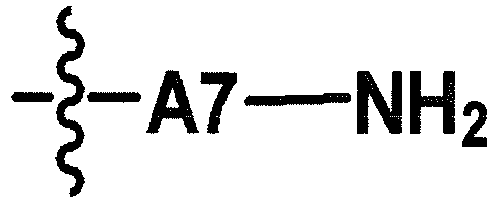
- R4 to R6 are each independently a substituent represented by the following Chemical Formula 9, and in Chemical Formula 9,
- A7 is an alkylene group having 2 to 10 carbon atoms.
- the polyalkyleneimine may include at least one of a compound represented by the following Chemical Formula 10 and a compound represented by the following Chemical Formula 11.
- X1, X2, Y1, Y2 and Y3 are each independently an alkylene group having 2 to 10 carbon atoms
- R is a substituent represented by any one of the following Chemical Formulae 3 to 5
- q is an integer of 1 to 1000
- n and m are each an integer of 1 to 5
- 1 is an integer of 1 to 200
- A1 to A3 are each independently an alkylene group having 2 to 10 carbon atoms
- R1 to R3 are each independently a substituent represented by any one of the following Chemical Formulae 6 to 8, in Chemical Formulae 6 to 8,
- A4 to A6 are each independently an alkylene group having 2 to 10 carbon atoms
- R4 to R6 are each independently a substituent represented by the following Chemical Formula 9, and in Chemical Formula 9, A7 is an alkylene group having 2 to 10 carbon atoms.
- the alkylene group may be linear or branched, and, although not particularly limited thereto, the number of carbon atoms is preferably from 2 to 10. Specific examples thereof may include an ethylene group, a propylene group, an isopropylene group, a butylene group, a t-butylene group, a pentylene group, a hexylene group, a heptylene group and the like, but are not limited thereto.
- the hydrogen ion exchange polymer includes a hydrogen ion exchange group represented by the following Chemical Formula 12. [Chemical Formula 12] -SO 3 - X
- X is a monovalent cation group.
- Protons are readily transferred to the metal nanoparticles bonding to the amine group on the polymer layer through the hydrogen ion exchange group, and therefore, a utilization rate of the metal nanoparticles may increase.
- the amine group on the polymer layer surface and the octahedron-structured metal nanoparticles bond to each other, and H + is transferred to the metal nanoparticles, an active metal site, through the hydrogen ion exchange group of the polymer layer present on the carbon carrier surface, and therefore, the metal nanoparticles are readily used.
- the hydrogen ion exchange polymer is not particularly limited as long as it includes the hydrogen ion exchange group represented by Chemical Formula 12, and those generally used in the art may be used.
- the hydrogen ion exchange polymer may be a hydrocarbon-based polymer, a partial fluorine-based polymer or a fluorine-based polymer.
- the hydrocarbon-based polymer may be a hydrocarbon-based sulfonated polymer without a fluorine group, and on the contrary, the fluorine-based polymer may be a sulfonated polymer saturated with a fluorine group, and the partial fluorine-based polymer may be a sulfonated polymer that is not saturated with a fluorine group.
- the hydrogen ion exchange polymer may be one, two or more polymers selected from the group consisting of a perfluorosulfonic acid-based polymer, a hydrocarbon-based polymer, an aromatic sulfone-based polymer, an aromatic ketone-based polymer, a polybenzimidazole-based polymer, a polystyrene-based polymer, a polyester-based polymer, a polyimide-based polymer, a polyvinylidene fluoride-based polymer, a polyethersulfone-based polymer, a polyphenylene sulfide-based polymer, a polyphenylene oxide-based polymer, a polyphosphazene-based polymer, a polyethylene naphthalate-based polymer, a polyester-based polymer, a doped polybenzimidazole-based polymer, a polyetherketone polymer, a polyphenylquinoxaline-based polymer, a polysulfone-based
- the polymer may be a single copolymer, an alternating copolymer, a random copolymer, a block copolymer, a multi-block copolymer or a graft copolymer, but is not limited thereto.
- Examples of the hydrogen ion exchange polymer may include at least one of Nafion, sulfonated polyetheretherketone (sPEEK) sulfonated (polyetherketone) (sPEK), poly(vinylidene fluoride)-graft-polystyrene sulfonic acid (PVDF-g-PSSA) and sulfonated poly(fluorenyl ether ketone).
- sPEEK sulfonated polyetheretherketone
- sPEK poly(vinylidene fluoride)-graft-polystyrene sulfonic acid
- PVDF-g-PSSA poly(fluorenyl ether ketone)
- amine group of the polyalkyleneimine and the hydrogen ion exchange group of the hydrogen ion exchange polymer may bond to form a sulfonamide bonding structure (-SO 2 -NH-) through a chemical reaction.
- the polymer layer may include a polymer crosslinked to each other through a crosslinking agent capable of each reacting with each of the amine group of the polyalkyleneimine and the hydrogen ion exchange group of the hydrogen ion exchange polymer.
- the crosslinking agent is not particularly limited as long as it is capable of crosslinking the amine group of the polyalkyleneimine and the hydrogen ion exchange group of the hydrogen ion exchange polymer, and examples thereof may include POCl 3 and the like.
- the polymer layer may include a polymer in which a sulfonamide bonding structure (-SO 2 -NH-) is formed by the hydrogen ion exchange group of the hydrogen ion exchange polymer (P1-SO 3 H) and the amine group of the polyalkyleneimine (P2-NH 2 ) being crosslinked to each other by POCl 3 , a crosslinking agent.
- a sulfonamide bonding structure (-SO 2 -NH-) is formed by the hydrogen ion exchange group of the hydrogen ion exchange polymer (P1-SO 3 H) and the amine group of the polyalkyleneimine (P2-NH 2 ) being crosslinked to each other by POCl 3 , a crosslinking agent.
- P1 is a hydrogen ion exchange polymer excluding -SO 3 H, the hydrogen ion exchange group, and P2 is polyalkyleneimine excluding -NH 2 in the amine group.
- the metal nanoparticles may bond to the amine group of the polymer layer, and specifically, may bond to the amine group of the polyalkyleneimine.
- the metal nanoparticles include a first metal and a second metal, the first metal and the second metal are different from each other, and the first metal and the second metal may have a molar ratio of 0.8:0.2 to 0.9:0.1.
- the first metal may include at least one of platinum (Pt), palladium (Pd), rhodium (Rh), iridium (Ir) and ruthenium (Ru), and is preferably formed with platinum.
- the second metal may include at least one of nickel (Ni), osmium (Os), cobalt (Co), iron (Fe) and copper (Cu), and preferably includes nickel.
- the metal nanoparticles may have an average particle diameter of greater than or equal to 2 nm and less than or equal to 20 nm, and specifically, greater than or equal to 3 nm and less than or equal to 10 nm.
- This has an advantage in that catalyst efficiency is high since the metal nanoparticles are well-dispersed on the carbon carrier without aggregation.
- the average particle diameter of the metal nanoparticles means an average of the length of the longest line among the lines connecting two points on the metal nanoparticle surface.
- the metal nanoparticles are octahedron structured particles having a (111) surface.
- Particles having an octahedron shape with a (111) surface has excellent activity for an oxygen reduction reaction.
- the octahedron structured particles having a (111) surface may be Pt x Ni 1-x particles.
- the metal nanoparticle content may be greater than or equal to 15% by weight and less than or equal to 50% by weight. Specifically, with respect to the total weight of the carrier-nanoparticle complex, the metal nanoparticle content may be greater than or equal to 20% by weight and less than or equal to 40% by weight.
- the present specification provides an electrochemical cell including the catalyst.
- the electrochemical cell means a battery using a chemical reaction, and the type is not particularly limited as long as it is provided with a polymer electrolyte membrane, and for example, the electrochemical cell may be a fuel cell, a metal secondary battery or a flow battery.
- the present specification provides an electrochemical cell module including the electrochemical cell as a unit cell.
- the electrochemical cell module may be formed by inserting a bipolar plate between the flow batteries according to one embodiment of the present application, and stacking the result.
- the cell module may specifically be used as a power source of electric vehicles, hybrid electric vehicles, plug-in hybrid electric vehicles or power storage systems.
- the present specification provides a membrane electrode assembly including an anode catalyst layer, a cathode catalyst layer and a polymer electrolyte membrane provided between the anode catalyst layer and the cathode catalyst layer, wherein the cathode catalyst layer includes the catalyst.
- the membrane electrode assembly may further include an anode gas diffusion layer provided on a surface opposite to the surface of the anode catalyst layer provided with the polymer electrolyte membrane, and a cathode gas diffusion layer provided on a surface opposite to the surface of the cathode catalyst layer provided with the polymer electrolyte membrane.
- the present specification provides a fuel cell including the membrane electrode assembly.
- FIG. 1 is a diagram schematically showing a principle of electricity generation of a fuel cell, and a most basic unit generating electricity in a fuel cell is a membrane electrode assembly (MEA), which is formed with an electrolyte membrane (M), and an anode (A) and a cathode (C) formed on both surfaces of this electrolyte membrane (M).
- MEA membrane electrode assembly
- F fuel
- an oxidation reaction of fuel (F) such as hydrogen, methanol or hydrocarbon such as butane occurs in an anode (A) to generate hydrogen ions (H + ) and electrons (e - )
- the hydrogen ions migrate to a cathode (C) through an electrolyte membrane (M).
- the hydrogen ions transferred through the electrolyte membrane (M), an oxidizer (O) such as oxygen, and electrons react to produce water (W). Through such a reaction, electrons migrate to an external circuit.
- FIG. 2 schematically illustrating a structure of a membrane electrode assembly for a fuel cell
- the membrane electrode assembly for a fuel cell may be provided with an electrolyte membrane (10), and a cathode (50) and an anode (51) placed opposite to each other with this electrolyte membrane (10) in between.
- the cathode may be provided with a cathode catalyst layer (20) and a cathode gas diffusion layer (40) consecutively from the electrolyte membrane (10), and the anode may be provided with an anode catalyst layer (21) and an anode gas diffusion layer (41) consecutively from the electrolyte membrane (10).
- the catalyst according to the present specification may be included in at least one of the cathode catalyst layer and the anode catalyst layer.
- FIG. 3 schematically illustrating a structure of a fuel cell, and the fuel cell is formed including a stack (60), an oxidizer supply unit (70) and a fuel supply unit (80).
- the stack (60) includes one, two or more of the membrane-electrode assemblies described above, and when two or more of the membrane-electrode assemblies are included, a separator provided therebetween is included.
- the separator prevents the membrane-electrode assemblies from being electrically connected, and performs a role of transferring fuel and oxidizer supplied from the outside to the membrane-electrode assemblies.
- the oxidizer supply unit (70) performs a role of supplying an oxidizer to the stack (60).
- oxygen is typically used, and oxygen or air may be injected to the oxidizer supply unit (70).
- the fuel supplying unit (80) performs a role of supplying fuel to the stack (60), and may be formed with a fuel tank (81) storing fuel, and a pump (82) supplying the fuel stored in the fuel tank (81) to the stack (60).
- a fuel tank (81) storing fuel
- a pump (82) supplying the fuel stored in the fuel tank (81) to the stack (60).
- the fuel hydrogen or hydrocarbon fuel in a gas or liquid state may be used.
- the hydrocarbon fuel may include methanol, ethanol, propanol, butanol or natural gas.
- the cathode catalyst layer may include the carrier-nanoparticle complex according to the present specification as a catalyst.
- the anode catalyst layer and the cathode catalyst layer may each include an ionomer.
- a ratio of the ionomer and the carrier-nanoparticle complex (ionomer/complex, I/C) of the cathode catalyst layer is from 0.3 to 0.7.
- the ionomer content required for the catalyst layer may be reduced by 20% by weight or greater, specifically may be reduced by 30% by weight or greater, and more specifically may be reduced by 50% by weight or greater when including the carrier-nanoparticle complex according to the present specification as a catalyst.
- the content of the expensive ionomer may be reduced, and hydrogen ion conductivity is maintained at a certain level or higher even with a low ionomer content.
- the ionomer performs a role of providing a passage for ions generated from the reaction between fuel such as hydrogen or methanol and a catalyst to migrate to the electrolyte membrane.
- polymers having a cation exchange group selected from the group consisting of a sulfonic acid group, a carboxylic acid group, a phosphoric acid group, a phosphonic acid group and derivatives thereof on the side chain may be used.
- the ionomer may include one or more types of hydrogen ion conductive polymers selected from among fluoro-based polymers, benzimidazole-based polymers, polyimide-based polymers, polyetherimide-based polymers, polyphenylene sulfide-based polymers, polysulfone-based polymers, polyethersulfone-based polymers, polyetherketone-based polymers, polyetheretherketone-based polymers or polyphenylquinoxaline-based polymers.
- the polymer ionomer may be Nafion.
- the present specification provides a method for preparing a catalyst for a fuel cell including forming a polymer layer having an amine group and a hydrogen ion exchange group represented by the following Chemical Formula 12 on a carbon carrier; preparing a reaction composition by adding the polymer layer-formed carbon carrier, a first metal precursor, a second metal precursor and a capping agent having a carboxyl group to a solvent, and, using the reaction composition, preparing a complex having metal nanoparticles formed on the polymer layer of the carbon carrier; and acid treating the complex.
- Chemical Formula 12 [Chemical Formula 12] -SO 3 - X
- X is a monovalent cation group.
- the method for preparing a catalyst for a fuel cell may cite the descriptions on the catalyst including a carrier-nanoparticle complex.
- the method for preparing a catalyst for a fuel cell includes forming a polymer layer having an amine group and a hydrogen ion exchange group represented by Chemical Formula 12 on a carbon carrier.
- the forming of a polymer layer may be forming a polymer layer by introducing a carbon carrier to a solution including polyalkyleneimine and a hydrogen ion exchange polymer, or a solution including a polymer derived from polyalkyleneimine having an amine group and a hydrogen ion exchange polymer having the hydrogen ion exchange group.
- the method for preparing a catalyst for a fuel cell may include preparing a first solution by adding a carbon carrier, polyalkyleneimine and a hydrogen ion exchange polymer to a solvent; and stirring the first solution.
- the first solution may further include a crosslinking agent.
- the crosslinking agent may have reacting groups that may react with each of the amine group of the polyalkyleneimine and the hydrogen ion exchange group of the hydrogen ion exchange polymer.
- the method for preparing a catalyst for a fuel cell may include preparing a solution by adding a carbon carrier, and a polymer derived from polyalkyleneimine and a hydrogen ion exchange polymer having the hydrogen ion exchange group to a solvent; and stirring the solution.
- the solvent of the solution is not particularly limited, but may include at least one of water, ethanol, 2-propanol and iso-propanol.
- the carbon carrier content may be greater than or equal to 14% by weight and less than or equal to 30% by weight.
- the polyalkyleneimine content may be greater than or equal to 65% by weight and less than or equal to 85% by weight.
- the hydrogen ion exchange polymer content may be greater than or equal to 0.1% by weight and less than or equal to 5% by weight.
- the crosslinking agent content may be greater than 0% by weight and less than or equal to 3% by weight based on the solid weight of the solution.
- the content of the carbon carrier may be greater than or equal to 14% by weight and less than or equal to 30% by weight, and the content of the polymer derived from polyalkyleneimine and a hydrogen ion exchange polymer having the hydrogen ion exchange group may be greater than or equal to 70% by weight and less than or equal to 86% by weight, based on the solid weight of the solution.
- the total solid content of the solution excluding the solvent may be greater than or equal to 0.3% by weight and less than or equal to 20% by weight, and based on the total weight of the solution, the solvent content may be greater than or equal to 80% by weight and less than or equal to 99.7% by weight.
- the time of stirring the solution may be longer than or equal to 3 hours and shorter than or equal to 72 hours.
- the method for preparing a catalyst for a fuel cell includes preparing a reaction composition by adding the polymer layer-formed carbon carrier, a first metal precursor, a second metal precursor and a capping agent having a carboxyl group to a solvent, and, using the reaction composition, preparing a complex having metal nanoparticles formed on the polymer layer of the carbon carrier.
- the preparing of a complex having metal nanoparticles formed on the polymer layer of the carbon carrier may include preparing a reaction composition by adding the polymer layer-formed carbon carrier, a first metal precursor, a second metal precursor and a capping agent having a carboxyl group to a solvent; and, using the reaction composition, preparing a complex having metal nanoparticles formed on the polymer layer of the carbon carrier.
- the preparing of a complex having metal nanoparticles formed on the polymer layer of the carbon carrier may include dissolving the first metal precursor and the second metal precursor by heating the reaction composition to a temperature of 120°C or lower; reacting the result by raising the temperature to 200°C to 230°C; cooling the result to room temperature; and filtering the reaction composition completed with the reaction to obtain a complex having metal nanoparticles formed on the polymer layer of the carbon carrier.
- the preparing of a reaction composition may include dispersing the carbon carrier into a solvent by adding the polymer layer-formed carbon carrier to the solvent; and preparing a reaction composition by adding a first metal precursor, a second metal precursor and a capping agent having a carboxyl group thereto.
- the capping agent having a carboxyl group may include citric acid or a mixture of citric acid and sodium formate.
- the capping agent having a carboxyl group provides help in enhancing uniformity of metal particle sizes, and forming an octahedron structure. Specifically, adding citric acid provides help with metal precursor dissolution as the pH of the reaction composition changes to an acidic condition, and as a result, particle size uniformity and the degree of dispersion may be enhanced.
- the content of the capping agent having a carboxyl group may be greater than or equal to 0.1% by weight and less than or equal to 2% by weight.
- the content of the polymer layer-formed carbon carrier may be greater than or equal to 0.1% by weight and less than or equal to 3% by weight.
- the metal precursor is a material before being reduced to metal nanoparticles, and is formed with metal ions and ligands.
- the metal precursor is divided depending on the types of the metal ion and the ligand.
- the ligand of the first metal precursor may be at least one of acetylacetonate and acetate, and specifically, may be acetylacetonate.
- the first metal precursor may include at least one of platinum(II) acetylacetonate (Pt(acac) 2 ), palladium acetylacetonate (Pd(acac) 2 ), palladium acetate (Pd(OAc) 2 ), rhodium acetylacetonate (Rh(acac) 2 ), iridium acetylacetonate (Ir(acac) 2 ) and ruthenium acetylacetonate (Ru(acac) 2 ).
- the first metal precursor preferably includes platinum acetylacetonate.
- the ligand of the second metal precursor may include at least one of acetylacetonate, formate dihydrate, acetate tetrahydrate, formate hydrate, acetate and formate, and specifically, may be acetylacetonate.
- the second metal precursor may include one of nickel(II) acetylacetonate, nickel(II) formate dihydrate, nickel(II) acetate tetrahydrate, copper(II) acetylacetonate, copper(II) formate hydrate, copper(II) acetate, cobalt(II) acetylacetonate, cobalt(II) acetate tetrahydrate, cobalt(II) formate, iron(II) acetylacetonate and iron(II) acetate.
- the second metal precursor preferably includes nickel acetylacetonate.
- the total content of the first metal precursor may be greater than or equal to 0.1% by weight and less than or equal to 4% by weight.
- the total content of the second metal precursor may be greater than or equal to 0.03% by weight and less than or equal to 12% by weight.
- the solvent content may be greater than or equal to 87% by weight and less than or equal to 99% by weight.
- the pH of the reaction composition may be 4 or less, and specifically, higher than or equal to 1 and lower than or equal to 4.
- Pt(acac) 2 is not soluble in polar solvents but is soluble under a diluted acidic condition, and the reaction composition having an acidic pH provides help with precursor dissolution and has an advantage of increasing particle size uniformity when forming particles.
- the solvent of the reaction composition may include polyalcohol having two or more hydroxyl groups.
- the polyalcohol is not particularly limited as long as it has two or more hydroxyl groups, but may include at least one of ethylene glycol, diethylene glycol and propylene glycol.
- the reaction composition does not include a surfactant. This has an advantage in that a step of removing a surfactant after synthesizing a catalyst is not required, and there are no active site decreases caused by a surfactant.
- the method for preparing a catalyst for a fuel cell includes acid treating the complex having metal nanoparticles formed on the polymer layer of the carbon carrier.
- the concentration of the acid treatment solution of the acid treatment may be 2 M or less, and specifically, the acid concentration may be greater than or equal to 0.5 M and less than or equal to 2 M.
- the acid treatment time of the acid treatment may be longer or equal to 1 hour and shorter than or equal to 5 hours.
- the acid treatment temperature of the acid treatment may be higher than or equal to 50°C and lower than or equal to 90°C.
- the acid used in the acid treatment may be at least one of sulfuric acid, nitric acid, hydrochloric acid and mixtures thereof, and sulfuric acid may be used as the acid used in the acid treatment.
- Ni-Pt particles When Ni-Pt particles are formed on the polymer layer of the carbon carrier, some of the Ni present on the Ni-Pt particle surfaces may be removed through the acid treatment.
- the method for preparing a catalyst for a fuel cell may further include, after the forming of metal nanoparticles on the polymer layer of the carbon carrier and before the acid treatment, washing the complex having metal nanoparticles formed on the polymer layer of the carbon carrier and removing the solvent.
- the solvent is removed and then the metal nanoparticles provided on the polymer layer of the carbon carrier may be sintered.
- the removing of the solvent may be heat treatment under hydrogen or argon atmosphere.
- the heat treatment temperature may be higher than or equal to 200°C and lower than or equal to 300°C.
- the solvent may not be completely removed at lower than 200°C, and the octahedron structure shape may be deformed at higher than 300°C.
- an octahedron structured PtNi particles may be synthesized using a surfactant, or dimethyl formamide (DMF) or CO gas (stated in Chunhua Cui, Lin Gan, Hui-Hui Li, Shu-Hong Yu, Marc Heggen, Peter Strasser Nano Lett. 12, 58855889 (2012 )).
- a surfactant or dimethyl formamide (DMF) or CO gas (stated in Chunhua Cui, Lin Gan, Hui-Hui Li, Shu-Hong Yu, Marc Heggen, Peter Strasser Nano Lett. 12, 58855889 (2012 )).
- DMF dimethyl formamide
- CO gas stated in Chunhua Cui, Lin Gan, Hui-Hui Li, Shu-Hong Yu, Marc Heggen, Peter Strasser Nano Lett. 12, 58855889 (2012 )
- DMF and CO gas are toxic materials and have limits in mass production for commercializing a catalyst.
- a platinum-nickel alloy catalyst having a specific surface may be synthesized, and this catalyst exhibits equal or higher performance with half (1/2) of platinum compared to existing commercialized platinum catalysts by enhancing high dispersion support of particles and a hydrogen transfer section of a membrane electrode assembly due to an effect of the functional group that the carrier has while maximizing activity for an oxygen reduction reaction for the specific surface, and have completed the present disclosure.
- the method of the present specification has an advantage in that a catalyst having octahedron structured metal particles including a (111) surface may be synthesized without using a surfactant, dimethyl formamide (DMF) or CO gas.
- a surfactant dimethyl formamide (DMF) or CO gas.
- the present disclosure is directed to proving a method for preparing a carrier-octahedron structured platinum-nickel alloy nanoparticle complex.
- the present disclosure is also directed to providing a carrier-octahedron structured platinum-nickel alloy nanoparticle complex prepared using the method for preparing a carrier-octahedron structured platinum-nickel alloy nanoparticle complex.
- the present disclosure is also directed to providing a catalyst for a fuel cell cathode including the carrier-octahedron structured platinum-nickel alloy nanoparticle complex.
- the temperature was raised to 120°C under vacuum, and the result was heated for 30 minutes, and after the temperature was raised to 200°C under nitrogen atmosphere, the result was heated for 2 hours and 30 minutes.
- octahedron structured metal particles were formed during a synthesis process of raising the temperature from 120°C to 200°C and heating.
- the result was cooled to room temperature, and then filtered using ethanol and distilled water.
- the filtered octahedron structured PtNi-carbon complex was dried in an oven, and placed in a 0.5 M sulfuric acid solution.
- the result was heated for 2 hours at 80°C, then cooled to room temperature, and filtered with sufficient distilled water to prepare a catalyst.
- the temperature was raised to 120°C under vacuum, and the result was heated for 30 minutes, and after the temperature was raised to 200°C under nitrogen atmosphere, the result was heated for 2 hours and 30 minutes.
- octahedron structured metal particles were formed during a synthesis process of raising the temperature from 120°C to 200°C and heating.
- the result was cooled to room temperature, and then filtered using ethanol and distilled water.
- the filtered octahedron structured PtNi-carbon complex was dried in an oven, and placed in a 0.5 M sulfuric acid solution.
- the result was heated for 2 hours at 80°C, then cooled to room temperature, and filtered with sufficient distilled water to prepare a catalyst.
- a catalyst was prepared in the same manner as in Example 2 except that carbon coated only with polyallylamine hydrochloride (PAH) was used instead of the carbon coated with PEI and nafion of Preparation Example 1.
- the catalyst is a PtNi-carbon complex having an octahedron structure on a carbon carrier coated only with PAH.
- a catalyst was prepared in the same manner as in Example 1 except that the acid treatment process was not performed.
- the prepared catalysts had metal particles having an octahedron structure, however, the platinum content and the nickel content in the metal particles were different as in the ICP-OES analysis results of the following Table 1.
- Table 1 Content [wt%] Molar Ratio Pt Ni Pt Ni Comparative Example 3 26.3 5.68 0.58 0.42
- Example 1 29.9 1.55 0.85 0.15
- a catalyst was prepared in the same manner as in Example 1 except that a carbon carrier without a polymer layer was used.
- the catalyst is a PtNi-carbon complex having an octahedron structure on a carbon carrier.
- the temperature was raised to 120°C under vacuum, and the result was heated for 30 minutes, and after the temperature was raised to 220°C under nitrogen atmosphere, the result was heated for 2 hours and 30 minutes.
- octahedron structured metal particles were formed during a synthesis process of raising the temperature from 120°C to 200°C and heating.
- the result was cooled to room temperature, and then filtered using ethanol and distilled water.
- the filtered octahedron structured PtNi-carbon complex was dried in an oven to prepare a catalyst.
- the catalyst is a catalyst having platinum particles having an octahedron structure on a carbon carrier without a polymer layer.
- a catalyst was prepared in the same manner as in Test Example 1-1 except that citric acid was not added.
- FIG. 9 shows transmission electron microscopy (TEM) images for the catalyst of Test Example 1-1 (left) and the catalyst of Test Example 1-2 (right). Herein, it was identified through the TEM image of FIG. 9 that the metal particles in the prepared catalyst did not have an octahedron structure.
- a catalyst was prepared in the same manner as in Test Example 1-1 except that the platinum precursor type was used as in FIG. 10 .
- FIG. 10 it was identified that octahedron structured alloy nanoparticles were formed when using Pt(acac) 2 .
- a precursor ligand was capable of providing help in controlling an octahedron structure shape.
- Example 1 For the catalyst prepared in Example 1, the image taken by high-resolution transmission electron microscopy (HRTEM) (left) and the image taken by high-angle annular dark-field scanning transmission electron microscopy (HADDF-STEM) (right) are shown in FIG. 5 .
- HRTEM high-resolution transmission electron microscopy
- HADDF-STEM high-angle annular dark-field scanning transmission electron microscopy
- the catalyst was a catalyst having particles having an octahedron structure shape.
- the reduction electrode loading amount was as follows.
Landscapes
- Chemical & Material Sciences (AREA)
- Engineering & Computer Science (AREA)
- Chemical Kinetics & Catalysis (AREA)
- Materials Engineering (AREA)
- Electrochemistry (AREA)
- General Chemical & Material Sciences (AREA)
- Organic Chemistry (AREA)
- Sustainable Energy (AREA)
- Sustainable Development (AREA)
- Manufacturing & Machinery (AREA)
- Life Sciences & Earth Sciences (AREA)
- Inorganic Chemistry (AREA)
- Inert Electrodes (AREA)
- Catalysts (AREA)
- Fuel Cell (AREA)
Abstract
Description
- The present disclosure claims priority to and the benefits of Korean Patent Application No.
10-2016-0155102 - The present specification relates to a catalyst including a carrier-nanoparticle complex, an electrochemical cell or a fuel cell including the catalyst, and a method for preparing the same.
- A polymer electrolyte membrane fuel cell (PEMFC) is a most promising alternative energy source due to its high energy density, low operating temperature, and environmental-friendly products. As a fuel cell catalyst, platinum (Pt) is known to be most superior, however, high price and instability of platinum are factors inhibiting PEMFC commercialization. Moreover, a slow oxygen reduction reaction in a cathode reduces fuel cell efficiency.
- In view of the above, studies on preparing an alloy catalyst made of platinum and inexpensive transition metals, and increasing activity for an oxygen reduction reaction by controlling the catalyst active surface through controlling the shape have been ongoing.
- A colloidal synthesis method most commonly used in the art synthesizing such catalysts has an advantage in readily controlling catalyst particle sizes and shapes, but has a disadvantage in that activity decreases by catalyst reaction sites being blocked due to a surfactant adsorbed on the particle surface, and electron migration between a catalyst and a support is difficult.
- A one-pot synthesis method introducing a metal precursor and a carrier at once to synthesize a catalyst has been much reported to compensate this problem. A one-pot synthesis method is simpler than the above-mentioned method progressed in two steps, and catalysts synthesized using the one-pot synthesis method are known to have an increased surface area of particles capable of participating in the reaction since there are no surfactants adsorbed on the surface. However, there is a disadvantage in that particle shapes are difficult to control.
- Accordingly, studies on preparation methods more readily controlling particle shapes without a surfactant have been required.
- The present specification is directed to providing a catalyst including a carrier-nanoparticle complex, an electrochemical cell or a fuel cell including the catalyst, and a method for preparing the same.
- One embodiment of the present specification provides a method for preparing a catalyst for a fuel cell including forming a polymer layer having an amine group and a hydrogen ion exchange group represented by the following Chemical Formula 12 on a carbon carrier; preparing a reaction composition by adding the polymer layer-formed carbon carrier, a first metal precursor, a second metal precursor and a capping agent having a carboxyl group to a solvent, and, using the reaction composition, preparing a carrier-nanoparticle complex having metal nanoparticles formed on the polymer layer of the carbon carrier; and acid treating the complex.
[Chemical Formula 12] -SO3 -X
- In Chemical Formula 12, X is a monovalent cation group.
- Another embodiment of the present specification provides a catalyst for a fuel cell including a carrier-nanoparticle complex comprising a carbon carrier; a polymer layer provided on a surface of the carbon carrier and having an amine group and a hydrogen ion exchange group represented by the following Chemical Formula 12; and metal nanoparticles provided on the polymer layer and having an octahedron structure, wherein the metal nanoparticles includes a first metal and a second metal, the first metal and the second metal are different from each other, and a molar ratio of the first metal and the second metal is from 0.8:0.2 to 0.9:0.1.
[Chemical Formula 12] -SO3 -X
- In Chemical Formula 12, X is a monovalent cation group.
- Still another embodiment of the present specification provides a membrane electrode assembly including an anode catalyst layer, a cathode catalyst layer, and a polymer electrolyte membrane provided between the anode catalyst layer and the cathode catalyst layer, wherein the cathode catalyst layer includes the catalyst.
- Yet another embodiment of the present specification provides a fuel cell including the membrane electrode assembly.
- A catalyst prepared according to a method for preparing a carrier-octahedron structured metal nanoparticle complex according to one embodiment of the present specification has an advantage of being suitable as a catalyst for a fuel cell reduction electrode with a (111) surface having high activity for an oxygen reduction reaction.
- A catalyst prepared according to a method for preparing a carrier-octahedron structured metal nanoparticle complex according to one embodiment of the present specification increases a degree of dispersion of alloy particles by an amine group and a hydrogen transfer ion layer treated on a carrier, and therefore, is capable of increasing a catalyst utilization rate of an electrode layer when driving a fuel cell.
- A catalyst prepared according to a method for preparing a carrier-octahedron structured metal nanoparticle complex according to one embodiment of the present specification increases a degree of dispersion of alloy particles by an amine group and a hydrogen transfer ion layer treated on a carrier, and therefore, is effective in enhancing fuel cell performance through lowering hydrogen transfer resistance by the hydrogen transfer ion layer.
- A method for preparing a carrier-nanoparticle complex according to one embodiment of the present specification synthesizes a complex in a one-pot synthesis without toxic materials such as DMF or CO gas, and is effective in synthesizing a complex having uniform distribution while controlling a shape through an environmental-friendly and simple process.
-
-
FIG. 1 is a schematic diagram showing a principle of electricity generation of a fuel cell. -
FIG. 2 is a diagram schematically illustrating a structure of a membrane electrode assembly for a fuel cell. -
FIG. 3 is a diagram schematically illustrating one example of a fuel cell. -
FIG. 4 is a mimetic diagram of a reaction on a surface of a carrier-nanoparticle complex in one embodiment of the present specification. -
FIG. 5 shows an image photographed using high-resolution transmission electron microscopy (HRTEM) (left) and a high-angle annular dark-field scanning transmission electron microscopy (HADDF-STEM) image (right) for a catalyst prepared in Example 1. -
FIG. 6 shows transmission electron microscopy (TEM) images for a catalyst of Comparative Example 4 (left picture) and a catalyst of Example 1 (right picture). -
FIG. 7 andFIG. 8 are results evaluating performance of PEMFC single cells using each of catalysts of Examples 1 and 2 and Comparative Examples 1 to 3. -
FIG. 9 shows transmission electron microscopy (TEM) images observing particle shapes depending on the presence of a capping agent having a carboxyl group of Test Example 1. -
FIG. 10 shows transmission electron microscopy (TEM) images observing particle shapes depending on platinum precursor types of Test Example 2-1. -
FIG. 11 shows transmission electron microscopy (TEM) images observing particle shapes depending on nickel precursor types of Test Example 2-2. -
- 10: Electrolyte Membrane
- 20, 21: Catalyst Layer
- 40, 41: Gas Diffusion Layer
- 50: Cathode
- 51: Anode
- 60: Stack
- 70: Oxidizer Supply Unit
- 80: Fuel Supply Unit
- 81: Fuel Tank
- 82: Pump
- Hereinafter, the present specification will be described in detail.
- The present specification provides a catalyst for a fuel cell including a carrier-nanoparticle complex comprising a carbon carrier; a polymer layer provided on a surface of the carbon carrier and having an amine group and a hydrogen ion exchange group represented by the following Chemical Formula 12; and metal nanoparticles provided on the polymer layer and having an octahedron structure.
[Chemical Formula 12] -SO3 -X
- In Chemical Formula 12, X is a monovalent cation group.
- The carbon carrier may include one or more types selected from the group consisting of carbon black, carbon nanotubes (CNT), graphite, graphene, active carbon, mesoporous carbon, carbon fiber and carbon nano wire.
- The polymer layer may be provided on a part or the whole of the carbon carrier surface. The polymer layer may be provided on greater than or equal to 50% and less than or equal to 100% of the carbon carrier surface, and specifically, the polymer layer may be provided on greater than or equal to 75% and less than or equal to 100%.
- Based on the total elements on the polymer layer surface, the content of the nitrogen element of the amine group may be greater than or equal to 0.01% by weight and less than or equal to 5% by weight, and the content of the sulfur element of the hydrogen ion exchange group of Chemical Formula 12 may be greater than or equal to 0.01% by weight and less than or equal to 1% by weight. When the sulfur element content is greater than 1% by weight, the carrier surface becomes too hydrophilic causing an adverse effect in water discharge in a cell.
- The polymer layer may either include polyalkyleneimine having an amine group and a hydrogen ion exchange polymer having the hydrogen ion exchange group, or include a polymer derived from polyalkyleneimine having an amine group and a hydrogen ion exchange polymer having the hydrogen ion exchange group.
- The polyalkyleneimine (PEI) and the hydrogen ion exchange polymer (ionomer) may have a weight ratio (PEI/ionomer) of greater than or equal to 15 and less than or equal to 100.
- The polyalkyleneimine may be a polymer having an aliphatic hydrocarbon main chain and including at least 10 or more amine groups in the main chain and the side chain. The amine group herein includes a primary amine group, a secondary amine group, a tertiary amine group and a quaternary amine group, and the amine group included in the main chain and the side chain of the polyalkyleneimine may have 10 or more of at least one of a primary amine group, a secondary amine group, a tertiary amine group and a quaternary amine group.
- The polyalkyleneimine may have a weight average molecular weight of greater than or equal to 500 and less than or equal to 1,000,000.
- The polyalkyleneimine may include at least one of a repeating unit represented by the following
Chemical Formula 1 and a repeating unit represented by the followingChemical Formula 2.


- In
Chemical Formulae Chemical Formulae 3 to 5, and o and p are each an integer of 1 to 1000,


Chemical Formulae 3 to 5, A1 to A3 are each independently an alkylene group having 2 to 10 carbon atoms, and R1 to R3 are each independently a substituent represented by any one the following Chemical Formulae 6 to 8,


- The polyalkyleneimine may include at least one of a compound represented by the following
Chemical Formula 10 and a compound represented by the following Chemical Formula 11.

- In
Chemical Formulae 10 and 11, X1, X2, Y1, Y2 and Y3 are each independently an alkylene group having 2 to 10 carbon atoms, R is a substituent represented by any one of the followingChemical Formulae 3 to 5, q is an integer of 1 to 1000, n and m are each an integer of 1 to 5, and 1 is an integer of 1 to 200,


Chemical Formulae 3 to 5, A1 to A3 are each independently an alkylene group having 2 to 10 carbon atoms, and R1 to R3 are each independently a substituent represented by any one of the following Chemical Formulae 6 to 8,


- In the present specification,

- In the present specification, the alkylene group may be linear or branched, and, although not particularly limited thereto, the number of carbon atoms is preferably from 2 to 10. Specific examples thereof may include an ethylene group, a propylene group, an isopropylene group, a butylene group, a t-butylene group, a pentylene group, a hexylene group, a heptylene group and the like, but are not limited thereto.
- The hydrogen ion exchange polymer includes a hydrogen ion exchange group represented by the following Chemical Formula 12.
[Chemical Formula 12] -SO3 -X
- In Chemical Formula 12, X is a monovalent cation group.
- Protons are readily transferred to the metal nanoparticles bonding to the amine group on the polymer layer through the hydrogen ion exchange group, and therefore, a utilization rate of the metal nanoparticles may increase.
- As shown in
FIG. 4 , the amine group on the polymer layer surface and the octahedron-structured metal nanoparticles bond to each other, and H+ is transferred to the metal nanoparticles, an active metal site, through the hydrogen ion exchange group of the polymer layer present on the carbon carrier surface, and therefore, the metal nanoparticles are readily used. - The hydrogen ion exchange polymer is not particularly limited as long as it includes the hydrogen ion exchange group represented by Chemical Formula 12, and those generally used in the art may be used.
- The hydrogen ion exchange polymer may be a hydrocarbon-based polymer, a partial fluorine-based polymer or a fluorine-based polymer. The hydrocarbon-based polymer may be a hydrocarbon-based sulfonated polymer without a fluorine group, and on the contrary, the fluorine-based polymer may be a sulfonated polymer saturated with a fluorine group, and the partial fluorine-based polymer may be a sulfonated polymer that is not saturated with a fluorine group.
- The hydrogen ion exchange polymer may be one, two or more polymers selected from the group consisting of a perfluorosulfonic acid-based polymer, a hydrocarbon-based polymer, an aromatic sulfone-based polymer, an aromatic ketone-based polymer, a polybenzimidazole-based polymer, a polystyrene-based polymer, a polyester-based polymer, a polyimide-based polymer, a polyvinylidene fluoride-based polymer, a polyethersulfone-based polymer, a polyphenylene sulfide-based polymer, a polyphenylene oxide-based polymer, a polyphosphazene-based polymer, a polyethylene naphthalate-based polymer, a polyester-based polymer, a doped polybenzimidazole-based polymer, a polyetherketone polymer, a polyphenylquinoxaline-based polymer, a polysulfone-based polymer, a polypyrrole-based polymer and a polyaniline-based polymer. The polymer may be a single copolymer, an alternating copolymer, a random copolymer, a block copolymer, a multi-block copolymer or a graft copolymer, but is not limited thereto.
- Examples of the hydrogen ion exchange polymer may include at least one of Nafion, sulfonated polyetheretherketone (sPEEK) sulfonated (polyetherketone) (sPEK), poly(vinylidene fluoride)-graft-polystyrene sulfonic acid (PVDF-g-PSSA) and sulfonated poly(fluorenyl ether ketone).
- When the amine group of the polyalkyleneimine and the hydrogen ion exchange group of the hydrogen ion exchange polymer are adjacent to each other, they may bond to form a sulfonamide bonding structure (-SO2-NH-) through a chemical reaction.
- The polymer layer may include a polymer crosslinked to each other through a crosslinking agent capable of each reacting with each of the amine group of the polyalkyleneimine and the hydrogen ion exchange group of the hydrogen ion exchange polymer.
- The crosslinking agent is not particularly limited as long as it is capable of crosslinking the amine group of the polyalkyleneimine and the hydrogen ion exchange group of the hydrogen ion exchange polymer, and examples thereof may include POCl3 and the like.
- As in the following
Reaction Formula 1, the polymer layer may include a polymer in which a sulfonamide bonding structure (-SO2-NH-) is formed by the hydrogen ion exchange group of the hydrogen ion exchange polymer (P1-SO3H) and the amine group of the polyalkyleneimine (P2-NH2) being crosslinked to each other by POCl3, a crosslinking agent.
- In the reaction formula, P1 is a hydrogen ion exchange polymer excluding -SO3H, the hydrogen ion exchange group, and P2 is polyalkyleneimine excluding -NH2 in the amine group.
- The metal nanoparticles may bond to the amine group of the polymer layer, and specifically, may bond to the amine group of the polyalkyleneimine.
- The metal nanoparticles include a first metal and a second metal, the first metal and the second metal are different from each other, and the first metal and the second metal may have a molar ratio of 0.8:0.2 to 0.9:0.1.
- The first metal may include at least one of platinum (Pt), palladium (Pd), rhodium (Rh), iridium (Ir) and ruthenium (Ru), and is preferably formed with platinum.
- The second metal may include at least one of nickel (Ni), osmium (Os), cobalt (Co), iron (Fe) and copper (Cu), and preferably includes nickel.
- The metal nanoparticles may have an average particle diameter of greater than or equal to 2 nm and less than or equal to 20 nm, and specifically, greater than or equal to 3 nm and less than or equal to 10 nm. This has an advantage in that catalyst efficiency is high since the metal nanoparticles are well-dispersed on the carbon carrier without aggregation. Herein, the average particle diameter of the metal nanoparticles means an average of the length of the longest line among the lines connecting two points on the metal nanoparticle surface.
- The metal nanoparticles are octahedron structured particles having a (111) surface. Particles having an octahedron shape with a (111) surface has excellent activity for an oxygen reduction reaction. Specifically, the octahedron structured particles having a (111) surface may be PtxNi1-x particles.
- With respect to the total weight of the carrier-nanoparticle complex, the metal nanoparticle content may be greater than or equal to 15% by weight and less than or equal to 50% by weight. Specifically, with respect to the total weight of the carrier-nanoparticle complex, the metal nanoparticle content may be greater than or equal to 20% by weight and less than or equal to 40% by weight.
- The present specification provides an electrochemical cell including the catalyst.
- The electrochemical cell means a battery using a chemical reaction, and the type is not particularly limited as long as it is provided with a polymer electrolyte membrane, and for example, the electrochemical cell may be a fuel cell, a metal secondary battery or a flow battery.
- The present specification provides an electrochemical cell module including the electrochemical cell as a unit cell.
- The electrochemical cell module may be formed by inserting a bipolar plate between the flow batteries according to one embodiment of the present application, and stacking the result.
- The cell module may specifically be used as a power source of electric vehicles, hybrid electric vehicles, plug-in hybrid electric vehicles or power storage systems.
- The present specification provides a membrane electrode assembly including an anode catalyst layer, a cathode catalyst layer and a polymer electrolyte membrane provided between the anode catalyst layer and the cathode catalyst layer, wherein the cathode catalyst layer includes the catalyst.
- The membrane electrode assembly may further include an anode gas diffusion layer provided on a surface opposite to the surface of the anode catalyst layer provided with the polymer electrolyte membrane, and a cathode gas diffusion layer provided on a surface opposite to the surface of the cathode catalyst layer provided with the polymer electrolyte membrane.
- The present specification provides a fuel cell including the membrane electrode assembly.
-
FIG. 1 is a diagram schematically showing a principle of electricity generation of a fuel cell, and a most basic unit generating electricity in a fuel cell is a membrane electrode assembly (MEA), which is formed with an electrolyte membrane (M), and an anode (A) and a cathode (C) formed on both surfaces of this electrolyte membrane (M). When referring toFIG. 1 showing a principle of electricity generation of a fuel cell, an oxidation reaction of fuel (F) such as hydrogen, methanol or hydrocarbon such as butane occurs in an anode (A) to generate hydrogen ions (H+) and electrons (e-), and the hydrogen ions migrate to a cathode (C) through an electrolyte membrane (M). In the cathode (C), the hydrogen ions transferred through the electrolyte membrane (M), an oxidizer (O) such as oxygen, and electrons react to produce water (W). Through such a reaction, electrons migrate to an external circuit. -
FIG. 2 schematically illustrating a structure of a membrane electrode assembly for a fuel cell, and the membrane electrode assembly for a fuel cell may be provided with an electrolyte membrane (10), and a cathode (50) and an anode (51) placed opposite to each other with this electrolyte membrane (10) in between. The cathode may be provided with a cathode catalyst layer (20) and a cathode gas diffusion layer (40) consecutively from the electrolyte membrane (10), and the anode may be provided with an anode catalyst layer (21) and an anode gas diffusion layer (41) consecutively from the electrolyte membrane (10). - In the membrane electrode assembly, the catalyst according to the present specification may be included in at least one of the cathode catalyst layer and the anode catalyst layer.
-
FIG. 3 schematically illustrating a structure of a fuel cell, and the fuel cell is formed including a stack (60), an oxidizer supply unit (70) and a fuel supply unit (80). - The stack (60) includes one, two or more of the membrane-electrode assemblies described above, and when two or more of the membrane-electrode assemblies are included, a separator provided therebetween is included. The separator prevents the membrane-electrode assemblies from being electrically connected, and performs a role of transferring fuel and oxidizer supplied from the outside to the membrane-electrode assemblies.
- The oxidizer supply unit (70) performs a role of supplying an oxidizer to the stack (60). As the oxidizer, oxygen is typically used, and oxygen or air may be injected to the oxidizer supply unit (70).
- The fuel supplying unit (80) performs a role of supplying fuel to the stack (60), and may be formed with a fuel tank (81) storing fuel, and a pump (82) supplying the fuel stored in the fuel tank (81) to the stack (60). As the fuel, hydrogen or hydrocarbon fuel in a gas or liquid state may be used. Examples of the hydrocarbon fuel may include methanol, ethanol, propanol, butanol or natural gas.
- The cathode catalyst layer may include the carrier-nanoparticle complex according to the present specification as a catalyst.
- The anode catalyst layer and the cathode catalyst layer may each include an ionomer.
- When the cathode catalyst layer includes the carrier-nanoparticle complex, a ratio of the ionomer and the carrier-nanoparticle complex (ionomer/complex, I/C) of the cathode catalyst layer is from 0.3 to 0.7.
- Considering that a general I/C ratio used in commercial catalysts is from 0.8 to 1 (stated in a book "PEM fuel cell Electrocatalyst and catalyst layer", page 895), the ionomer content required for the catalyst layer may be reduced by 20% by weight or greater, specifically may be reduced by 30% by weight or greater, and more specifically may be reduced by 50% by weight or greater when including the carrier-nanoparticle complex according to the present specification as a catalyst. In other words, there is an advantage in that the content of the expensive ionomer may be reduced, and hydrogen ion conductivity is maintained at a certain level or higher even with a low ionomer content.
- The ionomer performs a role of providing a passage for ions generated from the reaction between fuel such as hydrogen or methanol and a catalyst to migrate to the electrolyte membrane.
- As the ionomer, polymers having a cation exchange group selected from the group consisting of a sulfonic acid group, a carboxylic acid group, a phosphoric acid group, a phosphonic acid group and derivatives thereof on the side chain may be used. Specifically, the ionomer may include one or more types of hydrogen ion conductive polymers selected from among fluoro-based polymers, benzimidazole-based polymers, polyimide-based polymers, polyetherimide-based polymers, polyphenylene sulfide-based polymers, polysulfone-based polymers, polyethersulfone-based polymers, polyetherketone-based polymers, polyetheretherketone-based polymers or polyphenylquinoxaline-based polymers. Specifically, according to one embodiment of the present specification, the polymer ionomer may be Nafion.
- The present specification provides a method for preparing a catalyst for a fuel cell including forming a polymer layer having an amine group and a hydrogen ion exchange group represented by the following Chemical Formula 12 on a carbon carrier; preparing a reaction composition by adding the polymer layer-formed carbon carrier, a first metal precursor, a second metal precursor and a capping agent having a carboxyl group to a solvent, and, using the reaction composition, preparing a complex having metal nanoparticles formed on the polymer layer of the carbon carrier; and acid treating the complex.
[Chemical Formula 12] -SO3 -X
- In Chemical Formula 12, X is a monovalent cation group.
- The method for preparing a catalyst for a fuel cell may cite the descriptions on the catalyst including a carrier-nanoparticle complex.
- The method for preparing a catalyst for a fuel cell includes forming a polymer layer having an amine group and a hydrogen ion exchange group represented by Chemical Formula 12 on a carbon carrier.
- The forming of a polymer layer may be forming a polymer layer by introducing a carbon carrier to a solution including polyalkyleneimine and a hydrogen ion exchange polymer, or a solution including a polymer derived from polyalkyleneimine having an amine group and a hydrogen ion exchange polymer having the hydrogen ion exchange group.
- The method for preparing a catalyst for a fuel cell may include preparing a first solution by adding a carbon carrier, polyalkyleneimine and a hydrogen ion exchange polymer to a solvent; and stirring the first solution.
- The first solution may further include a crosslinking agent. The crosslinking agent may have reacting groups that may react with each of the amine group of the polyalkyleneimine and the hydrogen ion exchange group of the hydrogen ion exchange polymer.
- The method for preparing a catalyst for a fuel cell may include preparing a solution by adding a carbon carrier, and a polymer derived from polyalkyleneimine and a hydrogen ion exchange polymer having the hydrogen ion exchange group to a solvent; and stirring the solution.
- The solvent of the solution is not particularly limited, but may include at least one of water, ethanol, 2-propanol and iso-propanol.
- Based on the solid weight of the solution, the carbon carrier content may be greater than or equal to 14% by weight and less than or equal to 30% by weight.
- Based on the solid weight of the solution, the polyalkyleneimine content may be greater than or equal to 65% by weight and less than or equal to 85% by weight.
- Based on the solid weight of the solution, the hydrogen ion exchange polymer content may be greater than or equal to 0.1% by weight and less than or equal to 5% by weight.
- When the solvent further includes a crosslinking agent, the crosslinking agent content may be greater than 0% by weight and less than or equal to 3% by weight based on the solid weight of the solution.
- When the solvent includes a carbon carrier, and a polymer derived from polyalkyleneimine and a hydrogen ion exchange polymer having the hydrogen ion exchange group, the content of the carbon carrier may be greater than or equal to 14% by weight and less than or equal to 30% by weight, and the content of the polymer derived from polyalkyleneimine and a hydrogen ion exchange polymer having the hydrogen ion exchange group may be greater than or equal to 70% by weight and less than or equal to 86% by weight, based on the solid weight of the solution.
- Based on the total weight of the solution, the total solid content of the solution excluding the solvent may be greater than or equal to 0.3% by weight and less than or equal to 20% by weight, and based on the total weight of the solution, the solvent content may be greater than or equal to 80% by weight and less than or equal to 99.7% by weight.
- The time of stirring the solution may be longer than or equal to 3 hours and shorter than or equal to 72 hours.
- The method for preparing a catalyst for a fuel cell includes preparing a reaction composition by adding the polymer layer-formed carbon carrier, a first metal precursor, a second metal precursor and a capping agent having a carboxyl group to a solvent, and, using the reaction composition, preparing a complex having metal nanoparticles formed on the polymer layer of the carbon carrier.
- The preparing of a complex having metal nanoparticles formed on the polymer layer of the carbon carrier may include preparing a reaction composition by adding the polymer layer-formed carbon carrier, a first metal precursor, a second metal precursor and a capping agent having a carboxyl group to a solvent; and, using the reaction composition, preparing a complex having metal nanoparticles formed on the polymer layer of the carbon carrier.
- The preparing of a complex having metal nanoparticles formed on the polymer layer of the carbon carrier may include dissolving the first metal precursor and the second metal precursor by heating the reaction composition to a temperature of 120°C or lower; reacting the result by raising the temperature to 200°C to 230°C; cooling the result to room temperature; and filtering the reaction composition completed with the reaction to obtain a complex having metal nanoparticles formed on the polymer layer of the carbon carrier.
- The preparing of a reaction composition may include dispersing the carbon carrier into a solvent by adding the polymer layer-formed carbon carrier to the solvent; and preparing a reaction composition by adding a first metal precursor, a second metal precursor and a capping agent having a carboxyl group thereto.
- The capping agent having a carboxyl group may include citric acid or a mixture of citric acid and sodium formate.
- The capping agent having a carboxyl group provides help in enhancing uniformity of metal particle sizes, and forming an octahedron structure. Specifically, adding citric acid provides help with metal precursor dissolution as the pH of the reaction composition changes to an acidic condition, and as a result, particle size uniformity and the degree of dispersion may be enhanced.
- Based on the total weight of the reaction composition, the content of the capping agent having a carboxyl group may be greater than or equal to 0.1% by weight and less than or equal to 2% by weight.
- Based on the total weight of the reaction composition, the content of the polymer layer-formed carbon carrier may be greater than or equal to 0.1% by weight and less than or equal to 3% by weight.
- The metal precursor is a material before being reduced to metal nanoparticles, and is formed with metal ions and ligands. The metal precursor is divided depending on the types of the metal ion and the ligand.
- The ligand of the first metal precursor may be at least one of acetylacetonate and acetate, and specifically, may be acetylacetonate.
- The first metal precursor may include at least one of platinum(II) acetylacetonate (Pt(acac)2), palladium acetylacetonate (Pd(acac)2), palladium acetate (Pd(OAc)2), rhodium acetylacetonate (Rh(acac)2), iridium acetylacetonate (Ir(acac)2) and ruthenium acetylacetonate (Ru(acac)2). The first metal precursor preferably includes platinum acetylacetonate.
- The ligand of the second metal precursor may include at least one of acetylacetonate, formate dihydrate, acetate tetrahydrate, formate hydrate, acetate and formate, and specifically, may be acetylacetonate.
- The second metal precursor may include one of nickel(II) acetylacetonate, nickel(II) formate dihydrate, nickel(II) acetate tetrahydrate, copper(II) acetylacetonate, copper(II) formate hydrate, copper(II) acetate, cobalt(II) acetylacetonate, cobalt(II) acetate tetrahydrate, cobalt(II) formate, iron(II) acetylacetonate and iron(II) acetate. The second metal precursor preferably includes nickel acetylacetonate.
- Based on the total weight of the reaction composition, the total content of the first metal precursor may be greater than or equal to 0.1% by weight and less than or equal to 4% by weight.
- Based on the total weight of the reaction composition, the total content of the second metal precursor may be greater than or equal to 0.03% by weight and less than or equal to 12% by weight.
- Based on the total weight of the reaction composition, the solvent content may be greater than or equal to 87% by weight and less than or equal to 99% by weight.
- The pH of the reaction composition may be 4 or less, and specifically, higher than or equal to 1 and lower than or equal to 4. Pt(acac)2 is not soluble in polar solvents but is soluble under a diluted acidic condition, and the reaction composition having an acidic pH provides help with precursor dissolution and has an advantage of increasing particle size uniformity when forming particles.
- The solvent of the reaction composition may include polyalcohol having two or more hydroxyl groups. The polyalcohol is not particularly limited as long as it has two or more hydroxyl groups, but may include at least one of ethylene glycol, diethylene glycol and propylene glycol.
- The reaction composition does not include a surfactant. This has an advantage in that a step of removing a surfactant after synthesizing a catalyst is not required, and there are no active site decreases caused by a surfactant.
- The method for preparing a catalyst for a fuel cell includes acid treating the complex having metal nanoparticles formed on the polymer layer of the carbon carrier.
- The concentration of the acid treatment solution of the acid treatment may be 2 M or less, and specifically, the acid concentration may be greater than or equal to 0.5 M and less than or equal to 2 M.
- The acid treatment time of the acid treatment may be longer or equal to 1 hour and shorter than or equal to 5 hours.
- The acid treatment temperature of the acid treatment may be higher than or equal to 50°C and lower than or equal to 90°C.
- The acid used in the acid treatment may be at least one of sulfuric acid, nitric acid, hydrochloric acid and mixtures thereof, and sulfuric acid may be used as the acid used in the acid treatment.
- Through the acid treatment, some of the transition metals present on the surfaces of the metal nanoparticles on the polymer layer of the carbon carrier may be removed.
- When Ni-Pt particles are formed on the polymer layer of the carbon carrier, some of the Ni present on the Ni-Pt particle surfaces may be removed through the acid treatment.
- The method for preparing a catalyst for a fuel cell may further include, after the forming of metal nanoparticles on the polymer layer of the carbon carrier and before the acid treatment, washing the complex having metal nanoparticles formed on the polymer layer of the carbon carrier and removing the solvent.
- In the removing of the solvent, the solvent is removed and then the metal nanoparticles provided on the polymer layer of the carbon carrier may be sintered.
- The removing of the solvent may be heat treatment under hydrogen or argon atmosphere. Herein, the heat treatment temperature may be higher than or equal to 200°C and lower than or equal to 300°C. The solvent may not be completely removed at lower than 200°C, and the octahedron structure shape may be deformed at higher than 300°C.
- According to a recent report of a non-patent document (Vojislav R. Stamenkovicl, Ben Fowler, Bongjin Simon Mun, Guofeng Wang, Philip N. Ross, Christopher A. Lucas, Nenad M. Markovic, Science 315 493-497 (2007)), the (111) surface of PtxNi1-x particles has excellent activity for an oxygen reduction reaction.
- Accordingly, an octahedron structured PtNi particles may be synthesized using a surfactant, or dimethyl formamide (DMF) or CO gas (stated in Chunhua Cui, Lin Gan, Hui-Hui Li, Shu-Hong Yu, Marc Heggen, Peter Strasser Nano Lett. 12, 58855889 (2012)). However, using a surfactant inhibits active sites and has a limit of performance decline in an actual unit cell. In addition, DMF and CO gas are toxic materials and have limits in mass production for commercializing a catalyst.
- As a result of extensive studies in view of the above, the inventors of the present disclosure have identified that, when synthesizing a catalyst on a specific functional group-treated carrier using a specific method, a platinum-nickel alloy catalyst having a specific surface may be synthesized, and this catalyst exhibits equal or higher performance with half (1/2) of platinum compared to existing commercialized platinum catalysts by enhancing high dispersion support of particles and a hydrogen transfer section of a membrane electrode assembly due to an effect of the functional group that the carrier has while maximizing activity for an oxygen reduction reaction for the specific surface, and have completed the present disclosure.
- Meanwhile, the method of the present specification has an advantage in that a catalyst having octahedron structured metal particles including a (111) surface may be synthesized without using a surfactant, dimethyl formamide (DMF) or CO gas.
- The present disclosure is directed to proving a method for preparing a carrier-octahedron structured platinum-nickel alloy nanoparticle complex.
- The present disclosure is also directed to providing a carrier-octahedron structured platinum-nickel alloy nanoparticle complex prepared using the method for preparing a carrier-octahedron structured platinum-nickel alloy nanoparticle complex.
- The present disclosure is also directed to providing a catalyst for a fuel cell cathode including the carrier-octahedron structured platinum-nickel alloy nanoparticle complex.
- Hereinafter, the present specification will be described in more detail with reference to examples. However, the following examples are for illustrative purposes only, and are not to limit the present specification.
- After introducing 7.5 g of PEI, 1.8 g of nafion (5 wt% nafion solution) and 1.8 g of carbon to a mixed solution of 850 mL of isopropyl alcohol (IPA) and 450 mL of deionized water, the result was sufficiently stirred and then filtered to obtain carbon coated with PEI and nafion.
- After sufficiently dispersing 64.8 mg of the carbon coated with PEI and nafion of Preparation Example 1 into 25 mL of ethylene glycol, 66.9 mg of platinum(II) acetylacetonate (Pt(acac)2), 43.7 mg of nickel(II) acetylacetonate (Ni(acac)2) and 96.9 mg citric acid were added thereto, and the result was sufficiently stirred.
- In order to remove water, the temperature was raised to 120°C under vacuum, and the result was heated for 30 minutes, and after the temperature was raised to 200°C under nitrogen atmosphere, the result was heated for 2 hours and 30 minutes. Herein, octahedron structured metal particles were formed during a synthesis process of raising the temperature from 120°C to 200°C and heating.
- The result was cooled to room temperature, and then filtered using ethanol and distilled water. The filtered octahedron structured PtNi-carbon complex was dried in an oven, and placed in a 0.5 M sulfuric acid solution. The result was heated for 2 hours at 80°C, then cooled to room temperature, and filtered with sufficient distilled water to prepare a catalyst.
- After sufficiently dispersing 58.5 mg of the carbon coated with PEI and nafion of Preparation Example 1 into 30 mL of ethylene glycol, 78.7 mg of platinum(II) acetylacetonate (Pt(acac)2), 51.4 mg of nickel(II) acetylacetonate (Ni(acac)2) and 115.3 mg of citric acid were added thereto, and the result was sufficiently stirred.
- In order to remove water, the temperature was raised to 120°C under vacuum, and the result was heated for 30 minutes, and after the temperature was raised to 200°C under nitrogen atmosphere, the result was heated for 2 hours and 30 minutes. Herein, octahedron structured metal particles were formed during a synthesis process of raising the temperature from 120°C to 200°C and heating.
- The result was cooled to room temperature, and then filtered using ethanol and distilled water. The filtered octahedron structured PtNi-carbon complex was dried in an oven, and placed in a 0.5 M sulfuric acid solution. The result was heated for 2 hours at 80°C, then cooled to room temperature, and filtered with sufficient distilled water to prepare a catalyst.
- 40 wt% Pt/C, a commercialized catalyst manufactured by Johnson Matthey, was used as a catalyst.
- A catalyst was prepared in the same manner as in Example 2 except that carbon coated only with polyallylamine hydrochloride (PAH) was used instead of the carbon coated with PEI and nafion of Preparation Example 1. The catalyst is a PtNi-carbon complex having an octahedron structure on a carbon carrier coated only with PAH.
- A catalyst was prepared in the same manner as in Example 1 except that the acid treatment process was not performed.
- The prepared catalysts had metal particles having an octahedron structure, however, the platinum content and the nickel content in the metal particles were different as in the ICP-OES analysis results of the following Table 1.
[Table 1] Content [wt%] Molar Ratio Pt Ni Pt Ni Comparative Example 3 26.3 5.68 0.58 0.42 Example 1 29.9 1.55 0.85 0.15 - A catalyst was prepared in the same manner as in Example 1 except that a carbon carrier without a polymer layer was used. The catalyst is a PtNi-carbon complex having an octahedron structure on a carbon carrier.
- After sufficiently dispersing 49.7 mg of carbon into 25 mL of ethylene glycol, 66.9 mg of platinum(II) acetylacetonate (Pt(acac)2), 31.4 mg of nickel(II) formate dihydrate (Ni (HCO2)2·2H2O) and 96.9 mg of citric acid were added thereto, and the result was sufficiently stirred.
- In order to remove water, the temperature was raised to 120°C under vacuum, and the result was heated for 30 minutes, and after the temperature was raised to 220°C under nitrogen atmosphere, the result was heated for 2 hours and 30 minutes. Herein, octahedron structured metal particles were formed during a synthesis process of raising the temperature from 120°C to 200°C and heating.
- The result was cooled to room temperature, and then filtered using ethanol and distilled water. The filtered octahedron structured PtNi-carbon complex was dried in an oven to prepare a catalyst.
- The catalyst is a catalyst having platinum particles having an octahedron structure on a carbon carrier without a polymer layer.
- A catalyst was prepared in the same manner as in Test Example 1-1 except that citric acid was not added.
-
FIG. 9 shows transmission electron microscopy (TEM) images for the catalyst of Test Example 1-1 (left) and the catalyst of Test Example 1-2 (right). Herein, it was identified through the TEM image ofFIG. 9 that the metal particles in the prepared catalyst did not have an octahedron structure. - As shown in the TEM picture, particle size uniformity was enhanced when adding citric acid compared to before the addition, and it was identified that citric acid provided help in forming the octahedron structure. In addition, it was predicted that, when adding citric acid, the pH of the reaction composition changed to an acidic condition, which helped dissolution of Pt(acac)2, a precursor, enhancing particle size uniformity and the degree of dispersion.
- In order to examine effects of platinum precursor types on the particle shapes, a catalyst was prepared in the same manner as in Test Example 1-1 except that the platinum precursor type was used as in
FIG. 10 . - Through
FIG. 10 , it was identified that octahedron structured alloy nanoparticles were formed when using Pt(acac)2. - When preparing a catalyst in the same manner as in Test Example 1-1 except for using Ni(acac)2 as the nickel precursor, it was identified that the edge part of the octahedron structure became clear (right picture) compared to the nanoparticles prepared in Test Example 1-1 (left picture) as in
FIG. 11 . - As a result, it was identified that a precursor ligand was capable of providing help in controlling an octahedron structure shape.
- For the catalyst prepared in Example 1, the image taken by high-resolution transmission electron microscopy (HRTEM) (left) and the image taken by high-angle annular dark-field scanning transmission electron microscopy (HADDF-STEM) (right) are shown in
FIG. 5 . - Through
FIG. 5 , it was seen that the catalyst was a catalyst having particles having an octahedron structure shape. - Transmission electron microscopy (TEM) images for the catalyst of Comparative Example 4 (left picture) and the catalyst of Example 1 (right picture) are shown in
FIG. 6 . - Through
FIG. 6 , it was seen that, in the catalyst of Example 1, metal particles were supported on carbon coated with PEI and nafion, and the metal particles had favorable degree of dispersion. - Results of evaluating performance of PEMFC single cells using each of the catalysts of Examples 1 and 2 and Comparative Examples 1 to 3 are shown in
FIG. 7 andFIG. 8 . - After introducing 30 mg of the catalyst of Comparative Example 1 to 1.8 mL isopropyl alcohol (IPA) and sufficiently stirring the result, 257 mg of nafion was added thereto, and an ink for a reduction electrode was prepared through ultrasonic waves. In addition, after introducing 30 mg of each of the catalysts of Examples 1 and 2 and Comparative Examples 2 and 3 to a mixed solution of 0.84 mL of isopropyl alcohol (IPA) and 0.66 mL of deionized water and sufficiently stirring the result, 257 mg of nafion was added thereto, and an ink for a reduction electrode was prepared through ultrasonic waves.
- Herein, the reduction electrode loading amount was as follows.
- Comparative Example 1: 0.4 mgPt/cm2
- Comparative Example 2: 0.23 mgPt/cm2
- Comparative Example 3: 0.22 mgPt/cm2
- Example 1: 0.20 mgPt/cm2
- Example 2: 0.25 mgPt/cm2
- After introducing 30 mg of a platinum catalyst to 1.8 mL of IPA and sufficiently stirring the result, 257 mg of nafion was added thereto, and an ink for an oxidation electrode was prepared through ultrasonic waves.
- A MEA was prepared using the ink prepared above, and by using the MEA in a single cell, a performance evaluation was carried out under a condition of 80°C, 100% RH, H2 (anode)/Air (cathode)=150/500 sccm.
- Through
FIG. 7 , it was seen that, when comparing Comparative Example 3 and Example 1, the catalyst had enhanced open circuit voltage (OCV), Ohmic loss and mass transport section performance by removing nickel on the particle surface through the acid treatment process. - In addition, through the picture on the right of
FIG. 7 , it was seen that, when half (1/2) of platinum was loaded on the electrode compared to the commercialized catalyst (Comparative Example 1), more superior performance was obtained compared to Comparative Example 1 in a low current section and 0.6 V by the metal particles having an octahedron structure,. Accordingly, it was identified that the catalyst of Example 1 was a platinum-reduced and highly active catalyst. - Through
FIG. 8 , it was identified that, compared to the catalyst of Comparative Example 2 treated only with polyallylamine hydrochloride (PAH), a cationic polymer, the catalyst of Example 2 treated with both PEI and nafion had enhanced performance in the material transfer section with enhanced performance in the hydrogen transfer section due to the addition of nafion.
Claims (16)
- A method for preparing a catalyst for a fuel cell comprising:forming a polymer layer having an amine group and a hydrogen ion exchange group represented by the following Chemical Formula 12 on a carbon carrier;preparing a reaction composition by adding the polymer layer-formed carbon carrier, a first metal precursor, a second metal precursor and a capping agent having a carboxyl group to a solvent, and, using the reaction composition, preparing a carrier-nanoparticle complex having metal nanoparticles formed on the polymer layer of the carbon carrier; andacid treating the complex:
[Chemical Formula 12] -SO3 -X
wherein, in Chemical Formula 12, X is a monovalent cation group. - The method for preparing a catalyst for a fuel cell of Claim 1, wherein the first metal precursor is at least one of platinum(II) acetylacetonate (Pt(acac)2), palladium acetylacetonate (Pd(acac)2), palladium acetate (Pd(OAc)2), rhodium acetylacetonate (Rh(acac)2), iridium acetylacetonate (Ir(acac)2) and ruthenium acetylacetonate (Ru(acac)2).
- The method for preparing a catalyst for a fuel cell of Claim 1, wherein the second metal precursor is one of nickel(II) acetylacetonate, nickel(II) formate dihydrate, nickel(II) acetate tetrahydrate, copper(II) acetylacetonate, copper(II) formate hydrate, copper(II) acetate, cobalt(II) acetylacetonate, cobalt(II) acetate tetrahydrate, cobalt(II) formate, iron(II) acetylacetonate and iron(II) acetate.
- The method for preparing a catalyst for a fuel cell of Claim 1, wherein an acid treatment solution of the acid treatment has a concentration of 2 M or less.
- The method for preparing a catalyst for a fuel cell of Claim 1, wherein an acid treatment time of the acid treatment is longer than or equal to 1 hour and shorter than or equal to 5 hours.
- The method for preparing a catalyst for a fuel cell of Claim 1, wherein the capping agent having a carboxyl group includes citric acid or a mixture of citric acid and sodium formate.
- The method for preparing a catalyst for a fuel cell of Claim 1, wherein, based on a total weight of the reaction composition, a content of the capping agent having a carboxyl group is greater than or equal to 0.1% by weight and less than or equal to 2% by weight.
- The method for preparing a catalyst for a fuel cell of Claim 1, wherein the reaction composition has a pH of 4 or lower.
- The method for preparing a catalyst for a fuel cell of Claim 1, wherein the forming of a polymer layer is forming a polymer layer by introducing a carbon carrier to a solution including polyalkyleneimine and a hydrogen ion exchange polymer, or a solution including a polymer derived from polyalkyleneimine having an amine group and a hydrogen ion exchange polymer having the hydrogen ion exchange group.
- A catalyst for a fuel cell including a carrier-nanoparticle complex comprising:a carbon carrier;a polymer layer provided on a surface of the carbon carrier and having an amine group and a hydrogen ion exchange group represented by the following Chemical Formula 12; andmetal nanoparticles provided on the polymer layer and having an octahedron structure,wherein the metal nanoparticles include a first metal and a second metal;the first metal and the second metal are different from each other; anda molar ratio of the first metal and the second metal is from 0.8:0.2 to 0.9:0.1:
[Chemical Formula 12] -SO3 -X
wherein, in Chemical Formula 12, X is a monovalent cation group. - The catalyst for a fuel cell of Claim 10, wherein the polymer layer includes polyalkyleneimine having an amine group and a hydrogen ion exchange polymer having the hydrogen ion exchange group, or a polymer derived from polyalkyleneimine having an amine group and a hydrogen ion exchange polymer having the hydrogen ion exchange group.
- The catalyst for a fuel cell of Claim 11, wherein the polyalkyleneimine (PEI) and the hydrogen ion exchange polymer (ionomer) has a weight ratio (PEI/ionomer) of greater than or equal to 15 and less than or equal to 100.
- The catalyst for a fuel cell of Claim 10, wherein the first metal includes at least one of platinum (Pt), palladium (Pd), rhodium (Rh), iridium (Ir) and ruthenium (Ru).
- The catalyst for a fuel cell of Claim 10, wherein the second metal includes at least one of nickel (Ni), osmium (Os), cobalt (Co), iron (Fe) and copper (Cu).
- A membrane electrode assembly comprising:an anode catalyst layer;a cathode catalyst layer; anda polymer electrolyte membrane provided between the anode catalyst layer and the cathode catalyst layer,wherein the cathode catalyst layer includes the catalyst of any one of Claims 10 to 14.
- A fuel cell comprising the membrane electrode assembly of Claim 15.
Applications Claiming Priority (2)
| Application Number | Priority Date | Filing Date | Title |
|---|---|---|---|
| KR1020160155102A KR102022413B1 (en) | 2016-11-21 | 2016-11-21 | Catalyst and method for fabricating the same |
| PCT/KR2017/009322 WO2018093020A1 (en) | 2016-11-21 | 2017-08-25 | Catalyst and preparation method therefor |
Publications (3)
| Publication Number | Publication Date |
|---|---|
| EP3363543A1 true EP3363543A1 (en) | 2018-08-22 |
| EP3363543A4 EP3363543A4 (en) | 2018-10-24 |
| EP3363543B1 EP3363543B1 (en) | 2020-09-30 |
Family
ID=62146546
Family Applications (1)
| Application Number | Title | Priority Date | Filing Date |
|---|---|---|---|
| EP17822536.3A Active EP3363543B1 (en) | 2016-11-21 | 2017-08-25 | Catalyst and preparation method therefor |
Country Status (6)
| Country | Link |
|---|---|
| US (2) | US11121390B2 (en) |
| EP (1) | EP3363543B1 (en) |
| JP (1) | JP6795142B2 (en) |
| KR (1) | KR102022413B1 (en) |
| CN (1) | CN108602062B (en) |
| WO (1) | WO2018093020A1 (en) |
Cited By (1)
| Publication number | Priority date | Publication date | Assignee | Title |
|---|---|---|---|---|
| EP3435460A4 (en) * | 2016-05-02 | 2019-05-08 | LG Chem, Ltd. | NANOPARTICLE TRANSPORTING COMPOSITE, CATALYST CONTAINING THE SAME, AND METHOD FOR MANUFACTURING THE SAME |
Families Citing this family (10)
| Publication number | Priority date | Publication date | Assignee | Title |
|---|---|---|---|---|
| CN108746587B (en) * | 2018-05-31 | 2021-02-02 | 淮海工学院 | Platinum-nickel-iridium ternary ordered octahedron |
| KR102644546B1 (en) * | 2018-10-17 | 2024-03-06 | 현대자동차주식회사 | Catalyst Complex For Fuel Cell And Method For Manufacturing The Same |
| KR102764096B1 (en) * | 2018-12-20 | 2025-02-05 | 현대자동차주식회사 | Method of prepraing catalyst for fuel cell without carbon carrier |
| KR102791540B1 (en) * | 2019-04-02 | 2025-04-03 | 현대자동차주식회사 | A method of manufacturing multi-component alloy catalyst |
| US11715834B2 (en) * | 2019-12-27 | 2023-08-01 | Toyota Motor Engineering And Manufacturing North America, Inc. | Fuel cell cathode catalyst |
| KR102855179B1 (en) * | 2020-03-13 | 2025-09-03 | 현대자동차주식회사 | Method of manufacturing a catalyst ink with removed exsoluted transition metal for a fuel cell |
| KR102489090B1 (en) * | 2021-04-22 | 2023-01-16 | 인천대학교 산학협력단 | Method for synthesis of metal nanoprticle enwrapped by carbon shell originating from polymer coating on support |
| WO2025249928A1 (en) * | 2024-05-31 | 2025-12-04 | 주식회사 슈프림얼티밋 | Metal catalyst composite including carbon support and manufacturing method thereof |
| KR20250172445A (en) * | 2024-05-31 | 2025-12-09 | 주식회사 슈프림얼티밋 | Metal catalyst complex comprising carbon support prepared using polystyrene-based material and manufacturing method thereof |
| CN119864430B (en) * | 2025-01-16 | 2026-04-14 | 中自科技股份有限公司 | Method for improving interaction between noble metal nano particles and carbon carrier and application |
Family Cites Families (38)
| Publication number | Priority date | Publication date | Assignee | Title |
|---|---|---|---|---|
| EP0574791B1 (en) | 1992-06-13 | 1999-12-22 | Aventis Research & Technologies GmbH & Co. KG | Polymer electrolyte membrane and process for its manufacture |
| US6803891B2 (en) * | 2000-01-27 | 2004-10-12 | Pioneer Corporation | Apparatus for driving light-emitting display |
| US20050053818A1 (en) * | 2002-03-28 | 2005-03-10 | Marc St-Arnaud | Ion exchange composite material based on proton conductive functionalized inorganic support compounds in a polymer matrix |
| DE10309135A1 (en) * | 2003-02-28 | 2004-09-09 | Basf Ag | Process for the preparation of a polymer system capable of proton exchange based on polyaryl ether ketones |
| JP2005235688A (en) | 2004-02-23 | 2005-09-02 | Cataler Corp | Supported catalyst for fuel cell, production method thereof, and fuel cell |
| US9346673B2 (en) | 2004-06-23 | 2016-05-24 | Samsung Sdi Co., Ltd. | Electrode for fuel cell, membrane-electrode assembly for fuel cell comprising the same, fuel cell system comprising the same, and method for preparing the electrode |
| KR101117630B1 (en) | 2004-06-23 | 2012-02-29 | 삼성에스디아이 주식회사 | Membrane-electrode assembly for fuel cell and method for preparating the same |
| KR100684836B1 (en) | 2005-03-28 | 2007-02-20 | 삼성에스디아이 주식회사 | Catalyst complex for fuel cell, method for manufacturing the same, membrane-electrode assembly including the same, and fuel cell system comprising the same |
| KR100601101B1 (en) | 2005-09-23 | 2006-07-19 | 주식회사 엘지화학 | Manufacturing Method of Platinum Electrocatalyst for Fuel Cell |
| KR100684854B1 (en) | 2005-11-02 | 2007-02-20 | 삼성에스디아이 주식회사 | Catalyst for fuel cell, method for manufacturing same and membrane-electrode assembly for fuel cell comprising same |
| KR101255237B1 (en) * | 2006-02-07 | 2013-04-16 | 삼성에스디아이 주식회사 | Supported catalyst for fuel cell, method for preparing the same, electrode for fuel cell comprising the same, and fuel cell comprising the electrode |
| US8022006B2 (en) * | 2006-08-25 | 2011-09-20 | The United States Of America As Represented By The Secretary Of The Navy | Catalyst nanoparticle |
| US20090068544A1 (en) * | 2007-09-08 | 2009-03-12 | Cyvolt Energy Systems, Inc. | Fuel cell using polyhydric mixtures directly as a fuel |
| WO2009078815A1 (en) * | 2007-12-14 | 2009-06-25 | Nanyang Technological University | A nanostructured material loaded with noble metal particles |
| DE102008002457A1 (en) * | 2008-06-16 | 2009-12-17 | Elcomax Membranes Gmbh | Use of a proton conductivity-imparting material in the manufacture of fuel cells |
| JP5310334B2 (en) * | 2008-07-15 | 2013-10-09 | トヨタ自動車株式会社 | Anion conductive electrolyte resin |
| JP5375146B2 (en) | 2009-02-09 | 2013-12-25 | トヨタ自動車株式会社 | Method for producing supported catalyst for fuel cell |
| US8741801B2 (en) * | 2009-11-23 | 2014-06-03 | The Research Foundation For The State University Of New York | Catalytic platinum and its 3d-transition-metal alloy nanoparticles |
| US8765327B2 (en) * | 2010-07-12 | 2014-07-01 | 3M Innovative Properties Company | Fuel cell electrodes with conduction networks |
| US9162220B2 (en) | 2010-10-21 | 2015-10-20 | Basf Se | Catalyst support material comprising polyazole, electrochemical catalyst, and the preparation of a gas diffusion electrode and a membrane-electrode assembly therefrom |
| KR101230527B1 (en) | 2010-11-30 | 2013-02-06 | 한국과학기술연구원 | Methods of preparation of electrocatalysts for fuel cells in core-shell structure and the electrocatalysts |
| JP5765760B2 (en) * | 2010-12-06 | 2015-08-19 | 国立大学法人東京工業大学 | Ion-conducting polymer electrolyte with π stack and polymer electrolyte membrane, membrane electrode assembly and fuel cell using the same |
| JP5285054B2 (en) * | 2010-12-08 | 2013-09-11 | 本田技研工業株式会社 | Method for producing alloy catalyst for redox reaction |
| JP5837355B2 (en) * | 2011-08-09 | 2015-12-24 | 昭和電工株式会社 | Method for producing fuel cell electrode catalyst, fuel cell electrode catalyst and use thereof |
| JP6061329B2 (en) * | 2012-02-02 | 2017-01-18 | 国立大学法人九州大学 | Catalyst layer structure and method for preparing the same |
| WO2013162499A1 (en) * | 2012-04-23 | 2013-10-31 | United Technologies Corporation | Method for dispersing particles in perfluorinated polymer ionomer |
| KR102173690B1 (en) * | 2012-10-15 | 2020-11-02 | 유엔엠 레인포레스트 이노베이션즈 | Non-pgm catalyst for orr based on pyrolysed poly-complexes |
| KR20150080520A (en) * | 2012-10-22 | 2015-07-09 | 아우디 아게 | Platinum alloy nanocatalyst having non-platinum core |
| WO2014073114A1 (en) * | 2012-11-07 | 2014-05-15 | Toyota Jidosha Kabushiki Kaisha | Method for producing a catalyst for fuel cells |
| KR102189673B1 (en) * | 2013-09-26 | 2020-12-11 | 삼성전자주식회사 | Electrode catalyst for fuel cell, electrode for fuel cell including the electrode catalyst and fuel cell including the same, and method for preparing the electrode catalyst |
| KR101597970B1 (en) * | 2014-03-10 | 2016-02-26 | 연세대학교 산학협력단 | Preparing method of alloy catalyst using poly dopamine coating and alloy catalyst thereby |
| KR101599221B1 (en) * | 2014-07-08 | 2016-03-04 | 건국대학교 산학협력단 | Electrode catalyst for fuel cell and the manufacturing method of the same |
| EP3216521B1 (en) | 2014-11-04 | 2020-12-30 | LG Chem, Ltd. | A method for preparing a carrier-nanoparticle complex |
| JP2016143595A (en) | 2015-02-03 | 2016-08-08 | 日産自動車株式会社 | Method for manufacturing electrode catalyst |
| CN107921419B (en) * | 2015-08-27 | 2021-08-17 | 日产自动车株式会社 | Catalyst particle and electrode catalyst, electrolyte membrane-electrode assembly, and fuel cell constructed using the same |
| KR102096140B1 (en) * | 2016-02-02 | 2020-04-02 | 주식회사 엘지화학 | Carrier-nano particles complex, catalyst comprising the same and method for fabricating the same |
| KR102096130B1 (en) * | 2016-05-02 | 2020-04-01 | 주식회사 엘지화학 | Carrier-nano particles complex, catalyst comprising the same and method for fabricating the same |
| KR102121114B1 (en) * | 2017-09-19 | 2020-06-11 | 주식회사 엘지화학 | Carrior-nano particles complex, catalyst comprising the same, electrochemisty cell comprising the same and manufacturing method threof |
-
2016
- 2016-11-21 KR KR1020160155102A patent/KR102022413B1/en active Active
-
2017
- 2017-08-25 EP EP17822536.3A patent/EP3363543B1/en active Active
- 2017-08-25 JP JP2017567341A patent/JP6795142B2/en active Active
- 2017-08-25 CN CN201780002484.5A patent/CN108602062B/en active Active
- 2017-08-25 WO PCT/KR2017/009322 patent/WO2018093020A1/en not_active Ceased
- 2017-08-25 US US15/742,390 patent/US11121390B2/en active Active
-
2021
- 2021-08-09 US US17/397,514 patent/US11677089B2/en active Active
Cited By (2)
| Publication number | Priority date | Publication date | Assignee | Title |
|---|---|---|---|---|
| EP3435460A4 (en) * | 2016-05-02 | 2019-05-08 | LG Chem, Ltd. | NANOPARTICLE TRANSPORTING COMPOSITE, CATALYST CONTAINING THE SAME, AND METHOD FOR MANUFACTURING THE SAME |
| US11245119B2 (en) | 2016-05-02 | 2022-02-08 | Lg Chem, Ltd. | Carrier-nanoparticle composite, catalyst comprising same, and method for producing same |
Also Published As
| Publication number | Publication date |
|---|---|
| CN108602062A (en) | 2018-09-28 |
| EP3363543A4 (en) | 2018-10-24 |
| US20190088966A1 (en) | 2019-03-21 |
| EP3363543B1 (en) | 2020-09-30 |
| US11121390B2 (en) | 2021-09-14 |
| US20210399322A1 (en) | 2021-12-23 |
| WO2018093020A1 (en) | 2018-05-24 |
| JP2018538651A (en) | 2018-12-27 |
| KR102022413B1 (en) | 2019-09-18 |
| US11677089B2 (en) | 2023-06-13 |
| KR20180057023A (en) | 2018-05-30 |
| CN108602062B (en) | 2021-03-16 |
| JP6795142B2 (en) | 2020-12-02 |
Similar Documents
| Publication | Publication Date | Title |
|---|---|---|
| US11677089B2 (en) | Catalyst and method for preparing the same | |
| CN103402633B (en) | Method for producing catalyst carrier, method for producing composite catalyst, composite catalyst, and fuel cell using same | |
| US12036531B2 (en) | Low-cost and low-platinum composite catalyst for low-temperature proton exchange membrane fuel cells | |
| US7867940B2 (en) | Supported catalyst and method of preparing the same | |
| EP3435460B1 (en) | Carrier-nanoparticle composite, catalyst comprising same, and method for producing same | |
| KR102755522B1 (en) | Catalyst composition for fuel cell, manufacturing method for same, membrane-electrode assembly and fuel cell | |
| US11843122B2 (en) | Method for preparing fuel cell catalyst electrode and fuel cell catalyst electrode prepared therefrom | |
| KR102121114B1 (en) | Carrior-nano particles complex, catalyst comprising the same, electrochemisty cell comprising the same and manufacturing method threof | |
| US20080107956A1 (en) | Catalyst used to form fuel cell and fuel cell using the same | |
| KR102178482B1 (en) | Method for catalyst for fuel cell and catalyst for fuel cell by the method | |
| KR102176879B1 (en) | Catalyst and method for fabricating the same | |
| KR20220062897A (en) | Iridium oxide supported on carbon support, manufacturing method thereof, anode and fuel cell using the same | |
| JP6862792B2 (en) | Method of manufacturing electrode catalyst | |
| KR102459158B1 (en) | Method for producing a platinum-based alloy catalyst for fuel cell containing cobalt | |
| KR102132516B1 (en) | Carrier-nano particles complex, catalyst comprising the same and method for fabricating the same | |
| US20230187657A1 (en) | Carrier-nanoparticle complex, catalyst comprising same, electrochemical battery comprising catalyst, and method for producing carrier-nanoparticle complex | |
| EP4471911A1 (en) | Method for preparing fuel cell catalyst electrode and fuel cell catalyst electrode prepared therefrom | |
| JP2016143595A (en) | Method for manufacturing electrode catalyst | |
| KR20170018690A (en) | Catalyst for fuel cell, and electrode, membrane-electrode assembly and fuel cell system and fuel cell system including same |
Legal Events
| Date | Code | Title | Description |
|---|---|---|---|
| STAA | Information on the status of an ep patent application or granted ep patent |
Free format text: STATUS: UNKNOWN |
|
| STAA | Information on the status of an ep patent application or granted ep patent |
Free format text: STATUS: THE INTERNATIONAL PUBLICATION HAS BEEN MADE |
|
| PUAI | Public reference made under article 153(3) epc to a published international application that has entered the european phase |
Free format text: ORIGINAL CODE: 0009012 |
|
| STAA | Information on the status of an ep patent application or granted ep patent |
Free format text: STATUS: REQUEST FOR EXAMINATION WAS MADE |
|
| 17P | Request for examination filed |
Effective date: 20180111 |
|
| AK | Designated contracting states |
Kind code of ref document: A1 Designated state(s): AL AT BE BG CH CY CZ DE DK EE ES FI FR GB GR HR HU IE IS IT LI LT LU LV MC MK MT NL NO PL PT RO RS SE SI SK SM TR |
|
| AX | Request for extension of the european patent |
Extension state: BA ME |
|
| A4 | Supplementary search report drawn up and despatched |
Effective date: 20180924 |
|
| RIC1 | Information provided on ipc code assigned before grant |
Ipc: H01M 8/1018 20160101ALI20180918BHEP Ipc: B01J 31/16 20060101ALI20180918BHEP Ipc: B01J 37/12 20060101ALI20180918BHEP Ipc: H01M 8/1004 20160101ALI20180918BHEP Ipc: H01M 4/86 20060101ALI20180918BHEP Ipc: B01J 37/02 20060101AFI20180918BHEP Ipc: H01M 4/90 20060101ALI20180918BHEP Ipc: H01M 4/92 20060101ALI20180918BHEP |
|
| DAV | Request for validation of the european patent (deleted) | ||
| DAX | Request for extension of the european patent (deleted) | ||
| GRAP | Despatch of communication of intention to grant a patent |
Free format text: ORIGINAL CODE: EPIDOSNIGR1 |
|
| STAA | Information on the status of an ep patent application or granted ep patent |
Free format text: STATUS: GRANT OF PATENT IS INTENDED |
|
| INTG | Intention to grant announced |
Effective date: 20200605 |
|
| GRAS | Grant fee paid |
Free format text: ORIGINAL CODE: EPIDOSNIGR3 |
|
| GRAA | (expected) grant |
Free format text: ORIGINAL CODE: 0009210 |
|
| STAA | Information on the status of an ep patent application or granted ep patent |
Free format text: STATUS: THE PATENT HAS BEEN GRANTED |
|
| AK | Designated contracting states |
Kind code of ref document: B1 Designated state(s): AL AT BE BG CH CY CZ DE DK EE ES FI FR GB GR HR HU IE IS IT LI LT LU LV MC MK MT NL NO PL PT RO RS SE SI SK SM TR |
|
| REG | Reference to a national code |
Ref country code: CH Ref legal event code: EP Ref country code: GB Ref legal event code: FG4D |
|
| REG | Reference to a national code |
Ref country code: AT Ref legal event code: REF Ref document number: 1318249 Country of ref document: AT Kind code of ref document: T Effective date: 20201015 |
|
| REG | Reference to a national code |
Ref country code: DE Ref legal event code: R096 Ref document number: 602017024752 Country of ref document: DE |
|
| REG | Reference to a national code |
Ref country code: IE Ref legal event code: FG4D |
|
| PG25 | Lapsed in a contracting state [announced via postgrant information from national office to epo] |
Ref country code: FI Free format text: LAPSE BECAUSE OF FAILURE TO SUBMIT A TRANSLATION OF THE DESCRIPTION OR TO PAY THE FEE WITHIN THE PRESCRIBED TIME-LIMIT Effective date: 20200930 Ref country code: BG Free format text: LAPSE BECAUSE OF FAILURE TO SUBMIT A TRANSLATION OF THE DESCRIPTION OR TO PAY THE FEE WITHIN THE PRESCRIBED TIME-LIMIT Effective date: 20201230 Ref country code: NO Free format text: LAPSE BECAUSE OF FAILURE TO SUBMIT A TRANSLATION OF THE DESCRIPTION OR TO PAY THE FEE WITHIN THE PRESCRIBED TIME-LIMIT Effective date: 20201230 Ref country code: GR Free format text: LAPSE BECAUSE OF FAILURE TO SUBMIT A TRANSLATION OF THE DESCRIPTION OR TO PAY THE FEE WITHIN THE PRESCRIBED TIME-LIMIT Effective date: 20201231 Ref country code: SE Free format text: LAPSE BECAUSE OF FAILURE TO SUBMIT A TRANSLATION OF THE DESCRIPTION OR TO PAY THE FEE WITHIN THE PRESCRIBED TIME-LIMIT Effective date: 20200930 Ref country code: HR Free format text: LAPSE BECAUSE OF FAILURE TO SUBMIT A TRANSLATION OF THE DESCRIPTION OR TO PAY THE FEE WITHIN THE PRESCRIBED TIME-LIMIT Effective date: 20200930 |
|
| REG | Reference to a national code |
Ref country code: AT Ref legal event code: MK05 Ref document number: 1318249 Country of ref document: AT Kind code of ref document: T Effective date: 20200930 |
|
| PG25 | Lapsed in a contracting state [announced via postgrant information from national office to epo] |
Ref country code: RS Free format text: LAPSE BECAUSE OF FAILURE TO SUBMIT A TRANSLATION OF THE DESCRIPTION OR TO PAY THE FEE WITHIN THE PRESCRIBED TIME-LIMIT Effective date: 20200930 Ref country code: LV Free format text: LAPSE BECAUSE OF FAILURE TO SUBMIT A TRANSLATION OF THE DESCRIPTION OR TO PAY THE FEE WITHIN THE PRESCRIBED TIME-LIMIT Effective date: 20200930 |
|
| REG | Reference to a national code |
Ref country code: NL Ref legal event code: MP Effective date: 20200930 |
|
| REG | Reference to a national code |
Ref country code: LT Ref legal event code: MG4D |
|
| PG25 | Lapsed in a contracting state [announced via postgrant information from national office to epo] |
Ref country code: LT Free format text: LAPSE BECAUSE OF FAILURE TO SUBMIT A TRANSLATION OF THE DESCRIPTION OR TO PAY THE FEE WITHIN THE PRESCRIBED TIME-LIMIT Effective date: 20200930 Ref country code: SM Free format text: LAPSE BECAUSE OF FAILURE TO SUBMIT A TRANSLATION OF THE DESCRIPTION OR TO PAY THE FEE WITHIN THE PRESCRIBED TIME-LIMIT Effective date: 20200930 Ref country code: EE Free format text: LAPSE BECAUSE OF FAILURE TO SUBMIT A TRANSLATION OF THE DESCRIPTION OR TO PAY THE FEE WITHIN THE PRESCRIBED TIME-LIMIT Effective date: 20200930 Ref country code: PT Free format text: LAPSE BECAUSE OF FAILURE TO SUBMIT A TRANSLATION OF THE DESCRIPTION OR TO PAY THE FEE WITHIN THE PRESCRIBED TIME-LIMIT Effective date: 20210201 Ref country code: RO Free format text: LAPSE BECAUSE OF FAILURE TO SUBMIT A TRANSLATION OF THE DESCRIPTION OR TO PAY THE FEE WITHIN THE PRESCRIBED TIME-LIMIT Effective date: 20200930 Ref country code: CZ Free format text: LAPSE BECAUSE OF FAILURE TO SUBMIT A TRANSLATION OF THE DESCRIPTION OR TO PAY THE FEE WITHIN THE PRESCRIBED TIME-LIMIT Effective date: 20200930 |
|
| PG25 | Lapsed in a contracting state [announced via postgrant information from national office to epo] |
Ref country code: PL Free format text: LAPSE BECAUSE OF FAILURE TO SUBMIT A TRANSLATION OF THE DESCRIPTION OR TO PAY THE FEE WITHIN THE PRESCRIBED TIME-LIMIT Effective date: 20200930 Ref country code: IS Free format text: LAPSE BECAUSE OF FAILURE TO SUBMIT A TRANSLATION OF THE DESCRIPTION OR TO PAY THE FEE WITHIN THE PRESCRIBED TIME-LIMIT Effective date: 20210130 Ref country code: AL Free format text: LAPSE BECAUSE OF FAILURE TO SUBMIT A TRANSLATION OF THE DESCRIPTION OR TO PAY THE FEE WITHIN THE PRESCRIBED TIME-LIMIT Effective date: 20200930 Ref country code: AT Free format text: LAPSE BECAUSE OF FAILURE TO SUBMIT A TRANSLATION OF THE DESCRIPTION OR TO PAY THE FEE WITHIN THE PRESCRIBED TIME-LIMIT Effective date: 20200930 Ref country code: ES Free format text: LAPSE BECAUSE OF FAILURE TO SUBMIT A TRANSLATION OF THE DESCRIPTION OR TO PAY THE FEE WITHIN THE PRESCRIBED TIME-LIMIT Effective date: 20200930 |
|
| PG25 | Lapsed in a contracting state [announced via postgrant information from national office to epo] |
Ref country code: SK Free format text: LAPSE BECAUSE OF FAILURE TO SUBMIT A TRANSLATION OF THE DESCRIPTION OR TO PAY THE FEE WITHIN THE PRESCRIBED TIME-LIMIT Effective date: 20200930 Ref country code: NL Free format text: LAPSE BECAUSE OF FAILURE TO SUBMIT A TRANSLATION OF THE DESCRIPTION OR TO PAY THE FEE WITHIN THE PRESCRIBED TIME-LIMIT Effective date: 20200930 |
|
| REG | Reference to a national code |
Ref country code: DE Ref legal event code: R097 Ref document number: 602017024752 Country of ref document: DE |
|
| PLBE | No opposition filed within time limit |
Free format text: ORIGINAL CODE: 0009261 |
|
| STAA | Information on the status of an ep patent application or granted ep patent |
Free format text: STATUS: NO OPPOSITION FILED WITHIN TIME LIMIT |
|
| PG25 | Lapsed in a contracting state [announced via postgrant information from national office to epo] |
Ref country code: DK Free format text: LAPSE BECAUSE OF FAILURE TO SUBMIT A TRANSLATION OF THE DESCRIPTION OR TO PAY THE FEE WITHIN THE PRESCRIBED TIME-LIMIT Effective date: 20200930 |
|
| 26N | No opposition filed |
Effective date: 20210701 |
|
| PG25 | Lapsed in a contracting state [announced via postgrant information from national office to epo] |
Ref country code: IT Free format text: LAPSE BECAUSE OF FAILURE TO SUBMIT A TRANSLATION OF THE DESCRIPTION OR TO PAY THE FEE WITHIN THE PRESCRIBED TIME-LIMIT Effective date: 20200930 |
|
| PG25 | Lapsed in a contracting state [announced via postgrant information from national office to epo] |
Ref country code: SI Free format text: LAPSE BECAUSE OF FAILURE TO SUBMIT A TRANSLATION OF THE DESCRIPTION OR TO PAY THE FEE WITHIN THE PRESCRIBED TIME-LIMIT Effective date: 20200930 |
|
| REG | Reference to a national code |
Ref country code: CH Ref legal event code: PL |
|
| PG25 | Lapsed in a contracting state [announced via postgrant information from national office to epo] |
Ref country code: MC Free format text: LAPSE BECAUSE OF FAILURE TO SUBMIT A TRANSLATION OF THE DESCRIPTION OR TO PAY THE FEE WITHIN THE PRESCRIBED TIME-LIMIT Effective date: 20200930 |
|
| REG | Reference to a national code |
Ref country code: BE Ref legal event code: MM Effective date: 20210831 |
|
| PG25 | Lapsed in a contracting state [announced via postgrant information from national office to epo] |
Ref country code: LI Free format text: LAPSE BECAUSE OF NON-PAYMENT OF DUE FEES Effective date: 20210831 Ref country code: CH Free format text: LAPSE BECAUSE OF NON-PAYMENT OF DUE FEES Effective date: 20210831 |
|
| PG25 | Lapsed in a contracting state [announced via postgrant information from national office to epo] |
Ref country code: IS Free format text: LAPSE BECAUSE OF FAILURE TO SUBMIT A TRANSLATION OF THE DESCRIPTION OR TO PAY THE FEE WITHIN THE PRESCRIBED TIME-LIMIT Effective date: 20210130 Ref country code: LU Free format text: LAPSE BECAUSE OF NON-PAYMENT OF DUE FEES Effective date: 20210825 |
|
| PG25 | Lapsed in a contracting state [announced via postgrant information from national office to epo] |
Ref country code: IE Free format text: LAPSE BECAUSE OF NON-PAYMENT OF DUE FEES Effective date: 20210825 Ref country code: BE Free format text: LAPSE BECAUSE OF NON-PAYMENT OF DUE FEES Effective date: 20210831 |
|
| PG25 | Lapsed in a contracting state [announced via postgrant information from national office to epo] |
Ref country code: CY Free format text: LAPSE BECAUSE OF FAILURE TO SUBMIT A TRANSLATION OF THE DESCRIPTION OR TO PAY THE FEE WITHIN THE PRESCRIBED TIME-LIMIT Effective date: 20200930 |
|
| PG25 | Lapsed in a contracting state [announced via postgrant information from national office to epo] |
Ref country code: HU Free format text: LAPSE BECAUSE OF FAILURE TO SUBMIT A TRANSLATION OF THE DESCRIPTION OR TO PAY THE FEE WITHIN THE PRESCRIBED TIME-LIMIT; INVALID AB INITIO Effective date: 20170825 |
|
| PG25 | Lapsed in a contracting state [announced via postgrant information from national office to epo] |
Ref country code: MK Free format text: LAPSE BECAUSE OF FAILURE TO SUBMIT A TRANSLATION OF THE DESCRIPTION OR TO PAY THE FEE WITHIN THE PRESCRIBED TIME-LIMIT Effective date: 20200930 |
|
| PG25 | Lapsed in a contracting state [announced via postgrant information from national office to epo] |
Ref country code: MT Free format text: LAPSE BECAUSE OF FAILURE TO SUBMIT A TRANSLATION OF THE DESCRIPTION OR TO PAY THE FEE WITHIN THE PRESCRIBED TIME-LIMIT Effective date: 20200930 |
|
| PGFP | Annual fee paid to national office [announced via postgrant information from national office to epo] |
Ref country code: DE Payment date: 20250721 Year of fee payment: 9 |
|
| PGFP | Annual fee paid to national office [announced via postgrant information from national office to epo] |
Ref country code: GB Payment date: 20250722 Year of fee payment: 9 |
|
| PGFP | Annual fee paid to national office [announced via postgrant information from national office to epo] |
Ref country code: FR Payment date: 20250725 Year of fee payment: 9 |
|
| PG25 | Lapsed in a contracting state [announced via postgrant information from national office to epo] |
Ref country code: TR Free format text: LAPSE BECAUSE OF FAILURE TO SUBMIT A TRANSLATION OF THE DESCRIPTION OR TO PAY THE FEE WITHIN THE PRESCRIBED TIME-LIMIT Effective date: 20200930 |