EP3363491A1 - Administration instrument - Google Patents
Administration instrument Download PDFInfo
- Publication number
- EP3363491A1 EP3363491A1 EP16855124.0A EP16855124A EP3363491A1 EP 3363491 A1 EP3363491 A1 EP 3363491A1 EP 16855124 A EP16855124 A EP 16855124A EP 3363491 A1 EP3363491 A1 EP 3363491A1
- Authority
- EP
- European Patent Office
- Prior art keywords
- needle
- administration device
- shaped body
- puncture depth
- adjustment section
- Prior art date
- Legal status (The legal status is an assumption and is not a legal conclusion. Google has not performed a legal analysis and makes no representation as to the accuracy of the status listed.)
- Granted
Links
Images


Classifications
-
- A—HUMAN NECESSITIES
- A61—MEDICAL OR VETERINARY SCIENCE; HYGIENE
- A61M—DEVICES FOR INTRODUCING MEDIA INTO, OR ONTO, THE BODY; DEVICES FOR TRANSDUCING BODY MEDIA OR FOR TAKING MEDIA FROM THE BODY; DEVICES FOR PRODUCING OR ENDING SLEEP OR STUPOR
- A61M37/00—Other apparatus for introducing media into the body; Percutany, i.e. introducing medicines into the body by diffusion through the skin
- A61M37/0015—Other apparatus for introducing media into the body; Percutany, i.e. introducing medicines into the body by diffusion through the skin by using microneedles
-
- A—HUMAN NECESSITIES
- A61—MEDICAL OR VETERINARY SCIENCE; HYGIENE
- A61B—DIAGNOSIS; SURGERY; IDENTIFICATION
- A61B5/00—Measuring for diagnostic purposes; Identification of persons
- A61B5/15—Devices for taking samples of blood
- A61B5/150007—Details
- A61B5/150015—Source of blood
- A61B5/150022—Source of blood for capillary blood or interstitial fluid
-
- A—HUMAN NECESSITIES
- A61—MEDICAL OR VETERINARY SCIENCE; HYGIENE
- A61B—DIAGNOSIS; SURGERY; IDENTIFICATION
- A61B5/00—Measuring for diagnostic purposes; Identification of persons
- A61B5/15—Devices for taking samples of blood
- A61B5/150007—Details
- A61B5/150175—Adjustment of penetration depth
- A61B5/150183—Depth adjustment mechanism using end caps mounted at the distal end of the sampling device, i.e. the end-caps are adjustably positioned relative to the piercing device housing for example by rotating or screwing
-
- A—HUMAN NECESSITIES
- A61—MEDICAL OR VETERINARY SCIENCE; HYGIENE
- A61B—DIAGNOSIS; SURGERY; IDENTIFICATION
- A61B5/00—Measuring for diagnostic purposes; Identification of persons
- A61B5/15—Devices for taking samples of blood
- A61B5/150977—Arrays of piercing elements for simultaneous piercing
- A61B5/150984—Microneedles or microblades
-
- A—HUMAN NECESSITIES
- A61—MEDICAL OR VETERINARY SCIENCE; HYGIENE
- A61M—DEVICES FOR INTRODUCING MEDIA INTO, OR ONTO, THE BODY; DEVICES FOR TRANSDUCING BODY MEDIA OR FOR TAKING MEDIA FROM THE BODY; DEVICES FOR PRODUCING OR ENDING SLEEP OR STUPOR
- A61M37/00—Other apparatus for introducing media into the body; Percutany, i.e. introducing medicines into the body by diffusion through the skin
-
- A—HUMAN NECESSITIES
- A61—MEDICAL OR VETERINARY SCIENCE; HYGIENE
- A61M—DEVICES FOR INTRODUCING MEDIA INTO, OR ONTO, THE BODY; DEVICES FOR TRANSDUCING BODY MEDIA OR FOR TAKING MEDIA FROM THE BODY; DEVICES FOR PRODUCING OR ENDING SLEEP OR STUPOR
- A61M5/00—Devices for bringing media into the body in a subcutaneous, intra-vascular or intramuscular way; Accessories therefor, e.g. filling or cleaning devices, arm-rests
- A61M5/46—Devices for bringing media into the body in a subcutaneous, intra-vascular or intramuscular way; Accessories therefor, e.g. filling or cleaning devices, arm-rests having means for controlling depth of insertion
-
- A—HUMAN NECESSITIES
- A61—MEDICAL OR VETERINARY SCIENCE; HYGIENE
- A61M—DEVICES FOR INTRODUCING MEDIA INTO, OR ONTO, THE BODY; DEVICES FOR TRANSDUCING BODY MEDIA OR FOR TAKING MEDIA FROM THE BODY; DEVICES FOR PRODUCING OR ENDING SLEEP OR STUPOR
- A61M37/00—Other apparatus for introducing media into the body; Percutany, i.e. introducing medicines into the body by diffusion through the skin
- A61M37/0015—Other apparatus for introducing media into the body; Percutany, i.e. introducing medicines into the body by diffusion through the skin by using microneedles
- A61M2037/0023—Drug applicators using microneedles
-
- A—HUMAN NECESSITIES
- A61—MEDICAL OR VETERINARY SCIENCE; HYGIENE
- A61M—DEVICES FOR INTRODUCING MEDIA INTO, OR ONTO, THE BODY; DEVICES FOR TRANSDUCING BODY MEDIA OR FOR TAKING MEDIA FROM THE BODY; DEVICES FOR PRODUCING OR ENDING SLEEP OR STUPOR
- A61M37/00—Other apparatus for introducing media into the body; Percutany, i.e. introducing medicines into the body by diffusion through the skin
- A61M37/0015—Other apparatus for introducing media into the body; Percutany, i.e. introducing medicines into the body by diffusion through the skin by using microneedles
- A61M2037/0046—Solid microneedles
-
- A—HUMAN NECESSITIES
- A61—MEDICAL OR VETERINARY SCIENCE; HYGIENE
- A61M—DEVICES FOR INTRODUCING MEDIA INTO, OR ONTO, THE BODY; DEVICES FOR TRANSDUCING BODY MEDIA OR FOR TAKING MEDIA FROM THE BODY; DEVICES FOR PRODUCING OR ENDING SLEEP OR STUPOR
- A61M37/00—Other apparatus for introducing media into the body; Percutany, i.e. introducing medicines into the body by diffusion through the skin
- A61M37/0015—Other apparatus for introducing media into the body; Percutany, i.e. introducing medicines into the body by diffusion through the skin by using microneedles
- A61M2037/0053—Methods for producing microneedles
Definitions
- the present invention relates to administration devices having a needle-shaped body.
- Injection is commonly used for administration of a drug such as vaccine into the body. Although injection is a highly safe method for administration, it often causes severe pain since an injection needle is deeply pierced into the body to deliver the drug into the subcutaneous tissue. Further, particularly in developing countries, there are many issues such as infection by reuse of injection needles and needle stick accidents.
- the amount of vaccine used can be reduced compared to subcutaneous injection since antigen presenting cells are abundant in the skin.
- the projections of a needle-shaped body must have a thinness and sharpness sufficient for puncturing the skin and a length sufficient for intradermal drug delivery. Accordingly, the projections desirably have a diameter of several tens of micrometers to several hundreds of micrometers and a length that penetrates through the stratum corneum which is the outermost layer of the skin but does not reach the nerve plexus, which is specifically several hundreds of micrometers to several millimeters.
- Materials for the needle-shaped body are required to be harmless to the human body even if the projection is broken and left in the body.
- biocompatible resins such as medical grade silicone, maltose, poly lactic acid, and dextran are regarded as promising materials (see PTL 1).
- a transfer molding process such as injection molding, imprinting or casting is effective.
- a needle-shaped body when a needle-shaped body is used to administer a drug, especially a vaccine into the skin, control of the administration depth is of importance. For example, if a needle-shaped body having a projection of a length that can pierce the dermis layer of the skin of an adult is used for a child whose skin is thin, there is a risk that the projection may penetrate through the skin and pierce the hypodermis.
- puncture into the epidermis layer immediately under the epidermis layer is performed targeting both the Langerhans cells abundant in the epidermis layer and the dermal dendritic cells abundant in the dermis layer, which are antigen-presenting cells
- puncture into the epidermis layer may fail if a needle-shaped body having a projection of a length suitable for children is used for an adult whose skin is thick.
- a puncture load, a puncture speed, or the like of the needle-shaped body can be performed depending on the thickness of the skin, for example.
- adjustment of a puncture load, a puncture speed, or the like of the needle-shaped body can be performed depending on the thickness of the skin, for example.
- there are technical difficulties in precise adjustment when needle-shaped bodies having projections of different lengths are used depending on the thickness of the skin, a plurality of types of needle-shaped bodies should be prepared, which causes an increase in the cost of vaccine administration using a needle-shaped body.
- the present invention has been made in view of the above problem, and is directed to provide an administration device that can change the puncture depth depending on the thickness of the skin when a needle-shaped body has projections of the identical length.
- An aspect of the present invention is an administration device including a needle-shaped body having a substrate and a projection protruding from one surface of the substrate, and a puncture depth adjustment section having at least one film member that is detachable from the needle-shaped body.
- the puncture depth adjustment section may be disposed on one surface of the substrate.
- a base to which the needle-shaped body and the puncture depth adjustment section are fixed may be further provided.
- a height of the projection may be larger than a thickness of the puncture depth adjustment section.
- the film member may be an adhesive film.
- the film member may have a tab.
- the film member may be shaped as an annulus having an opening whose opening area is larger than an area of a portion on the one surface of the substrate in which the projection is formed.
- the administration device has a simple configuration made up of the needle-shaped body having the projections, and the puncture depth adjustment section. Therefore, the manufacturing cost can be reduced. Further, the puncture depth can be adjusted by simply peeling the required number of sheets of the film members. Therefore, ease of use can be ensured.
- the puncture depth can be changed depending on the thickness of the skin when a needle-shaped body has projections of the identical length.
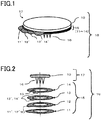
- Fig. 1 is a perspective view of the administration device (18)
- Fig. 2 is an exploded view of the administration device (18).
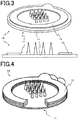
- Fig. 3 includes a perspective view and a cross-sectional view of a first modified example of the administration device (18)
- Fig. 4 is a perspective view of a second modified example of the administration device (18).
- the same or corresponding components in the embodiments are denoted by the same reference numbers, and the description thereof will be omitted.
- the administration device (18) includes a substrate (10), a needle-shaped body (17) having projections (16) protruding from one surface of the substrate (10), and a puncture depth adjustment section (15) made up of one or more film members (11 to 14) provided on the one surface of the substrate (10) to be detachable from the needle-shaped body (17).
- the film member (14) is removably bonded to the substrate 10, and the film members (13), (12), and (11) are removably laminated in this order on the film member (14). That is, these film members (11 to 14) are each detachable from the needle-shaped body (17), which is a main body of the administration device (18).
- the substrate (10) is not limited to a disk shape as illustrated, and may be in any shape.
- the projection (16) is not limited to the illustrated shape as long as it can puncture the skin.
- the shape of the projection (16) may be selected from a conical shape and a polygonal pyramid shape such as a quadrangular pyramid shape.
- a shape which does not have a pointed tip such as a cylinder shape, a polygonal columnar shape, or a truncated prism shape may be selected. These shapes can also be used in combination with each other.
- a height of the projection (16) of the needle-shaped body (17) from a surface of the substrate (10) is larger than a thickness of the puncture depth adjustment section (15). Accordingly, as shown in Fig. 1 , as viewed from the lateral side of the administration device (18) (in a horizontal direction to the drawing sheet of Fig. 1 ), the tip of the projection (16) protrudes from the planar surface of the puncture depth adjustment section (15).
- a material for the needle-shaped body (17) is, but is not limited to, preferably a biocompatible material, which may be a metal material, thermoplastic resin, or water soluble material.
- a metal material include stainless steel, titanium, manganese, and the like.
- thermoplastic resin include polylactic acid, cycloolefin copolymer, polyethylene, polypropylene, polycarbonate, polyglycolic acid, and the like.
- the water soluble material may be a water soluble polymer or polysaccharide.
- water-soluble polymer examples include carboxymethyl cellulose (CMC), methylcellulose (MC), hydroxylpropyl cellulose (HPC), hydroxypropyl methylcellulose (HPMC), polyvinyl alcohol (PVA), polyacrylic acid polymer, polyacrylic amide (PAM), polyethylene oxide (PEO), pullulan, alginate, pectin, chitosan, and chitosan succinamide.
- CMC carboxymethyl cellulose
- MC methylcellulose
- HPC hydroxypropyl cellulose
- PVA polyvinyl alcohol
- PAM polyacrylic amide
- PEO polyethylene oxide
- pullulan alginate, pectin, chitosan, and chitosan succinamide.
- the substrate (10) and the projection (16) may be formed of different materials. Further, the substrate (10) may have a multi-layered configuration. Similarly, the projection (16) may have a multi-layered configuration.
- the needle-shaped body (17) may contain a drug therein.
- a drug may be applied on a surface of the projection (16).
- the projection (16) of the needle-shaped body (17) is made of a water soluble material, a drug can be contained inside the projection (16).
- the water soluble material that constitutes the projection (16) may serve as a drug.
- any kind of drug may be used as long as it works when administered into the skin.
- a drug include various types of proteins, pharmacologically active agents, or cosmetic compositions, which are appropriately selected depending on the purpose.
- a pharmacologically active agent include vaccines such as influenza vaccine, pain relievers for cancer patients, insulin, biologics, gene therapy agents, injections, oral agents, skin application preparations and the like.
- transdermal administration using the needle-shaped body (17) a drug is administered into a hole created in the skin. Therefore, transdermal administration using the needle-shaped body (17) can be applied to not only administration of the pharmacologically active agents used in the conventional transdermal administration, but also administration of pharmacologically active agents that require hypodermic injection.
- transdermal administration using the needle-shaped body (17) is suitable for administration of an injection medication such as vaccines for children since it does not cause pain to a patient during administration.
- transdermal administration using the needle-shaped body (17) is suitable for administration of an oral medication for children who have difficulty in swallowing an oral medication since it does not require a patient to swallow a drug in administration.
- Cosmetic compositions are compositions for use as cosmetics or beauty products.
- a cosmetic composition include humectants, colorants, fragrance, and physiologically active agents exhibiting cosmetic effects such as improvement effect on wrinkles, acne, stretch marks or the like, and improvement effect on hair loss or the like.
- humectants such as humectants, colorants, fragrance, and physiologically active agents exhibiting cosmetic effects such as improvement effect on wrinkles, acne, stretch marks or the like, and improvement effect on hair loss or the like.
- a fragrance can be imparted to the needle-shaped body (17). Accordingly, the needle-shaped body (17) suitable for use as a beauty product can be obtained.
- the needle-shaped body (17) can be produced by using various known techniques. For example, when a resin is used as a material, molding techniques such as injection molding, extrusion molding, imprinting, hot embossing, and casting can be used.
- machining such as cutting or grinding
- etching techniques such as dry etching and wet etching can be used.
- the needle-shaped body (17) of the present invention is produced as follows. First, an intaglio plate having a recess formed in conformity with the shape of the needle-shaped body (17) is produced. In producing the intaglio plate, an original plate having the shape identical to the shape of the desired needle-shaped body (17) is produced. The shape of the original plate determines the shape of the needle-shaped body (17) to be produced.
- the original plate may be produced by a known method suitable for the shape of the original plate, for example, by using a micromachining technique. Micromachining technique includes lithography, wet etching, dry etching, sand blasting, laser processing, micromachining and the like.
- the intaglio plate having an inverted shape of recesses and projections of the original plate is produced from the original plate.
- the intaglio plate is formed by a known shape-transfer technique.
- the shape-transfer technique includes a method of producing the intaglio plate made of nickel by nickel electroforming, a method of transfer molding using a molten resin, and the like. Accordingly, the intaglio plate having recesses which are depressions shaped in conformity with the projections, is produced.
- the recesses of the produced intaglio plate are filled with a material for forming the needle-shaped body.
- a molded product is produced by thermal pressing of a sheet shaped thermoplastic resin placed on the recesses 51 so as to fill the thermoplastic resin into the recesses or by injection molding of a thermoplastic resin into the mold having the intaglio plate so as to fill the thermoplastic resin into the recesses.
- the needle-shaped body (17) is made of a water soluble material
- a material solution containing a water soluble material and a drug is prepared.
- the flowability of the material solution is preferably adjusted to an extent such that the material solution is smoothly filled into the recesses by adjusting the amount of the solvent or the like as appropriate.
- the way of supplying the material solution into the recesses may be appropriately selected from known methods taking into consideration the shape, size, or the like of the recesses.
- the material solution can be supplied by methods such as spin coating, use of dispenser, casting, and ink jetting.
- the material solution may be supplied to the recesses under normal pressure, but preferably under reduced pressure or vacuum in order to smoothly supply the material solution into the recesses.
- the amount of material solution supplied to the recesses is preferably at least such an extent that the depression of the shape in conformity with the inner projection is entirely covered with the material solution. As the material solution filled into the recesses is dried and solidified, the needle-shaped body (17) is produced.
- a single layered film or a multi-layered film can be used.
- an adhesive film can be advantageously used.
- An exemplary configuration of the adhesive film for use as the film members (11 to 14) may include an adhesive layer on the substrate sheet.
- the substrate sheet may be formed of, for example, a resin film made of polyolefin resin such as polyethylene, polypropylene, and cyclic polyolefin, polyester resin such as nylon and polyethylene terephthalate, polyvinyl chloride, polyvinylidene chloride, or polystyrene, polyurethane, polyvinyl alcohol, polyimide or the like.
- the adhesive layer may be formed of, for example, a silicone, urethane, epoxy, or acrylic adhesive.
- the adhesive sheet is not limited to these materials.
- the adhesive film may be provided with a peeling layer or the like.
- the adhesive layer of the adhesive films that constitute the puncture depth adjustment section (15) serves not only to adhere the film members (11 to 14) in the puncture depth adjustment section (15), but also to fix the administration device (18) to the skin when the administration device (18) of the present invention is punctured to the skin.
- both the film and the sheet refer to a web-shaped product.
- the film encompasses the meaning of sheet, and the sheet encompasses the meaning of film.
- the terms film and sheet should not be taken to express a difference in thickness or the like.
- the single layered film may be formed of a resin film made of polyolefin resin such as polyethylene, polypropylene, and cyclic polyolefin, polyester resin such as nylon and polyethylene terephthalate, polyvinyl chloride, polyvinylidene chloride, or polystyrene, polyurethane, polyvinyl alcohol, polyimide or the like, but is not limited to these materials.
- polyolefin resin such as polyethylene, polypropylene, and cyclic polyolefin
- polyester resin such as nylon and polyethylene terephthalate
- polyvinyl chloride polyvinylidene chloride
- polystyrene polyurethane
- polyvinyl alcohol polyimide or the like
- the shape of the film members (11 to 14) that constitute the puncture depth adjustment section (15) is not specifically limited.
- the shape is preferably a disk with an opening (annulus), in which an opening (19) has an opening area larger than an area of the portion on one surface of the substrate (10) in which the projections (16) are formed.
- the puncture depth adjustment section (15) can be provided across the entire outer periphery on one surface of the substrate (10) without interfering with the projections (16) so that the puncture depth can be uniformly adjusted across the entire periphery.
- the projections (16) can be punctured substantially vertically to the skin when the needle-shaped body (17) is punctured to the skin.
- the puncture depth adjustment section (15) may include tabs (11' to 14') on the outer edge of the film members (11 to 14) that constitute the puncture depth adjustment section (15) so that the film members (11 to 14) can be easily peeled off by holding the tab by hand.
- an adhesive is applied on the film members (11 to 14) that constitute the puncture depth adjustment section (15), and the substrate (10) and the film member (14) are fixed to each other.
- the film members (11 to 14) and the substrate (10) may be peelably bonded.
- the thickness and the numbers of sheets of the film members (11 to 14) that constitute the puncture depth adjustment section (15) may be determined considering the precision and the like required for adjustment of the length or the puncture depth of the projection (16).
- the puncture depth adjustment section (15) may be formed of a single film member. Further, the outer periphery of the needle-shaped body (17) and the outer periphery of the puncture depth adjustment section (15) may not be necessarily consistent with each other.
- the puncture depth adjustment section (15) may be shaped as an annulus having a circumference partially opened.
- FIG. 5 is a partial cross-sectional view of the administration device (18).
- a distance W from the interface between the projection (16) and the substrate (10) to the puncture depth adjustment section (15) is preferably in the range of 0.5 mm or more and 15 mm or less. When the distance W is less than 0.5 mm, it may cause difficulty in production. On the other hand, when the distance W is more than 15 mm, the puncture depth adjustment function may not be performed.
- a protrusion height H of the projection (16) from the puncture depth adjustment section (15) is preferably adjusted by the puncture depth adjustment section (15) to be within the range of 50 ⁇ m or more and 3000 ⁇ m or less.
- each of the film members (11 to 14) that constitute the puncture depth adjustment section (15) is preferably in the range of 20 ⁇ m or more and 1000 ⁇ m or less.
- FIGs. 6 and 7 are cross-sectional views which illustrate a usage of the administration device (18).
- a thickness of the skin where drug is to be administered is measured.
- the thickness of the skin can be measured by using a machine which uses ultrasonic waves, optical coherence tomography (OCT), or the like.
- OCT optical coherence tomography
- the thickness of the epidermis layer and the dermis layer is measured as necessary.
- a desired puncture depth of the projection (16) is determined.
- the puncture depth can also be determined depending on the ethnic group, gender, age, or puncture site.
- a protrusion length of the projection (16) from the puncture depth adjustment section (15) expected to be appropriate for puncturing the projection (16) at a desired depth is determined.
- the administration device (18) is punctured into the skin. Puncturing of the administration device (18) into the skin is not specifically limited, and may be performed manually or by use of an applicator or the like separately provided.
- Fig. 8 includes a perspective view and a cross-sectional view of the administration device (20).
- Fig. 9 includes a perspective view and a cross-sectional view of a first modified example of the administration device (20).
- Fig. 10 is a perspective view of a second modified example of the administration device (20).
- the administration device (20) includes a disk shaped base (21), the needle-shaped body (17) and the puncture depth adjustment section (15) which are fixed to the disk shaped base (21).
- the base (21) can be formed of the film member that constitutes the puncture depth adjustment section (15).
- a height of the projection (16) from a surface of the base (21) is larger than a thickness of the puncture depth adjustment section (15). Accordingly, as shown in the cross-sectional view of Fig. 8 , as viewed from the lateral side of the administration device (18) (in a horizontal direction to the drawing sheet of Fig. 8 ), the tip of the projection (16) protrudes from the planar surface of the puncture depth adjustment section (15).
- the puncture depth adjustment section (15) may be formed of a single film member. Further, the outer periphery of the base (21) and the outer periphery of the puncture depth adjustment section (15) may not be necessarily consistent with each other.
- the puncture depth adjustment section (15) may be shaped as an annulus having a circumference partially opened.
- FIGs. 11 and 12 are cross-sectional views of the administration device (22, 23) with a protective cover.
- the administration device (22) includes a protective cover (24) disposed on the puncture depth adjustment section (15) of the administration device (18) so as to cover the administration device (18). Further, the administration device (23) also includes the protective cover (24) disposed on the puncture depth adjustment section (15) of the administration device (20) so as to cover the administration device (20).
- the protective cover (24) can be attached to the puncture depth adjustment section (15) by using an adhesive or the like. In use of the administration device (18, 20), the protective cover (24) is removed.
- the protective cover (24) can be made of, for example, a synthetic resin or the like.
- the administration device (22, 23) can prevent damage to the projection (16) during storage and distribution processes.
- the administration device (18) which included the needle-shaped body (17) made of polycarbonate, and the puncture depth adjustment section (15) on which the film members (11 to 14) shaped as an annulus made of polypropylene were laminated was fabricated.
- the needle-shaped body (17) included the circular substrate (10) of a 20 mm diameter, and 100 projections (16) of 800 ⁇ m length arranged on the substrate (10) at a pitch of 500 ⁇ m.
- the needle-shaped body (17) was produced by injection molding. Further, the thickness of the puncture depth adjustment section (15) was 400 ⁇ m, and four film members (adhesive films) (11 to 14) with the thickness of 100 ⁇ m were laminated.
- the administration device (18) of the present invention in which the projection (16) has the protrusion length (h1) of 400 ⁇ m from the puncture depth adjustment section (15) was obtained.
- the film members (adhesive films) 11, 12, 13, and 14 in the unpeeled state were peeled off to thereby adjust the puncture depth of the projection (16) from 400 ⁇ m to approximately 500 ⁇ m, 600 ⁇ m, 700 ⁇ m, and 800 ⁇ m.
- the administration device (18, 20) has a simple configuration made up of the needle-shaped body (17) having the projections (16), and the puncture depth adjustment section (15). Therefore, the manufacturing cost can be reduced. Further, the puncture depth can be adjusted by simply peeling the required number of sheets of the film members (11 to 14). Therefore, ease of use can be ensured.
- the needle-shaped body (17) have the projections (16) of the identical length, the puncture depth can be changed depending on the skin thickness. Accordingly, this is advantageous in terms of the production.
- the present invention can be applied not only to medical field, cosmetic field, and beauty products field, but also various fields that require micropuncture techniques.
- the present invention is useful for the fields of micro electro mechanical systems (MEMS) devices, optical devices, drug development, test drugs, nutrition supplements, beauty products, and the like.
- MEMS micro electro mechanical systems
Landscapes
- Health & Medical Sciences (AREA)
- Life Sciences & Earth Sciences (AREA)
- Engineering & Computer Science (AREA)
- Public Health (AREA)
- Veterinary Medicine (AREA)
- Heart & Thoracic Surgery (AREA)
- Hematology (AREA)
- Animal Behavior & Ethology (AREA)
- General Health & Medical Sciences (AREA)
- Biomedical Technology (AREA)
- Medical Informatics (AREA)
- Physics & Mathematics (AREA)
- Biophysics (AREA)
- Pathology (AREA)
- Molecular Biology (AREA)
- Surgery (AREA)
- Anesthesiology (AREA)
- Dermatology (AREA)
- Vascular Medicine (AREA)
- Media Introduction/Drainage Providing Device (AREA)
- Infusion, Injection, And Reservoir Apparatuses (AREA)
Abstract
Description
- The present invention relates to administration devices having a needle-shaped body.
- Injection is commonly used for administration of a drug such as vaccine into the body. Although injection is a highly safe method for administration, it often causes severe pain since an injection needle is deeply pierced into the body to deliver the drug into the subcutaneous tissue. Further, particularly in developing countries, there are many issues such as infection by reuse of injection needles and needle stick accidents.
- Therefore, as an alternative drug administration method to injection, attention has been paid to use of a needle-shaped body having a plurality of projections of micron order that pierce the skin for direct administration of a drug into the skin. According to this method, it is possible to almost avoid producing pain during piercing into the skin since the length of the projections is controlled not to reach the nerve cells in the dermis layer.
- Further, when vaccine is intradermally administered using a needle-shaped body, the amount of vaccine used can be reduced compared to subcutaneous injection since antigen presenting cells are abundant in the skin.
- The projections of a needle-shaped body must have a thinness and sharpness sufficient for puncturing the skin and a length sufficient for intradermal drug delivery. Accordingly, the projections desirably have a diameter of several tens of micrometers to several hundreds of micrometers and a length that penetrates through the stratum corneum which is the outermost layer of the skin but does not reach the nerve plexus, which is specifically several hundreds of micrometers to several millimeters.
- Materials for the needle-shaped body are required to be harmless to the human body even if the projection is broken and left in the body. For such materials, biocompatible resins such as medical grade silicone, maltose, poly lactic acid, and dextran are regarded as promising materials (see PTL 1).
- PTL 1:
JP-2005-21677 A - For low cost mass production of a microstructure such as the needle-shaped body by using the above resin materials, a transfer molding process such as injection molding, imprinting or casting is effective.
- As methods of intradermal drug administration using a needle-shaped body, there are methods which have been proposed, including a method of applying a drug on the skin surface before or after puncturing the skin by a needle-shaped body, a method of puncturing the skin by a needle-shaped body having a projection on which a drug is applied in advance or a needle-shaped body made of a material containing a drug therein, and a method of puncturing the skin by a needle-shaped body in which a through hole is formed and then administering a drug into the skin via the through hole.
- For example, when a needle-shaped body is used to administer a drug, especially a vaccine into the skin, control of the administration depth is of importance. For example, if a needle-shaped body having a projection of a length that can pierce the dermis layer of the skin of an adult is used for a child whose skin is thin, there is a risk that the projection may penetrate through the skin and pierce the hypodermis.
- Further, when puncture into the dermis layer immediately under the epidermis layer is performed targeting both the Langerhans cells abundant in the epidermis layer and the dermal dendritic cells abundant in the dermis layer, which are antigen-presenting cells, puncture into the epidermis layer may fail if a needle-shaped body having a projection of a length suitable for children is used for an adult whose skin is thick.
- Both cases described above may lead to an unintended immune response.
- In order to address such a problem, adjustment of a puncture load, a puncture speed, or the like of the needle-shaped body can be performed depending on the thickness of the skin, for example. However, there are technical difficulties in precise adjustment. Further, when needle-shaped bodies having projections of different lengths are used depending on the thickness of the skin, a plurality of types of needle-shaped bodies should be prepared, which causes an increase in the cost of vaccine administration using a needle-shaped body.
- The present invention has been made in view of the above problem, and is directed to provide an administration device that can change the puncture depth depending on the thickness of the skin when a needle-shaped body has projections of the identical length.
- An aspect of the present invention is an administration device including a needle-shaped body having a substrate and a projection protruding from one surface of the substrate, and a puncture depth adjustment section having at least one film member that is detachable from the needle-shaped body.
- Further, the puncture depth adjustment section may be disposed on one surface of the substrate.
- Further, a base to which the needle-shaped body and the puncture depth adjustment section are fixed may be further provided.
- Further, a height of the projection may be larger than a thickness of the puncture depth adjustment section.
- Further, the film member may be an adhesive film.
- Further, the film member may have a tab.
- Further, the film member may be shaped as an annulus having an opening whose opening area is larger than an area of a portion on the one surface of the substrate in which the projection is formed.
- The administration device according to the present invention has a simple configuration made up of the needle-shaped body having the projections, and the puncture depth adjustment section. Therefore, the manufacturing cost can be reduced. Further, the puncture depth can be adjusted by simply peeling the required number of sheets of the film members. Therefore, ease of use can be ensured.
- According to the administration device of the present invention, the puncture depth can be changed depending on the thickness of the skin when a needle-shaped body has projections of the identical length.
-
-
Fig. 1 is a perspective view of an administration device according to a first embodiment of the present invention. -
Fig. 2 is an exploded view of the administration device according to the first embodiment of the present invention. -
Fig. 3 includes a perspective view and a cross-sectional view of a first modified example of the administration device. -
Fig. 4 is a perspective view of a second modified example of the administration device. -
Fig. 5 is a partial cross-sectional view of the administration device according to the first embodiment of the present invention. -
Fig. 6 is a cross-sectional view which illustrates a usage of the administration device. -
Fig. 7 is a cross-sectional view which illustrates a usage of the administration device. -
Fig. 8 includes a perspective view and a cross-sectional view of the administration device according to a second embodiment of the present invention. -
Fig. 9 includes a perspective view and a cross-sectional view of a first modified example of the administration device according to the second embodiment of the present invention. -
Fig. 10 is a perspective view of a second modified example of the administration device according to the second embodiment of the present invention. -
Fig. 11 is a cross-sectional view of the administration device with a protective cover according to a third embodiment of the present invention. -
Fig. 12 is a cross-sectional view of the administration device with a protective cover according to the third embodiment of the present invention. - With reference to
Figs. 1 to 4 , an administration device (18) according to a first embodiment of the present invention will be described.Fig. 1 is a perspective view of the administration device (18), andFig. 2 is an exploded view of the administration device (18). Further,Fig. 3 includes a perspective view and a cross-sectional view of a first modified example of the administration device (18), andFig. 4 is a perspective view of a second modified example of the administration device (18). In the following description, the same or corresponding components in the embodiments are denoted by the same reference numbers, and the description thereof will be omitted. - An administration device of the present invention is used for puncturing the skin of humans and animals. The administration device (18) includes a substrate (10), a needle-shaped body (17) having projections (16) protruding from one surface of the substrate (10), and a puncture depth adjustment section (15) made up of one or more film members (11 to 14) provided on the one surface of the substrate (10) to be detachable from the needle-shaped body (17). In the illustrated example, the film member (14) is removably bonded to the
substrate 10, and the film members (13), (12), and (11) are removably laminated in this order on the film member (14). That is, these film members (11 to 14) are each detachable from the needle-shaped body (17), which is a main body of the administration device (18). The substrate (10) is not limited to a disk shape as illustrated, and may be in any shape. Further, the projection (16) is not limited to the illustrated shape as long as it can puncture the skin. For example, the shape of the projection (16) may be selected from a conical shape and a polygonal pyramid shape such as a quadrangular pyramid shape. Further, a shape which does not have a pointed tip such as a cylinder shape, a polygonal columnar shape, or a truncated prism shape may be selected. These shapes can also be used in combination with each other. Moreover, a height of the projection (16) of the needle-shaped body (17) from a surface of the substrate (10) is larger than a thickness of the puncture depth adjustment section (15). Accordingly, as shown inFig. 1 , as viewed from the lateral side of the administration device (18) (in a horizontal direction to the drawing sheet ofFig. 1 ), the tip of the projection (16) protrudes from the planar surface of the puncture depth adjustment section (15). - A material for the needle-shaped body (17) is, but is not limited to, preferably a biocompatible material, which may be a metal material, thermoplastic resin, or water soluble material. Examples of the metal material include stainless steel, titanium, manganese, and the like. Examples of the thermoplastic resin include polylactic acid, cycloolefin copolymer, polyethylene, polypropylene, polycarbonate, polyglycolic acid, and the like. The water soluble material may be a water soluble polymer or polysaccharide. Examples of the water-soluble polymer include carboxymethyl cellulose (CMC), methylcellulose (MC), hydroxylpropyl cellulose (HPC), hydroxypropyl methylcellulose (HPMC), polyvinyl alcohol (PVA), polyacrylic acid polymer, polyacrylic amide (PAM), polyethylene oxide (PEO), pullulan, alginate, pectin, chitosan, and chitosan succinamide. In addition, the substrate (10) and the projection (16) may be formed of different materials. Further, the substrate (10) may have a multi-layered configuration. Similarly, the projection (16) may have a multi-layered configuration.
- The needle-shaped body (17) may contain a drug therein. When the projection (16) of the needle-shaped body (17) is made of a metal or thermoplastic resin, a drug may be applied on a surface of the projection (16). Further, when the projection (16) of the needle-shaped body (17) is made of a water soluble material, a drug can be contained inside the projection (16). Moreover, the water soluble material that constitutes the projection (16) may serve as a drug.
- Any kind of drug may be used as long as it works when administered into the skin. Examples of a drug include various types of proteins, pharmacologically active agents, or cosmetic compositions, which are appropriately selected depending on the purpose. Examples of a pharmacologically active agent include vaccines such as influenza vaccine, pain relievers for cancer patients, insulin, biologics, gene therapy agents, injections, oral agents, skin application preparations and the like. In transdermal administration using the needle-shaped body (17), a drug is administered into a hole created in the skin. Therefore, transdermal administration using the needle-shaped body (17) can be applied to not only administration of the pharmacologically active agents used in the conventional transdermal administration, but also administration of pharmacologically active agents that require hypodermic injection. In particular, transdermal administration using the needle-shaped body (17) is suitable for administration of an injection medication such as vaccines for children since it does not cause pain to a patient during administration. Further, transdermal administration using the needle-shaped body (17) is suitable for administration of an oral medication for children who have difficulty in swallowing an oral medication since it does not require a patient to swallow a drug in administration.
- Cosmetic compositions are compositions for use as cosmetics or beauty products. Examples of a cosmetic composition include humectants, colorants, fragrance, and physiologically active agents exhibiting cosmetic effects such as improvement effect on wrinkles, acne, stretch marks or the like, and improvement effect on hair loss or the like. When an aromatic material is used as a cosmetic composition, a fragrance can be imparted to the needle-shaped body (17). Accordingly, the needle-shaped body (17) suitable for use as a beauty product can be obtained.
- The needle-shaped body (17) can be produced by using various known techniques. For example, when a resin is used as a material, molding techniques such as injection molding, extrusion molding, imprinting, hot embossing, and casting can be used.
- Further, when a metal or silicon is used as a material of the needle-shaped body (17), machining such as cutting or grinding, and etching techniques such as dry etching and wet etching can be used.
- For example, the needle-shaped body (17) of the present invention is produced as follows. First, an intaglio plate having a recess formed in conformity with the shape of the needle-shaped body (17) is produced. In producing the intaglio plate, an original plate having the shape identical to the shape of the desired needle-shaped body (17) is produced. The shape of the original plate determines the shape of the needle-shaped body (17) to be produced. The original plate may be produced by a known method suitable for the shape of the original plate, for example, by using a micromachining technique. Micromachining technique includes lithography, wet etching, dry etching, sand blasting, laser processing, micromachining and the like.
- Next, the intaglio plate having an inverted shape of recesses and projections of the original plate is produced from the original plate. The intaglio plate is formed by a known shape-transfer technique. The shape-transfer technique includes a method of producing the intaglio plate made of nickel by nickel electroforming, a method of transfer molding using a molten resin, and the like. Accordingly, the intaglio plate having recesses which are depressions shaped in conformity with the projections, is produced.
- Then, the recesses of the produced intaglio plate are filled with a material for forming the needle-shaped body. When the needle-shaped body (17) is made of a thermoplastic resin, a molded product (needle-shaped body (17)) is produced by thermal pressing of a sheet shaped thermoplastic resin placed on the recesses 51 so as to fill the thermoplastic resin into the recesses or by injection molding of a thermoplastic resin into the mold having the intaglio plate so as to fill the thermoplastic resin into the recesses.
- On the other hand, when the needle-shaped body (17) is made of a water soluble material, a material solution containing a water soluble material and a drug is prepared. The flowability of the material solution is preferably adjusted to an extent such that the material solution is smoothly filled into the recesses by adjusting the amount of the solvent or the like as appropriate. The way of supplying the material solution into the recesses may be appropriately selected from known methods taking into consideration the shape, size, or the like of the recesses. The material solution can be supplied by methods such as spin coating, use of dispenser, casting, and ink jetting. The material solution may be supplied to the recesses under normal pressure, but preferably under reduced pressure or vacuum in order to smoothly supply the material solution into the recesses. The amount of material solution supplied to the recesses is preferably at least such an extent that the depression of the shape in conformity with the inner projection is entirely covered with the material solution. As the material solution filled into the recesses is dried and solidified, the needle-shaped body (17) is produced.
- For the film members (11 to 14) that constitute the puncture depth adjustment section (15), a single layered film or a multi-layered film can be used. Among others, an adhesive film can be advantageously used.
- An exemplary configuration of the adhesive film for use as the film members (11 to 14) may include an adhesive layer on the substrate sheet. The substrate sheet may be formed of, for example, a resin film made of polyolefin resin such as polyethylene, polypropylene, and cyclic polyolefin, polyester resin such as nylon and polyethylene terephthalate, polyvinyl chloride, polyvinylidene chloride, or polystyrene, polyurethane, polyvinyl alcohol, polyimide or the like. Further, the adhesive layer may be formed of, for example, a silicone, urethane, epoxy, or acrylic adhesive. However, the adhesive sheet is not limited to these materials. Further, the adhesive film may be provided with a peeling layer or the like. The adhesive layer of the adhesive films that constitute the puncture depth adjustment section (15) serves not only to adhere the film members (11 to 14) in the puncture depth adjustment section (15), but also to fix the administration device (18) to the skin when the administration device (18) of the present invention is punctured to the skin.
- Moreover, in the present invention, both the film and the sheet refer to a web-shaped product. In the present invention, the film encompasses the meaning of sheet, and the sheet encompasses the meaning of film. The terms film and sheet should not be taken to express a difference in thickness or the like.
- Further, the single layered film may be formed of a resin film made of polyolefin resin such as polyethylene, polypropylene, and cyclic polyolefin, polyester resin such as nylon and polyethylene terephthalate, polyvinyl chloride, polyvinylidene chloride, or polystyrene, polyurethane, polyvinyl alcohol, polyimide or the like, but is not limited to these materials.
- Further, the shape of the film members (11 to 14) that constitute the puncture depth adjustment section (15) is not specifically limited. For example, as shown in
Fig. 2 , the shape is preferably a disk with an opening (annulus), in which an opening (19) has an opening area larger than an area of the portion on one surface of the substrate (10) in which the projections (16) are formed. According to this shape, the puncture depth adjustment section (15) can be provided across the entire outer periphery on one surface of the substrate (10) without interfering with the projections (16) so that the puncture depth can be uniformly adjusted across the entire periphery. Further, the projections (16) can be punctured substantially vertically to the skin when the needle-shaped body (17) is punctured to the skin. - Further, the puncture depth adjustment section (15) may include tabs (11' to 14') on the outer edge of the film members (11 to 14) that constitute the puncture depth adjustment section (15) so that the film members (11 to 14) can be easily peeled off by holding the tab by hand.
- Further, an adhesive is applied on the film members (11 to 14) that constitute the puncture depth adjustment section (15), and the substrate (10) and the film member (14) are fixed to each other. Alternatively, the film members (11 to 14) and the substrate (10) may be peelably bonded.
- Further, the thickness and the numbers of sheets of the film members (11 to 14) that constitute the puncture depth adjustment section (15) may be determined considering the precision and the like required for adjustment of the length or the puncture depth of the projection (16).
- As shown in
Fig. 3 , the puncture depth adjustment section (15) may be formed of a single film member. Further, the outer periphery of the needle-shaped body (17) and the outer periphery of the puncture depth adjustment section (15) may not be necessarily consistent with each other. - As shown in
Fig. 4 , the puncture depth adjustment section (15) may be shaped as an annulus having a circumference partially opened. - Now referring to
Fig. 5 , dimensions of the needle-shaped body (17) and the puncture depth adjustment section (15) will be each described.Fig. 5 is a partial cross-sectional view of the administration device (18). - A distance W from the interface between the projection (16) and the substrate (10) to the puncture depth adjustment section (15) is preferably in the range of 0.5 mm or more and 15 mm or less. When the distance W is less than 0.5 mm, it may cause difficulty in production. On the other hand, when the distance W is more than 15 mm, the puncture depth adjustment function may not be performed.
- A protrusion height H of the projection (16) from the puncture depth adjustment section (15) is preferably adjusted by the puncture depth adjustment section (15) to be within the range of 50 µm or more and 3000 µm or less.
- The thickness of each of the film members (11 to 14) that constitute the puncture depth adjustment section (15) is preferably in the range of 20 µm or more and 1000 µm or less.
- Next, with reference to
Figs. 6 and 7 , an exemplary usage of the administration device (18) of the present invention will be described.Figs. 6 and 7 are cross-sectional views which illustrate a usage of the administration device (18). - First, a thickness of the skin where drug is to be administered is measured. The thickness of the skin can be measured by using a machine which uses ultrasonic waves, optical coherence tomography (OCT), or the like. The thickness of the epidermis layer and the dermis layer is measured as necessary. On the basis of the measurement result, a desired puncture depth of the projection (16) is determined. The puncture depth can also be determined depending on the ethnic group, gender, age, or puncture site.
- Then, a protrusion length of the projection (16) from the puncture depth adjustment section (15) expected to be appropriate for puncturing the projection (16) at a desired depth is determined.
- As shown in
Fig. 6 , when the thus determined protrusion length of the projection (16) from the puncture depth adjustment section (15) is the same as the initial protrusion length (h1) of the administration device (18), the film members (11 to 14) that constitute the puncture depth adjustment section (15) do not need to be peeled. - On the other hand, as shown in
Fig. 7 , when the thus determined protrusion length of the projection (16) from the puncture depth adjustment section (15) is larger than the initial protrusion length (h1) of the administration device (18), an appropriate number of sheets of the film members (11 to 14) that constitute the puncture depth adjustment section (15) can be peeled to obtain a desired length (h2). - Next, the administration device (18) is punctured into the skin. Puncturing of the administration device (18) into the skin is not specifically limited, and may be performed manually or by use of an applicator or the like separately provided.
- With reference to
Figs. 8 to 10 , an administration device (20) according to a second embodiment of the present invention will be described.Fig. 8 includes a perspective view and a cross-sectional view of the administration device (20).Fig. 9 includes a perspective view and a cross-sectional view of a first modified example of the administration device (20).Fig. 10 is a perspective view of a second modified example of the administration device (20). - As shown in
Fig. 8 , the administration device (20) includes a disk shaped base (21), the needle-shaped body (17) and the puncture depth adjustment section (15) which are fixed to the disk shaped base (21). The base (21) can be formed of the film member that constitutes the puncture depth adjustment section (15). In the administration device (20) as well, a height of the projection (16) from a surface of the base (21) is larger than a thickness of the puncture depth adjustment section (15). Accordingly, as shown in the cross-sectional view ofFig. 8 , as viewed from the lateral side of the administration device (18) (in a horizontal direction to the drawing sheet ofFig. 8 ), the tip of the projection (16) protrudes from the planar surface of the puncture depth adjustment section (15). - As shown in
Fig. 9 , in the administration device (20), the puncture depth adjustment section (15) may be formed of a single film member. Further, the outer periphery of the base (21) and the outer periphery of the puncture depth adjustment section (15) may not be necessarily consistent with each other. - As shown in
Fig. 10 , in the administration device (20), the puncture depth adjustment section (15) may be shaped as an annulus having a circumference partially opened. - With reference to
Figs. 11 and 12 , an administration device (22, 23) with a protective cover according to a third embodiment of the present invention will be described.Figs. 11 and 12 are cross-sectional views of the administration device (22, 23) with a protective cover. - As shown in
Fig. 11 , the administration device (22) includes a protective cover (24) disposed on the puncture depth adjustment section (15) of the administration device (18) so as to cover the administration device (18). Further, the administration device (23) also includes the protective cover (24) disposed on the puncture depth adjustment section (15) of the administration device (20) so as to cover the administration device (20). The protective cover (24) can be attached to the puncture depth adjustment section (15) by using an adhesive or the like. In use of the administration device (18, 20), the protective cover (24) is removed. - The protective cover (24) can be made of, for example, a synthetic resin or the like. By virtue of the protective cover (24), the administration device (22, 23) can prevent damage to the projection (16) during storage and distribution processes.
- With reference to
Figs. 1 and 2 , examples of the administration device of the present invention will be described. - First, the administration device (18) which included the needle-shaped body (17) made of polycarbonate, and the puncture depth adjustment section (15) on which the film members (11 to 14) shaped as an annulus made of polypropylene were laminated was fabricated. The needle-shaped body (17) included the circular substrate (10) of a 20 mm diameter, and 100 projections (16) of 800 µm length arranged on the substrate (10) at a pitch of 500 µm. The film members (11 to 14), each of which had an outer diameter of ϕ20 mm, included the opening (19) with an inner diameter of 10 mm.
- In this example, the needle-shaped body (17) was produced by injection molding. Further, the thickness of the puncture depth adjustment section (15) was 400 µm, and four film members (adhesive films) (11 to 14) with the thickness of 100 µm were laminated.
- Accordingly, the administration device (18) of the present invention in which the projection (16) has the protrusion length (h1) of 400 µm from the puncture depth adjustment section (15) was obtained.
- In this administration device (18), the film members (adhesive films) 11, 12, 13, and 14 in the unpeeled state were peeled off to thereby adjust the puncture depth of the projection (16) from 400 µm to approximately 500 µm, 600 µm, 700 µm, and 800 µm.
- As described above, according to the present invention, the administration device (18, 20) has a simple configuration made up of the needle-shaped body (17) having the projections (16), and the puncture depth adjustment section (15). Therefore, the manufacturing cost can be reduced. Further, the puncture depth can be adjusted by simply peeling the required number of sheets of the film members (11 to 14). Therefore, ease of use can be ensured. When the needle-shaped body (17) have the projections (16) of the identical length, the puncture depth can be changed depending on the skin thickness. Accordingly, this is advantageous in terms of the production.
- The present invention can be applied not only to medical field, cosmetic field, and beauty products field, but also various fields that require micropuncture techniques. For example, the present invention is useful for the fields of micro electro mechanical systems (MEMS) devices, optical devices, drug development, test drugs, nutrition supplements, beauty products, and the like.
-
- 10
- Substrate
- 11, 12, 13, 14
- Film member
- 11', 12', 13', 14'
- Tab
- 15
- Puncture depth adjustment section
- 16
- Projection
- 17
- Needle-shaped body
- 18, 20
- Administration device
- 19
- Opening
- 21
- Base
- 22, 23
- Administration device with a protective cover
- 24
- Protective cover
Claims (7)
- An administration device comprising:a needle-shaped body having a substrate and a projection protruding from one surface of the substrate; anda puncture depth adjustment section having at least one film member that is detachable from the needle-shaped body.
- The administration device according to claim 1, wherein the puncture depth adjustment section is disposed on one surface of the substrate.
- The administration device according to claim 1, further comprising a base to which the needle-shaped body and the puncture depth adjustment section are fixed.
- The administration device according to claim 1 or 2, wherein a height of the projection is larger than a thickness of the puncture depth adjustment section.
- The administration device according to any one of claims 1 to 4, wherein the film member is an adhesive film.
- The administration device according to any one of claims 1 to 5, wherein the film member has a tab.
- The administration device according to any one of claims 1 to 6, wherein the film member is shaped as an annulus having an opening whose opening area is larger than an area of a portion on the one surface of the substrate in which the projection is formed.
Applications Claiming Priority (2)
| Application Number | Priority Date | Filing Date | Title |
|---|---|---|---|
| JP2015203823 | 2015-10-15 | ||
| PCT/JP2016/004588 WO2017064870A1 (en) | 2015-10-15 | 2016-10-14 | Administration instrument |
Publications (3)
| Publication Number | Publication Date |
|---|---|
| EP3363491A1 true EP3363491A1 (en) | 2018-08-22 |
| EP3363491A4 EP3363491A4 (en) | 2018-10-31 |
| EP3363491B1 EP3363491B1 (en) | 2019-12-11 |
Family
ID=58517997
Family Applications (1)
| Application Number | Title | Priority Date | Filing Date |
|---|---|---|---|
| EP16855124.0A Active EP3363491B1 (en) | 2015-10-15 | 2016-10-14 | Administration instrument |
Country Status (4)
| Country | Link |
|---|---|
| US (1) | US20180200495A1 (en) |
| EP (1) | EP3363491B1 (en) |
| JP (1) | JP6777088B2 (en) |
| WO (1) | WO2017064870A1 (en) |
Families Citing this family (2)
| Publication number | Priority date | Publication date | Assignee | Title |
|---|---|---|---|---|
| CN106535980A (en) * | 2014-07-15 | 2017-03-22 | 凸版印刷株式会社 | Micro-needle and micro-needle assembly |
| EP3777926A4 (en) * | 2019-04-30 | 2022-04-20 | Huons Medical Co., Ltd. | INSERTABLE MEDICATION INJECTION DEVICE |
Family Cites Families (14)
| Publication number | Priority date | Publication date | Assignee | Title |
|---|---|---|---|---|
| JP4118399B2 (en) * | 1998-07-21 | 2008-07-16 | テルモ株式会社 | Puncture adjusting tool for injection needle and injection needle assembly including the same |
| HUP0402605A2 (en) * | 2001-12-20 | 2005-06-28 | Alza Corporation | Skin-piercing microprojections having piercing depth control |
| JP2004065775A (en) * | 2002-08-08 | 2004-03-04 | Sanwa Kagaku Kenkyusho Co Ltd | Device equipped with needle-like structure element |
| US20050137525A1 (en) * | 2003-06-04 | 2005-06-23 | Georgia Tech Research Corporation | Drilling microneedle device |
| JP2005021677A (en) * | 2003-06-10 | 2005-01-27 | Medorekkusu:Kk | Pad base for percutaneous administration and injection needle |
| US20050203575A1 (en) * | 2004-03-15 | 2005-09-15 | Unilever Home & Personal Care Usa, Division Of Conopco, Inc. | Skin microactivation system and method |
| US20070142885A1 (en) * | 2005-11-29 | 2007-06-21 | Reliant Technologies, Inc. | Method and Apparatus for Micro-Needle Array Electrode Treatment of Tissue |
| KR100943089B1 (en) * | 2009-01-23 | 2010-02-18 | 강동환 | Handpiece for treating skin |
| CN101829396B (en) * | 2009-03-27 | 2013-01-30 | 清华大学 | Micro-needle array chip and percutaneous administration patch using same and preparation method thereof |
| US9451914B2 (en) * | 2012-01-03 | 2016-09-27 | Charleston Area Medical Center, Inc. | Integrated needle and test strip assembly and method of use |
| KR101821572B1 (en) * | 2013-06-17 | 2018-01-26 | 주식회사 주빅 | Painless and Patchless Shooting Microstructures |
| JP7229653B2 (en) * | 2013-09-30 | 2023-02-28 | ジョージア テック リサーチ コーポレイション | Microneedle patch, system and method |
| WO2015068702A1 (en) * | 2013-11-05 | 2015-05-14 | 久光製薬株式会社 | Applicator |
| EP3117867B1 (en) * | 2014-03-12 | 2019-07-24 | Labo Juversa Co., Ltd. | Micro-needle preparation administration member for intradermal placement of target substance and apparatus for rapid administration of micro-needle preparation |
-
2016
- 2016-10-14 WO PCT/JP2016/004588 patent/WO2017064870A1/en not_active Ceased
- 2016-10-14 EP EP16855124.0A patent/EP3363491B1/en active Active
- 2016-10-14 JP JP2017545098A patent/JP6777088B2/en active Active
-
2018
- 2018-03-14 US US15/921,252 patent/US20180200495A1/en not_active Abandoned
Also Published As
| Publication number | Publication date |
|---|---|
| JP6777088B2 (en) | 2020-10-28 |
| US20180200495A1 (en) | 2018-07-19 |
| WO2017064870A1 (en) | 2017-04-20 |
| EP3363491B1 (en) | 2019-12-11 |
| EP3363491A4 (en) | 2018-10-31 |
| JPWO2017064870A1 (en) | 2018-08-16 |
Similar Documents
| Publication | Publication Date | Title |
|---|---|---|
| JP6402714B2 (en) | Microneedle unit | |
| US10918845B2 (en) | Transdermal administration device | |
| US20180326195A1 (en) | Microneedle array and microneedle sheet | |
| CN105916543B (en) | Microneedle unit and microneedle assembly | |
| EP3246066B1 (en) | Transdermal-administration-device accommodating body | |
| EP2990072B1 (en) | Production method for acicular body | |
| JP2015116335A (en) | Transdermal drug administration system and method for manufacturing transdermal drug administration system | |
| EP3025754B1 (en) | Needle-shaped body | |
| EP3097943A1 (en) | Microneedle unit | |
| JP2005021677A (en) | Pad base for percutaneous administration and injection needle | |
| WO2016072493A1 (en) | Transdermal delivery device and method for manufacturing transdermal delivery device | |
| US10596040B2 (en) | Transdermal administration device | |
| JP2008029710A (en) | Microneedle type patch and its manufacturing method | |
| JP6003338B2 (en) | Acicular package | |
| EP3363491B1 (en) | Administration instrument | |
| JP2015136527A (en) | Microneedle unit | |
| Jiawook | Manufacturing nanoimprint lithography system to produce efficient microneedles patch for transdermal drug delivery | |
| McAlister et al. | Microporation using microneedle arrays | |
| JP2018135286A (en) | Uneven structure, percutaneous administration device, and percutaneous administration device set | |
| JP2018134195A (en) | Uneven structure, percutaneous administration device, and percutaneous administration device set | |
| GB2639767A (en) | Microneedle devices for delivery of agents into the skin | |
| JP2016150134A (en) | Needle-like body package |
Legal Events
| Date | Code | Title | Description |
|---|---|---|---|
| STAA | Information on the status of an ep patent application or granted ep patent |
Free format text: STATUS: THE INTERNATIONAL PUBLICATION HAS BEEN MADE |
|
| PUAI | Public reference made under article 153(3) epc to a published international application that has entered the european phase |
Free format text: ORIGINAL CODE: 0009012 |
|
| STAA | Information on the status of an ep patent application or granted ep patent |
Free format text: STATUS: REQUEST FOR EXAMINATION WAS MADE |
|
| 17P | Request for examination filed |
Effective date: 20180314 |
|
| AK | Designated contracting states |
Kind code of ref document: A1 Designated state(s): AL AT BE BG CH CY CZ DE DK EE ES FI FR GB GR HR HU IE IS IT LI LT LU LV MC MK MT NL NO PL PT RO RS SE SI SK SM TR |
|
| AX | Request for extension of the european patent |
Extension state: BA ME |
|
| A4 | Supplementary search report drawn up and despatched |
Effective date: 20180928 |
|
| RIC1 | Information provided on ipc code assigned before grant |
Ipc: A61M 37/00 20060101AFI20180924BHEP Ipc: A61B 5/15 20060101ALI20180924BHEP Ipc: A61M 5/46 20060101ALI20180924BHEP |
|
| DAV | Request for validation of the european patent (deleted) | ||
| DAX | Request for extension of the european patent (deleted) | ||
| STAA | Information on the status of an ep patent application or granted ep patent |
Free format text: STATUS: EXAMINATION IS IN PROGRESS |
|
| 17Q | First examination report despatched |
Effective date: 20190507 |
|
| GRAP | Despatch of communication of intention to grant a patent |
Free format text: ORIGINAL CODE: EPIDOSNIGR1 |
|
| STAA | Information on the status of an ep patent application or granted ep patent |
Free format text: STATUS: GRANT OF PATENT IS INTENDED |
|
| INTG | Intention to grant announced |
Effective date: 20190624 |
|
| GRAS | Grant fee paid |
Free format text: ORIGINAL CODE: EPIDOSNIGR3 |
|
| GRAA | (expected) grant |
Free format text: ORIGINAL CODE: 0009210 |
|
| STAA | Information on the status of an ep patent application or granted ep patent |
Free format text: STATUS: THE PATENT HAS BEEN GRANTED |
|
| AK | Designated contracting states |
Kind code of ref document: B1 Designated state(s): AL AT BE BG CH CY CZ DE DK EE ES FI FR GB GR HR HU IE IS IT LI LT LU LV MC MK MT NL NO PL PT RO RS SE SI SK SM TR |
|
| REG | Reference to a national code |
Ref country code: GB Ref legal event code: FG4D |
|
| REG | Reference to a national code |
Ref country code: CH Ref legal event code: EP |
|
| REG | Reference to a national code |
Ref country code: AT Ref legal event code: REF Ref document number: 1211582 Country of ref document: AT Kind code of ref document: T Effective date: 20191215 |
|
| REG | Reference to a national code |
Ref country code: DE Ref legal event code: R096 Ref document number: 602016026183 Country of ref document: DE |
|
| REG | Reference to a national code |
Ref country code: IE Ref legal event code: FG4D |
|
| REG | Reference to a national code |
Ref country code: NL Ref legal event code: MP Effective date: 20191211 |
|
| REG | Reference to a national code |
Ref country code: LT Ref legal event code: MG4D |
|
| PG25 | Lapsed in a contracting state [announced via postgrant information from national office to epo] |
Ref country code: BG Free format text: LAPSE BECAUSE OF FAILURE TO SUBMIT A TRANSLATION OF THE DESCRIPTION OR TO PAY THE FEE WITHIN THE PRESCRIBED TIME-LIMIT Effective date: 20200311 Ref country code: FI Free format text: LAPSE BECAUSE OF FAILURE TO SUBMIT A TRANSLATION OF THE DESCRIPTION OR TO PAY THE FEE WITHIN THE PRESCRIBED TIME-LIMIT Effective date: 20191211 Ref country code: SE Free format text: LAPSE BECAUSE OF FAILURE TO SUBMIT A TRANSLATION OF THE DESCRIPTION OR TO PAY THE FEE WITHIN THE PRESCRIBED TIME-LIMIT Effective date: 20191211 Ref country code: LV Free format text: LAPSE BECAUSE OF FAILURE TO SUBMIT A TRANSLATION OF THE DESCRIPTION OR TO PAY THE FEE WITHIN THE PRESCRIBED TIME-LIMIT Effective date: 20191211 Ref country code: LT Free format text: LAPSE BECAUSE OF FAILURE TO SUBMIT A TRANSLATION OF THE DESCRIPTION OR TO PAY THE FEE WITHIN THE PRESCRIBED TIME-LIMIT Effective date: 20191211 Ref country code: GR Free format text: LAPSE BECAUSE OF FAILURE TO SUBMIT A TRANSLATION OF THE DESCRIPTION OR TO PAY THE FEE WITHIN THE PRESCRIBED TIME-LIMIT Effective date: 20200312 Ref country code: NO Free format text: LAPSE BECAUSE OF FAILURE TO SUBMIT A TRANSLATION OF THE DESCRIPTION OR TO PAY THE FEE WITHIN THE PRESCRIBED TIME-LIMIT Effective date: 20200311 |
|
| PG25 | Lapsed in a contracting state [announced via postgrant information from national office to epo] |
Ref country code: RS Free format text: LAPSE BECAUSE OF FAILURE TO SUBMIT A TRANSLATION OF THE DESCRIPTION OR TO PAY THE FEE WITHIN THE PRESCRIBED TIME-LIMIT Effective date: 20191211 Ref country code: HR Free format text: LAPSE BECAUSE OF FAILURE TO SUBMIT A TRANSLATION OF THE DESCRIPTION OR TO PAY THE FEE WITHIN THE PRESCRIBED TIME-LIMIT Effective date: 20191211 |
|
| PG25 | Lapsed in a contracting state [announced via postgrant information from national office to epo] |
Ref country code: AL Free format text: LAPSE BECAUSE OF FAILURE TO SUBMIT A TRANSLATION OF THE DESCRIPTION OR TO PAY THE FEE WITHIN THE PRESCRIBED TIME-LIMIT Effective date: 20191211 |
|
| PG25 | Lapsed in a contracting state [announced via postgrant information from national office to epo] |
Ref country code: NL Free format text: LAPSE BECAUSE OF FAILURE TO SUBMIT A TRANSLATION OF THE DESCRIPTION OR TO PAY THE FEE WITHIN THE PRESCRIBED TIME-LIMIT Effective date: 20191211 Ref country code: ES Free format text: LAPSE BECAUSE OF FAILURE TO SUBMIT A TRANSLATION OF THE DESCRIPTION OR TO PAY THE FEE WITHIN THE PRESCRIBED TIME-LIMIT Effective date: 20191211 Ref country code: CZ Free format text: LAPSE BECAUSE OF FAILURE TO SUBMIT A TRANSLATION OF THE DESCRIPTION OR TO PAY THE FEE WITHIN THE PRESCRIBED TIME-LIMIT Effective date: 20191211 Ref country code: RO Free format text: LAPSE BECAUSE OF FAILURE TO SUBMIT A TRANSLATION OF THE DESCRIPTION OR TO PAY THE FEE WITHIN THE PRESCRIBED TIME-LIMIT Effective date: 20191211 Ref country code: PT Free format text: LAPSE BECAUSE OF FAILURE TO SUBMIT A TRANSLATION OF THE DESCRIPTION OR TO PAY THE FEE WITHIN THE PRESCRIBED TIME-LIMIT Effective date: 20200506 Ref country code: EE Free format text: LAPSE BECAUSE OF FAILURE TO SUBMIT A TRANSLATION OF THE DESCRIPTION OR TO PAY THE FEE WITHIN THE PRESCRIBED TIME-LIMIT Effective date: 20191211 |
|
| PG25 | Lapsed in a contracting state [announced via postgrant information from national office to epo] |
Ref country code: IS Free format text: LAPSE BECAUSE OF FAILURE TO SUBMIT A TRANSLATION OF THE DESCRIPTION OR TO PAY THE FEE WITHIN THE PRESCRIBED TIME-LIMIT Effective date: 20200411 Ref country code: SK Free format text: LAPSE BECAUSE OF FAILURE TO SUBMIT A TRANSLATION OF THE DESCRIPTION OR TO PAY THE FEE WITHIN THE PRESCRIBED TIME-LIMIT Effective date: 20191211 Ref country code: SM Free format text: LAPSE BECAUSE OF FAILURE TO SUBMIT A TRANSLATION OF THE DESCRIPTION OR TO PAY THE FEE WITHIN THE PRESCRIBED TIME-LIMIT Effective date: 20191211 |
|
| REG | Reference to a national code |
Ref country code: DE Ref legal event code: R097 Ref document number: 602016026183 Country of ref document: DE |
|
| REG | Reference to a national code |
Ref country code: AT Ref legal event code: MK05 Ref document number: 1211582 Country of ref document: AT Kind code of ref document: T Effective date: 20191211 |
|
| PLBE | No opposition filed within time limit |
Free format text: ORIGINAL CODE: 0009261 |
|
| STAA | Information on the status of an ep patent application or granted ep patent |
Free format text: STATUS: NO OPPOSITION FILED WITHIN TIME LIMIT |
|
| PG25 | Lapsed in a contracting state [announced via postgrant information from national office to epo] |
Ref country code: DK Free format text: LAPSE BECAUSE OF FAILURE TO SUBMIT A TRANSLATION OF THE DESCRIPTION OR TO PAY THE FEE WITHIN THE PRESCRIBED TIME-LIMIT Effective date: 20191211 |
|
| 26N | No opposition filed |
Effective date: 20200914 |
|
| PG25 | Lapsed in a contracting state [announced via postgrant information from national office to epo] |
Ref country code: SI Free format text: LAPSE BECAUSE OF FAILURE TO SUBMIT A TRANSLATION OF THE DESCRIPTION OR TO PAY THE FEE WITHIN THE PRESCRIBED TIME-LIMIT Effective date: 20191211 Ref country code: AT Free format text: LAPSE BECAUSE OF FAILURE TO SUBMIT A TRANSLATION OF THE DESCRIPTION OR TO PAY THE FEE WITHIN THE PRESCRIBED TIME-LIMIT Effective date: 20191211 |
|
| PG25 | Lapsed in a contracting state [announced via postgrant information from national office to epo] |
Ref country code: IT Free format text: LAPSE BECAUSE OF FAILURE TO SUBMIT A TRANSLATION OF THE DESCRIPTION OR TO PAY THE FEE WITHIN THE PRESCRIBED TIME-LIMIT Effective date: 20191211 |
|
| PGFP | Annual fee paid to national office [announced via postgrant information from national office to epo] |
Ref country code: DE Payment date: 20201029 Year of fee payment: 5 Ref country code: GB Payment date: 20201022 Year of fee payment: 5 Ref country code: FR Payment date: 20201020 Year of fee payment: 5 |
|
| PG25 | Lapsed in a contracting state [announced via postgrant information from national office to epo] |
Ref country code: PL Free format text: LAPSE BECAUSE OF FAILURE TO SUBMIT A TRANSLATION OF THE DESCRIPTION OR TO PAY THE FEE WITHIN THE PRESCRIBED TIME-LIMIT Effective date: 20191211 |
|
| REG | Reference to a national code |
Ref country code: CH Ref legal event code: PL |
|
| PG25 | Lapsed in a contracting state [announced via postgrant information from national office to epo] |
Ref country code: LU Free format text: LAPSE BECAUSE OF NON-PAYMENT OF DUE FEES Effective date: 20201014 Ref country code: MC Free format text: LAPSE BECAUSE OF FAILURE TO SUBMIT A TRANSLATION OF THE DESCRIPTION OR TO PAY THE FEE WITHIN THE PRESCRIBED TIME-LIMIT Effective date: 20191211 |
|
| REG | Reference to a national code |
Ref country code: BE Ref legal event code: MM Effective date: 20201031 |
|
| PG25 | Lapsed in a contracting state [announced via postgrant information from national office to epo] |
Ref country code: LI Free format text: LAPSE BECAUSE OF NON-PAYMENT OF DUE FEES Effective date: 20201031 Ref country code: BE Free format text: LAPSE BECAUSE OF NON-PAYMENT OF DUE FEES Effective date: 20201031 Ref country code: CH Free format text: LAPSE BECAUSE OF NON-PAYMENT OF DUE FEES Effective date: 20201031 |
|
| PG25 | Lapsed in a contracting state [announced via postgrant information from national office to epo] |
Ref country code: IE Free format text: LAPSE BECAUSE OF NON-PAYMENT OF DUE FEES Effective date: 20201014 |
|
| REG | Reference to a national code |
Ref country code: DE Ref legal event code: R119 Ref document number: 602016026183 Country of ref document: DE |
|
| PG25 | Lapsed in a contracting state [announced via postgrant information from national office to epo] |
Ref country code: TR Free format text: LAPSE BECAUSE OF FAILURE TO SUBMIT A TRANSLATION OF THE DESCRIPTION OR TO PAY THE FEE WITHIN THE PRESCRIBED TIME-LIMIT Effective date: 20191211 Ref country code: MT Free format text: LAPSE BECAUSE OF FAILURE TO SUBMIT A TRANSLATION OF THE DESCRIPTION OR TO PAY THE FEE WITHIN THE PRESCRIBED TIME-LIMIT Effective date: 20191211 Ref country code: CY Free format text: LAPSE BECAUSE OF FAILURE TO SUBMIT A TRANSLATION OF THE DESCRIPTION OR TO PAY THE FEE WITHIN THE PRESCRIBED TIME-LIMIT Effective date: 20191211 |
|
| GBPC | Gb: european patent ceased through non-payment of renewal fee |
Effective date: 20211014 |
|
| PG25 | Lapsed in a contracting state [announced via postgrant information from national office to epo] |
Ref country code: MK Free format text: LAPSE BECAUSE OF FAILURE TO SUBMIT A TRANSLATION OF THE DESCRIPTION OR TO PAY THE FEE WITHIN THE PRESCRIBED TIME-LIMIT Effective date: 20191211 |
|
| PG25 | Lapsed in a contracting state [announced via postgrant information from national office to epo] |
Ref country code: GB Free format text: LAPSE BECAUSE OF NON-PAYMENT OF DUE FEES Effective date: 20211014 Ref country code: DE Free format text: LAPSE BECAUSE OF NON-PAYMENT OF DUE FEES Effective date: 20220503 |
|
| PG25 | Lapsed in a contracting state [announced via postgrant information from national office to epo] |
Ref country code: FR Free format text: LAPSE BECAUSE OF NON-PAYMENT OF DUE FEES Effective date: 20211031 |