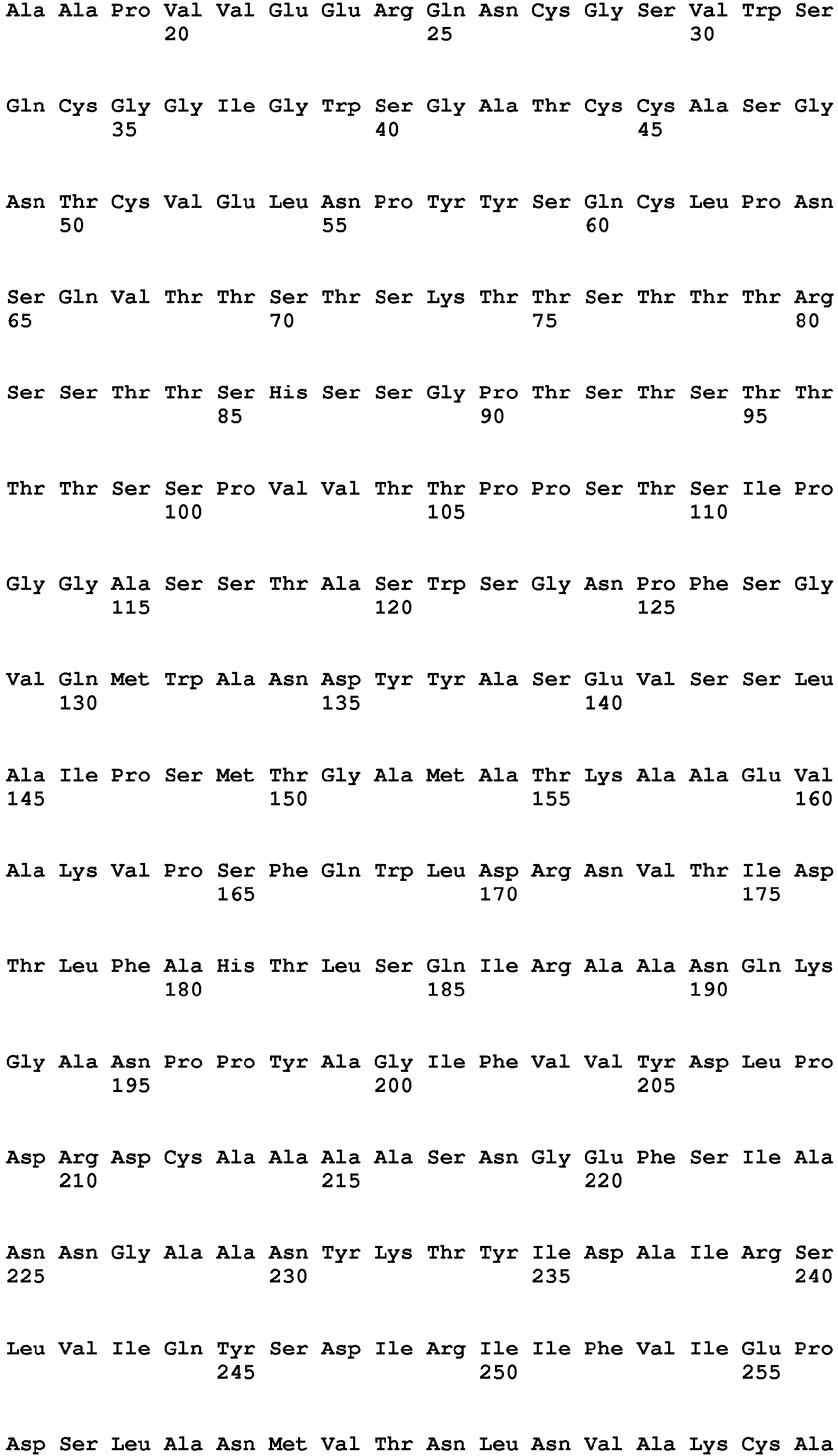
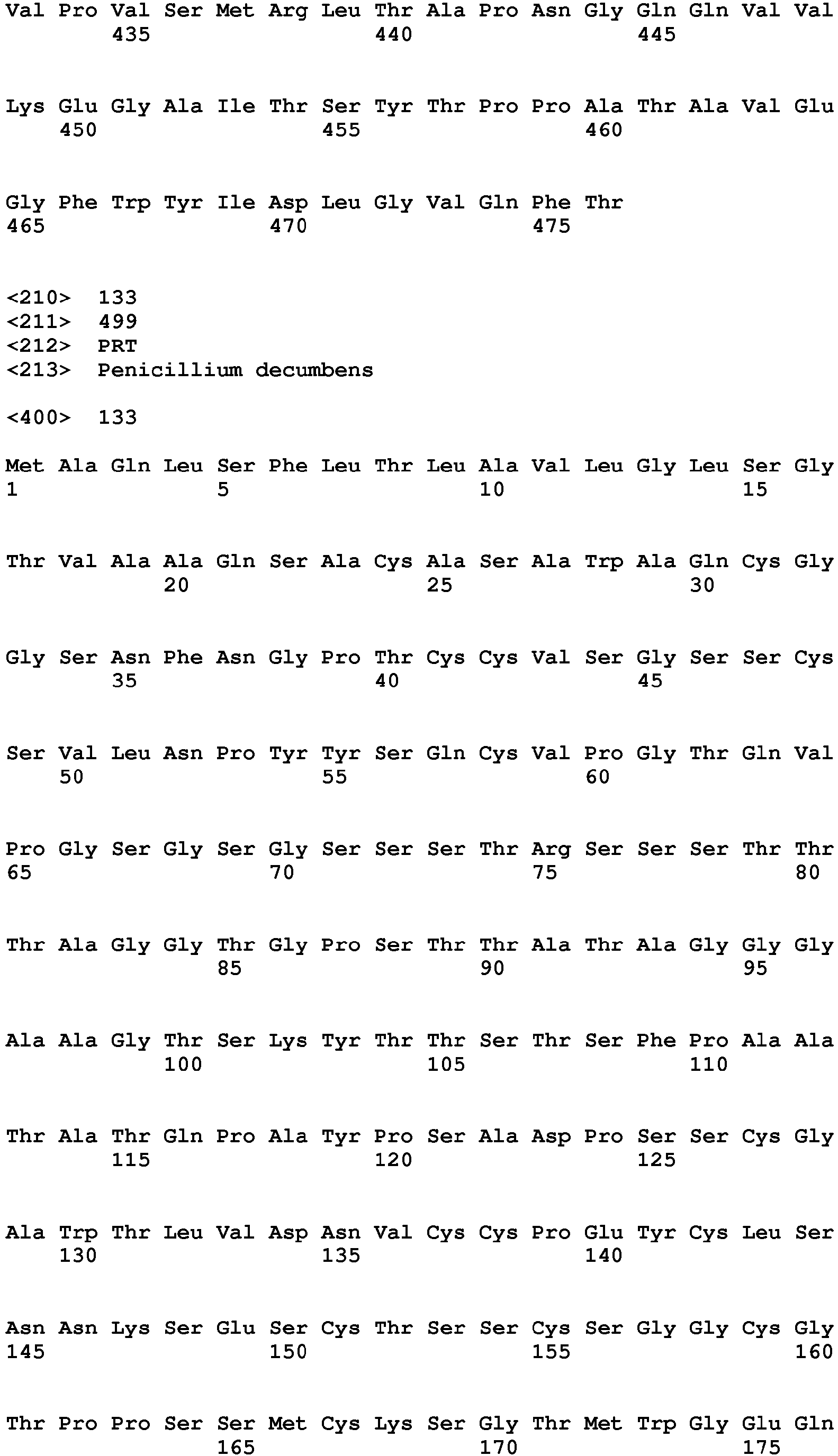
-
The present invention relates to mutant yeast strains, such as Yarrowia lipolytica strains, capable of growing on cellulose as carbon source and means for obtaining such mutant strains.
-
The production of second-generation biofuels and platform molecules for the chemical industry from lignocellulosic biomass (LCB) is viewed as crucial part of the bio-economy. Cellulose, the main component of LCB, is a polymer composed of β-1,4-linked glucose subunits usually embedded in an amorphous matrix of hemicellulose and lignin. It may exist in two forms, a tightly packed crystalline form where individual chains are organized in microfibrils via hydrogen bonding and van der Waals interactions, or less-ordered amorphous form. The depolymerisation of cellulose requires a variety of enzymes, including endoglucanases (EGs) (EC 3.2.1.4) that hydrolyse internal β-glucosidic bonds, cellobiohydrolases (CBHs) (EC 3.2.1.91) that remove cello-oligosaccharides in a processive manner from chain termini, and β-glucosidases (BGLs) (EC 3.2.1.21) that degrade cello-oligosaccharides to glucose (Menon and Rao, 2012). However, the condensed structure of crystalline cellulose and its intimate proximity with hemicelluloses and lignin combine to make LCB very resistant to enzymatic hydrolysis and render biochemical processing of raw LCB economically unreasonable. To overcome this recalcitrance, biomass pretreatment is necessry. However, this step constitutes a significant cost driver in the overall economics of LCB biorefinery processes. Presently it is widely recognized that significant technological advances, including better pretreatments, lower cost enzymes and efficient process design will be required in order to make LCB biorefining competitive within the current economic framework (Menon and Rao, 2012).
-
It is known a pretreatment process which belongs to the so-called organosolv technology family, because it uses organic solvents to dissolve lignin and hemicelluloses, and yields a pure and relatively amorphous cellulose fraction that is quite amenable to enzyme action (Delmas, 2008; International Application
WO 2012/049054 ). This process produces functionalized lignins (Biolignin™) and an essentially furfural-free pentose-rich fraction, making this pretreatment technology an interesting platform for the design of a new LCB biorefinery concept.
-
Consolidated bioprocessing (CBP), featuring microbial enzyme production and concomitant microbial conversion of suitable feedstock into value-added products in a single step, offers great potential for cost-effective lignocellulosic bioconversion (den Haan et al., 2015; Olson et al., 2012). This is because it is predicted that CBP will reduce both capital investment and operating costs and possibly procure higher enzymatic hydrolysis rates. However, the main challenge for CBP technology is to develop a purpose built microorganism that will simultaneously convert cellulose pulp into sugars and ferment these to target products. To date, no naturally-occurring organism has been described with such capabilities (den Haan et al., 2015). Nevertheless, using microbial engineering approaches and focusing on hosts such as Escherichia coli (Ryu and Karim, 2015), Saccharomyces cerevisiae (reviewed in La Grange DC, et al.. 2010) and Kluyveromyces marxianus (Yanase et al., 2010), considerable progress has been made, although so far most studies have used model cellulose substrates and achieved relatively low titres of product. Importantly, none of the engineered strains reported so far have convincingly hydrolysed the cellulose feedstock, and currently no commercially viable CBP organism has been reported (Brethauer and Studer, 2014).
-
The so-called oleaginous yeast Yarrowia lipolytica can accumulate lipids up to 50% of its dry weight depending on culture conditions, making this a promising platform for the production of biodiesel precursors (Thevenieau and Nicaud, 2013; Blazeck et al., 2014). Advantageously, Y. lipolytica is already widely used in detergent, food, pharmaceutical and environmental industries and has been classified by the FDA (Food and Drug Administration) as "Generally Recognized as Safe" (GRAS) for numerous processes (Groenewald et al., 2014). Moreover, Y. lipolytica is a suitable host for heterologous expression, since it displays high secretion ability and performs a wide-range of post-translational modifications (Madzak et al., 2004; Nicaud et al., 2002). However, regarding LCB biorefining, Y. lipolytica is unable to metabolize cellulose.
-
Recently, several reports have illustrated how cellulolytic capability can be conferred to Y. lipolytica, with single gene expression and co-culturing being used as a pragmatic way to design a Y. lipolytica-based CBP system (Boonvitthya et al., 2013; Wei et al., 2014). However, the use of co-culturing is not a feasible solution for industrial implementation, and a fully viable system can only be achieved if β-glucosidases (BGL) activity is present (Wei et al., 2014). In this respect, the inventors have recently described the over-expression of endogenous BGLs in Y. lipolytica and the use of cello-oligosaccharides by the recombinant yeast strain to support growth (Guo et al., 2015).
-
In pursuit of a more ambitious goal, the inventors have built on this platform strain, adding other cellulolytic enzyme-encoding genes and exploring different combinations in order to procure a Y. lipolytica strain that is able to grow on cellulose as the sole carbon source. The inventors have found that the co-expression of the previously described Yarrowia lipolytica β-glucosidases, a cellobiohydrolase (CBH) II, and endoglucanases (EG) I and II from Trichoderma reesei (syn. Hypocrea jecorina), and the Neurospora crassa CBH I procured an engineered Y. lipolytica strain that was able to grow both on model cellulose substrates, such as highly crystalline Avicel, and on industrial cellulose pulp, such as that obtained using an organosolv process. The inventors have also found that depending on the origin of the cellobiohydrolase and endoglucanase to express in Y. lipolytica, the secretion yield of this expressed enzyme may vary.
-
Accordingly, the present invention provides a method for obtaining an oleaginous yeast strain capable of growing on cellulose as carbon source, wherein said method comprises overexpressing in said strain:
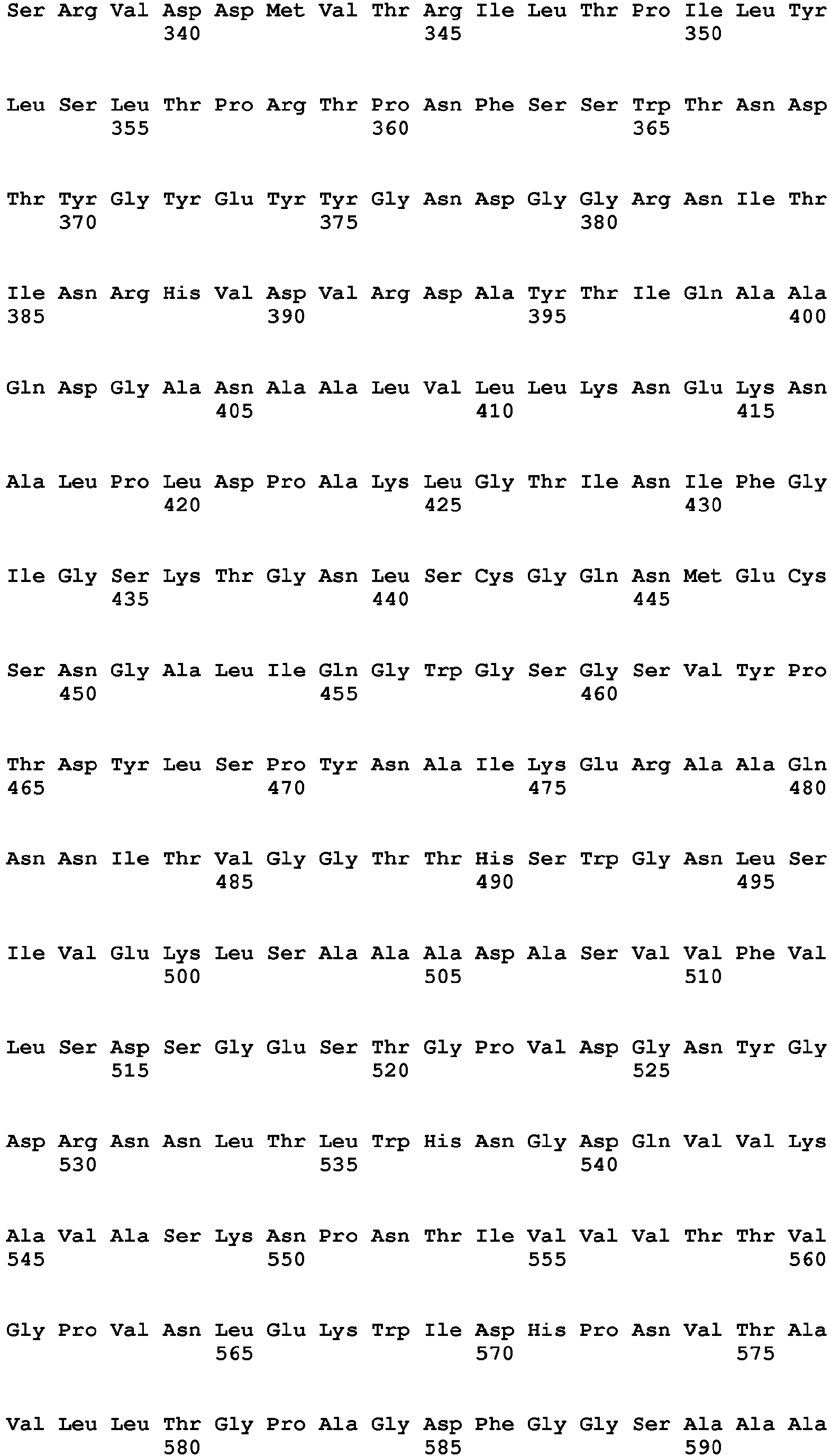
- a β-glucosidase 1 (BGL 1; EC 3.2.1.21) having at least 80% identity, or by order of increasing preference at least 83%, 85%, 90%, 92%, 95%, 96%, 97%, 98%, 99% or 100% identity, with the polypeptide of sequence SEQ ID NO: 1 (mature YALI_BGL1) further comprising a N-terminal signal peptide,
- a β-glucosidase 2 (BGL 2; EC 3.2.1.21) having at least 80% identity, or by order of increasing preference at least 82%, 85%, 90%, 92%, 95%, 96%, 97%, 98%, 99% or 100% identity, with the polypeptide of sequence SEQ ID NO: 2 (mature YALI_BGL2) further comprising a N-terminal signal peptide,
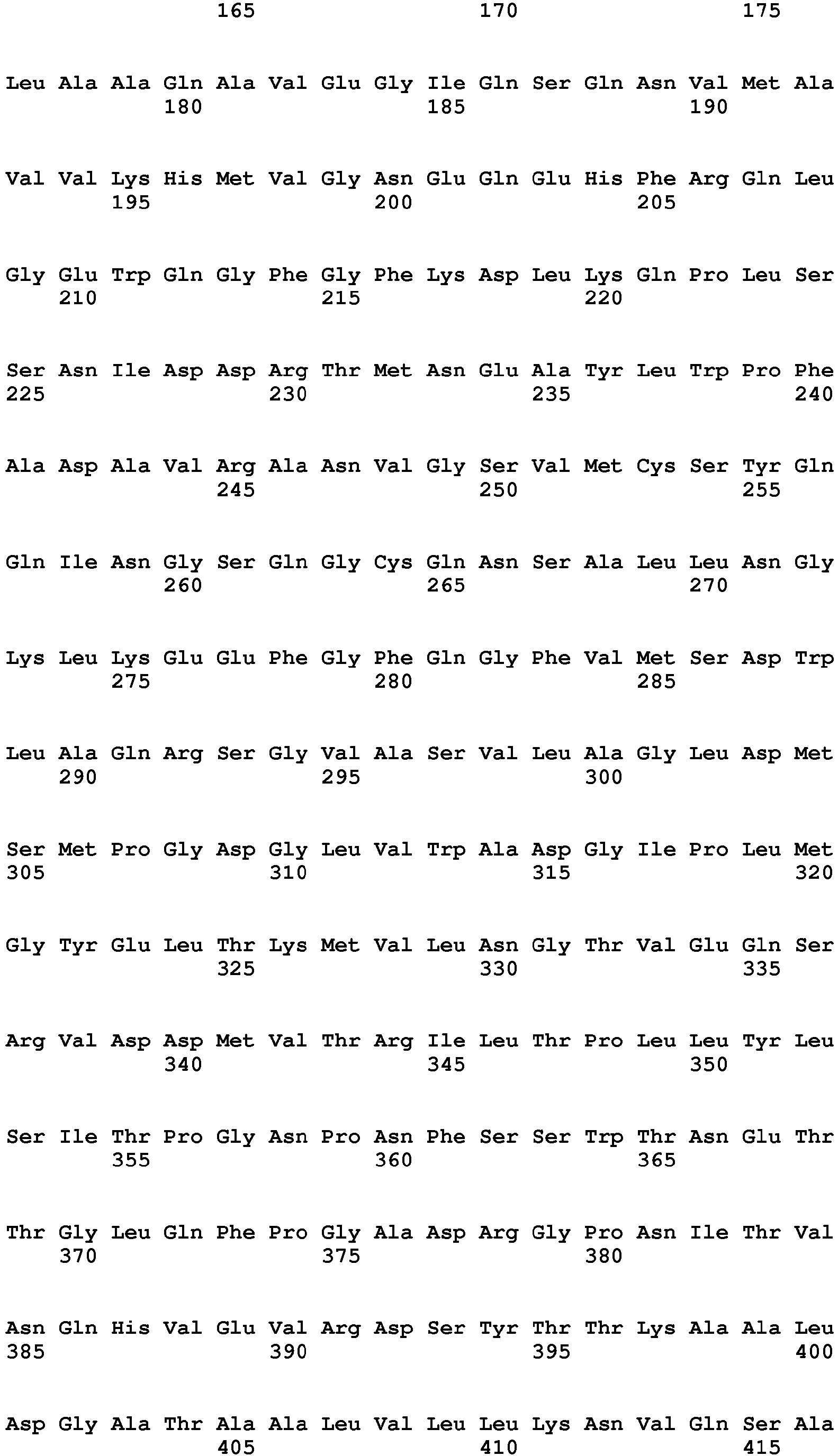
- an endoglucanase I (EG I; EC 3.2.1.4) having at least 55% identity, or by order of increasing preference at least 59%, 60%, 65%, 70%, 75%, 82%, 85%, 90%, 92%, 95%, 96%, 97%, 98%, 99% or 100% identity, with the polypeptide of sequence SEQ ID NO: 3 (TrEG I),
- an endoglucanase II (EG II; EC 3.2.1.4) having at least 55% identity, or by order of increasing preference at least 59%, 60%, 65%, 70%, 75%, 82%, 85%, 90%, 92%, 95%, 96%, 97%, 98%, 99% or 100% identity, with the polypeptide of sequence SEQ ID NO: 4 (TrEG II),
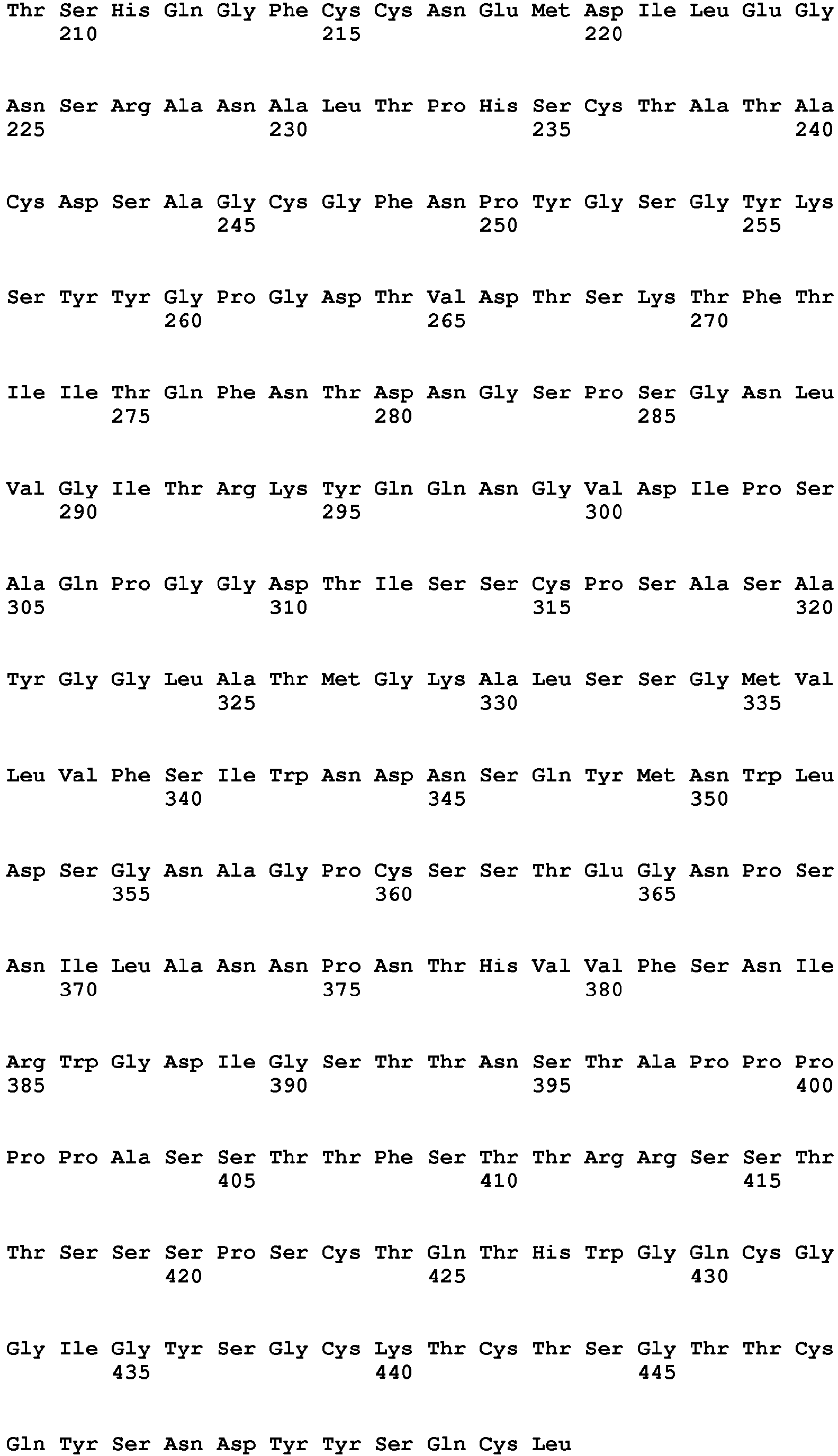
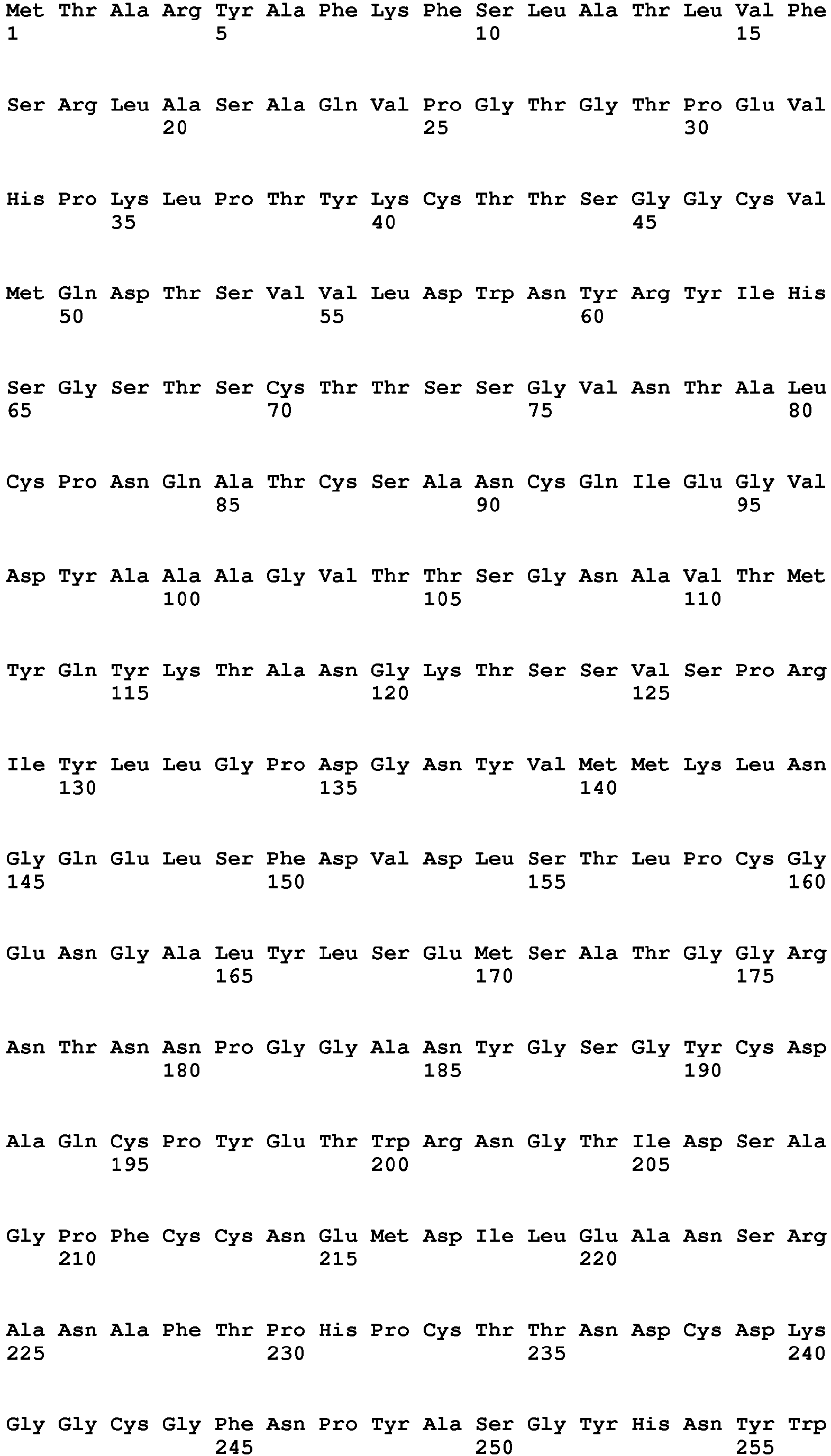
- a cellobiohydrolase I (CBH I; EC 3.2.1.91) having at least 65% identity, or by order of increasing preference at least 70%, 75%, 82%, 85%, 90%, 92%, 95%, 96%, 97%, 98%, 99% or 100% identity, with the polypeptide of sequence SEQ ID NO: 5 (NcCBH I), and
- a cellobiohydrolase II (CBH II; EC 3.2.1.91) having at least 60% identity, or by order of increasing preference at least 65%, 70%, 75%, 82%, 85%, 90%, 92%, 95%, 96%, 97%, 98%, 99% identity or 100%, with the polypeptide of sequence SEQ ID NO: 6 (TrCBH II).
-
The term overexpressing an enzyme (or protein) in a yeast strain, herein refers to artificially increasing the quantity of said enzyme produced in a yeast strain compared to a reference (control) yeast strain wherein said enzyme is not overexpressed. This term also encompasses expression of an enzyme (or protein) in a yeast strain which does not naturally contain a gene encoding said enzyme.
-
An advantageous method for overexpressing these six enzymes (i.e., BGL I, BGL II, EG I, EG II, CBH I, CBH II) comprises introducing into the genome of said yeast strain one or several DNA constructs comprising a nucleotide sequence encoding said enzymes, placed under the control of a promoter.
-
Unless otherwise specified, the percent of identity between two sequences which are mentioned herein is calculated from an alignment of the two sequences over their whole length, not comprising the signal sequence. One can use the BLAST program (Tatusova and Madden, 1999) with the default parameters (open gap penalty = 2; extension gap penalty = 5; matrix = BLOSUM 62).
-
The cellulose can be microcrystalline cellulose (e.g., Avicel®), phosphoric acid swollen cellulose (PASC) or cellulose pulp (i.e.., obtained using an organosolv process operated by CIMV S.A.).
-
The N-terminal signal peptide (or signal sequence) drives secretion of the β-glucosidase into the extracellular space (e.g., periplasm, external medium) of the yeast. After secretion, the N-terminal signal peptide is usually cleaved (removed) by a peptidase leading to a mature β-glucosidase. The N-terminal signal peptide can further allow glycosylation in the case of β-glucosidase bearing potential sites of glycosylation.
-
The N-terminal signal peptides are well known in the art (see for review von Heijne, 1985). In particular, N-terminal signal peptides able to drive secretion of a protein into the extracellular space in yeast and methods to perform such a secretion are well known in the art (see Sreekrishna et al., 1997; Hashimoto et al., 1998; Koganesawa et al.; 2001; Gasmi et al., 2011; Madzak and Beckerich, 2013). Methods for identifying a N-terminal signal peptide (signal sequence) are also well known in the art. One can use the programs Signal-BLAST (Franck and Sippl, 2008) and/or SignalP 4.1 Server (Petersen et al., 2011).
-
The N-terminal signal peptide can be from a protein from any organism, such as mammal, bacteria, yeast, preferably from a protein form a yeast, more preferably from Yarrowia.
-
The N-terminal signal peptide of the β-glucosidase 1 having at least 80% identity with the polypeptide of sequence SEQ ID NO: 1 and the N-terminal signal peptide of the β-glucosidase 2 having at least 80% identity with the polypeptide of sequence SEQ ID NO: 2 can be identical or different, in terms of space of secretion (periplasm or external medium) and/or in terms of amino acid sequence. By way of example, the N-terminal signal peptide of the β-glucosidase 1 having at least 80% identity with the polypeptide of sequence SEQ ID NO: 1 drives secretion of said β-glucosidase 1 into the periplasm space or the external medium and the N-terminal signal peptide of the β-glucosidase 2 having at least 80% identity with the polypeptide of sequence SEQ ID NO: 2 drives secretion of said β-glucosidase 2 into the periplasm space or the external medium.
-
Advantageously, the N-terminal signal peptide of the β-glucosidase 1 having at least 80% identity with the polypeptide of sequence SEQ ID NO: 1 drives secretion of said β-glucosidase 1 into the periplasm space. It can be chosen from the N-terminal signal peptides SEQ ID NO: 26 or SEQ ID NO: 27.
-
Advantageously, the N-terminal signal peptide of the β-glucosidase 2 having at least 80% identity with the polypeptide of sequence SEQ ID NO: 2 drives secretion of said β-glucosidase 2 into the external medium. It can be chosen from the N-terminal signal peptides SEQ ID NO: 28, SEQ ID NO: 29, SEQ ID NO: 30 or SEQ ID NO: 31.
-
The N-terminal signal peptide can be the naturally occurring signal sequence of the β-glucosidase to overexpress or a modified signal sequence, such as the Yarrowia alkaline extracellular protease (Aep; Fabre et al., 1991) or the extracellular lipase (Lip2p) signal sequences (Pignède et al., 2000; Nicaud et al., 2002).
-
Methods for determining the presence of a signal sequence (N-terminal signal peptide) in a protein are well known in the art. One can use the programs Signal-BLAST (Franck and Sippl, 2008) and/or SignalP 4.1 Server (Petersen et al., 2011).
-
Nucleotide sequences encoding YALI_BGL1 and YALI_BGL2 are provided in SEQ ID NO: 8 and SEQ ID NO: 9 respectively.
-
Methods for determining whether an enzyme has a β-glucosidase activity (EC 3.2.1.21) are known in the art. By way of example, β-glucosidase activity can be measured by quantifying the release of pNP (p-nitrophenol) from pNPGlc as described in Guo et al., 2011.
-
The β-glucosidase 1 having at least 80% identity with the polypeptide of sequence SEQ ID NO: 1 (mature YALI_BGL1) can be a heterologous or endogenous β-glucosidase of the oleaginous yeast strain.
-
Advantageously, the β-glucosidase 1 having at least 80% identity with the polypeptide of sequence SEQ ID NO: 1 (mature YALI_BGL1) is from a yeast strain, preferably an oleaginous yeast strain, such as Candida, Cryptoccocus, Lipomyces, Rhodosporidium (e.g., Rhodosporidium toruloides), Rhodotorula (e.g., Rhodotorula glutinis), Trichosporon or Yarrowia, more preferably a Yarrowia strain. According to this embodiment, the Yarrowia strain is preferably selected from Y. lipolytica and Y. galli, more preferably a Y. lipolytica strain.
-
In a preferred embodiment, the β-glucosidase 1 having at least 80% identity with the polypeptide of sequence SEQ ID NO: 1 (mature YALI_BGL1) is selected from the group consisting of the β-glucosidase 1 of SEQ ID NO: 1 (mature YALI_BGL1), and SEQ ID NO: 15 (YAGA_BGL1 without its naturally occurring N-terminal signal sequence), preferably SEQ ID NO: 1 (mature YALI_BGL1).
-
In another preferred embodiment, the β-glucosidase having at least 80% identity with the polypeptide of sequence SEQ ID NO: 1 (mature YALI_BGL1) further comprising a N-terminal signal peptide is selected from the group consisting of SEQ ID NO: 20 (YALI_BGL1; BGL1 from Yarrowia lipolytica CLIB122, comprising its naturally occurring N-terminal signal sequence) and SEQ ID NO: 21 (YAGA_BGL1; BGL1 from Yarrowia galli CBS 9722, comprising its naturally occurring N-terminal signal sequence), preferably SEQ ID NO: 20.
-
The β-glucosidases included in sequences SEQ ID NO: 20 (YALI_BGL1) and SEQ ID NO: 21 (YAGA_BGL1) have respectively 100% and 84.08% identity with the polypeptide of sequence SEQ ID NO: 1 (mature YALI_BGL1).
-
The β-glucosidase 2 having at least 80% identity with the polypeptide of sequence SEQ ID NO: 2 (mature YALI_BGL2) can be a heterologous or endogenous β-glucosidase of the oleaginous yeast strain.
-
Advantageously, the β-glucosidase 2 having at least 80% identity with the polypeptide of sequence SEQ ID NO: 2 (mature YALI_BGL2) is from a yeast strain, preferably an oleaginous yeast strain, such as Candida, Cryptoccocus, Lipomyces, Rhodosporidium (e.g., Rhodosporidium toruloides), Rhodotorula (e.g., Rhodotorula glutinis), Trichosporon or Yarrowia, more preferably a Yarrowia strain. According to this embodiment, the Yarrowia strain is preferably selected from a Y. lipolytica, Y. galli, Y. yakushimensis or Yarrowia alimentaria strain, more preferably a Y. lipolytica strain.
-
In a preferred embodiment, the β-glucosidase 2 having at least 80% identity with the polypeptide of sequence SEQ ID NO: 2 (mature YALI_BGL2) has the amino acid sequence SEQ ID NO: 16. This sequence SEQ ID NO: 16 corresponds to the consensus amino acid sequence obtained from mature YALI_BGL2, YAGA_BGL2, YAYA_BGL2 and YAAL_BGL2 (as described above).
-
In another preferred embodiment, the β-glucosidase 2 having at least 80% identity with the polypeptide of sequence SEQ ID NO: 2 (mature YALI_BGL2) is selected from the group consisting of the β-glucosidase of SEQ ID NO: 2 (mature YALI_BGL2), SEQ ID NO: 17 (YAGA_BGL2 without its naturally occurring N-terminal signal sequence), SEQ ID NO: 18 (YAYA_BGL2 without its naturally occurring N-terminal signal sequence) and SEQ ID NO: 19 (YAAL_BGL2 without its naturally occurring N-terminal signal sequence), preferably SEQ ID NO: 2 (mature YALI_BGL2).
-
In another preferred embodiment, the β-glucosidase 2 having at least 80% identity with the polypeptide of sequence SEQ ID NO: 2 (mature YALI_BGL2) further comprising a N-terminal signal peptide is selected from the group consisting of SEQ ID NO: 22 (YALI_BGL2; BGL2 from Yarrowia lipolytica CLIB122, comprising its naturally occurring N-terminal signal sequence), SEQ ID NO: 23 (YAGA_BGL2; BGL2 from Yarrowia galli CBS 9722, comprising its naturally occurring N-terminal signal sequence), SEQ ID NO: 24 (YAYA_BGL2; BGL2 from Yarrowia yakushimensis CBS 10253, comprising its naturally occurring N-terminal signal sequence) and SEQ ID NO: 25 (YAAL_BGL2; BGL2 from Yarrowia alimentaria CBS 10151, comprising its naturally occurring N-terminal signal sequence), preferably SEQ ID NO: 22.
-
The β-glucosidases 2 included in sequences SEQ ID NO: 22 (YALI_BGL2), SEQ ID NO: 23 (YAGA_BGL2), SEQ ID NO: 24 (YAYA_BGL2) and SEQ ID NO: 25 (YAAL_BGL2) have respectively 100%, 93.55%, 85.21% and 82.14% identity with the polypeptide of sequence SEQ ID NO: 2 (mature YALI_BGL2).
-
In another preferred embodiment, both β-glucosidases (the β-glucosidase 1 having at least 80% identity with the polypeptide of sequence SEQ ID NO: 1 and the β-glucosidase 2 having at least 80% identity with the polypeptide of sequence SEQ ID NO: 2) are from a yeast strain, preferably an oleaginous yeast strain, such as Candida, Cryptoccocus, Lipomyces, Rhodosporidium (e.g., Rhodosporidium toruloides), Rhodotorula (e.g., Rhodotorula glutinis), Trichosporon or Yarrowia, more preferably a Yarrowia strain. According to this embodiment, the Yarrowia strain is preferably selected from a Y. lipolytica or Y. galli strain, and more preferably a Y. lipolytica strain.
-
Methods for overexpressing
BGL 1 and
BGL 2 enzymes in an oleaginous yeast strain are described in Guo
et al., 2015 and International Application
WO 2016/170155 .
-
Endoglucanase I (EC 3.2.1.4), which is classified in glycoside hydrolase family 7 (GH7), has activity on cellulosic substrates. This enzyme randomly cleaves internal bonds at amorphous sites of cellulose that create new chain ends. Methods for determining whether an enzyme has an endoglucanase I activity are known in the art. By way of example, one can use the method described in Ghose et al. 1987.
-
Advantageously, the endoglucanase I is from a fungus or yeast strain, preferably from the genus Trichoderma, Hypocrea, Thielavia, Dactylellina, Myceliophthora, Aspergillus, Neosartorya, Penicillium, Aspergillus or Rosellinia.
-
In a preferred embodiment, the endoglucanase I has three conserved domains in catalytic core domain, defined by amino acid sequences SEQ ID NO: 32, SEQ ID NO: 33 and SEQ ID NO: 34; SEQ ID NO: 32 and SEQ ID NO: 33 being consensus amino acid sequences. These consensus amino acid sequences SEQ ID NO: 32 and SEQ ID NO: 33 correspond to the consensus amino acid sequences obtained by aligning the endoglucanase I from: Trichoderma reesei of SEQ ID NO: 3 (TrEG I), Hypocrea rufa of SEQ ID NO: 35, Trichoderma longibrachiatum of SEQ ID NO: 36, Trichoderma orientale of SEQ ID NO: 37, Trichoderma pseudokoningii of SEQ ID NO: 38, Hypocrea atroviridis of SEQ ID NO: 39, Trichoderma gamsii of SEQ ID NO: 40, Trichoderma harzianum of SEQ ID NO: 41, Thielavia terrestris of SEQ ID NO: 42, Dactylellina haptotyla of SEQ ID NO: 43, Myceliophthora thermophila of SEQ ID NO: 44, Aspergillus udagawae of SEQ ID NO: 45, Neosartorya fumigata of SEQ ID NO: 46, Neosartorya fischeri of SEQ ID NO: 47, Aspergillus fischeri of SEQ ID NO: 48, Penicillium brasilianum of SEQ ID NO: 49, Aspergillus fumigatus Z5 of SEQ ID NO: 50, Aspergillus lentulus of SEQ ID NO: 51, and Rosellinia necatrix of SEQ ID NO: 52.
-
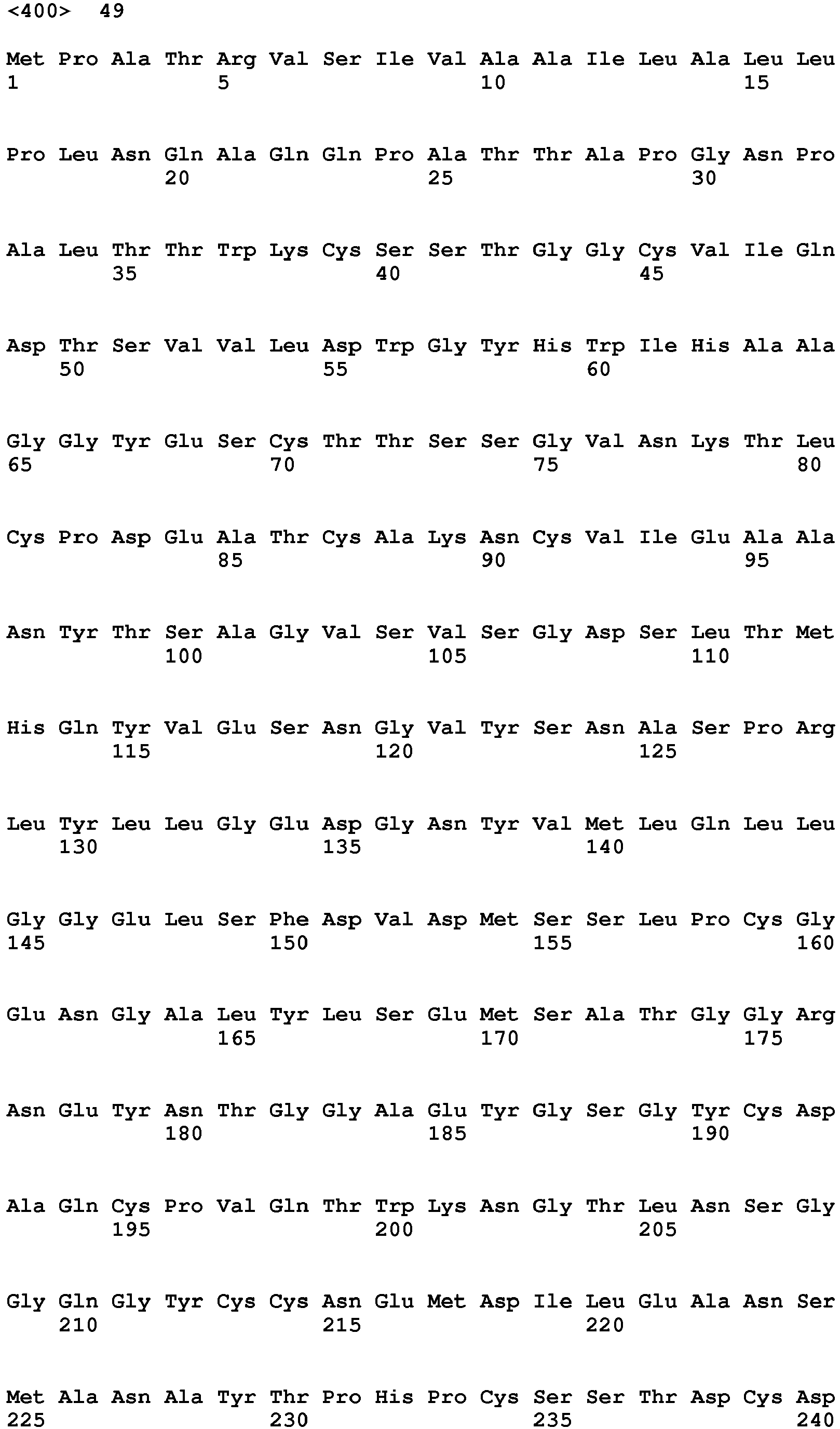
In another preferred embodiment, the endoglucanase I is selected from the group consisting of the EG I from: Trichoderma reesei of SEQ ID NO: 3 (TrEG I), Hypocrea rufa of SEQ ID NO: 35 (which possesses 99.8% identity with the amino acid sequence of TrEG I), Trichoderma longibrachiatum of SEQ ID NO: 36 (which possesses 94.6% identity with the amino acid sequence of TrEG I), Trichoderma orientale of SEQ ID NO: 37 (which possesses 94.6% identity with the amino acid sequence of TrEG I), Trichoderma pseudokoningii of SEQ ID NO: 38 (which possesses 94.4% identity with the amino acid sequence of TrEG I), Hypocrea atroviridis of SEQ ID NO: 39 (which possesses 84.4% identity with the amino acid sequence of TrEG I), Trichoderma gamsii of SEQ ID NO: 40 (which possesses 80.9% identity with the amino acid sequence of TrEG I), Trichoderma harzianum of SEQ ID NO: 41 (which possesses 80.9% identity with the amino acid sequence of TrEG I), Thielavia terrestris of SEQ ID NO: 42 (which possesses 69% identity with the amino acid sequence of TrEG I), Dactylellina haptotyla of SEQ ID NO: 43 (which possesses 60.4% identity with the amino acid sequence of TrEG I), Myceliophthora thermophila of SEQ ID NO: 44 (which possesses 62.9% identity with the amino acid sequence of TrEG I), Aspergillus udagawa of SEQ ID NO: 45 (which possesses 62.2% identity with the amino acid sequence of TrEG I), Neosartorya fumigata of SEQ ID NO: 46 (which possesses 63.3% identity with the amino acid sequence of TrEG I), Neosartorya fischeri of SEQ ID NO: 47 (which possesses 61.9% identity with the amino acid sequence of TrEG I), Aspergillus fischeri of SEQ ID NO: 48 (which possesses 62.2% identity with the amino acid sequence of TrEG I), Penicillium brasilianum of SEQ ID NO: 49 (which possesses 59.8% identity with the amino acid sequence of TrEG I), Aspergillus fumigatus Z5 of SEQ ID NO: 50 (which possesses 63.0% identity with the amino acid sequence of TrEG I), Aspergillus lentulus of SEQ ID NO: 51 (which possesses 61.2% identity with the amino acid sequence of TrEG I) and Rosellinia necatrix of SEQ ID NO: 52 (which possesses 59% identity with the amino acid sequence of TrEG I), preferably the endoglucanase I from Trichoderma reesei of SEQ ID NO: 3.
-
Endoglucanase II (EC 3.2.1.4), which belongs to glycoside hydrolase family 5 (GH5), has activity on both cellulose and hemicellulose. This enzyme randomly cleaves internal bonds at amorphous sites of cellulose as well as xylan that create new chain ends. Methods for determining whether an enzyme has an endoglucanase II activity are known in the art. By way of example, one can use the method described in Ghose et al., 1987.
-
Advantageously, the endoglucanase II is from a fungus or yeast strain, preferably from the genus Trichoderma, Hypocrea, Thielavia, Phialophora, Batryotinia, Jaapia, Cylindrobasidium, Polyporus, Ceriporiopsis or Phlebiopsis.
-
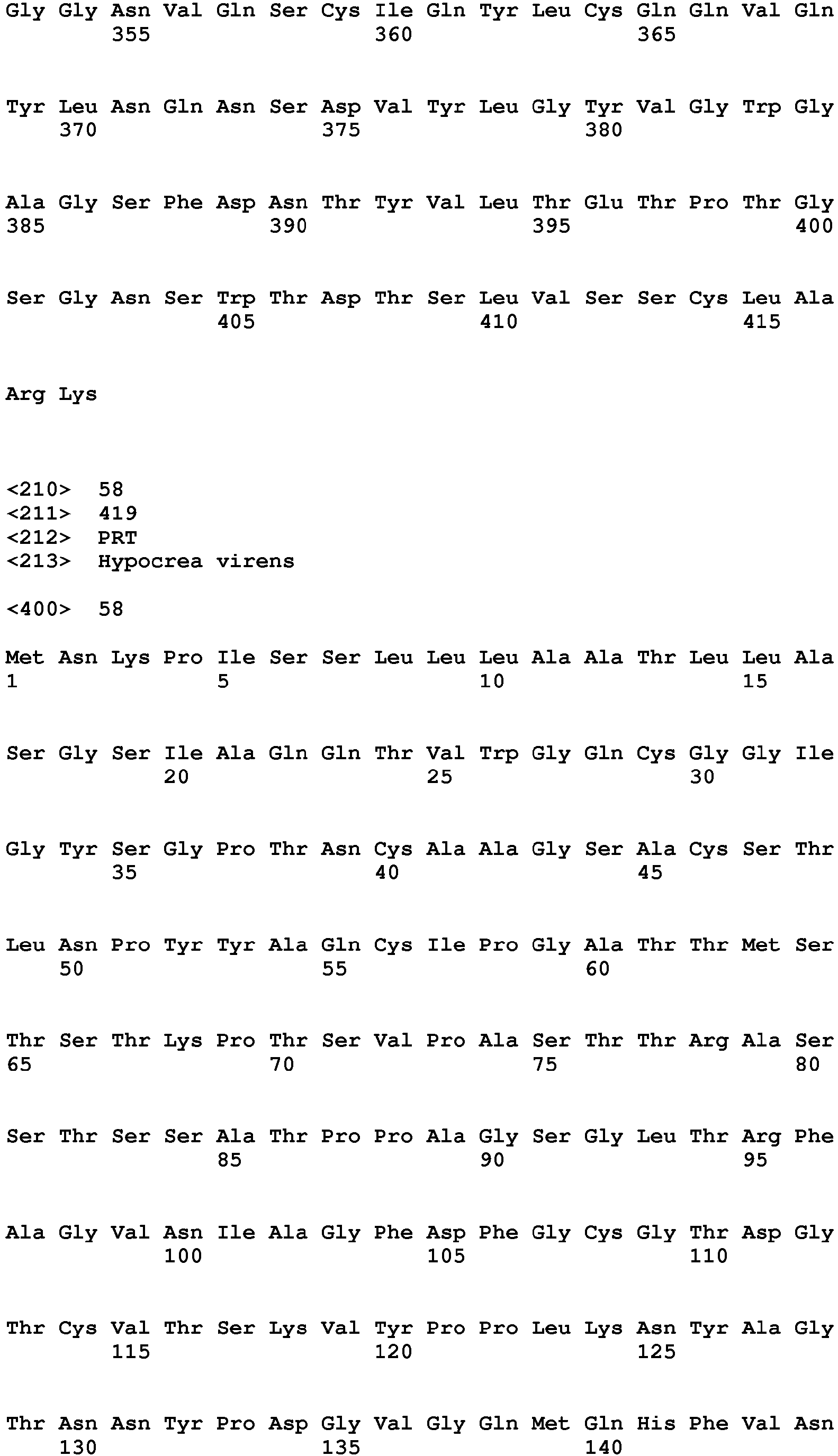
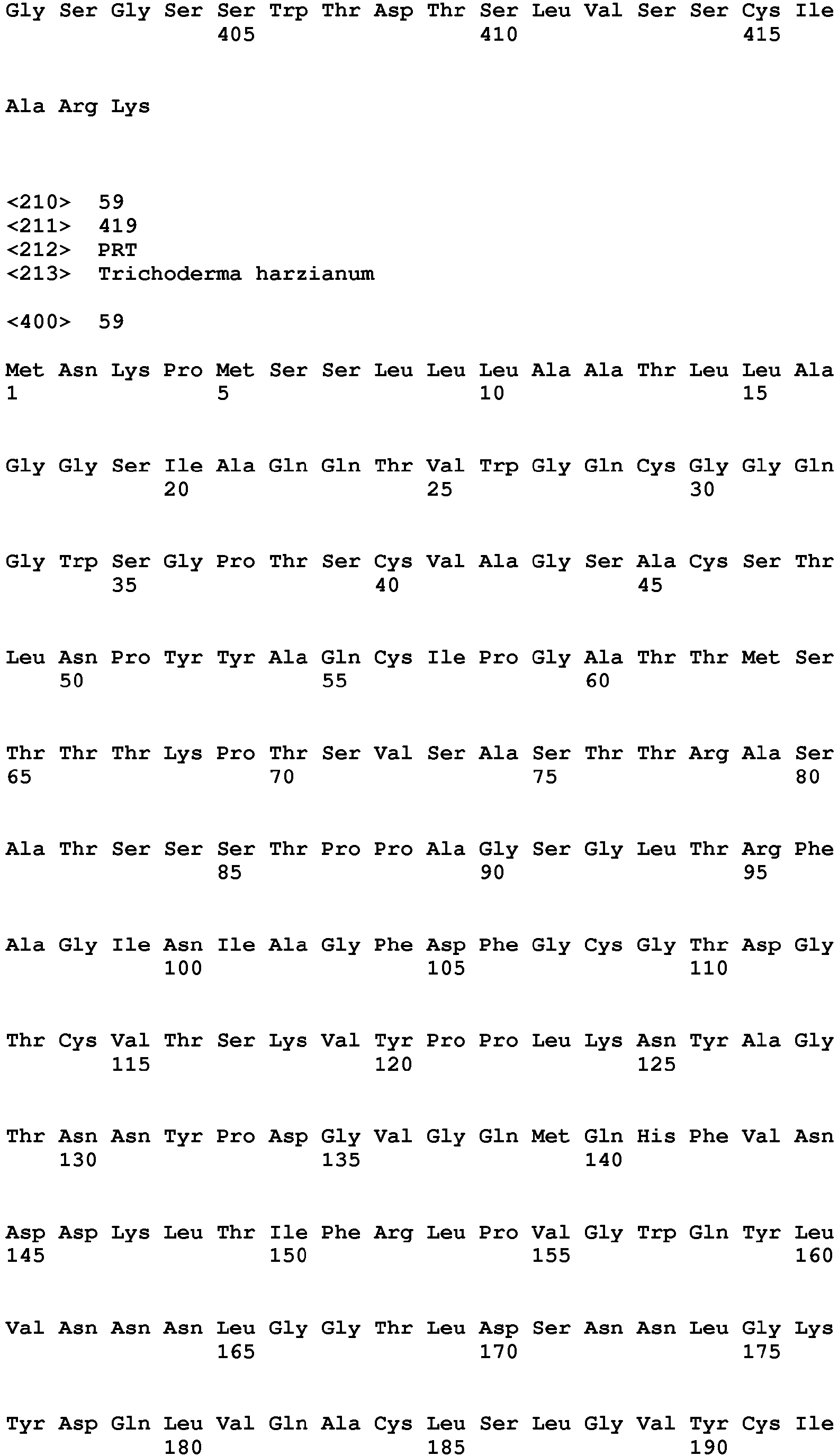
In a preferred embodiment, the endoglucanase II has two conserved domains in catalytic core domain, defined by the consensus amino acid sequences SEQ ID NO: 53 and SEQ ID NO: 54. These consensus amino acid sequences SEQ ID NO: 53 and SEQ ID NO: 54 correspond to the consensus amino acid sequences obtained by aligning the endoglucanase II from: Trichoderma reesei of SEQ ID NO: 4 (TrEG II), Hypocrea rufa of SEQ ID NO: 55, Hypocrea atroviridis of SEQ ID NO: 56, Trichoderma orientale of SEQ ID NO: 57, Hypocrea virens of SEQ ID NO: 58, Trichoderma harzianum of SEQ ID NO: 59, Trichoderma asperellum of SEQ ID NO: 60, Trichoderma gamsii of SEQ ID NO: 61, Thielavia terrestris of SEQ ID NO: 62, Phialophora sp. G5 of SEQ ID NO: 63, Botryotinia fuckeliana of SEQ ID NO: 64, Jaapia argillacea of SEQ ID NO: 65, Cylindrobasidium torrendii of SEQ ID NO: 66, Polyporus arcularius of SEQ ID NO: 67, Ceriporiopsis subvermispora of SEQ ID NO: 68, and Phlebiopsis gigantea of SEQ ID NO: 69.
-
In another preferred embodiment, the endoglucanase II is selected from the group consisting of the EG II from: Trichoderma reesei of SEQ ID NO: 4 (TrEG II), Hypocrea rufa of SEQ ID NO: 55 (which possesses 99.3% identity with the amino acid sequence of TrEG II), Hypocrea atroviridis of SEQ ID NO: 56 (which possesses 94.3% identity with the amino acid sequence of TrEG II), Trichoderma orientale of SEQ ID NO: 57 (which possesses 94% identity with the amino acid sequence of TrEG II), Hypocrea virens of SEQ ID NO: 58 (which possesses 85% identity with the amino acid sequence of TrEG II), Trichoderma harzianum of SEQ ID NO: 59 (which possesses 84% identity with the amino acid sequence of TrEG II), Trichoderma asperellum of SEQ ID NO: 60 (which possesses 78% identity with the amino acid sequence of TrEG II), Trichoderma gamsii of SEQ ID NO: 61 (which possesses 76.4% identity with the amino acid sequence of TrEG II), Thielavia terrestris of SEQ ID NO: 62 (which possesses 73.4% identity with the amino acid sequence of TrEG II), Phialophora sp. G5 of SEQ ID NO: 63 (which possesses 72.6% identity with the amino acid sequence of TrEG II), Botryotinia fuckeliana of SEQ ID NO: 64 (which possesses 67.6% identity with the amino acid sequence of TrEG II), Jaapia argillacea of SEQ ID NO: 65 (which possesses 66% identity with the amino acid sequence of TrEG II), Cylindrobasidium torrendii of SEQ ID NO: 66 (which possesses 61.1% identity with the amino acid sequence of TrEG II), Polyporus arcularius of SEQ ID NO: 67 (which possesses 62.9% identity with the amino acid sequence of TrEG II), Ceriporiopsis subvermispora of SEQ ID NO: 68 (which possesses 59.6% identity with the amino acid sequence of TrEG II), and Phlebiopsis gigantea of SEQ ID NO: 69 (which possesses 61.9% identity with the amino acid sequence of TrEG II), preferably the EG II from: Trichoderma reesei of SEQ ID NO: 4.
-
Nucleotide sequences (mature sequences) encoding TrEG I and TrEG II are provided in SEQ ID NO: 10 and SEQ ID NO: 11, respectively.
-
Nucleotide sequences encoding the native signal peptides of TrEG I and TrEG II are provided in SEQ ID NO: 207 and SEQ ID NO: 208, respectively.
-
Methods for overexpressing EG I or EG II enzymes in an oleaginous yeast strain are described in Boonvitthya et al., 2013 and Park et al., 2000.
-
Cellobiohydrolase I (EC 3.2.1.91) cleaves two to four units from the reducing end of the cellulose chain. Methods for determining whether an enzyme has an cellobiohydrolase I activity are known in the art. By way of example, one can use the method described in Zhang and Lynd, 2006.
-
Advantageously, the cellobiohydrolase I is from a fungus or yeast strain, preferably from the genus Neurospora, Sordaria, Thielavia, Acremonium, Myceliophthora, Humicola, Chaetomium, Podospora, Scedosporium, Togninia, Gibberella, Gaeumannomyces or Fusarium.
-
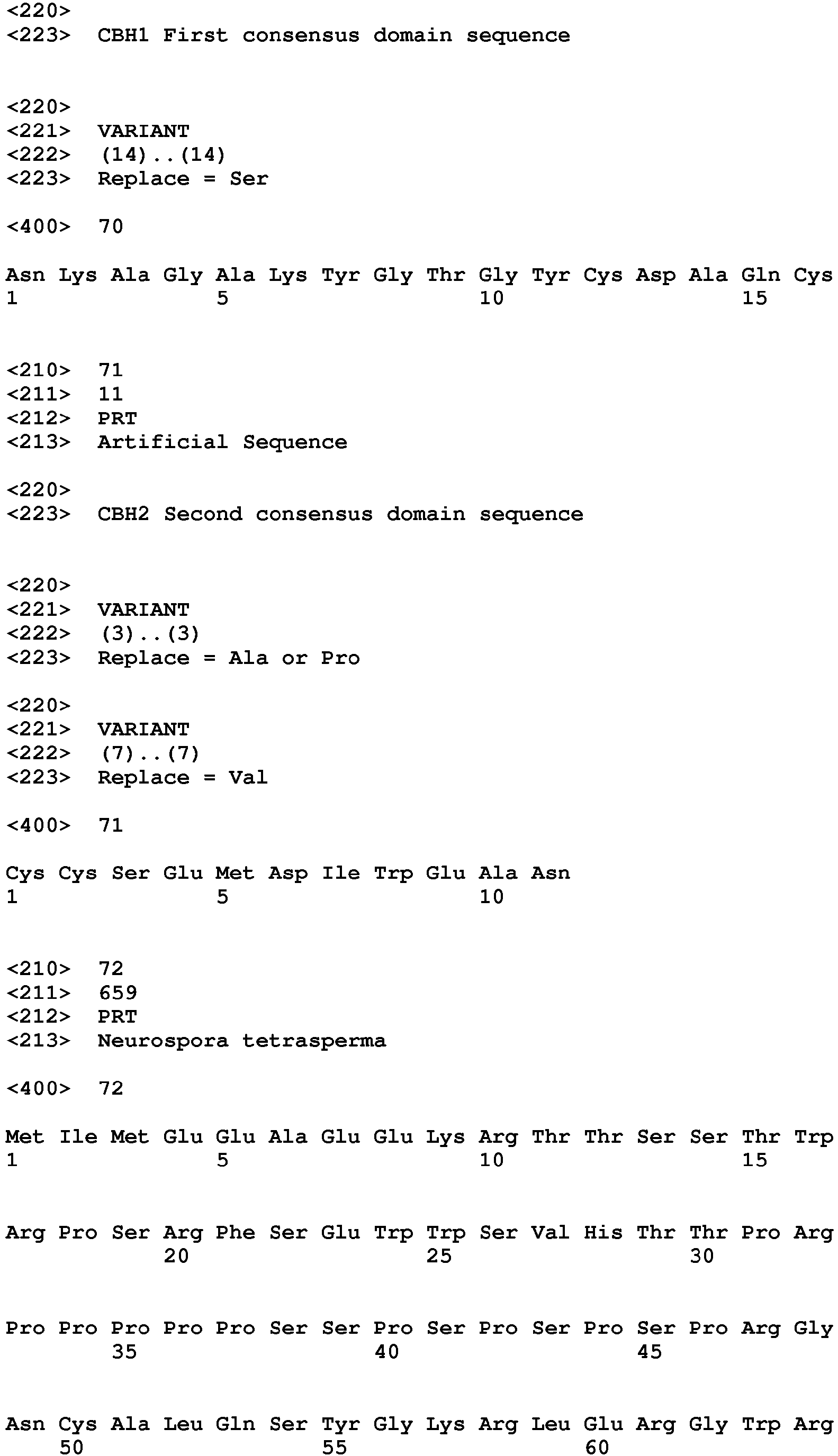
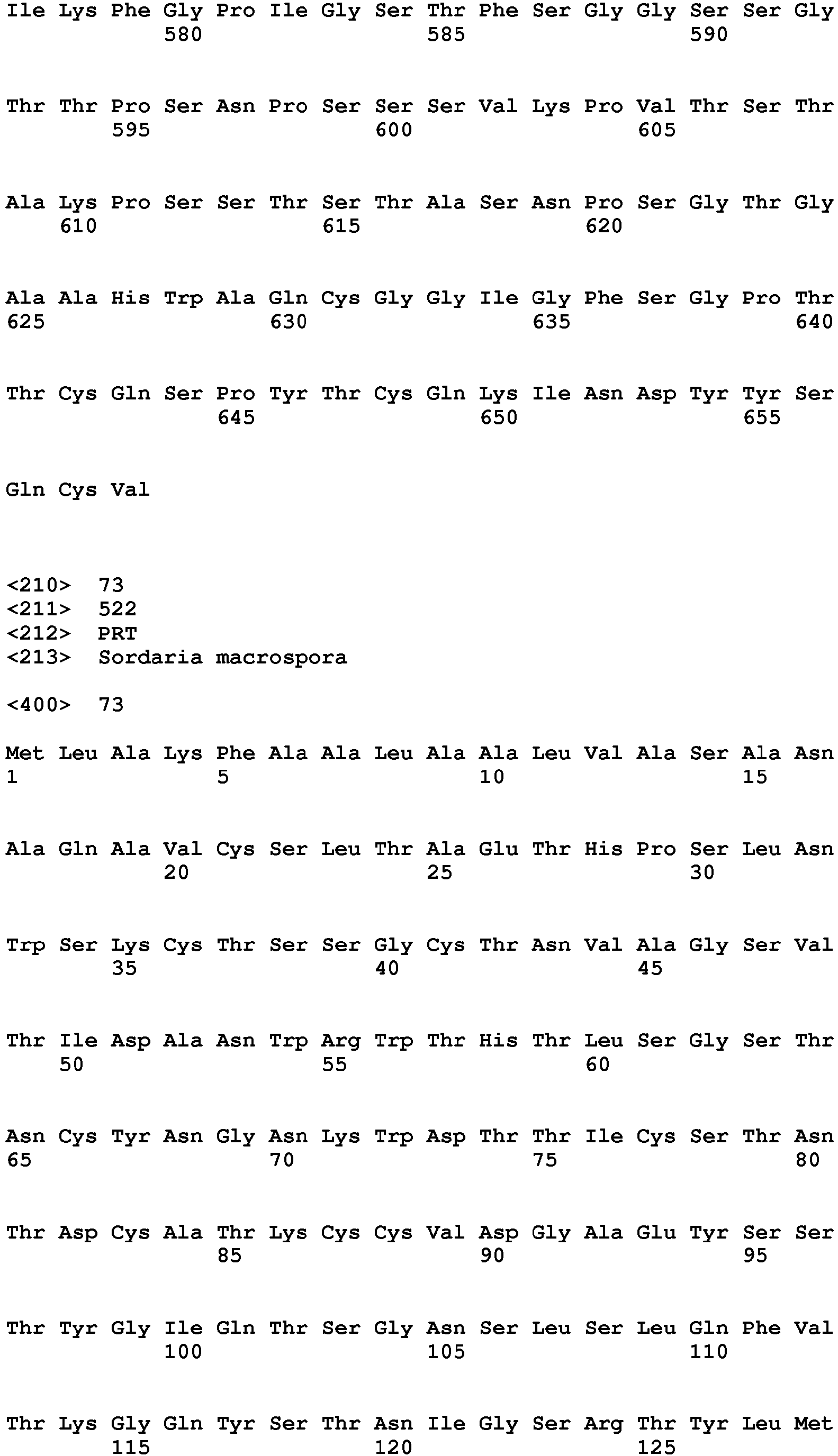
In a preferred embodiment, the cellobiohydrolase I has two conserved domains in catalytic core domain, defined by the consensus amino acid sequences SEQ ID NO: 70 and SEQ ID NO: 71. These consensus amino acid sequences SEQ ID NO: 70 and SEQ ID NO: 71 correspond to the consensus amino acid sequences obtained by aligning the cellobiohydrolase I from: Neurospora crassa of SEQ ID NO: 5 (NcCBH I), Neurospora tetrasperma of SEQ ID NO: 72, Sordaria macrospora of SEQ ID NO: 73, Thielavia terrestris of SEQ ID NO: 74, Acremonium thermophilum of SEQ ID NO: 75, Thielavia microspore of SEQ ID NO: 76, Myceliophthora thermophila of SEQ ID NO: 77, Humicola grisea var. thermoidea of SEQ ID NO: 78, Chaetomium luteum of SEQ ID NO: 79, Podospora anserina of SEQ ID NO: 80, Scedosporium apiospermum of SEQ ID NO: 81, Togninia minima of SEQ ID NO: 82, Gibberella moniliformis of SEQ ID NO: 83, Fusarium oxysporum sp. Radices-lycopersici of SEQ ID NO: 84, Gaeumannomyces graminis of SEQ ID NO: 85, and Fusarium oxysporum sp. Conglutinans race 2 of SEQ ID NO: 86.
-
In another preferred embodiment, the cellobiohydrolase I is selected from the group consisting of the CBH I from: Neurospora crassa of SEQ ID NO: 5 (NcCBH I), Neurospora tetrasperma of SEQ ID NO: 72 (which possesses 98.9% identity with the amino acid sequence of NcCBH I), Sordaria macrospora of SEQ ID NO: 73 (which possesses 92.7% identity with the amino acid sequence of NcCBH I), Thielavia terrestris of SEQ ID NO: 74 (which possesses 72.8% identity with the amino acid sequence of NcCBH I), Acremonium thermophilum of SEQ ID NO: 75 (which possesses 71.1% identity with the amino acid sequence of NcCBH I), Thielavia microspore of SEQ ID NO: 76 (which possesses 73.1% identity with the amino acid sequence of NcCBH I), Myceliophthora thermophila of SEQ ID NO: 77 (which possesses 72.5% identity with the amino acid sequence of NcCBH I), Humicola grisea var. thermoi of SEQ ID NO: 78 (which possesses 71.3% identity with the amino acid sequence of NcCBH I), Chaetomium luteum of SEQ ID NO: 79 (which possesses 72.1% identity with the amino acid sequence of NcCBH I), Podospora anserina of SEQ ID NO: 80 (which possesses 71.4% identity with the amino acid sequence of NcCBH I), Scedosporium apiospermum of SEQ ID NO: 81 (which possesses 68.1% identity with the amino acid sequence of NcCBH I), Togninia minima of SEQ ID NO: 82 (which possesses 69.4% identity with the amino acid sequence of NcCBH I), Gibberella moniliformis of SEQ ID NO: 83 (which possesses 66.9% identity with the amino acid sequence of NcCBH I), Fusarium oxysporum of SEQ ID NO: 84 (which possesses 66.4% identity with the amino acid sequence of NcCBH I), Gaeumannomyces graminis of SEQ ID NO: 85 (which possesses 66.8% identity with the amino acid sequence of NcCBH I), and Fusarium oxysporum of SEQ ID NO: 86 (which possesses 66.4% identity with the amino acid sequence of NcCBH I), preferably the CBH I from Neurospora crassa of SEQ ID NO: 5.
-
Cellobiohydrolase II (EC 3.2.1.91) cleaves two to four units from the non-reducing ends of the exposed cellulose chains produced by endoglucanase. Methods for determining whether an enzyme has an cellobiohydrolase II activity are known in the art. By way of example, one can use the method described in Zhang and Lynd,2006.
-
Advantageously, the cellobiohydrolase II is from a fungus or yeast strain, preferably from the genus Trichoderma, Hypocrea, Bionectria, Colletotrchum, Stachybotrys, Nectria, Neonectria, Pestalotiopsis, Rosellinia, Verticillium or Thielavia.
-
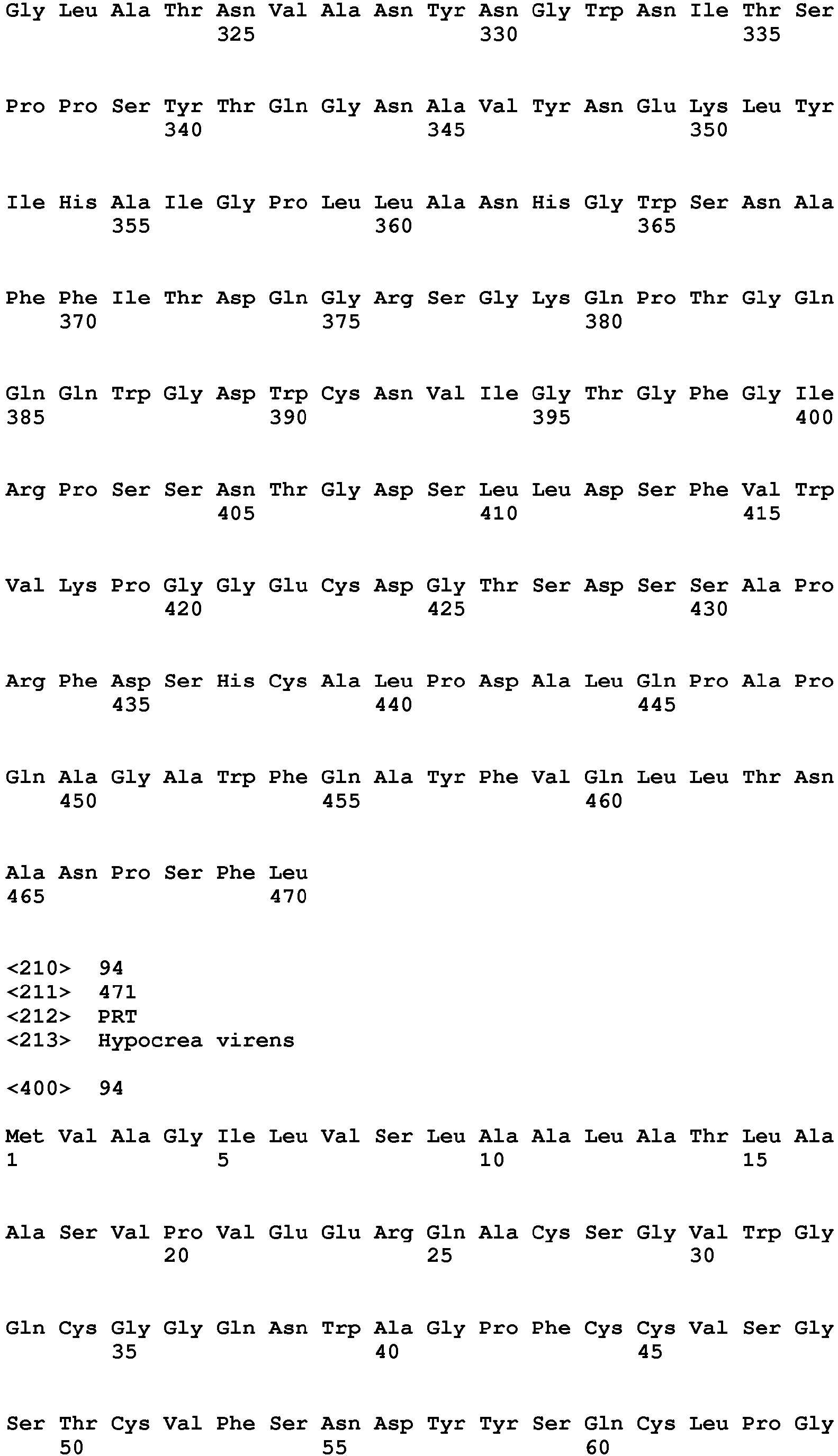
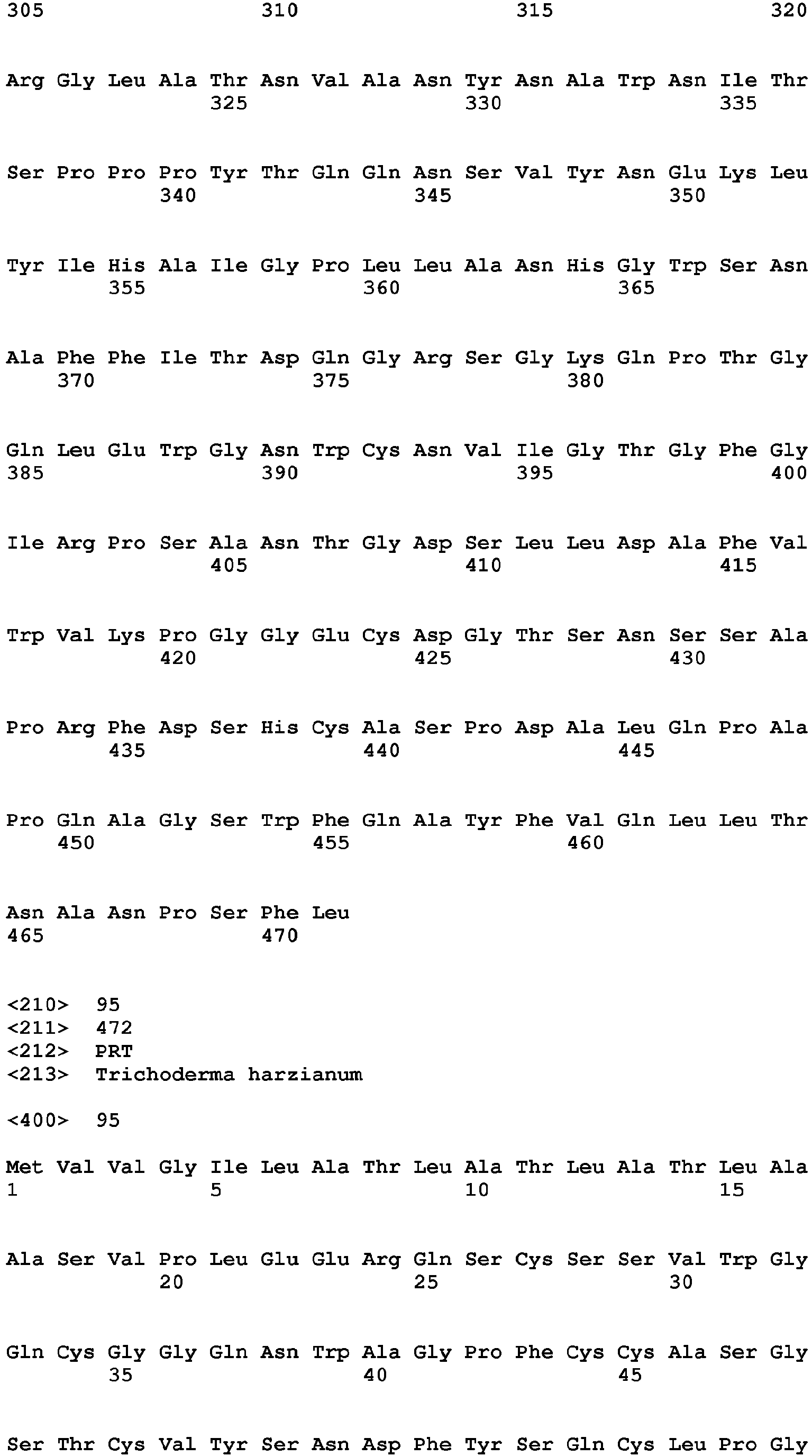
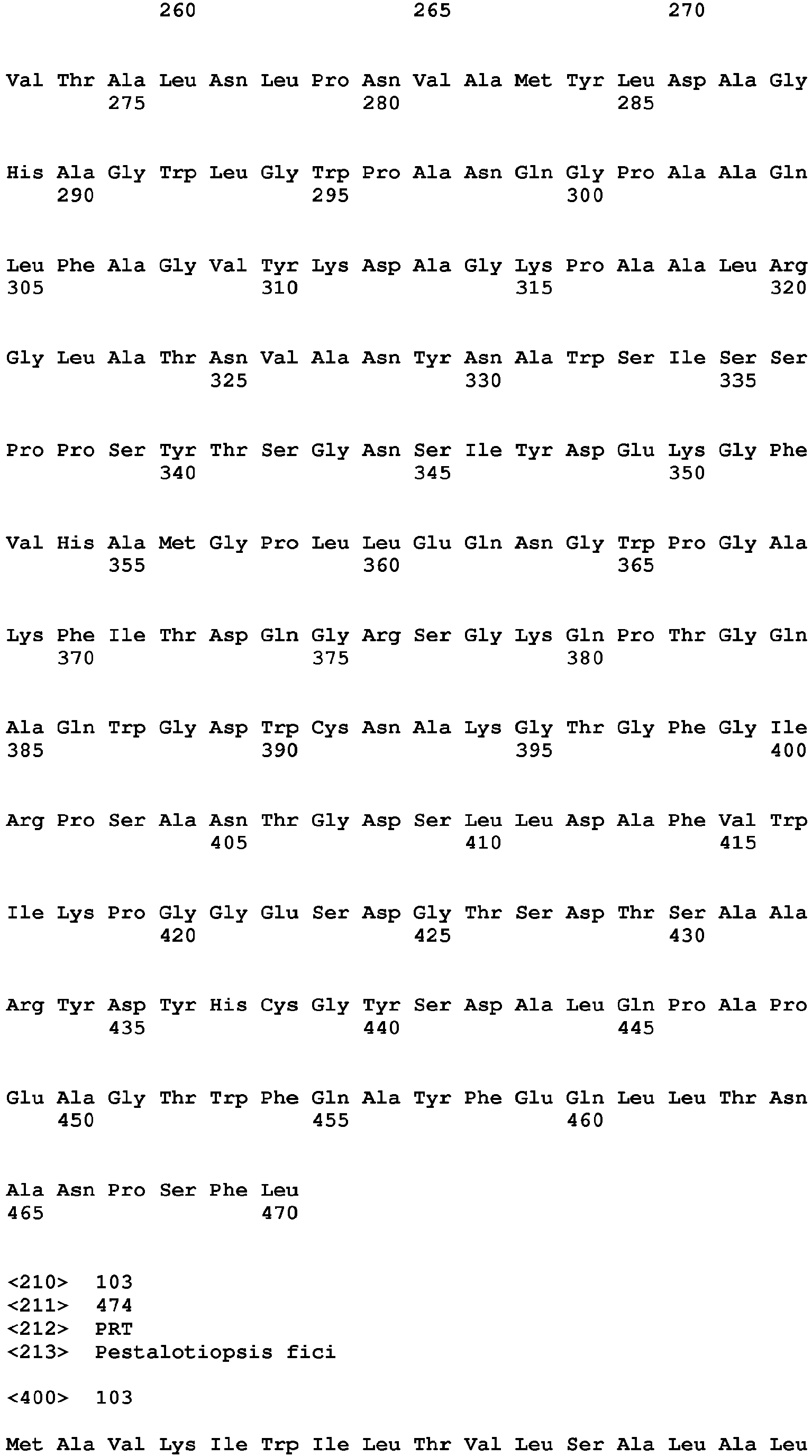
In a preferred embodiment, the cellobiohydrolase II has two conserved domains in catalytic core domain, defined by the consensus amino acid sequence SEQ ID NO: 87 and SEQ ID NO: 88. These consensus amino acid sequences SEQ ID NO: 87 and SEQ ID NO: 88 correspond to the consensus amino acid sequences obtained by aligning the cellobiohydrolase II from: Trichoderma reesei of SEQ ID NO: 6 (TrCBH II), Hypocrea rufa of SEQ ID NO: 89, Trichoderma koningii of SEQ ID NO: 90, Trichoderma longibrachiatum of SEQ ID NO: 91, Trichoderma orientale of SEQ ID NO: 92, Trichoderma ghanense of SEQ ID NO: 93, Hypocrea virens of SEQ ID NO: 94, Trichoderma harzianum of SEQ ID NO: 95, Hypocrea atroviridis of SEQ ID NO: 96, Trichoderma gamsii of SEQ ID NO: 97, Bionectria ochroleuca of SEQ ID NO: 98, Colletotrichum incanum of SEQ ID NO: 99, Stachybotrys chartarum of SEQ ID NO: 100, Nectria haematococca of SEQ ID NO: 101, Neonectria ditissima of SEQ ID NO: 102, Pestalotiopsis fici W106-1 of SEQ ID NO: 103, Rosellinia necatrix of SEQ ID NO: 104, Verticillium dahlia of SEQ ID NO: 105, and Thielavia terrestris of SEQ ID NO: 106.
-
In another preferred embodiment, the cellobiohydrolase II is selected from the group consisting of the CBH II from: Trichoderma reesei of SEQ ID NO: 6 (TrCBH II), Hypocrea rufa of SEQ ID NO: 89 (which possesses 99.8% identity with the amino acid sequence of TrCBH II), Trichoderma koningii of SEQ ID NO: 90 (which possesses 99.8% identity with the amino acid sequence of TrCBH II), Trichoderma longibrachiatum of SEQ ID NO: 91 (which possesses 97.9% identity with the amino acid sequence of TrCBH II), Trichoderma orientale of SEQ ID NO: 92 (which possesses 97.9% identity with the amino acid sequence of TrCBH II), Trichoderma ghanense of SEQ ID NO: 93 (which possesses 97.5% identity with the amino acid sequence of TrCBH II), Hypocrea virens of SEQ ID NO: 94 (which possesses 89.2% identity with the amino acid sequence of TrCBH II), Trichoderma harzianum of SEQ ID NO: 95 (which possesses 89.6% identity with the amino acid sequence of TrCBH II), Hypocrea atroviridis of SEQ ID NO: 96 (which possesses 81.0% identity with the amino acid sequence of TrCBH II), Trichoderma gamsii of SEQ ID NO: 97 (which possesses 80.1% identity with the amino acid sequence of TrCBH II), Bionectria ochroleuca of SEQ ID NO: 98 (which possesses 72.6% identity with the amino acid sequence of TrCBH II), Colletotrichum incanum of SEQ ID NO: 99 (which possesses 69.2% identity with the amino acid sequence of TrCBH II), Stachybotrys chartarum of SEQ ID NO: 100 (which possesses 67.3% identity with the amino acid sequence of TrCBH II), Nectria haematococca of SEQ ID NO: 101 (which possesses 69.1% identity with the amino acid sequence of TrCBH II), Neonectria ditissima of SEQ ID NO: 102 (which possesses 67.6% identity with the amino acid sequence of TrCBH II), Pestalotiopsis fici W106-1 of SEQ ID NO: 103 (which possesses 68.5% identity with the amino acid sequence of TrCBH II), Rosellinia necatrix of SEQ ID NO: 104 (which possesses 66.2% identity with the amino acid sequence of TrCBH II), Verticillium dahlia of SEQ ID NO: 105 (which possesses 62.8% identity with the amino acid sequence of TrCBH II), and Thielavia terrestris of SEQ ID NO: 106 (which possesses 64.8% identity with the amino acid sequence of TrCBH II), preferably the CBH II from Trichoderma reesei of SEQ ID NO: 6.
-
Nucleotide sequences (mature sequences) encoding NcCBH I and TrCBH II are provided in SEQ ID NO: 12 and 13 respectively.
-
Nucleotide sequences encoding the native signal peptides of NcCBH I and TrCBH II are provided in SEQ ID NO: 209 and SEQ ID NO: 210, respectively.
-
Methods for overexpressing CBH I or CBH II enzymes in an oleaginous yeast strain are described in Boonvitthya et al., 2013 and Wei et al., 2014.
-
According to an advantageous embodiment of the invention, the method further comprises overexpressing in said strain, a lytic polysaccharide monooxygenase (LPMOA) having at least 51% identity or by order of increasing preference at least 52%, 53%, 54%, 55%, 56%, 60%, 65%, 70%, 75%, 80%, 85%, 90%, 92%, 95%, 96%, 97%, 98% or 99% identity, with the polypeptide of sequence SEQ ID NO: 7 (TrLPMOA).
-
Lytic polysaccharide monooxygenase which is classified in the CAZy system as auxiliary activity family 9 (AA9, formerly GH61), is oxidative enzyme that boosts the overall efficiency of enzyme-mediated hydrolysis of cellulose. It achieves this in concert with canonical cellulases by performing oxidative cleavage of insoluble cellulose using molecular oxygen and an electron donor (Horn et al, 2012). Although most characterized LPMOAs oxidize polysaccharides at the C1 position of sugars (type 1 PMOs), yielding lactone (Hemsworth et al, 2013; Phillips et al, 2011; Vaaje-Kolstad et al, 2010), oxidation at C4 (type 2 PMOs) or both C1 and C4 (type 3 PMOs), and at C6 has also been observed. In these cases, the reaction products are ketoaldoses (Bey et al, 2013; Isaksen et al, 2014; Phillips et al, 2011).
-
Realizing the potential of LPMOAs, enzyme manufacturers have introduced these enzymes into commercial cellulases, forming a new generation of more efficient enzyme cocktails (Cannella et al, 2014).
-
Methods for determining whether an enzyme has a lytic polysaccharide monooxygenase activity are known in the art. By way of example, one can use the method described in Kitt et al., 2012.
-
Advantageously, the LPMOA is from a fungus or a yeast strain, preferably from a Trichoderma, Hypocrea, Pochonia, Myceliophthora, Penicillium, Rosellinia, Eutypa, Madurella, Thielavia.
-
In a preferred embodiment, the LPMOA has a conserved domain in catalytic core domain, defined by the consensus amino acid sequence SEQ ID NO: 107. This consensus amino sequence SEQ ID NO: 107 corresponds to the consensus amino acid sequence obtained by aligning the LPMOA from: Hypocrea jecorina of SEQ ID NO: 7 (TrLPMOA), Trichoderma harzianum of SEQ ID NO: 108, Hypocrea atroviridis of SEQ ID NO: 109, Hypocrea virens of SEQ ID NO: 110, Trichoderma gamsii of SEQ ID NO: 111, Pochonia chlamydosporia of SEQ ID NO: 112, Myceliophtora thermophile of SEQ ID NO: 113, Penicilium oxalicum of SEQ ID NO: 114, Rosellinia nexatrix of SEQ ID NO: 115, Penicillium expansum of SEQ ID NO: 116, Penicillium patulum of SEQ ID NO: 117, Eutypa lata of SEQ ID NO: 118, Madurella mycetomatis of SEQ ID NO: 119 and Thielavia terrestris of SEQ ID NO: 120.
-
In a preferred embodiment, the LPMOA is selected from the group consisting of the LPMOA from: Hypocrea jecorina of SEQ ID NO: 7 (TrLPMOA), Trichoderma harzianum of SEQ ID NO: 108 (which possesses 77.4% identity with the amino acid sequence of TrLPMOA), Hypocrea atroviridis of SEQ ID NO: 109 (which possesses 78% identity with the amino acid sequence of TrLPMOA), Hypocrea virens of SEQ ID NO: 110 (which possesses 76% identity with the amino acid sequence of TrLPMOA), Trichoderma gamsii of SEQ ID NO: 111 (which possesses 74.9% identity with the amino acid sequence of TrLPMOA), Pochonia chlamydosporia of SEQ ID NO: 112 (which possesses 60.2% identity with the amino acid sequence of TrLPMOA), Myceliophtora thermophila of SEQ ID NO: 113 (which possesses 56.6% identity with the amino acid sequence of TrLPMOA), Penicilium oxalicum of SEQ ID NO: 114 (which possesses 54.7% identity with the amino acid sequence of TrLPMOA), Rosellinia nexatrix of SEQ ID NO: 115 (which possesses 51.2% identity with the amino acid sequence of TrLPMOA), Penicillium expansum of SEQ ID NO: 116 (which possesses 54.4% identity with the amino acid sequence of TrLPMOA), Penicillium patulum of SEQ ID NO: 117 (which possesses 55.1% identity with the amino acid sequence of TrLPMOA), Eutypa lata of SEQ ID NO: 118 (which possesses 52.3% identity with the amino acid sequence of TrLPMOA), Madurella mycetomatis of SEQ ID NO: 119 (which possesses 53.2% identity with the amino acid sequence of TrLPMOA) and Thielavia terrestris of SEQ ID NO: 120 (which possesses 57.1 % identity with the amino acid sequence of TrLPMOA), preferably the LPMOA from Hypocrea jecorina of SEQ ID NO: 7.
-
Nucleotide sequence (mature sequence) encoding TrLPMOA is provided in SEQ ID NO: 14.
-
Nucleotide sequence encoding the native signal peptide of TrLPMOA is provided in SEQ ID NO: 211.
-
Methods for overexpressing the LPMOA in a yeast strain are described in Kitt et al., 2012.
-
Oleaginous yeast strains, which naturally accumulate lipids to more than 20% of their dry cell weight, are well known in the art (Ratledge, 1994 and 2005). They include the genus Candida, Cryptoccocus, Lipomyces, Rhodosporidium (e.g., Rhodosporidium toruloides), Rhodotorula (e.g., Rhodotorula glutinis), Trichosporon and Yarrowia. According to the present invention, the term oleaginous yeast also includes an engineered oleaginous Saccharomyces cerevisiae transformant able to accumulate lipids. Such oleaginous S. cerevisiae strains are known in the art (for a review see Valle-Rodriguez et al., 2014).
-
In a preferred embodiment, the oleaginous yeast strain is a Yarrowia strain, preferably a Yarrowia lipolytica strain.
-
Advantageously, said yeast strain is auxotrophic for leucine (Leu-) and optionally for the decarboxylase orotidine-5'-phosphate (Ura-).
-
Said yeast can also be a mutant yeast strain wherein the expression or activity of the endogenous isoforms of acyl-coenzymeA oxidases (AOX, EC 6.2.1.3) involved, at least partially, in the β-oxidation of fatty acids, is inhibited. In yeasts, 6 genes (
POX1, POX2,
POX3, POX4, POX5 and
POX6) encode these isoforms. Said inhibition of the expression or activity can be total or partial. Total or partial inhibition of the expression or activity of these enzymes leads to accumulation by yeast of dodecanedioic acid without use of accumulated fat. More particularly, the coding sequence of the genes
POX1-6 and the peptide sequence of AOX1-6 from
Y. lipolytica CLIB122 are available in either at Génolevures database (http://genolevures.org/) or at GRYC database (http://gryc.inra.fr/) or in GenBank database under the following accession numbers or names:
POX1 / AOX1 = YALI0E32835g / YALI0E32835p,
POX2 / AOX2 = YALI0F10857g / YALI0F10857p;
POX3 / AOX3 = YALI0D24750g / YALI0D24750p;
POX4 / AOX4 = YALI0E27654g / YALI0E27654p;
POX5 / AOX5 = YALI0C23859g / YALI0C23859p;
POX6 / AOX6 = YALI0E06567g / YALI0E06567p. The peptide sequences of the acyl-CoA oxidases of
Y. lipolytica have 45% identity or 50% similarity with those from other yeasts. The degree of identity between the acyl-CoA oxidases varies from 55% to 70% (or from 65 to 76% similarity) (see International Application
WO 2006/064131 ). A method of inhibiting the expression of the 6 endogenous AOX in a
Y. lipolytica strain is described in Beopoulos
et al., 2008 and International Applications
WO 2006/064131 ,
WO 2010/004141 and
WO 2012/001144 .
-
-
In particular, the yeast strain can be genetically modified to improve lipid accumulation. Said yeast strain having improved properties for lipid accumulation can be a mutant yeast strain, preferably a Y. lipolytica mutant strain, wherein at least one protein, preferably at least one endogenous protein, selected from the group consisting of an acyl-CoA:diacylglycerol acyltransferase 2 (encoded by DGAI), an acyl-CoA:diacylglycerol acyltransferase 1 (encoded by DGA2), a glycerol-3-phosphate dehydrogenase NAD+ (encoded by GPD1), an acetyl-CoA carboxylase (encoded by ACC1) and a hexokinase (encoded by HXK1) is overexpressed, and/or the expression or activity of at least one endogenous protein selected from the group consisting of the glycerol 3-phosphate dehydrogenase (encoded by GUT2), the triglyceride lipase (encoded by TGL4) and the peroxin 10 (encoded by PEX10) is inhibited.
-
Advantageously, the 5 proteins, acyl-CoA:diacylglycerol acyltransferase 2, acyl-CoA:diacylglycerol acyltransferase 1, glycerol-3-phosphate dehydrogenase NAD+, acetyl-CoA carboxylase and hexokinase, are overexpressed, and the expression or activity of the 3 endogenous proteins, glycerol 3-phosphate dehydrogenase, triglyceride lipase and peroxyne, are inhibited in said mutant yeast strain.
-
In another advantageous embodiment, said yeast strain - preferably a Yarrowia strain, more preferably a Y. lipolytica strain - having improved properties for lipid accumulation is a mutant yeast strain in which the expression or activity of the endogenous isoforms of acyl-coenzymeA oxidases (AOX, EC 6.2.1.3) involved, at least partially, in the β-oxidation of fatty acids (e.g., POX1 to POX6 in Y. lipolytica) and the triglyceride lipase (encoded by TGL4) are inhibited, and an acyl-CoA:diacylglycerol acyltransferase (encoded by DGA2) and a glycerol-3-phosphate dehydrogenase (encoded by GPD1) - preferably the endogenous DGA2 and GPD1 - are overexpressed.
-
A method of overexpressing the endogenous genes
DGA1, DGA2, GPD1 and
ACC1 and inhibiting the expression or activity of the endogenous genes
GUT2, TGL4 and
PEX10 in a
Y. lipolytica strain is described in International Application
WO 2014/136028 .
-
A method of overexpressing the endogenous genes DGA2, GPD1 and HXK1, and inhibiting the expression or activity of the endogenous gene TGL4 in a Y. lipolytica strain is described in Lazar et al., 2014.
-
In a preferred embodiment of the method of the invention, it provides a method for obtaining a Yarrowia strain, preferably a Y. lipolytica strain, capable of growing on cellulose as carbon source, wherein said method comprises overexpressing in said strain:
- a β-glucosidase 1 selected from the group consisting of SEQ ID NO: 1 and SEQ ID NO: 15, further comprising a N-terminal signal peptide selected from the group consisting of SEQ ID NO: 26 to 31,
- a β-glucosidase 2 selected from the group consisting of SEQ ID NO: 2, SEQ ID NO: 17, SEQ ID NO: 18 and SEQ ID NO: 19, further comprising a N-terminal signal peptide selected from the group consisting of SEQ ID NO: 26 to 31,
- the endoglucanase I of SEQ ID NO: 3 (TrEG I), further comprising a N-terminal signal peptide of lipase 2 of Y. lipolytica of sequence SEQ ID NO: 121 (pre-pro sequence of Lipase 2, UniProt accession number: Q9P8F7),
- the endoglucanase II of SEQ ID NO: 4 (TrEG II), further comprising a N-terminal signal peptide of lipase 2 of Y. lipolytica of sequence SEQ ID NO: 121 (pre-pro sequence of Lipase 2, UniProt accession number: Q9P8F7),
- the cellobiohydrolase I of SEQ ID NO: 5 (NcCBH I), further comprising a N-terminal signal peptide of lipase 2 of Y. lipolytica of sequence SEQ ID NO: 121 (pre-pro sequence of Lipase 2, UniProt accession number: Q9P8F7) and
- the cellobiohydrolase II of SEQ ID NO: 6 (TrCBH II) further comprising a N-terminal signal peptide of lipase 2 of Y. lipolytica of sequence SEQ ID NO: 121 (pre-pro sequence of Lipase 2, UniProt accession number: Q9P8F7), and optionally
- the lytic polysaccharide monooxygenase of SEQ ID NO: 7 (TrLPMOA) further comprising a N-terminal signal peptide of lipase 2 of Y. lipolytica of sequence SEQ ID NO: 121 (pre-pro sequence of Lipase 2, UniProt accession number: Q9P8F7).
-
For the genes corresponding to the endoglucanase I of SEQ ID NO: 3 (TrEG I), the endoglucanase II of SEQ ID NO: 4 (TrEG II), the cellobiohydrolase I of SEQ ID NO: 5 (NcCBH I), that were expressed in Y. lipolytica strain, the signal peptide of lipase 2 of Y. lipolytica of sequence SEQ ID NO: 121 (pre-pro sequence of Lipase 2, UniProt accession number: Q9P8F7) is used to replace the native signal peptides of these genes of sequences, SEQ ID NO: 207 to SEQ ID NO: 211, respectively.
-
Overexpression of an endogenous, orthologous or heterologous enzyme as defined in the present invention (i.e., BGL 1, BGL 2, EG I, EG I, CBH I, CBH II, LPMOA) in a yeast strain according to the present invention can be obtained in various ways by methods known per se.
-
Overexpression of an enzyme as defined in the present invention may be performed by placing one or more (preferably two or three) copies of the open reading frame (ORF) of the sequence encoding said enzyme under the control of appropriate regulatory sequences. Said regulatory sequences include promoter sequences, located upstream (at 5' position) of the ORF of the sequence encoding said enzyme, and terminator sequences, located downstream (at 3' position) of the ORF of the sequence encoding said β-glucosidase.
-
Promoter sequences that can be used in yeast are well known to those skilled in the art and may correspond in particular to inducible or constitutive promoters. Examples of promoters which can be used according to the present invention, include the promoter of a
Y. lipolytica gene which is strongly repressed by glucose and is inducible by the fatty acids or triglycerides such as the promoter of the
POX2 gene encoding the acyl-CoA oxidase 2 (AOX2) of
Y. lipolytica and the promoter of the
LIP2 gene described in International Application
WO 01/83773 . One can also use the promoter of the
FBA1 gene encoding the fructose-bisphosphate aldolase (see Application
US 2005/0130280 ), the promoter of the
GPM gene encoding the phosphoglycerate mutase (see International Application
WO 2006/0019297 ), the promoter of the
YAT1 gene encoding the transporter ammonium (see Application
US 2006/0094102 ), the promoter of the
GPAT gene encoding the O-acyltransferase glycerol-3-phosphate (see Application
US 2006/0057690 ), the promoter of the
TEF gene (Muller
et al., 1998; Application
US 2001/6265185 ), the hybrid promotor HTEF which is comprised or 4 tandem copies of upstream activation sequences (UAS) and the core promoter element of
TEF (Blazek
et al., 2011), the hybrid promoter hp4d (described in International Application
WO 96/41889 ), the hybrid promoter XPR2 described in Mazdak
et al. (2000), the hybrid promoters UAS1-TEF or UAStef-TEF described in Blazeck
et al. (2011, 2013, 2014), or the hybrid promotor HTEF of sequence SEQ ID NO: 122 which is comprised of 4 tandem copies of upstream activation sequences (UAS) and the core promoter element of
TEF (Blazek
et al., 2011).
-
Advantageously, the promoter is the promoter of the TEF gene or the hybrid promotor HTEF which is comprised of 4 tandem copies of upstream activation sequences (UAS) and the core promoter element of TEF of SEQ ID NO: 123 (Blazeck et al. 2011).
-
Terminator sequences that can be used in yeast are also well known to those skilled in the art. Example of terminator sequences which can be used according to the present invention include the terminator sequence of the
PGK1 gene and the terminator sequence of the
LIP2 gene described in International Application
WO 01/83773 .
-
The nucleotide sequence of the coding sequences of the heterologous genes can be optimized for expression in yeast by methods well known in the art (see for review Hedfalk, 2012).
-
Overexpression of an endogenous β-glucosidase can be obtained by replacing the sequences controlling the expression of said endogenous β-glucosidase by regulatory sequences allowing a stronger expression, such as those described above. The skilled person can replace the copy of the gene encoding an endogenous β-glucosidase in the genome, as well as its own regulatory sequences, by genetically transforming the yeast strain with a linear polynucleotide comprising the ORF of the sequence coding for said endogenous β-glucosidase under the control of regulatory sequences such as those described above. Advantageously, said polynucleotide is flanked by sequences which are homologous to sequences located on each side of said chromosomal gene encoding said endogenous β-glucosidase. Selection markers can be inserted between the sequences ensuring recombination to allow, after transformation, to isolate the cells in which integration of the fragment occurred by identifying the corresponding markers. Advantageously also, the promoter and terminator sequences belong to a gene different from the gene encoding the endogenous β-glucosidase to be overexpressed in order to minimize the risk of unwanted recombination into the genome of the yeast strain.
-
Overexpression of an endogenous β-glucosidase can also be obtained by introducing into the yeast strain of extra copies of the gene encoding said endogenous β-glucosidase under the control of regulatory sequences such as those described above. Said additional copies encoding said endogenous β-glucosidase may be carried by an episomal vector, that is to say capable of replicating in yeast. Preferably, these additional copies are carried by an integrative vector, that is to say, integrating into a given location in the yeast genome (Madzak
et al., 2004). In this case, the polynucleotide comprising the gene encoding said endogenous β-glucosidase under the control of regulatory regions is integrated by targeted integration. Said additional copies can also be carried by PCR fragments whose ends are homologous to a given locus of the yeast, allowing integrating said copies into the yeast genome by homologous recombination. Said additional copies can also be carried by auto-cloning vectors or PCR fragments, wherein the ends have a zeta region absent from the genome of the yeast, allowing the integration of said copies into the yeast genome by random insertion as described in Application
US 2012/0034652 .
-
Targeted integration of a gene into the genome of a yeast cell is a molecular biology technique well known to those skilled in the art: a DNA fragment is cloned into an integrating vector, introduced into the cell to be transformed, wherein said DNA fragment integrates by homologous recombination in a targeted region of the recipient genome (Orr-Weaver et al., 1981).
-
Methods for transforming yeast are also well known to those skilled in the art and are described, inter alia, by Ito et al. (1983), Klebe et al., (1983) and Gysler et al., (1990).
-
Any gene transfer method known in the art can be used to introduce a gene encoding enzyme as defined in the present invention. Preferably, one can use the method with lithium acetate and polyethylene glycol described by Gaillardin et al., (1987) and Le Dall et al., (1994).
-
The present invention also provides means for carrying out said overexpression.
-
This includes, in particular, recombinant DNA constructs for expressing one or several enzyme(s) as defined in the present invention in a yeast cell (e.g., Y. lipolytica strain). These DNA constructs can be obtained and introduced in said yeast strain by the well-known techniques of recombinant DNA and genetic engineering.
-
Recombinant DNA constructs of the invention include in particular expression cassettes, comprising a polynucleotide encoding one or several enzyme(s) as defined in the present invention, under the control of a promoter functional in yeast cell as defined above.
-
The expression cassettes generally also include a transcriptional terminator, such as those describes above. They may also include other regulatory sequences, such as transcription enhancer sequences.
-
Recombinant DNA constructs of the invention also include recombinant vectors containing an expression cassette comprising a polynucleotide encoding one or several enzyme(s) as defined in the present invention, under transcriptional control of a suitable promoter.
-
Recombinant vectors of the invention may also include other sequences of interest, such as, for instance, one or more marker genes, which allow for selection of transformed yeast cells.
-
The invention also comprises host cells containing a recombinant DNA construct of the invention. These host cells can be prokaryotic cells (such as bacteria cells) or eukaryotic cells, preferably yeast cells.
-
The invention also provides a method for obtaining a mutant oleaginous yeast strain, preferably a mutant Yarrowia strain (e.g., Y. lipolytica strain), capable of growing on cellulose as carbon source as defined above, comprising transforming an oleaginous yeast cell with one or several recombinant DNA constructs for expressing a β-glucosidase 1, a β-glucosidase 2, an endoglucanase I, an endoglucanase II, a cellobiohydrolase I, a cellobiohydrolase II and optionally LPMOA as defined in the present invention.
-
The term "one or several recombinant DNA constructs for expressing a β-glucosidase 1, a β-glucosidase 2, an endoglucanase I, an endoglucanase II, a cellobiohydrolase I, a cellobiohydrolase II and optionally LPMOA as defined in the present invention" refers to:
- a recombinant DNA construct for expressing the 6 or 7 enzymes as defined in the present invention,
- a recombinant DNA construct for expressing 1 of the 6 or 7 enzymes as defined in the present invention and a recombinant DNA construct for expressing the 5 or 6 other enzymes as defined in the present invention,
- a recombinant DNA construct for expressing 2 of the 6 or 7 enzymes as defined in the present invention and a recombinant DNA construct for expressing the 4 or 5 other enzymes as defined in the present invention,
- a recombinant DNA construct for expressing 3 of the 6 or 7 enzymes as defined in the present invention and a recombinant DNA construct for expressing the 3 or 4 other enzymes as defined in the present invention,
- 2 recombinant DNA constructs for expressing respectively 2 of the 6 or 7 enzymes as defined in the present invention and a recombinant DNA construct for expressing the 4 or 5 other enzymes as defined in the present invention,
- 3 recombinant DNA constructs for expressing respectively 3 or 4 of the 6 or 7 enzymes as defined in the present invention and a recombinant DNA construct for expressing the 3 other enzymes as defined in the present invention,
- 4 recombinant DNA constructs for expressing respectively 4 of the 6 or 7 enzymes as defined in the present invention and a recombinant DNA construct for expressing the 2 or 3 other enzymes as defined in the present invention,
- 6 or 7 recombinant DNA constructs for expressing respectively the 6 or 7 enzymes as defined in the present invention,
- 2 recombinant DNA constructs for expressing respectively 2 of the 6 or 7 enzymes as defined in the present invention, a recombinant DNA construct for expressing 2 or 3 other enzymes as defined in the present invention and a recombinant DNA construct for expressing the 2 or 3 remaining enzymes as defined in the present invention,
- a recombinant DNA constructs for expressing 2 of the 6 or 7 enzymes as defined in the present invention, a recombinant DNA construct for expressing 2 or 3 other enzymes as defined in the present invention and a recombinant DNA construct for expressing the 2 or 3 remaining enzymes as defined in the present invention,
- a recombinant DNA construct for expressing 1 of the 6 or 7 enzymes as defined in the present invention, a recombinant DNA construct for expressing 2 other enzymes as defined in the present invention and a recombinant DNA construct for expressing the 3 or 4 remaining enzymes as defined in the present invention.
-
The invention also comprises an oleaginous yeast strain, preferably a Yarrowia strain (e.g., Y. lipolytica strain), genetically transformed with one or several recombinant DNA constructs for expressing a β-glucosidase 1, a β-glucosidase 2, an endoglucanase I, an endoglucanase II, a cellobiohydrolase I, a cellobiohydrolase II and optionally LPMOA as defined in the present invention, and overexpressing said β-glucosidase 1, β-glucosidase 2, endoglucanase I, endoglucanase II, cellobiohydrolase I, cellobiohydrolase II and optionally LPMOA. In said mutant (transgenic) yeast strain one or several recombinant DNA construct(s) of the invention is/are comprised in a transgene stably integrated in the yeast genome, so that it is passed onto successive yeast generations. Thus the mutant (transgenic) yeast strain of the invention includes not only the yeast cell resulting from the initial transgenesis, but also their descendants, as far as they contain one or several recombinant DNA construct(s) of the invention. The overexpression of said 6 or 7 enzymes as defined above in said yeast strains provides them an ability to grow on cellulose as carbon source, when compared with an oleaginous yeast strain devoid of said transgene(s).
-
The present invention also comprises a mutant oleaginous yeast strain as defined above, preferably a mutant Yarrowia strain (e.g., Y. lipolytica strain), wherein:
- a β-glucosidase 1 (BGL 1; EC 3.2.1.21) having at least 80% identity, or by order of increasing preference at least 83%, 85%, 90%, 92%, 95%, 96%, 97%, 98%, 99% or 100% identity, with the polypeptide of sequence SEQ ID NO: 1 (mature YALI_BGL1) further comprising a N-terminal signal peptide,
- a β-glucosidase 2 (BGL 2; EC 3.2.1.21) having at least 80% identity, or by order of increasing preference at least 82%, 85%, 90%, 92%, 95%, 96%, 97%, 98%, 99% or 100% identity, with the polypeptide of sequence SEQ ID NO: 2 (mature YALI_BGL2) further comprising a N-terminal signal peptide,
- an endoglucanase I (EG I; EC 3.2.1.4) having at least 55% identity, or by order of increasing preference at least 59%, 60%, 65%, 70%, 75%, 82%, 85%, 90%, 92%, 95%, 96%, 97%, 98%, 99% or 100% identity, with the polypeptide of sequence SEQ ID NO: 3 (TrEG I),
- an endoglucanase II (EG II; EC 3.2.1.4) having at least 55% identity, or by order of increasing preference at least 59%, 60%, 65%, 70%, 75%, 82%, 85%, 90%, 92%, 95%, 96%, 97%, 98%, 99% or 100% identity, with the polypeptide of sequence SEQ ID NO: 4 (TrEG II),
- a cellobiohydrolase I (CBH I; EC 3.2.1.91) having at least 65% identity, or by order of increasing preference at least 70%, 75%, 82%, 85%, 90%, 92%, 95%, 96%, 97%, 98%, 99% or 100% identity, with the polypeptide of sequence SEQ ID NO: 5 (NcCBH I),
- a cellobiohydrolase II (CBH II; EC 3.2.1.91) having at least 60% identity, or by order of increasing preference at least 65%, 70%, 75%, 82%, 85%, 90%, 92%, 95%, 96%, 97%, 98%, 99% identity or 100%, with the polypeptide of sequence SEQ ID NO: 6 (TrCBH II), and optionally, a lytic polysaccharide monooxygenase (LPMOA) having at least 51% identity or by order of increasing preference at least 52%, 53%, 54%, 55%, 56%, 60%, 65%, 70%, 75%, 80%, 85%, 90%, 92%, 95%, 96%, 97%, 98% or 99% identity, with the polypeptide of sequence SEQ ID NO: 7 (TrLPMOA),
as defined above are overexpressed.
-
This mutant oleaginous yeast strain is obtainable by a method of the invention and contains one or two recombinant expression cassette(s) of the invention.
-
The present invention further comprises a mutant oleaginous yeast strain as defined above, preferably a mutant Yarrowia strain (e.g., Y. lipolytica strain) comprising, stably integrated in its genome, one or several recombinant DNA constructs for expressing a β-glucosidase 1, a β-glucosidase 2, an endoglucanase I, an endoglucanase II, a cellobiohydrolase I, a cellobiohydrolase II and optionally a LPMOA as defined in the present invention.
-
The present invention also provides the use of a mutant oleaginous yeast strain, preferably a mutant Yarrowia strain (e.g., Y. lipolytica strain), as defined above for producing lipids from lignocellulosic biomass, in particular from cellulose.
-
As used herein, the term producing lipids refers to the accumulation and optionally secretion of lipids.
-
The present invention also provides a method of producing lipids, comprising a step of growing a mutant oleaginous yeast strain, preferably a mutant Yarrowia strain (e.g., Y. lipolytica strain), of the invention on a lignocellulosic biomass, in particular on cellulose.
-
Methods for extracting and purifying lipids produced by cultured yeast strains are well known to those skilled in the art (Papanikolaou et al. 2001, 2002 and 2008; André et al., 2009). For example, the total lipids can be extracted according to the method described by Papanikolaou et al., 2001, and fractionated according to the methods described by Guo et al., 2000 and Fakas et al., 2006.
-
The present invention also provides a method for enhancing the extracellular expression of a protein in a yeast strain, preferably an oleaginous yeast strain as defined above, comprising the step of placing in said yeast strain the encoding sequence of said protein under the control of the hybrid promotor HTEF, which is comprised of 4 tandem copies of upstream activation sequences (UAS) and the core promoter element of TEF gene, of SEQ ID NO: 123 (described in Blazeck et al. 2011). Said protein is preferably chosen from the group consisting of an endoglucanase I, an endoglucanase II, a cellobiohydrolase I, a cellobiohydrolase II and optionally a LPMOA as defined in the present invention.
-
The present invention also provides the use of the hybrid promotor HTEF, which is comprised of 4 tandem copies of upstream activation sequences (UAS) and the core promoter element of TEF gene, of SEQ ID NO: 123 (described in Blazeck et al. 2011), for enhancing the extracellular expression of a protein in a yeast strain, wherein the encoding sequence of said protein is placed under the control of said hybrid promotor HTEF. Said protein is preferably chosen from the group consisting of an endoglucanase I, an endoglucanase II, a cellobiohydrolase I, a cellobiohydrolase II and optionally a LPMOA as defined in the present invention.
-
Among non-enzymatic auxiliaries, there are expansins and expansin-like swollenins which are known to mediate disruption of the ordered structure of crystalline cellulose, generating amorphous regions that are amenable to cellulose action (Gilbert et al., 2010; Jäger et al, 2011). Swollenins are fungal proteins that, like plant expansins which disrupt the crystalline surface of cellulose, making it more amenable enzyme attack (Eibinger et al, 2016). Swollenin 1 (SWO1) of sequence SEQ ID NO: 124 is the major expansin-like protein produced by the fungus T. reesei (Adav et al, 2012).
-
When the accessory protein swollenin either is expressed in combination with essential cellulases as described above or supplemented as an extra protein, it achieves an efficient degradation of recalcitrant crystalline cellulose.
-
According to a particular embodiment of the invention, the use of a mutant oleaginous yeast strain as defined above is conducted in presence of swollenin, for producing lipids from lignocellulosic biomass, in particular cellulose.
-
This swollenin can be selected from the group consisting of the swollenin from: Hypocrea jecorina of SEQ ID NO: 124 (TrSWO1), Trichoderma pseudokoningii of SEQ ID NO: 126 (which possesses 92.9% identity with the amino acid sequence of TrSWO1), Hypocrea virens of SEQ ID NO: 127 (which possesses 90.9% identity with the amino acid sequence of TrSWO1), Hypocrea atroviridis of SEQ ID NO: 128 (which possesses 85.1% identity with the amino acid sequence of TrSWO1), Trichoderma asperellum of SEQ ID NO: 129 (which possesses 84.1 % identity with the amino acid sequence of TrSWO1), Penicillium oxalicum strain 114-2 / CGMCC 5302) of SEQ ID NO: 130 (which possesses 65.9% identity with the amino acid sequence of TrSWO1), Neosartorya fumigata strain CEA10/ CBS 144.89/FGSC A1163 of SEQ ID NO: 131 (which possesses 66.2% identity with the amino acid sequence of TrSWO1), Neosartorya fumigata strain AF210 of SEQ ID NO: 132 (which possesses 66.4% identity with the amino acid sequence of TrSWO1), Penicillium decumbens of SEQ ID NO: 133 (which possesses 65.9% identity with the amino acid sequence of TrSWO1), Neosartorya fumigata strain ATCC MYA-4609 / Af293 / CBS 101355 / FGSC A1100 of SEQ ID NO: 134 (which possesses 63.5% identity with the amino acid sequence of TrSWO1), Talaromyces stipitatus strain ATCC 10500 / CBS 375.48 / QM 6759 / NRRL 1006 of SEQ ID NO: 135 (which possesses 65.4% identity with the amino acid sequence of TrSWO1), Talaromyces marneffei strain PM1 of SEQ ID NO: 136 (which possesses 64.3% identity with the amino acid sequence of TrSWO1), Aspergillus fumigatus of SEQ ID NO: 137 (which possesses 72.2% identity with the amino acid sequence of TrSWO1), Aspergillus udawae of SEQ ID NO: 138 (which possesses 77.7% identity with the amino acid sequence of TrSWO1), Talaromyces marneffei strain ATCC 18224 / CBS 334.59 / QM 7333 of SEQ ID NO: 139 (which possesses 73.1% identity with the amino acid sequence of TrSWO1) and Talaromyces cellulolyticus of SEQ ID NO: 140 (which possesses 51.5% identity with the amino acid sequence of TrSWO1), preferably the swollenin from Hypocrea jecorina of SEQ ID NO: 159 (TrSWO1).
-
The nucleotide sequence (mature sequence) of TrSWO1 is provided in SEQ ID NO: 125.
-
Nucleotide sequence encoding the native signal peptide of TrSWO1 is provided in SEQ ID NO: 212.
-
For the gene corresponding to the Swollenin 1 of SEQ ID NO: 125 (TrSWO1), that is expressed in Y. lipolytica strain, the signal peptide of lipase 2 of Y. lipolytica of sequence SEQ ID NO: 121 (pre-pro sequence of Lipase 2, UniProt accession number: Q9P8F7) is used to replace the native signal peptide of this gene of sequences SEQ ID NO: 212.
-
Methods for overexpressing the swollenin in a yeast strain are described in Jäger et al., 2011.
-
According to another particular embodiment of the invention, the method of producing lipids comprises a step of growing a mutant oleaginous yeast strain as defined above and a step of pre-treatment in presence of swollenin, on a lignocellulosic biomass, in particular on cellulose.
-
Preferably, the swollenin is previously incubated in the culture medium containing a lignocellulosic biomass, in particular on cellulose, during between 5 to 50 hours, preferably during 24 hours.
-
According to another particular embodiment of the invention, the method for enhancing the extracellular expression of a protein in a yeast strain as defined above in presence of swollenin comprises the step of placing in said yeast the encoding sequence of said protein under control of the hybrid promoter HTEF of SEQ ID NO: 122.
-
The present invention also provides the use of the hybrid promoter HTEF of SEQ ID NO: 122 for enhancing the extracellular expression of a protein in a yeast strain as defined above in presence of swollenin, wherein the encoding sequence of said protein is placed under the control of said hybrid promoter HTEF.
-
The present invention will be understood more clearly from the further description which follows, which refers to non-limitative examples illustrating the overexpression of a β-glucosidase 1, a β-glucosidase 2, an endoglucanase I, an endoglucanase II, a cellobiohydrolase I, a cellobiohydrolase II and optionally a LPMOA in Y. lipolytica.
- Figure 1 : Production of rbTrEGI and rhTrEGII in Y. lipolytica (a) enzyme production on YTD versus time, (b) SDS-PAGE analysis of the culture supernatant of Y. lipolytica transformants compared with the control and (c) western blot analysis, lane 1 and 3, culture supernatant of transformant ylEGI and ylEGII, respectively; lane 2 and 4, culture supernatant of transformant ylEGI and ylEGII treated by endo-H, respectively.
- Figure 2 : SDS-PAGE analysis of the purified rhTrEGI and rhTrEGII produced in Y. lipolytica JMY1212 transformants; lane 1 and 3, purified rhTrEGI and rhTrEGII; lane 2 and 4, endo-H treated rhTrEGI and rhTrEGII.
- Figure 3 : Western blot analysis of the heterologous CBH proteins produced by Y. lipolytica (a) lane 1, 3 and 5, rhNcCBHI, rhPfCBHI and rhTrCBHI, respectively; lane 2, 4 and 6, corresponding rhCBHIs treated by endo-H, (b) lane 1 and 2, rhTrCBHII and endo-H treated rhTrCBHII, respectively.
- Figure 4 : SDS-PAGE analysis of the purified rhNcCBHI (lane 1) and rhTrCBHII (lane 2) produced by Y. lipolytica JMY1212.
- Figure 5 : Production of rhNcCBHI and rhTrCBHII under the control of TEF or 4UASTEF promoter in Y. lipolytica (a and c) enzyme production on YTD versus time, (b and d) SDS-PAGE analysis of the culture supernatant of Y. lipolytica transformants.
- Figure 6 : PCR verification of Y. lipolytica transformants expressing multiple cellulases (A) YLC1, Lane 1, 2, 3, 4, 5: BGL1, BGL2, TrEGI, NcCBHI, TrCBHII; (B) YLC2, Lane 1, 2, 3, 4, 5: BGL1, BGL2, TrEGII, NcCBHI, TrCBHII; (C) YLC3, Lane 1, 2, 3, 4, 5, 6: BGL1, BGL2, TrEGI, TrEGII, NcCBHI, TrCBHII; (D) YLC4, Lane 1, 2, 3, 4, 5, 6: BGL1, BGL2, TrEG1, TrEGII, NcCBHI, 4UASTrCBHII; (E) YLC5, Lane 1, 2, 3, 4, 5, 6: BGL1, BGL2, TrEGI, TrEGII,4UASNcCBHI, TrCBHII; (F) YLC6, Lane 1, 2, 3, 4, 5, 6: BGL1, BGL2, TrEGI, TrEGII, 4UASNcCBHI, 4UASTrCBHII.
- Figure 7 : Comparison of the hydrolytic activity of the total secreted cellulases produced by different cellulolytic Y. lipolytica strains on various cellulosic substrates.
- Figure 8 : Expression of TrLPMOA in Y. lipolytica. (a) Western blot analysis of the heterologous LPMOA protein produced by Y. lipolytica: lane 1, rhTrLPMOA; lane 2, rhTrLPMOA treated by endo-H; (b) enzyme production on YTD versus time; (c) SDS-PAGE analysis of the culture supernatant of Y. lipolytica transformants.
- Figure 9 : Characterization of TrLPMOA expressed in Y. lipolytica. (a) SDS-PAGE analysis of the purified rhTrLPMOA (lane 1) and rhTrLPMOA treated by endo-H (lane 2); (b) H2O2 generation by rhTrLPMOA in the presence and absence of various oligosaccharides substrates; (c) gluconic acid produced from cello-oligosaccharides (DP4-DP6) by action of rhTrLPMOA in the presence of ascorbic acid.
- Figure 10 : Comparison of the hydrolytic activity of the total secreted cellulases produced by different cellulolytic Y. lipolytica strains on various cellulosic substrates.
- Figure 11 : Hydrolysis of Avicel in the presence of rhLPMOA at different concentrations.
- Figure 12 : PCR verification of Y. lipolytica transformants expressing multiple cellulases (A) YLC7, Lane 1, 2, 3, 4, 5, 6, 7: BGL1, BGL2, TrEGI, TrEGII, 4UASNcCBHI, 4UASTrCBHII, TrLPMOA; (B) YLC8, Lane 1, 2, 3, 4, 5, 6, 7: BGL1, BGL2, TrEGI, TrEGII, 4UASNcCBHI, 4UASTrCBHII, TrSWO1.
- Figure 13 : The growth of Y. lipolytica in defined medium containing 10 g/L gluconic acid or 10 g/L glucose.
- Figure 14 : Expression of TrSWO1 in Y. lipolytica. (a) SDS-PAGE analysis of the culture supernatant of Y. lipolytica transformants; (b) Western blot analysis of the heterologous SWO1 protein produced by Y. lipolytica: lane 1, rhTrSWO1; lane 2, rhTrSWO1 treated by endo-H; (c) SDS-PAGE analysis of the purified rhTrSWO1.
- Figure 15 : Hydrolysis of Avicel after pretreatment with swollenin at different concentrations.
- Figure 16 : Comparison of the hydrolytic activity of the total secreted cellulases produced by different cellulolytic Y. lipolytica strains on various cellulosic substrates.
EXAMPLE 1: Conferring cellulose-degrading ability to Yarrowia lipolytica
Materials and Methods
Strains and media
-
The genotypes of the microbial strains used in the present study are summarized in Table 1 below.
Table 1: Microbial strains used | Strains | Relevant genotype | Source of reference |
| T. reesei QM9414 | Wildtype | DSMZ |
| Phanerochaete chrysosporium | Wildtype | DSMZ |
| E. coli DH5 | Φ80dlacZΔm15, recA1, endA1, gyrA96, thi-1, hsdR17 (rk-, mk+), supE44, relA1, deoR, Δ(lacZYA-argF) U169 | Invitrogen |
| Y. lipolytica JMY1212 (Zeta) | MATA, ura3-302, leu2-270-LEU2-zeta, xpr2-322 Δlip2, Δlip7, Δlip8 | Bordes et al., 2007 |
| Y. lipolytica ΔpoxB12 | pTEF-YlBGL1, pTEF-YlBGL2 | Guo Z, et al. 2015 |
| ylTrEGI | Zeta, pTEF-TrEG I-His6 | Present study |
| ylTrEGII | Zeta, pTEF-TrEG II-His6 | Present study |
| ylNcCBHI | Zeta, pTEF-NcCBH I-His6 | Present study |
| ylTrCBHI | Zeta, pTEF-TrCBH I-His6 | Present study |
| ylPfCBHI | Zeta, pTEF-PfCBH I-His6 | Present study |
| yl4UASNcCBHI | Zeta, pHTEF-NcCBH I-His6 | Present study |
| ylTrCBHII | Zeta, pTEF-TrCBH II-His6 | Present study |
| ylPcCBHII | Zeta, pTEF-PcCBH II-His6 | Present study |
| yl4UASTrCBHII | Zeta, pHTEF-TrCBH II-His6 | Present study |
| YLC1 | ΔpoxB12, pTEF-TrEG I, pTEF-NcCBH I, pTEF-TrCBH II | Present study |
| YLC2 | ΔpoxB12, pTEF-TrEG II, p.TEF-NcCBH I, pTEF-TrCBH II | Present study |
| YLC3 | ΔpoxB12, pTEF-TrEG I, pTEF-TrEG II, pTEF-NcCBH I, pTEF-TrCBH II | Present study |
| YLC4 | ΔpoxB12, pTEF-TrEG I, pTEF-TrEG II, pTEF-NcCBH I, pHTEF-TrCBH II | Present study |
| YLC5 | ΔpoxB12, pTEF-TrEG I, pTEF-TrEG II, pHTEF-NcCBH I, pTEF-TrCBH II | Present study |
| YLC6 | ΔpoxB12, pTEF-TrEG I, pTEF-TrEG II; pHTEF-NcCBH I, pHTEF-TrCBH II | Present study |
| YLC7 | ΔpoxB12, pTEF-TrEG I, pTEF-TrEG II; pHTEF-NcCBH I, pHTEF-TrCBH II, pTEF-TrLPMOA | Present study |
-
E. coli DH5 were purchased from Invitrogen (Paisley, UK) and used for plasmid construction. The Y. lipolytica strains were routinely cultivated in a medium composed of 1% w/v yeast extract, 1% w/v Bacto peptone, and 1% w/v glucose (YPD). Transformants were selected on solid YNB medium (0.17% w/v YNB, 1% glucose or cellobiose w/v, 0.5% w/v ammonium chloride, with (for Ura+) or without (for Leu+) 0.2% w/v casamino acids and 50 mM sodium-potassium phosphate buffer, pH 6.8), supplemented with uracil (440 mg/L) or leucine (440 mg/L) depending on the auxotrophic requirements. Solid media contained 1.5% agar. The detection of endoglucanase activity in solid YNBcasa medium was achieved by incorporating 0.2% w/w Azo-CM-Cellulose (Megazyme). For cellulases characterization, enzymes were produced in YT2D5 medium (1% w/v yeast extract, 2% w/v tryptone, 5% w/v glucose and 100 mM phosphate buffer, pH 6.8). To evaluate the growth of engineered cellulolytic Y. lipolytica on cellulose, transformants were aerobically cultivated in defined medium containing vitamins, trace elements (Verduyn et al., 1992) and salts, including 3.5 g/L (NH4)2SO4, 3.0 g/L K2HPO4, 3.0 g/L NaH2PO4 and 1.0 g/L MgSO4•7H2O with 27 g/L CIMV-cellulose (cellulose content≈93%, provided by CIMV S.A.) or 25 g/L Avicel PH-101 (Sigma).
Plasmid constructions
-
The plasmids constructed in the present study are summarized in Table 2 below and all primers are listed in Table 3 below.
Table 2: Plasmids used or created | Plasmids | Description | Source of reference |
| JMP62UraTEF | URA3, pTEF | Taleb and Radford, 1995 |
| JMP62LeuTEF | LEU2, pTEF | Nicaud et al. 2002 |
| JMP62UraTB1his | URA3, pTEF-YlBGL1-His6 | Guo et al. 2015 |
| PUB4-CRE | hph, hp4d-CRE | Fickers et al., 2003 |
| JMP62UraHTEF | URA3, pHTEF | Present study |
| JMP62LeuHTEF | LEU2, pHTEF | Present study |
| JMP62UraEG1 | URA3, pTEF-TrEG I | Present study |
| JMP62LeuEG2 | LEU2, pTEF-TrEG II | Present study |
| JMP62UraNcCBH1 | URA3, pTEF-NcCBH I | Present study |
| JMP62UraNcCBH1His | URA3, pTEF-NcCBH I-His6 | Present study |
| JMP62UraTrCBH1His | URA3, pTEF-TrCBH I-His6 | Present study |
| JMP62UraPfCBH1His | URA3, pTEF-PfCBH I-His6 | Present study |
| JMP62UraTrCBH2 | URA3, pTEF-TrCBH II | Present study |
| JMP62LeuTrCBH2 | LEU2, pTEF-TrCBH II | Present study |
| JMP62UraPcCBH2 | URA3, pTEF-PcCBH II | Present study |
| JMP62UraTrCBH2 | URA3, pTEF-TrCBH II-His 6 | Present study |
| JMP62UraPcCBH2 | URA3, pTEF-PcCBH II-His6 | Present study |
| JMP62UraHCBH1 | URA3, pHTEF -NcCBH I | Present study |
| JMP62LeuHCBH2 | LEU2, pHTEF-TrCBH II | Present study |
| JMP62UraLPMOA | URA3, pTEF-LPMOA | Present study |
| JMP62UraLPMOA | URA3, pTEF-LPMOA-His6 | Present study |
Table 3: Sequences of the oligonucleotide primers | Primer names | Sequence (5'-3'), 15-bp homologous sequence for infusion is underlined. | SEQ ID NO: |
| F1 | GTTCTCCAGAAGCGACAGCAACCGGGTACCAGCAC | 141 |
| R1 | | 142 |
| F2 | GTTCTCCAGAAGCGAGCACAGCAGACTGTCTGGGGCC | 143 |
| R2 | | 144 |
| F3 | GTTCTCCAGAAGCGAGCCCAGGCTTGCTCAAGCGTC | 145 |
| R3 | CACAGACACCCTAGGTTACAGGAACGATGGGTTTGCGT | 146 |
| F4 | | 147 |
| R4 | | 148 |
| F5 | GTTCTCCAGAAGCGACAGGCGTCGGAGTGGGGACA | 149 |
| R5 | CACAGACACCCTAGGCTACAGCGGCGGGTTGGCAG | | 150 |
| JMP1F | CCTAGGGTGTCTGTGGTATCTAAGCTATT | 151 |
| JMP1R | TCGCTTCTGGAGAACTGCGG | 152 |
| F6 | ACACCCGAAGGATCCCACAATGAAGCTTTCCACCATCC | 153 |
| R6 | ATGGTGATGATGGTGAAGGCATTGCGAGTAGTAGTCGT | 154 |
| R7 | ATGGTGATGATGGTGCTTTCTTGCGAGACACGAGCTGAC | 155 |
| R8 | ATGGTGATGATGGTGCAGGAACGATGGGTTTGCGT | 156 |
| R9 | ATGGTGATGATGGTGCAGCGGCGGGTTGGCAGC | 157 |
| R10 | ATGGTGATGATGGTGGTTAAGGCACTGGGCGTAGTAGGG | 158 |
| JMP2F | CACCATCATCACCATCATTAAAACT | 159 |
| JMP2R | GGATCCTTCGGGTGTGAGTTG | 160 |
| HTF | ATCCCTAGAATCGATGCCGCCGCAAGGAATGG | 161 |
| HTR | GCCAACCCGGTCTCTGCACTTTTGCCCGTGATCAGTG | 162 |
| JMP3F | AGAGACCGGGTTGGCGG | 163 |
| JMP3R | ATCGATTCTAGGGATAACAGGGTAATT | 164 |
-
Briefly, the total RNA from 5-day cultured Trichoderma reesei QM9414 was isolated using RNeasy Plus Mini Kit (QIAGEN) and reverse transcription was performed with iScript™ cDNA Synthesis Kit (BIO-RAD) according to the manufacturer's instructions. For the expression of wild-type proteins, EG I (GenBank accession code: XM_006965612.1), EG II (GenBank accession code: XM_006965612.1), CBH II (GenBank accession code: XM_006962518.1) and LPMOA (formerly known as GH61A, GenBank accession code: Y11113.1), respectively, were amplified from the cDNA of T. reesei by PCR using F (1-4) as forward primers and R (1-4) as reverse primers. As a comparison, CBH II from Phanerochaete chrysosporium (GenBank accession code: AB699568.1) was cloned from the cDNA of P. chrysosporium by PCR using primers F5 and R5. A 15-base pair homologous sequence of the target plasmid was introduced into the end of each gene during PCR amplification. After that, the genes encoding T. reesei EG I, EG II, CBH II, LPMOA and P. chrysosporium CBH II, were fused with the PCR fragment (primers JMP1F/JMP1R) of secretion vector JMP62UraTEF or JMP62LeuTEF under the control of TEF promoter and the pre-pro sequence of lipase 2 (33 N-terminal amino acids of Lipase 2, Genbank accession number: Q9P8F7) of Y. lipolytica by In-Fusion Cloning Kits (Clontech). For the expression of His-tagged proteins, EG I, EG II and CBH II were cloned by PCR with F6 as forward primer and R (6-10) as reverse primers using the expression vectors constructed in last step as template, and fused with PCR fragment (primers JMP2F/JMP2R) of the vector JMP62UraTB1his (Guo et al. 2015).
-
To express CBH I in yeast, the gene coding sequences of CBH I from T. reesei, Penicillium funiculosum and Neurospora crassa were codon-optimized based on the codon bias of Y. lipolytica, and were synthesized by GenScript (USA) and cloned into the plasmid JMP62UraTEF, JMP62LeuTEF, or JMP62UraTB1his under the control of TEF promoter and the pre-pro sequence of lipase 2. The codon-optimized nucleotide sequences of TrCBH1, PfCBH1 and NcCBH1 are respectively referred to as SEQ ID NO: 165, 166 and 167.
-
These nucleotide sequences of SEQ ID NO: 165, 166 and 167 are codon-optimized based on the codon bias of Y. lipolytica and start with the signal peptide of lipase 2 of Y. lipolytica of nucleotide sequence SEQ ID NO: 213 (pre-pro sequence of Lipase 2).
-
In addition, an enhancer comprised of 4 tandem copies of upstream activation sequences (4UASs) was cloned by PCR with primers HTF and HTR using vector PUB4-CRE as template. The fusion of this DNA fragment with the PCR product (primers JMP3F/JMP3R) of vector JMP62UraTEF or JMP62LeuTEF yielded vectors JMP62UraHTEF and JMP62LeuHTEF, respectively. To enhance the expression level of CBH proteins, the plasmids JMP62UraCBH1 and JMP62LeuCBH2 were digested using BamHI/AvrII, and the NcCBHI and TrCBHII genes were respectively recovered and then inserted at the corresponding sites into the plasmid JMP62UraHTEF or JMP62LeuHTEF.
-
After construction, all expression vectors were verified by DNA sequencing (GATC Biotech, Konstanz, Germany). For
Y. lipolytica transformation, vectors were digested using
NotI, thus generating a linear DNA with Zeta sequences at both extremities, and purified liberating the expression cassettes. Then the gel purified expression cassettes were introduced into the Zeta docking platform of
Y. lipolytica JMY1212 Zeta for the expression of single cellulase, or randomly into the genome of Δ
poxB12 strain, for co-expression of multiple cellulases, using the lithium acetate method (Duquesne
et al., 2012). For the latter case, the
LoxP-Cre recombination system was used for marker rescue and ensure the multistep insertion of the target genes (Fickers P,
et al. 2003). The successful multiple integration of the heterologous genes into the genome of
Y. lipolytica was verified by PCR using gene specific primers shown in Table 4 below.
Table 4: Sequences of the oligonucleotide primers used for PCR verification of Y. lipolytica transformants | Primer names | Sequence (5'-3') | SEQ ID NO: |
| VBGL1A | TTGACCCAGTAGCGGACCCAA | 168 |
| VBGL1B | GCCGACATTAGCCCTAACAGCAT | 169 |
| VBGL2A | GGTTGGCGGCGCATTTGT | 170 |
| VBGL2B | TGTCGTCCACTCGGCTTTCATC | 171 |
| VEGIA | CACTTGCCGTTAAGGGCGTAGGGT | 172 |
| VEGIB | CTGGCTGTTGTCGTTCCAAATGCTG | 173 |
| VEGIIA | CTTGCCGTTAAGGGCGTAGGG | 174 |
| VEGIIB | CCATCGAGCATAATTGTGGATGTCG | 175 |
| VCBHIA | TTTGCTTTGTGGTTGGGACTTTAGC | 176 |
| VCBHIB | GGTTCGAGATCCGATGTTAGTGGAGTA | 177 |
| VCBHIIA | TTTGCTTTGTGGTTGGGACTTTAGCC | 178 |
| VCBHIIB | AGGCGTTGGACCAGCCGTGA | 179 |
| V4UASCBHIA | CGCCGCAAGGAATGGTGCA | 180 |
| V4UASCBHIB | GGTTCGAGATCCGATGTTAGTGGAGTA | 181 |
| V4UASCBHIIA | CGCCGCAAGGAATGGTGCA | 182 |
| V4UASCBHIIB | CCGATCCGACTGGAGGTACTCTGGTAG | 183 |
| VLPMOA | TTGACCCAGTAGCGGACCCAACCC | 184 |
| VLPMOB | TGATCTCGTGGCGGAGCACGTAATT | 185 |
-
In addition, transformants expressing multiple enzymes were tested for growth on cellobiose, and for degradation of Azo-CM-Cellulose. Clones displaying both activities were retained for further analysis. Table 4 summarizes the expressed cellulase genes and their corresponding Y. lipolytica transformants.
Enzyme production and activity assay
-
Recombinant protein production by Y. lipolytica was carried in YTD medium in shake flask at 28°C and 120 rpm for 5 days. PASC (phosphoric acid swollen cellulose) was prepared from Avicel PH-101 as previously described in Zhang et al. (2006). The activities of endoglucanases (EGs) were measured on carboxymethyl cellulose (CMC), PASC, β-1, 4-glucan, Avicel PH-101 and cellotriose using the method previously described in Ghose (1987) with slight modifications. Briefly, the reaction mixture contained 1 % (w/v) insoluble cellulosic substrate, or 5mM cellotriose, 50 mM citrate buffer (pH 4.8) and proper volume of diluted enzyme solution. The reaction was conducted at 50°C for 30 min and then reducing sugars were quantified using the dinitrosalicylic acid (DNS) reagent. A similar method was used to evaluate cellobiohydrolase (CBH) activity using PASC, β-1, 4-glucan or Avicel as substrates. One unit of activity (U) was defined as the amount of enzyme required to release 1 µmol of reducing sugars per min. All protein concentrations were measured using the Bradford method and bovine serum albumin as a standard (Bradford, 1976). All enzymatic activity measurements were performed in triplicate unless otherwise stated.
SDS-PAGE and Western blot analysis
-
SDS-PAGE was conducted using Mini-PROTEAN TGX Stain-Free precast gels (Biorad) according to the manufacturer's instructions. 15 µL of culture supernatant or enzyme solution was loaded into each well. Western blotting of proteins was performed as described previously in Duquesne et al. (2014). Crude supernatant of Y. lipolytica JMY1212 expressing EGs and CBHs fused with the His6 tag were concentrated 10-fold using an ultra-centrifugation filter unit (Amicon® Ultra-4 10 kDa cut-off, Merk Millipore, Bedford, MA, USA). Blots were sequentially treated with mouse non position-specific His-Tag antibody 1:2500 (THE™ from Genscript, Piscataway, NJ, US) and the alkaline phosphatase-conjugated goat anti-mouse IgG (1:10000). For the detection, the membrane was incubated with a mixture of nitro blue tetrazolium chloride and 5-Bromo-4-chloro-3-indolyl phosphate (NBT/BCIP) (Sigma).
Purification of recombinant cellulases and deglycosylation
-
Y. lipolytica JMY1212 expressing His6-tagged EG I, EG II, CBH I and CBH II, respectively, was grown in 200 mL YTD medium at 120 rpm, 28°C for 48 h. After centrifugation (8,000×g for 5 min at 4°C), the supernatant was concentrated 10-fold by ultrafiltration with an Omega™ membrane disc filter at 10KDa cut off (Pall, France), and applied to 2 mL of TALON Metal Affinity Resin (Clontech, Takara-Bio, Kyoto, Japan). Subsequently, protein was eluted using imidazole buffer according to the manufacturer's instructions. Deglycosylation was carried out by treating the purified proteins with endoglycosidase H according to the manufacturer's instructions (New England Biolabs, Beverly, MA, USA) to remove N-linked carbohydrates. Protein samples were analyzed by SDS-PAGE and visualized with colloidal coomassie blue staining.
Growth of yeast expressing multiple cellulases on CIMV and Avicel cellulose
-
Yeast growth on CIMV-cellulose and Avicel was performed in 50 mL defined medium containing 27 g/L CIMV or 25 g/L Avicel cellulose in 250 mL Erlenmeyer flasks. A fresh yeast culture in exponential phase was used to inoculate the defined medium to yield an initial biomass concentration of 1.0 g-DCW/L. The cultivations were conducted at 28°C and samples were taken at the end of 5 days to determine concentrations of biomass and residual cellulose. In parallel, two control experiments were conducted under the same conditions, with the addition of Cellic® CTec2 (120 IU/mL, gift from Novozyme, Denmark) at 20 IU/g cellulose as recommended.
Analysis of residual cellulose and determination of dry cell weight
-
The quantification of cellulose residues and dry cell matter was conducted as previously described in Wei et al. (2014) with slight modifications. Briefly, the cell pellets mixed with cellulose residues from the above cultures were harvested by centrifugation at 8,000×g for 10 min at 4°C. After 2-time wash with distilled water, the collected cellulose-cell pellet was freeze-dried and weighed. The amount of cellulose remained was calculated from the total glucose released from enzymatic hydrolysis of the cellulose residues using Cellic® CTec2, and verified by diluted acid hydrolysis of the residues with 2.5% sulfuric acid at 121°C for 1 h. Dry cell weight was deduced by subtracting the amount of cellulose from the weight of cellulose-cell pellet. Glucose was measured by HPLC as descried in Guo et al. (2015). The biomass yield was calculated as the ratio of the amount of biomass obtained divided by the amount of carbon source consumed.
Amplex Red/horseradish peroxidase assay
-
The oxygen reactivity of TrLPMOA was measured in a quantitative time resolved assay of H2O2 using Amplex Red and horseradish peroxidase as described previously (Isaksen et al, 2014; Kittl et al, 2015). The reaction mixture (100 µL) containing 100 mM sodium acetate buffer (pH 6.0), 50 µM Amplex Red reagent (Invitrogen, France), 7.14 U/mL horseradish peroxidase, 0.1 to 0.5 µM LPMOA and 30 µM ascorbate as reductant was assembled in the well of a 96-well microtiter plate and incubated at 30°C, measuring fluorescence (excitation and emission wavelengths of 560 and 595 nm respectively) using a Tecan Infinite M200 plate reader (Tecan, Männedorf, Switzerland). The activity of TrLPMOA was calculated was derived from the data using a standard H2O2 calibration curve. The inhibition of H2O2 production was used to test the activity of TrLPMOA on various β-glucan and xylan substrates as described previously (Bennati-Granier et al, 2015). A final concentration of 1.0 % (w/v) PASC, CMC, Avicel PH-101, barley glucan (β-1, 3; 1,4) and xylan was added into the above reaction mixture. All measurements were performed in triplicates.
Cello-oligosaccharide cleavage assay
-
The cleavage of cello-oligosaccharides by LPMOA was assayed by incubating 16 mg of TrLPMOA, 1 mM of ascorbate, and 5 mM cello-oligosaccharides (DP4-DP6) in 50 mM sodium acetate buffer (pH 4.8) at 50 °C for 24 h under shaking (1000 rpm). To stop the reaction, samples were boiled (100 °C for 10 min) and then cooled before adding an aliquot of Novozyme 188 β-glucosidase (12.0 IU/g cello-oligosaccharides, 810 IU/mL). After, the reaction was incubated for a further 12 h and then the oxidized mono-saccharide in the supernatant was measured using a D-gluconic acid/D-glucono-δ-Lactone assay kit (Megazyme) according to manufacturer's instructions. All assays were carried out in triplicate.
Study the synergy of LPMOA on enzymatic hydrolysis of Avicel
-
Enzymatic hydrolysis of cellulose was carried out in 50 mM citrate buffer (pH 4.8) containing 2.0 % (w/v) microcrystalline cellulose (Avicel PH-101, Sigma). Celluclast 1.5L (60 FPU/mL) and β-glucosidase (810 IU/mL, Novozyme 188, gift from Novozyme, Denmark) was added at 5.0 U/g-cellulose and 12.0 IU/g-cellulose, respectively. The reaction (1 mL) was conducted in Eppendorf tubes (2 mL) using a thermomixer at 50 °C and 1000 rpm. To study the synergistic effect of TrLPMOA on the enzymatic hydrolysis of cellulose, different amount of this protein (5, 10 and 15 mg-protein/g-cellulose respectively) was added to the reaction mixtures containing Avicel (2.0 % w/v). In addition, ascorbate (1 mM) was added into the reactions as the reducing agent to reactivate LPMOA.
Results
Expression of T. reesei endoglucanases in Y. lipolytica
-
The first step towards the construction of a fully cellulolytic Y. lipolytica strain was the introduction of sequences encoding T. reesei EG I (Cel7B) and EG II (Cel5A) into the Y. lipolytica zeta strain (Bordes et al., 2007). Subsequent screening of transformants producing either EG I or EG II with or without His6 revealed the presence of clones possessing the ability to hydrolyze Azo-CMC in solid agar medium (data not shown).
-
To further confirm the successful expression of EG I and II, positive clones were grown and His-tagged recombinant proteins (rh) rhTrEGI and rhTrEGII were purified from culture supernatant. Accordingly, it was possible to demonstrate that these secreted proteins possessed CMCase activity and that their expression steadily increased over a 48h-period until the glucose in the culture medium was depleted, with rhTrEGII activity (0.78 U/mL) at the end of the period being twice that of rbTrEGI (0.39 U/mL) (Fig. 1a). Furthermore, SDS-PAGE analysis of culture supernatants containing either rhTrEGI or rhTrEGII (Fig. 1b), and comparison to that of a control culture, revealed in the first case the presence of a smear (70-200k Da) and in the latter case a discrete species migrating to a position corresponding to an approximate Mw (molecular weight) of 55 kDa, which is a little high when compared to the actual expected Mw of EG II (47 kDa). In the case of both putative rhTrEGI and II, the anti-His antibody confirmed that these protein species were His-tagged (Fig. 1c). Taken together, these observations suggest that the recombinant proteins are glycosylated forms of EG I and II, in agreement with previous results (Boonvitthya et al., 2013; Park et al., 2000) and with the findings of a bioinformatics study (http://www.imtech.res.in/raghava/glycoep/) (Chauhan et al., 2013) that predicted that EG I bears 6 potential N-glycosylation sites, while EG II possesses only one. To confirm the presence of N-glycosylation, EndoH treatment and then Western blot analysis were performed (Fig. 1c). This revealed that the EndoH-treated protein samples were still detected using anti-His antibodies, but for rhTrEGI a discrete protein species of approximately 56 kDa appeared in place of the smear, which is a little high when compared to the actual expected Mw (49 kDa). Likewise, the migration of EndoH-treated rhTrEGII was slightly modified, consistent with that of a lowered Mw.
Characterization of the recombinant endoglucanases expressed in Y. lipolytica
-
RhTrEGI and rhTrEGII expressed in Y. lipolytica were purified and characterized. For the purification of rhTrEGII, a one-step affinity method procured good overall yield (>60%), whereas the yield of rhTrEGI was lower (18%), probably due to the hyper-glycosylated state of this protein (Fig. 2).
-
Subsequently, the hydrolytic activities of purified rh
TrEGs were measured on various cellulosic substrates (Table 5).
Table 5: Comparison of the hydrolytic activity of purified rhTrEGI and rhTrEGII expressed in Y. lipolytica on various cellulosic substrates (The mean value of three independent experiments is shown and the standard deviation is below 10%.) | | Specific activity µmol/min/mg) |
| Avicel | β-1, 4 glucan | β-1, 3 glucan | CMC | RAC | Cellotriose |
| EG I | 0.04 | 18.0 | 0.5 | 12.8 | 9.0 | 1.1 |
| EG II | 0.02 | 11.3 | 0.2 | 11.6 | 7.1 | 0.1 |
-
Significantly, compared to rhTrEGII (0.1 µmol/min/mg), rhTrEGI not only displayed 10 times higher specific activity on soluble cellotriose (1.1 µmol/min/mg), but also exhibited higher activity on Avicel, β-1, 3 and β-1, 4 glucans and phosphoric acid swollen cellulose (PASC). On the other hand, the specific activities of the two proteins on soluble carboxymethyl cellulose (CMC) were similar. Moreover, it is noteworthy that rhTrEGI exhibited highest hydrolytic activity on β-1, 4 glucan while CMC was the preferred substrate for rhTrEGII.
-
The amount of rhTrEGI and rhTrEGII secreted by Y. lipolytica in YTD medium during flask batch culture, as calculated from the total CMCase activity of the culture supernatant and specific activity of the enzyme, were approximately 29 and 67 mg/L, respectively. The secretion yield of rhTrEGII obtained in this study was comparable to that reported in the literature (Boonvitthya et al., 2013; Park et al. 2000).
Expression of cellobiohydrolases in Y. lipolytica
-
TrCBHI, PfCBHI and NcCBHI were produced in Y. lipolytica as His-tagged proteins (rhTrCBH1, rhPfCBHI and rhNcCBHI) using the TEF promoter and the Y. lipolytica lipase 2 pre-pro region. Subsequent SDS-PAGE and anti-His Western blot analysis of the culture supernatants indicated that rhTrCBHI could only be detected as a faint band. Contrastingly, the successful expression of rhNcCBHI and rhPfCBHI was confirmed by the clear presence of new protein species. In the case of rhNcCBHI a Mw of approximately 75 kDa was determined, while expression of rhPfCBHI produced a smear in the Mw range 70-200 kDa. Since the theoretical Mw of PfCBHI and NcCBHI is 52 kDa each, it was possible to deduce that rhPfCBHI and rhNcCBHI are glycosylated (Fig. 3a). Therefore, along with rhTrCBHI, rhPfCBHI and rhNcCBHI were submitted to EndoH-mediated deglycosylation. This yielded protein products with Mw of approximately 75 kDa, suggesting that the enzymes might bear other post-translational modifications other than N-glycosylation (Fig.3a). Further analysis of culture supernatants using an activity assay revealed that the Avicelase activity in the culture supernatant of the transformant ylNcCBHI was 10 times higher than that in the supernatant of y1PfCBHI (0.01 U/mL). No detectable Avicelase activity was found in the case of ylTrCBHI. Based upon this simple screening approach, NcCBHI was retained as the CBH I component for future work.
-
Western blot analysis indicated that rhTrCBHII bears a modest amount of post-translational modifications, since its apparent Mw is 75 kDa, which is higher than the theoretical value of 62 kDa even after EndoH-mediated deglycosylation (Fig. 3b). However, no protein product was detected by anti-His Western blot analysis of the culture supernatant of Y. lipolytica expressing rhPcCBHII (data not shown). Finally, it is noteworthy that the expression of the different rCBHs without the His-tag yielded similar activities on Avicel and PASC when culture supernatants were tested (i.e. comparison ofunpurified protein preparations).
Characterization of the recombinant cellobiohydrolases expressed in Y. lipolytica
-
In order to investigate the cellulose-degrading abilities of rh
NcCBHI and rh
TrCBHII, the recombinant CBHs were purified and characterized. Purification was achieved in a single step using IMAC with both proteins being obtained in good yields (>60% of the expressed protein) (
Fig. 4). Afterwards, each enzyme was tested for its ability to hydrolyze various substrates (Table 6).
Table 6: Comparison of the hydrolytic activity of purified His-tagged NcCBHI and TrCBHII expressed in Y. lipolytica with native T. reesei CBHs on various cellulosic substrates. The mean value of three independent experiments is shown and the standard deviation is below 10%. | | Specific activity (µmol/min/mg) |
| Avicel | PASC |
| NcCBHI | 0.11 | 2.5 |
| Native TrCBHI (Baker et al., 1998) | 0.065 | 0.6 |
| TrCBHII | 0.056 | 0.6 |
| Native TrCBHII (Baker et al., 1998) | 0.065 | 0.6 |
-
The specific activity of rhNcCBHI on Avicel and PASC was 2 and 4 times, respectively, of the reported value for native TrCBHI (Baker et al., 1998), that is to say two times the amount of the only cellobiohydrolase of family I expressed in Y. lipolytica (Wei et al., 2014). In contrast, the comparison of native and rhTrCBHII revealed similar specific activities on these substrates, consistent with the previously reported values (Boonvitthya et al. 2013; Baker et al., 1998). The high Avicelase activity of rhNcCBHI is noteworthy, because this substrate is known to be crystalline and quite recalcitrant to enzyme hydrolysis. Likewise, the specific activity of rhNcCBHI on amorphous PASC is four times that of native TrCBHI and CBH II (Table 6).
-
Finally, based on the measurement of total PASCase activities in the culture supernatant and specific activities of the rhCBH enzymes, it was possible to determine that the amount of rhNcCBHI and rhTrCBHII secreted by Y. lipolytica in YTD medium was approximately 24 mg/L and 75 mg/L, respectively.
Enhancement of cellobiohydrolase production in Y. lipolytica using hybrid promoter
-
To enhance the expression of rTrCBHII and rNcCBHI, their encoding sequences were placed under the control of the hybrid promoter (HTEF), which is comprised of 4 tandem copies of upstream activation sequences (UAS) and the core promoter element of TEF (Blazeck et al., 2011). Monitoring PASCase activity and using SDS-PAGE revealed that while the TEF-controlled production of rNcCBHI was highly cell growth-dependent, reaching its highest level at the beginning of stationary phase (Fig. 5a and b), HTEF-controlled production was much higher and continued to increase over the 5-day growth period. Importantly, when using the HTEF promoter, the final yield of rhNcCBHI (95 mg/L) was 4 times higher than that obtained using TEF and was much higher than previously reported yields (Wei et al., 2014). Similarly, when rhTrCBHII was produced under the control of HTEF, the yield of this protein was 8-fold higher (600 mg/L) than that obtained when using the TEF promoter (Fig. 5c). This significant increase was also evidenced upon SDS-PAGE (Fig. 5d). In this regard, although previous studies have already demonstrated the benefits of using the hybrid promoter to enhance protein production in Y. lipolytica, studies so far have only been focused on intracellular proteins (Blazeck et al., 2011). Here it is supplied two examples of enhanced extracellular production and further shown that in the case of TrCBHII the production level surpasses expectations as according to Blazeck et al. (2011), 4 tandem copies of UAS yield 4 folds of increase in protein production.
Construction of recombinant Y. lipolytica strains expressing different combination and ratio of cellulases
-
To confer optimal cellulose-degrading ability to Y. lipolytica, several strains were constructed, using the previously developed BGL-producing strain as a platform (Guo Z, et al. 2015). Moreover, to identify the best configuration, strains were built using different enzyme combinations and protein production ratios (Table 1 supra).
-
More than 10 transformants of each of the constructions were verified by PCR (Fig. 6) and best individual clones were chosen based on the results of enzymatic activity assays (data not shown). Subsequently, these selected strains were cultivated in YT2D5 medium and the hydrolytic activities of the total secretory secreted proteins were analyzed on cellulosic substrates CMC, PASC and Avicel (Fig. 7).
-
The strain YLC3, expressing two rTrEGs, displayed higher CMCase activity than YLC1 and YLC2, which express either rTrEGI or rTrEGII, alone (Fig. 7). Moreover, strain YLC1 expressing only rTrEGI and two CBHs, was more active on Avicel than YLC2, which is a homolog that expresses rTrEGII instead of rTrEGI. Consistently, YLC2 displayed better activity on PASC. When both rTrEGI and II are present (strains YLC4-6), the hydrolysis of Avicel and PASC was enhanced, demonstrating that the presence of both EGs is necessary to achieve optimal cellulolytic activity. In contrast, the ability of strain YLC3 to hydrolyze CMC was similar to that of strains YLC4-6, implying that the basic combination of the six enzymes is sufficient to achieve optimal results with this substrate. On the other hand, increasing the expression level of either rTrCBHII (YLC4) or rNcCBHI (YLC5) using the HTEF promoter resulted in improved Avicel and PASC hydrolysis. In this respect, it is significant that the relative proportions of each cellulase component in YLC5 was predicted to be similar to that of the native cellulase system of T. reesei (i.e. EG I/EG II/CBH I/CBH II≈10/10/60/20 % w/w) as estimated from single cellulase production experiment and verified by in vitro activity assay on the mixture of purified enzymes. A further increase of Avicel and PASC hydrolysis was achieved by enhancing the expression levels of both NcCBHI and TrCBHII (YLC6). The presence and the enrichment of each expressed enzyme in YLC6 were confirmed by proteomics analysis (Plateforme Protéomique de la Génopole Toulouse Midi-Pyrénées, IPBS, France).
-
Overall, the performance of YLC6 was rather encouraging.
CIMV-cellulose and Avicel fermentation with recombinant Y. lipolytica strains
-
In order to explore the potentiality of the Y. lipolytica strains developed in this study for use as CBP microorganisms, these were grown in defined minimum media containing either industrial cellulose pulp (CIMV-cellulose content≈93%) or Avicel as the carbon source. Gratifyingly, all of the strains consumed CIMV-cellulose, although Avicel was less amenable to hydrolysis. The strain YLC3 expressing all the essential cellulase components used 40% of the CIMV-cellulose provided and produced 0.38 g DW cells (g substrate)-1. These values increased to approximately 50% and 0.40 g DW cells (g substrate)-1 in the case of YLC4 and 5, and to 59% and 0.41 g DW cells (g substrate)-1 in the case of YCL6. Overall, these results demonstrate that cellulolytic capacity had been successfully conferred to Y. lipolytica and support findings that CIMV-cellulose is mainly amorphous and highly amenable to enzyme-mediated cellulolysis.
Expression of lytic polysaccharide monooxygenase in Y. lipolytica
-
In the extensively studied cellulolytic secretome of the soft-rot fungus T. reesei, LPMOs form a very minor component (Adav et al, 2012). However, recent in vitro studies have shown that the inclusion of these enymes in cellulose cocktails can reduce overall enzyme loadings while maintaining the efficiency of cellulose conversion (Cannella et al, 2015; Hu et al, 2015). Therefore, in the context of our recent studies on cellulase expression in Y. lipolytica we considered that it would be useful to include LMPOs in the panoply of enzymes. To achieve this, TrLPMOA was cloned and expressed under TEF promoter control in Y. lipolytica as His-tagged proteins (rhTrLPMOA) using the lipase 2 pre-pro region. In the case of rhTrLPMOA, compared to the control experiment, SDS-PAGE and anti-His Western blot analysis of the culture supernatants revealed a smear in the Mw range 60-200 kDa, instead of the expected single 34.6 kDa species (Figure 8a). Considering that Y. lipolytica is known to glycosylate recombinant proteins and that rhTrLPMOA contains a serine/threonine-rich linker region it was assumed that the smear represented a heterogeneous population of glycosylated rhTrLPMOA. Therefore, rhTrLPMOA was submitted to EndoH-mediated deglycosylation and further SDS-PAGE/Western blot analysis, which revealed a better defined protein population that migrated to a position approximately correlated to a Mw of 55 kDa. This result suggests that rhTrLPMOA was N-glycosylated, but that it is might bear additional post-translational modifications.
-
To confirm that the expressed recombinant protein was active, the ability of rhTrLPMOA to mediate the reduction of O2 to H2O2 in the presence of ascorbate was established. Moreover, using this test, it was shown that the expression level of rhTrLPMOA steadily increased over a 72h-period to the final activity of 0.75 U/L (Figure 8b).
Characterization of the rhTrLPMOA expressed in Y. lipolytica
-
To further assess the functionality of the expressed protein, His-tagged TrLPMOA was purified from culture supernatant and characterized. Purification of rhTrLPMOA was achieved by a one-step affinity method procured good overall yield (>60%) (Figure 9a). To further assess the functionality of the expressed protein, His-tagged TrLPMOA was purified from culture supernatant and characterized. Purification of rhTrLPMOA was achieved by a one-step affinity method procured good overall yield (>60%) (Figure 9a). The purified rhTrLPMOA exhibited a specific activity of 14.4 U/g. This value is similar to that of the Neurospora crassa LPMO9F (15 U/g) expressed in P. pastoris, which is the most active LPMO reported so far using the same activity assay (Isaksen et al, 2014). The amount of rhTrLPMOA secreted by Y. lipolytica in YTD medium during batch cultivation in flasks was approximately 52 mg/L, a yield that is moderate compared to other examples of PMO heterologous expression (Bennati-Granier et al, 2015; Isaksen et al, 2014).
-
To further investigate the substrate specificities of rhTrLPMOA, we measured the production of H2O2 in the presence of 1.0 % (w/v) PASC, CMC, Avicel PH-101, barley glucan (β-1, 3; 1, 4) and xylan. The repression in H2O2 production was observed for rhTrLPMOA in the presence of PASC, CMC, Avicel PH-101, barley glucan (β-1, 3; 1, 4) (Figure 9b) while xylan had no effect on H2O2 production. These results suggest that rhTrLPMOA displays broad specificity against β-(1, 4)-linked glucans, but is inactive on xylan. The oxidative cleavage of cello-oligosaccharides including cellotetraose (DP4), cellopentaose (DP5) and cellohexaose (DP6) was further investigated using D-gluconic acid/D-glucono-δ-Lactone assay kit (Megazyme). Novozyme 188 β-Glucosidase (810 IU/mL) was added into the reaction mixture to hydrolyze the oxidized species to their monomeric forms before the assay. Three regioselective groups of AA9 LPMOs ( types 1, 2 and 3) have been established based on sequence alignments and phylogenetic analyses (Vu et al, 2014). The oxidative cleavage of cello-oligosaccharides by rhTrLPMOA in the presence of ascorbic acid to yield the release of C1-oxidized oligosaccharides was confirmed by the successful detection of D-gluconic acid (Figure 9c). However, no C4-oxidized species were detected by HPAEC (data not shown) evidenced that TrLPMOA behaved as a type 1 LPMO (oxidation at the C1 position) although from the sequence it was predicted as a type 3 LPMO (oxidation at both the C1 and C4 position). Therefore, TrLPMOA might be another exception for this classification which based on alignments since a subgroup of type 3 LPMOs (PMO3*) was recently created because there are LPMOs such as the Myceliophtora thermophile AA9 LPMO (MYCTH_92668) was shown to oxidize at C1 position only (Vu et al, 2014).
The synergy of LPMOA on enzymatic hydrolysis of Avicel
-
To investigate synergy between helper protein and cellulases, enzymatic hydrolysis of Avicel was performed using a commercial cellulase cocktail (Cellulcast) supplemented with the rhTrLPMOA at different concentrations. Celluclast was used because, unlike Cellic™ CTEC2 (Cannella et al, 2012), it is devoid of LPMOs. For the control experiment, an equivalent amount of BSA was used instead of rhTrLPMOA. The addition of rhTrLPMOA significantly accelerated cellulose hydrolysis (Figure 10), in a rhTrLPMOA-concentration dependent manner (higher LPMO-mg/cellulose-g ratio, faster hydrolysis rate). In contrast, cellulose hydrolysis in the presence of BSA was similar to that in the control reaction containing buffer (data not shown). In addition, a conversion of 60% Avicel to soluble reducing sugars in 72 h was achieved by supplementation of 15 mg rhTrLPMOA per g cellulose, a 30% increase compared with the control (Figure 11).
Construction of recombinant Y. lipolytica strains expressing different combination and ratio of cellulases
-
To confer optimal cellulose-degrading ability to
Y. lipolytica, several strains were constructed, using the previously developed BGL-producing strain as a platform. Moreover, to identify the best configuration, strains were built using different enzyme combinations and protein production ratios (Table 7).
Table 7: Comparison of cellulose utilization and biomass yield of cellulolytic Y. lipolytica grown for 120h in aerobic cultivation on CIMV-cellulose and Avicela | Strains | CIMV-cellulose consumed% | Biomass yield (g-DCW/g-CI MV consumed) | Avicel consumed% | Biomass yield (g-DCW/g-Avic el consumed) |
| YLC1 | 30.5 | 0.36 | 19.6 | 0.29 |
| YLC2 | 36.8 | 0.36 | 17.2 | 0.26 |
| YLC3 | 40.2 | 0.37 | 22.0 | 0.30 |
| YLC4 | 50.4 | 0.40 | 27.1 | 0.31 |
| YLC5 | 52.0 | 0.40 | 26.3 | 0.30 |
| YLC6 | 58.6 | 0.41 | 30.2 | 0.32 |
| YLC7 | 64.0 | 0.39 | 36.3 | 0.29 |
| aThe mean value of three independent experiments is shown and the standard deviation is below 10%. |
-
More than 10 transformants of each of the constructions were verified by PCR (Figure 12) and best individual clones were chosen based on the results of enzymatic activity assays (data not shown). Subsequently, these selected strains were cultivated in YTD medium and the hydrolytic activities of the total secretory secreted proteins were analyzed on cellulosic substrates CMC, PASC and Avicel (Figure 10). The strain YLC3, expressing two rTrEGs, displayed higher CMCase activity than YLC1 and YLC2, which express either rTrEGI or rTrEGII, alone (Figure 10). Moreover, quite predictably, strain YLC1 expressing only rTrEGI and two CBHs, was more active on Avicel than YLC2, which is a homolog that expresses rTrEGII instead of rTrEGI. Consistently, YLC2 displayed better activity on PASC. When both rTrEGI and II are present (strains YLC4-6), the hydrolysis of Avicel and PASC was enhanced, demonstrating that the presence of both EGs is necessary to achieve optimal cellulolytic activity. In contrast, the ability of strain YLC3 to hydrolyze CMC was similar to that of strains YLC4-6, implying that the basic combination of the six enzymes is sufficient to achieve optimal results with this substrate. On the other hand, increasing the expression level of either rNcCBHI (YLC4) or rTrCBHII (YLC5) using the HTEF promoter resulted in improved Avicel and PASC hydrolysis. In this respect, it is significant that the relative proportions of each cellulase component in YLC5 was predicted to be similar to that of the native cellulase system of T. reesei (i.e. EG I/EG II/CBH I/CBH II≈10/10/60/20 % w/w) as estimated from single cellulase production experiment and verified by in vitro activity assay on the mixture of purified enzymes. A further increase of Avicel and PASC hydrolysis was achieved by enhancing the expression levels of both NcCBHI and TrCBHII (YLC6). To further enhance the potency of cellulose hydrolysis by engineered Y. lipolytica, the genes encoding TrLPMOA was expressed in the cellulase-producing strain YLC6 (Table 7). Testing the new daughter strain YCL7 (TrLPMOA) using CMC, PASC and Avicel as substrates, revealed that the presence of TrLPMOA enhanced hydrolysis of all three substrates (Figure 10). Overall, the performance of YLC7 was rather encouraging. However, accounting for the fact that Avicel and PASC are model substrates, our conclusions cannot be further extrapolated to predict the aptitude of YLC7 for use on industrial cellulose pulps, since these are generally of a much more complex nature.
CIMV-cellulose and Avicel fermentation with recombinant Y. lipolytica strains
-
When TrLPMOA was expressed in strain YLC6, a further increase in CIMV-cellulose consumption up to 63% was achieved (YLC7).
-
In the case of YLC7, an increase in Avicel consumption to 36% was achieved. Overall, the results emphasize the important roles of helper proteins in boosting cellulose degradation with hydrolytic enzymes, especially for recalcitrant highly crystalline substrates. The proper function of LPMO requires election donor and oxygen. The addition of an external electron donor is needed (e.g. ascorbic acid in this work) when using pure cellulose as substrate, whereas this is not required in complex biomass degradation in the presence of lignin. In addition, it has been shown that when using conventional cellulase cocktails supplemented with LPMOs, enhancement of cellulose saccharification can only occur under aerobic conditions (Müller et al, 2015). Therefore, incorporating LPMO activity in cellulolytic Y. lipolytica is advantageous, because Y. lipolytica is a strict aerobic production host for a variety of biotechnological applications. Moreover, Y. lipolytica is able to assimilate gluconic acid, the C1-oxidized product by LPMO, as confirmed in this work (Figure 13).
-
Further improvements of cellulose degradation, especially for the recalcitrant crystalline cellulose, were achieved by introducing lytic polysaccharide monooxygenase into the cellulolytic strains described here.
EXAMPLE 2: Expression of swollenin to improve the conversion yield of cellulose with cellulotic Yarrowia lipolytica
Materials and Methods
Strains and media
Plasmid constructions
-
The codon-optimized gene encoding T. reesei swollenin of nucleotide sequence SEQ ID NO: 186 (GenBank accession code: AJ245918.1) was synthesized by GenScript (USA) and cloned into the plasmid JMP62UraTEF under the control of TEF promoter directly. This nucleotide sequence of SEQ ID NO: 186 is codon-optimized based on the codon bias of Y. lipolytica and start with the signal peptide of lipase 2 of Y. lipolytica of nucleotide sequence SEQ ID NO: 213 (pre-pro sequence of Lipase 2).
-
For
Y. lipolytica transformation, vector was digested using
NotI, thus generating a linear DNA with Zeta sequences at both extremities, and purified liberating the expression cassettes. Then the gel purified expression cassettes were introduced into
Y. lipolytica JMY1212 Zeta for the expression of single protein, or randomly into the genome of recombinant cellulolytic strain YLC6 using the lithium acetate method (Table 8).
Table 8: Microbial strains used in the present study | Strains | Relevant genotype | Source of reference |
| YLC8 | ΔpoxB12, pTEF-TrEG I, pTEF-TrEG II; pHTEF-NcCBH I, pHTEF-TrCBH II, pTEF-TrSWO1 | This investigation |
-
The successful multiple integration of the heterologous genes into the genome of
Y. lipolytica was verified by PCR using gene specific primers (Table 9,
Figure 12).
Table 9: The sequences of the oligonucleotide primers used for PCR verification of yl-transformants | Primer names | Sequence (5'-3') | SEQ ID NO: |
| VBGL1A | TTGACCCAGTAGCGGACCCAA | 187 |
| VBGL1B | GCCGACATTAGCCCTAACAGCAT | 188 |
| VBGL2A | GGTTGGCGGCGCATTTGT | 189 |
| VBGL2B | TGTCGTCCACTCGGCTTTCATC | 190 |
| VEGIA | CACTTGCCGTTAAGGGCGTAGGGT | 191 |
| VEGIB | CTGGCTGTTGTCGTTCCAAATGCTG | 192 |
| VEGIIA | CTTGCCGTTAAGGGCGTAGGG | 193 |
| VEGIIB | CCATCGAGCATAATTGTGGATGTCG | 194 |
| VCBHIA | TTTGCTTTGTGGTTGGGACTTTAGC | 195 |
| VCBHIB | GGTTCGAGATCCGATGTTAGTGGAGTA | 196 |
| VCBHIIA | TTTGCTTTGTGGTTGGGACTTTAGCC | 197 |
| VCBHIIB | AGGCGTTGGACCAGCCGTGA | 198 |
| V4UASCBHIA | CGCCGCAAGGAATGGTGCA | 199 |
| V4UASCBHIB | GGTTCGAGATCCGATGTTAGTGGAGTA | 200 |
| V4UASCBHIIA | CGCCGCAAGGAATGGTGCA | 201 |
| V4UASCBHIIB | CCGATCCGACTGGAGGTACTCTGGTAG | 202 |
| VLPMOA | TTGACCCAGTAGCGGACCCAACCC | 203 |
| VLPMOB | TGATCTCGTGGCGGAGCACGTAATT | 204 |
| VSWOA | TTTTGCTTTGTGGTTGGGACTTTAGCC | 205 |
| VSWOB | GGGTGTAGTAGTCGCCGTTGGGAGC | 206 |
Study the synergy of SWO1 on enzymatic hydrolysis of Avicel
-
Enzymatic hydrolysis of cellulose was carried out in 50 mM citrate buffer (pH 4.8) containing 2.0 % (w/v) microcrystalline cellulose (Avicel PH-101, Sigma). Celluclast 1.5L (60 FPU/mL) and β-glucosidase (810 IU/mL, Novozyme 188, gift from Novozyme, Denmark) was added at 5.0 U/g-cellulose and 12.0 IU/g-cellulose, respectively. The reaction (1 mL) was conducted in Eppendorf tubes (2 mL) using a thermomixer at 50 °C and 1000 rpm. To study the synergistic effect of swollenin on the enzymatic hydrolysis of cellulose, this protein was either added into reaction mixture together with cellulases at different concentrations (5, 10 and 15 mg-swollenin/g-cellulose respectively) or, incubated with the Avicel at 50 °C under shaking for 24 h prior to the addition of cellulases. Control experiments were conducted under the same conditions, with or without, BSA (at 5, 10 and 15 mg-protein/g-cellulose). Samples were taken at regular intervals to determine the concentration of reducing sugars.
Growth of yeast expressing multiple cellulases on CIMV and Avicel cellulose
-
Yeast growth on CIMV-cellulose and Avicel was performed in 50 mL defined medium containing 27 g/L CIMV or 25 g/L Avice cellulose in 250 mL Erlenmeyer flasks. Yeasts were pre-cultivated in defined media until mid exponential phase and the cells were collected by centrifugation. After washing with deionized water, the cells wereused to inoculate the defined medium to yield an initial biomass concentration at 1.0 g-DCW/L. In addition, CIMV and Avicel cellulose were incubated with swollenin at 50 °C under shaking for 24 h prior to the inoculation of strain YLC7. All the cultivations were conducted at 28°C and samples were taken at the end of 5 days to determine concentrations of biomass and residual cellulose.
Results and discussion
Expression of Swollenin in Y. lipolytica
-
SWO1 was first expressed alone in Y. lipolytica and then investigated how it could be co-expressed in Y. lipolytica with cellulases. To facilitate protein detection and purification, TrSWO1 was produced in Y. lipolytica as His-tagged protein (rhTrSWO1) using the TEF promoter and the Y. lipolytica lipase 2 pre-pro region. SDS-PAGE analysis of culture supernatants of Y. lipolytica transformants containing rhTrSWO1 revealed the presence of a discrete species migrating to a position corresponding to an approximate Mw of 200 kDa compared to that of a control culture, which is much higher than the actual expected Mw of rhTrSWO1 (50 kDa) (Figure 14a). Further Western blot analysis using anti-His antibody confirmed that these protein species were His-tagged (Figure 14b). Taken together, these observations suggest that the recombinant proteins are glycosylated forms of rhTrSWO1, in agreement with previous results (Eibinger et al, 2016; Jäger et al, 2011). Further analysis of the sequence of SWO1 using NetNGlyc 1.0 predicted that this protein bears 3 potential N-glycosylation sites. To confirm the presence of N-glycosylation, Endo-H treatment followed by Western blot analysis were performed. This revealed that the EndoH-treated protein samples were still detected using anti-His antibodies, and a discrete protein species of approximately 75 kDa appeared for rhTrSWO1 (Figure 14b), which is consistent with the Mw of native SWO1 expressed by T. reesei (Eibinger et al, 2016). Therefore, the difference between the theoretical Mw of SWO1 and the observed Mw of rhTrSWO1 may be due to the presence of O-glycosylation and other post-translational modifications (Jäger et al, 2011). In order to further investigate the functionality of rhTrSWO1, the recombinant SWO1 was purified using immobilized metal ion affinity chromatography (IMAC) (Figure 14c).
The synergy of SWO1 on enzymatic hydrolysis of Avicel
-
To investigate synergy between helper protein and cellulases, enzymatic hydrolysis of Avicel was performed using a commercial cellulase cocktail (Cellulcast) supplemented with the TrSWO1 at different concentrations. For the control experiment, an equivalent amount of BSA was used instead of rhTrSWO1. The investigation is conducted by first incubating Avicel with swollenin (5 to 15 mg protein/g cellulose) for 24 h. Consistent with the non-enzymatic nature of swollenin, no reducing sugars were detectable at the end of this period, however upon addition of the cellulose cocktail hydrolysis was enhanced, with 70% of Avicel being converted to soluble reducing sugars after 72 h in the reaction containing 15 mg swollenin/g cellulose (Figure 15). Significantly, this enhancement of hydrolysis (1.5-fold compared to the control) by swollenin was more potent than the increase in hydrolysis procured by a similar amount (g protein) of rhTrLPMOA. Importantly, further increases in swollenin concentration (e.g. use of 20 mg/g cellulose) did not procure more hydrolysis, suggesting that 15 mg TrSWO1/g cellulose is a near optimal loading (data not shown). Taken together, these results indicate that swollenin adsorption is a prerequisite for amorphogenesis and that this governed by a time-dependant equilibrium. For the optimal amorphogenesis of Avicel, it is no doubt necessary to leave sufficient time for several cycles of adsorption/desorption (Jäger et al, 2011; Jalak et al., and Väljamäe et al., 2010).
CIMV-cellulose and Avicel fermentation with recombinant Y. lipolytica strains
-
Strain YLC8 expressing all the essential cellulase components and TrSWO1 consumed similar amount of CIMV-cellulose and Avicel to that of YLC6 (Table 10). Even though swollenin pretreatment of CIMV-cellulose did not yield obvious change on its fermentation with strain YLC7, incubation of Avicel with swollenin prior to fermentation greatly enhanced the degradation of this substrate and a consumption of 45% of Avicel by strain YLC7 was achieved in 5 days (Table 10). Overall, the results emphasize the important roles of helper proteins in boosting cellulose degradation with hydrolytic enzymes, especially for recalcitrant highly crystalline substrates. The advent of swollenin has a great potential, but requires rethinking of industrial bioprocessing procedures. The contribution of swollenin to overall efficiency in cellulose conversion may be large if the process conditions are further adapted to the key determinants of swollenin function, namely pretreatment time, temperature, protein dosages, according to the type of biomass.
Table 10: Comparison of cellulose utilization and biomass yield of cellulolytic Y. lipolytica grown for 120h in aerobic cultivation on CIMV-cellulose and Avicela | Strains | CIMV-cellulose consumed% | Biomass yield (g-DCW/g-CI MV consumed) | Avicel consumed% | Biomass yield (g-DCW/g-Avic el consumed) |
| YLC6 | 58.6 | 0.41 | 30.2 | 0.32 |
| YLC8 | 59.0 | 0.40 | 31.0 | 0.31 |
| bYLC7+ S | 64.2 | 0.38 | 45.0 | 0.30 |
aThe mean value of three independent experiments is shown and the standard deviation is below 10%.
bThe cellulose was treated by SWO1 at the dosage of 15 mg/g cellulose for 24 h before enzymatic hydrolysis. |
-
Further improvements of cellulose degradation, especially for the recalcitrant crystalline cellulose, was achieved by incubating the cellulose with recombinant swollenin.
References:
-
- Adav SS, et al. 2012; Mol Cell Proteomics. 11 (7).
- Baker JO, et al. 1998; Appl Biochem Biotechnol. 70-72:395-403.
- Bennati-Granier C, et al. 2015 ; Biotechnol Biofuels. 8:90.
- Beopoulos A, et al. 2008; Appl. Environ. Microbiol. 74:7779-7789.
-
Bey M, et al. 2013 ; Appl Environ Microbiol. 79,488-496
- Blazeck J, et al. 2011; Appl. Environ Microbiol. 77: 7905-7914.
- Blazeck J, et al. 2013; Appl. Microbiol Biotechnol. 97:3037-3052.
- Blazeck J, et al. 2014; Nat. Commun. 5:3131.
- Boonvitthya N, et al. 2013; Mol Biotechnol. 54:158-169.
- Bordes F, et al. 2007; J Microbiol Methods. 70:493-502.
- Bradford MM, 1976; Anal Biochem. 72:248-254.
- Brethauer S, et al. 2014; Energy Environ Sci. 7:1446-1453.
- Cannella D, et al. 2014; Biotechnol Bioeng. 111(1):59-68.
- Cannella D, et al. 2012; Biotechnol Biofuels. 5(1):26.
- Chauhan JS, et al. 2013; PLoS ONE. 8:e67008.
- Delmas M, et al. 2008; Chem Eng Technol [Internet]. WILEY-VCH Verlag; 31:792-7.den
- Duquesne S, et al. 2012; Methods Mol Biol. 861: 301-312.
- Duquesne S, et al. 2014; PLoS ONE. 9:e95128.
- Eibinger M, et al. 2016; Biotechnol Biofuels. 9(1):178.
- Fabre E, et al., 1991. J Biol Chem., 266:3782-3790.
- Fakas S, et al., 2006; Appl Microbiol Biotechnol., 73:676-683.
- Fickers P, et al. 2003; J Microbiol Methods. 55:727-737.
- Frank K and Sippl MJ, 2008; Bioinformatics. 24:2172-2176.
- Gaillardin C, et al., 1987; Curr Genet., 11:369-375.
- Gasmi N, et al., 2011; Appl Microbiol Biotechnol. 89:109-119.
- Gilbert HJ, et al, 2010; Plant Physiol. 153(2):444-55.
- Ghose TK, et al., 1987; Pure Appl Chem. 59:257-268.
- Gourlay K, et al., 2013; Bioresour Technol. 142:498-503.
- Groenewald M, et al. 2014; Crit Rev Microbiol. 40:187-206.
- Guo X, et al., 2000; J. Appl. Microbiol., 89:107-115.
- Guo ZP, et al., 2011; Enzyme Microb. Technol. 49:105-112.
- Guo Z, et al. 2015; Biotechnol Biofuels. 8:109.
- Gysler C, et al., 1990; Biotechn Techn., 4:285-290.
- Haan R, et al. 2015; Curr Opin Biotechnol. 33:32-38.
- Hashimoto Y, et al., 1998; Protein Engineering. 11:75-77.
- Hedfalk K. et al., 2012; Optimisation for Heterologous Gene Expression in Yeast'. In Springer Protocols :Methods in Molecular Biology. Recombinant protein production in yeast :methods and protocols. Volume 866 pp. 47-55. Springer Eds.
- Hemsworth GR, et al., 2013; J Am Chem Soc. 135,6069-6077.
- Horn SJ, et al., 2012; Biotechnol Biofuels. 5(1):45.
- Hu J, et al., 2015; Bioresour Technol. 186:149-53.
- Ito H, et al., 1983; J Bacteriol., 153:163-168.
- Isaksen T, et al., 2014; J Biol Chem., 289(5):2632-42.
- Jäger G, et al., 2011; Biotechnol Biofuels. 4(1):33.
- Kittl R, et al., 2012; Biotechnol Biofuels. 5:79.
- Klebe RJ, et al., 1983; Gene, 25:333-341.
- Koganesawa N, et al., 2001 ; Protein Eng. 14:705-710.
- La Grange DC, et al. 2010; Appl Microbiol Biotechnol. 87:1195-1208.
- Lazar Z, et al., 2014, Metab. Eng. 2689-99.
- Le Dal MT, et al, 1994; Curr Genet., 26:38-44.
- Madzak C, et al., 2004; J Biotechnol. 109:63-81.
- Madzak C and Beckerich JM, 2013; Heterologous protein expression and secretion in Yarrowia lipolytica. In : Yarrowia lipolytica: Biotechnological Applications, Microbiology Monographs Vol. 25. Ed : Barth G, Springer, Heidelberg, Germany. pp. 1-76.
- Menon V, et al., 2012; Progr Energy Combust Sci. 38, 522-550.
- Muller S, et al., 1998; Yeast, 14:1267-1283.
- Müller G, et al., 2015; Biotechnol Biofuels 8:187.Nicaud J-M, et al., 2002; FEMS Yeast Res. 2:371-379.
- Olson DG, et al. 2012; Curr Opin Biotechnol. 23:396-405.
- Orr-Weaver TL, et al., 1981; Proc. Natl. Acad. Sci. USA, 78:6354-6358.
- Papanikolaou S, et al., , 2001; Antonie van Leeuwenhoek 80:215-224.
- Papanikolaou S, et al., 2002; J. Appl. Microbiol., 92:737-744.
- Papanikolaou S, et al., 2008; Bioresour. Technol., 99:2419-2428.
- Park CS, et al. 2000; Appl Biochem Biotechnol. 87:1-15.
- Petersen TN, et al., 2011; N. Methods. 8:785-786.
- Pignède G, et al., 2000; J. Bacteriol. 182:2802-2810.
- Phillips CM, et al., 2011; ACS Chem Biol. 2011.6,1399-1406.
- Ratledge C, et al., 1994. Yeasts, moulds, algae and bacteria as sources of lipids. Technological advances in improved and alternative sources of lipids. B. S. Kamel, Kakuda, Y, et al., London, Blackie academic and professional, 235-291.
- Ratledge C, et al., 2005; Single cell oils for the 21th century, in:Cohen, R. (Eds.), Single cell oils. AOCS Press, Champaign, pp. 1-20.
- Ryu S, , et al., 2011; Appl Microbiol Biotechnol. 91:529-542.
- Sreekrishna K, , et al., 1997; Gene. 190:55-62.
- Taleb F, et al., 1995; Gene. 161:137-138.
- Tatusova TA, , et al., 1999; FEMS Microbiol. Lett. 174:247-250.
- Thevenieau F, et al., 2013; OCL. 20:1-8.
- Valle-Rodriguez JO, et al., 2014; Appl. Energy. 115, 226-232.
- Vaaje-Kolstad G, et al., 2010; Science. 330:219-222.
- Verduyn C, et al. 1992; Yeast. 8:501-517.
- Von Heijne G, et al., 1985; J Mol Biol. 184: 99-105.
- Vu VV, et al., 2014 ; J Am Chem Soc. 136(2):562-5.
- Wei H, et al. 2014; Biotechnol Biofuels. 7:148.
- Yanase S, et al. 2010; Appl Microbiol Biotechnol. 88:381-388.
- Zhang YHP, et al. 2006; Biomacromolecules. 7:644-648.
- Zhang Y-HP, et al. 2006; Biotechnol. Bioeng. 94:888-898.