EP3359209B2 - Zusammensetzungen und verfahren zur behandlung von knochendefekten - Google Patents
Zusammensetzungen und verfahren zur behandlung von knochendefekten Download PDFInfo
- Publication number
- EP3359209B2 EP3359209B2 EP16788416.2A EP16788416A EP3359209B2 EP 3359209 B2 EP3359209 B2 EP 3359209B2 EP 16788416 A EP16788416 A EP 16788416A EP 3359209 B2 EP3359209 B2 EP 3359209B2
- Authority
- EP
- European Patent Office
- Prior art keywords
- bone
- composition
- reconstruction
- agents
- treatment
- Prior art date
- Legal status (The legal status is an assumption and is not a legal conclusion. Google has not performed a legal analysis and makes no representation as to the accuracy of the status listed.)
- Active
Links
Images




Classifications
-
- A—HUMAN NECESSITIES
- A61—MEDICAL OR VETERINARY SCIENCE; HYGIENE
- A61L—METHODS OR APPARATUS FOR STERILISING MATERIALS OR OBJECTS IN GENERAL; DISINFECTION, STERILISATION OR DEODORISATION OF AIR; CHEMICAL ASPECTS OF BANDAGES, DRESSINGS, ABSORBENT PADS OR SURGICAL ARTICLES; MATERIALS FOR BANDAGES, DRESSINGS, ABSORBENT PADS OR SURGICAL ARTICLES
- A61L27/00—Materials for grafts or prostheses or for coating grafts or prostheses
- A61L27/36—Materials for grafts or prostheses or for coating grafts or prostheses containing ingredients of undetermined constitution or reaction products thereof, e.g. transplant tissue, natural bone, extracellular matrix
- A61L27/3641—Materials for grafts or prostheses or for coating grafts or prostheses containing ingredients of undetermined constitution or reaction products thereof, e.g. transplant tissue, natural bone, extracellular matrix characterised by the site of application in the body
- A61L27/3645—Connective tissue
- A61L27/365—Bones
-
- A—HUMAN NECESSITIES
- A61—MEDICAL OR VETERINARY SCIENCE; HYGIENE
- A61L—METHODS OR APPARATUS FOR STERILISING MATERIALS OR OBJECTS IN GENERAL; DISINFECTION, STERILISATION OR DEODORISATION OF AIR; CHEMICAL ASPECTS OF BANDAGES, DRESSINGS, ABSORBENT PADS OR SURGICAL ARTICLES; MATERIALS FOR BANDAGES, DRESSINGS, ABSORBENT PADS OR SURGICAL ARTICLES
- A61L27/00—Materials for grafts or prostheses or for coating grafts or prostheses
- A61L27/02—Inorganic materials
- A61L27/025—Other specific inorganic materials not covered by A61L27/04 - A61L27/12
-
- A—HUMAN NECESSITIES
- A61—MEDICAL OR VETERINARY SCIENCE; HYGIENE
- A61L—METHODS OR APPARATUS FOR STERILISING MATERIALS OR OBJECTS IN GENERAL; DISINFECTION, STERILISATION OR DEODORISATION OF AIR; CHEMICAL ASPECTS OF BANDAGES, DRESSINGS, ABSORBENT PADS OR SURGICAL ARTICLES; MATERIALS FOR BANDAGES, DRESSINGS, ABSORBENT PADS OR SURGICAL ARTICLES
- A61L27/00—Materials for grafts or prostheses or for coating grafts or prostheses
- A61L27/02—Inorganic materials
- A61L27/12—Phosphorus-containing materials, e.g. apatite
-
- A—HUMAN NECESSITIES
- A61—MEDICAL OR VETERINARY SCIENCE; HYGIENE
- A61L—METHODS OR APPARATUS FOR STERILISING MATERIALS OR OBJECTS IN GENERAL; DISINFECTION, STERILISATION OR DEODORISATION OF AIR; CHEMICAL ASPECTS OF BANDAGES, DRESSINGS, ABSORBENT PADS OR SURGICAL ARTICLES; MATERIALS FOR BANDAGES, DRESSINGS, ABSORBENT PADS OR SURGICAL ARTICLES
- A61L27/00—Materials for grafts or prostheses or for coating grafts or prostheses
- A61L27/36—Materials for grafts or prostheses or for coating grafts or prostheses containing ingredients of undetermined constitution or reaction products thereof, e.g. transplant tissue, natural bone, extracellular matrix
- A61L27/3604—Materials for grafts or prostheses or for coating grafts or prostheses containing ingredients of undetermined constitution or reaction products thereof, e.g. transplant tissue, natural bone, extracellular matrix characterised by the human or animal origin of the biological material, e.g. hair, fascia, fish scales, silk, shellac, pericardium, pleura, renal tissue, amniotic membrane, parenchymal tissue, fetal tissue, muscle tissue, fat tissue, enamel
- A61L27/3608—Bone, e.g. demineralised bone matrix [DBM], bone powder
-
- A—HUMAN NECESSITIES
- A61—MEDICAL OR VETERINARY SCIENCE; HYGIENE
- A61L—METHODS OR APPARATUS FOR STERILISING MATERIALS OR OBJECTS IN GENERAL; DISINFECTION, STERILISATION OR DEODORISATION OF AIR; CHEMICAL ASPECTS OF BANDAGES, DRESSINGS, ABSORBENT PADS OR SURGICAL ARTICLES; MATERIALS FOR BANDAGES, DRESSINGS, ABSORBENT PADS OR SURGICAL ARTICLES
- A61L27/00—Materials for grafts or prostheses or for coating grafts or prostheses
- A61L27/50—Materials characterised by their function or physical properties, e.g. injectable or lubricating compositions, shape-memory materials, surface modified materials
- A61L27/54—Biologically active materials, e.g. therapeutic substances
-
- A—HUMAN NECESSITIES
- A61—MEDICAL OR VETERINARY SCIENCE; HYGIENE
- A61L—METHODS OR APPARATUS FOR STERILISING MATERIALS OR OBJECTS IN GENERAL; DISINFECTION, STERILISATION OR DEODORISATION OF AIR; CHEMICAL ASPECTS OF BANDAGES, DRESSINGS, ABSORBENT PADS OR SURGICAL ARTICLES; MATERIALS FOR BANDAGES, DRESSINGS, ABSORBENT PADS OR SURGICAL ARTICLES
- A61L2300/00—Biologically active materials used in bandages, wound dressings, absorbent pads or medical devices
- A61L2300/40—Biologically active materials used in bandages, wound dressings, absorbent pads or medical devices characterised by a specific therapeutic activity or mode of action
- A61L2300/404—Biocides, antimicrobial agents, antiseptic agents
-
- A—HUMAN NECESSITIES
- A61—MEDICAL OR VETERINARY SCIENCE; HYGIENE
- A61L—METHODS OR APPARATUS FOR STERILISING MATERIALS OR OBJECTS IN GENERAL; DISINFECTION, STERILISATION OR DEODORISATION OF AIR; CHEMICAL ASPECTS OF BANDAGES, DRESSINGS, ABSORBENT PADS OR SURGICAL ARTICLES; MATERIALS FOR BANDAGES, DRESSINGS, ABSORBENT PADS OR SURGICAL ARTICLES
- A61L2300/00—Biologically active materials used in bandages, wound dressings, absorbent pads or medical devices
- A61L2300/40—Biologically active materials used in bandages, wound dressings, absorbent pads or medical devices characterised by a specific therapeutic activity or mode of action
- A61L2300/404—Biocides, antimicrobial agents, antiseptic agents
- A61L2300/406—Antibiotics
-
- A—HUMAN NECESSITIES
- A61—MEDICAL OR VETERINARY SCIENCE; HYGIENE
- A61L—METHODS OR APPARATUS FOR STERILISING MATERIALS OR OBJECTS IN GENERAL; DISINFECTION, STERILISATION OR DEODORISATION OF AIR; CHEMICAL ASPECTS OF BANDAGES, DRESSINGS, ABSORBENT PADS OR SURGICAL ARTICLES; MATERIALS FOR BANDAGES, DRESSINGS, ABSORBENT PADS OR SURGICAL ARTICLES
- A61L2430/00—Materials or treatment for tissue regeneration
- A61L2430/02—Materials or treatment for tissue regeneration for reconstruction of bones; weight-bearing implants
Definitions
- the present invention relates to the field of treatment of bone defects.
- the invention provides a composition for treatment of bone defects.
- Bone defects represent a common orthopaedic problem and can be a significant challenge to treat. They can arise as a consequence of disturbances or failure of formation and/or differentiation (bone aplasias and dysplasias), trauma, destruction due to a pathological process (infection, inflammation, tumors and implant wear associated osteolysis) or a surgical intervention or any combination of these.
- MBD metastatic bone disease
- US2004/157798 A1 discloses the use of bisphosphonates (e.g. zoledronate) for improving the osteoinductive and/or osteoconductive potential of bone graft substitutes or extenders (e.g. ProOsteon: hydroxyapatite and calcium carbonate) when said bone graft substitutes or extenders are used in combination with a bone graft (autogenous bone graft, allograft, xenograft) or with each other.
- the extender may be mixed with antibiotics or can comprise BMP-7, -2, -4, -6.
- Disclosed are methods of performing bone grafting in a patient said methods including the steps of: delivering a bone graft, bone graft substitute, an extender or a combination thereof to a graft site; and administering a drug selected from at least one bisphosphonate to the patient to increase the osteoinductive and/or osteoconductive potential of the bone graft, bone graft substitute or the extender.
- This method relates to the alternative and subsequent use of a bioactive agent possibly in a biocompatible carrier and a biocompatible matrix.
- Bisphosphonates are used for improving the osteoinductive and/or osteoconductive potential of bone graft substitutes or extenders when said bone graft substitutes or extenders are used in combination with a bone graft or with each other.
- Drawbacks of conventional bone graft substitutes include delayed or absent resorption, which may restrict or even block bone ingrowth and formation of new bone.
- some bone graft substitutes are associated with unpredictable in situ maintenance of their solid structure, which has led to treatment cases where adequate mechanical stability of the bone reconstruction construct was not sufficiently maintained and a stable osteoconductive scaffold was not achieved.
- the present invention provides a multi-phasic biodynamic scaffold useful for assembly and for building in situ to accommodate the individual characteristic of the individual bone defect.
- the invention thus provides a bone reconstruction composition according to claim 1.
- the disclosure also provides a method for treatment of a bone defect in an individual in need thereof, which method comprises
- the present disclosure also provides a method for bone reconstruction in an individual suffering from a bone defect, said method comprising performing the method according to any one of the preceding claims, thereby obtaining growth of healthy bone on the site of the bone defect in said individual.
- biocompatible matrix refers to a composition comprising solid particles and/or scaffolds of natural or synthetic origin.
- Said biocompatible matrix is preferably mechanically stable, and thus may be capable of providing mechanical stability to bone.
- Said particles and/or scaffolds are biocompatible meaning that they can coexist with living tissues without causing harm.
- Preferably said particles may slowly be resorbed by osteoclasts and subsequently replaced by newly formed bone through osteoblastic activity, or alternatively, the particles may permanently osseointegrate.
- osteointegrate it is understood that a direct structural and functional connection is formed between living bone and the surface of the particles and/or scaffolds, for example hydroxyapatite, allograft bone or metal particles and/or scaffolds.
- the biocompatible matrix may be resorbable, slowly resorbable or non-resorbable.
- the biocompatible matrix may comprise or consist of a bone graft material.
- the particles may comprise or consist of one or more selected from the group consisting of bone graft material (e.g. autograft and/or allograft bone graft material), synthetic metallic particles and/or scaffolds, synthetic non-metallic particles and/or scaffolds and any combination thereof.
- biocompatible carrier refers to a composition comprising materials of natural or synthetic origin (e.g. calcium salts, polymers, collagen gels) which can coexist with living tissues without causing harm and are suitable vehicles for delivery of any bioactive agent to a living tissue, for example to the site of a bone defect.
- the biocompatible carrier is an osteoconductive carrier.
- the biocompatible carrier comprises an osteoconductive material.
- osteoconductive refers to a material that can serve as a scaffold for new bone growth that is perpetuated by the native bone. Osteoblasts from the margin of the defect that is being treated can utilize the osteoconductive material as a framework upon which to spread and generate new bone.
- An "osteoconductive material” is usually a material that can be in powder form, but can become a paste when mixed with a solvent. The so-formed paste can subsequently cure at physiological conditions e.g. in the site of a bone defect.
- bone refers to natural bone from any animal. Bones typically comprise cortical bone and cancellous bone. Bone may also comprise other types of tissue, which may be referred to collectively as "soft tissue".
- soft tissues include marrow, endosteum, periosteum, nerves, blood vessels and cartilage.
- bone graft material refers to a material comprising bone from a human or non-human animal.
- bone graft material consists exclusively of material from bone from a human or non-human animal.
- Bone graft material is preferably divided in particles.
- cancellous bone also known as trabecular bone or spongy bone, as used herein refers to the bone composed of tiny lattice-shaped units, typically located internal to the hard compact bone at the metaphyeal ends of the long bones.
- cur refers to hardening of the composition. After mixing all ingredients of the bone reconstruction composition, the composition starts curing. The composition is considered “cured” if digital compression does not leave an impression.
- paste refers to a composition of a sufficient high viscosity to allow physical application to a defined space without losing its shape. A composition is considered a "paste", when the interphase between the paste and surrounding air is not deformed when a container comprising the paste is being moved.
- individual refers to a human or non-human animal.
- resorbable refers to a material that can be targeted by osteoclasts, dissolved, and subsequently replaced by newly formed bone through osteoblastic activity.
- Resorbable materials can be polymers, ceramics, or composites. Examples of resorbable materials are calcium sulfate, calcium phosphate, hydroxyapatite, polymers, e.g. polylactcic acid, collagen foams or gels.
- treatment may refer to any kind of treatment.
- the treatment may be a curative treatment, or it may also be an ameliorating treatment and/or a treatment reducing the effects of the bone defect.
- the treatment may also be a treatment which delays progression of a bone defect, for example the treatment may reduce the growth of metastatic bone disease.
- the invention also provides a bone reconstruction composition per se, which comprises calcium sulfate and/or calcium phosphate, an antiresorptive agent comprising or consisting of bisphosphonate, and fosfomycin.
- a bone reconstruction composition per se which comprises calcium sulfate and/or calcium phosphate, an antiresorptive agent comprising or consisting of bisphosphonate, and fosfomycin.
- an antiresorptive agent comprising or consisting of bisphosphonate
- fosfomycin fosfomycin.
- useful biocompatible carriers, bisphosphonates, anti-microbial agents and other bioactive agents are provided below.
- the bone reconstruction composition is preferably prepared in such a way that they can be used to repair bone defects in vivo and stimulate bone growth in a subject affected by a bone defect.
- the bone reconstruction composition achieves a viscosity, which is sufficiently high so that it does not flow away from the site of the bone defect when added to said site.
- the bone reconstruction material should preferably be moldable for a sufficient amount of time to allow for optimal adaptation to the individual site and geometry during repair of the bone defect.
- the bone reconstruction composition may reach a beneficial degree of hardness within 2 to 60 minutes from mixing.
- the bone reconstruction composition cures in a time range of 2 to 120 min, such as in the range of 2 to 60 minutes, for example in the range of 30 to 60 min. after all ingredients of said composition are mixed.
- the bone reconstruction composition hardens to a paste in a time range of 2 to 10 minutes, such as in a time range of 2 to 5 minutes, such as in a time range of 2 to 3 minutes after all ingredients of said composition are mixed.
- the bone reconstruction composition thickens to a paste in a time range of 2 to 10 minutes, such as in a time range of 2 to 5 minutes, such as in a time range of 2 to 3 minutes after all ingredients of said composition are mixed.
- the bone reconstruction compositions may also comprise bioactive agents and therapeutic agents such as anti-microbial agents and/or antiresorptive agents, anti-tumor agents and growth-promoting agents that facilitate, enhance or protect the bone reconstruction.
- bioactive agents and therapeutic agents such as anti-microbial agents and/or antiresorptive agents, anti-tumor agents and growth-promoting agents that facilitate, enhance or protect the bone reconstruction.
- bioactive agents and therapeutic agents may be released from the composition to the tissues around it in vivo in the treated individual. Examples of said bioactive agents are provided below.
- At least one bioactive agent is an antibiotic, as described in the section "Antibiotic”.
- at least one bioactive agent is an antiresorptive agent.
- the antiresorptive agent may be one of the bisphosphonates described in the section "Bisphosphonate”.
- the bone reconstruction composition may comprise a growth promoting agent, which may be any of the bioactive agents described in the section "Growth promoting agent”.
- the bone reconstruction composition may comprise any of the bioactive agents described herein below in the sections "Bioactive agent”, “Bisphosphonate”, “Antimicrobial agents", “Growth promoting agents” and “Other bioactive agents”.
- the bone reconstruction composition may comprise both an antibiotic and an antiresorptive agent.
- the bone reconstruction may comprise only one of an antibiotic or an antiresorptive agent.
- the bone reconstruction composition may also comprise one or more additional bioactive agents.
- the main components comprised in the bone reconstruction composition may have any of the features described in the following sections "Biocompatible carrier”, “Bioactive agent”, “Hydroxyapatite”, “Bisphosphonate”, “Calcium salt”, “Antibiotic”, and “Growth factor”.
- the bone reconstruction composition may be replaced by the healthy growing bone of the subject, said bone growing because of the beneficial effects of the compositions and methods described in the present invention.
- compositions for bone reconstruction comprising providing a composition that promotes bone reconstruction, providing a biocompatible matrix e.g. a bone graft material, and providing impacting a bone defect with said composition and said biocompatible matrix in alternate layers.
- the composition may comprise different components as described in the section "Compositions for bone reconstruction”.
- bone density measurements with dual energy x/ray absorptiometry are performed before and after treatment to assess the state of the bone.
- Exemplary values before treatment are at least 1.5 g/cm2 and not higher than 3 g/cm2 . In an individual treated with traditional methods, said values would typically drop to at least 0.1 g/cm2 and not higher than 1 g/cm2 after treatment.
- the methods for treatment of a bone defect in a subject disclosed herein may be supplemented by the use of appropriate internal or external bone fixation devices to establish or protect mechanical integrity of the entire bone in which the defect is treated.
- therapeutic- and/or preventive antimicrobial biofilm agent application to the surface of the implant may be needed.
- the bioactive agents described in the sections "Bioactive agents”, “Antibiotics” and “Other bioactive agents” can be used for this purpose.
- Said agents may be applied as preliminary surface treatment (e.g. surface coating with antimicrobial agents such as silver, copper, antibiotics or others).
- Said agents may also be used for in-situ surface modification of the surface of the implant e.g. with antibiotic- and/or antibiofilm agents.
- the biocompatible carrier comprises at least one bioactive agent, wherein said bioactive agent prevents and/or treats microbial colonization and biofilm formation of the particles of the biocompatible matrix.
- the biocompatible carrier comprises at least one bioactive agent, wherein said bioactive agent prevents and/or treats microbial colonization and biofilm formation of any internal or external bone fixation device used for treating a bone defect.
- the present invention describes, bone reconstruction compositions that are useful for treatment of a variety of bone defects in a subject.
- said individual may be an individual suffering from cancerous bone diseases, for example metastatic bone lesions; primary bone cancer, for example osteosarcoma; benign bone tumors, for example giant cell tumor of bone; inflammation or infection of the bones; and one or more bone fractures, for example pathologic fractures, and thus, said bone defect may be any of the aforementioned or caused by any of the aforementioned conditions.
- the bone reconstruction compositions can also be used to reconstruct a gap, a bone void, or a pre-existing bone cavity.
- the bone defect may be a partial or complete structural gap, a so-called segmental bone defect, or a bone void or a pre-existing bone cavity, so-called cavitary bone defect.
- the bone reconstruction compositions can be used in a wide variety of applications, such as in the treatment of bone defects associated with trauma and fracture healing, prosthetic implants, and implants of foreign materials in other situations and bone loss due to congenital, infective or iatrogenic causes.
- Such situations may comprise filling a gap or a bone void or a pre-existing bone cavity, such as fractures, osteotomy, for the attachment of prostheses or other foreign material, for prosthetic revision surgery, for plastic surgery, for reconstruction surgery, or for cosmetic surgery.
- the bone reconstruction compositions are suitable for local use in tooth pockets and/or bifurcatures to treat periodontitis or to be combined with other treatment options for periodontitis included therein, such as supportive matrix proteins or locally acting growth inducing factors.
- the bone reconstruction compositions can be used for repairing osteochondral defects as well as fractures or bone defects involving a joint.
- the bone reconstruction compositions can be used to fill skeletal defects caused by the removal of orthopedic devices, which are utilized for internal or external fixation of fractures, for example screws and pin tracts. It is in such occasions preferred that antibiotics are included in the composition as additives. They can also be used for filling of a bone cavity or replacing bone lost during surgical removal of a tumor.
- the bone reconstruction compositions can be used for local treatment of infections or infestations in the musculoskeletal system, such as osteomyelitis caused by e.g. bacteria or fungi.
- a combined osteoplastic and local antimicrobial treatment and a prophylaxis of skeletal infection can thus be obtained, e.g. in sternotomies, prosthetic implants, reconstructive surgery, trauma surgery, cancer surgery, cosmetic surgery, and oro-maxillo-facial surgery.
- the bone reconstruction compositions can also be used for local treatment with cytostatic or anti-tumor agents, such as in musculoskeletal tumors, e. g. for treatment of metastases in bone, e.g. in vertebrae.
- the metastases may be from any primary cancer, such as breast or prostatic cancers.
- the primary cancer may be a cancer demanding treatment with a supportive material that concomitantly gives a possibility for local treatment with anti-tumor agents.
- it can be used locally together with agents that enhance the clinical effects of irradiation in diseases, such as tumor diseases.
- a list of relevant anti-tumor agents that can be incorporated in the bone reconstruction composition as bioactive agents can be found on https://www.cancer.gov/about-cancer/treatment/drugs .
- the bone defect is caused by an inflammation and/or by an infection of the bone.
- the bone defect is a bone tumor, such as giant cell tumor of bone and/or the bone defect is associated with or caused by a bone tumor, such as giant cell tumor of bone.
- the bone defect is metastatic bone disease.
- Many primary tumors metastasize to other locations in the body, for example bone.
- Cancer which has metastasized to bone may be referred to as "metastatic bone disease”.
- a metastasis to the bone may cause bone cavities.
- metastases may be removed from the bone by surgery leaving a bone cavity.
- Bone cavities caused by or associated with metastases to the bone may be filled using the bone reconstruction compositions, the kits-of-parts and/or the methods of the present invention.
- the bone reconstruction compositions described by the present disclosure comprise a biocompatible carrier.
- Said biocompatible carrier may be a controlled releasing polymer matrix, for example comprising a synthetic polymer, such a synthetic polymer with pendant-functionalized diols, polyethylene glycol, polyacrylic acid, polyesters and their co-plymers e.g. polycaprolactone, polyanhydrides e.g. polyanhydrides based on sebacic acid (SA), p-(carboxyphenoxy)propane (CPP), p-(carboxyphenoxy)hexane (CHP) and their copolymers, polyamides, polyorthoesters (POE), e.g. POE I, POE II, POE III and POE IV; recombinant proteins-based polymers, in-situ forming hydrogels (such as PHEMA, and copolymers of PVA or PEG with acrylamides).
- a synthetic polymer such as synthetic polymer with pendant-functionalized diols, polyethylene glycol, polyacrylic acid, polyesters and their co
- Said biocompatible carrier may be a controlled releasing polymer matrix, for example comprising a natural polymer e.g. proteins such as collagen, gelatin and fibrin; polysaccharides such as hyaluronic acid and alginate; cellulose derivatives, chitosan, polysaccharide-based polymers and natural protein-based polymers.
- a natural polymer e.g. proteins such as collagen, gelatin and fibrin
- polysaccharides such as hyaluronic acid and alginate
- cellulose derivatives, chitosan polysaccharide-based polymers and natural protein-based polymers.
- Said biocompatible carrier comprising a releasing polymer matrix may comprise polymers as described above in pure form or as part of drug delivery systems such as nanoparticles and microparticles, dendrimers, nano- and micro-spheres, capsosomes and micelles.
- the biocompatible carrier comprised in the bone reconstruction composition comprises an osteoconductive resorbable material.
- the biocompatible carrier is typically used as a carrier for one or more bioactive agents.
- the bioactive agents may further enhance the growth of the natural bone and/or have a therapeutic effect for treatment of the bone defect or a disease associated therewith.
- the biocompatible carrier comprises an osteoconductive material and so it favors growth of natural bone via the action of osteoblasts and osteoclasts. In other embodiments, the biocompatible carrier does not comprise an osteoconductive material.
- the biocompatible carrier comprises calcium salts and/or hydroxyapatite, as described below.
- the biocompatible carrier comprises hydroxyapatite and polymers. It is preferred that the biocompatible carrier comprises both calcium salt(s) and hydroxyapatite, which may be any of the calcium salts and hydroxyapatites described below.
- the biocompatible carrier of the present disclosure may comprise calcium salts.
- Said calcium salt may be any useful calcium salt.
- the calcium salt may be selected from the group consisting of calcium sulfate and calcium phosphate.
- the biocompatible carrier comprises more than one calcium salt, and thus the calcium salt may be a mixture of at least two different calcium salts.
- the calcium salt may for example comprise at least one calcium phosphate component and at least one calcium sulfate component.
- the calcium salt comprises only one calcium salt.
- Calcium sulfate may particularly be hardened calcium sulfate, such as hardened calcium sulfate that has a diameter which is less than 100 ⁇ m.
- calcium sulfate represent up to 100% of the calcium salts.
- the particulate hardened calcium sulfate is calcium sulfate dihydrate (gypsum).
- the biocompatible carrier does not comprise calcium sulfate.
- the biocompatible carrier of the present disclosure may comprise the calcium-rich mineral hydroxyapatite (HA).
- HA is a naturally occurring mineral and has the general formula Ca 5 (PO 4 ) 3 (OH), usually written Ca 10 (PO 4 ) 6 (OH) 2 because its crystal unit is a dimer.
- Ca 5 (PO 4 ) 3 (OH) usually written Ca 10 (PO 4 ) 6 (OH) 2 because its crystal unit is a dimer.
- Up to 50% by volume and 7% by weight of human bone is a modified form of HA and HA is also known as bone mineral.
- the HA is mixed with the calcium salt.
- the ratio between the calcium salt and HA is typically in the following ranges:
- the bone reconstruction composition may comprise at least 40% of said mixture of HA and calcium salt, for example at least 50% of said mixture of HA and calcium salt, such as in the range of 40 to 70%, for example in the range of 50 to 70%, such as in the range of 50 to 60% of said mixture of HA and calcium salt.
- the bone reconstruction compositions described by the present disclosure comprise at least one bioactive agent.
- the at least one bioactive agent is usually comprised in the biocompatible carrier.
- a bioactive agent is applied directly to the solid components of the biocompatible matrix, for example silver or hydroxyapatite can be used to coat trabecular titanium spheres, or antibiotics, anti-biofilm and antiresorptive agents can be adsorbed onto purified allograft bone.
- the bone reconstruction composition of the present disclosure comprises two or more bioactive agents.
- the bone reconstruction composition is in the form of a paste.
- an agent that accelerates curing of the composition may be added.
- Said agent that accelerates curing of the bone reconstruction composition and improves its stability may be added by titration.
- the bioactive agent that accelerates curing of the composition is fosfomycin or a pharmaceutically acceptable salt thereof.
- the bioactive agent that accelerates curing of the composition is fosfomycin or a pharmaceutically acceptable salt thereof and said fosfomycin or a pharmaceutically acceptable salt thereof is dissolved in a solvent.
- the bioactive agent that decelerates curing of the composition is a bisphosphonate, for example a bisphosphopnate selected from a group consisting of Zoledronic acid, Pamidronic acid, Neridronic acid, Olpadronic acid, Alendronic acid, Ibandronic acid, Risedronic acid, pharmaceutically acceptable salts of any of the aforementioned and combinations of any of the aforementioned .
- the bone reconstruction composition may comprise a bisphosphonate in an amount comprised between 0.08 and 0.2g/ml, so 10 ml of compositions may comprise between 0.8 and 2 g of bisphosphonate.
- the bone reconstruction compositions comprise a bisphosphonate.
- bisphosphonate refers to a class of medicaments that prevent the loss of bone mass. This class of medicaments is also referred to as antiresorptive agents, as they slow or block the resorption of bone.
- the antiresorptive agent used is a bisphosphonate.
- the antiresorptive agent is a compound having antiresorptive activity but not the structure of a bisphosphonate, for example a monoclonal antibody such as Denosumab.
- bisphosphonates to be used with the present invention have the general structure of formula (I):
- the bisphosphonates to be used with the present invention are preferably compounds of formula (I), which are specific inhibitors of osteoclasts. By inhibiting osteoclasts, the bisphosphonates inhibit bone loss.
- R' may be a small moiety, for example R' may be selected from the group consisting of -H, -OH and halogen.
- R' is -OH, which enhances binding to hydroxyapatite.
- R" may be a larger moiety although it is also comprised in the invention that R" may be a small moiety such as halogen or methyl.
- R" is -C 1-6 -alkyl-X, wherein X is selected from the group consisting of cyclic, aryl, heteroaryl and amine.
- X may be amine or a mono- or bicyclic heteroaryl, wherein at least one heteroatom of said heteroaryl is nitrogen.
- Said amine may be a primary amine, for example -NH 2 , a secondary amine or a tertiary amine.
- Said tertiary amine may be - N(R 1 )(R 2 ), wherein R 1 and R 2 independently are C 1-6 -alkyl.
- Said mono- or bicyclic heteroaryl, wherein at least one heteroatom of said heteroaryl is nitrogen may for example be imidazole, pyridine or pyrrolidine.
- the bisphosphonate is a nitrogen containing bisphosphonate.
- the bisphosphonate may be a bisphosphonate of formula (I), wherein at least one of R' and R" contains nitrogen.
- the bisphosphonate is selected from the group consisting of Zoledronic acid, Pamidronic acid, Neridronic acid, Olpadronic acid, Alendronic acid, Ibandronic acid, Risedronic acid and pharmaceutically acceptable salts thereof.
- the bone reconstruction compositions may also comprise more than one bisphosphonate, for example the bone reconstruction compositions may comprise a combination of two or more of the aforementioned bisphosphonates.
- the bisphosphonate is Zoledronic acid (ZA) or a pharmaceutically acceptable salt thereof.
- the bisphosphonate may be Zoledronic acid.
- Zoledronic acid may also be referred to as zoledronate.
- Zoledronic acid is a compound of the formula (II):
- Zoledronate has multiple anti-tumor effects, including direct induction of cell death in various types of tumor, such as lung-, breast, prostate and kidney cancer, myeloma and giant cell tumor of bone.
- the bisphosphonate may be present within the composition in any suitable amount.
- the bone reconstruction composition may comprise in the range of 0.1 to 1.5 mg/ml, such as in the range of 0.2 to 1 mg/ml, for example in the range of 0.2 to 0.0 mg/ml, such as in the range of 0.3 to 0.8 mg/ml of said bisphosphonate.
- the bone reconstruction composition comprises approximately 0.3 mg/ml of bisphosphonate.
- the bone reconstruction composition comprises approximately 0.55 mg/ml.
- the bone reconstruction composition comprises approximately 0.80 mg/ml.
- ml refers to the final volume of the bone reconstruction composition and the term "approximately" as used herein refers to +/-10%, such as +/- 5%, for example +/-1%.
- 10 ml of bone reconstructing composition comprises between 1 and 2.5 ml of said Zoledronic acid or pharmaceutically acceptable salt thereof, such as between 1 and 1.5 ml, such as between 1 and 2 ml, such as between 1. 5 and 2 ml, such as between 1.5 and 2.5 ml, such as between 2 and 2.5 ml f said Zoledronic acid or pharmaceutically acceptable salt thereof.
- 10 ml of bone reconstructing composition comprises between 0.2 and 2 g of said Zoledronic acid or pharmaceutically acceptable salt thereof, such as between 0.2 and 1.5 g, such as between 0.2 and 1 g, such as between 0.2 and 0.5 g, such as between 0.5 and 2 g, such as between 0.5 and 1.5 g of said Zoledronic acid or pharmaceutically acceptable salt thereof.
- compositions described comprise fostomycin. Said fostomycin may be released from the composition in vivo and therefore prevent, limit or treat infection in the treated subject.
- the at least one bioactive agent comprises or consists of fosfomycin or a pharmaceutically acceptable salt thereof.
- the bone reconstruction composition comprises at least 80 mg/ml of fosfomycin, such as at least 97 mg/ml, such as at least 110 mg/ml, and up to 200 mg/ml, such as up to 175 mg/ml of fosfomycin or pharmaceutically acceptable salt thereof, where ml refers to the final volume of the composition.
- fosfomycin accelerates curing of a composition comprising hydroxyapatite and may improve mechanical stability of said composition in-situ.
- the bone reconstruction composition may also comprise a cytostatic agent.
- Cytostatic agents such as Bendamustine, Busulfan, Carmustine, Chlorambucil, Cyclophosphamide, dacarbazine, Ifosfamide, Melphalan, Procarbazine, Streptozocin and Temozolomide or derivatives thereof may thus also be comprised in the bone reconstruction composition.
- the bone reconstruction composition can in a similar way comprise an antiviral compound, an antifungal compound, a tuberculostatic or tuberculocidal compound or an antiparasite compound or a genetically altered variant of the aforementioned for the purpose of targeted antitumor treatment.
- Another additive, which may be included in the bone reconstruction composition, is a non-ionic X- ray contrast agent.
- the antibiotic agent may be present within the composition in any suitable amount.
- at least 80 mg/ml such as at least 97 mg/ml, such as at least 110 mg/ml, and up to 200 mg/ml, such as up to 175 mg/ml of said antibiotic or antibiotic mixture, where ml refers to the final volume of the composition.
- antimicrobial/anti-biofilm agents may be comprised in the bone reconstruction composition to complement each other and deliver synergistic antimicrobial effects to the site of the bone defect.
- Said bioactive agents will spread into the biocompatible matrix e.g. the bone graft material as well as into the area around the bone defect, e.g. into local hematoma and/or seroma by way of elution and diffusion from the composite.
- non-antibiotic compounds with innate antibacterial properties, such as silver and copper; N-acetylcysteine; nitric oxide (NO)-releasing coatings with diazeniumdiolates or calcium peroxide; bioactive antibacterial coatings; antimicrobials able to bypass the biofilm barrier, such as Daptomycin or, Minocycline; peptides such as human ⁇ -defensin-3; cyclic di-GMP modulating proteins; the transcriptional regulatory protein MucR; nanostructured compounds such as silver or chitosan; enzymes that lyse certain elements of the biofilm e.g. dispersin B or proteinase K.
- non-antibiotic compounds with innate antibacterial properties, such as silver and copper; N-acetylcysteine; nitric oxide (NO)-releasing coatings with diazeniumdiolates or calcium peroxide; bioactive antibacterial coatings; antimicrobials able to bypass the biofilm barrier, such as Daptomycin or, Min
- cytotoxic agents which are described in detailed above, have been found to be successful in removing biofilms from implant surfaces.
- citric acid was found to be successful in eliminating biofilms from titanium surfaces.
- a list of other agents that inhibit biofilm formation is found in Rabin N et al. ( Rabin N, Zheng Y, Opoku-Temeng C, Du Y, Bonsu E and Sintim HO, Future Medicinal Chemistry, 2015 , 7(5):647-671 ).
- the bone reconstruction compositions described by the present invention may comprise agents that stimulate and/or accelerate bone formation (also referred to as "growth promoting agents"), such as osteoinductive agents, growth factors and hormones. Specific signaling molecules, growth factors and derivatives thereof, which are locally acting are preferred. Said agents may be released from the composition in vivo.
- biocompatible carrier of the present disclosure is also an effective delivery vehicle for bioactive agents such as growth factors and antiresorptive agents.
- the bone reconstruction composition may comprise at least one growth or differentiation factor selected from the group consisting of bone morphogenic proteins (BMPs), members of the TGF-superfamily, platelet-derived growth factor (PDGF), fibroblast growth factors (FGFs), insulin-like growth factors (IGFs), metalloproteinases, vascular endothelial growth factor (VEGFs A, B, C or D), angioprotein 1 and 2, and combinations thereof.
- BMPs bone morphogenic proteins
- PDGF platelet-derived growth factor
- FGFs fibroblast growth factors
- IGFs insulin-like growth factors
- VEGFs A, B, C or D vascular endothelial growth factor
- angioprotein 1 and 2 angioprotein 1 and 2, and combinations thereof.
- the growth promoting or osteoinductive agent is a bone morphogenic protein (BMP, for example the growth promoting agent may be selected from the group consisting of BMP1, BMP2, BMP3, BMP4, BMP5, BMP6, BMP7, BMP8a, BMP8b, BMP10, BMP15 and a combination thereof.
- BMPs are BMPs of the same species to be treated with the bone reconstruction composition.
- the BMP may be human BMP, for example the growth promoting agent may be selected from the group consisting of human BMP1, human BMP2, human BMP3, human BMP4, human BMP5, human BMP6, human BMP7, human BMP8a, human BMP8b, human BMP10, human BMP15 and a combination thereof.
- human BMP refers to wild type human BMP.
- growth promoting agents examples include parathyroid hormones and derivatives thereof, estrogens, progesterone, androgens, testosterones, calcitonin, somatomedin, and oxytocin, preferably also autologous, but they can also be produced according to procedures known within the art.
- the bone reconstruction compositions described by the present disclosure comprise at least one bioactive agent e.g. a biologically and/or therapeutically active agent, also referred to as bioactive agent.
- a bioactive agent e.g. a biologically and/or therapeutically active agent, also referred to as bioactive agent.
- other bioactive agents may be comprised in the composition, as described here below.
- the at least one bioactive agent comprises or consists of a BMP antagonist inhibitors selected from the group consisting of noggin, chordin, sclerostin, follostatin.
- the at least one bioactive agent comprises or consists of a BMP antagonist inhibitors selected from the group consisting of members of the DAN family, for example sclerostin, members of the twisted gastrulation family and noggin/chordin.
- the at least one bioactive agent comprises or consists of a signaling protein, for example a signaling protein selected from the group consisting of Wnt proteins, lymphoid enhancer-binding factor 1 (Lef1), ⁇ -catenin, parathyroid hormone-related protein (PTHrP), colony stimulating factors, Indian hedgehog homolog (IHH), Hypoxia-inducible factor 1-alpha (HIF- ⁇ ) and combinations thereof.
- a signaling protein selected from the group consisting of Wnt proteins, lymphoid enhancer-binding factor 1 (Lef1), ⁇ -catenin, parathyroid hormone-related protein (PTHrP), colony stimulating factors, Indian hedgehog homolog (IHH), Hypoxia-inducible factor 1-alpha (HIF- ⁇ ) and combinations thereof.
- osteogenesis involves active participation of various types of cells, including osteoblasts, chondroblasts, osteocytes and osteoclasts.
- Bone formation is the result of successful recruitment and differentiation of locally available and/or implanted pluripotent progenitor cells into mature bone matrix producing cells at the site of the lesion.
- Suspensions of pluripotent mesenchymal stem cells (MSC's) and/or platelet rich plasma (PRP) can be harvested form a variety of sources (e.g. blood, bone marrow and/or adipose tissue), incorporated into an appropriate biocompatible carrier, preferably comprising an osteoconductive material, and thus delivered to the site of a bone defect as part of the method disclosed herein.
- sources e.g. blood, bone marrow and/or adipose tissue
- tumor infiltrating lymphocytes could be incorporated in a similar fashion into a surgically treated bone tumor site, to allow local delivery of cells for specific purposes, such as the killing of tumor cells, which may enhance local recurrence rates.
- the at least one bioactive agent comprises or consists of a human cell suspension, for example a human cell suspension comprising or consisting of mesenchymal stem cells and/or lymphocytes and/or platelet depleted plasma and/or lipoaspirate of autogenic or allogenic origin such as the stromal vascular fraction.
- cell suspensions are added to or substitute part of the solvent comprised in the biocompatible carrier.
- brachytherapy radioactive isotopes are sealed in tiny pellets or "seeds" which can be delivered to patients using delivery devices, e.g. an appropriate biocompatible carrier, such as a carrier comprising an osteoconductive material.
- delivery devices e.g. an appropriate biocompatible carrier, such as a carrier comprising an osteoconductive material.
- an appropriate biocompatible carrier such as a carrier comprising an osteoconductive material.
- the isotopes decay naturally, they give off radiation that damage nearby cancer cells. If left in place, after a few weeks or months, depending on the isotope, the isotopes decay completely and no longer give off radiation.
- the seeds will not cause harm if they are left in the body.
- Brachytherapy may be able to deliver higher doses of radiation to some sites than external-beam radiation therapy while causing less damage to normal tissue.
- the seeds can be resorbable or non-resorbable.
- brachytherapy sources can be temporary or permanent. These particles or seeds may be also embedded into the biocompatible matrix.
- these solid particles are embedded into the biocompatible carrier.
- the at least one bioactive agent comprises or consists of a radioactive material, for example a radioactive material selected from the group consisting of Cesium-131 or Cesium-137 or Cobalt-60 or Iridium-192 or lodine-125 or Palladium-103 or Ruthenium-106 or Radium-226 and combinations thereof.
- a radioactive material selected from the group consisting of Cesium-131 or Cesium-137 or Cobalt-60 or Iridium-192 or lodine-125 or Palladium-103 or Ruthenium-106 or Radium-226 and combinations thereof.
- the at least one bioactive agent comprises or consists of a cytokine, for example a cytokine selected from the group consisting of interleukin-1 (IL-1) or interleukin-6 (IL-6) or tumor necrosis factor alpha (TNF-alpha) or receptor activator of nuclear factor kappa-B ligand (RANKL) or core-binding factor alpha 1 (cbfa1) or osteogenin or SMADs proteins 1-8 or osteogenic growth peptide (OGP) and combinations thereof.
- IL-1 interleukin-1
- IL-6 interleukin-6
- TNF-alpha tumor necrosis factor alpha
- RTKL nuclear factor kappa-B ligand
- cbfa1 core-binding factor alpha 1
- the biocompatible carrier comprises a solvent, for example a solvent selected from the group consisting of water, simple sugars such as for example glucose, fructose, mannitol, a contrast agent such as iohexol, platelet depleted plasma, lipoaspirate, fosfomycin, vancomycin or gentamycin and combinations thereof.
- a solvent for example a solvent selected from the group consisting of water, simple sugars such as for example glucose, fructose, mannitol, a contrast agent such as iohexol, platelet depleted plasma, lipoaspirate, fosfomycin, vancomycin or gentamycin and combinations thereof.
- the at least one bioactive agent comprises or consists of an antiadhesive agent, for example monomeric trimethylsilane (TMS) or nonionic surfactants, e.g Pluronic F127.
- an antiadhesive agent for example monomeric trimethylsilane (TMS) or nonionic surfactants, e.g Pluronic F127.
- the at least one bioactive agent may be an antimetabolite, a chemical that inhibits the use of a metabolite which is part of the normal metabolidm of the subject.
- the antimetabolite is selected from the group consisting of Asparaginase, Capecitabine, Cytarabine, 5- Fluoro Uracil, Fludarabine, Gemcitabine, Methotrexate, Pemetrexed and Raltitrexed.
- the at least one bioactive agent may be an antitumour antibiotic selected from a group composed of Actinomycin D / Dactinomycin, Bleomycin, Daunorubicin, Doxorubicin, Doxorubicin (pegylated liposomal), Epirubici, Idarubicin, Mitomycin and Mitoxantrone.
- bioactive agents e.g. biologically and/or therapeutically active agents, may be plant alkaloids/ microtubule inhibitors selected from a group composed of Etoposide, Docetaxel, Irinotecan, Paclitaxel, Topotecan, Vinblastine, Vincristine and Vinorelbine.
- the at least one bioactive agent may be a DNA linking agent including Carboplatin, Cisplatin and Oxaliplatin.
- the at least one bioactive agent may be a hormons including Anastrozole, Abiraterone, Amifostine, Bexarotene, Bicalutamide, Buserelin, Cyproterone, Degarelix, Exemestane, Flutamide, Folinic acid, Fulvestrant, Goserelin, Lanreotide, Lenalidomide, Letrozole, Leuprorelin, Medroxyprogesterone, Megestrol, Mesna, Octreotide, Stilboestrol and Tamoxifen.
- a hormons including Anastrozole, Abiraterone, Amifostine, Bexarotene, Bicalutamide, Buserelin, Cyproterone, Degarelix, Exemestane, Flutamide, Folinic acid, Fulvestrant, Goserelin, Lanreotide, Lenalidomide, Letrozole, Leuprorelin, Medroxyprogesterone, Megestrol
- said composition used is cured to allow setting.
- improved interdigitation with host bone and biocompatible matrix e.g. bone graft material
- the curing procedure may be performed for few minutes and/or until complete setting.
- the bone reconstruction composition cures in a time range of 2 to 60 minutes after all ingredients of said composition are mixed.
- the curing time may vary, it can for example be 2 to 50 minutes, preferably 2 to 40 minutes, preferably 2 to 30 minutes, preferably 2 to 20 minutes, preferably 2 to 10 minutes, preferably 2 to 5 minutes, preferably 2 to 3 minutes.
- the bone reconstruction composition thickens to a paste in a time range of 2 to 10 minutes after all ingredients of said composition are mixed, such as in a time range of 2 to 8 minutes, such as in a time range of 2 to 7 minutes, such as in a time range of 2 to 6 minutes, such as in a time range of 2 to 5 minutes, such as in a time range of 2 to 3 minutes after all ingredients of said composition are mixed.
- a composition to be used together with bone graft material for treatment of bone defect is prepared.
- the bone reconstruction composition may be prepared by any useful method.
- the bioactive agents are provided in a solvent.
- additional solvent is added to the mixture, said solvent being free from bioactive agents or comprising one or more bioactive agents.
- the solvent may be any useful solvent e.g. water.
- Said water may comprise additives, such as a buffer, a salt and/or other components e.g. mannitol.
- the solvent may be a buffered saline aqueous solution, e.g. a citrate buffered aqueous solution comprising a physiological level of salt, e.g. in the range of 0-7 to 1.0%, such as approximately 0.9% NaCl.
- composition comprises the following steps:
- the composition may comprise at least 50% of HA and calcium sulfate.
- the composition may also comprise at least 0.3 mg/ml of ZA, preferably approximately 0.55 mg/ml and up to 0.80 mg/ml, where ml refers to the final volume of the composition.
- a longer setting time is allowed, so that the composition reaches a harder consistency.
- the resulting mould is applied directly without the help of a syringe.
- one or more bioactive agents are added to the composition.
- Some bioactive agents are in liquid forms and are added to the composition as they are. Some bioactive agents are not in liquid form and thus they are first mixed with a solvent and dissolved, and only after they are added to the mixture.
- Bioactive agents In the sections above "Bioactive agents”, “Bisphosphonate”, Antimicrobial agents”, “Growth promoting agents” and” Other bioactive agents” there are details regarding the various types of agents can be beneficially be added to the composition.
- an antibiotic is added to said composition.
- the antibiotic may be mixed with a suitable solvent prior to its addition to the composition.
- the dissolved antibiotic may be added into the mixing device containing BGS prior to addition of zolendric acid.
- the dissolved antibiotic may be added into the mixing device containing BGS after addition of zolendric acid.
- the composition may comprise at least 80 mg/ml, such as at least 97 mg/ml, such as at least 110 mg/ml, and up to 175 mg/ml of said antibiotic or antibiotic mixture, where ml refers to the final volume of the composition.
- Another example of a useful method to prepare composition comprises the following steps:
- the antibiotic added is fosfomycin.
- the antibiotic gentamicin or vancomycin is added. Additional anti-microbial agents may be added as described in the section "Antibiotic”.
- Bone defect reconstruction may require additional mechanical stabilization with appropriate internal or external bone fixation devices including but not limited to standard or custom wires, pins, screws, plates, nails, prosthetic- and/or external fixation devices, but also auto- or allograft bone with- or without vascularized bone grafts, which can help reinforcing the structure of the defected bone.
- appropriate internal or external bone fixation devices including but not limited to standard or custom wires, pins, screws, plates, nails, prosthetic- and/or external fixation devices, but also auto- or allograft bone with- or without vascularized bone grafts, which can help reinforcing the structure of the defected bone.
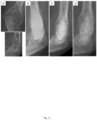
- Sequential imaging demonstrated progressive consolidation of the inserted graft material without any evidence of persistent osteolysis or local recurrence. Rapid and homogeneous remodeling typically started in well-contained areas with cancellous bone contact. Substantial bone formation was also observed in uncontained areas where graft material had been applied to the surface of metallic implants or surrounding cortical bone in some cases.
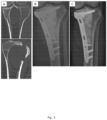
- Rapid and homogeneous remodeling typically started in areas with cancellous bone contact in the periphery of the defects but was not limited to the cavities only. Substantial periosteal bone formation was also observed in areas of ungrafted surrounding cortical bone.
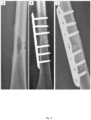
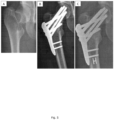
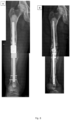
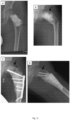
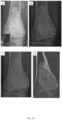
- x-rays taken prior treatment, right after and few months after treatment show bone formation and remodeling in 6 different patients.
- the treatment represented in figures 1-6 and 10 was performed by applying a biocompatible matrix, e.g. cancellous allograft, and a bone reconstruction composition, e.g. bone graft substitute (BGS) comprising zoledronic acid and they all show new bone formation and remodeling at 3 weeks to 6 months after treatment.
- BGS bone graft substitute
- the treatment represented in figure 7 instead, was performed by applying only a bone reconstruction composition, e.g. the bone graft substitute (Cerament TM
- a bone reconstruction composition e.g. the bone graft substitute (Cerament TM
- complete disappearance of the bone graft substitute is observed 6 months after the treatment.
- the patient represented in figure 8 was affected by aseptic loosening of an intercalary diaphyseal replacement in the right femur, treated with 2 stage revision and intermediate implantation of an antibiotic cement spacer and re-implantation of a new, cemented, silver coated intercalary spacer and periprosthetic bone defect reconstruction.
- Part of the bone defect was filled using a biocompatible matrix, e.g.
Landscapes
- Health & Medical Sciences (AREA)
- Chemical & Material Sciences (AREA)
- Life Sciences & Earth Sciences (AREA)
- Medicinal Chemistry (AREA)
- Biomedical Technology (AREA)
- Engineering & Computer Science (AREA)
- General Health & Medical Sciences (AREA)
- Epidemiology (AREA)
- Transplantation (AREA)
- Animal Behavior & Ethology (AREA)
- Oral & Maxillofacial Surgery (AREA)
- Public Health (AREA)
- Veterinary Medicine (AREA)
- Dermatology (AREA)
- Molecular Biology (AREA)
- Orthopedic Medicine & Surgery (AREA)
- Botany (AREA)
- Chemical Kinetics & Catalysis (AREA)
- Inorganic Chemistry (AREA)
- Urology & Nephrology (AREA)
- Zoology (AREA)
- Vascular Medicine (AREA)
- Materials For Medical Uses (AREA)
Claims (4)
- Härtbare Knochenrekonstruktions-Zusammensetzung, umfassend Calciumsulfat und/oder Calciumphosphat, ein antiresorptives Mittel und Fosfomycin, wobei das antiresorptive Mittel ein Bisphosphonat umfasst oder aus einem Bisphosphonat besteht.
- Knochenrekonstruktions-Zusammensetzung nach Anspruch 1, wobei das Calciumphosphat ein Hydroxylapatit umfasst oder aus diesem besteht.
- Zusammensetzung nach einem der vorhergehenden Ansprüche, wobei die Knochenrekonstruktions-Zusammensetzung in einem Zeitbereich von 2 bis 60 Minuten aushärtet, nachdem alle Bestandteile der Zusammensetzung gemischt wurden.
- Zusammensetzung nach einem der vorhergehenden Ansprüche, wobei die Knochenrekonstruktions-Zusammensetzung in einem Zeitbereich von 2 bis 10 Minuten zu einer Paste härtet, nachdem alle Bestandteile der Zusammensetzung gemischt wurden.
Priority Applications (1)
| Application Number | Priority Date | Filing Date | Title |
|---|---|---|---|
| EP20212234.7A EP3821917A1 (de) | 2015-10-05 | 2016-10-04 | Zusammensetzungen und verfahren zur behandlung von knochendefekten |
Applications Claiming Priority (2)
| Application Number | Priority Date | Filing Date | Title |
|---|---|---|---|
| DKPA201570626 | 2015-10-05 | ||
| PCT/DK2016/050320 WO2017059863A1 (en) | 2015-10-05 | 2016-10-04 | Compositions and methods for treatment of bone defects |
Related Child Applications (2)
| Application Number | Title | Priority Date | Filing Date |
|---|---|---|---|
| EP20212234.7A Division EP3821917A1 (de) | 2015-10-05 | 2016-10-04 | Zusammensetzungen und verfahren zur behandlung von knochendefekten |
| EP20212234.7A Division-Into EP3821917A1 (de) | 2015-10-05 | 2016-10-04 | Zusammensetzungen und verfahren zur behandlung von knochendefekten |
Publications (3)
| Publication Number | Publication Date |
|---|---|
| EP3359209A1 EP3359209A1 (de) | 2018-08-15 |
| EP3359209B1 EP3359209B1 (de) | 2020-12-09 |
| EP3359209B2 true EP3359209B2 (de) | 2025-06-18 |
Family
ID=55023819
Family Applications (2)
| Application Number | Title | Priority Date | Filing Date |
|---|---|---|---|
| EP16788416.2A Active EP3359209B2 (de) | 2015-10-05 | 2016-10-04 | Zusammensetzungen und verfahren zur behandlung von knochendefekten |
| EP20212234.7A Pending EP3821917A1 (de) | 2015-10-05 | 2016-10-04 | Zusammensetzungen und verfahren zur behandlung von knochendefekten |
Family Applications After (1)
| Application Number | Title | Priority Date | Filing Date |
|---|---|---|---|
| EP20212234.7A Pending EP3821917A1 (de) | 2015-10-05 | 2016-10-04 | Zusammensetzungen und verfahren zur behandlung von knochendefekten |
Country Status (4)
| Country | Link |
|---|---|
| US (2) | US20180289859A1 (de) |
| EP (2) | EP3359209B2 (de) |
| DK (1) | DK3359209T4 (de) |
| WO (1) | WO2017059863A1 (de) |
Families Citing this family (3)
| Publication number | Priority date | Publication date | Assignee | Title |
|---|---|---|---|---|
| US20180289859A1 (en) | 2015-10-05 | 2018-10-11 | Hettwer Holding Aps | Compositions and methods for treatment of bone defects |
| WO2022015364A1 (en) * | 2020-07-17 | 2022-01-20 | Zetagen Therapeutics, Inc. | Methods and compositions to graft bone using iron excipients |
| AU2021311459A1 (en) * | 2020-07-21 | 2023-02-02 | Shankar Rajeswaran M.D. Llc | System and method for treatment of bone |
Citations (1)
| Publication number | Priority date | Publication date | Assignee | Title |
|---|---|---|---|---|
| US9180137B2 (en) † | 2010-02-09 | 2015-11-10 | Bone Support Ab | Preparation of bone cement compositions |
Family Cites Families (13)
| Publication number | Priority date | Publication date | Assignee | Title |
|---|---|---|---|---|
| US5366507A (en) * | 1992-03-06 | 1994-11-22 | Sottosanti John S | Method for use in bone tissue regeneration |
| EP1383509A4 (de) * | 2001-04-03 | 2005-10-26 | Royal Alexandra Hosp Children | Arzneimittel zur verwendung bei der knochentransplantation |
| SI1856090T1 (sl) | 2005-02-11 | 2010-02-26 | Lilly Co Eli | Substituirani derivati tiofena kot antagonisti glukagonskega receptorja, priprava in terapevtske uporabe |
| AU2006326271B2 (en) * | 2005-12-14 | 2011-02-24 | Scil Technology Gmbh | A moldable biomaterial for bone regeneration |
| US20080281431A1 (en) * | 2007-05-10 | 2008-11-13 | Biomet Manufacturing Corp. | Resorbable bone graft materials |
| WO2009036279A1 (en) * | 2007-09-14 | 2009-03-19 | Purdue Research Foundation | Demineralized cancellous bone scaffolds |
| US20110137417A1 (en) * | 2009-12-04 | 2011-06-09 | Transplant Technologies of Texas | Multiple wafer cortical bone and cancellous bone allograft with cortical pins |
| US9283866B2 (en) * | 2012-01-31 | 2016-03-15 | Joy MM Deleware, Inc. | Overhead power grid for mobile mining machines |
| DK2958603T3 (en) | 2013-02-20 | 2018-07-16 | Bone Support Ab | IMPROVED CURE FOR HARDWARE BONE COMPENSATION |
| US9579421B2 (en) | 2014-02-07 | 2017-02-28 | Globus Medical Inc. | Bone grafts and methods of making and using bone grafts |
| DE102014104676A1 (de) * | 2014-04-02 | 2015-10-08 | Heraeus Medical Gmbh | Fosfomycin-Zubereitung, ein Verfahren zur Herstellung der Zubereitung und ein die Zubereitung enthaltendes Polymethylmethacrylat-Knochenzementpulver |
| US10006705B2 (en) * | 2015-02-09 | 2018-06-26 | Warsaw Orthopedic, Inc. | Methods for treating tissue materials |
| US20180289859A1 (en) | 2015-10-05 | 2018-10-11 | Hettwer Holding Aps | Compositions and methods for treatment of bone defects |
-
2016
- 2016-10-04 US US15/765,759 patent/US20180289859A1/en active Pending
- 2016-10-04 EP EP16788416.2A patent/EP3359209B2/de active Active
- 2016-10-04 EP EP20212234.7A patent/EP3821917A1/de active Pending
- 2016-10-04 WO PCT/DK2016/050320 patent/WO2017059863A1/en not_active Ceased
- 2016-10-04 DK DK16788416.2T patent/DK3359209T4/da active
-
2021
- 2021-05-11 US US17/317,540 patent/US12201747B2/en active Active
Patent Citations (1)
| Publication number | Priority date | Publication date | Assignee | Title |
|---|---|---|---|---|
| US9180137B2 (en) † | 2010-02-09 | 2015-11-10 | Bone Support Ab | Preparation of bone cement compositions |
Also Published As
| Publication number | Publication date |
|---|---|
| EP3359209A1 (de) | 2018-08-15 |
| EP3359209B1 (de) | 2020-12-09 |
| DK3359209T4 (en) | 2025-06-30 |
| US20210402058A1 (en) | 2021-12-30 |
| US20180289859A1 (en) | 2018-10-11 |
| DK3359209T3 (en) | 2021-03-15 |
| EP3821917A1 (de) | 2021-05-19 |
| WO2017059863A1 (en) | 2017-04-13 |
| US12201747B2 (en) | 2025-01-21 |
Similar Documents
| Publication | Publication Date | Title |
|---|---|---|
| EP2608778B1 (de) | Zusammensetzungen und verfahren zur behandlung von knochendefekten | |
| Thomas et al. | Calcium sulfate: Properties and clinical applications | |
| KR101115964B1 (ko) | 서방형 골다공증치료제를 담지한 골충진재 | |
| US12544335B2 (en) | Treatment approach by targeted delivery of bioactive molecules | |
| US12201747B2 (en) | Compositions and methods for treatment of bone defects | |
| US7887831B2 (en) | Bone enhancing composite | |
| Lee et al. | Sustained BMP-2 delivery via alginate microbeads and polydopamine-coated 3D-Printed PCL/β-TCP scaffold enhances bone regeneration in long bone segmental defects | |
| CN116194162A (zh) | 使用铁质赋形剂进行骨移植的方法和组合物 | |
| JP2026041714A (ja) | 人工骨膜 | |
| US20220118157A1 (en) | Method for bone healing or treatment of bone fracture | |
| US20110288652A1 (en) | Materials and methods for treating critically sized defects in mouse bone | |
| US20260041812A1 (en) | Adhesive compositions with tunable porosity and acidity content and methods of use thereof | |
| WO2004043333A2 (en) | Bone enhancing composite | |
| Kheirallah et al. | Oral health case reports | |
| KR20250034919A (ko) | 뼈 재생을 지원하는 방법에 사용하기 위한 페이스트상 생체적합성 재료, 이의 조성물, 및 페이스트상 재료로 형성된 성형품 | |
| Yasuda et al. | Experimental study of influence of direct bisphosphonate administration on bone substitute | |
| HK1185260B (en) | Compositions and methods for treating bone defects | |
| HK1185260A (en) | Compositions and methods for treating bone defects |
Legal Events
| Date | Code | Title | Description |
|---|---|---|---|
| STAA | Information on the status of an ep patent application or granted ep patent |
Free format text: STATUS: UNKNOWN |
|
| STAA | Information on the status of an ep patent application or granted ep patent |
Free format text: STATUS: THE INTERNATIONAL PUBLICATION HAS BEEN MADE |
|
| PUAI | Public reference made under article 153(3) epc to a published international application that has entered the european phase |
Free format text: ORIGINAL CODE: 0009012 |
|
| STAA | Information on the status of an ep patent application or granted ep patent |
Free format text: STATUS: REQUEST FOR EXAMINATION WAS MADE |
|
| 17P | Request for examination filed |
Effective date: 20180507 |
|
| AK | Designated contracting states |
Kind code of ref document: A1 Designated state(s): AL AT BE BG CH CY CZ DE DK EE ES FI FR GB GR HR HU IE IS IT LI LT LU LV MC MK MT NL NO PL PT RO RS SE SI SK SM TR |
|
| AX | Request for extension of the european patent |
Extension state: BA ME |
|
| DAV | Request for validation of the european patent (deleted) | ||
| DAX | Request for extension of the european patent (deleted) | ||
| STAA | Information on the status of an ep patent application or granted ep patent |
Free format text: STATUS: EXAMINATION IS IN PROGRESS |
|
| 17Q | First examination report despatched |
Effective date: 20190830 |
|
| TPAC | Observations filed by third parties |
Free format text: ORIGINAL CODE: EPIDOSNTIPA |
|
| GRAP | Despatch of communication of intention to grant a patent |
Free format text: ORIGINAL CODE: EPIDOSNIGR1 |
|
| STAA | Information on the status of an ep patent application or granted ep patent |
Free format text: STATUS: GRANT OF PATENT IS INTENDED |
|
| INTG | Intention to grant announced |
Effective date: 20200605 |
|
| GRAS | Grant fee paid |
Free format text: ORIGINAL CODE: EPIDOSNIGR3 |
|
| GRAA | (expected) grant |
Free format text: ORIGINAL CODE: 0009210 |
|
| STAA | Information on the status of an ep patent application or granted ep patent |
Free format text: STATUS: THE PATENT HAS BEEN GRANTED |
|
| AK | Designated contracting states |
Kind code of ref document: B1 Designated state(s): AL AT BE BG CH CY CZ DE DK EE ES FI FR GB GR HR HU IE IS IT LI LT LU LV MC MK MT NL NO PL PT RO RS SE SI SK SM TR |
|
| REG | Reference to a national code |
Ref country code: GB Ref legal event code: FG4D |
|
| REG | Reference to a national code |
Ref country code: AT Ref legal event code: REF Ref document number: 1342718 Country of ref document: AT Kind code of ref document: T Effective date: 20201215 Ref country code: CH Ref legal event code: EP |
|
| REG | Reference to a national code |
Ref country code: DE Ref legal event code: R096 Ref document number: 602016049500 Country of ref document: DE |
|
| REG | Reference to a national code |
Ref country code: IE Ref legal event code: FG4D |
|
| REG | Reference to a national code |
Ref country code: DK Ref legal event code: T3 Effective date: 20210310 Ref country code: CH Ref legal event code: NV Representative=s name: MICHELI AND CIE SA, CH |
|
| REG | Reference to a national code |
Ref country code: SE Ref legal event code: TRGR |
|
| PG25 | Lapsed in a contracting state [announced via postgrant information from national office to epo] |
Ref country code: GR Free format text: LAPSE BECAUSE OF FAILURE TO SUBMIT A TRANSLATION OF THE DESCRIPTION OR TO PAY THE FEE WITHIN THE PRESCRIBED TIME-LIMIT Effective date: 20210310 Ref country code: FI Free format text: LAPSE BECAUSE OF FAILURE TO SUBMIT A TRANSLATION OF THE DESCRIPTION OR TO PAY THE FEE WITHIN THE PRESCRIBED TIME-LIMIT Effective date: 20201209 Ref country code: RS Free format text: LAPSE BECAUSE OF FAILURE TO SUBMIT A TRANSLATION OF THE DESCRIPTION OR TO PAY THE FEE WITHIN THE PRESCRIBED TIME-LIMIT Effective date: 20201209 Ref country code: NO Free format text: LAPSE BECAUSE OF FAILURE TO SUBMIT A TRANSLATION OF THE DESCRIPTION OR TO PAY THE FEE WITHIN THE PRESCRIBED TIME-LIMIT Effective date: 20210309 |
|
| REG | Reference to a national code |
Ref country code: AT Ref legal event code: MK05 Ref document number: 1342718 Country of ref document: AT Kind code of ref document: T Effective date: 20201209 |
|
| PG25 | Lapsed in a contracting state [announced via postgrant information from national office to epo] |
Ref country code: BG Free format text: LAPSE BECAUSE OF FAILURE TO SUBMIT A TRANSLATION OF THE DESCRIPTION OR TO PAY THE FEE WITHIN THE PRESCRIBED TIME-LIMIT Effective date: 20210309 Ref country code: LV Free format text: LAPSE BECAUSE OF FAILURE TO SUBMIT A TRANSLATION OF THE DESCRIPTION OR TO PAY THE FEE WITHIN THE PRESCRIBED TIME-LIMIT Effective date: 20201209 |
|
| REG | Reference to a national code |
Ref country code: NL Ref legal event code: MP Effective date: 20201209 |
|
| PG25 | Lapsed in a contracting state [announced via postgrant information from national office to epo] |
Ref country code: NL Free format text: LAPSE BECAUSE OF FAILURE TO SUBMIT A TRANSLATION OF THE DESCRIPTION OR TO PAY THE FEE WITHIN THE PRESCRIBED TIME-LIMIT Effective date: 20201209 Ref country code: HR Free format text: LAPSE BECAUSE OF FAILURE TO SUBMIT A TRANSLATION OF THE DESCRIPTION OR TO PAY THE FEE WITHIN THE PRESCRIBED TIME-LIMIT Effective date: 20201209 |
|
| REG | Reference to a national code |
Ref country code: LT Ref legal event code: MG9D |
|
| PG25 | Lapsed in a contracting state [announced via postgrant information from national office to epo] |
Ref country code: CZ Free format text: LAPSE BECAUSE OF FAILURE TO SUBMIT A TRANSLATION OF THE DESCRIPTION OR TO PAY THE FEE WITHIN THE PRESCRIBED TIME-LIMIT Effective date: 20201209 Ref country code: EE Free format text: LAPSE BECAUSE OF FAILURE TO SUBMIT A TRANSLATION OF THE DESCRIPTION OR TO PAY THE FEE WITHIN THE PRESCRIBED TIME-LIMIT Effective date: 20201209 Ref country code: SM Free format text: LAPSE BECAUSE OF FAILURE TO SUBMIT A TRANSLATION OF THE DESCRIPTION OR TO PAY THE FEE WITHIN THE PRESCRIBED TIME-LIMIT Effective date: 20201209 Ref country code: LT Free format text: LAPSE BECAUSE OF FAILURE TO SUBMIT A TRANSLATION OF THE DESCRIPTION OR TO PAY THE FEE WITHIN THE PRESCRIBED TIME-LIMIT Effective date: 20201209 Ref country code: PT Free format text: LAPSE BECAUSE OF FAILURE TO SUBMIT A TRANSLATION OF THE DESCRIPTION OR TO PAY THE FEE WITHIN THE PRESCRIBED TIME-LIMIT Effective date: 20210409 Ref country code: SK Free format text: LAPSE BECAUSE OF FAILURE TO SUBMIT A TRANSLATION OF THE DESCRIPTION OR TO PAY THE FEE WITHIN THE PRESCRIBED TIME-LIMIT Effective date: 20201209 Ref country code: RO Free format text: LAPSE BECAUSE OF FAILURE TO SUBMIT A TRANSLATION OF THE DESCRIPTION OR TO PAY THE FEE WITHIN THE PRESCRIBED TIME-LIMIT Effective date: 20201209 |
|
| PG25 | Lapsed in a contracting state [announced via postgrant information from national office to epo] |
Ref country code: PL Free format text: LAPSE BECAUSE OF FAILURE TO SUBMIT A TRANSLATION OF THE DESCRIPTION OR TO PAY THE FEE WITHIN THE PRESCRIBED TIME-LIMIT Effective date: 20201209 Ref country code: AT Free format text: LAPSE BECAUSE OF FAILURE TO SUBMIT A TRANSLATION OF THE DESCRIPTION OR TO PAY THE FEE WITHIN THE PRESCRIBED TIME-LIMIT Effective date: 20201209 |
|
| REG | Reference to a national code |
Ref country code: DE Ref legal event code: R026 Ref document number: 602016049500 Country of ref document: DE |
|
| PLBI | Opposition filed |
Free format text: ORIGINAL CODE: 0009260 |
|
| PLAX | Notice of opposition and request to file observation + time limit sent |
Free format text: ORIGINAL CODE: EPIDOSNOBS2 |
|
| PG25 | Lapsed in a contracting state [announced via postgrant information from national office to epo] |
Ref country code: IS Free format text: LAPSE BECAUSE OF FAILURE TO SUBMIT A TRANSLATION OF THE DESCRIPTION OR TO PAY THE FEE WITHIN THE PRESCRIBED TIME-LIMIT Effective date: 20210409 |
|
| 26 | Opposition filed |
Opponent name: BONE SUPPORT AB Effective date: 20210907 |
|
| PG25 | Lapsed in a contracting state [announced via postgrant information from national office to epo] |
Ref country code: AL Free format text: LAPSE BECAUSE OF FAILURE TO SUBMIT A TRANSLATION OF THE DESCRIPTION OR TO PAY THE FEE WITHIN THE PRESCRIBED TIME-LIMIT Effective date: 20201209 Ref country code: IT Free format text: LAPSE BECAUSE OF FAILURE TO SUBMIT A TRANSLATION OF THE DESCRIPTION OR TO PAY THE FEE WITHIN THE PRESCRIBED TIME-LIMIT Effective date: 20201209 |
|
| PG25 | Lapsed in a contracting state [announced via postgrant information from national office to epo] |
Ref country code: SI Free format text: LAPSE BECAUSE OF FAILURE TO SUBMIT A TRANSLATION OF THE DESCRIPTION OR TO PAY THE FEE WITHIN THE PRESCRIBED TIME-LIMIT Effective date: 20201209 |
|
| PG25 | Lapsed in a contracting state [announced via postgrant information from national office to epo] |
Ref country code: ES Free format text: LAPSE BECAUSE OF FAILURE TO SUBMIT A TRANSLATION OF THE DESCRIPTION OR TO PAY THE FEE WITHIN THE PRESCRIBED TIME-LIMIT Effective date: 20201209 |
|
| PLBB | Reply of patent proprietor to notice(s) of opposition received |
Free format text: ORIGINAL CODE: EPIDOSNOBS3 |
|
| PG25 | Lapsed in a contracting state [announced via postgrant information from national office to epo] |
Ref country code: IS Free format text: LAPSE BECAUSE OF FAILURE TO SUBMIT A TRANSLATION OF THE DESCRIPTION OR TO PAY THE FEE WITHIN THE PRESCRIBED TIME-LIMIT Effective date: 20210409 |
|
| REG | Reference to a national code |
Ref country code: BE Ref legal event code: MM Effective date: 20211031 |
|
| PG25 | Lapsed in a contracting state [announced via postgrant information from national office to epo] |
Ref country code: MC Free format text: LAPSE BECAUSE OF FAILURE TO SUBMIT A TRANSLATION OF THE DESCRIPTION OR TO PAY THE FEE WITHIN THE PRESCRIBED TIME-LIMIT Effective date: 20201209 |
|
| PG25 | Lapsed in a contracting state [announced via postgrant information from national office to epo] |
Ref country code: LU Free format text: LAPSE BECAUSE OF NON-PAYMENT OF DUE FEES Effective date: 20211004 Ref country code: BE Free format text: LAPSE BECAUSE OF NON-PAYMENT OF DUE FEES Effective date: 20211031 |
|
| PG25 | Lapsed in a contracting state [announced via postgrant information from national office to epo] |
Ref country code: IE Free format text: LAPSE BECAUSE OF NON-PAYMENT OF DUE FEES Effective date: 20211004 |
|
| PG25 | Lapsed in a contracting state [announced via postgrant information from national office to epo] |
Ref country code: HU Free format text: LAPSE BECAUSE OF FAILURE TO SUBMIT A TRANSLATION OF THE DESCRIPTION OR TO PAY THE FEE WITHIN THE PRESCRIBED TIME-LIMIT; INVALID AB INITIO Effective date: 20161004 |
|
| P01 | Opt-out of the competence of the unified patent court (upc) registered |
Effective date: 20230503 |
|
| PG25 | Lapsed in a contracting state [announced via postgrant information from national office to epo] |
Ref country code: CY Free format text: LAPSE BECAUSE OF FAILURE TO SUBMIT A TRANSLATION OF THE DESCRIPTION OR TO PAY THE FEE WITHIN THE PRESCRIBED TIME-LIMIT Effective date: 20201209 |
|
| PG25 | Lapsed in a contracting state [announced via postgrant information from national office to epo] |
Ref country code: MK Free format text: LAPSE BECAUSE OF FAILURE TO SUBMIT A TRANSLATION OF THE DESCRIPTION OR TO PAY THE FEE WITHIN THE PRESCRIBED TIME-LIMIT Effective date: 20201209 |
|
| PG25 | Lapsed in a contracting state [announced via postgrant information from national office to epo] |
Ref country code: MT Free format text: LAPSE BECAUSE OF FAILURE TO SUBMIT A TRANSLATION OF THE DESCRIPTION OR TO PAY THE FEE WITHIN THE PRESCRIBED TIME-LIMIT Effective date: 20201209 |
|
| APBP | Date of receipt of notice of appeal recorded |
Free format text: ORIGINAL CODE: EPIDOSNNOA2O |
|
| APAH | Appeal reference modified |
Free format text: ORIGINAL CODE: EPIDOSCREFNO |
|
| APAW | Appeal reference deleted |
Free format text: ORIGINAL CODE: EPIDOSDREFNO |
|
| APBU | Appeal procedure closed |
Free format text: ORIGINAL CODE: EPIDOSNNOA9O |
|
| PUAH | Patent maintained in amended form |
Free format text: ORIGINAL CODE: 0009272 |
|
| STAA | Information on the status of an ep patent application or granted ep patent |
Free format text: STATUS: PATENT MAINTAINED AS AMENDED |
|
| REG | Reference to a national code |
Ref country code: DE Ref legal event code: R081 Ref document number: 602016049500 Country of ref document: DE Owner name: EMBIOS GMBH, DE Free format text: FORMER OWNER: HETTWER HOLDING APS, COPENHAGEN, DK |
|
| 27A | Patent maintained in amended form |
Effective date: 20250618 |
|
| AK | Designated contracting states |
Kind code of ref document: B2 Designated state(s): AL AT BE BG CH CY CZ DE DK EE ES FI FR GB GR HR HU IE IS IT LI LT LU LV MC MK MT NL NO PL PT RO RS SE SI SK SM TR |
|
| REG | Reference to a national code |
Ref country code: DE Ref legal event code: R102 Ref document number: 602016049500 Country of ref document: DE |
|
| REG | Reference to a national code |
Ref country code: DK Ref legal event code: T4 Effective date: 20250626 |
|
| REG | Reference to a national code |
Ref country code: SE Ref legal event code: RPEO |
|
| REG | Reference to a national code |
Ref country code: CH Ref legal event code: U11 Free format text: ST27 STATUS EVENT CODE: U-0-0-U10-U11 (AS PROVIDED BY THE NATIONAL OFFICE) Effective date: 20251101 |
|
| PG25 | Lapsed in a contracting state [announced via postgrant information from national office to epo] |
Ref country code: TR Free format text: LAPSE BECAUSE OF FAILURE TO SUBMIT A TRANSLATION OF THE DESCRIPTION OR TO PAY THE FEE WITHIN THE PRESCRIBED TIME-LIMIT Effective date: 20201209 |
|
| PGFP | Annual fee paid to national office [announced via postgrant information from national office to epo] |
Ref country code: DE Payment date: 20251020 Year of fee payment: 10 |
|
| PGFP | Annual fee paid to national office [announced via postgrant information from national office to epo] |
Ref country code: GB Payment date: 20251020 Year of fee payment: 10 |
|
| PGFP | Annual fee paid to national office [announced via postgrant information from national office to epo] |
Ref country code: DK Payment date: 20251003 Year of fee payment: 10 |
|
| PGFP | Annual fee paid to national office [announced via postgrant information from national office to epo] |
Ref country code: FR Payment date: 20251017 Year of fee payment: 10 |
|
| PGFP | Annual fee paid to national office [announced via postgrant information from national office to epo] |
Ref country code: CH Payment date: 20251101 Year of fee payment: 10 Ref country code: SE Payment date: 20251022 Year of fee payment: 10 |