EP3355152A1 - Display device - Google Patents
Display device Download PDFInfo
- Publication number
- EP3355152A1 EP3355152A1 EP17194317.8A EP17194317A EP3355152A1 EP 3355152 A1 EP3355152 A1 EP 3355152A1 EP 17194317 A EP17194317 A EP 17194317A EP 3355152 A1 EP3355152 A1 EP 3355152A1
- Authority
- EP
- European Patent Office
- Prior art keywords
- roller
- area
- display panel
- rotation axis
- unit
- Prior art date
- Legal status (The legal status is an assumption and is not a legal conclusion. Google has not performed a legal analysis and makes no representation as to the accuracy of the status listed.)
- Withdrawn
Links
Images








Classifications
-
- G—PHYSICS
- G09—EDUCATION; CRYPTOGRAPHY; DISPLAY; ADVERTISING; SEALS
- G09F—DISPLAYING; ADVERTISING; SIGNS; LABELS OR NAME-PLATES; SEALS
- G09F9/00—Indicating arrangements for variable information in which the information is built-up on a support by selection or combination of individual elements
- G09F9/30—Indicating arrangements for variable information in which the information is built-up on a support by selection or combination of individual elements in which the desired character or characters are formed by combining individual elements
- G09F9/301—Indicating arrangements for variable information in which the information is built-up on a support by selection or combination of individual elements in which the desired character or characters are formed by combining individual elements flexible foldable or roll-able electronic displays, e.g. thin LCD, OLED
-
- G—PHYSICS
- G06—COMPUTING OR CALCULATING; COUNTING
- G06F—ELECTRIC DIGITAL DATA PROCESSING
- G06F1/00—Details not covered by groups G06F3/00 - G06F13/00 and G06F21/00
- G06F1/16—Constructional details or arrangements
- G06F1/1613—Constructional details or arrangements for portable computers
- G06F1/1615—Constructional details or arrangements for portable computers with several enclosures having relative motions, each enclosure supporting at least one I/O or computing function
- G06F1/1624—Constructional details or arrangements for portable computers with several enclosures having relative motions, each enclosure supporting at least one I/O or computing function with sliding enclosures, e.g. sliding keyboard or display
-
- G—PHYSICS
- G02—OPTICS
- G02F—OPTICAL DEVICES OR ARRANGEMENTS FOR THE CONTROL OF LIGHT BY MODIFICATION OF THE OPTICAL PROPERTIES OF THE MEDIA OF THE ELEMENTS INVOLVED THEREIN; NON-LINEAR OPTICS; FREQUENCY-CHANGING OF LIGHT; OPTICAL LOGIC ELEMENTS; OPTICAL ANALOGUE/DIGITAL CONVERTERS
- G02F1/00—Devices or arrangements for the control of the intensity, colour, phase, polarisation or direction of light arriving from an independent light source, e.g. switching, gating or modulating; Non-linear optics
- G02F1/01—Devices or arrangements for the control of the intensity, colour, phase, polarisation or direction of light arriving from an independent light source, e.g. switching, gating or modulating; Non-linear optics for the control of the intensity, phase, polarisation or colour
- G02F1/13—Devices or arrangements for the control of the intensity, colour, phase, polarisation or direction of light arriving from an independent light source, e.g. switching, gating or modulating; Non-linear optics for the control of the intensity, phase, polarisation or colour based on liquid crystals, e.g. single liquid crystal display cells
- G02F1/133—Constructional arrangements; Operation of liquid crystal cells; Circuit arrangements
- G02F1/1333—Constructional arrangements; Manufacturing methods
- G02F1/133305—Flexible substrates, e.g. plastics, organic film
-
- G—PHYSICS
- G06—COMPUTING OR CALCULATING; COUNTING
- G06F—ELECTRIC DIGITAL DATA PROCESSING
- G06F1/00—Details not covered by groups G06F3/00 - G06F13/00 and G06F21/00
- G06F1/16—Constructional details or arrangements
- G06F1/1613—Constructional details or arrangements for portable computers
- G06F1/1633—Constructional details or arrangements of portable computers not specific to the type of enclosures covered by groups G06F1/1615 - G06F1/1626
- G06F1/1637—Details related to the display arrangement, including those related to the mounting of the display in the housing
- G06F1/1641—Details related to the display arrangement, including those related to the mounting of the display in the housing the display being formed by a plurality of foldable display components
-
- G—PHYSICS
- G06—COMPUTING OR CALCULATING; COUNTING
- G06F—ELECTRIC DIGITAL DATA PROCESSING
- G06F1/00—Details not covered by groups G06F3/00 - G06F13/00 and G06F21/00
- G06F1/16—Constructional details or arrangements
- G06F1/1613—Constructional details or arrangements for portable computers
- G06F1/1633—Constructional details or arrangements of portable computers not specific to the type of enclosures covered by groups G06F1/1615 - G06F1/1626
- G06F1/1637—Details related to the display arrangement, including those related to the mounting of the display in the housing
- G06F1/1652—Details related to the display arrangement, including those related to the mounting of the display in the housing the display being flexible, e.g. mimicking a sheet of paper, or rollable
-
- H—ELECTRICITY
- H10—SEMICONDUCTOR DEVICES; ELECTRIC SOLID-STATE DEVICES NOT OTHERWISE PROVIDED FOR
- H10K—ORGANIC ELECTRIC SOLID-STATE DEVICES
- H10K77/00—Constructional details of devices covered by this subclass and not covered by groups H10K10/80, H10K30/80, H10K50/80 or H10K59/80
- H10K77/10—Substrates, e.g. flexible substrates
- H10K77/111—Flexible substrates
-
- Y—GENERAL TAGGING OF NEW TECHNOLOGICAL DEVELOPMENTS; GENERAL TAGGING OF CROSS-SECTIONAL TECHNOLOGIES SPANNING OVER SEVERAL SECTIONS OF THE IPC; TECHNICAL SUBJECTS COVERED BY FORMER USPC CROSS-REFERENCE ART COLLECTIONS [XRACs] AND DIGESTS
- Y02—TECHNOLOGIES OR APPLICATIONS FOR MITIGATION OR ADAPTATION AGAINST CLIMATE CHANGE
- Y02E—REDUCTION OF GREENHOUSE GAS [GHG] EMISSIONS, RELATED TO ENERGY GENERATION, TRANSMISSION OR DISTRIBUTION
- Y02E10/00—Energy generation through renewable energy sources
- Y02E10/50—Photovoltaic [PV] energy
- Y02E10/549—Organic PV cells
Definitions
- the present disclosure relates to a display device.
- LCD liquid crystal display
- PDP plasma display panel
- OLED organic light emitting diode
- FED field effect display
- electrophoretic display and the like.
- the OLED display includes two electrodes and an organic emission layer interposed therebetween. Electrons injected from one electrode and holes injected from the other electrode are combined in the organic emission layer to generate excitons, and the generated excitons release energy to emit light.
- the OLED display may have a reduced thickness and weight since it has a self-luminance characteristic and does not require an additional light source, unlike the LCD.
- the OLED display is receiving attention as a next generation display device since it has high quality characteristics such as low power consumption, high luminance, and high response speed.
- This display device has recently been under development as a flexible display device that can be rolled. In order to use the foldable display devices or the rollable display devices for a long time, it is necessary to minimize stress applied to the display panel thereof while they are used.
- the present inventive concept has been made in an effort to provide a display device that may prevent a display panel thereof from being broken due to stress.
- An exemplary embodiment provides a display device including: a display panel configured to include a first area, and a second area and a third area respectively disposed at opposite sides of the first area in a first direction; a first roller unit configured to wind the second area thereon; and a second roller unit configured to wind the third area of the display panel in an opposite direction to that of the first roller unit, wherein the first roller unit and the second roller unit are separated from each other in the first direction by a distance, the first roller unit and the second roller unit configured to allow the distance to be adjusted.
- the first roller unit may include: a first roller configured to rotate around a first rotation axis; and a second roller configured to rotate in an opposite direction to that of the first roller around a second rotation axis that is parallel to the first rotation axis in the first direction.
- the second area of the display panel may be wound on at least one of external circumferential surfaces of the first roller and the second roller.
- a first ratio which is a ratio of a first length of the second area wound around the external circumferential surface of the first roller to a length of a circumference of the first roller may be the same as a second ratio which is a ratio of a second length of the second area wound around the external circumferential surface of the second roller to a length of a circumference of the second roller.
- a radius of the first roller may be a same radius as a radius of the second roller.
- a radius of the first roller may be a different radius from a radius of the second roller.
- the first roller unit may further include a first connection plate configured to have a first-side end portion fixedly coupled to the external circumferential surface of the second roller, and a second-side end portion coupled to the second area, and the first connection plate may be wound on the external circumferential surface of the first roller or the second roller.
- the first roller unit may further include a third roller configured to rotate in an opposite direction to that of the second roller around a third rotation axis parallel to the first rotation axis and the second rotation axis.
- the second roller unit may include: a fourth roller configured to rotate around a fourth rotation axis parallel to the first rotation axis in the first direction; and a fifth roller configured to rotate in an opposite direction to that of the fourth roller around a fifth rotation axis parallel to the fourth rotation axis in the first direction.
- the third area may be wound on at least one of external circumferential surfaces of the fourth roller and the fifth roller.
- a third ratio which is a ratio of a length of the display panel wound on the external circumferential surface of the fourth roller to a length of a circumference of the fourth roller may be the same as a fourth ratio which is a ratio of a length of the display panel wound on the external circumferential surface of the fifth roller to a length of a circumference of the fifth roller.
- a radius of the fourth roller may be a same radius as a radius of the fifth roller.
- a radius of the fourth roller may be a different radius from a radius of the fifth roller.
- the second roller unit may further include a second connection plate configured to have a first-side end portion fixedly coupled to the external circumferential surface of the fifth roller, and a second-side end portion coupled to the third area, and the second connection plate may be wound on the external circumferential surface of the fourth roller or the fifth roller.
- the second roller unit may further include a sixth roller configured to rotate in an opposite direction to that of the fifth roller around a sixth rotation axis parallel to the fourth rotation axis and the fifth rotation axis.
- An exemplary embodiment provides a display device including: a display panel configured to include a first area, and a second area arranged close to the first area along a first direction in parallel; a fixing unit fixedly coupled to a first-side end portion of the first area; and a first winder configured to wind the second area of the display panel thereon, wherein the first winder includes: a first roller configured to rotate about a first rotation axis; and a second roller configured to rotate around a second rotation axis that is parallel to the first rotation axis in the first direction, the second area of the display panel is wound on external circumferential surfaces of the first roller and the second roller, the first roller and the second roller are separated from each other along the first direction by a distance, the first roller and the second roller configured to be movable along the first direction and allow the distance to be adjusted.
- the first roller and the second roller may have a separation distance between a first distance which is a maximum distance between the first roller and the second roller which are separated from each other in the first direction and a second distance which is a minimum distance therebetween.
- the first roller and the second roller may have the first distance therebetween, and may be moved along the first direction.
- a distance between the first roller and the second roller may be reduced from the first distance to the second distance.
- the second roller may be configured to be movable toward the first roller.
- the first roller and the second roller may be configured to rotate in different directions.
- the first roller and the second roller may be configured to rotate in a same direction.
- a radius of the first roller may be a same radius as a radius of the second roller.
- a radius of the first roller may be a different radius from a radius of the second roller.
- An exemplary embodiment provides a display device including: a display panel configured to include a first area, and a second area arranged close to the first area along a first direction in parallel; a fixing unit fixedly coupled to a first-side end portion of the first area; and a second winder configured to wind the second area of the display panel thereon, wherein the second winder includes: a first roller configured to wind the second area of the display panel thereon; and a guide unit disposed in parallel with the first roller in the first direction, to allow the second area passing through the first roller to extend therethrough, wherein the first roller and the guide unit are separated from each other in the first direction by a distance, the first roller and the guide unit configured to allow the distance to be adjusted.
- the guide unit may be formed of a tubular member through which the display panel is to be extended.
- the guide unit may have a convex curved surface in one direction.
- a through hole formed at opposite side end portions of the guide unit may be positioned in parallel with the first direction to face the first roller.
- the first roller and the guide unit may have a separation distance between a first distance, which is a maximum distance between the first roller and the guide unit which are separated from each other in the first direction, and a second distance, which is a minimum distance therebetween.
- the first roller and the guide unit may have the first distance therebetween, and are moved along the first direction.
- a distance between the first roller and the guide unit may be reduced from the first distance to the second distance.
- the guide unit may be configured to be movable toward the first roller.
- the word “comprise” and variations such as “comprises” or “comprising” will be understood to imply the inclusion of stated elements but not the exclusion of any other elements.
- the word “on” means positioning on or below the object portion, but does not essentially mean positioning on the upper side of the object portion based on a gravity direction.
- FIG. 1 is a schematic perspective view illustrating a first exemplary embodiment of the present inventive concept
- FIG. 2 and FIG. 3 illustrate an operation of FIG. 1
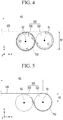
- FIG. 4 is an enlarged view illustrating a first roller unit of FIG. 2
- FIG. 5 is an enlarged view illustrating a first roller unit of FIG. 3
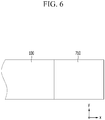
- FIG. 6 illustrates a coupling relationship between the display panel and the first connection plate.
- the display device may include a display panel 100, a first roller unit 300, and a second roller unit 500.
- opposite end portions of the display panel 100 may be wound around the first roller unit 300 and the second roller unit 500, respectively.
- at least two rollers for winding the display panel 100 may be respectively disposed in the first roller unit 300 and the second roller unit 500, and adjacent rollers may rotate in different directions.
- the display panel 100 may display images by emitting light.
- the display panel 100 may be applicable not only to a display panel of an organic light emitting diode (OLED) display, but also to a liquid crystal display (LCD), a plasma display (PDP), a field emission display (FED), an electrophoretic display, or the like, which may be used as a display panel.
- OLED organic light emitting diode
- LCD liquid crystal display
- PDP plasma display
- FED field emission display
- electrophoretic display or the like
- the display panel 100 can be divided into a display area for displaying an image and a peripheral area.
- the display area serves to display an image, and a plurality of pixels may be disposed therein.
- the peripheral area is an area other than the display area in which the pixels are disposed, and a drive signal line (not illustrated), a drive unit (not illustrated), and the like necessary for driving the display area may be disposed therein.
- the display panel 100 may be divided into a first area H1, a second area H2, and a third area H3.
- the first area H1, the second area H2, and the third area H3 may be disposed in a first direction (X-axis), and the first area H1 is a virtual area positioned in the center of the display panel 100.
- the second area H2 and the third area H3 represent virtual areas positioned at opposite end portions of the first area H1.
- the first area H1 is mainly formed of the display area
- the second area H2 and the third area H3 are formed of the display area and the peripheral area.
- the first area H1 when the display panel 100 is wound around the first roller unit 300 and the second roller unit 500, the first area H1 may indicate a virtual area that is not wound around the first roller unit 300 and the second roller unit 500. Further, the second area H2 and the third area H3 may indicate areas that can be wound around the first roller unit 300 and the second roller unit 500, respectively. In this case, lengths of the second area H2 and the third area H3 that are wound on the first roller unit 300 and the second roller unit 500 may be varied depending on operation states of the first roller unit 300 and second roller unit 500.
- the first roller unit 300 may wind the second area H2 of the display panel 100 thereon.
- the first roller unit 300 may wind the second area H2 around a second direction (Y-axis) in a clockwise direction.
- the second roller unit 500 may wind the third area H3 around the second direction (Y-axis) in a counterclockwise direction.
- the first roller unit 300 includes a first roller 310 and a second roller 330.
- the first roller 310 and the second roller 330 may be cylindrical members and may extend along the second direction (Y-axis).
- a radius R1 of the first roller 310 and a radius R2 of the second roller 330 may be equal to each other.
- the present inventive concept is not limited thereto.
- the radius R1 of the first roller 310 and the radius R2 of the second roller 330 may be different from each other.
- the first roller 310 can rotate about the first rotation axis A1 and the second roller 330 can rotate around the second rotation axis A2.
- the first rotation axis A1 and the second rotation axis A2 may be separated from each other in a first direction (X-axis), and the first rotation axis A1 and the second rotation axis A2 may be extended in the second direction (Y-axis).
- the first rotation axis A1 and the second rotation axis A2 may be disposed apart from each other by a first axis-to-axis distance W1 along the first direction (X-axis).
- the first axis-to-axis distance W1 can be constantly maintained while the first roller 310 and the second roller 330 rotate to wind or unwind the second area H2 of the display panel 100.
- FIG. 2 illustrates a display device in which the display panel 100 is wound, or a state in which the display panel 100 is fully wound around the first roller unit 300 and the second roller unit 500.
- the first roller 310 may rotate clockwise around the second direction (Y-axis)
- the second roller 330 may rotate counterclockwise around the second direction (Y-axis).
- the first roller 310 and the second roller 330 rotate in opposite directions as described above, the second area H2 of the display panel 100 may be moved along the second roller 330 through the first roller 310.
- the second area H2 of the display panel 100 when the second area H2 of the display panel 100 is wound and stored in the first roller unit 300, the second area H2 may have curved surfaces wound in different directions at the same time.
- a part of the second area H2 is wound on an external circumferential surface of the first roller 310 and has a curved surface wound in the clockwise direction about the second direction (Y-axis), and a remaining part of the second area H2 may have a curved surface that is wound around an external circumferential surface of the second roller 330 and wound along the counterclockwise direction about the second direction (Y-axis).
- stress generated in the display panel 100 in the rollable display device that can be wound can be reduced when the second area H2 of the display panel 100 simultaneously has curved surfaces wound in different directions.
- a process of reducing the stress of the display panel 100 will be described later.
- a first ratio which is a ratio of a first length G1 of the second area H2 wound around the external circumferential surface of the first roller 310 to a length of the circumference of the first roller 310 is the same as a second ratio (not illustrated) which is a ratio of a second length G2 of the second area H2 wound around the external circumferential surface of the second roller 330 to a length of the circumference of the second roller 330.
- the second area H2 may be wound around the external circumferential surface of the first roller 310 and the external circumferential surface of the second roller 330 to be stored such that the first ratio and the second ratio are equal to each other.
- the second area H2 can be wound around the external circumferential surface of the first roller 310 and the external circumferential surface of the second roller 330 to be stored such that the first length G1 of the second area H2 wound around the external circumferential surface of the first roller 310 and the second length G2 of the second area H2 wound around the external circumferential surface of the second roller 330 are equal to each other.
- the second roller unit 500 of the present exemplary embodiment may have a configuration that is symmetrical with the first roller unit 300 described above.
- the second roller unit 500 may include a fourth roller 510 and a fifth roller 530.
- the fourth roller 510 and the fifth roller 530 may be cylindrical members and may extend along a second direction (Y-axis).
- the radius R3 of the fourth roller 510 and the radius R4 of the fifth roller 530 may be equal to each other, like the first roller 310 and the second roller 330.
- the radius R3 of the fourth roller 510 and the radius R4 of the fifth roller 530 may be different from each other, without being limited thereto.
- the fourth roller 510 can rotate about the fourth rotation axis B1, and the fifth roller 530 can rotate about the fifth rotation axis B2.
- the fourth rotation axis B1 and the fifth rotation axis B2 may be spaced apart from each other along the first direction (X-axis), and the fourth rotation axis (B1) may extend along the second direction (Y-axis).
- the fourth rotation axis B1 and the fifth rotation axis B2 may be disposed apart from each other by a second axis-to-axis distance W2 along the first direction (X-axis).
- the second axis-to-axis distance W2 can be constantly maintained while the fourth roller 510 and the fifth roller 530 rotate to wind or unwind the third area H3 of the display panel 100.
- FIG. 2 illustrates a display device in which the display panel 100 is wound, i.e., a state in which the display panel 100 is fully wound around the first roller unit 300 and the second roller unit 500.
- the fourth roller 510 may rotate counterclockwise around the second direction (Y-axis)
- the fifth roller 530 may rotate clockwise around the second direction (Y-axis).
- the third area H3 of the display panel 100 may be moved along the fifth roller 530 through the fourth roller 510.
- the third area H3 of the display panel 100 when the third area H3 of the display panel 100 is wound and stored in the second roller unit 500, like the first roller unit 300, the third area H3 may have curved surfaces wound in different directions at the same time.
- a part of the third area H3 is wound on an external circumferential surface of the fourth roller 510 and has a curved surface wound in the counterclockwise direction about the second direction (Y-axis), and a remaining part of the third area H3 may have a curved surface that is wound around an external circumferential surface of the fifth roller 530 and wound along the clockwise direction about the second direction (Y-axis).
- stress generated in the display panel 100 in the rollable display device that can be wound can be reduced when the third area H3 of the display panel 100 simultaneously has curved surfaces wound in different directions.
- a third ratio (not illustrated) which is a ratio of a third length (not illustrated) of the third area H3 wound around the external circumferential surface of the fourth roller 510 to a length of the circumference of the fourth roller 510 is the same as a fourth ratio (not illustrated) which is a ratio of a fourth length (not illustrated) of the third area H3 wound around the external circumferential surface of the fifth roller 530 to a length of the circumference of the fifth roller 530.
- the third area H3 may be wound around the external circumferential surface of the fourth roller 510 and the external circumferential surface of the fifth roller 530 to be stored such that the third ratio (not illustrated) and the fourth ratio (not illustrated) are equal to each other.
- the third area H3 can be wound around the external circumferential surface of the fourth roller 510 and the external circumferential surface of the fifth roller 530 to be stored such that the third length of the third area H3 wound around the external circumferential surface of the fourth roller 510 and the fourth length of the third area H3 wound around the external circumferential surface of the fifth roller 530 are equal to each other.
- FIG. 3 and FIG. 5 illustrate the display device in which the display panel 100 is unfolded.
- the first roller 310 may rotate counterclockwise about the second direction (Y-axis), and the second roller 330 may rotate clockwise about the second direction (Y-axis).
- the second area H2 of the display panel 100 may be moved along the first roller 310 through the second roller 330.
- the fourth roller 510 may rotate in the clockwise direction about the second direction (Y-axis), and the fifth roller 530 may rotate in the counterclockwise direction about the second direction (Y-axis).
- the third area H3 of the display panel 100 may be moved along the fourth roller 510 through the fifth roller 530.
- the first roller unit 300 and the second roller unit 500 may be spaced apart from one another at a first distance D1.
- the first roller unit 300 and the second roller unit 500 may be disposed apart from each other at a second distance D2 in a state where the display panel 100 is unfolded by releasing the second area H2 and the third area H3 from the first roller unit 300 and the second roller unit 500, respectively.
- the first distance D1 and the second distance D2 may indicate a length measured in parallel with the first direction (X-axis).
- an interval of the two roller units 300 and 500 may be adjusted.
- a distance between the first roller unit 300 and the second roller unit 500 can be adjusted between the first distance D1 and the second distance D2.
- the distance between the first roller unit 300 and the second roller unit 500 can be increased from the first distance D1 to the second distance D2.
- an interval between the first roller unit 300 and the second roller unit 500 can be reduced from the second distance D2 to the first distance D1.
- a first connection plate 710 can be coupled to an end portion of the second area H2 of the display panel 100.
- the first connection plate 710 may be in the shape of a plate, a first end of which is coupled to the second area H2, and a second end of which is fixedly coupled to the second roller 330.
- the first connection plate 710 may include an elastic material, and may be made of, for example, rubber.
- the material of the first connection plate 710 is not limited thereto, and it may be made of a known material having elasticity.
- the first connecting plate 710 can guide the second area H2 to be wound on the second roller 330 through the first roller 310.
- the second area H2 of the display panel 100 may be positioned only on the external circumferential surface of the first roller 310 in a state in which the display panel 100 is unfolded. Then, when the display panel 100 is wound, the second area H2 must move along the external circumferential surface of the second roller 330 via the external circumferential surface of the first roller 310, as described above.
- the first connection plate 710 may be coupled to an end portion of the second area H2, to guide the second area H2 to be wound along the external circumferential surface of the second roller 330 around the second direction (Y-axis) in the counterclockwise direction.
- a second connection plate 730 applied to the second roller unit 500 has a symmetric configuration with respect to the first connection plate 710, and thus a detailed description of the second connection plate 730 will be omitted.
- each of the first roller unit 300 and the second roller unit 500 of FIGS. 1 to 3 has been described as including two rollers, the present inventive concept is not limited thereto.
- each of the first roller unit 300 and the second roller unit 500 may include three rollers.
- the present inventive concept is not limited thereto.
- each of the first roller unit 300 and the second roller unit 500 may include four or more rollers.
- the first roller unit 300 may include the first roller 310, the second roller 330 and a third roller 350. Similar to the first roller 310 and the second roller 330, the third roller 350 may be formed as a cylindrical member, and may be extended in the second direction (Y-axis). In this case, the first roller 310, the second roller 330, and the third roller 350 may be arranged in order along the first direction (X axis).
- the radiuses of the first roller 310, the second roller 330, and the third roller 350 may all be the same.
- the present inventive concept is not limited thereto.
- the radiuses of the first roller 310, the second roller 330, and the third roller 350 may all be different from each other.
- the radiuses of two of the first roller 310, the second roller 330, and the third roller 350 may be the same, but may be different from the other roller.
- the first roller 310 may rotate about a first rotation axis A1, the second roller 330 may rotate about a second rotation axis A2, and the third roller 350 may rotate about a third rotation axis A3.
- the first rotation axis A1, the second rotation axis A2, and the third rotation axis A3 may be spaced apart from each other along the first direction (X axis), and the first rotation axis A1, the second rotation axis A2, the third rotation axis A3 may extend along the second direction (Y axis).
- adjacent ones of the first roller 310, the second roller 330, and the third roller 350 may rotate in different directions.
- the first roller 310 rotates clockwise about the second direction (Y-axis)
- the second roller 330 rotates counterclockwise about the second direction (Y-axis)
- the third roller 350 rotates clockwise about the second direction (Y-axis).
- a sixth roller 550 of the second roller unit 500 rotates about a sixth rotational axis B3 and is symmetric with respect to the third roller 350 of the first roller unit 300, and thus a detailed description of the sixth roller 550 will be omitted.
- FIG. 8 illustrates a process of deforming an adhesive layer when the display device is bent.
- a display panel applicable to a rollable display device has a structure in which a first substrate Layer1, an adhesive layer PSA, and a second substrate Layer2 are stacked.
- the rollable display device has a structure in which two layers are disposed at an upper portion and a lower portion of the adhesive layer PSA.
- lengths of the first substrate Layer1, the adhesive layer PSA, and the second substrate Layer2 are all L1.
- Each of the first substrate Layer 1 and the second substrate Layer 2 can be a TFT layer, a light-emitting layer, a TSP layer, a polarizing layer, or the like located in the display panel.
- the first substrate Layer 1, the adhesive layer PSA, and the second substrate Layer 2 may be convexly bent in one direction.
- a length of a bottom surface of the first substrate Layer1 may be contracted to L2 that is smaller than L1.
- a length of an upper surface of the first substrate Layer1 may be extended to L3 that is larger than L1.
- a tensile force may be generated in a top surface of the first substrate Layer1 in a direction of the bold arrows.
- the length of L2 and L3 indicate an arc length.
- the length of the bottom surface of the adhesive layer PSA contacting the top surface of the first substrate Layer1 may be L3, but the length of the top surface of the adhesive layer PSA may be smaller than L3. Since the adhesive layer PSA is made of a relatively soft adhesive material, unlike the first substrate Layer 1 and the second substrate layer 2, the length of the top surface and the bottom surface of the adhesive layer PSA may vary when the adhesive layer PSA is bent.
- a tensile force may be generated in the vicinity of the bottom surface of the adhesive layer PSA, and a compressive force may be generated in the vicinity of the top surface of the adhesive layer PSA.
- a compressive force acts on the lower surface of the second substrate Layer 2 in the direction of the bold arrows.
- a compressive force may be generated at the second substrate Layer2 which is disposed at an upper side of the adhesive layer PSA, and a tensile force may be generated at the first substrate Layer1 which is disposed at a lower side of the adhesive layer PSA.
- stress may be generated at the first substrate Layer1 and the second substrate Layer2 to separate the adhesive layer PSA and the first substrate Layer1 from each other, or the adhesive layer PSA and the second substrate Layer2 from each other.
- the stress generated in the second area H2 of the display panel 100 may be reduced or dispersed when the second area H2 of the display panel 100 simultaneously has curved surfaces wound in different directions.
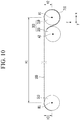
- the second roller unit 500 of FIGS. 1 to 3 has been described as including two rollers, the present inventive concept is not limited thereto. In a second modification shown in FIG. 9 and FIG. 10 , the second roller unit 500 may only include one roller.
- the second roller unit 500 may only include the fourth roller 510.
- the fourth roller 510 rotates clockwise or counterclockwise about the second direction (Y axis) to wind or unwind the third area H3 of the display panel 100.
- the fourth roller 510 rotates counterclockwise about the second direction (Y-axis) to store the third area H3 behind the second roller unit 500.
- the fourth roller 510 rotates in the clockwise direction about the second direction (Y-axis) so that the third area H3 can be discharged from the second roller unit 500.
- FIG. 11 to FIG. 13 A detailed description related to configurations that are the same as in the aforementioned first exemplary embodiment will be omitted in describing the second exemplary embodiment.
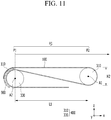
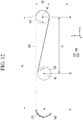
- FIG. 11 to FIG. 13 illustrate an operation of a display device according to a second exemplary embodiment of the present inventive concept.
- the display device includes a display panel 100, a fixing unit 900, and a first winder 400.
- the end of the first area H1 of the display panel 100 is fixedly coupled to the fixing unit 900, and the second area H2 of the display panel 100 may be wound around the first winder 400.
- the first roller 310 and the second roller 330 are arranged side by side along the first direction (X-axis), and an interval between the first roller 310 and the second roller 330 can be adjusted when the second area H2 of the display panel 100 is wound or unwound on the first winder 400.
- the first roller 310 and the second roller 330 may move along the first direction (X-axis) when the second area H2 of the display panel 100 is wound or unwound by the first winder 400.
- the display panel 100 may be divided into a first area H1 and a second area H2.
- the first area H1 and the second area H2 may be disposed in parallel along the first direction (X-axis).
- the first area H1 may represent a virtual area that is not wound on the first winder 400 when the display panel 100 is wound.
- the first area H1 may mainly include the above-described display area.
- the second area H2 may represent an area that can be wound on the first winder 400.
- a length of the second area H2 wound on the first winder 400 may vary depending on the operating state of the first winder 400.
- a first end of the first area H1 of the display panel 100 may be fixedly coupled to the fixing unit 900.
- the fixing unit 900 serves to fix the first end of the first area H1 so as to not move, and a peripheral area 110 coupled to the first end of the first area H1 of the display panel 100 may be disposed in the fixing unit 900.
- a driving unit and the like necessary for driving the first area H1 capable of displaying an image may be disposed in the peripheral area 110.
- the first winder 400 may include a first roller 310 and a second roller 330.
- the first roller 310 and the second roller 330 may be cylindrical members and may extend along the second direction (Y-axis).
- a radius R1 of the first roller 310 and a radius R2 of the second roller 330 may be equal to each other.
- the present inventive concept is not limited thereto.
- the radius R1 of the first roller 310 and the radius R2 of the second roller 330 may be different from each other.
- the first roller 310 can rotate about the first rotation axis A1 and the second roller 330 can rotate around the second rotation axis A2.
- the first rotation axis A1 and the second rotation axis A2 may be extended in the second direction (Y-axis).
- FIG. 11 to FIG. 13 sequentially illustrate a process in which the display panel 100 is unwound from the first winder 400.
- the first roller 310 may rotate in the counterclockwise direction about the second direction (Y-axis)
- the second roller 330 may rotate in the clockwise direction about the second direction (Y-axis).
- the first roller 310 may rotate clockwise about the second direction (Y-axis)
- the second roller 330 may rotate counterclockwise about the second direction (Y-axis).
- FIG. 11 illustrates a state in which the second area H2 of the display panel 100 is maximally wound inside the first winder 400.
- a part of the second area H2 is wound clockwise around the second direction (Y-axis) on the external circumferential surface of the first roller 310, and the other part of the second area H2 is wound counterclockwise around the second direction (Y-axis) on the external circumferential surface of the second roller 330.
- a first distance L1 between the first roller 310 and the second roller 330 i.e., a distance between the first rotation axis A1 of the first roller 310 and the second rotation axis A2 of the second roller 330 which are separated from each other in the first direction (X-axis)
- the first distance L1 may be a maximum distance that the first roller 310 and the second roller 330 are spaced apart from each other along the first direction (X axis).
- the second roller 330 and the first roller 310 may be respectively disposed at a first position P1 and a second position P2.
- second to fifth positions indicate arbitrary positions away from the first position P1 along the first direction (X-axis) with reference to the first position P1.
- the first roller 310 and the second roller 330 can move to the right along the first direction (X axis) while maintaining the first distance L1.
- the second roller 330 may move from the first position P1 to a third position P3, and the first roller 310 may move from the second position P2 to a fourth position P4. While the first roller 310 and the second roller 330 move to the fourth position P4 and the third position P3 respectively, the first interval L1, i.e., the distance between the first roller 310 and the second roller 330, can be constantly maintained.
- first roller 310 and the second roller 330 move to the fourth position P4 and the third position P3, respectively, the first roller 310 may rotate in the counterclockwise direction about the second direction (Y axis), and the second roller 330 may rotate in the clockwise direction about the second direction (Y axis)
- a minimum area of the second area H2 of the display panel 100 is attached to an external circumferential surface of the second roller 330.
- the minimum area may represent an area such that the second area H2 can be attached without falling off the external circumferential surface of the second roller 330.
- the second roller 330 may move from the third position P3 to a fifth position P5 and the first roller 310 may move from the fourth position P4 to a sixth position P6.
- the distance between the first roller 310 and the second roller 330 is reduced from the first distance L1 to the second distance L2.
- the second roller 330 moves from the third position P3 to the fifth position P5, the second roller 330 approaches the first roller 310.
- the distance between the first roller 310 and the second roller 330 reaches the second gap L2, the first roller 310 and the second roller 330 are no longer moved in the first direction (X axis).
- first roller 310 may rotate counterclockwise about the second direction (Y axis).
- second roller 330 is moved from the third position P3 to the fifth position P5, the second roller 330 can rotate clockwise about the second direction (Y axis).
- first roller 310 and the second roller 330 are rotated in different directions.
- present inventive concept is not limited thereto.
- first roller 310 and the second roller 330 can rotate in the same direction.
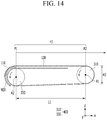
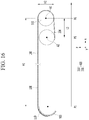
- the first modification of FIG. 14 to FIG. 16 is different from the aforementioned exemplary embodiment in that a rotating direction of the second roller 330 is a counterclockwise direction instead of the clockwise direction described above.
- the configurations other than the second roller 330 which is applicable to the first modification of FIG. 14 to FIG. 16 are the same as those of FIG. 11 to FIG. 13 , and thus a detailed description thereof will be omitted.
- FIG. 17 to FIG. 19 illustrate an operation of the display device according to the second modification of FIG. 11
- FIG. 20 is a schematic perspective view illustrating a guide unit of FIG. 17 .
- a second winder 600 may include a first roller 310 and a guide unit 800.
- the guide unit 800 may be disposed instead of the second roller 330 of FIG. 11 to FIG. 13 .
- the guide unit 800 may be a tubular member through which the display panel 100 can be extended.
- the guide unit 800 may be a tubular member having a hollow cross-section formed at the inside thereof.
- the area of the hollow may correspond to the cross-sectional area of the display panel 100.
- the cross-section area of the display panel 100 indicates a size of the cross-section of the display panel 100 in which the display panel 100 is cut in a direction parallel to a plane formed in the second direction (Y-axis) and the third direction (Z-axis).
- the guide unit 800 may have a convex curved surface in the first direction (X-axis). Opposite end portions of the guide unit 800, i.e., opposite end portions through which the display panel 100 can be entered or exited, may be arranged in parallel with the first direction (X-axis), and may be disposed to face the first roller 310.
- the guide unit 800 can move along the first direction (X-axis) together with the first roller 310, and the distance between the first roller 310 and the guide unit 800 can be adjusted.
Landscapes
- Engineering & Computer Science (AREA)
- Physics & Mathematics (AREA)
- Theoretical Computer Science (AREA)
- General Physics & Mathematics (AREA)
- Computer Hardware Design (AREA)
- Nonlinear Science (AREA)
- Human Computer Interaction (AREA)
- General Engineering & Computer Science (AREA)
- Mathematical Physics (AREA)
- Crystallography & Structural Chemistry (AREA)
- Optics & Photonics (AREA)
- Chemical & Material Sciences (AREA)
- Devices For Indicating Variable Information By Combining Individual Elements (AREA)
- Microelectronics & Electronic Packaging (AREA)
- Electroluminescent Light Sources (AREA)
Abstract
Description
- The present disclosure relates to a display device.
- Currently, as generally known display devices, there are a liquid crystal display (LCD), a plasma display panel (PDP), an organic light emitting diode (OLED) display, a field effect display (FED), an electrophoretic display, and the like.
- Particularly, the OLED display includes two electrodes and an organic emission layer interposed therebetween. Electrons injected from one electrode and holes injected from the other electrode are combined in the organic emission layer to generate excitons, and the generated excitons release energy to emit light.
- The OLED display may have a reduced thickness and weight since it has a self-luminance characteristic and does not require an additional light source, unlike the LCD. In addition, the OLED display is receiving attention as a next generation display device since it has high quality characteristics such as low power consumption, high luminance, and high response speed.
- This display device has recently been under development as a flexible display device that can be rolled. In order to use the foldable display devices or the rollable display devices for a long time, it is necessary to minimize stress applied to the display panel thereof while they are used.
- The above information disclosed in this Background section is only for enhancement of understanding of the background of the inventive concept and therefore it may contain information that does not form the prior art that is already known in this country to a person of ordinary skill in the art.
- The present inventive concept has been made in an effort to provide a display device that may prevent a display panel thereof from being broken due to stress.
- An exemplary embodiment provides a display device including: a display panel configured to include a first area, and a second area and a third area respectively disposed at opposite sides of the first area in a first direction; a first roller unit configured to wind the second area thereon; and a second roller unit configured to wind the third area of the display panel in an opposite direction to that of the first roller unit, wherein the first roller unit and the second roller unit are separated from each other in the first direction by a distance, the first roller unit and the second roller unit configured to allow the distance to be adjusted.
- The first roller unit may include: a first roller configured to rotate around a first rotation axis; and a second roller configured to rotate in an opposite direction to that of the first roller around a second rotation axis that is parallel to the first rotation axis in the first direction.
- The second area of the display panel may be wound on at least one of external circumferential surfaces of the first roller and the second roller.
- A first ratio which is a ratio of a first length of the second area wound around the external circumferential surface of the first roller to a length of a circumference of the first roller may be the same as a second ratio which is a ratio of a second length of the second area wound around the external circumferential surface of the second roller to a length of a circumference of the second roller.
- A radius of the first roller may be a same radius as a radius of the second roller.
- A radius of the first roller may be a different radius from a radius of the second roller.
- The first roller unit may further include a first connection plate configured to have a first-side end portion fixedly coupled to the external circumferential surface of the second roller, and a second-side end portion coupled to the second area, and the first connection plate may be wound on the external circumferential surface of the first roller or the second roller.
- The first roller unit may further include a third roller configured to rotate in an opposite direction to that of the second roller around a third rotation axis parallel to the first rotation axis and the second rotation axis.
- The second roller unit may include: a fourth roller configured to rotate around a fourth rotation axis parallel to the first rotation axis in the first direction; and a fifth roller configured to rotate in an opposite direction to that of the fourth roller around a fifth rotation axis parallel to the fourth rotation axis in the first direction.
- The third area may be wound on at least one of external circumferential surfaces of the fourth roller and the fifth roller.
- A third ratio which is a ratio of a length of the display panel wound on the external circumferential surface of the fourth roller to a length of a circumference of the fourth roller may be the same as a fourth ratio which is a ratio of a length of the display panel wound on the external circumferential surface of the fifth roller to a length of a circumference of the fifth roller.
- A radius of the fourth roller may be a same radius as a radius of the fifth roller.
- A radius of the fourth roller may be a different radius from a radius of the fifth roller.
- The second roller unit may further include a second connection plate configured to have a first-side end portion fixedly coupled to the external circumferential surface of the fifth roller, and a second-side end portion coupled to the third area, and the second connection plate may be wound on the external circumferential surface of the fourth roller or the fifth roller.
- The second roller unit may further include a sixth roller configured to rotate in an opposite direction to that of the fifth roller around a sixth rotation axis parallel to the fourth rotation axis and the fifth rotation axis.
- An exemplary embodiment provides a display device including: a display panel configured to include a first area, and a second area arranged close to the first area along a first direction in parallel; a fixing unit fixedly coupled to a first-side end portion of the first area; and a first winder configured to wind the second area of the display panel thereon, wherein the first winder includes: a first roller configured to rotate about a first rotation axis; and a second roller configured to rotate around a second rotation axis that is parallel to the first rotation axis in the first direction, the second area of the display panel is wound on external circumferential surfaces of the first roller and the second roller, the first roller and the second roller are separated from each other along the first direction by a distance, the first roller and the second roller configured to be movable along the first direction and allow the distance to be adjusted.
- The first roller and the second roller may have a separation distance between a first distance which is a maximum distance between the first roller and the second roller which are separated from each other in the first direction and a second distance which is a minimum distance therebetween.
- The first roller and the second roller may have the first distance therebetween, and may be moved along the first direction.
- A distance between the first roller and the second roller may be reduced from the first distance to the second distance.
- The second roller may be configured to be movable toward the first roller.
- The first roller and the second roller may be configured to rotate in different directions.
- The first roller and the second roller may be configured to rotate in a same direction.
- A radius of the first roller may be a same radius as a radius of the second roller.
- A radius of the first roller may be a different radius from a radius of the second roller.
- An exemplary embodiment provides a display device including: a display panel configured to include a first area, and a second area arranged close to the first area along a first direction in parallel; a fixing unit fixedly coupled to a first-side end portion of the first area; and a second winder configured to wind the second area of the display panel thereon, wherein the second winder includes: a first roller configured to wind the second area of the display panel thereon; and a guide unit disposed in parallel with the first roller in the first direction, to allow the second area passing through the first roller to extend therethrough, wherein the first roller and the guide unit are separated from each other in the first direction by a distance, the first roller and the guide unit configured to allow the distance to be adjusted.
- The guide unit may be formed of a tubular member through which the display panel is to be extended.
- The guide unit may have a convex curved surface in one direction.
- A through hole formed at opposite side end portions of the guide unit may be positioned in parallel with the first direction to face the first roller.
- The first roller and the guide unit may have a separation distance between a first distance, which is a maximum distance between the first roller and the guide unit which are separated from each other in the first direction, and a second distance, which is a minimum distance therebetween.
- The first roller and the guide unit may have the first distance therebetween, and are moved along the first direction.
- A distance between the first roller and the guide unit may be reduced from the first distance to the second distance.
- The guide unit may be configured to be movable toward the first roller.
- According to an embodiment of the present inventive concept, it is possible to prevent a display panel of a display device from being broken due to stress.
-
-
FIG. 1 is a schematic perspective view illustrating a first exemplary embodiment of the present inventive concept. -
FIG. 2 andFIG. 3 illustrate an operation ofFIG. 1 . -
FIG. 4 is an enlarged view illustrating a first roller unit ofFIG. 2 . -
FIG. 5 is an enlarged view illustrating a first roller unit ofFIG. 3 . -
FIG. 6 illustrates a coupling relationship between the display panel and the first connection plate. -
FIG. 7 illustrates a first modification of the display device ofFIG. 1 . -
FIG. 8 illustrates a process of deforming an adhesive layer when a display device is bent. -
FIG. 9 andFIG. 10 illustrate an operation of a second modification of the display device ofFIG. 1 . -
FIG. 11 to FIG. 13 illustrate an operation of a display device according to a second exemplary embodiment of the present inventive concept. -
FIG. 14 to FIG. 16 illustrate an operation of a first modification of the display device ofFIG. 11 . -
FIG. 17 to FIG. 19 illustrate an operation of a second modification of the display device ofFIG. 11 . -
FIG. 20 is a schematic perspective view illustrating a guide unit ofFIG. 17 . - The present disclosure will be described more fully hereinafter with reference to the accompanying drawings, in which exemplary embodiments of the disclosure are shown. As those skilled in the art would realize, the described embodiments may be modified in various different ways, all without departing from the spirit or scope of the present inventive concept. The drawings and description are to be regarded as illustrative in nature and not restrictive. Like reference numerals designate like elements throughout the specification.
- Further, since sizes and thicknesses of constituent members shown in the accompanying drawings are arbitrarily given for better understanding and ease of description, the present inventive concept is not limited to the illustrated sizes and thicknesses.
- In the drawings, the thickness of layers, films, panels, regions, etc., are exaggerated for clarity. In the drawings, for better understanding and ease of description, the thicknesses of some layers and areas are exaggerated. It will be understood that when an element such as a layer, film, region, or substrate is referred to as being "on" another element, it can be directly on the other element or intervening elements may also be present.
- In addition, unless explicitly described to the contrary, the word "comprise" and variations such as "comprises" or "comprising" will be understood to imply the inclusion of stated elements but not the exclusion of any other elements. Further, in the specification, the word "on" means positioning on or below the object portion, but does not essentially mean positioning on the upper side of the object portion based on a gravity direction.
- Hereinafter, a display device according to first exemplary embodiment will be described with reference to
FIG. 1 to FIG. 6 . -
FIG. 1 is a schematic perspective view illustrating a first exemplary embodiment of the present inventive concept, andFIG. 2 andFIG. 3 illustrate an operation ofFIG. 1 .FIG. 4 is an enlarged view illustrating a first roller unit ofFIG. 2 ,FIG. 5 is an enlarged view illustrating a first roller unit ofFIG. 3 , andFIG. 6 illustrates a coupling relationship between the display panel and the first connection plate. - Referring to
FIG. 1 to FIG. 3 , the display device according to the present exemplary embodiment may include adisplay panel 100, afirst roller unit 300, and asecond roller unit 500. In the present exemplary embodiment, opposite end portions of thedisplay panel 100 may be wound around thefirst roller unit 300 and thesecond roller unit 500, respectively. In this case, at least two rollers for winding thedisplay panel 100 may be respectively disposed in thefirst roller unit 300 and thesecond roller unit 500, and adjacent rollers may rotate in different directions. - The
display panel 100 may display images by emitting light. In this case, thedisplay panel 100 may be applicable not only to a display panel of an organic light emitting diode (OLED) display, but also to a liquid crystal display (LCD), a plasma display (PDP), a field emission display (FED), an electrophoretic display, or the like, which may be used as a display panel. - The
display panel 100 can be divided into a display area for displaying an image and a peripheral area. The display area serves to display an image, and a plurality of pixels may be disposed therein. - The peripheral area is an area other than the display area in which the pixels are disposed, and a drive signal line (not illustrated), a drive unit (not illustrated), and the like necessary for driving the display area may be disposed therein.
- Meanwhile, in the present exemplary embodiment, the
display panel 100 may be divided into a first area H1, a second area H2, and a third area H3. The first area H1, the second area H2, and the third area H3 may be disposed in a first direction (X-axis), and the first area H1 is a virtual area positioned in the center of thedisplay panel 100. In addition, the second area H2 and the third area H3 represent virtual areas positioned at opposite end portions of the first area H1. The first area H1 is mainly formed of the display area, and the second area H2 and the third area H3 are formed of the display area and the peripheral area. - In the present exemplary embodiment, when the
display panel 100 is wound around thefirst roller unit 300 and thesecond roller unit 500, the first area H1 may indicate a virtual area that is not wound around thefirst roller unit 300 and thesecond roller unit 500. Further, the second area H2 and the third area H3 may indicate areas that can be wound around thefirst roller unit 300 and thesecond roller unit 500, respectively. In this case, lengths of the second area H2 and the third area H3 that are wound on thefirst roller unit 300 and thesecond roller unit 500 may be varied depending on operation states of thefirst roller unit 300 andsecond roller unit 500. - The
first roller unit 300 may wind the second area H2 of thedisplay panel 100 thereon. Thefirst roller unit 300 may wind the second area H2 around a second direction (Y-axis) in a clockwise direction. In contrast, thesecond roller unit 500 may wind the third area H3 around the second direction (Y-axis) in a counterclockwise direction. - In this case, the
first roller unit 300 includes afirst roller 310 and asecond roller 330. Thefirst roller 310 and thesecond roller 330 may be cylindrical members and may extend along the second direction (Y-axis). In the present exemplary embodiment, a radius R1 of thefirst roller 310 and a radius R2 of thesecond roller 330 may be equal to each other. However, the present inventive concept is not limited thereto. For example, the radius R1 of thefirst roller 310 and the radius R2 of thesecond roller 330 may be different from each other. - The
first roller 310 can rotate about the first rotation axis A1 and thesecond roller 330 can rotate around the second rotation axis A2. The first rotation axis A1 and the second rotation axis A2 may be separated from each other in a first direction (X-axis), and the first rotation axis A1 and the second rotation axis A2 may be extended in the second direction (Y-axis). - The first rotation axis A1 and the second rotation axis A2 may be disposed apart from each other by a first axis-to-axis distance W1 along the first direction (X-axis). The first axis-to-axis distance W1 can be constantly maintained while the
first roller 310 and thesecond roller 330 rotate to wind or unwind the second area H2 of thedisplay panel 100. - In this case, the
first roller 310 and thesecond roller 330 can rotate in opposite directions to each other.FIG. 2 illustrates a display device in which thedisplay panel 100 is wound, or a state in which thedisplay panel 100 is fully wound around thefirst roller unit 300 and thesecond roller unit 500. When the second area H2 of thedisplay panel 100 is wound in thefirst roller unit 300, thefirst roller 310 may rotate clockwise around the second direction (Y-axis), and thesecond roller 330 may rotate counterclockwise around the second direction (Y-axis). As a result, when thefirst roller 310 and thesecond roller 330 rotate in opposite directions as described above, the second area H2 of thedisplay panel 100 may be moved along thesecond roller 330 through thefirst roller 310. - As shown in
FIG. 2 andFIG. 4 , when the second area H2 of thedisplay panel 100 is wound and stored in thefirst roller unit 300, the second area H2 may have curved surfaces wound in different directions at the same time. A part of the second area H2 is wound on an external circumferential surface of thefirst roller 310 and has a curved surface wound in the clockwise direction about the second direction (Y-axis), and a remaining part of the second area H2 may have a curved surface that is wound around an external circumferential surface of thesecond roller 330 and wound along the counterclockwise direction about the second direction (Y-axis). - As such, stress generated in the
display panel 100 in the rollable display device that can be wound can be reduced when the second area H2 of thedisplay panel 100 simultaneously has curved surfaces wound in different directions. A process of reducing the stress of thedisplay panel 100 will be described later. - Meanwhile, referring to
FIG. 4 , when the second area H2 is wound around thefirst roller 310 and thesecond roller 330 to be stored, a first ratio (not illustrated) which is a ratio of a first length G1 of the second area H2 wound around the external circumferential surface of thefirst roller 310 to a length of the circumference of thefirst roller 310 is the same as a second ratio (not illustrated) which is a ratio of a second length G2 of the second area H2 wound around the external circumferential surface of thesecond roller 330 to a length of the circumference of thesecond roller 330. - When the radius R1 of the
first roller 310 and the radius R2 of thesecond roller 330 are different from each other, the second area H2 may be wound around the external circumferential surface of thefirst roller 310 and the external circumferential surface of thesecond roller 330 to be stored such that the first ratio and the second ratio are equal to each other. - As in the present exemplary embodiment, when the radius R1 of the
first roller 310 and the radius R2 of thesecond roller 330 are equal to each other, the second area H2 can be wound around the external circumferential surface of thefirst roller 310 and the external circumferential surface of thesecond roller 330 to be stored such that the first length G1 of the second area H2 wound around the external circumferential surface of thefirst roller 310 and the second length G2 of the second area H2 wound around the external circumferential surface of thesecond roller 330 are equal to each other. - The
second roller unit 500 of the present exemplary embodiment may have a configuration that is symmetrical with thefirst roller unit 300 described above. Thesecond roller unit 500 may include afourth roller 510 and afifth roller 530. Thefourth roller 510 and thefifth roller 530 may be cylindrical members and may extend along a second direction (Y-axis). The radius R3 of thefourth roller 510 and the radius R4 of thefifth roller 530 may be equal to each other, like thefirst roller 310 and thesecond roller 330. However, the radius R3 of thefourth roller 510 and the radius R4 of thefifth roller 530 may be different from each other, without being limited thereto. - The
fourth roller 510 can rotate about the fourth rotation axis B1, and thefifth roller 530 can rotate about the fifth rotation axis B2. The fourth rotation axis B1 and the fifth rotation axis B2 may be spaced apart from each other along the first direction (X-axis), and the fourth rotation axis (B1) may extend along the second direction (Y-axis). - The fourth rotation axis B1 and the fifth rotation axis B2 may be disposed apart from each other by a second axis-to-axis distance W2 along the first direction (X-axis). The second axis-to-axis distance W2 can be constantly maintained while the
fourth roller 510 and thefifth roller 530 rotate to wind or unwind the third area H3 of thedisplay panel 100. - The
fourth roller 510 and thefifth roller 530 can rotate in opposite directions to each other.FIG. 2 illustrates a display device in which thedisplay panel 100 is wound, i.e., a state in which thedisplay panel 100 is fully wound around thefirst roller unit 300 and thesecond roller unit 500. When the third area H3 of thedisplay panel 100 is wound in thesecond roller unit 500, thefourth roller 510 may rotate counterclockwise around the second direction (Y-axis), and thefifth roller 530 may rotate clockwise around the second direction (Y-axis). As a result, when thefourth roller 510 and thefifth roller 530 rotate in opposite directions as described above, the third area H3 of thedisplay panel 100 may be moved along thefifth roller 530 through thefourth roller 510. - As shown in
FIG. 2 andFIG. 4 , when the third area H3 of thedisplay panel 100 is wound and stored in thesecond roller unit 500, like thefirst roller unit 300, the third area H3 may have curved surfaces wound in different directions at the same time. A part of the third area H3 is wound on an external circumferential surface of thefourth roller 510 and has a curved surface wound in the counterclockwise direction about the second direction (Y-axis), and a remaining part of the third area H3 may have a curved surface that is wound around an external circumferential surface of thefifth roller 530 and wound along the clockwise direction about the second direction (Y-axis). - As such, stress generated in the
display panel 100 in the rollable display device that can be wound can be reduced when the third area H3 of thedisplay panel 100 simultaneously has curved surfaces wound in different directions. - Meanwhile, similar to the second area H2, when the third area H3 is wound around the
fourth roller 510 and thefifth roller 530 to be stored, a third ratio (not illustrated) which is a ratio of a third length (not illustrated) of the third area H3 wound around the external circumferential surface of thefourth roller 510 to a length of the circumference of thefourth roller 510 is the same as a fourth ratio (not illustrated) which is a ratio of a fourth length (not illustrated) of the third area H3 wound around the external circumferential surface of thefifth roller 530 to a length of the circumference of thefifth roller 530. - When the radius R3 of the
fourth roller 510 and the radius R4 of thefifth roller 530 are different from each other, the third area H3 may be wound around the external circumferential surface of thefourth roller 510 and the external circumferential surface of thefifth roller 530 to be stored such that the third ratio (not illustrated) and the fourth ratio (not illustrated) are equal to each other. - As in the present exemplary embodiment, when the radius R3 of the
fourth roller 510 and the radius R4 of thefifth roller 530 are equal to each other, the third area H3 can be wound around the external circumferential surface of thefourth roller 510 and the external circumferential surface of thefifth roller 530 to be stored such that the third length of the third area H3 wound around the external circumferential surface of thefourth roller 510 and the fourth length of the third area H3 wound around the external circumferential surface of thefifth roller 530 are equal to each other. -
FIG. 3 andFIG. 5 illustrate the display device in which thedisplay panel 100 is unfolded. As shown inFIG. 3 , when the second area H2 of thedisplay panel 100 is unwound from thefirst roller unit 300, thefirst roller 310 may rotate counterclockwise about the second direction (Y-axis), and thesecond roller 330 may rotate clockwise about the second direction (Y-axis). As a result, when thefirst roller 310 and thesecond roller 330 are rotated in opposite directions as described above, the second area H2 of thedisplay panel 100 may be moved along thefirst roller 310 through thesecond roller 330. - In this case, the
fourth roller 510 may rotate in the clockwise direction about the second direction (Y-axis), and thefifth roller 530 may rotate in the counterclockwise direction about the second direction (Y-axis). As a result, when thefourth roller 510 and thefifth roller 530 are rotated in opposite directions as described above, the third area H3 of thedisplay panel 100 may be moved along thefourth roller 510 through thefifth roller 530. - In the present exemplary embodiment, as shown in
FIG. 2 andFIG. 3 , when the second area H2 and the third area H3 are wound around thefirst roller unit 300 and thesecond roller unit 500, respectively, thefirst roller unit 300 and thesecond roller unit 500 may be spaced apart from one another at a first distance D1. In contrast, thefirst roller unit 300 and thesecond roller unit 500 may be disposed apart from each other at a second distance D2 in a state where thedisplay panel 100 is unfolded by releasing the second area H2 and the third area H3 from thefirst roller unit 300 and thesecond roller unit 500, respectively. Herein, the first distance D1 and the second distance D2 may indicate a length measured in parallel with the first direction (X-axis). - In the present exemplary embodiment, when the second area H2 and the third area H3 of the
display panel 100 are wound or unwound by thefirst roller unit 300 and thesecond roller unit 500, an interval of the tworoller units first roller unit 300 and thesecond roller unit 500 can be adjusted between the first distance D1 and the second distance D2. Specifically, when thedisplay panel 100 starts to be unfolded in a state where thedisplay panel 100 is wound and stored, the distance between thefirst roller unit 300 and thesecond roller unit 500 can be increased from the first distance D1 to the second distance D2. In contrast, when thedisplay panel 100 starts to be wound, an interval between thefirst roller unit 300 and thesecond roller unit 500 can be reduced from the second distance D2 to the first distance D1. - Referring to
FIG. 4 to FIG. 6 , in the present exemplary embodiment, afirst connection plate 710 can be coupled to an end portion of the second area H2 of thedisplay panel 100. Thefirst connection plate 710 may be in the shape of a plate, a first end of which is coupled to the second area H2, and a second end of which is fixedly coupled to thesecond roller 330. In this case, thefirst connection plate 710 may include an elastic material, and may be made of, for example, rubber. However, the material of thefirst connection plate 710 is not limited thereto, and it may be made of a known material having elasticity. - When the second area H2 is wound inside the
first roller unit 300, the first connectingplate 710 can guide the second area H2 to be wound on thesecond roller 330 through thefirst roller 310. As shown inFIG. 5 , the second area H2 of thedisplay panel 100 may be positioned only on the external circumferential surface of thefirst roller 310 in a state in which thedisplay panel 100 is unfolded. Then, when thedisplay panel 100 is wound, the second area H2 must move along the external circumferential surface of thesecond roller 330 via the external circumferential surface of thefirst roller 310, as described above. In this case, thefirst connection plate 710 may be coupled to an end portion of the second area H2, to guide the second area H2 to be wound along the external circumferential surface of thesecond roller 330 around the second direction (Y-axis) in the counterclockwise direction. Meanwhile, asecond connection plate 730 applied to thesecond roller unit 500 has a symmetric configuration with respect to thefirst connection plate 710, and thus a detailed description of thesecond connection plate 730 will be omitted. - Although each of the
first roller unit 300 and thesecond roller unit 500 ofFIGS. 1 to 3 has been described as including two rollers, the present inventive concept is not limited thereto. In a first modification shown inFIG. 7 , each of thefirst roller unit 300 and thesecond roller unit 500 may include three rollers. However, the present inventive concept is not limited thereto. For example, each of thefirst roller unit 300 and thesecond roller unit 500 may include four or more rollers. - Referring to
FIG. 7 , thefirst roller unit 300 may include thefirst roller 310, thesecond roller 330 and athird roller 350. Similar to thefirst roller 310 and thesecond roller 330, thethird roller 350 may be formed as a cylindrical member, and may be extended in the second direction (Y-axis). In this case, thefirst roller 310, thesecond roller 330, and thethird roller 350 may be arranged in order along the first direction (X axis). - Further, in the present exemplary embodiment, the radiuses of the
first roller 310, thesecond roller 330, and thethird roller 350 may all be the same. However, the present inventive concept is not limited thereto. For example, the radiuses of thefirst roller 310, thesecond roller 330, and thethird roller 350 may all be different from each other. Alternatively, the radiuses of two of thefirst roller 310, thesecond roller 330, and thethird roller 350 may be the same, but may be different from the other roller. - The
first roller 310 may rotate about a first rotation axis A1, thesecond roller 330 may rotate about a second rotation axis A2, and thethird roller 350 may rotate about a third rotation axis A3. The first rotation axis A1, the second rotation axis A2, and the third rotation axis A3 may be spaced apart from each other along the first direction (X axis), and the first rotation axis A1, the second rotation axis A2, the third rotation axis A3 may extend along the second direction (Y axis). - In this case, adjacent ones of the
first roller 310, thesecond roller 330, and thethird roller 350 may rotate in different directions. For example, thefirst roller 310 rotates clockwise about the second direction (Y-axis), thesecond roller 330 rotates counterclockwise about the second direction (Y-axis), and thethird roller 350 rotates clockwise about the second direction (Y-axis). - Meanwhile, a
sixth roller 550 of thesecond roller unit 500 according to the present modification rotates about a sixth rotational axis B3 and is symmetric with respect to thethird roller 350 of thefirst roller unit 300, and thus a detailed description of thesixth roller 550 will be omitted. - Hereinafter, a process of reducing stress generated to the
display panel 100 when thedisplay panel 100 simultaneously has curved surfaces which are wound in different directions will be described with reference toFIG. 8 . -
FIG. 8 illustrates a process of deforming an adhesive layer when the display device is bent. - As illustrated in
FIG. 8 (A) , it is assumed that a display panel applicable to a rollable display device has a structure in which a first substrate Layer1, an adhesive layer PSA, and a second substrate Layer2 are stacked. In other words, it may be described that the rollable display device has a structure in which two layers are disposed at an upper portion and a lower portion of the adhesive layer PSA. In this case, it is assumed that lengths of the first substrate Layer1, the adhesive layer PSA, and the second substrate Layer2 are all L1. Each of the first substrate Layer 1 and the second substrate Layer 2 can be a TFT layer, a light-emitting layer, a TSP layer, a polarizing layer, or the like located in the display panel. - As illustrated in
FIG. 8 (B) , when the display panel ofFIG. 8 (A) is bent at a constant curvature, the first substrate Layer 1, the adhesive layer PSA, and the second substrate Layer 2 may be convexly bent in one direction. - When the display panel is bent at a constant curvature, a length of a bottom surface of the first substrate Layer1 may be contracted to L2 that is smaller than L1. A length of an upper surface of the first substrate Layer1 may be extended to L3 that is larger than L1. In this case, as illustrated in
FIG. 8 (B) , a tensile force may be generated in a top surface of the first substrate Layer1 in a direction of the bold arrows. InFIG. 8 (B) , the length of L2 and L3 indicate an arc length. - The length of the bottom surface of the adhesive layer PSA contacting the top surface of the first substrate Layer1 may be L3, but the length of the top surface of the adhesive layer PSA may be smaller than L3. Since the adhesive layer PSA is made of a relatively soft adhesive material, unlike the first substrate Layer 1 and the second substrate layer 2, the length of the top surface and the bottom surface of the adhesive layer PSA may vary when the adhesive layer PSA is bent.
- Accordingly, a tensile force may be generated in the vicinity of the bottom surface of the adhesive layer PSA, and a compressive force may be generated in the vicinity of the top surface of the adhesive layer PSA.
- As a result, as illustrated in
FIG. 8 (B) , a compressive force acts on the lower surface of the second substrate Layer 2 in the direction of the bold arrows. Specifically, when the sequentially stacked structure is bent, a compressive force may be generated at the second substrate Layer2 which is disposed at an upper side of the adhesive layer PSA, and a tensile force may be generated at the first substrate Layer1 which is disposed at a lower side of the adhesive layer PSA. Accordingly, stress may be generated at the first substrate Layer1 and the second substrate Layer2 to separate the adhesive layer PSA and the first substrate Layer1 from each other, or the adhesive layer PSA and the second substrate Layer2 from each other. - However, when the display panel of
Fig. 8 (A) in which the first substrate Layer1, the adhesive layer PSA and the second substrate Layer2 are sequentially stacked is bent in different directions, the aforementioned compressive and tensile forces acting on the display panel may cancel each other. - As a result, in the present exemplary embodiment, the stress generated in the second area H2 of the
display panel 100 may be reduced or dispersed when the second area H2 of thedisplay panel 100 simultaneously has curved surfaces wound in different directions. - Although the
second roller unit 500 ofFIGS. 1 to 3 has been described as including two rollers, the present inventive concept is not limited thereto. In a second modification shown inFIG. 9 andFIG. 10 , thesecond roller unit 500 may only include one roller. - Referring to
FIG. 9 andFIG. 10 , thesecond roller unit 500 may only include thefourth roller 510. Thefourth roller 510 rotates clockwise or counterclockwise about the second direction (Y axis) to wind or unwind the third area H3 of thedisplay panel 100. - Specifically, as shown in
FIG. 9 , when the third area H3 of thedisplay panel 100 is stored in thesecond roller unit 500, thefourth roller 510 rotates counterclockwise about the second direction (Y-axis) to store the third area H3 behind thesecond roller unit 500. Conversely, as shown inFIG. 10 , when the third area H3 of thedisplay panel 100 is unwound from thesecond roller unit 500, thefourth roller 510 rotates in the clockwise direction about the second direction (Y-axis) so that the third area H3 can be discharged from thesecond roller unit 500. - Hereinafter, a display device according to a second exemplary embodiment will be described with reference to
FIG. 11 to FIG. 13 . A detailed description related to configurations that are the same as in the aforementioned first exemplary embodiment will be omitted in describing the second exemplary embodiment. -
FIG. 11 to FIG. 13 illustrate an operation of a display device according to a second exemplary embodiment of the present inventive concept. - Referring to
FIG. 11 to FIG. 13 , the display device according to the present exemplary embodiment includes adisplay panel 100, a fixingunit 900, and afirst winder 400. In the present exemplary embodiment, the end of the first area H1 of thedisplay panel 100 is fixedly coupled to the fixingunit 900, and the second area H2 of thedisplay panel 100 may be wound around thefirst winder 400. In this case, thefirst roller 310 and thesecond roller 330 are arranged side by side along the first direction (X-axis), and an interval between thefirst roller 310 and thesecond roller 330 can be adjusted when the second area H2 of thedisplay panel 100 is wound or unwound on thefirst winder 400. In addition, thefirst roller 310 and thesecond roller 330 may move along the first direction (X-axis) when the second area H2 of thedisplay panel 100 is wound or unwound by thefirst winder 400. - The
display panel 100 may be divided into a first area H1 and a second area H2. The first area H1 and the second area H2 may be disposed in parallel along the first direction (X-axis). The first area H1 may represent a virtual area that is not wound on thefirst winder 400 when thedisplay panel 100 is wound. The first area H1 may mainly include the above-described display area. - The second area H2 may represent an area that can be wound on the
first winder 400. In this case, a length of the second area H2 wound on thefirst winder 400 may vary depending on the operating state of thefirst winder 400. - In the present exemplary embodiment, a first end of the first area H1 of the
display panel 100 may be fixedly coupled to the fixingunit 900. The fixingunit 900 serves to fix the first end of the first area H1 so as to not move, and aperipheral area 110 coupled to the first end of the first area H1 of thedisplay panel 100 may be disposed in the fixingunit 900. Herein, as described above, a driving unit and the like necessary for driving the first area H1 capable of displaying an image may be disposed in theperipheral area 110. - The
first winder 400 may include afirst roller 310 and asecond roller 330. Thefirst roller 310 and thesecond roller 330 may be cylindrical members and may extend along the second direction (Y-axis). In the present exemplary embodiment, a radius R1 of thefirst roller 310 and a radius R2 of thesecond roller 330 may be equal to each other. However, the present inventive concept is not limited thereto. For example, the radius R1 of thefirst roller 310 and the radius R2 of thesecond roller 330 may be different from each other. - The
first roller 310 can rotate about the first rotation axis A1 and thesecond roller 330 can rotate around the second rotation axis A2. In this case, the first rotation axis A1 and the second rotation axis A2 may be extended in the second direction (Y-axis). - In the present exemplary embodiment, the
first roller 310 and thesecond roller 330 can rotate in opposite directions to each other.FIG. 11 to FIG. 13 sequentially illustrate a process in which thedisplay panel 100 is unwound from thefirst winder 400. In this process, thefirst roller 310 may rotate in the counterclockwise direction about the second direction (Y-axis), and thesecond roller 330 may rotate in the clockwise direction about the second direction (Y-axis). Conversely, when thedisplay panel 100 is wound on thefirst winder 400, thefirst roller 310 may rotate clockwise about the second direction (Y-axis), and thesecond roller 330 may rotate counterclockwise about the second direction (Y-axis). - An operation of the display device according to the present exemplary embodiment will be described with reference to
FIG. 11 to FIG. 13 . -
FIG. 11 illustrates a state in which the second area H2 of thedisplay panel 100 is maximally wound inside thefirst winder 400. In this case, a part of the second area H2 is wound clockwise around the second direction (Y-axis) on the external circumferential surface of thefirst roller 310, and the other part of the second area H2 is wound counterclockwise around the second direction (Y-axis) on the external circumferential surface of thesecond roller 330. - In this case, a first distance L1 between the
first roller 310 and thesecond roller 330, i.e., a distance between the first rotation axis A1 of thefirst roller 310 and the second rotation axis A2 of thesecond roller 330 which are separated from each other in the first direction (X-axis), may be constantly maintained. The first distance L1 may be a maximum distance that thefirst roller 310 and thesecond roller 330 are spaced apart from each other along the first direction (X axis). - As shown in
FIG. 11 , thesecond roller 330 and thefirst roller 310 may be respectively disposed at a first position P1 and a second position P2. Hereinafter, second to fifth positions indicate arbitrary positions away from the first position P1 along the first direction (X-axis) with reference to the first position P1. - As illustrated in
FIG. 12 , when thedisplay panel 100 that is fully wound inside thefirst winder 400 ofFIG. 11 starts to be unfolded, thefirst roller 310 and thesecond roller 330 can move to the right along the first direction (X axis) while maintaining the first distance L1. - In this process, the
second roller 330 may move from the first position P1 to a third position P3, and thefirst roller 310 may move from the second position P2 to a fourth position P4. While thefirst roller 310 and thesecond roller 330 move to the fourth position P4 and the third position P3 respectively, the first interval L1, i.e., the distance between thefirst roller 310 and thesecond roller 330, can be constantly maintained. - In addition, while the
first roller 310 and thesecond roller 330 move to the fourth position P4 and the third position P3, respectively, thefirst roller 310 may rotate in the counterclockwise direction about the second direction (Y axis), and thesecond roller 330 may rotate in the clockwise direction about the second direction (Y axis) - In this case, when the
first roller 310 reaches the fourth position P4, a minimum area of the second area H2 of thedisplay panel 100 is attached to an external circumferential surface of thesecond roller 330. Herein, the minimum area may represent an area such that the second area H2 can be attached without falling off the external circumferential surface of thesecond roller 330. - Next, as shown in
FIG. 13 , thesecond roller 330 may move from the third position P3 to a fifth position P5 and thefirst roller 310 may move from the fourth position P4 to a sixth position P6. However, while thedisplay panel 100 shown inFIG. 12 is changed to thedisplay panel 100 shown inFIG. 13 , the distance between thefirst roller 310 and thesecond roller 330 is reduced from the first distance L1 to the second distance L2. - As a result, while the
second roller 330 moves from the third position P3 to the fifth position P5, thesecond roller 330 approaches thefirst roller 310. When the distance between thefirst roller 310 and thesecond roller 330 reaches the second gap L2, thefirst roller 310 and thesecond roller 330 are no longer moved in the first direction (X axis). - In addition, while the
first roller 310 is moved from the fourth position P4 to the sixth position P6, thefirst roller 310 may rotate counterclockwise about the second direction (Y axis). While thesecond roller 330 is moved from the third position P3 to the fifth position P5, thesecond roller 330 can rotate clockwise about the second direction (Y axis). - In
FIG. 11 to FIG. 13 , it has been described that thefirst roller 310 and thesecond roller 330 are rotated in different directions. However, the present inventive concept is not limited thereto. For example, in a first modification shown inFigs. 14 to 16 , thefirst roller 310 and thesecond roller 330 can rotate in the same direction. - The first modification of
FIG. 14 to FIG. 16 is different from the aforementioned exemplary embodiment in that a rotating direction of thesecond roller 330 is a counterclockwise direction instead of the clockwise direction described above. The configurations other than thesecond roller 330 which is applicable to the first modification ofFIG. 14 to FIG. 16 are the same as those ofFIG. 11 to FIG. 13 , and thus a detailed description thereof will be omitted. - Hereinafter, a display device according to a second modification will be described with reference to
FIG. 17 to FIG. 20 . A detailed description related to configurations that are the same as in the aforementioned second exemplary embodiment will be omitted in describing the second modification. -
FIG. 17 to FIG. 19 illustrate an operation of the display device according to the second modification ofFIG. 11 , andFIG. 20 is a schematic perspective view illustrating a guide unit ofFIG. 17 . - Referring to
FIG. 17 to FIG. 19 , asecond winder 600 may include afirst roller 310 and aguide unit 800. In the present modification, theguide unit 800 may be disposed instead of thesecond roller 330 ofFIG. 11 to FIG. 13 . - Referring to
FIG. 20 , theguide unit 800 may be a tubular member through which thedisplay panel 100 can be extended. In detail, theguide unit 800 may be a tubular member having a hollow cross-section formed at the inside thereof. In this case, the area of the hollow may correspond to the cross-sectional area of thedisplay panel 100. Herein, the cross-section area of thedisplay panel 100 indicates a size of the cross-section of thedisplay panel 100 in which thedisplay panel 100 is cut in a direction parallel to a plane formed in the second direction (Y-axis) and the third direction (Z-axis). - As shown in
FIG. 20 , theguide unit 800 may have a convex curved surface in the first direction (X-axis). Opposite end portions of theguide unit 800, i.e., opposite end portions through which thedisplay panel 100 can be entered or exited, may be arranged in parallel with the first direction (X-axis), and may be disposed to face thefirst roller 310. - In the present modification, similar to the
second roller 330 ofFIG. 11 to FIG. 13 , Theguide unit 800 can move along the first direction (X-axis) together with thefirst roller 310, and the distance between thefirst roller 310 and theguide unit 800 can be adjusted. -
- H1 first area
- H2 second area
- H3 third area
- 100 display panel
- 300 first roller unit
- 310 first roller
- 330 second roller
- 350 third roller
- 500 second roller unit
- 510 fourth roller
- 530 fifth roller
- 550 sixth roller
- 710 first connection plate
- 730 second connection plate
- 900 fixing unit
- 800 guide unit
Claims (15)
- A display device comprising:a display panel (100) configured to include a first area (H1), and a second area (H2) and a third area (H3) respectively disposed at opposite sides of the first area (H1) in a first direction;a first roller unit (300) configured to wind the second area (H2) thereon; anda second roller unit (500) configured to wind the third area (H3) of the display panel (100) in an opposite direction to that of the first roller unit (300),wherein the first roller unit (300) and the second roller unit (500) are separated from each other in the first direction by a distance, andthe first roller unit (300) and the second roller unit (500) are configured to be movable to allow the distance to be adjusted.
- The display device of claim 1, wherein the first roller unit (300) includes:a first roller (310) configured to rotate around a first rotation axis; anda second roller (330) configured to rotate in an opposite direction to that of the first roller (310) around a second rotation axis that is parallel to the first rotation axis in the first direction.
- The display device of claim 2, wherein the second area (H2) of the display panel (100) is wound on at least one of external circumferential surfaces of the first roller (310) and the second roller (330).
- The display device of claim 3, wherein a first ratio which is a ratio of a first length of the second area (H2) wound around the external circumferential surface of the first roller (310) to a length of a circumference of the first roller (310) is the same as a second ratio which is a ratio of a second length of the second area (H2) wound around the external circumferential surface of the second roller (330) to a length of a circumference of the second roller(330), and/or
wherein a radius of the first roller (310) is a same or different radius as a radius of the second roller (330). - The display device of claim 3, wherein the first roller unit (300) further includes a first connection plate (710) configured to have a first-side end portion fixedly coupled to the external circumferential surface of the second roller (330), and a second-side end portion coupled to the second area (H2),
wherein the first connection plate (710) is wound on the external circumferential surface of the first roller (310) or the second roller (330), and/or
wherein the first roller unit (300) further includes a third roller (350) configured to rotate in an opposite direction to that of the second roller (330) around a third rotation axis parallel to the first rotation axis and the second rotation axis. - The display device of claim 2, wherein the second roller unit (500) includes:a fourth roller (510) configured to rotate around a fourth rotation axis parallel to the first rotation axis in the first direction; anda fifth roller (530) configured to rotate in an opposite direction to that of the fourth roller (510) around a fifth rotation axis parallel to the fourth rotation axis in the first direction.
- The display device of claim 6, wherein the third area (H3) is wound on at least one of external circumferential surfaces of the fourth roller (510) and the fifth roller (530).
- The display device of claim 7, wherein a third ratio which is a ratio of a length of the display panel (100) wound on the external circumferential surface of the fourth roller (510) to a length of a circumference of the fourth roller (510) is the same as a fourth ratio which is a ratio of a length of the display panel (100) wound on the external circumferential surface of the fifth roller (530) to a length of a circumference of the fifth roller (530), and/or
wherein a radius of the fourth roller (510) is a same or different radius as a radius of the fifth roller (530). - The display device of claim 7, wherein the second roller unit (500) further includes a second connection plate (730) configured to have a first-side end portion fixedly coupled to the external circumferential surface of the fifth roller (530), and a second-side end portion coupled to the third area (H3),
wherein the second connection plate (730) is wound on the external circumferential surface of the fourth roller (510) or the fifth roller (530), and/or
wherein the second roller unit (500) further includes a sixth roller (550) configured to rotate in an opposite direction to that of the fifth roller (530) around a sixth rotation axis parallel to the fourth rotation axis and the fifth rotation axis. - A display device comprising:a display panel (100) configured to include a first area (H1), and a second area (H2) arranged close to the first area (H1) along a first direction in parallel;a fixing unit (900) fixedly coupled to a first-side end portion of the first area (H1); anda first winder (400) configured to wind the second area (H2) of the display panel (100) thereon,wherein the first winder (400) includes:a first roller (310) configured to rotate about a first rotation axis; anda second roller (330) configured to rotate around a second rotation axis that is parallel to the first rotation axis in the first direction,wherein the second area (H2) of the display panel (100) is wound on external circumferential surfaces of the first roller (310) and the second roller (330),the first roller (310) and the second roller (330) are separated from each other in the first direction by a distance, andthe first roller (310) and the second roller (330) are configured to be movable along the first direction and allow the distance to be adjusted.
- The display device of claim 10, wherein the first roller (310) and the second roller (330) have a separation distance between a first distance, which is a maximum distance between the first roller (310) and the second roller (330) which are separated from each other in the first direction, and a second distance, which is a minimum distance therebetween.
- The display device of claim 11, wherein the first roller (310) and the second roller (330) have the first distance therebetween, and are moved along the first direction.
- The display device of claim 11, wherein a distance between the first roller (310) and the second roller (330) is reduced from the first distance to the second distance.
- The display device of claim 13, wherein the second roller (330) is configured to be movable toward the first roller (310).
- The display device of claim 10, wherein the first roller (310) and the second roller (330) are configured to rotate in different directions or in a same direction, and/or
wherein a radius of the first roller (310) is a same or different radius as a radius of the second roller (330).
Priority Applications (1)
| Application Number | Priority Date | Filing Date | Title |
|---|---|---|---|
| EP20207230.2A EP3796127A1 (en) | 2016-10-04 | 2017-10-02 | Display device |
Applications Claiming Priority (1)
| Application Number | Priority Date | Filing Date | Title |
|---|---|---|---|
| KR1020160127734A KR102630108B1 (en) | 2016-10-04 | 2016-10-04 | Display device |
Related Child Applications (1)
| Application Number | Title | Priority Date | Filing Date |
|---|---|---|---|
| EP20207230.2A Division EP3796127A1 (en) | 2016-10-04 | 2017-10-02 | Display device |
Publications (1)
| Publication Number | Publication Date |
|---|---|
| EP3355152A1 true EP3355152A1 (en) | 2018-08-01 |
Family
ID=60043004
Family Applications (2)
| Application Number | Title | Priority Date | Filing Date |
|---|---|---|---|
| EP20207230.2A Pending EP3796127A1 (en) | 2016-10-04 | 2017-10-02 | Display device |
| EP17194317.8A Withdrawn EP3355152A1 (en) | 2016-10-04 | 2017-10-02 | Display device |
Family Applications Before (1)
| Application Number | Title | Priority Date | Filing Date |
|---|---|---|---|
| EP20207230.2A Pending EP3796127A1 (en) | 2016-10-04 | 2017-10-02 | Display device |
Country Status (5)
| Country | Link |
|---|---|
| US (2) | US10321584B2 (en) |
| EP (2) | EP3796127A1 (en) |
| KR (1) | KR102630108B1 (en) |
| CN (1) | CN107895541B (en) |
| TW (1) | TWI747965B (en) |
Families Citing this family (24)
| Publication number | Priority date | Publication date | Assignee | Title |
|---|---|---|---|---|
| KR102493528B1 (en) * | 2016-08-11 | 2023-02-01 | 삼성디스플레이 주식회사 | Sliding display device |
| CN106713554A (en) * | 2017-02-23 | 2017-05-24 | 维沃移动通信有限公司 | Display screen assembly and mobile terminal |
| KR102623425B1 (en) * | 2018-07-10 | 2024-01-11 | 삼성디스플레이 주식회사 | Display apparatus |
| KR102657401B1 (en) * | 2018-08-20 | 2024-04-17 | 삼성디스플레이 주식회사 | Display device |
| KR102600966B1 (en) | 2018-09-21 | 2023-11-09 | 엘지디스플레이 주식회사 | Rollable display apparatus |
| WO2020065828A1 (en) * | 2018-09-27 | 2020-04-02 | シャープ株式会社 | Display device |
| KR102597411B1 (en) * | 2018-11-28 | 2023-11-01 | 엘지디스플레이 주식회사 | Display device |
| KR102622319B1 (en) * | 2019-01-03 | 2024-01-10 | 삼성디스플레이 주식회사 | Slidable display device |
| KR102690763B1 (en) * | 2019-03-29 | 2024-08-02 | 삼성디스플레이 주식회사 | Display device |
| CN110111692B (en) * | 2019-04-26 | 2024-03-26 | 武汉华星光电半导体显示技术有限公司 | Flexible display device |
| CN110047385B (en) * | 2019-04-30 | 2024-10-01 | 武汉华星光电半导体显示技术有限公司 | Flexible display device |
| CN111953820B (en) * | 2019-05-17 | 2025-07-25 | 北京小米移动软件有限公司 | Electronic devices |
| CN110706598B (en) * | 2019-10-23 | 2024-09-13 | 武汉华星光电半导体显示技术有限公司 | A foldable display device |
| CN111524458B (en) * | 2020-04-17 | 2022-04-26 | 京东方科技集团股份有限公司 | Display device |
| CN111383540B (en) * | 2020-04-30 | 2022-04-08 | 上海天马微电子有限公司 | Display device capable of being curled |
| CN111583799A (en) * | 2020-05-15 | 2020-08-25 | 武汉华星光电半导体显示技术有限公司 | Flexible display device |
| US11423810B2 (en) | 2020-05-15 | 2022-08-23 | Wuhan China Star Optoelectronics Semiconductor Display Technology Co., Ltd. | Flexible display device |
| CN111599278B (en) * | 2020-06-03 | 2022-05-31 | 京东方科技集团股份有限公司 | Display device and electronic equipment |
| CN112331073B (en) * | 2020-10-29 | 2023-03-24 | 合肥维信诺科技有限公司 | Crimping device |
| CN112396962B (en) * | 2020-11-16 | 2022-11-01 | 京东方科技集团股份有限公司 | Curled display device, method for controlling curling of flexible display screen and electronic equipment |
| CN112331085B (en) * | 2020-11-20 | 2023-07-18 | 京东方科技集团股份有限公司 | A flexible screen display device |
| WO2022207115A1 (en) * | 2021-04-01 | 2022-10-06 | Huawei Technologies Co., Ltd. | Display assembly and foldable apparatus comprising display assembly |
| KR20230017068A (en) * | 2021-07-27 | 2023-02-03 | 현대모비스 주식회사 | Rollable display device for vehicle |
| CN114038332B (en) * | 2021-11-30 | 2023-09-22 | 湖北长江新型显示产业创新中心有限公司 | a display device |
Citations (6)
| Publication number | Priority date | Publication date | Assignee | Title |
|---|---|---|---|---|
| US20080049003A1 (en) * | 2006-08-24 | 2008-02-28 | Fujifilm Corporation | Display device |
| US20080247126A1 (en) * | 2007-04-04 | 2008-10-09 | Motorola, Inc. | Retractable display assembly and electronic device |
| US20150227171A1 (en) * | 2014-02-12 | 2015-08-13 | Samsung Display Co., Ltd. | Rollable display apparatus |
| US20160034000A1 (en) * | 2014-08-01 | 2016-02-04 | Samsung Display Co., Ltd. | Display device |
| US20160209879A1 (en) * | 2015-01-15 | 2016-07-21 | Samsung Display Co., Ltd. | Flexible display apparatus |
| US20160216737A1 (en) * | 2015-01-22 | 2016-07-28 | Samsung Display Co., Ltd. | Display device |
Family Cites Families (17)
| Publication number | Priority date | Publication date | Assignee | Title |
|---|---|---|---|---|
| US4064503A (en) * | 1975-02-03 | 1977-12-20 | Associated Data Concepts | Changeable printed alphanumeric display module |
| US7180665B2 (en) * | 2003-06-23 | 2007-02-20 | Daniel Simon R | Display device having an extendible screen |
| TW200627124A (en) * | 2005-01-25 | 2006-08-01 | Wistron Corp | Electronic Device with Continuously Adjustable Size of Display Area |
| US7440265B2 (en) * | 2005-12-27 | 2008-10-21 | Lite-On Technology Corporation | Variable-sized screen |
| US8531758B2 (en) * | 2007-04-16 | 2013-09-10 | Creator Technology B.V. | Device comprising a multilayer structure and rollers |
| KR101458659B1 (en) | 2007-05-09 | 2014-11-05 | 크리에이터 테크놀로지 비.브이. | An electronic device having a cleaning unit for a flexible display |
| US8379377B2 (en) * | 2010-01-20 | 2013-02-19 | Creator Technology B.V. | Electronic device with at least one extendable display section |
| TWM395341U (en) * | 2010-08-04 | 2010-12-21 | Micro Star Int Co Ltd | Foldable electronic apparatus |
| KR101273182B1 (en) * | 2011-02-18 | 2013-06-17 | 주식회사 팬택 | Flexible display apparatus and mobile communication terminal using the same |
| US9286812B2 (en) | 2011-06-07 | 2016-03-15 | Microsoft Technology Licensing, Llc | Flexible display extendable assembly |
| US8711566B2 (en) * | 2011-09-02 | 2014-04-29 | Microsoft Corporation | Expandable mobile device |
| GB2508194A (en) * | 2012-11-23 | 2014-05-28 | Averly Ip Ltd | Memory material frame to cause flexible display panel to become rigid |
| KR20150014161A (en) | 2013-07-29 | 2015-02-06 | 강기현 | Mobile Device Having Enlargeable Display Window |
| KR102300024B1 (en) | 2014-10-23 | 2021-09-09 | 삼성디스플레이 주식회사 | Display apparatus |
| CN104461127B (en) * | 2014-11-12 | 2017-08-29 | 京东方科技集团股份有限公司 | A kind of display device and its method of work |
| KR102257174B1 (en) | 2014-12-03 | 2021-05-28 | 삼성디스플레이 주식회사 | Rollable display apparatus |
| KR102352544B1 (en) | 2015-01-12 | 2022-01-19 | 삼성디스플레이 주식회사 | Display device |
-
2016
- 2016-10-04 KR KR1020160127734A patent/KR102630108B1/en active Active
-
2017
- 2017-09-29 CN CN201710903349.XA patent/CN107895541B/en active Active
- 2017-10-02 TW TW106134092A patent/TWI747965B/en active
- 2017-10-02 EP EP20207230.2A patent/EP3796127A1/en active Pending
- 2017-10-02 EP EP17194317.8A patent/EP3355152A1/en not_active Withdrawn
- 2017-10-03 US US15/723,652 patent/US10321584B2/en active Active
-
2019
- 2019-04-25 US US16/395,160 patent/US10863633B2/en active Active
Patent Citations (6)
| Publication number | Priority date | Publication date | Assignee | Title |
|---|---|---|---|---|
| US20080049003A1 (en) * | 2006-08-24 | 2008-02-28 | Fujifilm Corporation | Display device |
| US20080247126A1 (en) * | 2007-04-04 | 2008-10-09 | Motorola, Inc. | Retractable display assembly and electronic device |
| US20150227171A1 (en) * | 2014-02-12 | 2015-08-13 | Samsung Display Co., Ltd. | Rollable display apparatus |
| US20160034000A1 (en) * | 2014-08-01 | 2016-02-04 | Samsung Display Co., Ltd. | Display device |
| US20160209879A1 (en) * | 2015-01-15 | 2016-07-21 | Samsung Display Co., Ltd. | Flexible display apparatus |
| US20160216737A1 (en) * | 2015-01-22 | 2016-07-28 | Samsung Display Co., Ltd. | Display device |
Also Published As
| Publication number | Publication date |
|---|---|
| KR102630108B1 (en) | 2024-01-26 |
| US20180098440A1 (en) | 2018-04-05 |
| US10321584B2 (en) | 2019-06-11 |
| EP3796127A1 (en) | 2021-03-24 |
| TWI747965B (en) | 2021-12-01 |
| TW201820608A (en) | 2018-06-01 |
| US20190254180A1 (en) | 2019-08-15 |
| CN107895541B (en) | 2022-04-15 |
| CN107895541A (en) | 2018-04-10 |
| KR20180037637A (en) | 2018-04-13 |
| US10863633B2 (en) | 2020-12-08 |
Similar Documents
| Publication | Publication Date | Title |
|---|---|---|
| US10863633B2 (en) | Display device | |
| KR102627272B1 (en) | Rollable display device | |
| CN111161633B (en) | Display device | |
| US10209746B2 (en) | Foldable display device | |
| US9625946B2 (en) | Display device | |
| JP6306752B2 (en) | Rollable flexible display | |
| CN112991939B (en) | Display device | |
| CN111128013B (en) | display device | |
| KR102527213B1 (en) | Display device | |
| US20230097200A1 (en) | Display device | |
| CN110895901A (en) | display device | |
| KR102322851B1 (en) | Rollable organic light emitting disaplay device | |
| US10599378B2 (en) | Display device | |
| JP2016130853A (en) | Rollable display device | |
| JP2016085454A (en) | Display device, manufacturing method for display device, and flexible display device | |
| KR20160011718A (en) | Rollable display device | |
| CN111445791A (en) | display device | |
| CN111833736A (en) | display screen |
Legal Events
| Date | Code | Title | Description |
|---|---|---|---|
| PUAI | Public reference made under article 153(3) epc to a published international application that has entered the european phase |
Free format text: ORIGINAL CODE: 0009012 |
|
| STAA | Information on the status of an ep patent application or granted ep patent |
Free format text: STATUS: THE APPLICATION HAS BEEN PUBLISHED |
|
| AK | Designated contracting states |
Kind code of ref document: A1 Designated state(s): AL AT BE BG CH CY CZ DE DK EE ES FI FR GB GR HR HU IE IS IT LI LT LU LV MC MK MT NL NO PL PT RO RS SE SI SK SM TR |
|
| AX | Request for extension of the european patent |
Extension state: BA ME |
|
| STAA | Information on the status of an ep patent application or granted ep patent |
Free format text: STATUS: REQUEST FOR EXAMINATION WAS MADE |
|
| 17P | Request for examination filed |
Effective date: 20190131 |
|
| RBV | Designated contracting states (corrected) |
Designated state(s): AL AT BE BG CH CY CZ DE DK EE ES FI FR GB GR HR HU IE IS IT LI LT LU LV MC MK MT NL NO PL PT RO RS SE SI SK SM TR |
|
| STAA | Information on the status of an ep patent application or granted ep patent |
Free format text: STATUS: EXAMINATION IS IN PROGRESS |
|
| 17Q | First examination report despatched |
Effective date: 20200717 |
|
| STAA | Information on the status of an ep patent application or granted ep patent |
Free format text: STATUS: THE APPLICATION IS DEEMED TO BE WITHDRAWN |
|
| 18D | Application deemed to be withdrawn |
Effective date: 20201128 |