EP3352272A2 - An ionic liquid electrolyte in an energy storage device and method of making the same - Google Patents
An ionic liquid electrolyte in an energy storage device and method of making the same Download PDFInfo
- Publication number
- EP3352272A2 EP3352272A2 EP18167610.7A EP18167610A EP3352272A2 EP 3352272 A2 EP3352272 A2 EP 3352272A2 EP 18167610 A EP18167610 A EP 18167610A EP 3352272 A2 EP3352272 A2 EP 3352272A2
- Authority
- EP
- European Patent Office
- Prior art keywords
- thickener
- ionic liquid
- electrolyte
- optionally
- energy storage
- Prior art date
- Legal status (The legal status is an assumption and is not a legal conclusion. Google has not performed a legal analysis and makes no representation as to the accuracy of the status listed.)
- Ceased
Links
- 239000002608 ionic liquid Substances 0.000 title claims abstract description 44
- 238000004146 energy storage Methods 0.000 title claims abstract description 18
- 238000004519 manufacturing process Methods 0.000 title claims abstract description 5
- 239000003792 electrolyte Substances 0.000 title claims description 29
- 239000002562 thickening agent Substances 0.000 claims abstract description 40
- 239000000203 mixture Substances 0.000 claims abstract description 19
- 239000011244 liquid electrolyte Substances 0.000 claims abstract description 12
- 229920002521 macromolecule Polymers 0.000 claims abstract description 11
- VSCWAEJMTAWNJL-UHFFFAOYSA-K aluminium trichloride Chemical compound Cl[Al](Cl)Cl VSCWAEJMTAWNJL-UHFFFAOYSA-K 0.000 claims description 26
- 229920000642 polymer Polymers 0.000 claims description 26
- 229920006324 polyoxymethylene Polymers 0.000 claims description 23
- 150000001408 amides Chemical class 0.000 claims description 18
- 125000002485 formyl group Chemical class [H]C(*)=O 0.000 claims description 17
- 239000000463 material Substances 0.000 claims description 17
- 239000012528 membrane Substances 0.000 claims description 15
- 238000000034 method Methods 0.000 claims description 13
- -1 polyoxymethylene Polymers 0.000 claims description 12
- NJMWOUFKYKNWDW-UHFFFAOYSA-N 1-ethyl-3-methylimidazolium Chemical compound CCN1C=C[N+](C)=C1 NJMWOUFKYKNWDW-UHFFFAOYSA-N 0.000 claims description 11
- 239000004677 Nylon Substances 0.000 claims description 9
- 229930040373 Paraformaldehyde Natural products 0.000 claims description 9
- 229920001778 nylon Polymers 0.000 claims description 9
- 239000004810 polytetrafluoroethylene Substances 0.000 claims description 8
- 229920001343 polytetrafluoroethylene Polymers 0.000 claims description 8
- XLYOFNOQVPJJNP-UHFFFAOYSA-N water Substances O XLYOFNOQVPJJNP-UHFFFAOYSA-N 0.000 claims description 8
- 239000003365 glass fiber Substances 0.000 claims description 7
- OKTJSMMVPCPJKN-UHFFFAOYSA-N Carbon Chemical group [C] OKTJSMMVPCPJKN-UHFFFAOYSA-N 0.000 claims description 5
- 230000003993 interaction Effects 0.000 claims description 4
- 125000004432 carbon atom Chemical group C* 0.000 claims description 3
- 238000001523 electrospinning Methods 0.000 claims description 3
- 238000005516 engineering process Methods 0.000 claims description 3
- XAGFODPZIPBFFR-UHFFFAOYSA-N aluminium Chemical compound [Al] XAGFODPZIPBFFR-UHFFFAOYSA-N 0.000 description 9
- 229910052782 aluminium Inorganic materials 0.000 description 9
- 229920002239 polyacrylonitrile Polymers 0.000 description 7
- BMQZYMYBQZGEEY-UHFFFAOYSA-M 1-ethyl-3-methylimidazolium chloride Chemical compound [Cl-].CCN1C=C[N+](C)=C1 BMQZYMYBQZGEEY-UHFFFAOYSA-M 0.000 description 5
- 239000000835 fiber Substances 0.000 description 4
- 150000002500 ions Chemical class 0.000 description 4
- 239000004952 Polyamide Substances 0.000 description 3
- 239000012530 fluid Substances 0.000 description 3
- 239000007789 gas Substances 0.000 description 3
- 239000007788 liquid Substances 0.000 description 3
- 229920002647 polyamide Polymers 0.000 description 3
- 239000000126 substance Substances 0.000 description 3
- HBBGRARXTFLTSG-UHFFFAOYSA-N Lithium ion Chemical compound [Li+] HBBGRARXTFLTSG-UHFFFAOYSA-N 0.000 description 2
- 239000004642 Polyimide Substances 0.000 description 2
- NINIDFKCEFEMDL-UHFFFAOYSA-N Sulfur Chemical compound [S] NINIDFKCEFEMDL-UHFFFAOYSA-N 0.000 description 2
- UCKMPCXJQFINFW-UHFFFAOYSA-N Sulphide Chemical compound [S-2] UCKMPCXJQFINFW-UHFFFAOYSA-N 0.000 description 2
- 239000005864 Sulphur Substances 0.000 description 2
- 230000008901 benefit Effects 0.000 description 2
- 238000006243 chemical reaction Methods 0.000 description 2
- 229910002804 graphite Inorganic materials 0.000 description 2
- 239000010439 graphite Substances 0.000 description 2
- 229910001416 lithium ion Inorganic materials 0.000 description 2
- 231100000053 low toxicity Toxicity 0.000 description 2
- 229910021382 natural graphite Inorganic materials 0.000 description 2
- 239000001301 oxygen Substances 0.000 description 2
- 229910052760 oxygen Inorganic materials 0.000 description 2
- 229920001721 polyimide Polymers 0.000 description 2
- 238000003860 storage Methods 0.000 description 2
- ILQHIGIKULUQFQ-UHFFFAOYSA-N 1-dodecyl-3-methylimidazolium Chemical compound CCCCCCCCCCCCN1C=C[N+](C)=C1 ILQHIGIKULUQFQ-UHFFFAOYSA-N 0.000 description 1
- NKRASMXHSQKLHA-UHFFFAOYSA-M 1-hexyl-3-methylimidazolium chloride Chemical compound [Cl-].CCCCCCN1C=C[N+](C)=C1 NKRASMXHSQKLHA-UHFFFAOYSA-M 0.000 description 1
- OXFBEEDAZHXDHB-UHFFFAOYSA-M 3-methyl-1-octylimidazolium chloride Chemical compound [Cl-].CCCCCCCCN1C=C[N+](C)=C1 OXFBEEDAZHXDHB-UHFFFAOYSA-M 0.000 description 1
- UFHFLCQGNIYNRP-UHFFFAOYSA-N Hydrogen Chemical compound [H][H] UFHFLCQGNIYNRP-UHFFFAOYSA-N 0.000 description 1
- WHXSMMKQMYFTQS-UHFFFAOYSA-N Lithium Chemical compound [Li] WHXSMMKQMYFTQS-UHFFFAOYSA-N 0.000 description 1
- ZOKXTWBITQBERF-UHFFFAOYSA-N Molybdenum Chemical compound [Mo] ZOKXTWBITQBERF-UHFFFAOYSA-N 0.000 description 1
- PXHVJJICTQNCMI-UHFFFAOYSA-N Nickel Chemical compound [Ni] PXHVJJICTQNCMI-UHFFFAOYSA-N 0.000 description 1
- 235000010627 Phaseolus vulgaris Nutrition 0.000 description 1
- 244000046052 Phaseolus vulgaris Species 0.000 description 1
- 229930182556 Polyacetal Natural products 0.000 description 1
- 238000005270 abrasive blasting Methods 0.000 description 1
- DHKHKXVYLBGOIT-UHFFFAOYSA-N acetaldehyde Diethyl Acetal Natural products CCOC(C)OCC DHKHKXVYLBGOIT-UHFFFAOYSA-N 0.000 description 1
- 125000002777 acetyl group Chemical class [H]C([H])([H])C(*)=O 0.000 description 1
- 230000002378 acidificating effect Effects 0.000 description 1
- 230000004075 alteration Effects 0.000 description 1
- 238000010539 anionic addition polymerization reaction Methods 0.000 description 1
- QVGXLLKOCUKJST-UHFFFAOYSA-N atomic oxygen Chemical compound [O] QVGXLLKOCUKJST-UHFFFAOYSA-N 0.000 description 1
- 230000015572 biosynthetic process Effects 0.000 description 1
- 238000005266 casting Methods 0.000 description 1
- 239000003054 catalyst Substances 0.000 description 1
- 239000003795 chemical substances by application Substances 0.000 description 1
- 230000018044 dehydration Effects 0.000 description 1
- 238000006297 dehydration reaction Methods 0.000 description 1
- 238000005868 electrolysis reaction Methods 0.000 description 1
- 238000002474 experimental method Methods 0.000 description 1
- 239000004744 fabric Substances 0.000 description 1
- 239000011888 foil Substances 0.000 description 1
- 239000002803 fossil fuel Substances 0.000 description 1
- 239000001257 hydrogen Substances 0.000 description 1
- 229910052739 hydrogen Inorganic materials 0.000 description 1
- 239000012535 impurity Substances 0.000 description 1
- 239000003999 initiator Substances 0.000 description 1
- 230000002687 intercalation Effects 0.000 description 1
- 238000009830 intercalation Methods 0.000 description 1
- 229910052744 lithium Inorganic materials 0.000 description 1
- 230000005923 long-lasting effect Effects 0.000 description 1
- 230000004048 modification Effects 0.000 description 1
- 238000012986 modification Methods 0.000 description 1
- 229910052750 molybdenum Inorganic materials 0.000 description 1
- 239000011733 molybdenum Substances 0.000 description 1
- 230000007935 neutral effect Effects 0.000 description 1
- 239000011255 nonaqueous electrolyte Substances 0.000 description 1
- 229920000620 organic polymer Polymers 0.000 description 1
- 239000003960 organic solvent Substances 0.000 description 1
- 238000012643 polycondensation polymerization Methods 0.000 description 1
- 239000000843 powder Substances 0.000 description 1
- 238000000746 purification Methods 0.000 description 1
- 239000002994 raw material Substances 0.000 description 1
- 150000003839 salts Chemical class 0.000 description 1
- 238000005488 sandblasting Methods 0.000 description 1
- 239000007787 solid Substances 0.000 description 1
- 238000007711 solidification Methods 0.000 description 1
- 230000008023 solidification Effects 0.000 description 1
- 239000002904 solvent Substances 0.000 description 1
Images

Classifications
-
- H—ELECTRICITY
- H01—ELECTRIC ELEMENTS
- H01M—PROCESSES OR MEANS, e.g. BATTERIES, FOR THE DIRECT CONVERSION OF CHEMICAL ENERGY INTO ELECTRICAL ENERGY
- H01M6/00—Primary cells; Manufacture thereof
- H01M6/04—Cells with aqueous electrolyte
- H01M6/06—Dry cells, i.e. cells wherein the electrolyte is rendered non-fluid
-
- H—ELECTRICITY
- H01—ELECTRIC ELEMENTS
- H01M—PROCESSES OR MEANS, e.g. BATTERIES, FOR THE DIRECT CONVERSION OF CHEMICAL ENERGY INTO ELECTRICAL ENERGY
- H01M10/00—Secondary cells; Manufacture thereof
- H01M10/05—Accumulators with non-aqueous electrolyte
- H01M10/052—Li-accumulators
- H01M10/0525—Rocking-chair batteries, i.e. batteries with lithium insertion or intercalation in both electrodes; Lithium-ion batteries
-
- H—ELECTRICITY
- H01—ELECTRIC ELEMENTS
- H01M—PROCESSES OR MEANS, e.g. BATTERIES, FOR THE DIRECT CONVERSION OF CHEMICAL ENERGY INTO ELECTRICAL ENERGY
- H01M10/00—Secondary cells; Manufacture thereof
- H01M10/05—Accumulators with non-aqueous electrolyte
- H01M10/056—Accumulators with non-aqueous electrolyte characterised by the materials used as electrolytes, e.g. mixed inorganic/organic electrolytes
- H01M10/0564—Accumulators with non-aqueous electrolyte characterised by the materials used as electrolytes, e.g. mixed inorganic/organic electrolytes the electrolyte being constituted of organic materials only
- H01M10/0565—Polymeric materials, e.g. gel-type or solid-type
-
- H—ELECTRICITY
- H01—ELECTRIC ELEMENTS
- H01M—PROCESSES OR MEANS, e.g. BATTERIES, FOR THE DIRECT CONVERSION OF CHEMICAL ENERGY INTO ELECTRICAL ENERGY
- H01M2300/00—Electrolytes
- H01M2300/0017—Non-aqueous electrolytes
-
- Y—GENERAL TAGGING OF NEW TECHNOLOGICAL DEVELOPMENTS; GENERAL TAGGING OF CROSS-SECTIONAL TECHNOLOGIES SPANNING OVER SEVERAL SECTIONS OF THE IPC; TECHNICAL SUBJECTS COVERED BY FORMER USPC CROSS-REFERENCE ART COLLECTIONS [XRACs] AND DIGESTS
- Y02—TECHNOLOGIES OR APPLICATIONS FOR MITIGATION OR ADAPTATION AGAINST CLIMATE CHANGE
- Y02E—REDUCTION OF GREENHOUSE GAS [GHG] EMISSIONS, RELATED TO ENERGY GENERATION, TRANSMISSION OR DISTRIBUTION
- Y02E60/00—Enabling technologies; Technologies with a potential or indirect contribution to GHG emissions mitigation
- Y02E60/10—Energy storage using batteries
Definitions
- the present invention relates to an electrolyte for use in an energy storage device, for example particularly, but not exclusively, a non-liquid electrolyte for use in a battery.
- High-rate rechargeable batteries with long cycle life at reasonable cost are of high demand for powering motor vehicle and as a source of renewal energy replacing fossil fuels.
- a known alternative would be Lithium-ion batteries but the number of complete charge/discharge cycles that the battery is able to support before its capacity falling under 80% of its original capacity is less than 2000 cycles.
- the expensiveness of Lithium-ion batteries is another disadvantage in addition to the flammability of the electrolytes.
- Aluminum is always an attractive material for batteries for its low cost, low flammability and high-charge storage capacity.
- scientists have invented high-performance aluminum battery that is fast charging, long lasting and relatively inexpensive. It is considered a safe alternative replacing existing storage devices.
- Aluminum has a specific capacity of 2980mAh g -1 and volumetric capacity of 8046mAh cm -3 which are higher than those of lithium.
- secondary aluminum-based batteries are only possible in non-aqueous electrolytes with larger electrochemical stability window because aluminum redeposition occurs at a more negative potential -1.68V vs. SHE. (Standard hydrogen electrode) In the earlier days only aqueous or high temperature molten salt system are used.
- Ionic liquids are widely promoted as designer electrolytes.
- the key attraction of ionic liquid is the wide electrochemical stability window.
- Most ionic liquids show high thermal stability, non-flammability, non-volatility and lower vapor pressure. It has relatively low toxicity comparing to organic solvents.
- the invention seeks to eliminate or at least to mitigate such shortcomings by providing a non-liquid electrolyte for use in a battery.
- a non-liquid electrolyte for use in an energy storage device comprising a mixture of ionic liquid and a thickener that interact to evolve into a gel network, wherein the thickener comprises a macromolecule.
- the ionic liquid comprises a mixture of 1-ethyl-3-methylimidazolium and anhydrous aluminum chloride with a mole ratio of anhydrous aluminum chloride / 1-ethyl-3-methylimidazolium from 1.1 to 2.0, and water content at or below 300ppm, wherein the 1-ethyl-3-methylimidazolium comprises: wherein R1 comprises a carbon chain with from 1 to 8 carbon atoms.
- the thickener on a separator is released to interact with ionic liquid in a controlled manner, wherein the separator comprises a non-woven or porous membrane.
- the thickener is placed on support structure to forma sheet material, which is placed between cathode and anode of said energy storage device for releasing the thickener into the ionic liquid at a controlled manner for interaction.
- the support structure comprises a porous membrane, preferably a woven/non-woven membrane, formed from a material selected from a group consisting PTFE, PAN, glass fiber and PI.
- the macromolecule is at least one of aldehyde and amide polymer.
- the aldehyde polymer comprises polyoxymethylene.
- the amide polymer comprises nylon. More preferably, the polyoxymethylene is of a molecular weight of 10,000-500,000. Yet more preferably, the aldehyde polymer is of 4-30 weight %.
- the amide polymer is of 2-20 weight %.
- the ionic liquid comprises a mixture of 1-ethyl-3-methylimidazolium and anhydrous aluminum chloride, with a mole ratio of anhydrous aluminum chloride / 1-ethyl-3-methylimidazolium from 1.1 to 2.0, and water content at or below 300ppm, wherein the 1-ethyl-3-methylimidazolium comprises: wherein R1 comprises a carbon chain with from 1 to 8 carbon atoms.
- the macromolecule is at least one of aldehyde and amide polymer.
- the aldehyde polymer comprises polyoxymethylene.
- the amide polymer comprises nylon. More advantageously, the polyoxymethylene is of a molecular weight of 10,000-500,000.
- the aldehyde polymer is of 4-30 weight %.
- the amide polymer is of 2-20 weight %.
- the method further comprises the step of forming a separator comprising the thickener which is released into and interacts with the ionic liquid in a controlled manner, wherein the separator comprises a non-woven or porous membrane.
- the method further comprises the step of placing the thickener on a support structure to form a sheet material which is placed between cathode and anode of said energy storage device for releasing the thickener into the ionic liquid at a controlled manner.
- the support structure comprises a porous membrane, preferably a woven/non-woven membrane, formed from a material selected from a group consisting PTFE, PAN, glass fiber and PI.
- the thickener is placing on the support structure by a method selected from a group consisting adhesion; electrospinning; meltblown technology; impregnating a solution comprises the thickener on the support material; and propelling a stream of high pressure gas comprises the thickener against the support material.
- the specific temperature is about 50-140°C; wherein the specific mixing time is about 1 to 16 hours.
- an energy storage device comprising the electrolyte as detailed above.
- an energy storage device comprising the electrolyte formed from the method as detailed above.
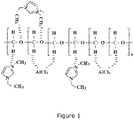
- Figures 1 and 2 show the chemical structure of two preferred embodiments of a component of the invention.
- the invention involves the application of a colloidal or non-fluid electrolyte in an energy storage device.
- the non-fluid electrolyte has a non-definite shape and can be manipulated to adopt different shapes according to needs.
- the invention removes the limitations on the physical shape as well as the concerns regarding electrolyte leakage of a battery yet without scarifying the benefits of ionic liquids including wide electrochemical stability window, low toxicity, high thermal stability, non-flammability, non-volatility and low vapor pressure.
- the ionic liquid electrolyte comprises a mixture of 1-ethyl-3-methylimidazolium chloride and anhydrous aluminum chloride in a predetermined ratio. It would be appreciated that other ionic liquids may be used as alternatives such as 1-hexyl-3-methyl-imidazolium chloride, 1-octyl-3-methylimidazoliumchloride and 1-dodecyl-3-methylimidazolium.Athickening agent, in the form of a macromolecule, is added to the mixture of 1-ethyl-3-methylimidazolium chloride and anhydrous aluminum chloride.
- the macromolecule may be an organic polymer which is preferably POM(polyoxymethylene), also known as acetal, polyacetal and polyformaldehyde with high stiffness, low friction and excellent dimensional stability.
- POM polyoxymethylene
- the molecular weight of the POM is preferably about 10000 - 500000.
- POM is added to the ionic liquid which is formed by mixing 1-ethyl-3-methylimidazolium chloride and anhydrous aluminum chloride.
- the POM and the ionic liquid interacts therewith, for a period which may be any amount of time from 1 hour to 12 days, to form a gel network which is considered to be a colloidal, non-liquid or solid state.
- the mixture Before the interaction is completed, the mixture remains in general a liquid that can be poured into a mold in which the interaction continues to result into a colloidal or non-liquid electrolyte that takes up the shape of the mold by way of casting.
- the non-liquid electrolyte may be formed with moisture content of 300ppm or below.
- a mold is provided with cathode and anode before the mixture of ionic liquid and POM is added thereto and cured therein such that the relative positions of the cathode and anode is fixed as the mixture is cured.
- Aluminum plate may be used as the negative electrode while pyrolytic graphite, MXene, natural graphite, sulfide or sulphur may form the positive electrode.
- the electrodes are separated by a support structure which may be in the form of PTFE(polytetrafluoroethylene), PAN(polyacrylonitrile), glass fiber and PI(polyimide).
- Circulation glovebox is useful in providing the controlled environment as it includes a purification system that circulates gas in the glovebox over a catalyst to lower trace impurities, oxygen, and water to levels below 1ppm.
- 1-ethyl-3-methylimidazolium is heated to 70°C in a vacuum oven for 24-48 hours for dehydration.
- the ionic liquid is formed by slowly adding 118g of anhydrous aluminum chloride to a trough that contains 100g of the 1-ethyl-3-methylimidazolium chloride for mixing. During mixing, the temperature of the mixture is maintained at 70°C under the pressure of 1 atm until all of the anhydrous aluminum chloride is dissolved.
- the mole ratio of anhydrous aluminum chloride and 1-ethyl-3-methylimidazolium chloride is from 1.1 to 2.0 and preferably 1.3.
- POM with molecular weight of 10,000-500,000 is considered suitable and may be used as the thickener.
- the POM has a molecular weight of 70000.
- the amount of POM added is about 4 to 30 weight%.
- the mixture will slowly solidify or cure. Before curing, the mixture is poured into a mold and is allowed to solidify.
- the water content of the cured electrolyte is at or below 300ppm.
- the negative electrode provided is preferably an aluminum plate and the positive electrode may bean intercalation host such as pyrolytic graphite, MXene, natural graphite, sulfide or sulphur. Molybdenum foil or nickel foil may act as collector.
- a separator is placed between the positive and negative electrodes and the uncured electrolyte is poured into the mold and allowed to solidify therein.
- the separator may be a non-woven or porous membrane made of PTFE, glass fiber, PAN (polyacrylonitrile) fiber or PI porous membrane.
- Example 2 is generally the same as Example 1 but instead of POM, polyamide nylon is used as the thickening agent as shown in Figure 2 .
- the amount of polyamide nylon added is about 2 to 20 weight %. At the temperature of 80°C, it takes about 1 to 16 hours to dissolve the polyamide nylon in the ionic liquid. The mixture will slowly solidify or cure. Before curing, the mixture is poured into a mold and allowed to solidify therein and takes up the shape of the mold. The water content of the cured electrolyte is at or below 300ppm.
- no separator is provided. It involves direct addition of the aldehyde or amide polymer into the ionic liquid.
- the mixture is poured into a mold with anode and cathode positioned therein.
- the mixture is cured in the mold to forma colloidal or non-fluid electrolyte in which the relative positions of the anode and cathode are fixed thereby resulting the preferred energy storage device.
- the ionic liquid is poured into the mold in which the anode and the cathode are provided.
- the amount of ionic liquid added is about 2 to 30 wt% of the aldehyde or amide polymer.
- the thickener interacts with ionic liquid in a controlled manner. At the temperature of 80°C, it takes about 16 hours to solidify or cure the gel (non-liquid) electrolyte to become the separate that separates electrodes and permits ion conduction.
- the thickener as detailed in Example 3 is placed or adhered to a supporting structure which may be a woven, non-woven or porous membrane made from a material selected from a group consisting glass fiber, PAN fiber, polyimide, PTFE. Together they form a sheet material which is hereinafter known as an enhanced separator to be placed between the anode and cathode.
- a supporting structure which may be a woven, non-woven or porous membrane made from a material selected from a group consisting glass fiber, PAN fiber, polyimide, PTFE.
- the enhanced separator as well as the anode and cathode are positioned in the mold. Thereafter the ionic liquid is poured into the mold for curing. The ionic liquid interacts with the thickener released from the enhanced separator to form a colloidal/non-liquid electrolyte which separates the electrodes and permits ion conduction.
- the enhanced separator prevents direct contact of the electrodes thereby preventing short circuit during deformation of the electrolyte.
- Aldehyde or amide polymer is dissolved in solvent such as DMF and the solution is impregnated on the support structure as detailed in Example 4 to form an enhanced separator preferably in the form of a sheet material.
- the enhanced separator is positioned between the anode and the cathode.
- the ionic liquid is then poured into the mold.
- the ionic liquid and the thickener which is released from the enhanced separator interact to form a colloidal/non-liquid electrolyte which separates the electrodes and permits ion conduction.
- the enhanced separator prevents direct contact of the electrodes thereby preventing short circuit during deformation of the electrolyte.
- Amide fiber is blended or mixed with one or more types of fiber and woven to form a cloth which is used as a support structure being placed between the cathode and anode.
- Thickener is added to the support structure to result in an enhanced separator in the form of a sheet material.
- the ionic liquid is poured into the mold in which the electrodes and the enhanced separator are provided.
- the ionic liquid and the thickener released from the enhanced separator interact to form a colloidal/non-liquid electrolyte which separates the electrodes and permit ion conduction.
- the enhanced separator prevents direct contact of the electrodes thereby preventing short circuit during deformation of the electrolyte.
- Aldehyde or amide polymer may be formed on the support structure by way of electrospinning or meltblown technology.
- the powder form of aldehyde or amide polymer is carried by high pressure gas that is forcibly propelled against the support structure under high pressure and is embedded in the support structure by way of abrasive blasting or sandblasting.
- the polymers in the present invention are prepared by anionic polymerization (for POM) and condensation polymerization (for Nylon), both of which do not require an initiator in the reaction or a termination step at the end of the reaction, which may simplify the battery manufacturing process
Landscapes
- Chemical & Material Sciences (AREA)
- Engineering & Computer Science (AREA)
- Manufacturing & Machinery (AREA)
- Chemical Kinetics & Catalysis (AREA)
- Electrochemistry (AREA)
- General Chemical & Material Sciences (AREA)
- Dispersion Chemistry (AREA)
- Condensed Matter Physics & Semiconductors (AREA)
- Physics & Mathematics (AREA)
- General Physics & Mathematics (AREA)
- Inorganic Chemistry (AREA)
- Materials Engineering (AREA)
- Secondary Cells (AREA)
- Battery Electrode And Active Subsutance (AREA)
- Primary Cells (AREA)
- Cell Separators (AREA)
Abstract
Description
- The present invention relates to an electrolyte for use in an energy storage device, for example particularly, but not exclusively, a non-liquid electrolyte for use in a battery.
- High-rate rechargeable batteries with long cycle life at reasonable cost are of high demand for powering motor vehicle and as a source of renewal energy replacing fossil fuels. A known alternative would be Lithium-ion batteries but the number of complete charge/discharge cycles that the battery is able to support before its capacity falling under 80% of its original capacity is less than 2000 cycles. The expensiveness of Lithium-ion batteries is another disadvantage in addition to the flammability of the electrolytes.
- Aluminum is always an attractive material for batteries for its low cost, low flammability and high-charge storage capacity. Scientists have invented high-performance aluminum battery that is fast charging, long lasting and relatively inexpensive. It is considered a safe alternative replacing existing storage devices. Aluminum has a specific capacity of 2980mAh g-1 and volumetric capacity of 8046mAh cm-3 which are higher than those of lithium. However secondary aluminum-based batteries are only possible in non-aqueous electrolytes with larger electrochemical stability window because aluminum redeposition occurs at a more negative potential -1.68V vs. SHE. (Standard hydrogen electrode) In the earlier days only aqueous or high temperature molten salt system are used. One concern is that aluminum in neutral or acidic electrolyte has a potential of -1.68V vs. SHE. and when the potential reaches - 1.23V, electrolysis of water occurs. This make aqueous electrolyte unsuitable for high-performance energy storage devices with redox potentials outside the stability window of water.
- Ionic liquids are widely promoted as designer electrolytes. The key attraction of ionic liquid is the wide electrochemical stability window. Most ionic liquids show high thermal stability, non-flammability, non-volatility and lower vapor pressure. It has relatively low toxicity comparing to organic solvents.
The invention seeks to eliminate or at least to mitigate such shortcomings by providing a non-liquid electrolyte for use in a battery. - In a first aspect of the invention there is provided a non-liquid electrolyte for use in an energy storage device comprising a mixture of ionic liquid and a thickener that interact to evolve into a gel network, wherein the thickener comprises a macromolecule.
- Preferably, the ionic liquid comprises a mixture of 1-ethyl-3-methylimidazolium and anhydrous aluminum chloride with a mole ratio of anhydrous aluminum chloride / 1-ethyl-3-methylimidazolium from 1.1 to 2.0, and water content at or below 300ppm, wherein the 1-ethyl-3-methylimidazolium comprises:

- More preferably, the thickener on a separator is released to interact with ionic liquid in a controlled manner, wherein the separator comprises a non-woven or porous membrane.
- It is preferable that the thickener is placed on support structure to forma sheet material, which is placed between cathode and anode of said energy storage device for releasing the thickener into the ionic liquid at a controlled manner for interaction. Advantageously, the support structure comprises a porous membrane, preferably a woven/non-woven membrane, formed from a material selected from a group consisting PTFE, PAN, glass fiber and PI. More advantageously, the macromolecule is at least one of aldehyde and amide polymer. Yet more advantageously, the aldehyde polymer comprises polyoxymethylene. Preferably, the amide polymer comprises nylon. More preferably, the polyoxymethylene is of a molecular weight of 10,000-500,000. Yet more preferably, the aldehyde polymer is of 4-30 weight %. Advantageously, the amide polymer is of 2-20 weight %.
- In a second aspect of the invention, there is provided a method of making with a non-liquid electrolyte for use in an energy storage device comprising the steps of:
- providing an ionic liquid,
- providing a thickener,
- mixing the ionic liquid with the thickener at specific temperature for a specific mixing time thereby allowing the ionic liquid to interact with the thickener to evolve into a gel network,
- wherein the thickener comprises a macromolecule.
- Preferably, the ionic liquid comprises a mixture of 1-ethyl-3-methylimidazolium and anhydrous aluminum chloride, with a mole ratio of anhydrous aluminum chloride / 1-ethyl-3-methylimidazolium from 1.1 to 2.0, and water content at or below 300ppm, wherein the 1-ethyl-3-methylimidazolium comprises:

- It is preferable that the method further comprises the step of placing the thickener on a support structure to form a sheet material which is placed between cathode and anode of said energy storage device for releasing the thickener into the ionic liquid at a controlled manner. Yet more preferably, the support structure comprises a porous membrane, preferably a woven/non-woven membrane, formed from a material selected from a group consisting PTFE, PAN, glass fiber and PI.
- Advantageously, the thickener is placing on the support structure by a method selected from a group consisting adhesion; electrospinning; meltblown technology; impregnating a solution comprises the thickener on the support material; and propelling a stream of high pressure gas comprises the thickener against the support material.
- Preferably, the specific temperature is about 50-140°C; wherein the specific mixing time is about 1 to 16 hours.
- In a third aspect of the invention there is provided an energy storage device comprising the electrolyte as detailed above.
- In a fourth aspect of the invention, there is provided an energy storage device comprising the electrolyte formed from the method as detailed above.
- The invention will now be more particularly described, by way of example only, with reference to the accompanying drawings, in which:
-
Figure 1 is a chemical structure of a first embodiment of a component of the invention; and -
Figure 2 is a chemical structure of as second embodiment of a component of the invention. -
Figures 1 and2 show the chemical structure of two preferred embodiments of a component of the invention. - The invention involves the application of a colloidal or non-fluid electrolyte in an energy storage device. The non-fluid electrolyte has a non-definite shape and can be manipulated to adopt different shapes according to needs. The invention removes the limitations on the physical shape as well as the concerns regarding electrolyte leakage of a battery yet without scarifying the benefits of ionic liquids including wide electrochemical stability window, low toxicity, high thermal stability, non-flammability, non-volatility and low vapor pressure.
- In the preferred embodiment, the ionic liquid electrolyte comprises a mixture of 1-ethyl-3-methylimidazolium chloride and anhydrous aluminum chloride in a predetermined ratio. It would be appreciated that other ionic liquids may be used as alternatives such as 1-hexyl-3-methyl-imidazolium chloride, 1-octyl-3-methylimidazoliumchloride and 1-dodecyl-3-methylimidazolium.Athickening agent, in the form of a macromolecule, is added to the mixture of 1-ethyl-3-methylimidazolium chloride and anhydrous aluminum chloride. The macromolecule may be an organic polymer which is preferably POM(polyoxymethylene), also known as acetal, polyacetal and polyformaldehyde with high stiffness, low friction and excellent dimensional stability. The molecular weight of the POM is preferably about 10000 - 500000. At a specific temperature range of 50-140°C, POM is added to the ionic liquid which is formed by mixing 1-ethyl-3-methylimidazolium chloride and anhydrous aluminum chloride. The POM and the ionic liquid interacts therewith, for a period which may be any amount of time from 1 hour to 12 days, to form a gel network which is considered to be a colloidal, non-liquid or solid state. Before the interaction is completed, the mixture remains in general a liquid that can be poured into a mold in which the interaction continues to result into a colloidal or non-liquid electrolyte that takes up the shape of the mold by way of casting. The non-liquid electrolyte may be formed with moisture content of 300ppm or below.
- A mold is provided with cathode and anode before the mixture of ionic liquid and POM is added thereto and cured therein such that the relative positions of the cathode and anode is fixed as the mixture is cured. Aluminum plate may be used as the negative electrode while pyrolytic graphite, MXene, natural graphite, sulfide or sulphur may form the positive electrode. In a preferred embodiment, the electrodes are separated by a support structure which may be in the form of PTFE(polytetrafluoroethylene), PAN(polyacrylonitrile), glass fiber and PI(polyimide).
- 1-ethyl-3-methylimidazolium and anhydrous aluminum chloride are very sensitive to moisture. Moisture in the raw materials and equipment are removed before use and the formation of the aluminum battery is carried out under a controlled environment with minimum exposure to moisture. The water-oxygen level in the controlled environment is at or below 1ppm. Circulation glovebox is useful in providing the controlled environment as it includes a purification system that circulates gas in the glovebox over a catalyst to lower trace impurities, oxygen, and water to levels below 1ppm.
- 1-ethyl-3-methylimidazolium is heated to 70°C in a vacuum oven for 24-48 hours for dehydration. The ionic liquid is formed by slowly adding 118g of anhydrous aluminum chloride to a trough that contains 100g of the 1-ethyl-3-methylimidazolium chloride for mixing. During mixing, the temperature of the mixture is maintained at 70°C under the pressure of 1 atm until all of the anhydrous aluminum chloride is dissolved. The mole ratio of anhydrous aluminum chloride and 1-ethyl-3-methylimidazolium chloride is from 1.1 to 2.0 and preferably 1.3.
- Referring to
Figure 1 , POM with molecular weight of 10,000-500,000 is considered suitable and may be used as the thickener. In this example, the POM has a molecular weight of 70000. The amount of POM added is about 4 to 30 weight%. At the temperature of 50-80°C, it takes about 1 to 16 hours to dissolve the POM in the ionic liquid. The mixture will slowly solidify or cure. Before curing, the mixture is poured into a mold and is allowed to solidify. The water content of the cured electrolyte is at or below 300ppm. - To form an energy storage device with the mixture, the negative electrode provided is preferably an aluminum plate and the positive electrode may bean intercalation host such as pyrolytic graphite, MXene, natural graphite, sulfide or sulphur. Molybdenum foil or nickel foil may act as collector. A separator is placed between the positive and negative electrodes and the uncured electrolyte is poured into the mold and allowed to solidify therein. The separator may be a non-woven or porous membrane made of PTFE, glass fiber, PAN (polyacrylonitrile) fiber or PI porous membrane.
- Example 2 is generally the same as Example 1 but instead of POM, polyamide nylon is used as the thickening agent as shown in
Figure 2 . The amount of polyamide nylon added is about 2 to 20 weight %. At the temperature of 80°C, it takes about 1 to 16 hours to dissolve the polyamide nylon in the ionic liquid. The mixture will slowly solidify or cure. Before curing, the mixture is poured into a mold and allowed to solidify therein and takes up the shape of the mold. The water content of the cured electrolyte is at or below 300ppm. - In this example, no separator is provided. It involves direct addition of the aldehyde or amide polymer into the ionic liquid. The mixture is poured into a mold with anode and cathode positioned therein. The mixture is cured in the mold to forma colloidal or non-fluid electrolyte in which the relative positions of the anode and cathode are fixed thereby resulting the preferred energy storage device. The ionic liquid is poured into the mold in which the anode and the cathode are provided. The amount of ionic liquid added is about 2 to 30 wt% of the aldehyde or amide polymer. The thickener interacts with ionic liquid in a controlled manner. At the temperature of 80°C, it takes about 16 hours to solidify or cure the gel (non-liquid) electrolyte to become the separate that separates electrodes and permits ion conduction.
- The thickener as detailed in Example 3 is placed or adhered to a supporting structure which may be a woven, non-woven or porous membrane made from a material selected from a group consisting glass fiber, PAN fiber, polyimide, PTFE. Together they form a sheet material which is hereinafter known as an enhanced separator to be placed between the anode and cathode.
- The enhanced separator as well as the anode and cathode are positioned in the mold. Thereafter the ionic liquid is poured into the mold for curing. The ionic liquid interacts with the thickener released from the enhanced separator to form a colloidal/non-liquid electrolyte which separates the electrodes and permits ion conduction. The enhanced separator prevents direct contact of the electrodes thereby preventing short circuit during deformation of the electrolyte.
- Aldehyde or amide polymer is dissolved in solvent such as DMF and the solution is impregnated on the support structure as detailed in Example 4 to form an enhanced separator preferably in the form of a sheet material. In the mold the enhanced separator is positioned between the anode and the cathode. The ionic liquid is then poured into the mold. The ionic liquid and the thickener which is released from the enhanced separator interact to form a colloidal/non-liquid electrolyte which separates the electrodes and permits ion conduction. The enhanced separator prevents direct contact of the electrodes thereby preventing short circuit during deformation of the electrolyte.
- Amide fiber is blended or mixed with one or more types of fiber and woven to form a cloth which is used as a support structure being placed between the cathode and anode.
- Thickener is added to the support structure to result in an enhanced separator in the form of a sheet material.
- The ionic liquid is poured into the mold in which the electrodes and the enhanced separator are provided. The ionic liquid and the thickener released from the enhanced separator interact to form a colloidal/non-liquid electrolyte which separates the electrodes and permit ion conduction. The enhanced separator prevents direct contact of the electrodes thereby preventing short circuit during deformation of the electrolyte.
- Aldehyde or amide polymer may be formed on the support structure by way of electrospinning or meltblown technology. Alternatively, the powder form of aldehyde or amide polymer is carried by high pressure gas that is forcibly propelled against the support structure under high pressure and is embedded in the support structure by way of abrasive blasting or sandblasting.
- The polymers in the present invention are prepared by anionic polymerization (for POM) and condensation polymerization (for Nylon), both of which do not require an initiator in the reaction or a termination step at the end of the reaction, which may simplify the battery manufacturing process
- In addition, the inventors, through their own research, trials and experiments, derived that the present invention is an unexpected outcome in the art. POM and Nylon result in unexpectedly full solidification of the ionic liquid electrolyte yet maintaining the advantages thereof.
- The invention has been given by way of example only, and various other modifications of and/or alterations to the described embodiment may be made by persons skilled in the art without departing from the scope of the invention as specified in the appended claims.
Claims (15)
- A non-liquid electrolyte for use in an energy storage device comprising a mixture of ionic liquid and a thickener that interact to evolve into a gel network, wherein the thickener comprises a macromolecule.
- The electrolyte as claimed in claim 1, wherein the thickener on a separator is released to interact with ionic liquid in a controlled manner, wherein the separator comprises a non-woven or porous membrane.
- The electrolyte as claimed in claim 1, wherein the thickener is placed on support structure to forma sheet material, which is placed between cathode and anode of said energy storage device for releasing the thickener into the ionic liquid at a controlled manner for interaction, and optionally wherein the support structure comprises a porous membrane, preferably a woven/non-woven membrane, formed from a material selected from a group consisting PTFE, PAN, glass fiber and PI.
- The electrolyte as claimed in claim 1, wherein the macromolecule is at least one of aldehyde and amide polymer.
- The electrolyte as claimed in claim 4, wherein the aldehyde polymer comprises polyoxymethylene, optionally wherein the polyoxymethylene is of a molecular weight of 10,000-500,000, and/or optionally wherein the aldehyde polymer is of 4-30 weight %.
- The electrolyte as claimed in claim 4, wherein the amide polymer comprises nylon, optionally wherein the amide polymer is of 2-20 weight %.
- A method of making with a non-liquid electrolyte for use in an energy storage device comprising the steps of:providing an ionic liquid,providing a thickener,mixing the ionic liquid with the thickener at specific temperature for a specific mixing time thereby allowing the ionic liquid to interact with the thickener to evolve into a gel network,wherein the thickener comprises a macromolecule.
- The electrolyte as claimed in claim 1, or the method as claimed in claim 7, wherein the ionic liquid comprises a mixture of 1-ethyl-3-methylimidazolium and anhydrous aluminum chloride, with a mole ratio of anhydrous aluminum chloride / 1-ethyl-3-methylimidazolium from 1.1 to 2.0, and water content at or below 300ppm, wherein the 1-ethyl-3-methylimidazolium comprises:

- The method as claimed in claim 7, wherein the macromolecule is at least one of aldehyde and amide polymer.
- The method as claimed in claim 7, wherein the aldehyde polymer comprises polyoxymethylene, optionally wherein the polyoxymethylene is of a molecular weight of 10,000-500,000, and/or optionally wherein the aldehyde polymer is of 4-30 weight %.
- The method as claimed in claim 9, wherein the amide polymer comprises nylon, and optionally wherein the amide polymer is of 2-20 weight %.
- The method as claimed in claim 7 further comprises the step of forming a separator comprising the thickener which is released into and interacts with the ionic liquid in a controlled manner, wherein the separator comprises a non-woven or porous membrane.
- The method as claimed in claim 7 further comprises the step of placing the thickener on a support structure to form a sheet material which is placed between cathode and anode of said energy storage device for releasing the thickener into the ionic liquid at a controlled manner, and optionally wherein the support structure comprises a porous membrane, preferably a woven/non-woven membrane, formed from a material selected from a group consisting PTFE, PAN, glass fiber and PI, and/or optionally the thickener is placing on the support structure by a method selected from a group consisting adhesion; electrospinning; meltblown technology; impregnating a solution comprises the thickener on the support material; and propelling a stream of high pressure gas comprises the thickener against the support material.
- The method as claimed in claim 7, wherein the specific temperature is about 50-140°C, and/or the specific mixing time is about 1 to 16 hours.
- An energy storage device comprising the electrolyte as claimed in any one of claims 1 to 6 and 8, and/or comprising the electrolyte formed from the method as claimed in anyone of claims 7 to 14.
Priority Applications (1)
| Application Number | Priority Date | Filing Date | Title |
|---|---|---|---|
| EP18167610.7A EP3352272A3 (en) | 2018-04-16 | 2018-04-16 | An ionic liquid electrolyte in an energy storage device and method of making the same |
Applications Claiming Priority (1)
| Application Number | Priority Date | Filing Date | Title |
|---|---|---|---|
| EP18167610.7A EP3352272A3 (en) | 2018-04-16 | 2018-04-16 | An ionic liquid electrolyte in an energy storage device and method of making the same |
Publications (2)
| Publication Number | Publication Date |
|---|---|
| EP3352272A2 true EP3352272A2 (en) | 2018-07-25 |
| EP3352272A3 EP3352272A3 (en) | 2018-08-15 |
Family
ID=62002589
Family Applications (1)
| Application Number | Title | Priority Date | Filing Date |
|---|---|---|---|
| EP18167610.7A Ceased EP3352272A3 (en) | 2018-04-16 | 2018-04-16 | An ionic liquid electrolyte in an energy storage device and method of making the same |
Country Status (1)
| Country | Link |
|---|---|
| EP (1) | EP3352272A3 (en) |
Cited By (4)
| Publication number | Priority date | Publication date | Assignee | Title |
|---|---|---|---|---|
| CN112911920A (en) * | 2021-02-08 | 2021-06-04 | 西安理工大学 | Preparation method of MXene-carbon aerogel/TPU composite material |
| CN115172907A (en) * | 2022-07-12 | 2022-10-11 | 华南理工大学 | Electrolyte-diaphragm composite material and preparation method and application thereof |
| CN116565303A (en) * | 2022-01-28 | 2023-08-08 | 通用汽车环球科技运作有限责任公司 | Thin solid-state electrolyte with high ionic conductivity |
| CN116731388A (en) * | 2023-06-12 | 2023-09-12 | 陕西科技大学 | Electromagnetic shielding polyimide composite aerogel and preparation method thereof, and anisotropic composite aerogel based on same and preparation method thereof |
Family Cites Families (4)
| Publication number | Priority date | Publication date | Assignee | Title |
|---|---|---|---|---|
| US6358651B1 (en) * | 1999-02-26 | 2002-03-19 | Reveo, Inc. | Solid gel membrane separator in rechargeable electrochemical cells |
| KR20120098728A (en) * | 2009-10-21 | 2012-09-05 | 도쿠리츠교세이호징 고쿠리츠코토센몬갓코키코 | Electrochemical device using solid polymer electrolyte using fine polymer composite particles |
| JP2015117252A (en) * | 2012-03-30 | 2015-06-25 | 国立大学法人 東京大学 | Method for producing ionic liquid-containing gel |
| EP3130025B1 (en) * | 2014-05-15 | 2021-07-07 | Amtek Research International, LLC. | Covalently cross-linked gel electrolytes |
-
2018
- 2018-04-16 EP EP18167610.7A patent/EP3352272A3/en not_active Ceased
Non-Patent Citations (1)
| Title |
|---|
| None |
Cited By (4)
| Publication number | Priority date | Publication date | Assignee | Title |
|---|---|---|---|---|
| CN112911920A (en) * | 2021-02-08 | 2021-06-04 | 西安理工大学 | Preparation method of MXene-carbon aerogel/TPU composite material |
| CN116565303A (en) * | 2022-01-28 | 2023-08-08 | 通用汽车环球科技运作有限责任公司 | Thin solid-state electrolyte with high ionic conductivity |
| CN115172907A (en) * | 2022-07-12 | 2022-10-11 | 华南理工大学 | Electrolyte-diaphragm composite material and preparation method and application thereof |
| CN116731388A (en) * | 2023-06-12 | 2023-09-12 | 陕西科技大学 | Electromagnetic shielding polyimide composite aerogel and preparation method thereof, and anisotropic composite aerogel based on same and preparation method thereof |
Also Published As
| Publication number | Publication date |
|---|---|
| EP3352272A3 (en) | 2018-08-15 |
Similar Documents
| Publication | Publication Date | Title |
|---|---|---|
| EP3352272A2 (en) | An ionic liquid electrolyte in an energy storage device and method of making the same | |
| Hong et al. | The lithium metal anode in Li–S batteries: challenges and recent progress | |
| Xu et al. | Three-dimensional, solid-state mixed electron–ion conductive framework for lithium metal anode | |
| KR101699140B1 (en) | Alkali metal-sulfur secondary cell | |
| JP6004274B2 (en) | Alkali metal-sulfur secondary battery | |
| US5690703A (en) | Apparatus and method of preparing electrochemical cells | |
| Chen et al. | Dual porous 3D zinc anodes toward dendrite-free and long cycle life zinc-ion batteries | |
| US20170162862A1 (en) | Solid electrode including electrolyte-impregnated active material particles | |
| CN104704651B (en) | Li-S battery with high cycling stability and method of operation thereof | |
| JP6119755B2 (en) | Sodium secondary battery | |
| WO2020053604A1 (en) | Battery | |
| Xu et al. | Cellulose Acetate‐Based High‐Electrolyte‐Uptake Gel Polymer Electrolyte for Semi‐Solid‐State Lithium‐Oxygen Batteries with Long‐Cycling Stability | |
| US20100248078A1 (en) | Aqueous lithium ion cell possessing high specific energy and electrolyte with high, stable cell voltage | |
| Chen et al. | Bioinspired separator with ion-selective nanochannels for lithium metal batteries | |
| US10283813B1 (en) | Ionic liquid electrolyte in an energy storage device and method of making the same | |
| CN101911372B (en) | Electrolyte containing eutectic mixture and electrochemical device containing same | |
| CN111235699A (en) | A preparation method of nitrogen-modified porous carbon nanofiber aerogel based on aramid nano aerogel | |
| Shui et al. | Flexible aluminum-air battery based on ionic liquid-gel polymer electrolyte | |
| JP2013196878A (en) | Sulfur secondary battery | |
| Novikova et al. | Trends in the development of room-temperature sodium–sulfur batteries | |
| JP2013225497A (en) | Alkali metal-sulfur secondary battery | |
| KR101771330B1 (en) | Electrolyte and secondary battery comprising the same | |
| Huai et al. | Preparation and characterization of a special structural poly (acrylonitrile)-based microporous membrane for lithium-ion batteries | |
| JP2010192385A (en) | Sulfur battery | |
| CN108183205A (en) | A kind of sodium-ion battery flexible self-supporting electrode material and its application and preparation method |
Legal Events
| Date | Code | Title | Description |
|---|---|---|---|
| PUAI | Public reference made under article 153(3) epc to a published international application that has entered the european phase |
Free format text: ORIGINAL CODE: 0009012 |
|
| PUAL | Search report despatched |
Free format text: ORIGINAL CODE: 0009013 |
|
| AK | Designated contracting states |
Kind code of ref document: A2 Designated state(s): AL AT BE BG CH CY CZ DE DK EE ES FI FR GB GR HR HU IE IS IT LI LT LU LV MC MK MT NL NO PL PT RO RS SE SI SK SM TR |
|
| AX | Request for extension of the european patent |
Extension state: BA ME |
|
| RIC1 | Information provided on ipc code assigned before grant |
Ipc: H01M 10/0565 20100101ALI20180703BHEP Ipc: H01M 6/06 20060101AFI20180703BHEP Ipc: H01M 10/0525 20100101ALI20180703BHEP |
|
| AK | Designated contracting states |
Kind code of ref document: A3 Designated state(s): AL AT BE BG CH CY CZ DE DK EE ES FI FR GB GR HR HU IE IS IT LI LT LU LV MC MK MT NL NO PL PT RO RS SE SI SK SM TR |
|
| AX | Request for extension of the european patent |
Extension state: BA ME |
|
| 17P | Request for examination filed |
Effective date: 20180920 |
|
| RBV | Designated contracting states (corrected) |
Designated state(s): AL AT BE BG CH CY CZ DE DK EE ES FI FR GB GR HR HU IE IS IT LI LT LU LV MC MK MT NL NO PL PT RO RS SE SI SK SM TR |
|
| STAA | Information on the status of an ep patent application or granted ep patent |
Free format text: STATUS: THE APPLICATION HAS BEEN REFUSED |
|
| 18R | Application refused |
Effective date: 20191124 |