EP3351639A1 - Method for selectively producing ginsenoside rd from saponins of ginseng through enzymatic method - Google Patents
Method for selectively producing ginsenoside rd from saponins of ginseng through enzymatic method Download PDFInfo
- Publication number
- EP3351639A1 EP3351639A1 EP16857822.7A EP16857822A EP3351639A1 EP 3351639 A1 EP3351639 A1 EP 3351639A1 EP 16857822 A EP16857822 A EP 16857822A EP 3351639 A1 EP3351639 A1 EP 3351639A1
- Authority
- EP
- European Patent Office
- Prior art keywords
- ginseng
- ginsenoside
- enzyme
- saponins
- trichoderma
- Prior art date
- Legal status (The legal status is an assumption and is not a legal conclusion. Google has not performed a legal analysis and makes no representation as to the accuracy of the status listed.)
- Granted
Links
Images

Classifications
-
- C—CHEMISTRY; METALLURGY
- C12—BIOCHEMISTRY; BEER; SPIRITS; WINE; VINEGAR; MICROBIOLOGY; ENZYMOLOGY; MUTATION OR GENETIC ENGINEERING
- C12P—FERMENTATION OR ENZYME-USING PROCESSES TO SYNTHESISE A DESIRED CHEMICAL COMPOUND OR COMPOSITION OR TO SEPARATE OPTICAL ISOMERS FROM A RACEMIC MIXTURE
- C12P33/00—Preparation of steroids
- C12P33/12—Acting on D ring
- C12P33/16—Acting at 17 position
-
- C—CHEMISTRY; METALLURGY
- C07—ORGANIC CHEMISTRY
- C07H—SUGARS; DERIVATIVES THEREOF; NUCLEOSIDES; NUCLEOTIDES; NUCLEIC ACIDS
- C07H17/00—Compounds containing heterocyclic radicals directly attached to hetero atoms of saccharide radicals
-
- C—CHEMISTRY; METALLURGY
- C07—ORGANIC CHEMISTRY
- C07J—STEROIDS
- C07J17/00—Normal steroids containing carbon, hydrogen, halogen or oxygen, having an oxygen-containing hetero ring not condensed with the cyclopenta(a)hydrophenanthrene skeleton
-
- C—CHEMISTRY; METALLURGY
- C12—BIOCHEMISTRY; BEER; SPIRITS; WINE; VINEGAR; MICROBIOLOGY; ENZYMOLOGY; MUTATION OR GENETIC ENGINEERING
- C12P—FERMENTATION OR ENZYME-USING PROCESSES TO SYNTHESISE A DESIRED CHEMICAL COMPOUND OR COMPOSITION OR TO SEPARATE OPTICAL ISOMERS FROM A RACEMIC MIXTURE
- C12P19/00—Preparation of compounds containing saccharide radicals
- C12P19/44—Preparation of O-glycosides, e.g. glucosides
-
- C—CHEMISTRY; METALLURGY
- C12—BIOCHEMISTRY; BEER; SPIRITS; WINE; VINEGAR; MICROBIOLOGY; ENZYMOLOGY; MUTATION OR GENETIC ENGINEERING
- C12Y—ENZYMES
- C12Y302/00—Hydrolases acting on glycosyl compounds, i.e. glycosylases (3.2)
- C12Y302/01—Glycosidases, i.e. enzymes hydrolysing O- and S-glycosyl compounds (3.2.1)
- C12Y302/01004—Cellulase (3.2.1.4), i.e. endo-1,4-beta-glucanase
Definitions
- the present invention relates to a method for selectively producing ginsenoside Rd, which is originally present in ginseng in a trace amount, from ginsenoside Rb1 which is saponins of ginseng, and more specifically to a method capable of obtaining a desired target compound, that is, ginsenoside Rd, in high yields, by treating a panaxadiol-type saponin, ginsenoside Rb1, obtained from ginseng, with particular enzymes to structurally convert the saponins.
- Ginseng saponin has a unique chemical structure different from that of saponin found in other plants. Thus, its pharmacological efficacy is unique, and thus it is also called “ginsenoside” in the sense of ginseng glycoside.
- Specific types of ginseng saponins include panaxadiol-type ginsenosides Rb1, Rb2, Rc, Rd, compound K, compound Mc, compound O, etc., and panaxatriol-type ginsenosides Re, Rf, Rg1, Rg3, Rg5, Rh1, Rh2, etc., and each of these ginseng saponins exhibit different efficacies.
- ginsenosides Rb1, Rb2, Rc, etc. which are panaxadiol type saponins, can be converted into other ginseng saponins by metabolism of microorganisms, a method using enzymes has been used for a long time as a method of converting ginseng saponin into other kinds of specific ginseng saponins.
- conventional methods of obtaining ginseng saponins do not convert only to a desired specific ginseng saponin, but provide a technical solution of obtaining various converted ginseng saponins by extraction or the like and then purifying the resultant to isolate only desired ginseng saponins.
- an object of the present invention is to provide a conversion method of ginseng saponin which can obtain a desired specific ginseng saponin in a high yield and also can be easily carried out
- the present invention provides a method for producing ginsenoside Rd by converting saponins of ginseng using at least one enzyme selected from the group consisting of pectinase and cellulase isolated from genus Trichoderma.
- the desired ginseng saponin can be easily produced with high yield.
- FIG. 1 shows the results of confirming ginsenoside Rd produced after the conversion reaction of ginseng saponin though silica gel column chromatography.
- the present invention relates to a method for selectively producing ginsenoside Rd (chemical formula 1) from saponins of ginseng, particularly ginsenoside Rb1, which is a panaxadiol-type saponin, by an enzymatic method.
- the conversion from saponin of ginseng to a desired ginseng saponin can be efficiently carried out by using enzymes derived from microorganisms, thereby obtaining ginsenoside Rd in high yield.
- the enzyme used in the present invention is desirably obtained from at least one microorganism selected from the group consisting of the microorganisms belonging to the genus Trichoderma, particularly Trichoderma aggressivum, Trichoderma harzianum, Trichoderma reesei and Trichoderma viride, and those obtained from Trichoderma reesei are most preferred.
- the enzyme used in the present invention may be lactase, cellulase, beta-galactosidase, pectinase, naringinase, hemicellulase, or a mixture thereof, isolated from a microorganism of the genus Trichoderma, and pectinase, cellulase, or a mixture thereof are preferred.
- the site where the enzyme functions specifically in the substrate varies depending on the species of the microorganism from which the enzyme is derived, resulting in a difference in substrate specificity. Therefore, in the present invention, it is most desirable to use at least one selected from the group consisting of pectinase and cellulase obtained from Trichoderma reesei.
- saponin of ginseng is dissolved in a solvent in an amount of 0.01 to 20% by weight, and then the saponin is converted into the desired ginseng saponin by an enzymatic method using the above-mentioned enzyme.
- the solvents used here are preferably those that do not inhibit the activity of the enzyme, for example, an aqueous solvent such as water or a buffer solution, or a mixture of an aqueous solvent and an organic solvent such as water or a buffer solution can be used.
- the buffer solution used here may be acetic acid, citric acid, phosphoric acid, citric acid-phosphoric acid, or the like, and the organic solvent may be acetonitrile, dioxane, dimethyl sulfoxide, methanol, ethanol, 1-propanol, 2-propanol, or the like.
- the pH range of the solvent that can be used is preferably 2.5 to 7.5, more preferably 3.5 to 5.5.
- the enzyme to be used is added in an amount of preferably 1 to 500% by weight, more preferably 10 to 400% by weight, still more preferably 10 to 200% by weight, based on the amount of the substrate used.
- the reaction temperature must be a temperature condition under which no enzyme inactivation occur, but the temperature is maintained in the range of preferably 30 to 60°C, more preferably 35 to 60°C, still more preferably 40 to 55°C.
- reaction time is not particularly limited as long as it is a period during which the activity of the enzyme is maintained, but it is desirable to perform the reaction while stirring for 1 to 120 hours, preferably 1 to 72 hours, more preferably 1 to 48 hours, still more preferably 1 to 24 hours.
- a reaction solution containing a large amount of ginsenoside Rd can be obtained by inactivating the enzyme using a known method such as heating in a boiling water bath.
- the total 1-butanol layer thus obtained was treated with 5% KOH, washed with distilled water and then concentrated under reduced pressure to obtain 1-butanol extract, which was dissolved in a small amount of methanol, and then added to a large amount of ethyl acetate.
- the resulting precipitate was dried to thereby obtain 40 to 80 g of ginseng purified saponin (including ginsenoside Rb1, Rb2, Rc, Rd, Re, Rg1, Rf, etc.).
- pectinase isolated from Trichoderma reesei was added to the above mixed solution in an amount of 200% by weight relative to the substrate, and the mixture was reacted at 30°C for 48 hours.
- the enzyme was inactivated by heating in a boiling water bath for 10 minutes, thereby completing the reaction.
- ginsenoside Rb1 0.73 g of ginsenoside Rb2, 1.23 g of ginsenoside Rc and 0.38 g of ginsenoside Rd were present in 10 g of the ginseng saponin of Reference example 1 used.
- ginsenoside Rb1 was present in an amount of 0.009 g
- ginsenoside Rd was present in an amount of 2.952.57 g
- ginsenosides Rb 2 and Rc were present in an amount of 0.73 g and 1.23 g, respectively. This means that ginsenoside Rd is selectively converted from ginsenoside Rb1.
- ginsenoside Rd is produced from ginsenoside Rb1 and the conversion rate to ginsenoside Rd is 95% or more.
- ginsenosides Rb2 and Rc were present in the same amount even after the enzymatic reaction, indicating that they remain in a state where conversion is not performed.
Landscapes
- Chemical & Material Sciences (AREA)
- Organic Chemistry (AREA)
- Life Sciences & Earth Sciences (AREA)
- Engineering & Computer Science (AREA)
- Wood Science & Technology (AREA)
- Health & Medical Sciences (AREA)
- Zoology (AREA)
- General Health & Medical Sciences (AREA)
- Genetics & Genomics (AREA)
- Biochemistry (AREA)
- Biotechnology (AREA)
- Bioinformatics & Cheminformatics (AREA)
- Microbiology (AREA)
- General Engineering & Computer Science (AREA)
- General Chemical & Material Sciences (AREA)
- Chemical Kinetics & Catalysis (AREA)
- Molecular Biology (AREA)
- Steroid Compounds (AREA)
- Preparation Of Compounds By Using Micro-Organisms (AREA)
- Medicines Containing Plant Substances (AREA)
- Medicinal Chemistry (AREA)
- Biomedical Technology (AREA)
- Enzymes And Modification Thereof (AREA)
Abstract
Description
- The present invention relates to a method for selectively producing ginsenoside Rd, which is originally present in ginseng in a trace amount, from ginsenoside Rb1 which is saponins of ginseng, and more specifically to a method capable of obtaining a desired target compound, that is, ginsenoside Rd, in high yields, by treating a panaxadiol-type saponin, ginsenoside Rb1, obtained from ginseng, with particular enzymes to structurally convert the saponins.
- Ginseng saponin has a unique chemical structure different from that of saponin found in other plants.
Thus, its pharmacological efficacy is unique, and thus it is also called "ginsenoside" in the sense of ginseng glycoside. Specific types of ginseng saponins include panaxadiol-type ginsenosides Rb1, Rb2, Rc, Rd, compound K, compound Mc, compound O, etc., and panaxatriol-type ginsenosides Re, Rf, Rg1, Rg3, Rg5, Rh1, Rh2, etc., and each of these ginseng saponins exhibit different efficacies.

- As shown in the Reaction Scheme 1, particularly, since ginsenosides Rb1, Rb2, Rc, etc., which are panaxadiol type saponins, can be converted into other ginseng saponins by metabolism of microorganisms, a method using enzymes has been used for a long time as a method of converting ginseng saponin into other kinds of specific ginseng saponins.
- However, for the conversion reaction using enzymes in the past, non-specificity of enzymes for a substrate is large and thus an extremely large amount of enzyme should be used relative to the saponin substrate used. Further, the enzymatic reaction is not completed with a desired ginseng saponin, but an additional reaction occurs nonspecifically. Thus, since other ginseng saponins were variously produced without being converted only to the desired ginseng saponin, the yield of the desired ginseng saponin was extremely low.
- In addition, conventional methods of obtaining ginseng saponins do not convert only to a desired specific ginseng saponin, but provide a technical solution of obtaining various converted ginseng saponins by extraction or the like and then purifying the resultant to isolate only desired ginseng saponins.
- However, since these conventional methods require additional cost and time associated with the purification in order to obtain a pure specific ginseng saponin. Therefore, the selling price of ginseng saponins is inevitably increased, and there is a limit to applying a large amount of ginseng saponins to related products.
- Furthermore, if the enzyme reaction occurs nonspecifically, nonselective removal of sugar in ginsenoside Rd allows it to convert into ginsenoside F2 and compound K, and thus it becomes difficult to obtain intermediate metabolites such as ginsenoside Rd and the like in high yield.
-
- 1. Korean Patent Laid-Open Publication No.
10-2014-0006331 - It was expensive to acquire a specific ginseng saponin by a conventional method and also it was difficult to obtain the desired ginseng saponin in large quantities. Therefore, there is a need to develop a production method that can produce a large amount of target ginseng saponins and can save costs.
- Accordingly, an object of the present invention is to provide a conversion method of ginseng saponin which can obtain a desired specific ginseng saponin in a high yield and also can be easily carried out
- In order to achieve the above object, the present invention provides a method for producing ginsenoside Rd by converting saponins of ginseng using at least one enzyme selected from the group consisting of pectinase and cellulase isolated from genus Trichoderma.
- By using the method for converting to ginseng saponins according to the present invention, the desired ginseng saponin can be easily produced with high yield.
-
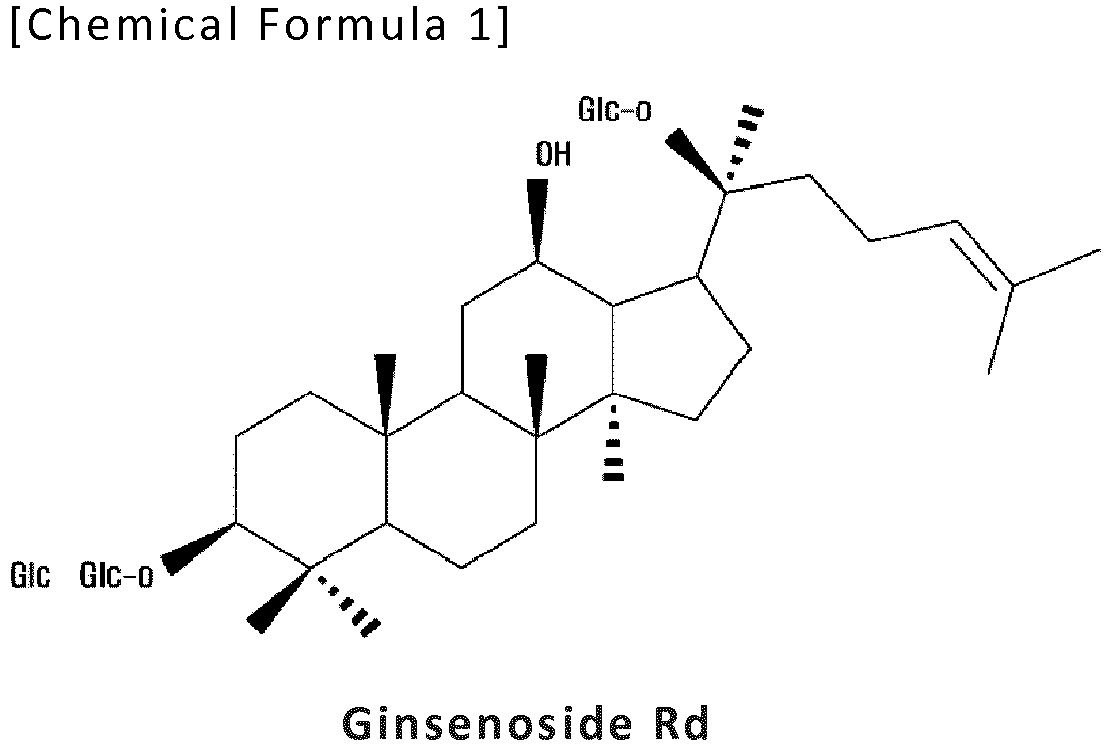
FIG. 1 shows the results of confirming ginsenoside Rd produced after the conversion reaction of ginseng saponin though silica gel column chromatography. - The present invention relates to a method for selectively producing ginsenoside Rd (chemical formula 1) from saponins of ginseng, particularly ginsenoside Rb1, which is a panaxadiol-type saponin, by an enzymatic method.
- According to the method of the present invention, the conversion from saponin of ginseng to a desired ginseng saponin can be efficiently carried out by using enzymes derived from microorganisms, thereby obtaining ginsenoside Rd in high yield.
- Specifically, the enzyme used in the present invention is desirably obtained from at least one microorganism selected from the group consisting of the microorganisms belonging to the genus Trichoderma, particularly Trichoderma aggressivum, Trichoderma harzianum, Trichoderma reesei and Trichoderma viride, and those obtained from Trichoderma reesei are most preferred.
- In addition, the enzyme used in the present invention may be lactase, cellulase, beta-galactosidase, pectinase, naringinase, hemicellulase, or a mixture thereof, isolated from a microorganism of the genus Trichoderma, and pectinase, cellulase, or a mixture thereof are preferred.
- Even the same type of enzyme that performs mostly the same function, the site where the enzyme functions specifically in the substrate varies depending on the species of the microorganism from which the enzyme is derived, resulting in a difference in substrate specificity. Therefore, in the present invention, it is most desirable to use at least one selected from the group consisting of pectinase and cellulase obtained from Trichoderma reesei.
- In the present invention, saponin of ginseng is dissolved in a solvent in an amount of 0.01 to 20% by weight, and then the saponin is converted into the desired ginseng saponin by an enzymatic method using the above-mentioned enzyme. The solvents used here are preferably those that do not inhibit the activity of the enzyme, for example, an aqueous solvent such as water or a buffer solution, or a mixture of an aqueous solvent and an organic solvent such as water or a buffer solution can be used. Specifically, the buffer solution used here may be acetic acid, citric acid, phosphoric acid, citric acid-phosphoric acid, or the like, and the organic solvent may be acetonitrile, dioxane, dimethyl sulfoxide, methanol, ethanol, 1-propanol, 2-propanol, or the like. The pH range of the solvent that can be used is preferably 2.5 to 7.5, more preferably 3.5 to 5.5.
- In the method of the present invention, the enzyme to be used is added in an amount of preferably 1 to 500% by weight, more preferably 10 to 400% by weight, still more preferably 10 to 200% by weight, based on the amount of the substrate used.
- The reaction temperature must be a temperature condition under which no enzyme inactivation occur, but the temperature is maintained in the range of preferably 30 to 60°C, more preferably 35 to 60°C, still more preferably 40 to 55°C.
- Furthermore, the reaction time is not particularly limited as long as it is a period during which the activity of the enzyme is maintained, but it is desirable to perform the reaction while stirring for 1 to 120 hours, preferably 1 to 72 hours, more preferably 1 to 48 hours, still more preferably 1 to 24 hours.
- Subsequently, a reaction solution containing a large amount of ginsenoside Rd can be obtained by inactivating the enzyme using a known method such as heating in a boiling water bath.
- Hereinafter, the present invention will be described in detail by way of Examples. However, these Examples are given for illustrative purposes only, and are not intended to limit the scope of the invention thereto.
- 20 ℓ of ethanol was added to 2 kg of red ginseng, white ginseng, fresh ginseng, tiny-sized ginseng or leaves, flowers and fruits of ginseng, and extracted three times under reflux and then immersed at 15°C for 6 days. Thereafter, the residue and the filtrate were isolated through filter cloth-filtration and centrifugation, and the isolated filtrate was concentrated under reduced pressure. The extract obtained was suspended in water, and then extracted five times with 1 ℓ of ether to remove a pigment. The aqueous layer was extracted three times with 1 ℓ of 1-butanol. The total 1-butanol layer thus obtained was treated with 5% KOH, washed with distilled water and then concentrated under reduced pressure to obtain 1-butanol extract, which was dissolved in a small amount of methanol, and then added to a large amount of ethyl acetate. The resulting precipitate was dried to thereby obtain 40 to 80 g of ginseng purified saponin (including ginsenoside Rb1, Rb2, Rc, Rd, Re, Rg1, Rf, etc.).
- 10 g of ginseng purified saponin (including ginsenoside Rb1, Rb2, Rc, Rd, Re, Rg1, Rf, etc.) of the Reference Example 1 was dissolved in 1 ℓ of water.
- Thereafter, pectinase isolated from Trichoderma reesei was added to the above mixed solution in an amount of 200% by weight relative to the substrate, and the mixture was reacted at 30°C for 48 hours. When the substrate was completely disappeared by periodic confirmation by thin layer chromatography, the enzyme was inactivated by heating in a boiling water bath for 10 minutes, thereby completing the reaction. Finally, ethyl acetate or ethanol was added to the reaction solution at a ratio of 1: 1 (ratio of volume to the reaction solution), extracted three times, concentrated and then subjected to silica gel column chromatography (chloroform: methanol= 9:1) to isolate ginsenoside Rd (
FIG. 1 ). - 2.66 g of ginsenoside Rb1, 0.73 g of ginsenoside Rb2, 1.23 g of ginsenoside Rc and 0.38 g of ginsenoside Rd were present in 10 g of the ginseng saponin of Reference example 1 used. In the mixed solution obtained after the enzymatic reaction, ginsenoside Rb1 was present in an amount of 0.009 g, whereas ginsenoside Rd was present in an amount of 2.952.57 g, and ginsenosides Rb 2 and Rc were present in an amount of 0.73 g and 1.23 g, respectively. This means that ginsenoside Rd is selectively converted from ginsenoside Rb1. In particular, it indicates that 2.19 g of ginsenoside Rd is produced from ginsenoside Rb1 and the conversion rate to ginsenoside Rd is 95% or more. On the other hand, ginsenosides Rb2 and Rc were present in the same amount even after the enzymatic reaction, indicating that they remain in a state where conversion is not performed.
Claims (8)
- A method for producing ginsenoside Rd (chemical formula 1) by converting panaxadiol-type saponins of ginseng using at least one selected from the group consisting of pectinase and cellulase obtained from a genus Trichoderma.

- The method according to claim 1, wherein the method comprises the steps of:1) dissolving panaxadiol-type saponins of ginseng as a substrate in an aqueous solvent or a mixed solution of an aqueous solvent and an organic solvent, adding thereto at least one enzyme selected from the group consisting of pectinase and cellulase obtained from a genus Trichoderma, and performing the reaction with stirring in a heated water bath;2) inactivating the enzyme when the substrate is completely disappeared, thereby completing the reaction; and3) adding ethyl acetate or ethanol to the reaction solution, followed by extraction and concentration, thereby isolating ginsenoside Rd.
- The method according to claim 2, wherein the panaxadiol-type saponin of ginseng is at least one selected from ginsenosides Rb1, Rb2, Rc, or a mixture thereof.
- The method according to claim 2, wherein the microorganism of the genus Trichoderma is selected from the group consisting of Trichoderma aggressivum, Trichoderma harzianum, Trichoderma reesei and Trichoderma viride.
- The method according to claim 2, wherein the enzyme is added in an amount of 10 to 400% by weight based on the amount of the substrate.
- The method according to claim 2, wherein the enzyme is reacted at a temperature of 35 to 60°C.
- The method according to claim 2, wherein the enzyme is reacted for 1 to 48 hours.
- The method according to claim 2, wherein the solvent has a pH in the range of 3 to 5.5.
Applications Claiming Priority (2)
| Application Number | Priority Date | Filing Date | Title |
|---|---|---|---|
| KR1020150147354A KR20170047008A (en) | 2015-10-22 | 2015-10-22 | Method for selectively preparing ginsenoside Rd from saponins of ginseng by enzymatic process |
| PCT/KR2016/011905 WO2017069565A1 (en) | 2015-10-22 | 2016-10-21 | Method for selectively producing ginsenoside rd from saponins of ginseng through enzymatic method |
Publications (3)
| Publication Number | Publication Date |
|---|---|
| EP3351639A1 true EP3351639A1 (en) | 2018-07-25 |
| EP3351639A4 EP3351639A4 (en) | 2019-05-15 |
| EP3351639B1 EP3351639B1 (en) | 2020-05-27 |
Family
ID=58557380
Family Applications (1)
| Application Number | Title | Priority Date | Filing Date |
|---|---|---|---|
| EP16857822.7A Active EP3351639B1 (en) | 2015-10-22 | 2016-10-21 | Method for selectively producing ginsenoside rd from saponins of ginseng through enzymatic method |
Country Status (7)
| Country | Link |
|---|---|
| US (1) | US10519480B2 (en) |
| EP (1) | EP3351639B1 (en) |
| JP (1) | JP6854815B2 (en) |
| KR (1) | KR20170047008A (en) |
| CN (1) | CN108138210B (en) |
| TW (1) | TWI737638B (en) |
| WO (1) | WO2017069565A1 (en) |
Families Citing this family (4)
| Publication number | Priority date | Publication date | Assignee | Title |
|---|---|---|---|---|
| KR102015044B1 (en) | 2017-11-14 | 2019-08-27 | 재단법인 진안홍삼연구소 | Preparation Methods of Red Gingseng Concentrate Containing Increased Ginsenoside Rd Using Enzyme and Ultraviolet Radiation UVB |
| CN113136358B (en) * | 2021-06-01 | 2023-08-04 | 重庆大学 | An aerobic co-cultivation probiotic fermentation process to increase the production of ginsenosides |
| CN115449536B (en) * | 2021-06-09 | 2023-04-25 | 成都普睿法药物研发有限公司 | Method for converting Rb1 into CK by Aspergillus niger fermentation broth |
| CN114377049A (en) * | 2022-01-25 | 2022-04-22 | 吉林省御华府生物食品工程有限公司 | Extraction method of ginseng |
Family Cites Families (11)
| Publication number | Priority date | Publication date | Assignee | Title |
|---|---|---|---|---|
| CN1105781C (en) * | 1999-03-17 | 2003-04-16 | 金凤燮 | Method for preparing rare ginsengoside using enzymatic method to modify ginsenoside glycoside |
| CN1477205A (en) * | 2003-07-10 | 2004-02-25 | 黄亚平 | Method for producing rare ginsenoside by using biological catalyst to transform ginsenoside |
| KR20090061107A (en) * | 2007-12-11 | 2009-06-16 | 메타볼랩(주) | How to switch to Ginsenoside F2 |
| KR101593618B1 (en) * | 2009-05-26 | 2016-02-15 | (주)아모레퍼시픽 | Composition for enhancing bioavailability of saponin |
| KR101753077B1 (en) * | 2010-05-07 | 2017-07-03 | 에스케이바이오랜드 주식회사 | A method for preparing fermented ginseng extract and compositions comprising thereof |
| KR101823585B1 (en) | 2011-07-01 | 2018-01-31 | 에스케이바이오랜드 주식회사 | Methods for preparing fermented ginseng extracts |
| CN102888437B (en) * | 2011-07-22 | 2014-06-11 | 复旦大学 | Method for preparing ginsenoside Rd by utilizing microbial conversion |
| KR101427882B1 (en) | 2012-07-03 | 2014-08-08 | 한국과학기술원 | Production of ginsenoside Rd and ginsenoside F2 using novel ginsenside glycosidase derived from Flavobacterium johnsoniae |
| CN103146592B (en) * | 2013-01-31 | 2014-06-25 | 河南科技学院 | A kind of yeast that converts ginsenoside Rb1 to generate Rd and its application |
| CN103142669B (en) * | 2013-03-07 | 2015-07-22 | 安徽丰润生物技术有限公司 | Enzyme method for extracting ginsenoside and obtained ginsenoside extractive |
| CN103525892A (en) * | 2013-09-20 | 2014-01-22 | 吉林大学 | Method for quickly preparing rare panaxoside Rd |
-
2015
- 2015-10-22 KR KR1020150147354A patent/KR20170047008A/en not_active Ceased
-
2016
- 2016-10-21 TW TW105134028A patent/TWI737638B/en active
- 2016-10-21 EP EP16857822.7A patent/EP3351639B1/en active Active
- 2016-10-21 US US15/769,995 patent/US10519480B2/en active Active
- 2016-10-21 JP JP2018520414A patent/JP6854815B2/en active Active
- 2016-10-21 CN CN201680061963.XA patent/CN108138210B/en active Active
- 2016-10-21 WO PCT/KR2016/011905 patent/WO2017069565A1/en not_active Ceased
Also Published As
| Publication number | Publication date |
|---|---|
| WO2017069565A1 (en) | 2017-04-27 |
| JP2018531029A (en) | 2018-10-25 |
| EP3351639B1 (en) | 2020-05-27 |
| CN108138210A (en) | 2018-06-08 |
| JP6854815B2 (en) | 2021-04-07 |
| CN108138210B (en) | 2022-06-03 |
| EP3351639A4 (en) | 2019-05-15 |
| TWI737638B (en) | 2021-09-01 |
| KR20170047008A (en) | 2017-05-04 |
| TW201718866A (en) | 2017-06-01 |
| US20180320212A1 (en) | 2018-11-08 |
| US10519480B2 (en) | 2019-12-31 |
Similar Documents
| Publication | Publication Date | Title |
|---|---|---|
| EP3351639B1 (en) | Method for selectively producing ginsenoside rd from saponins of ginseng through enzymatic method | |
| KR20230157273A (en) | Method for selectively preparing compound K and compound Y from saponins of ginseng by enzymatic process | |
| JP2018531029A6 (en) | Method for selectively producing ginsenoside Rd from carrot saponin by enzymatic method | |
| EP3351638A1 (en) | Method for selectively producing ginsenoside f2, compound mc, and compound o from saponins of ginseng through enzymatic method | |
| KR100293968B1 (en) | 20 (S) - Production method of Ginsenoside AL | |
| KR100424438B1 (en) | Enzymatic producing method of ginsenoside rd | |
| JP2018531018A6 (en) | Method for selectively producing ginsenoside F2, compound Mc and compound O from carrot saponin by enzymatic method | |
| KR101777673B1 (en) | Preparation method of ginsenoside-Rd using an enzyme | |
| KR102244275B1 (en) | Method for Preparation of Bioconverted Red Ginseng with Enhanced compound K content | |
| KR100671291B1 (en) | Method for producing ginsenoside F1 using beta-galactosidase | |
| KR20060120932A (en) | Ginsenoside production method using alpha-galactosidase | |
| KR100318304B1 (en) | Manufacturing method of Ginsenoside algin 1 | |
| CN119241627A (en) | A method for converting ginsenoside Rb1 into ginsenoside Rg3 and Rg5 | |
| CN109022530B (en) | Preparation method of ginsenoside Ro |
Legal Events
| Date | Code | Title | Description |
|---|---|---|---|
| STAA | Information on the status of an ep patent application or granted ep patent |
Free format text: STATUS: THE INTERNATIONAL PUBLICATION HAS BEEN MADE |
|
| PUAI | Public reference made under article 153(3) epc to a published international application that has entered the european phase |
Free format text: ORIGINAL CODE: 0009012 |
|
| STAA | Information on the status of an ep patent application or granted ep patent |
Free format text: STATUS: REQUEST FOR EXAMINATION WAS MADE |
|
| 17P | Request for examination filed |
Effective date: 20180420 |
|
| AK | Designated contracting states |
Kind code of ref document: A1 Designated state(s): AL AT BE BG CH CY CZ DE DK EE ES FI FR GB GR HR HU IE IS IT LI LT LU LV MC MK MT NL NO PL PT RO RS SE SI SK SM TR |
|
| AX | Request for extension of the european patent |
Extension state: BA ME |
|
| DAV | Request for validation of the european patent (deleted) | ||
| DAX | Request for extension of the european patent (deleted) | ||
| A4 | Supplementary search report drawn up and despatched |
Effective date: 20190417 |
|
| RIC1 | Information provided on ipc code assigned before grant |
Ipc: C12N 9/42 20060101ALI20190411BHEP Ipc: C07J 17/00 20060101ALI20190411BHEP Ipc: C07H 17/00 20060101ALI20190411BHEP Ipc: C12P 33/16 20060101ALI20190411BHEP Ipc: C12P 19/44 20060101AFI20190411BHEP |
|
| GRAP | Despatch of communication of intention to grant a patent |
Free format text: ORIGINAL CODE: EPIDOSNIGR1 |
|
| STAA | Information on the status of an ep patent application or granted ep patent |
Free format text: STATUS: GRANT OF PATENT IS INTENDED |
|
| INTG | Intention to grant announced |
Effective date: 20200110 |
|
| GRAS | Grant fee paid |
Free format text: ORIGINAL CODE: EPIDOSNIGR3 |
|
| GRAA | (expected) grant |
Free format text: ORIGINAL CODE: 0009210 |
|
| STAA | Information on the status of an ep patent application or granted ep patent |
Free format text: STATUS: THE PATENT HAS BEEN GRANTED |
|
| AK | Designated contracting states |
Kind code of ref document: B1 Designated state(s): AL AT BE BG CH CY CZ DE DK EE ES FI FR GB GR HR HU IE IS IT LI LT LU LV MC MK MT NL NO PL PT RO RS SE SI SK SM TR |
|
| REG | Reference to a national code |
Ref country code: GB Ref legal event code: FG4D |
|
| REG | Reference to a national code |
Ref country code: CH Ref legal event code: EP |
|
| REG | Reference to a national code |
Ref country code: AT Ref legal event code: REF Ref document number: 1274598 Country of ref document: AT Kind code of ref document: T Effective date: 20200615 |
|
| REG | Reference to a national code |
Ref country code: DE Ref legal event code: R096 Ref document number: 602016037244 Country of ref document: DE |
|
| REG | Reference to a national code |
Ref country code: LT Ref legal event code: MG4D |
|
| PG25 | Lapsed in a contracting state [announced via postgrant information from national office to epo] |
Ref country code: IS Free format text: LAPSE BECAUSE OF FAILURE TO SUBMIT A TRANSLATION OF THE DESCRIPTION OR TO PAY THE FEE WITHIN THE PRESCRIBED TIME-LIMIT Effective date: 20200927 Ref country code: LT Free format text: LAPSE BECAUSE OF FAILURE TO SUBMIT A TRANSLATION OF THE DESCRIPTION OR TO PAY THE FEE WITHIN THE PRESCRIBED TIME-LIMIT Effective date: 20200527 Ref country code: SE Free format text: LAPSE BECAUSE OF FAILURE TO SUBMIT A TRANSLATION OF THE DESCRIPTION OR TO PAY THE FEE WITHIN THE PRESCRIBED TIME-LIMIT Effective date: 20200527 Ref country code: NO Free format text: LAPSE BECAUSE OF FAILURE TO SUBMIT A TRANSLATION OF THE DESCRIPTION OR TO PAY THE FEE WITHIN THE PRESCRIBED TIME-LIMIT Effective date: 20200827 Ref country code: GR Free format text: LAPSE BECAUSE OF FAILURE TO SUBMIT A TRANSLATION OF THE DESCRIPTION OR TO PAY THE FEE WITHIN THE PRESCRIBED TIME-LIMIT Effective date: 20200828 Ref country code: FI Free format text: LAPSE BECAUSE OF FAILURE TO SUBMIT A TRANSLATION OF THE DESCRIPTION OR TO PAY THE FEE WITHIN THE PRESCRIBED TIME-LIMIT Effective date: 20200527 Ref country code: PT Free format text: LAPSE BECAUSE OF FAILURE TO SUBMIT A TRANSLATION OF THE DESCRIPTION OR TO PAY THE FEE WITHIN THE PRESCRIBED TIME-LIMIT Effective date: 20200928 |
|
| REG | Reference to a national code |
Ref country code: NL Ref legal event code: MP Effective date: 20200527 |
|
| PG25 | Lapsed in a contracting state [announced via postgrant information from national office to epo] |
Ref country code: HR Free format text: LAPSE BECAUSE OF FAILURE TO SUBMIT A TRANSLATION OF THE DESCRIPTION OR TO PAY THE FEE WITHIN THE PRESCRIBED TIME-LIMIT Effective date: 20200527 Ref country code: LV Free format text: LAPSE BECAUSE OF FAILURE TO SUBMIT A TRANSLATION OF THE DESCRIPTION OR TO PAY THE FEE WITHIN THE PRESCRIBED TIME-LIMIT Effective date: 20200527 Ref country code: BG Free format text: LAPSE BECAUSE OF FAILURE TO SUBMIT A TRANSLATION OF THE DESCRIPTION OR TO PAY THE FEE WITHIN THE PRESCRIBED TIME-LIMIT Effective date: 20200827 Ref country code: RS Free format text: LAPSE BECAUSE OF FAILURE TO SUBMIT A TRANSLATION OF THE DESCRIPTION OR TO PAY THE FEE WITHIN THE PRESCRIBED TIME-LIMIT Effective date: 20200527 |
|
| REG | Reference to a national code |
Ref country code: AT Ref legal event code: MK05 Ref document number: 1274598 Country of ref document: AT Kind code of ref document: T Effective date: 20200527 |
|
| PG25 | Lapsed in a contracting state [announced via postgrant information from national office to epo] |
Ref country code: AL Free format text: LAPSE BECAUSE OF FAILURE TO SUBMIT A TRANSLATION OF THE DESCRIPTION OR TO PAY THE FEE WITHIN THE PRESCRIBED TIME-LIMIT Effective date: 20200527 Ref country code: NL Free format text: LAPSE BECAUSE OF FAILURE TO SUBMIT A TRANSLATION OF THE DESCRIPTION OR TO PAY THE FEE WITHIN THE PRESCRIBED TIME-LIMIT Effective date: 20200527 |
|
| PG25 | Lapsed in a contracting state [announced via postgrant information from national office to epo] |
Ref country code: EE Free format text: LAPSE BECAUSE OF FAILURE TO SUBMIT A TRANSLATION OF THE DESCRIPTION OR TO PAY THE FEE WITHIN THE PRESCRIBED TIME-LIMIT Effective date: 20200527 Ref country code: ES Free format text: LAPSE BECAUSE OF FAILURE TO SUBMIT A TRANSLATION OF THE DESCRIPTION OR TO PAY THE FEE WITHIN THE PRESCRIBED TIME-LIMIT Effective date: 20200527 Ref country code: CZ Free format text: LAPSE BECAUSE OF FAILURE TO SUBMIT A TRANSLATION OF THE DESCRIPTION OR TO PAY THE FEE WITHIN THE PRESCRIBED TIME-LIMIT Effective date: 20200527 Ref country code: RO Free format text: LAPSE BECAUSE OF FAILURE TO SUBMIT A TRANSLATION OF THE DESCRIPTION OR TO PAY THE FEE WITHIN THE PRESCRIBED TIME-LIMIT Effective date: 20200527 Ref country code: AT Free format text: LAPSE BECAUSE OF FAILURE TO SUBMIT A TRANSLATION OF THE DESCRIPTION OR TO PAY THE FEE WITHIN THE PRESCRIBED TIME-LIMIT Effective date: 20200527 Ref country code: SM Free format text: LAPSE BECAUSE OF FAILURE TO SUBMIT A TRANSLATION OF THE DESCRIPTION OR TO PAY THE FEE WITHIN THE PRESCRIBED TIME-LIMIT Effective date: 20200527 Ref country code: IT Free format text: LAPSE BECAUSE OF FAILURE TO SUBMIT A TRANSLATION OF THE DESCRIPTION OR TO PAY THE FEE WITHIN THE PRESCRIBED TIME-LIMIT Effective date: 20200527 Ref country code: DK Free format text: LAPSE BECAUSE OF FAILURE TO SUBMIT A TRANSLATION OF THE DESCRIPTION OR TO PAY THE FEE WITHIN THE PRESCRIBED TIME-LIMIT Effective date: 20200527 |
|
| PG25 | Lapsed in a contracting state [announced via postgrant information from national office to epo] |
Ref country code: SK Free format text: LAPSE BECAUSE OF FAILURE TO SUBMIT A TRANSLATION OF THE DESCRIPTION OR TO PAY THE FEE WITHIN THE PRESCRIBED TIME-LIMIT Effective date: 20200527 Ref country code: PL Free format text: LAPSE BECAUSE OF FAILURE TO SUBMIT A TRANSLATION OF THE DESCRIPTION OR TO PAY THE FEE WITHIN THE PRESCRIBED TIME-LIMIT Effective date: 20200527 |
|
| REG | Reference to a national code |
Ref country code: DE Ref legal event code: R097 Ref document number: 602016037244 Country of ref document: DE |
|
| PLBE | No opposition filed within time limit |
Free format text: ORIGINAL CODE: 0009261 |
|
| STAA | Information on the status of an ep patent application or granted ep patent |
Free format text: STATUS: NO OPPOSITION FILED WITHIN TIME LIMIT |
|
| REG | Reference to a national code |
Ref country code: DE Ref legal event code: R119 Ref document number: 602016037244 Country of ref document: DE |
|
| 26N | No opposition filed |
Effective date: 20210302 |
|
| PG25 | Lapsed in a contracting state [announced via postgrant information from national office to epo] |
Ref country code: SI Free format text: LAPSE BECAUSE OF FAILURE TO SUBMIT A TRANSLATION OF THE DESCRIPTION OR TO PAY THE FEE WITHIN THE PRESCRIBED TIME-LIMIT Effective date: 20200527 |
|
| REG | Reference to a national code |
Ref country code: CH Ref legal event code: PL |
|
| GBPC | Gb: european patent ceased through non-payment of renewal fee |
Effective date: 20201021 |
|
| PG25 | Lapsed in a contracting state [announced via postgrant information from national office to epo] |
Ref country code: LU Free format text: LAPSE BECAUSE OF NON-PAYMENT OF DUE FEES Effective date: 20201021 Ref country code: MC Free format text: LAPSE BECAUSE OF FAILURE TO SUBMIT A TRANSLATION OF THE DESCRIPTION OR TO PAY THE FEE WITHIN THE PRESCRIBED TIME-LIMIT Effective date: 20200527 |
|
| REG | Reference to a national code |
Ref country code: BE Ref legal event code: MM Effective date: 20201031 |
|
| PG25 | Lapsed in a contracting state [announced via postgrant information from national office to epo] |
Ref country code: DE Free format text: LAPSE BECAUSE OF NON-PAYMENT OF DUE FEES Effective date: 20210501 |
|
| PG25 | Lapsed in a contracting state [announced via postgrant information from national office to epo] |
Ref country code: GB Free format text: LAPSE BECAUSE OF NON-PAYMENT OF DUE FEES Effective date: 20201021 Ref country code: BE Free format text: LAPSE BECAUSE OF NON-PAYMENT OF DUE FEES Effective date: 20201031 Ref country code: CH Free format text: LAPSE BECAUSE OF NON-PAYMENT OF DUE FEES Effective date: 20201031 Ref country code: LI Free format text: LAPSE BECAUSE OF NON-PAYMENT OF DUE FEES Effective date: 20201031 |
|
| PG25 | Lapsed in a contracting state [announced via postgrant information from national office to epo] |
Ref country code: IE Free format text: LAPSE BECAUSE OF NON-PAYMENT OF DUE FEES Effective date: 20201021 |
|
| PG25 | Lapsed in a contracting state [announced via postgrant information from national office to epo] |
Ref country code: TR Free format text: LAPSE BECAUSE OF FAILURE TO SUBMIT A TRANSLATION OF THE DESCRIPTION OR TO PAY THE FEE WITHIN THE PRESCRIBED TIME-LIMIT Effective date: 20200527 Ref country code: MT Free format text: LAPSE BECAUSE OF FAILURE TO SUBMIT A TRANSLATION OF THE DESCRIPTION OR TO PAY THE FEE WITHIN THE PRESCRIBED TIME-LIMIT Effective date: 20200527 Ref country code: CY Free format text: LAPSE BECAUSE OF FAILURE TO SUBMIT A TRANSLATION OF THE DESCRIPTION OR TO PAY THE FEE WITHIN THE PRESCRIBED TIME-LIMIT Effective date: 20200527 |
|
| PG25 | Lapsed in a contracting state [announced via postgrant information from national office to epo] |
Ref country code: MK Free format text: LAPSE BECAUSE OF FAILURE TO SUBMIT A TRANSLATION OF THE DESCRIPTION OR TO PAY THE FEE WITHIN THE PRESCRIBED TIME-LIMIT Effective date: 20200527 |
|
| PGFP | Annual fee paid to national office [announced via postgrant information from national office to epo] |
Ref country code: FR Payment date: 20230922 Year of fee payment: 8 |
|
| PG25 | Lapsed in a contracting state [announced via postgrant information from national office to epo] |
Ref country code: FR Free format text: LAPSE BECAUSE OF NON-PAYMENT OF DUE FEES Effective date: 20241031 |