EP3351614A1 - Cell culture system, cell culture environment evaluation device, and program - Google Patents
Cell culture system, cell culture environment evaluation device, and program Download PDFInfo
- Publication number
- EP3351614A1 EP3351614A1 EP18150997.7A EP18150997A EP3351614A1 EP 3351614 A1 EP3351614 A1 EP 3351614A1 EP 18150997 A EP18150997 A EP 18150997A EP 3351614 A1 EP3351614 A1 EP 3351614A1
- Authority
- EP
- European Patent Office
- Prior art keywords
- culture
- control device
- culture environment
- environment
- evaluation
- Prior art date
- Legal status (The legal status is an assumption and is not a legal conclusion. Google has not performed a legal analysis and makes no representation as to the accuracy of the status listed.)
- Pending
Links
Images




Classifications
-
- C—CHEMISTRY; METALLURGY
- C12—BIOCHEMISTRY; BEER; SPIRITS; WINE; VINEGAR; MICROBIOLOGY; ENZYMOLOGY; MUTATION OR GENETIC ENGINEERING
- C12M—APPARATUS FOR ENZYMOLOGY OR MICROBIOLOGY; APPARATUS FOR CULTURING MICROORGANISMS FOR PRODUCING BIOMASS, FOR GROWING CELLS OR FOR OBTAINING FERMENTATION OR METABOLIC PRODUCTS, i.e. BIOREACTORS OR FERMENTERS
- C12M41/00—Means for regulation, monitoring, measurement or control, e.g. flow regulation
-
- C—CHEMISTRY; METALLURGY
- C12—BIOCHEMISTRY; BEER; SPIRITS; WINE; VINEGAR; MICROBIOLOGY; ENZYMOLOGY; MUTATION OR GENETIC ENGINEERING
- C12M—APPARATUS FOR ENZYMOLOGY OR MICROBIOLOGY; APPARATUS FOR CULTURING MICROORGANISMS FOR PRODUCING BIOMASS, FOR GROWING CELLS OR FOR OBTAINING FERMENTATION OR METABOLIC PRODUCTS, i.e. BIOREACTORS OR FERMENTERS
- C12M41/00—Means for regulation, monitoring, measurement or control, e.g. flow regulation
- C12M41/12—Means for regulation, monitoring, measurement or control, e.g. flow regulation of temperature
- C12M41/14—Incubators; Climatic chambers
-
- C—CHEMISTRY; METALLURGY
- C12—BIOCHEMISTRY; BEER; SPIRITS; WINE; VINEGAR; MICROBIOLOGY; ENZYMOLOGY; MUTATION OR GENETIC ENGINEERING
- C12M—APPARATUS FOR ENZYMOLOGY OR MICROBIOLOGY; APPARATUS FOR CULTURING MICROORGANISMS FOR PRODUCING BIOMASS, FOR GROWING CELLS OR FOR OBTAINING FERMENTATION OR METABOLIC PRODUCTS, i.e. BIOREACTORS OR FERMENTERS
- C12M33/00—Means for introduction, transport, positioning, extraction, harvesting, peeling or sampling of biological material in or from the apparatus
-
- C—CHEMISTRY; METALLURGY
- C12—BIOCHEMISTRY; BEER; SPIRITS; WINE; VINEGAR; MICROBIOLOGY; ENZYMOLOGY; MUTATION OR GENETIC ENGINEERING
- C12M—APPARATUS FOR ENZYMOLOGY OR MICROBIOLOGY; APPARATUS FOR CULTURING MICROORGANISMS FOR PRODUCING BIOMASS, FOR GROWING CELLS OR FOR OBTAINING FERMENTATION OR METABOLIC PRODUCTS, i.e. BIOREACTORS OR FERMENTERS
- C12M41/00—Means for regulation, monitoring, measurement or control, e.g. flow regulation
- C12M41/12—Means for regulation, monitoring, measurement or control, e.g. flow regulation of temperature
-
- C—CHEMISTRY; METALLURGY
- C12—BIOCHEMISTRY; BEER; SPIRITS; WINE; VINEGAR; MICROBIOLOGY; ENZYMOLOGY; MUTATION OR GENETIC ENGINEERING
- C12M—APPARATUS FOR ENZYMOLOGY OR MICROBIOLOGY; APPARATUS FOR CULTURING MICROORGANISMS FOR PRODUCING BIOMASS, FOR GROWING CELLS OR FOR OBTAINING FERMENTATION OR METABOLIC PRODUCTS, i.e. BIOREACTORS OR FERMENTERS
- C12M41/00—Means for regulation, monitoring, measurement or control, e.g. flow regulation
- C12M41/26—Means for regulation, monitoring, measurement or control, e.g. flow regulation of pH
-
- C—CHEMISTRY; METALLURGY
- C12—BIOCHEMISTRY; BEER; SPIRITS; WINE; VINEGAR; MICROBIOLOGY; ENZYMOLOGY; MUTATION OR GENETIC ENGINEERING
- C12M—APPARATUS FOR ENZYMOLOGY OR MICROBIOLOGY; APPARATUS FOR CULTURING MICROORGANISMS FOR PRODUCING BIOMASS, FOR GROWING CELLS OR FOR OBTAINING FERMENTATION OR METABOLIC PRODUCTS, i.e. BIOREACTORS OR FERMENTERS
- C12M41/00—Means for regulation, monitoring, measurement or control, e.g. flow regulation
- C12M41/30—Means for regulation, monitoring, measurement or control, e.g. flow regulation of concentration
- C12M41/34—Means for regulation, monitoring, measurement or control, e.g. flow regulation of concentration of gas
-
- C—CHEMISTRY; METALLURGY
- C12—BIOCHEMISTRY; BEER; SPIRITS; WINE; VINEGAR; MICROBIOLOGY; ENZYMOLOGY; MUTATION OR GENETIC ENGINEERING
- C12M—APPARATUS FOR ENZYMOLOGY OR MICROBIOLOGY; APPARATUS FOR CULTURING MICROORGANISMS FOR PRODUCING BIOMASS, FOR GROWING CELLS OR FOR OBTAINING FERMENTATION OR METABOLIC PRODUCTS, i.e. BIOREACTORS OR FERMENTERS
- C12M41/00—Means for regulation, monitoring, measurement or control, e.g. flow regulation
- C12M41/30—Means for regulation, monitoring, measurement or control, e.g. flow regulation of concentration
- C12M41/36—Means for regulation, monitoring, measurement or control, e.g. flow regulation of concentration of biomass, e.g. colony counters or by turbidity measurements
-
- C—CHEMISTRY; METALLURGY
- C12—BIOCHEMISTRY; BEER; SPIRITS; WINE; VINEGAR; MICROBIOLOGY; ENZYMOLOGY; MUTATION OR GENETIC ENGINEERING
- C12M—APPARATUS FOR ENZYMOLOGY OR MICROBIOLOGY; APPARATUS FOR CULTURING MICROORGANISMS FOR PRODUCING BIOMASS, FOR GROWING CELLS OR FOR OBTAINING FERMENTATION OR METABOLIC PRODUCTS, i.e. BIOREACTORS OR FERMENTERS
- C12M41/00—Means for regulation, monitoring, measurement or control, e.g. flow regulation
- C12M41/48—Automatic or computerized control
Definitions
- the present invention relates to a cell culture system, a cell culture environment evaluation device, and a program.
- Patent Document 1 JP-A-2009-180594 (Patent Document 2), and JP-A-2012-200239 (Patent Document 3)).
- Patent Document 3 discloses a configuration for preventing contamination of a sterile space when performing sampling.
- a cell culture device described in Patent Document 3 includes an isolator provided with a sterile space for housing a cell culture vessel containing a culture solution, a sampling unit for sampling the culture solution, and a delivery channel for making the inside and the outside of the sterile space communicate with each other.
- the cell culture device includes a culture solution delivery section for delivering the culture solution to the outside of the sterile space while limiting the direction of the flow in the delivery channel to the direction from the inside to the outside of the sterile space. According to the configuration, a contaminant generated in a non-sterile space can be prevented from penetrating into the sterile space, and a safe cell culture environment can be realized.
- the cell culture vessel is placed in the external environment when it is taken out from the sterile space, and therefore, a large stress is applied to the cells, and therefore, there is a fear that an adverse effect on the cell culture is caused. Further, there is also a fear that the sterility of the sterile space is impaired.
- One aspect of a cell culture system according to the invention includes:
- the sensing unit measures the state of the culture environment in the culture vessel housing chamber and transmits the measurement result.
- the control device performs evaluation of the culture environment based on the measurement result. That is, the control device can perform evaluation in the culture environment without taking out the cell culture vessel from the culture vessel housing chamber. According to this, the cell culture system can perform evaluation in the culture environment without applying a stress to the cells during culture.
- the invention can provide a cell culture system, a cell culture environment evaluation device, and a program, capable of performing evaluation of a culture environment without causing an adverse effect on cell culture.
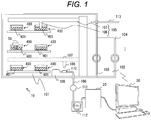
- Fig. 1 is a diagram showing the configuration of a cell culture system 1 according to a first embodiment.
- the cell culture system 1 includes an isolator 10, a measuring device 20, and a control device 30.
- the isolator 10 includes a sterile chamber 101 and a pass box 102.
- the isolator 10 is one embodiment of a culture vessel housing chamber (an environment for housing a cell culture vessel having a culture solution containing cells to be cultured placed therein).
- the sterile chamber 101 is controlled so that the internal space thereof becomes a sterile space maintained at a sterile level suitable for culture.
- the sterile space (that is, the inside of the sterile chamber 101) becomes a cell culture environment.
- the sterile chamber 101 and the pass box 102 are openably and closably separated from each other with an opening and closing door 103.
- the pass box 102 is openably and closably separated from the internal space of the sterile chamber 101, and also openably and closably separated from the external space (a non-sterile space) with an opening and closing door 104.
- the isolator 10 may have another arbitrary configuration as long as it is configured such that the sterile chamber 101 is separated from the outside with the opening and closing door 103.
- a plurality of cell culture vessels 400 each having a culture solution 401 placed therein are housed.
- the culture solution 401 cells to be cultured are contained.
- a sampling unit 105 for sampling the culture solution 401 in each cell culture vessel 400 is provided.
- the sampling unit 105 includes an injection port 106 which sucks and discharges the culture solution 401 of the cell culture vessel 400 to be sampled, and a conveying device 107 which conveys the injection port 106.
- a sensing unit 50 which will be described later with reference to Fig. 2 measures the state of the cell culture vessel 400 (the hydrogen-ion exponent (pH), the temperature, the carbon dioxide concentration, and the turbidity of the culture solution 401, etc.). Incidentally, an arbitrary number of sensing units 50 may be provided in the isolator 10.
- the internal space of the sterile chamber 101 communicates with the outside through a delivery channel 108.
- the material of the delivery channel 108 is a material with extremely low reactivity with the chemical agent.
- the delivery channel 108 is connected to a buffer substance supply section 109 provided in the culture environment for supplying a buffer substance to the delivery channel 108.
- a discharge section 110 whose upper side is open is provided in the vicinity of an end portion in the sterile chamber 101 of the delivery channel 108.
- an end portion on the external space side of the delivery channel 108 is connected to the measuring device 20.
- a one-way valve 111 and a peristaltic pump 112 are provided in this order from the side closer to the sterile chamber 101.
- the peristaltic pump 112 another embodiment may be adopted as long as it can suck the culture solution 401.
- the one-way valve 111 is a backflow prevention valve which blocks only the flow from the external space to the sterile chamber 101.
- the peristaltic pump 112 allows a fluid flowing in the delivery channel 108 from the inside of the sterile chamber 101 to flow to the measuring device 20 side.
- a carbon dioxide supply channel 113 continuously supplies carbon dioxide gas so that the culture environment (the internal space of the sterile chamber 101) has a constant carbon dioxide concentration (for example, 5%).
- the isolator 10 includes an air conditioner to be used for keeping the inside of the isolator 10 at a temperature suitable for cell culture.
- the air conditioner performs temperature control (control of blowing hot air or cold air according to the temperature inside the isolator 10 detected by a temperature sensor) so that the temperature in the isolator 10 is comparable to human body temperature (35 to 37°C).
- the air conditioner may be configured so that it can be controlled wirelessly from the outside of the isolator 10.
- the measuring device 20 performs various measurements with respect to a fluid (the below-mentioned sampled culture solution) flowing from the delivery channel 108, and inputs the measurement results to the control device 30.
- the measuring device 20 measures, for example, the pH, the dissolved oxygen concentration, the glucose content, etc. of the sampled culture solution.
- the control device 30 is constituted by a device body, various input devices (a key board, a mouse, etc.), a display, etc.
- the control device 30 displays the measurement results input from the measuring device 20 or information such as setting of the measuring device 20 on the display. Further, the control device 30 receives an instruction of setting change or the like through the input device and outputs the instruction to the measuring device 20.
- control device 30 operates as one embodiment of a cell culture environment evaluation device which receives the measurement results (pH, carbon dioxide concentration, temperature, turbidity, etc.) showing the state in the sterile chamber 101 (culture environment) from the below-mentioned sensing unit 50, and evaluates the state of the culture environment.
- the details of the evaluation of the culture environment by the control device 30 will be described later with reference to Figs. 4A to 8 .
- the control device 30 gives a notification by an arbitrary method when an abnormality in the culture environment is detected by the below-mentioned evaluation system shown in Figs. 4A to 8 .
- the control device 30 may output an alarm sound through a speaker or may display an alarm message indicating that an abnormality occurs on the display.
- the control device 30 may change the notification method according to the type of detected abnormality (supply shortage of carbon dioxide gas, contamination, opening and closing of the opening and closing door 103, etc.) . That is, the control device 30 may change the type of notification sound according to the type of abnormality, and may change the alarm message (for example, the type of abnormality may be displayed on the display).
- control device 30 may give a notification by illuminating a built-in indicator or an indicator provided in a communicable manner, or the like.
- the control device 30 can also give a notification of the occurrence of an abnormality in the culture environment by email.
- a buffer substance is allowed to continuously flow through the delivery channel 108 from the buffer substance supply section 109.
- the buffer substance to be supplied from the buffer substance supply section 109 is preferably, for example, a liquid such as pure water subjected to a sterilization treatment or a gas subjected to a sterilization treatment.
- the injection port 106 is conveyed by the conveying device 107 to the cell culture vessel 400 to be sampled, and sucks the culture solution 401 in the cell culture vessel 400 by the injection port 106.
- the injection port 106 after completion of suction is conveyed immediately above the discharge section 110 by the conveying device 107.
- the injection port 106 discharges the sucked culture solution 401 toward the discharge section 110.
- the culture solution 401 (hereinafter referred to as "sampled culture solution”) discharged to the discharge section 110 here is delivered to the outside of the sterile chamber 101 by the buffer substance continuously flowing in the delivery channel 108. Then, the sampled culture solution is supplied to the measuring device 20 through the one-way valve 111 and the peristaltic pump 112.
- the measuring device 20 and the control device 30 are described as separate devices, however, the configuration is not necessarily limited thereto. That is, a configuration in which the control device 30 is connected to the delivery channel 108 and performs various measurements (the pH, the dissolved oxygen concentration, the glucose content, etc. of the sampled culture solution) to be performed by the measuring device 20 may be adopted.
- Fig. 2 is a conceptual view showing a configuration example of the sensing unit 50 which measures the culture environment (the internal space of the sterile chamber 101).
- the sensing unit 50 is a device which measures the state of the culture environment and transmits the measurement result of the culture environment to the outside of the isolator 10 (control device 30).
- the sensing unit 50 shown in Fig. 2 includes a pH/turbidity sensor 501, a carbon dioxide sensor 502, a temperature sensor 503, and a device body 504.
- the pH/turbidity sensor 501 is a sensor which measures the pH and the turbidity of the culture solution 401.
- the pH/turbidity sensor 501 performs general pH measurement, and at this time, also measures the turbidity.
- the pH/turbidity sensor 501 continuously measures the pH and the turbidity, and transmits the measurement results to the device body 504.
- the carbon dioxide sensor 502 measures the carbon dioxide concentration in the environment (in the example shown in Fig. 2 , in the culture solution 401) where the cell culture vessel 400 is placed.
- the carbon dioxide sensor 502 may be a general carbon dioxide measuring device (for example, a measuring device based on an infrared absorbance).
- the carbon dioxide sensor 502 measures the carbon dioxide concentration in the environment where the cell culture vessel 400 is placed, and transmits the measurement result to the device body 504.
- the temperature sensor 503 measures the temperature in the environment (in the example shown in Fig. 2 , in the culture solution 401) where the cell culture vessel 400 is placed.
- the temperature sensor 503 may be a general sensor for temperature measurement.
- the device body 504 receives the measurement results from the respective sensors (the pH/turbidity sensor 501, the carbon dioxide sensor 502, and the temperature sensor 503).
- the device body 504 has a wireless communication function and transmits the respective measurement results to the control device 30 through the wireless communication function.
- the carbon dioxide sensor 502 may not necessarily be configured to measure the carbon dioxide concentration of the culture solution 401, and may be any as long as it measures the carbon dioxide concentration in an arbitrary place in the culture environment (that is, in the sterile chamber 101).
- the carbon dioxide sensor 502 is configured to have a wireless communication function, and may be a separate housing from the pH/turbidity sensor 501 or the temperature sensor 503.
- the carbon dioxide sensor 502 may be configured such that only one carbon dioxide sensor 502 is provided in the sterile chamber 101 and transmits the measurement result of the carbon dioxide concentration to the control device 30 through a built-in wireless communication function.
- the temperature sensor 503 may not necessarily be configured to measure the temperature of the culture solution 401, and may be any as long as it measures the temperature in an arbitrary place in the culture environment (that is, in the sterile chamber 101).
- the temperature sensor 503 is configured to have a wireless communication function, and may be a separate housing from the pH/turbidity sensor 501 or the carbon dioxide sensor 502. Further, the temperature sensor 503 may be configured such that only one temperature sensor 503 is provided in the sterile chamber 101 and transmits the measurement result of the temperature to the control device 30 through a built-in wireless communication function.
- the sensing unit 50 may be configured to measure only necessary parameters according to the purpose of evaluation of the culture environment by the control device 30. That is, the sensing unit 50 may be configured to measure at least one of the pH of the culture solution 401, the carbon dioxide concentration in the sterile chamber 101, the temperature in the sterile chamber 101, and the turbidity of the culture solution 401. Further, the number of housings may be an arbitrary number.
- the sensing unit 50 may be configured to be connected to the control device 30 through a wire and transmit the measurement results thereto on condition that sterility is guaranteed.
- the sensing unit 50 has a wireless communication function because the sterility is easily guaranteed and also the device configuration is simplified.
- the sensing unit 50 may be any as long as it measures the state of the culture environment (for example, at least one of the pH of the culture solution 401, the carbon dioxide concentration in the sterile chamber 101, the temperature in the sterile chamber 101, and the turbidity of the culture solution 401) and transmits the measurement result to the control device 30 regardless of wired or wireless connection.
- the sensing unit 50 may also be configured to measure another parameter which indicates the state of the culture environment without limiting to the above parameters (pH, carbon dioxide concentration, temperature, and turbidity).
- the control device 30 receives the measurement results of the state of the culture environment from the sensing unit 50.
- the control device 30 evaluates the state in the culture environment (the internal space of the sterile chamber 101) based on the change in the measurement results over time.
- the evaluation as used herein refers to a concept not only including detection of an abnormality in the culture environment, but also including determination as to what state the culture environment is (for example, whether the state is a state immediately after cell seeding) even if the culture environment is in a normal state, or the like.
- control device 30 is configured to include a receiving unit which receives the state of the culture environment from the sensing unit 50, an evaluation unit which performs the below-mentioned evaluation of the culture environment based on the measurement result, and the like.
- a receiving unit which receives the state of the culture environment from the sensing unit 50
- an evaluation unit which performs the below-mentioned evaluation of the culture environment based on the measurement result, and the like.
- a factor which changes the pH of the culture solution 401 will be described.
- Fig. 3A the relationship between each event (change factor) and a change in the pH is shown.
- Lactic acid shows a chemical reaction represented by the following formula (1) in the culture solution 401. Therefore, as the generation of lactic acid proceeds, acidification of the culture solution 401 is caused. In other words, the pH of the culture solution 401 decreases.
- the carbon dioxide concentration in the sterile chamber 101 is maintained at a constant value (for example, 5%).
- the carbon dioxide concentration in the sterile chamber 101 decreases. Due to this, the amount of carbon dioxide to be dissolved in the culture medium also decreases, and alkalinization of the culture solution 401 proceeds (in other words, the pH increases).
- a factor which changes the internal temperature of the sterile chamber 101 will be described.
- the internal temperature of the sterile chamber 101 is adjusted to be comparable to human body temperature (35 to 37°C) by the air conditioner. Further, the temperature outside the sterile chamber 101 is maintained at usual room temperature (for example, about 20°C). Therefore, when the opening and closing of the opening and closing door 103 occurs, air (35 to 37°C) in the sterile chamber 101 flows out to the space outside the sterile chamber 101 (the space maintained at room temperature of about 20°C in general). Due to this, the internal temperature of the isolator 10 decreases.
- a factor which changes the carbon dioxide concentration in the sterile chamber 101 will be described.
- Fig. 3C the relationship between each event (change factor) and a change in the carbon dioxide concentration is shown.
- the inside of the sterile chamber 101 is maintained in a state where the carbon dioxide concentration is high (for example, about 5% which is comparable to a human arterial blood carbon dioxide partial pressure) by the gas supply from the carbon dioxide supply channel 113.
- the carbon dioxide concentration outside the sterile chamber 101 is about 0.03% in the same manner as air.
- the opening and closing of the opening and closing door 103 occurs, the gas having a high carbon dioxide concentration flows outside the sterile chamber 101. Due to this, the carbon dioxide concentration inside the sterile chamber 101 decreases.
- an abnormality in the supply of carbon dioxide gas from the carbon dioxide supply channel 113 supply shortage
- the carbon dioxide concentration inside the sterile chamber 101 decreases.
- the culture solution 401 becomes in a turbid state.
- the cells or contaminants precipitate, and therefore, the turbidity of the culture solution 401 decreases.
- evaluation of the culture environment is performed by focusing on the change in the pH of the culture environment (culture solution 401) over time (the amount of change in a unit time).
- the evaluation method is shown in Fig. 4A .
- the control device 30 receives the measured value of the pH one after another. Then, the control device 30 performs evaluation based on the change in the pH over time (the amount of change in a unit time). To be more specific, in a case where the pH has increased by more than the threshold value in a unit time (for example, in a case where the pH has increased by more than 0.10 in 1 hour), the control device 30 determines that an abnormality in the gas state (the state of carbon dioxide gas) in the culture environment has occurred. To be more specific, the control device 30 determines that the opening and closing of the opening and closing door 103 or an abnormality in the gas supply (the supply of carbon dioxide gas from the carbon dioxide supply channel 113) has occurred.
- the control device 30 determines that the opening and closing of the opening and closing door 103 or an abnormality in the gas supply (the supply of carbon dioxide gas from the carbon dioxide supply channel 113) has occurred.
- the control device 30 determines that contamination has occurred in the culture solution 401. Further, in a case where the pH has decreased, although not rapidly, in a unit time (for example, in a case where the pH has decreased by only 0.00 to 0.05 in 5 hours), the control device 30 determines that the state is a state where appropriate cell culture is performed and lactic acid is generated.
- control device 30 detects an abnormality in the gas state or contamination based on the change in the pH of the culture environment (culture solution 401) over time (the amount of change in a unit time).
- evaluation of the culture environment is performed by focusing on the change in the temperature of the culture environment over time (the amount of change in a unit time).
- the evaluation method is shown in Fig. 4B .
- the control device 30 receives the measured value of the temperature of the culture environment one after another. Then, the control device 30 performs evaluation based on the change in the temperature over time (the amount of change in a unit time). To be more specific, in a case where the temperature has decreased by more than a given value in a unit time (for example, in a case where the temperature has decreased by more than 1.0°C in 1 minute), the control device 30 determines that the opening and closing of the opening and closing door 103 has occurred.
- control device 30 detects whether or not the opening and closing of the opening and closing door 103 has occurred (an abnormality in the opening and closing of the opening and closing door 103) based on the change in the temperature of the culture environment (in the sterile chamber 101) over time (the amount of change in a unit time).
- evaluation of the culture environment is performed by focusing on the carbon dioxide concentration in the culture environment.
- the evaluation method is shown in Fig. 4C .
- the control device 30 receives the measured value of the carbon dioxide concentration in the culture environment one after another. Then, the control device 30 performs evaluation of the culture environment based on the change in the carbon dioxide concentration over time (the amount of change in a unit time). To be more specific, in a case where the carbon dioxide concentration has decreased by more than a given value in a unit time (for example, in a case where the carbon dioxide concentration has decreased by more than 0.1% in 1 minute), the control device 30 determines that an abnormality in the gas state in the culture environment has occurred. To be more specific, the control device 30 determines that the opening and closing of the opening and closing door 103 has occurred or an abnormality in the gas supply (the supply of carbon dioxide gas from the carbon dioxide supply channel 113) has occurred.
- the control device 30 determines that the opening and closing of the opening and closing door 103 or an abnormality in the gas supply does not occur.
- control device 30 detects an abnormality in the gas state in the culture environment based on the change in the carbon dioxide concentration in the culture environment (in the sterile chamber 101) over time.
- a fourth evaluation method an abnormality is detected by focusing on the turbidity of the culture environment (culture solution 401). Incidentally, the evaluation method is also shown in Fig. 5A .
- the control device 30 receives the measured value of the turbidity of the culture solution 401 one after another. Then, the control device 30 performs evaluation of the culture environment based on the change in the turbidity over time (the amount of change in a unit time). To be more specific, in a case where the turbidity has rapidly increased in a unit time (which is a case where the turbidity has increased by more than the threshold value which can be regarded as a rapid increase in a unit time, and for example, in a case where the turbidity has increased by more than 20% in 6 hours), the control device 30 determines that contamination has occurred.
- the control device 30 determines that the state is a state immediately after cell seeding (determines that the state is not an abnormal state such as contamination).
- the control device 30 determines that contamination or cell seeding does not occur.
- control device 30 determines whether or not contamination or cell seeding occurs based on the change in the turbidity in the culture environment (in the sterile chamber 101) over time (the amount of change in a unit time).
- an abnormality in the culture environment (the internal space of the sterile chamber 101) is detected using a single parameter (one of pH, temperature, carbon dioxide concentration, and turbidity), however, in the following fifth to seventh evaluation methods, an abnormality in the culture environment or the state thereof is detected in more detail using two parameters.
- evaluation of the culture environment is performed by focusing on both the pH and the temperature of the culture environment.
- the evaluation method is shown in Fig. 5B .
- the control device 30 receives the measured value of the pH of the culture environment (culture solution 401) and the measured value of the temperature of the culture environment. Then, the control device 30 detects an abnormality in the gas state (the opening and closing of the opening and closing door 103 or an abnormality in the gas supply) and contamination based on the change in the pH over time (the amount of change in a unit time) in the same manner as the above-mentioned first evaluation method.
- an abnormality in the gas state the opening and closing of the opening and closing door 103 or an abnormality in the gas supply
- contamination based on the change in the pH over time (the amount of change in a unit time) in the same manner as the above-mentioned first evaluation method.
- the control device 30 In a case where an abnormality in the gas state (the opening and closing of the opening and closing door 103 or an abnormality in the gas supply) is detected here, the control device 30 focuses on the change in the temperature in the culture environment. In a case where the temperature has decreased by more than a given value in a unit time, the control device 30 determines that the opening and closing of the opening and closing door 103 has occurred in the same manner as the above-mentioned second evaluation method. On the other hand, in a case where the amount of change in the temperature is within a given range in a unit time, the control device 30 determines that an abnormality in the supply of carbon dioxide gas has occurred.
- control device 30 can also distinguish between the opening and closing of the opening and closing door 103 and the abnormality in the supply of carbon dioxide gas by referring also to the temperature in addition to the pH.
- an abnormality is detected by focusing on both the pH and the turbidity of the culture environment.
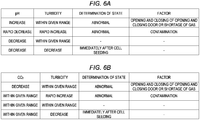
- the evaluation method is also shown in Fig. 6A .
- the control device 30 receives the measured value of the pH of the culture environment (culture solution 401) and the measured value of the turbidity of the culture environment (culture solution 401). Then, the control device 30 detects an abnormality in the gas state (the opening and closing of the opening and closing door 103 or the shortage of the gas) and contamination based on the change in the pH over time (the amount of change in a unit time) in the same manner as the above-mentioned first evaluation method.
- the control device 30 focuses on the amount of change in the turbidity in a unit time. In a case where the turbidity has decreased by more than a given value in a unit time (for example, in a case where the turbidity has decreased by more than 10% in 1 hour), the control device 30 determines that the state is a state immediately after cell seeding. On the other hand, in a case where the amount of change in the turbidity in a unit time is within a given range, the control device 30 determines that the state is not a state immediately after cell seeding.
- control device 30 can also determine whether or not the state is a state immediately after cell seeding in addition to the detection by the first evaluation method by also using the turbidity in addition to the pH.
- a seventh evaluation method evaluation of the culture environment is performed by focusing on both the carbon dioxide concentration and the turbidity of the culture environment.
- the evaluation method is shown in Fig. 6B .
- the control device 30 receives the measured value of the carbon dioxide concentration in the culture environment (culture solution 401) and the measured value of the turbidity of the culture environment (culture solution 401). Then, the control device 30 detects the occurrence of contamination or cell seeding based on the change in the turbidity over time (the amount of change in a unit time) in the same manner as the above-mentioned fourth evaluation method.
- the control device 30 determines that an abnormality in the gas state (the opening and closing of the opening and closing door 103 or the shortage of the gas) has occurred.
- control device 30 can also determine whether or not an abnormality in the gas state has occurred in addition to the detection by the fourth evaluation method by also using the carbon dioxide concentration in addition to the turbidity.
- control device 30 performs evaluation of the culture environment using two parameters.
- control device 30 may perform a similar determination using a combination of two parameters different from the fifth to seventh evaluation methods.
- evaluation of the culture environment is performed using three parameters.
- evaluation of the culture environment is performed by focusing on the following three parameters: pH, temperature, and turbidity.
- the evaluation method is shown in Fig. 7 .
- the control device 30 receives the measured value of the pH in the culture environment (culture solution 401), the measured value of the temperature of the culture environment, and the measured value of the turbidity of the culture environment. Then, the control device 30 detects an abnormality in the gas state (the opening and closing of the opening and closing door 103 or the shortage of the gas) and contamination based on the change in the pH over time (the amount of change in a unit time) in the same manner as the above-mentioned first evaluation method.
- an abnormality in the gas state the opening and closing of the opening and closing door 103 or the shortage of the gas
- contamination based on the change in the pH over time (the amount of change in a unit time) in the same manner as the above-mentioned first evaluation method.
- the control device 30 determines whether or not the temperature has decreased by more than a given value in a unit time. In a case where the temperature has decreased by more than a given value, the control device 30 determines that the abnormality in the gas state is attributed to the opening and closing of the opening and closing door 103. In a case where the amount of change in the temperature per unit time is within a given range, the control device 30 determines that the abnormality in the gas state is attributed to the supply of carbon dioxide gas from the carbon dioxide supply channel 113.
- the control device 30 focuses on the change in the turbidity in a unit time. In a case where the turbidity has decreased by more than a given value in a unit time (for example, in a case where the turbidity has decreased by more than 10% in 1 hour), the control device 30 determines that the state is a state immediately after cell seeding. On the other hand, in a case where the amount of change in the turbidity in a unit time is within a given range, the control device 30 determines that the state is not a state immediately after cell seeding.
- the control device 30 can accurately distinguish among the following three abnormalities: an abnormality in the gas supply, the opening and closing of the opening and closing door 103, and contamination, and also can distinguish whether or not the normal state is a state immediately after cell seeding by focusing on the following three parameters : pH, temperature, and turbidity.
- control device 30 may detect an abnormality in the gas state (the opening and closing of the opening and closing door 103 or an abnormality in the gas supply) by focusing not on the pH, but on the carbon dioxide concentration.
- the control device 30 can accurately distinguish among the following three abnormalities: an abnormality in the gas supply, the opening and closing of the opening and closing door 103, and contamination, and also can distinguish whether or not the normal state is a state immediately after cell seeding by focusing on the following four parameters: pH, temperature, carbon dioxide concentration, and turbidity. Further, the control device 30 can detect an abnormality in the gas state (the opening and closing of the opening and closing door 103 or an abnormality in the gas supply) in consideration of both the pH and the carbon dioxide concentration, and therefore can detect an abnormality more accurately.
- control device 30 may also perform evaluation using a parameter (for example, the dissolved oxygen concentration or the glucose content in the culture solution 401, etc.) which indicates the state of the culture environment other than these.
- a parameter for example, the dissolved oxygen concentration or the glucose content in the culture solution 401, etc.
- the control device 30 desirably performs the above-mentioned evaluation at all times (that is, at all times while performing culture). According to this, it is possible to immediately detect the occurrence of an abnormality, and thus, it is possible to promptly take appropriate measures.
- the control device 30 may perform evaluation of the culture environment spottedly (in other words intermittently). Even if the evaluation is performed intermittently, the evaluation of the culture environment can be performed without taking out the culture vessel 400.
- the sensing unit 50 measures the state (pH, temperature, carbon dioxide concentration, turbidity, etc.) of the culture environment in the isolator 10 (the inside of the sterile chamber 101) and transmits the measurement result to the control device 30.
- the control device 30 performs evaluation of the culture environment (in the sterile chamber 101) based on the measurement result. That is, the control device 30 can perform evaluation in the culture environment without taking out the cell culture vessel 400 from the isolator 10. According to this, the cell culture system 1 can perform evaluation in the culture environment without applying a stress to the cells during culture.
- the control device 30 may give an arbitrary notification (a notification by sound, display, email, or the like) when an abnormality in the culture environment is detected by the above-mentioned evaluation. According to this, an operator or a manager of the cell culture can recognize the occurrence of an abnormality in the culture environment, and can promptly take appropriate measures.
- control device 30 may change the notification method according to the type of detected abnormality. According to this, an operator or a manager of the cell culture can immediately ascertain also the type of abnormality, and therefore can more promptly take appropriate measures.
- control device 30 performs evaluation using the parameters (pH, temperature, carbon dioxide concentration, turbidity, etc.) strongly associated with the state of the culture environment, and therefore can appropriately evaluate the state of the culture environment.
- the control device 30 performs evaluation of the culture environment based on the change in the measurement result (pH, temperature, carbon dioxide concentration, turbidity, etc.) over time (the amount of change in a unit time). According to this, it becomes possible to detect an abnormality in consideration of the trend of change in the state in the culture environment. Incidentally, the control device 30 not only detects an abnormal state, but also may detect the deterioration of the culture environment, which cannot be said to be an abnormality, together when performing evaluation based on the change in the measurement result over time as described above.
- the control device 30 determines that the state of the culture environment is deteriorated, although the state is not abnormal, and may output an alarm to indicate such a state. According to this, it is possible to take appropriate measures not only in a case where an abnormality occurs in the culture environment, but also before an abnormality occurs.
- the control device 30 may perform evaluation of the culture environment by comparison of the measurement result with a predetermined threshold value. For example, the control device 30 may evaluate that an abnormality occurs in the culture environment when the pH is 7.5 or more or 7 or less.
- the control device 30 may give a notification (for example, output an alarm sound) to call attention when the measurement result deviates from a predetermined threshold value. For example, by outputting an alarm when the pH is 7 or less due to the metabolic activity of cells, an operator is prompted to replace the culture solution 401 in the cell culture vessel 400, and therefore, the slow-down of the culture speed or the like can be avoided.
- the threshold value to be compared may be provided by being divided in several levels. For example, when the pH is 7.5 or more or 7 or less, the control device 30 may determine that an abnormality occurs in the culture environment, and when the pH is between 7.2 and 7, the control device 30 may determine that an abnormality does not occur, but the culture environment is being deteriorated. When an abnormality or a deterioration in the culture environment is detected, the control device 30 may output an alarm according to the detected level (an abnormality or a deterioration, although not an abnormality). According to this, it is possible to take appropriate measures not only in a case where an abnormality occurs in the culture environment, but also before an abnormality occurs.
- a structure of automatically replacing the culture solution 401 in the cell culture vessel 400 by some kind of method in a case where the control device 30 detects an abnormality or a deterioration in the culture environment may be provided.
- the control device 30 may give a notification not only by alarm, but also by email, display on a display, or the like. That is, the control device 30 may be any as long as it performs evaluation of the culture environment based on the measurement result of the culture environment.
- control device 30 may receive an input of various index values to be used for evaluation (detection of an abnormality or the like) from an operator or a manager (user) of the cell culture.
- the control device 30 may perform evaluation of the culture environment by comparison of the various index values with the measurement result. For example, an operator or a manager sets the abnormal value of the pH (for example, the pH is 7.5 or more) described above, or the decreasing rate of the pH (for example, the pH decreases by more than 0.1 per 2 hours) or the increasing rate of the turbidity (for example, the turbidity increases by more than 0.2% per 6 hours) for determining contamination.
- the control device 30 may determine the culture environment according to the set value. According to this, appropriate detection of an abnormality according to the type of cells, the purpose of culture, or the like can be realized.
- control device 30 may perform evaluation of the culture environment using a default index value.
- the control device 30 performs evaluation of the culture environment by performing the above-mentioned evaluation. Even in a case where the culture environment is normal, the control device 30 records the contents of the evaluation as appropriate. For example, the control device 30 writes the evaluation result in a data base or a log file on a file system as appropriate. The user can confirm that the culture state was normal by referring to this record (data in the data base or the log file). That is, the control device 30 may provide the above-mentioned evaluation result as an index for the validation of the culture environment.
- Fig. 9 is a conceptual view showing the configuration of the cell culture system 1 including an incubator 60 in place of the isolator 10.
- the incubator 60 is one embodiment of the culture vessel housing chamber (the culture environment for housing the cell culture vessel having a culture solution containing cells to be cultured placed therein).
- the incubator 60 is a space in which the cell culture vessel 400 containing the culture solution 401 is housed in the same manner as the above-mentioned isolator 10.
- An operator or a manager (user) of the cell culture opens an opening and closing door 601, takes out the cell culture vessel 400, and performs sampling or the like.
- the incubator 60 has a size such that a person can enter, a user may enter inside the incubator 60 and perform an operation. Also in the environment, a change in the temperature, contamination, a change in the pH, or the like can occur due to the opening and closing of the opening and closing door 601.
- the sensing unit 50 measures the state of the culture environment and transmits the measurement result to the control device 30 in the same manner as the configuration shown in Fig. 1 .
- the control device 30 performs evaluation of the culture environment (the inside of the incubator 60) using the above-mentioned evaluation methods (for example, Figs. 4A to 8 ).
- the isolator 10 shown in Fig. 1 or the incubator 60 shown in Fig. 9 is only an example of the culture vessel housing chamber, and the shape or the like (for example, the size, the number of opening and closing doors, the position of the opening and closing door, etc.) thereof may be arbitrary as long as it can house the cell culture vessel 400 and provide the culture environment. Further, the internal configuration of the sensing unit 50, the number of housings, and the data transmission system (wired or wireless) may be arbitrary.
- control device 30 A part or the entire of the above-mentioned processing of the control device 30 (to be more specific, the data reception of the measurement result from the sensing unit 50 and the evaluation processing of the culture environment described above) can be realized as a computer program which operates within the control device 30.
- the control device 30 is one embodiment of a computer including a CPU (Central Processing Unit), a hard disk, etc.
- the computer program is stored using various types of non-transitory computer readable media and can be supplied to the computer.
- the non-transitory computer readable media include various types of tangible storage media. Examples of the non-transitory computer readable media include magnetic recording media (for example, flexible disks, magnetic tapes, and hard disk drives), magneto-optical recording media (for example, magneto-optical disks), CD-ROM (Read Only Memory), CD-R, CD-R/W, semiconductor memories (for example, mask ROM, PROM (Programmable ROM), EPROM (Erasable PROM), flash ROM, and RAM (random access memory)).
- the program may be supplied to the computer by various types of transitory computer readable media. Examples of the transitory computer readable media include electrical signals, optical signals, and electromagnetic waves.
- the transitory computer readable media can supply the program to the computer through a wired communication channel such as an electric wire or an optical fiber, or a wireless communication channel.
Landscapes
- Chemical & Material Sciences (AREA)
- Engineering & Computer Science (AREA)
- Health & Medical Sciences (AREA)
- Life Sciences & Earth Sciences (AREA)
- Wood Science & Technology (AREA)
- Organic Chemistry (AREA)
- Bioinformatics & Cheminformatics (AREA)
- Zoology (AREA)
- Analytical Chemistry (AREA)
- Microbiology (AREA)
- General Health & Medical Sciences (AREA)
- Sustainable Development (AREA)
- Biotechnology (AREA)
- Biomedical Technology (AREA)
- Biochemistry (AREA)
- General Engineering & Computer Science (AREA)
- Genetics & Genomics (AREA)
- Physics & Mathematics (AREA)
- Thermal Sciences (AREA)
- Computer Hardware Design (AREA)
- Molecular Biology (AREA)
- Apparatus Associated With Microorganisms And Enzymes (AREA)
- Measuring Or Testing Involving Enzymes Or Micro-Organisms (AREA)
Abstract
Description
- The present invention relates to a cell culture system, a cell culture environment evaluation device, and a program.
- In the field of regenerative medicine, artificial fertilization, or the like, there have been proposed various culture devices and sampling devices to be used for culture or sampling of cells (
WO 2003/104386 (Patent Document 1),JP-A-2009-180594 JP-A-2012-200239 - In a cell culture device (or a sampling device), in order to maintain the inside of the culture environment in a sterile state, it is necessary to isolate the culture environment from the outside. For example, Patent Document 3 discloses a configuration for preventing contamination of a sterile space when performing sampling. A cell culture device described in Patent Document 3 includes an isolator provided with a sterile space for housing a cell culture vessel containing a culture solution, a sampling unit for sampling the culture solution, and a delivery channel for making the inside and the outside of the sterile space communicate with each other. Then, the cell culture device includes a culture solution delivery section for delivering the culture solution to the outside of the sterile space while limiting the direction of the flow in the delivery channel to the direction from the inside to the outside of the sterile space. According to the configuration, a contaminant generated in a non-sterile space can be prevented from penetrating into the sterile space, and a safe cell culture environment can be realized.
- As described above, in a cell culture device (or a sampling device), it is important to maintain the inside of the culture environment in a sterile state. Due to this, it was necessary to monitor whether or not an abnormality occurs in the sterile space in which a cell culture vessel is placed. Then, in a general monitoring method, it was necessary to detect an abnormality by taking out the cell culture vessel from the sterile space and confirming the color of the culture medium or observing the state of cells using a microscope.
- However, in the above-mentioned monitoring method, the cell culture vessel is placed in the external environment when it is taken out from the sterile space, and therefore, a large stress is applied to the cells, and therefore, there is a fear that an adverse effect on the cell culture is caused. Further, there is also a fear that the sterility of the sterile space is impaired.
- One aspect of a cell culture system according to the invention includes:
- a culture vessel housing chamber which is provided with a culture environment for housing a cell culture vessel having a culture solution containing cells to be cultured placed therein;
- a sensing unit which measures the state of the culture environment and transmits the measurement result of the culture environment to the outside of the culture vessel housing chamber; and
- a control device which receives the measurement result and performs evaluation in the culture environment based on the measurement result.
- As described above, the sensing unit measures the state of the culture environment in the culture vessel housing chamber and transmits the measurement result. The control device performs evaluation of the culture environment based on the measurement result. That is, the control device can perform evaluation in the culture environment without taking out the cell culture vessel from the culture vessel housing chamber. According to this, the cell culture system can perform evaluation in the culture environment without applying a stress to the cells during culture.
- The invention can provide a cell culture system, a cell culture environment evaluation device, and a program, capable of performing evaluation of a culture environment without causing an adverse effect on cell culture.
-
-
Fig. 1 is a block diagram showing the configuration of acell culture system 1 according to a first embodiment. -
Fig. 2 is a conceptual view showing a configuration example of asensing unit 50 according to the first embodiment. -
Figs. 3A to 3D are views showing the relationship between a parameter and a change factor in a sterile space. -
Figs. 4A to 4C are views showing an evaluation method of acontrol device 30 according to the first embodiment. -
Figs. 5A and 5B are views showing an evaluation method of thecontrol device 30 according to the first embodiment. -
Figs. 6A and 6B are views showing an evaluation method of thecontrol device 30 according to the first embodiment. -
Fig. 7 is a view showing an evaluation method of thecontrol device 30 according to the first embodiment. -
Fig. 8 is a view showing an evaluation method of thecontrol device 30 according to the first embodiment. -
Fig. 9 is a conceptual view showing the configuration of thecell culture system 1 including anincubator 60 in place of anisolator 10. - Hereinafter, embodiments of the invention will be described with reference to the drawings.
Fig. 1 is a diagram showing the configuration of acell culture system 1 according to a first embodiment. Thecell culture system 1 includes anisolator 10, ameasuring device 20, and acontrol device 30. - The
isolator 10 includes asterile chamber 101 and apass box 102. Theisolator 10 is one embodiment of a culture vessel housing chamber (an environment for housing a cell culture vessel having a culture solution containing cells to be cultured placed therein). Thesterile chamber 101 is controlled so that the internal space thereof becomes a sterile space maintained at a sterile level suitable for culture. The sterile space (that is, the inside of the sterile chamber 101) becomes a cell culture environment. Thesterile chamber 101 and thepass box 102 are openably and closably separated from each other with an opening and closingdoor 103. Thepass box 102 is openably and closably separated from the internal space of thesterile chamber 101, and also openably and closably separated from the external space (a non-sterile space) with an opening and closingdoor 104. Incidentally, theisolator 10 may have another arbitrary configuration as long as it is configured such that thesterile chamber 101 is separated from the outside with the opening and closingdoor 103. - In the internal space of the
sterile chamber 101, a plurality ofcell culture vessels 400 each having aculture solution 401 placed therein are housed. In theculture solution 401, cells to be cultured are contained. Further, in the internal space of thesterile chamber 101, asampling unit 105 for sampling theculture solution 401 in eachcell culture vessel 400 is provided. Thesampling unit 105 includes aninjection port 106 which sucks and discharges theculture solution 401 of thecell culture vessel 400 to be sampled, and aconveying device 107 which conveys theinjection port 106. - A
sensing unit 50 which will be described later with reference toFig. 2 measures the state of the cell culture vessel 400 (the hydrogen-ion exponent (pH), the temperature, the carbon dioxide concentration, and the turbidity of theculture solution 401, etc.). Incidentally, an arbitrary number ofsensing units 50 may be provided in theisolator 10. - The internal space of the
sterile chamber 101 communicates with the outside through adelivery channel 108. Incidentally, when the inside of thesterile chamber 101 is sterilized with a chemical agent, the material of thedelivery channel 108 is a material with extremely low reactivity with the chemical agent. - The
delivery channel 108 is connected to a buffersubstance supply section 109 provided in the culture environment for supplying a buffer substance to thedelivery channel 108. In the vicinity of an end portion in thesterile chamber 101 of thedelivery channel 108, adischarge section 110 whose upper side is open is provided. On the other hand, an end portion on the external space side of thedelivery channel 108 is connected to themeasuring device 20. Further, on the channel on the external space side of thedelivery channel 108, a one-way valve 111 and aperistaltic pump 112 are provided in this order from the side closer to thesterile chamber 101. Incidentally, as theperistaltic pump 112, another embodiment may be adopted as long as it can suck theculture solution 401. - The one-
way valve 111 is a backflow prevention valve which blocks only the flow from the external space to thesterile chamber 101. Theperistaltic pump 112 allows a fluid flowing in thedelivery channel 108 from the inside of thesterile chamber 101 to flow to themeasuring device 20 side. - A carbon
dioxide supply channel 113 continuously supplies carbon dioxide gas so that the culture environment (the internal space of the sterile chamber 101) has a constant carbon dioxide concentration (for example, 5%). - Although not shown in the drawing, the
isolator 10 includes an air conditioner to be used for keeping the inside of theisolator 10 at a temperature suitable for cell culture. The air conditioner performs temperature control (control of blowing hot air or cold air according to the temperature inside theisolator 10 detected by a temperature sensor) so that the temperature in theisolator 10 is comparable to human body temperature (35 to 37°C). Incidentally, the air conditioner may be configured so that it can be controlled wirelessly from the outside of theisolator 10. - The measuring
device 20 performs various measurements with respect to a fluid (the below-mentioned sampled culture solution) flowing from thedelivery channel 108, and inputs the measurement results to thecontrol device 30. The measuringdevice 20 measures, for example, the pH, the dissolved oxygen concentration, the glucose content, etc. of the sampled culture solution. - The
control device 30 is constituted by a device body, various input devices (a key board, a mouse, etc.), a display, etc. Thecontrol device 30 displays the measurement results input from the measuringdevice 20 or information such as setting of the measuringdevice 20 on the display. Further, thecontrol device 30 receives an instruction of setting change or the like through the input device and outputs the instruction to the measuringdevice 20. - Further, the
control device 30 operates as one embodiment of a cell culture environment evaluation device which receives the measurement results (pH, carbon dioxide concentration, temperature, turbidity, etc.) showing the state in the sterile chamber 101 (culture environment) from the below-mentionedsensing unit 50, and evaluates the state of the culture environment. The details of the evaluation of the culture environment by thecontrol device 30 will be described later with reference toFigs. 4A to 8 . - The
control device 30 gives a notification by an arbitrary method when an abnormality in the culture environment is detected by the below-mentioned evaluation system shown inFigs. 4A to 8 . For example, thecontrol device 30 may output an alarm sound through a speaker or may display an alarm message indicating that an abnormality occurs on the display. Further, thecontrol device 30 may change the notification method according to the type of detected abnormality (supply shortage of carbon dioxide gas, contamination, opening and closing of the opening and closingdoor 103, etc.) . That is, thecontrol device 30 may change the type of notification sound according to the type of abnormality, and may change the alarm message (for example, the type of abnormality may be displayed on the display). - Further, the
control device 30 may give a notification by illuminating a built-in indicator or an indicator provided in a communicable manner, or the like. Thecontrol device 30 can also give a notification of the occurrence of an abnormality in the culture environment by email. - Hereinafter, one example of a sampling method of the
culture solution 401 in thecell culture vessel 400 will be described. First, a buffer substance is allowed to continuously flow through thedelivery channel 108 from the buffersubstance supply section 109. Here, the buffer substance to be supplied from the buffersubstance supply section 109 is preferably, for example, a liquid such as pure water subjected to a sterilization treatment or a gas subjected to a sterilization treatment. Subsequently, theinjection port 106 is conveyed by the conveyingdevice 107 to thecell culture vessel 400 to be sampled, and sucks theculture solution 401 in thecell culture vessel 400 by theinjection port 106. - The
injection port 106 after completion of suction is conveyed immediately above thedischarge section 110 by the conveyingdevice 107. Theinjection port 106 discharges the suckedculture solution 401 toward thedischarge section 110. The culture solution 401 (hereinafter referred to as "sampled culture solution") discharged to thedischarge section 110 here is delivered to the outside of thesterile chamber 101 by the buffer substance continuously flowing in thedelivery channel 108. Then, the sampled culture solution is supplied to the measuringdevice 20 through the one-way valve 111 and theperistaltic pump 112. - Incidentally, in the configuration shown in
Fig. 1 , the measuringdevice 20 and thecontrol device 30 are described as separate devices, however, the configuration is not necessarily limited thereto. That is, a configuration in which thecontrol device 30 is connected to thedelivery channel 108 and performs various measurements (the pH, the dissolved oxygen concentration, the glucose content, etc. of the sampled culture solution) to be performed by the measuringdevice 20 may be adopted. -
Fig. 2 is a conceptual view showing a configuration example of thesensing unit 50 which measures the culture environment (the internal space of the sterile chamber 101). Thesensing unit 50 is a device which measures the state of the culture environment and transmits the measurement result of the culture environment to the outside of the isolator 10 (control device 30). Thesensing unit 50 shown inFig. 2 includes a pH/turbidity sensor 501, acarbon dioxide sensor 502, a temperature sensor 503, and adevice body 504. - The pH/
turbidity sensor 501 is a sensor which measures the pH and the turbidity of theculture solution 401. The pH/turbidity sensor 501 performs general pH measurement, and at this time, also measures the turbidity. The pH/turbidity sensor 501 continuously measures the pH and the turbidity, and transmits the measurement results to thedevice body 504. - The
carbon dioxide sensor 502 measures the carbon dioxide concentration in the environment (in the example shown inFig. 2 , in the culture solution 401) where thecell culture vessel 400 is placed. Thecarbon dioxide sensor 502 may be a general carbon dioxide measuring device (for example, a measuring device based on an infrared absorbance). Thecarbon dioxide sensor 502 measures the carbon dioxide concentration in the environment where thecell culture vessel 400 is placed, and transmits the measurement result to thedevice body 504. - The temperature sensor 503 measures the temperature in the environment (in the example shown in
Fig. 2 , in the culture solution 401) where thecell culture vessel 400 is placed. The temperature sensor 503 may be a general sensor for temperature measurement. - The
device body 504 receives the measurement results from the respective sensors (the pH/turbidity sensor 501, thecarbon dioxide sensor 502, and the temperature sensor 503). Thedevice body 504 has a wireless communication function and transmits the respective measurement results to thecontrol device 30 through the wireless communication function. - Incidentally, the
carbon dioxide sensor 502 may not necessarily be configured to measure the carbon dioxide concentration of theculture solution 401, and may be any as long as it measures the carbon dioxide concentration in an arbitrary place in the culture environment (that is, in the sterile chamber 101). In this case, thecarbon dioxide sensor 502 is configured to have a wireless communication function, and may be a separate housing from the pH/turbidity sensor 501 or the temperature sensor 503. Further, thecarbon dioxide sensor 502 may be configured such that only onecarbon dioxide sensor 502 is provided in thesterile chamber 101 and transmits the measurement result of the carbon dioxide concentration to thecontrol device 30 through a built-in wireless communication function. - Similarly, the temperature sensor 503 may not necessarily be configured to measure the temperature of the
culture solution 401, and may be any as long as it measures the temperature in an arbitrary place in the culture environment (that is, in the sterile chamber 101). In this case, the temperature sensor 503 is configured to have a wireless communication function, and may be a separate housing from the pH/turbidity sensor 501 or thecarbon dioxide sensor 502. Further, the temperature sensor 503 may be configured such that only one temperature sensor 503 is provided in thesterile chamber 101 and transmits the measurement result of the temperature to thecontrol device 30 through a built-in wireless communication function. - Incidentally, the
sensing unit 50 may be configured to measure only necessary parameters according to the purpose of evaluation of the culture environment by thecontrol device 30. That is, thesensing unit 50 may be configured to measure at least one of the pH of theculture solution 401, the carbon dioxide concentration in thesterile chamber 101, the temperature in thesterile chamber 101, and the turbidity of theculture solution 401. Further, the number of housings may be an arbitrary number. - Further, the
sensing unit 50 may be configured to be connected to thecontrol device 30 through a wire and transmit the measurement results thereto on condition that sterility is guaranteed. However, it is preferred that thesensing unit 50 has a wireless communication function because the sterility is easily guaranteed and also the device configuration is simplified. - In summary, the
sensing unit 50 may be any as long as it measures the state of the culture environment (for example, at least one of the pH of theculture solution 401, the carbon dioxide concentration in thesterile chamber 101, the temperature in thesterile chamber 101, and the turbidity of the culture solution 401) and transmits the measurement result to thecontrol device 30 regardless of wired or wireless connection. Thesensing unit 50 may also be configured to measure another parameter which indicates the state of the culture environment without limiting to the above parameters (pH, carbon dioxide concentration, temperature, and turbidity). - The
control device 30 receives the measurement results of the state of the culture environment from thesensing unit 50. Thecontrol device 30 evaluates the state in the culture environment (the internal space of the sterile chamber 101) based on the change in the measurement results over time. The evaluation as used herein refers to a concept not only including detection of an abnormality in the culture environment, but also including determination as to what state the culture environment is (for example, whether the state is a state immediately after cell seeding) even if the culture environment is in a normal state, or the like. Although the internal configuration of thecontrol device 30 is not shown in the drawing, thecontrol device 30 is configured to include a receiving unit which receives the state of the culture environment from thesensing unit 50, an evaluation unit which performs the below-mentioned evaluation of the culture environment based on the measurement result, and the like. Hereinafter, as a prerequisite for the evaluation of thecontrol device 30, factors which change the respective parameters will be described with reference toFigs. 3A to 3D . - Firstly, a factor which changes the pH of the
culture solution 401 will be described. InFig. 3A , the relationship between each event (change factor) and a change in the pH is shown. In a normal cell culture process, lactic acid is generated by the metabolic activity of cells. Lactic acid shows a chemical reaction represented by the following formula (1) in theculture solution 401. Therefore, as the generation of lactic acid proceeds, acidification of theculture solution 401 is caused. In other words, the pH of theculture solution 401 decreases.
C3H6O3 ↔ H+ + C3H6O3 ... Formula (1)
- When contamination occurs in the
culture solution 401, bacteria or fungi in theculture solution 401 increase. Due to this increase in bacteria or fungi, lactic acid is rapidly generated. Therefore, when contamination occurs, acidification of theculture solution 401 rapidly proceeds. In other words, the pH of theculture solution 401 rapidly decreases. - A case where the pH of the
culture solution 401 increases will be described. As described above, the carbon dioxide concentration in thesterile chamber 101 is maintained at a constant value (for example, 5%). Here, when the opening and closing of the opening and closingdoor 103 or an abnormality in the inflow of carbon dioxide gas from the carbondioxide supply channel 113 occurs, the carbon dioxide concentration in thesterile chamber 101 decreases. Due to this, the amount of carbon dioxide to be dissolved in the culture medium also decreases, and alkalinization of theculture solution 401 proceeds (in other words, the pH increases). - Next, a factor which changes the internal temperature of the
sterile chamber 101 will be described. Incidentally, inFig. 3B , the relationship between each event (change factor) and a change in the temperature is shown. As described above, the internal temperature of thesterile chamber 101 is adjusted to be comparable to human body temperature (35 to 37°C) by the air conditioner. Further, the temperature outside thesterile chamber 101 is maintained at usual room temperature (for example, about 20°C). Therefore, when the opening and closing of the opening and closingdoor 103 occurs, air (35 to 37°C) in thesterile chamber 101 flows out to the space outside the sterile chamber 101 (the space maintained at room temperature of about 20°C in general). Due to this, the internal temperature of theisolator 10 decreases. - Next, a factor which changes the carbon dioxide concentration in the
sterile chamber 101 will be described. Incidentally, inFig. 3C , the relationship between each event (change factor) and a change in the carbon dioxide concentration is shown. As described above, the inside of thesterile chamber 101 is maintained in a state where the carbon dioxide concentration is high (for example, about 5% which is comparable to a human arterial blood carbon dioxide partial pressure) by the gas supply from the carbondioxide supply channel 113. On the other hand, the carbon dioxide concentration outside thesterile chamber 101 is about 0.03% in the same manner as air. Here, when the opening and closing of the opening and closingdoor 103 occurs, the gas having a high carbon dioxide concentration flows outside thesterile chamber 101. Due to this, the carbon dioxide concentration inside thesterile chamber 101 decreases. Further, when an abnormality in the supply of carbon dioxide gas from the carbon dioxide supply channel 113 (supply shortage) occurs, the carbon dioxide concentration inside thesterile chamber 101 decreases. - Next, a factor which changes the turbidity of the
culture solution 401 will be described. When contamination occurs in theculture solution 401, bacteria or fungi penetrate into theculture solution 401. Due to the rapid proliferation of the bacteria or fungi, the turbidity of theculture solution 401 rapidly increases. - Incidentally, when cell seeding occurs, cells or contaminants are suspended in the
culture solution 401, and therefore, theculture solution 401 becomes in a turbid state. As time passes from the cell seeding, the cells or contaminants precipitate, and therefore, the turbidity of theculture solution 401 decreases. - In a first evaluation method, evaluation of the culture environment is performed by focusing on the change in the pH of the culture environment (culture solution 401) over time (the amount of change in a unit time). The evaluation method is shown in
Fig. 4A . - The
control device 30 receives the measured value of the pH one after another. Then, thecontrol device 30 performs evaluation based on the change in the pH over time (the amount of change in a unit time). To be more specific, in a case where the pH has increased by more than the threshold value in a unit time (for example, in a case where the pH has increased by more than 0.10 in 1 hour), thecontrol device 30 determines that an abnormality in the gas state (the state of carbon dioxide gas) in the culture environment has occurred. To be more specific, thecontrol device 30 determines that the opening and closing of the opening and closingdoor 103 or an abnormality in the gas supply (the supply of carbon dioxide gas from the carbon dioxide supply channel 113) has occurred. - In a case where the pH has rapidly decreased in a unit time (which is a case where the pH has decreased by more than the threshold value which can be regarded as a rapid decrease in a unit time, and for example, in a case where the pH has decreased by more than 0.10 in 2 hours), the
control device 30 determines that contamination has occurred in theculture solution 401. Further, in a case where the pH has decreased, although not rapidly, in a unit time (for example, in a case where the pH has decreased by only 0.00 to 0.05 in 5 hours), thecontrol device 30 determines that the state is a state where appropriate cell culture is performed and lactic acid is generated. - In this manner, the
control device 30 detects an abnormality in the gas state or contamination based on the change in the pH of the culture environment (culture solution 401) over time (the amount of change in a unit time). <Second Evaluation Method> - In a second evaluation method, evaluation of the culture environment is performed by focusing on the change in the temperature of the culture environment over time (the amount of change in a unit time). The evaluation method is shown in
Fig. 4B . - The
control device 30 receives the measured value of the temperature of the culture environment one after another. Then, thecontrol device 30 performs evaluation based on the change in the temperature over time (the amount of change in a unit time). To be more specific, in a case where the temperature has decreased by more than a given value in a unit time (for example, in a case where the temperature has decreased by more than 1.0°C in 1 minute), thecontrol device 30 determines that the opening and closing of the opening and closingdoor 103 has occurred. - In this manner, the
control device 30 detects whether or not the opening and closing of the opening and closingdoor 103 has occurred (an abnormality in the opening and closing of the opening and closing door 103) based on the change in the temperature of the culture environment (in the sterile chamber 101) over time (the amount of change in a unit time). - In a third evaluation method, evaluation of the culture environment is performed by focusing on the carbon dioxide concentration in the culture environment. The evaluation method is shown in
Fig. 4C . - The
control device 30 receives the measured value of the carbon dioxide concentration in the culture environment one after another. Then, thecontrol device 30 performs evaluation of the culture environment based on the change in the carbon dioxide concentration over time (the amount of change in a unit time). To be more specific, in a case where the carbon dioxide concentration has decreased by more than a given value in a unit time (for example, in a case where the carbon dioxide concentration has decreased by more than 0.1% in 1 minute), thecontrol device 30 determines that an abnormality in the gas state in the culture environment has occurred. To be more specific, thecontrol device 30 determines that the opening and closing of the opening and closingdoor 103 has occurred or an abnormality in the gas supply (the supply of carbon dioxide gas from the carbon dioxide supply channel 113) has occurred. - On the other hand, in a case where the amount of change in the carbon dioxide concentration in a unit time is within a given range (for example, in a case where the change in the concentration in 1 minute is within 0.1%), the
control device 30 determines that the opening and closing of the opening and closingdoor 103 or an abnormality in the gas supply does not occur. - In this manner, the
control device 30 detects an abnormality in the gas state in the culture environment based on the change in the carbon dioxide concentration in the culture environment (in the sterile chamber 101) over time. - In a fourth evaluation method, an abnormality is detected by focusing on the turbidity of the culture environment (culture solution 401). Incidentally, the evaluation method is also shown in
Fig. 5A . - The
control device 30 receives the measured value of the turbidity of theculture solution 401 one after another. Then, thecontrol device 30 performs evaluation of the culture environment based on the change in the turbidity over time (the amount of change in a unit time). To be more specific, in a case where the turbidity has rapidly increased in a unit time (which is a case where the turbidity has increased by more than the threshold value which can be regarded as a rapid increase in a unit time, and for example, in a case where the turbidity has increased by more than 20% in 6 hours), thecontrol device 30 determines that contamination has occurred. - On the other hand, in a case where the turbidity has decreased by more than a given value in a unit time (for example, in a case where the turbidity has decreased by more than 10% in 1 hour), the
control device 30 determines that the state is a state immediately after cell seeding (determines that the state is not an abnormal state such as contamination). - On the other hand, in a case where the amount of change in the turbidity in a unit time is within a given range (for example, in a case where the amount of change in the turbidity in 1 hour is within 10%), the
control device 30 determines that contamination or cell seeding does not occur. - In this manner, the
control device 30 determines whether or not contamination or cell seeding occurs based on the change in the turbidity in the culture environment (in the sterile chamber 101) over time (the amount of change in a unit time). - In the above-mentioned first to fourth evaluation methods, an abnormality in the culture environment (the internal space of the sterile chamber 101) is detected using a single parameter (one of pH, temperature, carbon dioxide concentration, and turbidity), however, in the following fifth to seventh evaluation methods, an abnormality in the culture environment or the state thereof is detected in more detail using two parameters.
- In a fifth evaluation method, evaluation of the culture environment is performed by focusing on both the pH and the temperature of the culture environment. The evaluation method is shown in
Fig. 5B . - The
control device 30 receives the measured value of the pH of the culture environment (culture solution 401) and the measured value of the temperature of the culture environment. Then, thecontrol device 30 detects an abnormality in the gas state (the opening and closing of the opening and closingdoor 103 or an abnormality in the gas supply) and contamination based on the change in the pH over time (the amount of change in a unit time) in the same manner as the above-mentioned first evaluation method. - In a case where an abnormality in the gas state (the opening and closing of the opening and closing
door 103 or an abnormality in the gas supply) is detected here, thecontrol device 30 focuses on the change in the temperature in the culture environment. In a case where the temperature has decreased by more than a given value in a unit time, thecontrol device 30 determines that the opening and closing of the opening and closingdoor 103 has occurred in the same manner as the above-mentioned second evaluation method. On the other hand, in a case where the amount of change in the temperature is within a given range in a unit time, thecontrol device 30 determines that an abnormality in the supply of carbon dioxide gas has occurred. - In this manner, the
control device 30 can also distinguish between the opening and closing of the opening and closingdoor 103 and the abnormality in the supply of carbon dioxide gas by referring also to the temperature in addition to the pH. - In a sixth evaluation method, an abnormality is detected by focusing on both the pH and the turbidity of the culture environment. Incidentally, the evaluation method is also shown in
Fig. 6A . - The
control device 30 receives the measured value of the pH of the culture environment (culture solution 401) and the measured value of the turbidity of the culture environment (culture solution 401). Then, thecontrol device 30 detects an abnormality in the gas state (the opening and closing of the opening and closingdoor 103 or the shortage of the gas) and contamination based on the change in the pH over time (the amount of change in a unit time) in the same manner as the above-mentioned first evaluation method. - Further, in a case where the pH decreases within a normal range (not a rapid decrease), the
control device 30 focuses on the amount of change in the turbidity in a unit time. In a case where the turbidity has decreased by more than a given value in a unit time (for example, in a case where the turbidity has decreased by more than 10% in 1 hour), thecontrol device 30 determines that the state is a state immediately after cell seeding. On the other hand, in a case where the amount of change in the turbidity in a unit time is within a given range, thecontrol device 30 determines that the state is not a state immediately after cell seeding. - In this manner, the
control device 30 can also determine whether or not the state is a state immediately after cell seeding in addition to the detection by the first evaluation method by also using the turbidity in addition to the pH. - In a seventh evaluation method, evaluation of the culture environment is performed by focusing on both the carbon dioxide concentration and the turbidity of the culture environment. The evaluation method is shown in
Fig. 6B . - The
control device 30 receives the measured value of the carbon dioxide concentration in the culture environment (culture solution 401) and the measured value of the turbidity of the culture environment (culture solution 401). Then, thecontrol device 30 detects the occurrence of contamination or cell seeding based on the change in the turbidity over time (the amount of change in a unit time) in the same manner as the above-mentioned fourth evaluation method. - Further, in a case where the carbon dioxide concentration has decreased by more than a given value in a unit time even if the amount of change in the turbidity in a unit time is within a given range, the
control device 30 determines that an abnormality in the gas state (the opening and closing of the opening and closingdoor 103 or the shortage of the gas) has occurred. - In this manner, the
control device 30 can also determine whether or not an abnormality in the gas state has occurred in addition to the detection by the fourth evaluation method by also using the carbon dioxide concentration in addition to the turbidity. - In the above-mentioned fifth to seventh evaluation methods, the
control device 30 performs evaluation of the culture environment using two parameters. Incidentally, thecontrol device 30 may perform a similar determination using a combination of two parameters different from the fifth to seventh evaluation methods. - Next, an example in which evaluation of the culture environment is performed using three parameters will be described. In an eighth evaluation method, evaluation of the culture environment is performed by focusing on the following three parameters: pH, temperature, and turbidity. The evaluation method is shown in
Fig. 7 . - The
control device 30 receives the measured value of the pH in the culture environment (culture solution 401), the measured value of the temperature of the culture environment, and the measured value of the turbidity of the culture environment. Then, thecontrol device 30 detects an abnormality in the gas state (the opening and closing of the opening and closingdoor 103 or the shortage of the gas) and contamination based on the change in the pH over time (the amount of change in a unit time) in the same manner as the above-mentioned first evaluation method. - In a case where an abnormality in the gas state has occurred, the
control device 30 determines whether or not the temperature has decreased by more than a given value in a unit time. In a case where the temperature has decreased by more than a given value, thecontrol device 30 determines that the abnormality in the gas state is attributed to the opening and closing of the opening and closingdoor 103. In a case where the amount of change in the temperature per unit time is within a given range, thecontrol device 30 determines that the abnormality in the gas state is attributed to the supply of carbon dioxide gas from the carbondioxide supply channel 113. - Further, in a case where the amount of change in the pH in a unit time is within a given range, the
control device 30 focuses on the change in the turbidity in a unit time. In a case where the turbidity has decreased by more than a given value in a unit time (for example, in a case where the turbidity has decreased by more than 10% in 1 hour), thecontrol device 30 determines that the state is a state immediately after cell seeding. On the other hand, in a case where the amount of change in the turbidity in a unit time is within a given range, thecontrol device 30 determines that the state is not a state immediately after cell seeding. - The
control device 30 can accurately distinguish among the following three abnormalities: an abnormality in the gas supply, the opening and closing of the opening and closingdoor 103, and contamination, and also can distinguish whether or not the normal state is a state immediately after cell seeding by focusing on the following three parameters : pH, temperature, and turbidity. - Next, an example in which evaluation of the culture environment is performed using all the four parameters will be described. The evaluation method is shown in
Fig. 8 . - The details of the evaluation are exactly the same as the eighth evaluation method. However, the
control device 30 may detect an abnormality in the gas state (the opening and closing of the opening and closingdoor 103 or an abnormality in the gas supply) by focusing not on the pH, but on the carbon dioxide concentration. - The
control device 30 can accurately distinguish among the following three abnormalities: an abnormality in the gas supply, the opening and closing of the opening and closingdoor 103, and contamination, and also can distinguish whether or not the normal state is a state immediately after cell seeding by focusing on the following four parameters: pH, temperature, carbon dioxide concentration, and turbidity. Further, thecontrol device 30 can detect an abnormality in the gas state (the opening and closing of the opening and closingdoor 103 or an abnormality in the gas supply) in consideration of both the pH and the carbon dioxide concentration, and therefore can detect an abnormality more accurately. - Incidentally, in the above-mentioned first to ninth evaluation methods, the following four parameters: pH, temperature, carbon dioxide concentration, and turbidity are mentioned, however, the
control device 30 may also perform evaluation using a parameter (for example, the dissolved oxygen concentration or the glucose content in theculture solution 401, etc.) which indicates the state of the culture environment other than these. - The
control device 30 desirably performs the above-mentioned evaluation at all times (that is, at all times while performing culture). According to this, it is possible to immediately detect the occurrence of an abnormality, and thus, it is possible to promptly take appropriate measures. Incidentally, in an environment where an abnormality does not often occur, thecontrol device 30 may perform evaluation of the culture environment spottedly (in other words intermittently). Even if the evaluation is performed intermittently, the evaluation of the culture environment can be performed without taking out theculture vessel 400. - Next, an effect of the cell culture system 1 (or the control device 30) according to this embodiment will be described. As described above, the
sensing unit 50 measures the state (pH, temperature, carbon dioxide concentration, turbidity, etc.) of the culture environment in the isolator 10 (the inside of the sterile chamber 101) and transmits the measurement result to thecontrol device 30. Thecontrol device 30 performs evaluation of the culture environment (in the sterile chamber 101) based on the measurement result. That is, thecontrol device 30 can perform evaluation in the culture environment without taking out thecell culture vessel 400 from theisolator 10. According to this, thecell culture system 1 can perform evaluation in the culture environment without applying a stress to the cells during culture. - The
control device 30 may give an arbitrary notification (a notification by sound, display, email, or the like) when an abnormality in the culture environment is detected by the above-mentioned evaluation. According to this, an operator or a manager of the cell culture can recognize the occurrence of an abnormality in the culture environment, and can promptly take appropriate measures. - Further, the
control device 30 may change the notification method according to the type of detected abnormality. According to this, an operator or a manager of the cell culture can immediately ascertain also the type of abnormality, and therefore can more promptly take appropriate measures. - Further, the
control device 30 performs evaluation using the parameters (pH, temperature, carbon dioxide concentration, turbidity, etc.) strongly associated with the state of the culture environment, and therefore can appropriately evaluate the state of the culture environment. - In the above description, the
control device 30 performs evaluation of the culture environment based on the change in the measurement result (pH, temperature, carbon dioxide concentration, turbidity, etc.) over time (the amount of change in a unit time). According to this, it becomes possible to detect an abnormality in consideration of the trend of change in the state in the culture environment. Incidentally, thecontrol device 30 not only detects an abnormal state, but also may detect the deterioration of the culture environment, which cannot be said to be an abnormality, together when performing evaluation based on the change in the measurement result over time as described above. For example, in a case where the pH has decreased by more than 0.05 to 0.10 in 1 hour, thecontrol device 30 determines that the state of the culture environment is deteriorated, although the state is not abnormal, and may output an alarm to indicate such a state. According to this, it is possible to take appropriate measures not only in a case where an abnormality occurs in the culture environment, but also before an abnormality occurs. - Further, the evaluation by the
control device 30 is not limited to the evaluation based on the change in the measurement result over time. Thecontrol device 30 may perform evaluation of the culture environment by comparison of the measurement result with a predetermined threshold value. For example, thecontrol device 30 may evaluate that an abnormality occurs in the culture environment when the pH is 7.5 or more or 7 or less. Thecontrol device 30 may give a notification (for example, output an alarm sound) to call attention when the measurement result deviates from a predetermined threshold value. For example, by outputting an alarm when the pH is 7 or less due to the metabolic activity of cells, an operator is prompted to replace theculture solution 401 in thecell culture vessel 400, and therefore, the slow-down of the culture speed or the like can be avoided. Further, the threshold value to be compared may be provided by being divided in several levels. For example, when the pH is 7.5 or more or 7 or less, thecontrol device 30 may determine that an abnormality occurs in the culture environment, and when the pH is between 7.2 and 7, thecontrol device 30 may determine that an abnormality does not occur, but the culture environment is being deteriorated. When an abnormality or a deterioration in the culture environment is detected, thecontrol device 30 may output an alarm according to the detected level (an abnormality or a deterioration, although not an abnormality). According to this, it is possible to take appropriate measures not only in a case where an abnormality occurs in the culture environment, but also before an abnormality occurs. Incidentally, a structure of automatically replacing theculture solution 401 in thecell culture vessel 400 by some kind of method in a case where thecontrol device 30 detects an abnormality or a deterioration in the culture environment may be provided. When an abnormality or the like occurs in the culture environment, thecontrol device 30 may give a notification not only by alarm, but also by email, display on a display, or the like. That is, thecontrol device 30 may be any as long as it performs evaluation of the culture environment based on the measurement result of the culture environment. - Further, the
control device 30 may receive an input of various index values to be used for evaluation (detection of an abnormality or the like) from an operator or a manager (user) of the cell culture. Thecontrol device 30 may perform evaluation of the culture environment by comparison of the various index values with the measurement result. For example, an operator or a manager sets the abnormal value of the pH (for example, the pH is 7.5 or more) described above, or the decreasing rate of the pH (for example, the pH decreases by more than 0.1 per 2 hours) or the increasing rate of the turbidity (for example, the turbidity increases by more than 0.2% per 6 hours) for determining contamination. Thecontrol device 30 may determine the culture environment according to the set value. According to this, appropriate detection of an abnormality according to the type of cells, the purpose of culture, or the like can be realized. - Incidentally, in a case where there is no input from a user or the device is set not to accept any input, the
control device 30 may perform evaluation of the culture environment using a default index value. - The
control device 30 performs evaluation of the culture environment by performing the above-mentioned evaluation. Even in a case where the culture environment is normal, thecontrol device 30 records the contents of the evaluation as appropriate. For example, thecontrol device 30 writes the evaluation result in a data base or a log file on a file system as appropriate. The user can confirm that the culture state was normal by referring to this record (data in the data base or the log file). That is, thecontrol device 30 may provide the above-mentioned evaluation result as an index for the validation of the culture environment. - In the above-mentioned description, the
cell culture system 1 is described on the assumption that thecell culture system 1 includes theisolator 10, however, thecell culture system 1 may include another system other than an isolator system.Fig. 9 is a conceptual view showing the configuration of thecell culture system 1 including anincubator 60 in place of theisolator 10. Theincubator 60 is one embodiment of the culture vessel housing chamber (the culture environment for housing the cell culture vessel having a culture solution containing cells to be cultured placed therein). - The
incubator 60 is a space in which thecell culture vessel 400 containing theculture solution 401 is housed in the same manner as the above-mentionedisolator 10. An operator or a manager (user) of the cell culture opens an opening and closingdoor 601, takes out thecell culture vessel 400, and performs sampling or the like. In a case where theincubator 60 has a size such that a person can enter, a user may enter inside theincubator 60 and perform an operation. Also in the environment, a change in the temperature, contamination, a change in the pH, or the like can occur due to the opening and closing of the opening and closingdoor 601. - The
sensing unit 50 measures the state of the culture environment and transmits the measurement result to thecontrol device 30 in the same manner as the configuration shown inFig. 1 . Thecontrol device 30 performs evaluation of the culture environment (the inside of the incubator 60) using the above-mentioned evaluation methods (for example,Figs. 4A to 8 ). - The
isolator 10 shown inFig. 1 or theincubator 60 shown inFig. 9 is only an example of the culture vessel housing chamber, and the shape or the like (for example, the size, the number of opening and closing doors, the position of the opening and closing door, etc.) thereof may be arbitrary as long as it can house thecell culture vessel 400 and provide the culture environment. Further, the internal configuration of thesensing unit 50, the number of housings, and the data transmission system (wired or wireless) may be arbitrary. - A part or the entire of the above-mentioned processing of the control device 30 (to be more specific, the data reception of the measurement result from the
sensing unit 50 and the evaluation processing of the culture environment described above) can be realized as a computer program which operates within thecontrol device 30. Thecontrol device 30 is one embodiment of a computer including a CPU (Central Processing Unit), a hard disk, etc. - Here, the computer program is stored using various types of non-transitory computer readable media and can be supplied to the computer. The non-transitory computer readable media include various types of tangible storage media. Examples of the non-transitory computer readable media include magnetic recording media (for example, flexible disks, magnetic tapes, and hard disk drives), magneto-optical recording media (for example, magneto-optical disks), CD-ROM (Read Only Memory), CD-R, CD-R/W, semiconductor memories (for example, mask ROM, PROM (Programmable ROM), EPROM (Erasable PROM), flash ROM, and RAM (random access memory)). Further, the program may be supplied to the computer by various types of transitory computer readable media. Examples of the transitory computer readable media include electrical signals, optical signals, and electromagnetic waves. The transitory computer readable media can supply the program to the computer through a wired communication channel such as an electric wire or an optical fiber, or a wireless communication channel.
- Hereinabove, the invention made by the present inventor has been specifically described based on the embodiments, however, it should be understood that the present invention is not limited to the above-mentioned embodiments, and various modifications may be made thereto without departing from the gist of the invention.
Claims (15)
- A cell culture system (1), comprising:a culture vessel housing chamber which is provided with a culture environment for housing a cell culture vessel (400) having a culture solution containing cells to be cultured placed therein;a sensing unit (50) which measures the state of the culture environment and transmits the measurement result of the culture environment to the outside of the culture vessel housing chamber; anda control device (30) which receives the measurement result and performs evaluation in the culture environment based on the measurement result.
- The cell culture system (1) according to claim 1, wherein the control device (30) performs evaluation in the culture environment based on the amount of change in the measurement result in a unit time.
- The cell culture system (1) according to claim 1 or 2, wherein the control device (30) gives a notification when an abnormality in the culture environment or a deterioration of the state of the culture environment is detected.
- The cell culture system (1) according to any one of claims 1 to 3, wherein the control device (30) changes the notification method according to the type of detected abnormality.
- The cell culture system (1) according to any one of claims 1 to 4, wherein
the sensing unit (50) measures at least one of the hydrogen-ion exponent of the culture solution, the carbon dioxide concentration in the culture environment, the temperature in the culture environment, and the turbidity of the culture solution, and
the control device (30) detects an abnormality in the culture environment based on the measurement result of the sensing unit (50). - The cell culture system (1) according to claim 5, wherein the control device (30) detects contamination or an abnormality in the gas state of the culture environment based on the amount of change in the hydrogen-ion exponent (pH) of the culture solution in a unit time.
- The cell culture system (1) according to claim 5, wherein the control device (30) detects an abnormality associated with the opening and closing of an opening and closing door provided in the culture environment based on the amount of change in the temperature in the culture environment in a unit time.
- The cell culture system (1) according to claim 5, wherein the control device (30) detects an abnormality in the gas state of the culture environment based on the amount of change in the carbon dioxide concentration in the culture environment in a unit time.
- The cell culture system (1) according to claim 5, wherein the control device (30) detects the occurrence of contamination based on the amount of change in the turbidity of the culture solution in a unit time.
- The cell culture system (1) according to claim 5, wherein the control device (30) performs evaluation in the culture environment using the amount of change in two parameters of the hydrogen-ion exponent of the culture solution, the carbon dioxide concentration in the culture environment, the temperature in the culture environment, and the turbidity of the culture solution in a unit time.
- The cell culture system (1) according to claim 5, wherein the control device (30) performs evaluation in the culture environment using the amount of change in three parameters of the hydrogen-ion exponent of the culture solution, the carbon dioxide concentration in the culture environment, the temperature in the culture environment, and the turbidity of the culture solution in a unit time.
- The cell culture system (1) according to claim 5, wherein the control device (30) performs evaluation in the culture environment using the amount of change in the hydrogen-ion exponent of the culture solution, the carbon dioxide concentration in the culture environment, the temperature in the culture environment, and the turbidity of the culture solution in a unit time.
- The cell culture system (1) according to any one of claims 1 to 12, wherein the control device (30) performs evaluation of the culture environment by receiving the various index values to be used for the evaluation from a user and comparing the various index values with the measurement result.
- A cell culture environment evaluation device, which performs evaluation of a culture environment for housing a cell culture vessel (400) having a culture solution containing cells to be cultured placed therein, wherein
the device receives the measurement result of the culture environment from a sensing unit (50) which measures the state in the culture environment and performs the evaluation in the culture environment based on the measurement result. - A program for performing evaluation of a culture environment for housing a cell culture vessel (400) having a culture solution containing cells to be cultured placed therein, wherein
the program causes a computer to execute
a receiving step of receiving the measurement result of the culture environment from a sensing unit (50) which measures the state in the culture environment, and
an evaluation step of performing evaluation in the culture environment based on the measurement result.
Applications Claiming Priority (1)
| Application Number | Priority Date | Filing Date | Title |
|---|---|---|---|
| JP2017008942A JP6935201B2 (en) | 2017-01-20 | 2017-01-20 | Cell culture system, cell culture environment evaluation device, and program |
Publications (1)
| Publication Number | Publication Date |
|---|---|
| EP3351614A1 true EP3351614A1 (en) | 2018-07-25 |
Family
ID=60972025
Family Applications (1)
| Application Number | Title | Priority Date | Filing Date |
|---|---|---|---|
| EP18150997.7A Pending EP3351614A1 (en) | 2017-01-20 | 2018-01-10 | Cell culture system, cell culture environment evaluation device, and program |
Country Status (3)
| Country | Link |
|---|---|
| US (1) | US11312935B2 (en) |
| EP (1) | EP3351614A1 (en) |
| JP (1) | JP6935201B2 (en) |
Cited By (1)
| Publication number | Priority date | Publication date | Assignee | Title |
|---|---|---|---|---|
| EP3943588A4 (en) * | 2019-03-19 | 2022-05-25 | FUJIFILM Corporation | INFORMATION PROCESSING APPARATUS, CELL CULTURE SYSTEM, INFORMATION PROCESSING METHOD AND INFORMATION PROCESSING PROGRAM |
Families Citing this family (6)
| Publication number | Priority date | Publication date | Assignee | Title |
|---|---|---|---|---|
| JP7296569B2 (en) * | 2018-10-23 | 2023-06-23 | 日本光電工業株式会社 | Sample storage device |
| US12195710B2 (en) | 2020-02-07 | 2025-01-14 | Cook Medical Technologies Llc | Incubator |
| EP4130229A4 (en) * | 2020-03-25 | 2023-09-13 | PHC Holdings Corporation | Cell culture analyzer and cell culture analysis method using same, additive supply unit and cell culture analyzer provided therewith, and sensor unit and cell culture analyzer provided therewith |
| JP7176024B2 (en) * | 2020-03-25 | 2022-11-21 | Phcホールディングス株式会社 | CELL CULTURE ANALYZER AND CELL CULTURE ANALYSIS METHOD USING THE SAME |
| CN111394247A (en) * | 2020-03-31 | 2020-07-10 | 哈尔滨工业大学 | Constant-temperature heating system for cell in-situ culture |
| JP7665103B1 (en) * | 2023-11-09 | 2025-04-18 | 三菱電機株式会社 | Microalgae culture support device, microalgae culture system using the same, and microalgae culture support method |
Citations (7)
| Publication number | Priority date | Publication date | Assignee | Title |
|---|---|---|---|---|
| WO2003104386A1 (en) | 2002-05-22 | 2003-12-18 | 株式会社エムビーエス | Culture apparatus, artificial tissue and blood preparation |
| US6673008B1 (en) * | 1998-04-28 | 2004-01-06 | Ronald J. Thompson | Fallopian tube and method of in vitro fertilization and embryo development |
| WO2007120619A2 (en) * | 2006-04-11 | 2007-10-25 | William A. Cook Australia Pty. Ltd. | Incubation condition monitoring device |
| JP2009180594A (en) | 2008-01-30 | 2009-08-13 | Hitachi Plant Technologies Ltd | Sampling device |
| WO2011090792A1 (en) * | 2010-01-20 | 2011-07-28 | Millipore Corporation | Cell image capturing and remote monitoring systems |
| EP2489435A2 (en) * | 2011-02-18 | 2012-08-22 | Nihon Kohden Corporation | Cell incubator and incubation condition monitoring system |
| EP2505635A1 (en) * | 2011-03-28 | 2012-10-03 | Nihon Kohden Corporation | Cell culture apparatus |
Family Cites Families (8)
| Publication number | Priority date | Publication date | Assignee | Title |
|---|---|---|---|---|
| JPH06102016B2 (en) * | 1990-06-07 | 1994-12-14 | 三洋電機株式会社 | Incubator |
| WO1997016527A1 (en) | 1995-10-30 | 1997-05-09 | Cellex Biosciences, Inc. | Cultureware for bioartificial liver |
| AU2001294922A1 (en) * | 2000-10-02 | 2002-04-15 | Thomas F. Cannon | Automated bioculture and bioculture experiments system |
| US7799559B2 (en) * | 2003-10-24 | 2010-09-21 | Olympus Corporation | Culture microscope apparatus |
| JP4599937B2 (en) * | 2004-08-18 | 2010-12-15 | 株式会社ニコン | Automatic culture apparatus and automatic culture system |
| WO2007092571A2 (en) * | 2006-02-07 | 2007-08-16 | Wafergen, Inc. | Temperature-regulated culture plates |
| JP2007222083A (en) * | 2006-02-24 | 2007-09-06 | Satoshi Kaneko | Cell culture capsule |
| EP2484750A1 (en) * | 2011-02-07 | 2012-08-08 | Ecole Polytechnique Fédérale de Lausanne (EPFL) | Monitoring system for cell culture |
-
2017
- 2017-01-20 JP JP2017008942A patent/JP6935201B2/en active Active
- 2017-12-26 US US15/854,696 patent/US11312935B2/en active Active
-
2018
- 2018-01-10 EP EP18150997.7A patent/EP3351614A1/en active Pending
Patent Citations (8)
| Publication number | Priority date | Publication date | Assignee | Title |
|---|---|---|---|---|
| US6673008B1 (en) * | 1998-04-28 | 2004-01-06 | Ronald J. Thompson | Fallopian tube and method of in vitro fertilization and embryo development |
| WO2003104386A1 (en) | 2002-05-22 | 2003-12-18 | 株式会社エムビーエス | Culture apparatus, artificial tissue and blood preparation |
| WO2007120619A2 (en) * | 2006-04-11 | 2007-10-25 | William A. Cook Australia Pty. Ltd. | Incubation condition monitoring device |
| JP2009180594A (en) | 2008-01-30 | 2009-08-13 | Hitachi Plant Technologies Ltd | Sampling device |
| WO2011090792A1 (en) * | 2010-01-20 | 2011-07-28 | Millipore Corporation | Cell image capturing and remote monitoring systems |
| EP2489435A2 (en) * | 2011-02-18 | 2012-08-22 | Nihon Kohden Corporation | Cell incubator and incubation condition monitoring system |
| EP2505635A1 (en) * | 2011-03-28 | 2012-10-03 | Nihon Kohden Corporation | Cell culture apparatus |
| JP2012200239A (en) | 2011-03-28 | 2012-10-22 | Nippon Koden Corp | Cell culture apparatus |
Cited By (2)
| Publication number | Priority date | Publication date | Assignee | Title |
|---|---|---|---|---|
| EP3943588A4 (en) * | 2019-03-19 | 2022-05-25 | FUJIFILM Corporation | INFORMATION PROCESSING APPARATUS, CELL CULTURE SYSTEM, INFORMATION PROCESSING METHOD AND INFORMATION PROCESSING PROGRAM |
| US12460172B2 (en) | 2019-03-19 | 2025-11-04 | Fujifilm Corporation | Information processing apparatus, cell culture system, information processing method, and information processing program |
Also Published As
| Publication number | Publication date |
|---|---|
| US11312935B2 (en) | 2022-04-26 |
| US20180371396A1 (en) | 2018-12-27 |
| JP6935201B2 (en) | 2021-09-15 |
| JP2018113951A (en) | 2018-07-26 |
Similar Documents
| Publication | Publication Date | Title |
|---|---|---|
| US11312935B2 (en) | Cell culture system, cell culture environment evaluation device, and program | |
| CA3134925C (en) | Systems, methods and devices for predicting and detecting postoperative complications | |
| US20240207499A1 (en) | Sensor monitoring system for in-dwelling catheter based treatments | |
| ES2992389T3 (en) | Procedure and apparatus for determining drug dosage information | |
| US11083843B2 (en) | Closed loop control system with safety parameters and methods | |
| US10406286B2 (en) | Closed loop control with reference measurement and methods thereof | |
| CA3023304C (en) | Glucose sensor signal stability analysis | |
| US10251588B2 (en) | Glucose sensor signal reliability analysis | |
| US20120108932A1 (en) | Glucose sensor signal purity analysis | |
| US12059272B2 (en) | Method and device for analyzing continuously monitored physiological measurement values of a user | |
| WO2014078815A1 (en) | Electrochemical determination of infection | |
| WO2018177292A1 (en) | Monitoring apparatus, monitoring bougie, and monitoring system | |
| CN118649314B (en) | Intelligent transfusion monitoring method, electronic equipment, medium and program product | |
| AU2019357423B2 (en) | Automatic sterilization and charging of wearable device | |
| JPH11290299A (en) | Monitor for diffusible chemical | |
| US20210068723A1 (en) | Intelligent prediction-based glucose alarm devices, systems, and methods | |
| Brandão et al. | Analysis of Adverse Events in Medical Devices for Diabetes | |
| US20210068764A1 (en) | Intelligent prediction-based glucose alarm devices, systems, and methods | |
| HK40036526B (en) | Sensor monitoring system for in-dwelling catheter based treatments | |
| JP2012208006A (en) | Method for detecting mastitis, and measuring instrument for use in method for detecting mastitis |
Legal Events
| Date | Code | Title | Description |
|---|---|---|---|
| PUAI | Public reference made under article 153(3) epc to a published international application that has entered the european phase |
Free format text: ORIGINAL CODE: 0009012 |
|
| STAA | Information on the status of an ep patent application or granted ep patent |
Free format text: STATUS: THE APPLICATION HAS BEEN PUBLISHED |
|
| AK | Designated contracting states |
Kind code of ref document: A1 Designated state(s): AL AT BE BG CH CY CZ DE DK EE ES FI FR GB GR HR HU IE IS IT LI LT LU LV MC MK MT NL NO PL PT RO RS SE SI SK SM TR |
|
| AX | Request for extension of the european patent |
Extension state: BA ME |
|
| STAA | Information on the status of an ep patent application or granted ep patent |
Free format text: STATUS: REQUEST FOR EXAMINATION WAS MADE |
|
| 17P | Request for examination filed |
Effective date: 20180809 |
|
| RBV | Designated contracting states (corrected) |
Designated state(s): AL AT BE BG CH CY CZ DE DK EE ES FI FR GB GR HR HU IE IS IT LI LT LU LV MC MK MT NL NO PL PT RO RS SE SI SK SM TR |
|
| STAA | Information on the status of an ep patent application or granted ep patent |
Free format text: STATUS: EXAMINATION IS IN PROGRESS |
|
| 17Q | First examination report despatched |
Effective date: 20220603 |