EP3351584B1 - Molded article and method for producing molded article - Google Patents
Molded article and method for producing molded article Download PDFInfo
- Publication number
- EP3351584B1 EP3351584B1 EP16846375.0A EP16846375A EP3351584B1 EP 3351584 B1 EP3351584 B1 EP 3351584B1 EP 16846375 A EP16846375 A EP 16846375A EP 3351584 B1 EP3351584 B1 EP 3351584B1
- Authority
- EP
- European Patent Office
- Prior art keywords
- acid sequence
- amino
- molded article
- polypeptide
- silk protein
- Prior art date
- Legal status (The legal status is an assumption and is not a legal conclusion. Google has not performed a legal analysis and makes no representation as to the accuracy of the status listed.)
- Active
Links
Images

Classifications
-
- C—CHEMISTRY; METALLURGY
- C07—ORGANIC CHEMISTRY
- C07K—PEPTIDES
- C07K14/00—Peptides having more than 20 amino acids; Gastrins; Somatostatins; Melanotropins; Derivatives thereof
- C07K14/435—Peptides having more than 20 amino acids; Gastrins; Somatostatins; Melanotropins; Derivatives thereof from animals; from humans
- C07K14/43504—Peptides having more than 20 amino acids; Gastrins; Somatostatins; Melanotropins; Derivatives thereof from animals; from humans from invertebrates
- C07K14/43513—Peptides having more than 20 amino acids; Gastrins; Somatostatins; Melanotropins; Derivatives thereof from animals; from humans from invertebrates from arachnidae
- C07K14/43518—Peptides having more than 20 amino acids; Gastrins; Somatostatins; Melanotropins; Derivatives thereof from animals; from humans from invertebrates from arachnidae from spiders
-
- B—PERFORMING OPERATIONS; TRANSPORTING
- B29—WORKING OF PLASTICS; WORKING OF SUBSTANCES IN A PLASTIC STATE IN GENERAL
- B29C—SHAPING OR JOINING OF PLASTICS; SHAPING OF MATERIAL IN A PLASTIC STATE, NOT OTHERWISE PROVIDED FOR; AFTER-TREATMENT OF THE SHAPED PRODUCTS, e.g. REPAIRING
- B29C43/00—Compression moulding, i.e. applying external pressure to flow the moulding material; Apparatus therefor
- B29C43/003—Compression moulding, i.e. applying external pressure to flow the moulding material; Apparatus therefor characterised by the choice of material
-
- B—PERFORMING OPERATIONS; TRANSPORTING
- B29—WORKING OF PLASTICS; WORKING OF SUBSTANCES IN A PLASTIC STATE IN GENERAL
- B29C—SHAPING OR JOINING OF PLASTICS; SHAPING OF MATERIAL IN A PLASTIC STATE, NOT OTHERWISE PROVIDED FOR; AFTER-TREATMENT OF THE SHAPED PRODUCTS, e.g. REPAIRING
- B29C43/00—Compression moulding, i.e. applying external pressure to flow the moulding material; Apparatus therefor
- B29C43/02—Compression moulding, i.e. applying external pressure to flow the moulding material; Apparatus therefor of articles of definite length, i.e. discrete articles
-
- C—CHEMISTRY; METALLURGY
- C08—ORGANIC MACROMOLECULAR COMPOUNDS; THEIR PREPARATION OR CHEMICAL WORKING-UP; COMPOSITIONS BASED THEREON
- C08H—DERIVATIVES OF NATURAL MACROMOLECULAR COMPOUNDS
- C08H1/00—Macromolecular products derived from proteins
-
- B—PERFORMING OPERATIONS; TRANSPORTING
- B29—WORKING OF PLASTICS; WORKING OF SUBSTANCES IN A PLASTIC STATE IN GENERAL
- B29K—INDEXING SCHEME ASSOCIATED WITH SUBCLASSES B29B, B29C OR B29D, RELATING TO MOULDING MATERIALS OR TO MATERIALS FOR MOULDS, REINFORCEMENTS, FILLERS OR PREFORMED PARTS, e.g. INSERTS
- B29K2089/00—Use of proteins, e.g. casein, gelatine or derivatives thereof, as moulding material
Definitions
- the present invention relates to a molded article and a method for producing a molded article.
- Non Patent Literature 1 Shinji HIRAI, Monthly Journal of Function & Materials, June 2014, "Keratin and Fibroin Resins For Environmental Friendly Materials Using Animal Proteins Derived from Industrial Wastes "
- Patent document WO 2008/071226 A1 discloses the features of the respective preambles of independent claims 1 and 3.
- Patent Literature 1 materials as disclosed by Patent Literature 1 are materials that are caused to exhibit a reinforcement effect by adding a fiber thereto, and it is difficult to obtain a high strength with the matrix resin alone. In addition, it is not possible to obtain formed articles having a bending elastic modulus of more than 4.5 GPa from biodegradable materials.
- an object of the present invention is to provide a biodegradable formed article that exhibits an excellent bending elastic modulus without using any additive materials such as reinforced fibers and a production method therefor.
- the present invention provides a molded article of a composition comprising a polypeptide, wherein the polypeptide is at least one kind selected from natural spider silk protein and polypeptides derived from natural spider silk protein according to claim 1, and produced by the method according to claim 3.
- the above-described formed article has characteristics of being biodegradable, including natural spider silk protein and/or a polypeptide derived from natural spider silk protein as a raw material, and additionally, being obtained by molding the raw material and, due to these characteristics, exhibits an extremely high bending elastic modulus (for example, more than 4.5 GPa) even without using any additive materials such as reinforced fibers.
- the formed article can also be imparted with transparency and thus, compared with resins having a high strength but lacking transparency such as phenolic resins or polyether ether ketone (PEEK), the formed article has an advantage of significantly broadening applicable uses.
- spider silk protein can be genetically modified in diverse manners, and thus it is possible to easily optimize the performance depending on the final uses.
- the bending elastic modulus is preferably 4.7 GPa or more, more preferably 5.0 GPa or more, and still more preferably 5.2 GPa or more.
- the upper limit of the bending elastic modulus is not limited, but can be set to, for example, 15.0 GPa or less.
- the bending elastic modulus can be set to 10.0 GPa or less and, furthermore, 7.0 GPa or less.
- the molded article may be provided as a hot press-molded article.
- the molded article refers to an article or the like formed using a casting mold (mold), but articles having a superior bending elastic modulus can be produced by hot pressing procedure.
- the molded article can be produced using a production method comprising a step of hot pressing a composition comprising at least one kind selected from the group consisting of natural spider silk protein and polypeptides derived from natural spider silk protein.
- a biodegradable formed article exhibiting an excellent bending elastic modulus without using any additive materials such as reinforced fibers and a production method therefor are provided.
- a molded article according to the embodiment is made of a composition comprising natural spider silk protein and/or a polypeptide derived from natural spider silk protein.
- the molded article can be obtained by introducing the above-described composition into a casting mold (mold) and carrying out forming or the like, and, in the forming step, heating and/or pressing is possible.
- the composition has, typically, a shape of a powder form (lyophilized powder or the like) or a fibrous shape (a fiber or the like obtained by spinning), and the molded article may be a fused article of a composition including natural spider silk protein and/or a polypeptide derived from natural spider silk protein which have the above-described shape.
- Examples of the natural spider silk protein include a major dragline silk protein and a flagelliform silk protein.
- the major dragline silk protein is produced from spider's major ampullate glands and has a characteristic of excellent toughness.
- Examples of the major dragline silk protein include major ampullate spidroin MaSp1 or MaSp2 derived from Nephilaclavipes, ADF3 or ADF4 derived from Araneus diadematus, and the like.
- the flagelliform silk protein is produced from spider's flagelliform glands, and examples of the flagelliform silk protein include flagelliform silk protein derived from Nephilaclavipes.
- polypeptides derived from natural spider silk protein examples include recombinant spider silk protein, for example, mutants, analogues, derivatives, and the like of natural spider silk protein.
- the above-described polypeptide is particularly preferably the recombinant spider silk protein of the major dragline silk protein.
- the molded article may be a molded article including only natural spider silk protein and/or a polypeptide derived from natural spider silk protein (hereinafter, in some cases, these will be collectively referred to as "spider silk polypeptide") and also may be a molded article in which additive components (for example, a plasticizer, a coloring agent, a filler such as lamellar silicate or basic calcium phosphate, water, synthetic resins, and the like) are added to a spider silk polypeptide.
- additive components for example, a plasticizer, a coloring agent, a filler such as lamellar silicate or basic calcium phosphate, water, synthetic resins, and the like
- foreign substances that are generated in a process of obtaining other protein for example, silk fibroin, soybean protein, casein, keratin, collagen, or milk whey protein or polypeptides may also be included.
- the molded article exhibits the effects of the present invention even in a case in which the above-described additive components are not added thereto.
- the molded article comprising the spider silk polypeptide preferably has transparency.
- the transparency can be visually determined, but the molded article preferably has a transmittance of 50% or more in a case in which an optical transmittance measurement instrument is used and, for example, the cumulative time is set to 0.1 seconds in a wavelength range of 220 to 800 nm.
- the molded article can be produced using a press molding machine.
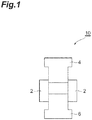
- Fig. 1 is a schematic cross-sectional view of a press molding machine that can be used to produce the molded article.
- a press molding machine 10 illustrated in Fig. 1 includes a die 2 in which a through hole is formed and which can be heated and an upper side pin 4 and a lower side pin 6 which can be moved up and down in the through hole of the die 2.
- the molded article can be obtained by introducing the composition including the spider silk polypeptide into a cavity formed by inserting the upper side pin 4 or the lower side pin 6 into the die 2, and pressing the composition with the upper side pin 4 and the lower side pin 6 while heating the die 2.
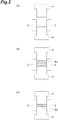
- Fig. 2 illustrates step views of obtaining the molded article and are schematic cross-sectional views of the press molding machine (a) before the introduction of the composition, (b) immediately after the introduction of the composition, and (c) with the composition in a state of being heated and pressed.
- the composition is introduced into the through hole in a state in which only the lower side pin 6 is inserted into the through hole of the die 2, and, as illustrated in Fig. 2(b) , the upper side pin 4 is inserted into the through hole of the die 2 and moved down, and the heating of the die 2 is initiated, thereby heating and pressing a composition 8a which is not yet heated and pressed in the through hole.
- the upper side pin 4 is moved down until a predetermined pressurization force is reached, and heating and pressing are continued until the composition reaches a predetermined temperature in a state illustrated by Fig. 2(c) , thereby obtaining a composition 8b which has been hot pressed.
- the temperature of the die 2 is lowered using a cooler (for example, a spot cooler), the upper side pin 4 or the lower side pin 6 is removed from the die 2 when the composition 8b reaches a predetermined temperature, and the resulting content is taken out, thereby obtaining a molded article.
- the pressing may be carried out by moving down the upper side pin 4 in a state in which the lower side pin 6 is fixed, but it is also possible to move down the upper side pin 4 and move up the lower side pin 6 at the same time.
- the heating is preferably carried out at 80°C to 300°C, more preferably carried out at 100°C to 180°C, and still more preferably carried out at 100°C to 130°C.
- the pressing is preferably carried out at 5 kN or more, more preferably carried out at 10 kN or more, and still more preferably carried out at 20 kN or more.
- the time during which the treatment is continued under predetermined hot pressing conditions after the conditions are satisfied is preferably 0 to 100 minutes, more preferably 1 to 50 minutes, and still more preferably 5 to 30 minutes.
- the molded article of the composition comprising a spider silk polypeptide is preferably produced using the polypeptide derived from natural spider silk protein, and thus the production method will be described below in detail.
- polypeptide derived from the major dragline silk protein which serves as a raw material of the molded article of the composition including a spider silk polypeptide examples include polypeptides including two or more, preferably including five or more, and more preferably including 10 or more units of an amino-acid sequence represented by Formula 1: REP1-REP2 (1).
- the polypeptide derived from the major dragline silk protein may be a polypeptide which includes a unit of the amino-acid sequence represented by Formula 1: REP1-REP2 (1) and in which a C terminal sequence is an amino-acid sequence represented by any of SEQ ID Nos. 1 to 3 or an amino-acid sequence having 90% or more homology with the amino-acid sequence represented by any of SEQ ID Nos.
- the units of the amino-acid sequence represented by Formula 1: REP1-REP2 (1) may be identical to or different from each other.
- the molecular weight of the polypeptide derived from the major dragline silk protein is preferably 500 kDa or less, more preferably 300 kDa or less, and still more preferably 200 kDa or less from the viewpoint of productivity.
- REP1 represents polyalanine.
- alanines that are continuously arranged are preferably two or more residues, more preferably three or more residues, still more preferably four or more residues, and particularly preferably five or more residues.
- alanines that are continuously arranged are preferably 20 or less residues, more preferably 16 or less residues, still more preferably 12 or less residues, and particularly preferably 10 or less residues.
- REP2 is an amino-acid sequence made of 10 to 200 residues of amino acid, and the total residue number of glycine, serine, glutamine, and alanine in the amino-acid sequence is 40% or more, preferably 60% or more, and more preferably 70% or more of the total number of amino acid residues.
- REP1 corresponds to a crystalline region that forms a crystalline ⁇ sheet in the fiber
- REP2 corresponds to an amorphous region which is more flexible and lacks a regular structure in a majority area in the fiber
- [REP1-REP2] corresponds to a repetitive region made up of crystalline regions and amorphous regions (repetitive sequence) and is the characteristic sequence of dragline silk protein.
- An amino-acid sequence represented by SEQ ID No. 1 is the same as an amino-acid sequence made of 50 residues of amino acid at the C terminal of an amino-acid sequence of ADF3 (NCBI accession number: AAC47010, GI: 1263287), and an amino-acid sequence represented by SEQ ID No. 2 is the same as an amino-acid sequence obtained by removing 20 residues from the C terminal of the amino-acid sequence represented by SEQ ID No. 1, and an amino-acid sequence represented by SEQ ID No. 3 is the same as an amino-acid sequence obtained by removing 29 residues from the C terminal of the amino-acid sequence represented by SEQ ID No. 1.
- polypeptide including two or more units of the amino-acid sequence represented by Formula 1: REP1-REP2 (1) it is possible to use, for example, a polypeptide made of an amino-acid sequence represented by SEQ ID No. 7.
- the polypeptide made of the amino-acid sequence represented by SEQ ID No. 7 is an amino-acid sequence of ADF3 (NCBI accession number: AAC47010, GI: 1263287) having an amino-acid sequence (SEQ ID No. 4) made up of an initiation codon, a His10 tag, and a Human rhinovirus 3C protease (HRV3C protease) recognition site added to an N terminal which is mutated so that translation ends at the 543 rd amino acid residue.
- polypeptide including two or more units of the amino-acid sequence represented by Formula 1: REP1-REP2 (1)
- a protein which is made of the amino-acid sequence represented by SEQ ID No. 7 in which one or a plurality of amino acids is substituted, deleted, inserted, and/or added, and has a repetitive region made up of crystalline regions and amorphous regions.
- "one or a plurality” means, for example, 1 to 40, 1 to 35, 1 to 30, 1 to 25, 1 to 20, 1 to 15, 1 to 10, or 1 or several.
- "one or several” means 1 to 9, 1 to 8, 1 to 7, 1 to 6, 1 to 5, 1 to 4, 1 to 3, 1 or 2, or 1.
- examples of the polypeptide including two or more units of the amino-acid sequence represented by Formula 1: REP1-REP2 (1) include ADF4-derived recombinant protein having an amino-acid sequence represented by SEQ ID No. 8.
- the amino-acid sequence represented by SEQ ID No. 8 is an amino-acid sequence obtained by adding the amino-acid sequence (SEQ ID No. 4) made up of an initiation codon, a His10 tag, and a Human rhinovirus 3C protease (HRV3C protease) recognition site to an N terminal of a partial amino-acid sequence of ADF4 (NCBI accession number: AAC47011, GI: 1263289) procured from NCBI database.
- polypeptide including two or more units of the amino-acid sequence represented by Formula 1: REP1-REP2 (1) a polypeptide which is made of the amino-acid sequence represented by SEQ ID No. 8 in which one or a plurality of amino acids is substituted, deleted, inserted, and/or added, and has a repetitive region made up of crystalline regions and amorphous regions may be used.
- examples of the polypeptide including two or more units of the amino-acid sequence represented by Formula 1: REP1-REP2 (1) include MaSp2-derived recombinant protein having an amino-acid sequence represented by SEQ ID No. 9. The amino-acid sequence represented by SEQ ID No.
- 9 is an amino-acid sequence obtained by adding an amino-acid sequence made up of an initiation codon, a His10 tag, and a Humanr hinovirus 3C protease (HRV3C protease) recognition site to an N terminal of a partial amino-acid sequence of MaSp2 (NCBI accession number: AAT75313, GI: 50363147) procured from NCBI database.
- the polypeptide including two or more units of the amino-acid sequence represented by Formula 1: REP1-REP2 (1) a polypeptide which is made of the amino-acid sequence represented by SEQ ID No. 9 in which one or a plurality of amino acids is substituted, deleted, inserted, and/or added, and has a repetitive region made up of crystalline regions and amorphous regions may also be used.
- polypeptides derived from the flagelliform silk protein examples include polypeptides including 10 or more, preferably including 20 or more, and more preferably including 30 or more units of an amino-acid sequence represented by Formula 2: REP3 (2).
- the molecular weight of the polypeptide derived from the flagelliform silk protein is preferably 500 kDa or less, more preferably 300 kDa or less, and still more preferably 200 kDa or less from the viewpoint of productivity.
- REP3 refers to an amino-acid sequence constituted of Gly-Pro-Gly-Gly-X, and X refers to one amino acid selected from the group consisting of Ala, Ser, Tyr, and Val.
- flagelliform silk In spider silk, flagelliform silk has a significant characteristic of having a repetitive region which does not have any crystalline regions and is made of an amorphous region.
- Major dragline silk and the like have a repetitive region made up of crystalline regions and amorphous regions and are thus assumed to have both a high stress and a favorable stretching property.
- flagelliform silk has a stress that is poorer than that of major dragline silk, but has a favorable stretching property. This is considered to be due to the fact that a majority of flagelliform silk is constituted of an amorphous region.
- Examples of the polypeptide including 10 or more units of the amino-acid sequence represented by Formula 2: REP3 (2) include flagelliform silk protein-derived recombinant protein having an amino-acid sequence represented by SEQ ID No. 10. The amino-acid sequence represented by SEQ ID No.
- NCBI accession number: AAF36090, GI: 7106224 procured from NCBI database (referred to as the PR1 sequence) and a C terminal amino-acid sequence of the 816 th residue through the 907 th residue from a C terminal of a partial sequence of a flagelliform silk protein of Nephilaclavipes (NCBI accession number: AAC38847, GI: 2833649) procured from NCBI database and adding the amino-acid sequence (SEQ ID No.
- polypeptide including 10 or more units of the amino-acid sequence represented by Formula 2: REP3 (2) a polypeptide which is made of the amino-acid sequence represented by SEQ ID No. 10 in which one or a plurality of amino acids is substituted, deleted, inserted, and/or added, and has a repetitive region made of an amorphous region may also be used.
- the polypeptide can be produced using a host that is transformed by an expression vector containing a gene that codes the polypeptide.
- a method for producing the gene is not particularly limited, and the gene is produced by amplifying a gene that codes natural spider silk protein from a spider-derived cell by means of a polymerase chain reaction (PCR) or the like and cloning the gene or is chemically synthesized.
- PCR polymerase chain reaction
- a method for chemically synthesizing the gene is not particularly limited, and, for example, the gene can be synthesized by linking oligonucleotides that are automatically synthesized with AKTAoligopilot plus 10/100 (manufactured by GE Healthcare Company Japan) or the like by means of PCR on the basis of the amino-acid sequence information of natural spider silk protein procured from the web database of NCBI or the like.
- a gene that codes a protein made of an amino-acid sequence obtained by adding an amino-acid sequence made up of an initiation codon and a His10 tag to an N terminal of the amino-acid sequence may be synthesized.
- the expression vector it is possible to use a plasmid, a phage, a virus, or the like which is capable of expressing proteins from DNA sequences.
- the plasmid-type expression vector is not particularly limited as long as the expression vector is capable of expressing the target gene in host cells and is self-amplifiable.
- Escherichia coli Rosetta (DE3) it is possible to use a pET22b(+) plasmid vector, a pCold plasmid vector, or the like.
- the pET22b(+) plasmid vector is preferably used.
- the host it is possible to use, for example, an animal cell, a plant cell, a microbe, or the like.
- the polypeptide that is used in the present invention is preferably a polypeptide derived from ADF3 which is one of the two important dragline silk proteins of Araneusdiadematus.
- This polypeptide basically, has a high strength-elongation degree and a high toughness and also has an advantage of ease of synthesis.
- a partial amino-acid sequence of ADF3 which is one of the two important dragline silk proteins of Araneus diadematus (NCBI accession number: AAC47010, GI: 1263287) was acquired from the web database of NCBI, and the synthesis of a gene that codes an amino-acid sequence (SEQ ID No. 5) obtained by adding (SEQ ID No. 4) made up of an initiation codon, a His10 tag, and a Human rhinovirus 3C protease (HRV3C protease) recognition site to an N terminal of the same sequence was entrusted to GenScript Japan Inc.
- a pUC57 vector (having an NdeI site at right upstream region of a 5' terminal of the gene and an Xba I site at right downstream region of the 5' terminal) into which a gene of ADF3Kai made of a base sequence represented by SEQ ID No. 6 was introduced was acquired. Then, a restriction enzyme treatment was carried out on the same gene using Nde I and EcoR I, and the gene was recombined to a pET22b(+) expression vector.
- the pET22b(+) expression vector including a gene sequence of the above-obtained ADF3Kai-noNR was transformed to Escherichia coli Rosetta (DE3).
- the obtained single colony was cultured for 15 hours in a 2 mL LB culture medium including ampicillin, 1.4 mL of the resulting culture liquid was added to a 140 mL LB culture medium including ampicillin, and the culture liquid was cultured under conditions of 37°C and 200 rpm until OD 600 of the culture liquid reached 3.5.
- the culture liquid having OD 600 of 3.5 was added to a 7 L 2xYT culture medium including ampicillin together with 140 mL of 50% glucose and was further cultured until OD 600 reached 4.0.
- IPTG isopropyl-p-thiogalactopyranoside
- sample 1.35 g of the freeze-dried powder obtained in the "polypeptide preparation example" (hereinafter, referred to as "sample") was weighed, and this sample was introduced into the through hole of the die 2 (a cylindrical die having a rectangular through hole having a 35 mm ⁇ 15 mm cross section) of the press molding machine 10 illustrated in Fig. 1 . At this time, the sample was added so that it became uniform thichness. After the entire sample was introduced, the heating of the die 2 was initiated, and the upper side pin 4 and the lower side pin 6 were inserted into the through hole using a hand presser (manufactured by NPa System Co., Ltd., NT-100H-V09), thereby pressing the sample.
- a hand presser manufactured by NPa System Co., Ltd., NT-100H-V09
- the pressurization condition of the sample was controlled to be 40 kN.
- the heating was stopped when the temperature of the sample reached 200°C, the sample was cooled using a spot cooler (manufactured by Trusco Nakayama Corporation, TS-25EP-1) and was removed when the temperature of the sample reached 50°C, and deburring was carried out, thereby obtaining a 35 mm ⁇ 15 mm ⁇ 2 mm rectangular molded article.
- Example 1 the heating was stopped when the temperature of the sample reached 200°C, the sample was cooled using the spot cooler and was removed when the temperature of the sample reached 50°C. That is, the heating temperature (X) was 200°C, and the annealing time (Y) was 0 minutes since the rapid cooling was initiated immediately after the heating temperature was reached.
- a molded article was obtained in the same manner as in Example 1 except for the fact that the heating temperature (X) was set to 100°C, the annealing time (Y) was set to 30 minutes, and the pressurization condition was set to 30 kN.
- a three-point bending test was carried out using a basket jig in an autograph (manufactured by Shimadzu Corporation, AG-Xplus).
- a load cell used was 50 kN.
- the distance between the support points for three-point bending was fixed to 27 mm, and the measurement rate was set to 1 mm/minute.
- the size of the molded article was measured using a microcaliper, and the molded article was installed in the jig and was measured.
- the bending elastic modulus was obtained from a displacement (strain) of up to 0.05 to 0.25%.
- the transparency in the thickness direction (2 mm-thick) was visually measured, and molded articles that were transparent were evaluated as O, and molded articles that were not transparent were evaluated as X. That is, the transparency was confirmed from whether or not the logo was visible when the molded article was placed on paper on which the logo of Spiber Inc. was printed.
- Example 35 mm ⁇ 15 mm ⁇ 2 mm rectangular formed articles were obtained in the same manner as in Example 1 using polyether ether ketone (PEEK), polycarbonate (PC), poly(methyl methacrylate) (PMMA), and an ABS resin (ABS). These formed articles were left to stand for one day in the constant temperature and humidity tank (manufactured by ESPEC Corp., LHL-113) under conditions of 20°C/65%, and then the bending elastic moduli, the bending strengths, and the transparency were measured in the same manner as in Example 1.
- PEEK polyether ether ketone
- PC polycarbonate
- PMMA poly(methyl methacrylate)
- ABS resin ABS resin
- Example 2 Heating Temperature X (°C) Annealing Time Y (Minutes)
- Example 2 110 0
- Example 3 120 0
- Example 4 130
- Example 5 140
- Example 6 160
- Example 7 180
- Example 8 90 5
- Example 9 100
- Example 10 110
- Example 11 120
- Example 12 90 15
- Example 13 120
- Example 14 80
- Example 15 90 30
- Example 16 110 30
- Example 17 120 30
- Example 18 90 0 40
- Example 19 100 0 40
- Example 20 110 0 40
- Example 21 120 0 40
- Example 22 90 0 50
- Example 23 100 0 50
- Example 5 For Examples 5 to 7, 16 and 17, the bending elastic moduli and the bending strengths were measured and are summarized in Table 4. [Table 4] Heating Temperature X (°C) Annealing Time Y (Minutes) Bending Elastic Modulus (GPa) Bending Strength (MPa) Example 5 140 0 5.2 52.1 Example 6 160 0 5.8 56.7 Example 7 180 0 5.7 63.5 Example 16 110 30 6.3 67.1 Example 17 120 30 5.9 62.5
Landscapes
- Chemical & Material Sciences (AREA)
- Life Sciences & Earth Sciences (AREA)
- Health & Medical Sciences (AREA)
- Engineering & Computer Science (AREA)
- Organic Chemistry (AREA)
- Mechanical Engineering (AREA)
- Biochemistry (AREA)
- Medicinal Chemistry (AREA)
- Insects & Arthropods (AREA)
- Materials Engineering (AREA)
- Chemical Kinetics & Catalysis (AREA)
- Polymers & Plastics (AREA)
- Tropical Medicine & Parasitology (AREA)
- Toxicology (AREA)
- Zoology (AREA)
- Gastroenterology & Hepatology (AREA)
- Biophysics (AREA)
- General Health & Medical Sciences (AREA)
- Genetics & Genomics (AREA)
- Molecular Biology (AREA)
- Proteomics, Peptides & Aminoacids (AREA)
- Peptides Or Proteins (AREA)
- Preparation Of Compounds By Using Micro-Organisms (AREA)
- Manufacture Of Macromolecular Shaped Articles (AREA)
- Casting Or Compression Moulding Of Plastics Or The Like (AREA)
Description
- The present invention relates to a molded article and a method for producing a molded article.
- For the purpose of weight reduction, cost reduction, the facilitation of forming, and the like, attempts for substituting metallic materials with organic materials are underway. As the above-described organic materials, phenolic resins having a high resin hardness are often used, and a method of adding a phenolic resin fiber to a matrix resin containing a phenolic resin is known since the bending elastic modulus or the bending strength is further increased (for example, refer to Patent Literature 1). In addition, due to a rising demand for environmental protection, bioplastics which are petroleum-free materials have been thus far drawing attention, and the fact that formed articles having 4.5 GPa of a bending elastic modulus can be obtained by resinifying silk powder is known (for example, refer to Non Patent Literature 1).
- [Patent Literature 1]
JP 2014-80491 A - [Non Patent Literature 1] Shinji HIRAI, Monthly Journal of Function & Materials, June 2014, "Keratin and Fibroin Resins For Environmental Friendly Materials Using Animal Proteins Derived from Industrial Wastes"
- Patent document
WO 2008/071226 A1 discloses the features of the respective preambles of independent claims 1 and 3. - However, materials as disclosed by Patent Literature 1 are materials that are caused to exhibit a reinforcement effect by adding a fiber thereto, and it is difficult to obtain a high strength with the matrix resin alone. In addition, it is not possible to obtain formed articles having a bending elastic modulus of more than 4.5 GPa from biodegradable materials.
- Therefore, an object of the present invention is to provide a biodegradable formed article that exhibits an excellent bending elastic modulus without using any additive materials such as reinforced fibers and a production method therefor.
- The present invention provides a molded article of a composition comprising a polypeptide, wherein the polypeptide is at least one kind selected from natural spider silk protein and polypeptides derived from natural spider silk protein according to claim 1, and produced by the method according to claim 3.
- The above-described formed article has characteristics of being biodegradable, including natural spider silk protein and/or a polypeptide derived from natural spider silk protein as a raw material, and additionally, being obtained by molding the raw material and, due to these characteristics, exhibits an extremely high bending elastic modulus (for example, more than 4.5 GPa) even without using any additive materials such as reinforced fibers. Furthermore, the formed article can also be imparted with transparency and thus, compared with resins having a high strength but lacking transparency such as phenolic resins or polyether ether ketone (PEEK), the formed article has an advantage of significantly broadening applicable uses. Additionally, spider silk protein can be genetically modified in diverse manners, and thus it is possible to easily optimize the performance depending on the final uses. Meanwhile, the bending elastic modulus is preferably 4.7 GPa or more, more preferably 5.0 GPa or more, and still more preferably 5.2 GPa or more. The upper limit of the bending elastic modulus is not limited, but can be set to, for example, 15.0 GPa or less. The bending elastic modulus can be set to 10.0 GPa or less and, furthermore, 7.0 GPa or less.
- The molded article may be provided as a hot press-molded article. The molded article refers to an article or the like formed using a casting mold (mold), but articles having a superior bending elastic modulus can be produced by hot pressing procedure.
- The molded article can be produced using a production method comprising a step of hot pressing a composition comprising at least one kind selected from the group consisting of natural spider silk protein and polypeptides derived from natural spider silk protein.
- According to the present invention, a biodegradable formed article exhibiting an excellent bending elastic modulus without using any additive materials such as reinforced fibers and a production method therefor are provided.
-
-
Fig. 1 is a schematic cross-sectional view of a press molding machine. -
Fig. 2 illustrates schematic cross-sectional views of the press molding machine (a) before the introduction of a composition, (b) immediately after the introduction of the composition, and (c) with the composition in a state of being hot pressed. -
Fig. 3 is a photograph of a molded article of Example 1. - Hereinafter, a preferred embodiment of the present invention will be described. However, the present invention is not limited to the following embodiment by any means, but only by the appended claims.
- A molded article according to the embodiment is made of a composition comprising natural spider silk protein and/or a polypeptide derived from natural spider silk protein. The molded article can be obtained by introducing the above-described composition into a casting mold (mold) and carrying out forming or the like, and, in the forming step, heating and/or pressing is possible. The composition has, typically, a shape of a powder form (lyophilized powder or the like) or a fibrous shape (a fiber or the like obtained by spinning), and the molded article may be a fused article of a composition including natural spider silk protein and/or a polypeptide derived from natural spider silk protein which have the above-described shape.
- Examples of the natural spider silk protein include a major dragline silk protein and a flagelliform silk protein.
- The major dragline silk protein is produced from spider's major ampullate glands and has a characteristic of excellent toughness. Examples of the major dragline silk protein include major ampullate spidroin MaSp1 or MaSp2 derived from Nephilaclavipes, ADF3 or ADF4 derived from Araneus diadematus, and the like.
- The flagelliform silk protein is produced from spider's flagelliform glands, and examples of the flagelliform silk protein include flagelliform silk protein derived from Nephilaclavipes.
- Examples of the polypeptides derived from natural spider silk protein include recombinant spider silk protein, for example, mutants, analogues, derivatives, and the like of natural spider silk protein. The above-described polypeptide is particularly preferably the recombinant spider silk protein of the major dragline silk protein.
- The molded article may be a molded article including only natural spider silk protein and/or a polypeptide derived from natural spider silk protein (hereinafter, in some cases, these will be collectively referred to as "spider silk polypeptide") and also may be a molded article in which additive components (for example, a plasticizer, a coloring agent, a filler such as lamellar silicate or basic calcium phosphate, water, synthetic resins, and the like) are added to a spider silk polypeptide. In a case in which additive components of a plasticizer and the like are used, it is preferable to set the amount thereof to 50% by mass or less of the total amount of the spider silk polypeptides. In addition, foreign substances that are generated in a process of obtaining other protein, for example, silk fibroin, soybean protein, casein, keratin, collagen, or milk whey protein or polypeptides may also be included. Meanwhile, the molded article exhibits the effects of the present invention even in a case in which the above-described additive components are not added thereto.
- The molded article comprising the spider silk polypeptide preferably has transparency. The transparency can be visually determined, but the molded article preferably has a transmittance of 50% or more in a case in which an optical transmittance measurement instrument is used and, for example, the cumulative time is set to 0.1 seconds in a wavelength range of 220 to 800 nm.
- The molded article can be produced using a press molding machine.
Fig. 1 is a schematic cross-sectional view of a press molding machine that can be used to produce the molded article. Apress molding machine 10 illustrated inFig. 1 includes adie 2 in which a through hole is formed and which can be heated and anupper side pin 4 and alower side pin 6 which can be moved up and down in the through hole of thedie 2. The molded article can be obtained by introducing the composition including the spider silk polypeptide into a cavity formed by inserting theupper side pin 4 or thelower side pin 6 into thedie 2, and pressing the composition with theupper side pin 4 and thelower side pin 6 while heating thedie 2. -
Fig. 2 illustrates step views of obtaining the molded article and are schematic cross-sectional views of the press molding machine (a) before the introduction of the composition, (b) immediately after the introduction of the composition, and (c) with the composition in a state of being heated and pressed. As illustrated inFig. 2(a) , the composition is introduced into the through hole in a state in which only thelower side pin 6 is inserted into the through hole of thedie 2, and, as illustrated inFig. 2(b) , theupper side pin 4 is inserted into the through hole of thedie 2 and moved down, and the heating of thedie 2 is initiated, thereby heating and pressing acomposition 8a which is not yet heated and pressed in the through hole. Theupper side pin 4 is moved down until a predetermined pressurization force is reached, and heating and pressing are continued until the composition reaches a predetermined temperature in a state illustrated byFig. 2(c) , thereby obtaining acomposition 8b which has been hot pressed. After that, the temperature of thedie 2 is lowered using a cooler (for example, a spot cooler), theupper side pin 4 or thelower side pin 6 is removed from thedie 2 when thecomposition 8b reaches a predetermined temperature, and the resulting content is taken out, thereby obtaining a molded article. The pressing may be carried out by moving down theupper side pin 4 in a state in which thelower side pin 6 is fixed, but it is also possible to move down theupper side pin 4 and move up thelower side pin 6 at the same time. - The heating is preferably carried out at 80°C to 300°C, more preferably carried out at 100°C to 180°C, and still more preferably carried out at 100°C to 130°C. The pressing is preferably carried out at 5 kN or more, more preferably carried out at 10 kN or more, and still more preferably carried out at 20 kN or more. In addition, the time during which the treatment is continued under predetermined hot pressing conditions after the conditions are satisfied (temperature retention condition) is preferably 0 to 100 minutes, more preferably 1 to 50 minutes, and still more preferably 5 to 30 minutes.
- The molded article of the composition comprising a spider silk polypeptide is preferably produced using the polypeptide derived from natural spider silk protein, and thus the production method will be described below in detail.
- Examples of the polypeptide derived from the major dragline silk protein which serves as a raw material of the molded article of the composition including a spider silk polypeptide include polypeptides including two or more, preferably including five or more, and more preferably including 10 or more units of an amino-acid sequence represented by Formula 1: REP1-REP2 (1). Alternatively, the polypeptide derived from the major dragline silk protein may be a polypeptide which includes a unit of the amino-acid sequence represented by Formula 1: REP1-REP2 (1) and in which a C terminal sequence is an amino-acid sequence represented by any of SEQ ID Nos. 1 to 3 or an amino-acid sequence having 90% or more homology with the amino-acid sequence represented by any of SEQ ID Nos. 1 to 3. Meanwhile, in the polypeptide derived from the major dragline silk protein, the units of the amino-acid sequence represented by Formula 1: REP1-REP2 (1) may be identical to or different from each other. In a case in which the production of recombinant protein c is carried out using a microbe such as Escherichia coli as a host, the molecular weight of the polypeptide derived from the major dragline silk protein is preferably 500 kDa or less, more preferably 300 kDa or less, and still more preferably 200 kDa or less from the viewpoint of productivity.
- In Formula 1, REP1 represents polyalanine. In REP1, alanines that are continuously arranged are preferably two or more residues, more preferably three or more residues, still more preferably four or more residues, and particularly preferably five or more residues. In addition, in REP1, alanines that are continuously arranged are preferably 20 or less residues, more preferably 16 or less residues, still more preferably 12 or less residues, and particularly preferably 10 or less residues. In Formula 1, REP2 is an amino-acid sequence made of 10 to 200 residues of amino acid, and the total residue number of glycine, serine, glutamine, and alanine in the amino-acid sequence is 40% or more, preferably 60% or more, and more preferably 70% or more of the total number of amino acid residues.
- In the major dragline silk protein, REP1 corresponds to a crystalline region that forms a crystalline β sheet in the fiber, and REP2 corresponds to an amorphous region which is more flexible and lacks a regular structure in a majority area in the fiber. In addition, [REP1-REP2] corresponds to a repetitive region made up of crystalline regions and amorphous regions (repetitive sequence) and is the characteristic sequence of dragline silk protein.
- An amino-acid sequence represented by SEQ ID No. 1 is the same as an amino-acid sequence made of 50 residues of amino acid at the C terminal of an amino-acid sequence of ADF3 (NCBI accession number: AAC47010, GI: 1263287), and an amino-acid sequence represented by SEQ ID No. 2 is the same as an amino-acid sequence obtained by removing 20 residues from the C terminal of the amino-acid sequence represented by SEQ ID No. 1, and an amino-acid sequence represented by SEQ ID No. 3 is the same as an amino-acid sequence obtained by removing 29 residues from the C terminal of the amino-acid sequence represented by SEQ ID No. 1.
- As the polypeptide including two or more units of the amino-acid sequence represented by Formula 1: REP1-REP2 (1), it is possible to use, for example, a polypeptide made of an amino-acid sequence represented by SEQ ID No. 7. The polypeptide made of the amino-acid sequence represented by SEQ ID No. 7 is an amino-acid sequence of ADF3 (NCBI accession number: AAC47010, GI: 1263287) having an amino-acid sequence (SEQ ID No. 4) made up of an initiation codon, a His10 tag, and a Human rhinovirus 3C protease (HRV3C protease) recognition site added to an N terminal which is mutated so that translation ends at the 543rd amino acid residue.
- In addition, as the polypeptide including two or more units of the amino-acid sequence represented by Formula 1: REP1-REP2 (1), it is possible to use a protein which is made of the amino-acid sequence represented by SEQ ID No. 7 in which one or a plurality of amino acids is substituted, deleted, inserted, and/or added, and has a repetitive region made up of crystalline regions and amorphous regions. In the present invention, "one or a plurality" means, for example, 1 to 40, 1 to 35, 1 to 30, 1 to 25, 1 to 20, 1 to 15, 1 to 10, or 1 or several. In addition, in the present invention, "one or several" means 1 to 9, 1 to 8, 1 to 7, 1 to 6, 1 to 5, 1 to 4, 1 to 3, 1 or 2, or 1.
- In addition, examples of the polypeptide including two or more units of the amino-acid sequence represented by Formula 1: REP1-REP2 (1) include ADF4-derived recombinant protein having an amino-acid sequence represented by SEQ ID No. 8. The amino-acid sequence represented by SEQ ID No. 8 is an amino-acid sequence obtained by adding the amino-acid sequence (SEQ ID No. 4) made up of an initiation codon, a His10 tag, and a Human rhinovirus 3C protease (HRV3C protease) recognition site to an N terminal of a partial amino-acid sequence of ADF4 (NCBI accession number: AAC47011, GI: 1263289) procured from NCBI database. In addition, as the polypeptide including two or more units of the amino-acid sequence represented by Formula 1: REP1-REP2 (1), a polypeptide which is made of the amino-acid sequence represented by SEQ ID No. 8 in which one or a plurality of amino acids is substituted, deleted, inserted, and/or added, and has a repetitive region made up of crystalline regions and amorphous regions may be used. In addition, examples of the polypeptide including two or more units of the amino-acid sequence represented by Formula 1: REP1-REP2 (1) include MaSp2-derived recombinant protein having an amino-acid sequence represented by SEQ ID No. 9. The amino-acid sequence represented by SEQ ID No. 9 is an amino-acid sequence obtained by adding an amino-acid sequence made up of an initiation codon, a His10 tag, and a Humanr hinovirus 3C protease (HRV3C protease) recognition site to an N terminal of a partial amino-acid sequence of MaSp2 (NCBI accession number: AAT75313, GI: 50363147) procured from NCBI database. In addition, as the polypeptide including two or more units of the amino-acid sequence represented by Formula 1: REP1-REP2 (1), a polypeptide which is made of the amino-acid sequence represented by SEQ ID No. 9 in which one or a plurality of amino acids is substituted, deleted, inserted, and/or added, and has a repetitive region made up of crystalline regions and amorphous regions may also be used.
- Examples of the polypeptides derived from the flagelliform silk protein include polypeptides including 10 or more, preferably including 20 or more, and more preferably including 30 or more units of an amino-acid sequence represented by Formula 2: REP3 (2). In a case in which the production of recombinant protein is carried out using a microbe such as Escherichia coli as a host, the molecular weight of the polypeptide derived from the flagelliform silk protein is preferably 500 kDa or less, more preferably 300 kDa or less, and still more preferably 200 kDa or less from the viewpoint of productivity.
- In Formula (2), REP3 refers to an amino-acid sequence constituted of Gly-Pro-Gly-Gly-X, and X refers to one amino acid selected from the group consisting of Ala, Ser, Tyr, and Val.
- In spider silk, flagelliform silk has a significant characteristic of having a repetitive region which does not have any crystalline regions and is made of an amorphous region. Major dragline silk and the like have a repetitive region made up of crystalline regions and amorphous regions and are thus assumed to have both a high stress and a favorable stretching property. On the other hand, flagelliform silk has a stress that is poorer than that of major dragline silk, but has a favorable stretching property. This is considered to be due to the fact that a majority of flagelliform silk is constituted of an amorphous region.
- Examples of the polypeptide including 10 or more units of the amino-acid sequence represented by Formula 2: REP3 (2) include flagelliform silk protein-derived recombinant protein having an amino-acid sequence represented by SEQ ID No. 10. The amino-acid sequence represented by SEQ ID No. 10 is an amino-acid sequence obtained by combining an amino-acid sequence of the 1220th residue through the 1659th residue from an N terminal that corresponds to a repeat portion and a motif of a partial sequence of a flagelliform silk protein of Nephilaclavipes (NCBI accession number: AAF36090, GI: 7106224) procured from NCBI database (referred to as the PR1 sequence) and a C terminal amino-acid sequence of the 816th residue through the 907th residue from a C terminal of a partial sequence of a flagelliform silk protein of Nephilaclavipes (NCBI accession number: AAC38847, GI: 2833649) procured from NCBI database and adding the amino-acid sequence (SEQ ID No. 4) made up of an initiation codon, a His10 tag, and an HRV3C protease recognition site to an N terminal of the combined sequence. In addition, as the polypeptide including 10 or more units of the amino-acid sequence represented by Formula 2: REP3 (2), a polypeptide which is made of the amino-acid sequence represented by SEQ ID No. 10 in which one or a plurality of amino acids is substituted, deleted, inserted, and/or added, and has a repetitive region made of an amorphous region may also be used.
- The polypeptide can be produced using a host that is transformed by an expression vector containing a gene that codes the polypeptide. A method for producing the gene is not particularly limited, and the gene is produced by amplifying a gene that codes natural spider silk protein from a spider-derived cell by means of a polymerase chain reaction (PCR) or the like and cloning the gene or is chemically synthesized. A method for chemically synthesizing the gene is not particularly limited, and, for example, the gene can be synthesized by linking oligonucleotides that are automatically synthesized with AKTAoligopilot plus 10/100 (manufactured by GE Healthcare Company Japan) or the like by means of PCR on the basis of the amino-acid sequence information of natural spider silk protein procured from the web database of NCBI or the like. At this time, in order to facilitate the refining or confirmation of protein, a gene that codes a protein made of an amino-acid sequence obtained by adding an amino-acid sequence made up of an initiation codon and a His10 tag to an N terminal of the amino-acid sequence may be synthesized.
- As the expression vector, it is possible to use a plasmid, a phage, a virus, or the like which is capable of expressing proteins from DNA sequences. The plasmid-type expression vector is not particularly limited as long as the expression vector is capable of expressing the target gene in host cells and is self-amplifiable. For example, in a case in which Escherichia coli Rosetta (DE3) is used as a host, it is possible to use a pET22b(+) plasmid vector, a pCold plasmid vector, or the like. Among these, from the viewpoint of the productivity of protein, the pET22b(+) plasmid vector is preferably used. As the host, it is possible to use, for example, an animal cell, a plant cell, a microbe, or the like.
- The polypeptide that is used in the present invention is preferably a polypeptide derived from ADF3 which is one of the two important dragline silk proteins of Araneusdiadematus. This polypeptide, basically, has a high strength-elongation degree and a high toughness and also has an advantage of ease of synthesis.
- Hereinafter, the present invention will be described in more detail using examples, but the present invention is not limited to these examples within the scope of the technical concept of the present invention.
- A partial amino-acid sequence of ADF3 which is one of the two important dragline silk proteins of Araneus diadematus (NCBI accession number: AAC47010, GI: 1263287) was acquired from the web database of NCBI, and the synthesis of a gene that codes an amino-acid sequence (SEQ ID No. 5) obtained by adding (SEQ ID No. 4) made up of an initiation codon, a His10 tag, and a Human rhinovirus 3C protease (HRV3C protease) recognition site to an N terminal of the same sequence was entrusted to GenScript Japan Inc. As a result, a pUC57 vector (having an NdeI site at right upstream region of a 5' terminal of the gene and an Xba I site at right downstream region of the 5' terminal) into which a gene of ADF3Kai made of a base sequence represented by SEQ ID No. 6 was introduced was acquired. Then, a restriction enzyme treatment was carried out on the same gene using Nde I and EcoR I, and the gene was recombined to a pET22b(+) expression vector.
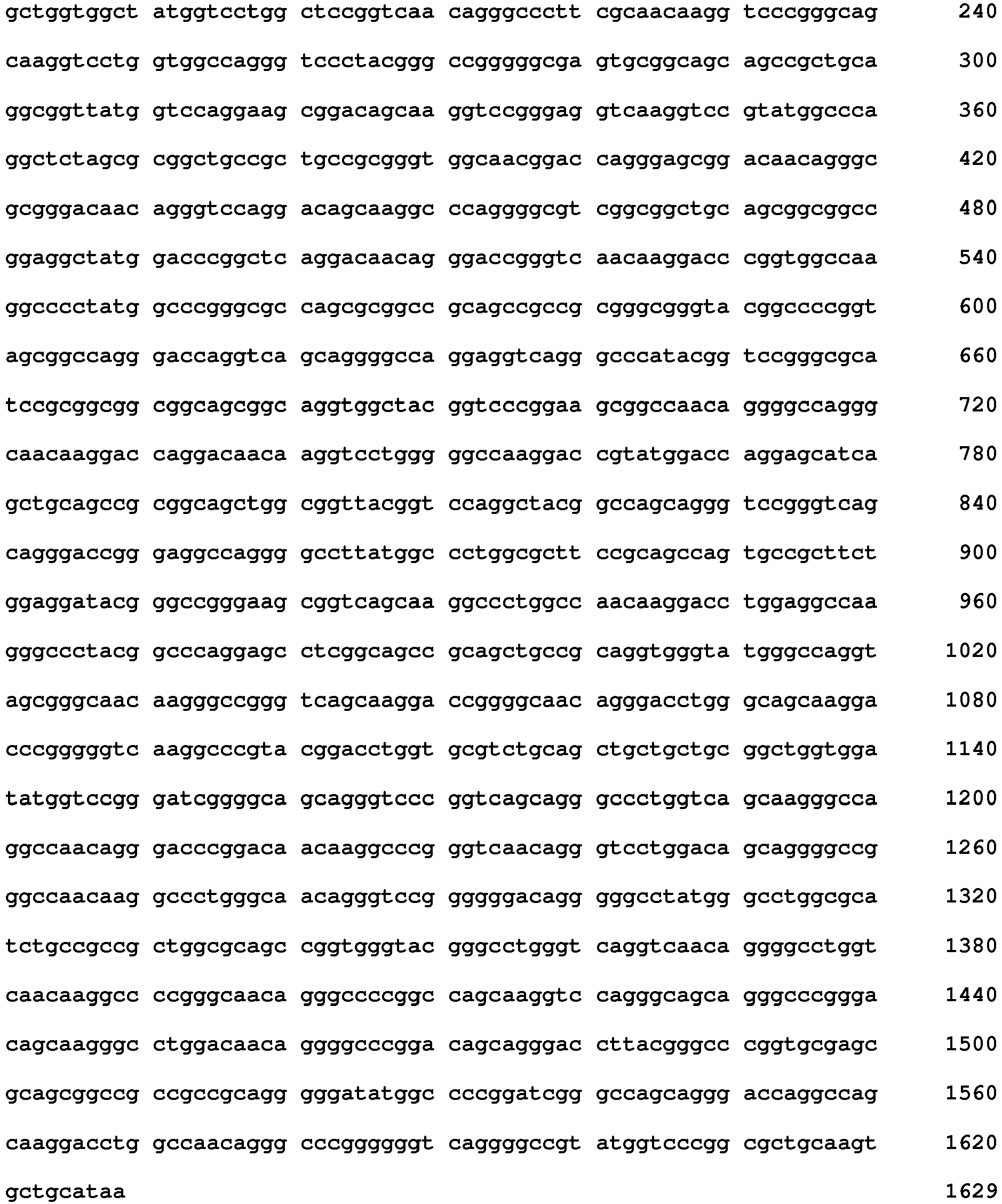
- The above-obtained pET22b(+) expression vector into which the gene of ADF3Kai was used as a template, and a codon GTG corresponding to the 543rd amino acid residue valine (Val) in the amino-acid sequence (SEQ ID No. 5) of ADF3Kai was mutated to a termination codon TAA by means of site-directed mutagenesis using PrimeStar MutagenesisBasal Kit (manufactured by Takara Bio Inc.), thereby constructing a gene of ADF3Kai-noNR represented by SEQ ID No. 11 on pET22b(+). The accuracy of the mutagenesis was confirmed from a sequence reaction for which 3130xlGenetic Analyzer (Applied Biosystems) was used. Meanwhile, the amino-acid sequence of ADF3Kai-noNR is as indicated by SEQ ID No. 7.
- The pET22b(+) expression vector including a gene sequence of the above-obtained ADF3Kai-noNR was transformed to Escherichia coli Rosetta (DE3). The obtained single colony was cultured for 15 hours in a 2 mL LB culture medium including ampicillin, 1.4 mL of the resulting culture liquid was added to a 140 mL LB culture medium including ampicillin, and the culture liquid was cultured under conditions of 37°C and 200 rpm until OD600 of the culture liquid reached 3.5. Next, the culture liquid having OD600 of 3.5 was added to a 7 L 2xYT culture medium including ampicillin together with 140 mL of 50% glucose and was further cultured until OD600 reached 4.0. Then, isopropyl-p-thiogalactopyranoside (IPTG) was added to the obtained culture liquid having OD600 of 4.0 so that the final concentration reached 0.5 mM, thereby inducing protein expression. After two hours elapsed from the addition of IPTG, the culture liquid was centrifugally separated, and a bacterial body was collected. As a result of electrophoresing protein solutions prepared from the culture liquid before that addition of IPTG and after the addition of IPTG in polyacrylamide gels, bands having a target size were observed depending on the addition of IPTG, and it was confirmed that target protein was expressed. Escherichia coli that expressed the protein of ADF3Kai-noNR was stored in a freezer (-20°C).
-
- (I) Approximately 4.5 g of the bacterial body of Escherichia coli that expressed the protein of ADF3Kai-noNR and 30 ml of a buffer solution AI (20mM of Tris-HCl, pH 7.4) were added to a centrifuge tube (50 mL), the bacterial body was dispersed using a mixer (manufactured by General Electric, SI-0286, level 10), then, centrifugal separation (10,000 rpm, 10 minutes, room temperature) was carried out using a centrifugal separator (manufactured by Tomy Seiko Co., Ltd., MX-305), and the supernatant was removed.
- (II) 30 mL of a buffer solution AI and 0.3 mL of 0.1 M PMSF (dissolved using isopropanol) were added to the precipitate (bacterial body) obtained by the centrifugal separation and were dispersed for three minutes using the mixer (level 10) manufactured by General Electric. After that, the bacterial body was crushed using an ultrasonic crusher (manufactured by Sonic & Materials, Inc., VCX500), and centrifugal separation (10,000 rpm, 10 minutes, room temperature) was carried out.
- (III) 30 mL of the buffer solution AI was added to the precipitate obtained by the centrifugal separation, was dispersed for three minutes using a mixer (manufactured by IKA, T18 basic ULTRA-TURRAX, level 2) manufactured by General Electric, then, centrifugal separation (10,000 rpm, 10 minutes, room temperature) was carried out using the centrifugal separator manufactured by Tomy Seiko Co., Ltd., and the supernatant was removed.
- (IV) A 7.5 M urea buffer solution I (7.5 M of urea, 10 mM of sodium dihydrogen phosphate, 20 mM of NaCl, 1 mM of Tris-HCl, pH 7.0) was added to the centrifuge tube from which the supernatant was removed, and the precipitation was favorably dispersed using the ultrasonic crusher manufactured by SMT (level 7). After that, the precipitate was dissolved for 120 minutes using a shaker manufactured by Taitec Corporation (200 rpm, 60°C). A protein solution after the dissolution was centrifugally separated (11,000xg, 10 minutes, room temperature) using the centrifugal separator manufactured by Tomy Seiko Co., Ltd., and the supernatant was dialyzed using a dialysis tube (manufactured by Sanko Junyaku Co., Ltd., cellulose tube 36/32). White agglomerated protein obtained after the dialysis was collected by means of centrifugal separation, water was removed using a freeze dryer, and freeze-dried powder was collected. The degree of refining of the target protein ADF3Kai-noNR in the obtained freeze-dried powder was confirmed by image-analyzing the results of the polyacrylamide gel electrophoresis (CBB dyeing) of the powder using Totallab (Nonlinear Dynamics Ltd.). As a result, the degree of refining of ADF3Kai-noNR was approximately 85%.
- 1.35 g of the freeze-dried powder obtained in the "polypeptide preparation example" (hereinafter, referred to as "sample") was weighed, and this sample was introduced into the through hole of the die 2 (a cylindrical die having a rectangular through hole having a 35 mm×15 mm cross section) of the
press molding machine 10 illustrated inFig. 1 . At this time, the sample was added so that it became uniform thichness. After the entire sample was introduced, the heating of thedie 2 was initiated, and theupper side pin 4 and thelower side pin 6 were inserted into the through hole using a hand presser (manufactured by NPa System Co., Ltd., NT-100H-V09), thereby pressing the sample. At this time, the pressurization condition of the sample was controlled to be 40 kN. The heating was stopped when the temperature of the sample reached 200°C, the sample was cooled using a spot cooler (manufactured by Trusco Nakayama Corporation, TS-25EP-1) and was removed when the temperature of the sample reached 50°C, and deburring was carried out, thereby obtaining a 35 mm×15 mm×2 mm rectangular molded article. - In Example 1, the heating was stopped when the temperature of the sample reached 200°C, the sample was cooled using the spot cooler and was removed when the temperature of the sample reached 50°C. That is, the heating temperature (X) was 200°C, and the annealing time (Y) was 0 minutes since the rapid cooling was initiated immediately after the heating temperature was reached.
- A molded article was obtained in the same manner as in Example 1 except for the fact that the heating temperature (X) was set to 100°C, the annealing time (Y) was set to 30 minutes, and the pressurization condition was set to 30 kN.
- After the obtained molded article was left to stand for one day in a constant temperature and humidity tank (manufactured by ESPEC Corp., LHL-113) under conditions of 20°C/65%, the following measurements were carried out.
- That is, a three-point bending test was carried out using a basket jig in an autograph (manufactured by Shimadzu Corporation, AG-Xplus). A load cell used was 50 kN. At this time, the distance between the support points for three-point bending was fixed to 27 mm, and the measurement rate was set to 1 mm/minute. In addition, the size of the molded article was measured using a microcaliper, and the molded article was installed in the jig and was measured. The bending elastic modulus was obtained from a displacement (strain) of up to 0.05 to 0.25%.
- For the obtained molded articles, the transparency in the thickness direction (2 mm-thick) was visually measured, and molded articles that were transparent were evaluated as O, and molded articles that were not transparent were evaluated as X. That is, the transparency was confirmed from whether or not the logo was visible when the molded article was placed on paper on which the logo of Spiber Inc. was printed.
- 35 mm×15 mm×2 mm rectangular formed articles were obtained in the same manner as in Example 1 using polyether ether ketone (PEEK), polycarbonate (PC), poly(methyl methacrylate) (PMMA), and an ABS resin (ABS). These formed articles were left to stand for one day in the constant temperature and humidity tank (manufactured by ESPEC Corp., LHL-113) under conditions of 20°C/65%, and then the bending elastic moduli, the bending strengths, and the transparency were measured in the same manner as in Example 1.
- The results of the example and the comparative examples are summarized in Table 1. A photograph of the molded article used to evaluate the transparency of Example 1 is illustrated in
Fig. 3 .[Table 1] Bending Elastic Modulus (GPa) Bending Strength (MPa) Transparency Example 1 5.39 74 ○ Example 2 6.6 64.6 ○ Comparative Example 1 (PEEK) 4.4 171 X Comparative Example 2 (PC) 2.68 97.3 ○ Comparative Example 3 (PMMA) 3.2 105 ○ Comparative Example 4 (ABS) 2.32 62.9 X - Molded articles were obtained in the same manner as in Example 1 except for the fact that the heating temperature (X) and the annealing time (Y) were changed as shown in Table 2 and the pressurization condition was set to 30 kN.
[Table 2] Heating Temperature X (°C) Annealing Time Y (Minutes) Example 2 110 0 Example 3 120 0 Example 4 130 0 Example 5 140 0 Example 6 160 0 Example 7 180 0 Example 8 90 5 Example 9 100 5 Example 10 110 5 Example 11 120 5 Example 12 90 15 Example 13 120 15 Example 14 80 30 Example 15 90 30 Example 16 110 30 Example 17 120 30 - Molded articles were obtained in the same manner as in Example 1 except for the fact that the heating temperature (X), the annealing time (Y), and the pressing condition were set as shown in Table 3.
[Table 3] Heating Temperature X (°C) Annealing Time Y (Minutes) Pressing Condition (kN) Example 18 90 0 40 Example 19 100 0 40 Example 20 110 0 40 Example 21 120 0 40 Example 22 90 0 50 Example 23 100 0 50 - For Examples 5 to 7, 16 and 17, the bending elastic moduli and the bending strengths were measured and are summarized in Table 4.
[Table 4] Heating Temperature X (°C) Annealing Time Y (Minutes) Bending Elastic Modulus (GPa) Bending Strength (MPa) Example 5 140 0 5.2 52.1 Example 6 160 0 5.8 56.7 Example 7 180 0 5.7 63.5 Example 16 110 30 6.3 67.1 Example 17 120 30 5.9 62.5 - 2: DIE, 4: UPPER SIDE PIN, 6: LOWER SIDE PIN, 8a: COMPOSITION BEFORE HOT PRESSING, 8b: COMPOSITION AFTER HOT PRESSING, 10: PRESS MOLDING MACHINE
-
- <110> Spiber Inc. KOJIMA INDUSTRIES CORPORATION TEKUNOHAMA CO., LTD MURORAN INSTITUTE OF TECHNOLOGY
- <120> MOLDED MATERIAL
- <130> 2015PS003WO1
- <160> 11
- <170> PatentIn version 3.5
- <210> 1
<211> 50
<212> PRT
<213> Araneus diadematus - <400> 1

- <210> 2
<211> 30
<212> PRT
<213> Araneus diadematus - <400> 2

- <210> 3
<211> 21
<212> PRT
<213> Araneus diadematus - <400> 3


- <210> 4
<211> 24
<212> PRT
<213> Artificial Sequence - <220>
<223> His tag and start codon - <400> 4

- <210> 5
<211> 660
<212> PRT
<213> Artificial Sequence - <220>
<223> recombinant spider silk protein ADF3Kai - <400> 5


- <210> 6
<211> 1983
<212> DNA
<213> Artificial Sequence - <220>
<223> recombinant DNA of spider silk protein gene ADF3Kai - <400> 6


- <210> 7
<211> 542
<212> PRT
<213> Artificial Sequence - <220>
<223> recombinant DNA of spider silk protein gene ADF3Kai - <400> 7


- <210> 8
<211> 434
<212> PRT
<213> Artificial - <220>
<223> Recombinang spider silk protein ADF4Kai - <400> 8


- <210> 9
<211> 355
<212> PRT
<213> Artificial - <220>
<223> Recombinant spider silk protein MaSp2_N - <400> 9


- <210> 10
<211> 559
<212> PRT
<213> Artificial - <220>
<223> Recombinant spider silk protein Flag_92_short2 - <400> 10


- <210> 11
<211> 1629
<212> DNA
<213> Artificial Sequence - <220>
<223> recombinant spider silk protein gene ADF3Kai-noNR - <400> 11

Claims (3)
- A hot-press molded article of a composition comprising a polypeptide,
wherein the polypeptide is at least one kind selected from the group consisting of natural spider silk protein and polypeptides derived from natural spider silk protein,
wherein the polypeptide includes two or more units of an amino acid sequence represented by Formula 1: REP1-REP2 and
wherein the units of the amino acid sequence represented by Formula 1: REP1-REP2 are identical or different from each other, and
characterised in that: REP1 represents polyalanine, and REP2 represents an amino acid sequence made of 10 to 200 residues of amino acid, and the total residue number of glycine, serine, glutamine, and alanine in the amino-acid sequence is 40% or more. - The molded article according to Claim 1,
wherein the molded article is a formed article having a bending elastic modulus of more than 4.5 GPa. - A method for producing a molded article comprising:a step of hot pressing a composition comprising a polypeptide, wherein the polypeptide is at least one kind selected from the group consisting of natural spider silk protein and polypeptides derived from natural spider silk protein,wherein the polypeptide includes two or more units of an amino acid sequence represented by Formula 1: REP1-REP2 andwherein the units of the amino acid sequence represented by Formula 1: REP1-REP2 are identical or different from each other, andcharacterised in that: REP1 represents polyalanine, and REP2 represents an amino acid sequence made of 10 to 200 residues of amino acid, and the total residue number of glycine, serine, glutamine, and alanine in the amino-acid sequence is 40% or more.
Applications Claiming Priority (2)
| Application Number | Priority Date | Filing Date | Title |
|---|---|---|---|
| JP2015185777 | 2015-09-18 | ||
| PCT/JP2016/076501 WO2017047504A1 (en) | 2015-09-18 | 2016-09-08 | Molded article and method for producing molded article |
Publications (3)
| Publication Number | Publication Date |
|---|---|
| EP3351584A1 EP3351584A1 (en) | 2018-07-25 |
| EP3351584A4 EP3351584A4 (en) | 2019-02-06 |
| EP3351584B1 true EP3351584B1 (en) | 2021-04-07 |
Family
ID=58289277
Family Applications (1)
| Application Number | Title | Priority Date | Filing Date |
|---|---|---|---|
| EP16846375.0A Active EP3351584B1 (en) | 2015-09-18 | 2016-09-08 | Molded article and method for producing molded article |
Country Status (5)
| Country | Link |
|---|---|
| US (1) | US10961285B2 (en) |
| EP (1) | EP3351584B1 (en) |
| JP (1) | JP6830604B2 (en) |
| CN (1) | CN108137814B (en) |
| WO (1) | WO2017047504A1 (en) |
Families Citing this family (17)
| Publication number | Priority date | Publication date | Assignee | Title |
|---|---|---|---|---|
| JP2018159137A (en) | 2015-08-20 | 2018-10-11 | 国立研究開発法人理化学研究所 | Method for producing polypeptide fiber having spider-like structure |
| JP6551789B2 (en) * | 2015-12-17 | 2019-07-31 | 国立大学法人室蘭工業大学 | Animal fiber molding and method for producing the same |
| JP7088511B2 (en) * | 2016-08-19 | 2022-06-21 | 国立研究開発法人理化学研究所 | Composite molding composition containing fibroin-like protein and method for producing the same |
| JPWO2018043698A1 (en) * | 2016-09-02 | 2019-06-24 | Spiber株式会社 | Molded article and method for producing molded article |
| JP2020105231A (en) * | 2017-03-22 | 2020-07-09 | Spiber株式会社 | Molded article and method for producing molded article |
| WO2019054503A1 (en) * | 2017-09-15 | 2019-03-21 | Spiber株式会社 | Composition for molding, molding, and method for producing molding |
| JP7219899B2 (en) * | 2017-12-15 | 2023-02-09 | 国立大学法人室蘭工業大学 | Molded article manufacturing method and molded article |
| JP2021063143A (en) * | 2017-12-27 | 2021-04-22 | Spiber株式会社 | Molded body and molded-body manufacturing method |
| CN112135881A (en) | 2018-04-03 | 2020-12-25 | 丝芭博株式会社 | Formed body and method for producing the same |
| CN109265913A (en) * | 2018-08-09 | 2019-01-25 | 南京欧纳壹有机光电有限公司 | A kind of high-strength engineering plastic and its preparation process |
| JP2020055916A (en) * | 2018-09-28 | 2020-04-09 | Spiber株式会社 | Molded article, method for producing molded article, and method for adjusting flexibility of molded article |
| JP2021008414A (en) * | 2019-06-28 | 2021-01-28 | Spiber株式会社 | Protein layer conjugate |
| JPWO2021066049A1 (en) | 2019-09-30 | 2021-04-08 | ||
| WO2022215473A1 (en) * | 2021-04-07 | 2022-10-13 | 旭化成株式会社 | Molded body, method for producing molded body and method for producing sintered body |
| EP4570812A1 (en) | 2022-08-23 | 2025-06-18 | Spiber Inc. | Esterified protein and method for producing same |
| WO2024137617A2 (en) * | 2022-12-19 | 2024-06-27 | Trustees Of Tufts College | Processing and fabrication of composite silk-based plastics |
| WO2024166833A1 (en) | 2023-02-08 | 2024-08-15 | Spiber株式会社 | Method for producing block copolymer or aqueous dispersion containing same, adhesive, coating liquid, coating agent, or molded body |
Family Cites Families (18)
| Publication number | Priority date | Publication date | Assignee | Title |
|---|---|---|---|---|
| JP3173835B2 (en) * | 1991-12-25 | 2001-06-04 | 日世株式会社 | Biodegradable molded products |
| JP2002001648A (en) * | 2000-06-21 | 2002-01-08 | Toray Ind Inc | Polishing pad, polishing apparatus and polishing method using the same |
| JP2001315056A (en) * | 1999-12-22 | 2001-11-13 | Toray Ind Inc | Polishing pad, polishing apparatus and polishing method using the same |
| US20050153118A1 (en) * | 2003-09-10 | 2005-07-14 | Carlo Licata | Production of pulp and materials utilizing pulp from fibrous proteins |
| EP2097117B1 (en) * | 2006-12-11 | 2013-05-22 | Medizinische Hochschule Hannover | Implant of cross-linked spider silk threads |
| US8119598B2 (en) | 2007-05-10 | 2012-02-21 | Hospital For Sick Children | Synthetic peptide materials for joint reconstruction, repair and cushioning |
| CN104224171B (en) | 2010-03-17 | 2017-06-09 | 伊利诺伊大学评议会 | Implantable bio-medical instrument based on biological absorbable matrix |
| US20130072598A1 (en) * | 2011-03-18 | 2013-03-21 | Board Of Regents Of The University Of Nebraska | Thermoplastics from Distillers Dried Grains and Feathers |
| CN103502516B (en) | 2011-06-01 | 2015-04-22 | 丝芭博株式会社 | Artificial polypeptide fiber and method for producing same |
| SG11201403419SA (en) * | 2011-12-23 | 2014-07-30 | Solazyme Inc | Algal thermoplastics, thermosets, paper, adsorbants and absorbants |
| JP2014080491A (en) | 2012-10-16 | 2014-05-08 | Sumitomo Bakelite Co Ltd | Phenol resin composition and molding |
| WO2014062134A1 (en) * | 2012-10-17 | 2014-04-24 | Nanyang Technological University | Compounds and methods for the production of suckerin and uses thereof |
| US10179807B2 (en) * | 2012-12-07 | 2019-01-15 | Cornell University | Crosslinked thermoset resins and methods thereof |
| EP2940066B1 (en) | 2012-12-26 | 2020-02-05 | Spiber Inc. | Spider silk protein film, and method for producing same |
| CN104884463B (en) * | 2012-12-27 | 2018-09-18 | 丝芭博株式会社 | The extracting method of hydrophily recombinant protein |
| JP2014198715A (en) * | 2013-03-15 | 2014-10-23 | 岡本株式会社 | Protein fiber |
| WO2014175179A1 (en) * | 2013-04-25 | 2014-10-30 | スパイバー株式会社 | Polypeptide particle and method for producing same |
| US20180251501A1 (en) | 2015-09-18 | 2018-09-06 | Spiber Inc. | Molded Article and Method for Producing Molded Article |
-
2016
- 2016-09-08 WO PCT/JP2016/076501 patent/WO2017047504A1/en not_active Ceased
- 2016-09-08 JP JP2017539870A patent/JP6830604B2/en active Active
- 2016-09-08 EP EP16846375.0A patent/EP3351584B1/en active Active
- 2016-09-08 CN CN201680053666.0A patent/CN108137814B/en active Active
- 2016-09-08 US US15/760,497 patent/US10961285B2/en active Active
Non-Patent Citations (1)
| Title |
|---|
| None * |
Also Published As
| Publication number | Publication date |
|---|---|
| JPWO2017047504A1 (en) | 2018-07-05 |
| WO2017047504A1 (en) | 2017-03-23 |
| CN108137814A (en) | 2018-06-08 |
| EP3351584A4 (en) | 2019-02-06 |
| JP6830604B2 (en) | 2021-02-17 |
| US10961285B2 (en) | 2021-03-30 |
| CN108137814B (en) | 2021-08-24 |
| US20190040109A1 (en) | 2019-02-07 |
| EP3351584A1 (en) | 2018-07-25 |
Similar Documents
| Publication | Publication Date | Title |
|---|---|---|
| EP3351584A1 (en) | Molded article and method for producing molded article | |
| EP3351586B1 (en) | Molded article and method for producing molded article | |
| JP7088511B2 (en) | Composite molding composition containing fibroin-like protein and method for producing the same | |
| EP3508517A1 (en) | Molded body and method for producing molded body | |
| EP3385305A1 (en) | Method for producing protein solution | |
| JP7436065B2 (en) | Protein recovery method | |
| WO2021187502A1 (en) | Synthetic polymer and method for producing same, molding material, and molded body | |
| KR101380786B1 (en) | Recombinant silk protein derived from sea anemone, method for produing the same, and composition for preparing silk fiber comprising the same | |
| JPWO2018163758A1 (en) | Molded article and method for producing molded article | |
| WO2021163495A1 (en) | Recombinant silk solids and films | |
| WO2020067554A1 (en) | Production method for molded body and structural protein molded body | |
| WO2018173887A1 (en) | Molded body and method for producing molded body | |
| CN115996744A (en) | highly porous spider silk fibers | |
| Zhao et al. | Biosynthesis of a potentially functional polypeptide derived from silk fibroin | |
| WO2019146765A1 (en) | Material for protein molded body, protein molded body, and method for producing protein molded body | |
| JP7219899B2 (en) | Molded article manufacturing method and molded article | |
| Şahin | Cloning, Expression and Characterization of Sericin Like Octamer-Repeat Protein |
Legal Events
| Date | Code | Title | Description |
|---|---|---|---|
| STAA | Information on the status of an ep patent application or granted ep patent |
Free format text: STATUS: THE INTERNATIONAL PUBLICATION HAS BEEN MADE |
|
| PUAI | Public reference made under article 153(3) epc to a published international application that has entered the european phase |
Free format text: ORIGINAL CODE: 0009012 |
|
| STAA | Information on the status of an ep patent application or granted ep patent |
Free format text: STATUS: REQUEST FOR EXAMINATION WAS MADE |
|
| 17P | Request for examination filed |
Effective date: 20180307 |
|
| AK | Designated contracting states |
Kind code of ref document: A1 Designated state(s): AL AT BE BG CH CY CZ DE DK EE ES FI FR GB GR HR HU IE IS IT LI LT LU LV MC MK MT NL NO PL PT RO RS SE SI SK SM TR |
|
| AX | Request for extension of the european patent |
Extension state: BA ME |
|
| DAV | Request for validation of the european patent (deleted) | ||
| DAX | Request for extension of the european patent (deleted) | ||
| A4 | Supplementary search report drawn up and despatched |
Effective date: 20190108 |
|
| RIC1 | Information provided on ipc code assigned before grant |
Ipc: C08H 1/00 20060101AFI20190102BHEP Ipc: B29C 43/02 20060101ALI20190102BHEP Ipc: B29C 43/00 20060101ALI20190102BHEP |
|
| RAP1 | Party data changed (applicant data changed or rights of an application transferred) |
Owner name: SPIBER INC. Owner name: KOJIMA INDUSTRIES CORPORATION |
|
| STAA | Information on the status of an ep patent application or granted ep patent |
Free format text: STATUS: EXAMINATION IS IN PROGRESS |
|
| RAP1 | Party data changed (applicant data changed or rights of an application transferred) |
Owner name: KOJIMA INDUSTRIES CORPORATION Owner name: SPIBER INC. |
|
| 17Q | First examination report despatched |
Effective date: 20200218 |
|
| GRAP | Despatch of communication of intention to grant a patent |
Free format text: ORIGINAL CODE: EPIDOSNIGR1 |
|
| STAA | Information on the status of an ep patent application or granted ep patent |
Free format text: STATUS: GRANT OF PATENT IS INTENDED |
|
| INTG | Intention to grant announced |
Effective date: 20201104 |
|
| RIN1 | Information on inventor provided before grant (corrected) |
Inventor name: SHIMOKATA, JUNICHI Inventor name: ABE, AYUMI Inventor name: NOBA, JUNICHI Inventor name: SEKIYAMA, KAORI Inventor name: HIRAI, SHINJI Inventor name: SUGAHARA, JUNICHI |
|
| GRAS | Grant fee paid |
Free format text: ORIGINAL CODE: EPIDOSNIGR3 |
|
| GRAA | (expected) grant |
Free format text: ORIGINAL CODE: 0009210 |
|
| STAA | Information on the status of an ep patent application or granted ep patent |
Free format text: STATUS: THE PATENT HAS BEEN GRANTED |
|
| RAP1 | Party data changed (applicant data changed or rights of an application transferred) |
Owner name: KOJIMA INDUSTRIES CORPORATION Owner name: SPIBER INC. |
|
| AK | Designated contracting states |
Kind code of ref document: B1 Designated state(s): AL AT BE BG CH CY CZ DE DK EE ES FI FR GB GR HR HU IE IS IT LI LT LU LV MC MK MT NL NO PL PT RO RS SE SI SK SM TR |
|
| REG | Reference to a national code |
Ref country code: GB Ref legal event code: FG4D |
|
| REG | Reference to a national code |
Ref country code: AT Ref legal event code: REF Ref document number: 1379633 Country of ref document: AT Kind code of ref document: T Effective date: 20210415 Ref country code: CH Ref legal event code: EP |
|
| REG | Reference to a national code |
Ref country code: DE Ref legal event code: R096 Ref document number: 602016055823 Country of ref document: DE |
|
| REG | Reference to a national code |
Ref country code: IE Ref legal event code: FG4D |
|
| REG | Reference to a national code |
Ref country code: SE Ref legal event code: TRGR |
|
| REG | Reference to a national code |
Ref country code: LT Ref legal event code: MG9D |
|
| REG | Reference to a national code |
Ref country code: NL Ref legal event code: MP Effective date: 20210407 Ref country code: AT Ref legal event code: MK05 Ref document number: 1379633 Country of ref document: AT Kind code of ref document: T Effective date: 20210407 |
|
| PG25 | Lapsed in a contracting state [announced via postgrant information from national office to epo] |
Ref country code: FI Free format text: LAPSE BECAUSE OF FAILURE TO SUBMIT A TRANSLATION OF THE DESCRIPTION OR TO PAY THE FEE WITHIN THE PRESCRIBED TIME-LIMIT Effective date: 20210407 Ref country code: LT Free format text: LAPSE BECAUSE OF FAILURE TO SUBMIT A TRANSLATION OF THE DESCRIPTION OR TO PAY THE FEE WITHIN THE PRESCRIBED TIME-LIMIT Effective date: 20210407 Ref country code: AT Free format text: LAPSE BECAUSE OF FAILURE TO SUBMIT A TRANSLATION OF THE DESCRIPTION OR TO PAY THE FEE WITHIN THE PRESCRIBED TIME-LIMIT Effective date: 20210407 Ref country code: BG Free format text: LAPSE BECAUSE OF FAILURE TO SUBMIT A TRANSLATION OF THE DESCRIPTION OR TO PAY THE FEE WITHIN THE PRESCRIBED TIME-LIMIT Effective date: 20210707 Ref country code: HR Free format text: LAPSE BECAUSE OF FAILURE TO SUBMIT A TRANSLATION OF THE DESCRIPTION OR TO PAY THE FEE WITHIN THE PRESCRIBED TIME-LIMIT Effective date: 20210407 Ref country code: NL Free format text: LAPSE BECAUSE OF FAILURE TO SUBMIT A TRANSLATION OF THE DESCRIPTION OR TO PAY THE FEE WITHIN THE PRESCRIBED TIME-LIMIT Effective date: 20210407 |
|
| PG25 | Lapsed in a contracting state [announced via postgrant information from national office to epo] |
Ref country code: LV Free format text: LAPSE BECAUSE OF FAILURE TO SUBMIT A TRANSLATION OF THE DESCRIPTION OR TO PAY THE FEE WITHIN THE PRESCRIBED TIME-LIMIT Effective date: 20210407 Ref country code: GR Free format text: LAPSE BECAUSE OF FAILURE TO SUBMIT A TRANSLATION OF THE DESCRIPTION OR TO PAY THE FEE WITHIN THE PRESCRIBED TIME-LIMIT Effective date: 20210708 Ref country code: IS Free format text: LAPSE BECAUSE OF FAILURE TO SUBMIT A TRANSLATION OF THE DESCRIPTION OR TO PAY THE FEE WITHIN THE PRESCRIBED TIME-LIMIT Effective date: 20210807 Ref country code: PL Free format text: LAPSE BECAUSE OF FAILURE TO SUBMIT A TRANSLATION OF THE DESCRIPTION OR TO PAY THE FEE WITHIN THE PRESCRIBED TIME-LIMIT Effective date: 20210407 Ref country code: PT Free format text: LAPSE BECAUSE OF FAILURE TO SUBMIT A TRANSLATION OF THE DESCRIPTION OR TO PAY THE FEE WITHIN THE PRESCRIBED TIME-LIMIT Effective date: 20210809 Ref country code: NO Free format text: LAPSE BECAUSE OF FAILURE TO SUBMIT A TRANSLATION OF THE DESCRIPTION OR TO PAY THE FEE WITHIN THE PRESCRIBED TIME-LIMIT Effective date: 20210707 Ref country code: RS Free format text: LAPSE BECAUSE OF FAILURE TO SUBMIT A TRANSLATION OF THE DESCRIPTION OR TO PAY THE FEE WITHIN THE PRESCRIBED TIME-LIMIT Effective date: 20210407 |
|
| REG | Reference to a national code |
Ref country code: DE Ref legal event code: R097 Ref document number: 602016055823 Country of ref document: DE |
|
| PG25 | Lapsed in a contracting state [announced via postgrant information from national office to epo] |
Ref country code: ES Free format text: LAPSE BECAUSE OF FAILURE TO SUBMIT A TRANSLATION OF THE DESCRIPTION OR TO PAY THE FEE WITHIN THE PRESCRIBED TIME-LIMIT Effective date: 20210407 Ref country code: RO Free format text: LAPSE BECAUSE OF FAILURE TO SUBMIT A TRANSLATION OF THE DESCRIPTION OR TO PAY THE FEE WITHIN THE PRESCRIBED TIME-LIMIT Effective date: 20210407 Ref country code: EE Free format text: LAPSE BECAUSE OF FAILURE TO SUBMIT A TRANSLATION OF THE DESCRIPTION OR TO PAY THE FEE WITHIN THE PRESCRIBED TIME-LIMIT Effective date: 20210407 Ref country code: DK Free format text: LAPSE BECAUSE OF FAILURE TO SUBMIT A TRANSLATION OF THE DESCRIPTION OR TO PAY THE FEE WITHIN THE PRESCRIBED TIME-LIMIT Effective date: 20210407 Ref country code: CZ Free format text: LAPSE BECAUSE OF FAILURE TO SUBMIT A TRANSLATION OF THE DESCRIPTION OR TO PAY THE FEE WITHIN THE PRESCRIBED TIME-LIMIT Effective date: 20210407 Ref country code: SK Free format text: LAPSE BECAUSE OF FAILURE TO SUBMIT A TRANSLATION OF THE DESCRIPTION OR TO PAY THE FEE WITHIN THE PRESCRIBED TIME-LIMIT Effective date: 20210407 Ref country code: SM Free format text: LAPSE BECAUSE OF FAILURE TO SUBMIT A TRANSLATION OF THE DESCRIPTION OR TO PAY THE FEE WITHIN THE PRESCRIBED TIME-LIMIT Effective date: 20210407 |
|
| PLBE | No opposition filed within time limit |
Free format text: ORIGINAL CODE: 0009261 |
|
| STAA | Information on the status of an ep patent application or granted ep patent |
Free format text: STATUS: NO OPPOSITION FILED WITHIN TIME LIMIT |
|
| 26N | No opposition filed |
Effective date: 20220110 |
|
| REG | Reference to a national code |
Ref country code: CH Ref legal event code: PL |
|
| REG | Reference to a national code |
Ref country code: BE Ref legal event code: MM Effective date: 20210930 |
|
| PG25 | Lapsed in a contracting state [announced via postgrant information from national office to epo] |
Ref country code: IS Free format text: LAPSE BECAUSE OF FAILURE TO SUBMIT A TRANSLATION OF THE DESCRIPTION OR TO PAY THE FEE WITHIN THE PRESCRIBED TIME-LIMIT Effective date: 20210807 Ref country code: MC Free format text: LAPSE BECAUSE OF FAILURE TO SUBMIT A TRANSLATION OF THE DESCRIPTION OR TO PAY THE FEE WITHIN THE PRESCRIBED TIME-LIMIT Effective date: 20210407 Ref country code: AL Free format text: LAPSE BECAUSE OF FAILURE TO SUBMIT A TRANSLATION OF THE DESCRIPTION OR TO PAY THE FEE WITHIN THE PRESCRIBED TIME-LIMIT Effective date: 20210407 |
|
| PG25 | Lapsed in a contracting state [announced via postgrant information from national office to epo] |
Ref country code: LU Free format text: LAPSE BECAUSE OF NON-PAYMENT OF DUE FEES Effective date: 20210908 Ref country code: IE Free format text: LAPSE BECAUSE OF NON-PAYMENT OF DUE FEES Effective date: 20210908 Ref country code: BE Free format text: LAPSE BECAUSE OF NON-PAYMENT OF DUE FEES Effective date: 20210930 |
|
| PG25 | Lapsed in a contracting state [announced via postgrant information from national office to epo] |
Ref country code: LI Free format text: LAPSE BECAUSE OF NON-PAYMENT OF DUE FEES Effective date: 20210930 Ref country code: CH Free format text: LAPSE BECAUSE OF NON-PAYMENT OF DUE FEES Effective date: 20210930 |
|
| PG25 | Lapsed in a contracting state [announced via postgrant information from national office to epo] |
Ref country code: HU Free format text: LAPSE BECAUSE OF FAILURE TO SUBMIT A TRANSLATION OF THE DESCRIPTION OR TO PAY THE FEE WITHIN THE PRESCRIBED TIME-LIMIT; INVALID AB INITIO Effective date: 20160908 |
|
| P01 | Opt-out of the competence of the unified patent court (upc) registered |
Effective date: 20230510 |
|
| PG25 | Lapsed in a contracting state [announced via postgrant information from national office to epo] |
Ref country code: CY Free format text: LAPSE BECAUSE OF FAILURE TO SUBMIT A TRANSLATION OF THE DESCRIPTION OR TO PAY THE FEE WITHIN THE PRESCRIBED TIME-LIMIT Effective date: 20210407 |
|
| PG25 | Lapsed in a contracting state [announced via postgrant information from national office to epo] |
Ref country code: MK Free format text: LAPSE BECAUSE OF FAILURE TO SUBMIT A TRANSLATION OF THE DESCRIPTION OR TO PAY THE FEE WITHIN THE PRESCRIBED TIME-LIMIT Effective date: 20210407 |
|
| PG25 | Lapsed in a contracting state [announced via postgrant information from national office to epo] |
Ref country code: MT Free format text: LAPSE BECAUSE OF FAILURE TO SUBMIT A TRANSLATION OF THE DESCRIPTION OR TO PAY THE FEE WITHIN THE PRESCRIBED TIME-LIMIT Effective date: 20210407 |
|
| PGFP | Annual fee paid to national office [announced via postgrant information from national office to epo] |
Ref country code: DE Payment date: 20250730 Year of fee payment: 10 |
|
| PGFP | Annual fee paid to national office [announced via postgrant information from national office to epo] |
Ref country code: IT Payment date: 20250825 Year of fee payment: 10 |
|
| PGFP | Annual fee paid to national office [announced via postgrant information from national office to epo] |
Ref country code: GB Payment date: 20250731 Year of fee payment: 10 |
|
| PGFP | Annual fee paid to national office [announced via postgrant information from national office to epo] |
Ref country code: FR Payment date: 20250808 Year of fee payment: 10 |
|
| PGFP | Annual fee paid to national office [announced via postgrant information from national office to epo] |
Ref country code: SE Payment date: 20250728 Year of fee payment: 10 |
|
| PG25 | Lapsed in a contracting state [announced via postgrant information from national office to epo] |
Ref country code: TR Free format text: LAPSE BECAUSE OF FAILURE TO SUBMIT A TRANSLATION OF THE DESCRIPTION OR TO PAY THE FEE WITHIN THE PRESCRIBED TIME-LIMIT Effective date: 20210407 |