EP3351007B1 - Verfahren zum anzeigen von daten im zusammenhang mit einem ereignis und zugehöriges system - Google Patents
Verfahren zum anzeigen von daten im zusammenhang mit einem ereignis und zugehöriges system Download PDFInfo
- Publication number
- EP3351007B1 EP3351007B1 EP16769958.6A EP16769958A EP3351007B1 EP 3351007 B1 EP3351007 B1 EP 3351007B1 EP 16769958 A EP16769958 A EP 16769958A EP 3351007 B1 EP3351007 B1 EP 3351007B1
- Authority
- EP
- European Patent Office
- Prior art keywords
- display device
- event
- data
- content
- display
- Prior art date
- Legal status (The legal status is an assumption and is not a legal conclusion. Google has not performed a legal analysis and makes no representation as to the accuracy of the status listed.)
- Active
Links
Images


Classifications
-
- G—PHYSICS
- G02—OPTICS
- G02B—OPTICAL ELEMENTS, SYSTEMS OR APPARATUS
- G02B27/00—Optical systems or apparatus not provided for by any of the groups G02B1/00 - G02B26/00, G02B30/00
- G02B27/01—Head-up displays
- G02B27/017—Head mounted
-
- G—PHYSICS
- G06—COMPUTING OR CALCULATING; COUNTING
- G06F—ELECTRIC DIGITAL DATA PROCESSING
- G06F3/00—Input arrangements for transferring data to be processed into a form capable of being handled by the computer; Output arrangements for transferring data from processing unit to output unit, e.g. interface arrangements
- G06F3/01—Input arrangements or combined input and output arrangements for interaction between user and computer
- G06F3/011—Arrangements for interaction with the human body, e.g. for user immersion in virtual reality
-
- G—PHYSICS
- G02—OPTICS
- G02B—OPTICAL ELEMENTS, SYSTEMS OR APPARATUS
- G02B27/00—Optical systems or apparatus not provided for by any of the groups G02B1/00 - G02B26/00, G02B30/00
- G02B27/01—Head-up displays
- G02B27/0101—Head-up displays characterised by optical features
- G02B2027/014—Head-up displays characterised by optical features comprising information/image processing systems
-
- G—PHYSICS
- G02—OPTICS
- G02B—OPTICAL ELEMENTS, SYSTEMS OR APPARATUS
- G02B27/00—Optical systems or apparatus not provided for by any of the groups G02B1/00 - G02B26/00, G02B30/00
- G02B27/01—Head-up displays
- G02B27/0101—Head-up displays characterised by optical features
- G02B2027/0141—Head-up displays characterised by optical features characterised by the informative content of the display
-
- G—PHYSICS
- G02—OPTICS
- G02B—OPTICAL ELEMENTS, SYSTEMS OR APPARATUS
- G02B27/00—Optical systems or apparatus not provided for by any of the groups G02B1/00 - G02B26/00, G02B30/00
- G02B27/01—Head-up displays
- G02B27/017—Head mounted
- G02B2027/0178—Eyeglass type
-
- H—ELECTRICITY
- H04—ELECTRIC COMMUNICATION TECHNIQUE
- H04N—PICTORIAL COMMUNICATION, e.g. TELEVISION
- H04N21/00—Selective content distribution, e.g. interactive television or video on demand [VOD]
- H04N21/40—Client devices specifically adapted for the reception of or interaction with content, e.g. set-top-box [STB]; Operations thereof
- H04N21/41—Structure of client; Structure of client peripherals
- H04N21/414—Specialised client platforms, e.g. receiver in car or embedded in a mobile appliance
- H04N21/41415—Specialised client platforms, e.g. receiver in car or embedded in a mobile appliance involving a public display, viewable by several users in a public space outside their home, e.g. movie theatre, information kiosk
-
- H—ELECTRICITY
- H04—ELECTRIC COMMUNICATION TECHNIQUE
- H04N—PICTORIAL COMMUNICATION, e.g. TELEVISION
- H04N21/00—Selective content distribution, e.g. interactive television or video on demand [VOD]
- H04N21/40—Client devices specifically adapted for the reception of or interaction with content, e.g. set-top-box [STB]; Operations thereof
- H04N21/47—End-user applications
- H04N21/488—Data services, e.g. news ticker
- H04N21/4884—Data services, e.g. news ticker for displaying subtitles
Definitions
- the data to be visualized may be translations of what is being said.
- a screen has been installed above the stage, so as to display surtitles. If the text and the scene are then closer, it remains difficult for the spectator to look at the surtitles and the scene below at the same time, and the disadvantages described above remain. In addition, the viewer must have sufficient visibility to see both the surtitles and the stage, which can be complicated or even impossible from certain seats in certain theaters.
- Screens are for example installed in different bays, and / or a screen is embedded in the back of the seat in front of the one in which the spectator is seated. This ensures that the viewer can see the translation. However, the spectator cannot watch the surtitles and the scene at the same time, and the disadvantages mentioned above persist.
- the documents US2011 / 0050727 A1 and EP2378347 A1 each describe a display device worn by a spectator and comprising a screen.
- the device can be used to display, for example, descriptions relating to a physical object of an event such as a show at an auspicious moment of the event, for example following a manipulation by the user, or under the control of a user. 'a computer or the like based on a predetermined timeline or the progress of the show.
- the device allows a display at a virtual distance based on the distance measured between the viewer and the object concerned.
- the document EP2378347 A1 furthermore describes the possibility for the user to control, for example by means of buttons, the position of the virtual content displayed and thus avoid blocking the view of the object.
- An object of the invention is to overcome at least one of the drawbacks presented above.
- the invention provides a method of displaying data relating to an event by at least one spectator in accordance with independent claim 1.
- the invention also relates to a system for viewing data relating to an event by at least one spectator, the system being configured to implement the method thus defined.
- the invention also relates to storage means readable by computer equipment on which a computer program product comprises code instructions for the execution of a method thus defined.
- System 1 is a system for viewing data by at least one spectator, relating to an event.
- System 1 is configured to implement the method as described below.
- event is meant a physical performance attended by one or more spectators, the event taking place in a specific location such as a hall, stadium, etc.
- the event is audiovisual (the user looks at it from a given point of view such as a seat), in particular sound and visual, that is to say it involves the production of sound content and / or visual to which the viewer has access while attending the event in the place, directly by looking and listening to what is happening in the place.
- the sound content and / or the visual content is for example produced by one or more person (s).
- the visual content is for example produced at least in part by one or more person (s) acting in a space visible to the spectator, such as artists on stage.
- the sound content is for example produced at least in part by the person (s) producing the visual content (or others, for example an orchestra).
- the sound content is for example produced at least in part by one or more person (s) in emitting sounds with the aid of their body, for example by means of the voice or by means of a device such as a musical instrument.
- the event comprises several successive predetermined times, i.e. it has a predetermined structure which is followed when the event is realized and which can therefore be followed.
- the event is for example a piece of music whose content is predetermined to a certain extent by its score.
- the event is for example an opera, which can therefore be considered as a series of acts, during which the sound content corresponding to a score is emitted, the songs and the speeches of the characters being predetermined, as well as their actions.
- the event is, for example, a show.
- the event is for example carried out at least in part at the level of a scenic space, that is to say a space predetermined as being that where one or more person (s) produce visual content specific to the event.
- the stage space is for example a stage, for example the stage of a theater or an opera or a concert hall.
- the system comprises storage means in which a set of visual content is stored.
- Each visual content is associated with one of said successive moments of the event.
- the visual contents include, for example, textual elements, for example texts to be displayed.
- the texts are for example those which are spoken by one or more person (s) during one of the moments of the event.
- the visual contents include, for example, sheet music, or any other representation of sounds produced during one of the moments of the event.
- the system 1 comprises at least one display device 10 as described below, for example a plurality of display devices 10, for example at least two, for example at least three, for example at least ten, for example at least twenty visualization devices 10.
- the system comprises data processing means (which as we will see may or may not be integrated into the display device (s) 10), such as a processor, adapted to implement a method such as described below, for example configured to implement such a method.
- data processing means such as a processor, adapted to implement a method such as described below, for example configured to implement such a method.
- the display device 10 is adapted to be worn by a spectator.
- the display device 10 comprises, for example, means for being held in place at the level of the spectator's head.
- the viewing device 10 comprises for example a spectacle structure adapted to be held at the level of the ears and / or the nose of the spectator.
- the display device 10 comprises for example a helmet structure adapted to be placed on the head of the spectator.
- the viewing device 10 is equipped with a screen 15 which is at least partially transparent (i.e. sufficiently transparent to see the event through).
- the screen 15 comprises, for example, one or more spectacle lens (s) and / or comprises a visor.
- the screen 15 has, for example, variable transparency.
- the screen 15 is for example a face shield, the viewing device 10 being adapted so that, when the viewing device 10 is worn by the viewer, the screen 15 is placed at least partially in front of the viewer's eyes, to so as to form a screen between the eyes of the spectator and the stage space when the spectator looks at the stage space.
- the display device 10 is suitable for displaying data on the screen 15.
- the data can for example be displayed in a luminous manner.
- the display device 10 may comprise means for adjusting the display parameters of the screen 15 and / or the display parameters may be blocked in a given configuration.
- the display device 10 can thus be configured to create an augmented reality, for example by displaying one or more visual content (s) associated with a current moment of the event.
- a viewing device 10 allows better immersion of the viewer.
- the display on the screen 15 is for example produced by a projector of the display device 10, and / or by hologram, and / or by a screen of transparent LCD type, and / or liquid crystal which may become locally opaque under the effect of an electric current.
- the display device 10 is adapted to display data on the screen 15 in a polychrome or monochrome display.
- the data can be displayed on a specific part of the screen 15, for example the top of the screen and / or the bottom of the screen.
- the display area on the screen can for example be modifiable, so as to allow the viewer to choose the area at which he wishes the display to be carried out.
- the display device 10 can comprise an input / output interface, for example a man / machine interface, for example one or more actuator (s), for example a keyboard, for example a touch interface.
- the input / output interface comprises for example a sensor 11, for example a touch sensor, for example at least one actuator such as a button, for example a plurality of actuators, for example a keyboard.
- the input / output interface can include a touch screen.
- the display device 10 can comprise data storage means 12.
- the data storage means 12 for example comprise a memory, in particular of the flash type.
- the display device 10 can comprise data processing means 13.
- the data processing means 13 comprise for example a processor.
- the display device 10 can comprise communication means 14, for example communication means 14 with or without wire, for example communication means 14 with a control device 20 and / or a control terminal 40 as described below. -after.
- the means of communication 14 with the control device 20 are for example suitable for implementing a communication of the Bluetooth or WiFi type.
- the display device 10 can comprise at least one optical sensor 16, for example of the camera type.
- the display device 10 can thus comprise a front optical sensor 161 adapted to be turned towards the front.
- forward is meant substantially in the direction towards which is turned the viewer's head or gaze.
- the display device 10 can thus comprise a rear optical sensor 162 adapted to be turned towards the rear.
- rear is meant substantially in the direction opposite to that towards which the viewer's head or gaze is turned, that is to say in the direction of the viewer.
- the rear optical sensor 162 can be adapted to form an oculometer, i.e. it is configured to measure eye movements.
- the front optical sensor 161 and / or the rear optical sensor 162 may have a direction that can be changed with respect to the structure of the display device 10.
- the display device 10 can include at least one sound sensor 17.
- the display device 10 can be configured to transmit its battery level, for example to a local network 30 as described below.
- the transmission can be periodic, or triggered when the battery level is detected by the display device 10 as lower than a predetermined threshold, for example 20% battery. It is thus possible to offer the viewer a replacement during a break.
- the viewing device 10 is for example a pair of smart glasses, for example SmartEyeGlass from Sony, for example Moverio BT-200 from Epson, for example ORA-1 from Optinvent, for example Google Glass from Google, or all another type of equivalent pair of smart glasses, configured to have the characteristics described.
- a pair of smart glasses for example SmartEyeGlass from Sony, for example Moverio BT-200 from Epson, for example ORA-1 from Optinvent, for example Google Glass from Google, or all another type of equivalent pair of smart glasses, configured to have the characteristics described.
- the system may include at least one monitoring device 20.
- the system may include one monitoring device 20 for each viewing device 10.
- Each control device 20 is suitable for being associated with a display device 10 as described above.
- each control device 20 can be associated with a display device, the association being able to be univocal, that is to say that each control device 20 is associated with a single display device 10, each display device 10 being associated with at most one control device 20.
- the control device 20 can comprise an input / output interface, for example a man / machine interface, for example one or more actuator (s), for example a keyboard, for example a touch interface.
- the input / output interface comprises for example a sensor 21, for example a touch sensor, for example at least one actuator such as a button, for example a plurality of actuators, for example a keyboard.
- the input / output interface can comprise a touch screen 25.
- the control device 20 can comprise data storage means 22.
- the data storage means 22 comprise, for example, a memory.
- the control device 20 can comprise data processing means 23.
- the data processing means 23 comprise for example a processor.
- the control device 20 can be adapted to detect an input signal coming from the input / output interface.
- the control device 20 can comprise communication means 24, for example communication means 24 with or without wire, for example communication means 24 with a display device 10 as described above and / or a control terminal. command 40 as described below.
- the means of communication 24 with the display device 10 are for example suitable for implementing a communication of the Bluetooth type.
- the control device 20 can comprise display means 25, for example a screen, for example a touch screen.
- the display means 25 can form part of the input / output interface of the control device 20 or be distinct from it.
- the display means 25 can be luminous.
- the control device 20 may comprise means for adjusting the display parameters of the display means 25 and / or the display parameters may be blocked in a given configuration.
- the control device 20 can include at least one sound sensor 27.
- the control device 20 can be configured to transmit its battery level, for example to a local network 30 as described below.
- the transmission can be periodic, or triggered when the battery level is detected by the monitoring device 20 as lower than a predetermined threshold, for example 20% battery. It is thus possible to offer the viewer a replacement during a break.
- the control device 20 is for example a mobile terminal of the smartphone or touch pad type configured to have the characteristics described here.
- the control device 20 comprises for example a dedicated application.
- the control device 20 may comprise charging means to form a power supply source for the display device 10.
- the charging means are for example wired, for example so as to allow the display device 10 to be recharged during the event or during a break, for example an intermission.
- the charging means are for example wireless, which allows easier recharging for the spectator during the event.
- the system can include a control terminal 40.
- the control terminal 40 is for example a computer.
- the control terminal 40 can include an input / output interface, for example a man / machine interface, for example one or more actuator (s), for example a keyboard, for example a touch interface.
- the input / output interface comprises for example a sensor 41, for example a touch sensor, for example at least one actuator such as a button, for example a plurality of actuators, for example a keyboard.
- the input / output interface can include a touch screen.
- the control terminal 40 can comprise data storage means 42.
- the data storage means 42 comprise, for example, a memory.
- the control terminal 40 can comprise data processing means 43.
- the data processing means 43 comprise for example a processor.
- the control terminal 40 can be adapted to detect an input signal coming from the input / output interface 41.
- the control terminal 40 may comprise communication means 44, for example communication means 44 with or without wire, for example communication means 44 with a display device 10 and / or a control device 20 as described herein. -before.
- the control terminal 40 can comprise display means 45, for example a screen, for example a touch screen.
- the display means 45 may form part of the input / output interface of the control terminal 40 or be distinct from it.
- the display means 45 can be luminous.
- the control terminal 40 may comprise means for adjusting the display parameters of the display means 45 and / or the display parameters may be blocked in a given configuration.
- the control terminal 40 can include at least one optical sensor 46, for example of the camera type.
- the control terminal 40 can thus include an optical sensor 46 adapted to be turned towards a stage area of the event.
- the control terminal 40 can include at least one sound sensor 47.
- the sound sensor is for example placed near or at the level of a stage area of the event.
- the display device 10, and / or the control device 20, and / or the control terminal 40 can be connected to a local area network 30 of the LAN type, advantageously wireless.
- the local network 30 can be implemented by the control terminal 40 (it can for example be connected directly to each other equipment 10, 20 via a direct wireless connection such as in Bluetooth) or by a dedicated equipment such as a router 31 to which the display device 10, and / or the control device 20, and / or the control terminal 40 are for example connected either via the wireless local network 30 (the router 31 can for example be a WiFi terminal ), or via a wired connection such as an Ethernet cable.
- the control terminal 40 can for example be connected directly to each other equipment 10, 20 via a direct wireless connection such as in Bluetooth
- a dedicated equipment such as a router 31 to which the display device 10, and / or the control device 20, and / or the control terminal 40 are for example connected either via the wireless local network 30 (the router 31 can for example be a WiFi terminal ), or via a wired connection such as an Ethernet cable.
- the visual contents include, for example, a text and / or an image to be displayed.
- the visual content includes, for example, lyrics (in one or more languages) to be displayed.
- the visual contents include, for example, a musical score to be displayed.
- the visual content comprises for example a decorative element to be displayed.
- the visual content comprises for example a video sequence, for example a video sequence of an actor.
- the visual content comprises, for example, elements to be displayed on the actor or actors present during the associated moment.
- the visual content includes, for example, elements to be displayed at the associated time, for example scenario or technical elements.
- the set of visual content may comprise a set of files, for example a set of image files, for example of the png type, for example in a format suitable for being displayed on the screen 15 of the viewing device 10, for example so to extend over the entire width of the screen 15, for example with a height of several pixels, for example greater than 20 pixels, for example greater than 50 pixels.
- a computer program product comprises code instructions for executing the method described below, as well as storage means readable by computer equipment (in particular storage means, in particular a memory, for example storage means 12, 22 or 42) which we find this computer program product.
- the method 5 is a method of visualization of data by at least one spectator, relating to an event.
- the event includes several successive predetermined times.
- a set of visual contents each associated with one of said successive moments is stored in data storage means of the system 1 (in practice those 12 of the display devices 10 and / or those 22 of the control device 20 and / or those 42 of the control terminal 40).
- the method 5 comprises the implementation by means of data processing of the system 1 (in practice those 13 of the display devices 10 and / or those 23 of the control device 20 and / or those 43 of the control terminal 40) d 'a plurality of steps, including at least those defined in claim 1.
- the method is for example implemented by the system as described above.
- the method comprises a step (a) of determining a current moment. It is thus possible to know the moment of the event taking place at a given moment, for example at given time intervals, for example in real time.
- Step (a) is for example implemented by the data processing means 13 of the display device, and / or by the data processing means 23 of the communication means, and / or by the processing means of data 43 of the control terminal.
- the determination can result from a measurement carried out by measuring means.
- the method can include a step of receiving an input signal from measurement means.
- the measuring means comprise for example at least one of the sound sensors 17, 27 and / or 47 of the display device, of the control device and / or of the communication terminal.
- the measuring means comprise for example at least one of the optical sensors 16, 161, 162 and / or 46 of the display device and / or of the control terminal.
- the determination can then be carried out as a function of the input signal thus measured.
- step (a) can comprise a step of recognizing the input signal, for example by comparison with a reference signal. It is thus possible to compare a received sound signal with several reference signals, each associated with a moment of the event, so as to determine the reference signal closest to the sound signal and therefore to determine the associated moment.
- the determination may result from an entry made by an operator.
- a person can indeed follow the event and indicate to the system the current moment, for example by supplying the system with an input signal characteristic of the current moment, for example via one of the input / output interfaces 11, 21 and / or 41.
- the operator can for example supply an input signal to the control terminal 40, for example via the input / output interface 41.
- the input signal is for example a value or an identifier specific to the moment to identify.
- the input signal can be an increment signal, indicating the passage to the next moment, in which case the determination is carried out iteratively.
- the method comprises a step (b) of identifying in said set of at least one visual content associated with the current moment, for example visual content associated with the current moment. It is thus possible to know what content to display depending on the time of the event.
- Step (b) is for example implemented by the data processing means 13 of the display device, and / or by the data processing means 23 of the communication means, and / or by the data processing means. data 43 of the control terminal.
- step (a) can be transmitted beforehand to the data processing means implementing step (b).
- the set of visual content has for example a database structure, for example in which each moment of the event is associated with one or more visual content (s).
- Step (b) can then comprise the extraction from the database of the associated visual content (s) at the determined time.
- the set of visual content has for example an ordered list (s) structure.
- the determination of the current moment can then make it possible to provide a number of the moment uniquely identifying said moment among the moments of the event for the implementation of step (b).
- the timing may include an increment signal, such that identifying associated content includes identifying the next content (s) of each list relative to the last content (s) (s) identified.
- Such a determination comprises for example an initiation for the first content to be identified, for example implemented so that when no content has yet been identified, the first content (s) of each list is identified.
- the at least one visual content comprises for example at least one content intended to be read by the viewer, for example several such content, that is to say written content representative of the time of the determined event.
- the at least one visual content comprises, for example, texts to be displayed, for example the spoken text and / or the musical notes played during the determined moment or the following moment.
- the method comprises a step (c) of display by said screen of the display device of said at least one identified visual content, for example of said identified visual content. Due to the display on the screen which is transparent and worn by the spectator, it is thus possible for the spectator to visualize during the event visual elements specific to the time of the event which he is attending. while continuing to look at the event itself. This has the advantage of allowing the spectator not to lose his attention or the thread of the event he is attending, and to live an optimal experience by accessing information allowing him to better appreciate the event without being distracted from the performance. which is carried out in front of him. In addition, the viewer does not have to move his head to alternately see the visual content and the event being represented, which avoids the health risks associated with such repeated movements (fatigue, muscle pain, etc.). This is all the more true when the viewer is particularly sensitive to such risks, for example when the viewer is an elderly person. This again has the advantage of being discreet and of not harming other viewers or even the event, since the viewer does not have to move to consult the content.
- Step (c) is for example implemented by the data processing means 13 of the display device, and / or by the data processing means 23 of the communication means, and / or by the data processing means. data 43 of the control terminal.
- step (b) can be transmitted beforehand to the data processing means implementing step (c).
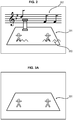
- the figure 2 illustrates an example of a part of the field of view of a spectator wearing the viewing device 10 while the method is implemented.
- the stage space 201 is seen in transparency, while the screen displays content 202 and 203, for example the score and the text sung during the current moment.
- Steps (a), (b) and (c) can be implemented by the data processing means 23 of the display device.
- the data storage means in which the set of visual content is stored can be the data storage means of the display device.
- Step (a) can be implemented by the data processing means 43 of the control terminal.
- step (a) it is thus possible to leave the determination of the current moment to the control terminal 40, for example controlled by an operator.
- step (b) can also be implemented by the data processing means 43 of the control terminal.
- the data storage means in which the set of visual content is stored can then be the data storage means 42 of the control terminal.
- the method may further comprise a step (d) of transmitting the at least one identified content to the viewing device 10, for example content identified to the viewing device 10.
- the transmission is for example carried out by wireless communication, which makes it possible to increase the maneuverability of the display device and simplifies the construction of the system. In addition, this makes it possible to limit the contents stored on the display device 10 and therefore does not require a prior step of loading contents associated with the event.
- the transmission is for example carried out via a local network, which makes it possible to implement a communication in places, such as certain concert halls, where it is difficult or impossible to receive the external wireless networks.
- the transmission is for example carried out via the local network 30.
- step (a) can be implemented by the data processing means 43 of the control terminal, with the same advantages and possibilities as those described above.
- the method may further comprise a step (e) of transmitting the determined moment to the display device 10.
- Step (e) is for example implemented after step (a) and / or prior to step (b).
- step (b) can be implemented by the data processing means 13 of the display device, and / or the set of contents can be stored in the storage means 11 of the display device. It is thus possible to limit the quantity of data exchanged between the control terminal 40 and the display device 10, since it is sufficient to transmit something to identify the current moment without needing to transmit all the associated contents. Furthermore, this makes it possible to improve the reactivity of the system because the data transmission can be carried out quickly and efficiently, the most expensive data being already present in the display device 10.
- the transmission is for example carried out via a local network, which makes it possible to implement a communication in places, such as certain concert halls, where it is difficult or impossible to receive the external wireless networks.
- the transmission is for example carried out via the local network 30.
- the method further comprises a step (f) of determining the relative position of a part of a space stage where the event takes place or an element of the scenic space or present in the scenic space, and on the other hand of the visualization device. It is thus possible to know the position of the scenic space, in particular of the stage and to adapt the display of the screen 15 accordingly.
- Such a step is repeated at a given frequency, for example of the order of several Hz, for example greater than 10 Hz, for example greater than 15 Hz, for example greater than 20 Hz. It is thus possible to follow the position of the stage space, in particular the stage, for example in real time.
- Step (c) is implemented such that the at least one identified visual content, for example the identified visual content, is or are displayed on the screen 15 as a function of the determined relative position. It is thus possible to produce a display which moves according to the movements of the viewer.
- Step (c) can be implemented such that at least one, for example several, of the at least one identified visual content, for example identified visual content, is displayed on the screen 15 in such a manner. fixed with respect to the scene in the frame of reference associated with the spectator. It is thus possible to display content effectively participating in the realization of the event.
- the at least one content thus displayed comprises for example a set element, for example set elements. This makes it possible, for example, to reduce the costs associated with the decorations by producing at least part of the decoration elements in a virtual manner. This also makes it possible to provide several possible decorations, the decorations being able to vary from one representation of the event to another or according to the choice of the spectator. The spectator can thus decide to visualize, for the same event, for example the same opera, an antique or futuristic decoration according to his tastes.
- the at least one visual content thus displayed comprises for example a video sequence of at least one actor, for example of a singer. It is thus possible to carry out events combining one or more actors physically present during the event with the performance of an absent actor, but whose visual is reproduced effectively, possibly supplemented by an associated sound content broadcast elsewhere. during the event. this allows therefore to enrich the possibilities of representing the event by combining real elements and / or performances with virtual elements and / or performances.
- the at least one visual content thus displayed comprises for example one or more textual element (s).
- a textual element e.g., a text indicating the moment of the event.
- Step (c) can be implemented such that at least one, for example several, of the identified visual content, for example identified visual content, is or are displayed on the screen 15 in such a manner. fixed with respect to the part of the stage and / or with respect to an actor present on stage in the frame of reference associated with the spectator. It is thus possible to present information specific to the part of the scene or to the actor, for example the name of the actor or the character played by the actor or the text spoken by the actor, in an efficient and easy manner. to follow for the spectator.
- Step (f) can comprise the detection of the stage space from the front optical sensor 161.
- the detection of the stage space comprises, for example, the detection of a less dark area in a generally darker space or of a darker space. a bright area in an overall less bright space.
- the detection of the scenic space comprises, for example, the passage of the color of the video stream coming from the front optical sensor 161 into shades of gray.
- the detection of the scenic space comprises, for example, the application of a Gaussian filter or equivalent to a video stream coming from the front optical sensor 161. This makes it possible to reduce the noise effects of the sensor, for example the areas where its values are exceeded. tolerance thresholds. This is all the more important as the quality of the measurement of the optical sensor is low.
- the detection of the scenic space comprises for example the application of another filter to calculate an average exposure value on elementary zones of predetermined size, for example of the order of a few pixels, then the definition of contrasted zones. of the video stream from the average values thus calculated, for example by comparison with the mean values so as to obtain a binary result.
- the detection of the scenic space comprises for example the detection of an outline of the contrasted zones, for example to give them a simple polygonal shape, for example having a number of faces less than or equal to ten, for example a rectangle.
- the detection of the scenic space comprises, for example, the transformation of the coordinates of the polygon thus obtained on the video stream to specific coordinates on the screen 15.
- the video stream coordinates are for example corrected by a predetermined zoom factor which corresponds for example to the compression ratio between the actual size of the stage space and the apparent size of the stage space through the screen 15. This correction can be followed by a translation making it possible to refocus the image with respect to screen 15. It is thus possible to locate the scenic space as viewed by the spectator.
- the acquisition and / or processing of video streams is for example carried out using the OpenCV software library or another library of the same type.
- Step (f) can comprise the detection of the scenic space by a GPS network, for example by using the natural GPS signal if it is available and / or by using an internal GPS network. Step (f) can thus comprise the determination of an absolute position of the scenic space.
- Step (f) can comprise the detection of the scenic space and / or of an element of the scenic space and / or of an element present in the scenic space by detecting the position of a communication chip. in the near field, for example an RFID type chip. It is thus possible to easily determine the position of different objects or people by implanting one or more such chips.
- Step (f) can further comprise the calculation of the distance between the display device 10 and such a chip, the display step (c) being carried out such that at least one display parameter depends of the distance thus calculated. For example, it is possible to adjust the size of the display to a predetermined readability ratio.
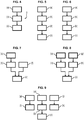
- the figure 3A schematically illustrates part of the field of view of a spectator wearing the viewing device 10 without display, i.e. that the spectator sees only the scenic space 301 by transparency of the screen 15.
- the figure 3B schematically illustrates part of the field of vision of a spectator wearing the viewing device 10 where a decorative element 302 is displayed so as to be fixed with respect to the scenic space 302.
- the figure 3C schematically illustrates part of the field of view of a viewer wearing the viewing device 10 in which the viewer sees information 303 relating to one of the singers fixed with respect to the near-field communication chip worn by the singer.
- the method can implement a control device 20 as described above, for example comprising an input / output interface 21.
- a control device 20 allows the viewer to control and / or interact in a more efficient manner. during the event, for example to more easily control the display device 10.
- the control device 20 is for example associated with the display device 10. In the case of a plurality of display devices 10, a control device 20 can be uniquely associated with each display device 10. It is thus more easy to use pairs of visualization device 10 and control device 20.
- the control device 20 is for example in communication with the associated display device 10.
- the communication is for example wireless, which makes it possible to increase the maneuverability of the display device 10 and of the control device 20 and simplifies the implementation of the system.
- the transmission is for example carried out via a local network, which makes it possible to implement a communication in places, such as certain concert halls, where it is difficult or impossible to receive the external wireless networks.
- the transmission is for example carried out via the local network 30.
- the method can comprise a step of associating the display device 10 and the control device 20.
- the association comprises, for example, the reading of a near-field communication marker from the display device 10 by a reader.
- the association can comprise, in response to the reading, the identification of the display device 10 by means of an identifier, this identification being for example implemented by the local network 30.
- the association comprises for example a step of detecting a control device 20 not yet associated, and its association with the display device 10, for example by the local network 30.
- the association comprises for example the association of the identifier of the display device 10 with an identifier of the control device 20, the identifier of the control device 20 comprising for example an address of the control device 20, for example its MAC address.
- the method may comprise a step (g) of detecting an input signal originating from a communication interface of the control device and / or of the display device.
- the communication interface comprises for example the input / output interface 11 and / or 21. It is thus possible to take into account an instruction from the viewer.
- the method may further comprise at least one step (h) of selecting at least one type of content to be displayed from among a list of possible types of content as a function of the detected input signal, for example several types of content to be displayed. .
- the viewer can thus choose the content that is of interest to him.
- the different types of content include, for example, texts in different languages and / or readable elements corresponding to the services of different actors.
- Step (h) can be implemented so that the at least one visual content, for example visual content, identified in step (b) and / or displayed in step (c), is a content of the at least one selected type, by example of the selected types, among all the visual contents associated with the determined moment.
- the display possibilities can therefore be important without compromising the visibility of the event, the spectator choosing the content which is relevant to him, for example the text in the original language and that translated into his mother tongue.
- Step (h) can comprise determining whether the number of types to be displayed simultaneously has been exceeded with respect to a maximum size, and the emission of an error message in the event of an overrun, the error message being for example displayed by the control device 20 and / or by the viewing device 10. It is thus possible to manage the number of types of content to be displayed. Determining the overflow may include determining a value of a size counter, the value being compared to a maximum size value.
- the maximum size can be defined as a maximum number of types to display, in which case the value of the counter is determined to be the number of types requested by the viewer. Alternatively, the maximum size and the counter can take into account the relative place of the types to be displayed compared to the top of the screen. It is thus possible to define a standard of comfort for the viewer.
- Step (h) can comprise a step of distributing the types of display on the screen 15. It is thus possible to optimize the comfort of the user.
- step (h) can comprise the selection of at least one display area for a type of content to be displayed from among a list of possible areas as a function of the input signal detected. The viewer can thus choose the area of the screen 15 at which he wishes the content to be displayed.
- the method can implement a control device 20 as described above, for example comprising an input / output interface 21.
- the method may comprise a step (g) of detecting an input signal originating from a communication interface of the control device and / or of the display device.
- the communication interface comprises for example the input / output interface 11 and / or 21. It is thus possible to take into account an instruction from the viewer.
- the method can comprise a step (i) of determining at least one content to be shared as a function of the detected input signal, for example several contents to be shared as a function of the detected input signal. It is thus possible for the spectator to share content during the event, by means set by the event organizer so as not to disturb the event, for example by choosing a control device and setting the parameters. associated display so that it causes little light pollution and / or little noise pollution.
- the modalities of composition of the content to be shared can be fixed so as to predetermine the composition of the content.
- Step (i) can also comprise the transmission of the contents to be shared to a remote network such as the Internet, for example via the local network.
- a remote network such as the Internet
- the router 31 can be an Internet access box of the “box” type.
- Step (i) thus comprises the sharing on a social network of the content to be shared.
- the sharing is for example carried out by a specific account of the social network common to several control devices and / or devices of visualization, for example to all control devices and / or visualization devices activated as described below.
- the sharing is for example carried out by a specific account of the social network specific to the control device and / or to the display device, for example corresponding to the identification and / or authentication data provided during the activation step described below.
- the content to be shared may include data relating to the event, for example a name of the event.
- the content to be shared may include data relating to the identified moment and / or the type of content to be shared selected, for example the content to be shared corresponding to the identified moment, for example a score and / or lyrics, for example a name of the composer. , for example a scene or song name.
- the method may comprise a step (j) of detecting an input signal originating from a communication interface of the control device and / or of the display device.
- the communication interface comprises for example the input / output interface 11 and / or 21. It is thus possible to take into account an instruction from the viewer relating to an object to be controlled.
- the object to be ordered is for example an object on sale by this means, for example food, for example a drink, for example a book.
- the method may further comprise at least one step (k) of selecting at least one object to be ordered from a list of possible objects as a function of the input signal detected, for example several foods. The viewer can thus choose the objects that are of interest to him.
- Step (k) can also include the transmission of the object to be controlled to a remote network such as the Internet, for example via the local network.
- a remote network such as the Internet
- the router 31 can be an Internet access box of the “box” type.
- the method may comprise a step of activating the display device 10 and the control device 20.
- the activation step is for example carried out at the same time as the step of associating the display device 10 and the control device 20.
- the activation step comprises, for example, the reading of a near-field communication marker from the display device 10 by a reader.
- the reader is for example associated with and / or communicates and / or comprises and / or is and / or forms means for displaying activation data and / or entering activation data.
- the data display and / or data entry means may be or comprise a terminal and / or a button and / or a touch sensor and / or a tablet, for example a touch tablet.
- the activation step comprises, for example at the same time or after the reading, a validation by input at the level of the means for displaying activation data and / or entering activation data.
- the validation is for example carried out at the same time and / or after a display of validation conditions, comprising for example the display of general conditions of sale.
- the validation may include the entry of identification and / or authentication data, for example identification with one or more social networks, these identification and / or authentication data being for example then transmitted and / or associated with the display device 10 and / or with the control device 20.
- the identification and / or authentication data are for example stored in a memory.
- the method can comprise a step of deactivating the display device 10 and the control device 20.
- the deactivation step comprises, for example, the reading of a near-field communication marker from the display device 10 by a reader.
- the reader is for example associated with and / or communicates and / or comprises and / or is and / or forms means for displaying activation data and / or entering activation data.
- the data display and / or data entry means may be or comprise a terminal and / or a button and / or a touch sensor and / or a tablet, for example a touch tablet.
- the deactivation step comprises, for example at the same time or after reading, the total or partial erasure of the identification and / or authentication data, for example identification with one or more stored social networks.
- the control device and / or another portable device for example a mobile telephone, is for example configured to allow the display of data, for example at the same time or in response to the same actions.
- the control device and / or another portable device can for example display the visual contents, for example the identified contents.
- step (c) can comprise the display by the control device and / or another portable device of said at least one identified visual content.
Landscapes
- Engineering & Computer Science (AREA)
- Physics & Mathematics (AREA)
- General Physics & Mathematics (AREA)
- General Engineering & Computer Science (AREA)
- Theoretical Computer Science (AREA)
- Optics & Photonics (AREA)
- Human Computer Interaction (AREA)
- User Interface Of Digital Computer (AREA)
- Measurement Of The Respiration, Hearing Ability, Form, And Blood Characteristics Of Living Organisms (AREA)
Claims (16)
- Verfahren zum Visualisieren von Daten im Zusammenhang mit einem Ereignis durch mindestens einen Zuschauer, der eine Visualisierungsvorrichtung (10) trägt, die mit einem mindestens teilweise transparenten Bildschirm (15) ausgestattet ist, wobei das Ereignis mehrere vorher festgelegte aufeinanderfolgende Momente umfasst, wobei eine Einheit visueller Inhalte, von denen jeder einem der aufeinanderfolgenden Momente zugeordnet ist, in Datenspeichermitteln (12, 22, 42) gespeichert ist, wobei das Verfahren die Durchführung durch Datenverarbeitungsmittel (13, 23, 43) folgender Schritte umfasst:(a) Bestimmen eines laufenden Moments,(b) Identifizieren, in der Einheit, des mindestens einen visuellen Inhalts, der dem laufenden Moment zugeordnet ist,(c) Anzeigen, durch den Bildschirm (15) der Visualisierungsvorrichtung, des mindestens einen identifizierten visuellen Inhalts,wobei das Verfahren dadurch gekennzeichnet ist, dass es ferner einen Schritt umfasst:
(f) Bestimmen der relativen Position zum einen eines szenischen Raums (201, 301), wo das Ereignis stattfindet oder eines Elements des szenischen Raums und zum anderen der Visualisierungsvorrichtung (10),wobei der Schritt (f) in einer gegebenen Frequenz wiederholt wird,wobei der Schritt (c) derart durchgeführt wird, dass der mindestens eine identifizierte Inhalt angezeigt wird, indem er sich auf dem Bildschirm (15) in Abhängigkeit von der bestimmten relativen Position verlagert. - Verfahren nach Anspruch 1, wobei die Datenverarbeitungsmittel Datenverarbeitungsmittel (13) der Visualisierungsvorrichtung (10) sind und die Datenspeichermittel Datenspeichermittel (12) der Visualisierungsvorrichtung (10) sind.
- Verfahren nach Anspruch 1, wobei der Schritt (a) von den Datenverarbeitungsmittel (43) eines Steuerendgeräts (40) durchgeführt wird.
- Verfahren nach Anspruch 3, wobei der Schritt (b) von den Datenverarbeitungsmitteln (43) des Steuerendgeräts durchgeführt wird, wobei die Datenspeichermittel Datenspeichermittel (42) des Steuerendgeräts sind, wobei das Verfahren ferner einen Schritt umfasst:
(d) Übertragen des mindestens einen identifizierten visuellen Inhalts an die Visualisierungsvorrichtung (10), wobei die Übertragung durch eine drahtlose Kommunikation erfolgt, wobei die Übertragung über ein lokales Netzwerk erfolgt. - Verfahren nach Anspruch 3, wobei das Verfahren ferner einen Schritt umfasst:(e) Übertragen des bestimmten Moments an die Visualisierungsvorrichtung (10),wobei der Schritt (b) von Datenverarbeitungsmitteln (13) der Visualisierungsvorrichtung durchgeführt wird, wobei die Datenspeichermittel Datenspeichermittel (12) der Visualisierungsvorrichtung sind.
- Verfahren nach einem der vorangehenden Ansprüche, wobei der mindestens eine identifizierte visuelle Inhalt eine anzuzeigende Musikpartitur und/oder ein anzuzeigendes Dekorelement umfasst.
- Verfahren nach einem der vorangehenden Ansprüche, wobei die gegebene Frequenz in der Größenordnung von mehreren Hz liegt, beispielsweise über 10 Hz, beispielsweise über 15 Hz, beispielsweise über 20 Hz.
- Verfahren nach einem der vorangehenden Ansprüche, wobei eine Kotrollvorrichtung (20), die eine Eingangs-/Ausgangs-Schnittstelle (21) umfasst, jeder Visualisierungsvorrichtung (10) zugeordnet ist, wobei die Kotrollvorrichtung mit der Visualisierungsvorrichtung in Kommunikation ist, und wobei:- das Verfahren einen Schritt umfasst:
(g) Ermittelns eines von der Eingangs-/Ausgangs-Schnittstelle ausgehenden Eingangssignals,- wobei das Verfahren ferner mindestens einen Schritt umfasst:(h) Auswählens mindestens eines Typs anzuzeigenden Inhalts aus einer Liste von Typen möglicher Inhalte in Abhängigkeit vom ermittelten Eingangssignal, so dass der mindestens eine in Schritt (b) identifizierte und/oder in Schritt (c) angezeigte visuelle Inhalt ein Inhalt des mindestens einen Typs ist, der aus dem mindestens einen visuellen Inhalt ausgewählt ist, der dem bestimmten Moment zugeordnet ist, und/oder(i) Bestimmen des mindestens einen in Abhängigkeit vom ermittelten Eingangssignal zu teilenden Inhalts und Übertragen des mindestens einen zu teilenden Inhalts an ein entferntes Netzwerk über ein lokales Netzwerk. - Verfahren nach Anspruch 8, umfassend einen Schritt (j) des Ermittelns eines von einer Kommunikationsschnittstelle der Kontrollvorrichtung und/oder der Visualisierungsvorrichtung ausgehenden Eingangssignals, wobei das Verfahren ferner einen Schritt (k) des Auswählens mindestens eines zu steuernden Objekts, beispielsweise eines Verkaufsobjekts, aus einer Liste möglicher Objekte in Abhängigkeit vom ermittelten Eingangssignal umfasst, wobei der Schritt (k) die Übertragung der Steuerung des Objekts an ein entferntes Netzwerk, beispielsweise über das lokale Netzwerk, umfasst.
- Verfahren nach Anspruch 8, umfassend einen Aktivierungsschritt der Visualisierungsvorrichtung (10) und der Kontrollvorrichtung (20), der gleichzeitig wie der Zuordnungsschritt der Visualisierungsvorrichtung (10) und der Kontrollvorrichtung (20) durchgeführt wird, wobei der Aktivierungsschritt das Lesen eines Kommunikationsmarkers im Nahfeld der Visualisierungsvorrichtung (10) durch ein Lesegerät umfasst, wobei das Lesegerät den Anzeigemitteln von Aktivierungsdaten und/oder Eingangsmitteln von Aktivierungsdaten zugeordnet ist und/oder kommuniziert und/oder umfasst und/oder ist und/oder bildet,
wobei der Aktivierungsschritt umfasst, gleichzeitig oder nach dem Lesen, eine Validierung durch Eingang, im Bereich der Anzeigemittel, von Aktivierungsdaten und/oder Eingang von Aktivierungsdaten, die gleichzeitig und/oder nach einer Anzeige von Validierungsbedingungen durchgeführt, wobei die Validierung den Eingang von Identifizierungs- und/oder Authentifizierungsdaten umfasst, wobei die Identifizierungs- und/oder Authentifizierungsdaten dann an die Visualisierungsvorrichtung (10) und/oder an die Kontrollvorrichtung (20) übertragen und/oder zugeordnet werden. - Verfahren nach Anspruch 10, umfassend einen Deaktivierungsschritt der Visualisierungsvorrichtung (10) und der Kontrollvorrichtung (20), wobei der Deaktivierungsschritt das Lesen eines Kommunikationsmarkers im Nahfeld der Visualisierungsvorrichtung (10) durch das Lesegerät umfasst, wobei der Deaktivierungsschritt gleichzeitig oder nach dem Lesen das vollständige oder teilweise Löschen der Identifizierungs- und/oder Authentifizierungsdaten umfasst.
- Verfahren nach einem der Ansprüche 8 bis 11, wobei der Schritt (c) das Anzeigen, durch die Kontrollvorrichtung und/oder eine andere tragbare Vorrichtung, des mindestens einen identifizierten visuellen Inhalts umfasst.
- Verfahren nach einem der vorangehenden Ansprüche, wobei das Verfahren einen Empfangsschritt eines von Messmitteln ausgehenden Eingangssignals umfasst, wobei die Messmittel mindestens einen akustischen Sensor (17, 27, 47) umfassen und/oder die Messmittel mindestens einen optischen Sensor (16, 161, 162, 46) umfassen, wobei die Bestimmung in Abhängigkeit von dem derart gemessenen Eingangssignal durchgeführt wird, wobei der Bestimmungsschritt einen Wiedererkennungsschritt des Eingangssignals, beispielsweise durch Vergleich mit einem Referenzsignal, umfasst.
- Verfahren nach einem der vorangehenden Ansprüche, wobei der mindestens eine visuelle Inhalt Musiknoten umfasst, die während des bestimmten Moments oder des folgenden Moments gespielt werden.
- System zur Visualisierung von Daten im Zusammenhang mit einem Ereignis durch mindestens einen Zuschauer, wobei das System ausgelegt ist, um das Verfahren nach einem der Ansprüche 1 bis 12 durchzuführen.
- Speichermittel, die von einer IT-Ausrüstung lesbar sind, auf denen ein Rechnerprogrammprodukt Codebefehle für die Ausführung eines Verfahrens nach einem der Ansprüche 1 bis 12 umfasst.
Applications Claiming Priority (2)
| Application Number | Priority Date | Filing Date | Title |
|---|---|---|---|
| FR1558693A FR3041122B1 (fr) | 2015-09-16 | 2015-09-16 | Procede de visualisation de donnees relatives a un evenement et systeme associe |
| PCT/EP2016/072008 WO2017046348A1 (fr) | 2015-09-16 | 2016-09-16 | Procédé de visualisation de données relatives à un événement et système associé |
Publications (2)
| Publication Number | Publication Date |
|---|---|
| EP3351007A1 EP3351007A1 (de) | 2018-07-25 |
| EP3351007B1 true EP3351007B1 (de) | 2021-10-27 |
Family
ID=55299569
Family Applications (1)
| Application Number | Title | Priority Date | Filing Date |
|---|---|---|---|
| EP16769958.6A Active EP3351007B1 (de) | 2015-09-16 | 2016-09-16 | Verfahren zum anzeigen von daten im zusammenhang mit einem ereignis und zugehöriges system |
Country Status (5)
| Country | Link |
|---|---|
| EP (1) | EP3351007B1 (de) |
| ES (1) | ES2903439T3 (de) |
| FR (1) | FR3041122B1 (de) |
| WO (1) | WO2017046348A1 (de) |
| ZA (1) | ZA201802463B (de) |
Family Cites Families (2)
| Publication number | Priority date | Publication date | Assignee | Title |
|---|---|---|---|---|
| JP2011053468A (ja) * | 2009-09-02 | 2011-03-17 | Sony Corp | 映像/文字同時表示装置及び頭部装着型ディスプレイ |
| JP5499854B2 (ja) * | 2010-04-08 | 2014-05-21 | ソニー株式会社 | 頭部装着型ディスプレイにおける光学的位置調整方法 |
-
2015
- 2015-09-16 FR FR1558693A patent/FR3041122B1/fr active Active
-
2016
- 2016-09-16 WO PCT/EP2016/072008 patent/WO2017046348A1/fr not_active Ceased
- 2016-09-16 ES ES16769958T patent/ES2903439T3/es active Active
- 2016-09-16 EP EP16769958.6A patent/EP3351007B1/de active Active
-
2018
- 2018-04-13 ZA ZA2018/02463A patent/ZA201802463B/en unknown
Non-Patent Citations (1)
| Title |
|---|
| None * |
Also Published As
| Publication number | Publication date |
|---|---|
| ES2903439T3 (es) | 2022-04-01 |
| WO2017046348A1 (fr) | 2017-03-23 |
| FR3041122A1 (fr) | 2017-03-17 |
| ZA201802463B (en) | 2018-12-19 |
| FR3041122B1 (fr) | 2022-01-21 |
| EP3351007A1 (de) | 2018-07-25 |
Similar Documents
| Publication | Publication Date | Title |
|---|---|---|
| US12141351B2 (en) | Eye gesture tracking | |
| US10019962B2 (en) | Context adaptive user interface for augmented reality display | |
| US11262590B2 (en) | Video generation method and apparatus | |
| US9038127B2 (en) | Physical interaction with virtual objects for DRM | |
| BE1022580A9 (fr) | Méthode d'obtention de vidéos immersives avec parallaxe interactive et méthode de visualisation de vidéos immersives avec parallaxe interactive | |
| WO2020231640A1 (en) | Light field display system for performance events | |
| TW201228380A (en) | Comprehension and intent-based content for augmented reality displays | |
| US20140204117A1 (en) | Mixed reality filtering | |
| US12620182B2 (en) | Method and device for presenting an audio and synthesized reality experience | |
| CN108369457A (zh) | 用于混合现实的现实混合器 | |
| CN105898429A (zh) | 能够增强现实演出的方法、设备和增强现实设备 | |
| US20190156715A1 (en) | Method and system for facilitating provisioning of holographic content | |
| KR20250116047A (ko) | 모바일 장치를 위한 라이트필드 디스플레이 | |
| EP3398165A1 (de) | Augenbewegungsverfolgung | |
| CN109074680A (zh) | 基于通信的增强现实中实时图像和信号处理方法和系统 | |
| FR2979986B1 (fr) | Procede et dispositif de reglage de la representation cartographique d'un systeme d'informations de vehicule | |
| EP3351007A1 (de) | Verfahren zum anzeigen von daten im zusammenhang mit einem ereignis und zugehöriges system | |
| FR3084498A1 (fr) | Systemes et procedes pour une interaction amelioree dans une application de realite augmentee | |
| FR3088458A1 (fr) | Procede de reconnaissance et de description contextuelles d'un objet d'interet pour un utilisateur deficient visuel, dispositif mettant en oeuvre ledit procede | |
| FR3112633A1 (fr) | Vieillissement du visage contrôlable à haute résolution avec des GAN conditionnels à sensibilité spatiale | |
| US12548263B1 (en) | Augmentation based on physical environment context | |
| WO2025209878A1 (fr) | Procédé de traitement d'un flux audiovisuel, dispositif électronique et produit programme d'ordinateur correspondants | |
| FR3123484A1 (fr) | Procédé et dispositif pour simuler un maquillage à partir d’un avatar | |
| CH711803A2 (fr) | Procédé d'interaction par surface miroir interactive. | |
| Christensen | Altered Perceptions Discerning the Natural from the Virtual in Extended Reality |
Legal Events
| Date | Code | Title | Description |
|---|---|---|---|
| STAA | Information on the status of an ep patent application or granted ep patent |
Free format text: STATUS: THE INTERNATIONAL PUBLICATION HAS BEEN MADE |
|
| PUAI | Public reference made under article 153(3) epc to a published international application that has entered the european phase |
Free format text: ORIGINAL CODE: 0009012 |
|
| STAA | Information on the status of an ep patent application or granted ep patent |
Free format text: STATUS: REQUEST FOR EXAMINATION WAS MADE |
|
| 17P | Request for examination filed |
Effective date: 20180413 |
|
| AK | Designated contracting states |
Kind code of ref document: A1 Designated state(s): AL AT BE BG CH CY CZ DE DK EE ES FI FR GB GR HR HU IE IS IT LI LT LU LV MC MK MT NL NO PL PT RO RS SE SI SK SM TR |
|
| AX | Request for extension of the european patent |
Extension state: BA ME |
|
| DAV | Request for validation of the european patent (deleted) | ||
| DAX | Request for extension of the european patent (deleted) | ||
| STAA | Information on the status of an ep patent application or granted ep patent |
Free format text: STATUS: EXAMINATION IS IN PROGRESS |
|
| 17Q | First examination report despatched |
Effective date: 20200408 |
|
| REG | Reference to a national code |
Ref country code: DE Ref legal event code: R079 Ref document number: 602016065441 Country of ref document: DE Free format text: PREVIOUS MAIN CLASS: H04N0021488000 Ipc: G02B0027010000 |
|
| RIC1 | Information provided on ipc code assigned before grant |
Ipc: G06F 3/01 20060101ALI20210423BHEP Ipc: H04N 21/488 20110101ALI20210423BHEP Ipc: H04N 21/414 20110101ALI20210423BHEP Ipc: G02B 27/01 20060101AFI20210423BHEP |
|
| GRAP | Despatch of communication of intention to grant a patent |
Free format text: ORIGINAL CODE: EPIDOSNIGR1 |
|
| STAA | Information on the status of an ep patent application or granted ep patent |
Free format text: STATUS: GRANT OF PATENT IS INTENDED |
|
| INTG | Intention to grant announced |
Effective date: 20210604 |
|
| GRAS | Grant fee paid |
Free format text: ORIGINAL CODE: EPIDOSNIGR3 |
|
| GRAA | (expected) grant |
Free format text: ORIGINAL CODE: 0009210 |
|
| STAA | Information on the status of an ep patent application or granted ep patent |
Free format text: STATUS: THE PATENT HAS BEEN GRANTED |
|
| AK | Designated contracting states |
Kind code of ref document: B1 Designated state(s): AL AT BE BG CH CY CZ DE DK EE ES FI FR GB GR HR HU IE IS IT LI LT LU LV MC MK MT NL NO PL PT RO RS SE SI SK SM TR |
|
| REG | Reference to a national code |
Ref country code: GB Ref legal event code: FG4D Free format text: NOT ENGLISH |
|
| REG | Reference to a national code |
Ref country code: CH Ref legal event code: EP |
|
| REG | Reference to a national code |
Ref country code: AT Ref legal event code: REF Ref document number: 1442302 Country of ref document: AT Kind code of ref document: T Effective date: 20211115 |
|
| REG | Reference to a national code |
Ref country code: DE Ref legal event code: R096 Ref document number: 602016065441 Country of ref document: DE |
|
| REG | Reference to a national code |
Ref country code: IE Ref legal event code: FG4D Free format text: LANGUAGE OF EP DOCUMENT: FRENCH |
|
| REG | Reference to a national code |
Ref country code: NL Ref legal event code: FP |
|
| REG | Reference to a national code |
Ref country code: LT Ref legal event code: MG9D |
|
| REG | Reference to a national code |
Ref country code: AT Ref legal event code: MK05 Ref document number: 1442302 Country of ref document: AT Kind code of ref document: T Effective date: 20211027 |
|
| REG | Reference to a national code |
Ref country code: ES Ref legal event code: FG2A Ref document number: 2903439 Country of ref document: ES Kind code of ref document: T3 Effective date: 20220401 |
|
| PG25 | Lapsed in a contracting state [announced via postgrant information from national office to epo] |
Ref country code: RS Free format text: LAPSE BECAUSE OF FAILURE TO SUBMIT A TRANSLATION OF THE DESCRIPTION OR TO PAY THE FEE WITHIN THE PRESCRIBED TIME-LIMIT Effective date: 20211027 Ref country code: LT Free format text: LAPSE BECAUSE OF FAILURE TO SUBMIT A TRANSLATION OF THE DESCRIPTION OR TO PAY THE FEE WITHIN THE PRESCRIBED TIME-LIMIT Effective date: 20211027 Ref country code: FI Free format text: LAPSE BECAUSE OF FAILURE TO SUBMIT A TRANSLATION OF THE DESCRIPTION OR TO PAY THE FEE WITHIN THE PRESCRIBED TIME-LIMIT Effective date: 20211027 Ref country code: BG Free format text: LAPSE BECAUSE OF FAILURE TO SUBMIT A TRANSLATION OF THE DESCRIPTION OR TO PAY THE FEE WITHIN THE PRESCRIBED TIME-LIMIT Effective date: 20220127 Ref country code: AT Free format text: LAPSE BECAUSE OF FAILURE TO SUBMIT A TRANSLATION OF THE DESCRIPTION OR TO PAY THE FEE WITHIN THE PRESCRIBED TIME-LIMIT Effective date: 20211027 |
|
| PG25 | Lapsed in a contracting state [announced via postgrant information from national office to epo] |
Ref country code: IS Free format text: LAPSE BECAUSE OF FAILURE TO SUBMIT A TRANSLATION OF THE DESCRIPTION OR TO PAY THE FEE WITHIN THE PRESCRIBED TIME-LIMIT Effective date: 20220227 Ref country code: SE Free format text: LAPSE BECAUSE OF FAILURE TO SUBMIT A TRANSLATION OF THE DESCRIPTION OR TO PAY THE FEE WITHIN THE PRESCRIBED TIME-LIMIT Effective date: 20211027 Ref country code: PT Free format text: LAPSE BECAUSE OF FAILURE TO SUBMIT A TRANSLATION OF THE DESCRIPTION OR TO PAY THE FEE WITHIN THE PRESCRIBED TIME-LIMIT Effective date: 20220228 Ref country code: PL Free format text: LAPSE BECAUSE OF FAILURE TO SUBMIT A TRANSLATION OF THE DESCRIPTION OR TO PAY THE FEE WITHIN THE PRESCRIBED TIME-LIMIT Effective date: 20211027 Ref country code: NO Free format text: LAPSE BECAUSE OF FAILURE TO SUBMIT A TRANSLATION OF THE DESCRIPTION OR TO PAY THE FEE WITHIN THE PRESCRIBED TIME-LIMIT Effective date: 20220127 Ref country code: LV Free format text: LAPSE BECAUSE OF FAILURE TO SUBMIT A TRANSLATION OF THE DESCRIPTION OR TO PAY THE FEE WITHIN THE PRESCRIBED TIME-LIMIT Effective date: 20211027 Ref country code: HR Free format text: LAPSE BECAUSE OF FAILURE TO SUBMIT A TRANSLATION OF THE DESCRIPTION OR TO PAY THE FEE WITHIN THE PRESCRIBED TIME-LIMIT Effective date: 20211027 Ref country code: GR Free format text: LAPSE BECAUSE OF FAILURE TO SUBMIT A TRANSLATION OF THE DESCRIPTION OR TO PAY THE FEE WITHIN THE PRESCRIBED TIME-LIMIT Effective date: 20220128 |
|
| REG | Reference to a national code |
Ref country code: DE Ref legal event code: R097 Ref document number: 602016065441 Country of ref document: DE |
|
| PG25 | Lapsed in a contracting state [announced via postgrant information from national office to epo] |
Ref country code: SM Free format text: LAPSE BECAUSE OF FAILURE TO SUBMIT A TRANSLATION OF THE DESCRIPTION OR TO PAY THE FEE WITHIN THE PRESCRIBED TIME-LIMIT Effective date: 20211027 Ref country code: SK Free format text: LAPSE BECAUSE OF FAILURE TO SUBMIT A TRANSLATION OF THE DESCRIPTION OR TO PAY THE FEE WITHIN THE PRESCRIBED TIME-LIMIT Effective date: 20211027 Ref country code: RO Free format text: LAPSE BECAUSE OF FAILURE TO SUBMIT A TRANSLATION OF THE DESCRIPTION OR TO PAY THE FEE WITHIN THE PRESCRIBED TIME-LIMIT Effective date: 20211027 Ref country code: EE Free format text: LAPSE BECAUSE OF FAILURE TO SUBMIT A TRANSLATION OF THE DESCRIPTION OR TO PAY THE FEE WITHIN THE PRESCRIBED TIME-LIMIT Effective date: 20211027 Ref country code: DK Free format text: LAPSE BECAUSE OF FAILURE TO SUBMIT A TRANSLATION OF THE DESCRIPTION OR TO PAY THE FEE WITHIN THE PRESCRIBED TIME-LIMIT Effective date: 20211027 Ref country code: CZ Free format text: LAPSE BECAUSE OF FAILURE TO SUBMIT A TRANSLATION OF THE DESCRIPTION OR TO PAY THE FEE WITHIN THE PRESCRIBED TIME-LIMIT Effective date: 20211027 |
|
| PLBE | No opposition filed within time limit |
Free format text: ORIGINAL CODE: 0009261 |
|
| STAA | Information on the status of an ep patent application or granted ep patent |
Free format text: STATUS: NO OPPOSITION FILED WITHIN TIME LIMIT |
|
| 26N | No opposition filed |
Effective date: 20220728 |
|
| PG25 | Lapsed in a contracting state [announced via postgrant information from national office to epo] |
Ref country code: AL Free format text: LAPSE BECAUSE OF FAILURE TO SUBMIT A TRANSLATION OF THE DESCRIPTION OR TO PAY THE FEE WITHIN THE PRESCRIBED TIME-LIMIT Effective date: 20211027 |
|
| PG25 | Lapsed in a contracting state [announced via postgrant information from national office to epo] |
Ref country code: SI Free format text: LAPSE BECAUSE OF FAILURE TO SUBMIT A TRANSLATION OF THE DESCRIPTION OR TO PAY THE FEE WITHIN THE PRESCRIBED TIME-LIMIT Effective date: 20211027 |
|
| PG25 | Lapsed in a contracting state [announced via postgrant information from national office to epo] |
Ref country code: MC Free format text: LAPSE BECAUSE OF FAILURE TO SUBMIT A TRANSLATION OF THE DESCRIPTION OR TO PAY THE FEE WITHIN THE PRESCRIBED TIME-LIMIT Effective date: 20211027 |
|
| PG25 | Lapsed in a contracting state [announced via postgrant information from national office to epo] |
Ref country code: LU Free format text: LAPSE BECAUSE OF NON-PAYMENT OF DUE FEES Effective date: 20220916 |
|
| PG25 | Lapsed in a contracting state [announced via postgrant information from national office to epo] |
Ref country code: IE Free format text: LAPSE BECAUSE OF NON-PAYMENT OF DUE FEES Effective date: 20220916 |
|
| PG25 | Lapsed in a contracting state [announced via postgrant information from national office to epo] |
Ref country code: HU Free format text: LAPSE BECAUSE OF FAILURE TO SUBMIT A TRANSLATION OF THE DESCRIPTION OR TO PAY THE FEE WITHIN THE PRESCRIBED TIME-LIMIT; INVALID AB INITIO Effective date: 20160916 |
|
| PG25 | Lapsed in a contracting state [announced via postgrant information from national office to epo] |
Ref country code: CY Free format text: LAPSE BECAUSE OF FAILURE TO SUBMIT A TRANSLATION OF THE DESCRIPTION OR TO PAY THE FEE WITHIN THE PRESCRIBED TIME-LIMIT Effective date: 20211027 |
|
| PG25 | Lapsed in a contracting state [announced via postgrant information from national office to epo] |
Ref country code: MK Free format text: LAPSE BECAUSE OF FAILURE TO SUBMIT A TRANSLATION OF THE DESCRIPTION OR TO PAY THE FEE WITHIN THE PRESCRIBED TIME-LIMIT Effective date: 20211027 |
|
| PG25 | Lapsed in a contracting state [announced via postgrant information from national office to epo] |
Ref country code: TR Free format text: LAPSE BECAUSE OF FAILURE TO SUBMIT A TRANSLATION OF THE DESCRIPTION OR TO PAY THE FEE WITHIN THE PRESCRIBED TIME-LIMIT Effective date: 20211027 |
|
| PG25 | Lapsed in a contracting state [announced via postgrant information from national office to epo] |
Ref country code: MT Free format text: LAPSE BECAUSE OF FAILURE TO SUBMIT A TRANSLATION OF THE DESCRIPTION OR TO PAY THE FEE WITHIN THE PRESCRIBED TIME-LIMIT Effective date: 20211027 |
|
| REG | Reference to a national code |
Ref country code: CH Ref legal event code: U11 Free format text: ST27 STATUS EVENT CODE: U-0-0-U10-U11 (AS PROVIDED BY THE NATIONAL OFFICE) Effective date: 20251001 |
|
| PGFP | Annual fee paid to national office [announced via postgrant information from national office to epo] |
Ref country code: DE Payment date: 20250916 Year of fee payment: 10 |
|
| PGFP | Annual fee paid to national office [announced via postgrant information from national office to epo] |
Ref country code: NL Payment date: 20250926 Year of fee payment: 10 Ref country code: IT Payment date: 20250909 Year of fee payment: 10 |
|
| PGFP | Annual fee paid to national office [announced via postgrant information from national office to epo] |
Ref country code: BE Payment date: 20250919 Year of fee payment: 10 Ref country code: GB Payment date: 20250919 Year of fee payment: 10 |
|
| PGFP | Annual fee paid to national office [announced via postgrant information from national office to epo] |
Ref country code: FR Payment date: 20250826 Year of fee payment: 10 |
|
| PGFP | Annual fee paid to national office [announced via postgrant information from national office to epo] |
Ref country code: CH Payment date: 20251001 Year of fee payment: 10 |
|
| PGFP | Annual fee paid to national office [announced via postgrant information from national office to epo] |
Ref country code: ES Payment date: 20251015 Year of fee payment: 10 |