EP3350002B1 - Système d'ouverture de hayon à deux bielettes - Google Patents
Système d'ouverture de hayon à deux bielettes Download PDFInfo
- Publication number
- EP3350002B1 EP3350002B1 EP16766964.7A EP16766964A EP3350002B1 EP 3350002 B1 EP3350002 B1 EP 3350002B1 EP 16766964 A EP16766964 A EP 16766964A EP 3350002 B1 EP3350002 B1 EP 3350002B1
- Authority
- EP
- European Patent Office
- Prior art keywords
- tailgate
- opening
- connecting rod
- body structure
- link
- Prior art date
- Legal status (The legal status is an assumption and is not a legal conclusion. Google has not performed a legal analysis and makes no representation as to the accuracy of the status listed.)
- Active
Links
Images

Classifications
-
- E—FIXED CONSTRUCTIONS
- E05—LOCKS; KEYS; WINDOW OR DOOR FITTINGS; SAFES
- E05D—HINGES OR SUSPENSION DEVICES FOR DOORS, WINDOWS OR WINGS
- E05D15/00—Suspension arrangements for wings
- E05D15/56—Suspension arrangements for wings with successive different movements
- E05D15/58—Suspension arrangements for wings with successive different movements with both swinging and sliding movements
- E05D15/582—Suspension arrangements for wings with successive different movements with both swinging and sliding movements with horizontal swinging axis
-
- B—PERFORMING OPERATIONS; TRANSPORTING
- B60—VEHICLES IN GENERAL
- B60J—WINDOWS, WINDSCREENS, NON-FIXED ROOFS, DOORS, OR SIMILAR DEVICES FOR VEHICLES; REMOVABLE EXTERNAL PROTECTIVE COVERINGS SPECIALLY ADAPTED FOR VEHICLES
- B60J5/00—Doors
- B60J5/10—Doors arranged at the vehicle rear
- B60J5/101—Doors arranged at the vehicle rear for non-load transporting vehicles, i.e. family cars including vans
- B60J5/106—Doors arranged at the vehicle rear for non-load transporting vehicles, i.e. family cars including vans comprising door or part of door being moveable by a linkage system to open/close position
-
- B—PERFORMING OPERATIONS; TRANSPORTING
- B60—VEHICLES IN GENERAL
- B60J—WINDOWS, WINDSCREENS, NON-FIXED ROOFS, DOORS, OR SIMILAR DEVICES FOR VEHICLES; REMOVABLE EXTERNAL PROTECTIVE COVERINGS SPECIALLY ADAPTED FOR VEHICLES
- B60J5/00—Doors
- B60J5/10—Doors arranged at the vehicle rear
- B60J5/12—Doors arranged at the vehicle rear slidable; foldable
-
- E—FIXED CONSTRUCTIONS
- E05—LOCKS; KEYS; WINDOW OR DOOR FITTINGS; SAFES
- E05D—HINGES OR SUSPENSION DEVICES FOR DOORS, WINDOWS OR WINGS
- E05D15/00—Suspension arrangements for wings
- E05D15/40—Suspension arrangements for wings supported on arms movable in vertical planes
- E05D15/403—Suspension arrangements for wings supported on arms movable in vertical planes with arms fixed on the wing pivoting about an axis outside the wing
-
- E—FIXED CONSTRUCTIONS
- E05—LOCKS; KEYS; WINDOW OR DOOR FITTINGS; SAFES
- E05D—HINGES OR SUSPENSION DEVICES FOR DOORS, WINDOWS OR WINGS
- E05D15/00—Suspension arrangements for wings
- E05D15/40—Suspension arrangements for wings supported on arms movable in vertical planes
- E05D15/406—Suspension arrangements for wings supported on arms movable in vertical planes with pivoted arms and sliding guides
- E05D15/408—Suspension arrangements for wings supported on arms movable in vertical planes with pivoted arms and sliding guides with sliding guides fixed to the wing
-
- E—FIXED CONSTRUCTIONS
- E05—LOCKS; KEYS; WINDOW OR DOOR FITTINGS; SAFES
- E05D—HINGES OR SUSPENSION DEVICES FOR DOORS, WINDOWS OR WINGS
- E05D15/00—Suspension arrangements for wings
- E05D15/40—Suspension arrangements for wings supported on arms movable in vertical planes
- E05D15/46—Suspension arrangements for wings supported on arms movable in vertical planes with two pairs of pivoted arms
-
- E—FIXED CONSTRUCTIONS
- E05—LOCKS; KEYS; WINDOW OR DOOR FITTINGS; SAFES
- E05D—HINGES OR SUSPENSION DEVICES FOR DOORS, WINDOWS OR WINGS
- E05D5/00—Construction of single parts, e.g. the parts for attachment
- E05D5/02—Parts for attachment, e.g. flaps
- E05D5/06—Bent flaps
- E05D5/062—Bent flaps specially adapted for vehicles
-
- E—FIXED CONSTRUCTIONS
- E05—LOCKS; KEYS; WINDOW OR DOOR FITTINGS; SAFES
- E05D—HINGES OR SUSPENSION DEVICES FOR DOORS, WINDOWS OR WINGS
- E05D5/00—Construction of single parts, e.g. the parts for attachment
- E05D5/02—Parts for attachment, e.g. flaps
- E05D5/06—Bent flaps
- E05D2005/067—Bent flaps gooseneck shaped
-
- E—FIXED CONSTRUCTIONS
- E05—LOCKS; KEYS; WINDOW OR DOOR FITTINGS; SAFES
- E05D—HINGES OR SUSPENSION DEVICES FOR DOORS, WINDOWS OR WINGS
- E05D15/00—Suspension arrangements for wings
- E05D15/48—Suspension arrangements for wings allowing alternative movements
- E05D2015/485—Swinging or sliding movements
-
- E—FIXED CONSTRUCTIONS
- E05—LOCKS; KEYS; WINDOW OR DOOR FITTINGS; SAFES
- E05Y—INDEXING SCHEME ASSOCIATED WITH SUBCLASSES E05D AND E05F, RELATING TO CONSTRUCTION ELEMENTS, ELECTRIC CONTROL, POWER SUPPLY, POWER SIGNAL OR TRANSMISSION, USER INTERFACES, MOUNTING OR COUPLING, DETAILS, ACCESSORIES, AUXILIARY OPERATIONS NOT OTHERWISE PROVIDED FOR, APPLICATION THEREOF
- E05Y2900/00—Application of doors, windows, wings or fittings thereof
- E05Y2900/50—Application of doors, windows, wings or fittings thereof for vehicles
- E05Y2900/53—Type of wing
- E05Y2900/546—Tailboards, tailgates or sideboards opening upwards
Definitions
- Such a set is known from WO 2006/097082 , which is considered to be the closest prior art and describes the characteristics of the preamble of claim 1.
- Said assembly is in particular intended to give access to the boot of a motor vehicle by opening the tailgate. A user of the motor vehicle can thus easily load and unload, for example, bulky objects from the rear of the vehicle by opening the tailgate.
- Such a tailgate opens, generally, by rotation of the tailgate around a hinge placed between the upper edge of the opening and the upper edge of the tailgate.
- the tailgate thus passes from a closed position, substantially parallel to the plane of the opening of the body structure, to an open position, substantially perpendicular to the plane of the opening of the body structure, in which the tailgate extends over the user's head.
- One of the objects of the invention is to provide a rear vehicle assembly whose opening and closing device of the tailgate has kinematics requiring less space around the vehicle and comprising less ample movements.
- the subject of the invention is an assembly of the aforementioned type, in which the first link comprises, from its first end to a first intermediate point, a first substantially straight section, from the first intermediate point to a second intermediate point, a curved section, and from the second intermediate point to the second end, a second substantially straight section, the two straight sections forming acute angles with the tangents to the curved section at their points of contact with the curved section, the first straight section being from concave side of the curved section and the second straight section located on the convex side of the curved section.
- the opening and closing device comprises two connecting rods replacing the hinge, an opening kinematics are ensured requiring the minimum of space and presenting little risk of impact during use while guaranteeing optimal access to inside the vehicle, the tailgate can pass over the roof of the vehicle in the open position.
- Such a device is more robust and simple to implement, and has reasonable manufacturing costs.
- orientations are the usual orientations of a motor vehicle.
- the terms “upper”, “lower”, “left”, “right”, “above”, “below”, “forward” and “backward” are generally understood in relation to the normal direction of movement of the motor vehicle and the position of the driver.
- a rear vehicle assembly 10 is shown in the Figures 1 to 3 .
- the rear assembly 10 comprises a body structure 12.
- the body structure 12 defines an opening 14.
- the opening 14 is adapted to give access to the interior of a rear part of the vehicle, for example the trunk and / or the rear area of the vehicle, from the outside of the vehicle.
- the opening 14 comprises at least a first lateral edge of the opening 16 and a second lateral edge of the opening (not shown), formed by uprights of the body structure 12.
- the first lateral edge of the opening 16 extends substantially in a direction of elevation of the vehicle and is located, for example, to the left of the vehicle.
- the second lateral edge of the opening extends substantially in a direction of elevation of the vehicle and is located, for example, to the right of the vehicle.
- the opening 14 further comprises an upper edge of the opening 18, extending, for example, between the roof of the vehicle and the lateral edges of the opening 14, and a lower edge of the opening 19, extending, for example, between the vehicle floor and the lateral edges of the opening 14.
- the rear assembly 10 also includes a tailgate 20.
- Such a tailgate 20 is conventional in a motor vehicle and includes, for example, glazed surfaces, rear vehicle optics, etc.
- the tailgate 20 comprises at least a first side edge of the tailgate 22, a second side edge of the tailgate (not shown), an upper edge of the tailgate 24 and a bottom edge of the tailgate 25.
- the tailgate 20 is movable relative to the body structure 12 between at least one open position and a closed position.
- the opening 14 of the body structure 12 is isolated from the outside environment of the vehicle.
- the first side edge of the tailgate 22 and the second side edge of the tailgate are then respectively pressed against the first side edge of the opening 16 and the second side edge of the opening, and the top edge of the tailgate 24 and the bottom edge of tailgate 25 are respectively pressed against the upper edge of the opening 18 and the lower edge of the opening 19.
- the opening 14 of the body structure 12 is accessible from outside the vehicle.
- the first side edge of the tailgate 22 and the second side edge of the tailgate then face the roof of the vehicle.
- the rear assembly 10 also comprises an opening and closing device 26.
- the opening and closing device 26 fixes the tailgate 20 to the body structure 12.
- the opening and closing device 26 forms the only attachment of the tailgate 20 to the body structure 12, that is to say that there is no other attachment element ensuring the attachment tailgate 20 on the body structure 12.
- the rear assembly 10 according to the invention is thus devoid of direct articulation between the upper edge of the tailgate 24 and the upper edge of the opening 18 of the body structure 12, at unlike conventional tailgates for motor vehicles.
- the opening and closing device 26 is then adapted to keep the tailgate 20 closed in the event of an impact.
- the device 26 further comprises a closing lock located at the lower edge 25 of the tailgate 20 and adapted to cooperate with a holding member fixed to the body structure 12. The lock makes it possible to maintain the tailgate 20 on the body structure 12 in the event of an impact.
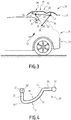
- the tailgate 20 may also include two holding hooks located respectively at the upper level of the first 16 and second side edges of the tailgate 20 and adapted to engage with the tailgate 20 and ensure its retention on the body structure 12 in the closed position.
- the opening and closing device 26 comprises a first link 28 and a second link 30.
- the first end 31 of the first link 28 is provided with a pivot type connection suitable for articulating the first link 28 in rotation relative to the body structure 12.
- the second end 37 of the first link 28 is provided with a pivot type connection suitable for articulating the first link 28 to the tailgate 20.
- the curved section 34 has for example the shape of a circular arc or an elliptical arc, having a concave side 41 and a convex side 43.
- the first straight section 32 is located on the concave side 41 of the curved section 34
- the second straight section 36 is located on the convex side 43 of the curved section 34, so that the first and second straight sections 32, 36 are located on either side of the curved section 34.
- the two straight sections 32, 36 form at intermediate points 33, 35 of the acute angles with the local tangents to the curved section 34. These angles are for example substantially between 45 ° and 90 °.
- these intermediate points 33, 35 have rounded at the angles.
- the first and second links are made in one piece and have a rigid structure.
- the length of the first rectilinear section 32 is advantageously greater than the distance separating the axis AA ′ from the upper edge 18 of the opening 14 and is for example between 250 mm and 350 mm and.
- the length of the second rectilinear section 36 is for example between 50 mm and 150 mm.
- the length of the curved section 34 is for example between 400 mm and 750 mm.
- the second link 30 has a first end 38 and a second end 40, connected by a substantially rectilinear section 39.
- the first end 38 of the second link 30 is provided with a pivot type connection suitable for articulating the second link 30 in rotation compared to the body structure.
- the second end 40 of the second link 30 is provided with a pivot type connection suitable for articulating the second link 30 to the tailgate 20.
- Each of the first ends 31, 38 of the first and second links 28, 30 is hingedly connected to the side edge 16 of the opening 14.
- the first link 28 and the second link 30 are offset along the side edge of the opening 16 along an axis in the plane of the opening 14 substantially along the first lateral edge of the opening 16.
- first end 31 of the first link 28 is articulated around an axis of rotation A-A ', transverse and in the plane of the opening 14.
- the first end 38 of the second link 30 is articulated around 'an axis of rotation B-B', transverse and in the plane of the opening 14.
- the axis AA ' is located above the axis BB' and in the vicinity of the upper edge of the opening 18. In under normal conditions of use, the vehicle being flat on a horizontal surface, the axes AA 'and BB' are horizontal.
- Each of the second ends 37, 40 of the first and second links is hingedly connected to the tailgate 20.
- each of the second ends 37, 40 of the first and second links is hingedly and slidingly connected to a rail 42 fixed to the tailgate 20, substantially parallel to the first side edge of the tailgate 22.
- the first and second ends of the first and second links (31, 37, 38, 40) form the apices of a parallelogram, in the closed position, such that depicted on the Figure 1 .
- the rear assembly 10 has symmetry with respect to a longitudinal vertical plane of the vehicle.
- the opening and closing device 26 then comprises a third link and a fourth link, not shown on the Figures 1 to 3 .
- the third link and the fourth link are then fixed and arranged in a similar manner to the first link 28 and to the second link 30, respectively.
- the third link is substantially identical to the first link and has the same shape.
- the fourth link is substantially identical to the second link and has the same shape.
- the third and fourth links are connected, in an articulated manner, to the second lateral edge of the opening 14 by their first ends, and, in an articulated manner by their second ends to the tailgate 20. According to a previously described embodiment, they are connected in an articulated and sliding manner to a second rail fixed to the tailgate 20, substantially parallel to the second lateral edge of the tailgate.
- the third and fourth links are offset along the second lateral edge of the opening 14.
- the first end of the third link is articulated in rotation around the axis AA 'and the first end of the third link is articulated rotating around the axis B-B '.
- a rear assembly 10 is provided, the tailgate 20 being in the closed position as illustrated by the Figure 1 .
- the curved section 34 of the first link 28 is located below the first end 31 of the first link 28.
- the second end 37 of the first link 28 is located at the upper end of the rail 42.
- the user When the user wishes to free access to the opening 14 of the body structure 12, he activates the movement of the tailgate 20, for example manually or automatically.
- at least one assistance and safety cylinder is added to the rear assembly 10.
- at least one motor capable of rotating the second link 30 around the axis BB ' is added to the rear assembly 10, as well as a control assembly capable of providing the appropriate opening kinematics.
- the tailgate 20 passes from a closed position to an open position by rotating the first 28 and second 30 rods around the respective axes of rotation AA 'and B-B'.
- the parallelogram formed by the first and second ends of the first and second links (31, 37, 38, 40) deforms during the rotation of the first and second links, as can be seen in the Figures 1 to 3 .
- the second ends 37, 40 of the first and second links follow a combined movement of rotation and sliding along the rail 42.
- the component of translation of the movement of the second ends 37, 40 is only possible from a minimum opening angle traversed by the first and second links in their rotation relative to their initial position.
- this minimum opening angle to allow a translational movement of the second ends 37, 40 is between 10 ° and 30 °.
- the rear assembly 10 passes through an intermediate position illustrated by the Figure 2 , where the first 28 and second 30 connecting rods protrude from the opening 14 and their second ends 37, 40 are sliding along the rail 42.
- the rear assembly 10 arrives at an open position illustrated by the Figure 3 , where the second end 40 of the second link 30 comes into abutment at the lower end of the rail 42 and is blocked to prevent sliding.
- the tailgate 20 is then positioned above the roof of the vehicle and clears access to the opening 14.
- the curved section 34 of the first link 28 then bypasses the upper edge 18 of the opening, so that the first link 28 does not come into contact with the upper edge of the opening 18 or with the vehicle roof, in particular because of the length of the first straight section 32 and the shape of the curved section 34 of the first link 28.
- the closing kinematics is the reverse of the opening kinematics, the blocking of the sliding on the rail 42 being lifted at the start of the operation by the user.
- This movement of the tailgate 20 requires only a small space, the tailgate 20 closely following the shape of the vehicle during its movement, and ending its race above the roof.
- the risk of impact between the tailgate and the environment or the user is low due to the low range of movement of the tailgate during opening and closing.
Landscapes
- Engineering & Computer Science (AREA)
- Mechanical Engineering (AREA)
- Body Structure For Vehicles (AREA)
- Power-Operated Mechanisms For Wings (AREA)
- Lock And Its Accessories (AREA)
Description
- La présente invention concerne un ensemble arrière de véhicule comprenant :
- une structure de caisse, la structure de caisse délimitant une ouverture comprenant au moins un premier bord latéral de l'ouverture et un deuxième bord latéral de l'ouverture,
- un hayon, le hayon étant mobile par rapport à la structure de caisse entre au moins une position d'ouverture, dans laquelle l'ouverture de la structure de caisse est accessible, et une position de fermeture, dans laquelle le hayon ferme l'ouverture de la structure de caisse , le hayon comprenant au moins un premier bord latéral de hayon et un deuxième bord latéral de hayon, et
- un dispositif d'ouverture et de fermeture, le dispositif d'ouverture et de fermeture comprenant au moins une première bielle et une deuxième bielle fixant le hayon à la structure de caisse, lesdites première et deuxième bielles étant chacune articulées à une première extrémité à la structure de caisse et à une seconde extrémité au premier bord de hayon.
- Un tel ensemble est connu de
WO 2006/097082 , qui est considéré comme l'art antérieur le plus proche et décrit les caractéristiques du préambule de la revendication 1. Ledit ensemble est notamment destiné à donner accès au coffre d'un véhicule automobile par l'ouverture du hayon. Un utilisateur du véhicule automobile peut ainsi facilement charger et décharger, par exemple, des objets encombrants par l'arrière du véhicule en ouvrant le hayon. - Un tel hayon s'ouvre, généralement, par rotation du hayon autour d'une charnière placée entre le bord supérieur de l'ouverture et le bord supérieur du hayon. Le hayon passe ainsi d'une position de fermeture, sensiblement parallèle au plan de l'ouverture de la structure de caisse, à une position d'ouverture, sensiblement perpendiculaire au plan de l'ouverture de la structure de caisse, dans laquelle le hayon s'étend au-dessus de la tête de l'utilisateur.
- De tels systèmes ne donnent donc pas entière satisfaction, car ils nécessitent une place importante au-dessus et derrière le véhicule, et présentent des risques de chocs avec l'environnement, qui sont la cause de dommages au véhicule. De plus, un hayon muni d'un tel système est susceptible de heurter par mégarde l'utilisateur. Il est donc nécessaire de développer des systèmes d'ouverture de hayon avec des cinématiques d'ouverture moins amples et dans lesquelles le hayon est moins encombrant en position d'ouverture.
- Un des buts de l'invention est de fournir un ensemble arrière de véhicule dont le dispositif d'ouverture et de fermeture du hayon présente une cinématique nécessitant moins d'espace autour du véhicule et comportant des mouvements moins amples.
- A cet effet, l'invention a pour objet un ensemble du type précité, dans lequel la première biellette comprend, de sa première extrémité à un premier point intermédiaire, un premier tronçon sensiblement rectiligne, du premier point intermédiaire à un deuxième point intermédiaire, un tronçon courbe, et du deuxième point intermédiaire à la seconde extrémité, un deuxième tronçon sensiblement rectiligne, les deux tronçons rectilignes formant des angles aigus avec les tangentes au tronçon courbe en leurs points de contact avec le tronçon courbe, le premier tronçon rectiligne se trouvant du coté concave du tronçon courbe et le deuxième tronçon rectiligne se trouvant du coté convexe du tronçon courbe.
- En prévoyant que le dispositif d'ouverture et de fermeture comprend deux biellettes remplaçant la charnière, on assure une cinématique d'ouverture nécessitant le minimum d'espace et présentant peu de risques de chocs en cours d'utilisation tout en garantissant un accès optimal à l'intérieur du véhicule, le hayon pouvant passer au-dessus du toit du véhicule dans la position d'ouverture. Un tel dispositif est de plus robuste et simple à mettre en œuvre, et présente des coûts de fabrication raisonnables.
- L'ensemble selon l'invention peut comprendre une ou plusieurs des caractéristiques suivantes, prise(s) isolément ou suivant toute combinaison techniquement possible :
- la première biellette et la deuxième biellette sont décalées le long du premier bord latéral de l'ouverture ;
- le premier tronçon sensiblement rectiligne et le deuxième tronçon sensiblement rectiligne de la première biellette forment des angles aigus avec les tangentes au tronçon sensiblement courbe respectivement au premier point intermédiaire et au deuxième point intermédiaire ;
- la première biellette présente des angles arrondis au niveau des points intermédiaires entre le tronçon sensiblement courbe et les premier et deuxième tronçons sensiblement rectilignes ;
- le dispositif d'ouverture et de fermeture comprend une troisième biellette et une quatrième biellette, la troisième biellette et la quatrième biellette étant fixées entre la structure de caisse et le deuxième bord latéral de hayon, la troisième biellette ayant une forme identique à la forme de la première biellette et la quatrième biellette ayant une forme identique à la forme de la deuxième biellette ;
- une des première et deuxième biellette est munie de moyens de motorisation propres à commander la rotation de la première ou deuxième biellette autour de sa première extrémité, articulée à la structure de caisse ;
- les secondes extrémités des première et deuxième biellettes sont coulissantes sur un rail fixé sur le hayon, sensiblement parallèle au premier bord de hayon, ledit rail étant sensiblement parallèle au plan de l'ouverture en position de fermeture du hayon ;
- la première biellette contourne au moins en partie le bord supérieur de l'ouverture en position d'ouverture ; et
- la structure de caisse et le hayon ne sont reliés que par le dispositif d'ouverture et de fermeture.
- L'invention sera mieux comprise à la lecture de la description qui va suivre, donnée uniquement à titre d'exemple, et faite en référence aux dessins annexés, sur lesquels :
- la
Figure 1 est une représentation schématique en coupe, suivant un plan longitudinal passant par l'arrière du véhicule, de l'ensemble arrière selon l'invention, le hayon étant en position de fermeture, - la
Figure 2 est une représentation schématique en coupe de l'ensemble arrière de laFigure 1 , le hayon étant dans une position intermédiaire entre la position de fermeture et la position d'ouverture, - la
Figure 3 est une représentation schématique en coupe de l'ensemble arrière de laFigure 1 , le hayon étant en position d'ouverture, - la
Figure 4 est une représentation de coté de la première biellette. - Dans tout ce qui suit, les orientations sont les orientations habituelles d'un véhicule automobile. En particulier, les termes « supérieur », « inférieur », « gauche », « droit », « au-dessus », « en-dessous », « vers l'avant » et « vers l'arrière » s'entendent généralement par rapport au sens normal de circulation du véhicule automobile et à la position du conducteur.
- Un ensemble arrière 10 de véhicule est représenté sur les
Figures 1 à 3 . - L'ensemble arrière 10 comprend une structure de caisse 12.
- La structure de caisse 12 délimite une ouverture 14.
- L'ouverture 14 est propre à donner l'accès à l'intérieur d'une partie arrière du véhicule, par exemple le coffre et/ou la plage arrière du véhicule, depuis l'extérieur du véhicule.
- L'ouverture 14 comprend au moins un premier bord latéral de l'ouverture 16 et un deuxième bord latéral de l'ouverture (non représenté), formés par des montants de la structure de caisse 12.
- Le premier bord latéral de l'ouverture 16 s'étend sensiblement selon une direction d'élévation du véhicule et est situé, par exemple, à gauche du véhicule.
- Par symétrie, le deuxième bord latéral de l'ouverture s'étend sensiblement selon une direction d'élévation du véhicule et est situé, par exemple, à droite du véhicule.
- L'ouverture 14 comprend, en outre, un bord supérieur de l'ouverture 18, s'étendant, par exemple, entre le toit du véhicule et les bords latéraux de l'ouverture 14, et un bord inférieur de l'ouverture 19, s'étendant, par exemple, entre le plancher du véhicule et les bords latéraux de l'ouverture 14.
- L'ensemble arrière 10 comprend également un hayon 20.
- Un tel hayon 20 est classique dans un véhicule automobile et comprend, par exemple, des surfaces vitrées, des optiques arrière de véhicule, etc.
- Le hayon 20 comprend au moins un premier bord latéral de hayon 22, un deuxième bord latéral de hayon (non représenté), un bord supérieur de hayon 24 et un bord inférieur de hayon 25.
- Le hayon 20 est mobile par rapport à la structure de caisse 12 entre au moins une position d'ouverture et une position de fermeture.
- Dans la position de fermeture, telle que représentée sur la
Figure 1 , l'ouverture 14 de la structure de caisse 12 est isolée de l'environnement extérieur du véhicule. Le premier bord latéral de hayon 22 et le deuxième bord latéral de hayon sont alors respectivement appuyés contre le premier bord latéral de l'ouverture 16 et le deuxième bord latéral de l'ouverture, et le bord supérieur de hayon 24 et le bord inférieur de hayon 25 sont respectivement appuyés contre le bord supérieur de l'ouverture 18 et le bord inférieur de l'ouverture 19. - Dans une position d'ouverture, telle que représentée sur la
Figure 3 , l'ouverture 14 de la structure de caisse 12 est accessible depuis l'extérieur du véhicule. Le premier bord latéral de hayon 22 et le deuxième bord latéral de hayon sont alors en regard toit du véhicule. - L'ensemble arrière 10 comprend en outre un dispositif d'ouverture et de fermeture 26.
- Le dispositif d'ouverture et de fermeture 26 fixe le hayon 20 à la structure de caisse 12.
- Plus particulièrement, le dispositif d'ouverture et de fermeture 26 forme la seule fixation du hayon 20 à la structure de caisse 12, c'est-à-dire qu'il n'y a pas d'autre élément de fixation assurant la fixation du hayon 20 sur la structure de caisse 12. L'ensemble arrière 10 selon l'invention est ainsi dépourvu d'articulation directe entre le bord supérieur de hayon 24 et le bord supérieur de l'ouverture 18 de la structure de caisse 12, au contraire des hayons classiques de véhicule automobile. Le dispositif d'ouverture et de fermeture 26 est alors adapté pour maintenir le hayon 20 fermé en cas de choc. Alternativement, le dispositif 26 comprend, en outre, une serrure de fermeture située au niveau du bord inférieur 25 du hayon 20 et adaptée pour coopérer avec un organe de maintien fixé à la structure de caisse 12. La serrure permet d'assurer un maintien du hayon 20 sur la structure de caisse 12 en cas de choc. Le hayon 20 peut comprendre également deux crochets de maintien situés respectivement au niveau supérieur des premier 16 et deuxième bords latéraux du hayon 20 et adaptés pour s'engager avec le hayon 20 et assurer son maintien sur la structure de caisse 12 en position de fermeture.
- Comme illustré par les
Figures 1 à 3 , le dispositif d'ouverture et de fermeture 26 comprend une première biellette 28 et une deuxième biellette 30. - La première biellette 28 est représentée sur la
Figure 4 , et comporte une première extrémité 31 et une seconde extrémité 37. Entre ces extrémités (31 ; 37), la première biellette 28 comprend : - un premier tronçon rectiligne 32, s'étendant de manière sensiblement rectiligne entre la première extrémité 31 et un premier point intermédiaire 33 ;
- un tronçon courbe 34, s'étendant de manière sensiblement courbe entre le premier point intermédiaire 33 et un second point intermédiaire 35 ;
- un deuxième tronçon rectiligne 36, s'étendant de manière sensiblement rectiligne entre le deuxième point intermédiaire 35 et la seconde extrémité 37.
- La première extrémité 31 de la première biellette 28 est munie d'une liaison de type pivot propre à articuler la première biellette 28 en rotation par rapport à la structure de caisse 12. La seconde extrémité 37 de la première biellette 28 est munie d'une liaison de type pivot propre à articuler la première biellette 28 au hayon 20.
- Le tronçon courbe 34 a par exemple la forme d'un arc de cercle ou d'un arc elliptique, présentant un côté concave 41 et un côté convexe 43. Le premier tronçon rectiligne 32 se situe du côté concave 41 du tronçon courbe 34, et le deuxième tronçon rectiligne 36 se situe du côté convexe 43 du tronçon courbe 34, de sorte que les premiers et deuxièmes tronçons rectilignes 32, 36 se trouvent de part et d'autre du tronçon courbe 34. Les deux tronçons rectilignes 32, 36 forment aux points intermédiaires 33, 35 des angles aigus avec les tangentes locales au tronçon courbe 34. Ces angles sont par exemple sensiblement compris entre 45°et 90°.
- Avantageusement, ces points intermédiaires 33, 35 présentent des arrondis au niveau des angles.
- Les première et deuxième biellettes sont réalisées d'une seule pièce et présentent une structure rigide.
- La longueur du premier tronçon rectiligne 32 est avantageusement supérieure à la distance séparant l'axe A-A' du bord supérieur 18 de l'ouverture 14 et est par exemple comprise entre 250 mm et 350 mm et. La longueur du deuxième tronçon rectiligne 36 est par exemple comprise entre 50 mm et 150 mm. La longueur du tronçon courbe 34 est par exemple comprise entre 400 mm et 750 mm.
- La deuxième biellette 30 comporte une première extrémité 38 et une seconde extrémité 40, reliées par un tronçon sensiblement rectiligne 39. La première extrémité 38 de la deuxième biellette 30 est munie d'une liaison de type pivot propre à articuler la deuxième biellette 30 en rotation par rapport à la structure de caisse. La seconde extrémité 40 de la deuxième biellette 30 est munie d'une liaison de type pivot propre à articuler la deuxième biellette 30 au hayon 20.
- Chacune des premières extrémités 31, 38 des première et deuxième biellettes 28, 30 est reliée de manière articulée au bord latéral 16 de l'ouverture 14. En particulier, la première biellette 28 et la deuxième biellette 30 sont décalées le long du bord latéral de l'ouverture 16 selon un axe dans le plan de l'ouverture 14 suivant sensiblement le premier bord latéral de l'ouverture 16.
- Plus particulièrement, la première extrémité 31 de la première biellette 28 est articulée autour d'un axe de rotation A-A', transversal et dans le plan de l'ouverture 14. La première extrémité 38 de la deuxième biellette 30 est articulée autour d'un axe de rotation B-B', transversal et dans le plan de l'ouverture 14. L'axe A-A' se trouve au-dessus de l'axe B-B' et au voisinage du bord supérieur de l'ouverture 18. Dans les conditions d'utilisation normales, le véhicule étant à plat sur une surface horizontale, les axes A-A' et B-B' sont horizontaux.
- Chacune des secondes extrémités 37, 40 des première et deuxième biellettes est reliée de manière articulée au hayon 20. Selon un mode de réalisation, chacune des secondes extrémités 37, 40 des première et deuxième biellettes est reliée de manière articulée et coulissante à un rail 42 fixé sur le hayon 20, sensiblement parallèle au premier bord latéral de hayon 22. Les premières et secondes extrémités des première et deuxième biellettes (31, 37, 38, 40) forment les sommets d'un parallélogramme, en position de fermeture, tel que représenté sur la
Figure 1 . - Selon un mode de réalisation, l'ensemble arrière 10 présente une symétrie par rapport à un plan vertical longitudinal du véhicule.
- Le dispositif d'ouverture et de fermeture 26 comprend alors une troisième biellette et une quatrième biellette, non représentées sur les
Figures 1 à 3 . - La troisième biellette et la quatrième biellette sont alors fixées et disposées de façon analogue à la première biellette 28 et à la deuxième biellette 30, respectivement.
- En particulier, la troisième biellette est sensiblement identique à la première biellette et présente la même forme. De même, la quatrième biellette est sensiblement identique à la deuxième biellette et présente la même forme. De manière symétrique aux première et deuxième biellettes, les troisièmes et quatrièmes biellettes sont reliées, de manière articulée, au deuxième bord latéral de l'ouverture 14 par leurs premières extrémités, et, de manière articulée par leurs secondes extrémités au hayon 20. Selon un mode de réalisation précédemment décrit, elles sont reliées de manière articulée et coulissante à un deuxième rail fixé sur le hayon 20, sensiblement parallèle au deuxième bord latéral de hayon.
- Les troisième et quatrième biellettes sont décalées le long du second bord latéral de l'ouverture 14. En particulier, la première extrémité de la troisième biellette est articulée en rotation autour de l'axe A-A' et la première extrémité de la troisième biellette est articulée en rotation autour de l'axe B-B'.
- Le fonctionnement de l'ensemble arrière 10 selon l'invention va maintenant être décrit.
- Initialement, un ensemble arrière 10 est fourni, le hayon 20 se trouvant en position de fermeture telle qu'illustré par la
Figure 1 . Dans cette position initiale, le tronçon courbe 34 de la première biellette 28 se trouve en dessous de la première extrémité 31 de la première biellette 28. La seconde extrémité 37 de la première biellette 28 se trouve à l'extrémité supérieure du rail 42. - Lorsque l'utilisateur souhaite dégager l'accès à l'ouverture 14 de la structure de caisse 12, il active le mouvement du hayon 20, par exemple manuellement ou de manière automatisée. Dans le cas d'une ouverture manuelle, au moins un vérin d'assistance et de sécurité est ajouté à l'ensemble arrière 10. Dans le cas d'une ouverture automatisée, au moins un moteur, propre à mettre en rotation la deuxième biellette 30 autour de l'axe B-B' est ajouté à l'ensemble arrière 10, ainsi qu'un ensemble de pilotage propre à fournir la cinématique d'ouverture adéquate.
- Le hayon 20 passe d'une position de fermeture à une position d'ouverture en faisant tourner les première 28 et deuxième 30 biellettes autour des axes de rotation respectifs A-A' et B-B'. Le parallélogramme formé par les premières et secondes extrémités des première et deuxième biellettes (31, 37, 38, 40) se déforme au cours de la rotation des première et deuxième biellettes, comme on peut le voir sur les
Figures 1 à 3 . - Au cours du mouvement, le tronçon courbe 34 de la première biellette 28 passe à proximité de la première extrémité 38 de la deuxième biellette 30, sans contact entre la première biellette 28 et la deuxième biellette 30. Un tel agencement permet d'avoir un dispositif d'ouverture et de fermeture compact et peu encombrant.
- Les secondes extrémités 37, 40 des première et deuxième biellettes suivent un mouvement combiné de rotation et de glissement le long du rail 42. La composante de translation du mouvement des secondes extrémités 37, 40 n'est possible qu'à partir d'un angle minimal d'ouverture parcouru par les première et seconde biellettes dans leur rotation par rapport à leur position initiale. Par exemple, cet angle d'ouverture minimal pour permettre un mouvement de translation des secondes extrémités 37, 40 est compris entre 10° et 30°.
- L'ensemble arrière 10 passe par une position intermédiaire illustrée par la
Figure 2 , où les première 28 et deuxième 30 biellettes font saillie hors de l'ouverture 14 et leurs secondes extrémités 37, 40 sont en glissement le long du rail 42. - L'ensemble arrière 10 arrive à une position d'ouverture illustrée par la
Figure 3 , où la seconde extrémité 40 de la deuxième biellette 30 arrive en butée à l'extrémité inférieure du rail 42 et se bloque pour empêcher le glissement. Le hayon 20 est alors positionné au-dessus du toit du véhicule et dégage l'accès à l'ouverture 14. Le tronçon courbe 34 de la première biellette 28 contourne alors le bord supérieur 18 de l'ouverture, de sorte que la première biellette 28 n'entre pas en contact avec le bord supérieur de l'ouverture 18 ni avec le toit du véhicule, notamment du fait de la longueur du premier tronçon rectiligne 32 et de la forme du tronçon courbe 34 de la première biellette 28. - La cinématique de fermeture est l'inverse de la cinématique d'ouverture, le blocage du glissement sur le rail 42 étant levé au début de l'opération par l'utilisateur.
- Ce mouvement du hayon 20 ne nécessite que peu d'espace, le hayon 20 suivant de près la forme du véhicule lors de son déplacement, et finissant sa course au-dessus du toit. Les risques de choc entre le hayon et l'environnement ou l'utilisateur sont faibles grâce à la faible amplitude du mouvement du hayon au cours de l'ouverture et de la fermeture.
Claims (8)
- Ensemble arrière (10) de véhicule comprenant :- une structure de caisse (12), la structure de caisse (12) délimitant une ouverture (14) comprenant au moins un premier bord latéral de l'ouverture (16) et un deuxième bord latéral de l'ouverture,- un hayon (20), le hayon (20) étant mobile par rapport à la structure de caisse (12) entre au moins une position d'ouverture, dans laquelle l'ouverture (14) de la structure de caisse (12) est accessible, et une position de fermeture, dans laquelle le hayon (20) ferme l'ouverture (14) de la structure de caisse (12), le hayon (20) comprenant au moins un premier bord latéral de hayon (22) et un deuxième bord latéral de hayon,- un dispositif d'ouverture et de fermeture (26), le dispositif d'ouverture et de fermeture (26) comprenant au moins une première biellette (28) et une deuxième biellette (30) fixant le hayon (20) à la structure de caisse (12), lesdites première (28) et deuxième (30) biellettes étant chacune articulées, à une première extrémité (31 ; 38), à la structure de caisse (12) et, à une seconde extrémité (37 ; 40), au premier bord latéral de hayon (22),
caractérisé en ce que la première biellette (28) comprend, de sa première extrémité (31) à un premier point intermédiaire (33), un premier tronçon sensiblement rectiligne (32), du premier point intermédiaire (33) à un deuxième point intermédiaire (35), un tronçon sensiblement courbe (34), et du deuxième point intermédiaire (35) à la seconde extrémité (37), un deuxième tronçon sensiblement rectiligne (36), le premier tronçon sensiblement rectiligne (32) se trouvant du coté concave (41) du tronçon sensiblement courbe (34) et le deuxième tronçon sensiblement rectiligne (36) se trouvant du coté convexe (43) du tronçon sensiblement courbe (34), et en ce que les secondes extrémités (37 ; 40) des première (28) et deuxième (30) biellettes sont coulissantes sur un rail (42) fixé sur le hayon (20), sensiblement parallèle au premier bord de hayon (22), ledit rail étant sensiblement parallèle au plan de l'ouverture (14) en position de fermeture du hayon (20). - Ensemble arrière (10) de véhicule selon la revendication 1, dans lequel la première biellette (28) et la deuxième biellette (30) sont décalées le long du premier bord latéral (16) de l'ouverture (14).
- Ensemble arrière (10) de véhicule selon l'une quelconque des revendications 1 ou 2, dans lequel le premier tronçon sensiblement rectiligne (32) et le deuxième tronçon sensiblement rectiligne (36) de la première biellette forment des angles aigus avec les tangentes au tronçon sensiblement courbe (34) respectivement au premier point intermédiaire (33) et au deuxième point intermédiaire (35).
- Ensemble arrière (10) de véhicule selon l'une quelconque de revendications 1 à 3, dans lequel la première biellette (28) présente des angles arrondis au niveau des points intermédiaires (33 ; 35) entre le tronçon sensiblement courbe (34) et les premier (32) et deuxième (36) tronçons sensiblement rectilignes.
- Ensemble arrière (10) de véhicule selon l'une quelconque des revendications 1 à 4, dans lequel le dispositif d'ouverture et de fermeture (26) comprend une troisième biellette et une quatrième biellette, la troisième biellette et la quatrième biellette étant fixées entre la structure de caisse (12) et le deuxième bord latéral de hayon, la troisième biellette ayant une forme identique à la forme de la première biellette (28) et la quatrième biellette ayant une forme identique à la forme de la deuxième biellette (30).
- Ensemble arrière (10) de véhicule selon l'une quelconque des revendications 1 à 5, dans lequel au moins une des première (28) et deuxième (30) biellette est munie de moyens de motorisation propres à commander la rotation de la première (28) ou deuxième (30) biellette autour de sa première extrémité (31 ; 38), articulée à la structure de caisse (12).
- Ensemble arrière (10) de véhicule selon l'une quelconque des revendications 1 à 6, dans lequel la première biellette (28) contourne au moins en partie le bord supérieur de l'ouverture (18) en position d'ouverture.
- Ensemble arrière (10) de véhicule selon l'une quelconque des revendications 1 à 7, dans lequel la structure de caisse (12) et le hayon (20) ne sont reliés que par le dispositif d'ouverture et de fermeture (26).
Applications Claiming Priority (2)
| Application Number | Priority Date | Filing Date | Title |
|---|---|---|---|
| FR1558765A FR3041315B1 (fr) | 2015-09-17 | 2015-09-17 | Systeme d'ouverture de hayon a deux bielettes |
| PCT/EP2016/072036 WO2017046367A1 (fr) | 2015-09-17 | 2016-09-16 | Système d'ouverture de hayon à deux bielettes |
Publications (2)
| Publication Number | Publication Date |
|---|---|
| EP3350002A1 EP3350002A1 (fr) | 2018-07-25 |
| EP3350002B1 true EP3350002B1 (fr) | 2020-06-17 |
Family
ID=54366431
Family Applications (1)
| Application Number | Title | Priority Date | Filing Date |
|---|---|---|---|
| EP16766964.7A Active EP3350002B1 (fr) | 2015-09-17 | 2016-09-16 | Système d'ouverture de hayon à deux bielettes |
Country Status (5)
| Country | Link |
|---|---|
| US (1) | US10626649B2 (fr) |
| EP (1) | EP3350002B1 (fr) |
| ES (1) | ES2819908T3 (fr) |
| FR (1) | FR3041315B1 (fr) |
| WO (1) | WO2017046367A1 (fr) |
Families Citing this family (10)
| Publication number | Priority date | Publication date | Assignee | Title |
|---|---|---|---|---|
| FR3040923B1 (fr) * | 2015-09-11 | 2018-08-31 | Faurecia Bloc Avant | Systeme d'ouverture de hayon presentant plusieurs cinematiques d'ouverture |
| FR3041315B1 (fr) * | 2015-09-17 | 2018-09-14 | Faurecia Bloc Avant | Systeme d'ouverture de hayon a deux bielettes |
| DE102019100787A1 (de) * | 2019-01-14 | 2020-07-16 | Dr. Schneider Kunststoffwerke Gmbh | Einrichtung zum Öffnen und Schließen einer Tank- und/oder Ladeklappe |
| FR3097249B1 (fr) * | 2019-06-12 | 2021-06-11 | Renault Sas | Agencement d’un ouvrant sur une caisse de véhicule. |
| US11926198B2 (en) | 2021-10-14 | 2024-03-12 | Ford Global Technologies, Llc | Side door for a vehicle |
| US12006753B2 (en) * | 2022-01-31 | 2024-06-11 | Nissan North America, Inc. | Rear door assembly |
| US11987107B2 (en) | 2022-10-13 | 2024-05-21 | Nissan North America, Inc. | Rear door assembly |
| TWI843272B (zh) * | 2022-11-03 | 2024-05-21 | 光陽工業股份有限公司 | 電動機車的充電座防護結構 |
| US20250026277A1 (en) * | 2023-07-19 | 2025-01-23 | Nissan North America, Inc. | Vehicle cargo carrier |
| EP4729410A1 (fr) * | 2024-10-21 | 2026-04-22 | Tusas- Turk Havacilik Ve Uzay Sanayii Anonim Sirketi | Mécanisme d'actionnement de trappe |
Family Cites Families (19)
| Publication number | Priority date | Publication date | Assignee | Title |
|---|---|---|---|---|
| GB9204425D0 (en) * | 1992-02-27 | 1992-04-15 | I A D Design Limited | Door assembly |
| US5577793A (en) * | 1993-04-21 | 1996-11-26 | Kobasic; Richard A. | Multipurpose highway vehicle |
| US6618904B1 (en) * | 2000-09-25 | 2003-09-16 | Van-Rob Stampings Inc. | Spring loaded vehicle hinge mechanism |
| US6386613B1 (en) * | 2000-09-26 | 2002-05-14 | Unicell Limited | Truck rear door opening mechanism |
| US6578234B2 (en) * | 2001-09-25 | 2003-06-17 | Midway Products Group, Inc. | Four bar hinge for vehicle rear deck lid |
| US20050264144A1 (en) * | 2004-06-01 | 2005-12-01 | Tk Canada Limited | Cabinet door support mechanism |
| BRPI0513268B1 (pt) * | 2004-07-14 | 2016-05-17 | Blum Gmbh Julius | mecanismo de atuação para um braço atuador apoiado podendo girar |
| DE102005012222A1 (de) | 2005-03-15 | 2006-09-28 | Webasto Ag | Fahrzeug mit einem Verdeck und einer Heckklappe |
| ITMI20062232A1 (it) * | 2006-11-22 | 2008-05-23 | Agostino Ferrari Spa | Cerniera con ridotto ingombro per ante a movimento verticale |
| US8296906B2 (en) * | 2009-04-28 | 2012-10-30 | Weber Knapp Company | Four bar hinge |
| AT508529A1 (de) * | 2009-07-28 | 2011-02-15 | Blum Gmbh Julius | Stellantrieb für ein bewegbares möbelteil |
| EP2559835A4 (fr) * | 2010-04-16 | 2017-12-20 | Sugatsune Kogyo CO., LTD. | Appareil d'ouverture/de fermeture de porte |
| US8572808B2 (en) * | 2012-02-23 | 2013-11-05 | Sub-Zero, Inc. | Controlled closure system for a hinge |
| US8845006B2 (en) * | 2012-12-21 | 2014-09-30 | Ford Global Technologies, Llc | Power liftgate in a vehicle |
| JP6103132B2 (ja) * | 2014-08-07 | 2017-03-29 | トヨタ自動車株式会社 | 車両用ポップアップフード装置 |
| KR101637805B1 (ko) * | 2015-01-05 | 2016-07-07 | 현대자동차주식회사 | 파워트렁크모듈 |
| FR3040923B1 (fr) * | 2015-09-11 | 2018-08-31 | Faurecia Bloc Avant | Systeme d'ouverture de hayon presentant plusieurs cinematiques d'ouverture |
| FR3041315B1 (fr) * | 2015-09-17 | 2018-09-14 | Faurecia Bloc Avant | Systeme d'ouverture de hayon a deux bielettes |
| US9783028B1 (en) * | 2016-03-16 | 2017-10-10 | Ford Global Technologies, Llc | Powered dual closure system for vehicles |
-
2015
- 2015-09-17 FR FR1558765A patent/FR3041315B1/fr not_active Expired - Fee Related
-
2016
- 2016-09-16 EP EP16766964.7A patent/EP3350002B1/fr active Active
- 2016-09-16 US US15/761,046 patent/US10626649B2/en active Active
- 2016-09-16 ES ES16766964T patent/ES2819908T3/es active Active
- 2016-09-16 WO PCT/EP2016/072036 patent/WO2017046367A1/fr not_active Ceased
Non-Patent Citations (1)
| Title |
|---|
| None * |
Also Published As
| Publication number | Publication date |
|---|---|
| US10626649B2 (en) | 2020-04-21 |
| EP3350002A1 (fr) | 2018-07-25 |
| FR3041315A1 (fr) | 2017-03-24 |
| US20180283072A1 (en) | 2018-10-04 |
| ES2819908T3 (es) | 2021-04-19 |
| WO2017046367A1 (fr) | 2017-03-23 |
| FR3041315B1 (fr) | 2018-09-14 |
Similar Documents
| Publication | Publication Date | Title |
|---|---|---|
| WO2017046367A1 (fr) | Système d'ouverture de hayon à deux bielettes | |
| EP2030821B1 (fr) | Ouvrant pour véhicule automobile | |
| FR2892142A1 (fr) | Dispositif de guidage pour porte coulissante d'un vehicule automobile et porte coulissante d'un tel dispositif de guidage. | |
| EP2010405B1 (fr) | Dispositif de verrouillage d'un toit escamotable et vehicule equipe d'un tel systeme | |
| EP1784312B1 (fr) | Vehicule automobile comprenant une porte coulissante et des moyens pour retenir la porte coulissante en cas d'impact | |
| EP3650322A1 (fr) | Carrosserie de véhicule routier de transport de marchandises munie de déflecteurs arrière | |
| EP1634745B1 (fr) | Véhicule automobile en particulier de type break comportant une porte arrière à deux ouvrants | |
| WO2017042391A1 (fr) | Système d'ouverture de hayon présentant plusieurs cinématiques d'ouverture | |
| EP4556664A1 (fr) | Dispositif d'accès pour un véhicule automobile avec des portes antagonistes | |
| FR2974326A1 (fr) | Systeme de connexion pour la fixation d'un dispositif de portage | |
| EP1765624B1 (fr) | Ouvrant de vehicule automobile, et vehicule pourvu d'un tel ouvrant | |
| FR2750365A1 (fr) | Porte arriere de vehicule automobile comportant un abattant muni de moyens d'articulation perfectionnes | |
| EP3044020B1 (fr) | Hayon pour véhicule automobile avec ossature de support et véhicule correspondant | |
| FR2746059A1 (fr) | Porte laterale de vehicule automobile a cinematique d'ouverture perfectionnee | |
| EP4538489A1 (fr) | Fausse paumelle pour porte latérale de véhicule coulissante | |
| EP1661742B1 (fr) | Dispositif de montage d'une lunette arrière ouvrante pour un véhicule automobile et lunette arrière équipée d'un tel dispositif de montage | |
| EP1706283A1 (fr) | Vehicule a toit decouvrable et hayon arriere | |
| FR3071785B1 (fr) | Structure de siege de vehicule automobile dotee d’une agrafe de maintien d’un carter de recouvrement. | |
| EP3350065B1 (fr) | Coffre d'un vehicule automobile | |
| FR3129331A1 (fr) | Dispositif de retenue à rotation et élément de garnissage associé | |
| FR2905904A1 (fr) | Toit escamotable comprenant un dispositif de verrouillage d'un premier sur un second element | |
| FR2922826A1 (fr) | Siege de vehicule automobile rabattable vers l'avant | |
| FR3031937A1 (fr) | Dispositif de fixation et d’articulation d’un bras de liaison entre une porte laterale coulissante (en abrege plc) et un vehicule. | |
| EP1820681A2 (fr) | Dispositif de couverture de coffre comprenant une tablette articulée et véhicule automobile équipé d'un tel dispositif | |
| EP1833694A1 (fr) | Vehicule comprenant un element de toit arriere rapporte sur le capot du coffre |
Legal Events
| Date | Code | Title | Description |
|---|---|---|---|
| STAA | Information on the status of an ep patent application or granted ep patent |
Free format text: STATUS: THE INTERNATIONAL PUBLICATION HAS BEEN MADE |
|
| PUAI | Public reference made under article 153(3) epc to a published international application that has entered the european phase |
Free format text: ORIGINAL CODE: 0009012 |
|
| STAA | Information on the status of an ep patent application or granted ep patent |
Free format text: STATUS: REQUEST FOR EXAMINATION WAS MADE |
|
| 17P | Request for examination filed |
Effective date: 20180315 |
|
| AK | Designated contracting states |
Kind code of ref document: A1 Designated state(s): AL AT BE BG CH CY CZ DE DK EE ES FI FR GB GR HR HU IE IS IT LI LT LU LV MC MK MT NL NO PL PT RO RS SE SI SK SM TR |
|
| AX | Request for extension of the european patent |
Extension state: BA ME |
|
| RIN1 | Information on inventor provided before grant (corrected) |
Inventor name: BOIS, FREDERIC Inventor name: LAURENT, CLAUDE Inventor name: GROS, VIRGILE |
|
| DAV | Request for validation of the european patent (deleted) | ||
| DAX | Request for extension of the european patent (deleted) | ||
| GRAP | Despatch of communication of intention to grant a patent |
Free format text: ORIGINAL CODE: EPIDOSNIGR1 |
|
| STAA | Information on the status of an ep patent application or granted ep patent |
Free format text: STATUS: GRANT OF PATENT IS INTENDED |
|
| INTG | Intention to grant announced |
Effective date: 20200304 |
|
| GRAS | Grant fee paid |
Free format text: ORIGINAL CODE: EPIDOSNIGR3 |
|
| GRAA | (expected) grant |
Free format text: ORIGINAL CODE: 0009210 |
|
| STAA | Information on the status of an ep patent application or granted ep patent |
Free format text: STATUS: THE PATENT HAS BEEN GRANTED |
|
| AK | Designated contracting states |
Kind code of ref document: B1 Designated state(s): AL AT BE BG CH CY CZ DE DK EE ES FI FR GB GR HR HU IE IS IT LI LT LU LV MC MK MT NL NO PL PT RO RS SE SI SK SM TR |
|
| REG | Reference to a national code |
Ref country code: GB Ref legal event code: FG4D Free format text: NOT ENGLISH |
|
| REG | Reference to a national code |
Ref country code: CH Ref legal event code: EP |
|
| REG | Reference to a national code |
Ref country code: DE Ref legal event code: R096 Ref document number: 602016038304 Country of ref document: DE |
|
| REG | Reference to a national code |
Ref country code: IE Ref legal event code: FG4D Free format text: LANGUAGE OF EP DOCUMENT: FRENCH |
|
| REG | Reference to a national code |
Ref country code: AT Ref legal event code: REF Ref document number: 1280886 Country of ref document: AT Kind code of ref document: T Effective date: 20200715 |
|
| RAP2 | Party data changed (patent owner data changed or rights of a patent transferred) |
Owner name: FLEX-N-GATE FRANCE Owner name: PLASTIC OMNIUM AUTOMOTIVE EXTERIORS GMBH |
|
| PG25 | Lapsed in a contracting state [announced via postgrant information from national office to epo] |
Ref country code: NO Free format text: LAPSE BECAUSE OF FAILURE TO SUBMIT A TRANSLATION OF THE DESCRIPTION OR TO PAY THE FEE WITHIN THE PRESCRIBED TIME-LIMIT Effective date: 20200917 Ref country code: GR Free format text: LAPSE BECAUSE OF FAILURE TO SUBMIT A TRANSLATION OF THE DESCRIPTION OR TO PAY THE FEE WITHIN THE PRESCRIBED TIME-LIMIT Effective date: 20200918 Ref country code: FI Free format text: LAPSE BECAUSE OF FAILURE TO SUBMIT A TRANSLATION OF THE DESCRIPTION OR TO PAY THE FEE WITHIN THE PRESCRIBED TIME-LIMIT Effective date: 20200617 Ref country code: SE Free format text: LAPSE BECAUSE OF FAILURE TO SUBMIT A TRANSLATION OF THE DESCRIPTION OR TO PAY THE FEE WITHIN THE PRESCRIBED TIME-LIMIT Effective date: 20200617 Ref country code: LT Free format text: LAPSE BECAUSE OF FAILURE TO SUBMIT A TRANSLATION OF THE DESCRIPTION OR TO PAY THE FEE WITHIN THE PRESCRIBED TIME-LIMIT Effective date: 20200617 |
|
| REG | Reference to a national code |
Ref country code: LT Ref legal event code: MG4D |
|
| REG | Reference to a national code |
Ref country code: NL Ref legal event code: MP Effective date: 20200617 |
|
| PG25 | Lapsed in a contracting state [announced via postgrant information from national office to epo] |
Ref country code: BG Free format text: LAPSE BECAUSE OF FAILURE TO SUBMIT A TRANSLATION OF THE DESCRIPTION OR TO PAY THE FEE WITHIN THE PRESCRIBED TIME-LIMIT Effective date: 20200917 Ref country code: HR Free format text: LAPSE BECAUSE OF FAILURE TO SUBMIT A TRANSLATION OF THE DESCRIPTION OR TO PAY THE FEE WITHIN THE PRESCRIBED TIME-LIMIT Effective date: 20200617 Ref country code: RS Free format text: LAPSE BECAUSE OF FAILURE TO SUBMIT A TRANSLATION OF THE DESCRIPTION OR TO PAY THE FEE WITHIN THE PRESCRIBED TIME-LIMIT Effective date: 20200617 Ref country code: LV Free format text: LAPSE BECAUSE OF FAILURE TO SUBMIT A TRANSLATION OF THE DESCRIPTION OR TO PAY THE FEE WITHIN THE PRESCRIBED TIME-LIMIT Effective date: 20200617 |
|
| REG | Reference to a national code |
Ref country code: AT Ref legal event code: MK05 Ref document number: 1280886 Country of ref document: AT Kind code of ref document: T Effective date: 20200617 |
|
| PG25 | Lapsed in a contracting state [announced via postgrant information from national office to epo] |
Ref country code: NL Free format text: LAPSE BECAUSE OF FAILURE TO SUBMIT A TRANSLATION OF THE DESCRIPTION OR TO PAY THE FEE WITHIN THE PRESCRIBED TIME-LIMIT Effective date: 20200617 Ref country code: AL Free format text: LAPSE BECAUSE OF FAILURE TO SUBMIT A TRANSLATION OF THE DESCRIPTION OR TO PAY THE FEE WITHIN THE PRESCRIBED TIME-LIMIT Effective date: 20200617 |
|
| PG25 | Lapsed in a contracting state [announced via postgrant information from national office to epo] |
Ref country code: PT Free format text: LAPSE BECAUSE OF FAILURE TO SUBMIT A TRANSLATION OF THE DESCRIPTION OR TO PAY THE FEE WITHIN THE PRESCRIBED TIME-LIMIT Effective date: 20201019 Ref country code: AT Free format text: LAPSE BECAUSE OF FAILURE TO SUBMIT A TRANSLATION OF THE DESCRIPTION OR TO PAY THE FEE WITHIN THE PRESCRIBED TIME-LIMIT Effective date: 20200617 Ref country code: EE Free format text: LAPSE BECAUSE OF FAILURE TO SUBMIT A TRANSLATION OF THE DESCRIPTION OR TO PAY THE FEE WITHIN THE PRESCRIBED TIME-LIMIT Effective date: 20200617 Ref country code: SM Free format text: LAPSE BECAUSE OF FAILURE TO SUBMIT A TRANSLATION OF THE DESCRIPTION OR TO PAY THE FEE WITHIN THE PRESCRIBED TIME-LIMIT Effective date: 20200617 Ref country code: RO Free format text: LAPSE BECAUSE OF FAILURE TO SUBMIT A TRANSLATION OF THE DESCRIPTION OR TO PAY THE FEE WITHIN THE PRESCRIBED TIME-LIMIT Effective date: 20200617 Ref country code: CZ Free format text: LAPSE BECAUSE OF FAILURE TO SUBMIT A TRANSLATION OF THE DESCRIPTION OR TO PAY THE FEE WITHIN THE PRESCRIBED TIME-LIMIT Effective date: 20200617 |
|
| PG25 | Lapsed in a contracting state [announced via postgrant information from national office to epo] |
Ref country code: PL Free format text: LAPSE BECAUSE OF FAILURE TO SUBMIT A TRANSLATION OF THE DESCRIPTION OR TO PAY THE FEE WITHIN THE PRESCRIBED TIME-LIMIT Effective date: 20200617 Ref country code: SK Free format text: LAPSE BECAUSE OF FAILURE TO SUBMIT A TRANSLATION OF THE DESCRIPTION OR TO PAY THE FEE WITHIN THE PRESCRIBED TIME-LIMIT Effective date: 20200617 Ref country code: IS Free format text: LAPSE BECAUSE OF FAILURE TO SUBMIT A TRANSLATION OF THE DESCRIPTION OR TO PAY THE FEE WITHIN THE PRESCRIBED TIME-LIMIT Effective date: 20201017 |
|
| REG | Reference to a national code |
Ref country code: DE Ref legal event code: R097 Ref document number: 602016038304 Country of ref document: DE |
|
| REG | Reference to a national code |
Ref country code: ES Ref legal event code: FG2A Ref document number: 2819908 Country of ref document: ES Kind code of ref document: T3 Effective date: 20210419 |
|
| PLBE | No opposition filed within time limit |
Free format text: ORIGINAL CODE: 0009261 |
|
| STAA | Information on the status of an ep patent application or granted ep patent |
Free format text: STATUS: NO OPPOSITION FILED WITHIN TIME LIMIT |
|
| PG25 | Lapsed in a contracting state [announced via postgrant information from national office to epo] |
Ref country code: DK Free format text: LAPSE BECAUSE OF FAILURE TO SUBMIT A TRANSLATION OF THE DESCRIPTION OR TO PAY THE FEE WITHIN THE PRESCRIBED TIME-LIMIT Effective date: 20200617 |
|
| REG | Reference to a national code |
Ref country code: CH Ref legal event code: PL |
|
| 26N | No opposition filed |
Effective date: 20210318 |
|
| PG25 | Lapsed in a contracting state [announced via postgrant information from national office to epo] |
Ref country code: SI Free format text: LAPSE BECAUSE OF FAILURE TO SUBMIT A TRANSLATION OF THE DESCRIPTION OR TO PAY THE FEE WITHIN THE PRESCRIBED TIME-LIMIT Effective date: 20200617 |
|
| REG | Reference to a national code |
Ref country code: BE Ref legal event code: MM Effective date: 20200930 |
|
| PG25 | Lapsed in a contracting state [announced via postgrant information from national office to epo] |
Ref country code: LU Free format text: LAPSE BECAUSE OF NON-PAYMENT OF DUE FEES Effective date: 20200916 |
|
| PG25 | Lapsed in a contracting state [announced via postgrant information from national office to epo] |
Ref country code: CH Free format text: LAPSE BECAUSE OF NON-PAYMENT OF DUE FEES Effective date: 20200930 Ref country code: BE Free format text: LAPSE BECAUSE OF NON-PAYMENT OF DUE FEES Effective date: 20200930 Ref country code: LI Free format text: LAPSE BECAUSE OF NON-PAYMENT OF DUE FEES Effective date: 20200930 Ref country code: IE Free format text: LAPSE BECAUSE OF NON-PAYMENT OF DUE FEES Effective date: 20200916 |
|
| PG25 | Lapsed in a contracting state [announced via postgrant information from national office to epo] |
Ref country code: TR Free format text: LAPSE BECAUSE OF FAILURE TO SUBMIT A TRANSLATION OF THE DESCRIPTION OR TO PAY THE FEE WITHIN THE PRESCRIBED TIME-LIMIT Effective date: 20200617 Ref country code: MT Free format text: LAPSE BECAUSE OF FAILURE TO SUBMIT A TRANSLATION OF THE DESCRIPTION OR TO PAY THE FEE WITHIN THE PRESCRIBED TIME-LIMIT Effective date: 20200617 Ref country code: CY Free format text: LAPSE BECAUSE OF FAILURE TO SUBMIT A TRANSLATION OF THE DESCRIPTION OR TO PAY THE FEE WITHIN THE PRESCRIBED TIME-LIMIT Effective date: 20200617 |
|
| PG25 | Lapsed in a contracting state [announced via postgrant information from national office to epo] |
Ref country code: MK Free format text: LAPSE BECAUSE OF FAILURE TO SUBMIT A TRANSLATION OF THE DESCRIPTION OR TO PAY THE FEE WITHIN THE PRESCRIBED TIME-LIMIT Effective date: 20200617 Ref country code: MC Free format text: LAPSE BECAUSE OF FAILURE TO SUBMIT A TRANSLATION OF THE DESCRIPTION OR TO PAY THE FEE WITHIN THE PRESCRIBED TIME-LIMIT Effective date: 20200617 |
|
| P01 | Opt-out of the competence of the unified patent court (upc) registered |
Effective date: 20230606 |
|
| PGFP | Annual fee paid to national office [announced via postgrant information from national office to epo] |
Ref country code: IT Payment date: 20230822 Year of fee payment: 8 |
|
| PG25 | Lapsed in a contracting state [announced via postgrant information from national office to epo] |
Ref country code: IT Free format text: LAPSE BECAUSE OF NON-PAYMENT OF DUE FEES Effective date: 20240916 |
|
| PGFP | Annual fee paid to national office [announced via postgrant information from national office to epo] |
Ref country code: DE Payment date: 20250820 Year of fee payment: 10 |
|
| PGFP | Annual fee paid to national office [announced via postgrant information from national office to epo] |
Ref country code: GB Payment date: 20250822 Year of fee payment: 10 |
|
| PGFP | Annual fee paid to national office [announced via postgrant information from national office to epo] |
Ref country code: FR Payment date: 20250821 Year of fee payment: 10 |
|
| PGFP | Annual fee paid to national office [announced via postgrant information from national office to epo] |
Ref country code: ES Payment date: 20251001 Year of fee payment: 10 |