-
The present invention relates to a method and a system for automatically activating a closing element of a closable opening of a vehicle and, in particular, to an improved method and systems for automatically activating a closing element of a closable opening of a vehicle based on captured image data.
-
Driver assistance systems for vehicles are known and have been optimized for various applications within the last years. Typically, the driver assistance systems employ several vehicle environment sensors such as cameras. Further, remote opening systems, such as smart key systems are known. In a smart key system, a wearable electronic transmitter device functions as an electronic key and is used to replace a traditional vehicle key. The electronic key device provides a function of automatically opening and closing of a door and/or tailgate of a vehicle when a user is in close proximity to the vehicle. Therein, the user can for example press a button of the wearable device to control the doors and/or the tailgate. In other examples, the opening and closing functions are fully automated without the user having to operate the wearable device. For example, systems are known, wherein a sensor is placed under a tailgate of a vehicle and detects leg movement of a user, and wherein the tailgate is activated, respectively opened, based on the detected leg movement.
-
US 2011/0248820 A1 discloses a device for automatically locking and/or unlocking at least one openable panel of a motor vehicle, which comprises a remote-opening system with a central processing unit designed to be installed inside the vehicle, and a portable identification element, wherein the central processing unit is capable of authenticating by radiofrequency the portable identification element. The device further comprises a means for the remote optical recognition of a predetermined movement of part of the body for locking and/or unlocking said openable panel or panels in front of which the movement has been executed in the event of positive recognition of the movement. The central processing unit further comprises activation means for activating the remote optical recognition means when the portable identification element is located within a predefined perimeter around the vehicle.
-
It is an object of the present invention to provide an improved method for automatically activating a closing element of a closable opening of a vehicle.
-
According to one embodiment of the invention, a method for automatically activating a closing element of a closable opening of a vehicle is provided, which comprises the following steps: At first it is detected whether a person with a remote-control device for a vehicle approaches the vehicle within a predetermined perimeter. Then, if a person with a remote-control device for the vehicle approaches the vehicle within a predetermined perimeter, image data of the person is captured and it is verified whether the person is an authorized user of the vehicle based on at least one biometrical feature within the captured image data. Further, if the person is an authorized user of the vehicle, a gesture performed by the authorized user is captured and a closing element of a closeable opening of the vehicle is automatically activated based on the captured gesture.
-
Thereby, an improved method for automatically activating a closing element of a closable opening of a vehicle is provided. As it is detected, whether a person with a remote-control device for a vehicle approaches the vehicle within a predetermined perimeter and, if a person with a remote-control device for the vehicle approaches the vehicle within a predetermined perimeter, further image data of the person is captured , wherein it is verified whether the person is an authorized user of the vehicle based on at least one biometrical feature within the captured image data, a method is provided which is more intelligent to authenticate an authorized user than common methods for automatically activating a closing element of a closable opening of a vehicle. In particular, as a remote-control device can be stolen, authentication of a user that is only based on the detection of a remote-control device within a predetermined perimeter around the vehicle is not secure and can be misappropriated. On the other hand, an authorized user might have no permission to use the vehicle at a specific time or have no intention to use the vehicle at a specific time, for example only intends to pass by the vehicle at that time, wherefore authentication of an authorized user based only on verifying the user based on captured image data might lead to false interpretations and, therefore, to false activations of the closing element. Therefore, a robust authentication of an authorized user based on remote-control device information and the user's biometrics is provided. Further, as the closing element is activated based on gesture input, the closing element can easily be activated even if the user carries heavy luggage and, therefore, the method is easy to use.
-
Therein, the step of automatically activating the closing element of the closeable opening of the vehicle can comprise automatically opening or closing the opening of the vehicle. Therefore, a method is provided with which an authorized person can open or close a vehicle opening, for example a driver door and/or a tailgate of the vehicle, based on gesture input. This is particularly advantageous in the event that the user carries heavy luggage or in the event of chronic or temporary voice or speech impediments.
-
Further, the step of detecting whether a person with a remote-control device for the vehicle approaches the vehicle within a predetermined perimeter can comprise determining whether an engine of the vehicle is in an on-state or an off-state, wherein the image data is only captured if a person with a remote-control device for the vehicle approaches the vehicle within a predetermined perimeter and if the engine of the vehicle is in an off-state. Therefore, a safety and security level of an activation of the closing element can be further enhanced.
-
According to one embodiment, the step of verifying whether the person is an authorized user of the vehicle based on at least one biometrical feature within the captured digital image data comprises detecting at least one facial feature of the person within the captured image data, comparing the at least one facial feature to a database comprising stored facial features that are predefined for authorized users of the vehicle, and verifying that the person is an authorized user of the vehicle if the at least one facial feature matches one of the stored facial features. In particular, when an image of a face of a person carrying a remote-control device of the vehicle, having a set of unique biometric features, is captured in the field of view of an optical sensor, for example a camera mounted to the vehicle, the set of unique biometric features of the captured image are compared to a database comprising predefined biometric information for one or more persons that are authorized to use the vehicle, in particular stored facial features that are predefined for authorized users of the vehicle. Thereby, it can implicitly and intelligently identified whether the detected face belongs to an authorized user and, therefore, verified whether the respective person is an authorized user of the vehicle. Further, face-recognition systems for vehicles are known and, therefore, the method can easily be implemented. Further, when a face-recognition system is already installed in the vehicle, the weight and production costs for implementing the method can be reduced and an optimum use of the installation space of the vehicle is possible. That the biometric feature is at least one facial feature should merely be understood as an example, however. Thus, other biometric features, for example the size of a person could be used to verify whether the person is an authorized user of the vehicle, too.
-
The gesture performed by the authorized user can comprise at least one of a facial expression of the authorized user, a movement of a part of the body of the authorized user, or a voice command. Thus, an explicit command comprising one of a facial expression of the authorized user, a movement of a part of the body of the authorized user, or a voice command can be detected and further processed, in order to determine which closing element of the vehicle should be activated and how it should be activated. Therein, especially if the gesture input comprises a facial expression of the authorized user or a voice command, activating the closing element from a fair distance to avoid collision of the closing element with the user can easily implemented, as there is no need for the user to stand close to the vehicle and, in particular, close to the closing element, so that it is less likely that a part of the closing element, for example a driver door or a tailgate, hits a part of the body of the user during activation. Further, the method works in a robust way and the closing element can be activated independently of the vehicle position, for example a parking position of the vehicle, as the position of a gesture sensor for capturing a facial expression of the authorized user, a movement of a part of the body of the authorized user, or a voice command, is not restricted to a certain position, such as under a tailgate of the vehicle.
-
According to one embodiment, the step of automatically activating the closing member of the closeable opening of the vehicle based on the captured gesture comprises comparing the captured gesture to a database comprising predefined associations between gestures and activation commands for the closing element, determining a desired activation command for the closing element based on the comparison, and automatically activating the closing element based on the desired activation command. For example, merely two easy to distinguish facial expressions can be used to automatically open or close the vehicle opening. For example, the vehicle opening can be opened, if the user opens his mouth, or closed, if the user smiles. Further, known face-recognition systems for vehicles can be used to detect a facial expression of the authorized user and, therefore, the method can easily be implemented. Therein, the already captured image data can be utilized by the face-recognition system, in order to identify the gesture and, therefore, the desired activation command. Further, when a face-recognition system is already installed in the vehicle, the weight and production costs for implementing the method can be reduced and an optimum use of the installation space of the vehicle is possible.
-
According to another embodiment of the invention, a computer program product is provided, which comprises code tangibly embodied thereon that when executed on a processor, causes the processor to perform a method as described above.
-
Thereby, a computer program product having code of an improved method for automatically activating a closing element of a closable opening of a vehicle embodied thereon is provided. Therein, as it is detected, whether a person with a remote-control device for a vehicle approaches the vehicle within a predetermined perimeter and, if a person with a remote-control device for the vehicle approaches the vehicle within a predetermined perimeter, further image data of the person is captured and it is verified whether the person is an authorized user of the vehicle based on at least one biometrical feature within the captured image data, the method is more intelligent to authenticate an authorized user than common methods for automatically activating a closing element of a closable opening of a vehicle. In particular, as a remote-control device can be stolen, authentication of a user that is only based on the detection of a remote-control device within a predetermined perimeter around the vehicle is not secure and can be misappropriated. On the other hand, an authorized user might have no permission to use the vehicle at a specific time or have no intention to use the vehicle at a specific time, for example only intends to pass by the vehicle at that time, wherefore authentication of an authorized user based only on verifying the user based on captured image data might lead to false interpretations and, therefore, to false activations of the closing element. Therefore, a robust authentication of an authorized user based on remote-control device information and the user's biometrics is provided. Further, as, according to the method, the closing element is activated based on gesture input, the closing element can easily be activated even if the user carries heavy luggage and, therefore, the method is easy to use.
-
According to a further embodiment of the invention, a system for automatically activating a closing element of a closeable opening of a vehicle is provided, which comprises a remote opening system comprising a detector for detecting whether a person with a remote-control device for a vehicle approaches the vehicle within a predetermined perimeter. The system further comprises an optical system, wherein the optical system comprises an optical sensor for capturing image data of the person and means to activate the optical sensor if a person with a remote-control device for the vehicle approaches the vehicle within a predetermined perimeter. Further, the system comprises a verification unit for verifying whether the person is an authorized user of the vehicle based on at least one biometrical feature within the captured image data, and a gesture system, wherein the gesture system comprises a gesture sensor for capturing a gesture performed by the authorized user and means to activate the gesture sensor if the person is an authorized user of the vehicle. There is further a control unit for determining a desired activation command for the closing element based on the captured gesture, and an activation unit for activating the closing element based on the desired activation command.
-
Thereby, an improved system for automatically activating a closing element of a closable opening of a vehicle is provided. Therein, as the remote opening system detects, whether a person with a remote-control device for a vehicle approaches the vehicle within a predetermined perimeter and, if a person with a remote-control device for the vehicle approaches the vehicle within a predetermined perimeter, further image data of the person is captured by the optical sensor and the verification unit verifies whether the person is an authorized user of the vehicle based on at least one biometrical feature within the image data captured by the optical sensor, the system is more intelligent to authenticate an authorized user compared to common systems for automatically activating a closing element of a closable opening of a vehicle. In particular, as a remote-control device can be stolen, authentication of a user that is only based on the detection of a remote-control device within a predetermined perimeter around the vehicle is not secure and can be misappropriated. On the other hand, an authorized user might have no permission to use the vehicle at a specific time or have no intention to use the vehicle at a specific time, for example only intends to pass by the vehicle at that time, wherefore authentication of an authorized user based only on verifying the user based on captured image data might lead to false interpretations and, therefore, to false activations of the closing element. Therefore, a robust authentication of an authorized user based on remote-control device information and the user's biometrics is provided. Further, as the activation unit activates the closing element based on gesture input captured by the gesture sensor, the closing element can easily be activated even if the user carries heavy luggage and, therefore, the system is easy to use. Further, as the optical sensor is only activated if it has been detected that a person with a remote-control device approaches the vehicle within a predetermined parameter, and as the gesture sensor is only activated if the person is an authorized user of the vehicle, the energy consumption of the system and the automatic activation of the closing element can be significantly reduced.
-
Therein, the desired activation command can be a command to open the closeable opening of the vehicle or a command to close the closeable opening of the vehicle. Therefore, a system is provided with which an authorized person can open or close a vehicle opening, for example a driver door and/or a tailgate of the vehicle, based on gesture input. This is particularly advantageous in the event that the user carries heavy luggage or in the event of chronic or temporary voice or speech impediments.
-
According to one embodiment, the system further comprises an engine control unit for determining whether an engine of the vehicle is in an on-state or an off state, wherein the means to activate the optical sensor is configured to only activate the optical sensor, if a person with a remote-control device for the vehicle approaches the vehicle within a predetermined perimeter and if the engine of the vehicle is in an off-state. Therefore, a safety and security level of an activation of the closing element can be further enhanced.
-
Further, the verification unit can comprise a detecting means for detecting at least one facial feature of the person within the captured image data, a first storage unit for storing a first database comprising stored facial features that are predefined for authorized users, and a first comparison unit for verifying that the person is an authorized user of the vehicle if the at least one facial feature matches one of the stored facial features. In particular, when an image of a face of a person carrying a remote-control device of the vehicle, having a set of unique biometric features, is captured in the field of view of the optical sensor, for example a camera mounted to the vehicle, the set of unique biometric features of the captured image are compared to a database comprising predefined biometric information for one or more persons that are authorized to use the vehicle, in particular stored facial features that are predefined for authorized users of the vehicle. Thereby, it can implicitly and intelligently be identified whether the detected face belongs to an authorized user and, therefore, verified whether the respective person is an authorized user of the vehicle. Further, face-recognition systems for vehicles are known and, therefore, the verification unit can easily be implemented using known systems. Further, when a face-recognition system is already installed in the vehicle, the weight and production costs for implementing the method can be reduced and an optimum use of the installation space of the vehicle is possible. That the biometric feature is at least one facial feature should merely be understood as an example, however. Thus, other biometric features, for example the size of a person could be used to verify whether the person is an authorized user of the vehicle within the verification unit, too.
-
The gesture performed by the authorized user can comprise at least one of a facial expression of the authorized user, a movement of a part of the body of the authorized user, or a voice command. Thus, an explicit command comprising one of a facial expression of the authorized user, a movement of a part of the body of the authorized user, or a voice command can be detected and further processed, in order to determine which closing element of the vehicle should be activated and how it should be activated. Therein, especially if the gesture input comprises a facial expression of the authorized user or a voice command, activating the closing element from a fair distance to avoid collision of the closing element with the user can easily implemented, as there is no need for the user to stand close to the vehicle and, in particular, close to the closing element, so that it is less likely that a part of the closing element, for example a driver door or a tailgate, hits a part of body of the user during activation. Further, the activation of the closing element can be accomplished in a robust way and the closing element can be activated independently of the vehicle position, for example a parking position of the vehicle, as the position of a gesture sensor for capturing a facial expression of the authorized user, a movement of a part of the body of the authorized user, or a voice command, is not restricted to a certain position, such as a tailgate of the vehicle.
-
According to one embodiment, the control unit comprises a second storage unit for storing a second database comprising predefined associations between gestures and activation commands for the closing element, a second comparison unit for comparing the captured gesture to the entries of the database, and a determining unit for determining a desired activation command for the closing element based on the comparison in the second comparison unit. For example, merely two easy to distinguish facial expressions can be used to automatically open or close the vehicle opening. For example, the vehicle opening can be opened, if the user opens his mouth, or closed, if the user smiles. Further, known face-recognition systems for vehicles can be used to detect a facial expression of the authorized user and, therefore, the control unit can easily be implemented by known systems. Further, when a face-recognition system is already installed in the vehicle, the weight and production costs for implementing the control unit and, therefore, the system can be reduced and an optimum use of the installation space of the vehicle is possible.
-
Therein, the optical sensor and/or the gesture sensor can be a camera mounted to the vehicle. Therein, the camera can be mounted to the vehicle in close proximity to the closeable opening of the vehicle. Further a single camera can be utilized to provide the functions of the optical sensor and the gesture sensor. As a plurality of camera-based driver assistance systems for vehicles are known, for example driver assistance systems for preventing collision with an object or a pedestrian, a vehicle surround view system, or a rear-view camera system, the cameras of these systems can be used to capture image data and/or a gesture performed by the authorized user and, therefore, the system can easily be implemented by known systems. Further, as these cameras are already installed in the vehicle, the weight and production costs for implementing the system can be reduced and an optimum use of the installation space of the vehicle is possible. That the optical sensor and/or the gesture sensor is a camera should merely be understood as an example, however. Thus, the optical sensor and/or the gesture sensor can be for example an infrared sensor or a three-dimensional laser scanner, too.
-
Further, the closing element can comprise a tailgate or a vehicle door, for example a driver door. A common vehicle has various mechanisms that can be automatically activated for providing access to the vehicle, such as a tailgate or a vehicle door. Therefore, a system is provided with which an authorized person can open or close a vehicle opening, for example a driver door and/or a tailgate of the vehicle, and, therefore, can be provided with access to the vehicle, which is particularly advantageous in the event that the user carries heavy luggage or in the event of chronic or temporary voice or speech impediments.
-
According to still another embodiment of the invention, a vehicle is provided, which comprises a system for automatically activating a closing element of a closeable opening of a vehicle as described above.
-
Thereby, a vehicle with an improved system for automatically activating a closing element of a closable opening of the vehicle is provided.
-
The invention is now described in more detail with reference to the accompanied drawings, wherein in the drawings:
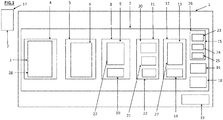
- Fig. 1 illustrates a schematic block diagram of a vehicle which comprises a system for automatically activating a closing element of a closeable opening of the vehicle, according to embodiments of the invention.
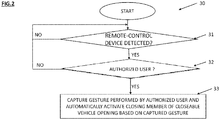
- Fig. 2 illustrates a flowchart of a method for controlling a closeable opening of the vehicle, according to a first embodiment.
- Fig. 3 illustrates a flowchart of a method for controlling a closeable opening of the vehicle, according to a second embodiment.
-
Fig. 1 illustrates a schematic block diagram of a vehicle 1, which comprises a system 2 for automatically activating a closing element 3 of a closeable opening 4 of the vehicle 1 according to embodiments of the invention.
-
Driver assistance systems for vehicles are known and have been optimized for various applications within the last years. Typically, the driver assistance systems employ several vehicle environment sensors such as cameras. Further, remote opening systems, such as smart key systems are known. In a smart key system, a wearable electronic transmitter device functions as an electronic key and is used to replace a traditional vehicle key. The electronic key device provides a function of automatically opening and closing of a door and/or tailgate of a vehicle when a user is in close proximity to the vehicle. In other examples, the opening and closing functions are fully automated without the owner having to operate the wearable device. For example, systems are known, wherein a sensor is placed under a tailgate of a vehicle and detects leg movement of a user, and wherein the tailgate is activated, respectively opened, based on the detected leg movement.
-
According to the embodiments shown in Fig. 1, the vehicle 1 comprises a system for automatically activating a closing element 3 of a closeable opening 4 of the vehicle 1, wherein the system 2 comprises a remote opening system 5 with a detector 6 for detecting whether a person with a remote-control device 7 for the vehicle 1 approaches the vehicle 1 within a predetermined parameter.
-
The shown system 2 further comprises an optical system 8 with an optical sensor 9 for capturing image data of the person an means 10 to activate the optical sensor if a person with a remote-control device 7 for the vehicle 1 approaches the vehicle 1 within a predetermined parameter. The system 2 further comprises a verification unit 11 for verifying whether the person is an authorized user of the vehicle 1 based on at least one biometrical feature within the captured image data.
-
As shown in Fig. 1, the system further comprises a gesture system 12 with a gesture sensor 13 for capturing a gesture performed by the authorized user and means 14 to activate the gesture sensor 13 if the person is an authorized user of the vehicle 1. Also shown are a control unit 15 for determining a desired activation command for the closing element 3 based on the captured gesture and an activation unit 16 for activating the closing element 3 based on the desired activation command.
-
Thereby, an improved system 2 for automatically activating a closing element 3 of a closable opening 4 of the vehicle 1 is provided, which is more intelligent to authenticate an authorized user compared to common systems for automatically activating a closing element of a closable opening of a vehicle. Further, as the activation unit 16 activates the closing element 3 based on gesture input captured by the gesture sensor, the closing element 3 can easily be activated even if the user carries heavy luggage and, therefore, the system 2 is easy to use. Further, as the optical sensor 9 is only activated if it has been detected that a person with a remote-control device 7 approaches the vehicle 1 within a predetermined parameter, and as the gesture sensor 13 is only activated if the person is an authorized user of the vehicle 1, the energy consumption of the system 2 can be significantly reduced.
-
Therein, according to the embodiments of Fig. 1, the desired activation command is a command to open the closeable opening of the vehicle 1 or a command to close the closeable opening of the vehicle 1.
-
According to the embodiments shown in Fig. 1, the remote-control device 7 is a smart key 17, which can unlock doors or a tailgate of the vehicle 1 based on wireless communications with the detector 6 of the remote opening system 5. In particular, the smart key 17 comprises means for radio frequency communication with the detector 6, if the smart key 17 is within a predetermined parameter around the vehicle 1. Herein, the predetermined perimeter is defined by the coverage of this radio frequency communication and, therefore, the geographic area where the remote-control device 7 can communicate with the detector, which in turn depends on the signal strength.
-
The shown system 2 further comprises an engine control unit 18 for detecting an operation state of an engine 19 of the vehicle 1, in particular for determining whether the engine 19 is in an on-state and, therefore, operating, or whether the engine 19 is in an off-state and, therefore, not operating. Therein, the means 10 to activate the optical sensor 9 is configured to only activate the optical sensor 9 if a person with a remote-control device 7 approaches the vehicle 1 within a predetermined perimeter and if the engine 19 of the vehicle 1 is in an off-state.
-
As shown in Fig. 1, the verification unit 11 comprises a detecting means 20 for detecting at least one facial feature of the person within the captured image data, a first storage unit 21 for storing a first database comprising stored facial features that are predefined for authorized users, and a first comparison unit 22 for verifying that the person is an authorized user of the vehicle 1 if the at least one facial feature matches one of the stored facial features. Thereby, it can implicitly and intelligently be identified whether the detected face belongs to an authorized user and, therefore, verified whether the respective person is an authorized user of the vehicle. That the biometric feature is at least one facial feature should merely be understood as an example, however. Thus, other biometric features, for example the size of a person could be used to verify whether the person is an authorized user of the vehicle within the verification unit, too.
-
Further, it should be noted that the first database can be created through an enrollment process, which involves compiling biometric information about each authorized user and saving the information in the first database, and which can be supervised by a master user who has rights to authorize others to enroll. The master user may initially be a seller of the vehicle 1 and can thereafter be changed to the purchaser of the vehicle 1.
-
According to the embodiments shown in Fig.1, the gesture performed by the authorized user comprises at least one facial expression of the authorized user. However, the gesture performed by the authorized user can be a movement of a part of the body of the authorized user, or a voice command, too. Therein, as shown in Fig. 1, the control unit 15 comprises a second storage unit 23 for storing a second database comprising predefined associations between gestures and activation commands for the closing element 3, a second comparison unit 24 for comparing the captured gesture to the entries of the database, and a determining unit 25 for determining a desired activation command for the closing element 3 based on the comparison in the second comparison unit 24.
-
According to the embodiments shown in Fig. 1, the control unit 15 is a facial recognition system or engine 26 configured to provide identification of the facial expression of the authorized user and, based on the identified facial expression of the user, a desired activation command for the closing element 3. Further, it should be noted that also the second database can be created through an enrollment process, which involves compiling predefined associations between gestures and activation commands for the closing element 3. Further, in other embodiments, when the the gesture performed by the authorized user comprises a voice command, the control unit can be a speech recognition engine or comprise an additional speech recognition engine.
-
The optical sensor 9 and the gesture sensor 13 are both cameras 27 mounted to the vehicle. As a plurality of camera-based driver assistance systems for vehicles are known, for example driver assistance systems for preventing collision with an object or a pedestrian, a vehicle surround view system, or a rear-view camera system, the cameras of these systems can be used to capture image data and/or a gesture performed by the authorized user and, therefore, the system can easily be implemented by known systems.
-
Further, the closing element 3 comprises a tailgate 28. However, the closing element can comprise closing elements of other closeable vehicle openings, such as a vehicle door, for example a driver door, too. Further, it should be noted that the system 2 is not restricted to control only one closing element of the vehicle and can be utilized to control a plurality of closing elements, too. Therein, for example the gesture performed by the authorized user may be used determine which closing element of the vehicle should be activated and how it should be activated.
-
Fig. 2 illustrates a flowchart of a method 30 for controlling a closeable opening of the vehicle, according to a first embodiment.
-
In step 31, it is detected whether a person with a remote-control device for a vehicle approaches the vehicle within a predetermined perimeter. Herein, the predetermined perimeter is defined by the coverage of the radio frequency communication between the remote-control device and a corresponding detector of a remote opening system of the vehicle, and, therefore, by the geographic area where the remote-control device 7 can communicate with the detector, which in turn depends on the signal strength.
-
If it is determined in step 31, that there is no person with a remote-control device for a vehicle approaching the vehicle within a predetermined perimeter, step 31 is repeated. On the other hand, if it is determined in step 31, that a person with a remote-control device for a vehicle approaches the vehicle within a predetermined perimeter, the method 30 continues with step 32.
-
In step 32, image data of the person is captured and it is verified whether the person is an authorized user of the vehicle based on at least one biometrical feature within the captured image data.
-
If it is determined in step 32, that the person is not an authorized user of the vehicle, the method returns to step 31. On the other hand, if it is determined in step 32, that the person is an authorized user of the vehicle, the method 30 continues with step 33.
-
In step 33, a gesture performed by the authorized user is captured and a closing element of a closeable opening of the vehicle is automatically activated based on the captured gesture.
-
Fig. 3 illustrates a flowchart of a method 40 for controlling a closeable opening of the vehicle, according to a second embodiment.
-
Therein, in step 41, it is determined whether an engine of the vehicle is in an on-state and, therefore, operated, or whether the engine of the vehicle is in an off-state and, therefore, not operated.
-
If it is determined in step 41, that the engine of the vehicle is in an off-state, the method 40 is terminated. On the other hand, if it is determined in step 41, that the engine of the vehicle is in an on-state, the method 40 continues with step 42.
-
In step 42, it is detected whether a person with a remote-control device for a vehicle approaches the vehicle within a predetermined perimeter.
-
If it is determined in step 42, that there is no person with a remote-control device for a vehicle approaching the vehicle within a predetermined perimeter, the method 40 returns to start and, therefore, to step 41. On the other hand, if it is determined in step 41, that a person with a remote-control device for a vehicle approaches the vehicle within a predetermined perimeter, the method 40 continues with step 43.
-
In step 43, image data of the person is captured and it is verified whether the person is an authorized user of the vehicle based on at least one biometrical feature within the captured image data, wherein the verification whether the person is an authorized user of the vehicle based on at least one biometrical feature within the captured image data comprises detecting at least one facial feature of the person within the captured image data and comparing the at least one facial feature to a database comprising stored facial features that are predefined for authorized users of the vehicle and verifying that the person is an authorized user of the vehicle if the at least one facial feature matches one of the stored facial features.
-
If it is determined in step 43, that the at least one facial feature does not match one of the stored facial features, the method 40 returns to start and, therefore, to step 41. On the other hand, if it is determined in step 43, that the at least one facial feature matches one of the stored facial features, the method 40 continues with step 44.
-
In step 44, it is determined, whether the authorized user performs a gesture, wherein the gesture is a facial expression of the authorized user.
-
If it is determined in step 44, that the authorized user does not perform a gesture, the method 40 returns to start and, therefore, to step 41. On the other hand, if it is determined in step 44, that the authorized user performs a gesture, the method 40 continues with step 45.
-
In step 45, the captured gesture is compared to a database comprising predefined associations between gestures and activation commands for the closing element and a desired activation command for the closing element is based on the comparison.
-
Therein, according to the embodiment shown in Fig. 3, if is determined that the user opens his mouth, this gesture is associated to a command to open a tailgate of the vehicle and the tailgate is correspondingly opened in step 46.
-
Further, if it is determined that the user smiles, this gesture is associated to a command to close the tailgate of the vehicle and the tailgate is correspondingly closed in step 47.