EP3348615A1 - Rubber composition - Google Patents
Rubber composition Download PDFInfo
- Publication number
- EP3348615A1 EP3348615A1 EP16844314.1A EP16844314A EP3348615A1 EP 3348615 A1 EP3348615 A1 EP 3348615A1 EP 16844314 A EP16844314 A EP 16844314A EP 3348615 A1 EP3348615 A1 EP 3348615A1
- Authority
- EP
- European Patent Office
- Prior art keywords
- less
- cellulose fibers
- mass
- rubber composition
- modified cellulose
- Prior art date
- Legal status (The legal status is an assumption and is not a legal conclusion. Google has not performed a legal analysis and makes no representation as to the accuracy of the status listed.)
- Withdrawn
Links
- 229920001971 elastomer Polymers 0.000 title claims abstract description 218
- 239000005060 rubber Substances 0.000 title claims abstract description 218
- 239000000203 mixture Substances 0.000 title claims abstract description 176
- 229920003043 Cellulose fiber Polymers 0.000 claims abstract description 175
- 229920002678 cellulose Polymers 0.000 claims abstract description 121
- 239000001913 cellulose Substances 0.000 claims abstract description 120
- 125000004432 carbon atom Chemical group C* 0.000 claims abstract description 94
- 125000001424 substituent group Chemical group 0.000 claims abstract description 94
- RTZKZFJDLAIYFH-UHFFFAOYSA-N ether Substances CCOCC RTZKZFJDLAIYFH-UHFFFAOYSA-N 0.000 claims abstract description 24
- 125000000217 alkyl group Chemical group 0.000 claims abstract description 18
- 239000013078 crystal Substances 0.000 claims abstract description 14
- 229930195734 saturated hydrocarbon Natural products 0.000 claims abstract description 14
- 125000001183 hydrocarbyl group Chemical group 0.000 claims abstract 3
- 239000002994 raw material Substances 0.000 claims description 81
- 238000004519 manufacturing process Methods 0.000 claims description 58
- 150000001875 compounds Chemical class 0.000 claims description 57
- 239000000835 fiber Substances 0.000 claims description 53
- 238000002156 mixing Methods 0.000 claims description 44
- 239000002585 base Substances 0.000 claims description 24
- JUJWROOIHBZHMG-UHFFFAOYSA-N Pyridine Chemical compound C1=CC=NC=C1 JUJWROOIHBZHMG-UHFFFAOYSA-N 0.000 claims description 10
- 125000002947 alkylene group Chemical group 0.000 claims description 10
- WQZGKKKJIJFFOK-VFUOTHLCSA-N beta-D-glucose Chemical group OC[C@H]1O[C@@H](O)[C@H](O)[C@@H](O)[C@@H]1O WQZGKKKJIJFFOK-VFUOTHLCSA-N 0.000 claims description 10
- 239000001257 hydrogen Substances 0.000 claims description 7
- 229910052739 hydrogen Inorganic materials 0.000 claims description 7
- 150000003512 tertiary amines Chemical class 0.000 claims description 6
- 150000008044 alkali metal hydroxides Chemical class 0.000 claims description 5
- 229910001860 alkaline earth metal hydroxide Inorganic materials 0.000 claims description 5
- 150000004703 alkoxides Chemical class 0.000 claims description 5
- GYZLOYUZLJXAJU-UHFFFAOYSA-N diglycidyl ether Chemical class C1OC1COCC1CO1 GYZLOYUZLJXAJU-UHFFFAOYSA-N 0.000 claims description 5
- 125000004435 hydrogen atom Chemical class [H]* 0.000 claims description 5
- UMJSCPRVCHMLSP-UHFFFAOYSA-N pyridine Natural products COC1=CC=CN=C1 UMJSCPRVCHMLSP-UHFFFAOYSA-N 0.000 claims description 5
- 150000003242 quaternary ammonium salts Chemical class 0.000 claims description 5
- 150000002460 imidazoles Chemical class 0.000 claims description 2
- 235000010980 cellulose Nutrition 0.000 description 117
- 238000011282 treatment Methods 0.000 description 66
- 238000000034 method Methods 0.000 description 60
- -1 propylhydroxyethyl group Chemical group 0.000 description 56
- 238000004073 vulcanization Methods 0.000 description 42
- 238000006243 chemical reaction Methods 0.000 description 36
- 239000004636 vulcanized rubber Substances 0.000 description 36
- XLYOFNOQVPJJNP-UHFFFAOYSA-N water Substances O XLYOFNOQVPJJNP-UHFFFAOYSA-N 0.000 description 36
- KFZMGEQAYNKOFK-UHFFFAOYSA-N Isopropanol Chemical compound CC(C)O KFZMGEQAYNKOFK-UHFFFAOYSA-N 0.000 description 31
- ZMXDDKWLCZADIW-UHFFFAOYSA-N N,N-Dimethylformamide Chemical compound CN(C)C=O ZMXDDKWLCZADIW-UHFFFAOYSA-N 0.000 description 31
- HEMHJVSKTPXQMS-UHFFFAOYSA-M Sodium hydroxide Chemical compound [OH-].[Na+] HEMHJVSKTPXQMS-UHFFFAOYSA-M 0.000 description 30
- 230000000052 comparative effect Effects 0.000 description 30
- QTBSBXVTEAMEQO-UHFFFAOYSA-N Acetic acid Chemical compound CC(O)=O QTBSBXVTEAMEQO-UHFFFAOYSA-N 0.000 description 27
- YXFVVABEGXRONW-UHFFFAOYSA-N Toluene Chemical compound CC1=CC=CC=C1 YXFVVABEGXRONW-UHFFFAOYSA-N 0.000 description 27
- 239000006185 dispersion Substances 0.000 description 27
- 229920003048 styrene butadiene rubber Polymers 0.000 description 24
- 239000000126 substance Substances 0.000 description 24
- 230000002829 reductive effect Effects 0.000 description 23
- 239000006229 carbon black Substances 0.000 description 21
- 235000019241 carbon black Nutrition 0.000 description 21
- XLOMVQKBTHCTTD-UHFFFAOYSA-N Zinc monoxide Chemical compound [Zn]=O XLOMVQKBTHCTTD-UHFFFAOYSA-N 0.000 description 18
- 230000004048 modification Effects 0.000 description 18
- 238000012986 modification Methods 0.000 description 18
- 239000002174 Styrene-butadiene Substances 0.000 description 16
- 238000006467 substitution reaction Methods 0.000 description 16
- 238000004898 kneading Methods 0.000 description 15
- VLKZOEOYAKHREP-UHFFFAOYSA-N n-Hexane Chemical compound CCCCCC VLKZOEOYAKHREP-UHFFFAOYSA-N 0.000 description 15
- 244000043261 Hevea brasiliensis Species 0.000 description 14
- 230000006872 improvement Effects 0.000 description 14
- 229920003052 natural elastomer Polymers 0.000 description 14
- 229920001194 natural rubber Polymers 0.000 description 14
- 239000002904 solvent Substances 0.000 description 14
- VHYFNPMBLIVWCW-UHFFFAOYSA-N 4-Dimethylaminopyridine Chemical compound CN(C)C1=CC=NC=C1 VHYFNPMBLIVWCW-UHFFFAOYSA-N 0.000 description 13
- 239000000654 additive Substances 0.000 description 12
- 239000003153 chemical reaction reagent Substances 0.000 description 12
- QIQXTHQIDYTFRH-UHFFFAOYSA-N octadecanoic acid Chemical compound CCCCCCCCCCCCCCCCCC(O)=O QIQXTHQIDYTFRH-UHFFFAOYSA-N 0.000 description 12
- 229920001084 poly(chloroprene) Polymers 0.000 description 12
- 235000021355 Stearic acid Nutrition 0.000 description 11
- NINIDFKCEFEMDL-UHFFFAOYSA-N Sulfur Chemical compound [S] NINIDFKCEFEMDL-UHFFFAOYSA-N 0.000 description 11
- 125000000484 butyl group Chemical group [H]C([*])([H])C([H])([H])C([H])([H])C([H])([H])[H] 0.000 description 11
- 150000002430 hydrocarbons Chemical group 0.000 description 11
- OQCDKBAXFALNLD-UHFFFAOYSA-N octadecanoic acid Natural products CCCCCCCC(C)CCCCCCCCC(O)=O OQCDKBAXFALNLD-UHFFFAOYSA-N 0.000 description 11
- 239000000523 sample Substances 0.000 description 11
- 239000008117 stearic acid Substances 0.000 description 11
- 229910052717 sulfur Inorganic materials 0.000 description 11
- 239000011593 sulfur Substances 0.000 description 11
- WHNBDXQTMPYBAT-UHFFFAOYSA-N 2-butyloxirane Chemical compound CCCCC1CO1 WHNBDXQTMPYBAT-UHFFFAOYSA-N 0.000 description 10
- AFZSMODLJJCVPP-UHFFFAOYSA-N dibenzothiazol-2-yl disulfide Chemical compound C1=CC=C2SC(SSC=3SC4=CC=CC=C4N=3)=NC2=C1 AFZSMODLJJCVPP-UHFFFAOYSA-N 0.000 description 10
- 238000005259 measurement Methods 0.000 description 10
- 239000011541 reaction mixture Substances 0.000 description 10
- 238000003860 storage Methods 0.000 description 10
- WEVYAHXRMPXWCK-UHFFFAOYSA-N Acetonitrile Chemical compound CC#N WEVYAHXRMPXWCK-UHFFFAOYSA-N 0.000 description 9
- 241000609240 Ambelania acida Species 0.000 description 9
- RAXXELZNTBOGNW-UHFFFAOYSA-N imidazole Natural products C1=CNC=N1 RAXXELZNTBOGNW-UHFFFAOYSA-N 0.000 description 9
- 239000012535 impurity Substances 0.000 description 9
- 239000012046 mixed solvent Substances 0.000 description 9
- IUJLOAKJZQBENM-UHFFFAOYSA-N n-(1,3-benzothiazol-2-ylsulfanyl)-2-methylpropan-2-amine Chemical compound C1=CC=C2SC(SNC(C)(C)C)=NC2=C1 IUJLOAKJZQBENM-UHFFFAOYSA-N 0.000 description 9
- 230000009257 reactivity Effects 0.000 description 9
- 239000011787 zinc oxide Substances 0.000 description 9
- ZXJBWUAALADCRI-UHFFFAOYSA-N 2-(octadecoxymethyl)oxirane Chemical compound CCCCCCCCCCCCCCCCCCOCC1CO1 ZXJBWUAALADCRI-UHFFFAOYSA-N 0.000 description 8
- AAMHBRRZYSORSH-UHFFFAOYSA-N 2-octyloxirane Chemical compound CCCCCCCCC1CO1 AAMHBRRZYSORSH-UHFFFAOYSA-N 0.000 description 8
- 239000010905 bagasse Substances 0.000 description 8
- 239000003795 chemical substances by application Substances 0.000 description 8
- 125000000816 ethylene group Chemical group [H]C([H])([*:1])C([H])([H])[*:2] 0.000 description 8
- 238000012360 testing method Methods 0.000 description 8
- 239000003960 organic solvent Substances 0.000 description 7
- 239000010734 process oil Substances 0.000 description 7
- 239000000243 solution Substances 0.000 description 7
- 241000894007 species Species 0.000 description 7
- 238000003756 stirring Methods 0.000 description 7
- VDZOOKBUILJEDG-UHFFFAOYSA-M tetrabutylammonium hydroxide Chemical compound [OH-].CCCC[N+](CCCC)(CCCC)CCCC VDZOOKBUILJEDG-UHFFFAOYSA-M 0.000 description 7
- QBJWYMFTMJFGOL-UHFFFAOYSA-N 2-hexadecyloxirane Chemical compound CCCCCCCCCCCCCCCCC1CO1 QBJWYMFTMJFGOL-UHFFFAOYSA-N 0.000 description 6
- WMFOQBRAJBCJND-UHFFFAOYSA-M Lithium hydroxide Chemical compound [Li+].[OH-] WMFOQBRAJBCJND-UHFFFAOYSA-M 0.000 description 6
- 229920000459 Nitrile rubber Polymers 0.000 description 6
- KWYUFKZDYYNOTN-UHFFFAOYSA-M Potassium hydroxide Chemical compound [OH-].[K+] KWYUFKZDYYNOTN-UHFFFAOYSA-M 0.000 description 6
- DKGAVHZHDRPRBM-UHFFFAOYSA-N Tert-Butanol Chemical compound CC(C)(C)O DKGAVHZHDRPRBM-UHFFFAOYSA-N 0.000 description 6
- ZMANZCXQSJIPKH-UHFFFAOYSA-N Triethylamine Chemical compound CCN(CC)CC ZMANZCXQSJIPKH-UHFFFAOYSA-N 0.000 description 6
- 238000002441 X-ray diffraction Methods 0.000 description 6
- 239000003513 alkali Substances 0.000 description 6
- 150000001993 dienes Chemical class 0.000 description 6
- 125000001033 ether group Chemical group 0.000 description 6
- 238000011156 evaluation Methods 0.000 description 6
- 238000010992 reflux Methods 0.000 description 6
- 230000009466 transformation Effects 0.000 description 6
- YSUQLAYJZDEMOT-UHFFFAOYSA-N 2-(butoxymethyl)oxirane Chemical compound CCCCOCC1CO1 YSUQLAYJZDEMOT-UHFFFAOYSA-N 0.000 description 5
- 229960000549 4-dimethylaminophenol Drugs 0.000 description 5
- 238000006266 etherification reaction Methods 0.000 description 5
- 125000002887 hydroxy group Chemical group [H]O* 0.000 description 5
- 239000007788 liquid Substances 0.000 description 5
- 239000002121 nanofiber Substances 0.000 description 5
- 125000004805 propylene group Chemical group [H]C([H])([H])C([H])([*:1])C([H])([H])[*:2] 0.000 description 5
- 230000035484 reaction time Effects 0.000 description 5
- BBBUAWSVILPJLL-UHFFFAOYSA-N 2-(2-ethylhexoxymethyl)oxirane Chemical compound CCCCC(CC)COCC1CO1 BBBUAWSVILPJLL-UHFFFAOYSA-N 0.000 description 4
- BJOWTLCTYPKRRU-UHFFFAOYSA-N 3-ethenoxyoctane Chemical group CCCCCC(CC)OC=C BJOWTLCTYPKRRU-UHFFFAOYSA-N 0.000 description 4
- OKTJSMMVPCPJKN-UHFFFAOYSA-N Carbon Chemical compound [C] OKTJSMMVPCPJKN-UHFFFAOYSA-N 0.000 description 4
- IAZDPXIOMUYVGZ-UHFFFAOYSA-N Dimethylsulphoxide Chemical compound CS(C)=O IAZDPXIOMUYVGZ-UHFFFAOYSA-N 0.000 description 4
- 239000005062 Polybutadiene Substances 0.000 description 4
- VYPSYNLAJGMNEJ-UHFFFAOYSA-N Silicium dioxide Chemical compound O=[Si]=O VYPSYNLAJGMNEJ-UHFFFAOYSA-N 0.000 description 4
- WQDUMFSSJAZKTM-UHFFFAOYSA-N Sodium methoxide Chemical compound [Na+].[O-]C WQDUMFSSJAZKTM-UHFFFAOYSA-N 0.000 description 4
- 229920005549 butyl rubber Polymers 0.000 description 4
- 230000000694 effects Effects 0.000 description 4
- 230000001747 exhibiting effect Effects 0.000 description 4
- 238000010438 heat treatment Methods 0.000 description 4
- 210000001724 microfibril Anatomy 0.000 description 4
- 239000003921 oil Substances 0.000 description 4
- 230000003287 optical effect Effects 0.000 description 4
- 229920002857 polybutadiene Polymers 0.000 description 4
- 229920001195 polyisoprene Polymers 0.000 description 4
- 238000012545 processing Methods 0.000 description 4
- 239000012763 reinforcing filler Substances 0.000 description 4
- NHGXDBSUJJNIRV-UHFFFAOYSA-M tetrabutylammonium chloride Chemical compound [Cl-].CCCC[N+](CCCC)(CCCC)CCCC NHGXDBSUJJNIRV-UHFFFAOYSA-M 0.000 description 4
- FPGGTKZVZWFYPV-UHFFFAOYSA-M tetrabutylammonium fluoride Chemical compound [F-].CCCC[N+](CCCC)(CCCC)CCCC FPGGTKZVZWFYPV-UHFFFAOYSA-M 0.000 description 4
- WGTYBPLFGIVFAS-UHFFFAOYSA-M tetramethylammonium hydroxide Chemical compound [OH-].C[N+](C)(C)C WGTYBPLFGIVFAS-UHFFFAOYSA-M 0.000 description 4
- 235000015112 vegetable and seed oil Nutrition 0.000 description 4
- 235000019871 vegetable fat Nutrition 0.000 description 4
- 241000196324 Embryophyta Species 0.000 description 3
- LFQSCWFLJHTTHZ-UHFFFAOYSA-N Ethanol Chemical compound CCO LFQSCWFLJHTTHZ-UHFFFAOYSA-N 0.000 description 3
- 238000012790 confirmation Methods 0.000 description 3
- 238000011049 filling Methods 0.000 description 3
- WNLRTRBMVRJNCN-UHFFFAOYSA-N hexanedioic acid Natural products OC(=O)CCCCC(O)=O WNLRTRBMVRJNCN-UHFFFAOYSA-N 0.000 description 3
- 150000002431 hydrogen Chemical class 0.000 description 3
- 239000003112 inhibitor Substances 0.000 description 3
- 239000012299 nitrogen atmosphere Substances 0.000 description 3
- GLDOVTGHNKAZLK-UHFFFAOYSA-N octadecan-1-ol Chemical compound CCCCCCCCCCCCCCCCCCO GLDOVTGHNKAZLK-UHFFFAOYSA-N 0.000 description 3
- 125000005702 oxyalkylene group Chemical group 0.000 description 3
- 238000010298 pulverizing process Methods 0.000 description 3
- 239000007787 solid Substances 0.000 description 3
- JRMUNVKIHCOMHV-UHFFFAOYSA-M tetrabutylammonium bromide Chemical compound [Br-].CCCC[N+](CCCC)(CCCC)CCCC JRMUNVKIHCOMHV-UHFFFAOYSA-M 0.000 description 3
- CYSGHNMQYZDMIA-UHFFFAOYSA-N 1,3-Dimethyl-2-imidazolidinon Chemical compound CN1CCN(C)C1=O CYSGHNMQYZDMIA-UHFFFAOYSA-N 0.000 description 2
- RYHBNJHYFVUHQT-UHFFFAOYSA-N 1,4-Dioxane Chemical compound C1COCCO1 RYHBNJHYFVUHQT-UHFFFAOYSA-N 0.000 description 2
- MCTWTZJPVLRJOU-UHFFFAOYSA-N 1-methyl-1H-imidazole Chemical compound CN1C=CN=C1 MCTWTZJPVLRJOU-UHFFFAOYSA-N 0.000 description 2
- VMSIYTPWZLSMOH-UHFFFAOYSA-N 2-(dodecoxymethyl)oxirane Chemical compound CCCCCCCCCCCCOCC1CO1 VMSIYTPWZLSMOH-UHFFFAOYSA-N 0.000 description 2
- LKMJVFRMDSNFRT-UHFFFAOYSA-N 2-(methoxymethyl)oxirane Chemical compound COCC1CO1 LKMJVFRMDSNFRT-UHFFFAOYSA-N 0.000 description 2
- BSKHPKMHTQYZBB-UHFFFAOYSA-N 2-methylpyridine Chemical compound CC1=CC=CC=N1 BSKHPKMHTQYZBB-UHFFFAOYSA-N 0.000 description 2
- HQNOODJDSFSURF-UHFFFAOYSA-N 3-(1h-imidazol-2-yl)propan-1-amine Chemical compound NCCCC1=NC=CN1 HQNOODJDSFSURF-UHFFFAOYSA-N 0.000 description 2
- GDYDAGIQSILFPT-UHFFFAOYSA-N 3-ethenoxydodecane Chemical group CCC(CCCCCCCCC)OC=C GDYDAGIQSILFPT-UHFFFAOYSA-N 0.000 description 2
- CZEQYUSNXYYTFT-UHFFFAOYSA-N 3-ethenoxyhexane Chemical group CCCC(CC)OC=C CZEQYUSNXYYTFT-UHFFFAOYSA-N 0.000 description 2
- LNCPJPAMHBPZNK-UHFFFAOYSA-N C(=C)OC(CCCCCCC)CC Chemical group C(=C)OC(CCCCCCC)CC LNCPJPAMHBPZNK-UHFFFAOYSA-N 0.000 description 2
- AYXMYYDRPRQVSV-UHFFFAOYSA-N CCC(CCCCCCCC)OC=C Chemical group CCC(CCCCCCCC)OC=C AYXMYYDRPRQVSV-UHFFFAOYSA-N 0.000 description 2
- MSNFVEFJWAVURQ-UHFFFAOYSA-N CCC(CCCCCCCCCCCCCCC)OC=C Chemical group CCC(CCCCCCCCCCCCCCC)OC=C MSNFVEFJWAVURQ-UHFFFAOYSA-N 0.000 description 2
- ZHIOZLAZPZVXPJ-UHFFFAOYSA-N CCCCCCCCCCCCCC(CC)OC=C Chemical group CCCCCCCCCCCCCC(CC)OC=C ZHIOZLAZPZVXPJ-UHFFFAOYSA-N 0.000 description 2
- PIICEJLVQHRZGT-UHFFFAOYSA-N Ethylenediamine Chemical compound NCCN PIICEJLVQHRZGT-UHFFFAOYSA-N 0.000 description 2
- VEXZGXHMUGYJMC-UHFFFAOYSA-N Hydrochloric acid Chemical compound Cl VEXZGXHMUGYJMC-UHFFFAOYSA-N 0.000 description 2
- MHAJPDPJQMAIIY-UHFFFAOYSA-N Hydrogen peroxide Chemical compound OO MHAJPDPJQMAIIY-UHFFFAOYSA-N 0.000 description 2
- ONIBWKKTOPOVIA-BYPYZUCNSA-N L-Proline Chemical compound OC(=O)[C@@H]1CCCN1 ONIBWKKTOPOVIA-BYPYZUCNSA-N 0.000 description 2
- NTIZESTWPVYFNL-UHFFFAOYSA-N Methyl isobutyl ketone Chemical compound CC(C)CC(C)=O NTIZESTWPVYFNL-UHFFFAOYSA-N 0.000 description 2
- UIHCLUNTQKBZGK-UHFFFAOYSA-N Methyl isobutyl ketone Natural products CCC(C)C(C)=O UIHCLUNTQKBZGK-UHFFFAOYSA-N 0.000 description 2
- KWYHDKDOAIKMQN-UHFFFAOYSA-N N,N,N',N'-tetramethylethylenediamine Chemical compound CN(C)CCN(C)C KWYHDKDOAIKMQN-UHFFFAOYSA-N 0.000 description 2
- OKIZCWYLBDKLSU-UHFFFAOYSA-M N,N,N-Trimethylmethanaminium chloride Chemical compound [Cl-].C[N+](C)(C)C OKIZCWYLBDKLSU-UHFFFAOYSA-M 0.000 description 2
- FXHOOIRPVKKKFG-UHFFFAOYSA-N N,N-Dimethylacetamide Chemical compound CN(C)C(C)=O FXHOOIRPVKKKFG-UHFFFAOYSA-N 0.000 description 2
- SVYKKECYCPFKGB-UHFFFAOYSA-N N,N-dimethylcyclohexylamine Chemical compound CN(C)C1CCCCC1 SVYKKECYCPFKGB-UHFFFAOYSA-N 0.000 description 2
- ONIBWKKTOPOVIA-UHFFFAOYSA-N Proline Natural products OC(=O)C1CCCN1 ONIBWKKTOPOVIA-UHFFFAOYSA-N 0.000 description 2
- GOOHAUXETOMSMM-UHFFFAOYSA-N Propylene oxide Chemical compound CC1CO1 GOOHAUXETOMSMM-UHFFFAOYSA-N 0.000 description 2
- 239000006087 Silane Coupling Agent Substances 0.000 description 2
- QAOWNCQODCNURD-UHFFFAOYSA-N Sulfuric acid Chemical compound OS(O)(=O)=O QAOWNCQODCNURD-UHFFFAOYSA-N 0.000 description 2
- XSQUKJJJFZCRTK-UHFFFAOYSA-N Urea Chemical compound NC(N)=O XSQUKJJJFZCRTK-UHFFFAOYSA-N 0.000 description 2
- HCHKCACWOHOZIP-UHFFFAOYSA-N Zinc Chemical compound [Zn] HCHKCACWOHOZIP-UHFFFAOYSA-N 0.000 description 2
- 230000000996 additive effect Effects 0.000 description 2
- 239000001361 adipic acid Substances 0.000 description 2
- 235000011037 adipic acid Nutrition 0.000 description 2
- 150000005215 alkyl ethers Chemical class 0.000 description 2
- 150000001412 amines Chemical class 0.000 description 2
- RQPZNWPYLFFXCP-UHFFFAOYSA-L barium dihydroxide Chemical compound [OH-].[OH-].[Ba+2] RQPZNWPYLFFXCP-UHFFFAOYSA-L 0.000 description 2
- 229910001863 barium hydroxide Inorganic materials 0.000 description 2
- WPYMKLBDIGXBTP-UHFFFAOYSA-N benzoic acid Chemical compound OC(=O)C1=CC=CC=C1 WPYMKLBDIGXBTP-UHFFFAOYSA-N 0.000 description 2
- NTXGQCSETZTARF-UHFFFAOYSA-N buta-1,3-diene;prop-2-enenitrile Chemical compound C=CC=C.C=CC#N NTXGQCSETZTARF-UHFFFAOYSA-N 0.000 description 2
- AXCZMVOFGPJBDE-UHFFFAOYSA-L calcium dihydroxide Chemical compound [OH-].[OH-].[Ca+2] AXCZMVOFGPJBDE-UHFFFAOYSA-L 0.000 description 2
- 239000000920 calcium hydroxide Substances 0.000 description 2
- 229910001861 calcium hydroxide Inorganic materials 0.000 description 2
- PFKFTWBEEFSNDU-UHFFFAOYSA-N carbonyldiimidazole Chemical compound C1=CN=CN1C(=O)N1C=CN=C1 PFKFTWBEEFSNDU-UHFFFAOYSA-N 0.000 description 2
- 235000012343 cottonseed oil Nutrition 0.000 description 2
- HPNMFZURTQLUMO-UHFFFAOYSA-N diethylamine Chemical compound CCNCC HPNMFZURTQLUMO-UHFFFAOYSA-N 0.000 description 2
- 238000001035 drying Methods 0.000 description 2
- 238000001473 dynamic force microscopy Methods 0.000 description 2
- 238000001125 extrusion Methods 0.000 description 2
- 125000004836 hexamethylene group Chemical group [H]C([H])([*:2])C([H])([H])C([H])([H])C([H])([H])C([H])([H])C([H])([H])[*:1] 0.000 description 2
- 230000002209 hydrophobic effect Effects 0.000 description 2
- 239000002655 kraft paper Substances 0.000 description 2
- 229920005610 lignin Polymers 0.000 description 2
- 239000000395 magnesium oxide Substances 0.000 description 2
- CPLXHLVBOLITMK-UHFFFAOYSA-N magnesium oxide Inorganic materials [Mg]=O CPLXHLVBOLITMK-UHFFFAOYSA-N 0.000 description 2
- AXZKOIWUVFPNLO-UHFFFAOYSA-N magnesium;oxygen(2-) Chemical compound [O-2].[Mg+2] AXZKOIWUVFPNLO-UHFFFAOYSA-N 0.000 description 2
- 239000000463 material Substances 0.000 description 2
- MOVBJUGHBJJKOW-UHFFFAOYSA-N methyl 2-amino-5-methoxybenzoate Chemical compound COC(=O)C1=CC(OC)=CC=C1N MOVBJUGHBJJKOW-UHFFFAOYSA-N 0.000 description 2
- 125000001570 methylene group Chemical group [H]C([H])([*:1])[*:2] 0.000 description 2
- 239000010445 mica Substances 0.000 description 2
- 229910052618 mica group Inorganic materials 0.000 description 2
- 238000000465 moulding Methods 0.000 description 2
- DTKANQSCBACEPK-UHFFFAOYSA-N n',n'-bis[3-(dimethylamino)propyl]-n,n-dimethylpropane-1,3-diamine Chemical compound CN(C)CCCN(CCCN(C)C)CCCN(C)C DTKANQSCBACEPK-UHFFFAOYSA-N 0.000 description 2
- TXXWBTOATXBWDR-UHFFFAOYSA-N n,n,n',n'-tetramethylhexane-1,6-diamine Chemical compound CN(C)CCCCCCN(C)C TXXWBTOATXBWDR-UHFFFAOYSA-N 0.000 description 2
- DMQSHEKGGUOYJS-UHFFFAOYSA-N n,n,n',n'-tetramethylpropane-1,3-diamine Chemical compound CN(C)CCCN(C)C DMQSHEKGGUOYJS-UHFFFAOYSA-N 0.000 description 2
- 150000002832 nitroso derivatives Chemical class 0.000 description 2
- CLNYHERYALISIR-UHFFFAOYSA-N nona-1,3-diene Chemical compound CCCCCC=CC=C CLNYHERYALISIR-UHFFFAOYSA-N 0.000 description 2
- RZJRJXONCZWCBN-UHFFFAOYSA-N octadecane Chemical compound CCCCCCCCCCCCCCCCCC RZJRJXONCZWCBN-UHFFFAOYSA-N 0.000 description 2
- 125000004430 oxygen atom Chemical group O* 0.000 description 2
- 239000000123 paper Substances 0.000 description 2
- 125000004817 pentamethylene group Chemical group [H]C([H])([*:2])C([H])([H])C([H])([H])C([H])([H])C([H])([H])[*:1] 0.000 description 2
- 239000005011 phenolic resin Substances 0.000 description 2
- 229920001568 phenolic resin Polymers 0.000 description 2
- 230000000704 physical effect Effects 0.000 description 2
- LPNYRYFBWFDTMA-UHFFFAOYSA-N potassium tert-butoxide Chemical compound [K+].CC(C)(C)[O-] LPNYRYFBWFDTMA-UHFFFAOYSA-N 0.000 description 2
- 230000002250 progressing effect Effects 0.000 description 2
- 230000003014 reinforcing effect Effects 0.000 description 2
- 239000011342 resin composition Substances 0.000 description 2
- YGSDEFSMJLZEOE-UHFFFAOYSA-N salicylic acid Chemical compound OC(=O)C1=CC=CC=C1O YGSDEFSMJLZEOE-UHFFFAOYSA-N 0.000 description 2
- 239000000377 silicon dioxide Substances 0.000 description 2
- QDRKDTQENPPHOJ-UHFFFAOYSA-N sodium ethoxide Chemical compound [Na+].CC[O-] QDRKDTQENPPHOJ-UHFFFAOYSA-N 0.000 description 2
- 239000012086 standard solution Substances 0.000 description 2
- HWCKGOZZJDHMNC-UHFFFAOYSA-M tetraethylammonium bromide Chemical compound [Br-].CC[N+](CC)(CC)CC HWCKGOZZJDHMNC-UHFFFAOYSA-M 0.000 description 2
- YMBCJWGVCUEGHA-UHFFFAOYSA-M tetraethylammonium chloride Chemical compound [Cl-].CC[N+](CC)(CC)CC YMBCJWGVCUEGHA-UHFFFAOYSA-M 0.000 description 2
- 229940073455 tetraethylammonium hydroxide Drugs 0.000 description 2
- QSUJAUYJBJRLKV-UHFFFAOYSA-M tetraethylazanium;fluoride Chemical compound [F-].CC[N+](CC)(CC)CC QSUJAUYJBJRLKV-UHFFFAOYSA-M 0.000 description 2
- LRGJRHZIDJQFCL-UHFFFAOYSA-M tetraethylazanium;hydroxide Chemical compound [OH-].CC[N+](CC)(CC)CC LRGJRHZIDJQFCL-UHFFFAOYSA-M 0.000 description 2
- DDFYFBUWEBINLX-UHFFFAOYSA-M tetramethylammonium bromide Chemical compound [Br-].C[N+](C)(C)C DDFYFBUWEBINLX-UHFFFAOYSA-M 0.000 description 2
- 125000000383 tetramethylene group Chemical group [H]C([H])([*:1])C([H])([H])C([H])([H])C([H])([H])[*:2] 0.000 description 2
- 235000013311 vegetables Nutrition 0.000 description 2
- 239000001993 wax Substances 0.000 description 2
- 239000002023 wood Substances 0.000 description 2
- 239000011701 zinc Substances 0.000 description 2
- 229910052725 zinc Inorganic materials 0.000 description 2
- OWRCNXZUPFZXOS-UHFFFAOYSA-N 1,3-diphenylguanidine Chemical compound C=1C=CC=CC=1NC(=N)NC1=CC=CC=C1 OWRCNXZUPFZXOS-UHFFFAOYSA-N 0.000 description 1
- UJPKMTDFFUTLGM-UHFFFAOYSA-N 1-aminoethanol Chemical compound CC(N)O UJPKMTDFFUTLGM-UHFFFAOYSA-N 0.000 description 1
- 241000233788 Arecaceae Species 0.000 description 1
- 239000005711 Benzoic acid Substances 0.000 description 1
- 239000002028 Biomass Substances 0.000 description 1
- 108010059892 Cellulase Proteins 0.000 description 1
- 229920000742 Cotton Polymers 0.000 description 1
- 108090000790 Enzymes Proteins 0.000 description 1
- 102000004190 Enzymes Human genes 0.000 description 1
- BRLQWZUYTZBJKN-UHFFFAOYSA-N Epichlorohydrin Chemical compound ClCC1CO1 BRLQWZUYTZBJKN-UHFFFAOYSA-N 0.000 description 1
- IAYPIBMASNFSPL-UHFFFAOYSA-N Ethylene oxide Chemical compound C1CO1 IAYPIBMASNFSPL-UHFFFAOYSA-N 0.000 description 1
- 244000166124 Eucalyptus globulus Species 0.000 description 1
- 101710112457 Exoglucanase Proteins 0.000 description 1
- 241000220485 Fabaceae Species 0.000 description 1
- 229920002488 Hemicellulose Polymers 0.000 description 1
- UFHFLCQGNIYNRP-UHFFFAOYSA-N Hydrogen Chemical compound [H][H] UFHFLCQGNIYNRP-UHFFFAOYSA-N 0.000 description 1
- 229920002153 Hydroxypropyl cellulose Polymers 0.000 description 1
- 239000006237 Intermediate SAF Substances 0.000 description 1
- 241000219071 Malvaceae Species 0.000 description 1
- 229920001410 Microfiber Polymers 0.000 description 1
- UBUCNCOMADRQHX-UHFFFAOYSA-N N-Nitrosodiphenylamine Chemical compound C=1C=CC=CC=1N(N=O)C1=CC=CC=C1 UBUCNCOMADRQHX-UHFFFAOYSA-N 0.000 description 1
- QSLLYLLIPOSASI-UHFFFAOYSA-N N-naphthalen-2-yl-N-phenylnitramide Chemical compound [N+](=O)([O-])N(C1=CC2=CC=CC=C2C=C1)C1=CC=CC=C1 QSLLYLLIPOSASI-UHFFFAOYSA-N 0.000 description 1
- CTQNGGLPUBDAKN-UHFFFAOYSA-N O-Xylene Chemical compound CC1=CC=CC=C1C CTQNGGLPUBDAKN-UHFFFAOYSA-N 0.000 description 1
- CBENFWSGALASAD-UHFFFAOYSA-N Ozone Chemical compound [O-][O+]=O CBENFWSGALASAD-UHFFFAOYSA-N 0.000 description 1
- 235000019482 Palm oil Nutrition 0.000 description 1
- 235000019483 Peanut oil Nutrition 0.000 description 1
- LGRFSURHDFAFJT-UHFFFAOYSA-N Phthalic anhydride Natural products C1=CC=C2C(=O)OC(=O)C2=C1 LGRFSURHDFAFJT-UHFFFAOYSA-N 0.000 description 1
- 241000218657 Picea Species 0.000 description 1
- 241000209504 Poaceae Species 0.000 description 1
- 235000019484 Rapeseed oil Nutrition 0.000 description 1
- 240000000111 Saccharum officinarum Species 0.000 description 1
- 235000007201 Saccharum officinarum Nutrition 0.000 description 1
- FKNQFGJONOIPTF-UHFFFAOYSA-N Sodium cation Chemical group [Na+] FKNQFGJONOIPTF-UHFFFAOYSA-N 0.000 description 1
- 229920006311 Urethane elastomer Polymers 0.000 description 1
- 239000006230 acetylene black Substances 0.000 description 1
- 239000002253 acid Substances 0.000 description 1
- 238000010306 acid treatment Methods 0.000 description 1
- 238000013019 agitation Methods 0.000 description 1
- 125000003545 alkoxy group Chemical group 0.000 description 1
- 238000004458 analytical method Methods 0.000 description 1
- ARCGXLSVLAOJQL-UHFFFAOYSA-N anhydrous trimellitic acid Natural products OC(=O)C1=CC=C(C(O)=O)C(C(O)=O)=C1 ARCGXLSVLAOJQL-UHFFFAOYSA-N 0.000 description 1
- 229940111121 antirheumatic drug quinolines Drugs 0.000 description 1
- 239000007864 aqueous solution Substances 0.000 description 1
- 125000001204 arachidyl group Chemical group [H]C([*])([H])C([H])([H])C([H])([H])C([H])([H])C([H])([H])C([H])([H])C([H])([H])C([H])([H])C([H])([H])C([H])([H])C([H])([H])C([H])([H])C([H])([H])C([H])([H])C([H])([H])C([H])([H])C([H])([H])C([H])([H])C([H])([H])C([H])([H])[H] 0.000 description 1
- 125000003118 aryl group Chemical group 0.000 description 1
- 235000010233 benzoic acid Nutrition 0.000 description 1
- 108010047754 beta-Glucosidase Proteins 0.000 description 1
- 102000006995 beta-Glucosidase Human genes 0.000 description 1
- 238000009835 boiling Methods 0.000 description 1
- JHIWVOJDXOSYLW-UHFFFAOYSA-N butyl 2,2-difluorocyclopropane-1-carboxylate Chemical compound CCCCOC(=O)C1CC1(F)F JHIWVOJDXOSYLW-UHFFFAOYSA-N 0.000 description 1
- 238000004364 calculation method Methods 0.000 description 1
- 239000004202 carbamide Substances 0.000 description 1
- 229910052799 carbon Inorganic materials 0.000 description 1
- 239000011111 cardboard Substances 0.000 description 1
- 206010061592 cardiac fibrillation Diseases 0.000 description 1
- 239000004359 castor oil Substances 0.000 description 1
- 235000019438 castor oil Nutrition 0.000 description 1
- 229920003086 cellulose ether Polymers 0.000 description 1
- 239000006231 channel black Substances 0.000 description 1
- 238000007385 chemical modification Methods 0.000 description 1
- 239000003240 coconut oil Substances 0.000 description 1
- 235000019864 coconut oil Nutrition 0.000 description 1
- 239000002131 composite material Substances 0.000 description 1
- 230000006835 compression Effects 0.000 description 1
- 238000007906 compression Methods 0.000 description 1
- 229920001577 copolymer Polymers 0.000 description 1
- 239000002385 cottonseed oil Substances 0.000 description 1
- 238000004132 cross linking Methods 0.000 description 1
- 125000004122 cyclic group Chemical group 0.000 description 1
- 238000000354 decomposition reaction Methods 0.000 description 1
- 230000003247 decreasing effect Effects 0.000 description 1
- 125000002704 decyl group Chemical group [H]C([H])([H])C([H])([H])C([H])([H])C([H])([H])C([H])([H])C([H])([H])C([H])([H])C([H])([H])C([H])([H])C([H])([H])* 0.000 description 1
- 230000018044 dehydration Effects 0.000 description 1
- 238000006297 dehydration reaction Methods 0.000 description 1
- 229920003244 diene elastomer Polymers 0.000 description 1
- 238000004090 dissolution Methods 0.000 description 1
- 238000004821 distillation Methods 0.000 description 1
- 239000012990 dithiocarbamate Substances 0.000 description 1
- 150000004659 dithiocarbamates Chemical class 0.000 description 1
- 125000003438 dodecyl group Chemical group [H]C([H])([H])C([H])([H])C([H])([H])C([H])([H])C([H])([H])C([H])([H])C([H])([H])C([H])([H])C([H])([H])C([H])([H])C([H])([H])C([H])([H])* 0.000 description 1
- 238000005516 engineering process Methods 0.000 description 1
- 125000003700 epoxy group Chemical group 0.000 description 1
- 230000002349 favourable effect Effects 0.000 description 1
- 230000002600 fibrillogenic effect Effects 0.000 description 1
- 239000006232 furnace black Substances 0.000 description 1
- 238000004817 gas chromatography Methods 0.000 description 1
- 239000011521 glass Substances 0.000 description 1
- ZEMPKEQAKRGZGQ-XOQCFJPHSA-N glycerol triricinoleate Natural products CCCCCC[C@@H](O)CC=CCCCCCCCC(=O)OC[C@@H](COC(=O)CCCCCCCC=CC[C@@H](O)CCCCCC)OC(=O)CCCCCCCC=CC[C@H](O)CCCCCC ZEMPKEQAKRGZGQ-XOQCFJPHSA-N 0.000 description 1
- 239000008187 granular material Substances 0.000 description 1
- 150000002357 guanidines Chemical class 0.000 description 1
- 229910052736 halogen Inorganic materials 0.000 description 1
- 150000002367 halogens Chemical class 0.000 description 1
- 230000020169 heat generation Effects 0.000 description 1
- 125000003187 heptyl group Chemical group [H]C([*])([H])C([H])([H])C([H])([H])C([H])([H])C([H])([H])C([H])([H])C([H])([H])[H] 0.000 description 1
- 125000004051 hexyl group Chemical group [H]C([H])([H])C([H])([H])C([H])([H])C([H])([H])C([H])([H])C([H])([H])* 0.000 description 1
- XMBWDFGMSWQBCA-UHFFFAOYSA-N hydrogen iodide Chemical compound I XMBWDFGMSWQBCA-UHFFFAOYSA-N 0.000 description 1
- 229910000043 hydrogen iodide Inorganic materials 0.000 description 1
- 125000000687 hydroquinonyl group Chemical class C1(O)=C(C=C(O)C=C1)* 0.000 description 1
- 239000001863 hydroxypropyl cellulose Substances 0.000 description 1
- 235000010977 hydroxypropyl cellulose Nutrition 0.000 description 1
- 230000002401 inhibitory effect Effects 0.000 description 1
- 238000005342 ion exchange Methods 0.000 description 1
- 235000021374 legumes Nutrition 0.000 description 1
- 230000000670 limiting effect Effects 0.000 description 1
- 239000000944 linseed oil Substances 0.000 description 1
- 235000021388 linseed oil Nutrition 0.000 description 1
- 238000000691 measurement method Methods 0.000 description 1
- 229910000000 metal hydroxide Inorganic materials 0.000 description 1
- 150000004692 metal hydroxides Chemical class 0.000 description 1
- 239000003658 microfiber Substances 0.000 description 1
- 150000007522 mineralic acids Chemical class 0.000 description 1
- 239000004570 mortar (masonry) Substances 0.000 description 1
- 125000001802 myricyl group Chemical group [H]C([*])([H])C([H])([H])C([H])([H])C([H])([H])C([H])([H])C([H])([H])C([H])([H])C([H])([H])C([H])([H])C([H])([H])C([H])([H])C([H])([H])C([H])([H])C([H])([H])C([H])([H])C([H])([H])C([H])([H])C([H])([H])C([H])([H])C([H])([H])C([H])([H])C([H])([H])C([H])([H])C([H])([H])C([H])([H])C([H])([H])C([H])([H])C([H])([H])C([H])([H])C([H])([H])[H] 0.000 description 1
- GOQYKNQRPGWPLP-UHFFFAOYSA-N n-heptadecyl alcohol Natural products CCCCCCCCCCCCCCCCCO GOQYKNQRPGWPLP-UHFFFAOYSA-N 0.000 description 1
- 125000001400 nonyl group Chemical group [H]C([*])([H])C([H])([H])C([H])([H])C([H])([H])C([H])([H])C([H])([H])C([H])([H])C([H])([H])C([H])([H])[H] 0.000 description 1
- XNGIFLGASWRNHJ-UHFFFAOYSA-N o-dicarboxybenzene Natural products OC(=O)C1=CC=CC=C1C(O)=O XNGIFLGASWRNHJ-UHFFFAOYSA-N 0.000 description 1
- 125000002347 octyl group Chemical group [H]C([*])([H])C([H])([H])C([H])([H])C([H])([H])C([H])([H])C([H])([H])C([H])([H])C([H])([H])[H] 0.000 description 1
- 150000007524 organic acids Chemical class 0.000 description 1
- 235000005985 organic acids Nutrition 0.000 description 1
- 150000002894 organic compounds Chemical class 0.000 description 1
- 150000001451 organic peroxides Chemical class 0.000 description 1
- 230000003647 oxidation Effects 0.000 description 1
- 238000007254 oxidation reaction Methods 0.000 description 1
- 150000002923 oximes Chemical class 0.000 description 1
- 239000002540 palm oil Substances 0.000 description 1
- 125000000913 palmityl group Chemical group [H]C([*])([H])C([H])([H])C([H])([H])C([H])([H])C([H])([H])C([H])([H])C([H])([H])C([H])([H])C([H])([H])C([H])([H])C([H])([H])C([H])([H])C([H])([H])C([H])([H])C([H])([H])C([H])([H])[H] 0.000 description 1
- FJKROLUGYXJWQN-UHFFFAOYSA-N papa-hydroxy-benzoic acid Natural products OC(=O)C1=CC=C(O)C=C1 FJKROLUGYXJWQN-UHFFFAOYSA-N 0.000 description 1
- 239000012188 paraffin wax Substances 0.000 description 1
- 239000000312 peanut oil Substances 0.000 description 1
- 239000008188 pellet Substances 0.000 description 1
- 125000001147 pentyl group Chemical group C(CCCC)* 0.000 description 1
- 239000003208 petroleum Substances 0.000 description 1
- 150000002989 phenols Chemical class 0.000 description 1
- 150000008301 phosphite esters Chemical class 0.000 description 1
- 239000010665 pine oil Substances 0.000 description 1
- 229920003023 plastic Polymers 0.000 description 1
- 239000004033 plastic Substances 0.000 description 1
- 239000004014 plasticizer Substances 0.000 description 1
- 229920000768 polyamine Polymers 0.000 description 1
- 238000006116 polymerization reaction Methods 0.000 description 1
- 150000008442 polyphenolic compounds Chemical class 0.000 description 1
- 235000013824 polyphenols Nutrition 0.000 description 1
- 239000005077 polysulfide Substances 0.000 description 1
- 229920001021 polysulfide Polymers 0.000 description 1
- 150000008117 polysulfides Polymers 0.000 description 1
- 150000003141 primary amines Chemical class 0.000 description 1
- 125000001436 propyl group Chemical group [H]C([*])([H])C([H])([H])C([H])([H])[H] 0.000 description 1
- 238000000197 pyrolysis Methods 0.000 description 1
- 150000003248 quinolines Chemical class 0.000 description 1
- 230000009467 reduction Effects 0.000 description 1
- 238000011160 research Methods 0.000 description 1
- 229920005989 resin Polymers 0.000 description 1
- 239000011347 resin Substances 0.000 description 1
- 238000005096 rolling process Methods 0.000 description 1
- 229960004889 salicylic acid Drugs 0.000 description 1
- 150000003839 salts Chemical class 0.000 description 1
- 150000003335 secondary amines Chemical class 0.000 description 1
- 238000010008 shearing Methods 0.000 description 1
- 229920002379 silicone rubber Polymers 0.000 description 1
- 239000004945 silicone rubber Substances 0.000 description 1
- 229910001415 sodium ion Chemical group 0.000 description 1
- 239000003549 soybean oil Substances 0.000 description 1
- 235000012424 soybean oil Nutrition 0.000 description 1
- 125000004079 stearyl group Chemical group [H]C([*])([H])C([H])([H])C([H])([H])C([H])([H])C([H])([H])C([H])([H])C([H])([H])C([H])([H])C([H])([H])C([H])([H])C([H])([H])C([H])([H])C([H])([H])C([H])([H])C([H])([H])C([H])([H])C([H])([H])C([H])([H])[H] 0.000 description 1
- 150000003464 sulfur compounds Chemical class 0.000 description 1
- 239000006234 thermal black Substances 0.000 description 1
- 150000003557 thiazoles Chemical class 0.000 description 1
- 230000008719 thickening Effects 0.000 description 1
- 150000003585 thioureas Chemical class 0.000 description 1
- 125000002948 undecyl group Chemical group [H]C([*])([H])C([H])([H])C([H])([H])C([H])([H])C([H])([H])C([H])([H])C([H])([H])C([H])([H])C([H])([H])C([H])([H])C([H])([H])[H] 0.000 description 1
- 238000001291 vacuum drying Methods 0.000 description 1
- 239000012178 vegetable wax Substances 0.000 description 1
- 239000012991 xanthate Substances 0.000 description 1
- 239000008096 xylene Substances 0.000 description 1
Classifications
-
- C—CHEMISTRY; METALLURGY
- C08—ORGANIC MACROMOLECULAR COMPOUNDS; THEIR PREPARATION OR CHEMICAL WORKING-UP; COMPOSITIONS BASED THEREON
- C08B—POLYSACCHARIDES; DERIVATIVES THEREOF
- C08B11/00—Preparation of cellulose ethers
- C08B11/193—Mixed ethers, i.e. ethers with two or more different etherifying groups
-
- B—PERFORMING OPERATIONS; TRANSPORTING
- B60—VEHICLES IN GENERAL
- B60C—VEHICLE TYRES; TYRE INFLATION; TYRE CHANGING; CONNECTING VALVES TO INFLATABLE ELASTIC BODIES IN GENERAL; DEVICES OR ARRANGEMENTS RELATED TO TYRES
- B60C1/00—Tyres characterised by the chemical composition or the physical arrangement or mixture of the composition
-
- C—CHEMISTRY; METALLURGY
- C08—ORGANIC MACROMOLECULAR COMPOUNDS; THEIR PREPARATION OR CHEMICAL WORKING-UP; COMPOSITIONS BASED THEREON
- C08B—POLYSACCHARIDES; DERIVATIVES THEREOF
- C08B11/00—Preparation of cellulose ethers
- C08B11/02—Alkyl or cycloalkyl ethers
- C08B11/04—Alkyl or cycloalkyl ethers with substituted hydrocarbon radicals
- C08B11/08—Alkyl or cycloalkyl ethers with substituted hydrocarbon radicals with hydroxylated hydrocarbon radicals; Esters, ethers, or acetals thereof
-
- C—CHEMISTRY; METALLURGY
- C08—ORGANIC MACROMOLECULAR COMPOUNDS; THEIR PREPARATION OR CHEMICAL WORKING-UP; COMPOSITIONS BASED THEREON
- C08J—WORKING-UP; GENERAL PROCESSES OF COMPOUNDING; AFTER-TREATMENT NOT COVERED BY SUBCLASSES C08B, C08C, C08F, C08G or C08H
- C08J3/00—Processes of treating or compounding macromolecular substances
- C08J3/005—Processes for mixing polymers
-
- C—CHEMISTRY; METALLURGY
- C08—ORGANIC MACROMOLECULAR COMPOUNDS; THEIR PREPARATION OR CHEMICAL WORKING-UP; COMPOSITIONS BASED THEREON
- C08J—WORKING-UP; GENERAL PROCESSES OF COMPOUNDING; AFTER-TREATMENT NOT COVERED BY SUBCLASSES C08B, C08C, C08F, C08G or C08H
- C08J5/00—Manufacture of articles or shaped materials containing macromolecular substances
- C08J5/04—Reinforcing macromolecular compounds with loose or coherent fibrous material
- C08J5/06—Reinforcing macromolecular compounds with loose or coherent fibrous material using pretreated fibrous materials
-
- C—CHEMISTRY; METALLURGY
- C08—ORGANIC MACROMOLECULAR COMPOUNDS; THEIR PREPARATION OR CHEMICAL WORKING-UP; COMPOSITIONS BASED THEREON
- C08L—COMPOSITIONS OF MACROMOLECULAR COMPOUNDS
- C08L1/00—Compositions of cellulose, modified cellulose or cellulose derivatives
- C08L1/08—Cellulose derivatives
- C08L1/26—Cellulose ethers
- C08L1/28—Alkyl ethers
- C08L1/284—Alkyl ethers with hydroxylated hydrocarbon radicals
-
- C—CHEMISTRY; METALLURGY
- C08—ORGANIC MACROMOLECULAR COMPOUNDS; THEIR PREPARATION OR CHEMICAL WORKING-UP; COMPOSITIONS BASED THEREON
- C08L—COMPOSITIONS OF MACROMOLECULAR COMPOUNDS
- C08L9/00—Compositions of homopolymers or copolymers of conjugated diene hydrocarbons
- C08L9/02—Copolymers with acrylonitrile
-
- C—CHEMISTRY; METALLURGY
- C08—ORGANIC MACROMOLECULAR COMPOUNDS; THEIR PREPARATION OR CHEMICAL WORKING-UP; COMPOSITIONS BASED THEREON
- C08L—COMPOSITIONS OF MACROMOLECULAR COMPOUNDS
- C08L9/00—Compositions of homopolymers or copolymers of conjugated diene hydrocarbons
- C08L9/06—Copolymers with styrene
-
- C—CHEMISTRY; METALLURGY
- C08—ORGANIC MACROMOLECULAR COMPOUNDS; THEIR PREPARATION OR CHEMICAL WORKING-UP; COMPOSITIONS BASED THEREON
- C08J—WORKING-UP; GENERAL PROCESSES OF COMPOUNDING; AFTER-TREATMENT NOT COVERED BY SUBCLASSES C08B, C08C, C08F, C08G or C08H
- C08J2309/00—Characterised by the use of homopolymers or copolymers of conjugated diene hydrocarbons
- C08J2309/06—Copolymers with styrene
-
- C—CHEMISTRY; METALLURGY
- C08—ORGANIC MACROMOLECULAR COMPOUNDS; THEIR PREPARATION OR CHEMICAL WORKING-UP; COMPOSITIONS BASED THEREON
- C08J—WORKING-UP; GENERAL PROCESSES OF COMPOUNDING; AFTER-TREATMENT NOT COVERED BY SUBCLASSES C08B, C08C, C08F, C08G or C08H
- C08J2401/00—Characterised by the use of cellulose, modified cellulose or cellulose derivatives
- C08J2401/08—Cellulose derivatives
- C08J2401/26—Cellulose ethers
-
- C—CHEMISTRY; METALLURGY
- C08—ORGANIC MACROMOLECULAR COMPOUNDS; THEIR PREPARATION OR CHEMICAL WORKING-UP; COMPOSITIONS BASED THEREON
- C08L—COMPOSITIONS OF MACROMOLECULAR COMPOUNDS
- C08L2205/00—Polymer mixtures characterised by other features
- C08L2205/14—Polymer mixtures characterised by other features containing polymeric additives characterised by shape
- C08L2205/16—Fibres; Fibrils
Definitions
- the present invention relates to a rubber composition. More specifically, the present invention relates to a rubber composition which can be suitably used in machine tool parts, household electric appliance parts, automobile parts, and the like, a method for producing the rubber composition, and a rubber part for industrial use and a tire, containing the rubber composition.
- plastic materials derived from limited resource petroleum have been widely used; however, in the recent years, techniques with less burdens on the environment have been spotlighted.
- materials using cellulose fibers, which are biomass existing in large amounts in nature have been remarked.
- Patent Publication 1 discloses cellulose nanofibers having an average degree of polymerization of 600 or more and 30,000 or less, an aspect ratio of from 20 to 10,000, and an average diameter of from 1 to 800 nm, as cellulose nanofibers having excellent reinforcing effects, characterized in that the cellulose nanofibers have crystal peaks of I ⁇ form in X-ray diffraction patterns.
- the resin composition containing the cellulose nanofibers shows excellent moldability and a coefficient of linear thermal expansion.
- Patent Publication 2 discloses that pulps containing a lignin are subjected to a mechanical defibriation treatment to provide microfibrillated vegetable fibers with a structure coated with hemicellulose and lignin in that order, thereby making them easier to handle in an aqueous system, and that the fiber-reinforced resin blended with the vegetable fibers has a decomposition temperature higher than a conventional microfibrillated cellulose, so that they are excellent in thermal stability.
- Patent Publication 3 discloses cellulose microfibrils having a modified surface, characterized in that a hydroxyl functional group existing on a surface of the microfibrils is etherified with at least one of an organic compound capable of reacting with the hydroxyl functional group, wherein the degree of substitution of surface (DSS) during etherification is at least 0.05.
- DSS degree of substitution of surface
- Patent Publication 4 discloses a composite material containing cellulose microfibers of which surface is replaced with an ether group having a degree of substitution of surface (DSS) of at least 0.05.
- the present invention relates to the following [1] to [4]:
- the present invention relates to a rubber composition having excellent mechanical strength, reduced energy loss, and dimensional stability when blended with a rubber, a method for producing the rubber composition, and a rubber part for industrial use and a tire, containing the rubber composition.
- the rubber composition of the present invention shows excellent mechanical strength, and exhibits some excellent effects of having excellent reduced energy loss and dimensional stability.
- the rubber composition of the present invention is characterized in that the composition contains a rubber and specified modified cellulose fibers.
- the modified cellulose fibers in the present invention are characterized in that a specified substituent is bonded to a cellulose fiber surface via an ether bond.
- the above modified cellulose fibers may be hereinafter described as the modified cellulose fibers of the present invention.
- the phrase "bonded via an ether bond" as used herein means a state in which a hydroxyl group of the cellulose fiber surface is reacted with a modifying group to form an ether bond.
- the reasons why the rubber composition having excellent mechanical strength, reduced energy loss, and dimensional stability is obtained when the modified cellulose fibers of the present invention are blended with a rubber are assumed to be as follows.
- Celluloses in general, are aggregated by hydrogen bonding with the surface hydroxyl groups to form bundles of microfibrils, meanwhile in the modified cellulose fibers used in the present invention, the modifying group is directly ether bonded to the cellulose chain of the cellulose fiber backbone by carrying out a reaction of introducing a specified modifying group to a surface hydroxyl group, thereby forming hydrophobic cellulose fibers in which a crystal structure of the cellulose is maintained.
- the modified cellulose fibers used in the present invention are evenly dispersed in a rubber, and their crystal structure is stably maintained, so that the mechanical strength, reduced energy loss, and dimensional stability of the rubber composition obtained become excellent.
- these assumptions are by no means limiting the present invention.
- the modified cellulose fibers of the present invention have an average fiber size of preferably 5 ⁇ m or more, more preferably 7 ⁇ m or more, and even more preferably 10 ⁇ m or more, from the viewpoint of improvement in mechanical strength, handling property, availability, and costs.
- the upper limit is, but not particularly set to, preferably 100 ⁇ m or less, more preferably 70 ⁇ m or less, even more preferably 50 ⁇ m or less, even more preferably 40 ⁇ m or less, and even more preferably 30 ⁇ m or less, from the viewpoint of handling property and improvement in mechanical strength.
- the average fiber size of the cellulose fibers as used herein can be measured in accordance with the following method.
- Specific examples include, for example, a method including stirring cellulose fibers which are previously absolutely dried with a household mixer or the like in ion-exchanged water to defibrillate, and further adding ion-exchange water thereto while stirring to make an even aqueous dispersion, and analyzing a part of the aqueous dispersion obtained by "Kajaani Fiber Lab” manufactured by Metso Automation.
- the average fiber size can be measured in the order of micro-order.
- the detailed measurement method is as described in Examples.
- the modified cellulose fibers of the present invention may have a fine average fiber size.
- the cellulose fibers can be finely fibrillated by carrying out a treatment with a high-pressure homogenizer or the like in an organic solvent.
- the average fiber size of the finely fibrillated modified cellulose fibers may be, for example, from 1 to 500 nm or so, and the average fiber size is preferably 3 nm or more, more preferably 10 nm or more, and even more preferably 20 nm or more, from the viewpoint of improvement in heat resistance, and the average fiber size is preferably 300 nm or less, more preferably 200 nm or less, even more preferably 150 nm or less, and still even more preferably 120 nm or less, from the viewpoint of handling property and dimensional stability.
- the finely fibrillated modified cellulose fibers as used herein may be hereinafter described as fine modified cellulose fibers.
- a fiber size of a nano-order can be measured by observing a dispersion obtained by a finely fibrillating treatment with an optical microscope manufactured by KEYENCE, "Digital Microscope VHX-1000" at a magnification of from 300 to 1,000 folds, and calculating an average of 30 or more of fiber strands.
- an optical microscope manufactured by KEYENCE, "Digital Microscope VHX-1000” at a magnification of from 300 to 1,000 folds, and calculating an average of 30 or more of fiber strands.
- a dispersion prepared by further adding a solvent to the above dispersion is dropped on mica and dried to provide an observation sample, and a measurement can be taken with an interatomic force microscope (AFM), Nanoscope III Tapping mode AFM, manufactured by Digital Instrument, using probe Point Probe (NCH) manufactured by NANOSENSORS.
- AFM interatomic force microscope
- NCH probe Point Probe
- a minimum unit of cellulose nanofibers prepared from higher plants is packed in nearly square form having sizes of 6 ⁇ 6 molecular chains, so that the height analyzed in the image according to the AFM can be assumed to be a width of the fibers.
- the detailed method for measurement is as described in Examples.
- the modifying group in the modified cellulose fibers of the present invention is a substituent represented by the following general formula (1) and a substituent represented by the following general formula (2): -CH 2 -CH(OH)-R 1 (1) -CH 2 -CH(OH)-CH 2 -(OA) n -O-R 1 (2) wherein each R 1 in the general formula (1) and the general formula (2) is independently a linear or branched alkyl group having 3 or more carbon atoms and 30 or less carbon atoms; n in the general formula (2) is a number of 0 or more and 50 or less; and A is a linear or branched, divalent saturated hydrocarbon group having 1 or more carbon atoms and 6 or less carbon atoms, and these substituents are introduced alone or in any combinations thereof.
- each of substituents which may be the identical substituent, or a combination of two or more kinds, may be introduced.
- R 1 in the general formula (1) is a linear or branched alkyl group having 3 or more carbon atoms and 30 or less carbon atoms.
- the number of carbon atoms of the alkyl group is 3 or more and 30 or less, and the number of carbon atoms is preferably 4 or more, more preferably 6 or more, and even more preferably 10 or more, from the viewpoint of mechanical strength, reduced energy loss, and dimensional stability, and the number of carbon atoms is preferably 25 or less, more preferably 20 or less, even more preferably 18 or less, even more preferably 16 or less, even more preferably 12 or less, and still even more preferably 10 or less, from the viewpoint of dimensional stability, heat resistance, and improvement in reactivity.
- Specific examples include a propyl group, a butyl group, a pentyl group, a hexyl group, a heptyl group, an octyl group, a nonyl group, a decyl group, an undecyl group, a dodecyl group, a hexadecyl group, an octadecyl group, an icosyl group, a triacontyl group, and the like.
- R 1 in the general formula (2) is a linear or branched alkyl group having 3 or more carbon atoms and 30 or less carbon atoms.
- the number of carbon atoms of the alkyl group is 3 or more and 30 or less, and the number of carbon atoms is preferably 4 or more, more preferably 6 or more, even more preferably 8 or more, and still even more preferably 10 or more, from the viewpoint of mechanical strength, reduced energy loss, and dimensional stability, and the number of carbon atoms is preferably 25 or less, more preferably 20 or less, and even more preferably 18 or less, from the viewpoint of availability and improvement in reactivity.
- Specific examples include the same ones as those of R 1 in the general formula (1).
- a in the general formula (2) is a linear or branched, divalent saturated hydrocarbon group having 1 or more carbon atoms and 6 or less carbon atoms, which forms an oxyalkylene group with an adjoining oxygen atom.
- the number of carbon atoms of A is 1 or more and 6 or less, and the number of carbon atoms is preferably 2 or more, from the viewpoint of availability and costs, and the number of carbon atoms is preferably 4 or less, and more preferably 3 or less, from the same viewpoint.
- Specific examples include a methylene group, an ethylene group, a propylene group, a butylene group, a pentylene group, a hexylene group, and the like, among which an ethylene group and a propylene group are preferred, and an ethylene group is more preferred.
- n in the general formula (2) shows the number of moles of alkylene oxides added.
- n is a number of 0 or more and 50 or less, and n is preferably 3 or more, more preferably 5 or more, and even more preferably 10 or more, from the viewpoint of availability and costs, and n is preferably 40 or less, more preferably 30 or less, even more preferably 20 or less, and even more preferably 15 or less, from the same viewpoint.
- the combination of A and n in the general formula (2) is preferably a combination in which A is a linear or branched, divalent saturated hydrocarbon group having 2 or more carbon atoms and 3 or less carbon atoms and n is a number of 0 or more and 20 or less, and more preferably a combination in which A is a linear or branched, divalent saturated hydrocarbon group having 2 or more carbon atoms and 3 or less carbon atoms and n is a number of 5 or more and 15 or less, from the viewpoint of reactivity and thickening effects due to exhibition of steric repulsion.
- substituent represented by the general formula (1) include, for example, a propylhydroxyethyl group, a butylhydroxyethyl group, a pentylhydroxyethyl group, a hexylhydroxyethyl group, a heptylhydroxyethyl group, an octylhydroxyethyl group, a nonylhydroxyethyl group, a decylhydroxyethyl group, an undecylhydroxyethyl group, a dodecylhydroxyethyl group, a hexadecylhydroxyethyl group, an octadecylhydroxyethyl group, an icosylhydroxyethyl group, a triacontylhydroxyethyl group, and the like.
- substituent represented by the general formula (2) include, for example, a 3-butoxy-2-hydroxy-propyl group, a 3-hexoxyethylene oxide-2-hydroxy-propyl group, a 3-hexoxy-2-hydroxypropyl group, a 3-octoxyethylene oxide-2-hydroxy-propyl group, a 3-octoxy-2-hydroxy-propyl group, a 6-ethyl-3-hexoxy-2-hydroxy-propyl group, a 6-ethyl-3-hexoxyethylene oxide-2-hydroxy-propyl group, a 3-decoxyethylene oxide-2-hydroxy-propyl group, a 3-decoxy-2-hydroxypropyl group, a 3-undecoxyethylene oxide-2-hydroxy-propyl group, a 3-undecoxy-2-hydroxy-propyl group, a 3-undecoxy-2-hydroxy-propyl group, a 3-dodecoxyethylene oxide-2-hydroxy-propyl group, a 3-dodecoxy-2-hydroxy-propyl group,
- the number of moles of the alkylene oxides added may be 0 or more and 50 or less.
- the number of moles added in substituents having an oxyalkylene group such as ethylene oxide mentioned above includes substituents of 10, 12, 13, and 20 mol.
- the introduction ratio of the substituent or substituents selected from substituents represented by the general formula (1) and substituents represented by the general formula (2) defined above, per mol of the anhydrous glucose unit of the cellulose is preferably 0.001 mol or more, more preferably 0.005 mol or more, even more preferably 0.01 mol or more, even more preferably 0.05 mol or more, even more preferably 0.1 mol or more, even more preferably 0.2 mol or more, even more preferably 0.3 mol or more, and even more preferably 0.4 mol or more, from the viewpoint of affinity to the solvent.
- the introduction ratio is preferably 1.5 mol or less, more preferably 1.3 mol or less, even more preferably 1.0 mol or less, even more preferably 0.8 mol or less, even more preferably 0.6 mol or less, and even more preferably 0.5 mol or less, from the viewpoint of having cellulose I crystal structure and exhibiting strength.
- the introduction ratio refers to a total introduction molar ratio.
- the introduction ratio as used herein can be measured in accordance with the method described in Examples set forth below, which may be also described as an introduction molar ratio or modification ratio.
- the crystallinity of the modified cellulose fibers is preferably 10% or more, more preferably 15% or more, and even more preferably 20% or more, from the viewpoint of exhibiting strength. Also, the crystallinity is preferably 90% or less, more preferably 85% or less, even more preferably 80% or less, and even more preferably 75% or less, from the viewpoint of availability of the raw materials.
- the crystallinity of the cellulose as used herein refers to a cellulose I crystallinity which is calculated from diffraction intensity values according to X-ray diffraction method, which can be measured by the method described in Examples set forth below.
- the cellulose I refers to a crystal form of natural cellulose
- the cellulose I crystallinity means a proportion of the amount of crystalline region that occupies the entire cellulose.
- the modified cellulose fibers of the present invention do not greatly fluctuate in crystallinity and cellulose crystal forms by the presence or absence of the finely fibrillating treatment.
- the above substituent is bonded to the surface of the cellulose fibers via an ether bond as mentioned above, and the introduction of the substituent can be carried out in accordance with a known method without particular limitations.
- the cellulose-based raw material may be reacted with a compound having the above substituent in the presence of a base.
- the cellulose-based raw material usable in the present invention includes, but not particularly limited to, woody raw materials (needle-leaf trees and broad-leaf trees); grassy raw materials (plant raw materials of Gramineae, Malvaceae, and Fabaceae, non-woody raw materials of plants of Palmae); pulps (cotton linter pulps obtained from fibers surrounding the cottonseeds, etc.); and papers (newspapers, corrugated cardboards, magazines, high-quality paper, etc.). Among them, woody and grassy raw materials are preferred, from the viewpoint of availability and costs.
- the shape of the cellulose-based raw material is, but not particularly limited to, preferably fibrous, powdery, spherical, chip-like, or flaky, from the viewpoint of handling property. Also, it may be a mixture of these shapes.
- the cellulose-based raw material can be previously subjected to at least one pretreatment selected from biochemical treatment, chemical treatment, and mechanical treatment, from the viewpoint of handing property and the like.
- biochemical treatment the chemical used is not particularly limited, and the biochemical treatment includes, for example, a treatment using an enzyme such as endoglucanase, exoglucanase, or beta-glucosidase.
- chemical treatment the chemical used is not particularly limited, and the chemical treatment includes, for example, an acid treatment with hydrochloric acid, sulfuric acid, or the like, and an oxidation treatment with hydrogen peroxide, ozone, or the like.
- the machines used and the treatment conditions are not particularly limited, and examples include roll mills such as high-pressure compression roll mills and roll-rotating mills, vertical roller mills such as ring roller mills, roller race mills or ball race mills, vessel driving medium mills such as tumbling ball mills, vibrating ball mills, vibrating rod mills, vibrating tube mills, planetary ball mills, or centrifugal fluidized bed mills, media agitating mills such as tower pulverizers, agitation tank-containing mills, flow tank-containing mills or annular mills, compact shearing mills such as high-speed centrifugal roller mills or angmills, mortar, millstone, Masscolloider, fret mills, edge-runner mills, knife mills, pin mills, cutter mills, and the like.
- roll mills such as high-pressure compression roll mills and roll-rotating mills
- vertical roller mills such as ring roller mills, roller race mills or ball race mills
- vessel driving medium mills such
- the shape transformation by mechanical treatment can also be accelerated by adding an aid such as a solvent such as water, ethanol, isopropyl alcohol, t-butyl alcohol, toluene, or xylene, a plasticizer such as a phthalic acid compound, an adipic acid compound, or a trimellitic acid compound, a hydrogen bonding-inhibitor such as urea, an alkali (alkaline earth) metal hydroxide, or an amine-based compound.
- an aid such as a solvent such as water, ethanol, isopropyl alcohol, t-butyl alcohol, toluene, or xylene
- a plasticizer such as a phthalic acid compound, an adipic acid compound, or a trimellitic acid compound
- a hydrogen bonding-inhibitor such as urea, an alkali (alkaline earth) metal hydroxide, or an amine-based compound.
- the amount of the additive aid used varies depending upon the additive aid used, a method of the mechanical treatment used or the like, and the amount used, based on 100 parts by mass of the raw material is usually 5 parts by mass or more, preferably 10 parts by mass or more, and more preferably 20 parts by mass or more, from the viewpoint of exhibiting the effect of accelerating the shape transformation, and the amount used is usually 10,000 parts by mass or less, preferably 5,000 parts by mass or less, and more preferably 3,000 parts by mass or less, from the viewpoint of exhibiting the effect of accelerating the shape transformation and from the viewpoint of economic advantages.
- the average fiber size of the cellulose-based raw material is, but not particularly limited to, preferably 5 ⁇ m or more, more preferably 7 ⁇ m or more, even more preferably 10 ⁇ m or more, and even more preferably 15 ⁇ m or more, from the viewpoint of handling property and costs.
- the upper limit is, but not particularly set, preferably 10,000 ⁇ m or less, more preferably 5,000 ⁇ m or less, even more preferably 1,000 ⁇ m or less, even more preferably 500 ⁇ m or less, and still even more preferably 100 ⁇ m or less, from the viewpoint of handling property.
- the previously finely fibrillated cellulose-based raw material may be used, from the viewpoint of reduction of production steps, and the average fiber size in that case is preferably 1 nm or more, more preferably 2 nm or more, even more preferably 3 nm or more, and even more preferably 10 nm or more, from the viewpoint of improvement in heat resistance.
- the upper limit is, but not particularly set to, preferably 500 nm or less, more preferably 300 nm or less, even more preferably 200 nm or less, even more preferably 100 nm or less, and still even more preferably 80 nm or less, from the viewpoint of handling property.
- the average fiber size of the cellulose-based raw material can be measured in the same manner as the modified cellulose fibers mentioned above. The details are as described in Examples.
- the composition of the cellulose-based raw material is not particularly limited. It is preferable that the cellulose content in the cellulose-based raw material is preferably 30% by mass or more, more preferably 50% by mass or more, and even more preferably 70% by mass or more, from the viewpoint of obtaining cellulose fibers, and the cellulose content is preferably 99% by mass or less, more preferably 98% by mass or less, even more preferably 95% by mass or less, and even more preferably 90% by mass or less, from the viewpoint of availability.
- the cellulose content in the cellulose-based raw material refers to a cellulose content in the remainder component after removing water in the cellulose-based raw material.
- the water content in the cellulose-based raw material is, but not particularly limited to, preferably 0.01% by mass or more, more preferably 0.1% by mass or more, even more preferably 0.5% by mass or more, even more preferably 1.0% by mass or more, even more preferably 1.5% by mass or more, and even more preferably 2.0% by mass or more, from the viewpoint of availability and costs, and the water content is preferably 50% by mass or less, more preferably 40% by mass or less, even more preferably 30% by mass or less, and even more preferably 20% by mass or less, from the viewpoint of handling property.
- the above cellulose-based raw material is mixed with a base.
- the base usable in the present invention is, but not particularly limited to, preferably one or more members selected from the group consisting of alkali metal hydroxides, alkaline earth metal hydroxides, primary to tertiary amines, quaternary ammonium salts, imidazoles and derivatives thereof, pyridine and derivatives thereof, and alkoxides, from the viewpoint of progressing etherification reaction.
- the alkali metal hydroxide and the alkaline earth metal hydroxide include sodium hydroxide, potassium hydroxide, lithium hydroxide, calcium hydroxide, barium hydroxide, and the like.
- the primary to tertiary amines refer to primary amines, secondary amines, and tertiary amines, and specific examples include ethylenediamine, diethylamine, proline, N,N,N',N'-tetramethylethylenediamine, N,N,N',N'-tetramethyl-1,3-propanediamine, N,N,N',N'-tetramethyl-1,6-hexanediamine, tris(3-dimethylaminopropyl)amine, N,N-dimethylcyclohexylamine, triethylamine, and the like.
- the quaternary ammonium salt includes tetrabutylammonium hydroxide, tetrabutylammonium chloride, tetrabutylammonium fluoride, tetrabutylammonium bromide, tetraethylammonium hydroxide, tetraethylammonium chloride, tetraethylammonium fluoride, tetraethylammonium bromide, tetramethylammonium hydroxide, tetramethylammonium chloride, tetramethylammonium fluoride, tetramethylammonium bromide, and the like.
- the imidazole and derivatives thereof include 1-methylimidazole, 3-aminopropylimidazole, carbonyldiimidazole, and the like.
- the pyridine and derivatives thereof include N,N-dimethyl-4-aminopyridine, picoline, and the like.
- the alkoxide includes sodium methoxide, sodium ethoxide, potassium t-butoxide, and the like.
- the amount of the base is preferably 0.01 equivalents or more, more preferably 0.05 equivalents or more, even more preferably 0.1 equivalents or more, and even more preferably 0.2 equivalents or more, from the viewpoint of progressing the etherification reaction, and the amount of the base is preferably 10 equivalents or less, more preferably 8 equivalents or less, even more preferably 5 equivalents or less, and even more preferably 3 equivalents or less, from the viewpoint of production costs.
- the mixing of the above cellulose-based raw material and the base may be carried out in the presence of a solvent.
- the solvent includes, but not particularly limited to, for example, water, isopropanol, t-butanol, dimethylformamide, toluene, methyl isobutyl ketone, acetonitrile, dimethyl sulfoxide, dimethylacetamide, 1,3-dimethyl-2-imidazolidinone, hexane, 1,4-dioxane, and mixtures thereof.
- the mixing of the cellulose-based raw material and the base is not limited in the temperature and time, so long as the components can be homogeneously mixed.
- a mixture of the cellulose-based raw material and the base obtained above is reacted with one or more compounds selected from a compound having a substituent represented by the above general formula (1) and a compound having a substituent represented by the general formula (2) defined above as a compound having a substituent.
- the compound is not particularly limited, so long as the compound is capable of bonding the above substituent during the reaction with the cellulose-based raw material, and in the present invention, it is preferable to use a compound having a cyclic structure group having reactivity, from the viewpoint of reactivity and a non-halogen-containing compound, and a compound having an epoxy group is preferably used.
- a compound having an epoxy group is preferably used.
- the compound may be one prepared by a known technique, or a commercially available product may be used.
- a total number of carbon atoms of the compound is 5 or more, preferably 6 or more, more preferably 8 or more, and even more preferably 12 or more, from the viewpoint of mechanical strength, reduced energy loss, and dimensional stability, and a total number of carbon atoms is 32 or less, preferably 27 or less, more preferably 22 or less, even more preferably 20 or less, even more preferably 18 or less, even more preferably 14 or less, and even more preferably 12 or less, from the viewpoint of mechanical strength, dimensional stability, and heat resistance.
- R 1 in the general formula (1A) is a linear or branched alkyl group having 3 or more carbon atoms and 30 or less carbon atoms.
- the number of carbon atoms of the alkyl group is 3 or more and 30 or less, and the number of carbon atoms is preferably 4 or more, more preferably 6 or more, and even more preferably 10 or more, from the viewpoint of mechanical strength, reduced energy loss, and dimensional stability, and the number of carbon atoms is preferably 25 or less, more preferably 20 or less, even more preferably 18 or less, even more preferably 16 or less, even more preferably 12 or less, and even more preferably 10 or less, from the viewpoint of mechanical strength, reduced energy loss, and dimensional stability.
- Specific examples include those listed in the section of R 1 in the substituent represented by the general formula (1).
- Specific examples of the compound represented by the general formula (1A) include 1,2-epoxyhexane, 1,2-epoxydecane, and 1,2-epoxyoctadecane.
- the compound having a substituent represented by the general formula (2) is, for example, preferably a nonionic glycidyl ether compound represented by the following general formula (2A): wherein R 1 is a linear or branched alkyl group having 3 or more carbon atoms and 30 or less carbon atoms; A is a linear or branched, divalent saturated hydrocarbon group having 1 or more carbon atoms and 6 or less carbon atoms; and n is a number of 0 or more and 50 or less.
- the compound may be one prepared by a known technique, or a commercially available product may be used.
- a total number of carbon atoms of the compound is 5 or more, preferably 6 or more, more preferably 10 or more, even more preferably 20 or more, and even more preferably 15 or more, from the viewpoint of mechanical strength, reduced energy loss, and dimensional stability, and a total number of carbon atoms is 100 or less, preferably 75 or less, more preferably 50 or less, and even more preferably 25 or less, from the viewpoint of mechanical strength, reduced energy loss, and dimensional stability.
- R 1 in the general formula (2A) is a linear or branched alkyl group having 3 or more carbon atoms and 30 or less carbon atoms.
- the number of carbon atoms of the alkyl group is 3 or more and 30 or less, and the number of carbon atoms is preferably 4 or more, more preferably 6 or more, even more preferably 8 or more, and still even more preferably 10 or more, from the viewpoint of mechanical strength, reduced energy loss, and dimensional stability, and the number of carbon atoms is preferably 25 or less, more preferably 20 or less, and even more preferably 18 or less, from the viewpoint of mechanical strength, reduced energy loss, and dimensional stability.
- Specific examples include those listed in the section of R 1 in the substituent represented by the general formula (2).
- a in the general formula (2A) is a linear or branched, divalent saturated hydrocarbon group having 1 or more carbon atoms and 6 or less carbon atoms, which forms an oxyalkylene group with an adjoining oxygen atom.
- the number of carbon atoms of A is 1 or more and 6 or less, and the number of carbon atoms is preferably 2 or more, from the viewpoint of availability and costs, and the number of carbon atoms is preferably 4 or less, and more preferably 3 or less, from the same viewpoint.
- Specific examples include those listed in the section of A in the substituent represented by the general formula (2), among which an ethylene group and a propylene group are preferred, and an ethylene group is more preferred.
- n in the general formula (2A) is the number of moles of alkylene oxides added.
- n is a number of 0 or more and 50 or less, and n is preferably 3 or more, more preferably 5 or more, and even more preferably 10 or more, from the viewpoint of availability and costs, and n is preferably 40 or less, more preferably 30 or less, even more preferably 20 or less, and even more preferably 15 or less, from the same viewpoint.
- Specific examples of the compound represented by the general formula (2A) include butyl glycidyl ether, 2-ethylhexyl glycidyl ether, dodecyl glycidyl ether, stearyl glycidyl ether, and polyoxyalkylene alkyl ethers.
- the amount of the above compound can be determined by a desired introduction ratio of the substituent represented by the general formula (1) and/or the substituent represented by the general formula (2) defined above in the modified cellulose fibers obtained, and the amount of the compound, based on the anhydrous glucose unit of the cellulose-based raw material, is preferably 0.01 equivalents or more, more preferably 0.1 equivalents or more, even more preferably 0.3 equivalents or more, even more preferably 0.5 equivalents or more, and even more preferably 1.0 equivalent or more, from the viewpoint of reactivity, and the amount is preferably 10 equivalents or less, more preferably 8 equivalents or less, even more preferably 6.5 equivalents or less, and even more preferably 5 equivalents or less, from the viewpoint of production costs.
- the ether reaction of the above compound and the cellulose-based raw material can be carried out by mixing both the components in the presence of a solvent.
- the solvent is not particularly limited, and solvents which are exemplified as being usable in the presence of the above base can be used.
- the amount of the solvent used is not unconditionally determined because the amount depends upon the kinds of the cellulose-based raw material and the above compound having a substituent, and the amount used, based on 100 parts by mass of the cellulose-based raw material, is preferably 30 parts by mass or more, more preferably 50 parts by mass or more, even more preferably 75 parts by mass or more, even more preferably 100 parts by mass or more, and even more preferably 200 parts by mass or more, from the viewpoint of reactivity, and the amount used is preferably 10,000 parts by mass or less, more preferably 5,000 parts by mass or less, even more preferably 2,500 parts by mass or less, even more preferably 1,000 parts by mass or less, and even more preferably 500 parts by mass or less, from the viewpoint of productivity.
- the mixing conditions are not particularly limited so long as the cellulose-based raw material and the above compound having a substituent are homogeneously mixed, so that the reaction can be sufficiently progressed, and continuous mixing treatment may or may not be carried out.
- stirring may be appropriately carried out from the viewpoint of controlling the reaction temperature.
- the reaction temperature is not unconditionally determined because the reaction temperature depends upon the kinds of the cellulose-based raw material and the above compound having a substituent and an intended introduction ratio, and the reaction temperature is preferably 40°C or higher, more preferably 50°C or higher, and even more preferably 60°C or higher, from the viewpoint of improving reactivity, and the reaction temperature is preferably 120°C or lower, more preferably 110°C or lower, and even more preferably 100°C or lower, from the viewpoint of inhibiting pyrolysis.
- the reaction time is not unconditionally determined because the reaction time depends upon the kinds of the cellulose-based raw material and the above compound having a substituent and an intended introduction ratio, and the reaction time is preferably 3 hours or more, more preferably 6 hours or more, even more preferably 10 hours or more, from the viewpoint of reactivity, and the reaction time is preferably 60 hours or less, more preferably 48 hours or less, and even more preferably 36 hours or less, from the viewpoint of productivity.
- the same treatment as the pretreatment to which the cellulose-based raw material is subjected may be carried out for the reaction mixture to form into chips, flaky, and powdery shapes, from the viewpoint of handling property.
- the shape transformation by the above treatment when the modified cellulose fibers of the present invention obtained are added to the rubber composition, the physical properties such as Young's modulus of the rubber composition can be improved.
- the modified cellulose fibers of the present invention may be finely fibrillated by a known finely fibrillating treatment after the above reaction.
- the modified cellulose fibers can be finely fibrillated by carrying out a treatment with a high-pressure homogenizer or the like in an organic solvent.
- the fine modified cellulose fibers can be obtained by carrying out an introduction reaction of the above substituent with a cellulose-based raw material which is previously subjected to a finely fibrillating treatment, and it is preferable that fine fibrillation is carried out by a known finely fibrillating treatment after the reaction of introduction of the above substituent, from the viewpoint of mechanical strength, reduced energy loss, and dimensional stability.
- a mechanical treatment can be carried out with a vessel driving medium mill, a media agitating mill or the like.
- a treatment with a high-pressure homogenizer or the like in an organic solvent can be carried out.
- a post-treatment can be appropriately carried out in order to remove an unreacted compound, an unreacted base, or the like.
- an unreacted base can be neutralized with an acid (an organic acid, an inorganic acid, etc.), and thereafter washed with a solvent that dissolves the unreacted compound or base.
- drying vacuum drying etc. may be further carried out.
- modified cellulose fibers of the present invention are obtained.
- a preferred method for producing modified cellulose fibers of the present invention includes, for example, an embodiment characterized by introducing one or more compounds selected from nonionic alkylene oxide compounds having a total number of carbon atoms of 5 or more and 32 or less per molecule and nonionic glycidyl ether compounds having a total number of carbon atoms of 5 or more and 100 or less per molecule to a cellulose-based raw material via an ether bond, in the presence of a base.
- the modified cellulose fibers obtained have a state in which the substituent represented by the general formula (1) and/or the substituent represented by the general formula (2) is ether-bonded on the cellulose fiber surface.
- Specific examples include, for example, modified cellulose fibers represented by the following general formula (3): wherein R, which may be identical or different, is hydrogen, or a substituent selected from substituents represented by the general formula (1) defined above and substituents represented by the general formula (2) defined above; and m is an integer of 20 or more and 3,000 or less, with proviso that a case where all R's are simultaneously hydrogens is excluded.
- R which may be identical or different, is hydrogen or a substituent represented by the general formula (1) and/or a substituent represented by the general formula (2), which has a repeating structure of cellulose unit into which the above substituent is introduced.
- m in the general formula (3) may be an integer of 20 or more and 3,000 or less, and m is preferably 100 or more and 2,000 or less, from the viewpoint of mechanical strength, reduced energy loss, and dimensional stability.
- the rubber used in the present invention is, but not particularly limited to, preferably a diene-based rubber, from the viewpoint of reinforcing ability.
- a non-diene-based rubber such as a urethane rubber, a silicone rubber, or a polysulfide rubber can also be used.
- the diene-based rubber includes natural rubber (NR), polyisoprene rubber (IR), polybutadiene rubber (BR), styrene-butadiene copolymer rubber (SBR), butyl rubber (IIR), butadiene-acrylonitrile copolymer rubber (NBR), chloroprene rubber (CR), modified rubbers, and the like.
- the modified rubber includes epoxidized natural rubber, hydrogenated natural rubber, hydrogenated butadiene-acrylonitrile copolymer rubber (HNBR), and the like.
- one or more members selected from natural rubber (NR), polyisoprene rubber (IR), polybutadiene rubber (BR), styrene-butadiene copolymer rubber (SBR), a chloroprene rubber (CR), and modified rubbers are preferred, and one or more members selected from natural rubber (NR), styrene-butadiene copolymer rubber (SBR), a chloroprene rubber (CR), and modified rubbers are more preferred, from the viewpoint of satisfying both of excellent processability and high impact resilience of the rubber composition.
- the diene-based rubbers can be used alone or in a combination of two or more kinds.
- the content of the rubber in the rubber composition of the present invention is preferably 30% by mass or more, more preferably 45% by mass or more, and even more preferably 55% by mass or more, from the viewpoint of mold processability of the composition, and the content is preferably 95% by mass or less, more preferably 90% by mass or less, even more preferably 80% by mass or less, and still even more preferably 70% by mass or less, from the viewpoint of containing modified cellulose fibers, and the like.
- the content of the modified cellulose fibers in the rubber composition of the present invention is preferably 1% by mass or more, more preferably 2% by mass or more, even more preferably 5% by mass or more, and still even more preferably 10% by mass or more, from the viewpoint of mechanical strength, reduced energy loss, and dimensional stability of the composition obtained, and the content is preferably 30% by mass or less, more preferably 20% by mass or less, and even more 15% by mass or less, from the viewpoint of operability during the production.
- the amount of the modified cellulose fibers in the rubber composition of the present invention, based on 100 parts by mass of the rubber, is preferably 1 part by mass or more, more preferably 5 parts by mass or more, even more preferably 10 parts by mass or more, and still even more preferably 15 parts by mass or more, from the viewpoint of mechanical strength, reduced energy loss, and dimensional stability obtained, and the content is preferably 30 parts by mass or less, more preferably 25 parts by mass or less, and even more preferably 20 parts by mass or less, from the viewpoint of operability during the production.
- the rubber composition of the present invention can be optionally blended with a conventionally general amount of various additives which are blended in tires and other general rubbers, such as reinforcing fillers, vulcanization agents, vulcanization accelerators, vulcanization retarders, age resistors, process oils, vegetable fats and oils, scorching inhibitors, zinc flower, stearic acid, magnesium oxide, waxes, and phenolic resins, which are ordinarily used in the rubber industrial fields, within the range that would not impair the object of the present invention.
- various additives which are blended in tires and other general rubbers, such as reinforcing fillers, vulcanization agents, vulcanization accelerators, vulcanization retarders, age resistors, process oils, vegetable fats and oils, scorching inhibitors, zinc flower, stearic acid, magnesium oxide, waxes, and phenolic resins, which are ordinarily used in the rubber industrial fields, within the range that would not impair the object of the present invention.
- a carbon black, silica or the like is suitably used, and the carbon black includes, for example, channel black; furnace black such as SAF, ISAF, N-339, HAF, N-351, MAF, FEF, SRF, GPF, ECF, and N-234; thermal black such as FT and MT; acetylene black, and the like.
- the carbon black may be constituted by a single species, or carbon blacks may be constituted by plural species.
- the vulcanization agent includes, for example, sulfur, sulfur compounds, oximes, nitroso compounds, polyamines, organic peroxides, and the like.
- the vulcanization agent may be used alone in a single species or in a combination of plural species.
- the vulcanization accelerator includes, for example, guanidines, aldehyde-amines, aldehyde-ammonia, thiazoles, sulfenamides, thioureas, thiurams, dithiocarbamates, xanthates, and the like.
- the vulcanization accelerator may be used alone in a single species or in a combination of plural species.
- the vulcanization retarder includes, for example, aromatic organic acids such as salicylic acid, phthalic anhydride, and benzoic acid, and nitroso compounds such as N-nitrosodiphenylamine, N-nitroso-2,2,4-trimethyl-1,2-dihydroquinone, and N-nitrophenyl- ⁇ -naphthylamine, and the like.
- aromatic organic acids such as salicylic acid, phthalic anhydride, and benzoic acid
- nitroso compounds such as N-nitrosodiphenylamine, N-nitroso-2,2,4-trimethyl-1,2-dihydroquinone, and N-nitrophenyl- ⁇ -naphthylamine, and the like.
- the vulcanization retarder may be used alone in a single species or in a combination of plural species.
- the age resistor includes, for example, amines, quinolines, hydroquinone derivatives, monophenols, polyphenols, thiobisphenols, hindered phenols, phosphite esters, and the like.
- the age resistor may be used alone in a single species or in a combination of plural species.
- the process oil includes paraffin-based process oils, naphthenic process oils, aromatic process oils, and the like.
- the process oil may be used alone in a single species or in a combination of plural species.
- the vegetable fats and oils include castor oil, cottonseed oil, linseed oil, rapeseed oil, soybean oil, palm oil, coconut oil, peanut oil, vegetable wax, rosins, pine oil, and the like.
- the vegetable fats and oils may be used alone in a single species or in a combination of plural species.
- the rubber composition of the present invention can be prepared without particular limitations, so long as the rubber composition contains the rubber and the above modified cellulose fibers.
- the rubber composition can be prepared by mixing raw materials containing the rubber and the modified cellulose fibers, and further optionally various additives with an open-type kneader such as a roller, or a tightly closed kneader such as a Banbury mixer.
- the temperature during mixing while in a molten state is usually from 10° to 200°C, and preferably from 20° to 180°C.
- the rubber composition may be prepared by preparing a solution in which a rubber and modified cellulose fibers are dissolved with an organic solvent, and thereafter removing the organic solvent component.
- the present invention also provides a method for producing a rubber composition of the present invention.
- the method for producing a rubber composition of the present invention is not particularly limited, so long as the method includes the step of mixing the rubber and the modified cellulose fibers of the present invention.
- examples of preferred method for production include a method including the following steps:
- the modified cellulose fibers of the present invention are prepared.
- the section of the method for producing modified cellulose fibers of the present invention can be referred.
- the modified cellulose fibers obtained can be also subjected to a subsequent step after subjecting them to a known finely fibrillating treatment.
- the modified cellulose fibers obtained in the step (1) and the rubber are mixed.
- the subjects to be mixed may be only the rubber and the modified cellulose fibers, or various additives can be optionally further used.
- the number of mixing may be in a single bath or divided several times and mixed, and the raw materials can also be additionally supplied for each mixing step. For example, a step of mixing raw materials other than a vulcanization agent (a kneading step A) and a step of mixing the mixture obtained with a vulcanization agent (a kneading step B) may be carried out.
- a kneading step C may be carried out between the kneading step A and the kneading step B, under the same conditions as in the kneading step A in a state that a vulcanization agent is not mixed, for the purpose of decreasing the viscosity of the mixture obtained in the kneading step A or improving dispersibility of various additives.
- the mixing can be carried out by a known method with, for example, an open-type kneader such as a roller, or a tightly closed kneader such as a Banbury mixer.
- a rubber composition can be obtained by dissolving a rubber with an organic solvent such as toluene, mixing the rubber solution obtained with the modified cellulose fibers, and thereafter removing an organic solvent component by a drying step.
- the rubber composition of the present invention can be applied to various rubber manufactured articles applications by using a rubber composition prepared by a method mentioned above, optionally subjecting the composition to appropriate mold processing, and thereafter vulcanizing or crosslinking the composition.
- the rubber composition of the present invention has excellent processability and excellent reduced energy loss while showing excellent mechanical strength, so that the rubber composition can be suitably used in various applications such as daily sundries, household electric appliance parts, and automobile parts, and especially automobile applications.
- the rubber parts for industrial use include belts and hoses, and the like, and these rubber parts can be produced by subjecting a rubber composition of the present invention optionally blended with various additives to extrusion processing in line with the shape of various parts at the unvulcanized stage to mold, thereby forming unvulcanized rubber parts, and heating the unvulcanized rubber parts with pressure in a vulcanization machine, to provide various rubber parts for industrial use.
- the improvement in mechanical strength can realize improvements in fundamental performance or miniaturization and thinning of parts, losses in internal heat generation owing to reduced energy loss can realize improvement in durability and the like, and dimensional stability can realize improvement in processing or engagement accuracy or the like.
- the tire in a case where a tire is produced, as a rubber manufactured article using a rubber composition of the present invention, the tire can be produced by subjecting a rubber composition of the present invention optionally blended with various additives to extrusion processing in line with the shape of each part of the tire such as treads at an unvulcanized stage, molding the extruded parts on a tire molding machine by an ordinary method, pasting together with other tire parts to form an unvulcanized tire, and heating the unvulcanized tire with pressure in a vulcanization machine.
- the improvement in mechanical strength can realize miniaturization and thinning of various parts, the reduced energy loss can realize rolling resistance and improvement in conservation of energy, and dimensional stability can realize improvement in parts assembling accuracy and the like.
- the present invention further discloses the following rubber compositions and methods for producing the rubber compositions.
- the mixture was aged at 50°C for additional 4 hours, and thereafter washed with 13 kg of water repeatedly 8 times, to remove salts and alkali. Thereafter, the internal reactor temperature was raised to 90°C, hexane was distilled off from an upper layer, and the mixture was further purged with steam under a reduced pressure of 6.6 kPa to remove low-boiling point compounds. After dehydration, the mixture was subjected to a reduced-pressure distillation at an internal reactor temperature of 250°C and an internal reactor pressure of 1.3 kPa, to provide 8.6 kg of white stearyl glycidyl ether.
- the mixture was filtered and washed with ion-exchanged water, and vacuum-dried for one day and night at 70°C, to provide alkali-treated bagasse in a fibrous form, having an average fiber size of 24 ⁇ m, a cellulose content of 70% by mass, and a water content of 3% by mass.
- NBKP needle-leaf bleached kraft pulp
- NBKP needle-leaf bleached kraft pulp
- CSF 650 ml in a fibrous form, having an average fiber size of 24 ⁇ m, a cellulose content of 90% by mass, and a water content of 5% by mass, were weighed out on dry basis, supplied into a batch-type vibrating mill manufactured by CHUO KAKOHKI CO., LTD "MB-1,” vessel entire volume: 3.5 L, 13 rods made of SUS304 being used, each rod having a diameter ⁇ of 30 mm, a length of 218 mm, and cross-sectional shape of circular, rod filling ratio of 57%, and subjected to a pulverization treatment for 20 minutes, to provide a powdery cellulose A having an average fiber size of 25 ⁇ m, a crystallinity of 35%, and a water content of 3% by mass.
- the alkali-treated bagasse prepared in Production Example 1 of Cellulose-Based Raw Material was used as cellulose fibers.
- One hundred grams of the absolutely dried alkali-treated bagasse was supplied to a kneader manufactured by IRIE SHOKAI Co., Ltd., model PNV-1, capacity: 1.0 L equipped with a reflux tube and a dropping funnel, and 100 g of a 6.4% by mass aqueous sodium hydroxide solution, prepared from sodium hydroxide granules manufactured by Wako Pure Chemical Industries, Ltd.
- the reaction mixture was neutralized with acetic acid manufactured by Wako Pure Chemical Industries, Ltd., and the mixture was sufficiently washed with a mixed solvent of water/isopropanol to remove impurities, and further vacuum-dried overnight at 50°C, to provide modified cellulose fibers.
- a rubber composition was produced.
- Components excluding a vulcanization accelerator and sulfur in a blending component listed in Table 1 were kneaded for 6 minutes with a 50-milliliter tightly closed-type mixer, and the vessel was opened when the temperature reached 150°C, to provide a rubber composition (kneading step A).
- vulcanization accelerators N-(tert-butyl)-2-benzothiazolyl sulfenamine (TBBS), di-2-benzothiazolyl disulfide (MBTS), and 1,3-diphenyl guanidine (DPG), zinc oxide and sulfur
- TBBS tert-butyl-2-benzothiazolyl sulfenamine
- MBTS di-2-benzothiazolyl disulfide
- DPG 1,3-diphenyl guanidine
- zinc oxide and sulfur zinc oxide and sulfur
- the rubber composition obtained was subjected to vulcanization treatment in a die having dimensions of 15 ⁇ 15 ⁇ 0.2 cm at 145°C for 20 minutes, to provide a vulcanized rubber sheet having a thickness of about 0.2 mm.
- modified cellulose fibers obtained Using modified cellulose fibers obtained, the same treatments as in the method described in Example 1 were carried out, in a blending component listed in Table 1, to provide a vulcanized rubber sheet.
- NBKP N,N-dimethyl-4-aminopyridine
- DMF dimethylformamide manufactured by Wako Pure Chemical Industries, Ltd.
- DMAP N,N-dimethyl-4-aminopyridine
- 7.2 g of 1,2-epoxydecane manufactured by Wako Pure Chemical Industries, Ltd. (5 equivalents per AGU) was added thereto, and the contents were tightly sealed, and thereafter reacted while allowing to stand at 90°C for 24 h.
- the reaction mixture was neutralized with acetic acid, and sufficiently washed with DMF and a mixed solvent of water/isopropanol to remove impurities. Further, the mixture was vacuum-dried overnight at 50°C to provide modified cellulose fibers.
- modified cellulose fibers obtained Using modified cellulose fibers obtained, the same treatments as in the method described in Example 1 were carried out, in a blending component listed in Table 1, to provide a vulcanized rubber sheet.
- NBKP Fifty grams of the absolutely dried NBKP was supplied to a kneader equipped with a reflux tube and a dropping funnel, and 100 g of DMF and 60 g of DMAP (1.6 equivalents per AGU) were sequentially added, and thereafter the mixture was stirred at room temperature at 50 rpm for 30 minutes to homogeneously mix. Further, 141 g of 1,2-epoxydecane (5 equivalents per AGU) was added dropwise in 1 minute, and the reaction was carried out at 90°C for 24 h under reflux conditions while stirring.
- reaction mixture was neutralized with acetic acid, and the mixture was sufficiently washed with DMF and a mixed solvent of water/isopropanol to remove impurities, and further vacuum-dried overnight at 50°C, to provide modified cellulose fibers.
- Example 2 The same treatments as in the method described in Example 1 were carried out, in a blending component listed in Table 1, to provide a vulcanized rubber sheet.
- modified cellulose fibers obtained Using modified cellulose fibers obtained, the same treatments as in the method described in Example 1 were carried out, in a blending component listed in Table 1, to provide a vulcanized rubber sheet.
- Example 2 The same procedures as in Example 1 were carried out except that the modified cellulose fibers were not added, to provide a vulcanized rubber sheet.
- Example 2 The same procedures as in Example 1 were employed except that the reaction reagent was changed to propylene oxide, and that the amount of the reagent was changed to 0.16 g (0.3 equivalents per AGU), to provide modified cellulose fibers, and a vulcanized rubber sheet was prepared in the same manner as Example 1, in a blending component listed in Table 1.
- Example 32 The same procedures as in Example 32 were employed except that the reaction reagent was changed to butyl glycidyl ether manufactured by Tokyo Chemical Industry Co., Ltd., and that the amount of the reagent was changed to 6.0 g (5 equivalents per AGU), to provide modified cellulose fibers, and a vulcanized rubber sheet was prepared in the same manner as Example 1, in a blending component listed in Table 2.
- Example 32 The same procedures as in Example 32 were employed except that the reaction reagent was changed to 2-ethylhexyl glycidyl ether manufactured by Tokyo Chemical Industry Co., Ltd., and that the amount of the reagent was changed to 8.6 g (5 equivalents per AGU), to provide modified cellulose fibers, and a vulcanized rubber sheet was prepared in the same manner as Example 1, in a blending component listed in Table 2.
- Example 32 The same procedures as in Example 32 were employed except that the reaction reagent was changed to stearyl glycidyl ether prepared in Production Example 1 of Compound Having Substituent, and that the amount of the reagent was changed to 31.0 g (6 equivalents per AGU), to provide modified cellulose fibers, and a vulcanized rubber sheet was prepared in the same manner as Example 1, in a blending component listed in Table 2.
- Example 2 The same procedures as in Example 1 were employed except that the reaction reagent was changed to glycidyl methyl ether manufactured by Tokyo Chemical Industry Co., Ltd., and that the amount of the reagent was changed to 0.48 g (0.6 equivalents per AGU), to provide modified cellulose fibers, and a vulcanized rubber sheet was prepared in the same manner as Example 1, in a blending component listed in Table 2.
- Example 2 The same procedures as in Example 1 were carried out except that the amount of the modified cellulose fibers and the amount of carbon black were changed to those in Table 3, to provide a vulcanized rubber sheet.
- NBKP was used as a cellulose-based raw material, and the same treatments as those in Example 1 were carried out, to provide modified cellulose fibers.
- Example 2 The same treatments as the method described in Example 1 were carried out in a blending component listed in Table 3, to provide a vulcanized rubber sheet.
- Example 5 The same procedures as in Example 5 were carried out except that the amount of the modified cellulose fibers and the amount of carbon black were changed to those in Table 3, to provide a vulcanized rubber sheet.
- Example 31 The same procedures as in Example 31 were carried out except that the amount of carbon black was changed to that in Table 3, to provide a vulcanized rubber sheet.
- Example 33 The same procedures as in Example 33 were carried out except that the amount of carbon black was changed to that in Table 3, to provide a vulcanized rubber sheet.
- Example 34 The same procedures as in Example 34 were carried out except that the amount of carbon black was changed to that in Table 3, to provide a vulcanized rubber sheet.
- Example 36 The same procedures as in Example 36 were carried out except that the amount of carbon black was changed to that in Table 3, to provide a vulcanized rubber sheet.
- a broad-leaf bleached kraft pulp (hereinafter abbreviated as LBKP) derived from eucalyptus, manufactured by CENIBRA, in a fibrous form, having an average fiber size of 24 ⁇ m, a cellulose content of 90% by mass, and a water content of 5% by mass was used as a raw material cellulose.
- LBKP broad-leaf bleached kraft pulp
- reaction mixture was neutralized with acetic acid, and the mixture was sufficiently washed with a mixed solvent of water/isopropanol to remove impurities, and further vacuum-dried overnight at 50°C, to provide modified cellulose fibers.
- modified cellulose fibers obtained Using modified cellulose fibers obtained, the same treatments as in the method described in Example 1 were carried out, in a blending component listed in Table 4, to provide a vulcanized rubber sheet.
- Example 41 The same procedures as in Example 41 were employed except that the raw material used was changed to High Yield Pulp (hereinafter abbreviated as HYP) derived from spruce, manufactured by Rottneros, in a fibrous form, having an average fiber size of 28 ⁇ m, a cellulose content of 55% by mass, and a water content of 15% by mass, to provide modified cellulose fibers.
- HYP High Yield Pulp
- modified cellulose fibers obtained Using modified cellulose fibers obtained, the same treatments as in the method described in Example 1 were carried out, in a blending component listed in Table 4, to provide a vulcanized rubber sheet.
- Example 41 The same procedures as in Example 41 were employed except that the raw material used was changed to ARBOCELL BC200 (hereinafter abbreviated as ARBOCELL), manufactured by Rettenmaier Co., Ltd., in a powdery form, having an average fiber size of 65 ⁇ m, a cellulose content of 90% by mass, and a water content of 5% by mass, to provide modified cellulose fibers.
- ARBOCELL ARBOCELL BC200
- modified cellulose fibers obtained Using modified cellulose fibers obtained, the same treatments as in the method described in Example 1 were carried out, in a blending component listed in Table 4, to provide a vulcanized rubber sheet.
- Example 41 The same procedures as in Example 41 were employed except that the raw material used was changed to a powdery cellulose A prepared in Production Example 2 of Cellulose-Based Raw Material, in a powdery form, having an average fiber size of 25 ⁇ m, a cellulose content of 90% by mass, and a water content of 3% by mass, to provide modified cellulose fibers.
- modified cellulose fibers obtained Using modified cellulose fibers obtained, the same treatments as in the method described in Example 1 were carried out, in a blending component listed in Table 4, to provide a vulcanized rubber sheet.
- Example 2 The same treatments as the method described in Example 1 were carried out in a blending component listed in Table 5 using powdery modified cellulose fibers obtained by previously supplying 100 g of the modified cellulose fibers obtained in the same manner as Example 36 on dry basis into a batch-type vibrating mill "MB-1" manufactured by CHUO KAKOHKI CO., LTD, having a reactor entire volume of 3.5 L, using 13 rods made of SUS304 having a diameter ⁇ of 30 mm, a length of 218 mm, a cross-sectional shape of circular, and a rod filling ratio of 57%, and subjecting the contents to a pulverization treatment for 20 minutes, to provide a vulcanized rubber sheet.
- MB-1 manufactured by CHUO KAKOHKI CO., LTD
- Example 2 The same treatments as the method described in Example 1 were carried out in a blending component listed in Table 5 using powdery modified cellulose fibers obtained by previously supplying 50 g of the modified cellulose fibers obtained in the same manner as Example 36 on dry basis mixed with 25 g of water into a batch-type vibrating mill "MB-1" manufactured by CHUO KAKOHKI CO., LTD, having a reactor entire volume of 3.5 L, using 13 rods made of SUS304 having a diameter ⁇ of 30 mm, a length of 218 mm, a cross-sectional shape of circular, and a rod filling ratio of 57%, and subjecting the contents to a pulverization treatment for 20 minutes, to provide a vulcanized rubber sheet.
- MB-1 manufactured by CHUO KAKOHKI CO., LTD
- Example 2 The same treatments as the method described in Example 1 were carried out except that a step of kneading the modified cellulose fibers obtained in the same manner as Example 36 for 6 minutes in a blending component listed in Table 5 with a tightly closed type mixer between the kneading step A and the kneading step B, and opening the vessel when the temperature reached 150°C to provide a rubber composition (kneading step C) was added, to provide a vulcanized rubber sheet.
- Example 36 Using the modified cellulose fibers obtained in the same manner as Example 36, the same treatments as the method described in Example 1 were carried out except that Si69 manufactured by Evonik Industries was added thereto as a silane coupling agent in an amount of 2% by mass based on SBR during the kneading step A in a blending component listed in Table 5, to provide a vulcanized rubber sheet.
- Si69 manufactured by Evonik Industries was added thereto as a silane coupling agent in an amount of 2% by mass based on SBR during the kneading step A in a blending component listed in Table 5, to provide a vulcanized rubber sheet.
- the amount 0.50 g of the modified cellulose fibers obtained were supplied into 49.50 g of toluene manufactured by Wako Pure Chemical Industries, Ltd., and the mixture was stirred with a homogenizer T.K. ROBOMICS manufactured by PRIMIX Corporation at 3,000 rpm for 30 minutes, and thereafter subjected to a 10-pass treatment with a high-pressure homogenizer "NanoVater L-ES" manufactured by YOSHIDA KIKAI CO., LTD. at 100 MPa, to provide a fine modified cellulose dispersion in which finely fibrillated modified cellulose fibers were dispersed in toluene, a solid content concentration of which was 1.0% by mass.
- the resulting dispersion was poured to a glass petri dish, to remove toluene for 2 days at room temperature and ambient pressure. Thereafter, the dispersion was dried at room temperature for 12 hours with a vacuum drier, and the dried product was subjected to vulcanization at 150°C for 1 hour, to provide a vulcanized rubber sheet having a thickness of about 0.2 mm.
- Example 10 Using the modified cellulose fibers obtained in the same manner as Example 33, the same treatments as in Example 10 were carried out to provide a fine modified cellulose dispersion, and the same treatments as the method described in Example 10 were carried out using the fine modified cellulose dispersion in a blending component listed in Table 6 to provide a vulcanized rubber sheet.
- the reaction mixture was neutralized with acetic acid, and sufficiently washed with DMF and a mixed solvent of water/isopropanol to remove impurities. Further, the mixture was vacuum-dried overnight at 50°C, to provide modified cellulose fibers. Using the modified cellulose fibers obtained, the same finely fibrillating treatments as in Example 10 were carried out, to provide a fine modified cellulose dispersion in which finely fibrillated modified cellulose fibers were dispersed in toluene, a solid content concentration of which was 1.0% by mass.
- Example 10 Using the fine modified cellulose dispersion obtained, the same treatments as in Example 10 were carried out, to provide a vulcanized rubber sheet having a thickness of about 0.2 mm.
- Example 10 Using the modified cellulose fibers obtained in the same manner as in Example 32, the same treatments as in Example 10 were carried out, to provide a fine modified cellulose dispersion. Using the fine modified cellulose dispersion obtained, the same treatments as the method described in Example 10 were carried out in a blending component listed in Table 6, to provide a vulcanized rubber sheet.
- Example 51 Using Modified Cellulose Fibers (Fine Cellulose Fibers) >
- microfibrillated cellulose as a solid content, which was previously subjected to solvent replacement with DMF, manufactured by Daicel FineChem Ltd., under the trade name of "CELISH FD100-G," as a cellulose-based raw material was added 1.8 g of DMAP (1.6 equivalents per AGU), and the mixture was homogeneously mixed. Thereafter, 7.2 g of 1,2-epoxydecane (5 equivalents per AGU) was added thereto, and the contents were tightly sealed, and thereafter reacted while allowing to stand at 90°C for 24 h.
- reaction mixture was neutralized with acetic acid, and sufficiently washed with DMF and a mixed solvent of water/isopropanol to remove impurities. Further, the mixture was vacuum-dried overnight at 50°C to provide modified cellulose fibers.
- Example 10 Using the modified cellulose fibers obtained, the same treatments as in Example 10 were carried out, to provide a fine modified cellulose dispersion. Using the fine modified cellulose dispersion obtained, the same treatments as the method described in Example 10 were carried out in a blending component listed in Table 6, to provide a vulcanized rubber sheet.
- Example 10 Using the modified cellulose fibers obtained in the same manner as in Example 36, the same treatments as in Example 10 were carried out, to provide a fine modified cellulose dispersion. Using the fine modified cellulose dispersion obtained, the same treatments as the method described in Example 10 were carried out in a blending component listed in Table 6, to provide a vulcanized rubber sheet.
- Example 10 The same procedures as in Example 10 were carried out except that the modified cellulose fibers were not added, to provide a vulcanized rubber sheet.
- the modified cellulose fibers obtained were evaluated for substituent introduction ratio, average fiber sizes of modified cellulose fibers, fine modified cellulose dispersion and cellulose-based raw material, and confirmation of the crystal structure (crystallinity) in accordance with the methods of the following Test Examples 1 to 4.
- the properties of the vulcanized rubber sheet were each evaluated in accordance with the following Test Examples 5 to 6. The results are shown in Tables 1 to 6.
- the % content (% by mass) of the hydrophobic ether group contained in the modified cellulose fibers obtained was calculated in accordance with Zeisel method, which has been known as a method of analyzing an average number of moles added of alkoxy groups of the cellulose ethers described in Analytical Chemistry, 51(13), 2172 (1979 ), " Fifteenth Revised Japan Pharmacopeia (Section of Method of Analyzing Hydroxypropyl Cellulose )” or the like. The procedures are shown hereinbelow.
- the content of the ether groups in the modified cellulose fibers was calculated from a detected amount of the etherification reagent used.
- MS W 1 / Mw / 100 ⁇ W 1 / 162.14
- the fiber sizes of the cellulose-based raw material and the modified cellulose fibers were obtained by the following method. About 0.3 g of an absolutely dried sample was accurately weighed, and stirred in 1.0 L of ion-exchanged water with a household mixer for one minute, to defibriate the fibers in water. Thereafter, 4.0 L of ion-exchanged water was further added, and the mixture was stirred to make it homogeneous. From the aqueous dispersion obtained, about 50 g was collected and accurately weighed as the measurement liquid. The measurement liquid obtained was analyzed by "Kajaani Fiber Lab" manufactured by Metso Automation, to provide an average fiber size.
- the dispersion obtained was observed with an optical microscope "Digital Microscope VHX-1000" manufactured by KEYENCE at a magnification of from 300 to 1,000, and calculating an average of 30 or more of fiber strands (calculated by rounding off to a first decimal as a significant digit).
- a solvent was further added to the cellulose fiber dispersion to provide a 0.0001% by mass dispersion, and the dispersion was dropped on mica and dried to provide an observation sample, and a fiber height of the cellulose fibers in the observation sample was measured with an interatomic force microscope (AFM), Nanoscope III Tapping mode AFM, manufactured by Digital Instrument, the probe Point Probe (NCH) manufactured by NANOSENSORS being used.
- the crystal structure of the modified cellulose fibers was confirmed by measuring with "Rigaku RINT 2500VC X-RAY diffractometer" manufactured by Rigaku Corporation.
- a sample for the measurement was prepared by compressing pellets to a size having an area of 320 mm 2 and a thickness of 1 mm.
- a calculated value based on the following formula (B) can be used as a crystallinity:
- Cellulose I Crystallinity % Ac / Ac + Aa ⁇ 100
- the rubber compositions of the present invention contain specified modified cellulose fibers, so that the rubber compositions are excellent in high mechanical strength, reduced energy loss, and dimensional stability.
- the rubber compositions of the present invention can be suitably used as machine tool parts, household electric appliance parts, automobile parts, and the like.
Landscapes
- Chemical & Material Sciences (AREA)
- Chemical Kinetics & Catalysis (AREA)
- Medicinal Chemistry (AREA)
- Polymers & Plastics (AREA)
- Organic Chemistry (AREA)
- Health & Medical Sciences (AREA)
- Engineering & Computer Science (AREA)
- Materials Engineering (AREA)
- Biochemistry (AREA)
- Life Sciences & Earth Sciences (AREA)
- Mechanical Engineering (AREA)
- Manufacturing & Machinery (AREA)
- Compositions Of Macromolecular Compounds (AREA)
- Tires In General (AREA)
- Polysaccharides And Polysaccharide Derivatives (AREA)
Abstract
Description
- The present invention relates to a rubber composition. More specifically, the present invention relates to a rubber composition which can be suitably used in machine tool parts, household electric appliance parts, automobile parts, and the like, a method for producing the rubber composition, and a rubber part for industrial use and a tire, containing the rubber composition.
- Conventionally, plastic materials derived from limited resource petroleum have been widely used; however, in the recent years, techniques with less burdens on the environment have been spotlighted. In view of the technical background, materials using cellulose fibers, which are biomass existing in large amounts in nature have been remarked.
- For example, Patent Publication 1 discloses cellulose nanofibers having an average degree of polymerization of 600 or more and 30,000 or less, an aspect ratio of from 20 to 10,000, and an average diameter of from 1 to 800 nm, as cellulose nanofibers having excellent reinforcing effects, characterized in that the cellulose nanofibers have crystal peaks of Iβ form in X-ray diffraction patterns. The resin composition containing the cellulose nanofibers shows excellent moldability and a coefficient of linear thermal expansion.
- Patent Publication 2 discloses that pulps containing a lignin are subjected to a mechanical defibriation treatment to provide microfibrillated vegetable fibers with a structure coated with hemicellulose and lignin in that order, thereby making them easier to handle in an aqueous system, and that the fiber-reinforced resin blended with the vegetable fibers has a decomposition temperature higher than a conventional microfibrillated cellulose, so that they are excellent in thermal stability.
- Patent Publication 3 discloses cellulose microfibrils having a modified surface, characterized in that a hydroxyl functional group existing on a surface of the microfibrils is etherified with at least one of an organic compound capable of reacting with the hydroxyl functional group, wherein the degree of substitution of surface (DSS) during etherification is at least 0.05. The publication describes that an elastomeric composition containing the microfibrils shows excellent mechanical strength.
- Patent Publication 4 discloses a composite material containing cellulose microfibers of which surface is replaced with an ether group having a degree of substitution of surface (DSS) of at least 0.05.
-
- Patent Publication 1: Japanese Patent Laid-Open No.
2011-184816 - Patent Publication 2: Japanese Patent Laid-Open No.
2009-19200 - Patent Publication 3: Japanese Unexamined Patent Publication No.
2002-524618 - Patent Publication 4:
FR2800378 - The present invention relates to the following [1] to [4]:
- [1] A rubber composition containing a rubber and modified cellulose fibers, wherein one or more substituents selected from substituents represented by the following general formula (1) and substituents represented by the following general formula (2)
-CH2-CH(OH)-R1 (1)
-CH2-CH(OH)-CH2-(OA)n-O-R1 (2)
wherein each R1 in the general formula (1) and the general formula (2) is independently a linear or branched alkyl group having 3 or more carbon atoms and 30 or less carbon atoms; n in the general formula (2) is a number of 0 or more and 50 or less; and A is a linear or branched, divalent saturated hydrocarbon group having 1 or more carbon atoms and 6 or less carbon atoms
are bonded to cellulose fibers via an ether bond, wherein the modified cellulose fibers have a cellulose I crystal structure. - [2] A method for producing a rubber composition containing a rubber and modified cellulose fibers, including:
- introducing one or more compounds selected from nonionic alkylene oxide compounds having a total number of carbon atoms of 5 or more and 32 or less per molecule and nonionic glycidyl ether compounds having a total number of carbon atoms of 5 or more and 100 or less per molecule to a cellulose-based raw material via an ether bond, in the presence of a base, to provide modified cellulose fibers, and
- mixing the modified cellulose fibers obtained and the rubber.
- [3] A rubber part for industrial use containing a rubber composition as defined in the above [1].
- [4] A tire containing a rubber composition as defined in the above [1].
- Even if the rubber compositions contain the cellulose fibers of Patent Publications 1 to 4, further improvements are needed for rubber compositions which are tried to be applied to various applications.
- The present invention relates to a rubber composition having excellent mechanical strength, reduced energy loss, and dimensional stability when blended with a rubber, a method for producing the rubber composition, and a rubber part for industrial use and a tire, containing the rubber composition.
- The rubber composition of the present invention shows excellent mechanical strength, and exhibits some excellent effects of having excellent reduced energy loss and dimensional stability.
- The rubber composition of the present invention is characterized in that the composition contains a rubber and specified modified cellulose fibers.
- The modified cellulose fibers in the present invention are characterized in that a specified substituent is bonded to a cellulose fiber surface via an ether bond. The above modified cellulose fibers may be hereinafter described as the modified cellulose fibers of the present invention. The phrase "bonded via an ether bond" as used herein means a state in which a hydroxyl group of the cellulose fiber surface is reacted with a modifying group to form an ether bond.
- The reasons why the rubber composition having excellent mechanical strength, reduced energy loss, and dimensional stability is obtained when the modified cellulose fibers of the present invention are blended with a rubber are assumed to be as follows. Celluloses, in general, are aggregated by hydrogen bonding with the surface hydroxyl groups to form bundles of microfibrils, meanwhile in the modified cellulose fibers used in the present invention, the modifying group is directly ether bonded to the cellulose chain of the cellulose fiber backbone by carrying out a reaction of introducing a specified modifying group to a surface hydroxyl group, thereby forming hydrophobic cellulose fibers in which a crystal structure of the cellulose is maintained. In addition, since the introduced modifying group has an alkyl group terminal of a specified chain length, a repulsion due to steric hindrance is obtained, thereby making dispersibility in a rubber excellent. Therefore, the modified cellulose fibers used in the present invention are evenly dispersed in a rubber, and their crystal structure is stably maintained, so that the mechanical strength, reduced energy loss, and dimensional stability of the rubber composition obtained become excellent. However, these assumptions are by no means limiting the present invention.
- The modified cellulose fibers of the present invention have an average fiber size of preferably 5 µm or more, more preferably 7 µm or more, and even more preferably 10 µm or more, from the viewpoint of improvement in mechanical strength, handling property, availability, and costs. In addition, the upper limit is, but not particularly set to, preferably 100 µm or less, more preferably 70 µm or less, even more preferably 50 µm or less, even more preferably 40 µm or less, and even more preferably 30 µm or less, from the viewpoint of handling property and improvement in mechanical strength. Here, the average fiber size of the cellulose fibers as used herein can be measured in accordance with the following method.
- Specific examples include, for example, a method including stirring cellulose fibers which are previously absolutely dried with a household mixer or the like in ion-exchanged water to defibrillate, and further adding ion-exchange water thereto while stirring to make an even aqueous dispersion, and analyzing a part of the aqueous dispersion obtained by "Kajaani Fiber Lab" manufactured by Metso Automation. According to the above method, the average fiber size can be measured in the order of micro-order. Incidentally, the detailed measurement method is as described in Examples.
- In addition, the modified cellulose fibers of the present invention may have a fine average fiber size. For example, the cellulose fibers can be finely fibrillated by carrying out a treatment with a high-pressure homogenizer or the like in an organic solvent. The average fiber size of the finely fibrillated modified cellulose fibers may be, for example, from 1 to 500 nm or so, and the average fiber size is preferably 3 nm or more, more preferably 10 nm or more, and even more preferably 20 nm or more, from the viewpoint of improvement in heat resistance, and the average fiber size is preferably 300 nm or less, more preferably 200 nm or less, even more preferably 150 nm or less, and still even more preferably 120 nm or less, from the viewpoint of handling property and dimensional stability. Here, the finely fibrillated modified cellulose fibers as used herein may be hereinafter described as fine modified cellulose fibers.
- In a case of having a fine average fiber size as mentioned above, a fiber size of a nano-order can be measured by observing a dispersion obtained by a finely fibrillating treatment with an optical microscope manufactured by KEYENCE, "Digital Microscope VHX-1000" at a magnification of from 300 to 1,000 folds, and calculating an average of 30 or more of fiber strands. In a case where observation with an optical microscope is difficult, a dispersion prepared by further adding a solvent to the above dispersion is dropped on mica and dried to provide an observation sample, and a measurement can be taken with an interatomic force microscope (AFM), Nanoscope III Tapping mode AFM, manufactured by Digital Instrument, using probe Point Probe (NCH) manufactured by NANOSENSORS. Generally, a minimum unit of cellulose nanofibers prepared from higher plants is packed in nearly square form having sizes of 6 × 6 molecular chains, so that the height analyzed in the image according to the AFM can be assumed to be a width of the fibers. Here, the detailed method for measurement is as described in Examples.
- The modifying group in the modified cellulose fibers of the present invention is a substituent represented by the following general formula (1) and a substituent represented by the following general formula (2):
-CH2-CH(OH)-R1 (1)
-CH2-CH(OH)-CH2-(OA)n-O-R1 (2)
wherein each R1 in the general formula (1) and the general formula (2) is independently a linear or branched alkyl group having 3 or more carbon atoms and 30 or less carbon atoms; n in the general formula (2) is a number of 0 or more and 50 or less; and A is a linear or branched, divalent saturated hydrocarbon group having 1 or more carbon atoms and 6 or less carbon atoms, and
these substituents are introduced alone or in any combinations thereof. Here, even if the introduced modifying group were either one of the above of substituents, each of substituents, which may be the identical substituent, or a combination of two or more kinds, may be introduced. - R1 in the general formula (1) is a linear or branched alkyl group having 3 or more carbon atoms and 30 or less carbon atoms. The number of carbon atoms of the alkyl group is 3 or more and 30 or less, and the number of carbon atoms is preferably 4 or more, more preferably 6 or more, and even more preferably 10 or more, from the viewpoint of mechanical strength, reduced energy loss, and dimensional stability, and the number of carbon atoms is preferably 25 or less, more preferably 20 or less, even more preferably 18 or less, even more preferably 16 or less, even more preferably 12 or less, and still even more preferably 10 or less, from the viewpoint of dimensional stability, heat resistance, and improvement in reactivity. Specific examples include a propyl group, a butyl group, a pentyl group, a hexyl group, a heptyl group, an octyl group, a nonyl group, a decyl group, an undecyl group, a dodecyl group, a hexadecyl group, an octadecyl group, an icosyl group, a triacontyl group, and the like.
- R1 in the general formula (2) is a linear or branched alkyl group having 3 or more carbon atoms and 30 or less carbon atoms. The number of carbon atoms of the alkyl group is 3 or more and 30 or less, and the number of carbon atoms is preferably 4 or more, more preferably 6 or more, even more preferably 8 or more, and still even more preferably 10 or more, from the viewpoint of mechanical strength, reduced energy loss, and dimensional stability, and the number of carbon atoms is preferably 25 or less, more preferably 20 or less, and even more preferably 18 or less, from the viewpoint of availability and improvement in reactivity. Specific examples include the same ones as those of R1 in the general formula (1).
- A in the general formula (2) is a linear or branched, divalent saturated hydrocarbon group having 1 or more carbon atoms and 6 or less carbon atoms, which forms an oxyalkylene group with an adjoining oxygen atom. The number of carbon atoms of A is 1 or more and 6 or less, and the number of carbon atoms is preferably 2 or more, from the viewpoint of availability and costs, and the number of carbon atoms is preferably 4 or less, and more preferably 3 or less, from the same viewpoint. Specific examples include a methylene group, an ethylene group, a propylene group, a butylene group, a pentylene group, a hexylene group, and the like, among which an ethylene group and a propylene group are preferred, and an ethylene group is more preferred.
- n in the general formula (2) shows the number of moles of alkylene oxides added. n is a number of 0 or more and 50 or less, and n is preferably 3 or more, more preferably 5 or more, and even more preferably 10 or more, from the viewpoint of availability and costs, and n is preferably 40 or less, more preferably 30 or less, even more preferably 20 or less, and even more preferably 15 or less, from the same viewpoint.
- The combination of A and n in the general formula (2) is preferably a combination in which A is a linear or branched, divalent saturated hydrocarbon group having 2 or more carbon atoms and 3 or less carbon atoms and n is a number of 0 or more and 20 or less, and more preferably a combination in which A is a linear or branched, divalent saturated hydrocarbon group having 2 or more carbon atoms and 3 or less carbon atoms and n is a number of 5 or more and 15 or less, from the viewpoint of reactivity and thickening effects due to exhibition of steric repulsion.
- Specific examples of the substituent represented by the general formula (1) include, for example, a propylhydroxyethyl group, a butylhydroxyethyl group, a pentylhydroxyethyl group, a hexylhydroxyethyl group, a heptylhydroxyethyl group, an octylhydroxyethyl group, a nonylhydroxyethyl group, a decylhydroxyethyl group, an undecylhydroxyethyl group, a dodecylhydroxyethyl group, a hexadecylhydroxyethyl group, an octadecylhydroxyethyl group, an icosylhydroxyethyl group, a triacontylhydroxyethyl group, and the like.
- Specific examples of the substituent represented by the general formula (2) include, for example, a 3-butoxy-2-hydroxy-propyl group, a 3-hexoxyethylene oxide-2-hydroxy-propyl group, a 3-hexoxy-2-hydroxypropyl group, a 3-octoxyethylene oxide-2-hydroxy-propyl group, a 3-octoxy-2-hydroxy-propyl group, a 6-ethyl-3-hexoxy-2-hydroxy-propyl group, a 6-ethyl-3-hexoxyethylene oxide-2-hydroxy-propyl group, a 3-decoxyethylene oxide-2-hydroxy-propyl group, a 3-decoxy-2-hydroxypropyl group, a 3-undecoxyethylene oxide-2-hydroxy-propyl group, a 3-undecoxy-2-hydroxy-propyl group, a 3-dodecoxyethylene oxide-2-hydroxy-propyl group, a 3-dodecoxy-2-hydroxy-propyl group, a 3-hexadecoxyethylene oxide-2-hydroxy-propyl group, a 3-hexadecoxy-2-hydroxy-propyl group, a 3-octadecoxyethylene oxide-2-hydroxy-propyl group, a 3-octadecoxy-2-hydroxy-propyl group, and the like. Here, the number of moles of the alkylene oxides added may be 0 or more and 50 or less. For example, the number of moles added in substituents having an oxyalkylene group such as ethylene oxide mentioned above includes substituents of 10, 12, 13, and 20 mol.
- In the modified cellulose fibers of the present invention, the introduction ratio of the substituent or substituents selected from substituents represented by the general formula (1) and substituents represented by the general formula (2) defined above, per mol of the anhydrous glucose unit of the cellulose, is preferably 0.001 mol or more, more preferably 0.005 mol or more, even more preferably 0.01 mol or more, even more preferably 0.05 mol or more, even more preferably 0.1 mol or more, even more preferably 0.2 mol or more, even more preferably 0.3 mol or more, and even more preferably 0.4 mol or more, from the viewpoint of affinity to the solvent. In addition, the introduction ratio is preferably 1.5 mol or less, more preferably 1.3 mol or less, even more preferably 1.0 mol or less, even more preferably 0.8 mol or less, even more preferably 0.6 mol or less, and even more preferably 0.5 mol or less, from the viewpoint of having cellulose I crystal structure and exhibiting strength. Here, when both of the substituent represented by the general formula (1) and the substituent represented by the general formula (2) are introduced, the introduction ratio refers to a total introduction molar ratio. The introduction ratio as used herein can be measured in accordance with the method described in Examples set forth below, which may be also described as an introduction molar ratio or modification ratio.
- The crystallinity of the modified cellulose fibers is preferably 10% or more, more preferably 15% or more, and even more preferably 20% or more, from the viewpoint of exhibiting strength. Also, the crystallinity is preferably 90% or less, more preferably 85% or less, even more preferably 80% or less, and even more preferably 75% or less, from the viewpoint of availability of the raw materials. Here, the crystallinity of the cellulose as used herein refers to a cellulose I crystallinity which is calculated from diffraction intensity values according to X-ray diffraction method, which can be measured by the method described in Examples set forth below. Here, the cellulose I refers to a crystal form of natural cellulose, and the cellulose I crystallinity means a proportion of the amount of crystalline region that occupies the entire cellulose. In addition, the modified cellulose fibers of the present invention do not greatly fluctuate in crystallinity and cellulose crystal forms by the presence or absence of the finely fibrillating treatment.
- In the modified cellulose fibers of the present invention, the above substituent is bonded to the surface of the cellulose fibers via an ether bond as mentioned above, and the introduction of the substituent can be carried out in accordance with a known method without particular limitations.
- Specifically, the cellulose-based raw material may be reacted with a compound having the above substituent in the presence of a base.
- The cellulose-based raw material usable in the present invention includes, but not particularly limited to, woody raw materials (needle-leaf trees and broad-leaf trees); grassy raw materials (plant raw materials of Gramineae, Malvaceae, and Fabaceae, non-woody raw materials of plants of Palmae); pulps (cotton linter pulps obtained from fibers surrounding the cottonseeds, etc.); and papers (newspapers, corrugated cardboards, magazines, high-quality paper, etc.). Among them, woody and grassy raw materials are preferred, from the viewpoint of availability and costs.
- The shape of the cellulose-based raw material is, but not particularly limited to, preferably fibrous, powdery, spherical, chip-like, or flaky, from the viewpoint of handling property. Also, it may be a mixture of these shapes.
- In addition, the cellulose-based raw material can be previously subjected to at least one pretreatment selected from biochemical treatment, chemical treatment, and mechanical treatment, from the viewpoint of handing property and the like. In the biochemical treatment, the chemical used is not particularly limited, and the biochemical treatment includes, for example, a treatment using an enzyme such as endoglucanase, exoglucanase, or beta-glucosidase. In the chemical treatment, the chemical used is not particularly limited, and the chemical treatment includes, for example, an acid treatment with hydrochloric acid, sulfuric acid, or the like, and an oxidation treatment with hydrogen peroxide, ozone, or the like. In the mechanical treatment, the machines used and the treatment conditions are not particularly limited, and examples include roll mills such as high-pressure compression roll mills and roll-rotating mills, vertical roller mills such as ring roller mills, roller race mills or ball race mills, vessel driving medium mills such as tumbling ball mills, vibrating ball mills, vibrating rod mills, vibrating tube mills, planetary ball mills, or centrifugal fluidized bed mills, media agitating mills such as tower pulverizers, agitation tank-containing mills, flow tank-containing mills or annular mills, compact shearing mills such as high-speed centrifugal roller mills or angmills, mortar, millstone, Masscolloider, fret mills, edge-runner mills, knife mills, pin mills, cutter mills, and the like.
- In addition, during the above mechanical treatment, the shape transformation by mechanical treatment can also be accelerated by adding an aid such as a solvent such as water, ethanol, isopropyl alcohol, t-butyl alcohol, toluene, or xylene, a plasticizer such as a phthalic acid compound, an adipic acid compound, or a trimellitic acid compound, a hydrogen bonding-inhibitor such as urea, an alkali (alkaline earth) metal hydroxide, or an amine-based compound. By adding the shape transformation as described above, the handling property of the cellulose-based raw materials is improved, which makes the introduction of a substituent favorable, which in turn makes it possible to also improve the physical properties of the modified cellulose fibers obtained. The amount of the additive aid used varies depending upon the additive aid used, a method of the mechanical treatment used or the like, and the amount used, based on 100 parts by mass of the raw material is usually 5 parts by mass or more, preferably 10 parts by mass or more, and more preferably 20 parts by mass or more, from the viewpoint of exhibiting the effect of accelerating the shape transformation, and the amount used is usually 10,000 parts by mass or less, preferably 5,000 parts by mass or less, and more preferably 3,000 parts by mass or less, from the viewpoint of exhibiting the effect of accelerating the shape transformation and from the viewpoint of economic advantages.
- The average fiber size of the cellulose-based raw material is, but not particularly limited to, preferably 5 µm or more, more preferably 7 µm or more, even more preferably 10 µm or more, and even more preferably 15 µm or more, from the viewpoint of handling property and costs. In addition, the upper limit is, but not particularly set, preferably 10,000 µm or less, more preferably 5,000 µm or less, even more preferably 1,000 µm or less, even more preferably 500 µm or less, and still even more preferably 100 µm or less, from the viewpoint of handling property.
- In addition, the previously finely fibrillated cellulose-based raw material may be used, from the viewpoint of reduction of production steps, and the average fiber size in that case is preferably 1 nm or more, more preferably 2 nm or more, even more preferably 3 nm or more, and even more preferably 10 nm or more, from the viewpoint of improvement in heat resistance. In addition, the upper limit is, but not particularly set to, preferably 500 nm or less, more preferably 300 nm or less, even more preferably 200 nm or less, even more preferably 100 nm or less, and still even more preferably 80 nm or less, from the viewpoint of handling property.
- The average fiber size of the cellulose-based raw material can be measured in the same manner as the modified cellulose fibers mentioned above. The details are as described in Examples.
- The composition of the cellulose-based raw material is not particularly limited. It is preferable that the cellulose content in the cellulose-based raw material is preferably 30% by mass or more, more preferably 50% by mass or more, and even more preferably 70% by mass or more, from the viewpoint of obtaining cellulose fibers, and the cellulose content is preferably 99% by mass or less, more preferably 98% by mass or less, even more preferably 95% by mass or less, and even more preferably 90% by mass or less, from the viewpoint of availability. Here, the cellulose content in the cellulose-based raw material refers to a cellulose content in the remainder component after removing water in the cellulose-based raw material.
- In addition, the water content in the cellulose-based raw material is, but not particularly limited to, preferably 0.01% by mass or more, more preferably 0.1% by mass or more, even more preferably 0.5% by mass or more, even more preferably 1.0% by mass or more, even more preferably 1.5% by mass or more, and even more preferably 2.0% by mass or more, from the viewpoint of availability and costs, and the water content is preferably 50% by mass or less, more preferably 40% by mass or less, even more preferably 30% by mass or less, and even more preferably 20% by mass or less, from the viewpoint of handling property.
- In the present invention, the above cellulose-based raw material is mixed with a base.
- The base usable in the present invention is, but not particularly limited to, preferably one or more members selected from the group consisting of alkali metal hydroxides, alkaline earth metal hydroxides, primary to tertiary amines, quaternary ammonium salts, imidazoles and derivatives thereof, pyridine and derivatives thereof, and alkoxides, from the viewpoint of progressing etherification reaction.
- The alkali metal hydroxide and the alkaline earth metal hydroxide include sodium hydroxide, potassium hydroxide, lithium hydroxide, calcium hydroxide, barium hydroxide, and the like.
- The primary to tertiary amines refer to primary amines, secondary amines, and tertiary amines, and specific examples include ethylenediamine, diethylamine, proline, N,N,N',N'-tetramethylethylenediamine, N,N,N',N'-tetramethyl-1,3-propanediamine, N,N,N',N'-tetramethyl-1,6-hexanediamine, tris(3-dimethylaminopropyl)amine, N,N-dimethylcyclohexylamine, triethylamine, and the like.
- The quaternary ammonium salt includes tetrabutylammonium hydroxide, tetrabutylammonium chloride, tetrabutylammonium fluoride, tetrabutylammonium bromide, tetraethylammonium hydroxide, tetraethylammonium chloride, tetraethylammonium fluoride, tetraethylammonium bromide, tetramethylammonium hydroxide, tetramethylammonium chloride, tetramethylammonium fluoride, tetramethylammonium bromide, and the like.
- The imidazole and derivatives thereof include 1-methylimidazole, 3-aminopropylimidazole, carbonyldiimidazole, and the like.
- The pyridine and derivatives thereof include N,N-dimethyl-4-aminopyridine, picoline, and the like.
- The alkoxide includes sodium methoxide, sodium ethoxide, potassium t-butoxide, and the like.
- The amount of the base, based on the anhydrous glucose unit of the cellulose-based raw material, is preferably 0.01 equivalents or more, more preferably 0.05 equivalents or more, even more preferably 0.1 equivalents or more, and even more preferably 0.2 equivalents or more, from the viewpoint of progressing the etherification reaction, and the amount of the base is preferably 10 equivalents or less, more preferably 8 equivalents or less, even more preferably 5 equivalents or less, and even more preferably 3 equivalents or less, from the viewpoint of production costs.
- Here, the mixing of the above cellulose-based raw material and the base may be carried out in the presence of a solvent. The solvent includes, but not particularly limited to, for example, water, isopropanol, t-butanol, dimethylformamide, toluene, methyl isobutyl ketone, acetonitrile, dimethyl sulfoxide, dimethylacetamide, 1,3-dimethyl-2-imidazolidinone, hexane, 1,4-dioxane, and mixtures thereof.
- The mixing of the cellulose-based raw material and the base is not limited in the temperature and time, so long as the components can be homogeneously mixed.
- Next, a mixture of the cellulose-based raw material and the base obtained above is reacted with one or more compounds selected from a compound having a substituent represented by the above general formula (1) and a compound having a substituent represented by the general formula (2) defined above as a compound having a substituent. The compound is not particularly limited, so long as the compound is capable of bonding the above substituent during the reaction with the cellulose-based raw material, and in the present invention, it is preferable to use a compound having a cyclic structure group having reactivity, from the viewpoint of reactivity and a non-halogen-containing compound, and a compound having an epoxy group is preferably used. Each of the compounds will be exemplified hereinbelow.
- As the compound having a substituent represented by the general formula (1), for example, a nonionic alkylene oxide compound represented by the following general formula (1A):

is preferred. The compound may be one prepared by a known technique, or a commercially available product may be used. A total number of carbon atoms of the compound is 5 or more, preferably 6 or more, more preferably 8 or more, and even more preferably 12 or more, from the viewpoint of mechanical strength, reduced energy loss, and dimensional stability, and a total number of carbon atoms is 32 or less, preferably 27 or less, more preferably 22 or less, even more preferably 20 or less, even more preferably 18 or less, even more preferably 14 or less, and even more preferably 12 or less, from the viewpoint of mechanical strength, dimensional stability, and heat resistance. - R1 in the general formula (1A) is a linear or branched alkyl group having 3 or more carbon atoms and 30 or less carbon atoms. The number of carbon atoms of the alkyl group is 3 or more and 30 or less, and the number of carbon atoms is preferably 4 or more, more preferably 6 or more, and even more preferably 10 or more, from the viewpoint of mechanical strength, reduced energy loss, and dimensional stability, and the number of carbon atoms is preferably 25 or less, more preferably 20 or less, even more preferably 18 or less, even more preferably 16 or less, even more preferably 12 or less, and even more preferably 10 or less, from the viewpoint of mechanical strength, reduced energy loss, and dimensional stability. Specific examples include those listed in the section of R1 in the substituent represented by the general formula (1).
- Specific examples of the compound represented by the general formula (1A) include 1,2-epoxyhexane, 1,2-epoxydecane, and 1,2-epoxyoctadecane.
- The compound having a substituent represented by the general formula (2) is, for example, preferably a nonionic glycidyl ether compound represented by the following general formula (2A):

- R1 in the general formula (2A) is a linear or branched alkyl group having 3 or more carbon atoms and 30 or less carbon atoms. The number of carbon atoms of the alkyl group is 3 or more and 30 or less, and the number of carbon atoms is preferably 4 or more, more preferably 6 or more, even more preferably 8 or more, and still even more preferably 10 or more, from the viewpoint of mechanical strength, reduced energy loss, and dimensional stability, and the number of carbon atoms is preferably 25 or less, more preferably 20 or less, and even more preferably 18 or less, from the viewpoint of mechanical strength, reduced energy loss, and dimensional stability. Specific examples include those listed in the section of R1 in the substituent represented by the general formula (2).
- A in the general formula (2A) is a linear or branched, divalent saturated hydrocarbon group having 1 or more carbon atoms and 6 or less carbon atoms, which forms an oxyalkylene group with an adjoining oxygen atom. The number of carbon atoms of A is 1 or more and 6 or less, and the number of carbon atoms is preferably 2 or more, from the viewpoint of availability and costs, and the number of carbon atoms is preferably 4 or less, and more preferably 3 or less, from the same viewpoint. Specific examples include those listed in the section of A in the substituent represented by the general formula (2), among which an ethylene group and a propylene group are preferred, and an ethylene group is more preferred.
- n in the general formula (2A) is the number of moles of alkylene oxides added. n is a number of 0 or more and 50 or less, and n is preferably 3 or more, more preferably 5 or more, and even more preferably 10 or more, from the viewpoint of availability and costs, and n is preferably 40 or less, more preferably 30 or less, even more preferably 20 or less, and even more preferably 15 or less, from the same viewpoint.
- Specific examples of the compound represented by the general formula (2A) include butyl glycidyl ether, 2-ethylhexyl glycidyl ether, dodecyl glycidyl ether, stearyl glycidyl ether, and polyoxyalkylene alkyl ethers.
- The amount of the above compound can be determined by a desired introduction ratio of the substituent represented by the general formula (1) and/or the substituent represented by the general formula (2) defined above in the modified cellulose fibers obtained, and the amount of the compound, based on the anhydrous glucose unit of the cellulose-based raw material, is preferably 0.01 equivalents or more, more preferably 0.1 equivalents or more, even more preferably 0.3 equivalents or more, even more preferably 0.5 equivalents or more, and even more preferably 1.0 equivalent or more, from the viewpoint of reactivity, and the amount is preferably 10 equivalents or less, more preferably 8 equivalents or less, even more preferably 6.5 equivalents or less, and even more preferably 5 equivalents or less, from the viewpoint of production costs.
- The ether reaction of the above compound and the cellulose-based raw material can be carried out by mixing both the components in the presence of a solvent. The solvent is not particularly limited, and solvents which are exemplified as being usable in the presence of the above base can be used.
- The amount of the solvent used is not unconditionally determined because the amount depends upon the kinds of the cellulose-based raw material and the above compound having a substituent, and the amount used, based on 100 parts by mass of the cellulose-based raw material, is preferably 30 parts by mass or more, more preferably 50 parts by mass or more, even more preferably 75 parts by mass or more, even more preferably 100 parts by mass or more, and even more preferably 200 parts by mass or more, from the viewpoint of reactivity, and the amount used is preferably 10,000 parts by mass or less, more preferably 5,000 parts by mass or less, even more preferably 2,500 parts by mass or less, even more preferably 1,000 parts by mass or less, and even more preferably 500 parts by mass or less, from the viewpoint of productivity.
- The mixing conditions are not particularly limited so long as the cellulose-based raw material and the above compound having a substituent are homogeneously mixed, so that the reaction can be sufficiently progressed, and continuous mixing treatment may or may not be carried out. In a case where a relatively large reaction vessel having a size exceeding 1 L is used, stirring may be appropriately carried out from the viewpoint of controlling the reaction temperature.
- The reaction temperature is not unconditionally determined because the reaction temperature depends upon the kinds of the cellulose-based raw material and the above compound having a substituent and an intended introduction ratio, and the reaction temperature is preferably 40°C or higher, more preferably 50°C or higher, and even more preferably 60°C or higher, from the viewpoint of improving reactivity, and the reaction temperature is preferably 120°C or lower, more preferably 110°C or lower, and even more preferably 100°C or lower, from the viewpoint of inhibiting pyrolysis.
- The reaction time is not unconditionally determined because the reaction time depends upon the kinds of the cellulose-based raw material and the above compound having a substituent and an intended introduction ratio, and the reaction time is preferably 3 hours or more, more preferably 6 hours or more, even more preferably 10 hours or more, from the viewpoint of reactivity, and the reaction time is preferably 60 hours or less, more preferably 48 hours or less, and even more preferably 36 hours or less, from the viewpoint of productivity.
- In addition, after the above reaction, for example, the same treatment as the pretreatment to which the cellulose-based raw material is subjected may be carried out for the reaction mixture to form into chips, flaky, and powdery shapes, from the viewpoint of handling property. By having the shape transformation by the above treatment, when the modified cellulose fibers of the present invention obtained are added to the rubber composition, the physical properties such as Young's modulus of the rubber composition can be improved.
- Furthermore, the modified cellulose fibers of the present invention may be finely fibrillated by a known finely fibrillating treatment after the above reaction. For example, the modified cellulose fibers can be finely fibrillated by carrying out a treatment with a high-pressure homogenizer or the like in an organic solvent. In addition, the fine modified cellulose fibers can be obtained by carrying out an introduction reaction of the above substituent with a cellulose-based raw material which is previously subjected to a finely fibrillating treatment, and it is preferable that fine fibrillation is carried out by a known finely fibrillating treatment after the reaction of introduction of the above substituent, from the viewpoint of mechanical strength, reduced energy loss, and dimensional stability.
- Specifically, for example, in a case where modified cellulose fibers having an average fiber size of 5 µm or more are obtained, a mechanical treatment can be carried out with a vessel driving medium mill, a media agitating mill or the like. Alternatively, in a case where modified cellulose fibers having an average fiber size of 1 nm or more and 500 nm or less are obtained, a treatment with a high-pressure homogenizer or the like in an organic solvent can be carried out.
- After the reaction, a post-treatment can be appropriately carried out in order to remove an unreacted compound, an unreacted base, or the like. As the method for post-treatment, for example, an unreacted base can be neutralized with an acid (an organic acid, an inorganic acid, etc.), and thereafter washed with a solvent that dissolves the unreacted compound or base. As desired, drying (vacuum drying etc.) may be further carried out.
- Thus, the modified cellulose fibers of the present invention are obtained. Accordingly, a preferred method for producing modified cellulose fibers of the present invention includes, for example, an embodiment characterized by introducing one or more compounds selected from nonionic alkylene oxide compounds having a total number of carbon atoms of 5 or more and 32 or less per molecule and nonionic glycidyl ether compounds having a total number of carbon atoms of 5 or more and 100 or less per molecule to a cellulose-based raw material via an ether bond, in the presence of a base.
- The modified cellulose fibers obtained have a state in which the substituent represented by the general formula (1) and/or the substituent represented by the general formula (2) is ether-bonded on the cellulose fiber surface. Specific examples include, for example, modified cellulose fibers represented by the following general formula (3):

- In the modified cellulose fibers represented by the general formula (3), R, which may be identical or different, is hydrogen or a substituent represented by the general formula (1) and/or a substituent represented by the general formula (2), which has a repeating structure of cellulose unit into which the above substituent is introduced. As the number of repeats of the repeating structure, m in the general formula (3) may be an integer of 20 or more and 3,000 or less, and m is preferably 100 or more and 2,000 or less, from the viewpoint of mechanical strength, reduced energy loss, and dimensional stability.
- The rubber used in the present invention is, but not particularly limited to, preferably a diene-based rubber, from the viewpoint of reinforcing ability. Besides the diene-based rubbers, a non-diene-based rubber such as a urethane rubber, a silicone rubber, or a polysulfide rubber can also be used. The diene-based rubber includes natural rubber (NR), polyisoprene rubber (IR), polybutadiene rubber (BR), styrene-butadiene copolymer rubber (SBR), butyl rubber (IIR), butadiene-acrylonitrile copolymer rubber (NBR), chloroprene rubber (CR), modified rubbers, and the like. The modified rubber includes epoxidized natural rubber, hydrogenated natural rubber, hydrogenated butadiene-acrylonitrile copolymer rubber (HNBR), and the like. Among them, one or more members selected from natural rubber (NR), polyisoprene rubber (IR), polybutadiene rubber (BR), styrene-butadiene copolymer rubber (SBR), a chloroprene rubber (CR), and modified rubbers are preferred, and one or more members selected from natural rubber (NR), styrene-butadiene copolymer rubber (SBR), a chloroprene rubber (CR), and modified rubbers are more preferred, from the viewpoint of satisfying both of excellent processability and high impact resilience of the rubber composition. The diene-based rubbers can be used alone or in a combination of two or more kinds.
- The contents of each of the components in the rubber composition of the present invention are as follows.
- The content of the rubber in the rubber composition of the present invention is preferably 30% by mass or more, more preferably 45% by mass or more, and even more preferably 55% by mass or more, from the viewpoint of mold processability of the composition, and the content is preferably 95% by mass or less, more preferably 90% by mass or less, even more preferably 80% by mass or less, and still even more preferably 70% by mass or less, from the viewpoint of containing modified cellulose fibers, and the like.
- The content of the modified cellulose fibers in the rubber composition of the present invention is preferably 1% by mass or more, more preferably 2% by mass or more, even more preferably 5% by mass or more, and still even more preferably 10% by mass or more, from the viewpoint of mechanical strength, reduced energy loss, and dimensional stability of the composition obtained, and the content is preferably 30% by mass or less, more preferably 20% by mass or less, and even more 15% by mass or less, from the viewpoint of operability during the production.
- The amount of the modified cellulose fibers in the rubber composition of the present invention, based on 100 parts by mass of the rubber, is preferably 1 part by mass or more, more preferably 5 parts by mass or more, even more preferably 10 parts by mass or more, and still even more preferably 15 parts by mass or more, from the viewpoint of mechanical strength, reduced energy loss, and dimensional stability obtained, and the content is preferably 30 parts by mass or less, more preferably 25 parts by mass or less, and even more preferably 20 parts by mass or less, from the viewpoint of operability during the production.
- The rubber composition of the present invention can be optionally blended with a conventionally general amount of various additives which are blended in tires and other general rubbers, such as reinforcing fillers, vulcanization agents, vulcanization accelerators, vulcanization retarders, age resistors, process oils, vegetable fats and oils, scorching inhibitors, zinc flower, stearic acid, magnesium oxide, waxes, and phenolic resins, which are ordinarily used in the rubber industrial fields, within the range that would not impair the object of the present invention.
- As the reinforcing filler, a carbon black, silica or the like is suitably used, and the carbon black includes, for example, channel black; furnace black such as SAF, ISAF, N-339, HAF, N-351, MAF, FEF, SRF, GPF, ECF, and N-234; thermal black such as FT and MT; acetylene black, and the like. The carbon black may be constituted by a single species, or carbon blacks may be constituted by plural species.
- The vulcanization agent includes, for example, sulfur, sulfur compounds, oximes, nitroso compounds, polyamines, organic peroxides, and the like. The vulcanization agent may be used alone in a single species or in a combination of plural species.
- The vulcanization accelerator includes, for example, guanidines, aldehyde-amines, aldehyde-ammonia, thiazoles, sulfenamides, thioureas, thiurams, dithiocarbamates, xanthates, and the like. The vulcanization accelerator may be used alone in a single species or in a combination of plural species.
- The vulcanization retarder includes, for example, aromatic organic acids such as salicylic acid, phthalic anhydride, and benzoic acid, and nitroso compounds such as N-nitrosodiphenylamine, N-nitroso-2,2,4-trimethyl-1,2-dihydroquinone, and N-nitrophenyl-β-naphthylamine, and the like. The vulcanization retarder may be used alone in a single species or in a combination of plural species.
- The age resistor includes, for example, amines, quinolines, hydroquinone derivatives, monophenols, polyphenols, thiobisphenols, hindered phenols, phosphite esters, and the like. The age resistor may be used alone in a single species or in a combination of plural species.
- The process oil includes paraffin-based process oils, naphthenic process oils, aromatic process oils, and the like. The process oil may be used alone in a single species or in a combination of plural species.
- The vegetable fats and oils include castor oil, cottonseed oil, linseed oil, rapeseed oil, soybean oil, palm oil, coconut oil, peanut oil, vegetable wax, rosins, pine oil, and the like. The vegetable fats and oils may be used alone in a single species or in a combination of plural species.
- The rubber composition of the present invention can be prepared without particular limitations, so long as the rubber composition contains the rubber and the above modified cellulose fibers. For example, the rubber composition can be prepared by mixing raw materials containing the rubber and the modified cellulose fibers, and further optionally various additives with an open-type kneader such as a roller, or a tightly closed kneader such as a Banbury mixer. The temperature during mixing while in a molten state is usually from 10° to 200°C, and preferably from 20° to 180°C. In addition, the rubber composition may be prepared by preparing a solution in which a rubber and modified cellulose fibers are dissolved with an organic solvent, and thereafter removing the organic solvent component.
- Accordingly, the present invention also provides a method for producing a rubber composition of the present invention.
- The method for producing a rubber composition of the present invention is not particularly limited, so long as the method includes the step of mixing the rubber and the modified cellulose fibers of the present invention. For example, examples of preferred method for production include a method including the following steps:
- step (1): introducing one or more compounds selected from nonionic alkylene oxide compounds having a total number of carbon atoms of 5 or more and 32 or less per molecule and nonionic glycidyl ether compounds having a total number of carbon atoms of 5 or more and 100 or less per molecule to a cellulose-based raw material via an ether bond, in the presence of a base, to provide modified cellulose fibers; and
- step (2): mixing the modified cellulose fibers obtained in the step (1), with a rubber.
- In the step (1), the modified cellulose fibers of the present invention are prepared. For details, the section of the method for producing modified cellulose fibers of the present invention can be referred. Here, the modified cellulose fibers obtained can be also subjected to a subsequent step after subjecting them to a known finely fibrillating treatment.
- In the step (2), the modified cellulose fibers obtained in the step (1) and the rubber are mixed. The subjects to be mixed may be only the rubber and the modified cellulose fibers, or various additives can be optionally further used. The number of mixing may be in a single bath or divided several times and mixed, and the raw materials can also be additionally supplied for each mixing step. For example, a step of mixing raw materials other than a vulcanization agent (a kneading step A) and a step of mixing the mixture obtained with a vulcanization agent (a kneading step B) may be carried out. In addition, a kneading step C may be carried out between the kneading step A and the kneading step B, under the same conditions as in the kneading step A in a state that a vulcanization agent is not mixed, for the purpose of decreasing the viscosity of the mixture obtained in the kneading step A or improving dispersibility of various additives. The mixing can be carried out by a known method with, for example, an open-type kneader such as a roller, or a tightly closed kneader such as a Banbury mixer. In addition, a rubber composition can be obtained by dissolving a rubber with an organic solvent such as toluene, mixing the rubber solution obtained with the modified cellulose fibers, and thereafter removing an organic solvent component by a drying step.
- The rubber composition of the present invention can be applied to various rubber manufactured articles applications by using a rubber composition prepared by a method mentioned above, optionally subjecting the composition to appropriate mold processing, and thereafter vulcanizing or crosslinking the composition.
- The rubber composition of the present invention has excellent processability and excellent reduced energy loss while showing excellent mechanical strength, so that the rubber composition can be suitably used in various applications such as daily sundries, household electric appliance parts, and automobile parts, and especially automobile applications.
- In addition, as the rubber manufactured articles using the rubber composition of the present invention, for example, rubber parts for industrial use will be explained. The rubber parts for industrial use include belts and hoses, and the like, and these rubber parts can be produced by subjecting a rubber composition of the present invention optionally blended with various additives to extrusion processing in line with the shape of various parts at the unvulcanized stage to mold, thereby forming unvulcanized rubber parts, and heating the unvulcanized rubber parts with pressure in a vulcanization machine, to provide various rubber parts for industrial use. The improvement in mechanical strength can realize improvements in fundamental performance or miniaturization and thinning of parts, losses in internal heat generation owing to reduced energy loss can realize improvement in durability and the like, and dimensional stability can realize improvement in processing or engagement accuracy or the like.
- In addition, for example, in a case where a tire is produced, as a rubber manufactured article using a rubber composition of the present invention, the tire can be produced by subjecting a rubber composition of the present invention optionally blended with various additives to extrusion processing in line with the shape of each part of the tire such as treads at an unvulcanized stage, molding the extruded parts on a tire molding machine by an ordinary method, pasting together with other tire parts to form an unvulcanized tire, and heating the unvulcanized tire with pressure in a vulcanization machine. The improvement in mechanical strength can realize miniaturization and thinning of various parts, the reduced energy loss can realize rolling resistance and improvement in conservation of energy, and dimensional stability can realize improvement in parts assembling accuracy and the like.
- With respect to the above-mentioned embodiments, the present invention further discloses the following rubber compositions and methods for producing the rubber compositions.
- <1> A rubber composition containing a rubber and modified cellulose fibers, wherein one or more substituents selected from substituents represented by the following general formula (1) and substituents represented by the following general formula (2):
-CH2-CH(OH)-R1 (1)
-CH2-CH(OH)-CH2-(OA)n-O-R1 (2)
wherein each R1 in the general formula (1) and the general formula (2) is independently a linear or branched alkyl group having 3 or more carbon atoms and 30 or less carbon atoms; n in the general formula (2) is a number of 0 or more and 50 or less; and A is a linear or branched, divalent saturated hydrocarbon group having 1 or more carbon atoms and 6 or less carbon atoms,
are bonded to cellulose fibers via an ether bond, wherein the modified cellulose fibers have a cellulose I crystal structure. - <2> The rubber composition according to the above <1>, wherein the average fiber size of the modified cellulose fibers is preferably 5 µm or more, more preferably 7 µm or more, and even more preferably 10 µm or more, and preferably 100 µm or less, more preferably 70 µm or less, even more preferably 50 µm or less, even more preferably 40 µm or less, and even more preferably 30 µm or less.
- <3> The rubber composition according to the above <1>, wherein the average fiber size of the modified cellulose fibers is preferably 3 nm or more, more preferably 10 nm or more, and even more preferably 20 nm or more, and preferably 300 nm or less, more preferably 200 nm or less, even more preferably 150 nm or less, and still even more preferably 120 nm or less.
- <4> The rubber composition according to any one of the above <1> to <3>, wherein the number of carbon atoms of R1 in the general formula (1) is preferably 4 or more, more preferably 6 or more, and even more preferably 10 or more, and preferably 25 or less, more preferably 20 or less, even more preferably 18 or less, even more preferably 16 or less, even more preferably 12 or less, and still even more preferably 10 or less.
- <5> The rubber composition according to any one of the above <1> to <4>, wherein the number of carbon atoms of R1 in the general formula (2) is preferably 4 or more, more preferably 6 or more, even more preferably 8 or more, and still even more preferably 10 or more, and preferably 25 or less, more preferably 20 or less, and even more preferably 18 or less.
- <6> The rubber composition according to any one of the above <1> to <5>, wherein the number of carbon atoms of A in the general formula (2) is preferably 2 or more, and preferably 4 or less, and more preferably 3 or less.
- <7> The rubber composition according to any one of the above <1> to <6>, wherein A in the general formula (2) is preferably a group selected from the group consisting of a methylene group, an ethylene group, a propylene group, a butylene group, a pentylene group, and a hexylene group, an ethylene group and a propylene group are more preferred, and an ethylene group is even more preferred.
- <8> The rubber composition according to any one of the above <1> to <7>, wherein n in the general formula (2) is preferably 3 or more, more preferably 5 or more, and even more preferably 10 or more, and preferably 40 or less, more preferably 30 or less, even more preferably 20 or less, and even more preferably 15 or less.
- <9> The rubber composition according to any one of the above <1> to <8>, wherein the combination of A and n in the general formula (2) is preferably a combination in which A is a linear or branched, divalent saturated hydrocarbon group having 2 or more carbon atoms and 3 or less carbon atoms, and n is a number of 0 or more and 20 or less, and more preferably a combination in which A is a linear or branched, divalent saturated hydrocarbon group having 2 or more carbon atoms and 3 or less carbon atoms, and n is a number of 5 or more and 15 or less.
- <10> The rubber composition according to any one of the above <1> to <9>, wherein the substituent represented by the general formula (1) is preferably a group selected from a propylhydroxyethyl group, a butylhydroxyethyl group, a pentylhydroxyethyl group, a hexylhydroxyethyl group, a heptylhydroxyethyl group, an octylhydroxyethyl group, a nonylhydroxyethyl group, a decylhydroxyethyl group, an undecylhydroxyethyl group, a dodecylhydroxyethyl group, a hexadecylhydroxyethyl group, an octadecylhydroxyethyl group, an icosylhydroxyethyl group, and a triacontylhydroxyethyl group.
- <11> The rubber composition according to any one of the above <1> to <10>, wherein the substituent represented by the general formula (2) is preferably a group selected from a 3-butoxy-2-hydroxy-propyl group, a 3-hexoxyethylene oxide-2-hydroxy-propyl group, a 3-hexoxy-2-hydroxypropyl group, a 3-octoxyethylene oxide-2-hydroxy-propyl group, a 3-octoxy-2-hydroxy-propyl group, a 6-ethyl-3-hexoxy-2-hydroxy-propyl group, a 6-ethyl-3-hexoxyethylene oxide-2-hydroxy-propyl group, a 3-decoxyethylene oxide-2-hydroxy-propyl group, a 3-decoxy-2-hydroxypropyl group, a 3-undecoxyethylene oxide-2-hydroxy-propyl group, a 3-undecoxy-2-hydroxy-propyl group, a 3-dodecoxyethylene oxide-2-hydroxy-propyl group, a 3-dodecoxy-2-hydroxy-propyl group, a 3-hexadecoxyethylene oxide-2-hydroxy-propyl group, a 3-hexadecoxy-2-hydroxy-propyl group, a 3-octadecoxyethylene oxide-2-hydroxy-propyl group, and a 3-octadecoxy-2-hydroxy-propyl group.
- <12> The rubber composition according to any one of the above <1> to <11>, wherein the introduction ratio of the substituents selected from the substituents represented by the general formula (1) and the substituents represented by the general formula (2) as defined above, per mol of the anhydrous glucose unit of the cellulose, is preferably 0.001 mol or more, more preferably 0.005 mol or more, even more preferably 0.01 mol or more, even more preferably 0.05 mol or more, even more preferably 0.1 mol or more, even more preferably 0.2 mol or more, even more preferably 0.3 mol or more, and even more preferably 0.4 mol or more, and preferably 1.5 mol or less, more preferably 1.3 mol or less, even more preferably 1.0 mol or less, even more preferably 0.8 mol or less, even more preferably 0.6 mol or less, and even more preferably 0.5 mol or less.
- <13> The rubber composition according to any one of the above <1> to <12>, wherein the crystallinity of the modified cellulose fibers is preferably 10% or more, more preferably 15% or more, and even more preferably 20% or more, and preferably 90% or less, more preferably 85% or less, even more preferably 80% or less, and even more preferably 75% or less.
- <14> The rubber composition according to any one of the above <1> to <13>, wherein the modified cellulose fibers are represented by the following general formula (3):
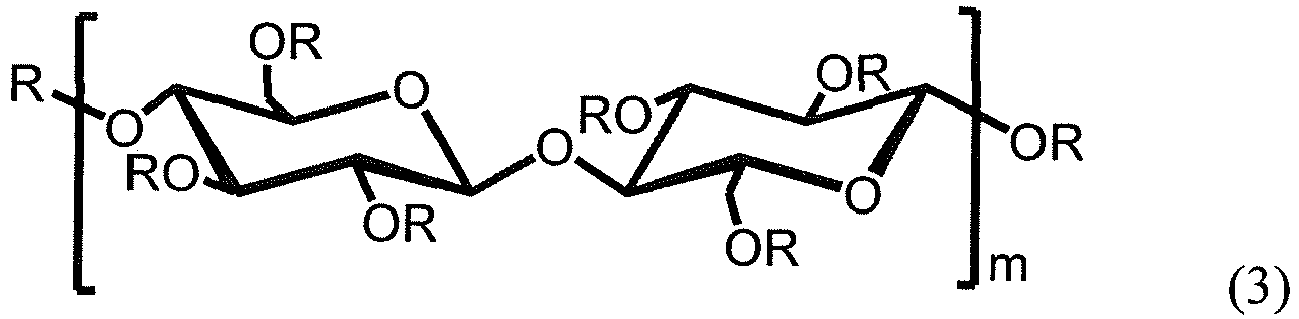
- <15> The rubber composition according to any one of the above <1> to <14>, wherein in the modified cellulose fibers represented by the general formula (3), R, which may be identical or different, is hydrogen, or a substituent represented by the general formula (1) and/or a substituent represented by the general formula (2), with proviso that a case where all R's are simultaneously hydrogens is excluded, wherein the modified cellulose fibers have a repeating structure of cellulose units into which the substituent is introduced, and wherein m in the general formula (3) is preferably 100 or more and 2,000 or less.
- <16> The rubber composition according to any one of the above <1> to <15>, wherein as the rubber, a diene-based rubber or a non-diene-based rubber can be used, and the diene-based rubber is preferred.
- <17> The rubber composition according to the above <16>, wherein as the diene rubber, one or more members selected from natural rubber (NR), polyisoprene rubber (IR), polybutadiene rubber (BR), styrene-butadiene copolymer rubber (SBR), butyl rubber (IIR), butadiene-acrylonitrile copolymer rubber (NBR), chloroprene rubber (CR) and modified rubbers are preferred, one or more members selected from natural rubber (NR), polyisoprene rubber (IR), polybutadiene rubber (BR), styrene-butadiene copolymer rubber (SBR), a chloroprene rubber (CR), and modified rubbers are more preferred, and one or more members selected from natural rubber (NR), styrene-butadiene copolymer rubber (SBR), a chloroprene rubber (CR), and modified rubbers are even more preferred.
- <18> The rubber composition according to any one of the above <1> to <17>, wherein the content of the rubber in the rubber composition is preferably 30% by mass or more, more preferably 45% by mass or more, and even more preferably 55% by mass or more, and preferably 95% by mass or less, more preferably 90% by mass or less, even more preferably 80% by mass or less, and still even more preferably 70% by mass or less.
- <19> The rubber composition according to any one of the above <1> to <18>, wherein the content of the modified cellulose fibers in the rubber composition is preferably 1% by mass or more, more preferably 2% by mass or more, even more preferably 5% by mass or more, and still even more preferably 10% by mass or more, and preferably 30% by mass or less, more preferably 20% by mass or less, and even more preferably 15% by mass or less.
- <20> The rubber composition according to any one of the above <1> to <19>, wherein the amount of the modified cellulose fibers in the rubber composition, based on 100 parts by mass of the rubber, is preferably 1 part by mass or more, more preferably 5 parts by mass or more, even more preferably 10 parts by mass or more, and still even more preferably 15 parts by mass or more, and preferably 30 parts by mass or less, more preferably 25 parts by mass or less, and even more preferably 20 parts by mass or less.
- <21> The rubber composition according to any one of the above <1> to <20>, wherein the rubber composition can be blended with a conventionally general amount of various additives which are blended for use in tires and other general rubbers, such as reinforcing fillers, vulcanization agents, vulcanization accelerators, vulcanization retarders, age resistors, process oils, vegetable fats and oils, scorching inhibitors, zinc flower, stearic acid, magnesium oxide, waxes, and phenolic resins, which are ordinarily used in the rubber industrial fields, as other components besides those mentioned above.
- <22> The rubber composition according to the above <21>, wherein as the reinforcing filler, a carbon black or silica is suitably used.
- <23> The resin composition according to any one of the above <1> to <22>, wherein the composition can be prepared by mixing raw materials containing the rubber and the above modified cellulose fibers, and further optionally various additives with an open-type kneader such as a roller, or a tightly closed kneader such as a Banbury mixer.
- <24> A method for producing a rubber composition, including the step of mixing a rubber and modified cellulose fibers as defined in any one of the above <1> to <23>.
- <25> The method for producing a rubber composition according to the above <24>, including reacting a cellulose-based raw material with a compound selected from a compound having a substituent represented by the general formula (1) and a compound having a substituent represented by the general formula (2), in the presence of a base, in the modified cellulose fibers.
- <26> The method for producing a rubber composition according to the above <25>, wherein the average fiber size of the cellulose-based raw material is preferably 5 µm or more, more preferably 7 µm or more, even more preferably 10 µm or more, and even more preferably 15 µm or more, and preferably 10,000 µm or less, more preferably 5,000 µm or less, even more preferably 1,000 µm or less, even more preferably 500 µm or less, and still even more preferably 100 µm or less.
- <27> The method for producing a rubber composition according to the above <25>, wherein the average fiber size of the cellulose-based raw material is preferably 1 nm or more, more preferably 2 nm or more, even more preferably 3 nm or more, and even more preferably 10 nm or more, and preferably 500 nm or less, more preferably 300 nm or less, even more preferably 200 nm or less, even more preferably 100 nm or less, and still even more preferably 80 nm or less.
- <28> The method for producing a rubber composition according to any one of the above <25> to <27>, wherein the cellulose content in the cellulose-based raw material is preferably 30% by mass or more, more preferably 50% by mass or more, and even more preferably 70% by mass or more, and preferably 99% by mass or less, more preferably 98% by mass or less, even more preferably 95% by mass or less, and even more preferably 90% by mass or less.
- <29> The method for producing a rubber composition according to any one of the above <25> to <28>, wherein the water content in the cellulose-based raw material is preferably 0.01% by mass or more, more preferably 0.1% by mass or more, even more preferably 0.5% by mass or more, even more preferably 1.0% by mass or more, even more preferably 1.5% by mass or more, and even more preferably 2.0% by mass or more, and preferably 50% by mass or less, more preferably 40% by mass or less, even more preferably 30% by mass or less, and even more preferably 20% by mass or less.
- <30> The method for producing a rubber composition according to any one of the above <25> to <29>, wherein the cellulose-based raw material is mixed with a base.
- <31> The method for producing a rubber composition according to any one of the above <25> to <30>, wherein the base is preferably one or more members selected from the group consisting of alkali metal hydroxides, alkaline earth metal hydroxides, primary to tertiary amines, quaternary ammonium salts, imidazole and derivatives thereof, pyridine and derivatives thereof, and alkoxides.
- <32> The method for producing a rubber composition according to the above <31>, wherein the alkali metal hydroxides and the alkaline earth metal hydroxide are selected from the group consisting of sodium hydroxide, potassium hydroxide, lithium hydroxide, calcium hydroxide, and barium hydroxide.
- <33> The method for producing a rubber composition according to the above <31>, wherein the primary to tertiary amines are selected from the group consisting of ethylenediamine, diethylamine, proline, N,N,N',N'-tetramethylethylenediamine, N,N,N',N'-tetramethyl-1,3-propanediamine, N,N,N',N'-tetramethyl-1,6-hexanediamine, tris(3-dimethylaminopropyl)amine, N,N-dimethylcyclohexylamine, and triethylamine.
- <34> The method for producing a rubber composition according to the above <31>, wherein the quaternary ammonium salt is selected from the group consisting of tetrabutylammonium hydroxide, tetrabutylammonium chloride, tetrabutylammonium fluoride, tetrabutylammonium bromide, tetraethylammonium hydroxide, tetraethylammonium chloride, tetraethylammonium fluoride, tetraethylammonium bromide, tetramethylammonium hydroxide, tetramethylammonium chloride, tetramethylammonium fluoride, and tetramethylammonium bromide.
- <35> The method for producing a rubber composition according to the above <31>, wherein the imidazole and derivatives thereof are selected from the group consisting of 1-methylimidazole, 3-aminopropylimidazole, and carbonyldiimidazole.
- <36> The method for producing a rubber composition according to the above <31>, wherein the pyridine and derivatives thereof are selected from the group consisting of N,N-dimethyl-4-aminopyridine and picoline.
- <37> The method for producing a rubber composition according to the above <31>, wherein the alkoxide is selected from the group consisting of sodium methoxide, sodium ethoxide, and potassium t-butoxide.
- <38> The method for producing a rubber composition according to any one of the above <25> to <37>, wherein the amount of the base, based on the anhydrous glucose unit of the cellulose-based raw material, is preferably 0.01 equivalents or more, more preferably 0.05 equivalents or more, even more preferably 0.1 equivalents or more, and even more preferably 0.2 equivalents or more, and preferably 10 equivalents or less, more preferably 8 equivalents or less, even more preferably 5 equivalents or less, and even more preferably 3 equivalents or less.
- <39> The method for producing a rubber composition according to any one of the above <25> to <38>, wherein the compound having a substituent represented by the general formula (1) is preferably a nonionic alkylene oxide compound represented by the following general formula (1A):

wherein a total number of carbon atoms of the compound is 5 or more, preferably 6 or more, more preferably 8 or more, and even more preferably 12 or more, and 32 or less, preferably 27 or less, more preferably 22 or less, even more preferably 20 or less, even more preferably 18 or less, even more preferably 14 or less, and even more preferably 12 or less. - <40> The method for producing a rubber composition according to the above <39>, wherein the number of carbon atoms of R1 in the general formula (1A) is preferably 4 or more, more preferably 6 or more, and even more preferably 10 or more, and preferably 25 or less, more preferably 20 or less, even more preferably 18 or less, even more preferably 16 or less, even more preferably 12 or less, and even more preferably 10 or less.
- <41> The method for producing a rubber composition according to the above <39> or <40>, wherein the compound represented by the general formula (1A) is selected from the group consisting of 1,2-epoxyhexane, 1,2-epoxydecane, and 1,2-epoxyoctadecane.
- <42> The method for producing a rubber composition according to any one of the above <25> to <38>, wherein the compound having a substituent represented by the general formula (2) is preferably a nonionic glycidyl ether compound represented by the following general formula (2A):

- <43> The method for producing a rubber composition according to the above <42>, wherein the number of carbon atoms of R1 in the general formula (2A) is preferably 4 or more, more preferably 6 or more, even more preferably 8 or more, and still even more preferably 10 or more, and preferably 25 or less, more preferably 20 or less, and even more preferably 18 or less.
- <44> The method for producing a rubber composition according to the above <42> or <43>, wherein the number of carbon atoms of A in the general formula (2A) is preferably 2 or more, and preferably 4 or less, and more preferably 3 or less.
- <45> The method for producing a rubber composition according to any one of the above <42> to <44>, wherein n in the general formula (2A) is preferably 3 or more, more preferably 5 or more, and even more preferably 10 or more, and preferably 40 or less, more preferably 30 or less, even more preferably 20 or less, and even more preferably 15 or less.
- <46> The method for producing a rubber composition according to any one of the above <42> to <45>, wherein the compound represented by the general formula (2A) is selected from the group consisting of butyl glycidyl ether, 2-ethylhexyl glycidyl ether, dodecyl glycidyl ether, stearyl glycidyl ether, and polyoxyalkylene alkyl ethers.
- <47> The method for producing a rubber composition according to any one of the above <25> to <46>, wherein the used amount of the compound having a substituent represented by the general formula (1) and/or the compound having a substituent represented by the general formula (2), based on the anhydrous glucose unit of the cellulose-based raw material, is preferably 0.01 equivalents or more, more preferably 0.1 equivalents or more, even more preferably 0.3 equivalents or more, even more preferably 0.5 equivalents or more, and even more preferably 0.1 equivalents or more, and preferably 10 equivalents or less, more preferably 8 equivalents or less, even more preferably 6.5 equivalents or less, and even more preferably 5 equivalents or less.
- <48> The method for producing a rubber composition according to any one of the above <25> to <47>, wherein as the solvent, water, isopropanol, t-butanol, dimethylformamide, toluene, methyl isobutyl ketone, acetonitrile, dimethyl sulfoxide, dimethylacetamide, 1,3-dimethyl-2-imidazolidinone, hexane, 1,4-dioxane, and mixtures thereof can be used.
- <49> The method for producing a rubber composition according to the above <48>, wherein the amount of solvent used, based on 100 parts by mass of the cellulose-based raw material, is preferably 30 parts by mass or more, more preferably 50 parts by mass or more, even more preferably 75 parts by mass or more, even more preferably 100 parts by mass or more, and even more preferably 200 parts by mass or more, and preferably 10,000 parts by mass or less, more preferably 5,000 parts by mass or less, even more preferably 2,500 parts by mass or less, even more preferably 1,000 parts by mass or less, and even more preferably 500 parts by mass or less.
- <50> The method for producing a rubber composition according to any one of the above <25> to <49>, wherein the reaction temperature is preferably 40°C or higher, more preferably 50°C or higher, and even more preferably 60°C or higher, and preferably 120°C or lower, more preferably 110°C or lower, and even more preferably 100°C or lower.
- <51> The method for producing a rubber composition according to any one of the above <25> to <50>, wherein the reaction time is preferably 3 hours or more, more preferably 6 hours or more, and even more preferably 10 hours or more, and preferably 60 hours or less, more preferably 48 hours or less, and even more preferably 36 hours or less.
- <52> The method for producing a rubber composition according to any one of the above <25> to <51>, including, after the above reaction, further carrying out a known finely fibrillating treatment.
- <53> The method for producing a rubber composition according to any one of the above <24> to <52>, including the following steps of:
- step (1): introducing one or more compounds selected from nonionic alkylene oxide compounds having a total number of carbon atoms of 5 or more and 32 or less per molecule and nonionic glycidyl ether compounds having a total number of carbon atoms of 5 or more and 100 or less per molecule to a cellulose-based raw material via an ether bond, in the presence of a base, to provide modified cellulose fibers; and
- step (2): mixing the modified cellulose fibers obtained in the step (1) with a rubber.
- <54> The rubber composition according to any one of the above <1> to <23>, which can be suitably used in various applications such as daily sundries, household electric appliance parts, and automobile parts.
- <55> A rubber part for industrial use containing a rubber composition as defined in any one of the above <1> to <23>.
- <56> A tire containing a rubber composition as defined in any one of the above <1> to <23>.
- The present invention will be described more specifically by means of the Examples. Here, the Examples are mere exemplifications of the present invention, without intending to limit the scope of the present invention thereto. Parts in Examples are parts by mass unless specified otherwise. Here, the term "ambient pressure" is 101.3 kPa, and the term "ambient temperature (room temperature)" is 25°C.
- Ten kilograms of stearyl alcohol, KALCOL 8098 manufactured by Kao Corporation, 0.36 kg of tetrabutylammonium bromide manufactured by KOEI CHEMICAL COMPANY LIMITED, 7.5 kg of epichlorohydrin manufactured by Dow Chemical Company, and 10 kg of hexane were supplied into a 100-L reactor, and the contents were mixed under a nitrogen atmosphere. While holding a liquid mixture at 50°C, 12 kg of a 48% by mass aqueous sodium hydroxide solution manufactured by Nankai Chemical Co., Ltd. was added dropwise thereto over 30 minutes. After the termination of the dropwise addition, the mixture was aged at 50°C for additional 4 hours, and thereafter washed with 13 kg of water repeatedly 8 times, to remove salts and alkali. Thereafter, the internal reactor temperature was raised to 90°C, hexane was distilled off from an upper layer, and the mixture was further purged with steam under a reduced pressure of 6.6 kPa to remove low-boiling point compounds. After dehydration, the mixture was subjected to a reduced-pressure distillation at an internal reactor temperature of 250°C and an internal reactor pressure of 1.3 kPa, to provide 8.6 kg of white stearyl glycidyl ether.
- As an entire treatment liquid 937 parts by mass of water, granular sodium hydroxide and ion-exchanged water in an amount so that sodium hydroxide would be 15.2 parts by mass, were added, based on 100 parts by mass of bagasse on a dry basis, the residual sugar cane, and the contents were heat-treated at a temperature of 120°C for 2 hours in an autoclave manufactured by TOMY SEIKO CO., LTD., LSX-700. After the treatment, the mixture was filtered and washed with ion-exchanged water, and vacuum-dried for one day and night at 70°C, to provide alkali-treated bagasse in a fibrous form, having an average fiber size of 24 µm, a cellulose content of 70% by mass, and a water content of 3% by mass.
- One-hundred grams of needle-leaf bleached kraft pulp, hereinafter abbreviated as NBKP, manufactured by Fletcher Challenge Canada Ltd., "Machenzie," CSF 650 ml, in a fibrous form, having an average fiber size of 24 µm, a cellulose content of 90% by mass, and a water content of 5% by mass, were weighed out on dry basis, supplied into a batch-type vibrating mill manufactured by CHUO KAKOHKI CO., LTD "MB-1," vessel entire volume: 3.5 L, 13 rods made of SUS304 being used, each rod having a diameter ϕ of 30 mm, a length of 218 mm, and cross-sectional shape of circular, rod filling ratio of 57%, and subjected to a pulverization treatment for 20 minutes, to provide a powdery cellulose A having an average fiber size of 25 µm, a crystallinity of 35%, and a water content of 3% by mass.
- The alkali-treated bagasse prepared in Production Example 1 of Cellulose-Based Raw Material was used as cellulose fibers. One hundred grams of the absolutely dried alkali-treated bagasse was supplied to a kneader manufactured by IRIE SHOKAI Co., Ltd., model PNV-1, capacity: 1.0 L equipped with a reflux tube and a dropping funnel, and 100 g of a 6.4% by mass aqueous sodium hydroxide solution, prepared from sodium hydroxide granules manufactured by Wako Pure Chemical Industries, Ltd. and ion-exchanged water (0.26 equivalent per AGU: calculated by assuming that the cellulose-based raw material is entirely constituted by anhydrous glucose units, hereinafter referred to the same) and 100 g of isopropanol were sequentially added, and thereafter the mixture was stirred at room temperature at 50 rpm for 30 minutes to homogeneously mix. Further, 92.7 g of 1,2-epoxyhexane manufactured by Wako Pure Chemical Industries, Ltd. (1.5 equivalents per AGU) was added dropwise in 1 minute, and the reaction was carried out at 70°C for 24 h under reflux conditions while stirring. After the reaction, the reaction mixture was neutralized with acetic acid manufactured by Wako Pure Chemical Industries, Ltd., and the mixture was sufficiently washed with a mixed solvent of water/isopropanol to remove impurities, and further vacuum-dried overnight at 50°C, to provide modified cellulose fibers.
- Using modified cellulose fibers obtained above, a rubber composition was produced. Styrene-butadiene copolymer SBR manufactured by ZEON Corporation, Nipol NS210 was used as a rubber. Components excluding a vulcanization accelerator and sulfur in a blending component listed in Table 1 were kneaded for 6 minutes with a 50-milliliter tightly closed-type mixer, and the vessel was opened when the temperature reached 150°C, to provide a rubber composition (kneading step A). To the rubber composition were added vulcanization accelerators N-(tert-butyl)-2-benzothiazolyl sulfenamine (TBBS), di-2-benzothiazolyl disulfide (MBTS), and 1,3-diphenyl guanidine (DPG), zinc oxide and sulfur, the contents were kneaded with a 50-milliliter tightly closed-type mixer for 3 minutes, and the vessel was opened when the temperature reached 100°C, to provide an unvulcanized rubber composition (kneading step B). The rubber composition obtained was subjected to vulcanization treatment in a die having dimensions of 15 × 15 × 0.2 cm at 145°C for 20 minutes, to provide a vulcanized rubber sheet having a thickness of about 0.2 mm.
- To 1.5 g of absolutely dried NBKP were added 1.5 g of a 6.4% by mass aqueous sodium hydroxide solution (NaOH, 0.26 equivalents per AGU) and 1.5 g of isopropanol, and the mixture was homogeneously mixed. Thereafter, 1.4 g of 1,2-epoxyhexane (1.5 equivalents per AGU) was added thereto, and the contents were tightly sealed, and thereafter reacted while allowing to stand at 70°C for 24 h. After the reaction, the reaction mixture was neutralized with acetic acid, and sufficiently washed with a mixed solvent of water/isopropanol to remove impurities. Further, the mixture was vacuum-dried overnight at 50°C to provide modified cellulose fibers.
- Using modified cellulose fibers obtained, the same treatments as in the method described in Example 1 were carried out, in a blending component listed in Table 1, to provide a vulcanized rubber sheet.
- To 1.5 g of absolutely dried NBKP were added 6.0 g of dimethylformamide manufactured by Wako Pure Chemical Industries, Ltd. (DMF) and 1.8 g of N,N-dimethyl-4-aminopyridine (DMAP, 1.6 equivalents per AGU), and the mixture was homogeneously mixed. Thereafter, 7.2 g of 1,2-epoxydecane manufactured by Wako Pure Chemical Industries, Ltd. (5 equivalents per AGU) was added thereto, and the contents were tightly sealed, and thereafter reacted while allowing to stand at 90°C for 24 h. After the reaction, the reaction mixture was neutralized with acetic acid, and sufficiently washed with DMF and a mixed solvent of water/isopropanol to remove impurities. Further, the mixture was vacuum-dried overnight at 50°C to provide modified cellulose fibers.
- Using modified cellulose fibers obtained, the same treatments as in the method described in Example 1 were carried out, in a blending component listed in Table 1, to provide a vulcanized rubber sheet.
- Fifty grams of the absolutely dried NBKP was supplied to a kneader equipped with a reflux tube and a dropping funnel, and 100 g of DMF and 60 g of DMAP (1.6 equivalents per AGU) were sequentially added, and thereafter the mixture was stirred at room temperature at 50 rpm for 30 minutes to homogeneously mix. Further, 141 g of 1,2-epoxydecane (5 equivalents per AGU) was added dropwise in 1 minute, and the reaction was carried out at 90°C for 24 h under reflux conditions while stirring. After the reaction, the reaction mixture was neutralized with acetic acid, and the mixture was sufficiently washed with DMF and a mixed solvent of water/isopropanol to remove impurities, and further vacuum-dried overnight at 50°C, to provide modified cellulose fibers.
- The same treatments as in the method described in Example 1 were carried out, in a blending component listed in Table 1, to provide a vulcanized rubber sheet.
- To 1.5 g of absolutely dried NBKP were added 6.0 g of DMF and 1.8 g of DMAP (1.6 equivalents per AGU), and the mixture was homogeneously mixed. Thereafter, 24.8 g of 1,2-epoxyoctadecane manufactured by Tokyo Chemical Industry Co., Ltd. (10 equivalents per AGU) was added thereto, and the contents were tightly sealed, and thereafter reacted while allowing to stand at 90°C for 24 h. After the reaction, the reaction mixture was neutralized with acetic acid, and sufficiently washed with DMF and a mixed solvent of water/isopropanol to remove impurities, and further vacuum-dried overnight at 50°C, to provide modified cellulose fibers.
- Using modified cellulose fibers obtained, the same treatments as in the method described in Example 1 were carried out, in a blending component listed in Table 1, to provide a vulcanized rubber sheet.
- The same procedures as in Example 1 were carried out except that the modified cellulose fibers were not added, to provide a vulcanized rubber sheet.
- The same procedures as in Example 1 were employed except that the reaction reagent was changed to propylene oxide, and that the amount of the reagent was changed to 0.16 g (0.3 equivalents per AGU), to provide modified cellulose fibers, and a vulcanized rubber sheet was prepared in the same manner as Example 1, in a blending component listed in Table 1.
- The same procedures as in Example 32 were employed except that the reaction reagent was changed to butyl glycidyl ether manufactured by Tokyo Chemical Industry Co., Ltd., and that the amount of the reagent was changed to 6.0 g (5 equivalents per AGU), to provide modified cellulose fibers, and a vulcanized rubber sheet was prepared in the same manner as Example 1, in a blending component listed in Table 2.
- The same procedures as in Example 32 were employed except that the reaction reagent was changed to 2-ethylhexyl glycidyl ether manufactured by Tokyo Chemical Industry Co., Ltd., and that the amount of the reagent was changed to 8.6 g (5 equivalents per AGU), to provide modified cellulose fibers, and a vulcanized rubber sheet was prepared in the same manner as Example 1, in a blending component listed in Table 2.
- The same procedures as in Example 32 were employed except that the reaction reagent was changed to stearyl glycidyl ether prepared in Production Example 1 of Compound Having Substituent, and that the amount of the reagent was changed to 31.0 g (6 equivalents per AGU), to provide modified cellulose fibers, and a vulcanized rubber sheet was prepared in the same manner as Example 1, in a blending component listed in Table 2.
- The same procedures as in Example 1 were employed except that the reaction reagent was changed to glycidyl methyl ether manufactured by Tokyo Chemical Industry Co., Ltd., and that the amount of the reagent was changed to 0.48 g (0.6 equivalents per AGU), to provide modified cellulose fibers, and a vulcanized rubber sheet was prepared in the same manner as Example 1, in a blending component listed in Table 2.
- The same procedures as in Example 1 were carried out except that the amount of the modified cellulose fibers and the amount of carbon black were changed to those in Table 3, to provide a vulcanized rubber sheet.
- NBKP was used as a cellulose-based raw material, and the same treatments as those in Example 1 were carried out, to provide modified cellulose fibers.
- The same treatments as the method described in Example 1 were carried out in a blending component listed in Table 3, to provide a vulcanized rubber sheet.
- The same procedures as in Example 5 were carried out except that the amount of the modified cellulose fibers and the amount of carbon black were changed to those in Table 3, to provide a vulcanized rubber sheet.
- The same procedures as in Example 31 were carried out except that the amount of carbon black was changed to that in Table 3, to provide a vulcanized rubber sheet.
- The same procedures as in Example 33 were carried out except that the amount of carbon black was changed to that in Table 3, to provide a vulcanized rubber sheet.
- The same procedures as in Example 34 were carried out except that the amount of carbon black was changed to that in Table 3, to provide a vulcanized rubber sheet.
- The same procedures as in Example 36 were carried out except that the amount of carbon black was changed to that in Table 3, to provide a vulcanized rubber sheet.
- The same procedures as in Comparative Example 1 were carried out except that the carbon black was added in an amount of 50 parts by mass, to provide a vulcanized rubber sheet.
- The same procedures as in Comparative Example 2 were carried out except that the alkali-treated bagasse prepared in Production Example 1 of Cellulose-Based Raw Material was directly added in an amount of 10 parts by mass without chemical modification, to provide a vulcanized rubber sheet.
- A broad-leaf bleached kraft pulp (hereinafter abbreviated as LBKP) derived from eucalyptus, manufactured by CENIBRA, in a fibrous form, having an average fiber size of 24 µm, a cellulose content of 90% by mass, and a water content of 5% by mass was used as a raw material cellulose. One hundred grams of the absolutely dried LBKP was supplied to a kneader manufactured by IRIE SHOKAI Co., Ltd., model PNV-1, capacity: 1.0 L equipped with a reflux tube and a dropping funnel, and 100 g of 6.4% by mass aqueous sodium hydroxide solution (0.26 equivalent per AGU) and 100 g of isopropanol were sequentially added thereto, and thereafter the mixture was stirred at room temperature at 50 rpm for 30 minutes to homogeneously mix. Further, 92.7 g of 1,2-epoxyhexane (1.5 equivalents per AGU) was added dropwise in 1 minute, and the reaction was carried out at 70°C for 24 h under reflux conditions while stirring. After the reaction, the reaction mixture was neutralized with acetic acid, and the mixture was sufficiently washed with a mixed solvent of water/isopropanol to remove impurities, and further vacuum-dried overnight at 50°C, to provide modified cellulose fibers.
- Using modified cellulose fibers obtained, the same treatments as in the method described in Example 1 were carried out, in a blending component listed in Table 4, to provide a vulcanized rubber sheet.
- The same procedures as in Example 41 were employed except that the raw material used was changed to High Yield Pulp (hereinafter abbreviated as HYP) derived from spruce, manufactured by Rottneros, in a fibrous form, having an average fiber size of 28 µm, a cellulose content of 55% by mass, and a water content of 15% by mass, to provide modified cellulose fibers.
- Using modified cellulose fibers obtained, the same treatments as in the method described in Example 1 were carried out, in a blending component listed in Table 4, to provide a vulcanized rubber sheet.
- The same procedures as in Example 41 were employed except that the raw material used was changed to ARBOCELL BC200 (hereinafter abbreviated as ARBOCELL), manufactured by Rettenmaier Co., Ltd., in a powdery form, having an average fiber size of 65 µm, a cellulose content of 90% by mass, and a water content of 5% by mass, to provide modified cellulose fibers.
- Using modified cellulose fibers obtained, the same treatments as in the method described in Example 1 were carried out, in a blending component listed in Table 4, to provide a vulcanized rubber sheet.
- The same procedures as in Example 41 were employed except that the raw material used was changed to a powdery cellulose A prepared in Production Example 2 of Cellulose-Based Raw Material, in a powdery form, having an average fiber size of 25 µm, a cellulose content of 90% by mass, and a water content of 3% by mass, to provide modified cellulose fibers.
- Using modified cellulose fibers obtained, the same treatments as in the method described in Example 1 were carried out, in a blending component listed in Table 4, to provide a vulcanized rubber sheet.
- The same treatments as the method described in Example 1 were carried out in a blending component listed in Table 5 using powdery modified cellulose fibers obtained by previously supplying 100 g of the modified cellulose fibers obtained in the same manner as Example 36 on dry basis into a batch-type vibrating mill "MB-1" manufactured by CHUO KAKOHKI CO., LTD, having a reactor entire volume of 3.5 L, using 13 rods made of SUS304 having a diameter ϕ of 30 mm, a length of 218 mm, a cross-sectional shape of circular, and a rod filling ratio of 57%, and subjecting the contents to a pulverization treatment for 20 minutes, to provide a vulcanized rubber sheet.
- The same treatments as the method described in Example 1 were carried out in a blending component listed in Table 5 using powdery modified cellulose fibers obtained by previously supplying 50 g of the modified cellulose fibers obtained in the same manner as Example 36 on dry basis mixed with 25 g of water into a batch-type vibrating mill "MB-1" manufactured by CHUO KAKOHKI CO., LTD, having a reactor entire volume of 3.5 L, using 13 rods made of SUS304 having a diameter ϕ of 30 mm, a length of 218 mm, a cross-sectional shape of circular, and a rod filling ratio of 57%, and subjecting the contents to a pulverization treatment for 20 minutes, to provide a vulcanized rubber sheet.
- The same treatments as the method described in Example 1 were carried out except that a step of kneading the modified cellulose fibers obtained in the same manner as Example 36 for 6 minutes in a blending component listed in Table 5 with a tightly closed type mixer between the kneading step A and the kneading step B, and opening the vessel when the temperature reached 150°C to provide a rubber composition (kneading step C) was added, to provide a vulcanized rubber sheet.
- Using the modified cellulose fibers obtained in the same manner as Example 36, the same treatments as the method described in Example 1 were carried out except that Si69 manufactured by Evonik Industries was added thereto as a silane coupling agent in an amount of 2% by mass based on SBR during the kneading step A in a blending component listed in Table 5, to provide a vulcanized rubber sheet.
- To 1.5 g of absolutely dried NBKP were added 6.0 g of DMF and 1.8 g of DMAP (1.6 equivalents per AGU), and the mixture was homogeneously mixed. Thereafter, 12.4 g of 1,2-epoxyoctadecane (5 equivalents per AGU) was added thereto, and the contents were tightly sealed, and thereafter reacted while allowing to stand at 90°C for 24 h. After the reaction, the reaction mixture was neutralized with acetic acid, and sufficiently washed with DMF and a mixed solvent of water/isopropanol to remove impurities, and further vacuum-dried overnight at 50°C to provide modified cellulose fibers.
- The amount 0.50 g of the modified cellulose fibers obtained were supplied into 49.50 g of toluene manufactured by Wako Pure Chemical Industries, Ltd., and the mixture was stirred with a homogenizer T.K. ROBOMICS manufactured by PRIMIX Corporation at 3,000 rpm for 30 minutes, and thereafter subjected to a 10-pass treatment with a high-pressure homogenizer "NanoVater L-ES" manufactured by YOSHIDA KIKAI CO., LTD. at 100 MPa, to provide a fine modified cellulose dispersion in which finely fibrillated modified cellulose fibers were dispersed in toluene, a solid content concentration of which was 1.0% by mass.
- Twenty grams of the fine modified cellulose dispersion obtained above, 2.0 g of styrene-butadiene copolymer SBR, 0.04 g of stearic acid, 0.06 g of zinc oxide, 0.03 g of sulfur, 0.01 g of TBBS, 0.01 g of MBTS, 0.01 g of DPG, and 20 g of toluene were mixed, and the mixture was stirred at room temperature of 25°C for 2 hours. After confirmation of dissolution, the resulting solution was subjected to finely fibrillating treatment on 1-pass at 60 MPa and 1-pass at 100 MPa with a high-pressure homogenizer. The resulting dispersion was poured to a glass petri dish, to remove toluene for 2 days at room temperature and ambient pressure. Thereafter, the dispersion was dried at room temperature for 12 hours with a vacuum drier, and the dried product was subjected to vulcanization at 150°C for 1 hour, to provide a vulcanized rubber sheet having a thickness of about 0.2 mm.
- Using the modified cellulose fibers obtained in the same manner as Example 33, the same treatments as in Example 10 were carried out to provide a fine modified cellulose dispersion, and the same treatments as the method described in Example 10 were carried out using the fine modified cellulose dispersion in a blending component listed in Table 6 to provide a vulcanized rubber sheet.
- To 1.5 g of absolutely dried NBKP were added 6.0 g of acetonitrile manufactured by Wako Pure Chemical Industries, Ltd. and 2.7 g of tetrabutylammonium hydroxide manufactured by Wako Pure Chemical Industries, Ltd., a 10% aqueous solution (TBAH, 0.8 equivalents per AGU), and the mixture was homogeneously mixed. Thereafter, 15.5 g of stearyl glycidyl ether prepared in Production Example 1 of Compound Having Substituent (3 equivalents per AGU) was added thereto, and the contents were tightly sealed, and thereafter reacted while allowing to stand at 70°C for 24 h. After the reaction, the reaction mixture was neutralized with acetic acid, and sufficiently washed with DMF and a mixed solvent of water/isopropanol to remove impurities. Further, the mixture was vacuum-dried overnight at 50°C, to provide modified cellulose fibers. Using the modified cellulose fibers obtained, the same finely fibrillating treatments as in Example 10 were carried out, to provide a fine modified cellulose dispersion in which finely fibrillated modified cellulose fibers were dispersed in toluene, a solid content concentration of which was 1.0% by mass.
- Using the fine modified cellulose dispersion obtained, the same treatments as in Example 10 were carried out, to provide a vulcanized rubber sheet having a thickness of about 0.2 mm.
- Using the modified cellulose fibers obtained in the same manner as in Example 32, the same treatments as in Example 10 were carried out, to provide a fine modified cellulose dispersion. Using the fine modified cellulose dispersion obtained, the same treatments as the method described in Example 10 were carried out in a blending component listed in Table 6, to provide a vulcanized rubber sheet.
- To 1.5 g of microfibrillated cellulose, as a solid content, which was previously subjected to solvent replacement with DMF, manufactured by Daicel FineChem Ltd., under the trade name of "CELISH FD100-G," as a cellulose-based raw material was added 1.8 g of DMAP (1.6 equivalents per AGU), and the mixture was homogeneously mixed. Thereafter, 7.2 g of 1,2-epoxydecane (5 equivalents per AGU) was added thereto, and the contents were tightly sealed, and thereafter reacted while allowing to stand at 90°C for 24 h. After the reaction, the reaction mixture was neutralized with acetic acid, and sufficiently washed with DMF and a mixed solvent of water/isopropanol to remove impurities. Further, the mixture was vacuum-dried overnight at 50°C to provide modified cellulose fibers.
- Using the modified cellulose fibers obtained, the same treatments as in Example 10 were carried out, to provide a fine modified cellulose dispersion. Using the fine modified cellulose dispersion obtained, the same treatments as the method described in Example 10 were carried out in a blending component listed in Table 6, to provide a vulcanized rubber sheet.
- Using the modified cellulose fibers obtained in the same manner as in Example 36, the same treatments as in Example 10 were carried out, to provide a fine modified cellulose dispersion. Using the fine modified cellulose dispersion obtained, the same treatments as the method described in Example 10 were carried out in a blending component listed in Table 6, to provide a vulcanized rubber sheet.
- The same procedures as in Example 10 were carried out except that the modified cellulose fibers were not added, to provide a vulcanized rubber sheet.
- The modified cellulose fibers obtained were evaluated for substituent introduction ratio, average fiber sizes of modified cellulose fibers, fine modified cellulose dispersion and cellulose-based raw material, and confirmation of the crystal structure (crystallinity) in accordance with the methods of the following Test Examples 1 to 4. In addition, the properties of the vulcanized rubber sheet were each evaluated in accordance with the following Test Examples 5 to 6. The results are shown in Tables 1 to 6.
- Here, raw materials in Tables 1 to 6 are as follows.
- SBR: Nipol NS210, manufactured by ZEON Corporation
-
- Carbon Black: Seast 3, manufactured by Toyo Carbon Co., Ltd.
- Stearic Acid: Lunac S-70V, industrial stearic acid, manufactured by Kao Corporation
- Sulfur: vulcanizing agent, manufactured by Wako Pure Chemical Industries, Ltd.
- Zinc Oxide: manufactured by Wako Pure Chemical Industries, Ltd.
- TBBS: vulcanization accelerator, manufactured by Wako Pure Chemical Industries, Ltd.
- MBTS: vulcanization accelerator, manufactured by Tokyo Chemical Industry Co., Ltd.
- DPG: vulcanization accelerator, manufactured by Wako Pure Chemical Industries, Ltd.
- The % content (% by mass) of the hydrophobic ether group contained in the modified cellulose fibers obtained was calculated in accordance with Zeisel method, which has been known as a method of analyzing an average number of moles added of alkoxy groups of the cellulose ethers described in Analytical Chemistry, 51(13), 2172 (1979), "Fifteenth Revised Japan Pharmacopeia (Section of Method of Analyzing Hydroxypropyl Cellulose)" or the like. The procedures are shown hereinbelow.
- (i) To a 200 mL volumetric flask was added 0.1 g of n-octadecane, and filled up to a marked line with hexane, to provide an internal standard solution.
- (ii) One-hundred milligrams of modified cellulose fibers previously purified and dried, and 100 mg of adipic acid were accurately weighed in a 10 mL vial jar, 2 mL of hydrogen iodide was added thereto, and the vial jar was tightly sealed.
- (iii) The mixture in the above vial jar was heated with a block heater at 160°C for 1 hour, while stirring with stirrer chips.
- (iv) After heating, 3 mL of the internal standard solution and 3 mL of diethyl ether were sequentially injected to the vial, and a liquid mixture was stirred at room temperature for 1 minute.
- (v) An upper layer (diethyl ether layer) of the mixture separated in two layers in the vial jar was analyzed by gas chromatography with "GC2010Plus," manufactured by SHIMADZU Corporation. The analytical conditions were as follows:
- Column: DB-5, manufactured by Agilent Technologies (12 m, 0.2 mm × 0.33 µm
- Column Temperature: 100°C, heating at 10°C/min, to 280°C (holding for 10 min)
- Injector Temperature: 300°C, detector temperature: 300°C, input amount: 1 µL
- The content of the ether groups in the modified cellulose fibers (% by mass) was calculated from a detected amount of the etherification reagent used.
- From the ether group content obtained, the molar substitution (MS), amount of moles of substituents based on one mol of the anhydrous glucose unit, was calculated using the following formula (1):

- W1: The content of the ether groups in the modified cellulose fibers, % by mass
- Mw: The molecular weight of the introduced etherification reagent, g/mol
- The fiber sizes of the cellulose-based raw material and the modified cellulose fibers were obtained by the following method. About 0.3 g of an absolutely dried sample was accurately weighed, and stirred in 1.0 L of ion-exchanged water with a household mixer for one minute, to defibriate the fibers in water. Thereafter, 4.0 L of ion-exchanged water was further added, and the mixture was stirred to make it homogeneous. From the aqueous dispersion obtained, about 50 g was collected and accurately weighed as the measurement liquid. The measurement liquid obtained was analyzed by "Kajaani Fiber Lab" manufactured by Metso Automation, to provide an average fiber size.
- The dispersion obtained was observed with an optical microscope "Digital Microscope VHX-1000" manufactured by KEYENCE at a magnification of from 300 to 1,000, and calculating an average of 30 or more of fiber strands (calculated by rounding off to a first decimal as a significant digit). In a case where observation with an optical microscope was difficult, a solvent was further added to the cellulose fiber dispersion to provide a 0.0001% by mass dispersion, and the dispersion was dropped on mica and dried to provide an observation sample, and a fiber height of the cellulose fibers in the observation sample was measured with an interatomic force microscope (AFM), Nanoscope III Tapping mode AFM, manufactured by Digital Instrument, the probe Point Probe (NCH) manufactured by NANOSENSORS being used. During the measurements, five or more sets of fine cellulose fibers were extracted from a microscopic image in which the cellulose fibers could be confirmed, and an average fiber size, a fiber size in the dispersion, was calculated from those fiber heights. Here, a case where fibers were aggregated in a dispersion to make analysis impossible is listed as "> 10,000."
- The crystal structure of the modified cellulose fibers was confirmed by measuring with "Rigaku RINT 2500VC X-RAY diffractometer" manufactured by Rigaku Corporation. The measurement conditions were as follows: X-ray source: Cu/Kα-radiation, tube voltage: 40 kV, tube current: 120 mA, measurement range: diffraction angle 2θ = 5° to 45°, scanning speed of X-ray: 10°/min. A sample for the measurement was prepared by compressing pellets to a size having an area of 320 mm2 and a thickness of 1 mm. Also, as to the crystallinity of the cellulose I crystal structure, X-ray diffraction intensity was calculated by the following formula (A):

- On the other hand, in a case where a crystallinity obtained by the above formula (A) is 35% or less, it is preferable to use a calculated value based on the formula (B) given below as a crystallinity, in accordance with the description of P199-200 of "Mokushitsu Kagaku Jikken Manyuaru (Wood Science Experimental Manual)," edited by The Japan Wood Research Society, from the viewpoint of improving the calculation accuracy.
- Therefore, in a case where a crystallinity obtained by the above formula (A) is 35% or less, a calculated value based on the following formula (B) can be used as a crystallinity:

- Using a dynamic viscoelastometer "DMS6100," manufactured by SII, the storage modulus and tan δ of a rectangular sample cut out to have a width of 5 mm and a length of 20 mm from the sheet obtained were measured in tensile mode while raising the temperature from -50°C to 200°C in a rate of 2°C per minute in a nitrogen atmosphere at a frequency of 1 Hz. When each value of Comparative Example 1 or 4 is considered as 100, relative modulus and relative tan δ were calculated from the storage modulus and tan δ obtained, and the both values are given in Table 1 and Table 2. It is shown that the higher the value of the relative storage moduli to the corresponding Comparative Example, the more excellent the strength. In addition, it is shown that the lower the value of the relative tan δ to the corresponding Comparative Example, the lower the thermal conversion of energy during the shape transformation and the more excellent the reduced energy loss.
- Using a thermal stress-strain measurement apparatus "EXSTAR TMA/SS6100" manufactured by Seiko Instruments, Inc., the measurements were taken with a rectangular sample having a width of 3 mm and a length of 20 mm, which was subjected to temperature elevation at a rate of 5°C per minute under nitrogen atmosphere in a tensile mode, with applying a load of 50 g. As a coefficient of linear thermal expansion (CTE), a value measured at 80°C was used. When the CTE of Comparative Example 4 was considered as 100, relative CTE was calculated from the CTE obtained, and the both are shown in Table 2. It is shown that the lower the relative CTE to the CTE of the corresponding Comparative Example, the more excellent the dimensional stability.
-
Table 1 Comparative Examples Examples 1 31 1 31 32 5 33 Rubber Composition SBR, parts by mass 100 100 100 100 100 100 100 Modified Cellulose Fibers Substituent Formula (1) R1 - -CH3 -C4H9 -C4H9 -C8H17 -C8H17 -C16H33 Degree of Substitution - 0.15 0.22 0.20 0.40 0.48 0.24 Formula (2) R1 - - - - - - - n - - - - - - - A - - - - - - - Degree of Substitution - - - - - - - Average Fiber Size, µm - 24 23 24 24 24 23 Cellulose Crystal Form - I I I I I I Crystallinity, % - 57 38 57 51 50 56 Raw Material Cellulose - NBKP Bagasse NBKP NBKP NBKP NBKP Parts Added, parts by mass 0 10 9 10 10 20 10 Carbon Black, parts by mass 0 0 0 0 0 0 0 Stearic Acid, parts by mass 2 2 2 2 2 2 2 Zinc Oxide, parts by mass 3 3 3 3 3 3 3 Sulfur, parts by mass 1.5 1.5 1.5 1.5 1.5 1.5 1.5 Vulcanization Accelerator TBBS, parts by mass 0.5 0.5 0.5 0.5 0.5 0.5 0.5 Vulcanization Accelerator MBTS, parts by mass 0.5 0.5 0.5 0.5 0.5 0.5 0.5 Vulcanization Accelerator DPG, parts by mass 0.5 0.5 0.5 0.5 0.5 0.5 0.5 Evaluation Results 25°C Relative Storage Modulus, Based on Comparative Example 1 100 235 480 510 725 2,345 1,250 25°C Relative tan δ, Based on Comparative Example 1 100 101 67 73 68 74 65 -
Table 2 Comparative Example Examples 32 34 35 36 Rubber Composition SBR, parts by mass 100 100 100 100 Modified Cellulose Fibers Substituent Formula (1) R1 - - - - Degree of Substitution Formula (2) R1 -CH3 -C4H9 -C8H17 -C18H37 n 0 0 0 0 A - - - - Degree of Substitution 0.35 0.57 0.10 0.30 Average Fiber Size, µm 24 24 24 24 Cellulose Crystal Form I I I I Crystallinity, % 55 57 52 55 Raw Material Cellulose NBKP NBKP NBKP NBKP Parts Added, parts by mass 10 10 10 10 Carbon Black, parts by mass 0 0 0 0 Stearic Acid, parts by mass 2 2 2 2 Zinc Oxide, parts by mass 3 3 3 3 Sulfur, parts by mass 1.5 1.5 1.5 1.5 Vulcanization Accelerator TBBS, parts by mass 0.5 0.5 0.5 0.5 Vulcanization Accelerator MBTS, parts by mass 0.5 0.5 0.5 0.5 Vulcanization Accelerator DPG, parts by mass 0.5 0.5 0.5 0.5 Evaluation Results 25°C Relative Storage Modulus, Based on Comparative Example 1 260 345 1,220 1,280 25°C Relative tan δ, Based on Comparative Example 1 105 66 71 64 -
Table 3 Comparative Examples Examples 2 3 2 3 4 6 37 38 39 40 Rubber Composition SBR, parts by mass 100 100 100 100 100 100 100 100 100 100 Modified Cellulose Fibers Substituent Formula (1) R1 - - -C4H9 -C4H9 -C4H9 -C8H17 -C4H9 -C16H33 - - Degree of Substitution - - 0.22 0.22 0.09 0.48 0.20 0.24 - - Formula (2) R1 - - - - - - - - -C4H9 -C18H37 n 0 0 A - - - - - - - - - - Degree of Substitution - - - - - - - - 0.57 0.30 Average Fiber Size, µm - 24 23 23 24 24 24 23 24 24 Cellulose Crystal Form - I I I I I I I I I Crystallinity, % - 39 38 38 56 50 57 56 57 55 Raw Material Cellulose - Bagasse Bagasse Bagasse NBKP NBKP NBKP NBKP NBKP NBKP Parts Added, parts by mass 0 10 10 20 20 20 10 10 10 10 Carbon Black, parts by mass 50 50 50 50 50 50 50 50 50 50 Stearic Acid, parts by mass 2 2 2 2 2 2 2 2 2 2 Zinc Oxide, parts by mass 3 3 3 3 3 3 3 3 3 3 Sulfur, parts by mass 1.5 1.5 1.5 1.5 1.5 1.5 1.5 1.5 1.5 1.5 Vulcanization Accelerator TBBS, parts by mass 0.5 0.5 0.5 0.5 0.5 0.5 0.5 0.5 0.5 0.5 Vulcanization Accelerator MBTS, parts by mass 0.5 0.5 0.5 0.5 0.5 0.5 0.5 0.5 0.5 0.5 Vulcanization Accelerator DPG, parts by mass 0.5 0.5 0.5 0.5 0.5 0.5 0.5 0.5 0.5 0.5 Evaluation Results 25°C Relative Storage Modulus, Based on Comparative Example 1 795 1,585 3,605 5,525 8,650 3,130 3,920 4,420 2,555 5,890 25°C Relative tan δ, Based on Comparative Example 1 82 76 68 66 68 72 73 62 68 65 -
Table 4 Comparative Example Examples 1 1 41 42 43 44 Rubber Composition SBR, parts by mass 100 100 100 100 100 100 Modified Cellulose Fibers Substituent Formula (1) R1 - -C4H9 -C4H9 -C4H9 -C4H9 -C4H9 Degree of Substitution - 0.22 0.26 0.35 0.30 0.28 Formula (2) R1 - - - - - n A - - - - Degree of Substitution - - - - - - Average Fiber Size, µm - 23 24 28 65 25 Cellulose Crystal Form - I I I I I Crystallinity, % - 38 60 49 56 35 Raw Material Cellulose - Bagasse LBKP HYP ARBOCEL Powdery Cellulose A Parts Added, parts by mass 0 9 10 10 10 10 Carbon Black, parts by mass 0 0 0 0 0 0 Stearic Acid, parts by mass 2 2 2 2 2 2 Zinc Oxide, parts by mass 3 3 3 3 3 3 Sulfur, parts by mass 1.5 1.5 1.5 1.5 1.5 1.5 Vulcanization Accelerator TBBS, parts by mass 0.5 0.5 0.5 0.5 0.5 0.5 Vulcanization Accelerator MBTS, parts by mass 0.5 0.5 0.5 0.5 0.5 0.5 Vulcanization Accelerator DPG, parts by mass 0.5 0.5 0.5 0.5 0.5 0.5 Evaluation Results 25°C Relative Storage Modulus, Based on Comparative Example 1 100 480 480 485 405 420 25°C Relative tan δ, Based on Comparative Example 1 100 67 70 68 65 65 -
Table 5 Examples 45 46 47 48 Rubber Composition SBR, parts by mass 100 100 100 100 Modified Cellulose Fibers Substituent Formula (1) R1 - - - - Degree of Substitution - - - - Formula (2) R1 -C18H37 -C18H37 -C18H37 -C18H37 n 0 0 0 0 A - - - - Degree of Substitution 0.30 0.30 0.30 0.30 Average Fiber Size, µm 24 24 24 24 Cellulose Crystal Form I I I I Crystallinity, % 55 55 55 55 Raw Material Cellulose NBKP NBKP NBKP NBKP Pretreatment Before Mixing Vibrating Mill, Without Water Vibrating Mill, Water, 50 parts by mass None None Parts Added, parts by mass 10 10 10 10 Carbon Black, parts by mass 0 0 0 0 Stearic Acid, parts by mass 2 2 2 2 Zinc Oxide, parts by mass 3 3 3 3 Sulfur, parts by mass 1.5 1.5 1.5 1.5 Vulcanization Accelerator TBBS, parts by mass 0.5 0.5 0.5 0.5 Vulcanization Accelerator MBTS, parts by mass 0.5 0.5 0.5 0.5 Vulcanization Accelerator DPG, parts by mass 0.5 0.5 0.5 0.5 Silane Coupling Agent, parts by mass 0 0 0 2 Presence or Absence of Kneading Step C Absence Absence Presence Absence Evaluation Results 25°C Relative Storage Modulus, Based on Comparative Example 1 1,090 1,450 1,420 1,335 25°C Relative tan δ, Based on Comparative Example 1 65 72 71 66 -
Table 6 Comparative Example Examples 4 10 49 11 50 51 52 Rubber Composition SBR, parts by mass 100 100 100 100 100 100 100 Modified Cellulose Fibers Substituent Formula (1) R1 - -C16H33 -C16H33 - -C8H17 -C8H17 - Degree of Substitution - 0.03 0.24 - 0.40 0.22 - Formula (2) R1 - - - -C18H37 - - -C18H37 n - - - 0 - - 0 A - - - - - - - Degree of Substitution - - - 0.02 - - 0.30 Average Fiber Size, nm - 120 78 110 61 112 81 Cellulose Crystal Form - I I I I I I Crystallinity, % - 51 56 56 51 56 55 Raw Material Cellulose - NBKP NBKP NBKP NBKP MFC NBKP Parts Added, parts by mass 0 10 10 10 10 10 10 Carbon Black, parts by mass 0 0 0 0 0 0 0 Stearic Acid, parts by mass 2 2 2 2 2 2 2 Zinc Oxide, parts by mass 3 3 3 3 3 3 3 Sulfur, parts by mass 1.5 1.5 1.5 1.5 1.5 1.5 1.5 Vulcanization Accelerator TBBS, parts by mass 0.5 0.5 0.5 0.5 0.5 0.5 0.5 Vulcanization Accelerator MBTS, parts by mass 0.5 0.5 0.5 0.5 0.5 0.5 0.5 Vulcanization Accelerator DPG, parts by mass 0.5 0.5 0.5 0.5 0.5 0.5 0.5 Evaluation Results 80°C Relative Storage Modulus, Based on Comparative Example 4 100 8,545 11,056 3,545 5,221 2,603 9,084 80°C Relative CTE, Based on Comparative Example 4 100 20 20 21 20 28 21 - It can be seen from Tables 1 to 6 that the rubber compositions of the present invention contain specified modified cellulose fibers, so that the rubber compositions are excellent in high mechanical strength, reduced energy loss, and dimensional stability.
- The rubber compositions of the present invention can be suitably used as machine tool parts, household electric appliance parts, automobile parts, and the like.
Claims (12)
- A rubber composition comprising a rubber and modified cellulose fibers, wherein one or more substituents selected from substituents represented by the following general formula (1) and substituents represented by the following general formula (2):
-CH2-CH(OH)-R1 (1)
-CH2-CH(OH)-CH2-(OA)n-O-R1 (2)
wherein each R1 in the general formula (1) and the general formula (2) is independently a linear or branched alkyl group having 3 or more carbon atoms and 30 or less carbon atoms; n in the general formula (2) is a number of 0 or more and 50 or less; and A is a linear or branched, divalent saturated hydrocarbon group having 1 or more carbon atoms and 6 or less carbon atoms
are bonded to cellulose fibers via an ether bond, wherein the modified cellulose fibers have a cellulose I crystal structure. - The rubber composition according to claim 1, wherein the modified cellulose fibers are modified cellulose fibers represented by the following general formula (3):
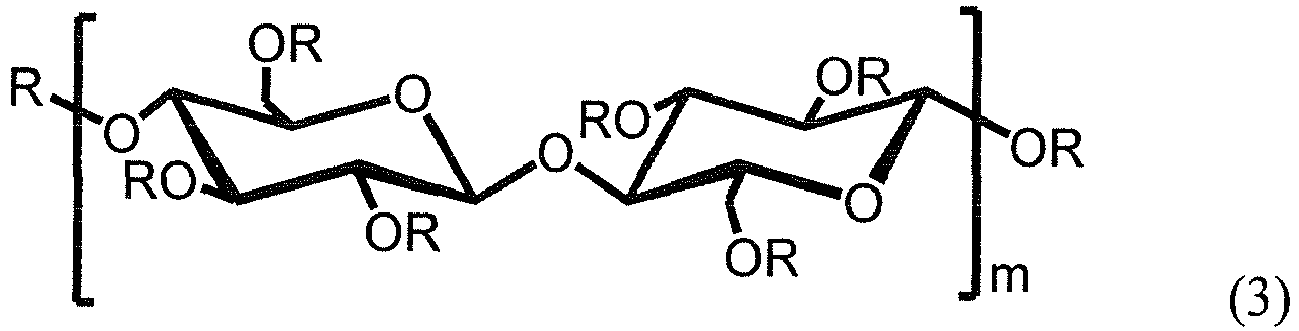
- The rubber composition according to claim 1 or 2, wherein the introduction ratio of the substituent or substituents selected from substituents represented by the general formula (1) and substituents represented by the general formula (2) is 0.001 mol or more and 1.5 mol or less, per mol of the anhydrous glucose unit.
- The rubber composition according to any one of claims 1 to 3, wherein n is a number of 0 or more and 20 or less, and A is a linear or branched, divalent saturated hydrocarbon group having 2 or more carbon atoms and 3 or less carbon atoms, in the substituent represented by the general formula (2).
- The rubber composition according to any one of claims 1 to 4, wherein the modified cellulose fibers have an average fiber size of 5 µm or more.
- The rubber composition according to any one of claims 1 to 4, wherein the modified cellulose fibers have an average fiber size of 1 nm or more and 500 nm or less.
- The rubber composition according to any one of claims 1 to 6, wherein the content of the modified cellulose fibers is 1 part by mass or more and 30 parts by mass or less, based on 100 parts by mass of the rubber.
- A method for producing a rubber composition comprising a rubber and modified cellulose fibers, comprising
introducing one or more compounds selected from nonionic alkylene oxide compounds having a total number of carbon atoms of 5 or more and 32 or less per molecule and nonionic glycidyl ether compounds having a total number of carbon atoms of 5 or more and 100 or less per molecule to a cellulose-based raw material via an ether bond, in the presence of a base, to provide modified cellulose fibers, and
mixing the modified cellulose fibers obtained and the rubber. - The method for producing a rubber composition according to claim 8, wherein the base is one or more members selected from alkali metal hydroxides, alkaline earth metal hydroxides, primary to tertiary amines, quaternary ammonium salts, imidazoles and derivatives thereof, pyridine and derivatives thereof, and alkoxides.
- The method for producing a rubber composition according to claim 8 or 9, wherein the amount of the base is 0.01 equivalents or more and 10 equivalents or less, based on the anhydrous glucose unit in the cellulose-based raw material.
- A rubber part for industrial use comprising a rubber composition as defined in any one of claims 1 to 7.
- A tire comprising a rubber composition as defined in any one of claims 1 to 7.
Applications Claiming Priority (2)
| Application Number | Priority Date | Filing Date | Title |
|---|---|---|---|
| JP2015176048 | 2015-09-07 | ||
| PCT/JP2016/076056 WO2017043453A1 (en) | 2015-09-07 | 2016-09-05 | Rubber composition |
Publications (2)
| Publication Number | Publication Date |
|---|---|
| EP3348615A1 true EP3348615A1 (en) | 2018-07-18 |
| EP3348615A4 EP3348615A4 (en) | 2019-05-01 |
Family
ID=58239760
Family Applications (1)
| Application Number | Title | Priority Date | Filing Date |
|---|---|---|---|
| EP16844314.1A Withdrawn EP3348615A4 (en) | 2015-09-07 | 2016-09-05 | Rubber composition |
Country Status (5)
| Country | Link |
|---|---|
| US (1) | US11136416B2 (en) |
| EP (1) | EP3348615A4 (en) |
| JP (1) | JP6809849B2 (en) |
| CN (1) | CN108026337B (en) |
| WO (1) | WO2017043453A1 (en) |
Cited By (1)
| Publication number | Priority date | Publication date | Assignee | Title |
|---|---|---|---|---|
| US10804668B2 (en) | 2016-10-03 | 2020-10-13 | Komax Holding Ag | Device for assembling a plug housing |
Families Citing this family (7)
| Publication number | Priority date | Publication date | Assignee | Title |
|---|---|---|---|---|
| CN107949577B (en) * | 2015-09-07 | 2021-04-06 | 花王株式会社 | Modified Cellulose Fiber |
| JP6733627B2 (en) * | 2017-08-29 | 2020-08-05 | 王子ホールディングス株式会社 | Fibrous cellulose-containing composition and paint |
| CN109467770B (en) * | 2017-09-08 | 2020-07-28 | 北京化工大学 | Rubber composite material using cardanol glycidyl ether modified white carbon black and preparation method thereof |
| EP3808782A4 (en) | 2018-06-12 | 2022-03-23 | Kao Corporation | METHOD FOR PRODUCTION OF MODIFIED CELLULOSE FIBER AND MODIFIED CELLULOSE FIBER |
| US12378390B2 (en) | 2018-10-22 | 2025-08-05 | Birla Carbon U.S.A., Inc. | Methods for improving nanocellulose dispersion in elastomeric compounds, and compositions containing dispersed nanocellulose in elastomer compounds |
| JP7386807B2 (en) * | 2018-11-27 | 2023-11-27 | 大阪瓦斯株式会社 | Rubbery composition and method for producing the same |
| CN112574599B (en) * | 2020-12-31 | 2022-03-22 | 常州市五洲化工有限公司 | Preparation method of modified white carbon black |
Family Cites Families (11)
| Publication number | Priority date | Publication date | Assignee | Title |
|---|---|---|---|---|
| FR2784107B1 (en) * | 1998-09-15 | 2005-12-09 | Rhodia Chimie Sa | SURFACE MODIFIED CELLULOSE MICROFIBRILLES, THEIR PREPARATION PROCESS, AND THEIR USE |
| FR2800378A1 (en) | 1999-11-03 | 2001-05-04 | Saint Louis Sucre Sa | Cellulose microfibers used in composites and paints, have hydroxyl groups substituted by ether groups localized at the surface and with a specified degree of surface substitution |
| US7812153B2 (en) * | 2004-03-11 | 2010-10-12 | Rayonier Products And Financial Services Company | Process for manufacturing high purity xylose |
| JP5398180B2 (en) | 2007-06-11 | 2014-01-29 | 国立大学法人京都大学 | Lignin-containing microfibrillated plant fiber and method for producing the same |
| EP2223307B1 (en) * | 2007-11-27 | 2018-09-19 | Uppsala Universitets Projekt AB | Composite materials including an intrinsically conducting polymer, and methods and devices |
| JP5677754B2 (en) | 2010-03-05 | 2015-02-25 | オリンパス株式会社 | Cellulose nanofiber and method for producing the same, composite resin composition, molded article |
| US9708474B2 (en) * | 2011-12-07 | 2017-07-18 | Eastman Chemical Company | Cellulose esters in pneumatic tires |
| JP5865063B2 (en) * | 2011-12-22 | 2016-02-17 | 三菱化学株式会社 | Method for producing rubber composition |
| JP6000598B2 (en) * | 2012-03-29 | 2016-09-28 | 東洋ゴム工業株式会社 | Rubber / cellulose masterbatch and rubber composition |
| JP6146115B2 (en) * | 2013-05-09 | 2017-06-14 | 株式会社ブリヂストン | Cellulose fiber, rubber composition, vulcanized rubber composition and tire |
| CN107949577B (en) | 2015-09-07 | 2021-04-06 | 花王株式会社 | Modified Cellulose Fiber |
-
2016
- 2016-09-05 CN CN201680051547.1A patent/CN108026337B/en not_active Expired - Fee Related
- 2016-09-05 WO PCT/JP2016/076056 patent/WO2017043453A1/en not_active Ceased
- 2016-09-05 JP JP2016173171A patent/JP6809849B2/en active Active
- 2016-09-05 US US15/757,784 patent/US11136416B2/en not_active Expired - Fee Related
- 2016-09-05 EP EP16844314.1A patent/EP3348615A4/en not_active Withdrawn
Cited By (1)
| Publication number | Priority date | Publication date | Assignee | Title |
|---|---|---|---|---|
| US10804668B2 (en) | 2016-10-03 | 2020-10-13 | Komax Holding Ag | Device for assembling a plug housing |
Also Published As
| Publication number | Publication date |
|---|---|
| WO2017043453A1 (en) | 2017-03-16 |
| US11136416B2 (en) | 2021-10-05 |
| US20180244806A1 (en) | 2018-08-30 |
| CN108026337B (en) | 2021-06-01 |
| CN108026337A (en) | 2018-05-11 |
| EP3348615A4 (en) | 2019-05-01 |
| JP6809849B2 (en) | 2021-01-06 |
| JP2017052941A (en) | 2017-03-16 |
Similar Documents
| Publication | Publication Date | Title |
|---|---|---|
| EP3348581B1 (en) | Modified cellulose fibers | |
| US11136416B2 (en) | Rubber composition | |
| US10738169B2 (en) | Resin composition | |
| EP3594246A1 (en) | Method for producing modified cellulose fiber | |
| EP3564321B1 (en) | Resin composition | |
| EP3348579A1 (en) | Modified cellulose fiber | |
| EP3348580A1 (en) | Modified cellulose fibers | |
| JP6779158B2 (en) | Method for manufacturing modified cellulose fiber | |
| An et al. | Extraction of microcrystalline cellulose from cotton fiber, and application to block natural rubber as reinforcing agent | |
| JP2020084111A (en) | Rubber composition for tire, vulcanized rubber, bead filler and tire | |
| EP3808782A1 (en) | Method for producing modified cellulose fiber, and modified cellulose fiber |
Legal Events
| Date | Code | Title | Description |
|---|---|---|---|
| STAA | Information on the status of an ep patent application or granted ep patent |
Free format text: STATUS: THE INTERNATIONAL PUBLICATION HAS BEEN MADE |
|
| PUAI | Public reference made under article 153(3) epc to a published international application that has entered the european phase |
Free format text: ORIGINAL CODE: 0009012 |
|
| STAA | Information on the status of an ep patent application or granted ep patent |
Free format text: STATUS: REQUEST FOR EXAMINATION WAS MADE |
|
| 17P | Request for examination filed |
Effective date: 20180309 |
|
| AK | Designated contracting states |
Kind code of ref document: A1 Designated state(s): AL AT BE BG CH CY CZ DE DK EE ES FI FR GB GR HR HU IE IS IT LI LT LU LV MC MK MT NL NO PL PT RO RS SE SI SK SM TR |
|
| AX | Request for extension of the european patent |
Extension state: BA ME |
|
| DAV | Request for validation of the european patent (deleted) | ||
| DAX | Request for extension of the european patent (deleted) | ||
| A4 | Supplementary search report drawn up and despatched |
Effective date: 20190329 |
|
| RIC1 | Information provided on ipc code assigned before grant |
Ipc: C08B 11/08 20060101ALI20190325BHEP Ipc: C08B 11/193 20060101AFI20190325BHEP Ipc: C08L 1/28 20060101ALI20190325BHEP Ipc: C08L 9/02 20060101ALI20190325BHEP Ipc: C08L 9/06 20060101ALI20190325BHEP |
|
| STAA | Information on the status of an ep patent application or granted ep patent |
Free format text: STATUS: EXAMINATION IS IN PROGRESS |
|
| 17Q | First examination report despatched |
Effective date: 20220525 |
|
| STAA | Information on the status of an ep patent application or granted ep patent |
Free format text: STATUS: THE APPLICATION HAS BEEN WITHDRAWN |
|
| 18W | Application withdrawn |
Effective date: 20220713 |