EP3348559A1 - Novel vinyl silane compound - Google Patents
Novel vinyl silane compound Download PDFInfo
- Publication number
- EP3348559A1 EP3348559A1 EP16844157.4A EP16844157A EP3348559A1 EP 3348559 A1 EP3348559 A1 EP 3348559A1 EP 16844157 A EP16844157 A EP 16844157A EP 3348559 A1 EP3348559 A1 EP 3348559A1
- Authority
- EP
- European Patent Office
- Prior art keywords
- group
- vinyl silane
- silane compound
- carbon atoms
- groups
- Prior art date
- Legal status (The legal status is an assumption and is not a legal conclusion. Google has not performed a legal analysis and makes no representation as to the accuracy of the status listed.)
- Granted
Links
- 0 C=CN*C1C=CC(C2CC3)C1C3C2NNC=C Chemical compound C=CN*C1C=CC(C2CC3)C1C3C2NNC=C 0.000 description 2
Images
Classifications
-
- C—CHEMISTRY; METALLURGY
- C07—ORGANIC CHEMISTRY
- C07F—ACYCLIC, CARBOCYCLIC OR HETEROCYCLIC COMPOUNDS CONTAINING ELEMENTS OTHER THAN CARBON, HYDROGEN, HALOGEN, OXYGEN, NITROGEN, SULFUR, SELENIUM OR TELLURIUM
- C07F7/00—Compounds containing elements of Groups 4 or 14 of the Periodic Table
- C07F7/02—Silicon compounds
- C07F7/08—Compounds having one or more C—Si linkages
- C07F7/0803—Compounds with Si-C or Si-Si linkages
- C07F7/0805—Compounds with Si-C or Si-Si linkages comprising only Si, C or H atoms
-
- C—CHEMISTRY; METALLURGY
- C07—ORGANIC CHEMISTRY
- C07F—ACYCLIC, CARBOCYCLIC OR HETEROCYCLIC COMPOUNDS CONTAINING ELEMENTS OTHER THAN CARBON, HYDROGEN, HALOGEN, OXYGEN, NITROGEN, SULFUR, SELENIUM OR TELLURIUM
- C07F7/00—Compounds containing elements of Groups 4 or 14 of the Periodic Table
- C07F7/02—Silicon compounds
- C07F7/08—Compounds having one or more C—Si linkages
-
- C—CHEMISTRY; METALLURGY
- C07—ORGANIC CHEMISTRY
- C07F—ACYCLIC, CARBOCYCLIC OR HETEROCYCLIC COMPOUNDS CONTAINING ELEMENTS OTHER THAN CARBON, HYDROGEN, HALOGEN, OXYGEN, NITROGEN, SULFUR, SELENIUM OR TELLURIUM
- C07F7/00—Compounds containing elements of Groups 4 or 14 of the Periodic Table
- C07F7/02—Silicon compounds
- C07F7/08—Compounds having one or more C—Si linkages
- C07F7/0803—Compounds with Si-C or Si-Si linkages
- C07F7/0825—Preparations of compounds not comprising Si-Si or Si-cyano linkages
- C07F7/0832—Other preparations
-
- C—CHEMISTRY; METALLURGY
- C08—ORGANIC MACROMOLECULAR COMPOUNDS; THEIR PREPARATION OR CHEMICAL WORKING-UP; COMPOSITIONS BASED THEREON
- C08G—MACROMOLECULAR COMPOUNDS OBTAINED OTHERWISE THAN BY REACTIONS ONLY INVOLVING UNSATURATED CARBON-TO-CARBON BONDS
- C08G77/00—Macromolecular compounds obtained by reactions forming a linkage containing silicon with or without sulfur, nitrogen, oxygen or carbon in the main chain of the macromolecule
- C08G77/48—Macromolecular compounds obtained by reactions forming a linkage containing silicon with or without sulfur, nitrogen, oxygen or carbon in the main chain of the macromolecule in which at least two but not all the silicon atoms are connected by linkages other than oxygen atoms
- C08G77/50—Macromolecular compounds obtained by reactions forming a linkage containing silicon with or without sulfur, nitrogen, oxygen or carbon in the main chain of the macromolecule in which at least two but not all the silicon atoms are connected by linkages other than oxygen atoms by carbon linkages
Definitions
- the present invention relates to a novel vinyl silane compound, especially to: a vinyl silane compound capable of being reversibly changed between a dimer and a monomer by heat; and a method for producing the same.
- a vinyl silane compound having two vinylsilyl groups in one molecule there have been known, for example, 1,3-divinyl-1,1,3,3-tetramethyldisiloxane, 1,3-divinyl-1,1,3,3-tetraphenyldisiloxane and dimethylpolysiloxane with both molecular chain ends blocked by dimethylvinylsiloxy groups. Since these compounds have vinylsilyl groups, they can be subjected to hydrosilylation addition reactions with hydrosilane and organohydrogenpolysiloxane.
- Non-patent document " Silicone Handbook” by Kunio Ito, NIKKAN KOGYO SHIMBUN, LTD., August 31, 1990 (first impression of the first edition), pp. 7-11
- the inventors of the present invention diligently conducted a series of studies to achieve the aforementioned objective, and completed the invention as follows. That is, the inventors found that a novel vinyl silane compound having a Diels-Alder reaction product shown below in its structure was useful in solving the abovementioned problem.
- the present invention is to provide the following vinyl silane compound(s).
- the vinyl silane compound of the invention has vinyl silyl groups
- the compound can be subjected to hydrosilylation addition reactions with hydrosilane and organohydrogenpolysiloxane.
- a bifunctional organohydrogenpolysiloxane having in one molecule two silicon atom-bonded hydrogen atoms (SiH groups) especially, a bifunctional diorganopolysiloxane having a SiH group at each of the two ends of its molecular chain, and optionally containing a small number of branched units in part of the main chain structure while the bifunctional diorganopolysiloxane itself is basically linear
- polymerization reaction progresses (i.e.
- the vinyl silane compound of the present invention is favorable as a compound capable of imparting a thermal plasticity to an organic silicon resin.
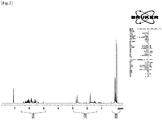
- FIG.1 is a 1 H-NMR chart of a vinyl silane compound obtained in working example 1.
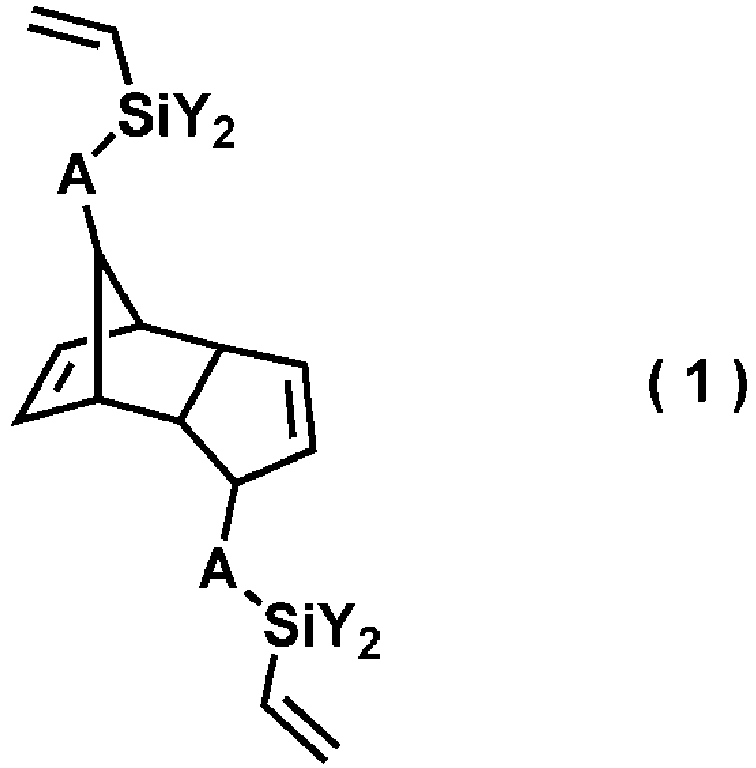
- the abovementioned vinyl silane compound of the invention is a compound represented by the above general formula (1) (i.e. bis-silane compound having two vinylsilyl groups on the dicyclopentadiene skeleton).
- a divalent hydrocarbon group represented by A and having 1 to 6, especially 1 to 4, particularly 1 to 3 carbon atoms be a linear alkylene group represented by -(CH 2 ) n - (n represents an integer of 1 to 6, especially 1 to 4, particularly 1 to 3).
- these groups particularly preferred is a methylene group represented by -(CH 2 )-, an ethylene group (dimethylene group) represented by -(CH 2 ) 2 -, or a trimethylene group represented by -(CH 2 ) 3 -.
- examples of a substituted or unsubstituted monovalent hydrocarbon group represented by Y and having 1 to 12, preferably 1 to 6 carbon atoms include: alkyl groups such as a methyl group, an ethyl group, a propyl group, an isopropyl group, a butyl group, an isobutyl group, a tert-butyl group, a pentyl group, a hexyl group, a heptyl group, an octyl group, a 2-ethylhexyl group, a nonyl group, a decyl group and a dodecyl group; cycloalkyl groups such as a cyclopentyl group and a cyclohexyl group; alkenyl groups such as a vinyl group, an allyl group, a propenyl group, an isopropenyl group, a butenyl group, an is
- the vinyl silane compound of the invention can be easily produced by, for example, the following method. That is, the compound of the invention may be produced by reacting, in an organic solvent, an alkali cyclopentadienylide with a vinyl diorgano haloorganosilane represented by the following formula (2):
- A represents a divalent hydrocarbon group having 1 to 6, especially 1 to 4, particularly 1 to 3 carbon atoms, such as a methylene group, an ethylene group, a trimethylene group and a tetramethylene group, among which a methylene group, an ethylene group or a trimethylene group is preferred;
- Y independently represents a substituted or unsubstituted monovalent hydrocarbon group having 1 to 12, preferably 1 to 6 carbon atoms, and it is more preferred that Y independently represent a methyl group or an ethyl group;
- X represents a halogen atom such as F, Cl, Br and I, preferably a Cl atom or a Br atom.
- alkali cyclopentadienylide used in the production method of the invention examples include sodium or potassium salts of cyclopentadiene, such as sodium cyclopentadienylide and potassium cyclopentadienylide.
- alkali cyclopentadienylide be used in an amount of 1.0 to 2.0 mol, particularly preferably 1.0 to 1.2 mol, per 1 mol of the vinyl diorgano haloorganosilane.
- examples of a favorable organic solvent used in the production method of the invention include aromatics such as benzene, toluene and xylene; ethers such as diethyl ether, diisopropyl ether and tetrahydrofuran; and hydrocarbons such as n-pentane, n-hexane and cyclohexane.
- reaction temperature there are no particular restrictions on a reaction temperature in the production method of the invention, as long as the temperature is that at which Diels-Alder reaction in the alkali cyclopentadienylide may progress.
- the reaction temperature is 150°C or higher, a dimer produced may turn into a monomer due to thermal decomposition.
- the reaction temperature be room temperature (25°C ⁇ 10°C) to 100°C.
- the target compound is then purified by, for example, distillation under a reduced pressure to obtain the target compound of the present invention.
- Vinyldimethylchloromethylsilane of 94.3 g (0.7 mol) and tetrahydrofuran of 100 ml were put into a 1,000 ml four-necked flask, followed by cooling them to 0°C. Next, 350 ml (0.7 mol) of a 2.0 M tetrahydrofuran solution of sodium cyclopentadienylide (by Sigma-Aldrich) was delivered thereinto by drops while performing stirring. After dropping was finished, the temperature was raised to 50°C, and stirring was then performed for 12 hours.
- the 1 H-NMR spectrum of the product was measured to confirm the structure thereof ( FIG.1 ) Based on the result of the 1 H-NMR measurement, the product obtained was considered to be 3a,4,7,7a, -tetrahydro-1,8-bis (vinyldimethylsilylmethyl)-4,7-methano-1H-indene having a structure represented by a formula (3).
- part(s) 0.8 parts by mass (simply referred to as "part(s)" hereafter) of the vinyl silane prepared in working example 1 were added to 7.4 parts of a dimethylpolysiloxane with a number of repetitions of dimethylsiloxane units being approximately 40 on the main chain thereof, and with both the molecular chain ends thereof being blocked by dimethylhydrogensiloxy groups (dimethylpolysiloxane with both molecular chain ends blocked by dimethylhydrogensiloxy groups). After mixing them at room temperature (i.e.
- 0.8 parts of the vinyl silane prepared in working example 1 were added to 11.5 parts of a dimethylpolysiloxane with a number of repetitions of dimethylsiloxane units being approximately 60 on the main chain thereof, and with both the molecular chain ends thereof being blocked by dimethylhydrogensiloxy groups (dimethylpolysiloxane with both molecular chain ends blocked by dimethylhydrogensiloxy groups).
- the platinum catalyst of 0.1 parts (CAT-PL-50T by Shin-Etsu Chemical Co., Ltd.) was added thereto, followed by mixing them again at room temperature for another 5 min.
- the mixture obtained was then heated in a glass petri dish at 60°C for 48 hours to obtain a cured product 2.
- 0.5 parts of 1,3-divinyl-1,1,3,3-tetramethyldisiloxane were added to 11.5 parts of the dimethylpolysiloxane with a number of repetitions of dimethylsiloxane units being approximately 60 on the main chain thereof, and with both the molecular chain ends thereof being blocked by dimethylhydrogensiloxy groups (dimethylpolysiloxane with both molecular chain ends blocked by dimethylhydrogensiloxy groups).
- the platinum catalyst of 0.1 parts (CAT-PL-50T by Shin-Etsu Chemical Co., Ltd.) was added thereto, followed by mixing them again at room temperature for another 5 min.
- the mixture obtained was then heated in a glass petri dish at 60°C for 48 hours to obtain a cured product 3.
- the cured products 1 to 3 prepared in reference examples 1 and 2; and comparative reference example 1 were placed on an aluminum petri dish, and then heated in an oven at 180°C for an hour. After heating, the properties of the cured products 1 to 3 were confirmed by visual observation and finger touch (i.e. whether the cured products were still solid, or had liquefied due to heating). In addition, with regard to the cured products 1 and 2 that had liquefied due to heating, the cured products were further left under room temperature so as to confirm, by visual observation and finger touch, whether the properties thereof would change (i.e. whether what had once liquefied due to heating would solidify again).
- each of the vinyl silane compounds used in reference examples 1 and 2 can be reversibly changed between a dimer and a monomer by heat, such that a thermal plasticity can thus be imparted to an organic silicon resin, which has been impossible with the conventional vinyl silane compounds.
- the present invention is not limited to the aforementioned embodiments.
- the above embodiments are provided as examples, and any embodiment shall be included in the technical scope of the invention, provided that such embodiment has a structure that is substantially identical to the technical ideas described in the claims of the invention, and that the embodiment brings about similar functions and effects.
- the vinyl silane compound of the invention has vinylsilyl groups, hydrosilylation addition reactions with hydrosilane and organohydrogenpolysiloxane are possible.
- a bifunctional organohydrogenpolysiloxane having in one molecule two silicon atom-bonded hydrogen atoms (SiH groups) polymerization reaction progresses (i.e. as a result of a chain-extending reaction progressing due to a continuous hydrosilylation addition reaction), thereby making it possible to obtain an organic silicon resin having a molecular weight (polymerization degree) that is high to a certain extent.
- This organic silicon resin has a thermal plasticity due to the fact that the dicyclopentadiene skeleton from the vinyl silane compound of the invention is capable of being reversibly changed between a dimer and a monomer by heat. Therefore, the vinyl silane compound of the present invention is useful as a compound for imparting a thermal plasticity to an organic silicon resin.
Landscapes
- Chemical & Material Sciences (AREA)
- Organic Chemistry (AREA)
- Health & Medical Sciences (AREA)
- Chemical Kinetics & Catalysis (AREA)
- Medicinal Chemistry (AREA)
- Polymers & Plastics (AREA)
- Silicon Polymers (AREA)
Abstract
Description
- The present invention relates to a novel vinyl silane compound, especially to: a vinyl silane compound capable of being reversibly changed between a dimer and a monomer by heat; and a method for producing the same.
- Conventionally, as a vinyl silane compound having two vinylsilyl groups in one molecule (particularly, a vinyldiorganosilyl group such as a vinyldimethylsilyl), there have been known, for example, 1,3-divinyl-1,1,3,3-tetramethyldisiloxane, 1,3-divinyl-1,1,3,3-tetraphenyldisiloxane and dimethylpolysiloxane with both molecular chain ends blocked by dimethylvinylsiloxy groups. Since these compounds have vinylsilyl groups, they can be subjected to hydrosilylation addition reactions with hydrosilane and organohydrogenpolysiloxane. Particularly, when there are used a bifunctional vinyl silane compound having two vinylsilyl groups in one molecule; and a bifunctional organohydrogenpolysiloxane having two silicon atom-bonded hydrogen atoms (SiH groups) in one molecule, polymerization reaction progresses (i.e. as a result of a chain-extending reaction progressing due to a continuous hydrosilylation addition reaction), thereby making it possible to obtain an organic silicon resin having a molecular weight (polymerization degree) that is high to a certain extent.
- However, most of these known vinyl silane compounds generally have vinylsilyl groups that are bonded together by siloxane bonds, which in fact only allows properties derived from siloxane bonds to be imparted to an organic silicon resin (
Patent documents 1 and 2; and Non-patent document 1). -
- Patent document:
JP-A-Hei 11-246769 - Patent document:
JP-A 2013-108063 - Non-patent document: "Silicone Handbook" by Kunio Ito, NIKKAN KOGYO SHIMBUN, LTD., August 31, 1990 (first impression of the first edition), pp. 7-11
- Therefore, it is an object of the present invention to provide a vinyl silane compound having vinylsilyl groups that are bonded together by a structure other than the siloxane bond such that novel properties can be imparted to an organic silicon resin.
- The inventors of the present invention diligently conducted a series of studies to achieve the aforementioned objective, and completed the invention as follows. That is, the inventors found that a novel vinyl silane compound having a Diels-Alder reaction product shown below in its structure was useful in solving the abovementioned problem.
- Specifically, the present invention is to provide the following vinyl silane compound(s).
- [1] A vinyl silane compound represented by the following formula (1):

- [2] The vinyl silane compound according to [1], wherein A independently represents a methylene group, an ethylene group or a trimethylene group.
- [3] The vinyl silane compound according to [1] or [2], wherein Y represents a methyl group.
The vinyl silane compound of the present invention may be a mixture of various vinyl silane compounds with different structures, provided that the structure of the compound of the invention is within the scope of the above formula (1).
Further, the present invention is also to provide the following method(s) for producing the vinyl silane compound. - [4] A method for producing the vinyl silane compound as set forth in any one of [1] to [3], comprising:
a step of reacting an alkali cyclopentadienylide with a vinyl diorgano haloorganosilane represented by the following formula (2):
- [5] The method for producing the vinyl silane compound according to [4], wherein A represents a methylene group, an ethylene group or a trimethylene group; Y represents a methyl group; and X represents a Cl atom or a Br atom.
- Since the vinyl silane compound of the invention has vinyl silyl groups, the compound can be subjected to hydrosilylation addition reactions with hydrosilane and organohydrogenpolysiloxane. Particularly, as a result of reacting the vinyl silane compound of the invention with a bifunctional organohydrogenpolysiloxane having in one molecule two silicon atom-bonded hydrogen atoms (SiH groups) (especially, a bifunctional diorganopolysiloxane having a SiH group at each of the two ends of its molecular chain, and optionally containing a small number of branched units in part of the main chain structure while the bifunctional diorganopolysiloxane itself is basically linear), polymerization reaction progresses (i.e. as a result of a chain-extending reaction progressing due to a continuous hydrosilylation addition reaction), thereby making it possible to obtain an organic silicon resin having a molecular weight (polymerization degree) that is high to a certain extent. This organic silicon resin has a thermal plasticity due to the fact that the dicyclopentadiene skeleton from the vinyl silane compound of the invention is capable of being reversibly changed between a dimer and a monomer by heat. Thus, the vinyl silane compound of the present invention is favorable as a compound capable of imparting a thermal plasticity to an organic silicon resin.
-
FIG.1 is a 1H-NMR chart of a vinyl silane compound obtained in working example 1. - The abovementioned vinyl silane compound of the invention is a compound represented by the above general formula (1) (i.e. bis-silane compound having two vinylsilyl groups on the dicyclopentadiene skeleton).
- Here, in the above general formula (1), it is preferred that a divalent hydrocarbon group represented by A and having 1 to 6, especially 1 to 4, particularly 1 to 3 carbon atoms be a linear alkylene group represented by -(CH2)n- (n represents an integer of 1 to 6, especially 1 to 4, particularly 1 to 3). Among these groups, particularly preferred is a methylene group represented by -(CH2)-, an ethylene group (dimethylene group) represented by -(CH2)2-, or a trimethylene group represented by -(CH2)3-.
- Next, in the above general formula (1), examples of a substituted or unsubstituted monovalent hydrocarbon group represented by Y and having 1 to 12, preferably 1 to 6 carbon atoms include: alkyl groups such as a methyl group, an ethyl group, a propyl group, an isopropyl group, a butyl group, an isobutyl group, a tert-butyl group, a pentyl group, a hexyl group, a heptyl group, an octyl group, a 2-ethylhexyl group, a nonyl group, a decyl group and a dodecyl group; cycloalkyl groups such as a cyclopentyl group and a cyclohexyl group; alkenyl groups such as a vinyl group, an allyl group, a propenyl group, an isopropenyl group, a butenyl group, an isobutenyl group, a pentenyl group, a hexenyl group and a cyclohexenyl group; aryl groups such as a phenyl group, a tolyl group, a xylyl group and an α-, β-naphthyl group; aralkyl groups such as a benzyl group, a 2-phenylethyl group and a 3-phenylpropyl group; or groups obtained by substituting a part of or all the hydrogen atoms in any of these groups with, for example, a cyano group and/or halogen atoms such as F, Cl and Br, the examples of such substituted groups including a 3-chloropropyl group, a 3,3,3-trifluoropropyl group and a 2-cyanoethyl group. Among the above groups, as a monovalent hydrocarbon group having 1 to 6 carbon atoms, a methyl group and a phenyl group are preferred, among which a methyl group is particularly preferred.
- The vinyl silane compound of the invention can be easily produced by, for example, the following method. That is, the compound of the invention may be produced by reacting, in an organic solvent, an alkali cyclopentadienylide with a vinyl diorgano haloorganosilane represented by the following formula (2):

- In this formula, A represents a divalent hydrocarbon group having 1 to 6, especially 1 to 4, particularly 1 to 3 carbon atoms, such as a methylene group, an ethylene group, a trimethylene group and a tetramethylene group, among which a methylene group, an ethylene group or a trimethylene group is preferred; Y independently represents a substituted or unsubstituted monovalent hydrocarbon group having 1 to 12, preferably 1 to 6 carbon atoms, and it is more preferred that Y independently represent a methyl group or an ethyl group; X represents a halogen atom such as F, Cl, Br and I, preferably a Cl atom or a Br atom.
- Examples of the alkali cyclopentadienylide used in the production method of the invention include sodium or potassium salts of cyclopentadiene, such as sodium cyclopentadienylide and potassium cyclopentadienylide.
- It is preferred that such alkali cyclopentadienylide be used in an amount of 1.0 to 2.0 mol, particularly preferably 1.0 to 1.2 mol, per 1 mol of the vinyl diorgano haloorganosilane.
- Further, examples of a favorable organic solvent used in the production method of the invention include aromatics such as benzene, toluene and xylene; ethers such as diethyl ether, diisopropyl ether and tetrahydrofuran; and hydrocarbons such as n-pentane, n-hexane and cyclohexane.
- There are no particular restrictions on a reaction temperature in the production method of the invention, as long as the temperature is that at which Diels-Alder reaction in the alkali cyclopentadienylide may progress. When the reaction temperature is 150°C or higher, a dimer produced may turn into a monomer due to thermal decomposition. Thus, it is preferred that the reaction temperature be room temperature (25°C±10°C) to 100°C.
- After the reaction is finished, the target compound is then purified by, for example, distillation under a reduced pressure to obtain the target compound of the present invention.
- The present invention is described in detail hereunder with reference to working and reference examples. However, the invention is not limited to the following working examples.
- Vinyldimethylchloromethylsilane of 94.3 g (0.7 mol) and tetrahydrofuran of 100 ml were put into a 1,000 ml four-necked flask, followed by cooling them to 0°C. Next, 350 ml (0.7 mol) of a 2.0 M tetrahydrofuran solution of sodium cyclopentadienylide (by Sigma-Aldrich) was delivered thereinto by drops while performing stirring. After dropping was finished, the temperature was raised to 50°C, and stirring was then performed for 12 hours. After the reaction was stopped by adding a saturated aqueous solution of ammonium chloride, an organic layer was separated, and a solvent was then distilled away under a reduced pressure, followed by purifying the target product by distillation under a reduced pressure to obtain 35.4 g (30%) of a colorless and transparent liquid having a boiling point of 51°C/300 Pa.
- The 1H-NMR spectrum of the product was measured to confirm the structure thereof (
FIG.1 )
Based on the result of the 1H-NMR measurement, the product obtained was considered to be 3a,4,7,7a, -tetrahydro-1,8-bis (vinyldimethylsilylmethyl)-4,7-methano-1H-indene having a structure represented by a formula (3).
- In this example, 0.8 parts by mass (simply referred to as "part(s)" hereafter) of the vinyl silane prepared in working example 1 were added to 7.4 parts of a dimethylpolysiloxane with a number of repetitions of dimethylsiloxane units being approximately 40 on the main chain thereof, and with both the molecular chain ends thereof being blocked by dimethylhydrogensiloxy groups (dimethylpolysiloxane with both molecular chain ends blocked by dimethylhydrogensiloxy groups). After mixing them at room temperature (i.e. 25°C, the same applies hereinafter) for 5 min, a platinum catalyst of 0.1 parts (CAT-PL-50T by Shin-Etsu Chemical Co., Ltd.) was added thereto, followed by mixing them again at room temperature for another 5 min. The mixture obtained was then heated in a glass petri dish at 60°C for 48 hours to obtain a cured product 1.
- In this example, 0.8 parts of the vinyl silane prepared in working example 1 were added to 11.5 parts of a dimethylpolysiloxane with a number of repetitions of dimethylsiloxane units being approximately 60 on the main chain thereof, and with both the molecular chain ends thereof being blocked by dimethylhydrogensiloxy groups (dimethylpolysiloxane with both molecular chain ends blocked by dimethylhydrogensiloxy groups). After mixing them at room temperature for 5 min, the platinum catalyst of 0.1 parts (CAT-PL-50T by Shin-Etsu Chemical Co., Ltd.) was added thereto, followed by mixing them again at room temperature for another 5 min. The mixture obtained was then heated in a glass petri dish at 60°C for 48 hours to obtain a cured
product 2. - In this example, 0.5 parts of 1,3-divinyl-1,1,3,3-tetramethyldisiloxane were added to 11.5 parts of the dimethylpolysiloxane with a number of repetitions of dimethylsiloxane units being approximately 60 on the main chain thereof, and with both the molecular chain ends thereof being blocked by dimethylhydrogensiloxy groups (dimethylpolysiloxane with both molecular chain ends blocked by dimethylhydrogensiloxy groups). After mixing them at room temperature for 5 min, the platinum catalyst of 0.1 parts (CAT-PL-50T by Shin-Etsu Chemical Co., Ltd.) was added thereto, followed by mixing them again at room temperature for another 5 min. The mixture obtained was then heated in a glass petri dish at 60°C for 48 hours to obtain a cured product 3.
- The cured products 1 to 3 prepared in reference examples 1 and 2; and comparative reference example 1 were placed on an aluminum petri dish, and then heated in an oven at 180°C for an hour. After heating, the properties of the cured products 1 to 3 were confirmed by visual observation and finger touch (i.e. whether the cured products were still solid, or had liquefied due to heating). In addition, with regard to the cured
products 1 and 2 that had liquefied due to heating, the cured products were further left under room temperature so as to confirm, by visual observation and finger touch, whether the properties thereof would change (i.e. whether what had once liquefied due to heating would solidify again). - These results are shown in the following Table 1.
Table 1 Reference example 1 Reference example 2 Comparative reference example 1 Cured product 1 Cured product 2Cured product 3 Before heating Solid Solid Solid After heating Liquid Liquid Solid (No change in property) Time elapsed until fluidity again disappeared at room temperature 2 Days 1 Day - - According to the results in Table 1, it is clear that each of the vinyl silane compounds used in reference examples 1 and 2 can be reversibly changed between a dimer and a monomer by heat, such that a thermal plasticity can thus be imparted to an organic silicon resin, which has been impossible with the conventional vinyl silane compounds.
- However, the present invention is not limited to the aforementioned embodiments. The above embodiments are provided as examples, and any embodiment shall be included in the technical scope of the invention, provided that such embodiment has a structure that is substantially identical to the technical ideas described in the claims of the invention, and that the embodiment brings about similar functions and effects.
- Since the vinyl silane compound of the invention has vinylsilyl groups, hydrosilylation addition reactions with hydrosilane and organohydrogenpolysiloxane are possible. Particularly, as a result of reacting the vinyl silane compound of the invention with a bifunctional organohydrogenpolysiloxane having in one molecule two silicon atom-bonded hydrogen atoms (SiH groups), polymerization reaction progresses (i.e. as a result of a chain-extending reaction progressing due to a continuous hydrosilylation addition reaction), thereby making it possible to obtain an organic silicon resin having a molecular weight (polymerization degree) that is high to a certain extent. This organic silicon resin has a thermal plasticity due to the fact that the dicyclopentadiene skeleton from the vinyl silane compound of the invention is capable of being reversibly changed between a dimer and a monomer by heat. Therefore, the vinyl silane compound of the present invention is useful as a compound for imparting a thermal plasticity to an organic silicon resin.
Claims (5)
- A vinyl silane compound represented by the following formula (1):

- The vinyl silane compound according to claim 1, wherein A independently represents a methylene group, an ethylene group or a trimethylene group.
- The vinyl silane compound according to claim 1 or claim 2, wherein Y represents a methyl group.
- A method for producing the vinyl silane compound as set forth in any one of claim 1 to claim 3, comprising:
a step of reacting an alkali cyclopentadienylide with a vinyl diorgano haloorganosilane represented by the following formula (2):
- The method for producing the vinyl silane compound according to claim 4, wherein A represents a methylene group, an ethylene group or a trimethylene group; Y represents a methyl group; and X represents a Cl atom or a Br atom.
Applications Claiming Priority (2)
| Application Number | Priority Date | Filing Date | Title |
|---|---|---|---|
| JP2015176907 | 2015-09-08 | ||
| PCT/JP2016/074322 WO2017043294A1 (en) | 2015-09-08 | 2016-08-22 | Novel vinyl silane compound |
Publications (3)
| Publication Number | Publication Date |
|---|---|
| EP3348559A1 true EP3348559A1 (en) | 2018-07-18 |
| EP3348559A4 EP3348559A4 (en) | 2019-03-13 |
| EP3348559B1 EP3348559B1 (en) | 2019-11-20 |
Family
ID=58240620
Family Applications (1)
| Application Number | Title | Priority Date | Filing Date |
|---|---|---|---|
| EP16844157.4A Active EP3348559B1 (en) | 2015-09-08 | 2016-08-22 | Novel vinyl silane compound |
Country Status (4)
| Country | Link |
|---|---|
| US (1) | US10174058B2 (en) |
| EP (1) | EP3348559B1 (en) |
| JP (1) | JP6460250B2 (en) |
| WO (1) | WO2017043294A1 (en) |
Families Citing this family (1)
| Publication number | Priority date | Publication date | Assignee | Title |
|---|---|---|---|---|
| CN111040247B (en) | 2019-12-31 | 2021-03-05 | 大连理工大学 | A kind of vulcanizing agent and its application |
Family Cites Families (5)
| Publication number | Priority date | Publication date | Assignee | Title |
|---|---|---|---|---|
| FR2676064B1 (en) * | 1991-04-30 | 1994-07-29 | Rhone Poulenc Chimie | POLYORGANOSILOXANES WITH CYCLOPENTADIENYL AND / OR CYCLOPENTADIENYLENE AND / OR DICYCLOPENTADIENYLENE ARRANGEMENTS, THEIR PREPARATIONS AND THEIR USE IN CROSSLINKABLE ELASTOMER COMPOSITIONS. |
| JP3987196B2 (en) | 1997-12-29 | 2007-10-03 | 東レ・ダウコーニング株式会社 | Method for producing organosilicon polymer emulsion |
| US6830833B2 (en) | 2002-12-03 | 2004-12-14 | Canon Kabushiki Kaisha | Organic light-emitting device based on fused conjugated compounds |
| US7897715B1 (en) | 2010-04-12 | 2011-03-01 | The United States Of America As Represented By The Secretary Of The Navy | Copolymers and ceramic-carbonaceous solids from divinyl aromatic ether oligomers and divinyl carborane siloxane |
| JP6011230B2 (en) | 2011-10-25 | 2016-10-19 | セントラル硝子株式会社 | Siloxane composition, cured product thereof and use thereof |
-
2016
- 2016-08-22 WO PCT/JP2016/074322 patent/WO2017043294A1/en not_active Ceased
- 2016-08-22 EP EP16844157.4A patent/EP3348559B1/en active Active
- 2016-08-22 JP JP2017539095A patent/JP6460250B2/en active Active
- 2016-08-22 US US15/757,873 patent/US10174058B2/en active Active
Also Published As
| Publication number | Publication date |
|---|---|
| US20180334467A1 (en) | 2018-11-22 |
| JP6460250B2 (en) | 2019-01-30 |
| JPWO2017043294A1 (en) | 2018-07-19 |
| EP3348559B1 (en) | 2019-11-20 |
| US10174058B2 (en) | 2019-01-08 |
| EP3348559A4 (en) | 2019-03-13 |
| WO2017043294A1 (en) | 2017-03-16 |
Similar Documents
| Publication | Publication Date | Title |
|---|---|---|
| Köhler et al. | Industrial synthesis of reactive silicones: Reaction mechanisms and processes | |
| KR101896423B1 (en) | Metal-catalyzed mono-hydrosilylation of polyunsaturated compounds | |
| EP2194099B1 (en) | Addition-curable silicone composition that produces cured product having high refractive index, and optical element encapsulating material formed from the compostion | |
| US6359098B1 (en) | Curable organopolysiloxane materials | |
| US9688819B2 (en) | Silicone resin composition for optical semiconductors | |
| US10005799B2 (en) | Bis (alkoxysilyl-vinylene) group-containing silicon compound and production method of same | |
| JP4253665B2 (en) | Method for producing organopolysiloxane having triorganosiloxy group | |
| US20160340511A1 (en) | Cyclic siloxane compounds and compositions comprising the same | |
| CN107428945B (en) | Organopolysiloxane, method for its production, and curable silicone composition | |
| EP3348559B1 (en) | Novel vinyl silane compound | |
| JP6698882B2 (en) | Method for producing oxamide-functional siloxane | |
| KR20250170082A (en) | Organosilicon compounds, their preparation methods, and additives | |
| JP7126999B2 (en) | Alkynyl group-containing cyclic organopolysiloxane and hydrosilylation reaction control agent | |
| EP3837305B1 (en) | Crosslinkable organosiloxane compositions | |
| EP3950786A1 (en) | Organopolysiloxane modified with lactate silyl at both ends and method for producing same | |
| US2507515A (en) | Bis-trihydrocarbon silylphenyl silanes | |
| JPH0366731A (en) | Silethynylsiloxane copolymer and its manufacture | |
| WO2021108067A1 (en) | Hydrocarbyloxy-functional arylsilanes and their use as promoters for platinum catalyzed hydrosilylation reactions | |
| Boev et al. | Study of the Reactivity of Tetraalkoxysilanes on Interaction with Siloxanols | |
| EP0455137A2 (en) | Charge-dissipating silicone rubber compositions | |
| US2975203A (en) | Phenylvinyl-substituted cyclic siloxanes | |
| JP6225888B2 (en) | Organopolysiloxane compound and method for producing the same | |
| JP2021520422A (en) | Method for preparing oxamide functional siloxane | |
| EP4713332A1 (en) | Process for making cyanoethyltrimethoxysilane and dimer | |
| EP4112591A1 (en) | Isocyanate group-containing organic silicon compound and method for producing isocyanate group-containing organic silicon compound |
Legal Events
| Date | Code | Title | Description |
|---|---|---|---|
| STAA | Information on the status of an ep patent application or granted ep patent |
Free format text: STATUS: THE INTERNATIONAL PUBLICATION HAS BEEN MADE |
|
| PUAI | Public reference made under article 153(3) epc to a published international application that has entered the european phase |
Free format text: ORIGINAL CODE: 0009012 |
|
| STAA | Information on the status of an ep patent application or granted ep patent |
Free format text: STATUS: REQUEST FOR EXAMINATION WAS MADE |
|
| 17P | Request for examination filed |
Effective date: 20180327 |
|
| AK | Designated contracting states |
Kind code of ref document: A1 Designated state(s): AL AT BE BG CH CY CZ DE DK EE ES FI FR GB GR HR HU IE IS IT LI LT LU LV MC MK MT NL NO PL PT RO RS SE SI SK SM TR |
|
| AX | Request for extension of the european patent |
Extension state: BA ME |
|
| DAV | Request for validation of the european patent (deleted) | ||
| DAX | Request for extension of the european patent (deleted) | ||
| A4 | Supplementary search report drawn up and despatched |
Effective date: 20190213 |
|
| RIC1 | Information provided on ipc code assigned before grant |
Ipc: C07F 7/08 20060101AFI20190207BHEP Ipc: C08G 77/50 20060101ALI20190207BHEP Ipc: C08K 5/54 20060101ALI20190207BHEP Ipc: C08L 83/05 20060101ALI20190207BHEP |
|
| RIN1 | Information on inventor provided before grant (corrected) |
Inventor name: KATAYAMA, TAIKI Inventor name: TAKAI, MISAKI Inventor name: SAKAMOTO, TAKAFUMI Inventor name: IKENO, MASAYUKI |
|
| GRAP | Despatch of communication of intention to grant a patent |
Free format text: ORIGINAL CODE: EPIDOSNIGR1 |
|
| STAA | Information on the status of an ep patent application or granted ep patent |
Free format text: STATUS: GRANT OF PATENT IS INTENDED |
|
| INTG | Intention to grant announced |
Effective date: 20190531 |
|
| GRAS | Grant fee paid |
Free format text: ORIGINAL CODE: EPIDOSNIGR3 |
|
| GRAA | (expected) grant |
Free format text: ORIGINAL CODE: 0009210 |
|
| STAA | Information on the status of an ep patent application or granted ep patent |
Free format text: STATUS: THE PATENT HAS BEEN GRANTED |
|
| AK | Designated contracting states |
Kind code of ref document: B1 Designated state(s): AL AT BE BG CH CY CZ DE DK EE ES FI FR GB GR HR HU IE IS IT LI LT LU LV MC MK MT NL NO PL PT RO RS SE SI SK SM TR |
|
| REG | Reference to a national code |
Ref country code: GB Ref legal event code: FG4D |
|
| REG | Reference to a national code |
Ref country code: CH Ref legal event code: EP |
|
| REG | Reference to a national code |
Ref country code: IE Ref legal event code: FG4D |
|
| REG | Reference to a national code |
Ref country code: DE Ref legal event code: R096 Ref document number: 602016024863 Country of ref document: DE |
|
| REG | Reference to a national code |
Ref country code: AT Ref legal event code: REF Ref document number: 1204101 Country of ref document: AT Kind code of ref document: T Effective date: 20191215 |
|
| REG | Reference to a national code |
Ref country code: NL Ref legal event code: MP Effective date: 20191120 |
|
| REG | Reference to a national code |
Ref country code: LT Ref legal event code: MG4D |
|
| PG25 | Lapsed in a contracting state [announced via postgrant information from national office to epo] |
Ref country code: SE Free format text: LAPSE BECAUSE OF FAILURE TO SUBMIT A TRANSLATION OF THE DESCRIPTION OR TO PAY THE FEE WITHIN THE PRESCRIBED TIME-LIMIT Effective date: 20191120 Ref country code: LV Free format text: LAPSE BECAUSE OF FAILURE TO SUBMIT A TRANSLATION OF THE DESCRIPTION OR TO PAY THE FEE WITHIN THE PRESCRIBED TIME-LIMIT Effective date: 20191120 Ref country code: NL Free format text: LAPSE BECAUSE OF FAILURE TO SUBMIT A TRANSLATION OF THE DESCRIPTION OR TO PAY THE FEE WITHIN THE PRESCRIBED TIME-LIMIT Effective date: 20191120 Ref country code: LT Free format text: LAPSE BECAUSE OF FAILURE TO SUBMIT A TRANSLATION OF THE DESCRIPTION OR TO PAY THE FEE WITHIN THE PRESCRIBED TIME-LIMIT Effective date: 20191120 Ref country code: GR Free format text: LAPSE BECAUSE OF FAILURE TO SUBMIT A TRANSLATION OF THE DESCRIPTION OR TO PAY THE FEE WITHIN THE PRESCRIBED TIME-LIMIT Effective date: 20200221 Ref country code: BG Free format text: LAPSE BECAUSE OF FAILURE TO SUBMIT A TRANSLATION OF THE DESCRIPTION OR TO PAY THE FEE WITHIN THE PRESCRIBED TIME-LIMIT Effective date: 20200220 Ref country code: NO Free format text: LAPSE BECAUSE OF FAILURE TO SUBMIT A TRANSLATION OF THE DESCRIPTION OR TO PAY THE FEE WITHIN THE PRESCRIBED TIME-LIMIT Effective date: 20200220 Ref country code: FI Free format text: LAPSE BECAUSE OF FAILURE TO SUBMIT A TRANSLATION OF THE DESCRIPTION OR TO PAY THE FEE WITHIN THE PRESCRIBED TIME-LIMIT Effective date: 20191120 |
|
| PG25 | Lapsed in a contracting state [announced via postgrant information from national office to epo] |
Ref country code: RS Free format text: LAPSE BECAUSE OF FAILURE TO SUBMIT A TRANSLATION OF THE DESCRIPTION OR TO PAY THE FEE WITHIN THE PRESCRIBED TIME-LIMIT Effective date: 20191120 Ref country code: IS Free format text: LAPSE BECAUSE OF FAILURE TO SUBMIT A TRANSLATION OF THE DESCRIPTION OR TO PAY THE FEE WITHIN THE PRESCRIBED TIME-LIMIT Effective date: 20200320 Ref country code: HR Free format text: LAPSE BECAUSE OF FAILURE TO SUBMIT A TRANSLATION OF THE DESCRIPTION OR TO PAY THE FEE WITHIN THE PRESCRIBED TIME-LIMIT Effective date: 20191120 |
|
| PG25 | Lapsed in a contracting state [announced via postgrant information from national office to epo] |
Ref country code: AL Free format text: LAPSE BECAUSE OF FAILURE TO SUBMIT A TRANSLATION OF THE DESCRIPTION OR TO PAY THE FEE WITHIN THE PRESCRIBED TIME-LIMIT Effective date: 20191120 |
|
| PG25 | Lapsed in a contracting state [announced via postgrant information from national office to epo] |
Ref country code: PT Free format text: LAPSE BECAUSE OF FAILURE TO SUBMIT A TRANSLATION OF THE DESCRIPTION OR TO PAY THE FEE WITHIN THE PRESCRIBED TIME-LIMIT Effective date: 20200412 Ref country code: EE Free format text: LAPSE BECAUSE OF FAILURE TO SUBMIT A TRANSLATION OF THE DESCRIPTION OR TO PAY THE FEE WITHIN THE PRESCRIBED TIME-LIMIT Effective date: 20191120 Ref country code: DK Free format text: LAPSE BECAUSE OF FAILURE TO SUBMIT A TRANSLATION OF THE DESCRIPTION OR TO PAY THE FEE WITHIN THE PRESCRIBED TIME-LIMIT Effective date: 20191120 Ref country code: ES Free format text: LAPSE BECAUSE OF FAILURE TO SUBMIT A TRANSLATION OF THE DESCRIPTION OR TO PAY THE FEE WITHIN THE PRESCRIBED TIME-LIMIT Effective date: 20191120 Ref country code: RO Free format text: LAPSE BECAUSE OF FAILURE TO SUBMIT A TRANSLATION OF THE DESCRIPTION OR TO PAY THE FEE WITHIN THE PRESCRIBED TIME-LIMIT Effective date: 20191120 Ref country code: CZ Free format text: LAPSE BECAUSE OF FAILURE TO SUBMIT A TRANSLATION OF THE DESCRIPTION OR TO PAY THE FEE WITHIN THE PRESCRIBED TIME-LIMIT Effective date: 20191120 |
|
| REG | Reference to a national code |
Ref country code: AT Ref legal event code: MK05 Ref document number: 1204101 Country of ref document: AT Kind code of ref document: T Effective date: 20191120 |
|
| REG | Reference to a national code |
Ref country code: DE Ref legal event code: R097 Ref document number: 602016024863 Country of ref document: DE |
|
| PG25 | Lapsed in a contracting state [announced via postgrant information from national office to epo] |
Ref country code: SM Free format text: LAPSE BECAUSE OF FAILURE TO SUBMIT A TRANSLATION OF THE DESCRIPTION OR TO PAY THE FEE WITHIN THE PRESCRIBED TIME-LIMIT Effective date: 20191120 Ref country code: SK Free format text: LAPSE BECAUSE OF FAILURE TO SUBMIT A TRANSLATION OF THE DESCRIPTION OR TO PAY THE FEE WITHIN THE PRESCRIBED TIME-LIMIT Effective date: 20191120 |
|
| PLBE | No opposition filed within time limit |
Free format text: ORIGINAL CODE: 0009261 |
|
| STAA | Information on the status of an ep patent application or granted ep patent |
Free format text: STATUS: NO OPPOSITION FILED WITHIN TIME LIMIT |
|
| 26N | No opposition filed |
Effective date: 20200821 |
|
| PG25 | Lapsed in a contracting state [announced via postgrant information from national office to epo] |
Ref country code: SI Free format text: LAPSE BECAUSE OF FAILURE TO SUBMIT A TRANSLATION OF THE DESCRIPTION OR TO PAY THE FEE WITHIN THE PRESCRIBED TIME-LIMIT Effective date: 20191120 Ref country code: PL Free format text: LAPSE BECAUSE OF FAILURE TO SUBMIT A TRANSLATION OF THE DESCRIPTION OR TO PAY THE FEE WITHIN THE PRESCRIBED TIME-LIMIT Effective date: 20191120 Ref country code: AT Free format text: LAPSE BECAUSE OF FAILURE TO SUBMIT A TRANSLATION OF THE DESCRIPTION OR TO PAY THE FEE WITHIN THE PRESCRIBED TIME-LIMIT Effective date: 20191120 |
|
| PG25 | Lapsed in a contracting state [announced via postgrant information from national office to epo] |
Ref country code: IT Free format text: LAPSE BECAUSE OF FAILURE TO SUBMIT A TRANSLATION OF THE DESCRIPTION OR TO PAY THE FEE WITHIN THE PRESCRIBED TIME-LIMIT Effective date: 20191120 |
|
| PG25 | Lapsed in a contracting state [announced via postgrant information from national office to epo] |
Ref country code: MC Free format text: LAPSE BECAUSE OF FAILURE TO SUBMIT A TRANSLATION OF THE DESCRIPTION OR TO PAY THE FEE WITHIN THE PRESCRIBED TIME-LIMIT Effective date: 20191120 |
|
| REG | Reference to a national code |
Ref country code: CH Ref legal event code: PL |
|
| PG25 | Lapsed in a contracting state [announced via postgrant information from national office to epo] |
Ref country code: CH Free format text: LAPSE BECAUSE OF NON-PAYMENT OF DUE FEES Effective date: 20200831 Ref country code: LU Free format text: LAPSE BECAUSE OF NON-PAYMENT OF DUE FEES Effective date: 20200822 Ref country code: LI Free format text: LAPSE BECAUSE OF NON-PAYMENT OF DUE FEES Effective date: 20200831 |
|
| REG | Reference to a national code |
Ref country code: BE Ref legal event code: MM Effective date: 20200831 |
|
| PG25 | Lapsed in a contracting state [announced via postgrant information from national office to epo] |
Ref country code: IE Free format text: LAPSE BECAUSE OF NON-PAYMENT OF DUE FEES Effective date: 20200822 Ref country code: BE Free format text: LAPSE BECAUSE OF NON-PAYMENT OF DUE FEES Effective date: 20200831 |
|
| PG25 | Lapsed in a contracting state [announced via postgrant information from national office to epo] |
Ref country code: TR Free format text: LAPSE BECAUSE OF FAILURE TO SUBMIT A TRANSLATION OF THE DESCRIPTION OR TO PAY THE FEE WITHIN THE PRESCRIBED TIME-LIMIT Effective date: 20191120 Ref country code: MT Free format text: LAPSE BECAUSE OF FAILURE TO SUBMIT A TRANSLATION OF THE DESCRIPTION OR TO PAY THE FEE WITHIN THE PRESCRIBED TIME-LIMIT Effective date: 20191120 Ref country code: CY Free format text: LAPSE BECAUSE OF FAILURE TO SUBMIT A TRANSLATION OF THE DESCRIPTION OR TO PAY THE FEE WITHIN THE PRESCRIBED TIME-LIMIT Effective date: 20191120 |
|
| PG25 | Lapsed in a contracting state [announced via postgrant information from national office to epo] |
Ref country code: MK Free format text: LAPSE BECAUSE OF FAILURE TO SUBMIT A TRANSLATION OF THE DESCRIPTION OR TO PAY THE FEE WITHIN THE PRESCRIBED TIME-LIMIT Effective date: 20191120 |
|
| PGFP | Annual fee paid to national office [announced via postgrant information from national office to epo] |
Ref country code: DE Payment date: 20250702 Year of fee payment: 10 |
|
| PGFP | Annual fee paid to national office [announced via postgrant information from national office to epo] |
Ref country code: GB Payment date: 20250703 Year of fee payment: 10 |
|
| PGFP | Annual fee paid to national office [announced via postgrant information from national office to epo] |
Ref country code: FR Payment date: 20250703 Year of fee payment: 10 |