EP3348041B1 - Sichere benutzerberechtigungsverwaltung - Google Patents
Sichere benutzerberechtigungsverwaltung Download PDFInfo
- Publication number
- EP3348041B1 EP3348041B1 EP16844940.3A EP16844940A EP3348041B1 EP 3348041 B1 EP3348041 B1 EP 3348041B1 EP 16844940 A EP16844940 A EP 16844940A EP 3348041 B1 EP3348041 B1 EP 3348041B1
- Authority
- EP
- European Patent Office
- Prior art keywords
- website
- user
- list
- credential information
- determining
- Prior art date
- Legal status (The legal status is an assumption and is not a legal conclusion. Google has not performed a legal analysis and makes no representation as to the accuracy of the status listed.)
- Active
Links
Images


Classifications
-
- H—ELECTRICITY
- H04—ELECTRIC COMMUNICATION TECHNIQUE
- H04L—TRANSMISSION OF DIGITAL INFORMATION, e.g. TELEGRAPHIC COMMUNICATION
- H04L63/00—Network architectures or network communication protocols for network security
- H04L63/14—Network architectures or network communication protocols for network security for detecting or protecting against malicious traffic
- H04L63/1441—Countermeasures against malicious traffic
- H04L63/1483—Countermeasures against malicious traffic service impersonation, e.g. phishing, pharming or web spoofing
-
- H—ELECTRICITY
- H04—ELECTRIC COMMUNICATION TECHNIQUE
- H04L—TRANSMISSION OF DIGITAL INFORMATION, e.g. TELEGRAPHIC COMMUNICATION
- H04L63/00—Network architectures or network communication protocols for network security
- H04L63/08—Network architectures or network communication protocols for network security for authentication of entities
-
- G—PHYSICS
- G06—COMPUTING OR CALCULATING; COUNTING
- G06F—ELECTRIC DIGITAL DATA PROCESSING
- G06F2221/00—Indexing scheme relating to security arrangements for protecting computers, components thereof, programs or data against unauthorised activity
- G06F2221/21—Indexing scheme relating to G06F21/00 and subgroups addressing additional information or applications relating to security arrangements for protecting computers, components thereof, programs or data against unauthorised activity
- G06F2221/2119—Authenticating web pages, e.g. with suspicious links
Definitions
- This application generally relates to the field of computer security and, in particular, to preventing harvesting of user credentials from web-based applications.
- Phishing is a type of security threat where attackers harvest sensitive information from victims by using fake websites.
- the websites used by attackers use domain names that are very similar to those of the target websites so that victims believe they are submitting information to genuine websites. For example, the website https://neighborhoodbank.ru could be used to deceive users into believing they are submitting information to a (hypothetical) bank named Neighborhood Bank due to its similarity to the legitimate website URL, https://neighborhoodbank.com.
- WO20105/000422 discloses a method and device for detecting a potential phishing website.
- a computing device having at least a processor obtains information input to a website and determines whether the website is legitimate through a server when the input information entered by the user has some private information. The computing device continues to access the website if the website is legitimate and generates a warning if the website is determined not to be legitimate.
- US2008/028444 discloses a secure authentication process that detects and prevents phishing and pharming attacks for specific web sites.
- the process is based on a dedicated secure hardware store for user sign-in credentials, a database of information about specific web sites, and a private secure browser. All user web activity is monitored by an agent program.
- the agent program checks to make sure that user attempts to send any sign-in credentials stored in secure hardware store of user sign-in credentials, to any web site accessed by the user, is allowed only if the IP address of the web site accessed by the user matches at least one of the IP addresses stored web site database associated with the sign-in credential the user is attempting to send.
- the process also detects mismatches between a URL and the actual IP address of the web site associated with the URL.
- US2006/253446 discloses a method wherein redirection of user entered data to an unauthenticated website ("phishing") is checked by, at redirection, detecting the presence of data entry fields in a user web page and, if any are present, authenticating the redirection address against lists of approved websites or the redirection web site certificate. If the new address is not authenticated, the user may still opt to be redirected.
- phishing unauthenticated website
- US2006/123478 discloses a messaging application facilitates communication via a messaging user interface, and receives a communication, such as an email message, from a domain.
- a phishing detection module detects a phishing attack in the communication by determining that the domain is similar to a known phishing domain, or by detecting suspicious network properties of the domain.
- a Web browsing application receives content, such as data for a Web page, from a network-based resource, such as a Web site or domain.
- the Web browsing application initiates a display of the content, and a phishing detection module detects a phishing attack in the content by determining that a domain of the network-based resource is similar to a known phishing domain, or that an address of the network-based resource from which the content is received has suspicious network properties.
- US2011/126289 discloses a method of protecting username/password (U/P) credentials operates on a client computer that cooperates with an anti-phishing scheme that generates a client warning at the client computer when a suspected phishing website issues a U/P request.
- U/P username/password
- a set of S fake U/P credentials is generated when the client warning is heeded, or a set of (S-1) fake U/P credentials are derived from a client-supplied U/P credential provided after the client warning is ignored.
- the client computer transmits to the suspected phishing website one of (i) the set of S fake U/P credentials, and (ii) the client-supplied U/P credential along with the set of (S-1) fake U/P credentials.
- a method of providing secured identity management services comprises receiving, from a user, a request to visit a website having an input form with credential fields for receiving user credential information.
- the method determines whether the website is authentic by comparing a web address associated with the destination to a list of known authentic web addresses. Responsive to determining that the destination is not authentic: the method hooks a form submission event of the webpage with scripting code.
- the method overlays the credential fields with a substitute form, such that user credential information associated with the input form is stored in the substitute form rather than the input form.
- the scripting code confirms with the user whether to provide the credential information to the website. Responsive to the user confirming, the scripting code causes the user credential information to be submitted.
- a method of providing secured identity management services includes receiving, from a user, a request to visit a website.
- the website include one or more webpages.
- the method determines whether the website is authentic.
- the method submits the credential information to the website.
- the method confirms with the user whether or not the credential information should be provided to the website.
- a computer system of providing secured identity management services include a non-transitory computer-readable storage medium storing computer program modules executable to perform steps comprising receiving, from a user, a request to visit a website.
- the website includes one or more webpages.
- the computer program modules executable to perform determining whether the website is authentic.
- the computer program modules executable to perform in response to determining that the website is authentic, and in response to a user's request to submit credential information to the website, submitting the credential information to the website.
- FIG. 1 is a high-level block diagram illustrating an environment 100 for managing users' credentials in a secured manner, according to one embodiment.
- the environment 100 may be in part maintained by an enterprise (e.g., an identity management service) that provides a user credential service that manages users' credentials for use with third-party service user accounts, identifies malicious websites, and prevents the users' credentials from being submitted to those identified malicious websites.
- an identity management system 120 manages credentials (e.g., user name and password) for the users at a third-party service system 140 and verifies the authenticity of websites. After confirming that a website is legitimate, the identity management system 120 interacts with the third-party service system 140 so that a user can access his or her user account. After detecting that a website is malicious, the identity management system 120 alerts or prevents the user from submitting the user's credentials to the malicious website.
- a user may install a plugin for the identity management system 120 on the client 130.
- a website includes one or more webpages that may be linked together.
- a webpage is a document presented to a user to present information.
- a website can be accessed by a web address (e.g., a uniform resource locator (URL)).
- the web address can be used to determine a registered name (e.g., a host name, a domain name) or an IP address of the resource (e.g., computer, service, network) hosting the website.
- a webpage may include one or more input fields (e.g., a form) that solicits users for credential information for submission to a destination web address.
- credential information refers to information that is confidential and private to users. Credential information can be used to verify users' identities.
- Example credential information includes user names, account names, license numbers, credit card numbers, passwords, biometrics, and the like.
- the environment 100 includes a network 110, an identity management system 120, a client 130, a third-party service system 140, and a device management system 150. While one identity management system 120, one client 130, one third-party service system 140, and one device management system 150 are shown in the embodiment depicted in FIG. 1 for clarity, other embodiments can have different numbers of identity management systems, clients, third-party service systems, and device management systems.
- the network 110 represents the communication pathway between the identity management system 120, the client 130, the third-party service system 140, and the device management system 150.
- the network 110 uses standard wireless and wired communications technologies and protocols and can include the Internet and associated protocols.
- the entities on the network 110 can use custom and/or dedicated data communications technologies.
- a client 130 is a computer (or set of computers) that enables a user to access various third-party services.
- the client 130 can be, for example, a desktop computer, a laptop computer, a tablet computer, or a smart phone.
- the client 130 includes one or more application modules 132.
- a particular application module 132 enables the client 130 to access third-party services provided by a particular third-party service system 140.
- an application module 132 interacts with a third-party service system 140 to log in to a user account of the third-party service system by using corresponding credential information (e.g., using a username/password combination). After logging in, the application module 132 interacts with the third-party service system 140 to access various services.
- credential information e.g., using a username/password combination
- the application module 132 is a native application that executes on an operating system of the client 130, such as a web browser.
- the application module 132 is a plugin for a web browser of the client 130.
- the application module 132 is a link to a website provided by the third-party service system 140.
- the application module includes a verification module 136, which is a browser plugin that monitors user interactions with websites and modifies the typical user interactions with the websites in order to prevent user credentials from being phished.
- the verification module 136 monitors user interactions with websites and transmits the observed information to the verification module 124 which modifies or instructs the verification module 136 to modify the user interactions with the websites to prevent user credentials from being phished.
- the identity management system 120 is a computer (or set of computers) that provides secured identity management services.
- Identity management services include, for example, managing user accounts at various third-party services.
- the identity management system 120 configures accounts of users on third-party service systems 140, e.g., setting and tracking the user login credentials such as username and password, using the login credentials to perform single sign-on for the users onto all their user services, and the like.
- the identity management system 120 additionally interacts with the verification module 136 on the client device 130 to prevent theft of user credentials by attackers such as malicious websites.
- the identity management system 120 includes a credential module 122 and a verification module 124.
- the credential module 122 stores, for each of the users that use the anti-phishing system, a list of the third-party services 140 that the user uses (e.g., the web addresses of the services), as well as the user's credentials (e.g., username and password) for those services.
- the credentials may be stored encrypted or unencrypted. If encrypted, the encrypted credential need not be decrypted unless and until the credentials need to be provided for login purposes. If the credential is stored encrypted with a user-level key, then the credential can be decrypted by only the client 130 that has access to the user-level key.
- the credential module 122 also interacts with third-party services to provide credentials associated with the user accounts on the third-party services 140 responsive to verifying the authenticity of the websites. For example, the credential module 122 interacts with a third-party service system 140 to provide a password for a user account so that the user can log into the user account. In one embodiment, the credential module 122 interacts with the third-party service system 140 via an application programming interface (API) provided by the third-party service system. In another embodiment, the credential module 122 interacts with the third-party service system 140 via a configurable web script that includes information regarding how to access the third-party service system. In one embodiment, the script conforms to the Extensible Markup Language (XML) standard. In another embodiment, a particular script is stored in association with a reference to a particular third-party service system 140. In yet another embodiment, the script is generated automatically.
- XML Extensible Markup Language
- the verification module 136 verifies the authenticity of destinations (e.g., websites) prior to releasing the credentials to the destinations. For example, in response to a triggering event such as a user attempting to log into the third-party service system 140, the verification module 136 verifies the authenticity of the destination such as a web address of a website to receive the user's credentials.
- the application module 132 delegates to the verification module 124 on the identity management system 120 to verify the authenticity of the destination in response to a triggering event such as a user requesting access to a website.
- the verification module 136 may confirm whether a destination website requested to visit by a user is a known website.
- a website is considered to be a known website if the website's associated web address is known.
- a website is considered authentic if the associated web address (e.g., URL) belongs to a list of web addresses known to be legitimate; similarly, a website is considered unauthentic if the associated web address belongs to a list of web addresses known to be non-legitimate.
- publicly known websites or websites where the user has established user accounts are known authentic websites.
- a website can also be considered authentic if the registered name or the IP address of the resource hosting the website belongs to a list of registered names or IP addresses known to be legitimate. Users are allowed to submit their credentials to the websites for which the authenticity has been confirmed.
- a website can be considered unauthentic if the web address is unknown or cannot be verified.
- a website can also be considered unauthentic if the registered domain name or IP address hosting the website is unknown or cannot be verified.
- a website may be considered unauthentic when it includes input fields to collect information for unauthentic destinations. For example, an input field hosted by unknown web addresses to receive the credential information entered in the input fields is considered unauthentic.
- the verification module 136 may use the credential information created and stored by the credential module 122, such as the user's credential information for the third-party services 140 that the user uses, to verify the authenticity of the destination to receive the credential information.
- the verification module 136 may determine a list of services based on the credential information entered by a user and verify the authenticity of the website by determining whether the website is included in the list of services.
- the verification module 136 may also verify the authenticity of the website using the destination to receive the user's credential information.
- the verification module 136 confirms that the destination is authentic when the input fields are hosted by known web addresses.
- a destination can also be considered authentic if registered names or IP addresses of the resources are known.
- the verification module 136 monitors all input fields present on a destination website and compares the credential entered by the user to the web addresses (registered names or IP addresses) associated with the credential entered by the user.
- the web address (registered name or IP address) hosting the input form requesting input from the user matches the web address (registered name or IP address) associated with the credential entered by the user, the request for a user's credential is determined to originate from an authentic web address (registered name or IP address).
- the request for a user's credential may originate from a potentially malicious web address (registered name or IP address) (e.g., where the website is considered unauthentic), and the verification module 136 alerts the user accordingly.
- the verification module 136 analyzes an unknown web address (or registered name) to verify its authenticity. If an unknown web address (or registered name) is determined to be similar (e.g., based on lexical similarity, such as that measured by the Levenshtein distance) to a known web address (or registered name), the verification module determines the unknown web address (or registered name) to be unauthentic and potentially malicious. For example, if a website with a log-in form hosted by the web address "https://bankofamerica.ru", the verification module 136 determines that this web address is roughly similar to "https://bankofamerica.com" and may be malicious.
- the verification module 124 or 136 may maintain and use a list of web addresses (registered names and/or IP addresses) to verify the authenticity of the destination websites.
- the verification module 124 maintains a list of malicious web addresses (registered names and/or IP addresses), which may be distributed to the verification module 136. Newly identified malicious web addresses (registered names and/or IP addresses) are included to the list of malicious web addresses (registered names and/or IP addresses).
- the verification module 136 may also submit any malicious web address (registered name and/or IP address) it discovers to the verification module 124 at a predetermined time or in real time.
- the verification module 136 prevents users from submitting their credential information to unauthentic web addresses (registered names and/or IP addresses).
- the identity management system 120 e.g., the verification module 136 or the verification module 124 alerts a user that the web address (registered name and/or IP address) to which he or she is trying to submit credential information may be malicious.
- the identity management system 120 confirms with the user prior to releasing the credential information to potentially malicious websites in order to prevent the credential information from being compromised.
- the identity management system 120 e.g., the verification module 136 or the verification module 124) prevents submission of forms that include users' credential information, at least until warning the user and receiving using confirmation of submission.
- the verification module 136 hooks the form submission event by adding or modifying JavaScript or other scripting code of the webpage that responds to the form submission event. Then, when a user attempts to submit his or her credential information (e.g., by clicking a page element causing form submission to the web server, such as a "Login" button), the identity management system 120 intercepts the form submission event by performing checks and/or alerting the user to a possible phishing attempt.
- the verification module 136 may alert the user that the web address is malicious and confirms with the user that he or she authorizes such submission. If a user authorizes the form submission despite the warning, the verification module 136 allows the application module 132 to submit the form including the user's credential information. If a user declines to allow the submission in response to the warning, the verification module 136 cancels the submission of the form. As such, the risk of an attacker obtaining the users' credential information for various third-party services is reduced.
- the identity management system 120 verification module 136 overlays a substitute form (e.g., a transparent iframe) on top of the input form hosted by the malicious web addresses (registered names and/or IP addresses), such that the substitute form, rather than the original form, receives user keystrokes or other input that the user destines for the original input form.
- a substitute form e.g., a transparent iframe
- the substitute form mimics the form hosted by the malicious web addresses (registered names and/or IP addresses) by having the same visual appearance.
- the substitute form includes hidden input fields that mirror the input fields hosted by the malicious web addresses (domain names and/or IP addresses).
- domain names and/or IP addresses the information entered by the user (into the substitute form) is not revealed to the underlying page hosted by the malicious web addresses (domain names and/or IP addresses), since the malicious scripting code monitors the original form fields, not the form fields of the added substitute form, into which the user information goes.
- the verification module 136 inserts the credential information entered into the substitute form into the original form and causes submission of the original form, including the user's entered credential information.
- the third-party service system 140 is a computer (or set of computers) that provides various third-party services.
- a third-party service is, for example, a cloud-based application service, a web-based application service, a network-based application service, an on-premises application, an enterprise application, a consumer application, or a custom-built internal application.
- the third-party service system 140 maintains user accounts that are logged into in order to access the third-party services. Credential information such as authentication information for these user accounts (e.g., username/password combinations) is stored in a credential repository 145 of the third-party service system 140.
- the third-party service system 140 provides an API that can be used by external systems to interact with the third-party service system.
- the identity management system 120 can use a third-party service system API to log in to a user account of the third-party service system 140.
- the identity management system 120 can prevent the client 130 from submitting a user's credential information to a third-party service system API such that the third-party service system 140 cannot receive the user's credential information.
- a third-party service system 140 may be a phishing website that harvests users' credential information.
- Verifying authenticity of destinations that receive users' credential information prevents users' privacy, security, and identity information from being harvested by attackers.
- the processes and systems described herein provide an effective solution to prevent phishing attacks.
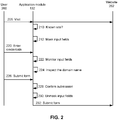
- FIG. 2 illustrates interactions between a user, the application module 132 of FIG. 1 , and a (possibly malicious) website 262, according to one embodiment.
- a user requests 205 to visit a website 262 by specifying the web address of the website, for example, clicking a link to a URL of the website.
- the application module 132 verifies whether the web address of the website is authentic.
- the application module 132 may additionally or alternatively verify whether a registered name or IP address of a resource hosting the website is authentic.
- the application module 132 determines 210 whether the web address of the website belongs to a list of known web addresses .
- the credential module 122 maintains a list of known web addresses where a user has an account and the application module 132 inspects whether the web address of the website is that list. Registered names and IP addresses can also be verified in a similar manner.
- the application module 132 checks whether a domain name belongs to a list of known malicious domain names and warns the user about it.
- the application module 132 inspects whether an unknown web address (or registered name) mimics a known web address (or registered name) and determines the web address (or registered name) to be potentially malicious when it mimics a known web address (or domain registered name).
- the application module 132 masks 212 the input fields by overlaying a transparent iframe or other substitute forms on top of a credential input form hosted by the website 262.
- the credential input form requests credential information from the user.
- real-time observation of credential information is prevented because the user's credential information are entered into the transparent iframe provided by the application module 132.
- the application module 132 may mask the input fields using this transparent iframe responsive to determining the website 262 is unknown.
- the application module 132 may override the form submission sequence. For example, the application module 132 may add scripting code to the page that responds to a user's submission of the form. In response to a form submission request, a warning is provided to the user to confirm that the form should be submitted.
- the user 220 enters his or her credential information.
- the application module 132 monitors 222 the credential information entered. In some embodiments, when the user is entering his or her credential information, the application module 132 warns the user responsive to determining the website has an unknown web address (domain name or IP address) at block 210. In some embodiments, the application module 132 identifies a set of web addresses (domain names and/ IP addresses) associated with the credential information entered by the user 260. The application module 132 inspects 224 the web address (domain name or IP address) hosting the input form requesting credential information from the user.
- the application module 132 may warn the user that the credential information is being entered into an unknown website.
- the user 260 requests 226 to submit the form.
- the application module 132 submits 232 the form to the website 262 if the website 262 is authentic. Responsive to determining that the website 262 is unknown or potentially malicious, the application module 132 confirms 228 with the user on the submission.
- the application module 228 may warn the user that the credential information will be submitted to unknown websites, for example, when the web address (domain name or IP address) is determined as unknown at block 210 or when the web address (domain name or IP address) hosting the input form is determined as unknown at block 224.
- the application module 228 may warn the user that the credential information may be submitted to a potentially malicious website when the domain name is determined to belong to a list of potentially malicious web addresses (domain names or IP addresses) or determined to mimic a known authentic web address (or domain name). If an iframe is over-layed on the input form, the application module 132 unmask 230 the input fields by transferring the credential information entered by the user into the input form hosted by the website 262. The application module 132 submits the input form to the website 262 when the user confirms the submission.
- FIG. 3 is a high-level block diagram illustrating an example of a computer 300 for use as one or more of the entities illustrated in FIG. 1 , according to one embodiment. Illustrated are at least one processor 302 coupled to a chipset 304.
- the chipset 304 includes a memory controller hub 320 and an input/output (I/O) controller hub 322.
- a memory 306 and a graphics adapter 312 are coupled to the memory controller hub 320, and a display device 318 is coupled to the graphics adapter 312.
- a storage device 308, keyboard 310, pointing device 314, and network adapter 316 are coupled to the I/O controller hub 322.
- Other embodiments of the computer 300 have different architectures.
- the memory 306 is directly coupled to the processor 302 in some embodiments.
- the storage device 308 includes one or more non-transitory computer-readable storage media such as a hard drive, compact disk read-only memory (CD-ROM), DVD, or a solid-state memory device.
- the memory 306 holds instructions and data used by the processor 302.
- the pointing device 314 is used in combination with the keyboard 310 to input data into the computer system 300.
- the graphics adapter 312 displays images and other information on the display device 318.
- the display device 318 includes a touch screen capability for receiving user input and selections.
- the network adapter 316 couples the computer system 300 to the network 110.
- Some embodiments of the computer 300 have different and/or other components than those shown in FIG. 3 .
- the identity management system 120 and the third-party service system 140 can be formed of multiple blade servers and lack a display device, keyboard, and other components.
- the computer 300 is adapted to execute computer program modules for providing functionality described herein.
- module refers to computer program instructions and/or other logic used to provide the specified functionality.
- a module can be implemented in hardware, firmware, and/or software.
- program modules formed of executable computer program instructions are stored on the storage device 308, loaded into the memory 306, and executed by the processor 302.
Landscapes
- Engineering & Computer Science (AREA)
- Computer Security & Cryptography (AREA)
- Computer Hardware Design (AREA)
- Computing Systems (AREA)
- General Engineering & Computer Science (AREA)
- Computer Networks & Wireless Communication (AREA)
- Signal Processing (AREA)
- Information Transfer Between Computers (AREA)
- User Interface Of Digital Computer (AREA)
Claims (9)
- Verfahren zum Bereitstellen von sicheren Identitätsverwaltungsdiensten, umfassend:Empfangen, von einem Benutzer (260), einer Anforderung, eine Website (262) zu besuchen, wobei die Website (262) eine oder mehrere Webseiten umfasst, wobei die Website (262) ein Formular umfasst, welches ein oder mehrere Eingabefelder umfasst;Bestimmen, ob die Website (262) authentisch ist, umfassend:Identifizieren eines Eingabefelds der Website (262), wobei das Eingabefeld Berechtigungsinformationen anfordert;Bestimmen eines Ziels des Eingabefelds, um die angeforderten Berechtigungsinformationen zu empfangen; undÜberprüfen, ob das Ziel des Eingabefelds authentisch ist;
undals Reaktion auf das Bestimmen, dass die Website (262) nicht authentisch ist, Verwenden eines Script-Codes, um die Formularsendung der Website (262) zu verändern;Überlagern des Eingabeformulars mit einem Ersatzformular, welches das Eingabeformular nachahmt, wobei das Ersatzformular konfiguriert ist, um das Eingabeformular beim Empfangen und Speichern von Benutzerberechtigungsinformationen zu ersetzen, welche durch den Benutzer (260) eingegeben werden;als Reaktion auf das Empfangen von Berechtigungsinformationen von dem Benutzer (260), Eingeben der Berechtigungsinformationen in das Ersatzformular, sodass das Eingabeformular keine Informationen als Reaktion auf das Empfangen der Berechtigungsinformationen empfängt;als Reaktion auf den Versuch des Benutzers (260) das Eingabeformular zu senden, dem Benutzer (260) bestätigen, dass die Benutzerberechtigungsinformationen, welche in dem Ersatzformular gespeichert sind, an die Website (262) bereitgestellt wurden, undals Reaktion auf die Bestätigung des Benutzers (260), Eingeben der Berechtigungsinformationen aus dem Ersatzformular in das Eingabefeld. - Verfahren nach Anspruch 1, wobei das Bestimmen, ob die Website (262) authentisch ist, umfasst:
als Reaktion auf das Bestimmen, dass die Website (262) authentisch ist, und als Reaktion auf eine Anforderung (260) durch den Benutzer, die Berechtigungsinformationen an die Website (262) zu senden, Senden der Berechtigungsinformationen an die Website (262). - Verfahren nach Anspruch 1, wobei das Bestimmen, ob die Website (262) authentisch ist, umfasst:Vergleichen einer Webadresse, welche der Website (262) zugeordnet ist, mit einer ersten Liste von bekannten Webadressen und einer zweiten Liste von bekannten Webadressen;wobei das Bestimmen, dass die Webadresse zu einer ersten Liste von bekannten Webadressen gehört, anzeigt, dass die Website (262) authentisch ist; undwobei das Bestimmen, dass die Webadresse zu einer zweiten Liste von bekannten Webadressen gehört, anzeigt, dass die Website (262) nicht authentisch ist.
- Verfahren nach Anspruch 1, wobei das Bestimmen, ob die Website (262) authentisch ist, umfasst:Vergleichen einer Webadresse, welche der Website (262) zugeordnet ist, mit einer Liste von bekannten Webadressen; undals Reaktion auf das Bestimmen, dass die Webadresse einer bekannten Adresse der Liste von bekannten Webadressen ähnlich ist, Bestimmen dass die Website (262) nicht authentisch ist.
- Verfahren nach Anspruch 1, wobei das Überprüfen, ob das Ziel des Eingabefelds authentisch ist, umfasst:Vergleichen einer Webadresse, welcher dem Ziel des Eingabefelds zugeordnet ist, mit einer ersten Liste von bekannten Webadressen und einer zweiten Liste von bekannten Webadressen;wobei das Bestimmen, dass die Webadresse zu einer ersten Liste von bekannten Webadressen gehört, anzeigt, dass die Website (262) authentisch ist; undwobei das Versagen beim Bestimmen, dass die Webadresse einer zweiten Liste von bekannten Webadressen gehört, anzeigt, dass die Website (262) nicht authentisch ist.
- Verfahren nach Anspruch 1, wobei das Überprüfen, ob das Ziel des Eingabefelds authentisch ist, umfasst:Vergleichen einer Webadresse, welche der Website (262) zugeordnet ist, mit einer Liste von bekannten Webadressen;wobei das Bestimmen, dass die Webadresse einer Liste von bekannten Webadressen gehört, anzeigt, dass die Website (262) authentisch ist; undwobei das Bestimmen, dass die Webadresse einer bekannten Webadresse aus der Liste von bekannten Webadressen ähnlich ist, bestimmt, dass die Website (262) nicht authentisch ist.
- Verfahren nach Anspruch 1, wobei das Überprüfen, ob das Ziel des Eingabefelds authentisch ist, zusätzlich umfasst:Überwachen der Berechtigungsinformationen, welche durch den Benutzer (260) eingegeben werden;Identifizieren der ersten Liste von bekannten Domänennamen, basierend auf den Berechtigungsinformationen, welche durch den Benutzer (260) eingegeben werden.
- Verfahren nach Anspruch 1, ferner umfassend:Führen einer Liste von bekannten nicht authentischen Websites;als Reaktion auf das Bestimmen, dass die Website (262) nicht authentisch ist und in der Liste von bekannten authentischen Websites eingeschlossen ist, Einführen der Website in die Liste von bekannten nicht authentischen Websites.
- Computersystem zum Bereitstellen von sicheren Identitätsverwaltungsdiensten, wobei das System umfasst:ein nichtflüchtiges computerlesbares Speichermedium, welches Computerprogrammmodule speichert, welche ausführbar sind, um die Schritte nach einem der Verfahren nach Ansprüchen 1 bis 8 auszuführen; undeinen Computerprozessor zum Ausführen der Computerprogrammmodule.
Applications Claiming Priority (2)
| Application Number | Priority Date | Filing Date | Title |
|---|---|---|---|
| US201562217234P | 2015-09-11 | 2015-09-11 | |
| PCT/US2016/050449 WO2017044432A1 (en) | 2015-09-11 | 2016-09-06 | Secured user credential management |
Publications (3)
| Publication Number | Publication Date |
|---|---|
| EP3348041A1 EP3348041A1 (de) | 2018-07-18 |
| EP3348041A4 EP3348041A4 (de) | 2019-03-20 |
| EP3348041B1 true EP3348041B1 (de) | 2020-03-25 |
Family
ID=58239852
Family Applications (1)
| Application Number | Title | Priority Date | Filing Date |
|---|---|---|---|
| EP16844940.3A Active EP3348041B1 (de) | 2015-09-11 | 2016-09-06 | Sichere benutzerberechtigungsverwaltung |
Country Status (5)
| Country | Link |
|---|---|
| US (1) | US10505980B2 (de) |
| EP (1) | EP3348041B1 (de) |
| AU (1) | AU2016318602B2 (de) |
| NZ (1) | NZ740710A (de) |
| WO (1) | WO2017044432A1 (de) |
Families Citing this family (16)
| Publication number | Priority date | Publication date | Assignee | Title |
|---|---|---|---|---|
| US10600108B2 (en) * | 2016-09-26 | 2020-03-24 | Target Brands, Inc. | Web session security and computational load management |
| US11483345B2 (en) * | 2016-12-08 | 2022-10-25 | Cequence Security, Inc. | Prevention of malicious automation attacks on a web service |
| US10148668B2 (en) * | 2017-01-25 | 2018-12-04 | Ca, Inc. | Geolocation-based authentication credentials |
| US11470113B1 (en) * | 2018-02-15 | 2022-10-11 | Comodo Security Solutions, Inc. | Method to eliminate data theft through a phishing website |
| US11070554B2 (en) * | 2018-04-30 | 2021-07-20 | Paypal, Inc. | Authentication module for mobile devices |
| CN113632080A (zh) * | 2019-04-03 | 2021-11-09 | 思杰系统有限公司 | 用于保护远程托管应用程序免受恶意攻击的系统和方法 |
| US11856022B2 (en) * | 2020-01-27 | 2023-12-26 | Netskope, Inc. | Metadata-based detection and prevention of phishing attacks |
| US11082445B1 (en) | 2021-01-21 | 2021-08-03 | Netskope, Inc. | Preventing phishing attacks via document sharing |
| US11336689B1 (en) | 2021-09-14 | 2022-05-17 | Netskope, Inc. | Detecting phishing websites via a machine learning-based system using URL feature hashes, HTML encodings and embedded images of content pages |
| US11444978B1 (en) | 2021-09-14 | 2022-09-13 | Netskope, Inc. | Machine learning-based system for detecting phishing websites using the URLS, word encodings and images of content pages |
| US11438377B1 (en) | 2021-09-14 | 2022-09-06 | Netskope, Inc. | Machine learning-based systems and methods of using URLs and HTML encodings for detecting phishing websites |
| US12184604B2 (en) * | 2022-04-13 | 2024-12-31 | Unstoppable Domains, Inc. | Domain name registration based on verification of entities of reserved names |
| US12254464B2 (en) | 2022-05-05 | 2025-03-18 | Unstoppable Domains, Inc. | Controlling publishing of assets on a blockchain |
| US12568124B2 (en) * | 2022-10-07 | 2026-03-03 | Chime Financial, Inc. | Generating and providing various degrees of digital information and account-based functionality based on a predicted network security threat |
| WO2025072928A1 (en) * | 2023-09-29 | 2025-04-03 | Obsidian Security, Inc. | Systems and methods to perform phishing detection and device attestation via browser extension |
| US12561681B2 (en) | 2023-10-30 | 2026-02-24 | Unstoppable Domains, Inc. | Acquisition of digital assets on a blockchain using off-chain valuation and authorization |
Citations (1)
| Publication number | Priority date | Publication date | Assignee | Title |
|---|---|---|---|---|
| US20100083383A1 (en) * | 2008-09-30 | 2010-04-01 | Apple Inc. | Phishing shield |
Family Cites Families (18)
| Publication number | Priority date | Publication date | Assignee | Title |
|---|---|---|---|---|
| US7293034B2 (en) * | 2004-02-23 | 2007-11-06 | Microsoft Coporation | Dynamically customizing a user interface for the aggregation of content |
| US20060123478A1 (en) * | 2004-12-02 | 2006-06-08 | Microsoft Corporation | Phishing detection, prevention, and notification |
| US8291065B2 (en) * | 2004-12-02 | 2012-10-16 | Microsoft Corporation | Phishing detection, prevention, and notification |
| US7634810B2 (en) * | 2004-12-02 | 2009-12-15 | Microsoft Corporation | Phishing detection, prevention, and notification |
| ES2382361T3 (es) * | 2005-01-14 | 2012-06-07 | Bae Systems Plc | Sistema de seguridad basado en red |
| MY165346A (en) * | 2005-05-03 | 2018-03-21 | E Lock Corp Sdn Bhd | Internet security |
| US8332627B1 (en) * | 2006-02-08 | 2012-12-11 | Cisco Technology, Inc. | Mutual authentication |
| US8640231B2 (en) * | 2006-02-23 | 2014-01-28 | Microsoft Corporation | Client side attack resistant phishing detection |
| US8095967B2 (en) | 2006-07-27 | 2012-01-10 | White Sky, Inc. | Secure web site authentication using web site characteristics, secure user credentials and private browser |
| US9325731B2 (en) * | 2008-03-05 | 2016-04-26 | Facebook, Inc. | Identification of and countermeasures against forged websites |
| KR20110083660A (ko) | 2008-10-31 | 2011-07-20 | 다이닛본 스미토모 세이야꾸 가부시끼가이샤 | 당뇨병 치료제 |
| US8307433B2 (en) | 2009-11-20 | 2012-11-06 | College Of William And Mary | Client side username/password credential protection |
| US8555384B1 (en) * | 2010-12-10 | 2013-10-08 | Amazon Technologies, Inc. | System and method for gathering data for detecting fraudulent transactions |
| CN102902917A (zh) * | 2011-07-29 | 2013-01-30 | 国际商业机器公司 | 用于预防钓鱼式攻击的方法和系统 |
| US10262148B2 (en) * | 2012-01-09 | 2019-04-16 | Visa International Service Association | Secure dynamic page content and layouts apparatuses, methods and systems |
| US9231972B2 (en) * | 2012-11-13 | 2016-01-05 | Tencent Technology (Shenzhen) Company Limited | Malicious website identifying method and system |
| CN103368958A (zh) | 2013-07-05 | 2013-10-23 | 腾讯科技(深圳)有限公司 | 一种网页检测方法、装置和系统 |
| US9408182B1 (en) * | 2015-05-28 | 2016-08-02 | Google Inc. | Third party action triggers |
-
2016
- 2016-09-06 EP EP16844940.3A patent/EP3348041B1/de active Active
- 2016-09-06 US US15/257,850 patent/US10505980B2/en active Active
- 2016-09-06 AU AU2016318602A patent/AU2016318602B2/en active Active
- 2016-09-06 WO PCT/US2016/050449 patent/WO2017044432A1/en not_active Ceased
- 2016-09-06 NZ NZ740710A patent/NZ740710A/en unknown
Patent Citations (1)
| Publication number | Priority date | Publication date | Assignee | Title |
|---|---|---|---|---|
| US20100083383A1 (en) * | 2008-09-30 | 2010-04-01 | Apple Inc. | Phishing shield |
Also Published As
| Publication number | Publication date |
|---|---|
| EP3348041A1 (de) | 2018-07-18 |
| US20170078326A1 (en) | 2017-03-16 |
| WO2017044432A1 (en) | 2017-03-16 |
| NZ740710A (en) | 2020-05-29 |
| US10505980B2 (en) | 2019-12-10 |
| AU2016318602B2 (en) | 2020-08-27 |
| EP3348041A4 (de) | 2019-03-20 |
| AU2016318602A1 (en) | 2018-04-12 |
Similar Documents
| Publication | Publication Date | Title |
|---|---|---|
| EP3348041B1 (de) | Sichere benutzerberechtigungsverwaltung | |
| AU2020201528B2 (en) | Automated password generation and change | |
| US8234687B2 (en) | Communications security system | |
| US9059985B1 (en) | Methods for fraud detection | |
| US10846432B2 (en) | Secure data leak detection | |
| CN107077410B (zh) | 分析客户端应用行为以检测异常并且阻止访问 | |
| US10225260B2 (en) | Enhanced authentication security | |
| US8904521B2 (en) | Client-side prevention of cross-site request forgeries | |
| US9349014B1 (en) | Determining an indicator of aggregate, online security fitness | |
| US20060253446A1 (en) | Internet security | |
| JP2019511048A (ja) | 検出された脅威イベントに基づく識別情報のセキュリティと封じ込め | |
| US10999080B2 (en) | Dynamically analyzing third-party application website certificates across users to detect malicious activity | |
| US20200059466A1 (en) | Phishing attack prevention for oauth applications | |
| US10474810B2 (en) | Controlling access to web resources | |
| AU2013202232A1 (en) | Communications Security System and Method |
Legal Events
| Date | Code | Title | Description |
|---|---|---|---|
| STAA | Information on the status of an ep patent application or granted ep patent |
Free format text: STATUS: THE INTERNATIONAL PUBLICATION HAS BEEN MADE |
|
| PUAI | Public reference made under article 153(3) epc to a published international application that has entered the european phase |
Free format text: ORIGINAL CODE: 0009012 |
|
| STAA | Information on the status of an ep patent application or granted ep patent |
Free format text: STATUS: REQUEST FOR EXAMINATION WAS MADE |
|
| 17P | Request for examination filed |
Effective date: 20180226 |
|
| AK | Designated contracting states |
Kind code of ref document: A1 Designated state(s): AL AT BE BG CH CY CZ DE DK EE ES FI FR GB GR HR HU IE IS IT LI LT LU LV MC MK MT NL NO PL PT RO RS SE SI SK SM TR |
|
| AX | Request for extension of the european patent |
Extension state: BA ME |
|
| DAV | Request for validation of the european patent (deleted) | ||
| DAX | Request for extension of the european patent (deleted) | ||
| A4 | Supplementary search report drawn up and despatched |
Effective date: 20190214 |
|
| RIC1 | Information provided on ipc code assigned before grant |
Ipc: H04L 29/06 20060101AFI20190208BHEP |
|
| RAP1 | Party data changed (applicant data changed or rights of an application transferred) |
Owner name: OKTA, INC. |
|
| GRAP | Despatch of communication of intention to grant a patent |
Free format text: ORIGINAL CODE: EPIDOSNIGR1 |
|
| STAA | Information on the status of an ep patent application or granted ep patent |
Free format text: STATUS: GRANT OF PATENT IS INTENDED |
|
| INTG | Intention to grant announced |
Effective date: 20191018 |
|
| GRAS | Grant fee paid |
Free format text: ORIGINAL CODE: EPIDOSNIGR3 |
|
| GRAA | (expected) grant |
Free format text: ORIGINAL CODE: 0009210 |
|
| STAA | Information on the status of an ep patent application or granted ep patent |
Free format text: STATUS: THE PATENT HAS BEEN GRANTED |
|
| AK | Designated contracting states |
Kind code of ref document: B1 Designated state(s): AL AT BE BG CH CY CZ DE DK EE ES FI FR GB GR HR HU IE IS IT LI LT LU LV MC MK MT NL NO PL PT RO RS SE SI SK SM TR |
|
| REG | Reference to a national code |
Ref country code: GB Ref legal event code: FG4D |
|
| REG | Reference to a national code |
Ref country code: AT Ref legal event code: REF Ref document number: 1249899 Country of ref document: AT Kind code of ref document: T Effective date: 20200415 Ref country code: IE Ref legal event code: FG4D |
|
| REG | Reference to a national code |
Ref country code: DE Ref legal event code: R096 Ref document number: 602016032730 Country of ref document: DE |
|
| PG25 | Lapsed in a contracting state [announced via postgrant information from national office to epo] |
Ref country code: FI Free format text: LAPSE BECAUSE OF FAILURE TO SUBMIT A TRANSLATION OF THE DESCRIPTION OR TO PAY THE FEE WITHIN THE PRESCRIBED TIME-LIMIT Effective date: 20200325 Ref country code: NO Free format text: LAPSE BECAUSE OF FAILURE TO SUBMIT A TRANSLATION OF THE DESCRIPTION OR TO PAY THE FEE WITHIN THE PRESCRIBED TIME-LIMIT Effective date: 20200625 Ref country code: RS Free format text: LAPSE BECAUSE OF FAILURE TO SUBMIT A TRANSLATION OF THE DESCRIPTION OR TO PAY THE FEE WITHIN THE PRESCRIBED TIME-LIMIT Effective date: 20200325 |
|
| PG25 | Lapsed in a contracting state [announced via postgrant information from national office to epo] |
Ref country code: BG Free format text: LAPSE BECAUSE OF FAILURE TO SUBMIT A TRANSLATION OF THE DESCRIPTION OR TO PAY THE FEE WITHIN THE PRESCRIBED TIME-LIMIT Effective date: 20200625 Ref country code: GR Free format text: LAPSE BECAUSE OF FAILURE TO SUBMIT A TRANSLATION OF THE DESCRIPTION OR TO PAY THE FEE WITHIN THE PRESCRIBED TIME-LIMIT Effective date: 20200626 Ref country code: HR Free format text: LAPSE BECAUSE OF FAILURE TO SUBMIT A TRANSLATION OF THE DESCRIPTION OR TO PAY THE FEE WITHIN THE PRESCRIBED TIME-LIMIT Effective date: 20200325 Ref country code: LV Free format text: LAPSE BECAUSE OF FAILURE TO SUBMIT A TRANSLATION OF THE DESCRIPTION OR TO PAY THE FEE WITHIN THE PRESCRIBED TIME-LIMIT Effective date: 20200325 Ref country code: SE Free format text: LAPSE BECAUSE OF FAILURE TO SUBMIT A TRANSLATION OF THE DESCRIPTION OR TO PAY THE FEE WITHIN THE PRESCRIBED TIME-LIMIT Effective date: 20200325 |
|
| REG | Reference to a national code |
Ref country code: NL Ref legal event code: MP Effective date: 20200325 |
|
| REG | Reference to a national code |
Ref country code: LT Ref legal event code: MG4D |
|
| PG25 | Lapsed in a contracting state [announced via postgrant information from national office to epo] |
Ref country code: NL Free format text: LAPSE BECAUSE OF FAILURE TO SUBMIT A TRANSLATION OF THE DESCRIPTION OR TO PAY THE FEE WITHIN THE PRESCRIBED TIME-LIMIT Effective date: 20200325 |
|
| PG25 | Lapsed in a contracting state [announced via postgrant information from national office to epo] |
Ref country code: RO Free format text: LAPSE BECAUSE OF FAILURE TO SUBMIT A TRANSLATION OF THE DESCRIPTION OR TO PAY THE FEE WITHIN THE PRESCRIBED TIME-LIMIT Effective date: 20200325 Ref country code: PT Free format text: LAPSE BECAUSE OF FAILURE TO SUBMIT A TRANSLATION OF THE DESCRIPTION OR TO PAY THE FEE WITHIN THE PRESCRIBED TIME-LIMIT Effective date: 20200818 Ref country code: LT Free format text: LAPSE BECAUSE OF FAILURE TO SUBMIT A TRANSLATION OF THE DESCRIPTION OR TO PAY THE FEE WITHIN THE PRESCRIBED TIME-LIMIT Effective date: 20200325 Ref country code: CZ Free format text: LAPSE BECAUSE OF FAILURE TO SUBMIT A TRANSLATION OF THE DESCRIPTION OR TO PAY THE FEE WITHIN THE PRESCRIBED TIME-LIMIT Effective date: 20200325 Ref country code: SK Free format text: LAPSE BECAUSE OF FAILURE TO SUBMIT A TRANSLATION OF THE DESCRIPTION OR TO PAY THE FEE WITHIN THE PRESCRIBED TIME-LIMIT Effective date: 20200325 Ref country code: SM Free format text: LAPSE BECAUSE OF FAILURE TO SUBMIT A TRANSLATION OF THE DESCRIPTION OR TO PAY THE FEE WITHIN THE PRESCRIBED TIME-LIMIT Effective date: 20200325 Ref country code: EE Free format text: LAPSE BECAUSE OF FAILURE TO SUBMIT A TRANSLATION OF THE DESCRIPTION OR TO PAY THE FEE WITHIN THE PRESCRIBED TIME-LIMIT Effective date: 20200325 Ref country code: IS Free format text: LAPSE BECAUSE OF FAILURE TO SUBMIT A TRANSLATION OF THE DESCRIPTION OR TO PAY THE FEE WITHIN THE PRESCRIBED TIME-LIMIT Effective date: 20200725 |
|
| REG | Reference to a national code |
Ref country code: AT Ref legal event code: MK05 Ref document number: 1249899 Country of ref document: AT Kind code of ref document: T Effective date: 20200325 |
|
| REG | Reference to a national code |
Ref country code: DE Ref legal event code: R097 Ref document number: 602016032730 Country of ref document: DE |
|
| PG25 | Lapsed in a contracting state [announced via postgrant information from national office to epo] |
Ref country code: ES Free format text: LAPSE BECAUSE OF FAILURE TO SUBMIT A TRANSLATION OF THE DESCRIPTION OR TO PAY THE FEE WITHIN THE PRESCRIBED TIME-LIMIT Effective date: 20200325 Ref country code: AT Free format text: LAPSE BECAUSE OF FAILURE TO SUBMIT A TRANSLATION OF THE DESCRIPTION OR TO PAY THE FEE WITHIN THE PRESCRIBED TIME-LIMIT Effective date: 20200325 Ref country code: IT Free format text: LAPSE BECAUSE OF FAILURE TO SUBMIT A TRANSLATION OF THE DESCRIPTION OR TO PAY THE FEE WITHIN THE PRESCRIBED TIME-LIMIT Effective date: 20200325 Ref country code: DK Free format text: LAPSE BECAUSE OF FAILURE TO SUBMIT A TRANSLATION OF THE DESCRIPTION OR TO PAY THE FEE WITHIN THE PRESCRIBED TIME-LIMIT Effective date: 20200325 |
|
| PLBE | No opposition filed within time limit |
Free format text: ORIGINAL CODE: 0009261 |
|
| STAA | Information on the status of an ep patent application or granted ep patent |
Free format text: STATUS: NO OPPOSITION FILED WITHIN TIME LIMIT |
|
| PG25 | Lapsed in a contracting state [announced via postgrant information from national office to epo] |
Ref country code: PL Free format text: LAPSE BECAUSE OF FAILURE TO SUBMIT A TRANSLATION OF THE DESCRIPTION OR TO PAY THE FEE WITHIN THE PRESCRIBED TIME-LIMIT Effective date: 20200325 |
|
| 26N | No opposition filed |
Effective date: 20210112 |
|
| REG | Reference to a national code |
Ref country code: CH Ref legal event code: PL |
|
| PG25 | Lapsed in a contracting state [announced via postgrant information from national office to epo] |
Ref country code: SI Free format text: LAPSE BECAUSE OF FAILURE TO SUBMIT A TRANSLATION OF THE DESCRIPTION OR TO PAY THE FEE WITHIN THE PRESCRIBED TIME-LIMIT Effective date: 20200325 |
|
| REG | Reference to a national code |
Ref country code: BE Ref legal event code: MM Effective date: 20200930 |
|
| PG25 | Lapsed in a contracting state [announced via postgrant information from national office to epo] |
Ref country code: LU Free format text: LAPSE BECAUSE OF NON-PAYMENT OF DUE FEES Effective date: 20200906 |
|
| PG25 | Lapsed in a contracting state [announced via postgrant information from national office to epo] |
Ref country code: LI Free format text: LAPSE BECAUSE OF NON-PAYMENT OF DUE FEES Effective date: 20200930 Ref country code: IE Free format text: LAPSE BECAUSE OF NON-PAYMENT OF DUE FEES Effective date: 20200906 Ref country code: BE Free format text: LAPSE BECAUSE OF NON-PAYMENT OF DUE FEES Effective date: 20200930 Ref country code: CH Free format text: LAPSE BECAUSE OF NON-PAYMENT OF DUE FEES Effective date: 20200930 |
|
| REG | Reference to a national code |
Ref country code: DE Ref legal event code: R079 Ref document number: 602016032730 Country of ref document: DE Free format text: PREVIOUS MAIN CLASS: H04L0029060000 Ipc: H04L0065000000 |
|
| PG25 | Lapsed in a contracting state [announced via postgrant information from national office to epo] |
Ref country code: TR Free format text: LAPSE BECAUSE OF FAILURE TO SUBMIT A TRANSLATION OF THE DESCRIPTION OR TO PAY THE FEE WITHIN THE PRESCRIBED TIME-LIMIT Effective date: 20200325 Ref country code: MT Free format text: LAPSE BECAUSE OF FAILURE TO SUBMIT A TRANSLATION OF THE DESCRIPTION OR TO PAY THE FEE WITHIN THE PRESCRIBED TIME-LIMIT Effective date: 20200325 Ref country code: CY Free format text: LAPSE BECAUSE OF FAILURE TO SUBMIT A TRANSLATION OF THE DESCRIPTION OR TO PAY THE FEE WITHIN THE PRESCRIBED TIME-LIMIT Effective date: 20200325 |
|
| PG25 | Lapsed in a contracting state [announced via postgrant information from national office to epo] |
Ref country code: MK Free format text: LAPSE BECAUSE OF FAILURE TO SUBMIT A TRANSLATION OF THE DESCRIPTION OR TO PAY THE FEE WITHIN THE PRESCRIBED TIME-LIMIT Effective date: 20200325 Ref country code: MC Free format text: LAPSE BECAUSE OF FAILURE TO SUBMIT A TRANSLATION OF THE DESCRIPTION OR TO PAY THE FEE WITHIN THE PRESCRIBED TIME-LIMIT Effective date: 20200325 Ref country code: AL Free format text: LAPSE BECAUSE OF FAILURE TO SUBMIT A TRANSLATION OF THE DESCRIPTION OR TO PAY THE FEE WITHIN THE PRESCRIBED TIME-LIMIT Effective date: 20200325 |
|
| PGFP | Annual fee paid to national office [announced via postgrant information from national office to epo] |
Ref country code: DE Payment date: 20250819 Year of fee payment: 10 |
|
| PGFP | Annual fee paid to national office [announced via postgrant information from national office to epo] |
Ref country code: GB Payment date: 20250919 Year of fee payment: 10 |
|
| PGFP | Annual fee paid to national office [announced via postgrant information from national office to epo] |
Ref country code: FR Payment date: 20250922 Year of fee payment: 10 |