EP3346415A2 - Ereignisbestätigung für eine elektronische vorrichtung - Google Patents
Ereignisbestätigung für eine elektronische vorrichtung Download PDFInfo
- Publication number
- EP3346415A2 EP3346415A2 EP17200828.6A EP17200828A EP3346415A2 EP 3346415 A2 EP3346415 A2 EP 3346415A2 EP 17200828 A EP17200828 A EP 17200828A EP 3346415 A2 EP3346415 A2 EP 3346415A2
- Authority
- EP
- European Patent Office
- Prior art keywords
- event
- attestation
- electronic device
- attestations
- validation
- Prior art date
- Legal status (The legal status is an assumption and is not a legal conclusion. Google has not performed a legal analysis and makes no representation as to the accuracy of the status listed.)
- Granted
Links
Images


Classifications
-
- G—PHYSICS
- G06—COMPUTING OR CALCULATING; COUNTING
- G06F—ELECTRIC DIGITAL DATA PROCESSING
- G06F21/00—Security arrangements for protecting computers, components thereof, programs or data against unauthorised activity
- G06F21/30—Authentication, i.e. establishing the identity or authorisation of security principals
- G06F21/44—Program or device authentication
-
- H—ELECTRICITY
- H04—ELECTRIC COMMUNICATION TECHNIQUE
- H04L—TRANSMISSION OF DIGITAL INFORMATION, e.g. TELEGRAPHIC COMMUNICATION
- H04L63/00—Network architectures or network communication protocols for network security
- H04L63/08—Network architectures or network communication protocols for network security for authentication of entities
- H04L63/083—Network architectures or network communication protocols for network security for authentication of entities using passwords
-
- G—PHYSICS
- G06—COMPUTING OR CALCULATING; COUNTING
- G06F—ELECTRIC DIGITAL DATA PROCESSING
- G06F15/00—Digital computers in general; Data processing equipment in general
- G06F15/02—Digital computers in general; Data processing equipment in general manually operated with input through keyboard and computation using a built-in program, e.g. pocket calculators
- G06F15/0208—Digital computers in general; Data processing equipment in general manually operated with input through keyboard and computation using a built-in program, e.g. pocket calculators for combination with other devices having a different main function, e.g. watches, pens
-
- G—PHYSICS
- G06—COMPUTING OR CALCULATING; COUNTING
- G06F—ELECTRIC DIGITAL DATA PROCESSING
- G06F21/00—Security arrangements for protecting computers, components thereof, programs or data against unauthorised activity
- G06F21/50—Monitoring users, programs or devices to maintain the integrity of platforms, e.g. of processors, firmware or operating systems
- G06F21/57—Certifying or maintaining trusted computer platforms, e.g. secure boots or power-downs, version controls, system software checks, secure updates or assessing vulnerabilities
-
- G—PHYSICS
- G06—COMPUTING OR CALCULATING; COUNTING
- G06F—ELECTRIC DIGITAL DATA PROCESSING
- G06F21/00—Security arrangements for protecting computers, components thereof, programs or data against unauthorised activity
- G06F21/70—Protecting specific internal or peripheral components, in which the protection of a component leads to protection of the entire computer
- G06F21/71—Protecting specific internal or peripheral components, in which the protection of a component leads to protection of the entire computer to assure secure computing or processing of information
- G06F21/73—Protecting specific internal or peripheral components, in which the protection of a component leads to protection of the entire computer to assure secure computing or processing of information by creating or determining hardware identification, e.g. serial numbers
-
- H—ELECTRICITY
- H04—ELECTRIC COMMUNICATION TECHNIQUE
- H04L—TRANSMISSION OF DIGITAL INFORMATION, e.g. TELEGRAPHIC COMMUNICATION
- H04L9/00—Cryptographic mechanisms or cryptographic arrangements for secret or secure communications; Network security protocols
- H04L9/08—Key distribution or management, e.g. generation, sharing or updating, of cryptographic keys or passwords
- H04L9/088—Usage controlling of secret information, e.g. techniques for restricting cryptographic keys to pre-authorized uses, different access levels, validity of crypto-period, different key- or password length, or different strong and weak cryptographic algorithms
-
- H—ELECTRICITY
- H04—ELECTRIC COMMUNICATION TECHNIQUE
- H04L—TRANSMISSION OF DIGITAL INFORMATION, e.g. TELEGRAPHIC COMMUNICATION
- H04L9/00—Cryptographic mechanisms or cryptographic arrangements for secret or secure communications; Network security protocols
- H04L9/32—Cryptographic mechanisms or cryptographic arrangements for secret or secure communications; Network security protocols including means for verifying the identity or authority of a user of the system or for message authentication, e.g. authorization, entity authentication, data integrity or data verification, non-repudiation, key authentication or verification of credentials
- H04L9/3236—Cryptographic mechanisms or cryptographic arrangements for secret or secure communications; Network security protocols including means for verifying the identity or authority of a user of the system or for message authentication, e.g. authorization, entity authentication, data integrity or data verification, non-repudiation, key authentication or verification of credentials using cryptographic hash functions
- H04L9/3242—Cryptographic mechanisms or cryptographic arrangements for secret or secure communications; Network security protocols including means for verifying the identity or authority of a user of the system or for message authentication, e.g. authorization, entity authentication, data integrity or data verification, non-repudiation, key authentication or verification of credentials using cryptographic hash functions involving keyed hash functions, e.g. message authentication codes [MACs], CBC-MAC or HMAC
-
- H—ELECTRICITY
- H04—ELECTRIC COMMUNICATION TECHNIQUE
- H04W—WIRELESS COMMUNICATION NETWORKS
- H04W12/00—Security arrangements; Authentication; Protecting privacy or anonymity
- H04W12/08—Access security
-
- H—ELECTRICITY
- H04—ELECTRIC COMMUNICATION TECHNIQUE
- H04W—WIRELESS COMMUNICATION NETWORKS
- H04W12/00—Security arrangements; Authentication; Protecting privacy or anonymity
- H04W12/10—Integrity
-
- G—PHYSICS
- G06—COMPUTING OR CALCULATING; COUNTING
- G06F—ELECTRIC DIGITAL DATA PROCESSING
- G06F21/00—Security arrangements for protecting computers, components thereof, programs or data against unauthorised activity
- G06F21/10—Protecting distributed programs or content, e.g. vending or licensing of copyrighted material ; Digital rights management [DRM]
- G06F21/101—Protecting distributed programs or content, e.g. vending or licensing of copyrighted material ; Digital rights management [DRM] by binding digital rights to specific entities
- G06F21/1011—Protecting distributed programs or content, e.g. vending or licensing of copyrighted material ; Digital rights management [DRM] by binding digital rights to specific entities to devices
-
- H—ELECTRICITY
- H04—ELECTRIC COMMUNICATION TECHNIQUE
- H04W—WIRELESS COMMUNICATION NETWORKS
- H04W88/00—Devices specially adapted for wireless communication networks, e.g. terminals, base stations or access point devices
- H04W88/02—Terminal devices
Definitions
- the present technique relates to the field of electronic devices. More particularly, it relates to providing a cryptographic attestation for an electronic device.
- such events could include a system-on-chip being embedded into a component by a device manufacturer, a device passing through a certain quality assurance step, or some specific software being provisioned on the device.
- Cryptographic techniques can be used to provide the required root of trust.
- a cryptographic key may be embedded in the device during manufacture and the device can later use that key to prove to an external verifier that the device meets the required properties.
- At least some examples provide a method for validating an electronic device, comprising:
- At least some examples provide a validation apparatus for validating an electronic device, comprising:
- At least some examples provide an electronic device, comprising:
- At least some examples provide a method for an electronic device, comprising:
- At least some examples provide a method for manufacturing or adapting a batch of electronic devices, comprising:
- an electronic device manufacturing equipment comprising:
- At least some examples provide a computer program comprising instructions for controlling a data processing apparatus to perform any of the methods described above.
- a provider of a service may require that, in order for a given action to be permitted for an electronic device, the device is able to demonstrate that it has undergone certain events during its life cycle which enable the device to be trusted.
- the events could include the installation of a hardware component, the installation of some software, or the device passing a quality assurance programme, etc.
- the particular events required for a given action may vary from service provider to service provider.
- One approach for providing a root of trust may be to provide each device which has undergone the required events with a secret device-specific key which can be verified by cryptographic means to determine whether a given electronic device is one of the trusted devices known to have undergone the required processing steps.
- electronic device manufacture may be a multi-stage process and different stages of the manufacturing process may be carried out by different parties. If a single device-specific key, which attests that the entire manufacturing process of the device is safe, is to be injected into a given device, this may require one manufacturer in the chain to inject the key and attest that other stages performed by other parties have also been performed. In practice, that manufacturer may be processing many batches of devices which may be intended for different purposes and may be passed to different parties after it has left the hands of the current manufacturer, or may have passed through multiple different hands on route to the current manufacturer.
- the manufacturer injecting the key may need to distinguish different batches of devices intended for different routes through the manufacturing chain.
- using device-specific credentials may require a greater amount of on-line communication with the device during the manufacturing process as well as recordal of the device-specific information associated with the known devices with a validation service provider, which may require greater network communication and more complex measures for protecting the security of the device-specific credentials. All of these factors may increase the cost of manufacturing of such electronic devices, which may not be worthwhile if some of the devices are relatively low resource devices where the cost of the device itself may be relatively low but still some security capability may be required. This is particularly the case for Internet of Things-type devices which may be relatively power- and area-constrained, and so making the manufacturing process more efficient can be beneficial.
- a number of event attestations attesting to the occurrence of specific events during the lifecycle of the electronic device can be provided to the electronic device. For example, if events are performed by different manufacturing parties, each party may inject a separate event attestation into the device providing a cryptographically authenticated attestation to the fact that the event performed by that particular party has taken place.
- the device can send attestation information to a validator to attest that it has received the two or more event attestations, and the validator can determine a validation result indicative of whether the attestation information is valid.
- a cryptographically authenticated message may include a message protected using encryption, digital signatures, message authentication codes or one way functions.
- the attestation information provided by the electronic device to the validation apparatus may be the event attestations themselves.
- validation of an event attestation may comprise checking that the format of the attestation is valid, and/or that the attestation is signed by a key associated with a known manufacturer/adapter permitted to cause the corresponding required event to be performed for the device.
- the event attestations may not actually be transmitted to the validation apparatus, and instead the electronic device may send a cryptographically authenticated attestation attesting that the electronic device has verified that the plurality of event attestations were previously received by the electronic device.
- the electronic device may send a cryptographically authenticated attestation attesting that the electronic device has verified that the plurality of event attestations were previously received by the electronic device.
- a signed message specifying identifiers of the event attestations could be sent in place of the actual event attestations.
- the event attestations may be device-specific, so that the cryptographically authenticated event attestations provided to a number of electronic devices to attest to the same event may be different (e.g. a device identifier could be included in the attestation to track attestation usage).
- the same event attestation may be used to attest to the occurrence of a given event for two or more different electronic devices.
- the event attestation may be device-independent, so it may not include any information specific to the particular electronic device such as a device identifier. This can further simplify the manufacturing process because it means that a batch of devices which undergo a particular event can all be injected with exactly the same event attestation, which can reduce the complexity of managing the manufacturing equipment, as it is not necessary to track which devices are provided with specific attestations.
- the method may comprise determining a usage count indicative of a number of other electronic devices that have already attested to receiving a particular event attestation, and determining the validation result in dependence on the usage count.
- an event attestation could be limited to being used on a certain number of devices (e.g. the number of devices in the batch that were originally injected with that event attestation), and the validation apparatus (or a service provider apparatus) could compare the usage count with a set threshold to determine whether the device should be accepted. This enables detection of fraud attempts when an event attestation for one device is intercepted and reused for another device. Although identifying that more than the threshold number of uses of the attestation have been attempted may not be enough to identify which particular devices are the fraudulent devices, nevertheless this can enable the service provider to determine that the corresponding event attestation can no longer be trusted and take steps to counteract this.
- Event attestations can be revoked when fraud attempts or other issues with the event attestation are identified (e.g. fraudulent devices using leaked event attestations as discussed above, or a certain manufacturer being found to have manufactured devices in a way which means that manufacturer can no longer be trusted).
- a record of at least one revoked event attestation can be maintained and the validation result may depend on whether a particular event attestation attested in the attestation information is one of the revoked event attestations in the revocation record.
- each of the event attestations held by the device may be entirely independent of each other.
- an event attestation attesting to the occurrence of a later event during the lifecycle of the device may include event chain information which depends on information from at least one event attestation for attesting to the occurrence of at least one earlier event that should have occurred before the later event during the lifecycle of the electronic device.
- event chain information which depends on information from at least one event attestation for attesting to the occurrence of at least one earlier event that should have occurred before the later event during the lifecycle of the electronic device.
- each device may include a cryptographic hash of certain contents of the event attestation, and the hash generated for one event attestation may include the hash of the previously installed event attestation.
- the validation result may depend on whether the event chain information for the received event attestations from the device indicates that events occurred in a prohibited sequence.
- the validator could detect that there was an additional attestation injected which is not expected, and so could prevent the predetermined action in case the rogue party has performed some action to compromise the device security.
- this can allow devices processed in a prohibited sequence to be detected and hence enables better decisions on whether a device can be trusted.
- the method may also comprise receiving from the electronic device an audit log which indicates a time of occurrence of one or more local events occurring at the electronic device.
- the validator may determine the validation result in dependence on the audit log.
- the one or more local events could comprise at least one of: installation of a given event attestation on the electronic device; calling of a given program code function by the electronic device; booting of the electronic device; and updating of one or more attributes of the electronic device.
- Logging the time of occurrence of such events can help to detect suspicious patterns of processing of a device, such as when a device undergoes an unusually long delay between two steps of the manufacturing process, or if the device has been booted or had its attributes updated at some time which does not match the known time at which the corresponding batch of devices was held by a trusted manufacturer.
- the validator may maintain batch processing information indicating when a batch of electronic devices associated with a given event attestation were processed by a given manufacturer and may determine the validation result in dependence on a comparison of the audit log with the batch processing information.
- the event attestation itself provides a cryptographic attestation to the occurrence of certain events, there are other events that may be generated and stored by the device itself (such as being booted). These events will not be cryptographically signed or attested, but can form part of the event sequence recorded in the audit log that can be later used to attest to device integrity.
- the audit log could also log other tracking information, such as the identifiers of peripheral devices connected to the device (either external peripherals or locally connected peripherals connected to a bus within the device), which could enable suspicious behaviour to be identified.
- the use of the audit log relating to events occurring at the device can further increase trust in the electronic device, as it can enable suspicious behaviour to be detected even if it does not result in additional event attestations being injected or some event attestations being omitted or incorrectly formed by an untrusted manufacturer/adapter.
- a given event attestation may be validated using a cryptographic key which is associated with a manufacturer or adapter permitted to cause the corresponding event to be performed for the device.
- each event attestation could be accompanied by a signature of certain contents of the attestation, which is generated using a key associated with the manufacturer or adapter (the key could be a symmetric key or a private key of a cryptographic key pair).
- the validator or the electronic device can then verify that the signature is authentic by checking the signature using the symmetric key or the public key corresponding to the private key.
- the event attestation could be encrypted using the manufacturer key (symmetric or private key) and then decrypted at validation in order to check that the attestation is valid.
- each of those required attestations may be validated using the corresponding keys associated with the permitted manufacturers or adapters allowed to perform the event.
- a given event may be allowed to be performed by more than one manufacturer and so the validation process may include attempting to validate a given event attestation with the keys associated with each of the pool of manufacturers or adapters associated with that event, until it is determined either that none of the manufacturers or adapters have cryptographically authenticated the provided event attestation or that one of the manufacturers or adapters has authenticated the event attestation as valid.
- the same cryptographic key may be used to validate event attestations for two or more electronic devices. For example, all devices made by a particular manufacturer may be authenticated using the same manufacturer key. By avoiding the need for device-specific cryptographic keys, this greatly reduces the overhead for the manufacturer, as providing means for generating cryptographic keys bespoke for each device, and securely storing the keys and registering the device-specific keys with a validator, can be expensive. Also, using the same key for authenticating each of a manufactured batch of devices means there is no requirement for cryptographic processing during the actual production of the devices, since the cryptographic authentication associated with a given event attestation provided to a batch of devices could be pre-prepared offline and the manufacturing equipment could simply inject the pre-prepared material into each device.
- Using device-independent keys also means that manufacturers can inject the attestations using a single-stage push of information to each device, rather than a query or more complex device interaction, so that the attestation injection process can be faster and more amenable to integration in a factory workflow.
- the validation result may comprise a determination of whether a predetermined action is permitted for the electronic device.
- the action allowed to be performed when the attestation information is validated may vary, and may be specific to the particular application for which the device is used.
- the action may comprise enabling the electronic device to access a predetermined service. Access to the service could for example include the device being allowed to upload data to the service provider or to receive data in return.
- the verification of the event attestations may not be the only check performed in determining whether the action is allowed.
- there could also be validation of the user of the device such as based on credentials such as user passwords, biometric material, etc.
- the predetermined action may be prevented if a required event attestation is not provided by the electronic device or cannot be cryptographically authenticated as valid, even if all the required cryptographically authenticated event attestations are available from the electronic device, this is not necessarily enough to allow the predetermined action to be performed, as there could be additional checks as well.
- the validation result may comprise a device report indicative of information derived from the event attestations, which could then be used by another apparatus or software program to determine whether an action is permitted at the device.
- the checking of the attestation information as discussed above could in some cases be performed directly by a service provider of the service for which the electronic device is seeking access.
- the service providers themselves may not have the cryptographic support for verifying the event attestations as authentic. Also, it may not be practical for a given service provider to track all the allowed manufacturers or adapters who are permitted to perform actions for the device.
- the validation of the event attestations may be performed by a third party server, which may verify event attestations on behalf of a range of different service providers.
- it can be particularly useful to provide a device report to a service provider of the predetermined service the device report containing information derived from information extracted from the event attestations. In some cases the device report could simply comprise an indication of whether the attestation information was valid, and/or a list of the events that were identified as having been performed on the electronic device.
- the device report could also include other information.
- the event attestations may have certain information on which manufacturers performed the events, or details of the particular events that were performed.
- the event attestations may be encoded in binary form which may not be immediately intelligible to a service provider.
- the third party server validating the event attestations could include in the device report some information obtained by expanding or parsing contents of the event attestations, in order to provide more useful information to the service provider.
- the report could also include information about use of event attestations (e.g. how many previous devices have already used the same event attestation).
- a validation apparatus may be provided for performing the method for determining whether a predetermined action is permitted for a device as discussed above.
- the validation apparatus may have communication circuitry which receives the attestation information from the device, and processing circuitry to validate the attestation information, and determine a validation result in dependence on whether the attestation information is valid and, when valid, on a set of events identified by the attestation information as occurring during the lifecycle of the electronic device.
- the electronic device may have communication circuitry to communicate with external devices (such as a server), and processing circuitry to control the communication circuitry to transmit a validation request to a validation apparatus, the validation request comprising attestation information attesting that the electronic device has received a plurality of event attestations, each event attestation comprising a cryptographically authenticated attestation to the occurrence of a respective event during a lifecycle of the electronic device.
- the manufacturing process for making the device can be simplified.
- the attestation information could be the event attestations themselves, or a cryptographically authenticated attestation attesting that the electronic device has verified that the event attestations were received.
- the event attestations could have different formats and may comprise a range of different kinds of information.
- the attestation could simply comprise an identifier indicating that a particular event occurred and cryptographic means of authenticating that attestation as valid, such as a signature or encryption applied using the manufacturer key.
- each event attestation may be associated with a hash value corresponding to a result of a predetermined hash function applied to contents of the event attestation.
- the hash function may be a cryptographic hash function or one way function, so that it is computationally infeasible for the contents of the event attestation to be determined if only the hash function is known. This enables a local check of the event attestation to be performed by the electronic device itself when a new event attestation is provided to the device.
- the processing circuitry of the electronic device may prevent storage of the new event attestation when a mismatch is detected between the hash value of the new event attestation and a result of the predetermined hash function applied to the contents of the new event attestation.
- the device may have a secure region of the storage which is protected (by hardware infrastructure or by software techniques such as encryption) from access by less secure processes.
- At least a part of the event attestation e.g. the hash value, or another part of the message used to derive the hash
- Other parts of the event attestations could be stored in normal storage or in the secure storage.
- a new event attestation provided to the device may originally include a stub portion, and the hash value for the new event attestation may depend on the stub portion.
- the stub portion may be discarded by the processing circuitry of the electronic device after the new event attestation has been validated by the device.
- the stub portion may not be stored in the storage circuitry of the device (or may initially be stored but then invalidated or overwritten).
- the new event attestation may be associated with a signature which is derived from the hash value and the contents of the new event attestation excluding the stub portion.
- the attestation information may comprise the signatures associated with the event attestations or an indication that the signatures associated with the event attestations have been validated. Each signature may be generated using a cryptographic key associated with a manufacturer or adapter who caused the corresponding event to be performed on the electronic device during the lifecycle of the electronic device.
- the stub portion can be a random value or pseudorandom value, for example.
- a certain event may have taken place for a given electronic device, it may not be certain that that device can definitely be trusted, in case some action has been performed on the device which could lead to the original event being cancelled or reversed in some way.
- that attestation may only be valid if the software continues to be installed on the device and it can be trusted that that software had not been modified in some way.
- some types of event attestations may be conditional, so that the manufacturer or adapter providing the event attestation may attest to the occurrence of a predetermined event on condition that a predetermined condition is satisfied by the electronic device.
- the processing circuitry of the electronic device may, at the time of making the validation request to the validating apparatus, validate whether the predetermined condition is still satisfied, and if the predetermined condition is not satisfied, may prevent transmission the attestation information attesting that the conditional event attestation was validly received.
- the predetermined condition could be that specific software is installed at a predetermined region of the storage circuitry.
- the conditional event attestation could specify a region of memory and an expected hash code indicating the expected value of applying some hash function to the contents of the specified region. By checking whether the result of hashing the contents of the specific memory region matches the expected hash code, the device can determine whether the software previously installed is still unmodified, and hence whether it is safe to provide the conditional event attestation.
- a hash of the contents of the memory region could be transmitted to the validation apparatus, and the validation apparatus could validate the software's integrity by checking whether the hash result matches the expected hash code.
- the electronic device may have hardware architecture support for providing certain security mechanisms on the device which enable the device to be trusted (in some examples, the installation of a system on chip having such hardware architecture features may be one of the events for which an event attestation is required).
- the processing circuitry of the device may support a secure execution environment and a less secure execution environment in order to protect certain code and data associated with secure functions from access by less secure code operating in the less secure execution environment.
- An example of such a hardware architecture technique may be the TrustZone® architecture provided by ARM® Limited of Cambridge, UK.
- some steps performed on the electronic device may be performed under control of software executing in the secure execution environment, to increase security.
- the device may receive a signal from the validator or from the service provider to indicate that access has been enabled.
- the processing circuitry may trigger at least one of: deletion of the plurality of event attestations from storage circuitry; deletion of at least one device key for protecting communication between the electronic device and the validation apparatus; deletion of a device identifier for identifying the electronic device to the validation apparatus; storage of at least one device key for protecting communication between the electronic device and a service provider of the predetermined service; and storage of a device identifier for identifying the electronic device to the service provider of the predetermined service.
- the event attestations need not be permanently installed on the device, and once a device has been enabled for access to a service then the event attestations may no longer serve any purpose and it may be more secure to delete these event attestations to free up storage capacity (especially for resource-constrained Internet-of-Things type devices, the amount of storage capacity provided may be extremely limited).
- any device keys of device identifiers associated with communication with the validation apparatus can be deleted. New device keys or identifiers may be established associated with communication with the service provider of the predetermined service. Not all of these measures are essential, and which steps are performed upon registering for a service may be selected specific to the particular service. For example, in some cases event attestations, device identifier or device keys could be retained in order to enable additional lifecycle events to be logged for the device after registering for the service.
- a device may be desirable for a device, once already enabled for access to a given service, to later be reused for a different service or by a different user, and so to forget some or all aspects of the devices past lifecycle (for example who the previous owners were).
- the device could then re-registered with a service (which could be the same service as before or a different service).
- a given service provider may be able to issue a rebirth request to an electronic device which may trigger the device to delete information arising from use of the predetermined service since the access was enabled.
- the processing of the rebirth request may again require certain cryptographic authentication to be performed, such as authentication that the rebirth request did come from the service provider with which the device was previously registered.
- the device could for example delete any application-specific data or keys.
- the rebirth request sent by the service provider may comprise at least one rebirth event attestation attesting to occurrence of at least one event, and in response to the rebirth request, the processing circuitry may store the at least one rebirth event attestation to storage circuitry for generating the attestation information for a subsequent validation request.
- the event attestation included in the rebirth request need not be the same as the original event attestations which were held by the device when originally registering for the service. For example, while the device may have held many event attestations before the previous registration, if these were all deleted then the service provider may only be able to deduce that the events which that service provider required for enrolment to its service have all taken place, but may not be able to attest to whether any other events not required for access its own service have occurred. Hence, after rebirth the device may not have the same capabilities to enrol for different services that it did originally. Nevertheless, it can be useful to allow such a rebirth events so that a device can be enrolled again if it passes to a different user.
- the rebirth event attestation may be such that effectively the device is limited to being re-registered with the same service provider as before (e.g. the service provider may trust its own event attestation that the device previously met the requirements for that service and so can re-enrol the device again for a subsequent attempt, but other service providers may not be willing to trust an attestation provided by another service provider).
- a method for manufacturing or adapting a batch of electronic devices may comprise causing a predetermined event to be performed for each of the batch of devices, and storing an event attestation in each of the batch of devices, the event attestation comprising a cryptographically authenticated attestation to the occurrence of the predetermined event, wherein the event attestation is cryptographically authenticated using the same cryptographic key for each of the batch of devices.
- one manufacturer could inject more than one event attestation in each of the batch of devices, for example if one manufacturer performs multiple different processing steps on the same batch of devices.
- Each of the injected event attestations could correspond to one event. It is possible to provide more than one event attestation corresponding to the same event performed during the lifecycle of the device. For example, separate event attestations could attest to the fact that a certain event (e.g. the installation of software) started, and that that same event finished.
- the event attestation may comprise pre-prepared information which is generated independently of any information read from the electronic devices. This means the communication from the manufacturing equipment to the electronic devices can be one-way and there is no need to consider any response from the electronic devices.
- a computer program may comprise instructions for controlling a data processing apparatus to perform any of the methods discussed above (including the validation method at the validation apparatus side, the method performed on the electronic device itself for validating newly installed attestations and/or making the request for access to a given service, and the manufacturing method performed at the manufacturing equipment).
- the program can be stored on a recording medium.
- the recording medium may be a non-transitory recording medium.
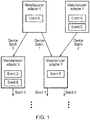
- Figure 1 shows an example of a multi-stage manufacturing process for manufacturing electronic devices, involving a number of different device manufacturers or adapters 0, 1, 2, 3.
- Each manufacturer or adapter performs one or more events A-F on a given batch of devices.
- an event may comprise any action performed on a device by a manufacturer/adapter, for instance the installation of a particular hardware component (such as a system on chip or security module), the installation of software on the device, the testing of the device using some test procedure or quality assurance programme, the activation of a particular device mode, recording of information about the device with a third party server, etc.
- the manufacture of a given batch of devices involves multiple stages which may be performed by different parties.
- batch 0 in the example of Figure 1 undergoes events A, D and E, with event A performed by manufacturer 0 and events D and E performed by manufacturer 2.
- Batch 1 undergoes events A and F performed by manufacturers 0 and 3 respectively.
- Batch 2 undergoes events B, C and F with events B and C performed by manufacturer 1 and event F performed by manufacturer 3.
- batches 1 and 2 are both processed for event F by manufacturer 3 even though they went through different manufacturers earlier in their lifecycle).
- FIG. 2 shows an example of an electronic device 2.
- the device has processing circuitry 4 for performing data processing in response to program instructions, storage circuitry 6 for storing data and instructions to be processed by the processing circuitry 4.
- the storage circuitry 6 may have a secure region 8 which is protected by hardware mechanisms (e.g. using memory protection units or security mechanisms providing a trusted execution environment) or by software mechanisms (e.g. encryption), so that data stored in a secure region 8 is inaccessible to software not executing within the trusted environment.
- the device 2 has a communications interface 10 for communicating with external devices.
- communications interface 10 could use any other range of different communication protocols, such as WiFi®, Bluetooth®, ZigBee®, etc.
- the device may have one or more sensors 12 for sensing certain external conditions such as temperature, pressure, the proximity of a nearby user, etc.
- the specific sensors 12 provided may depend on the purpose of the device. It will be appreciated that Figure 2 is merely an example of possible hardware that may be provided in the device and other components may also be provided. For example, some devices for which user interaction is expected may be provided with a display and/or a user interface module in order to display information to the user and receive input from the user. Other types of devices may simply be sensors which capture data and transmit the data to an external device and so these types of devices may not need a user interface or display.
- the validation apparatus described below may have a similar configuration to the one shown from the electronic device in Figure 2 , although the processing circuitry 4 of the validation apparatus may be more powerful than the processing circuitry in the electronic device and the storage 6 may be provided with greater storage capacity.
- FIG. 3 shows an example of manufacturing equipment 20 provided by a given manufacturer or adapter.
- the processing line for processing a batch of devices includes action performing equipment 22 for performing some predetermined action on each of the batch of devices.
- the action could be installing software, making or installing a hardware component, testing the devices, etc.
- the batch of devices is passed to attestation storage equipment 24 which stores into each of the batch of devices one or more pre-prepared attestations 26 attesting to the fact that one or more predetermined actions have been performed by the action performing equipment 22.
- the pre-prepared attestations may be prepared offline and may be signed with a manufacturer key associated with a manufacturer or adapter performing the relevant action. If multiple events are performed by the same manufacturer, then multiple attestations may be injected, each attesting to one of the events.
- Figure 3 shows the attestation storage equipment 24 processing the devices after the actions have been performed, the attestations could also be injected before the action is performed or at the same time. While Figure 3 shows a batch of devices progressing from the action performing equipment 22 to the attestation storage equipment 24, it will be appreciated that processing of the devices may be pipelined, so that some of the devices may be at the attestation storage stage 24 having the event attestations injected while other devices of the batch are still at the action performing stage 22. Also, in some cases the action performing equipment and attestation storage equipment may be the same equipment, for example when installing a piece of software the corresponding event attestation could be installed at the same time.
- Each attestation is a cryptographically authenticated attestation attesting to the fact that a given event has been performed.
- the attestations are also referred to as "holograms" in the examples below.
- each significant event in the devices lifecycle is marked with the installation of a given event attestation. Which particular events are considered significant enough to justify installation of an event attestation may depend on the particular application for these devices.
- the framework discussed below can be applied to a range of applications and services, and so the particular events recorded with the attestations may vary from application to application.
- a device moving through the manufacturing chain may build up a collection of event attestations 30 for a number of events.
- batch 0 in the example of Figure 1 may end up having event attestations 30 corresponding to events A, D, E.
- the event A attestation is signed by the manufacturer key K M0 associated with manufacturer/adapter 0 while the attestations for events D and E are signed with the key K M2 associated with manufacturer/adapter 2.
- the electronic device can use these attestations when seeking access to a given cloud service.
- the electronic device issues a service access request 40 to a service provider 50.
- the request includes a subset (or all) of the event attestations stored in the device storage 6.
- the service provider 50 forwards the request to a validation apparatus 60 which is responsible for checking the event attestations to determine whether they meet certain requirements.
- the service provider 50 may require that certain events have occurred during the lifecycle of the device in order for the device to be accepted for access to its service.
- the validation apparatus 60 may maintain a manufacturer/attestation database 62 which records information about validly cryptographically authenticated attestations for particular events.
- the attestation database 62 may also include lists of revoked attestations or information about allowed usage limits for attestations.
- the validation apparatus 60 may also have access to a service provider database 64 which may record the requirements of different service providers 50 with which the validation apparatus 60 may communicate. For example each service provider may specify what events are required for it to accept an electronic device for access to its servers, or any other criteria to be checked before a device can access its service.
- the validation apparatus 60 validates the device request 40 by comparing the provided attestations with the information in the attestation database 62 and a service provider database 64. Validation is unsuccessful if the device 2 is unable to provide a correct cryptographically authenticated event attestation for each event required by the service provider. If validation is successful, then the validation apparatus 60 returns a message 66 to the service provider 50 to indicate that the device can be accepted for the service. This message may be accompanied by a device report which may provide certain information about the device which has been extracted from the attestations provided with the request 40.
- the validation response 66 provided by the validation apparatus 60 could simply be an assertion that the event attestations are well formed (and optionally, that they convey particular information). In this case, it could be up to the service provider 50 to determine, given that the attestation is valid, whether any other requirements are satisfied to enable access to its service.
- Figure 4 shows the service provider 50 and validation apparatus 60 as separate devices, in other examples the validation of the device request 40 may be performed by the service provider 50, and so the devices 50 and 60 can be combined.
- the functions of validating well formed event attestations (checking signature, etc.), parsing the meaning of the attestations, comparing that information with the requirements for a particular service provider and deciding whether to enable access to the service by the device 2 are all functions that may be provided by the service provider 50 or a validation apparatus 60 or by another actor entirely.
- the service provider 50 and electronic device may then engage in service-specific communication 68.
- the device 2 and service provider 50 may establish device-specific key material for protecting subsequent communications with the service provider 50, or could establish other information specific to a particular service for which the device is to access.
- This technique relates to recording and attesting information about a device's lifecycle, in particular the manufacturing process through numerous steps. We later enable a web service to attest that the device went through these steps. The technique also extends to provisioning the device with a Root of Trust and other information. We also support the secure re-provisioning of the device in a way that does not allow the device to be tracked between owners.
- a KPH/Attestation system enables a factory to attest that a device is 'born' and later have a web service confirm the device was born in a 'good' factory.
- a KPH key provisioning host
- a key is generated on the device/injected into the device, and that key is made known to the attestation service (validation apparatus) 60.
- This enables the service to later confirm that a message originated on the device (as only it knows the key).
- This technique extends those concepts to a multi-stage manufacture / lifecycle.
- a device may be created, specialized multiple times and then 'used'.
- the technique provides a means to validate all the steps that were attested during the device lifecycle.
- the KPH enables the later lifecycle steps (holograms) to be remembered only on the device, avoiding the need for communication with the back end at that time.
- the technique does so by a means that minimizes the amount of on-line communication required by the device.
- the initial 'creation' may take place with either no communication with the back end web system, or with delayed/batched communication.
- any lifecycle steps can be recorded with no network access required.
- the technique also provides means for a device history to be discarded/forgotten, but for key aspects to be selectively remembered - for example keys/identities related to a previous user of a medical device may be securely discarded, whist recording that the device has been used 'n' times (this is done by discarding holograms and/or replacing them with others, for example one indicating use 'n' times).
- the technique enables all of this using a small amount of storage/processing making it suitable for loT or other constrained devices.
- the technique also reduces the load placed on a factory by minimizing the amount of cryptographic or other processing needed per device, and enables flexible tradeoffs in security/performance.
- the technique also provides a means for detecting fraud in the system.
- the system uses the following features:
- the device creates (or is given) a private key that cannot be read or modified by other software on the device, or by 3rd parties / other factory equipment.
- 3rd parties There are existing well known means to achieve this.
- the device has a small amount of secure storage that can be used to store information that cannot be read/modified by 3rd parties. (A 3rd party may be able to wipe this information, but not retrieve it or modify it in other deterministic ways).
- a device contains the information shown in Figure 6 .
- secure storage may be formed by storing the majority of data in regular storage, encrypted or otherwise protected by a key which is it stored in secure storage. Anything stored in normal storage could be also be stored in secure storage.
- a receipt providing the device public key, device ID and any other device attributes, signed by the manufacturer key, may be stored on the device, or transmitted to Device directory 60 out of band.
- a factory for example a ODM wishes to create an attestation for the device - for example indicating that a subsequent manufacturing step has been completed, such as creation of a module by a specific factory.
- the hologram format is as follows (this is just one example format, other examples could comprise a stub that can be validated on the device and then discarded, and a signature to prove the hologram was created by a known entity (key)):
- the relevant hologram is stored on the device. After two such stages the device contents might be as shown in Figure 7 .
- Figure 8 shows an example of processing at the Adaptation stage for a given electronic device 2.
- the manufacturing equipment 20 performs one or more actions on the electronic device 2.
- one or more attestations (holograms) for at least one of the performed actions are obtained, each attestation authenticated with a cryptographic key associated with the manufacturer or adapter who performed the action.
- a single hologram may indicate that multiple actions have taken place.
- the action may not be a physical action - e.g. some attestations may simply attest that the device passed through a particular manufacturer ("device was here").
- the attestations could be pre-prepared attestations used for an entire batch of devices, or could have some device-specific material.
- any obtained attestations are provided to the device (alternatively, each attestation could be provided one at a time in separate transmissions).
- the device 2 performs a validation check to determine whether the attestation is well formed.
- the device 2 generates a hash value by applying a cryptographic hash function to contents of the attestation, including the stub portion.
- the values used as inputs to the cryptographic hash function may also include a hash function associated with the most recently installed attestation held by the device (see more detail below). The device 2 determines whether the result of the hash function matches the expected hash value associated with that attestation.
- the attestation is rejected at step S5. If the hash result does match the expected hash value, at step S6 the attestation is stored to the storage circuitry 6 of the electronic device 2. At least the Hash value associated with the stored attestation is stored to a secure storage region. At step S7 the stub portion of the attestation is discarded (the stub portion is not stored to the storage circuitry of the device 6). If multiple event attestations are received from the manufacturing equipment 20, steps S4-S7 are repeated for each of the attestations.
- the proposed flow involves the device, 3rd party service that will manage the device and Device directory 60. There are other equivalent flows.
- Device directory 60 never learns of the 3rd party specific device ids/keys/other data.
- Device directory 60 can keep a count of each unique hologram it sees, and report this usage back to the 3rd party service. For example, if by agreement each hologram for a certain attestation should only be used on 100 devices, then if 1000 instances of the hologram are seen, this indicates fraud has taken place. Though this is not sufficient to detect which devices are fraudulent and which are legitimate, it does give a useful indication and enables external action to be taken (e.g. audit of factory).
- Holograms can be released to a factory/production line in batches, each batch being differentiated by having a different Hologram ID or by other means. If it is later discovered that a batch has been stolen, then Device directory 60 can be informed and revoke the holograms, but recording the stolen batch and refusing to enable devices from this batch to be 'born'.
- Figure 9 shows an example of processing performed by the Electronic device 2, service provider 50 and validation apparatus 60 at the Birth phase. While Figure 9 shows communication directly between the electronic device 2 and service provider 50, it is also possible for the electronic device 2 to communicate with the service provider 50 via an agent device (e.g. a computer, laptop, tablet or smart phone) which acts as an intermediary. For example, this could be useful for use cases where the communication functionality of the electronic device 2 may not yet be fully operational at the time the Birth phase is performed (activating full communication functionality may be part of the actions performed if the device 2 is accepted for the service), or if the device 2 itself does not have any communications capability of its own (e.g. a peripheral).
- an agent device e.g. a computer, laptop, tablet or smart phone
- the electronic device 2 reads at least a subset of the stored attestations (holograms) from its storage circuitry 6. If it is known which particular attestations are required for accessing a given service provider, it is possible for the device 2 to read a subset of the stored attestations, and to omit other known not to be needed from the subsequent request. However, in many cases it may be simpler for the device to read all the stored attestations and include them all in the subsequent request, and leave it up to the validation apparatus 60 to decide which event attestations are relevant to a particular service.
- the stored attestations holograms
- any of the stored attestations is a conditional attestation
- the electronic device 2 determines whether the associated condition is satisfied. For example, the device 2 may check whether the result of hashing contents of a specified memory region matches an expected hash value, to check whether a required piece of software is still installed at that memory region and has not been modified (see the advanced memory holograms discussed below). Other conditional checks could be that the device is operating in a given mode of operation (e.g. a secure mode). If the condition associated with any conditional attestation is not satisfied, then at step S12 the method ends and no request is transmitted.
- a given mode of operation e.g. a secure mode
- step S13 the method could still proceed to step S13 in the event of a failed attestation, but any event attestation whose condition is failed may be omitted from the subsequent request, so that a failed conditional event attestation does not prevent access to a service if that attestation is not a required event attestation for that particular service).
- the device 2 transmits a request to the service provider 50, specifying all, or a subset of, the event attestations stored in the device 2.
- the request is signed using the device key allocated to the device in the Creation phase.
- the request is forwarded to the validation apparatus 60 by the service provider 50.
- the validation apparatus 60 performs a validation process to determine whether the request meets the requirements for accessing the service. The validation process is described in more detail with respect to Figure 10 below.
- the validation apparatus 60 returns a message to the service provider 50 indicating whether the validation of the attestation was successful (i.e. that the holograms were not forged).
- a device report may also be transmitted to the service provider 50, summarising information extracted from the event attestations.
- the validation apparatus 60 and/or the service provider 50 may decide, when validation of the attestation is successful, whether to accept the device 2 for access to the service (e.g. there may be other criteria to check, not just that the event attestations are valid). If the device 2 is accepted for access to the service, at step S16 the service provider 50 enables access to the service (e.g. registers the device as a valid device, or carries out other operations for preparing the device for use in conjunction with the service). In some cases, in addition to the validation based on the event attestations, the service provider 50 could also provide other checks before accepting the device for access to the service (e.g. authenticating the user of the device using user identifiers, passwords, etc.).
- the service provider 50 provides the device with any service-specific information to be stored on the device (e.g. device identifiers, keys or data to be used by the device to access the service).
- the electronic device 2 deletes one or more (or all) of the event attestations stored in the device storage 6, validation keys used to encrypt the messages exchanged with the service provider 50 during the birth phase, and/or device identifiers used to identify the device during the birth phase.
- the electronic device 2 stores any new service-specific keys, identifiers or data received at step S17 (or generated within the device 2 itself), for use when subsequently accessing the service. The device 2 is now ready for access to the service.
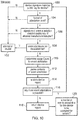
- Figure 10 is a flow diagram illustrating steps that may be performed by the validation apparatus 60 and/or the service provider apparatus 50 to validate the device request 40 based on the event attestations. For example, the steps of Figure 10 may be performed at step S14 of Figure 9 . Which particular steps are performed at the validation apparatus 60 and the service provider apparatus 50 is an implementation choice.
- the validation apparatus 60 or service provider apparatus 50 determines, for one of the event attestations received from the electronic device 2, whether the device signature associated with the request matches a known public key for the electronic device 2.
- the public key may be obtained from a certifying authority or may be associated with a device certificate of the device. If the device signature does not match then at step 102 the attestation is determined to be invalid.
- the validation apparatus 60 or service provider apparatus 50 determines whether the format of the event attestation is valid, and if not then at step 102 the attestation is determined to be invalid.
- the validation apparatus 60 or service provider apparatus 50 checks whether the signature of the event attestation can be validated using a public key of one of the allowed manufacturers or adapters who are allowed to perform the corresponding event on electronic devices. For some events, there may be only one manufacturer or adapter allowed to perform that event. However, often there may be multiple allowed manufacturers/adapters for a given event, so the signature could be validated using two or more keys associated with different manufacturers/adapters.
- the event attestation may include key identifying information to identify the manufacturer key that should be used to validate the attestation.
- the validation apparatus 60 or service provider apparatus 50 determines whether the event attestation is on a revocation list of a revoked attestations which can no longer be accepted. Event attestations can also be revoked for a number of reasons, e.g. because a key was leaked, or the signing algorithm used to create the attestation is no longer deemed secure, etc (hence even a non-fraudulent device which went through the valid manufacturing process may still sometimes receive an error when it attempts to access a service, because its event attestation has been revoked for reasons outside its control). If the event attestation is on the revocation list then again the event attestation is determined to be invalid at step 102.
- the validation apparatus 60 or service provider apparatus 50 determines a usage count for the event attestation, i.e. how many electronic devices have already used the event attestation associated with a particular event in previous validations.
- the validation apparatus 60 or service provider apparatus 50 could check whether the number of uses is greater than a certain threshold number, and reject the event attestation as invalid if the usage count is greater than the threshold.
- the maximum number may be recorded in the manufacturer database 62 or could be extracted from the event attestation itself as provided by the electronic device.
- a counter may be maintained by the validation apparatus 60 or service provider apparatus 50 to track the number of devices which have already used the attestation for event X.
- the maximum number could for example correspond to the number of devices in the batch of devices which were manufactured with that particular event attestation. If more than this number of devices are detected to be using the same event attestation then a fraud attempt can be identified and that attestation could be added to the revocation list. In other examples, the validity of the event attestation may not depend on the usage count, but instead the validation apparatus 60 or service provider apparatus 50 could simply include the usage count in a device report to allow others to decide whether the usage count indicates an invalid usage.
- the validation apparatus 60 or service provider apparatus 50 parses the contents of the event attestation to extract any other information from the event attestation (e.g. information on the event that occurred, the manufacturer who performed it, etc.).
- the validation apparatus 60 or service provider apparatus 50 updates a device report for the electronic device 2, to indicate whether or not the event attestation was determined to be valid or invalid, and indicate other information parsed based on the event attestation.
- the device report may include a number of entries each corresponding to one of the event attestations transmitted from the electronic device and validated by the validation apparatus 60 or service provider apparatus 50.
- the validation apparatus 60 or service provider apparatus 50 checks whether there are any more event attestations remaining to be processed, and if so then the method returns to step 100 to validate the next event attestation. When all event attestations have been processed, the device report is returned to the service provider 50 at step 118.
- the service provider uses the device report to determine, based on the list of events for which valid event attestations were identified in the device report, whether the device meets the particular requirements needed for it to accept the device for access to its service.
- the service provider might accept two or more alternative sets of events (e.g. either events A, B, C or events D, E, F%) as being valid (e.g. indicating two different manufacturing chains).
- the test applied by the service provider might include comparing the list of valid events against a simple list, a regular expression, or a more complex matching criterion.
- the validation apparatus or service provider may also perform a device attestation (e.g. by verifying a device signature using a device public key), to verify whether it should initially trust the event attestations.
- a device attestation e.g. by verifying a device signature using a device public key
- the validation request providing the event attestations may be collectively signed by a device private key injected in the device during manufacturing, and the dvice key could be verified using the public key associated with the device certificate. If the device attestation can be validated, then the validation apparatus or service provider may continue to validate the event attestations contained within the validation request.
- the event attestations themselves are transmitted from the device 2 to the validation apparatus 60 or service provider 50 along with the validation request.
- this is not essential.
- an alternative implementation would be for the holograms to be validated on installation by the device 2 instead of the validation server 60, for signatures to be discarded, and then, at birth, for the device to attest them to the server, by transmitting a single cryptographically authenticated attestation (signed by the device's public key) attesting that the device 2 previously received the set of event attestations (each signed by a corresponding manufacturer/adapter key) and that those event attestations were correctly validated on the device. That is, a device may attest to the validation apparatus that a given set of holograms (H1, H2, H3) was received.
- the attestation information sent with the request S13 attests that the device 2 is a correct device, but does not explicitly identify the set of valid events which occurred for the device. For example, the device may initially know "I expect H1 or H2 next", and when it gets H1, H1 contains the info "either H3 or H5" next, etc.
- each hologram can specify information about what holograms are valid at the next stage, and so the device can then validate whether the next installed hologram is correct.
- the device may send a validation request S13 to the validation apparatus 60 or service provider 50 specifying an attestation (signed by the device key) that it has gone through a valid manufacturing chain (attesting "I am a good device").
- attestation signed by the device key
- the device only knows what acceptable actions come next, but can attest to a server that it has/has not gone through a valid chain.
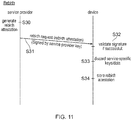
- Figure 11 shows an example of processing performed between the service provider 50 and device 2 at the Rebirth phase.
- the service provider 50 generates at least one rebirth attestation, attesting that the device has undergone a particular event.
- the rebirth attestation could attest to the fact that the device previously was validated as meeting the requirements of that particular service (as the event attestations which were previously used to validate the device may already have been deleted as discussed above, the rebirth attestation may not be able to individually attest to each event).
- the service provider 50 sends a rebirth request to the device 2, comprising the rebirth attestation.
- the rebirth request is signed with a cryptographic key (symmetric or private) associated with the service provider.
- the device 2 validates the signature of the service provider using a corresponding service provider key (symmetric or public). If the signature validation is successful, at step S33 the device 2 discards any service-specific keys, identifiers or data associated with the access to the service in the device's previous life, and at step S34 the device stores the rebirth attestation.
- the Rebirth phase may also include the service provider providing the device with a new temporary identity (identifier and Device key) similar to the Device identifier and key provided at the Creation phase, to allow the device to identify itself during a subsequent birth phase. The device can now undergo another Birth phase to register again for a service.
- a second form of hologram can be used to indicate that specific software was installed on the device.
- the device When processing this hologram during the 'Birth' phase, the device itself first validates that the memory range indicate contains the correct software (i.e. matches the expected hashcode) prior to contacting the server. In this case the device is attesting that the software is correct.
- the holograms may be cryptographically chained together. This means at later time, the exact path the device took during ODM manufacturing can be assessed, and either rejected or accepted. A cryptographical binding may be provided between the imported holograms, which later can be attested or validated.
- the linkage between the assertions can be inserted in a public record of sorts and the whole binding can thus be viewed as a blockchain.
- a verifier can attest the exact route the device took from first to last step. It can help with finding problems or other issues within a supply chain.
- the addition is that we make the holograms cryptographically bound and thus create a public ledger to attest this fact. It also means that the exact path the device took during manufacturing is asserted.
- the Hash H N when the Hash H N is created for a later hologram corresponding to a later event performed on the device, it will also include the hash, H N-1 of the previously installed hologram. For the first hologram there is no previous hash to use, so the Hash does not include any earlier hash. By doing so we will create a cryptographic chain of the holograms (and their order is now explicit as well).
- the electronic device 2 may return the following information to the validation server 60:
- the server 60 may pass down a nonce when communication with the electronic device 2 to be enrolled takes place, to ensure that the enrolment is fresh, and not a reply of a previous one, and this nonce is thus also returned in the signed response by the loT device (use of such a nonce is also possible in the earlier examples discussed above).
- the validation server 60 can check the returned "blob" of information to determine:
- the server 60 When the server 60 receives all of the holograms (as well as other data), it can check ensure they are in the correct order (due to the event chaining described above), and for each hologram, it can check that the assertion in each is sensible (according to whatever policy it has). That means, if a rogue ODM tries to insert a hologram into an loT device - the server will detect this as the assertion and the key signing it would not match what it expects.
- the validation server 60 may have access to data defining one or more of the following (or this could be out of scope, and handled by an OEM server instead):
- an loT device can take several paths from the SiP until the OEM;
- SiP ⁇ ODM1 ⁇ ODM2 ⁇ OEM is an illegal route and not allowed by the above policy (graph).
- each factory can use a hologram server for injecting the relevant hologram into the target electronic device 2.
- a hologram server for injecting the relevant hologram into the target electronic device 2.
- the enrolment server (or at any future time), can validate the steps the device took until birth to ensure they were valid.
- an event attestation attesting to the occurrence of a later event during the lifecycle of the electronic device may include event chain information dependent on information from at least one event attestation for attesting to the occurrence of at least one earlier event that should have occurred before the later event during the lifecycle of the electronic device.
- the event chain information may be a hash value which depends on a corresponding hash value for at least one earlier event attestation.
- the validation apparatus may then prevent the predetermined action being performed for the electronic device when the event chain information for the received event attestations indicates that events occurred in a prohibited sequence.
- an audit log indicating a time of occurrence of one or more local events occurring at the electronic device may be recorded by the electronic device.
- the validation apparatus may determine based on the audit log whether the predetermined action is permitted (in addition to validation based on the event attestations themselves).
- the local events recorded in the audit log could be any significant event relating to the installation or use of event attestations or handling of the device during its progress through the manufacturing chain.
- the synchronized time each hologram was inserted into the device may be recorded in the audit log.
- a record of every boot (and optionally) the functions called are also logged for future ODM fraud detection.
- a map of connected hardware peripherals could also be monitored.
- the validation apparatus may have access to information indicating when a batch of devices associated with a particular event attestation were processed, which can be compared with the audit log to determine whether to permit the predetermined action.
- a means is provided to analyse at device "birth” (or any other time of interest) if the device followed an assumed and correct path from SiP to OEM and that there were no detours taken that might invalidate such a claim. That is, in addition to having all the relevant holograms verified and in-place, the extra logging the system has provided can be used to analyse the device to ensure it was correctly manufactured.
- the device may have a secure world (protected execution environment) and may always start in the secure world after being booted. This means that logging cannot be tampered or modified - because the secure world cannot be altered. Also, if the hardware identifiers of any connected peripherals were logged in the audit log, tampering could potentially be detected too.
- the audit logging functionality could be disposed of (similar to discarding the event attestations or keys/identifiers used for the birth phase once the device access to the service has been enabled) or alternatively turned off - i.e. it may only serve to detect fraudulent ODMs, it need not be considered to always be active.
- the precise time (UTC synchronized for simplicity) may be written to the loT device as well, as a time stamp corresponding to that hologram installation.
- the timeline shows when all the holograms were inserted into the device. This can be done by either the hologram server injecting the holograms, or the device itself (or both). Whether the hologram server or device logs the time may depends on the exact trust one can exert from the hologram server or the device. Using both together (logging the time at both the hologram server and device) can provide a compromise to increase security.
- the loT device may also store a record of these starts in an additional audit log.
- This additional file may be size limited (although stored in the secure storage) to a certain number of records (e.g. the last 100 boot cycles, which can be overwritten in a FIFO manner, or whatever is feasible).
- the audit log may also comprise counters for relevant functions that have been executed. For example, rather than storing all the 345 last boot cycles, a counter stating 345 is stored, and the last 100 boot cycles are all what remains - as this saves space (unless there is "unlimited” storage). Exactly what is stored and how much can be varied from implementation to implementation.
- the device 2 can also write time stamps for each start, along any other relevant information (like what secure world functions have been called etc.). If there is no [backup] battery in the loT device, or otherwise not reliable, a monotonic counter could be used to indicate a strict order to the boots, but would not necessarily be aligned with a wall clock. This counter could optionally be backed by OTP memory or otherwise available hardware. Hence, it is not essential for the recorded time to be an absolute (synchronised time).
- This audit log is to assist in validating what an loT device has gone through before it became a legitimate product. Boot cycles outside of factory injections of holograms could indicate suspicious activities, or it might show an loT device went through many iterations before it became a real product. This can help in determining if an loT device followed a good common flow or something irregular occurred.
- this audit log is only used up and until the loT device is "born", and after that, it is discarded or not used - it is only the first steps that are relevant to capture to determine fraudulent ODM activities, not the ones following when it becomes used by an end-user.
- the feature could still be used for debugging and assisting if a problem occurs, or otherwise to capture malicious usage by the end-user utilizing the loT device.
- the first hologram was encountered at 13:13:13 and then last seen at 14:13:12, (i.e. Hologram ID OxFOOBA).
- Hologram ID OxFOOBA Hologram ID
- the chain expected for this device might be exactly that Hologram 1 must come before Hologram 2 and that they are (optionally linked as in the previously referenced extension), verified accordingly.
- Hologram IDs are checked for fraud and hologram assertions validated too (as discussed above).
- the validation server 60 could select a subset of devices for further analysis and skip the majority of devices, unless there was a stronger need to analyze the devices (but it would most likely add time to enrollment which might not be acceptable en masse).
- the words “configured to" are used to mean that an element of an apparatus has a configuration able to carry out the defined operation.
- a “configuration” means an arrangement or manner of interconnection of hardware or software.
- the apparatus may have dedicated hardware which provides the defined operation, or a processor or other processing device may be programmed to perform the function.
- Configured to does not imply that the apparatus element needs to be changed in any way in order to provide the defined operation.
Landscapes
- Engineering & Computer Science (AREA)
- Computer Security & Cryptography (AREA)
- Theoretical Computer Science (AREA)
- Computer Hardware Design (AREA)
- General Engineering & Computer Science (AREA)
- Physics & Mathematics (AREA)
- Software Systems (AREA)
- General Physics & Mathematics (AREA)
- Signal Processing (AREA)
- Computer Networks & Wireless Communication (AREA)
- Mathematical Physics (AREA)
- Computing Systems (AREA)
- Power Engineering (AREA)
- Storage Device Security (AREA)
- Mobile Radio Communication Systems (AREA)
- Management, Administration, Business Operations System, And Electronic Commerce (AREA)
Priority Applications (1)
| Application Number | Priority Date | Filing Date | Title |
|---|---|---|---|
| EP19192167.5A EP3591564B1 (de) | 2017-01-10 | 2017-11-09 | Ereignisbestätigung für eine elektronische vorrichtung |
Applications Claiming Priority (2)
| Application Number | Priority Date | Filing Date | Title |
|---|---|---|---|
| GBGB1700367.4A GB201700367D0 (en) | 2017-01-10 | 2017-01-10 | A system for recording and attesting device lifecycle |
| GB1709800.5A GB2558688A (en) | 2017-01-10 | 2017-06-20 | Event attestation for an electronic device |
Related Child Applications (2)
| Application Number | Title | Priority Date | Filing Date |
|---|---|---|---|
| EP19192167.5A Division EP3591564B1 (de) | 2017-01-10 | 2017-11-09 | Ereignisbestätigung für eine elektronische vorrichtung |
| EP19192167.5A Division-Into EP3591564B1 (de) | 2017-01-10 | 2017-11-09 | Ereignisbestätigung für eine elektronische vorrichtung |
Publications (3)
| Publication Number | Publication Date |
|---|---|
| EP3346415A2 true EP3346415A2 (de) | 2018-07-11 |
| EP3346415A3 EP3346415A3 (de) | 2018-10-10 |
| EP3346415B1 EP3346415B1 (de) | 2019-12-25 |
Family
ID=58463788
Family Applications (2)
| Application Number | Title | Priority Date | Filing Date |
|---|---|---|---|
| EP19192167.5A Active EP3591564B1 (de) | 2017-01-10 | 2017-11-09 | Ereignisbestätigung für eine elektronische vorrichtung |
| EP17200828.6A Active EP3346415B1 (de) | 2017-01-10 | 2017-11-09 | Ereignisbestätigung für eine elektronische vorrichtung |
Family Applications Before (1)
| Application Number | Title | Priority Date | Filing Date |
|---|---|---|---|
| EP19192167.5A Active EP3591564B1 (de) | 2017-01-10 | 2017-11-09 | Ereignisbestätigung für eine elektronische vorrichtung |
Country Status (5)
| Country | Link |
|---|---|
| US (1) | US10680812B2 (de) |
| EP (2) | EP3591564B1 (de) |
| JP (1) | JP7060362B2 (de) |
| CN (1) | CN108337239B (de) |
| GB (2) | GB201700367D0 (de) |
Cited By (7)
| Publication number | Priority date | Publication date | Assignee | Title |
|---|---|---|---|---|
| EP3647979A1 (de) * | 2018-11-01 | 2020-05-06 | Trustonic Limited | Vorrichtungsbescheinigungstechniken |
| WO2020117314A1 (en) * | 2018-12-03 | 2020-06-11 | Ebay Inc. | System level function based access control for smart contract execution on a blockchain |
| WO2020151831A1 (en) * | 2019-01-25 | 2020-07-30 | Huawei Technologies Co., Ltd. | Method for end entity attestation |
| GB2581161A (en) * | 2019-02-05 | 2020-08-12 | Trustonic Ltd | Software encryption |
| US20210374287A1 (en) * | 2018-11-02 | 2021-12-02 | Telefonaktiebolaget Lm Ericsson (Publ) | Authentication of an original equipment manufacturer entity |
| US11250125B2 (en) | 2018-12-03 | 2022-02-15 | Ebay Inc. | Highly scalable permissioned block chains |
| US11405182B2 (en) | 2018-12-03 | 2022-08-02 | Ebay Inc. | Adaptive security for smart contracts using high granularity metrics |
Families Citing this family (31)
| Publication number | Priority date | Publication date | Assignee | Title |
|---|---|---|---|---|
| KR20170129866A (ko) * | 2015-03-20 | 2017-11-27 | 리베츠 코프. | 블록 체인을 사용하여 디바이스 무결성의 자동화된 입증 |
| US10861019B2 (en) * | 2016-03-18 | 2020-12-08 | Visa International Service Association | Location verification during dynamic data transactions |
| US11256799B2 (en) * | 2017-08-29 | 2022-02-22 | Seagate Technology Llc | Device lifecycle distributed ledger |
| CN109104311B (zh) * | 2018-08-06 | 2021-08-31 | 腾讯科技(深圳)有限公司 | 基于区块链的设备管理方法、装置、介质及电子设备 |
| RU2695487C1 (ru) * | 2018-09-26 | 2019-07-23 | Олег Дмитриевич Гурин | Способ и система обеспечения взаимодействия устройств интернета вещей (iot) |
| US11308194B2 (en) | 2018-10-31 | 2022-04-19 | Seagate Technology Llc | Monitoring device components using distributed ledger |
| US10602353B1 (en) * | 2018-12-31 | 2020-03-24 | Microsoft Technology Licensing, Llc | Extensible device identity attestation |
| US11531777B2 (en) * | 2019-01-30 | 2022-12-20 | Virtru Corporation | Methods and systems for restricting data access based on properties of at least one of a process and a machine executing the process |
| US20200410138A1 (en) * | 2019-06-28 | 2020-12-31 | Seagate Technology Llc | Data storage system with device provenance |
| CN110689345B (zh) * | 2019-09-06 | 2022-03-18 | 北京清红微谷技术开发有限责任公司 | 调整区块权重的无许可区块链共识方法、系统、p2p网络 |
| WO2021061715A1 (en) * | 2019-09-25 | 2021-04-01 | Shift5, Inc. | Passive monitoring and prevention of unauthorized firmware or software upgrades between computing devices |
| GB201915385D0 (en) * | 2019-10-23 | 2019-12-04 | Woodenshark Llc | WS Moeco Devices |
| DE102019130067B4 (de) * | 2019-11-07 | 2022-06-02 | Krohne Messtechnik Gmbh | Verfahren zur Durchführung einer erlaubnisabhängigen Kommunikation zwischen wenigstens einem Feldgerät der Automatisierungstechnik und einem Bediengerät |
| JP7363497B2 (ja) | 2020-01-14 | 2023-10-18 | 富士通株式会社 | 制御方法、デバイス及び制御システム |
| EP4099612A4 (de) * | 2020-01-31 | 2023-07-26 | Panasonic Intellectual Property Corporation of America | Steuerungsverfahren, server und programm |
| US11949784B2 (en) * | 2020-05-13 | 2024-04-02 | Ridgeline, Inc. | Auditing for events |
| US11233640B2 (en) | 2020-05-13 | 2022-01-25 | Ridgeline, Inc. | Mutation processing for events |
| US11818259B2 (en) * | 2020-05-13 | 2023-11-14 | Ridgeline, Inc. | Query and projection processing for events |
| CN111800402B (zh) * | 2020-06-28 | 2022-08-09 | 格尔软件股份有限公司 | 一种利用事件证书实现全链路加密代理的方法 |
| US11425124B2 (en) * | 2020-06-29 | 2022-08-23 | Lenovo Enterprise Solutions (Singapore) Pte. Ltd. | Method for cloud assisted authorization of IoT identity bootstrapping |
| CN111860898A (zh) * | 2020-08-06 | 2020-10-30 | 江苏华邦网络科技有限公司 | 一种设备更新决策的方法、装置及电子设备 |
| US11853438B2 (en) | 2020-10-02 | 2023-12-26 | Blockframe, Inc. | Providing cryptographically secure post-secrets-provisioning services |
| US11563579B2 (en) * | 2020-10-02 | 2023-01-24 | Nvidia Corporation | Token-based zero-touch enrollment for provisioning edge computing applications |
| EP3989137A1 (de) * | 2020-10-21 | 2022-04-27 | Aesculap AG | Sicherstellung single use anwendungen von su produkten mittels dlt/blockchain |
| EP3992873A1 (de) * | 2020-10-30 | 2022-05-04 | Hewlett-Packard Development Company, L.P. | Durch vorrichtung ermöglichter sicherer ledger |
| JP7693407B2 (ja) * | 2021-06-18 | 2025-06-17 | 日本発條株式会社 | 電子機器部品の生産管理システム、及び電子機器部品の生産管理方法 |
| CN113870416B (zh) * | 2021-09-24 | 2022-11-04 | 埃洛克航空科技(北京)有限公司 | 基于全链路加密的三维实景模型展示方法以及相关装置 |
| EP4160980B1 (de) * | 2021-09-29 | 2026-01-28 | AUMOVIO Germany GmbH | Verfahren zum sicheren übergang eines lebenszyklusstadiums eines produkts in ein nächstes stadium während des gesamten lebenszyklus und zur überprüfung der integrität von daten und produktzuständen |
| EP4261726A1 (de) * | 2022-04-12 | 2023-10-18 | Siemens Aktiengesellschaft | Verwalten von ereignisdaten eines realen objekts in einer verwaltungsschale |
| US12363111B2 (en) | 2022-10-19 | 2025-07-15 | Hewlett Packard Enterprise Development Lp | Unauthorized device detection in a computing environment |
| US20240154808A1 (en) * | 2022-11-03 | 2024-05-09 | Change Healthcare Holdings, Llc | Systems and methods of trace id validation and trust |
Family Cites Families (29)
| Publication number | Priority date | Publication date | Assignee | Title |
|---|---|---|---|---|
| US7134021B2 (en) * | 1999-10-22 | 2006-11-07 | Hitachi, Ltd. | Method and system for recovering the validity of cryptographically signed digital data |
| US7363495B2 (en) * | 2001-02-22 | 2008-04-22 | Bea Systems, Inc. | System and method for message encryption and signing in a transaction processing system |
| JP2003296518A (ja) * | 2002-04-08 | 2003-10-17 | Fujitsu Ltd | リサイクル方法およびリサイクルシステム |
| US7392415B2 (en) * | 2002-06-26 | 2008-06-24 | Intel Corporation | Sleep protection |
| US8468330B1 (en) * | 2003-06-30 | 2013-06-18 | Oracle International Corporation | Methods, systems, and data structures for loading and authenticating a module |
| US20060005009A1 (en) * | 2004-06-30 | 2006-01-05 | International Business Machines Corporation | Method, system and program product for verifying an attribute of a computing device |
| US8213618B2 (en) * | 2008-12-30 | 2012-07-03 | Intel Corporation | Protecting content on client platforms |
| US8225110B2 (en) | 2009-01-09 | 2012-07-17 | Telefonaktiebolaget Lm Ericsson (Publ) | Cryptographic protection of usage restrictions in electronic devices |
| US8738932B2 (en) * | 2009-01-16 | 2014-05-27 | Teleputers, Llc | System and method for processor-based security |
| CN101534296B (zh) * | 2009-03-24 | 2014-12-31 | 王琳 | 公开网络信息完整性、时间点存在性证明方法和系统 |
| US9077543B2 (en) * | 2009-10-09 | 2015-07-07 | Apple Inc. | Methods and apparatus for digital attestation |
| US8584961B2 (en) * | 2010-03-18 | 2013-11-19 | Triune Ip Llc | Marking verification system |
| WO2012040840A1 (en) * | 2010-09-17 | 2012-04-05 | Certicom Corp. | A mechanism for managing authentication device lifecycles |
| TWI546692B (zh) * | 2011-10-27 | 2016-08-21 | 電子戰協會公司 | 包括與已知電路板資訊有關之電路測試及驗證等特徵的裝置鑑別之系統及方法 |
| US8854115B2 (en) * | 2013-03-05 | 2014-10-07 | Lsi Corporation | Preventing electronic device counterfeits |
| US9160543B2 (en) * | 2013-05-07 | 2015-10-13 | The Boeing Company | Verification of aircraft information in response to compromised digital certificate |
| DE102014102168A1 (de) * | 2014-02-20 | 2015-09-03 | Phoenix Contact Gmbh & Co. Kg | Verfahren und System zum Erstellen und zur Gültigkeitsprüfung von Gerätezertifikaten |
| US9509502B2 (en) * | 2014-03-13 | 2016-11-29 | Intel Corporation | Symmetric keying and chain of trust |
| US9521125B2 (en) * | 2014-03-13 | 2016-12-13 | Intel Corporation | Pseudonymous remote attestation utilizing a chain-of-trust |
| US9680872B1 (en) * | 2014-03-25 | 2017-06-13 | Amazon Technologies, Inc. | Trusted-code generated requests |
| US20150294119A1 (en) * | 2014-04-10 | 2015-10-15 | International Business Machines Corporation | Booting a multi-node computer system from a primary node dynamically selected based on security setting criteria |
| US9853811B1 (en) * | 2014-06-27 | 2017-12-26 | Amazon Technologies, Inc. | Optimistic key usage with correction |
| US9621347B2 (en) * | 2014-09-03 | 2017-04-11 | Virtustream Ip Holding Company Llc | Systems and methods for securely provisioning the geographic location of physical infrastructure elements in cloud computing environments |
| JP6344170B2 (ja) * | 2014-09-12 | 2018-06-20 | 株式会社リコー | 機器、管理モジュール、プログラムおよび制御方法 |
| CN104735054B (zh) * | 2015-02-06 | 2018-03-02 | 西安电子科技大学 | 数字家庭设备可信接入平台及认证方法 |
| CN105162772B (zh) * | 2015-08-04 | 2019-03-15 | 三星电子(中国)研发中心 | 一种物联网设备认证与密钥协商方法和装置 |
| CN106230784B (zh) * | 2016-07-20 | 2020-09-18 | 新华三技术有限公司 | 一种设备验证方法及装置 |
| CN106302415A (zh) * | 2016-08-03 | 2017-01-04 | 杭州晟元数据安全技术股份有限公司 | 一种验证设备合法性和对合法设备自动配网的方法 |
| US10229270B2 (en) * | 2016-12-23 | 2019-03-12 | Amazon Technologies, Inc. | Host attestation |
-
2017
- 2017-01-10 GB GBGB1700367.4A patent/GB201700367D0/en not_active Ceased
- 2017-06-20 GB GB1709800.5A patent/GB2558688A/en not_active Withdrawn
- 2017-11-09 EP EP19192167.5A patent/EP3591564B1/de active Active
- 2017-11-09 EP EP17200828.6A patent/EP3346415B1/de active Active
- 2017-11-16 JP JP2017221256A patent/JP7060362B2/ja active Active
- 2017-11-21 US US15/819,294 patent/US10680812B2/en active Active
- 2017-12-29 CN CN201711478063.8A patent/CN108337239B/zh active Active
Non-Patent Citations (1)
| Title |
|---|
| None |
Cited By (18)
| Publication number | Priority date | Publication date | Assignee | Title |
|---|---|---|---|---|
| GB2578628A (en) * | 2018-11-01 | 2020-05-20 | Trustonic Ltd | Device attestation techniques |
| EP3647979A1 (de) * | 2018-11-01 | 2020-05-06 | Trustonic Limited | Vorrichtungsbescheinigungstechniken |
| US11232190B2 (en) | 2018-11-01 | 2022-01-25 | Trustonic Limited | Device attestation techniques |
| GB2578628B (en) * | 2018-11-01 | 2021-09-15 | Trustonic Ltd | Device attestation techniques |
| US20210374287A1 (en) * | 2018-11-02 | 2021-12-02 | Telefonaktiebolaget Lm Ericsson (Publ) | Authentication of an original equipment manufacturer entity |
| US11972032B2 (en) * | 2018-11-02 | 2024-04-30 | Telefonaktiebolagget LM Ericsson (Publ) | Authentication of an original equipment manufacturer entity |
| EP4358467A3 (de) * | 2018-12-03 | 2024-07-17 | eBay Inc. | Auf systemebenenfunktion basierende zugangssteuerung zur ausführung intelligenter kontrakte auf einer blockchain |
| US11899783B2 (en) | 2018-12-03 | 2024-02-13 | Ebay, Inc. | System level function based access control for smart contract execution on a blockchain |
| US11888966B2 (en) | 2018-12-03 | 2024-01-30 | Ebay Inc. | Adaptive security for smart contracts using high granularity metrics |
| US11250125B2 (en) | 2018-12-03 | 2022-02-15 | Ebay Inc. | Highly scalable permissioned block chains |
| US11263315B2 (en) | 2018-12-03 | 2022-03-01 | Ebay Inc. | System level function based access control for smart contract execution on a blockchain |
| US11405182B2 (en) | 2018-12-03 | 2022-08-02 | Ebay Inc. | Adaptive security for smart contracts using high granularity metrics |
| WO2020117314A1 (en) * | 2018-12-03 | 2020-06-11 | Ebay Inc. | System level function based access control for smart contract execution on a blockchain |
| US11809551B2 (en) | 2018-12-03 | 2023-11-07 | Ebay Inc. | Highly scalable permissioned block chains |
| US11777717B2 (en) | 2019-01-25 | 2023-10-03 | Huawei Technologies Co., Ltd. | Method for end entity attestation |
| WO2020151831A1 (en) * | 2019-01-25 | 2020-07-30 | Huawei Technologies Co., Ltd. | Method for end entity attestation |
| US11218299B2 (en) | 2019-02-05 | 2022-01-04 | Trustonic Limited | Software encryption |
| GB2581161A (en) * | 2019-02-05 | 2020-08-12 | Trustonic Ltd | Software encryption |
Also Published As
| Publication number | Publication date |
|---|---|
| GB2558688A (en) | 2018-07-18 |
| CN108337239A (zh) | 2018-07-27 |
| JP7060362B2 (ja) | 2022-04-26 |
| GB201709800D0 (en) | 2017-08-02 |
| EP3591564B1 (de) | 2021-05-05 |
| EP3346415A3 (de) | 2018-10-10 |
| GB201700367D0 (en) | 2017-02-22 |
| US10680812B2 (en) | 2020-06-09 |
| JP2018121328A (ja) | 2018-08-02 |
| US20180198604A1 (en) | 2018-07-12 |
| EP3591564A1 (de) | 2020-01-08 |
| CN108337239B (zh) | 2022-09-02 |
| EP3346415B1 (de) | 2019-12-25 |
Similar Documents
| Publication | Publication Date | Title |
|---|---|---|
| EP3591564B1 (de) | Ereignisbestätigung für eine elektronische vorrichtung | |
| EP3905078B1 (de) | Verfahren zur identitätsüberprüfung und system dafür | |
| US10873641B2 (en) | Systems and methods for recognizing a device | |
| CN112217835B (zh) | 报文数据的处理方法、装置、服务器和终端设备 | |
| CN102393890B (zh) | 一种抗物理入侵和旁路攻击的密码芯片系统及其实现方法 | |
| US12047388B2 (en) | Hardware detection method and apparatus, device, and storage medium | |
| WO2013086901A1 (zh) | 现场可更换单元的校验方法、装置和通信设备 | |
| CN101493870A (zh) | 可信平台模块测试装置 | |
| CN110502889B (zh) | 登录方法、装置、计算机可读存储介质和计算机设备 | |
| EP3420694B1 (de) | Systeme und verfahren zur erkennung und kategorisierung einer vorrichtung | |
| CN121056141A (zh) | 私钥管理方法、装置及计算机设备 | |
| CN112132588B (zh) | 基于区块链的数据处理方法、装置、路由设备及存储介质 | |
| CN116566744B (zh) | 数据处理方法和安全校验系统 | |
| Deutschmann et al. | A PUF based hardware authentication scheme for embedded devices | |
| CN120811773B (zh) | 一种用于隐私计算平台的密文链式审计方法及系统 | |
| CN121077815B (zh) | 一种跨域联合认证与多方签署系统及方法 | |
| CN118802157B (zh) | 一种应用程序管理方法、相关设备、介质及程序产品 | |
| Romani | Standard-Based Remote Attestation | |
| CN121486063A (zh) | 设备授权方法、装置、计算机设备和存储介质 | |
| TWI673621B (zh) | 資訊註冊、認證方法及裝置 | |
| CN121309170A (zh) | 一种基于区块链的访问认证方法 | |
| CN120915440A (zh) | 一种基于数字人民币工控设备的嵌入式安全管理方法 | |
| CN121234332A (zh) | 基于多重密钥验证的软件激活控制方法 | |
| CN120034395A (zh) | 支持kmip协议的全生命周期密钥管理服务方法及系统 | |
| CN120750656A (zh) | 密钥管理方法、电子设备、存储介质和程序产品 |
Legal Events
| Date | Code | Title | Description |
|---|---|---|---|
| PUAI | Public reference made under article 153(3) epc to a published international application that has entered the european phase |
Free format text: ORIGINAL CODE: 0009012 |
|
| STAA | Information on the status of an ep patent application or granted ep patent |
Free format text: STATUS: THE APPLICATION HAS BEEN PUBLISHED |
|
| AK | Designated contracting states |
Kind code of ref document: A2 Designated state(s): AL AT BE BG CH CY CZ DE DK EE ES FI FR GB GR HR HU IE IS IT LI LT LU LV MC MK MT NL NO PL PT RO RS SE SI SK SM TR |
|
| AX | Request for extension of the european patent |
Extension state: BA ME |
|
| PUAL | Search report despatched |
Free format text: ORIGINAL CODE: 0009013 |
|
| AK | Designated contracting states |
Kind code of ref document: A3 Designated state(s): AL AT BE BG CH CY CZ DE DK EE ES FI FR GB GR HR HU IE IS IT LI LT LU LV MC MK MT NL NO PL PT RO RS SE SI SK SM TR |
|
| AX | Request for extension of the european patent |
Extension state: BA ME |
|
| RIC1 | Information provided on ipc code assigned before grant |
Ipc: G06F 21/73 20130101AFI20180904BHEP Ipc: G06F 21/57 20130101ALI20180904BHEP |
|
| STAA | Information on the status of an ep patent application or granted ep patent |
Free format text: STATUS: REQUEST FOR EXAMINATION WAS MADE |
|
| 17P | Request for examination filed |
Effective date: 20190410 |
|
| RBV | Designated contracting states (corrected) |
Designated state(s): AL AT BE BG CH CY CZ DE DK EE ES FI FR GB GR HR HU IE IS IT LI LT LU LV MC MK MT NL NO PL PT RO RS SE SI SK SM TR |
|
| GRAP | Despatch of communication of intention to grant a patent |
Free format text: ORIGINAL CODE: EPIDOSNIGR1 |
|
| STAA | Information on the status of an ep patent application or granted ep patent |
Free format text: STATUS: GRANT OF PATENT IS INTENDED |
|
| RIC1 | Information provided on ipc code assigned before grant |
Ipc: H04L 9/32 20060101ALI20190527BHEP Ipc: G06F 21/73 20130101AFI20190527BHEP Ipc: G06F 21/44 20130101ALI20190527BHEP Ipc: H04L 9/08 20060101ALI20190527BHEP Ipc: H04W 12/08 20090101ALI20190527BHEP Ipc: G06F 21/57 20130101ALI20190527BHEP Ipc: G06F 15/02 20060101ALI20190527BHEP Ipc: H04W 88/02 20090101ALN20190527BHEP Ipc: H04W 12/10 20090101ALN20190527BHEP |
|
| RIC1 | Information provided on ipc code assigned before grant |
Ipc: H04W 88/02 20090101ALN20190612BHEP Ipc: H04W 12/10 20090101ALN20190612BHEP Ipc: G06F 15/02 20060101ALI20190612BHEP Ipc: G06F 21/44 20130101ALI20190612BHEP Ipc: H04L 9/32 20060101ALI20190612BHEP Ipc: H04L 9/08 20060101ALI20190612BHEP Ipc: H04W 12/08 20090101ALI20190612BHEP Ipc: G06F 21/57 20130101ALI20190612BHEP Ipc: G06F 21/73 20130101AFI20190612BHEP |
|
| INTG | Intention to grant announced |
Effective date: 20190626 |
|
| GRAS | Grant fee paid |
Free format text: ORIGINAL CODE: EPIDOSNIGR3 |
|
| GRAA | (expected) grant |
Free format text: ORIGINAL CODE: 0009210 |
|
| STAA | Information on the status of an ep patent application or granted ep patent |
Free format text: STATUS: THE PATENT HAS BEEN GRANTED |
|
| AK | Designated contracting states |
Kind code of ref document: B1 Designated state(s): AL AT BE BG CH CY CZ DE DK EE ES FI FR GB GR HR HU IE IS IT LI LT LU LV MC MK MT NL NO PL PT RO RS SE SI SK SM TR |
|
| REG | Reference to a national code |
Ref country code: GB Ref legal event code: FG4D |
|
| REG | Reference to a national code |
Ref country code: CH Ref legal event code: EP |
|
| REG | Reference to a national code |
Ref country code: AT Ref legal event code: REF Ref document number: 1217938 Country of ref document: AT Kind code of ref document: T Effective date: 20200115 |
|
| REG | Reference to a national code |
Ref country code: DE Ref legal event code: R096 Ref document number: 602017010059 Country of ref document: DE |
|
| REG | Reference to a national code |
Ref country code: IE Ref legal event code: FG4D |
|
| REG | Reference to a national code |
Ref country code: NL Ref legal event code: MP Effective date: 20191225 |
|
| PG25 | Lapsed in a contracting state [announced via postgrant information from national office to epo] |
Ref country code: SE Free format text: LAPSE BECAUSE OF FAILURE TO SUBMIT A TRANSLATION OF THE DESCRIPTION OR TO PAY THE FEE WITHIN THE PRESCRIBED TIME-LIMIT Effective date: 20191225 Ref country code: LV Free format text: LAPSE BECAUSE OF FAILURE TO SUBMIT A TRANSLATION OF THE DESCRIPTION OR TO PAY THE FEE WITHIN THE PRESCRIBED TIME-LIMIT Effective date: 20191225 Ref country code: NO Free format text: LAPSE BECAUSE OF FAILURE TO SUBMIT A TRANSLATION OF THE DESCRIPTION OR TO PAY THE FEE WITHIN THE PRESCRIBED TIME-LIMIT Effective date: 20200325 Ref country code: FI Free format text: LAPSE BECAUSE OF FAILURE TO SUBMIT A TRANSLATION OF THE DESCRIPTION OR TO PAY THE FEE WITHIN THE PRESCRIBED TIME-LIMIT Effective date: 20191225 Ref country code: GR Free format text: LAPSE BECAUSE OF FAILURE TO SUBMIT A TRANSLATION OF THE DESCRIPTION OR TO PAY THE FEE WITHIN THE PRESCRIBED TIME-LIMIT Effective date: 20200326 Ref country code: BG Free format text: LAPSE BECAUSE OF FAILURE TO SUBMIT A TRANSLATION OF THE DESCRIPTION OR TO PAY THE FEE WITHIN THE PRESCRIBED TIME-LIMIT Effective date: 20200325 Ref country code: LT Free format text: LAPSE BECAUSE OF FAILURE TO SUBMIT A TRANSLATION OF THE DESCRIPTION OR TO PAY THE FEE WITHIN THE PRESCRIBED TIME-LIMIT Effective date: 20191225 |
|
| REG | Reference to a national code |
Ref country code: LT Ref legal event code: MG4D |
|
| PG25 | Lapsed in a contracting state [announced via postgrant information from national office to epo] |
Ref country code: RS Free format text: LAPSE BECAUSE OF FAILURE TO SUBMIT A TRANSLATION OF THE DESCRIPTION OR TO PAY THE FEE WITHIN THE PRESCRIBED TIME-LIMIT Effective date: 20191225 Ref country code: HR Free format text: LAPSE BECAUSE OF FAILURE TO SUBMIT A TRANSLATION OF THE DESCRIPTION OR TO PAY THE FEE WITHIN THE PRESCRIBED TIME-LIMIT Effective date: 20191225 |
|
| PG25 | Lapsed in a contracting state [announced via postgrant information from national office to epo] |
Ref country code: AL Free format text: LAPSE BECAUSE OF FAILURE TO SUBMIT A TRANSLATION OF THE DESCRIPTION OR TO PAY THE FEE WITHIN THE PRESCRIBED TIME-LIMIT Effective date: 20191225 |
|
| PG25 | Lapsed in a contracting state [announced via postgrant information from national office to epo] |
Ref country code: CZ Free format text: LAPSE BECAUSE OF FAILURE TO SUBMIT A TRANSLATION OF THE DESCRIPTION OR TO PAY THE FEE WITHIN THE PRESCRIBED TIME-LIMIT Effective date: 20191225 Ref country code: RO Free format text: LAPSE BECAUSE OF FAILURE TO SUBMIT A TRANSLATION OF THE DESCRIPTION OR TO PAY THE FEE WITHIN THE PRESCRIBED TIME-LIMIT Effective date: 20191225 Ref country code: PT Free format text: LAPSE BECAUSE OF FAILURE TO SUBMIT A TRANSLATION OF THE DESCRIPTION OR TO PAY THE FEE WITHIN THE PRESCRIBED TIME-LIMIT Effective date: 20200520 Ref country code: EE Free format text: LAPSE BECAUSE OF FAILURE TO SUBMIT A TRANSLATION OF THE DESCRIPTION OR TO PAY THE FEE WITHIN THE PRESCRIBED TIME-LIMIT Effective date: 20191225 Ref country code: NL Free format text: LAPSE BECAUSE OF FAILURE TO SUBMIT A TRANSLATION OF THE DESCRIPTION OR TO PAY THE FEE WITHIN THE PRESCRIBED TIME-LIMIT Effective date: 20191225 |
|
| PG25 | Lapsed in a contracting state [announced via postgrant information from national office to epo] |
Ref country code: SK Free format text: LAPSE BECAUSE OF FAILURE TO SUBMIT A TRANSLATION OF THE DESCRIPTION OR TO PAY THE FEE WITHIN THE PRESCRIBED TIME-LIMIT Effective date: 20191225 Ref country code: SM Free format text: LAPSE BECAUSE OF FAILURE TO SUBMIT A TRANSLATION OF THE DESCRIPTION OR TO PAY THE FEE WITHIN THE PRESCRIBED TIME-LIMIT Effective date: 20191225 Ref country code: IS Free format text: LAPSE BECAUSE OF FAILURE TO SUBMIT A TRANSLATION OF THE DESCRIPTION OR TO PAY THE FEE WITHIN THE PRESCRIBED TIME-LIMIT Effective date: 20200425 |
|
| REG | Reference to a national code |
Ref country code: DE Ref legal event code: R097 Ref document number: 602017010059 Country of ref document: DE |
|
| PG25 | Lapsed in a contracting state [announced via postgrant information from national office to epo] |
Ref country code: DK Free format text: LAPSE BECAUSE OF FAILURE TO SUBMIT A TRANSLATION OF THE DESCRIPTION OR TO PAY THE FEE WITHIN THE PRESCRIBED TIME-LIMIT Effective date: 20191225 Ref country code: ES Free format text: LAPSE BECAUSE OF FAILURE TO SUBMIT A TRANSLATION OF THE DESCRIPTION OR TO PAY THE FEE WITHIN THE PRESCRIBED TIME-LIMIT Effective date: 20191225 |
|
| PLBE | No opposition filed within time limit |
Free format text: ORIGINAL CODE: 0009261 |
|
| STAA | Information on the status of an ep patent application or granted ep patent |
Free format text: STATUS: NO OPPOSITION FILED WITHIN TIME LIMIT |
|
| REG | Reference to a national code |
Ref country code: AT Ref legal event code: MK05 Ref document number: 1217938 Country of ref document: AT Kind code of ref document: T Effective date: 20191225 |
|
| PG25 | Lapsed in a contracting state [announced via postgrant information from national office to epo] |
Ref country code: SI Free format text: LAPSE BECAUSE OF FAILURE TO SUBMIT A TRANSLATION OF THE DESCRIPTION OR TO PAY THE FEE WITHIN THE PRESCRIBED TIME-LIMIT Effective date: 20191225 |
|
| 26N | No opposition filed |
Effective date: 20200928 |
|
| PG25 | Lapsed in a contracting state [announced via postgrant information from national office to epo] |
Ref country code: AT Free format text: LAPSE BECAUSE OF FAILURE TO SUBMIT A TRANSLATION OF THE DESCRIPTION OR TO PAY THE FEE WITHIN THE PRESCRIBED TIME-LIMIT Effective date: 20191225 Ref country code: IT Free format text: LAPSE BECAUSE OF FAILURE TO SUBMIT A TRANSLATION OF THE DESCRIPTION OR TO PAY THE FEE WITHIN THE PRESCRIBED TIME-LIMIT Effective date: 20191225 |
|
| PG25 | Lapsed in a contracting state [announced via postgrant information from national office to epo] |
Ref country code: PL Free format text: LAPSE BECAUSE OF FAILURE TO SUBMIT A TRANSLATION OF THE DESCRIPTION OR TO PAY THE FEE WITHIN THE PRESCRIBED TIME-LIMIT Effective date: 20191225 |
|
| PG25 | Lapsed in a contracting state [announced via postgrant information from national office to epo] |
Ref country code: MC Free format text: LAPSE BECAUSE OF FAILURE TO SUBMIT A TRANSLATION OF THE DESCRIPTION OR TO PAY THE FEE WITHIN THE PRESCRIBED TIME-LIMIT Effective date: 20191225 |
|
| REG | Reference to a national code |
Ref country code: CH Ref legal event code: PL |
|
| PG25 | Lapsed in a contracting state [announced via postgrant information from national office to epo] |
Ref country code: LU Free format text: LAPSE BECAUSE OF NON-PAYMENT OF DUE FEES Effective date: 20201109 |
|
| REG | Reference to a national code |
Ref country code: BE Ref legal event code: MM Effective date: 20201130 |
|
| PG25 | Lapsed in a contracting state [announced via postgrant information from national office to epo] |
Ref country code: LI Free format text: LAPSE BECAUSE OF NON-PAYMENT OF DUE FEES Effective date: 20201130 Ref country code: CH Free format text: LAPSE BECAUSE OF NON-PAYMENT OF DUE FEES Effective date: 20201130 |
|
| PG25 | Lapsed in a contracting state [announced via postgrant information from national office to epo] |
Ref country code: IE Free format text: LAPSE BECAUSE OF NON-PAYMENT OF DUE FEES Effective date: 20201109 |
|
| PG25 | Lapsed in a contracting state [announced via postgrant information from national office to epo] |
Ref country code: TR Free format text: LAPSE BECAUSE OF FAILURE TO SUBMIT A TRANSLATION OF THE DESCRIPTION OR TO PAY THE FEE WITHIN THE PRESCRIBED TIME-LIMIT Effective date: 20191225 Ref country code: MT Free format text: LAPSE BECAUSE OF FAILURE TO SUBMIT A TRANSLATION OF THE DESCRIPTION OR TO PAY THE FEE WITHIN THE PRESCRIBED TIME-LIMIT Effective date: 20191225 Ref country code: CY Free format text: LAPSE BECAUSE OF FAILURE TO SUBMIT A TRANSLATION OF THE DESCRIPTION OR TO PAY THE FEE WITHIN THE PRESCRIBED TIME-LIMIT Effective date: 20191225 |
|
| PG25 | Lapsed in a contracting state [announced via postgrant information from national office to epo] |
Ref country code: MK Free format text: LAPSE BECAUSE OF FAILURE TO SUBMIT A TRANSLATION OF THE DESCRIPTION OR TO PAY THE FEE WITHIN THE PRESCRIBED TIME-LIMIT Effective date: 20191225 |
|
| PG25 | Lapsed in a contracting state [announced via postgrant information from national office to epo] |
Ref country code: BE Free format text: LAPSE BECAUSE OF NON-PAYMENT OF DUE FEES Effective date: 20201130 |
|
| P01 | Opt-out of the competence of the unified patent court (upc) registered |
Effective date: 20230515 |
|
| PGFP | Annual fee paid to national office [announced via postgrant information from national office to epo] |
Ref country code: DE Payment date: 20251126 Year of fee payment: 9 |
|
| PGFP | Annual fee paid to national office [announced via postgrant information from national office to epo] |
Ref country code: GB Payment date: 20251119 Year of fee payment: 9 |
|
| PGFP | Annual fee paid to national office [announced via postgrant information from national office to epo] |
Ref country code: FR Payment date: 20251124 Year of fee payment: 9 |