EP3345981A1 - Electrochromic compounds and optical articles containing them - Google Patents
Electrochromic compounds and optical articles containing them Download PDFInfo
- Publication number
- EP3345981A1 EP3345981A1 EP17150656.1A EP17150656A EP3345981A1 EP 3345981 A1 EP3345981 A1 EP 3345981A1 EP 17150656 A EP17150656 A EP 17150656A EP 3345981 A1 EP3345981 A1 EP 3345981A1
- Authority
- EP
- European Patent Office
- Prior art keywords
- compound
- radical
- formula
- mmol
- branched
- Prior art date
- Legal status (The legal status is an assumption and is not a legal conclusion. Google has not performed a legal analysis and makes no representation as to the accuracy of the status listed.)
- Granted
Links
- 0 CCc1cc*(*)c(C(C)C)c1 Chemical compound CCc1cc*(*)c(C(C)C)c1 0.000 description 1
Classifications
-
- C—CHEMISTRY; METALLURGY
- C07—ORGANIC CHEMISTRY
- C07D—HETEROCYCLIC COMPOUNDS
- C07D401/00—Heterocyclic compounds containing two or more hetero rings, having nitrogen atoms as the only ring hetero atoms, at least one ring being a six-membered ring with only one nitrogen atom
- C07D401/14—Heterocyclic compounds containing two or more hetero rings, having nitrogen atoms as the only ring hetero atoms, at least one ring being a six-membered ring with only one nitrogen atom containing three or more hetero rings
-
- C—CHEMISTRY; METALLURGY
- C09—DYES; PAINTS; POLISHES; NATURAL RESINS; ADHESIVES; COMPOSITIONS NOT OTHERWISE PROVIDED FOR; APPLICATIONS OF MATERIALS NOT OTHERWISE PROVIDED FOR
- C09K—MATERIALS FOR MISCELLANEOUS APPLICATIONS, NOT PROVIDED FOR ELSEWHERE
- C09K9/00—Tenebrescent materials, i.e. materials for which the range of wavelengths for energy absorption is changed as a result of excitation by some form of energy
- C09K9/02—Organic tenebrescent materials
-
- C—CHEMISTRY; METALLURGY
- C07—ORGANIC CHEMISTRY
- C07D—HETEROCYCLIC COMPOUNDS
- C07D213/00—Heterocyclic compounds containing six-membered rings, not condensed with other rings, with one nitrogen atom as the only ring hetero atom and three or more double bonds between ring members or between ring members and non-ring members
- C07D213/02—Heterocyclic compounds containing six-membered rings, not condensed with other rings, with one nitrogen atom as the only ring hetero atom and three or more double bonds between ring members or between ring members and non-ring members having three double bonds between ring members or between ring members and non-ring members
- C07D213/04—Heterocyclic compounds containing six-membered rings, not condensed with other rings, with one nitrogen atom as the only ring hetero atom and three or more double bonds between ring members or between ring members and non-ring members having three double bonds between ring members or between ring members and non-ring members having no bond between the ring nitrogen atom and a non-ring member or having only hydrogen or carbon atoms directly attached to the ring nitrogen atom
- C07D213/06—Heterocyclic compounds containing six-membered rings, not condensed with other rings, with one nitrogen atom as the only ring hetero atom and three or more double bonds between ring members or between ring members and non-ring members having three double bonds between ring members or between ring members and non-ring members having no bond between the ring nitrogen atom and a non-ring member or having only hydrogen or carbon atoms directly attached to the ring nitrogen atom containing only hydrogen and carbon atoms in addition to the ring nitrogen atom
- C07D213/22—Heterocyclic compounds containing six-membered rings, not condensed with other rings, with one nitrogen atom as the only ring hetero atom and three or more double bonds between ring members or between ring members and non-ring members having three double bonds between ring members or between ring members and non-ring members having no bond between the ring nitrogen atom and a non-ring member or having only hydrogen or carbon atoms directly attached to the ring nitrogen atom containing only hydrogen and carbon atoms in addition to the ring nitrogen atom containing two or more pyridine rings directly linked together, e.g. bipyridyl
Definitions
- the present invention relates to a group of novel electrochromic compounds. More specifically, it relates to electrochromic compounds comprising one or several pyridinium rings and the use of these compounds as a variable transmittance medium for the manufacture of an optical article, such as an ophthalmic lens.
- Electrochromism is a well-known physical phenomenon which is observed with certain classes of chemical compounds that reversibly change colour when a voltage is applied to them.
- the material undergoes reversible changes in optical properties by oxidation and reduction.
- the electrochromic material is colourless when an electric field is not applied and becomes coloured when an electric field is applied.
- An electrochromic device i.e. a device containing electrochromic compounds, the absorbance of which depends only on the presence of an electric field, can thus have two states, i.e. a coloured state (when electrically activated) and a bleached state (in the inactive state).
- the optical transmission properties of the device depend on the nature of the electrochromic compounds.
- bipyridinium (bipm) compounds may exhibit three oxidation states: V 2+ (bipm 2+ ), V + (bipm + ) and V 0 (bipm 0 ), as shown in the scheme below:
- V 2+ to V + occurs at potential E 1 and is reversible.
- V + to V 0 that occurs at potential E 2 is often less reversible, in part because V 0 is frequently an insoluble species. Indeed, when V 0 is soluble it is known to be reactive, undergoing oxidation and participating in photochemical reactions to afford non-electrochromic impurities. Additionally, the species V 0 has a different visible absorption spectrum to V + which is problematic in variable transmission applications. Furthermore, the presence of V 0 leads to complications in electrochemical switching due to comproportionation reactions.
- the present inventors provide novel electrochromic compounds comprising one or several pyridinium groups that exhibit excellent electrochromic properties and that can be easily incorporated in a cell to form, for instance, an electrochromic lens.
- the compounds of the present invention are advantageously:
- the present invention thus relates to electrochromic compounds of formula (I) as defined below.
- the present invention also relates to an electrochromic composition comprising at least one compound of formula (I).
- the present invention relates to an electrochromic device, such as an ophthalmic lens, comprising an electrochromic compound of formula (I) or an electrochromic composition according to the invention.
- C 6 -C 10 arylene represents any divalent radical of an aromatic hydrocarbon comprising 6 to 10 carbon atoms.
- Examples of C 6 -C 10 arylene groups include phenylene and naphthylene.
- pyridinediyl radical represents any divalent radical of a pyridine which is an aromatic group comprising 5 carbon atoms and a nitrogen.
- pyridiniumdiyl radical represents any divalent radical of a pyridinium which is an aromatic group comprising 5 carbon atoms and a positively charged nitrogen.
- alkyl represents any monovalent radical of a linear or branched hydrocarbon chain comprising 1 to 18 carbon atoms.
- C 1 -C 3 alkyl represents an alkyl group having 1 to 3 carbon atoms.
- C 5 -C 7 alkyl represents an alkyl group having 5 to 7 carbon atoms.
- Examples of C 1 -C 18 alkyl groups include C 1 -C 3 alkyl groups such as methyl, ethyl, n -propyl, i -propyl, C 5 -C 7 alkyl groups such as n -pentyl, n -hexyl, 2,2,-dimethylpropyl or n -heptyl.
- alkoxy represents a radical of formula -OR wherein R is a C 1 -C 12 alkyl.
- Examples of C 1 -C 12 alkoxy groups include C 1 -C 6 alkoxy groups such as -OCH 3 , -OCH 2 CH 3 or -O(CH 2 ) 5 CH 3.
- alkylthio represents a radical of formula -SR wherein R is a C 1 -C 12 alkyl.
- Examples of C 1 -C 12 alkylthio groups include -SCH 3 and -SCH 2 CH 3 .
- haloalkyl represents any C 1 -C 12 alkyl group substituted by one or more halogen atom such as F or Cl.
- C 1 -C 12 haloalkyl groups include C 1 -C 12 perhaloalkyl groups, in particular C 1 -C 4 perhaloalkyl groups such as -CF 3 , as well as C 1 -C 12 (perhaloalkyl)alkyl groups, in particular (C 1 -C 4 perhaloalkyl)-(C 1 -C 4 alkyl) groups such as -CH 2 CF 3 .
- haloalkoxy represents a radical of formula -OR wherein R is a C 1 -C 12 haloalkyl.
- C 1 -C 12 haloalkoxy include C 1 -C 12 perhaloalkoxy groups, in particular C 1 -C 4 perhaloalkoxy groups such as -OCF 3 , as well as C 1 -C 12 (perhaloalkyl)alkoxy groups, in particular (C 1 -C 4 perhaloalkyl)-(C 1 -C 4 alkoxy) groups such as -OCH 2 CF 3 .
- haloalkylthio represents a radical of formula -SR wherein R is a C 1 -C 12 haloalkyl.
- C 1 -C 12 haloalkoxy groups include C 1 -C 12 perhaloalkylthio groups, in particular C 1 -C 4 perhaloalkylthio groups such as -SCF 3 , as well as C 1 -C 12 (perhaloalkyl)alkylthio groups, in particular (C 1 -C 4 perhaloalkyl)-(C 1 -C 4 alkylthio) groups such as -SCH 2 CF 3 .
- polyalkylenoxy represents a radical of formula -O(R'O) m R wherein R' is a C 1 -C 12 alkylene, R is a C 1 -C 12 alkyl and m is an integer from 1 to 12.
- Examples of poly(C 1 -C 12 alkylenoxy) groups include OCH 2 CH 2 OCH 3 .
- alkoxycarbonyl represents a radical of formula -C(O)OR wherein R is a C 1 -C 18 alkyl group.
- alkoxycarbonyl groups possessing a C 1 -C 18 chain include -C(O)OCH 3 and -C(O)OC 2 H 5 .
- aryl represents any monovalent radical of an aromatic hydrocarbon comprising 6 to 18 carbon atoms.
- C 6 -C 18 aryl groups include phenyl, naphthyl, anthracenyl and phenanthrenyl.
- heteroaryl represents any monovalent radical of a monocyclic or bicyclic 5 to 10 membered aromatic group comprising from 1 to 3 heteroatoms independently selected from oxygen, nitrogen and sulfur.
- C 5 -C 10 heteroaryl groups include furyl, thienyl, pyrrolyl, pyrazoyl, imidazolyl, isoxazolyl, isothiazoyl, thiazolyl, oxazolyl, 1,2,3-triazolyl, 1,2,4-triazolyl, 1-benzofuryl, 1-benzothienyl, indolyl, benzimidazolyl, indazolyl, 1,2-benzisoxazolyl, 2,1-benzisoxazolyl, 1,2-benzisothiazolyl, 2,1-benzisothiazolyl, benzothiazolyl, benzoxazolyl, benzotriazolyl, pyridinyl, pyridiniumyl, N-alkylpyridin
- pyridinyl group represents any radical of a pyridine.
- pyridiniumyl group represents any radical of a pyridinium which is an aromatic group comprising 5 carbon atoms and a positively charged nitrogen.
- N-alkylpyridiniumyl group represents any radical of a pyridinium which is an aromatic group comprising 5 carbon atoms and a positively charged nitrogen, said nitrogen being substituted by an alkyl group.
- the groups and radicals defined hereinabove may be unsubstituted or substituted by one or more substituents such as, for example, halogen, alkyl, alkoxy, aryl, heteroaryl, haloalkyl, haloalkoxy, alkoxycarbonyl, alkanoyl, aroyl, formyl, nitrile, nitro, amido, alkylthio, alkylsulfinyl, alkylsulfonyl, arylthio, arylsulfinyl, arylsulfonyl, amino, alkylamino, arylamino, dialkylamino and diarylamino.
- substituents such as, for example, halogen, alkyl, alkoxy, aryl, heteroaryl, haloalkyl, haloalkoxy, alkoxycarbonyl, alkanoyl, aroyl, formyl, nitrile, nitro, amid
- the electrochromic compounds of the present invention have a central core (represented as Z in formula (I) below), which is either a pyridinediyl radical or a pyridiniumdiyl radical, onto which are branched two lateral pyridines or pyridiniums (which are represented as rings or cycles A and B in formula (I) below).
- electrochromic compounds of the present invention are represented by formula (I): wherein:
- the ring nitrogen atom on the central core Z defines position 1.
- the central core Z of the compound of formula (I) is a pyridinediyl radical.
- Said pyridinediyl radical may be selected from:
- 2,3-branched pyridinediyl radical means that the two lateral pyridines or pyridiniums (rings or cycles A and B) are branched on the central core (Z) in, respectively, positions 2 and 3, positions 2 and 4, positions 2 and 5 or positions 2 and 6 as represented below (optional substituents or fused systems on the central core are not shown):
- the central core Z of the compound of formula (I) is a pyridiniumdiyl radical.
- Said pyridiniumdiyl radical may be selected from:
- 1,2-branched pyridiniumdiyl radical and "1,4-branched pyridiniumyl radical” mean that the two lateral pyridines or pyridiniums (cycles A and B) are branched on the central pyridinium core (Z) in, respectively, positions 1 and 2 or positions 1 and 4 as represented below (optional substituents or fused systems on the central pyridinium core are not shown):
- 2,3-branched N-alkylpyridiniumyl radical means that the two lateral pyridines or pyridiniums (cycles A and B) are branched on the central pyridinium core (Z) in, respectively, positions 2 and 3 or positions 2 and 4 or positions 2 and 5 as represented below (R is a alkyl group as defined above and optional substituents or fused systems on the central pyridinium core are not shown):
- 3,4-branched N-alkylpyridiniumdiyl radical and "3,5 branched N-alkylpyridiniumdiyl radical” mean that the two lateral pyridines or pyridiniums (cycles A and B) are branched on the central pyridinium core (Z) in, respectively, positions 3 and 4 or positions 3 and 5 as represented below (R is a alkyl group as defined above and optional substituents or fused systems on the central pyridinium core are not shown):
- said pyridiniumdiyl radical is preferably selected from:
- Z is a 1,4-branched pyridiniumdiyl radical
- said 1,4-branched pyridiniumdiyl radical is substituted by at least one aryl group. More preferably, said 1,4-branched pyridiniumdiyl radical is substituted by two aryl groups, even more preferably substituted by two methylphenyl (-C 6 H 4 CH 3 ) groups.
- Z is a 2,3-branched N-alkylpyridiniumdiyl radical, it is preferably an unsubstituted N-alkylpyridiniumdiyl radical.
- Z is a 2,5-branched N-alkylpyridiniumdiyl radical, it is preferably an unsubstituted N-alkylpyridiniumdiyl radical.
- the central core Z of the compound of formula (I) is as described above and each Y is N or ( + N-R 2 )(X - ) with R 2 a C 1 -C 8 alkyl or R 2 an aryl group.
- Y is N or ( + N-R 2 )(X - ) with R 2 a methyl, a n - hexyl or a substituted or an unsubstituted phenyl group.
- n is preferably equal to 1.
- n is preferably equal to 2, 3 or 4.
- Z and Y are as defined above and each one of R 1 is independently selected from H, alkyl, and heteroaryl, preferably selected from H, alkyl, pyridinyl group, pyridiniumyl group or N-alkylpyridiniumyl group, preferably selected from H, C 1 -C 8 alkyl and a N-C 1 -C 18 alkylpyridiniumyl group, more preferably selected from H, unsubstituted C 1 -C 3 alkyl, a N-C 5 -C 7 alkylpyridiniumyl group and a N-C 1 -C 2 alkylpyridiniumyl group, even more preferably selected from H, methyl a N-methylpyridiniumyl group and a N- n -hexylpyridiniumyl group.
- the counterion X - may be any anion that maintains electric neutrality of the compounds of formula (I).
- X- may be selected from halide, preferably fluoride and chloride, tetrafluoroborate, tetraphenylborate, hexafluorophosphate, nitrate, methanesulfonate, trifluoromethanesulfonate, toluenesulfonate, hexachloroantimonate, bis(trifluoromethanesulfonyl)imide, perchlorate, acetate and sulfate.
- X- is tetrafluoroborate.
- Electrochromic compounds according to the invention are preferably well soluble in a solvent medium.
- electrochromic compounds preferably do not contain functional groups limiting solubility.
- electrochromic compounds preferably do not contain a sulfonate group, a phosphonate group, a phosphate group, a phosphoric acid group, a trichlorosilyl group, a trialkoxysilyl group, a monochlorosilyl group, and a monoalkoxysilyl group.
- the electrochromic compounds are represented by formula (II): wherein Z, Y, R 1 , X - , a and n are as defined above.
- the electrochromic compounds are represented by formula (III): wherein Z, Y, R 1 , X - , a and n are as defined above.
- the compounds of the present invention are selected from the group consisting of: Compound Structure II-1 II-2 II-3 II-4 III-1 III-2 III-3 III-4 III-5
- Compounds having a pyridinium radical central core may be obtained by reacting the key intermediates, the pyrylogens Aa-Ac with 2-aminopyridine or 4-aminopyridine and their derivatives, according to the synthetic routes detailed in scheme 1.
- the pyrylogens A may be obtained by standard literature procedures that are known to those in the field ( E. L. Clennan, C. Liao and E. Ayokosk, J. Am. Chem. Soc., 2008,130, 7552 ).
- 5-Bromo-2-iodopyridine was subjected to a Stille-Kelly coupling with hexa- n- butylditin to provide 5,5'-dibromo-2,2'-bipyridine ( J. I. Bruce, J.-C. Chambron, P. Kolle and J.-P. Sauvage, J. Chem. Soc., Perkin Trans. 1, 2002, 1226 ; X.-L. Bai, X.-D. Liu, C.-Q. Kang and L.-X. Gao, Synthesis, 2005, 458 .).
- a subsequent Suzuki-Miyaura coupling provided 4,3':6',2":5",4"'-quaterpyridine that was converted to the tetra(N-alkyl) derivative in the usual manner (scheme 4).
- the present invention also relates to electrochromic compositions comprising at least one compound of formula (I), (II) or (III) as defined above as an oxidizing electrochromic compound.
- One or more additional oxidizing electrochromic compounds can be added to the composition of the invention so as to adapt the colour or the intensity of the coloured state of the composition.
- Said additional compound can be another compound of formula (I), (II) or (III) or a different compound such as compatible dyes or pigments.
- the additional oxidizing electrochromic compound can be selected from alkylviologens, arylviologens, alkylarylviologens or anthraquinone and derivatives.
- the additional compound has a redox potential close to the compound of formula (I), (II) or (III).
- additional oxidizing electrochromic compounds include the compounds described in applications WO 2015/040033 and WO 2015/040031 .
- the composition may also comprise at least one reducing compound.
- the reducing compound may also be an electrochromic compound.
- Example of reducing compounds include 5,10-dihydrophenazine, phenothiazine, phenoxazine, N,N,N',N'-tetramethyl-p-phenylenediamine, thioanthrene, tetrathiafulvalene, ferrocene and their derivatives.
- the composition of the invention may comprise a host medium that may be a fluid, a mesomorphous medium or a gel.
- the host medium is introduced in the composition of the invention to dissolve the electrochromic compounds so as to form a solution of the electrochromic compounds.
- the host medium is preferably selected from the group consisting of organic solvents, liquid crystals, polymers, liquid crystal polymers and mixtures thereof.
- Electrochromic compounds according to the invention are preferably well soluble in solvent medium.
- electrochromic compounds preferably do not contain functional groups limiting solubility.
- electrochromic compounds preferably do not contain a sulfonate group, a phosphonate group, a phosphate group, a phosphoric acid group, a trichlorosilyl group, a trialkoxysilyl group, a monochlorosilyl group, and a monoalkoxysilyl group.
- suitable organic solvents that can be used as host medium are redox-compatible solvents which cannot react with the electrochromic compounds of the composition, such as ethylene carbonate, propylene carbonate, ⁇ -butyrolactone, ⁇ -valerolactone, acetronitrile, propionitrile, benzonitrile, glutaronitrile, methylglutaronitrile, dimethylformamide, N-methylpyrrolidone, sulfolane, 3-methyl sulfolane, benzene, toluene, methyl ethyl ketone, acetone, ethanol, tetrahydrofurfuryl alcohol, 2-methoxyethyl ether, xylene, cyclohexane, 3-methylcyclohexanone, ethyl acetate, ethyl phenylacetate, tetrahydrofuran, methanol, methyl propionate, ethylene glycol, ethylene carbonate, ionic liquids,
- suitable polymers that can be used as host medium are polymers which are soluble with the solvent, in particular PMMA or other acrylate polymers, polyurethane, polyethylene oxide, polypropylene oxide, polyvinyl acetate, poly(N-vinyl pyrrolidone), and polyvinylidene fluoride.
- liquid crystal polymers examples include Merck RM257 (Merck), LC242 (BASF) or SLM 90519 (Wacker). These liquid crystal polymers are generally used in combination with an organic solvent, for example one of the organic solvents mentioned above.
- the present invention also relates to an electrochromic device comprising a compound of formula (I), (II) or (III) as defined above or a composition according to the invention.
- Said device may be selected from an optical article, preferably an optical lens, or an optical filter, a window, preferably an aircraft window, a visor, a mirror, a head mounted device and a display, in particular a segmented or matrix display.
- the device of the invention is an optical article, more preferably an optical lens, and even more preferably an ophthalmic lens.
- Non limiting examples of head mounted devices include immersive and non-immersive devices, in particular see-through devices and see-around devices.
- Head mounted devices may be either augmented reality devices or virtual reality devices.
- Non-limiting examples of ophthalmic lenses include corrective and non-corrective lenses, including single vision or multi-vision lenses, which may be either segmented or non-segmented, as well as other elements used to correct, protect, or enhance vision, including without limitation contact lenses, intra-ocular lenses, magnifying lenses and protective lenses or visors.
- Non-limiting examples of display elements and devices include screens and monitors.
- Non-limiting examples of windows include automotive, marine and aircraft windows, filters, shutters, and optical switches.
- the device of the invention comprises a mechanism for holding the compound or composition of the invention in a mechanically stable environment. More preferably, said device may comprise a pair of opposed substrates having a gap there between for receiving the mixture of the host medium and said compound or said composition of the present invention, and a frame for holding said pair of substrates adjacent one another.
- the device of the present invention may thus comprise an optical component provided with at least one transparent cell arrangement juxtaposed in a parallel direction to the surface thereof, as disclosed in WO 2006/013250 , each cell being tightly closed and containing at least one compound or composition of the present invention.
- devices according to the invention can be devices as described in FR 2937154 or FR2950710 comprising at least one compound or composition of the invention.
- Aqueous HI (57 %) was added to 2,5-dibromopyridine (12.60 g, 53.2 mmol) and NaI (11.40 g, 76 mmol). The resulting mixture was heated at reflux for 24 h, cooled and then diluted with water (100 mL). The resulting mixture was basified with NaHCO 3 and treated with Na 2 S 2 O 4 until colourless. The mixture was extracted with DCM (5 x 60 mL) and the dried (Na 2 SO 4 ) solvent removed under reduced pressure. The residue was collected by filtration and washed with Et 2 O (60 mL) and air dried to give the 5-bromo-2-iodopyridine (8.28 g, 55 %) as a light grey powder.
- the resulting residue was crystallised from EtOAc/hexanes to give the 5,5'-dibromo-2,2'-bipyridine (1.22 g, 33 %) as a pale yellow powder.
- the crystallisation liquors were evaporated under reduced pressure and the residue dissolved in DCM, hexanes were added and the volume of solvent reduced.
- the resulting precipitate was collected by filtration and air dried to give a second crop of the product (0.46 g, 13 %) as a cream powder.
- celite was extracted with DCM (800 mL) and MeOH (100 mL) and the combined DCM and MeOH extracts were filtered through celite.
- the extraction/filtration sequence was repeated 3 further times.
- the organic phases were combined and filtered through celite once more whereupon the solvent was removed under reduced pressure and the residue triturated with hot acetone (100 mL).
- the triturated solid was collected by filtration and air dried to give the 4,3':6',2":5",4"'-quaterpyridine (1.18 g, 82 %) as a light tan powder.
- the liquors were cooled and the precipitated solid collected by filtration to give a second crop of the product (0.15 g, 10 %) as a pale pink powder.
- the resulting precipitate was collected by filtration (maintaining ice cold temperature), washed with ice cold water (2 ⁇ 20 mL) and dried, cold, under vacuum to give the 1,1"-dihexyl-2',6'-di- p -tolyl-[3,4':1',4"-terpyridine]-1,1',1"-triium tris(tetrafluoroborate) (0.59 g, 43 %) as a yellow powder.
- the oxido-reduction potentials of the compounds are measured by cyclic voltammetry with 3 electrodes.
- the 3 electrodes used are:
- the scan rate of the potential is fixed to 100mV/s.
- E 1 red corresponds to the first reduction peak of the analysed compound.
- E 2 red corresponds to the second reduction peak of the analysed compound.
- the indicated potential values are the first reduction potentials for the compounds, with respect to the standard hydrogen reference electrode (SHE).
- the analysed solution comprises 0.005 M of the compound to be analysed and 0.5 M of TBAP salt in propylene carbonate as solvent.
- the absorption spectra of the compounds are measured with a solution comprising 0.01 M of the compound to be analysed, 0.005 M of 10-methylphenothiazine (Mephtz) and 0.5 M of TBAP salt in propylene carbonate as solvent.
- This solution is introduced into a quartz cell with optical path of 1 mm where a Platinum gauze working electrode (80 mesh) is placed in order to colour the analyzed compound on this electrode.
- a Platinum auxiliary (or counter electrode) and a Platinum reference electrode immersed into a solution constituted of 0.01 M AgNO 3 + 0.1 M TBAP (tetrabutylammonium perchlorate) in acetonitrile) are also introduced in the quartz cell.
- the absorption spectrum of the compound in the time domain is measured by a spectrophotometer.
- the potential between the working electrode and the reference electrode is increased, in absolute value, up to E 1 red of the compound at a scanning speed of 1 mV/S.
- the absorption spectrum is registered at this value of E 1 red .
- the ⁇ max value corresponds to the maximum absorption peak within the visible spectrum (between 370 and 800 nm).
Landscapes
- Chemical & Material Sciences (AREA)
- Organic Chemistry (AREA)
- Engineering & Computer Science (AREA)
- Materials Engineering (AREA)
- Pyridine Compounds (AREA)
- Electrochromic Elements, Electrophoresis, Or Variable Reflection Or Absorption Elements (AREA)
Abstract
Description
- The present invention relates to a group of novel electrochromic compounds. More specifically, it relates to electrochromic compounds comprising one or several pyridinium rings and the use of these compounds as a variable transmittance medium for the manufacture of an optical article, such as an ophthalmic lens.
- Electrochromism is a well-known physical phenomenon which is observed with certain classes of chemical compounds that reversibly change colour when a voltage is applied to them. The material undergoes reversible changes in optical properties by oxidation and reduction. Advantageously, the electrochromic material is colourless when an electric field is not applied and becomes coloured when an electric field is applied.
- An electrochromic device, i.e. a device containing electrochromic compounds, the absorbance of which depends only on the presence of an electric field, can thus have two states, i.e. a coloured state (when electrically activated) and a bleached state (in the inactive state). The optical transmission properties of the device depend on the nature of the electrochromic compounds.
- There remains a need for improving electrochromic materials in order to use them as transparent media for forming high quality articles, in particular high quality ophthalmic lenses, while keeping electrochromic properties and having a wide range of colours.
- Compounds comprising several pyridinium rings are known to be good candidates for electrochromic materials. The challenge with compounds comprising several pyridinium rings is that they may exhibit two reduction peaks, the second reduction process being known to generate species having solubility and/or stability issues. For example, bipyridinium (bipm) compounds may exhibit three oxidation states: V2+ (bipm2+), V+ (bipm+) and V0 (bipm0), as shown in the scheme below:

- The reduction of V2+ to V+ occurs at potential E1 and is reversible. However, the reduction of V+ to V0 that occurs at potential E2 is often less reversible, in part because V0 is frequently an insoluble species. Indeed, when V0 is soluble it is known to be reactive, undergoing oxidation and participating in photochemical reactions to afford non-electrochromic impurities. Additionally, the species V0 has a different visible absorption spectrum to V+ which is problematic in variable transmission applications. Furthermore, the presence of V0 leads to complications in electrochemical switching due to comproportionation reactions.
- After conducting extensive research, the present inventors provide novel electrochromic compounds comprising one or several pyridinium groups that exhibit excellent electrochromic properties and that can be easily incorporated in a cell to form, for instance, an electrochromic lens. As such, the compounds of the present invention are advantageously:
- colourless in their inactivated state and coloured, for example red, pink, orange, yellow or brown, in their activated state;
- reversibly oxidized or reduced;
- easily activated, i.e. they have an electrochemical potential from -1.5 to -0.5 V;
- stable, i.e. no generation of degradation products (only one reversible oxidation/reduction peak or two peaks separated by at least 0.1V, preferably at least 0.3 V, more preferably at least 0.4 V, even more preferably at least 0.5 V).
- The present invention thus relates to electrochromic compounds of formula (I) as defined below.
- The present invention also relates to an electrochromic composition comprising at least one compound of formula (I).
- Finally, the present invention relates to an electrochromic device, such as an ophthalmic lens, comprising an electrochromic compound of formula (I) or an electrochromic composition according to the invention.
- The expression "C6-C10 arylene" represents any divalent radical of an aromatic hydrocarbon comprising 6 to 10 carbon atoms. Examples of C6-C10 arylene groups include phenylene and naphthylene.
- The expression "pyridinediyl radical" represents any divalent radical of a pyridine which is an aromatic group comprising 5 carbon atoms and a nitrogen.
- The expression "pyridiniumdiyl radical" represents any divalent radical of a pyridinium which is an aromatic group comprising 5 carbon atoms and a positively charged nitrogen.
- The expression "alkyl" represents any monovalent radical of a linear or branched hydrocarbon chain comprising 1 to 18 carbon atoms. The expression "C1-C3 alkyl" represents an alkyl group having 1 to 3 carbon atoms. The expression "C5-C7 alkyl" represents an alkyl group having 5 to 7 carbon atoms. Examples of C1-C18 alkyl groups include C1-C3 alkyl groups such as methyl, ethyl, n-propyl, i-propyl, C5-C7 alkyl groups such as n-pentyl, n-hexyl, 2,2,-dimethylpropyl or n-heptyl.
- The expression "alkoxy" represents a radical of formula -OR wherein R is a C1-C12 alkyl. Examples of C1-C12 alkoxy groups include C1-C6 alkoxy groups such as -OCH3, -OCH2CH3 or -O(CH2)5CH3.
- The expression "alkylthio" represents a radical of formula -SR wherein R is a C1-C12 alkyl. Examples of C1-C12 alkylthio groups include -SCH3 and -SCH2CH3.
- The expression "haloalkyl" represents any C1-C12 alkyl group substituted by one or more halogen atom such as F or Cl. Examples of C1-C12 haloalkyl groups include C1-C12 perhaloalkyl groups, in particular C1-C4 perhaloalkyl groups such as -CF3, as well as C1-C12 (perhaloalkyl)alkyl groups, in particular (C1-C4 perhaloalkyl)-(C1-C4 alkyl) groups such as -CH2CF3.
- The expression "haloalkoxy" represents a radical of formula -OR wherein R is a C1-C12 haloalkyl. Examples of C1-C12 haloalkoxy include C1-C12 perhaloalkoxy groups, in particular C1-C4 perhaloalkoxy groups such as -OCF3, as well as C1-C12 (perhaloalkyl)alkoxy groups, in particular (C1-C4 perhaloalkyl)-(C1-C4 alkoxy) groups such as -OCH2CF3.
- The expression "haloalkylthio" represents a radical of formula -SR wherein R is a C1-C12 haloalkyl. Examples of C1-C12 haloalkoxy groups include C1-C12 perhaloalkylthio groups, in particular C1-C4 perhaloalkylthio groups such as -SCF3, as well as C1-C12 (perhaloalkyl)alkylthio groups, in particular (C1-C4 perhaloalkyl)-(C1-C4 alkylthio) groups such as -SCH2CF3.
- The expression "polyalkylenoxy" represents a radical of formula -O(R'O)mR wherein R' is a C1-C12 alkylene, R is a C1-C12 alkyl and m is an integer from 1 to 12. Examples of poly(C1-C12 alkylenoxy) groups include OCH2CH2OCH3.
- The expression "alkoxycarbonyl" represents a radical of formula -C(O)OR wherein R is a C1-C18 alkyl group. Examples of alkoxycarbonyl groups possessing a C1-C18 chain include -C(O)OCH3 and -C(O)OC2H5.
- The expression "aryl" represents any monovalent radical of an aromatic hydrocarbon comprising 6 to 18 carbon atoms. Examples of C6-C18 aryl groups include phenyl, naphthyl, anthracenyl and phenanthrenyl.
- The expression "heteroaryl" represents any monovalent radical of a monocyclic or bicyclic 5 to 10 membered aromatic group comprising from 1 to 3 heteroatoms independently selected from oxygen, nitrogen and sulfur. Examples of C5-C10 heteroaryl groups include furyl, thienyl, pyrrolyl, pyrazoyl, imidazolyl, isoxazolyl, isothiazoyl, thiazolyl, oxazolyl, 1,2,3-triazolyl, 1,2,4-triazolyl, 1-benzofuryl, 1-benzothienyl, indolyl, benzimidazolyl, indazolyl, 1,2-benzisoxazolyl, 2,1-benzisoxazolyl, 1,2-benzisothiazolyl, 2,1-benzisothiazolyl, benzothiazolyl, benzoxazolyl, benzotriazolyl, pyridinyl, pyridiniumyl, N-alkylpyridiniumyl, quinolinyl, quinolinium, isoquinolinyl, isoquinolinium, pyridazinyl, cinnolinyl, phthalazinyl, pyrimidinyl, quinazolinyl, pyrazinyl and quinoxalinyl.
- The expression "pyridinyl group" represents any radical of a pyridine.
- The expression "pyridiniumyl group" represents any radical of a pyridinium which is an aromatic group comprising 5 carbon atoms and a positively charged nitrogen.
- The expression "N-alkylpyridiniumyl group" represents any radical of a pyridinium which is an aromatic group comprising 5 carbon atoms and a positively charged nitrogen, said nitrogen being substituted by an alkyl group.
- Unless mentioned otherwise, the groups and radicals defined hereinabove may be unsubstituted or substituted by one or more substituents such as, for example, halogen, alkyl, alkoxy, aryl, heteroaryl, haloalkyl, haloalkoxy, alkoxycarbonyl, alkanoyl, aroyl, formyl, nitrile, nitro, amido, alkylthio, alkylsulfinyl, alkylsulfonyl, arylthio, arylsulfinyl, arylsulfonyl, amino, alkylamino, arylamino, dialkylamino and diarylamino.
- The expression "Z is not simultaneously bound in position 4 of cycle A and in positon 4 of cycle B" means that Z and Y of cycle A and Z and Y of cycle B are not simultaneously in para positions. In other words, in this expression Y defines position 1 on cycles A and B.
- The electrochromic compounds of the present invention have a central core (represented as Z in formula (I) below), which is either a pyridinediyl radical or a pyridiniumdiyl radical, onto which are branched two lateral pyridines or pyridiniums (which are represented as rings or cycles A and B in formula (I) below).
- As such, the electrochromic compounds of the present invention are represented by formula (I):
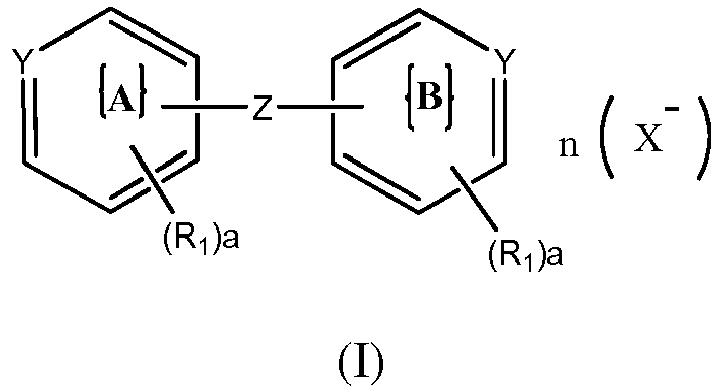
- Z is a pyridinediyl radical or a pyridiniumdiyl radical;
- each Y is independently selected from N or (+N-R2)(X-) with R2 a C1-C18 alkyl or R2 an aryl group;
- each one of R1 is independently selected from H, alkyl, alkoxy, alkylthio, haloalkyl, haloalkoxy, haloalkylthio, polyalkylenoxy, alkoxycarbonyl, aryl, or heteroaryl;
- n is 1, 2, 3 or 4;
- a is 4;
- X- is a counterion;
- Z is not simultaneously bound in position 4 of cycle A and in position 4 of cycle B.
- In the following, the ring nitrogen atom on the central core Z defines position 1.
- In a first embodiment of the present invention, the central core Z of the compound of formula (I) is a pyridinediyl radical. Said pyridinediyl radical may be selected from:
- 2,3-branched pyridinediyl radical;
- 2,4-branched pyridinediyl radical;
- 2,5-branched pyridinediyl radical; or
- 2,6-branched pyridinediyl radical.
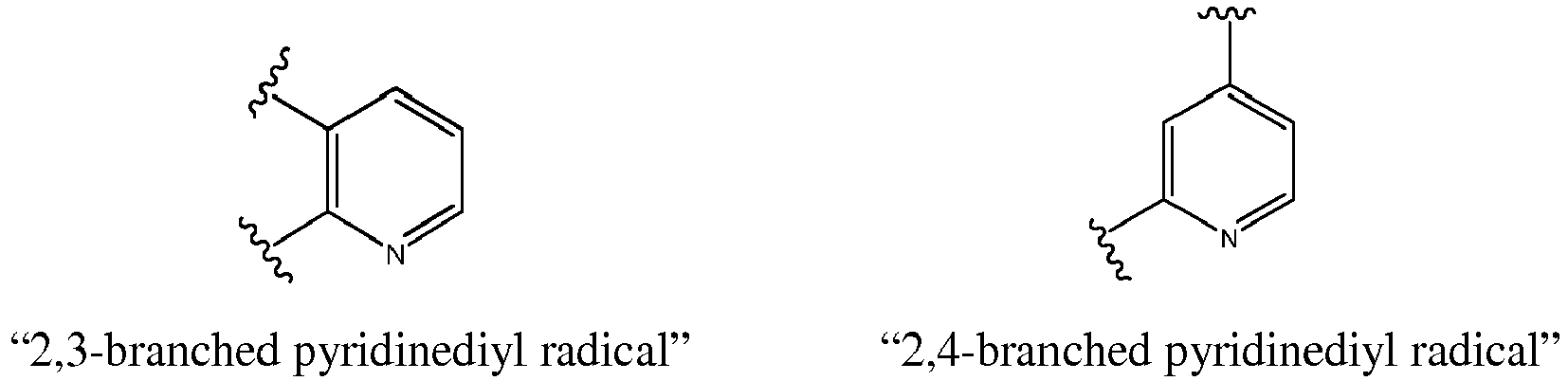
- The terms "2,3-branched pyridinediyl radical", "2,4-branched pyridinediyl radical", "2,5-branched pyridinediyl radical" and "2,6-branched pyridinediyl radical" mean that the two lateral pyridines or pyridiniums (rings or cycles A and B) are branched on the central core (Z) in, respectively, positions 2 and 3, positions 2 and 4, positions 2 and 5 or positions 2 and 6 as represented below (optional substituents or fused systems on the central core are not shown):

- In a second embodiment of the present invention, the central core Z of the compound of formula (I) is a pyridiniumdiyl radical. Said pyridiniumdiyl radical may be selected from:
- 1,2-branched pyridiniumdiyl radical;
- 1,4-branched pyridiniumdiyl radical;
- 2,3-branched N alkylpyridiniumdiyl radical;
- 2,4-branched N-alkylpyridiniumdiyl radical;
- 2,5-branched N-alkylpyridiniumdiyl radical;
- 3,4-branched N-alkylpyridiniumdiyl radical; or
- 3,5-branched N-alkylpyridiniumdiyl radical.
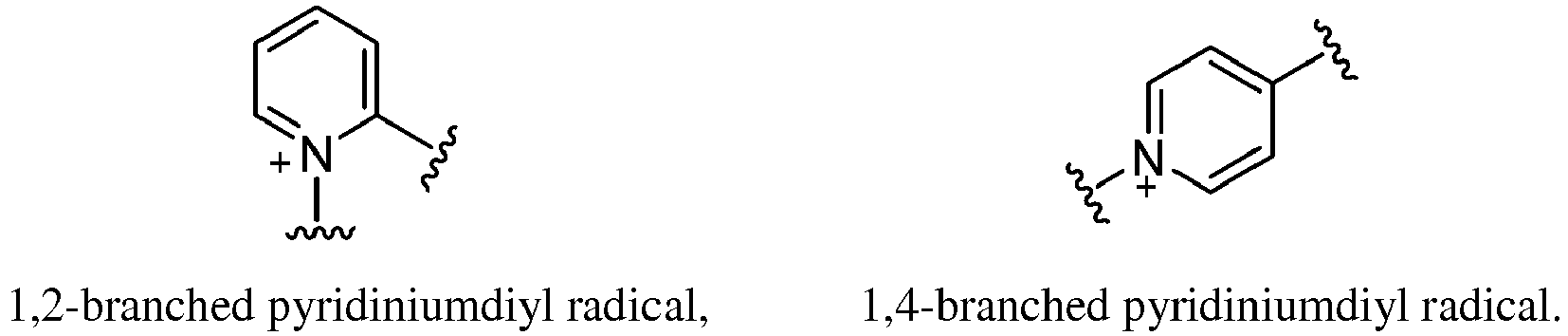
- The terms "1,2-branched pyridiniumdiyl radical" and "1,4-branched pyridiniumyl radical" mean that the two lateral pyridines or pyridiniums (cycles A and B) are branched on the central pyridinium core (Z) in, respectively, positions 1 and 2 or positions 1 and 4 as represented below (optional substituents or fused systems on the central pyridinium core are not shown):
- The terms "2,3-branched N-alkylpyridiniumyl radical", "2,4-branched N-alkylpyridiniumdiyl radical" and "2,5-branched N-alkylpyridiniumdiyl radical" mean that the two lateral pyridines or pyridiniums (cycles A and B) are branched on the central pyridinium core (Z) in, respectively, positions 2 and 3 or positions 2 and 4 or positions 2 and 5 as represented below (R is a alkyl group as defined above and optional substituents or fused systems on the central pyridinium core are not shown):


- The terms "3,4-branched N-alkylpyridiniumdiyl radical" and "3,5 branched N-alkylpyridiniumdiyl radical" mean that the two lateral pyridines or pyridiniums (cycles A and B) are branched on the central pyridinium core (Z) in, respectively, positions 3 and 4 or positions 3 and 5 as represented below (R is a alkyl group as defined above and optional substituents or fused systems on the central pyridinium core are not shown):


- According to this second embodiment of the present invention, said pyridiniumdiyl radical is preferably selected from:
- 1,4-branched pyridiniumdiyl radical;
- 2,3- branched N-alkylpyridiniumdiyl radical; or
- 2,5 branched N-alkylpyridiniumdiyl radical.
- When Z is a 1,4-branched pyridiniumdiyl radical, it is preferably substituted. Preferably, said 1,4-branched pyridiniumdiyl radical is substituted by at least one aryl group. More preferably, said 1,4-branched pyridiniumdiyl radical is substituted by two aryl groups, even more preferably substituted by two methylphenyl (-C6H4CH3) groups.
- When Z is a 2,3-branched N-alkylpyridiniumdiyl radical, it is preferably an unsubstituted N-alkylpyridiniumdiyl radical.
- When Z is a 2,5-branched N-alkylpyridiniumdiyl radical, it is preferably an unsubstituted N-alkylpyridiniumdiyl radical.
- In a third embodiment of the present invention, the central core Z of the compound of formula (I) is as described above and each Y is N or (+N-R2)(X-) with R2 a C1-C8 alkyl or R2 an aryl group. Preferably, Y is N or (+N-R2)(X-) with R2 a methyl, a n- hexyl or a substituted or an unsubstituted phenyl group.
- When both Y are N, n is preferably equal to 1.
- When at least one Y is (+N-R2)(X-) with R2 as defined above, n is preferably equal to 2, 3 or 4.
- In a fourth embodiment of the present invention, Z and Y are as defined above and each one of R1 is independently selected from H, alkyl, and heteroaryl, preferably selected from H, alkyl, pyridinyl group, pyridiniumyl group or N-alkylpyridiniumyl group, preferably selected from H, C1-C8 alkyl and a N-C1-C18 alkylpyridiniumyl group, more preferably selected from H, unsubstituted C1-C3 alkyl, a N-C5-C7 alkylpyridiniumyl group and a N-C1-C2 alkylpyridiniumyl group, even more preferably selected from H, methyl a N-methylpyridiniumyl group and a N-n-hexylpyridiniumyl group.
- The counterion X- may be any anion that maintains electric neutrality of the compounds of formula (I). X- may be selected from halide, preferably fluoride and chloride, tetrafluoroborate, tetraphenylborate, hexafluorophosphate, nitrate, methanesulfonate, trifluoromethanesulfonate, toluenesulfonate, hexachloroantimonate, bis(trifluoromethanesulfonyl)imide, perchlorate, acetate and sulfate. Preferably, X- is tetrafluoroborate.
- Electrochromic compounds according to the invention are preferably well soluble in a solvent medium. Hence, electrochromic compounds preferably do not contain functional groups limiting solubility. In particular electrochromic compounds preferably do not contain a sulfonate group, a phosphonate group, a phosphate group, a phosphoric acid group, a trichlorosilyl group, a trialkoxysilyl group, a monochlorosilyl group, and a monoalkoxysilyl group.
- In a fifth embodiment of the present invention, the electrochromic compounds are represented by formula (II):

- In a sixth embodiment of the present invention, the electrochromic compounds are represented by formula (III):

- In a particularly preferred embodiment of the present invention, the compounds of the present invention are selected from the group consisting of:
Compound Structure II-1 
II-2 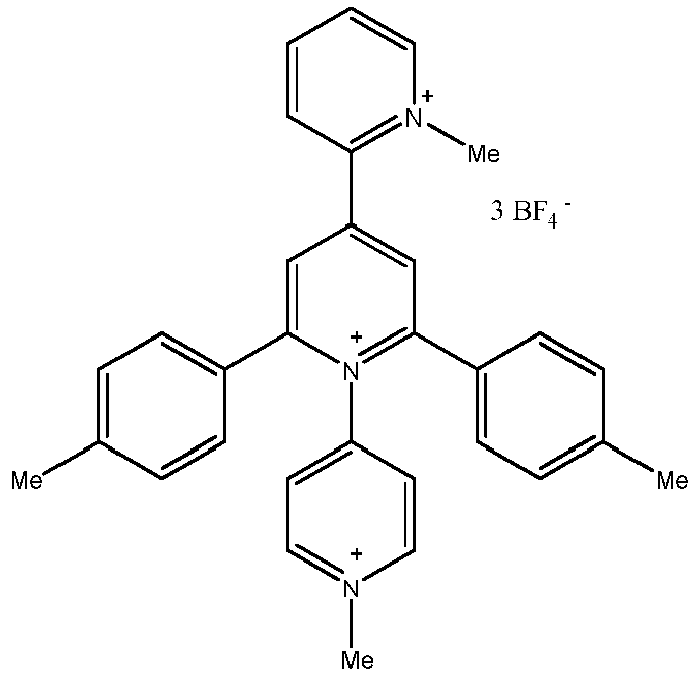
II-3 
II-4 
III-1 
III-2 
III-3 
III-4 
III-5 
- Compounds of the present invention may be prepared according to various methods well known in the art.
- Compounds having a pyridinium radical central core may be obtained by reacting the key intermediates, the pyrylogens Aa-Ac with 2-aminopyridine or 4-aminopyridine and their derivatives, according to the synthetic routes detailed in scheme 1. The pyrylogens A may be obtained by standard literature procedures that are known to those in the field (E. L. Clennan, C. Liao and E. Ayokosk, J. Am. Chem. Soc., 2008,130, 7552).

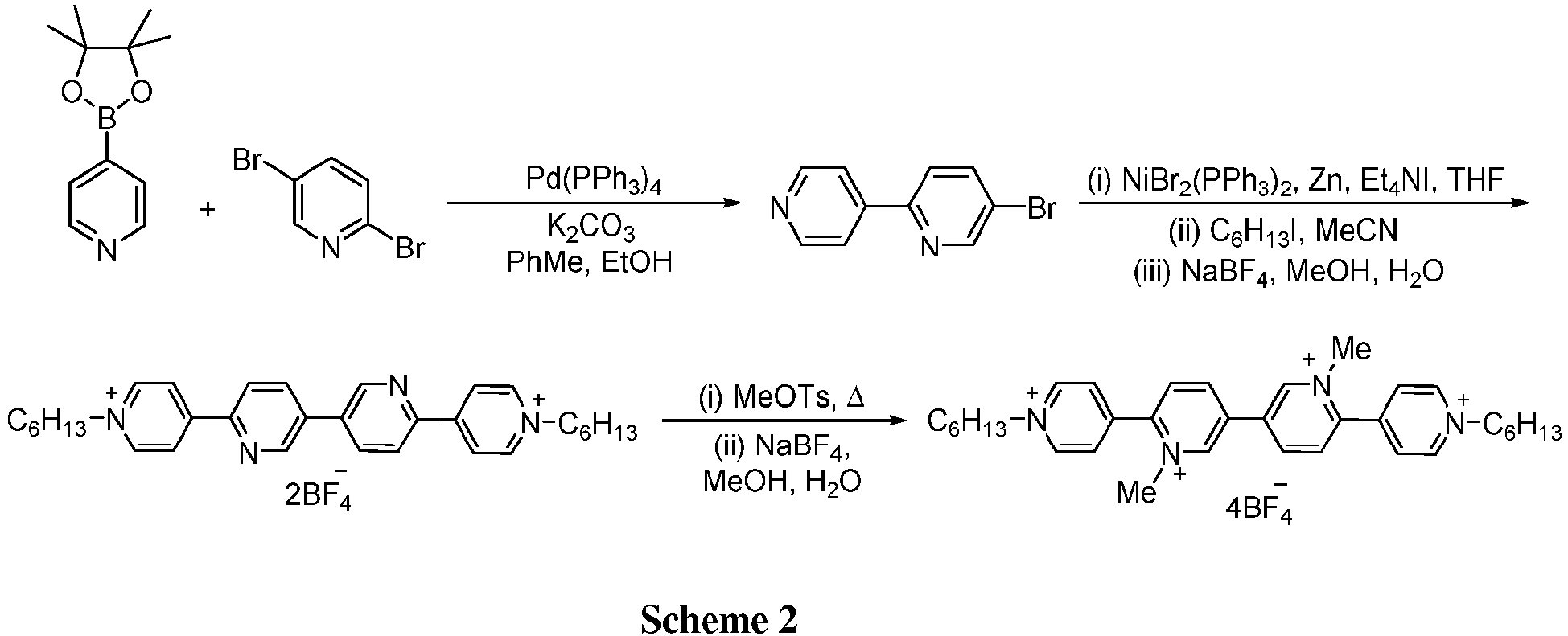
- Compounds containing a quaterpyridine core may be obtained by the sequences shown in schemes 2-4. Thus the synthesis of the 4,2:5',3":6",4"'-quaterpyridine-1,1',1",1"'-tetraium species involved initial Suzuki-Miyaura coupling of 4-(4,4,5,5-tetramethyl-1,3,2-dioxaborolan-2-yl)pyridine with 2,5-dibromopyridine to give 5-bromo-2,4'-bipyridine (J. Sopkova-de Olivera Santos, A. S. Voisin-Chiret, G. Burzicki, L. Sebaoun, M. Sebban, J.-F. Lohier, R. Legay, H. Oulyadi, R. Bureau and S. Rault, J. Chem. Inf. Model., 2012, 52, 429) which was subjected to Ni-catalysed homocoupling (M. Tiecco, L. Testaferri, M. Tingoli, D. Chianelli and M. Montanucci, Synthesis, 1984, 736; M. Iyoda, H. Otsuka, K. Sato, N. Nisato and M. Oda, Bull. Chem. Soc. Jpn., 1990, 63, 80) followed by sequential alkylation of 4,2:5',3":6",4"'-quaterpyridine as shown in scheme 2.
- Suzuki-Miyaura coupling of 4-(4,4,5,5-tetramethyl-1,3,2-dioxaborolan-2-yl)pyridine to 2,3-dibromopyridine provided 3-bromo-2,4'-bipyridine that was converted by the standard procedures into the 4,2':3',3":2",4"'-quaterpyridine-1,1',1",1"'-tetraium salt (scheme 3).

- 5-Bromo-2-iodopyridine was subjected to a Stille-Kelly coupling with hexa-n-butylditin to provide 5,5'-dibromo-2,2'-bipyridine (J. I. Bruce, J.-C. Chambron, P. Kolle and J.-P. Sauvage, J. Chem. Soc., Perkin Trans. 1, 2002, 1226; X.-L. Bai, X.-D. Liu, C.-Q. Kang and L.-X. Gao, Synthesis, 2005, 458.). A subsequent Suzuki-Miyaura coupling provided 4,3':6',2":5",4"'-quaterpyridine that was converted to the tetra(N-alkyl) derivative in the usual manner (scheme 4).

- The present invention also relates to electrochromic compositions comprising at least one compound of formula (I), (II) or (III) as defined above as an oxidizing electrochromic compound. One or more additional oxidizing electrochromic compounds can be added to the composition of the invention so as to adapt the colour or the intensity of the coloured state of the composition. Said additional compound can be another compound of formula (I), (II) or (III) or a different compound such as compatible dyes or pigments. For example, the additional oxidizing electrochromic compound can be selected from alkylviologens, arylviologens, alkylarylviologens or anthraquinone and derivatives. Preferably, the additional compound has a redox potential close to the compound of formula (I), (II) or (III). Non limiting examples of additional oxidizing electrochromic compounds include the compounds described in applications
WO 2015/040033 andWO 2015/040031 . - The composition may also comprise at least one reducing compound. The reducing compound may also be an electrochromic compound. Example of reducing compounds include 5,10-dihydrophenazine, phenothiazine, phenoxazine, N,N,N',N'-tetramethyl-p-phenylenediamine, thioanthrene, tetrathiafulvalene, ferrocene and their derivatives.
- The composition of the invention may comprise a host medium that may be a fluid, a mesomorphous medium or a gel. The host medium is introduced in the composition of the invention to dissolve the electrochromic compounds so as to form a solution of the electrochromic compounds. The host medium is preferably selected from the group consisting of organic solvents, liquid crystals, polymers, liquid crystal polymers and mixtures thereof.
- Electrochromic compounds according to the invention are preferably well soluble in solvent medium. Hence, electrochromic compounds preferably do not contain functional groups limiting solubility. In particular electrochromic compounds preferably do not contain a sulfonate group, a phosphonate group, a phosphate group, a phosphoric acid group, a trichlorosilyl group, a trialkoxysilyl group, a monochlorosilyl group, and a monoalkoxysilyl group.
- Examples of suitable organic solvents that can be used as host medium are redox-compatible solvents which cannot react with the electrochromic compounds of the composition, such as ethylene carbonate, propylene carbonate, γ-butyrolactone, γ-valerolactone, acetronitrile, propionitrile, benzonitrile, glutaronitrile, methylglutaronitrile, dimethylformamide, N-methylpyrrolidone, sulfolane, 3-methyl sulfolane, benzene, toluene, methyl ethyl ketone, acetone, ethanol, tetrahydrofurfuryl alcohol, 2-methoxyethyl ether, xylene, cyclohexane, 3-methylcyclohexanone, ethyl acetate, ethyl phenylacetate, tetrahydrofuran, methanol, methyl propionate, ethylene glycol, ethylene carbonate, ionic liquids, and mixtures thereof. Preference is given to carbonates and particularly propylene carbonate.
- Examples of suitable liquid crystals that can be used as host medium are nematic or chiral nematic media.
- Examples of suitable polymers that can be used as host medium are polymers which are soluble with the solvent, in particular PMMA or other acrylate polymers, polyurethane, polyethylene oxide, polypropylene oxide, polyvinyl acetate, poly(N-vinyl pyrrolidone), and polyvinylidene fluoride.
- Examples of suitable liquid crystal polymers that may be used as host medium are Merck RM257 (Merck), LC242 (BASF) or SLM 90519 (Wacker). These liquid crystal polymers are generally used in combination with an organic solvent, for example one of the organic solvents mentioned above.
- The present invention also relates to an electrochromic device comprising a compound of formula (I), (II) or (III) as defined above or a composition according to the invention. Said device may be selected from an optical article, preferably an optical lens, or an optical filter, a window, preferably an aircraft window, a visor, a mirror, a head mounted device and a display, in particular a segmented or matrix display. Preferably, the device of the invention is an optical article, more preferably an optical lens, and even more preferably an ophthalmic lens.
- Non limiting examples of head mounted devices include immersive and non-immersive devices, in particular see-through devices and see-around devices. Head mounted devices may be either augmented reality devices or virtual reality devices.
- Non-limiting examples of ophthalmic lenses include corrective and non-corrective lenses, including single vision or multi-vision lenses, which may be either segmented or non-segmented, as well as other elements used to correct, protect, or enhance vision, including without limitation contact lenses, intra-ocular lenses, magnifying lenses and protective lenses or visors. Non-limiting examples of display elements and devices include screens and monitors. Non-limiting examples of windows include automotive, marine and aircraft windows, filters, shutters, and optical switches.
- Preferably, the device of the invention comprises a mechanism for holding the compound or composition of the invention in a mechanically stable environment. More preferably, said device may comprise a pair of opposed substrates having a gap there between for receiving the mixture of the host medium and said compound or said composition of the present invention, and a frame for holding said pair of substrates adjacent one another.
- The device of the present invention may thus comprise an optical component provided with at least one transparent cell arrangement juxtaposed in a parallel direction to the surface thereof, as disclosed in
WO 2006/013250 , each cell being tightly closed and containing at least one compound or composition of the present invention. - Other devices according to the invention can be devices as described in
FR 2937154 FR2950710 - This invention will be further illustrated by the following non-limiting examples which are given for illustrative purposes only and should not restrict the scope of the appended claims.
-

- Ground NaOH (11.22 g, 200.5 mmol) was added portionwise to a mixture of 4'-methylacetophenone (37.6 g, 280 mmol) and pyridine-4-carboxaldehyde (15 g, 140 mmol) with grinding. The solid mass was suspended in hot EtOH/water (300 mL) with stirring. The resulting suspension was cooled and the solid collected by filtration and washed with water (50 mL). The solid was crystallised from hot EtOH, collected by filtration and washed with EtOH to give 3-(pyridin-4-yl)-1,5-di-p-tolylpentane-1,5-dione (28.46 g, 56 %) as colourless needles.
- Boron trifluoride etherate (48 mL) was added dropwise to a hot stirred solution of 3-(pyridin-4-yl)-1,5-di-p-tolylpentane-1,5-dione (12 g, 33.6 mmol) and trans-chalcone (7.27 g, 34.9 mmol) in AcOH under N2. The resulting solution was heated at reflux for 6 h. The cooled solution was diluted with Et2O (500 mL) and the solid collected by filtration and washed with Et2O (2 x 100 mL) and air dried to give the 4-(pyridin-4-yl)-2,6-di-p-tolylpyrylium bis(tetrafluoroborate) (13.80 g, 80 %) as an orange powder which was used directly in the next step.
- A solution of 4-(pyridin-4-yl)-2,6-di-p-tolylpyrylium bis(tetrafluoroborate) (3 g, 5.8 mmol), 4-methylpyridin-2-amine (0.76 g, 7 mmol), NaOAc (1.92 g, 23.4 mmol) in propan-2-ol (45 mL) was heated at reflux for 16 h, cooled and water (200 mL) added. The aqueous propan-2-ol was decanted from the mixture, diluted with water (1.5 L) and filtered through celite. The foregoing celite was suspended in MeOH (50 mL), diluted with water (1.5 L) and filtered through celite. The aqueous propan-2-ol and the aqueous methanol phases were combined and evaporated under reduced pressure. The resulting residue was dissolved in MeOH (20 mL) and added dropwise to water at 0 °C with stirring. The resulting precipitate was collected by filtration, washed with water (10 mL) and air dried to give the 4-methyl-2',6'-di-p-tolyl-[2,1':4',4"-terpyridin]-1'-ium tetrafluoroborate (2.21 g, 73 %) as a yellow powder. 1H NMR 400 MHz (CD3OD) δ 8.87 (2H, d, J = 6.2 Hz), 8.60 (2H, s), 8.21 (1H, d, J = 5.1 Hz), 8.15 (2H, d, J = 6.2 Hz), 7.42 - 7.30 (5H, m), 7.26 - 7.16 (5H, m), 2.34 (6H, s) and 2.21 (3H, s); 13C NMR 100 MHz (CD3OD) δ 157.22, 154.86, 151.51, 150.34, 148.14, 142.46, 141.26, 129.55, 129.47, 128.83, 126.44, 126.39, 124.72, 122.62, 19.90 and 19.24.
-

- Sodium hydroxide (2 g, 50 mmol) in water (20 mL) was added to a stirred solution of pyridine-2-carboxaldehyde (5.4 g, 50.4 mmol) and 4'-methylacetophenone (13.4 g, 111 mmol) in EtOH (50 mL). The solution was stirred for 3 h, poured into water (100 mL) and the resulting precipitate collected by filtration and washed with water (100 mL). Crystallisation from EtOH (30 mL), gave the 3-(pyridin-2-yl)-1,5-di-p-tolylpentane-1,5-dione (6.95 g, 39 %) as a cream powder.
- BF3.Et2O (32 mL) was added dropwise to a refluxing solution of 3-(pyridin-2-yl)-1,5-di-p-tolylpentane-1,5-dione (6.87 g, 19.2 mmol) and trans-chalcone (4.53 g, 21.8 mmol) in AcOH (14 mL). Upon completion of the addition heating was continued for 6 h. The cooled mixture was diluted with Et2O (200 mL) and the solid collected by filtration and washed with Et2O (2 x 100 mL) and air dried. The foregoing solid was crystallised from AcOH (30 mL), collected by vacuum filtration and washed with Et2O (2 x 50 mL) and air dried to give the 2-(2,6-di-p-tolylpyrylium-4-yl)pyridin-1-ium bis(tetrafluoroborate) (1.31 g, 68 %) as a red powder which was used directly in the next step.
- A solution of 2-(2,6-di-p-tolylpyrylium-4-yl)pyridin-1-ium bis(tetrafluoroborate) (1.30 g, 2.7 mmol), 4-aminopyridine (0.30 g, 3.2 mmol), NaOAc (0.88 g, 10.7 mmol) in propan-2-ol (25 mL) was heated at reflux for 16 h. The mixture was cooled to 60 °C and water (50 mL) was added. The resulting suspension was filtered through celite and the volume of the filtrate reduced. The resulting precipitate was collected by filtration, washed with water (2 x 10 mL) and air dried to give the 2',6'-di-p-tolyl-[2,4':1',4"-terpyridin]-1'-ium tetrafluoroborate (0.67 g, 50 %) as a pale yellow powder.
- A mixture of 2',6'-di-p-tolyl-[2,4':1',4"-terpyridin]-1'-ium tetrafluoroborate (1.61 g, 3.2 mmol) and Me3OBF4 (1.14 g, 7.7 mmol) in DCM (20 mL) was stirred under N2 for 3 days. The mixture was then diluted with MeOH (20 mL) and filtered. The filtrate was thrice triturated with hot MeOH (20 mL) and the solid collected by filtration and air dried to give the 1,1 "-dimethyl-2',6'-di-p-tolyl-[2,4': 1',4"-terpyridine]-1,1', 1"-triium tris(tetrafluoroborate) (1.45 g, 64 %) as a pale yellow powder. 1H NMR 400 MHz (d6-AcMe) δ 9.43 (1H, bd, J = 5.8 Hz), 9.23 (2H, bd, J = 5.2 Hz), 9.06 - 8.94 (1H, m), 8.71 (1H, bd, J = 1.9 Hz), 8.60 - 8.37 (4H, bm), 7.54 (4H, bd, J = 7.0 Hz), 7.27 (4H, bd, J = 7.0 Hz), 4.66 (3H, s), 4.58 (3H, s) and 2.34 (6H, s); 19F NMR 376 MHz (d6-AcMe) δ -151.11; 13C NMR 100 MHz (d6-AcMe) δ 157.56, 156.90, 152.61, 150.74, 149.02, 148.37, 147.72, 146.62, 142.08, 130.37, 130.29, 129.62, 129.36, 128.40, 128.28, 49.22, 47.96 and 20.52.
-

- Aqueous HI (57 %) was added to 2,5-dibromopyridine (12.60 g, 53.2 mmol) and NaI (11.40 g, 76 mmol). The resulting mixture was heated at reflux for 24 h, cooled and then diluted with water (100 mL). The resulting mixture was basified with NaHCO3 and treated with Na2S2O4 until colourless. The mixture was extracted with DCM (5 x 60 mL) and the dried (Na2SO4) solvent removed under reduced pressure. The residue was collected by filtration and washed with Et2O (60 mL) and air dried to give the 5-bromo-2-iodopyridine (8.28 g, 55 %) as a light grey powder.
- 5-Bromo-2-iodopyridine (6.60 g, 23.2 mmol) and Pd(PPh3)4 (0.72 g, 0.6 mmol) were dissolved in anhydrous PhMe (120 mL) under N2. Hexa-n-butylditin (7.25 g, 12.5 mmol) was added and the solution heated at reflux for 3 days. The mixture was filtered through celite and the solvent removed. The residue was chromatographed on silica using a DCM to EtOAc gradient. The resulting residue was crystallised from EtOAc/hexanes to give the 5,5'-dibromo-2,2'-bipyridine (1.22 g, 33 %) as a pale yellow powder. The crystallisation liquors were evaporated under reduced pressure and the residue dissolved in DCM, hexanes were added and the volume of solvent reduced. The resulting precipitate was collected by filtration and air dried to give a second crop of the product (0.46 g, 13 %) as a cream powder.
- A mixture of 4-(4,4,5,5-tetramethyl-1,3,2-dioxaborolan-2-yl)pyridine (2.38 g, 11.6 mmol), 5,5'-dibromo-2,2'-bipyridine (1.46 g, 4.6 mmol), K2CO3 (1.6 g, 11.6 mmol) and Pd(PPh3)4 (0.27 g, 5 mol%) in degassed EtOH (40 mL) and PhMe (40 mL) under N2 was heated at reflux for 48 h. The mixture was cooled, diluted with water (200 mL) and poured into DCM (1.5 L) containing MeOH (150 mL) and filtered through celite. The foregoing celite was extracted with DCM (800 mL) and MeOH (100 mL) and the combined DCM and MeOH extracts were filtered through celite. The extraction/filtration sequence was repeated 3 further times. The organic phases were combined and filtered through celite once more whereupon the solvent was removed under reduced pressure and the residue triturated with hot acetone (100 mL). The triturated solid was collected by filtration and air dried to give the 4,3':6',2":5",4"'-quaterpyridine (1.18 g, 82 %) as a light tan powder. The liquors were cooled and the precipitated solid collected by filtration to give a second crop of the product (0.15 g, 10 %) as a pale pink powder.
- A solution of 4,3':6',2":5",4"'-quaterpyridine (0.60 g, 1.9 mmol) and 1-iodohexane (2.46 g, 11.6 mmol) in MeCN (50 mL) in the dark under N2 was heated at reflux for 24 h. Upon cooling the solid was collected by filtration and washed with Et2O (3 x 50 mL) and air dried to give the 1,1"'-dihexyl-[4,3':6',2":5",4"'-quaterpyridinel-1,1"'-diium diiodide (1.05 g, 74 %) as a sandy powder. The liquors were diluted with Et2O (30 mL) and the precipitated solid collected by filtration and washed with Et2O (2 × 30 mL) and air dried to give a second crop of the product (0.11 g, 8 %).
- A filtered solution of 1,1"'-dihexyl-[4,3':6',2":5",4"'-quaterpyridine]-1,1"'-diium diiodide (1.00 g, 1.36 mmol) in hot MeOH (100 mL) was added dropwise to a solution of NaBF4 (12 g, 109 mmol) in water (200 mL) with stirring. Stirring was continued for 0.5 h, then the resulting precipitate was collected by filtration and washed with water (2 × 10 mL). The foregoing solid was dissolved in hot MeOH (150 mL) and added dropwise to a solution of NaBF4 (12 g, 109 mmol) in water (250 mL) with stirring. Stirring was continued for 0.5 h and then the resulting precipitate was collected by filtration, washed with water (2 × 10 mL) and air dried to give the 1,1"'-dihexyl-[4,3':6',2":5",4"'-quaterpyridine]-1,1"'-diium bis(tetrafluoroborate) (0.76 g, 85 %) as a tan powder which was used directly in the subsequent step.
- A mixture of 1,1"'-dihexyl-[4,3':6',2":5",4"'-quaterpyridine]-1,1"'-diium bis(tetrafluoroborate) (0.56 g, 0.86 mmol) in methyl tosylate (3.18 g) was heated at 180 °C for 2.5 h. The cooled reaction mixture was triturated with Et2O (40 mL) and the solid collected by filtration and washed with Et2O (3 × 40 mL) and air dried. The foregoing solid was dissolved in methyl tosylate (1.71 g) and heated at 180 °C for 1 h. The cooled mixture was triturated with Et2O (4 × 30 mL), collected by filtration and air dried. The resulting gummy solid was dissolved in MeOH/water (25 mL, 1/4) and added dropwise to a solution of NaBF4 (3.38 g, 30.7 mmol) in water (50 mL) with stirring. Stirring was continued for 0.5 h and the resulting precipitate was collected by filtration, washed with water (2 x 5 mL) and air dried. This solid was triturated with hot MeOH (8 mL) and the resulting solid collected by filtration and washed with cold MeOH (2 mL) to give the 1,1"'-dihexyl-1',1"-dimethyl-[4,3':6',2":5",4'"-quaterpyridine]-1,1',1",1'"-tetraium tetrakis(tetrafluoroborate) (0.38 g, 51 %) as a cream powder. 1H NMR 400 MHz (CD3OD/D2O) δ 10.04 - 9.87 (2H, bs), 9.32 (2H, d, J = 7.7 Hz), 9.13 (4H, d, J = 6.3 Hz), 8.72 - 8.48 (6H, m), 4.70 - 4.54 (4H, m), 2.11 - 1.93 (4H, m), 1.50 - 1.17 (12H, m) and 0.82 (6H, t, J = 6.7 Hz); 19F NMR 376 MHz (CD3OD/D2O) δ -150.99.
-

- To a mixture of 2,5-dibromopyridine (5.92 g, 25 mmol), 4-(4,4,5,5-tetramethyl-1,3,2-dioxaborolan-2-yl)pyridine (5.13 g, 25 mmol), Pd(PPh3)4 (1.01 g, 0.88 mmol, 3.5 mol%), and K2CO3 (3.46 g, 25 mmol) under nitrogen was added degassed EtOH/PhMe (120 mL), and heated to reflux for 22 hours. The mixture was cooled, diluted with water (150 mL) and extracted with DCM (3 × 100 mL), dried with sodium sulfate and the solvent removed to give a tan solid. Purification by flash chromatography (5% MeOH/EtOAc), followed by recrystallisation from PhMe/hexane gave a low-density cream solid (2.78 g, 47.3%).
- To a mixture of Pd(PPh3)4 (0.24 g, 0.21 mmol, 2.5 mol%) and 5-bromo-2,4'-bipyridine (1.97 g, 8.3 mmol) under nitrogen was added anhydrous THF (4.5 mL) and the slurry stirred for 0.5 h, after which 2-pyridylzinc bromide (25 mL, 12.5 mmol, 0.5 M in THF) was added slowly and heated to 65 °C for 3 hours. The mixture was cooled and HCl (15 mL, 2 M) added, made basic with NaOH (2.5 g in 25 mL) and a white precipitate observed. The forgoing mixture was then partitioned with Et2O (3 × 300 mL) and DCM (3 × 50 mL), the aqueous made basic and extracted with DCM (1 × 50 mL ), dried with sodium sulfate, and the solvent removed in vacuo to give a brown solid. Purification by flash chromatography (1% MeOH/EtOAc) gave a cream powder.
- A mixture of 2,3':6',4"-terpyridine (0.75 g, 3.22 mmol) and methyl tosylate (12.1 mL, 14.97 g, 80 mmol) under nitrogen was stirred at 180 °C for 4 hours, cooled, diethyl ether added and the precipitate collected by vacuum filtration, and washed with diethyl ether to give a grey solid (2.34 g, 91.8%).
- From 1,1',1"-trimethyl-[2,3':6',4"-terpyridine]-1,1',1"-triium 4-methylbenzenesulfonate (2.20 g, 2.78 mmol), in a minimal amount of warm MeOH, and NaBF4 (4.58 g, 41.7 mmol, 15.0 equiv.) in water (150 mL). Stirred for 0.5 h, NaBF4 (15.0 equiv.) added, the solvent reduced in vacuo, the solution filtered through celite, NaBF4 (15.0 equiv.) added and cooled to 4 °C for 16 h. The resulting precipitate was collected, and washed with a small amount of cold water to yield off-white crystals (0.86 g, 57.3%). mp: 300+ °C. δH (400 MHz DMSO-d 6) 9.61 (1H, s, Ar-H6), 9.36 (2H, d, J = 6.4, Ar-H2',6'), 9.31 (1H, d, J = 6.0 Hz, Ar-H6"), 9.10 (1H, d, J = 1.2, 8.3 Hz, Ar-H4), 8.86 (1H, app. t, Ar-H4" ), 8.51 (1H, d, J = 8.3 Hz, Ar-H3), 8.46 (2H, d, J = 6.3 Hz, Ar-H3', 5'), 8.39 (1H, app. t, Ar-H5"), 8.20 (1H, d, J = 7.6 Hz, Ar-H3"), 4.52 (3H, s, N-CH3), 4.26 (6H, s, N',N"-CH3).
-
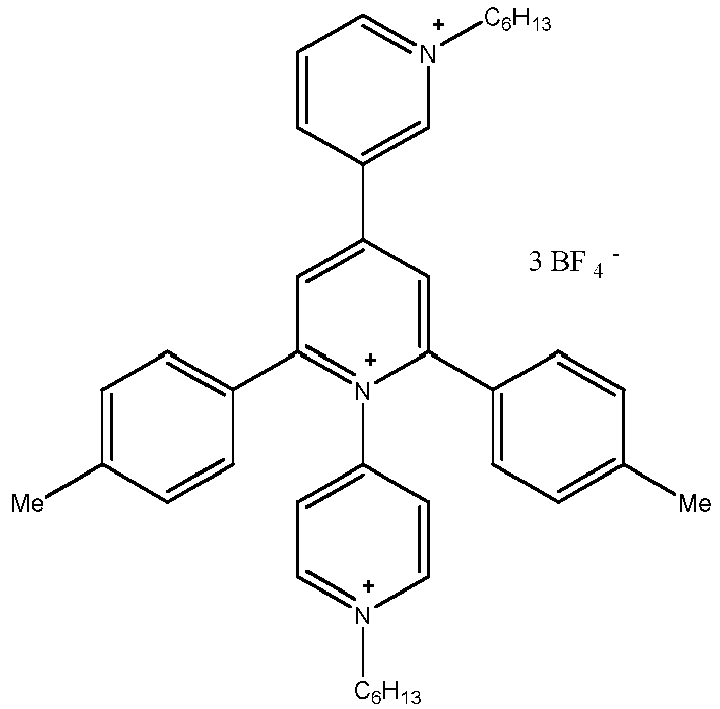
- A mixture of pyridine-3-carboxaldehyde (5 g, 46.7 mmol) and 4'-methylacetophenone (12.52 g, 93.4 mmol) was added to ground NaOH (3.74 g, 93.5 mmol) in a pestle and mortar. Grinding was continued for 10 min and then the resulting mass was dissolved in hot EtOH (500 mL) and water (500 mL) was added. The mixture was cooled with stirring and the resulting precipitate was collected by filtration, washed with EtOH/water (50 mL, 1/1) and air dried to give the 3-(pyridin-3-yl)-1,5-di-p-tolylpentane-1,5-dione (12.38 g, 74 %) as a colourless powder which was used without further purification.
- BF3.Et2O (28 mL, 198 mmol) was added dropwise to a hot solution of 3-(pyridin-3-yl)-1,5-di-p-tolylpentane-1,5-dione (6 g, 16.8 mmol) and trans-chalcone (3.96 g, 19 mmol) in hot AcOH (13 mL) with stirring. The resulting solution was heated at reflux for 5 h and then cooled, diluted with Et2O (400 mL) and the solid collected by filtration. The foregoing solid was crystallised from hot AcOH (40 mL), collected by filtration and then washed with AcOH (30 mL) then Et2O (4 × 50 mL) and air dried to give the 3-(2,6-di-p-tolylpyrylium-4-yl)pyridin-1-ium bis(tetrafluoroborate) (5.38 g, 62 %) as orange prisms which were used directly in the next step.
- A solution of 3-(2,6-di-p-tolylpyrylium-4-yl)pyridin-1-ium bis(tetrafluoroborate) (2.00 g, 3.9 mmol), 4-aminopyridine (0.44 g, 4.7 mmol), NaOAc (1.28 g, 15.6 mmol) in propan-2-ol (40 mL) was heated at reflux for 16 h. The cooled reaction mixture was diluted with water (1.5 L) and filtered through celite. The residue obtained after removal of the aqueous propan-2-ol was dissolved in MeOH (10 mL) and added dropwise to a solution of NaBF4 (2.57 g, 23.4 mmol) in water (200 mL) with stirring. Stirring was continued for 0.5 h and then the precipitate was collected by filtration, washed with water (2 × 10 mL) and air dried to give the 2',6'-di-p-tolyl-[3,4':1',4"-terpyridin]-1'-ium tetrafluoroborate (1.51 g, 77 %) as a pale yellow powder.
- A solution of 2',6'-di-p-tolyl-[3,4':1',4"-terpyridin]-1'-ium tetrafluoroborate (1.00 g, 2 mmol) and 1-iodohexane (5.06 g, 23.8 mmol) in MeCN (50 mL) under N2 was heated at reflux in the dark for 5 days. The residue obtained upon removal of the cooled solvent was triturated with Et2O (3 × 50 mL), collected by filtration and air dried to give the 1,1"-dihexyl-2',6'-di-p-tolyl-[3,4':1',4"-terpyridine]-1,1',1"-triium tetrafluoroborate diiodide (1.83 g, 100 %) as an ochre powder.
- A solution of 1,1"-dihexyl-2',6'-di-p-tolyl-[3,4':1',4"-terpyridine]-1,1',1"-triium tetrafluoroborate diiodide (1.50 g, 1.6 mmol) in MeOH (15 mL) was added dropwise to a solution of NaBF4 (4.30 g, 39 mmol) in water (250 mL) with stirring. The volume of the solvent was reduced and the remaining solvent decanted from the residue. The foregoing residue was dissolved in MeOH (40 mL) and added dropwise to NaBF4 (8.60 g, 78 mmol) in ice cold water (500 mL) with rapid stirring. The resulting precipitate was collected by filtration (maintaining ice cold temperature), washed with ice cold water (2 × 20 mL) and dried, cold, under vacuum to give the 1,1"-dihexyl-2',6'-di-p-tolyl-[3,4':1',4"-terpyridine]-1,1',1"-triium tris(tetrafluoroborate) (0.59 g, 43 %) as a yellow powder. 1H NMR 400 MHz (CD3OD) δ 9.77 (1H, s), 9.31- 9.16 (2H, m), 9.14 (2H, d, J = 6.3 Hz), 8.81 (2H, s), 8.40 - 8.29 (2H, m), 8.23 (2H, d J = 6.3 Hz), 7.46 (4H, d, J = 7.9 Hz), 7.28 (4H, d, J = 7.9 Hz), 4.76 (2H, t, J = 7.6 Hz), 4.58 (2H, t, J = 6.8 Hz), 2.35 (6H, s), 2.21 - 2.03 (2H, m), 1.95 - 1.76 (2H, m), 1.57 - 1.21 (10H, m), 1.17 - 1.02 (2H, m) and 1.00 - 0.81 (6H, m); 19F NMR 376 MHz (CD3OD) δ -153.35; 13C NMR 100 MHz (CD3OD) δ 157.00, 152.75, 152.10, 146.97, 146.29, 145.05, 144.96, 142.40, 135.06, 130.14, 129.55, 128.54, 128.45, 128.28, 127.75, 62.58, 62.51, 31.03, 30.90, 30.71, 30.60, 25.53, 24.91, 22.07, 22.06, 20.04, 12.91, 12.88.
-

- A mixture of 4-(4,4,5,5-tetramethyl-1,3,2-dioxaborolan-2-yl)pyridine (3.89 g, 19 mmol), 2,5-dibromopyridine (5 g, 21.1 mmol), K2CO3 (2.88 g, 20.1 mmol) and Pd(PPh3)4 (0.49 g, 2 mol%) in degassed EtOH (40 mL) and PhMe (40 mL) under N2 was heated at reflux for 16 h. The cooled solution was poured into water (200 mL), extracted with DCM (3 × 100 mL) and the combined organic phases dried (Na2SO4) and the solvent removed under reduced pressure. The residue was chromatographed on silica using MeOH (1 % in EtOAc) as eluent. The solvent was removed under reduced pressure to give the 5-bromo-2,4'-bipyridine (3.54 g, 79 %) as an off white solid.
- Under N2, a mixture of NiBr2(PPh3)2 (3.03 g, 4.1 mmol, 30 mol%), Zn dust (1.32 g, 20.3 mmol) and Et4NI (3.49 g, 13.6 mmol) in THF (30 mL) was stirred for 0.5 h. A solution of 5-bromo-2,4'-bipyridine (3.19 g, 13.6 mmol) in THF (25 mL) was added and the mixture heated at 60 °C for 24 h. The cooled mixture was diluted with water (200 mL) and EtOAc (100 mL), filtered and the residue washed with EtOAc (50 mL). The residue was stirred with aq. ammonia (200 mL), extracted with DCM (5 × 200 mL), dried (Na2SO4) and the solvent removed under reduced pressure. The resulting residue was suspended in hot DCM (30 mL) and hexane (30 mL) was added. The mixture was cooled and the solid collected by filtration. The foregoing solid was dissolved in DCM (300 mL), washed with NaOH (2 M, 100 mL), dried (Na2SO4) and the solvent reduced and hexane added. The resulting precipitate was collected by filtration and washed with hexanes and air dried to give the 4,2':5',3":6",4"'-quaterpyridine (1.47 g, 70 %) as a pale yellow powder.
- A solution of 4,2':5',3":6",4"'-quaterpyridine (0.89 g, 2.9 mmol) and 1-iodohexane (3.65 g, 17.2 mmol) in MeCN (50 mL) was heated at reflux for 24 h. The solid produced was collected by filtration and washed with Et2O (3 x 30 mL) and air dried to give the 1,1"'-dihexyl-[4,2':5',3":6",4'"-quaterpyridine]-1,1"-diium diiodide (1.68 g, 80 %) as an orange powder. The filtration liquors were diluted with Et2O (100 mL) and filtered to give a second crop of the product (0.41 g, 19 %) as a light orange powder after washing with Et2O (2 × 30 mL).
- A solution of 1,1"'-dihexyl-[4,2':5',3":6",4"'-quaterpyridine]-1,1"'-diium diiodide (1.61 g, 2.2 mmol) in warm MeOH/water (25 mL, 5/2) was added dropwise to NaBF4 in water (200 mL) with stirring. Stirring was continued for 0.5 h and the mixture warmed to ensure dissolution of any solid. The solid which precipitated upon cooling was collected by filtration and washed with water (2 × 5 mL) and air dried to give the 1,1"'-dihexyl-[4,2':5',3":6",4"'-quaterpyridine]-1,1"'-diium bis(tetrafluoroborate) (1.31 g, 92 %) as a yellow powder.
- A solution of 1,1"'-dihexyl-[4,2':5',3":6",4"'-quaterpyridine]-1,1"'-diium bis(tetrafluoroborate) (0.94 g, 1.4 mmol) in methyl tosylate (3.21 g, 17.3 mmol) was heated at 180 °C for 1 h. The solid resulting from the cooled mixture was triturated with Et2O (3 × 30 mL) and collected by filtration to afford a cream powder (1.47 g). The foregoing solid was dissolved in warm MeOH (20 mL) and added dropwise to NaBF4 (3.79 g, 34.4 mmol) in water (100 mL) with stirring. Stirring was continued for 0.5 h and the resulting precipitate was collected by filtration. Trituration of the precipitate with hot MeOH (20 mL), followed by cooling and filtration gave the 1,1"'-dihexyl-1',1"-dimethyl-[4,2':5',3":6",4"'-quaterpyridine]-1,1',1",1"'-tetraium tetrakis(tetrafluoroborate) (0.78 g, 63 %) as a light grey powder. 1H NMR 400 MHz (d6-DMSO) δ 10.00 (2H, bs), 9.45 (4H, bd, J = 5.8 Hz), 9.38 (2H, bd, J = 8.2 Hz), 8.63 - 8.50 (6H, m), 4.77 (4H, bt, J = 6.9 Hz), 4.33 (6H, s), 2.10 - 1.92 (4H, bm), 1.49 - 1.25 (12H, bm) and 1.00 - 0.82 (6H, bs); 19F NMR 376 MHz (d6-DMSO) δ -148.26; 13C NMR 100 MHz (d6-DMSO) δ 150.74, 147.08, 146.19, 146.08, 144.21, 133.34, 130.75, 129.44, 61.84, 48.59, 31.32, 31.09, 25.56, 22.36 and 14.34.
-

- A mixture of 4-(4,4,5,5-tetramethyl-1,3,2-dioxaborolan-2-yl)pyridine (4.32 g, 21.1 mmol), 2,3-dibromopyridine (5 g, 21.1 mmol), K2CO3 (3.49 g, 25.3 mmol) and Pd(PPh3)4 (24 mg, 1 mol%) in degassed EtOH (30 mL) and PhMe (30 mL) under N2 was heated at reflux for 7 days. The cooled mixture was poured into water (100 mL), extracted with DCM (3 × 100 mL), dried (Na2SO4) and the solvent removed under reduced pressure. The residue was chromatographed on silica using MeOH (0 - 3 % in EtOAc) as eluent. Crystallisation of the resulting solid from hot EtOAc/hexanes gave the 3-bromo-2,4'-bipyridine (2.67 g, 54 %) as pale orange needles. Evaporation of the crystallisation liquors gave a solid which was crystallised from DCM/hexanes to give a second crop of the product (0.59 g, 12 %) as pale orange needles. Under N2, a mixture of NiBr2(PPh3)2 (3.01 g, 4 mmol, 30 mol%), Zn dust (1.31 g, 20.1 mmol) and Et4NI (3.44 g, 13.4 mmol) in THF (30 mL) was stirred for 0.5 h. A solution of 3-bromo-2,4'-bipyridine (3.15 g, 13.4 mmol) in THF (30 mL) was added and the mixture heated at 60 °C for 20 h. The cooled mixture was diluted with aq. ammonia (100 mL), extracted with DCM (4 x 100 mL). The combined DCM extracts were washed with water (50 mL), dried (Na2SO4) and the solvent removed under reduced pressure. The residue was chromatographed on silica using MeOH (0 - 5 % in EtOAc) as eluent. The fraction with a Rf. = 0.3 (EtOAc) was collected and the solvent removed under reduced pressure. The residue was crystallised from EtOAc/hexanes to give the 4,2':3',3":2",4"'-quaterpyridine (1.10 g, 53 %) as a cream powder.
- A solution of 4,2':3',3":2",4"'-quaterpyridine (0.79 g, 2.5 mmol) and 1-iodohexane (3.24 g, 15.3 mmol) in MeCN (50 mL) was heated at reflux for 24 h. On cooling the solvent was reduced to ∼10 mL and Et2O (50 mL) was added. The resulting precipitate was triturated with Et2O (3 × 50 mL), collected by filtration and air dried to give a tacky orange solid. The solid was dissolved in MeOH (5 mL) and added dropwise to a solution of NaBF4 (11.20 g, 101.6 mmol) in water (100 mL) with stirring. The resulting solution was reduced in volume and filtered through fluted paper. The residue was dissolved in MeOH, poured into water (30 mL) and the solvent reduced in volume. The resulting gum was filtered through fluted paper and air dried. The gum was washed from the filter paper with methanol and the solvent removed to give the 1,1"'-dihexyl-[4,2':3',3":2",4"'-quaterpyridine]-1,1"'-diium bis(tetrafluoroborate) (1.05 g, 63 %) as a yellow glass. 1H NMR 400 MHz (CD3OD) δ 8.93 (2H, dd, J = 1.4 and 4.7 Hz), 8.76 (4H, d, J = 6.7 Hz), 8.22 (2H, dd, J = 1.4 and 7.9 Hz), 7.81 (2H, dd, J = 4.7 and 7.9 Hz) and 7.66 (4H, d, J = 6.7 Hz), 4.68 - 4.50 (4H, m), 2.09 - 1.90 (4H, m), 1.47 - 1.30 (12H, m) and 1.02 - 0.86 (6H, m); 19F NMR 376 MHz (CD3OD) δ -153.67; 13C NMR 100 MHz (CD3OD) δ 154.80, 150.83, 150.27, 144.50, 140.72, 133.43, 127.59, 125.97, 61.46, 30.83, 30.77, 25.48, 22.07 and 12.84.
-

- A solution of 1,1"'-dihexyl-[4,2':3',3":2",4"'-quaterpyridine]-1,1"'-diium bis(tetrafluoroborate) (0.94 g, 1.4 mol) in methyl tosylate (2.14 g, 11.5 mmol) was heated at 180 °C for 2 h. The solid resulting from the cooled mixture was triturated with Et2O (4 × 30 mL) and collected by filtration to afford the 1,1"'-dihexyl-1',1"-dimethyl-[4,2':3',3":2",4"'-quaterpyridine]-1,1',1",1"'-tetraium tetrafluoroborate tosylate (1.57 g, 99 %) as an off white hygroscopic powder. A solution of 1,1"'-dihexyl-1',1"-dimethyl-[4,2':3',3":2",4"'-quaterpyridine]-1,1',1",1"'-tetraium tetrafluoroborate tosylate (1.31 g, 1.2 mmol) in hot MeOH/H2O (30 mL, 1/1) was added dropwise to a solution of NaBF4 (5.19 g, 47.2 mmol) in water (30 mL) with stirring. The resulting mixture was heated to dissolution and cooled to 3 °C. The resulting precipitate was collected by filtration and the solid triturated with hot MeOH (20 mL). The triturated solid was collected by filtration and washed with MeOH (5 mL) and air dried to give the 1,1'''-dihexyl-1',1''-dimethyl-[4,2':3',3":2",4"'-quaterpyridine]-1,1',1",1"'-tetraium tetrakis(tetrafluoroborate) (0.52 g, 52 %) as a colourless powder. 1H NMR 400 MHz (CD3OD) δ 9.26 - 9.14 (6H, m), 8.78 (2H, d, J = 8.0 Hz), 8.41 (2H, dd, J = 1.6 and 6.3 Hz), 8.31 (2H, dd, J = 6.2 and 8.2 Hz), 8.00 (2H, dd, J = 1.7 and 6.2 Hz), 4.69 (4H, t, J = 7.9 Hz), 4.09 (6H, s), 2.19 - 1.98 (4H, m), 1.53 - 1.26 (12H, m) and 1.00 - 0.83 (6H, m); 19F NMR 376 MHz (CD3OD) δ -151.90;13C NMR 100 MHz (CD3OD) δ 149.88, 148.22, 148.14, 147.27, 144.05, 133.35, 129.27, 129.08, 129.07, 63.03, 30.59, 30.44, 25.36, 21.90 and 13.10.
-

- A mixture of 4,2':3',3":2",4"'-quaterpyridine (0.30 g, 0.97 mmol) and methyl tosylate (4.36 g, 23.3 mmol) was stirred under nitrogen at 180 °C for 4 hours. The cooled mixture was diluted with Et2O and the solid was collected by filtration and washed sequentially with Et2O DCM, and Et2O to give the 1,1',1",1"'-tetramethyl-[4,2':3',3":2",4"'-quaterpyridine]-1,1',1",1'''-tetraium tetrakis(4-methylbenzenesulfonate) (650 mg, 63.7%) as a grey powder. A filtered solution of 1,1',1",1"'-tetramethyl-[4,2':3',3":2",4"'-quaterpyridine]-1,1',1",1"'-tetraium tetrakis(4-methylbenzenesulfonate) (0.60 g, 0.57 mmol) in warm MeOH (15 mL) was added to a stirred solution of NaBF4 (2.00 g, 18.2 mmol) in water (40 mL). The mixture was stirred for 30 minutes and then the 1,1',1",1"'-tetramethyl-[4,2':3',3":2",4"'-quaterpyridine]-1,1',1",1"'-tetraium tetrakis(tetrafluoroborate) (360 mg) was obtained as a grey powder by filtration. The filtrate was stirred at 60 °C for 15 minutes, cooled to 3 °C, and left overnight. The volume of the filtrate was reduced in vacuo, the solution cooled to 3 °C for 1 hour, then filtration gave a second crop of the product (50 mg, 0.41 g, 99.9 % overall) as a grey powder. 1H NMR 400 MHz (d6-DMSO) δ 9.34 (2H, d, J = 5.9 Hz), 9.20 (2H, d, J = 6.3 Hz), 9.10 (2H, d, J = 6.3 Hz), 8.64 (2H, d, J = 7.7 Hz), 8.31 - 8.37 (4H, m), 7.80 (2H, dd, J = 6.26 and 1.78 Hz), 4.43 (6H), 3.96 (6H, s); 13C NMR 100 MHz (d6-DMSO) δ 149.15, 148.67, 148.30, 147.71, 147.52, 143.74, 133.47, 129.64, 129.12, 128.33, 48.95 and 48.90.
- The oxido-reduction potentials of the compounds are measured by cyclic voltammetry with 3 electrodes.
- The 3 electrodes used are:
- 1 Platinum working electrode
- 1 Platinum auxiliary or counter electrode
- 1 Platinum reference electrode which is immersed into a solution constituted of 0.01 M AgNO3 + 0.1 M TBAP (tetrabutylammonium perchlorate) in acetonitrile.
- The scan rate of the potential is fixed to 100mV/s.
- E1 red corresponds to the first reduction peak of the analysed compound.
- E2 red corresponds to the second reduction peak of the analysed compound.
- E1 1/2 corresponds to the oxido-reduction potential of an oxidant/reductor system as calculated below:


- The indicated potential values are the first reduction potentials for the compounds, with respect to the standard hydrogen reference electrode (SHE).
- The analysed solution comprises 0.005 M of the compound to be analysed and 0.5 M of TBAP salt in propylene carbonate as solvent.
- The absorption spectra of the compounds are measured with a solution comprising 0.01 M of the compound to be analysed, 0.005 M of 10-methylphenothiazine (Mephtz) and 0.5 M of TBAP salt in propylene carbonate as solvent.
- This solution is introduced into a quartz cell with optical path of 1 mm where a Platinum gauze working electrode (80 mesh) is placed in order to colour the analyzed compound on this electrode. A Platinum auxiliary (or counter electrode) and a Platinum reference electrode (immersed into a solution constituted of 0.01 M AgNO3 + 0.1 M TBAP (tetrabutylammonium perchlorate) in acetonitrile) are also introduced in the quartz cell. The absorption spectrum of the compound in the time domain is measured by a spectrophotometer.
- For activating the compounds, the potential between the working electrode and the reference electrode, is increased, in absolute value, up to E1 red of the compound at a scanning speed of 1 mV/S.
- The absorption spectrum is registered at this value of E1 red. The λmax value corresponds to the maximum absorption peak within the visible spectrum (between 370 and 800 nm).
- The results for each of the synthesized compounds are indicated in the Tables below. E1 red corresponds to the first reduction potential. The colour indicated in the Tables below is the visual colour perceived by emmetropic eyes under day light conditions. It should be noted that the λmax value just gives an approximate indication of the colour of a particular compound. However, as a consequence of the broad nature of the absorption bands, the whole absorption spectrum has to be taken into account in order to understand the final perceived colour of any one compound.
Compound Structure E1 red (V) E2 red (V) ΔEred (V) E1 1/2 (V) λmax (nm) Color II-1 
-1.17 -1.35 0.18 -1.13 411/550 pink/red 11-2 
-0.60 * * -0.56 532 red II-3 
-0.72 * * * 420 yellow II-4 
-0.80 * * * 500 Red III-1 
-0.76 * * -0.73 476 brown III-2 
-0.85 -1.26 0.39 -0.82 409 brown III-3 
-0.94 -1.39 0.45 * 390 orange III-4 
-1.28 * * * 400 pale yellow III-5 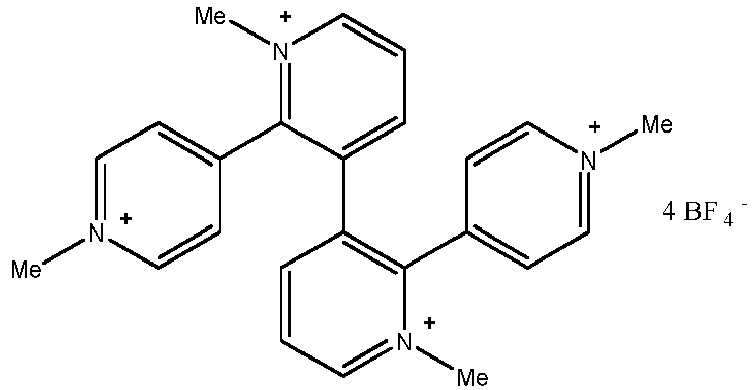
-0.95 -1.38 0.43 * 400 orange
Claims (14)
- An electrochromic compound represented by a general formula (I):
 - Z is a pyridinediyl radical or a pyridiniumdiyl radical;- each Y is independently selected from N or (+N-R2)(X-) with R2 a C1-C18 alkyl;- each one of R1 is independently selected from H, alkyl, alkoxy, alkylthio, haloalkyl, haloalkoxy, haloalkylthio, polyalkylenoxy, alkoxycarbonyl, aryl, or heteroaryl;- n is 1, 2, 3 or 4;- a is 4;- X- is a counterion;- Z is not simultaneously bound in position 4 of cycle A and in position 4 of cycle B.
 - The compound of formula (I) according to claim 1, wherein said compound is represented by formula (II)

- The compound of formula (I) according to claim 1, wherein said compound is represented by formula (III)

- The compound of formula (I) according to any one of claims 1-3, wherein Z is a 2,3 branched pyridinediyl radical, preferably unsubstituted.
- The compound of formula (I) according to any one of claims 1-3, wherein Z is a pyridiniumdiyl radical selected from:- 1,4-branched pyridiniumdiyl radical, preferably substituted, more preferably substituted by at least one aryl group;- 2,3 branched N-alkylpyridiniumdiyl radical , preferably unsubstituted 2,3 branched N-alkylpyridiniumdiyl radical; or- 2,5 branched pyridiniumdiyl radical, preferably unsubstituted 2,5 branched N-alkylpyridiniumdiyl radical.
- The compound of formula (I) according to any one of claims 1-5, wherein Y is independently selected from N and (+N-R2)(X-) with R2 a C1-C8 alkyl, preferably Y is independently selected from N and (+N-R2)(X-) with R2 is methyl or n-hexyl.
- The compound of formula (I) according to any one of claims 1-6, wherein each one of R1 is selected from H, alkyl, and heteroaryl, preferably selected from H, alkyl, pyridinyl, pyridiniumyl or N-alkylpyridinium group, preferably selected from H, C1-C8 alkyl and a N-C1-C18 alkylpyridinium group, more preferably selected from H, unsubstituted C1-C3 alkyl, a N-C5-C7 alkylpyridinium group and a N-C1-C2 alkylpyridinium group, even more preferably selected from H, methyl a N-methylpyridinium group and a N-n-hexylpyridinium group.
- The compound of formula (I) according to any one of claims 1-7, wherein both Y are N and n is equal to 1 or wherein at least one Y is (+N-R2)(X-) and n is equal to 2, 3 or 4.
- The compound of formula (I) according to any one of claims 1-8, wherein the counterion X- is selected from halide, preferably fluoride and chloride, tetrafluoroborate, tetraphenylborate, hexafluorophosphate, nitrate, methanesulfonate, trifluoromethane sulfonate, p-toluenesulfonate, hexachloroantimonate, bis(trifluoromethanesulfonyl)imide, perchlorate, acetate and sulfate.
- The compound of formula (I) according to claim 1, wherein said compound is selected from:

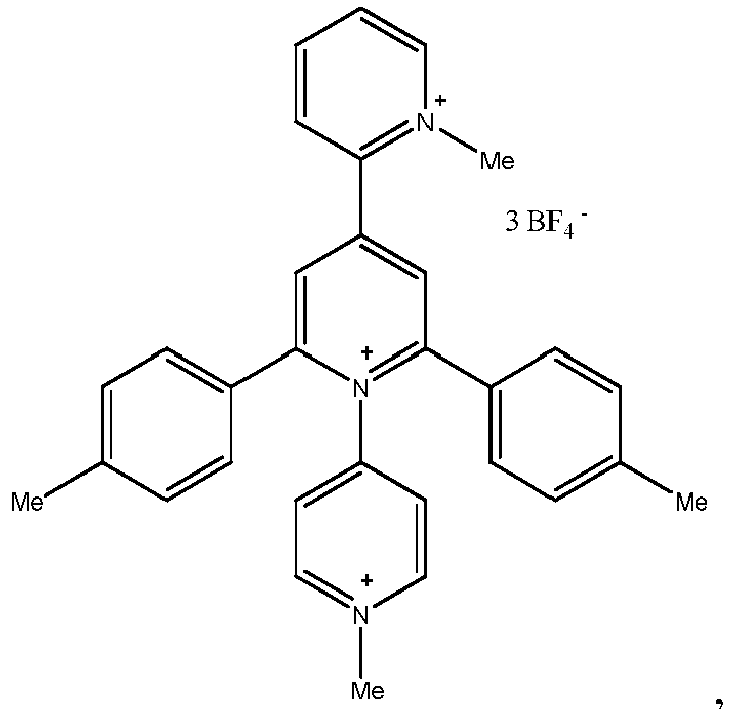

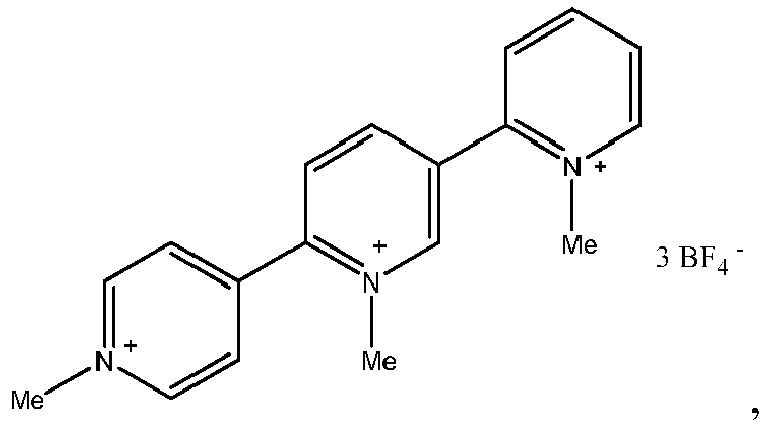


- An electrochromic composition comprising at least one compound as defined in any one of claims 1 to 10.
- The electrochromic composition according to claim 11, wherein said composition further comprises host medium, preferably a host medium that is a fluid, a mesomorphous media or a gel.
- An electrochromic device comprising a compound as defined in any one of claims 1 to 10, or an electrochromic composition as defined in claim 11 or 12.
- The electrochromic device according to claim 13, wherein said electrochromic device is selected from an optical article, preferably an optical lens or an optical filter, a window, notably aircraft window, a visor, a mirror, a head mounted device and a display, more preferably an optical article selected from optical lenses, and most preferably an optical article selected from ophthalmic lenses.
Priority Applications (5)
| Application Number | Priority Date | Filing Date | Title |
|---|---|---|---|
| EP17150656.1A EP3345981B1 (en) | 2017-01-09 | 2017-01-09 | Electrochromic compounds and optical articles containing them |
| US16/471,050 US10730855B2 (en) | 2017-01-09 | 2018-01-04 | Electrochromic compounds and optical articles containing them |
| JP2019535390A JP7209628B2 (en) | 2017-01-09 | 2018-01-04 | Electrochromic compounds and optical articles containing them |
| CN201880005446.XA CN110114438B (en) | 2017-01-09 | 2018-01-04 | Electrochromic compounds and optical articles containing them |
| PCT/EP2018/050218 WO2018127540A1 (en) | 2017-01-09 | 2018-01-04 | Electrochromic compounds and optical articles containing them |
Applications Claiming Priority (1)
| Application Number | Priority Date | Filing Date | Title |
|---|---|---|---|
| EP17150656.1A EP3345981B1 (en) | 2017-01-09 | 2017-01-09 | Electrochromic compounds and optical articles containing them |
Publications (2)
| Publication Number | Publication Date |
|---|---|
| EP3345981A1 true EP3345981A1 (en) | 2018-07-11 |
| EP3345981B1 EP3345981B1 (en) | 2020-09-09 |
Family
ID=57956074
Family Applications (1)
| Application Number | Title | Priority Date | Filing Date |
|---|---|---|---|
| EP17150656.1A Active EP3345981B1 (en) | 2017-01-09 | 2017-01-09 | Electrochromic compounds and optical articles containing them |
Country Status (5)
| Country | Link |
|---|---|
| US (1) | US10730855B2 (en) |
| EP (1) | EP3345981B1 (en) |
| JP (1) | JP7209628B2 (en) |
| CN (1) | CN110114438B (en) |
| WO (1) | WO2018127540A1 (en) |
Cited By (6)
| Publication number | Priority date | Publication date | Assignee | Title |
|---|---|---|---|---|
| CN111718291A (en) * | 2019-03-21 | 2020-09-29 | 宁波祢若电子科技有限公司 | Cathode electrochromic material and preparation and application thereof |
| EP3923064A1 (en) | 2020-06-12 | 2021-12-15 | Essilor International | Electrochromic solution |
| EP3985046A1 (en) | 2020-10-15 | 2022-04-20 | Essilor International | Crosslinked gel formulation |
| EP4016178A1 (en) | 2020-12-16 | 2022-06-22 | Essilor International | Multilayer structure, electrochromic cell and ophthalmic device incorporating it, and methods for manufacturing the same |
| EP4020066A1 (en) | 2020-12-23 | 2022-06-29 | Essilor International | Optical device forming an electrochromic ophthalmic lens, spectacle glasses incorporating it and method for manufacturing the same |
| EP4194935A1 (en) | 2021-12-10 | 2023-06-14 | Essilor International | Electro-active ophthalmic device satisfying a prescription for power correction(s), manufacturing method and use of a semi-finished hybrid lens |
Families Citing this family (1)
| Publication number | Priority date | Publication date | Assignee | Title |
|---|---|---|---|---|
| CN115417857B (en) * | 2022-08-31 | 2023-06-06 | 贵州中医药大学 | Piperidine alkaloid in Chinese medicinal Alangium chinense and extraction purification and semisynthesis method and application thereof |
Citations (6)
| Publication number | Priority date | Publication date | Assignee | Title |
|---|---|---|---|---|
| JP2003128654A (en) * | 2001-10-26 | 2003-05-08 | Fuji Photo Film Co Ltd | Method for producing 4,4'-bipyridinium derivative |
| WO2006013250A1 (en) | 2004-07-02 | 2006-02-09 | Essilor International | Method for producing a transparent optical element, an optical component involved into said method and the thus obtained optical element |
| FR2937154A1 (en) | 2008-10-09 | 2010-04-16 | Essilor Int | TRANSPARENT ELECTROACTIVE SYSTEM |
| FR2950710A1 (en) | 2009-09-28 | 2011-04-01 | Essilor Int | TRANSPARENT ELECTROCHROMIC SYSTEMS WITH MULTIPLE POLARIZATION ELECTRODES |
| EP2848667A1 (en) * | 2013-09-17 | 2015-03-18 | ESSILOR INTERNATIONAL (Compagnie Générale d'Optique) | Electrochromic single and two-core viologens and optical articles containing them |
| WO2015040031A1 (en) | 2013-09-17 | 2015-03-26 | Essilor International (Compagnie Generale D'optique) | Electrochromic two-core viologen derivatives and optical articles containing them |
Family Cites Families (5)
| Publication number | Priority date | Publication date | Assignee | Title |
|---|---|---|---|---|
| US7019138B2 (en) * | 2001-10-30 | 2006-03-28 | Colorado State University Research Foundation | Metal complex-based electron-transfer mediators in dye-sensitized solar cells |
| WO2008087879A1 (en) | 2007-01-17 | 2008-07-24 | Konica Minolta Holdings, Inc. | Display device |
| JP6851710B2 (en) | 2015-01-28 | 2021-03-31 | 株式会社リコー | Materials for electrochromic display elements |
| EP3115433B1 (en) * | 2015-07-08 | 2018-10-03 | Essilor International | Electrochromic compounds and optical articles containing them |
| CN106916099A (en) * | 2015-12-25 | 2017-07-04 | 宁波祢若电子科技有限公司 | A kind of cathodic electrochromic compound in electrochromic device and preparation method thereof |
-
2017
- 2017-01-09 EP EP17150656.1A patent/EP3345981B1/en active Active
-
2018
- 2018-01-04 JP JP2019535390A patent/JP7209628B2/en active Active
- 2018-01-04 US US16/471,050 patent/US10730855B2/en active Active
- 2018-01-04 WO PCT/EP2018/050218 patent/WO2018127540A1/en not_active Ceased
- 2018-01-04 CN CN201880005446.XA patent/CN110114438B/en active Active
Patent Citations (7)
| Publication number | Priority date | Publication date | Assignee | Title |
|---|---|---|---|---|
| JP2003128654A (en) * | 2001-10-26 | 2003-05-08 | Fuji Photo Film Co Ltd | Method for producing 4,4'-bipyridinium derivative |
| WO2006013250A1 (en) | 2004-07-02 | 2006-02-09 | Essilor International | Method for producing a transparent optical element, an optical component involved into said method and the thus obtained optical element |
| FR2937154A1 (en) | 2008-10-09 | 2010-04-16 | Essilor Int | TRANSPARENT ELECTROACTIVE SYSTEM |
| FR2950710A1 (en) | 2009-09-28 | 2011-04-01 | Essilor Int | TRANSPARENT ELECTROCHROMIC SYSTEMS WITH MULTIPLE POLARIZATION ELECTRODES |
| EP2848667A1 (en) * | 2013-09-17 | 2015-03-18 | ESSILOR INTERNATIONAL (Compagnie Générale d'Optique) | Electrochromic single and two-core viologens and optical articles containing them |
| WO2015040033A2 (en) | 2013-09-17 | 2015-03-26 | Essilor International (Compagnie Generale D'optique) | Electrochromic single and two-core viologens and optical articles containing them |
| WO2015040031A1 (en) | 2013-09-17 | 2015-03-26 | Essilor International (Compagnie Generale D'optique) | Electrochromic two-core viologen derivatives and optical articles containing them |
Non-Patent Citations (7)
| Title |
|---|
| E. L. CLENNAN; C. LIAO; E. AYOKOSK, J. AM. CHEM. SOC., vol. 130, 2008, pages 7552 |
| J. I. BRUCE; J.-C. CHAMBRON; P. KOLLE; J.-P. SAUVAGE, J. CHEM. SOC., PERKIN TRANS. 1, 2002, pages 1226 |
| J. SOPKOVA-DE OLIVERA SANTOS; A. S. VOISIN-CHIRET; G. BURZICKI; L. SEBAOUN; M. SEBBAN; J.-F. LOHIER; R. LEGAY; H. OULYADI; R. BURE, J. CHEM. INF. MODEL.,, vol. 52, 2012, pages 429 |
| M. IYODA; H. OTSUKA; K. SATO; N. NISATO; M. ODA, BULL. CHEM. SOC. JPN., vol. 63, 1990, pages 80 |
| M. TIECCO; L. TESTAFERRI; M. TINGOLI; D. CHIANELLI; M. MONTANUCCI, SYNTHESIS, 1984, pages 736 |
| MICHIO M. MATSUSHITA ET AL: "Metal Coordination Complexes Composed of Photo-Electrochemically Active Ligands", MOLECULAR CRYSTALS AND LIQUID CRYSTALS SCIENCE AND TECHNOLOGY. SECTION A. MOLECULAR CRYSTALS AND LIQUID CRYSTALS., vol. 343, no. 1, 1 May 2000 (2000-05-01), CH, pages 87 - 96, XP055385063, ISSN: 1058-725X, DOI: 10.1080/10587250008023508 * |
| X.-L. BAI; X.-D. LIU; C.-Q. KANG; L.-X. GAO, SYNTHESIS, 2005, pages 458 |
Cited By (9)
| Publication number | Priority date | Publication date | Assignee | Title |
|---|---|---|---|---|
| CN111718291A (en) * | 2019-03-21 | 2020-09-29 | 宁波祢若电子科技有限公司 | Cathode electrochromic material and preparation and application thereof |
| EP3923064A1 (en) | 2020-06-12 | 2021-12-15 | Essilor International | Electrochromic solution |
| WO2021250114A1 (en) | 2020-06-12 | 2021-12-16 | Essilor International | Electrochromic solution |
| EP3985046A1 (en) | 2020-10-15 | 2022-04-20 | Essilor International | Crosslinked gel formulation |
| WO2022078935A1 (en) | 2020-10-15 | 2022-04-21 | Essilor International | Crosslinked gel formulation |
| EP4016178A1 (en) | 2020-12-16 | 2022-06-22 | Essilor International | Multilayer structure, electrochromic cell and ophthalmic device incorporating it, and methods for manufacturing the same |
| EP4020066A1 (en) | 2020-12-23 | 2022-06-29 | Essilor International | Optical device forming an electrochromic ophthalmic lens, spectacle glasses incorporating it and method for manufacturing the same |
| WO2022135928A2 (en) | 2020-12-23 | 2022-06-30 | Essilor International | Optical device forming an electrochromic ophthalmic lens, spectacle glasses incorporating it and method for manufacturing the same |
| EP4194935A1 (en) | 2021-12-10 | 2023-06-14 | Essilor International | Electro-active ophthalmic device satisfying a prescription for power correction(s), manufacturing method and use of a semi-finished hybrid lens |
Also Published As
| Publication number | Publication date |
|---|---|
| JP2020504332A (en) | 2020-02-06 |
| CN110114438B (en) | 2022-12-06 |
| JP7209628B2 (en) | 2023-01-20 |
| CN110114438A (en) | 2019-08-09 |
| US10730855B2 (en) | 2020-08-04 |
| WO2018127540A1 (en) | 2018-07-12 |
| US20190315718A1 (en) | 2019-10-17 |
| EP3345981B1 (en) | 2020-09-09 |
Similar Documents
| Publication | Publication Date | Title |
|---|---|---|
| EP3345981B1 (en) | Electrochromic compounds and optical articles containing them | |
| KR102653345B1 (en) | Electrochromic compounds and optical articles containing them | |
| EP2848668B1 (en) | Electrochromic two-core viologen derivatives and optical articles containing them | |
| EP2848667B1 (en) | Electrochromic single and two-core viologens and optical articles containing them | |
| EP2848669B1 (en) | Electrochromic composition | |
| CN108779113B (en) | Organic compound, electrochromic device, electrochromic apparatus, optical filter, image pickup apparatus, lens unit, and window member | |
| Crossley | 94220 Charenton le Pont (FR) 94220 Charenton-le-Pont (FR)(72) Inventors:(74) Representative: Cabinet Plasseraud | |
| EP4461783A1 (en) | Electrochromic compounds, compositions and optical articles containing them |
Legal Events
| Date | Code | Title | Description |
|---|---|---|---|
| PUAI | Public reference made under article 153(3) epc to a published international application that has entered the european phase |
Free format text: ORIGINAL CODE: 0009012 |
|
| STAA | Information on the status of an ep patent application or granted ep patent |
Free format text: STATUS: THE APPLICATION HAS BEEN PUBLISHED |
|
| AK | Designated contracting states |
Kind code of ref document: A1 Designated state(s): AL AT BE BG CH CY CZ DE DK EE ES FI FR GB GR HR HU IE IS IT LI LT LU LV MC MK MT NL NO PL PT RO RS SE SI SK SM TR |
|
| AX | Request for extension of the european patent |
Extension state: BA ME |
|
| STAA | Information on the status of an ep patent application or granted ep patent |
Free format text: STATUS: REQUEST FOR EXAMINATION WAS MADE |
|
| 17P | Request for examination filed |
Effective date: 20181120 |
|
| RBV | Designated contracting states (corrected) |
Designated state(s): AL AT BE BG CH CY CZ DE DK EE ES FI FR GB GR HR HU IE IS IT LI LT LU LV MC MK MT NL NO PL PT RO RS SE SI SK SM TR |
|
| RIC1 | Information provided on ipc code assigned before grant |
Ipc: C07D 213/22 20060101ALI20200217BHEP Ipc: C09K 9/02 20060101AFI20200217BHEP |
|
| GRAP | Despatch of communication of intention to grant a patent |
Free format text: ORIGINAL CODE: EPIDOSNIGR1 |
|
| STAA | Information on the status of an ep patent application or granted ep patent |
Free format text: STATUS: GRANT OF PATENT IS INTENDED |
|
| INTG | Intention to grant announced |
Effective date: 20200327 |
|
| GRAS | Grant fee paid |
Free format text: ORIGINAL CODE: EPIDOSNIGR3 |
|
| GRAA | (expected) grant |
Free format text: ORIGINAL CODE: 0009210 |
|
| STAA | Information on the status of an ep patent application or granted ep patent |
Free format text: STATUS: THE PATENT HAS BEEN GRANTED |
|
| RIN1 | Information on inventor provided before grant (corrected) |
Inventor name: AIKEN, STUART Inventor name: ARCHAMBEAU, SAMUEL Inventor name: HERON, BERNARD MARK Inventor name: BROADBENT, THOMAS DAVID Inventor name: GABBUTT, CHRISTOPHER Inventor name: BIVER, CLAUDINE Inventor name: BERIT-DEBAT, FABIEN |
|
| AK | Designated contracting states |
Kind code of ref document: B1 Designated state(s): AL AT BE BG CH CY CZ DE DK EE ES FI FR GB GR HR HU IE IS IT LI LT LU LV MC MK MT NL NO PL PT RO RS SE SI SK SM TR |
|
| REG | Reference to a national code |
Ref country code: GB Ref legal event code: FG4D |
|
| REG | Reference to a national code |
Ref country code: AT Ref legal event code: REF Ref document number: 1311561 Country of ref document: AT Kind code of ref document: T Effective date: 20200915 Ref country code: CH Ref legal event code: EP |
|
| REG | Reference to a national code |
Ref country code: IE Ref legal event code: FG4D |
|
| REG | Reference to a national code |
Ref country code: DE Ref legal event code: R096 Ref document number: 602017023082 Country of ref document: DE |
|
| REG | Reference to a national code |
Ref country code: LT Ref legal event code: MG4D |
|
| PG25 | Lapsed in a contracting state [announced via postgrant information from national office to epo] |
Ref country code: LT Free format text: LAPSE BECAUSE OF FAILURE TO SUBMIT A TRANSLATION OF THE DESCRIPTION OR TO PAY THE FEE WITHIN THE PRESCRIBED TIME-LIMIT Effective date: 20200909 Ref country code: SE Free format text: LAPSE BECAUSE OF FAILURE TO SUBMIT A TRANSLATION OF THE DESCRIPTION OR TO PAY THE FEE WITHIN THE PRESCRIBED TIME-LIMIT Effective date: 20200909 Ref country code: NO Free format text: LAPSE BECAUSE OF FAILURE TO SUBMIT A TRANSLATION OF THE DESCRIPTION OR TO PAY THE FEE WITHIN THE PRESCRIBED TIME-LIMIT Effective date: 20201209 Ref country code: BG Free format text: LAPSE BECAUSE OF FAILURE TO SUBMIT A TRANSLATION OF THE DESCRIPTION OR TO PAY THE FEE WITHIN THE PRESCRIBED TIME-LIMIT Effective date: 20201209 Ref country code: HR Free format text: LAPSE BECAUSE OF FAILURE TO SUBMIT A TRANSLATION OF THE DESCRIPTION OR TO PAY THE FEE WITHIN THE PRESCRIBED TIME-LIMIT Effective date: 20200909 Ref country code: FI Free format text: LAPSE BECAUSE OF FAILURE TO SUBMIT A TRANSLATION OF THE DESCRIPTION OR TO PAY THE FEE WITHIN THE PRESCRIBED TIME-LIMIT Effective date: 20200909 Ref country code: GR Free format text: LAPSE BECAUSE OF FAILURE TO SUBMIT A TRANSLATION OF THE DESCRIPTION OR TO PAY THE FEE WITHIN THE PRESCRIBED TIME-LIMIT Effective date: 20201210 |
|
| REG | Reference to a national code |
Ref country code: AT Ref legal event code: MK05 Ref document number: 1311561 Country of ref document: AT Kind code of ref document: T Effective date: 20200909 |
|
| REG | Reference to a national code |
Ref country code: NL Ref legal event code: MP Effective date: 20200909 |
|
| PG25 | Lapsed in a contracting state [announced via postgrant information from national office to epo] |
Ref country code: LV Free format text: LAPSE BECAUSE OF FAILURE TO SUBMIT A TRANSLATION OF THE DESCRIPTION OR TO PAY THE FEE WITHIN THE PRESCRIBED TIME-LIMIT Effective date: 20200909 Ref country code: PL Free format text: LAPSE BECAUSE OF FAILURE TO SUBMIT A TRANSLATION OF THE DESCRIPTION OR TO PAY THE FEE WITHIN THE PRESCRIBED TIME-LIMIT Effective date: 20200909 Ref country code: RS Free format text: LAPSE BECAUSE OF FAILURE TO SUBMIT A TRANSLATION OF THE DESCRIPTION OR TO PAY THE FEE WITHIN THE PRESCRIBED TIME-LIMIT Effective date: 20200909 |
|
| PG25 | Lapsed in a contracting state [announced via postgrant information from national office to epo] |
Ref country code: CZ Free format text: LAPSE BECAUSE OF FAILURE TO SUBMIT A TRANSLATION OF THE DESCRIPTION OR TO PAY THE FEE WITHIN THE PRESCRIBED TIME-LIMIT Effective date: 20200909 Ref country code: RO Free format text: LAPSE BECAUSE OF FAILURE TO SUBMIT A TRANSLATION OF THE DESCRIPTION OR TO PAY THE FEE WITHIN THE PRESCRIBED TIME-LIMIT Effective date: 20200909 Ref country code: PT Free format text: LAPSE BECAUSE OF FAILURE TO SUBMIT A TRANSLATION OF THE DESCRIPTION OR TO PAY THE FEE WITHIN THE PRESCRIBED TIME-LIMIT Effective date: 20210111 Ref country code: EE Free format text: LAPSE BECAUSE OF FAILURE TO SUBMIT A TRANSLATION OF THE DESCRIPTION OR TO PAY THE FEE WITHIN THE PRESCRIBED TIME-LIMIT Effective date: 20200909 Ref country code: SM Free format text: LAPSE BECAUSE OF FAILURE TO SUBMIT A TRANSLATION OF THE DESCRIPTION OR TO PAY THE FEE WITHIN THE PRESCRIBED TIME-LIMIT Effective date: 20200909 |
|
| PG25 | Lapsed in a contracting state [announced via postgrant information from national office to epo] |
Ref country code: IS Free format text: LAPSE BECAUSE OF FAILURE TO SUBMIT A TRANSLATION OF THE DESCRIPTION OR TO PAY THE FEE WITHIN THE PRESCRIBED TIME-LIMIT Effective date: 20210109 Ref country code: AL Free format text: LAPSE BECAUSE OF FAILURE TO SUBMIT A TRANSLATION OF THE DESCRIPTION OR TO PAY THE FEE WITHIN THE PRESCRIBED TIME-LIMIT Effective date: 20200909 Ref country code: AT Free format text: LAPSE BECAUSE OF FAILURE TO SUBMIT A TRANSLATION OF THE DESCRIPTION OR TO PAY THE FEE WITHIN THE PRESCRIBED TIME-LIMIT Effective date: 20200909 Ref country code: ES Free format text: LAPSE BECAUSE OF FAILURE TO SUBMIT A TRANSLATION OF THE DESCRIPTION OR TO PAY THE FEE WITHIN THE PRESCRIBED TIME-LIMIT Effective date: 20200909 |
|
| REG | Reference to a national code |
Ref country code: DE Ref legal event code: R097 Ref document number: 602017023082 Country of ref document: DE |
|
| PG25 | Lapsed in a contracting state [announced via postgrant information from national office to epo] |
Ref country code: SK Free format text: LAPSE BECAUSE OF FAILURE TO SUBMIT A TRANSLATION OF THE DESCRIPTION OR TO PAY THE FEE WITHIN THE PRESCRIBED TIME-LIMIT Effective date: 20200909 |
|
| PLBE | No opposition filed within time limit |
Free format text: ORIGINAL CODE: 0009261 |
|
| STAA | Information on the status of an ep patent application or granted ep patent |
Free format text: STATUS: NO OPPOSITION FILED WITHIN TIME LIMIT |
|
| 26N | No opposition filed |
Effective date: 20210610 |
|
| PG25 | Lapsed in a contracting state [announced via postgrant information from national office to epo] |
Ref country code: MC Free format text: LAPSE BECAUSE OF FAILURE TO SUBMIT A TRANSLATION OF THE DESCRIPTION OR TO PAY THE FEE WITHIN THE PRESCRIBED TIME-LIMIT Effective date: 20200909 Ref country code: DK Free format text: LAPSE BECAUSE OF FAILURE TO SUBMIT A TRANSLATION OF THE DESCRIPTION OR TO PAY THE FEE WITHIN THE PRESCRIBED TIME-LIMIT Effective date: 20200909 Ref country code: SI Free format text: LAPSE BECAUSE OF FAILURE TO SUBMIT A TRANSLATION OF THE DESCRIPTION OR TO PAY THE FEE WITHIN THE PRESCRIBED TIME-LIMIT Effective date: 20200909 |
|
| REG | Reference to a national code |
Ref country code: CH Ref legal event code: PL |
|
| PG25 | Lapsed in a contracting state [announced via postgrant information from national office to epo] |
Ref country code: LU Free format text: LAPSE BECAUSE OF NON-PAYMENT OF DUE FEES Effective date: 20210109 |
|
| REG | Reference to a national code |
Ref country code: BE Ref legal event code: MM Effective date: 20210131 |
|
| PG25 | Lapsed in a contracting state [announced via postgrant information from national office to epo] |
Ref country code: CH Free format text: LAPSE BECAUSE OF NON-PAYMENT OF DUE FEES Effective date: 20210131 Ref country code: LI Free format text: LAPSE BECAUSE OF NON-PAYMENT OF DUE FEES Effective date: 20210131 |
|
| PG25 | Lapsed in a contracting state [announced via postgrant information from national office to epo] |
Ref country code: IE Free format text: LAPSE BECAUSE OF NON-PAYMENT OF DUE FEES Effective date: 20210109 |
|
| PG25 | Lapsed in a contracting state [announced via postgrant information from national office to epo] |
Ref country code: BE Free format text: LAPSE BECAUSE OF NON-PAYMENT OF DUE FEES Effective date: 20210131 |
|
| PG25 | Lapsed in a contracting state [announced via postgrant information from national office to epo] |
Ref country code: NL Free format text: LAPSE BECAUSE OF NON-PAYMENT OF DUE FEES Effective date: 20200923 Ref country code: CY Free format text: LAPSE BECAUSE OF FAILURE TO SUBMIT A TRANSLATION OF THE DESCRIPTION OR TO PAY THE FEE WITHIN THE PRESCRIBED TIME-LIMIT Effective date: 20200909 |
|
| P01 | Opt-out of the competence of the unified patent court (upc) registered |
Effective date: 20230525 |
|
| PG25 | Lapsed in a contracting state [announced via postgrant information from national office to epo] |
Ref country code: HU Free format text: LAPSE BECAUSE OF FAILURE TO SUBMIT A TRANSLATION OF THE DESCRIPTION OR TO PAY THE FEE WITHIN THE PRESCRIBED TIME-LIMIT; INVALID AB INITIO Effective date: 20170109 |
|
| PG25 | Lapsed in a contracting state [announced via postgrant information from national office to epo] |
Ref country code: MK Free format text: LAPSE BECAUSE OF FAILURE TO SUBMIT A TRANSLATION OF THE DESCRIPTION OR TO PAY THE FEE WITHIN THE PRESCRIBED TIME-LIMIT Effective date: 20200909 |
|
| PG25 | Lapsed in a contracting state [announced via postgrant information from national office to epo] |
Ref country code: TR Free format text: LAPSE BECAUSE OF FAILURE TO SUBMIT A TRANSLATION OF THE DESCRIPTION OR TO PAY THE FEE WITHIN THE PRESCRIBED TIME-LIMIT Effective date: 20200909 |
|
| PG25 | Lapsed in a contracting state [announced via postgrant information from national office to epo] |
Ref country code: MT Free format text: LAPSE BECAUSE OF FAILURE TO SUBMIT A TRANSLATION OF THE DESCRIPTION OR TO PAY THE FEE WITHIN THE PRESCRIBED TIME-LIMIT Effective date: 20200909 |
|
| PGFP | Annual fee paid to national office [announced via postgrant information from national office to epo] |
Ref country code: GB Payment date: 20260127 Year of fee payment: 10 |
|
| PGFP | Annual fee paid to national office [announced via postgrant information from national office to epo] |
Ref country code: DE Payment date: 20260128 Year of fee payment: 10 |
|
| PGFP | Annual fee paid to national office [announced via postgrant information from national office to epo] |
Ref country code: IT Payment date: 20260121 Year of fee payment: 10 |
|
| PGFP | Annual fee paid to national office [announced via postgrant information from national office to epo] |
Ref country code: FR Payment date: 20260126 Year of fee payment: 10 |