EP3345950B1 - Resin composition for fiber-reinforced plastic, cured product thereof, fiber-reinforced plastic containing said cured product, and method for producing said fiber-reinforced plastic - Google Patents
Resin composition for fiber-reinforced plastic, cured product thereof, fiber-reinforced plastic containing said cured product, and method for producing said fiber-reinforced plastic Download PDFInfo
- Publication number
- EP3345950B1 EP3345950B1 EP16841635.2A EP16841635A EP3345950B1 EP 3345950 B1 EP3345950 B1 EP 3345950B1 EP 16841635 A EP16841635 A EP 16841635A EP 3345950 B1 EP3345950 B1 EP 3345950B1
- Authority
- EP
- European Patent Office
- Prior art keywords
- fiber
- reinforced plastic
- resin composition
- resin
- epoxy
- Prior art date
- Legal status (The legal status is an assumption and is not a legal conclusion. Google has not performed a legal analysis and makes no representation as to the accuracy of the status listed.)
- Active
Links
- 0 C*C(C)(C)c1cc(C(C)(C)C)ccc1 Chemical compound C*C(C)(C)c1cc(C(C)(C)C)ccc1 0.000 description 2
Images


Classifications
-
- C—CHEMISTRY; METALLURGY
- C08—ORGANIC MACROMOLECULAR COMPOUNDS; THEIR PREPARATION OR CHEMICAL WORKING-UP; COMPOSITIONS BASED THEREON
- C08J—WORKING-UP; GENERAL PROCESSES OF COMPOUNDING; AFTER-TREATMENT NOT COVERED BY SUBCLASSES C08B, C08C, C08F, C08G or C08H
- C08J5/00—Manufacture of articles or shaped materials containing macromolecular substances
- C08J5/04—Reinforcing macromolecular compounds with loose or coherent fibrous material
- C08J5/046—Reinforcing macromolecular compounds with loose or coherent fibrous material with synthetic macromolecular fibrous material
-
- C—CHEMISTRY; METALLURGY
- C08—ORGANIC MACROMOLECULAR COMPOUNDS; THEIR PREPARATION OR CHEMICAL WORKING-UP; COMPOSITIONS BASED THEREON
- C08G—MACROMOLECULAR COMPOUNDS OBTAINED OTHERWISE THAN BY REACTIONS ONLY INVOLVING UNSATURATED CARBON-TO-CARBON BONDS
- C08G59/00—Polycondensates containing more than one epoxy group per molecule; Macromolecules obtained by polymerising compounds containing more than one epoxy group per molecule using curing agents or catalysts which react with the epoxy groups
- C08G59/18—Macromolecules obtained by polymerising compounds containing more than one epoxy group per molecule using curing agents or catalysts which react with the epoxy groups ; e.g. general methods of curing
- C08G59/20—Macromolecules obtained by polymerising compounds containing more than one epoxy group per molecule using curing agents or catalysts which react with the epoxy groups ; e.g. general methods of curing characterised by the epoxy compounds used
- C08G59/22—Di-epoxy compounds
-
- C—CHEMISTRY; METALLURGY
- C08—ORGANIC MACROMOLECULAR COMPOUNDS; THEIR PREPARATION OR CHEMICAL WORKING-UP; COMPOSITIONS BASED THEREON
- C08G—MACROMOLECULAR COMPOUNDS OBTAINED OTHERWISE THAN BY REACTIONS ONLY INVOLVING UNSATURATED CARBON-TO-CARBON BONDS
- C08G59/00—Polycondensates containing more than one epoxy group per molecule; Macromolecules obtained by polymerising compounds containing more than one epoxy group per molecule using curing agents or catalysts which react with the epoxy groups
- C08G59/18—Macromolecules obtained by polymerising compounds containing more than one epoxy group per molecule using curing agents or catalysts which react with the epoxy groups ; e.g. general methods of curing
- C08G59/20—Macromolecules obtained by polymerising compounds containing more than one epoxy group per molecule using curing agents or catalysts which react with the epoxy groups ; e.g. general methods of curing characterised by the epoxy compounds used
- C08G59/22—Di-epoxy compounds
- C08G59/24—Di-epoxy compounds carbocyclic
-
- C—CHEMISTRY; METALLURGY
- C08—ORGANIC MACROMOLECULAR COMPOUNDS; THEIR PREPARATION OR CHEMICAL WORKING-UP; COMPOSITIONS BASED THEREON
- C08G—MACROMOLECULAR COMPOUNDS OBTAINED OTHERWISE THAN BY REACTIONS ONLY INVOLVING UNSATURATED CARBON-TO-CARBON BONDS
- C08G59/00—Polycondensates containing more than one epoxy group per molecule; Macromolecules obtained by polymerising compounds containing more than one epoxy group per molecule using curing agents or catalysts which react with the epoxy groups
- C08G59/18—Macromolecules obtained by polymerising compounds containing more than one epoxy group per molecule using curing agents or catalysts which react with the epoxy groups ; e.g. general methods of curing
- C08G59/20—Macromolecules obtained by polymerising compounds containing more than one epoxy group per molecule using curing agents or catalysts which react with the epoxy groups ; e.g. general methods of curing characterised by the epoxy compounds used
- C08G59/22—Di-epoxy compounds
- C08G59/24—Di-epoxy compounds carbocyclic
- C08G59/245—Di-epoxy compounds carbocyclic aromatic
-
- C—CHEMISTRY; METALLURGY
- C08—ORGANIC MACROMOLECULAR COMPOUNDS; THEIR PREPARATION OR CHEMICAL WORKING-UP; COMPOSITIONS BASED THEREON
- C08G—MACROMOLECULAR COMPOUNDS OBTAINED OTHERWISE THAN BY REACTIONS ONLY INVOLVING UNSATURATED CARBON-TO-CARBON BONDS
- C08G59/00—Polycondensates containing more than one epoxy group per molecule; Macromolecules obtained by polymerising compounds containing more than one epoxy group per molecule using curing agents or catalysts which react with the epoxy groups
- C08G59/18—Macromolecules obtained by polymerising compounds containing more than one epoxy group per molecule using curing agents or catalysts which react with the epoxy groups ; e.g. general methods of curing
- C08G59/40—Macromolecules obtained by polymerising compounds containing more than one epoxy group per molecule using curing agents or catalysts which react with the epoxy groups ; e.g. general methods of curing characterised by the curing agents used
-
- C—CHEMISTRY; METALLURGY
- C08—ORGANIC MACROMOLECULAR COMPOUNDS; THEIR PREPARATION OR CHEMICAL WORKING-UP; COMPOSITIONS BASED THEREON
- C08G—MACROMOLECULAR COMPOUNDS OBTAINED OTHERWISE THAN BY REACTIONS ONLY INVOLVING UNSATURATED CARBON-TO-CARBON BONDS
- C08G59/00—Polycondensates containing more than one epoxy group per molecule; Macromolecules obtained by polymerising compounds containing more than one epoxy group per molecule using curing agents or catalysts which react with the epoxy groups
- C08G59/18—Macromolecules obtained by polymerising compounds containing more than one epoxy group per molecule using curing agents or catalysts which react with the epoxy groups ; e.g. general methods of curing
- C08G59/40—Macromolecules obtained by polymerising compounds containing more than one epoxy group per molecule using curing agents or catalysts which react with the epoxy groups ; e.g. general methods of curing characterised by the curing agents used
- C08G59/4007—Curing agents not provided for by the groups C08G59/42 - C08G59/66
- C08G59/4014—Nitrogen containing compounds
- C08G59/4028—Isocyanates; Thioisocyanates
-
- C—CHEMISTRY; METALLURGY
- C08—ORGANIC MACROMOLECULAR COMPOUNDS; THEIR PREPARATION OR CHEMICAL WORKING-UP; COMPOSITIONS BASED THEREON
- C08G—MACROMOLECULAR COMPOUNDS OBTAINED OTHERWISE THAN BY REACTIONS ONLY INVOLVING UNSATURATED CARBON-TO-CARBON BONDS
- C08G59/00—Polycondensates containing more than one epoxy group per molecule; Macromolecules obtained by polymerising compounds containing more than one epoxy group per molecule using curing agents or catalysts which react with the epoxy groups
- C08G59/18—Macromolecules obtained by polymerising compounds containing more than one epoxy group per molecule using curing agents or catalysts which react with the epoxy groups ; e.g. general methods of curing
- C08G59/40—Macromolecules obtained by polymerising compounds containing more than one epoxy group per molecule using curing agents or catalysts which react with the epoxy groups ; e.g. general methods of curing characterised by the curing agents used
- C08G59/50—Amines
-
- C—CHEMISTRY; METALLURGY
- C08—ORGANIC MACROMOLECULAR COMPOUNDS; THEIR PREPARATION OR CHEMICAL WORKING-UP; COMPOSITIONS BASED THEREON
- C08G—MACROMOLECULAR COMPOUNDS OBTAINED OTHERWISE THAN BY REACTIONS ONLY INVOLVING UNSATURATED CARBON-TO-CARBON BONDS
- C08G59/00—Polycondensates containing more than one epoxy group per molecule; Macromolecules obtained by polymerising compounds containing more than one epoxy group per molecule using curing agents or catalysts which react with the epoxy groups
- C08G59/18—Macromolecules obtained by polymerising compounds containing more than one epoxy group per molecule using curing agents or catalysts which react with the epoxy groups ; e.g. general methods of curing
- C08G59/40—Macromolecules obtained by polymerising compounds containing more than one epoxy group per molecule using curing agents or catalysts which react with the epoxy groups ; e.g. general methods of curing characterised by the curing agents used
- C08G59/50—Amines
- C08G59/5033—Amines aromatic
-
- C—CHEMISTRY; METALLURGY
- C08—ORGANIC MACROMOLECULAR COMPOUNDS; THEIR PREPARATION OR CHEMICAL WORKING-UP; COMPOSITIONS BASED THEREON
- C08J—WORKING-UP; GENERAL PROCESSES OF COMPOUNDING; AFTER-TREATMENT NOT COVERED BY SUBCLASSES C08B, C08C, C08F, C08G or C08H
- C08J5/00—Manufacture of articles or shaped materials containing macromolecular substances
- C08J5/04—Reinforcing macromolecular compounds with loose or coherent fibrous material
-
- C—CHEMISTRY; METALLURGY
- C08—ORGANIC MACROMOLECULAR COMPOUNDS; THEIR PREPARATION OR CHEMICAL WORKING-UP; COMPOSITIONS BASED THEREON
- C08K—Use of inorganic or non-macromolecular organic substances as compounding ingredients
- C08K5/00—Use of organic ingredients
- C08K5/54—Silicon-containing compounds
-
- C—CHEMISTRY; METALLURGY
- C08—ORGANIC MACROMOLECULAR COMPOUNDS; THEIR PREPARATION OR CHEMICAL WORKING-UP; COMPOSITIONS BASED THEREON
- C08J—WORKING-UP; GENERAL PROCESSES OF COMPOUNDING; AFTER-TREATMENT NOT COVERED BY SUBCLASSES C08B, C08C, C08F, C08G or C08H
- C08J3/00—Processes of treating or compounding macromolecular substances
- C08J3/28—Treatment by wave energy or particle radiation
Definitions
- the present invention relates to a resin composition for fiber-reinforced plastic, a cured product thereof and a fiber-reinforced plastic using the resin composition, and in particular relates to a resin composition having good impregnating properties to reinforcement fiber, good rapid curing properties and good high-strength properties, obtained by using an epoxy resin having excellent flexibility, a cyanate resin, and an aromatic amine as a curing agent, a fiber-reinforced plastic comprising a cured product of said composition, and a method for producing said fiber-reinforced plastic.
- a method for producing a molded material by using a reinforcing material such as thermosetting epoxy resin, unsaturated polyester resin, polyamide resin, or phenol resin, for fiber materials such as carbon fiber and glass fiber is well known.
- the fiber-reinforced plastic obtained by using this method is extensively used for a material of structures such as an airplane and a ship, and sporting goods such as a tennis racket and a golf club.
- the epoxy resin used as a reinforcing material which is not only excellent in adhesive properties, heat resistance and chemical resistance, but also is inexpensive, is often used as a well balanced material.
- the epoxy resin composition has an excellent electric performance and adhesive properties.
- a cyanate-epoxy composite resin composition having high heat resistance which is obtained by further blending with a cyanate resin, is often used for a sealing material of a semiconductor, or for molding of electronic circuit substrate etc.
- a method for producing a cyanate-epoxy composite resin composition that has excellent storage stability and curing properties and also is suitable for a sealing agent or an adhesive agent for a semiconductor, by carrying out the curing reaction, using a latent curing agent which is obtained by reacting an epoxy compound with a polyamine compound (for example, Patent document 2 etc.).
- a powdery latent curing agent is used, therefore, there is a disadvantage in that, when the resin composition is applied to a fiber material, the curing agent cannot permeate into the inside of the fiber, and as a result, the curing is not carried out enough.
- a method using an adhesive agent which can bond resin materials in a short time wherein a laser beam is irradiated to a composition which contains a latent curing agent obtained by reacting polyamine with epoxy resin, together with a light-absorbing component (for example, Patent document 3 etc.).
- This method is a method which can realize a bonding in a shorter time compared to conventional thermal curing by using resin materials having light transmission properties and transmitting a laser beam to the inside of the adhesion part.
- the first object of the present invention is to provide a resin composition having high stretch displacement, excellent heat resistance and flexibility, which is suitable for improving the strength of fiber material.
- the second object of the present invention is to provide a fiber-reinforced plastic having excellent heat resistance and strength.
- the third object of the present invention is to provide a method for producing a fiber-reinforced plastic by curing the above resin composition in a short time.
- a resin composition obtained by combining a specific epoxy resin having a polyalkylene ether structure, a cyanate resin, and a liquid aromatic amine curing agent, can easily permeate into gaps existing among fibers, and becomes a fiber-reinforced resin composition having excellent heat resistance and flexibility; and also have found that, in the case of combining an active energy radiation absorbable component having excellent compatibility with the epoxy resin, a fiber-reinforced plastic can be produced in a short time by irradiating active energy radiation, thereby achieving the present invention.
- the present invention is a resin composition for fiber-reinforced plastic comprising: an epoxy resin (A), a cyanate resin (B), at least one aromatic amine curing agent (C) that is liquid at 25°C, which is at least one selected from methaphenylenediamine, a diaminodiphenylmethane, a diaminodimethyldiphenylmethane, a diaminodiethyldiphenylmethane, a diaminodiethyltoluene, a 1-methyl-3,5-bis(methylthio)-2,4-benzenediamine and a 1-methyl-3,5-bis(methylthio)-2,6-benzenediamine, and an active energy radiation absorbable component (D), wherein 20 to 100 percent by mass of the epoxy resin (A) is the epoxy compound expressed by the following general formula (1); a cured product obtainable by curing a composition which contains said resin composition; a high-strength fiber-reinforce
- a and b each independently express an integer from 2 to 10
- c expresses an integer from 0 to 3
- R 1 and R 2 each independently express a bivalent hydrocarbon group having 2 to 5 carbon atoms
- R 3 expresses a single bond, a methylene group or -C(CH 3 ) 2 -.
- composition of the present invention further contains an active energy radiation absorbable component as the component (D).
- the resin composition of the present invention that 3 to 15 percent by mass of the aforementioned epoxy resin (A) is a dicyclopentadiene epoxy resin.
- the cyanate resin (B) is at least one compound selected from a group consisting of compounds expressed by the after-mentioned general formulae from (2-1) to (2-3) and prepolymers thereof, and it is also preferable that the amount of cyanate resin (B) used is 50 to 120 parts by mass relative to the total amount of epoxy compounds, that is 100 parts by mass, which are all compounds having an epoxy group in the resin composition.
- the aromatic amine curing agent (C), which is liquid at 25°C, is at least one compound selected from diamino diphenylmethane, diamino diethyldiphenylmethane and diamino diethyl toluene, and also it is preferable that the amount used thereof is 40 to 90 parts by mass relative to 100 parts by mass of the epoxy compounds which corresponds to all of compounds having the epoxy group in the resin composition.
- the resin composition of the present invention further contains a silane coupling agent and also it is preferable that the amount used thereof is 7 to 20 parts by mass relative to 100 parts by mass of the total amount of the epoxy compound having an epoxy group in the resin composition.
- the amount used thereof is 0.001 to 1 percent by mass relative to the total amount of the resin composition and it is preferable that said component is a nigrosine compound.
- the composition of the present invention which contains the component (D) cures rapidly by irradiating active energy radiation. It is preferable that the active energy radiation used in this case is laser beam and/or infrared ray.
- the resin composition of the present invention has excellent heat resistance and also the cured product thereof has high stretch displacement and excellent flexibility. Therefore, in the case of applying the resin composition of the present invention to a fiber material, adhesion properties thereof to the fiber are excellent. Accordingly, the fiber-reinforced plastic of the present invention having excellent heat resistance and strength can be easily obtained by applying the resin composition of the present invention to fibers. In addition, the composition of the present invention can be cured by irradiating the active energy radiation, therefore, the fiber-reinforced plastic having the aforementioned performances can be obtained in a quite short time compared to the conventional curing method using heat.
- an epoxy resin (A) used in the present invention contains at least 20 percent by mass of epoxy compound expressed by the following general formula (1). wherein (a) and (b) each independently indicate an integer from 2 to 10, (c) indicates an integer from 0 to 3, R 1 and R 2 each independently indicate a bivalent hydrocarbon group having 2 to 5 carbon atoms, and R 3 indicates a single bond, a methylene group, or -C(CH 3 ) 2 -.
- the amount used of the compound expressed by the aforementioned general formula (1) is 20 to 100 percent by mass of epoxy resin (A), however, in order to further improve the tensile stress of cured product, 30 to 80 percent by mass is preferable, but 40 to 60 percent by mass is even more preferable. When it is less than 20 percent by mass, although the strength of cured product is not negatively affected, the toughness of cured product is markedly decreased since the stretch displacement does not increase.
- a cured product obtained by reacting the compound expressed by the aforementioned general formula (1) or the epoxy resin containing the compound expressed by the aforementioned general formula (1) with curing agents has more flexible physical properties due to large stretch displacement, therefore, it can adapt to the stretch of fiber, even when the fiber material is used in combination, thus a high-strength fiber-reinforced plastic can be obtained.
- the amount of the compound expressed by the aforementioned general formula (1) contained in the epoxy resin (A) is 40 to 95 percent by mass, but 60 to 90 percent by mass is even more preferable.
- the cured product cannot adapt to the stretch of fiber material and as a result, the cured product peels off from the fiber material, therefore, the tension strength of the fiber-reinforced plastic obtained decreases markedly.
- (a) and (b) each independently indicate an integer from 2 to 10. From the viewpoint of crosslink density of cured product, it is preferable that the average value of (a) and the average value of (b) are each independently a number from 3 to 7, but a number from 4 to 6 is even more preferable.
- the average values of (a) and (b) are each independently less than 2
- flexibility is markedly decreased since the crosslink density of cured product is excessively increased.
- the average values of (a) and (b) are each independently more than 10
- the strength of cured product is markedly decreased since the crosslink density of cured product is decreased.
- (c) indicates an integer from 0 to 3. From the viewpoint of workability when used, it is preferable that the average value of (c) is a number from 0 to 2, but a number from 0 to 1 is even more preferable. When the average value of (c) is more than 3, workability is decreased since the viscosity of the resin is increased.
- R 1 and R 2 in the aforementioned general formula (1) are each independently a bivalent hydrocarbon group having 2 to 4 carbon atoms, but a propylene group is especially preferable.
- the method for producing the compound expressed by the aforementioned general formula (1) is not limited in particular.
- an alkylene oxide addition product is prepared at first by carrying out an addition reaction of at least 2 equivalents of alkylene oxide, if necessary using a catalyst, with one equivalent of phenolic hydroxyl group (a hydroxyl group directly-bonded to an aromatic ring) of compound having two phenolic hydroxyl groups, such as bisphenol A, bisphenol F or biphenol. Then, an epichlorohydrin is reacted with the alkylene oxide addition product obtained, by using a catalyst and/or a solvent as necessary, so that the compound expressed by the aforementioned general formula (1) can be obtained.
- Examples of the aforementioned alkylene oxide are ethylene oxide, 1,2-propylene oxide, 1,2-butylene oxide and 1,2-pentylene oxide.
- R 1 and R 2 in the aforementioned general formula (1) are a propylene group.
- An acid catalyst or an alkali catalyst is included in the catalyst used for the addition reaction of the aforementioned alkylene oxide.
- acid catalyst are Bronsted acid such as sulfuric acid and phosphoric acid, and Lewis acid such as stannic chloride and boron trifluoride.
- alkali catalyst are tertiary amine, hydroxide of alkali metals such as sodium hydroxide and potassium hydroxide, hydroxide of quaternary ammonium such as ammonium hydroxide, hydroxide of alkali earth metal such as calcium hydroxide and barium hydroxide, and a carbonate of alkali metals such as potassium carbonate and sodium carbonate.
- the alkali catalyst among these, and it is more preferable to use the hydroxide of alkali metal or alkali earth metal, but it is most preferable to use the hydroxide of alkali metal.
- These catalysts may be each independently used, or more than two kinds of them may be used together.
- Phase-transfer catalysts such as tetrabutylammonium salt, trioctylmethylammonium salt and benzyl dimethyl octadecylammonium salt are included in the catalyst used for reacting the aforementioned epichlorohydrin, as well as the catalysts referred in the addition reaction of the alkylene oxide.
- the alkali catalyst from the viewpoint that a purification process after the reaction is finished is convenient, it is preferable to use the alkali catalyst among these, and it is more preferable to use the hydroxide of alkali metal or alkali earth metal, but it is most preferable to use the hydroxide of alkali metal.
- These catalysts may be used alone, or more than two of them may be used together.
- Examples of the solvent used for the addition reaction of the aforementioned epichlorohydrin are, for example, ketone solvents such as acetone and methylethylketone, alcohol solvents such as methanol, ethanol, 1-propyl alcohol, isopropyl alcohol, 1-butanol, secondary butanol and tertiary butanol, cellosolve solvents such as methyl cellosolve and ethyl cellosolve, ether solvents such as tetrahydrofuran, 1,4-dioxane, 1,3-dioxane and diethoxyethane, and aprotic polar solvents such as acetonitrile, dimethyl sulfoxide and dimethylformamide.
- ketone solvents such as acetone and methylethylketone
- alcohol solvents such as methanol, ethanol, 1-propyl alcohol, isopropyl alcohol, 1-butanol, secondary butanol and terti
- a necessary amount of epichlorohydrin used in the aforementioned reaction of the alkylene oxide addition product with epichlorohydrin is 1 to 10 equivalents relative to 1 equivalent of hydroxyl group which is contained in the alkylene oxide addition product.
- the epoxy compound expressed by the aforementioned general formula (1) can be obtained by removing the excess of epichlorohydrin.
- the closer the epichlorohydrin used gets to 10 equivalents the closer the average value of (c) expressed in the aforementioned general formula (1) tends to get to 0.
- epoxy resin (A) other than the epoxy compound expressed by the aforementioned general formula (1), other epoxy compounds can be used together as appropriate, as an epoxy resin (A).
- the molecular structure and molecular weight etc. of other epoxy compounds used are not limited in particular, and they can be selected as appropriate from publicly-known epoxy resins having at least two epoxy groups in a molecule.
- an epoxy resin which is liquid at 25°C it is preferable to use an epoxy resin which is liquid at 25°C.
- Examples of the aforementioned other epoxy compounds are, for example, bisphenol epoxy resins such as bisphenol A type epoxy resin and bisphenol F type epoxy resin; biphenyl type epoxy resin such as biphenyl type epoxy resin and tetramethyl biphenyl type epoxy resin; dicyclopentadiene type epoxy resin; naphthalene type epoxy resin; alicyclic epoxy resin obtained from cyclohexanedimethanol and hydrogenated bisphenol A etc.; epoxy compounds having glycidyl amino groups such as N,N-diglycidyl aniline, bis(4-(N-methyl-N-glycidyl amino)phenyl)methane and diglycidyl ortho-toluidine; epoxidized products of cyclic olefin compounds such as vinylcyclohexene diepoxide, (3,4-epoxycyclohexylmethyl) 3,4-epoxycyclohexane carboxylate, (3,4-epoxy-6-methylcyclohexylmethyl
- bisphenol A type epoxy resin and/or bisphenol F type epoxy resin among these from the standpoint of inexpensive availability.
- dicyclopentadiene type epoxy resin it is preferable to use dicyclopentadiene type epoxy resin, from the viewpoint that adhesion properties to fiber is improved.
- the amount of dicyclopentadiene type epoxy resin used is 0.1 to 30 percent by mass in the epoxy resin of component (A), but 3 to 15 percent by mass is even more preferable.
- the epoxy equivalent of epoxy resin (A) used in the present invention is 70 to 3000, but 100 to 2000 is even more preferable. It is difficult to obtain an epoxy resin of which epoxy equivalent is less than 70, and as a result, it is difficult to use. As for the epoxy resin of which equivalent is more than 3000, since the crosslink density of resin composition is decreased, physical properties remarkably tend to decrease.
- a reactive diluent may be used together in order to adjust a viscosity of the reaction mixture to the desired viscosity.
- a reactive diluent having at least one epoxy group.
- Examples of the reactive diluent having one epoxy group are, for example, n-butylglycidylether, C 12 -C 14 alkyl glycidylether, allylglycidylether, 2-ethylhexylglycidylether, styrene oxide, phenylglycidylether, cresylglycidylether, p-sec-butylphenylglycidylether, t-butylphenylglycidylether, glycidylmethacrylate and tertiary carboxylicacid glycidylester.
- Examples of the reactive diluent having two epoxy groups are, for example, ethylene glycol diglycidylether, propylene glycol diglycidylether, butanediol diglycidylether, 1,6-hexanediol diglycidylether and neopentyl glycol diglycidylether.
- examples of the reactive diluent having three epoxy groups are trimethylolpropane triglycidylether and glycerin triglycidylether.
- cyanate resin (B) used in the present invention are not limited in particular. They can be selected as appropriate from publicly-known cyanate resins. In the present invention, it is especially preferable to use a cyanate resin having at least two cyanate groups (OCN) in a molecule.
- OCN cyanate groups
- a compound expressed by the following general formulae (2-1), (2-2) and prepolymers thereof are preferable.
- NCO-R b -R a -R c -OCN (2-1) wherein, R a indicates a bivalent hydrocarbon group, R b and R c each independently indicate an unsubstituted phenylene group or a phenylene group substituted by 1 to 4 alkyl groups.
- (n) indicates an integer from 1 to 10
- R d is a hydrogen atom, or an alkyl group having 1 to 4 carbon atoms.
- the amount of cyanate resin (B) used in the present invention is 10 to 200 parts by mass relative to 100 parts by mass of the total amount of epoxy compound containing the epoxy group used in the present invention, but 30 to 150 parts by mass is more preferable and 50 to 120 parts by mass is optimal.
- the strength of the resin composition is not improved.
- adhesion properties of the resin composition to a base material remarkably tend to deteriorate.
- a liquid aromatic amine curing agent (C) used in the present invention is required to be liquid at 25°C so as to easily permeate into the gaps existing among fiber materials, and particularly it is required to be a compound which has an amino group directly bonded with an aromatic ring.
- Such compounds are selected from methaphenylenediamine, diaminodiphenylmethane, diaminodimethyldiphenylmethane, diaminodiethyldiphenylmethane, diaminodiethyltoluene, 1-methyl-3,5-bis(methylthio)-2,4-benzenediamine and 1-methyl-3,5-bis(methylthio)-2,6- benzenediamine.
- diaminodiphenylmethane diaminodiethyldiphenylmethane or diaminodiethyltoluene among these curing agents, but it is even more preferable to use diaminodiethyldiphenylmethane.
- the blending amount of the aromatic amine curing agent (C) ranges from 20 to 100 parts by mass relative to 100 parts by mass of the total amount of compounds having the epoxy group, but 40 to 90 parts by mass is even more preferable. When it is less than 20 parts by mass or when it is more than 90 parts by mass, it becomes difficult that the epoxy resin composition is perfectly cured.
- the resin composition of the present invention can be cured by heating, however, since it contains an active energy radiation absorbable component (D), it is possible to shorten the curing time by irradiating the active energy radiation. By shortening the curing time, working hours are shortened, moreover, the energy used for the curing is decreased compared with the energy consumed for curing by heat, that is, the curing method using the active energy radiation has an economical merit and also it is advantageous from an environmentally-friendly standpoint.
- D active energy radiation absorbable component
- the aforementioned active energy radiation is not limited in particular. It can be selected as appropriate depending on purposes. Examples of this active energy radiation are, for example, an electron beam, ultraviolet rays, infrared rays, a laser beam, a visible ray, ionizing radiations (a X-ray, an alpha ray, a beta ray, a gamma ray etc.), a microwave and a high-frequency wave.
- this active energy radiation are, for example, an electron beam, ultraviolet rays, infrared rays, a laser beam, a visible ray, ionizing radiations (a X-ray, an alpha ray, a beta ray, a gamma ray etc.), a microwave and a high-frequency wave.
- the present invention from the viewpoint of further improving the curing speed, it is preferable to use a laser beam and/or infrared rays among the active energy radiation, but it is even more preferable to use infrared rays.
- Examples of the laser which emits the aforementioned laser beam are a solid-state laser wherein ruby, glass or YAG (a crystalline body obtained by adding a small amount of rare earth to yttrium, aluminum and garnet) is used as a medium; a liquid laser wherein a substance obtained by dissolving pigment in solvents such as water and alcohol is used as a medium; a gas laser wherein CO 2 , argon or He-Ne mixture gas etc. are used as a medium; and a semiconductor laser wherein a recombination luminescence in a semiconductor is used.
- the semiconductor laser which is inexpensive and also easily-controlled in the output power.
- the wavelength of laser beam used in the present invention is not limited in particular. For example, if it is within the near infrared range (the wavelength range from 0.7 to 2.5 ⁇ m), a resin composition can be cured.
- the output power of laser beam is also not limited in particular. For example, if it is within 1W to 4kW, a resin composition can be cured.
- the time length of laser irradiation is not limited in particular. However, it varies depending on the irradiated area and output power. For example, if it is within the range from 0.2W/mm 2 to 10W/mm 2 , a resin composition can be cured.
- the wavelength of infrared rays by which the resin composition of the present invention can be cured is also not limited in particular.
- wavelengths in any range such as the near infrared range (the wavelength range from 0.7 to 2.5 ⁇ m), the middle infrared range (the wavelength range from 2.5 to 4 ⁇ m) and the far infrared range (the wavelength range from 4 to 1000 ⁇ m) can cure the resin composition.
- An example of a method for irradiating the infrared rays by which the resin composition of the present invention can be cured is a method for irradiating by using an infrared heater.
- the infrared heater are, for example, a halogen heater, a quartz heater, a sheathed heater and a ceramic heater etc..
- the halogen heater can irradiate infrared rays having wavelengths from the near infrared range to the middle infrared range.
- the quartz heater, sheathed heater and ceramic heater can irradiate infrared rays having wavelengths from the middle infrared range to the far infrared range as well.
- it is preferable to use the halogen heater for the reason that the time until the heat source is heated after turning on the power is short and the rapid heating is possible.
- the wavelength of infrared ray which can cure the resin composition of the present invention is not limited in particular. However, depending on absorption areas of active energy radiation absorbable component used, various wavelength ranges can be used. For example, in the case of using a nigrosine compound, it is possible to cure the resin composition of the present invention for a short time by irradiating the near infrared light (the wavelength is approximately 0.7 to 2.5 ⁇ m).
- the active energy radiation absorbable component (D) which is contained in the resin composition of the present invention is a component that can absorb the aforementioned active energy radiation to emit heat energy which can cure the resin composition of the present invention. From the viewpoint of impregnating the resin composition into gaps existing among fibers, it is preferable that such an active energy radiation absorbable component is liquid at 25°C, or, when mixed with other materials, is compatible so as to become liquid. Examples of such compounds are aniline black, a metallic complex, a squaric acid derivative, an immonium dye, polymethine, a phthalocyanine compounds, a naphthalocyanine compounds, a perylene compounds, a quoterrylene compounds and a nigrosine compounds. In the present invention, from an easily obtainable standpoint, it is more preferable to use the nigrosine compounds among these compounds.
- Examples of a commercially available nigrocine compound are BONASORB series, eBIND ACW series, eBIND LTW series, eBIND LAW series, ORIENT NIGROSINE series and NUBIAN BLACK series, which are manufactured by Orient Chemical Industries Co., Ltd..
- a commercially available nigrocine compound are BONASORB series, eBIND ACW series, eBIND LTW series, eBIND LAW series, ORIENT NIGROSINE series and NUBIAN BLACK series, which are manufactured by Orient Chemical Industries Co., Ltd..
- NUBIAN BLACK series among these nigrosine compounds.
- one of them may be used alone, or two or more of them may be used together.
- the blending amount of active energy radiation absorbable component (D) used for the resin composition of the present invention should be within the range from 0.001 to 1 percent by mass relative to the total amount of the resin composition. Adding the standpoint of balance of curing speed and heat generation (burning of the composition) in the resin composition, it is preferable that the blending amount is from 0.01 to 0.5 percent by mass, but 0.05 to 0.2 percent by mass is even more preferable. When it is less than 0.001 percent by mass, the amount of the heat, which was generated in the resin composition by irradiating the active energy radiation is not sufficient, therefore, it is difficult for the resin composition to be cured completely.
- the active energy radiation When it is more than 1 percent by mass, the active energy radiation is almost absorbed at the surface of the resin composition and only the surface of the resin composition is carbonized, therefore, the active energy radiation cannot reach to the inside of the composition. Thus, it is difficult for the resin composition to be completely cured inside.
- Additive agents may be further used together for the resin composition of the present invention, if necessary.
- the aforementioned additive agents are, for example, nonreactive diluents (plasticizers) such as dioctyl phthalate, dibutyl phthalate, benzyl alcohol and coal tar; pigment; silane coupling agents such as ⁇ -aminopropyl triethoxysilane, N- ⁇ -(aminoethyl)- ⁇ -aminopropyl triethoxysilane, N- ⁇ -(aminoethyl)-N'- ⁇ -(aminoethyl)- ⁇ -aminopropyl triethoxysilane, ⁇ -anilinopropyl triethoxysilane, ⁇ -glycidoxypropyl triethoxysilane, ⁇ -(3,4-epoxycyclohexyl)ethyl triethoxysilane, vinyltriethoxysilane,
- Titanium coupling agents such as isopropyl triisostearoyl titanate, isopropyltri-n-dodecylbenzene sulfonyl titanate, isopropyltris(dioctyl pyrophosphate)titanate, tetraisopropylbis(dioctyl phosphite)titanate, tetraoctylbis(ditridecyl phosphite)titanate, tetra(2,2-diallyloxymethyl- 1-butyl)bis(di-tridecyl) phosphite titanate, bis(dioctylpyrophosphate)oxyacetate titanate, bis(dioctylpyrophosphate)ethylene titanate, isopropyltrioctanoyl titanate, isopropyldimethacryloyl isostearoyl titanate, isopropyl
- Zirconium coupling agents such as zirconium tributoxy stearate, tetra(2,2-diallyloxymethyl)butyldi(ditridecyl)phosphite zirconate, neopentyl(diallyl)oxytri neodecanoyl zirconate, neopentyl(diallyl)oxytri(dodecyl) benzene-sulfonyl zirconate, neopentyl(diallyl)oxytri(dioctyl) phosphite zirconate, neopentyl(diallyl)oxytri(dioctyl)pyrophosphate zirconate, neopentyl(diallyl)oxytri(N-ethylenediamino)ethyl zirconate, neopentyl(diallyl)oxytri(m-amino)phenyl zirconate,
- Lubricant agents such as candelilla wax, carnauba wax, Japan tallow, insects wax, bees wax, lanolin, spermaceti, montan wax, petroleum wax, fatty acid wax, fatty acid ester, fatty acid ether, aromatic ester and aromatic ether; a thickening agent; a thixotropic agent; an antioxidant; a light stabilizer; an ultraviolet absorber; a flame retardant; an antifoaming agent; and an antirust agent. These are usual additive agents.
- the present invention among the aforementioned additive agents, from the viewpoint of improving adhesion properties to the fiber, it is preferable to add a silane coupling agent, and it is more preferable to add the ⁇ -aminopropyl triethoxysilane and/or the ⁇ -glycidoxypropyl triethoxysilane, since these compounds can be obtained easily and cheaply. In the present invention it is most preferable to add the ⁇ -glycidoxypropyl triethoxysilane.
- the blending amount of the aforementioned silane coupling agent ranges from 0.1 to 50 parts by mass relative to 100 parts by mass of the total amount of compound having an epoxy group. From the viewpoints of the good miscibility with resin and of improving adhesion properties to the fiber, it is particularly preferable to blend 7 to 20 parts by mass.
- the resin composition of the present invention is excellent as a matrix resin of fiber-reinforced plastic wherein carbon fiber or glass fiber etc. is used as reinforced fiber.
- Sorts of the aforementioned reinforced fiber are not limited in particular.
- carbon fiber, glass fiber, aramid fiber, boron fiber, alumina fiber and silicone carbide fiber etc. may be used alone, or may be used as a hybrid fiber wherein two or more fibers of them are combined.
- Examples of a form of the aforementioned reinforced fiber are a so-called tow sheet obtained by arranging high strength and high-modulus fiber in one direction, an unidirectional woven fabric and a bi-directional woven fabric wherein the aforementioned fiber filaments are arranged in one direction or in two directions, a triaxial woven fabric wherein the aforementioned fiber filaments are arranged in three directions, and a multiaxial woven fabric wherein the aforementioned fiber filaments are arranged multidirectionally.
- a method for shaping a fiber-reinforced plastic using the resin composition of the present invention is not limited in particular.
- an extrusion molding method, a blow molding method, a compression molding method, a vacuum molding method, an injection molding method, a RTM (Resin Transfer Molding) method, a VaRTM (Vacuum assist Resin Transfer Molding) method, a laminate molding method, a hand lay-up molding method and a filament winding molding method are cited.
- the fiber-reinforced plastic obtained by using the resin composition of the present invention can be utilized for various purposes.
- Examples of utilization are a structural material of movable bodies such as an automobile, a ship and a railroad vehicle, utilization for general industries such as a drive shaft, a plate spring, a windmill blade, a pressure container, a flywheel, a papermaking roller, a roof material, a cable and a material for repair and reinforcement; a material for aerospace industries such as an airplane body, a main wing, a tail wing, a moving blade, a fairing, a cowl, a door, a seat, an interior material, a motor case and an antenna; a material of sporting goods such as a golf shaft, a fishing rod, a racket of tennis and badminton, a hockey stick and a ski pole.
- percent refers to “percent by mass”.
- ADEKA RESIN EP-4901E bisphenol F type epoxy resin manufactured by ADEKA CORPORATION, epoxy equivalent: 170g/eq
- epoxy resin (A) 60g of ADEKA RESIN EP-4005 (an epoxydized material of an addition product obtained by adding an average of 5 equivalent of propylene oxide to bisphenol A (a compound wherein the average values of (a) and (b) in the structural formula of general formula (1) correspond to 5 respectively), manufactured by ADEKA CORPORATION, epoxy equivalent: 510g/eq)
- KAYAHARD AA diaminodiethyldiphenyl methane manufactured by Nippon Kayaku Co., Ltd.
- 100g of the aforementioned mixture was stored in a 500 ml glass bottle to conduct a still-standing treatment at 23°C for 55 hours. After that, the aforementioned glass bottle was overturned to confirm whether there is fluidity in the mixture or not, and the evaluation of "good” or “poor” was made.
- a test piece was manufactured according to the method based on the JIS K 7171 to measure a maximum point stress, a strain at the maximum stress, a stress at rupture, a strain at rupture and a coefficient of elasticity.
- a ratio of the rupture point stress to the maximum point stress ((rupture point stress/ maximum point stress) ⁇ 100 (%)) was calculated.
- a test piece was manufactured according to the method based on the JIS K 7161-1 to measure a maximum point stress, a maximum point stretch, a stress at rupture, a stretch at rupture and a coefficient of elasticity.
- a test piece was manufactured according to the method based on the JIS K 7181 to measure a maximum point stress, a maximum point strain and a coefficient of elasticity.
- Example 1 The same operation as Example 1 was carried out to obtain respective mixtures, except for blending as shown in Table 1. The results obtained by evaluating respective mixtures obtained were shown in Table 1.
- ADEKA RESIN EP-4901E and 75g of ADEKA RESIN EP-4005 as an epoxy resin (A), 100g of LECy as a cyanate resin (B), and 70g of KAYAHARD AA as an aromatic amine cured product (C) that is liquid at 25°C were introduced in a 500 ml disposable cup to stir with a spatula at 25°C for 5 minutes. After that, further stirring was carried out using a sun-and-planet stirring machine to obtain a mixture.
- the glass fiber impregnated with resin was put in a constant temperature water tank at 150°C to measure by feel the curing time until said glass fiber became tack-free.
- the bend test was carried out according to the method based on the JIS K 7017.
- the cross-sectional surface of fiber-reinforced plastic ruptured by the bend test was confirmed as below, using the scanning electron microscope (DSC 6220, manufactured by Seiko Instruments Inc.).
- the resin cured product is in the state of cohesive failure at the time of rupture by the bend test, and it can be confirmed that the cured product and the fiber tightly adhere each other.
- the resin cured product and the fiber are in the state of interfacial peeling at the time of rupture in the bend test, and it can be confirmed that the cured product and the fiber did not tightly adhere each other.
- the evaluation of A or B was deemed as an acceptance.
- the states from A to C were shown in Figs from 1 to 3 respectively.
- ADEKA RESIN EP-4901E and 75g of ADEKA RESIN EP-4005 as an epoxy resin (A)
- 70g of KAYAHARD AA as an aromatic amine curing agent (C) that is liquid at 25°C and 0.27g of NUBIAN BLACK TN-870 (a nigrosine black dye manufactured by Orient Chemical Industries Co., Ltd.) as an active energy radiation absorbable component (D) were introduced in a 500 ml disposable cup to stir with a spatula at 25°C for 5 minutes. After that, further stirring was carried out using a sun-and-planet stirring machine to obtain a mixture.
- the irradiation time of infrared rays was measured and the state of fiber surface of glass fiber were verified by carrying out the same operation as Example 17, except that the glass fiber impregnated with the resin composition was irradiated with the infrared rays, using a halogen heater (QIR 200V 2000W/444, manufactured by Iwasaki Electric Co., Ltd.) instead of a laser beam.
- a halogen heater QIR 200V 2000W/444, manufactured by Iwasaki Electric Co., Ltd.
- the irradiation time of infrared rays was measured and the state of fiber surface of glass fiber were verified by carrying out the same operation as Example 17, except that the glass fiber impregnated with the resin composition was irradiated with the infrared rays, using a ceramic heater (FFE-1000, manufactured by NIPPON HEATER CO., LTD.) instead of a laser beam.
- a ceramic heater FFE-1000, manufactured by NIPPON HEATER CO., LTD.
- the irradiation time of infrared rays was measured and the state of fiber surface of glass fiber were verified by carrying out the same operation as Example 17, except that the glass fiber impregnated with the resin composition was irradiated with the infrared rays, using a quartz heater (FQE-650, manufactured by NIPPON HEATER CO., LTD.) instead of a laser beam.
- a quartz heater FQE-650, manufactured by NIPPON HEATER CO., LTD.
- the irradiation time of laser beam was measured and the state of fiber surface of glass fiber were verified by carrying out the same operation as Example 17, except for blending according to the composition shown in Table 4.
- the irradiation time of infrared rays was measured and the state of fiber surface of glass fiber were verified by carrying out the same operation as Example 18, except for blending according to the composition shown in Table 4.
- the curing time until the glass fiber becomes tack-free by feel was measured and the state of fiber surface of glass fiber were verified by carrying out the same operation as Example 17, except that the glass fiber impregnated with the resin composition was cured in a constant temperature water tank at 150°C instead of a laser beam.
- the irradiation time of a laser beam was measured and the state of fiber surface of glass fiber were verified by carrying out the same operation as Example 17, except for blending according to the composition shown in Table 4.
- Example 17 Example 18
- Example 20 Example 21
- Example 22 Example 23
- Example 24 Example 25
- Example 26 Example 27
- the resin composition of the present invention has the long usable time and all components of the composition can penetrate into the inside of gaps existing among the fibers, therefore, the fiber-reinforced plastic of the present invention having excellent heat resistance and strength can be provided.
- the fiber-reinforced plastic of the present invention can be applied to various use applications such as an automobile, a ship, a windmill blade, a roof material and sporting goods. Therefore, the present invention is extremely useful in the industrial field.
Landscapes
- Chemical & Material Sciences (AREA)
- Health & Medical Sciences (AREA)
- Chemical Kinetics & Catalysis (AREA)
- Medicinal Chemistry (AREA)
- Polymers & Plastics (AREA)
- Organic Chemistry (AREA)
- Engineering & Computer Science (AREA)
- Manufacturing & Machinery (AREA)
- Materials Engineering (AREA)
- Epoxy Resins (AREA)
- Reinforced Plastic Materials (AREA)
- Compositions Of Macromolecular Compounds (AREA)
Description
- The present invention relates to a resin composition for fiber-reinforced plastic, a cured product thereof and a fiber-reinforced plastic using the resin composition, and in particular relates to a resin composition having good impregnating properties to reinforcement fiber, good rapid curing properties and good high-strength properties, obtained by using an epoxy resin having excellent flexibility, a cyanate resin, and an aromatic amine as a curing agent, a fiber-reinforced plastic comprising a cured product of said composition, and a method for producing said fiber-reinforced plastic.
- A method for producing a molded material by using a reinforcing material, such as thermosetting epoxy resin, unsaturated polyester resin, polyamide resin, or phenol resin, for fiber materials such as carbon fiber and glass fiber is well known. The fiber-reinforced plastic obtained by using this method is extensively used for a material of structures such as an airplane and a ship, and sporting goods such as a tennis racket and a golf club. The epoxy resin used as a reinforcing material, which is not only excellent in adhesive properties, heat resistance and chemical resistance, but also is inexpensive, is often used as a well balanced material.
- The epoxy resin composition has an excellent electric performance and adhesive properties. However, in cases where sufficient heat resistance can not be obtained by using a conventional epoxy resin, a cyanate-epoxy composite resin composition having high heat resistance, which is obtained by further blending with a cyanate resin, is often used for a sealing material of a semiconductor, or for molding of electronic circuit substrate etc.
- With regard to a method for curing by using epoxy resin and cyanate resin, it is known that a cured product for sealing a semiconductor which has a high glass-transition temperature, low water absorption coefficient and good adhesive properties can be obtained by using phenol-modified resin as a curing agent (for example, Patent document 1 etc.). However, in cases of using this method, although adhesive properties and heat resistance of a cured product are good, there is a disadvantage in that, since the stretch displacement of the cured product is low, the cured product cannot adapt to the fiber's stretch when it is applied to a fiber material, and as a result, an internal peel-off is caused.
- In addition, a method for producing a cyanate-epoxy composite resin composition is known that has excellent storage stability and curing properties and also is suitable for a sealing agent or an adhesive agent for a semiconductor, by carrying out the curing reaction, using a latent curing agent which is obtained by reacting an epoxy compound with a polyamine compound (for example, Patent document 2 etc.). However, in this method a powdery latent curing agent is used, therefore, there is a disadvantage in that, when the resin composition is applied to a fiber material, the curing agent cannot permeate into the inside of the fiber, and as a result, the curing is not carried out enough.
- Furthermore, with regard to a method which can rapidly carry out a curing reaction of an epoxy resin with a cyanate resin, a method using an adhesive agent which can bond resin materials in a short time is known, wherein a laser beam is irradiated to a composition which contains a latent curing agent obtained by reacting polyamine with epoxy resin, together with a light-absorbing component (for example, Patent document 3 etc.). This method is a method which can realize a bonding in a shorter time compared to conventional thermal curing by using resin materials having light transmission properties and transmitting a laser beam to the inside of the adhesion part. However, in the case of being applied as a composition for fiber-reinforced plastic, there is a disadvantage in that, since a latent curing agent used as a curing agent, and a light-absorbing component are solid powder, a latent curing agent and a light-absorbing component remain on the surface without permeating into the inside gap existing among fibers, therefore, curing of resin in the inside gap among fibers becomes insufficient.
-
- Patent document 1 :
JP 2005-506422 A - Patent document 2 : International Publication
2009-001658 A - Patent document 3 :
JP 2010-180352 A - Patent document 4:
US 2012/309923 A1 - Therefore, the first object of the present invention is to provide a resin composition having high stretch displacement, excellent heat resistance and flexibility, which is suitable for improving the strength of fiber material.
- The second object of the present invention is to provide a fiber-reinforced plastic having excellent heat resistance and strength.
- In addition, the third object of the present invention is to provide a method for producing a fiber-reinforced plastic by curing the above resin composition in a short time.
- As a result of extensive studies, the inventors of the present invention have found that a resin composition, obtained by combining a specific epoxy resin having a polyalkylene ether structure, a cyanate resin, and a liquid aromatic amine curing agent, can easily permeate into gaps existing among fibers, and becomes a fiber-reinforced resin composition having excellent heat resistance and flexibility; and also have found that, in the case of combining an active energy radiation absorbable component having excellent compatibility with the epoxy resin, a fiber-reinforced plastic can be produced in a short time by irradiating active energy radiation, thereby achieving the present invention.
- Namely, the present invention is a resin composition for fiber-reinforced plastic comprising: an epoxy resin (A), a cyanate resin (B), at least one aromatic amine curing agent (C) that is liquid at 25°C, which is at least one selected from methaphenylenediamine, a diaminodiphenylmethane, a diaminodimethyldiphenylmethane, a diaminodiethyldiphenylmethane, a diaminodiethyltoluene, a 1-methyl-3,5-bis(methylthio)-2,4-benzenediamine and a 1-methyl-3,5-bis(methylthio)-2,6-benzenediamine, and an active energy radiation absorbable component (D), wherein 20 to 100 percent by mass of the epoxy resin (A) is the epoxy compound expressed by the following general formula (1); a cured product obtainable by curing a composition which contains said resin composition; a high-strength fiber-reinforced plastic which uniformly contains said cured product and reinforcement fiber; and a method for producing said high-strength fiber-reinforced plastic.

- From the viewpoint of producing a fiber-reinforced plastic in a short time, it is preferable that the composition of the present invention further contains an active energy radiation absorbable component as the component (D).
- From the viewpoint of improving adhesion properties of the cured product to the fiber, it is preferable in the resin composition of the present invention that 3 to 15 percent by mass of the aforementioned epoxy resin (A) is a dicyclopentadiene epoxy resin.
- In addition, it is preferable that the cyanate resin (B) is at least one compound selected from a group consisting of compounds expressed by the after-mentioned general formulae from (2-1) to (2-3) and prepolymers thereof, and it is also preferable that the amount of cyanate resin (B) used is 50 to 120 parts by mass relative to the total amount of epoxy compounds, that is 100 parts by mass, which are all compounds having an epoxy group in the resin composition.
- Furthermore, it is preferable that the aromatic amine curing agent (C), which is liquid at 25°C, is at least one compound selected from diamino diphenylmethane, diamino diethyldiphenylmethane and diamino diethyl toluene, and also it is preferable that the amount used thereof is 40 to 90 parts by mass relative to 100 parts by mass of the epoxy compounds which corresponds to all of compounds having the epoxy group in the resin composition.
- From the viewpoint of improving adhesion properties of the cured product to the fiber, it is preferable that the resin composition of the present invention further contains a silane coupling agent and also it is preferable that the amount used thereof is 7 to 20 parts by mass relative to 100 parts by mass of the total amount of the epoxy compound having an epoxy group in the resin composition.
- Moreover, in relation to the active energy radiation absorbable component (D), the amount used thereof is 0.001 to 1 percent by mass relative to the total amount of the resin composition and it is preferable that said component is a nigrosine compound. The composition of the present invention which contains the component (D) cures rapidly by irradiating active energy radiation. It is preferable that the active energy radiation used in this case is laser beam and/or infrared ray.
- The resin composition of the present invention has excellent heat resistance and also the cured product thereof has high stretch displacement and excellent flexibility. Therefore, in the case of applying the resin composition of the present invention to a fiber material, adhesion properties thereof to the fiber are excellent. Accordingly, the fiber-reinforced plastic of the present invention having excellent heat resistance and strength can be easily obtained by applying the resin composition of the present invention to fibers. In addition, the composition of the present invention can be cured by irradiating the active energy radiation, therefore, the fiber-reinforced plastic having the aforementioned performances can be obtained in a quite short time compared to the conventional curing method using heat.
-
- [
Fig.1 ] is a figure substituted for photograph indicating the state of evaluation A in the confirmation test of fiber surface state. - [
Fig.2 ] is a figure substituted for photograph indicating the state of evaluation B in the confirmation test of fiber surface state. - [
Fig.3 ] is a figure substituted for photograph indicating the state of evaluation C in the confirmation test of fiber surface state. - It is necessary that an epoxy resin (A) used in the present invention contains at least 20 percent by mass of epoxy compound expressed by the following general formula (1).

- The amount used of the compound expressed by the aforementioned general formula (1) is 20 to 100 percent by mass of epoxy resin (A), however, in order to further improve the tensile stress of cured product, 30 to 80 percent by mass is preferable, but 40 to 60 percent by mass is even more preferable. When it is less than 20 percent by mass, although the strength of cured product is not negatively affected, the toughness of cured product is markedly decreased since the stretch displacement does not increase.
- Compared to a cured product obtained by curing a bisphenol epoxy resin alone, a cured product obtained by reacting the compound expressed by the aforementioned general formula (1) or the epoxy resin containing the compound expressed by the aforementioned general formula (1) with curing agents has more flexible physical properties due to large stretch displacement, therefore, it can adapt to the stretch of fiber, even when the fiber material is used in combination, thus a high-strength fiber-reinforced plastic can be obtained.
- In the case, wherein the resin composition of the present invention is used with a fiber material in combination, in order to adapt to the stretch of fiber, it is particularly preferable that the amount of the compound expressed by the aforementioned general formula (1) contained in the epoxy resin (A) is 40 to 95 percent by mass, but 60 to 90 percent by mass is even more preferable. When it is less than 20 percent by mass, the cured product cannot adapt to the stretch of fiber material and as a result, the cured product peels off from the fiber material, therefore, the tension strength of the fiber-reinforced plastic obtained decreases markedly.
- In the aforementioned general formula (1), (a) and (b) each independently indicate an integer from 2 to 10. From the viewpoint of crosslink density of cured product, it is preferable that the average value of (a) and the average value of (b) are each independently a number from 3 to 7, but a number from 4 to 6 is even more preferable. When the average values of (a) and (b) are each independently less than 2, flexibility is markedly decreased since the crosslink density of cured product is excessively increased. In contrast, when the average values of (a) and (b) are each independently more than 10, the strength of cured product is markedly decreased since the crosslink density of cured product is decreased.
- In the aforementioned general formula (1), (c) indicates an integer from 0 to 3. From the viewpoint of workability when used, it is preferable that the average value of (c) is a number from 0 to 2, but a number from 0 to 1 is even more preferable. When the average value of (c) is more than 3, workability is decreased since the viscosity of the resin is increased.
- In addition, from the viewpoint of ready availability of raw materials, it is preferable that R1 and R2 in the aforementioned general formula (1) are each independently a bivalent hydrocarbon group having 2 to 4 carbon atoms, but a propylene group is especially preferable.
- The method for producing the compound expressed by the aforementioned general formula (1) is not limited in particular. For example, an alkylene oxide addition product is prepared at first by carrying out an addition reaction of at least 2 equivalents of alkylene oxide, if necessary using a catalyst, with one equivalent of phenolic hydroxyl group (a hydroxyl group directly-bonded to an aromatic ring) of compound having two phenolic hydroxyl groups, such as bisphenol A, bisphenol F or biphenol. Then, an epichlorohydrin is reacted with the alkylene oxide addition product obtained, by using a catalyst and/or a solvent as necessary, so that the compound expressed by the aforementioned general formula (1) can be obtained.
- Examples of the aforementioned alkylene oxide are ethylene oxide, 1,2-propylene oxide, 1,2-butylene oxide and 1,2-pentylene oxide. In the case of using 1,2-propylene oxide among them, R1 and R2 in the aforementioned general formula (1) are a propylene group.
- With regard to the amount of alkylene oxide used, for example, when the alkylene oxide is 2 equivalents relative to one equivalent of phenolic hydroxyl group, the average values of (a) and (b) expressed by the aforementioned general formula (1) are each 2 in the theoretical value.
- An acid catalyst or an alkali catalyst is included in the catalyst used for the addition reaction of the aforementioned alkylene oxide. Examples of acid catalyst are Bronsted acid such as sulfuric acid and phosphoric acid, and Lewis acid such as stannic chloride and boron trifluoride. Examples of alkali catalyst are tertiary amine, hydroxide of alkali metals such as sodium hydroxide and potassium hydroxide, hydroxide of quaternary ammonium such as ammonium hydroxide, hydroxide of alkali earth metal such as calcium hydroxide and barium hydroxide, and a carbonate of alkali metals such as potassium carbonate and sodium carbonate. From the viewpoint that a purification process after the reaction is finished is convenient, it is preferable to use the alkali catalyst among these, and it is more preferable to use the hydroxide of alkali metal or alkali earth metal, but it is most preferable to use the hydroxide of alkali metal. These catalysts may be each independently used, or more than two kinds of them may be used together.
- Phase-transfer catalysts such as tetrabutylammonium salt, trioctylmethylammonium salt and benzyl dimethyl octadecylammonium salt are included in the catalyst used for reacting the aforementioned epichlorohydrin, as well as the catalysts referred in the addition reaction of the alkylene oxide. In the present invention, from the viewpoint that a purification process after the reaction is finished is convenient, it is preferable to use the alkali catalyst among these, and it is more preferable to use the hydroxide of alkali metal or alkali earth metal, but it is most preferable to use the hydroxide of alkali metal. These catalysts may be used alone, or more than two of them may be used together.
- Examples of the solvent used for the addition reaction of the aforementioned epichlorohydrin are, for example, ketone solvents such as acetone and methylethylketone, alcohol solvents such as methanol, ethanol, 1-propyl alcohol, isopropyl alcohol, 1-butanol, secondary butanol and tertiary butanol, cellosolve solvents such as methyl cellosolve and ethyl cellosolve, ether solvents such as tetrahydrofuran, 1,4-dioxane, 1,3-dioxane and diethoxyethane, and aprotic polar solvents such as acetonitrile, dimethyl sulfoxide and dimethylformamide. These organic solvents may be used alone, or more than two of them may be used together.
- A necessary amount of epichlorohydrin used in the aforementioned reaction of the alkylene oxide addition product with epichlorohydrin, is 1 to 10 equivalents relative to 1 equivalent of hydroxyl group which is contained in the alkylene oxide addition product. After the reaction is finished, the epoxy compound expressed by the aforementioned general formula (1) can be obtained by removing the excess of epichlorohydrin. In this case, the closer the epichlorohydrin used gets to 10 equivalents, the closer the average value of (c) expressed in the aforementioned general formula (1) tends to get to 0. The closer the epichlorohydrin used gets to 1 equivalent, the closer the average value of (c) tends to go up to 3.
- In the present invention, other than the epoxy compound expressed by the aforementioned general formula (1), other epoxy compounds can be used together as appropriate, as an epoxy resin (A). In this case, the molecular structure and molecular weight etc. of other epoxy compounds used are not limited in particular, and they can be selected as appropriate from publicly-known epoxy resins having at least two epoxy groups in a molecule. In the present invention, from a viewpoint of permeability into gaps of the fiber material, it is preferable to use an epoxy resin which is liquid at 25°C.
- Examples of the aforementioned other epoxy compounds are, for example, bisphenol epoxy resins such as bisphenol A type epoxy resin and bisphenol F type epoxy resin; biphenyl type epoxy resin such as biphenyl type epoxy resin and tetramethyl biphenyl type epoxy resin; dicyclopentadiene type epoxy resin; naphthalene type epoxy resin; alicyclic epoxy resin obtained from cyclohexanedimethanol and hydrogenated bisphenol A etc.; epoxy compounds having glycidyl amino groups such as N,N-diglycidyl aniline, bis(4-(N-methyl-N-glycidyl amino)phenyl)methane and diglycidyl ortho-toluidine; epoxidized products of cyclic olefin compounds such as vinylcyclohexene diepoxide, (3,4-epoxycyclohexylmethyl) 3,4-epoxycyclohexane carboxylate, (3,4-epoxy-6-methylcyclohexylmethyl)6-methylcyclohexane carboxylate and bis(3,4-epoxy-6-methylcyclohexylmethyl)adipate; epoxidized conjugated diene polymers such as epoxidized polybutadiene and epoxidized styrene-butadiene copolymer; and a heterocyclic compound such as triglycidyl isocyanurate.
- In the present invention, it is preferable to use bisphenol A type epoxy resin and/or bisphenol F type epoxy resin among these, from the standpoint of inexpensive availability.
- Also, in the case of using the resin composition of the present invention together with a fiber material in combination, it is preferable to use dicyclopentadiene type epoxy resin, from the viewpoint that adhesion properties to fiber is improved. In that case, it is preferable that the amount of dicyclopentadiene type epoxy resin used is 0.1 to 30 percent by mass in the epoxy resin of component (A), but 3 to 15 percent by mass is even more preferable.
- It is preferable that the epoxy equivalent of epoxy resin (A) used in the present invention is 70 to 3000, but 100 to 2000 is even more preferable. It is difficult to obtain an epoxy resin of which epoxy equivalent is less than 70, and as a result, it is difficult to use. As for the epoxy resin of which equivalent is more than 3000, since the crosslink density of resin composition is decreased, physical properties remarkably tend to decrease.
- In the present invention, a reactive diluent may be used together in order to adjust a viscosity of the reaction mixture to the desired viscosity. When curing the epoxy resin composition of the present invention, from the viewpoint of suppressing the deteriorations of heat resistance as well as a glass-transition temperature of the cured product, it is preferable to use a reactive diluent having at least one epoxy group.
- Examples of the reactive diluent having one epoxy group are, for example, n-butylglycidylether, C12-C14alkyl glycidylether, allylglycidylether, 2-ethylhexylglycidylether, styrene oxide, phenylglycidylether, cresylglycidylether, p-sec-butylphenylglycidylether, t-butylphenylglycidylether, glycidylmethacrylate and tertiary carboxylicacid glycidylester.
- Examples of the reactive diluent having two epoxy groups are, for example, ethylene glycol diglycidylether, propylene glycol diglycidylether, butanediol diglycidylether, 1,6-hexanediol diglycidylether and neopentyl glycol diglycidylether.
- Furthermore, examples of the reactive diluent having three epoxy groups are trimethylolpropane triglycidylether and glycerin triglycidylether.
- The molecular structure and molecular weight etc. of cyanate resin (B) used in the present invention are not limited in particular. They can be selected as appropriate from publicly-known cyanate resins. In the present invention, it is especially preferable to use a cyanate resin having at least two cyanate groups (OCN) in a molecule. For example, a compound expressed by the following general formulae (2-1), (2-2) and prepolymers thereof are preferable.
NCO-Rb-Ra-Rc-OCN (2-1)
wherein, Ra indicates a bivalent hydrocarbon group, Rb and Rc each independently indicate an unsubstituted phenylene group or a phenylene group substituted by 1 to 4 alkyl groups.
- Among compounds mentioned above, from the viewpoint of workability, it is more preferable to use the compound indicated in the general formula (2-1), but it is even more preferable that said compound is the compound indicated in the following general formula (2-3).


- It is preferable that the amount of cyanate resin (B) used in the present invention is 10 to 200 parts by mass relative to 100 parts by mass of the total amount of epoxy compound containing the epoxy group used in the present invention, but 30 to 150 parts by mass is more preferable and 50 to 120 parts by mass is optimal. When it is less than 10 parts by mass, the strength of the resin composition is not improved. When it is more than 200 parts by mass, adhesion properties of the resin composition to a base material remarkably tend to deteriorate.
- A liquid aromatic amine curing agent (C) used in the present invention is required to be liquid at 25°C so as to easily permeate into the gaps existing among fiber materials, and particularly it is required to be a compound which has an amino group directly bonded with an aromatic ring. Such compounds are selected from methaphenylenediamine, diaminodiphenylmethane, diaminodimethyldiphenylmethane, diaminodiethyldiphenylmethane, diaminodiethyltoluene, 1-methyl-3,5-bis(methylthio)-2,4-benzenediamine and 1-methyl-3,5-bis(methylthio)-2,6- benzenediamine.
- In the present invention, from the viewpoint of improving the heat resistance of cured product, it is preferable to use diaminodiphenylmethane, diaminodiethyldiphenylmethane or diaminodiethyltoluene among these curing agents, but it is even more preferable to use diaminodiethyldiphenylmethane.
- In the present invention, it is preferable that the blending amount of the aromatic amine curing agent (C) ranges from 20 to 100 parts by mass relative to 100 parts by mass of the total amount of compounds having the epoxy group, but 40 to 90 parts by mass is even more preferable. When it is less than 20 parts by mass or when it is more than 90 parts by mass, it becomes difficult that the epoxy resin composition is perfectly cured.
- The resin composition of the present invention can be cured by heating, however, since it contains an active energy radiation absorbable component (D), it is possible to shorten the curing time by irradiating the active energy radiation. By shortening the curing time, working hours are shortened, moreover, the energy used for the curing is decreased compared with the energy consumed for curing by heat, that is, the curing method using the active energy radiation has an economical merit and also it is advantageous from an environmentally-friendly standpoint.
- The aforementioned active energy radiation is not limited in particular. It can be selected as appropriate depending on purposes. Examples of this active energy radiation are, for example, an electron beam, ultraviolet rays, infrared rays, a laser beam, a visible ray, ionizing radiations (a X-ray, an alpha ray, a beta ray, a gamma ray etc.), a microwave and a high-frequency wave.
- In the present invention, from the viewpoint of further improving the curing speed, it is preferable to use a laser beam and/or infrared rays among the active energy radiation, but it is even more preferable to use infrared rays.
- Examples of the laser which emits the aforementioned laser beam are a solid-state laser wherein ruby, glass or YAG (a crystalline body obtained by adding a small amount of rare earth to yttrium, aluminum and garnet) is used as a medium; a liquid laser wherein a substance obtained by dissolving pigment in solvents such as water and alcohol is used as a medium; a gas laser wherein CO2, argon or He-Ne mixture gas etc. are used as a medium; and a semiconductor laser wherein a recombination luminescence in a semiconductor is used. In the present invention, it is preferable to use the semiconductor laser which is inexpensive and also easily-controlled in the output power.
- The wavelength of laser beam used in the present invention is not limited in particular. For example, if it is within the near infrared range (the wavelength range from 0.7 to 2.5µm), a resin composition can be cured.
- The output power of laser beam is also not limited in particular. For example, if it is within 1W to 4kW, a resin composition can be cured.
- The time length of laser irradiation is not limited in particular. However, it varies depending on the irradiated area and output power. For example, if it is within the range from 0.2W/mm2 to 10W/mm2, a resin composition can be cured.
- The wavelength of infrared rays by which the resin composition of the present invention can be cured is also not limited in particular. For example, wavelengths in any range such as the near infrared range (the wavelength range from 0.7 to 2.5µm), the middle infrared range (the wavelength range from 2.5 to 4µm) and the far infrared range (the wavelength range from 4 to 1000µm) can cure the resin composition.
- An example of a method for irradiating the infrared rays by which the resin composition of the present invention can be cured is a method for irradiating by using an infrared heater. Examples of the infrared heater are, for example, a halogen heater, a quartz heater, a sheathed heater and a ceramic heater etc.. The halogen heater can irradiate infrared rays having wavelengths from the near infrared range to the middle infrared range. The quartz heater, sheathed heater and ceramic heater can irradiate infrared rays having wavelengths from the middle infrared range to the far infrared range as well. Among these, it is preferable to use the halogen heater for the reason that the time until the heat source is heated after turning on the power is short and the rapid heating is possible.
- The wavelength of infrared ray which can cure the resin composition of the present invention is not limited in particular. However, depending on absorption areas of active energy radiation absorbable component used, various wavelength ranges can be used. For example, in the case of using a nigrosine compound, it is possible to cure the resin composition of the present invention for a short time by irradiating the near infrared light (the wavelength is approximately 0.7 to 2.5 µm).
- The active energy radiation absorbable component (D) which is contained in the resin composition of the present invention is a component that can absorb the aforementioned active energy radiation to emit heat energy which can cure the resin composition of the present invention. From the viewpoint of impregnating the resin composition into gaps existing among fibers, it is preferable that such an active energy radiation absorbable component is liquid at 25°C, or, when mixed with other materials, is compatible so as to become liquid. Examples of such compounds are aniline black, a metallic complex, a squaric acid derivative, an immonium dye, polymethine, a phthalocyanine compounds, a naphthalocyanine compounds, a perylene compounds, a quoterrylene compounds and a nigrosine compounds. In the present invention, from an easily obtainable standpoint, it is more preferable to use the nigrosine compounds among these compounds.
- Examples of a commercially available nigrocine compound are BONASORB series, eBIND ACW series, eBIND LTW series, eBIND LAW series, ORIENT NIGROSINE series and NUBIAN BLACK series, which are manufactured by Orient Chemical Industries Co., Ltd.. In the present invention, from an inexpensively and easily obtainable standpoint, it is preferable to use the NUBIAN BLACK series among these nigrosine compounds. In these nigrosine compounds, one of them may be used alone, or two or more of them may be used together.
- The blending amount of active energy radiation absorbable component (D) used for the resin composition of the present invention should be within the range from 0.001 to 1 percent by mass relative to the total amount of the resin composition. Adding the standpoint of balance of curing speed and heat generation (burning of the composition) in the resin composition, it is preferable that the blending amount is from 0.01 to 0.5 percent by mass, but 0.05 to 0.2 percent by mass is even more preferable. When it is less than 0.001 percent by mass, the amount of the heat, which was generated in the resin composition by irradiating the active energy radiation is not sufficient, therefore, it is difficult for the resin composition to be cured completely. When it is more than 1 percent by mass, the active energy radiation is almost absorbed at the surface of the resin composition and only the surface of the resin composition is carbonized, therefore, the active energy radiation cannot reach to the inside of the composition. Thus, it is difficult for the resin composition to be completely cured inside.
- Additive agents may be further used together for the resin composition of the present invention, if necessary. Examples of the aforementioned additive agents are, for example, nonreactive diluents (plasticizers) such as dioctyl phthalate, dibutyl phthalate, benzyl alcohol and coal tar; pigment; silane coupling agents such as γ-aminopropyl triethoxysilane, N-β-(aminoethyl)-γ-aminopropyl triethoxysilane, N-β-(aminoethyl)-N'-β-(aminoethyl)-γ-aminopropyl triethoxysilane, γ-anilinopropyl triethoxysilane, γ-glycidoxypropyl triethoxysilane, β-(3,4-epoxycyclohexyl)ethyl triethoxysilane, vinyltriethoxysilane, N-β-(N-vinylbenzylaminoethyl)-γ-aminopropyl triethoxysilane, γ-methacryloxypropyl triethoxysilane, γ-chloropropyl trimethoxysilane, γ-mercaptopropyl trimethoxysilane and γ-isocyanatopropyl triethoxysilane;
- Titanium coupling agents such as isopropyl triisostearoyl titanate, isopropyltri-n-dodecylbenzene sulfonyl titanate, isopropyltris(dioctyl pyrophosphate)titanate, tetraisopropylbis(dioctyl phosphite)titanate, tetraoctylbis(ditridecyl phosphite)titanate, tetra(2,2-diallyloxymethyl- 1-butyl)bis(di-tridecyl) phosphite titanate, bis(dioctylpyrophosphate)oxyacetate titanate, bis(dioctylpyrophosphate)ethylene titanate, isopropyltrioctanoyl titanate, isopropyldimethacryloyl isostearoyl titanate, isopropylisostearoyl diacryloyl titanate, isopropyltri(dioctylphosphate)titanate, isopropyltricumylphenyl titanate, isopropyltri(N-aminoethyl-aminoethyl)titanate, tetraisopropyl titanate, tetra normal butyl titanate, butyltitanate dimmer, tetrakis(2-ethylhexyl)titanate, tetrastearyl titanate, tetramethyl titanate, diethoxybis(acetylacetonato)titanium, diisopropylbis(acetylacetonato)titanium, diisopropoxybis(ethylacetoacetate)titanium, isopropoxy(2-ethyl-1,3-hexanediolato)titanium, di(2-ethylhexoxy)bis(2-ethyl-1,3-hexanediolato)titanium, di-n-butoxybis(triethanolaminato)titanium, tetraacetylacetonate titanium, hydroxybis(lactato)titanium, dicumylphenyloxyacetate titanate and diisostearoyl ethylene titanate;
- Zirconium coupling agents such as zirconium tributoxy stearate, tetra(2,2-diallyloxymethyl)butyldi(ditridecyl)phosphite zirconate, neopentyl(diallyl)oxytri neodecanoyl zirconate, neopentyl(diallyl)oxytri(dodecyl) benzene-sulfonyl zirconate, neopentyl(diallyl)oxytri(dioctyl) phosphite zirconate, neopentyl(diallyl)oxytri(dioctyl)pyrophosphate zirconate, neopentyl(diallyl)oxytri(N-ethylenediamino)ethyl zirconate, neopentyl(diallyl)oxytri(m-amino)phenyl zirconate, neopentyl(diallyl)oxytrimethacryloyl zirconate, neopentyl(diallyl)oxytriacryloylzirconate, dineopentyl(diallyl)oxydi paraaminobenzoyl zirconate, dineopentyl(diallyl)oxydi(3-mercapto)propyl zirconate, tetranormalpropoxy zirconium, tetranormalbutoxy zirconium, zirconium 2,2-bis(2-propenolate methyl)butylate, zirconium tetraacetyl acetonate, zirconium tributoxy acetyl acetonate, zirconium dibutoxybis(acetylacetonate), zirconium tributoxyethyl acetoacetate and zirconium monobutoxy acetylacetonatebis(ethylacetoacetate);
- Lubricant agents such as candelilla wax, carnauba wax, Japan tallow, insects wax, bees wax, lanolin, spermaceti, montan wax, petroleum wax, fatty acid wax, fatty acid ester, fatty acid ether, aromatic ester and aromatic ether; a thickening agent; a thixotropic agent; an antioxidant; a light stabilizer; an ultraviolet absorber; a flame retardant; an antifoaming agent; and an antirust agent. These are usual additive agents.
- In the present invention, among the aforementioned additive agents, from the viewpoint of improving adhesion properties to the fiber, it is preferable to add a silane coupling agent, and it is more preferable to add the γ-aminopropyl triethoxysilane and/or the γ-glycidoxypropyl triethoxysilane, since these compounds can be obtained easily and cheaply. In the present invention it is most preferable to add the γ-glycidoxypropyl triethoxysilane.
- It is preferable that the blending amount of the aforementioned silane coupling agent ranges from 0.1 to 50 parts by mass relative to 100 parts by mass of the total amount of compound having an epoxy group. From the viewpoints of the good miscibility with resin and of improving adhesion properties to the fiber, it is particularly preferable to blend 7 to 20 parts by mass.
- The resin composition of the present invention is excellent as a matrix resin of fiber-reinforced plastic wherein carbon fiber or glass fiber etc. is used as reinforced fiber. Sorts of the aforementioned reinforced fiber are not limited in particular. For example, carbon fiber, glass fiber, aramid fiber, boron fiber, alumina fiber and silicone carbide fiber etc. may be used alone, or may be used as a hybrid fiber wherein two or more fibers of them are combined.
- Examples of a form of the aforementioned reinforced fiber are a so-called tow sheet obtained by arranging high strength and high-modulus fiber in one direction, an unidirectional woven fabric and a bi-directional woven fabric wherein the aforementioned fiber filaments are arranged in one direction or in two directions, a triaxial woven fabric wherein the aforementioned fiber filaments are arranged in three directions, and a multiaxial woven fabric wherein the aforementioned fiber filaments are arranged multidirectionally. In order to improve resin-impregnating properties to a base material, it is preferable in the tow sheet to arrange the aforementioned fibers so as to secure proper gaps between strands.
- A method for shaping a fiber-reinforced plastic using the resin composition of the present invention is not limited in particular. For example, an extrusion molding method, a blow molding method, a compression molding method, a vacuum molding method, an injection molding method, a RTM (Resin Transfer Molding) method, a VaRTM (Vacuum assist Resin Transfer Molding) method, a laminate molding method, a hand lay-up molding method and a filament winding molding method are cited.
- The fiber-reinforced plastic obtained by using the resin composition of the present invention can be utilized for various purposes. Examples of utilization are a structural material of movable bodies such as an automobile, a ship and a railroad vehicle, utilization for general industries such as a drive shaft, a plate spring, a windmill blade, a pressure container, a flywheel, a papermaking roller, a roof material, a cable and a material for repair and reinforcement; a material for aerospace industries such as an airplane body, a main wing, a tail wing, a moving blade, a fairing, a cowl, a door, a seat, an interior material, a motor case and an antenna; a material of sporting goods such as a golf shaft, a fishing rod, a racket of tennis and badminton, a hockey stick and a ski pole.
- Now, the present invention will be illustrated in greater detail by reference to Examples and Comparative examples. Also, unless otherwise specified, "percent" refers to "percent by mass".
- 80g of ADEKA RESIN EP-4901E (bisphenol F type epoxy resin manufactured by ADEKA CORPORATION, epoxy equivalent: 170g/eq) as an epoxy resin (A), 60g of ADEKA RESIN EP-4005 (an epoxydized material of an addition product obtained by adding an average of 5 equivalent of propylene oxide to bisphenol A (a compound wherein the average values of (a) and (b) in the structural formula of general formula (1) correspond to 5 respectively), manufactured by ADEKA CORPORATION, epoxy equivalent: 510g/eq), 60g of LECy (1,1-bis(4-cyanatophenyl)ethane manufactured by Lonza Co., Ltd) as a cyanate resin (B), and 70g of KAYAHARD AA (diaminodiethyldiphenyl methane manufactured by Nippon Kayaku Co., Ltd.) as an aromatic amine cured product (C) that is liquid at 25°C were introduced in a 500 ml disposable cup to stir with a spatula at 25°C for 5 minutes. After that, further stirring was carried out using a sun-and-planet stirring machine to obtain a mixture.
- 100g of the aforementioned mixture was stored in a 500 ml glass bottle to conduct a still-standing treatment at 23°C for 55 hours. After that, the aforementioned glass bottle was overturned to confirm whether there is fluidity in the mixture or not, and the evaluation of "good" or "poor" was made.
- Good: fluid and available
- Poor: non-usable for the reason that the mixture did not move from the beginning position, even when 10 seconds passed after the glass bottle was overturned
- The aforementioned mixture was heated at 80°C for 5 hours. Then it was further heated at 150°C for 2 hours to cure. With respect to a cured product obtained, a bend test, a tensile test and a compression test were carried out to make an evaluation. Respective test methods were shown as below.
- Using a cured product, a test piece was manufactured according to the method based on the JIS K 7171 to measure a maximum point stress, a strain at the maximum stress, a stress at rupture, a strain at rupture and a coefficient of elasticity. In addition, a ratio of the rupture point stress to the maximum point stress ((rupture point stress/ maximum point stress) × 100 (%)) was calculated.
- Using a cured product, a test piece was manufactured according to the method based on the JIS K 7161-1 to measure a maximum point stress, a maximum point stretch, a stress at rupture, a stretch at rupture and a coefficient of elasticity.
- Using a cured product, a test piece was manufactured according to the method based on the JIS K 7181 to measure a maximum point stress, a maximum point strain and a coefficient of elasticity.
- The same operation as Example 1 was carried out to obtain respective mixtures, except for blending as shown in Table 1. The results obtained by evaluating respective mixtures obtained were shown in Table 1.

- As is clear from the Table 1, it was confirmed that the usable time was good in the resin composition of the present invention, and all items of bend test, tensile test and compression test were good in the cured product of resin composition of the present invention. In the cured products obtained by curing the resin compositions in Comparative examples from 1 to 3, items of bend test and compression test were good. However, with respect to items of tensile test, the maximum point stress and the stretch at the maximum stress were lower than the case of the present invention, therefore, sufficient results could not be obtained. In comparative example 4, since the usable time was short, workability was markedly-decreased, as a result, subsequent tests were not carried out.
- 25g of ADEKA RESIN EP-4901E and 75g of ADEKA RESIN EP-4005 as an epoxy resin (A), 100g of LECy as a cyanate resin (B), and 70g of KAYAHARD AA as an aromatic amine cured product (C) that is liquid at 25°C were introduced in a 500 ml disposable cup to stir with a spatula at 25°C for 5 minutes. After that, further stirring was carried out using a sun-and-planet stirring machine to obtain a mixture.
- 100g of glass fiber (UDR S14EU970-01190-00100-100000, manufactured by SAERTEX GmbH & Co. KG) was impregnated with 33g of mixture obtained, using a roller. With respect to the glass fiber impregnated with resin, curing properties and the state of fiber surface were measured in the way hereinafter prescribed. Evaluated results were shown in Table 2.
- The glass fiber impregnated with resin was put in a constant temperature water tank at 150°C to measure by feel the curing time until said glass fiber became tack-free.
- With respect to the resin fiber complex after the resin curing (fiber-reinforced plastic) which was obtained at the time of confirming the curing properties as above stated, the bend test was carried out according to the method based on the JIS K 7017. The cross-sectional surface of fiber-reinforced plastic ruptured by the bend test was confirmed as below, using the scanning electron microscope (DSC 6220, manufactured by Seiko Instruments Inc.).
- A: Resin adheres to the whole of fiber surface.
- B: Resin adheres to a part of fiber surface.
- C: Resin hardly adheres to the fiber surface.
- In the case of A or B, the resin cured product is in the state of cohesive failure at the time of rupture by the bend test, and it can be confirmed that the cured product and the fiber tightly adhere each other. In the case of the state of C, the resin cured product and the fiber are in the state of interfacial peeling at the time of rupture in the bend test, and it can be confirmed that the cured product and the fiber did not tightly adhere each other. The evaluation of A or B was deemed as an acceptance. The states from A to C were shown in Figs from 1 to 3 respectively.
- With respect to the glass fiber impregnated with resin, curing properties and the state of fiber surface were measured by carrying out the same operation as Example 8, except for blending as shown in Table 2 or Table 3. Evaluated results were shown in Table 2 and Table 3 respectively.
[Table 2] Example 8 Example 9 Example 10 Example 11 Example 12 Example 13 Example 14 Example 15 Example 16 EP-4901E 25 50 50 50 50 50 50 50 EP-4005 75 50 100 50 50 50 50 50 50 LECy 100 100 100 100 100 100 100 100 100 KAYAHARD AA 70 70 70 70 70 70 70 70 70 EP-4088S*4 2.7 5.4 10.8 KBM-403*5 2.7 5.4 10.8 Curing time (hr) 3 3 3 3 3 3 3 3 3 Evaluation of fiber surface conditions B B B A A A A A A *4 EP-4088S: dicyclopentadiene type epoxy resin manufactured by ADEKA CORPORATION
*5 KBM-403: γ-glycidoxypropyl triethoxy silane manufactured by Shin-Etsu Chemical Co., Ltd.[Table 3] Comparative example 5 Comparative example 6 Comparative example 7 Comparative example 8 EP-4901E 100 50 50 EP-4005 50 EP-4000 50 100 LECy 100 100 100 100 KAYAHARD AA 70 70 70 EH-3636AS*6 70 Curing time (hr) 3 3 3 Uncured Evaluation of fiber surface conditions C C C - *6 EH-3636AS: powdery dicyandiamide type latent curing agent manufactured by ADEKA CORPORATION - As is clear from the results of Table 2, it was confirmed that the fiber reinforced plastic using the resin composition of the present invention cures at 150°C for 3 hours and the resin cured product adheres tightly to the fiber when verifying the state of fiber surface after the bend test. This proves that, when the fiber is stretched by the bend test, the resin cured product can adapt to the stretch of fiber.
- In addition, in Examples from 11 to 13 wherein the dicyclopentadiene type epoxy resin was added in the resin composition as an additive agent, and also in Examples from 14 to 16 wherein the silane coupling agent was added in the resin composition as an additive agent, it was confirmed that adhesive properties were further improved by increasing the amount of additive agent.
- As is clear from Table 3, in the case of Comparative examples from 5 to 7 using the resin composition wherein the compound indicated by the general formula (1) is not used, the curing time was the same as the case of Examples using the resin composition of the present invention. However, it was confirmed that the resin cured product did not adhere tightly to the fiber surface of which state was verified after the bend test and the interfacial peeling from the fiber surface was caused on the cured resin product. In addition, in the case of Comparative example 8, since the resin composition was not cured, the subsequent tests could not be carried out. As a reason for the fact that the resin composition was not cured, it can be thought that the powdery latent curing agent could not permeate into the inside gaps existing among fibers, and as a result, it remains on the fiber surface, which causes poor curing.
- 25g of ADEKA RESIN EP-4901E and 75g of ADEKA RESIN EP-4005 as an epoxy resin (A), 100g of LECy as a cyanate resin (B), 70g of KAYAHARD AA as an aromatic amine curing agent (C) that is liquid at 25°C and 0.27g of NUBIAN BLACK TN-870 (a nigrosine black dye manufactured by Orient Chemical Industries Co., Ltd.) as an active energy radiation absorbable component (D) were introduced in a 500 ml disposable cup to stir with a spatula at 25°C for 5 minutes. After that, further stirring was carried out using a sun-and-planet stirring machine to obtain a mixture.
- 100g of glass fiber (UDR S14EU970-01190-00100-100000, manufactured by SAERTEX GmbH & Co. KG) was impregnated with 33g of mixture obtained, using a roller. The glass fiber impregnated with the resin composition was irradiated with the laser beam (output power: 10W, wavelength of light: 915 nm), and the irradiation time of laser beam until said glass fiber became tack-free was measured by feel. Evaluated results were shown in Table 4.
- After the resin composition was cured, the state of fiber surface of glass fiber (fiber-reinforced plastic) was evaluated in the same manner as Examples from 8 to 16.
- With respect to the fiber-reinforced plastic obtained by curing, the irradiation time of infrared rays was measured and the state of fiber surface of glass fiber were verified by carrying out the same operation as Example 17, except that the glass fiber impregnated with the resin composition was irradiated with the infrared rays, using a halogen heater (QIR 200V 2000W/444, manufactured by Iwasaki Electric Co., Ltd.) instead of a laser beam.
- With respect to the fiber-reinforced plastic obtained by curing, the irradiation time of infrared rays was measured and the state of fiber surface of glass fiber were verified by carrying out the same operation as Example 17, except that the glass fiber impregnated with the resin composition was irradiated with the infrared rays, using a ceramic heater (FFE-1000, manufactured by NIPPON HEATER CO., LTD.) instead of a laser beam.
- With respect to the fiber-reinforced plastic obtained by curing, the irradiation time of infrared rays was measured and the state of fiber surface of glass fiber were verified by carrying out the same operation as Example 17, except that the glass fiber impregnated with the resin composition was irradiated with the infrared rays, using a quartz heater (FQE-650, manufactured by NIPPON HEATER CO., LTD.) instead of a laser beam.
- With respect to the fiber-reinforced plastic obtained by curing, the irradiation time of laser beam was measured and the state of fiber surface of glass fiber were verified by carrying out the same operation as Example 17, except for blending according to the composition shown in Table 4.
- With respect to the fiber-reinforced plastic obtained by curing, the irradiation time of infrared rays was measured and the state of fiber surface of glass fiber were verified by carrying out the same operation as Example 18, except for blending according to the composition shown in Table 4.
- With respect to the fiber-reinforced plastic obtained by curing, the curing time until the glass fiber becomes tack-free by feel was measured and the state of fiber surface of glass fiber were verified by carrying out the same operation as Example 17, except that the glass fiber impregnated with the resin composition was cured in a constant temperature water tank at 150°C instead of a laser beam.
- With respect to the fiber-reinforced plastic obtained by curing, the irradiation time of a laser beam was measured and the state of fiber surface of glass fiber were verified by carrying out the same operation as Example 17, except for blending according to the composition shown in Table 4.
- The same operation as Example 17 was carried out except for blending without NUBIAN BLACK TN-870. However, the resin was not cured in spite of being irradiated with a laser beam for 3 hours. Therefore, the subsequent evaluations were not made.
[Table 4] Example 17 Example 18 Example 19 Example 20 Example 21 Example 22 Example 23 Example 24 Example 25 Example 26 Example 27 Example 28 Com. example 9 EP4901E 50 50 50 50 50 50 50 50 50 50 50 50 50 EP4005 50 50 50 50 50 50 50 50 50 50 50 50 50 LECy 100 100 100 100 100 100 100 100 100 100 100 100 100 KAYAHARD AA 70 70 70 70 70 70 70 70 70 70 70 70 70 NUBIAN BLACK TN-870 0.27 0.27 0.27 0.27 0.81 1.35 0.27 0.27 0.27 0.135 0.068 0.027 EP-4088S*1 10.8 KBM-403*2 10.8 Irradiation time of laser beam/infrared rays (sec.) 0.25 27 75 90 27 27 27 27 - 1.3 2 27 Uncured Curing time (hr) - - - - - - - - 3 hours - - - - Evaluation of fiber surface conditions B B B B B B A A B B B B - *1 EP-4088S: dicyclopentadiene type epoxy resin manufactured by ADEKA CORPORATION
*2 KBM-403: γ- glycidoxypropyl triethoxysilane manufactured by Shin-Etsu Chemical Co., Ltd. - As is clear from the results of Table 4, it was confirmed that, with regard to the fiber reinforced plastic using the resin composition of the present invention wherein the active energy radiation absorbable component (D) is contained, the resin cured product adheres tightly to the fiber. This proves that, when the fiber is stretched by the bend test, the resin cured product can adapt to the stretch of fiber. In addition, it was confirmed that, in Examples of the present invention wherein the curing was carried out by the active energy radiation, the resin can be cured in a very short time compared to the curing by heat. Furthermore, it was confirmed that, in the cases of Example 23 wherein the dicyclopentadiene type epoxy resin is added in the resin composition and Example 24 wherein the silane coupling agent is added in the resin composition as an additive agent, adhesive properties are further improved.
- The resin composition of the present invention has the long usable time and all components of the composition can penetrate into the inside of gaps existing among the fibers, therefore, the fiber-reinforced plastic of the present invention having excellent heat resistance and strength can be provided. The fiber-reinforced plastic of the present invention can be applied to various use applications such as an automobile, a ship, a windmill blade, a roof material and sporting goods. Therefore, the present invention is extremely useful in the industrial field.
Claims (14)
- A resin composition for fiber reinforced plastic, comprising an epoxy resin (A), a cyanate resin (B) and at least one aromatic amine curing agent (C) that is liquid at 25°C, which is at least one selected from methaphenylenediamine, a diaminodiphenylmethane, a diaminodimethyldiphenylmethane, a diaminodiethyldiphenylmethane, a diaminodiethyltoluene, a 1-methyl-3,5-bis(methylthio)-2,4-benzenediamine and a 1-methyl-3,5-bis(methylthio)-2,6-benzenediamine, wherein 20 to 100 percent by mass of the aforementioned epoxy resin (A) is an epoxy compound expressed by the following general formula (1);

wherein an active energy radiation absorbable component (D) is further contained and
wherein the amount of the active energy radiation absorbable component (D) used ranges from 0.001 to 1 percent by mass relative to the total amount of the resin composition. - The resin composition for fiber reinforced plastic according to Claim 1, wherein 3 to 15 percent by mass of dicyclopentadiene type epoxy resin is contained in the aforementioned epoxy resin (A).
- The resin composition for fiber reinforced plastic according to Claim 1 or 2, wherein the cyanate resin (B) comprises at least one compound selected from a group consisting of compound expressed by the following general formula (2-1), a compound expressed by the following general formula (2-2), and prepolymers thereof;
NCO -Rb-Ra-Rc-OCN (2-1)
wherein, Ra indicates a bivalent hydrocarbon group, Rb and Rc each independently indicate an unsubstituted phenylene group or a phenylene group substituted by 1 to 4 alkyl groups;
- The resin composition for fiber reinforced plastic according to Claim 1 or 2, wherein the cyanate resin (B) is at least one compound selected from a group consisting of the compound expressed by the following general formula (2-3), and the prepolymer thereof;
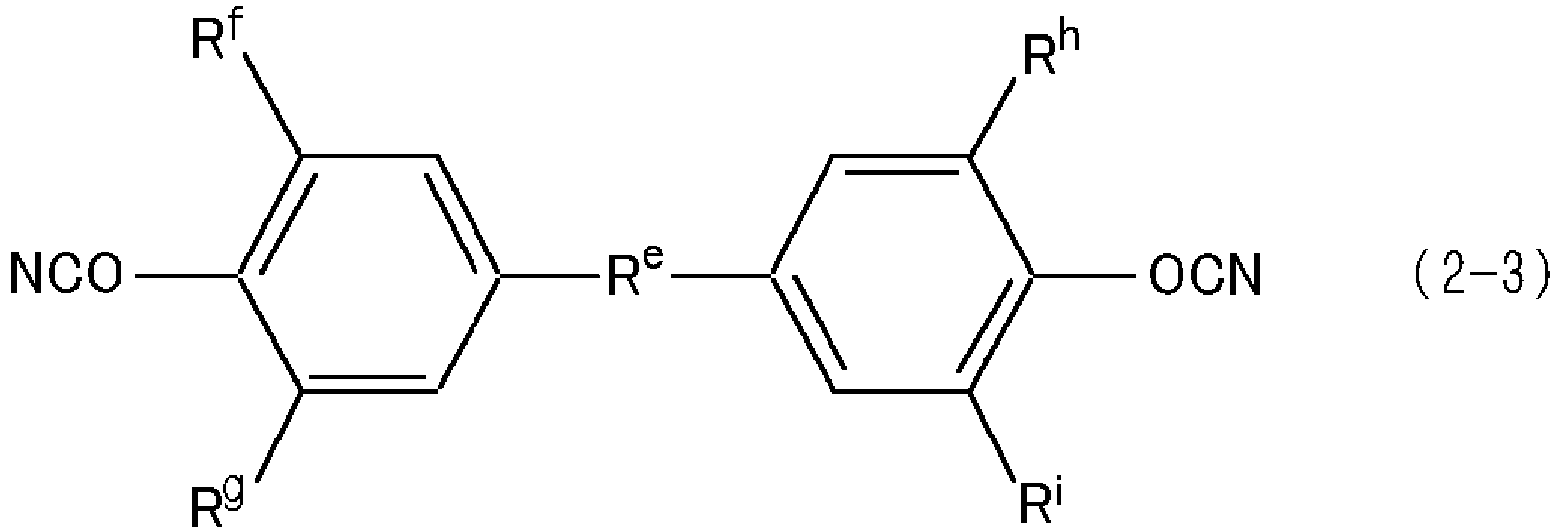


- The resin composition for fiber reinforced plastic according to any one of Claims from 1 to 4, wherein the amount of cyanate resin (B) used is 50 to 120 parts by mass relative to 100 parts by mass of the total amount of epoxy compound containing an epoxy group in the composition.
- The resin composition for fiber reinforced plastic according to any one of Claims from 1 to 5, wherein the aromatic amine curing agent (C) is at least one compound selected from diaminodiphenylmethane, diaminodiethyl diphenylmethane, and diaminodiethyltoluene.
- The resin composition for fiber reinforced plastic according to any one of Claims from 1 to 6, wherein the amount used of the aromatic amine curing agent (C) ranges from 40 to 90 parts by mass relative to 100 parts by mass of the total amount of epoxy compound having an epoxy group in the composition.
- The resin composition for fiber reinforced plastic according to any one of Claims from 1 to 7, wherein the active energy radiation absorbable component (D) is a nigrosine compound.
- The resin composition for fiber reinforced plastic according to any one of Claims from 1 to 8, wherein a silane coupling agent is further contained.
- The resin composition for fiber reinforced plastic according to Claim 9, wherein the amount of the aforementioned silane coupling agent used ranges from 7 to 20 parts by mass relative to 100 parts by mass of the total amount of epoxy compound having an epoxy group in the composition.
- A cured product obtainable by curing the composition containing the resin composition for fiber reinforced plastic according to any one of Claims from 1 to 10.
- A high-strength fiber-reinforced plastic obtained by curing the composition which uniformly contains the resin composition for fiber reinforced plastic according to any one of Claims from 1 to 11 and the reinforcement fiber.
- A method for producing the high-strength fiber-reinforced plastic, wherein the composition, which uniformly contains the resin composition for fiber reinforced plastic according to any one of Claims from 1 to 12 and the reinforcement fiber, is cured by the active energy radiation.
- The method for producing the high-strength fiber-reinforced plastic according to Claim 13, wherein the active energy radiation used is the laser beam and/or the infrared rays.
Applications Claiming Priority (3)
| Application Number | Priority Date | Filing Date | Title |
|---|---|---|---|
| JP2015174653 | 2015-09-04 | ||
| JP2015208947 | 2015-10-23 | ||
| PCT/JP2016/074758 WO2017038603A1 (en) | 2015-09-04 | 2016-08-25 | Resin composition for fiber-reinforced plastic, cured product thereof, fiber-reinforced plastic containing said cured product, and method for producing said fiber-reinforced plastic |
Publications (3)
| Publication Number | Publication Date |
|---|---|
| EP3345950A1 EP3345950A1 (en) | 2018-07-11 |
| EP3345950A4 EP3345950A4 (en) | 2019-05-08 |
| EP3345950B1 true EP3345950B1 (en) | 2021-07-21 |
Family
ID=58187384
Family Applications (1)
| Application Number | Title | Priority Date | Filing Date |
|---|---|---|---|
| EP16841635.2A Active EP3345950B1 (en) | 2015-09-04 | 2016-08-25 | Resin composition for fiber-reinforced plastic, cured product thereof, fiber-reinforced plastic containing said cured product, and method for producing said fiber-reinforced plastic |
Country Status (10)
| Country | Link |
|---|---|
| US (1) | US10557002B2 (en) |
| EP (1) | EP3345950B1 (en) |
| JP (1) | JP6800857B2 (en) |
| KR (1) | KR102564741B1 (en) |
| CN (1) | CN108026249B (en) |
| CA (1) | CA2997390C (en) |
| DK (1) | DK3345950T3 (en) |
| ES (1) | ES2881753T3 (en) |
| TW (1) | TWI709606B (en) |
| WO (1) | WO2017038603A1 (en) |
Families Citing this family (6)
| Publication number | Priority date | Publication date | Assignee | Title |
|---|---|---|---|---|
| US10759226B2 (en) * | 2015-07-31 | 2020-09-01 | Pirelli Tyre S.P.A. | High performance tyre |
| JP7121721B2 (en) * | 2017-02-27 | 2022-08-18 | 株式会社Adeka | Resin composition for fiber-reinforced plastic, cured product thereof, and fiber-reinforced plastic comprising the cured product |
| CN108929519A (en) * | 2017-05-24 | 2018-12-04 | 洛阳尖端技术研究院 | A kind of basalt fiber composite material and preparation method thereof |
| WO2019167579A1 (en) | 2018-02-27 | 2019-09-06 | 東レ株式会社 | Heat-curable resin composition, prepreg, and fiber-reinforced composite material |
| CN112334540A (en) * | 2018-07-04 | 2021-02-05 | 株式会社艾迪科 | Resin composition, cured product thereof, fiber-reinforced plastic, and method for imparting flame retardancy to fiber-reinforced plastic |
| WO2020184324A1 (en) * | 2019-03-08 | 2020-09-17 | 株式会社Adeka | Resin composition for fiber-reinforced plastic, and fiber-reinforced plastic containing said composition |
Citations (1)
| Publication number | Priority date | Publication date | Assignee | Title |
|---|---|---|---|---|
| WO2014157626A1 (en) * | 2013-03-28 | 2014-10-02 | 三菱化学株式会社 | Composition for interlayer filler of layered semiconductor device, layered semiconductor device, and method for manufacturing layered semiconductor device |
Family Cites Families (17)
| Publication number | Priority date | Publication date | Assignee | Title |
|---|---|---|---|---|
| JP3508346B2 (en) * | 1994-12-02 | 2004-03-22 | 東レ株式会社 | Prepreg and fiber reinforced composite materials |
| ATE388981T1 (en) | 2001-10-19 | 2008-03-15 | Lonza Ag | CURED CYANATE COMPOSITIONS |
| US20040247882A1 (en) | 2001-11-07 | 2004-12-09 | Shinji Kouchi | Epoxy resin compositions for fiber-reinforced composite materials, process for production of the materials and fiber-reinforced composite materials |
| JP4946336B2 (en) | 2005-11-14 | 2012-06-06 | 東レ株式会社 | Epoxy resin composition, prepreg and fiber reinforced composite material |
| MY150705A (en) * | 2007-04-10 | 2014-02-28 | Sumitomo Bakelite Co | Epoxy resin composition, prepreg, laminate board, multilayer printed wiring board, semiconductor device, insulating resin sheet, and process for manufacturing multilayer printed wiring board |
| JP2009001658A (en) | 2007-06-21 | 2009-01-08 | Tosoh Corp | Triazine resin composition and molded article comprising the same |
| JP5353064B2 (en) * | 2008-02-19 | 2013-11-27 | 日立化成株式会社 | Photosensitive adhesive composition, adhesive film obtained using the same, adhesive sheet, adhesive pattern, and semiconductor device |
| GB2460050A (en) * | 2008-05-14 | 2009-11-18 | Hexcel Composites Ltd | Epoxy composite |
| JP2010150310A (en) | 2008-12-24 | 2010-07-08 | Toray Ind Inc | Epoxy resin composition, fiber-reinforced composite material and method for manufacturing the same |
| JP5546137B2 (en) * | 2009-02-06 | 2014-07-09 | 株式会社デンソー | Rapid photo-curable epoxy adhesive composition and bonding method |
| JP2011046825A (en) | 2009-08-27 | 2011-03-10 | Toho Tenax Co Ltd | Radiation curable resin composition and prepreg |
| CN102153724A (en) * | 2010-02-11 | 2011-08-17 | 中国科学院化学研究所 | Aromatic polyether glycidyl ether epoxide resin and preparation method of aromatic polyether glycidyl ether epoxide resin |
| JP5603610B2 (en) * | 2010-02-12 | 2014-10-08 | 株式会社Adeka | Solvent-free one-component cyanate ester-epoxy composite resin composition |
| JP2013091728A (en) | 2011-10-26 | 2013-05-16 | Ishihara Chem Co Ltd | Thermosetting resin composition, carbon fiber-reinforced plastic and production method thereof |
| JP6559133B2 (en) * | 2013-12-04 | 2019-08-14 | ロンザ リミテッドLonza Limited | Process for producing fiber reinforced parts based on cyanate ester / epoxy blends |
| DE102014019207A1 (en) * | 2014-12-19 | 2016-06-23 | Airbus Defence and Space GmbH | High-temperature-resistant thermosets based on naphthalene-based epoxy resins and cyanate esters, as well as improving impact resistance |
| US12172389B2 (en) * | 2015-11-25 | 2024-12-24 | Adeka Corporation | Molding apparatus, manufacturing method, and fiber reinforced resin material |
-
2016
- 2016-08-25 WO PCT/JP2016/074758 patent/WO2017038603A1/en not_active Ceased
- 2016-08-25 EP EP16841635.2A patent/EP3345950B1/en active Active
- 2016-08-25 CA CA2997390A patent/CA2997390C/en active Active
- 2016-08-25 JP JP2017537791A patent/JP6800857B2/en active Active
- 2016-08-25 US US15/757,086 patent/US10557002B2/en active Active
- 2016-08-25 CN CN201680050914.6A patent/CN108026249B/en active Active
- 2016-08-25 ES ES16841635T patent/ES2881753T3/en active Active
- 2016-08-25 DK DK16841635.2T patent/DK3345950T3/en active
- 2016-08-25 KR KR1020187006141A patent/KR102564741B1/en active Active
- 2016-08-26 TW TW105127385A patent/TWI709606B/en active
Patent Citations (1)
| Publication number | Priority date | Publication date | Assignee | Title |
|---|---|---|---|---|
| WO2014157626A1 (en) * | 2013-03-28 | 2014-10-02 | 三菱化学株式会社 | Composition for interlayer filler of layered semiconductor device, layered semiconductor device, and method for manufacturing layered semiconductor device |
Also Published As
| Publication number | Publication date |
|---|---|
| US20180251612A1 (en) | 2018-09-06 |
| CA2997390A1 (en) | 2017-03-09 |
| WO2017038603A1 (en) | 2017-03-09 |
| KR20180050307A (en) | 2018-05-14 |
| TW201714955A (en) | 2017-05-01 |
| EP3345950A1 (en) | 2018-07-11 |
| JP6800857B2 (en) | 2020-12-16 |
| TWI709606B (en) | 2020-11-11 |
| KR102564741B1 (en) | 2023-08-08 |
| ES2881753T3 (en) | 2021-11-30 |
| US10557002B2 (en) | 2020-02-11 |
| CA2997390C (en) | 2022-09-27 |
| EP3345950A4 (en) | 2019-05-08 |
| JPWO2017038603A1 (en) | 2018-07-26 |
| CN108026249B (en) | 2020-12-11 |
| CN108026249A (en) | 2018-05-11 |
| DK3345950T3 (en) | 2021-09-06 |
Similar Documents
| Publication | Publication Date | Title |
|---|---|---|
| EP3345950B1 (en) | Resin composition for fiber-reinforced plastic, cured product thereof, fiber-reinforced plastic containing said cured product, and method for producing said fiber-reinforced plastic | |
| TWI585121B (en) | Epoxy-amine addition, resin composition, sizing agent, carbon fiber coated with sizing agent and fiber forced complex material | |
| JP6609321B2 (en) | Molding apparatus, manufacturing method, and fiber-reinforced resin material | |
| TW201404796A (en) | Cured resin composition and a hardened product thereof, prepreg, and fiber forced complex material | |
| KR102573168B1 (en) | Resin composition for fiber-reinforced plastics, a cured product thereof, and a fiber-reinforced plastic comprising the cured product | |
| JP7527270B2 (en) | Resin composition for fiber-reinforced plastics, and fiber-reinforced plastics containing said composition | |
| JP7082496B2 (en) | A resin composition for fiber reinforced plastics, a cured product thereof, and a fiber reinforced plastic containing the cured product. | |
| JP2006241308A (en) | Fiber-reinforced composite material |
Legal Events
| Date | Code | Title | Description |
|---|---|---|---|
| STAA | Information on the status of an ep patent application or granted ep patent |
Free format text: STATUS: THE INTERNATIONAL PUBLICATION HAS BEEN MADE |
|
| PUAI | Public reference made under article 153(3) epc to a published international application that has entered the european phase |
Free format text: ORIGINAL CODE: 0009012 |
|
| STAA | Information on the status of an ep patent application or granted ep patent |
Free format text: STATUS: REQUEST FOR EXAMINATION WAS MADE |
|
| 17P | Request for examination filed |
Effective date: 20180302 |
|
| AK | Designated contracting states |
Kind code of ref document: A1 Designated state(s): AL AT BE BG CH CY CZ DE DK EE ES FI FR GB GR HR HU IE IS IT LI LT LU LV MC MK MT NL NO PL PT RO RS SE SI SK SM TR |
|
| AX | Request for extension of the european patent |
Extension state: BA ME |
|
| DAV | Request for validation of the european patent (deleted) | ||
| DAX | Request for extension of the european patent (deleted) | ||
| A4 | Supplementary search report drawn up and despatched |
Effective date: 20190404 |
|
| RIC1 | Information provided on ipc code assigned before grant |
Ipc: C08G 59/22 20060101ALI20190329BHEP Ipc: C08G 59/50 20060101ALI20190329BHEP Ipc: C08J 5/04 20060101ALI20190329BHEP Ipc: C08G 59/40 20060101AFI20190329BHEP |
|
| STAA | Information on the status of an ep patent application or granted ep patent |
Free format text: STATUS: EXAMINATION IS IN PROGRESS |
|
| 17Q | First examination report despatched |
Effective date: 20191107 |
|
| GRAP | Despatch of communication of intention to grant a patent |
Free format text: ORIGINAL CODE: EPIDOSNIGR1 |
|
| STAA | Information on the status of an ep patent application or granted ep patent |
Free format text: STATUS: GRANT OF PATENT IS INTENDED |
|
| INTG | Intention to grant announced |
Effective date: 20210512 |
|
| GRAS | Grant fee paid |
Free format text: ORIGINAL CODE: EPIDOSNIGR3 |
|
| GRAA | (expected) grant |
Free format text: ORIGINAL CODE: 0009210 |
|
| STAA | Information on the status of an ep patent application or granted ep patent |
Free format text: STATUS: THE PATENT HAS BEEN GRANTED |
|
| AK | Designated contracting states |
Kind code of ref document: B1 Designated state(s): AL AT BE BG CH CY CZ DE DK EE ES FI FR GB GR HR HU IE IS IT LI LT LU LV MC MK MT NL NO PL PT RO RS SE SI SK SM TR |
|
| REG | Reference to a national code |
Ref country code: GB Ref legal event code: FG4D |
|
| REG | Reference to a national code |
Ref country code: CH Ref legal event code: EP |
|
| REG | Reference to a national code |
Ref country code: DE Ref legal event code: R096 Ref document number: 602016061044 Country of ref document: DE |
|
| REG | Reference to a national code |
Ref country code: AT Ref legal event code: REF Ref document number: 1412568 Country of ref document: AT Kind code of ref document: T Effective date: 20210815 |
|
| REG | Reference to a national code |
Ref country code: IE Ref legal event code: FG4D |
|
| REG | Reference to a national code |
Ref country code: NL Ref legal event code: FP |
|
| REG | Reference to a national code |
Ref country code: DK Ref legal event code: T3 Effective date: 20210830 |
|
| PGFP | Annual fee paid to national office [announced via postgrant information from national office to epo] |
Ref country code: FR Payment date: 20210913 Year of fee payment: 6 |
|
| REG | Reference to a national code |
Ref country code: NO Ref legal event code: T2 Effective date: 20210721 |
|
| REG | Reference to a national code |
Ref country code: LT Ref legal event code: MG9D |
|
| REG | Reference to a national code |
Ref country code: ES Ref legal event code: FG2A Ref document number: 2881753 Country of ref document: ES Kind code of ref document: T3 Effective date: 20211130 |
|
| REG | Reference to a national code |
Ref country code: AT Ref legal event code: MK05 Ref document number: 1412568 Country of ref document: AT Kind code of ref document: T Effective date: 20210721 |
|
| PG25 | Lapsed in a contracting state [announced via postgrant information from national office to epo] |
Ref country code: LT Free format text: LAPSE BECAUSE OF FAILURE TO SUBMIT A TRANSLATION OF THE DESCRIPTION OR TO PAY THE FEE WITHIN THE PRESCRIBED TIME-LIMIT Effective date: 20210721 Ref country code: AT Free format text: LAPSE BECAUSE OF FAILURE TO SUBMIT A TRANSLATION OF THE DESCRIPTION OR TO PAY THE FEE WITHIN THE PRESCRIBED TIME-LIMIT Effective date: 20210721 Ref country code: BG Free format text: LAPSE BECAUSE OF FAILURE TO SUBMIT A TRANSLATION OF THE DESCRIPTION OR TO PAY THE FEE WITHIN THE PRESCRIBED TIME-LIMIT Effective date: 20211021 Ref country code: PT Free format text: LAPSE BECAUSE OF FAILURE TO SUBMIT A TRANSLATION OF THE DESCRIPTION OR TO PAY THE FEE WITHIN THE PRESCRIBED TIME-LIMIT Effective date: 20211122 Ref country code: HR Free format text: LAPSE BECAUSE OF FAILURE TO SUBMIT A TRANSLATION OF THE DESCRIPTION OR TO PAY THE FEE WITHIN THE PRESCRIBED TIME-LIMIT Effective date: 20210721 Ref country code: FI Free format text: LAPSE BECAUSE OF FAILURE TO SUBMIT A TRANSLATION OF THE DESCRIPTION OR TO PAY THE FEE WITHIN THE PRESCRIBED TIME-LIMIT Effective date: 20210721 Ref country code: RS Free format text: LAPSE BECAUSE OF FAILURE TO SUBMIT A TRANSLATION OF THE DESCRIPTION OR TO PAY THE FEE WITHIN THE PRESCRIBED TIME-LIMIT Effective date: 20210721 Ref country code: SE Free format text: LAPSE BECAUSE OF FAILURE TO SUBMIT A TRANSLATION OF THE DESCRIPTION OR TO PAY THE FEE WITHIN THE PRESCRIBED TIME-LIMIT Effective date: 20210721 |
|
| PG25 | Lapsed in a contracting state [announced via postgrant information from national office to epo] |
Ref country code: PL Free format text: LAPSE BECAUSE OF FAILURE TO SUBMIT A TRANSLATION OF THE DESCRIPTION OR TO PAY THE FEE WITHIN THE PRESCRIBED TIME-LIMIT Effective date: 20210721 Ref country code: LV Free format text: LAPSE BECAUSE OF FAILURE TO SUBMIT A TRANSLATION OF THE DESCRIPTION OR TO PAY THE FEE WITHIN THE PRESCRIBED TIME-LIMIT Effective date: 20210721 Ref country code: GR Free format text: LAPSE BECAUSE OF FAILURE TO SUBMIT A TRANSLATION OF THE DESCRIPTION OR TO PAY THE FEE WITHIN THE PRESCRIBED TIME-LIMIT Effective date: 20211022 |
|
| REG | Reference to a national code |
Ref country code: DE Ref legal event code: R097 Ref document number: 602016061044 Country of ref document: DE |
|
| PLBE | No opposition filed within time limit |
Free format text: ORIGINAL CODE: 0009261 |
|
| STAA | Information on the status of an ep patent application or granted ep patent |
Free format text: STATUS: NO OPPOSITION FILED WITHIN TIME LIMIT |
|
| PG25 | Lapsed in a contracting state [announced via postgrant information from national office to epo] |
Ref country code: SM Free format text: LAPSE BECAUSE OF FAILURE TO SUBMIT A TRANSLATION OF THE DESCRIPTION OR TO PAY THE FEE WITHIN THE PRESCRIBED TIME-LIMIT Effective date: 20210721 Ref country code: SK Free format text: LAPSE BECAUSE OF FAILURE TO SUBMIT A TRANSLATION OF THE DESCRIPTION OR TO PAY THE FEE WITHIN THE PRESCRIBED TIME-LIMIT Effective date: 20210721 Ref country code: RO Free format text: LAPSE BECAUSE OF FAILURE TO SUBMIT A TRANSLATION OF THE DESCRIPTION OR TO PAY THE FEE WITHIN THE PRESCRIBED TIME-LIMIT Effective date: 20210721 Ref country code: MC Free format text: LAPSE BECAUSE OF FAILURE TO SUBMIT A TRANSLATION OF THE DESCRIPTION OR TO PAY THE FEE WITHIN THE PRESCRIBED TIME-LIMIT Effective date: 20210721 Ref country code: LU Free format text: LAPSE BECAUSE OF NON-PAYMENT OF DUE FEES Effective date: 20210825 Ref country code: EE Free format text: LAPSE BECAUSE OF FAILURE TO SUBMIT A TRANSLATION OF THE DESCRIPTION OR TO PAY THE FEE WITHIN THE PRESCRIBED TIME-LIMIT Effective date: 20210721 Ref country code: CZ Free format text: LAPSE BECAUSE OF FAILURE TO SUBMIT A TRANSLATION OF THE DESCRIPTION OR TO PAY THE FEE WITHIN THE PRESCRIBED TIME-LIMIT Effective date: 20210721 Ref country code: AL Free format text: LAPSE BECAUSE OF FAILURE TO SUBMIT A TRANSLATION OF THE DESCRIPTION OR TO PAY THE FEE WITHIN THE PRESCRIBED TIME-LIMIT Effective date: 20210721 |
|
| 26N | No opposition filed |
Effective date: 20220422 |
|
| PG25 | Lapsed in a contracting state [announced via postgrant information from national office to epo] |
Ref country code: IE Free format text: LAPSE BECAUSE OF NON-PAYMENT OF DUE FEES Effective date: 20210825 |
|
| PG25 | Lapsed in a contracting state [announced via postgrant information from national office to epo] |
Ref country code: HU Free format text: LAPSE BECAUSE OF FAILURE TO SUBMIT A TRANSLATION OF THE DESCRIPTION OR TO PAY THE FEE WITHIN THE PRESCRIBED TIME-LIMIT; INVALID AB INITIO Effective date: 20160825 |
|
| P01 | Opt-out of the competence of the unified patent court (upc) registered |
Effective date: 20230403 |
|
| PG25 | Lapsed in a contracting state [announced via postgrant information from national office to epo] |
Ref country code: CY Free format text: LAPSE BECAUSE OF FAILURE TO SUBMIT A TRANSLATION OF THE DESCRIPTION OR TO PAY THE FEE WITHIN THE PRESCRIBED TIME-LIMIT Effective date: 20210721 |
|
| PG25 | Lapsed in a contracting state [announced via postgrant information from national office to epo] |
Ref country code: FR Free format text: LAPSE BECAUSE OF NON-PAYMENT OF DUE FEES Effective date: 20220831 |
|
| PG25 | Lapsed in a contracting state [announced via postgrant information from national office to epo] |
Ref country code: MK Free format text: LAPSE BECAUSE OF FAILURE TO SUBMIT A TRANSLATION OF THE DESCRIPTION OR TO PAY THE FEE WITHIN THE PRESCRIBED TIME-LIMIT Effective date: 20210721 |
|
| PG25 | Lapsed in a contracting state [announced via postgrant information from national office to epo] |
Ref country code: MT Free format text: LAPSE BECAUSE OF FAILURE TO SUBMIT A TRANSLATION OF THE DESCRIPTION OR TO PAY THE FEE WITHIN THE PRESCRIBED TIME-LIMIT Effective date: 20210721 |
|
| PGFP | Annual fee paid to national office [announced via postgrant information from national office to epo] |
Ref country code: NL Payment date: 20250821 Year of fee payment: 10 |
|
| PGFP | Annual fee paid to national office [announced via postgrant information from national office to epo] |
Ref country code: ES Payment date: 20250926 Year of fee payment: 10 |
|
| PGFP | Annual fee paid to national office [announced via postgrant information from national office to epo] |
Ref country code: DK Payment date: 20250825 Year of fee payment: 10 Ref country code: DE Payment date: 20250820 Year of fee payment: 10 |
|
| PGFP | Annual fee paid to national office [announced via postgrant information from national office to epo] |
Ref country code: NO Payment date: 20250826 Year of fee payment: 10 |
|
| PGFP | Annual fee paid to national office [announced via postgrant information from national office to epo] |
Ref country code: IT Payment date: 20250825 Year of fee payment: 10 |
|
| PGFP | Annual fee paid to national office [announced via postgrant information from national office to epo] |
Ref country code: BE Payment date: 20250820 Year of fee payment: 10 Ref country code: GB Payment date: 20250821 Year of fee payment: 10 |
|
| PGFP | Annual fee paid to national office [announced via postgrant information from national office to epo] |
Ref country code: CH Payment date: 20250901 Year of fee payment: 10 |