EP3345893A1 - Urea derivative and use therefor - Google Patents
Urea derivative and use therefor Download PDFInfo
- Publication number
- EP3345893A1 EP3345893A1 EP16841903.4A EP16841903A EP3345893A1 EP 3345893 A1 EP3345893 A1 EP 3345893A1 EP 16841903 A EP16841903 A EP 16841903A EP 3345893 A1 EP3345893 A1 EP 3345893A1
- Authority
- EP
- European Patent Office
- Prior art keywords
- trans
- phenyl
- synthesis
- mmol
- cyclohexyl
- Prior art date
- Legal status (The legal status is an assumption and is not a legal conclusion. Google has not performed a legal analysis and makes no representation as to the accuracy of the status listed.)
- Granted
Links
- 150000003672 ureas Chemical class 0.000 title claims abstract description 53
- 101710131668 Epithelial discoidin domain-containing receptor 1 Proteins 0.000 claims abstract description 34
- 102100036725 Epithelial discoidin domain-containing receptor 1 Human genes 0.000 claims abstract description 34
- 150000003839 salts Chemical class 0.000 claims abstract description 18
- -1 pentafluorosulfanyl Chemical group 0.000 claims description 60
- 125000004429 atom Chemical group 0.000 claims description 28
- 125000004076 pyridyl group Chemical group 0.000 claims description 22
- 125000000623 heterocyclic group Chemical group 0.000 claims description 17
- 125000004435 hydrogen atom Chemical group [H]* 0.000 claims description 16
- 125000001997 phenyl group Chemical group [H]C1=C([H])C([H])=C(*)C([H])=C1[H] 0.000 claims description 16
- 125000001072 heteroaryl group Chemical group 0.000 claims description 15
- 229910052757 nitrogen Inorganic materials 0.000 claims description 13
- 125000006273 (C1-C3) alkyl group Chemical group 0.000 claims description 12
- 125000003917 carbamoyl group Chemical group [H]N([H])C(*)=O 0.000 claims description 12
- 125000000714 pyrimidinyl group Chemical group 0.000 claims description 12
- 125000004433 nitrogen atom Chemical group N* 0.000 claims description 11
- 125000002757 morpholinyl group Chemical group 0.000 claims description 10
- 125000002887 hydroxy group Chemical group [H]O* 0.000 claims description 9
- 125000002098 pyridazinyl group Chemical group 0.000 claims description 8
- 125000002777 acetyl group Chemical group [H]C([H])([H])C(*)=O 0.000 claims description 6
- 125000005843 halogen group Chemical group 0.000 claims description 6
- 239000003112 inhibitor Substances 0.000 claims description 6
- 125000002496 methyl group Chemical group [H]C([H])([H])* 0.000 claims description 5
- 125000004043 oxo group Chemical group O=* 0.000 claims description 5
- 125000004575 3-pyrrolidinyl group Chemical group [H]N1C([H])([H])C([H])([H])C([H])(*)C1([H])[H] 0.000 claims description 4
- 125000004482 piperidin-4-yl group Chemical group N1CCC(CC1)* 0.000 claims description 4
- 239000004480 active ingredient Substances 0.000 claims description 3
- 125000000876 trifluoromethoxy group Chemical group FC(F)(F)O* 0.000 claims description 3
- 125000002023 trifluoromethyl group Chemical group FC(F)(F)* 0.000 claims description 3
- 125000004029 hydroxymethyl group Chemical group [H]OC([H])([H])* 0.000 claims description 2
- 150000001875 compounds Chemical class 0.000 abstract description 373
- 230000002401 inhibitory effect Effects 0.000 abstract description 6
- 238000003786 synthesis reaction Methods 0.000 description 345
- 230000015572 biosynthetic process Effects 0.000 description 343
- 238000000034 method Methods 0.000 description 196
- XEKOWRVHYACXOJ-UHFFFAOYSA-N Ethyl acetate Chemical compound CCOC(C)=O XEKOWRVHYACXOJ-UHFFFAOYSA-N 0.000 description 168
- HEDRZPFGACZZDS-MICDWDOJSA-N Trichloro(2H)methane Chemical compound [2H]C(Cl)(Cl)Cl HEDRZPFGACZZDS-MICDWDOJSA-N 0.000 description 156
- 239000000243 solution Substances 0.000 description 135
- 238000005160 1H NMR spectroscopy Methods 0.000 description 130
- OKKJLVBELUTLKV-UHFFFAOYSA-N Methanol Chemical compound OC OKKJLVBELUTLKV-UHFFFAOYSA-N 0.000 description 105
- 238000006243 chemical reaction Methods 0.000 description 95
- RTZKZFJDLAIYFH-UHFFFAOYSA-N Diethyl ether Chemical compound CCOCC RTZKZFJDLAIYFH-UHFFFAOYSA-N 0.000 description 78
- ZMXDDKWLCZADIW-UHFFFAOYSA-N N,N-Dimethylformamide Chemical compound CN(C)C=O ZMXDDKWLCZADIW-UHFFFAOYSA-N 0.000 description 78
- WYURNTSHIVDZCO-UHFFFAOYSA-N Tetrahydrofuran Chemical compound C1CCOC1 WYURNTSHIVDZCO-UHFFFAOYSA-N 0.000 description 76
- LFQSCWFLJHTTHZ-UHFFFAOYSA-N Ethanol Chemical compound CCO LFQSCWFLJHTTHZ-UHFFFAOYSA-N 0.000 description 75
- OSRKDVXHKXWQAH-WKILWMFISA-N COC1=C(C=C(C=C1)S(F)(F)(F)(F)F)NC(=O)N[C@@H]1CC[C@H](CC1)OC1=NC(=NC=C1)N1CCOCC1 Chemical compound COC1=C(C=C(C=C1)S(F)(F)(F)(F)F)NC(=O)N[C@@H]1CC[C@H](CC1)OC1=NC(=NC=C1)N1CCOCC1 OSRKDVXHKXWQAH-WKILWMFISA-N 0.000 description 74
- 238000010534 nucleophilic substitution reaction Methods 0.000 description 66
- OKKJLVBELUTLKV-MZCSYVLQSA-N Deuterated methanol Chemical compound [2H]OC([2H])([2H])[2H] OKKJLVBELUTLKV-MZCSYVLQSA-N 0.000 description 64
- YMWUJEATGCHHMB-UHFFFAOYSA-N Dichloromethane Chemical compound ClCCl YMWUJEATGCHHMB-UHFFFAOYSA-N 0.000 description 63
- VLKZOEOYAKHREP-UHFFFAOYSA-N n-Hexane Chemical compound CCCCCC VLKZOEOYAKHREP-UHFFFAOYSA-N 0.000 description 63
- XSQUKJJJFZCRTK-UHFFFAOYSA-N urea group Chemical group NC(=O)N XSQUKJJJFZCRTK-UHFFFAOYSA-N 0.000 description 60
- 239000012043 crude product Substances 0.000 description 49
- WEVYAHXRMPXWCK-UHFFFAOYSA-N Acetonitrile Chemical compound CC#N WEVYAHXRMPXWCK-UHFFFAOYSA-N 0.000 description 48
- IAZDPXIOMUYVGZ-UHFFFAOYSA-N Dimethylsulphoxide Chemical compound CS(C)=O IAZDPXIOMUYVGZ-UHFFFAOYSA-N 0.000 description 48
- ZMANZCXQSJIPKH-UHFFFAOYSA-N Triethylamine Chemical compound CCN(CC)CC ZMANZCXQSJIPKH-UHFFFAOYSA-N 0.000 description 48
- HEDRZPFGACZZDS-UHFFFAOYSA-N Chloroform Chemical compound ClC(Cl)Cl HEDRZPFGACZZDS-UHFFFAOYSA-N 0.000 description 44
- IAZDPXIOMUYVGZ-WFGJKAKNSA-N Dimethyl sulfoxide Chemical compound [2H]C([2H])([2H])S(=O)C([2H])([2H])[2H] IAZDPXIOMUYVGZ-WFGJKAKNSA-N 0.000 description 40
- 239000002904 solvent Substances 0.000 description 40
- 239000012044 organic layer Substances 0.000 description 37
- 238000005859 coupling reaction Methods 0.000 description 35
- JGFZNNIVVJXRND-UHFFFAOYSA-N N,N-Diisopropylethylamine (DIPEA) Chemical compound CCN(C(C)C)C(C)C JGFZNNIVVJXRND-UHFFFAOYSA-N 0.000 description 34
- 239000007864 aqueous solution Substances 0.000 description 32
- 150000001298 alcohols Chemical class 0.000 description 30
- 239000004202 carbamide Substances 0.000 description 29
- NLXLAEXVIDQMFP-UHFFFAOYSA-N Ammonia chloride Chemical compound [NH4+].[Cl-] NLXLAEXVIDQMFP-UHFFFAOYSA-N 0.000 description 28
- UIIMBOGNXHQVGW-UHFFFAOYSA-M Sodium bicarbonate Chemical compound [Na+].OC([O-])=O UIIMBOGNXHQVGW-UHFFFAOYSA-M 0.000 description 28
- 239000007810 chemical reaction solvent Substances 0.000 description 28
- 229920006395 saturated elastomer Polymers 0.000 description 28
- XLYOFNOQVPJJNP-UHFFFAOYSA-N water Substances O XLYOFNOQVPJJNP-UHFFFAOYSA-N 0.000 description 28
- PMZURENOXWZQFD-UHFFFAOYSA-L Sodium Sulfate Chemical compound [Na+].[Na+].[O-]S([O-])(=O)=O PMZURENOXWZQFD-UHFFFAOYSA-L 0.000 description 27
- FAPWRFPIFSIZLT-UHFFFAOYSA-M Sodium chloride Chemical compound [Na+].[Cl-] FAPWRFPIFSIZLT-UHFFFAOYSA-M 0.000 description 26
- RYHBNJHYFVUHQT-UHFFFAOYSA-N 1,4-Dioxane Chemical compound C1COCCO1 RYHBNJHYFVUHQT-UHFFFAOYSA-N 0.000 description 25
- GBWGWBSAWOVMLF-UHFFFAOYSA-N 2,2,2-trichloroethyl N-[3-(hydroxymethyl)-2-methoxy-5-(trifluoromethyl)phenyl]carbamate Chemical compound OCC=1C(=C(C=C(C=1)C(F)(F)F)NC(OCC(Cl)(Cl)Cl)=O)OC GBWGWBSAWOVMLF-UHFFFAOYSA-N 0.000 description 25
- YLQBMQCUIZJEEH-UHFFFAOYSA-N tetrahydrofuran Natural products C=1C=COC=1 YLQBMQCUIZJEEH-UHFFFAOYSA-N 0.000 description 25
- 239000004210 ether based solvent Substances 0.000 description 24
- XTHFKEDIFFGKHM-UHFFFAOYSA-N Dimethoxyethane Chemical compound COCCOC XTHFKEDIFFGKHM-UHFFFAOYSA-N 0.000 description 23
- 239000003480 eluent Substances 0.000 description 23
- 238000010898 silica gel chromatography Methods 0.000 description 23
- 238000003756 stirring Methods 0.000 description 23
- VEXZGXHMUGYJMC-UHFFFAOYSA-N Hydrochloric acid Chemical compound Cl VEXZGXHMUGYJMC-UHFFFAOYSA-N 0.000 description 22
- 239000005456 alcohol based solvent Substances 0.000 description 21
- 239000012046 mixed solvent Substances 0.000 description 21
- FXHOOIRPVKKKFG-UHFFFAOYSA-N N,N-Dimethylacetamide Chemical compound CN(C)C(C)=O FXHOOIRPVKKKFG-UHFFFAOYSA-N 0.000 description 20
- 239000002798 polar solvent Substances 0.000 description 20
- BWHMMNNQKKPAPP-UHFFFAOYSA-L potassium carbonate Chemical compound [K+].[K+].[O-]C([O-])=O BWHMMNNQKKPAPP-UHFFFAOYSA-L 0.000 description 20
- KVFZEIRWDXKXJD-KMMPGQJCSA-N Cl.ClC1=NC=CC(=N1)O[C@@H]1CC[C@H](CC1)N Chemical compound Cl.ClC1=NC=CC(=N1)O[C@@H]1CC[C@H](CC1)N KVFZEIRWDXKXJD-KMMPGQJCSA-N 0.000 description 19
- 239000003153 chemical reaction reagent Substances 0.000 description 19
- 150000001934 cyclohexanes Chemical class 0.000 description 19
- 238000006722 reduction reaction Methods 0.000 description 19
- JVTDEXRGFGWNKX-UHFFFAOYSA-N 2,2,2-trichloroethyl N-[2-methoxy-5-(trifluoromethoxy)phenyl]carbamate Chemical compound COC1=C(C=C(C=C1)OC(F)(F)F)NC(OCC(Cl)(Cl)Cl)=O JVTDEXRGFGWNKX-UHFFFAOYSA-N 0.000 description 18
- IFUJOVOXAQZLCA-KBTGPXOVSA-N Cl.Cl.N1=CC=C(C=C1)CO[C@@H]1CC[C@H](CC1)N Chemical compound Cl.Cl.N1=CC=C(C=C1)CO[C@@H]1CC[C@H](CC1)N IFUJOVOXAQZLCA-KBTGPXOVSA-N 0.000 description 18
- 238000001816 cooling Methods 0.000 description 18
- 239000000126 substance Substances 0.000 description 18
- 150000005181 nitrobenzenes Chemical class 0.000 description 17
- KDLHZDBZIXYQEI-UHFFFAOYSA-N Palladium Chemical compound [Pd] KDLHZDBZIXYQEI-UHFFFAOYSA-N 0.000 description 16
- 229910052801 chlorine Inorganic materials 0.000 description 16
- 230000000694 effects Effects 0.000 description 16
- WSLDOOZREJYCGB-UHFFFAOYSA-N 1,2-Dichloroethane Chemical compound ClCCCl WSLDOOZREJYCGB-UHFFFAOYSA-N 0.000 description 15
- UHOVQNZJYSORNB-UHFFFAOYSA-N Benzene Chemical compound C1=CC=CC=C1 UHOVQNZJYSORNB-UHFFFAOYSA-N 0.000 description 15
- ZAMOUSCENKQFHK-UHFFFAOYSA-N Chlorine atom Chemical compound [Cl] ZAMOUSCENKQFHK-UHFFFAOYSA-N 0.000 description 15
- VCOJPPISDDENCY-XYPYZODXSA-N ClC1=NC=CC(=N1)O[C@@H]1CC[C@H](CC1)NC(OC(C)(C)C)=O Chemical compound ClC1=NC=CC(=N1)O[C@@H]1CC[C@H](CC1)NC(OC(C)(C)C)=O VCOJPPISDDENCY-XYPYZODXSA-N 0.000 description 15
- YXFVVABEGXRONW-UHFFFAOYSA-N Toluene Chemical compound CC1=CC=CC=C1 YXFVVABEGXRONW-UHFFFAOYSA-N 0.000 description 15
- 239000000460 chlorine Substances 0.000 description 15
- 239000000203 mixture Substances 0.000 description 15
- 150000002825 nitriles Chemical class 0.000 description 15
- FVSKHRXBFJPNKK-UHFFFAOYSA-N propionitrile Chemical compound CCC#N FVSKHRXBFJPNKK-UHFFFAOYSA-N 0.000 description 15
- 238000012360 testing method Methods 0.000 description 15
- JUJWROOIHBZHMG-UHFFFAOYSA-N Pyridine Chemical compound C1=CC=NC=C1 JUJWROOIHBZHMG-UHFFFAOYSA-N 0.000 description 14
- 235000019270 ammonium chloride Nutrition 0.000 description 14
- 239000003054 catalyst Substances 0.000 description 14
- 230000035484 reaction time Effects 0.000 description 14
- 229910000030 sodium bicarbonate Inorganic materials 0.000 description 14
- 235000017557 sodium bicarbonate Nutrition 0.000 description 14
- 125000000999 tert-butyl group Chemical group [H]C([H])([H])C(*)(C([H])([H])[H])C([H])([H])[H] 0.000 description 14
- 238000006751 Mitsunobu reaction Methods 0.000 description 13
- KEAYESYHFKHZAL-UHFFFAOYSA-N Sodium Chemical compound [Na] KEAYESYHFKHZAL-UHFFFAOYSA-N 0.000 description 13
- 150000001448 anilines Chemical class 0.000 description 13
- 239000003759 ester based solvent Substances 0.000 description 13
- 230000005764 inhibitory process Effects 0.000 description 13
- 229910052751 metal Inorganic materials 0.000 description 13
- 239000002184 metal Substances 0.000 description 13
- YKYONYBAUNKHLG-UHFFFAOYSA-N n-Propyl acetate Natural products CCCOC(C)=O YKYONYBAUNKHLG-UHFFFAOYSA-N 0.000 description 13
- 229940090181 propyl acetate Drugs 0.000 description 13
- 239000011780 sodium chloride Substances 0.000 description 13
- 239000012312 sodium hydride Substances 0.000 description 13
- 229910000104 sodium hydride Inorganic materials 0.000 description 13
- NQPDZGIKBAWPEJ-UHFFFAOYSA-N valeric acid Chemical compound CCCCC(O)=O NQPDZGIKBAWPEJ-UHFFFAOYSA-N 0.000 description 13
- RMCLGYZLDXAFCF-UHFFFAOYSA-N 2,2,2-trichloroethyl N-[2-(oxetan-3-yloxy)-5-(trifluoromethyl)phenyl]carbamate Chemical compound O1CC(C1)OC1=C(C=C(C=C1)C(F)(F)F)NC(OCC(Cl)(Cl)Cl)=O RMCLGYZLDXAFCF-UHFFFAOYSA-N 0.000 description 12
- 125000006239 protecting group Chemical group 0.000 description 12
- 0 Cc1ncnc(*)c1 Chemical compound Cc1ncnc(*)c1 0.000 description 11
- 125000000113 cyclohexyl group Chemical group [H]C1([H])C([H])([H])C([H])([H])C([H])(*)C([H])([H])C1([H])[H] 0.000 description 11
- 150000007529 inorganic bases Chemical class 0.000 description 11
- 150000007530 organic bases Chemical class 0.000 description 11
- XCYHDPGKQQVCEL-UHFFFAOYSA-N 4-[2-amino-4-(trifluoromethyl)phenyl]piperazin-2-one Chemical compound NC1=CC(C(F)(F)F)=CC=C1N1CC(=O)NCC1 XCYHDPGKQQVCEL-UHFFFAOYSA-N 0.000 description 10
- QODJTDVIWSPFLS-UHFFFAOYSA-N 4-pyrimidin-2-yloxycyclohexan-1-amine Chemical compound C1CC(N)CCC1OC1=NC=CC=N1 QODJTDVIWSPFLS-UHFFFAOYSA-N 0.000 description 10
- KXDHJXZQYSOELW-UHFFFAOYSA-M Carbamate Chemical compound NC([O-])=O KXDHJXZQYSOELW-UHFFFAOYSA-M 0.000 description 10
- YNAVUWVOSKDBBP-UHFFFAOYSA-N Morpholine Chemical compound C1COCCN1 YNAVUWVOSKDBBP-UHFFFAOYSA-N 0.000 description 10
- MXRGQIYKKZOZCG-HAQNSBGRSA-N O1CCN(CC1)C1=NC=CC(=N1)O[C@@H]1CC[C@H](CC1)N Chemical compound O1CCN(CC1)C1=NC=CC(=N1)O[C@@H]1CC[C@H](CC1)N MXRGQIYKKZOZCG-HAQNSBGRSA-N 0.000 description 10
- PAFZNILMFXTMIY-UHFFFAOYSA-N cyclohexylamine Chemical class NC1CCCCC1 PAFZNILMFXTMIY-UHFFFAOYSA-N 0.000 description 10
- 229910000027 potassium carbonate Inorganic materials 0.000 description 10
- QTBSBXVTEAMEQO-UHFFFAOYSA-N Acetic acid Chemical compound CC(O)=O QTBSBXVTEAMEQO-UHFFFAOYSA-N 0.000 description 9
- QTIQTBDSTCJOBY-WKILWMFISA-N COC1=C(C=C(C=C1)OC(F)(F)F)NC(=O)N[C@@H]1CC[C@H](CC1)OC1=NC(=NC=C1)N1CCOCC1 Chemical compound COC1=C(C=C(C=C1)OC(F)(F)F)NC(=O)N[C@@H]1CC[C@H](CC1)OC1=NC(=NC=C1)N1CCOCC1 QTIQTBDSTCJOBY-WKILWMFISA-N 0.000 description 9
- HEMHJVSKTPXQMS-UHFFFAOYSA-M Sodium hydroxide Chemical compound [OH-].[Na+] HEMHJVSKTPXQMS-UHFFFAOYSA-M 0.000 description 9
- 239000012295 chemical reaction liquid Substances 0.000 description 9
- VUFKABITFAWQGE-UHFFFAOYSA-N 2,2,2-trichloroethyl n-[2-methoxy-5-(trifluoromethyl)phenyl]carbamate Chemical compound COC1=CC=C(C(F)(F)F)C=C1NC(=O)OCC(Cl)(Cl)Cl VUFKABITFAWQGE-UHFFFAOYSA-N 0.000 description 8
- 125000004432 carbon atom Chemical group C* 0.000 description 8
- 238000009903 catalytic hydrogenation reaction Methods 0.000 description 8
- 239000012038 nucleophile Substances 0.000 description 8
- 229910052763 palladium Inorganic materials 0.000 description 8
- TZGFQIXRVUHDLE-UHFFFAOYSA-N 1-chloro-2-nitro-4-(trifluoromethyl)benzene Chemical compound [O-][N+](=O)C1=CC(C(F)(F)F)=CC=C1Cl TZGFQIXRVUHDLE-UHFFFAOYSA-N 0.000 description 7
- OBYGUYIKZYVGTF-XYPYZODXSA-N ClC1=NC(=NC=C1)O[C@@H]1CC[C@H](CC1)NC(OC(C)(C)C)=O Chemical compound ClC1=NC(=NC=C1)O[C@@H]1CC[C@H](CC1)NC(OC(C)(C)C)=O OBYGUYIKZYVGTF-XYPYZODXSA-N 0.000 description 7
- UFHFLCQGNIYNRP-UHFFFAOYSA-N Hydrogen Chemical compound [H][H] UFHFLCQGNIYNRP-UHFFFAOYSA-N 0.000 description 7
- XEEYBQQBJWHFJM-UHFFFAOYSA-N Iron Chemical compound [Fe] XEEYBQQBJWHFJM-UHFFFAOYSA-N 0.000 description 7
- MAZYFSVUOQJRKH-SHTZXODSSA-N N1=CC=C(C=C1)CO[C@@H]1CC[C@H](CC1)NC(OC(C)(C)C)=O Chemical compound N1=CC=C(C=C1)CO[C@@H]1CC[C@H](CC1)NC(OC(C)(C)C)=O MAZYFSVUOQJRKH-SHTZXODSSA-N 0.000 description 7
- 150000004678 hydrides Chemical class 0.000 description 7
- 229940002612 prodrug Drugs 0.000 description 7
- 239000000651 prodrug Substances 0.000 description 7
- UMJSCPRVCHMLSP-UHFFFAOYSA-N pyridine Natural products COC1=CC=CN=C1 UMJSCPRVCHMLSP-UHFFFAOYSA-N 0.000 description 7
- LJCZNYWLQZZIOS-UHFFFAOYSA-N 2,2,2-trichlorethoxycarbonyl chloride Chemical compound ClC(=O)OCC(Cl)(Cl)Cl LJCZNYWLQZZIOS-UHFFFAOYSA-N 0.000 description 6
- ARRWVCWNVGTIGB-UHFFFAOYSA-N 2,2,2-trichloroethyl N-[3-(hydroxymethyl)-2-methoxy-5-(trifluoromethoxy)phenyl]carbamate Chemical compound OCC=1C(=C(C=C(C=1)OC(F)(F)F)NC(OCC(Cl)(Cl)Cl)=O)OC ARRWVCWNVGTIGB-UHFFFAOYSA-N 0.000 description 6
- PXHVJJICTQNCMI-UHFFFAOYSA-N Nickel Chemical compound [Ni] PXHVJJICTQNCMI-UHFFFAOYSA-N 0.000 description 6
- VYPSYNLAJGMNEJ-UHFFFAOYSA-N Silicium dioxide Chemical compound O=[Si]=O VYPSYNLAJGMNEJ-UHFFFAOYSA-N 0.000 description 6
- 125000000217 alkyl group Chemical group 0.000 description 6
- 239000012298 atmosphere Substances 0.000 description 6
- 238000004166 bioassay Methods 0.000 description 6
- 239000007822 coupling agent Substances 0.000 description 6
- 239000000706 filtrate Substances 0.000 description 6
- 239000001257 hydrogen Substances 0.000 description 6
- 229910052739 hydrogen Inorganic materials 0.000 description 6
- BASFCYQUMIYNBI-UHFFFAOYSA-N platinum Chemical compound [Pt] BASFCYQUMIYNBI-UHFFFAOYSA-N 0.000 description 6
- CDBYLPFSWZWCQE-UHFFFAOYSA-L sodium carbonate Substances [Na+].[Na+].[O-]C([O-])=O CDBYLPFSWZWCQE-UHFFFAOYSA-L 0.000 description 6
- 239000000758 substrate Substances 0.000 description 6
- RIOQSEWOXXDEQQ-UHFFFAOYSA-N triphenylphosphine Chemical compound C1=CC=CC=C1P(C=1C=CC=CC=1)C1=CC=CC=C1 RIOQSEWOXXDEQQ-UHFFFAOYSA-N 0.000 description 6
- VPUFDWHLINEFSJ-UHFFFAOYSA-N 2-methoxy-3-nitro-5-(trifluoromethyl)benzaldehyde Chemical compound COC1=C(C=O)C=C(C=C1[N+](=O)[O-])C(F)(F)F VPUFDWHLINEFSJ-UHFFFAOYSA-N 0.000 description 5
- OKTJSMMVPCPJKN-UHFFFAOYSA-N Carbon Chemical compound [C] OKTJSMMVPCPJKN-UHFFFAOYSA-N 0.000 description 5
- MJQBDTHFOZXYTI-JZDLBZJVSA-N Cl.Cl.N[C@@H]1CC[C@H](CC1)OC1=CC(=NC=N1)NC Chemical compound Cl.Cl.N[C@@H]1CC[C@H](CC1)OC1=CC(=NC=N1)NC MJQBDTHFOZXYTI-JZDLBZJVSA-N 0.000 description 5
- GSUSHEOEXOJILO-HAQNSBGRSA-N ClC1=NC=CC(=C1)O[C@@H]1CC[C@H](CC1)NC(OC(C)(C)C)=O Chemical compound ClC1=NC=CC(=C1)O[C@@H]1CC[C@H](CC1)NC(OC(C)(C)C)=O GSUSHEOEXOJILO-HAQNSBGRSA-N 0.000 description 5
- BKODHYWKNILOND-WKILWMFISA-N N1=CC(=CC=C1)C1=NC=CC(=N1)O[C@@H]1CC[C@H](CC1)NC(OC(C)(C)C)=O Chemical compound N1=CC(=CC=C1)C1=NC=CC(=N1)O[C@@H]1CC[C@H](CC1)NC(OC(C)(C)C)=O BKODHYWKNILOND-WKILWMFISA-N 0.000 description 5
- ANHFHXVLWSWHMA-UHFFFAOYSA-N [2-methoxy-3-nitro-5-(trifluoromethyl)phenyl]methanol Chemical compound COC1=C(C=C(C=C1[N+](=O)[O-])C(F)(F)F)CO ANHFHXVLWSWHMA-UHFFFAOYSA-N 0.000 description 5
- 229910052799 carbon Inorganic materials 0.000 description 5
- 230000003834 intracellular effect Effects 0.000 description 5
- 229910052987 metal hydride Inorganic materials 0.000 description 5
- SYSQUGFVNFXIIT-UHFFFAOYSA-N n-[4-(1,3-benzoxazol-2-yl)phenyl]-4-nitrobenzenesulfonamide Chemical class C1=CC([N+](=O)[O-])=CC=C1S(=O)(=O)NC1=CC=C(C=2OC3=CC=CC=C3N=2)C=C1 SYSQUGFVNFXIIT-UHFFFAOYSA-N 0.000 description 5
- 150000002903 organophosphorus compounds Chemical class 0.000 description 5
- 239000012453 solvate Substances 0.000 description 5
- UCPYLLCMEDAXFR-UHFFFAOYSA-N triphosgene Chemical compound ClC(Cl)(Cl)OC(=O)OC(Cl)(Cl)Cl UCPYLLCMEDAXFR-UHFFFAOYSA-N 0.000 description 5
- IJGRMHOSHXDMSA-UHFFFAOYSA-N Atomic nitrogen Chemical compound N#N IJGRMHOSHXDMSA-UHFFFAOYSA-N 0.000 description 4
- DQARDWKWPIRJEH-KYZUINATSA-N CC(C)(C)OC(=O)N[C@H]1CC[C@H](O)CC1 Chemical compound CC(C)(C)OC(=O)N[C@H]1CC[C@H](O)CC1 DQARDWKWPIRJEH-KYZUINATSA-N 0.000 description 4
- XGNMBZCFYCYZLD-JZDLBZJVSA-N Cl.Cl.N[C@@H]1CC[C@H](CC1)OC1=NC(=NC=C1)NC Chemical compound Cl.Cl.N[C@@H]1CC[C@H](CC1)OC1=NC(=NC=C1)NC XGNMBZCFYCYZLD-JZDLBZJVSA-N 0.000 description 4
- BAVYZALUXZFZLV-UHFFFAOYSA-N Methylamine Chemical compound NC BAVYZALUXZFZLV-UHFFFAOYSA-N 0.000 description 4
- MZRVEZGGRBJDDB-UHFFFAOYSA-N N-Butyllithium Chemical compound [Li]CCCC MZRVEZGGRBJDDB-UHFFFAOYSA-N 0.000 description 4
- 206010028980 Neoplasm Diseases 0.000 description 4
- WQDUMFSSJAZKTM-UHFFFAOYSA-N Sodium methoxide Chemical compound [Na+].[O-]C WQDUMFSSJAZKTM-UHFFFAOYSA-N 0.000 description 4
- 239000002253 acid Substances 0.000 description 4
- 150000004945 aromatic hydrocarbons Chemical class 0.000 description 4
- 201000011510 cancer Diseases 0.000 description 4
- PFKFTWBEEFSNDU-UHFFFAOYSA-N carbonyldiimidazole Chemical compound C1=CN=CN1C(=O)N1C=CN=C1 PFKFTWBEEFSNDU-UHFFFAOYSA-N 0.000 description 4
- 238000010511 deprotection reaction Methods 0.000 description 4
- ZCSHNCUQKCANBX-UHFFFAOYSA-N lithium diisopropylamide Chemical compound [Li+].CC(C)[N-]C(C)C ZCSHNCUQKCANBX-UHFFFAOYSA-N 0.000 description 4
- 239000002480 mineral oil Substances 0.000 description 4
- 235000010446 mineral oil Nutrition 0.000 description 4
- NFHFRUOZVGFOOS-UHFFFAOYSA-N palladium;triphenylphosphane Chemical compound [Pd].C1=CC=CC=C1P(C=1C=CC=CC=1)C1=CC=CC=C1.C1=CC=CC=C1P(C=1C=CC=CC=1)C1=CC=CC=C1.C1=CC=CC=C1P(C=1C=CC=CC=1)C1=CC=CC=C1.C1=CC=CC=C1P(C=1C=CC=CC=1)C1=CC=CC=C1 NFHFRUOZVGFOOS-UHFFFAOYSA-N 0.000 description 4
- 108090000765 processed proteins & peptides Proteins 0.000 description 4
- 239000000047 product Substances 0.000 description 4
- UUUZMRVEWXYEME-UHFFFAOYSA-N (4-chloro-3-nitrophenyl)-pentafluoro-$l^{6}-sulfane Chemical compound [O-][N+](=O)C1=CC(S(F)(F)(F)(F)F)=CC=C1Cl UUUZMRVEWXYEME-UHFFFAOYSA-N 0.000 description 3
- NXLNNXIXOYSCMB-UHFFFAOYSA-N (4-nitrophenyl) carbonochloridate Chemical compound [O-][N+](=O)C1=CC=C(OC(Cl)=O)C=C1 NXLNNXIXOYSCMB-UHFFFAOYSA-N 0.000 description 3
- YZRBKUKOHYCGDU-UHFFFAOYSA-N 2,2,2-trichloroethyl N-[2-(3-oxopiperazin-1-yl)-5-(trifluoromethyl)phenyl]carbamate Chemical compound O=C1CN(CCN1)C1=C(C=C(C=C1)C(F)(F)F)NC(OCC(Cl)(Cl)Cl)=O YZRBKUKOHYCGDU-UHFFFAOYSA-N 0.000 description 3
- IBHXICIUUKZRCM-UHFFFAOYSA-N 2,2,2-trichloroethyl N-[2-(oxetan-3-yloxy)-5-(trifluoromethoxy)phenyl]carbamate Chemical compound O1CC(C1)OC1=C(C=C(C=C1)OC(F)(F)F)NC(OCC(Cl)(Cl)Cl)=O IBHXICIUUKZRCM-UHFFFAOYSA-N 0.000 description 3
- OIOCMPYZQVCVPZ-UHFFFAOYSA-N 2,2,2-trichloroethyl N-[2-chloro-5-(trifluoromethyl)phenyl]carbamate Chemical compound ClC1=C(C=C(C=C1)C(F)(F)F)NC(OCC(Cl)(Cl)Cl)=O OIOCMPYZQVCVPZ-UHFFFAOYSA-N 0.000 description 3
- NMPDKIIFOWGFMM-UHFFFAOYSA-N 2,2,2-trichloroethyl N-[2-fluoro-5-(trifluoromethyl)phenyl]carbamate Chemical compound FC1=C(C=C(C=C1)C(F)(F)F)NC(OCC(Cl)(Cl)Cl)=O NMPDKIIFOWGFMM-UHFFFAOYSA-N 0.000 description 3
- MZGBBAZOIDIUKD-UHFFFAOYSA-N 2,2,2-trichloroethyl N-[2-methoxy-5-(pentafluoro-lambda6-sulfanyl)phenyl]carbamate Chemical compound COC1=C(C=C(C=C1)S(F)(F)(F)(F)F)NC(OCC(Cl)(Cl)Cl)=O MZGBBAZOIDIUKD-UHFFFAOYSA-N 0.000 description 3
- ATDHUIXFROUDDD-UHFFFAOYSA-N 2,2,2-trichloroethyl N-[2-morpholin-4-yl-5-(trifluoromethyl)phenyl]carbamate Chemical compound O1CCN(CC1)C1=C(C=C(C=C1)C(F)(F)F)NC(OCC(Cl)(Cl)Cl)=O ATDHUIXFROUDDD-UHFFFAOYSA-N 0.000 description 3
- CNVOJNRNRNAOOP-UHFFFAOYSA-N 2-morpholin-4-yl-5-(trifluoromethyl)aniline Chemical compound NC1=CC(C(F)(F)F)=CC=C1N1CCOCC1 CNVOJNRNRNAOOP-UHFFFAOYSA-N 0.000 description 3
- UWHCREKUEQKTOT-UHFFFAOYSA-N 4-[2-nitro-4-(trifluoromethyl)phenyl]piperazin-2-one Chemical compound [O-][N+](=O)C1=CC(C(F)(F)F)=CC=C1N1CC(=O)NCC1 UWHCREKUEQKTOT-UHFFFAOYSA-N 0.000 description 3
- WFDIJRYMOXRFFG-UHFFFAOYSA-N Acetic anhydride Chemical compound CC(=O)OC(C)=O WFDIJRYMOXRFFG-UHFFFAOYSA-N 0.000 description 3
- DJWIKYDTPSNXKL-CTYIDZIISA-N C(C)(C)(C)OC(=O)N[C@@H]1CC[C@H](CC1)COC=1C=C(C(=O)O)C=CC=1 Chemical compound C(C)(C)(C)OC(=O)N[C@@H]1CC[C@H](CC1)COC=1C=C(C(=O)O)C=CC=1 DJWIKYDTPSNXKL-CTYIDZIISA-N 0.000 description 3
- BKHVKSLZRXDHHU-MQMHXKEQSA-N C(C)(C)(C)OC(=O)N[C@@H]1CC[C@H](CC1)COC=1C=NC=C(C(=O)O)C=1 Chemical compound C(C)(C)(C)OC(=O)N[C@@H]1CC[C@H](CC1)COC=1C=NC=C(C(=O)O)C=1 BKHVKSLZRXDHHU-MQMHXKEQSA-N 0.000 description 3
- QUIXWITXDVLEAU-CTYIDZIISA-N C(C)(C)(C)OC(=O)N[C@@H]1CC[C@H](CC1)COC=1C=NC=C(C(=O)OC)C=1 Chemical compound C(C)(C)(C)OC(=O)N[C@@H]1CC[C@H](CC1)COC=1C=NC=C(C(=O)OC)C=1 QUIXWITXDVLEAU-CTYIDZIISA-N 0.000 description 3
- LBERIYLMBFULKM-MQMHXKEQSA-N C(N)(=O)C=1C=C(C=NC=1)OC[C@@H]1CC[C@H](CC1)NC(OC(C)(C)C)=O Chemical compound C(N)(=O)C=1C=C(C=NC=1)OC[C@@H]1CC[C@H](CC1)NC(OC(C)(C)C)=O LBERIYLMBFULKM-MQMHXKEQSA-N 0.000 description 3
- ADYRLHOOVLAXAV-JOCQHMNTSA-N COC1=C(C=C(C=C1)OC(F)(F)F)NC(=O)N[C@@H]1CC[C@H](CC1)OC1=NC=CC(=N1)NC Chemical compound COC1=C(C=C(C=C1)OC(F)(F)F)NC(=O)N[C@@H]1CC[C@H](CC1)OC1=NC=CC(=N1)NC ADYRLHOOVLAXAV-JOCQHMNTSA-N 0.000 description 3
- YQVFURSLBSVOJZ-HIZJWYRFSA-N Cl.Cl.N[C@@H]1CC[C@H](CC1)OC1=NC(=NC=C1)NCCO Chemical compound Cl.Cl.N[C@@H]1CC[C@H](CC1)OC1=NC(=NC=C1)NCCO YQVFURSLBSVOJZ-HIZJWYRFSA-N 0.000 description 3
- QHHLGASVNYVKCB-XYPYZODXSA-N ClC1=CC(=NC=N1)O[C@@H]1CC[C@H](CC1)NC(OC(C)(C)C)=O Chemical compound ClC1=CC(=NC=N1)O[C@@H]1CC[C@H](CC1)NC(OC(C)(C)C)=O QHHLGASVNYVKCB-XYPYZODXSA-N 0.000 description 3
- PUFPWEYLORVGRZ-HAQNSBGRSA-N ClC1=NC=CC(=N1)O[C@@H]1CC[C@H](CC1)NC(=O)NC1=C(C=CC(=C1)OC(F)(F)F)OC Chemical compound ClC1=NC=CC(=N1)O[C@@H]1CC[C@H](CC1)NC(=O)NC1=C(C=CC(=C1)OC(F)(F)F)OC PUFPWEYLORVGRZ-HAQNSBGRSA-N 0.000 description 3
- OPTHMNKOFMVCFG-YHBQERECSA-N N1=CC=C(C=C1)CO[C@@H]1CC[C@H](CC1)NC(NC1=C(OC2CCN(CC2)C(=O)OC(C)(C)C)C=CC(=C1)C(F)(F)F)=O Chemical compound N1=CC=C(C=C1)CO[C@@H]1CC[C@H](CC1)NC(NC1=C(OC2CCN(CC2)C(=O)OC(C)(C)C)C=CC(=C1)C(F)(F)F)=O OPTHMNKOFMVCFG-YHBQERECSA-N 0.000 description 3
- 238000005481 NMR spectroscopy Methods 0.000 description 3
- CTQNGGLPUBDAKN-UHFFFAOYSA-N O-Xylene Chemical compound CC1=CC=CC=C1C CTQNGGLPUBDAKN-UHFFFAOYSA-N 0.000 description 3
- 229910019142 PO4 Inorganic materials 0.000 description 3
- 108091000080 Phosphotransferase Proteins 0.000 description 3
- ATJFFYVFTNAWJD-UHFFFAOYSA-N Tin Chemical compound [Sn] ATJFFYVFTNAWJD-UHFFFAOYSA-N 0.000 description 3
- HCHKCACWOHOZIP-UHFFFAOYSA-N Zinc Chemical compound [Zn] HCHKCACWOHOZIP-UHFFFAOYSA-N 0.000 description 3
- CRXOPOAPKHGQNX-UHFFFAOYSA-N [2-methoxy-3-nitro-5-(trifluoromethoxy)phenyl]methanol Chemical compound COC1=C(C=C(C=C1[N+](=O)[O-])OC(F)(F)F)CO CRXOPOAPKHGQNX-UHFFFAOYSA-N 0.000 description 3
- GMIAPTPCRZFFHP-UHFFFAOYSA-N [3-amino-2-methoxy-5-(pentafluoro-lambda6-sulfanyl)phenyl]methanol Chemical compound NC=1C(=C(C=C(C=1)S(F)(F)(F)(F)F)CO)OC GMIAPTPCRZFFHP-UHFFFAOYSA-N 0.000 description 3
- SQYAGTRDUOHENU-UHFFFAOYSA-N [3-amino-2-methoxy-5-(trifluoromethyl)phenyl]methanol Chemical compound NC=1C(=C(C=C(C=1)C(F)(F)F)CO)OC SQYAGTRDUOHENU-UHFFFAOYSA-N 0.000 description 3
- UONWUJGPXCGHNL-UHFFFAOYSA-N [3-amino-5-(trifluoromethyl)phenyl]methanol Chemical compound NC1=CC(CO)=CC(C(F)(F)F)=C1 UONWUJGPXCGHNL-UHFFFAOYSA-N 0.000 description 3
- 125000003710 aryl alkyl group Chemical group 0.000 description 3
- 125000002393 azetidinyl group Chemical group 0.000 description 3
- 125000001797 benzyl group Chemical group [H]C1=C([H])C([H])=C(C([H])=C1[H])C([H])([H])* 0.000 description 3
- AOGYCOYQMAVAFD-UHFFFAOYSA-N chlorocarbonic acid Chemical class OC(Cl)=O AOGYCOYQMAVAFD-UHFFFAOYSA-N 0.000 description 3
- 238000011156 evaluation Methods 0.000 description 3
- 229910052742 iron Inorganic materials 0.000 description 3
- 239000012280 lithium aluminium hydride Substances 0.000 description 3
- 238000004519 manufacturing process Methods 0.000 description 3
- 238000005259 measurement Methods 0.000 description 3
- 150000004681 metal hydrides Chemical class 0.000 description 3
- UOVPHHSFTNRQHJ-UHFFFAOYSA-N methyl 3-amino-5-(trifluoromethyl)benzoate Chemical compound COC(=O)C1=CC(N)=CC(C(F)(F)F)=C1 UOVPHHSFTNRQHJ-UHFFFAOYSA-N 0.000 description 3
- 229910052759 nickel Inorganic materials 0.000 description 3
- 208000002154 non-small cell lung carcinoma Diseases 0.000 description 3
- AHWALFGBDFAJAI-UHFFFAOYSA-N phenyl carbonochloridate Chemical compound ClC(=O)OC1=CC=CC=C1 AHWALFGBDFAJAI-UHFFFAOYSA-N 0.000 description 3
- NBIIXXVUZAFLBC-UHFFFAOYSA-K phosphate Chemical group [O-]P([O-])([O-])=O NBIIXXVUZAFLBC-UHFFFAOYSA-K 0.000 description 3
- 239000010452 phosphate Chemical group 0.000 description 3
- 102000020233 phosphotransferase Human genes 0.000 description 3
- 125000004193 piperazinyl group Chemical group 0.000 description 3
- 125000003386 piperidinyl group Chemical group 0.000 description 3
- 229910052697 platinum Inorganic materials 0.000 description 3
- 125000002924 primary amino group Chemical group [H]N([H])* 0.000 description 3
- 125000004527 pyrimidin-4-yl group Chemical group N1=CN=C(C=C1)* 0.000 description 3
- 125000000719 pyrrolidinyl group Chemical group 0.000 description 3
- 238000001953 recrystallisation Methods 0.000 description 3
- 229910000029 sodium carbonate Inorganic materials 0.000 description 3
- LOCTUOLMHDPIFA-UHFFFAOYSA-N tert-butyl 3-[2-(3,3,3-trichloropropanoylamino)-4-(trifluoromethyl)phenoxy]azetidine-1-carboxylate Chemical compound ClC(CC(=O)NC1=C(OC2CN(C2)C(=O)OC(C)(C)C)C=CC(=C1)C(F)(F)F)(Cl)Cl LOCTUOLMHDPIFA-UHFFFAOYSA-N 0.000 description 3
- WAYYSHBVZXZBID-UHFFFAOYSA-N tert-butyl 3-[2-amino-4-(trifluoromethyl)phenoxy]azetidine-1-carboxylate Chemical compound NC1=C(OC2CN(C2)C(=O)OC(C)(C)C)C=CC(=C1)C(F)(F)F WAYYSHBVZXZBID-UHFFFAOYSA-N 0.000 description 3
- MNHIZOUTNLGAJB-UHFFFAOYSA-N tert-butyl 4-[2-(2,2,2-trichloroethoxycarbonylamino)-4-(trifluoromethyl)phenoxy]piperidine-1-carboxylate Chemical compound ClC(COC(=O)NC1=C(OC2CCN(CC2)C(=O)OC(C)(C)C)C=CC(=C1)C(F)(F)F)(Cl)Cl MNHIZOUTNLGAJB-UHFFFAOYSA-N 0.000 description 3
- SGNKPJPMWHKOJO-UHFFFAOYSA-N tert-butyl n-[4-(hydroxymethyl)cyclohexyl]carbamate Chemical compound CC(C)(C)OC(=O)NC1CCC(CO)CC1 SGNKPJPMWHKOJO-UHFFFAOYSA-N 0.000 description 3
- 229910052718 tin Inorganic materials 0.000 description 3
- 239000011135 tin Substances 0.000 description 3
- JOXIMZWYDAKGHI-UHFFFAOYSA-N toluene-4-sulfonic acid Chemical compound CC1=CC=C(S(O)(=O)=O)C=C1 JOXIMZWYDAKGHI-UHFFFAOYSA-N 0.000 description 3
- VZCYOOQTPOCHFL-UHFFFAOYSA-N trans-butenedioic acid Natural products OC(=O)C=CC(O)=O VZCYOOQTPOCHFL-UHFFFAOYSA-N 0.000 description 3
- 208000029729 tumor suppressor gene on chromosome 11 Diseases 0.000 description 3
- 239000008096 xylene Substances 0.000 description 3
- 239000011701 zinc Substances 0.000 description 3
- 229910052725 zinc Inorganic materials 0.000 description 3
- YBJHBAHKTGYVGT-ZKWXMUAHSA-N (+)-Biotin Chemical compound N1C(=O)N[C@@H]2[C@H](CCCCC(=O)O)SC[C@@H]21 YBJHBAHKTGYVGT-ZKWXMUAHSA-N 0.000 description 2
- CYPYTURSJDMMMP-WVCUSYJESA-N (1e,4e)-1,5-diphenylpenta-1,4-dien-3-one;palladium Chemical compound [Pd].[Pd].C=1C=CC=CC=1\C=C\C(=O)\C=C\C1=CC=CC=C1.C=1C=CC=CC=1\C=C\C(=O)\C=C\C1=CC=CC=C1.C=1C=CC=CC=1\C=C\C(=O)\C=C\C1=CC=CC=C1 CYPYTURSJDMMMP-WVCUSYJESA-N 0.000 description 2
- HFFYAXHCEUUPJM-UHFFFAOYSA-N 1-[3-(hydroxymethyl)-2-methoxy-5-(trifluoromethyl)phenyl]-3-[4-(6-phenylpyridazin-3-yl)oxycyclohexyl]urea Chemical compound OCC=1C(=C(C=C(C=1)C(F)(F)F)NC(=O)NC1CCC(CC1)OC=1N=NC(=CC=1)C1=CC=CC=C1)OC HFFYAXHCEUUPJM-UHFFFAOYSA-N 0.000 description 2
- GJSMLDPPOZUHFU-UHFFFAOYSA-N 2,2,2-trichloroethyl N-[2-(oxetan-3-yloxy)-5-(pentafluoro-lambda6-sulfanyl)phenyl]carbamate Chemical compound O1CC(C1)OC1=C(C=C(C=C1)S(F)(F)(F)(F)F)NC(OCC(Cl)(Cl)Cl)=O GJSMLDPPOZUHFU-UHFFFAOYSA-N 0.000 description 2
- XYBSZBYOYVCHPC-UHFFFAOYSA-N 2,2,2-trichloroethyl N-[2-methyl-5-(trifluoromethyl)phenyl]carbamate Chemical compound CC1=C(C=C(C=C1)C(F)(F)F)NC(OCC(Cl)(Cl)Cl)=O XYBSZBYOYVCHPC-UHFFFAOYSA-N 0.000 description 2
- RKLKHGDWWIYSKC-UHFFFAOYSA-N 2,2,2-trichloroethyl N-[3-(hydroxymethyl)-2-methoxy-5-(pentafluoro-lambda6-sulfanyl)phenyl]carbamate Chemical compound OCC=1C(=C(C=C(C=1)S(F)(F)(F)(F)F)NC(OCC(Cl)(Cl)Cl)=O)OC RKLKHGDWWIYSKC-UHFFFAOYSA-N 0.000 description 2
- ZXTLOTRXDYWUNM-UHFFFAOYSA-N 2,2,2-trichloroethyl N-[3-(hydroxymethyl)-5-(trifluoromethyl)phenyl]carbamate Chemical compound OCC=1C=C(C=C(C=1)C(F)(F)F)NC(OCC(Cl)(Cl)Cl)=O ZXTLOTRXDYWUNM-UHFFFAOYSA-N 0.000 description 2
- UOUGVOLJNOQGRO-UHFFFAOYSA-N 2,2,2-trichloroethyl N-[4-(hydroxymethyl)-3-(trifluoromethyl)phenyl]carbamate Chemical compound OCC1=C(C=C(C=C1)NC(OCC(Cl)(Cl)Cl)=O)C(F)(F)F UOUGVOLJNOQGRO-UHFFFAOYSA-N 0.000 description 2
- ZRJSJOQNSBNCLR-UHFFFAOYSA-N 2-(oxetan-3-yloxy)-5-(pentafluoro-lambda6-sulfanyl)aniline Chemical compound O1CC(C1)OC1=C(N)C=C(C=C1)S(F)(F)(F)(F)F ZRJSJOQNSBNCLR-UHFFFAOYSA-N 0.000 description 2
- HZAXFHJVJLSVMW-UHFFFAOYSA-N 2-Aminoethan-1-ol Chemical compound NCCO HZAXFHJVJLSVMW-UHFFFAOYSA-N 0.000 description 2
- QXGPTHNCQJXLBP-UHFFFAOYSA-N 2-methoxy-3-nitro-5-(pentafluoro-lambda6-sulfanyl)benzaldehyde Chemical compound COC1=C(C=O)C=C(C=C1[N+](=O)[O-])S(F)(F)(F)(F)F QXGPTHNCQJXLBP-UHFFFAOYSA-N 0.000 description 2
- JOEBTMVUJNLNBF-UHFFFAOYSA-N 2-methoxy-3-nitro-5-(trifluoromethoxy)benzaldehyde Chemical compound COC1=C(C=O)C=C(C=C1[N+](=O)[O-])OC(F)(F)F JOEBTMVUJNLNBF-UHFFFAOYSA-N 0.000 description 2
- WLURTVOYVCVDAC-UHFFFAOYSA-N 2-methoxy-5-(pentafluoro-$l^{6}-sulfanyl)aniline Chemical compound COC1=CC=C(S(F)(F)(F)(F)F)C=C1N WLURTVOYVCVDAC-UHFFFAOYSA-N 0.000 description 2
- OGTUEXGICSOCIV-UHFFFAOYSA-N 2-methoxy-5-(pentafluoro-$l^{6}-sulfanyl)benzaldehyde Chemical compound COC1=CC=C(S(F)(F)(F)(F)F)C=C1C=O OGTUEXGICSOCIV-UHFFFAOYSA-N 0.000 description 2
- MKAPTOAKEPIGOA-UHFFFAOYSA-N 2-methoxy-5-(trifluoromethoxy)aniline Chemical compound COC1=CC=C(OC(F)(F)F)C=C1N MKAPTOAKEPIGOA-UHFFFAOYSA-N 0.000 description 2
- PGHKJMVOHWKSLJ-UHFFFAOYSA-N 2-methoxyethyl n-(2-methoxyethoxycarbonylimino)carbamate Chemical compound COCCOC(=O)N=NC(=O)OCCOC PGHKJMVOHWKSLJ-UHFFFAOYSA-N 0.000 description 2
- 125000004638 2-oxopiperazinyl group Chemical group O=C1N(CCNC1)* 0.000 description 2
- FNHPUOJKUXFUKN-UHFFFAOYSA-N 3-(bromomethyl)pyridine;hydron;bromide Chemical compound Br.BrCC1=CC=CN=C1 FNHPUOJKUXFUKN-UHFFFAOYSA-N 0.000 description 2
- CSDQQAQKBAQLLE-UHFFFAOYSA-N 4-(4-chlorophenyl)-4,5,6,7-tetrahydrothieno[3,2-c]pyridine Chemical compound C1=CC(Cl)=CC=C1C1C(C=CS2)=C2CCN1 CSDQQAQKBAQLLE-UHFFFAOYSA-N 0.000 description 2
- VAJUUDUWDNCECT-UHFFFAOYSA-N 4-(bromomethyl)pyridine;hydron;bromide Chemical compound Br.BrCC1=CC=NC=C1 VAJUUDUWDNCECT-UHFFFAOYSA-N 0.000 description 2
- CIWBSHSKHKDKBQ-JLAZNSOCSA-N Ascorbic acid Chemical compound OC[C@H](O)[C@H]1OC(=O)C(O)=C1O CIWBSHSKHKDKBQ-JLAZNSOCSA-N 0.000 description 2
- 206010006187 Breast cancer Diseases 0.000 description 2
- 208000026310 Breast neoplasm Diseases 0.000 description 2
- HYYYFDPJEGNMBS-MXVIHJGJSA-N C(C)(=O)N1CC(C1)OC1=C(C=C(C=C1)C(F)(F)F)NC(=O)N[C@@H]1CC[C@H](CC1)OCC1=CC=NC=C1 Chemical compound C(C)(=O)N1CC(C1)OC1=C(C=C(C=C1)C(F)(F)F)NC(=O)N[C@@H]1CC[C@H](CC1)OCC1=CC=NC=C1 HYYYFDPJEGNMBS-MXVIHJGJSA-N 0.000 description 2
- DEBCACJMRYSSAN-KOMQPUFPSA-N C(C)(C)(C)OC(=O)N[C@@H]1CC[C@H](CC1)COC=1C=C(C(=O)OC)C=CC=1 Chemical compound C(C)(C)(C)OC(=O)N[C@@H]1CC[C@H](CC1)COC=1C=C(C(=O)OC)C=CC=1 DEBCACJMRYSSAN-KOMQPUFPSA-N 0.000 description 2
- QZQALBPIUITKBK-WKILWMFISA-N C(C)(C)(C)OC(N[C@@H]1CC[C@H](CC1)OC1=NC(=NC=C1)C1=CC=NC=C1)=O Chemical compound C(C)(C)(C)OC(N[C@@H]1CC[C@H](CC1)OC1=NC(=NC=C1)C1=CC=NC=C1)=O QZQALBPIUITKBK-WKILWMFISA-N 0.000 description 2
- RTANIMZRFJLBCT-IYARVYRRSA-N CC1=C(C=C(C=C1)C(F)(F)F)NC(=O)N[C@@H]1CC[C@H](CC1)OCC1=CC=NC=C1 Chemical compound CC1=C(C=C(C=C1)C(F)(F)F)NC(=O)N[C@@H]1CC[C@H](CC1)OCC1=CC=NC=C1 RTANIMZRFJLBCT-IYARVYRRSA-N 0.000 description 2
- JIYPHMQKJVKUAP-QAQDUYKDSA-N COC1=C(C=C(C=C1)C(F)(F)F)NC(=O)N[C@@H]1CC[C@H](CC1)OCC1=CC=NC=C1 Chemical compound COC1=C(C=C(C=C1)C(F)(F)F)NC(=O)N[C@@H]1CC[C@H](CC1)OCC1=CC=NC=C1 JIYPHMQKJVKUAP-QAQDUYKDSA-N 0.000 description 2
- OKJVKWMFGQPSAK-QAQDUYKDSA-N COC1=C(C=C(C=C1)OC(F)(F)F)NC(=O)N[C@@H]1CC[C@H](CC1)OC1=NC(=NC=C1)C=1C=NC=CC=1 Chemical compound COC1=C(C=C(C=C1)OC(F)(F)F)NC(=O)N[C@@H]1CC[C@H](CC1)OC1=NC(=NC=C1)C=1C=NC=CC=1 OKJVKWMFGQPSAK-QAQDUYKDSA-N 0.000 description 2
- PEURPTMBXXTUDC-WKILWMFISA-N COC1=C(C=C(C=C1)OC(F)(F)F)NC(=O)N[C@@H]1CC[C@H](CC1)OC1=NC=NC(=C1)N1CCOCC1 Chemical compound COC1=C(C=C(C=C1)OC(F)(F)F)NC(=O)N[C@@H]1CC[C@H](CC1)OC1=NC=NC(=C1)N1CCOCC1 PEURPTMBXXTUDC-WKILWMFISA-N 0.000 description 2
- YRDMTZJNCDQMJS-JOCQHMNTSA-N COC1=C(C=C(C=C1)OC(F)(F)F)NC(=O)N[C@@H]1CC[C@H](CC1)OC1=NC=NC=C1 Chemical compound COC1=C(C=C(C=C1)OC(F)(F)F)NC(=O)N[C@@H]1CC[C@H](CC1)OC1=NC=NC=C1 YRDMTZJNCDQMJS-JOCQHMNTSA-N 0.000 description 2
- YLJXKPTYGOLXDZ-HIZJWYRFSA-N Cl.Cl.C1C[C@@H](N)CC[C@@H]1OC1=CC=NC=C1 Chemical compound Cl.Cl.C1C[C@@H](N)CC[C@@H]1OC1=CC=NC=C1 YLJXKPTYGOLXDZ-HIZJWYRFSA-N 0.000 description 2
- JAVUUBFMJUDFHV-MCMRNRESSA-N Cl.Cl.N[C@@H]1CC[C@H](CC1)COC=1C=NC=C(C(=O)N)C1 Chemical compound Cl.Cl.N[C@@H]1CC[C@H](CC1)COC=1C=NC=C(C(=O)N)C1 JAVUUBFMJUDFHV-MCMRNRESSA-N 0.000 description 2
- TUNMVXIUGHRNRV-JZDLBZJVSA-N Cl.Cl.N[C@@H]1CC[C@H](CC1)OC1=NC=CC(=N1)NC Chemical compound Cl.Cl.N[C@@H]1CC[C@H](CC1)OC1=NC=CC(=N1)NC TUNMVXIUGHRNRV-JZDLBZJVSA-N 0.000 description 2
- IDYBVXDCRLSCSH-RYPVWUCQSA-N Cl.N[C@@H]1CC[C@H](CC1)COC=1C=C(C(=O)N)C=CC1 Chemical compound Cl.N[C@@H]1CC[C@H](CC1)COC=1C=C(C(=O)N)C=CC1 IDYBVXDCRLSCSH-RYPVWUCQSA-N 0.000 description 2
- 102000008186 Collagen Human genes 0.000 description 2
- 108010035532 Collagen Proteins 0.000 description 2
- 206010009944 Colon cancer Diseases 0.000 description 2
- 208000001333 Colorectal Neoplasms Diseases 0.000 description 2
- 208000032612 Glial tumor Diseases 0.000 description 2
- 206010018338 Glioma Diseases 0.000 description 2
- CPELXLSAUQHCOX-UHFFFAOYSA-N Hydrogen bromide Chemical compound Br CPELXLSAUQHCOX-UHFFFAOYSA-N 0.000 description 2
- TWRXJAOTZQYOKJ-UHFFFAOYSA-L Magnesium chloride Chemical compound [Mg+2].[Cl-].[Cl-] TWRXJAOTZQYOKJ-UHFFFAOYSA-L 0.000 description 2
- 206010027476 Metastases Diseases 0.000 description 2
- AFVFQIVMOAPDHO-UHFFFAOYSA-N Methanesulfonic acid Chemical compound CS(O)(=O)=O AFVFQIVMOAPDHO-UHFFFAOYSA-N 0.000 description 2
- YPBOIFBZOZMMBT-HAQNSBGRSA-N N1=C(N=CC=C1)O[C@@H]1CC[C@H](CC1)NC(OC(C)(C)C)=O Chemical compound N1=C(N=CC=C1)O[C@@H]1CC[C@H](CC1)NC(OC(C)(C)C)=O YPBOIFBZOZMMBT-HAQNSBGRSA-N 0.000 description 2
- GNBTUMZTISEYEM-WKILWMFISA-N N1=CC(=CC=C1)C1=NC(=NC=C1)O[C@@H]1CC[C@H](CC1)NC(OC(C)(C)C)=O Chemical compound N1=CC(=CC=C1)C1=NC(=NC=C1)O[C@@H]1CC[C@H](CC1)NC(OC(C)(C)C)=O GNBTUMZTISEYEM-WKILWMFISA-N 0.000 description 2
- FSNUJGDJGDDFIQ-KOMQPUFPSA-N N1=CC(=CC=C1)COC[C@@H]1CC[C@H](CC1)NC(OC(C)(C)C)=O Chemical compound N1=CC(=CC=C1)COC[C@@H]1CC[C@H](CC1)NC(OC(C)(C)C)=O FSNUJGDJGDDFIQ-KOMQPUFPSA-N 0.000 description 2
- OZKVQZZRCZLWDV-SHTZXODSSA-N N1=CC(=CC=C1)CO[C@@H]1CC[C@H](CC1)NC(OC(C)(C)C)=O Chemical compound N1=CC(=CC=C1)CO[C@@H]1CC[C@H](CC1)NC(OC(C)(C)C)=O OZKVQZZRCZLWDV-SHTZXODSSA-N 0.000 description 2
- XJFFGISCAPVRHX-KOMQPUFPSA-N N1=CC=C(C=C1)COC[C@@H]1CC[C@H](CC1)NC(OC(C)(C)C)=O Chemical compound N1=CC=C(C=C1)COC[C@@H]1CC[C@H](CC1)NC(OC(C)(C)C)=O XJFFGISCAPVRHX-KOMQPUFPSA-N 0.000 description 2
- GCIDBWMWTNZHNR-MEMLXQNLSA-N N1=CC=C(C=C1)CO[C@@H]1CC[C@H](CC1)NC(NC1=C(OC2CN(C2)C(=O)OC(C)(C)C)C=CC(=C1)C(F)(F)F)=O Chemical compound N1=CC=C(C=C1)CO[C@@H]1CC[C@H](CC1)NC(NC1=C(OC2CN(C2)C(=O)OC(C)(C)C)C=CC(=C1)C(F)(F)F)=O GCIDBWMWTNZHNR-MEMLXQNLSA-N 0.000 description 2
- NFKLVTAAKVLYSH-IYARVYRRSA-N N1=CC=C(C=C1)CO[C@@H]1CC[C@H](CC1)NC(NC1=C(OC2CNC2)C=CC(=C1)C(F)(F)F)=O Chemical compound N1=CC=C(C=C1)CO[C@@H]1CC[C@H](CC1)NC(NC1=C(OC2CNC2)C=CC(=C1)C(F)(F)F)=O NFKLVTAAKVLYSH-IYARVYRRSA-N 0.000 description 2
- LITWUZVNQHATKO-WGSAOQKQSA-N O1CC(C1)OC1=C(C=C(C=C1)C(F)(F)F)NC(=O)N[C@@H]1CC[C@H](CC1)OC1=NC(=NC=C1)C=1C=NC=CC=1 Chemical compound O1CC(C1)OC1=C(C=C(C=C1)C(F)(F)F)NC(=O)N[C@@H]1CC[C@H](CC1)OC1=NC(=NC=C1)C=1C=NC=CC=1 LITWUZVNQHATKO-WGSAOQKQSA-N 0.000 description 2
- IKGAUVGVJAHJRA-SHTZXODSSA-N O1CCN(CC1)C1=CC(=NC=N1)O[C@@H]1CC[C@H](CC1)NC(OC(C)(C)C)=O Chemical compound O1CCN(CC1)C1=CC(=NC=N1)O[C@@H]1CC[C@H](CC1)NC(OC(C)(C)C)=O IKGAUVGVJAHJRA-SHTZXODSSA-N 0.000 description 2
- ZRPVAKATQAUVKS-SHTZXODSSA-N O1CCN(CC1)C1=NC=CC(=N1)O[C@@H]1CC[C@H](CC1)NC(OC(C)(C)C)=O Chemical compound O1CCN(CC1)C1=NC=CC(=N1)O[C@@H]1CC[C@H](CC1)NC(OC(C)(C)C)=O ZRPVAKATQAUVKS-SHTZXODSSA-N 0.000 description 2
- OCXKYPPGXABIQC-AFARHQOCSA-N O1CCN(CC1)CC=1C=C(C=C(C=1)C(F)(F)F)NC(=O)N[C@@H]1CC[C@H](CC1)OC1=NC(=NC=C1)N1CCOCC1 Chemical compound O1CCN(CC1)CC=1C=C(C=C(C=1)C(F)(F)F)NC(=O)N[C@@H]1CC[C@H](CC1)OC1=NC(=NC=C1)N1CCOCC1 OCXKYPPGXABIQC-AFARHQOCSA-N 0.000 description 2
- PBOVBQHXPDOETH-WGSAOQKQSA-N OCC=1C(=C(C=C(C=1)C(F)(F)F)NC(=O)N[C@@H]1CC[C@H](CC1)OC1=NC(=NC=C1)C=1C=NC=CC=1)OC Chemical compound OCC=1C(=C(C=C(C=1)C(F)(F)F)NC(=O)N[C@@H]1CC[C@H](CC1)OC1=NC(=NC=C1)C=1C=NC=CC=1)OC PBOVBQHXPDOETH-WGSAOQKQSA-N 0.000 description 2
- OLMYUWWCOVGMIW-IYARVYRRSA-N OCC=1C(=C(C=C(C=1)C(F)(F)F)NC(=O)N[C@@H]1CC[C@H](CC1)OC1=NC(=NC=C1)N1CCOCC1)OC Chemical compound OCC=1C(=C(C=C(C=1)C(F)(F)F)NC(=O)N[C@@H]1CC[C@H](CC1)OC1=NC(=NC=C1)N1CCOCC1)OC OLMYUWWCOVGMIW-IYARVYRRSA-N 0.000 description 2
- PLVGDJBNRMXYHF-QAQDUYKDSA-N OCC=1C(=C(C=C(C=1)OC(F)(F)F)NC(=O)N[C@@H]1CC[C@H](CC1)OC1=NC(=NC=C1)N1CCOCC1)OC Chemical compound OCC=1C(=C(C=C(C=1)OC(F)(F)F)NC(=O)N[C@@H]1CC[C@H](CC1)OC1=NC(=NC=C1)N1CCOCC1)OC PLVGDJBNRMXYHF-QAQDUYKDSA-N 0.000 description 2
- MABWOCGYOOJPFQ-UAPYVXQJSA-N OCC=1C=C(C=C(C=1)C(F)(F)F)NC(=O)N[C@@H]1CC[C@H](CC1)OC1=NC(=NC=C1)N1CCOCC1 Chemical compound OCC=1C=C(C=C(C=1)C(F)(F)F)NC(=O)N[C@@H]1CC[C@H](CC1)OC1=NC(=NC=C1)N1CCOCC1 MABWOCGYOOJPFQ-UAPYVXQJSA-N 0.000 description 2
- VHAGPHMPKPFFEM-UAPYVXQJSA-N OCC=1C=C(C=C(C=1)C(F)(F)F)NC(=O)N[C@@H]1CC[C@H](CC1)OCC1=CC=NC=C1 Chemical compound OCC=1C=C(C=C(C=1)C(F)(F)F)NC(=O)N[C@@H]1CC[C@H](CC1)OCC1=CC=NC=C1 VHAGPHMPKPFFEM-UAPYVXQJSA-N 0.000 description 2
- FWTQBHHICLAHIN-MGCOHNPYSA-N O[C@@H]1CC[C@H](CC1)NC(=O)NC1=C(C=CC(=C1)OC(F)(F)F)OC Chemical compound O[C@@H]1CC[C@H](CC1)NC(=O)NC1=C(C=CC(=C1)OC(F)(F)F)OC FWTQBHHICLAHIN-MGCOHNPYSA-N 0.000 description 2
- 108700020796 Oncogene Proteins 0.000 description 2
- YGYAWVDWMABLBF-UHFFFAOYSA-N Phosgene Chemical compound ClC(Cl)=O YGYAWVDWMABLBF-UHFFFAOYSA-N 0.000 description 2
- 102000004022 Protein-Tyrosine Kinases Human genes 0.000 description 2
- 108090000412 Protein-Tyrosine Kinases Proteins 0.000 description 2
- QAOWNCQODCNURD-UHFFFAOYSA-L Sulfate Chemical compound [O-]S([O-])(=O)=O QAOWNCQODCNURD-UHFFFAOYSA-L 0.000 description 2
- NINIDFKCEFEMDL-UHFFFAOYSA-N Sulfur Chemical compound [S] NINIDFKCEFEMDL-UHFFFAOYSA-N 0.000 description 2
- RGYALELXDXYCKX-UHFFFAOYSA-N [4-amino-2-(trifluoromethyl)phenyl]methanol Chemical compound NC1=CC=C(CO)C(C(F)(F)F)=C1 RGYALELXDXYCKX-UHFFFAOYSA-N 0.000 description 2
- 230000002378 acidificating effect Effects 0.000 description 2
- 125000003277 amino group Chemical group 0.000 description 2
- QVGXLLKOCUKJST-UHFFFAOYSA-N atomic oxygen Chemical compound [O] QVGXLLKOCUKJST-UHFFFAOYSA-N 0.000 description 2
- WPYMKLBDIGXBTP-UHFFFAOYSA-N benzoic acid Chemical compound OC(=O)C1=CC=CC=C1 WPYMKLBDIGXBTP-UHFFFAOYSA-N 0.000 description 2
- 229960002685 biotin Drugs 0.000 description 2
- 239000011616 biotin Substances 0.000 description 2
- PFYXSUNOLOJMDX-UHFFFAOYSA-N bis(2,5-dioxopyrrolidin-1-yl) carbonate Chemical compound O=C1CCC(=O)N1OC(=O)ON1C(=O)CCC1=O PFYXSUNOLOJMDX-UHFFFAOYSA-N 0.000 description 2
- MCQRPQCQMGVWIQ-UHFFFAOYSA-N boron;methylsulfanylmethane Chemical compound [B].CSC MCQRPQCQMGVWIQ-UHFFFAOYSA-N 0.000 description 2
- UWTDFICHZKXYAC-UHFFFAOYSA-N boron;oxolane Chemical compound [B].C1CCOC1 UWTDFICHZKXYAC-UHFFFAOYSA-N 0.000 description 2
- 239000000872 buffer Substances 0.000 description 2
- 125000003178 carboxy group Chemical group [H]OC(*)=O 0.000 description 2
- 229920001436 collagen Polymers 0.000 description 2
- 230000008878 coupling Effects 0.000 description 2
- 238000010168 coupling process Methods 0.000 description 2
- FAMRKDQNMBBFBR-BQYQJAHWSA-N diethyl azodicarboxylate Substances CCOC(=O)\N=N\C(=O)OCC FAMRKDQNMBBFBR-BQYQJAHWSA-N 0.000 description 2
- 201000010099 disease Diseases 0.000 description 2
- 208000037265 diseases, disorders, signs and symptoms Diseases 0.000 description 2
- 239000003814 drug Substances 0.000 description 2
- 238000005516 engineering process Methods 0.000 description 2
- 125000001495 ethyl group Chemical group [H]C([H])([H])C([H])([H])* 0.000 description 2
- FAMRKDQNMBBFBR-UHFFFAOYSA-N ethyl n-ethoxycarbonyliminocarbamate Chemical compound CCOC(=O)N=NC(=O)OCC FAMRKDQNMBBFBR-UHFFFAOYSA-N 0.000 description 2
- 238000001914 filtration Methods 0.000 description 2
- 150000004820 halides Chemical class 0.000 description 2
- IXCSERBJSXMMFS-UHFFFAOYSA-N hydrogen chloride Substances Cl.Cl IXCSERBJSXMMFS-UHFFFAOYSA-N 0.000 description 2
- 229910000041 hydrogen chloride Inorganic materials 0.000 description 2
- 238000000338 in vitro Methods 0.000 description 2
- 230000008595 infiltration Effects 0.000 description 2
- 238000001764 infiltration Methods 0.000 description 2
- 239000000543 intermediate Substances 0.000 description 2
- 229910052744 lithium Inorganic materials 0.000 description 2
- AFRJJFRNGGLMDW-UHFFFAOYSA-N lithium amide Chemical compound [Li+].[NH2-] AFRJJFRNGGLMDW-UHFFFAOYSA-N 0.000 description 2
- YNESATAKKCNGOF-UHFFFAOYSA-N lithium bis(trimethylsilyl)amide Chemical compound [Li+].C[Si](C)(C)[N-][Si](C)(C)C YNESATAKKCNGOF-UHFFFAOYSA-N 0.000 description 2
- VZCYOOQTPOCHFL-UPHRSURJSA-N maleic acid Chemical compound OC(=O)\C=C/C(O)=O VZCYOOQTPOCHFL-UPHRSURJSA-N 0.000 description 2
- 230000009401 metastasis Effects 0.000 description 2
- YKUCHDXIBAQWSF-UHFFFAOYSA-N methyl 3-hydroxybenzoate Chemical compound COC(=O)C1=CC=CC(O)=C1 YKUCHDXIBAQWSF-UHFFFAOYSA-N 0.000 description 2
- IYEKSDFYHAQYAM-UHFFFAOYSA-N methyl 4-amino-2-(trifluoromethyl)benzoate Chemical compound COC(=O)C1=CC=C(N)C=C1C(F)(F)F IYEKSDFYHAQYAM-UHFFFAOYSA-N 0.000 description 2
- DVSDBMFJEQPWNO-UHFFFAOYSA-N methyllithium Chemical compound C[Li] DVSDBMFJEQPWNO-UHFFFAOYSA-N 0.000 description 2
- 230000003287 optical effect Effects 0.000 description 2
- QMLWSAXEQSBAAQ-UHFFFAOYSA-N oxetan-3-ol Chemical compound OC1COC1 QMLWSAXEQSBAAQ-UHFFFAOYSA-N 0.000 description 2
- 125000003566 oxetanyl group Chemical group 0.000 description 2
- 229910052760 oxygen Inorganic materials 0.000 description 2
- 239000001301 oxygen Substances 0.000 description 2
- XUAYFWFDOZBPIF-UHFFFAOYSA-N pentafluoro-(4-methoxy-3-nitrophenyl)-lambda6-sulfane Chemical compound [N+](=O)([O-])C=1C=C(C=CC1OC)S(F)(F)(F)(F)F XUAYFWFDOZBPIF-UHFFFAOYSA-N 0.000 description 2
- HVEWPNYILHLGKS-UHFFFAOYSA-N pentafluoro-(4-methoxyphenyl)-$l^{6}-sulfane Chemical compound COC1=CC=C(S(F)(F)(F)(F)F)C=C1 HVEWPNYILHLGKS-UHFFFAOYSA-N 0.000 description 2
- ZLIPVIBEOJPBAI-UHFFFAOYSA-N pentafluoro-[3-nitro-4-(oxetan-3-yloxy)phenyl]-lambda6-sulfane Chemical compound [N+](=O)([O-])C1=C(OC2COC2)C=CC(=C1)S(F)(F)(F)(F)F ZLIPVIBEOJPBAI-UHFFFAOYSA-N 0.000 description 2
- SCVFZCLFOSHCOH-UHFFFAOYSA-M potassium acetate Chemical compound [K+].CC([O-])=O SCVFZCLFOSHCOH-UHFFFAOYSA-M 0.000 description 2
- NTTOTNSKUYCDAV-UHFFFAOYSA-N potassium hydride Chemical compound [KH] NTTOTNSKUYCDAV-UHFFFAOYSA-N 0.000 description 2
- 229910000105 potassium hydride Inorganic materials 0.000 description 2
- BDERNNFJNOPAEC-UHFFFAOYSA-N propan-1-ol Chemical compound CCCO BDERNNFJNOPAEC-UHFFFAOYSA-N 0.000 description 2
- VVWRJUBEIPHGQF-UHFFFAOYSA-N propan-2-yl n-propan-2-yloxycarbonyliminocarbamate Chemical compound CC(C)OC(=O)N=NC(=O)OC(C)C VVWRJUBEIPHGQF-UHFFFAOYSA-N 0.000 description 2
- 238000000746 purification Methods 0.000 description 2
- 239000002994 raw material Substances 0.000 description 2
- MFRIHAYPQRLWNB-UHFFFAOYSA-N sodium tert-butoxide Chemical compound [Na+].CC(C)(C)[O-] MFRIHAYPQRLWNB-UHFFFAOYSA-N 0.000 description 2
- 239000007787 solid Substances 0.000 description 2
- 239000007858 starting material Substances 0.000 description 2
- 229910052717 sulfur Inorganic materials 0.000 description 2
- 239000011593 sulfur Substances 0.000 description 2
- 238000010189 synthetic method Methods 0.000 description 2
- SDRFEHGPWWTWRA-GFCCVEGCSA-N tert-butyl (3R)-3-[2-(3,3,3-trichloropropanoylamino)-4-(trifluoromethyl)phenoxy]pyrrolidine-1-carboxylate Chemical compound ClC(CC(=O)NC1=C(O[C@H]2CN(CC2)C(=O)OC(C)(C)C)C=CC(=C1)C(F)(F)F)(Cl)Cl SDRFEHGPWWTWRA-GFCCVEGCSA-N 0.000 description 2
- CYFXSFULPYIRSP-LLVKDONJSA-N tert-butyl (3R)-3-[2-nitro-4-(trifluoromethyl)phenoxy]pyrrolidine-1-carboxylate Chemical compound [N+](=O)([O-])C1=C(O[C@H]2CN(CC2)C(=O)OC(C)(C)C)C=CC(=C1)C(F)(F)F CYFXSFULPYIRSP-LLVKDONJSA-N 0.000 description 2
- SDRFEHGPWWTWRA-LBPRGKRZSA-N tert-butyl (3S)-3-[2-(3,3,3-trichloropropanoylamino)-4-(trifluoromethyl)phenoxy]pyrrolidine-1-carboxylate Chemical compound ClC(CC(=O)NC1=C(O[C@@H]2CN(CC2)C(=O)OC(C)(C)C)C=CC(=C1)C(F)(F)F)(Cl)Cl SDRFEHGPWWTWRA-LBPRGKRZSA-N 0.000 description 2
- XZNLSZUFUJEBPK-NSHDSACASA-N tert-butyl (3S)-3-[2-amino-4-(trifluoromethyl)phenoxy]pyrrolidine-1-carboxylate Chemical compound NC1=C(O[C@@H]2CN(CC2)C(=O)OC(C)(C)C)C=CC(=C1)C(F)(F)F XZNLSZUFUJEBPK-NSHDSACASA-N 0.000 description 2
- CYFXSFULPYIRSP-NSHDSACASA-N tert-butyl (3S)-3-[2-nitro-4-(trifluoromethyl)phenoxy]pyrrolidine-1-carboxylate Chemical compound [N+](=O)([O-])C1=C(O[C@@H]2CN(CC2)C(=O)OC(C)(C)C)C=CC(=C1)C(F)(F)F CYFXSFULPYIRSP-NSHDSACASA-N 0.000 description 2
- FPQWHJMQDPIKDH-UHFFFAOYSA-N tert-butyl 3-[2-nitro-4-(trifluoromethyl)phenoxy]azetidine-1-carboxylate Chemical compound [N+](=O)([O-])C1=C(OC2CN(C2)C(=O)OC(C)(C)C)C=CC(=C1)C(F)(F)F FPQWHJMQDPIKDH-UHFFFAOYSA-N 0.000 description 2
- BLQKMOCNSNZLHL-UHFFFAOYSA-N tert-butyl 4-[2-amino-4-(trifluoromethyl)phenoxy]piperidine-1-carboxylate Chemical compound NC1=C(OC2CCN(CC2)C(=O)OC(C)(C)C)C=CC(=C1)C(F)(F)F BLQKMOCNSNZLHL-UHFFFAOYSA-N 0.000 description 2
- YKYRVXIEXDZLNR-UHFFFAOYSA-N tert-butyl 4-[2-nitro-4-(trifluoromethyl)phenoxy]piperidine-1-carboxylate Chemical compound C1CN(C(=O)OC(C)(C)C)CCC1OC1=CC=C(C(F)(F)F)C=C1[N+]([O-])=O YKYRVXIEXDZLNR-UHFFFAOYSA-N 0.000 description 2
- 125000003718 tetrahydrofuranyl group Chemical group 0.000 description 2
- 125000001412 tetrahydropyranyl group Chemical group 0.000 description 2
- TUQOTMZNTHZOKS-UHFFFAOYSA-N tributylphosphine Chemical compound CCCCP(CCCC)CCCC TUQOTMZNTHZOKS-UHFFFAOYSA-N 0.000 description 2
- UKSZBOKPHAQOMP-SVLSSHOZSA-N (1e,4e)-1,5-diphenylpenta-1,4-dien-3-one;palladium Chemical compound [Pd].C=1C=CC=CC=1\C=C\C(=O)\C=C\C1=CC=CC=C1.C=1C=CC=CC=1\C=C\C(=O)\C=C\C1=CC=CC=C1 UKSZBOKPHAQOMP-SVLSSHOZSA-N 0.000 description 1
- AZOPETVFRMSFNY-UHFFFAOYSA-N (4-chlorophenyl)-pentafluoro-$l^{6}-sulfane Chemical compound FS(F)(F)(F)(F)C1=CC=C(Cl)C=C1 AZOPETVFRMSFNY-UHFFFAOYSA-N 0.000 description 1
- VLSDXINSOMDCBK-BQYQJAHWSA-N (E)-1,1'-azobis(N,N-dimethylformamide) Chemical compound CN(C)C(=O)\N=N\C(=O)N(C)C VLSDXINSOMDCBK-BQYQJAHWSA-N 0.000 description 1
- WMEHRJJXMQRTOU-UHFFFAOYSA-N 1-chloro-2-nitro-4-(trifluoromethoxy)benzene Chemical compound [O-][N+](=O)C1=CC(OC(F)(F)F)=CC=C1Cl WMEHRJJXMQRTOU-UHFFFAOYSA-N 0.000 description 1
- LIEOEYTUTSDYKB-BUHFOSPRSA-N 2,2,2-trichloroethyl (ne)-n-(2,2,2-trichloroethoxycarbonylimino)carbamate Chemical compound ClC(Cl)(Cl)COC(=O)\N=N\C(=O)OCC(Cl)(Cl)Cl LIEOEYTUTSDYKB-BUHFOSPRSA-N 0.000 description 1
- PTRAKEUCRAAVGH-UHFFFAOYSA-N 2,2,2-trichloroethyl N-[2-ethoxy-5-(trifluoromethyl)phenyl]carbamate Chemical compound C(C)OC1=C(C=C(C=C1)C(F)(F)F)NC(OCC(Cl)(Cl)Cl)=O PTRAKEUCRAAVGH-UHFFFAOYSA-N 0.000 description 1
- UBJNMSFVNGJGNO-UHFFFAOYSA-N 2,3-dihydro-1h-inden-2-ylurea Chemical class C1=CC=C2CC(NC(=O)N)CC2=C1 UBJNMSFVNGJGNO-UHFFFAOYSA-N 0.000 description 1
- BTTNYQZNBZNDOR-UHFFFAOYSA-N 2,4-dichloropyrimidine Chemical compound ClC1=CC=NC(Cl)=N1 BTTNYQZNBZNDOR-UHFFFAOYSA-N 0.000 description 1
- QRFQAOTWJKCNAY-UONRGADFSA-N 2-[(1R,2R)-2-aminocyclohexyl]oxy-N-methylpyrimidin-4-amine dihydrochloride Chemical compound Cl.Cl.CNc1ccnc(O[C@@H]2CCCC[C@H]2N)n1 QRFQAOTWJKCNAY-UONRGADFSA-N 0.000 description 1
- LIEPVGBDUYKPLC-UHFFFAOYSA-N 2-chloro-4-nitropyridine Chemical compound [O-][N+](=O)C1=CC=NC(Cl)=C1 LIEPVGBDUYKPLC-UHFFFAOYSA-N 0.000 description 1
- VKTTYIXIDXWHKW-UHFFFAOYSA-N 2-chloro-5-(trifluoromethyl)aniline Chemical compound NC1=CC(C(F)(F)F)=CC=C1Cl VKTTYIXIDXWHKW-UHFFFAOYSA-N 0.000 description 1
- UNCQVRBWJWWJBF-UHFFFAOYSA-N 2-chloropyrimidine Chemical compound ClC1=NC=CC=N1 UNCQVRBWJWWJBF-UHFFFAOYSA-N 0.000 description 1
- DRKWGMXFFCPZLW-UHFFFAOYSA-N 2-fluoro-5-(trifluoromethyl)aniline Chemical compound NC1=CC(C(F)(F)F)=CC=C1F DRKWGMXFFCPZLW-UHFFFAOYSA-N 0.000 description 1
- ATRDCTRZAJKDPL-UHFFFAOYSA-N 2-methoxy-5-(trifluoromethoxy)benzaldehyde Chemical compound COC1=CC=C(OC(F)(F)F)C=C1C=O ATRDCTRZAJKDPL-UHFFFAOYSA-N 0.000 description 1
- RKUSRLUGUVDNKP-UHFFFAOYSA-N 2-methoxy-5-(trifluoromethyl)aniline Chemical compound COC1=CC=C(C(F)(F)F)C=C1N RKUSRLUGUVDNKP-UHFFFAOYSA-N 0.000 description 1
- WFRURKYDETYZGF-UHFFFAOYSA-N 2-methoxy-5-(trifluoromethyl)benzaldehyde Chemical compound COC1=CC=C(C(F)(F)F)C=C1C=O WFRURKYDETYZGF-UHFFFAOYSA-N 0.000 description 1
- BCLCKENDTZITFB-UHFFFAOYSA-N 2-methyl-5-(trifluoromethyl)aniline Chemical compound CC1=CC=C(C(F)(F)F)C=C1N BCLCKENDTZITFB-UHFFFAOYSA-N 0.000 description 1
- 125000004637 2-oxopiperidinyl group Chemical group O=C1N(CCCC1)* 0.000 description 1
- WADSJYLPJPTMLN-UHFFFAOYSA-N 3-(cycloundecen-1-yl)-1,2-diazacycloundec-2-ene Chemical compound C1CCCCCCCCC=C1C1=NNCCCCCCCC1 WADSJYLPJPTMLN-UHFFFAOYSA-N 0.000 description 1
- BUBRFWDEAVIFMV-UHFFFAOYSA-N 3-chloro-6-phenylpyridazine Chemical compound N1=NC(Cl)=CC=C1C1=CC=CC=C1 BUBRFWDEAVIFMV-UHFFFAOYSA-N 0.000 description 1
- CELKOWQJPVJKIL-UHFFFAOYSA-N 3-fluoropyridine Chemical compound FC1=CC=CN=C1 CELKOWQJPVJKIL-UHFFFAOYSA-N 0.000 description 1
- ODCLHXGXGFBBTA-UHFFFAOYSA-N 3-nitro-5-(trifluoromethyl)benzoic acid Chemical compound OC(=O)C1=CC([N+]([O-])=O)=CC(C(F)(F)F)=C1 ODCLHXGXGFBBTA-UHFFFAOYSA-N 0.000 description 1
- XJPZKYIHCLDXST-UHFFFAOYSA-N 4,6-dichloropyrimidine Chemical compound ClC1=CC(Cl)=NC=N1 XJPZKYIHCLDXST-UHFFFAOYSA-N 0.000 description 1
- HHGDVYIXSVAKKG-UHFFFAOYSA-N 4-(piperazin-1-ylmethyl)-3-(trifluoromethyl)benzamide Chemical class FC(F)(F)C1=CC(C(=O)N)=CC=C1CN1CCNCC1 HHGDVYIXSVAKKG-UHFFFAOYSA-N 0.000 description 1
- BPCKZQCTLCTDST-UHFFFAOYSA-N 4-nitro-2-(trifluoromethyl)benzoic acid Chemical compound OC(=O)C1=CC=C([N+]([O-])=O)C=C1C(F)(F)F BPCKZQCTLCTDST-UHFFFAOYSA-N 0.000 description 1
- ZCYVEMRRCGMTRW-UHFFFAOYSA-N 7553-56-2 Chemical group [I] ZCYVEMRRCGMTRW-UHFFFAOYSA-N 0.000 description 1
- QTBSBXVTEAMEQO-UHFFFAOYSA-M Acetate Chemical compound CC([O-])=O QTBSBXVTEAMEQO-UHFFFAOYSA-M 0.000 description 1
- 201000003076 Angiosarcoma Diseases 0.000 description 1
- 206010004593 Bile duct cancer Diseases 0.000 description 1
- 206010005003 Bladder cancer Diseases 0.000 description 1
- BTBUEUYNUDRHOZ-UHFFFAOYSA-N Borate Chemical group [O-]B([O-])[O-] BTBUEUYNUDRHOZ-UHFFFAOYSA-N 0.000 description 1
- 208000003174 Brain Neoplasms Diseases 0.000 description 1
- WKBOTKDWSSQWDR-UHFFFAOYSA-N Bromine atom Chemical group [Br] WKBOTKDWSSQWDR-UHFFFAOYSA-N 0.000 description 1
- XJSMXXIDEKGXQJ-HZCBDIJESA-N C(C)(=O)N1CCC(CC1)OC1=C(C=C(C=C1)C(F)(F)F)NC(=O)N[C@@H]1CC[C@H](CC1)OCC1=CC=NC=C1 Chemical compound C(C)(=O)N1CCC(CC1)OC1=C(C=C(C=C1)C(F)(F)F)NC(=O)N[C@@H]1CC[C@H](CC1)OCC1=CC=NC=C1 XJSMXXIDEKGXQJ-HZCBDIJESA-N 0.000 description 1
- FQBGMGOEMZPYHG-IYARVYRRSA-N C(C)OC1=C(C=C(C=C1)C(F)(F)F)NC(=O)N[C@@H]1CC[C@H](CC1)OC1=NC(=NC=C1)N1CCOCC1 Chemical compound C(C)OC1=C(C=C(C=C1)C(F)(F)F)NC(=O)N[C@@H]1CC[C@H](CC1)OC1=NC(=NC=C1)N1CCOCC1 FQBGMGOEMZPYHG-IYARVYRRSA-N 0.000 description 1
- QYJRPMRAKQZHOP-CTYIDZIISA-N C(N)(=O)C=1C=C(OC[C@@H]2CC[C@H](CC2)NC(OC(C)(C)C)=O)C=CC=1 Chemical compound C(N)(=O)C=1C=C(OC[C@@H]2CC[C@H](CC2)NC(OC(C)(C)C)=O)C=CC=1 QYJRPMRAKQZHOP-CTYIDZIISA-N 0.000 description 1
- GOZSPNNXUCPBLD-JOCQHMNTSA-N C1C[C@@H](NC(=O)OC(C)(C)C)CC[C@@H]1OC1=CC=NC=C1 Chemical compound C1C[C@@H](NC(=O)OC(C)(C)C)CC[C@@H]1OC1=CC=NC=C1 GOZSPNNXUCPBLD-JOCQHMNTSA-N 0.000 description 1
- OPTHMNKOFMVCFG-UHFFFAOYSA-N CC(C)(C)OC(N(CC1)CCC1Oc1ccc(C(F)(F)F)cc1NC(NC(CC1)CCC1OCc1ccncc1)=O)=O Chemical compound CC(C)(C)OC(N(CC1)CCC1Oc1ccc(C(F)(F)F)cc1NC(NC(CC1)CCC1OCc1ccncc1)=O)=O OPTHMNKOFMVCFG-UHFFFAOYSA-N 0.000 description 1
- BYQBKWZFBYMNDQ-GFCCVEGCSA-N CC(C)(C)OC(N(CC1)C[C@@H]1Oc1ccc(C(F)(F)F)cc1NC(OCC(Cl)(Cl)Cl)=O)=O Chemical compound CC(C)(C)OC(N(CC1)C[C@@H]1Oc1ccc(C(F)(F)F)cc1NC(OCC(Cl)(Cl)Cl)=O)=O BYQBKWZFBYMNDQ-GFCCVEGCSA-N 0.000 description 1
- WMFIPLZJWRDLGR-JOCQHMNTSA-N CC(C)(C)OC(NC[C@H](CC1)CC[C@@H]1Oc1ncnc(NC)c1)=O Chemical compound CC(C)(C)OC(NC[C@H](CC1)CC[C@@H]1Oc1ncnc(NC)c1)=O WMFIPLZJWRDLGR-JOCQHMNTSA-N 0.000 description 1
- ZKELWRWVOPLDFO-HAQNSBGRSA-N CC(C)(C)OC(N[C@H](CC1)CC[C@@H]1Oc1ccnc(NC)n1)=O Chemical compound CC(C)(C)OC(N[C@H](CC1)CC[C@@H]1Oc1ccnc(NC)n1)=O ZKELWRWVOPLDFO-HAQNSBGRSA-N 0.000 description 1
- TTXNYQFFKSROOQ-UHFFFAOYSA-N CC1=C(C=C(C=C1)S(F)(F)(F)(F)F)NC(OCC(Cl)(Cl)Cl)=O Chemical compound CC1=C(C=C(C=C1)S(F)(F)(F)(F)F)NC(OCC(Cl)(Cl)Cl)=O TTXNYQFFKSROOQ-UHFFFAOYSA-N 0.000 description 1
- MIWXIIKEFXSKRB-WKILWMFISA-N CNC1=CC(=NC=N1)O[C@@H]1CC[C@H](CC1)NC(=O)NC1=C(C=CC(=C1)OC(F)(F)F)OC1CCNCC1 Chemical compound CNC1=CC(=NC=N1)O[C@@H]1CC[C@H](CC1)NC(=O)NC1=C(C=CC(=C1)OC(F)(F)F)OC1CCNCC1 MIWXIIKEFXSKRB-WKILWMFISA-N 0.000 description 1
- KQJWMGZMALKFIN-MXVIHJGJSA-N CNC1=CC(=NC=N1)O[C@@H]1CC[C@H](CC1)NC(NC1=C(OC2CCN(CC2)C(=O)OC(C)(C)C)C=CC(=C1)C(F)(F)F)=O Chemical compound CNC1=CC(=NC=N1)O[C@@H]1CC[C@H](CC1)NC(NC1=C(OC2CCN(CC2)C(=O)OC(C)(C)C)C=CC(=C1)C(F)(F)F)=O KQJWMGZMALKFIN-MXVIHJGJSA-N 0.000 description 1
- QKKIMJWGCFWXKM-IYARVYRRSA-N CNC1=CC(=NC=N1)O[C@@H]1CC[C@H](CC1)NC(NC1=C(OC2CN(C2)C(=O)OC(C)(C)C)C=CC(=C1)C(F)(F)F)=O Chemical compound CNC1=CC(=NC=N1)O[C@@H]1CC[C@H](CC1)NC(NC1=C(OC2CN(C2)C(=O)OC(C)(C)C)C=CC(=C1)C(F)(F)F)=O QKKIMJWGCFWXKM-IYARVYRRSA-N 0.000 description 1
- GVAKEKJWDHKXMJ-SHTZXODSSA-N CNC1=NC=CC(=N1)O[C@@H]1CC[C@H](CC1)NC(=O)NC1=C(C=CC(=C1)C(F)(F)F)OC1COC1 Chemical compound CNC1=NC=CC(=N1)O[C@@H]1CC[C@H](CC1)NC(=O)NC1=C(C=CC(=C1)C(F)(F)F)OC1COC1 GVAKEKJWDHKXMJ-SHTZXODSSA-N 0.000 description 1
- GRLKYSYNVFXOKR-RZDIXWSQSA-N COC1=C(C=C(C=C1)C(F)(F)F)NC(=O)N[C@@H]1CC[C@H](CC1)COCC1=CC=NC=C1 Chemical compound COC1=C(C=C(C=C1)C(F)(F)F)NC(=O)N[C@@H]1CC[C@H](CC1)COCC1=CC=NC=C1 GRLKYSYNVFXOKR-RZDIXWSQSA-N 0.000 description 1
- VJADJUJUUXKPSY-RZDIXWSQSA-N COC1=C(C=C(C=C1)C(F)(F)F)NC(=O)N[C@@H]1CC[C@H](CC1)COCC=1C=NC=CC=1 Chemical compound COC1=C(C=C(C=C1)C(F)(F)F)NC(=O)N[C@@H]1CC[C@H](CC1)COCC=1C=NC=CC=1 VJADJUJUUXKPSY-RZDIXWSQSA-N 0.000 description 1
- XLLMOBXNTDCENH-IYARVYRRSA-N COC1=C(C=C(C=C1)C(F)(F)F)NC(=O)N[C@@H]1CC[C@H](CC1)OC1=NC(=NC=C1)C=1C=NC=CC=1 Chemical compound COC1=C(C=C(C=C1)C(F)(F)F)NC(=O)N[C@@H]1CC[C@H](CC1)OC1=NC(=NC=C1)C=1C=NC=CC=1 XLLMOBXNTDCENH-IYARVYRRSA-N 0.000 description 1
- VUUZNCZLOSMPCD-IYARVYRRSA-N COC1=C(C=C(C=C1)C(F)(F)F)NC(=O)N[C@@H]1CC[C@H](CC1)OC1=NC=CC(=N1)C=1C=NC=CC=1 Chemical compound COC1=C(C=C(C=C1)C(F)(F)F)NC(=O)N[C@@H]1CC[C@H](CC1)OC1=NC=CC(=N1)C=1C=NC=CC=1 VUUZNCZLOSMPCD-IYARVYRRSA-N 0.000 description 1
- UKQSQZIXPFRZPZ-HDJSIYSDSA-N COC1=C(C=C(C=C1)C(F)(F)F)NC(=O)N[C@@H]1CC[C@H](CC1)OC1=NC=CC=N1 Chemical compound COC1=C(C=C(C=C1)C(F)(F)F)NC(=O)N[C@@H]1CC[C@H](CC1)OC1=NC=CC=N1 UKQSQZIXPFRZPZ-HDJSIYSDSA-N 0.000 description 1
- PAMJKMYPOYTHOM-QAQDUYKDSA-N COC1=C(C=C(C=C1)C(F)(F)F)NC(=O)N[C@@H]1CC[C@H](CC1)OCC=1C=NC=CC=1 Chemical compound COC1=C(C=C(C=C1)C(F)(F)F)NC(=O)N[C@@H]1CC[C@H](CC1)OCC=1C=NC=CC=1 PAMJKMYPOYTHOM-QAQDUYKDSA-N 0.000 description 1
- RZYHICIJNAUDAZ-JCNLHEQBSA-N COC1=C(C=C(C=C1)OC(F)(F)F)NC(=O)N[C@@H]1CC[C@H](CC1)COCC1=CC=NC=C1 Chemical compound COC1=C(C=C(C=C1)OC(F)(F)F)NC(=O)N[C@@H]1CC[C@H](CC1)COCC1=CC=NC=C1 RZYHICIJNAUDAZ-JCNLHEQBSA-N 0.000 description 1
- XRESSBLXRARXMF-JCNLHEQBSA-N COC1=C(C=C(C=C1)OC(F)(F)F)NC(=O)N[C@@H]1CC[C@H](CC1)COCC=1C=NC=CC=1 Chemical compound COC1=C(C=C(C=C1)OC(F)(F)F)NC(=O)N[C@@H]1CC[C@H](CC1)COCC=1C=NC=CC=1 XRESSBLXRARXMF-JCNLHEQBSA-N 0.000 description 1
- WCLAPFOGWMTEDR-QAQDUYKDSA-N COC1=C(C=C(C=C1)OC(F)(F)F)NC(=O)N[C@@H]1CC[C@H](CC1)OC1=CC(=NC=C1)N1CCOCC1 Chemical compound COC1=C(C=C(C=C1)OC(F)(F)F)NC(=O)N[C@@H]1CC[C@H](CC1)OC1=CC(=NC=C1)N1CCOCC1 WCLAPFOGWMTEDR-QAQDUYKDSA-N 0.000 description 1
- OUKXRFMYXFYPLZ-HDJSIYSDSA-N COC1=C(C=C(C=C1)OC(F)(F)F)NC(=O)N[C@@H]1CC[C@H](CC1)OC1=CC=NC=C1 Chemical compound COC1=C(C=C(C=C1)OC(F)(F)F)NC(=O)N[C@@H]1CC[C@H](CC1)OC1=CC=NC=C1 OUKXRFMYXFYPLZ-HDJSIYSDSA-N 0.000 description 1
- HQIBHJXPPYDLNA-JOCQHMNTSA-N COC1=C(C=C(C=C1)OC(F)(F)F)NC(=O)N[C@@H]1CC[C@H](CC1)OC1=NC(=NC=C1)NC Chemical compound COC1=C(C=C(C=C1)OC(F)(F)F)NC(=O)N[C@@H]1CC[C@H](CC1)OC1=NC(=NC=C1)NC HQIBHJXPPYDLNA-JOCQHMNTSA-N 0.000 description 1
- QFRMJFVLEWFJOC-JOCQHMNTSA-N COC1=C(C=C(C=C1)OC(F)(F)F)NC(=O)N[C@@H]1CC[C@H](CC1)OC1=NC=CC=N1 Chemical compound COC1=C(C=C(C=C1)OC(F)(F)F)NC(=O)N[C@@H]1CC[C@H](CC1)OC1=NC=CC=N1 QFRMJFVLEWFJOC-JOCQHMNTSA-N 0.000 description 1
- JWQCZHNTAZZFAW-HDJSIYSDSA-N COC1=C(C=C(C=C1)OC(F)(F)F)NC(=O)N[C@@H]1CC[C@H](CC1)OC=1C=NC=CC=1 Chemical compound COC1=C(C=C(C=C1)OC(F)(F)F)NC(=O)N[C@@H]1CC[C@H](CC1)OC=1C=NC=CC=1 JWQCZHNTAZZFAW-HDJSIYSDSA-N 0.000 description 1
- APHZDHJVKKCYMR-WKILWMFISA-N COC1=C(C=C(C=C1)OC(F)(F)F)NC(=O)N[C@@H]1CC[C@H](CC1)OCC1=CC=NC=C1 Chemical compound COC1=C(C=C(C=C1)OC(F)(F)F)NC(=O)N[C@@H]1CC[C@H](CC1)OCC1=CC=NC=C1 APHZDHJVKKCYMR-WKILWMFISA-N 0.000 description 1
- QHVLTPGQQJHYCL-WKILWMFISA-N COC1=C(C=C(C=C1)OC(F)(F)F)NC(=O)N[C@@H]1CC[C@H](CC1)OCC=1C=NC=CC=1 Chemical compound COC1=C(C=C(C=C1)OC(F)(F)F)NC(=O)N[C@@H]1CC[C@H](CC1)OCC=1C=NC=CC=1 QHVLTPGQQJHYCL-WKILWMFISA-N 0.000 description 1
- SJRUNLPLKQUHGI-KOMQPUFPSA-N COC1=C(C=C(C=C1)OC(F)(F)F)NC(N[C@@H]1CC[C@H](CC1)COC=1C=C(C(=O)N)C=CC=1)=O Chemical compound COC1=C(C=C(C=C1)OC(F)(F)F)NC(N[C@@H]1CC[C@H](CC1)COC=1C=C(C(=O)N)C=CC=1)=O SJRUNLPLKQUHGI-KOMQPUFPSA-N 0.000 description 1
- XQSGFZDDCQVWFM-CTYIDZIISA-N COC1=C(C=C(C=C1)OC(F)(F)F)NC(N[C@@H]1CC[C@H](CC1)COC=1C=NC=C(C(=O)N)C=1)=O Chemical compound COC1=C(C=C(C=C1)OC(F)(F)F)NC(N[C@@H]1CC[C@H](CC1)COC=1C=NC=C(C(=O)N)C=1)=O XQSGFZDDCQVWFM-CTYIDZIISA-N 0.000 description 1
- PCPUCWIJJKUIIU-JOCQHMNTSA-N COC1=C(C=C(C=C1)S(F)(F)(F)(F)F)NC(=O)N[C@@H]1CC[C@H](CC1)OC1=NC=CC=N1 Chemical compound COC1=C(C=C(C=C1)S(F)(F)(F)(F)F)NC(=O)N[C@@H]1CC[C@H](CC1)OC1=NC=CC=N1 PCPUCWIJJKUIIU-JOCQHMNTSA-N 0.000 description 1
- DERJJYBKHIYSFX-WKILWMFISA-N COC1=C(C=C(C=C1)S(F)(F)(F)(F)F)NC(=O)N[C@@H]1CC[C@H](CC1)OCC1=CC=NC=C1 Chemical compound COC1=C(C=C(C=C1)S(F)(F)(F)(F)F)NC(=O)N[C@@H]1CC[C@H](CC1)OCC1=CC=NC=C1 DERJJYBKHIYSFX-WKILWMFISA-N 0.000 description 1
- YZLBBYUJIYSYMZ-WKILWMFISA-N COc(c(NC(N[C@H](CC1)CC[C@@H]1Oc1nc(N2CCOCC2)ccn1)=O)c1)ccc1OC(F)(F)F Chemical compound COc(c(NC(N[C@H](CC1)CC[C@@H]1Oc1nc(N2CCOCC2)ccn1)=O)c1)ccc1OC(F)(F)F YZLBBYUJIYSYMZ-WKILWMFISA-N 0.000 description 1
- 101100498819 Caenorhabditis elegans ddr-1 gene Proteins 0.000 description 1
- 208000005243 Chondrosarcoma Diseases 0.000 description 1
- KRKNYBCHXYNGOX-UHFFFAOYSA-K Citrate Chemical compound [O-]C(=O)CC(O)(CC([O-])=O)C([O-])=O KRKNYBCHXYNGOX-UHFFFAOYSA-K 0.000 description 1
- XZJNVHYJSYLQFP-UBRLZZGHSA-N Cl.N1=CC=C(C=C1)O[C@@H]1CC[C@H](CC1)NC(OC(C)(C)C)=O Chemical compound Cl.N1=CC=C(C=C1)O[C@@H]1CC[C@H](CC1)NC(OC(C)(C)C)=O XZJNVHYJSYLQFP-UBRLZZGHSA-N 0.000 description 1
- ODXDPEKIWUXKMZ-JOCQHMNTSA-N ClC1=C(C=C(C=C1)C(F)(F)F)NC(=O)N[C@@H]1CC[C@H](CC1)OC1=NC=CC=N1 Chemical compound ClC1=C(C=C(C=C1)C(F)(F)F)NC(=O)N[C@@H]1CC[C@H](CC1)OC1=NC=CC=N1 ODXDPEKIWUXKMZ-JOCQHMNTSA-N 0.000 description 1
- KBRVLNPGLLIGQK-WKILWMFISA-N ClC1=C(C=C(C=C1)C(F)(F)F)NC(=O)N[C@@H]1CC[C@H](CC1)OCC1=CC=NC=C1 Chemical compound ClC1=C(C=C(C=C1)C(F)(F)F)NC(=O)N[C@@H]1CC[C@H](CC1)OCC1=CC=NC=C1 KBRVLNPGLLIGQK-WKILWMFISA-N 0.000 description 1
- XDTMQSROBMDMFD-UHFFFAOYSA-N Cyclohexane Chemical compound C1CCCCC1 XDTMQSROBMDMFD-UHFFFAOYSA-N 0.000 description 1
- RGHNJXZEOKUKBD-SQOUGZDYSA-M D-gluconate Chemical compound OC[C@@H](O)[C@@H](O)[C@H](O)[C@@H](O)C([O-])=O RGHNJXZEOKUKBD-SQOUGZDYSA-M 0.000 description 1
- FEWJPZIEWOKRBE-JCYAYHJZSA-N Dextrotartaric acid Chemical compound OC(=O)[C@H](O)[C@@H](O)C(O)=O FEWJPZIEWOKRBE-JCYAYHJZSA-N 0.000 description 1
- 108010049959 Discoidins Proteins 0.000 description 1
- 206010014733 Endometrial cancer Diseases 0.000 description 1
- 206010014759 Endometrial neoplasm Diseases 0.000 description 1
- 102000004190 Enzymes Human genes 0.000 description 1
- 108090000790 Enzymes Proteins 0.000 description 1
- 208000000461 Esophageal Neoplasms Diseases 0.000 description 1
- TVKFKGUPYHKWPL-WKILWMFISA-N FC1=C(C=C(C=C1)C(F)(F)F)NC(=O)N[C@@H]1CC[C@H](CC1)OCC1=CC=NC=C1 Chemical compound FC1=C(C=C(C=C1)C(F)(F)F)NC(=O)N[C@@H]1CC[C@H](CC1)OCC1=CC=NC=C1 TVKFKGUPYHKWPL-WKILWMFISA-N 0.000 description 1
- 201000008808 Fibrosarcoma Diseases 0.000 description 1
- VZCYOOQTPOCHFL-OWOJBTEDSA-N Fumaric acid Chemical compound OC(=O)\C=C\C(O)=O VZCYOOQTPOCHFL-OWOJBTEDSA-N 0.000 description 1
- 208000022072 Gallbladder Neoplasms Diseases 0.000 description 1
- 239000007821 HATU Substances 0.000 description 1
- 208000001258 Hemangiosarcoma Diseases 0.000 description 1
- 208000008839 Kidney Neoplasms Diseases 0.000 description 1
- CKLJMWTZIZZHCS-REOHCLBHSA-N L-aspartic acid Chemical compound OC(=O)[C@@H](N)CC(O)=O CKLJMWTZIZZHCS-REOHCLBHSA-N 0.000 description 1
- WHUUTDBJXJRKMK-VKHMYHEASA-N L-glutamic acid Chemical compound OC(=O)[C@@H](N)CCC(O)=O WHUUTDBJXJRKMK-VKHMYHEASA-N 0.000 description 1
- JVTAAEKCZFNVCJ-UHFFFAOYSA-M Lactate Chemical compound CC(O)C([O-])=O JVTAAEKCZFNVCJ-UHFFFAOYSA-M 0.000 description 1
- 206010023825 Laryngeal cancer Diseases 0.000 description 1
- 206010058467 Lung neoplasm malignant Diseases 0.000 description 1
- 206010025323 Lymphomas Diseases 0.000 description 1
- OFOBLEOULBTSOW-UHFFFAOYSA-L Malonate Chemical compound [O-]C(=O)CC([O-])=O OFOBLEOULBTSOW-UHFFFAOYSA-L 0.000 description 1
- 229910021380 Manganese Chloride Inorganic materials 0.000 description 1
- GLFNIEUTAYBVOC-UHFFFAOYSA-L Manganese chloride Chemical compound Cl[Mn]Cl GLFNIEUTAYBVOC-UHFFFAOYSA-L 0.000 description 1
- 239000012359 Methanesulfonyl chloride Substances 0.000 description 1
- AYRWJQYKZJXZBA-UFYCRDLUSA-N N1=CC=C(C=C1)CO[C@@H]1CC[C@H](CC1)NC(=O)NC1=C(C=CC(=C1)C(F)(F)F)O[C@@H]1CNCC1 Chemical compound N1=CC=C(C=C1)CO[C@@H]1CC[C@H](CC1)NC(=O)NC1=C(C=CC(=C1)C(F)(F)F)O[C@@H]1CNCC1 AYRWJQYKZJXZBA-UFYCRDLUSA-N 0.000 description 1
- AYRWJQYKZJXZBA-VAMGGRTRSA-N N1=CC=C(C=C1)CO[C@@H]1CC[C@H](CC1)NC(=O)NC1=C(C=CC(=C1)C(F)(F)F)O[C@H]1CNCC1 Chemical compound N1=CC=C(C=C1)CO[C@@H]1CC[C@H](CC1)NC(=O)NC1=C(C=CC(=C1)C(F)(F)F)O[C@H]1CNCC1 AYRWJQYKZJXZBA-VAMGGRTRSA-N 0.000 description 1
- CGSZSBZYKRREOE-SAABIXHNSA-N N1=CC=C(C=C1)CO[C@@H]1CC[C@H](CC1)NC(=O)NC1=CC(=CC=C1)C(F)(F)F Chemical compound N1=CC=C(C=C1)CO[C@@H]1CC[C@H](CC1)NC(=O)NC1=CC(=CC=C1)C(F)(F)F CGSZSBZYKRREOE-SAABIXHNSA-N 0.000 description 1
- VYTFYWFRLPEMKO-MXVIHJGJSA-N N1=CC=C(C=C1)CO[C@@H]1CC[C@H](CC1)NC(NC1=C(OC2CCNCC2)C=CC(=C1)C(F)(F)F)=O Chemical compound N1=CC=C(C=C1)CO[C@@H]1CC[C@H](CC1)NC(NC1=C(OC2CCNCC2)C=CC(=C1)C(F)(F)F)=O VYTFYWFRLPEMKO-MXVIHJGJSA-N 0.000 description 1
- ZAZMCUGTYGXLAZ-VABKMULXSA-N N1=CC=C(C=C1)CO[C@@H]1CC[C@H](CC1)NC(NC1=C(O[C@@H]2CN(CC2)C(=O)OC(C)(C)C)C=CC(=C1)C(F)(F)F)=O Chemical compound N1=CC=C(C=C1)CO[C@@H]1CC[C@H](CC1)NC(NC1=C(O[C@@H]2CN(CC2)C(=O)OC(C)(C)C)C=CC(=C1)C(F)(F)F)=O ZAZMCUGTYGXLAZ-VABKMULXSA-N 0.000 description 1
- ZAZMCUGTYGXLAZ-DNVJHFABSA-N N1=CC=C(C=C1)CO[C@@H]1CC[C@H](CC1)NC(NC1=C(O[C@H]2CN(CC2)C(=O)OC(C)(C)C)C=CC(=C1)C(F)(F)F)=O Chemical compound N1=CC=C(C=C1)CO[C@@H]1CC[C@H](CC1)NC(NC1=C(O[C@H]2CN(CC2)C(=O)OC(C)(C)C)C=CC(=C1)C(F)(F)F)=O ZAZMCUGTYGXLAZ-DNVJHFABSA-N 0.000 description 1
- MRPGIWLYVVVPBL-KYZUINATSA-N N1=CN=C(C=C1)O[C@@H]1CC[C@H](CC1)N Chemical compound N1=CN=C(C=C1)O[C@@H]1CC[C@H](CC1)N MRPGIWLYVVVPBL-KYZUINATSA-N 0.000 description 1
- XJYNVERGISOYDB-HDJSIYSDSA-N N1CC(C1)OC1=C(C=C(C=C1)OC(F)(F)F)NC(=O)N[C@@H]1CC[C@H](CC1)OC1=NC=NC(=C1)NC Chemical compound N1CC(C1)OC1=C(C=C(C=C1)OC(F)(F)F)NC(=O)N[C@@H]1CC[C@H](CC1)OC1=NC=NC(=C1)NC XJYNVERGISOYDB-HDJSIYSDSA-N 0.000 description 1
- 229910002651 NO3 Inorganic materials 0.000 description 1
- 206010029260 Neuroblastoma Diseases 0.000 description 1
- NHNBFGGVMKEFGY-UHFFFAOYSA-N Nitrate Chemical compound [O-][N+]([O-])=O NHNBFGGVMKEFGY-UHFFFAOYSA-N 0.000 description 1
- GRYLNZFGIOXLOG-UHFFFAOYSA-N Nitric acid Chemical compound O[N+]([O-])=O GRYLNZFGIOXLOG-UHFFFAOYSA-N 0.000 description 1
- AMORRBKPEDQFPU-WGSAOQKQSA-N O1CC(C1)OC1=C(C=C(C=C1)C(F)(F)F)NC(=O)N[C@@H]1CC[C@H](CC1)OC1=NC(=NC=C1)C1=CC=NC=C1 Chemical compound O1CC(C1)OC1=C(C=C(C=C1)C(F)(F)F)NC(=O)N[C@@H]1CC[C@H](CC1)OC1=NC(=NC=C1)C1=CC=NC=C1 AMORRBKPEDQFPU-WGSAOQKQSA-N 0.000 description 1
- FDWFCONEHMVERJ-WGSAOQKQSA-N O1CC(C1)OC1=C(C=C(C=C1)C(F)(F)F)NC(=O)N[C@@H]1CC[C@H](CC1)OC1=NC=CC(=N1)C=1C=NC=CC=1 Chemical compound O1CC(C1)OC1=C(C=C(C=C1)C(F)(F)F)NC(=O)N[C@@H]1CC[C@H](CC1)OC1=NC=CC(=N1)C=1C=NC=CC=1 FDWFCONEHMVERJ-WGSAOQKQSA-N 0.000 description 1
- JWWPMAQNNULPCA-SHTZXODSSA-N O1CC(C1)OC1=C(C=C(C=C1)C(F)(F)F)NC(=O)N[C@@H]1CC[C@H](CC1)OC1=NC=CC=N1 Chemical compound O1CC(C1)OC1=C(C=C(C=C1)C(F)(F)F)NC(=O)N[C@@H]1CC[C@H](CC1)OC1=NC=CC=N1 JWWPMAQNNULPCA-SHTZXODSSA-N 0.000 description 1
- YTMNFBDYAAJGQJ-SHTZXODSSA-N O1CC(C1)OC1=C(C=C(C=C1)C(F)(F)F)NC(=O)N[C@@H]1CC[C@H](CC1)OC1=NC=NC=C1 Chemical compound O1CC(C1)OC1=C(C=C(C=C1)C(F)(F)F)NC(=O)N[C@@H]1CC[C@H](CC1)OC1=NC=NC=C1 YTMNFBDYAAJGQJ-SHTZXODSSA-N 0.000 description 1
- OUPRXDNNECQQSQ-IYARVYRRSA-N O1CC(C1)OC1=C(C=C(C=C1)C(F)(F)F)NC(=O)N[C@@H]1CC[C@H](CC1)OCC1=CC=NC=C1 Chemical compound O1CC(C1)OC1=C(C=C(C=C1)C(F)(F)F)NC(=O)N[C@@H]1CC[C@H](CC1)OCC1=CC=NC=C1 OUPRXDNNECQQSQ-IYARVYRRSA-N 0.000 description 1
- WXFPLDIIPLFISL-IYARVYRRSA-N O1CC(C1)OC1=C(C=C(C=C1)C(F)(F)F)NC(=O)N[C@@H]1CC[C@H](CC1)OCC=1C=NC=CC=1 Chemical compound O1CC(C1)OC1=C(C=C(C=C1)C(F)(F)F)NC(=O)N[C@@H]1CC[C@H](CC1)OCC=1C=NC=CC=1 WXFPLDIIPLFISL-IYARVYRRSA-N 0.000 description 1
- DPMVEXIWTLLBKH-QAQDUYKDSA-N O1CC(C1)OC1=C(C=C(C=C1)OC(F)(F)F)NC(=O)N[C@@H]1CC[C@H](CC1)OCC1=CC=NC=C1 Chemical compound O1CC(C1)OC1=C(C=C(C=C1)OC(F)(F)F)NC(=O)N[C@@H]1CC[C@H](CC1)OCC1=CC=NC=C1 DPMVEXIWTLLBKH-QAQDUYKDSA-N 0.000 description 1
- MSMHSCBVGKGHHX-HDJSIYSDSA-N O1CC(C1)OC1=C(C=C(C=C1)S(F)(F)(F)(F)F)NC(=O)N[C@@H]1CC[C@H](CC1)OC1=NC=CC=N1 Chemical compound O1CC(C1)OC1=C(C=C(C=C1)S(F)(F)(F)(F)F)NC(=O)N[C@@H]1CC[C@H](CC1)OC1=NC=CC=N1 MSMHSCBVGKGHHX-HDJSIYSDSA-N 0.000 description 1
- VZAUFDOHGMSUEM-QAQDUYKDSA-N O1CCN(CC1)C1=C(C=C(C=C1)C(F)(F)F)NC(=O)N[C@@H]1CC[C@H](CC1)OC1=NC=CC=N1 Chemical compound O1CCN(CC1)C1=C(C=C(C=C1)C(F)(F)F)NC(=O)N[C@@H]1CC[C@H](CC1)OC1=NC=CC=N1 VZAUFDOHGMSUEM-QAQDUYKDSA-N 0.000 description 1
- HBKKHAXHXVLYPE-MXVIHJGJSA-N O1CCN(CC1)C1=C(C=C(C=C1)C(F)(F)F)NC(=O)N[C@@H]1CC[C@H](CC1)OCC1=CC=NC=C1 Chemical compound O1CCN(CC1)C1=C(C=C(C=C1)C(F)(F)F)NC(=O)N[C@@H]1CC[C@H](CC1)OCC1=CC=NC=C1 HBKKHAXHXVLYPE-MXVIHJGJSA-N 0.000 description 1
- NMGISVQUKPNIQS-HAQNSBGRSA-N O1CCN(CC1)C1=NC(=NC=C1)O[C@@H]1CC[C@H](CC1)N Chemical compound O1CCN(CC1)C1=NC(=NC=C1)O[C@@H]1CC[C@H](CC1)N NMGISVQUKPNIQS-HAQNSBGRSA-N 0.000 description 1
- STCIUCKYHCQVLZ-SHTZXODSSA-N O1CCN(CC1)C1=NC(=NC=C1)O[C@@H]1CC[C@H](CC1)NC(OC(C)(C)C)=O Chemical compound O1CCN(CC1)C1=NC(=NC=C1)O[C@@H]1CC[C@H](CC1)NC(OC(C)(C)C)=O STCIUCKYHCQVLZ-SHTZXODSSA-N 0.000 description 1
- WOANIRUFHRFDBD-WGSAOQKQSA-N O1CCN(CC1)C1=NC=CC(=N1)O[C@@H]1CC[C@H](CC1)NC(=O)NC1=C(C=CC(=C1)C(F)(F)F)N1CC(NCC1)=O Chemical compound O1CCN(CC1)C1=NC=CC(=N1)O[C@@H]1CC[C@H](CC1)NC(=O)NC1=C(C=CC(=C1)C(F)(F)F)N1CC(NCC1)=O WOANIRUFHRFDBD-WGSAOQKQSA-N 0.000 description 1
- BLBIAVGHECSZRW-IYARVYRRSA-N O1CCN(CC1)C1=NC=CC(=N1)O[C@@H]1CC[C@H](CC1)NC(=O)NC1=C(C=CC(=C1)C(F)(F)F)OC1COC1 Chemical compound O1CCN(CC1)C1=NC=CC(=N1)O[C@@H]1CC[C@H](CC1)NC(=O)NC1=C(C=CC(=C1)C(F)(F)F)OC1COC1 BLBIAVGHECSZRW-IYARVYRRSA-N 0.000 description 1
- MLNXEJWKHQHMSA-QAQDUYKDSA-N O1CCN(CC1)C1=NC=CC(=N1)O[C@@H]1CC[C@H](CC1)NC(=O)NC1=C(C=CC(=C1)OC(F)(F)F)OC1COC1 Chemical compound O1CCN(CC1)C1=NC=CC(=N1)O[C@@H]1CC[C@H](CC1)NC(=O)NC1=C(C=CC(=C1)OC(F)(F)F)OC1COC1 MLNXEJWKHQHMSA-QAQDUYKDSA-N 0.000 description 1
- SHEGOWGDGUZHNQ-UHFFFAOYSA-N O=C(NC(C1)C1(CC1)CCC1OCc1cccnc1)Nc1cc(C(F)(F)F)ccc1OC1COC1 Chemical compound O=C(NC(C1)C1(CC1)CCC1OCc1cccnc1)Nc1cc(C(F)(F)F)ccc1OC1COC1 SHEGOWGDGUZHNQ-UHFFFAOYSA-N 0.000 description 1
- UZUCNJRLOOXQJL-WKILWMFISA-N O=C1CN(CCN1)C1=C(C=C(C=C1)C(F)(F)F)NC(=O)N[C@@H]1CC[C@H](CC1)OC1=NC=CC=N1 Chemical compound O=C1CN(CCN1)C1=C(C=C(C=C1)C(F)(F)F)NC(=O)N[C@@H]1CC[C@H](CC1)OC1=NC=CC=N1 UZUCNJRLOOXQJL-WKILWMFISA-N 0.000 description 1
- YTETVWFSFBWHID-SAABIXHNSA-N OCC1=C(C=C(C=C1)NC(=O)N[C@@H]1CC[C@H](CC1)OC1=NC(=NC=C1)N1CCOCC1)C(F)(F)F Chemical compound OCC1=C(C=C(C=C1)NC(=O)N[C@@H]1CC[C@H](CC1)OC1=NC(=NC=C1)N1CCOCC1)C(F)(F)F YTETVWFSFBWHID-SAABIXHNSA-N 0.000 description 1
- MMKUMKAFXLSNSN-SAABIXHNSA-N OCC1=C(C=C(C=C1)NC(=O)N[C@@H]1CC[C@H](CC1)OCC1=CC=NC=C1)C(F)(F)F Chemical compound OCC1=C(C=C(C=C1)NC(=O)N[C@@H]1CC[C@H](CC1)OCC1=CC=NC=C1)C(F)(F)F MMKUMKAFXLSNSN-SAABIXHNSA-N 0.000 description 1
- ZIKWNIIZHUFYOV-UHFFFAOYSA-N OCC1=C(C=C(C=C1)NC(OCC(Cl)(Cl)Cl)=O)OC(F)(F)F Chemical compound OCC1=C(C=C(C=C1)NC(OCC(Cl)(Cl)Cl)=O)OC(F)(F)F ZIKWNIIZHUFYOV-UHFFFAOYSA-N 0.000 description 1
- REHICUJAKOTVFM-SHTZXODSSA-N OCC=1C(=C(C=C(C=1)C(F)(F)F)NC(=O)N[C@@H]1CC[C@H](CC1)OC1=NC(=NC=C1)NC)OC Chemical compound OCC=1C(=C(C=C(C=1)C(F)(F)F)NC(=O)N[C@@H]1CC[C@H](CC1)OC1=NC(=NC=C1)NC)OC REHICUJAKOTVFM-SHTZXODSSA-N 0.000 description 1
- PUUGUAISPGLEJE-SHTZXODSSA-N OCC=1C(=C(C=C(C=1)C(F)(F)F)NC(=O)N[C@@H]1CC[C@H](CC1)OC1=NC=CC=N1)OC Chemical compound OCC=1C(=C(C=C(C=1)C(F)(F)F)NC(=O)N[C@@H]1CC[C@H](CC1)OC1=NC=CC=N1)OC PUUGUAISPGLEJE-SHTZXODSSA-N 0.000 description 1
- IXKRMOWGYAIIJG-SHTZXODSSA-N OCC=1C(=C(C=C(C=1)C(F)(F)F)NC(=O)N[C@@H]1CC[C@H](CC1)OC1=NC=NC(=C1)NC)OC Chemical compound OCC=1C(=C(C=C(C=1)C(F)(F)F)NC(=O)N[C@@H]1CC[C@H](CC1)OC1=NC=NC(=C1)NC)OC IXKRMOWGYAIIJG-SHTZXODSSA-N 0.000 description 1
- QSZWMGMCZUEPHV-IYARVYRRSA-N OCC=1C(=C(C=C(C=1)C(F)(F)F)NC(=O)N[C@@H]1CC[C@H](CC1)OCC1=CC=NC=C1)OC Chemical compound OCC=1C(=C(C=C(C=1)C(F)(F)F)NC(=O)N[C@@H]1CC[C@H](CC1)OCC1=CC=NC=C1)OC QSZWMGMCZUEPHV-IYARVYRRSA-N 0.000 description 1
- KXYKBCQSINFQHE-IYARVYRRSA-N OCC=1C(=C(C=C(C=1)OC(F)(F)F)NC(=O)N[C@@H]1CC[C@H](CC1)OC1=NC(=NC=C1)C=1C=NC=CC=1)OC Chemical compound OCC=1C(=C(C=C(C=1)OC(F)(F)F)NC(=O)N[C@@H]1CC[C@H](CC1)OC1=NC(=NC=C1)C=1C=NC=CC=1)OC KXYKBCQSINFQHE-IYARVYRRSA-N 0.000 description 1
- DDSZDCSRXJLCRH-HDJSIYSDSA-N OCC=1C(=C(C=C(C=1)OC(F)(F)F)NC(=O)N[C@@H]1CC[C@H](CC1)OC1=NC(=NC=C1)NC)OC Chemical compound OCC=1C(=C(C=C(C=1)OC(F)(F)F)NC(=O)N[C@@H]1CC[C@H](CC1)OC1=NC(=NC=C1)NC)OC DDSZDCSRXJLCRH-HDJSIYSDSA-N 0.000 description 1
- FCHYRXBCQQZEIT-HDJSIYSDSA-N OCC=1C(=C(C=C(C=1)OC(F)(F)F)NC(=O)N[C@@H]1CC[C@H](CC1)OC1=NC=NC(=C1)NC)OC Chemical compound OCC=1C(=C(C=C(C=1)OC(F)(F)F)NC(=O)N[C@@H]1CC[C@H](CC1)OC1=NC=NC(=C1)NC)OC FCHYRXBCQQZEIT-HDJSIYSDSA-N 0.000 description 1
- VPYKXMQNUYYVNP-QAQDUYKDSA-N OCC=1C(=C(C=C(C=1)OC(F)(F)F)NC(=O)N[C@@H]1CC[C@H](CC1)OCC=1C=NC=CC=1)OC Chemical compound OCC=1C(=C(C=C(C=1)OC(F)(F)F)NC(=O)N[C@@H]1CC[C@H](CC1)OCC=1C=NC=CC=1)OC VPYKXMQNUYYVNP-QAQDUYKDSA-N 0.000 description 1
- JEGXYLUFUYSFHV-QAQDUYKDSA-N OCC=1C(=C(C=C(C=1)S(F)(F)(F)(F)F)NC(=O)N[C@@H]1CC[C@H](CC1)OC1=NC(=NC=C1)N1CCOCC1)OC Chemical compound OCC=1C(=C(C=C(C=1)S(F)(F)(F)(F)F)NC(=O)N[C@@H]1CC[C@H](CC1)OC1=NC(=NC=C1)N1CCOCC1)OC JEGXYLUFUYSFHV-QAQDUYKDSA-N 0.000 description 1
- WFWOUWDCYLLMAO-UHFFFAOYSA-N OCC=1C=C(C=C(C=1)OC(F)(F)F)NC(OCC(Cl)(Cl)Cl)=O Chemical compound OCC=1C=C(C=C(C=1)OC(F)(F)F)NC(OCC(Cl)(Cl)Cl)=O WFWOUWDCYLLMAO-UHFFFAOYSA-N 0.000 description 1
- XNNKLGBMSPOOJL-WKILWMFISA-N OCCNC1=NC=CC(=N1)O[C@@H]1CC[C@H](CC1)NC(=O)NC1=C(C(=CC(=C1)C(F)(F)F)CO)OC Chemical compound OCCNC1=NC=CC(=N1)O[C@@H]1CC[C@H](CC1)NC(=O)NC1=C(C(=CC(=C1)C(F)(F)F)CO)OC XNNKLGBMSPOOJL-WKILWMFISA-N 0.000 description 1
- JIGKAGCOVDBXLV-WKILWMFISA-N OCCNC1=NC=CC(=N1)O[C@@H]1CC[C@H](CC1)NC(=O)NC1=C(C=CC(=C1)C(F)(F)F)OC1COC1 Chemical compound OCCNC1=NC=CC(=N1)O[C@@H]1CC[C@H](CC1)NC(=O)NC1=C(C=CC(=C1)C(F)(F)F)OC1COC1 JIGKAGCOVDBXLV-WKILWMFISA-N 0.000 description 1
- FMDOOOAPVKUFPS-HDJSIYSDSA-N OCCNC1=NC=CC(=N1)O[C@@H]1CC[C@H](CC1)NC(=O)NC1=C(C=CC(=C1)OC(F)(F)F)OC Chemical compound OCCNC1=NC=CC(=N1)O[C@@H]1CC[C@H](CC1)NC(=O)NC1=C(C=CC(=C1)OC(F)(F)F)OC FMDOOOAPVKUFPS-HDJSIYSDSA-N 0.000 description 1
- 206010033128 Ovarian cancer Diseases 0.000 description 1
- 206010061535 Ovarian neoplasm Diseases 0.000 description 1
- MUBZPKHOEPUJKR-UHFFFAOYSA-N Oxalic acid Chemical compound OC(=O)C(O)=O MUBZPKHOEPUJKR-UHFFFAOYSA-N 0.000 description 1
- 206010061902 Pancreatic neoplasm Diseases 0.000 description 1
- YNHIGQDRGKUECZ-UHFFFAOYSA-L PdCl2(PPh3)2 Substances [Cl-].[Cl-].[Pd+2].C1=CC=CC=C1P(C=1C=CC=CC=1)C1=CC=CC=C1.C1=CC=CC=C1P(C=1C=CC=CC=1)C1=CC=CC=C1 YNHIGQDRGKUECZ-UHFFFAOYSA-L 0.000 description 1
- 208000009565 Pharyngeal Neoplasms Diseases 0.000 description 1
- 206010035226 Plasma cell myeloma Diseases 0.000 description 1
- 206010060862 Prostate cancer Diseases 0.000 description 1
- 208000000236 Prostatic Neoplasms Diseases 0.000 description 1
- 238000012228 RNA interference-mediated gene silencing Methods 0.000 description 1
- 206010038389 Renal cancer Diseases 0.000 description 1
- VMHLLURERBWHNL-UHFFFAOYSA-M Sodium acetate Chemical compound [Na+].CC([O-])=O VMHLLURERBWHNL-UHFFFAOYSA-M 0.000 description 1
- 208000005718 Stomach Neoplasms Diseases 0.000 description 1
- 208000024770 Thyroid neoplasm Diseases 0.000 description 1
- 206010062129 Tongue neoplasm Diseases 0.000 description 1
- DTQVDTLACAAQTR-UHFFFAOYSA-M Trifluoroacetate Chemical compound [O-]C(=O)C(F)(F)F DTQVDTLACAAQTR-UHFFFAOYSA-M 0.000 description 1
- 208000023915 Ureteral Neoplasms Diseases 0.000 description 1
- 206010046392 Ureteric cancer Diseases 0.000 description 1
- 208000007097 Urinary Bladder Neoplasms Diseases 0.000 description 1
- 208000002495 Uterine Neoplasms Diseases 0.000 description 1
- IWMBRELBWGLRPH-UHFFFAOYSA-N [2-methoxy-3-nitro-5-(pentafluoro-lambda6-sulfanyl)phenyl]methanol Chemical compound COC1=C(C=C(C=C1[N+](=O)[O-])S(F)(F)(F)(F)F)CO IWMBRELBWGLRPH-UHFFFAOYSA-N 0.000 description 1
- FLTYGDCIXZVWFC-UHFFFAOYSA-N [3-amino-2-methoxy-5-(trifluoromethoxy)phenyl]methanol Chemical compound NC=1C(=C(C=C(C=1)OC(F)(F)F)CO)OC FLTYGDCIXZVWFC-UHFFFAOYSA-N 0.000 description 1
- 230000004913 activation Effects 0.000 description 1
- 125000004453 alkoxycarbonyl group Chemical group 0.000 description 1
- 125000004448 alkyl carbonyl group Chemical group 0.000 description 1
- VZTDIZULWFCMLS-UHFFFAOYSA-N ammonium formate Chemical compound [NH4+].[O-]C=O VZTDIZULWFCMLS-UHFFFAOYSA-N 0.000 description 1
- 239000003849 aromatic solvent Substances 0.000 description 1
- 125000003118 aryl group Chemical group 0.000 description 1
- 229940072107 ascorbate Drugs 0.000 description 1
- 235000010323 ascorbic acid Nutrition 0.000 description 1
- 239000011668 ascorbic acid Substances 0.000 description 1
- 229940009098 aspartate Drugs 0.000 description 1
- 238000003556 assay Methods 0.000 description 1
- 125000005604 azodicarboxylate group Chemical group 0.000 description 1
- 229940077388 benzenesulfonate Drugs 0.000 description 1
- SRSXLGNVWSONIS-UHFFFAOYSA-M benzenesulfonate Chemical compound [O-]S(=O)(=O)C1=CC=CC=C1 SRSXLGNVWSONIS-UHFFFAOYSA-M 0.000 description 1
- 229940050390 benzoate Drugs 0.000 description 1
- 125000003236 benzoyl group Chemical group [H]C1=C([H])C([H])=C(C([H])=C1[H])C(*)=O 0.000 description 1
- 125000001584 benzyloxycarbonyl group Chemical group C(=O)(OCC1=CC=CC=C1)* 0.000 description 1
- 208000026900 bile duct neoplasm Diseases 0.000 description 1
- 235000020958 biotin Nutrition 0.000 description 1
- 210000000988 bone and bone Anatomy 0.000 description 1
- MIOPJNTWMNEORI-UHFFFAOYSA-N camphorsulfonic acid Chemical compound C1CC2(CS(O)(=O)=O)C(=O)CC1C2(C)C MIOPJNTWMNEORI-UHFFFAOYSA-N 0.000 description 1
- UKAWXALBBYVEGN-UHFFFAOYSA-N carbamic acid;dihydrochloride Chemical compound Cl.Cl.NC(O)=O UKAWXALBBYVEGN-UHFFFAOYSA-N 0.000 description 1
- 150000001734 carboxylic acid salts Chemical class 0.000 description 1
- 230000012292 cell migration Effects 0.000 description 1
- 230000005754 cellular signaling Effects 0.000 description 1
- 125000001309 chloro group Chemical group Cl* 0.000 description 1
- 208000006990 cholangiocarcinoma Diseases 0.000 description 1
- 238000004587 chromatography analysis Methods 0.000 description 1
- 229940114081 cinnamate Drugs 0.000 description 1
- 239000000470 constituent Substances 0.000 description 1
- 230000002596 correlated effect Effects 0.000 description 1
- 230000000875 corresponding effect Effects 0.000 description 1
- 238000002425 crystallisation Methods 0.000 description 1
- 230000008025 crystallization Effects 0.000 description 1
- 208000035250 cutaneous malignant susceptibility to 1 melanoma Diseases 0.000 description 1
- 230000003247 decreasing effect Effects 0.000 description 1
- 238000011161 development Methods 0.000 description 1
- GRTGGSXWHGKRSB-UHFFFAOYSA-N dichloromethyl methyl ether Chemical compound COC(Cl)Cl GRTGGSXWHGKRSB-UHFFFAOYSA-N 0.000 description 1
- 231100000673 dose–response relationship Toxicity 0.000 description 1
- 229940079593 drug Drugs 0.000 description 1
- 238000000119 electrospray ionisation mass spectrum Methods 0.000 description 1
- 238000003821 enantio-separation Methods 0.000 description 1
- 230000002255 enzymatic effect Effects 0.000 description 1
- 201000004101 esophageal cancer Diseases 0.000 description 1
- CCIVGXIOQKPBKL-UHFFFAOYSA-M ethanesulfonate Chemical compound CCS([O-])(=O)=O CCIVGXIOQKPBKL-UHFFFAOYSA-M 0.000 description 1
- 125000002534 ethynyl group Chemical group [H]C#C* 0.000 description 1
- 230000005284 excitation Effects 0.000 description 1
- 238000003818 flash chromatography Methods 0.000 description 1
- 238000002866 fluorescence resonance energy transfer Methods 0.000 description 1
- 229910052731 fluorine Inorganic materials 0.000 description 1
- 125000001153 fluoro group Chemical group F* 0.000 description 1
- 201000010175 gallbladder cancer Diseases 0.000 description 1
- 206010017758 gastric cancer Diseases 0.000 description 1
- 230000009368 gene silencing by RNA Effects 0.000 description 1
- 229940050410 gluconate Drugs 0.000 description 1
- 229930195712 glutamate Natural products 0.000 description 1
- 229940049906 glutamate Drugs 0.000 description 1
- JFCQEDHGNNZCLN-UHFFFAOYSA-N glutaric acid Chemical compound OC(=O)CCCC(O)=O JFCQEDHGNNZCLN-UHFFFAOYSA-N 0.000 description 1
- 238000002868 homogeneous time resolved fluorescence Methods 0.000 description 1
- XMBWDFGMSWQBCA-UHFFFAOYSA-N hydrogen iodide Chemical compound I XMBWDFGMSWQBCA-UHFFFAOYSA-N 0.000 description 1
- 125000002883 imidazolyl group Chemical group 0.000 description 1
- 230000006872 improvement Effects 0.000 description 1
- 238000001727 in vivo Methods 0.000 description 1
- 229910052740 iodine Inorganic materials 0.000 description 1
- 238000002955 isolation Methods 0.000 description 1
- 125000001449 isopropyl group Chemical group [H]C([H])([H])C([H])(*)C([H])([H])[H] 0.000 description 1
- 201000010982 kidney cancer Diseases 0.000 description 1
- 210000000244 kidney pelvis Anatomy 0.000 description 1
- 238000002372 labelling Methods 0.000 description 1
- 206010023841 laryngeal neoplasm Diseases 0.000 description 1
- 201000004962 larynx cancer Diseases 0.000 description 1
- 208000032839 leukemia Diseases 0.000 description 1
- 239000003446 ligand Substances 0.000 description 1
- 201000007270 liver cancer Diseases 0.000 description 1
- 208000014018 liver neoplasm Diseases 0.000 description 1
- 201000005202 lung cancer Diseases 0.000 description 1
- 208000020816 lung neoplasm Diseases 0.000 description 1
- 229910001629 magnesium chloride Inorganic materials 0.000 description 1
- 229940049920 malate Drugs 0.000 description 1
- BJEPYKJPYRNKOW-UHFFFAOYSA-N malic acid Chemical compound OC(=O)C(O)CC(O)=O BJEPYKJPYRNKOW-UHFFFAOYSA-N 0.000 description 1
- 208000015486 malignant pancreatic neoplasm Diseases 0.000 description 1
- 201000009020 malignant peripheral nerve sheath tumor Diseases 0.000 description 1
- 208000020984 malignant renal pelvis neoplasm Diseases 0.000 description 1
- IWYDHOAUDWTVEP-UHFFFAOYSA-M mandelate Chemical compound [O-]C(=O)C(O)C1=CC=CC=C1 IWYDHOAUDWTVEP-UHFFFAOYSA-M 0.000 description 1
- 239000011565 manganese chloride Substances 0.000 description 1
- 230000010534 mechanism of action Effects 0.000 description 1
- 201000001441 melanoma Diseases 0.000 description 1
- QARBMVPHQWIHKH-UHFFFAOYSA-N methanesulfonyl chloride Chemical compound CS(Cl)(=O)=O QARBMVPHQWIHKH-UHFFFAOYSA-N 0.000 description 1
- 229940120152 methyl 3-hydroxybenzoate Drugs 0.000 description 1
- KJJSHOHQQHACLE-UHFFFAOYSA-N methyl 5-hydroxypyridine-3-carboxylate Chemical compound COC(=O)C1=CN=CC(O)=C1 KJJSHOHQQHACLE-UHFFFAOYSA-N 0.000 description 1
- 125000001570 methylene group Chemical group [H]C([H])([*:1])[*:2] 0.000 description 1
- 125000002950 monocyclic group Chemical group 0.000 description 1
- 201000000050 myeloid neoplasm Diseases 0.000 description 1
- 208000029974 neurofibrosarcoma Diseases 0.000 description 1
- 230000001272 neurogenic effect Effects 0.000 description 1
- 239000012299 nitrogen atmosphere Substances 0.000 description 1
- 238000000655 nuclear magnetic resonance spectrum Methods 0.000 description 1
- 150000002901 organomagnesium compounds Chemical class 0.000 description 1
- 201000008968 osteosarcoma Diseases 0.000 description 1
- 125000001715 oxadiazolyl group Chemical group 0.000 description 1
- 125000002971 oxazolyl group Chemical group 0.000 description 1
- MUMZUERVLWJKNR-UHFFFAOYSA-N oxoplatinum Chemical compound [Pt]=O MUMZUERVLWJKNR-UHFFFAOYSA-N 0.000 description 1
- 125000005476 oxopyrrolidinyl group Chemical group 0.000 description 1
- 201000002528 pancreatic cancer Diseases 0.000 description 1
- 208000008443 pancreatic carcinoma Diseases 0.000 description 1
- AGNCKMHGYZKMLN-UHFFFAOYSA-N pentafluoro-(4-nitrophenyl)-$l^{6}-sulfane Chemical compound [O-][N+](=O)C1=CC=C(S(F)(F)(F)(F)F)C=C1 AGNCKMHGYZKMLN-UHFFFAOYSA-N 0.000 description 1
- 239000000825 pharmaceutical preparation Substances 0.000 description 1
- 229940127557 pharmaceutical product Drugs 0.000 description 1
- 201000008006 pharynx cancer Diseases 0.000 description 1
- XPIGMNXAOKAWFV-UHFFFAOYSA-N phenyl n-[3-(trifluoromethyl)phenyl]carbamate Chemical compound FC(F)(F)C1=CC=CC(NC(=O)OC=2C=CC=CC=2)=C1 XPIGMNXAOKAWFV-UHFFFAOYSA-N 0.000 description 1
- XNGIFLGASWRNHJ-UHFFFAOYSA-L phthalate(2-) Chemical compound [O-]C(=O)C1=CC=CC=C1C([O-])=O XNGIFLGASWRNHJ-UHFFFAOYSA-L 0.000 description 1
- 125000000612 phthaloyl group Chemical group C(C=1C(C(=O)*)=CC=CC1)(=O)* 0.000 description 1
- IWELDVXSEVIIGI-UHFFFAOYSA-N piperazin-2-one Chemical compound O=C1CNCCN1 IWELDVXSEVIIGI-UHFFFAOYSA-N 0.000 description 1
- 229910003446 platinum oxide Inorganic materials 0.000 description 1
- 238000010837 poor prognosis Methods 0.000 description 1
- 235000011056 potassium acetate Nutrition 0.000 description 1
- LPNYRYFBWFDTMA-UHFFFAOYSA-N potassium tert-butoxide Chemical compound [K+].CC(C)(C)[O-] LPNYRYFBWFDTMA-UHFFFAOYSA-N 0.000 description 1
- 125000001436 propyl group Chemical group [H]C([*])([H])C([H])([H])C([H])([H])[H] 0.000 description 1
- 102000004169 proteins and genes Human genes 0.000 description 1
- 108090000623 proteins and genes Proteins 0.000 description 1
- 125000003373 pyrazinyl group Chemical group 0.000 description 1
- 125000003226 pyrazolyl group Chemical group 0.000 description 1
- ABMYEXAYWZJVOV-UHFFFAOYSA-N pyridin-3-ylboronic acid Chemical compound OB(O)C1=CC=CN=C1 ABMYEXAYWZJVOV-UHFFFAOYSA-N 0.000 description 1
- QLULGIRFKAWHOJ-UHFFFAOYSA-N pyridin-4-ylboronic acid Chemical compound OB(O)C1=CC=NC=C1 QLULGIRFKAWHOJ-UHFFFAOYSA-N 0.000 description 1
- 125000000168 pyrrolyl group Chemical group 0.000 description 1
- 238000010992 reflux Methods 0.000 description 1
- 238000000611 regression analysis Methods 0.000 description 1
- 201000007444 renal pelvis carcinoma Diseases 0.000 description 1
- 238000011160 research Methods 0.000 description 1
- 238000012552 review Methods 0.000 description 1
- 201000009410 rhabdomyosarcoma Diseases 0.000 description 1
- 238000012216 screening Methods 0.000 description 1
- 125000003808 silyl group Chemical group [H][Si]([H])([H])[*] 0.000 description 1
- 239000001632 sodium acetate Substances 0.000 description 1
- 235000017281 sodium acetate Nutrition 0.000 description 1
- 239000012279 sodium borohydride Substances 0.000 description 1
- 229910000033 sodium borohydride Inorganic materials 0.000 description 1
- 238000000638 solvent extraction Methods 0.000 description 1
- 201000011549 stomach cancer Diseases 0.000 description 1
- 125000001424 substituent group Chemical group 0.000 description 1
- KDYFGRWQOYBRFD-UHFFFAOYSA-L succinate(2-) Chemical compound [O-]C(=O)CCC([O-])=O KDYFGRWQOYBRFD-UHFFFAOYSA-L 0.000 description 1
- QAOWNCQODCNURD-UHFFFAOYSA-N sulfuric acid Substances OS(O)(=O)=O QAOWNCQODCNURD-UHFFFAOYSA-N 0.000 description 1
- 230000000153 supplemental effect Effects 0.000 description 1
- 230000004083 survival effect Effects 0.000 description 1
- 208000024891 symptom Diseases 0.000 description 1
- 229940095064 tartrate Drugs 0.000 description 1
- DYHSDKLCOJIUFX-UHFFFAOYSA-N tert-butoxycarbonyl anhydride Chemical compound CC(C)(C)OC(=O)OC(=O)OC(C)(C)C DYHSDKLCOJIUFX-UHFFFAOYSA-N 0.000 description 1
- XZNLSZUFUJEBPK-LLVKDONJSA-N tert-butyl (3R)-3-[2-amino-4-(trifluoromethyl)phenoxy]pyrrolidine-1-carboxylate Chemical compound NC1=C(O[C@H]2CN(CC2)C(=O)OC(C)(C)C)C=CC(=C1)C(F)(F)F XZNLSZUFUJEBPK-LLVKDONJSA-N 0.000 description 1
- APCBTRDHCDOPNY-SSDOTTSWSA-N tert-butyl (3r)-3-hydroxypyrrolidine-1-carboxylate Chemical compound CC(C)(C)OC(=O)N1CC[C@@H](O)C1 APCBTRDHCDOPNY-SSDOTTSWSA-N 0.000 description 1
- APCBTRDHCDOPNY-ZETCQYMHSA-N tert-butyl (3s)-3-hydroxypyrrolidine-1-carboxylate Chemical compound CC(C)(C)OC(=O)N1CC[C@H](O)C1 APCBTRDHCDOPNY-ZETCQYMHSA-N 0.000 description 1
- XRRXRQJQQKMFBC-UHFFFAOYSA-N tert-butyl 3-hydroxyazetidine-1-carboxylate Chemical compound CC(C)(C)OC(=O)N1CC(O)C1 XRRXRQJQQKMFBC-UHFFFAOYSA-N 0.000 description 1
- PWQLFIKTGRINFF-UHFFFAOYSA-N tert-butyl 4-hydroxypiperidine-1-carboxylate Chemical compound CC(C)(C)OC(=O)N1CCC(O)CC1 PWQLFIKTGRINFF-UHFFFAOYSA-N 0.000 description 1
- 125000001981 tert-butyldimethylsilyl group Chemical group [H]C([H])([H])[Si]([H])(C([H])([H])[H])[*]C(C([H])([H])[H])(C([H])([H])[H])C([H])([H])[H] 0.000 description 1
- 125000005931 tert-butyloxycarbonyl group Chemical group [H]C([H])([H])C(OC(*)=O)(C([H])([H])[H])C([H])([H])[H] 0.000 description 1
- CZDYPVPMEAXLPK-UHFFFAOYSA-N tetramethylsilane Chemical compound C[Si](C)(C)C CZDYPVPMEAXLPK-UHFFFAOYSA-N 0.000 description 1
- 125000003831 tetrazolyl group Chemical group 0.000 description 1
- 229940124597 therapeutic agent Drugs 0.000 description 1
- 125000001113 thiadiazolyl group Chemical group 0.000 description 1
- 125000000335 thiazolyl group Chemical group 0.000 description 1
- 201000002510 thyroid cancer Diseases 0.000 description 1
- XJDNKRIXUMDJCW-UHFFFAOYSA-J titanium tetrachloride Chemical compound Cl[Ti](Cl)(Cl)Cl XJDNKRIXUMDJCW-UHFFFAOYSA-J 0.000 description 1
- 201000006134 tongue cancer Diseases 0.000 description 1
- WBYWAXJHAXSJNI-VOTSOKGWSA-M trans-cinnamate Chemical compound [O-]C(=O)\C=C\C1=CC=CC=C1 WBYWAXJHAXSJNI-VOTSOKGWSA-M 0.000 description 1
- 125000004306 triazinyl group Chemical group 0.000 description 1
- 125000001425 triazolyl group Chemical group 0.000 description 1
- WLPUWLXVBWGYMZ-UHFFFAOYSA-N tricyclohexylphosphine Chemical compound C1CCCCC1P(C1CCCCC1)C1CCCCC1 WLPUWLXVBWGYMZ-UHFFFAOYSA-N 0.000 description 1
- 125000000026 trimethylsilyl group Chemical group [H]C([H])([H])[Si]([*])(C([H])([H])[H])C([H])([H])[H] 0.000 description 1
- 125000002221 trityl group Chemical group [H]C1=C([H])C([H])=C([H])C([H])=C1C([*])(C1=C(C(=C(C(=C1[H])[H])[H])[H])[H])C1=C([H])C([H])=C([H])C([H])=C1[H] 0.000 description 1
- 201000011294 ureter cancer Diseases 0.000 description 1
- 201000005112 urinary bladder cancer Diseases 0.000 description 1
- 206010046766 uterine cancer Diseases 0.000 description 1
Classifications
-
- C—CHEMISTRY; METALLURGY
- C07—ORGANIC CHEMISTRY
- C07D—HETEROCYCLIC COMPOUNDS
- C07D413/00—Heterocyclic compounds containing two or more hetero rings, at least one ring having nitrogen and oxygen atoms as the only ring hetero atoms
- C07D413/02—Heterocyclic compounds containing two or more hetero rings, at least one ring having nitrogen and oxygen atoms as the only ring hetero atoms containing two hetero rings
- C07D413/04—Heterocyclic compounds containing two or more hetero rings, at least one ring having nitrogen and oxygen atoms as the only ring hetero atoms containing two hetero rings directly linked by a ring-member-to-ring-member bond
-
- C—CHEMISTRY; METALLURGY
- C07—ORGANIC CHEMISTRY
- C07D—HETEROCYCLIC COMPOUNDS
- C07D239/00—Heterocyclic compounds containing 1,3-diazine or hydrogenated 1,3-diazine rings
- C07D239/02—Heterocyclic compounds containing 1,3-diazine or hydrogenated 1,3-diazine rings not condensed with other rings
- C07D239/24—Heterocyclic compounds containing 1,3-diazine or hydrogenated 1,3-diazine rings not condensed with other rings having three or more double bonds between ring members or between ring members and non-ring members
- C07D239/28—Heterocyclic compounds containing 1,3-diazine or hydrogenated 1,3-diazine rings not condensed with other rings having three or more double bonds between ring members or between ring members and non-ring members with hetero atoms or with carbon atoms having three bonds to hetero atoms with at the most one bond to halogen, directly attached to ring carbon atoms
- C07D239/46—Two or more oxygen, sulphur or nitrogen atoms
- C07D239/47—One nitrogen atom and one oxygen or sulfur atom, e.g. cytosine
-
- A—HUMAN NECESSITIES
- A61—MEDICAL OR VETERINARY SCIENCE; HYGIENE
- A61K—PREPARATIONS FOR MEDICAL, DENTAL OR TOILETRY PURPOSES
- A61K31/00—Medicinal preparations containing organic active ingredients
- A61K31/16—Amides, e.g. hydroxamic acids
- A61K31/17—Amides, e.g. hydroxamic acids having the group >N—C(O)—N< or >N—C(S)—N<, e.g. urea, thiourea, carmustine
-
- A—HUMAN NECESSITIES
- A61—MEDICAL OR VETERINARY SCIENCE; HYGIENE
- A61K—PREPARATIONS FOR MEDICAL, DENTAL OR TOILETRY PURPOSES
- A61K31/00—Medicinal preparations containing organic active ingredients
- A61K31/33—Heterocyclic compounds
- A61K31/395—Heterocyclic compounds having nitrogen as a ring hetero atom, e.g. guanethidine or rifamycins
- A61K31/435—Heterocyclic compounds having nitrogen as a ring hetero atom, e.g. guanethidine or rifamycins having six-membered rings with one nitrogen as the only ring hetero atom
- A61K31/44—Non condensed pyridines; Hydrogenated derivatives thereof
- A61K31/4406—Non condensed pyridines; Hydrogenated derivatives thereof only substituted in position 3, e.g. zimeldine
-
- A—HUMAN NECESSITIES
- A61—MEDICAL OR VETERINARY SCIENCE; HYGIENE
- A61K—PREPARATIONS FOR MEDICAL, DENTAL OR TOILETRY PURPOSES
- A61K31/00—Medicinal preparations containing organic active ingredients
- A61K31/33—Heterocyclic compounds
- A61K31/395—Heterocyclic compounds having nitrogen as a ring hetero atom, e.g. guanethidine or rifamycins
- A61K31/435—Heterocyclic compounds having nitrogen as a ring hetero atom, e.g. guanethidine or rifamycins having six-membered rings with one nitrogen as the only ring hetero atom
- A61K31/44—Non condensed pyridines; Hydrogenated derivatives thereof
- A61K31/4409—Non condensed pyridines; Hydrogenated derivatives thereof only substituted in position 4, e.g. isoniazid, iproniazid
-
- A—HUMAN NECESSITIES
- A61—MEDICAL OR VETERINARY SCIENCE; HYGIENE
- A61K—PREPARATIONS FOR MEDICAL, DENTAL OR TOILETRY PURPOSES
- A61K31/00—Medicinal preparations containing organic active ingredients
- A61K31/33—Heterocyclic compounds
- A61K31/395—Heterocyclic compounds having nitrogen as a ring hetero atom, e.g. guanethidine or rifamycins
- A61K31/435—Heterocyclic compounds having nitrogen as a ring hetero atom, e.g. guanethidine or rifamycins having six-membered rings with one nitrogen as the only ring hetero atom
- A61K31/44—Non condensed pyridines; Hydrogenated derivatives thereof
- A61K31/4427—Non condensed pyridines; Hydrogenated derivatives thereof containing further heterocyclic ring systems
-
- A—HUMAN NECESSITIES
- A61—MEDICAL OR VETERINARY SCIENCE; HYGIENE
- A61K—PREPARATIONS FOR MEDICAL, DENTAL OR TOILETRY PURPOSES
- A61K31/00—Medicinal preparations containing organic active ingredients
- A61K31/33—Heterocyclic compounds
- A61K31/395—Heterocyclic compounds having nitrogen as a ring hetero atom, e.g. guanethidine or rifamycins
- A61K31/435—Heterocyclic compounds having nitrogen as a ring hetero atom, e.g. guanethidine or rifamycins having six-membered rings with one nitrogen as the only ring hetero atom
- A61K31/44—Non condensed pyridines; Hydrogenated derivatives thereof
- A61K31/4427—Non condensed pyridines; Hydrogenated derivatives thereof containing further heterocyclic ring systems
- A61K31/4439—Non condensed pyridines; Hydrogenated derivatives thereof containing further heterocyclic ring systems containing a five-membered ring with nitrogen as a ring hetero atom, e.g. omeprazole
-
- A—HUMAN NECESSITIES
- A61—MEDICAL OR VETERINARY SCIENCE; HYGIENE
- A61K—PREPARATIONS FOR MEDICAL, DENTAL OR TOILETRY PURPOSES
- A61K31/00—Medicinal preparations containing organic active ingredients
- A61K31/33—Heterocyclic compounds
- A61K31/395—Heterocyclic compounds having nitrogen as a ring hetero atom, e.g. guanethidine or rifamycins
- A61K31/435—Heterocyclic compounds having nitrogen as a ring hetero atom, e.g. guanethidine or rifamycins having six-membered rings with one nitrogen as the only ring hetero atom
- A61K31/44—Non condensed pyridines; Hydrogenated derivatives thereof
- A61K31/445—Non condensed piperidines, e.g. piperocaine
- A61K31/4523—Non condensed piperidines, e.g. piperocaine containing further heterocyclic ring systems
- A61K31/4545—Non condensed piperidines, e.g. piperocaine containing further heterocyclic ring systems containing a six-membered ring with nitrogen as a ring hetero atom, e.g. pipamperone, anabasine
-
- A—HUMAN NECESSITIES
- A61—MEDICAL OR VETERINARY SCIENCE; HYGIENE
- A61K—PREPARATIONS FOR MEDICAL, DENTAL OR TOILETRY PURPOSES
- A61K31/00—Medicinal preparations containing organic active ingredients
- A61K31/33—Heterocyclic compounds
- A61K31/395—Heterocyclic compounds having nitrogen as a ring hetero atom, e.g. guanethidine or rifamycins
- A61K31/495—Heterocyclic compounds having nitrogen as a ring hetero atom, e.g. guanethidine or rifamycins having six-membered rings with two or more nitrogen atoms as the only ring heteroatoms, e.g. piperazine or tetrazines
- A61K31/50—Pyridazines; Hydrogenated pyridazines
-
- A—HUMAN NECESSITIES
- A61—MEDICAL OR VETERINARY SCIENCE; HYGIENE
- A61K—PREPARATIONS FOR MEDICAL, DENTAL OR TOILETRY PURPOSES
- A61K31/00—Medicinal preparations containing organic active ingredients
- A61K31/33—Heterocyclic compounds
- A61K31/395—Heterocyclic compounds having nitrogen as a ring hetero atom, e.g. guanethidine or rifamycins
- A61K31/495—Heterocyclic compounds having nitrogen as a ring hetero atom, e.g. guanethidine or rifamycins having six-membered rings with two or more nitrogen atoms as the only ring heteroatoms, e.g. piperazine or tetrazines
- A61K31/505—Pyrimidines; Hydrogenated pyrimidines, e.g. trimethoprim
-
- A—HUMAN NECESSITIES
- A61—MEDICAL OR VETERINARY SCIENCE; HYGIENE
- A61K—PREPARATIONS FOR MEDICAL, DENTAL OR TOILETRY PURPOSES
- A61K31/00—Medicinal preparations containing organic active ingredients
- A61K31/33—Heterocyclic compounds
- A61K31/395—Heterocyclic compounds having nitrogen as a ring hetero atom, e.g. guanethidine or rifamycins
- A61K31/495—Heterocyclic compounds having nitrogen as a ring hetero atom, e.g. guanethidine or rifamycins having six-membered rings with two or more nitrogen atoms as the only ring heteroatoms, e.g. piperazine or tetrazines
- A61K31/505—Pyrimidines; Hydrogenated pyrimidines, e.g. trimethoprim
- A61K31/506—Pyrimidines; Hydrogenated pyrimidines, e.g. trimethoprim not condensed and containing further heterocyclic rings
-
- A—HUMAN NECESSITIES
- A61—MEDICAL OR VETERINARY SCIENCE; HYGIENE
- A61K—PREPARATIONS FOR MEDICAL, DENTAL OR TOILETRY PURPOSES
- A61K31/00—Medicinal preparations containing organic active ingredients
- A61K31/33—Heterocyclic compounds
- A61K31/395—Heterocyclic compounds having nitrogen as a ring hetero atom, e.g. guanethidine or rifamycins
- A61K31/495—Heterocyclic compounds having nitrogen as a ring hetero atom, e.g. guanethidine or rifamycins having six-membered rings with two or more nitrogen atoms as the only ring heteroatoms, e.g. piperazine or tetrazines
- A61K31/505—Pyrimidines; Hydrogenated pyrimidines, e.g. trimethoprim
- A61K31/513—Pyrimidines; Hydrogenated pyrimidines, e.g. trimethoprim having oxo groups directly attached to the heterocyclic ring, e.g. cytosine
-
- A—HUMAN NECESSITIES
- A61—MEDICAL OR VETERINARY SCIENCE; HYGIENE
- A61K—PREPARATIONS FOR MEDICAL, DENTAL OR TOILETRY PURPOSES
- A61K31/00—Medicinal preparations containing organic active ingredients
- A61K31/33—Heterocyclic compounds
- A61K31/395—Heterocyclic compounds having nitrogen as a ring hetero atom, e.g. guanethidine or rifamycins
- A61K31/535—Heterocyclic compounds having nitrogen as a ring hetero atom, e.g. guanethidine or rifamycins having six-membered rings with at least one nitrogen and one oxygen as the ring hetero atoms, e.g. 1,2-oxazines
- A61K31/5375—1,4-Oxazines, e.g. morpholine
- A61K31/5377—1,4-Oxazines, e.g. morpholine not condensed and containing further heterocyclic rings, e.g. timolol
-
- A—HUMAN NECESSITIES
- A61—MEDICAL OR VETERINARY SCIENCE; HYGIENE
- A61P—SPECIFIC THERAPEUTIC ACTIVITY OF CHEMICAL COMPOUNDS OR MEDICINAL PREPARATIONS
- A61P35/00—Antineoplastic agents
-
- A—HUMAN NECESSITIES
- A61—MEDICAL OR VETERINARY SCIENCE; HYGIENE
- A61P—SPECIFIC THERAPEUTIC ACTIVITY OF CHEMICAL COMPOUNDS OR MEDICINAL PREPARATIONS
- A61P35/00—Antineoplastic agents
- A61P35/04—Antineoplastic agents specific for metastasis
-
- A—HUMAN NECESSITIES
- A61—MEDICAL OR VETERINARY SCIENCE; HYGIENE
- A61P—SPECIFIC THERAPEUTIC ACTIVITY OF CHEMICAL COMPOUNDS OR MEDICINAL PREPARATIONS
- A61P43/00—Drugs for specific purposes, not provided for in groups A61P1/00-A61P41/00
-
- C—CHEMISTRY; METALLURGY
- C07—ORGANIC CHEMISTRY
- C07C—ACYCLIC OR CARBOCYCLIC COMPOUNDS
- C07C275/00—Derivatives of urea, i.e. compounds containing any of the groups, the nitrogen atoms not being part of nitro or nitroso groups
- C07C275/28—Derivatives of urea, i.e. compounds containing any of the groups, the nitrogen atoms not being part of nitro or nitroso groups having nitrogen atoms of urea groups bound to carbon atoms of six-membered aromatic rings of a carbon skeleton
- C07C275/32—Derivatives of urea, i.e. compounds containing any of the groups, the nitrogen atoms not being part of nitro or nitroso groups having nitrogen atoms of urea groups bound to carbon atoms of six-membered aromatic rings of a carbon skeleton being further substituted by singly-bound oxygen atoms
- C07C275/34—Derivatives of urea, i.e. compounds containing any of the groups, the nitrogen atoms not being part of nitro or nitroso groups having nitrogen atoms of urea groups bound to carbon atoms of six-membered aromatic rings of a carbon skeleton being further substituted by singly-bound oxygen atoms having nitrogen atoms of urea groups and singly-bound oxygen atoms bound to carbon atoms of the same non-condensed six-membered aromatic ring
-
- C—CHEMISTRY; METALLURGY
- C07—ORGANIC CHEMISTRY
- C07D—HETEROCYCLIC COMPOUNDS
- C07D213/00—Heterocyclic compounds containing six-membered rings, not condensed with other rings, with one nitrogen atom as the only ring hetero atom and three or more double bonds between ring members or between ring members and non-ring members
- C07D213/02—Heterocyclic compounds containing six-membered rings, not condensed with other rings, with one nitrogen atom as the only ring hetero atom and three or more double bonds between ring members or between ring members and non-ring members having three double bonds between ring members or between ring members and non-ring members
- C07D213/04—Heterocyclic compounds containing six-membered rings, not condensed with other rings, with one nitrogen atom as the only ring hetero atom and three or more double bonds between ring members or between ring members and non-ring members having three double bonds between ring members or between ring members and non-ring members having no bond between the ring nitrogen atom and a non-ring member or having only hydrogen or carbon atoms directly attached to the ring nitrogen atom
- C07D213/24—Heterocyclic compounds containing six-membered rings, not condensed with other rings, with one nitrogen atom as the only ring hetero atom and three or more double bonds between ring members or between ring members and non-ring members having three double bonds between ring members or between ring members and non-ring members having no bond between the ring nitrogen atom and a non-ring member or having only hydrogen or carbon atoms directly attached to the ring nitrogen atom with substituted hydrocarbon radicals attached to ring carbon atoms
- C07D213/28—Radicals substituted by singly-bound oxygen or sulphur atoms
- C07D213/30—Oxygen atoms
-
- C—CHEMISTRY; METALLURGY
- C07—ORGANIC CHEMISTRY
- C07D—HETEROCYCLIC COMPOUNDS
- C07D213/00—Heterocyclic compounds containing six-membered rings, not condensed with other rings, with one nitrogen atom as the only ring hetero atom and three or more double bonds between ring members or between ring members and non-ring members
- C07D213/02—Heterocyclic compounds containing six-membered rings, not condensed with other rings, with one nitrogen atom as the only ring hetero atom and three or more double bonds between ring members or between ring members and non-ring members having three double bonds between ring members or between ring members and non-ring members
- C07D213/04—Heterocyclic compounds containing six-membered rings, not condensed with other rings, with one nitrogen atom as the only ring hetero atom and three or more double bonds between ring members or between ring members and non-ring members having three double bonds between ring members or between ring members and non-ring members having no bond between the ring nitrogen atom and a non-ring member or having only hydrogen or carbon atoms directly attached to the ring nitrogen atom
- C07D213/60—Heterocyclic compounds containing six-membered rings, not condensed with other rings, with one nitrogen atom as the only ring hetero atom and three or more double bonds between ring members or between ring members and non-ring members having three double bonds between ring members or between ring members and non-ring members having no bond between the ring nitrogen atom and a non-ring member or having only hydrogen or carbon atoms directly attached to the ring nitrogen atom with hetero atoms or with carbon atoms having three bonds to hetero atoms with at the most one bond to halogen, e.g. ester or nitrile radicals, directly attached to ring carbon atoms
- C07D213/62—Oxygen or sulfur atoms
- C07D213/63—One oxygen atom
- C07D213/65—One oxygen atom attached in position 3 or 5
-
- C—CHEMISTRY; METALLURGY
- C07—ORGANIC CHEMISTRY
- C07D—HETEROCYCLIC COMPOUNDS
- C07D213/00—Heterocyclic compounds containing six-membered rings, not condensed with other rings, with one nitrogen atom as the only ring hetero atom and three or more double bonds between ring members or between ring members and non-ring members
- C07D213/02—Heterocyclic compounds containing six-membered rings, not condensed with other rings, with one nitrogen atom as the only ring hetero atom and three or more double bonds between ring members or between ring members and non-ring members having three double bonds between ring members or between ring members and non-ring members
- C07D213/04—Heterocyclic compounds containing six-membered rings, not condensed with other rings, with one nitrogen atom as the only ring hetero atom and three or more double bonds between ring members or between ring members and non-ring members having three double bonds between ring members or between ring members and non-ring members having no bond between the ring nitrogen atom and a non-ring member or having only hydrogen or carbon atoms directly attached to the ring nitrogen atom
- C07D213/60—Heterocyclic compounds containing six-membered rings, not condensed with other rings, with one nitrogen atom as the only ring hetero atom and three or more double bonds between ring members or between ring members and non-ring members having three double bonds between ring members or between ring members and non-ring members having no bond between the ring nitrogen atom and a non-ring member or having only hydrogen or carbon atoms directly attached to the ring nitrogen atom with hetero atoms or with carbon atoms having three bonds to hetero atoms with at the most one bond to halogen, e.g. ester or nitrile radicals, directly attached to ring carbon atoms
- C07D213/72—Nitrogen atoms
- C07D213/74—Amino or imino radicals substituted by hydrocarbon or substituted hydrocarbon radicals
-
- C—CHEMISTRY; METALLURGY
- C07—ORGANIC CHEMISTRY
- C07D—HETEROCYCLIC COMPOUNDS
- C07D237/00—Heterocyclic compounds containing 1,2-diazine or hydrogenated 1,2-diazine rings
- C07D237/02—Heterocyclic compounds containing 1,2-diazine or hydrogenated 1,2-diazine rings not condensed with other rings
- C07D237/06—Heterocyclic compounds containing 1,2-diazine or hydrogenated 1,2-diazine rings not condensed with other rings having three double bonds between ring members or between ring members and non-ring members
- C07D237/10—Heterocyclic compounds containing 1,2-diazine or hydrogenated 1,2-diazine rings not condensed with other rings having three double bonds between ring members or between ring members and non-ring members with hetero atoms or with carbon atoms having three bonds to hetero atoms with at the most one bond to halogen, e.g. ester or nitrile radicals, directly attached to ring carbon atoms
- C07D237/14—Oxygen atoms
-
- C—CHEMISTRY; METALLURGY
- C07—ORGANIC CHEMISTRY
- C07D—HETEROCYCLIC COMPOUNDS
- C07D239/00—Heterocyclic compounds containing 1,3-diazine or hydrogenated 1,3-diazine rings
- C07D239/02—Heterocyclic compounds containing 1,3-diazine or hydrogenated 1,3-diazine rings not condensed with other rings
- C07D239/24—Heterocyclic compounds containing 1,3-diazine or hydrogenated 1,3-diazine rings not condensed with other rings having three or more double bonds between ring members or between ring members and non-ring members
- C07D239/28—Heterocyclic compounds containing 1,3-diazine or hydrogenated 1,3-diazine rings not condensed with other rings having three or more double bonds between ring members or between ring members and non-ring members with hetero atoms or with carbon atoms having three bonds to hetero atoms with at the most one bond to halogen, directly attached to ring carbon atoms
- C07D239/32—One oxygen, sulfur or nitrogen atom
- C07D239/34—One oxygen atom
-
- C—CHEMISTRY; METALLURGY
- C07—ORGANIC CHEMISTRY
- C07D—HETEROCYCLIC COMPOUNDS
- C07D401/00—Heterocyclic compounds containing two or more hetero rings, having nitrogen atoms as the only ring hetero atoms, at least one ring being a six-membered ring with only one nitrogen atom
- C07D401/02—Heterocyclic compounds containing two or more hetero rings, having nitrogen atoms as the only ring hetero atoms, at least one ring being a six-membered ring with only one nitrogen atom containing two hetero rings
- C07D401/04—Heterocyclic compounds containing two or more hetero rings, having nitrogen atoms as the only ring hetero atoms, at least one ring being a six-membered ring with only one nitrogen atom containing two hetero rings directly linked by a ring-member-to-ring-member bond
-
- C—CHEMISTRY; METALLURGY
- C07—ORGANIC CHEMISTRY
- C07D—HETEROCYCLIC COMPOUNDS
- C07D401/00—Heterocyclic compounds containing two or more hetero rings, having nitrogen atoms as the only ring hetero atoms, at least one ring being a six-membered ring with only one nitrogen atom
- C07D401/02—Heterocyclic compounds containing two or more hetero rings, having nitrogen atoms as the only ring hetero atoms, at least one ring being a six-membered ring with only one nitrogen atom containing two hetero rings
- C07D401/12—Heterocyclic compounds containing two or more hetero rings, having nitrogen atoms as the only ring hetero atoms, at least one ring being a six-membered ring with only one nitrogen atom containing two hetero rings linked by a chain containing hetero atoms as chain links
-
- C—CHEMISTRY; METALLURGY
- C07—ORGANIC CHEMISTRY
- C07D—HETEROCYCLIC COMPOUNDS
- C07D403/00—Heterocyclic compounds containing two or more hetero rings, having nitrogen atoms as the only ring hetero atoms, not provided for by group C07D401/00
- C07D403/02—Heterocyclic compounds containing two or more hetero rings, having nitrogen atoms as the only ring hetero atoms, not provided for by group C07D401/00 containing two hetero rings
- C07D403/12—Heterocyclic compounds containing two or more hetero rings, having nitrogen atoms as the only ring hetero atoms, not provided for by group C07D401/00 containing two hetero rings linked by a chain containing hetero atoms as chain links
-
- C—CHEMISTRY; METALLURGY
- C07—ORGANIC CHEMISTRY
- C07D—HETEROCYCLIC COMPOUNDS
- C07D405/00—Heterocyclic compounds containing both one or more hetero rings having oxygen atoms as the only ring hetero atoms, and one or more rings having nitrogen as the only ring hetero atom
- C07D405/02—Heterocyclic compounds containing both one or more hetero rings having oxygen atoms as the only ring hetero atoms, and one or more rings having nitrogen as the only ring hetero atom containing two hetero rings
- C07D405/12—Heterocyclic compounds containing both one or more hetero rings having oxygen atoms as the only ring hetero atoms, and one or more rings having nitrogen as the only ring hetero atom containing two hetero rings linked by a chain containing hetero atoms as chain links
-
- C—CHEMISTRY; METALLURGY
- C07—ORGANIC CHEMISTRY
- C07D—HETEROCYCLIC COMPOUNDS
- C07D405/00—Heterocyclic compounds containing both one or more hetero rings having oxygen atoms as the only ring hetero atoms, and one or more rings having nitrogen as the only ring hetero atom
- C07D405/14—Heterocyclic compounds containing both one or more hetero rings having oxygen atoms as the only ring hetero atoms, and one or more rings having nitrogen as the only ring hetero atom containing three or more hetero rings
Definitions
- the present invention relates to a urea derivative and use thereof.
- DDR1 Discoidin Domain Receptor 1
- DDR1 Discoidin Domain Receptor 1
- DDR1 is a receptor-type tyrosine kinase that is activated by its ligand, insoluble collagen, and carries a discoidin domain which is capable of binding to collagen in its extracellular region, and a receptor-type tyrosine kinase domain in its intracellular region, respectively.
- Non-Patent Documents 3 to 5 It has been reported that activation of DDR1 causes promotion of cell infiltration, cell migration, and cell survival. In the clinical setting, it has been reported that the expression of DDR1 is increased in non-small cell lung cancer, glioma, and breast cancer, and that the increased expression of DDR1 is correlated with poor prognosis and with cell infiltration in non-small cell lung cancer (Non-Patent Documents 6 to 9).
- Non-Patent Document 6 It has been reported that knocking-down of DDR1 by RNA interference results in suppressing bone metastasis of lung cancer cells (Non-Patent Document 6) and decreasing the tumorigenicity of colorectal cancer (Non-Patent Document 10).
- Examples of compounds that reportedly have inhibitory activity on DDR1 include 3-(2-(pyrazolo[1,5-a]pyrimidin-6-yl)ethinyl)benzamide derivatives (Patent Document 1 and Non-Patent Document 11), 4-(((4-ethylpiperazinyl)methyl)-3-trifluoromethylbenzamide derivatives (Non-Patent Documents 12), and 4-piperazinylmethyl-3-trifluoromethylbenzamide derivatives (Patent Documents 2 and 3).
- Patent Document 4 2,3-dihydro-1H-inden-2-ylurea derivatives (Patent Document 4) are reported to be compounds with inhibitory activity on p38MAPK.
- the purpose of the present invention is to provide a compound with inhibitory activity on DDR1.
- DDR1 inhibition activity a novel urea derivative or a pharmaceutically acceptable salt thereof has inhibitory activity on DDR1 (hereinafter referred to as DDR1 inhibition activity), and thereby completed the present invention.
- each R 2 is independently a hydrogen atom or hydroxymethyl;
- R 3 is a hydrogen atom, morpholinyl, 2-oxopiperazinyl, or R 5 O-;
- R 4 is pyridyl or pyrimidinyl, which pyridyl or pyrimidinyl is optionally substituted by one R 6 ;
- R 5 is C 1 -C 3 alkyl, 3-oxetanyl, or 3-azetidinyl, 3-pyrrolidinyl, or 4-piperidinyl, which 3-azetidinyl, 3-pyrrolidinyl, or 4-piperidinyl optionally has a nitrogen atom substituted by acetyl; and
- R 6 is carbamoyl, pyridyl, morpholinyl, or (R 7 )R 8 N-.
- R 4 is a group represented by one formula selected from Formulae (IIa) to (IIc), and m and n are 0. (wherein R 9 is carbamoyl, pyridyl, morpholinyl, or (R 7 )R 8 N-; and the wavy line represents the point to which Formula (I) is linked.)
- R 4 is a group represented by Formula (IId) or (IIe), and one of m and n is 0 and the other is 1. (wherein R 10 is a hydrogen atom or carbamoyl; and the wavy line represents the point to which Formula (I) is linked.)
- the present invention provides an inhibitor of DDR1 comprising, as an active ingredient, the urea derivative represented by Formula (I) above or a pharmaceutically acceptable salt thereof.
- Urea derivatives according to the present invention and pharmaceutically acceptable salts thereof have high DDR1 inhibition activity and therefore can be utilized as DDR1 inhibitors.
- a urea derivative according to the present invention is characteristically represented by Formula (I) below:
- halogen atom means fluorine atom, chlorine atom, bromine atom, or iodine atom.
- C 1 -C 3 alkyl means methyl, ethyl, propyl, or isopropyl.
- saturated heterocyclyl having four to six ring-forming atoms means a monocyclic saturated heterocyclyl group having a four- to six-membered ring which comprises the same or different one or more atoms selected from the group consisting of oxygen, sulfur and nitrogen, and one to five carbon atoms, and the term includes, for example, azetidinyl, pyrrolidinyl, piperidinyl, oxetanyl, tetrahydrofuranyl, tetrahydropyranyl, piperazinyl, or morpholinyl group.
- examples of a saturated heterocyclyl having four to six ring-forming atoms in which a nitrogen atom is included in the ring-forming atoms include azetidinyl, pyrrolidinyl, piperidinyl, piperazinyl, or morpholinyl.
- saturated heterocyclyl having four to six ring-forming atoms and optionally having an oxo group means the above-described saturated heterocyclyl having four to six ring-forming atoms in which the two hydrogen atoms of a methylene group are optionally replaced by an oxo group, and the term includes, for example, azetidinyl, pyrrolidinyl, piperidinyl, oxetanyl, tetrahydrofuranyl, tetrahydropyranyl, piperazinyl, morpholinyl, 2-oxoazetidinyl, 2-oxopyrrolidinyl, 2-oxopiperidinyl, 2-oxooxetanyl, 2-oxotetrahydrofuranyl, 2-oxotetrahydropyranyl, 2-oxopiperazinyl, or 3-oxomorpholinyl.
- heteroaryl having five or six ring-forming atoms means a monocyclic aromatic heterocyclyl group having a 5- or 6-membered ring which comprises the same or different one or more atoms selected from the group consisting of oxygen, sulfur and nitrogen, and one to five carbon atoms, and the term includes, for example, pyrrolyl, imidazolyl, pyrazolyl, triazolyl, tetrazolyl, oxazolyl, isooxazolyl, oxadiazolyl, thiazolyl, thiadiazolyl, pyridyl, pyrimidinyl, pyrazinyl, pyridazinyl, or triazinyl.
- Optical isomers and diastereomers can exist for a urea derivative represented by Formula (I) above (hereinafter referred to as urea derivative (I)), and the urea derivative includes racemic and diastereomeric mixtures as well as each single isomer.
- urea derivative (I) a urea derivative represented by Formula (I) above
- the urea derivative includes racemic and diastereomeric mixtures as well as each single isomer.
- the present invention also includes a prodrug of the urea derivative (I) or a pharmaceutically acceptable salt thereof.
- the prodrug of the urea derivative (I) refers to a compound which is enzymatically or chemically converted in vivo to the urea derivative (I).
- the activity of a prodrug of the urea derivative (I) is attributable to the urea derivative (I) but the prodrug of the urea derivative (I) itself may have some activity.
- Examples of a prodrug of the urea derivative (I) include compounds in which a hydroxyl group of the urea derivative (I) is substituted by alkyl, phosphate, or borate. These compounds can be synthesized from the urea derivative (I) according to known methods.
- the prodrug of the urea derivative (I) may be a prodrug which is converted to the urea derivative (I) under the conditions described in a known document (" Development of Pharmaceutical Product", Hirokawa Shoten Co., 1990, Vol. 7, pp. 163-198 ; and Progress in Medicine, 1985, Vol. 5, pp. 2157-2161 ).
- the urea derivative (I) may be labeled with an isotope, and examples of the isotope used for labeling include 2 H, 3 H, 13 C, 14 C, 15 N, 15 O, 18 O and/or 125 I.
- Examples of “pharmaceutically acceptable salts" of the urea derivative (I) include inorganic acid salts, such as hydrochloride, sulfate, nitrate, hydrobromide, hydroiodide, or phosphate; or organic acid salts, such as oxalate, malonate, citrate, fumarate, lactate, malate, succinate, tartrate, acetate, trifluoroacetate, maleate, gluconate, benzoate, ascorbate, glutarate, mandelate, phthalate, methanesulfonate, ethanesulfonate, benzenesulfonate, p -toluenesulfonate, camphorsulfonate, aspartate, glutamate, or cinnamate, and preferably include a hydrochloride, sulfate, hydrobromide, maleate, benzoate or methanesulfonate.
- inorganic acid salts such as
- the urea derivative (I) or a pharmaceutically acceptable salt thereof may be an anhydrate or may have formed a solvate, such as hydrate.
- the solvate herein is preferably a pharmaceutically acceptable solvate.
- the pharmaceutically acceptable solvate either may be or not may be a hydrate, but preferably it is a hydrate.
- Examples of the solvent constituent in the solvate include alcohol-based solvents, such as methanol, ethanol, or n -propanol; N,N-dimethylformamide, dimethyl sulfoxide, or water.
- the urea derivative (I) can be produced by an appropriate method based on its basic skeleton and features derived from the types of substituents.
- the starting materials and reagents used for the production of these compounds are generally commercially available or can be produced by known methods.
- the urea derivative (I) as well as the intermediates and starting materials for use in the production of the derivative can be isolated and purified by known procedures. Examples of the known procedures for isolation and purification include solvent extraction, recrystallization, or chromatography.
- each isomer can be obtained as a single compound by known methods. Examples of the known methods include crystallization, enzymatic resolution, or chiral chromatography.
- a protective group may be introduced to each of these groups in each reaction and a compound of interest can be obtained subsequent to the reaction by removing the protective group as necessary.
- Examples of the protective group for hydroxyl group include trityl group, aralkyl group having 7 to 10 carbon atoms (for example, benzyl group), or substituted silyl group (for example, trimethylsilyl group, triethylsilyl group, or tert butyldimethylsilyl group).
- Examples of the protective group for amino group include alkylcarbonyl group having 2 to 6 carbon atoms (for example, acetyl group), benzoyl group, alkyloxycarbonyl group having 2 to 8 carbon atoms (for example, tert- butoxycarbonyl group or benzyloxycarbonyl group), aralkyl group having 7 to 10 carbon atoms (for example, benzyl group), or phthaloyl group.
- Examples of the protective group for carboxyl group include alkyl group having 1 to 6 carbon atoms (for example, methyl group, ethyl group or tert-butyl group), or aralkyl group having 7 to 10 carbon atoms (for example, benzyl group).
- Protective groups are removed in different ways depending on the type of the protective groups, but the deprotection may be performed according to a known method (for example, Greene, T.W., “Greene's Protective Groups in Organic Synthesis", Wiley-Interscience ) or an equivalent method.
- a urea derivative (I) can be obtained, for example, from an aniline derivative (IV) and a cyclohexanamine derivative (V) via urea coupling in the presence of a urea coupling agent and a base, as shown in Scheme 1. (wherein each symbol is as defined above.)
- the aniline derivative (IV) for use in the urea coupling reaction can be produced by a known method or an equivalent method.
- the cyclohexanamine derivative (V) for use in the urea coupling reaction is commercially available as a single isomer or a mixture of isomers as necessary. Moreover, it can also be produced by a known method or an equivalent method.
- the amount of the cyclohexanamine derivative (V) for use in the urea coupling reaction is preferably 0.5 to 10 equivalents, more preferably 1 to 3 equivalents, to the aniline derivative (IV).
- Examples of the urea coupling agent for use in the urea coupling reaction include chloroformate derivatives, such as 2,2,2-trichloroethyl chloroformate, phenyl chloroformate, or p -nitrophenyl chloroformate; triphosgene, phosgene, N,N'-carbonyldiimidazole, or N,N'-disuccinimidyl carbonate, and preferably include chloroformate derivatives, such as 2,2,2-trichloroethyl chloroformate, phenyl chloroformate, or p -nitrophenyl chloroformate; or triphosgene.
- chloroformate derivatives such as 2,2,2-trichloroethyl chloroformate, phenyl chloroformate, or p -nitrophenyl chloroformate
- triphosgene such as 2,2,2-trichloroethyl chloroformate, phenyl chloroformate, or p
- the amount of the urea coupling agent for use in the urea coupling reaction is preferably 0.1 to 100 equivalents, more preferably 0.3 to 30 equivalents, to the aniline derivative (IV).
- Examples of the base for use in the urea coupling reaction include organic bases, such as triethylamine or diisopropylethylamine; inorganic bases, such as sodium hydrogen carbonate or potassium carbonate; metal hydride compounds, such as sodium hydride, potassium hydride, or calcium hydride; alkyl lithium, such as methyl lithium or butyl lithium; lithium amide, such as lithium hexamethyldisilazide or lithium diisopropylamide; or a mixture thereof, and preferably include organic bases, such as triethylamine or diisopropylethylamine.
- organic bases such as triethylamine or diisopropylethylamine
- inorganic bases such as sodium hydrogen carbonate or potassium carbonate
- metal hydride compounds such as sodium hydride, potassium hydride, or calcium hydride
- alkyl lithium such as methyl lithium or butyl lithium
- lithium amide such as lithium hexamethyldisilazide or
- the amount of the base for use in the urea coupling reaction is preferably 1 to 100 equivalents, more preferably 2 to 30 equivalents, to the aniline derivative (IV).
- a reaction solvent for use in the urea coupling reaction is appropriately selected depending on the type of reagents to be used, but it is not particularly limited as long as the reaction is not inhibited.
- the reaction solvent include aprotic polar solvents, such as N,N-dimethylformamide, N,N-dimethylacetamide, or dimethyl sulfoxide; ether-based solvents, such as diethyl ether, tetrahydrofuran, dimethoxyethane, or 1,4-dioxane; ester-based solvents, such as ethyl acetate or propyl acetate; chlorine-based solvents, such as dichloromethane, chloroform, or 1,2-dichloroethane; nitrile-based solvents, such as acetonitrile or propionitrile; or mixed solvents thereof, and preferably include chlorine-based solvents, such as dichloromethane, chloroform, or 1,2-dichloroethane; or
- the reaction temperature of the urea coupling reaction is preferably -40°C to 200°C, more preferably -20°C to 150°C.
- reaction time of the urea coupling reaction is appropriately selected depending on the conditions, such as reaction temperature, and is preferably from 30 minutes to 30 hours.
- the concentration of the aniline derivative (IV) for use in the urea coupling reaction is preferably from 1 mmol/L to 1 mol/L at the start of the reaction.
- the aniline derivative (IV) can be obtained, for example, by reduction reaction of a nitrobenzene derivative (VI), as shown in Scheme 2. (wherein each symbol is as defined above.)
- Examples of the reduction reaction include catalytic hydrogenation reaction under hydrogen atmosphere in the presence of a metal catalyst, such as palladium, nickel, or platinum; hydride reduction reaction with a metal hydride reagent, such as lithium aluminum hydride, borane-dimethylsulfide complex, or borane-tetrahydrofuran complex; or one-electron reduction reaction with a metal catalyst, such as zinc, iron, or tin, in the presence of an acid, and preferably include catalytic hydrogenation reaction under hydrogen atmosphere in the presence of a metal catalyst, such as palladium, nickel, or platinum; or one-electron reduction reaction with a metal catalyst, such as zinc, iron, or tin, in the presence of an acid.
- a metal catalyst such as palladium, nickel, or platinum
- hydride reduction reaction with a metal hydride reagent such as lithium aluminum hydride, borane-dimethylsulfide complex, or borane-tetrahydrofuran complex
- Examples of the metal catalyst for use in the catalytic hydrogenation reaction include palladium, nickel, platinum, or any of them on carbon support.
- the amount of the metal catalyst for use in the catalytic hydrogenation reaction is preferably 0.001 to 5 equivalents, more preferably 0.01 to 1 equivalent, to the nitrobenzene derivative (VI).
- a reaction solvent for use in the catalytic hydrogenation reaction is appropriately selected depending on the type of reagents to be used, but it is not particularly limited as long as the reaction is not inhibited.
- the reaction solvent include alcohol-based solvents, such as methanol or ethanol; nitrile-based solvents, such as acetonitrile or propionitrile; aprotic polar solvents, such as N,N-dimethylformamide or N,N-dimethylacetamide; ether-based solvents, such as diethyl ether, tetrahydrofuran, dimethoxyethane, or 1,4-dioxane; ester-based solvents, such as ethyl acetate or propyl acetate; chlorine-based solvents, such as dichloromethane, chloroform, or 1,2-dichloroethane; or mixed solvents thereof, and preferably include alcohol-based solvents, such as methanol or ethanol.
- the pressure of the hydrogen gas for use in the catalytic hydrogenation reaction is preferably from 1 to 10 atmospheres, more preferably from 1 to 3 atmospheres.
- the reaction temperature of the catalytic hydrogenation reaction is preferably 0-200°C, more preferably 0-100°C.
- the reaction time of the catalytic hydrogenation reaction is appropriately selected depending on the conditions, such as reaction temperature, and is preferably from 1 to 72 hours.
- metal hydride reagent for use in the hydride reduction reaction examples include lithium aluminum hydride, borane-dimethylsulfide complex, or borane-tetrahydrofuran complex.
- the amount of the metal hydride reagent for use in the hydride reduction reaction is preferably 0.1 to 20 equivalents, more preferably 0.1 to 10 equivalents, to the nitrobenzene derivative (VI).
- a reaction solvent for use in the hydride reduction reaction is appropriately selected depending on the type of reagents to be used, but it is not particularly limited as long as the reaction is not inhibited.
- the reaction solvent include aromatic hydrocarbon-based solvents, such as benzene, toluene, or xylene; ether-based solvents, such as diethyl ether, tetrahydrofuran, dimethoxyethane, or 1,4-dioxane; or mixed solvents thereof, and preferably include ether-based solvents, such as diethyl ether, tetrahydrofuran, dimethoxyethane, or 1,4-dioxane.
- the reaction temperature of the hydride reduction reaction is preferably - 78°C to 150°C, more preferably -20°C to 100°C.
- reaction time of the hydride reduction reaction is appropriately selected depending on the conditions, such as reaction temperature, and is preferably from 1 to 72 hours.
- the concentration of the nitrobenzene derivative (VI) for use in the hydride reduction reaction is preferably from 1 mmol/L to 1 mol/L at the start of the reaction.
- Examples of the acid for use in the one-electron reduction reaction include acetic acid, hydrochloric acid, or ammonium chloride.
- the amount of the acid for use in the one-electron reduction reaction is preferably 0.1 to 20 equivalents, more preferably 0.1 to 10 equivalents, to the nitrobenzene derivative (VI).
- Examples of the metal catalyst for use in the one-electron reduction reaction include zinc, iron, tin, or a halide thereof.
- the amount of the metal catalyst for use in the one-electron reduction reaction is preferably 0.1 to 100 equivalents, more preferably 1 to 50 equivalents, to the nitrobenzene derivative (VI).
- a reaction solvent for use in the one-electron reduction reaction is appropriately selected depending on the type of reagents to be used, but it is not particularly limited as long as the reaction is not inhibited.
- the reaction solvent include acidic solvents, such as hydrochloric acid or acetic acid; alcohol-based solvents, such as methanol or ethanol; nitrile-based solvents, such as acetonitrile or propionitrile; aprotic polar solvents, such as N,N-dimethylformamide or N,N-dimethylacetamide; ether-based solvents, such as diethyl ether, tetrahydrofuran, dimethoxyethane, or 1,4-dioxane; ester-based solvents, such as ethyl acetate or propyl acetate; chlorine-based solvents, such as dichloromethane, chloroform, or 1,2-dichloroethane; or mixed solvents thereof, and preferably include acidic solvents,
- the reaction temperature of the one-electron reduction reaction is preferably 0°C to 200°C, more preferably 0°C to 100°C.
- the reaction time of the one-electron reduction reaction is appropriately selected depending on the conditions, such as reaction temperature, and is preferably from 1 to 72 hours.
- the concentration of the nitrobenzene derivative (VI) for use in the reduction reaction is preferably from 1 mmol/L to 1 mol/L at the start of the reaction.
- nitrobenzene derivative (VI) can be obtained, for example, by nucleophilic substitution reaction of a nitrobenzene derivative (VIA) with a nucleophile in the presence or absence of a base, as shown in Scheme 3. (wherein each symbol is as defined above.)
- the nucleophile for use in the nucleophilic substitution reaction is commercially available. Moreover, it can also be produced by a known method.
- the amount of the nucleophile for use in the nucleophilic substitution reaction is preferably 0.2 to 10 equivalents, more preferably 0.5 to 3 equivalents, to the nitrobenzene derivative (VIA).
- the nucleophilic substitution reaction may optionally be performed with a base.
- the base to be used include inorganic bases, such as sodium hydride, sodium hydrogen carbonate, or potassium carbonate; organic bases, such as triethylamine, diisopropylethylamine, or pyridine; or a mixture thereof.
- the amount of the base for use in the nucleophilic substitution reaction is preferably 0.5 to 20 equivalents, more preferably 1 to 3 equivalents, to the nitrobenzene derivative (VIA).
- a reaction solvent for use in the nucleophilic substitution reaction is appropriately selected depending on the type of reagents to be used, but it is not particularly limited as long as the reaction is not inhibited.
- the reaction solvent include alcohol-based solvents, such as methanol or ethanol; nitrile-based solvents, such as acetonitrile or propionitrile; aprotic polar solvents, such as N,N-dimethylformamide, N,N-dimethylacetamide, or dimethyl sulfoxide; ether-based solvents, such as diethyl ether, tetrahydrofuran, dimethoxyethane, or 1,4-dioxane; ester-based solvents, such as ethyl acetate or propyl acetate; chlorine-based solvents, such as dichloromethane, chloroform, or 1,2-dichloroethane; or mixed solvents thereof, and preferably include alcohol-based solvents, such as methanol or ethanol;
- the reaction temperature of the nucleophilic substitution reaction is preferably -20°C to 200°C, more preferably 0-150°C.
- the reaction time of the nucleophilic substitution reaction is appropriately selected depending on the conditions, such as reaction temperature, and is preferably from 1 to 60 hours.
- the concentration of the nitrobenzene derivative (VIA) for use in the nucleophilic substitution reaction is preferably from 1 mmol/L to 1 mol/L at the start of the reaction.
- the cyclohexanamine derivative (V) can be obtained, for example, by deprotection of a cyclohexane derivative (VII), as shown in Scheme 4. (wherein PG is a protective group, and each of the other symbols is as defined above.)
- Protective groups are removed in different ways depending on the type of the protective groups, but the deprotection may be performed according to a known method (for example, Greene, T.W., “Greene's Protective Groups in Organic Synthesis", Wiley-Interscience) or an equivalent method.
- a cyclohexane derivative (VIIA) in which m and n are 0 can be obtained, for example, by nucleophilic substitution reaction of an alcohol derivative (VIIIA) with a halogenated heteroaryl derivative (IX) in the presence or absence of a base, as shown in Scheme 5.
- X represents a halogen atom, and each of the other symbols is as defined above.
- the alcohol derivative (VIIIA) for use in the nucleophilic substitution reaction is commercially available as a single isomer or a mixture of isomers as necessary. Moreover, it can also be produced by a known method or an equivalent method.
- the halogenated heteroaryl derivative (IX) for use in the nucleophilic substitution is commercially available. Moreover, it can also be produced by a known method.
- the amount of the halogenated heteroaryl derivative (IX) for use in the nucleophilic substitution reaction is preferably 0.2 to 10 equivalents, more preferably 0.5 to 3 equivalents, to the alcohol derivative (VIIIA).
- the nucleophilic substitution reaction may optionally be performed with a base.
- the base to be used include inorganic bases, such as sodium hydride, sodium hydrogen carbonate, or potassium carbonate; organic bases, such as triethylamine, diisopropylethylamine, or pyridine; or a mixture thereof.
- the amount of the base for use in the nucleophilic substitution reaction is preferably 0.5 to 20 equivalents, more preferably 1 to 3 equivalents, to the alcohol derivative (VIIIA).
- a reaction solvent for use in the nucleophilic substitution is appropriately selected depending on the type of reagents to be used, but it is not particularly limited as long as the reaction is not inhibited.
- the reaction solvent include alcohol-based solvents, such as methanol or ethanol; nitrile-based solvents, such as acetonitrile or propionitrile; aprotic polar solvents, such as N,N-dimethylformamide, N,N-dimethylacetamide, or dimethyl sulfoxide; ether-based solvents, such as diethyl ether, tetrahydrofuran, dimethoxyethane, or 1,4-dioxane; ester-based solvents, such as ethyl acetate or propyl acetate; chlorine-based solvents, such as dichloromethane, chloroform, or 1,2-dichloroethane; or mixed solvents thereof, and preferably include alcohol-based solvents, such as methanol or ethanol;
- the reaction temperature of the nucleophilic substitution is preferably -20°C to 200°C, more preferably 0-150°C.
- reaction time of the nucleophilic substitution is appropriately selected depending on the conditions, such as reaction temperature, and is preferably from 1 to 30 hours.
- the concentration of the alcohol derivative (VIIIA) for use in the nucleophilic substitution is preferably from 1 mmol/L to 1 mol/L at the start of the reaction.
- a cyclohexane derivative (VIIB) in which m is 1 and n is 0 can be obtained, for example, by Mitsunobu reaction of an alcohol derivative (VIIIB) with an alcohol derivative (X) in the presence of an azo compound and an organic phosphorus compound, or by nucleophilic substitution reaction of the alcohol derivative (VIIIB) with a halogenated heteroaryl derivative (IX) in the presence or absence of a base, as shown in Scheme 6. (wherein each symbol is as defined above.)
- the alcohol derivative (VIIIB) for use in the Mitsunobu reaction or nucleophilic substitution reaction is commercially available as a single isomer or a mixture of isomers as necessary. Moreover, it can also be produced by a known method or an equivalent method.
- Mitsunobu reaction examples include a method in which an azo compound such as diethyl azodicarboxylate or diisopropyl azodicarboxylate and an organic phosphorus compound such as triphenylphosphine or tributylphosphine are used (see Chem. Rev. 2009, 109: 2551-2651 ).
- the alcohol derivative (X), azo compound and organic phosphorus compound for use in the Mitsunobu reaction are commercially available. Moreover, they can also be produced by known methods.
- the amount of the alcohol derivative (X) for use in the Mitsunobu reaction is preferably 0.5 to 20 equivalents, more preferably 1 to 5 equivalents, to the alcohol derivative (VIIIB).
- Examples the azo compound for use in the Mitsunobu reaction include diethyl azodicarboxylate, diisopropyl azodicarboxylate, bis(2,2,2-trichloroethyl) azodicarboxylate, N,N,N',N'-tetramethylazodicarboxamide, bis(2-methoxyethyl) azodicarboxylate, or di( tert -butyl) azodicarboxylate.
- the amount of the azo compound for use in the Mitsunobu reaction is preferably 0.5 to 20 equivalents, more preferably 1 to 5 equivalents, to the alcohol derivative (VIIIB).
- Examples of the organic phosphorus compound for use in the Mitsunobu reaction include triphenylphosphine, tributylphosphine, or tricyclohexylphosphine.
- the amount of the organic phosphorus compound for use in the Mitsunobu reaction is preferably 1 to 20 equivalents, more preferably 0.5 to 5 equivalents, to the alcohol derivative (VIIIB).
- a reaction solvent for use in the Mitsunobu reaction is appropriately selected depending on the type of reagents to be used, but it is not particularly limited as long as the reaction is not inhibited.
- the reaction solvent include aromatic hydrocarbon-based solvents, such as benzene, toluene, or xylene; nitrile-based solvents, such as acetonitrile or propionitrile; aprotic polar solvents, such as N,N-dimethylformamide, N,N-dimethylacetamide, or dimethyl sulfoxide; ether-based solvents, such as diethyl ether, tetrahydrofuran, dimethoxyethane, or 1,4-dioxane; ester-based solvents, such as ethyl acetate or propyl acetate; chlorine-based solvents, such as dichloromethane, chloroform, or 1,2-dichloroethane; or mixed solvents thereof, and preferably include aromatic hydrocarbon
- the reaction temperature of the Mitsunobu reaction is preferably -20°C to 200°C, more preferably 0°C to 100°C.
- the reaction time of the Mitsunobu reaction is appropriately selected depending on the conditions, such as reaction temperature, and is preferably from 1 to 30 hours.
- the concentration of the alcohol derivative (VIIIB) for use in the Mitsunobu reaction is preferably from 1 mmol/L to 1 mol/L at the start of the reaction.
- the amount of the halogenated heteroaryl derivative (IX) for use in the nucleophilic substitution reaction is preferably 0.2 to 10 equivalents, more preferably 0.5 to 3 equivalents, to the alcohol derivative (VIIIB).
- the nucleophilic substitution reaction may optionally be performed with a base.
- the base to be used include inorganic bases, such as sodium hydride, sodium hydrogen carbonate, or potassium carbonate; organic bases, such as triethylamine, diisopropylethylamine, or pyridine; or a mixture thereof.
- the amount of the base for use in the nucleophilic substitution reaction is preferably 0.5 to 20 equivalents, more preferably 1 to 3 equivalents, to the alcohol derivative (VIIIB).
- a reaction solvent for use in the nucleophilic substitution reaction is appropriately selected depending on the type of reagents to be used, but it is not particularly limited as long as the reaction is not inhibited.
- the reaction solvent include alcohol-based solvents, such as methanol or ethanol; nitrile-based solvents, such as acetonitrile or propionitrile; aprotic polar solvents, such as N,N-dimethylformamide, N,N-dimethylacetamide, or dimethyl sulfoxide; ether-based solvents, such as diethyl ether, tetrahydrofuran, dimethoxyethane, or 1,4-dioxane; ester-based solvents, such as ethyl acetate or propyl acetate; chlorine-based solvents, such as dichloromethane, chloroform, or 1,2-dichloroethane; or mixed solvents thereof, and preferably include alcohol-based solvents, such as methanol or ethanol;
- the reaction temperature of the nucleophilic substitution reaction is preferably -20°C to 200°C, more preferably 0-150°C.
- the reaction time of the nucleophilic substitution reaction is appropriately selected depending on the conditions, such as reaction temperature, and is preferably from 1 to 30 hours.
- the concentration of the alcohol derivative (VIIIB) for use in the nucleophilic substitution reaction is preferably from 1 mmol/L to 1 mol/L at the start of the reaction.
- a cyclohexane (VIIC) in which n is 1 can be obtained, for example, by nucleophilic substitution reaction of the alcohol derivative (VIIIA) or (VIIIB) with a halogenated alkyl derivative (XI) in the presence or absence of a base, as shown in Scheme 7. (wherein each symbol is as defined above.)
- halogenated alkyl derivative (XI) for use in the nucleophilic substitution reaction is commercially available. Moreover, it can also be produced by a known method.
- the amount of the halogenated alkyl derivative (XI) for use in the nucleophilic substitution reaction is preferably 0.2 to 10 equivalents, more preferably 0.5 to 3 equivalents, to the alcohol derivative (VIIIA) or (VIIIB).
- the nucleophilic substitution reaction may optionally be performed with a base.
- the base to be used include inorganic bases, such as sodium hydride, sodium hydrogen carbonate, or potassium carbonate; organic bases, such as triethylamine, diisopropylethylamine, or pyridine; or a mixture thereof.
- the amount of the base for use in the nucleophilic substitution reaction is preferably 0.5 to 20 equivalents, more preferably 1 to 3 equivalents, to the alcohol derivative (VIIIA) or (VIIIB).
- a reaction solvent for use in the nucleophilic substitution reaction is appropriately selected depending on the type of reagents to be used, but it is not particularly limited as long as the reaction is not inhibited.
- the reaction solvent include alcohol-based solvents, such as methanol or ethanol; nitrile-based solvents, such as acetonitrile or propionitrile; aprotic polar solvents, such as N,N-dimethylformamide, N,N-dimethylacetamide, or dimethyl sulfoxide; ether-based solvents, such as diethyl ether, tetrahydrofuran, dimethoxyethane, or 1,4-dioxane; ester-based solvents, such as ethyl acetate or propyl acetate; chlorine-based solvents, such as dichloromethane, chloroform, or 1,2-dichloroethane; or mixed solvents thereof, and preferably include alcohol-based solvents, such as methanol or ethanol;
- the reaction temperature of the nucleophilic substitution reaction is preferably -20°C to 200°C, more preferably 0-150°C.
- the reaction time of the nucleophilic substitution reaction is appropriately selected depending on the conditions, such as reaction temperature, and is preferably from 1 to 30 hours.
- the concentration of the alcohol derivative (VIIIA) or the alcohol derivative (VIIIB) for use in the nucleophilic substitution reaction is preferably from 1 mmol/L to 1 mol/L at the start of the reaction.
- a cyclohexane derivative (VIIA-b) in which R 4 is a halogenated heteroaryl can be obtained, for example, by nucleophilic substitution reaction of the alcohol derivative (VIIIA) with a dihalogenated heteroaryl derivative (XII) in the presence or absence of a base, as shown in Scheme 8.
- X represents a halogen atom
- R 11 is phenyl, pyridyl, pyridazinyl, or pyrimidinyl, and each of the other symbols is as defined above.
- the alcohol derivative (VIIIA) for use in the nucleophilic substitution reaction is commercially available as a single isomer or a mixture of isomers as necessary. Moreover, it can also be produced by a known method or an equivalent method.
- the dihalogenated heteroaryl derivative (XII) for use in the nucleophilic substitution reaction is commercially available. Moreover, it can also be produced by a known method.
- the amount of the dihalogenated heteroaryl derivative (XII) for use in the nucleophilic substitution reaction is preferably 0.2 to 10 equivalents, more preferably 0.5 to 3 equivalents, to the alcohol derivative (VIIIA).
- the nucleophilic substitution reaction may optionally be performed with a base.
- the base to be used include inorganic bases, such as sodium hydride, sodium hydrogen carbonate, or potassium carbonate; organic bases, such as triethylamine, diisopropylethylamine, or pyridine; or a mixture thereof.
- the amount of the base for use in the nucleophilic substitution reaction is preferably 0.5 to 20 equivalents, more preferably 1 to 3 equivalents, to the alcohol derivative (VIIIA).
- a reaction solvent for use in the nucleophilic substitution is appropriately selected depending on the type of reagents to be used, but it is not particularly limited as long as the reaction is not inhibited.
- the reaction solvent include alcohol-based solvents, such as methanol or ethanol; nitrile-based solvents, such as acetonitrile or propionitrile; aprotic polar solvents, such as N,N-dimethylformamide, N,N-dimethylacetamide, or dimethyl sulfoxide; ether-based solvents, such as diethyl ether, tetrahydrofuran, dimethoxyethane, or 1,4-dioxane; ester-based solvents, such as ethyl acetate or propyl acetate; chlorine-based solvents, such as dichloromethane, chloroform, or 1,2-dichloroethane; or mixed solvents thereof, and preferably include alcohol-based solvents, such as methanol or ethanol;
- the reaction temperature of the nucleophilic substitution reaction is preferably -20°C to 200°C, more preferably 0-150°C.
- the reaction time of the nucleophilic substitution reaction is appropriately selected depending on the conditions, such as reaction temperature, and is preferably from 1 to 30 hours.
- the concentration of the alcohol derivative (VIIIA) for use in the nucleophilic substitution reaction is preferably from 1 mmol/L to 1 mol/L at the start of the reaction.
- cyclohexane derivatives (VII) a derivative represented by Formula (VIIA-a) can be obtained, for example, by nucleophilic substitution reaction or coupling reaction using the cyclohexane derivative (VIIA-b) in the presence or absence of a base, as shown in Scheme 9. (wherein each symbol is as defined above.)
- cyclohexane derivative (VIIA-b) can be obtained, for example, by nucleophilic substitution reaction of the alcohol derivative (VIIIA) with the halogenated heteroaryl derivative (IX) in the presence of a base, as shown in Scheme 5 described above.
- the nucleophile for use in the nucleophilic substitution reaction is commercially available. Moreover, it can also be produced by a known method.
- the amount of the nucleophile for use in the nucleophilic substitution is preferably 0.2 to 10 equivalents, more preferably 0.5 to 3 equivalents, to the cyclohexane derivative (VIIA-b).
- the nucleophilic substitution reaction may optionally be performed with a base.
- the base to be used include inorganic bases, such as sodium hydride, sodium hydrogen carbonate, or potassium carbonate; organic bases, such as triethylamine, diisopropylethylamine, or pyridine; or a mixture thereof.
- the amount of the base for use in the nucleophilic substitution reaction is preferably 0.5 to 20 equivalents, more preferably 1 to 3 equivalents, to the cyclohexane derivative (VIIA-b).
- a reaction solvent for use in the nucleophilic substitution reaction is appropriately selected depending on the type of reagents to be used, but it is not particularly limited as long as the reaction is not inhibited.
- the reaction solvent include alcohol-based solvents, such as methanol or ethanol; nitrile-based solvents, such as acetonitrile or propionitrile; aprotic polar solvents, such as N,N-dimethylformamide, N,N-dimethylacetamide, or dimethyl sulfoxide; ether-based solvents, such as diethyl ether, tetrahydrofuran, dimethoxyethane, or 1,4-dioxane; ester-based solvents, such as ethyl acetate or propyl acetate; chlorine-based solvents, such as dichloromethane, chloroform, or 1,2-dichloroethane; or mixed solvents thereof, and preferably include alcohol-based solvents, such as methanol or ethanol;
- the reaction temperature of the nucleophilic substitution reaction is preferably -20°C to 200°C, more preferably 0-150°C.
- the reaction time of the nucleophilic substitution reaction is appropriately selected depending on the conditions, such as reaction temperature, and is preferably from 1 to 60 hours.
- the concentration of the cyclohexane derivative (VIIA-b) for use in the nucleophilic substitution reaction is preferably from 1 mmol/L to 1 mol/L at the start of the reaction.
- Examples of the coupling reaction include a method in which an organometal compound such as an organomagnesium compound, an organozinc compound, or an organoboron compound and a halide such as a halogenated aryl, a halogenated heteroaryl, or a halogenated alkyl are used in the presence of a metal catalyst (see Angewante. Chem. Int. Ed., 2005, 44: 4442-4489 .).
- the metal catalyst and organometal compound for use in the coupling reaction are commercially available. Moreover, they can also be produced by known methods or equivalent methods.
- the amount of the organometal compound for use in the coupling reaction is preferably 0.5 to 20 equivalents, more preferably 1 to 3 equivalents, to the cyclohexane derivative (VIIA-b).
- the metal catalyst for use in the coupling reaction examples include zero-valent palladium complex catalysts, such as tetrakis(triphenylphosphine)palladium (0), tris(dibenzylideneacetone)dipalladium (0), or bis(dibenzylideneacetone)palladium (0), and preferably include tetrakis(triphenylphosphine)palladium (0).
- the amount of the metal catalyst for use in the coupling reaction is preferably 0.001 to 10 equivalents, more preferably 0.01 to 1 equivalent, to the cyclohexane derivative (VIIA-b).
- the coupling reaction may optionally be performed with a base.
- the base to be used include inorganic bases, such as sodium hydroxide or sodium carbonate; metal alkyoxides, such as sodium tert -butoxide or potassium tert- butoxide; carboxylic acid salts and the like, such as sodium acetate or potassium acetate; or aqueous solutions thereof, and preferably include inorganic bases, such as sodium hydroxide or sodium carbonate; or aqueous solutions thereof.
- the amount of the base for use in the coupling reaction is preferably 0.5 to 100 equivalents, more preferably 1 to 30 equivalents, to the cyclohexane derivative (VIIA-b).
- a reaction solvent for use in the coupling reaction is appropriately selected depending on the type of reagents to be used, but it is not particularly limited as long as the reaction is not inhibited.
- the reaction solvent include aromatic hydrocarbon-based solvents, such as benzene or toluene; alcohol-based solvents, such as methanol or ethanol; nitrile-based solvents, such as acetonitrile or propionitrile; aprotic polar solvents, such as N,N-dimethylformamide, N,N-dimethylacetamide, or dimethyl sulfoxide; ether-based solvents, such as diethyl ether, tetrahydrofuran, dimethoxyethane, or 1,4-dioxane; ester-based solvents, such as ethyl acetate or propyl acetate; chlorine-based solvents, such as dichloromethane, chloroform, or 1,2-dichloroethane; or mixed solvents thereof, and
- the reaction temperature of the coupling reaction is preferably 0°C to 300°C, more preferably 20°C to 200°C.
- the reaction time of the coupling reaction is appropriately selected depending on the conditions, such as reaction temperature, and is preferably from 1 to 48 hours.
- the concentration of the cyclohexane derivative (VIIA-b) for use in the coupling reaction is preferably from 1 mmol/L to 1 mol/L at the start of the reaction.
- urea derivative (IA-a) in which R 4 is R 11 substituted by one morpholinyl or (R 7 )R 8 N- can be obtained, for example, by urea coupling (Step 1) of the aniline derivative (IV) and a cyclohexanamine derivative (VA) in the presence of a urea coupling agent and a base, and nucleophilic substitution reaction (Step 2) of the resulting urea derivative (IA-b) with the nucleophile (IX) in the presence or absence of a base, as shown in Scheme 10. (wherein each symbol is as defined above.)
- the above-described cyclohexanamine derivative (VA) can be obtained, for example, by deprotection of the above-described cyclohexane derivative (VI), as shown in Scheme 4 described above.
- the aniline derivative (IV) for use in the urea coupling reaction can be produced by a known method or an equivalent method.
- the amount of the cyclohexanamine derivative (VA) for use in the urea coupling reaction is preferably 0.5 to 10 equivalents, more preferably 1 to 3 equivalents, to the aniline derivative (IV).
- Examples of the urea coupling agent for use in the urea coupling reaction include chloroformate derivatives, such as 2,2,2-trichloroethyl chloroformate, phenyl chloroformate, or p -nitrophenyl chloroformate; triphosgene, phosgene, N,N'-carbonyldiimidazole, or N,N'-disuccinimidyl carbonate, and preferably include triphosgene.
- the amount of the urea coupling agent for use in the urea coupling reaction is preferably 0.1 to 100 equivalents, more preferably 0.3 to 30 equivalents, to the aniline derivative (IV).
- Examples of the base for use in the urea coupling reaction include organic bases, such as triethylamine or diisopropylethylamine; inorganic bases, such as sodium hydrogen carbonate or potassium carbonate; metal hydride compounds, such as sodium hydride, potassium hydride, or calcium hydride; alkyl lithium, such as methyl lithium or butyl lithium; lithium amide, such as lithium hexamethyldisilazide or lithium diisopropylamide; or a mixture thereof, and preferably include organic bases, such as triethylamine or diisopropylethylamine.
- organic bases such as triethylamine or diisopropylethylamine
- inorganic bases such as sodium hydrogen carbonate or potassium carbonate
- metal hydride compounds such as sodium hydride, potassium hydride, or calcium hydride
- alkyl lithium such as methyl lithium or butyl lithium
- lithium amide such as lithium hexamethyldisilazide or
- the amount of the base for use in the urea coupling reaction is preferably 1 to 100 equivalents, more preferably 2 to 30 equivalents, to the aniline derivative (IV).
- a reaction solvent for use in the urea coupling reaction is appropriately selected depending on the type of reagents to be used, but it is not particularly limited as long as the reaction is not inhibited.
- the reaction solvent include aprotic polar solvents, such as N,N-dimethylformamide, N,N-dimethylacetamide, or dimethyl sulfoxide; ether-based solvents, such as diethyl ether, tetrahydrofuran, dimethoxyethane, or 1,4-dioxane; ester-based solvents, such as ethyl acetate or propyl acetate; chlorine-based solvents, such as dichloromethane, chloroform, or 1,2-dichloroethane; nitrile-based solvents, such as acetonitrile or propionitrile; or mixed solvents thereof, and preferably include chlorine-based solvents, such as dichloromethane, chloroform, or 1,2-dichloroethane; or
- the reaction temperature of the urea coupling reaction is preferably -40°C to 200°C, more preferably -20°C to 150°C.
- reaction time of the urea coupling reaction is appropriately selected depending on the conditions, such as reaction temperature, and is preferably from 30 minutes to 30 hours.
- the concentration of the aniline derivative (IV) for use in the urea coupling reaction is preferably from 1 mmol/L to 1 mol/L at the start of the reaction.
- the nucleophile (IX) for use in the nucleophilic substitution reaction is commercially available. Moreover, it can also be produced by a known method.
- the amount of the nucleophile (IX) for use in the nucleophilic substitution reaction is preferably 0.2 to 10 equivalents, more preferably 0.5 to 3 equivalents, to the urea derivative (IA-b).
- the nucleophilic substitution reaction may optionally be performed with a base.
- the base to be used include inorganic bases, such as sodium hydride, sodium hydrogen carbonate, or potassium carbonate; organic bases, such as triethylamine, diisopropylethylamine, or pyridine; or a mixture thereof.
- the amount of the base for use in the nucleophilic substitution reaction is preferably 0.5 to 20 equivalents, more preferably 1 to 3 equivalents, to the urea derivative (IA-b).
- a reaction solvent for use in the nucleophilic substitution reaction is appropriately selected depending on the type of reagents to be used, but it is not particularly limited as long as the reaction is not inhibited.
- the reaction solvent include alcohol-based solvents, such as methanol or ethanol; nitrile-based solvents, such as acetonitrile or propionitrile; aprotic polar solvents, such as N,N-dimethylformamide, N,N-dimethylacetamide, or dimethyl sulfoxide; ether-based solvents, such as diethyl ether, tetrahydrofuran, dimethoxyethane, or 1,4-dioxane; ester-based solvents, such as ethyl acetate or propyl acetate; chlorine-based solvents, such as dichloromethane, chloroform, or 1,2-dichloroethane; or mixed solvents thereof, and preferably include alcohol-based solvents, such as methanol or ethanol;
- the reaction temperature of the nucleophilic substitution reaction is preferably -20°C to 200°C, more preferably 0-150°C.
- the reaction time of the nucleophilic substitution reaction is appropriately selected depending on the conditions, such as reaction temperature, and is preferably from 1 to 60 hours.
- the concentration of the urea derivative (IA-b) for use in the nucleophilic substitution is preferably from 1 mmol/L to 1 mol/L at the start of the reaction.
- the DDR1 inhibitor of the present invention is characterized by comprising, as an active ingredient, the urea derivative (I) or a pharmaceutically acceptable salt thereof.
- DDR1 inhibitor means a compound that inhibits the kinase activity of DDR1.
- the urea derivative (I) or a pharmaceutically acceptable salt thereof has DDR1 inhibition activity and is thus expected to be a therapeutic agent against diseases, for example, cancer, with which improvement of the clinical state or amelioration of symptoms of the diseases is expected based on the corresponding mechanism of action.
- cancer examples include pharynx cancer, larynx cancer, tongue cancer, non-small cell lung cancer, breast cancer, esophagus cancer, gastric cancer, colorectal cancer, uterine cancer, endometrial cancer, ovarian cancer, liver cancer, pancreatic cancer, gallbladder cancer, bile duct cancer, kidney cancer, renal pelvis and ureter cancer, bladder cancer, prostate cancer, malignant melanoma, thyroid cancer, neurogenic or osteogenic sarcoma, chondrosarcoma, rhabdomyosarcoma, angiosarcoma, fibrosarcoma, glioma, leukemia, malignant lymphoma, neuroblastoma, myeloma, or brain tumor.
- the DDR1 inhibition activity of the urea derivative (I) or a pharmaceutically acceptable salt thereof can be evaluated with an in vitro study.
- the in vitro study include a method in which the kinase activity of DDR1 is evaluated based on measuring the amount of a phosphorylated substrate or consumed ATP ( Analytical Biochemistry, 1999, 269: 94-104 ), and a method in which the binding of an assay target to DDR1 is measured ( Journal of Biomolecular Screening, 2009, 14: 924-935 ).
- More specific examples of a method for the evaluation of DDR1 kinase activity include a method in which a purified intracellular domain protein of DDR1, a substrate peptide, and ATP are mixed and allowed to react and the amount of the phosphorylated substrate peptide is measured.
- the amount of the phosphorylated substrate peptide can be measured, for example, by measurement of fluorescence resonance energy transfer using the substrate peptide labeled in advance with biotin or a fluorescent substance.
- the organic layer was sequentially washed with a saturated aqueous solution of sodium hydrogen carbonate and with a saturated aqueous solution of sodium chloride.
- the obtained organic layer was dried over anhydrous sodium sulfate and then concentrated under vacuum.
- the title compound (0.010 g) (hereinafter referred to as the compound of Example 3) was obtained using a 1.0 N solution of methylamine in THF (0.20 mL) by a method similar to that for the synthesis of 1-(2-methoxy-5-(trifluoromethoxy)phenyl)-3-( trans -4-((2-morpholinopyrimidin-4-yl)oxy)cyclohexyl)urea (Example 1).
- the title compound (11 g) was obtained using (2-methoxy-3-nitro-5-(trifluoromethoxy)phenyl)methanol (13 g, 0.057 mol) by a method similar to that for the synthesis of 2,2,2-trichloroethyl (3-(hydroxymethyl)-2-methoxy-5-(trifluoromethyl)phenyl)carbamate (Reference Example 8).
- the obtained organic layer was dried over anhydrous sodium sulfate and then concentrated under vacuum, and a crude product was obtained.
- palladium (10% by weight) on carbon (containing 50% water by weight, 0.10 g) was added to a solution of the obtained crude product in methanol, and the obtained solution was stirred for five hours under hydrogen atmosphere.
- the reaction liquid was filtered through Celite® and the filtrate was concentrated under vacuum to obtain a crude product.
- DIPEA 3.8 mL, 22 mmol
- 2,2,2-trichloroethyl chloroformate 3.3 g, 16 mmol
- the title compound (0.12 g) was obtained using tert -butyl ( trans -4-(hydroxymethyl)cyclohexyl)carbamate (0.20 g, 0.87 mmol) and 3-(bromomethyl)pyridine hydrobromide (0.20 g, 0.79 mmol) by a method similar to that for the synthesis of tert -butyl ( trans -4-(pyridin-4-ylmethoxy)cyclohexyl)carbamate (Reference Example 67).
- the title compound (0.14 g) was obtained using tert -butyl ( trans-4- (hydroxymethyl)cyclohexyl)carbamate (0.20 g, 0.87 mmol) and 4-(bromomethyl)pyridine hydrobromide (0.20 g, 0.79 mmol) by a method similar to that for the synthesis of tert -butyl ( trans -4-(pyridin-4-ylmethoxy)cyclohexyl)carbamate (Reference Example 67).
- the title compound (0.081 g) was obtained using methyl 3-(( trans -4-(( tert- butoxycarbonyl)amino)cyclohexyl)methoxy)benzoate (0.092 g, 0.25 mmol) by a method similar to that for the synthesis of 5-(( trans -4-(( tert- butoxycarbonyl)amino)cyclohexyl)methoxy)nicotinic acid (Reference Example 76).
- the title compound (0.081 g) was obtained using 3-(( trans -4-(( tert- butoxycarbonyl)amino)cyclohexyl)methoxy)benzoic acid (0.081 g, 0.23 mmol) by a method similar to that for the synthesis of tert -butyl ( trans -4-(((5-carbamoylpyridin-3-yl)oxy)methyl)cyclohexyl)carbamate (Reference Example 77).
- the title compound (0.029 g) (hereinafter referred to as the compound of Example 5) was obtained using 2,2,2-trichloroethyl (3-(hydroxymethyl)-2-methoxy-5-(pentafluorosulfanyl)phenyl)carbamate (0.033 g, 0.072 mmol) by a method similar to that for the synthesis of 1-(2-methoxy-5-(pentafluorosulfanyl)phenyl)-3-( trans -4-((2-morpholinopyrimidin-4-yl)oxy)cyclohexyl)urea (Example 4).
- the title compound (0.025 g) (hereinafter referred to as the compound of Example 6) was obtained using 2,2,2-trichloroethyl (3-(hydroxymethyl)-2-methoxy-5-(trifluoromethyl)phenyl)carbamate (0.043 g, 0.11 mmol) by a method similar to that for the synthesis of 1-(2-methoxy-5-(pentafluorosulfanyl)phenyl)-3-( trans -4-((2-morpholinopyrimidin-4-yl)oxy)cyclohexyl)urea (Example 4).
- the title compound (0.049 g) (hereinafter referred to as the compound of Example 7) was obtained using 2,2,2-trichloroethyl (2-(oxetan-3-yloxy)-5-(trifluoromethyl)phenyl)carbamate (0.044 mg, 0.11 mmol) by a method similar to that for the synthesis of 1-(2-methoxy-5-(pentafluorosulfanyl)phenyl)-3-( trans -4-((2-morpholinopyrimidin-4-yl)oxy)cyclohexyl)urea (Example 4).
- the title compound (0.027 g) (hereinafter referred to as the compound of Example 8) was obtained using 2,2,2-trichloroethyl (2-(3-oxopiperazin-1-yl)-5-(trifluoromethyl)phenyl)carbamate (0.030 g, 0.069 mmol) by a method similar to that for the synthesis of 1-(2-methoxy-5-(pentafluorosulfanyl)phenyl)-3-( trans -4-((2-morpholinopyrimidin-4-yl)oxy)cyclohexyl)urea (Example 4).
- the title compound (0.018 g) (hereinafter referred to as the compound of Example 9) was obtained using 2,2,2-trichloroethyl (2-methoxy-5-(trifluoromethoxy)phenyl)carbamate (0.030 g, 0.078 mmol) and trans -4-(pyrimidin-2-yloxy)cyclohexanamine (0.015 g, 0.078 mmol) by a method similar to that for the synthesis of 1-(2-methoxy-5-(pentafluorosulfanyl)phenyl)-3-( trans -4-((2-morpholinopyrimidin-4-yl)oxy)cyclohexyl)urea (Example 4).
- the title compound (0.040 g) (hereinafter referred to as the compound of Example 10) was obtained using 2,2,2-trichloroethyl (2-methoxy-5-(pentafluorosulfanyl)phenyl)carbamate (0.066 g, 0.16 mmol) and trans -4-(pyrimidin-2-yloxy)cyclohexanamine (0.020 g, 0.10 mmol) by a method similar to that for the synthesis of 1-(2-methoxy-5-(pentafluorosulfanyl)phenyl)-3-( trans -4-((2-morpholinopyrimidin-4-yl)oxy)cyclohexyl)urea (Example 4).
- the title compound (0.032 g) (hereinafter referred to as the compound of Example 11) was obtained using 2,2,2-trichloroethyl (2-methoxy-5-(trifluoromethyl)phenyl)carbamate (0.057 g, 0.16 mmol) and trans -4-(pyrimidin-2-yloxy)cyclohexanamine (0.020 g, 0.10 mmol) by a method similar to that for the synthesis of 1-(2-methoxy-5-(pentafluorosulfanyl)phenyl)-3-( trans -4-((2-morpholinopyrimidin-4-yl)oxy)cyclohexyl)urea (Example 4).
- the title compound (0.045 g) (hereinafter referred to as the compound of Example 12) was obtained using 2,2,2-trichloroethyl (3-(hydroxymethyl)-2-methoxy-5-(trifluoromethyl)phenyl)carbamate (0.062 g, 0.16 mmol) and trans -4-(pyrimidin-2-yloxy)cyclohexanamine (0.020 g, 0.10 mmol) by a method similar to that for the synthesis of 1-(2-methoxy-5-(pentafluorosulfanyl)phenyl)-3-( trans -4-((2-morpholinopyrimidin-4-yl)oxy)cyclohexyl)urea (Example 4).
- the title compound (0.042 g) (hereinafter referred to as the compound of Example 13) was obtained using 2,2,2-trichloroethyl (2-(oxetan-3-yloxy)-5-(trifluoromethyl)phenyl)carbamate (0.063 g, 0.16 mmol) and trans -4-(pyrimidin-2-yloxy)cyclohexanamine (0.020 g, 0.10 mmol) by a method similar to that for the synthesis of 1-(2-methoxy-5-(pentafluorosulfanyl)phenyl)-3-( trans -4-((2-morpholinopyrimidin-4-yl)oxy)cyclohexyl)urea (Example 4).
- the title compound (0.042 g) (hereinafter referred to as the compound of Example 14) was obtained using 2,2,2-trichloroethyl (2-(oxetan-3-yloxy)-5-(pentafluorosulfanyl)phenyl)carbamate (0.072 g, 0.16 mmol) and trans -4-(pyrimidin-2-yloxy)cyclohexanamine (0.020 g, 0.10 mmol) by a method similar to that for the synthesis of 1-(2-methoxy-5-(pentafluorosulfanyl)phenyl)-3-( trans -4-((2-morpholinopyrimidin-4-yl)oxy)cyclohexyl)urea (Example 4).
- the title compound (0.023 g) (hereinafter referred to as the compound of Example 15) was obtained using 2,2,2-trichloroethyl (2-(3-oxopiperazin-1-yl)-5-(trifluoromethyl)phenyl)carbamate (0.068 g, 0.16 mmol) and trans -4-(pyrimidin-2-yloxy)cyclohexanamine (0.020 g, 0.10 mmol) by a method similar to that for the synthesis of 1-(2-methoxy-5-(pentafluorosulfanyl)phenyl)-3-( trans -4-((2-morpholinopyrimidin-4-yl)oxy)cyclohexyl)urea (Example 4).
- the title compound (0.017 g) (hereinafter referred to as the compound of Example 16) was obtained using 2,2,2-trichloroethyl (2-methoxy-5-(trifluoromethoxy)phenyl)carbamate (0.040 g, 0.10 mmol) and trans -4-(6-phenylpyridazin-3-yl)oxy)cyclohexanamine (0.014 g, 0.052 mmol) by a method similar to that for the synthesis of 1-(2-methoxy-5-(pentafluorosulfanyl)phenyl)-3-( trans -4-((2-morpholinopyrimidin-4-yl)oxy)cyclohexyl)urea (Example 4).
- the title compound (0.018 g) (hereinafter referred to as the compound of Example 17) was obtained using 2,2,2-trichloroethyl (3-(hydroxymethyl)-2-methoxy-5-(trifluoromethyl)phenyl)carbamate (0.041 g, 0.10 mmol) and trans -4-(6-phenylpyridazin-3-yl)oxy)cyclohexanamine (0.014 g, 0.052 mmol) by a method similar to that for the synthesis of 1-(2-methoxy-5-(pentafluorosulfanyl)phenyl)-3-( trans -4-((2-morpholinopyrimidin-4-yl)oxy)cyclohexyl)urea (Example 4).
- the title compound (0.012 g) (hereinafter referred to as the compound of Example 18) was obtained using 3-fluoropyridine (0.062 g, 0.63 mmol) and 1-( trans- 4-hydroxycyclohexyl)-3-(2-methoxy-5-(trifluoromethoxy)phenyl)urea (0.20 g, 0.57 mmol) by a method similar to that for the synthesis of tert -butyl ( trans -4-(pyridin-4-ylmethoxy)cyclohexyl)carbamate (Reference Example 67).
- the title compound (0.018 g) (hereinafter referred to as the compound of Example 19) was obtained using 2,2,2-trichloroethyl (2-methoxy-5-(trifluoromethoxy)phenyl)carbamate (0.042 g, 0.11 mmol) and trans -4-(pyridin-4-ylmethoxy)cyclohexanamine dihydrochloride (0.015 g, 0.073 mmol) by a method similar to that for the synthesis of 1-(2-methoxy-5-(pentafluorosulfanyl)phenyl)-3-( trans -4-((2-morpholinopyrimidin-4-yl)oxy)cyclohexyl)urea (Example 4).
- the title compound (0.017 g) (hereinafter referred to as the compound of Example 20) was obtained using 2,2,2-trichloroethyl (3-(hydroxymethyl)-5-(trifluoromethyl)phenyl)carbamate (0.030 g, 0.08 mmol) and trans -4-(pyridin-4-ylmethoxy)cyclohexanamine dihydrochloride (0.010 g, 0.048 mmol) by a method similar to that for the synthesis of 1-(2-methoxy-5-(pentafluorosulfanyl)phenyl)-3-( trans -4-((2-morpholinopyrimidin-4-yl)oxy)cyclohexyl)urea (Example 4).
- the title compound (0.017 g) (hereinafter referred to as the compound of Example 21) was obtained using 2,2,2-trichloroethyl (3-(hydroxymethyl)-2-methoxy-5-(trifluoromethyl)phenyl)carbamate (0.030 g, 0.076 mmol) and trans-4- (pyridin-4-ylmethoxy)cyclohexanamine dihydrochloride (0.010 g, 0.048 mmol) by a method similar to that for the synthesis of 1-(2-methoxy-5-(pentafluorosulfanyl)phenyl)-3-( trans -4-((2-morpholinopyrimidin-4-yl)oxy)cyclohexyl)urea (Example 4).
- the title compound (0.015 g) (hereinafter referred to as the compound of Example 22) was obtained using phenyl (3-(trifluoromethyl)phenyl)carbamate (0.030 g, 0.076 mmol) and trans -4-(pyridin-4-ylmethoxy)cyclohexanamine dihydrochloride (0.010 g, 0.048 mmol) by a method similar to that for the synthesis of 1-(2-methoxy-5-(pentafluorosulfanyl)phenyl)-3-( trans -4-((2-morpholinopyrimidin-4-yl)oxy)cyclohexyl)urea (Example 4).
- the title compound (0.015 g) (hereinafter referred to as the compound of Example 23) was obtained using 2,2,2-trichloroethyl (4-(hydroxymethyl)-3-(trifluoromethyl)phenyl)carbamate (0.030 g, 0.082 mmol) and trans -4-(pyridin-4-ylmethoxy)cyclohexanamine dihydrochloride (0.010 g, 0.048 mmol) by a method similar to that for the synthesis of 1-(2-methoxy-5-(pentafluorosulfanyl)phenyl)-3-( trans -4-((2-morpholinopyrimidin-4-yl)oxy)cyclohexyl)urea (Example 4).
- the title compound (0.018 g) (hereinafter referred to as the compound of Example 24) was obtained using 2,2,2-trichloroethyl (2-methoxy-5-(trifluoromethyl)phenyl)carbamate (0.030 g, 0.082 mmol) and trans -4-(pyridin-4-ylmethoxy)cyclohexanamine dihydrochloride (0.010 g, 0.048 mmol) by a method similar to that for the synthesis of 1-(2-methoxy-5-(pentafluorosulfanyl)phenyl)-3-( trans -4-((2-morpholinopyrimidin-4-yl)oxy)cyclohexyl)urea (Example 4).
- the title compound (0.016 g) (hereinafter referred to as the compound of Example 25) was obtained using 2,2,2-trichloroethyl (2-methyl-5-(trifluoromethyl)phenyl)carbamate (0.030 g, 0.086 mmol) and trans -4-(pyridin-4-ylmethoxy)cyclohexanamine dihydrochloride (0.010 g, 0.048 mmol) by a method similar to that for the synthesis of 1-(2-methoxy-5-(pentafluorosulfanyl)phenyl)-3-( trans -4-((2-morpholinopyrimidin-4-yl)oxy)cyclohexyl)urea (Example 4).
- the title compound (0.005 g) (hereinafter referred to as the compound of Example 26) was obtained using 2,2,2-trichloroethyl (2-methyl-5-(pentafluorosulfanyl)phenyl)carbamate (0.030 g, 0.071 mmol) and trans -4-(pyridin-4-ylmethoxy)cyclohexanamine dihydrochloride (0.010 g, 0.048 mmol) by a method similar to that for the synthesis of 1-(2-methoxy-5-(pentafluorosulfanyl)phenyl)-3-( trans -4-((2-morpholinopyrimidin-4-yl)oxy)cyclohexyl)urea (Example 4).
- the title compound (0.017 g) (hereinafter referred to as the compound of Example 27) was obtained using 2,2,2-trichloroethyl (2-fluoro-5-(trifluoromethyl)phenyl)carbamate (0.030 g, 0.085 mmol) and trans -4-(pyridin-4-ylmethoxy)cyclohexanamine dihydrochloride (0.010 g, 0.048 mmol) by a method similar to that for the synthesis of 1-(2-methoxy-5-(pentafluorosulfanyl)phenyl)-3-( trans -4-((2-morpholinopyrimidin-4-yl)oxy)cyclohexyl)urea (Example 4).
- the title compound (0.015 g) (hereinafter referred to as the compound of Example 28) was obtained using 2,2,2-trichloroethyl (2-morpholino-5-(trifluoromethyl)phenyl)carbamate (0.032 g, 0.076 mmol) and trans -4-(pyridin-4-ylmethoxy)cyclohexanamine dihydrochloride (0.016 g, 0.076 mmol) by a method similar to that for the synthesis of 1-(2-methoxy-5-(pentafluorosulfanyl)phenyl)-3-( trans -4-((2-morpholinopyrimidin-4-yl)oxy)cyclohexyl)urea (Example 4).
- the title compound (0.015 g) (hereinafter referred to as the compound of Example 29) was obtained using 2,2,2-trichloroethyl (2-chloro-5-(trifluoromethyl)phenyl)carbamate (0.030 g, 0.081 mmol) and trans -4-(pyridin-4-ylmethoxy)cyclohexanamine dihydrochloride (0.010 g, 0.048 mmol) by a method similar to that for the synthesis of 1-(2-methoxy-5-(pentafluorosulfanyl)phenyl)-3-( trans -4-((2-morpholinopyrimidin-4-yl)oxy)cyclohexyl)urea (Example 4).
- the title compound (0.013 g) (hereinafter referred to as the compound of Example 30) was obtained using 2,2,2-trichloroethyl (2-(oxetan-3-yloxy)-5-(trifluoromethoxy)phenyl)carbamate (0.040 g, 0.098 mmol) and trans -4-(pyridin-4-ylmethoxy)cyclohexanamine dihydrochloride (0.020 g, 0.098 mmol) by a method similar to that for the synthesis of 1-(2-methoxy-5-(pentafluorosulfanyl)phenyl)-3-( trans -4-((2-morpholinopyrimidin-4-yl)oxy)cyclohexyl)urea (Example 4).
- the title compound (0.015 g) (hereinafter referred to as the compound of Example 31) was obtained using tert -butyl 3-(2-(3-( trans -4-(pyridin-4-ylmethoxy)cyclohexyl)ureido)-4-(trifluoromethyl)phenoxy)azetidine-1-carboxylate (0.020 g, 0.035 mmol) by a method similar to that for the synthesis of trans -4-((2-morpholinopyrimidin-4-yl)oxy)cyclohexanamine (Reference Example 51).
- the title compound (0.015 g) (hereinafter referred to as the compound of Example 32) was obtained using tert -butyl 4-(2-(3-( trans -4-(pyridin-4-ylmethoxy)cyclohexyl)ureido)-4-(trifluoromethyl)phenoxy)piperidine-1-carboxylate (0.020 g, 0.034 mmol) by a method similar to that for the synthesis of trans -4-((2-morpholinopyrimidin-4-yl)oxy)cyclohexanamine (Reference Example 51).
- the title compound (0.007 g) (hereinafter referred to as the compound of Example 34) was obtained using tert -butyl 4-(2-(3-( trans -4-(pyridin-4-ylmethoxy)cyclohexyl)ureido)-4-(trifluoromethyl)phenoxy)piperidine-1-carboxylate (0.010 g, 0.020 mmol) by a method similar to that for the synthesis of 1-(2-((1-acetylazetidin-3-yl)oxy)-5-(trifluoromethyl)phenyl)-3-( trans -4-(pyridin-4-ylmethoxy)cyclohexyl)urea (Example 33).
- the title compound (0.015 g) (hereinafter referred to as the compound of Example 37) was obtained using 2,2,2-trichloroethyl (2-methoxy-5-(trifluoromethyl)phenyl)carbamate (0.020 g, 0.055 mmol) and trans -4-((2-(pyridin-3-yl)pyrimidin-4-yl)oxy)cyclohexanamine dihydrochloride (0.015 g, 0.055 mmol) by a method similar to that for the synthesis of 1-(2-methoxy-5-(pentafluorosulfanyl)phenyl)-3-( trans -4-((2-morpholinopyrimidin-4-yl)oxy)cyclohexyl)urea (Example 4).
- the title compound (0.018 g) (hereinafter referred to as the compound of Example 38) was obtained using 2,2,2-trichloroethyl (2-(oxetan-3-yloxy)-5-(trifluoromethyl)phenyl)carbamate (0.020 g, 0.049 mmol) and trans -4-((2-(pyridin-3-yl)pyrimidin-4-yl)oxy)cyclohexanamine dihydrochloride (0.013 g, 0.049 mmol) by a method similar to that for the synthesis of 1-(2-methoxy-5-(pentafluorosulfanyl)phenyl)-3-( trans -4-((2-morpholinopyrimidin-4-yl)oxy)cyclohexyl)urea (Example 4).
- the title compound (0.017 g) (hereinafter referred to as the compound of Example 39) was obtained using 2,2,2-trichloroethyl (2-methoxy-5-(trifluoromethoxy)phenyl)carbamate (0.020 g, 0.052 mmol) and trans -4-((2-(pyridin-3-yl)pyrimidin-4-yl)oxy)cyclohexanamine dihydrochloride (0.014 g, 0.052 mmol) by a method similar to that for the synthesis of 1-(2-methoxy-5-(pentafluorosulfanyl)phenyl)-3-( trans -4-((2-morpholinopyrimidin-4-yl)oxy)cyclohexyl)urea (Example 4).
- the title compound (0.018 g) (hereinafter referred to as the compound of Example 40) was obtained using 2,2,2-trichloroethyl (2-methoxy-5-(trifluoromethyl)phenyl)carbamate (0.020 g, 0.055 mmol) and trans -4-((4-(pyridin-3-yl)pyrimidin-2-yl)oxy)cyclohexanamine dihydrochloride (0.015 g, 0.055 mmol) by a method similar to that for the synthesis of 1-(2-methoxy-5-(pentafluorosulfanyl)phenyl)-3-( trans -4-((2-morpholinopyrimidin-4-yl)oxy)cyclohexyl)urea (Example 4).
- the title compound (0.016 g) (hereinafter referred to as the compound of Example 41) was obtained using 2,2,2-trichloroethyl (2-(oxetan-3-yloxy)-5-(trifluoromethyl)phenyl)carbamate (0.020 g, 0.049 mmol) and trans -4-((4-(pyridin-3-yl)pyrimidin-2-yl)oxy)cyclohexanamine dihydrochloride (0.013 g, 0.049 mmol) by a method similar to that for the synthesis of 1-(2-methoxy-5-(pentafluorosulfanyl)phenyl)-3-( trans -4-((2-morpholinopyrimidin-4-yl)oxy)cyclohexyl)urea (Example 4).
- the title compound (0.020 g) (hereinafter referred to as the compound of Example 44) was obtained using 2,2,2-trichloroethyl (2-(oxetan-3-yloxy)-5-(trifluoromethoxy)phenyl)carbamate (0.020 g, 0.047 mmol) by a method similar to that for the synthesis of 1-(2-methoxy-5-(pentafluorosulfanyl)phenyl)-3-( trans -4-((2-morpholinopyrimidin-4-yl)oxy)cyclohexyl)urea (Example 4).
- the title compound (0.014 g) (hereinafter referred to as the compound of Example 45) was obtained using 2,2,2-trichloroethyl (3-(hydroxymethyl)-2-methoxy-5-(trifluoromethyl)phenyl)carbamate (0.050 g, 0.050 mmol) and trans -4-((2-(pyridin-3-yl)pyrimidin-4-yl)oxy)cyclohexanamine dihydrochloride (0.013 g, 0.050 mmol) by a method similar to that for the synthesis of 1-(2-methoxy-5-(pentafluorosulfanyl)phenyl)-3-( trans -4-((2-morpholinopyrimidin-4-yl)oxy)cyclohexyl)urea (Example 4).
- the title compound (0.026 g) (hereinafter referred to as the compound of Example 46) was obtained using 2,2,2-trichloroethyl (2-ethoxy-5-(trifluoromethyl)phenyl)carbamate (0.040 g, 0.11 mmol) by a method similar to that for the synthesis of 1-(2-methoxy-5-(pentafluorosulfanyl)phenyl)-3-( trans -4-((2-morpholinopyrimidin-4-yl)oxy)cyclohexyl)urea (Example 4).
- the title compound (0.010 g) (hereinafter referred to as the compound of Example 47) was obtained using 2,2,2-trichloroethyl (2-(oxetan-3-yloxy)-5-(trifluoromethyl)phenyl)carbamate (0.020 g, 0.049 mmol) and trans -4-((4-(pyridin-3-yl)pyrimidin-4-yl)oxy)cyclohexanamine dihydrochloride (0.013 g, 0.049 mmol) by a method similar to that for the synthesis of 1-(2-methoxy-5-(pentafluorosulfanyl)phenyl)-3-( trans -4-((2-morpholinopyrimidin-4-yl)oxy)cyclohexyl)urea (Example 4).
- the title compound (0.010 g) (hereinafter referred to as the compound of Example 48) was obtained using 2,2,2-trichloroethyl (2-methoxy-5-(trifluoromethoxy)phenyl)carbamate (0.021 g, 0.054 mmol) and trans -4-((2-morpholinopyridin-4-yl)oxy)cyclohexanamine dihydrochloride (0.010 g, 0.036 mmol) by a method similar to that for the synthesis of 1-(2-methoxy-5-(pentafluorosulfanyl)phenyl)-3-( trans -4-((2-morpholinopyrimidin-4-yl)oxy)cyclohexyl)urea (Example 4).
- the title compound (0.041 g) (hereinafter referred to as the compound of Example 49) was obtained using 2,2,2-trichloroethyl (2-methoxy-5-(trifluoromethoxy)phenyl)carbamate (0.075 g, 0.20 mmol) and trans -4-(pyridin-4-yloxy)cyclohexanamine dihydrochloride (0.025 g, 0.13 mmol) by a method similar to that for the synthesis of 1-(2-methoxy-5-(pentafluorosulfanyl)phenyl)-3-( trans -4-((2-morpholinopyrimidin-4-yl)oxy)cyclohexyl)urea (Example 4).
- the title compound (0.022 g) (hereinafter referred to as the compound of Example 50) was obtained using 2,2,2-trichloroethyl (3-(hydroxymethyl)-2-methoxy-5-(trifluoromethoxy)phenyl)carbamate (0.046 g, 0.11 mmol) by a method similar to that for the synthesis of 1-(2-methoxy-5-(pentafluorosulfanyl)phenyl)-3-( trans -4-((2-morpholinopyrimidin-4-yl)oxy)cyclohexyl)urea (Example 4).
- the title compound (0.039 g) (hereinafter referred to as the compound of Example 51) was obtained using 2,2,2-trichloroethyl (3-(hydroxymethyl)-5-(trifluoromethoxy)phenyl)carbamate (0.030 g, 0.082 mmol) by a method similar to that for the synthesis of 1-(2-methoxy-5-(pentafluorosulfanyl)phenyl)-3-( trans -4-((2-morpholinopyrimidin-4-yl)oxy)cyclohexyl)urea (Example 4).
- the title compound (0.021 g) (hereinafter referred to as the compound of Example 53) was obtained using 2,2,2-trichloroethyl (4-(hydroxymethyl)-3-(trifluoromethoxy)phenyl)carbamate (0.030 g, 0.082 mmol) by a method similar to that for the synthesis of 1-(2-methoxy-5-(pentafluorosulfanyl)phenyl)-3-( trans -4-((2-morpholinopyrimidin-4-yl)oxy)cyclohexyl)urea (Example 4).
- the title compound (0.023 g) (hereinafter referred to as the compound of Example 54) was obtained using 2,2,2-trichloroethyl (2-methoxy-5-(trifluoromethoxy)phenyl)carbamate (0.038 g, 0.099 mmol) and 2-(( trans -4-aminocyclohexyl)oxy)-N-methylpyrimidin-4-amine dihydrochloride (0.017 g, 0.066 mmol) by a method similar to that for the synthesis of 1-(2-methoxy-5-(pentafluorosulfanyl)phenyl)-3-( trans -4-((2-morpholinopyrimidin-4-yl)oxy)cyclohexyl)urea (Example 4).
- the title compound (0.027 g) (hereinafter referred to as the compound of Example 55) was obtained using 2,2,2-trichloroethyl (2-methoxy-5-(trifluoromethoxy)phenyl)carbamate (0.038 g, 0.099 mmol) and trans -4-((4-morpholinopyrimidin-2-yl)oxy)cyclohexanamine dihydrochloride (0.021 g, 0.066 mmol) by a method similar to that for the synthesis of 1-(2-methoxy-5-(pentafluorosulfanyl)phenyl)-3-( trans -4-((2-morpholinopyrimidin-4-yl)oxy)cyclohexyl)urea (Example 4).
- the title compound (0.013 g) (hereinafter referred to as the compound of Example 56) was obtained using 2,2,2-trichloroethyl (2-(oxetan-3-yloxy)-5-(trifluoromethyl)phenyl)carbamate (0.040 g, 0.098 mmol) and trans -4-(pyridin-4-ylmethoxy)cyclohexanamine dihydrochloride (0.020 g, 0.098 mmol) by a method similar to that for the synthesis of 1-(2-methoxy-5-(pentafluorosulfanyl)phenyl)-3-( trans -4-((2-morpholinopyrimidin-4-yl)oxy)cyclohexyl)urea (Example 4).
- the title compound (0.021 g) (hereinafter referred to as the compound of Example 57) was obtained using 2,2,2-trichloroethyl (2-morpholino-5-(trifluoromethyl)phenyl)carbamate (0.042 g, 0.10 mmol) and trans -4-(pyrimidin-2-yloxy)cyclohexanamine (0.019 g, 0.10 mmol) by a method similar to that for the synthesis of 1-(2-methoxy-5-(pentafluorosulfanyl)phenyl)-3-( trans -4-((2-morpholinopyrimidin-4-yl)oxy)cyclohexyl)urea (Example 4).
- the title compound (0.02 g) (hereinafter referred to as the compound of Example 58) was obtained using 2,2,2-trichloroethyl (2-chloro-5-(trifluoromethyl)phenyl)carbamate (0.030 g, 0.081 mmol) and trans -4-(pyrimidin-2-yloxy)cyclohexanamine (0.016 g, 0.081 mmol) by a method similar to that for the synthesis of 1-(2-methoxy-5-(pentafluorosulfanyl)phenyl)-3-( trans -4-((2-morpholinopyrimidin-4-yl)oxy)cyclohexyl)urea (Example 4).
- the title compound (0.019 g) (hereinafter referred to as the compound of Example 59) was obtained using 2,2,2-trichloroethyl (2-methoxy-5-(trifluoromethoxy)phenyl)carbamate (0.037 g, 0.095 mmol) and trans -4-((6-morpholinopyrimidin-4-yl)oxy)cyclohexanamine dihydrochloride (0.020 g, 0.064 mmol) by a method similar to that for the synthesis of 1-(2-methoxy-5-(pentafluorosulfanyl)phenyl)-3-( trans -4-((2-morpholinopyrimidin-4-yl)oxy)cyclohexyl)urea (Example 4).
- the title compound (0.035 g) (hereinafter referred to as the compound of Example 60) was obtained using 2,2,2-trichloroethyl (2-methoxy-5-(trifluoromethoxy)phenyl)carbamate (0.067 g, 0.17 mmol) and 2-(( trans -6-aminocyclohexyl)oxy)-N-methylpyrimidin-4-amine dihydrochloride (0.030 g, 0.12 mmol) by a method similar to that for the synthesis of 1-(2-methoxy-5-(pentafluorosulfanyl)phenyl)-3-( trans -4-((2-morpholinopyrimidin-4-yl)oxy)cyclohexyl)urea (Example 4).
- the title compound (0.0079 g) (hereinafter referred to as the compound of Example 61) was obtained using 2,2,2-trichloroethyl (3-(hydroxymethyl)-2-methoxy-5-(trifluoromethyl)phenyl)carbamate (0.030 g, 0.076 mmol) and 2-((4-(( trans -4-aminocyclohexyl)oxy)pyrimidin-2-yl)amino)ethanol dihydrochloride (0.020 g, 0.069 mmol) by a method similar to that for the synthesis of 1-(2-methoxy-5-(pentafluorosulfanyl)phenyl)-3-( trans -4-((2-morpholinopyrimidin-4-yl)oxy)cyclohexyl)urea (Example 4).
- the title compound (0.013 g) (hereinafter referred to as the compound of Example 62) was obtained using 2,2,2-trichloroethyl (2-methoxy-5-(trifluoromethoxy)phenyl)carbamate (0.029 g, 0.076 mmol) and 2-((4-(( trans -4-aminocyclohexyl)oxy)pyrimidin-2-yl)amino)ethanol dihydrochloride (0.020 g, 0.069 mmol) by a method similar to that for the synthesis of 1-(2-methoxy-5-(pentafluorosulfanyl)phenyl)-3-( trans -4-((2-morpholinopyrimidin-4-yl)oxy)cyclohexyl)urea (Example 4).
- the title compound (0.018 g) (hereinafter referred to as the compound of Example 63) was obtained using 2,2,2-trichloroethyl (2-(oxetan-3-yloxy)-5-(trifluoromethyl)phenyl)carbamate (0.031 g, 0.076 mmol) and 2-((4-(( trans -4-aminocyclohexyl)oxy)pyrimidin-2-yl)amino)ethanol dihydrochloride (0.020 g, 0.069 mmol) by a method similar to that for the synthesis of 1-(2-methoxy-5-(pentafluorosulfanyl)phenyl)-3-( trans -4-((2-morpholinopyrimidin-4-yl)oxy)cyclohexyl)urea (Example 4).
- the title compound (0.028 g) (hereinafter referred to as the compound of Example 64) was obtained using 2,2,2-trichloroethyl (2-(oxetan-3-yloxy)-5-(trifluoromethyl)phenyl)carbamate (0.038 g, 0.077 mmol) and 4-(( trans -4-aminocyclohexyl)oxy)-N-methylpyrimidin-2-amine dihydrochloride (0.017 g, 0.066 mmol) by a method similar to that for the synthesis of 1-(2-methoxy-5-(pentafluorosulfanyl)phenyl)-3-( trans -4-((2-morpholinopyrimidin-4-yl)oxy)cyclohexyl)urea (Example 4).
- the title compound (0.029 g) (hereinafter referred to as the compound of Example 65) was obtained using 2,2,2-trichloroethyl (3-(hydroxymethyl)-2-methoxy-5-(trifluoromethyl)phenyl)carbamate (0.031 g, 0.077 mmol) and 4-(( trans- 4-aminocyclohexyl)oxy)-N-methylpyrimidin-2-amine dihydrochloride (0.017 g, 0.066 mmol) by a method similar to that for the synthesis of 1-(2-methoxy-5-(pentafluorosulfanyl)phenyl)-3-( trans -4-((2-morpholinopyrimidin-4-yl)oxy)cyclohexyl)urea (Example 4).
- the title compound (0.029 g) (hereinafter referred to as the compound of Example 66) was obtained using 2,2,2-trichloroethyl (2-(oxetan-3-yloxy)-5-(trifluoromethyl)phenyl)carbamate and trans -4-(pyrimidin-4-yloxy)cyclohexanamine by a method similar to that for the synthesis of 1-(2-methoxy-5-(pentafluorosulfanyl)phenyl)-3-( trans -4-((2-morpholinopyrimidin-4-yl)oxy)cyclohexyl)urea (Example 4).
- the title compound (0.029 g) (hereinafter referred to as the compound of Example 67) was obtained using 2,2,2-trichloroethyl (3-(hydroxymethyl)-2-methoxy-5-(trifluoromethoxy)phenyl)carbamate (0.033 g, 0.079 mmol) and trans -4-(pyridin-3-ylmethoxy)cyclohexanamine dihydrochloride (0.020 g, 0.070 mmol) by a method similar to that for the synthesis of 1-(2-methoxy-5-(pentafluorosulfanyl)phenyl)-3-( trans -4-((2-morpholinopyrimidin-4-yl)oxy)cyclohexyl)urea (Example 4).
- the title compound (0.022 g) (hereinafter referred to as the compound of Example 68) was obtained using 2,2,2-trichloroethyl (2-methoxy-5-(trifluoromethoxy)phenyl)carbamate (0.030 g, 0.079 mmol) and trans -4-(pyridin-3-ylmethoxy)cyclohexanamine dihydrochloride (0.020 g, 0.079 mmol) by a method similar to that for the synthesis of 1-(2-methoxy-5-(pentafluorosulfanyl)phenyl)-3-( trans -4-((2-morpholinopyrimidin-4-yl)oxy)cyclohexyl)urea (Example 4).
- the title compound (0.021 g) (hereinafter referred to as the compound of Example 69) was obtained using 2,2,2-trichloroethyl (2-methoxy-5-(trifluoromethyl)phenyl)carbamate (0.029 g, 0.079 mmol) and trans -4-(pyridin-3-ylmethoxy)cyclohexanamine dihydrochloride (0.020 g, 0.079 mmol) by a method similar to that for the synthesis of 1-(2-methoxy-5-(pentafluorosulfanyl)phenyl)-3-( trans -4-((2-morpholinopyrimidin-4-yl)oxy)cyclohexyl)urea (Example 4).
- the title compound (0.0083 g) (hereinafter referred to as the compound of Example 70) was obtained using 2,2,2-trichloroethyl (3-(hydroxymethyl)-2-methoxy-5-(trifluoromethoxy)phenyl)carbamate (0.026 g, 0.064 mmol) and 6-(( trans -4-aminocyclohexyl)oxy)-N-methylpyrimidin-4-amine dihydrochloride (0.015 g, 0.058 mmol) by a method similar to that for the synthesis of 1-(2-methoxy-5-(pentafluorosulfanyl)phenyl)-3-( trans -4-((2-morpholinopyrimidin-4-yl)oxy)cyclohexyl)urea (Example 4).
- the title compound (0.0076 g) (hereinafter referred to as the compound of Example 71) was obtained using 2,2,2-trichloroethyl (3-(hydroxymethyl)-2-methoxy-5-(trifluoromethyl)phenyl)carbamate (0.025 g, 0.064 mmol) and 6-(( trans- 4-aminocyclohexyl)oxy)-N-methylpyrimidin-4-amine dihydrochloride (0.015 g, 0.058 mmol) by a method similar to that for the synthesis of 1-(2-methoxy-5-(pentafluorosulfanyl)phenyl)-3-( trans -4-((2-morpholinopyrimidin-4-yl)oxy)cyclohexyl)urea (Example 4).
- the title compound (0.018 g) (hereinafter referred to as the compound of Example 72) was obtained using 2,2,2-trichloroethyl (2-methoxy-5-(trifluoromethoxy)phenyl)carbamate (0.029 g, 0.075 mmol) and trans -4-((pyridin-3-ylmethoxy)methyl)cyclohexanamine dihydrochloride (0.018 g, 0.068 mmol) by a method similar to that for the synthesis of 1-(2-methoxy-5-(pentafluorosulfanyl)phenyl)-3-( trans -4-((2-morpholinopyrimidin-4-yl)oxy)cyclohexyl)urea (Example 4).
Landscapes
- Chemical & Material Sciences (AREA)
- Organic Chemistry (AREA)
- Health & Medical Sciences (AREA)
- Veterinary Medicine (AREA)
- Medicinal Chemistry (AREA)
- Pharmacology & Pharmacy (AREA)
- Life Sciences & Earth Sciences (AREA)
- Animal Behavior & Ethology (AREA)
- General Health & Medical Sciences (AREA)
- Public Health (AREA)
- Epidemiology (AREA)
- Chemical Kinetics & Catalysis (AREA)
- General Chemical & Material Sciences (AREA)
- Nuclear Medicine, Radiotherapy & Molecular Imaging (AREA)
- Engineering & Computer Science (AREA)
- Bioinformatics & Cheminformatics (AREA)
- Oncology (AREA)
- Pharmaceuticals Containing Other Organic And Inorganic Compounds (AREA)
- Pyridine Compounds (AREA)
- Acyclic And Carbocyclic Compounds In Medicinal Compositions (AREA)
- Plural Heterocyclic Compounds (AREA)
- Organic Low-Molecular-Weight Compounds And Preparation Thereof (AREA)
- Peptides Or Proteins (AREA)
Abstract
Description
- The present invention relates to a urea derivative and use thereof.
- Discoidin Domain Receptor 1 (hereinafter referred to as DDR1) is a receptor-type tyrosine kinase that is activated by its ligand, insoluble collagen, and carries a discoidin domain which is capable of binding to collagen in its extracellular region, and a receptor-type tyrosine kinase domain in its intracellular region, respectively (Non-Patent Documents 1 and 2).
- It has been reported that activation of DDR1 causes promotion of cell infiltration, cell migration, and cell survival (Non-Patent Documents 3 to 5). In the clinical setting, it has been reported that the expression of DDR1 is increased in non-small cell lung cancer, glioma, and breast cancer, and that the increased expression of DDR1 is correlated with poor prognosis and with cell infiltration in non-small cell lung cancer (Non-Patent Documents 6 to 9).
- It has been reported that knocking-down of DDR1 by RNA interference results in suppressing bone metastasis of lung cancer cells (Non-Patent Document 6) and decreasing the tumorigenicity of colorectal cancer (Non-Patent Document 10).
- Examples of compounds that reportedly have inhibitory activity on DDR1 include 3-(2-(pyrazolo[1,5-a]pyrimidin-6-yl)ethinyl)benzamide derivatives (Patent Document 1 and Non-Patent Document 11), 4-(((4-ethylpiperazinyl)methyl)-3-trifluoromethylbenzamide derivatives (Non-Patent Documents 12), and 4-piperazinylmethyl-3-trifluoromethylbenzamide derivatives (Patent Documents 2 and 3).
- On the other hand, among those compounds having a urea skeleton, for example, 2,3-dihydro-1H-inden-2-ylurea derivatives (Patent Document 4) are reported to be compounds with inhibitory activity on p38MAPK.
-
- Patent Document 1:
WO2012/000304 . - Patent Document 2:
WO2013/161851 . - Patent Document 3:
WO2013/161853 . - Patent Document 4:
WO2011/040509 . -
- Non-Patent Document 1: Vogel et al., British journal of Cancer. (2007) 96: 808-814.
- Non-Patent Document 2: Vogel et al., Cellular Signalling. (2006) 18: 1108-1116.
- Non-Patent Document 3: Vogel et al., FASEB Journal. (1999) 13: S77-S82.
- Non-Patent Document 4: Valiathan et al., Cancer Metastasis Review. (2012) 31: 295-321.
- Non-Patent Document 5: Vogel et al., Molecular Cell. (1997) 1: 13-23.
- Non-Patent Document 6: Valencia et al., Clinical Cancer Research. (2012) 18; 969-980.
- Non-Patent Document 7: Barker et al., Oncogene. (1995) 10: 569-575.
- Non-Patent Document 8: Yamanaka et al., Oncogene. (2006) 25: 5994-6002.
- Non-Patent Document 9: Miao et al., Medical Oncology. (2013) 30: 626.
- Non-Patent Document 10: Hung-Gu et al., Journal of Biological Chemistry. (2011) 286: 17672-17681.
- Non-Patent Document 11: Ding et al., Journal of Medicinal Chemistry. (2013) 56; 3281-3295.
- Non-Patent Document 12: Gray et al., ACS Chemical Biology. (2013) 8: 2145-2150.
- However, no compound with inhibitory activity on DDR1 has been reported in the compounds having a urea skeleton.
- Thus, the purpose of the present invention is to provide a compound with inhibitory activity on DDR1.
- The inventors intensively studied to achieve the above-described problem and consequently found that a novel urea derivative or a pharmaceutically acceptable salt thereof has inhibitory activity on DDR1 (hereinafter referred to as DDR1 inhibition activity), and thereby completed the present invention.
- That is, the present invention provides a urea derivative represented by Formula (I) below:

- R1 is trifluoromethyl, trifluoromethoxy, or pentafluorosulfanyl;
- each R2 is independently a hydrogen atom or methyl which is optionally substituted by one hydroxyl or one saturated heterocyclyl having four to six ring-forming atoms;
- R3 is a hydrogen atom, halogen atom, C1-C3 alkyl, saturated heterocyclyl having four to six ring-forming atoms and optionally having an oxo group, or R5O-;
- R4 is phenyl, pyridyl, pyridazinyl, or pyrimidinyl, which phenyl, pyridyl, pyridazinyl, or pyrimidinyl is optionally substituted by one R6;
- m and n are independently 0 or 1;
- R5 is C1-C3 alkyl or saturated heterocyclyl having four to six ring-forming atoms (provided that if one of the ring-forming atoms of R5 is a nitrogen atom, that is, a nitrogen atom is included in the ring-forming atoms of R5, the above-described nitrogen atom is optionally substituted by acetyl);
- R6 is carbamoyl, phenyl, heteroaryl having five or six ring-forming atoms, saturated heterocyclyl having four to six ring-forming atoms, or (R7)R8N-; and
- each of R7 and R8 is independently a hydrogen atom, or C1-C3 alkyl which is optionally substituted by hydroxyl (excluding the cases where m and n are 0; and R4 is phenyl or pyridyl, which phenyl or pyridyl is substituted by carbamoyl)
- In the urea derivative represented by Formula (I) above, preferably, each R2 is independently a hydrogen atom or hydroxymethyl;
R3 is a hydrogen atom, morpholinyl, 2-oxopiperazinyl, or R5O-;
R4 is pyridyl or pyrimidinyl, which pyridyl or pyrimidinyl is optionally substituted by one R6;
R5 is C1-C3 alkyl, 3-oxetanyl, or 3-azetidinyl, 3-pyrrolidinyl, or 4-piperidinyl, which 3-azetidinyl, 3-pyrrolidinyl, or 4-piperidinyl optionally has a nitrogen atom substituted by acetyl; and
R6 is carbamoyl, pyridyl, morpholinyl, or (R7)R8N-. - In this case, higher DDR1 inhibition activity can be expected.
- Moreover, in the urea derivative represented by Formula (I) above, more preferably, R4 is a group represented by one formula selected from Formulae (IIa) to (IIc), and
m and n are 0.
- Moreover, more preferably, R4 is a group represented by Formula (IId) or (IIe), and
one of m and n is 0 and the other is 1.
- In these cases, still higher DDR1 inhibition activity can be expected.
- Also, the present invention provides an inhibitor of DDR1 comprising, as an active ingredient, the urea derivative represented by Formula (I) above or a pharmaceutically acceptable salt thereof.
- Urea derivatives according to the present invention and pharmaceutically acceptable salts thereof have high DDR1 inhibition activity and therefore can be utilized as DDR1 inhibitors.
- A urea derivative according to the present invention is characteristically represented by Formula (I) below:

- wherein R1 is trifluoromethyl, trifluoromethoxy, or pentafluorosulfanyl;
- each R2 is independently a hydrogen atom or methyl which is optionally substituted by one hydroxyl or one saturated heterocyclyl having four to six ring-forming atoms;
- R3 is a hydrogen atom, halogen atom, C1-C3 alkyl, saturated heterocyclyl having four to six ring-forming atoms and optionally having an oxo group, or R5O-;
- R4 is phenyl, pyridyl, pyridazinyl, or pyrimidinyl, which phenyl, pyridyl, pyridazinyl, or pyrimidinyl is optionally substituted by one R6;
- m and n are independently 0 or 1;
- R5 is C1-C3 alkyl or saturated heterocyclyl having four to six ring-forming atoms (provided that if one of the ring-forming atoms of R5 is a nitrogen atom, that is, a nitrogen atom is included in the ring-forming atoms of R5, the above-described nitrogen atom is optionally substituted by acetyl);
- R6 is carbamoyl, phenyl, heteroaryl having five or six ring-forming atoms, saturated heterocyclyl having four to six ring-forming atoms, or (R7)R8N-; and
- each of R7 and R8 is independently a hydrogen atom, or C1-C3 alkyl which is optionally substituted by hydroxyl (excluding the cases where m and n are 0; and R4 is phenyl or pyridyl, which phenyl or pyridyl is substituted by carbamoyl).
- Unless otherwise specified, the following terms used herein are as defined below.
- The term "halogen atom" means fluorine atom, chlorine atom, bromine atom, or iodine atom.
- The term "C1-C3 alkyl" means methyl, ethyl, propyl, or isopropyl.
- The term "saturated heterocyclyl having four to six ring-forming atoms" means a monocyclic saturated heterocyclyl group having a four- to six-membered ring which comprises the same or different one or more atoms selected from the group consisting of oxygen, sulfur and nitrogen, and one to five carbon atoms, and the term includes, for example, azetidinyl, pyrrolidinyl, piperidinyl, oxetanyl, tetrahydrofuranyl, tetrahydropyranyl, piperazinyl, or morpholinyl group. In addition, examples of a saturated heterocyclyl having four to six ring-forming atoms in which a nitrogen atom is included in the ring-forming atoms include azetidinyl, pyrrolidinyl, piperidinyl, piperazinyl, or morpholinyl.
- The term "saturated heterocyclyl having four to six ring-forming atoms and optionally having an oxo group" means the above-described saturated heterocyclyl having four to six ring-forming atoms in which the two hydrogen atoms of a methylene group are optionally replaced by an oxo group, and the term includes, for example, azetidinyl, pyrrolidinyl, piperidinyl, oxetanyl, tetrahydrofuranyl, tetrahydropyranyl, piperazinyl, morpholinyl, 2-oxoazetidinyl, 2-oxopyrrolidinyl, 2-oxopiperidinyl, 2-oxooxetanyl, 2-oxotetrahydrofuranyl, 2-oxotetrahydropyranyl, 2-oxopiperazinyl, or 3-oxomorpholinyl.
- The term "heteroaryl having five or six ring-forming atoms" means a monocyclic aromatic heterocyclyl group having a 5- or 6-membered ring which comprises the same or different one or more atoms selected from the group consisting of oxygen, sulfur and nitrogen, and one to five carbon atoms, and the term includes, for example, pyrrolyl, imidazolyl, pyrazolyl, triazolyl, tetrazolyl, oxazolyl, isooxazolyl, oxadiazolyl, thiazolyl, thiadiazolyl, pyridyl, pyrimidinyl, pyrazinyl, pyridazinyl, or triazinyl.
- Specific examples of preferable urea derivatives represented by Formula (I) above are indicated in Table 1, but the present invention is not limited thereto.
[Table 1-1] Structural Formula Structural Formula Structural Formula 


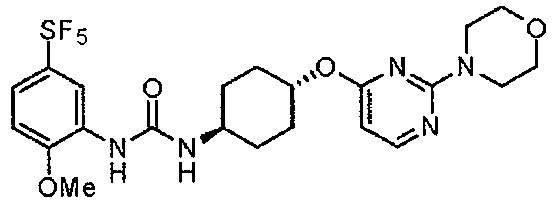

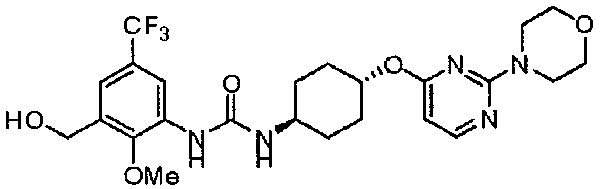


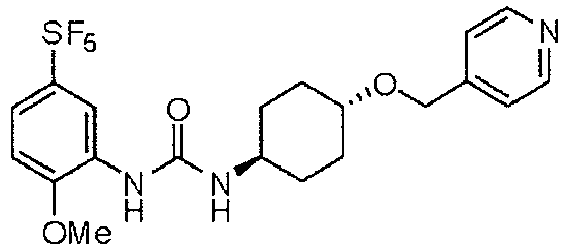

[Table 1-2] Structural Formula Structural Formula Structural Formula 


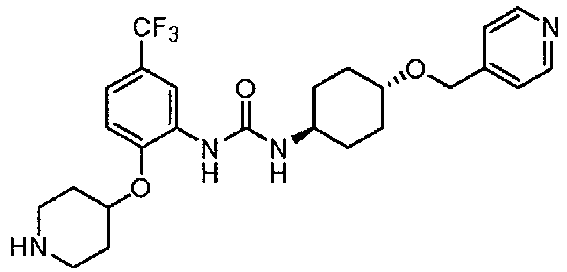


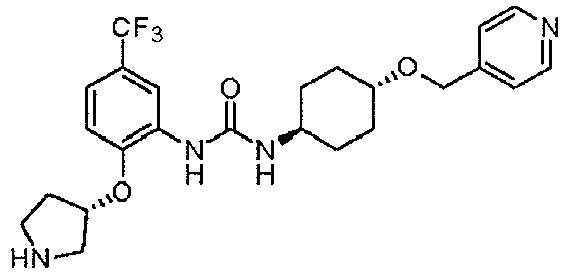
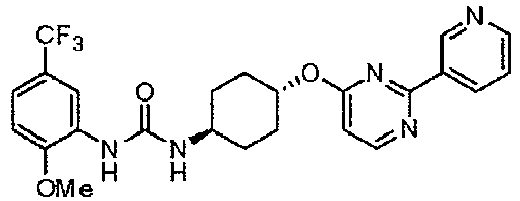


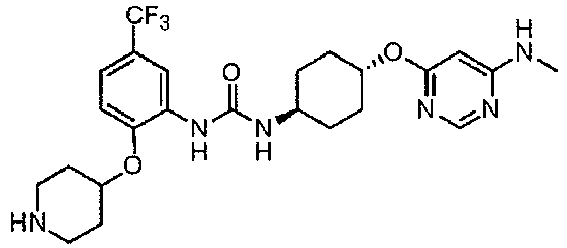


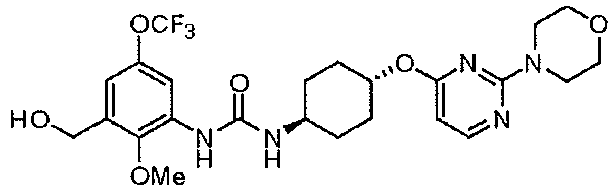

[Table 1-3] Structural Formula Structural Formula Structural Formula 

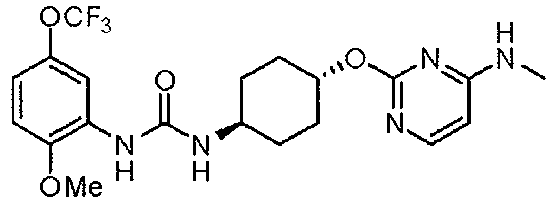


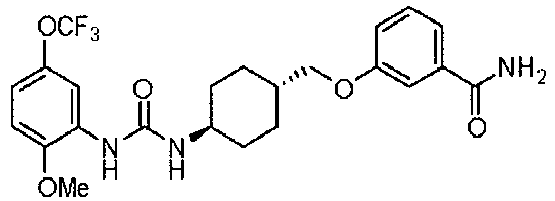
[Table 1-4] Structural Formula Structural Formula Structural Formula 


- Optical isomers and diastereomers can exist for a urea derivative represented by Formula (I) above (hereinafter referred to as urea derivative (I)), and the urea derivative includes racemic and diastereomeric mixtures as well as each single isomer.
- The present invention also includes a prodrug of the urea derivative (I) or a pharmaceutically acceptable salt thereof. The prodrug of the urea derivative (I) refers to a compound which is enzymatically or chemically converted in vivo to the urea derivative (I). The activity of a prodrug of the urea derivative (I) is attributable to the urea derivative (I) but the prodrug of the urea derivative (I) itself may have some activity.
- Examples of a prodrug of the urea derivative (I) include compounds in which a hydroxyl group of the urea derivative (I) is substituted by alkyl, phosphate, or borate. These compounds can be synthesized from the urea derivative (I) according to known methods.
- Moreover, the prodrug of the urea derivative (I) may be a prodrug which is converted to the urea derivative (I) under the conditions described in a known document ("Development of Pharmaceutical Product", Hirokawa Shoten Co., 1990, Vol. 7, pp. 163-198; and Progress in Medicine, 1985, Vol. 5, pp. 2157-2161).
- The urea derivative (I) may be labeled with an isotope, and examples of the isotope used for labeling include 2H, 3H, 13C, 14C, 15N, 15O, 18O and/or 125I.
- Examples of "pharmaceutically acceptable salts" of the urea derivative (I) include inorganic acid salts, such as hydrochloride, sulfate, nitrate, hydrobromide, hydroiodide, or phosphate; or organic acid salts, such as oxalate, malonate, citrate, fumarate, lactate, malate, succinate, tartrate, acetate, trifluoroacetate, maleate, gluconate, benzoate, ascorbate, glutarate, mandelate, phthalate, methanesulfonate, ethanesulfonate, benzenesulfonate, p-toluenesulfonate, camphorsulfonate, aspartate, glutamate, or cinnamate, and preferably include a hydrochloride, sulfate, hydrobromide, maleate, benzoate or methanesulfonate.
- The urea derivative (I) or a pharmaceutically acceptable salt thereof may be an anhydrate or may have formed a solvate, such as hydrate. The solvate herein is preferably a pharmaceutically acceptable solvate. The pharmaceutically acceptable solvate either may be or not may be a hydrate, but preferably it is a hydrate. Examples of the solvent constituent in the solvate include alcohol-based solvents, such as methanol, ethanol, or n-propanol; N,N-dimethylformamide, dimethyl sulfoxide, or water.
- Among the urea derivatives (I) and the compounds described in Reference Examples, those compounds with known configuration will be indicated as shown by Formula (IIIa) or (IIIb) below.

- The configuration as shown by Formula (IIIa) is preferable for those of the urea derivatives (I) and the compounds described in Reference Examples.
- The urea derivative (I) can be produced by an appropriate method based on its basic skeleton and features derived from the types of substituents. In addition, the starting materials and reagents used for the production of these compounds are generally commercially available or can be produced by known methods.
- The urea derivative (I) as well as the intermediates and starting materials for use in the production of the derivative can be isolated and purified by known procedures. Examples of the known procedures for isolation and purification include solvent extraction, recrystallization, or chromatography.
- If the urea derivative (I) includes optical isomers or stereoisomers, each isomer can be obtained as a single compound by known methods. Examples of the known methods include crystallization, enzymatic resolution, or chiral chromatography.
- In the production method as described below, if any raw material compound has hydroxyl group, amino group, or carboxyl group, a protective group may be introduced to each of these groups in each reaction and a compound of interest can be obtained subsequent to the reaction by removing the protective group as necessary.
- Examples of the protective group for hydroxyl group include trityl group, aralkyl group having 7 to 10 carbon atoms (for example, benzyl group), or substituted silyl group (for example, trimethylsilyl group, triethylsilyl group, or tertbutyldimethylsilyl group).
- Examples of the protective group for amino group include alkylcarbonyl group having 2 to 6 carbon atoms (for example, acetyl group), benzoyl group, alkyloxycarbonyl group having 2 to 8 carbon atoms (for example, tert-butoxycarbonyl group or benzyloxycarbonyl group), aralkyl group having 7 to 10 carbon atoms (for example, benzyl group), or phthaloyl group.
- Examples of the protective group for carboxyl group include alkyl group having 1 to 6 carbon atoms (for example, methyl group, ethyl group or tert-butyl group), or aralkyl group having 7 to 10 carbon atoms (for example, benzyl group).
- Protective groups are removed in different ways depending on the type of the protective groups, but the deprotection may be performed according to a known method (for example, Greene, T.W., "Greene's Protective Groups in Organic Synthesis", Wiley-Interscience) or an equivalent method.
- A urea derivative (I) can be obtained, for example, from an aniline derivative (IV) and a cyclohexanamine derivative (V) via urea coupling in the presence of a urea coupling agent and a base, as shown in Scheme 1.

- The aniline derivative (IV) for use in the urea coupling reaction can be produced by a known method or an equivalent method.
- The cyclohexanamine derivative (V) for use in the urea coupling reaction is commercially available as a single isomer or a mixture of isomers as necessary. Moreover, it can also be produced by a known method or an equivalent method.
- The amount of the cyclohexanamine derivative (V) for use in the urea coupling reaction is preferably 0.5 to 10 equivalents, more preferably 1 to 3 equivalents, to the aniline derivative (IV).
- Examples of the urea coupling agent for use in the urea coupling reaction include chloroformate derivatives, such as 2,2,2-trichloroethyl chloroformate, phenyl chloroformate, or p-nitrophenyl chloroformate; triphosgene, phosgene, N,N'-carbonyldiimidazole, or N,N'-disuccinimidyl carbonate, and preferably include chloroformate derivatives, such as 2,2,2-trichloroethyl chloroformate, phenyl chloroformate, or p-nitrophenyl chloroformate; or triphosgene.
- The amount of the urea coupling agent for use in the urea coupling reaction is preferably 0.1 to 100 equivalents, more preferably 0.3 to 30 equivalents, to the aniline derivative (IV).
- Examples of the base for use in the urea coupling reaction include organic bases, such as triethylamine or diisopropylethylamine; inorganic bases, such as sodium hydrogen carbonate or potassium carbonate; metal hydride compounds, such as sodium hydride, potassium hydride, or calcium hydride; alkyl lithium, such as methyl lithium or butyl lithium; lithium amide, such as lithium hexamethyldisilazide or lithium diisopropylamide; or a mixture thereof, and preferably include organic bases, such as triethylamine or diisopropylethylamine.
- The amount of the base for use in the urea coupling reaction is preferably 1 to 100 equivalents, more preferably 2 to 30 equivalents, to the aniline derivative (IV).
- A reaction solvent for use in the urea coupling reaction is appropriately selected depending on the type of reagents to be used, but it is not particularly limited as long as the reaction is not inhibited. Examples of the reaction solvent include aprotic polar solvents, such as N,N-dimethylformamide, N,N-dimethylacetamide, or dimethyl sulfoxide; ether-based solvents, such as diethyl ether, tetrahydrofuran, dimethoxyethane, or 1,4-dioxane; ester-based solvents, such as ethyl acetate or propyl acetate; chlorine-based solvents, such as dichloromethane, chloroform, or 1,2-dichloroethane; nitrile-based solvents, such as acetonitrile or propionitrile; or mixed solvents thereof, and preferably include chlorine-based solvents, such as dichloromethane, chloroform, or 1,2-dichloroethane; or nitrile-based solvents, such as acetonitrile or propionitrile.
- The reaction temperature of the urea coupling reaction is preferably -40°C to 200°C, more preferably -20°C to 150°C.
- The reaction time of the urea coupling reaction is appropriately selected depending on the conditions, such as reaction temperature, and is preferably from 30 minutes to 30 hours.
- The concentration of the aniline derivative (IV) for use in the urea coupling reaction is preferably from 1 mmol/L to 1 mol/L at the start of the reaction.
- The aniline derivative (IV) can be obtained, for example, by reduction reaction of a nitrobenzene derivative (VI), as shown in Scheme 2.

- Examples of the reduction reaction include catalytic hydrogenation reaction under hydrogen atmosphere in the presence of a metal catalyst, such as palladium, nickel, or platinum; hydride reduction reaction with a metal hydride reagent, such as lithium aluminum hydride, borane-dimethylsulfide complex, or borane-tetrahydrofuran complex; or one-electron reduction reaction with a metal catalyst, such as zinc, iron, or tin, in the presence of an acid, and preferably include catalytic hydrogenation reaction under hydrogen atmosphere in the presence of a metal catalyst, such as palladium, nickel, or platinum; or one-electron reduction reaction with a metal catalyst, such as zinc, iron, or tin, in the presence of an acid.
- Examples of the metal catalyst for use in the catalytic hydrogenation reaction include palladium, nickel, platinum, or any of them on carbon support.
- The amount of the metal catalyst for use in the catalytic hydrogenation reaction is preferably 0.001 to 5 equivalents, more preferably 0.01 to 1 equivalent, to the nitrobenzene derivative (VI).
- A reaction solvent for use in the catalytic hydrogenation reaction is appropriately selected depending on the type of reagents to be used, but it is not particularly limited as long as the reaction is not inhibited. Examples of the reaction solvent include alcohol-based solvents, such as methanol or ethanol; nitrile-based solvents, such as acetonitrile or propionitrile; aprotic polar solvents, such as N,N-dimethylformamide or N,N-dimethylacetamide; ether-based solvents, such as diethyl ether, tetrahydrofuran, dimethoxyethane, or 1,4-dioxane; ester-based solvents, such as ethyl acetate or propyl acetate; chlorine-based solvents, such as dichloromethane, chloroform, or 1,2-dichloroethane; or mixed solvents thereof, and preferably include alcohol-based solvents, such as methanol or ethanol.
- The pressure of the hydrogen gas for use in the catalytic hydrogenation reaction is preferably from 1 to 10 atmospheres, more preferably from 1 to 3 atmospheres.
- The reaction temperature of the catalytic hydrogenation reaction is preferably 0-200°C, more preferably 0-100°C.
- The reaction time of the catalytic hydrogenation reaction is appropriately selected depending on the conditions, such as reaction temperature, and is preferably from 1 to 72 hours.
- Examples of the metal hydride reagent for use in the hydride reduction reaction include lithium aluminum hydride, borane-dimethylsulfide complex, or borane-tetrahydrofuran complex.
- The amount of the metal hydride reagent for use in the hydride reduction reaction is preferably 0.1 to 20 equivalents, more preferably 0.1 to 10 equivalents, to the nitrobenzene derivative (VI).
- A reaction solvent for use in the hydride reduction reaction is appropriately selected depending on the type of reagents to be used, but it is not particularly limited as long as the reaction is not inhibited. Examples of the reaction solvent include aromatic hydrocarbon-based solvents, such as benzene, toluene, or xylene; ether-based solvents, such as diethyl ether, tetrahydrofuran, dimethoxyethane, or 1,4-dioxane; or mixed solvents thereof, and preferably include ether-based solvents, such as diethyl ether, tetrahydrofuran, dimethoxyethane, or 1,4-dioxane.
- The reaction temperature of the hydride reduction reaction is preferably - 78°C to 150°C, more preferably -20°C to 100°C.
- The reaction time of the hydride reduction reaction is appropriately selected depending on the conditions, such as reaction temperature, and is preferably from 1 to 72 hours.
- The concentration of the nitrobenzene derivative (VI) for use in the hydride reduction reaction is preferably from 1 mmol/L to 1 mol/L at the start of the reaction.
- Examples of the acid for use in the one-electron reduction reaction include acetic acid, hydrochloric acid, or ammonium chloride.
- The amount of the acid for use in the one-electron reduction reaction is preferably 0.1 to 20 equivalents, more preferably 0.1 to 10 equivalents, to the nitrobenzene derivative (VI).
- Examples of the metal catalyst for use in the one-electron reduction reaction include zinc, iron, tin, or a halide thereof.
- The amount of the metal catalyst for use in the one-electron reduction reaction is preferably 0.1 to 100 equivalents, more preferably 1 to 50 equivalents, to the nitrobenzene derivative (VI).
- A reaction solvent for use in the one-electron reduction reaction is appropriately selected depending on the type of reagents to be used, but it is not particularly limited as long as the reaction is not inhibited. Examples of the reaction solvent include acidic solvents, such as hydrochloric acid or acetic acid; alcohol-based solvents, such as methanol or ethanol; nitrile-based solvents, such as acetonitrile or propionitrile; aprotic polar solvents, such as N,N-dimethylformamide or N,N-dimethylacetamide; ether-based solvents, such as diethyl ether, tetrahydrofuran, dimethoxyethane, or 1,4-dioxane; ester-based solvents, such as ethyl acetate or propyl acetate; chlorine-based solvents, such as dichloromethane, chloroform, or 1,2-dichloroethane; or mixed solvents thereof, and preferably include acidic solvents, such as hydrochloric acid or acetic acid; or alcohol-based solvents, such as methanol or ethanol.
- The reaction temperature of the one-electron reduction reaction is preferably 0°C to 200°C, more preferably 0°C to 100°C.
- The reaction time of the one-electron reduction reaction is appropriately selected depending on the conditions, such as reaction temperature, and is preferably from 1 to 72 hours.
- The concentration of the nitrobenzene derivative (VI) for use in the reduction reaction is preferably from 1 mmol/L to 1 mol/L at the start of the reaction.
- The nitrobenzene derivative (VI) can be obtained, for example, by nucleophilic substitution reaction of a nitrobenzene derivative (VIA) with a nucleophile in the presence or absence of a base, as shown in Scheme 3.
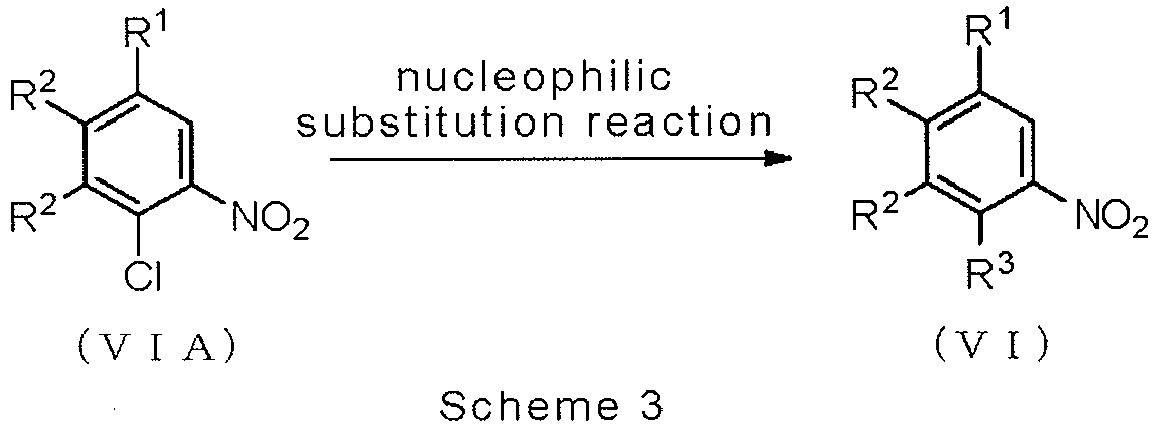
- The nucleophile for use in the nucleophilic substitution reaction is commercially available. Moreover, it can also be produced by a known method.
- The amount of the nucleophile for use in the nucleophilic substitution reaction is preferably 0.2 to 10 equivalents, more preferably 0.5 to 3 equivalents, to the nitrobenzene derivative (VIA).
- The nucleophilic substitution reaction may optionally be performed with a base. Examples of the base to be used include inorganic bases, such as sodium hydride, sodium hydrogen carbonate, or potassium carbonate; organic bases, such as triethylamine, diisopropylethylamine, or pyridine; or a mixture thereof.
- The amount of the base for use in the nucleophilic substitution reaction is preferably 0.5 to 20 equivalents, more preferably 1 to 3 equivalents, to the nitrobenzene derivative (VIA).
- A reaction solvent for use in the nucleophilic substitution reaction is appropriately selected depending on the type of reagents to be used, but it is not particularly limited as long as the reaction is not inhibited. Examples of the reaction solvent include alcohol-based solvents, such as methanol or ethanol; nitrile-based solvents, such as acetonitrile or propionitrile; aprotic polar solvents, such as N,N-dimethylformamide, N,N-dimethylacetamide, or dimethyl sulfoxide; ether-based solvents, such as diethyl ether, tetrahydrofuran, dimethoxyethane, or 1,4-dioxane; ester-based solvents, such as ethyl acetate or propyl acetate; chlorine-based solvents, such as dichloromethane, chloroform, or 1,2-dichloroethane; or mixed solvents thereof, and preferably include alcohol-based solvents, such as methanol or ethanol; aprotic polar solvents, such as N,N-dimethylformamide, N,N-dimethylacetamide, or dimethyl sulfoxide; or ether-based solvents, such as diethyl ether, tetrahydrofuran, dimethoxyethane, or 1,4-dioxane.
- The reaction temperature of the nucleophilic substitution reaction is preferably -20°C to 200°C, more preferably 0-150°C.
- The reaction time of the nucleophilic substitution reaction is appropriately selected depending on the conditions, such as reaction temperature, and is preferably from 1 to 60 hours.
- The concentration of the nitrobenzene derivative (VIA) for use in the nucleophilic substitution reaction is preferably from 1 mmol/L to 1 mol/L at the start of the reaction.
- The cyclohexanamine derivative (V) can be obtained, for example, by deprotection of a cyclohexane derivative (VII), as shown in Scheme 4.

- Protective groups are removed in different ways depending on the type of the protective groups, but the deprotection may be performed according to a known method (for example, Greene, T.W., "Greene's Protective Groups in Organic Synthesis", Wiley-Interscience) or an equivalent method.
- Among cyclohexane derivatives (VII), a cyclohexane derivative (VIIA) in which m and n are 0 can be obtained, for example, by nucleophilic substitution reaction of an alcohol derivative (VIIIA) with a halogenated heteroaryl derivative (IX) in the presence or absence of a base, as shown in Scheme 5.

- The alcohol derivative (VIIIA) for use in the nucleophilic substitution reaction is commercially available as a single isomer or a mixture of isomers as necessary. Moreover, it can also be produced by a known method or an equivalent method.
- The halogenated heteroaryl derivative (IX) for use in the nucleophilic substitution is commercially available. Moreover, it can also be produced by a known method.
- The amount of the halogenated heteroaryl derivative (IX) for use in the nucleophilic substitution reaction is preferably 0.2 to 10 equivalents, more preferably 0.5 to 3 equivalents, to the alcohol derivative (VIIIA).
- The nucleophilic substitution reaction may optionally be performed with a base. Examples of the base to be used include inorganic bases, such as sodium hydride, sodium hydrogen carbonate, or potassium carbonate; organic bases, such as triethylamine, diisopropylethylamine, or pyridine; or a mixture thereof.
- The amount of the base for use in the nucleophilic substitution reaction is preferably 0.5 to 20 equivalents, more preferably 1 to 3 equivalents, to the alcohol derivative (VIIIA).
- A reaction solvent for use in the nucleophilic substitution is appropriately selected depending on the type of reagents to be used, but it is not particularly limited as long as the reaction is not inhibited. Examples of the reaction solvent include alcohol-based solvents, such as methanol or ethanol; nitrile-based solvents, such as acetonitrile or propionitrile; aprotic polar solvents, such as N,N-dimethylformamide, N,N-dimethylacetamide, or dimethyl sulfoxide; ether-based solvents, such as diethyl ether, tetrahydrofuran, dimethoxyethane, or 1,4-dioxane; ester-based solvents, such as ethyl acetate or propyl acetate; chlorine-based solvents, such as dichloromethane, chloroform, or 1,2-dichloroethane; or mixed solvents thereof, and preferably include alcohol-based solvents, such as methanol or ethanol; aprotic polar solvents, such as N,N-dimethylformamide, N,N-dimethylacetamide, or dimethyl sulfoxide; or ether-based solvents, such as diethyl ether, tetrahydrofuran, dimethoxyethane, or 1,4-dioxane.
- The reaction temperature of the nucleophilic substitution is preferably -20°C to 200°C, more preferably 0-150°C.
- The reaction time of the nucleophilic substitution is appropriately selected depending on the conditions, such as reaction temperature, and is preferably from 1 to 30 hours.
- The concentration of the alcohol derivative (VIIIA) for use in the nucleophilic substitution is preferably from 1 mmol/L to 1 mol/L at the start of the reaction.
- Among cyclohexane derivatives (VII), a cyclohexane derivative (VIIB) in which m is 1 and n is 0 can be obtained, for example, by Mitsunobu reaction of an alcohol derivative (VIIIB) with an alcohol derivative (X) in the presence of an azo compound and an organic phosphorus compound, or by nucleophilic substitution reaction of the alcohol derivative (VIIIB) with a halogenated heteroaryl derivative (IX) in the presence or absence of a base, as shown in Scheme 6.

- The alcohol derivative (VIIIB) for use in the Mitsunobu reaction or nucleophilic substitution reaction is commercially available as a single isomer or a mixture of isomers as necessary. Moreover, it can also be produced by a known method or an equivalent method.
- Examples of Mitsunobu reaction include a method in which an azo compound such as diethyl azodicarboxylate or diisopropyl azodicarboxylate and an organic phosphorus compound such as triphenylphosphine or tributylphosphine are used (see Chem. Rev. 2009, 109: 2551-2651).
- The alcohol derivative (X), azo compound and organic phosphorus compound for use in the Mitsunobu reaction are commercially available. Moreover, they can also be produced by known methods.
- The amount of the alcohol derivative (X) for use in the Mitsunobu reaction is preferably 0.5 to 20 equivalents, more preferably 1 to 5 equivalents, to the alcohol derivative (VIIIB).
- Examples the azo compound for use in the Mitsunobu reaction include diethyl azodicarboxylate, diisopropyl azodicarboxylate, bis(2,2,2-trichloroethyl) azodicarboxylate, N,N,N',N'-tetramethylazodicarboxamide, bis(2-methoxyethyl) azodicarboxylate, or di(tert-butyl) azodicarboxylate.
- The amount of the azo compound for use in the Mitsunobu reaction is preferably 0.5 to 20 equivalents, more preferably 1 to 5 equivalents, to the alcohol derivative (VIIIB).
- Examples of the organic phosphorus compound for use in the Mitsunobu reaction include triphenylphosphine, tributylphosphine, or tricyclohexylphosphine.
- The amount of the organic phosphorus compound for use in the Mitsunobu reaction is preferably 1 to 20 equivalents, more preferably 0.5 to 5 equivalents, to the alcohol derivative (VIIIB).
- A reaction solvent for use in the Mitsunobu reaction is appropriately selected depending on the type of reagents to be used, but it is not particularly limited as long as the reaction is not inhibited. Examples of the reaction solvent include aromatic hydrocarbon-based solvents, such as benzene, toluene, or xylene; nitrile-based solvents, such as acetonitrile or propionitrile; aprotic polar solvents, such as N,N-dimethylformamide, N,N-dimethylacetamide, or dimethyl sulfoxide; ether-based solvents, such as diethyl ether, tetrahydrofuran, dimethoxyethane, or 1,4-dioxane; ester-based solvents, such as ethyl acetate or propyl acetate; chlorine-based solvents, such as dichloromethane, chloroform, or 1,2-dichloroethane; or mixed solvents thereof, and preferably include aromatic hydrocarbon-based solvents, such as benzene, toluene, or xylene; or ether-based solvents, such as diethyl ether or tetrahydrofuran.
- The reaction temperature of the Mitsunobu reaction is preferably -20°C to 200°C, more preferably 0°C to 100°C.
- The reaction time of the Mitsunobu reaction is appropriately selected depending on the conditions, such as reaction temperature, and is preferably from 1 to 30 hours.
- The concentration of the alcohol derivative (VIIIB) for use in the Mitsunobu reaction is preferably from 1 mmol/L to 1 mol/L at the start of the reaction.
- The amount of the halogenated heteroaryl derivative (IX) for use in the nucleophilic substitution reaction is preferably 0.2 to 10 equivalents, more preferably 0.5 to 3 equivalents, to the alcohol derivative (VIIIB).
- The nucleophilic substitution reaction may optionally be performed with a base. Examples of the base to be used include inorganic bases, such as sodium hydride, sodium hydrogen carbonate, or potassium carbonate; organic bases, such as triethylamine, diisopropylethylamine, or pyridine; or a mixture thereof.
- The amount of the base for use in the nucleophilic substitution reaction is preferably 0.5 to 20 equivalents, more preferably 1 to 3 equivalents, to the alcohol derivative (VIIIB).
- A reaction solvent for use in the nucleophilic substitution reaction is appropriately selected depending on the type of reagents to be used, but it is not particularly limited as long as the reaction is not inhibited. Examples of the reaction solvent include alcohol-based solvents, such as methanol or ethanol; nitrile-based solvents, such as acetonitrile or propionitrile; aprotic polar solvents, such as N,N-dimethylformamide, N,N-dimethylacetamide, or dimethyl sulfoxide; ether-based solvents, such as diethyl ether, tetrahydrofuran, dimethoxyethane, or 1,4-dioxane; ester-based solvents, such as ethyl acetate or propyl acetate; chlorine-based solvents, such as dichloromethane, chloroform, or 1,2-dichloroethane; or mixed solvents thereof, and preferably include alcohol-based solvents, such as methanol or ethanol; aprotic polar solvents, such as N,N-dimethylformamide, N,N-dimethylacetamide, or dimethyl sulfoxide; or ether-based solvents, such as diethyl ether, tetrahydrofuran, dimethoxyethane, or 1,4-dioxane.
- The reaction temperature of the nucleophilic substitution reaction is preferably -20°C to 200°C, more preferably 0-150°C.
- The reaction time of the nucleophilic substitution reaction is appropriately selected depending on the conditions, such as reaction temperature, and is preferably from 1 to 30 hours.
- The concentration of the alcohol derivative (VIIIB) for use in the nucleophilic substitution reaction is preferably from 1 mmol/L to 1 mol/L at the start of the reaction.
- Among cyclohexane derivatives (VII), a cyclohexane (VIIC) in which n is 1 can be obtained, for example, by nucleophilic substitution reaction of the alcohol derivative (VIIIA) or (VIIIB) with a halogenated alkyl derivative (XI) in the presence or absence of a base, as shown in Scheme 7.

- Each of the above-described alcohol derivatives (VIIIA) and (VIIIB) is commercially available as a single isomer or a mixture of isomers as necessary. Moreover, they can also be produced by known methods or equivalent methods.
- The halogenated alkyl derivative (XI) for use in the nucleophilic substitution reaction is commercially available. Moreover, it can also be produced by a known method.
- The amount of the halogenated alkyl derivative (XI) for use in the nucleophilic substitution reaction is preferably 0.2 to 10 equivalents, more preferably 0.5 to 3 equivalents, to the alcohol derivative (VIIIA) or (VIIIB).
- The nucleophilic substitution reaction may optionally be performed with a base. Examples of the base to be used include inorganic bases, such as sodium hydride, sodium hydrogen carbonate, or potassium carbonate; organic bases, such as triethylamine, diisopropylethylamine, or pyridine; or a mixture thereof.
- The amount of the base for use in the nucleophilic substitution reaction is preferably 0.5 to 20 equivalents, more preferably 1 to 3 equivalents, to the alcohol derivative (VIIIA) or (VIIIB).
- A reaction solvent for use in the nucleophilic substitution reaction is appropriately selected depending on the type of reagents to be used, but it is not particularly limited as long as the reaction is not inhibited. Examples of the reaction solvent include alcohol-based solvents, such as methanol or ethanol; nitrile-based solvents, such as acetonitrile or propionitrile; aprotic polar solvents, such as N,N-dimethylformamide, N,N-dimethylacetamide, or dimethyl sulfoxide; ether-based solvents, such as diethyl ether, tetrahydrofuran, dimethoxyethane, or 1,4-dioxane; ester-based solvents, such as ethyl acetate or propyl acetate; chlorine-based solvents, such as dichloromethane, chloroform, or 1,2-dichloroethane; or mixed solvents thereof, and preferably include alcohol-based solvents, such as methanol or ethanol; aprotic polar solvents, such as N,N-dimethylformamide, N,N-dimethylacetamide, or dimethyl sulfoxide; or ether-based solvents, such as diethyl ether, tetrahydrofuran, dimethoxyethane, or 1,4-dioxane.
- The reaction temperature of the nucleophilic substitution reaction is preferably -20°C to 200°C, more preferably 0-150°C.
- The reaction time of the nucleophilic substitution reaction is appropriately selected depending on the conditions, such as reaction temperature, and is preferably from 1 to 30 hours.
- The concentration of the alcohol derivative (VIIIA) or the alcohol derivative (VIIIB) for use in the nucleophilic substitution reaction is preferably from 1 mmol/L to 1 mol/L at the start of the reaction.
- Among cyclohexane derivatives (VIIA), a cyclohexane derivative (VIIA-b) in which R4 is a halogenated heteroaryl can be obtained, for example, by nucleophilic substitution reaction of the alcohol derivative (VIIIA) with a dihalogenated heteroaryl derivative (XII) in the presence or absence of a base, as shown in Scheme 8.

- The alcohol derivative (VIIIA) for use in the nucleophilic substitution reaction is commercially available as a single isomer or a mixture of isomers as necessary. Moreover, it can also be produced by a known method or an equivalent method.
- The dihalogenated heteroaryl derivative (XII) for use in the nucleophilic substitution reaction is commercially available. Moreover, it can also be produced by a known method.
- The amount of the dihalogenated heteroaryl derivative (XII) for use in the nucleophilic substitution reaction is preferably 0.2 to 10 equivalents, more preferably 0.5 to 3 equivalents, to the alcohol derivative (VIIIA).
- The nucleophilic substitution reaction may optionally be performed with a base. Examples of the base to be used include inorganic bases, such as sodium hydride, sodium hydrogen carbonate, or potassium carbonate; organic bases, such as triethylamine, diisopropylethylamine, or pyridine; or a mixture thereof.
- The amount of the base for use in the nucleophilic substitution reaction is preferably 0.5 to 20 equivalents, more preferably 1 to 3 equivalents, to the alcohol derivative (VIIIA).
- A reaction solvent for use in the nucleophilic substitution is appropriately selected depending on the type of reagents to be used, but it is not particularly limited as long as the reaction is not inhibited. Examples of the reaction solvent include alcohol-based solvents, such as methanol or ethanol; nitrile-based solvents, such as acetonitrile or propionitrile; aprotic polar solvents, such as N,N-dimethylformamide, N,N-dimethylacetamide, or dimethyl sulfoxide; ether-based solvents, such as diethyl ether, tetrahydrofuran, dimethoxyethane, or 1,4-dioxane; ester-based solvents, such as ethyl acetate or propyl acetate; chlorine-based solvents, such as dichloromethane, chloroform, or 1,2-dichloroethane; or mixed solvents thereof, and preferably include alcohol-based solvents, such as methanol or ethanol; aprotic polar solvents, such as N,N-dimethylformamide, N,N-dimethylacetamide, or dimethyl sulfoxide; or ether-based solvents, such as diethyl ether, tetrahydrofuran, dimethoxyethane, or 1,4-dioxane.
- The reaction temperature of the nucleophilic substitution reaction is preferably -20°C to 200°C, more preferably 0-150°C.
- The reaction time of the nucleophilic substitution reaction is appropriately selected depending on the conditions, such as reaction temperature, and is preferably from 1 to 30 hours.
- The concentration of the alcohol derivative (VIIIA) for use in the nucleophilic substitution reaction is preferably from 1 mmol/L to 1 mol/L at the start of the reaction.
- Among cyclohexane derivatives (VII), a derivative represented by Formula (VIIA-a) can be obtained, for example, by nucleophilic substitution reaction or coupling reaction using the cyclohexane derivative (VIIA-b) in the presence or absence of a base, as shown in Scheme 9.

- The above-described cyclohexane derivative (VIIA-b) can be obtained, for example, by nucleophilic substitution reaction of the alcohol derivative (VIIIA) with the halogenated heteroaryl derivative (IX) in the presence of a base, as shown in Scheme 5 described above.
- The nucleophile for use in the nucleophilic substitution reaction is commercially available. Moreover, it can also be produced by a known method.
- The amount of the nucleophile for use in the nucleophilic substitution is preferably 0.2 to 10 equivalents, more preferably 0.5 to 3 equivalents, to the cyclohexane derivative (VIIA-b).
- The nucleophilic substitution reaction may optionally be performed with a base. Examples of the base to be used include inorganic bases, such as sodium hydride, sodium hydrogen carbonate, or potassium carbonate; organic bases, such as triethylamine, diisopropylethylamine, or pyridine; or a mixture thereof.
- The amount of the base for use in the nucleophilic substitution reaction is preferably 0.5 to 20 equivalents, more preferably 1 to 3 equivalents, to the cyclohexane derivative (VIIA-b).
- A reaction solvent for use in the nucleophilic substitution reaction is appropriately selected depending on the type of reagents to be used, but it is not particularly limited as long as the reaction is not inhibited. Examples of the reaction solvent include alcohol-based solvents, such as methanol or ethanol; nitrile-based solvents, such as acetonitrile or propionitrile; aprotic polar solvents, such as N,N-dimethylformamide, N,N-dimethylacetamide, or dimethyl sulfoxide; ether-based solvents, such as diethyl ether, tetrahydrofuran, dimethoxyethane, or 1,4-dioxane; ester-based solvents, such as ethyl acetate or propyl acetate; chlorine-based solvents, such as dichloromethane, chloroform, or 1,2-dichloroethane; or mixed solvents thereof, and preferably include alcohol-based solvents, such as methanol or ethanol; aprotic polar solvents, such as N,N-dimethylformamide, N,N-dimethylacetamide, or dimethyl sulfoxide; or ether-based solvents, such as diethyl ether, tetrahydrofuran, dimethoxyethane, or 1,4-dioxane.
- The reaction temperature of the nucleophilic substitution reaction is preferably -20°C to 200°C, more preferably 0-150°C.
- The reaction time of the nucleophilic substitution reaction is appropriately selected depending on the conditions, such as reaction temperature, and is preferably from 1 to 60 hours.
- The concentration of the cyclohexane derivative (VIIA-b) for use in the nucleophilic substitution reaction is preferably from 1 mmol/L to 1 mol/L at the start of the reaction.
- Examples of the coupling reaction include a method in which an organometal compound such as an organomagnesium compound, an organozinc compound, or an organoboron compound and a halide such as a halogenated aryl, a halogenated heteroaryl, or a halogenated alkyl are used in the presence of a metal catalyst (see Angewante. Chem. Int. Ed., 2005, 44: 4442-4489.).
- The metal catalyst and organometal compound for use in the coupling reaction are commercially available. Moreover, they can also be produced by known methods or equivalent methods.
- The amount of the organometal compound for use in the coupling reaction is preferably 0.5 to 20 equivalents, more preferably 1 to 3 equivalents, to the cyclohexane derivative (VIIA-b).
- Examples of the metal catalyst for use in the coupling reaction include zero-valent palladium complex catalysts, such as tetrakis(triphenylphosphine)palladium (0), tris(dibenzylideneacetone)dipalladium (0), or bis(dibenzylideneacetone)palladium (0), and preferably include tetrakis(triphenylphosphine)palladium (0).
- The amount of the metal catalyst for use in the coupling reaction is preferably 0.001 to 10 equivalents, more preferably 0.01 to 1 equivalent, to the cyclohexane derivative (VIIA-b).
- The coupling reaction may optionally be performed with a base. Examples of the base to be used include inorganic bases, such as sodium hydroxide or sodium carbonate; metal alkyoxides, such as sodium tert-butoxide or potassium tert-butoxide; carboxylic acid salts and the like, such as sodium acetate or potassium acetate; or aqueous solutions thereof, and preferably include inorganic bases, such as sodium hydroxide or sodium carbonate; or aqueous solutions thereof.
- The amount of the base for use in the coupling reaction is preferably 0.5 to 100 equivalents, more preferably 1 to 30 equivalents, to the cyclohexane derivative (VIIA-b).
- A reaction solvent for use in the coupling reaction is appropriately selected depending on the type of reagents to be used, but it is not particularly limited as long as the reaction is not inhibited. Examples of the reaction solvent include aromatic hydrocarbon-based solvents, such as benzene or toluene; alcohol-based solvents, such as methanol or ethanol; nitrile-based solvents, such as acetonitrile or propionitrile; aprotic polar solvents, such as N,N-dimethylformamide, N,N-dimethylacetamide, or dimethyl sulfoxide; ether-based solvents, such as diethyl ether, tetrahydrofuran, dimethoxyethane, or 1,4-dioxane; ester-based solvents, such as ethyl acetate or propyl acetate; chlorine-based solvents, such as dichloromethane, chloroform, or 1,2-dichloroethane; or mixed solvents thereof, and preferably include aromatic solvents, such as benzene or toluene; alcohol-based solvents, such as methanol or ethanol; ether-based solvents, such as diethyl ether, tetrahydrofuran, dimethoxyethane, or 1,4-dioxane; or mixed solvents thereof.
- The reaction temperature of the coupling reaction is preferably 0°C to 300°C, more preferably 20°C to 200°C.
- The reaction time of the coupling reaction is appropriately selected depending on the conditions, such as reaction temperature, and is preferably from 1 to 48 hours.
- The concentration of the cyclohexane derivative (VIIA-b) for use in the coupling reaction is preferably from 1 mmol/L to 1 mol/L at the start of the reaction.
- Among urea derivatives (I), a urea derivative (IA-a) in which R4 is R11 substituted by one morpholinyl or (R7)R8N- can be obtained, for example, by urea coupling (Step 1) of the aniline derivative (IV) and a cyclohexanamine derivative (VA) in the presence of a urea coupling agent and a base, and nucleophilic substitution reaction (Step 2) of the resulting urea derivative (IA-b) with the nucleophile (IX) in the presence or absence of a base, as shown in Scheme 10.

- The above-described cyclohexanamine derivative (VA) can be obtained, for example, by deprotection of the above-described cyclohexane derivative (VI), as shown in Scheme 4 described above.
- The aniline derivative (IV) for use in the urea coupling reaction can be produced by a known method or an equivalent method.
- The amount of the cyclohexanamine derivative (VA) for use in the urea coupling reaction is preferably 0.5 to 10 equivalents, more preferably 1 to 3 equivalents, to the aniline derivative (IV).
- Examples of the urea coupling agent for use in the urea coupling reaction include chloroformate derivatives, such as 2,2,2-trichloroethyl chloroformate, phenyl chloroformate, or p-nitrophenyl chloroformate; triphosgene, phosgene, N,N'-carbonyldiimidazole, or N,N'-disuccinimidyl carbonate, and preferably include triphosgene.
- The amount of the urea coupling agent for use in the urea coupling reaction is preferably 0.1 to 100 equivalents, more preferably 0.3 to 30 equivalents, to the aniline derivative (IV).
- Examples of the base for use in the urea coupling reaction include organic bases, such as triethylamine or diisopropylethylamine; inorganic bases, such as sodium hydrogen carbonate or potassium carbonate; metal hydride compounds, such as sodium hydride, potassium hydride, or calcium hydride; alkyl lithium, such as methyl lithium or butyl lithium; lithium amide, such as lithium hexamethyldisilazide or lithium diisopropylamide; or a mixture thereof, and preferably include organic bases, such as triethylamine or diisopropylethylamine.
- The amount of the base for use in the urea coupling reaction is preferably 1 to 100 equivalents, more preferably 2 to 30 equivalents, to the aniline derivative (IV).
- A reaction solvent for use in the urea coupling reaction is appropriately selected depending on the type of reagents to be used, but it is not particularly limited as long as the reaction is not inhibited. Examples of the reaction solvent include aprotic polar solvents, such as N,N-dimethylformamide, N,N-dimethylacetamide, or dimethyl sulfoxide; ether-based solvents, such as diethyl ether, tetrahydrofuran, dimethoxyethane, or 1,4-dioxane; ester-based solvents, such as ethyl acetate or propyl acetate; chlorine-based solvents, such as dichloromethane, chloroform, or 1,2-dichloroethane; nitrile-based solvents, such as acetonitrile or propionitrile; or mixed solvents thereof, and preferably include chlorine-based solvents, such as dichloromethane, chloroform, or 1,2-dichloroethane; or nitrile-based solvents, such as acetonitrile or propionitrile.
- The reaction temperature of the urea coupling reaction is preferably -40°C to 200°C, more preferably -20°C to 150°C.
- The reaction time of the urea coupling reaction is appropriately selected depending on the conditions, such as reaction temperature, and is preferably from 30 minutes to 30 hours.
- The concentration of the aniline derivative (IV) for use in the urea coupling reaction is preferably from 1 mmol/L to 1 mol/L at the start of the reaction.
- The nucleophile (IX) for use in the nucleophilic substitution reaction is commercially available. Moreover, it can also be produced by a known method.
- The amount of the nucleophile (IX) for use in the nucleophilic substitution reaction is preferably 0.2 to 10 equivalents, more preferably 0.5 to 3 equivalents, to the urea derivative (IA-b).
- The nucleophilic substitution reaction may optionally be performed with a base. Examples of the base to be used include inorganic bases, such as sodium hydride, sodium hydrogen carbonate, or potassium carbonate; organic bases, such as triethylamine, diisopropylethylamine, or pyridine; or a mixture thereof.
- The amount of the base for use in the nucleophilic substitution reaction is preferably 0.5 to 20 equivalents, more preferably 1 to 3 equivalents, to the urea derivative (IA-b).
- A reaction solvent for use in the nucleophilic substitution reaction is appropriately selected depending on the type of reagents to be used, but it is not particularly limited as long as the reaction is not inhibited. Examples of the reaction solvent include alcohol-based solvents, such as methanol or ethanol; nitrile-based solvents, such as acetonitrile or propionitrile; aprotic polar solvents, such as N,N-dimethylformamide, N,N-dimethylacetamide, or dimethyl sulfoxide; ether-based solvents, such as diethyl ether, tetrahydrofuran, dimethoxyethane, or 1,4-dioxane; ester-based solvents, such as ethyl acetate or propyl acetate; chlorine-based solvents, such as dichloromethane, chloroform, or 1,2-dichloroethane; or mixed solvents thereof, and preferably include alcohol-based solvents, such as methanol or ethanol; aprotic polar solvents, such as N,N-dimethylformamide, N,N-dimethylacetamide, or dimethyl sulfoxide; or ether-based solvents, such as diethyl ether, tetrahydrofuran, dimethoxyethane, or 1,4-dioxane.
- The reaction temperature of the nucleophilic substitution reaction is preferably -20°C to 200°C, more preferably 0-150°C.
- The reaction time of the nucleophilic substitution reaction is appropriately selected depending on the conditions, such as reaction temperature, and is preferably from 1 to 60 hours.
- The concentration of the urea derivative (IA-b) for use in the nucleophilic substitution is preferably from 1 mmol/L to 1 mol/L at the start of the reaction.
- The DDR1 inhibitor of the present invention is characterized by comprising, as an active ingredient, the urea derivative (I) or a pharmaceutically acceptable salt thereof.
- The term "DDR1 inhibitor" means a compound that inhibits the kinase activity of DDR1.
- The urea derivative (I) or a pharmaceutically acceptable salt thereof has DDR1 inhibition activity and is thus expected to be a therapeutic agent against diseases, for example, cancer, with which improvement of the clinical state or amelioration of symptoms of the diseases is expected based on the corresponding mechanism of action.
- Examples of "cancer" include pharynx cancer, larynx cancer, tongue cancer, non-small cell lung cancer, breast cancer, esophagus cancer, gastric cancer, colorectal cancer, uterine cancer, endometrial cancer, ovarian cancer, liver cancer, pancreatic cancer, gallbladder cancer, bile duct cancer, kidney cancer, renal pelvis and ureter cancer, bladder cancer, prostate cancer, malignant melanoma, thyroid cancer, neurogenic or osteogenic sarcoma, chondrosarcoma, rhabdomyosarcoma, angiosarcoma, fibrosarcoma, glioma, leukemia, malignant lymphoma, neuroblastoma, myeloma, or brain tumor.
- The DDR1 inhibition activity of the urea derivative (I) or a pharmaceutically acceptable salt thereof can be evaluated with an in vitro study. Examples of the in vitro study include a method in which the kinase activity of DDR1 is evaluated based on measuring the amount of a phosphorylated substrate or consumed ATP (Analytical Biochemistry, 1999, 269: 94-104), and a method in which the binding of an assay target to DDR1 is measured (Journal of Biomolecular Screening, 2009, 14: 924-935). More specific examples of a method for the evaluation of DDR1 kinase activity include a method in which a purified intracellular domain protein of DDR1, a substrate peptide, and ATP are mixed and allowed to react and the amount of the phosphorylated substrate peptide is measured. The amount of the phosphorylated substrate peptide can be measured, for example, by measurement of fluorescence resonance energy transfer using the substrate peptide labeled in advance with biotin or a fluorescent substance.
- The present invention will be described in more details below by way of Examples and Reference Examples. However, the present invention is not limited thereto.
- For any compounds whose synthetic methods are not described in the context of the synthesis of the compounds of Examples, commercially available compounds were used. The names of solvents indicated in the NMR data represent the solvents used for the measurements. Moreover, 400 MHz NMR spectrum was measured using the JNM-AL400 nuclear magnetic resonance spectrometer (JEOL Ltd.) or the JNM-ECS400 nuclear magnetic resonance spectrometer (JEOL Ltd.). Chemical shifts were referenced to tetramethylsilane and expressed in δ (unit: ppm), while the multiplicity of each signal was expressed as s (singlet), d (doublet), t (triplet), q (quartet), m (multiplet), br (broad), dd (double-doublet), dt (double-triplet), ddd (double-double-doublet), dq (double-quartet), or tt (triple-triplet). ESI-MS spectrum was measured using the Agilent Technologies 1200 Series, G6130A (manufactured by Agilent Technology). All the used solvents were commercially available. The YFLC W-prep 2XH chromatograph (Yamazen Science, Inc.) was used for flash chromatography. The Monowave 300 manufactured by Anton Paar GmbH was used as a microwave synthesis reactor.
- Raw materials and intermediates of urea derivatives (I) were synthesized by methods described in Reference Examples below. For any compounds whose synthetic methods are not described in the context of the synthesis of the compounds of Reference Examples, commercially available compounds were used.
-

- To a solution of trans-4-aminohexanol (10 g, 87 mmol) and triethylamine (18 mL, 0.13 mol) in dichloromethane (44 mL), di(tert-butyl) dicarbonate (21 g, 96 mmol) was added under cooling on ice. After stirring the obtained solution at room temperature for 6.5 hours, water and 1 N hydrochloric acid were added to the reaction solution, and the obtained solution was extracted with chloroform. The organic layer was dried over anhydrous sodium sulfate and then concentrated under vacuum. The obtained crude product was purified by recrystallization with a mixed solvent of hexane/ethyl acetate, and the precipitated solid was recovered by filtration to obtain the title compound (13 g).
1H-NMR (400 MHz, CDCl3) δ (ppm): 1.12 - 1.21 (2H, m), 1.33 - 1.44 (11H, m), 1.97 - 2.01 (4H, m), 3.40 - 3.43 (1H, m), 3.60 - 3.61 (1H, m), 4.33 - 4.35 (1H, m). -


- To a solution of tert-butyl trans-(4-hydroxycyclohexyl)carbamate (0.59 g, 2.7 mmol) in tetrahydrofuran (hereinafter referred to as THF) (10 mL), sodium hydride (55% by weight in mineral oil, 0.36 g) was added under cooling on ice. After stirring the obtained solution at room temperature for one and a half hours, a solution of 2,4-dichloropyrimidine (0.45 g, 3.0 mmol) in THF (5 mL) was added to the reaction solution. After stirring the obtained solution at 40°C for two hours, the resulting solution was stirred at 60°C for seven hours. Water was added to the reaction solution under cooling on ice, and the obtained solution was extracted with ethyl acetate. The organic layer was dried over anhydrous sodium sulfate and then concentrated under vacuum. The obtained crude product was purified by silica gel column chromatography (eluent; hexane:ethyl acetate = 95:5 → 85:15) to obtain tert-butyl trans-(4-((2-chloropyrimidin-4-yl)oxy)cyclohexyl)carbamate (0.32 g) and tert-butyl trans-(4-((4-chloropyrimidin-2-yl)oxy)cyclohexyl)carbamate (0.17 g).
tert-butyl trans-(4-((2-chloropyrimidin-4-yl)oxy)cyclohexyl)carbamate 1H-NMR (400 MHz, CDCl3) δ (ppm): 1.34 (2H, t, J = 11.7 Hz), 1.45 (11H, s), 2.09 - 2.13 (4H, m), 3.50 - 3.53 (1H, m), 4.40 - 4.43 (1H, m), 5.07 - 5.09 (1H, m), 6.59 (1H, d, J = 6.3 Hz), 8.26 (1H, d, J = 6.3 Hz).
tert-butyl trans-(4-((4-chloropyrimidin-2-yl)oxy)cyclohexyl)carbamate 1H-NMR (400 MHz, CDCl3) δ (ppm): 1.31 - 1.36 (2H, m), 1.44 - 1.46 (9H, m), 1.63 - 1.66 (2H, m), 2.10 - 2.16 (4H, m), 3.53 (1H, brs), 4.40 (1H, brs), 4.93 - 4.98 (1H, m), 6.95 (1H, d, J = 5.1 Hz), 8.36 (1H, d, J = 5.1 Hz). -

- A solution of tert-butyl trans-(4-((2-chloropyrimidin-4-yl)oxy)cyclohexyl)carbamate (0.33 g, 0.99 mmol) in a 4 N hydrogen chloride/ethyl acetate solution (2 mL) was stirred at room temperature for five hours. The reaction solution was concentrated under vacuum to obtain the title compound as a crude product.
-

- To a solution of triphosgene (0.037 g, 0.13 mmol) in dichloromethane (3 mL), a solution of 2-methoxy-5-(trifluoromethoxy)aniline (0.79 g, 0.38 mmol) in dichloromethane (0.9 mL) and triethylamine (0.053 mL, 0.38 mmol) were added under cooling on ice. After stirring the reaction solution for one hour under cooling on ice, a solution of the crude product of trans-4-((2-chloropyrimidin-4-yl)oxy)cyclohexanamine hydrochloride (0.10 g) in N,N-dimethylformamide (hereinafter referred to as DMF) (0.6 mL) and triethylamine (0.26 mL, 1.9 mmol) were added thereto. After stirring the obtained solution at room temperature for one and a half hours, water was added to the reaction solution, and the obtained solution was extracted with chloroform. The organic layer was dried over anhydrous sodium sulfate and then concentrated under vacuum. The obtained crude product was purified by silica gel column chromatography (eluent; hexane:ethyl acetate = 99:1 → 50:50) to obtain the title compound (0.015 g).
1H-NMR (400 MHz, CDCl3) δ (ppm): 1.35 - 1.40 (2H, m), 1.58 - 1.68 (2H, m), 2.16 - 2.18 (4H, m), 3.76 - 3.80 (1H, m), 3.88 (3H, s), 4.47 (1H, d, J = 7.6 Hz), 5.08 - 5.14 (1H, m), 6.61 (1H, d, J = 5.9 Hz), 6.79 - 6.81 (3H, m), 8.14 (1H, s), 8.27 (1H, d, J = 5.9 Hz). -

- A solution of 1-(trans-4-((2-chloropyrimidin-4-yl)oxy)cyclohexyl)-3-(2-methoxy-5-(trifluoromethoxy)phenyl)urea (0.016 g, 0.034 mmol), morpholine (0.0032 g, 0.037 mmol) and sodium carbonate (0.068 g, 0.064 mmol) in ethanol (0.17 mL) was stirred at room temperature for one hour, and morpholine (0.010 g, 0.11 mmol) was then added to the reaction solution. After stirring the obtained solution overnight at room temperature, an aqueous solution of ammonium chloride was added to the reaction solution, and the obtained solution was extracted with ethyl acetate. The organic layer was sequentially washed with a saturated aqueous solution of sodium hydrogen carbonate and with a saturated aqueous solution of sodium chloride. The obtained organic layer was dried over anhydrous sodium sulfate and then concentrated under vacuum. The obtained crude product was purified by silica gel column chromatography (eluent; hexane:ethyl acetate = 90:10 → 40:60) to obtain the title compound (0.0073 g) (hereinafter referred to as the compound of Example 1).
1H-NMR (400 MHz, CDCl3) δ (ppm): 1.24 - 1.39 (2H, m), 1.59 - 1.64 (2H, m), 2.15 - 2.17 (4H, m), 3.75 (9H, brs), 3.87 (3H, s), 4.52 - 4.54 (1H, m), 4.93 - 4.96 (1H, m), 5.97 (1H, d, J = 5.6 Hz), 6.79 - 6.81 (3H, m), 8.06 (1H, d, J = 5.6 Hz), 8.13 (1H, s). MS(ESI) [M + H]+: 512. -

- A solution of 1-(trans-4-((2-chloropyrimidin-4-yl)oxy)cyclohexyl)-3-(2-methoxy-5-(trifluoromethoxy)phenyl)urea (0.020 g, 0.043 mmol), palladium (10% by weight) on carbon (containing 50% water by weight, 0.0046 g) and ammonium formate (0.0055 g, 0.087 mmol) in ethanol (0.33 mL) was stirred overnight at room temperature, and the reaction liquid was then filtered through Celite®, and the filtrate was concentrated under vacuum. The obtained crude product was purified by silica gel column chromatography (eluent; hexane:ethyl acetate = 90:10 → 0:100) to obtain the title compound (0.014 g) (hereinafter referred to as the compound of Example 2). 1H-NMR (400 MHz, CDCl3) δ (ppm): 1.35 - 1.42 (2H, m), 1.56 - 1.66 (2H, m), 2.15 - 2.19 (4H, m), 3.76 - 3.80 (1H, m), 3.88 (3H, s), 4.45 - 4.49 (1H, m), 5.07 - 5.11 (1H, m), 6.68 (1H, d, J = 6.0 Hz), 6.79 - 6.82 (3H, m), 8.14 (1H, s), 8.40 (1H, d, J = 6.0 Hz), 8.74 (1H, s).
MS(ESI) [M + H]+: 425. -

- The title compound (0.010 g) (hereinafter referred to as the compound of Example 3) was obtained using a 1.0 N solution of methylamine in THF (0.20 mL) by a method similar to that for the synthesis of 1-(2-methoxy-5-(trifluoromethoxy)phenyl)-3-(trans-4-((2-morpholinopyrimidin-4-yl)oxy)cyclohexyl)urea (Example 1).
1H-NMR (400 MHz, CD3OD) δ (ppm): 1.37 - 1.40 (2H, m), 1.58 - 1.61 (2H, m), 2.06 - 2.15 (4H, m), 2.88 (3H, s), 3.61 - 3.64 (1H, m), 3.90 (3H, s), 4.59 (1H, brs), 5.06 (1H, brs), 5.97 (1H, d, J = 5.9 Hz), 6.80 (1H, dd, J = 9.1, 2.6 Hz), 6.96 (1H, d, J = 8.8 Hz), 7.91 (1H, d, J = 5.9 Hz), 8.09 (1H, d, J = 2.9 Hz).
MS(ESI) [M + H]+: 456. -

- To a solution of 2-methoxy-5-(trifluoromethyl)benzaldehyde (3.0 g, 15 mmol) in concentrated sulfuric acid (44 mL), fuming nitric acid (0.79 mL) was added under cooling on ice. After stirring the reaction solution for one hour under cooling on ice, the reaction solution was poured into ice-cold water, and the obtained solution was extracted with ethyl acetate. The organic layer was washed with a saturated aqueous solution of sodium hydrogen carbonate, dried over anhydrous sodium sulfate, and then concentrated under vacuum. The obtained crude product was purified by silica gel column chromatography (eluent; hexane:ethyl acetate = 99:1 → 90:10) to obtain the title compound (3.2 g).
1H-NMR (400 MHz, CDCl3) δ (ppm): 4.15 (3H, s), 8.33 (1H, d, J = 2.2 Hz), 8.35 (1H, d, J = 2.4 Hz), 10.43 (1H, s). -

- To a solution of 2-methoxy-3-nitro-5-(trifluoromethyl)benzaldehyde (2.0 g, 8.0 mmol) in methanol (40 mL), sodium borohydride (0.15 g, 4.0 mmol) was added under cooling on ice. After stirring the obtained solution for 10 minutes under cooling on ice, 1 N hydrochloric acid was added to the reaction solution, and the reaction solution was concentrated under vacuum. Water was added to the obtained crude product, and the obtained solution was extracted with ethyl acetate. The organic layer was dried over anhydrous sodium sulfate and then concentrated under vacuum. The obtained crude product was purified by silica gel column chromatography (eluent; hexane:ethyl acetate = 90:10 → 75:25) to obtain the title compound (1.9 g).
1H-NMR (400 MHz, CDCl3) δ (ppm): 2.01 (1H, t, J = 5.9 Hz), 3.98 (3H, s), 4.87 (2H, d, J = 5.9 Hz), 8.01 (1H, d, J = 1.8 Hz), 8.06 (1H, d, J = 1.8 Hz). -

- A solution of (2-methoxy-3-nitro-5-(trifluoromethyl)phenyl)methanol (1.0 g, 4.0 mmol), iron powder (1.1 g, 20 mmol) and ammonium chloride (1.1 g, 20 mmol) in a mixed solvent of ethanol/water (ethanol:water = 2:1, v/v, 60 mL) was stirred at 90°C for 1.5 hours, and the reaction liquid was then filtered through Celite®, and the filtrate was concentrated under vacuum. A saturated aqueous solution of sodium hydrogen carbonate was added to the obtained crude product, and the obtained solution was extracted with ethyl acetate. The organic layer was dried over anhydrous sodium sulfate and then concentrated under vacuum to obtain the title compound (0.84 g).
1H-NMR (400 MHz, CDCl3) δ (ppm): 1.96 (1H, s), 3.83 (3H, s), 3.97 (2H, s), 4.74 (2H, s), 6.95 (1H, d, J = 1.4 Hz), 7.04 (1H, s).
MS(ESI) [M + H]+: 222. -

- To a solution of (3-amino-2-methoxy-5-(trifluoromethyl)phenyl)methanol (0.84 g, 3.8 mmol) and diisopropylethylamine (hereinafter referred to as DIPEA) (0.99 mL, 5.7 mmol) in THF (38 mL), 2,2,2-trichloroethyl chloroformate (0.80 g, 3.8 mmol) was added under cooling on ice. After stirring the obtained solution at room temperature for 14 hours, 1 N hydrochloric acid was added to the reaction solution, and the obtained solution was extracted with ethyl acetate. The organic layer was dried over anhydrous sodium sulfate and then concentrated under vacuum. The obtained crude product was purified by silica gel column chromatography (eluent; hexane:ethyl acetate = 90:10 → 65:35) to obtain the title compound (1.2 g). 1H-NMR (400 MHz, CDCl3) δ (ppm): 1.90 (1H, t, J = 6.1 Hz), 3.89 (3H, s), 4.80 (2H, d, J = 5.9 Hz), 4.87 (2H, s), 7.43 (1H, s), 7.46 (1H, d, J = 1.4 Hz), 8.37 (1H, s).
-

- The title compound (21 g) was obtained using 2-methoxy-5-(trifluoromethoxy)benzaldehyde (25 g, 0.11 mol) by a method similar to that for the synthesis of 2-methoxy-3-nitro-5-(trifluoromethyl)benzaldehyde (Reference Example 5).
1H-NMR (400 MHz, CDCl3) δ (ppm): 4.11 (3H, s), 7.95 - 7.97 (2H, m), 10.40 (1H, t, J = 3.5 Hz). -

- The title compound (19 g) was obtained using 2-methoxy-3-nitro-5-(trifluoromethoxy)benzaldehyde (21 g, 0.081 mol) by a method similar to that for the synthesis of (2-methoxy-3-nitro-5-(trifluoromethyl)phenyl)methanol (Reference Example 6).
1H-NMR (400 MHz, CDCl3) δ (ppm): 2.01 (1H, t, J = 5.9 Hz), 3.94 (3H, s), 4.84 (2H, d, J = 5.6 Hz), 7.64 - 7.67 (2H, m). -

- The title compound (13 g) was obtained using (2-methoxy-3-nitro-5-(trifluoromethoxy)phenyl)methanol (19 g, 0.069 mol) by a method similar to that for the synthesis of (3-amino-2-methoxy-5-(trifluoromethyl)phenyl)methanol (Reference Example 7).
1H-NMR (400 MHz, CDCl3) δ (ppm): 1.97 (1H, t, J = 6.2 Hz), 3.79 (3H, s), 3.92 (2H, s), 4.69 (2H, d, J = 6.3 Hz), 6.56 (1H, s), 6.62 (1H, s). -

- The title compound (11 g) was obtained using (2-methoxy-3-nitro-5-(trifluoromethoxy)phenyl)methanol (13 g, 0.057 mol) by a method similar to that for the synthesis of 2,2,2-trichloroethyl (3-(hydroxymethyl)-2-methoxy-5-(trifluoromethyl)phenyl)carbamate (Reference Example 8).
1H-NMR (400 MHz, CDCl3) δ (ppm): 1.89 (1H, t, J = 6.0 Hz), 3.84 (3H, s), 4.77 (2H, d, J = 5.9 Hz), 4.86 (2H, s), 7.05 (1H, s), 7.40 (1H, s), 8.00 (1H, s). -

- To a solution of 1-nitro-4-(pentafluorosulfanyl)benzene (20 g, 80 mmol) in DMF (100 mL), sodium methoxide (13 g, 24 mmol) was added over 30 minutes. After stirring the obtained solution at room temperature for one hour, water was added to the reaction solution, and the obtained solution was extracted with diethyl ether. The organic layer was dried over anhydrous sodium sulfate and then concentrated under vacuum. The obtained crude product was purified by silica gel column chromatography (eluent; hexane) to obtain the title compound (16 g). 1H-NMR (400 MHz, CDCl3) δ (ppm): 3.85 (3H, s), 6.91 (2H, d, J = 9.6 Hz), 7.68 (2H, d, J = 9.6 Hz).
MS(ESI) [M + H]+: 235. -

- To a solution of 4-(pentafluorosulfanyl)anisole (1.3 g, 5.3 mmol) and dichloromethyl methyl ether (1.2 mL, 13 mmol) in dichloromethane (10 mL), titanium tetrachloride (1.5 mL, 13 mmol) was added over 10 minutes at -20°C to keep the temperature of the reaction liquid within the range of -20 to -22°C. After stirring the obtained solution at -20°C for 30 minutes, water was added to the reaction solution, and the obtained solution was extracted with dichloromethane. The organic layer was dried over anhydrous sodium sulfate and then concentrated under vacuum. The obtained crude product was purified by silica gel column chromatography (eluent; hexane:ethyl acetate = 95:5 → 80:20) to obtain the title compound (0.52 g).
1H-NMR (400 MHz, CDCl3) δ (ppm): 4.02 (3H, s), 7.04 - 7.08 (1H, m), 7.90 - 7.95 (1H, m), 8.22 - 8.24 (1H, m), 10.5 (1H, s).
MS(ESI) [M + H]+: 263. -

- The title compound (0.070 g) was obtained using 2-methoxy-5-(pentafluorosulfanyl)benzaldehyde (0.10 g, 0.38 mol) by a method similar to that for the synthesis of 2-methoxy-3-nitro-5-(trifluoromethyl)benzaldehyde (Reference Example 5).
1H-NMR (400 MHz, CDCl3) δ (ppm): 4.15 (3H, s), 8.43 - 8.47 (2H, m), 10.4 (1H, s). MS(ESI) [M + H]+: 308. -

- The title compound (0.067 g) was obtained using 2-methoxy-3-nitro-5-(pentafluorosulfanyl)benzaldehyde (0.070 g, 0.23 mmol) by a method similar to that for the synthesis of (2-methoxy-3-nitro-5-(trifluoromethyl)phenyl)methanol (Reference Example 6).
1H-NMR (400 MHz, CDCl3) δ (ppm): 3.97 (3H, s), 4.82 - 4.87 (2H, m), 8.12 - 8.21 (2H, m).
MS(ESI) [M + H]+: 310. -

- To a solution of (3-amino-2-methoxy-5-(pentafluorosulfanyl)phenyl)methanol (0.057 g, 0.18 mmol) in methanol (1 mL), platinum oxide (0.0042 g, 0.018 mmol) was added, and the obtained solution was stirred at room temperature for 30 minutes under hydrogen atmosphere. The reaction liquid was filtered through Celite® and the filtrate was concentrated under vacuum. The obtained crude product was purified by silica gel column chromatography (eluent; hexane:ethyl acetate = 95:5 → 70:30) to obtain the title compound (0.049 g).
1H-NMR (400 MHz, CDCl3) δ (ppm): 3.82 (3H, s), 3.94 - 4.02 (2H, m), 4.71 - 4.74 (2H, m), 7.08 - 7.12 (1H, m), 7.16 - 7.20 (1H, m).
MS(ESI) [M + H]+: 280. -

- The title compound (0.071 g) was obtained using (3-amino-2-methoxy-5-(pentafluorosulfanyl)phenyl)methanol (0.049 g, 0.18 mmol) by a method similar to that for the synthesis of 2,2,2-trichloroethyl (3-(hydroxymethyl)-2-methoxy-5-(trifluoromethyl)phenyl)carbamate (Reference Example 8).
1H-NMR (400 MHz, CDCl3) δ (ppm): 3.88 (3H, s), 4.77 - 4.88 (4H, m), 7.37 - 7.47 (1H, m), 7.59 - 7.62 (1H, m), 8.46 - 8.58 (1H, m).
MS(ESI) [M + H]+: 455. -

- A solution of 1-chloro-2-nitro-4-(trifluoromethyl)benzene (0.30 g, 1.3 mmol), piperazin-2-one (0.17 mL, 1.7 mmol) and triethylamine (0.28 mL, 2.0 mmol) in dimethyl sulfoxide (hereinafter referred to as DMSO) (5 mL) was stirred for two hours, and water was then added to the reaction solution, and the obtained solution was extracted with ethyl acetate. The organic layer was dried over anhydrous sodium sulfate and then concentrated under vacuum. The obtained crude product was purified by silica gel column chromatography (eluent; hexane:ethyl acetate = 95:5 → 0:100) to obtain 4-(2-nitro-4-(trifluoromethyl)phenyl)piperazin-2-one (0.32 g).
1H-NMR (400 MHz, CDCl3) δ (ppm): 3.38 - 3.39 (2H, m), 3.56 - 3.58 (2H, m), 3.91 (2H, d, J = 3.7 Hz), 7.17 - 7.18 (1H, m), 7.72 - 7.75 (1H, m), 8.11 - 8.13 (1H, m). -

- To a solution of 4-(2-nitro-4-(trifluoromethyl)phenyl)piperazin-2-one (0.15 g, 0.58 mol) in methanol (11 mL), palladium (10% by weight) on carbon (containing 50% water by weight, 0.062 g) was added at room temperature, and the obtained solution was stirred at room temperature for one hour under hydrogen atmosphere. The reaction liquid was filtered through Celite® and the filtrate was concentrated under vacuum to obtain the title compound (0.15 g).
1H-NMR (400 MHz, CDCl3) δ (ppm): 3.22 - 3.23 (2H, m), 3.47 - 3.50 (2H, m), 3.68 (2H, s), 4.09 (1H, s), 5.95 (1H, s), 6.97 (1H, s), 7.01 (2H, s). -

- The title compound (0.17 g) was obtained using 4-(2-amino-4-(trifluoromethyl)phenyl)piperazin-2-one (0.15 g, 0.57 mmol) by a method similar to that for the synthesis of 2,2,2-trichloroethyl (3-(hydroxymethyl)-2-methoxy-5-(trifluoromethyl)phenyl)carbamate (Reference Example 8).
1H-NMR (400 MHz, CDCl3) δ (ppm): 3.18 - 3.20 (2H, m), 3.53 - 3.55 (2H, m), 3.67 (2H, s), 4.88 (2H, s), 6.01 (1H, s), 7.21 - 7.24 (1H, m), 7.38 (1H, d, J = 8.3 Hz), 7.79 (1H, s), 8.40 (1H, s). -

- To a solution of 1-chloro-2-nitro-4-(trifluoromethyl)benzene (1.2 g, 5.2 mmol) in DMF, sodium hydride (55% by weight in mineral oil, 0.41 g) was added under cooling on ice. After stirring the obtained solution at room temperature for 30 minutes, oxetan-3-ol (3.2 g, 43 mmol) was added. After stirring the obtained solution overnight at room temperature, water was added to the reaction solution, and the obtained solution was extracted with ethyl acetate. The organic layer was sequentially washed with a saturated aqueous solution of ammonium chloride and with a saturated aqueous solution of sodium chloride. The obtained organic layer was dried over anhydrous sodium sulfate and then concentrated under vacuum, and a crude product was obtained. At room temperature, palladium (10% by weight) on carbon (containing 50% water by weight, 0.10 g) was added to a solution of the obtained crude product in methanol, and the obtained solution was stirred for five hours under hydrogen atmosphere. The reaction liquid was filtered through Celite® and the filtrate was concentrated under vacuum to obtain a crude product. To a solution of the obtained crude product and DIPEA (3.8 mL, 22 mmol) in THF, 2,2,2-trichloroethyl chloroformate (3.3 g, 16 mmol) was added under cooling on ice. After stirring the obtained solution overnight at room temperature, water was added to the reaction solution, and the obtained solution was extracted with ethyl acetate. The organic layer was sequentially washed with a saturated aqueous solution of ammonium chloride and with a saturated aqueous solution of sodium chloride. The obtained organic layer was dried over anhydrous sodium sulfate and then concentrated under vacuum. The obtained crude product was purified by recrystallization with a mixed solvent of hexane/diethyl ether, and the precipitated solid was recovered by filtration to obtain the title compound (3.8 g).
1H-NMR (400 MHz, CDCl3) δ (ppm): 4.83 (2H, dd, J = 8.3, 5.1 Hz), 4.88 (2H, s), 5.05 (2H, dd, J = 7.7, 6.7 Hz), 5.29 - 5.35 (1H, m), 6.49 (1H, d, J = 8.5 Hz), 7.29 (1H, d, J = 2.0 Hz), 7.46 (1H, s), 8.47 (1H, s).
MS(ESI) [M + H]+: 408. -

- The title compound (5.9 g) was obtained using 1-chloro-4-(pentafluorosulfanyl)benzene (5.0 g, 21 mmol) by a method similar to that for the synthesis of 2-methoxy-3-nitro-5-(trifluoromethyl)benzaldehyde (Reference Example 5).
1H-NMR (400 MHz, CDCl3) δ (ppm): 7.71 (1H, d, J = 8.6 Hz), 7.92 (1H, dd, J = 8.6, 2.7 Hz), 8.31 (1H, d, J = 2.7 Hz). -

- To a solution of oxetan-3-ol (94.0 mg, 1.27 mmol) in THF (1 mL), sodium hydride (55% by weight in mineral oil, 0.069 g) was added. After stirring the obtained solution at room temperature for 30 minutes, 1-chloro-2-nitro-4-(pentafluorosulfanyl)benzene (0.030 g, 1.1 mmol) was added to the reaction solution. After stirring the obtained solution at room temperature for four hours, water was added to the reaction solution, and the obtained solution was extracted with ethyl acetate. The organic layer was washed with a saturated aqueous solution of sodium chloride. The obtained organic layer was dried over anhydrous sodium sulfate and then concentrated under vacuum to obtain the title compound (0.34 g).
1H-NMR (400 MHz, CD3OD) δ (ppm): 4.72 - 4.75 (2H, m), 5.03 - 5.07 (2H, m), 5.52 - 5.57 (1H, m), 7.06 (1H, d, J = 9.1 Hz), 8.04 (1H, dd, J = 9.1, 2.8 Hz), 8.39 (1H, d, J = 2.8 Hz).
MS(ESI) [M + H]+: 322. -

- The title compound (0.31 g) was obtained using 3-(2-nitro-4-(pentafluorosulfanyl)phenoxy)oxetane (0.34 g, 1.1 mmol) by a method similar to that for the synthesis of 4-(2-amino-4-(trifluoromethyl)phenyl)piperazin-2-one (Reference Example 20).
1H-NMR (400 MHz, CDCl3) δ (ppm): 4.03 (2H, brs), 4.76 - 4.79 (2H, m), 4.99 - 5.03 (2H, m), 5.24 - 5.29 (1H, m), 6.30 (1H, d, J = 8.8 Hz), 7.05 (1H, dd, J = 8.8, 2.7 Hz), 7.12 (1H, d, J = 2.7 Hz).
MS(ESI) [M + H]+: 292. -

- The title compound (0.32 g) was obtained using 2-(oxetan-3-yloxy)-5-(pentafluorosulfanyl)aniline (0.31 g, 1.1 mmol) by a method similar to that for the synthesis of 2,2,2-trichloroethyl (3-(hydroxymethyl)-2-methoxy-5-(trifluoromethyl)phenyl)carbamate (Reference Example 8).
1H-NMR (400 MHz, CDCl3) δ (ppm): 4.82 (2H, dd, J = 8.3, 4.9 Hz), 4.88 (2H, s), 5.03 - 5.07 (2H, m), 5.30 - 5.35 (1H, m), 6.45 (1H, d, J = 9.0 Hz), 7.42 (1H, dd, J = 9.0, 2.7 Hz), 8.66 (1H, s).
MS(ESI) [M + H]+: 466. -
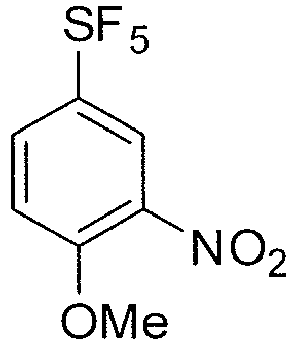
- To a solution of 1-chloro-2-nitro-4-(pentafluorosulfanyl)benzene (3.0 g, 10 mmol) in THF (30 mL), a solution of sodium methoxide in methanol (28% by weight, 2.4 g, 13 mmol) was added under cooling on ice. After stirring the obtained solution at room temperature for two hours, a saturated aqueous solution of ammonium chloride was added to the reaction solution, and the obtained solution was extracted with dichloromethane. The organic layer was dried over anhydrous sodium sulfate and then concentrated under vacuum to obtain the title compound (2.5 g).
1H-NMR (400 MHz, CDCl3) δ (ppm): 4.04 (3H, s), 7.16 (1H, d, J = 9.3 Hz), 7.94 (1H, dd, J = 9.3, 2.7 Hz), 8.29 (1H, d, J = 2.7 Hz).
MS(ESI) [M + H]+: 280. -

- The title compound (0.45 g) was obtained using 1-methoxy-2-nitro-4-(pentafluorosulfanyl)benzene (0.34 g, 1.1 mmol) by a method similar to that for the synthesis of 4-(2-amino-4-(trifluoromethyl)phenyl)piperazin-2-one (Reference Example 20).
1H-NMR (400 MHz, CDCl3) δ (ppm): 3.90 (3H, s), 6.75 (1H, d, J = 9.1 Hz), 7.09 (1H, d, J = 2.7 Hz), 7.13 (1H, dd, J = 9.1, 2.7 Hz).
MS(ESI) [M + H]+: 250. -

- The title compound (5.0 g) was obtained using 2-methoxy-5-(pentafluorosulfanyl)aniline (4.5 g, 18 mmol) by a method similar to that for the synthesis of 2,2,2-trichloroethyl (3-(hydroxymethyl)-2-methoxy-5-(trifluoromethyl)phenyl)carbamate (Reference Example 8).
-

- The title compound (7.0 g) was obtained using 2-methoxy-5-(trifluoromethoxy)aniline (5.0 g, 24 mmol) by a method similar to that for the synthesis of 2,2,2-trichloroethyl (3-(hydroxymethyl)-2-methoxy-5-(trifluoromethyl)phenyl)carbamate (Reference Example 8).
1H-NMR (400 MHz, CDCl3) δ (ppm): 3.92 (3H, s), 4.85 (2H, s), 6.86 - 6.91 (2H, m), 7.51 (1H, d, J = 8.0 Hz), 8.08 (1H, s).
MS(ESI) [M + H]+: 382. -
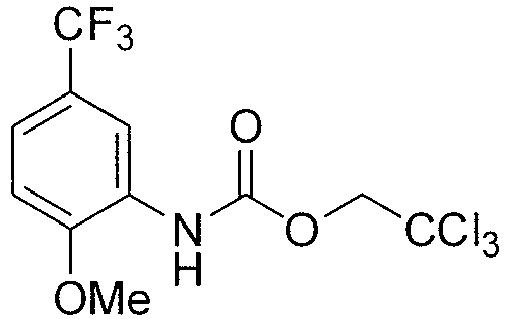
- The title compound (7.8 g) was obtained using 2-methoxy-5-(trifluoromethyl)aniline (5.0 g, 26 mmol) by a method similar to that for the synthesis of 2,2,2-trichloroethyl (3-(hydroxymethyl)-2-methoxy-5-(trifluoromethyl)phenyl)carbamate (Reference Example 8).
1H-NMR (400 MHz, CDCl3) δ (ppm): 3.97 (3H, s), 4.86 (2H, s), 6.95 (1H, d, J = 8.5 Hz), 7.33 (1H, dd, J = 8.9, 1.8 Hz), 7.52 (1H, s), 8.42 (1H, s). -

- The title compound (0.11 g) was obtained using 1-chloro-2-nitro-4-(trifluoromethyl)benzene (0.10 g, 0.44 mmol) and tert-butyl 4-hydroxypiperidine-1-carboxylate (0.089 g, 0.044 mmol) by a method similar to that for the synthesis of tert-butyl trans-(4-((2-chloropyrimidin-4-yl)oxy)cyclohexyl)carbamate (Reference Example 2).
MS(ESI) [M - tBu]+: 335. -

- The title compound (0.19 g) was obtained using tert-butyl 4-(2-nitro-4-(trifluoromethyl)phenoxy)piperidine-1-carboxylate (0.20 g, 0.51 mmol) by a method similar to that for the synthesis of 4-(2-amino-4-(trifluoromethyl)phenyl)piperazin-2-one (Reference Example 20).
MS(ESI) [M + H]+: 437. - Synthesis of tert-butyl 4-(2-(((2,2,2-trichloroethoxy)carbonyl)amino)-4-(trifluoromethyl)phenoxy)piperidine-1-carboxylate:

- The title compound (0.13 g) was obtained using tert-butyl 4-(2-amino-4-(trifluoromethyl)phenoxy)piperidine-1-carboxylate (0.11 g, 0.30 mmol) by a method similar to that for the synthesis of 2,2,2-trichloroethyl (3-(hydroxymethyl)-2-methoxy-5-(trifluoromethyl)phenyl)carbamate (Reference Example 8).
MS(ESI) [M + H]+: 534. -

- The title compound (0.12 g) was obtained using 1-chloro-2-nitro-4-(trifluoromethyl)benzene (0.10 g, 0.44 mmol) and tert-butyl 3-hydroxyazetidine-1-carboxylate (0.08 g, 0.44 mmol) by a method similar to that for the synthesis of tert-butyl trans-(4-((2-chloropyrimidin-4-yl)oxy)cyclohexyl)carbamate (Reference Example 2).
MS(ESI) [M - tBu]+: 307. -

- The title compound (0.62 g) was obtained using 1-chloro-2-nitro-4-(trifluoromethyl)benzene (0.50 g, 2.22 mmol) and (S)-tert-butyl 3-hydroxypyrrolidine-1-carboxylate (0.50 g, 2.66 mmol) by a method similar to that for the synthesis of tert-butyl trans-(4-((2-chloropyrimidin-4-yl)oxy)cyclohexyl)carbamate (Reference Example 2).
MS(ESI) [M - tBu]+: 321. -

- The title compound (0.6 g) was obtained using 1-chloro-2-nitro-4-(trifluoromethyl)benzene (0.50 g, 2.22 mmol) and (R)-tert-butyl 3-hydroxypyrrolidine-1-carboxylate (0.50 g, 2.66 mmol) by a method similar to that for the synthesis of tert-butyl trans-(4-((2-chloropyrimidin-4-yl)oxy)cyclohexyl)carbamate (Reference Example 2).
MS(ESI) [M - tBu]+: 321. -

- The title compound (0.15 g) was obtained using tert-butyl 3-(2-nitro-4-(trifluoromethyl)phenoxy)azetidine-1-carboxylate (0.19 g, 0.51 mmol) by a method similar to that for the synthesis of 4-(2-amino-4-(trifluoromethyl)phenyl)piperazin-2-one (Reference Example 20).
MS(ESI) [M - tBu]+: 277. -

- The title compound (0.5 g) was obtained using (S)-tert-butyl 3-(2-nitro-4-(trifluoromethyl)phenoxy)pyrrolidine-1-carboxylate (0.62 g, 1.65 mmol) by a method similar to that for the synthesis of 4-(2-amino-4-(trifluoromethyl)phenyl)piperazin-2-one (Reference Example 20).
MS(ESI) [M - tBu]+: 291. -

- The title compound (0.51 g) was obtained using (R)-tert-butyl 3-(2-nitro-4-(trifluoromethyl)phenoxy)pyrrolidine-1-carboxylate (0.61 g, 1.62 mmol) by a method similar to that for the synthesis of 4-(2-amino-4-(trifluoromethyl)phenyl)piperazin-2-one (Reference Example 20).
MS(ESI) [M - tBu]+: 291. -

- The title compound (0.15 g) was obtained using tert-butyl 3-(2-amino-4-(trifluoromethyl)phenoxy)azetidine-1-carboxylate (0.10 g, 0.30 mmol) by a method similar to that for the synthesis of 2,2,2-trichloroethyl (3-(hydroxymethyl)-2-methoxy-5-(trifluoromethyl)phenyl)carbamate (Reference Example 8). MS(ESI) [M - tBu]+: 451.
-
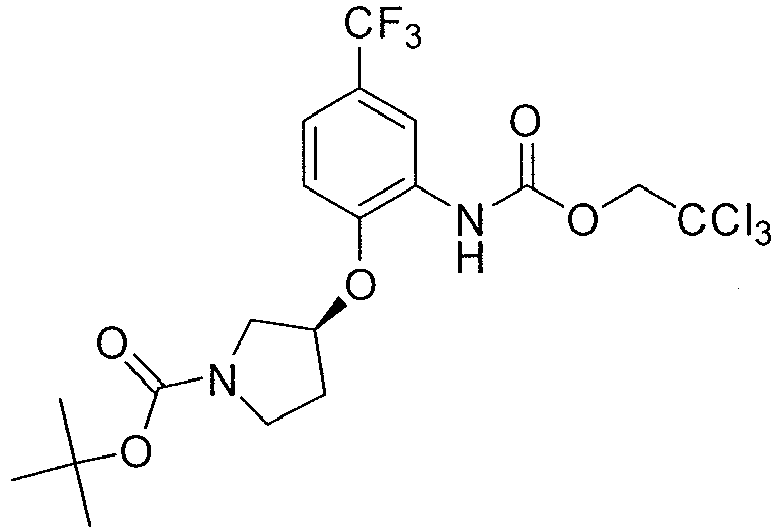
- The title compound (0.49 g) was obtained using (S)-tert-butyl 3-(2-amino-4-(trifluoromethyl)phenoxy)pyrrolidine-1-carboxylate (0.34 g, 1.59 mmol) by a method similar to that for the synthesis of 2,2,2-trichloroethyl (3-(hydroxymethyl)-2-methoxy-5-(trifluoromethyl)phenyl)carbamate (Reference Example 8).
MS(ESI) [M - Boc]+: 421. -

- The title compound (0.51 g) was obtained using (R)-tert-butyl 3-(2-amino-4-(trifluoromethyl)phenoxy)pyrrolidine-1-carboxylate (0.50 g, 1.44 mmol) by a method similar to that for the synthesis of 2,2,2-trichloroethyl (3-(hydroxymethyl)-2-methoxy-5-(trifluoromethyl)phenyl)carbamate (Reference Example 8).
MS(ESI) [M - Boc]+: 421. -

- The title compound (0.18 g) was obtained using 2-methyl-5-(trifluoromethyl)aniline (0.20 g, 1.05 mmol) by a method similar to that for the synthesis of 2,2,2-trichloroethyl (3-(hydroxymethyl)-2-methoxy-5-(trifluoromethyl)phenyl)carbamate (Reference Example 8).
MS(ESI) [M + H]+: 349. -

- The title compound (0.15 g) was obtained using 2-fluoro-5-(trifluoromethyl)aniline (0.26 g, 1.23 mmol) by a method similar to that for the synthesis of 2,2,2-trichloroethyl (3-(hydroxymethyl)-2-methoxy-5-(trifluoromethyl)phenyl)carbamate (Reference Example 8).
MS(ESI) [M + H]+: 354. -

- To a solution of 2-chloro-5-(trifluoromethyl)aniline (0.24 g, 1.1 mmol) and diazabicycloundecene (hereinafter referred to as DBU) (0.20 g, 1.3 mmol) in THF, 2,2,2-trichloroethyl chloroformate (0.20 g, 1.0 mmol) was added under cooling on ice. After stirring the obtained solution overnight at room temperature, water was added to the reaction solution, and the obtained solution was extracted with ethyl acetate. The organic layer was sequentially washed with a saturated aqueous solution of ammonium chloride and with a saturated aqueous solution of sodium chloride. The obtained organic layer was dried over anhydrous sodium sulfate and then concentrated under vacuum. The obtained crude product was purified by silica gel column chromatography (eluent; hexane:ethyl acetate = 90:10 → 60:40) to obtain the title compound (0.12 g).
MS(ESI) [M + H]+: 505. -
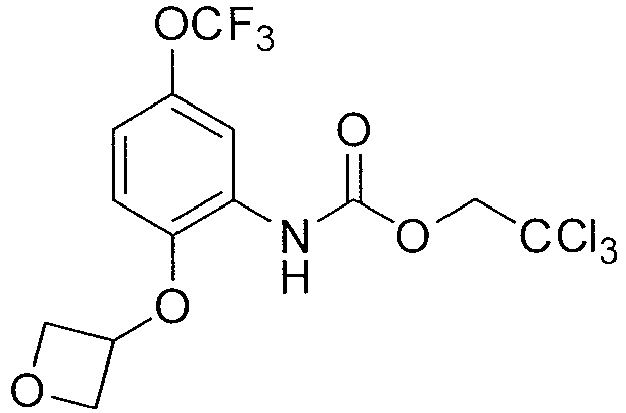
- The title compound (0.12 g) was obtained using 1-chloro-2-nitro-4-(trifluoromethoxy)benzene (0.50 g, 1.79 mmol) by a method similar to that for 2,2,2-trichloroethyl (2-(oxetan-3-yloxy)-5-(trifluoromethyl)phenyl)carbamate (Reference Example 22).
MS(ESI) [M + H]+: 424. -
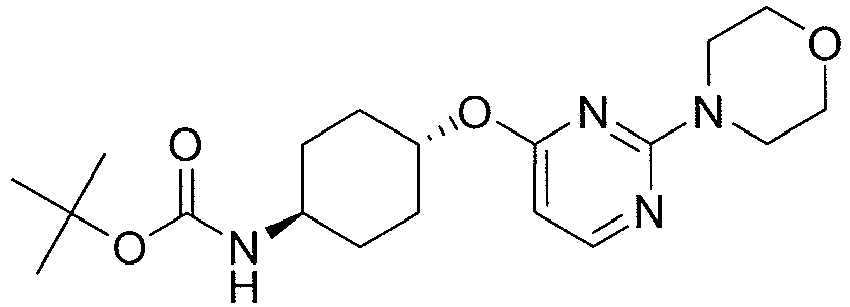
- The title compound (0.54 g) was obtained using tert-butyl trans-(4-((2-chloropyrimidin-4-yl)oxy)cyclohexyl)carbamate (0.020 g, 0.061 mmol) by a method similar to that for the synthesis of 1-(2-methoxy-5-(trifluoromethoxy)phenyl)-3-(trans-4-((2-morpholinopyrimidin-4-yl)oxy)cyclohexyl)urea (Example 1).
1H-NMR (400 MHz, CDCl3) δ (ppm): 1.25 - 1.46 (13H, m), 2.10 (4H, m), 3.50 (1H, brs), 3.74 - 3.78 (8H, m), 4.41 (1H, brs), 4.92 (1H, brs), 5.96 (1H, d, J = 5.6 Hz), 8.05 (1H, d, J = 5.6 Hz). -

- The title compound (0.35 g) was obtained using 2-chloropyrimidine (0.30 g, 1.4 mmol) by a method similar to that for the synthesis of tert-butyl trans-(4-((2-chloropyrimidin-4-yl)oxy)cyclohexyl)carbamate (Reference Example 2).
1H-NMR (400 MHz, CDCl3) δ (ppm): 1.24 - 1.31 (2H, m), 1.42 (9H, s), 1.60 - 1.64 (2H, m), 2.07 - 2.15 (4H, m), 3.51 (1H, brs), 4.39 (1H, brs), 4.89 - 4.94 (1H, m), 6.86 (1H, t, J = 4.8 Hz), 8.46 (2H, d, J = 4.8 Hz). -

- The title compound (0.060 g) was obtained using 3-chloro-6-phenylpyridazine (0.093 g, 0.49 mmol) by a method similar to that for the synthesis of tert-butyl trans-(4-((2-chloropyrimidin-4-yl)oxy)cyclohexyl)carbamate (Reference Example 2).
1H-NMR (400 MHz, CDCl3) δ (ppm): 1.33 - 1.36 (2H, m), 1.46 (9H, s), 1.61 - 1.64 (2H, m), 2.08 - 2.11 (2H, m), 2.29 - 2.31 (2H, m), 3.55 (1H, brs), 4.43 (1H, brs), 5.33 (1H, brs), 6.98 (1H, d, J = 9.3 Hz), 7.48 - 7.50 (3H, m), 7.78 (1H, d, J = 9.5 Hz), 8.00 - 8.02 (2H, m). -

- A solution of tert-butyl (trans-4-((2-morpholinopyrimidin-4-yl)oxy)cyclohexyl)carbamate (0.54 g, 1.4 mmol) in a 4 N hydrogen chloride/ethyl acetate solution (4 mL) was stirred at room temperature for two hours. The reaction solution was concentrated under vacuum, and a saturated aqueous solution of sodium hydrogen carbonate was added thereto, and the obtained solution was extracted with ethyl acetate and with a mixed solvent of chloroform/methanol. The organic layer was sequentially washed with a saturated aqueous solution of sodium hydrogen carbonate and with a saturated aqueous solution of sodium chloride. The obtained organic layer was dried over anhydrous sodium sulfate and then concentrated under vacuum to obtain the title compound (0.40 g).
1H-NMR (400 MHz, CDCl3) δ (ppm): 1.24 - 1.34 (2H, m), 1.48 - 1.55 (2H, m), 1.95 - 1.97 (2H, m), 2.12 - 2.15 (2H, m), 2.79 - 2.84 (1H, m), 3.75 (8H, s), 4.90 - 4.98 (1H, m), 5.95 (1H, d, J = 5.6 Hz), 8.05 (1H, d, J = 5.6 Hz). -

- The title compound (0.020 g) was obtained using tert-butyl (trans-4-(pyrimidin-2-yloxy)cyclohexyl)carbamate (0.35 g, 1.2 mmol) by a method similar to that for the synthesis of trans-4-((2-morpholinopyrimidin-4-yl)oxy)cyclohexanamine (Reference Example 51).
1H-NMR (400 MHz, CDCl3) δ (ppm): 1.20 - 1.32 (2H, m), 1.55 - 1.60 (2H, m), 1.90 - 1.93 (2H, m), 2.14 - 2.16 (2H, m), 2.76 - 2.78 (1H, m), 4.92 - 4.94 (1H, m), 6.86 (1H, t, J = 4.8 Hz), 8.46 (2H, d, J = 4.9 Hz). -

- A crude product of the title compound (0.069 g) was obtained using tert-butyl (trans-4-(6-phenylpyridazin-3-yl)oxy)cyclohexyl)carbamate (0.060 g, 0.16 mmol) by a method similar to that for the synthesis of trans-4-((2-morpholinopyrimidin-4-yl)oxy)cyclohexanamine (Reference Example 51).
1H-NMR (400 MHz, CDCl3) δ (ppm): 1.32 - 1.35 (2H, m), 1.53 - 1.56 (2H, m), 1.94 - 1.97 (2H, m), 2.30 - 2.33 (2H, m), 2.80 (1H, brs), 5.33 (1H, brs), 6.98 (1H, d, J = 9.0 Hz), 7.47 - 7.50 (3H, m), 7.78 (1H, d, J = 9.0 Hz), 8.00 - 8.03 (2H, m). -

- The title compound (0.048 g) was obtained using tert-butyl trans-(4-((4-chloropyrimidin-2-yl)oxy)cyclohexyl)carbamate (0.050 g, 0.15 mmol) by a method similar to that for the synthesis of 1-(2-methoxy-5-(trifluoromethoxy)phenyl)-3-(trans-4-((2-morpholinopyrimidin-4-yl)oxy)cyclohexyl)urea (Example 1). 1H-NMR (400 MHz, CDCl3) δ (ppm): 1.25 - 1.30 (2H, m), 1.43 - 1.46 (2H, m), 1.45 (9H, s), 2.06 - 2.15 (4H, m), 2.94 (3H, d, J = 4.9 Hz), 3.50 (1H, brs), 4.39 (1H, brs), 4.85 - 4.91 (1H, m), 5.97 (1H,, d, J = 5.9 Hz), 7.96 (1H, d, J = 5.9 Hz).
-

- A crude product of the title compound (0.056 g) was obtained using tert-butyl (trans-4-(4-(methylamino)-2-yl)oxy)cyclohexyl)carbamate (0.087 g, 0.27 mmol) by a method similar to that for the synthesis of trans-4-((2-chloropyrimidin-4-yl)oxy)cyclohexanamine hydrochloride (Reference Example 3).
-

- The title compound (0.048 g) was obtained using tert-butyl trans-(4-((4-chloropyrimidin-2-yl)oxy)cyclohexyl)carbamate (0.020 g, 0.043 mmol) by a method similar to that for the synthesis of 1-(2-methoxy-5-(trifluoromethoxy)phenyl)-3-(trans-4-((2-morpholinopyrimidin-4-yl)oxy)cyclohexyl)urea (Example 1). 1H-NMR (400 MHz, CDCl3) δ (ppm): 1.25 - 1.28 (2H, m), 1.43 - 1.46 (11H, m), 2.05 - 2.17 (4H, m), 3.50 (1H, brs)3.59 - 3.61 (4H, m), 3.75 - 3.76 (4H, m), 4.39 (1H, brs), 4.87 (1H, brs), 6.13 (1H, d, J = 6.1 Hz), 8.02 (1H, d, J = 6.1 Hz).
-

- A crude product of the title compound (0.056 g) was obtained using tert-butyl (trans-4-((4-morpholinopyrimidin-2-yl)oxy)cyclohexyl)carbamate (0.066 g, 0.15 mmol) by a method similar to that for the synthesis of trans-4-((2-chloropyrimidin-4-yl)oxy)cyclohexanamine hydrochloride (Reference Example 3).
-

- The title compound (0.56 g) was obtained using 4,6-dichloropyrimidine (0.35 g, 2.3 mmol) by a method similar to that for the synthesis of tert-butyl trans-(4-((2-chloropyrimidin-4-yl)oxy)cyclohexyl)carbamate (Reference Example 2).
1H-NMR (400 MHz, CDCl3) δ (ppm): 1.29 - 1.32 (2H, m), 1.44 - 1.46 (11H, m), 2.05 - 2.13 (4H, m), 3.50 (1H, s), 4.42 (1H, s), 5.06 (1H, s), 6.71 (1H, d, J = 1.0 Hz), 8.53 (1H, d, J = 0.7 Hz). -

-
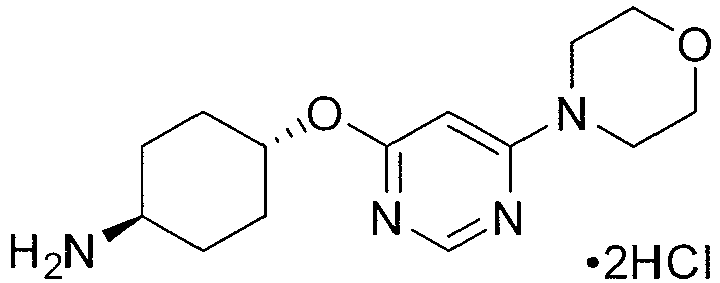
- A crude product of the title compound (0.061 g) was obtained using tert-butyl (trans-4-((6-morpholinopyrimidin-4-yl)oxy)cyclohexyl)carbamate (0.059 g, 0.16 mmol) by a method similar to that for the synthesis of trans-4-((2-chloropyrimidin-4-yl)oxy)cyclohexanamine hydrochloride (Reference Example 3).
-

- The title compound (0.56 g) was obtained using tert-butyl trans-(4-((6-chloropyrimidin-4-yl)oxy)cyclohexyl)carbamate (0.050 g, 0.15 mmol) by a method similar to that for the synthesis of 1-(2-methoxy-5-(trifluoromethoxy)phenyl)-3-(trans-4-((2-morpholinopyrimidin-4-yl)oxy)cyclohexyl)urea (Example 1).
1H-NMR (400 MHz, CDCl3) δ (ppm): 1.30 - 1.32 (2H, m), 1.43 - 1.47 (11H, m), 2.07 - 2.11 (4H, m), 2.87 (3H, d, J = 5.1 Hz), 3.50 (1H, brs), 4.42 (1H, brs), 4.83 (1H, brs), 4.99 (1H, brs), 5.60 (1H, d, J = 0.7 Hz), 8.20 (1H, s). -
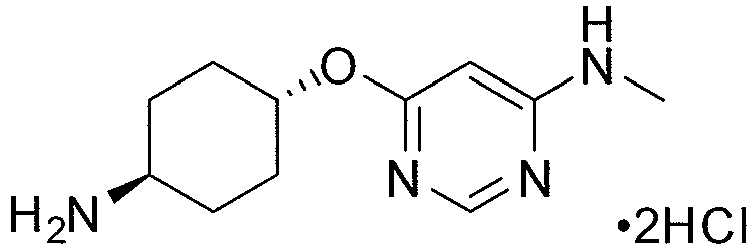
- A crude product of the title compound (0.031 g) was obtained using tert-butyl (trans-4-(6-(methylamino)pyrimidin-4-yl)oxy)cyclohexyl)carbamate (0.029 g, 0.089 mmol) by a method similar to that for the synthesis of trans-4-((2-chloropyrimidin-4-yl)oxy)cyclohexanamine hydrochloride (Reference Example 3).
-

- At room temperature, a solution of tert-butyl trans-(4-((2-chloropyrimidin-4-yl)oxy)cyclohexyl)carbamate (0.12 g, 0.37 mmol) in a methylamine/methanol solution (40% by weight, 0.37 mL) was stirred at room temperature for four hours. The reaction solution was concentrated under vacuum. The obtained crude product was purified by silica gel column chromatography (eluent; hexane:ethyl acetate = 99:1 → 60:40) to obtain the title compound (0.087 g).
1H-NMR (400 MHz, CDCl3) δ (ppm): 1.25 - 1.29 (2H, m), 1.45 (9H, s), 1.51 - 1.55 (2H, m), 2.08 - 2.12 (4H, m), 2.96 (3H, d, J = 5.1 Hz), 3.49 (1H, brs), 4.40 (1H, brs), 4.92 (1H, brs), 5.94 (1H, d, J = 5.9 Hz), 8.00 (1H, d, J = 5.6 Hz). -

- A crude product of the title compound (0.078 g) was obtained using tert-butyl (trans-4-(2-(methylamino)-4-yl)oxy)cyclohexyl)carbamate (0.087 g, 0.27 mmol) by a method similar to that for the synthesis of trans-4-((2-chloropyrimidin-4-yl)oxy)cyclohexanamine hydrochloride (Reference Example 3).
-
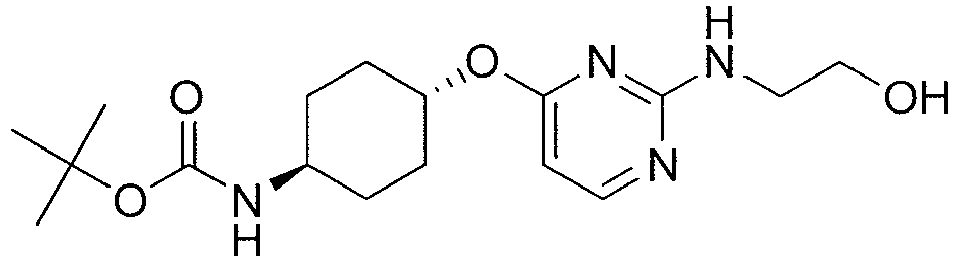
- A crude product of the title compound (0.15 g) was obtained using 2-aminoethanol (55 mL, 0.92 mmol) and tert-butyl trans-(4-((2-chloropyrimidin-4-yl)oxy)cyclohexyl)carbamate (0.15 g, 0.46 mmol) by a method similar to that for the synthesis of 1-(2-methoxy-5-(trifluoromethoxy)phenyl)-3-(trans-4-((2-morpholinopyrimidin-4-yl)oxy)cyclohexyl)urea (Example 1).
-

- A crude product of the title compound (0.11 g) was obtained using tert-butyl (trans-4-((2-((2-hydroxymethyl)amino)pyrimidin-4-yl)oxy)cyclohexyl)carbamate (0.15 g, 0.43 mmol) by a method similar to that for the synthesis of trans-4-((2-chloropyrimidin-4-yl)oxy)cyclohexanamine hydrochloride (Reference Example 3).
-

- To a solution of tert-butyl trans-(4-hydroxycyclohexyl)carbamate (0.20 g, 0.93 mmol) and 4-(bromomethyl)pyridine hydrobromide (0.18 g, 0.72 mmol) in DMF, sodium hydride (55% by weight in mineral oil, 0.096 g) was added. After stirring the obtained solution at room temperature for one and a half hours, water was added to the reaction solution, and the obtained solution was extracted with ethyl acetate and sequentially washed with a saturated aqueous solution of ammonium chloride and with a saturated aqueous solution of sodium chloride. The organic layer was dried over anhydrous sodium sulfate and then concentrated under vacuum. The obtained crude product was purified by silica gel column chromatography (eluent; hexane:ethyl acetate = 95:5 → 35:65) to obtain the title compound (0.053 g). MS(ESI) [M + H]+: 307.
-

- The title compound (0.012 g) was obtained using tert-butyl (trans-4-(pyridin-4-ylmethoxy)cyclohexyl)carbamate (0.017 g, 0.055 mmol) by a method similar to that for the synthesis of trans-4-((2-chloropyrimidin-4-yl)oxy)cyclohexanamine hydrochloride (Reference Example 3).
MS(ESI) [M + H]+: 207. -

- The title compound (0.094 g) was obtained using 3-(bromomethyl)pyridine hydrobromide (0.53 g, 2.1 mmol) by a method similar to that for the synthesis of tert-butyl (trans-4-(pyridin-4-ylmethoxy)cyclohexyl)carbamate (Reference Example 67).
1H-NMR (400 MHz, CDCl3) δ (ppm): 1.13 - 1.16 (2H, m), 1.42 - 1.46 (11H, s), 2.05 - 2.06 (4H, m), 3.33 (1H, brs), 3.45 (1H, brs), 4.37 (1H, brs), 4.55 (2H, s), 7.25 - 7.28 (1H, m), 7.68 (1H, d, J = 8.0 Hz), 8.54 - 8.56 (2H, m). -

- A crude product of the title compound (0.078 g) was obtained using tert-butyl (trans-4-(pyridin-3-ylmethoxy)cyclohexyl)carbamate (0.029 g, 0.089 mmol) by a method similar to that for the synthesis of trans-4-((2-chloropyrimidin-4-yl)oxy)cyclohexanamine hydrochloride (Reference Example 3).
-

- The title compound (0.12 g) was obtained using tert-butyl (trans-4-(hydroxymethyl)cyclohexyl)carbamate (0.20 g, 0.87 mmol) and 3-(bromomethyl)pyridine hydrobromide (0.20 g, 0.79 mmol) by a method similar to that for the synthesis of tert-butyl (trans-4-(pyridin-4-ylmethoxy)cyclohexyl)carbamate (Reference Example 67).
1H-NMR (400 MHz, CDCl3) δ (ppm): 1.03 - 1.11 (4H, m), 1.44 (9H, s), 1.53 - 1.57 (1H, m), 1.83 - 1.86 (2H, m), 2.02 - 2.04 (2H, m), 3.29 - 3.30 (2H, m), 3.38 - 3.41 (1H, m), 4.37 (1H, brs), 4.50 (2H, brs),7.28 - 7.29 (1H, m), 7.66 (1H, d, J = 8.0 Hz), 8.53 - 8.55 (2H, m). -

- A crude product of the title compound (0.084 g) was obtained using tert-butyl (trans-4-((pyridin-3-ylmethoxy)methyl)cyclohexyl)carbamate (0.12 g, 0.38 mmol) by a method similar to that for the synthesis of trans-4-((2-chloropyrimidin-4-yl)oxy)cyclohexanamine hydrochloride (Reference Example 3).
-

- The title compound (0.14 g) was obtained using tert-butyl (trans-4-(hydroxymethyl)cyclohexyl)carbamate (0.20 g, 0.87 mmol) and 4-(bromomethyl)pyridine hydrobromide (0.20 g, 0.79 mmol) by a method similar to that for the synthesis of tert-butyl (trans-4-(pyridin-4-ylmethoxy)cyclohexyl)carbamate (Reference Example 67).
1H-NMR (400 MHz, CDCl3) δ (ppm): 1.07 - 1.16 (4H, m), 1.44 (9H, s), 1.53 - 1.57 (1H, m), 1.85 - 1.87 (2H, m), 2.03 - 2.05 (2H, m), 3.31 (2H, d, J = 6.6 Hz), 3.39 (1H, brs), 4.38 (1H, brs), 4.50 (2H, s), 7.24 (2H, dd, J = 3.4, 2.7 Hz), 8.56 (2H, dd, J = 4.4, 1.5 Hz). -

- A crude product of the title compound (0.097 g) was obtained using tert-butyl (trans-4-((pyridin-4-ylmethoxy)methyl)cyclohexyl)carbamate (0.14 g, 0.44 mmol) by a method similar to that for the synthesis of trans-4-((2-chloropyrimidin-4-yl)oxy)cyclohexanamine hydrochloride (Reference Example 3).
-

- To a solution of tert-butyl (trans-4-(hydroxymethyl)cyclohexyl)carbamate (0.10 g, 0.44 mmol), methyl 5-hydroxynicotinate (0.10 g, 0.65 mmol) and triphenylphosphine (0.17 g, 0.65 mmol) in THF (5 mL), bis(2-methoxyethyl) azodicarboxylate (0.15 g, 0.65 mmol) was added under cooling on ice. After stirring the obtained solution overnight at room temperature, water was added to the reaction solution, and the obtained solution was extracted with ethyl acetate. The organic layer was dried over anhydrous sodium sulfate and then concentrated under vacuum. The obtained crude product was purified by silica gel column chromatography (eluent; hexane:ethyl acetate = 80:20 → 55:45) to obtain the title compound (0.12 g).
1H-NMR (400 MHz, CDCl3) δ (ppm): 1.13 - 1.24 (4H, m), 1.45 (9H, s), 1.76 - 1.80 (1H, m), 1.94 - 1.96 (2H, m), 2.06 - 2.09 (2H, m), 3.42 (1H, brs), 3.84 (2H, d, J = 6.3 Hz), 3.95 (3H, s), 4.41 (1H, brs), 7.73 - 7.73 (1H, m), 8.45 (1H, d, J = 2.9 Hz), 8.81 (1H, d, J = 1.5 Hz). -

- To a solution of methyl 5-((trans-4-((tert-butoxycarbonyl)amino)cyclohexyl)methoxy)nicotinate (0.092 g, 0.25 mmol) in a mixed solvent of THF/methanol (THF:methanol = 1:1, v/v, 2 mL), a 1 N aqueous solution of sodium hydroxide (0.50 mL) was added. After stirring the obtained solution overnight at room temperature, a saturated aqueous solution of ammonium chloride was added to the reaction solution, and the obtained solution was extracted with ethyl acetate. The organic layer was dried over anhydrous sodium sulfate and then concentrated under vacuum, and a crude product of the title compound (0.086 g) was obtained.
-

- To a solution of 5-((trans-4-((tert-butoxycarbonyl)amino)cyclohexyl)methoxy)nicotinic acid (0.086 g, 0.25 mmol), ammonium chloride (0.13 g, 2.5 mmol), 2-(7-aza-1H-benzotriazol-1-yl)-1,1,3,3-tetramethyluronium hexafluorophosphate and O-(benzotriazol-1-yl)-N,N,N',N'-tetramethyluronium hexafluorophosphate (hereinafter referred to as HATU) (0.14 g, 0.37 mmol) in DMF (2 mL), DIPEA (0.48 mL, 3.7 mmol) was added under cooling on ice. After stirring the obtained solution overnight at room temperature, water and 1 N hydrochloric acid were added to the reaction solution, the obtained solution was extracted with ethyl acetate. The organic layer was dried over anhydrous sodium sulfate and then concentrated under vacuum. The obtained crude product was purified by silica gel column chromatography (eluent; chloroform:methanol = 99:1 → 95:5) to obtain the title compound (0.019 g).
1H-NMR (400 MHz, CDCl3) δ (ppm): 1.14 - 1.19 (4H, m), 1.45 (9H, s), 1.76 - 1.80 (1H, m), 1.93 - 1.96 (2H, m), 2.08 - 2.11 (2H, m), 3.42 (1H, brs), 3.86 (2H, d, J = 6.3 Hz), 4.41 (1H, brs), 7.66 (1H, s), 8.43 (1H, d, J = 2.9 Hz), 8.53 (1H, d, J = 1.7 Hz). -

- A crude product of the title compound (0.014 g) was obtained using tert-butyl (trans-4-(((5-carbamoylpyridin-3-yl)oxy)methyl)cyclohexyl)carbamate (0.019 g, 0.054 mmol) by a method similar to that for the synthesis of trans-4-((2-chloropyrimidin-4-yl)oxy)cyclohexanamine hydrochloride (Reference Example 3).
-
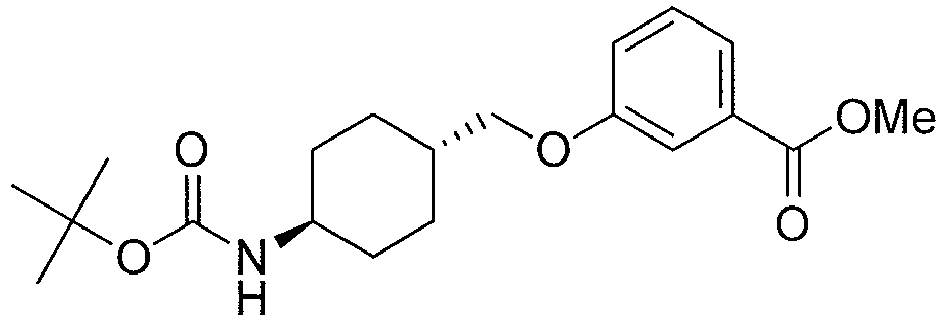
- The title compound (0.092 g) was obtained using methyl 3-hydroxybenzoate (0.10 g, 0.65 mmol) by a method similar to that for the synthesis of methyl 5-((trans-4-((tert-butoxycarbonyl)amino)cyclohexyl)methoxy)nicotinate (Reference Example 75).
1H-NMR (400 MHz, CDCl3) δ (ppm): 1.12 - 1.20 (4H, m), 1.45 (9H, s), 1.76 (1H, brs), 1.94 - 1.96 (2H, m), 2.06 - 2.08 (2H, m), 3.42 (1H, brs), 3.80 (2H, d, J = 6.3 Hz), 3.91 (3H, s), 4.40 (1H, brs), 7.07 (1H, dt, J = 8.3, 1.2 Hz), 7.33 (1H, t, J = 7.9 Hz), 7.52 (1H, t, J = 2.0 Hz), 7.61 (1H, dt, J = 7.6,1.2 Hz). -

- The title compound (0.081 g) was obtained using methyl 3-((trans-4-((tert-butoxycarbonyl)amino)cyclohexyl)methoxy)benzoate (0.092 g, 0.25 mmol) by a method similar to that for the synthesis of 5-((trans-4-((tert-butoxycarbonyl)amino)cyclohexyl)methoxy)nicotinic acid (Reference Example 76).
-

- The title compound (0.081 g) was obtained using 3-((trans-4-((tert-butoxycarbonyl)amino)cyclohexyl)methoxy)benzoic acid (0.081 g, 0.23 mmol) by a method similar to that for the synthesis of tert-butyl (trans-4-(((5-carbamoylpyridin-3-yl)oxy)methyl)cyclohexyl)carbamate (Reference Example 77).
1H-NMR (400 MHz, CDCl3) δ (ppm): 1.12 - 1.22 (4H, m), 1.76 (1H, s), 1.94 (2H, d, J = 8.5 Hz), 2.08 (2H, s), 3.42 (1H, s), 3.81 (2H, d, J = 6.3 Hz), 4.41 (1H, s), 5.58 (1H, s), 6.02 (1H, s), 7.03 - 7.06 (1H, m), 7.31 - 7.34 (3H, m). -

- A crude product of the title compound (0.045 g) was obtained using 3-((trans-4-((tert-butoxycarbonyl)amino)cyclohexyl)methoxy)benzoic acid (0.081 g, 0.23 mmol) by a method similar to that for the synthesis of trans-4-((2-chloropyrimidin-4-yl)oxy)cyclohexanamine hydrochloride (Reference Example 3).
-

- The title compound (0.082 g) was obtained using 2-chloro-4-nitropyridine (0.10 g, 0.46 mmol) by a method similar to that for the synthesis of tert-butyl (trans-4-(pyridin-4-ylmethoxy)cyclohexyl)carbamate (Reference Example 67).
MS(ESI) [M + H]+: 327. -

- A solution of tert-butyl (trans-4-((2-chloropyridin-4-yl)oxy)cyclohexyl)carbamate (0.10 g, 0.31 mmol) in morpholine (5 mL) was stirred for 30 minutes at 170°C by using the microwave synthesis reactor, and water was subsequently added to the reaction solution, and the obtained solution was extracted with ethyl acetate and sequentially washed with 0.01 N hydrochloric acid and with a saturated aqueous solution of sodium chloride. The organic layer was dried over anhydrous sodium sulfate and then concentrated under vacuum. The obtained crude product was purified by silica gel column chromatography (eluent; hexane:ethyl acetate = 80:20 → 50:50) to obtain the title compound (0.025 g).
MS(ESI) [M + H]+: 378. -

- The title compound (0.010 g) was obtained using tert-butyl (trans-4-((2-chloropyridin-4-yl)oxy)cyclohexyl)carbamate (0.025 g, 0.066 mmol) by a method similar to that for the synthesis of trans-4-((2-chloropyrimidin-4-yl)oxy)cyclohexanamine hydrochloride (Reference Example 3).
MS(ESI) [M + H]+: 278. -

- The title compound (0.042 g) was obtained using tert-butyl (trans-4-((2-chloropyridin-4-yl)oxy)cyclohexyl)carbamate (0.050 g, 0.15 mmol) by a method similar to that for the synthesis of 4-(2-amino-4-(trifluoromethyl)phenyl)piperazin-2-one (Reference Example 20).
MS(ESI) [M + H]+: 293. -

- A crude product of the title compound (0.025 g) was obtained using tert-butyl (trans-4-(pyridin-4-yloxy)cyclohexyl)carbamate (0.040 g, 0.14 mmol) by a method similar to that for the synthesis of trans-4-((2-chloropyrimidin-4-yl)oxy)cyclohexanamine hydrochloride (Reference Example 3).
MS(ESI) [M + H]+: 193. -

- A solution of tert-butyl trans-(4-((2-chloropyrimidin-4-yl)oxy)cyclohexyl)carbamate (0.063 g, 0.19 mmol), pyridine-3-boronic acid (0.028 g, 0.23 mmol), PdCl2(PPh3)2 (0.0067 g, 0.0096 mmol) and potassium carbonate (0.056 g, 0.40 mmol) in a mixed solvent of 1,4-dioxane/water (1,4-dioxane:water = 2:1, v/v) was stirred at 105°C for eight hours under nitrogen atmosphere, and water was subsequently added to the reaction solution, and the obtained solution was extracted with ethyl acetate. The organic layer was sequentially washed with a saturated aqueous solution of ammonium chloride and with a saturated aqueous solution of sodium chloride. The obtained organic layer was dried over anhydrous sodium sulfate and then concentrated under vacuum, and the obtained crude product was purified by silica gel column chromatography (eluent; hexane:ethyl acetate = 90:10 → 60:40) to obtain the title compound (0.047 g).
MS(ESI) [M + H]+: 371. -

- The title compound (0.05 g) was obtained using tert-butyl trans-(4-((4-chloropyrimidin-2-yl)oxy)cyclohexyl)carbamate (0.07 g, 0.21 mmol) by a method similar to that for the synthesis of tert-butyl (trans-4-((2-(pyridin-3-yl)pyrimidin-4-yl)oxy)cyclohexyl)carbamate (Reference Example 88).
MS(ESI) [M + H]+: 371. -

- The title compound (0.03 g) was obtained using tert-butyl (trans-4-((2-(pyridin-3-yl)pyrimidin-4-yl)oxy)cyclohexyl)carbamate (0.05 g, 0.14 mmol) by a method similar to that for the synthesis of trans-4-((2-chloropyrimidin-4-yl)oxy)cyclohexanamine hydrochloride (Reference Example 3).
-
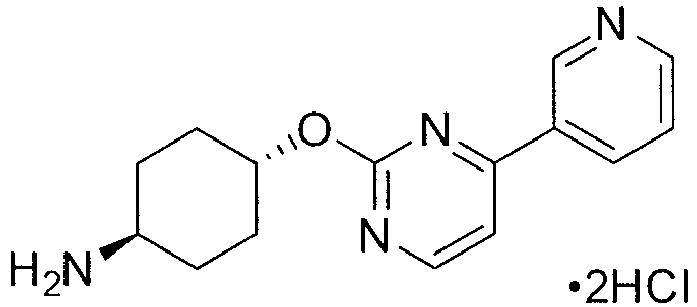
- The title compound (0.03 g) was obtained using tert-butyl (trans-4-((4-(pyridin-3-yl)pyrimidin-2-yl)oxy)cyclohexyl)carbamate (0.047 g, 0.13 mmol) by a method similar to that for the synthesis of trans-4-((2-chloropyrimidin-4-yl)oxy)cyclohexanamine hydrochloride (Reference Example 3).
-

- The title compound (0.10 g) was obtained using tert-butyl trans-(4-((4-chloropyrimidin-2-yl)oxy)cyclohexyl)carbamate (0.2 g, 0.61 mmol) and pyridine-4-boronic acid (0.09 g, 0.73 mmol) by a method similar to that for the synthesis of tert-butyl (trans-4-((2-(pyridin-3-yl)pyrimidin-4-yl)oxy)cyclohexyl)carbamate (Reference Example 88).
MS(ESI) [M + H]+: 371. -

- The title compound (0.059 g) was obtained using tert-butyl (trans-4-((2-(pyridin-3-yl)pyrimidin-4-yl)oxy)cyclohexyl)carbamate (0.2 g, 0.28 mmol) by a method similar to that for the synthesis of trans-4-((2-chloropyrimidin-4-yl)oxy)cyclohexanamine hydrochloride (Reference Example 3).
-
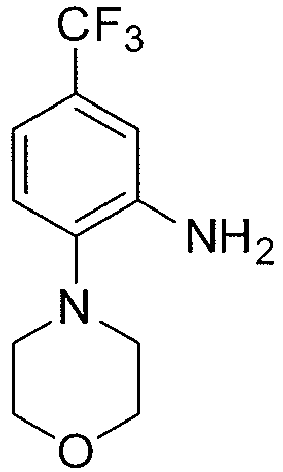
- Morpholine (5.0 ml) was added to 1-chloro-2-nitro-4-(trifluoromethyl)benzene (0.4 g, 1.77 mmol), and the obtained solution was heated at 100°C for five hours. A solution of 0.01 N hydrochloric acid was added to the reaction solution, and the obtained solution was then extracted with ethyl acetate and washed with a saturated aqueous solution of sodium chloride. The organic layer was dried over anhydrous sodium sulfate and then concentrated under vacuum, and the obtained crude product was used in a similar way to the synthesis of 4-(2-amino-4-(trifluoromethyl)phenyl)piperazin-2-one (Reference Example 20) to obtain the title compound. The obtained compound was used without purification in the next reaction.
MS(ESI) [M + H]+: 247. -

- The title compound (0.18 g) was obtained using 2-morpholino-5-(trifluoromethyl)aniline (0.19 g, 0.89 mol) by a method similar to that for the synthesis of 2,2,2-trichloroethyl (3-(hydroxymethyl)-2-methoxy-5-(trifluoromethyl)phenyl)carbamate (Reference Example 8).
MS(ESI) [M + H]+: 421. -

- To a solution of 3-nitro-5-(trifluoromethyl)benzoic acid (1.0 g, 4.25 mmol) in methanol, a catalyst amount of p-toluenesulfonic acid was added, and the obtained solution was heated under reflux for 15 hours. The obtained reaction liquid was returned to room temperature and then concentrated to the half of the original volume. Palladium (10% by weight) on carbon (containing 50% water by weight, 0.062 g) was added to the reaction liquid, and the obtained solution was stirred for one hour under hydrogen atmosphere. The reaction liquid was filtered through Celite®, the filtrate was concentrated under vacuum, and the obtained crude product was purified by silica gel column chromatography (eluent; hexane:ethyl acetate = 90:10 → 60:40) to obtain the title compound (0.85 g).
MS(ESI) [M + H]+: 221. -

- To a solution of methyl 3-amino-5-(trifluoromethyl)benzoate (0.4 g, 1.825 mmol) in THF, lithium aluminium hydride (0.215 g, 5.66 mmol) was slowly added under cooling on ice. The ice bath was removed, and the obtained solution was stirred overnight. Water was slowly added to the reaction solution, and the obtained solution was extracted with ethyl acetate. The organic layer was sequentially washed with a saturated aqueous solution of ammonium chloride and with a saturated aqueous solution of sodium chloride. The obtained organic layer was dried over anhydrous sodium sulfate and then concentrated under vacuum, and the obtained crude product was purified by silica gel column chromatography (eluent; hexane:ethyl acetate = 90:10 → 60:40) to obtain the title compound (0.32 g). MS(ESI) [M + H]+: 371.
-

- The title compound (0.13 g) was obtained using (3-amino-5-(trifluoromethyl)phenyl)methanol (0.318 g, 1.5 mmol) by a method similar to that for the synthesis of 2,2,2-trichloroethyl (3-(hydroxymethyl)-2-methoxy-5-(trifluoromethyl)phenyl)carbamate (Reference Example 8).
MS(ESI) [M + H]+: 367. -

- The title compound (0.9 g) was obtained using 4-nitro-6-(trifluoromethyl)benzoic acid (1.0 g, 4.25 mmol) by a method similar to that for the synthesis of methyl 3-amino-5-(trifluoromethyl)benzoate (Reference Example 96). MS(ESI) [M + H]+: 221.
-
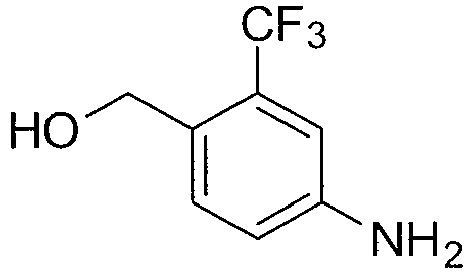
- The title compound (0.31 g) was obtained using methyl 4-amino-6-(trifluoromethyl)benzoate (0.4 g, 1.825 mmol) by a method similar to that for the synthesis of (3-amino-5-(trifluoromethyl)phenyl)methanol (Reference Example 97). MS(ESI) [M + H]+: 371.
-

- The title compound (0.16 g) was obtained using (4-amino-6-(trifluoromethyl)phenyl)methanol (0.13 g, 0.61 mmol) by a method similar to that for the synthesis of 2,2,2-trichloroethyl (3-(hydroxymethyl)-2-methoxy-5-(trifluoromethyl)phenyl)carbamate (Reference Example 8).
MS(ESI) [M + H]+: 367. -

- A solution of 2,2,2-trichloroethyl (2-methoxy-5-(pentafluorosulfanyl)phenyl)carbamate (0.046 g, 0.11 mmol), trans-4-((2-morpholinopyrimidin-4-yl)oxy)cyclohexanamine (0.020 g, 0.072 mmol) and DIPEA (0.038 mL, 0.22 mmol) in acetonitrile (5 mL) was stirred for 30 minutes at 150°C by using the microwave synthesis reactor, and the reaction solution was then concentrated under vacuum. The obtained crude product was purified by silica gel column chromatography (eluent; chloroform:methanol = 99:1 → 96:4) to obtain the title compound (0.032 g) (hereinafter referred to as the compound of Example 4).
1H-NMR (400 MHz, CDCl3) δ (ppm): 1.34 - 1.36 (2H, m), 1.59 - 1.62 (2H, m), 2.16 - 2.18 (4H, m), 3.74 - 3.77 (9H, m), 3.93 (3H, s), 4.46 (1H, d, J = 7.8 Hz), 4.95 (1H, brs), 5.97 (1H, d, J = 5.6 Hz), 6.76 (1H, s), 6.85 (1H, d, J = 9.0 Hz), 7.37 (1H, dd, J = 9.0, 2.7 Hz), 8.06 (1H, d, J = 5.6 Hz), 8.69 (1H, d, J = 2.7 Hz). MS(ESI) [M + H]+: 554. -

- The title compound (0.25 g) was obtained using 2,2,2-trichloroethyl (2-methoxy-5-(trifluoromethoxy)phenyl)carbamate (0.50 g, 1.3 mmol) and trans-4-aminohexanol (0.15 g, 1.3 mmol) by a method similar to that for the synthesis of 1-(2-methoxy-5-(pentafluorosulfanyl)phenyl)-3-(trans-4-((2-morpholinopyrimidin-4-yl)oxy)cyclohexyl)urea (Example 4).
1H-NMR (400 MHz, CD3OD) δ (ppm): 1.21 - 1.42 (4H, m), 1.96 - 1.99 (4H, m), 3.89 (3H, s), 6.79 (1H, ddd, J = 8.8, 2.9, 0.9 Hz), 6.95 (1H, d, J = 8.8 Hz), 8.07 (1H, dd, J = 2.9, 1.0 Hz).
MS(ESI) [M + H]+: 349. -

- The title compound (0.029 g) (hereinafter referred to as the compound of Example 5) was obtained using 2,2,2-trichloroethyl (3-(hydroxymethyl)-2-methoxy-5-(pentafluorosulfanyl)phenyl)carbamate (0.033 g, 0.072 mmol) by a method similar to that for the synthesis of 1-(2-methoxy-5-(pentafluorosulfanyl)phenyl)-3-(trans-4-((2-morpholinopyrimidin-4-yl)oxy)cyclohexyl)urea (Example 4).
1H-NMR (400 MHz, CDCl3) δ (ppm): 1.36 - 1.38 (2H, m), 1.61 - 1.63 (2H, m), 1.89 (1H, t, J = 6.1 Hz), 2.17 - 2.19 (4H, m), 3.74 - 3.77 (9H, m), 3.84 (3H, s), 4.55 (1H, d, J = 7.1 Hz), 4.77 (2H, d, J = 6.1 Hz), 4.96 (1H, brs), 5.98 (1H, d, J = 5.9 Hz), 6.69 (1H, s), 7.50 (1H, d, J = 2.7 Hz), 8.06 (1H, d, J = 5.6 Hz), 8.59 (1H, d, J = 2.7 Hz). MS(ESI) [M + H]+: 584. -
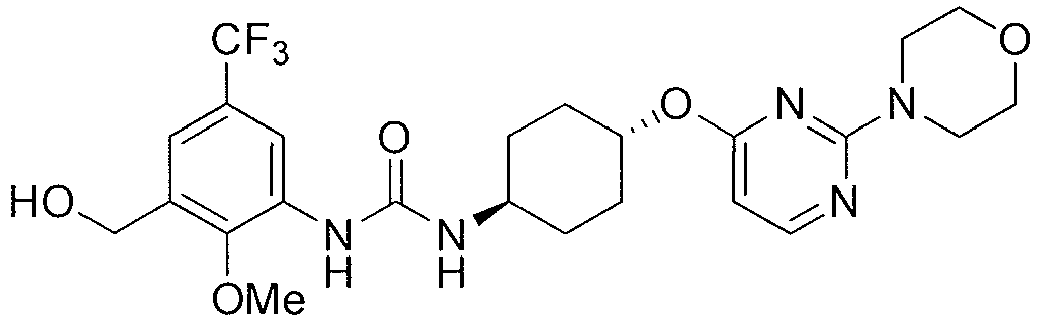
- The title compound (0.025 g) (hereinafter referred to as the compound of Example 6) was obtained using 2,2,2-trichloroethyl (3-(hydroxymethyl)-2-methoxy-5-(trifluoromethyl)phenyl)carbamate (0.043 g, 0.11 mmol) by a method similar to that for the synthesis of 1-(2-methoxy-5-(pentafluorosulfanyl)phenyl)-3-(trans-4-((2-morpholinopyrimidin-4-yl)oxy)cyclohexyl)urea (Example 4).
1H-NMR (400 MHz, CDCl3) δ (ppm): 1.36 - 1.39 (2H, m), 1.61 - 1.64 (2H, m), 1.90 (1H, t, J = 6.0 Hz), 2.17 - 2.19 (4H, m), 3.74 - 3.76 (9H, m), 3.84 (3H, s), 4.59 (1H, d, J = 7.6 Hz), 4.77 (2H, d, J = 5.9 Hz), 4.96 (1H, brs), 5.97 (1H, d, J = 5.6 Hz), 6.74 (1H, s), 7.35 (1H, d, J = 2.0 Hz), 8.06 (1H, d, J = 5.6 Hz), 8.39 (1H, d, J = 2.0 Hz).
MS(ESI) [M + H]+: 526. -

- The title compound (0.049 g) (hereinafter referred to as the compound of Example 7) was obtained using 2,2,2-trichloroethyl (2-(oxetan-3-yloxy)-5-(trifluoromethyl)phenyl)carbamate (0.044 mg, 0.11 mmol) by a method similar to that for the synthesis of 1-(2-methoxy-5-(pentafluorosulfanyl)phenyl)-3-(trans-4-((2-morpholinopyrimidin-4-yl)oxy)cyclohexyl)urea (Example 4).
1H-NMR (400 MHz, CDCl3) δ (ppm): 1.36 - 1.41 (2H, m), 1.59 - 1.65 (2H, m), 2.17 - 2.20 (4H, m), 3.75 (9H, s), 4.65 - 4.78 (3H, m), 4.95 - 4.98 (1H, m), 5.04 (2H, t, J = 6.8 Hz), 5.26 - 5.32 (1H, m), 5.98 (1H, d, J = 5.6 Hz), 6.44 (1H, d, J = 8.5 Hz), 6.85 (1H, s), 7.17 (1H, d, J = 8.5 Hz), 8.06 (1H, d, J = 5.9 Hz), 8.54 (1H, d, J = 2.0 Hz). MS(ESI) [M + H]+: 538. -

- The title compound (0.027 g) (hereinafter referred to as the compound of Example 8) was obtained using 2,2,2-trichloroethyl (2-(3-oxopiperazin-1-yl)-5-(trifluoromethyl)phenyl)carbamate (0.030 g, 0.069 mmol) by a method similar to that for the synthesis of 1-(2-methoxy-5-(pentafluorosulfanyl)phenyl)-3-(trans-4-((2-morpholinopyrimidin-4-yl)oxy)cyclohexyl)urea (Example 4).
1H-NMR (400 MHz, CDCl3) δ (ppm): 1.38 - 1.40 (2H, m), 1.55 - 1.57 (2H, m), 2.16 - 2.18 (4H, m), 3.19 (2H, t, J = 5.5 Hz), 3.53 (2H, brs),3.58 (2H, s), 3.75 (9H, s), 4.96 (1H, brs), 5.97 - 5.98 (2H, m), 7.46 (1H, s), 8.06 - 8.07 (2H, m), 8.56 (1H, s). MS(ESI) [M + H]+: 564. -

- The title compound (0.018 g) (hereinafter referred to as the compound of Example 9) was obtained using 2,2,2-trichloroethyl (2-methoxy-5-(trifluoromethoxy)phenyl)carbamate (0.030 g, 0.078 mmol) and trans-4-(pyrimidin-2-yloxy)cyclohexanamine (0.015 g, 0.078 mmol) by a method similar to that for the synthesis of 1-(2-methoxy-5-(pentafluorosulfanyl)phenyl)-3-(trans-4-((2-morpholinopyrimidin-4-yl)oxy)cyclohexyl)urea (Example 4).
1H-NMR (400 MHz, CDCl3) δ (ppm): 1.36 - 1.39 (2H, m), 1.71 - 1.74 (2H, m), 2.17 - 2.20 (4H, m), 3.78 (1H, brs), 3.87 (3H, s), 4.48 (1H, brs), 4.97 (1H, brs), 6.79 (3H, brs), 6.91 (1H, brs), 8.15 (1H, brs), 8.50 (2H, brs).
MS(ESI) [M + H]+: 425. -

- The title compound (0.040 g) (hereinafter referred to as the compound of Example 10) was obtained using 2,2,2-trichloroethyl (2-methoxy-5-(pentafluorosulfanyl)phenyl)carbamate (0.066 g, 0.16 mmol) and trans-4-(pyrimidin-2-yloxy)cyclohexanamine (0.020 g, 0.10 mmol) by a method similar to that for the synthesis of 1-(2-methoxy-5-(pentafluorosulfanyl)phenyl)-3-(trans-4-((2-morpholinopyrimidin-4-yl)oxy)cyclohexyl)urea (Example 4).
1H-NMR (400 MHz, CDCl3) δ (ppm): 1.35 - 1.38 (2H, m), 1.66 - 1.75 (2H, m), 2.16 - 2.19 (4H, m), 3.76 - 3.77 (1H, m), 3.90 (3H, s), 4.47 (1H, d, J = 7.8 Hz), 4.92 - 4.94 (1H, m), 6.76 (1H, s), 6.81 (1H, d, J = 9.3 Hz), 6.88 (1H, t, J = 4.8 Hz), 7.34 (1H, dd, J = 8.9, 2.8 Hz), 8.47 (2H, d, J = 4.9 Hz), 8.68 (1H, d, J = 2.7 Hz).
MS(ESI) [M + H]+: 469. -

- The title compound (0.032 g) (hereinafter referred to as the compound of Example 11) was obtained using 2,2,2-trichloroethyl (2-methoxy-5-(trifluoromethyl)phenyl)carbamate (0.057 g, 0.16 mmol) and trans-4-(pyrimidin-2-yloxy)cyclohexanamine (0.020 g, 0.10 mmol) by a method similar to that for the synthesis of 1-(2-methoxy-5-(pentafluorosulfanyl)phenyl)-3-(trans-4-((2-morpholinopyrimidin-4-yl)oxy)cyclohexyl)urea (Example 4).
1H-NMR (400 MHz, CDCl3) δ (ppm): 1.34 - 1.37 (2H, m), 1.68 - 1.71 (2H, m), 2.15 - 2.18 (4H, m), 3.76 (1H, s), 3.89 (3H, s), 4.45 (1H, brs), 4.94 (1H, brs), 6.79 (1H, brs), 6.87 - 6.88 (2H, m), 7.20 - 7.21 (1H, m), 8.46 - 8.48 (3H, m). -

- The title compound (0.045 g) (hereinafter referred to as the compound of Example 12) was obtained using 2,2,2-trichloroethyl (3-(hydroxymethyl)-2-methoxy-5-(trifluoromethyl)phenyl)carbamate (0.062 g, 0.16 mmol) and trans-4-(pyrimidin-2-yloxy)cyclohexanamine (0.020 g, 0.10 mmol) by a method similar to that for the synthesis of 1-(2-methoxy-5-(pentafluorosulfanyl)phenyl)-3-(trans-4-((2-morpholinopyrimidin-4-yl)oxy)cyclohexyl)urea (Example 4).
1H-NMR (400 MHz, CDCl3) δ (ppm): 1.35 - 1.38 (2H, m), 1.68 - 1.71 (2H, m), 1.92 (1H, brs), 2.16 - 2.20 (4H, m), 3.74 (1H, brs), 3.82 (3H, s), 4.58 (1H, brs), 4.74 (2H, d, J = 5.6 Hz), 4.94 (1H, brs), 6.74 (1H, s), 6.88 (1H, t, J = 4.9 Hz), 7.30 - 7.33 (1H, m), 8.39 (1H, d, J = 1.7 Hz), 8.47 - 8.48 (2H, m).
MS(ESI) [M + H]+: 439. - Synthesis of 1-(2-(oxetan-3-yloxy)-5-(trifluoromethyl)phenyl)-3-(trans-4-(pyrimidin-2-yloxy)cyclohexyl)urea:

- The title compound (0.042 g) (hereinafter referred to as the compound of Example 13) was obtained using 2,2,2-trichloroethyl (2-(oxetan-3-yloxy)-5-(trifluoromethyl)phenyl)carbamate (0.063 g, 0.16 mmol) and trans-4-(pyrimidin-2-yloxy)cyclohexanamine (0.020 g, 0.10 mmol) by a method similar to that for the synthesis of 1-(2-methoxy-5-(pentafluorosulfanyl)phenyl)-3-(trans-4-((2-morpholinopyrimidin-4-yl)oxy)cyclohexyl)urea (Example 4).
1H-NMR (400 MHz, CDCl3) δ (ppm): 1.41 - 1.44 (2H, m), 1.71 - 1.73 (2H, m), 2.21 - 2.24 (4H, m), 3.80 (1H, s), 4.58 (1H, d, J = 7.3 Hz), 4.78 (2H, dd, J = 8.3, 4.9 Hz), 5.03 - 5.05 (3H, m), 5.29 - 5.30 (1H, m), 6.44 (1H, d, J = 8.3 Hz), 6.81 (1H, brs), 6.91 (1H, t, J = 4.8 Hz), 7.17 (1H, d, J = 6.8 Hz), 8.50 (2H, d, J = 4.6 Hz), 8.56 (1H, d, J = 1.7 Hz). -

- The title compound (0.042 g) (hereinafter referred to as the compound of Example 14) was obtained using 2,2,2-trichloroethyl (2-(oxetan-3-yloxy)-5-(pentafluorosulfanyl)phenyl)carbamate (0.072 g, 0.16 mmol) and trans-4-(pyrimidin-2-yloxy)cyclohexanamine (0.020 g, 0.10 mmol) by a method similar to that for the synthesis of 1-(2-methoxy-5-(pentafluorosulfanyl)phenyl)-3-(trans-4-((2-morpholinopyrimidin-4-yl)oxy)cyclohexyl)urea (Example 4).
1H-NMR (400 MHz, CDCl3) δ (ppm): 1.40 - 1.42 (2H, m), 1.72 - 1.75 (2H, m), 2.21 - 2.23 (4H, m), 4.57 (1H, d, J = 7.3 Hz), 4.76 - 4.78 (2H, m), 5.03 - 5.05 (3H, m), 5.30 (1H, brs), 6.40 (1H, d, J = 9.5 Hz), 6.77 (1H, s), 6.91 (1H, t, J = 4.8 Hz), 7.31 (1H, dd, J = 9.0, 2.7 Hz), 8.50 (2H, d, J = 4.9 Hz), 8.77 (1H, d, J = 2.7 Hz). MS(ESI) [M - H]-: 509. -

- The title compound (0.023 g) (hereinafter referred to as the compound of Example 15) was obtained using 2,2,2-trichloroethyl (2-(3-oxopiperazin-1-yl)-5-(trifluoromethyl)phenyl)carbamate (0.068 g, 0.16 mmol) and trans-4-(pyrimidin-2-yloxy)cyclohexanamine (0.020 g, 0.10 mmol) by a method similar to that for the synthesis of 1-(2-methoxy-5-(pentafluorosulfanyl)phenyl)-3-(trans-4-((2-morpholinopyrimidin-4-yl)oxy)cyclohexyl)urea (Example 4).
1H-NMR (400 MHz, CD3OD) δ (ppm): 1.42 - 1.45 (2H, m), 1.65 - 1.69 (2H, m), 2.11 - 2.21 (4H, m), 3.19 (2H, t, J = 5.2 Hz), 3.49 (2H, t, J = 5.5 Hz), 3.53 (2H, s), 3.67 (1H, s), 5.04 (1H, d, J = 3.9 Hz), 7.06 (1H, t, J = 4.9 Hz), 7.30 (2H, dd, J = 26.8, 8.3 Hz), 8.46 (1H, d, J = 2.2 Hz), 8.54 (2H, d, J = 4.9 Hz).
MS(ESI) [M + H]+: 479. -

- The title compound (0.017 g) (hereinafter referred to as the compound of Example 16) was obtained using 2,2,2-trichloroethyl (2-methoxy-5-(trifluoromethoxy)phenyl)carbamate (0.040 g, 0.10 mmol) and trans-4-(6-phenylpyridazin-3-yl)oxy)cyclohexanamine (0.014 g, 0.052 mmol) by a method similar to that for the synthesis of 1-(2-methoxy-5-(pentafluorosulfanyl)phenyl)-3-(trans-4-((2-morpholinopyrimidin-4-yl)oxy)cyclohexyl)urea (Example 4).
1H-NMR (400 MHz, CDCl3) δ (ppm): 1.41 - 1.44 (2H, m), 1.65 - 1.68 (2H, m), 2.17 - 2.21 (2H, m), 2.33 - 2.37 (2H, m), 3.82 (1H, brs), 3.87 (3H, s), 4.53 (1H, d, J = 7.2 Hz), 5.33 - 5.36 (1H, m), 6.80 - 6.82 (2H, m), 7.01 (1H, d, J = 9.1 Hz), 7.47 - 7.50 (3H, m), 7.80 (1H, d, J = 9.1 Hz), 8.00 - 8.02 (2H, m), 8.17 (1H, s).
MS(ESI) [M - H]-: 501. -

- The title compound (0.018 g) (hereinafter referred to as the compound of Example 17) was obtained using 2,2,2-trichloroethyl (3-(hydroxymethyl)-2-methoxy-5-(trifluoromethyl)phenyl)carbamate (0.041 g, 0.10 mmol) and trans-4-(6-phenylpyridazin-3-yl)oxy)cyclohexanamine (0.014 g, 0.052 mmol) by a method similar to that for the synthesis of 1-(2-methoxy-5-(pentafluorosulfanyl)phenyl)-3-(trans-4-((2-morpholinopyrimidin-4-yl)oxy)cyclohexyl)urea (Example 4).
1H-NMR (400 MHz, CD3OD) δ (ppm): 1.43 - 1.46 (2H, m), 1.66 - 1.69 (2H, m), 2.07 - 2.10 (2H, m), 2.24 - 2.27 (2H, m), 3.77 - 3.79 (4H, m), 4.68 (2H, s), 5.22 - 5.26 (1H, m), 7.18 (1H, d, J = 9.3 Hz), 7.33 (1H, s), 7.47 - 7.49 (4H, m), 7.92 - 7.94 (2H, m), 8.01 (1H, d, J = 9.3 Hz), 8.39 (1H, s). -

- The title compound (0.012 g) (hereinafter referred to as the compound of Example 18) was obtained using 3-fluoropyridine (0.062 g, 0.63 mmol) and 1-(trans-4-hydroxycyclohexyl)-3-(2-methoxy-5-(trifluoromethoxy)phenyl)urea (0.20 g, 0.57 mmol) by a method similar to that for the synthesis of tert-butyl (trans-4-(pyridin-4-ylmethoxy)cyclohexyl)carbamate (Reference Example 67).
1H-NMR (400 MHz, CDCl3) δ (ppm): 1.22 - 1.37 (2H, m), 1.60 - 1.69 (2H, m), 2.16 - 2.18 (4H, m), 3.77 - 3.80 (1H, m), 3.85 (3H, s), 4.22 - 4.25 (1H, m), 4.70 (1H, brs), 6.78 - 6.81 (2H, m), 6.89 - 6.91 (1H, m), 7.20 - 7.21 (2H, m), 8.15 (1H, s), 8.20 (1H, dd, J = 3.9, 2.0 Hz), 8.29 (1H, d, J = 2.2 Hz).
MS(ESI) [M + H]+: 426. -

- The title compound (0.018 g) (hereinafter referred to as the compound of Example 19) was obtained using 2,2,2-trichloroethyl (2-methoxy-5-(trifluoromethoxy)phenyl)carbamate (0.042 g, 0.11 mmol) and trans-4-(pyridin-4-ylmethoxy)cyclohexanamine dihydrochloride (0.015 g, 0.073 mmol) by a method similar to that for the synthesis of 1-(2-methoxy-5-(pentafluorosulfanyl)phenyl)-3-(trans-4-((2-morpholinopyrimidin-4-yl)oxy)cyclohexyl)urea (Example 4).
1H-NMR (400 MHz, CD3OD) δ (ppm): 1.10 - 1.30 (2H, m), 1.40 - 1.50 (2H, m), 2.00 - 2.20 (4H, m), 3.40 - 3.50 (1H, m), 3.55 - 3.65 (1H, m), 3.89 (3H, s), 4.63 (2H, s), 6.79 (1H, d, J = 8.0 Hz), 6.95 (1H, dd, J = 8.0, 4.0 Hz), 7.41 (2H, bs), 8.07 (1H, s), 8.47 (2H, bs).
MS(ESI) [M + H]+: 440. -

- The title compound (0.017 g) (hereinafter referred to as the compound of Example 20) was obtained using 2,2,2-trichloroethyl (3-(hydroxymethyl)-5-(trifluoromethyl)phenyl)carbamate (0.030 g, 0.08 mmol) and trans-4-(pyridin-4-ylmethoxy)cyclohexanamine dihydrochloride (0.010 g, 0.048 mmol) by a method similar to that for the synthesis of 1-(2-methoxy-5-(pentafluorosulfanyl)phenyl)-3-(trans-4-((2-morpholinopyrimidin-4-yl)oxy)cyclohexyl)urea (Example 4).
1H-NMR (400 MHz, CD3OD) δ (ppm): 1.20 - 1.30 (2H, m), 1.40 - 1.50 (2H, m), 2.00 - 2.20 (4H, m), 3.40 - 3.50 (1H, m), 3.55 - 3.65 (1H, m), 4.61 (2H, s), 4.64 (2H, s), 7.23 (1H, s), 7.43 (2H, d, J = 8.0 Hz), 7.47 (1H, s), 7.73 (1H, s), 8.47 (1H, d, J = 8.0, 4.0 Hz).
MS(ESI) [M + H]+: 424. -
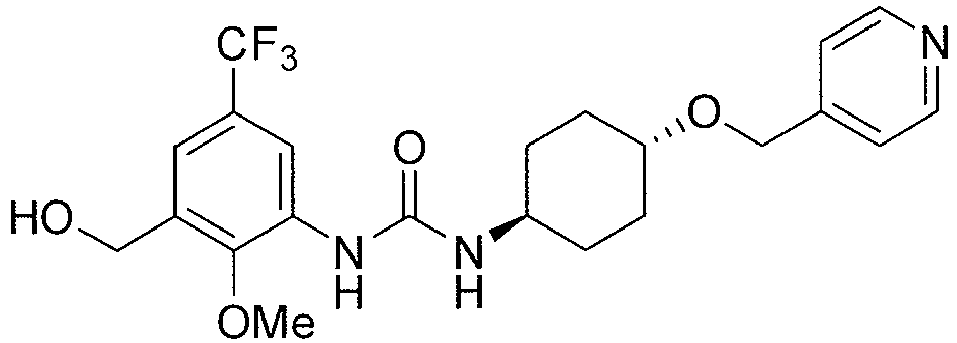
- The title compound (0.017 g) (hereinafter referred to as the compound of Example 21) was obtained using 2,2,2-trichloroethyl (3-(hydroxymethyl)-2-methoxy-5-(trifluoromethyl)phenyl)carbamate (0.030 g, 0.076 mmol) and trans-4-(pyridin-4-ylmethoxy)cyclohexanamine dihydrochloride (0.010 g, 0.048 mmol) by a method similar to that for the synthesis of 1-(2-methoxy-5-(pentafluorosulfanyl)phenyl)-3-(trans-4-((2-morpholinopyrimidin-4-yl)oxy)cyclohexyl)urea (Example 4).
1H-NMR (400 MHz, CD3OD) δ (ppm): 1.25 - 1.40 (2H, m), 1.45 - 1.55 (2H, m), 2.00 - 2.20 (4H, m), 3.40 - 3.50 (1H, m), 3.55 - 3.65 (1H, m), 4.64 (2H, s), 4.72 (2H, s), 7.36 (1H, d, J = 4.0 Hz), 7.43 (2H, d, J = 4.0 Hz), 8.41 (1H, d, J = 4.0 Hz), 8.47 (2H, dd, J = 8.0, 4.0 Hz).
MS(ESI) [M + H]+: 454. -

- The title compound (0.015 g) (hereinafter referred to as the compound of Example 22) was obtained using phenyl (3-(trifluoromethyl)phenyl)carbamate (0.030 g, 0.076 mmol) and trans-4-(pyridin-4-ylmethoxy)cyclohexanamine dihydrochloride (0.010 g, 0.048 mmol) by a method similar to that for the synthesis of 1-(2-methoxy-5-(pentafluorosulfanyl)phenyl)-3-(trans-4-((2-morpholinopyrimidin-4-yl)oxy)cyclohexyl)urea (Example 4).
1H-NMR (400 MHz, CD3OD) δ (ppm): 1.20 - 1.40 (2H, m), 1.40 - 1.50 (2H, m), 2.00 - 2.20 (4H, m), 3.40 - 3.50 (1H, m), 3.55 - 3.65 (1H, m), 4.64 (2H, s), 7.06 (1H, d, J = 8.0 Hz), 7.22 (1H, d, J = 8.0 Hz), 7.43 (3H, bs), 7.48 (1H, d, J = 8.0 Hz), 7.81 (1H, s), 8.47 (2H, dd, J = 8.0, 4.0 Hz).
MS(ESI) [M + H]+: 394. -

- The title compound (0.015 g) (hereinafter referred to as the compound of Example 23) was obtained using 2,2,2-trichloroethyl (4-(hydroxymethyl)-3-(trifluoromethyl)phenyl)carbamate (0.030 g, 0.082 mmol) and trans-4-(pyridin-4-ylmethoxy)cyclohexanamine dihydrochloride (0.010 g, 0.048 mmol) by a method similar to that for the synthesis of 1-(2-methoxy-5-(pentafluorosulfanyl)phenyl)-3-(trans-4-((2-morpholinopyrimidin-4-yl)oxy)cyclohexyl)urea (Example 4).
1H-NMR (400 MHz, DMSO-d6) δ (ppm): 1.10 - 1.40 (4H, m), 2.00 - 2.20 (4H, m), 1.90 - 1.92 (2H, m), 2.00 - 2.10 (2H, m), 3.30 - 3.40 (1H, m), 3.45 - 3.55 (1H, m), 4.57 (4H, bs), 5.31 (1H, t, J = 8.0 Hz), 6.16 (1H, d, J = 8.0 Hz), 7.32 (2H, d, J = 4.0 Hz), 7.47 (1H, d, J = 8.0 Hz), 7.58 (1H, d, J = 8.0 Hz), 7.91 (1H, s), 8.52 (2H, dd, J = 8.0,4.0 Hz), 8.61 (1H, s).
MS(ESI) [M + H]+: 424. -

- The title compound (0.018 g) (hereinafter referred to as the compound of Example 24) was obtained using 2,2,2-trichloroethyl (2-methoxy-5-(trifluoromethyl)phenyl)carbamate (0.030 g, 0.082 mmol) and trans-4-(pyridin-4-ylmethoxy)cyclohexanamine dihydrochloride (0.010 g, 0.048 mmol) by a method similar to that for the synthesis of 1-(2-methoxy-5-(pentafluorosulfanyl)phenyl)-3-(trans-4-((2-morpholinopyrimidin-4-yl)oxy)cyclohexyl)urea (Example 4).
1H-NMR (400 MHz, CD3OD) δ (ppm): 1.10 - 1.30 (2H, m), 1.40 - 1.50 (2H, m), 2.00 - 2.20 (4H, m), 3.40 - 3.50 (1H, m), 3.55 - 3.65 (1H, m), 3.94 (3H, s), 4.63 (2H, s), 7.06 (1H, d, J = 8.0 Hz), 7.21 (1H, dd, J = 8.0, 4.0 Hz), 7.43 (2H, d, J = 8.0 Hz), 8.43 (1H, s), 8.47 (1H, dd, J = 8.0, 4.0 Hz).
MS(ESI) [M + H]+: 424. -

- The title compound (0.016 g) (hereinafter referred to as the compound of Example 25) was obtained using 2,2,2-trichloroethyl (2-methyl-5-(trifluoromethyl)phenyl)carbamate (0.030 g, 0.086 mmol) and trans-4-(pyridin-4-ylmethoxy)cyclohexanamine dihydrochloride (0.010 g, 0.048 mmol) by a method similar to that for the synthesis of 1-(2-methoxy-5-(pentafluorosulfanyl)phenyl)-3-(trans-4-((2-morpholinopyrimidin-4-yl)oxy)cyclohexyl)urea (Example 4).
1H-NMR (400 MHz, CD3OD) δ (ppm): 1.20 - 1.35 (2H, m), 1.45 - 1.55 (2H, m), 2.00 - 2.20 (4H, m), 2.29 (3H, s), 3.40 - 3.50 (1H, m), 3.55 - 3.65 (1H, m), 4.64 (2H, s), 7.06 (1H, d, J = 8.0 Hz), 7.20 (1H, d, J = 8.0 Hz), 7.31 (1H, d, J = 8.0 Hz), 7.43 (2H, d, J = 8.0 Hz), 8.13 (1H, s), 8.47 (1H, dd, J = 8.0, 4.0 Hz).
MS(ESI) [M + H]+: 408. -
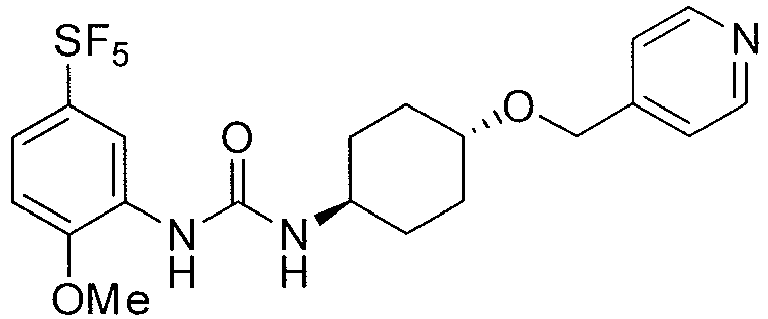
- The title compound (0.005 g) (hereinafter referred to as the compound of Example 26) was obtained using 2,2,2-trichloroethyl (2-methyl-5-(pentafluorosulfanyl)phenyl)carbamate (0.030 g, 0.071 mmol) and trans-4-(pyridin-4-ylmethoxy)cyclohexanamine dihydrochloride (0.010 g, 0.048 mmol) by a method similar to that for the synthesis of 1-(2-methoxy-5-(pentafluorosulfanyl)phenyl)-3-(trans-4-((2-morpholinopyrimidin-4-yl)oxy)cyclohexyl)urea (Example 4).
1H-NMR (400 MHz, CD3OD) δ (ppm): 1.25 - 1.35 (2H, m), 1.45 - 1.55 (2H, m), 2.00 - 2.20 (4H, m), 3.40 - 3.50 (1H, m), 3.55 - 3.65 (1H, m), 3.95 (3H, s), 4.63 (2H, s), 7.04 (1H, d, J = 8.0 Hz), 7.37 (1H, dd, J = 8.0, 4.0 Hz), 7.42 (2H, d, J = 8.0 Hz), 8.47 (2H, dd, J = 8.0, 4.0 Hz), 8.67 (1H,bs).
MS(ESI) [M + H]+: 482. -

- The title compound (0.017 g) (hereinafter referred to as the compound of Example 27) was obtained using 2,2,2-trichloroethyl (2-fluoro-5-(trifluoromethyl)phenyl)carbamate (0.030 g, 0.085 mmol) and trans-4-(pyridin-4-ylmethoxy)cyclohexanamine dihydrochloride (0.010 g, 0.048 mmol) by a method similar to that for the synthesis of 1-(2-methoxy-5-(pentafluorosulfanyl)phenyl)-3-(trans-4-((2-morpholinopyrimidin-4-yl)oxy)cyclohexyl)urea (Example 4).
1H-NMR (400 MHz, CD3OD) δ (ppm): 1.20 - 1.35 (2H, m), 1.45 - 1.55 (2H, m), 2.00 - 2.20 (4H, m), 3.40 - 3.50 (1H, m), 3.55 - 3.65 (1H, m), 4.64 (2H, s), 7.25 - 7.30 (2H, m), 7.42 (2H, d, J = 8.0 Hz), 8.46 - 8.52 (3H, m).
MS(ESI) [M + H]+: 412. -

- The title compound (0.015 g) (hereinafter referred to as the compound of Example 28) was obtained using 2,2,2-trichloroethyl (2-morpholino-5-(trifluoromethyl)phenyl)carbamate (0.032 g, 0.076 mmol) and trans-4-(pyridin-4-ylmethoxy)cyclohexanamine dihydrochloride (0.016 g, 0.076 mmol) by a method similar to that for the synthesis of 1-(2-methoxy-5-(pentafluorosulfanyl)phenyl)-3-(trans-4-((2-morpholinopyrimidin-4-yl)oxy)cyclohexyl)urea (Example 4).
1H-NMR (400 MHz, CD3OD) δ (ppm): 1.20 - 1.35 (2H, m), 1.40 - 1.50 (2H, m), 2.00 - 2.20 (4H, m), 2.80 (4H, bs), 3.40 - 3.50 (1H, m), 3.55 - 3.65 (1H, m), 3.88 (4H, bs), 4.62 (2H, s), 7.20 (2H, d, J = 8.0 Hz), 7.30 (2H, d, J = 8.0 Hz), 7.41 (2H, d, J = 8.0 Hz), 8.39 (1H, s), 8.47 (2H, d, J = 8.0 Hz).
MS(ESI) [M + H]+: 479. -

- The title compound (0.015 g) (hereinafter referred to as the compound of Example 29) was obtained using 2,2,2-trichloroethyl (2-chloro-5-(trifluoromethyl)phenyl)carbamate (0.030 g, 0.081 mmol) and trans-4-(pyridin-4-ylmethoxy)cyclohexanamine dihydrochloride (0.010 g, 0.048 mmol) by a method similar to that for the synthesis of 1-(2-methoxy-5-(pentafluorosulfanyl)phenyl)-3-(trans-4-((2-morpholinopyrimidin-4-yl)oxy)cyclohexyl)urea (Example 4).
1H-NMR (400 MHz, DMSO-d6) δ (ppm): 1.15 - 1.25 (2H, m), 1.35 - 1.45 (2H, m), 1.90 - 2.00 (4H, m), 3.40 - 3.50 (1H, m), 3.55 - 3.65 (1H, m), 4.56 (2H, s), 7.19 (1H, d, J = 8.0 Hz), 7.27 (1H, d, J = 8.0 Hz), 7.33 (2H, d, J = 4.0 Hz), 7.64 (1H, d, J = 8.0 Hz), 8.25 (1H, s), 8.53 (2H, d, J = 4.0 Hz), 8.66 (1H, bs).
MS(ESI) [M + H]+: 428. -

- The title compound (0.013 g) (hereinafter referred to as the compound of Example 30) was obtained using 2,2,2-trichloroethyl (2-(oxetan-3-yloxy)-5-(trifluoromethoxy)phenyl)carbamate (0.040 g, 0.098 mmol) and trans-4-(pyridin-4-ylmethoxy)cyclohexanamine dihydrochloride (0.020 g, 0.098 mmol) by a method similar to that for the synthesis of 1-(2-methoxy-5-(pentafluorosulfanyl)phenyl)-3-(trans-4-((2-morpholinopyrimidin-4-yl)oxy)cyclohexyl)urea (Example 4).
1H-NMR (400 MHz, DMSO-d6) δ (ppm): 1.15 - 1.25 (2H, m), 1.30 - 1.40 (2H, m), 2.00 - 2.20 (4H, m), 3.30 - 3.40 (1H, m), 3.45 - 3.55 (1H, m), 3.94 (3H, s), 4.57 (2H, s), 4.61 - 4.65 (2H, m), 4.95 (2H, t, J = 8.0 Hz), 5.30 - 5.35 (1H, m), 6.65 (1H, d, J = 8.0 Hz), 6.78 (1H, dd, J = 8.0, 4.0 Hz), 7.02 (1H, d, J = 8.0 Hz), 7.31 (2H, d, J = 8.0 Hz), 8.05 (1H, s), 8.24 (1H, bs), 8.52 (2H, dd, J = 8.0, 4.0 Hz). -

- The title compound (0.032 g) was obtained using tert-butyl 3-(2-(((2,2,2-trichloroethyl)carbonyl)amino)-4-(trifluoromethyl)phenoxy)azetidine-1-carboxylate (0.050 g, 0.098 mmol) and trans-4-(pyridin-4-ylmethoxy)cyclohexanamine dihydrochloride (0.020 g, 0.098 mmol) by a method similar to that for the synthesis of 1-(2-methoxy-5-(pentafluorosulfanyl)phenyl)-3-(trans-4-((2-morpholinopyrimidin-4-yl)oxy)cyclohexyl)urea (Example 4).
MS(ESI) [M + H]+: 565. -

- The title compound (0.025) was obtained using tert-butyl 4-(2-(((2,2,2-trichloroethoxy)carbonyl)amino)-4-(trifluoromethyl)phenoxy)piperidine-1-carboxylate (0.050 g, 0.093 mmol) and trans-4-(pyridin-4-ylmethoxy)cyclohexanamine dihydrochloride (0.019 g, 0.093 mmol) by a method similar to that for the synthesis of 1-(2-methoxy-5-(pentafluorosulfanyl)phenyl)-3-(trans-4-((2-morpholinopyrimidin-4-yl)oxy)cyclohexyl)urea (Example 4). MS(ESI) [M + H]+: 593.
-

- The title compound (0.015 g) (hereinafter referred to as the compound of Example 31) was obtained using tert-butyl 3-(2-(3-(trans-4-(pyridin-4-ylmethoxy)cyclohexyl)ureido)-4-(trifluoromethyl)phenoxy)azetidine-1-carboxylate (0.020 g, 0.035 mmol) by a method similar to that for the synthesis of trans-4-((2-morpholinopyrimidin-4-yl)oxy)cyclohexanamine (Reference Example 51).
1H-NMR (400 MHz, CD3OD) δ (ppm): 1.35 - 1.45 (2H, m), 1.48 - 1.58 (2H, m), 2.00 - 2.20 (4H, m), 3.50 - 3.75 (2H, m), 4.35 (2H, dd, J = 8.0, 4.0 Hz), 4.57 - 4.61 (2H, m), 4.92 (2H, s), 5.25 - 5.30 (1H, m), 6.83 (1H, d, J = 8.0 Hz), 7.21 (1H, dd, J = 8.0, 4.0 Hz), 8.08 (2H, d, J = 8.0 Hz), 8.51 (1H, s), 8.79 (2H, d, J = 8.0 Hz).
MS(ESI) [M + H]+: 465. -

- The title compound (0.015 g) (hereinafter referred to as the compound of Example 32) was obtained using tert-butyl 4-(2-(3-(trans-4-(pyridin-4-ylmethoxy)cyclohexyl)ureido)-4-(trifluoromethyl)phenoxy)piperidine-1-carboxylate (0.020 g, 0.034 mmol) by a method similar to that for the synthesis of trans-4-((2-morpholinopyrimidin-4-yl)oxy)cyclohexanamine (Reference Example 51).
1H-NMR (400 MHz, CD3OD) δ (ppm): 1.25 - 1.40 (2H, m), 1.45 - 1.55 (2H, m), 2.00 - 2.20 (4H, m), 3.19 - 3.26 (1H, m), 3.50 - 3.65 (2H, m), 4.92 (2H, dd, J = 8.0, 4.0 Hz), 7.17 (1H, d, J = 8.0 Hz), 7.23 (1H, d, J = 8.0 Hz), 8.08 (2H, d, J = 8.0 Hz), 8.43 (1H, s), 8.79 (2H, d, J = 8.0 Hz).
MS(ESI) [M + H]+: 493. -

- To a solution of 1-(2-(azetidin-3-yloxy)-5-(trifluoromethyl)phenyl)-3-(trans-4-(pyridin-4-ylmethoxy)cyclohexyl)urea (0.010 g, 0.022 mmol) and triethylamine (0.01 ml) in THF, acetic anhydride (0.01 ml) was added. After stirring the obtained solution at room temperature for 30 minutes, water was added to the reaction solution, and the obtained solution was extracted with ethyl acetate. The organic layer was sequentially washed with a saturated aqueous solution of ammonium chloride and with a saturated aqueous solution of sodium chloride. The obtained organic layer was dried over anhydrous sodium sulfate and then concentrated under vacuum, and the obtained crude product was purified by silica gel column chromatography (eluent; chloroform:methanol = 100:0 → 90:10) to obtain the title compound (0.0080 g) (hereinafter referred to as the compound of Example 33).
1H-NMR (400 MHz, CD3OD) δ (ppm): 1.15 - 1.25 (2H, m), 1.35 - 1.45 (2H, m), 1.81 (3H, s), 1.95 - 2.05 (4H, m), 3.31 - 3.40 (1H, m), 3.45 - 3.55 (1H, m), 4.00 (1H, dd, J = 8.0, 4.0 Hz), 4.16 (1H, dd, J = 8.0, 4.0 Hz), 4.32 - 4.36 (1H, m), 4.51 (2H, s), 4.50 - 4.60 (1H, m), 5.00 - 5.10 (1H, m), 6.71 (1H, d, J = 8.0 Hz), 7.10 (1H, dd, J = 8.0, 4.0 Hz), 7.31 (2H, d, J = 8.0 Hz), 8.3 (2H, d, J = 8.0 Hz), 8.41 (1H, s).
MS(ESI) [M + H]+: 507. -

- The title compound (0.007 g) (hereinafter referred to as the compound of Example 34) was obtained using tert-butyl 4-(2-(3-(trans-4-(pyridin-4-ylmethoxy)cyclohexyl)ureido)-4-(trifluoromethyl)phenoxy)piperidine-1-carboxylate (0.010 g, 0.020 mmol) by a method similar to that for the synthesis of 1-(2-((1-acetylazetidin-3-yl)oxy)-5-(trifluoromethyl)phenyl)-3-(trans-4-(pyridin-4-ylmethoxy)cyclohexyl)urea (Example 33).
1H-NMR (400 MHz, CD3OD) δ (ppm): 1.25 - 1.40 (2H, m), 1.45 - 1.50 (2H, m), 1.69 - 1.81 (2H, m), 1.98 - 2.05 (10H, m), 3.31 - 3.40 (2H, m), 3.50 - 3.60 (1H, m), 3.83 - 3.90 (1H, m), 4.09 - 4.15 (1H, m), 4.62 (2H, s), 4.75 - 4.80 (1H, m), 7.14 - 7.22 (2H, m), 7.42 (2H, d, J = 4.0 Hz), 8.45 - 8.50 (3H, m).
MS(ESI) [M + H]+: 535. -

- (R)-tert-butyl 3-(2-(((2,2,2-trichloroethyl)carbonyl)amino)-4-(trifluoromethyl)phenoxy)pyrrolidine-1-carboxylate (0.040 g, 0.077 mmol) and trans-4-(pyridin-4-ylmethoxy)cyclohexanamine dihydrochloride (0.015 g, 0.077 mmol) were used by a method similar to that for the synthesis of 1-(2-methoxy-5-(pentafluorosulfanyl)phenyl)-3-(trans-4-((2-morpholinopyrimidin-4-yl)oxy)cyclohexyl)urea (Example 4) to synthesize (R)-tert-butyl 3-(2-(3-(trans-4-(pyridin-4-ylmethoxy)cyclohexyl)ureido)-4-(trifluoromethyl)phenoxy)pyrrolidine-1-carboxylate, and the obtained product was used by a method similar to that for the synthesis of trans-4-((2-morpholinopyrimidin-4-yl)oxy)cyclohexanamine (Reference Example 51) to obtain the title compound (0.012 g) (hereinafter referred to as the compound of Example 35).
1H-NMR (400 MHz, DMSO-d6) δ (ppm): 1.20 - 1.36 (4H, m), 1.80 - 2.00 (3H, m) 2.80 - 2.95 (1H, m), 2.98 - 3.19 (3H, m), 4.57 (2H, s), 5.00 (1H, bs), 7.06 - 7.10 (2H, m), 7.18 (1H, d, J = 4.0 Hz), 7.32 (2H, d, J = 8.0 Hz), 7.80 (1H, s), 8.52 (2H, d, J = 4.0 Hz), 8.55 (1H, d, J = 4.0 Hz).
MS(ESI) [M + H]+: 479. -

- (S)-tert-butyl 3-(2-(((2,2,2-trichloroethyl)carbonyl)amino)-4-(trifluoromethyl)phenoxy)pyrrolidine-1-carboxylate (0.040 g, 0.077 mmol) and trans-4-(pyridin-4-ylmethoxy)cyclohexanamine dihydrochloride (0.015 g, 0.077 mmol) were used by a method similar to that for the synthesis of 1-(2-methoxy-5-(pentafluorosulfanyl)phenyl)-3-(trans-4-((2-morpholinopyrimidin-4-yl)oxy)cyclohexyl)urea (Example 4) to synthesize (S)-tert-butyl 3-(2-(3-(trans-4-(pyridin-4-ylmethoxy)cyclohexyl)ureido)-4-(trifluoromethyl)phenoxy)pyrrolidine-1-carboxylate, and the obtained product was used by a method similar to that for the synthesis of trans-4-((2-morpholinopyrimidin-4-yl)oxy)cyclohexanamine (Reference Example 51) to obtain the title compound (0.014 g) (hereinafter referred to as the compound of Example 36).
1H-NMR (400 MHz, DMSO-d6) δ (ppm): 1.10 - 1.40 (4H, m), 1.70 - 1.85 (1H, m), 1.90 - 1.98 (2H, m), 2.0 - 2.1 (3H, m), 2.75 - 2.82 (1H, m), 2.90 - 3.10 (3H, m), 4.47 (2H, s), 4.98 (1H, bs), 7.06 - 7.10 (2H, m), 7.18 (1H, d, J = 4.0 Hz), 7.32 (2H, d, J = 8.0 Hz), 7.80 (1H, s), 8.52 (2H, d, J = 4.0 Hz), 8.55 (1H, d, J = 4.0 Hz). MS(ESI) [M + H]+: 479. -
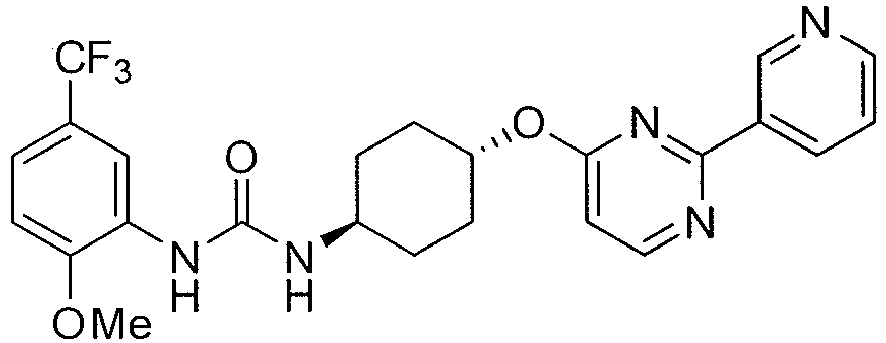
- The title compound (0.015 g) (hereinafter referred to as the compound of Example 37) was obtained using 2,2,2-trichloroethyl (2-methoxy-5-(trifluoromethyl)phenyl)carbamate (0.020 g, 0.055 mmol) and trans-4-((2-(pyridin-3-yl)pyrimidin-4-yl)oxy)cyclohexanamine dihydrochloride (0.015 g, 0.055 mmol) by a method similar to that for the synthesis of 1-(2-methoxy-5-(pentafluorosulfanyl)phenyl)-3-(trans-4-((2-morpholinopyrimidin-4-yl)oxy)cyclohexyl)urea (Example 4).
1H-NMR (400 MHz, DMSO-d6) δ (ppm): 1.40 - 1.50 (2H, m), 1.55 - 1.65 (2H, m), 1.99 - 2.00 (2H, m), 2.17 - 2.20 (2H, m), 2.75 - 2.82 (1H, m), 3.56 - 3.61 (1H, m), 3.93 (3H, s), 5.25 - 5.31 (1H, m), 6.92 (1H, d, J = 8.0 Hz), 7.06 (1H, d, J = 8.0 Hz), 7.14 (1H, d, J = 8.0 Hz), 7.23 (1H, d, J = 8.0 Hz), 7.57 (1H,q, J = 4.0 Hz), 8.18 (1H, s), 8.54 (1H, d, J = 4.0 Hz), 8.60 - 8.70 (2H, m), 8.73 (1H, dd, J = 8.0, 4.0 Hz), 9.50 (1H, d, J = 4.0 Hz).
MS(ESI) [M + H]+: 488. -

- The title compound (0.018 g) (hereinafter referred to as the compound of Example 38) was obtained using 2,2,2-trichloroethyl (2-(oxetan-3-yloxy)-5-(trifluoromethyl)phenyl)carbamate (0.020 g, 0.049 mmol) and trans-4-((2-(pyridin-3-yl)pyrimidin-4-yl)oxy)cyclohexanamine dihydrochloride (0.013 g, 0.049 mmol) by a method similar to that for the synthesis of 1-(2-methoxy-5-(pentafluorosulfanyl)phenyl)-3-(trans-4-((2-morpholinopyrimidin-4-yl)oxy)cyclohexyl)urea (Example 4).
1H-NMR (400 MHz, DMSO-d6) δ (ppm): 1.40 - 1.50 (2H, m), 1.55 - 1.65 (2H, m), 1.99 - 2.00 (2H, m), 2.17 - 2.20 (2H, m), 2.75 - 2.82 (1H, m), 3.56 - 3.61 (1H, m), 4.65 - 4.75 (2H, m), 4.98 (2H, t, J = 8.0 Hz), 5.25 - 5.31 (1H, m), 5.40 - 5.45 (1H, m), 6.77 (1H, d, J = 8.0 Hz), 6.90 - 6.95 (1H, m), 7.10 (1H, d, J = 8.0 Hz), 7.17 (1H, d, J = 8.0 Hz), 7.57 (1H,q, J = 4.0 Hz), 8.15 (1H, s), 8.59 (1H, s), 8.63 - 8.66 (2H, m), 8.73 (1H, dd, J = 8.0, 4.0 Hz), 9.50 (1H, d, J = 4.0 Hz).
MS(ESI) [M + H]+: 530. -

- The title compound (0.017 g) (hereinafter referred to as the compound of Example 39) was obtained using 2,2,2-trichloroethyl (2-methoxy-5-(trifluoromethoxy)phenyl)carbamate (0.020 g, 0.052 mmol) and trans-4-((2-(pyridin-3-yl)pyrimidin-4-yl)oxy)cyclohexanamine dihydrochloride (0.014 g, 0.052 mmol) by a method similar to that for the synthesis of 1-(2-methoxy-5-(pentafluorosulfanyl)phenyl)-3-(trans-4-((2-morpholinopyrimidin-4-yl)oxy)cyclohexyl)urea (Example 4).
1H-NMR (400 MHz, DMSO-d6) δ (ppm): 1.40 - 1.50 (2H, m), 1.55 - 1.65 (2H, m), 1.99 - 2.00 (2H, m), 2.17 - 2.20 (2H, m), 3.56 - 3.61 (1H, m), 3.88 (3H, s), 5.25 - 5.31 (1H, m), 6.84 (1H, d, J = 8.0 Hz), 6.91 (1H, d, J = 8.0 Hz), 7.03 (1H, d, J = 8.0 Hz), 7.06 (1H, d, J = 8.0 Hz), 7.57 (1H,q, J = 4.0 Hz), 8.15 (1H, s), 8.21 (1H, d, J = 4.0 Hz), 8.60 - 8.70 (2H, m), 8.73 (1H, dd, J = 8.0, 4.0 Hz), 9.50 (1H, d, J = 4.0 Hz). MS(ESI) [M + H]+: 504. -

- The title compound (0.018 g) (hereinafter referred to as the compound of Example 40) was obtained using 2,2,2-trichloroethyl (2-methoxy-5-(trifluoromethyl)phenyl)carbamate (0.020 g, 0.055 mmol) and trans-4-((4-(pyridin-3-yl)pyrimidin-2-yl)oxy)cyclohexanamine dihydrochloride (0.015 g, 0.055 mmol) by a method similar to that for the synthesis of 1-(2-methoxy-5-(pentafluorosulfanyl)phenyl)-3-(trans-4-((2-morpholinopyrimidin-4-yl)oxy)cyclohexyl)urea (Example 4).
1H-NMR (400 MHz, DMSO-d6) δ (ppm): 1.35 - 1.45 (2H, m), 1.55 - 1.65 (2H, m), 1.99 - 2.00 (2H, m), 2.17 - 2.20 (2H, m), 3.56 - 3.61 (1H, m), 3.93 (3H, s), 5.05 - 5.12 (1H, m), 7.05 (1H, d, J = 8.0 Hz), 7.14 (1H, d, J = 8.0 Hz), 7.23 (1H, d, J = 8.0 Hz), 7.60 (1H,q, J = 4.0 Hz), 7.80 (1H, d, J = 4.0 Hz), 8.17 (1H, s), 8.50 - 8.55 (2H, m), 8.72 (1H, d, J = 8.0 Hz), 8.75 (1H, d, J = 8.0, 4.0 Hz), 9.35 (1H, d, J = 4.0 Hz). MS(ESI) [M + H]+: 488. -

- The title compound (0.016 g) (hereinafter referred to as the compound of Example 41) was obtained using 2,2,2-trichloroethyl (2-(oxetan-3-yloxy)-5-(trifluoromethyl)phenyl)carbamate (0.020 g, 0.049 mmol) and trans-4-((4-(pyridin-3-yl)pyrimidin-2-yl)oxy)cyclohexanamine dihydrochloride (0.013 g, 0.049 mmol) by a method similar to that for the synthesis of 1-(2-methoxy-5-(pentafluorosulfanyl)phenyl)-3-(trans-4-((2-morpholinopyrimidin-4-yl)oxy)cyclohexyl)urea (Example 4).
1H-NMR (400 MHz, DMSO-d6) δ (ppm): 1.40 - 1.50 (2H, m), 1.55 - 1.65 (2H, m), 1.99 - 2.00 (2H, m), 2.17 - 2.20 (2H, m), 3.56 - 3.61 (1H, m), 4.65 - 4.70 (2H, m), 5.00 (2H, t, J = 8.0 Hz), 5.10-5.15 (1H, m), 5.40 - 5.45 (1H, m), 6.77 (1H, d, J = 8.0 Hz), 7.09 (1H, d, J = 8.0 Hz), 7.17 (1H, d, J = 8.0 Hz), 7.57 (1H, q, J = 4.0 Hz), 7.80 (1H, d, J = 8.0 Hz), 8.14 (1H, s), 8.32 (1H, s), 8.51 (1H, dt, J = 8.0, 4.0 Hz), 8.60 (1H, d, J = 4.0 Hz), 8.71 (1H, d, J = 8.0 Hz), 8.75 (1H, dd, J = 8.0, 4.0 Hz), 9.35 (1H, d, J = 4.0 Hz).
MS(ESI) [M + H]+: 530. -

- tert-Butyl 3-(2-(((2,2,2-trichloroethyl)carbonyl)amino)-4-(trifluoromethyl)phenoxy)azetidine-1-carboxylate (0.050 g, 0.098 mmol) and 6-((trans-4-aminocyclohexyl)oxy)-N-methylpyrimidin-4-amine dihydrochloride (0.022 g, 0.098 mmol) were used by a method similar to that for the synthesis of 1-(2-methoxy-5-(pentafluorosulfanyl)phenyl)-3-(trans-4-((2-morpholinopyrimidin-4-yl)oxy)cyclohexyl)urea (Example 4) to synthesize tert-butyl 3-(2-(3-(trans-4-((6-(methylamino)pyrimidin-4-yl)oxy)cyclohexyl)ureido)-4-(trifluoromethyl)phenoxy)azetidine-1-carboxylate, and the obtained product was used by a method similar to that for the synthesis of trans-4-((2-morpholinopyrimidin-4-yl)oxy)cyclohexanamine (Reference Example 51) to obtain the title compound (0.021 g) (hereinafter referred to as the compound of Example 42).
1H-NMR (400 MHz, DMSO-d6) δ (ppm): 1.29 - 1.37 (2H, m), 1.44 - 1.55 (2H, m), 1.96 - 2.10 (4H, m), 2.4 (3H, s), 3.50 - 3.57 (2H, m), 3.63 (2H, t, J = 8.0 Hz), 3.86 (2H, t, J = 8.0 Hz), 4.95 (1H, bs), 5.11 (1H, t, J = 8.0 Hz), 5.65 (1H, s), 6.81 (1H, d, J = 8.0 Hz), 7.05 (1H, d, J = 8.0 Hz), 7.10 - 7.20 (2H, d, J = 8.0 Hz), 8.07 (1H, s), 8.14 (1H, s), 8.58 (1H, s).
MS(ESI) [M + H]+: 481. -

- tert-Butyl 4-(2-(((2,2,2-trichloroethoxy)carbonyl)amino)-4-(trifluoromethyl)phenoxy)piperidine-1-carboxylate (0.050 g, 0.093 mmol) and 6-((trans-4-aminocyclohexyl)oxy)-N-methylpyrimidin-4-amine dihydrochloride (0.020 g, 0.093 mmol) were used by a method similar to that for the synthesis of 1-(2-methoxy-5-(pentafluorosulfanyl)phenyl)-3-(trans-4-((2-morpholinopyrimidin-4-yl)oxy)cyclohexyl)urea (Example 4) to synthesize tert-butyl 4-(2-(3-(trans-4-((6-(methylamino)pyrimidin-4-yl)oxy)cyclohexyl)ureido)-4-(trifluoromethyl)phenoxy)piperidine-1-carboxylate, and the obtained product was used by a method similar to that for the synthesis of trans-4-((2-morpholinopyrimidin-4-yl)oxy)cyclohexanamine (Reference Example 51) to obtain the title compound (0.012 g) (hereinafter referred to as the compound of Example 43).
1H-NMR (400 MHz, DMSO-d6) δ (ppm): 1.34 - 1.45 (2H, m), 1.51 - 1.59 (2H, m), 1.96 - 2.10 (4H, m), 2.87 (3H, s), 3.50 - 3.57 (2H, m), 3.06 (2H, bs), 3.86 (2H, t, J = 8.0 Hz), 4.82 (1H, bs), 6.06 (1H, s), 7.10 - 7.20 (2H, d, J = 8.0 Hz), 8.21 (1H, s), 8.30 (1H, s), 8.41 (1H, s), 8.55 (1H, s).
MS(ESI) [M + H]+: 509. -

- The title compound (0.020 g) (hereinafter referred to as the compound of Example 44) was obtained using 2,2,2-trichloroethyl (2-(oxetan-3-yloxy)-5-(trifluoromethoxy)phenyl)carbamate (0.020 g, 0.047 mmol) by a method similar to that for the synthesis of 1-(2-methoxy-5-(pentafluorosulfanyl)phenyl)-3-(trans-4-((2-morpholinopyrimidin-4-yl)oxy)cyclohexyl)urea (Example 4).
1H-NMR (400 MHz, DMSO-d6) δ (ppm): 1.30 - 1.40 (2H, m), 1.45 - 1.55 (2H, m), 1.96 - 2.10 (4H, m), 3.54 - 3.52 (4H, m), 3.66 (8H, s), 4.62 - 4.65 (2H, m), 4.96 (3H, t, J = 8.0 Hz), 5.31 - 5.40 (1H, m), 6.06 (1H, d, J = 8.0 Hz), 6.66 (1H, d, J = 8.0 Hz), 6.78 (1H, dd, J = 8.0, 4.0 Hz), 7.05 (1H, d, J = 8.0 Hz), 8.06 (1H, s), 8.10 (1H, d, J = 8.0 Hz), 8.24 (1H, d, J = 4.0 Hz).
MS(ESI) [M + H]+: 554. -

- The title compound (0.014 g) (hereinafter referred to as the compound of Example 45) was obtained using 2,2,2-trichloroethyl (3-(hydroxymethyl)-2-methoxy-5-(trifluoromethyl)phenyl)carbamate (0.050 g, 0.050 mmol) and trans-4-((2-(pyridin-3-yl)pyrimidin-4-yl)oxy)cyclohexanamine dihydrochloride (0.013 g, 0.050 mmol) by a method similar to that for the synthesis of 1-(2-methoxy-5-(pentafluorosulfanyl)phenyl)-3-(trans-4-((2-morpholinopyrimidin-4-yl)oxy)cyclohexyl)urea (Example 4).
1H-NMR (400 MHz, DMSO-d6) δ (ppm): 1.39 - 1.51 (2H, m), 1.58 - 1.67 (2H, m), 1.99 - 2.02 (2H, m), 2.17 - 2.20 (2H, m), 3.53 - 3.62 (1H, m), 3.77 (3H, s), 4.59 (2H, d, J = 8.0 Hz), 5.25 - 5.31 (1H, m), 5.37 (1H, t, J = 8.0 Hz), 6.90 (1H, d, J = 8.0 Hz), 7.07 (1H, d, J = 8.0 Hz), 7.30 (1H, d, J = 4.0 Hz), 7.57 (1H, q, J = 4.0 Hz), 8.28 (1H, s), 8.53 (1H, d, J = 4.0 Hz), 8.60 - 8.67 (2H, m), 8.73 (1H, dd, J = 8.0, 4.0 Hz), 9.50 (1H, d, J = 4.0 Hz). -
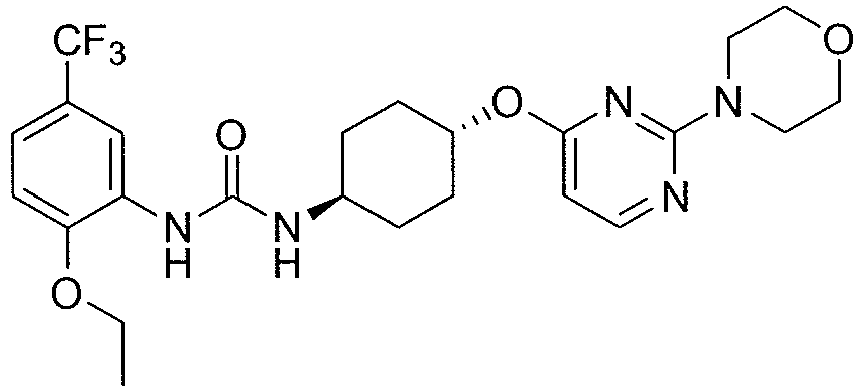
- The title compound (0.026 g) (hereinafter referred to as the compound of Example 46) was obtained using 2,2,2-trichloroethyl (2-ethoxy-5-(trifluoromethyl)phenyl)carbamate (0.040 g, 0.11 mmol) by a method similar to that for the synthesis of 1-(2-methoxy-5-(pentafluorosulfanyl)phenyl)-3-(trans-4-((2-morpholinopyrimidin-4-yl)oxy)cyclohexyl)urea (Example 4).
1H-NMR (400 MHz, DMSO-d6) δ (ppm): 1.30 - 1.53 (4H, m), 1.42 (3H, t, J = 8.0 Hz), 1.95 - 2.08 (4H, m), 3.50 - 3.53 (1H, m), 3.66 (s,8H), 4.18 (2H, q, J = 8.0 Hz), 4.94 - 4.99 (1H, m), 6.06 (1H, d, J = 4.0 Hz), 7.11 (2H, d, J = 4.0 Hz), 7.20 (1H, dd, J = 8.0, 4.0 Hz), 7.96 (1H, s), 8.10 (1H, d, J = 8.0 Hz), 8.53 (1H, d, J = 4.0 Hz). -

- The title compound (0.010 g) (hereinafter referred to as the compound of Example 47) was obtained using 2,2,2-trichloroethyl (2-(oxetan-3-yloxy)-5-(trifluoromethyl)phenyl)carbamate (0.020 g, 0.049 mmol) and trans-4-((4-(pyridin-3-yl)pyrimidin-4-yl)oxy)cyclohexanamine dihydrochloride (0.013 g, 0.049 mmol) by a method similar to that for the synthesis of 1-(2-methoxy-5-(pentafluorosulfanyl)phenyl)-3-(trans-4-((2-morpholinopyrimidin-4-yl)oxy)cyclohexyl)urea (Example 4).
1H-NMR (400 MHz, DMSO-d6) δ (ppm): 1.40 - 1.66 (4H, m), 1.99 - 2.05 (2H, m), 2.19 - 2.21 (2H, m), 3.58 - 3.62 (1H, m), 4.65 - 4.70 (2H, m), 5.00 (2H, t, J = 8.0 Hz), 5.26 - 5.32 (1H, m), 5.40 - 5.46 (1H, m), 6.76 (1H, d, J = 8.0 Hz), 6.97 (1H, d, J = 8.0 Hz), 7.11 (1H, d, J = 8.0 Hz), 7.17 (1H, dd, J = 8.0, 4.0 Hz), 8.15 (1H, s), 8.24 (2H, dd, J = 8.0, 4.0 Hz), 8.59 (1H, d, J = 4.0 Hz), 8.69 (1H, d, J = 8.0 Hz), 8.78 (2H, dd, J = 8.0, 4.0 Hz). -

- The title compound (0.010 g) (hereinafter referred to as the compound of Example 48) was obtained using 2,2,2-trichloroethyl (2-methoxy-5-(trifluoromethoxy)phenyl)carbamate (0.021 g, 0.054 mmol) and trans-4-((2-morpholinopyridin-4-yl)oxy)cyclohexanamine dihydrochloride (0.010 g, 0.036 mmol) by a method similar to that for the synthesis of 1-(2-methoxy-5-(pentafluorosulfanyl)phenyl)-3-(trans-4-((2-morpholinopyrimidin-4-yl)oxy)cyclohexyl)urea (Example 4).
1H-NMR (400 MHz, CD3OD) δ (ppm): 1.37 - 1.50 (2H, m), 1.50 - 1.60 (2H, m), 2.00 - 2.20 (4H, m), 3.40 (4H,t, J = 8.0 Hz), 3.60 - 3.65 (1H, m), 3.78 (1H, t, J = 8.0 Hz), 3.90 (3H, s), 4.40 - 4.50 (1H, m), 6.27 (1H, d, J = 4.0 Hz), 6.39 (1H, dd, J = 8.0, 4.0 Hz), 6.80 (1H, dd, J = 8.0, 4.0 Hz), 6.96 (1H, d, J = 8.0 Hz), 7.91 (1H, d, J = 4.0 Hz), 8.10 (1H, s). -

- The title compound (0.041 g) (hereinafter referred to as the compound of Example 49) was obtained using 2,2,2-trichloroethyl (2-methoxy-5-(trifluoromethoxy)phenyl)carbamate (0.075 g, 0.20 mmol) and trans-4-(pyridin-4-yloxy)cyclohexanamine dihydrochloride (0.025 g, 0.13 mmol) by a method similar to that for the synthesis of 1-(2-methoxy-5-(pentafluorosulfanyl)phenyl)-3-(trans-4-((2-morpholinopyrimidin-4-yl)oxy)cyclohexyl)urea (Example 4).
1H-NMR (400 MHz, CD3OD) δ (ppm): 1.40 - 1.50 (2H, m), 1.60 - 1.70 (2H, m), 2.00 - 2.20 (4H, m), 3.60 - 3.65 (1H, m), 3.90 (3H, s), 4.40 - 4.60 (1H, m), 6.80 (1H, dd, J = 9.0, 4.0 Hz), 6.91 - 7.00 (3H, m), 8.09 (1H, dd, J = 8.0, 4.0 Hz), 8.30 (1H, d, J = 4.0 Hz). -

- The title compound (0.022 g) (hereinafter referred to as the compound of Example 50) was obtained using 2,2,2-trichloroethyl (3-(hydroxymethyl)-2-methoxy-5-(trifluoromethoxy)phenyl)carbamate (0.046 g, 0.11 mmol) by a method similar to that for the synthesis of 1-(2-methoxy-5-(pentafluorosulfanyl)phenyl)-3-(trans-4-((2-morpholinopyrimidin-4-yl)oxy)cyclohexyl)urea (Example 4).
1H-NMR (400 MHz, CDCl3) δ (ppm): 1.25 - 1.41 (2H, m), 1.62 - 1.65 (2H, m), 1.92 (1H, brs), 2.16 - 2.19 (4H, m), 3.74 - 3.76 (9H, m), 3.80 (3H, s), 4.61 (1H, d, J = 8.3 Hz), 4.73 (2H, d, J = 4.9 Hz), 4.96 (1H, brs), 5.98 (1H, d, J = 5.6 Hz), 6.74 (1H, s), 6.93 (1H, d, J = 2.4 Hz), 8.01 (1H, d, J = 2.2 Hz), 8.06 (1H, d, J = 5.6 Hz). MS(ESI) [M + H]+: 542. -

- The title compound (0.039 g) (hereinafter referred to as the compound of Example 51) was obtained using 2,2,2-trichloroethyl (3-(hydroxymethyl)-5-(trifluoromethoxy)phenyl)carbamate (0.030 g, 0.082 mmol) by a method similar to that for the synthesis of 1-(2-methoxy-5-(pentafluorosulfanyl)phenyl)-3-(trans-4-((2-morpholinopyrimidin-4-yl)oxy)cyclohexyl)urea (Example 4).
1H-NMR (400 MHz, CD3OD) δ (ppm): 1.25 - 1.41 (2H, m), 1.62 - 1.65 (2H, m), 1.92 (1H, s), 1.20 - 1.30 (2H, m), 1.40 - 1.50 (2H, m), 2.00 - 2.20 (4H, m), 3.40 - 3.50 (1H, m), 3.55 - 3.65 (1H, m), 4.61 (2H, s), 4.64 (2H, s), 7.23 (1H, s), 7.43 (2H, d, J = 8.0 Hz), 7.47 (1H, s), 7.73 (1H, s), 8.47 (1H, d, J = 8.0, 4.0 Hz). -

- To a solution of 1-(3-(hydroxymethyl)-5-(trifluoromethyl)phenyl)-3-(trans-4-((2-morpholinopyrimidin-4-yl)oxy)cyclohexyl)urea (0.032 g, 0.065 mmol) and diisopropylethylamine (0.017 g, 0.136 mmol) in DMF, methanesulfonyl chloride (0.011 g, 0.097 mmol) was added and stirred for one hour under cooling on ice. Morpholine (0.017 g, 0.2 mmol) was added thereto, and the obtained solution was stirred overnight at room temperature. A saturated aqueous solution of ammonium chloride was added to the reaction solution to stop the reaction, and the obtained solution was subsequently extracted with ethyl acetate, and the organic layer was washed with a saturated aqueous solution of sodium chloride. The obtained organic layer was dried over anhydrous sodium sulfate and then concentrated under vacuum, and the obtained crude product was purified by amino-silica gel column chromatography (eluent; chloroform:methanol = 99:1 → 96:4) to obtain the title compound (0.024 g) (hereinafter referred to as the compound of Example 52).
1H-NMR (400 MHz, DMSO-d6) δ (ppm): 1.36 - 1.51 (4H, m), 1.91 - 2.06 (4H, m), 2.36 (s, 4H), 3.48 (s, 2H), 3.58 (4H, t, J = 4.0 Hz), 3.66 (s, 8H), 6.07 (1H, d, J = 4.0 Hz), 6.20 (1H, d, J = 8.0 Hz), 7.14 (1H, s), 7.44 (1H, s), 7.87 (1H, s), 8.09 (1H, d, J = 8.0 Hz), 8.80 (s, 1H). -

- The title compound (0.021 g) (hereinafter referred to as the compound of Example 53) was obtained using 2,2,2-trichloroethyl (4-(hydroxymethyl)-3-(trifluoromethoxy)phenyl)carbamate (0.030 g, 0.082 mmol) by a method similar to that for the synthesis of 1-(2-methoxy-5-(pentafluorosulfanyl)phenyl)-3-(trans-4-((2-morpholinopyrimidin-4-yl)oxy)cyclohexyl)urea (Example 4).
1H-NMR (400 MHz, DMSO-d6) δ (ppm): 1.31 - 1.53 (4H, m), 1.92 - 2.08 (4H, m), 3.65 (s, 8H), 4.56 (2H, d, J = 8.0 Hz), 5.31 (1H, t, J = 8.0 Hz), 6.05 (1H, d, J = 4.0 Hz), 6.16 (1H, d, J = 4.0 Hz), 7.48 (1H, d, J = 8.0 Hz), 7.57 (1H, d, J = 8.0 Hz), 7.91 (1H, s), 8.01 (1H, d, J = 8.0 Hz), 8.67 (1H, s). -

- The title compound (0.023 g) (hereinafter referred to as the compound of Example 54) was obtained using 2,2,2-trichloroethyl (2-methoxy-5-(trifluoromethoxy)phenyl)carbamate (0.038 g, 0.099 mmol) and 2-((trans-4-aminocyclohexyl)oxy)-N-methylpyrimidin-4-amine dihydrochloride (0.017 g, 0.066 mmol) by a method similar to that for the synthesis of 1-(2-methoxy-5-(pentafluorosulfanyl)phenyl)-3-(trans-4-((2-morpholinopyrimidin-4-yl)oxy)cyclohexyl)urea (Example 4).
1H-NMR (400 MHz, CDCl3) δ (ppm): 1.23 - 1.38 (2H, m), 1.65 - 1.70 (2H, m), 2.17 (4H, t, J = 14.8 Hz), 2.94 (3H, d, J = 5.1 Hz), 3.49 (1H, d, J = 3.7 Hz), 3.73 - 3.74 (1H, m), 3.87 (3H, s), 4.49 (1H, d, J = 7.6 Hz), 4.89 (1H, brs), 5.98 (1H, d, J = 5.6 Hz), 6.78 - 6.80 (2H, m), 6.82 (1H, s), 7.96 (1H, s), 8.15 (1H, s).
MS(ESI) [M + H]+: 456. -

- The title compound (0.027 g) (hereinafter referred to as the compound of Example 55) was obtained using 2,2,2-trichloroethyl (2-methoxy-5-(trifluoromethoxy)phenyl)carbamate (0.038 g, 0.099 mmol) and trans-4-((4-morpholinopyrimidin-2-yl)oxy)cyclohexanamine dihydrochloride (0.021 g, 0.066 mmol) by a method similar to that for the synthesis of 1-(2-methoxy-5-(pentafluorosulfanyl)phenyl)-3-(trans-4-((2-morpholinopyrimidin-4-yl)oxy)cyclohexyl)urea (Example 4).
1H-NMR (400 MHz, CDCl3) δ (ppm): 1.28 - 1.35 (2H, m), 1.67 - 1.72 (2H, m), 2.15 - 2.18 (4H, m), 3.60 - 3.61 (4H, m), 3.75 - 3.76 (5H, m), 4.62 (1H, d, J = 7.6 Hz), 4.88 - 4.90 (1H, m), 6.14 (1H, d, J = 6.1 Hz), 6.77 - 6.80 (2H, m), 6.88 (1H, s), 8.02 (1H, d, J = 6.1 Hz), 8.14 (1H, d, J = 0.7 Hz).
MS(ESI) [M + H]+: 512. -

- The title compound (0.013 g) (hereinafter referred to as the compound of Example 56) was obtained using 2,2,2-trichloroethyl (2-(oxetan-3-yloxy)-5-(trifluoromethyl)phenyl)carbamate (0.040 g, 0.098 mmol) and trans-4-(pyridin-4-ylmethoxy)cyclohexanamine dihydrochloride (0.020 g, 0.098 mmol) by a method similar to that for the synthesis of 1-(2-methoxy-5-(pentafluorosulfanyl)phenyl)-3-(trans-4-((2-morpholinopyrimidin-4-yl)oxy)cyclohexyl)urea (Example 4). 1H-NMR (400 MHz, CD3OD) δ (ppm): 1.25 - 1.38 (2H, m), 1.40 - 1.53 (2H, m), 2.00 - 2.15 (4H, m), 3.41 - 3.49 (1H, m), 3.57 - 3.64 (1H, m), 4.61 (2H, s), 4.75 - 4.82 (2H, m), 5.03 - 5.07 (2H, t, J = 8.0 Hz), 5.37 - 5.42 (1H, m), 6.70 (1H, d, J = 8.0 Hz), 7.16 (1H, dd, J = 8.0, 4.0 Hz), 7.42 (1H, d, J = 8.0 Hz), 8.46 - 8.50 (3H, m).
-

- The title compound (0.021 g) (hereinafter referred to as the compound of Example 57) was obtained using 2,2,2-trichloroethyl (2-morpholino-5-(trifluoromethyl)phenyl)carbamate (0.042 g, 0.10 mmol) and trans-4-(pyrimidin-2-yloxy)cyclohexanamine (0.019 g, 0.10 mmol) by a method similar to that for the synthesis of 1-(2-methoxy-5-(pentafluorosulfanyl)phenyl)-3-(trans-4-((2-morpholinopyrimidin-4-yl)oxy)cyclohexyl)urea (Example 4).
1H-NMR (400 MHz, DMSO-d6) δ (ppm): 1.29 - 1.41 (2H, m), 1.51 - 1.60 (2H, m), 1.96 - 2.14 (4H, m), 2.80 - 2.83 (4H, m), 3.50 - 3.60 (1H, m), 3.79 - 3.87 (4H, m), 4.91 - 4.99 (1H, m), 7.11 (1H, t, J = 8.0 Hz), 7.23 - 7.25 (1H, m), 7.30 - 7.32 (2H, m), 7.90 (1H, s), 8.51 (1H, d, J = 4.0 Hz), 8.59 (1H, s), 8.61 (1H, s). -

- The title compound (0.02 g) (hereinafter referred to as the compound of Example 58) was obtained using 2,2,2-trichloroethyl (2-chloro-5-(trifluoromethyl)phenyl)carbamate (0.030 g, 0.081 mmol) and trans-4-(pyrimidin-2-yloxy)cyclohexanamine (0.016 g, 0.081 mmol) by a method similar to that for the synthesis of 1-(2-methoxy-5-(pentafluorosulfanyl)phenyl)-3-(trans-4-((2-morpholinopyrimidin-4-yl)oxy)cyclohexyl)urea (Example 4).
1H-NMR (400 MHz, CD3OD) δ (ppm): 1.32 - 1.41 (2H, m), 1.52 - 1.62 (2H, m), 1.97 - 2.12 (4H, m), 3.50 - 3.60 (1H, m), 4.91 - 4.99 (1H, m), 7.11 (1H, t, J = 8.0 Hz), 7.24 - 7.29 (2H, m), 7.65 (1H, d, J = 8.0 Hz), 8.30 (1H, s), 8.60 (2H, d, J = 4.0 Hz), 8.67 (1H, d, J = 4.0 Hz). -

- The title compound (0.019 g) (hereinafter referred to as the compound of Example 59) was obtained using 2,2,2-trichloroethyl (2-methoxy-5-(trifluoromethoxy)phenyl)carbamate (0.037 g, 0.095 mmol) and trans-4-((6-morpholinopyrimidin-4-yl)oxy)cyclohexanamine dihydrochloride (0.020 g, 0.064 mmol) by a method similar to that for the synthesis of 1-(2-methoxy-5-(pentafluorosulfanyl)phenyl)-3-(trans-4-((2-morpholinopyrimidin-4-yl)oxy)cyclohexyl)urea (Example 4).
1H-NMR (400 MHz, CDCl3) δ (ppm): 1.34 - 1.37 (2H, m), 1.55 - 1.61 (2H, m), 2.13 - 2.16 (4H, m), 3.54 - 3.55 (4H, m), 3.76 - 3.77 (5H, m), 3.87 (3H, s), 4.47 (1H, d, J = 7.1 Hz), 5.02 (1H, brs), 5.78 (1H, s), 6.79 - 6.81 (3H, m), 8.15 (1H, s), 8.30 (1H, s). MS(ESI) [M + H]+: 512. -

- The title compound (0.035 g) (hereinafter referred to as the compound of Example 60) was obtained using 2,2,2-trichloroethyl (2-methoxy-5-(trifluoromethoxy)phenyl)carbamate (0.067 g, 0.17 mmol) and 2-((trans-6-aminocyclohexyl)oxy)-N-methylpyrimidin-4-amine dihydrochloride (0.030 g, 0.12 mmol) by a method similar to that for the synthesis of 1-(2-methoxy-5-(pentafluorosulfanyl)phenyl)-3-(trans-4-((2-morpholinopyrimidin-4-yl)oxy)cyclohexyl)urea (Example 4).
1H-NMR (400 MHz, CDCl3) δ (ppm): 1.36 - 1.38 (2H, m), 1.55 - 1.58 (2H, m), 2.13 - 2.17 (4H, m), 2.87 (3H, d, J = 5.1 Hz), 3.76 (1H, brs), 3.87 (3H, s), 4.47 (1H, s), 4.85 (1H, brs), 5.01 (1H, s), 5.62 (1H, s), 6.79 - 6.81 (3H, m), 8.15 (1H, s), 8.21 (1H, s).
MS(ESI) [M + H]+: 456. -
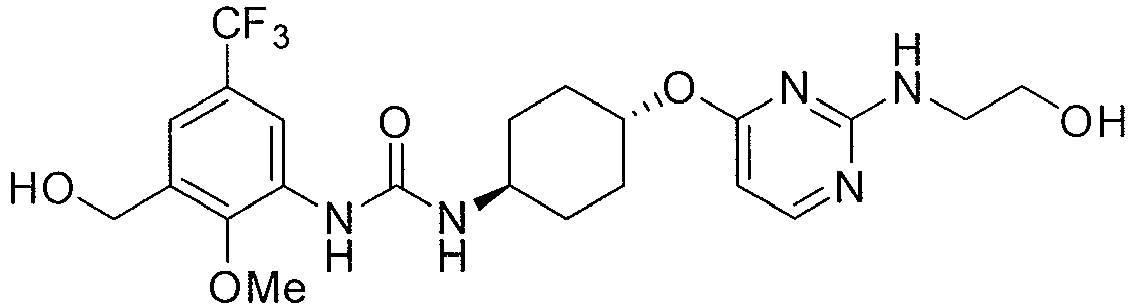
- The title compound (0.0079 g) (hereinafter referred to as the compound of Example 61) was obtained using 2,2,2-trichloroethyl (3-(hydroxymethyl)-2-methoxy-5-(trifluoromethyl)phenyl)carbamate (0.030 g, 0.076 mmol) and 2-((4-((trans-4-aminocyclohexyl)oxy)pyrimidin-2-yl)amino)ethanol dihydrochloride (0.020 g, 0.069 mmol) by a method similar to that for the synthesis of 1-(2-methoxy-5-(pentafluorosulfanyl)phenyl)-3-(trans-4-((2-morpholinopyrimidin-4-yl)oxy)cyclohexyl)urea (Example 4).
1H-NMR (400 MHz, CD3OD) δ (ppm): 1.38 - 1.44 (2H, m), 1.57 - 1.63 (2H, m), 2.09 - 2.15 (4H, m), 3.47 (2H, t, J = 5.9 Hz), 3.62 - 3.71 (3H, m), 3.80 (3H, s), 4.70 (2H, s), 5.03 - 5.08 (1H, m), 5.99 (1H, d, J = 5.9 Hz), 7.36 (1H, d, J = 1.5 Hz), 7.91 (1H, d, J = 5.6 Hz), 8.41 (1H, d, J = 2.2 Hz).
MS(ESI) [M + H]+: 500. -

- The title compound (0.013 g) (hereinafter referred to as the compound of Example 62) was obtained using 2,2,2-trichloroethyl (2-methoxy-5-(trifluoromethoxy)phenyl)carbamate (0.029 g, 0.076 mmol) and 2-((4-((trans-4-aminocyclohexyl)oxy)pyrimidin-2-yl)amino)ethanol dihydrochloride (0.020 g, 0.069 mmol) by a method similar to that for the synthesis of 1-(2-methoxy-5-(pentafluorosulfanyl)phenyl)-3-(trans-4-((2-morpholinopyrimidin-4-yl)oxy)cyclohexyl)urea (Example 4).
1H-NMR (400 MHz, CDCl3) δ (ppm): 1.30 - 1.35 (2H, m), 1.59 - 1.62 (2H, m), 2.13 - 2.15 (4H, m), 3.55 - 3.57 (2H, m), 3.74 - 3.76 (1H, m), 3.82 - 3.83 (2H, m), 3.87 (3H, s), 4.52 - 4.54 (1H, m), 4.91 - 4.94 (1H, m), 5.34 (1H, s), 6.01 (1H, d, J = 5.9 Hz), 6.78 - 6.82 (2H, m), 6.83 (1H, s), 7.97 (1H, d, J = 5.9 Hz), 8.14 (1H, s). MS(ESI) [M + H]+: 486. -

- The title compound (0.018 g) (hereinafter referred to as the compound of Example 63) was obtained using 2,2,2-trichloroethyl (2-(oxetan-3-yloxy)-5-(trifluoromethyl)phenyl)carbamate (0.031 g, 0.076 mmol) and 2-((4-((trans-4-aminocyclohexyl)oxy)pyrimidin-2-yl)amino)ethanol dihydrochloride (0.020 g, 0.069 mmol) by a method similar to that for the synthesis of 1-(2-methoxy-5-(pentafluorosulfanyl)phenyl)-3-(trans-4-((2-morpholinopyrimidin-4-yl)oxy)cyclohexyl)urea (Example 4).
1H-NMR (400 MHz, CDCl3) δ (ppm): 1.32 - 1.55 (4H, m), 2.12 (4H, d, J = 8.5 Hz), 3.57 (2H, dd, J = 10.0,5.4 Hz), 3.71 - 3.75 (1H, m), 3.84 (2H, t, J = 4.8 Hz), 4.78 (2H, dd, J = 7.6,4.9 Hz), 4.90 - 4.94 (1H, m), 5.03 (2H, t, J = 6.7 Hz), 5.28 (1H, dd, J = 10.6,4.8 Hz), 5.45 - 5.49 (1H, m), 6.01 (1H, d, J = 5.9 Hz), 6.43 (1H, d, J = 8.5 Hz), 7.15 (2H, d, J = 8.5 Hz), 7.97 (1H, d, J = 5.9 Hz), 8.58 (1H, s).
MS(ESI) [M + H]+: 512. -

- The title compound (0.028 g) (hereinafter referred to as the compound of Example 64) was obtained using 2,2,2-trichloroethyl (2-(oxetan-3-yloxy)-5-(trifluoromethyl)phenyl)carbamate (0.038 g, 0.077 mmol) and 4-((trans-4-aminocyclohexyl)oxy)-N-methylpyrimidin-2-amine dihydrochloride (0.017 g, 0.066 mmol) by a method similar to that for the synthesis of 1-(2-methoxy-5-(pentafluorosulfanyl)phenyl)-3-(trans-4-((2-morpholinopyrimidin-4-yl)oxy)cyclohexyl)urea (Example 4).
1H-NMR (400 MHz, CD3OD) δ (ppm): 1.41 - 1.44 (2H, m), 1.58 - 1.60 (2H, m), 2.10 - 2.17 (4H, m), 2.88 (3H, s), 3.61 - 3.70 (1H, m), 4.74 - 4.77 (2H, m), 5.02 - 5.06 (3H, m), 5.38 - 5.42 (1H, m), 5.97 (1H, d, J = 6.1 Hz), 6.68 (1H, d, J = 8.0 Hz), 7.17 (1H, d, J = 9.8 Hz), 7.91 (1H, d, J = 5.4 Hz), 8.49 (1H, s).
MS(ESI) [M + H]+: 482. -

- The title compound (0.029 g) (hereinafter referred to as the compound of Example 65) was obtained using 2,2,2-trichloroethyl (3-(hydroxymethyl)-2-methoxy-5-(trifluoromethyl)phenyl)carbamate (0.031 g, 0.077 mmol) and 4-((trans-4-aminocyclohexyl)oxy)-N-methylpyrimidin-2-amine dihydrochloride (0.017 g, 0.066 mmol) by a method similar to that for the synthesis of 1-(2-methoxy-5-(pentafluorosulfanyl)phenyl)-3-(trans-4-((2-morpholinopyrimidin-4-yl)oxy)cyclohexyl)urea (Example 4).
1H-NMR (400 MHz, CD3OD) δ (ppm): 1.41 (2H, t, J = 11.6 Hz), 1.59 (2H, t, J = 10.9 Hz), 2.09 - 2.16 (4H, m), 2.88 (3H, s), 3.61 - 3.65 (1H, m), 3.80 (3H, s), 4.70 (2H, s), 5.07 (1H, d, J = 4.4 Hz), 5.97 (1H, d, J = 5.9 Hz), 7.36 (1H, s), 7.91 (1H, d, J = 5.9 Hz), 8.41 (1H, d, J = 1.7 Hz). -
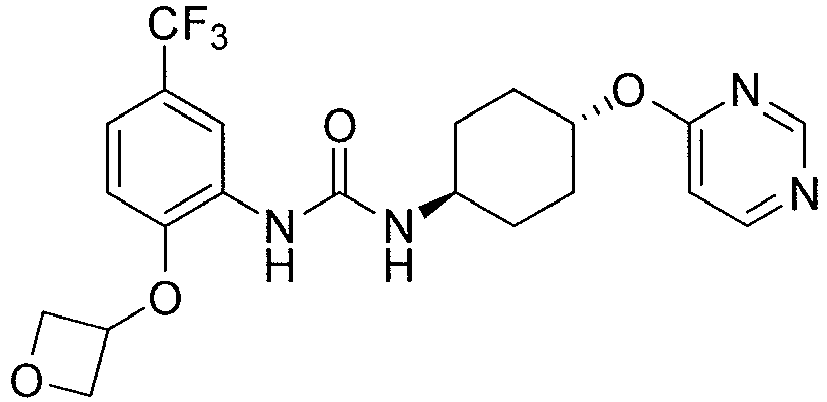
- The title compound (0.029 g) (hereinafter referred to as the compound of Example 66) was obtained using 2,2,2-trichloroethyl (2-(oxetan-3-yloxy)-5-(trifluoromethyl)phenyl)carbamate and trans-4-(pyrimidin-4-yloxy)cyclohexanamine by a method similar to that for the synthesis of 1-(2-methoxy-5-(pentafluorosulfanyl)phenyl)-3-(trans-4-((2-morpholinopyrimidin-4-yl)oxy)cyclohexyl)urea (Example 4).
1H-NMR (400 MHz, CD3OD) δ (ppm): 1.29 - 1.38 (2H, m), 1.52 - 1.69 (2H, m), 2.01 - 2.20 (4H, m), 3.60 - 3.68 (1H, m), 4.77 - 4.80 (2H, m), 5.01 - 5.08 (2H, m), 5.10 - 5.21 (1H, m), 5.38 - 5.43 (1H, m), 6.67 - 6.73 (1H, m), 6.84 (1H, d, J = 8.0 Hz), 7.16 - 7.25 (1H, m), 8.41 (1H, d, J = 8.0 Hz), 8.49 (1H, d, J = 4.0 Hz), 8.70 (1H, s). -

- The title compound (0.029 g) (hereinafter referred to as the compound of Example 67) was obtained using 2,2,2-trichloroethyl (3-(hydroxymethyl)-2-methoxy-5-(trifluoromethoxy)phenyl)carbamate (0.033 g, 0.079 mmol) and trans-4-(pyridin-3-ylmethoxy)cyclohexanamine dihydrochloride (0.020 g, 0.070 mmol) by a method similar to that for the synthesis of 1-(2-methoxy-5-(pentafluorosulfanyl)phenyl)-3-(trans-4-((2-morpholinopyrimidin-4-yl)oxy)cyclohexyl)urea (Example 4).
1H-NMR (400 MHz, CDCl3) δ (ppm): 1.20 - 1.28 (2H, m), 1.48 - 1.52 (2H, m), 2.00 - 2.02 (1H, m), 2.10 - 2.12 (4H, m), 3.35 (1H, brs), 3.69 (1H, brs), 3.78 (3H, s), 4.57 (2H, s), 4.60 (1H, d, J = 8.0 Hz), 4.72 (2H, d, J = 6.1 Hz), 6.74 (1H, s), 6.92 (1H, d, J = 1.7 Hz), 7.28 - 7.30 (2H, m), 7.69 (1H, d, J = 7.3 Hz), 8.03 (1H, d, J = 2.4 Hz), 8.54 (1H, dd, J = 4.9, 1.7 Hz), 8.56 (1H, d, J = 1.5 Hz). -

- The title compound (0.022 g) (hereinafter referred to as the compound of Example 68) was obtained using 2,2,2-trichloroethyl (2-methoxy-5-(trifluoromethoxy)phenyl)carbamate (0.030 g, 0.079 mmol) and trans-4-(pyridin-3-ylmethoxy)cyclohexanamine dihydrochloride (0.020 g, 0.079 mmol) by a method similar to that for the synthesis of 1-(2-methoxy-5-(pentafluorosulfanyl)phenyl)-3-(trans-4-((2-morpholinopyrimidin-4-yl)oxy)cyclohexyl)urea (Example 4).
1H-NMR (400 MHz, CDCl3) δ (ppm): 1.19 - 1.22 (2H, m), 1.47 - 1.50 (2H, m), 2.11 (4H, s), 3.36 - 3.38 (1H, m), 3.68 - 3.71 (1H, m), 3.86 (3H, s), 4.44 (1H, brs), 4.57 (2H, s), 6.78 - 6.80 (3H, m), 7.26 - 7.31 (1H, m), 7.70 (1H, d, J = 7.8 Hz), 8.14 (1H, s), 8.54 (1H, dd, J = 4.9, 1.5 Hz), 8.57 (1H, d, J = 2.4 Hz). -

- The title compound (0.021 g) (hereinafter referred to as the compound of Example 69) was obtained using 2,2,2-trichloroethyl (2-methoxy-5-(trifluoromethyl)phenyl)carbamate (0.029 g, 0.079 mmol) and trans-4-(pyridin-3-ylmethoxy)cyclohexanamine dihydrochloride (0.020 g, 0.079 mmol) by a method similar to that for the synthesis of 1-(2-methoxy-5-(pentafluorosulfanyl)phenyl)-3-(trans-4-((2-morpholinopyrimidin-4-yl)oxy)cyclohexyl)urea (Example 4).
1H-NMR (400 MHz, CDCl3) δ (ppm): 1.21 - 1.24 (2H, m), 1.47 - 1.50 (2H, m), 2.11 - 2.13 (4H, m), 3.36 (1H, brs), 3.71 (1H, brs), 3.91 (3H, s), 4.45 (1H, d, J = 7.3 Hz), 4.57 (2H, s), 6.81 (1H, s), 6.88 (1H, d, J = 8.8 Hz), 7.22 - 7.24 (1H, m), 7.27 - 7.31 (1H, m), 7.70 (1H, d, J = 8.0 Hz), 8.49 (1H, s), 8.54 (1H, d, J = 4.6 Hz), 8.58 (1H, s). -

- The title compound (0.0083 g) (hereinafter referred to as the compound of Example 70) was obtained using 2,2,2-trichloroethyl (3-(hydroxymethyl)-2-methoxy-5-(trifluoromethoxy)phenyl)carbamate (0.026 g, 0.064 mmol) and 6-((trans-4-aminocyclohexyl)oxy)-N-methylpyrimidin-4-amine dihydrochloride (0.015 g, 0.058 mmol) by a method similar to that for the synthesis of 1-(2-methoxy-5-(pentafluorosulfanyl)phenyl)-3-(trans-4-((2-morpholinopyrimidin-4-yl)oxy)cyclohexyl)urea (Example 4).
1H-NMR (400 MHz, CD3OD) δ (ppm): 1.38 - 1.43 (2H, m), 1.56 - 1.62 (2H, m), 2.08 - 2.14 (4H, m), 2.84 (3H, s), 3.62 - 3.65 (1H, m), 3.75 (3H, s), 4.66 (2H, s), 4.86 - 4.89 (1H, m), 5.71 (1H, s), 6.95 (1H, s), 8.05 (1H, s), 8.08 (1H, s). -

- The title compound (0.0076 g) (hereinafter referred to as the compound of Example 71) was obtained using 2,2,2-trichloroethyl (3-(hydroxymethyl)-2-methoxy-5-(trifluoromethyl)phenyl)carbamate (0.025 g, 0.064 mmol) and 6-((trans-4-aminocyclohexyl)oxy)-N-methylpyrimidin-4-amine dihydrochloride (0.015 g, 0.058 mmol) by a method similar to that for the synthesis of 1-(2-methoxy-5-(pentafluorosulfanyl)phenyl)-3-(trans-4-((2-morpholinopyrimidin-4-yl)oxy)cyclohexyl)urea (Example 4).
1H-NMR (400 MHz, CD3OD) δ (ppm): 1.38 - 1.44 (3H, m), 1.57 - 1.62 (2H, m), 2.08 - 2.14 (4H, m), 2.84 (3H, s), 3.63 - 3.65 (1H, m), 3.80 (3H, s), 4.70 (2H, s), 4.84 - 4.86 (1H, m), 5.71 (1H, s), 7.36 (1H, s), 8.08 (1H, s), 8.41 (1H, d, J = 1.7 Hz). MS(ESI) [M + H]+: 470. -

- The title compound (0.018 g) (hereinafter referred to as the compound of Example 72) was obtained using 2,2,2-trichloroethyl (2-methoxy-5-(trifluoromethoxy)phenyl)carbamate (0.029 g, 0.075 mmol) and trans-4-((pyridin-3-ylmethoxy)methyl)cyclohexanamine dihydrochloride (0.018 g, 0.068 mmol) by a method similar to that for the synthesis of 1-(2-methoxy-5-(pentafluorosulfanyl)phenyl)-3-(trans-4-((2-morpholinopyrimidin-4-yl)oxy)cyclohexyl)urea (Example 4).
1H-NMR (400 MHz, CDCl3) δ (ppm): 1.11 - 1.16 (4H, m), 1.55 - 1.57 (1H, m), 1.87 - 1.90 (2H, m), 2.08 - 2.10 (2H, m), 3.32 (2H, d, J = 6.3 Hz), 3.63 (1H, brs), 3.86 (3H, s), 4.44 (1H, d, J = 7.6 Hz), 4.51 (2H, s), 6.77 - 6.79 (3H, m), 7.27 - 7.30 (1H, m), 7.67 (1H, d, J = 8.0 Hz), 8.14 (1H, s), 8.54 (1H, dd, J = 4.8,1.6 Hz), 8.57 (1H, d, J = 1.5 Hz).
MS(ESI) [M + H]+: 454. -

- The title compound (0.014 g) (hereinafter referred to as the compound of Example 73) was obtained using 2,2,2-trichloroethyl (2-methoxy-5-(trifluoromethyl)phenyl)carbamate (0.028 g, 0.075 mmol) and trans-4-((pyridin-3-ylmethoxy)methyl)cyclohexanamine dihydrochloride (0.018 g, 0.068 mmol) by a method similar to that for the synthesis of 1-(2-methoxy-5-(pentafluorosulfanyl)phenyl)-3-(trans-4-((2-morpholinopyrimidin-4-yl)oxy)cyclohexyl)urea (Example 4).
1H-NMR (400 MHz, CDCl3) δ (ppm): 1.10 - 1.26 (4H, m), 1.55 - 1.57 (1H, m), 1.88 - 1.90 (2H, m), 2.05 - 2.10 (2H, m), 3.32 (2H, d, J = 6.3 Hz), 3.62 (1H, brs), 3.91 (3H, s), 4.44 (1H, d, J = 7.6 Hz), 4.51 (2H, s), 6.79 (1H, s), 6.88 (1H, d, J = 8.5 Hz), 7.29 - 7.30 (2H, m), 7.67 (1H, d, J = 7.8 Hz), 8.49 (1H, d, J = 2.0 Hz), 8.54 (1H, dd, J = 4.9, 1.7 Hz), 8.57 (1H, d, J = 2.0 Hz). -

- The title compound (0.017 g) (hereinafter referred to as the compound of Example 74) was obtained using 2,2,2-trichloroethyl (2-methoxy-5-(trifluoromethoxy)phenyl)carbamate (0.029 g, 0.075 mmol) and trans-4-((pyridin-4-ylmethoxy)methyl)cyclohexanamine dihydrochloride (0.018 g, 0.068 mmol) by a method similar to that for the synthesis of 1-(2-methoxy-5-(pentafluorosulfanyl)phenyl)-3-(trans-4-((2-morpholinopyrimidin-4-yl)oxy)cyclohexyl)urea (Example 4).
1H-NMR (400 MHz, CDCl3) δ (ppm): 1.15 - 1.17 (2H, m), 1.55 - 1.57 (1H, m), 1.90 - 1.93 (2H, m), 2.10 - 2.12 (2H, m), 3.33 (2H, d, J = 6.3 Hz), 3.65 (1H, brs), 3.87 (3H, s), 4.44 (1H, d, J = 7.3 Hz), 4.51 (2H, s), 6.78 - 6.80 (3H, m), 7.25 - 7.26 (2H, m), 8.15 (1H, s), 8.57 (2H, d, J = 5.9 Hz).
MS(ESI) [M + H]+: 454. -

- The title compound (0.013 g) (hereinafter referred to as the compound of Example 75) was obtained using 2,2,2-trichloroethyl (2-methoxy-5-(trifluoromethyl)phenyl)carbamate (0.029 g, 0.075 mmol) and trans-4-((pyridin-4-ylmethoxy)methyl)cyclohexanamine dihydrochloride (0.018 g, 0.068 mmol) by a method similar to that for the synthesis of 1-(2-methoxy-5-(pentafluorosulfanyl)phenyl)-3-(trans-4-((2-morpholinopyrimidin-4-yl)oxy)cyclohexyl)urea (Example 4).
1H-NMR (400 MHz, CDCl3) δ (ppm): 1.10 - 1.23 (4H, m), 1.55 - 1.57 (1H, m), 1.89 - 1.92 (2H, m), 2.10 - 2.13 (2H, m), 3.33 (2H, d, J = 6.3 Hz), 3.65 (1H, brs), 3.91 (3H, s), 4.49 - 4.51 (3H, m), 6.81 (1H, s), 6.88 (1H, d, J = 8.5 Hz), 7.22 - 7.24 (2H, m), 8.50 (1H, d, J = 2.0 Hz), 8.57 (2H, t, J = 2.9 Hz).
MS(ESI) [M + H]+: 454. -

- The title compound (0.011 g) (hereinafter referred to as the compound of Example 76) was obtained using 2,2,2-trichloroethyl (2-(oxetan-3-yloxy)-5-(trifluoromethyl)phenyl)carbamate (0.028 g, 0.069 mmol) and trans-4-(pyridin-3-ylmethoxy)cyclohexanamine dihydrochloride (0.018 g, 0.063 mmol) by a method similar to that for the synthesis of 1-(2-methoxy-5-(pentafluorosulfanyl)phenyl)-3-(trans-4-((2-morpholinopyrimidin-4-yl)oxy)cyclohexyl)urea (Example 4).
1H-NMR (400 MHz, CDCl3) δ (ppm): 1.19 - 1.28 (2H, m), 1.46 - 1.52 (2H, m), 2.11 - 2.14 (4H, m), 3.34 - 3.37 (1H, m), 3.69 - 3.71 (1H, m), 4.57 (2H, s), 4.73 - 4.78 (3H, m), 5.01 (2H, t, J = 6.7 Hz), 5.25 - 5.28 (1H, m), 6.42 (1H, d, J = 8.5 Hz), 6.89 - 6.91 (1H, m), 7.15 - 7.16 (1H, m), 7.29 - 7.31 (1H, m), 7.69 - 7.71 (1H, m), 8.53 - 8.58 (3H, m). -

- The title compound (0.013 g) (hereinafter referred to as the compound of Example 77) was obtained using 2,2,2-trichloroethyl (2-methoxy-5-(trifluoromethoxy)phenyl)carbamate (0.023 g, 0.060 mmol) and 5-((trans-4-aminocyclohexyl)methoxy)nicotinamide dihydrochloride (0.016 g, 0.050 mmol) by a method similar to that for the synthesis of 1-(2-methoxy-5-(pentafluorosulfanyl)phenyl)-3-(trans-4-((2-morpholinopyrimidin-4-yl)oxy)cyclohexyl)urea (Example 4).
1H-NMR (400 MHz, CD3OD) δ (ppm): 1.24 - 1.30 (4H, m), 1.81 - 1.85 (1H, m), 1.93 - 1.98 (2H, m), 2.07 - 2.10 (2H, m), 3.52 - 3.55 (1H, m), 3.90 (3H, s), 3.96 (2H, d, J = 6.1 Hz), 6.78 - 6.81 (1H, m), 6.96 (1H, d, J = 9.0 Hz), 7.82 (1H, t, J = 2.3 Hz), 8.09 - 8.09 (1H, m), 8.37 (1H, d, J = 2.9 Hz), 8.60 (1H, d, J = 1.7 Hz). -

- The title compound (0.016 g) (hereinafter referred to as the compound of Example 78) was obtained using 2,2,2-trichloroethyl (2-methoxy-5-(trifluoromethoxy)phenyl)carbamate (0.023 g, 0.060 mmol) and 3-((trans-4-aminocyclohexyl)methoxy)benzamide hydrochloride (0.016 g, 0.050 mmol) by a method similar to that for the synthesis of 1-(2-methoxy-5-(pentafluorosulfanyl)phenyl)-3-(trans-4-((2-morpholinopyrimidin-4-yl)oxy)cyclohexyl)urea (Example 4).
1H-NMR (400 MHz, CD3OD) δ (ppm): 1.20 - 1.32 (4H, m), 1.79 - 1.89 (1H, m), 2.00 - 2.04 (4H, m), 3.53 (1H, brs), 3.86 (2H, d, J = 6.3 Hz), 3.90 (2H, brs),6.80 (1H, dd, J = 8.8,2.0 Hz), 6.96 (1H, d, J = 9.0 Hz), 7.08 - 7.10 (1H, m), 7.35 (1H, t, J = 8.2 Hz), 7.41 - 7.43 (2H, m), 8.09 (1H, d, J = 2.9 Hz).
MS(ESI) [M + H]+: 482. -

- The title compound (0.015 g) (hereinafter referred to as the compound of Example 79) was obtained using 2,2,2-trichloroethyl (3-(hydroxymethyl)-2-methoxy-5-(trifluoromethoxy)phenyl)carbamate (0.020 g, 0.048 mmol) and trans-4-((2-(pyridin-3-yl)pyrimidin-4-yl)oxy)cyclohexanamine dihydrochloride (0.013 g, 0.048 mmol) by a method similar to that for the synthesis of 1-(2-methoxy-5-(pentafluorosulfanyl)phenyl)-3-(trans-4-((2-morpholinopyrimidin-4-yl)oxy)cyclohexyl)urea (Example 4).
1H-NMR (400 MHz, DMSO-d6) δ (ppm): 1.41 - 1.51 (2H, m), 1.57 - 1.67 (2H, m), 1.99 - 2.02 (2H, m), 2.17 - 2.20 (2H, m), 3.53 - 3.62 (1H, m), 3.69 (3H, s), 4.57 (2H, d, J = 8.0 Hz), 5.24 - 5.38 (1H, m), 5.33 (1H, t, J = 8.0 Hz), 6.90 - 6.96 (2H, m), 7.06 (1H, d, J = 8.0 Hz), 7.57 (1H,q, J = 4.0 Hz), 8.16 (1H, d, J = 4.0 Hz), 8.24 (1H, s), 8.60 - 8.67 (2H, m), 8.73 (1H, dd, J = 8.0, 4.0 Hz), 9.50 (1H, d, J = 4.0 Hz). -

- The title compound (0.019 g) (hereinafter referred to as the compound of Example 80) was obtained using 2,2,2-trichloroethyl (3-(hydroxymethyl)-2-methoxy-5-(trifluoromethoxy)phenyl)carbamate (0.020 g, 0.048 mmol) and 4-((trans-4-aminocyclohexyl)oxy)-N-methylpyrimidin-2-amine dihydrochloride (0.014 g, 0.048 mmol) by a method similar to that for the synthesis of 1-(2-methoxy-5-(pentafluorosulfanyl)phenyl)-3-(trans-4-((2-morpholinopyrimidin-4-yl)oxy)cyclohexyl)urea (Example 4).
1H-NMR (400 MHz, CD3OD) δ (ppm): 1.38 - 1.61 (4H, m), 2.08 - 2.16 (4H, m), 2.88 (3H, s), 3.63 (1H, brs), 3.75 (3H, s), 4.66 (2H, s), 5.07 (1H, brs), 5.97 (1H, d, J = 5.9 Hz), 6.94 (1H, s), 7.91 (1H, d, J = 5.9 Hz), 8.04 (1H, d, J = 2.9 Hz). - The DDR1 inhibition activity in the compounds of Examples 1 to 80 was evaluated with HTRF® KinEASE-TK kit (Cisbio Bioassays).
- Each test substance was dissolved in dimethyl sulfoxide and then used for the evaluation as described below. Moreover, each of test substances and reagents was diluted in the kinase buffer (Cisbio Bioassays) prepared by adding thereto MgCl2, MnCl2, DTT, and the Supplemental Enzyme buffer (Cisbio Bioassays) to concentrations of 5 mmol/L, 0.5 mmol/L, 0.25 mmol/L, and 50 nmol/L, respectively, and then used. Each test substance (in DMSO in a final concentration of 1%), the intracellular domain of DDR1 (in a final concentration of 5 ng/µL) (Carna Biosciences, Inc.), the phosphate donor ATP (in final concentration of 25 µmol/L) (Sigma), and the substrate TK Substrate-biotin (in a final concentration of 1000 nmol/L) (Cisbio Bioassays) were added to a 384-well black plate (Corning) and allowed to react at room temperature for one hour. After the completion of the reaction, the TK Antibody-Cryptate (Cisbio Bioassays) and the Streptavidin-XL665 (Cisbio Bioassays) were added thereto and allowed to react at room temperature for one hour. In addition, the plate was provided with a well to which a test substance was not added, and with a well to which a test substance and the intracellular domain of DDR1 were added.
- The fluorescence intensity in each well was measured using a multi-label counter (Envision, PerkinElmer; excitation wavelength: 320 nm, measurement wavelength: 665 nm and 620 nm) to calculate a ratio (the fluorescence intensity at 665 nm/the fluorescence intensity at 620 nm). The inhibition rate (%) of a test substance at each concentration was calculated based on the formula below.

- The calculated inhibition rates were fitted to a sigmoidal dose-response curve by regression analysis using the Prism 5.04 (GraphPad Software, Inc.) to calculate the IC50 value of the test substance.
- The IC50 value of each test substance is shown in Table 2. As seen from the results in Tables 2-1, 2-2 and 2-3, the urea derivatives (I) of the present invention or the pharmaceutically acceptable salts thereof were indicated to have high DDR1 inhibition activity.
[Table 2-1] Test Substance IC50 (nmol/L) Compound of Example 1 476 Compound of Example 2 229 Compound of Example 3 141 Compound of Example 4 427 Compound of Example 5 65.9 Compound of Example 6 62.2 Compound of Example 7 111 Compound of Example 8 46.3 Compound of Example 9 349 Compound of Example 10 167 Compound of Example 11 384 Compound of Example 12 96.7 Compound of Example 13 57.6 Compound of Example 14 76.7 Compound of Example 15 72.4 Compound of Example 16 963 Compound of Example 17 189 Compound of Example 18 162 Compound of Example 19 46.2 Compound of Example 20 114 Compound of Example 21 39.3 Compound of Example 22 234 Compound of Example 23 402 Compound of Example 24 124 Compound of Example 25 421 Compound of Example 26 82.7 Compound of Example 27 258 Compound of Example 28 103 Compound of Example 29 133 Compound of Example 30 50.4 Compound of Example 31 76.7 Compound of Example 32 10 Compound of Example 33 28 Compound of Example 34 51 Compound of Example 35 88.6 Compound of Example 36 140 Compound of Example 37 149 [Table 2-2] Test Substance IC50 (nmol/L) Compound of Example 38 61 Compound of Example 39 236 Compound of Example 40 98 Compound of Example 41 45.6 Compound of Example 42 27.2 Compound of Example 43 31.3 Compound of Example 44 128 Compound of Example 45 33.8 Compound of Example 46 531 Compound of Example 47 56.6 Compound of Example 48 171 Compound of Example 49 204 Compound of Example 50 35.1 Compound of Example 51 142 Compound of Example 52 661 Compound of Example 53 254 Compound of Example 54 95.1 Compound of Example 55 90.2 Compound of Example 56 55.8 Compound of Example 57 653 Compound of Example 58 528 Compound of Example 59 335 Compound of Example 60 59.8 Compound of Example 61 57.9 Compound of Example 62 138 Compound of Example 63 46.7 Compound of Example 64 54.5 Compound of Example 65 42.1 Compound of Example 66 98.4 Compound of Example 67 9.69 Compound of Example 68 16.6 Compound of Example 69 17.2 Compound of Example 70 13.4 Compound of Example 71 10.8 Compound of Example 72 82.2 Compound of Example 73 57.7 [Table 2-3] Test Substance IC50 (nmol/L) Compound of Example 74 25.2 Compound of Example 75 20 Compound of Example 76 14.1 Compound of Example 77 6.65 Compound of Example 78 80.1 Compound of Example 79 22.8 Compound of Example 80 24.9 - Urea derivatives (I) according to the present invention and pharmaceutically acceptable salts thereof have high DDR1 inhibition activity and therefore can be used as DDR1 inhibitors.
Claims (5)
- A urea derivative represented by Formula (I):
 R1 is trifluoromethyl, trifluoromethoxy, or pentafluorosulfanyl;each R2 is independently a hydrogen atom or methyl which is optionally substituted by one hydroxyl or one saturated heterocyclyl having four to six ring-forming atoms;R3 is a hydrogen atom, halogen atom, C1-C3 alkyl, saturated heterocyclyl having four to six ring-forming atoms and optionally having an oxo group, or R5O-;R4 is phenyl, pyridyl, pyridazinyl, or pyrimidinyl, which phenyl, pyridyl, pyridazinyl, or pyrimidinyl is optionally substituted by one R6;m and n are independently 0 or 1;R5 is C1-C3 alkyl or saturated heterocyclyl having four to six ring-forming atoms (provided that if a nitrogen atom is included in the ring-forming atoms of R5, said nitrogen atom is optionally substituted by acetyl);R6 is carbamoyl, phenyl, heteroaryl having five or six ring-forming atoms, saturated heterocyclyl having four to six ring-forming atoms, or (R7)R8N-; andeach of R7 and R8 is independently a hydrogen atom, or C1-C3 alkyl which is optionally substituted by hydroxyl (excluding the cases where m and n are 0; and R4 is phenyl or pyridyl, which phenyl or pyridyl is substituted by carbamoyl) or a pharmaceutically acceptable salt thereof.
 - The urea derivative according to claim 1, or a pharmaceutically acceptable salt thereof, wherein
each R2 is independently a hydrogen atom or hydroxymethyl;
R3 is a hydrogen atom, morpholinyl, 3-oxopiperazinyl, or R5O-;
R4 is pyridyl or pyrimidinyl, which pyridyl or pyrimidinyl is optionally substituted by one R6;
R5 is C1-C3 alkyl, 3-oxetanyl, or 3-azetidinyl, 3-pyrrolidinyl, or 4-piperidinyl, which 3-azetidinyl, 3-pyrrolidinyl, or 4-piperidinyl optionally has a nitrogen atom substituted by acetyl; and
R6 is carbamoyl, pyridyl, morpholinyl, or (R7)R8N-. - The urea derivative according to claim 2, or a pharmaceutically acceptable salt thereof, wherein
R4 is a group represented by one formula selected from Formulae (IIa) to (IIc), and
m and n are 0:
- The urea derivative according to claim 2, or a pharmaceutically acceptable salt thereof, wherein
R4 is a group represented by Formula (IId) or (IIe); and
one of m and n is 0 and the other is 1:
- An inhibitor of Discoidin Domain Receptor 1, comprising, as an active ingredient, the urea derivative according to any one of claims 1 to 4 or a pharmaceutically acceptable salt thereof.
Applications Claiming Priority (2)
| Application Number | Priority Date | Filing Date | Title |
|---|---|---|---|
| JP2015170015 | 2015-08-31 | ||
| PCT/JP2016/075500 WO2017038873A1 (en) | 2015-08-31 | 2016-08-31 | Urea derivative and use therefor |
Publications (3)
| Publication Number | Publication Date |
|---|---|
| EP3345893A1 true EP3345893A1 (en) | 2018-07-11 |
| EP3345893A4 EP3345893A4 (en) | 2019-01-16 |
| EP3345893B1 EP3345893B1 (en) | 2019-10-30 |
Family
ID=58188928
Family Applications (1)
| Application Number | Title | Priority Date | Filing Date |
|---|---|---|---|
| EP16841903.4A Active EP3345893B1 (en) | 2015-08-31 | 2016-08-31 | Urea derivative and use therefor |
Country Status (14)
| Country | Link |
|---|---|
| US (1) | US10280145B2 (en) |
| EP (1) | EP3345893B1 (en) |
| JP (1) | JPWO2017038873A1 (en) |
| KR (1) | KR20180043200A (en) |
| CN (1) | CN107922319A (en) |
| AU (1) | AU2016317531A1 (en) |
| BR (1) | BR112018002127A2 (en) |
| CA (1) | CA2991697A1 (en) |
| ES (1) | ES2764731T3 (en) |
| HK (1) | HK1248209A1 (en) |
| MX (1) | MX2018002018A (en) |
| RU (1) | RU2018109256A (en) |
| TW (1) | TW201718475A (en) |
| WO (1) | WO2017038873A1 (en) |
Cited By (1)
| Publication number | Priority date | Publication date | Assignee | Title |
|---|---|---|---|---|
| EP4025570A4 (en) * | 2019-09-06 | 2022-11-02 | ONO Pharmaceutical Co., Ltd. | Hydantoin derivative |
Families Citing this family (4)
| Publication number | Priority date | Publication date | Assignee | Title |
|---|---|---|---|---|
| CN108276388B (en) * | 2017-03-10 | 2020-01-14 | 成都医学院 | 1H-indole derivatives and application thereof |
| US11602534B2 (en) | 2017-12-21 | 2023-03-14 | Hefei Institutes Of Physical Science, Chinese Academy Of Sciences | Pyrimidine derivative kinase inhibitors |
| CN111196783B (en) * | 2020-01-19 | 2022-09-27 | 郑州大学 | 2,4,6-Substituted pyrimidine derivatives containing acylurea structure and preparation method and use thereof |
| CN121285552A (en) | 2023-06-07 | 2026-01-06 | 奇斯药制品公司 | heteroaryl derivatives as DDR inhibitors |
Family Cites Families (11)
| Publication number | Priority date | Publication date | Assignee | Title |
|---|---|---|---|---|
| TW200740820A (en) * | 2005-07-05 | 2007-11-01 | Takeda Pharmaceuticals Co | Fused heterocyclic derivatives and use thereof |
| US8653304B2 (en) | 2009-09-30 | 2014-02-18 | Toray Industries, Inc. | 2,3-dihydro-1H-indene-2-yl urea derivative and pharmaceutical application of same |
| CN101885722B (en) | 2010-07-01 | 2013-07-24 | 中国科学院广州生物医药与健康研究院 | Heterocycle alkyne and benzene compound, medicinal composition and application thereof |
| WO2012112570A1 (en) * | 2011-02-14 | 2012-08-23 | The Regents Of The University Of California | SORAFENIB DERIVATIVES AS sEH INHIBITORS |
| CN102319242A (en) * | 2011-10-13 | 2012-01-18 | 济南海乐医药技术开发有限公司 | Application of indazole bi-aryl urea compound serving as protein kinase inhibitor |
| WO2013155047A2 (en) * | 2012-04-10 | 2013-10-17 | Trustees Of Dartmouth College | Compounds and methods for inhibiting cif virulence factor |
| AR090835A1 (en) | 2012-04-24 | 2014-12-10 | Chugai Pharmaceutical Co Ltd | DERIVATIVES OF QUINAZOLINDIONA |
| CA2871237A1 (en) | 2012-04-24 | 2013-10-31 | Chugai Seiyaku Kabushiki Kaisha | Benzamide derivative |
| US10449182B2 (en) * | 2012-07-06 | 2019-10-22 | The Regents Of The University Of California | Sorafenib derivatives as p21 inhibitors |
| US20150225369A1 (en) | 2012-08-29 | 2015-08-13 | Merck Patent Gmbh | Ddr2 inhibitors for the treatment of osteoarthritis |
| US20160318856A1 (en) * | 2013-09-11 | 2016-11-03 | The Brigham And Women's Hospital, Inc. | Substituted Urea eIF2alpha Kinase Activators |
-
2016
- 2016-08-31 BR BR112018002127-0A patent/BR112018002127A2/en not_active Application Discontinuation
- 2016-08-31 JP JP2016556023A patent/JPWO2017038873A1/en not_active Withdrawn
- 2016-08-31 TW TW105127962A patent/TW201718475A/en unknown
- 2016-08-31 HK HK18107600.7A patent/HK1248209A1/en unknown
- 2016-08-31 CA CA2991697A patent/CA2991697A1/en not_active Abandoned
- 2016-08-31 CN CN201680049418.9A patent/CN107922319A/en not_active Withdrawn
- 2016-08-31 EP EP16841903.4A patent/EP3345893B1/en active Active
- 2016-08-31 WO PCT/JP2016/075500 patent/WO2017038873A1/en not_active Ceased
- 2016-08-31 MX MX2018002018A patent/MX2018002018A/en unknown
- 2016-08-31 RU RU2018109256A patent/RU2018109256A/en not_active Application Discontinuation
- 2016-08-31 KR KR1020177033605A patent/KR20180043200A/en not_active Withdrawn
- 2016-08-31 AU AU2016317531A patent/AU2016317531A1/en not_active Abandoned
- 2016-08-31 ES ES16841903T patent/ES2764731T3/en active Active
- 2016-08-31 US US15/753,567 patent/US10280145B2/en active Active
Cited By (1)
| Publication number | Priority date | Publication date | Assignee | Title |
|---|---|---|---|---|
| EP4025570A4 (en) * | 2019-09-06 | 2022-11-02 | ONO Pharmaceutical Co., Ltd. | Hydantoin derivative |
Also Published As
| Publication number | Publication date |
|---|---|
| CN107922319A (en) | 2018-04-17 |
| AU2016317531A1 (en) | 2018-02-22 |
| HK1248209A1 (en) | 2018-10-12 |
| WO2017038873A1 (en) | 2017-03-09 |
| CA2991697A1 (en) | 2017-03-09 |
| ES2764731T3 (en) | 2020-06-04 |
| TW201718475A (en) | 2017-06-01 |
| BR112018002127A2 (en) | 2018-09-11 |
| KR20180043200A (en) | 2018-04-27 |
| US10280145B2 (en) | 2019-05-07 |
| JPWO2017038873A1 (en) | 2018-06-14 |
| RU2018109256A (en) | 2019-10-07 |
| MX2018002018A (en) | 2018-03-26 |
| US20180237398A1 (en) | 2018-08-23 |
| EP3345893B1 (en) | 2019-10-30 |
| EP3345893A4 (en) | 2019-01-16 |
Similar Documents
| Publication | Publication Date | Title |
|---|---|---|
| EP3481831B1 (en) | 4-aminopyrazolo[3,4-d]pyrimidinylazabicyclo derivatives and pharmaceutical composition comprising the same | |
| EP3345893B1 (en) | Urea derivative and use therefor | |
| EP3307727B1 (en) | Heterocyclic inhibitors of erk1 and erk2 and their use in the treatment of cancer | |
| EP3613737B1 (en) | Novel inhibitor of cyclin-dependent kinase cdk9 | |
| TW201400486A (en) | Imidazo[1,2-b]indole derivatives as kinase inhibitors | |
| CA2683624A1 (en) | Pharmaceutical compounds | |
| EP3822263A1 (en) | Biaryl ether-type quinazoline derivative | |
| EP3715341A1 (en) | Halo-allylamine ssao/vap-1 inhibitor and use thereof | |
| EP3679029B1 (en) | Imidazolidine compounds | |
| EP2933248A1 (en) | Novel renin inhibitor | |
| WO2006118231A1 (en) | Cyanopyridine derivative and use thereof as medicine | |
| CA2975072A1 (en) | Method for producing pyrazinecarboxamide compound and synthetic intermediate thereof | |
| EP4114829A1 (en) | Monoacylglycerol lipase inhibitors | |
| EP3345892A1 (en) | Urea derivative and use therefor | |
| TW202045506A (en) | Pyrazole compound | |
| CN117304095A (en) | An N-aryl-N-aryl propargyl-arylacetamide compound and its pharmaceutical use | |
| EP3089974B1 (en) | Novel imidazolidine-2,4-dione derivatives | |
| CN116987073B (en) | A PI3Kα/HDAC6 subtype selective dual inhibitor and its application | |
| EP3653626B1 (en) | Novel 1h-pyrazolopyridine derivative and pharmaceutical composition containing same | |
| CN121471100A (en) | A 2-amido-N-arylbenzamide-based USP2 inhibitor and its pharmaceutical uses | |
| HK1252869A1 (en) | Method for removing dimethoxybenzyl group |
Legal Events
| Date | Code | Title | Description |
|---|---|---|---|
| STAA | Information on the status of an ep patent application or granted ep patent |
Free format text: STATUS: THE INTERNATIONAL PUBLICATION HAS BEEN MADE |
|
| PUAI | Public reference made under article 153(3) epc to a published international application that has entered the european phase |
Free format text: ORIGINAL CODE: 0009012 |
|
| STAA | Information on the status of an ep patent application or granted ep patent |
Free format text: STATUS: REQUEST FOR EXAMINATION WAS MADE |
|
| 17P | Request for examination filed |
Effective date: 20180104 |
|
| AK | Designated contracting states |
Kind code of ref document: A1 Designated state(s): AL AT BE BG CH CY CZ DE DK EE ES FI FR GB GR HR HU IE IS IT LI LT LU LV MC MK MT NL NO PL PT RO RS SE SI SK SM TR |
|
| AX | Request for extension of the european patent |
Extension state: BA ME |
|
| DAV | Request for validation of the european patent (deleted) | ||
| DAX | Request for extension of the european patent (deleted) | ||
| A4 | Supplementary search report drawn up and despatched |
Effective date: 20181217 |
|
| RIC1 | Information provided on ipc code assigned before grant |
Ipc: C07D 239/34 20060101ALI20181211BHEP Ipc: A61K 31/4427 20060101ALI20181211BHEP Ipc: C07D 213/65 20060101ALI20181211BHEP Ipc: C07D 237/14 20060101ALI20181211BHEP Ipc: A61K 31/4545 20060101ALI20181211BHEP Ipc: A61P 35/00 20060101ALI20181211BHEP Ipc: A61K 31/4409 20060101ALI20181211BHEP Ipc: A61K 31/513 20060101ALI20181211BHEP Ipc: C07C 275/34 20060101AFI20181211BHEP Ipc: C07D 239/47 20060101ALI20181211BHEP Ipc: A61K 31/17 20060101ALI20181211BHEP Ipc: A61K 31/506 20060101ALI20181211BHEP Ipc: A61K 31/5377 20060101ALI20181211BHEP Ipc: A61K 31/50 20060101ALI20181211BHEP Ipc: C07D 213/74 20060101ALI20181211BHEP Ipc: C07D 401/04 20060101ALI20181211BHEP Ipc: A61P 43/00 20060101ALI20181211BHEP Ipc: A61K 31/4439 20060101ALI20181211BHEP Ipc: A61K 31/4406 20060101ALI20181211BHEP Ipc: C07D 213/30 20060101ALI20181211BHEP |
|
| GRAP | Despatch of communication of intention to grant a patent |
Free format text: ORIGINAL CODE: EPIDOSNIGR1 |
|
| STAA | Information on the status of an ep patent application or granted ep patent |
Free format text: STATUS: GRANT OF PATENT IS INTENDED |
|
| INTG | Intention to grant announced |
Effective date: 20190614 |
|
| GRAS | Grant fee paid |
Free format text: ORIGINAL CODE: EPIDOSNIGR3 |
|
| GRAA | (expected) grant |
Free format text: ORIGINAL CODE: 0009210 |
|
| STAA | Information on the status of an ep patent application or granted ep patent |
Free format text: STATUS: THE PATENT HAS BEEN GRANTED |
|
| AK | Designated contracting states |
Kind code of ref document: B1 Designated state(s): AL AT BE BG CH CY CZ DE DK EE ES FI FR GB GR HR HU IE IS IT LI LT LU LV MC MK MT NL NO PL PT RO RS SE SI SK SM TR |
|
| REG | Reference to a national code |
Ref country code: GB Ref legal event code: FG4D |
|
| REG | Reference to a national code |
Ref country code: CH Ref legal event code: EP |
|
| REG | Reference to a national code |
Ref country code: AT Ref legal event code: REF Ref document number: 1195973 Country of ref document: AT Kind code of ref document: T Effective date: 20191115 |
|
| REG | Reference to a national code |
Ref country code: DE Ref legal event code: R096 Ref document number: 602016023514 Country of ref document: DE |
|
| REG | Reference to a national code |
Ref country code: IE Ref legal event code: FG4D |
|
| REG | Reference to a national code |
Ref country code: LT Ref legal event code: MG4D |
|
| PG25 | Lapsed in a contracting state [announced via postgrant information from national office to epo] |
Ref country code: PL Free format text: LAPSE BECAUSE OF FAILURE TO SUBMIT A TRANSLATION OF THE DESCRIPTION OR TO PAY THE FEE WITHIN THE PRESCRIBED TIME-LIMIT Effective date: 20191030 Ref country code: LT Free format text: LAPSE BECAUSE OF FAILURE TO SUBMIT A TRANSLATION OF THE DESCRIPTION OR TO PAY THE FEE WITHIN THE PRESCRIBED TIME-LIMIT Effective date: 20191030 Ref country code: NL Free format text: LAPSE BECAUSE OF FAILURE TO SUBMIT A TRANSLATION OF THE DESCRIPTION OR TO PAY THE FEE WITHIN THE PRESCRIBED TIME-LIMIT Effective date: 20191030 Ref country code: GR Free format text: LAPSE BECAUSE OF FAILURE TO SUBMIT A TRANSLATION OF THE DESCRIPTION OR TO PAY THE FEE WITHIN THE PRESCRIBED TIME-LIMIT Effective date: 20200131 Ref country code: BG Free format text: LAPSE BECAUSE OF FAILURE TO SUBMIT A TRANSLATION OF THE DESCRIPTION OR TO PAY THE FEE WITHIN THE PRESCRIBED TIME-LIMIT Effective date: 20200130 Ref country code: FI Free format text: LAPSE BECAUSE OF FAILURE TO SUBMIT A TRANSLATION OF THE DESCRIPTION OR TO PAY THE FEE WITHIN THE PRESCRIBED TIME-LIMIT Effective date: 20191030 Ref country code: NO Free format text: LAPSE BECAUSE OF FAILURE TO SUBMIT A TRANSLATION OF THE DESCRIPTION OR TO PAY THE FEE WITHIN THE PRESCRIBED TIME-LIMIT Effective date: 20200130 Ref country code: LV Free format text: LAPSE BECAUSE OF FAILURE TO SUBMIT A TRANSLATION OF THE DESCRIPTION OR TO PAY THE FEE WITHIN THE PRESCRIBED TIME-LIMIT Effective date: 20191030 Ref country code: SE Free format text: LAPSE BECAUSE OF FAILURE TO SUBMIT A TRANSLATION OF THE DESCRIPTION OR TO PAY THE FEE WITHIN THE PRESCRIBED TIME-LIMIT Effective date: 20191030 Ref country code: PT Free format text: LAPSE BECAUSE OF FAILURE TO SUBMIT A TRANSLATION OF THE DESCRIPTION OR TO PAY THE FEE WITHIN THE PRESCRIBED TIME-LIMIT Effective date: 20200302 |
|
| REG | Reference to a national code |
Ref country code: NL Ref legal event code: MP Effective date: 20191030 |
|
| PG25 | Lapsed in a contracting state [announced via postgrant information from national office to epo] |
Ref country code: HR Free format text: LAPSE BECAUSE OF FAILURE TO SUBMIT A TRANSLATION OF THE DESCRIPTION OR TO PAY THE FEE WITHIN THE PRESCRIBED TIME-LIMIT Effective date: 20191030 Ref country code: RS Free format text: LAPSE BECAUSE OF FAILURE TO SUBMIT A TRANSLATION OF THE DESCRIPTION OR TO PAY THE FEE WITHIN THE PRESCRIBED TIME-LIMIT Effective date: 20191030 Ref country code: IS Free format text: LAPSE BECAUSE OF FAILURE TO SUBMIT A TRANSLATION OF THE DESCRIPTION OR TO PAY THE FEE WITHIN THE PRESCRIBED TIME-LIMIT Effective date: 20200229 |
|
| REG | Reference to a national code |
Ref country code: ES Ref legal event code: FG2A Ref document number: 2764731 Country of ref document: ES Kind code of ref document: T3 Effective date: 20200604 |
|
| PG25 | Lapsed in a contracting state [announced via postgrant information from national office to epo] |
Ref country code: AL Free format text: LAPSE BECAUSE OF FAILURE TO SUBMIT A TRANSLATION OF THE DESCRIPTION OR TO PAY THE FEE WITHIN THE PRESCRIBED TIME-LIMIT Effective date: 20191030 |
|
| PG25 | Lapsed in a contracting state [announced via postgrant information from national office to epo] |
Ref country code: CZ Free format text: LAPSE BECAUSE OF FAILURE TO SUBMIT A TRANSLATION OF THE DESCRIPTION OR TO PAY THE FEE WITHIN THE PRESCRIBED TIME-LIMIT Effective date: 20191030 Ref country code: RO Free format text: LAPSE BECAUSE OF FAILURE TO SUBMIT A TRANSLATION OF THE DESCRIPTION OR TO PAY THE FEE WITHIN THE PRESCRIBED TIME-LIMIT Effective date: 20191030 Ref country code: EE Free format text: LAPSE BECAUSE OF FAILURE TO SUBMIT A TRANSLATION OF THE DESCRIPTION OR TO PAY THE FEE WITHIN THE PRESCRIBED TIME-LIMIT Effective date: 20191030 Ref country code: DK Free format text: LAPSE BECAUSE OF FAILURE TO SUBMIT A TRANSLATION OF THE DESCRIPTION OR TO PAY THE FEE WITHIN THE PRESCRIBED TIME-LIMIT Effective date: 20191030 |
|
| REG | Reference to a national code |
Ref country code: DE Ref legal event code: R097 Ref document number: 602016023514 Country of ref document: DE |
|
| REG | Reference to a national code |
Ref country code: AT Ref legal event code: MK05 Ref document number: 1195973 Country of ref document: AT Kind code of ref document: T Effective date: 20191030 |
|
| PG25 | Lapsed in a contracting state [announced via postgrant information from national office to epo] |
Ref country code: SM Free format text: LAPSE BECAUSE OF FAILURE TO SUBMIT A TRANSLATION OF THE DESCRIPTION OR TO PAY THE FEE WITHIN THE PRESCRIBED TIME-LIMIT Effective date: 20191030 Ref country code: SK Free format text: LAPSE BECAUSE OF FAILURE TO SUBMIT A TRANSLATION OF THE DESCRIPTION OR TO PAY THE FEE WITHIN THE PRESCRIBED TIME-LIMIT Effective date: 20191030 |
|
| PLBE | No opposition filed within time limit |
Free format text: ORIGINAL CODE: 0009261 |
|
| STAA | Information on the status of an ep patent application or granted ep patent |
Free format text: STATUS: NO OPPOSITION FILED WITHIN TIME LIMIT |
|
| 26N | No opposition filed |
Effective date: 20200731 |
|
| PG25 | Lapsed in a contracting state [announced via postgrant information from national office to epo] |
Ref country code: AT Free format text: LAPSE BECAUSE OF FAILURE TO SUBMIT A TRANSLATION OF THE DESCRIPTION OR TO PAY THE FEE WITHIN THE PRESCRIBED TIME-LIMIT Effective date: 20191030 Ref country code: SI Free format text: LAPSE BECAUSE OF FAILURE TO SUBMIT A TRANSLATION OF THE DESCRIPTION OR TO PAY THE FEE WITHIN THE PRESCRIBED TIME-LIMIT Effective date: 20191030 |
|
| REG | Reference to a national code |
Ref country code: DE Ref legal event code: R119 Ref document number: 602016023514 Country of ref document: DE |
|
| PG25 | Lapsed in a contracting state [announced via postgrant information from national office to epo] |
Ref country code: MC Free format text: LAPSE BECAUSE OF FAILURE TO SUBMIT A TRANSLATION OF THE DESCRIPTION OR TO PAY THE FEE WITHIN THE PRESCRIBED TIME-LIMIT Effective date: 20191030 |
|
| REG | Reference to a national code |
Ref country code: CH Ref legal event code: PL |
|
| GBPC | Gb: european patent ceased through non-payment of renewal fee |
Effective date: 20200831 |
|
| PG25 | Lapsed in a contracting state [announced via postgrant information from national office to epo] |
Ref country code: LU Free format text: LAPSE BECAUSE OF NON-PAYMENT OF DUE FEES Effective date: 20200831 Ref country code: LI Free format text: LAPSE BECAUSE OF NON-PAYMENT OF DUE FEES Effective date: 20200831 Ref country code: CH Free format text: LAPSE BECAUSE OF NON-PAYMENT OF DUE FEES Effective date: 20200831 |
|
| REG | Reference to a national code |
Ref country code: BE Ref legal event code: MM Effective date: 20200831 |
|
| PG25 | Lapsed in a contracting state [announced via postgrant information from national office to epo] |
Ref country code: FR Free format text: LAPSE BECAUSE OF NON-PAYMENT OF DUE FEES Effective date: 20200831 Ref country code: DE Free format text: LAPSE BECAUSE OF NON-PAYMENT OF DUE FEES Effective date: 20210302 |
|
| PG25 | Lapsed in a contracting state [announced via postgrant information from national office to epo] |
Ref country code: IE Free format text: LAPSE BECAUSE OF NON-PAYMENT OF DUE FEES Effective date: 20200831 Ref country code: GB Free format text: LAPSE BECAUSE OF NON-PAYMENT OF DUE FEES Effective date: 20200831 Ref country code: BE Free format text: LAPSE BECAUSE OF NON-PAYMENT OF DUE FEES Effective date: 20200831 |
|
| PG25 | Lapsed in a contracting state [announced via postgrant information from national office to epo] |
Ref country code: IT Free format text: LAPSE BECAUSE OF NON-PAYMENT OF DUE FEES Effective date: 20200831 |
|
| REG | Reference to a national code |
Ref country code: ES Ref legal event code: FD2A Effective date: 20211229 |
|
| PG25 | Lapsed in a contracting state [announced via postgrant information from national office to epo] |
Ref country code: ES Free format text: LAPSE BECAUSE OF NON-PAYMENT OF DUE FEES Effective date: 20200901 |
|
| PG25 | Lapsed in a contracting state [announced via postgrant information from national office to epo] |
Ref country code: TR Free format text: LAPSE BECAUSE OF FAILURE TO SUBMIT A TRANSLATION OF THE DESCRIPTION OR TO PAY THE FEE WITHIN THE PRESCRIBED TIME-LIMIT Effective date: 20191030 Ref country code: MT Free format text: LAPSE BECAUSE OF FAILURE TO SUBMIT A TRANSLATION OF THE DESCRIPTION OR TO PAY THE FEE WITHIN THE PRESCRIBED TIME-LIMIT Effective date: 20191030 Ref country code: CY Free format text: LAPSE BECAUSE OF FAILURE TO SUBMIT A TRANSLATION OF THE DESCRIPTION OR TO PAY THE FEE WITHIN THE PRESCRIBED TIME-LIMIT Effective date: 20191030 |
|
| PG25 | Lapsed in a contracting state [announced via postgrant information from national office to epo] |
Ref country code: MK Free format text: LAPSE BECAUSE OF FAILURE TO SUBMIT A TRANSLATION OF THE DESCRIPTION OR TO PAY THE FEE WITHIN THE PRESCRIBED TIME-LIMIT Effective date: 20191030 |