EP3343401A1 - Verfahren und system zur steuerung des benutzerzugriffs auf informationen in unternehmensnetzwerken - Google Patents
Verfahren und system zur steuerung des benutzerzugriffs auf informationen in unternehmensnetzwerken Download PDFInfo
- Publication number
- EP3343401A1 EP3343401A1 EP17161467.0A EP17161467A EP3343401A1 EP 3343401 A1 EP3343401 A1 EP 3343401A1 EP 17161467 A EP17161467 A EP 17161467A EP 3343401 A1 EP3343401 A1 EP 3343401A1
- Authority
- EP
- European Patent Office
- Prior art keywords
- enterprise
- enterprise network
- information
- network device
- contextual terms
- Prior art date
- Legal status (The legal status is an assumption and is not a legal conclusion. Google has not performed a legal analysis and makes no representation as to the accuracy of the status listed.)
- Withdrawn
Links
Images



Classifications
-
- G—PHYSICS
- G06—COMPUTING OR CALCULATING; COUNTING
- G06F—ELECTRIC DIGITAL DATA PROCESSING
- G06F16/00—Information retrieval; Database structures therefor; File system structures therefor
- G06F16/90—Details of database functions independent of the retrieved data types
- G06F16/95—Retrieval from the web
- G06F16/958—Organisation or management of web site content, e.g. publishing, maintaining pages or automatic linking
- G06F16/972—Access to data in other repository systems, e.g. legacy data or dynamic Web page generation
-
- G—PHYSICS
- G06—COMPUTING OR CALCULATING; COUNTING
- G06F—ELECTRIC DIGITAL DATA PROCESSING
- G06F21/00—Security arrangements for protecting computers, components thereof, programs or data against unauthorised activity
- G06F21/60—Protecting data
- G06F21/62—Protecting access to data via a platform, e.g. using keys or access control rules
- G06F21/6218—Protecting access to data via a platform, e.g. using keys or access control rules to a system of files or objects, e.g. local or distributed file system or database
-
- G—PHYSICS
- G06—COMPUTING OR CALCULATING; COUNTING
- G06F—ELECTRIC DIGITAL DATA PROCESSING
- G06F16/00—Information retrieval; Database structures therefor; File system structures therefor
- G06F16/30—Information retrieval; Database structures therefor; File system structures therefor of unstructured textual data
- G06F16/33—Querying
- G06F16/332—Query formulation
- G06F16/3329—Natural language query formulation
-
- G—PHYSICS
- G06—COMPUTING OR CALCULATING; COUNTING
- G06F—ELECTRIC DIGITAL DATA PROCESSING
- G06F16/00—Information retrieval; Database structures therefor; File system structures therefor
- G06F16/30—Information retrieval; Database structures therefor; File system structures therefor of unstructured textual data
- G06F16/36—Creation of semantic tools, e.g. ontology or thesauri
- G06F16/367—Ontology
-
- G—PHYSICS
- G06—COMPUTING OR CALCULATING; COUNTING
- G06F—ELECTRIC DIGITAL DATA PROCESSING
- G06F21/00—Security arrangements for protecting computers, components thereof, programs or data against unauthorised activity
- G06F21/60—Protecting data
- G06F21/604—Tools and structures for managing or administering access control systems
-
- G—PHYSICS
- G06—COMPUTING OR CALCULATING; COUNTING
- G06F—ELECTRIC DIGITAL DATA PROCESSING
- G06F21/00—Security arrangements for protecting computers, components thereof, programs or data against unauthorised activity
- G06F21/60—Protecting data
- G06F21/62—Protecting access to data via a platform, e.g. using keys or access control rules
- G06F21/6218—Protecting access to data via a platform, e.g. using keys or access control rules to a system of files or objects, e.g. local or distributed file system or database
- G06F21/6227—Protecting access to data via a platform, e.g. using keys or access control rules to a system of files or objects, e.g. local or distributed file system or database where protection concerns the structure of data, e.g. records, types, queries
-
- G—PHYSICS
- G06—COMPUTING OR CALCULATING; COUNTING
- G06F—ELECTRIC DIGITAL DATA PROCESSING
- G06F16/00—Information retrieval; Database structures therefor; File system structures therefor
- G06F16/20—Information retrieval; Database structures therefor; File system structures therefor of structured data, e.g. relational data
- G06F16/28—Databases characterised by their database models, e.g. relational or object models
- G06F16/284—Relational databases
- G06F16/288—Entity relationship models
Definitions
- This disclosure relates generally to information access in enterprise networks and more particularly to methods and system for controlling user access to information in enterprise networks.
- the structure of the semantic web gives users the power to share and collaboratively generate decentralized linked data.
- collaboration requires some form of authentication and authorization to ensure the security and integrity of the data being generated.
- Conventional authorization systems for example, role-based authentication, attribute-based authentication, and ontology-based authentication rely on centralized databases and are thus insufficient.
- a method of providing information access in an enterprise network includes creating automatically, by an enterprise network device, an ontology by analyzing at least one document comprising semantic information for roles, responsibilities, authority, and restrictions associated with a plurality of users; extracting based on the ontology, by the enterprise network device, a plurality of contextual terms associated with at least one of roles, responsibilities, authority, or restrictions; assigning, by the enterprise network device, a plurality of annotation tags to each sentence in at least one enterprise policy document based on the plurality of contextual terms, wherein each of the plurality of annotation tags corresponding to at least one of roles, responsibilities, authority, and restrictions; generating, by the enterprise network device, a plurality of information access rules based on the plurality of contextual terms and assigned plurality of annotation tags to each sentence in the at least one enterprise policy document; and creating, by the enterprise network device, a context similarity tree based on the assigned plurality of annotation tags and the plurality of information access rules.
- the method may optionally further comprise determining, based on the context similarity tree, whether a user is authorized to access a particular information in the enterprise network.
- an enterprise network device for providing information access in an enterprise network.
- the enterprise network device includes a processor; and a memory communicatively coupled to the processor, wherein the memory stores processor instructions, which, on execution, causes the processor to create automatically an ontology by analyzing at least one document comprising semantic information for roles, responsibilities, authority, and restrictions associated with a plurality of users; extract based on the ontology a plurality of contextual terms associated with at least one of roles, responsibilities, authority, or restrictions; assign a plurality of annotation tags to each sentence in at least one enterprise policy document based on the plurality of contextual terms, wherein each of the plurality of annotation tags corresponding to at least one of roles, responsibilities, authority, and restrictions; generate a plurality of information access rules based on the plurality of contextual terms and assigned plurality of annotation tags to each sentence in the at least one enterprise policy document; and create a context similarity tree based on the assigned plurality of annotation tags and the plurality of information access rules.
- a non-transitory computer-readable storage medium having is disclosed.
- the non-transitory computer-readable storage medium has instructions stored thereon, a set of computer-executable instructions for providing information access in an enterprise network, causing a computer comprising one or more processors to perform steps comprising: creating automatically, by an enterprise network device, an ontology by analyzing at least one document comprising semantic information for roles, responsibilities, authority, and restrictions associated with a plurality of users; extracting based on the ontology, by the enterprise network device, a plurality of contextual terms associated with at least one of roles, responsibilities, authority, or restrictions; assigning, by the enterprise network device, a plurality of annotation tags to each sentence in at least one enterprise policy document based on the plurality of contextual terms, wherein each of the plurality of annotation tags corresponding to at least one of roles, responsibilities, authority, and restrictions; generating, by the enterprise network device, a plurality of information access rules based on the plurality of contextual terms and assigned plurality of annotation tags to each
- Enterprise network 100 includes an enterprise network device 102 that communicates with a plurality of external devices (for example, a laptop 104, a desktop 106, a mobile device 108, and a server 110) via network 112.
- external devices for example, a laptop 104, a desktop 106, a mobile device 108, and a server 110
- Other examples of external devices may include, but are not limited to a tablet, a phablet, an application server, a router, switches, a gateway, a bridge, a modem, a HUB, and a Multistation Access Unit (MAU).
- Network 110 may be a wireless or a wireline network.
- Enterprise network device 102 may be used by one or more users to access enterprise information stored in a database 114.
- Enterprise information may include, but is not limited to employee information, client data, financial information, Human Resource documents.
- a role associated with a user of enterprise network device 102 By way of an example, only managers may have access to client data and other financial information.
- the type of HR documents that can be accessed by a user may depend on designation of that user in the enterprise.
- the enterprise information stored in database 114 is not constant and keeps on changing based on requirements of the enterprise and as access policies or rules for accessing enterprise information keeps on evolving and changing, a continuously and dynamically evolving access authentication model is required.
- enterprise network device 102 includes a processor 116 that is communicatively coupled to a memory 118.
- Memory 118 further includes various modules that enable enterprise network device 102 to create a context similarity tree to determine user access to information in enterprise network 100 (enterprise information) and to provide information access to a user. This is explained in detail in conjunction with FIG. 2 .
- Enterprise network device 102 may further include a display 120 having a User Interface (UI) 122 that may be used by a user to enter details regarding enterprise information required by the user. Display 120 may further be used to display whether access permission is granted to the user or not. Additionally, subsequent to the user being granted permission to access, display 120 may be used to display the relevant enterprise information.
- UI User Interface
- FIG. 2 a block diagram illustrating various modules stored in memory 118 of enterprise network device 102 in an enterprise network, in accordance with an embodiment.
- input documents 202 are first processed by enterprise network device 102.
- Input documents 202 are received by an ontology module 204 from a user via UI 122, an application (for example, Adobe Acrobat, BOTs, MS Word, Internet Explorer, etc.), or an external device (for example, a scanner, a fax machine, or a computing device, etc.).
- an application for example, Adobe Acrobat, BOTs, MS Word, Internet Explorer, etc.
- an external device for example, a scanner, a fax machine, or a computing device, etc.
- input documents 202 may be text documents, images, or web pages from which the data may be extracted so as to create an ontology.
- every job role or level may have a predefined role, responsibility, authority, and restrictions associated with it.
- input documents 202 would include job descriptor documents and security policy documents that have semantic information associated with job descriptions for different roles or employee levels within the enterprise. These documents would thus include detailed information for roles and its responsibilities, authorities, and restrictions associated with a plurality of users in the enterprise.
- Ontology module 204 creates an ontology by analyzing these input documents and by extracting the semantic information from them.
- Restrictions associated with a role may be based on time, geography, and personal information.
- a user may be restricted to perform an assigned task for stipulated period of time, specifically, on some days/dates.
- a user may be restricted to perform assigned task in certain regions of the world, for example, APAC, Europe or USA.
- restrictions associated with a role may also be based on role dynamicity, which means different roles played by the same person having two different time or geographies or personal information.
- ontology module 204 based on input documents 204 is illustrated in table 1 given below: TABLE 1 Role HR Manager Appraisals process for employees responsibility Completion of all appraisals on time Authentication HR Can review the appraisal comments and status • Can view appraisals all employees with band below a predefined band Restriction • Can view appraisals all employees within same group as HR
- a term extractor module 206 extracts a plurality of contextual terms associated with one or more of roles, responsibilities, authority, or restrictions. These contextual terms after being extracted, may be normalized. However, two contextual terms may co-occur for various reasons, including functional and other relationships.
- a separate list of unique terms for each of role, responsibility, authority, and restrictions are identified from the ontology and are thereafter classified. In an embodiment, different properties or classes may be defined for these unique terms.
- relationship amongst these plurality of contextual terms may be determined.
- contextual terms that are dependent on other contextual terms or are completely independent of other contextual terms are determined. By way of an example, if we consider “Java Developer,” “Java” depends on “Developer,” and is thus a dependent contextual term, while “Developer” does not depend on “Java,” and is thus an independent contextual term.
- Each of the plurality of contextual terms may further be categorized into a plurality of categories. These categories may include, but are not limited to mandatory contextual terms, optional contextual terms, conditional contextual terms, value based contextual terms, or discrete terms. By way of an example, if a term “Experience of 3 years” is represented in the ontology, then “Experience” would be categorized as a value based contextual term.
- tag annotation module 208 receives input policy documents 210 from a user via UI 122, an application (for example, Adobe Acrobat, BOTs, MS Word, Internet Explorer, etc.), or an external device (for example, a scanner, a fax machine, or a computing device, etc.).
- input policy documents 210 may be text documents, images, or web pages from which the data may be extracted.
- Input policy documents 210 are enterprise policy documents, and examples of these documents may include, but are not limited to appraisal process document, a recruitment process document, and a general security process document.
- enterprise policy documents and their relevant information is illustrated in table 2 given below: TABLE 2 Enterprise Policy Document Relevant Policy Information Appraisal process • Employees have to complete the self-appraisal by the specified date and time. • HR will look through the appraisal status of all employees. • HR will enforce the employees to complete/close appraisals on time Recruitment process • Employees referring a candidate will not participate in the interview process • The last round of interview has to be taken by an HR manager • A candidate being recruited at manager level should have at least 5 years of experience GeneralSecurityPolicy • No soliciting and tailgating is allowed • All employees need to carry Lanyards with valid employee identification cards • Employees are not allowed to carry storage device that are not issued by the company in the company premises
- the enterprise policy documents include natural language sentences
- these sentences are first parsed using natural language processing engine.
- enterprise policy information is extracted from these enterprise policy documents and the plurality of annotation tags are assigned using the plurality of contextual terms.
- Each of the plurality of annotation tags correspond to one or more of roles, responsibilities, authority, and restrictions.
- there may be four annotation tags i.e., "role annotation tag,” “responsibility annotation tag,” “authority annotation tag,” and “restriction annotation tag.” While assigning these annotation tags, a lemmatized version of each of the plurality of contextual terms is matched with words in each sentence of the enterprise policy documents.
- tag annotation module 208 uses the plurality of contextual terms extracted by term extractor module 206 to assign the plurality of annotation tags.
- tag annotation module 208 may use a simple text processing approach to assign these annotation tags.
- the following sentence is used: "HR can view appraisals of all employees with band below a predefined band.”
- tag annotation module 208 assigns a role annotation tag to "HR,” a responsibility annotation tag to "Appraisal,” an authority annotation tag to "Viewing Appraisal,” and a restriction annotation tag to "band below the predefined band.”
- relationship, order, and context information is also considered to assign annotation tags.
- HR is allocated based on geography.
- a further check may be performed to verify, if the label and the "not” auxiliary have been split during the term extraction into two consecutive terms.
- meaning of the terms may be reverse of the intended meaning.
- access rule generation module 212 Based on the plurality of contextual terms and assigned plurality of annotation tags to each sentence in the enterprise policy documents, access rule generation module 212 generates a plurality of information access rules.
- the plurality of information access rules may help defining how and when users would be allowed to access information in the enterprise network.
- an information access rule may be: "HR views appraisal status of employees.”
- an information access rule may be: "Only managers would be issued office laptops.”
- Geographical information A person is restricted to perform assigned task for certain defined regions of the world. For example, APAC or Europe or USA etc.
- personal information such as person's contract details and current active states he/she is restricted to do some activities in.
- Role dynamicity A person may be able to play different roles in different projects or geographical areas etc.
- Context similarity tree model 216 is then used by a user access request analyzing module 218 to determine whether a user is authorized to access certain type of information stored in any database of the enterprise. Creation of context similarity tree model 216 is a continuously evolving process, such that, as and when new input documents are introduced in the enterprise, the fields within context similarity tree model 216 are automatically updated. This ensures that users are allowed access to information within the enterprise based on the latest policies defined in the enterprise.
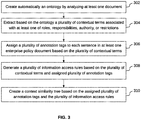
- FIG. 3 a flow chart of a method for creating a context similarity tree to determine user access to information in an enterprise network is illustrated, in accordance with an embodiment.
- input documents are first processed by enterprise network device 102.
- Input documents may be received via UI 122, an application (for example, Adobe Acrobat, BOTs, MS Word, Internet Explorer, etc.), or an external device (for example, a scanner, a fax machine, or a computing device, etc.).
- an application for example, Adobe Acrobat, BOTs, MS Word, Internet Explorer, etc.
- an external device for example, a scanner, a fax machine, or a computing device, etc.
- every job role or level would have a predefined role, responsibility, authority, and restrictions associated with it.
- the input documents would include job descriptor documents and security policy documents that have semantic information associated with job descriptions for different roles or employee levels within the enterprise. These documents would thus include detailed information for roles and its responsibilities, authorities, and restrictions associated with a plurality of users in the enterprise.
- enterprise network device 102 automatically analyzes these input documents, as and when they are created and fed into the system, and subsequently creates an ontology by extracting semantic information from them. Restrictions associated with a role may be based on time, geography information and personal information. Additionally, restrictions associated with a role may also be based on role dynamicity, which means different roles played by the same person having two different time or geographies or personal information. This has already been explained in detail in conjunction with FIG. 2 .
- enterprise network device 102 Based on the ontology, at 304, enterprise network device 102 extracts a plurality of contextual terms associated with one or more of roles, responsibilities, authority, or restrictions. These contextual terms after being extracted, may be normalized. However, two contextual terms may co-occur for various reasons, including functional and other relationships. Once the plurality of contextual terms have been extracted from the ontology, relationship amongst these plurality of contextual terms may be determined. In an embodiment, contextual terms that are dependent or other contextual terms or are completely independent of other contextual terms are determined. Each of the plurality of contextual terms may further be categorized into a plurality of categories. These categories may include, but are not limited to mandatory contextual terms, optional contextual terms, conditional contextual terms, value based contextual terms, or discrete terms. This has already been explained in detail in conjunction with FIG. 2 .
- enterprise network device 102 assigns a plurality of annotation tags to each sentence in one or more enterprise policy documents based on the plurality of contextual terms.
- Input policy documents may be enterprise policy documents, and examples of these documents may include, but are not limited to appraisal process document, a recruitment process document, and a general security process document.
- Each of the plurality of annotation tags correspond to one or more of roles, responsibilities, authority, and restrictions. This has already been explained in detail in conjunction with FIG. 2 .
- enterprise network device 102 Based on the plurality of contextual terms and assigned plurality of annotation tags to each sentence in the enterprise policy documents, enterprise network device 102, at 308, generates a plurality of information access rules.
- the plurality of information access rules would help defining how and when users would be allowed to access information in the enterprise network.
- the information access rules are automatically updated and revised in order to be in conformance with the new role definitions and enterprise policies.
- enterprise network device 102 creates a context similarity tree based on the assigned plurality of annotation tags and the plurality of information access rules. While creating context similarity tree model 216, each sentence that is assigned annotation tags is grouped based on the plurality of contextual terms. This has already been explained in detail in conjunction with FIG. 2 .
- the context similarity tree is then used by enterprise network device 102 to determine whether a user is authorized to access certain type of information stored in any database of the enterprise. That is, the context similarity tree is a data structure, the contents of which can be used to control user access to information. This is further explained in conjunction with FIG. 4 .
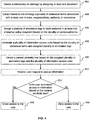
- an ontology tree is automatically created by analyzing one or more documents that include semantic information for roles, responsibilities, authority, and restrictions associated with a plurality of users.
- a plurality of contextual terms associated with one or more of roles, responsibilities, authority, or restrictions are extracted.
- a plurality of annotation tags are assigned to each sentence in one or more enterprise policy documents based on the plurality of contextual terms.
- Each of the plurality of annotation tags correspond to one or more of roles, responsibilities, authority, and restrictions.
- a plurality of information access rules are generated based on the plurality of contextual terms and assigned plurality of annotation tags to each sentence in the one or more enterprise policy documents.
- a context similarity tree is created based on the assigned plurality of annotation tags and the plurality of information access rules. This has been explained in detail in conjunction with FIG. 2 and FIG. 3 .
- enterprise network device 102 accesses the context similarity tree created at 410 and perform a check, at 414, to determine whether the user is authorized to access the requested information. If the user is authorized to access the requested information, enterprise network device 102, at 416, grants access to the user. As a result, the user is able to access the requested information. However, if the user is not authorized to access the requested information, enterprise network device 102, at 418, denies access to the user. As a result, the user is not able to access the requested information.
- a user from a particular account may request to "view appraisal.”
- the scope of operation in this case is defined in table 4 as: "Employees of same account,” the user may be granted access only when he/she belongs to the same account.
- FIG. 5 is a block diagram of an exemplary computer system for implementing various embodiments.
- Computer system 502 may comprise a central processing unit (“CPU” or "processor") 504.
- Processor 504 may comprise at least one data processor for executing program components for executing user- or system-generated requests.
- a user may include a person, a person using a device such as such as those included in this disclosure, or such a device itself.
- the processor may include specialized processing units such as integrated system (bus) controllers, memory management control units, floating point units, graphics processing units, digital signal processing units, etc.
- the processor may include a microprocessor, such as AMD Athlon, Duron or Opteron, ARM's application, embedded or secure processors, IBM PowerPC, Intel's Core, Itanium, Xeon, Celeron or other line of processors, etc.
- Processor 504 may be implemented using mainframe, distributed processor, multi-core, parallel, grid, or other architectures. Some embodiments may utilize embedded technologies like application-specific integrated circuits (ASICs), digital signal processors (DSPs), Field Programmable Gate Arrays (FPGAs), etc.
- ASICs application-specific integrated circuits
- DSPs digital signal processors
- FPGAs Field Programmable Gate Arrays
- I/O interface 506 may employ communication protocols/methods such as, without limitation, audio, analog, digital, monoaural, RCA, stereo, IEEE-1394, serial bus, universal serial bus (USB), infrared, PS/2, BNC, coaxial, component, composite, digital visual interface (DVI), high-definition multimedia interface (HDMI), RF antennas, S-Video, VGA, IEEE 802.n /b/g/n/x, Bluetooth, cellular (e.g., code-division multiple access (CDMA), high-speed packet access (HSPA+), global system for mobile communications (GSM), long-term evolution (LTE), WiMax, or the like), etc.
- CDMA code-division multiple access
- HSPA+ high-speed packet access
- GSM global system for mobile communications
- LTE long-term evolution
- WiMax wireless wide area network
- I/O interface 506 computer system 502 may communicate with one or more I/O devices.
- an input device 508 may be an antenna, keyboard, mouse, joystick, (infrared) remote control, camera, card reader, fax machine, dongle, biometric reader, microphone, touch screen, touchpad, trackball, sensor (e.g., accelerometer, light sensor, GPS, gyroscope, proximity sensor, or the like), stylus, scanner, storage device, transceiver, video device/source, visors, etc.
- an input device 508 may be an antenna, keyboard, mouse, joystick, (infrared) remote control, camera, card reader, fax machine, dongle, biometric reader, microphone, touch screen, touchpad, trackball, sensor (e.g., accelerometer, light sensor, GPS, gyroscope, proximity sensor, or the like), stylus, scanner, storage device, transceiver, video device/source, visors, etc.
- sensor e.g., accelerometer, light sensor, GPS
- An output device 510 may be a printer, fax machine, video display (e.g., cathode ray tube (CRT), liquid crystal display (LCD), light-emitting diode (LED), plasma, or the like), audio speaker, etc.
- a transceiver 512 may be disposed in connection with processor 504. Transceiver 512 may facilitate various types of wireless transmission or reception.
- transceiver 512 may include an antenna operatively connected to a transceiver chip (e.g., Texas Instruments WiLink WL1283, Broadcom BCM4750IUB8, Infineon Technologies X-Gold 618-PMB9800, or the like), providing IEEE 802.11a/b/g/n, Bluetooth, FM, global positioning system (GPS), 2G/3G HSDPA/HSUPA communications, etc.
- a transceiver chip e.g., Texas Instruments WiLink WL1283, Broadcom BCM4750IUB8, Infineon Technologies X-Gold 618-PMB9800, or the like
- IEEE 802.11a/b/g/n e.g., Texas Instruments WiLink WL1283, Broadcom BCM4750IUB8, Infineon Technologies X-Gold 618-PMB9800, or the like
- IEEE 802.11a/b/g/n e.g., Bluetooth, FM, global positioning system (GPS), 2G/3G HSDPA/
- processor 504 may be disposed in communication with a communication network 514 via a network interface 516.
- Network interface 516 may communicate with communication network 514.
- Network interface 516 may employ connection protocols including, without limitation, direct connect, Ethernet (e.g., twisted pair 50/500/5000 Base T), transmission control protocol/internet protocol (TCP/IP), token ring, IEEE 802.11a/b/g/n/x, etc.
- Communication network 514 may include, without limitation, a direct interconnection, local area network (LAN), wide area network (WAN), wireless network (e.g., using Wireless Application Protocol), the Internet, etc.
- LAN local area network
- WAN wide area network
- wireless network e.g., using Wireless Application Protocol
- These devices may include, without limitation, personal computer(s), server(s), fax machines, printers, scanners, various mobile devices such as cellular telephones, smartphones (e.g., Apple iPhone, Blackberry, Android-based phones, etc.), tablet computers, eBook readers (Amazon Kindle, Nook, etc.), laptop computers, notebooks, gaming consoles (Microsoft Xbox, Nintendo DS, Sony PlayStation, etc.), or the like.
- computer system 502 may itself embody one or more of these devices.
- processor 504 may be disposed in communication with one or more memory devices (e.g., RAM 526, ROM 528, etc.) via a storage interface 524.
- Storage interface 524 may connect to memory devices 530 including, without limitation, memory drives, removable disc drives, etc., employing connection protocols such as serial advanced technology attachment (SATA), integrated drive electronics (IDE), IEEE-1394, universal serial bus (USB), fiber channel, small computer systems interface (SCSI), etc.
- the memory drives may further include a drum, magnetic disc drive, magneto-optical drive, optical drive, redundant array of independent discs (RAID), solid-state memory devices, solid-state drives, etc.
- Memory devices 530 may store a collection of program or database components, including, without limitation, an operating system 532, a user interface application 534, a web browser 536, a mail server 538, a mail client 540, a user/application data 542 (e.g., any data variables or data records discussed in this disclosure), etc.
- Operating system 532 may facilitate resource management and operation of the computer system 502.
- operating system 532 examples include, without limitation, Apple Macintosh OS X, Unix, Unix-like system distributions (e.g., Berkeley Software Distribution (BSD), FreeBSD, NetBSD, OpenBSD, etc.), Linux distributions (e.g., Red Hat, Ubuntu, Kubuntu, etc.), IBM OS/2, Microsoft Windows (XP, Vista/7/8, etc.), Apple iOS, Google Android, Blackberry OS, or the like.
- User interface 534 may facilitate display, execution, interaction, manipulation, or operation of program components through textual or graphical facilities.
- user interfaces may provide computer interaction interface elements on a display system operatively connected to computer system 502, such as cursors, icons, check boxes, menus, scrollers, windows, widgets, etc.
- GUIs Graphical user interfaces
- GUIs may be employed, including, without limitation, Apple Macintosh operating systems' Aqua, IBM OS/2, Microsoft Windows (e.g., Aero, Metro, etc.), Unix X-Windows, web interface libraries (e.g., ActiveX, Java, Javascript, AJAX, HTML, Adobe Flash, etc.), or the like.
- computer system 502 may implement web browser 536 stored program component.
- Web browser 536 may be a hypertext viewing application, such as Microsoft Internet Explorer, Google Chrome, Mozilla Firefox, Apple Safari, etc. Secure web browsing may be provided using HTTPS (secure hypertext transport protocol), secure sockets layer (SSL), Transport Layer Security (TLS), etc. Web browsers may utilize facilities such as AJAX, DHTML, Adobe Flash, JavaScript, Java, application programming interfaces (APIs), etc.
- computer system 502 may implement mail server 538 stored program component.
- Mail server 538 may be an Internet mail server such as Microsoft Exchange, or the like.
- the mail server may utilize facilities such as ASP, ActiveX, ANSI C++/C#, Microsoft .NET, CGI scripts, Java, JavaScript, PERL, PHP, Python, WebObjects, etc.
- the mail server may utilize communication protocols such as internet message access protocol (IMAP), messaging application programming interface (MAPI), Microsoft Exchange, post office protocol (POP), simple mail transfer protocol (SMTP), or the like.
- computer system 502 may implement mail client 540 stored program component.
- Mail client 540 may be a mail viewing application, such as Apple Mail, Microsoft Entourage, Microsoft Outlook, Mozilla Thunderbird, etc.
- computer system 502 may store user/application data 542, such as the data, variables, records, etc. as described in this disclosure.
- databases may be implemented as fault-tolerant, relational, scalable, secure databases such as Oracle or Sybase.
- databases may be implemented using standardized data structures, such as an array, hash, linked list, struct, structured text file (e.g., XML), table, or as object-oriented databases (e.g., using ObjectStore, Poet, Zope, etc.).
- object-oriented databases e.g., using ObjectStore, Poet, Zope, etc.
- Such databases may be consolidated or distributed, sometimes among the various computer systems discussed above in this disclosure. It is to be understood that the structure and operation of the any computer or database component may be combined, consolidated, or distributed in any working combination.
- Various embodiments provide methods and system for controlling user access to information in enterprise networks. These methods and systems enable efficient management of access to information in an enterprise without requiring a centralized authority. Moreover, the access management is multiple context based, i.e., time, geography, role, responsibility, and restrictions etc. Additionally, creation of context similarity tree is a continuously evolving process, such that, as and when new input documents are introduced in the enterprise, the fields within context similarity tree are automatically updated. This ensures that users are allowed access to information within the enterprise based on the latest policies defined in the enterprise. The system thus allows users to efficiently manage read and write access to linked data without a centralized authority.
- a computer-readable storage medium refers to any type of physical memory on which information or data readable by a processor may be stored.
- a computer-readable storage medium may store instructions for execution by one or more processors, including instructions for causing the processor(s) to perform steps or stages consistent with the embodiments described herein.
- the term "computer-readable medium” should be understood to include tangible items and exclude carrier waves and transient signals, i.e., be non-transitory. Examples include random access memory (RAM), read-only memory (ROM), volatile memory, nonvolatile memory, hard drives, CD ROMs, DVDs, flash drives, disks, and any other known physical storage media.
Landscapes
- Engineering & Computer Science (AREA)
- Theoretical Computer Science (AREA)
- Physics & Mathematics (AREA)
- Databases & Information Systems (AREA)
- General Physics & Mathematics (AREA)
- General Engineering & Computer Science (AREA)
- Data Mining & Analysis (AREA)
- Health & Medical Sciences (AREA)
- Computer Security & Cryptography (AREA)
- Computer Hardware Design (AREA)
- General Health & Medical Sciences (AREA)
- Bioethics (AREA)
- Software Systems (AREA)
- Mathematical Physics (AREA)
- Computational Linguistics (AREA)
- Animal Behavior & Ethology (AREA)
- Artificial Intelligence (AREA)
- Human Computer Interaction (AREA)
- Life Sciences & Earth Sciences (AREA)
- Automation & Control Theory (AREA)
- Management, Administration, Business Operations System, And Electronic Commerce (AREA)
- Information Retrieval, Db Structures And Fs Structures Therefor (AREA)
Applications Claiming Priority (1)
| Application Number | Priority Date | Filing Date | Title |
|---|---|---|---|
| IN201641044921 | 2016-12-29 |
Publications (1)
| Publication Number | Publication Date |
|---|---|
| EP3343401A1 true EP3343401A1 (de) | 2018-07-04 |
Family
ID=58358441
Family Applications (1)
| Application Number | Title | Priority Date | Filing Date |
|---|---|---|---|
| EP17161467.0A Withdrawn EP3343401A1 (de) | 2016-12-29 | 2017-03-17 | Verfahren und system zur steuerung des benutzerzugriffs auf informationen in unternehmensnetzwerken |
Country Status (2)
| Country | Link |
|---|---|
| US (1) | US10331759B2 (de) |
| EP (1) | EP3343401A1 (de) |
Families Citing this family (3)
| Publication number | Priority date | Publication date | Assignee | Title |
|---|---|---|---|---|
| US11399030B2 (en) * | 2018-07-23 | 2022-07-26 | Kyndryl, Inc. | Ontology based control of access to resources in a computing system |
| CN109343863B (zh) * | 2018-09-06 | 2022-01-04 | 福建星瑞格软件有限公司 | 一种hdfs权限的界面配置方法及系统 |
| CN113282629A (zh) * | 2021-06-16 | 2021-08-20 | 中国建设银行股份有限公司 | 一种惠补政策推荐方法和装置 |
Citations (1)
| Publication number | Priority date | Publication date | Assignee | Title |
|---|---|---|---|---|
| US20110246441A1 (en) * | 2008-02-08 | 2011-10-06 | International Business Machines Corporation | Constructing a domain-specific ontology by mining the web |
Family Cites Families (11)
| Publication number | Priority date | Publication date | Assignee | Title |
|---|---|---|---|---|
| US7526425B2 (en) * | 2001-08-14 | 2009-04-28 | Evri Inc. | Method and system for extending keyword searching to syntactically and semantically annotated data |
| US20090070322A1 (en) * | 2007-08-31 | 2009-03-12 | Powerset, Inc. | Browsing knowledge on the basis of semantic relations |
| US8442940B1 (en) * | 2008-11-18 | 2013-05-14 | Semantic Research, Inc. | Systems and methods for pairing of a semantic network and a natural language processing information extraction system |
| US8554710B2 (en) * | 2010-02-12 | 2013-10-08 | Raytheon Company | Converting video metadata to propositional graphs for use in an analogical reasoning system |
| DE102013003055A1 (de) * | 2013-02-18 | 2014-08-21 | Nadine Sina Kurz | Verfahren und Vorrichtung zum Durchführen von Suchen in natürlicher Sprache |
| US9740736B2 (en) * | 2013-09-19 | 2017-08-22 | Maluuba Inc. | Linking ontologies to expand supported language |
| US10223699B2 (en) * | 2014-08-05 | 2019-03-05 | CrowdCare Corporation | System and method of rule creation based on frequency of question |
| US10095689B2 (en) * | 2014-12-29 | 2018-10-09 | International Business Machines Corporation | Automated ontology building |
| RU2584457C1 (ru) * | 2015-02-03 | 2016-05-20 | Общество с ограниченной ответственностью "Аби ИнфоПоиск" | Система и способ создания и использования пользовательских семантических словарей для обработки пользовательского текста на естественном языке |
| WO2017015231A1 (en) * | 2015-07-17 | 2017-01-26 | Fido Labs, Inc. | Natural language processing system and method |
| US10878191B2 (en) * | 2016-05-10 | 2020-12-29 | Nuance Communications, Inc. | Iterative ontology discovery |
-
2017
- 2017-02-14 US US15/431,849 patent/US10331759B2/en active Active
- 2017-03-17 EP EP17161467.0A patent/EP3343401A1/de not_active Withdrawn
Patent Citations (1)
| Publication number | Priority date | Publication date | Assignee | Title |
|---|---|---|---|---|
| US20110246441A1 (en) * | 2008-02-08 | 2011-10-06 | International Business Machines Corporation | Constructing a domain-specific ontology by mining the web |
Non-Patent Citations (3)
| Title |
|---|
| JOHN SLANKAS: "Implementing database access control policy from unconstrained natural language text", SOFTWARE ENGINEERING, IEEE PRESS, 445 HOES LANE, PO BOX 1331, PISCATAWAY, NJ 08855-1331 USA, 18 May 2013 (2013-05-18), pages 1357 - 1360, XP058019351, ISBN: 978-1-4673-3076-3, DOI: 10.1109/ICSE.2013.6606716 * |
| NAROUEI MASOUD ET AL: "Automatic Top-Down Role Engineering Framework Using Natural Language Processing Techniques", 24 October 2015, NETWORK AND PARALLEL COMPUTING; [LECTURE NOTES IN COMPUTER SCIENCE; LECT.NOTES COMPUTER], SPRINGER INTERNATIONAL PUBLISHING, CHAM, PAGE(S) 137 - 152, ISBN: 978-3-642-38492-9, ISSN: 0302-9743, XP047323745 * |
| XUSHENG XIAO ET AL: "Automated extraction of security policies from natural-language software documents", PROCEEDINGS OF THE ACM SIGSOFT 20TH INTERNATIONAL SYMPOSIUM ON THE FOUNDATIONS OF SOFTWARE ENGINEERING, FSE '12, 1 January 2012 (2012-01-01), New York, New York, USA, pages 1, XP055327053, ISBN: 978-1-4503-1614-9, DOI: 10.1145/2393596.2393608 * |
Also Published As
| Publication number | Publication date |
|---|---|
| US10331759B2 (en) | 2019-06-25 |
| US20180189413A1 (en) | 2018-07-05 |
Similar Documents
| Publication | Publication Date | Title |
|---|---|---|
| US10896288B1 (en) | Systems, devices, and methods for software coding | |
| US10803253B2 (en) | Method and device for extracting point of interest from natural language sentences | |
| US10528669B2 (en) | Method and device for extracting causal from natural language sentences for intelligent systems | |
| US9892278B2 (en) | Focused personal identifying information redaction | |
| US9037537B2 (en) | Automatic redaction of content for alternate reviewers in document workflow solutions | |
| US10861437B2 (en) | Method and device for extracting factoid associated words from natural language sentences | |
| US20170262525A1 (en) | Systems and methods for secure storage of user information in a user profile | |
| US10803252B2 (en) | Method and device for extracting attributes associated with centre of interest from natural language sentences | |
| US12216780B2 (en) | Managing purpose-based processing of data using a purpose agent | |
| US20180285768A1 (en) | Method and system for rendering a resolution for an incident ticket | |
| US20170318077A1 (en) | Method for associating previously created social media data with an individual or entity | |
| US11216614B2 (en) | Method and device for determining a relation between two or more entities | |
| US11721116B2 (en) | Managing camera actions | |
| US12339917B2 (en) | Method and system for generating user role-specific responses through Large Language Models | |
| US12579305B2 (en) | Data security for machine learning systems | |
| US10803251B2 (en) | Method and device for extracting action of interest from natural language sentences | |
| US10331759B2 (en) | Methods and system for controlling user access to information in enterprise networks | |
| US9910880B2 (en) | System and method for managing enterprise user group | |
| US20180285795A1 (en) | Method and device for risk analysis using risk relationship mapping in supply chain networks | |
| US10380372B2 (en) | Methods and systems for providing secured access to big data | |
| US20170154286A1 (en) | Methods and systems for identifying risks and associated root causes in supply chain networks | |
| US11182560B2 (en) | System and method for language independent iterative learning mechanism for NLP tasks | |
| CN113918511A (zh) | 一种多要素数据分析处理方法、系统和存储介质 | |
| CN119293058B (zh) | 一种基于动态表单的数据管理方法 | |
| US12530341B2 (en) | Computer-automated smart data room |
Legal Events
| Date | Code | Title | Description |
|---|---|---|---|
| PUAI | Public reference made under article 153(3) epc to a published international application that has entered the european phase |
Free format text: ORIGINAL CODE: 0009012 |
|
| AK | Designated contracting states |
Kind code of ref document: A1 Designated state(s): AL AT BE BG CH CY CZ DE DK EE ES FI FR GB GR HR HU IE IS IT LI LT LU LV MC MK MT NL NO PL PT RO RS SE SI SK SM TR |
|
| AX | Request for extension of the european patent |
Extension state: BA ME |
|
| STAA | Information on the status of an ep patent application or granted ep patent |
Free format text: STATUS: THE APPLICATION IS DEEMED TO BE WITHDRAWN |
|
| 18D | Application deemed to be withdrawn |
Effective date: 20190105 |