EP3342759A1 - Ion exchangeable glass with high crack initiation threshold - Google Patents
Ion exchangeable glass with high crack initiation threshold Download PDFInfo
- Publication number
- EP3342759A1 EP3342759A1 EP18156305.7A EP18156305A EP3342759A1 EP 3342759 A1 EP3342759 A1 EP 3342759A1 EP 18156305 A EP18156305 A EP 18156305A EP 3342759 A1 EP3342759 A1 EP 3342759A1
- Authority
- EP
- European Patent Office
- Prior art keywords
- mol
- glass
- alkali aluminosilicate
- aluminosilicate glass
- layer
- Prior art date
- Legal status (The legal status is an assumption and is not a legal conclusion. Google has not performed a legal analysis and makes no representation as to the accuracy of the status listed.)
- Granted
Links
Images


Classifications
-
- C—CHEMISTRY; METALLURGY
- C03—GLASS; MINERAL OR SLAG WOOL
- C03C—CHEMICAL COMPOSITION OF GLASSES, GLAZES OR VITREOUS ENAMELS; SURFACE TREATMENT OF GLASS; SURFACE TREATMENT OF FIBRES OR FILAMENTS MADE FROM GLASS, MINERALS OR SLAGS; JOINING GLASS TO GLASS OR OTHER MATERIALS
- C03C3/00—Glass compositions
- C03C3/04—Glass compositions containing silica
- C03C3/076—Glass compositions containing silica with 40% to 90% silica, by weight
- C03C3/097—Glass compositions containing silica with 40% to 90% silica, by weight containing phosphorus, niobium or tantalum
-
- C—CHEMISTRY; METALLURGY
- C03—GLASS; MINERAL OR SLAG WOOL
- C03C—CHEMICAL COMPOSITION OF GLASSES, GLAZES OR VITREOUS ENAMELS; SURFACE TREATMENT OF GLASS; SURFACE TREATMENT OF FIBRES OR FILAMENTS MADE FROM GLASS, MINERALS OR SLAGS; JOINING GLASS TO GLASS OR OTHER MATERIALS
- C03C14/00—Glass compositions containing a non-glass component, e.g. compositions containing fibres, filaments, whiskers, platelets, or the like, dispersed in a glass matrix
- C03C14/006—Glass compositions containing a non-glass component, e.g. compositions containing fibres, filaments, whiskers, platelets, or the like, dispersed in a glass matrix the non-glass component being in the form of microcrystallites, e.g. of optically or electrically active material
-
- C—CHEMISTRY; METALLURGY
- C03—GLASS; MINERAL OR SLAG WOOL
- C03C—CHEMICAL COMPOSITION OF GLASSES, GLAZES OR VITREOUS ENAMELS; SURFACE TREATMENT OF GLASS; SURFACE TREATMENT OF FIBRES OR FILAMENTS MADE FROM GLASS, MINERALS OR SLAGS; JOINING GLASS TO GLASS OR OTHER MATERIALS
- C03C21/00—Treatment of glass, not in the form of fibres or filaments, by diffusing ions or metals in the surface
- C03C21/001—Treatment of glass, not in the form of fibres or filaments, by diffusing ions or metals in the surface in liquid phase, e.g. molten salts, solutions
- C03C21/002—Treatment of glass, not in the form of fibres or filaments, by diffusing ions or metals in the surface in liquid phase, e.g. molten salts, solutions to perform ion-exchange between alkali ions
-
- C—CHEMISTRY; METALLURGY
- C03—GLASS; MINERAL OR SLAG WOOL
- C03C—CHEMICAL COMPOSITION OF GLASSES, GLAZES OR VITREOUS ENAMELS; SURFACE TREATMENT OF GLASS; SURFACE TREATMENT OF FIBRES OR FILAMENTS MADE FROM GLASS, MINERALS OR SLAGS; JOINING GLASS TO GLASS OR OTHER MATERIALS
- C03C3/00—Glass compositions
- C03C3/04—Glass compositions containing silica
- C03C3/076—Glass compositions containing silica with 40% to 90% silica, by weight
- C03C3/083—Glass compositions containing silica with 40% to 90% silica, by weight containing aluminium oxide or an iron compound
-
- C—CHEMISTRY; METALLURGY
- C03—GLASS; MINERAL OR SLAG WOOL
- C03C—CHEMICAL COMPOSITION OF GLASSES, GLAZES OR VITREOUS ENAMELS; SURFACE TREATMENT OF GLASS; SURFACE TREATMENT OF FIBRES OR FILAMENTS MADE FROM GLASS, MINERALS OR SLAGS; JOINING GLASS TO GLASS OR OTHER MATERIALS
- C03C3/00—Glass compositions
- C03C3/04—Glass compositions containing silica
- C03C3/076—Glass compositions containing silica with 40% to 90% silica, by weight
- C03C3/083—Glass compositions containing silica with 40% to 90% silica, by weight containing aluminium oxide or an iron compound
- C03C3/085—Glass compositions containing silica with 40% to 90% silica, by weight containing aluminium oxide or an iron compound containing an oxide of a divalent metal
-
- C—CHEMISTRY; METALLURGY
- C03—GLASS; MINERAL OR SLAG WOOL
- C03C—CHEMICAL COMPOSITION OF GLASSES, GLAZES OR VITREOUS ENAMELS; SURFACE TREATMENT OF GLASS; SURFACE TREATMENT OF FIBRES OR FILAMENTS MADE FROM GLASS, MINERALS OR SLAGS; JOINING GLASS TO GLASS OR OTHER MATERIALS
- C03C3/00—Glass compositions
- C03C3/04—Glass compositions containing silica
- C03C3/076—Glass compositions containing silica with 40% to 90% silica, by weight
- C03C3/083—Glass compositions containing silica with 40% to 90% silica, by weight containing aluminium oxide or an iron compound
- C03C3/085—Glass compositions containing silica with 40% to 90% silica, by weight containing aluminium oxide or an iron compound containing an oxide of a divalent metal
- C03C3/087—Glass compositions containing silica with 40% to 90% silica, by weight containing aluminium oxide or an iron compound containing an oxide of a divalent metal containing calcium oxide, e.g. common sheet or container glass
-
- C—CHEMISTRY; METALLURGY
- C03—GLASS; MINERAL OR SLAG WOOL
- C03C—CHEMICAL COMPOSITION OF GLASSES, GLAZES OR VITREOUS ENAMELS; SURFACE TREATMENT OF GLASS; SURFACE TREATMENT OF FIBRES OR FILAMENTS MADE FROM GLASS, MINERALS OR SLAGS; JOINING GLASS TO GLASS OR OTHER MATERIALS
- C03C4/00—Compositions for glass with special properties
- C03C4/02—Compositions for glass with special properties for coloured glass
-
- C—CHEMISTRY; METALLURGY
- C03—GLASS; MINERAL OR SLAG WOOL
- C03C—CHEMICAL COMPOSITION OF GLASSES, GLAZES OR VITREOUS ENAMELS; SURFACE TREATMENT OF GLASS; SURFACE TREATMENT OF FIBRES OR FILAMENTS MADE FROM GLASS, MINERALS OR SLAGS; JOINING GLASS TO GLASS OR OTHER MATERIALS
- C03C21/00—Treatment of glass, not in the form of fibres or filaments, by diffusing ions or metals in the surface
-
- C—CHEMISTRY; METALLURGY
- C03—GLASS; MINERAL OR SLAG WOOL
- C03C—CHEMICAL COMPOSITION OF GLASSES, GLAZES OR VITREOUS ENAMELS; SURFACE TREATMENT OF GLASS; SURFACE TREATMENT OF FIBRES OR FILAMENTS MADE FROM GLASS, MINERALS OR SLAGS; JOINING GLASS TO GLASS OR OTHER MATERIALS
- C03C2204/00—Glasses, glazes or enamels with special properties
-
- C—CHEMISTRY; METALLURGY
- C03—GLASS; MINERAL OR SLAG WOOL
- C03C—CHEMICAL COMPOSITION OF GLASSES, GLAZES OR VITREOUS ENAMELS; SURFACE TREATMENT OF GLASS; SURFACE TREATMENT OF FIBRES OR FILAMENTS MADE FROM GLASS, MINERALS OR SLAGS; JOINING GLASS TO GLASS OR OTHER MATERIALS
- C03C3/00—Glass compositions
- C03C3/04—Glass compositions containing silica
-
- C—CHEMISTRY; METALLURGY
- C03—GLASS; MINERAL OR SLAG WOOL
- C03C—CHEMICAL COMPOSITION OF GLASSES, GLAZES OR VITREOUS ENAMELS; SURFACE TREATMENT OF GLASS; SURFACE TREATMENT OF FIBRES OR FILAMENTS MADE FROM GLASS, MINERALS OR SLAGS; JOINING GLASS TO GLASS OR OTHER MATERIALS
- C03C3/00—Glass compositions
- C03C3/04—Glass compositions containing silica
- C03C3/062—Glass compositions containing silica with less than 40% silica by weight
-
- C—CHEMISTRY; METALLURGY
- C03—GLASS; MINERAL OR SLAG WOOL
- C03C—CHEMICAL COMPOSITION OF GLASSES, GLAZES OR VITREOUS ENAMELS; SURFACE TREATMENT OF GLASS; SURFACE TREATMENT OF FIBRES OR FILAMENTS MADE FROM GLASS, MINERALS OR SLAGS; JOINING GLASS TO GLASS OR OTHER MATERIALS
- C03C3/00—Glass compositions
- C03C3/04—Glass compositions containing silica
- C03C3/062—Glass compositions containing silica with less than 40% silica by weight
- C03C3/064—Glass compositions containing silica with less than 40% silica by weight containing boron
-
- C—CHEMISTRY; METALLURGY
- C03—GLASS; MINERAL OR SLAG WOOL
- C03C—CHEMICAL COMPOSITION OF GLASSES, GLAZES OR VITREOUS ENAMELS; SURFACE TREATMENT OF GLASS; SURFACE TREATMENT OF FIBRES OR FILAMENTS MADE FROM GLASS, MINERALS OR SLAGS; JOINING GLASS TO GLASS OR OTHER MATERIALS
- C03C3/00—Glass compositions
- C03C3/04—Glass compositions containing silica
- C03C3/076—Glass compositions containing silica with 40% to 90% silica, by weight
- C03C3/089—Glass compositions containing silica with 40% to 90% silica, by weight containing boron
- C03C3/091—Glass compositions containing silica with 40% to 90% silica, by weight containing boron containing aluminium
-
- C—CHEMISTRY; METALLURGY
- C03—GLASS; MINERAL OR SLAG WOOL
- C03C—CHEMICAL COMPOSITION OF GLASSES, GLAZES OR VITREOUS ENAMELS; SURFACE TREATMENT OF GLASS; SURFACE TREATMENT OF FIBRES OR FILAMENTS MADE FROM GLASS, MINERALS OR SLAGS; JOINING GLASS TO GLASS OR OTHER MATERIALS
- C03C3/00—Glass compositions
- C03C3/04—Glass compositions containing silica
- C03C3/076—Glass compositions containing silica with 40% to 90% silica, by weight
- C03C3/089—Glass compositions containing silica with 40% to 90% silica, by weight containing boron
- C03C3/091—Glass compositions containing silica with 40% to 90% silica, by weight containing boron containing aluminium
- C03C3/093—Glass compositions containing silica with 40% to 90% silica, by weight containing boron containing aluminium containing zinc or zirconium
-
- C—CHEMISTRY; METALLURGY
- C03—GLASS; MINERAL OR SLAG WOOL
- C03C—CHEMICAL COMPOSITION OF GLASSES, GLAZES OR VITREOUS ENAMELS; SURFACE TREATMENT OF GLASS; SURFACE TREATMENT OF FIBRES OR FILAMENTS MADE FROM GLASS, MINERALS OR SLAGS; JOINING GLASS TO GLASS OR OTHER MATERIALS
- C03C4/00—Compositions for glass with special properties
- C03C4/18—Compositions for glass with special properties for ion-sensitive glass
-
- Y—GENERAL TAGGING OF NEW TECHNOLOGICAL DEVELOPMENTS; GENERAL TAGGING OF CROSS-SECTIONAL TECHNOLOGIES SPANNING OVER SEVERAL SECTIONS OF THE IPC; TECHNICAL SUBJECTS COVERED BY FORMER USPC CROSS-REFERENCE ART COLLECTIONS [XRACs] AND DIGESTS
- Y10—TECHNICAL SUBJECTS COVERED BY FORMER USPC
- Y10T—TECHNICAL SUBJECTS COVERED BY FORMER US CLASSIFICATION
- Y10T428/00—Stock material or miscellaneous articles
- Y10T428/26—Web or sheet containing structurally defined element or component, the element or component having a specified physical dimension
- Y10T428/263—Coating layer not in excess of 5 mils thick or equivalent
- Y10T428/264—Up to 3 mils
- Y10T428/265—1 mil or less
-
- Y—GENERAL TAGGING OF NEW TECHNOLOGICAL DEVELOPMENTS; GENERAL TAGGING OF CROSS-SECTIONAL TECHNOLOGIES SPANNING OVER SEVERAL SECTIONS OF THE IPC; TECHNICAL SUBJECTS COVERED BY FORMER USPC CROSS-REFERENCE ART COLLECTIONS [XRACs] AND DIGESTS
- Y10—TECHNICAL SUBJECTS COVERED BY FORMER USPC
- Y10T—TECHNICAL SUBJECTS COVERED BY FORMER US CLASSIFICATION
- Y10T428/00—Stock material or miscellaneous articles
- Y10T428/31—Surface property or characteristic of web, sheet or block
- Y10T428/315—Surface modified glass [e.g., tempered, strengthened, etc.]
Definitions
- the disclosure relates to damage resistant glasses. More particularly, the disclosure relates to damage resistant glasses that have optionally been strengthened by ion exchange. Even more particularly, the disclosure relates to damage resistant, phosphate containing glasses that have optionally been strengthened by ion exchange.
- Alkali aluminosilicate glasses which, when strengthened, are resistant to damage due to sharp impact and capable of fast ion exchange, are provided.
- the glasses comprise at least 4 mol% P 2 O 5 and, when ion exchanged, have a Vickers indentation crack initiation load of at least about 7 kgf.
- one aspect comprises an alkali aluminosilicate glass comprising at least about 4% P 2 O 5 , wherein the alkali aluminosilicate glass is ion exchanged to a depth of layer of at least about 10 ⁇ m, and wherein:
- Another aspect comprises an alkali aluminosilicate glass comprising from about 40 mol% to about 70 mol% SiO 2 ; from about 11 mol% to about 25 mol% Al 2 O 3 ; from about 4 mol% to about 15 mol% P 2 O 5 ; and from about 13 mol% to about 25 mol% Na 2 O.
- the alkali aluminosilicate glass comprises from about 50 mol% to about 65 mol% SiO 2 ; from about 14 mol% to about 20 mol% Al 2 O 3 ; from about 4 mol% to about 10 mol% P 2 O 5 ; and from about 14 mol% to about 20 mol% Na 2 O.
- the alkali aluminosilicate glass further comprises less than 1 mol% K 2 O. In some embodiments, the alkali aluminosilicate glass further comprises less than 1 mol% B 2 O 3 .
- the the monovalent and divalent cation oxides are selected from the group consisting of Li 2 O, Na 2 O, K 2 O, Rb 2 O, Cs 2 O, MgO, CaO, SrO, BaO, and ZnO.
- the alkali aluminosilicate glass has a potassium/sodium interdiffusion coefficient of at least about 2.4 x 10 -10 cm 2 /s at 410°C.
- the potassium/sodium interdiffusion coefficient is in a range from about 2.4 x 10 -10 cm 2 /s up to about 1.5 x 10 -9 cm 2 /s at 410°C.
- the glass has a compressive layer extending from a surface of the glass to the depth of layer, and wherein the compressive layer is under a compressive stress of at least about 300 MPa.
- the glass has a Vickers indentation crack initiation load of at least about 7 kgf. In some embodiments, the glass has a Vickers indentation crack initiation load of at least about 12 kgf.
- Another aspect comprises a method of strengthening an alkali aluminosilicate glass, the method comprising providing the alkali aluminosilicate glass comprising at least about 4% P 2 O 5 , wherein:
- the monovalent and divalent cation oxides are selected from the group consisting of Li 2 O, Na 2 O, K 2 O, Rb 2 O, Cs 2 O, MgO, CaO, SrO, BaO, and ZnO.
- the alkali aluminosilicate glass comprises from about 40 mol% to about 70 mol% SiO 2 ; from about 11 mol% to about 25 mol% Al 2 O 3 ; from about 4 mol% to about 15 mol% P 2 O 5 ; and from about 13 mol% to about 25 mol% Na 2 O. In other embodiments, the alkali aluminosilicate glass comprises from about 50 mol% to about 65 mol% SiO 2 ; from about 14 mol% to about 20 mol% Al 2 O 3 ; from about 4 mol% to about 10 mol% P 2 O 5 ; and from about 14 mol% to about 20 mol% Na 2 O.
- the composition further comprises less than 1 mol% K 2 O. In some embodiments, the composition further comprises about 0 mol% K 2 O. In some embodiments, the composition further comprises less than 1 mol% B 2 O 3 . In some embodiments, the composition further comprises about 0 mol% B 2 O 3 .
- Embodiments may be ion exchanged.
- the glass is ion exchanged to a depth of layer of at least about 10 ⁇ m.
- the glass is ion exchanged to a depth of layer of at least about 20 ⁇ m.
- the glass is ion exchanged to a depth of layer of at least about 40 ⁇ m.
- the alkali aluminosilicate glass has a compressive layer extending from a surface of the glass to the depth of layer, and wherein the compressive layer is under a compressive stress of at least about 300 MPa.
- the alkali aluminosilicate glass has a compressive layer extending from a surface of the glass to the depth of layer, and wherein the compressive layer is under a compressive stress of at least about 500 MPa. In other embodiments, the alkali aluminosilicate glass has a compressive layer extending from a surface of the glass to the depth of layer, and wherein the compressive layer is under a compressive stress of at least about 750 MPa. In some embodiments, the ion exchanged alkali aluminosilicate glass has a Vickers indentation crack initiation load of at least about 7 kgf.
- the ion exchanged alkali aluminosilicate glass has a Vickers indentation crack initiation load of at least about 15 kgf. In other embodiments, the ion exchanged alkali aluminosilicate glass has a Vickers indentation crack initiation load of at least about 20 kgf. In some embodiments, the alkali aluminosilicate glass has a potassium/sodium interdiffusion coefficient of at least about 2.4 x 10 -10 cm 2 /s at 410°C. In some embodiments, the potassium/sodium interdiffusion coefficient is in a range from about 2.4 x 10 -10 cm 2 /s up to about 1.5 x 10 -9 cm 2 /s at 410°C.
- Another aspect is to provide an alkali aluminosilicate glass comprising at least about 4 mol% P 2 O 5 .
- the monovalent and divalent cation oxides are selected from the group consisting of Li 2 O, Na 2 O, K 2 O, Rb 2 O, Cs 2 O, MgO, CaO, SrO, BaO, and ZnO.
- the alkali aluminosilicate glass comprises from about 40 mol% to about 70 mol% SiO 2 ; from about 11 mol% to about 25 mol% Al 2 O 3 ; from about 4 mol% to about 15 mol% P 2 O 5 ; and from about 13 mol% to about 25 mol% Na 2 O. In other embodiments, the alkali aluminosilicate glass comprises from about 50 mol% to about 65 mol% SiO 2 ; from about 14 mol% to about 20 mol% Al 2 O 3 ; from about 4 mol% to about 10 mol% P 2 O 5 ; and from about 14 mol% to about 20 mol% Na 2 O.
- the composition further comprises less than 1 mol% K 2 O. In some embodiments, the composition further comprises about 0 mol% K 2 O. In some embodiments, the composition further comprises less than 1 mol% B 2 O 3 . In some embodiments, the composition further comprises about 0 mol% B 2 O 3 .
- Embodiments of the aspect may be ion exchanged.
- the glass is ion exchanged to a depth of layer of at least about 10 ⁇ m.
- the glass is ion exchanged to a depth of layer of at least about 20 ⁇ m.
- the glass is ion exchanged to a depth of layer of at least about 40 ⁇ m.
- the alkali aluminosilicate glass has a compressive layer extending from a surface of the glass to the depth of layer, and wherein the compressive layer is under a compressive stress of at least about 300 MPa.
- the alkali aluminosilicate glass has a compressive layer extending from a surface of the glass to the depth of layer, and wherein the compressive layer is under a compressive stress of at least about 500 MPa. In other embodiments, the alkali aluminosilicate glass has a compressive layer extending from a surface of the glass to the depth of layer, and wherein the compressive layer is under a compressive stress of at least about 750 MPa. In some embodiments, the ion exchanged alkali aluminosilicate glass has a Vickers indentation crack initiation load of at least about 7 kgf.
- the ion exchanged alkali aluminosilicate glass has a Vickers indentation crack initiation load of at least about 15 kgf. In other embodiments, the ion exchanged alkali aluminosilicate glass has a Vickers indentation crack initiation load of at least about 20 kgf. In some embodiments, the alkali aluminosilicate glass has a potassium/sodium interdiffusion coefficient of at least about 2.4 x 10 -10 cm 2 /s at 410°C. In some embodiments, the potassium/sodium interdiffusion coefficient is in a range from about 2.4 x 10 -10 cm 2 /s up to about 1.5 x 10 -9 cm 2 /s at 410°C.
- Another aspect of the disclosure is to provide a method of strengthening an alkali aluminosilicate glass.
- the method comprises: providing the alkali aluminosilicate glass, the alkali aluminosilicate glass comprising at least about 4 mol% P 2 O 5 , wherein:
- the alkali aluminosilicate glass has a compressive layer extending from a surface of the glass to the depth of layer, and wherein the compressive layer is under a compressive stress of at least about 300 MPa. In other embodiments, the alkali aluminosilicate glass has a compressive layer extending from a surface of the glass to the depth of layer, and wherein the compressive layer is under a compressive stress of at least about 500 MPa. In other embodiments, the alkali aluminosilicate glass has a compressive layer extending from a surface of the glass to the depth of layer, and wherein the compressive layer is under a compressive stress of at least about 750 MPa.
- the ion exchanged alkali aluminosilicate glass has a Vickers indentation crack initiation load of at least about 7 kgf. In still other embodiments, the ion exchanged alkali aluminosilicate glass has a Vickers indentation crack initiation load of at least about 15 kgf. In other embodiments, the ion exchanged alkali aluminosilicate glass has a Vickers indentation crack initiation load of at least about 20 kgf. In some embodiments, the alkali aluminosilicate glass has a potassium/sodium interdiffusion coefficient of at least about 2.4 x 10 -10 cm 2 /s at 410°C. In some embodiments, the potassium/sodium interdiffusion coefficient is in a range from about 2.4 x 10 -10 cm 2 /s up to about 1.5 x 10 -9 cm 2 /s at 410°C.
- the alkali aluminosilicate glass used in the method comprises monovalent and divalent cation oxides selected from the group consisting of Li 2 O, Na 2 O, K 2 O, Rb 2 O, Cs 2 O, MgO, CaO, SrO, BaO, and ZnO.
- the alkali aluminosilicate glass used in the method comprises from about 40 mol% to about 70 mol% SiO 2 ; from about 11 mol% to about 25 mol% Al 2 O 3 ; from about 4 mol% to about 15 mol% P 2 O 5 ; and from about 13 mol% to about 25 mol% Na 2 O.
- the alkali aluminosilicate glass used in the method comprises from about 50 mol% to about 65 mol% SiO 2 ; from about 14 mol% to about 20 mol% Al 2 O 3 ; from about 4 mol% to about 10 mol% P 2 O 5 ; and from about 14 mol% to about 20 mol% Na 2 O.
- the composition used in the method further comprises less than 1 mol% K 2 O. In some embodiments, the composition used in the method further comprises about 0 mol% K 2 O. In some embodiments, the composition used in the method further comprises less than 1 mol% B 2 O 3 . In some embodiments, the composition used in the method further comprises about 0 mol% B 2 O 3 .
- the sub-group of A-E, B-F, and C-E are specifically contemplated and should be considered disclosed from disclosure of A, B, and/or C; D, E, and/or F; and the example combination A-D.
- This concept applies to all aspects of this disclosure including, but not limited to any components of the compositions and steps in methods of making and using the disclosed compositions.
- additional steps that can be performed it is understood that each of these additional steps can be performed with any specific embodiment or combination of embodiments of the disclosed methods, and that each such combination is specifically contemplated and should be considered disclosed.
- a group is described as comprising at least one of a group of elements and combinations thereof, it is understood that the group may comprise, consist essentially of, or consist of any number of those elements recited, either individually or in combination with each other. Similarly, whenever a group is described as consisting of at least one of a group of elements or combinations thereof, it is understood that the group may consist of any number of those elements recited, either individually or in combination with each other.
- the term “about” means that amounts, sizes, formulations, parameters, and other quantities and characteristics are not and need not be exact, but may be approximate and/or larger or smaller, as desired, reflecting tolerances, conversion factors, rounding off, measurement error and the like, and other factors known to those of skill in the art. In general, an amount, size, formulation, parameter or other quantity or characteristic is “about” or “approximate” whether or not expressly stated to be such.
- indefinite articles “a” and “an” are employed to describe elements and components of embodiments. The use of these articles means that one or at least one of these elements or components is present. Although these articles are conventionally employed to signify that the modified noun is a singular noun, as used herein the articles “a” and “an” also include the plural, unless otherwise stated in specific instances. Similarly, the definite article “the”, as used herein, also signifies that the modified noun may be singular or plural, again unless otherwise stated in specific instances.
- variable being a "function" of a parameter or another variable is not intended to denote that the variable is exclusively a function of the listed parameter or variable. Rather, reference herein to a variable that is a "function" of a listed parameter is intended to be open ended such that the variable may be a function of a single parameter or a plurality of parameters. It is also understood that, unless otherwise specified, terms such as “top,” “bottom,” “outward,” “inward,” and the like are words of convenience and are not to be construed as limiting terms.
- a glass composition having 0 wt% or mol% of a compound is defined as meaning that the compound, molecule, or element was not purposefully added to the composition, but the composition may still comprise the compound, typically in tramp or trace amounts.
- “sodium-free,” “alkali-free,” “potassium-free” or the like are defined to mean that the compound, molecule, or element was not purposefully added to the composition, but the composition may still comprise sodium, alkali, or potassium, but in approximately tramp or trace amounts.
- concentrations of all constituents recited herein are expressed in terms of mole percent (mol%).
- Vickers indentation cracking threshold measurements described herein are performed by applying and then removing an indentation load to the glass surface at a rate of 0.2 mm/min. The maximum indentation load is held for 10 seconds.
- the indentation cracking threshold is defined at the indentation load at which 50% of 10 indents exhibit any number of radial/median cracks emanating from the corners of the indent impression. The maximum load is increased until the threshold is met for a given glass composition. All indentation measurements are performed at room temperature in 50% relative humidity.
- Chemically strengthened alkali aluminosilicate glasses having high damage resistance i.e., having Vickers cracking thresholds of greater than 15 kilograms force (kgf), and, in some embodiments, greater than 20 kgf, typically have compositions that satisfy the rule [(Al 2 O 3 (mol%) + B 2 O 3 (mol%))/( ⁇ modifier oxides(mol%))] > 1, where the modifier oxides include alkali and alkaline earth oxides.
- Such glasses have been previously described in U.S. Patent Application No. 12/858,490, filed August 18, 2010, by Kristen L. Barefoot et al. , entitled "Crack and Scratch Resistant Glass and Enclosures Made Therefrom.”
- the damage resistance of these glasses and glass articles is enhanced by the addition of at least about 4 mol% P 2 O 5 .
- the damage resistance is enhanced by the addition of at least about 5 mol% P 2 O 5 .
- the P 2 O 5 concentration is in a range from about 4 mol% up to about 10 mol% and, in other embodiments in a range from about 4 mol% up to about 15 mol%.
- Embodiments described herein generally fall outside the glasses and glass articles of the composition space described in U.S. Provisional Patent Application No. 61/417,941 .
- the glasses described in the present disclosure nominally comprise primarily tetrahedrally coordinated phosphate (PO 4 3- ) groups that contain one double-bonded oxygen per tetrahedral phosphorus structural unit.
- the ratio of (M 2 O 3 (mol%)/ ⁇ R x O(mol%)) is less than 1.4, 1.35, 1.3, 1.25, 1.2, 1.15, 1.1, 1.05, 1.0, 0.95, 0.9, 0.85, 0.8, 0.75, or 0.7.
- Y ⁇ (M 2 O 3 (mol%)/R x O(mol%)) ⁇ Z wherein Y is about 0.6, 0.65, 0.7, 0.75, 0.8, 0.85, 0.9, 0.95, 1.0, 1.05, or 1.1 and X is independently about 1.4, 1.35, 1.3, 1.25, 1.2, 1.15, 1.1, 1.05, 1.0, 0.95, 0.9, 0.85, 0.8, and wherein X > Y.
- Such monovalent and divalent oxides include, but are not limited to, alkali metal oxides (Li 2 O, Na 2 O, K 2 O, Rb 2 O, Cs 2 O), alkaline earth oxides (MgO, CaO, SrO, BaO), and transition metal oxides such as, but not limited to, ZnO.
- alkali metal oxides Li 2 O, Na 2 O, K 2 O, Rb 2 O, Cs 2 O
- alkaline earth oxides MgO, CaO, SrO, BaO
- transition metal oxides such as, but not limited to, ZnO.
- the glasses can have sufficient P 2 O 5 to allow for a glass structure wherein P 2 O 5 is present in the structure rather, or in addition to, MPO 4 .
- a glass structure wherein P 2 O 5 is present in the structure rather, or in addition to, MPO 4 .
- the ratio of [(P 2 O 5 (mol%) + R 2 O (mol%))/M 2 O 3 (mol%)] is greater than 1.3.
- the ratio is 1.24 ⁇ [(P 2 O 5 (mol%) + R 2 O (mol%))/M 2 O 3 (mol%)] ⁇ 2.8.
- the glasses and glass articles described herein comprise greater than 4 mol% P 2 O 5 , and are described by the ratio S ⁇ P 2 O 5 mol % + R 2 O mol % / M 2 O 3 mol % ⁇ V wherein S is independently about 1.5, 1.45, 1.4, 1.35, 1.3, 1.25, 1.24, 1.2, or 1.15, and V is independently about 2.0, 2.05, 2.1, 2.15, 2.2, 2.25, 2.3, 2.35, 2.4, 2.45, 2.5, 2.55, 2.6, 2.65, 2.7, 2.75, or 2.8.
- the alkli aluminosilicate glasses and articles described herein comprise a number of chemical components.
- SiO 2 an oxide involved in the formation of glass, functions to stabilize the networking structure of glass.
- the glass composition can comprise from about 40 to about 70 mol% SiO 2 .
- the glass composition can comprise from about 50 to about 70 mol% SiO 2 .
- the glass composition can comprise from about 55 to about 65 mol% SiO 2 .
- the glass composition can comprise from about 40 to about 70 mol%, about 40 to about 65 mol%, about 40 to about 60 mol%, about 40 to about 55 mol%, about 40 to 50 mol%, about 40 to 45 mol%, 50 to about 70 mol%, about 50 to about 65 mol%, about 50 to about 60 mol%, about 50 to about 55 mol%, about 55 to about 70 mol%, about 60 to about 70 mol%, about 65 to about 70 mol%, about 55 to about 65 mol%, or about 55 to about 60 mol% SiO 2 .
- the glass composition comprises about 40, 41, 42, 43, 44, 45, 46, 47, 48, 49, 50, 51, 52, 53, 54, 55, 56, 57, 58, 59, 60, 61, 62, 63, 64, 65, 66, 67, 68, 69, or 70 mol% SiO 2 .
- Al 2 O 3 may provide, among other benefits, for a) maintaining the lowest possible liquidus temperature, b) lowering the expansion coefficient, or c) enhancing the strain point.
- the glass composition can comprise from about 11 to about 25 mol% Al 2 O 3 . In some embodiments, the glass composition can comprise from about 14 to about 20 mol% Al 2 O 3 .
- the glass composition can comprise from about 11 to about 25 mol%, about 11 to about 20 mol%, about 11 to about 18 mol%, about 11 to about 15 mol%, about 12 to about 25 mol%, about 12 to about 20 mol%, about 12 to about 18 mol%, about 12 to about 15 mol%, about 14 to about 25 mol%, about 14 to about 20 mol%, about 14 to about 18 mol%, about 14 to about 15 mol%, about 18 to about 25 mol%, about 18 to about 20 mol%, or about 20 to about 25 mol% Al 2 O 3 .
- the glass composition can comprise about 11, 12, 13, 14, 15, 16, 17, 18, 19, 20, 21 ,22, 23, 24, or 25 mol% Al 2 O 3 .
- the presence of B 2 O 3 in embodiments can improve damage resistance, but may also be detrimental to compressive stress and diffusivity.
- the glasses described herein generally do not contain - or are free of - B 2 O 3 .
- about 0.1, 0.2, 0.3, 0.4, 0.5, 0.6, 0.7, 0.8, 0.9, 1, 2, 3, or 4 mol% B 2 O 3 may be present.
- less than 4, 3, 2, or 1 mol% B 2 O 3 may be present.
- tramp B 2 O 3 may be present.
- the glass composition can comprise about 0 mol% B 2 O 3 .
- the amount of B 2 O 3 is 0.5 mol% or less, 0.25 mol% or less, 0.1 mol% or less, about 0.05 mol% or less, 0.001 mol% or less, 0.0005 mol% or less, or 0.0001 mol% or less.
- the glass compositions, according to some embodiments, are free of intentionally added B 2 O 3 .
- the addition of phosphorous to the glass improves damage resistance and does not impede ion exchange.
- the addition of phosphorous to the glass creates a structure in which silica (SiO 2 in the glass) is replaced by aluminum phosphate (AlPO 4 ), which consists of tetrahedrally coordinated aluminum and phosphorus and/or boron phosphate (BPO 4 ), which consists of tetrahedrally coordinated boron and phosphorus.
- AlPO 4 aluminum phosphate
- BPO 4 boron phosphate
- the glasses described herein generally contain greater than 4 mol% P 2 O 5 .
- the glass can comprise from about 4 to about 15 mol% P 2 O 5 .
- the glass can comprise from about 4 to about 12 mol% P 2 O 5 . In some embodiments, the glass can comprise from about 4 to about 10 mol% P 2 O 5 . In some embodiments, the glass can comprise from about 6 to about 10 mol% P 2 O 5 .
- the glass composition can comprise from about 4 to about 15 mol%, about 6 to about 15 mol%, about 8 to about 15 mol%, about 10 to about 15 mol%, about 12 to about 15 mol%, about 4 to about 12 mol%, about 4 to about 10 mol%, about 4 to about 8 mol%, about 4 to about 6 mol%, about 6 to about 12 mol%, about 6 to about 10 mol%, about 6 to about 8 mol%, about 8 to about 12 mol%, about 8 to about 10 mol%, about 10 to about 12 mol%.
- the glass composition can comprise about 4, 5, 6, 7, 8, 9, 10, 11, 12, 13, 14, or 15 mol% P 2 O 5 .
- Na 2 O may be used for ion exchange in embodied glasses.
- the glass can comprise from about 13 to about 25 mol% Na 2 O. In other embodiments, the glass can comprise about 13 to about 20 mol% Na 2 O. In some embodiments, the glass composition can comprise from about 13 to about 25 mol%, about 13 to about 20 mol%, about 13 to about 18 mol%, about 13 to about 15 mol%, about 15 to about 25 mol%, about 15 to about 20 mol%, about 15 to about 18 mol%, about 18 to about 25 mol%, about 18 to about 20 mol%, or about 20 to about 25 mol%. In some embodiments, the glass can comprise about 13, 14, 15, 16, 17, 18, 19, 20, 21, 22, 23, 24, or 25 mol% Na 2 O.
- R x O generally describes monovalent and divalent cation oxides present in the alkali aluminosilicate glass.
- the presence R x O may provide advantages for ion exchange of the glass.
- Such monovalent and divalent oxides include, but are not limited to, alkali metal oxides (Li 2 O, Na 2 O, K 2 O, Rb 2 O, Cs 2 O), alkaline earth oxides (MgO, CaO, SrO, BaO), and transition metal oxides such as, but not limited to, ZnO.
- the amount of R x O in the composition is described by the equation (M 2 O 3 (mol%)/ ⁇ R x O(mol%)) ⁇ 1.4.
- the amount of R x O in the composition is described by the equation (M 2 O 3 (mol%)/ ⁇ R x O(mol%)) ⁇ 1.0. In some embodiments, the amount of R x O in the composition is described by the equation 0.6 ⁇ (M 2 O 3 (mol%)/ ⁇ R x O(mol%)) ⁇ 1.4. In some embodiments, the amount of R x O in the composition is described by the equation 0.6 ⁇ (M 2 O 3 (mol%)/ ⁇ R x O(mol%)) ⁇ 1.0. In some embodiments, the glass composition can comprise from about 7 to about 30 mol% Al 2 O 3 . In some embodiments, the glass composition can comprise from about 14 to about 25 mol% Al 2 O 3 .
- the glass composition can comprise from about 7 to about 30 mol%, about 7 to about 25 mol%, about 7 to about 22 mol%, about 7 to about 20 mol%, about 7 to about 18 mol%, about 7 to about 15 mol%, about 7 to about 10 mol%, about 10 to about 30 mol%, about 10 to about 25 mol%, about 10 to about 22 mol%, about 10 to about 18 mol%, about 10 to about 15 mol%, about 15 to about 30 mol%, about 15 to about 25 mol%, about 15 to about 22 mol%, about 15 to about 18 mol%, about 18 to about 30 mol%, about 18 to about 25 mol%, about 18 to about 22 mol%, about 18 to about 20 mol%, about 20 to about 30 mol%, about 20 to about 25 mol%, about 20 to about 22 mol%, about 22 to about 30 mol%, about 22 to about 25 mol%, or about 25 to about 30 mol%.
- the glass composition can comprise from about 7 to about 30
- M 2 O 3 describes the amount of Al 2 O 3 and B 2 O 3 in the composition.
- the glass composition can comprise from about 11 to about 30 mol% M 2 O 3 . In some embodiments, the glass composition can comprise from about 14 to about 20 mol% M 2 O 3 .
- the glass composition can comprise from about 11 to about 30 mol%, about 11 to about 25 mol%, about 11 to about 20 mol%, about 11 to about 18 mol%, about 11 to about 15 mol%, about 12 to about 30 mol%, about 12 to about 25 mol%, about 12 to about 20 mol%, about 12 to about 18 mol%, about 12 to about 15 mol%, about 14 to about 30 mol%, about 14 to about 25 mol%, about 14 to about 20 mol%, about 14 to about 18 mol%, about 14 to about 15 mol%, about 18 to about 25 mol%, about 18 to about 20 mol%, or about 20 to about 25 mol% M 2 O 3 .
- the glass composition can comprise about 11, 12, 13, 14, 15, 16, 17, 18, 19, 20, 21 ,22, 23, 24, 25, 26, 27, 28, 29, or 30 mol% M 2 O 3 .
- K 2 O in some embodiments can be used for ion exchange, but can be detrimental to compressive stress.
- the glass compositions are free of K 2 O.
- the glass compositions are substantially K 2 O-free, for example, when the content of K 2 O is 0.5 mol percent or less, 0.25 mol% or less, 0.1 mol% or less, about 0.05 mol% or less, 0.001 mol% or less, 0.0005 mol% or less, or 0.0001 mol% or less.
- the glass sheets, according to some embodiments are free of intentionally added sodium.
- the glass can comprise from 0 to about 1 mol% K 2 O. In other embodiments, the glass can comprise greater than 0 to about 1 mol% K 2 O.
- the glass composition can comprise from 0 to about 2 mol%, 0 to about 1.5 mol%, 0 to about 1 mol%, 0 to about 0.9 mol%, 0 to about 0.8 mol% 0 to about 0.7 mol%, 0 to about 0.6 mol%, 0 to about 0.5 mol%, 0 to about 0.4 mol%, 0 to about 0.3 mol%, 0 to about 0.2 mol%, or 0 to about 0.1 mol%.
- the glass can comprise about 0, 0.01, 0.02, 0.03, 0.04, 0.05, 0.06, 0.07, 0.08, 0.09, 0.1, 0.2, 0.3, 0.4, 0.5, 0.6, 0.7, 0.8, 0.9, or 1 mol % K 2 O.
- the glass compositions can be incorporated into the glass compositions to provide additional benefits.
- additional components can be added as fining agents (e.g., to facilitate removal of gaseous inclusions from melted batch materials used to produce the glass) and/or for other purposes.
- the glass may comprise one or more compounds useful as ultraviolet radiation absorbers.
- the glass can comprise 3 mol% or less TiO 2 , MnO, ZnO, Nb 2 O 5 , MoO 3 , Ta 2 O 5 , WO 3 , ZrO 2 , Y 2 O 3 , La 2 O 3 , HfO 2 , CdO, SnO 2 , Fe 2 O 3 , CeO 2 , As 2 O 3 , Sb 2 O 3 , Cl, Br, or combinations thereof.
- the glass can comprise from 0 to about 3 mol%, 0 to about 2 mol%, 0 to about 1 mol%, 0 to 0.5 mol%, 0 to 0.1 mol%, 0 to 0.05 mol%, or 0 to 0.01 mol% TiO 2 , MnO, ZnO, Nb 2 O 5 , MoO 3 , Ta 2 O 5 , WO 3 , ZrO 2 , Y 2 O 3 , La 2 O 3 , HfO 2 , CdO, SnO 2 , Fe 2 O 3 , CeO 2 , As 2 O 3 , Sb 2 O 3 , Cl, Br, or combinations thereof.
- the glass can comprise from 0 to about 3 mol%, 0 to about 2 mol%, 0 to about 1 mol%, 0 to about 0.5 mol%, 0 to about 0.1 mol%, 0 to about 0.05 mol%, or 0 to about 0.01 mol% TiO 2 , CeO 2 , or Fe 2 O 3 , or combinations thereof.
- the glass composition can include F, Cl, or Br, for example, as in the case where the glasses comprise Cl and/or Br as fining agents.
- the glass composition can comprise BaO.
- the glasses can comprise less than about 5, less than about 4, less than about 3, less than about 2, less than about 1, less than 0.5, or less than 0.1 mol% of BaO.
- the glass can be substantially free of Sb 2 O 3 , As 2 O 3 , or combinations thereof.
- the glass can comprise 0.05 mol% or less of Sb 2 O 3 or As 2 O 3 or a combination thereof, the glass may comprise zero mol% of Sb 2 O 3 or As 2 O 3 or a combination thereof, or the glass may be, for example, free of any intentionally added Sb 2 O 3 , As 2 O 3 , or combinations thereof.
- the glasses can further comprise contaminants typically found in commercially-prepared glass.
- a variety of other oxides e.g., TiO 2 , MnO, ZnO, Nb 2 O 5 , MoO 3 , Ta 2 O 5 , WO 3 , ZrO 2 , Y 2 O 3 , La 2 O 3 , P 2 O 5 , and the like
- TiO 2 , MnO, ZnO, Nb 2 O 5 , MoO 3 , Ta 2 O 5 , WO 3 , ZrO 2 , Y 2 O 3 , La 2 O 3 , P 2 O 5 , and the like may be added, albeit with adjustments to other glass components, without compromising the melting or forming characteristics of the glass composition.
- each of such other oxides are typically present in an amount not exceeding about 3 mol%, about 2 mol%, or about 1 mol%, and their total combined concentration is typically less than or equal to about 5 mol%, about 4 mol%, about 3 mol%, about 2 mol%, or about 1 mol%. In some circumstances, higher amounts can be used so long as the amounts used do not place the composition outside of the ranges described above.
- the glasses can also include various contaminants associated with batch materials and/or introduced into the glass by the melting, fining, and/or forming equipment used to produce the glass (e.g., ZrO 2 ).
- the alkali aluminosilicate glasses and articles described herein comprise from about 40 mol% to about 70 mol% SiO 2 ; from about 11 mol% to about 25 mol% Al 2 O 3 ; from about 4 mol% to about 15 mol% P 2 O 5 ; and from about 11 mol% to about 25 mol% Na 2 O.
- the glass compositions have high damage resistance. In some embodiments, the glass compositions have Vickers cracking thresholds of greater than 7 kilograms force (kgf). In some embodiments, the glass compositions have Vickers cracking thresholds of greater than 12 kgf. In some embodiments, the glass compositions have Vickers cracking thresholds of greater than 15 kgf. In some embodiments, the glass compositions have Vickers cracking thresholds of greater than 20 kgf. In some embodiments, the glass compositions have Vickers cracking thresholds of greater than 6, 7, 8, 9, 10, 11, 12, 13, 14, 15, 16, 17, 18, 19, 20, 21, 22, 23, 24, or 25 kgf.
- Non-limiting examples of embodied glasses are listed in Table 1.
- Table 1. Glass compositions and properties. Sample a b c d e f g h i j k l SiO 2 (mol%) 61 59 57 62 60 58 60 60 60 60 60 60 B 2 O 3 (mol%) 0 0 0 0 0 0 0 0 0 0 0 0 0 0 0 0 0 Al 2 O 3 (mol%) 15.5 16.5 17.5 15.5 16.5 17.5 16 16 16 16 16 16 16 16 P 2 O 5 (mol%) 7 7 7 6 6 6 5 5 6 6 7 7 Na 2 O (mol%) 16.5 17.5 18.5 16.5 17.5 18.5 16 16 16 16 16 16 16 MgO (mol%) 0 0 0 0 0 0 3 0 2 0 1 0 ZnO (mol%) 0 0 0 0 0 0 0 3 0 2 0 1 Density (g/cm 3 ) 2.388 2.401
- Non-limiting examples of embodied glasses are listed in Table 2 (for ion-exchange data, if no SOC is provided, the default used was 3.0 using 1.0 mm thick ion-exchanged parts).
- Ion exchange is widely used to chemically strengthen glass articles for use in in consumer electronics, automotive applications, appliances, architectural components, and other areas where high levels of damage resistance are desirable.
- a glass article containing a first metal ion e.g., alkali cations in Li 2 O, Na 2 O, etc.
- an ion exchange bath or medium containing a second metal ion that is either larger or smaller than the first metal ion that is present in the glass.
- the first metal ions diffuse from the glass surface into the ion exchange bath/medium while the second metal ions from the ion exchange bath/medium replace the first metal ions in the glass to a depth of layer below the surface of the glass.
- the first metal ion and second metal ion are monovalent alkali metal ions.
- other monovalent metal ions such as Ag + , Tl + , Cu + , and the like may also be used in the ion exchange process. In those instances where at least one of Ag + and Cu + is exchanged for metal ions in the glass, such glasses may be particularly useful for anti-viral and/or anti-microbial applications.
- strengthened glass sheet 100 has a thickness t , central portion 130, and a first surface 110 and second surface 112 that are substantially parallel to each other.
- Compressive layers 120, 122 extend from first surface 110 and second surface 112, respectively, to depths of layer d 1 , d 2 below each surface.
- Compressive layers 120, 122 are under a compressive stress, while central portion 130 is under a tensile stress, or in tension.
- the glasses and glass articles described herein may be ion exchanged to achieve a compressive stress of at least about 300 MPa and/or a depth of compressive layer of at least about 10 ⁇ m. In some embodiments, the glasses and glass articles described herein may be ion exchanged to achieve a compressive stress of at least about 500 MPa and/or a depth of compressive layer of at least about 40 ⁇ m. In some embodiments, the glass is ion exchanged to achieve a compressive stress of at least about 200, 300, 400, 500, 600, 700, 800, 900, or 1000 MPa.
- the glass is ion exchanged to achieve a depth of layer of at least about 10 ⁇ m, 20 ⁇ m, 30 ⁇ m, 40 ⁇ m, 50 ⁇ m, 60 ⁇ m, 70 ⁇ m, 80 ⁇ m, 90 ⁇ m, 100 ⁇ m, or 110 ⁇ m or more.
- the glasses described herein may be ion exchanged to achieve desired levels of compressive stress and compressive depth of layer in relatively short times. Following ion exchange at 410°C for 4 hours in molten KNO 3 salt, for example, a compressive layer having a compressive stress of greater than about 700 MPa and a depth of compressive layer of greater than about 75 ⁇ m may be achieved in these glasses.
- the ion exchange is done at about 400°C, 410°C, 420°C, 430°C, 440°C, 450°C, 460°C, 470°C, 480°C, 490°C, 500°C, 510°C, 520°C, 530°C, 540°C, or 550°C or greater. In some embodiments, the ion exchange is done for about 0.5, 1, 2, 3, 4, 5, 6, 7, 8, 9, 10, or more than 10 hours.
- FIG. 2 is a plot of depth of layer as a function of compressive stress for samples a-f in Table 1.
- the 0.7 mm thick samples were annealed at 700°C and ion exchanged in a molten KNO 3 salt bath at 410°C for times ranging from 1 hour up to 8 hours (groups "b-d” in FIG. 2 ) or at 470°C for six minutes (group "a” in FIG. 2 ).
- the samples that were ion exchanged at 470°C for six minutes exhibited compressive stresses and depths of layer that are well below the frangibility limit ( i.e., the point at which the glass sample should or is likely to exhibit frangible behavior, indicated by line 1 in FIG. 2 ).
- the ion exchange time required for 0.7 mm thick samples to reach the frangibility limit is slightly greater than one hour at 410°C.
- samples having higher fictive temperatures with viscosities corresponding to about 10 11 Poise i.e ., unannealed, as down-drawn samples
- the frangibility limit will also be met in a similarly short time, but the compressive stress will be lower and the depth of layer will be greater than in annealed samples.
- the ability to ion exchange the glasses described herein may be at least partially attributable to the fact that these glasses have potassium and sodium interdiffusion coefficients that are significantly greater that those of other alkali aluminosilicate glasses that are used in applications in which damage resistance, as characterized by the Vickers crack initiation threshold of the glass, is a desirable attribute.
- the glasses described herein have a potassium/sodium interdiffusion coefficient of at least about 2.4 x 10 -10 cm 2 /s, 3.0 x 10 -10 cm 2 /s, 4.0 x 10 -10 cm 2 /s, or 4.5 x 10 -10 cm 2 /s, 6.0 x 10 -10 cm 2 /s, 7.5 x 10 -10 cm 2 /s, 9.0 x 10 -10 cm 2 /s, 1.0 x 10 -9 cm 2 /s, 1.2 x 10 -9 cm 2 /s, 1.5 x 10 -9 cm 2 /s and in some embodiments, in a range from about 2.4 x 10 -10 cm 2 /s, 3.0 x 10 -10 cm 2 /s, 4.0 x 10 -10 cm 2 /s, or 4.5 x 10 -10 cm 2 /s up to about 7.5 x 10 -10 cm 2 /s, 9.0 x 10 -10 cm 2 /s, 1.0 x 10
- the alkali aluminosilicate glasses described in U.S. Patent Applications 12/858,490 , 12/856,840 , and 12/392,577 have potassium/sodium interdiffusion coefficients of less than 1.5 x 10 -10 cm 2 /s.
- the alkali aluminosilicate glass further comprises less than 1 mol% K 2 O.
- the alkali aluminosilicate glass comprises 0 mol% K 2 O.
- the alkali aluminosilicate glass comprises less than 1 mol% B 2 O 3 . In some embodiments, the alkali aluminosilicate glass comprises 0 mol% B 2 O 3 . In some embodiments, the monovalent and divalent cation oxides are selected from the group consisting of Li 2 O, Na 2 O, K 2 O, Rb 2 O, Cs 2 O, MgO, CaO, SrO, BaO, and ZnO. In some embodiments, the alkali aluminosilicate glass has a potassium/sodium interdiffusion coefficient of at least about 2.4 x 10 -10 cm 2 /s at 410°C. In some embodiments, the potassium/sodium interdiffusion coefficient is in a range from about 2.4 x 10 -10 cm 2 /s up to about 1.5 x 10 -9 cm 2 /s at 410°C.
- the alkali aluminosilicate glass further comprises less than 1 mol% K 2 O.
- the alkali aluminosilicate glass comprises 0 mol% K 2 O. In some embodiments, the alkali aluminosilicate glass comprises less than 1 mol% B 2 O 3 . In some embodiments, the alkali aluminosilicate glass comprises 0 mol% B 2 O 3 . In some embodiments, the monovalent and divalent cation oxides are selected from the group consisting of Li 2 O, Na 2 O, K 2 O, Rb 2 O, Cs 2 O, MgO, CaO, SrO, BaO, and ZnO.
- the alkali aluminosilicate glass has a potassium/sodium interdiffusion coefficient of at least about 2.4 x 10 -10 cm 2 /s at 410°C. In some embodiments, the potassium/sodium interdiffusion coefficient is in a range from about 2.4 x 10 -10 cm 2 /s up to about 1.5 x 10 -9 cm 2 /s at 410°C.
- the alkali aluminosilicate glass further comprises less than 1 mol% K 2 O. In some embodiments, the alkali aluminosilicate glass comprises 0 mol% K 2 O. In some embodiments, the alkali aluminosilicate glass comprises less than 1 mol% B 2 O 3 . In some embodiments, the alkali aluminosilicate glass comprises 0 mol% B 2 O 3 .
- the monovalent and divalent cation oxides are selected from the group consisting of Li 2 O, Na 2 O, K 2 O, Rb 2 O, Cs 2 O, MgO, CaO, SrO, BaO, and ZnO.
- the alkali aluminosilicate glass has a potassium/sodium interdiffusion coefficient of at least about 2.4 x 10 -10 cm 2 /s at 410°C. In some embodiments, the potassium/sodium interdiffusion coefficient is in a range from about 2.4 x 10 -10 cm 2 /s up to about 1.5 x 10 -9 cm 2 /s at 410°C.
- the alkali aluminosilicate glass further comprises less than 1 mol% K 2 O.
- the alkali aluminosilicate glass comprises 0 mol% K 2 O.
- the alkali aluminosilicate glass comprises less than 1 mol% B 2 O 3 .
- the alkali aluminosilicate glass comprises 0 mol% B 2 O 3 .
- the monovalent and divalent cation oxides are selected from the group consisting of Li 2 O, Na 2 O, K 2 O, Rb 2 O, Cs 2 O, MgO, CaO, SrO, BaO, and ZnO.
- the alkali aluminosilicate glass has a potassium/sodium interdiffusion coefficient of at least about 2.4 x 10 -10 cm 2 /s at 410°C. In some embodiments, the potassium/sodium interdiffusion coefficient is in a range from about 2.4 x 10 -10 cm 2 /s up to about 1.5 x 10 -9 cm 2 /s at 410°C.
- the alkali alumino silicate glass comprises from about 40 mol% to about 70 mol% SiO 2 ; from about 11 mol% to about 25 mol% Al 2 O 3 ; from about 4 mol% to about 15 mol% P 2 O 5 ; and from about 13 mol% to about 25 mol% Na 2 O.
- the alkali aluminosilicate glass comprises from about 50 mol% to about 65 mol% SiO 2 ; from about 14 mol% to about 20 mol% Al 2 O 3 ; from about 4 mol% to about 10 mol% P 2 O 5 ; and from about 14 mol% to about 20 mol% Na 2 O.
- the alkali aluminosilicate glass further comprises less than 1 mol% K 2 O. In some embodiments, the alkali aluminosilicate glass comprises 0 mol% K 2 O. In some embodiments, the alkali aluminosilicate glass comprises less than 1 mol% B 2 O 3 . In some embodiments, the alkali aluminosilicate glass comprises 0 mol% B 2 O 3 . In some embodiments, the monovalent and divalent cation oxides are selected from the group consisting of Li 2 O, Na 2 O, K 2 O, Rb 2 O, Cs 2 O, MgO, CaO, SrO, BaO, and ZnO.
- the alkali aluminosilicate glasses described above are ion exchanged to a depth of layer of at least about 20 ⁇ m. In some embodiments, the glasses are ion exchanged to a depth of layer of at least about 40 ⁇ m. In some embodiments, the alkali aluminosilicate glasses have a compressive layer extending from a surface of the glass to the depth of layer, and wherein the compressive layer is under a compressive stress of at least 500 MPa. In some embodiments, the compressive stress is at least 750 MPa. In some embodiments, the compressive stress layer is from about 500 MPa to about 2000 MPa.
- the ion exchanged alkali aluminosilicate glasses have a Vickers indentation crack initiation load of at least about 8 kgf. In some embodiments, the ion exchanged alkali aluminosilicate glasses have a Vickers indentation crack initiation load of at least about 12 kgf.
- An embodiment comprises a method of strengthening an alkali aluminosilicate glass, the method comprising: providing an alkali aluminosilicate glass as described above, and immersing the alkali aluminosilicate glass in an ion exchange bath for a time period of up to about 24 hours to form a compressive layer extending from a surface of the alkali aluminosilicate glass to a depth of layer of at least 20 ⁇ m.
- the alkali aluminosilicate glass comprises from about 40 mol% to about 70 mol% SiO 2 ; from about 11 mol% to about 25 mol% Al 2 O 3 ; from about 4 mol% to about 15 mol% P 2 O 5 ; and from about 13 mol% to about 25 mol% Na 2 O.
- the alkali aluminosilicate glass comprises from about 50 mol% to about 65 mol% SiO 2 ; from about 14 mol% to about 20 mol% Al 2 O 3 ; from about 4 mol% to about 10 mol% P 2 O 5 ; and from about 14 mol% to about 20 mol% Na 2 O.
- the alkali aluminosilicate glass further comprises less than 1 mol% K 2 O.
- the alkali aluminosilicate glass comprises 0 mol% K 2 O.
- the alkali aluminosilicate glass comprises less than 1 mol% B 2 O 3 .
- the alkali aluminosilicate glass comprises 0 mol% B 2 O 3 .
- the monovalent and divalent cation oxides are selected from the group consisting of Li 2 O, Na 2 O, K 2 O, Rb 2 O, Cs 2 O, MgO, CaO, SrO, BaO, and ZnO.
- the alkali aluminosilicate glasses described above are ion exchanged to a depth of layer of at least about 20 ⁇ m. In some embodiments, the glasses are ion exchanged to a depth of layer of at least about 40 ⁇ m. In some embodiments, the alkali aluminosilicate glasses have a compressive layer extending from a surface of the glass to the depth of layer, and wherein the compressive layer is under a compressive stress of at least 500 MPa. In some embodiments, the compressive stress is at least 750 MPa. In some embodiments, the compressive stress layer is from about 500 MPa to about 2000 MPa.
- the ion exchanged alkali aluminosilicate glasses have a Vickers indentation crack initiation load of at least about 8 kgf. In some embodiments, the ion exchanged alkali aluminosilicate glasses have a Vickers indentation crack initiation load of at least about 12 kgf.
- the present disclosure includes the following:
Landscapes
- Chemical & Material Sciences (AREA)
- Engineering & Computer Science (AREA)
- Materials Engineering (AREA)
- Chemical Kinetics & Catalysis (AREA)
- General Chemical & Material Sciences (AREA)
- Geochemistry & Mineralogy (AREA)
- Life Sciences & Earth Sciences (AREA)
- Organic Chemistry (AREA)
- Ceramic Engineering (AREA)
- Crystallography & Structural Chemistry (AREA)
- Dispersion Chemistry (AREA)
- Glass Compositions (AREA)
- Surface Treatment Of Glass (AREA)
Abstract
Description
- This application claims the benefit of priority under 35 USC §119 of
U.S. Provisional Application Serial No. 61/560,434 filed November 16, 2011 - The disclosure relates to damage resistant glasses. More particularly, the disclosure relates to damage resistant glasses that have optionally been strengthened by ion exchange. Even more particularly, the disclosure relates to damage resistant, phosphate containing glasses that have optionally been strengthened by ion exchange.
- Alkali aluminosilicate glasses which, when strengthened, are resistant to damage due to sharp impact and capable of fast ion exchange, are provided. The glasses comprise at least 4 mol% P2O5 and, when ion exchanged, have a Vickers indentation crack initiation load of at least about 7 kgf.
- Accordingly, one aspect comprises an alkali aluminosilicate glass comprising at least about 4% P2O5, wherein the alkali aluminosilicate glass is ion exchanged to a depth of layer of at least about 10 µm, and wherein:
- i. 0.6 < [M2O3(mol%)/RxO(mol%)] < 1.4; or
- ii. 1.3 < [(P2O5 + R2O)/M2O3] ≤ 2.3;
- Another aspect comprises an alkali aluminosilicate glass comprising from about 40 mol% to about 70 mol% SiO2; from about 11 mol% to about 25 mol% Al2O3; from about 4 mol% to about 15 mol% P2O5; and from about 13 mol% to about 25 mol% Na2O. In some embodiments, the alkali aluminosilicate glass comprises from about 50 mol% to about 65 mol% SiO2; from about 14 mol% to about 20 mol% Al2O3; from about 4 mol% to about 10 mol% P2O5; and from about 14 mol% to about 20 mol% Na2O. In some embodiments, the alkali aluminosilicate glass further comprises less than 1 mol% K2O. In some embodiments, the alkali aluminosilicate glass further comprises less than 1 mol% B2O3. In some embodiments, the the monovalent and divalent cation oxides are selected from the group consisting of Li2O, Na2O, K2O, Rb2O, Cs2O, MgO, CaO, SrO, BaO, and ZnO. In some embodiments, the alkali aluminosilicate glass has a potassium/sodium interdiffusion coefficient of at least about 2.4 x 10⁻¹⁰ cm2/s at 410°C. In some embodiments, the potassium/sodium interdiffusion coefficient is in a range from about 2.4 x 10⁻¹⁰ cm2/s up to about 1.5 x 10⁻⁹ cm2/s at 410°C. In some embodiments, the glass has a compressive layer extending from a surface of the glass to the depth of layer, and wherein the compressive layer is under a compressive stress of at least about 300 MPa. In some embodiments, the glass has a Vickers indentation crack initiation load of at least about 7 kgf. In some embodiments, the glass has a Vickers indentation crack initiation load of at least about 12 kgf.
- Another aspect comprises a method of strengthening an alkali aluminosilicate glass, the method comprising providing the alkali aluminosilicate glass comprising at least about 4% P2O5, wherein:
- i. 0.6 < [M2O3(mol%)/RxO(mol%)] < 1.4; or
- ii. 1.3 < [(P2O5 + R2O)/M2O3] ≤ 2.3;
- Another aspect comprises an alkali aluminosilicate glass comprising at least about 4 mol% P2O5, wherein [M2O3 (mol%)/RxO(mol%)] < 1.4, where M2O3 = Al2O3 + B2O3 and RxO is the sum of monovalent and divalent cation oxides present in the alkali aluminosilicate glass. In some embodiments, [M2O3 (mol%)/RxO(mol%)] < 1.2. In some embodiments, [M2O3 (mol%)/RxO(mol%)] < 1. In some embodiments, the monovalent and divalent cation oxides are selected from the group consisting of Li2O, Na2O, K2O, Rb2O, Cs2O, MgO, CaO, SrO, BaO, and ZnO.
- In some embodiments, the alkali aluminosilicate glass comprises from about 40 mol% to about 70 mol% SiO2; from about 11 mol% to about 25 mol% Al2O3; from about 4 mol% to about 15 mol% P2O5; and from about 13 mol% to about 25 mol% Na2O. In other embodiments, the alkali aluminosilicate glass comprises from about 50 mol% to about 65 mol% SiO2; from about 14 mol% to about 20 mol% Al2O3; from about 4 mol% to about 10 mol% P2O5; and from about 14 mol% to about 20 mol% Na2O.
- In some embodiments, the composition further comprises less than 1 mol% K2O. In some embodiments, the composition further comprises about 0 mol% K2O. In some embodiments, the composition further comprises less than 1 mol% B2O3. In some embodiments, the composition further comprises about 0 mol% B2O3.
- Embodiments may be ion exchanged. In some embodiments, the glass is ion exchanged to a depth of layer of at least about 10 µm. In some embodiments, the glass is ion exchanged to a depth of layer of at least about 20 µm. In other embodiments, the glass is ion exchanged to a depth of layer of at least about 40 µm. In some embodiments, the alkali aluminosilicate glass has a compressive layer extending from a surface of the glass to the depth of layer, and wherein the compressive layer is under a compressive stress of at least about 300 MPa. In other embodiments, the alkali aluminosilicate glass has a compressive layer extending from a surface of the glass to the depth of layer, and wherein the compressive layer is under a compressive stress of at least about 500 MPa. In other embodiments, the alkali aluminosilicate glass has a compressive layer extending from a surface of the glass to the depth of layer, and wherein the compressive layer is under a compressive stress of at least about 750 MPa. In some embodiments, the ion exchanged alkali aluminosilicate glass has a Vickers indentation crack initiation load of at least about 7 kgf. In still other embodiments, the ion exchanged alkali aluminosilicate glass has a Vickers indentation crack initiation load of at least about 15 kgf. In other embodiments, the ion exchanged alkali aluminosilicate glass has a Vickers indentation crack initiation load of at least about 20 kgf. In some embodiments, the alkali aluminosilicate glass has a potassium/sodium interdiffusion coefficient of at least about 2.4 x 10⁻¹⁰ cm2/s at 410°C. In some embodiments, the potassium/sodium interdiffusion coefficient is in a range from about 2.4 x 10⁻¹⁰ cm2/s up to about 1.5 x 10⁻⁹ cm2/s at 410°C.
- Another aspect is to provide an alkali aluminosilicate glass comprising at least about 4 mol% P2O5. The alkali aluminosilicate glass is ion exchanged to a depth of layer of at least about 10 µm, wherein 0.6 < [M2O3(mol%)/RxO(mol%)] < 1.4, where M2O3 = Al2O3 + B2O3 and RxO is the sum of monovalent and divalent cation oxides present in the alkali aluminosilicate glass. In some embodiments, 0.6 < [M2O3 (mol%)/RxO(mol%)] < 1.2. In some embodiments, 0.6 < [M2O3 (mol%)/RxO(mol%)] < 1. In some embodiments, 0.8 < [M2O3 (mol%)/RxO(mol%)] < 1. In some embodiments, the monovalent and divalent cation oxides are selected from the group consisting of Li2O, Na2O, K2O, Rb2O, Cs2O, MgO, CaO, SrO, BaO, and ZnO.
- In some embodiments, the alkali aluminosilicate glass comprises from about 40 mol% to about 70 mol% SiO2; from about 11 mol% to about 25 mol% Al2O3; from about 4 mol% to about 15 mol% P2O5; and from about 13 mol% to about 25 mol% Na2O. In other embodiments, the alkali aluminosilicate glass comprises from about 50 mol% to about 65 mol% SiO2; from about 14 mol% to about 20 mol% Al2O3; from about 4 mol% to about 10 mol% P2O5; and from about 14 mol% to about 20 mol% Na2O.
- In some embodiments, the composition further comprises less than 1 mol% K2O. In some embodiments, the composition further comprises about 0 mol% K2O. In some embodiments, the composition further comprises less than 1 mol% B2O3. In some embodiments, the composition further comprises about 0 mol% B2O3.
- Embodiments of the aspect may be ion exchanged. In some embodiments, the glass is ion exchanged to a depth of layer of at least about 10 µm. In some embodiments, the glass is ion exchanged to a depth of layer of at least about 20 µm. In other embodiments, the glass is ion exchanged to a depth of layer of at least about 40 µm. In some embodiments, the alkali aluminosilicate glass has a compressive layer extending from a surface of the glass to the depth of layer, and wherein the compressive layer is under a compressive stress of at least about 300 MPa. In other embodiments, the alkali aluminosilicate glass has a compressive layer extending from a surface of the glass to the depth of layer, and wherein the compressive layer is under a compressive stress of at least about 500 MPa. In other embodiments, the alkali aluminosilicate glass has a compressive layer extending from a surface of the glass to the depth of layer, and wherein the compressive layer is under a compressive stress of at least about 750 MPa. In some embodiments, the ion exchanged alkali aluminosilicate glass has a Vickers indentation crack initiation load of at least about 7 kgf. In still other embodiments, the ion exchanged alkali aluminosilicate glass has a Vickers indentation crack initiation load of at least about 15 kgf. In other embodiments, the ion exchanged alkali aluminosilicate glass has a Vickers indentation crack initiation load of at least about 20 kgf. In some embodiments, the alkali aluminosilicate glass has a potassium/sodium interdiffusion coefficient of at least about 2.4 x 10⁻¹⁰ cm2/s at 410°C. In some embodiments, the potassium/sodium interdiffusion coefficient is in a range from about 2.4 x 10⁻¹⁰ cm2/s up to about 1.5 x 10⁻⁹ cm2/s at 410°C.
- Another aspect of the disclosure is to provide a method of strengthening an alkali aluminosilicate glass. The method comprises: providing the alkali aluminosilicate glass, the alkali aluminosilicate glass comprising at least about 4 mol% P2O5, wherein:
- i. 0.6 < [M2O3(mol%)/RxO(mol%)] < 1.4; or
- ii. 1.3 < [(P2O5 + R2O)/M2O3] ≤ 2.3;
- In some embodiments, the alkali aluminosilicate glass has a compressive layer extending from a surface of the glass to the depth of layer, and wherein the compressive layer is under a compressive stress of at least about 300 MPa. In other embodiments, the alkali aluminosilicate glass has a compressive layer extending from a surface of the glass to the depth of layer, and wherein the compressive layer is under a compressive stress of at least about 500 MPa. In other embodiments, the alkali aluminosilicate glass has a compressive layer extending from a surface of the glass to the depth of layer, and wherein the compressive layer is under a compressive stress of at least about 750 MPa. In some embodiments, the ion exchanged alkali aluminosilicate glass has a Vickers indentation crack initiation load of at least about 7 kgf. In still other embodiments, the ion exchanged alkali aluminosilicate glass has a Vickers indentation crack initiation load of at least about 15 kgf. In other embodiments, the ion exchanged alkali aluminosilicate glass has a Vickers indentation crack initiation load of at least about 20 kgf. In some embodiments, the alkali aluminosilicate glass has a potassium/sodium interdiffusion coefficient of at least about 2.4 x 10⁻¹⁰ cm2/s at 410°C. In some embodiments, the potassium/sodium interdiffusion coefficient is in a range from about 2.4 x 10⁻¹⁰ cm2/s up to about 1.5 x 10⁻⁹ cm2/s at 410°C.
- In some embodiments, the alkali aluminosilicate glass used in the method comprises monovalent and divalent cation oxides selected from the group consisting of Li2O, Na2O, K2O, Rb2O, Cs2O, MgO, CaO, SrO, BaO, and ZnO.
- In some embodiments, the alkali aluminosilicate glass used in the method comprises from about 40 mol% to about 70 mol% SiO2; from about 11 mol% to about 25 mol% Al2O3; from about 4 mol% to about 15 mol% P2O5; and from about 13 mol% to about 25 mol% Na2O. In other embodiments, the alkali aluminosilicate glass used in the method comprises from about 50 mol% to about 65 mol% SiO2; from about 14 mol% to about 20 mol% Al2O3; from about 4 mol% to about 10 mol% P2O5; and from about 14 mol% to about 20 mol% Na2O.
- In some embodiments, the composition used in the method further comprises less than 1 mol% K2O. In some embodiments, the composition used in the method further comprises about 0 mol% K2O. In some embodiments, the composition used in the method further comprises less than 1 mol% B2O3. In some embodiments, the composition used in the method further comprises about 0 mol% B2O3.
- These and other aspects, advantages, and salient features will become apparent from the following detailed description, the accompanying drawings, and the appended claims.
-
-
FIGURE 1 is a schematic cross-sectional view of a glass sheet strengthened by ion exchange; and -
FIGURE 2 is a plot of depth of layer as a function of compressive stress for 0.7 mm thick samples that were annealed at 700°C and ion exchanged in a molten KNO3 salt bath at 410°C. - Disclosed are materials, compounds, compositions, and components that can be used for, can be used in conjunction with, can be used in preparation for, or are embodiments of the disclosed method and compositions. These and other materials are disclosed herein, and it is understood that when combinations, subsets, interactions, groups, etc. of these materials are disclosed that while specific reference of each various individual and collective combinations and permutation of these compounds may not be explicitly disclosed, each is specifically contemplated and described herein.
- Thus, if a class of substituents A, B, and C are disclosed as well as a class of substituents D, E, and F, and an example of a combination embodiment, A-D is disclosed, then each is individually and collectively contemplated. Thus, in this example, each of the combinations A-E, A-F, B-D, B-E, B-F, C-D, C-E, and C-F are specifically contemplated and should be considered disclosed from disclosure of A, B, and/or C; D, E, and/or F; and the example combination A-D. Likewise, any subset or combination of these is also specifically contemplated and disclosed. Thus, for example, the sub-group of A-E, B-F, and C-E are specifically contemplated and should be considered disclosed from disclosure of A, B, and/or C; D, E, and/or F; and the example combination A-D. This concept applies to all aspects of this disclosure including, but not limited to any components of the compositions and steps in methods of making and using the disclosed compositions. Thus, if there are a variety of additional steps that can be performed it is understood that each of these additional steps can be performed with any specific embodiment or combination of embodiments of the disclosed methods, and that each such combination is specifically contemplated and should be considered disclosed.
- In addition, whenever a group is described as comprising at least one of a group of elements and combinations thereof, it is understood that the group may comprise, consist essentially of, or consist of any number of those elements recited, either individually or in combination with each other. Similarly, whenever a group is described as consisting of at least one of a group of elements or combinations thereof, it is understood that the group may consist of any number of those elements recited, either individually or in combination with each other.
- Moreover, where a range of numerical values is recited herein, comprising upper and lower values, unless otherwise stated in specific circumstances, the range is intended to include the endpoints thereof, and all integers and fractions within the range. It is not intended that the scope of the disclosure be limited to the specific values recited when defining a range. Further, when an amount, concentration, or other value or parameter is given as a range, one or more preferred ranges or a list of upper preferable values and lower preferable values, this is to be understood as specifically disclosing all ranges formed from any pair of any upper range limit or preferred value and any lower range limit or preferred value, regardless of whether such pairs are separately disclosed. Finally, when the term "about" is used in describing a value or an end-point of a range, the disclosure should be understood to include the specific value or end-point referred to.
- As used herein, the term "about" means that amounts, sizes, formulations, parameters, and other quantities and characteristics are not and need not be exact, but may be approximate and/or larger or smaller, as desired, reflecting tolerances, conversion factors, rounding off, measurement error and the like, and other factors known to those of skill in the art. In general, an amount, size, formulation, parameter or other quantity or characteristic is "about" or "approximate" whether or not expressly stated to be such.
- The term "or", as used herein, is inclusive; more specifically, the phrase "A or B" means "A, B, or both A and B". Exclusive "or" is designated herein by terms such as "either A or B" and "one of A or B", for example.
- The indefinite articles "a" and "an" are employed to describe elements and components of embodiments. The use of these articles means that one or at least one of these elements or components is present. Although these articles are conventionally employed to signify that the modified noun is a singular noun, as used herein the articles "a" and "an" also include the plural, unless otherwise stated in specific instances. Similarly, the definite article "the", as used herein, also signifies that the modified noun may be singular or plural, again unless otherwise stated in specific instances.
- For the purposes of describing the embodiments, it is noted that reference herein to a variable being a "function" of a parameter or another variable is not intended to denote that the variable is exclusively a function of the listed parameter or variable. Rather, reference herein to a variable that is a "function" of a listed parameter is intended to be open ended such that the variable may be a function of a single parameter or a plurality of parameters. It is also understood that, unless otherwise specified, terms such as "top," "bottom," "outward," "inward," and the like are words of convenience and are not to be construed as limiting terms.
- It is noted that terms like "preferably," "commonly," and "typically," when utilized herein, are not utilized to limit the scope or to imply that certain features are critical, essential, or even important to the structure or function of the embodiments described. Rather, these terms are merely intended to identify particular aspects of an embodiment or to emphasize alternative or additional features that may or may not be utilized in a particular embodiment.
- For the purposes of describing and defining embodiments it is noted that the terms "substantially" and "approximately" are utilized herein to represent the inherent degree of uncertainty that may be attributed to any quantitative comparison, value, measurement, or other representation. The terms "substantially" and "approximately" are also utilized herein to represent the degree by which a quantitative representation may vary from a stated reference without resulting in a change in the basic function of the subject matter at issue.
- It is noted that one or more of the claims may utilize the term "wherein" as a transitional phrase. For the purposes of defining embodiments, it is noted that this term is introduced in the claims as an open-ended transitional phrase that is used to introduce a recitation of a series of characteristics of the structure and should be interpreted in like manner as the more commonly used open-ended preamble term "comprising."
- As a result of the raw materials and/or equipment used to produce the glass composition, certain impurities or components that are not intentionally added, can be present in the final glass composition. Such materials are present in the glass composition in minor amounts and are referred to herein as "tramp materials."
- As used herein, a glass composition having 0 wt% or mol% of a compound is defined as meaning that the compound, molecule, or element was not purposefully added to the composition, but the composition may still comprise the compound, typically in tramp or trace amounts. Similarly, "sodium-free," "alkali-free," "potassium-free" or the like are defined to mean that the compound, molecule, or element was not purposefully added to the composition, but the composition may still comprise sodium, alkali, or potassium, but in approximately tramp or trace amounts. Unless otherwise specified, the concentrations of all constituents recited herein are expressed in terms of mole percent (mol%).
- Vickers indentation cracking threshold measurements described herein are performed by applying and then removing an indentation load to the glass surface at a rate of 0.2 mm/min. The maximum indentation load is held for 10 seconds. The indentation cracking threshold is defined at the indentation load at which 50% of 10 indents exhibit any number of radial/median cracks emanating from the corners of the indent impression. The maximum load is increased until the threshold is met for a given glass composition. All indentation measurements are performed at room temperature in 50% relative humidity.
- Referring to the drawings in general and to
FIG. 1 in particular, it will be understood that the illustrations are for the purpose of describing particular embodiments and are not intended to limit the disclosure or appended claims thereto. The drawings are not necessarily to scale, and certain features and certain views of the drawings may be shown exaggerated in scale or in schematic in the interest of clarity and conciseness. - Chemically strengthened alkali aluminosilicate glasses having high damage resistance (i.e., having Vickers cracking thresholds of greater than 15 kilograms force (kgf), and, in some embodiments, greater than 20 kgf, typically have compositions that satisfy the rule [(Al2O3(mol%) + B2O3(mol%))/(∑modifier oxides(mol%))] > 1, where the modifier oxides include alkali and alkaline earth oxides. Such glasses have been previously described in
U.S. Patent Application No. 12/858,490, filed August 18, 2010, by Kristen L. Barefoot et al. - The enhanced damage resistance of P2O5-containing alkali aluminosilicate glasses has been previously described in
U.S. Provisional Patent Application No. 61/417,941, filed on November 30, 2010, by Dana Craig Bookbinder et al. 
- Described herein are embodiments comprising P2O5-containing alkali aluminosilicate glasses and articles made therefrom which, when chemically strengthened by ion exchange, achieve Vickers cracking thresholds of at least about 7 kgf, 8, kgf, 9, kgf, 10, kgf, 11 kgf, 12 kgf, 13 kgf, 14 kgf, 15 kgf 16 kgf, 17 kgf, 18 kgf, 19 kgf, and, in some embodiments, at least about 20 kgf. The damage resistance of these glasses and glass articles is enhanced by the addition of at least about 4 mol% P2O5. In some embodiments, the damage resistance is enhanced by the addition of at least about 5 mol% P2O5. In some embodiments, the P2O5 concentration is in a range from about 4 mol% up to about 10 mol% and, in other embodiments in a range from about 4 mol% up to about 15 mol%.
- Embodiments described herein generally fall outside the glasses and glass articles of the composition space described in
U.S. Provisional Patent Application No. 61/417,941 - In some embodiments, ratios of M2O3 to ∑RxO provide glasses that have advantageous melting temperatures, viscosities, and/or liquidus temperatures. Some embodiments may be described by the ratio (M2O3(mol%)/∑RxO(mol%)) < 1.4, where M2O3 = Al2O3 + B2O3, and wherein ∑RxO is the sum of monovalent and divalent cation oxides present in the alkali aluminosilicate glass. In some embodiments, the glasses and glass articles described herein comprise greater than 4 mol% P2O5, wherein the ratio (M2O3(mol%)/∑RxO(mol%)) is less than 1.4, where M2O3 = Al2O3 + B2O3, and wherein ∑RxO is the sum of monovalent and divalent cation oxides present in the alkali aluminosilicate glass. In some embodiments, the ratio of (M2O3(mol%)/∑RxO(mol%)) is less than 1.0. In some embodiments, the ratio of (M2O3(mol%)/∑RxO(mol%)) is less than 1.4, 1.35, 1.3, 1.25, 1.2, 1.15, 1.1, 1.05, 1.0, 0.95, 0.9, 0.85, 0.8, 0.75, or 0.7. In some embodiments, 0.6 < (M2O3(mol%)/RxO(mol%)) < 1.4. In some embodiments, 0.6 < (M2O3(mol%)/RxO(mol%)) < 1.2. In some embodiments, 0.6 < (M2O3(mol%)/RxO(mol%)) < 1. In some embodiments, 0.8 < (M2O3(mol%)/RxO(mol%)) < 1.4. In some embodiments, 0.8 < (M2O3(mol%)/RxO(mol%)) < 1.2. In some embodiments, 0.8 < (M2O3(mol%)/RxO(mol%)) < 1.0. In some embodiments, Y < (M2O3(mol%)/RxO(mol%)) < Z, wherein Y is about 0.6, 0.65, 0.7, 0.75, 0.8, 0.85, 0.9, 0.95, 1.0, 1.05, or 1.1 and X is independently about 1.4, 1.35, 1.3, 1.25, 1.2, 1.15, 1.1, 1.05, 1.0, 0.95, 0.9, 0.85, 0.8, and wherein X > Y. Such monovalent and divalent oxides include, but are not limited to, alkali metal oxides (Li2O, Na2O, K2O, Rb2O, Cs2O), alkaline earth oxides (MgO, CaO, SrO, BaO), and transition metal oxides such as, but not limited to, ZnO.
- In some embodiments, the glasses can have sufficient P2O5 to allow for a glass structure wherein P2O5 is present in the structure rather, or in addition to, MPO4. In some embodiments, such a structure may be described by the ratio [(P2O5 (mol%) + R2O (mol%))/M2O3 (mol%)] > 1.24, where M2O3 = Al2O3 + B2O3, P2O5 is 4 mol% or greater, and wherein R2O is the sum divalent cation oxides present in the alkali aluminosilicate glass. In some embodiments, the glasses described herein comprise greater than 4 mol% P2O5, wherein the ratio of [(P2O5(mol%) + R2O (mol%))/M2O3 (mol%)] is greater than 1.24, where M2O3 = Al2O3 + B2O3, and wherein R2O is the sum divalent cation oxides present in the alkali aluminosilicate glass. In some embodiments, the ratio of [(P2O5(mol%) + R2O (mol%))/M2O3 (mol%)] is greater than 1.3. In some embodiments, the ratio is 1.24 ≤ [(P2O5(mol%) + R2O (mol%))/M2O3 (mol%)] ≤ 2.8. In some embodiments, the glasses and glass articles described herein comprise greater than 4 mol% P2O5, and are described by the ratio

- The alkli aluminosilicate glasses and articles described herein comprise a number of chemical components. SiO2, an oxide involved in the formation of glass, functions to stabilize the networking structure of glass. In some embodiments, the glass composition can comprise from about 40 to about 70 mol% SiO2. In some embodiments, the glass composition can comprise from about 50 to about 70 mol% SiO2. In some embodiments, the glass composition can comprise from about 55 to about 65 mol% SiO2. In some embodiments, the glass composition can comprise from about 40 to about 70 mol%, about 40 to about 65 mol%, about 40 to about 60 mol%, about 40 to about 55 mol%, about 40 to 50 mol%, about 40 to 45 mol%, 50 to about 70 mol%, about 50 to about 65 mol%, about 50 to about 60 mol%, about 50 to about 55 mol%, about 55 to about 70 mol%, about 60 to about 70 mol%, about 65 to about 70 mol%, about 55 to about 65 mol%, or about 55 to about 60 mol% SiO2. In some embodiments, the glass composition comprises about 40, 41, 42, 43, 44, 45, 46, 47, 48, 49, 50, 51, 52, 53, 54, 55, 56, 57, 58, 59, 60, 61, 62, 63, 64, 65, 66, 67, 68, 69, or 70 mol% SiO2.
- Al2O3 may provide, among other benefits, for a) maintaining the lowest possible liquidus temperature, b) lowering the expansion coefficient, or c) enhancing the strain point. In some embodiments, the glass composition can comprise from about 11 to about 25 mol% Al2O3. In some embodiments, the glass composition can comprise from about 14 to about 20 mol% Al2O3. In some embodiments, the glass composition can comprise from about 11 to about 25 mol%, about 11 to about 20 mol%, about 11 to about 18 mol%, about 11 to about 15 mol%, about 12 to about 25 mol%, about 12 to about 20 mol%, about 12 to about 18 mol%, about 12 to about 15 mol%, about 14 to about 25 mol%, about 14 to about 20 mol%, about 14 to about 18 mol%, about 14 to about 15 mol%, about 18 to about 25 mol%, about 18 to about 20 mol%, or about 20 to about 25 mol% Al2O3. In some embodiments, the glass composition can comprise about 11, 12, 13, 14, 15, 16, 17, 18, 19, 20, 21 ,22, 23, 24, or 25 mol% Al2O3.
- The presence of B2O3 in embodiments can improve damage resistance, but may also be detrimental to compressive stress and diffusivity. The glasses described herein generally do not contain - or are free of - B2O3. In some embodiments, about 0.1, 0.2, 0.3, 0.4, 0.5, 0.6, 0.7, 0.8, 0.9, 1, 2, 3, or 4 mol% B2O3 may be present. In some embodiments, less than 4, 3, 2, or 1 mol% B2O3 may be present. In some embodiments, tramp B2O3 may be present. In some embodiments, the glass composition can comprise about 0 mol% B2O3. In some embodiments, the amount of B2O3 is 0.5 mol% or less, 0.25 mol% or less, 0.1 mol% or less, about 0.05 mol% or less, 0.001 mol% or less, 0.0005 mol% or less, or 0.0001 mol% or less. The glass compositions, according to some embodiments, are free of intentionally added B2O3.
- It has been discovered that addition of phosphorous to the glass as P2O5 improves damage resistance and does not impede ion exchange. In some embodiments, the addition of phosphorous to the glass creates a structure in which silica (SiO2 in the glass) is replaced by aluminum phosphate (AlPO4), which consists of tetrahedrally coordinated aluminum and phosphorus and/or boron phosphate (BPO4), which consists of tetrahedrally coordinated boron and phosphorus. The glasses described herein generally contain greater than 4 mol% P2O5. In some embodiments, the glass can comprise from about 4 to about 15 mol% P2O5. In some embodiments, the glass can comprise from about 4 to about 12 mol% P2O5. In some embodiments, the glass can comprise from about 4 to about 10 mol% P2O5. In some embodiments, the glass can comprise from about 6 to about 10 mol% P2O5. In some embodiments, the glass composition can comprise from about 4 to about 15 mol%, about 6 to about 15 mol%, about 8 to about 15 mol%, about 10 to about 15 mol%, about 12 to about 15 mol%, about 4 to about 12 mol%, about 4 to about 10 mol%, about 4 to about 8 mol%, about 4 to about 6 mol%, about 6 to about 12 mol%, about 6 to about 10 mol%, about 6 to about 8 mol%, about 8 to about 12 mol%, about 8 to about 10 mol%, about 10 to about 12 mol%. In some embodiments, the glass composition can comprise about 4, 5, 6, 7, 8, 9, 10, 11, 12, 13, 14, or 15 mol% P2O5.
- Na2O may be used for ion exchange in embodied glasses. In some embodiments, the glass can comprise from about 13 to about 25 mol% Na2O. In other embodiments, the glass can comprise about 13 to about 20 mol% Na2O. In some embodiments, the glass composition can comprise from about 13 to about 25 mol%, about 13 to about 20 mol%, about 13 to about 18 mol%, about 13 to about 15 mol%, about 15 to about 25 mol%, about 15 to about 20 mol%, about 15 to about 18 mol%, about 18 to about 25 mol%, about 18 to about 20 mol%, or about 20 to about 25 mol%. In some embodiments, the glass can comprise about 13, 14, 15, 16, 17, 18, 19, 20, 21, 22, 23, 24, or 25 mol% Na2O.
- RxO generally describes monovalent and divalent cation oxides present in the alkali aluminosilicate glass. The presence RxO may provide advantages for ion exchange of the glass. Such monovalent and divalent oxides include, but are not limited to, alkali metal oxides (Li2O, Na2O, K2O, Rb2O, Cs2O), alkaline earth oxides (MgO, CaO, SrO, BaO), and transition metal oxides such as, but not limited to, ZnO. In some embodiments, the amount of RxO in the composition is described by the equation (M2O3(mol%)/∑RxO(mol%)) < 1.4. In some embodiments, the amount of RxO in the composition is described by the equation (M2O3(mol%)/∑RxO(mol%)) < 1.0. In some embodiments, the amount of RxO in the composition is described by the equation 0.6 < (M2O3(mol%)/∑RxO(mol%)) < 1.4. In some embodiments, the amount of RxO in the composition is described by the equation 0.6 < (M2O3(mol%)/∑RxO(mol%)) < 1.0. In some embodiments, the glass composition can comprise from about 7 to about 30 mol% Al2O3. In some embodiments, the glass composition can comprise from about 14 to about 25 mol% Al2O3. In some embodiments, the glass composition can comprise from about 7 to about 30 mol%, about 7 to about 25 mol%, about 7 to about 22 mol%, about 7 to about 20 mol%, about 7 to about 18 mol%, about 7 to about 15 mol%, about 7 to about 10 mol%, about 10 to about 30 mol%, about 10 to about 25 mol%, about 10 to about 22 mol%, about 10 to about 18 mol%, about 10 to about 15 mol%, about 15 to about 30 mol%, about 15 to about 25 mol%, about 15 to about 22 mol%, about 15 to about 18 mol%, about 18 to about 30 mol%, about 18 to about 25 mol%, about 18 to about 22 mol%, about 18 to about 20 mol%, about 20 to about 30 mol%, about 20 to about 25 mol%, about 20 to about 22 mol%, about 22 to about 30 mol%, about 22 to about 25 mol%, or about 25 to about 30 mol%. In some embodiments, the glass composition can comprise about 8, 9, 10, 11, 12, 13, 14, 15, 16, 17, 18, 19, 20, 21 ,22, 23, 24, 25, 26, 27, 28, 29, or 30 mol% RxO.
- M2O3 describes the amount of Al2O3 and B2O3 in the composition. In some embodiments, the glass composition can comprise from about 11 to about 30 mol% M2O3. In some embodiments, the glass composition can comprise from about 14 to about 20 mol% M2O3. In some embodiments, the glass composition can comprise from about 11 to about 30 mol%, about 11 to about 25 mol%, about 11 to about 20 mol%, about 11 to about 18 mol%, about 11 to about 15 mol%, about 12 to about 30 mol%, about 12 to about 25 mol%, about 12 to about 20 mol%, about 12 to about 18 mol%, about 12 to about 15 mol%, about 14 to about 30 mol%, about 14 to about 25 mol%, about 14 to about 20 mol%, about 14 to about 18 mol%, about 14 to about 15 mol%, about 18 to about 25 mol%, about 18 to about 20 mol%, or about 20 to about 25 mol% M2O3. In some embodiments, the glass composition can comprise about 11, 12, 13, 14, 15, 16, 17, 18, 19, 20, 21 ,22, 23, 24, 25, 26, 27, 28, 29, or 30 mol% M2O3.
- K2O in some embodiments can be used for ion exchange, but can be detrimental to compressive stress. In some embodiments, the glass compositions are free of K2O. The glass compositions are substantially K2O-free, for example, when the content of K2O is 0.5 mol percent or less, 0.25 mol% or less, 0.1 mol% or less, about 0.05 mol% or less, 0.001 mol% or less, 0.0005 mol% or less, or 0.0001 mol% or less. The glass sheets, according to some embodiments, are free of intentionally added sodium. In some embodiments, the glass can comprise from 0 to about 1 mol% K2O. In other embodiments, the glass can comprise greater than 0 to about 1 mol% K2O. In some embodiments, the glass composition can comprise from 0 to about 2 mol%, 0 to about 1.5 mol%, 0 to about 1 mol%, 0 to about 0.9 mol%, 0 to about 0.8
mol% 0 to about 0.7 mol%, 0 to about 0.6 mol%, 0 to about 0.5 mol%, 0 to about 0.4 mol%, 0 to about 0.3 mol%, 0 to about 0.2 mol%, or 0 to about 0.1 mol%. In some embodiments, the glass can comprise about 0, 0.01, 0.02, 0.03, 0.04, 0.05, 0.06, 0.07, 0.08, 0.09, 0.1, 0.2, 0.3, 0.4, 0.5, 0.6, 0.7, 0.8, 0.9, or 1 mol % K2O. - Additional components can be incorporated into the glass compositions to provide additional benefits. For example, additional components can be added as fining agents (e.g., to facilitate removal of gaseous inclusions from melted batch materials used to produce the glass) and/or for other purposes. In some embodiments, the glass may comprise one or more compounds useful as ultraviolet radiation absorbers. In some embodiments, the glass can comprise 3 mol% or less TiO2, MnO, ZnO, Nb2O5, MoO3, Ta2O5, WO3, ZrO2, Y2O3, La2O3, HfO2, CdO, SnO2, Fe2O3, CeO2, As2O3, Sb2O3, Cl, Br, or combinations thereof. In some embodiments, the glass can comprise from 0 to about 3 mol%, 0 to about 2 mol%, 0 to about 1 mol%, 0 to 0.5 mol%, 0 to 0.1 mol%, 0 to 0.05 mol%, or 0 to 0.01 mol% TiO2, MnO, ZnO, Nb2O5, MoO3, Ta2O5, WO3, ZrO2, Y2O3, La2O3, HfO2, CdO, SnO2, Fe2O3, CeO2, As2O3, Sb2O3, Cl, Br, or combinations thereof. In some embodiments, the glass can comprise from 0 to about 3 mol%, 0 to about 2 mol%, 0 to about 1 mol%, 0 to about 0.5 mol%, 0 to about 0.1 mol%, 0 to about 0.05 mol%, or 0 to about 0.01 mol% TiO2, CeO2, or Fe2O3, or combinations thereof.
- The glass composition, according to some embodiments, (e.g., any of the glasses discussed above) can include F, Cl, or Br, for example, as in the case where the glasses comprise Cl and/or Br as fining agents.
- The glass composition, according to some embodiments, can comprise BaO. In certain embodiments, the glasses can comprise less than about 5, less than about 4, less than about 3, less than about 2, less than about 1, less than 0.5, or less than 0.1 mol% of BaO.
- In some embodiments, the glass can be substantially free of Sb2O3, As2O3, or combinations thereof. For example, the glass can comprise 0.05 mol% or less of Sb2O3 or As2O3 or a combination thereof, the glass may comprise zero mol% of Sb2O3 or As2O3 or a combination thereof, or the glass may be, for example, free of any intentionally added Sb2O3, As2O3, or combinations thereof.
- The glasses, according to some embodiments, can further comprise contaminants typically found in commercially-prepared glass. In addition, or alternatively, a variety of other oxides (e.g., TiO2, MnO, ZnO, Nb2O5, MoO3, Ta2O5, WO3, ZrO2, Y2O3, La2O3, P2O5, and the like) may be added, albeit with adjustments to other glass components, without compromising the melting or forming characteristics of the glass composition. In those cases where the glasses, according to some embodiments, further include such other oxide(s), each of such other oxides are typically present in an amount not exceeding about 3 mol%, about 2 mol%, or about 1 mol%, and their total combined concentration is typically less than or equal to about 5 mol%, about 4 mol%, about 3 mol%, about 2 mol%, or about 1 mol%. In some circumstances, higher amounts can be used so long as the amounts used do not place the composition outside of the ranges described above. The glasses, according to some embodiments, can also include various contaminants associated with batch materials and/or introduced into the glass by the melting, fining, and/or forming equipment used to produce the glass (e.g., ZrO2).
- In some embodiments, the alkali aluminosilicate glasses and articles described herein comprise from about 40 mol% to about 70 mol% SiO2; from about 11 mol% to about 25 mol% Al2O3; from about 4 mol% to about 15 mol% P2O5; and from about 11 mol% to about 25 mol% Na2O.
- In some embodiments, the glass compositions have high damage resistance. In some embodiments, the glass compositions have Vickers cracking thresholds of greater than 7 kilograms force (kgf). In some embodiments, the glass compositions have Vickers cracking thresholds of greater than 12 kgf. In some embodiments, the glass compositions have Vickers cracking thresholds of greater than 15 kgf. In some embodiments, the glass compositions have Vickers cracking thresholds of greater than 20 kgf. In some embodiments, the glass compositions have Vickers cracking thresholds of greater than 6, 7, 8, 9, 10, 11, 12, 13, 14, 15, 16, 17, 18, 19, 20, 21, 22, 23, 24, or 25 kgf.
- Non-limiting examples of embodied glasses (wherein the glass thickness is 0.7 mm) are listed in Table 1.
Table 1. Glass compositions and properties. Sample a b c d e f g h i j k l SiO2 (mol%) 61 59 57 62 60 58 60 60 60 60 60 60 B2O3 (mol%) 0 0 0 0 0 0 0 0 0 0 0 0 Al2O3 (mol%) 15.5 16.5 17.5 15.5 16.5 17.5 16 16 16 16 16 16 P2O5 (mol%) 7 7 7 6 6 6 5 5 6 6 7 7 Na2O (mol%) 16.5 17.5 18.5 16.5 17.5 18.5 16 16 16 16 16 16 MgO (mol%) 0 0 0 0 0 0 3 0 2 0 1 0 ZnO (mol%) 0 0 0 0 0 0 0 3 0 2 0 1 Density (g/cm3) 2.388 2.401 2.412 2.393 2.406 2.416 Molar Volume (cm3/mol) 30.41 30.43 30.47 30.01 30.03 30.08 Strain Point (°C) 615 620 625 633 638 640 Anneal Point (°C) 675 678 682 693 697 699 Softening Point (°C) 963 958 951 973 978 969 T200P (°C) 1732 1708 1683 1752 1720 1698 T35000P (°C) 1284 1274 1260 1304 1289 1275 T160000P (°C) 1195 1186 1176 1215 1202 1191 Liquidus Temperature (°C) 775 740 730 770 790 770 0.7 mm thick parts annealed 410°C, 8 hr Compressive Stress (MPa) 665 over limits of FSM over limits of FSM over limits of FSM over limits of FSM over limits of FSM 410°C, 8 hr Depth of Layer (µm) 113 over limits of FSM over limits of FSM over limits of FSM over limits of FSM over limits of FSM 410°C, 1 hr Compressive Stress (MPa) 764 806 866 805 863 922 410°C, 1 hr Depth of Layer (µm) 40 38 38 39 37 36 410°C, 4 hr Compressive Stress (MPa) 706 747 804 745 805 over limits of FSM 410°C, 4 hr Depth of Layer (microns) 80 82 80 77 77 over limits of FSM 410°C, 4 hr Vickers Crack Initiation Load (kgf) >25 >20 >20 >15 >25 >15 470°C, 6 min Compressive Stress (MPa) 736 780 837 778 836 894 470°C, 6 min Depth of Layer 23 23 23 23 23 23 (µm) (Al2O3 + B2O3) / RxO 0.94 0.94 0.95 0.94 0.94 0.95 0.84 0.84 0.89 0.89 0.94 0.94 (P2O5 + RxO) / M2O3 1.52 1.48 1.46 1.45 1.42 1.40 1.5 1.5 1.5 1.5 1.54 1.5 K+/Na+ Ion-Exchange Interdiffusion Coefficient at 410°C in annealed parts x 10-10(cm2/s) 5.78 5.65 5.50 5.43 5.16 4.69 - Non-limiting examples of embodied glasses (wherein the glass thickness is 1.0 mm) are listed in Table 2 (for ion-exchange data, if no SOC is provided, the default used was 3.0 using 1.0 mm thick ion-exchanged parts).


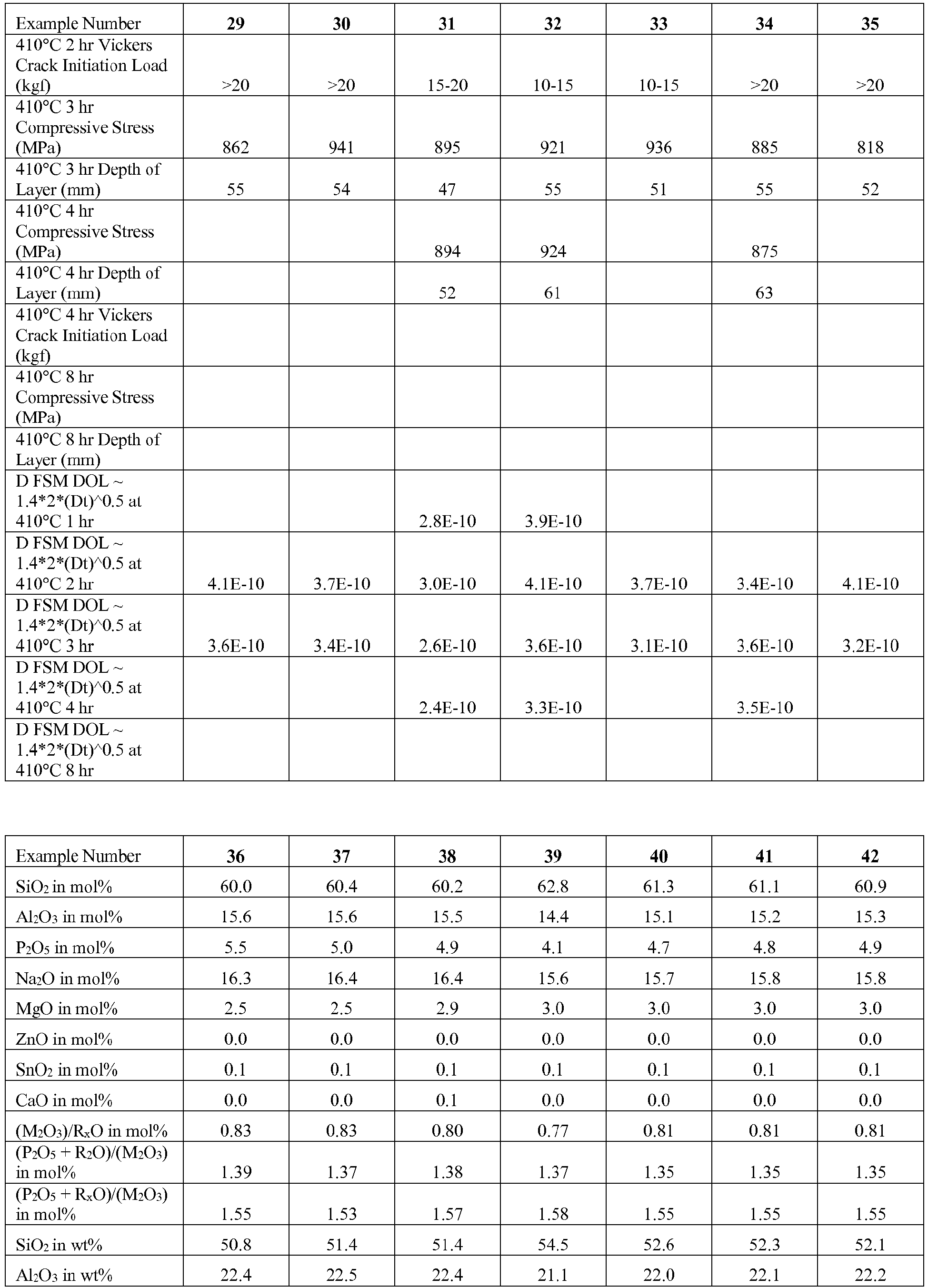


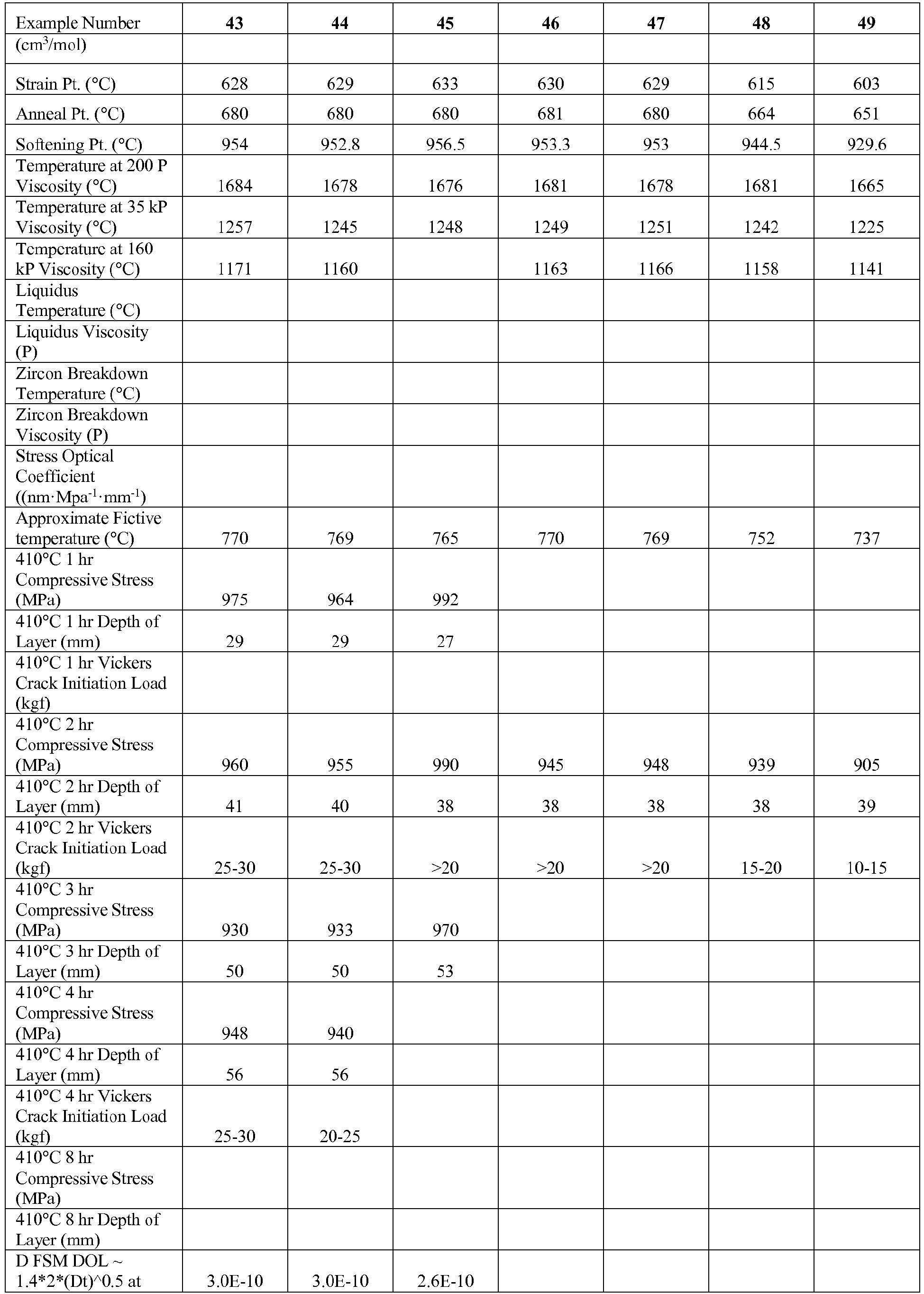


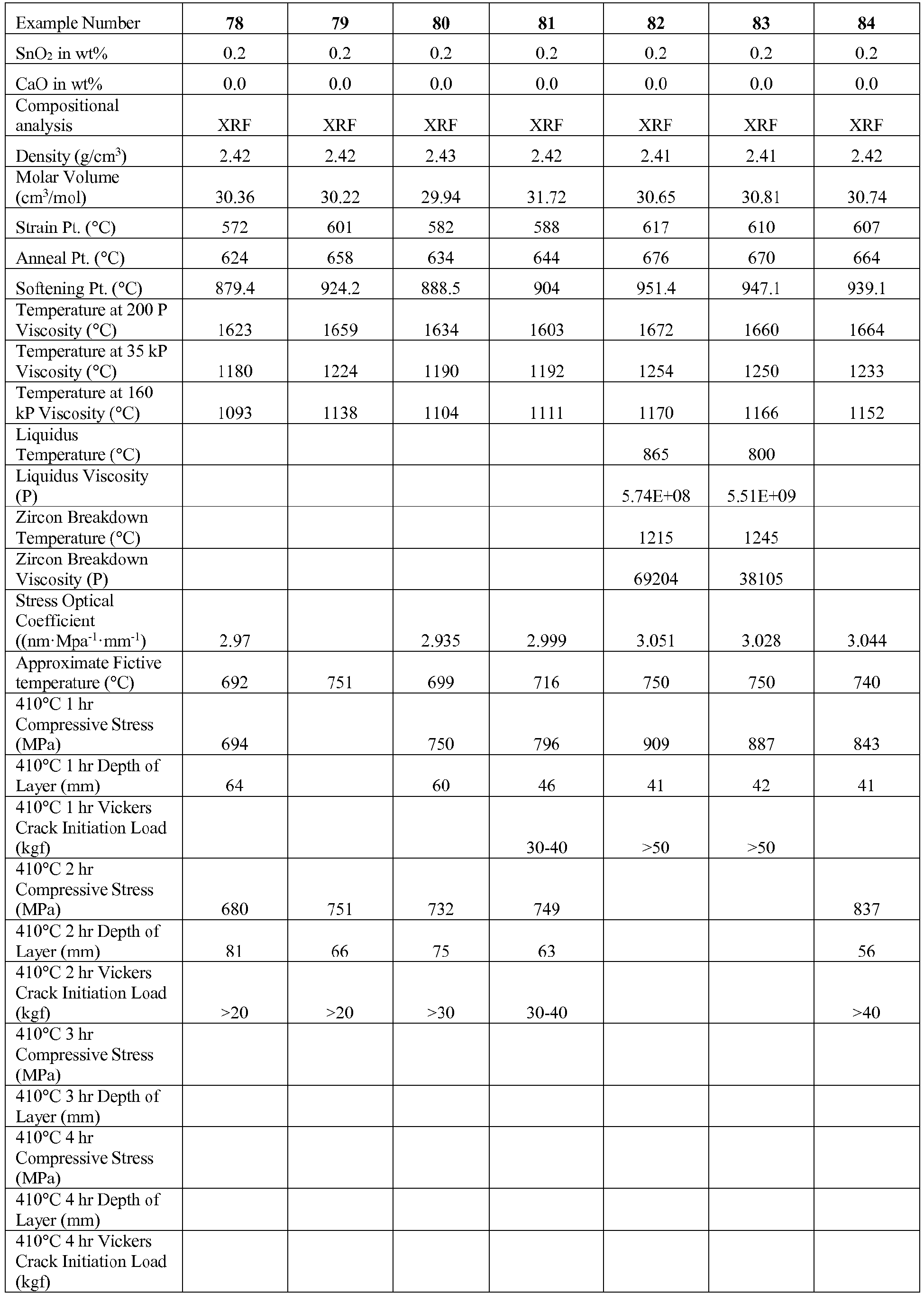


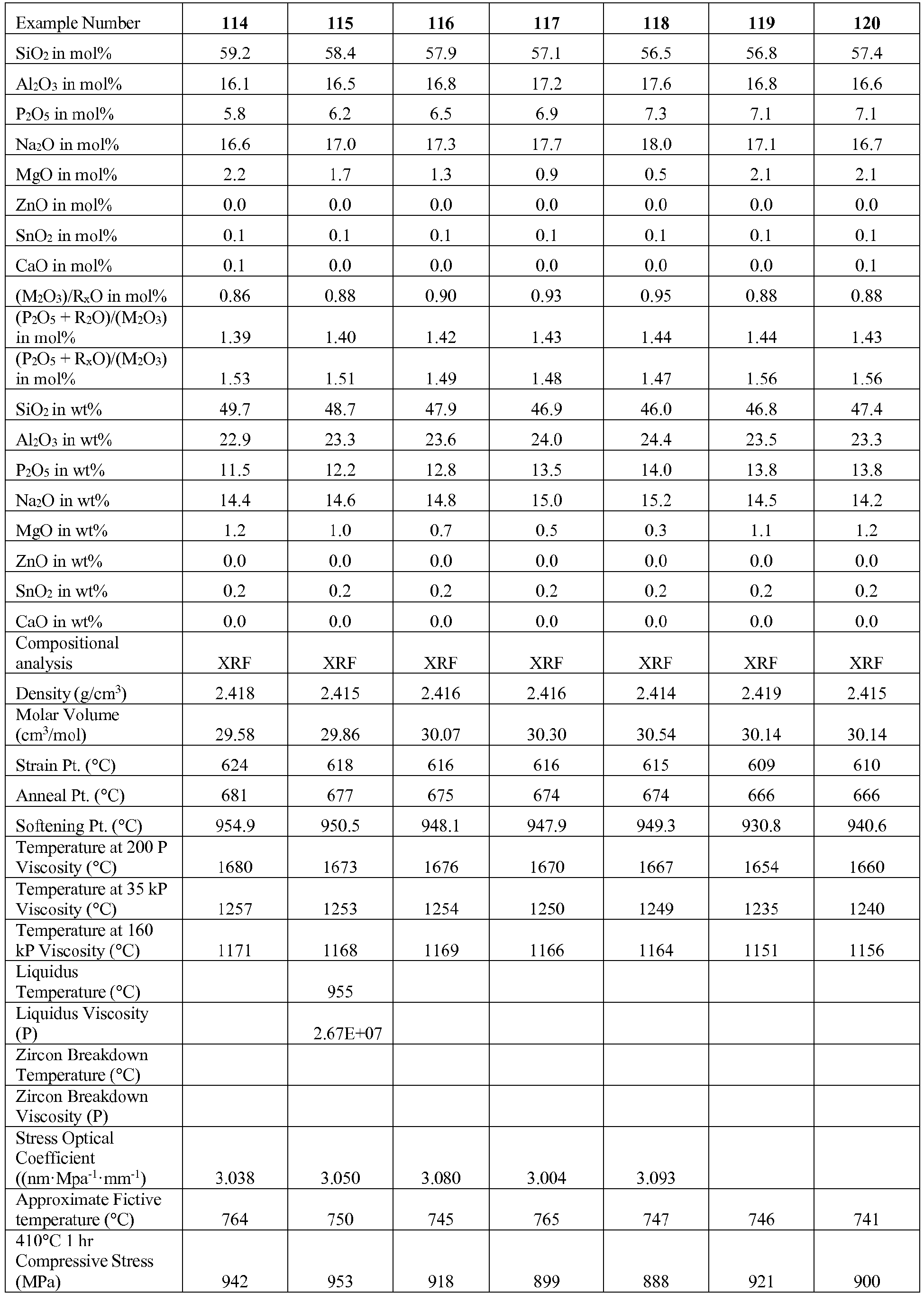


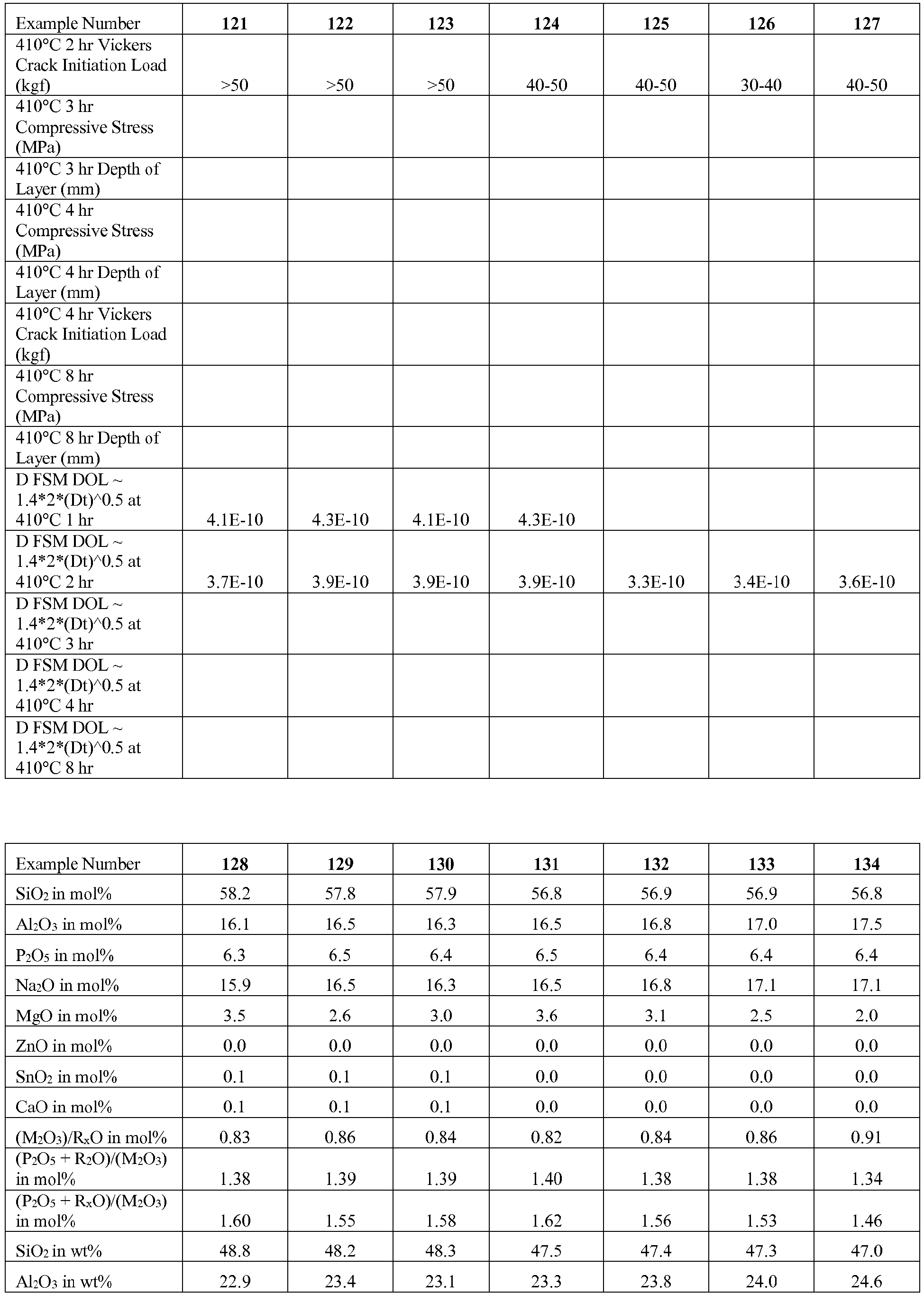


- Ion exchange is widely used to chemically strengthen glass articles for use in in consumer electronics, automotive applications, appliances, architectural components, and other areas where high levels of damage resistance are desirable. In the ion exchange process, a glass article containing a first metal ion (e.g., alkali cations in Li2O, Na2O, etc.) is at least partially immersed in or otherwise contacted with an ion exchange bath or medium containing a second metal ion that is either larger or smaller than the first metal ion that is present in the glass. The first metal ions diffuse from the glass surface into the ion exchange bath/medium while the second metal ions from the ion exchange bath/medium replace the first metal ions in the glass to a depth of layer below the surface of the glass. The substitution of larger ions for smaller ions in the glass creates a compressive stress at the glass surface, whereas substitution of smaller ions for larger ions in the glass typically creates a tensile stress at the surface of the glass. In some embodiments, the first metal ion and second metal ion are monovalent alkali metal ions. However, other monovalent metal ions such as Ag+, Tl+, Cu+, and the like may also be used in the ion exchange process. In those instances where at least one of Ag+ and Cu+ is exchanged for metal ions in the glass, such glasses may be particularly useful for anti-viral and/or anti-microbial applications.
- A cross-sectional view of a portion (i.e., ends of the glass sheet are not shown) of a glass sheet strengthened by ion exchange is schematically shown in
FIG.1 . In the non-limiting example shown inFIG. 1 , strengthenedglass sheet 100 has a thickness t,central portion 130, and afirst surface 110 andsecond surface 112 that are substantially parallel to each other.Compressive layers first surface 110 andsecond surface 112, respectively, to depths of layer d1, d2 below each surface.Compressive layers central portion 130 is under a tensile stress, or in tension. The tensile stress incentral portion 130 balances the compressive stresses incompressive layers glass sheet 100. In some embodiments, the glasses and glass articles described herein may be ion exchanged to achieve a compressive stress of at least about 300 MPa and/or a depth of compressive layer of at least about 10 µm. In some embodiments, the glasses and glass articles described herein may be ion exchanged to achieve a compressive stress of at least about 500 MPa and/or a depth of compressive layer of at least about 40 µm. In some embodiments, the glass is ion exchanged to achieve a compressive stress of at least about 200, 300, 400, 500, 600, 700, 800, 900, or 1000 MPa. In some embodiments, the glass is ion exchanged to achieve a depth of layer of at least about 10 µm, 20 µm, 30 µm, 40 µm, 50 µm, 60 µm, 70 µm, 80 µm, 90 µm, 100 µm, or 110 µm or more. - In addition to high damage resistance, the glasses described herein may be ion exchanged to achieve desired levels of compressive stress and compressive depth of layer in relatively short times. Following ion exchange at 410°C for 4 hours in molten KNO3 salt, for example, a compressive layer having a compressive stress of greater than about 700 MPa and a depth of compressive layer of greater than about 75 µm may be achieved in these glasses. In some embodiments, the ion exchange is done at about 400°C, 410°C, 420°C, 430°C, 440°C, 450°C, 460°C, 470°C, 480°C, 490°C, 500°C, 510°C, 520°C, 530°C, 540°C, or 550°C or greater. In some embodiments, the ion exchange is done for about 0.5, 1, 2, 3, 4, 5, 6, 7, 8, 9, 10, or more than 10 hours.
-
FIG. 2 is a plot of depth of layer as a function of compressive stress for samples a-f in Table 1. The 0.7 mm thick samples were annealed at 700°C and ion exchanged in a molten KNO3 salt bath at 410°C for times ranging from 1 hour up to 8 hours (groups "b-d" inFIG. 2 ) or at 470°C for six minutes (group "a" inFIG. 2 ). The samples that were ion exchanged at 470°C for six minutes exhibited compressive stresses and depths of layer that are well below the frangibility limit (i.e., the point at which the glass sample should or is likely to exhibit frangible behavior, indicated byline 1 inFIG. 2 ). The ion exchange time required for 0.7 mm thick samples to reach the frangibility limit is slightly greater than one hour at 410°C. In samples having higher fictive temperatures with viscosities corresponding to about 1011 Poise (i.e., unannealed, as down-drawn samples), the frangibility limit will also be met in a similarly short time, but the compressive stress will be lower and the depth of layer will be greater than in annealed samples. Samples that were ion exchanged for one hour (group "b") exhibited compressive stresses and depths of layer that are just below the frangibility limit, and samples that were ion exchanged for either 4 or 8 hours (groups "c" and "d", respectively) exhibit compressive stresses and depths of layer that exceed the frangibility limit. - The ability to ion exchange the glasses described herein may be at least partially attributable to the fact that these glasses have potassium and sodium interdiffusion coefficients that are significantly greater that those of other alkali aluminosilicate glasses that are used in applications in which damage resistance, as characterized by the Vickers crack initiation threshold of the glass, is a desirable attribute. At 410°C, the glasses described herein have a potassium/sodium interdiffusion coefficient of at least about 2.4 x 10⁻¹⁰ cm2/s, 3.0 x 10⁻¹⁰ cm2/s, 4.0 x 10⁻¹⁰ cm2/s, or 4.5 x 10⁻¹⁰ cm2/s, 6.0 x 10⁻¹⁰ cm2/s, 7.5 x 10⁻¹⁰ cm2/s, 9.0 x 10⁻¹⁰ cm2/s, 1.0 x 10⁻⁹ cm2/s, 1.2 x 10⁻⁹ cm2/s, 1.5 x 10⁻⁹ cm2/s and in some embodiments, in a range from about 2.4 x 10⁻¹⁰ cm2/s, 3.0 x 10⁻¹⁰ cm2/s, 4.0 x 10⁻¹⁰ cm2/s, or 4.5 x 10⁻¹⁰ cm2/s up to about 7.5 x 10⁻¹⁰ cm2/s, 9.0 x 10⁻¹⁰ cm2/s, 1.0 x 10⁻⁹ cm2/s, 1.2 x 10⁻⁹ cm2/s, or 1.5 x 10⁻⁹ cm2/s. In contrast to these glasses, the alkali aluminosilicate glasses described in
U.S. Patent Applications 12/858,490 ,12/856,840 12/392,577 - An embodiment comprises an alkali aluminosilicate glass comprising at least about 4 mol% P2O5, wherein [M2O3 (mol%)/RxO(mol%)] < 1.4, where M2O3 = Al2O3 + B2O3 and RxO is the sum of monovalent and divalent cation oxides present in the alkali aluminosilicate glass. In some embodiments, [M2O3 (mol%)/RxO(mol%)] < 1. In some embodiments, the alkali aluminosilicate glass further comprises less than 1 mol% K2O. In some embodiments, the alkali aluminosilicate glass comprises 0 mol% K2O. In some embodiments, the alkali aluminosilicate glass comprises less than 1 mol% B2O3. In some embodiments, the alkali aluminosilicate glass comprises 0 mol% B2O3. In some embodiments, the monovalent and divalent cation oxides are selected from the group consisting of Li2O, Na2O, K2O, Rb2O, Cs2O, MgO, CaO, SrO, BaO, and ZnO. In some embodiments, the alkali aluminosilicate glass has a potassium/sodium interdiffusion coefficient of at least about 2.4 x 10⁻¹⁰ cm2/s at 410°C. In some embodiments, the potassium/sodium interdiffusion coefficient is in a range from about 2.4 x 10⁻¹⁰ cm2/s up to about 1.5 x 10⁻⁹ cm2/s at 410°C.
- An embodiment comprises an alkali aluminosilicate glass comprising 0.6 < [M2O3 (mol%)/RxO(mol%)] < 1.4 where M2O3 = Al2O3 + B2O3 and RxO is the sum of monovalent and divalent cation oxides present in the alkali aluminosilicate glass. In some embodiments, 0.8 < [M2O3(mol%)/RxO(mol%)] < 1.4. In some embodiments, 0.8 ≤ [M2O3(mol%)/RxO(mol%)] ≤ 1.0. In some embodiments, the alkali aluminosilicate glass further comprises less than 1 mol% K2O. In some embodiments, the alkali aluminosilicate glass comprises 0 mol% K2O. In some embodiments, the alkali aluminosilicate glass comprises less than 1 mol% B2O3. In some embodiments, the alkali aluminosilicate glass comprises 0 mol% B2O3. In some embodiments, the monovalent and divalent cation oxides are selected from the group consisting of Li2O, Na2O, K2O, Rb2O, Cs2O, MgO, CaO, SrO, BaO, and ZnO. In some embodiments, the alkali aluminosilicate glass has a potassium/sodium interdiffusion coefficient of at least about 2.4 x 10⁻¹⁰ cm2/s at 410°C. In some embodiments, the potassium/sodium interdiffusion coefficient is in a range from about 2.4 x 10⁻¹⁰ cm2/s up to about 1.5 x 10⁻⁹ cm2/s at 410°C.
- Another embodiment comprises an alkali aluminosilicate glass comprising at least about 4% P2O5, wherein the alkali aluminosilicate glass is ion exchanged to a depth of layer of at least about 20 µm, and wherein 0.6 < [M2O3(mol%)/RxO(mol%)] < 1.4, where M2O3 = Al2O3 + B2O3 and RxO is the sum of monovalent and divalent cation oxides present in the alkali aluminosilicate glass. In some embodiments, 0.6 < [M2O3(mol%)/RxO(mol%)] < 1.0. In some embodiments, 0.8 < [M2O3(mol%)/RxO(mol%)] < 1.4. In some embodiments, 0.8 ≤ [M2O3(mol%)/RxO(mol%)] ≤ 1.0. In some embodiments, the alkali aluminosilicate glass further comprises less than 1 mol% K2O. In some embodiments, the alkali aluminosilicate glass comprises 0 mol% K2O. In some embodiments, the alkali aluminosilicate glass comprises less than 1 mol% B2O3. In some embodiments, the alkali aluminosilicate glass comprises 0 mol% B2O3. In some embodiments, the monovalent and divalent cation oxides are selected from the group consisting of Li2O, Na2O, K2O, Rb2O, Cs2O, MgO, CaO, SrO, BaO, and ZnO. In some embodiments, the alkali aluminosilicate glass has a potassium/sodium interdiffusion coefficient of at least about 2.4 x 10⁻¹⁰ cm2/s at 410°C. In some embodiments, the potassium/sodium interdiffusion coefficient is in a range from about 2.4 x 10⁻¹⁰ cm2/s up to about 1.5 x 10⁻⁹ cm2/s at 410°C.
- Another embodiment comprises an alkali aluminosilicate glass comprising at least about 4% P2O5, wherein 1.3 < [(P2O5 + R2O)/M2O3] ≤ 2.3, where M2O3 = Al2O3 + B2O3 and R2O is the sum of monovalent cation oxides present in the alkali aluminosilicate glass. In some embodiments, the alkali aluminosilicate glass further comprises less than 1 mol% K2O. In some embodiments, the alkali aluminosilicate glass comprises 0 mol% K2O. In some embodiments, the alkali aluminosilicate glass comprises less than 1 mol% B2O3. In some embodiments, the alkali aluminosilicate glass comprises 0 mol% B2O3. In some embodiments, the monovalent and divalent cation oxides are selected from the group consisting of Li2O, Na2O, K2O, Rb2O, Cs2O, MgO, CaO, SrO, BaO, and ZnO. In some embodiments, the alkali aluminosilicate glass has a potassium/sodium interdiffusion coefficient of at least about 2.4 x 10⁻¹⁰ cm2/s at 410°C. In some embodiments, the potassium/sodium interdiffusion coefficient is in a range from about 2.4 x 10⁻¹⁰ cm2/s up to about 1.5 x 10⁻⁹ cm2/s at 410°C.
- In some embodiments, the alkali alumino silicate glass comprises from about 40 mol% to about 70 mol% SiO2; from about 11 mol% to about 25 mol% Al2O3; from about 4 mol% to about 15 mol% P2O5; and from about 13 mol% to about 25 mol% Na2O. In some embodiments, the alkali aluminosilicate glass comprises from about 50 mol% to about 65 mol% SiO2; from about 14 mol% to about 20 mol% Al2O3; from about 4 mol% to about 10 mol% P2O5; and from about 14 mol% to about 20 mol% Na2O. In some embodiments, the alkali aluminosilicate glass further comprises less than 1 mol% K2O. In some embodiments, the alkali aluminosilicate glass comprises 0 mol% K2O. In some embodiments, the alkali aluminosilicate glass comprises less than 1 mol% B2O3. In some embodiments, the alkali aluminosilicate glass comprises 0 mol% B2O3. In some embodiments, the monovalent and divalent cation oxides are selected from the group consisting of Li2O, Na2O, K2O, Rb2O, Cs2O, MgO, CaO, SrO, BaO, and ZnO.
- In some embodiments, the alkali aluminosilicate glasses described above are ion exchanged to a depth of layer of at least about 20 µm. In some embodiments, the glasses are ion exchanged to a depth of layer of at least about 40 µm. In some embodiments, the alkali aluminosilicate glasses have a compressive layer extending from a surface of the glass to the depth of layer, and wherein the compressive layer is under a compressive stress of at least 500 MPa. In some embodiments, the compressive stress is at least 750 MPa. In some embodiments, the compressive stress layer is from about 500 MPa to about 2000 MPa. In some embodiments, the ion exchanged alkali aluminosilicate glasses have a Vickers indentation crack initiation load of at least about 8 kgf. In some embodiments, the ion exchanged alkali aluminosilicate glasses have a Vickers indentation crack initiation load of at least about 12 kgf.
- An embodiment comprises a method of strengthening an alkali aluminosilicate glass, the method comprising: providing an alkali aluminosilicate glass as described above, and immersing the alkali aluminosilicate glass in an ion exchange bath for a time period of up to about 24 hours to form a compressive layer extending from a surface of the alkali aluminosilicate glass to a depth of layer of at least 20 µm. In some embodiments, the alkali aluminosilicate glass comprises at least about 4 mol% P2O5, wherein [M2O3 (mol%)/RxO(mol%)] < 1.4, where M2O3 = Al2O3 + B2O3 and RxO is the sum of monovalent and divalent cation oxides present in the alkali aluminosilicate glass. In some embodiments, [M2O3 (mol%)/RxO(mol%)] < 1. In some embodiments, the alkali aluminosilicate glass comprises 0.6 < [M2O3 (mol%)/RxO(mol%)] < 1.4 where M2O3 = Al2O3 + B2O3 and RxO is the sum of monovalent and divalent cation oxides present in the alkali aluminosilicate glass. In some embodiments, 0.8 < [M2O3(mol%)/RxO(mol%)] < 1.4. In some embodiments, 0.8 ≤ [M2O3(mol%)/RxO(mol%)] ≤ 1.0. In some embodiments, the alkali aluminosilicate glass comprising at least about 4% P2O5, wherein 1.3 < [(P2O5 + R2O)/M2O3] ≤ 2.3, where M2O3 = Al2O3 + B2O3 and R2O is the sum of monovalent cation oxides present in the alkali aluminosilicate glass. In some embodiments, the alkali aluminosilicate glass comprises from about 40 mol% to about 70 mol% SiO2; from about 11 mol% to about 25 mol% Al2O3; from about 4 mol% to about 15 mol% P2O5; and from about 13 mol% to about 25 mol% Na2O. In some embodiments, the alkali aluminosilicate glass comprises from about 50 mol% to about 65 mol% SiO2; from about 14 mol% to about 20 mol% Al2O3; from about 4 mol% to about 10 mol% P2O5; and from about 14 mol% to about 20 mol% Na2O. In some embodiments, the alkali aluminosilicate glass further comprises less than 1 mol% K2O. In some embodiments, the alkali aluminosilicate glass comprises 0 mol% K2O. In some embodiments, the alkali aluminosilicate glass comprises less than 1 mol% B2O3. In some embodiments, the alkali aluminosilicate glass comprises 0 mol% B2O3. In some embodiments, the monovalent and divalent cation oxides are selected from the group consisting of Li2O, Na2O, K2O, Rb2O, Cs2O, MgO, CaO, SrO, BaO, and ZnO.
- In some embodiments, the alkali aluminosilicate glasses described above are ion exchanged to a depth of layer of at least about 20 µm. In some embodiments, the glasses are ion exchanged to a depth of layer of at least about 40 µm. In some embodiments, the alkali aluminosilicate glasses have a compressive layer extending from a surface of the glass to the depth of layer, and wherein the compressive layer is under a compressive stress of at least 500 MPa. In some embodiments, the compressive stress is at least 750 MPa. In some embodiments, the compressive stress layer is from about 500 MPa to about 2000 MPa. In some embodiments, the ion exchanged alkali aluminosilicate glasses have a Vickers indentation crack initiation load of at least about 8 kgf. In some embodiments, the ion exchanged alkali aluminosilicate glasses have a Vickers indentation crack initiation load of at least about 12 kgf.
- While typical embodiments have been set forth for the purpose of illustration, the foregoing description should not be deemed to be a limitation on the scope of the disclosure or appended claims. Accordingly, various modifications, adaptations, and alternatives may occur to one skilled in the art without departing from the spirit and scope of the present disclosure or appended claims.
- The present disclosure includes the following:
- [1] An alkali aluminosilicate glass comprising at least about 4% P2O5, wherein:
- i. [M2O3(mol%)/RxO(mol%)] < 1.4; or
- ii. 1.3 < [(P2O5 + R2O)/M2O3] ≤ 2.3;
- [2] The alkali aluminosilicate glass of [1], wherein the glass satisfies:

- [3] The alkali aluminosilicate glass of [2], wherein the glass satisfies:

- [4] The alkali aluminosilicate glass of [1], wherein the glass satisfies:

- [5] The alkali aluminosilicate glass of [4], wherein the glass satisfies:

- [6] The alkali aluminosilicate glass of [1], further comprising less than 1 mol% K2O.
- [7] The alkali aluminosilicate glass of [6], wherein the alkali aluminosilicate glass comprises 0 mol% K2O.
- [8] The alkali aluminosilicate glass of [1], further comprising less than 1 mol% B2O3.
- [9] The alkali aluminosilicate glass of [8], wherein the alkali aluminosilicate glass comprises 0 mol% B2O3.
- [10] The alkali aluminosilicate glass of [1], wherein the glass is ion exchanged to a depth of layer of at least about 10 µm.
- [11] The alkali aluminosilicate glass of [10], wherein the glass is ion exchanged to a depth of layer of at least about 30 µm.
- [12] The alkali aluminosilicate glass of [10], wherein the alkali aluminosilicate glass has a compressive layer extending from a surface of the glass to the depth of layer, and wherein the compressive layer is under a compressive stress of at least about 300 MPa.
- [13] The alkali aluminosilicate glass of [12], wherein the compressive stress is at least about 500 MPa.
- [14] The alkali aluminosilicate glass of [10], wherein the ion exchanged alkali aluminosilicate glass has a Vickers indentation crack initiation load of at least about 7 kgf.
- [15] The alkali aluminosilicate glass of [14], wherein the ion exchanged alkali aluminosilicate glass has a Vickers indentation crack initiation load of at least about 12 kgf.
- [16] The alkali aluminosilicate glass of [1], wherein the monovalent and divalent cation oxides are selected from the group consisting of Li2O, Na2O, K2O, Rb2O, Cs2O, MgO, CaO, SrO, BaO, and ZnO.
- [17] The alkali aluminosilicate glass of [1], wherein the alkali aluminosilicate glass comprises from about 40 mol% to about 70 mol% SiO2; from about 11 mol% to about 25 mol% Al2O3; from about 4 mol% to about 15 mol% P2O5; and from about 13 mol% to about 25 mol% Na2O.
- [18] The alkali aluminosilicate glass of [17], wherein the alkali aluminosilicate glass comprises from about 50 mol% to about 65 mol% SiO2; from about 14 mol% to about 20 mol% Al2O3; from about 4 mol% to about 10 mol% P2O5; and from about 14 mol% to about 20 mol% Na2O.
- [19] The alkali aluminosilicate glass of [17], wherein the alkali aluminosilicate glass further comprises less than 1 mol% K2O.
- [20] The alkali aluminosilicate glass of [19], wherein the alkali aluminosilicate glass comprises 0 mol% K2O.
- [21] The alkali aluminosilicate glass of [17], wherein the alkali aluminosilicate glass further comprises less than 1 mol% B2O3.
- [22] The alkali aluminosilicate glass of [19], wherein the alkali aluminosilicate glass comprises 0 mol% B2O3.
- [23] The alkali aluminosilicate glass of [1], wherein the alkali aluminosilicate glass has a potassium/sodium interdiffusion coefficient of at least about 2.4 x 10⁻¹⁰ cm2/s at 410°C.
- [24] The alkali aluminosilicate glass of [23], wherein the potassium/sodium interdiffusion coefficient is in a range from about 2.4 x 10⁻¹⁰ cm2/s up to about 1.5 x 10⁻⁹ cm2/s at 410°C.
- [25] The alkali aluminosilicate glass of [1], wherein the glass satisfies:

- [26] An alkali aluminosilicate glass comprising at least about 4% P2O5, wherein the alkali aluminosilicate glass is ion exchanged to a depth of layer of at least about 10 µm, and wherein:
- iii. 0.6 < [M2O3(mol%)/RxO(mol%)] < 1.4; or
- iv. 1.3 < [(P2O5 + R2O)/M2O3] ≤ 2.3;
- [27] The alkali aluminosilicate glass of [26], wherein the glass satisfies:

- [28] The alkali aluminosilicate glass of [27], wherein the glass satisfies:

- [29] The alkali aluminosilicate glass of [26], wherein the glass satisfies:

- [30] The alkali aluminosilicate glass of [29], wherein the glass satisfies:

- [31] The alkali alumino silicate glass of [26], further comprising less than 1 mol% K2O.
- [32] The alkali aluminosilicate glass of [26], further comprising less than 1 mol% B2O3.
- [33] The alkali aluminosilicate glass of [26], wherein the alkali aluminosilicate glass has a potassium/sodium interdiffusion coefficient of at least about 2.4 x 10⁻¹⁰ cm2/s at 410°C.
- [34] The alkali aluminosilicate glass of [33], wherein the potassium/sodium interdiffusion coefficient is in a range from about 2.4 x 10⁻¹⁰ cm2/s up to about 1.5 x 10⁻⁹ cm2/s at 410°C.
- [35] The alkali aluminosilicate glass of [26], wherein the glass has a compressive layer extending from a surface of the glass to the depth of layer, and wherein the compressive layer is under a compressive stress of at least about 300 MPa.
- [36] The alkali aluminosilicate glass of [26], wherein the ion exchanged glass has a Vickers indentation crack initiation load of at least about 7 kgf.
- [37] The alkali aluminosilicate glass of [36], wherein the ion exchanged glass has a Vickers indentation crack initiation load of at least about 12 kgf.
- [38] The alkali aluminosilicate glass of [1], wherein the monovalent and divalent cation oxides are selected from the group consisting of Li2O, Na2O, K2O, Rb2O, Cs2O, MgO, CaO, SrO, BaO, and ZnO.
- [39] The alkali aluminosilicate glass of [1], wherein the alkali aluminosilicate glass comprises from about 40 mol% to about 70 mol% SiO2; from about 11 mol% to about 25 mol% Al2O3; from about 4 mol% to about 15 mol% P2O5; and from about 13 mol% to about 25 mol% Na2O.
- [40] The alkali aluminosilicate glass of [14], wherein the alkali aluminosilicate glass comprises from about 50 mol% to about 65 mol% SiO2; from about 14 mol% to about 20 mol% Al2O3; from about 4 mol% to about 10 mol% P2O5; and from about 14 mol% to about 20 mol% Na2O.
- [41] The alkali aluminosilicate glass of [14], wherein the alkali aluminosilicate glass further comprises less than 1 mol% K2O.
- [42] The alkali aluminosilicate glass of [14], wherein the alkali aluminosilicate glass further comprises less than 1 mol% B2O3.
- [43] The alkali aluminosilicate glass of [14], wherein the potassium/sodium interdiffusion coefficient is in a range from about 2.4 x 10⁻¹⁰ cm2/s up to about 1.5 x 10⁻⁹ cm2/s at 410°C.
- [44] A method of strengthening an alkali aluminosilicate glass, the method comprising:
- a. providing the alkali aluminosilicate glass of [1] or [26], and
- b. immersing the alkali aluminosilicate glass in an ion exchange bath for a time period of up to about 24 hours to form a compressive layer extending from a surface of the alkali aluminosilicate glass to a depth of layer of at least 10 µm.
- [45] The method of [44], wherein the glass satisfies:

- [46] The method of [44], wherein the glass satisfies:

- [47] The method of [44], wherein the glass satisfies:

- [48] The method of [44], wherein the glass satisfies:

- [49] The method of [44], wherein the glass satisfies:

- [50] The method of [44], wherein the glass satisfies:

- [51] The method of [44], wherein the alkali aluminosilicate glass comprises less than 1 mol% K2O.
- [52] The method of [44], wherein the alkali aluminosilicate glass comprises less than 1 mol% B2O3.
- [53] The method of [44], wherein the compressive layer is under a compressive stress of at least about 300 MPa.
- [54] The method of [44], wherein the ion exchanged glass has a Vickers indentation crack initiation load of at least about 7 kgf.
- [55] The method of [44], wherein the ion exchanged glass has a Vickers indentation crack initiation load of at least about 12 kgf.
Claims (12)
- An alkali aluminosilicate glass comprising MgO; from about 40 mol% to about 70 mol% SiO2; from about 11 mol% to about 25 mol% Al2O3; from about 4 mol% to about 15 mol% P2O5; from about 13 mol% to about 20 mol% Na2O; less than 1 mol% B2O3; and 0 mol% K2O, wherein:i. the alkali aluminosilicate glass is free of Li2O; andii. 1.3 < [(P2O5 + R2O)/M2O3] ≤ 2.3, where M2O3 = Al2O3 + B2O3 and R2O is the sum of Na2O, K2O, Rb2O, and Cs2O present in the alkali aluminosilicate glass.
- The alkali aluminosilicate glass of claim 1, wherein the alkali aluminosilicate glass comprises from about 50 mol% to about 65 mol% SiO2; from about 14 mol% to about 20 mol% Al2O3; from about 4 mol% to about 10 mol% P2O5; and from about 14 mol% to about 20 mol% Na2O.
- The alkali aluminosilicate glass of claim 1 or 2, wherein the glass satisfies:

- The alkali aluminosilicate glass of any preceding claim, wherein the alkali aluminosilicate glass comprises 0 mol% B2O3.
- The alkali aluminosilicate glass of any preceding claim, wherein the monovalent cation oxides are selected from the group consisting of Na2O, Rb2O, and Cs2O.
- The alkali aluminosilicate glass of any preceding claim, wherein the alkali aluminosilicate glass comprises 0 mol% B2O3.
- The alkali aluminosilicate glass of any preceding claim, wherein the alkali aluminosilicate glass has a potassium/sodium interdiffusion coefficient of at least about 2.4 x 10⁻¹⁰ cm2/s at 410°C.
- The alkali aluminosilicate glass of any preceding claim, wherein the potassium/sodium interdiffusion coefficient is in a range from about 2.4 x 10⁻¹⁰ cm2/s up to about 1.5 x 10⁻⁹ cm2/s at 410°C.
- The alkali aluminosilicate glass of any preceding claim, wherein the glass has a compressive layer extending from a surface of the glass to a depth of layer, and wherein the compressive layer is under a compressive stress of at least about 300 MPa.
- The alkali aluminosilicate glass of claim 9 wherein the ion exchanged glass has a Vickers indentation crack initiation load of at least about 7 kgf.
- The alkali aluminosilicate glass of claim 9, wherein the ion exchanged glass has a Vickers indentation crack initiation load of at least about 12 kgf.
- An electronic device comprising the alkali aluminosilicate glass of any preceding claim.
Applications Claiming Priority (3)
| Application Number | Priority Date | Filing Date | Title |
|---|---|---|---|
| US201161560434P | 2011-11-16 | 2011-11-16 | |
| PCT/US2012/065263 WO2013074779A1 (en) | 2011-11-16 | 2012-11-15 | Ion exchangeable glass with high crack initiation threshold |
| EP12848960.6A EP2780291B1 (en) | 2011-11-16 | 2012-11-15 | Ion exchangeable glass with high crack initiation threshold |
Related Parent Applications (2)
| Application Number | Title | Priority Date | Filing Date |
|---|---|---|---|
| EP12848960.6A Division EP2780291B1 (en) | 2011-11-16 | 2012-11-15 | Ion exchangeable glass with high crack initiation threshold |
| EP12848960.6A Division-Into EP2780291B1 (en) | 2011-11-16 | 2012-11-15 | Ion exchangeable glass with high crack initiation threshold |
Publications (2)
| Publication Number | Publication Date |
|---|---|
| EP3342759A1 true EP3342759A1 (en) | 2018-07-04 |
| EP3342759B1 EP3342759B1 (en) | 2021-08-25 |
Family
ID=48280927
Family Applications (2)
| Application Number | Title | Priority Date | Filing Date |
|---|---|---|---|
| EP12848960.6A Active EP2780291B1 (en) | 2011-11-16 | 2012-11-15 | Ion exchangeable glass with high crack initiation threshold |
| EP18156305.7A Active EP3342759B1 (en) | 2011-11-16 | 2012-11-15 | Ion exchangeable glass with high crack initiation threshold |
Family Applications Before (1)
| Application Number | Title | Priority Date | Filing Date |
|---|---|---|---|
| EP12848960.6A Active EP2780291B1 (en) | 2011-11-16 | 2012-11-15 | Ion exchangeable glass with high crack initiation threshold |
Country Status (8)
| Country | Link |
|---|---|
| US (7) | US8765262B2 (en) |
| EP (2) | EP2780291B1 (en) |
| JP (4) | JP6527330B2 (en) |
| KR (3) | KR20190122267A (en) |
| CN (2) | CN110002745B (en) |
| BR (1) | BR112014011561A2 (en) |
| TW (2) | TWI555716B (en) |
| WO (1) | WO2013074779A1 (en) |
Families Citing this family (161)
| Publication number | Priority date | Publication date | Assignee | Title |
|---|---|---|---|---|
| US9783452B2 (en) | 2011-07-01 | 2017-10-10 | Corning Incorporated | Ion-exchanged glass of high surface compression and shallow depth of layer with high resistance to radial crack formation from vickers indentation |
| US10280112B2 (en) | 2011-08-19 | 2019-05-07 | Corning Incorporated | Ion exchanged glass with high resistance to sharp contact failure and articles made therefrom |
| US9517966B2 (en) | 2011-10-25 | 2016-12-13 | Corning Incorporated | Glass compositions with improved chemical and mechanical durability |
| WO2013063277A1 (en) | 2011-10-25 | 2013-05-02 | Corning Incorporated | Delamination resistant pharmaceutical glass containers containing active pharmaceutical ingredients |
| KR20190122267A (en) | 2011-11-16 | 2019-10-29 | 코닝 인코포레이티드 | Ion exchangeable glass with high crack initiation threshold |
| US8901544B2 (en) | 2011-12-06 | 2014-12-02 | Corning Incorporated | Organic thin film transistor with ion exchanged glass substrate |
| US9359251B2 (en) | 2012-02-29 | 2016-06-07 | Corning Incorporated | Ion exchanged glasses via non-error function compressive stress profiles |
| US10273048B2 (en) | 2012-06-07 | 2019-04-30 | Corning Incorporated | Delamination resistant glass containers with heat-tolerant coatings |
| JP2015523310A (en) | 2012-06-08 | 2015-08-13 | コーニング インコーポレイテッド | Tempered glass article and manufacturing method |
| WO2013183716A1 (en) * | 2012-06-08 | 2013-12-12 | 日本電気硝子株式会社 | Tempered glass, tempered glass plate, and glass for tempering |
| EP2922795A1 (en) | 2012-11-20 | 2015-09-30 | Corning Incorporated | Method of making three dimensional glass ceramic article |
| EP2953910A1 (en) | 2013-02-11 | 2015-12-16 | Corning Incorporated | Antimicrobial glass articles and methods of making and using same |
| US9700486B2 (en) | 2013-04-24 | 2017-07-11 | Corning Incorporated | Delamination resistant pharmaceutical glass containers containing active pharmaceutical ingredients |
| US9707155B2 (en) | 2013-04-24 | 2017-07-18 | Corning Incorporated | Delamination resistant pharmaceutical glass containers containing active pharmaceutical ingredients |
| US9839579B2 (en) | 2013-04-24 | 2017-12-12 | Corning Incorporated | Delamination resistant pharmaceutical glass containers containing active pharmaceutical ingredients |
| US9603775B2 (en) | 2013-04-24 | 2017-03-28 | Corning Incorporated | Delamination resistant pharmaceutical glass containers containing active pharmaceutical ingredients |
| US9717649B2 (en) | 2013-04-24 | 2017-08-01 | Corning Incorporated | Delamination resistant pharmaceutical glass containers containing active pharmaceutical ingredients |
| US9707153B2 (en) | 2013-04-24 | 2017-07-18 | Corning Incorporated | Delamination resistant pharmaceutical glass containers containing active pharmaceutical ingredients |
| US9849066B2 (en) | 2013-04-24 | 2017-12-26 | Corning Incorporated | Delamination resistant pharmaceutical glass containers containing active pharmaceutical ingredients |
| US9707154B2 (en) | 2013-04-24 | 2017-07-18 | Corning Incorporated | Delamination resistant pharmaceutical glass containers containing active pharmaceutical ingredients |
| US9713572B2 (en) | 2013-04-24 | 2017-07-25 | Corning Incorporated | Delamination resistant pharmaceutical glass containers containing active pharmaceutical ingredients |
| US9700485B2 (en) | 2013-04-24 | 2017-07-11 | Corning Incorporated | Delamination resistant pharmaceutical glass containers containing active pharmaceutical ingredients |
| US9717648B2 (en) | 2013-04-24 | 2017-08-01 | Corning Incorporated | Delamination resistant pharmaceutical glass containers containing active pharmaceutical ingredients |
| US10131574B2 (en) | 2013-06-17 | 2018-11-20 | Corning Incorporated | Antimicrobial glass articles and methods of making and using same |
| US9512035B2 (en) | 2013-06-17 | 2016-12-06 | Corning Incorporated | Antimicrobial glass articles with improved strength and methods of making and using same |
| JP6597950B2 (en) * | 2013-07-24 | 2019-10-30 | 日本電気硝子株式会社 | Tempered glass and tempered glass |
| US11079309B2 (en) * | 2013-07-26 | 2021-08-03 | Corning Incorporated | Strengthened glass articles having improved survivability |
| US9573843B2 (en) | 2013-08-05 | 2017-02-21 | Corning Incorporated | Polymer edge-covered glass articles and methods for making and using same |
| CN104211301A (en) * | 2013-08-27 | 2014-12-17 | 东旭集团有限公司 | Formula of glass used to prepare touch screen cover plate |
| KR102290967B1 (en) | 2013-08-27 | 2021-08-19 | 코닝 인코포레이티드 | Damage resistant glass with high coefficient of thermal expansion |
| US9815733B2 (en) * | 2013-08-29 | 2017-11-14 | Corning Incorporated | Ion exchangeable glass containing boron and phosphorous |
| JP6761344B2 (en) | 2013-08-30 | 2020-09-23 | コーニング インコーポレイテッド | Ion-exchangeable glass, glass ceramics, and their manufacturing methods |
| US9714188B2 (en) * | 2013-09-13 | 2017-07-25 | Corning Incorporated | Ion exchangeable glasses with high crack initiation threshold |
| US10209419B2 (en) | 2013-09-17 | 2019-02-19 | Corning Incorporated | Broadband polarizer made using ion exchangeable fusion drawn glass sheets |
| KR101755558B1 (en) * | 2013-10-04 | 2017-07-07 | 주식회사 엘지화학 | Aluminosilicate glass and method for manufacturing the same |
| CN112919828A (en) | 2013-10-14 | 2021-06-08 | 康宁股份有限公司 | Ion exchange method and chemically strengthened glass substrate obtained by the ion exchange method |
| DE102013019003A1 (en) * | 2013-11-13 | 2015-05-13 | Taiwan Glass Ind. Corp. | Alkali-aluminosilicate glass |
| US10442730B2 (en) | 2013-11-25 | 2019-10-15 | Corning Incorporated | Method for achieving a stress profile in a glass |
| TWI729306B (en) * | 2013-11-26 | 2021-06-01 | 美商康寧公司 | Phosphorous containing glass having antimicrobial efficacy |
| KR20160123368A (en) | 2014-02-13 | 2016-10-25 | 코닝 인코포레이티드 | Glass With Enhanced Strength and Antimicrobial Properties, and Method of Making Same |
| EP3107875B1 (en) | 2014-02-20 | 2018-06-13 | Corning Incorporated | Uv photobleaching of glass having uv-induced colorization |
| US9517968B2 (en) | 2014-02-24 | 2016-12-13 | Corning Incorporated | Strengthened glass with deep depth of compression |
| WO2016191676A1 (en) | 2015-05-28 | 2016-12-01 | Corning Incorporated | Strengthened glass with deep depth of compression |
| KR102347803B1 (en) | 2014-02-27 | 2022-01-06 | 코닝 인코포레이티드 | Ion exchangeable glass article for three-dimensional forming |
| WO2015164556A1 (en) | 2014-04-25 | 2015-10-29 | Corning Incorporated | Methods of making antimicrobial glass articles |
| US9840438B2 (en) | 2014-04-25 | 2017-12-12 | Corning Incorporated | Antimicrobial article with functional coating and methods for making the antimicrobial article |
| US9359243B2 (en) | 2014-05-13 | 2016-06-07 | Corning Incorporated | Transparent glass-ceramic articles, glass-ceramic precursor glasses and methods for forming the same |
| TWI697403B (en) * | 2014-06-19 | 2020-07-01 | 美商康寧公司 | Glasses having non-frangible stress profiles |
| US10611664B2 (en) | 2014-07-31 | 2020-04-07 | Corning Incorporated | Thermally strengthened architectural glass and related systems and methods |
| US11097974B2 (en) | 2014-07-31 | 2021-08-24 | Corning Incorporated | Thermally strengthened consumer electronic glass and related systems and methods |
| CA2956929A1 (en) * | 2014-07-31 | 2016-02-04 | Corning Incorporated | Thermally tempered glass and methods and apparatuses for thermal tempering of glass |
| CN107001113B (en) | 2014-09-25 | 2021-09-10 | 康宁股份有限公司 | UV blocking for glass with improved light transmission |
| CN108046589A (en) | 2014-10-08 | 2018-05-18 | 康宁股份有限公司 | Glass and glass ceramics comprising metal oxide concentration gradient |
| US10150698B2 (en) | 2014-10-31 | 2018-12-11 | Corning Incorporated | Strengthened glass with ultra deep depth of compression |
| WO2016073539A1 (en) | 2014-11-04 | 2016-05-12 | Corning Incorporated | Deep non-frangible stress profiles and methods of making |
| US9586857B2 (en) | 2014-11-17 | 2017-03-07 | International Business Machines Corporation | Controlling fragmentation of chemically strengthened glass |
| DE102014226986B9 (en) | 2014-12-23 | 2017-01-12 | Schott Ag | Glass-ceramic substrate made of a transparent, colored LAS glass-ceramic and process for its production |
| WO2016104454A1 (en) * | 2014-12-25 | 2016-06-30 | 旭硝子株式会社 | Glass plate |
| US10315949B2 (en) * | 2015-02-26 | 2019-06-11 | Corning Incorporated | Fast ion-exchangeable boron-free glasses with low softening point |
| US9761817B2 (en) | 2015-03-13 | 2017-09-12 | Corning Incorporated | Photo-patternable gate dielectrics for OFET |
| KR102583884B1 (en) | 2015-04-21 | 2023-09-27 | 코닝 인코포레이티드 | Edge and corner reinforcement products and methods for manufacturing the same |
| CN107531562B (en) | 2015-04-30 | 2021-05-28 | 康宁股份有限公司 | Conductive article with discrete metallic silver layer and method of making the same |
| US11104602B2 (en) | 2015-06-26 | 2021-08-31 | Corning Incorporated | Glass with high surface strength |
| KR102640959B1 (en) | 2015-06-26 | 2024-02-27 | 코닝 인코포레이티드 | Glass with high surface strength |
| US10579106B2 (en) | 2015-07-21 | 2020-03-03 | Corning Incorporated | Glass articles exhibiting improved fracture performance |
| US11613103B2 (en) | 2015-07-21 | 2023-03-28 | Corning Incorporated | Glass articles exhibiting improved fracture performance |
| US12338159B2 (en) | 2015-07-30 | 2025-06-24 | Corning Incorporated | Thermally strengthened consumer electronic glass and related systems and methods |
| TWI758263B (en) | 2015-11-19 | 2022-03-21 | 美商康寧公司 | Display screen protector |
| WO2017091482A1 (en) | 2015-11-23 | 2017-06-01 | Corning Incorporated | Removal of inorganic coatings from glass substrates |
| US10611681B2 (en) | 2015-12-08 | 2020-04-07 | Corning Incorporated | S-shaped stress profiles and methods of making |
| TWI697463B (en) | 2015-12-11 | 2020-07-01 | 美商康寧公司 | Fusion-formable glass-based articles including a metal oxide concentration gradient |
| WO2017106629A1 (en) | 2015-12-17 | 2017-06-22 | Corning Incorporated | Ion exchangeable glass with fast diffusion |
| JP7165055B2 (en) | 2016-01-08 | 2022-11-02 | コーニング インコーポレイテッド | Chemically Strengthenable Lithium Aluminosilicate Glass with Inherent Damage Resistance |
| KR102492060B1 (en) * | 2016-01-12 | 2023-01-26 | 코닝 인코포레이티드 | Thin thermally and chemically strengthened glass-based articles |
| KR20180103972A (en) | 2016-01-13 | 2018-09-19 | 코닝 인코포레이티드 | Ultra-Thin, Non-Vulnerable Glass and Manufacturing Method Thereof |
| DE102016101066B3 (en) | 2016-01-21 | 2017-02-23 | Schott Ag | Process for the preparation of a preferably non-colored glass-ceramic material with low scattered light content and glass-ceramic material produced according to the process and its use |
| CN115650601B (en) | 2016-01-21 | 2024-07-12 | Agc株式会社 | Chemically strengthened glass and glass for chemical strengthening |
| US11795102B2 (en) | 2016-01-26 | 2023-10-24 | Corning Incorporated | Non-contact coated glass and related coating system and method |
| CN109071302B (en) | 2016-03-09 | 2022-04-26 | 康宁股份有限公司 | Cold forming of complexly curved glass articles |
| KR20200091500A (en) * | 2016-04-08 | 2020-07-30 | 코닝 인코포레이티드 | Glass-based articles including a stress profile comprising two regions, and methods of making |
| CN111423110A (en) | 2016-04-08 | 2020-07-17 | 康宁股份有限公司 | Glass-Based Articles Containing Metal Oxide Concentration Gradients |
| US11453612B2 (en) | 2016-04-20 | 2022-09-27 | Corning Incorporated | Glass-based articles including a metal oxide concentration gradient |
| CA3025663A1 (en) | 2016-05-31 | 2017-12-07 | Corning Incorporated | Anti-counterfeiting measures for glass articles |
| US11198639B2 (en) | 2016-06-13 | 2021-12-14 | Corning Incorporated | Multicolored photosensitive glass-based parts and methods of manufacture |
| US11059744B2 (en) * | 2016-06-14 | 2021-07-13 | Corning Incorporated | Glasses having improved drop performance |
| DE102016211065B4 (en) | 2016-06-21 | 2019-09-05 | Schott Ag | Transparent, preferably colored glass ceramic article with low scattered light content and high strength, as well as processes for its preparation and its use |
| CN107540214B (en) * | 2016-06-24 | 2020-06-05 | 成都光明光电股份有限公司 | Optical glass, optical preform and optical element |
| TWI800484B (en) | 2016-06-28 | 2023-05-01 | 美商康寧公司 | Laminating thin strengthened glass to curved molded plastic surface for decorative and display cover application |
| US10483101B2 (en) | 2016-06-30 | 2019-11-19 | Corning Incorporated | Glass-based article with engineered stress distribution and method of making same |
| WO2018009504A1 (en) | 2016-07-05 | 2018-01-11 | Corning Incorporated | Cold-formed glass article and assembly process thereof |
| JP2019521947A (en) | 2016-07-28 | 2019-08-08 | コーニング インコーポレイテッド | Glass with resistance to light blackening |
| CN115403280B (en) | 2016-10-25 | 2024-03-19 | 康宁公司 | Cold formed glass laminate for display |
| KR102445875B1 (en) | 2017-01-03 | 2022-09-21 | 코닝 인코포레이티드 | Vehicle interior system having curved cover glass and display or touch panel and method of forming same |
| US11016590B2 (en) | 2017-01-03 | 2021-05-25 | Corning Incorporated | Vehicle interior systems having a curved cover glass and display or touch panel and methods for forming the same |
| JP7127058B2 (en) | 2017-01-18 | 2022-08-29 | コーニング インコーポレイテッド | Coated glass-based article with engineered stress profile and method of making same |
| TWI749160B (en) * | 2017-01-31 | 2021-12-11 | 美商康寧公司 | Coated glass-based articles with engineered stress profiles and a consumer electonic product comprising the same |
| US11685684B2 (en) | 2017-05-15 | 2023-06-27 | Corning Incorporated | Contoured glass articles and methods of making the same |
| CN107226614A (en) * | 2017-05-16 | 2017-10-03 | 东旭科技集团有限公司 | A kind of glass composition and glass and its preparation method and application |
| CN117962601A (en) | 2017-07-18 | 2024-05-03 | 康宁公司 | Cold forming of complex curved glass products |
| US20190030861A1 (en) | 2017-07-27 | 2019-01-31 | Corning Incorporated | Composite laminate with high depth of compression |
| WO2019040818A2 (en) | 2017-08-24 | 2019-02-28 | Corning Incorporated | Glasses with improved tempering capabilities |
| EP3681847B1 (en) | 2017-09-12 | 2025-01-29 | Corning Incorporated | Tactile elements for deadfronted glass and methods of making the same |
| TWI873668B (en) | 2017-09-13 | 2025-02-21 | 美商康寧公司 | Light guide-based deadfront for display, related methods and vehicle interior systems |
| US11065960B2 (en) | 2017-09-13 | 2021-07-20 | Corning Incorporated | Curved vehicle displays |
| CN107651837B (en) * | 2017-09-27 | 2021-03-26 | 东旭光电科技股份有限公司 | A kind of glass composition for protecting display device and preparation method thereof |
| US11523527B2 (en) | 2017-10-03 | 2022-12-06 | Corning Incorporated | Glass-based articles having crack resistant stress profiles |
| US11655184B2 (en) | 2017-10-10 | 2023-05-23 | Corning Incorporated | Glass-based articles with sections of different thicknesses |
| TWI844520B (en) | 2017-10-10 | 2024-06-11 | 美商康寧公司 | Vehicle interior systems having a curved cover glass with improved reliability and methods for forming the same |
| NL2020896B1 (en) | 2018-05-08 | 2019-11-14 | Corning Inc | Water-containing glass-based articles with high indentation cracking threshold |
| WO2019103469A1 (en) | 2017-11-21 | 2019-05-31 | Corning Precision Materials Co., Ltd. | Aspheric mirror for head-up display system and methods for forming the same |
| TWI784093B (en) | 2017-11-29 | 2022-11-21 | 美商康寧公司 | Methods of making coated glass-based parts |
| WO2019108840A1 (en) | 2017-11-30 | 2019-06-06 | Corning Incorporated | Glass-based articles having stress profiles with high stored energy and methods of manufacture |
| CN111656254B (en) | 2017-11-30 | 2023-06-02 | 康宁公司 | Systems and methods for vacuum forming aspheric mirrors |
| KR102605341B1 (en) | 2017-11-30 | 2023-11-24 | 코닝 인코포레이티드 | Vacuum mold apparatus, system, and method for forming curved mirrors |
| TWI785156B (en) | 2017-11-30 | 2022-12-01 | 美商康寧公司 | Non-iox glasses with high coefficient of thermal expansion and preferential fracture behavior for thermal tempering |
| WO2019169293A1 (en) | 2018-03-02 | 2019-09-06 | Corning Incorporated | Anti-reflective coatings and articles and methods of forming the same |
| US11718071B2 (en) | 2018-03-13 | 2023-08-08 | Corning Incorporated | Vehicle interior systems having a crack resistant curved cover glass and methods for forming the same |
| WO2019191480A1 (en) | 2018-03-29 | 2019-10-03 | Corning Incorporated | Glasses having high fracture toughness |
| US20210230056A1 (en) | 2018-06-01 | 2021-07-29 | Corning Incorporated | Low-warp, strengthened articles and asymmetric ion-exchange methods of making the same |
| CN110605274B (en) | 2018-06-15 | 2022-12-27 | 康宁股份有限公司 | Glass substrate processing method |
| US20210221735A1 (en) | 2018-07-05 | 2021-07-22 | Corning Incorporated | Asymmetric ion-exchange methods of making strengthened articles with asymmetric surfaces |
| DE102018116483A1 (en) | 2018-07-06 | 2020-01-09 | Schott Ag | Chemically toughened glasses with high chemical resistance and crack resistance |
| DE102018116464A1 (en) | 2018-07-06 | 2020-01-09 | Schott Ag | Chemically toughened, corrosion-resistant glasses |
| DE102018116460A1 (en) | 2018-07-06 | 2020-01-09 | Schott Ag | Highly resistant and chemically toughened glasses |
| DE102019117498B4 (en) | 2018-07-06 | 2024-03-28 | Schott Ag | Glasses with improved ion exchangeability |
| CN112672984B (en) | 2018-07-12 | 2023-03-10 | 康宁公司 | Configure an electroless board for color comparison |
| KR20210032976A (en) | 2018-07-16 | 2021-03-25 | 코닝 인코포레이티드 | In-vehicle system with cold-bending glass substrate and method for forming same |
| WO2020037242A1 (en) | 2018-08-16 | 2020-02-20 | Anuvia Plant Nutrients Holdings, Llc | Reactive inorganic coatings for agricultural fertilizers |
| CN109020192A (en) * | 2018-10-17 | 2018-12-18 | 科立视材料科技有限公司 | It is a kind of with high strain-point, can fast ion exchange and weak acid resistant zinc phosphorus alumina silicate glass |
| US12037282B2 (en) | 2018-11-01 | 2024-07-16 | Corning Incorporated | Strengthened glass articles with reduced delayed breakage and methods of making the same |
| TWI891613B (en) | 2018-11-16 | 2025-08-01 | 美商康寧公司 | Glass compositions and methods for strengthening via steam treatment |
| WO2020102147A2 (en) | 2018-11-16 | 2020-05-22 | Corning Incorporated | Laminated glass articles comprising a hydrogen-containing glass core layer and methods of forming the same |
| CN111204989A (en) | 2018-11-22 | 2020-05-29 | 康宁股份有限公司 | Low warpage reinforced article and asymmetric ion exchange method for making same |
| CN111348837A (en) | 2018-12-20 | 2020-06-30 | 康宁股份有限公司 | Strengthened article, strengthened glass article, and method of making a strengthened article |
| CN113727954A (en) | 2019-04-23 | 2021-11-30 | 康宁股份有限公司 | Glass laminates having defined stress profiles and methods of making same |
| US12404204B2 (en) | 2019-05-16 | 2025-09-02 | Corning Incorporated | Glasses with modified young's modulus profile |
| US12122711B2 (en) | 2019-05-16 | 2024-10-22 | Corning Incorporated | Steam strengthenable glass compositions with low phosphorous content |
| WO2020231961A1 (en) | 2019-05-16 | 2020-11-19 | Corning Incorporated | Glass compositions and methods with steam treatment haze resistance |
| EP3771695A1 (en) | 2019-07-31 | 2021-02-03 | Corning Incorporated | Method and system for cold-forming glass |
| EP4010292A1 (en) | 2019-08-05 | 2022-06-15 | Schott Ag | Sheet-like, chemically toughened, or chemically toughenable glass article, and method for producing same |
| DE102019121147A1 (en) | 2019-08-05 | 2021-02-11 | Schott Ag | Disc-shaped, chemically toughened glass articles and process for their manufacture |
| DE102019121146A1 (en) | 2019-08-05 | 2021-02-11 | Schott Ag | Heat-formed chemically toughenable glass article with a low crystal content, in particular disk-shaped chemically toughened glass article, as well as method and device for its production |
| US11697617B2 (en) | 2019-08-06 | 2023-07-11 | Corning Incorporated | Glass laminate with buried stress spikes to arrest cracks and methods of making the same |
| US12466756B2 (en) | 2019-10-08 | 2025-11-11 | Corning Incorporated | Curved glass articles including a bumper piece configured to relocate bending moment from display region and method of manufacturing same |
| TW202120449A (en) | 2019-11-20 | 2021-06-01 | 美商康寧公司 | Boron-containing glass compositions having high fracture toughness |
| US11584681B2 (en) | 2019-11-26 | 2023-02-21 | Corning Incorporated | Ion exchangeable alkali aluminosilicate glass compositions having improved mechanical durability |
| CN114981224A (en) * | 2019-11-27 | 2022-08-30 | 康宁股份有限公司 | High fracture toughness glass with high central tension |
| US11772361B2 (en) | 2020-04-02 | 2023-10-03 | Corning Incorporated | Curved glass constructions and methods for forming same |
| GB202012825D0 (en) | 2020-05-12 | 2020-09-30 | Corning Inc | Fusion formable and steam strengthenable glass compositions with platinum compatibility |
| DE102020117213A1 (en) * | 2020-06-30 | 2021-12-30 | Schott Ag | Glass ceramic articles, processes for their manufacture and their use |
| US20230415456A1 (en) | 2020-11-30 | 2023-12-28 | Corning Incorporated | Glass polymer laminates with compressive top layer |
| CN112707639A (en) * | 2020-12-30 | 2021-04-27 | 清远南玻节能新材料有限公司 | Lithium aluminosilicate glass, strengthened glass, preparation methods of lithium aluminosilicate glass and strengthened glass, and electronic product |
| CN113149428B (en) * | 2021-04-30 | 2022-09-09 | 科立视材料科技有限公司 | High-alumina glass, high-alumina toughened glass and preparation method thereof |
| DE202021103861U1 (en) | 2021-07-20 | 2021-10-04 | Schott Ag | Disc-shaped, chemically toughened or chemically toughened glass articles |
| KR20240036652A (en) * | 2021-07-29 | 2024-03-20 | 코닝 인코포레이티드 | Low-modulus ion exchangeable glass compositions |
| WO2023210506A1 (en) * | 2022-04-27 | 2023-11-02 | 日本電気硝子株式会社 | Reinforced glass plate, method for manufacturing reinforced glass plate, and glass plate to be reinforced |
| TW202344385A (en) | 2022-04-28 | 2023-11-16 | 美商康寧公司 | Impact-resistant glass-polymer laminates and sensors incorporating the same |
| WO2024118320A1 (en) | 2022-11-28 | 2024-06-06 | Corning Incorporated | Composite articles with impact-resistant glass-polymer layers and damage-resistant glass laminate layers and methods of making the same |
| CN121311450A (en) * | 2023-05-18 | 2026-01-09 | 康宁股份有限公司 | Lithium-free ion-exchangeable glass |
| DE102023123531A1 (en) * | 2023-08-31 | 2025-03-06 | Schott Ag | Glass and glass articles with high chemical toughening capacity and low susceptibility to crystallization as well as manufacturing processes |
| WO2026072479A1 (en) | 2024-09-26 | 2026-04-02 | Corning Incorporated | Strengthened glass articles with deep outer compression from ion exchange on cylindrically thermally induced bending stress profile |
Citations (5)
| Publication number | Priority date | Publication date | Assignee | Title |
|---|---|---|---|---|
| US3357876A (en) * | 1965-01-19 | 1967-12-12 | Pittsburgh Plate Glass Co | Method of strengthening a glass article by ion exchange |
| US3495963A (en) * | 1965-04-13 | 1970-02-17 | Ppg Industries Inc | Simultaneous staining and strengthening of glass |
| WO2011149811A1 (en) * | 2010-05-27 | 2011-12-01 | Corning Incorporated | Ion exchangeable glasses |
| WO2012074949A1 (en) * | 2010-11-30 | 2012-06-07 | Corning Incorporated | Ion exchangeable glass with deep compressive layer and high damage threshold |
| WO2012166421A2 (en) * | 2011-05-31 | 2012-12-06 | Corning Incorporated | Ion exchangeable alkali aluminosilicate glass articles |
Family Cites Families (58)
| Publication number | Priority date | Publication date | Assignee | Title |
|---|---|---|---|---|
| NL6410825A (en) | 1963-11-21 | 1965-05-24 | ||
| US3356477A (en) | 1963-12-04 | 1967-12-05 | Pittsburgh Plate Glass Co | Method of increasing stain resistance of a glass body subjected to an ion exchange strengthening set-up |
| US3485647A (en) * | 1964-12-18 | 1969-12-23 | Corning Glass Works | Glass article and method of production |
| US3433611A (en) * | 1965-09-09 | 1969-03-18 | Ppg Industries Inc | Strengthening glass by multiple alkali ion exchange |
| NL6808826A (en) * | 1967-07-01 | 1969-01-03 | ||
| US3998617A (en) | 1968-10-24 | 1976-12-21 | Jenaer Glaswerk Schott & Gen. | Method of improving the mechanical strength of glass |
| US3728095A (en) | 1971-02-16 | 1973-04-17 | Owens Illinois Inc | Chemically-strengthened glass-encapsulated glass articles and process therefor |
| GB1367903A (en) | 1971-07-12 | 1974-09-25 | Pilkington Brothers Ltd | Photochromic glasses |
| AT339523B (en) * | 1973-09-21 | 1977-10-25 | Jenaer Glaswerk Schott & Gen | CERAMIC GLASS FOR FULL DENTALS |
| US4108674A (en) | 1974-02-01 | 1978-08-22 | Jenaer Glaswerk Schott & Gen. | Phototropic optical glass |
| US4055703A (en) * | 1975-08-15 | 1977-10-25 | Ppg Industries, Inc. | Ion exchange strengthened glass containing P2 O5 |
| US4053679A (en) | 1975-08-15 | 1977-10-11 | Ppg Industries, Inc. | Chemically strengthened opal glass |
| GB1540471A (en) | 1976-01-30 | 1979-02-14 | Pilkington Brothers Ltd | Photochromic glasses |
| US4042405A (en) * | 1976-03-18 | 1977-08-16 | American Optical Corporation | High strength ophthalmic lens |
| US4059454A (en) * | 1976-06-16 | 1977-11-22 | Corning Glass Works | Green colored glasses |
| US4125404A (en) | 1976-11-05 | 1978-11-14 | Corning Glass Works | Photochromic glasses exhibiting dichroism, birefringence and color adaptation |
| SU823326A1 (en) | 1979-07-30 | 1981-04-23 | Государственный Научно-Исследовательскийинститут Стекла | Opacified glass |
| SU925886A1 (en) | 1980-07-09 | 1982-05-07 | Государственный научно-исследовательский институт стекла | Opacified glass composition |
| DE3204625C2 (en) | 1982-02-10 | 1986-07-10 | Schott Glaswerke, 6500 Mainz | Alumosilico-phosphate spectacle lens with an Abbe number over 46, with a refractive index over 1.56 and a very low density |
| US4726981A (en) | 1985-06-10 | 1988-02-23 | Corning Glass Works | Strengthened glass articles and method for making |
| JPH01167245A (en) | 1987-12-24 | 1989-06-30 | Central Glass Co Ltd | Glass composition for chemical reinforcement |
| DE4423794C1 (en) * | 1994-07-01 | 1996-02-08 | Ivoclar Ag | Glass ceramic containing Zr0¶2¶, process for its production and its use |
| CN1207086A (en) * | 1996-09-04 | 1999-02-03 | 保谷株式会社 | Glass for information recording medium substrate and glass substrate |
| JP3219705B2 (en) | 1996-11-14 | 2001-10-15 | 株式会社オハラ | Glass ceramic substrate for magnetic information storage media |
| JPH10236891A (en) * | 1997-02-28 | 1998-09-08 | Kawasaki Steel Corp | Coking oven carbonization chamber coating agent and method of construction |
| JPH1167245A (en) | 1997-08-21 | 1999-03-09 | Toshiba Corp | Fuel cell retention electrolyte management method |
| JP3311308B2 (en) | 1998-03-03 | 2002-08-05 | 株式会社オハラ | Glass ceramic substrate for perpendicular magnetic recording media |
| JP2000086283A (en) * | 1998-09-08 | 2000-03-28 | Ohara Inc | Luminescent glass |
| JP2001076336A (en) * | 1999-09-08 | 2001-03-23 | Hoya Corp | Glass substrate for information recording medium and information recording medium using the same |
| SG99350A1 (en) * | 2000-02-17 | 2003-10-27 | Hoya Corp | Glass for cathode-ray tube, strengthened glass, method for the production thereof and use thereof |
| EP1227069B1 (en) * | 2001-01-29 | 2004-11-17 | Hoya Corporation | Optical glass |
| US6753279B2 (en) * | 2001-10-30 | 2004-06-22 | Corning Incorporated | Glass composition for display panels |
| CN1450010A (en) * | 2002-04-09 | 2003-10-22 | 碧悠国际光电股份有限公司 | Optical glass |
| JP2004102210A (en) * | 2002-07-16 | 2004-04-02 | Asahi Glass Co Ltd | Glass, optical waveguide manufacturing method and optical waveguide |
| JP4933863B2 (en) | 2005-10-25 | 2012-05-16 | 株式会社オハラ | Crystallized glass and method for producing crystallized glass |
| JP2008050182A (en) * | 2006-08-23 | 2008-03-06 | Nippon Sheet Glass Co Ltd | Glass composition and its manufacturing method |
| KR101351366B1 (en) * | 2006-10-10 | 2014-01-14 | 니폰 덴키 가라스 가부시키가이샤 | Reinforced glass substrate |
| JP4755135B2 (en) | 2007-04-27 | 2011-08-24 | 株式会社オハラ | Crystallized glass |
| KR101451197B1 (en) | 2007-06-07 | 2014-10-15 | 니폰 덴키 가라스 가부시키가이샤 | Hardened glass substrate, and method for production thereof |
| JP2009007194A (en) * | 2007-06-27 | 2009-01-15 | Ohara Inc | Glass composition |
| JP2011510903A (en) * | 2008-02-08 | 2011-04-07 | コーニング インコーポレイテッド | Damage resistant chemically reinforced protective cover glass |
| EP3138822B1 (en) | 2008-02-26 | 2023-07-26 | Corning Incorporated | Fining agents for silicate glasses |
| JP5614607B2 (en) * | 2008-08-04 | 2014-10-29 | 日本電気硝子株式会社 | Tempered glass and method for producing the same |
| KR20110050522A (en) | 2008-08-21 | 2011-05-13 | 코닝 인코포레이티드 | Durable Glass Housings / Enclosures for Electronic Devices |
| US8341976B2 (en) * | 2009-02-19 | 2013-01-01 | Corning Incorporated | Method of separating strengthened glass |
| JP5601319B2 (en) | 2009-05-13 | 2014-10-08 | 旭硝子株式会社 | Cover glass for solid-state image sensor package |
| JP5659544B2 (en) * | 2009-07-03 | 2015-01-28 | 旭硝子株式会社 | Glass for information recording medium substrate, glass substrate for information recording medium and magnetic disk |
| US8326777B2 (en) * | 2009-07-31 | 2012-12-04 | Yahoo! Inc. | Supplementing a trained model using incremental data in making item recommendations |
| US8802581B2 (en) | 2009-08-21 | 2014-08-12 | Corning Incorporated | Zircon compatible glasses for down draw |
| JP5645099B2 (en) * | 2009-09-09 | 2014-12-24 | 日本電気硝子株式会社 | Tempered glass |
| WO2011031821A1 (en) | 2009-09-09 | 2011-03-17 | The Ohio State University Research Foundation | Glass ceramic scaffolds with complex topography |
| US9783452B2 (en) * | 2011-07-01 | 2017-10-10 | Corning Incorporated | Ion-exchanged glass of high surface compression and shallow depth of layer with high resistance to radial crack formation from vickers indentation |
| US10280112B2 (en) | 2011-08-19 | 2019-05-07 | Corning Incorporated | Ion exchanged glass with high resistance to sharp contact failure and articles made therefrom |
| KR20190122267A (en) * | 2011-11-16 | 2019-10-29 | 코닝 인코포레이티드 | Ion exchangeable glass with high crack initiation threshold |
| TWI729306B (en) * | 2013-11-26 | 2021-06-01 | 美商康寧公司 | Phosphorous containing glass having antimicrobial efficacy |
| US9517968B2 (en) * | 2014-02-24 | 2016-12-13 | Corning Incorporated | Strengthened glass with deep depth of compression |
| KR102347803B1 (en) * | 2014-02-27 | 2022-01-06 | 코닝 인코포레이티드 | Ion exchangeable glass article for three-dimensional forming |
| JP7506790B1 (en) | 2023-03-31 | 2024-06-26 | 住友化学株式会社 | Prediction method, information processing device, computer program, material selection method, and material manufacturing method |
-
2012
- 2012-11-15 KR KR1020197030884A patent/KR20190122267A/en not_active Ceased
- 2012-11-15 KR KR1020217012350A patent/KR102306087B1/en active Active
- 2012-11-15 CN CN201910294436.9A patent/CN110002745B/en active Active
- 2012-11-15 EP EP12848960.6A patent/EP2780291B1/en active Active
- 2012-11-15 US US13/677,805 patent/US8765262B2/en active Active
- 2012-11-15 CN CN201280067101.XA patent/CN104114503A/en active Pending
- 2012-11-15 BR BR112014011561A patent/BR112014011561A2/en not_active IP Right Cessation
- 2012-11-15 JP JP2014542460A patent/JP6527330B2/en active Active
- 2012-11-15 WO PCT/US2012/065263 patent/WO2013074779A1/en not_active Ceased
- 2012-11-15 EP EP18156305.7A patent/EP3342759B1/en active Active
- 2012-11-15 KR KR1020147016419A patent/KR102036799B1/en not_active Expired - Fee Related
- 2012-11-15 US US13/678,013 patent/US9156724B2/en active Active
- 2012-11-16 TW TW101142930A patent/TWI555716B/en not_active IP Right Cessation
- 2012-11-16 TW TW105126121A patent/TWI567042B/en not_active IP Right Cessation
-
2015
- 2015-09-01 US US14/842,122 patent/US9783453B2/en active Active
-
2016
- 2016-04-19 US US15/132,696 patent/US9682885B2/en not_active Expired - Fee Related
-
2017
- 2017-09-06 US US15/696,831 patent/US10562806B2/en not_active Expired - Fee Related
- 2017-10-05 JP JP2017195256A patent/JP6586142B2/en active Active
- 2017-10-05 JP JP2017195255A patent/JP6586141B2/en active Active
-
2019
- 2019-09-06 JP JP2019162935A patent/JP6948364B2/en active Active
-
2020
- 2020-02-18 US US16/793,398 patent/US11724958B2/en active Active
-
2023
- 2023-06-22 US US18/212,993 patent/US12378153B2/en active Active
Patent Citations (5)
| Publication number | Priority date | Publication date | Assignee | Title |
|---|---|---|---|---|
| US3357876A (en) * | 1965-01-19 | 1967-12-12 | Pittsburgh Plate Glass Co | Method of strengthening a glass article by ion exchange |
| US3495963A (en) * | 1965-04-13 | 1970-02-17 | Ppg Industries Inc | Simultaneous staining and strengthening of glass |
| WO2011149811A1 (en) * | 2010-05-27 | 2011-12-01 | Corning Incorporated | Ion exchangeable glasses |
| WO2012074949A1 (en) * | 2010-11-30 | 2012-06-07 | Corning Incorporated | Ion exchangeable glass with deep compressive layer and high damage threshold |
| WO2012166421A2 (en) * | 2011-05-31 | 2012-12-06 | Corning Incorporated | Ion exchangeable alkali aluminosilicate glass articles |
Also Published As
Similar Documents
| Publication | Publication Date | Title |
|---|---|---|
| US12378153B2 (en) | Ion exchangeable glass with high crack initiation threshold | |
| KR102113788B1 (en) | Aluminosilicate glasses for ion exchange | |
| EP3044175B1 (en) | Ion exchangeable glasses with high crack initiation threshold | |
| EP3774677B1 (en) | Glasses having high fracture toughness | |
| WO2023101844A1 (en) | Lithium phosphoalumino silicate glasses with fast effective inter-diffusivity |
Legal Events
| Date | Code | Title | Description |
|---|---|---|---|
| PUAI | Public reference made under article 153(3) epc to a published international application that has entered the european phase |
Free format text: ORIGINAL CODE: 0009012 |
|
| STAA | Information on the status of an ep patent application or granted ep patent |
Free format text: STATUS: THE APPLICATION HAS BEEN PUBLISHED |
|
| AC | Divisional application: reference to earlier application |
Ref document number: 2780291 Country of ref document: EP Kind code of ref document: P |
|
| AK | Designated contracting states |
Kind code of ref document: A1 Designated state(s): AL AT BE BG CH CY CZ DE DK EE ES FI FR GB GR HR HU IE IS IT LI LT LU LV MC MK MT NL NO PL PT RO RS SE SI SK SM TR |
|
| STAA | Information on the status of an ep patent application or granted ep patent |
Free format text: STATUS: REQUEST FOR EXAMINATION WAS MADE |
|
| 17P | Request for examination filed |
Effective date: 20181030 |
|
| RBV | Designated contracting states (corrected) |
Designated state(s): AL AT BE BG CH CY CZ DE DK EE ES FI FR GB GR HR HU IE IS IT LI LT LU LV MC MK MT NL NO PL PT RO RS SE SI SK SM TR |
|
| GRAP | Despatch of communication of intention to grant a patent |
Free format text: ORIGINAL CODE: EPIDOSNIGR1 |
|
| STAA | Information on the status of an ep patent application or granted ep patent |
Free format text: STATUS: GRANT OF PATENT IS INTENDED |
|
| INTG | Intention to grant announced |
Effective date: 20210312 |
|
| GRAS | Grant fee paid |
Free format text: ORIGINAL CODE: EPIDOSNIGR3 |
|
| GRAA | (expected) grant |
Free format text: ORIGINAL CODE: 0009210 |
|
| STAA | Information on the status of an ep patent application or granted ep patent |
Free format text: STATUS: THE PATENT HAS BEEN GRANTED |
|
| AC | Divisional application: reference to earlier application |
Ref document number: 2780291 Country of ref document: EP Kind code of ref document: P |
|
| AK | Designated contracting states |
Kind code of ref document: B1 Designated state(s): AL AT BE BG CH CY CZ DE DK EE ES FI FR GB GR HR HU IE IS IT LI LT LU LV MC MK MT NL NO PL PT RO RS SE SI SK SM TR |
|
| REG | Reference to a national code |
Ref country code: CH Ref legal event code: EP |
|
| REG | Reference to a national code |
Ref country code: DE Ref legal event code: R096 Ref document number: 602012076561 Country of ref document: DE |
|
| REG | Reference to a national code |
Ref country code: IE Ref legal event code: FG4D Ref country code: AT Ref legal event code: REF Ref document number: 1423627 Country of ref document: AT Kind code of ref document: T Effective date: 20210915 |
|
| REG | Reference to a national code |
Ref country code: LT Ref legal event code: MG9D |
|
| REG | Reference to a national code |
Ref country code: NL Ref legal event code: MP Effective date: 20210825 |
|
| REG | Reference to a national code |
Ref country code: AT Ref legal event code: MK05 Ref document number: 1423627 Country of ref document: AT Kind code of ref document: T Effective date: 20210825 |
|
| PG25 | Lapsed in a contracting state [announced via postgrant information from national office to epo] |
Ref country code: LT Free format text: LAPSE BECAUSE OF FAILURE TO SUBMIT A TRANSLATION OF THE DESCRIPTION OR TO PAY THE FEE WITHIN THE PRESCRIBED TIME-LIMIT Effective date: 20210825 Ref country code: AT Free format text: LAPSE BECAUSE OF FAILURE TO SUBMIT A TRANSLATION OF THE DESCRIPTION OR TO PAY THE FEE WITHIN THE PRESCRIBED TIME-LIMIT Effective date: 20210825 Ref country code: BG Free format text: LAPSE BECAUSE OF FAILURE TO SUBMIT A TRANSLATION OF THE DESCRIPTION OR TO PAY THE FEE WITHIN THE PRESCRIBED TIME-LIMIT Effective date: 20211125 Ref country code: PT Free format text: LAPSE BECAUSE OF FAILURE TO SUBMIT A TRANSLATION OF THE DESCRIPTION OR TO PAY THE FEE WITHIN THE PRESCRIBED TIME-LIMIT Effective date: 20211227 Ref country code: NO Free format text: LAPSE BECAUSE OF FAILURE TO SUBMIT A TRANSLATION OF THE DESCRIPTION OR TO PAY THE FEE WITHIN THE PRESCRIBED TIME-LIMIT Effective date: 20211125 Ref country code: HR Free format text: LAPSE BECAUSE OF FAILURE TO SUBMIT A TRANSLATION OF THE DESCRIPTION OR TO PAY THE FEE WITHIN THE PRESCRIBED TIME-LIMIT Effective date: 20210825 Ref country code: ES Free format text: LAPSE BECAUSE OF FAILURE TO SUBMIT A TRANSLATION OF THE DESCRIPTION OR TO PAY THE FEE WITHIN THE PRESCRIBED TIME-LIMIT Effective date: 20210825 Ref country code: FI Free format text: LAPSE BECAUSE OF FAILURE TO SUBMIT A TRANSLATION OF THE DESCRIPTION OR TO PAY THE FEE WITHIN THE PRESCRIBED TIME-LIMIT Effective date: 20210825 Ref country code: RS Free format text: LAPSE BECAUSE OF FAILURE TO SUBMIT A TRANSLATION OF THE DESCRIPTION OR TO PAY THE FEE WITHIN THE PRESCRIBED TIME-LIMIT Effective date: 20210825 Ref country code: SE Free format text: LAPSE BECAUSE OF FAILURE TO SUBMIT A TRANSLATION OF THE DESCRIPTION OR TO PAY THE FEE WITHIN THE PRESCRIBED TIME-LIMIT Effective date: 20210825 |
|
| PG25 | Lapsed in a contracting state [announced via postgrant information from national office to epo] |
Ref country code: PL Free format text: LAPSE BECAUSE OF FAILURE TO SUBMIT A TRANSLATION OF THE DESCRIPTION OR TO PAY THE FEE WITHIN THE PRESCRIBED TIME-LIMIT Effective date: 20210825 Ref country code: LV Free format text: LAPSE BECAUSE OF FAILURE TO SUBMIT A TRANSLATION OF THE DESCRIPTION OR TO PAY THE FEE WITHIN THE PRESCRIBED TIME-LIMIT Effective date: 20210825 Ref country code: GR Free format text: LAPSE BECAUSE OF FAILURE TO SUBMIT A TRANSLATION OF THE DESCRIPTION OR TO PAY THE FEE WITHIN THE PRESCRIBED TIME-LIMIT Effective date: 20211126 |
|
| PG25 | Lapsed in a contracting state [announced via postgrant information from national office to epo] |
Ref country code: NL Free format text: LAPSE BECAUSE OF FAILURE TO SUBMIT A TRANSLATION OF THE DESCRIPTION OR TO PAY THE FEE WITHIN THE PRESCRIBED TIME-LIMIT Effective date: 20210825 |
|
| PG25 | Lapsed in a contracting state [announced via postgrant information from national office to epo] |
Ref country code: DK Free format text: LAPSE BECAUSE OF FAILURE TO SUBMIT A TRANSLATION OF THE DESCRIPTION OR TO PAY THE FEE WITHIN THE PRESCRIBED TIME-LIMIT Effective date: 20210825 |
|
| REG | Reference to a national code |
Ref country code: DE Ref legal event code: R097 Ref document number: 602012076561 Country of ref document: DE |
|
| PG25 | Lapsed in a contracting state [announced via postgrant information from national office to epo] |
Ref country code: SM Free format text: LAPSE BECAUSE OF FAILURE TO SUBMIT A TRANSLATION OF THE DESCRIPTION OR TO PAY THE FEE WITHIN THE PRESCRIBED TIME-LIMIT Effective date: 20210825 Ref country code: SK Free format text: LAPSE BECAUSE OF FAILURE TO SUBMIT A TRANSLATION OF THE DESCRIPTION OR TO PAY THE FEE WITHIN THE PRESCRIBED TIME-LIMIT Effective date: 20210825 Ref country code: RO Free format text: LAPSE BECAUSE OF FAILURE TO SUBMIT A TRANSLATION OF THE DESCRIPTION OR TO PAY THE FEE WITHIN THE PRESCRIBED TIME-LIMIT Effective date: 20210825 Ref country code: EE Free format text: LAPSE BECAUSE OF FAILURE TO SUBMIT A TRANSLATION OF THE DESCRIPTION OR TO PAY THE FEE WITHIN THE PRESCRIBED TIME-LIMIT Effective date: 20210825 Ref country code: CZ Free format text: LAPSE BECAUSE OF FAILURE TO SUBMIT A TRANSLATION OF THE DESCRIPTION OR TO PAY THE FEE WITHIN THE PRESCRIBED TIME-LIMIT Effective date: 20210825 Ref country code: AL Free format text: LAPSE BECAUSE OF FAILURE TO SUBMIT A TRANSLATION OF THE DESCRIPTION OR TO PAY THE FEE WITHIN THE PRESCRIBED TIME-LIMIT Effective date: 20210825 |
|
| PG25 | Lapsed in a contracting state [announced via postgrant information from national office to epo] |
Ref country code: MC Free format text: LAPSE BECAUSE OF FAILURE TO SUBMIT A TRANSLATION OF THE DESCRIPTION OR TO PAY THE FEE WITHIN THE PRESCRIBED TIME-LIMIT Effective date: 20210825 |
|
| REG | Reference to a national code |
Ref country code: CH Ref legal event code: PL |
|
| PLBE | No opposition filed within time limit |
Free format text: ORIGINAL CODE: 0009261 |
|
| STAA | Information on the status of an ep patent application or granted ep patent |
Free format text: STATUS: NO OPPOSITION FILED WITHIN TIME LIMIT |
|
| PG25 | Lapsed in a contracting state [announced via postgrant information from national office to epo] |
Ref country code: LU Free format text: LAPSE BECAUSE OF NON-PAYMENT OF DUE FEES Effective date: 20211115 Ref country code: IT Free format text: LAPSE BECAUSE OF FAILURE TO SUBMIT A TRANSLATION OF THE DESCRIPTION OR TO PAY THE FEE WITHIN THE PRESCRIBED TIME-LIMIT Effective date: 20210825 Ref country code: BE Free format text: LAPSE BECAUSE OF NON-PAYMENT OF DUE FEES Effective date: 20211130 |
|
| REG | Reference to a national code |
Ref country code: BE Ref legal event code: MM Effective date: 20211130 |
|
| 26N | No opposition filed |
Effective date: 20220527 |
|
| PG25 | Lapsed in a contracting state [announced via postgrant information from national office to epo] |
Ref country code: SI Free format text: LAPSE BECAUSE OF FAILURE TO SUBMIT A TRANSLATION OF THE DESCRIPTION OR TO PAY THE FEE WITHIN THE PRESCRIBED TIME-LIMIT Effective date: 20210825 |
|
| PG25 | Lapsed in a contracting state [announced via postgrant information from national office to epo] |
Ref country code: IE Free format text: LAPSE BECAUSE OF NON-PAYMENT OF DUE FEES Effective date: 20211115 |
|
| PG25 | Lapsed in a contracting state [announced via postgrant information from national office to epo] |
Ref country code: HU Free format text: LAPSE BECAUSE OF FAILURE TO SUBMIT A TRANSLATION OF THE DESCRIPTION OR TO PAY THE FEE WITHIN THE PRESCRIBED TIME-LIMIT; INVALID AB INITIO Effective date: 20121115 Ref country code: CY Free format text: LAPSE BECAUSE OF FAILURE TO SUBMIT A TRANSLATION OF THE DESCRIPTION OR TO PAY THE FEE WITHIN THE PRESCRIBED TIME-LIMIT Effective date: 20210825 |
|
| PG25 | Lapsed in a contracting state [announced via postgrant information from national office to epo] |
Ref country code: LI Free format text: LAPSE BECAUSE OF NON-PAYMENT OF DUE FEES Effective date: 20220630 Ref country code: CH Free format text: LAPSE BECAUSE OF NON-PAYMENT OF DUE FEES Effective date: 20220630 |
|
| PGFP | Annual fee paid to national office [announced via postgrant information from national office to epo] |
Ref country code: GB Payment date: 20231013 Year of fee payment: 12 |
|
| PGFP | Annual fee paid to national office [announced via postgrant information from national office to epo] |
Ref country code: FR Payment date: 20231010 Year of fee payment: 12 Ref country code: DE Payment date: 20231010 Year of fee payment: 12 |
|
| PG25 | Lapsed in a contracting state [announced via postgrant information from national office to epo] |
Ref country code: MK Free format text: LAPSE BECAUSE OF FAILURE TO SUBMIT A TRANSLATION OF THE DESCRIPTION OR TO PAY THE FEE WITHIN THE PRESCRIBED TIME-LIMIT Effective date: 20210825 |
|
| PG25 | Lapsed in a contracting state [announced via postgrant information from national office to epo] |
Ref country code: MT Free format text: LAPSE BECAUSE OF FAILURE TO SUBMIT A TRANSLATION OF THE DESCRIPTION OR TO PAY THE FEE WITHIN THE PRESCRIBED TIME-LIMIT Effective date: 20210825 |
|
| REG | Reference to a national code |
Ref country code: DE Ref legal event code: R119 Ref document number: 602012076561 Country of ref document: DE |
|
| GBPC | Gb: european patent ceased through non-payment of renewal fee |
Effective date: 20241115 |
|
| PG25 | Lapsed in a contracting state [announced via postgrant information from national office to epo] |
Ref country code: DE Free format text: LAPSE BECAUSE OF NON-PAYMENT OF DUE FEES Effective date: 20250603 |
|
| PG25 | Lapsed in a contracting state [announced via postgrant information from national office to epo] |
Ref country code: GB Free format text: LAPSE BECAUSE OF NON-PAYMENT OF DUE FEES Effective date: 20241115 |
|
| PG25 | Lapsed in a contracting state [announced via postgrant information from national office to epo] |
Ref country code: FR Free format text: LAPSE BECAUSE OF NON-PAYMENT OF DUE FEES Effective date: 20241130 |
|
| PG25 | Lapsed in a contracting state [announced via postgrant information from national office to epo] |
Ref country code: TR Free format text: LAPSE BECAUSE OF FAILURE TO SUBMIT A TRANSLATION OF THE DESCRIPTION OR TO PAY THE FEE WITHIN THE PRESCRIBED TIME-LIMIT Effective date: 20210825 |