EP3341821B1 - Input processing method and device - Google Patents
Input processing method and device Download PDFInfo
- Publication number
- EP3341821B1 EP3341821B1 EP16862336.1A EP16862336A EP3341821B1 EP 3341821 B1 EP3341821 B1 EP 3341821B1 EP 16862336 A EP16862336 A EP 16862336A EP 3341821 B1 EP3341821 B1 EP 3341821B1
- Authority
- EP
- European Patent Office
- Prior art keywords
- touch
- variation
- coordinates
- reference value
- electronic device
- Prior art date
- Legal status (The legal status is an assumption and is not a legal conclusion. Google has not performed a legal analysis and makes no representation as to the accuracy of the status listed.)
- Active
Links
Images




Classifications
-
- G—PHYSICS
- G06—COMPUTING OR CALCULATING; COUNTING
- G06F—ELECTRIC DIGITAL DATA PROCESSING
- G06F3/00—Input arrangements for transferring data to be processed into a form capable of being handled by the computer; Output arrangements for transferring data from processing unit to output unit, e.g. interface arrangements
- G06F3/01—Input arrangements or combined input and output arrangements for interaction between user and computer
- G06F3/03—Arrangements for converting the position or the displacement of a member into a coded form
- G06F3/041—Digitisers, e.g. for touch screens or touch pads, characterised by the transducing means
- G06F3/0416—Control or interface arrangements specially adapted for digitisers
- G06F3/0418—Control or interface arrangements specially adapted for digitisers for error correction or compensation, e.g. based on parallax, calibration or alignment
- G06F3/04186—Touch location disambiguation
-
- G—PHYSICS
- G06—COMPUTING OR CALCULATING; COUNTING
- G06F—ELECTRIC DIGITAL DATA PROCESSING
- G06F3/00—Input arrangements for transferring data to be processed into a form capable of being handled by the computer; Output arrangements for transferring data from processing unit to output unit, e.g. interface arrangements
- G06F3/01—Input arrangements or combined input and output arrangements for interaction between user and computer
- G06F3/03—Arrangements for converting the position or the displacement of a member into a coded form
- G06F3/041—Digitisers, e.g. for touch screens or touch pads, characterised by the transducing means
- G06F3/0412—Digitisers structurally integrated in a display
-
- G—PHYSICS
- G06—COMPUTING OR CALCULATING; COUNTING
- G06F—ELECTRIC DIGITAL DATA PROCESSING
- G06F3/00—Input arrangements for transferring data to be processed into a form capable of being handled by the computer; Output arrangements for transferring data from processing unit to output unit, e.g. interface arrangements
- G06F3/01—Input arrangements or combined input and output arrangements for interaction between user and computer
- G06F3/048—Interaction techniques based on graphical user interfaces [GUI]
- G06F3/0487—Interaction techniques based on graphical user interfaces [GUI] using specific features provided by the input device, e.g. functions controlled by the rotation of a mouse with dual sensing arrangements, or of the nature of the input device, e.g. tap gestures based on pressure sensed by a digitiser
- G06F3/0488—Interaction techniques based on graphical user interfaces [GUI] using specific features provided by the input device, e.g. functions controlled by the rotation of a mouse with dual sensing arrangements, or of the nature of the input device, e.g. tap gestures based on pressure sensed by a digitiser using a touch-screen or digitiser, e.g. input of commands through traced gestures
Definitions
- the present disclosure relates generally to a method and device for processing a touch input, and more particularly, to a method and device for processing a touch input to improve a reaction speed or accuracy of a touch manipulation.
- a touch panel or a pen sensor panel
- a user may intuitively input a user manipulation to a touch screen combined with a display.
- EP 2 487 570 A9 discloses a method that includes detecting movement of a touch on a touch-sensitive display of an electronic device from a first touch location to a second touch location.
- US 2010/315366 A1 and EP 2 587 358 A2 are directed to touch movement detection.
- EP 2 677 413 A2 discloses a method for differentiating between tap and drag events.
- a touch screen (e.g., a touch panel (or a pen sensor panel)) included in a display may have a reduced reaction speed or reduced accuracy of a touch manipulation based on a processing time or a processing method of a touch movement of a user.
- An aspect of the present disclosure is to provide an input processing method and device capable of improving the reaction speed or the accuracy of a touch manipulation.
- the reaction speed or the accuracy of the touch manipulation of a user may be improved, thereby providing the user with an excellent user experience.
- power consumed to drive an input panel may be reduced.
- the expressions "have,” “may have,” “include,” “comprise,” “may include,” and “may comprise” used herein indicate the existence of corresponding features (e.g., elements such as numeric values, functions, operations, or components) but do not exclude the presence of additional features.
- the expressions "A or B,” “at least one of A and/or B,” “one or more of A and/or B,” and the like used herein may include any and all combinations of one or more of the associated listed items.
- the terms “A or B,” “at least one of A and B,” and “at least one of A or B” may refer to all of case (1) where at least one A is included, case (2) where at least one B is included, and case (3) where both of at least one A and at least one B are included.
- first may refer to various elements of various embodiments of the present disclosure, but do not limit the elements.
- a first user device and “a second user device” may indicate different user devices regardless of the order or priority thereof.
- a first element may be referred to as a second element, and similarly, a second element may be referred to as a first element.
- an element e.g., a first element
- another element e.g., a second element
- the element may be directly coupled with/to or connected to the other element or an intervening element (e.g., a third element) may be present.
- an intervening element e.g., a third element
- the expression “configured to” used herein may be used as, for example, the expression “suitable for,” “having the size to,” “designed to,” “adapted to,” “made to,” or “capable of.”
- the term “configured to” must not indicate only “specifically designed to” in hardware. Instead, the expression “a device configured to” may indicate that the device is “capable of” operating together with another device or other components.
- a "processor configured to (or set to) perform A, B, and C” may indicate a dedicated processor (e.g., an embedded processor) for performing a corresponding operation or a general purpose processor (e.g., a central processing unit (CPU) or an application processor) which performs corresponding operations by executing one or more software programs which are stored in a memory device.
- a dedicated processor e.g., an embedded processor
- a general purpose processor e.g., a central processing unit (CPU) or an application processor
- an electronic device may include at least one of smartphones, tablet personal computers (PCs), mobile phones, video telephones, electronic book readers, desktop PCs, laptop PCs, netbook computers, workstations, servers, personal digital assistants (PDAs), portable multimedia players (PMPs), motion picture experts group (MPEG-1 or MPEG-2) audio layer 3 (MP3) players, mobile medical devices, cameras, and wearable devices.
- PCs tablet personal computers
- PDAs personal digital assistants
- PMPs portable multimedia players
- MPEG-1 or MPEG-2 motion picture experts group
- MP3 audio layer 3
- a wearable device may include at least one of an accessory type of a device (e.g., a timepiece, a ring, a bracelet, an anklet, a necklace, glasses, a contact lens, or a head-mounted-device (HMD)), a one-piece fabric or a clothes type of a device (e.g., electronic clothes), a body-attached type of a device (e.g., a skin pad or a tattoo), and a bio-implantable type of a device (e.g., an implantable circuit).
- an accessory type of a device e.g., a timepiece, a ring, a bracelet, an anklet, a necklace, glasses, a contact lens, or a head-mounted-device (HMD)
- a one-piece fabric or a clothes type of a device e.g., electronic clothes
- a body-attached type of a device e.g., a skin pad or a tattoo
- an electronic device may be a home appliance.
- a home appliance may include at least one of, for example, a television (TV), a digital versatile disc (DVD) player, an audio player, a refrigerator, an air conditioner, a cleaner, an oven, a microwave oven, a washing machine, an air cleaner, a set-top box, a home automation control panel, a security control panel, a TV box (e.g., Samsung HomeSync ® , Apple TV ® , or Google TV), a game console (e.g., Xbox ® or PlayStation ® ), an electronic dictionary, an electronic key, a camcorder, and an electronic picture frame.
- TV television
- DVD digital versatile disc
- FIG. 1 is a block diagram of an electronic device 100, according to an embodiment of the present disclosure.
- the electronic device 100 may include an input panel 110, a display 120, a memory 130, and a processor 140.
- the input panel 110 may sense a user manipulation (e.g., a touch manipulation or a pen manipulation).
- the input panel 110 may include a panel 111 and a panel control module 113.
- the panel 111 may receive a driving signal generated at the panel control module 113 and may scan channels in response to the driving signal. For example, while channels are being scanned, a capacitance or an electric field may be changed if a certain object is adjacent to a certain position of the panel 111. A change in a capacitance or an electric field may be sent to the panel control module 113.
- the panel 111 may include a touch sensor panel that senses a touch manipulation of a user or a pen sensor panel that senses a pen manipulation of a user.
- the touch sensor panel and the pen recognition panel may operate similarly or differently. In the case where the touch sensor panel and the pen recognition panel operate similarly (e.g., a capacitive method), the touch sensor panel and the pen recognition panel may be the same panel.
- the panel control module 113 may generate a driving signal and may provide the driving signal to the panel 111.
- the panel control module 113 may sense touch coordinates (e.g., pixel coordinates) corresponding to a touch manipulation (or a pen manipulation) by analyzing a signal received from the panel 111.
- the panel control module 113 may sense touch coordinates corresponding to a touch manipulation of a user during a certain period (e.g., 10 ms (millisecond)) (or at a frequency (e.g., 100 Hz)).
- the panel control module 113 may sense touch coordinates corresponding to the touch manipulation of a user by periodically supplying a driving signal to the panel 111.
- the panel control module 113 may sense x-axis and y-axis touch coordinates corresponding to a touch manipulation of a user.
- Touch coordinates may include, for example, an x-axis coordinate and a y-axis coordinate corresponding to a touch manipulation.
- the panel control module 113 may send touch coordinates to the processor 140.
- the panel control module 113 may send touch coordinates to the processor 140 during a certain period (e.g., 10 ms).
- the input panel 110 may sense a user manipulation input by a user with the user's finger or a pen spaced apart from the panel 111 by a certain distance, as well as a user manipulation input if the user makes direct contact with the panel 111 (e.g., a touch sensor panel or a pen recognition panel).
- the display 120 may present a user interface.
- the display 120 may update a display screen during a certain period (e.g., 16.67 ms) (or at a frequency (e.g., 60 Hz)).
- a certain period e.g. 16.67 ms
- a frequency e.g. 60 Hz
- the display 120 may update the display screen in synchronization with a vertical synchronization signal (e.g., Vsync) received during a certain period.
- Vsync vertical synchronization signal
- the input panel 110 and the display 120 may be implemented with a touch screen that is capable of displaying and sensing a touch manipulation at the same time.
- the input panel 111 may be disposed on a display panel.
- the memory 130 may store a reference value (e.g., mtouchslop) for determining a movement of a touch manipulation. If a reference value is changed by the processor 140, the memory 130 may store the changed reference value.
- the memory 130 may store a reference value that is capable of being applied, in common, to an application installed in the electronic device 100.
- the memory 130 may store reference values that are different from each other for respective applications installed in the electronic device 100.
- a unit of a reference value stored in the memory 130 may be pixels or density-independent pixels (DP).
- the processor 140 may control overall operations of the electronic device 100.
- the processor 140 may include at least one processor.
- the processor 140 may process a touch manipulation of a user according to an embodiment of the present disclosure by controlling the input panel 110, the display 120, and the memory 130, respectively.
- the processor 140 e.g., an application processor (AP)
- SoC system on chip
- CPU central processing unit
- GPU graphics processing unit
- memory and the like.
- the processor 140 may determine a touch event corresponding to touch coordinates.
- a touch event may include, for example, a touch down event (or a touch start event), a touch move event, and a touch up event (or a touch end event).
- the processor 140 may determine that touch coordinates, which are sensed for the first time on one successive touch manipulation, correspond to a touch down event.
- the processor 140 may determine that touch coordinates, which are sensed last on one successive touch manipulation, correspond to a touch up event.
- the processor 140 may determine that touch coordinates other than the touch coordinates that are sensed for a first time or for a last time on one successive touch manipulation correspond to a touch move event.
- FIG. 2 is a plot of a resampling result of touch coordinates, according to an embodiment of the present disclosure.
- the processor 140 may resample touch coordinates received from the input panel 110.
- the processor 140 may resample touch coordinates based on an update period of the display 120. For example, if a sensing period of an input panel 110 is 10 ms and an update period of the display 120 is 16.67 ms, the processor 140 may resample touch coordinates, which are received from the input panel 110 per 10 ms, based on a time of 16.67 ms being an update period of the display 120.
- the resampled touch coordinates may be determined by using, for example, interpolation or extrapolation.
- the touch coordinates illustrated in FIG. 2 may include touch coordinates a1 to a6, which are sensed by the input panel 110 during a certain period (e.g., 10 ms), and touch coordinates b1 to b4 that are resampled by the processor 140 based on an update period of the display 120.
- the processor 140 may resample touch coordinates such that the touch coordinates correspond to a timing faster than each of update timings t1 to t5 of the display 120 (e.g., a timing that is faster by 3 ms than each of the update timings t1 to t5), based on a time at which a touch manipulation is processed. If the first touch coordinates for a1 are received from the input panel 110, the processor 140 may determine the first resampling coordinates for b1 by using extrapolation. If the second touch coordinates a2 and the third touch coordinates for a3 are received from the input panel 110, the processor 140 may determine the second resampling coordinates for b2 by using interpolation.
- the processor 140 may determine the third resampling coordinates for b3 by using extrapolation. If the fifth touch coordinates for a5 and the sixth touch coordinates for a6 are received from the input panel 110, the processor 140 may determine the fourth resampling coordinates for b4 by using interpolation.
- the processor 140 may receive a plurality of touch coordinates during the update period of the display 120. If a plurality of touch coordinates is received during an update period of the display 120, the processor 140 may process the plurality of touch coordinates at the same time or may not process a part of the touch coordinates.
- the processor 140 may calculate a variation (or a difference value) of touch coordinates by using the touch coordinates received from the input panel 110.
- the processor 140 may periodically receive touch coordinates from the input panel 110.
- the processor 140 may calculate a variation between two successive touch coordinates. For example, if first touch coordinates and second touch coordinates are periodically received, the processor 140 may calculate a variation between the first touch coordinates and the second touch coordinates.
- the processor 140 may calculate a variation of each of an x-axis coordinate and a y-axis coordinate.
- a unit of a variation may be, for example, pixels.
- the processor 140 may calculate a variation of touch coordinates by using original touch coordinates received from the input panel 110. For example, the processor 140 may calculate a variation of touch coordinates by using touch coordinates that are not resampled.
- touch coordinates sensed by the input panel 110 may move due to an effect by an area of a finger or by a minute motion of a finger.
- the processor 140 may use a reference value for determining whether a touch manipulation moves.
- the processor 140 may determine whether a touch manipulation moves, based on a reference value. For example, the processor 140 may compare a variation of touch coordinates to a reference value and determine whether a touch manipulation moves, based on the comparison. If a variation of touch coordinates is greater than or equal to a reference value, the processor 140 may determine that a touch manipulation moved. If a variation of touch coordinates is less than a reference value, the processor 140 may determine that a touch manipulation stopped (or that a touch manipulation does not move). The processor 140 may determine whether a touch manipulation moves, based on each of a variation of an x-axis coordinate and a variation of a y-axis coordinate.
- FIG. 3 is a plot of a resampling result of touch coordinates, according to an embodiment of the present disclosure.
- the touch coordinates illustrated in FIG. 3 may include touch coordinates a1 to a5, which are sensed by the input panel 110 during a certain period (e.g., 10 ms), and touch coordinates b1 to b3 that are resampled by the processor 140 based on an update period of the display 120.
- the processor 140 may resample touch coordinates at a timing faster than each of update timings t1, t2 and t5 of the display 120 (e.g., a timing that is faster by 3 ms than each of the update timings t1, t2 and t5), based on a time at which a touch manipulation is processed. If the second touch coordinates for a2 are received from the input panel 110, the processor 140 may determine a first resampling coordinates b1 by using extrapolation. If the third touch coordinates for a3 are received from the input panel 110, the processor 140 may determine the second resampling coordinates for b2 by using extrapolation. If the fifth touch coordinates for a5 are received from the input panel 110, the processor 140 may determine the third resampling coordinates b3 by using interpolation.
- the processor 140 may determine whether a touch manipulation moves (e.g., determine whether a variation of touch coordinates is greater than a reference value) by using a variation of touch coordinates that are not resampled. In the case where the processor 140 determines whether a touch manipulation moves by using a variation of touch coordinates that are not resampled, the processor 140 may process a touch manipulation (e.g., determine whether a touch manipulation moves) by comparing a variation ⁇ n between the third touch coordinates for a3 and the fourth touch coordinates for a4, which are not resampled at timing t3 at which the fourth touch coordinates for a4 are received from the input panel 110, with a reference value (e.g., 8 DP).
- a reference value e.g. 8 DP
- the processor 140 may process a touch manipulation (e.g., determine whether a touch manipulation moves) by comparing a variation ⁇ r between the second resampling coordinates for b2 and the third resampling coordinates for b3 with a reference value (e.g., 8 DP) at timing t4 at which resampling is performed after the fifth touch coordinates for a5 are received from the input panel 110.
- a touch manipulation e.g., determine whether a touch manipulation moves
- the processor 140 may calculate a variation of actual touch coordinates, thereby increasing the accuracy of determining whether a touch manipulation moves.
- the processor 140 may save a time, at which the touch manipulation is processed, by time ⁇ t needed until resampling coordinates are calculated after touch coordinates are received.
- FIGs. 4a and 4b are plots of a movement distance of a touch manipulation over time.
- a movement distance (y) of a touch drag manipulation of a user over time (x-axis) is illustrated.
- a touch drag manipulation of a user may correspond to a motion such as an accelerated motion, a uniform motion, or a decelerated motion.
- FIG. 4b which is a magnified view of the box that includes times 0 to 64 in FIG. 4a
- a reference value e.g. 8 DP
- the processor 140 may process the third touch coordinates for b3 as being a stop input. Since variation ⁇ d2 between the third touch coordinates for b3 and fourth touch coordinates for b4 is greater than the reference value, the processor 140 may process the fourth touch coordinates for b4 as being a movement input.
- the processor 140 may determine that a touch manipulation is a touch movement. Accordingly, a speed at which a touch movement of a user is processed may be reduced. As described above, in the case where a speed at which the touch manipulation moves is reduced when a user ends a touch manipulation, some of the last touch movements may be processed as being a stop input.
- An electronic device may variably set a reference value for determining whether a touch manipulation moves, thereby improving a reaction speed of a touch movement.
- the processor 140 may change a reference value for determining whether a touch manipulation moves by using a variation of touch coordinates.
- the processor 140 may compare a variation of touch coordinates to a current reference value. If a variation of touch coordinates is less than a reference value, the processor 140 may change the reference value to the variation of the touch coordinates. For example, if a reference value that is currently stored in the memory 130 is 8 DP and a variation of touch coordinates is 6 DP, the processor 140 may change the reference value to 6 DP. If a unit of a reference value is DP, after the processor 140 changes from a unit of pixels to a unit of DP, the processor 140 may compare a variation of touch coordinates with the reference value. If a reference value is changed, the processor 140 may store the changed reference value in the memory 130.
- the processor 140 may compare each of a variation of an x-axis coordinate and a variation of a y-axis coordinate to a reference value. If at least one of a variation of an x-axis coordinate and a variation of a y-axis coordinate is less than a reference value, the processor 140 may change the reference value to one of the variation of the x-axis coordinate and the variation of the y-axis coordinate. For example, if a current reference value is 8 DP, a variation of an x-axis coordinate is 7 DP, and a variation of a y-axis coordinate is 10 DP, the processor 140 may change the reference value to 7 DP.
- the processor 140 may change the reference value to one (e.g., a smallest value or a greatest value) of the variation of the x-axis coordinate and the variation of the y-axis coordinate. For example, if a current reference value is 8 DP, a variation of the x-axis coordinate is 7 DP, and a variation of the y-axis coordinate is 6 DP, the processor 140 may change the reference value to 6 DP.
- the processor 140 may change a reference value in a certain range (or a change range of a reference value or pre-determined range). For example, in the case where a variation of touch coordinates is out of a certain range even though the variation of the touch coordinates is less than a current reference value, the processor 140 may not change the reference value. For example, if a certain range is set to 6 to 8 DP, a current reference value is 7 DP, a variation of an x-axis coordinate is 4 DP, a variation of a y-axis coordinate is 10 DP, where the variation of the touch coordinates is out of the certain range, and where the variation of the x-axis coordinate is less than the reference value, the processor 140 may maintain the reference value at 7 DP.
- the processor 140 may maintain the reference value at 7 DP.
- FIG. 5 is a plot of a change range of a reference value, according to an embodiment of the present disclosure.
- the change range of a reference value may be set based on pixel density or pixel size (e.g., a width or a height) of the display 120.
- a maximum value and a minimum value of a change range of a reference value may be set such that the maximum value and the minimum value are inversely proportional to pixel density of the display 120 (or the maximum value and the minimum value are proportional to pixel size of the display 120).
- a maximum value and a minimum value of a change range of a reference value may be set such that the maximum value and the minimum value decrease.
- a maximum value and a minimum value of a change range of a reference value may be set such that the maximum value and the minimum value increase.
- a minimum value and a maximum value of a change range of a reference value may be set to 6 DP and 8 DP, respectively.
- a minimum value and a maximum value of a change range of a reference value may be set to 9 DP and 12 DP, respectively.
- a difference between a maximum value and a minimum value of a change range of a reference value may be set such that the difference is inversely proportional to pixel density of the display 120 (or the difference is proportional to pixel size of the display 120). For example, as pixel density of the display 120 increases, a difference between a maximum value and a minimum value of a change range of a reference value may be set such that the difference decreases. As pixel density of the display 120 decreases, a difference between a maximum value and a minimum value of a change range of a reference value may be set such that the difference increases.
- a difference between a maximum value and a minimum value of a change range of a reference value may be set to 2 DP.
- a difference between a maximum value and a minimum value of a change range of a reference value may be set to 3 DP.
- the change range of a reference value may be a preset value if the electronic device 100 is manufactured.
- the processor 140 may change a reference value based on a touch event. If the processor 140 determines that a touch move event occurred, the processor 140 may count a number of occurrences of the touch move event. If the number of occurrences of the touch move event is greater than or equal to a certain number of times (e.g., a pre-determined number of times), the processor 140 may change a reference value. For example, if the number of occurrences of a touch move event is 3 or more, the processor 140 may compare a variation of touch coordinates to a reference value. If a variation of a touch coordinates is less than a reference value, the processor 140 may change the reference value to the variation of the touch coordinates.
- a certain number of times e.g., a pre-determined number of times
- the processor 140 may initialize a number of times that a touch move event is received. If a reference value is changed, the processor 140 may initialize a number of times that the touch move event is received.
- the processor 140 may perform a function corresponding to a touch manipulation based on a result of determining whether the touch manipulation moves. For example, the processor 140 may perform a function corresponding to a touch manipulation based on at least one of touch coordinates and a variation of touch coordinates and based on a result of determining whether the touch manipulation moves. For example, the processor 140 may display a user interface corresponding to a touch manipulation on the display 120 in synchronization with an update timing of the display 120. If the processor 140 determines that a touch manipulation moved (or determines that the touch manipulation is a movement input), the processor 140 may perform a function corresponding to the movement of the touch manipulation. For example, if the processor 140 determines that a touch manipulation moved, the processor 140 may move an icon displayed on the display 120 such that the icon corresponds to the movement of the touch manipulation.
- the processor 140 may accumulate a touch manipulation and process the accumulated touch manipulation. For example, the processor 140 may accumulate a movement distance of a touch manipulation, which is determined as a movement input, or a number of movements of the touch manipulation; if the processor 140 determines that the accumulated movement distance of the touch manipulation is greater than or equal to a certain distance or determines that the accumulated number of movements of the touch manipulation is greater than or equal to a certain number of times, the processor 140 may perform a function corresponding to the movement of the touch manipulation. If the processor 140 determines that a touch manipulation stopped (or determines that the touch manipulation is a stop input), the processor 140 may disregard the touch manipulation or may perform a function corresponding to the stop of the touch manipulation.
- the processor 140 may perform a function corresponding to a touch manipulation based on variations of resampled touch coordinates and touch coordinates that are not resampled. For example, the processor 140 may determine that a touch manipulation of a user moved to resampled touch coordinates by a variation of touch coordinates that are not resampled.
- a sensing period of an input panel 110 may be set to be less than an update period of the display 120. Even though a sensing period of an input panel 110 is set to be the same as an update period of the display 120, the processor 140 may accurately and rapidly process a touch manipulation. Accordingly, power consumed to drive the input panel 110 may be reduced.
- An electronic device may include an input panel configured to periodically sense touch coordinates corresponding to a touch manipulation of a user and a processor configured to periodically receive the touch coordinates from the input panel to calculate a variation of the touch coordinates based on the touch coordinates, change a reference value for determining movement of the touch manipulation based on the variation of the touch coordinates, and determine whether the touch manipulation moves, based on the reference value.
- a reference value into a variation of touch coordinates if a variation of the touch coordinates is less than the reference value.
- a processor may change a reference value in a certain range.
- a certain range may be proportional to a pixel density.
- a processor may determine a touch event corresponding to touch coordinates, count a number of times that a touch move event in the touch event is received and change a reference value if the number of times that the touch move event is received is greater than or equal to a certain number of times.
- a processor may initialize a number of times that a touch move event is received, if a touch down event or a touch up event is received from an input panel or if a reference value is changed.
- a processor may determine that a touch manipulation moved, if a variation of touch coordinates is greater than or equal to a reference value, and determine that the touch manipulation stopped, if the variation of the touch coordinates is less than the reference value.
- Touch coordinates may comprise an x-axis coordinate and a y-axis coordinate corresponding to a touch manipulation, and a processor may calculate a variation of each of the x-axis coordinate and the y-axis coordinate and determine that the touch manipulation moved, if at least one of the variation of the x-axis coordinate and the variation of the y-axis coordinate is greater than or equal to a reference value.
- An electronic device may include a display, an input panel configured to periodically sense touch coordinates corresponding to a touch manipulation of a user and a processor configured to periodically receive the touch coordinates from the input panel, calculate a variation of the touch coordinates based on the touch coordinates, determine resampling coordinates of the touch coordinates based on an update period of the display, determine whether the touch manipulation moves, based on the variation of the touch coordinates, and perform a function corresponding to the determination result based on the resampling coordinates.
- a processor determines that a touch manipulation moved, if a variation of touch coordinates is greater than or equal to a certain reference value and determine that the touch manipulation stopped, if the variation of the touch coordinates is less than the reference value.
- a processor changes a certain reference value by using a variation of touch coordinates.
- Touch coordinates may comprise an x-axis coordinate and a y-axis coordinate corresponding to a touch manipulation, and a processor may calculate a variation of each of the x-axis coordinate and the y-axis coordinate and determine that the touch manipulation moved, if at least one of a variation of the x-axis coordinate and a variation of the y-axis coordinate is greater than or equal to a reference value.
- Touch coordinates may comprise an x-axis coordinate and a y-axis coordinate corresponding to a touch manipulation, and a processor may calculate a variation of each of the x-axis coordinate and the y-axis coordinate and determine resampling coordinates based on each of the x-axis coordinate and the y-axis coordinate.
- the electronic device may include an input panel and a processor.
- the processor may receive an input through the input panel, may obtain first coordinates and second coordinates on the input panel corresponding to the input, and may change a reference value for determining whether a touch manipulation moves, if a variation satisfies a certain condition based at least on a variation between the first coordinates and the second coordinates.
- the electronic device includes an input panel and a processor.
- the processor receives an input through the input panel, obtain first coordinates and second coordinates on the input panel corresponding to an input, determine interpolated coordinates (e.g. resampled coordinates) corresponding to the first coordinates based on an update period of the display, determine an input event corresponding to the input based at least on a variation between the first coordinates and the second coordinates, and perform a function corresponding to an input event based at least on interpolated coordinates (e.g. resampled coordinates).
- interpolated coordinates e.g. resampled coordinates
- FIG. 6 is a flow diagram of a touch processing method of an electronic device, according to an embodiment of the present disclosure.
- the flow diagram in FIG. 6 may illustrate a touch processing process by the electronic device 100 illustrated in FIG. 1 . Details about the electronic device 100 may be applied to the flow diagram shown in FIG. 6 with reference to FIGS. 1 to 5 described above.
- the electronic device 100 may include a touch controller 11, which is performed by the panel control module 113, and a touch driver 13, an input manager 15, and an application 17 that are performed by the processor 140.
- the input manager 15 may correspond to, for example, a middleware 1230 of FIG. 12 described below.
- the input manager 15 may process data associated with a user input and may send the processed data to the application 17.
- the electronic device 100 may execute the application 17.
- the electronic device 100 may send a reference value to the application 17. If the application 17 is executed for the first time or if the reference value is changed, the electronic device 100 may send the reference value to the application 17.
- the electronic device 100 may sense touch coordinates.
- the touch controller 11 may sense x-axis and y-axis touch coordinates corresponding to a touch manipulation of a user.
- the electronic device 100 may send the touch coordinates to the touch driver 13.
- the electronic device 100 may determine a touch event corresponding to the touch coordinates.
- the touch event may include, for example, a touch down event (or a touch start event), a touch move event, and a touch up event (or a touch end event).
- the electronic device 100 may send the touch coordinates and the touch event to the input manager 15.
- the electronic device 100 may resample the touch coordinates received from the touch driver 13.
- the input manager 15 may resample the touch coordinates based on an update period of the display 120.
- the electronic device 100 may calculate a variation of the touch coordinates.
- the input manager 15 may calculate the variation of the touch coordinates by using the touch coordinates (i.e., touch coordinates that are not resampled) that are received from the touch driver 13.
- the input manager 15 may calculate the variation of each of an x-axis coordinate and a y-axis coordinate.
- the electronic device 100 may change a reference value for determining whether a touch manipulation moves.
- the input manager 15 may compare a variation of touch coordinates to a currently set reference value and may change the reference value to the variation of the touch coordinates if the variation of the touch coordinates is less than the reference value.
- the input manager 15 may compare each variation of the x-axis coordinate and the y-axis coordinate to the reference value; if at least one variation of the x-axis coordinate and the y-axis coordinate is less than the reference value, the processor 140 may change the reference value to a variation of the x-axis coordinate or the y-axis coordinate.
- the input manager 15 may change the reference value in a certain range (e.g.
- the change range of the reference value may be set based on a pixel density or a pixel size (e.g., a width or a height) of the display 120.
- the electronic device 100 may send the changed reference value to the application 17.
- the input manager 15 may store the changed reference value in an area of the memory 130.
- the application 17 may receive the changed reference value from the input manager 15 in a manner of referring to the reference value stored in the memory 130.
- operation 619 may be omitted.
- the electronic device 100 may send a resampling coordinate, a variation of the touch coordinates, and the touch event to the application 17.
- the electronic device 100 may determine whether the touch manipulation moves, by using the reference value received from the input manager 15. If the variation of the touch coordinates is greater than or equal to the reference value, the application 17 may determine that the touch manipulation moved. If the variation of the touch coordinates is less than the reference value, the application 17 may determine that the touch manipulation stopped (or that the touch manipulation does not move). The application 17 may determine whether the touch manipulation moves, based on each of a variation of an x-axis coordinate and a variation of a y-axis coordinate.
- the electronic device 100 may perform a function corresponding to the touch manipulation based on the determination result.
- the application 17 may perform a function corresponding to the touch manipulation based on at least one of the touch coordinates and a variation of the touch coordinates.
- the application 17 may accumulate a touch manipulation and may process the accumulated touch manipulation.
- the application 17 may accumulate a movement distance of a touch manipulation, which is determined as the movement input, or a number of movements of a touch manipulation; if the application 17 determines that an accumulated movement distance of a touch manipulation is greater than or equal to a certain distance or determines that an accumulated number of movements of a touch manipulation is greater than or equal to a certain number of times, the application 17 may perform a function corresponding to a movement of a touch manipulation.
- a touch event is described above with reference to FIG. 6 as being determined by the touch driver 13. However, according to an embodiment of the present disclosure, a touch event may be determined by the input manager 15.
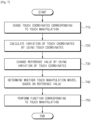
- FIG. 7 is a flowchart of a touch processing method of an electronic device, according to an example of the present disclosure.
- the flowchart illustrated in FIG. 7 may include operations processed by the electronic device 100 illustrated in FIG. 1 . Details about the electronic device 100 may be applied to the flowchart shown in FIG. 7 with reference to FIGS. 1 to 5 described above.
- the electronic device 100 may sense touch coordinates corresponding to a touch manipulation (or a pen manipulation) of a user.
- the electronic device 100 may periodically sense touch coordinates corresponding to a touch manipulation of a user through the input panel 110.
- the electronic device 100 may sense x-axis and y-axis touch coordinates corresponding to a touch manipulation of a user.
- the electronic device 100 may determine a touch event corresponding to touch coordinates.
- a touch event may include, for example, a touch down event (or a touch start event), a touch move event, and a touch up event (or a touch end event).
- the electronic device 100 may calculate a variation of touch coordinates (or a difference value) by using touch coordinates.
- the electronic device 100 may calculate a variation between two successive touch coordinates.
- the electronic device 100 may calculate a variation of each of an x-axis coordinate and a y-axis coordinate.
- the electronic device 100 may change a reference value for determining whether a touch manipulation moves.
- the electronic device 100 may compare a variation of touch coordinates to a currently set reference value and may change the reference value to a variation of the touch coordinates if the variation of the touch coordinates is less than the reference value.
- the electronic device 100 may compare each of a variation of an x-axis coordinate and a variation of a y-axis coordinate to a reference value.
- the electronic device 100 may change the reference value to one of the variation of the x-axis coordinate and the variation of the y-axis coordinate.
- the electronic device 100 may change a reference value in a certain range (or a change range of the reference value). If a number of occurrences of a touch move event received from the touch driver 13 is greater than or equal to a certain number of times, the electronic device 100 may change the reference value.
- the change range of a reference value may be set based on pixel density or pixel size (e.g., a width or a height) of the display 120.
- the electronic device 100 may determine whether a touch manipulation moves, by using a reference value. For example, in operation 730, if a reference value is changed, the electronic device 100 may determine whether a touch manipulation moves, based on the changed reference value. If a variation of touch coordinates is greater than or equal to a reference value, the electronic device 100 may determine that a touch manipulation moved. If a variation of touch coordinates is less than a reference value, the electronic device 140 may determine that a touch manipulation stopped (or that the touch manipulation does not move). The electronic device 100 may determine whether a touch manipulation moves, based on each of a variation of an x-axis coordinate and a variation of a y-axis coordinate.
- the electronic device 100 may perform a function corresponding to a touch manipulation based on a determination result.
- the electronic device 100 may perform a function corresponding to a touch manipulation based on at least one of touch coordinates and a variation of the touch coordinates.
- the electronic device 100 may accumulate a touch manipulation and may process the accumulated touch manipulation.
- the electronic device 100 may accumulate a movement distance of a touch manipulation, which is determined as a movement input, or a number of movements of the touch manipulation; if the electronic device 100 determines that an accumulated movement distance of a touch manipulation is greater than or equal to a certain distance or determines that an accumulated number of movements of a touch manipulation is greater than or equal to a certain number of times, the electronic device 100 may perform a function corresponding to the movement of the touch manipulation.
- FIG. 8 is a flowchart of a reference value changing method of an electronic device, according to an embodiment of the present disclosure.
- the flowchart illustrated in FIG. 8 includes operations which the electronic device 100 illustrated in FIG. 1 processes. Details about the electronic device 100 may be applied to the flowchart shown in FIG. 8 with reference to FIGS. 1 to 5 described above.
- the electronic device 100 determines whether a touch move event occurred. For example, the electronic device 100 determines whether a touch move event occurred, based on touch coordinates that are sent from the input panel 110 to the processor 140.
- the electronic device 100 determines that a touch move event occurs, in operation 820, the electronic device 100 counts a number of occurrences (or a count) of the touch move event. If a touch move event does not occur (e.g., if a touch down event or a touch up event occurs), the electronic device 100 may end the process of changing a reference value.
- the electronic device 100 determines whether a number of occurrences (or a count) of a touch move event is greater than or equal to a certain value.
- the electronic device 100 determines whether a variation of touch coordinates is less than a reference value. If a number of occurrences of a touch move event is greater than or equal to a certain value, the electronic device 100 may end the process of changing the reference value.
- the electronic device 100 determines whether the variation of the touch coordinates is in a certain range (or a change range of the reference value).
- a change range of a reference value may be set based on a pixel density or a pixel size (e.g., a width or a height) of a display.
- a maximum value and a minimum value of a change range of a reference value may be set to be inversely proportional to a pixel density (or proportional to a pixel size).
- a difference between a maximum value and a minimum value of a change range of a reference value may be set to be inversely proportional to a pixel density (or proportional to pixel size).
- a preset value upon manufacturing the electronic device 100 may be set as a change range of a reference value. If a variation of touch coordinates is greater than a reference value, the electronic device 100 may end the process of changing the reference value.
- the electronic device 100 e.g., the processor 140 changes a reference value to the variation of the touch coordinates.
- operations 820 and 830 may be omitted.
- a running application e.g., an application that performs a function corresponding to a touch manipulation
- operations 820 and 830 may be performed.
- operations 820 and 830 may be omitted.
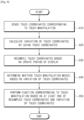
- FIG. 9 is a flowchart of a reference value changing method of an electronic device, according to an example of the present disclosure.
- the flowchart illustrated in FIG. 9 may include operations which the electronic device 100 illustrated in FIG. 1 processes. Details about the electronic device 100 may be applied to the flowchart shown in FIG. 9 with reference to FIGS. 1 to 5 described above.
- the electronic device 100 may sense touch coordinates corresponding to a touch manipulation (or a pen manipulation) of a user.
- the electronic device 100 may periodically sense touch coordinates corresponding to a touch manipulation of a user through the input panel 110.
- the electronic device 100 may sense x-axis and y-axis touch coordinates corresponding to a touch manipulation of a user.
- the electronic device 140 may determine a touch event corresponding to touch coordinates.
- a touch event may include, for example, a touch down event (or a touch start event), a touch move event, and a touch up event (or a touch end event).
- the electronic device 100 may calculate a variation of touch coordinates (or a difference value) by using the touch coordinates.
- the electronic device 100 may calculate a variation between two successive touch coordinates.
- the electronic device 100 may calculate a variation of each of an x-axis coordinate and a y-axis coordinate.
- the electronic device 100 may resample touch coordinates.
- the electronic device 100 may resample touch coordinates based on an update period of a display.
- the electronic device 100 may determine whether a touch manipulation moves, based on a variation of touch coordinates.
- the electronic device 100 may determine whether a touch manipulation moves, by using a variation of touch coordinates that are not resampled. If a variation of touch coordinates is greater than or equal to a reference value, the electronic device 100 may determine that a touch manipulation moved. If a variation of touch coordinates is less than a reference value, the electronic device 140 may determine that a touch manipulation stopped (or that the touch manipulation does not move). The electronic device 100 may determine whether a touch manipulation moves, based on each of a variation of an x-axis coordinate and a variation of a y-axis coordinate.
- the electronic device 100 may perform a function corresponding to a touch manipulation based on at least one of resampled touch coordinates and a variation of touch coordinates.
- the electronic device 100 may perform a function corresponding to a touch manipulation based on a result of determining whether a touch manipulation moves.
- the electronic device 100 may accumulate a touch manipulation and may process the accumulated touch manipulation.
- the electronic device 100 may accumulate a movement distance of a touch manipulation, which is determined as a movement input, or a number of movements of the touch manipulation; if the electronic device 100 determines that an accumulated movement distance of a touch manipulation is greater than or equal to a certain distance or determines that an accumulated number of movements of a touch manipulation is greater than or equal to a certain number of times, the electronic device 100 may perform a function corresponding to the movement of the touch manipulation.
- An input processing method of an electronic device may include periodically sensing touch coordinates corresponding to a touch manipulation of a user, calculating a variation of the touch coordinates based on the touch coordinates, changing a reference value for determining movement of the touch manipulation by using the variation of the touch coordinates and determining whether the touch manipulation moves, based on the reference value.
- Changing a reference value may include changing the reference value to a variation of touch coordinates if the variation of the touch coordinates is less than the reference value.
- Changing a reference value may include changing the reference value in a certain range.
- a certain range may be proportional to a pixel density.
- a touch event corresponding to touch coordinates may be determined, and changing a reference value may include counting a number of occurrences of a touch move event in the touch event and changing the reference value if the number of occurrences of the touch move event is greater than or equal to a certain number of times.
- Changing a reference value may further include initializing a number of occurrences of a touch move event if a touch down event or a touch up event is received from an input panel or if the reference value is changed.
- Determining whether a touch manipulation moves may include determining that the touch manipulation moved if a variation of touch coordinates is greater than or equal to a reference value, and determining that the touch manipulation stopped if the variation of the touch coordinates is less than the reference value.
- An input processing method of an electronic device may include periodically sensing touch coordinates corresponding to a touch manipulation of a user, calculating a variation of the touch coordinates based on the touch coordinates, determining resampling coordinates of the touch coordinates based on an update period of a display, determining whether the touch manipulation moves, based on the variation of the touch coordinates and performing a function corresponding to the determined result based on the resampling coordinates.
- Touch coordinates may include an x-axis coordinate and a y-axis coordinate corresponding to the touch manipulation.
- the determining of whether the touch manipulation moves may include calculating the variation of each of the x-axis coordinate and the y-axis coordinate and resampling each of the x-axis coordinate and the y-axis coordinate.
- An input processing method of an electronic device may include receiving an input through the input panel, obtaining first coordinates and second coordinates on the input panel corresponding to the input, and changing a reference value for determining whether the touch manipulation moves, if a variation satisfies a certain condition based at least on a variation between the first coordinates and the second coordinates.
- An input processing method of an electronic device may include receiving an input through the input panel, obtaining first coordinates and second coordinates on the input panel corresponding to the input, determining interpolated coordinates (resampled coordinates) corresponding to the first coordinates based on an update period of a display, determining an input event corresponding to the input by using the processor based at least on a variation between the first coordinates and the second coordinates, and performing a function corresponding to the input event based at least on the interpolated coordinates (the resampled coordinates).
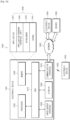
- FIG. 10 is a block diagram of an electronic device 1001 in a network environment 1000 according to an embodiment of the present disclosure.
- the electronic device 1001 may include a bus 1010, a processor 1020, a memory 1030, an input/output interface 1050, a display 1060, and a communication interface 1070. According to an embodiment of the present disclosure, at least one of the foregoing elements may be omitted or another element may be added to the electronic device 1001.
- the bus 1010 may include a circuit for connecting the above-mentioned elements 1010 to 1070 to each other and transferring communications (e.g., control messages and/or data) among the above-mentioned elements 1010 to 1070.
- communications e.g., control messages and/or data
- the processor 1020 may include at least one of a central processing unit (CPU), an application processor (AP), and a communication processor (CP).
- the processor 1020 may perform data processing or an operation related to communication and/or control of at least one of the other elements 1010 to 1070 of the electronic device 1001.
- the memory 1030 may include a volatile memory and/or a nonvolatile memory.
- the memory 1030 may store instructions or data related to at least one of the other elements 1020 and 1050-1070 of the electronic device 1001.
- the memory 1030 may store software and/or a program 1040.
- the program 1040 may include, for example, a kernel 1041, a middleware 1043, an application programming interface (API) 1045, and/or an application program (or an application) 1047. At least a portion of the kernel 1041, the middleware 1043, or the API 1045 may be referred to as an operating system (OS).
- OS operating system
- the kernel 1041 may control or manage system resources (e.g., the bus 1010, the processor 1020, the memory 1030, or the like) used to perform operations or functions of other programs (e.g., the middleware 1043, the API 1045, or the application program 1047). Further, the kernel 1041 may provide an interface for allowing the middleware 1043, the API 1045, or the application program 1047 to access individual elements of the electronic device 1001 in order to control or manage the system resources.
- system resources e.g., the bus 1010, the processor 1020, the memory 1030, or the like
- other programs e.g., the middleware 1043, the API 1045, or the application program 1047.
- the kernel 1041 may provide an interface for allowing the middleware 1043, the API 1045, or the application program 1047 to access individual elements of the electronic device 1001 in order to control or manage the system resources.
- the middleware 1043 may serve as an intermediary so that the API 1045 or the application program 1047 communicates and exchanges data with the kernel 1041.
- the middleware 1043 may handle one or more task requests received from the application program 1047 according to a priority order. For example, the middleware 1043 may assign at least one application program 1047 a priority for using the system resources (e.g., the bus 1010, the processor 1020, the memory 1030, or the like) of the electronic device 1001. For example, the middleware 1043 may handle the one or more task requests according to the priority assigned to the at least one application program 1047, thereby performing scheduling or load balancing with respect to the one or more task requests.
- system resources e.g., the bus 1010, the processor 1020, the memory 1030, or the like
- the API 1045 which is an interface for allowing the application 1047 to control a function provided by the kernel 1041 or the middleware 1043, may include, for example, at least one interface or function (e.g., instructions) for file control, window control, image processing, character control, or the like.
- the input/output interface 1050 may serve to transfer an instruction or data input from a user or another external device to (an)other element(s) of the electronic device 1001. Furthermore, the input/output interface 1050 may output instructions or data received from (an)other element(s) of the electronic device 1001 to the user or another external device.
- the display 1060 may include, for example, a liquid crystal display (LCD), a light-emitting diode (LED) display, an organic light-emitting diode (OLED) display, a microelectromechanical systems (MEMS) display, or an electronic paper display.
- the display 1060 may present various content (e.g., a text, an image, a video, an icon, a symbol, or the like) to a user.
- the display 1060 may include a touch screen, and may receive a touch, a gesture, a proximity or hovering input from an electronic pen or a part of a user's body.
- the communication interface 1070 may establish communication between the electronic device 1001 and the first external electronic device 1002, the second external electronic device 1004, or a server 1006.
- the communication interface 1070 may be connected to a network 1062 via wireless communications or wired communications so as to communicate with the second external electronic device 1004 or the server 1006.
- the wireless communications may employ at least one of cellular communication protocols such as long-term evolution (LTE), LTE-advanced (LTE-A), code division multiple access (CDMA), wideband CDMA (WCDMA), universal mobile telecommunications system (UMTS), wireless broadband (WiBro), and global system for mobile communications (GSM).
- LTE long-term evolution
- LTE-A LTE-advanced
- CDMA code division multiple access
- WCDMA wideband CDMA
- UMTS universal mobile telecommunications system
- WiBro wireless broadband
- GSM global system for mobile communications
- the wireless communications may include, for example, a short-range communications 1064.
- the short-range communications may include at least one of wireless fidelity (Wi-Fi), Bluetooth, Bluetooth low energy (BLE), Zigbee, near field communication (NFC), magnetic secure transmission (MST), and global navigation satellite system (GNSS).
- Wi-Fi wireless fidelity
- BLE Bluetooth low energy
- NFC near field communication
- MST magnetic
- GNSS may include, for example, at least one of a global positioning system (GPS), another global navigation satellite system (GLONASS), BeiDou navigation satellite system (BeiDou), and Galileo, the European global satellite-based navigation system according to a use area or a bandwidth.
- GPS global positioning system
- GLONASS global navigation satellite system
- BeiDou BeiDou navigation satellite system
- Galileo the European global satellite-based navigation system according to a use area or a bandwidth.
- GPS global positioning system
- GLONASS global navigation satellite system
- BeiDou BeiDou navigation satellite system
- Galileo the European global satellite-based navigation system
- Wired communications may include at least one of a universal serial bus (USB), a high definition multimedia interface (HDMI), a recommended standard 232 (RS-232), a plain old telephone service (POTS), and the like.
- the network 1062 may include at least one telecommunications network, for example, a computer network (e.g., a local area network (LAN) or a wide area network (WAN)), the Internet, and/or a telephone network.
- the types of the first external electronic device 1002 and the second external electronic device 1004 may be the same as or different from the type of the electronic device 1001.
- the server 1006 may include one or more servers. A portion or all of the operations performed in the electronic device 1001 may be performed in one or more other electronic devices (e.g., the first electronic device 1002, the second external electronic device 1004, or the server 1006). If the electronic device 1001 performs a certain function or service automatically or in response to a request, the electronic device 1001 may request at least a portion of the functions related to the certain function or service to be performed from another device (e.g., the first electronic device 1002, the second external electronic device 1004, or the server 1006) instead of or in addition to the electronic device 1001 performing the function or service.
- another device e.g., the first electronic device 1002, the second external electronic device 1004, or the server 1006
- the other electronic device may perform the requested function or additional function, and may transfer a result of performing the requested function or additional function to the electronic device 1001.
- the electronic device 1001 may use a received result as is or additionally process the received result to provide the requested function or service.
- cloud computing, distributed computing, or client-server computing may be used.
- FIG. 11 is a block diagram of an electronic device 1101 according to an embodiment of the present disclosure.
- the electronic device 1101 may include, for example, a part or the entirety of the electronic device 1001 illustrated in FIG. 10 .
- the electronic device 1101 may include at least one processor (e.g., an AP) 1110, a communication module 1120, a subscriber identification module (SIM) 1129, a memory 1130, a sensor module 1140, an input device 1150, a display 1160, an interface 1170, an audio module 1180, a camera module 1191, a power management module 1195, a battery 1196, an indicator 1197, and a motor 1198.
- processor e.g., an AP
- SIM subscriber identification module
- the processor 1110 may run an operating system or an application program so as to control a plurality of hardware or software elements connected to the processor 1110, process various data, and perform operations.
- the processor 1110 may be implemented with, for example, a system on chip (SoC).
- SoC system on chip
- the processor 1110 may further include a GPU and/or an image signal processor.
- the processor 1110 may include at least a portion of the elements (e.g., a cellular module 1121) illustrated in FIG. 11 .
- the processor 1110 may load, on a volatile memory, an instruction or data received from at least one of the other elements (e.g., a nonvolatile memory) to process the instruction or data, and may store various data in a nonvolatile memory.
- the communication module 1120 may be configured the same as or similar to the communication interface 1070 of FIG. 10 .
- the communication module 1120 may include, for example, the cellular module 1121 (e.g., the modem 330), a Wi-Fi module 1122, a Bluetooth (BT) module 1123, a GNSS module 1124 (e.g., a GPS module, a GLONASS module, a BeiDou module, or a Galileo module), an NFC module 1125, a MST module 1126 and a radio frequency (RF) module 1127.
- the cellular module 1121 e.g., the modem 330
- BT Bluetooth
- GNSS module 1124 e.g., a GPS module, a GLONASS module, a BeiDou module, or a Galileo module
- NFC module 1125 e.g., a GPS module, a GLONASS module, a BeiDou module, or a Galileo module
- the cellular module 1121 may provide, for example, a voice call service, a video call service, a text message service, or an Internet service through a communication network.
- the cellular module 1121 may identify and authenticate the electronic device 1101 in the communication network using the subscriber identification module 1129 (e.g., a SIM card).
- the cellular module 1121 may perform at least a part of the functions that may be provided by the processor 1110.
- the cellular module 1121 may include a CP.
- Each of the Wi-Fi module 1122, the Bluetooth module 1123, the GNSS module 1124, the NFC module 1125 and the MST module 1126 may include, for example, a processor for processing data transmitted/received through the modules.
- at least a part (e.g., two or more) of the cellular module 1121, the Wi-Fi module 1122, the Bluetooth module 1123, the GNSS module 1124, the NFC module 1125 and the MST module 1126 may be included in a single integrated circuit (IC) or IC package.
- the RF module 1127 may transmit/receive, for example, communication signals (e.g., RF signals).
- the RF module 1127 may include, for example, a transceiver, a power amplifier module (PAM), a frequency filter, a low noise amplifier (LNA), an antenna, or the like.
- PAM power amplifier module
- LNA low noise amplifier
- at least one of the cellular module 1121, the Wi-Fi module 1122, the Bluetooth module 1123, the GNSS module 1124, the NFC module 1125 and the MST module 1126 may transmit/receive RF signals through a separate RF module.
- the SIM 1129 may include, for example, an embedded SIM and/or a card, and may include unique identification information (e.g., an integrated circuit card identifier (ICCID)) or subscriber information (e.g., international mobile subscriber identity (IMSI)).
- ICCID integrated circuit card identifier
- IMSI international mobile subscriber identity
- the memory 1130 may include, for example, an internal memory 1132 or an external memory 1134.
- the internal memory 1132 may include at least one of a volatile memory (e.g., a dynamic random access memory (DRAM), a static RAM (SRAM), a synchronous dynamic RAM (SDRAM), or the like), a nonvolatile memory (e.g., a one-time programmable read only memory (OTPROM), a programmable ROM (PROM), an erasable and programmable ROM (EPROM), an electrically erasable and programmable ROM (EEPROM), a mask ROM, a flash ROM, a flash memory (e.g., a NAND flash memory, a NOR flash memory, or the like)), a hard drive, and a solid state drive (SSD).
- a volatile memory e.g., a dynamic random access memory (DRAM), a static RAM (SRAM), a synchronous dynamic RAM (SDRAM), or the like
- the external memory 1134 may include a flash drive such as a compact flash (CF) drive, a secure digital (SD) memory card, a micro-SD, a mini-SD memory card, an extreme digital (xD) memory card, a multimedia card (MMC), a memory stick, or the like.
- the external memory 1134 may be operatively and/or physically connected to the electronic device 1101 through various interfaces.
- a security module 1136 which is a module including a storage space that has a higher security level than the memory 1130, may be a circuit for providing secure data storage and a protected execution environment.
- the security module 1136 may be implemented with an additional circuit and may include an additional processor.
- the security module 1136 may be present in an attachable smart IC or SD memory card, or may include an embedded secure element (eSE), which is installed in a fixed IC. Additionally, the security module 1136 may be driven in another OS which is different from the OS of the electronic device 1101. For example, the security module 1136 may operate based on a java card open platform (JCOP) OS.
- JCOP java card open platform
- the sensor module 1140 may, for example, measure a physical quantity or detect an operation state of the electronic device 1101 so as to convert measured or detected information into an electrical signal.
- the sensor module 1140 may include, for example, at least one of a gesture sensor 1140A, a gyro sensor 1140B, a barometric pressure sensor 1140C, a magnetic sensor 1140D, an acceleration sensor 1140E, a grip sensor 1140F, a proximity sensor 1140G, a color sensor 1140H (e.g., a red/green/blue (RGB) sensor), a biometric sensor 11401, a temperature/humidity sensor 1140J, an illumination sensor 1140K, and an ultraviolet (UV) light sensor 1140M.
- a gesture sensor 1140A e.g., a gyro sensor 1140B, a barometric pressure sensor 1140C, a magnetic sensor 1140D, an acceleration sensor 1140E, a grip sensor 1140F, a proximity sensor 1140G,
- the sensor module 1140 may include, for example, an olfactory sensor (e.g., an electronic nose (E-nose) sensor), an electromyography (EMG) sensor, an electroencephalogram (EEG) sensor, an electrocardiogram (ECG) sensor, an infrared (IR) sensor, an iris recognition sensor, and/or a fingerprint sensor.
- the sensor module 1140 may further include a control circuit for controlling at least one sensor included therein.
- the electronic device 1101 may further include a processor configured to control the sensor module 1140 as a part of the processor 1110 or separately, so that the sensor module 1140 is controlled while the processor 1110 is in a reduced power or sleep state.
- the input device 1150 may include, for example, a touch panel 1152, a (digital) pen sensor 1154, a key 1156, or an ultrasonic input device 1158.
- the touch panel 1152 may employ at least one of a capacitive type, a resistive type, an infrared type, and an ultraviolet light type sensing method.
- the touch panel 1152 may further include a control circuit.
- the touch panel 1152 may further include a tactile layer so as to provide a haptic feedback to a user.
- the (digital) pen sensor 1154 may include, for example, a sheet for recognition which is either a part of a touch panel or is separate.
- the key 1156 may include, for example, a physical button, an optical button, or a keypad.
- the ultrasonic input device 1158 may sense ultrasonic waves generated by an input tool through a microphone 1188 so as to identify data corresponding to the ultrasonic waves sensed.
- the display 1160 may include a panel 1162, a hologram device 1164, and/or a projector 1166.
- the panel 1162 may be configured the same as or similar to the display 1060 of FIG. 10 .
- the panel 1162 may be, for example, flexible, transparent, or wearable.
- the panel 1162 and the touch panel 1152 may be integrated into a single module.
- the hologram device 1164 may display a stereoscopic image in a space using a light interference phenomenon.
- the projector 1166 may project light onto a screen so as to display an image.
- the screen may be disposed in internally or externally to the electronic device 1101.
- the display 1160 may further include a control circuit for controlling the panel 1162, the hologram device 1164, and/or the projector 1166.
- the interface 1170 may include, for example, an HDMI 1172, a USB 1174, an optical interface 1176, and/or a D-subminiature (D-sub) connector 1178.
- the interface 1170 may be included in the communication interface 1070 illustrated in FIG. 10 .
- the interface 1170 may include, for example, a mobile high-definition link (MHL) interface, an SD card/ MMC interface, or an interface according to an Infrared Data Association (IrDA) standard.
- MHL mobile high-definition link
- IrDA Infrared Data Association
- the audio module 1180 may convert, for example, a sound into an electrical signal or vice versa. At least a portion of the elements of the audio module 1180 may be included in the input/output interface 1050 illustrated in FIG. 10 .
- the audio module 1180 may process sound information input or output through a speaker 1182, a receiver 1184, an earphone 1186, or the microphone 1188.
- the camera module 1191 is, for example, a device for photographing a still image or recording a video.
- the camera module 1191 may include at least one image sensor (e.g., a front sensor or a rear sensor), a lens, an image signal processor (ISP), or a flash (e.g., an LED lamp or a xenon lamp).
- ISP image signal processor
- flash e.g., an LED lamp or a xenon lamp.
- the power management module 1195 may manage power of the electronic device 1101.
- the power management module 1195 may include a power management integrated circuit (PMIC), a charger IC, a battery, and/or a battery gauge.
- the PMIC may employ a wired and/or wireless charging method.
- the wireless charging method may include, for example, a magnetic resonance method, a magnetic induction method, an electromagnetic method, or the like.
- An additional circuit for wireless charging, such as a coil loop, a resonant circuit, a rectifier, or the like, may be further included.
- the battery gauge may measure, for example, a remaining capacity of the battery 1196 and a voltage, current or temperature thereof while the battery 1196 is charging.
- the battery 1196 may include, for example, a rechargeable battery and/or a solar battery.
- the indicator 1197 may display a certain state of the electronic device 1101 or a part thereof (e.g., the processor 1110), such as a booting state, a message state, a charging state, or the like.
- the motor 1198 may convert an electrical signal into a mechanical vibration, and may generate a vibration or haptic effect.
- a processing device e.g., a GPU
- the processing device for supporting a mobile TV may process media data according to the standards of digital multimedia broadcasting (DMB), digital video broadcasting (DVB), MediaFLO TM , or the like.
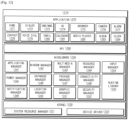
- FIG. 12 is a block diagram of a program module according to an embodiment of the present disclosure.
- a program module 1210 may include an OS for controlling a resource related to an electronic device (e.g., the electronic device 1001) and/or various applications (e.g., the application program 1047) running on the OS.
- the OS may be, for example, Android ® , iOS ® , Windows ® , Symbian ® , Tizen ® , or the like.
- the program module 1210 may include a kernel 1220, a middleware 1230, an API 1260, and/or an application 1270. At least a part of the program module 1210 may be preloaded on an electronic device or may be downloaded from an external electronic device (e.g., the first electronic device 1002, the second external electronic device 1004, or the server 1006).
- an external electronic device e.g., the first electronic device 1002, the second external electronic device 1004, or the server 1006
- the kernel 1220 may include, for example, a system resource manager 1221 or a device driver 1223.
- the system resource manager 1221 may perform control, allocation, or retrieval of a system resource.
- the system resource manager 1221 may include a process management unit, a memory management unit, a file system management unit, or the like.
- the device driver 1223 may include, for example, a display driver, a camera driver, a Bluetooth driver, a shared memory driver, a USB driver, a keypad driver, a Wi-Fi driver, an audio driver, or an inter-process communication (IPC) driver.
- IPC inter-process communication
- the middleware 1230 may provide a function that the application 1270 requires in common, or may provide various functions to the application 1270 through the API 1260 so that the application 1270 may efficiently use limited system resources in the electronic device.
- the middleware 1230 (e.g., the middleware 1043) may include at least one of a runtime library 1235, an application manager 1241, a window manager 1242, a multimedia manager 1243, a resource manager 1244, a power manager 1245, a database manager 1246, a package manager 1247, a connectivity manager 1248, a notification manager 1249, a location manager 1250, a graphic manager 1251, a security manager 1252 and an input manager 1254.
- the runtime library 1235 may include, for example, a library module that a complier uses to add a new function through a programming language while the application 1270 is running.
- the runtime library 1235 may perform a function for input/output management, memory management, or an arithmetic function.
- the application manager 1241 may mange, for example, a life cycle of at least one of the application 1270.
- the window manager 1242 may manage a graphical user interface (GUI) resource used in a screen.
- the multimedia manager 1243 may recognize a format required for playing various media files and may encode or decode a media file using a codec matched to the format.
- the resource manager 1244 may manage a resource such as source code, a memory, or a storage space of at least one of the applications in the application 1270.
- the power manager 1245 may operate together with a basic input/output system (BIOS) to manage a battery or power and may provide power information required for operating an electronic device.
- BIOS basic input/output system
- the database manager 1246 may generate, search, or modify a database to be used in at least one of the applications of the application 1270.
- the package manager 1247 may manage installation or update of an application distributed in a package file format.
- the connectivity manger 1248 may manage a wireless connection of Wi-Fi, Bluetooth, or the like.
- the notification manager 1249 may display or notify an event such as message arrival, appointments, and proximity alerts in such a manner as not to disturb a user.
- the location manager 1250 may manage location information of the electronic device.
- the graphic manager 1251 may manage a graphic effect to be provided to a user or a user interface related thereto.
- the security manager 1252 may provide various security functions required for system security or user authentication.
- the input manager 1254 (e.g., the input manager 15) may process data regarding a user input and transfer the data to an application.
- the middleware 1230 may further include a telephony manager for managing a voice or video call function of the electronic device.
- the middleware 1230 may include a middleware module for forming a combination of various functions of the above-mentioned elements.
- the middleware 1230 may provide a module specialized for each type of an operating system to provide differentiated functions. Furthermore, the middleware 1230 may delete a part of existing elements or may add new elements dynamically.
- the API 1260 (e.g., the API 1045) which is, for example, a set of API programming functions may be provided in different configurations according to an operating system. For example, in the case of Android ® or iOS ® , one API set may be provided for each platform, and, in the case of Tizen ® , at least two API sets may be provided for each platform.
- the application 1270 may include at least one application capable of performing functions such as a home application 1271, a dialer application 1272, an SMS/MMS application 1273, an instant message application (IM) 1274, a browser application 1275, a camera application 1276, an alarm application 1277, a contact application 1278, a voice dial application 1279, an e-mail application 1280, a calendar application 1281, a media player application 1282, an album application 1283, a clock application 1284.
- the application 1270 may also include a health care application (e.g., an application to measure an exercise amount or a blood sugar level), or an environmental information provision application (e.g., an application to provide air pressure, humidity, or temperature information).
- the application 1270 may include an information exchange application for supporting information exchange between the electronic device (e.g., the electronic device 1001) and the first electronic device 1002 or the second external electronic device 1004.
- the information exchange application may include, for example, a notification relay application for relaying certain information to an external electronic device or a device management application for managing the external electronic device.
- the notification relay application may have a function for relaying, to the first electronic device 1002 or the second external electronic device 1004, notification information generated in another application (e.g., the SMS/MMS application 1273, the e-mail application 1280, the health care application, the environmental information provision application, or the like) of an electronic device.
- the notification relay application may receive notification information from an external electronic device and may provide the received notification information to a user.
- the device management application may manage (e.g., install, delete, or update) at least one function (e.g., turn-on/turn off of an external electronic device (or some elements) or the brightness (or resolution) adjustment of a display) of the first electronic device 1002 or the second external electronic device 1004 communicating with an electronic device, an application running in the external electronic device, or a service (e.g., a call service, a message service, or the like) provided from the external electronic device.
- function e.g., turn-on/turn off of an external electronic device (or some elements) or the brightness (or resolution) adjustment of a display
- a service e.g., a call service, a message service, or the like
- the application 1270 may include a certain application (e.g., a healthcare application of a mobile medical device) according to an attribute of the first electronic device 1002 or the second external electronic device 1004.
- the application 1270 may include an application received from the first electronic device 1002 or the second external electronic device 1004.
- the application 1270 may include a preloaded application or a third-party application downloadable from a server.
- the names of the elements of the program module 1210 illustrated may vary with the type of an operating system.
- At least a part of the program module 1210 may be implemented with software, firmware, hardware, or a combination thereof. At least a part of the program module 1210, for example, may be implemented (e.g., executed) by a processor (e.g., the processor 1020). At least a part of the program module 1210 may include, for example, a module, a program, a routine, sets of instructions, or a process for performing at least one function.
- an electronic device may include at least one of the elements described herein, and some elements may be omitted or other additional elements may be added. Further, some of the elements of an electronic device may be combined with each other so as to form one entity, so that the functions of the elements may be performed in the same manner as before the combination.
- module used herein may represent, for example, a unit including one of hardware, software, firmware, and a combination thereof.
- the term “module” may be interchangeably used with the terms “unit,” “logic,” “logical block,” “component” and “circuit.”
- the term “module” may indicate a minimum unit of an integrated component or may indicate a part thereof.
- the term “module” may indicate a minimum unit for performing one or more functions or a part thereof.
- module may indicate a unit that may be implemented mechanically or electronically.
- module may indicate a unit that includes at least one of an application-specific integrated circuit (ASIC), a field-programmable gate array (FPGA), and a programmable-logic device for performing some operations, which are known or will be developed.
- ASIC application-specific integrated circuit
- FPGA field-programmable gate array
- programmable-logic device for performing some operations, which are known or will be developed.
- At least a part of devices (e.g., modules or functions thereof) or methods (e.g., operations) according to an embodiment of the present disclosure may be implemented as instructions stored in a non-transitory computer-readable recording medium in the form of a program module.
- the processor may perform functions corresponding to the instructions.
- the non-transitory computer-readable recording medium may be, for example, the memory 130.
- a non-transitory computer-readable recording medium may include a hard disk, a floppy disk, a magnetic medium (e.g., a magnetic tape), an optical medium (e.g., a compact disc ROM (CD-ROM), a digital versatile disc (DVD)), a magneto-optical medium (e.g., a floptical disk), or a hardware device (e.g., a ROM, a RAM, a flash memory, or the like).
- Program instructions may include machine language code generated by compilers and high-level language code that can be executed by computers using interpreters.
- the above-mentioned hardware device may be configured to be operated as one or more software modules for performing operations of an embodiment of the present disclosure and vice versa.
- a module or a program module according to an embodiment of the present disclosure may include at least one of the above-mentioned elements, or some elements may be omitted or other additional elements may be added. Operations performed by a module, a program module or other elements according to an embodiment of the present disclosure may be performed in a sequential, parallel, iterative or heuristic way. Furthermore, some operations may be performed in another order or may be omitted, or other operations may be added.
- the reaction speed or the accuracy of the touch manipulation of a user may be improved, thereby providing the user with an excellent user experience.
- power consumed to drive an input panel may be reduced.
Landscapes
- Engineering & Computer Science (AREA)
- General Engineering & Computer Science (AREA)
- Theoretical Computer Science (AREA)
- Human Computer Interaction (AREA)
- Physics & Mathematics (AREA)
- General Physics & Mathematics (AREA)
- User Interface Of Digital Computer (AREA)
Description
- The present disclosure relates generally to a method and device for processing a touch input, and more particularly, to a method and device for processing a touch input to improve a reaction speed or accuracy of a touch manipulation.
- With the development of electronic technologies, various types of electronic devices are being developed and supplied. In recent years, portable electronic devices, which have a variety of functions, such as a smart phone, a tablet personal computer (PC), and the like are widely used.
- Most electronic devices that were recently developed have used a touch panel (or a pen sensor panel) as an input device. In particular, a user may intuitively input a user manipulation to a touch screen combined with a display.
-
EP 2 487 570 A9 discloses a method that includes detecting movement of a touch on a touch-sensitive display of an electronic device from a first touch location to a second touch location. -
US 2010/315366 A1 andEP 2 587 358 A2 are directed to touch movement detection. -
EP 2 677 413 A2 discloses a method for differentiating between tap and drag events. - A touch screen (e.g., a touch panel (or a pen sensor panel)) included in a display may have a reduced reaction speed or reduced accuracy of a touch manipulation based on a processing time or a processing method of a touch movement of a user.
- An aspect of the present disclosure is to provide an input processing method and device capable of improving the reaction speed or the accuracy of a touch manipulation.
- The invention is defined by the appended set of claims.
- According to various embodiments of the present disclosure, the reaction speed or the accuracy of the touch manipulation of a user may be improved, thereby providing the user with an excellent user experience. According to various embodiments of the present disclosure, power consumed to drive an input panel may be reduced.
- The above and other aspects, features, and advantages of certain embodiments of the present disclosure will be more apparent from the following description, taken in conjunction with the accompanying drawings, in which:
-
FIG. 1 is a block diagram of an electronic device, according to an embodiment of the present disclosure; -
FIG. 2 is a plot of a resampling result of touch coordinates, according to an embodiment of the present disclosure; -
FIG. 3 is a plot of a resampling result of touch coordinates, according to an embodiment of the present disclosure; -
FIGs. 4a and 4b are plots of a movement distance of a touch manipulation over time; -
FIG. 5 is a plot of a change range of a reference value, according to an embodiment of the present disclosure; -
FIG. 6 is a flow diagram of a touch processing method of an electronic device, according to an embodiment of the present disclosure; -
FIG. 7 is a flowchart of a touch processing method of an electronic device, according to an example of the present disclosure which is not encompassed by the scope of the appended set of claims; -
FIG. 8 is a flowchart of a reference value changing method of an electronic device, according to an embodiment of the present disclosure; -
FIG. 9 is a flowchart of a reference value changing method of an electronic device, according to an example of the present disclosure which is not encompassed by the scope of the appended set of claims; -
FIG. 10 is a block diagram of an electronic device in a network environment, according to an embodiment of the present disclosure; -
FIG. 11 is a block diagram of an electronic device, according to an embodiment of the present disclosure; and -
FIG. 12 is a block diagram of a program module, according to an embodiment of the present disclosure. - Various embodiments of the present disclosure may be described with reference to the accompanying drawings. Accordingly, those of ordinary skill in the art will recognize that a modification, an equivalent, and/or an alternative on the various embodiments of the present disclosure described herein may be variously made without departing from the scope of the present disclosure which is defined by the appended set of claims . With regard to the description below of the accompanying drawings, similar elements may be marked by similar reference numerals.
- In the present disclosure, the expressions "have," "may have," "include," "comprise," "may include," and "may comprise" used herein indicate the existence of corresponding features (e.g., elements such as numeric values, functions, operations, or components) but do not exclude the presence of additional features.
- In the present disclosure, the expressions "A or B," "at least one of A and/or B," "one or more of A and/or B," and the like used herein may include any and all combinations of one or more of the associated listed items. For example, the terms "A or B," "at least one of A and B," and "at least one of A or B" may refer to all of case (1) where at least one A is included, case (2) where at least one B is included, and case (3) where both of at least one A and at least one B are included.
- The terms "first," "second," and the like used herein may refer to various elements of various embodiments of the present disclosure, but do not limit the elements. For example, "a first user device" and "a second user device" may indicate different user devices regardless of the order or priority thereof. For example, without departing from the scope of the present disclosure, a first element may be referred to as a second element, and similarly, a second element may be referred to as a first element.
- When an element (e.g., a first element) is referred to as being "(operatively or communicatively) coupled with/to" or "connected to" another element (e.g., a second element), the element may be directly coupled with/to or connected to the other element or an intervening element (e.g., a third element) may be present. In contrast, when an element (e.g., a first element) is referred to as being "directly coupled with/to" or "directly connected to" another element (e.g., a second element), it should be understood that there are no intervening element (e.g., a third element).
- According to the situation, the expression "configured to" used herein may be used as, for example, the expression "suitable for," "having the size to," "designed to," "adapted to," "made to," or "capable of." The term "configured to" must not indicate only "specifically designed to" in hardware. Instead, the expression "a device configured to" may indicate that the device is "capable of" operating together with another device or other components. For example, a "processor configured to (or set to) perform A, B, and C" may indicate a dedicated processor (e.g., an embedded processor) for performing a corresponding operation or a general purpose processor (e.g., a central processing unit (CPU) or an application processor) which performs corresponding operations by executing one or more software programs which are stored in a memory device.
- Terms used in the present disclosure are used to describe certain embodiments but are not intended to limit the scope of the present disclosure. The terms of a singular form may include plural forms unless otherwise specified.
- All the terms used herein, may have the same meanings that are generally understood by a person skilled in the art. Terms, which are defined in a dictionary and commonly used, should also be interpreted as is customary in the relevant related art and not in an idealized or overly formal way unless expressly so defined herein in various embodiments of the present disclosure. In some cases, even if terms are terms which are defined in the present disclosure, they may not be interpreted to exclude embodiments of the present disclosure.
- For example, an electronic device according to various embodiments of the present disclosure may include at least one of smartphones, tablet personal computers (PCs), mobile phones, video telephones, electronic book readers, desktop PCs, laptop PCs, netbook computers, workstations, servers, personal digital assistants (PDAs), portable multimedia players (PMPs), motion picture experts group (MPEG-1 or MPEG-2) audio layer 3 (MP3) players, mobile medical devices, cameras, and wearable devices. According to various embodiments of the present disclosure, a wearable device may include at least one of an accessory type of a device (e.g., a timepiece, a ring, a bracelet, an anklet, a necklace, glasses, a contact lens, or a head-mounted-device (HMD)), a one-piece fabric or a clothes type of a device (e.g., electronic clothes), a body-attached type of a device (e.g., a skin pad or a tattoo), and a bio-implantable type of a device (e.g., an implantable circuit).
- In an embodiment of the present disclosure, an electronic device may be a home appliance. A home appliance may include at least one of, for example, a television (TV), a digital versatile disc (DVD) player, an audio player, a refrigerator, an air conditioner, a cleaner, an oven, a microwave oven, a washing machine, an air cleaner, a set-top box, a home automation control panel, a security control panel, a TV box (e.g., Samsung HomeSync®, Apple TV®, or Google TV), a game console (e.g., Xbox® or PlayStation®), an electronic dictionary, an electronic key, a camcorder, and an electronic picture frame.
-
FIG. 1 is a block diagram of anelectronic device 100, according to an embodiment of the present disclosure. - Referring to
FIG. 1 , theelectronic device 100 may include aninput panel 110, adisplay 120, amemory 130, and aprocessor 140. - The
input panel 110 may sense a user manipulation (e.g., a touch manipulation or a pen manipulation). Theinput panel 110 may include apanel 111 and apanel control module 113. - The panel 111 (e.g., a touch screen) may receive a driving signal generated at the
panel control module 113 and may scan channels in response to the driving signal. For example, while channels are being scanned, a capacitance or an electric field may be changed if a certain object is adjacent to a certain position of thepanel 111. A change in a capacitance or an electric field may be sent to thepanel control module 113. Thepanel 111 may include a touch sensor panel that senses a touch manipulation of a user or a pen sensor panel that senses a pen manipulation of a user. The touch sensor panel and the pen recognition panel may operate similarly or differently. In the case where the touch sensor panel and the pen recognition panel operate similarly (e.g., a capacitive method), the touch sensor panel and the pen recognition panel may be the same panel. - The
panel control module 113 may generate a driving signal and may provide the driving signal to thepanel 111. Thepanel control module 113 may sense touch coordinates (e.g., pixel coordinates) corresponding to a touch manipulation (or a pen manipulation) by analyzing a signal received from thepanel 111. Thepanel control module 113 may sense touch coordinates corresponding to a touch manipulation of a user during a certain period (e.g., 10 ms (millisecond)) (or at a frequency (e.g., 100 Hz)). For example, thepanel control module 113 may sense touch coordinates corresponding to the touch manipulation of a user by periodically supplying a driving signal to thepanel 111. Thepanel control module 113 may sense x-axis and y-axis touch coordinates corresponding to a touch manipulation of a user. Touch coordinates may include, for example, an x-axis coordinate and a y-axis coordinate corresponding to a touch manipulation. - The
panel control module 113 may send touch coordinates to theprocessor 140. For example, thepanel control module 113 may send touch coordinates to theprocessor 140 during a certain period (e.g., 10 ms). - The
input panel 110 may sense a user manipulation input by a user with the user's finger or a pen spaced apart from thepanel 111 by a certain distance, as well as a user manipulation input if the user makes direct contact with the panel 111 (e.g., a touch sensor panel or a pen recognition panel). - The
display 120 may present a user interface. Thedisplay 120 may update a display screen during a certain period (e.g., 16.67 ms) (or at a frequency (e.g., 60 Hz)). For example, thedisplay 120 may update the display screen in synchronization with a vertical synchronization signal (e.g., Vsync) received during a certain period. - The
input panel 110 and thedisplay 120, for example, may be implemented with a touch screen that is capable of displaying and sensing a touch manipulation at the same time. In the touch screen, theinput panel 111 may be disposed on a display panel. - The
memory 130 may store a reference value (e.g., mtouchslop) for determining a movement of a touch manipulation. If a reference value is changed by theprocessor 140, thememory 130 may store the changed reference value. Thememory 130 may store a reference value that is capable of being applied, in common, to an application installed in theelectronic device 100. Thememory 130 may store reference values that are different from each other for respective applications installed in theelectronic device 100. A unit of a reference value stored in thememory 130 may be pixels or density-independent pixels (DP). - The
processor 140 may control overall operations of theelectronic device 100. Theprocessor 140 may include at least one processor. Theprocessor 140 may process a touch manipulation of a user according to an embodiment of the present disclosure by controlling theinput panel 110, thedisplay 120, and thememory 130, respectively. The processor 140 (e.g., an application processor (AP)) may be implemented with a system on chip (SoC) including a central processing unit (CPU), a graphics processing unit (GPU), a memory, and the like. - The
processor 140 may determine a touch event corresponding to touch coordinates. A touch event may include, for example, a touch down event (or a touch start event), a touch move event, and a touch up event (or a touch end event). For example, theprocessor 140 may determine that touch coordinates, which are sensed for the first time on one successive touch manipulation, correspond to a touch down event. As another example, theprocessor 140 may determine that touch coordinates, which are sensed last on one successive touch manipulation, correspond to a touch up event. As another example, theprocessor 140 may determine that touch coordinates other than the touch coordinates that are sensed for a first time or for a last time on one successive touch manipulation correspond to a touch move event. -
FIG. 2 is a plot of a resampling result of touch coordinates, according to an embodiment of the present disclosure. - The
processor 140 may resample touch coordinates received from theinput panel 110. Theprocessor 140 may resample touch coordinates based on an update period of thedisplay 120. For example, if a sensing period of aninput panel 110 is 10 ms and an update period of thedisplay 120 is 16.67 ms, theprocessor 140 may resample touch coordinates, which are received from theinput panel 110 per 10 ms, based on a time of 16.67 ms being an update period of thedisplay 120. The resampled touch coordinates may be determined by using, for example, interpolation or extrapolation. - Referring to
FIG. 2 , a movement distance of touch coordinates over time is illustrated. The touch coordinates illustrated inFIG. 2 may include touch coordinates a1 to a6, which are sensed by theinput panel 110 during a certain period (e.g., 10 ms), and touch coordinates b1 to b4 that are resampled by theprocessor 140 based on an update period of thedisplay 120. According to an embodiment of the present disclosure, theprocessor 140 may resample touch coordinates such that the touch coordinates correspond to a timing faster than each of update timings t1 to t5 of the display 120 (e.g., a timing that is faster by 3 ms than each of the update timings t1 to t5), based on a time at which a touch manipulation is processed. If the first touch coordinates for a1 are received from theinput panel 110, theprocessor 140 may determine the first resampling coordinates for b1 by using extrapolation. If the second touch coordinates a2 and the third touch coordinates for a3 are received from theinput panel 110, theprocessor 140 may determine the second resampling coordinates for b2 by using interpolation. If the fourth touch coordinates for a4 are received from theinput panel 110, theprocessor 140 may determine the third resampling coordinates for b3 by using extrapolation. If the fifth touch coordinates for a5 and the sixth touch coordinates for a6 are received from theinput panel 110, theprocessor 140 may determine the fourth resampling coordinates for b4 by using interpolation. - When the sensing period of the
input panel 110 is shorter than the update period of thedisplay 120, theprocessor 140 may receive a plurality of touch coordinates during the update period of thedisplay 120. If a plurality of touch coordinates is received during an update period of thedisplay 120, theprocessor 140 may process the plurality of touch coordinates at the same time or may not process a part of the touch coordinates. - The
processor 140 may calculate a variation (or a difference value) of touch coordinates by using the touch coordinates received from theinput panel 110. Theprocessor 140 may periodically receive touch coordinates from theinput panel 110. Theprocessor 140 may calculate a variation between two successive touch coordinates. For example, if first touch coordinates and second touch coordinates are periodically received, theprocessor 140 may calculate a variation between the first touch coordinates and the second touch coordinates. Theprocessor 140 may calculate a variation of each of an x-axis coordinate and a y-axis coordinate. A unit of a variation may be, for example, pixels. - The
processor 140 may calculate a variation of touch coordinates by using original touch coordinates received from theinput panel 110. For example, theprocessor 140 may calculate a variation of touch coordinates by using touch coordinates that are not resampled. - When a user inputs a touch manipulation (or a pen manipulation) to the
input panel 110 even though the user does not intend to move a touch manipulation (e.g., in the case where the user inputs a tap manipulation), touch coordinates sensed by theinput panel 110 may move due to an effect by an area of a finger or by a minute motion of a finger. To prevent a malfunction (e.g., a movement of a touch manipulation) that a user does not intend, theprocessor 140 may use a reference value for determining whether a touch manipulation moves. - The
processor 140 may determine whether a touch manipulation moves, based on a reference value. For example, theprocessor 140 may compare a variation of touch coordinates to a reference value and determine whether a touch manipulation moves, based on the comparison. If a variation of touch coordinates is greater than or equal to a reference value, theprocessor 140 may determine that a touch manipulation moved. If a variation of touch coordinates is less than a reference value, theprocessor 140 may determine that a touch manipulation stopped (or that a touch manipulation does not move). Theprocessor 140 may determine whether a touch manipulation moves, based on each of a variation of an x-axis coordinate and a variation of a y-axis coordinate. -
FIG. 3 is a plot of a resampling result of touch coordinates, according to an embodiment of the present disclosure. - Referring to
FIG. 3 , a movement distance of touch coordinates over time is illustrated. The touch coordinates illustrated inFIG. 3 may include touch coordinates a1 to a5, which are sensed by theinput panel 110 during a certain period (e.g., 10 ms), and touch coordinates b1 to b3 that are resampled by theprocessor 140 based on an update period of thedisplay 120. According to an embodiment of the present disclosure, theprocessor 140 may resample touch coordinates at a timing faster than each of update timings t1, t2 and t5 of the display 120 (e.g., a timing that is faster by 3 ms than each of the update timings t1, t2 and t5), based on a time at which a touch manipulation is processed. If the second touch coordinates for a2 are received from theinput panel 110, theprocessor 140 may determine a first resampling coordinates b1 by using extrapolation. If the third touch coordinates for a3 are received from theinput panel 110, theprocessor 140 may determine the second resampling coordinates for b2 by using extrapolation. If the fifth touch coordinates for a5 are received from theinput panel 110, theprocessor 140 may determine the third resampling coordinates b3 by using interpolation. - The
processor 140 may determine whether a touch manipulation moves (e.g., determine whether a variation of touch coordinates is greater than a reference value) by using a variation of touch coordinates that are not resampled. In the case where theprocessor 140 determines whether a touch manipulation moves by using a variation of touch coordinates that are not resampled, theprocessor 140 may process a touch manipulation (e.g., determine whether a touch manipulation moves) by comparing a variation Δn between the third touch coordinates for a3 and the fourth touch coordinates for a4, which are not resampled at timing t3 at which the fourth touch coordinates for a4 are received from theinput panel 110, with a reference value (e.g., 8 DP). In the case where theprocessor 140 determines whether a touch manipulation moves by using a variation of touch coordinates that are resampled, theprocessor 140 may process a touch manipulation (e.g., determine whether a touch manipulation moves) by comparing a variation Δr between the second resampling coordinates for b2 and the third resampling coordinates for b3 with a reference value (e.g., 8 DP) at timing t4 at which resampling is performed after the fifth touch coordinates for a5 are received from theinput panel 110. - When the
processor 140 determines whether a touch manipulation moves by using a variation of touch coordinates that are not resampled, theprocessor 140 may calculate a variation of actual touch coordinates, thereby increasing the accuracy of determining whether a touch manipulation moves. When theprocessor 140 determines whether a touch manipulation moves by using a variation of touch coordinates that are not resampled, theprocessor 140 may save a time, at which the touch manipulation is processed, by time Δt needed until resampling coordinates are calculated after touch coordinates are received. -
FIGs. 4a and 4b are plots of a movement distance of a touch manipulation over time. - Referring to
FIG. 4a , a movement distance (y) of a touch drag manipulation of a user over time (x-axis) is illustrated. A touch drag manipulation of a user may correspond to a motion such as an accelerated motion, a uniform motion, or a decelerated motion. - Referring to
FIG. 4b , which is a magnified view of the box that includestimes 0 to 64 inFIG. 4a , since a variation Δd1 between second touch coordinates for b2 and third touch coordinates for b3 is less than a reference value (e.g., 8 DP), theprocessor 140 may process the third touch coordinates for b3 as being a stop input. Since variation Δd2 between the third touch coordinates for b3 and fourth touch coordinates for b4 is greater than the reference value, theprocessor 140 may process the fourth touch coordinates for b4 as being a movement input. Accordingly, after a time of 48 ms elapses after first touch coordinates for b1 are sensed, theprocessor 140 may determine that a touch manipulation is a touch movement. Accordingly, a speed at which a touch movement of a user is processed may be reduced. As described above, in the case where a speed at which the touch manipulation moves is reduced when a user ends a touch manipulation, some of the last touch movements may be processed as being a stop input. - An electronic device according to an embodiment of the present disclosure may variably set a reference value for determining whether a touch manipulation moves, thereby improving a reaction speed of a touch movement.
- The
processor 140 may change a reference value for determining whether a touch manipulation moves by using a variation of touch coordinates. Theprocessor 140 may compare a variation of touch coordinates to a current reference value. If a variation of touch coordinates is less than a reference value, theprocessor 140 may change the reference value to the variation of the touch coordinates. For example, if a reference value that is currently stored in thememory 130 is 8 DP and a variation of touch coordinates is 6 DP, theprocessor 140 may change the reference value to 6 DP. If a unit of a reference value is DP, after theprocessor 140 changes from a unit of pixels to a unit of DP, theprocessor 140 may compare a variation of touch coordinates with the reference value. If a reference value is changed, theprocessor 140 may store the changed reference value in thememory 130. - The
processor 140 may compare each of a variation of an x-axis coordinate and a variation of a y-axis coordinate to a reference value. If at least one of a variation of an x-axis coordinate and a variation of a y-axis coordinate is less than a reference value, theprocessor 140 may change the reference value to one of the variation of the x-axis coordinate and the variation of the y-axis coordinate. For example, if a current reference value is 8 DP, a variation of an x-axis coordinate is 7 DP, and a variation of a y-axis coordinate is 10 DP, theprocessor 140 may change the reference value to 7 DP. If both a variation of an x-axis coordinate and a variation of a y-axis coordinate are less than a reference value, theprocessor 140 may change the reference value to one (e.g., a smallest value or a greatest value) of the variation of the x-axis coordinate and the variation of the y-axis coordinate. For example, if a current reference value is 8 DP, a variation of the x-axis coordinate is 7 DP, and a variation of the y-axis coordinate is 6 DP, theprocessor 140 may change the reference value to 6 DP. - The
processor 140 may change a reference value in a certain range (or a change range of a reference value or pre-determined range). For example, in the case where a variation of touch coordinates is out of a certain range even though the variation of the touch coordinates is less than a current reference value, theprocessor 140 may not change the reference value. For example, if a certain range is set to 6 to 8 DP, a current reference value is 7 DP, a variation of an x-axis coordinate is 4 DP, a variation of a y-axis coordinate is 10 DP, where the variation of the touch coordinates is out of the certain range, and where the variation of the x-axis coordinate is less than the reference value, theprocessor 140 may maintain the reference value at 7 DP. As another example, if the certain range is set to 6 to 8 DP, a current reference value is 7 DP, a variation of an x-axis coordinate is 4 DP, and a variation of the y-axis coordinate is 5 DP, where the variation of the touch coordinates is out of the certain range, and where the variation of the x-axis coordinate and the variation of the y-axis coordinate are less than the reference value, theprocessor 140 may maintain the reference value at 7 DP. -
FIG. 5 is a plot of a change range of a reference value, according to an embodiment of the present disclosure. - Referring to
FIG. 5 , the change range of a reference value may be set based on pixel density or pixel size (e.g., a width or a height) of thedisplay 120. A maximum value and a minimum value of a change range of a reference value may be set such that the maximum value and the minimum value are inversely proportional to pixel density of the display 120 (or the maximum value and the minimum value are proportional to pixel size of the display 120). For example, as pixel density of thedisplay 120 increases (e.g., as the resolution of thedisplay 120 increases or the display size decreases), a maximum value and a minimum value of a change range of a reference value may be set such that the maximum value and the minimum value decrease. As pixel density of thedisplay 120 decreases (e.g., as the resolution of thedisplay 120 decreases or the display size increases), a maximum value and a minimum value of a change range of a reference value may be set such that the maximum value and the minimum value increase. For example, in the case where pixel density of thedisplay 120 is 300 pixels per inch (ppi), a minimum value and a maximum value of a change range of a reference value may be set to 6 DP and 8 DP, respectively. In the case where a pixel density is 200 ppi, a minimum value and a maximum value of a change range of a reference value may be set to 9 DP and 12 DP, respectively. - A difference between a maximum value and a minimum value of a change range of a reference value may be set such that the difference is inversely proportional to pixel density of the display 120 (or the difference is proportional to pixel size of the display 120). For example, as pixel density of the
display 120 increases, a difference between a maximum value and a minimum value of a change range of a reference value may be set such that the difference decreases. As pixel density of thedisplay 120 decreases, a difference between a maximum value and a minimum value of a change range of a reference value may be set such that the difference increases. For example, in the case where pixel density of thedisplay 120 is 300 ppi, a difference between a maximum value and a minimum value of a change range of a reference value may be set to 2 DP. In the case where pixel density is 200 ppi, a difference between a maximum value and a minimum value of a change range of a reference value may be set to 3 DP. - The change range of a reference value may be a preset value if the
electronic device 100 is manufactured. - The
processor 140 may change a reference value based on a touch event. If theprocessor 140 determines that a touch move event occurred, theprocessor 140 may count a number of occurrences of the touch move event. If the number of occurrences of the touch move event is greater than or equal to a certain number of times (e.g., a pre-determined number of times), theprocessor 140 may change a reference value. For example, if the number of occurrences of a touch move event is 3 or more, theprocessor 140 may compare a variation of touch coordinates to a reference value. If a variation of a touch coordinates is less than a reference value, theprocessor 140 may change the reference value to the variation of the touch coordinates. - If a touch down event or a touch up event occurs, the
processor 140 may initialize a number of times that a touch move event is received. If a reference value is changed, theprocessor 140 may initialize a number of times that the touch move event is received. - The
processor 140 may perform a function corresponding to a touch manipulation based on a result of determining whether the touch manipulation moves. For example, theprocessor 140 may perform a function corresponding to a touch manipulation based on at least one of touch coordinates and a variation of touch coordinates and based on a result of determining whether the touch manipulation moves. For example, theprocessor 140 may display a user interface corresponding to a touch manipulation on thedisplay 120 in synchronization with an update timing of thedisplay 120. If theprocessor 140 determines that a touch manipulation moved (or determines that the touch manipulation is a movement input), theprocessor 140 may perform a function corresponding to the movement of the touch manipulation. For example, if theprocessor 140 determines that a touch manipulation moved, theprocessor 140 may move an icon displayed on thedisplay 120 such that the icon corresponds to the movement of the touch manipulation. - The
processor 140 may accumulate a touch manipulation and process the accumulated touch manipulation. For example, theprocessor 140 may accumulate a movement distance of a touch manipulation, which is determined as a movement input, or a number of movements of the touch manipulation; if theprocessor 140 determines that the accumulated movement distance of the touch manipulation is greater than or equal to a certain distance or determines that the accumulated number of movements of the touch manipulation is greater than or equal to a certain number of times, theprocessor 140 may perform a function corresponding to the movement of the touch manipulation. If theprocessor 140 determines that a touch manipulation stopped (or determines that the touch manipulation is a stop input), theprocessor 140 may disregard the touch manipulation or may perform a function corresponding to the stop of the touch manipulation. - The
processor 140 may perform a function corresponding to a touch manipulation based on variations of resampled touch coordinates and touch coordinates that are not resampled. For example, theprocessor 140 may determine that a touch manipulation of a user moved to resampled touch coordinates by a variation of touch coordinates that are not resampled. - To improve a reaction speed of a touch manipulation, a sensing period of an
input panel 110 may be set to be less than an update period of thedisplay 120. Even though a sensing period of aninput panel 110 is set to be the same as an update period of thedisplay 120, theprocessor 140 may accurately and rapidly process a touch manipulation. Accordingly, power consumed to drive theinput panel 110 may be reduced. - An electronic device may include an input panel configured to periodically sense touch coordinates corresponding to a touch manipulation of a user and a processor configured to periodically receive the touch coordinates from the input panel to calculate a variation of the touch coordinates based on the touch coordinates, change a reference value for determining movement of the touch manipulation based on the variation of the touch coordinates, and determine whether the touch manipulation moves, based on the reference value.
- A reference value into a variation of touch coordinates if a variation of the touch coordinates is less than the reference value.
- A processor may change a reference value in a certain range.
- A certain range may be proportional to a pixel density.
- A processor may determine a touch event corresponding to touch coordinates, count a number of times that a touch move event in the touch event is received and change a reference value if the number of times that the touch move event is received is greater than or equal to a certain number of times.
- A processor may initialize a number of times that a touch move event is received, if a touch down event or a touch up event is received from an input panel or if a reference value is changed.
- A processor may determine that a touch manipulation moved, if a variation of touch coordinates is greater than or equal to a reference value, and determine that the touch manipulation stopped, if the variation of the touch coordinates is less than the reference value.
- Touch coordinates may comprise an x-axis coordinate and a y-axis coordinate corresponding to a touch manipulation, and a processor may calculate a variation of each of the x-axis coordinate and the y-axis coordinate and determine that the touch manipulation moved, if at least one of the variation of the x-axis coordinate and the variation of the y-axis coordinate is greater than or equal to a reference value.
- An electronic device may include a display, an input panel configured to periodically sense touch coordinates corresponding to a touch manipulation of a user and a processor configured to periodically receive the touch coordinates from the input panel, calculate a variation of the touch coordinates based on the touch coordinates, determine resampling coordinates of the touch coordinates based on an update period of the display, determine whether the touch manipulation moves, based on the variation of the touch coordinates, and perform a function corresponding to the determination result based on the resampling coordinates.
- A processor determines that a touch manipulation moved, if a variation of touch coordinates is greater than or equal to a certain reference value and determine that the touch manipulation stopped, if the variation of the touch coordinates is less than the reference value.
- A processor changes a certain reference value by using a variation of touch coordinates.
- Touch coordinates may comprise an x-axis coordinate and a y-axis coordinate corresponding to a touch manipulation, and a processor may calculate a variation of each of the x-axis coordinate and the y-axis coordinate and determine that the touch manipulation moved, if at least one of a variation of the x-axis coordinate and a variation of the y-axis coordinate is greater than or equal to a reference value.
- Touch coordinates may comprise an x-axis coordinate and a y-axis coordinate corresponding to a touch manipulation, and a processor may calculate a variation of each of the x-axis coordinate and the y-axis coordinate and determine resampling coordinates based on each of the x-axis coordinate and the y-axis coordinate.
- The electronic device may include an input panel and a processor. The processor may receive an input through the input panel, may obtain first coordinates and second coordinates on the input panel corresponding to the input, and may change a reference value for determining whether a touch manipulation moves, if a variation satisfies a certain condition based at least on a variation between the first coordinates and the second coordinates.
- The electronic device includes an input panel and a processor. The processor receives an input through the input panel, obtain first coordinates and second coordinates on the input panel corresponding to an input, determine interpolated coordinates (e.g. resampled coordinates) corresponding to the first coordinates based on an update period of the display, determine an input event corresponding to the input based at least on a variation between the first coordinates and the second coordinates, and perform a function corresponding to an input event based at least on interpolated coordinates (e.g. resampled coordinates).
-
FIG. 6 is a flow diagram of a touch processing method of an electronic device, according to an embodiment of the present disclosure. - The flow diagram in
FIG. 6 may illustrate a touch processing process by theelectronic device 100 illustrated inFIG. 1 . Details about theelectronic device 100 may be applied to the flow diagram shown inFIG. 6 with reference toFIGS. 1 to 5 described above. - Referring to
FIG. 6 , theelectronic device 100 may include atouch controller 11, which is performed by thepanel control module 113, and atouch driver 13, aninput manager 15, and anapplication 17 that are performed by theprocessor 140. Theinput manager 15 may correspond to, for example, amiddleware 1230 ofFIG. 12 described below. Theinput manager 15 may process data associated with a user input and may send the processed data to theapplication 17. - In
operation 601, the electronic device 100 (e.g., the processor 140) may execute theapplication 17. - In
operation 603, if theapplication 17 is executed, the electronic device 100 (e.g., the input manager 15) may send a reference value to theapplication 17. If theapplication 17 is executed for the first time or if the reference value is changed, theelectronic device 100 may send the reference value to theapplication 17. - In
operation 605, the electronic device 100 (e.g., the touch controller 11) may sense touch coordinates. Thetouch controller 11 may sense x-axis and y-axis touch coordinates corresponding to a touch manipulation of a user. - In
operation 607, the electronic device 100 (e.g., the touch controller 11) may send the touch coordinates to thetouch driver 13. - In
operation 609, the electronic device 100 (e.g., the touch driver 13) may determine a touch event corresponding to the touch coordinates. The touch event may include, for example, a touch down event (or a touch start event), a touch move event, and a touch up event (or a touch end event). - In
operation 611, the electronic device 100 (e.g., the touch driver 13) may send the touch coordinates and the touch event to theinput manager 15. - In
operation 613, the electronic device 100 (e.g., the input manager 15) may resample the touch coordinates received from thetouch driver 13. Theinput manager 15 may resample the touch coordinates based on an update period of thedisplay 120. - In
operation 615, the electronic device 100 (e.g., the input manager 15) may calculate a variation of the touch coordinates. Theinput manager 15 may calculate the variation of the touch coordinates by using the touch coordinates (i.e., touch coordinates that are not resampled) that are received from thetouch driver 13. Theinput manager 15 may calculate the variation of each of an x-axis coordinate and a y-axis coordinate. - In
operation 617, the electronic device 100 (e.g., the input manager 15) may change a reference value for determining whether a touch manipulation moves. Theinput manager 15 may compare a variation of touch coordinates to a currently set reference value and may change the reference value to the variation of the touch coordinates if the variation of the touch coordinates is less than the reference value. Theinput manager 15 may compare each variation of the x-axis coordinate and the y-axis coordinate to the reference value; if at least one variation of the x-axis coordinate and the y-axis coordinate is less than the reference value, theprocessor 140 may change the reference value to a variation of the x-axis coordinate or the y-axis coordinate. Theinput manager 15 may change the reference value in a certain range (e.g. a change range of the reference value). If a number of occurrences of a touch move event received from thetouch driver 13 is greater than or equal to the certain number of times, theinput manager 15 may change the reference value. The change range of the reference value may be set based on a pixel density or a pixel size (e.g., a width or a height) of thedisplay 120. - If the reference value is changed, in operation 619, the electronic device 100 (e.g., the input manager 15) may send the changed reference value to the
application 17. Theinput manager 15 may store the changed reference value in an area of thememory 130. Theapplication 17 may receive the changed reference value from theinput manager 15 in a manner of referring to the reference value stored in thememory 130. Inoperation 617, if the reference value is not changed (e.g., if the variation of the touch coordinates is greater than or equal to the reference value), operation 619 may be omitted. - In operation 621, the electronic device 100 (e.g., the input manager 15) may send a resampling coordinate, a variation of the touch coordinates, and the touch event to the
application 17. - In
operation 623, the electronic device 100 (e.g., the application 17) may determine whether the touch manipulation moves, by using the reference value received from theinput manager 15. If the variation of the touch coordinates is greater than or equal to the reference value, theapplication 17 may determine that the touch manipulation moved. If the variation of the touch coordinates is less than the reference value, theapplication 17 may determine that the touch manipulation stopped (or that the touch manipulation does not move). Theapplication 17 may determine whether the touch manipulation moves, based on each of a variation of an x-axis coordinate and a variation of a y-axis coordinate. - In
operation 625, the electronic device 100 (e.g., the application 17) may perform a function corresponding to the touch manipulation based on the determination result. Theapplication 17 may perform a function corresponding to the touch manipulation based on at least one of the touch coordinates and a variation of the touch coordinates. Theapplication 17 may accumulate a touch manipulation and may process the accumulated touch manipulation. For example, theapplication 17 may accumulate a movement distance of a touch manipulation, which is determined as the movement input, or a number of movements of a touch manipulation; if theapplication 17 determines that an accumulated movement distance of a touch manipulation is greater than or equal to a certain distance or determines that an accumulated number of movements of a touch manipulation is greater than or equal to a certain number of times, theapplication 17 may perform a function corresponding to a movement of a touch manipulation. - A touch event is described above with reference to
FIG. 6 as being determined by thetouch driver 13. However, according to an embodiment of the present disclosure, a touch event may be determined by theinput manager 15. -
FIG. 7 is a flowchart of a touch processing method of an electronic device, according to an example of the present disclosure. - The flowchart illustrated in
FIG. 7 may include operations processed by theelectronic device 100 illustrated inFIG. 1 . Details about theelectronic device 100 may be applied to the flowchart shown inFIG. 7 with reference toFIGS. 1 to 5 described above. - Referring to
FIG. 7 , inoperation 710, the electronic device 100 (e.g., the input panel 110) may sense touch coordinates corresponding to a touch manipulation (or a pen manipulation) of a user. Theelectronic device 100 may periodically sense touch coordinates corresponding to a touch manipulation of a user through theinput panel 110. Theelectronic device 100 may sense x-axis and y-axis touch coordinates corresponding to a touch manipulation of a user. - The electronic device 100 (e.g., the processor 140) may determine a touch event corresponding to touch coordinates. A touch event may include, for example, a touch down event (or a touch start event), a touch move event, and a touch up event (or a touch end event).
- In
operation 720, the electronic device 100 (e.g., the processor 140) may calculate a variation of touch coordinates (or a difference value) by using touch coordinates. Theelectronic device 100 may calculate a variation between two successive touch coordinates. Theelectronic device 100 may calculate a variation of each of an x-axis coordinate and a y-axis coordinate. - In
operation 730, the electronic device 100 (e.g., the processor 140) may change a reference value for determining whether a touch manipulation moves. Theelectronic device 100 may compare a variation of touch coordinates to a currently set reference value and may change the reference value to a variation of the touch coordinates if the variation of the touch coordinates is less than the reference value. Theelectronic device 100 may compare each of a variation of an x-axis coordinate and a variation of a y-axis coordinate to a reference value. If at least one of a variation of an x-axis coordinate and a variation of a y-axis coordinate is less than a reference value, theelectronic device 100 may change the reference value to one of the variation of the x-axis coordinate and the variation of the y-axis coordinate. Theelectronic device 100 may change a reference value in a certain range (or a change range of the reference value). If a number of occurrences of a touch move event received from thetouch driver 13 is greater than or equal to a certain number of times, theelectronic device 100 may change the reference value. The change range of a reference value may be set based on pixel density or pixel size (e.g., a width or a height) of thedisplay 120. - In
operation 740, the electronic device 100 (e.g., the processor 140) may determine whether a touch manipulation moves, by using a reference value. For example, inoperation 730, if a reference value is changed, theelectronic device 100 may determine whether a touch manipulation moves, based on the changed reference value. If a variation of touch coordinates is greater than or equal to a reference value, theelectronic device 100 may determine that a touch manipulation moved. If a variation of touch coordinates is less than a reference value, theelectronic device 140 may determine that a touch manipulation stopped (or that the touch manipulation does not move). Theelectronic device 100 may determine whether a touch manipulation moves, based on each of a variation of an x-axis coordinate and a variation of a y-axis coordinate. - In
operation 750, the electronic device 100 (e.g., the processor 140) may perform a function corresponding to a touch manipulation based on a determination result. Theelectronic device 100 may perform a function corresponding to a touch manipulation based on at least one of touch coordinates and a variation of the touch coordinates. Theelectronic device 100 may accumulate a touch manipulation and may process the accumulated touch manipulation. For example, theelectronic device 100 may accumulate a movement distance of a touch manipulation, which is determined as a movement input, or a number of movements of the touch manipulation; if theelectronic device 100 determines that an accumulated movement distance of a touch manipulation is greater than or equal to a certain distance or determines that an accumulated number of movements of a touch manipulation is greater than or equal to a certain number of times, theelectronic device 100 may perform a function corresponding to the movement of the touch manipulation. -
FIG. 8 is a flowchart of a reference value changing method of an electronic device, according to an embodiment of the present disclosure. - The flowchart illustrated in
FIG. 8 includes operations which theelectronic device 100 illustrated inFIG. 1 processes. Details about theelectronic device 100 may be applied to the flowchart shown inFIG. 8 with reference toFIGS. 1 to 5 described above. - Referring to
FIG. 8 , inoperation 810, the electronic device 100 (e.g., the processor 140) determines whether a touch move event occurred. For example, theelectronic device 100 determines whether a touch move event occurred, based on touch coordinates that are sent from theinput panel 110 to theprocessor 140. - If the electronic device 100 (e.g., the processor 140) determines that a touch move event occurs, in
operation 820, theelectronic device 100 counts a number of occurrences (or a count) of the touch move event. If a touch move event does not occur (e.g., if a touch down event or a touch up event occurs), theelectronic device 100 may end the process of changing a reference value. - In
operation 830, the electronic device 100 (e.g., the processor 140) determines whether a number of occurrences (or a count) of a touch move event is greater than or equal to a certain value. - If a number of occurrences of a touch move event is greater than or equal to a certain value, in
operation 840, the electronic device 100 (e.g., the processor 140) determines whether a variation of touch coordinates is less than a reference value. If a number of occurrences of a touch move event is greater than or equal to a certain value, theelectronic device 100 may end the process of changing the reference value. - If a variation of touch coordinates is less than a reference value, the electronic device 100 (e.g., the processor 140) determines whether the variation of the touch coordinates is in a certain range (or a change range of the reference value). A change range of a reference value may be set based on a pixel density or a pixel size (e.g., a width or a height) of a display. A maximum value and a minimum value of a change range of a reference value may be set to be inversely proportional to a pixel density (or proportional to a pixel size). A difference between a maximum value and a minimum value of a change range of a reference value may be set to be inversely proportional to a pixel density (or proportional to pixel size). A preset value upon manufacturing the
electronic device 100 may be set as a change range of a reference value. If a variation of touch coordinates is greater than a reference value, theelectronic device 100 may end the process of changing the reference value. - If a variation of touch coordinates is in a certain range, in
operation 860, the electronic device 100 (e.g., the processor 140) changes a reference value to the variation of the touch coordinates. - Alternatively,
operations operations operations -
FIG. 9 is a flowchart of a reference value changing method of an electronic device, according to an example of the present disclosure. - The flowchart illustrated in
FIG. 9 may include operations which theelectronic device 100 illustrated inFIG. 1 processes. Details about theelectronic device 100 may be applied to the flowchart shown inFIG. 9 with reference toFIGS. 1 to 5 described above. - Referring to
FIG. 9 , inoperation 910, the electronic device 100 (e.g., the input panel 110) may sense touch coordinates corresponding to a touch manipulation (or a pen manipulation) of a user. Theelectronic device 100 may periodically sense touch coordinates corresponding to a touch manipulation of a user through theinput panel 110. Theelectronic device 100 may sense x-axis and y-axis touch coordinates corresponding to a touch manipulation of a user. - The electronic device 140 (e.g., the processor 140) may determine a touch event corresponding to touch coordinates. A touch event may include, for example, a touch down event (or a touch start event), a touch move event, and a touch up event (or a touch end event).
- In
operation 920, the electronic device 100 (e.g., the processor 140) may calculate a variation of touch coordinates (or a difference value) by using the touch coordinates. According to an embodiment of the present disclosure, theelectronic device 100 may calculate a variation between two successive touch coordinates. Theelectronic device 100 may calculate a variation of each of an x-axis coordinate and a y-axis coordinate. - In
operation 930, the electronic device 100 (e.g., the processor 140) may resample touch coordinates. According to an embodiment of the present disclosure, theelectronic device 100 may resample touch coordinates based on an update period of a display. - In
operation 940, the electronic device 100 (e.g., the processor 140) may determine whether a touch manipulation moves, based on a variation of touch coordinates. According to an embodiment of the present disclosure, theelectronic device 100 may determine whether a touch manipulation moves, by using a variation of touch coordinates that are not resampled. If a variation of touch coordinates is greater than or equal to a reference value, theelectronic device 100 may determine that a touch manipulation moved. If a variation of touch coordinates is less than a reference value, theelectronic device 140 may determine that a touch manipulation stopped (or that the touch manipulation does not move). Theelectronic device 100 may determine whether a touch manipulation moves, based on each of a variation of an x-axis coordinate and a variation of a y-axis coordinate. - In
operation 950, the electronic device 100 (e.g., the processor 140) may perform a function corresponding to a touch manipulation based on at least one of resampled touch coordinates and a variation of touch coordinates. Theelectronic device 100 may perform a function corresponding to a touch manipulation based on a result of determining whether a touch manipulation moves. Theelectronic device 100 may accumulate a touch manipulation and may process the accumulated touch manipulation. For example, theelectronic device 100 may accumulate a movement distance of a touch manipulation, which is determined as a movement input, or a number of movements of the touch manipulation; if theelectronic device 100 determines that an accumulated movement distance of a touch manipulation is greater than or equal to a certain distance or determines that an accumulated number of movements of a touch manipulation is greater than or equal to a certain number of times, theelectronic device 100 may perform a function corresponding to the movement of the touch manipulation. - An input processing method of an electronic device may include periodically sensing touch coordinates corresponding to a touch manipulation of a user, calculating a variation of the touch coordinates based on the touch coordinates, changing a reference value for determining movement of the touch manipulation by using the variation of the touch coordinates and determining whether the touch manipulation moves, based on the reference value.
- Changing a reference value may include changing the reference value to a variation of touch coordinates if the variation of the touch coordinates is less than the reference value.
- Changing a reference value may include changing the reference value in a certain range.
- A certain range may be proportional to a pixel density.
- A touch event corresponding to touch coordinates may be determined, and changing a reference value may include counting a number of occurrences of a touch move event in the touch event and changing the reference value if the number of occurrences of the touch move event is greater than or equal to a certain number of times.
- Changing a reference value may further include initializing a number of occurrences of a touch move event if a touch down event or a touch up event is received from an input panel or if the reference value is changed.
- Determining whether a touch manipulation moves may include determining that the touch manipulation moved if a variation of touch coordinates is greater than or equal to a reference value, and determining that the touch manipulation stopped if the variation of the touch coordinates is less than the reference value.
- Touch coordinates may include an x-axis coordinate and a y-axis coordinate corresponding to the touch manipulation, and determining whether the touch manipulation moves may include calculating a variation of each of the x-axis coordinate and the y-axis coordinate and determining that the touch manipulation moved if at least one of the variation of the x-axis coordinate and the variation of the y-axis coordinate is greater than or equal to a reference value.
- An input processing method of an electronic device may include periodically sensing touch coordinates corresponding to a touch manipulation of a user, calculating a variation of the touch coordinates based on the touch coordinates, determining resampling coordinates of the touch coordinates based on an update period of a display, determining whether the touch manipulation moves, based on the variation of the touch coordinates and performing a function corresponding to the determined result based on the resampling coordinates.
- Touch coordinates may include an x-axis coordinate and a y-axis coordinate corresponding to the touch manipulation. The determining of whether the touch manipulation moves may include calculating the variation of each of the x-axis coordinate and the y-axis coordinate and resampling each of the x-axis coordinate and the y-axis coordinate.
- An input processing method of an electronic device that includes an input panel and a processor may include receiving an input through the input panel, obtaining first coordinates and second coordinates on the input panel corresponding to the input, and changing a reference value for determining whether the touch manipulation moves, if a variation satisfies a certain condition based at least on a variation between the first coordinates and the second coordinates.
- An input processing method of an electronic device that includes an input panel and a processor may include receiving an input through the input panel, obtaining first coordinates and second coordinates on the input panel corresponding to the input, determining interpolated coordinates (resampled coordinates) corresponding to the first coordinates based on an update period of a display, determining an input event corresponding to the input by using the processor based at least on a variation between the first coordinates and the second coordinates, and performing a function corresponding to the input event based at least on the interpolated coordinates (the resampled coordinates).
-
FIG. 10 is a block diagram of anelectronic device 1001 in anetwork environment 1000 according to an embodiment of the present disclosure. - Referring to
FIG. 10 , theelectronic device 1001 may include abus 1010, aprocessor 1020, amemory 1030, an input/output interface 1050, adisplay 1060, and acommunication interface 1070. According to an embodiment of the present disclosure, at least one of the foregoing elements may be omitted or another element may be added to theelectronic device 1001. - The
bus 1010 may include a circuit for connecting the above-mentionedelements 1010 to 1070 to each other and transferring communications (e.g., control messages and/or data) among the above-mentionedelements 1010 to 1070. - The
processor 1020 may include at least one of a central processing unit (CPU), an application processor (AP), and a communication processor (CP). Theprocessor 1020 may perform data processing or an operation related to communication and/or control of at least one of theother elements 1010 to 1070 of theelectronic device 1001. - The
memory 1030 may include a volatile memory and/or a nonvolatile memory. Thememory 1030 may store instructions or data related to at least one of theother elements 1020 and 1050-1070 of theelectronic device 1001. According to an embodiment of the present disclosure, thememory 1030 may store software and/or aprogram 1040. Theprogram 1040 may include, for example, akernel 1041, amiddleware 1043, an application programming interface (API) 1045, and/or an application program (or an application) 1047. At least a portion of thekernel 1041, themiddleware 1043, or theAPI 1045 may be referred to as an operating system (OS). - The
kernel 1041 may control or manage system resources (e.g., thebus 1010, theprocessor 1020, thememory 1030, or the like) used to perform operations or functions of other programs (e.g., themiddleware 1043, theAPI 1045, or the application program 1047). Further, thekernel 1041 may provide an interface for allowing themiddleware 1043, theAPI 1045, or theapplication program 1047 to access individual elements of theelectronic device 1001 in order to control or manage the system resources. - The
middleware 1043 may serve as an intermediary so that theAPI 1045 or theapplication program 1047 communicates and exchanges data with thekernel 1041. - Further, the
middleware 1043 may handle one or more task requests received from theapplication program 1047 according to a priority order. For example, themiddleware 1043 may assign at least one application program 1047 a priority for using the system resources (e.g., thebus 1010, theprocessor 1020, thememory 1030, or the like) of theelectronic device 1001. For example, themiddleware 1043 may handle the one or more task requests according to the priority assigned to the at least oneapplication program 1047, thereby performing scheduling or load balancing with respect to the one or more task requests. - The
API 1045, which is an interface for allowing theapplication 1047 to control a function provided by thekernel 1041 or themiddleware 1043, may include, for example, at least one interface or function (e.g., instructions) for file control, window control, image processing, character control, or the like. - The input/
output interface 1050 may serve to transfer an instruction or data input from a user or another external device to (an)other element(s) of theelectronic device 1001. Furthermore, the input/output interface 1050 may output instructions or data received from (an)other element(s) of theelectronic device 1001 to the user or another external device. - The
display 1060 may include, for example, a liquid crystal display (LCD), a light-emitting diode (LED) display, an organic light-emitting diode (OLED) display, a microelectromechanical systems (MEMS) display, or an electronic paper display. Thedisplay 1060 may present various content (e.g., a text, an image, a video, an icon, a symbol, or the like) to a user. Thedisplay 1060 may include a touch screen, and may receive a touch, a gesture, a proximity or hovering input from an electronic pen or a part of a user's body. - The
communication interface 1070 may establish communication between theelectronic device 1001 and the first externalelectronic device 1002, the second externalelectronic device 1004, or aserver 1006. For example, thecommunication interface 1070 may be connected to anetwork 1062 via wireless communications or wired communications so as to communicate with the second externalelectronic device 1004 or theserver 1006. - The wireless communications may employ at least one of cellular communication protocols such as long-term evolution (LTE), LTE-advanced (LTE-A), code division multiple access (CDMA), wideband CDMA (WCDMA), universal mobile telecommunications system (UMTS), wireless broadband (WiBro), and global system for mobile communications (GSM). The wireless communications may include, for example, a short-
range communications 1064. The short-range communications may include at least one of wireless fidelity (Wi-Fi), Bluetooth, Bluetooth low energy (BLE), Zigbee, near field communication (NFC), magnetic secure transmission (MST), and global navigation satellite system (GNSS). GNSS may include, for example, at least one of a global positioning system (GPS), another global navigation satellite system (GLONASS), BeiDou navigation satellite system (BeiDou), and Galileo, the European global satellite-based navigation system according to a use area or a bandwidth. Hereinafter, the terms "GPS" and "GNSS" may be used interchangeably. - Wired communications may include at least one of a universal serial bus (USB), a high definition multimedia interface (HDMI), a recommended standard 232 (RS-232), a plain old telephone service (POTS), and the like. The
network 1062 may include at least one telecommunications network, for example, a computer network (e.g., a local area network (LAN) or a wide area network (WAN)), the Internet, and/or a telephone network. - The types of the first external
electronic device 1002 and the second externalelectronic device 1004 may be the same as or different from the type of theelectronic device 1001. Theserver 1006 may include one or more servers. A portion or all of the operations performed in theelectronic device 1001 may be performed in one or more other electronic devices (e.g., the firstelectronic device 1002, the second externalelectronic device 1004, or the server 1006). If theelectronic device 1001 performs a certain function or service automatically or in response to a request, theelectronic device 1001 may request at least a portion of the functions related to the certain function or service to be performed from another device (e.g., the firstelectronic device 1002, the second externalelectronic device 1004, or the server 1006) instead of or in addition to theelectronic device 1001 performing the function or service. The other electronic device (e.g., the firstelectronic device 1002, the second externalelectronic device 1004, or the server 1006) may perform the requested function or additional function, and may transfer a result of performing the requested function or additional function to theelectronic device 1001. Theelectronic device 1001 may use a received result as is or additionally process the received result to provide the requested function or service. To this end, for example, cloud computing, distributed computing, or client-server computing may be used. -
FIG. 11 is a block diagram of anelectronic device 1101 according to an embodiment of the present disclosure. - Referring to
FIG. 11 , theelectronic device 1101 may include, for example, a part or the entirety of theelectronic device 1001 illustrated inFIG. 10 . Theelectronic device 1101 may include at least one processor (e.g., an AP) 1110, acommunication module 1120, a subscriber identification module (SIM) 1129, amemory 1130, asensor module 1140, aninput device 1150, adisplay 1160, aninterface 1170, anaudio module 1180, acamera module 1191, apower management module 1195, abattery 1196, anindicator 1197, and amotor 1198. - The
processor 1110 may run an operating system or an application program so as to control a plurality of hardware or software elements connected to theprocessor 1110, process various data, and perform operations. Theprocessor 1110 may be implemented with, for example, a system on chip (SoC). According to an embodiment of the present disclosure, theprocessor 1110 may further include a GPU and/or an image signal processor. Theprocessor 1110 may include at least a portion of the elements (e.g., a cellular module 1121) illustrated inFIG. 11 . Theprocessor 1110 may load, on a volatile memory, an instruction or data received from at least one of the other elements (e.g., a nonvolatile memory) to process the instruction or data, and may store various data in a nonvolatile memory. - The
communication module 1120 may be configured the same as or similar to thecommunication interface 1070 ofFIG. 10 . Thecommunication module 1120 may include, for example, the cellular module 1121 (e.g., the modem 330), a Wi-Fi module 1122, a Bluetooth (BT)module 1123, a GNSS module 1124 (e.g., a GPS module, a GLONASS module, a BeiDou module, or a Galileo module), anNFC module 1125, aMST module 1126 and a radio frequency (RF)module 1127. - The
cellular module 1121 may provide, for example, a voice call service, a video call service, a text message service, or an Internet service through a communication network. Thecellular module 1121 may identify and authenticate theelectronic device 1101 in the communication network using the subscriber identification module 1129 (e.g., a SIM card). Thecellular module 1121 may perform at least a part of the functions that may be provided by theprocessor 1110. Thecellular module 1121 may include a CP. - Each of the Wi-
Fi module 1122, theBluetooth module 1123, theGNSS module 1124, theNFC module 1125 and theMST module 1126 may include, for example, a processor for processing data transmitted/received through the modules. According to an embodiment of the present disclosure, at least a part (e.g., two or more) of thecellular module 1121, the Wi-Fi module 1122, theBluetooth module 1123, theGNSS module 1124, theNFC module 1125 and theMST module 1126 may be included in a single integrated circuit (IC) or IC package. - The
RF module 1127 may transmit/receive, for example, communication signals (e.g., RF signals). TheRF module 1127 may include, for example, a transceiver, a power amplifier module (PAM), a frequency filter, a low noise amplifier (LNA), an antenna, or the like. According to an embodiment of the present disclosure, at least one of thecellular module 1121, the Wi-Fi module 1122, theBluetooth module 1123, theGNSS module 1124, theNFC module 1125 and theMST module 1126 may transmit/receive RF signals through a separate RF module. - The
SIM 1129 may include, for example, an embedded SIM and/or a card, and may include unique identification information (e.g., an integrated circuit card identifier (ICCID)) or subscriber information (e.g., international mobile subscriber identity (IMSI)). - The memory 1130 (e.g., the memory 1030) may include, for example, an
internal memory 1132 or anexternal memory 1134. Theinternal memory 1132 may include at least one of a volatile memory (e.g., a dynamic random access memory (DRAM), a static RAM (SRAM), a synchronous dynamic RAM (SDRAM), or the like), a nonvolatile memory (e.g., a one-time programmable read only memory (OTPROM), a programmable ROM (PROM), an erasable and programmable ROM (EPROM), an electrically erasable and programmable ROM (EEPROM), a mask ROM, a flash ROM, a flash memory (e.g., a NAND flash memory, a NOR flash memory, or the like)), a hard drive, and a solid state drive (SSD). - The
external memory 1134 may include a flash drive such as a compact flash (CF) drive, a secure digital (SD) memory card, a micro-SD, a mini-SD memory card, an extreme digital (xD) memory card, a multimedia card (MMC), a memory stick, or the like. Theexternal memory 1134 may be operatively and/or physically connected to theelectronic device 1101 through various interfaces. - A
security module 1136, which is a module including a storage space that has a higher security level than thememory 1130, may be a circuit for providing secure data storage and a protected execution environment. Thesecurity module 1136 may be implemented with an additional circuit and may include an additional processor. Thesecurity module 1136 may be present in an attachable smart IC or SD memory card, or may include an embedded secure element (eSE), which is installed in a fixed IC. Additionally, thesecurity module 1136 may be driven in another OS which is different from the OS of theelectronic device 1101. For example, thesecurity module 1136 may operate based on a java card open platform (JCOP) OS. - The
sensor module 1140 may, for example, measure a physical quantity or detect an operation state of theelectronic device 1101 so as to convert measured or detected information into an electrical signal. Thesensor module 1140 may include, for example, at least one of agesture sensor 1140A, agyro sensor 1140B, abarometric pressure sensor 1140C, amagnetic sensor 1140D, anacceleration sensor 1140E, agrip sensor 1140F, aproximity sensor 1140G, acolor sensor 1140H (e.g., a red/green/blue (RGB) sensor), abiometric sensor 11401, a temperature/humidity sensor 1140J, anillumination sensor 1140K, and an ultraviolet (UV)light sensor 1140M. Additionally or alternatively, thesensor module 1140 may include, for example, an olfactory sensor (e.g., an electronic nose (E-nose) sensor), an electromyography (EMG) sensor, an electroencephalogram (EEG) sensor, an electrocardiogram (ECG) sensor, an infrared (IR) sensor, an iris recognition sensor, and/or a fingerprint sensor. Thesensor module 1140 may further include a control circuit for controlling at least one sensor included therein. In an embodiment of the present disclosure, theelectronic device 1101 may further include a processor configured to control thesensor module 1140 as a part of theprocessor 1110 or separately, so that thesensor module 1140 is controlled while theprocessor 1110 is in a reduced power or sleep state. - The
input device 1150 may include, for example, atouch panel 1152, a (digital)pen sensor 1154, a key 1156, or anultrasonic input device 1158. Thetouch panel 1152 may employ at least one of a capacitive type, a resistive type, an infrared type, and an ultraviolet light type sensing method. Thetouch panel 1152 may further include a control circuit. Thetouch panel 1152 may further include a tactile layer so as to provide a haptic feedback to a user. - The (digital)
pen sensor 1154 may include, for example, a sheet for recognition which is either a part of a touch panel or is separate. The key 1156 may include, for example, a physical button, an optical button, or a keypad. Theultrasonic input device 1158 may sense ultrasonic waves generated by an input tool through amicrophone 1188 so as to identify data corresponding to the ultrasonic waves sensed. - The display 1160 (e.g., the display 1060) may include a
panel 1162, ahologram device 1164, and/or aprojector 1166. Thepanel 1162 may be configured the same as or similar to thedisplay 1060 ofFIG. 10 . Thepanel 1162 may be, for example, flexible, transparent, or wearable. Thepanel 1162 and thetouch panel 1152 may be integrated into a single module. Thehologram device 1164 may display a stereoscopic image in a space using a light interference phenomenon. Theprojector 1166 may project light onto a screen so as to display an image. The screen may be disposed in internally or externally to theelectronic device 1101. According to an embodiment of the present disclosure, thedisplay 1160 may further include a control circuit for controlling thepanel 1162, thehologram device 1164, and/or theprojector 1166. - The
interface 1170 may include, for example, anHDMI 1172, aUSB 1174, anoptical interface 1176, and/or a D-subminiature (D-sub)connector 1178. Theinterface 1170, for example, may be included in thecommunication interface 1070 illustrated inFIG. 10 . Additionally or alternatively, theinterface 1170 may include, for example, a mobile high-definition link (MHL) interface, an SD card/ MMC interface, or an interface according to an Infrared Data Association (IrDA) standard. - The
audio module 1180 may convert, for example, a sound into an electrical signal or vice versa. At least a portion of the elements of theaudio module 1180 may be included in the input/output interface 1050 illustrated inFIG. 10 . Theaudio module 1180 may process sound information input or output through aspeaker 1182, areceiver 1184, anearphone 1186, or themicrophone 1188. - The
camera module 1191 is, for example, a device for photographing a still image or recording a video. According to an embodiment of the present disclosure, thecamera module 1191 may include at least one image sensor (e.g., a front sensor or a rear sensor), a lens, an image signal processor (ISP), or a flash (e.g., an LED lamp or a xenon lamp). - The
power management module 1195 may manage power of theelectronic device 1101. Thepower management module 1195 may include a power management integrated circuit (PMIC), a charger IC, a battery, and/or a battery gauge. The PMIC may employ a wired and/or wireless charging method. The wireless charging method may include, for example, a magnetic resonance method, a magnetic induction method, an electromagnetic method, or the like. An additional circuit for wireless charging, such as a coil loop, a resonant circuit, a rectifier, or the like, may be further included. The battery gauge may measure, for example, a remaining capacity of thebattery 1196 and a voltage, current or temperature thereof while thebattery 1196 is charging. Thebattery 1196 may include, for example, a rechargeable battery and/or a solar battery. - The
indicator 1197 may display a certain state of theelectronic device 1101 or a part thereof (e.g., the processor 1110), such as a booting state, a message state, a charging state, or the like. Themotor 1198 may convert an electrical signal into a mechanical vibration, and may generate a vibration or haptic effect. A processing device (e.g., a GPU) for supporting a mobile TV may be included in theelectronic device 1101. The processing device for supporting a mobile TV may process media data according to the standards of digital multimedia broadcasting (DMB), digital video broadcasting (DVB), MediaFLO™, or the like. -
FIG. 12 is a block diagram of a program module according to an embodiment of the present disclosure. - Referring to
FIG. 12 , a program module 1210 (e.g., the program 1040) may include an OS for controlling a resource related to an electronic device (e.g., the electronic device 1001) and/or various applications (e.g., the application program 1047) running on the OS. The OS may be, for example, Android®, iOS®, Windows®, Symbian®, Tizen®, or the like. - The
program module 1210 may include akernel 1220, amiddleware 1230, anAPI 1260, and/or anapplication 1270. At least a part of theprogram module 1210 may be preloaded on an electronic device or may be downloaded from an external electronic device (e.g., the firstelectronic device 1002, the second externalelectronic device 1004, or the server 1006). - The kernel 1220 (e.g., the kernel 1041) may include, for example, a
system resource manager 1221 or adevice driver 1223. Thesystem resource manager 1221 may perform control, allocation, or retrieval of a system resource. According to an embodiment of the present disclosure, thesystem resource manager 1221 may include a process management unit, a memory management unit, a file system management unit, or the like. Thedevice driver 1223 may include, for example, a display driver, a camera driver, a Bluetooth driver, a shared memory driver, a USB driver, a keypad driver, a Wi-Fi driver, an audio driver, or an inter-process communication (IPC) driver. - The
middleware 1230, for example, may provide a function that theapplication 1270 requires in common, or may provide various functions to theapplication 1270 through theAPI 1260 so that theapplication 1270 may efficiently use limited system resources in the electronic device. The middleware 1230 (e.g., the middleware 1043) may include at least one of aruntime library 1235, anapplication manager 1241, awindow manager 1242, amultimedia manager 1243, aresource manager 1244, apower manager 1245, adatabase manager 1246, apackage manager 1247, aconnectivity manager 1248, anotification manager 1249, alocation manager 1250, agraphic manager 1251, asecurity manager 1252 and aninput manager 1254. - The
runtime library 1235 may include, for example, a library module that a complier uses to add a new function through a programming language while theapplication 1270 is running. Theruntime library 1235 may perform a function for input/output management, memory management, or an arithmetic function. - The
application manager 1241 may mange, for example, a life cycle of at least one of theapplication 1270. Thewindow manager 1242 may manage a graphical user interface (GUI) resource used in a screen. Themultimedia manager 1243 may recognize a format required for playing various media files and may encode or decode a media file using a codec matched to the format. Theresource manager 1244 may manage a resource such as source code, a memory, or a storage space of at least one of the applications in theapplication 1270. - The
power manager 1245, for example, may operate together with a basic input/output system (BIOS) to manage a battery or power and may provide power information required for operating an electronic device. Thedatabase manager 1246 may generate, search, or modify a database to be used in at least one of the applications of theapplication 1270. Thepackage manager 1247 may manage installation or update of an application distributed in a package file format. - The
connectivity manger 1248 may manage a wireless connection of Wi-Fi, Bluetooth, or the like. Thenotification manager 1249 may display or notify an event such as message arrival, appointments, and proximity alerts in such a manner as not to disturb a user. Thelocation manager 1250 may manage location information of the electronic device. Thegraphic manager 1251 may manage a graphic effect to be provided to a user or a user interface related thereto. Thesecurity manager 1252 may provide various security functions required for system security or user authentication. The input manager 1254 (e.g., the input manager 15) may process data regarding a user input and transfer the data to an application. According to an embodiment of the present disclosure, in the case in which an electronic device (e.g., the electronic device 1001) includes a phone function, themiddleware 1230 may further include a telephony manager for managing a voice or video call function of the electronic device. - The
middleware 1230 may include a middleware module for forming a combination of various functions of the above-mentioned elements. Themiddleware 1230 may provide a module specialized for each type of an operating system to provide differentiated functions. Furthermore, themiddleware 1230 may delete a part of existing elements or may add new elements dynamically. - The API 1260 (e.g., the API 1045) which is, for example, a set of API programming functions may be provided in different configurations according to an operating system. For example, in the case of Android® or iOS®, one API set may be provided for each platform, and, in the case of Tizen®, at least two API sets may be provided for each platform.
- The application 1270 (e.g., the application program 1047), for example, may include at least one application capable of performing functions such as a
home application 1271, adialer application 1272, an SMS/MMS application 1273, an instant message application (IM) 1274, abrowser application 1275, acamera application 1276, analarm application 1277, acontact application 1278, avoice dial application 1279, ane-mail application 1280, acalendar application 1281, amedia player application 1282, analbum application 1283, aclock application 1284. Theapplication 1270 may also include a health care application (e.g., an application to measure an exercise amount or a blood sugar level), or an environmental information provision application (e.g., an application to provide air pressure, humidity, or temperature information). - The
application 1270 may include an information exchange application for supporting information exchange between the electronic device (e.g., the electronic device 1001) and the firstelectronic device 1002 or the second externalelectronic device 1004. The information exchange application may include, for example, a notification relay application for relaying certain information to an external electronic device or a device management application for managing the external electronic device. - For example, the notification relay application may have a function for relaying, to the first
electronic device 1002 or the second externalelectronic device 1004, notification information generated in another application (e.g., the SMS/MMS application 1273, thee-mail application 1280, the health care application, the environmental information provision application, or the like) of an electronic device. Furthermore, the notification relay application may receive notification information from an external electronic device and may provide the received notification information to a user. - The device management application, for example, may manage (e.g., install, delete, or update) at least one function (e.g., turn-on/turn off of an external electronic device (or some elements) or the brightness (or resolution) adjustment of a display) of the first
electronic device 1002 or the second externalelectronic device 1004 communicating with an electronic device, an application running in the external electronic device, or a service (e.g., a call service, a message service, or the like) provided from the external electronic device. - The
application 1270 may include a certain application (e.g., a healthcare application of a mobile medical device) according to an attribute of the firstelectronic device 1002 or the second externalelectronic device 1004. Theapplication 1270 may include an application received from the firstelectronic device 1002 or the second externalelectronic device 1004. Theapplication 1270 may include a preloaded application or a third-party application downloadable from a server. The names of the elements of theprogram module 1210 illustrated may vary with the type of an operating system. - At least a part of the
program module 1210 may be implemented with software, firmware, hardware, or a combination thereof. At least a part of theprogram module 1210, for example, may be implemented (e.g., executed) by a processor (e.g., the processor 1020). At least a part of theprogram module 1210 may include, for example, a module, a program, a routine, sets of instructions, or a process for performing at least one function. - Each of the elements described herein may be configured with one or more components, and the names of the elements may be changed according to the type of an electronic device. In an embodiment of the present disclosure, an electronic device may include at least one of the elements described herein, and some elements may be omitted or other additional elements may be added. Further, some of the elements of an electronic device may be combined with each other so as to form one entity, so that the functions of the elements may be performed in the same manner as before the combination.
- The term "module" used herein may represent, for example, a unit including one of hardware, software, firmware, and a combination thereof. The term "module" may be interchangeably used with the terms "unit," "logic," "logical block," "component" and "circuit." The term "module" may indicate a minimum unit of an integrated component or may indicate a part thereof. The term "module" may indicate a minimum unit for performing one or more functions or a part thereof. The term "module" may indicate a unit that may be implemented mechanically or electronically. For example, the term "module" may indicate a unit that includes at least one of an application-specific integrated circuit (ASIC), a field-programmable gate array (FPGA), and a programmable-logic device for performing some operations, which are known or will be developed.
- At least a part of devices (e.g., modules or functions thereof) or methods (e.g., operations) according to an embodiment of the present disclosure may be implemented as instructions stored in a non-transitory computer-readable recording medium in the form of a program module. In the case where instructions are performed by a processor (e.g., the processor 1020), the processor may perform functions corresponding to the instructions. The non-transitory computer-readable recording medium may be, for example, the
memory 130. - A non-transitory computer-readable recording medium may include a hard disk, a floppy disk, a magnetic medium (e.g., a magnetic tape), an optical medium (e.g., a compact disc ROM (CD-ROM), a digital versatile disc (DVD)), a magneto-optical medium (e.g., a floptical disk), or a hardware device (e.g., a ROM, a RAM, a flash memory, or the like). Program instructions may include machine language code generated by compilers and high-level language code that can be executed by computers using interpreters. The above-mentioned hardware device may be configured to be operated as one or more software modules for performing operations of an embodiment of the present disclosure and vice versa.
- A module or a program module according to an embodiment of the present disclosure may include at least one of the above-mentioned elements, or some elements may be omitted or other additional elements may be added. Operations performed by a module, a program module or other elements according to an embodiment of the present disclosure may be performed in a sequential, parallel, iterative or heuristic way. Furthermore, some operations may be performed in another order or may be omitted, or other operations may be added.
- According to various embodiments of the present disclosure, the reaction speed or the accuracy of the touch manipulation of a user may be improved, thereby providing the user with an excellent user experience. According to various embodiments of the present disclosure, power consumed to drive an input panel may be reduced.
- While the present disclosure has been shown and described with reference to certain embodiments thereof, it will be understood by those skilled in the art that various changes in form and details may be made therein without departing from the scope of the present disclosure. Therefore, the scope of the present disclosure should not be defined as being limited to the embodiments described herein, but are defined by the appended claims.
Claims (8)
- An electronic device, comprising:an input panel (110) configured to periodically sense touch coordinates corresponding to a touch manipulation of a user; anda processor (140) configured to:periodically receive the touch coordinates from the input panel (110),determine (810) whether a touch event, corresponding to the touch coordinates, occurs,count (820) a number of times that a touch move event in the touch event is received; anddetermine (830) whether the number of times that the touch move event in the touch event is received is greater than or equal to a pre-determined number of times;in response to determining that the number of times that the touch move events in the touch event is received is greater than or equal to the pre-determined number of times, identify a variation of the touch coordinates based on the touch coordinates and determine (840) whether a variation of touch coordinates is less than a reference value for determining movement of the touch manipulation,in response to determining that the variation of the touch coordinates is less than the reference value for determining movement of the touch manipulation, determine (850) whether the variation of the touch coordinates is in a certain range;in response to determining that the variation of touch coordinates is in the certain range, change (860) the reference value to the variation of the touch coordinates, anddetermine whether the touch manipulation moves, based on the changed reference value.
- The electronic device of claim 1, wherein the processor (140) is further configured to initialize the number of times that the touch move event in the touch event is received, if a touch down event or a touch up event is received from the input panel (110) or if the reference value is changed.
- The electronic device of claim 1, wherein the processor (140) is further configured to determine that the touch manipulation moves, if the variation of the touch coordinates is greater than or equal to the reference value, and
determine that the touch manipulation stopped, if the variation of the touch coordinates is less than the reference value. - The electronic device of claim 1, wherein the touch coordinates comprise an x-axis coordinate and a y-axis coordinate corresponding to the touch manipulation, and
wherein the processor (140) is further configured to:calculate a variation of each of the x-axis coordinate and the y-axis coordinate; anddetermine that the touch manipulation moves, if at least one of the variation of the x-axis coordinate and the variation of the y-axis coordinate is greater than or equal to the reference value. - The electronic device of any of the preceding claims, further comprising:
a display (120);
wherein the processor (140) is further configured to:determine resampling coordinates of the touch coordinates based on an update period of the display (120), to determine whether the touch manipulation moves, based on the variation of the touch coordinates, anddetermine whether the touch manipulation moves based on the resampled coordinates. - The electronic device of claim 5, wherein the processor (140) is further configured to:determine that the touch manipulation moves, if the variation of the touch coordinates is greater than or equal to a pre-determined reference value; anddetermine that the touch manipulation stopped, if the variation of the touch coordinates is less than the pre-determined reference value.
- The electronic device of claim 5, wherein the touch coordinates comprise an x-axis coordinate and a y-axis coordinate corresponding to the touch manipulation, and
wherein the processor (140) is further configured to:identify a variation of each of the x-axis coordinate and the y-axis coordinate anddetermine resampling coordinates based on each of the x-axis coordinate and the y-axis coordinate. - An input processing method of an electronic device, the method comprising:periodically sensing touch coordinates corresponding to a touch manipulation of a user;determining (810) whether a touch event, corresponding to the touch coordinates, occurs,counting (820) a number of times that a touch move event in the touch event is received; anddetermining (830) whether the number of times that the touch move event in the touch event is received is greater than or equal to a pre-determined number of times;in response to determining that the number of times that the touch move events in the touch event is received is greater than or equal to the pre-determined number of times, identifying a variation of the touch coordinates based on the touch coordinates and determine (840) whether a variation of touch coordinates is less than a reference value for determining movement of the touch manipulation;in response to determining that the variation of the touch coordinates is less than the reference value for determining movement of the touch manipulation, determine (850) whether the variation of the touch coordinates is in a certain range,
in response to determining that the variation of touch coordinates is in the certain range, change the reference value to the variation of the touch coordinates (730); anddetermining whether the touch manipulation moves, based on the changed reference value.
Applications Claiming Priority (2)
| Application Number | Priority Date | Filing Date | Title |
|---|---|---|---|
| KR1020150156169A KR102464280B1 (en) | 2015-11-06 | 2015-11-06 | Input processing method and device |
| PCT/KR2016/012085 WO2017078320A1 (en) | 2015-11-06 | 2016-10-26 | Input processing method and device |
Publications (3)
| Publication Number | Publication Date |
|---|---|
| EP3341821A1 EP3341821A1 (en) | 2018-07-04 |
| EP3341821A4 EP3341821A4 (en) | 2018-09-26 |
| EP3341821B1 true EP3341821B1 (en) | 2024-10-23 |
Family
ID=58662172
Family Applications (1)
| Application Number | Title | Priority Date | Filing Date |
|---|---|---|---|
| EP16862336.1A Active EP3341821B1 (en) | 2015-11-06 | 2016-10-26 | Input processing method and device |
Country Status (5)
| Country | Link |
|---|---|
| US (1) | US10268308B2 (en) |
| EP (1) | EP3341821B1 (en) |
| KR (1) | KR102464280B1 (en) |
| CN (1) | CN108351726B (en) |
| WO (1) | WO2017078320A1 (en) |
Families Citing this family (9)
| Publication number | Priority date | Publication date | Assignee | Title |
|---|---|---|---|---|
| CN107562260B (en) * | 2017-08-04 | 2019-11-05 | 南京中兴新软件有限责任公司 | A kind of method and device of touch control |
| JP7092480B2 (en) * | 2017-09-27 | 2022-06-28 | エルジー ディスプレイ カンパニー リミテッド | Sensor device and its control method |
| JP7148232B2 (en) * | 2017-09-27 | 2022-10-05 | エルジー ディスプレイ カンパニー リミテッド | Sensor device and its control method |
| KR102527080B1 (en) * | 2018-08-01 | 2023-05-02 | 삼성전자주식회사 | Electronic apparatus for processing input event and operating method thereof |
| JP6682056B1 (en) * | 2019-06-28 | 2020-04-15 | 三菱電機株式会社 | Touch panel system and display |
| US11862113B2 (en) * | 2020-08-13 | 2024-01-02 | Chongqing Konka Photoelectric Technology Research Institute Co., Ltd. | Display panel and electronic device |
| EP4258094A4 (en) | 2021-04-28 | 2024-07-10 | Samsung Electronics Co., Ltd. | ELECTRONIC DEVICE FOR PROCESSING HANDWRITTEN INPUTS AND OPERATING METHODS THEREFOR |
| EP4411520A4 (en) | 2022-01-12 | 2025-02-12 | Samsung Electronics Co., Ltd. | METHOD AND ELECTRONIC DEVICE FOR PROCESSING TOUCH INPUTS |
| WO2024080838A1 (en) * | 2022-10-14 | 2024-04-18 | 삼성전자 주식회사 | Electronic device and method for correcting typographical error of keyboard input |
Citations (3)
| Publication number | Priority date | Publication date | Assignee | Title |
|---|---|---|---|---|
| EP2487570A9 (en) * | 2011-02-11 | 2013-03-27 | Research In Motion Limited | Electronic device and method of controlling same |
| EP2587358A2 (en) * | 2011-10-26 | 2013-05-01 | Sony Computer Entertainment Inc. | Scroll control device, terminal device, and scroll control method |
| EP2620843A1 (en) * | 2012-01-27 | 2013-07-31 | Research In Motion Limited | Electronic device including touch-sensitive display |
Family Cites Families (17)
| Publication number | Priority date | Publication date | Assignee | Title |
|---|---|---|---|---|
| US6255604B1 (en) * | 1995-05-31 | 2001-07-03 | Canon Kabushiki Kaisha | Coordinate detecting device for outputting coordinate data when two points are simultaneously depressed, method therefor and computer control device |
| JP2001134382A (en) * | 1999-11-04 | 2001-05-18 | Sony Corp | Graphic processing unit |
| US7254775B2 (en) * | 2001-10-03 | 2007-08-07 | 3M Innovative Properties Company | Touch panel system and method for distinguishing multiple touch inputs |
| JP4295280B2 (en) * | 2003-08-29 | 2009-07-15 | ノキア コーポレイション | Method and apparatus for recognizing two-point user input with a touch-based user input device |
| KR100859882B1 (en) * | 2006-02-24 | 2008-09-24 | 노키아 코포레이션 | Method and device for recognizing dual point user input on touch based user input device |
| US8004497B2 (en) | 2006-05-18 | 2011-08-23 | Cypress Semiconductor Corporation | Two-pin buttons |
| WO2009142345A1 (en) * | 2008-05-23 | 2009-11-26 | Atlab Inc. | Touch sensor device and the method of switching operation mode thereof |
| KR20100134153A (en) * | 2009-06-15 | 2010-12-23 | 삼성전자주식회사 | Touch recognition method of device with touch screen |
| CN102073414B (en) * | 2010-10-29 | 2013-10-30 | 广东威创视讯科技股份有限公司 | Multi-touch tracking method based on machine vision |
| US20120169619A1 (en) * | 2011-01-05 | 2012-07-05 | Research In Motion Limited | Electronic device and method of controlling same |
| KR101461036B1 (en) * | 2011-11-15 | 2014-11-14 | 엘지디스플레이 주식회사 | Apparatus and method for driving touch sensor |
| KR101357292B1 (en) | 2012-03-12 | 2014-01-28 | 삼성전자주식회사 | Infomation display device for portable terminal and method using the same |
| KR20130113181A (en) * | 2012-04-05 | 2013-10-15 | 삼성전자주식회사 | Touch sensing device and control method thereof |
| KR102096070B1 (en) | 2012-06-22 | 2020-04-14 | 삼성전자주식회사 | Method for improving touch recognition and an electronic device thereof |
| US8773396B1 (en) * | 2013-03-07 | 2014-07-08 | Cypress Semiconductor Corporation | Detecting touchdowns and liftoffs of touch objects |
| KR20150022202A (en) | 2013-08-22 | 2015-03-04 | 삼성전자주식회사 | Electronic device and method for controlling touch reactivity in electronic device |
| JP6369805B2 (en) * | 2013-12-24 | 2018-08-08 | Tianma Japan株式会社 | Touch sensor device, electronic device, and touch gesture detection program |
-
2015
- 2015-11-06 KR KR1020150156169A patent/KR102464280B1/en active Active
-
2016
- 2016-10-26 WO PCT/KR2016/012085 patent/WO2017078320A1/en not_active Ceased
- 2016-10-26 EP EP16862336.1A patent/EP3341821B1/en active Active
- 2016-10-26 CN CN201680064978.1A patent/CN108351726B/en active Active
- 2016-11-04 US US15/343,897 patent/US10268308B2/en active Active
Patent Citations (3)
| Publication number | Priority date | Publication date | Assignee | Title |
|---|---|---|---|---|
| EP2487570A9 (en) * | 2011-02-11 | 2013-03-27 | Research In Motion Limited | Electronic device and method of controlling same |
| EP2587358A2 (en) * | 2011-10-26 | 2013-05-01 | Sony Computer Entertainment Inc. | Scroll control device, terminal device, and scroll control method |
| EP2620843A1 (en) * | 2012-01-27 | 2013-07-31 | Research In Motion Limited | Electronic device including touch-sensitive display |
Also Published As
| Publication number | Publication date |
|---|---|
| KR20170053533A (en) | 2017-05-16 |
| US20170131832A1 (en) | 2017-05-11 |
| EP3341821A1 (en) | 2018-07-04 |
| EP3341821A4 (en) | 2018-09-26 |
| US10268308B2 (en) | 2019-04-23 |
| CN108351726B (en) | 2021-07-13 |
| WO2017078320A1 (en) | 2017-05-11 |
| KR102464280B1 (en) | 2022-11-08 |
| CN108351726A (en) | 2018-07-31 |
Similar Documents
| Publication | Publication Date | Title |
|---|---|---|
| US11164285B2 (en) | Electronic device and method for displaying image on a display to prevent burn-in of the display | |
| US11073942B2 (en) | Touch recognition method and electronic device executing same | |
| US10268308B2 (en) | Input processing method and device | |
| US10565672B2 (en) | Electronic device for composing graphic data and method thereof | |
| EP3156888B1 (en) | Apparatus and method for obtaining coordinate through touch panel thereof | |
| EP3016451B1 (en) | Electronic device and method of controlling power of electronic device background | |
| EP3211552A1 (en) | Exercise information providing method and electronic device supporting the same | |
| US10366029B2 (en) | Data transceiving method and device | |
| US10310905B2 (en) | Method and apparatus for controlling a plurality of operating systems | |
| US10691335B2 (en) | Electronic device and method for processing input on view layers | |
| US11217207B2 (en) | Electronic device and method for controlling display thereof | |
| EP3489906A1 (en) | Electronic device, and method for controlling operation of electronic device | |
| US11037333B2 (en) | Method of applying graphic effect and electronic device performing same | |
| US20170017373A1 (en) | Electronic device and method for controlling the same | |
| EP3393111B1 (en) | Method for reducing current consumption, and electronic device | |
| US10937390B2 (en) | Content display method and electronic device for performing same | |
| US10725560B2 (en) | Electronic device and method controlling accessory | |
| US20160267886A1 (en) | Method of controlling screen and electronic device for processing method | |
| US10694044B2 (en) | Electronic device and content transmitting and receiving method thereof |
Legal Events
| Date | Code | Title | Description |
|---|---|---|---|
| STAA | Information on the status of an ep patent application or granted ep patent |
Free format text: STATUS: THE INTERNATIONAL PUBLICATION HAS BEEN MADE |
|
| PUAI | Public reference made under article 153(3) epc to a published international application that has entered the european phase |
Free format text: ORIGINAL CODE: 0009012 |
|
| STAA | Information on the status of an ep patent application or granted ep patent |
Free format text: STATUS: REQUEST FOR EXAMINATION WAS MADE |
|
| 17P | Request for examination filed |
Effective date: 20180329 |
|
| AK | Designated contracting states |
Kind code of ref document: A1 Designated state(s): AL AT BE BG CH CY CZ DE DK EE ES FI FR GB GR HR HU IE IS IT LI LT LU LV MC MK MT NL NO PL PT RO RS SE SI SK SM TR |
|
| AX | Request for extension of the european patent |
Extension state: BA ME |
|
| A4 | Supplementary search report drawn up and despatched |
Effective date: 20180829 |
|
| RIC1 | Information provided on ipc code assigned before grant |
Ipc: G06F 3/041 20060101AFI20180823BHEP Ipc: G06F 3/0488 20130101ALI20180823BHEP |
|
| DAV | Request for validation of the european patent (deleted) | ||
| DAX | Request for extension of the european patent (deleted) | ||
| STAA | Information on the status of an ep patent application or granted ep patent |
Free format text: STATUS: EXAMINATION IS IN PROGRESS |
|
| 17Q | First examination report despatched |
Effective date: 20200423 |
|
| GRAP | Despatch of communication of intention to grant a patent |
Free format text: ORIGINAL CODE: EPIDOSNIGR1 |
|
| STAA | Information on the status of an ep patent application or granted ep patent |
Free format text: STATUS: GRANT OF PATENT IS INTENDED |
|
| INTG | Intention to grant announced |
Effective date: 20240513 |
|
| GRAJ | Information related to disapproval of communication of intention to grant by the applicant or resumption of examination proceedings by the epo deleted |
Free format text: ORIGINAL CODE: EPIDOSDIGR1 |
|
| STAA | Information on the status of an ep patent application or granted ep patent |
Free format text: STATUS: EXAMINATION IS IN PROGRESS |
|
| GRAP | Despatch of communication of intention to grant a patent |
Free format text: ORIGINAL CODE: EPIDOSNIGR1 |
|
| INTC | Intention to grant announced (deleted) | ||
| STAA | Information on the status of an ep patent application or granted ep patent |
Free format text: STATUS: GRANT OF PATENT IS INTENDED |
|
| GRAS | Grant fee paid |
Free format text: ORIGINAL CODE: EPIDOSNIGR3 |
|
| GRAA | (expected) grant |
Free format text: ORIGINAL CODE: 0009210 |
|
| STAA | Information on the status of an ep patent application or granted ep patent |
Free format text: STATUS: THE PATENT HAS BEEN GRANTED |
|
| INTG | Intention to grant announced |
Effective date: 20240829 |
|
| RIN1 | Information on inventor provided before grant (corrected) |
Inventor name: KIM, YOUNG MOK Inventor name: KIM, KI WON Inventor name: LEE, JUN IK Inventor name: KIM, SEUNG JIN Inventor name: LEE, JAE MIN Inventor name: LEE, SUNG JUN |
|
| AK | Designated contracting states |
Kind code of ref document: B1 Designated state(s): AL AT BE BG CH CY CZ DE DK EE ES FI FR GB GR HR HU IE IS IT LI LT LU LV MC MK MT NL NO PL PT RO RS SE SI SK SM TR |
|
| REG | Reference to a national code |
Ref country code: GB Ref legal event code: FG4D |
|
| REG | Reference to a national code |
Ref country code: CH Ref legal event code: EP |
|
| REG | Reference to a national code |
Ref country code: DE Ref legal event code: R096 Ref document number: 602016089974 Country of ref document: DE |
|
| REG | Reference to a national code |
Ref country code: IE Ref legal event code: FG4D |
|
| REG | Reference to a national code |
Ref country code: LT Ref legal event code: MG9D |
|
| REG | Reference to a national code |
Ref country code: NL Ref legal event code: MP Effective date: 20241023 |
|
| REG | Reference to a national code |
Ref country code: AT Ref legal event code: MK05 Ref document number: 1735366 Country of ref document: AT Kind code of ref document: T Effective date: 20241023 |
|
| PG25 | Lapsed in a contracting state [announced via postgrant information from national office to epo] |
Ref country code: NL Free format text: LAPSE BECAUSE OF FAILURE TO SUBMIT A TRANSLATION OF THE DESCRIPTION OR TO PAY THE FEE WITHIN THE PRESCRIBED TIME-LIMIT Effective date: 20241023 |
|
| PG25 | Lapsed in a contracting state [announced via postgrant information from national office to epo] |
Ref country code: NL Free format text: LAPSE BECAUSE OF FAILURE TO SUBMIT A TRANSLATION OF THE DESCRIPTION OR TO PAY THE FEE WITHIN THE PRESCRIBED TIME-LIMIT Effective date: 20241023 |
|
| PG25 | Lapsed in a contracting state [announced via postgrant information from national office to epo] |
Ref country code: HR Free format text: LAPSE BECAUSE OF FAILURE TO SUBMIT A TRANSLATION OF THE DESCRIPTION OR TO PAY THE FEE WITHIN THE PRESCRIBED TIME-LIMIT Effective date: 20241023 Ref country code: IS Free format text: LAPSE BECAUSE OF FAILURE TO SUBMIT A TRANSLATION OF THE DESCRIPTION OR TO PAY THE FEE WITHIN THE PRESCRIBED TIME-LIMIT Effective date: 20250223 Ref country code: PT Free format text: LAPSE BECAUSE OF FAILURE TO SUBMIT A TRANSLATION OF THE DESCRIPTION OR TO PAY THE FEE WITHIN THE PRESCRIBED TIME-LIMIT Effective date: 20250224 |
|
| PG25 | Lapsed in a contracting state [announced via postgrant information from national office to epo] |
Ref country code: FI Free format text: LAPSE BECAUSE OF FAILURE TO SUBMIT A TRANSLATION OF THE DESCRIPTION OR TO PAY THE FEE WITHIN THE PRESCRIBED TIME-LIMIT Effective date: 20241023 |
|
| PG25 | Lapsed in a contracting state [announced via postgrant information from national office to epo] |
Ref country code: BG Free format text: LAPSE BECAUSE OF FAILURE TO SUBMIT A TRANSLATION OF THE DESCRIPTION OR TO PAY THE FEE WITHIN THE PRESCRIBED TIME-LIMIT Effective date: 20241023 |
|
| PG25 | Lapsed in a contracting state [announced via postgrant information from national office to epo] |
Ref country code: ES Free format text: LAPSE BECAUSE OF FAILURE TO SUBMIT A TRANSLATION OF THE DESCRIPTION OR TO PAY THE FEE WITHIN THE PRESCRIBED TIME-LIMIT Effective date: 20241023 |
|
| PG25 | Lapsed in a contracting state [announced via postgrant information from national office to epo] |
Ref country code: NO Free format text: LAPSE BECAUSE OF FAILURE TO SUBMIT A TRANSLATION OF THE DESCRIPTION OR TO PAY THE FEE WITHIN THE PRESCRIBED TIME-LIMIT Effective date: 20250123 |
|
| PG25 | Lapsed in a contracting state [announced via postgrant information from national office to epo] |
Ref country code: AT Free format text: LAPSE BECAUSE OF FAILURE TO SUBMIT A TRANSLATION OF THE DESCRIPTION OR TO PAY THE FEE WITHIN THE PRESCRIBED TIME-LIMIT Effective date: 20241023 Ref country code: LV Free format text: LAPSE BECAUSE OF FAILURE TO SUBMIT A TRANSLATION OF THE DESCRIPTION OR TO PAY THE FEE WITHIN THE PRESCRIBED TIME-LIMIT Effective date: 20241023 Ref country code: GR Free format text: LAPSE BECAUSE OF FAILURE TO SUBMIT A TRANSLATION OF THE DESCRIPTION OR TO PAY THE FEE WITHIN THE PRESCRIBED TIME-LIMIT Effective date: 20250124 |
|
| PG25 | Lapsed in a contracting state [announced via postgrant information from national office to epo] |
Ref country code: PL Free format text: LAPSE BECAUSE OF FAILURE TO SUBMIT A TRANSLATION OF THE DESCRIPTION OR TO PAY THE FEE WITHIN THE PRESCRIBED TIME-LIMIT Effective date: 20241023 |
|
| PG25 | Lapsed in a contracting state [announced via postgrant information from national office to epo] |
Ref country code: RS Free format text: LAPSE BECAUSE OF FAILURE TO SUBMIT A TRANSLATION OF THE DESCRIPTION OR TO PAY THE FEE WITHIN THE PRESCRIBED TIME-LIMIT Effective date: 20250123 |
|
| REG | Reference to a national code |
Ref country code: CH Ref legal event code: PL |
|
| PG25 | Lapsed in a contracting state [announced via postgrant information from national office to epo] |
Ref country code: SM Free format text: LAPSE BECAUSE OF FAILURE TO SUBMIT A TRANSLATION OF THE DESCRIPTION OR TO PAY THE FEE WITHIN THE PRESCRIBED TIME-LIMIT Effective date: 20241023 |
|
| PG25 | Lapsed in a contracting state [announced via postgrant information from national office to epo] |
Ref country code: MC Free format text: LAPSE BECAUSE OF FAILURE TO SUBMIT A TRANSLATION OF THE DESCRIPTION OR TO PAY THE FEE WITHIN THE PRESCRIBED TIME-LIMIT Effective date: 20241023 |
|
| PG25 | Lapsed in a contracting state [announced via postgrant information from national office to epo] |
Ref country code: DK Free format text: LAPSE BECAUSE OF FAILURE TO SUBMIT A TRANSLATION OF THE DESCRIPTION OR TO PAY THE FEE WITHIN THE PRESCRIBED TIME-LIMIT Effective date: 20241023 |
|
| PG25 | Lapsed in a contracting state [announced via postgrant information from national office to epo] |
Ref country code: LU Free format text: LAPSE BECAUSE OF NON-PAYMENT OF DUE FEES Effective date: 20241026 Ref country code: BE Free format text: LAPSE BECAUSE OF NON-PAYMENT OF DUE FEES Effective date: 20241031 |
|
| PG25 | Lapsed in a contracting state [announced via postgrant information from national office to epo] |
Ref country code: EE Free format text: LAPSE BECAUSE OF FAILURE TO SUBMIT A TRANSLATION OF THE DESCRIPTION OR TO PAY THE FEE WITHIN THE PRESCRIBED TIME-LIMIT Effective date: 20241023 |
|
| PG25 | Lapsed in a contracting state [announced via postgrant information from national office to epo] |
Ref country code: CH Free format text: LAPSE BECAUSE OF NON-PAYMENT OF DUE FEES Effective date: 20241031 |
|
| PG25 | Lapsed in a contracting state [announced via postgrant information from national office to epo] |
Ref country code: RO Free format text: LAPSE BECAUSE OF FAILURE TO SUBMIT A TRANSLATION OF THE DESCRIPTION OR TO PAY THE FEE WITHIN THE PRESCRIBED TIME-LIMIT Effective date: 20241023 |
|
| REG | Reference to a national code |
Ref country code: DE Ref legal event code: R097 Ref document number: 602016089974 Country of ref document: DE |
|
| PG25 | Lapsed in a contracting state [announced via postgrant information from national office to epo] |
Ref country code: SK Free format text: LAPSE BECAUSE OF FAILURE TO SUBMIT A TRANSLATION OF THE DESCRIPTION OR TO PAY THE FEE WITHIN THE PRESCRIBED TIME-LIMIT Effective date: 20241023 |
|
| PG25 | Lapsed in a contracting state [announced via postgrant information from national office to epo] |
Ref country code: CZ Free format text: LAPSE BECAUSE OF FAILURE TO SUBMIT A TRANSLATION OF THE DESCRIPTION OR TO PAY THE FEE WITHIN THE PRESCRIBED TIME-LIMIT Effective date: 20241023 |
|
| PG25 | Lapsed in a contracting state [announced via postgrant information from national office to epo] |
Ref country code: IT Free format text: LAPSE BECAUSE OF FAILURE TO SUBMIT A TRANSLATION OF THE DESCRIPTION OR TO PAY THE FEE WITHIN THE PRESCRIBED TIME-LIMIT Effective date: 20241023 |
|
| REG | Reference to a national code |
Ref country code: BE Ref legal event code: MM Effective date: 20241031 |
|
| PLBE | No opposition filed within time limit |
Free format text: ORIGINAL CODE: 0009261 |
|
| STAA | Information on the status of an ep patent application or granted ep patent |
Free format text: STATUS: NO OPPOSITION FILED WITHIN TIME LIMIT |
|
| PG25 | Lapsed in a contracting state [announced via postgrant information from national office to epo] |
Ref country code: SE Free format text: LAPSE BECAUSE OF FAILURE TO SUBMIT A TRANSLATION OF THE DESCRIPTION OR TO PAY THE FEE WITHIN THE PRESCRIBED TIME-LIMIT Effective date: 20241023 |
|
| GBPC | Gb: european patent ceased through non-payment of renewal fee |
Effective date: 20250123 |
|
| 26N | No opposition filed |
Effective date: 20250724 |
|
| PG25 | Lapsed in a contracting state [announced via postgrant information from national office to epo] |
Ref country code: GB Free format text: LAPSE BECAUSE OF NON-PAYMENT OF DUE FEES Effective date: 20250123 |
|
| PG25 | Lapsed in a contracting state [announced via postgrant information from national office to epo] |
Ref country code: FR Free format text: LAPSE BECAUSE OF NON-PAYMENT OF DUE FEES Effective date: 20241223 |
|
| PG25 | Lapsed in a contracting state [announced via postgrant information from national office to epo] |
Ref country code: IE Free format text: LAPSE BECAUSE OF NON-PAYMENT OF DUE FEES Effective date: 20241026 |
|
| PGFP | Annual fee paid to national office [announced via postgrant information from national office to epo] |
Ref country code: DE Payment date: 20250922 Year of fee payment: 10 |
|
| PG25 | Lapsed in a contracting state [announced via postgrant information from national office to epo] |
Ref country code: CY Free format text: LAPSE BECAUSE OF FAILURE TO SUBMIT A TRANSLATION OF THE DESCRIPTION OR TO PAY THE FEE WITHIN THE PRESCRIBED TIME-LIMIT; INVALID AB INITIO Effective date: 20161026 |
|
| PG25 | Lapsed in a contracting state [announced via postgrant information from national office to epo] |
Ref country code: HU Free format text: LAPSE BECAUSE OF FAILURE TO SUBMIT A TRANSLATION OF THE DESCRIPTION OR TO PAY THE FEE WITHIN THE PRESCRIBED TIME-LIMIT; INVALID AB INITIO Effective date: 20161026 |