EP3336480A1 - Reversible camouflage material - Google Patents
Reversible camouflage material Download PDFInfo
- Publication number
- EP3336480A1 EP3336480A1 EP18155670.5A EP18155670A EP3336480A1 EP 3336480 A1 EP3336480 A1 EP 3336480A1 EP 18155670 A EP18155670 A EP 18155670A EP 3336480 A1 EP3336480 A1 EP 3336480A1
- Authority
- EP
- European Patent Office
- Prior art keywords
- layer
- reversible
- camouflage
- microporous film
- article
- Prior art date
- Legal status (The legal status is an assumption and is not a legal conclusion. Google has not performed a legal analysis and makes no representation as to the accuracy of the status listed.)
- Granted
Links
- 230000002441 reversible effect Effects 0.000 title claims abstract description 137
- 239000000463 material Substances 0.000 title abstract description 78
- 239000004753 textile Substances 0.000 claims abstract description 81
- 229920000295 expanded polytetrafluoroethylene Polymers 0.000 claims abstract description 71
- 239000000654 additive Substances 0.000 claims abstract description 52
- OKTJSMMVPCPJKN-UHFFFAOYSA-N Carbon Chemical compound [C] OKTJSMMVPCPJKN-UHFFFAOYSA-N 0.000 claims abstract description 51
- 229910052799 carbon Inorganic materials 0.000 claims abstract description 51
- 239000004814 polyurethane Substances 0.000 claims abstract description 26
- 229920002635 polyurethane Polymers 0.000 claims abstract description 25
- 238000001228 spectrum Methods 0.000 claims abstract description 23
- 239000003086 colorant Substances 0.000 claims abstract description 21
- 239000008199 coating composition Substances 0.000 claims abstract description 16
- 239000010410 layer Substances 0.000 claims description 163
- 230000000996 additive effect Effects 0.000 claims description 42
- 239000000853 adhesive Substances 0.000 claims description 28
- 230000001070 adhesive effect Effects 0.000 claims description 28
- 239000012790 adhesive layer Substances 0.000 claims description 22
- 238000000576 coating method Methods 0.000 claims description 22
- 239000011248 coating agent Substances 0.000 claims description 21
- ZYMKZMDQUPCXRP-UHFFFAOYSA-N fluoro prop-2-enoate Chemical group FOC(=O)C=C ZYMKZMDQUPCXRP-UHFFFAOYSA-N 0.000 claims description 10
- 238000000034 method Methods 0.000 description 18
- 230000005540 biological transmission Effects 0.000 description 13
- 239000004744 fabric Substances 0.000 description 13
- 239000002131 composite material Substances 0.000 description 12
- 238000007639 printing Methods 0.000 description 12
- 239000000758 substrate Substances 0.000 description 11
- 229920001343 polytetrafluoroethylene Polymers 0.000 description 10
- 239000004810 polytetrafluoroethylene Substances 0.000 description 9
- 230000004297 night vision Effects 0.000 description 7
- 230000008569 process Effects 0.000 description 7
- 230000005670 electromagnetic radiation Effects 0.000 description 6
- 239000012528 membrane Substances 0.000 description 6
- -1 region Substances 0.000 description 6
- 238000010521 absorption reaction Methods 0.000 description 5
- 238000004900 laundering Methods 0.000 description 5
- 239000000049 pigment Substances 0.000 description 5
- 238000002310 reflectometry Methods 0.000 description 5
- 230000003595 spectral effect Effects 0.000 description 5
- 238000011282 treatment Methods 0.000 description 5
- GWEVSGVZZGPLCZ-UHFFFAOYSA-N Titan oxide Chemical compound O=[Ti]=O GWEVSGVZZGPLCZ-UHFFFAOYSA-N 0.000 description 4
- 239000000203 mixture Substances 0.000 description 4
- 230000001629 suppression Effects 0.000 description 4
- 238000010998 test method Methods 0.000 description 4
- 238000012360 testing method Methods 0.000 description 4
- 238000001429 visible spectrum Methods 0.000 description 4
- XLYOFNOQVPJJNP-UHFFFAOYSA-N water Substances O XLYOFNOQVPJJNP-UHFFFAOYSA-N 0.000 description 4
- 241000282470 Canis latrans Species 0.000 description 3
- 229920001577 copolymer Polymers 0.000 description 3
- 229920002313 fluoropolymer Polymers 0.000 description 3
- 239000004811 fluoropolymer Substances 0.000 description 3
- 238000011068 loading method Methods 0.000 description 3
- 238000005259 measurement Methods 0.000 description 3
- 239000002245 particle Substances 0.000 description 3
- 239000002689 soil Substances 0.000 description 3
- RNFJDJUURJAICM-UHFFFAOYSA-N 2,2,4,4,6,6-hexaphenoxy-1,3,5-triaza-2$l^{5},4$l^{5},6$l^{5}-triphosphacyclohexa-1,3,5-triene Chemical compound N=1P(OC=2C=CC=CC=2)(OC=2C=CC=CC=2)=NP(OC=2C=CC=CC=2)(OC=2C=CC=CC=2)=NP=1(OC=1C=CC=CC=1)OC1=CC=CC=C1 RNFJDJUURJAICM-UHFFFAOYSA-N 0.000 description 2
- JBRZTFJDHDCESZ-UHFFFAOYSA-N AsGa Chemical compound [As]#[Ga] JBRZTFJDHDCESZ-UHFFFAOYSA-N 0.000 description 2
- 239000004812 Fluorinated ethylene propylene Substances 0.000 description 2
- 229910001218 Gallium arsenide Inorganic materials 0.000 description 2
- RTAQQCXQSZGOHL-UHFFFAOYSA-N Titanium Chemical compound [Ti] RTAQQCXQSZGOHL-UHFFFAOYSA-N 0.000 description 2
- 229910052782 aluminium Inorganic materials 0.000 description 2
- XAGFODPZIPBFFR-UHFFFAOYSA-N aluminium Chemical compound [Al] XAGFODPZIPBFFR-UHFFFAOYSA-N 0.000 description 2
- 229910052787 antimony Inorganic materials 0.000 description 2
- WATWJIUSRGPENY-UHFFFAOYSA-N antimony atom Chemical compound [Sb] WATWJIUSRGPENY-UHFFFAOYSA-N 0.000 description 2
- 229910000410 antimony oxide Inorganic materials 0.000 description 2
- TZCXTZWJZNENPQ-UHFFFAOYSA-L barium sulfate Chemical group [Ba+2].[O-]S([O-])(=O)=O TZCXTZWJZNENPQ-UHFFFAOYSA-L 0.000 description 2
- 229910052793 cadmium Inorganic materials 0.000 description 2
- BDOSMKKIYDKNTQ-UHFFFAOYSA-N cadmium atom Chemical compound [Cd] BDOSMKKIYDKNTQ-UHFFFAOYSA-N 0.000 description 2
- 238000013461 design Methods 0.000 description 2
- 230000007613 environmental effect Effects 0.000 description 2
- 239000003063 flame retardant Substances 0.000 description 2
- 238000007646 gravure printing Methods 0.000 description 2
- BHEPBYXIRTUNPN-UHFFFAOYSA-N hydridophosphorus(.) (triplet) Chemical compound [PH] BHEPBYXIRTUNPN-UHFFFAOYSA-N 0.000 description 2
- 238000007641 inkjet printing Methods 0.000 description 2
- 238000003475 lamination Methods 0.000 description 2
- 230000000670 limiting effect Effects 0.000 description 2
- 239000011159 matrix material Substances 0.000 description 2
- TWNQGVIAIRXVLR-UHFFFAOYSA-N oxo(oxoalumanyloxy)alumane Chemical compound O=[Al]O[Al]=O TWNQGVIAIRXVLR-UHFFFAOYSA-N 0.000 description 2
- VTRUBDSFZJNXHI-UHFFFAOYSA-N oxoantimony Chemical compound [Sb]=O VTRUBDSFZJNXHI-UHFFFAOYSA-N 0.000 description 2
- 229920009441 perflouroethylene propylene Polymers 0.000 description 2
- 229920000728 polyester Polymers 0.000 description 2
- 239000011148 porous material Substances 0.000 description 2
- 238000007650 screen-printing Methods 0.000 description 2
- 238000000926 separation method Methods 0.000 description 2
- 239000007787 solid Substances 0.000 description 2
- 238000010345 tape casting Methods 0.000 description 2
- 229910052719 titanium Inorganic materials 0.000 description 2
- 239000010936 titanium Substances 0.000 description 2
- OGIDPMRJRNCKJF-UHFFFAOYSA-N titanium oxide Inorganic materials [Ti]=O OGIDPMRJRNCKJF-UHFFFAOYSA-N 0.000 description 2
- 230000000699 topical effect Effects 0.000 description 2
- 238000012546 transfer Methods 0.000 description 2
- 239000002759 woven fabric Substances 0.000 description 2
- 229920000742 Cotton Polymers 0.000 description 1
- 239000004593 Epoxy Substances 0.000 description 1
- 239000004839 Moisture curing adhesive Substances 0.000 description 1
- 239000004677 Nylon Substances 0.000 description 1
- 229910019142 PO4 Inorganic materials 0.000 description 1
- 229920001774 Perfluoroether Polymers 0.000 description 1
- 239000004952 Polyamide Substances 0.000 description 1
- 239000004698 Polyethylene Substances 0.000 description 1
- 239000004743 Polypropylene Substances 0.000 description 1
- 229920000297 Rayon Polymers 0.000 description 1
- 238000002835 absorbance Methods 0.000 description 1
- 229920006397 acrylic thermoplastic Polymers 0.000 description 1
- 238000004026 adhesive bonding Methods 0.000 description 1
- 239000011230 binding agent Substances 0.000 description 1
- 239000006229 carbon black Substances 0.000 description 1
- 238000007385 chemical modification Methods 0.000 description 1
- 238000006243 chemical reaction Methods 0.000 description 1
- 239000003795 chemical substances by application Substances 0.000 description 1
- 229920006026 co-polymeric resin Polymers 0.000 description 1
- 230000001143 conditioned effect Effects 0.000 description 1
- 229920001940 conductive polymer Polymers 0.000 description 1
- 238000001816 cooling Methods 0.000 description 1
- 230000003247 decreasing effect Effects 0.000 description 1
- 230000001419 dependent effect Effects 0.000 description 1
- 239000003599 detergent Substances 0.000 description 1
- 125000003700 epoxy group Chemical group 0.000 description 1
- HQQADJVZYDDRJT-UHFFFAOYSA-N ethene;prop-1-ene Chemical group C=C.CC=C HQQADJVZYDDRJT-UHFFFAOYSA-N 0.000 description 1
- 230000004927 fusion Effects 0.000 description 1
- 238000010348 incorporation Methods 0.000 description 1
- 229910010272 inorganic material Inorganic materials 0.000 description 1
- 239000011147 inorganic material Substances 0.000 description 1
- 238000005304 joining Methods 0.000 description 1
- CPLXHLVBOLITMK-UHFFFAOYSA-N magnesium oxide Inorganic materials [Mg]=O CPLXHLVBOLITMK-UHFFFAOYSA-N 0.000 description 1
- 239000000395 magnesium oxide Substances 0.000 description 1
- AXZKOIWUVFPNLO-UHFFFAOYSA-N magnesium;oxygen(2-) Chemical compound [O-2].[Mg+2] AXZKOIWUVFPNLO-UHFFFAOYSA-N 0.000 description 1
- 230000014759 maintenance of location Effects 0.000 description 1
- 229910052751 metal Inorganic materials 0.000 description 1
- 239000002184 metal Substances 0.000 description 1
- 150000002736 metal compounds Chemical class 0.000 description 1
- 229910044991 metal oxide Inorganic materials 0.000 description 1
- 150000004706 metal oxides Chemical class 0.000 description 1
- 150000002739 metals Chemical class 0.000 description 1
- 239000012982 microporous membrane Substances 0.000 description 1
- 238000002156 mixing Methods 0.000 description 1
- 229920001778 nylon Polymers 0.000 description 1
- 230000003287 optical effect Effects 0.000 description 1
- 239000011368 organic material Substances 0.000 description 1
- NBIIXXVUZAFLBC-UHFFFAOYSA-K phosphate Chemical compound [O-]P([O-])([O-])=O NBIIXXVUZAFLBC-UHFFFAOYSA-K 0.000 description 1
- 239000010452 phosphate Substances 0.000 description 1
- 229920003229 poly(methyl methacrylate) Polymers 0.000 description 1
- 229920002647 polyamide Polymers 0.000 description 1
- 229920000647 polyepoxide Polymers 0.000 description 1
- 229920000573 polyethylene Polymers 0.000 description 1
- 229920000642 polymer Polymers 0.000 description 1
- 229920000098 polyolefin Polymers 0.000 description 1
- 229920001155 polypropylene Polymers 0.000 description 1
- 229920001296 polysiloxane Polymers 0.000 description 1
- 229920000915 polyvinyl chloride Polymers 0.000 description 1
- 239000002964 rayon Substances 0.000 description 1
- 230000002829 reductive effect Effects 0.000 description 1
- 239000012925 reference material Substances 0.000 description 1
- 230000004044 response Effects 0.000 description 1
- 230000000717 retained effect Effects 0.000 description 1
- 230000011218 segmentation Effects 0.000 description 1
- 230000035945 sensitivity Effects 0.000 description 1
- 239000002356 single layer Substances 0.000 description 1
- 239000004834 spray adhesive Substances 0.000 description 1
- 229920003051 synthetic elastomer Polymers 0.000 description 1
- 239000005061 synthetic rubber Substances 0.000 description 1
- ISXSCDLOGDJUNJ-UHFFFAOYSA-N tert-butyl prop-2-enoate Chemical compound CC(C)(C)OC(=O)C=C ISXSCDLOGDJUNJ-UHFFFAOYSA-N 0.000 description 1
- 229920001187 thermosetting polymer Polymers 0.000 description 1
- 238000002834 transmittance Methods 0.000 description 1
- 229920002554 vinyl polymer Polymers 0.000 description 1
- 238000005406 washing Methods 0.000 description 1
- 238000004078 waterproofing Methods 0.000 description 1
- 238000009736 wetting Methods 0.000 description 1
Images



Classifications
-
- F—MECHANICAL ENGINEERING; LIGHTING; HEATING; WEAPONS; BLASTING
- F41—WEAPONS
- F41H—ARMOUR; ARMOURED TURRETS; ARMOURED OR ARMED VEHICLES; MEANS OF ATTACK OR DEFENCE, e.g. CAMOUFLAGE, IN GENERAL
- F41H3/00—Camouflage, i.e. means or methods for concealment or disguise
- F41H3/02—Flexible, e.g. fabric covers, e.g. screens, nets characterised by their material or structure
-
- B—PERFORMING OPERATIONS; TRANSPORTING
- B32—LAYERED PRODUCTS
- B32B—LAYERED PRODUCTS, i.e. PRODUCTS BUILT-UP OF STRATA OF FLAT OR NON-FLAT, e.g. CELLULAR OR HONEYCOMB, FORM
- B32B27/00—Layered products comprising a layer of synthetic resin
- B32B27/12—Layered products comprising a layer of synthetic resin next to a fibrous or filamentary layer
-
- B—PERFORMING OPERATIONS; TRANSPORTING
- B32—LAYERED PRODUCTS
- B32B—LAYERED PRODUCTS, i.e. PRODUCTS BUILT-UP OF STRATA OF FLAT OR NON-FLAT, e.g. CELLULAR OR HONEYCOMB, FORM
- B32B27/00—Layered products comprising a layer of synthetic resin
- B32B27/32—Layered products comprising a layer of synthetic resin comprising polyolefins
- B32B27/322—Layered products comprising a layer of synthetic resin comprising polyolefins comprising halogenated polyolefins, e.g. PTFE
-
- B—PERFORMING OPERATIONS; TRANSPORTING
- B32—LAYERED PRODUCTS
- B32B—LAYERED PRODUCTS, i.e. PRODUCTS BUILT-UP OF STRATA OF FLAT OR NON-FLAT, e.g. CELLULAR OR HONEYCOMB, FORM
- B32B27/00—Layered products comprising a layer of synthetic resin
- B32B27/40—Layered products comprising a layer of synthetic resin comprising polyurethanes
-
- B—PERFORMING OPERATIONS; TRANSPORTING
- B32—LAYERED PRODUCTS
- B32B—LAYERED PRODUCTS, i.e. PRODUCTS BUILT-UP OF STRATA OF FLAT OR NON-FLAT, e.g. CELLULAR OR HONEYCOMB, FORM
- B32B3/00—Layered products comprising a layer with external or internal discontinuities or unevennesses, or a layer of non-planar shape; Layered products comprising a layer having particular features of form
- B32B3/10—Layered products comprising a layer with external or internal discontinuities or unevennesses, or a layer of non-planar shape; Layered products comprising a layer having particular features of form characterised by a discontinuous layer, i.e. formed of separate pieces of material
-
- B—PERFORMING OPERATIONS; TRANSPORTING
- B32—LAYERED PRODUCTS
- B32B—LAYERED PRODUCTS, i.e. PRODUCTS BUILT-UP OF STRATA OF FLAT OR NON-FLAT, e.g. CELLULAR OR HONEYCOMB, FORM
- B32B3/00—Layered products comprising a layer with external or internal discontinuities or unevennesses, or a layer of non-planar shape; Layered products comprising a layer having particular features of form
- B32B3/26—Layered products comprising a layer with external or internal discontinuities or unevennesses, or a layer of non-planar shape; Layered products comprising a layer having particular features of form characterised by a particular shape of the outline of the cross-section of a continuous layer; characterised by a layer with cavities or internal voids ; characterised by an apertured layer
-
- B—PERFORMING OPERATIONS; TRANSPORTING
- B32—LAYERED PRODUCTS
- B32B—LAYERED PRODUCTS, i.e. PRODUCTS BUILT-UP OF STRATA OF FLAT OR NON-FLAT, e.g. CELLULAR OR HONEYCOMB, FORM
- B32B5/00—Layered products characterised by the non- homogeneity or physical structure, i.e. comprising a fibrous, filamentary, particulate or foam layer; Layered products characterised by having a layer differing constitutionally or physically in different parts
- B32B5/02—Layered products characterised by the non- homogeneity or physical structure, i.e. comprising a fibrous, filamentary, particulate or foam layer; Layered products characterised by having a layer differing constitutionally or physically in different parts characterised by structural features of a fibrous or filamentary layer
- B32B5/024—Woven fabric
-
- B—PERFORMING OPERATIONS; TRANSPORTING
- B32—LAYERED PRODUCTS
- B32B—LAYERED PRODUCTS, i.e. PRODUCTS BUILT-UP OF STRATA OF FLAT OR NON-FLAT, e.g. CELLULAR OR HONEYCOMB, FORM
- B32B5/00—Layered products characterised by the non- homogeneity or physical structure, i.e. comprising a fibrous, filamentary, particulate or foam layer; Layered products characterised by having a layer differing constitutionally or physically in different parts
- B32B5/16—Layered products characterised by the non- homogeneity or physical structure, i.e. comprising a fibrous, filamentary, particulate or foam layer; Layered products characterised by having a layer differing constitutionally or physically in different parts characterised by features of a layer formed of particles, e.g. chips, powder or granules
-
- B—PERFORMING OPERATIONS; TRANSPORTING
- B32—LAYERED PRODUCTS
- B32B—LAYERED PRODUCTS, i.e. PRODUCTS BUILT-UP OF STRATA OF FLAT OR NON-FLAT, e.g. CELLULAR OR HONEYCOMB, FORM
- B32B7/00—Layered products characterised by the relation between layers; Layered products characterised by the relative orientation of features between layers, or by the relative values of a measurable parameter between layers, i.e. products comprising layers having different physical, chemical or physicochemical properties; Layered products characterised by the interconnection of layers
- B32B7/04—Interconnection of layers
- B32B7/12—Interconnection of layers using interposed adhesives or interposed materials with bonding properties
-
- B—PERFORMING OPERATIONS; TRANSPORTING
- B32—LAYERED PRODUCTS
- B32B—LAYERED PRODUCTS, i.e. PRODUCTS BUILT-UP OF STRATA OF FLAT OR NON-FLAT, e.g. CELLULAR OR HONEYCOMB, FORM
- B32B7/00—Layered products characterised by the relation between layers; Layered products characterised by the relative orientation of features between layers, or by the relative values of a measurable parameter between layers, i.e. products comprising layers having different physical, chemical or physicochemical properties; Layered products characterised by the interconnection of layers
- B32B7/04—Interconnection of layers
- B32B7/12—Interconnection of layers using interposed adhesives or interposed materials with bonding properties
- B32B7/14—Interconnection of layers using interposed adhesives or interposed materials with bonding properties applied in spaced arrangements, e.g. in stripes
-
- G—PHYSICS
- G02—OPTICS
- G02B—OPTICAL ELEMENTS, SYSTEMS OR APPARATUS
- G02B1/00—Optical elements characterised by the material of which they are made; Optical coatings for optical elements
- G02B1/04—Optical elements characterised by the material of which they are made; Optical coatings for optical elements made of organic materials, e.g. plastics
-
- G—PHYSICS
- G02—OPTICS
- G02B—OPTICAL ELEMENTS, SYSTEMS OR APPARATUS
- G02B1/00—Optical elements characterised by the material of which they are made; Optical coatings for optical elements
- G02B1/10—Optical coatings produced by application to, or surface treatment of, optical elements
- G02B1/18—Coatings for keeping optical surfaces clean, e.g. hydrophobic or photo-catalytic films
-
- G—PHYSICS
- G02—OPTICS
- G02B—OPTICAL ELEMENTS, SYSTEMS OR APPARATUS
- G02B5/00—Optical elements other than lenses
- G02B5/20—Filters
- G02B5/208—Filters for use with infrared or ultraviolet radiation, e.g. for separating visible light from infrared and/or ultraviolet radiation
-
- B—PERFORMING OPERATIONS; TRANSPORTING
- B32—LAYERED PRODUCTS
- B32B—LAYERED PRODUCTS, i.e. PRODUCTS BUILT-UP OF STRATA OF FLAT OR NON-FLAT, e.g. CELLULAR OR HONEYCOMB, FORM
- B32B2255/00—Coating on the layer surface
- B32B2255/02—Coating on the layer surface on fibrous or filamentary layer
-
- B—PERFORMING OPERATIONS; TRANSPORTING
- B32—LAYERED PRODUCTS
- B32B—LAYERED PRODUCTS, i.e. PRODUCTS BUILT-UP OF STRATA OF FLAT OR NON-FLAT, e.g. CELLULAR OR HONEYCOMB, FORM
- B32B2255/00—Coating on the layer surface
- B32B2255/26—Polymeric coating
-
- B—PERFORMING OPERATIONS; TRANSPORTING
- B32—LAYERED PRODUCTS
- B32B—LAYERED PRODUCTS, i.e. PRODUCTS BUILT-UP OF STRATA OF FLAT OR NON-FLAT, e.g. CELLULAR OR HONEYCOMB, FORM
- B32B2264/00—Composition or properties of particles which form a particulate layer or are present as additives
- B32B2264/02—Synthetic macromolecular particles
- B32B2264/0214—Particles made of materials belonging to B32B27/00
- B32B2264/0257—Polyolefin particles, e.g. polyethylene or polypropylene homopolymers or ethylene-propylene copolymers
-
- B—PERFORMING OPERATIONS; TRANSPORTING
- B32—LAYERED PRODUCTS
- B32B—LAYERED PRODUCTS, i.e. PRODUCTS BUILT-UP OF STRATA OF FLAT OR NON-FLAT, e.g. CELLULAR OR HONEYCOMB, FORM
- B32B2307/00—Properties of the layers or laminate
- B32B2307/30—Properties of the layers or laminate having particular thermal properties
-
- B—PERFORMING OPERATIONS; TRANSPORTING
- B32—LAYERED PRODUCTS
- B32B—LAYERED PRODUCTS, i.e. PRODUCTS BUILT-UP OF STRATA OF FLAT OR NON-FLAT, e.g. CELLULAR OR HONEYCOMB, FORM
- B32B2307/00—Properties of the layers or laminate
- B32B2307/40—Properties of the layers or laminate having particular optical properties
-
- B—PERFORMING OPERATIONS; TRANSPORTING
- B32—LAYERED PRODUCTS
- B32B—LAYERED PRODUCTS, i.e. PRODUCTS BUILT-UP OF STRATA OF FLAT OR NON-FLAT, e.g. CELLULAR OR HONEYCOMB, FORM
- B32B2307/00—Properties of the layers or laminate
- B32B2307/70—Other properties
- B32B2307/724—Permeability to gases, adsorption
-
- B—PERFORMING OPERATIONS; TRANSPORTING
- B32—LAYERED PRODUCTS
- B32B—LAYERED PRODUCTS, i.e. PRODUCTS BUILT-UP OF STRATA OF FLAT OR NON-FLAT, e.g. CELLULAR OR HONEYCOMB, FORM
- B32B2307/00—Properties of the layers or laminate
- B32B2307/70—Other properties
- B32B2307/726—Permeability to liquids, absorption
- B32B2307/7265—Non-permeable
-
- B—PERFORMING OPERATIONS; TRANSPORTING
- B32—LAYERED PRODUCTS
- B32B—LAYERED PRODUCTS, i.e. PRODUCTS BUILT-UP OF STRATA OF FLAT OR NON-FLAT, e.g. CELLULAR OR HONEYCOMB, FORM
- B32B2437/00—Clothing
-
- B—PERFORMING OPERATIONS; TRANSPORTING
- B32—LAYERED PRODUCTS
- B32B—LAYERED PRODUCTS, i.e. PRODUCTS BUILT-UP OF STRATA OF FLAT OR NON-FLAT, e.g. CELLULAR OR HONEYCOMB, FORM
- B32B2571/00—Protective equipment
-
- Y—GENERAL TAGGING OF NEW TECHNOLOGICAL DEVELOPMENTS; GENERAL TAGGING OF CROSS-SECTIONAL TECHNOLOGIES SPANNING OVER SEVERAL SECTIONS OF THE IPC; TECHNICAL SUBJECTS COVERED BY FORMER USPC CROSS-REFERENCE ART COLLECTIONS [XRACs] AND DIGESTS
- Y10—TECHNICAL SUBJECTS COVERED BY FORMER USPC
- Y10T—TECHNICAL SUBJECTS COVERED BY FORMER US CLASSIFICATION
- Y10T428/00—Stock material or miscellaneous articles
- Y10T428/24—Structurally defined web or sheet [e.g., overall dimension, etc.]
- Y10T428/24802—Discontinuous or differential coating, impregnation or bond [e.g., artwork, printing, retouched photograph, etc.]
- Y10T428/2481—Discontinuous or differential coating, impregnation or bond [e.g., artwork, printing, retouched photograph, etc.] including layer of mechanically interengaged strands, strand-portions or strand-like strips
-
- Y—GENERAL TAGGING OF NEW TECHNOLOGICAL DEVELOPMENTS; GENERAL TAGGING OF CROSS-SECTIONAL TECHNOLOGIES SPANNING OVER SEVERAL SECTIONS OF THE IPC; TECHNICAL SUBJECTS COVERED BY FORMER USPC CROSS-REFERENCE ART COLLECTIONS [XRACs] AND DIGESTS
- Y10—TECHNICAL SUBJECTS COVERED BY FORMER USPC
- Y10T—TECHNICAL SUBJECTS COVERED BY FORMER US CLASSIFICATION
- Y10T428/00—Stock material or miscellaneous articles
- Y10T428/24—Structurally defined web or sheet [e.g., overall dimension, etc.]
- Y10T428/24942—Structurally defined web or sheet [e.g., overall dimension, etc.] including components having same physical characteristic in differing degree
-
- Y—GENERAL TAGGING OF NEW TECHNOLOGICAL DEVELOPMENTS; GENERAL TAGGING OF CROSS-SECTIONAL TECHNOLOGIES SPANNING OVER SEVERAL SECTIONS OF THE IPC; TECHNICAL SUBJECTS COVERED BY FORMER USPC CROSS-REFERENCE ART COLLECTIONS [XRACs] AND DIGESTS
- Y10—TECHNICAL SUBJECTS COVERED BY FORMER USPC
- Y10T—TECHNICAL SUBJECTS COVERED BY FORMER US CLASSIFICATION
- Y10T428/00—Stock material or miscellaneous articles
- Y10T428/249921—Web or sheet containing structurally defined element or component
- Y10T428/249953—Composite having voids in a component [e.g., porous, cellular, etc.]
- Y10T428/249978—Voids specified as micro
- Y10T428/24998—Composite has more than two layers
Definitions
- the present invention relates generally to camouflage materials, and more specifically, to a reversible camouflage material that demonstrates controlled reflectance in both the nIR and SWIR regions of the electromagnetic radiation spectrum on both sides of the garment while demonstrating high breathability on both sides of the material.
- Camouflage textile materials used by hunters and by the military typically provide camouflage in the visible region of the electromagnetic radiation spectrum (400-700nm). Due to the vastly diverse environments throughout the world, many different camouflage materials exist, including both visibly camouflaged and non-visibly camouflaged materials. The variety of environments (e.g., ranging from woodland to desert) necessitates the use of a variety of colors and patterns to create these camouflage textile materials. For instance, in a military woodland camouflage, the materials often use four colors: black, coyote, khaki, and green.
- Textiles with visible camouflage patterns are typically manufactured by printing the camouflage pattern on an undyed (greige) textile (e.g., woven, knit, non-woven, etc.) surface or by solution dying yarns that are subsequently woven or knitted into a camouflage pattern using, for instance, a jacquard process.
- grey textile e.g., woven, knit, non-woven, etc.
- nIR near infrared
- SWIR short wave infrared
- Typical night vision equipment amplifies low intensity electromagnetic radiation in the visible, nIR, and SWIR spectra, with specific sensitivity in the nIR and SWIR.
- camouflage in the nIR and SWIR spectra enables the material, and thus the wearer or covered structure, to blend in with the environment.
- a primary difference is that, unlike the visible camouflage, nIR and SWIR camouflage does not involve a further segmentation of discrete bands of the spectrum (that in the visible gives rise to color separation).
- effective camouflage in the nIR and SWIR spectra requires a material to have an appropriate balance of reflection, or reflectance, and transmittance/absorbance over the whole nIR and SWIR spectra.
- the ability to detect and identify an object using image intensifiers also depends on the ability to disrupt the silhouette or the shape of the object.
- a further challenge in creating camouflage textiles which are suitable for the applications described is the need for comfort of the user.
- comfort in a variety of weather conditions requires that the textiles, and resulting articles, be liquidproof and breathable for optimum comfort.
- providing environmental protection by coating or lamination of liquidproof, breathable films or coatings can also affect the visible, nIR, and SWIR camouflage properties of the textile.
- the PTFE film often increases the overall reflectivity in the nIR spectrum, and possibly the visible spectrum as well, resulting in undesirable tradeoffs between durable environmental protection and nIR and SWIR camouflage.
- the infrared suppressive performance on one surface of the reversible article is different from the opposing surface of the reversible article.
- the first textile layer is adhered to the first microporous film and the second textile layer is adhered to the second microporous film.
- the first and second microporous films may be expanded polytetrafluoroethylene.
- the oleophobic layer is a fluoroacrylate oleophobic coating and the infrared suppressive additive is carbon.
- the inventive camouflage material demonstrates camouflage concealment in the near IR (nIR) and short wave infrared (SWIR) wavelengths of the electromagnetic spectrum on both sides of the material.
- both surfaces of the reversible article demonstrate an average reflection less than about 75% or less in the wavelength range from about 700nm to about 900nm and an average reflection less than about 85% in the wavelength range from about 900nm to about 1700nm.
- the second microporous film contains at least one infrared suppressive additive within the microporous film.
- the infrared suppressive additive is distributed throughout the microporous film.
- a first adhesive layer bonds the first textile layer to the first microporous film and a second adhesive layer bonds the second textile layer to the second microporous film.
- the infrared suppressive performance on one surface of the reversible article is different from the opposing surface of the reversible article. Additionally, the moisture vapor transmission rates of the opposing surfaces of the reversible article are substantially the same.
- the second microporous film is treated with differing levels of infrared suppressive additives to create multiple regions of reflection.
- It is yet another object of the present invention to provide a reversible article that includes (1) an infrared suppressing layer including a polyurethane layer sandwiched between a first microporous film and a second microporous film having thereon a coating composition containing at least one colorant and at least one infrared suppressive additive where the second microporous film forms a first outer surface, (2) a textile layer positioned on the first microporous film where the textile layer forms a second outer surface, and (3) an adhesive layer positioned between the textile layer and the first microporous film.
- the coating composition includes a sufficient amount of colorant to colorize the second microporous film and infrared suppressive additives to achieve nIR and SWIR reflectance.
- the printed microporous film is colorized on at least 90% of the outer film surface.
- the infrared suppressive performance on one surface of the reversible article is different from the opposing surface of the reversible article.
- the first and second microporous films may be bonded together via a continuous or a discontinuous adhesive.
- first microporous film and the second microporous film may form the center structure in the absence of an adhesive.
- the first microporous film has thereon a coating that contains at least one infrared suppressive additive.
- the first and second microporous films may be expanded polytetrafluoroethylene.
- the two outer surfaces of the reversible material have differing infrared reflectivity.
- the reversible materials are highly breathable and lightweight.
- both a desert camouflage and a woodland camouflage are present in a single, reversible article that demonstrates camouflage concealment in the near nIR and SWIR wavelengths of the electromagnetic spectrum on both sides of the article.
- nIR and SWIR reflectance can be tailored by altering the amount of infrared suppressive additive present in the ePTFE layer.
- the invention relates to a reversible camouflage material that has a woodland camouflage print on one side of the material and a desert camouflage print on the opposing side of the material.
- the inventive camouflage material demonstrates camouflage concealment in the near IR (nIR) and short wave infrared (SWIR) wavelengths of the electromagnetic spectrum.
- nIR near IR
- SWIR short wave infrared
- the camouflage material is both highly breathable and lightweight.
- the material is particularly suitable for making reversible camouflage garments such as jackets and pants.
- FIG. 1 illustrates a reversible camouflage material 10 according to at least one embodiment of the present invention.
- the reversible material 10 is a three layer structure formed of a first textile layer 20 having a woodland camouflage print thereon, an expanded polytetrafluoroethylene (ePTFE) substrate 30 (infrared suppressing layer), and a second textile layer 40 having a desert camouflage print thereon.
- the ePTFE substrate contains a polyurethane layer 60 sandwiched between a carbon containing ePTFE layer 50 and an ePTFE layer 70.
- the carbon containing ePTFE layer 50 may be coated with carbon or the carbon may be positioned throughout the ePTFE layer.
- the polyurethane layer 60 acts as an adhesive to bond the two ePTFE layers 50, 70 together.
- ePTFE membranes having a thickness from about 0.2 mil to about 5.0 mil may be utilized. In at least one exemplary embodiment, the ePTFE membrane thickness is less than or equal to 2.0 mil, or less than or equal to 1.0 mil.
- the infrared suppressive performance is different from one side of the reversible material to the opposing side.
- the phrase "infrared suppressive performance" as used herein is meant to denote that the outer surfaces of the reversible camouflage material have different nIR and SWIR reflective camouflage performance. For example, one surface may be nIR and SWIR reflective for a dry soil environment and the opposing surface may be nIR and SWIR reflective for a foliage environment.
- the carbon-containing ePTFE layer 50 and the ePTFE layer 70 are bonded by an adhesive, such as is depicted in Figures 3 and 4 .
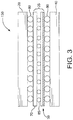
- Figure 3 illustrates a reversible material 150 that contains a center structure 35 (infrared suppressing layer) where the carbon containing ePTFE layer 50 and the ePTFE layer 70 are bonded by a discontinuous adhesive 85.
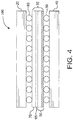
- a reversible material 160 where a continuous adhesive 95 bonds the carbon containing ePTFE layer 50 and the ePTFE layer 70 is depicted in Figure 4 .
- Figure 5 depicts a reversible material 170 where the carbon containing ePTFE layer 50 and the ePTFE layer 70 are bonded together without an adhesive.
- expandable fluoropolymers include, but are not limited to, expanded PTFE, expanded modified PTFE, expanded copolymers of PTFE, fluorinated ethylene propylene (FEP), and perfluoroalkoxy copolymer resin (PFA).
- Patents have been filed on expandable blends of PTFE, expandable modified PTFE, and expanded copolymers of PTFE, such as, but not limited to, U.S. Patent No.
- Porous membranes including polymeric materials such as polyolefins (e.g., polypropylene and polyethylene), polyurethanes, polyesters, polyamides, polyvinyls, polyvinyl chlorides, acrylics, silicones, epoxies, synthetic rubbers, other thermoset polymers, and copolymers of these types are considered tobe within the purview of the invention provided that the polymeric material can be processed to form porous or microporous membrane structures.
- polymeric materials such as polyolefins (e.g., polypropylene and polyethylene), polyurethanes, polyesters, polyamides, polyvinyls, polyvinyl chlorides, acrylics, silicones, epoxies, synthetic rubbers, other thermoset polymers, and copolymers of these types are considered tobe within the purview of the invention provided that the polymeric material can be processed to form porous or microporous membrane structures.
- One method of accomplishing nIR and SWIR reflectance within the reversible material 10 is by coating or imbibing the carbon into or on the film surface.
- Carbon is used herein for ease of discussion. It is to be appreciated that any infrared suppressive additive can be used in place of, or in addition to, the carbon.
- any conventional application method may be employed to place a coating composition containing carbon onto the carbon coated ePTFE layer 50.
- Application methods for coating the ePTFE layer 50 with carbon include but are not limited to, transfer coating, screen printing, gravure printing, ink-jet printing, and knife coating.
- Additional topical treatments can be applied to the ePTFE layer 50, provided sufficient porosity throughout the ePTFE substrate 30 is maintained to remain moisture vapor transmissivity.
- an oleophobic treatment such as a fluoroacrylate oleophobic coating, may be applied to the ePTFE layer 50. It is to be appreciated that the oleophobic treatment may be applied in conjunction with the application of carbon, or prior to or subsequent to the application of the carbon coating. Achieving the unique balance of visible and near infrared electromagnetic characteristics of the reversible material 10 requires a near infrared suppressive additive that can decrease the nIR and SWIR reflectivity of the substrate 30 while maintaining a light shade visible appearance.
- Non-limiting exemplary additives include inorganic materials such as, but not limited to, metals, and metal oxides, metal compounds, such as, but not limited to, aluminum, aluminum oxide, antimony, antimony oxide, titanium, titanium oxide, cadmium selinide, gallium arsenide, and the like, and organic materials such as, but not limited to, conductive polymers and those described in U.K. Patent Application No. GB 2,222,608A .
- the infrared suppressive material/additive(s) that provide the nIR and SWIR suppression can either be soluble in the polymeric matrix or exist as discrete particles. In either instance, the infrared suppressive additives should be uniformly or substantially uniformly dispersed in the polymeric matrix.
- Infrared suppressive additive loadings onto and/or into the carbon-containing ePTFE layer 50 can be varied depending on the combination of properties desired. For example, carbon levels on the order of about 1% by weight have been surprisingly found to be effective in nIR and SWIR suppression while simultaneously providing excellent shade retention in the articles. Infrared suppressive additive(s) in an amount from about 1% to about at least 15% by weight, or more, may be present in the carbon-containing ePTFE layer. In the presence of other reflective materials (e.g., TiO 2 and the like) in the carbon-containing ePTFE layer 50, higher loadings of carbon can be used to achieve the desired balance of absorption and reflectance in the nIR, SWIR, and visible spectra.
- other reflective materials e.g., TiO 2 and the like
- the carbon containing ePTFE layer 50 is treated with differing levels of infrared suppressive additives to create multiple regions of reflection (analogous to camouflage printing of textiles). This allows for the incorporation of a nIR/SWIR disruptive pattern into the film layer.
- the pattern applied or achieved by the application of the infrared suppressive additive could be altered in a variety of ways to achieve the particular nIR and/or SWIR disruptive pattern desired.
- the carbon containing ePTFE layer 50 it is important that the carbon containing ePTFE layer 50 not exhibit too dark of a shade in the visible light spectrum. For instance, if the nIR suppressive layer is too dark, it will alter the shade of the desert camouflaged textile behind which it is located.
- the first and second textile layers 20, 40 are bonded to the ePTFE substrate 30 by adhesive layers 80, 90, respectively.
- the first textile layer 20 is positioned adjacent to the ePTFE layer 70 and the second textile layer 40 is positioned adjacent to the carbon containing ePTFE layer 50.
- Any suitable process for joining the ePTFE substrate 30 and the first and second textile layers 20, 40 may be used, such as gravure lamination, fusion bonding, spray adhesive bonding, and the like.
- the adhesive may be applied discontinuously or continuously, provided that breathability through the camouflage material 10 is maintained.
- the adhesive may be applied in the form of discontinuous attachments, such as by discrete dots, or in the form of an adhesive web to adhere the first and second textile layers 20, 40 to the PTFE substrate 30 together.
- the first and second textile layers 20, 40 may be formed of a woven, knit, or non-woven material, and it may be comprised of materials such as, but not limited to cotton, rayon, nylon, polyester, and blends thereof.
- the weight of the textile forming the first and second textile layers 20, 40 is not particularly limited except as required by the application.
- the textile is air permeable.
- the textile layers 20, 40 are printed with a woodland camouflage pattern and a desert camouflage pattern, respectively.
- the ink used for printing the camouflage patterns contains nIR suppressive materials such as carbon to aid in nIR and SWIR camouflage.
- Application methods for printing the surface of the textile layers 20, 40 include but are not limited to, transfer coating, screen printing, gravure printing, ink-jet printing, and knife coating.
- the reversible material is formed of a first textile layer 20 having a woodland camouflage print thereon and an infrared suppressing layer 120.
- the infrared suppressing 120 contains an adhesive layer 60 sandwiched between a printed ePTFE layer 100 and an ePTFE layer 70.
- the adhesive layer may be polyurethane.
- a coating composition that includes a colorant to colorize the ePTFE layer 100 and infrared suppressive additives to achieve nIR and SWIR reflectance is applied to the outer surface of the printed ePTFE layer 100.
- the coating composition coats or encapsulates the nodes and/or fibrils of the expanded fluoropolymer structure forming a durable aesthetic appearance.
- Aesthetic durability can be achieved in some embodiments with colorant coating compositions that comprise a pigment having a particle size sufficiently small to fit within the pores of the porous substrate. Pigment particles having a mean diameter of less than about 250 nm are useful for forming durable color.
- Coating compositions may further comprise a binder capable of wetting the porous substrate and binding the pigment to the pore walls. Additional treatments may be provided to impart a desired functionality to the ePTFE layer 100. As one non limiting example, oleophobic treatments may be applied to render the ePTFE layer 100 oleophobic.
- the printed ePTFE layer 100 is colorized on at least 90% of the outer film surface. Any of the conventional printing techniques described herein may be utilized to print the outer surface of the ePTFE layer 100 so long as the ePTFE substrate 120 maintains moisture vapor transmission.
- the surface of the film can be colorized with a colorant to form a solid color or a pattern (design).
- Coating compositions comprising colorants can be applied to provide a variety of colors and designs, such as solid, camouflage, and various print patterns. Additionally, the coating compositions may include one or more colorants suitable for use in printing camouflage patterns, such as woodland and desert patterns.
- the coating composition including highland, light coyote, urban tan, and light tan colorant suitable for printing a desert camouflage pattern.
- Other compositions that include colorants shade variations are considered within the purview of the invention.
- Moisture vapor transmission, or breathability, is important to provide cooling to a wearer of the outerwear apparel made from reversible materials described herein.
- Fabric textiles described herein are breathable and have a moisture vapor transmission rate (MVTR) that is greater than about 4500 g/m 2 /24 hours, greater than about 8000 g/m 2 /24 hours, greater than about 12000 g/m 2 /24 hours, or greater than about 16000 g/m 2 /24 hours when tested according to the MVTR Test Method described herein.
- the moisture vapor transmission rate of the reversible material is the surprisingly the same or substantially the same on both sides for the embodiment depicted in Figure 1 and described herein.
- the reversible materials are also lightweight, and may have a mass/area less than about 300 g/m 2 , less than about 200 g/m 2 , less than about 100 g/m 2 , or less than about 65 g/m 2 .
- nIR and SWIR reflectance that is neither too high nor too low.
- a nIR and SWIR reflectance that is too high relative to the surrounding environment creates a bright silhouette under night vision.
- a reflectance that is too low creates a dark silhouette relative to the surrounding environment under night vision.
- nIR/SWIR disruptive pattern there will typically be areas that are very nIR and/or SWTR suppressive and areas that are only moderately reflective. It is to be understood that the optimum reflectance levels varies with the environment.
- the reversible materials described herein demonstrate nIR and SWIR suppression of incident electromagnetic radiation in the nIR and SWIR wavelength range on both sides of the material. Such nIR and SWTR suppression is particularly useful because reduced reflectivity in these wavelength ranges reduce the visibility of an article when viewed in the dark with a night vision scope.
- the nIR absorption characteristic of the reversible materials provide an average reflection of about 75% or less in the wavelength range of about 700nm to about 900nm.
- the nIR absorption characteristic may be tailored to provide an average reflection of less than about 65%, less than about 55%, or less than about 45% in the wavelength range of about 700nm to about 900nm.
- the SWIR absorption characteristic of the reversible materials provides an average reflection from about 10% to about 85% in the wavelength range of about 900nm to about 1700nm.
- the nIR absorption characteristic may be tailored to provide an average reflection of less than about 85%, less than about 75%, or less than about 65% in the wavelength range of about 900nm to about 1700nm.
- the level of reflectance preferred for any particular environment is dependent on the reflectance of the background that lies behind the article tobe hidden by the reflective material.
- a background of trees and leaves is known in the art to have a nIR reflectance between about 45% and 55% and a SWIR reflectance between about 5% and 65%.
- an article of the present invention can be tailored to have a reflectance that closely matches that of a treed background (or other background), the article will appear less visible when viewed in the dark through a night vision instrument.
- one unique aspect of the inventive reversible materials is that the infrared suppressive additives are decoupled from the visible camouflage in the printed surface so that the visible camouflage shades can be retained within desired specifications while simultaneously providing the necessary nIR and SWIR suppressive characteristics.
- the reversible materials described herein are suitable for use in various applications, including but not limited to forming reversible garments (e.g. jackets, pants, ponchos, raincoats), tents, covers, bivy bags, and the like.
- the reversible material 10 exhibits high breathability on both sides of the material.
- the reversible materials demonstrate both nIR and SWTR reflectance on both sides of the garment to enable the reversible material to blend into the background and provide optimal camouflage.
- Spectral reflectance data shall be determined on both sides of the fabric laminate and shall be obtained from 600 to 1700 nanometers (nm), for Woodland print, and 700 to 1700nm, for Desert print, at 20nm intervals from 700 to 860nm and at 100nm intervals from 900 to 1700nm, on a spectrophotometer relative to the barium sulfate standard, the preferred white standard.
- Other white reference materials may be used provided they are calibrated to absolute white, e.g. magnesium oxide or vitrolite tiles.
- the spectral band width shall be less than 26 nm at 860 nm. Reflectance measurements may be made by either the monochromatic or polychromatic mode of operation.
- the spectrophotometer When the polychromatic mode is used, the spectrophotometer shall operate with the specimen diffusely illuminated with the full emission of a source that simulates either CIE source A or CIE source D65.
- the specimen shall be measured as a single layer, backed with six layers of the same fabric and shade. Measurements shall be taken on a minimum of two different areas and the data averaged. The measured areas should be at least 6 inches away from the selvage.
- the specimen shall be viewed at an angle no greater than 10 degrees from the normal, with the specular component included. Photometric accuracy of the spectrophotometer shall be within 1 percent and wavelength accuracy within 2 nm.
- the standard aperture size used in the color measurement device shall be 0.3725 inches in diameter.
- Any color having spectral reflectance values falling outside the limits in four or more of the wavelengths, in the 700-860nm range, specified shall be considered a test failure (as per MIL-PRF-32142 and MC/PD 11-2011 SYSCOM A).
- MVTR Delta P value * 24 / 1 / WVP + 1 + WVPapp value
- specimens were conditioned at 73.4 ⁇ 0.4°F and 50 ⁇ 2% rH for 2 hrs prior to testing and the bath water was a constant 73.4°F ⁇ 0.4°F.
- the MVTR for each sample was measured once, and the results are reported as g/m 2 -24hours.
- a reversible garment material was constructed in the following manner.
- a 30 denier (30D) by 30 denier (30D) printed, woven woodland MARPAT camouflage fabric with carbon incorporated into the ink used in the printing process is bonded as follows:
- the construct met the spectral nIR reflectance specifications as set forth below in MIL-PRF-32142 (for Woodland print) and MC/PD 11-2011 SYSCOM A (for Desert print). Also, the construct demonstrated SWIR reflectance that closely matched the encountered background (dry soil and foliage), indicating that the reversible construct was effective in camouflaging the construct.
- a seam tape was made in the following manner.
- a 30D by 30D desert MARPAT camouflage woven fabric was obtained. Carbon was incorporated into the ink of the darker colors used in the printing process.
- the camouflage fabric was bonded in a similar fashion as the described previously to the fluoroacrylate, carbon-containing side of a bicomponent ePTFE/PU film (to aid in controlling nIR and SWIR reflectance), as generally taught in U.S. Patent Publication No. 2007/0009679 , and then the film side of this structure was subsequently completely coated with polyurethane.
- a reversible garment material was constructed in the following manner.
- a 30D by 30D printed,woven woodland MARPAT camouflage fabric with carbon incorporated into the ink used in the printing process is bonded as follows:
- the construct demonstrated nIR and SWIR reflectance that closely matched the encountered background (dry soil and foliage), indicating that the reversible construct was effective in camouflaging the construct.
Landscapes
- Physics & Mathematics (AREA)
- Engineering & Computer Science (AREA)
- General Physics & Mathematics (AREA)
- Optics & Photonics (AREA)
- Toxicology (AREA)
- Health & Medical Sciences (AREA)
- General Engineering & Computer Science (AREA)
- Life Sciences & Earth Sciences (AREA)
- Wood Science & Technology (AREA)
- Textile Engineering (AREA)
- Chemical Kinetics & Catalysis (AREA)
- Chemical & Material Sciences (AREA)
- Laminated Bodies (AREA)
- Aiming, Guidance, Guns With A Light Source, Armor, Camouflage, And Targets (AREA)
- Outer Garments And Coats (AREA)
Abstract
Description
- The present invention relates generally to camouflage materials, and more specifically, to a reversible camouflage material that demonstrates controlled reflectance in both the nIR and SWIR regions of the electromagnetic radiation spectrum on both sides of the garment while demonstrating high breathability on both sides of the material.
- Camouflage textile materials used by hunters and by the military typically provide camouflage in the visible region of the electromagnetic radiation spectrum (400-700nm). Due to the vastly diverse environments throughout the world, many different camouflage materials exist, including both visibly camouflaged and non-visibly camouflaged materials. The variety of environments (e.g., ranging from woodland to desert) necessitates the use of a variety of colors and patterns to create these camouflage textile materials. For instance, in a military woodland camouflage, the materials often use four colors: black, coyote, khaki, and green. In a military desert camouflage, the textile materials often use four colors: highland, light coyote, urban tan, and light tan. Many visible shade variations exist even within these two examples. Textiles with visible camouflage patterns are typically manufactured by printing the camouflage pattern on an undyed (greige) textile (e.g., woven, knit, non-woven, etc.) surface or by solution dying yarns that are subsequently woven or knitted into a camouflage pattern using, for instance, a jacquard process.
- In some applications it is desirable to use textile materials that provide camouflage in other areas of the electromagnetic spectrum (e.g., beyond visible). In particular, advances in image intensifiers used in night vision equipment have heightened the need for improved camouflage in the near infrared ("nIR") (i.e., 700-900nm) and short wave infrared (SWIR) (i.e., 900-1700nm) electromagnetic radiation spectrum. Typical night vision equipment amplifies low intensity electromagnetic radiation in the visible, nIR, and SWIR spectra, with specific sensitivity in the nIR and SWIR. Like camouflage in the visible spectrum, camouflage in the nIR and SWIR spectra enables the material, and thus the wearer or covered structure, to blend in with the environment. A primary difference is that, unlike the visible camouflage, nIR and SWIR camouflage does not involve a further segmentation of discrete bands of the spectrum (that in the visible gives rise to color separation). As such, effective camouflage in the nIR and SWIR spectra requires a material to have an appropriate balance of reflection, or reflectance, and transmittance/absorbance over the whole nIR and SWIR spectra. In addition, the ability to detect and identify an object using image intensifiers (such as night vision goggles) also depends on the ability to disrupt the silhouette or the shape of the object.
- Conventional means for achieving desirable camouflage in both the visible, nIR, and SWIR is through a printing process wherein undyed textiles or textiles dyed to a base shade are printed to simultaneously achieve multiple colors (visible spectrum) and levels of nIR and SWIR reflectance. Most commonly, carbon black is added to the camouflage print ink or paste in varying amounts to vary the nIR and SWIR reflectance of the resulting textile. A disadvantage to this technique is that the carbon can negatively impact the desired visible shade of the camouflage textile and frequently results in a compromise between achieving appropriate visible and nIR camouflage, particularly in environments which require extremely light shades like the desert. In addition, topically treating textiles with such a carbon finish results in a textile material with poor nIR camouflage durability, as the topical carbon finishing can readily wash and/or wear off in use.
- A further challenge in creating camouflage textiles which are suitable for the applications described is the need for comfort of the user. In outdoor environments, comfort in a variety of weather conditions requires that the textiles, and resulting articles, be liquidproof and breathable for optimum comfort. However, providing environmental protection by coating or lamination of liquidproof, breathable films or coatings can also affect the visible, nIR, and SWIR camouflage properties of the textile. For example, in the specific case of a liquidproof, breathable film comprising microporous PTFE, the PTFE film often increases the overall reflectivity in the nIR spectrum, and possibly the visible spectrum as well, resulting in undesirable tradeoffs between durable environmental protection and nIR and SWIR camouflage.
- Recent improvements to military camouflage have extended performance into the nIR portion and the short wave infrared (SWIR). Thus, there exists a need in the art for a camouflage material that achieves camouflage protection in both the nIR and SWIR spectra and that provides the desired physical and protection properties needed and comfort qualities desired in a camouflage garment.
- It is an object of the present invention to provide a reversible article that includes (1) a center structure including a polyurethane layer sandwiched between a first microporous film and a second microporous film having thereon an oleophobic layer containing at least one infrared suppressive additive, (2) a first textile layer positioned on the first microporous film, and (3) a second textile layer positioned on the second microporous film. The infrared suppressive performance on one surface of the reversible article is different from the opposing surface of the reversible article. The first textile layer is adhered to the first microporous film and the second textile layer is adhered to the second microporous film. The first and second microporous films may be expanded polytetrafluoroethylene. In one exemplary embodiment, the oleophobic layer is a fluoroacrylate oleophobic coating and the infrared suppressive additive is carbon. The inventive camouflage material demonstrates camouflage concealment in the near IR (nIR) and short wave infrared (SWIR) wavelengths of the electromagnetic spectrum on both sides of the material. In particular, both surfaces of the reversible article demonstrate an average reflection less than about 75% or less in the wavelength range from about 700nm to about 900nm and an average reflection less than about 85% in the wavelength range from about 900nm to about 1700nm.
- It is another object of the present invention to provide a reversible article that includes (1) a center structure including a polyurethane layer sandwiched between a first microporous film and a second microporous film having thereon an oleophobic layer, (2) a first textile layer positioned on the first microporous film, and (3) a second textile layer positioned on the second microporous film. The second microporous film contains at least one infrared suppressive additive within the microporous film. In exemplary embodiments, the infrared suppressive additive is distributed throughout the microporous film. A first adhesive layer bonds the first textile layer to the first microporous film and a second adhesive layer bonds the second textile layer to the second microporous film. The infrared suppressive performance on one surface of the reversible article is different from the opposing surface of the reversible article.
Additionally, the moisture vapor transmission rates of the opposing surfaces of the reversible article are substantially the same. In some exemplary embodiments, the second microporous film is treated with differing levels of infrared suppressive additives to create multiple regions of reflection. - It is yet another object of the present invention to provide a reversible article that includes (1) an infrared suppressing layer including a polyurethane layer sandwiched between a first microporous film and a second microporous film having thereon a coating composition containing at least one colorant and at least one infrared suppressive additive where the second microporous film forms a first outer surface, (2) a textile layer positioned on the first microporous film where the textile layer forms a second outer surface, and (3) an adhesive layer positioned between the textile layer and the first microporous film. The coating composition includes a sufficient amount of colorant to colorize the second microporous film and infrared suppressive additives to achieve nIR and SWIR reflectance. The printed microporous film is colorized on at least 90% of the outer film surface.
- It is a further object of the present invention to provide a reversible article that includes (1) a center structure including a first microporous film bonded to a second microporous film having thereon an oleophobic coating containing at least one infrared suppressive additive, (2) a first textile layer positioned on the first microporous film, and (3) a second textile layer positioned on the second microporous film. The infrared suppressive performance on one surface of the reversible article is different from the opposing surface of the reversible article. The first and second microporous films may be bonded together via a continuous or a discontinuous adhesive. Alternatively, the first microporous film and the second microporous film may form the center structure in the absence of an adhesive. In one exemplary embodiment, the first microporous film has thereon a coating that contains at least one infrared suppressive additive. The first and second microporous films may be expanded polytetrafluoroethylene.
- It is a feature of the present invention that the two outer surfaces of the reversible material have differing infrared reflectivity.
- It is also a feature of the present invention that the reversible materials are highly breathable and lightweight.
- It is a further feature of the present invention that both a desert camouflage and a woodland camouflage are present in a single, reversible article that demonstrates camouflage concealment in the near nIR and SWIR wavelengths of the electromagnetic spectrum on both sides of the article.
- It is yet another feature of the present invention that the nIR and SWIR reflectance can be tailored by altering the amount of infrared suppressive additive present in the ePTFE layer.
- The advantages of this invention will be apparent upon consideration of the following detailed disclosure of the invention, especially when taken in conjunction with the accompanying drawings wherein:
-
FIG. 1 is a schematic illustration of a reversible camouflage material including a center structure that includes a polyurethane layer sandwiched between a first microporous film and a second microporous film and two outer facing textile materials according to one exemplary embodiment of the invention; -
FIG. 2 is a schematic illustration of a reversible camouflage material including an infrared suppressing layer that includes a polyurethane layer sandwiched between a first microporous film and a second microporous film having thereon a coating composition that contains at least one colorant and at least one infrared suppressive additive according to another exemplary embodiment of the invention; -
FIG. 3 is a schematic illustration of a reversible camouflage material including an infrared suppressing layer that contains two ePTFE layers adhered via a discontinuous adhesive; -
FIG. 4 is a schematic illustration of a reversible camouflage material including an infrared suppressing layer that contains two ePTFE layers adhered via a continuous adhesive; and -
FIG. 5 is a schematic illustration of a reversible camouflage material including an infrared suppressing layer that contains two ePTFE layers bonded without an adhesive. - Unless defined otherwise, all technical and scientific terms used herein have the same meaning as commonly understood by one of ordinary skill in the art to which the invention belongs. Although any methods and materials similar or equivalent to those described herein can be used in the practice or testing of the present invention, the preferred methods and materials are described herein.
In the drawings, the thickness of the lines, layers, and regions may be exaggerated for clarity. It will be understood that when an element such as a layer, region, substrate, or panel is referred to as being "on" another element, it can be directly on the other element or intervening elements may also be present. Also, when an element is referred to as being "adjacent" to another element, the element may be directly adjacent to the other element or intervening elements may be present. It is to be noted that like numbers found throughout the figures denote like elements. As used herein, "visible" refers to 400-700nm, "nIR" refers to near infrared 700-900nm, and "SWIR" refers to 900-1700nm in the electromagnetic radiation spectrum. The terms "camouflage material" and "material" may be used interchangeably herein. - The invention relates to a reversible camouflage material that has a woodland camouflage print on one side of the material and a desert camouflage print on the opposing side of the material. The inventive camouflage material demonstrates camouflage concealment in the near IR (nIR) and short wave infrared (SWIR) wavelengths of the electromagnetic spectrum. In addition, the camouflage material is both highly breathable and lightweight. The material is particularly suitable for making reversible camouflage garments such as jackets and pants.
- Reference is first made to
FIG. 1 , which illustrates areversible camouflage material 10 according to at least one embodiment of the present invention. Thereversible material 10 is a three layer structure formed of afirst textile layer 20 having a woodland camouflage print thereon, an expanded polytetrafluoroethylene (ePTFE) substrate 30 (infrared suppressing layer), and asecond textile layer 40 having a desert camouflage print thereon. The ePTFE substrate contains apolyurethane layer 60 sandwiched between a carbon containingePTFE layer 50 and anePTFE layer 70. The carbon containingePTFE layer 50 may be coated with carbon or the carbon may be positioned throughout the ePTFE layer. Thepolyurethane layer 60 acts as an adhesive to bond the two ePTFE layers 50, 70 together. ePTFE membranes having a thickness from about 0.2 mil to about 5.0 mil may be utilized. In at least one exemplary embodiment, the ePTFE membrane thickness is less than or equal to 2.0 mil, or less than or equal to 1.0 mil. It is to be noted that the infrared suppressive performance is different from one side of the reversible material to the opposing side. The phrase "infrared suppressive performance" as used herein is meant to denote that the outer surfaces of the reversible camouflage material have different nIR and SWIR reflective camouflage performance. For example, one surface may be nIR and SWIR reflective for a dry soil environment and the opposing surface may be nIR and SWIR reflective for a foliage environment. - In alternate exemplary embodiments, the carbon-containing
ePTFE layer 50 and theePTFE layer 70 are bonded by an adhesive, such as is depicted inFigures 3 and4 . In particular,Figure 3 illustrates areversible material 150 that contains a center structure 35 (infrared suppressing layer) where the carbon containingePTFE layer 50 and theePTFE layer 70 are bonded by adiscontinuous adhesive 85. Areversible material 160 where acontinuous adhesive 95 bonds the carbon containingePTFE layer 50 and theePTFE layer 70 is depicted inFigure 4 .Figure 5 depicts areversible material 170 where the carbon containingePTFE layer 50 and theePTFE layer 70 are bonded together without an adhesive. - It is to be appreciated that reference is made herein with respect to expanded polytetrafluorethylene (ePTFE) for ease of discussion. However, it is to be understood that any suitable expanded fluoropolymer membrane may be used interchangeably with any ePTFE layer described within this application. Non limiting examples of expandable fluoropolymers include, but are not limited to, expanded PTFE, expanded modified PTFE, expanded copolymers of PTFE, fluorinated ethylene propylene (FEP), and perfluoroalkoxy copolymer resin (PFA). Patents have been filed on expandable blends of PTFE, expandable modified PTFE, and expanded copolymers of PTFE, such as, but not limited to,
U.S. Patent No. 5,708,044 to Branca ;U.S. Patent No. 6,541,589 to Baillie ;U.S. Patent No. 7,531,611 to Sabol et al. ;U.S. Patent Application No. 11/906,877 to Ford ; andU.S. Patent Application No. 12/410,050 to Xu et al. Porous membranes including polymeric materials such as polyolefins (e.g., polypropylene and polyethylene), polyurethanes, polyesters, polyamides, polyvinyls, polyvinyl chlorides, acrylics, silicones, epoxies, synthetic rubbers, other thermoset polymers, and copolymers of these types are considered tobe within the purview of the invention provided that the polymeric material can be processed to form porous or microporous membrane structures. - One method of accomplishing nIR and SWIR reflectance within the
reversible material 10 is by coating or imbibing the carbon into or on the film surface. Carbon is used herein for ease of discussion. It is to be appreciated that any infrared suppressive additive can be used in place of, or in addition to, the carbon. In an embodiment where theePTFE layer 50 is coated with a layer of carbon, any conventional application method may be employed to place a coating composition containing carbon onto the carbon coatedePTFE layer 50. Application methods for coating theePTFE layer 50 with carbon include but are not limited to, transfer coating, screen printing, gravure printing, ink-jet printing, and knife coating. Additional topical treatments can be applied to theePTFE layer 50, provided sufficient porosity throughout theePTFE substrate 30 is maintained to remain moisture vapor transmissivity. For example, an oleophobic treatment, such as a fluoroacrylate oleophobic coating, may be applied to theePTFE layer 50. It is to be appreciated that the oleophobic treatment may be applied in conjunction with the application of carbon, or prior to or subsequent to the application of the carbon coating. Achieving the unique balance of visible and near infrared electromagnetic characteristics of thereversible material 10 requires a near infrared suppressive additive that can decrease the nIR and SWIR reflectivity of thesubstrate 30 while maintaining a light shade visible appearance. It is to be noted that a range of additives suitable for decreasing the nIR and SWIR reflectivity are available and can be used in place of, or in addition to, the carbon described above. Non-limiting exemplary additives include inorganic materials such as, but not limited to, metals, and metal oxides, metal compounds, such as, but not limited to, aluminum, aluminum oxide, antimony, antimony oxide, titanium, titanium oxide, cadmium selinide, gallium arsenide, and the like, and organic materials such as, but not limited to, conductive polymers and those described in U.K. Patent Application No.GB 2,222,608A - In an embodiment where the carbon (or other infrared suppressive additive) is included within or substantially within the
ePTFE layer 50, the infrared suppressive material/additive(s) that provide the nIR and SWIR suppression can either be soluble in the polymeric matrix or exist as discrete particles. In either instance, the infrared suppressive additives should be uniformly or substantially uniformly dispersed in the polymeric matrix. - Infrared suppressive additive loadings onto and/or into the carbon-containing
ePTFE layer 50 can be varied depending on the combination of properties desired. For example, carbon levels on the order of about 1% by weight have been surprisingly found to be effective in nIR and SWIR suppression while simultaneously providing excellent shade retention in the articles. Infrared suppressive additive(s) in an amount from about 1% to about at least 15% by weight, or more, may be present in the carbon-containing ePTFE layer. In the presence of other reflective materials (e.g., TiO2 and the like) in the carbon-containingePTFE layer 50, higher loadings of carbon can be used to achieve the desired balance of absorption and reflectance in the nIR, SWIR, and visible spectra. - Conversely, at carbon levels on the order of 5% by weight and higher, and even at levels down to 1% by weight, in the absence of other reflective materials in the
ePTFE layer 50, it has been observed that the resulting membrane will appear black to the unaided eye and would darken the shade of any light color textiles to which it is attached. Resulting textile composites from these carbon loading levels show significant and unacceptable darkening of the light color visible camouflage to which it is adhered. This light color shade shifting is particularly problematic in daylight situations, which is also when visible camouflage with the correct shades is most essential. - In some exemplary embodiments, the carbon containing
ePTFE layer 50 is treated with differing levels of infrared suppressive additives to create multiple regions of reflection (analogous to camouflage printing of textiles). This allows for the incorporation of a nIR/SWIR disruptive pattern into the film layer. The pattern applied or achieved by the application of the infrared suppressive additive could be altered in a variety of ways to achieve the particular nIR and/or SWIR disruptive pattern desired. It is to be appreciated that there are numerous ways to achieve multiple levels of reflectance within the carbon containing ePTFE layer, including, but not limited to, using multiple types of infrared suppressive additives, chemical modification, coating on an imbibed polymer (e.g., a carbon-imbibed ePTFE layer 50), or combinations thereof. It is also within the purview of the invention alter the nIR/SWIR reflectance by physically altering the carbon containingePTFE layer 50 such as by densifying or abrading select areas of the ePTFE membrane. - It is important that the carbon containing
ePTFE layer 50 not exhibit too dark of a shade in the visible light spectrum. For instance, if the nIR suppressive layer is too dark, it will alter the shade of the desert camouflaged textile behind which it is located. - Turning back to
Figure 1 , the first and second textile layers 20, 40 are bonded to theePTFE substrate 30 byadhesive layers first textile layer 20 is positioned adjacent to theePTFE layer 70 and thesecond textile layer 40 is positioned adjacent to the carbon containingePTFE layer 50. Any suitable process for joining theePTFE substrate 30 and the first and second textile layers 20, 40 may be used, such as gravure lamination, fusion bonding, spray adhesive bonding, and the like. The adhesive may be applied discontinuously or continuously, provided that breathability through thecamouflage material 10 is maintained. For example, the adhesive may be applied in the form of discontinuous attachments, such as by discrete dots, or in the form of an adhesive web to adhere the first and second textile layers 20, 40 to thePTFE substrate 30 together. - The first and second textile layers 20, 40 may be formed of a woven, knit, or non-woven material, and it may be comprised of materials such as, but not limited to cotton, rayon, nylon, polyester, and blends thereof. The weight of the textile forming the first and second textile layers 20, 40 is not particularly limited except as required by the application. In exemplary embodiments, the textile is air permeable. As discussed above, the textile layers 20, 40 are printed with a woodland camouflage pattern and a desert camouflage pattern, respectively. The ink used for printing the camouflage patterns contains nIR suppressive materials such as carbon to aid in nIR and SWIR camouflage. Application methods for printing the surface of the textile layers 20, 40 include but are not limited to, transfer coating, screen printing, gravure printing, ink-jet printing, and knife coating.
- In another exemplary embodiment, the reversible material is formed of a
first textile layer 20 having a woodland camouflage print thereon and an infrared suppressinglayer 120. The infrared suppressing 120 contains anadhesive layer 60 sandwiched between a printedePTFE layer 100 and anePTFE layer 70. The adhesive layer may be polyurethane. Such areversible material 110 is shown inFigure 2 . In this embodiment, a coating composition that includes a colorant to colorize theePTFE layer 100 and infrared suppressive additives to achieve nIR and SWIR reflectance is applied to the outer surface of the printedePTFE layer 100. - In instances where the printed
layer 100 is formed of ePTFE, the coating composition coats or encapsulates the nodes and/or fibrils of the expanded fluoropolymer structure forming a durable aesthetic appearance. Aesthetic durability can be achieved in some embodiments with colorant coating compositions that comprise a pigment having a particle size sufficiently small to fit within the pores of the porous substrate. Pigment particles having a mean diameter of less than about 250 nm are useful for forming durable color. Coating compositions may further comprise a binder capable of wetting the porous substrate and binding the pigment to the pore walls. Additional treatments may be provided to impart a desired functionality to theePTFE layer 100. As one non limiting example, oleophobic treatments may be applied to render theePTFE layer 100 oleophobic. - Multiple colors can be applied using multiple pigments, or varying the concentrations of one or more pigments, or by both techniques. The printed
ePTFE layer 100 is colorized on at least 90% of the outer film surface. Any of the conventional printing techniques described herein may be utilized to print the outer surface of theePTFE layer 100 so long as theePTFE substrate 120 maintains moisture vapor transmission. In one embodiment, the surface of the film can be colorized with a colorant to form a solid color or a pattern (design). Coating compositions comprising colorants can be applied to provide a variety of colors and designs, such as solid, camouflage, and various print patterns. Additionally, the coating compositions may include one or more colorants suitable for use in printing camouflage patterns, such as woodland and desert patterns. In exemplary embodiments, the coating composition including highland, light coyote, urban tan, and light tan colorant suitable for printing a desert camouflage pattern. Other compositions that include colorants shade variations are considered within the purview of the invention. - Moisture vapor transmission, or breathability, is important to provide cooling to a wearer of the outerwear apparel made from reversible materials described herein. Fabric textiles described herein are breathable and have a moisture vapor transmission rate (MVTR) that is greater than about 4500 g/m2/24 hours, greater than about 8000 g/m2/24 hours, greater than about 12000 g/m2/24 hours, or greater than about 16000 g/m2/24 hours when tested according to the MVTR Test Method described herein. Also, the moisture vapor transmission rate of the reversible material is the surprisingly the same or substantially the same on both sides for the embodiment depicted in
Figure 1 and described herein. The reversible materials are also lightweight, and may have a mass/area less than about 300 g/m2 , less than about 200 g/m2 , less than about 100 g/m2, or less than about 65 g/m2. - In order to achieve optimal results in a nIR application, it is desirable to control the spectral response to create a reversible article that has nIR and SWIR reflectance that is neither too high nor too low. For example, a nIR and SWIR reflectance that is too high relative to the surrounding environment creates a bright silhouette under night vision. Equally, a reflectance that is too low creates a dark silhouette relative to the surrounding environment under night vision. For articles with areas of different reflectance levels (i.e., nIR/SWIR disruptive pattern), there will typically be areas that are very nIR and/or SWTR suppressive and areas that are only moderately reflective. It is to be understood that the optimum reflectance levels varies with the environment.
- The reversible materials described herein demonstrate nIR and SWIR suppression of incident electromagnetic radiation in the nIR and SWIR wavelength range on both sides of the material. Such nIR and SWTR suppression is particularly useful because reduced reflectivity in these wavelength ranges reduce the visibility of an article when viewed in the dark with a night vision scope. The nIR absorption characteristic of the reversible materials provide an average reflection of about 75% or less in the wavelength range of about 700nm to about 900nm. The nIR absorption characteristic may be tailored to provide an average reflection of less than about 65%, less than about 55%, or less than about 45% in the wavelength range of about 700nm to about 900nm.
- The SWIR absorption characteristic of the reversible materials provides an average reflection from about 10% to about 85% in the wavelength range of about 900nm to about 1700nm. In exemplary embodiments, there are at least two, and desirably at least three, reflectance levels within the range of about 10% to about 85% to provide color separation and optimal blending with the background. The nIR absorption characteristic may be tailored to provide an average reflection of less than about 85%, less than about 75%, or less than about 65% in the wavelength range of about 900nm to about 1700nm.
- The level of reflectance preferred for any particular environment is dependent on the reflectance of the background that lies behind the article tobe hidden by the reflective material. For example, a background of trees and leaves is known in the art to have a nIR reflectance between about 45% and 55% and a SWIR reflectance between about 5% and 65%. Because an article of the present invention can be tailored to have a reflectance that closely matches that of a treed background (or other background), the article will appear less visible when viewed in the dark through a night vision instrument.
- It is to be understood that one unique aspect of the inventive reversible materials is that the infrared suppressive additives are decoupled from the visible camouflage in the printed surface so that the visible camouflage shades can be retained within desired specifications while simultaneously providing the necessary nIR and SWIR suppressive characteristics.
- The reversible materials described herein are suitable for use in various applications, including but not limited to forming reversible garments (e.g. jackets, pants, ponchos, raincoats), tents, covers, bivy bags, and the like. Advantageously, the
reversible material 10 exhibits high breathability on both sides of the material. In addition, the reversible materials demonstrate both nIR and SWTR reflectance on both sides of the garment to enable the reversible material to blend into the background and provide optimal camouflage. - It should be understood that although certain methods and equipment are described below, any method or equipment determined suitable by one of ordinary skill in the art may be alternatively utilized.
- Spectral reflectance data shall be determined on both sides of the fabric laminate and shall be obtained from 600 to 1700 nanometers (nm), for Woodland print, and 700 to 1700nm, for Desert print, at 20nm intervals from 700 to 860nm and at 100nm intervals from 900 to 1700nm, on a spectrophotometer relative to the barium sulfate standard, the preferred white standard. Other white reference materials may be used provided they are calibrated to absolute white, e.g. magnesium oxide or vitrolite tiles. The spectral band width shall be less than 26 nm at 860 nm. Reflectance measurements may be made by either the monochromatic or polychromatic mode of operation. When the polychromatic mode is used, the spectrophotometer shall operate with the specimen diffusely illuminated with the full emission of a source that simulates either CIE source A or CIE source D65. The specimen shall be measured as a single layer, backed with six layers of the same fabric and shade. Measurements shall be taken on a minimum of two different areas and the data averaged. The measured areas should be at least 6 inches away from the selvage. The specimen shall be viewed at an angle no greater than 10 degrees from the normal, with the specular component included. Photometric accuracy of the spectrophotometer shall be within 1 percent and wavelength accuracy within 2 nm. The standard aperture size used in the color measurement device shall be 0.3725 inches in diameter. Any color having spectral reflectance values falling outside the limits in four or more of the wavelengths, in the 700-860nm range, specified shall be considered a test failure (as per MIL-PRF-32142 and MC/PD 11-2011 SYSCOM A).
- Place 2.0 + 0.2 pounds of the cloth, and if needed, ballast in an automatic washing machine set on permanent press cycle, high water level and warm (100 + 10°F - 0°F) wash temperature. Place 0.5 ounce (14 grams) of 1993 AATCC Standard Reference Detergent (non-phosphate) without optical brighteners into the washer. The duration of each laundering cycle shall be 30 + 5 minutes. After laundering, place sample and ballast in an automatic tumble dryer set on permanent press cycle, 150-160°F and dry for approximately fifteen to thirty (15-30) minutes or until dry. The laundering equipment, washer and dryer, shall be in accordance with AATCC No. 135.
- The MVTR for each sample was determined in accordance with the general teachings of ISO 15496 except that the sample water vapor transmission (WVP) was converted into MVTR moisture vapor transmission rate (MVTR) based on the apparatus water vapor transmission (WVPapp) and using the following conversion.

- To ensure comparable results, the specimens were conditioned at 73.4 ± 0.4°F and 50± 2% rH for 2 hrs prior to testing and the bath water was a constant 73.4°F ± 0.4°F.
- The MVTR for each sample was measured once, and the results are reported as g/m2 -24hours.
- A reversible garment material was constructed in the following manner.
- A 30 denier (30D) by 30 denier (30D) printed, woven woodland MARPAT camouflage fabric with carbon incorporated into the ink used in the printing process is bonded as follows:
- 1) A three-layer film composite, approximately 0.27mm thick was obtained consisting of a polyurethane layer sandwiched between two ePTFE layers. This laminate was constructed in accordance with the general teachings of U.S. Patent No.
5,418,054 to Sun except that no phosphorous or other flame-retardant material was incorporated into the polyurethane layer. A fluoroacrylate, carbon-containing coating (to aid in controlling nIR reflectance), as generally taught inU.S. Patent Publication No. 2007/0009679 to Holcombe, et al. was then applied to one side of the film laminate in order to render it oleophobic while preserving the microporous structure. - 2) The bond of the woodland MARPAT fabric layer to the 3 layer film composite was made by applying a dot pattern of a melted polyurethane adhesive to the non-coated side of the 3 layer film composite. While the polyurethane adhesive dots were molten, the fabric was positioned, non-printed side down, on top of the adhesive side of the three layer film composite. This construct was allowed to cool.
- 3) The resulting bonded construct, with the coated side of the film composite facing down, was then positioned on top of a 30D by 30D desert MARPAT camouflage woven fabric. Carbon was incorporated into the ink of the darker colors used in the printing process. The bonded construct and the desert camouflage fabric were subsequently bonded together by applying a dot pattern of a melted polyurethane adhesive to the coated side of the 3 layer composite film. While the polyurethane adhesive dots were molten, the fabric was positioned, non-printed side down, on top of the adhesive side of the three layer film composite. This construct was allowed to cool.
- 4) After the moisture curing adhesive has set, both sides of the reversible garment material were treated with a waterproofing agent.
- Both initially and after 20 launderings, the construct met the spectral nIR reflectance specifications as set forth below in MIL-PRF-32142 (for Woodland print) and MC/PD 11-2011 SYSCOM A (for Desert print). Also, the construct demonstrated SWIR reflectance that closely matched the encountered background (dry soil and foliage), indicating that the reversible construct was effective in camouflaging the construct.
- A seam tape was made in the following manner. A 30D by 30D desert MARPAT camouflage woven fabric was obtained. Carbon was incorporated into the ink of the darker colors used in the printing process. The camouflage fabric was bonded in a similar fashion as the described previously to the fluoroacrylate, carbon-containing side of a bicomponent ePTFE/PU film (to aid in controlling nIR and SWIR reflectance), as generally taught in
U.S. Patent Publication No. 2007/0009679 , and then the film side of this structure was subsequently completely coated with polyurethane. - A reversible garment material was constructed in the following manner. A 30D by 30D printed,woven woodland MARPAT camouflage fabric with carbon incorporated into the ink used in the printing process is bonded as follows:
- 1) A three-layer film composite, approximately 0.17 mm thick was obtained consisting of a polyurethane layer sandwiched between two ePTFE layers. This laminate was constructed in accordance with the general teachings of U.S. Patent 5,418,054 to Sun except that no phosphorous or other flame-retardant material was incorporated into the polyurethane layer.
- 2) The bond of the woodland MARPAT fabric layer to the 3 layer film composite was made by applying a dot pattern of a melted polyurethane adhesive to the 3 layer film composite. While the polyurethane adhesive dots were molten, the fabric was positioned, non-printed side down, on top of the adhesive side of the three layer film composite. This construct was allowed to cool.
- The construct demonstrated nIR and SWIR reflectance that closely matched the encountered background (dry soil and foliage), indicating that the reversible construct was effective in camouflaging the construct.
- The invention of this application has been described above both generically and with regard to specific embodiments. Although the invention has been set forth in what is believed to be the preferred embodiments, a wide variety of alternatives known to those of skill in the art can be selected within the generic disclosure. The invention is not otherwise limited, except for the recitation of the claims set forth below.
- Further embodiments are described in the following list of numbered paragraphs:
- 1. A reversible article having a first surface and a second surface, said reversible article comprising:
- (a) a center structure comprising a polyurethane layer sandwiched between a first microporous film and a second microporous film having thereon an oleophobic layer containing at least one infrared suppressive additive;
- (b) a first textile layer positioned on said first microporous film; and
- (c) a second textile layer positioned on said second microporous film such that said oleophobic layer is positioned adjacent said second textile layer,
- 2. The reversible article of paragraph 1, wherein said first and second microporous films comprise expanded polytetrafluoroethylene.
- 3. The reversible article of paragraph 1 or 2, further comprising a first adhesive layer bonding said first textile layer to said first microporous film and a second adhesive layer bonding said second textile layer to said second microporous film.
- 4. The reversible article of any of the paragraphs 1 to 3, wherein said oleophobic layer is a fluoroacrylate oleophobic coating and said at least one infrared suppressive additive is carbon.
- 5. The reversible article of any of paragraphs 1 to 4, wherein said at least one infrared suppressive additive is selected from carbon, aluminum, aluminum oxide, antimony, antimony oxide, titanium, titanium oxide, cadmium selinide, gallium arsenide and mixtures thereof.
- 6. The reversible article of any of paragraphs 1 to 5, wherein said at least one infrared suppressive additive is present in said oleophobic layer in an amount from about 1% to about 15% by weight.
- 7. The reversible article of any of paragraphs 1 to 6, wherein each of said first and second surface of said reversible article demonstrates an average reflection of about 75% or less in the wavelength range from about 700nm to about 900nm and an average reflection from about 10% to about 85% in the wavelength range from about 900nm to about 1700nm.
- 8. The reversible article of any of paragraphs 1 to 7, wherein each of said first and second surface of said reversible article demonstrates an average reflection less than about 65% or less in the wavelength range from about 700nm to about 900nm and an average reflection less than about 75% in the wavelength range from about 900nm to about 1700nm.
- 9. The reversible article of any of paragraphs 1 to 8, wherein said oleophobic layer contains differing levels of said at least one infrared suppressive additive to create a disruptive pattern in both the 700nm to 900nm and 900nm to 1700nm regions of the electromagnetic spectrum.
- 10. The reversible article of any of paragraphs 1 to 9, wherein each of said first and second surface of said reversible article has a moisture vapor transmission rate of at least about 8000 g/m2/24 hours, and
wherein said moisture vapor transmission rates of said first and said second surface are substantially the same. - 11. The reversible article of any of paragraphs 1 to 10, wherein said reversible article has a mass/area less than about 300 g/m2.
- 12. The reversible article of any of paragraphs 1 to 11, wherein said first textile has thereon a woodland camouflage printed surface and said second textile has thereon a desert camouflage printed surface.
- 13. The reversible article of any of paragraphs 1 to 12, wherein said article is a garment.
- 14. The reversible article of any of paragraphs 1 to 12, wherein said article is a tent or bivy bag.
- 15. A reversible article having a first surface and a second surface, said reversible article comprising:
- (a) a center structure comprising a polyurethane layer sandwiched between a first microporous film and a second microporous film having thereon an oleophobic layer, said second microporous film containing at least one infrared suppressive additive within said second microporous film;
- (b) a first textile layer positioned on said first microporous film; and
- (c) a second textile layer positioned on said second microporous film such that said oleophobic layer is positioned adjacent said second textile layer.
- 16. The reversible article of paragraph 15, wherein said first and second microporous films comprise expanded polytetrafluoroethylene.
- 17. The reversible article of paragraph 15 or 16, further comprising a first adhesive layer bonding said first textile layer to said first microporous film and a second adhesive layer bonding said second textile layer to said second microporous film.
- 18. The reversible article of any of paragraphs 15 to 17, wherein each of said first and second surface of said reversible article demonstrates an average reflection of about 75% or less in the wavelength range from about 700nm to about 900nm and an average reflection from about 10% to about 85% in the wavelength range from about 900nm to about 1700nm.
- 19. The reversible article of any of paragraphs 15 to 18, wherein said oleophobic layer contains differing levels of said at least one infrared suppressive additive to create a disruptive pattern in both the 700nm to 900nm and 900nm to 1700nm regions of the electromagnetic spectrum.
- 20. The reversible article of any of paragraphs 15 to 19, wherein said oleophobic layer is a fluoroacrylate oleophobic coating and said at least one infrared suppressive additive is carbon.
- 21. The reversible article of any of paragraphs 15 to 20, wherein each of said first and second surface of said reversible article has a moisture vapor transmission rate of at least about 8000 g/m2/24 hours, and
wherein said moisture vapor transmission rate of said first and said second surface is substantially the same. - 22. The reversible article of any of paragraphs 15 to 21, wherein said reversible article has a mass/area less than about 300 g/m2.
- 23. The reversible article of any of paragraphs 15 to 22, wherein said article is a garment.
- 24. The reversible article of any of paragraph 15 to 22, wherein said article is a tent or bivy bag.
- 25. A reversible article having a first surface and a second surface, said reversible article comprising:
- (a) a center structure comprising:
- a first microporous film; and
- a second microporous film having thereon an oleophobic coating containing at least one infrared suppressive additive, said second microporous film being bonded to said first microporous film;
- (b) a first textile layer positioned on said first microporous film; and
- (c) a second textile layer positioned on said second microporous film such that said oleophobic coating is positioned adjacent said second textile layer,
- (a) a center structure comprising:
- 26. The reversible article of paragraph 25, wherein said first microporous film and said second microporous film are bonded via an adhesive layer.
- 27. The reversible article of paragraph 26, wherein said adhesive layer is discontinuous.
- 28. The reversible article of paragraph 26 or 27, wherein said adhesive layer is continuous.
- 29. The reversible article of any of paragraphs 25 to 28, wherein said first microporous film and said second microporous film form said center structure in the absence of an adhesive.
- 30. The reversible article of any of paragraphs 25 to 29, wherein said first microporous film has thereon a coating containing at least one infrared suppressive additive.
- 31. The reversible article of
paragraph 30, wherein a first amount of said infrared additive present on said first microporous film is different from a second amount of said infrared additive on said second microporous film. - 32. The reversible article of any of paragraphs 25 to 31, wherein said first and second microporous films comprise expanded polytetrafluoroethylene.
- 33. The reversible article of any of paragraphs 25 to 32, further comprising a first adhesive layer bonding said first textile layer to said first microporous film and a second adhesive layer bonding said second textile layer to said second microporous film.
- 34. The reversible article of any of paragraphs 25 to 33, wherein said oleophobic layer is a fluoroacrylate oleophobic coating and said at least one infrared suppressive additive is carbon.
- 35. The reversible article of any of paragraphs 25 to 34, wherein said oleophobic layer contains differing levels of said at least one infrared suppressive additive to create a disruptive pattern in both the 700nm to 900nm and 900nm to 1700nm regions of the electromagnetic spectrum.
- 36. The reversible article of any of paragraphs 24 to 35, wherein said first textile has thereon a woodland camouflage printed surface and said second textile has thereon a desert camouflage printed surface.
- 37. A reversible article having a first surface and a second surface, said reversible article comprising:
- (a) a center structure comprising:
- a first microporous film; and
- a second microporous film having thereon an oleophobic layer, said second microporous film containing at least one infrared suppressive additive within said second microporous film;
- (b) a first textile layer positioned on said first microporous film; and
- (c) a second textile layer positioned on said second microporous film such that said oleophobic layer is positioned adjacent said second textile layer,
- (a) a center structure comprising:
- 38. The reversible article of paragraph 37, wherein said first microporous film and said second microporous film are bonded via an adhesive layer.
- 39. The reversible article of paragraph 38, wherein said adhesive layer is discontinuous.
- 40. The reversible article of paragraph 38 or 39, wherein said adhesive layer is continuous.
- 41. The reversible article of any of paragraphs 37 to 40, wherein said first microporous film and said second microporous film form said center structure in the absence of an adhesive.
- 42. The reversible article of any of paragraphs 37 to 41, wherein said first microporous film contains at least one infrared suppressive additive within said first microporous film.
- 43. The reversible article of paragraph 42, wherein a first amount of said infrared additive present within said first microporous film is different from a second amount of said infrared additive within said second microporous film.
- 44. The reversible article of any of paragraphs 37 to 43, wherein said first and second microporous films comprise expanded polytetrafluoroethylene.
- 45. The reversible article of any of paragraphs 37 to 44, further comprising a first adhesive layer bonding said first textile layer to said first microporous film and a second adhesive layer bonding said second textile layer to said second microporous film.
- 46. The reversible article of any of paragraphs 37 to 45, wherein said oleophobic layer contains differing levels of said at least one infrared suppressive additive to create a disruptive pattern in both the 700nm to 900nm and 900nm to 1700nm regions of the electromagnetic spectrum.
- 47. The reversible article of any of paragraphs 37 to 46, wherein said oleophobic layer is a fluoroacrylate oleophobic coating and said at least one infrared suppressive additive is carbon.
- 48. A reversible article comprising:
- an infrared suppressing layer comprising a layer of an adhesive sandwiched between a first microporous film and a second microporous film having thereon a coating composition containing at least one colorant and at least one infrared suppressive additive, said second microporous film forming a first outer surface;
- a textile layer positioned on said first microporous film, said textile layer forming a second outer surface; and
- an adhesive layer positioned between said textile layer and said first microporous film.
- 49. The reversible article of paragraph 48, wherein said adhesive is polyurethane.
- 50. The reversible article of paragraph 48 or 49, wherein said first and second microporous films comprise expanded polytetrafluoroethylene.
- 51. The reversible article of any of paragraphs 48 to 50, wherein each of said first and second outer surface of said reversible article demonstrates an average reflection of about 75% or less in the wavelength range from about 700nm to about 900nm and an average reflection from about 10% to about 85% in the wavelength range from about 900nm to about 1700nm.
- 52. The reversible article of any of paragraphs 48 to 51, wherein said coating composition contains differing levels of said at least one infrared suppressive additive to create a disruptive pattern in both the 700nm to about 900nm and 900nm to about 1700nm regions of the electromagnetic spectrum.
- 53. The reversible article of any of paragraphs 48 to 52, wherein said second microporous film further comprises an oleophobic layer.
- 54. The reversible article of any of paragraphs 48 to 53, wherein said oleophobic layer is a fluoroacrylate oleophobic coating and said at least one infrared suppressive additive is carbon.
- 55. The reversible article of any of paragraphs 48 to 54, wherein said reversible article is a garment.
- 56. The reversible article of any of paragraphs 48 to 54, wherein said reversible article is a tent or bivy bag.
Claims (9)
- A reversible article (10; 110; 150; 160) comprising:an infrared suppressing layer (30; 120; 35) comprising a layer of an adhesive (60; 85; 95) sandwiched between a first microporous film (70) and a second microporous film (50; 100) having thereon a coating composition containing at least one colorant and at least one infrared suppressive additive, said second microporous film (50; 100) forming a first outer surface;a textile layer (20) positioned on said first microporous film, said textile layer (20) forming a second outer surface; andan adhesive layer (80) positioned between said textile layer (20) and said first microporous film (70).
- The reversible article (30; 110; 150; 160)of claim 1, wherein said adhesive (60; 85; 95) is polyurethane.
- The reversible article (30; 110, 150; 160) of claim 1 or 2, wherein said first and second microporous films (50, 70; 100) comprise expanded polytetrafluoroethylene.
- The reversible article (30; 110; 150; 160) of any of claims 1 to 3, wherein each of said first and second outer surface of said reversible article demonstrates an average reflection of about 75% or less in the wavelength range from about 700nm to about 900nm and an average reflection from about 10% to about 85% in the wavelength range from about 900nm to about 1700nm.
- The reversible article (30; 110; 150; 160) of any of claims 1 to 4, wherein said coating composition contains differing levels of said at least one infrared suppressive additive to create a disruptive pattern in both the 700nm to about 900nm and 900nm to about 1700nm regions of the electromagnetic spectrum.
- The reversible article (30; 110; 150; 160) of any of claims 1 to 5, wherein said second microporous film (70; 100) further comprises an oleophobic layer.
- The reversible article (30; 110; 150; 160) of any of claims 1 to 6, wherein said oleophobic layer is a fluoroacrylate oleophobic coating and said at least one infrared suppressive additive is carbon.
- The reversible article (30; 110; 150; 160) of any of claims 1 to 7, wherein said reversible article is a garment.
- The reversible article (30; 110; 150; 160) of any of claims 1 to 7, wherein said reversible article is a tent or bivy bag.
Priority Applications (1)
| Application Number | Priority Date | Filing Date | Title |
|---|---|---|---|
| PL18155670T PL3336480T3 (en) | 2013-02-28 | 2014-02-12 | Reversible camouflage material |
Applications Claiming Priority (3)
| Application Number | Priority Date | Filing Date | Title |
|---|---|---|---|
| US13/781,062 US20140242355A1 (en) | 2013-02-28 | 2013-02-28 | Reversible Camouflage Material |
| PCT/US2014/015970 WO2014186009A2 (en) | 2013-02-28 | 2014-02-12 | Reversible camouflage material |
| EP14798649.1A EP2962059B1 (en) | 2013-02-28 | 2014-02-12 | Reversible camouflage material |
Related Parent Applications (2)
| Application Number | Title | Priority Date | Filing Date |
|---|---|---|---|
| EP14798649.1A Division EP2962059B1 (en) | 2013-02-28 | 2014-02-12 | Reversible camouflage material |
| EP14798649.1A Division-Into EP2962059B1 (en) | 2013-02-28 | 2014-02-12 | Reversible camouflage material |
Publications (2)
| Publication Number | Publication Date |
|---|---|
| EP3336480A1 true EP3336480A1 (en) | 2018-06-20 |
| EP3336480B1 EP3336480B1 (en) | 2021-01-06 |
Family
ID=51388444
Family Applications (2)
| Application Number | Title | Priority Date | Filing Date |
|---|---|---|---|
| EP14798649.1A Active EP2962059B1 (en) | 2013-02-28 | 2014-02-12 | Reversible camouflage material |
| EP18155670.5A Not-in-force EP3336480B1 (en) | 2013-02-28 | 2014-02-12 | Reversible camouflage material |
Family Applications Before (1)
| Application Number | Title | Priority Date | Filing Date |
|---|---|---|---|
| EP14798649.1A Active EP2962059B1 (en) | 2013-02-28 | 2014-02-12 | Reversible camouflage material |
Country Status (10)
| Country | Link |
|---|---|
| US (2) | US20140242355A1 (en) |
| EP (2) | EP2962059B1 (en) |
| JP (1) | JP6334571B2 (en) |
| KR (1) | KR101860619B1 (en) |
| CN (1) | CN105026878A (en) |
| CA (1) | CA2900496C (en) |
| HK (1) | HK1216923A1 (en) |
| PL (2) | PL2962059T3 (en) |
| RU (1) | RU2611277C1 (en) |
| WO (1) | WO2014186009A2 (en) |
Families Citing this family (18)
| Publication number | Priority date | Publication date | Assignee | Title |
|---|---|---|---|---|
| US10921095B1 (en) | 2015-11-03 | 2021-02-16 | Milliken & Company | Metallized textile for multispectral camouflage |
| RU2756185C2 (en) * | 2015-12-10 | 2021-09-28 | Артем Валентинович Строчков | Camouflage clothing |
| CN105587159A (en) * | 2016-01-25 | 2016-05-18 | 青岛三秀纺织科技集团有限公司 | Electromagnetic proofing and shielding waterproof moisture-permeable film composite tent fabric |
| US11118869B1 (en) | 2016-02-23 | 2021-09-14 | Milliken & Company | Multispectral camouflage fabric |
| US10760878B2 (en) | 2016-09-07 | 2020-09-01 | Honeywell International Inc. | Colored multilayered composite fabrics |
| US11046047B2 (en) * | 2017-01-15 | 2021-06-29 | Honeywell International Inc. | Water repellent composite laminate fabrics |
| KR101849295B1 (en) * | 2017-08-02 | 2018-04-16 | 주식회사 동아티오엘 | Camouflaging fabrics by jacquard loom and its weaving method |
| WO2019033096A1 (en) | 2017-08-11 | 2019-02-14 | The Trustees Of The University Of Pennsylvania | Native extracellular matrix-derived membrane inserts for organs on chips, multilayer microfluidics microdevices, and three-dimensional cell culture systems |
| US20190063877A1 (en) * | 2017-08-30 | 2019-02-28 | SAAB Barracuda USA | Reversible camouflage |
| AU2018422666B2 (en) * | 2018-05-08 | 2022-03-10 | W. L. Gore & Associates, Inc. | Flexible and stretchable printed circuits on stretchable substrates |
| US11330711B2 (en) | 2018-05-08 | 2022-05-10 | W. L. Gore & Associates, Inc. | Flexible and durable printed circuits on stretchable and non-stretchable substrates |
| JP7089064B2 (en) | 2018-05-08 | 2022-06-21 | ダブリュ.エル.ゴア アンド アソシエイツ,インコーポレイティド | Flexible printed circuit for skin application |
| US20220081583A1 (en) * | 2019-01-15 | 2022-03-17 | Nevoa Life Sciences | Ultraviolet (uv) radiation-reflective material, system, and method |
| WO2020159410A1 (en) * | 2019-01-31 | 2020-08-06 | Saab Ab | Winter camouflage comprising hexagonal boron nitride |
| WO2021108296A1 (en) * | 2019-11-27 | 2021-06-03 | Lifelabs Design, Inc. | Metallized breathable composite fabric |
| US11606984B1 (en) | 2020-12-17 | 2023-03-21 | Milliken & Company | Thermal camouflage fabric with zones |
| US11662180B1 (en) | 2020-12-17 | 2023-05-30 | Milliken & Company | Thermal camouflage fabric |
| US12606661B2 (en) | 2021-02-03 | 2026-04-21 | Donaldson Company, Inc. | Compositions and articles including perfluoropolyether bottlebrush polymers and methods of making and using same |
Citations (7)
| Publication number | Priority date | Publication date | Assignee | Title |
|---|---|---|---|---|
| GB2222608A (en) | 1988-07-08 | 1990-03-14 | Sandoz Ltd | Infra-red absorbing textiles |
| US5418054A (en) | 1993-03-16 | 1995-05-23 | W. L. Gore & Associates, Inc. | Flame-retardant, waterproof and breathable expanded PTFE laminate |
| US5708044A (en) | 1994-09-02 | 1998-01-13 | W. L. Gore & Associates, Inc. | Polyetrafluoroethylene compositions |
| US5750242A (en) * | 1995-04-11 | 1998-05-12 | W. L. Gore & Associates, Inc. | Infra-red reflective coverings |
| US6541589B1 (en) | 2001-10-15 | 2003-04-01 | Gore Enterprise Holdings, Inc. | Tetrafluoroethylene copolymer |
| US20070009679A1 (en) | 2005-05-25 | 2007-01-11 | Holcombe John D | Infrared suppressive material |
| US7531611B2 (en) | 2005-07-05 | 2009-05-12 | Gore Enterprise Holdings, Inc. | Copolymers of tetrafluoroethylene |
Family Cites Families (14)
| Publication number | Priority date | Publication date | Assignee | Title |
|---|---|---|---|---|
| JPH06137794A (en) * | 1992-10-27 | 1994-05-20 | Toray Ind Inc | Reversible camouflage garment |
| WO1997049552A1 (en) * | 1996-06-25 | 1997-12-31 | W.L. Gore & Associates Gmbh | Flexible water and oil resistant composites |
| US5955175A (en) * | 1996-09-20 | 1999-09-21 | W. L. Gore & Associates, Inc. | Infra-red reflective coverings |
| JP2003262498A (en) * | 2002-03-08 | 2003-09-19 | Toray Ind Inc | Disguise |
| CN2677861Y (en) * | 2003-12-30 | 2005-02-09 | 广州军区装备部军械雷达修理所 | Infrared camouflage protection cover |
| US7704598B2 (en) * | 2004-05-26 | 2010-04-27 | Gore Enterprise Holdings, Inc. | Durable covering for chemical protection |
| GB0424977D0 (en) * | 2004-11-12 | 2004-12-15 | Amsafe Bridport Ltd | Camouflage nets |
| CA2609519C (en) * | 2005-05-25 | 2015-09-29 | Gore Enterprise Holdings, Inc. | Multi-functional coatings on microporous substrates |
| US8236714B2 (en) * | 2005-12-13 | 2012-08-07 | INVISTA North America S.à.r.l. | Dyed fabric with visible and near infrared differential yarn fiber signature |
| US8916265B1 (en) | 2007-11-09 | 2014-12-23 | W. L. Gore & Associates, Inc. | Multi-spectral, selectively reflective construct |
| US9276324B2 (en) * | 2007-11-09 | 2016-03-01 | W. L. Gore & Associates, Inc. | Multi-spectral, selectively reflective construct |
| US20100028624A1 (en) * | 2008-07-31 | 2010-02-04 | Scott Duane Smith | Snag free reversible camouflage netting |
| US20130040114A1 (en) * | 2011-08-10 | 2013-02-14 | Gregory D. Culler | Invertible Camouflage Construction |
| CN102490424B (en) * | 2011-11-30 | 2014-03-19 | 泰州拓谷超细粉体材料有限公司 | Camouflage stealth tarpaulin material with double-sided camouflage foam structure |
-
2013
- 2013-02-28 US US13/781,062 patent/US20140242355A1/en not_active Abandoned
-
2014
- 2014-02-12 EP EP14798649.1A patent/EP2962059B1/en active Active
- 2014-02-12 KR KR1020157024867A patent/KR101860619B1/en active Active
- 2014-02-12 HK HK16104873.6A patent/HK1216923A1/en unknown
- 2014-02-12 RU RU2015140999A patent/RU2611277C1/en active
- 2014-02-12 PL PL14798649T patent/PL2962059T3/en unknown
- 2014-02-12 WO PCT/US2014/015970 patent/WO2014186009A2/en not_active Ceased
- 2014-02-12 CA CA2900496A patent/CA2900496C/en active Active
- 2014-02-12 PL PL18155670T patent/PL3336480T3/en unknown
- 2014-02-12 JP JP2015560196A patent/JP6334571B2/en active Active
- 2014-02-12 EP EP18155670.5A patent/EP3336480B1/en not_active Not-in-force
- 2014-02-12 CN CN201480010940.7A patent/CN105026878A/en active Pending
-
2016
- 2016-07-07 US US15/203,830 patent/US10330442B2/en active Active
Patent Citations (7)
| Publication number | Priority date | Publication date | Assignee | Title |
|---|---|---|---|---|
| GB2222608A (en) | 1988-07-08 | 1990-03-14 | Sandoz Ltd | Infra-red absorbing textiles |
| US5418054A (en) | 1993-03-16 | 1995-05-23 | W. L. Gore & Associates, Inc. | Flame-retardant, waterproof and breathable expanded PTFE laminate |
| US5708044A (en) | 1994-09-02 | 1998-01-13 | W. L. Gore & Associates, Inc. | Polyetrafluoroethylene compositions |
| US5750242A (en) * | 1995-04-11 | 1998-05-12 | W. L. Gore & Associates, Inc. | Infra-red reflective coverings |
| US6541589B1 (en) | 2001-10-15 | 2003-04-01 | Gore Enterprise Holdings, Inc. | Tetrafluoroethylene copolymer |
| US20070009679A1 (en) | 2005-05-25 | 2007-01-11 | Holcombe John D | Infrared suppressive material |
| US7531611B2 (en) | 2005-07-05 | 2009-05-12 | Gore Enterprise Holdings, Inc. | Copolymers of tetrafluoroethylene |
Also Published As
| Publication number | Publication date |
|---|---|
| US20160320161A1 (en) | 2016-11-03 |
| RU2611277C1 (en) | 2017-02-21 |
| JP6334571B2 (en) | 2018-05-30 |
| US20140242355A1 (en) | 2014-08-28 |
| JP2016515953A (en) | 2016-06-02 |
| WO2014186009A3 (en) | 2015-01-22 |
| EP3336480B1 (en) | 2021-01-06 |
| CN105026878A (en) | 2015-11-04 |
| WO2014186009A2 (en) | 2014-11-20 |
| CA2900496A1 (en) | 2014-11-20 |
| KR20150126856A (en) | 2015-11-13 |
| PL2962059T3 (en) | 2021-06-14 |
| KR101860619B1 (en) | 2018-05-23 |
| CA2900496C (en) | 2017-11-07 |
| HK1216923A1 (en) | 2016-12-09 |
| US10330442B2 (en) | 2019-06-25 |
| EP2962059B1 (en) | 2020-10-14 |
| EP2962059A4 (en) | 2016-10-05 |
| PL3336480T3 (en) | 2021-08-23 |
| EP2962059A2 (en) | 2016-01-06 |
Similar Documents
| Publication | Publication Date | Title |
|---|---|---|
| US10330442B2 (en) | Reversible camouflage material | |
| CN101326421B (en) | Near infrared suppressive garments, mask material or protective coverings | |
| KR101311596B1 (en) | Multi-spectral, selectively reflective construct | |
| EP2429811B1 (en) | Lightweight, durable apparel and laminates for making the same | |
| CA2927897C (en) | High-visibility fabric and high-visibility clothing made using the high-visibility fabric | |
| TWI726912B (en) | Colored fiber cloth and manufacturing method of colored fiber cloth | |
| GB2281748A (en) | Camouflage fabric | |
| CA2609588C (en) | Infrared suppressive material | |
| JP2671935B2 (en) | Polyamide-based camouflage fabric | |
| JP6163723B2 (en) | Stretch fabric and method for producing the same | |
| JP4552452B2 (en) | Laminating material for camouflage including cloth substrate layer | |
| JP2003260751A (en) | Far-infrared camouflage sheet | |
| KR102936080B1 (en) | Shading and heat-insulating composite sheets and fiber products | |
| JP5730633B2 (en) | Far-infrared disguised fabric and method for producing the same | |
| CA3159044A1 (en) | Metallized breathable composite fabric |
Legal Events
| Date | Code | Title | Description |
|---|---|---|---|
| PUAI | Public reference made under article 153(3) epc to a published international application that has entered the european phase |
Free format text: ORIGINAL CODE: 0009012 |
|
| STAA | Information on the status of an ep patent application or granted ep patent |
Free format text: STATUS: THE APPLICATION HAS BEEN PUBLISHED |
|
| AC | Divisional application: reference to earlier application |
Ref document number: 2962059 Country of ref document: EP Kind code of ref document: P |
|
| AK | Designated contracting states |
Kind code of ref document: A1 Designated state(s): AL AT BE BG CH CY CZ DE DK EE ES FI FR GB GR HR HU IE IS IT LI LT LU LV MC MK MT NL NO PL PT RO RS SE SI SK SM TR |
|
| STAA | Information on the status of an ep patent application or granted ep patent |
Free format text: STATUS: REQUEST FOR EXAMINATION WAS MADE |
|
| 17P | Request for examination filed |
Effective date: 20180807 |
|
| RBV | Designated contracting states (corrected) |
Designated state(s): AL AT BE BG CH CY CZ DE DK EE ES FI FR GB GR HR HU IE IS IT LI LT LU LV MC MK MT NL NO PL PT RO RS SE SI SK SM TR |
|
| STAA | Information on the status of an ep patent application or granted ep patent |
Free format text: STATUS: EXAMINATION IS IN PROGRESS |
|
| 17Q | First examination report despatched |
Effective date: 20180924 |
|
| GRAP | Despatch of communication of intention to grant a patent |
Free format text: ORIGINAL CODE: EPIDOSNIGR1 |
|
| STAA | Information on the status of an ep patent application or granted ep patent |
Free format text: STATUS: GRANT OF PATENT IS INTENDED |
|
| INTG | Intention to grant announced |
Effective date: 20200924 |
|
| GRAS | Grant fee paid |
Free format text: ORIGINAL CODE: EPIDOSNIGR3 |
|
| GRAA | (expected) grant |
Free format text: ORIGINAL CODE: 0009210 |
|
| STAA | Information on the status of an ep patent application or granted ep patent |
Free format text: STATUS: THE PATENT HAS BEEN GRANTED |
|
| AC | Divisional application: reference to earlier application |
Ref document number: 2962059 Country of ref document: EP Kind code of ref document: P |
|
| AK | Designated contracting states |
Kind code of ref document: B1 Designated state(s): AL AT BE BG CH CY CZ DE DK EE ES FI FR GB GR HR HU IE IS IT LI LT LU LV MC MK MT NL NO PL PT RO RS SE SI SK SM TR |
|
| REG | Reference to a national code |
Ref country code: GB Ref legal event code: FG4D |
|
| REG | Reference to a national code |
Ref country code: AT Ref legal event code: REF Ref document number: 1352832 Country of ref document: AT Kind code of ref document: T Effective date: 20210115 Ref country code: CH Ref legal event code: EP |
|
| REG | Reference to a national code |
Ref country code: DE Ref legal event code: R096 Ref document number: 602014074136 Country of ref document: DE |
|
| REG | Reference to a national code |
Ref country code: IE Ref legal event code: FG4D |
|
| REG | Reference to a national code |
Ref country code: SE Ref legal event code: TRGR |
|
| REG | Reference to a national code |
Ref country code: NL Ref legal event code: MP Effective date: 20210106 |
|
| REG | Reference to a national code |
Ref country code: AT Ref legal event code: MK05 Ref document number: 1352832 Country of ref document: AT Kind code of ref document: T Effective date: 20210106 |
|
| REG | Reference to a national code |
Ref country code: LT Ref legal event code: MG9D |
|
| PG25 | Lapsed in a contracting state [announced via postgrant information from national office to epo] |
Ref country code: GR Free format text: LAPSE BECAUSE OF FAILURE TO SUBMIT A TRANSLATION OF THE DESCRIPTION OR TO PAY THE FEE WITHIN THE PRESCRIBED TIME-LIMIT Effective date: 20210407 Ref country code: FI Free format text: LAPSE BECAUSE OF FAILURE TO SUBMIT A TRANSLATION OF THE DESCRIPTION OR TO PAY THE FEE WITHIN THE PRESCRIBED TIME-LIMIT Effective date: 20210106 Ref country code: HR Free format text: LAPSE BECAUSE OF FAILURE TO SUBMIT A TRANSLATION OF THE DESCRIPTION OR TO PAY THE FEE WITHIN THE PRESCRIBED TIME-LIMIT Effective date: 20210106 Ref country code: NO Free format text: LAPSE BECAUSE OF FAILURE TO SUBMIT A TRANSLATION OF THE DESCRIPTION OR TO PAY THE FEE WITHIN THE PRESCRIBED TIME-LIMIT Effective date: 20210406 Ref country code: PT Free format text: LAPSE BECAUSE OF FAILURE TO SUBMIT A TRANSLATION OF THE DESCRIPTION OR TO PAY THE FEE WITHIN THE PRESCRIBED TIME-LIMIT Effective date: 20210506 Ref country code: BG Free format text: LAPSE BECAUSE OF FAILURE TO SUBMIT A TRANSLATION OF THE DESCRIPTION OR TO PAY THE FEE WITHIN THE PRESCRIBED TIME-LIMIT Effective date: 20210406 Ref country code: LT Free format text: LAPSE BECAUSE OF FAILURE TO SUBMIT A TRANSLATION OF THE DESCRIPTION OR TO PAY THE FEE WITHIN THE PRESCRIBED TIME-LIMIT Effective date: 20210106 |
|
| PG25 | Lapsed in a contracting state [announced via postgrant information from national office to epo] |
Ref country code: AT Free format text: LAPSE BECAUSE OF FAILURE TO SUBMIT A TRANSLATION OF THE DESCRIPTION OR TO PAY THE FEE WITHIN THE PRESCRIBED TIME-LIMIT Effective date: 20210106 Ref country code: LV Free format text: LAPSE BECAUSE OF FAILURE TO SUBMIT A TRANSLATION OF THE DESCRIPTION OR TO PAY THE FEE WITHIN THE PRESCRIBED TIME-LIMIT Effective date: 20210106 Ref country code: RS Free format text: LAPSE BECAUSE OF FAILURE TO SUBMIT A TRANSLATION OF THE DESCRIPTION OR TO PAY THE FEE WITHIN THE PRESCRIBED TIME-LIMIT Effective date: 20210106 |
|
| PG25 | Lapsed in a contracting state [announced via postgrant information from national office to epo] |
Ref country code: IS Free format text: LAPSE BECAUSE OF FAILURE TO SUBMIT A TRANSLATION OF THE DESCRIPTION OR TO PAY THE FEE WITHIN THE PRESCRIBED TIME-LIMIT Effective date: 20210506 |
|
| REG | Reference to a national code |
Ref country code: DE Ref legal event code: R097 Ref document number: 602014074136 Country of ref document: DE |
|
| REG | Reference to a national code |
Ref country code: BE Ref legal event code: MM Effective date: 20210228 |
|
| PG25 | Lapsed in a contracting state [announced via postgrant information from national office to epo] |
Ref country code: SM Free format text: LAPSE BECAUSE OF FAILURE TO SUBMIT A TRANSLATION OF THE DESCRIPTION OR TO PAY THE FEE WITHIN THE PRESCRIBED TIME-LIMIT Effective date: 20210106 Ref country code: CH Free format text: LAPSE BECAUSE OF NON-PAYMENT OF DUE FEES Effective date: 20210228 Ref country code: CZ Free format text: LAPSE BECAUSE OF FAILURE TO SUBMIT A TRANSLATION OF THE DESCRIPTION OR TO PAY THE FEE WITHIN THE PRESCRIBED TIME-LIMIT Effective date: 20210106 Ref country code: EE Free format text: LAPSE BECAUSE OF FAILURE TO SUBMIT A TRANSLATION OF THE DESCRIPTION OR TO PAY THE FEE WITHIN THE PRESCRIBED TIME-LIMIT Effective date: 20210106 Ref country code: LI Free format text: LAPSE BECAUSE OF NON-PAYMENT OF DUE FEES Effective date: 20210228 Ref country code: LU Free format text: LAPSE BECAUSE OF NON-PAYMENT OF DUE FEES Effective date: 20210212 Ref country code: MC Free format text: LAPSE BECAUSE OF FAILURE TO SUBMIT A TRANSLATION OF THE DESCRIPTION OR TO PAY THE FEE WITHIN THE PRESCRIBED TIME-LIMIT Effective date: 20210106 |
|
| PLBE | No opposition filed within time limit |
Free format text: ORIGINAL CODE: 0009261 |
|
| STAA | Information on the status of an ep patent application or granted ep patent |
Free format text: STATUS: NO OPPOSITION FILED WITHIN TIME LIMIT |
|
| PG25 | Lapsed in a contracting state [announced via postgrant information from national office to epo] |
Ref country code: DK Free format text: LAPSE BECAUSE OF FAILURE TO SUBMIT A TRANSLATION OF THE DESCRIPTION OR TO PAY THE FEE WITHIN THE PRESCRIBED TIME-LIMIT Effective date: 20210106 Ref country code: SK Free format text: LAPSE BECAUSE OF FAILURE TO SUBMIT A TRANSLATION OF THE DESCRIPTION OR TO PAY THE FEE WITHIN THE PRESCRIBED TIME-LIMIT Effective date: 20210106 Ref country code: RO Free format text: LAPSE BECAUSE OF FAILURE TO SUBMIT A TRANSLATION OF THE DESCRIPTION OR TO PAY THE FEE WITHIN THE PRESCRIBED TIME-LIMIT Effective date: 20210106 |
|
| 26N | No opposition filed |
Effective date: 20211007 |
|
| PG25 | Lapsed in a contracting state [announced via postgrant information from national office to epo] |
Ref country code: ES Free format text: LAPSE BECAUSE OF FAILURE TO SUBMIT A TRANSLATION OF THE DESCRIPTION OR TO PAY THE FEE WITHIN THE PRESCRIBED TIME-LIMIT Effective date: 20210106 Ref country code: IE Free format text: LAPSE BECAUSE OF NON-PAYMENT OF DUE FEES Effective date: 20210212 Ref country code: AL Free format text: LAPSE BECAUSE OF FAILURE TO SUBMIT A TRANSLATION OF THE DESCRIPTION OR TO PAY THE FEE WITHIN THE PRESCRIBED TIME-LIMIT Effective date: 20210106 |
|
| PG25 | Lapsed in a contracting state [announced via postgrant information from national office to epo] |
Ref country code: SI Free format text: LAPSE BECAUSE OF FAILURE TO SUBMIT A TRANSLATION OF THE DESCRIPTION OR TO PAY THE FEE WITHIN THE PRESCRIBED TIME-LIMIT Effective date: 20210106 |
|
| PGFP | Annual fee paid to national office [announced via postgrant information from national office to epo] |
Ref country code: GB Payment date: 20220119 Year of fee payment: 9 Ref country code: DE Payment date: 20220119 Year of fee payment: 9 |
|
| PG25 | Lapsed in a contracting state [announced via postgrant information from national office to epo] |
Ref country code: IS Free format text: LAPSE BECAUSE OF FAILURE TO SUBMIT A TRANSLATION OF THE DESCRIPTION OR TO PAY THE FEE WITHIN THE PRESCRIBED TIME-LIMIT Effective date: 20210506 |
|
| PGFP | Annual fee paid to national office [announced via postgrant information from national office to epo] |
Ref country code: SE Payment date: 20220120 Year of fee payment: 9 Ref country code: PL Payment date: 20220121 Year of fee payment: 9 Ref country code: IT Payment date: 20220119 Year of fee payment: 9 Ref country code: FR Payment date: 20220120 Year of fee payment: 9 |
|
| PG25 | Lapsed in a contracting state [announced via postgrant information from national office to epo] |
Ref country code: BE Free format text: LAPSE BECAUSE OF NON-PAYMENT OF DUE FEES Effective date: 20210228 |
|
| PG25 | Lapsed in a contracting state [announced via postgrant information from national office to epo] |
Ref country code: NL Free format text: LAPSE BECAUSE OF NON-PAYMENT OF DUE FEES Effective date: 20210206 Ref country code: CY Free format text: LAPSE BECAUSE OF FAILURE TO SUBMIT A TRANSLATION OF THE DESCRIPTION OR TO PAY THE FEE WITHIN THE PRESCRIBED TIME-LIMIT Effective date: 20210106 |
|
| PG25 | Lapsed in a contracting state [announced via postgrant information from national office to epo] |
Ref country code: HU Free format text: LAPSE BECAUSE OF FAILURE TO SUBMIT A TRANSLATION OF THE DESCRIPTION OR TO PAY THE FEE WITHIN THE PRESCRIBED TIME-LIMIT; INVALID AB INITIO Effective date: 20140212 |
|
| REG | Reference to a national code |
Ref country code: DE Ref legal event code: R119 Ref document number: 602014074136 Country of ref document: DE |
|
| REG | Reference to a national code |
Ref country code: SE Ref legal event code: EUG |
|
| GBPC | Gb: european patent ceased through non-payment of renewal fee |
Effective date: 20230212 |
|
| PG25 | Lapsed in a contracting state [announced via postgrant information from national office to epo] |
Ref country code: SE Free format text: LAPSE BECAUSE OF NON-PAYMENT OF DUE FEES Effective date: 20230213 |
|
| PG25 | Lapsed in a contracting state [announced via postgrant information from national office to epo] |
Ref country code: GB Free format text: LAPSE BECAUSE OF NON-PAYMENT OF DUE FEES Effective date: 20230212 |
|
| PG25 | Lapsed in a contracting state [announced via postgrant information from national office to epo] |
Ref country code: IT Free format text: LAPSE BECAUSE OF NON-PAYMENT OF DUE FEES Effective date: 20230212 Ref country code: GB Free format text: LAPSE BECAUSE OF NON-PAYMENT OF DUE FEES Effective date: 20230212 Ref country code: FR Free format text: LAPSE BECAUSE OF NON-PAYMENT OF DUE FEES Effective date: 20230228 Ref country code: DE Free format text: LAPSE BECAUSE OF NON-PAYMENT OF DUE FEES Effective date: 20230901 |
|
| PG25 | Lapsed in a contracting state [announced via postgrant information from national office to epo] |
Ref country code: MK Free format text: LAPSE BECAUSE OF FAILURE TO SUBMIT A TRANSLATION OF THE DESCRIPTION OR TO PAY THE FEE WITHIN THE PRESCRIBED TIME-LIMIT Effective date: 20210106 |
|
| PG25 | Lapsed in a contracting state [announced via postgrant information from national office to epo] |
Ref country code: TR Free format text: LAPSE BECAUSE OF FAILURE TO SUBMIT A TRANSLATION OF THE DESCRIPTION OR TO PAY THE FEE WITHIN THE PRESCRIBED TIME-LIMIT Effective date: 20210106 |
|
| PG25 | Lapsed in a contracting state [announced via postgrant information from national office to epo] |
Ref country code: MT Free format text: LAPSE BECAUSE OF FAILURE TO SUBMIT A TRANSLATION OF THE DESCRIPTION OR TO PAY THE FEE WITHIN THE PRESCRIBED TIME-LIMIT Effective date: 20210106 |
|
| PG25 | Lapsed in a contracting state [announced via postgrant information from national office to epo] |
Ref country code: PL Free format text: LAPSE BECAUSE OF NON-PAYMENT OF DUE FEES Effective date: 20230212 |
|
| PG25 | Lapsed in a contracting state [announced via postgrant information from national office to epo] |
Ref country code: PL Free format text: LAPSE BECAUSE OF NON-PAYMENT OF DUE FEES Effective date: 20230212 |