EP3333797A1 - Tragbare vorrichtung um die interaktion zwischen einzelpersonen zu erleichtern - Google Patents
Tragbare vorrichtung um die interaktion zwischen einzelpersonen zu erleichtern Download PDFInfo
- Publication number
- EP3333797A1 EP3333797A1 EP16306640.0A EP16306640A EP3333797A1 EP 3333797 A1 EP3333797 A1 EP 3333797A1 EP 16306640 A EP16306640 A EP 16306640A EP 3333797 A1 EP3333797 A1 EP 3333797A1
- Authority
- EP
- European Patent Office
- Prior art keywords
- users
- configuration
- configuration code
- interests
- code
- Prior art date
- Legal status (The legal status is an assumption and is not a legal conclusion. Google has not performed a legal analysis and makes no representation as to the accuracy of the status listed.)
- Withdrawn
Links
Images

Classifications
-
- G—PHYSICS
- G06—COMPUTING OR CALCULATING; COUNTING
- G06Q—INFORMATION AND COMMUNICATION TECHNOLOGY [ICT] SPECIALLY ADAPTED FOR ADMINISTRATIVE, COMMERCIAL, FINANCIAL, MANAGERIAL OR SUPERVISORY PURPOSES; SYSTEMS OR METHODS SPECIALLY ADAPTED FOR ADMINISTRATIVE, COMMERCIAL, FINANCIAL, MANAGERIAL OR SUPERVISORY PURPOSES, NOT OTHERWISE PROVIDED FOR
- G06Q10/00—Administration; Management
- G06Q10/40—Business processes related to social networking or social networking services
- G06Q10/42—Determination of affinities or common interests between users
Definitions
- the present subject matter generally relates to wearable devices that facilitate meeting and grouping of like-minded individuals.
- An important goal of a conference or meeting is to facilitate interaction between individuals of similar interests.
- most attendees are able to meet only a limited set of new people, hardly if-ever having an unplanned, but fruitful, meeting that could lead to potential collaboration/business.
- Either people know each other from before the conference or they end up meeting people who are not similar enough to merit a deeper collaboration/business.
- the inefficiencies in the process of discovering people in large events greatly limits the benefits of the current conferencing systems.
- a method for facilitating social interaction between people comprises the following steps in a management server:
- the wearable bracelet device acts as a visual cue for a guided discovery of like-minded individuals.
- light sources are light-emitting diodes.
- configuration codes are uniquely generated or selected from a pre-existing database of configuration codes.
- a device configuration code corresponds to settings to be applied for a wearable device.
- said settings specify the color and pattern of the light-emitting diodes.
- the different clusters of users are produced once an event registration is closed.
- the event registration is closed after a deadline or once a given number of users have registered.
- the two-dimensional barcode is a Quick Response code.
- areas of interests provided by users are stored in correspondence with identifiers of the users and each identifier of user is assigned a configuration code.
- the management server comprises:
- a system for facilitating social interaction between people comprises:
- the device configuration code is sent to the wearable device via a NFC link or a Bluetooth LE link.
- means for receiving and configuring are built in a system on chip.
- a computer-readable medium having embodied thereon a computer program for executing a method for facilitating social interaction between people.
- Said computer program comprises instructions which carry out steps according to the method according to the invention.
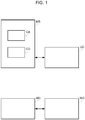
- a communication system comprises a management server MS, a user device UD, a mobile device MD and a wearable device WD.
- the management server MS is responsible for generating codes to be used by applications to configure wearable devices.
- the entity managing the management server MS is the same entity managing the delivery of the wearable devices.
- the management server MS includes a clustering agent CA and a code generator CG.
- the clustering agent CA manages an event registration through a user interface for users that provide areas of interest.
- the provided areas of interest are stored in a database in correspondence with identifiers IdU of users.
- the registration is closed for example after a deadline or once a given number of users have registered.
- the clustering agent CA performs a hierarchical clustering for all the registered users, producing a number N of unique clusters. Each cluster corresponds to a unique area of interest. For example, via an event registration website, users can select an area of interest among a predefined list of areas of interest.
- This configuration code corresponds to settings to be applied for a wearable device and is generated by the code generator CG. For example, with a wearable device implementing RGB LEDs (Red Green Blue Light-Emitting Diode), this configuration code will specify which RGB LEDs should be set, what should be the RGB color combination for the LEDs. A System on Chip on the wearable device will use this information to set the LEDs according to the configuration code.
- This configuration code can be selected from a pre-existing database of configuration codes. This can be easily implemented using a hash table. For example, assuming that we have 12 values for color1/color2 each and 6 values for patterns we can encode 864(12 X 12 X 6) unique configuration codes.
- the clustering agent CA assigns the configuration code of the cluster to all the users who belong to the cluster. Thus all the users belonging to the same cluster (representing a group of people of similar interests) will have the same color/pattern on their wearable devices.
- the clustering agent CA assigns color and pattern to clusters which are close to each other. For instance, this can be performed by a low-distortion embedding of cluster centers to a 3-dimensional grid - the three dimensions corresponding to the two colors and a pattern.
- the configuration code is encoded into a two-dimensional barcode, like a Quick Response (QR) code, for example using ISO/IEC 18004:2015 standard, and thus associated with the corresponding identifier IdU of the user.
- QR Quick Response
- each user is assigned a two-dimensional barcode code which corresponds to the configuration of a wearable device to be carried by the user.
- the user device UD is able to communicate with the managing server MS.
- the user device UD can be a mobile terminal, a personal computer or other client device such as a smartphone, a tablet.
- client device such as a smartphone, a tablet.
- the mobile device MD is able to communicate with the wearable device WD.
- the mobile device MD can be a mobile terminal, a laptop or other client device such as a smartphone, a tablet.
- the mobile device MD is able to store an application in a memory module, loaded via disk or downloaded to the memory module via a network interface. Details of said application can be provided to the user owning the mobile device in order that said application is installed in the mobile device.
- the mobile device MD is able to scan a two-dimensional barcode that can be interpreted by the application.
- the application decodes the two-dimensional barcode to a device configuration code and sends it to the wearable device WB.
- This mechanism could be enabled using NFC (Near Field Communication) or Bluetooth LE (Low Energy) and a JSON (JavaScript Object Notation) data exchange.
- the wearable device WD is a communicating device that can be carried on a user.
- the wearable device WD is a bracelet or amulet fabricated using material such as silicone or (other) in which RGB LEDs can be pre-installed and patterns can be etched. If the wearable device WD is a bracelet, it could be either flexible enough to wear it by sliding it into to the wrist or be detachable in between to wear it.
- the wearable device WD should be easily visible by other people.
- the wearable device WD comprises an inbuilt battery and a provision to replace the battery.
- an opening can be used to replace the battery.
- the wearable device WD comprises a communication stack to communicate with a mobile device MD sufficient to communicate small amount information such as device configuration code.
- the communication stack supports NFC or Bluetooth LE.
- the wearable device WD comprises a System on Chip including a color and pattern processing which receives a device configuration code and configures the RGB LEDs to the appropriate color and pattern.
- the System on Chip receives a configuration code and configures the RGB LEDs according to the configuration code.
- This device configuration code will, for example, specify which RGB LEDs should be set, what should be the RBG color combination for each LED.
- the user can easily do so on the event registration website hosted by the management server, get a different QR code and re-configure the wearable device using the application on the mobile device MD and the new QR code.
- a method for facilitating social interaction between people comprises steps S1 to S7 executed within the communication system.
- step S1 users register to an event registration website hosted by the management server MS using login credentials and are authenticated by means of a classic authentication mechanism. At least, each user sends an identifier IdU of the user to the management server MS via a user device UD.
- step S2 the users provide areas of interests that are stored by the clustering agent CA in a database in correspondence with the identifiers IdU of the users.
- step S3 once the event registration is closed, the clustering agent CA performs a hierarchical clustering for all the registered users, producing a number N of unique clusters and each cluster being based on a given area of interests. Users having same areas of interests are grouped in the same cluster.
- step S4 the clustering agent CA assigns a configuration code to each cluster and thus assigns the configuration code of the cluster to all the users who belong to the cluster.
- Each configuration code is uniquely generated by the code generator CG and corresponds to settings to be applied for a wearable device.
- the clustering agent CA encodes the configuration codes into a two-dimensional barcode codes, like QR codes, and associates each of them with the identifiers IdU of the users belonging to the same cluster. Each user is assigned a two-dimensional barcode which corresponds to the configuration of a wearable device to be carried by the user.
- Each user attending to the event should receive an attendee kit comprising especially a two-dimensional barcode code associated with the identifier IdU of the user. For example, a link is created between the identifier IdU of the user and a means to identify physically the user, in order to give him/her the attendee kit.
- step S5 on the first day of the event, each user as attendee receives a wearable device WD, a two-dimensional barcode and details of an application to be installed in the mobile device of the user. The user scans the two-dimensional barcode using the installed application.
- step S6 the application in the mobile device MD decodes the two-dimensional barcode to a device configuration code and sends it to the wearable device WD, via a NFC link or a Bluetooth LE link for example.
- step S7 the System on Chip of the wearable device WD configures the RGB LEDs according to the received configuration code.
- Alice is a person planning to attend a technical conference.
- Alice opens the conference registration page to register for the conference.
- Alice is asked to enter her areas of interests.
- Alice completes her registration and receives an email confirming her registration to the event.
- an attendee kit which contains a wearable device, a QR code, and details of a phone application accompanying the device.
- Alice pairs her smart phone to the wearable device using Bluetooth, opens the application and scans the QR code using her phone.
- the application decodes the QR code to a device configuration code and sends it to the wearable device.
- the wearable device sets the LEDs and pattern according to the configuration code. Now, the device is glowing with color and pattern corresponding to the areas of interests that Alice has previously provided.
- autism spectrum disorder is the name for a group of developmental disorders.
- ASD includes a wide range of symptoms, skills, and levels of disability. People with ASD often have repetitive activities and routines, and a very narrow range of interests. They tend to have a bias towards shape, color. Grouping people with ASD based on their interests at an autistic centre would enable people with ASD, as well as the trainers at the autistic centre. For example, it would provide a mechanism to guide people with ASD into towards their familiar environment, or enable them in discovering people with similar interests, or it could enable the trainers in discovering ASD patients with similar activities and behaviour, thus enabling the trainers in conducting various routines for people of similar interests.
- some enterprises have hundreds of visitors at their company campus each day. Each of these hundreds of visitors have a different profile (for example, employee from different location, interview candidate, friends of employee) and different purposes for their visits. Each of these stakeholders, depending on their position might be interested in (or allowed to) visiting different locations (such as meeting rooms, hot offices, conference halls, auditoriums, galleries) on the campus. When a new visitor arrives at a campus, he is unfamiliar with the environment and hesitant to freely navigate / use the facilities of the campus.
- a bracelet When a visitor visits the campus, at the entrance desk he receives a bracelet according his visitor information. (for example, business group that the visitor is visiting, reason for visit, affiliation). As the visitor walks through the building he observes that entrances to many of the places in the building display the pattern that he has on his device. He understands that he is free to visit or use any of these locations.
- the device enables the user in getting familiar with a new setting. It facilitates a seamlessly and safe way to interact with the environment allowing the visitor to derive the most out of his visit.
- An embodiment comprises a server comprising one or more processor(s), I/O interface(s), and a memory coupled to the processor(s).
- the processor(s) may be implemented as one or more microprocessors, microcomputers, microcontrollers, digital signal processors, central processing units, state machines, logic circuitries, and/or any devices that manipulate signals based on operational instructions.
- the processor(s) can be a single processing unit or a number of units, all of which could also include multiple computing units.
- the processor(s) are configured to fetch and execute computer-readable instructions stored in the memory.
- processor may be provided through the use of dedicated hardware as well as hardware capable of executing software in association with appropriate software.
- the functions may be provided by a single dedicated processor, by a single shared processor, or by a plurality of individual processors, some of which may be shared.
- explicit use of the term "processor” should not be construed to refer exclusively to hardware capable of executing software, and may implicitly include, without limitation, digital signal processor (DSP) hardware, network processor, application specific integrated circuit (ASIC), field programmable gate array (FPGA), read only memory (ROM) for storing software, random access memory (RAM), and non volatile storage.
- DSP digital signal processor
- ASIC application specific integrated circuit
- FPGA field programmable gate array
- ROM read only memory
- RAM random access memory
- non volatile storage Other hardware, conventional and/or custom, may also be included.
- the memory may include any computer-readable medium known in the art including, for example, volatile memory, such as static random access memory (SRAM) and dynamic random access memory (DRAM), and/or non-volatile memory, such as read only memory (ROM), erasable programmable ROM, flash memories, hard disks, optical disks, and magnetic tapes.
- volatile memory such as static random access memory (SRAM) and dynamic random access memory (DRAM)
- non-volatile memory such as read only memory (ROM), erasable programmable ROM, flash memories, hard disks, optical disks, and magnetic tapes.
- the memory includes modules and data.
- the modules include routines, programs, objects, components, data structures, etc., which perform particular tasks or implement particular abstract data types.
- the data serves as a repository for storing data processed, received, and generated by one or more of the modules.
- program storage devices for example, digital data storage media, which are machine or computer readable and encode machine-executable or computer-executable programs of instructions, where said instructions perform some or all of the steps of the described method.
- the program storage devices may be, for example, digital memories, magnetic storage media, such as a magnetic disks and magnetic tapes, hard drives, or optically readable digital data storage media.
Landscapes
- Business, Economics & Management (AREA)
- Engineering & Computer Science (AREA)
- Economics (AREA)
- Entrepreneurship & Innovation (AREA)
- Human Resources & Organizations (AREA)
- Marketing (AREA)
- Operations Research (AREA)
- Quality & Reliability (AREA)
- Strategic Management (AREA)
- Tourism & Hospitality (AREA)
- Physics & Mathematics (AREA)
- General Business, Economics & Management (AREA)
- General Physics & Mathematics (AREA)
- Theoretical Computer Science (AREA)
- User Interface Of Digital Computer (AREA)
Priority Applications (1)
| Application Number | Priority Date | Filing Date | Title |
|---|---|---|---|
| EP16306640.0A EP3333797A1 (de) | 2016-12-08 | 2016-12-08 | Tragbare vorrichtung um die interaktion zwischen einzelpersonen zu erleichtern |
Applications Claiming Priority (1)
| Application Number | Priority Date | Filing Date | Title |
|---|---|---|---|
| EP16306640.0A EP3333797A1 (de) | 2016-12-08 | 2016-12-08 | Tragbare vorrichtung um die interaktion zwischen einzelpersonen zu erleichtern |
Publications (1)
| Publication Number | Publication Date |
|---|---|
| EP3333797A1 true EP3333797A1 (de) | 2018-06-13 |
Family
ID=57570558
Family Applications (1)
| Application Number | Title | Priority Date | Filing Date |
|---|---|---|---|
| EP16306640.0A Withdrawn EP3333797A1 (de) | 2016-12-08 | 2016-12-08 | Tragbare vorrichtung um die interaktion zwischen einzelpersonen zu erleichtern |
Country Status (1)
| Country | Link |
|---|---|
| EP (1) | EP3333797A1 (de) |
Citations (2)
| Publication number | Priority date | Publication date | Assignee | Title |
|---|---|---|---|---|
| US20130043302A1 (en) * | 2011-08-18 | 2013-02-21 | Mark Stuart Powlen | Social media platforms |
| US8725842B1 (en) * | 2013-07-11 | 2014-05-13 | Khalid Al-Nasser | Smart watch |
-
2016
- 2016-12-08 EP EP16306640.0A patent/EP3333797A1/de not_active Withdrawn
Patent Citations (2)
| Publication number | Priority date | Publication date | Assignee | Title |
|---|---|---|---|---|
| US20130043302A1 (en) * | 2011-08-18 | 2013-02-21 | Mark Stuart Powlen | Social media platforms |
| US8725842B1 (en) * | 2013-07-11 | 2014-05-13 | Khalid Al-Nasser | Smart watch |
Non-Patent Citations (2)
| Title |
|---|
| ANONYMOUS: "Smartwatch", 7 December 2016 (2016-12-07), XP055344307, Retrieved from the Internet <URL:https://en.wikipedia.org/w/index.php?title=Smartwatch&oldid=753470690> [retrieved on 20170209] * |
| YANNICK BERNAERTS ET AL: "The office smartwatch", DESIGNING INTERACTIVE SYSTEMS, ACM, 2 PENN PLAZA, SUITE 701 NEW YORK NY 10121-0701 USA, 21 June 2014 (2014-06-21), pages 41 - 44, XP058052241, ISBN: 978-1-4503-2903-3, DOI: 10.1145/2598784.2602777 * |
Similar Documents
| Publication | Publication Date | Title |
|---|---|---|
| Welbourne et al. | Building the internet of things using RFID: the RFID ecosystem experience | |
| TWI499987B (zh) | 增強社交網路之技術 | |
| US20150205822A1 (en) | Methods and Systems for Contact Management | |
| US20200117758A1 (en) | Dynamically enhancing query results | |
| US20140129505A1 (en) | Social event recommendation system | |
| CN112214971A (zh) | 在线文档公告的处理方法、装置、电子设备和存储介质 | |
| US9344520B2 (en) | Method and system for visualizing social connections in a video meeting | |
| US20130240618A1 (en) | Exchange of dynamically updated data using matrix bar codes | |
| JP2015509639A (ja) | デバイスからの情報を用いたミーティング参加者の識別 | |
| CN106651073A (zh) | 任务派发管理系统及其方法 | |
| KR20160143754A (ko) | 동적 콘텍스트형 장치 네트워크 | |
| CN112800803B (zh) | 图形码识别方法、装置、设备及存储介质 | |
| US20230186248A1 (en) | Method and system for facilitating convergence | |
| CN113692596A (zh) | 用于目录去中心化的系统和方法 | |
| Gupta et al. | A formal proximity model for RBAC systems | |
| Ilic et al. | Augmented reality and the internet of things | |
| Mashhadi et al. | No walk in the park: The viability and fairness of social media analysis for parks and recreational policy making | |
| US10621417B2 (en) | Systems and methods for generating content | |
| Imanullah et al. | Randomized QR-code scanning for a low-cost secured attendance system | |
| Banotra et al. | Asset security in data of internet of things using blockchain technology | |
| US20150074557A1 (en) | System and method to determine the presence status of a registered user on a network | |
| KR102352879B1 (ko) | 명함을 이용한 소셜네트워크 플랫폼 | |
| Atzori et al. | Social internet of things: turning smart objects into social objects to boost the iot | |
| US20170171140A1 (en) | Platform for digital business cards that facilitates connections between individuals and a method thereof | |
| EP3333797A1 (de) | Tragbare vorrichtung um die interaktion zwischen einzelpersonen zu erleichtern |
Legal Events
| Date | Code | Title | Description |
|---|---|---|---|
| PUAI | Public reference made under article 153(3) epc to a published international application that has entered the european phase |
Free format text: ORIGINAL CODE: 0009012 |
|
| STAA | Information on the status of an ep patent application or granted ep patent |
Free format text: STATUS: THE APPLICATION HAS BEEN PUBLISHED |
|
| AK | Designated contracting states |
Kind code of ref document: A1 Designated state(s): AL AT BE BG CH CY CZ DE DK EE ES FI FR GB GR HR HU IE IS IT LI LT LU LV MC MK MT NL NO PL PT RO RS SE SI SK SM TR |
|
| AX | Request for extension of the european patent |
Extension state: BA ME |
|
| STAA | Information on the status of an ep patent application or granted ep patent |
Free format text: STATUS: REQUEST FOR EXAMINATION WAS MADE |
|
| 17P | Request for examination filed |
Effective date: 20181213 |
|
| RBV | Designated contracting states (corrected) |
Designated state(s): AL AT BE BG CH CY CZ DE DK EE ES FI FR GB GR HR HU IE IS IT LI LT LU LV MC MK MT NL NO PL PT RO RS SE SI SK SM TR |
|
| STAA | Information on the status of an ep patent application or granted ep patent |
Free format text: STATUS: EXAMINATION IS IN PROGRESS |
|
| 17Q | First examination report despatched |
Effective date: 20190313 |
|
| STAA | Information on the status of an ep patent application or granted ep patent |
Free format text: STATUS: THE APPLICATION IS DEEMED TO BE WITHDRAWN |
|
| 18D | Application deemed to be withdrawn |
Effective date: 20190924 |