EP3333787A1 - System und verfahren zur automatisierung der entscheidungsfindung für innerhalb einer organisation aufgezeichnete instanzen - Google Patents
System und verfahren zur automatisierung der entscheidungsfindung für innerhalb einer organisation aufgezeichnete instanzen Download PDFInfo
- Publication number
- EP3333787A1 EP3333787A1 EP17198439.6A EP17198439A EP3333787A1 EP 3333787 A1 EP3333787 A1 EP 3333787A1 EP 17198439 A EP17198439 A EP 17198439A EP 3333787 A1 EP3333787 A1 EP 3333787A1
- Authority
- EP
- European Patent Office
- Prior art keywords
- instances
- value
- threshold
- location
- span
- Prior art date
- Legal status (The legal status is an assumption and is not a legal conclusion. Google has not performed a legal analysis and makes no representation as to the accuracy of the status listed.)
- Ceased
Links
Images


Classifications
-
- G—PHYSICS
- G06—COMPUTING OR CALCULATING; COUNTING
- G06Q—INFORMATION AND COMMUNICATION TECHNOLOGY [ICT] SPECIALLY ADAPTED FOR ADMINISTRATIVE, COMMERCIAL, FINANCIAL, MANAGERIAL OR SUPERVISORY PURPOSES; SYSTEMS OR METHODS SPECIALLY ADAPTED FOR ADMINISTRATIVE, COMMERCIAL, FINANCIAL, MANAGERIAL OR SUPERVISORY PURPOSES, NOT OTHERWISE PROVIDED FOR
- G06Q10/00—Administration; Management
- G06Q10/06—Resources, workflows, human or project management; Enterprise or organisation planning; Enterprise or organisation modelling
- G06Q10/063—Operations research, analysis or management
- G06Q10/0631—Resource planning, allocation, distributing or scheduling for enterprises or organisations
-
- G—PHYSICS
- G06—COMPUTING OR CALCULATING; COUNTING
- G06Q—INFORMATION AND COMMUNICATION TECHNOLOGY [ICT] SPECIALLY ADAPTED FOR ADMINISTRATIVE, COMMERCIAL, FINANCIAL, MANAGERIAL OR SUPERVISORY PURPOSES; SYSTEMS OR METHODS SPECIALLY ADAPTED FOR ADMINISTRATIVE, COMMERCIAL, FINANCIAL, MANAGERIAL OR SUPERVISORY PURPOSES, NOT OTHERWISE PROVIDED FOR
- G06Q10/00—Administration; Management
- G06Q10/06—Resources, workflows, human or project management; Enterprise or organisation planning; Enterprise or organisation modelling
- G06Q10/063—Operations research, analysis or management
- G06Q10/0637—Strategic management or analysis, e.g. setting a goal or target of an organisation; Planning actions based on goals; Analysis or evaluation of effectiveness of goals
-
- G—PHYSICS
- G06—COMPUTING OR CALCULATING; COUNTING
- G06Q—INFORMATION AND COMMUNICATION TECHNOLOGY [ICT] SPECIALLY ADAPTED FOR ADMINISTRATIVE, COMMERCIAL, FINANCIAL, MANAGERIAL OR SUPERVISORY PURPOSES; SYSTEMS OR METHODS SPECIALLY ADAPTED FOR ADMINISTRATIVE, COMMERCIAL, FINANCIAL, MANAGERIAL OR SUPERVISORY PURPOSES, NOT OTHERWISE PROVIDED FOR
- G06Q10/00—Administration; Management
- G06Q10/10—Office automation; Time management
-
- G—PHYSICS
- G06—COMPUTING OR CALCULATING; COUNTING
- G06Q—INFORMATION AND COMMUNICATION TECHNOLOGY [ICT] SPECIALLY ADAPTED FOR ADMINISTRATIVE, COMMERCIAL, FINANCIAL, MANAGERIAL OR SUPERVISORY PURPOSES; SYSTEMS OR METHODS SPECIALLY ADAPTED FOR ADMINISTRATIVE, COMMERCIAL, FINANCIAL, MANAGERIAL OR SUPERVISORY PURPOSES, NOT OTHERWISE PROVIDED FOR
- G06Q10/00—Administration; Management
- G06Q10/20—Administration of product repair or maintenance
-
- G—PHYSICS
- G06—COMPUTING OR CALCULATING; COUNTING
- G06Q—INFORMATION AND COMMUNICATION TECHNOLOGY [ICT] SPECIALLY ADAPTED FOR ADMINISTRATIVE, COMMERCIAL, FINANCIAL, MANAGERIAL OR SUPERVISORY PURPOSES; SYSTEMS OR METHODS SPECIALLY ADAPTED FOR ADMINISTRATIVE, COMMERCIAL, FINANCIAL, MANAGERIAL OR SUPERVISORY PURPOSES, NOT OTHERWISE PROVIDED FOR
- G06Q10/00—Administration; Management
- G06Q10/30—Administration of product recycling or disposal
-
- Y—GENERAL TAGGING OF NEW TECHNOLOGICAL DEVELOPMENTS; GENERAL TAGGING OF CROSS-SECTIONAL TECHNOLOGIES SPANNING OVER SEVERAL SECTIONS OF THE IPC; TECHNICAL SUBJECTS COVERED BY FORMER USPC CROSS-REFERENCE ART COLLECTIONS [XRACs] AND DIGESTS
- Y02—TECHNOLOGIES OR APPLICATIONS FOR MITIGATION OR ADAPTATION AGAINST CLIMATE CHANGE
- Y02W—CLIMATE CHANGE MITIGATION TECHNOLOGIES RELATED TO WASTEWATER TREATMENT OR WASTE MANAGEMENT
- Y02W90/00—Enabling technologies or technologies with a potential or indirect contribution to greenhouse gas [GHG] emissions mitigation
Definitions
- the disclosure herein generally relates to automating decision making, and more particularly to system and method for automating decision making for instances recorded within an organization.
- the decisions can include the items to be purchased in an organization, trainings to be taken by the employees of the organization and other decisions.
- the decisions are made by the management of the organization by considering many factors. For example, an organization would have a numerous catalogue of course training that need to be taken by the employees of the organization. However, all the course need not be taken by all the employees of the organization.
- the courses to be undertaken by an employee depends on the profile of the employee and other factors. Therefore, the decision to assign a course to an employee is made by the management.
- a method for automating decision making for instances recorded within an organization includes receiving a list of one or more pre-defined categories that are tagged with one or more decisions of the organization along with a span threshold, a location threshold and a size threshold for each of the one or more pre-defined categories. Further, one or more instances are received by the system. Subsequently, one or more recorded instances are analysed to determine a span value, a location value and a size value, wherein location value is determined by computing a dynamic weight to one or more locations based on the one or more instances received.
- comparing the span value, the location value and the size value with corresponding span threshold, location threshold and size threshold with pre-defined categories stored in memory comparing the span value, the location value and the size value with corresponding span threshold, location threshold and size threshold with pre-defined categories stored in memory. Subsequently, one or more instances are tagged to one or more pre-defined categories based on the comparison and a decision is determined for the organization based on the instances tagged to one or more pre-defined categories.
- a system automating decision making for instances recorded within an organization includes at least one processor, and a memory communicatively coupled to the at least one processor, wherein the memory comprises of several modules.
- the modules include automating decision making module that automates decision making for instances received within an organization.
- the module receives a list of one or more pre-defined categories tagged with one or more decisions of the organization along with a span threshold, a location threshold and a size threshold for each of the one or more pre-defined categories of one or more instances. Further the module receives one or more instances.
- one or more recorded instances are analysed to determine a span value, a location value and a size value, wherein location value is determined by computing a dynamic weight to one or more locations based on the one or more instances received. Further, comparing the span value, the location value and the size value with corresponding span threshold, location threshold and size threshold with pre-defined categories stored in memory. Subsequently, one or more instances are tagged to one or more pre-defined categories based on the comparision and a decision is determined for the organization based on the instances tagged to one or more pre-defined categories.
- a non-transitory computer readable medium embodying a program executable in a computing device receives a list of one or more pre-defined categories tagged with one or more decisions of the organization along with a span threshold, a location threshold and a size threshold for each of the one or more pre-defined categories of one or more instances. Further the module receives one or more instances. Subsequently, one or more recorded instances are analysed to determine a span value, a location value and a size value, wherein location value is determined by computing a dynamic weight to one or more locations based on the one or more instances received. Further, comparing the span value, the location value and the size value with corresponding span threshold, location threshold and size threshold with pre-defined categories stored in memory. Subsequently, one or more instances are tagged to one or more pre-defined categories based on the comparison and a decision is determined for the organization based on the instances tagged to one or more pre-defined categories.
- the present description discloses a method for automating the decision making without human intervention in an organization.
- the method includes receiving the instances of request for a process in an organization.
- the system also receive span threshold, size threshold and location threshold along with categories. Further the instances are analysed based on span analysis, size analysis and location analysis to determine a span value, a size value and a location value. Comparing the span value, size value and location value with the span threshold, size threshold and location threshold. Based on the comparison, categorizing the instances received in an organization.
- the method of computation is explained in the following description.
- FIG. 1 schematically illustrates a system 100 for automating decision making for instances recorded within an organization, according to an embodiment of the present disclosure.
- the system 100 includes one or more processor(s) 102 and a memory 104 communicatively coupled to each other.
- the memory 104 includes an automated decision making module 106 that analyses the instances based on span, location and size and automates the decision making.
- the system 100 also includes interface(s) 108.
- FIG. 1 shows example components of the system 100, in other implementations, the system 100 may contain fewer components, additional components, different components, or differently arranged components than depicted in FIG. 1 .
- the processor(s) 102 and the memory 104 may be communicatively coupled by a system bus.
- the processor(s) 102 may include circuitry implementing, among others, audio and logic functions associated with the communication.
- the processor 102 may include, among other things, a clock, an arithmetic logic unit (ALU) and logic gates configured to support operation of the processor(s) 102.
- the processor(s) 102 can be a single processing unit or a number of units, all of which include multiple computing units.
- the processor(s) 102 may be implemented as one or more microprocessors, microcomputers, microcontrollers, digital signal processors, central processing units, state machines, logic circuitries, and/or any devices that manipulate signals based on operational instructions.
- the processor(s) 102 is configured to fetch and execute computer-readable instructions and data stored in the memory 104.
- processors may be provided through the use of dedicated hardware as well as hardware capable of executing software in association with appropriate software.
- the functions may be provided by a single dedicated processor, by a single shared processor, or by a plurality of individual processors, some of which may be shared.
- explicit use of the term "processor” should not be construed to refer exclusively to hardware capable of executing software, and may implicitly include, without limitation, digital signal processor (DSP) hardware, network processor, application specific integrated circuit (ASIC), field programmable gate array (FPGA), read only memory (ROM) for storing software, random access memory (RAM), and non-volatile storage.
- DSP digital signal processor
- ASIC application specific integrated circuit
- FPGA field programmable gate array
- ROM read only memory
- RAM random access memory
- non-volatile storage Other hardware, conventional, and/or custom, may also be included.
- the interface(s) 108 may include a variety of software and hardware interfaces, for example, interfaces for peripheral device(s), such as a keyboard, a mouse, an external memory, and a printer.
- the interface(s) 108 can facilitate multiple communications within a wide variety of networks and protocol types, including wired networks, for example, local area network (LAN), cable, etc., and wireless networks, such as Wireless LAN (WLAN), cellular, or satellite.
- the interface(s) 108 may include one or more ports for connecting the system 100 to other network devices.
- the memory 104 may include any computer-readable medium known in the art including, for example, volatile memory, such as static random access memory (SRAM) and dynamic random access memory (DRAM), and/or non-volatile memory, such as read only memory (ROM), erasable programmable ROM, flash memories, hard disks, optical disks, and magnetic tapes.
- volatile memory such as static random access memory (SRAM) and dynamic random access memory (DRAM)
- non-volatile memory such as read only memory (ROM), erasable programmable ROM, flash memories, hard disks, optical disks, and magnetic tapes.
- ROM read only memory
- the memory 104 may be configured to store instructions which when executed by the processor 102 causes the system 100 to behave in a manner as described in various embodiments.
- the memory 104 includes the automated decision making module 106 and other modules.
- the module 106 include routines, programs, objects, components, data structures, etc., which perform particular tasks or implement particular abstract data types.
- an organization there are a plurality of instances received for an entity.
- the examples of entities are items to be purchased in an organization, trainings to be taken by the employees of the organization.
- the instances that are received by the system are recorded in the system.
- the recorded instances for the entity are analysed to determine if the instance is received for the entity for the first time or the instance is a repeated instance.
- a span value, a location value and a size value is determined by performing the span analysis, location analysis and the size analysis on the instances received in the organization.
- a span threshold, location threshold and a size threshold are received in the system 100 and stored in the memory 104.
- One or more categories are also received with respect to the span threshold, location threshold and the size threshold.
- the span value, the location value and the size value are compared with the span threshold, the location threshold and the size threshold. Based on the comparison, the instances are tagged to one of the categories. Subsequently, decisions are made in an organization based on the instances tagged in an entity.
- the instances are analysed based on the span, location and size of the instance.
- the span analysis is performed on the instances received in the entity to obtain a span value.
- the span analysis refers to the analysis of the span between the instances recorded based on the defined parameters.
- the parameters include average time between two records or a weightage assigned to each record based on specific time when record was inserted or combination of both.
- the location analysis is performed on the instances received for the entity to obtain the location value.
- the location analysis refers to the analysis of the location of the instances received.
- the examples include store location where item is purchased, city of the customer, training location, etc.
- the location analysis is performed by assigning a dynamic weightage to the locations. Dynamic weightage includes increasing or decreasing the weightage to a location based on categorized instances from specific locations.
- the dynamic weightage of a location is utilized to assign a dynamic value to each of the locations.
- the dynamic location varies based on frequency of instances for a specific location that are categorized as high or medium or low items from.
- the dynamic weightage is utilized for determining a decision in an organization based on the frequency of instances received in a location.
- the weightage of locations of the one or more instances are summed and compared with the location threshold. Based on the comparison, system 100 decides if the size analysis has to be performed. In an embodiment of the present disclosure, when the sum of location weightages is more than location threshold, the size analysis is performed. However, if the sum of location weightages is less than location threshold, the process ends (or may be terminated).
- the method for size analysis refers to analysis of instance size parameter.
- the examples of size analysis include determining number of same item purchased in bulk, trainee counts per training instance, number of different items purchased by customer etc.
- Size analysis includes determine size value of the instances received in a particular entity. Size value is the sum of the instance quantity considered for an each entity.
- size parameters are summed and compared with the size threshold. Based on the comparison, the system 100 determines if the instance qualifies for a specific pre-defined category.
- each item from a specific location is tagged to one of the predefined categories stored in the memory 104.
- the predefined categories are tagged to one of the business decisions in an organization. Therefore, a decision is made in an organization based on the predefined categories tagged to the one or more instances.
- an example for a training to be taken by the employee of the organization is considered.
- the details recorded for the instances received in an organization are training title, category, assessment details and repeat request count.
- the training details are considered.
- the training details are project details, location details, trainer details, start date, end date, number of hours and attendees.
- frequency of the repeated requests of a training is to be determined.
- the size analysis, location analysis and frequency of the repeated requests is utilized.
- the system updates the repeat request count after every new repeat request count is received by the system. Frequency of repeated requests to be analysed and categorized as high or moderate as and when repeat request count is updated.
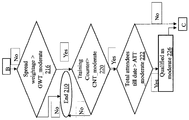
- FIG. 2 is a flow chart illustrating the requirement of a training course for the employees in an organization.
- the inputs considered from the organization are calculation logic for T Avg threshold, weightage for each geography, the geography weightage threshold for high GWT_high, the geography weightage for moderate GWT_moderate, training request count for high CNT_high, training request count for moderate CNT_moderate, number of attendees for high ATT_high and number of attendees for moderate ATT_moderate.
- each repeat request for KTP (Knowledge Transfer Partnership) offering is recorded.
- the procedure for determining the requirement for a training course is determined.
- average time between the two requests received by the system T Avg is determined.
- the T Avg is compared with the T Avg threshold. If the T Avg is less than T Avg threshold, a spread weightage is calculated at block 212. The spread weightage is the summation of the weightages given to all the geographies. If the T Avg is not less than T Avg threshold, then the process ends at block 210. Further at block 214, spread weightage is compared with GWT_high. If spread weightage is greater than GWT_high, training counter is compared with CNT_high at block 218. However, if spread weightage is less that GWT_high, then spread weightage is compared with GWT_moderate at block 216.
- the process ends at block 210.
- training counter of the system is compared with CNT_moderate given by the organization at block 220. If training counter is less than CNT_moderate, the process ends at block 210. However, if training counter is greater than CNT_moderate, total attendees is compared with the ATT_moderate at block 222. If total attendees till date is greater than ATT_moderate, then the training course requirement is considered as moderate. Otherwise, the process ends. However, in the comparison at block 218, the training counter is greater than CNT_high, total attendees till date are compared with ATT_high at block 224.
- the process ends at block 210.
- the training counter is less than CNT_high, the process ends at block 210.
- the training course requirement is determined as high. However, if the total number of attendees till date is less than ATT_high, then the process ends at block 210.
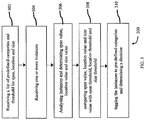
- FIG. 3 is a flowchart illustrating a method for automating decision making for instances recorded within an organization.
- the system 100 receives a list of predefined categories and threshold for span, location and size from the organization.
- one or more instances are received.
- the instances are analysed to determine the span value, location value and size value.
- the span value, location value and the size value are compared with span threshold, location threshold and size threshold at block 308.
- one or more instances are tagged to pre-defined categories and determining a decision within an organization.
- the technical challenge the present disclosure addresses is analyzing the instances received by the organization to determine a decision for the organization.
- the present disclosure determines a decision based on the span analysis, location analysis and size analysis of the instances.
- the method disclosed in the present disclosure provides a better throughput by utilizing dynamic weightage to locations for performing location analysis.
- the hardware device can be any kind of device which can be programmed including e.g. any kind of computer like a server or a personal computer, or the like, or any combination thereof.
- the device may also include means which could be e.g. hardware means like e.g. an application-specific integrated circuit (ASIC), a field-programmable gate array (FPGA), or a combination of hardware and software means, e.g.
- ASIC application-specific integrated circuit
- FPGA field-programmable gate array
- the means can include both hardware means and software means.
- the method embodiments described herein could be implemented in hardware and software.
- the device may also include software means.
- the embodiments may be implemented on different hardware devices, e.g. using a plurality of CPUs.
- the embodiments herein can comprise hardware and software elements.
- the embodiments that are implemented in software include but are not limited to, firmware, resident software, microcode, etc.
- the functions performed by various modules described herein may be implemented in other modules or combinations of other modules.
- a computer-usable or computer readable medium can be any apparatus that can comprise, store, communicate, propagate, or transport the program for use by or in connection with the instruction execution system, apparatus, or device.
- a computer-readable storage medium refers to any type of physical memory on which information or data readable by a processor may be stored.
- a computer-readable storage medium may store instructions for execution by one or more processors, including instructions for causing the processor(s) to perform steps or stages consistent with the embodiments described herein.
- the term "computer-readable medium” should be understood to include tangible items and exclude carrier waves and transient signals, i.e., be non-transitory. Examples include random access memory (RAM), read-only memory (ROM), volatile memory, nonvolatile memory, hard drives, CD ROMs, DVDs, flash drives, disks, and any other known physical storage media.
Landscapes
- Business, Economics & Management (AREA)
- Human Resources & Organizations (AREA)
- Engineering & Computer Science (AREA)
- Entrepreneurship & Innovation (AREA)
- Strategic Management (AREA)
- Economics (AREA)
- Operations Research (AREA)
- Theoretical Computer Science (AREA)
- General Physics & Mathematics (AREA)
- Marketing (AREA)
- General Business, Economics & Management (AREA)
- Quality & Reliability (AREA)
- Tourism & Hospitality (AREA)
- Physics & Mathematics (AREA)
- Educational Administration (AREA)
- Development Economics (AREA)
- Game Theory and Decision Science (AREA)
- Life Sciences & Earth Sciences (AREA)
- Sustainable Development (AREA)
- Data Mining & Analysis (AREA)
- Information Retrieval, Db Structures And Fs Structures Therefor (AREA)
- Management, Administration, Business Operations System, And Electronic Commerce (AREA)
Applications Claiming Priority (1)
| Application Number | Priority Date | Filing Date | Title |
|---|---|---|---|
| IN201621042143 | 2016-12-09 |
Publications (1)
| Publication Number | Publication Date |
|---|---|
| EP3333787A1 true EP3333787A1 (de) | 2018-06-13 |
Family
ID=60201834
Family Applications (1)
| Application Number | Title | Priority Date | Filing Date |
|---|---|---|---|
| EP17198439.6A Ceased EP3333787A1 (de) | 2016-12-09 | 2017-10-26 | System und verfahren zur automatisierung der entscheidungsfindung für innerhalb einer organisation aufgezeichnete instanzen |
Country Status (2)
| Country | Link |
|---|---|
| US (1) | US20180165613A1 (de) |
| EP (1) | EP3333787A1 (de) |
Citations (5)
| Publication number | Priority date | Publication date | Assignee | Title |
|---|---|---|---|---|
| US20080288305A1 (en) * | 2007-05-15 | 2008-11-20 | Laluzerne Joseph D | Enterprise Decision Management System and Method |
| EP2575102A1 (de) * | 2011-09-30 | 2013-04-03 | Tata Consultancy Services Limited | Risikobeurteilung für Ereignisse |
| GB2505220A (en) * | 2012-08-23 | 2014-02-26 | Ibm | Efficient rule execution in decision services |
| US20140324519A1 (en) * | 2013-04-25 | 2014-10-30 | Bank Of America Corporation | Operational Risk Decision-Making Framework |
| US20160232466A1 (en) * | 2015-02-09 | 2016-08-11 | Wipro Limited | Method and device for determining risks associated with customer requirements in an organization |
Family Cites Families (1)
| Publication number | Priority date | Publication date | Assignee | Title |
|---|---|---|---|---|
| US9055407B1 (en) * | 2010-11-16 | 2015-06-09 | Mykee Acquistions L.L.C. | Generation and utilization of a database of cell phone usage events |
-
2017
- 2017-10-25 US US15/793,363 patent/US20180165613A1/en not_active Abandoned
- 2017-10-26 EP EP17198439.6A patent/EP3333787A1/de not_active Ceased
Patent Citations (5)
| Publication number | Priority date | Publication date | Assignee | Title |
|---|---|---|---|---|
| US20080288305A1 (en) * | 2007-05-15 | 2008-11-20 | Laluzerne Joseph D | Enterprise Decision Management System and Method |
| EP2575102A1 (de) * | 2011-09-30 | 2013-04-03 | Tata Consultancy Services Limited | Risikobeurteilung für Ereignisse |
| GB2505220A (en) * | 2012-08-23 | 2014-02-26 | Ibm | Efficient rule execution in decision services |
| US20140324519A1 (en) * | 2013-04-25 | 2014-10-30 | Bank Of America Corporation | Operational Risk Decision-Making Framework |
| US20160232466A1 (en) * | 2015-02-09 | 2016-08-11 | Wipro Limited | Method and device for determining risks associated with customer requirements in an organization |
Also Published As
| Publication number | Publication date |
|---|---|
| US20180165613A1 (en) | 2018-06-14 |
Similar Documents
| Publication | Publication Date | Title |
|---|---|---|
| US10089109B2 (en) | System and method for evaluating human resources in a software development environment | |
| US9038027B2 (en) | Systems and methods for identifying software performance influencers | |
| CN107040397B (zh) | 一种业务参数获取方法及装置 | |
| CN108574933A (zh) | 用户轨迹恢复方法及装置 | |
| CN106875110A (zh) | 业务指标分层计算方法及装置、分布式计算方法及系统 | |
| AU2018250383A1 (en) | Skill proficiency system | |
| EP4060542B1 (de) | System und verfahren zur datenanonymisierung mittels optimierungstechniken | |
| US20140067472A1 (en) | System and Method For Segmenting A Customer Base | |
| US10423651B2 (en) | Analysis of mobile application reviews based on content, reviewer credibility, and temporal and geographic clustering | |
| EP3214569B1 (de) | Verfahren und system zur identifizierung von testfällen zur eindringungsprüfung einer anwendung | |
| US11200250B2 (en) | Method and system for optimizing validations carried out for input data at a data warehouse | |
| CN116166820A (zh) | 基于供应商数据的可视化知识图谱生成方法及装置 | |
| EP3561751A1 (de) | Systeme und verfahren zur quantitativen beurteilung der benutzererfahrung (ux) eines digitalen produkts | |
| CN108694672A (zh) | 订单处理方法、装置、计算机设备及存储介质 | |
| CN112613762A (zh) | 基于知识图谱的集团评级方法、装置和电子设备 | |
| EP3333787A1 (de) | System und verfahren zur automatisierung der entscheidungsfindung für innerhalb einer organisation aufgezeichnete instanzen | |
| CN110378543A (zh) | 离职风险预测方法、装置、计算机设备和存储介质 | |
| CN105528352A (zh) | 建立移动通信用户与其网络账户信息的对应关系的方法 | |
| US20190362838A1 (en) | Method and system for data driven cognitive clinical trial feasibility program | |
| US10467595B2 (en) | Prediction tool | |
| CN109271499A (zh) | 一种知识问答中答题用户的推荐方法、装置和终端设备 | |
| AU2018204545B2 (en) | System and method for analysis of information technology production service support metrics | |
| CN109213979A (zh) | 对电子表格进行筛选的方法、装置、电子设备及存储介质 | |
| CN117370909A (zh) | 基于操作行为的员工监控方法、装置、设备及存储介质 | |
| JP2025510022A (ja) | 時空間データを使用したエンティティ関係強度識別 |
Legal Events
| Date | Code | Title | Description |
|---|---|---|---|
| PUAI | Public reference made under article 153(3) epc to a published international application that has entered the european phase |
Free format text: ORIGINAL CODE: 0009012 |
|
| STAA | Information on the status of an ep patent application or granted ep patent |
Free format text: STATUS: THE APPLICATION HAS BEEN PUBLISHED |
|
| AK | Designated contracting states |
Kind code of ref document: A1 Designated state(s): AL AT BE BG CH CY CZ DE DK EE ES FI FR GB GR HR HU IE IS IT LI LT LU LV MC MK MT NL NO PL PT RO RS SE SI SK SM TR |
|
| AX | Request for extension of the european patent |
Extension state: BA ME |
|
| RIN1 | Information on inventor provided before grant (corrected) |
Inventor name: RAI, YOUTHIKA JAGADISH Inventor name: BARAD, VISHAL Inventor name: MUJUMDAR, PALLAVI |
|
| STAA | Information on the status of an ep patent application or granted ep patent |
Free format text: STATUS: REQUEST FOR EXAMINATION WAS MADE |
|
| 17P | Request for examination filed |
Effective date: 20181213 |
|
| RBV | Designated contracting states (corrected) |
Designated state(s): AL AT BE BG CH CY CZ DE DK EE ES FI FR GB GR HR HU IE IS IT LI LT LU LV MC MK MT NL NO PL PT RO RS SE SI SK SM TR |
|
| STAA | Information on the status of an ep patent application or granted ep patent |
Free format text: STATUS: EXAMINATION IS IN PROGRESS |
|
| 17Q | First examination report despatched |
Effective date: 20191218 |
|
| STAA | Information on the status of an ep patent application or granted ep patent |
Free format text: STATUS: THE APPLICATION HAS BEEN REFUSED |
|
| 18R | Application refused |
Effective date: 20210611 |