EP3333157A1 - Vinyl compounds as fgfr and vegfr inhibitors - Google Patents
Vinyl compounds as fgfr and vegfr inhibitors Download PDFInfo
- Publication number
- EP3333157A1 EP3333157A1 EP16834592.4A EP16834592A EP3333157A1 EP 3333157 A1 EP3333157 A1 EP 3333157A1 EP 16834592 A EP16834592 A EP 16834592A EP 3333157 A1 EP3333157 A1 EP 3333157A1
- Authority
- EP
- European Patent Office
- Prior art keywords
- group
- crr
- lcms
- esi
- stirred
- Prior art date
- Legal status (The legal status is an assumption and is not a legal conclusion. Google has not performed a legal analysis and makes no representation as to the accuracy of the status listed.)
- Granted
Links
- 0 CC1=C*(*)*=C1 Chemical compound CC1=C*(*)*=C1 0.000 description 11
- PDNMCKCPAMGRPP-UHFFFAOYSA-N C(c1ccccc1)Oc(cc12)ccc1[nH]nc2-c1ccccc1 Chemical compound C(c1ccccc1)Oc(cc12)ccc1[nH]nc2-c1ccccc1 PDNMCKCPAMGRPP-UHFFFAOYSA-N 0.000 description 1
- GQZFCBAMMHMKTC-ONEGZZNKSA-N C/C=C/c1n[nH]c2c1cc(C)cc2 Chemical compound C/C=C/c1n[nH]c2c1cc(C)cc2 GQZFCBAMMHMKTC-ONEGZZNKSA-N 0.000 description 1
- VGENXJABVOXCPL-VQHVLOKHSA-N CC(c(c(Cl)cnc1)c1Cl)Oc(cc1)cc2c1[nH]nc2/C=C/c1ccc(CN(CC2)CCN2C(C)=O)cc1 Chemical compound CC(c(c(Cl)cnc1)c1Cl)Oc(cc1)cc2c1[nH]nc2/C=C/c1ccc(CN(CC2)CCN2C(C)=O)cc1 VGENXJABVOXCPL-VQHVLOKHSA-N 0.000 description 1
- NXGAFPRDOYRPIV-FYWRMAATSA-N CC(c(c(Cl)cnc1)c1Cl)Oc(cc1)cc2c1[nH]nc2/C=C/c1ccc(CN(CCN(C)C)Cc2ccccc2)cc1 Chemical compound CC(c(c(Cl)cnc1)c1Cl)Oc(cc1)cc2c1[nH]nc2/C=C/c1ccc(CN(CCN(C)C)Cc2ccccc2)cc1 NXGAFPRDOYRPIV-FYWRMAATSA-N 0.000 description 1
- SCGOKBOHYLSKCS-YVNNLAQVSA-N CC(c(c(Cl)cnc1)c1Cl)Oc(cc1)cc2c1[n](C(OC(C)(C)C)=O)nc2/C=C(/c1cnc(CO)cc1)\F Chemical compound CC(c(c(Cl)cnc1)c1Cl)Oc(cc1)cc2c1[n](C(OC(C)(C)C)=O)nc2/C=C(/c1cnc(CO)cc1)\F SCGOKBOHYLSKCS-YVNNLAQVSA-N 0.000 description 1
- XWPJDFMFADXQMX-GQCTYLIASA-N CC(c(c(Cl)cnc1)c1Cl)Oc1ccc2[nH]nc(/C=C/c(ccc(CN3CCOCC3)c3)c3Cl)c2c1 Chemical compound CC(c(c(Cl)cnc1)c1Cl)Oc1ccc2[nH]nc(/C=C/c(ccc(CN3CCOCC3)c3)c3Cl)c2c1 XWPJDFMFADXQMX-GQCTYLIASA-N 0.000 description 1
- BVHONWAASKTFCK-VQHVLOKHSA-N CC(c(c(Cl)cnc1)c1Cl)Oc1ccc2[nH]nc(/C=C/c3ccc(CN4CCOCCC4)cc3)c2c1 Chemical compound CC(c(c(Cl)cnc1)c1Cl)Oc1ccc2[nH]nc(/C=C/c3ccc(CN4CCOCCC4)cc3)c2c1 BVHONWAASKTFCK-VQHVLOKHSA-N 0.000 description 1
- DCXMZTDGDUDVCE-GQCTYLIASA-N CC(c(c(Cl)cnc1)c1Cl)Oc1ccc2[nH]nc(/C=C/c3nnc(CN4CCOCC4)cc3)c2c1 Chemical compound CC(c(c(Cl)cnc1)c1Cl)Oc1ccc2[nH]nc(/C=C/c3nnc(CN4CCOCC4)cc3)c2c1 DCXMZTDGDUDVCE-GQCTYLIASA-N 0.000 description 1
- VOXMZQCXQQDOFL-QFEZKATASA-N CC(c(c(F)ccc1)c1Cl)Oc(cc1)cc2c1[nH]nc2/C=C(/c1cnc(CNC2CCOCC2)cc1)\F Chemical compound CC(c(c(F)ccc1)c1Cl)Oc(cc1)cc2c1[nH]nc2/C=C(/c1cnc(CNC2CCOCC2)cc1)\F VOXMZQCXQQDOFL-QFEZKATASA-N 0.000 description 1
- ABGKOYZZPLUGGD-JJFYIABZSA-N CC(c(c(F)cnc1)c1F)Oc(cc1)cc2c1[nH]nc2/C=C(/c1cnc(CNC2CCOCC2)cc1)\F Chemical compound CC(c(c(F)cnc1)c1F)Oc(cc1)cc2c1[nH]nc2/C=C(/c1cnc(CNC2CCOCC2)cc1)\F ABGKOYZZPLUGGD-JJFYIABZSA-N 0.000 description 1
- XCCBMPNQMFHXRS-UHFFFAOYSA-N CC1=NNC(C2)C1CN2I Chemical compound CC1=NNC(C2)C1CN2I XCCBMPNQMFHXRS-UHFFFAOYSA-N 0.000 description 1
- BWRNREIEPIQCOI-UHFFFAOYSA-N CCOC(CN(CC1)CCN1C(OC(C)(C)C)=O)=O Chemical compound CCOC(CN(CC1)CCN1C(OC(C)(C)C)=O)=O BWRNREIEPIQCOI-UHFFFAOYSA-N 0.000 description 1
- QETJQVJIERQYIQ-UHFFFAOYSA-N CCOC(CN1CCN(C)CC1)=O Chemical compound CCOC(CN1CCN(C)CC1)=O QETJQVJIERQYIQ-UHFFFAOYSA-N 0.000 description 1
- KKXWNQGDURZYEO-UHFFFAOYSA-N CCOP(C(c1cnc(CN2CCOCC2)cc1)O)(/[O]=C/C)=O Chemical compound CCOP(C(c1cnc(CN2CCOCC2)cc1)O)(/[O]=C/C)=O KKXWNQGDURZYEO-UHFFFAOYSA-N 0.000 description 1
- CSZUJAGXJWZEAZ-UHFFFAOYSA-N COC(c1ccc(CN2CCOCC2)nc1)=O Chemical compound COC(c1ccc(CN2CCOCC2)nc1)=O CSZUJAGXJWZEAZ-UHFFFAOYSA-N 0.000 description 1
- HXWYVOZOSHUONV-YFKPBYRVSA-N C[C@@H](c(c(Cl)cnc1)c1Cl)OC(C)=O Chemical compound C[C@@H](c(c(Cl)cnc1)c1Cl)OC(C)=O HXWYVOZOSHUONV-YFKPBYRVSA-N 0.000 description 1
- CBLBLWIOOCYWEM-CUOULEQJSA-N C[C@@H](c(c(Cl)cnc1)c1Cl)Oc(cc1)cc2c1[nH]nc2/C(/F)=C/c1cnc(CN2CCOCC2)cc1 Chemical compound C[C@@H](c(c(Cl)cnc1)c1Cl)Oc(cc1)cc2c1[nH]nc2/C(/F)=C/c1cnc(CN2CCOCC2)cc1 CBLBLWIOOCYWEM-CUOULEQJSA-N 0.000 description 1
- QXLRGGKBSLJXJU-VSBOVPKBSA-N C[C@@H](c(c(Cl)cnc1)c1Cl)Oc(cc1)cc2c1[nH]nc2/C(/O)=C/c1cnc(CN2CCOCC2)cc1 Chemical compound C[C@@H](c(c(Cl)cnc1)c1Cl)Oc(cc1)cc2c1[nH]nc2/C(/O)=C/c1cnc(CN2CCOCC2)cc1 QXLRGGKBSLJXJU-VSBOVPKBSA-N 0.000 description 1
- OCRLRYYDAAIXNO-XQPFNSCHSA-N C[C@@H](c(c(Cl)cnc1)c1Cl)Oc(cc1)cc2c1[nH]nc2/C=C(/c1ccc(CN(CC2)CC2O)nc1)\F Chemical compound C[C@@H](c(c(Cl)cnc1)c1Cl)Oc(cc1)cc2c1[nH]nc2/C=C(/c1ccc(CN(CC2)CC2O)nc1)\F OCRLRYYDAAIXNO-XQPFNSCHSA-N 0.000 description 1
- XJKIWXSRGDNWFE-OAHLLOKOSA-N C[C@H](c(c(Cl)cnc1)c1Cl)Oc(cc1)cc2c1[nH]nc2-c1cc(C(NC2CCOCC2)=O)ccc1 Chemical compound C[C@H](c(c(Cl)cnc1)c1Cl)Oc(cc1)cc2c1[nH]nc2-c1cc(C(NC2CCOCC2)=O)ccc1 XJKIWXSRGDNWFE-OAHLLOKOSA-N 0.000 description 1
- XMRHWUKRSSHNDQ-MFLNWZAWSA-N C[C@H](c(c(Cl)cnc1)c1Cl)Oc(cc1)cc2c1[nH]nc2/C=C(/c(cn1)ccc1OC1CCNCC1)\F Chemical compound C[C@H](c(c(Cl)cnc1)c1Cl)Oc(cc1)cc2c1[nH]nc2/C=C(/c(cn1)ccc1OC1CCNCC1)\F XMRHWUKRSSHNDQ-MFLNWZAWSA-N 0.000 description 1
- AJHZGVQJUVSPIX-LPXJLTLPSA-N C[C@H](c(c(Cl)cnc1)c1Cl)Oc(cc1)cc2c1[nH]nc2/C=C(/c1ccc(CN[C@H](C2)C[C@@H]2O)nc1)\F Chemical compound C[C@H](c(c(Cl)cnc1)c1Cl)Oc(cc1)cc2c1[nH]nc2/C=C(/c1ccc(CN[C@H](C2)C[C@@H]2O)nc1)\F AJHZGVQJUVSPIX-LPXJLTLPSA-N 0.000 description 1
- JGYDHLYJHZOILU-MFLNWZAWSA-N C[C@H](c(c(Cl)cnc1)c1Cl)Oc(cc1)cc2c1[nH]nc2/C=C(/c1ccc(NC2CCOCC2)nc1)\F Chemical compound C[C@H](c(c(Cl)cnc1)c1Cl)Oc(cc1)cc2c1[nH]nc2/C=C(/c1ccc(NC2CCOCC2)nc1)\F JGYDHLYJHZOILU-MFLNWZAWSA-N 0.000 description 1
- SWGNJJNBJXYTNG-CACIFTLBSA-N C[C@H](c(c(Cl)cnc1)c1Cl)Oc(cc1)cc2c1[nH]nc2/C=C(/c1cnc(CNC2CCOCC2)cc1)\F Chemical compound C[C@H](c(c(Cl)cnc1)c1Cl)Oc(cc1)cc2c1[nH]nc2/C=C(/c1cnc(CNC2CCOCC2)cc1)\F SWGNJJNBJXYTNG-CACIFTLBSA-N 0.000 description 1
- UOGGHJJDKBCAME-DYLPDCAISA-N C[C@H](c(c(Cl)cnc1)c1Cl)Oc(cc1)cc2c1[nH]nc2/C=C/c1cnc(CN(CC2)C[C@H]2O)cc1 Chemical compound C[C@H](c(c(Cl)cnc1)c1Cl)Oc(cc1)cc2c1[nH]nc2/C=C/c1cnc(CN(CC2)C[C@H]2O)cc1 UOGGHJJDKBCAME-DYLPDCAISA-N 0.000 description 1
- VFACEWPKXUBNHZ-ZNNBYXKUSA-N C[C@H](c(c(Cl)cnc1)c1Cl)Oc(cc1)cc2c1[nH]nc2/C=C/c1cnc(CN2CCOCC2)cc1 Chemical compound C[C@H](c(c(Cl)cnc1)c1Cl)Oc(cc1)cc2c1[nH]nc2/C=C/c1cnc(CN2CCOCC2)cc1 VFACEWPKXUBNHZ-ZNNBYXKUSA-N 0.000 description 1
- SRGDRFZNHYTWJC-DPKCJYKSSA-N C[C@H](c1ccncc1Cl)Oc(cc1)cc2c1[nH]nc2/C=C(/c1cnc(CNC2CCOCC2)cc1)\F Chemical compound C[C@H](c1ccncc1Cl)Oc(cc1)cc2c1[nH]nc2/C=C(/c1cnc(CNC2CCOCC2)cc1)\F SRGDRFZNHYTWJC-DPKCJYKSSA-N 0.000 description 1
- RACIHBXDZONTQJ-UHFFFAOYSA-N Cc(cc1)nnc1Br Chemical compound Cc(cc1)nnc1Br RACIHBXDZONTQJ-UHFFFAOYSA-N 0.000 description 1
- HBXFIXSFKULBOG-UHFFFAOYSA-N Cc1cc(F)c(C)c(F)c1 Chemical compound Cc1cc(F)c(C)c(F)c1 HBXFIXSFKULBOG-UHFFFAOYSA-N 0.000 description 1
- YFSLBELJYPLIHB-UHFFFAOYSA-N Cc1cc(F)c(C)cc1N Chemical compound Cc1cc(F)c(C)cc1N YFSLBELJYPLIHB-UHFFFAOYSA-N 0.000 description 1
- UBSUFPBEXSWWMK-UHFFFAOYSA-N Cc1cc([nH]nc2C)c2[o]1 Chemical compound Cc1cc([nH]nc2C)c2[o]1 UBSUFPBEXSWWMK-UHFFFAOYSA-N 0.000 description 1
- CQHHRMSZJOEJRG-UHFFFAOYSA-N Cc1cc([nH]nc2C)c2[s]1 Chemical compound Cc1cc([nH]nc2C)c2[s]1 CQHHRMSZJOEJRG-UHFFFAOYSA-N 0.000 description 1
- WCDGHRJJPFDCNB-UHFFFAOYSA-N Cc1cc(c(C)n[nH]2)c2[s]1 Chemical compound Cc1cc(c(C)n[nH]2)c2[s]1 WCDGHRJJPFDCNB-UHFFFAOYSA-N 0.000 description 1
- CRKXUWSKMFLMNL-UHFFFAOYSA-N Cc1nnc2[n]1cc(C)cc2 Chemical compound Cc1nnc2[n]1cc(C)cc2 CRKXUWSKMFLMNL-UHFFFAOYSA-N 0.000 description 1
- CIFSHVKGUBPAPN-UHFFFAOYSA-N N#Cc(cc(CN1CCOCC1)cc1)c1Br Chemical compound N#Cc(cc(CN1CCOCC1)cc1)c1Br CIFSHVKGUBPAPN-UHFFFAOYSA-N 0.000 description 1
- WANHTVLKRBRQNN-UHFFFAOYSA-N NS(c1cc(-c2n[nH]c(cc3)c2cc3OCc2ccccc2)ccc1)(=O)=O Chemical compound NS(c1cc(-c2n[nH]c(cc3)c2cc3OCc2ccccc2)ccc1)(=O)=O WANHTVLKRBRQNN-UHFFFAOYSA-N 0.000 description 1
- LKAVTWPQAPQMLM-UHFFFAOYSA-N O=Cc1cnc(CN2CCOCC2)cc1 Chemical compound O=Cc1cnc(CN2CCOCC2)cc1 LKAVTWPQAPQMLM-UHFFFAOYSA-N 0.000 description 1
- DYNSNXKZIKXOCG-UHFFFAOYSA-N c1c(C2=C[I]=CC=C2)[nH]nc1 Chemical compound c1c(C2=C[I]=CC=C2)[nH]nc1 DYNSNXKZIKXOCG-UHFFFAOYSA-N 0.000 description 1
Classifications
-
- C—CHEMISTRY; METALLURGY
- C07—ORGANIC CHEMISTRY
- C07D—HETEROCYCLIC COMPOUNDS
- C07D401/00—Heterocyclic compounds containing two or more hetero rings, having nitrogen atoms as the only ring hetero atoms, at least one ring being a six-membered ring with only one nitrogen atom
- C07D401/14—Heterocyclic compounds containing two or more hetero rings, having nitrogen atoms as the only ring hetero atoms, at least one ring being a six-membered ring with only one nitrogen atom containing three or more hetero rings
-
- A—HUMAN NECESSITIES
- A61—MEDICAL OR VETERINARY SCIENCE; HYGIENE
- A61K—PREPARATIONS FOR MEDICAL, DENTAL OR TOILETRY PURPOSES
- A61K31/00—Medicinal preparations containing organic active ingredients
- A61K31/33—Heterocyclic compounds
- A61K31/395—Heterocyclic compounds having nitrogen as a ring hetero atom, e.g. guanethidine or rifamycins
-
- A—HUMAN NECESSITIES
- A61—MEDICAL OR VETERINARY SCIENCE; HYGIENE
- A61K—PREPARATIONS FOR MEDICAL, DENTAL OR TOILETRY PURPOSES
- A61K31/00—Medicinal preparations containing organic active ingredients
- A61K31/33—Heterocyclic compounds
- A61K31/395—Heterocyclic compounds having nitrogen as a ring hetero atom, e.g. guanethidine or rifamycins
- A61K31/41—Heterocyclic compounds having nitrogen as a ring hetero atom, e.g. guanethidine or rifamycins having five-membered rings with two or more ring hetero atoms, at least one of which being nitrogen, e.g. tetrazole
- A61K31/415—1,2-Diazoles
- A61K31/416—1,2-Diazoles condensed with carbocyclic ring systems, e.g. indazole
-
- A—HUMAN NECESSITIES
- A61—MEDICAL OR VETERINARY SCIENCE; HYGIENE
- A61P—SPECIFIC THERAPEUTIC ACTIVITY OF CHEMICAL COMPOUNDS OR MEDICINAL PREPARATIONS
- A61P35/00—Antineoplastic agents
-
- C—CHEMISTRY; METALLURGY
- C07—ORGANIC CHEMISTRY
- C07D—HETEROCYCLIC COMPOUNDS
- C07D235/00—Heterocyclic compounds containing 1,3-diazole or hydrogenated 1,3-diazole rings, condensed with other rings
- C07D235/02—Heterocyclic compounds containing 1,3-diazole or hydrogenated 1,3-diazole rings, condensed with other rings condensed with carbocyclic rings or ring systems
-
- C—CHEMISTRY; METALLURGY
- C07—ORGANIC CHEMISTRY
- C07D—HETEROCYCLIC COMPOUNDS
- C07D401/00—Heterocyclic compounds containing two or more hetero rings, having nitrogen atoms as the only ring hetero atoms, at least one ring being a six-membered ring with only one nitrogen atom
- C07D401/02—Heterocyclic compounds containing two or more hetero rings, having nitrogen atoms as the only ring hetero atoms, at least one ring being a six-membered ring with only one nitrogen atom containing two hetero rings
-
- C—CHEMISTRY; METALLURGY
- C07—ORGANIC CHEMISTRY
- C07D—HETEROCYCLIC COMPOUNDS
- C07D401/00—Heterocyclic compounds containing two or more hetero rings, having nitrogen atoms as the only ring hetero atoms, at least one ring being a six-membered ring with only one nitrogen atom
- C07D401/02—Heterocyclic compounds containing two or more hetero rings, having nitrogen atoms as the only ring hetero atoms, at least one ring being a six-membered ring with only one nitrogen atom containing two hetero rings
- C07D401/12—Heterocyclic compounds containing two or more hetero rings, having nitrogen atoms as the only ring hetero atoms, at least one ring being a six-membered ring with only one nitrogen atom containing two hetero rings linked by a chain containing hetero atoms as chain links
-
- C—CHEMISTRY; METALLURGY
- C07—ORGANIC CHEMISTRY
- C07D—HETEROCYCLIC COMPOUNDS
- C07D403/00—Heterocyclic compounds containing two or more hetero rings, having nitrogen atoms as the only ring hetero atoms, not provided for by group C07D401/00
- C07D403/02—Heterocyclic compounds containing two or more hetero rings, having nitrogen atoms as the only ring hetero atoms, not provided for by group C07D401/00 containing two hetero rings
-
- C—CHEMISTRY; METALLURGY
- C07—ORGANIC CHEMISTRY
- C07D—HETEROCYCLIC COMPOUNDS
- C07D403/00—Heterocyclic compounds containing two or more hetero rings, having nitrogen atoms as the only ring hetero atoms, not provided for by group C07D401/00
- C07D403/14—Heterocyclic compounds containing two or more hetero rings, having nitrogen atoms as the only ring hetero atoms, not provided for by group C07D401/00 containing three or more hetero rings
-
- C—CHEMISTRY; METALLURGY
- C07—ORGANIC CHEMISTRY
- C07D—HETEROCYCLIC COMPOUNDS
- C07D405/00—Heterocyclic compounds containing both one or more hetero rings having oxygen atoms as the only ring hetero atoms, and one or more rings having nitrogen as the only ring hetero atom
- C07D405/14—Heterocyclic compounds containing both one or more hetero rings having oxygen atoms as the only ring hetero atoms, and one or more rings having nitrogen as the only ring hetero atom containing three or more hetero rings
-
- C—CHEMISTRY; METALLURGY
- C07—ORGANIC CHEMISTRY
- C07D—HETEROCYCLIC COMPOUNDS
- C07D413/00—Heterocyclic compounds containing two or more hetero rings, at least one ring having nitrogen and oxygen atoms as the only ring hetero atoms
- C07D413/14—Heterocyclic compounds containing two or more hetero rings, at least one ring having nitrogen and oxygen atoms as the only ring hetero atoms containing three or more hetero rings
Definitions
- the present invention relates to FGFR and VEGFR inhibitors, in particular to compounds represented by formula (I), pharmaceutically acceptable salts or tautomers thereof as FGFR and VEGFR inhibitors.
- Fibroblast growth factor has been recognized as an important mediator of many physiological processes such as developmental morphogenesis and angiogenesis.
- the fibroblast growth factor receptor (FGFR) family is composed of four members (FGFR1-FGFR4), which are glycoprotein composed of extracellular immunoglobulin (Ig) -like domain, hydrophobic transmembrane domain, and the cytoplasmic part including tyrosine kinase domain.
- FGF binding leads to dimerization of FGFR, followed by activation of receptor autophosphorylation and downstream signaling pathways. Receptor activation is sufficient to regain and activate specific downstream signaling partners involved in the diverse process of regulation such as cell growth, cell metabolism and cell survival. Therefore, the FGF/FGFR signaling pathway has a multi-effect effect in many biological processes that are critical for tumor cell proliferation, migration, invasion and angiogenesis.
- Vinyl indazoles are known in the field of cancer treatment, see WO 0210137 and WO 2003101968 .
- FGFR inhibitors are also known in this art, see WO 2002022598 .
- the present invention provides a compound represented by formula (I) or formula (II), a pharmaceutically acceptable salt or a tautomer thereof,
- R 1 and R 2 are selected from the group consisting of F, Cl, Br, I, CN, OH and NH 2 , and the other is selected from the group consisting of H, F, Cl, Br, I, CN, OH and NH 2 ;
- B 1 is selected from the group consisting of wherein,
- R is selected from the group consisting of H, F, Cl, Br, I, OH, NH 2 , CN, hydroxymethyl, hydroxyethyl, carboxypropyl, carboxymethyl, methoxy, ethoxy, propoxy, methyl, ethyl, propyl, isopropyl, monohalomethyl, dihalomethyl, trihalomethyl, methylamino, dimethylamino,
- any two of D 41-45 or T 31-34 are connected together to the same atom or atom group to form a benzene ring.
- B 1 is selected from the group consisting of H, F,
- L 1 and L 3 are each independently selected from the group consisting of a single bond, NH,
- B 2 is selected from the group consisting of
- B 4 is selected from the group consisting of phenyl, pyridyl, imidazolyl, furyl, thiazolyl, piperidinyl, piperazinyl and morpholinyl, and each of which is optionally substituted with 1, 2 or 3 R.
- B 4 is selected from the group consisting of
- the structure unit is selected from the group consisting of
- the compound is selected from the group consisting of and
- the present invention also provides a process for preparing the compound represented by formula (I), comprising: wherein, P is selected from halogen, OH, NH 2 and CN; P 1 is an amino protecting group, specifically THP; and other variables are as defined above.
- the present invention further provides a pharmaceutical composition
- a pharmaceutical composition comprising a therapeutically effective amount of the compound, the pharmaceutically acceptable salt or the tautomer thereof, and a pharmaceutically acceptable carrier.
- the present invention further provides a use of the compound, the pharmaceutically acceptable salt or the tautomer thereof, or the pharmaceutical composition in the manufacture of a medicament for the treatment of cancer.
- C 1-12 is selected from the group consisting of C 1 , C 2 , C 3 , C 4 , C 5 , C 6 , C 7 , C 8 , C 9 , C 10 , C 11 and C 12 ;
- C 3-12 is selected from the group consisting of C 3 , C 4 , C 5 , C 6 , C 7 , C 8 , C 9 , C 10 , C 11 and C 12 .
- C 1-12 alkyl or heteroalkyl, C 3-12 cyclo or heterocycloalkyl, C 1-12 alkyl or heteroalkyl which is substituted with C 3-12 cyclohydrocarbyl or heterocyclohydrocarbyl include, but are not limited to,
- pharmaceutically acceptable salt refers to a salt of the compound of the present invention prepared from a compound with particular substituent of the present invention and a relatively non-toxic acid or base.
- the base addition salt can be obtained by contacting a sufficient amount of base with a neutral form of such compound in pure solution or a suitable inert solvent.
- Pharmaceutically acceptable base addition salts include sodium, potassium, calcium, ammonium, organic ammonium or magnesium salts or similar salts.
- the acid addition salt can be obtained by contacting a sufficient amount of acid with a neutral form of such compound in pure solution or a suitable inert solvent.
- Examples of pharmaceutically acceptable acid addition salts include inorganic acid salts, wherein the inorganic acid includes, for example, hydrochloric acid, hydrobromic acid, nitric acid, carbonic acid, bicarbonate, phosphoric acid, monohydrogenphosphate, dihydrogenphosphate, sulfuric acid, hydrogensulfate, hydroiodic acid, phosphorous acid and the like; and organic acid salts, wherein the organic acid includes, for example, formic acid, acetic acid, trifluoroacetic acid, propionic acid, isobutyric acid, maleic acid, malonic acid, benzoic acid, succinic acid, suberic acid, fumaric acid, lactic acid, mandelic acid, phthalic acid, benzenesulfonic acid, p -toluenesulfonic acid, citric acid, tartaric acid and methanesulfonic acid and the like; and also include salts of amino acids such as arginine and the like, and salts of organic acids such as
- the salt is contacted with a base or an acid in a conventional manner and the parent compound is then isolated, thereby regenerating the neutral form of the compound.
- the parent form of a compound differs from its various salt forms in certain physical properties, such as different solubility in polar solvents.
- pharmaceutically acceptable salt pertains to derivatives of the compound of the present invention wherein the parent compound is modified by salt formation with an acid or a base.
- pharmaceutically acceptable salts include, but are not limited to, inorganic or organic acid salt of an alkali group such as amino, acid radical such as alkali or organic salt of carboxylic acid, and the like.
- Pharmaceutically acceptable salts include the conventional nontoxic salts or quaternary ammonium salts of the parent compound, for example salts of non-toxic inorganic or organic acids.
- the conventional non-toxic salts include, but are not limited to, those derived from inorganic acids and organic acids, and the inorganic acids and organic acids are selected from 2-acetoxybenzoic acid, 2-hydroxyethanesulfonic acid, acetic acid, ascorbic acid, benzenesulfonic acid, benzoic acid, bicarbonate, carbonic acid, citric acid, edetic acid, ethanedisulfonic acid, ethanesulfonic acid, fumaric acid, glucoheptose, gluconic acid, glutamic acid, glycolic acid, hydrobromic acid, hydrochloric acid, hydroiodic acid, hydroxy, hydroxynaphthalene, isethionic acid, lactic acid, lactose, dodecylsulfonic acid, maleic acid, malic acid, mandelic acid, methanesulfonic acid, nitric acid, oxalic acid, pamoic acid, pantothenic acid, phen
- salts of the present invention can be synthesized from the parent compound containing an acid radical or a base radical by conventional chemical methods.
- such salts are prepared by reacting these compounds in the form of a free acid or base with a stoichiometric amount of appropriate base or acid in water or an organic solvent or a mixture thereof.
- non-aqueous media such as ether, ethyl acetate, ethanol, isopropanol or acetonitrile etc. are preferred.
- the compounds provided herein also exist as prodrug forms.
- Prodrugs of the compounds described herein are readily converted to the compounds of the present invention by chemical changes under physiological conditions.
- prodrugs can be converted to the compounds of the present invention by chemical or biochemical methods in vivo environment.
- Certain compounds of the present invention may exist in unsolvated as well as solvated forms, including hydrated forms.
- solvated forms are comparable to unsolvated forms, both of which are included within the scope of the present invention.
- Certain compounds of the present invention may have asymmetric carbon atoms (optical centers) or double bonds. Racemates, diastereomers, geometric isomers, and individual isomers thereof are included within the scope of this invention.
- the compounds of the present invention may exist in specific geometric or stereoisomeric forms.
- the present invention contemplates all such compounds, including cis- and trans- isomers, (-) - and (+) - enantiomers, (R) - and (S) - enantiomers, diastereomers, (D) -isomers, (L) -isomers, and their racemic mixtures and other mixtures, such as enantiomer or diastereomer enriched mixtures, all of which are within the scope of the present invention.
- Additional asymmetric carbon atoms may be present in alkyl and other substituents. All such isomers and mixtures thereof are included within the scope of the present invention.
- Optically active (R) - and (S) -isomers as well as D- and L- isomers may be prepared by chiral synthesis or chiral reagents or other conventional techniques.
- One enantiomer of the compound of the present invention if desired, can be prepared by asymmetric synthesis or derivatization with a chiral auxiliary, wherein the resulting mixture of diastereomers is separated and the ancillary groups cleave to provide the pure desired enantiomer.
- the molecule when the molecule contains a basic functional group (such as an amino group) or an acidic functional group (such as a carboxyl group), it forms a diastereoisomeric salt with a suitable optically active acid or base, then diastereoisomeric resolution is performed by conventional methods well known in the art and the pure enantiomer is recovered.
- the separation of enantiomers and diastereomers is generally accomplished by chromatographic method employing a chiral stationary phase and optionally in combination with chemical derivatization (e.g., the formation of an amine formate from an amino group).
- the compounds of the present invention may contain atomic isotopes in an unnatural proportion at one or more than one atoms that make up the compound.
- the compounds may be labeled with a radioisotope such as tritium ( 3 H), iodine-125 ( 125 I) or C-14 ( 14 C).
- a radioisotope such as tritium ( 3 H), iodine-125 ( 125 I) or C-14 ( 14 C).
- pharmaceutically acceptable carrier refers to any agent or carrier medium that is capable of delivering an effective amount of an active agent of the present invention, does not interfere with the biological activity of the active agent and has no toxic side effects on the host or the patient.
- Representative carriers include water, oils, vegetables and minerals, cream bases, lotion bases, ointment bases and the like. These bases include suspending agents, tackifiers, transdermal enhancers and the like. Their formulations are well known to those skilled in the art of cosmetics or topical medicines. For additional information on carriers, reference may be made to Remington: The Science and Practice of Pharmacy, 21st Ed., Lippincott, Williams & Wilkins (2005 ), the contents of which are incorporated herein by reference.
- excipient generally refers to the carriers, diluents and/or vehicles required to formulate an effective pharmaceutical composition.
- an "effective amount” or “therapeutically effective amount” refers to a sufficient amount of a non-toxic drug or agent that achieves the desired effect.
- an "effective amount" of an active substance in a composition means the amount required to achieve the desired effect when used in combination with another active substance in the composition. The determination of the effective amount will vary from person to person, depending on the age and general condition of the recipient, but also on the specific active substance, and the appropriate effective amount in each case can be determined by one skilled in the art according to routine experimentation.
- active ingredient refers to a chemical entity that is effective in treating disorder, disease, or condition of a subject.
- substituted means that any one or more than one hydrogen atoms on a specific atom has been substituted with a substituent, including deuterium and the variants of hydrogen, as long as the valence of the specific atom is normal and the substituted compound is stable.
- Ketonic substitution does not occur on aromatic groups.
- optionally substituted means that may or may not be substituted, and unless otherwise specified, the kind and number of the substituents may be arbitrary on the basis that they are chemically achievable.
- any variable e.g. R
- its definition in each case is independent.
- the group may optionally be substituted with up to two R, and in each case R has its own individual options.
- a combination of substituents and/or variants thereof is only permitted if such combination results in a stable compound.
- substituent When a bond of a substituent can be cross-linked to two atoms on one ring, such substituent can be bonded to any atom on this ring.
- substituent When a listed substituent is not specified by which atom it is attached to the compound included in the general chemical structural formula but not specifically mentioned, such substituent may be bonded by any of its atoms.
- a combination of substituents and/or variants thereof is only permitted if such combination results in a stable compound.
- the structural unit means that it can be substituted at any position on cyclohexyl or cyclohexadien.
- linking group When the number of a linking group is 0, such as -(CRR)o-, this means that the linking group is a single bond.
- halo or halogen denotes a fluorine, chlorine, bromine or iodine, as such or as part of another substituent.
- haloalkyl is intended to include monohaloalkyl and polyhaloalkyl.
- halo(C 1 -C 4 )alkyl is intended to include but not limited to trifluoromethyl, 2,2,2-trifluoroethyl, 4-chlorobutyl and 3-bromopropyl and the like.
- haloalkyl examples include, but are not limited to, trifluoromethyl, trichloromethyl, pentafluoroethyl, and pentachloroethyl.
- Alkoxy represents the above alkyl with specified number of carbon atoms attached through an oxygen bridge.
- C 1-6 alkoxy includes C 1 , C 2 , C 3 , C 4 , C 5 and C 6 alkoxy.
- alkoxy include, but are not limited to, methoxy, ethoxy, n -propoxy, iso -propoxy, n -butoxy, sec -butoxy, tert -butoxy, n -pentoxy and S -pentoxy.
- Cycloalkyl includes saturated cyclic groups such as cyclopropyl, cyclobutyl or cyclopentyl. 3-7 Cycloalkyl includes C 3 , C 4 , C 5 , C 6 and C 7 cycloalkyl.
- Alkenyl includes hydrocarbon chains in a linear or branched configuration in which one or more than one carbon-carbon double bonds, such as vinyl and propenyl, are present at any stable site on the chain.
- halo or halogen refers to fluorine, chlorine, bromine and iodine.
- ring refers to substituted or unsubstituted cycloalkyl, heterocycloalkyl, cycloalkenyl, heterocycloalkenyl, cycloalkynyl, heterocycloalkynyl, aryl, or heteroaryl.
- the so-called rings include monocyclic rings, bicyclic rings, spiro rings, fused ring or bridged rings.
- the number of atoms in a ring is usually defined as the member number of ring.
- “5- to 7-membered ring” means that there are 5 to 7 atoms arranging in a circle.
- the ring optionally contains 1 to 3 heteroatoms.
- 5- to 7-membered ring includes, for example, phenylpyridine and piperidinyl; on the other hand, the term “5- to 7-membered heterocycloalkyl ring” includes pyridyl and piperidinyl, but excludes phenyl.
- ring also includes ring systems containing at least one ring, each ring of which independently conforms to the above definition.
- heterocycle or “heterocyclyl” means a stable monocyclic, bicyclic or tricyclic ring containing heteroatoms or heteroatom groups, which may be saturated, partially unsaturated or unsaturated (aromatic) containing carbon atoms and 1, 2, 3 or 4 heteroatoms in the ring independently selected from N, O and S, wherein any of the above heterocycles can be fused to a benzene ring to form a bicyclic ring.
- Nitrogen and sulfur heteroatoms may optionally be oxidized (i.e. NO and S(O) p , p is 1 or 2).
- the nitrogen atom may be substituted or unsubstituted (i.e.
- the heterocycle can be attached to the pendant group of any heteroatom or carbon atom to form a stable structure. If the compound produced is stable, the heterocycle described herein may undergo substitution at the carbon or nitrogen position.
- the nitrogen atom in the heterocycle is optionally quaternized.
- a preferred embodiment is that when the total number of S and O atoms in the heterocycle exceeds 1, the heteroatoms are not adjacent to each other. Another preferred embodiment is that the total number of S and O atoms in the heterocycle does not exceed 1.
- aromatic heterocyclic group or “heteroaryl” means a stable 5-, 6-, 7- membered monocyclic or bicyclic ring or 7-, 8-, 9-, or 10- membered bicyclic heterocyclyl aromatic ring, which contains carbon atoms and 1, 2, 3 or 4 heteroatoms in the ring independently selected from N, O and S.
- the nitrogen atom may be substituted or unsubstituted (i.e. N or NR, where R is H or other substituents that have been defined herein).
- Nitrogen and sulfur heteroatoms may optionally be oxidized (i.e. NO and S(O) p , p is 1 or 2).
- bridged rings are also included in the definition of heterocycle.
- a bridged ring forms when one or more than one atoms (i.e. C, O, N, or S) connect two non-adjacent carbon atoms or nitrogen atoms.
- Preferred bridged rings include, but are not limited to, one carbon atom, two carbon atoms, one nitrogen atom, two nitrogen atoms, and one carbon-nitrogen group. It is worth noting that a bridge always converts a monocyclic ring to a tricyclic ring. In a bridged ring, the substituents on the ring can also appear on the bridge.
- heterocyclic compounds include, but are not limited to, acridinyl, azocinyl, benzimidazolyl, benzofuranyl, benzothiofuryl, benzothiophenyl, benzoxazolyl, benzoxazolinyl, benzothiazolyl, benzotriazolyl, benzotetrazolyl, benzisoxazolyl, benzisothiazolyl, benzimidazolinyl, carbazolyl, 4aH -carbazolyl, carbolinyl, chromanyl, chromene, cinnolinyl decahydroquinolinyl, 2 H, 6 H -1,5,2-dithiazinyl, dihydrofuro[2,3- b ]tetrahydrofuranyl, furanyl, furazanyl, imidazolidinyl, imidazolinyl, imidazolyl, 1 H -indazolyl, in
- hydrocarbyl or its subordinate concept (such as alkyl, alkenyl, alkynyl, phenyl, etc.) as such or as part of another substituent denotes a linear, branched or cyclic hydrocarbon radical, or combination thereof, which may be fully saturated, mono- or polyunsaturated, may be mono-substituted, disubstituted or polysubstituted, may include divalent or polyvalent radicals, with specified number of carbon atoms (for example C 1 -C 10 represents 1 to 10 carbons).
- Hydrocarbyl includes, but is not limited to, aliphatic hydrocarbyl and aromatic hydrocarbyl, wherein, the aliphatic hydrocarby includes chain structure and cyclic structure, specific examples of which include, but are not limited to, alkyl, alkenyl, alkynyl, the aromatic hydrocarbyl includes but is not limited to 6- to 12- membered aromatic hydrocarbyl such as benzene, naphthalene and the like.
- alkyl means a straight or branched radical or combination thereof, which may be fully saturated, mono- or polyunsaturated, and may include divalent and multivalent radicals.
- saturated hydrocarbon radicals include but are not limited to methyl, ethyl, n -propyl, isopropyl, n -butyl, t -butyl, isobutyl, secbutyl, isobutyl, cyclohexyl, (cyclohexyl)methyl, cyclopropylmethyl, and homologs or isomers of n -pentyl, n -hexyl, n -heptyl, n -octyl and the like.
- Unsaturated alkyl has one or more than one double or triple bonds and examples include, but are not limited to, vinyl, 2-propenyl, butenyl, crotyl, 2-isopentenyl, 2-(butadienyl), 2,4-pentadienyl, 3-(1,4-pentadienyl), ethynyl, 1- and 3-propynyl, 3-butynyl, and more advanced homologues and isomers.
- heterohydrocarbyl or its subordinate concept (such as heteroalkyl, heteroalkenyl, heteroalkynyl, heteroaryl, etc.) as such or in combination with another term denotes a stable linear, branched or cyclic hydrocarbon radical or combination thereof, with a certain number of carbon atoms and at least one heteroatom.
- heteroalkyl as such or in combination with another term denotes a stable linear, branched hydrocarbon radical or combination thereof, with a certain number of carbon atoms and at least one heteroatom.
- the heteroatoms are selected from the group consisting of B, O, N and S, wherein the nitrogen and sulfur atoms are optionally oxidized and the nitrogen heteroatoms are optionally quaternized.
- the heteroatoms B, O, N and S may be located at any internal position of the heterohydrocarbyl (including the position of the hydrocarbyl at which it is attached to the rest of the molecule).
- alkoxy alkylamino and “alkylthio” (or thioalkoxy) are the customary expressions and refer to those alkyl groups which are attached to the rest of the molecule through an oxygen atom, an amino group or a sulfur atom, respectively.
- cyclohydrocarbyl “heterocyclohydrocarbyl” or subordinate concept thereof (such as aryl, heteroaryl, cycloalkyl, heterocycloalkyl, cycloalkenyl, heterocycloalkenyl, cycloalkynyl, heterocycloalkynyl, etc.), as such or in combination with other terms, stand for cyclized “hydrocarbyl”, “heterohydrocarbyl”, respectively.
- heterohydrocarbyl or heterocyclohydrocarbyl such as heteroalkyl, heterocycloalkyl
- the heteroatom may occupy the position at which the heterocycle is attached to the rest of the molecule.
- cycloalkyl examples include, but are not limited to, cyclopentyl, cyclohexyl, 1-cyclohexenyl, 3-cyclohexenyl, cycloheptyl and the like.
- heterocyclyl examples include 1-(1,2,5,6-tetrahydropyridinyl), 1-piperidinyl, 2-piperidinyl, 3-piperidinyl, 4-morpholinyl, 3-morpholinyl, tetrahydrofuran-2-yl, tetrahydrofuran indol-3-yl, tetrahydrothiophen-2-yl, tetrahydrothiophen-3-yl, 1-piperazinyl and 2-piperazinyl.
- aryl means a polyunsaturated aromatic hydrocarbon substituent which may be mono-, di- or polysubstituted, may be monocyclic or polycyclic (preferably from 1 to 3 rings), and are fused together or covalently linked.
- heteroaryl refers to an aryl (or ring) containing one to four heteroatoms. In one illustrative example, the heteroatoms are selected from B, N, O and S, wherein the nitrogen and sulfur atoms are optionally oxidized and the nitrogen atoms are optionally quaternized. Heteroaryl can be attached to the rest of the molecule via heteroatoms.
- Non-limiting examples of aryl or heteroaryl include phenyl, 1-naphthyl, 2-naphthyl, 4-biphenyl, 1-pyrrolyl, 2-pyrrolyl, 3-pyrrolyl, 2-imidazolyl, 4-imidazolyl, pyrazinyl, 2-oxazolyl, 4-oxazolyl, 2-phenyl-4-oxazolyl, 5-oxazolyl, 3-isoxazolyl, 4-isoxazolyl, 5-isoxazolyl, 2-thiazolyl, 4-thiazolyl, 5-thiazolyl, 2-furyl, 3-furyl, 2-thienyl, 3-thienyl, 2-pyridyl, 3-pyridyl, 4-pyridyl, 2-pyrimidinyl, 4-pyrimidinyl, 5-benzothiazolyl, purinyl, 2-benzimidazolyl, 5-indolyl, 1-isoquinolinyl, 5-iso
- aryl when used in conjunction with other terms (e.g. aryloxy, arylthio, arylalkyl) includes aryl and heteroaryl rings as defined above.
- aralkyl is intended to include those radicals in which an aryl is attached to an alkyl (e.g. benzyl, phenethyl, pyridylmethyl and the like), including those alkyl groups in which a carbon atom (such as methylene) has been replaced by an atom such as an oxygen atom, for example, phenoxymethyl, 2-pyridyloxymethyl 3-(1-naphthyloxy)propyl and the like.
- leaving group refers to a functional group or atom that can be substituted by another functional group or atom by a substitution reaction (e.g. an affinity substitution reaction).
- a substitution reaction e.g. an affinity substitution reaction
- representative leaving groups include triflates; chloro, bromo, iodo; sulfonate groups, such as mesylate, tosylate, brosylate, p -toluenesulfonate and the like; acyloxy groups, such as acetoxy, trifluoroacetoxy and the like.
- protecting group includes, but is not limited to, "amino protecting group,” “hydroxy protecting group,” or “thiol protecting group”.
- amino protecting group refers to a protecting group suitable for preventing side reactions on the amino nitrogen.
- Representative amino protecting groups include, but are not limited to, formyl; acyl such as alkanoyl (such as acetyl, trichloroacetyl or trifluoroacetyl); alkoxycarbonyl such as tert -butoxycarbonyl (Boc); arylmethoxycarbonyl, such as benzyloxycarbonyl (Cbz) and 9-fluorenylmethoxycarbonyl (Fmoc); arylmethyl, such as benzyl (Bn), trityl (Tr), 1,1-bis-(4'-methoxyphenyl)methyl; silyl, such as trimethylsilyl (TMS) and tert- butyldimethylsilyl
- hydroxy protecting group refers to a protecting group suitable for preventing side reactions with hydroxyl groups.
- Representative hydroxyl protecting groups include, but are not limited to, alkyl, such as methyl, ethyl and t -butyl; acyl, such as alkanoyl (such as acetyl); arylmethyl, such as benzyl (Bn), p -methoxylbenzyl (PMB), 9-fluorenylmethyl (Fm) and diphenylmethyl (benzhydryl, DPM); silyl, such as trimethylsilyl (TMS) and tert -butyldimethylsilyl (TBS) and the like.
- alkyl such as methyl, ethyl and t -butyl
- acyl such as alkanoyl (such as acetyl)
- arylmethyl such as benzyl (Bn), p -methoxylbenzyl (PMB), 9-
- the compounds of the present invention can be prepared by a variety of synthetic methods well known to those skilled in the art including the specific embodiments listed below, their combinations with other chemical synthesis methods, and the equivalent alternatives well known to those skilled in the art, preferred embodiments include, but are not limited to, embodiments of the present invention.
- aq stands for aqueous
- HATU stands for 2-(7-azobenzotriazole)-N,N,N',N'-tetramethyluronium hexafluorophosphate
- EDC stands for N-(3-dimethylaminopropyl)-N'-ethylcarbodiimide hydrochloride
- m-CPBA stands for 3-chloroperoxybenzoic acid
- eq stands for equivalent
- CDI stands for carbonyldiimidazole
- DCM stands for dichloromethane
- PE stands for petroleum ether
- DIAD stands for diisopropyl azodicarboxylate
- DMF stands for N,N-dimethylformamide
- DMSO stands for dimethyl sulfoxide
- EtOAc stands for ethyl acetate
- EtOH stands for ethanol
- MeOH stands for methanol
- CBz stands for benzyloxycarbonyl, an amine protecting group
- TBSCl (90g, 0.6mol) was added in batches to a solution of 1-hydro-indazole-5-hydroxy (54g, 0.4mol) and imidazole (40g, 0.6mol) in DMF (1L) at room temperature. After the addition, the reaction solution was stirred at 15°C for 5 hours. The final reaction solution was diluted with 3L water, extracted with ethyl acetate (0.8L ⁇ 3), and the organic phases were combined, washed with water (0.8L ⁇ 3), dried over anhydrous sodium sulfate, filtered and evaporated. The residue was purified by flash silica gel column chromatography to give the title compound (90g, yield 90%). LCMS (ESI) m/z: 249 [M+1] + .
- NIS (88g, 0.4mol) was added in batches to a solution of Example 1A (90g, 0.36mol) in dichloromethane (1.2L) at 10°C.
- the reaction solution was stirred at 10°C for 2 hours.
- the reaction was quenched with 10% sodium sulfite solution (plus volume) and the organic layer was washed with saturated brine (300mL ⁇ 2), the combined organic phases were dried over anhydrous sodium sulfate, filtered and evaporated.
- the residue was purified by flash silica gel column chromatography to give the title compound (125g, yield 92%).
- Example 1B was dissolved in a mixed solvent of dichloromethane (1L) and tetrahydrofuran (0.4L), then methanesulfonic acid (6.0g, 60mmol) was added and finally 3,4-tetrahydro-2-hydro-pyran (124.2g, 0.92mol) was added in batches to the reaction solution. After the addition, the mixture was stirred for 5 hours at 12°C. Upon completion of the reaction, the reaction solution was diluted with dichloromethane (500mL) and washed with saturated sodium bicarbonate solution (300mL). The organic layer was washed again with saturated brine and dried over anhydrous sodium sulfate, filtered and evaporated to dryness. The residue was purified by flash silica gel column chromatography to give the title compound (132g, yield 93.6%). LCMS (ESI) m/z: 459 [M+1] + .
- Example 1D 35g, 0.1mol
- Example 1F 33g, 0.12mol
- cesium carbonate 66g, 0.2mol
- acetonitrile 1.5L
- Example 1J Sodium hydride (60% content) (0.63g, 3.0mmol) was added in batches to a solution of Example 1J (1.42g, 2.5mmol) in tetrahydrofuran (15mL) at 10°C under the protection of nitrogen. After the addition, the reaction solution was stirred at 10°C for 30 minutes. 6-(Morpholinomethyl)-3-aldehyde pyridine (0.63g, 3.0mmol) was added to the stirred reaction solution, and the reaction solution was then heated to 80°C and reacted for 3 hours. TLC showed the reaction was complete.
- Example 1L was separated by SFC (with the following SFC separation conditions: Column: Chiralpak AD-3 50*4.6mm I.D., 3um Mobile phase: Ethanol (0.05% DEA)-CO 2 5% to 40% Rate: 4 mL/min, Wavelength: 254nm) to give Example 2, Example 3, Example 4, Example 5, and by-product Example 6.
- Example 2 LCMS (ESI) m/z: 528.4[M+1] + .
- Example 7A Formic acid (40ml) was slowly added dropwise to a solution of Example 7A (20g, 120mmol) in trimethyl orthoformate (400ml) at 0°C and stirred at this temperature for 30 minutes before concentrated sulfuric acid (1.2ml) was added dropwise. After the addition, the reaction solution was heated to 50°C and stirred for 30 minutes and then cooled to 25°C and stirred for another 3 hours. The mixture was cooled to room temperature and added to water (100ml). The aqueous layer was extracted with ethyl acetate (200ml ⁇ 3).
- Lithium aluminum hydride (4.4g, 114mmol) was added in batches to a solution of Example 7B (8g, 38mmol) in tetrahydrofuran (120mL) at 0°C under the protection of nitrogen, after the addition, the reaction solution was stirred for 1 hour at this temperature. The reaction was quenched with water (4.4mL), 15% sodium hydroxide (4.4mL) followed by water (13.2mL), stirred for 30 minutes, filtered and concentrated in vacuo to give the title compound as a yellow oil (5g, yield 71%) which was used directly in the next step.
- Example 7C Manganese dioxide (19g, 216mmol) was added to a solution of Example 7C (5g, 27mmol) in dichloromethane (120mL), and then the reaction solution was heated to 40°C and stirred for 16 hours. After being cooled to room temperature, the mixture was filtered and concentrated in vacuo. The residue was purified by flash silica gel column chromatography to give the title compound (2.62g, yield 52.4%) as a yellow oil.
- Example 7D Sodium hydride (600mg, 60%, 14.5mmol) was added in batches to a solution of Example 7D (2.7g, 5mmol) in tetrahydrofuran (80mL) at 5°C under the protection of nitrogen. After the addition, the reaction solution was stirred for 30 minutes at this temperature and added with Example 1J (2g, 10.6mmol), followed by being heated to 70°C and stirred for 16 hours. After being cooled to room temperature, the mixture was poured into ice water (50ml). The aqueous layer was extracted with ethyl acetate (40ml ⁇ 3).
- Example 7E A mixed solution of Example 7E (0.2g, 0.34mmol) and p -benzenesulfonic acid monohydrate (12mg, 0.068mmol) in water (8 ml) and acetone (10 ml) was stirred at 50°C for 3 hours. After cooling, the aqueous layer was extracted with dichloromethane (4mL ⁇ 3), and the organic layers were combined and washed with brine (4mL ⁇ 2), dried over anhydrous sodium sulfate, filtered and concentrated in vacuo to give the title compound (140mg, yield 76%) which was used directly in the next step.
- Acetic acid (9mg, 147.77mmol) was added dropwise to a mixed solution of Example 7F (70mg, 130 ⁇ mol) and ( S )-2-aminopropan-1-ol (29mg, 390 ⁇ mol) in 1,2-dichloroethane (1mL), and the mixture was stirred at 20°C for 30 minutes after the addition.
- Sodium cyanoborohydride (24mg, 390 ⁇ mol) was slowly added and the mixture was stirred for 2 hours at 20°C. The reaction was quenched with water (1mL).
- Ethyl levulinate (30g, 208mmol) was dissolved in ethanol (100mL), hydrazine hydrate (15.63g, 312mmol, 85%) was slowly added dropwise thereto and the mixture was refluxed at 80°C for 2 hours. After the mixture was cooled to room temperature, the target compound was precipitated from the reaction solution as 6-methyl-4,5-dihydropyridazin-3(2-hydro)-one (23g, yield 98%) which was used directly in the next step without purification.
- Example 13A (23g, 205.4mmol) was dissolved in acetic acid (100mL) and liquid bromine (55.03g, 348.5mmol) was added dropwise to the above solution under vigorous stirring. The temperature during the dropwise addition did not exceed 40°C. After the addition, the mixture was reacted at 80°C for half an hour, cooled to room temperature, filtered and the filter cake was rinsed twice with methyl tert-butyl ether to give the title compound (20g, yield 87%) which was used directly in the next step without further purification.
- 1 HNMR CHLOROFORM-d, Bruker Avance 400MHz: ppm 7.36-7.39 (m, 1H), 6.69-6.89 (m, 1H), 2.22 (s, 3H).
- Example 13B A mixture of Example 13B (18g, 163.44mmol) and phosphorus oxybromide (93.8g, 327.6mmol) was stirred at 70°C overnight. The mixture was cooled to 40°C, poured into ice-water, quenched with saturated sodium bicarbonate (20mL) and extracted with dichloromethane (100mL ⁇ 3). The organic layers were combined, dried over anhydrous sodium sulfate, filtered and evaporated to give the title compound, 3-bromo-6-methylpyridazine (8g, yield 31%). LCMS (ESI) m/z: 173[M+1] + .
- Example 13C (8.0g, 48.0mmol) and NBS (9.44g, 48.0mmol) were dissolved in carbon tetrachloride (200mL) and AIBN (1.58g, 9.6mmol) was added and the mixture was reacted at 80°C for 12 hours. The mixture was filtered and concentrated. The residue was purified by flash silica gel column chromatography to give the target compound 3-bromo-6-(bromomethyl)pyridazine (2.2g, yield 19%). LCMS (ESI) m/z: 332[M+1] + .
- Example 13D (2.0g, 8.0mmol) was dissolved in DMF (15mL) and morpholine (1.4g, 16mmol) and K 2 CO 3 (2.2g, 16mmol) were added to the solution, the mixture was reacted at 20°C for 12 hours. The mixture was added with water (5mL) and extracted with dichloromethane. The organic phase was concentrated and the residue was purified by flash silica gel column chromatography to give the title compound (1.46g, yield 72%). LCMS (ESI) m/z: 258[M+1] + .
- Example 1G (1g, 1.93mmol), Pd(PPh 3 ) 2 Cl 2 (136mg, 0.19mmol), trimethylsilyl acetylene (227mg, 2.32mmol), cuprous iodide (368mg, 0.19mmol) and triethylamine (586mg, 5.79mmol) were suspended in acetonitrile (14mL). The reaction was stirred at 80°C for 18 hours. After cooled to room temperature, the reaction solution was filtered and the solvent was concentrated under reduced pressure to give the title compound (as a yellow liquid, 0.8g, crude).
- Example 13G (1g, 2.4mmol), silver fluoride (762mg, 6mmol) and NBS (470mg, 2.64mmol) were added to a mixed solution of acetonitrile (10mL) and water (1mL) in a sealing tube. The reaction was stirred at 80-90°C for 18 hours. The progress of the reaction was monitored by TLC. After being cooled to room temperature, the reaction solution was added with brine (10mL) and extracted with ethyl acetate (20mL ⁇ 3). The organic phase was dried over anhydrous sodium sulfate, filtered, and the solvent was evaporated to dryness in vacuo.
- LCMS (ESI) m/z: 613.2[M+1] + .
- Example 13J (5mg, 8 ⁇ mol) was dissolved in dry methanol (1mL). The solution was then added dropwise to freshly prepared solution of acetyl chloride (0.5mL) in dry methanol (2mL). The reaction solution was stirred at 40°C for 3 hours. Upon the completion of the reaction, the solvent was evaporated to give the title compound (4mg, yield 91%).
- Azobisisobutyronitrile (1.08g, 7mmol) was added to a solution of 6-methyl-nicotinic acid methyl ester (5g, 30mmol) and bromosuccinimide (6.48g, 30mmol) in carbon tetrachloride (40mL) at room temperature under nitrogen.
- the reaction solution was heated to 80°C, stirred for 12 hours, and filtered while hot. The filtrate was evaporated to dryness and the residue was purified by flash silica gel column chromatography to give the title compound (1.6g, yield 21%).
- Lithium aluminum hydride (1.08g, 28.4mmol) was added in batches to a solution of Example 16B (6.7g, 28.4mmol) in tetrahydrofuran (85mL) at 0°C under atmosphere of nitrogen, and stirred for 2 hours.
- the reaction solution was slowly added successively with water (1mL), sodium hydroxide (1mL, 15%) and water (3mL), stirred for 20 minutes and filtered. The filtrate was concentrated under reduced pressure to give the title compound (48g, yield 70%).
- Example 16C Active manganese dioxide (39g, 449mmol) was added in batches to a solution of Example 16C (4.06g, 19.5mmol) in dichloromethane (70 mL) at room temperature, and the reaction solution was heated to reflux for 16 hours. Upon the completion of the reaction, the reaction solution was filtered and the filtrate was evaporated to dryness. The residue was purified by flash silica gel column chromatography to give the title compound (1.2g, yield 30%).
- Example 16F 400mg, 1.15mmol
- tetrahydrofuran 10mL
- 5-(1-(3,5-dichloropyridin-4-)ethoxy)-1-(tetrahydro-2-hydro-pyran-2-)-1H-indazol-3-carbaldehyde 485mg, 1.15mmol 1 H was added to above reaction solution and the mixture was stirred for 10 minutes. The reaction solution was then heated to 80°C and stirred for 3 hours.
- Example 16G A freshly prepared solution of acetyl chloride (1mL) in methanol (3mL) was added to a solution of Example 16G (80mg, 1.3mmol) in methanol (1mL) at room temperature under nitrogen. The reaction solution was stirred at 40°C for 3 hours. The solution was removed in vacuo to give the title compound (33mg, yield 52%).
- Example 17A Sodium borohydride (119mg, 3.14mmol) was added in batches to a solution of Example 17A (850mg, 1.57mmol) in methanol (8mL) and stirred for 1 hour at room temperature under nitrogen. The mixture was quenched with water (30mL), extracted with ethyl acetate (40mL ⁇ 3) and the organic phases were combined, washed with brine (20mL) and dried over sodium sulfate, filtered and the filtrate was evaporated to give the title compound (900mg, crude) as a yellow liquid.
- Example 17E A solution of Example 17E (50mg, 90 ⁇ mol), tetrahydro-2H-pyran-4-amine (18mg, 180 ⁇ mol) in 1,2-dichloroethane (2.5mL) was added with acetic acid (about 0.1mL) to adjust pH to about 5 and the mixture was stirred for 2 hours at room temperature.
- acetic acid about 0.1mL
- Sodium cyanoborohydride (12mg, 180 ⁇ mol) was added to the reaction solution at room temperature and stirred for 1 hour.
- the reaction solution was added with water (5mL) and extracted with dichloromethane (20mL ⁇ 3). The organic phases were combined and washed with brine (20mL), dried over sodium sulfate, filtered and evaporated.
- Chiral column method chiral column, Chiralcel OJ-H 250 ⁇ 4.6mm I.D., 5um; mobile phase, methanol (0.05% DEA)-CO 2 5%-40%; Flow rate, 2.35mL/min; Wavelength, 280nm.
- Example 17F-S configuration (15mg, 23 ⁇ mol) (prepared according to the method of Example 17F, scaling up to 200mg to give 15mg of the 17F-S configuration product) in methanol 1 ml at room temperature under nitrogen atmosphere.
- the reaction was stirred at 40°C for 3 hours.
- the solution was removed in vacuo to give the title compound (33mg, yield 52%).
- 1 H NMR 400 MHz, METHANOL-d 4 ) ppm 9.04 (s, 1H), 8.50 (br.
- Example 17F was prepared according to such as the method of Example 17, scaling up to 200mg, to give 15mg of the 17F-R configuration product to give Example 18.
- Acetic acid (2.21mg, 38.87 ⁇ mol) was added dropwise to a mixed solution of Example 18 (15mg, 27.68 ⁇ mol) and anhydrous acetaldehyde (5mg, 110 ⁇ mol) in 1,2-dichloroethane (2mL) and the mixture was stirred at 20°C for 1 hour after the addition.
- Sodium cyanoborohydride (7mg, 110 ⁇ mol) was slowly added and the mixture was stirred for 1 hour at 20°C.
- the reaction was quenched with water and the aqueous layer was extracted with dichloromethane (3mL ⁇ 2), the organic phases were combined and washed with brine (5mL), dried over anhydrous sodium sulfate, filtered and concentrated in vacuo.
- Example 18b (12mg, yield 76%).
- P-toluenesulfonic acid monohydrate (818.11mg, 4.30mmol) was added in batches to a mixed solution of Example 1A (40g, 215.05mmol), trimethyl orthoformate (27.38g, 258.06mmol) in methanol (400mL) at 20°C under nitrogen. After the addition, the mixture was stirred at 20°C for 10 minutes, then heated to 70°C and stirred for 16 hours. When TLC showed the completion of the reaction, the reaction mixture was cooled to 20°C, partially concentrated in vacuo, then poured into ice water (150mL) and stirred for 20 minutes. The aqueous layer was extracted with ethyl acetate (100mL ⁇ 3).
- Pd(dppf)Cl 2 (630.73mg, 862.00 ⁇ mol) was added to a solution of Example 24B (2g, 8.62mmol), bispinacolatoboronate (2.85g, 11.21mmol), potassium acetate (2.54g, 25.86mmol) in dioxane (10mL) under nitrogen atmosphere, followed by reacting at 110°C for 2 hours.
- LC-MS showed the completion of the reaction, the reaction solution was cooled to room temperature, filtered, concentrated in vacuo and the residue was purified by flash silica gel column chromatography to give the title compound as a black oil (2g, yield 83.12%).
- Acetyl chloride (41.99g, 534.88mmol) was added dropwise to a solution of 1E 1-(3,5-dichloropyridine-4-)ethanol (85.60g, 445.74mol), triethylamine (90.21g, 891.47mmol) in dichloromethane (1.5L) at 20°C, and the mixture was stirred at 20°C for 1 hour.
- TLC showed the completion of the reaction, the solvent was evaporated under reduced pressure and the residue was purified by column chromatography to give the title compound (as a colorless oil, 57.10g, yield 54.7%).
- Example 24G (24g, 88.9mmol), Example ID (35g, 101.7mmol) and cesium carbonate (57.9g, 177.7mmol) in acetonitrile was heated to 110°C under an oil bath under nitrogen atmosphere, and the reaction solution was stirred for 12 hours. Upon the completion of the reaction, the reaction solution was filtered and the filtrate was evaporated to dryness. The residue was subjected to column chromatography to give Example 25E as pale yellow solid (26g, 50.2mmol, yield 56.5%). LCMS (ESI) m/z: 518.0 [M+1] + .
- Example 24K A mixed solution of Example 24K (1.00g, 1.70mmol) and p -benzenesulfonic acid monohydrate (19.4mg, 1.02mmol) in water (8mL) and acetone (10mL) was heated and stirred at 50°C for 12 hours. The mixture was cooled and the aqueous layer was extracted with dichloromethane (10mL ⁇ 3), and the organic layers were combined and washed with brine (10mL ⁇ 2), dried over anhydrous sodium sulfate, filtered and concentrated in vacuo to give the title compound (940mg, crude) which was used directly in the next step.
- Acetic acid (8.87mg, 147.77 ⁇ mol) was added dropwise to a mixed solution of Example 24L (80mg, 147.77 ⁇ mol) and 1-amino-2-methylpropane-2-hydroxy(54.78mg, 443.31 ⁇ mol) in 1,2-dichloroethane (2mL), and the mixture was stirred at 20°C for 30 minutes after the addition.
- Sodium cyanoborohydride (27.86mg, 443.31 ⁇ mol) was added slowly and the mixture was stirred for 2 hours at 20°C.
- Acetic acid (8.87mg, 147.77 ⁇ mol) was added dropwise to a mixed solution of Example 24L (80mg, 147.77 ⁇ mol) and 2-piperazine-1-ethanol (57.71mg, 443.31 ⁇ mol) in 1,2-dichloroethane (2mL). After the addition, the mixture was stirred at 20°C for 30 minutes. Sodium cyanoborohydride (27.86mg, 443.31 ⁇ mol) was added slowly and the mixture was stirred for 2 hours at 20°C.
- Example 27A A mixed solution of methanol (1mL)/acetyl chloride (0.25mL) was added to a solution of Example 27A (20mg, 30.51 ⁇ mol) in methanol (1mL) and the mixture was heated to 40°C and stirred for 3 hours, then cooled and concentrated in vacuo to give the title compound (11.50mg, yield 65.5%).
- Example 29A (2.1g, 7.7mmol) was added to hydrochloric acid ethyl acetate (30mL) and the reaction solution was stirred at room temperature for 16 hours. TLC showed that the reaction was complete. The reaction solution was directly evaporated to dryness to give the title compound (1.2g, yield 90.4%) which was used directly in the next step without further purification.
- Example 29B A mixed solution of Example 29B (15mg, 87 ⁇ mol) and Example 24L (47mg, 87 ⁇ mol) in 1,2-dichloroethane (4mL) was stirred at room temperature for 1 hour.
- Sodium cyanoborohydride (5.5mg, 87 ⁇ mol) was added to the reaction solution under an ice bath.
- the reaction was finally warmed to room temperature and stirred for 3 hours.
- the reaction was quenched with water and extracted with dichloromethane.
- the organic phase was dried over anhydrous sodium sulfate and evaporated to dryness.
- the residue was isolated by HPLC to give the title compound (30mg, yield 49.5%).
- Example 29D Sodium hydroxide (10mg, 245 ⁇ mol) was added in one batch to a solution of Example 29D (30mg, 49 ⁇ mol) in a mixed solvent of tetrahydrofuran (1mL), methanol (1mL) and water (1mL) at room temperature. The reaction solution was stirred at 21°C for 16 hours. LCMS showed the reaction was complete. The reaction solution was evaporated to dryness directly, then dissolved with methanol and filtered to obtain a filtrate which was evaporated. The residue was separated by preparative chromatography to give the title compound (as a green oil, 5mg, yield 17.5%). LCMS (ESI)m/z: 585.2 [M+1] + .
- Pd(dppf)Cl 2 (4.16g, 5.68mmol) was added in one batch to a solution of 5-bromo-2-fluoro-pyridine (10g, 56.82mmol), bispinacolatoboronate (21.64g, 85.23mmol), potassium acetate (16.73g, 170.46mmol) in dioxane (100mL) at room temperature under nitrogen atmosphere, and the mixture was stirred for 10 minutes and heated to reflux for 6 hours. Upon the completion of the reaction, the solvent was evaporated off directly and the residue was purified by flash silica gel column chromatography to give the title compound (10.5g, yield 82.85%).
- Example 45A (30.00mg, 50.65 ⁇ mol), 4-amino-tetrahydropyran (6.15mg, 60.78 ⁇ mol), sodium tert -butoxide (14.60mg, 151.95 ⁇ mol) and ( ⁇ )-2,2'-bis-(diphenylphosphino)-1,1'-binaphthyl (6.31mg, 10.13 ⁇ mol) were added to toluene (2mL) and the mixture was reacted for 12 hours at 110°C under nitrogen atmosphere. The reaction mixture was concentrated under reduced pressure, and directly seperated by HPLC to give the title compound (11.00mg, 35.46%). LCMS (ESI) m/z: 612.1 [M+1] + .
- Vinyl pinacol boronate (890mg, 5.79mmol), Pd( t -Bu 3 P) 2 (130mg, 0.3 mmol) and triethylamine (900mg, 8.9mmol) were added to a solution of 1G (1.5g, 2.89mmol) in toluene (10mL) under nitrogen atmosphere, and the mixture was stirred under microwave conditions at 90°C for 2 hours. The reaction mixture was poured into sodium bicarbonate solution (50mL).
- Example 48A 4-((5-Bromopyridin-2-yl)methyl)morpholine (60mg, 0.23mmol), Pd(dppf)Cl 2 (20mg, 0.027mmol) and sodium carbonate (80mg, 0.75mmol) were added to a solution of Example 48A (80mg, 0.15mmol) in tetrahydrofuran (2.5mL) and water (0.5mL) under nitrogen atmosphere, and the mixture was stirred under microwave at 90°C for 1.5 hours. After being cooled to room temperature, the mixture was poured into ice-water (5mL).
- Morpholine (1.1g, 0.013mol) and glacial acetic acid (0.2mL) were added to a solution of 5-bromonicotinaldehyde (2g, 0.01mol) in tetrahydrofuran (40mL) and stirred at 20°C for 2 hours.
- the mixture was added with NaBH(OAc) 3 (4.3g, 0.02mol) and stirred for 1 hour, then added with water (40mL) and extracted with ethyl acetate (30mL ⁇ 3).
- the organic layers were combined and washed with saturated brine, dried over sodium sulfate, filtered and evaporated to dryness under reduced pressure to give the title compound (as a colorless oil, 2g, yield 71%).
- Example 52B A solution of Example 52B (8.8g, 79.9mmol) in phosphorus oxychloride (50mL) was stirred overnight at 90°C. The reaction solution was poured into ice water, and sodium bicarbonate solution was added, the aqueous layer was extracted with dichloromethane. The organic layer was concentrated to give the title compound (2.8g).
- 1 H NMR 400 MHz, DMSO-d 6 ) ppm 2.27 (s, 3 H) 8.64 (s, 2 H).
- NBS (0.28g, 1.56mmol) and AIBN (0.05g, 0.31mmol) were added to a solution of Example 52C (0.2g, 1.56mmol) in carbon tetrachloride (10mL) and the mixture was stirred at 80°C for 12 hours. Water was added and the aqueous layer was extracted with dichloromethane. The organic layer was purified by preparative TLC (ethyl acetate) to give the title compound (40mg), LCMS (ESI) m/z: 206 [M+1] + .
- Example 61B (200mg, 0.63mmol) was dissolved in toluene (4mL), and 4,4,5,5-tetramethyl-2-vinyl-1,3,2-boronic acid pinacol ester (200mg, 1.98mmol), Pd(t-Bu 3 P) 2 (48mg, 0.09mmol) and Et 3 N (200mg, 1.98mmol) were added to the solution under nitrogen atmosphere, and the reaction solution was stirred under microwave conditions at 80°C for 1 hour.
- Example 61C (150mg, 0.28mmol) was dissolved in a mixture of tetrahydrofuran and water (5/1, 3mL). Then, 1G (170mg, 0.28mmol), Na 2 CO 3 (100mg, 0.84mmol) and Pd(dppf)Cl 2 (20mg, 0.027mmol) were added to the above solution under nitrogen atmosphere. The reaction solution was reacted under nitrogen atmosphere at 80°C for 1 hour under microwave conditions, and added with water (5mL). The mixture was extracted with ethyl acetate (10mL ⁇ 3), washed with brine, dried and concentrated under reduced pressure.
- Vinyl pinacol boronate (923mg, 6mmol), Pd( t -Bu 3 P) 2 (56mg, 0.11mmol) and triethylamine (1.1g, 10.9mmol) were added to a solution of 4-bromobenzaldehyde (1g, 5.45mmol) in toluene (10mL), and the mixture was stirred under nitrogen atmosphere at 80°C for 5 hours.
- 63B (96mg, 0.29mmol), Pd(dppf)Cl 2 (15mg, 0.02mmol) and sodium carbonate (40mg, 0.38mmol) were added to a solution of 1G (100mg, 0.19mmol) in tetrahydrofuran (5mL) and water (1.0mL) under nitrogen gas atmosphere, and the mixture was stirred at 80°C for 18 hours. After being cooled to room temperature, the mixture was poured into ice-water (5mL). The aqueous layer was extracted with ethyl acetate (10mL ⁇ 3), the organic layers were combined and washed with brine, dried over anhydrous sodium sulfate, filtered and the filtrate was concentrated in vacuo.
- POCl 3 (5.60g, 0.036mol) was added to a solution of Example 65A (2.8g, 0.018mol) in toluene at room temperature and the mixture was heated to 120°C and stirred for 2 hours. The solvent was evaporated to dryness, water (20mL) was added and the mixture was extracted with ethyl acetate (15mL ⁇ 3). The combined organic layer was washed with brine, dried over sodium sulfate, filtered and the filtrate was evaporated. The residue was purified by column chromatography to give the title compound (1.5g, yield 50%).
- Example 65B 400mg, 2.32mmol
- Na 2 CO 3 307mg, 2.9mmol
- Pd (PPh 3 ) 2 Cl 2 135mg, 0.19mmol
- the reaction solution was diluted with water (10mL) and extracted with ethyl acetate (15mL ⁇ 3). The combined organic layer was washed with saturated brine, dried over sodium sulfate, filtered and evaporated. The residue was purified by column chromatography to give the title compound (500mg, yield 50%).
- Example 65G Concentrated hydrochloric acid (0.1mL) was added dropwise to a solution of Example 65G (40mg, 0.07mmol) in methanol (2mL). The mixture was heated to 50°C and stirred for 4 hours, filtered and the filtrate was separated by preparative high performance liquid chromatography to give the title compound (26mg, yield 76%).
- Example 66B Concentrated sulfuric acid (19.9g, 202.9mmol) was slowly added dropwise to a solution of Example 66B (20g, 142.76mmol) in methanol (500mL). After the addition, the mixture was heated to 70°C and stirred for 2 hours. Then, the reaction solution was cooled and concentrated in vacuo, added with ice water (300mL) and filtered, the filter cake was washed with water to give the title compound (17g, yield 73.4%).
- Example 66C A solution of Example 66C (5g, 32.44mmol) in phosphorus oxychloride (60mL) was stirred at 110°C for 3 hours. The solution was cooled and concentrated in vacuo. The residue was slowly added to ice water (20mL). The precipitate was filtered and the filter cake was washed with water to give pale white title compound (1.8g, yield 32.15%).
- Example 65D 600mg, 3.48mmol
- vinyl pinacol borate 803.2mg, 5.22mmol
- potassium carbonate 961.07mg, 6.95mmol
- Pd(PPh 3 ) 4 602.66mg, 521.53mmol
- Example 66E 200mg, 1.22mmol, 1G (694.43mg, 1.34mmol), POT (37.08mg, 121.83 ⁇ mol), palladium acetate (27.35mg, 121.83mmol) and triethylamine (369.85mmol, 3.65mmol) in DMF (4mL) was stirred at 110°C for 30 minutes under microwave conditions and nitrogen atmosphere. The suspension was cooled, filtered and the filtrate was concentrated in vacuo. The residue was purified by preparative TLC to give the yellow title compound (345mg, yield 50%), LCMS (ESI) m/z: 554.4 [M+1] + .
- Lithium aluminum hydride (10.27mg, 270.55mmol) was slowly added to a solution of Example 66F (100mg, 180.37 ⁇ mol) in tetrahydrofuran (1mL) at 0°C and then the mixture was stirred at this temperature for 30 minutes. The reaction was quenched with water (0.1mL), aqueous sodium hydroxide (0.1mL, 15%) and water (0.3mL), filtered and the filtrate was concentrated in vacuo. The residue was purified by preparative TLC to give the title compound as a yellow oil (30mg, 30.33 %). LCMS (ESI) m/z :526.4 [M+1].
- Example 661 (25mg, 42 ⁇ mol) was dissolved in dry methanol (1mL) and then the solution was added dropwise to acetyl chloride (0.2mL) in dry methanol (0.8mL). The reaction solution was stirred at 40°C for 1 hour, concentrated in vacuo and the residue was purified by preparative liquid chromatography to give the title compound as a yellow oil (8mg, yield 37.26%).
- Example 70C Concentrated hydrochloric acid (0.1mL) was added dropwise to a solution of Example 70C (75mg, 0.12mmol) in methanol (2mL). The reaction was stirred at 50°C for 4 hours, filtered and the filtrate was separated by liquid chromatography to give the title compound (23mg, yield 34%).
- N -methylpiperazine (2.8g, 28.4mmol) and potassium carbonate (7.8g, 56.8 mmol) were added to a solution of 5-bromo-2-fluoropyridine (5.0g, 28.4 mmol) in DMF (50mL) at 30°C.
- the mixture was heated to 80-90°C and stirred for 16 hours, cooled to 33°C, added with water (50mL) and extracted with ethyl acetate (50mL ⁇ 3).
- the combined organic layer was washed with water (20mL ⁇ 3), dried over sodium sulfate, filtered and the filtrate was evaporated. The residue was purified by column chromatography to give the title compound (5.3g, yield 73%).
- Example 70C Concentrated hydrochloric acid (0.2mL) was added dropwise to a solution of Example 70C (50mg, 0.08mmol) in methanol (4mL) at 0°C. The mixture was heated to 38°C and stirred for 16 hours. The reaction solution was separated by preparative high performance liquid chromatography and recrystallized from acetonitrile to give the title compound (5.0mg, yield 10%).
- Example 111B (50mg, 0.08mmol) was dissolved in methanol (2mL) and concentrated HCl (0.1mL) was slowly added dropwise. The reaction solution was stirred at room temperature for 4 hours. The reaction solution was concentrated and purified by preparative HPLC to give the target compound (18mg, yield 42%).
- Example 24H 600mg, 1.16mmol
- 3-methoxycarbonyl-phenylboronic acid (229.23mg, 1.27mmol)
- Pd(dppf)Cl 2 84.73mg, 115.79 ⁇ mol
- potassium phosphate trihydrate 925.10mg, 3.47mmol
- triethylamine 555.53mmol, 5.49mmol
- the reaction solution was added with water (50mL) and extracted with ethyl acetate (50mL ⁇ 3), dried over anhydrous sodium sulfate and concentrated in vacuo.
- Lithium hydroxide monohydrate (51.34mg, 1.35mmol) was added in one batch to a solution of Example 1A (600mg, 1.14mmol) in methanol/tetrahydrofuran/water (6/6/4 mL) at 30°C, then the mixture was stirred at this temperature for 5 hours.
- Acetic acid (0.80mg, 13.4 ⁇ mol) was added dropwise to a mixed solution of Example 132B (70mg, 133.99 ⁇ mol) and tetrahydropyran-4-amino (40.66mg, 401.97 ⁇ mol) in 1,2-dichloroethane (1mL), and the mixture was stirred at 20°C for 30 minutes after the addition.
- Sodium cyanoborohydride 25.26mg, 401.98 ⁇ mol was slowly added and the mixture was stirred for 2 hours at 20°C. The reaction solution was quenched with water.
- Example 132C (30.00mg, 49.38 ⁇ mol) was dissolved in dry methanol (1mL) and then this solution was added dropwise to a solution of acetyl chloride (1mL) in dry methanol (4mL) at 0°C. The reaction solution was warmed to 40°C and stirred for 30 hours. Upon the completion of the reaction, the solvent was spun off to give the title compound (22mg, 42.03 ⁇ mol, yield 85.11%). LCMS (ESI) m/z [M + H] + : 522.3
- Example 137A A suspension of Example 137A (850mg, 4.74mmol), 24H (2.46g, 4.74mmol), POT (144.27mg, 474mmol), palladium acetate (106.42mg, 474mmol) and DIEA(1.84g, 14.2 mmol) in DMF (30mL) was stirred at 100°C for 16 hours under nitrogen atmosphere. The suspension was cooled, filtered and the filtrate was concentrated in vacuo. The residue was purified by preparative column chromatography to give the title compound as a yellow oil (1.4g, yield 52%). LCMS (ESI) m/z [M+H] + : 569.4.
- Example 137B A mixed solution of Example 137B (1.4g, 2.46mmol) and p -benzenesulfonic acid monohydrate (234mg, 1.23mmol) in water (5mL) and acetone (15mL) was stirred at 50°C for 3 hours. After cooled, the aqueous layer was extracted with dichloromethane (10mL ⁇ 3), and the organic layers were combined, washed with brine, dried over anhydrous sodium sulfate, filtered and the filtrate was concentrated in vacuo to give the title compound (1.2g, yield 76%) which was used directly in next step.
- Example 137C 100mg, 191 ⁇ m ⁇ l
- morpholine 50mg, 573.15 ⁇ mol
- acetic acid 100 ⁇ L
- Example 142 was synthesized from Example 3 according to the same method described in Example 24 to give Example 142 (11.00mg, yield 20%).
- Example 143A as a colorless oil (12.30g, yield 98.66%).
- Methylmagnesium bromide (13.48g, 113.04mmol) was added dropwise to a solution of Example 144A (12.30g, 56.52mmol) in tetrahydrofuran (100.00mL) at - 78°C over 30 minutes, and the mixture was stirred at 0°C for 5 hours. The mixture was added with saturated aqueous ammonium chloride solution (100mL), diluted with water (50mL), extracted with ethyl acetate (200mL ⁇ 3) and washed with brine (400 mL ⁇ 2).
- Example 143B as a colorless oil (9.60g, yield 98.42%).
- Example 144B Sodium borohydride (5.26g, 139.08mmol) was added to a solution of Example 144B (9.60g, 55.63mmol) in MeOH (80.00mL) at 0°C, and the mixture was stirred for 3h at 15°C. The mixture was added with water (100mL) at 0°C, extracted with DCM (100mL ⁇ 2), and washed with brine (200mL ⁇ 3). The organic phases were combined, dried over anhydrous sodium sulfate, filtered and the filtrate was concentrated in vacuo. The residue was purified by column chromatography to give Example 143C as a colorless oil (9.50g, yield 97.81%).
- Example 143 was synthesized from Example 4 according to the same method described in Example 24 to give Example 143 (350.00mg, yield 33.84%).
- Example 1 The experimental results are shown in Table 1: Table 1. Test results of Z'-LYTETM Detection for IC 50 Sample tested (Title compound) FGFR1 Example 1 A Example 2 A Example 3 A Example 4 A Example 5 A Example 6 A Example 9 AA Example 10 AA Example 11 A Example 12 AA Example 13 A Example 16 AA Example 17 A Example 18 AAA Example 18b AAA Example 21 AAA Example 22 AA Example 23 AAA Example 26 AA Example 27 AAA Example 29 AAA Example 30 AAA Example 31 AAA Example 32 AAA Example 33 AAA Example 34 AAA Example 36 A Example 37 A Example 38 A Example 41 A Example 43 AAA Example 44 AAA Example 45 A Example 47 AAA Example 48 AAA Example 49 N/A Example 50 AAA Example 51 AAA Example 52 A Example 53 AA Example 54 AAA Example 55 A Example 56 A Example 57 A Example 58 A Example 59 A Example 60 A Example 61 A Example 62 A Example 63 AA Example 64 A Example 65 AAA Example 66 AAA Example 67 AAA Example 68 AAA Example 69 AAA Example 70 A Example 71 AA Example 72 AAA Example 73 AAA Example 74 AAA Example 76 AAA
- the compounds of the present invention have a significant inhibitory effect on FGFR1.
- Table 2 The experimental results are shown in Table 2: Table 2. Test results of CellTiter-Glo® Detection for IC 50 Sample tested (Title compound) SNU-16 Example 1 + Example 16 ++ Example 17 ++ Example 19 + Example 21 ++ Example 29 + Example 32 ++ Example 33 ++ Example 34 ++ Example 38 ++ Example 39 ++ Example 41 ++ Example 42 ++ Example 45 ++ Example 47 ++ Example 53 ++ Example 62 ++ Example 70 ++ Example 76 ++
- the evolutionary growth potential of tumors was evaluated by the relationship between tumor volume and time.
- the long axis (L) and short axis (W) of the subcutaneous tumor were measured twice a week by the caliper and the tumor volume (TV) was calculated by the formula ((LxW 2 )/2).
- the compound of the invention has excellent in vitro FGFR1 kinase inhibitory activity and SNU-16 cell inhibitory activity and can be used as a small molecule tyrosine kinase inhibitor; and it can inhibit cell proliferation and angiogenesis, having excellent antitumor activity, and having excellent results for the treatment of various mammals (including humans).
- the plasma clearance (CL) was 83.5 ⁇ 18.5 mL/min/kg and the steady state apparent volume of distribution (Vdss) was 5.31 ⁇ 0.268 L/kg, the elimination half-life (T1/2) and the area under the plasma concentration curve (AUC 0-last) from 0 to the last quantifiable time point were 0.971 ⁇ 0.461h and 386 ⁇ 88.3 nM•h, respectively.
- the introduction of a fluorine on the alkene has many advantages, such as: 1) the structure of fluoroalkene itself is a novel design, synthesis of which requires great skill; 2) it can significantly improve the physical and chemical properties of the compound, improve its solubility on the biofilm, vary the compound's acidity and alkalinity, improve the affinity of the compound and organic tissues, and promote the speed of absorption in the body; 3) at the same time it can increase the stability of the compound, improve the metabolic stability of the compound in vivo and increase exposure quantity, potentially improve in vivo efficacy, and reducing the dose at the same efficacy.
- Plasma concentrations were determined by LC-MS/MS and related pharmacokinetic parameters were calculated using the non-compartmental model linear logarithmic trapezoidal method using WinNonlinTM Version 6.3 (Pharsight, Mountain View, CA) pharmacokinetic software.
- the AUC 0-last was 221 ⁇ 71.3nM•h and the peak concentration (C max ) was 214 ⁇ 39.7nM, and the peak time appeared 0.25h after administration.
Landscapes
- Chemical & Material Sciences (AREA)
- Organic Chemistry (AREA)
- Health & Medical Sciences (AREA)
- Life Sciences & Earth Sciences (AREA)
- Medicinal Chemistry (AREA)
- Pharmacology & Pharmacy (AREA)
- Animal Behavior & Ethology (AREA)
- General Health & Medical Sciences (AREA)
- Public Health (AREA)
- Veterinary Medicine (AREA)
- Epidemiology (AREA)
- Nuclear Medicine, Radiotherapy & Molecular Imaging (AREA)
- General Chemical & Material Sciences (AREA)
- Chemical Kinetics & Catalysis (AREA)
- Pharmaceuticals Containing Other Organic And Inorganic Compounds (AREA)
- Plural Heterocyclic Compounds (AREA)
Abstract
Description
- The present invention relates to FGFR and VEGFR inhibitors, in particular to compounds represented by formula (I), pharmaceutically acceptable salts or tautomers thereof as FGFR and VEGFR inhibitors.
- Fibroblast growth factor (FGF) has been recognized as an important mediator of many physiological processes such as developmental morphogenesis and angiogenesis. The fibroblast growth factor receptor (FGFR) family is composed of four members (FGFR1-FGFR4), which are glycoprotein composed of extracellular immunoglobulin (Ig) -like domain, hydrophobic transmembrane domain, and the cytoplasmic part including tyrosine kinase domain. FGF binding leads to dimerization of FGFR, followed by activation of receptor autophosphorylation and downstream signaling pathways. Receptor activation is sufficient to regain and activate specific downstream signaling partners involved in the diverse process of regulation such as cell growth, cell metabolism and cell survival. Therefore, the FGF/FGFR signaling pathway has a multi-effect effect in many biological processes that are critical for tumor cell proliferation, migration, invasion and angiogenesis.
- Vinyl indazoles are known in the field of cancer treatment, see
WO 0210137 WO 2003101968 . FGFR inhibitors are also known in this art, seeWO 2002022598 . - The present invention provides a compound represented by formula (I) or formula (II), a pharmaceutically acceptable salt or a tautomer thereof,


- wherein, one of R1 and R2 is selected from the group consisting of F, Cl, Br, I, CN, OH and NH2, and the other is selected from the group consisting of H, F, Cl, Br, I, CN, OH and NH2;
- B1 is selected from the group consisting of


- 0 to 2 of T11-15 are selected from N and the rest are selected from C(R);
- 0 to 2 of T16-18 are selected from N and the rest are selected from C(R);
- D11 is selected from the group consisting of -C(R)(R)-, -C(=O)N(R)-, -N(R)-, -C(=NR)-, -S(=O)2N(R)-, -S(=O)N(R)-, -O-, -S-, -C(=O)O-, -C(=O)-, -C(=S)-, -S(=O)-, -S(=O)2- or -N(R)C(=O)N(R)-;
- T41 is selected from N or C(R);
- D41 is selected from the group consisting of -C(R)(R)-, -C(=O)N(R)-, -N(R)-, -C(=NR)-, -S(=O)2N(R)-, -S(=O)N(R)-, -O-, -S-, -C(=O)O-, -C(=O)-, -C(=S)-, -S(=O)-, -S(=O)2- or -N(R)C(=O)N(R)-;
- 0 to 2 of D42-45 are each independently selected from the group consisting of a single bond, -[C(R)(R)]1-3-, -C(=O)N(R)-, -N(R)-, -C(=NR)-, -S(=O)2N(R)-, - S(=O)N(R)-, -O-, -S-, -C(=O)O-, -C(=O)-, -C(=S)-, -S(=O)-, -S(=O)2- or - N(R)C(=O)N(R)-, the rest are selected -C(R)(R)-;
- optionally, any two of D41-45 are connected to the same atom or atom group to form a 3-6 membered ring;
- L1 and L3 are each independently selected from the group consisting of - (CRR)0-3-, -(CRR)0-3-C(=O)N(R)-(CRR)0-3-, -(CRR)0-3-N(R)-(CRR)0-3-, -(CRR)0-3-C(=NR)-(CRR)0-3-, -(CRR)0-3-S(=O)2N(R)-(CRR)0-3-, -(CRR)0-3-S(=O)N(R)-(CF-R)0-3-, -(CRR)0-3-O-(CRR)0-3-, -(CRR)0-3-S-(CRR)0-3-, -(CRR)0-3-C(=O)O-(CRR)0-3-, - (CRR)0-3-C(=O)-(CRR)0-3-, -(CRR)0-3-C(=S)-(CRR)0-3-, -(CRR)0-3-S(=O)-(CRR)0-3-, - (CRR)0-3-S(=O)2-(CRR)0-3- or -(CRR)0-3-N(R)C(=O)N(R)-(CRR)0-3-;
- B2 is selected from a 5- to 10-membered aryl or heteroaryl which is optionally substituted with R;
- B4 is selected from a 5- to 6-membered aryl or heteroaryl and a 5- to 6-membered cycloalkyl or heterocycloalkyl, the 5- to 6-membered aryl or heteroaryl and the 5- to 6-membered cycloalkyl or heterocycloalkyl is optionally substituted with R;
- T31-34 are each independently selected from N or C(R);
- optionally, any two of T31-34 are connected to the same atom or atom group to form a 3-6 membered ring;
- n is 0 or 1, and when n is 0, the defined structural unit represents a single bond for linkage;
- R is selected from the group consisting of H, F, Cl, Br, I, CN, OH, SH, NH2, CHO, COOH, C(=O)NH2, S(=O)NH2, S(=O)2NH2, or selected from a C1-12 alkyl or heteroalkyl, a C3-12 cyclocarbyl or heterocyclocarbyl and C1-12 alkyl or heteroalkyl which is substituted with C3-12 cyclocarbyl or heterocyclocarbyl; the C1-12 alkyl or heteroalkyl or the C3-12 cyclocarbyl or heterocyclocarbyl is optionally substituted with R';
- R' is selected from the group consisting of F, Cl, Br, I, CN, OH, SH, NH2, CHO, COOH, C(=O)NH2, S(=O)NH2, S(=O)2NH2, =NH, =O, =S, or selected from the group optionally substituted with R" consisting of NHC(=O)CH3, C1-12 alkyl, C1-12 alkylamino, N,N-di(C1-12 alkyl)amino, C1-12 alkoxy, C1-12 alkanoyl, C1-12 alkoxycarbonyl, C1-12 alkylsulfonyl, C1-12 alkylsulfinyl, 3- to 12-membered cycloalkyl, 3- to 12-membered cycloalkylamino, 3- to 12-membered heterocycloalkylamino, 3- to 12-membered cycloalkyloxy, 3- to 12-membered cycloalkylacyl, 3- to 12-membered cycloalkyloxycarbonyl, 3- to 12-membered cycloalkylsulfonyl, 3- to 12-cycloalkylsulfinyl, 5- to 12-membered aryl or heteroaryl, 5 to 12-membered aralkyl or heteroaralkyl;
- R" is selected from the group consisting of F, Cl, Br, I, CN, OH, N(CH3)2, NH(CH3), NH2, CHO, COOH, C(=O)NH2, S(=O)NH2, S(=O)2NH2, =NH, =O, =S, trihalomethyl, dihalomethyl, monohalomethyl, aminomethyl, hydroxymethyl, methyl, methoxy, formyl, methoxycarbonyl, methanesulfonyl, methylsulfinyl;
- "hetero" represents a heteroatom or heteroatom group selected from the group consisting of -C(=O)N(R)-, -N(R)-, -C(=NR)-, -S(=O)2N(R)-, -S(=O)N(R)-, -O-, -S-, =O, =S, -C(=O)O-, -C(=O)-, -S(=O)-, -S(=O)2- and/or -N(R)C(=O)N(R)-;
- in each of the above cases, the number of R, R', R", heteroatoms or heteroatom groups is independently selected from 0, 1, 2 or 3;
- and the compound represented by formula (I) does not include

- In some embodiments of the present invention, R is selected from the group consisting of H, F, Cl, Br, I, OH, NH2, CN, hydroxymethyl, hydroxyethyl, carboxypropyl, carboxymethyl, methoxy, ethoxy, propoxy, methyl, ethyl, propyl, isopropyl, monohalomethyl, dihalomethyl, trihalomethyl, methylamino, dimethylamino,


- In some embodiments of the present invention, any two of D41-45 or T31-34 are connected together to the same atom or atom group to form a benzene ring.
- In some embodiments of the present invention, B1 is selected from the group consisting of H, F,


- In some embodiments of the present invention, L1 and L3 are each independently selected from the group consisting of a single bond, NH,


- In some embodiments of the present invention, B2 is selected from the group consisting of


- In some embodiments of the present invention, B2 is selected from the group consisting of


- In some embodiments of the present invention, B4 is selected from the group consisting of phenyl, pyridyl, imidazolyl, furyl, thiazolyl, piperidinyl, piperazinyl and morpholinyl, and each of which is optionally substituted with 1, 2 or 3 R.
- In some embodiments of the present invention, B4 is selected from the group consisting of


- In some embodiments of the present invention, the structure unit


- In some embodiments of the present invention, the compound is selected from the group consisting of


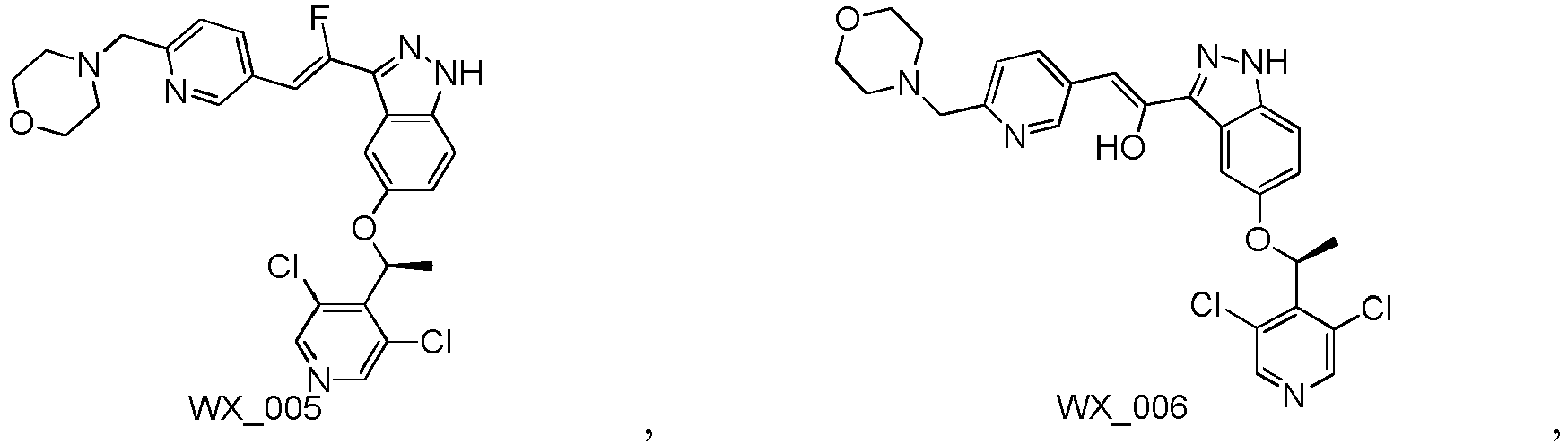


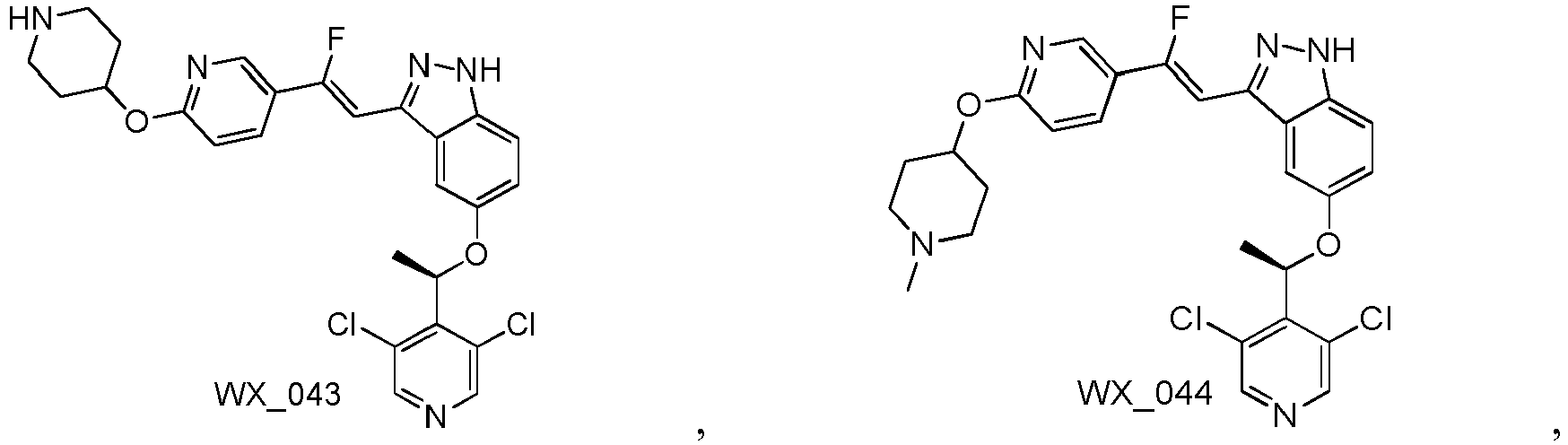


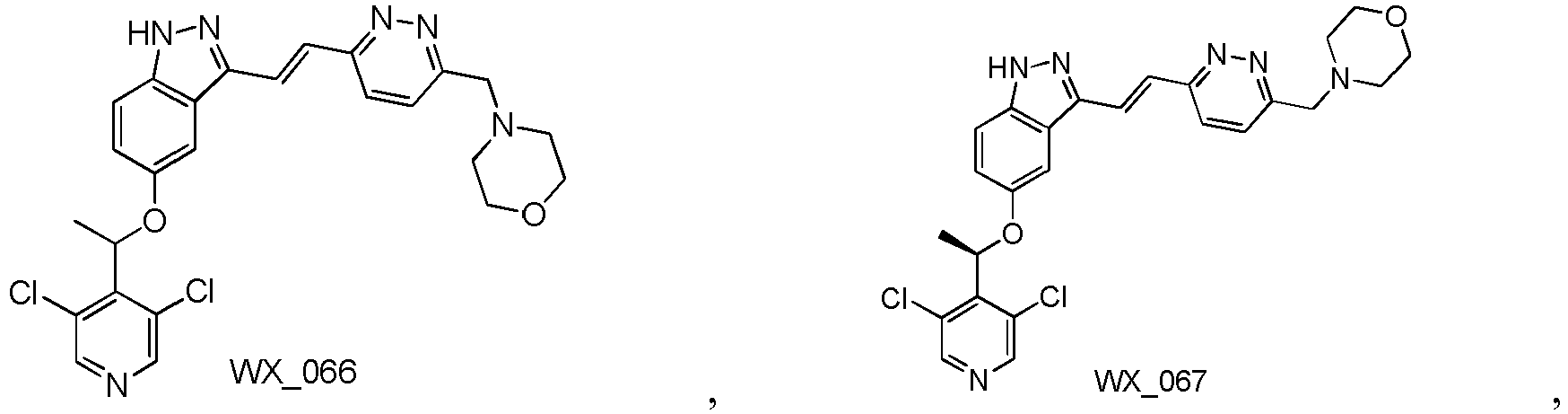


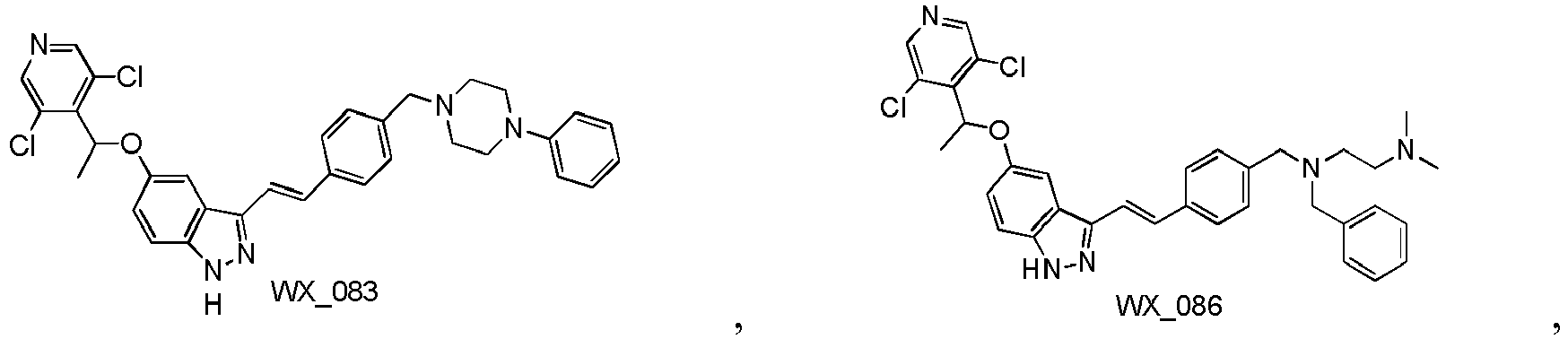


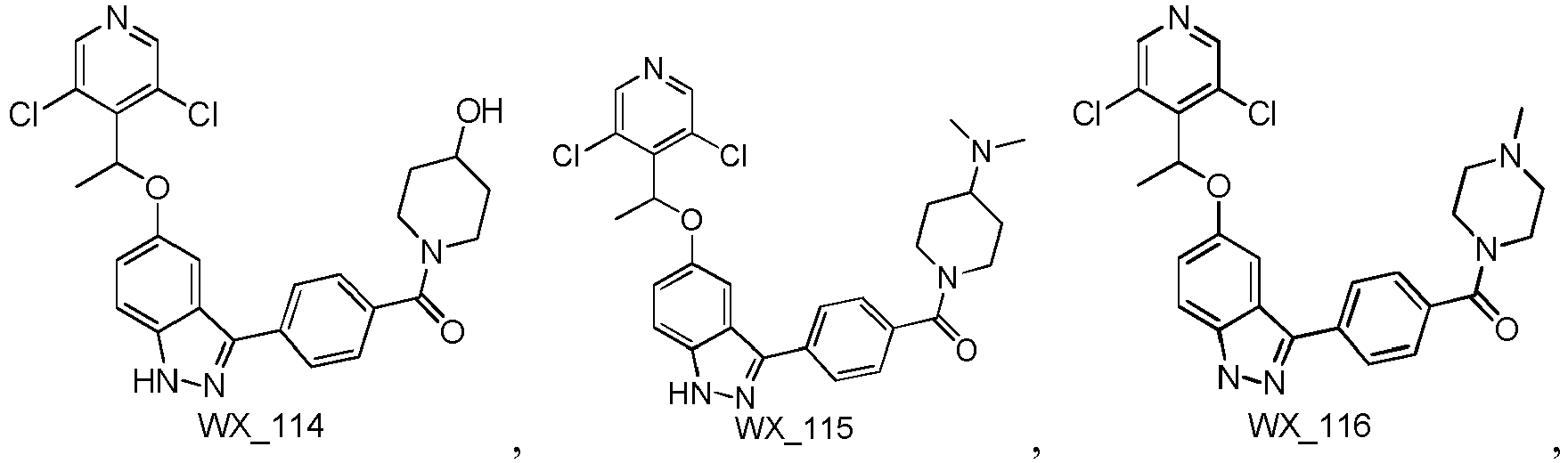


- The present invention also provides a process for preparing the compound represented by formula (I), comprising:

- In some embodiments of the present invention, the process for preparing the compound represented by formula (I), comprising
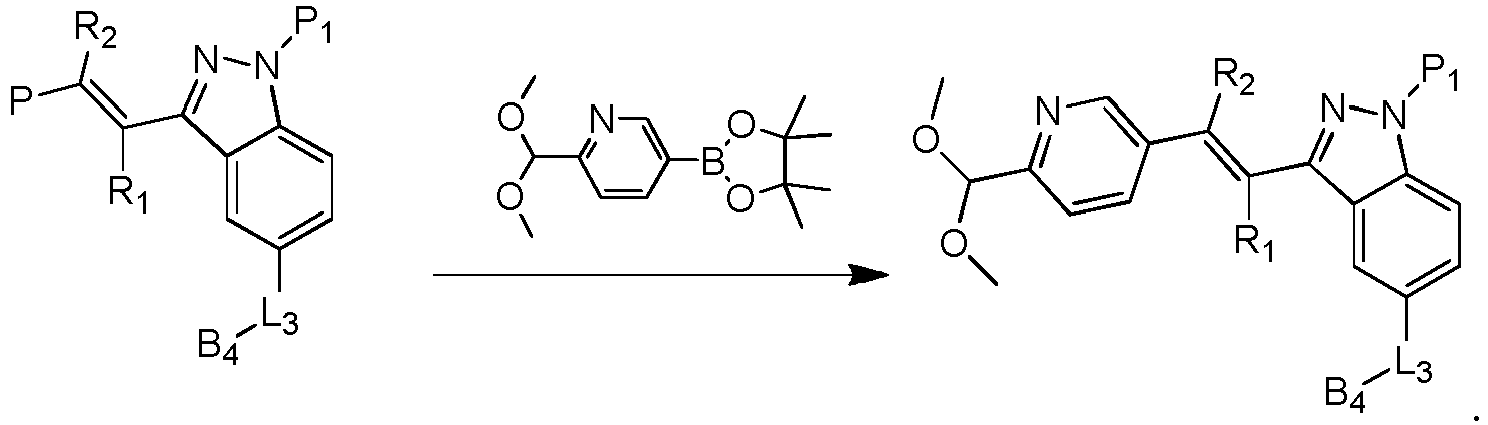
- The present invention further provides a pharmaceutical composition comprising a therapeutically effective amount of the compound, the pharmaceutically acceptable salt or the tautomer thereof, and a pharmaceutically acceptable carrier.
- The present invention further provides a use of the compound, the pharmaceutically acceptable salt or the tautomer thereof, or the pharmaceutical composition in the manufacture of a medicament for the treatment of cancer.
- Unless otherwise stated, the following terms and phrases used herein are intended to have the following meanings. A particular term or phrase should not be considered as indefinite or unclear but should be understood in the ordinary sense in the absence of any special definition. When a trade name appears in this article, it is intended to refer to its corresponding product or its active ingredient.
- C1-12 is selected from the group consisting of C1, C2, C3, C4, C5, C6, C7, C8, C9, C10, C11 and C12; C3-12 is selected from the group consisting of C3, C4, C5, C6, C7, C8, C9, C10, C11 and C12.
- C1-12 alkyl or heteroalkyl, C3-12 cyclo or heterocycloalkyl, C1-12 alkyl or heteroalkyl which is substituted with C3-12 cyclohydrocarbyl or heterocyclohydrocarbyl include, but are not limited to,
- C1-12 alkyl, C1-12 alkylamino, N,N-di(C1-12 alkyl)amino, C1-12 alkoxy, C1-12 alkanoyl, C1-12 alkoxycarbonyl, C1-12 alkylsulfonyl, C1-12 alkylsulfinyl, C3-12 cycloalkyl, C3-12 cycloalkylamino, C3-12 heterocycloalkylamino, C3-12 cycloalkyloxy, C3-12 cycloalkylacyl, C3-12 cycloalkyloxycarbonyl, C3-12 cycloalkylsulfonyl, C3-12 cycloalkylsulfinyl, 5- to 12-membered aryl or heteroaryl, 5- to 12-membered aralkyl or heteroaryl alkyl;
- methyl, ethyl, n-propyl, isopropyl, -CH2C(CH3)(CH3)(OH), cyclopropyl, cyclobutyl, propylmethylene, cyclopropionyl, benzyloxy, trifluoromethyl, aminomethyl, hydroxymethyl, methoxy, formyl, methoxycarbonyl, methanesulfonyl, methylsulfinyl, ethoxy, acetyl, ethanesulfonyl, ethoxycarbonyl, dimethylamino, diethylamino, dimethylaminocarbonyl, diethylaminocarbonyl;









the term "pharmaceutically acceptable" as used herein, pertains to those compounds, materials, compositions and/or dosage forms that are, within the scope of sound medical judgment, suitable for use in contact with the tissues of humans and animals, without excessive toxicity, irritation, allergic reaction or other problems or complications, commensurate with a reasonable benefit/risk ratio. - The term "pharmaceutically acceptable salt" refers to a salt of the compound of the present invention prepared from a compound with particular substituent of the present invention and a relatively non-toxic acid or base. When the compound of the present invention contains a relatively acidic functional group, the base addition salt can be obtained by contacting a sufficient amount of base with a neutral form of such compound in pure solution or a suitable inert solvent. Pharmaceutically acceptable base addition salts include sodium, potassium, calcium, ammonium, organic ammonium or magnesium salts or similar salts. When the compound of the present invention contains a relatively basic functional group, the acid addition salt can be obtained by contacting a sufficient amount of acid with a neutral form of such compound in pure solution or a suitable inert solvent. Examples of pharmaceutically acceptable acid addition salts include inorganic acid salts, wherein the inorganic acid includes, for example, hydrochloric acid, hydrobromic acid, nitric acid, carbonic acid, bicarbonate, phosphoric acid, monohydrogenphosphate, dihydrogenphosphate, sulfuric acid, hydrogensulfate, hydroiodic acid, phosphorous acid and the like; and organic acid salts, wherein the organic acid includes, for example, formic acid, acetic acid, trifluoroacetic acid, propionic acid, isobutyric acid, maleic acid, malonic acid, benzoic acid, succinic acid, suberic acid, fumaric acid, lactic acid, mandelic acid, phthalic acid, benzenesulfonic acid, p-toluenesulfonic acid, citric acid, tartaric acid and methanesulfonic acid and the like; and also include salts of amino acids such as arginine and the like, and salts of organic acids such as glucuronic acid (see Berge et al., "Pharmaceutical Salts", Journal of Pharmaceutical Science 66: 1-19 (1977 )). Certain specific compounds of the present invention contain both basic and acidic functional groups so that they can be converted to any of the base or acid addition salts.
- Preferably, the salt is contacted with a base or an acid in a conventional manner and the parent compound is then isolated, thereby regenerating the neutral form of the compound. The parent form of a compound differs from its various salt forms in certain physical properties, such as different solubility in polar solvents.
- As used herein, "pharmaceutically acceptable salt" pertains to derivatives of the compound of the present invention wherein the parent compound is modified by salt formation with an acid or a base. Examples of pharmaceutically acceptable salts include, but are not limited to, inorganic or organic acid salt of an alkali group such as amino, acid radical such as alkali or organic salt of carboxylic acid, and the like. Pharmaceutically acceptable salts include the conventional nontoxic salts or quaternary ammonium salts of the parent compound, for example salts of non-toxic inorganic or organic acids. The conventional non-toxic salts include, but are not limited to, those derived from inorganic acids and organic acids, and the inorganic acids and organic acids are selected from 2-acetoxybenzoic acid, 2-hydroxyethanesulfonic acid, acetic acid, ascorbic acid, benzenesulfonic acid, benzoic acid, bicarbonate, carbonic acid, citric acid, edetic acid, ethanedisulfonic acid, ethanesulfonic acid, fumaric acid, glucoheptose, gluconic acid, glutamic acid, glycolic acid, hydrobromic acid, hydrochloric acid, hydroiodic acid, hydroxy, hydroxynaphthalene, isethionic acid, lactic acid, lactose, dodecylsulfonic acid, maleic acid, malic acid, mandelic acid, methanesulfonic acid, nitric acid, oxalic acid, pamoic acid, pantothenic acid, phenylacetic acid, phosphoric acid, polygalacturonic, propionic acid, salicylic acid, stearic acid, sub-acetic acid, succinic acid, sulfamic acid, sulfanilic acid, sulfuric acid, tannin, tartaric acid and p-toluenesulfonic acid.
- Pharmaceutically acceptable salts of the present invention can be synthesized from the parent compound containing an acid radical or a base radical by conventional chemical methods. In general, such salts are prepared by reacting these compounds in the form of a free acid or base with a stoichiometric amount of appropriate base or acid in water or an organic solvent or a mixture thereof. In general, non-aqueous media such as ether, ethyl acetate, ethanol, isopropanol or acetonitrile etc. are preferred.
- In addition to the salt form, the compounds provided herein also exist as prodrug forms. Prodrugs of the compounds described herein are readily converted to the compounds of the present invention by chemical changes under physiological conditions. In addition, prodrugs can be converted to the compounds of the present invention by chemical or biochemical methods in vivo environment.
- Certain compounds of the present invention may exist in unsolvated as well as solvated forms, including hydrated forms. In general, solvated forms are comparable to unsolvated forms, both of which are included within the scope of the present invention.
- Certain compounds of the present invention may have asymmetric carbon atoms (optical centers) or double bonds. Racemates, diastereomers, geometric isomers, and individual isomers thereof are included within the scope of this invention.
- Schematic illustrations of racemates, ambiscalemic and scalemic or enantiopure compounds herein are from Maehr, J. Chem. Ed. 1985, 62: 114-120 . Unless otherwise specified, the absolute configuration of a stereocenter is expressed in terms of
 , the wedge key, and the wavy line
 refers to the relative configuration.
- When the compounds described herein contain olefinic double bonds or other geometric asymmetric centers, they include the E, Z geometric isomers unless otherwise specified. Likewise, all tautomeric forms are included within the scope of the present invention.
- The compounds of the present invention may exist in specific geometric or stereoisomeric forms. The present invention contemplates all such compounds, including cis- and trans- isomers, (-) - and (+) - enantiomers, (R)- and (S)- enantiomers, diastereomers, (D)-isomers, (L)-isomers, and their racemic mixtures and other mixtures, such as enantiomer or diastereomer enriched mixtures, all of which are within the scope of the present invention. Additional asymmetric carbon atoms may be present in alkyl and other substituents. All such isomers and mixtures thereof are included within the scope of the present invention.
- Optically active (R)- and (S)-isomers as well as D- and L- isomers may be prepared by chiral synthesis or chiral reagents or other conventional techniques. One enantiomer of the compound of the present invention, if desired, can be prepared by asymmetric synthesis or derivatization with a chiral auxiliary, wherein the resulting mixture of diastereomers is separated and the ancillary groups cleave to provide the pure desired enantiomer. Alternatively, when the molecule contains a basic functional group (such as an amino group) or an acidic functional group (such as a carboxyl group), it forms a diastereoisomeric salt with a suitable optically active acid or base, then diastereoisomeric resolution is performed by conventional methods well known in the art and the pure enantiomer is recovered. In addition, the separation of enantiomers and diastereomers is generally accomplished by chromatographic method employing a chiral stationary phase and optionally in combination with chemical derivatization (e.g., the formation of an amine formate from an amino group).
- The compounds of the present invention may contain atomic isotopes in an unnatural proportion at one or more than one atoms that make up the compound. For example, the compounds may be labeled with a radioisotope such as tritium (3H), iodine-125 (125 I) or C-14 (14C). The conversion of all isotopic compositions of the compounds of the present invention, whether radioactive or not, is included in the scope of the present invention.
- The term "pharmaceutically acceptable carrier" refers to any agent or carrier medium that is capable of delivering an effective amount of an active agent of the present invention, does not interfere with the biological activity of the active agent and has no toxic side effects on the host or the patient. Representative carriers include water, oils, vegetables and minerals, cream bases, lotion bases, ointment bases and the like. These bases include suspending agents, tackifiers, transdermal enhancers and the like. Their formulations are well known to those skilled in the art of cosmetics or topical medicines. For additional information on carriers, reference may be made to Remington: The Science and Practice of Pharmacy, 21st Ed., Lippincott, Williams & Wilkins (2005 ), the contents of which are incorporated herein by reference.
- The term "excipient" generally refers to the carriers, diluents and/or vehicles required to formulate an effective pharmaceutical composition.
- For pharmaceutical or pharmacologically active agents, the term "effective amount" or "therapeutically effective amount" refers to a sufficient amount of a non-toxic drug or agent that achieves the desired effect. For oral dosage forms in the present invention, an "effective amount" of an active substance in a composition means the amount required to achieve the desired effect when used in combination with another active substance in the composition. The determination of the effective amount will vary from person to person, depending on the age and general condition of the recipient, but also on the specific active substance, and the appropriate effective amount in each case can be determined by one skilled in the art according to routine experimentation.
- The term "active ingredient," "therapeutic agent," "active substance," or "active agent" refers to a chemical entity that is effective in treating disorder, disease, or condition of a subject.
- The term "substituted" means that any one or more than one hydrogen atoms on a specific atom has been substituted with a substituent, including deuterium and the variants of hydrogen, as long as the valence of the specific atom is normal and the substituted compound is stable. When the substituent is a ketonic group (i.e. =O), it means that two hydrogen atoms are substituted. Ketonic substitution does not occur on aromatic groups. The term "optionally substituted" means that may or may not be substituted, and unless otherwise specified, the kind and number of the substituents may be arbitrary on the basis that they are chemically achievable.
- When any variable (e.g. R) occurs more than once in the composition or structure of the compound, its definition in each case is independent. Thus, for example, if a group is substituted with 0-2 R, the group may optionally be substituted with up to two R, and in each case R has its own individual options. In addition, a combination of substituents and/or variants thereof is only permitted if such combination results in a stable compound.
- When a bond of a substituent can be cross-linked to two atoms on one ring, such substituent can be bonded to any atom on this ring. When a listed substituent is not specified by which atom it is attached to the compound included in the general chemical structural formula but not specifically mentioned, such substituent may be bonded by any of its atoms. A combination of substituents and/or variants thereof is only permitted if such combination results in a stable compound. For example, the structural unit

- When the number of a linking group is 0, such as -(CRR)o-, this means that the linking group is a single bond.
- When one of the variables is selected as a single bond, it means that the two groups are attached directly. For example, when L represents a single bond in A-L-Z, the structure is actually A-Z.
- Unless otherwise specified, the term "halo" or "halogen" denotes a fluorine, chlorine, bromine or iodine, as such or as part of another substituent. In addition, the term "haloalkyl" is intended to include monohaloalkyl and polyhaloalkyl. For example, the term "halo(C1-C4)alkyl" is intended to include but not limited to trifluoromethyl, 2,2,2-trifluoroethyl, 4-chlorobutyl and 3-bromopropyl and the like.
- Examples of haloalkyl include, but are not limited to, trifluoromethyl, trichloromethyl, pentafluoroethyl, and pentachloroethyl. "Alkoxy" represents the above alkyl with specified number of carbon atoms attached through an oxygen bridge. C1-6 alkoxy includes C1, C2, C3, C4, C5 and C6 alkoxy. Examples of alkoxy include, but are not limited to, methoxy, ethoxy, n-propoxy, iso-propoxy, n-butoxy, sec-butoxy, tert-butoxy, n-pentoxy and S-pentoxy. "Cycloalkyl" includes saturated cyclic groups such as cyclopropyl, cyclobutyl or cyclopentyl. 3-7 Cycloalkyl includes C3, C4, C5, C6 and C7 cycloalkyl. "Alkenyl" includes hydrocarbon chains in a linear or branched configuration in which one or more than one carbon-carbon double bonds, such as vinyl and propenyl, are present at any stable site on the chain.
- The term "halo" or "halogen" refers to fluorine, chlorine, bromine and iodine.
- Unless otherwise specified, the term "hetero" means a heteroatom or a heteroatom group (i.e. an atom group containing a heteroatom), including atoms other than carbon (C) and hydrogen (H), as well as atom groups containing such heteroatoms, for example, oxygen (O), nitrogen (N), sulfur (S), silicon (Si), germanium (Ge), aluminum (Al), boron (B), -O-, -S-, =O, =S, -C(=O)O-, -C(=O)-, -C(=S)-, -S(=O)-, - S(=O)2-, and optionally substituted -C(=O)N(H)-, -N(H)-, -C(=NH)-, -S(=O)2N(H)- or -S(=O)N(H)-.
- Unless otherwise specified, "ring" refers to substituted or unsubstituted cycloalkyl, heterocycloalkyl, cycloalkenyl, heterocycloalkenyl, cycloalkynyl, heterocycloalkynyl, aryl, or heteroaryl. The so-called rings include monocyclic rings, bicyclic rings, spiro rings, fused ring or bridged rings. The number of atoms in a ring is usually defined as the member number of ring. For example, "5- to 7-membered ring" means that there are 5 to 7 atoms arranging in a circle. Unless otherwise specified, the ring optionally contains 1 to 3 heteroatoms. Thus, "5- to 7-membered ring" includes, for example, phenylpyridine and piperidinyl; on the other hand, the term "5- to 7-membered heterocycloalkyl ring" includes pyridyl and piperidinyl, but excludes phenyl. The term "ring" also includes ring systems containing at least one ring, each ring of which independently conforms to the above definition.
- Unless otherwise specified, the term "heterocycle" or "heterocyclyl" means a stable monocyclic, bicyclic or tricyclic ring containing heteroatoms or heteroatom groups, which may be saturated, partially unsaturated or unsaturated (aromatic) containing carbon atoms and 1, 2, 3 or 4 heteroatoms in the ring independently selected from N, O and S, wherein any of the above heterocycles can be fused to a benzene ring to form a bicyclic ring. Nitrogen and sulfur heteroatoms may optionally be oxidized (i.e. NO and S(O)p, p is 1 or 2). The nitrogen atom may be substituted or unsubstituted (i.e. N or NR, where R is H or other substituents that have been defined herein). The heterocycle can be attached to the pendant group of any heteroatom or carbon atom to form a stable structure. If the compound produced is stable, the heterocycle described herein may undergo substitution at the carbon or nitrogen position. The nitrogen atom in the heterocycle is optionally quaternized. A preferred embodiment is that when the total number of S and O atoms in the heterocycle exceeds 1, the heteroatoms are not adjacent to each other. Another preferred embodiment is that the total number of S and O atoms in the heterocycle does not exceed 1. As used herein, the term "aromatic heterocyclic group" or "heteroaryl" means a stable 5-, 6-, 7- membered monocyclic or bicyclic ring or 7-, 8-, 9-, or 10- membered bicyclic heterocyclyl aromatic ring, which contains carbon atoms and 1, 2, 3 or 4 heteroatoms in the ring independently selected from N, O and S. The nitrogen atom may be substituted or unsubstituted (i.e. N or NR, where R is H or other substituents that have been defined herein). Nitrogen and sulfur heteroatoms may optionally be oxidized (i.e. NO and S(O)p, p is 1 or 2). It is worth noting that the total number of S and O atoms on the aromatic heterocycle does not exceed 1. Bridged rings are also included in the definition of heterocycle. A bridged ring forms when one or more than one atoms (i.e. C, O, N, or S) connect two non-adjacent carbon atoms or nitrogen atoms. Preferred bridged rings include, but are not limited to, one carbon atom, two carbon atoms, one nitrogen atom, two nitrogen atoms, and one carbon-nitrogen group. It is worth noting that a bridge always converts a monocyclic ring to a tricyclic ring. In a bridged ring, the substituents on the ring can also appear on the bridge.
- Examples of heterocyclic compounds include, but are not limited to, acridinyl, azocinyl, benzimidazolyl, benzofuranyl, benzothiofuryl, benzothiophenyl, benzoxazolyl, benzoxazolinyl, benzothiazolyl, benzotriazolyl, benzotetrazolyl, benzisoxazolyl, benzisothiazolyl, benzimidazolinyl, carbazolyl, 4aH-carbazolyl, carbolinyl, chromanyl, chromene, cinnolinyl decahydroquinolinyl, 2H, 6H-1,5,2-dithiazinyl, dihydrofuro[2,3-b]tetrahydrofuranyl, furanyl, furazanyl, imidazolidinyl, imidazolinyl, imidazolyl, 1H-indazolyl, indolialkenyl, indolinyl, indolizinyl, indolyl, 3H-indolyl, iso-benzofuranyl, isoindolyl, isoindolinyl, isoquinolinyl, isothiazolyl, isoxazolyl, methylenedioxyphenyl, morpholinyl, naphthyridinyl ,octahydroisoquinolyl, oxadiazolyl, 1,2,3-oxadiazolyl, 1,2,4-oxadiazolyl, 1,2,5-oxadiazolyl, 1,3,4-oxadiazolyl, oxazolidinyl, oxazolyl, oxindolyl, pyrimidinyl, phenanthridinyl, phenanthrolinyl, phenazine, phenothiazine, benzoxanthinyl, phenoxazinyl, phthalazinyl, piperazinyl, piperidinyl, piperidonyl, 4-piperidonyl, piperonyl, pteridinyl, purinyl, pyranyl, prazinyl, pyrazolidinyl, pyrazolyl, pyridazinyl, pyridoxazole, pyridimidazole, pyridothiazole, pyridyl, pyrrolidinyl, pyrrolinyl, 2H-pyrrolyl, pyrrolyl, quinazolinyl, quinolyl, 4H-quinolyl, quinoxalinyl, quinuclidinyl, tetrahydrofuranyl, tetrahydroisoquinolinyl, tetrahydroquinolyl, tetrazolyl, 6H-1,2,5-thiadiazinyl, 1,2,3-thiadiazolyl, 1,2,4-thiadiazolyl, 1,2,5-thiadiazolyl, 1,3,4-thiadiazolyl, thianthrene, thiazolyl, isothiazolylthienyl, thienyl, thienoxazolyl, thienothiazolyl, thienoimidazolyl, triazinyl, 1,2,3-triazolyl, 1,2,4-triazolyl, 1,2,5-triazolyl, 1,3,4-triazolyl and xanthenyl, also include fused ring and spiro compounds.
- Unless otherwise specified, the term "hydrocarbyl" or its subordinate concept (such as alkyl, alkenyl, alkynyl, phenyl, etc.) as such or as part of another substituent denotes a linear, branched or cyclic hydrocarbon radical, or combination thereof, which may be fully saturated, mono- or polyunsaturated, may be mono-substituted, disubstituted or polysubstituted, may include divalent or polyvalent radicals, with specified number of carbon atoms (for example C1-C10 represents 1 to 10 carbons). "Hydrocarbyl" includes, but is not limited to, aliphatic hydrocarbyl and aromatic hydrocarbyl, wherein, the aliphatic hydrocarby includes chain structure and cyclic structure, specific examples of which include, but are not limited to, alkyl, alkenyl, alkynyl, the aromatic hydrocarbyl includes but is not limited to 6- to 12- membered aromatic hydrocarbyl such as benzene, naphthalene and the like. In some embodiments, the term "alkyl" means a straight or branched radical or combination thereof, which may be fully saturated, mono- or polyunsaturated, and may include divalent and multivalent radicals. Examples of saturated hydrocarbon radicals include but are not limited to methyl, ethyl, n-propyl, isopropyl, n-butyl, t-butyl, isobutyl, secbutyl, isobutyl, cyclohexyl, (cyclohexyl)methyl, cyclopropylmethyl, and homologs or isomers of n-pentyl, n-hexyl, n-heptyl, n-octyl and the like. Unsaturated alkyl has one or more than one double or triple bonds and examples include, but are not limited to, vinyl, 2-propenyl, butenyl, crotyl, 2-isopentenyl, 2-(butadienyl), 2,4-pentadienyl, 3-(1,4-pentadienyl), ethynyl, 1- and 3-propynyl, 3-butynyl, and more advanced homologues and isomers.
- Unless otherwise specified, the term "heterohydrocarbyl" or its subordinate concept (such as heteroalkyl, heteroalkenyl, heteroalkynyl, heteroaryl, etc.) as such or in combination with another term denotes a stable linear, branched or cyclic hydrocarbon radical or combination thereof, with a certain number of carbon atoms and at least one heteroatom. In some embodiments, the term "heteroalkyl" as such or in combination with another term denotes a stable linear, branched hydrocarbon radical or combination thereof, with a certain number of carbon atoms and at least one heteroatom. In an exemplary embodiment, the heteroatoms are selected from the group consisting of B, O, N and S, wherein the nitrogen and sulfur atoms are optionally oxidized and the nitrogen heteroatoms are optionally quaternized. The heteroatoms B, O, N and S may be located at any internal position of the heterohydrocarbyl (including the position of the hydrocarbyl at which it is attached to the rest of the molecule). Examples include, but are not limited to, -CH2-CH2-O-CH3, -CH2-CH2-NH- CH3, -CH2-CH2-N(CH3) -CH3, -CH2-S-CH2-(O)-CH3, -CH2-CH2-, -S(O)-CH3, -CH2-CH2-S(O)2-CH3, -CH=CH-O-CH3, -CH2-CH=N-OCH3 and -CH=CH-N(CH3) -CH3. Up to two heteroatoms may be consecutive, for example, -CH2-NH-OCH3.
- The terms "alkoxy", "alkylamino" and "alkylthio" (or thioalkoxy) are the customary expressions and refer to those alkyl groups which are attached to the rest of the molecule through an oxygen atom, an amino group or a sulfur atom, respectively.
- Unless otherwise specified, the terms "cyclohydrocarbyl", "heterocyclohydrocarbyl" or subordinate concept thereof (such as aryl, heteroaryl, cycloalkyl, heterocycloalkyl, cycloalkenyl, heterocycloalkenyl, cycloalkynyl, heterocycloalkynyl, etc.), as such or in combination with other terms, stand for cyclized "hydrocarbyl", "heterohydrocarbyl", respectively. In addition, as for heterohydrocarbyl or heterocyclohydrocarbyl (such as heteroalkyl, heterocycloalkyl), the heteroatom may occupy the position at which the heterocycle is attached to the rest of the molecule. Examples of cycloalkyl include, but are not limited to, cyclopentyl, cyclohexyl, 1-cyclohexenyl, 3-cyclohexenyl, cycloheptyl and the like. Non-limiting examples of heterocyclyl include 1-(1,2,5,6-tetrahydropyridinyl), 1-piperidinyl, 2-piperidinyl, 3-piperidinyl, 4-morpholinyl, 3-morpholinyl, tetrahydrofuran-2-yl, tetrahydrofuran indol-3-yl, tetrahydrothiophen-2-yl, tetrahydrothiophen-3-yl, 1-piperazinyl and 2-piperazinyl.
- Unless otherwise specified, the term "aryl" means a polyunsaturated aromatic hydrocarbon substituent which may be mono-, di- or polysubstituted, may be monocyclic or polycyclic (preferably from 1 to 3 rings), and are fused together or covalently linked. The term "heteroaryl" refers to an aryl (or ring) containing one to four heteroatoms. In one illustrative example, the heteroatoms are selected from B, N, O and S, wherein the nitrogen and sulfur atoms are optionally oxidized and the nitrogen atoms are optionally quaternized. Heteroaryl can be attached to the rest of the molecule via heteroatoms. Non-limiting examples of aryl or heteroaryl include phenyl, 1-naphthyl, 2-naphthyl, 4-biphenyl, 1-pyrrolyl, 2-pyrrolyl, 3-pyrrolyl, 2-imidazolyl, 4-imidazolyl, pyrazinyl, 2-oxazolyl, 4-oxazolyl, 2-phenyl-4-oxazolyl, 5-oxazolyl, 3-isoxazolyl, 4-isoxazolyl, 5-isoxazolyl, 2-thiazolyl, 4-thiazolyl, 5-thiazolyl, 2-furyl, 3-furyl, 2-thienyl, 3-thienyl, 2-pyridyl, 3-pyridyl, 4-pyridyl, 2-pyrimidinyl, 4-pyrimidinyl, 5-benzothiazolyl, purinyl, 2-benzimidazolyl, 5-indolyl, 1-isoquinolinyl, 5-isoquinolinyl, 2-quinoxalinyl, 5-quinoxalinyl, 3-quinolinyl and 6-quinolinyl. Any one of the above aryl and heteroaryl cyclic substituents is selected from acceptable substituents described below.
- For the sake of simplicity, aryl when used in conjunction with other terms (e.g. aryloxy, arylthio, arylalkyl) includes aryl and heteroaryl rings as defined above. Thus, the term "aralkyl" is intended to include those radicals in which an aryl is attached to an alkyl (e.g. benzyl, phenethyl, pyridylmethyl and the like), including those alkyl groups in which a carbon atom (such as methylene) has been replaced by an atom such as an oxygen atom, for example, phenoxymethyl, 2-pyridyloxymethyl 3-(1-naphthyloxy)propyl and the like.
- The term "leaving group" refers to a functional group or atom that can be substituted by another functional group or atom by a substitution reaction (e.g. an affinity substitution reaction). For example, representative leaving groups include triflates; chloro, bromo, iodo; sulfonate groups, such as mesylate, tosylate, brosylate, p-toluenesulfonate and the like; acyloxy groups, such as acetoxy, trifluoroacetoxy and the like.
- The term "protecting group" includes, but is not limited to, "amino protecting group," "hydroxy protecting group," or "thiol protecting group". The term "amino protecting group" refers to a protecting group suitable for preventing side reactions on the amino nitrogen. Representative amino protecting groups include, but are not limited to, formyl; acyl such as alkanoyl (such as acetyl, trichloroacetyl or trifluoroacetyl); alkoxycarbonyl such as tert-butoxycarbonyl (Boc); arylmethoxycarbonyl, such as benzyloxycarbonyl (Cbz) and 9-fluorenylmethoxycarbonyl (Fmoc); arylmethyl, such as benzyl (Bn), trityl (Tr), 1,1-bis-(4'-methoxyphenyl)methyl; silyl, such as trimethylsilyl (TMS) and tert-butyldimethylsilyl (TBS) and the like. The term "hydroxy protecting group" refers to a protecting group suitable for preventing side reactions with hydroxyl groups. Representative hydroxyl protecting groups include, but are not limited to, alkyl, such as methyl, ethyl and t-butyl; acyl, such as alkanoyl (such as acetyl); arylmethyl, such as benzyl (Bn), p-methoxylbenzyl (PMB), 9-fluorenylmethyl (Fm) and diphenylmethyl (benzhydryl, DPM); silyl, such as trimethylsilyl (TMS) and tert-butyldimethylsilyl (TBS) and the like.
- The compounds of the present invention can be prepared by a variety of synthetic methods well known to those skilled in the art including the specific embodiments listed below, their combinations with other chemical synthesis methods, and the equivalent alternatives well known to those skilled in the art, preferred embodiments include, but are not limited to, embodiments of the present invention.
- All solvents used in the present invention are commercially available and can be used without further purification. The reaction is generally carried out in an anhydrous solvent under an inert atmosphere of nitrogen. Proton NMR data was recorded on a Bruker Avance III 400 (400 MHz) spectrometer and the chemical shifts were reported as (ppm) of the tetramethylsilane at low field. Mass spectra was determined on an Agilent 1200 Series Plus 6110 (& 1956A). The LC/MS or Shimadzu MS contains one DAD: SPD-M20A (LC) and Shimadzu Micromass 2020 detector. The mass spectrometer is equipped with an electrospray ionization source (ESI) operating in positive or negative mode.
- The following abbreviations are used herein: aq stands for aqueous; HATU stands for 2-(7-azobenzotriazole)-N,N,N',N'-tetramethyluronium hexafluorophosphate; EDC stands for N-(3-dimethylaminopropyl)-N'-ethylcarbodiimide hydrochloride; m-CPBA stands for 3-chloroperoxybenzoic acid; eq stands for equivalent; CDI stands for carbonyldiimidazole; DCM stands for dichloromethane; PE stands for petroleum ether; DIAD stands for diisopropyl azodicarboxylate; DMF stands for N,N-dimethylformamide; DMSO stands for dimethyl sulfoxide; EtOAc stands for ethyl acetate; EtOH stands for ethanol; MeOH stands for methanol; CBz stands for benzyloxycarbonyl, an amine protecting group; BOC stands for t-butylcarbonyl, an amine protecting group; HOAc stands for acetic acid; NaCNBH3 stands for sodium cyanoborohydride; r.t. stands for room temperature; O/N stands for overnight; THF stands for tetrahydrofuran; THP stands for tetrahydropyran; Novozyme 435 stands for Novozymes lipase; Boc2O stands for di-tert-butyldicarbonate; TFA stands for trifluoroacetic acid; DIPEA stands for diisopropyl ethylamine; SOCl2 stands for thionyl chloride; CS2 stands for carbon disulfide; TsOH stands for p-toluenesulfonic acid; NFSI stands for N-fluoro-N-(phenylsulfonyl)benzenesulfonamide; NCS stands for 1-chloropyrrolidine-2,5-dione; n-Bu4NF stands for tetrabutylammonium fluoride; iPrOH stands for 2-propanol; dppf stands for 1,1'-bis(diphenylphosphino)ferrocene; TBSCl stands for t-butyldimethylchlorosilane; NIS stands for N-iodosuccinimide; TBAF stands for tetrabutylammonium fluoride; MsCl stands for methanesulfonyl chloride; LDA stands for lithium diisopropylamide; TEA stands for triethylamine; DAST stands for diethylaminosulfur trifluoride; SFC stands for supercritical liquid chromatography; NBS stands for N-bromosuccinimide; TMSA stands for trimethylsilylacetylene; DMAP stands for 4-dimethylamino pyridine; DCE stands for 1,2-dichloroethane; MW stands for microwave reaction; AIBN stands for azobisisobutyronitrile; POT stands for tri-o-methyltriphenylphosphine; DTBPF stands for 1,1'-bis(di-tert-butylphosphino)ferrocene; mp stands for melting point.
- Compounds are named manually or with ChemDraw® software, and commercial compounds are available under Supplier Directory Name.
- The following examples further illustrate the present invention, but the present invention is not limited thereto.


-

-

- TBSCl (90g, 0.6mol) was added in batches to a solution of 1-hydro-indazole-5-hydroxy (54g, 0.4mol) and imidazole (40g, 0.6mol) in DMF (1L) at room temperature. After the addition, the reaction solution was stirred at 15°C for 5 hours. The final reaction solution was diluted with 3L water, extracted with ethyl acetate (0.8L × 3), and the organic phases were combined, washed with water (0.8L × 3), dried over anhydrous sodium sulfate, filtered and evaporated. The residue was purified by flash silica gel column chromatography to give the title compound (90g, yield 90%). LCMS (ESI) m/z: 249 [M+1]+.
-

- NIS (88g, 0.4mol) was added in batches to a solution of Example 1A (90g, 0.36mol) in dichloromethane (1.2L) at 10°C. The reaction solution was stirred at 10°C for 2 hours. The reaction was quenched with 10% sodium sulfite solution (plus volume) and the organic layer was washed with saturated brine (300mL × 2), the combined organic phases were dried over anhydrous sodium sulfate, filtered and evaporated. The residue was purified by flash silica gel column chromatography to give the title compound (125g, yield 92%). LCMS (ESI) m/z: 375 [M+1]+.
-

- Example 1B was dissolved in a mixed solvent of dichloromethane (1L) and tetrahydrofuran (0.4L), then methanesulfonic acid (6.0g, 60mmol) was added and finally 3,4-tetrahydro-2-hydro-pyran (124.2g, 0.92mol) was added in batches to the reaction solution. After the addition, the mixture was stirred for 5 hours at 12°C. Upon completion of the reaction, the reaction solution was diluted with dichloromethane (500mL) and washed with saturated sodium bicarbonate solution (300mL). The organic layer was washed again with saturated brine and dried over anhydrous sodium sulfate, filtered and evaporated to dryness. The residue was purified by flash silica gel column chromatography to give the title compound (132g, yield 93.6%). LCMS (ESI) m/z: 459 [M+1]+.
-
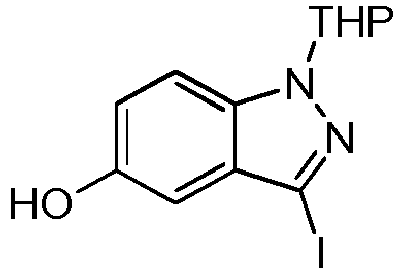
- A solution of tetrabutylammonium fluoride in tetrahydrofuran (0.35L, 0.35mol, 1mol/L) was added in one batch to a solution of Example 1C (132g, 0.29mol) in tetrahydrofuran (1.4L) at 10°C. The mixed solution was stirred at 10°C for 2 hours. The reaction mixture was poured into 1.5L ice water and stirred for 20 minutes. The aqueous phase was extracted with ethyl acetate (400mL × 3) and the combined organic phase was washed with saturated brine (200mL × 2) and dried over anhydrous sodium sulfate, filtered and evaporated. The residue was purified by flash silica gel column chromatography to give the title compound (64g, yield 65%). LCMS (ESI) m/z: 345 [M+1]+.
-
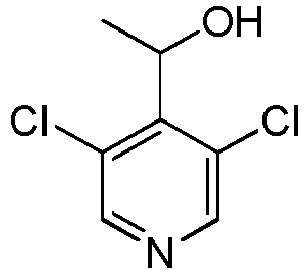
- LDA (242mL, 484mmol, 2.0mol/L) was added dropwise to a solution of 3,5-dichloropyridine (58.8g, 404mmol) in tetrahydrofuran (600mL) under the protection of nitrogen at -78 °C. After the addition, the reaction was further stirred for an hour under the atmosphere of nitrogen at -78 °C. And then, anhydrous acetaldehyde (35.5g, 808mmol) was added to the reaction solution in batches. After the addition, the reaction solution was heated to room temperature 20 °C and stirred for another 2 hours. The reaction was quenched by the addition of saturated ammonium chloride (200mL) and then extracted with ethyl acetate (400 mL × 3). The organic phases were combined and dried over anhydrous sodium sulfate, filtered and the filtrate was concentrated to give a residue that was purified by flash silica gel column chromatography to give the title compound (51g, yield 66%). 1H NMR (400MHz, METHANOL-d4) ppm: 8.43 (s, 2H), 5.53 (t, J=6 Hz, 1H), 3.12 (d, J=6 Hz, 1H), 1.64 (d, J=6.8 Hz, 3H).
-

- MsCl (32g, 0.28mol) was added in batches to a solution of a mixture of Example 1E (36g, 0.91mol) and triethylamine (21g, 0.21mol) in dichloromethane (1 L) at 0°C. The reaction was stirred at 0°C for 3 hours and then quenched with water (100mL) in an ice bath and stirred for 1 hour. After layering, the organic phase was washed with saturated sodium bicarbonate solution (200mL × 3) and brine (200mL), then dried over anhydrous sodium sulfate, filtered and the filtrate was concentrated to give a residue that was purified by flash silica gel column chromatography to give the title compound (pale yellow, 50g, yield 98%).
-

- A mixture of Example 1D (35g, 0.1mol), Example 1F (33g, 0.12mol) and cesium carbonate (66g, 0.2mol) in acetonitrile (1.5L) was reacted at 90°C for 12 hours. After being cooled to the room temperature, the reaction mixture was filtered and the filtrate was evaporated to dryness to give the crude compound. The residue was purified by flash silica gel column chromatography to give the title compound (35g, yield 85%). LCMS (ESI) m/z: 518 [M+1]+. 1H NMR (400MHz, METHANOL-d4) ppm 8.44 (s, 2H), 7.46 (dd, J=2.8, 8.8 Hz, 1H), 7.17 (dd, J=2.4, 9.2 Hz, 1H), 6.71 (s, 1H), 6.08 (d, J=6.8 Hz, 1H), 5.64∼5.59 (m, 1H), 4.01∼3.97 (m, 1H), 3.73∼3.69 (m, 1H), 2.48∼2.47 (m, 1H), 2.13∼2.11 (m, 2H), 1.83 (d, J=6.8 Hz, 3H), 1.75∼1.64 (m, 3H).
-

- Pd(PPh3)2Cl2 (1.36g, 2mmol) and sodium formate (6g, 58mmol) were added to a solution of Example 1G (10g, 19.3mmol) in DMF (300mL) at room temperature under nitrogen. The hydrogen in the hydrogenation bottle was then replaced with carbon monoxide gas to fill the bottle with carbon monoxide gas. The reaction solution was stirred under carbon monoxide (50 psi) at 80°C for 12 hours. The reaction solution was filtered and the filtrate was concentrated to give a residue. The residue was purified by flash silica gel column chromatography to give the title compound (7.2g, yield 89%). LCMS (ESI) m/z: 420 [M+ ]+.
-

- A solution of a mixture of Example 1H (7.2g, 17.1mmol), diethyl phosphite (5.4mL, 51.4mmol) and barium hydroxide octahydrate (2.7g, 8.6mmol) in tetrahydrofuran (130mL) was heated to 50°C and reacted for 5 hours. TLC test showed that the starting material disappeared and the reaction was complete. The reaction solution was filtered and the filtrate was concentrated to give a residue. The residue was purified by flash silica gel column chromatography to give the title compound (as a colorless oily liquid, 5.5g, yield 58%). LCMS (ESI) m/z: 558 [M+1] +.
-

- DAST (3.7mL, 29.7mmol) was slowly added dropwise to a solution of Example 11 (5.5g, 9.9mmol) in dichloroethane (100mL) in an ice bath under the protection of nitrogen. After the addition, the reaction was stirred under nitrogen at 0°C for 2 hours. TLC test showed that all the starting materials disappeared and a new main point was generated. The reaction solution was quenched with water (10 ml) in an ice bath, and then stirred for 10 minutes. After layering, the organic phase was washed successively with saturated sodium bicarbonate (20mL × 2) and brine (20mL) and dried over anhydrous sodium sulphate and finally filtered and evaporated. The residue was purified by flash silica gel column chromatography to give the title compound (as a yellow oil, 2.7g, yield 50%). LCMS (ESI) m/z: 560 [M+ ]+.
-

- Sodium hydride (60% content) (0.63g, 3.0mmol) was added in batches to a solution of Example 1J (1.42g, 2.5mmol) in tetrahydrofuran (15mL) at 10°C under the protection of nitrogen. After the addition, the reaction solution was stirred at 10°C for 30 minutes. 6-(Morpholinomethyl)-3-aldehyde pyridine (0.63g, 3.0mmol) was added to the stirred reaction solution, and the reaction solution was then heated to 80°C and reacted for 3 hours. TLC showed the reaction was complete. After the reaction solution was cooled to room temperature, the reaction was quenched with water (2ml), and stirred at room temperature for ten minutes, then extracted with ethyl acetate (10ml × 3). The organic phases are combined and washed with brine, dried over anhydrous sodium sulfate, filtered and evaporated to dryness. The residue was purified by flash silica gel column chromatography to give the title compound (as a yellow oil, 0.28g mixture 1K (cis 1Ka and trans 1Kb), yield 54%). LCMS (ESI) m/z: 612 [M+1]+.
-

- Acetyl chloride (3ml) was slowly added dropwise to methanol (12ml) at 0 °C. The reaction solution was then stirred at room temperature for 15 minutes. Example 1K (800mg, 1.3mmol) was added to the stirred reaction solution. The reaction solution was heated to 40°C and stirred for 3 hours. LCMS showed the reaction was complete. The reaction solution was evaporated to dryness directly to give compound 1L (racemate) LCMS (ESI) m/z: 528. [M+1]+.
-
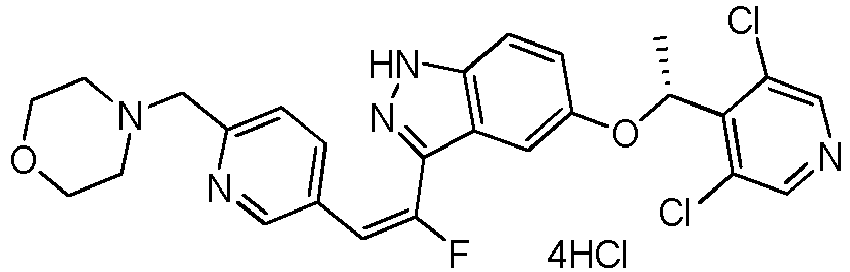
- Example 1L was separated by SFC (with the following SFC separation conditions: Column: Chiralpak AD-3 50*4.6mm I.D., 3um Mobile phase: Ethanol (0.05% DEA)-CO2 5% to 40% Rate: 4 mL/min, Wavelength: 254nm) to give Example 2, Example 3, Example 4, Example 5, and by-product Example 6.
Example 2: LCMS (ESI) m/z: 528.4[M+1]+. 1H NMR (400MHz, METHANOL-d4) ppm 8.81 (s, 1H), 8.49 (s, 2H), 8.10 (d, 1H), 7.65 - 7.43 (m, 2H), 7.17 (d, J=7.3 Hz, 1H), 6.84 (m, 1H), 6.77 - 6.63 (m, 1H), 6.01 (m, 1H), 4.54 (s, 2H), 4.02 - 3.87 (m, 4H), 3.31 (m, 4H), 1.84 (d, 3H). -

- This example was prepared by the method as described in Example 2. LCMS (ESI) m/z: 528.4[M+1]+. 1H NMR (400MHz, DMSO-d6) ppm 8.65 (s, 1H), 8.55 (s, 2H), 7.96 (d, J=8.0 Hz, 1H), 7.56 (d, J=9.0 Hz, 1H), 7.46 (d, J=8.3 Hz, 1H), 7.14 (dd, J=2.3, 9.0 Hz, 1H), 6.84 (s, 1H), 6.78 (s, 2H), 5.94 (q, J=6.4 Hz, 1H), 4.44 (s, 2H), 3.83 (m, 4H), 3.22 (m, 4H), 1.71 (d, J=6.5 Hz, 3H).
-

- This example was prepared by the method as described in Example 2. LCMS (ESI) m/z: 528.4 [M+1]+.
1H NMR (400MHz, DMSO-d6) ppm 8.94 (s, 1H), 8.60 (s, 2H), 8.21 (d, J=8.3 Hz, 1H), 7.71 - 7.52 (m, 2H), 7.23 - 7.12 (m, 2H), 6.80 - 6.65 (m, 1H), 6.14 (q, J=6.5 Hz, 1H), 4.54 (s, 2H), 3.88 (m, 4H), 3.31 (m, 4H), 1.77 (d, J=6.5 Hz, 3H). -
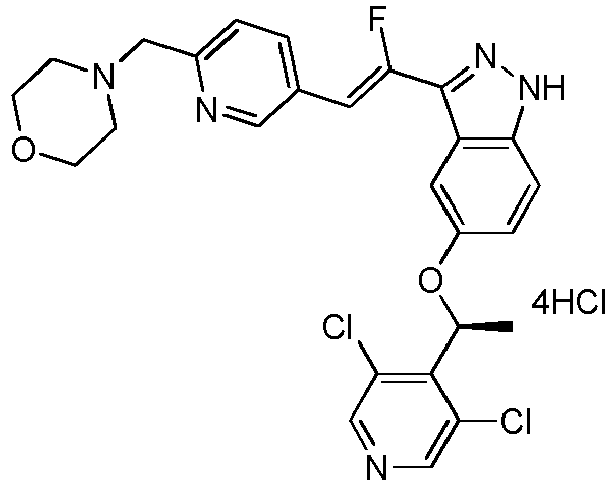
- This example was prepared by the method as described in Example 2. LCMS (ESI) m/z: 528.4[M+1]+.
1H NMR (400MHz, METHANOL-d4) ppm 8.98 (s, 1H), 8.52 (s, 2H), 8.36 (d, J=7.5 Hz, 1H), 7.78 (d, J=8.3 Hz, 1H), 7.51 (d, J=8.8 Hz, 1H), 7.26 - 7.14 (m, 2H), 6.74 - 6.60 (m, 1H), 6.18 (q, J=6.5 Hz, 1H), 4.63 (s, 2H), 3.99 (m, 4H), 3.46 (m, 4H), 1.83 (d, J=6.5 Hz, 3H). -

- This example was prepared by the method as described in Example 2. LCMS (ESI) m/z: 526.4[M+1]+.
1H NMR (400MHz, METHANOL-d4) ppm 8.92 (s, 1H), 8.49 (s, 2H), 8.41 (d, J=7.3 Hz, 1H), 8.11 (d, J=7.8 Hz, 1H), 7.55 (d, J=9.0 Hz, 1H), 7.43 (d, J=2.0 Hz, 1H), 7.19 (dd, J=2.0, 9.0 Hz, 1H), 6.10 (q, J=6.5 Hz, 1H), 4.74 (d, J=7.8 Hz, 4H), 3.99 (br. s., 4H), 3.47 (br. s., 4H), 1.79 (d, J=6.8 Hz, 3H).
-

-

- Iodine (33.5g, 0.13mmol) and trifluoroacetic acid (35.3ml, 0.4mmol) were added to a solution of methyl 6-carboxylate-1-picoline (20g, 0.13mol) in N,N-dimethylsulfoxide (200ml) at 0°C and the mixture was stirred for 1 hour and then heated to 140°C and stirred for 2.5 hours. After being cooled to 0°C, the reaction was quenched with saturated sodium thiosulfate solution (30ml) and stirred for 30 minutes. The aqueous layer was extracted with ethyl acetate (150ml × 3) and the organic layers were combined and washed with brine (50ml × 2), dried over anhydrous sodium sulfate, filtered, concentrated in vacuo and the residue was purified by flash silica gel column chromatography to give the title compound (8g, yield 37%). 1H NMR (400MHz, CHLOROFORM-d) ppm :10.14 (s, 1H), 9.36 (s, 1H), 8.47 (dd, J=1.3, 8.0 Hz, 1H), 8.03 (d, J=8.0 Hz, 1H), 4.05 - 3.94 (s, 3H).
-

- Formic acid (40ml) was slowly added dropwise to a solution of Example 7A (20g, 120mmol) in trimethyl orthoformate (400ml) at 0°C and stirred at this temperature for 30 minutes before concentrated sulfuric acid (1.2ml) was added dropwise. After the addition, the reaction solution was heated to 50°C and stirred for 30 minutes and then cooled to 25°C and stirred for another 3 hours. The mixture was cooled to room temperature and added to water (100ml). The aqueous layer was extracted with ethyl acetate (200ml × 3). The organic phases were combined, washed with saturated brine (100ml × 2), dried over anhydrous sodium sulfate, filtered, and concentrated in vacuo to give the title compound as a brown oil (25g, yield 98.8%) which was used directly in the next step.
-

- Lithium aluminum hydride (4.4g, 114mmol) was added in batches to a solution of Example 7B (8g, 38mmol) in tetrahydrofuran (120mL) at 0°C under the protection of nitrogen, after the addition, the reaction solution was stirred for 1 hour at this temperature. The reaction was quenched with water (4.4mL), 15% sodium hydroxide (4.4mL) followed by water (13.2mL), stirred for 30 minutes, filtered and concentrated in vacuo to give the title compound as a yellow oil (5g, yield 71%) which was used directly in the next step.
-

- Manganese dioxide (19g, 216mmol) was added to a solution of Example 7C (5g, 27mmol) in dichloromethane (120mL), and then the reaction solution was heated to 40°C and stirred for 16 hours. After being cooled to room temperature, the mixture was filtered and concentrated in vacuo. The residue was purified by flash silica gel column chromatography to give the title compound (2.62g, yield 52.4%) as a yellow oil. 1H NMR (400 MHz, CHLOROFORM-d) ppm 10.1 (s, 1H), 9.04-9.13 (m, 1H), 8.22 (dd, J=2.01, 8.03 Hz, 1H), 7.75 (d, J=8.03 Hz, 1H), 5.44 (s, 1H), 3.43 (s, 6H).
-

- Sodium hydride (600mg, 60%, 14.5mmol) was added in batches to a solution of Example 7D (2.7g, 5mmol) in tetrahydrofuran (80mL) at 5°C under the protection of nitrogen. After the addition, the reaction solution was stirred for 30 minutes at this temperature and added with Example 1J (2g, 10.6mmol), followed by being heated to 70°C and stirred for 16 hours. After being cooled to room temperature, the mixture was poured into ice water (50ml). The aqueous layer was extracted with ethyl acetate (40ml × 3). The organic phases were combined, washed with saturated brine (20 ml × 2), dried over anhydrous sodium sulfate, filtered and concentrated in vacuo. The residue was purified by column chromatography to give the title compound (1.35g, yield 48%) as a colorless oil.
- The mixture was resolved by chiral HPLC to give cis and trans isomers, chiral column: Chiralcel OD-3 150 × 4.6 mm ID, 3um, mobile phase: ethanol (0.05% DEA) -CO2, 5% to 40%, Flow rate: 2.5 mL/min, wavelength: 220 nm.
-

- A mixed solution of Example 7E (0.2g, 0.34mmol) and p-benzenesulfonic acid monohydrate (12mg, 0.068mmol) in water (8 ml) and acetone (10 ml) was stirred at 50°C for 3 hours. After cooling, the aqueous layer was extracted with dichloromethane (4mL × 3), and the organic layers were combined and washed with brine (4mL × 2), dried over anhydrous sodium sulfate, filtered and concentrated in vacuo to give the title compound (140mg, yield 76%) which was used directly in the next step. LCMS (ESI) m/z: 541.4 [M + 1]+.
-

- Acetic acid (9mg, 147.77mmol) was added dropwise to a mixed solution of Example 7F (70mg, 130µmol) and (S)-2-aminopropan-1-ol (29mg, 390µmol) in 1,2-dichloroethane (1mL), and the mixture was stirred at 20°C for 30 minutes after the addition. Sodium cyanoborohydride (24mg, 390µmol) was slowly added and the mixture was stirred for 2 hours at 20°C. The reaction was quenched with water (1mL). The aqueous layer was extracted with dichloromethane (5 mL × 3), and the organic layers were combined and washed with brine (3mL × 2), dried over anhydrous sodium sulfate, filtered and concentrated in vacuo. The residue was separated and purified by preparative HPLC (HCl) to give the title compound (3mg, yield 3.32%). LCMS (ESI) m/z: 600.1[M+1]+. 1H NMR (400MHz, METHANOL-d4) ppm 8.94 (s, 1H), 8.49 (s, 2H), 8.36 - 8.30 (m, 1H), 7.69 (dd, J=8.8, 18.8 Hz, 2H), 7.25 - 7.15 (m, 2H), 6.78 - 6.64 (m, 1H), 6.17 (q, J=6.5 Hz, 1H), 5.86 - 5.76 (m, 1H), 4.59 - 4.45 (m, 2H), 4.03 - 3.88 (m, 2H), 3.85 - 3.75 (m, 1H), 3.69 (dd, J=6.0, 12.0 Hz, 1H), 3.56 - 3.47 (m, 1H), 2.56 - 2.40 (m, 1H), 2.18 - 2.08 (m, 1H), 2.02 (d, J=13.3 Hz, 1H), 1.83 (d, J=6.5 Hz, 3H), 1.73 - 1.62 (m, 2H), 1.42 (d, J=6.8 Hz, 3H).
-

- This example was prepared by the method as described in Example 1L. LCMS (ESI) m/z: 516.1[M+1]+. 1H NMR (400 MHz, DMSO-d6) ppm 8.89 (br. s., 1H), 8.58 (s, 2H), 8.17 (d, J=8.53 Hz, 1H), 7.51-7.66 (m, 2H), 7.27 (s, 1H), 7.01 (s, 1H), 6.63-6.76 (m, 2H), 6.13 (d, J=6.78 Hz, 1H), 4.38 (br. s., 2H), 3.68 (d, J=15.81 Hz, 2H), 2.66 (br. s., 1H), 1.76 (d, J=6.53 Hz, 3H), 1.25 (d, J=6.53 Hz, 3H).
-

- This example was prepared by the method as described in Example 7. LCMS (ESI) m/z: 556.1[M+1]+. 1H NMR (400 MHz, METHANOL-d4) ppm 8.93 (s, 1H), 8.49 (s, 2H), 8.23 (d, J=6.27 Hz, 1H), 7.45-7.66 (m, 2H), 7.10-7.26 (m, 2H), 6.53-6.70 (m, 1H), 6.12-6.22 (m, 1H), 4.50 (br. s., 2H), 3.49 (br. s., 2H), 3.17 (br. s., 2H), 2.03 (d, J=12.80 Hz, 2H), 1.83 (d, J=6.53 Hz, 3H), 1.59 (br. s., 2H), 1.29 (s, 2H).
-

- This example was prepared by the method as described in Example 7. LCMS (ESI) m/z: 542.1[M+1]+. 1H NMR (400 MHz, METHANOL-d4) ppm 8.91 (s, 1H), 8.50 (s, 2H), 8.23 (d, J=8.28 Hz, 1H), 7.49-7.61 (m, 2H), 7.17-7.27 (m, 2H), 6.53-6.71 (m, 2H), 6.14-6.26 (m, 2H), 4.48 (s, 2H), 4.05-4.13 (m, 2H), 3.39-3.59 (m, 4H), 2.15 (d, J=12.05 Hz, 3H), 1.70-1.90 (m, 5H).
-

- This example was prepared by the method as described in Example 7. LCMS (ESI) m/z: 571.4[M+1]+. 1H NMR (400 MHz, METHANOL-d4) ppm 8.92 (s, 1H), 8.50 (s, 2H), 8.25 (d, J=8.28 Hz, 1H), 7.47-7.67 (m, 3H), 7.16-7.28 (m, 2H), 6.56-6.69 (m, 1H), 6.19 (q, J=6.61 Hz, 1H), 4.57 (s, 2H), 4.04 (br. s., 4H), 3.60-3.80 (m, 5H), 3.49 (br. s., 3H), 1.85 (d, J=6.78 Hz, 3H).
-

-

- Acetic acid (8.87mg, 147.77mmol) was added dropwise to a mixed solution of Example 7F (50mg, 90µmol) and 3-hydroxypyrrole (23mg, 270µmol) in 1,2-dichloroethane (1mL), and the mixture was stirred at 20°C for 30 minutes after the addition. Sodium cyanoborohydride (17mg, 270µmol) was slowly added and stirred for 2 hours at 20°C. The reaction was quenched with water. The aqueous layer was extracted with dichloromethane (5mL × 3), and the organic layers were combined and washed with brine (3mL × 2), dried over anhydrous sodium sulfate, filtered and the filtrate was concentrated in vacuo. The residue was purified by flash silica gel column chromatography to give the title compound (29mg, yield 53%). LCMS (ESI) m/z: 612.5 [M+1]+.
-

- This example was prepared by the method as described in Example 7. LCMS (ESI) m/z: 528.1[M+1]+. 1H NMR (400 MHz, METHANOL-d4) ppm 8.95 (br. s., 1H), 8.52 (br. s., 2H), 8.33 (br. s., 1H), 7.73 (d, J=4.77 Hz, 1H), 7.50 (d, J=9.03 Hz, 1H), 7.13-7.24 (m, 2H), 6.58-6.73 (m, 1H), 6.18 (d, J=6.53 Hz, 1H), 4.60-4.73 (m, 4H), 3.35 (s, 2H), 1.83 (d, J=6.27 Hz, 4H), 1.28 (s, 1H).

-

-
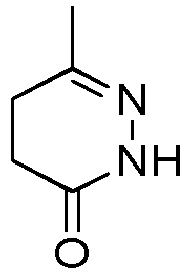
- Ethyl levulinate (30g, 208mmol) was dissolved in ethanol (100mL), hydrazine hydrate (15.63g, 312mmol, 85%) was slowly added dropwise thereto and the mixture was refluxed at 80°C for 2 hours. After the mixture was cooled to room temperature, the target compound was precipitated from the reaction solution as 6-methyl-4,5-dihydropyridazin-3(2-hydro)-one (23g, yield 98%) which was used directly in the next step without purification.
-
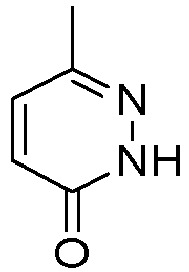
- Example 13A (23g, 205.4mmol) was dissolved in acetic acid (100mL) and liquid bromine (55.03g, 348.5mmol) was added dropwise to the above solution under vigorous stirring. The temperature during the dropwise addition did not exceed 40°C. After the addition, the mixture was reacted at 80°C for half an hour, cooled to room temperature, filtered and the filter cake was rinsed twice with methyl tert-butyl ether to give the title compound (20g, yield 87%) which was used directly in the next step without further purification. LCMS (ESI) m/z: 133[M+1]+. 1HNMR (CHLOROFORM-d, Bruker Avance 400MHz): ppm 7.36-7.39 (m, 1H), 6.69-6.89 (m, 1H), 2.22 (s, 3H).
-

- A mixture of Example 13B (18g, 163.44mmol) and phosphorus oxybromide (93.8g, 327.6mmol) was stirred at 70°C overnight. The mixture was cooled to 40°C, poured into ice-water, quenched with saturated sodium bicarbonate (20mL) and extracted with dichloromethane (100mL × 3). The organic layers were combined, dried over anhydrous sodium sulfate, filtered and evaporated to give the title compound, 3-bromo-6-methylpyridazine (8g, yield 31%). LCMS (ESI) m/z: 173[M+1]+. 1H NMR (CHLOROFORM-d, BrukerAvance 400MHz): ppm 7.86-7.88 (d, 1H, J = 8 Hz), 7.52-7.54 (d, 1H, J = 8 Hz), 2.55(s, 3H).
-

- Example 13C (8.0g, 48.0mmol) and NBS (9.44g, 48.0mmol) were dissolved in carbon tetrachloride (200mL) and AIBN (1.58g, 9.6mmol) was added and the mixture was reacted at 80°C for 12 hours. The mixture was filtered and concentrated. The residue was purified by flash silica gel column chromatography to give the target compound 3-bromo-6-(bromomethyl)pyridazine (2.2g, yield 19%). LCMS (ESI) m/z: 332[M+1]+. 1H NMR (400 MHz, CHLOROFORM-d) ppm 7.69 (d, J=8.53 Hz, 1H), 7.56 (d, J=9.04 Hz, 1H).
-

- Example 13D (2.0g, 8.0mmol) was dissolved in DMF (15mL) and morpholine (1.4g, 16mmol) and K2CO3 (2.2g, 16mmol) were added to the solution, the mixture was reacted at 20°C for 12 hours. The mixture was added with water (5mL) and extracted with dichloromethane. The organic phase was concentrated and the residue was purified by flash silica gel column chromatography to give the title compound (1.46g, yield 72%). LCMS (ESI) m/z: 258[M+1]+. 1H NMR (400 MHz, CHLOROFORM-d) ppm 8.19 (d, J=8.53 Hz, 1H), 7.86 (d, J=8.53 Hz, 1H), 4.00 (s, 2H), 3.71-3.78 (m, 4H), 2.53-2.60 (m, 4H).
-
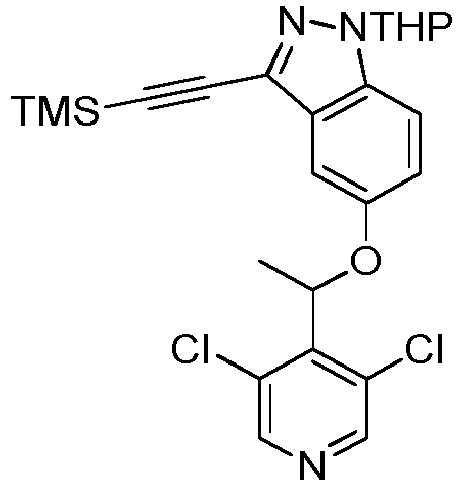
- Example 1G (1g, 1.93mmol), Pd(PPh3)2Cl2 (136mg, 0.19mmol), trimethylsilyl acetylene (227mg, 2.32mmol), cuprous iodide (368mg, 0.19mmol) and triethylamine (586mg, 5.79mmol) were suspended in acetonitrile (14mL). The reaction was stirred at 80°C for 18 hours. After cooled to room temperature, the reaction solution was filtered and the solvent was concentrated under reduced pressure to give the title compound (as a yellow liquid, 0.8g, crude). 1H NMR (400 MHz, CHLOROFORM-d) ppm 8.42 (s, 1H), 7.48 (d, J=9.03 Hz, 1H), 7.12 (dd, J=2.51, 9.03 Hz, 1H), 6.91 (d, J=2.01 Hz, 1H), 6.04 (d, J=6.53 Hz, 1H), 5.58-5.68 (m, 1H), 3.95 (br. s., 1H), 3.63-3.74 (m, 1H), 2.47 (d, J=9.54 Hz, 1H), 2.11 (br. s., 1H), 2.00 (br. s., 1H), 1.81 (d, J=6.53 Hz, 3H), 1.58-1.75 (m, 3H), 0.30 (s, 9H).
-

- A solution of tetrabutylammonium fluoride (8.6mL, 8.6mmol, 1mol/L) in tetrahydrofuran was added dropwise to a solution of Example 13F (2.8g, 5.73mmol) in tetrahydrofuran (30mL). The reaction solution was stirred at 15°C for 3 hours, followed by adding with brine (50mL), and extracted with ethyl acetate (40ml × 3). The layers were separated and the organic phases were combined, dried over anhydrous sodium sulfate, filtered, and the solvent was evaporated to dryness under reduced pressure. The residue was purified by flash silica gel column chromatography (petroleum ether/ethyl acetate = 20/1 to 10/1) to give the title compound (as a colorless oily liquid, 1g, yield 42%). 1H NMR (400 MHz, CHLOROFORM-d) ppm 8.42 (s, 2H), 7.50 (dd, J=3.01, 9.03 Hz, 1H), 7.13 (dd, J=2.26, 9.29 Hz, 1H), 7.01 (d, J=2.01 Hz, 1H), 6.06 (q, J=6.69 Hz, 1H), 5.64 (ddd, J=3.01, 6.15, 8.91 Hz, 1H), 3.92-4.00 (m, 1H), 3.64-3.74 (m, 1H), 3.35 (s, 1H), 2.49 (dd, J=1.76, 8.78 Hz, 1H), 1.97-2.20 (m, 2H), 1.61-1.86 (m, 6H).
-

- Example 13G (1g, 2.4mmol), silver fluoride (762mg, 6mmol) and NBS (470mg, 2.64mmol) were added to a mixed solution of acetonitrile (10mL) and water (1mL) in a sealing tube. The reaction was stirred at 80-90°C for 18 hours. The progress of the reaction was monitored by TLC. After being cooled to room temperature, the reaction solution was added with brine (10mL) and extracted with ethyl acetate (20mL × 3). The organic phase was dried over anhydrous sodium sulfate, filtered, and the solvent was evaporated to dryness in vacuo. The residue was purified by flash silica gel column chromatography (petroleum ether/ethyl acetate = 20/1 to 10/1) to give the title compound (cis-trans mixture, as a colorless oil, 200mg, yield 16%). 1H NMR (400 MHz, CHLOROFORM-d) ppm 8.45 (s, 2 H), 7.47 - 7.55 (m, 1 H), 7.12 - 7.20 (m, 1 H), 7.10 (s, 1 H), 6.30 - 6.46 (m, 1 H), 6.01 - 6.12 (m, 1 H), 5.60 - 5.70 (m, 1 H), 3.95 - 4.06 (m, 1 H), 3.66 - 3.79 (m, 1 H), 2.42 - 2.55 (m, 1 H), 2.09 - 2.21 (m, 1 H), 1.95 - 2.05 (m, 1 H), 1.83 (d, J=6.78 Hz, 3 H), 1.62 - 1.79 (m, 3 H).
-

- Example 13H (30mg, 58µmol), bispinacolatoboronate (16mg, 64µmol), Pd(dppf)Cl2CH2Cl2 (5mg, 6µmol) and potassium acetate (12mg, 120µmol) were suspended in dioxane (1.5mL). Under the atmosphere of nitrogen, the reaction solution was stirred at 100°C for 18 hours. The progress of the reaction was monitored by TLC. After the reaction solution was cooled to room temperature, the solvent was removed under reduced pressure and the residue was purified by flash silica gel column chromatography (petroleum ether/ethyl acetate = 10/1) to give the title compound (as a colorless oil, 10mg, yield 30%). LCMS (ESI) m/z: 562.1[M+1] +.
-

- Example 131 (10mg, 18µmol), Example 13E (9mg, 36µmol), Pd(DTBPF)Cl2 (2mg, 3.6µmol) and potassium carbonate (5mg, 36µmol) were suspended in a mixed solvent of tetrahydrofuran (1mL) and water (0.2mL), and reacted at 105°C for 15 minutes under microwave conditions. After cooled to room temperature, the reaction solution was separated by preparative plate (petroleum ether/ethyl acetate = 10/1) to give the title compound (as a colorless oil, 5mg, yield 46%). LCMS (ESI) m/z: 613.2[M+1]+.
-

- Example 13J (5mg, 8µmol) was dissolved in dry methanol (1mL). The solution was then added dropwise to freshly prepared solution of acetyl chloride (0.5mL) in dry methanol (2mL). The reaction solution was stirred at 40°C for 3 hours. Upon the completion of the reaction, the solvent was evaporated to give the title compound (4mg, yield 91%). LCMS (ESI) m/z: 541.1[M+1]+.

-

-
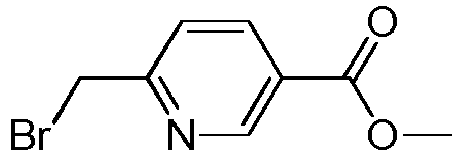
- Azobisisobutyronitrile (1.08g, 7mmol) was added to a solution of 6-methyl-nicotinic acid methyl ester (5g, 30mmol) and bromosuccinimide (6.48g, 30mmol) in carbon tetrachloride (40mL) at room temperature under nitrogen. The reaction solution was heated to 80°C, stirred for 12 hours, and filtered while hot. The filtrate was evaporated to dryness and the residue was purified by flash silica gel column chromatography to give the title compound (1.6g, yield 21%). 1H NMR (400 MHz, CHLOROFORM-d) ppm 9.16 (d, J=1.00 Hz, 1H), 8.29 (dd, J=1.76, 8.03 Hz, 1H), 7.53 (d, J=8.03 Hz, 1H), 4.58 (s, 2H), 3.95 (s, 3H).
-

- Potassium carbonate (1.16g, 8.4mmol) was added in one batch to a solution of Example 16A (1.6g, 7mmol) in DMF (12mL) at room temperature under nitrogen, and stirred overnight. The reaction solution was poured into ice-water (20mL) and extracted with ethyl acetate (40mL × 3). The organic phases were combined and washed with brine (50mL), dried over sodium sulfate, filtered and concentrated. The residue was purified by flash silica gel column chromatography to give the title compound (1g, yield 60%). 1H NMR (400 MHz, CHLOROFORM-d) ppm 9.15 (d, J=1.51 Hz, 1H), 8.26 (dd, J=2.01, 8.03 Hz, 1H), 7.53 (d, J=8.28 Hz, 1H), 3.94 (s, 3H), 3.68-3.78 (m, 6H), 2.46-2.55 (m, 4H).
-

- Lithium aluminum hydride (1.08g, 28.4mmol) was added in batches to a solution of Example 16B (6.7g, 28.4mmol) in tetrahydrofuran (85mL) at 0°C under atmosphere of nitrogen, and stirred for 2 hours. The reaction solution was slowly added successively with water (1mL), sodium hydroxide (1mL, 15%) and water (3mL), stirred for 20 minutes and filtered. The filtrate was concentrated under reduced pressure to give the title compound (48g, yield 70%). 1H NMR (400 MHz, CHLOROFORM-d) ppm 8.45 (s, 1H), 7.68 (dd, J=1.51, 8.03 Hz, 1H), 7.38 (d, J=8.03 Hz, 1H), 4.67 (s, 2H), 3.67-3.72 (m, 4H), 3.61 (s, 2H), 2.41-2.52 (m, 4H).
-

- Active manganese dioxide (39g, 449mmol) was added in batches to a solution of Example 16C (4.06g, 19.5mmol) in dichloromethane (70 mL) at room temperature, and the reaction solution was heated to reflux for 16 hours. Upon the completion of the reaction, the reaction solution was filtered and the filtrate was evaporated to dryness. The residue was purified by flash silica gel column chromatography to give the title compound (1.2g, yield 30%). 1H NMR (400 MHz, CHLOROFORM-d) ppm 10.10 (s, 1H), 9.02 (d, J=1.00 Hz, 1H), 8.15 (dd, J=2.01, 8.03 Hz, 1H), 7.65 (d, J=8.03 Hz, 1H), 3.73-3.79 (m, 6H), 2.49-2.58 (m, 4H).
-
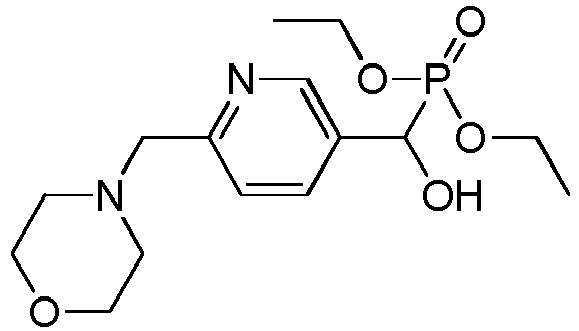
- Barium hydroxide octahydrate (229mg, 0.728mmol) was added in one batch to a solution of Example 16D (300mg, 1.45mmol) and diethyl phosphite (603mg, 4.36mmol) in tetrahydrofuran (5mL) at room temperature and the reaction solution was heated to 45°C and stirred for 4 hours. Upon the completion of the reaction, the reaction solution was added with water (20 ml) and extracted with ethyl acetate (40ml × 3). The organic phases were combined and washed with brine (50ml), dried over sodium sulfate, filtered and concentrated. The residue was purified by flash silica gel column chromatography to give the title compound (120mg, yield 24%) as a yellow liquid. LCMS (ESI) m/z: 345.1 [M+1]+.
-

- Diethylaminosulfur trifluoride (168mg, 1.04mmol) was slowly dropwise added to a solution of Example 16E (120mg, 0.35mmol) in dichloromethane (5mL) at 0°C. After the addition, the reaction solution was stirred at 0°C for 1 hour. Upon the completion of the reaction, the reaction solution was washed with saturated sodium bicarbonate (5mL) and brine (5mL), dried over sodium sulfate, filtered and concentrated. The residue was purified by flash silica gel column chromatography to give the title compound (60mg, yield 50%) as a colorless liquid. LCMS (ESI) m/z: 347.1 [M+1]+.
-

- Under the protection of nitrogen and at room temperature, sodium hydride (139mg, 60% in mineral oil, 3.46mmol) was added in batches to a solution of Example 16F (400mg, 1.15mmol) in tetrahydrofuran (10mL) and stirred for 10 minutes, and then 5-(1-(3,5-dichloropyridin-4-)ethoxy)-1-(tetrahydro-2-hydro-pyran-2-)-1H-indazol-3-carbaldehyde (485mg, 1.15mmol) 1 H was added to above reaction solution and the mixture was stirred for 10 minutes. The reaction solution was then heated to 80°C and stirred for 3 hours. Upon the completion of the reaction, the reaction solution was cooled to room temperature, quenched with water (10mL) and extracted with ethyl acetate (40mL × 3). The organic phases were combined and washed with brine (50mL), dried over sodium sulfate, filtered and concentrated. The residue was purified by flash silica gel column chromatography and then resolved by chiral HPLC to give the title compound (formula Z) (250mg, yield 35%) and the isomer (formula E) (200mg, yield 28%) as a yellow liquid. LCMS (ESI) m/z: 612 [M+ ]+.
-

- A freshly prepared solution of acetyl chloride (1mL) in methanol (3mL) was added to a solution of Example 16G (80mg, 1.3mmol) in methanol (1mL) at room temperature under nitrogen. The reaction solution was stirred at 40°C for 3 hours. The solution was removed in vacuo to give the title compound (33mg, yield 52%). 1H NMR (400 MHz, METHANOL-d4) ppm 9.08 (s, 1H), 8.52 (br. s., 1H), 8.26 (d, J=7.03 Hz, 1H), 7.66 (d, J=8.03 Hz, 1H), 7.48 (d, J=9.79 Hz, 1H), 7.23 (br. s., 2H), 6.92-7.08 (m, 1H), 6.12 (d, J=6.78 Hz, 1H), 4.63 (s, 2H), 4.00 (br. s., 4H), 3.47 (br. s., 4H), 1.83 (d, J=6.53 Hz, 3H).

-

-

- P-toluenesulfonic acid monohydrate (291mg, 1.53mmol) was added to a mixed solution of Example 7E (900mg, 1.53mmol) in acetone (4mL) and water (4mL) at room temperature and the reaction solution was heated to 50°C and stirred for 10 hours. Upon the completion of the reaction, the reaction solution was added with water (4mL) and extracted with dichloromethane (30ml × 3). The organic phases were combined, washed with saturated brine (20mL) and dried over sodium sulfate, filtered and evaporated to give the title compound (850mg, yield 92%). LCMS (ESI) m/z: 541 [M+1]+.
-
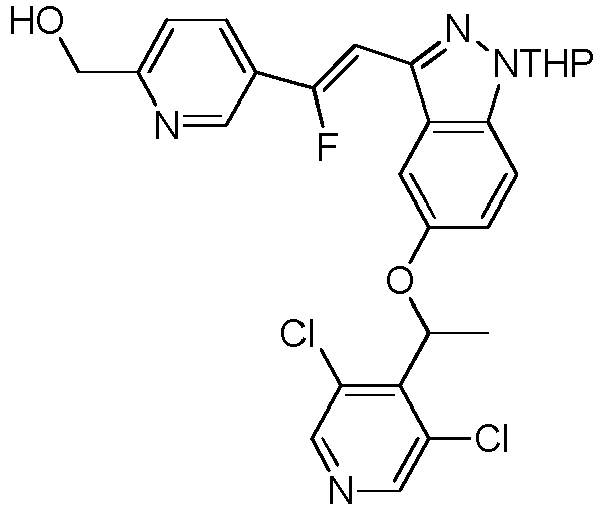
- Sodium borohydride (119mg, 3.14mmol) was added in batches to a solution of Example 17A (850mg, 1.57mmol) in methanol (8mL) and stirred for 1 hour at room temperature under nitrogen. The mixture was quenched with water (30mL), extracted with ethyl acetate (40mL × 3) and the organic phases were combined, washed with brine (20mL) and dried over sodium sulfate, filtered and the filtrate was evaporated to give the title compound (900mg, crude) as a yellow liquid. LCMS (ESI) m/z: 543 [M+1] +.
-

- A freshly prepared solution of acetyl chloride (2mL) in methanol (6mL) was added to a solution of Example 17B (900mg, crude) in methanol (2mL) at room temperature under nitrogen. The reaction solution was stirred at 40°C and stirred for 3 hours. The solution was removed in vacuo to give the title compound (850mg, crude). LCMS (ESI) m/z: 459 [M+1]+.
-

- Triethylamine (495mg, 4.89mmol), di-tert-butyl dicarbonate (356mg, 1.63mmol), DMAP (20mg, 0.16mmol) were added to a solution of Example 17C (748mg, 1.63mmol) in dichloromethane (12mL) at room temperature under nitrogen, and the reaction solution was stirred at room temperature for 30 minutes. Upon the completion of the reaction, the reaction solution was adjusted to about pH 7 with 1M hydrochloric acid, extracted with dichloromethane (20mL × 3), the organic phases were combined and washed with brine (20mL), dried over sodium sulfate, filtered and evaporated. The residue was purified by flash silica gel column chromatography to give the title compound (280mg, yield 30.7%). LCMS (ESI) m/z: 559 [M+1]+.
-

- Dess-Martin reagent (318mg, 0.75mmol) was added in batches to a solution of Example 17D (280mg, 0.5mmol) in dichloromethane (6mL) at room temperature, and the reaction solution was stirred at room temperature for 2 hours. Upon the completion of the reaction, the reaction solution was cooled in an ice-water bath, filtered and the filtrate was evaporated to give the title compound (230mg, yield 82.4%). LCMS (ESI) m/z: 557 [M+1]+.
-

- A solution of Example 17E (50mg, 90µιmol), tetrahydro-2H-pyran-4-amine (18mg, 180µmol) in 1,2-dichloroethane (2.5mL) was added with acetic acid (about 0.1mL) to adjust pH to about 5 and the mixture was stirred for 2 hours at room temperature. Sodium cyanoborohydride (12mg, 180µmol) was added to the reaction solution at room temperature and stirred for 1 hour. The reaction solution was added with water (5mL) and extracted with dichloromethane (20mL × 3). The organic phases were combined and washed with brine (20mL), dried over sodium sulfate, filtered and evaporated. The residue was purified by flash silica gel column chromatography to give the title compound (20mg, yield 34.7%). The sample was used for chiral column resolution to give Example 17F-R configuration (8mg), Example 17F-S configuration (8mg).
LCMS (ESI) m/z: 642 [M+1]+. - Chiral column method: chiral column, Chiralcel OJ-H 250×4.6mm I.D., 5um; mobile phase, methanol (0.05% DEA)-CO2 5%-40%; Flow rate, 2.35mL/min; Wavelength, 280nm.
-

- A freshly prepared solution of acetyl chloride (1mL) in methanol (3mL) was added to a solution of Example 17F-S configuration (15mg, 23µmol) (prepared according to the method of Example 17F, scaling up to 200mg to give 15mg of the 17F-S configuration product) in methanol 1 ml at room temperature under nitrogen atmosphere. The reaction was stirred at 40°C for 3 hours. The solution was removed in vacuo to give the title compound (33mg, yield 52%). LCMS (ESI) m/z: 542 [M+1] +. 1H NMR (400 MHz, METHANOL-d4) ppm 9.04 (s, 1H), 8.50 (br. s., 2H), 8.23 (d, J=7.03 Hz, 1H), 7.64 (d, J=8.03 Hz, 1H), 7.49 (d, J=8.53 Hz, 1H), 7.18-7.26 (m, 2H), 7.04 (s, 2H), 6.12 (q, J=6.53 Hz, 1H), 4.53 (s, 2H), 4.08 (dd, J=4.02, 11.54 Hz, 2H), 3.56-3.66 (m, 7H), 2.15 (d, J=11.04 Hz, 2H), 1.83 (d, J=6.53 Hz, 4H), 1.18 (t, J=7.03 Hz, 9H).
-

- In this example, Example 17F was prepared according to such as the method of Example 17, scaling up to 200mg, to give 15mg of the 17F-R configuration product to give Example 18. LCMS (ESI) m/z: 542[M+1]+. 1H NMR (400 MHz, METHANOL-d4) ppm 8.95-9.12 (m, 1H), 8.44-8.59 (m, 1H), 8.25 (br. s., 1H), 7.68 (br. s., 1H), 7.51 (d, J=8.78 Hz, 1H), 7.25 (d, J=15.06 Hz, 2H), 6.91-7.10 (m, 1H), 6.13 (d, J=5.77 Hz, 1H), 4.54 (br. s., 2H), 4.07 (d, J=10.54 Hz, 2H), 3.42-3.57 (m, 3H), 2.15 (d, J=10.79 Hz, 2H), 1.83 (m, 5H).
-

- Acetic acid (2.21mg, 38.87µmol) was added dropwise to a mixed solution of Example 18 (15mg, 27.68µmol) and anhydrous acetaldehyde (5mg, 110µmol) in 1,2-dichloroethane (2mL) and the mixture was stirred at 20°C for 1 hour after the addition. Sodium cyanoborohydride (7mg, 110µmol) was slowly added and the mixture was stirred for 1 hour at 20°C. The reaction was quenched with water and the aqueous layer was extracted with dichloromethane (3mL × 2), the organic phases were combined and washed with brine (5mL), dried over anhydrous sodium sulfate, filtered and concentrated in vacuo. The residue was purified by preparative column chromatography to give Example 18b (12mg, yield 76%).
LCMS (ESI) m/z: 571 [M+1]+
1H NMR (400 MHz, METHANOL-d4) 9.09 (s, 1H), 8.31 (d, J=8.03 Hz, 1H), 7.72 (d, J=8.28 Hz, 1H), 7.54 (d, J=9.03 Hz, 1H), 7.24-7.33 (m, 2H), 7.00-7.16 (m, 1H), 6.17 (q, J=6.69 Hz, 1H), 4.11 (d, J=8.53 Hz, 2H), 3.79 (t, J=11.80 Hz, 1H), 3.38-3.58 (m, 4H), 3.26-3.32 (m, 2H), 2.09 (br. s., 2H), 1.90-2.01 (m, 2H), 1.85 (d, J=6.78 Hz, 3H), 1.39 (t, J=7.15 Hz, 3H) -

- This example was prepared by the method as described in Example 17. LCMS (ESI) m/z: 556.1 [M+1]+. 1H NMR (400 MHz, METHANOL-d4) ppm 9.10 (br. s., 1H), 8.58 (br. s., 1H), 8.29 (br. s., 1H), 7.72 (br. s., 1H), 7.53 (d, J=8.53 Hz, 1H), 7.21-7.33 (m, 3H), 6.97-7.18 (m, 1H), 6.14 (d, J=5.52 Hz, 1H), 4.59 (br. s., 2H), 3.57-3.74 (m, 6H), 3.50 (br. s., 3H), 3.19 (br. s., 1H), 2.03 (d, J=12.55 Hz, 3H), 1.83 (d, J=5.52 Hz, 6H), 1.66 (br. s., 3H).
-

- This example was prepared by the method as described in Example 17. LCMS (ESI) m/z: 556.1 [M+1]+. 1H NMR (400 MHz, METHANOL-d4) ppm 9.09 (s, 1H), 8.54 (br. s., 2H), 8.27 (d, J=7.53 Hz, 1H), 7.68 (d, J=8.03 Hz, 1H), 7.51 (d, J=9.03 Hz, 1H), 7.23-7.28 (m, 2H), 7.09 (s, 1H), 6.14 (q, J=6.53 Hz, 1H), 4.57 (br. s., 2H), 3.66 (d, J=7.03 Hz, 2H), 3.50 (br. s., 2H), 2.03 (d, J=13.55 Hz, 3H), 1.83 (d, J=6.53 Hz, 4H), 1.64 (br. s., 2H), 1.29 (br. s., 3H).
-

- This example was prepared by the method as described in Example 17. LCMS (ESI) m/z: 528.1 [M+1]+.
1H NMR (400 MHz, DMSO-d6) ppm 9.08 (s, 1H), 8.62 (s, 2H), 8.29 (d, J=6.27 Hz, 1H), 7.73 (d, J=7.78 Hz, 1H), 7.50 (d, J=9.03 Hz, 1H), 7.09-7.33 (m, 3H), 6.04 (q, J=6.53 Hz, 1H), 4.38-4.68 (m, 1H), 2.68 (br. s., 1H), 2.33 (br. s., 1H), 1.69-1.82 (m, 3H).

-

-

- A solution of isopropylmagnesium chloride Grignard reagent (26.52g, 257.84mmol) in tetrahydrofuran was slowly added dropwise to a solution of 5-bromo-2-iodopyridine (61g, 214.87mmol) in tetrahydrofuran (700mL) at -20°C under nitrogen, the solution was stirred at -20°C for 3 hours and warmed to 0°C. N,N-dimethylformamide (18.85g, 257.84mmol) was added dropwise in batches at 0°C. The reaction solution was warmed to 20°C after the addition, and further stirred for 6 hours. When TLC showed the completion of the reaction, the reaction solution was added with saturated ammonium chloride (100mL) to quench the reaction, and the aqueous layer was extracted with ethyl acetate (140mL × 3), the organic layers were combined and washed with brine (100mL × 2) and dried over anhydrous sodium sulfate, filtered and concentrated in vacuo to give the title compound (44g) which was used directly in the next step without further purification 1H NMR (400MHz, CHLOROFORM-d) ppm 10.04 (s, 1H), 8.85 (d, J=1.8 Hz, 1H), 8.03 (dd, J=1.8, 8.3 Hz, 1H), 7.86 (d, J=8.3 Hz, 1H).
-

- P-toluenesulfonic acid monohydrate (818.11mg, 4.30mmol) was added in batches to a mixed solution of Example 1A (40g, 215.05mmol), trimethyl orthoformate (27.38g, 258.06mmol) in methanol (400mL) at 20°C under nitrogen. After the addition, the mixture was stirred at 20°C for 10 minutes, then heated to 70°C and stirred for 16 hours. When TLC showed the completion of the reaction, the reaction mixture was cooled to 20°C, partially concentrated in vacuo, then poured into ice water (150mL) and stirred for 20 minutes. The aqueous layer was extracted with ethyl acetate (100mL × 3). The combined organic phases were washed with brine (100mL × 2), dried over anhydrous sodium sulfate, filtered and concentrated in vacuo. The residue was purified by flash silica gel column chromatography to give the title compound as a yellow oil (19g, yield 38.07%). 1H NMR (400MHz, CHLOROFORM-d) ppm 8.67 (d, J=2.0 Hz, 1H), 7.86 (dd, J=2.3, 8.3 Hz, 1H), 7.46 (d, J=8.0 Hz, 1H), 3.39 (s, 6H).
-

- Pd(dppf)Cl2 (630.73mg, 862.00µmol) was added to a solution of Example 24B (2g, 8.62mmol), bispinacolatoboronate (2.85g, 11.21mmol), potassium acetate (2.54g, 25.86mmol) in dioxane (10mL) under nitrogen atmosphere, followed by reacting at 110°C for 2 hours. When LC-MS showed the completion of the reaction, the reaction solution was cooled to room temperature, filtered, concentrated in vacuo and the residue was purified by flash silica gel column chromatography to give the title compound as a black oil (2g, yield 83.12%). 1H NMR (400MHz, CHLOROFORM-d) ppm 8.94 (s, 1H), 8.11 (dd, J=1.4, 7.7 Hz, 1H), 7.54 (d, J=7.8 Hz, 1H), 5.40 (s, 1H), 3.39 (s, 6H), 1.35 (s, 12H).
-

- Acetyl chloride (41.99g, 534.88mmol) was added dropwise to a solution of 1E 1-(3,5-dichloropyridine-4-)ethanol (85.60g, 445.74mol), triethylamine (90.21g, 891.47mmol) in dichloromethane (1.5L) at 20°C, and the mixture was stirred at 20°C for 1 hour. When TLC showed the completion of the reaction, the solvent was evaporated under reduced pressure and the residue was purified by column chromatography to give the title compound (as a colorless oil, 57.10g, yield 54.7%). 1H NMR (400 MHz, CHLOROFORM-d) ppm 8.44 (s, 2H), 6.25 (q, J=6.8 Hz, 1H), 2.09 (s, 3H), 1.63 (d, J=7.2 Hz, 3H).
-

- Novozymer 435 (31.78g, 3.12 × 10⁴PLU) was added to a mixed solution of Example 24D (31g, 243mmol) in DMSO (78mL) and 1M NaH2PO4/Na2HPO4 buffer solution (pH 7.5, 775mL) at 20 °C. After the mixture was stirred at 51°C for 129 hours, LCMS showed that about 50% of the starting material was converted. The reaction solution was diluted with water (1L) and extracted with ethyl acetate (1L × 5). The combined organic layer was washed with water (500mL) and brine (500mL × 2), dried over sodium sulfate, filtered and evaporated. The residue was purified by column chromatography to give the title compound (as a colorless oil, 12.00g, yield 77%). LCMS (ESI) m/z: 233.9 [M+1]+
-

- 1M sodium hydroxide solution (51.26mL, 51.26mmol) was added dropwise to a mixed solution of Example 24E (12.00g, 51.26mmol) in tetrahydrofuran (50mL) and methanol (50mL) at 20°C. After the mixture was stirred for half an hour at 20°C, TLC showed that the reaction was completed and the reaction solution was diluted with water (30mL) and extracted with ethyl acetate (100mL × 3). The combined organic layer was washed with brine (20mL × 2), dried over sodium sulfate and evaporated to dryness under reduced pressure to give the title compound (as a colorless oil, 7.99g, yield 81.2%). LCMS (ESI) m/z: 191.8 [M+1]+.
-

- Methanesulfonyl chloride (32.21g, 281.2 mmol) was slowly added to a mixed solution of Example 25F (18g, 94mmol) and triethylamine (28.45g, 281mmol) in dichloromethane (400mL) at 0°C under an ice bath. The reaction solution was stirred at room temperature for 4 hours. Upon the completion of the reaction, the reaction was quenched with water and extracted with dichloromethane (500mL × 3). The combined organic phase was dried over anhydrous sodium sulfate and evaporated to dryness. The residue was purified by column chromatography to give Example 24G (24g, 88.9mmol, yield 94.8%).
-

- A solution of Example 24G (24g, 88.9mmol), Example ID (35g, 101.7mmol) and cesium carbonate (57.9g, 177.7mmol) in acetonitrile was heated to 110°C under an oil bath under nitrogen atmosphere, and the reaction solution was stirred for 12 hours. Upon the completion of the reaction, the reaction solution was filtered and the filtrate was evaporated to dryness. The residue was subjected to column chromatography to give Example 25E as pale yellow solid (26g, 50.2mmol, yield 56.5%). LCMS (ESI) m/z: 518.0 [M+1]+. 1H NMR (400MHz, METHANOL-d4) ppm 8.44 (s, 2H), 7.46 (dd, J=2.8, 8.8 Hz, 1H), 7.17(dd, J=2.4, 9.2 Hz, 1H), 6.71(s, 1H), 6.08(d,J=6.8Hz,1H), 5.64∼5.59(m,1H), 4.01∼3.97(m, 1H), 3.73∼3.69(m, 1H), 2.48∼2.47(m, 1H), 2.13∼2.11(m, 2H), 1.83 (d, J=6.8 Hz, 3H), 1.75∼1.64 (m, 3H).
-

- Pd(PPh3)2Cl2 (1.63g, 2.32mmol) and sodium formate (9.5g, 139.0mmol) were added to a solution of Example 25E (24g, 46.3mmol) in DMF (500mL) at room temperature under nitrogen atmosphere. The hydrogen in the hydrogenation bottle is then replaced with carbon monoxide gas to fill the bottle with carbon monoxide gas. The reaction solution was stirred to react under carbon monoxide (50psi) at 80°C for 12 hours. The reaction solution was then filtered and the filtrate was concentrated to dryness, the residue was subject to column chromatography to give the title compound (16g, yield 64%). LCMS (ESI) m/z: 420.1 [M+1]+.
-

- Hydrazine hydrate (2.38g, 47.6mmol) was added to a solution of 24F [1-(3,5-dichloro-4-pyridyl)ethoxy] -1-tetrahydropyran-2-benzofindazole-3 -carbaldehyde (10g, 23.8 mmol) in ethanol (180mL) at 0°C, and the mixture was stirred at 20°C for 3 hours. Ethylenediamine (2.86g, 47.6mmol) and cuprous chloride (2.35.6g, 23.8mmol) were added, and after 10 minutes, tribromofluoromethane (16.1g, 59.6mmol) was dropwise added slowly at 0°C. After the addition, the mixture was stirred at 20°C for 16 hours. TLC test showed the completion of the reaction, the reaction was quenched by dropwise addition of 1 mol citric acid. The aqueous layer was extracted with ethyl acetate (50mL × 3) and the organic layers were combined and washed with brine (50mL × 2), dried over anhydrous sodium sulfate, filtered, concentrated in vacuo and the residue was purified by flash silica gel column chromatography to give the title compound as a yellow oil (6g, yield 48.97%). 1H NMR (400MHz, CHLOROFORM-d) ppm 8.41 (s, 2H), 7.46 - 7.43 (m, 1H), 7.13-7.10 (dd, J=2.3, 9.0 Hz, 1H), 6.98 (d, J=2.5 Hz, 1H), 6.33 (d, J=2.5 Hz, 1H), 6.25 (d, J=20 Hz 1H), 6.02 (q, J=6.7 Hz, 1H), 5.69 - 5.57 (m, 1H), 4.04 - 3.92 (m, 1H), 3.74 - 3.65 (m, 1H), 2.54 - 2.40 (m, 1H), 2.19 - 2.06 (m, 1H), 2.04 - 1.93 (m, 1H), 1.80 (d, J=6.5 Hz, 3H), 1.76 - 1.60 (m, 3H).
-

- Under nitrogen, Pd(dppf)Cl2 (141.95mg, 194.00µmol) was added to a mixed solution of Example 24C (703.99mg, 2.52mmol) and Example 24J (1.00g, 1.94mmol) in tetrahydrofuran (9mL), and then the mixture was refluxed overnight at 80°C with stirring. The reaction solution was cooled, filtered and concentrated in vacuo. The residue was purified by flash silica gel column chromatography to give the title compound as a yellow oil (1.0g, yield 90%). LCMS (ESI) m/z: 587.1 [M+1]+. 1H NMR (400MHz, CHLOROFORM-d) ppm 8.98 - 8.93 (m, 1H), 8.41 (s, 2H), 7.98 (d, J=7.0 Hz, 1H), 7.64 (d, J=8.5 Hz, 1H), 7.48 (dd, J=3.8, 9.3 Hz, 1H), 7.24 - 7.13 (m, 2H), 6.84 - 6.70 (m, 1H), 6.05 (q, J=6.5 Hz, 1H), 5.68 - 5.61 (m, 1H), 5.44 (s, 1H), 4.03 (m, 1H), 3.72 (m., 1H), 3.49 (d, J=4.5 Hz, 1H), 3.45 (s, 6H), 2.57 - 2.42 (m, 1H), 2.07 - 1.98 (m, 2H), 1.81 (d, J=6.5 Hz, 3H), 1.78 - 1.70 (m, 2H).
-

- A mixed solution of Example 24K (1.00g, 1.70mmol) and p-benzenesulfonic acid monohydrate (19.4mg, 1.02mmol) in water (8mL) and acetone (10mL) was heated and stirred at 50°C for 12 hours. The mixture was cooled and the aqueous layer was extracted with dichloromethane (10mL × 3), and the organic layers were combined and washed with brine (10mL × 2), dried over anhydrous sodium sulfate, filtered and concentrated in vacuo to give the title compound (940mg, crude) which was used directly in the next step. LCMS (ESI) m/z: 541.4 [M+1]+.
-
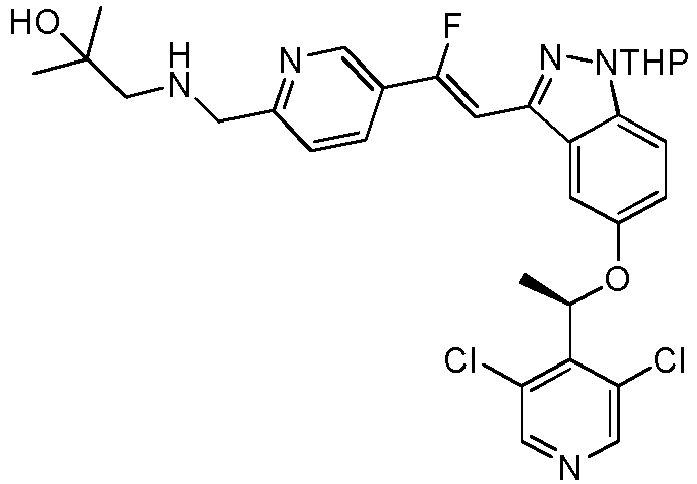
- Acetic acid (8.87mg, 147.77µmol) was added dropwise to a mixed solution of Example 24L (80mg, 147.77µmol) and 1-amino-2-methylpropane-2-hydroxy(54.78mg, 443.31µmol) in 1,2-dichloroethane (2mL), and the mixture was stirred at 20°C for 30 minutes after the addition. Sodium cyanoborohydride (27.86mg, 443.31µmol) was added slowly and the mixture was stirred for 2 hours at 20°C. The reaction was quenched with water, and the aqueous layer was extracted with dichloromethane (5mL × 3), the organic layers were combined and washed with brine (3mL × 2), dried over anhydrous sodium sulfate, filtered and the filtrate was concentrated in vacuo. The residue was purified by flash silica gel column chromatography to give the title compound as a yellow oil (30mg, 33%). LCMS (ESI) m/z: 613.2 [M+1]+.
-

- This example was prepared by the method as described in Example 24. LCMS (ESI) m/z: 529.4 [M+1]+. 1H NMR (400MHz, METHANOL-d4) ppm 9.09 (s, 1H), 8.55 (s, 2H), 8.32 (d, J=7.0 Hz, 1H), 7.72 (d, J=8.0 Hz, 1H), 7.56 (d, J=9.0 Hz, 1H), 7.35 - 7.24 (m, 2H), 7.16 - 7.00 (m, 1H), 6.16 (q, J=6.5 Hz, 1H), 4.57 (s, 2H), 3.16 (s, 2H), 1.84 (d, J=6.5 Hz, 3H), 1.42 - 1.35 (m, 6H).
-

- This example was prepared by the method as described in Example 24. LCMS (ESI) m/z: 529.4 [M+1]+. 1H NMR (400MHz, METHANOL-d4) ppm 9.04 (s, 1H), 8.51 (m, 2H), 8.23 (d, J=6.8 Hz, 1H), 7.68 - 7.43 (m, 1H), 7.26 - 7.17 (m, 2H), 7.06 - 6.88 (m, 2H), 6.12 (d, J=6.5 Hz, 1H), 4.55 (m, 1H), 4.40 (s, 2H), 4.08 - 4.01 (m, 1H), 2.61 (d, J=6.0 Hz, 2H), 2.41 (m, 2H), 1.84 (d, J=6.5 Hz, 3H).
-

-

- Acetic acid (8.87mg, 147.77µmol) was added dropwise to a mixed solution of Example 24L (80mg, 147.77µmol) and 2-piperazine-1-ethanol (57.71mg, 443.31µmol) in 1,2-dichloroethane (2mL). After the addition, the mixture was stirred at 20°C for 30 minutes. Sodium cyanoborohydride (27.86mg, 443.31µmol) was added slowly and the mixture was stirred for 2 hours at 20°C. The reaction was quenched with water and the aqueous layer was extracted with dichloromethane (5mL × 3), the organic layers were combined and washed with brine (3mL × 2), dried over anhydrous sodium sulfate, filtered and concentrated in vacuo. The residue was purified by flash silica gel column chromatography to give the title compound (30mg, yield 30.9%). LCMS (ESI) m/z: 655.2 [M+1]+.
-
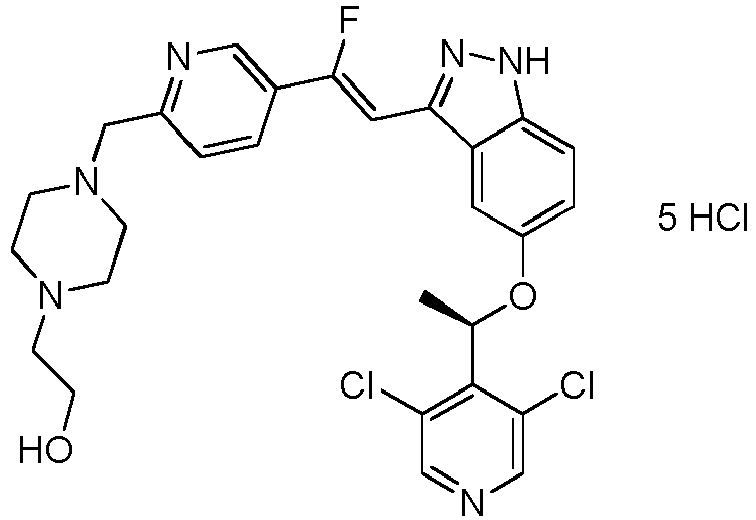
- A mixed solution of methanol (1mL)/acetyl chloride (0.25mL) was added to a solution of Example 27A (20mg, 30.51 µmol) in methanol (1mL) and the mixture was heated to 40°C and stirred for 3 hours, then cooled and concentrated in vacuo to give the title compound (11.50mg, yield 65.5%). LCMS (ESI) m/z: 571.4 [M+1]+. 1H NMR (400MHz, METHANOL-d4) ppm :9.07 (s, 1H), 8.58 - 8.49 (m, 3H), 7.92 (d, J=8.5 Hz, 1H), 7.50 (d, J=9.0 Hz, 1H), 7.27 - 7.20 (m, 1H), 7.18 - 7.06 (m, 2H), 6.14 (q, J=6.5 Hz, 1H), 4.32 (s, 2H), 3.98 - 3.92 (m, 2H), 3.67 - 3.45 (m, 4H), 3.43 - 3.37 (m, 2H), 3.28 - 3.13 (m, 4H), 1.85 (d, J=7.0 Hz, 3H).
-

-

- A mixed solution of nitrogen tert-butoxycarbonylpiperidine (2g, 10.7mmol), ethyl bromoacetate (1.79g, 10.7mmol) and potassium carbonate (4.45g, 32.2mmol) in acetonitrile (30mL) was heated to 90°C and stirred to react for 16 hours. TLC showed the starting materials of the reaction disappeared. The reaction solution was filtered and the filtrate was evaporated to dryness and the residue was purified by flash silica gel column chromatography flash silica gel column chromatography to give the title compound as a colorless oil (2.1g, 7.7mmol). LCMS (ESI) m/z: 273.2 [M+1]+.
-

- Example 29A (2.1g, 7.7mmol) was added to hydrochloric acid ethyl acetate (30mL) and the reaction solution was stirred at room temperature for 16 hours. TLC showed that the reaction was complete. The reaction solution was directly evaporated to dryness to give the title compound (1.2g, yield 90.4%) which was used directly in the next step without further purification.
-
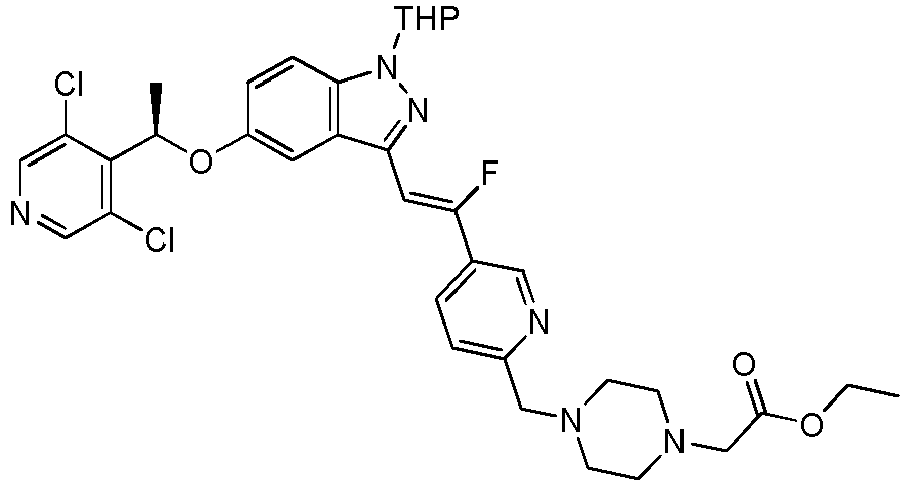
- A mixed solution of Example 29B (15mg, 87µmol) and Example 24L (47mg, 87µmol) in 1,2-dichloroethane (4mL) was stirred at room temperature for 1 hour. Sodium cyanoborohydride (5.5mg, 87µmol) was added to the reaction solution under an ice bath. The reaction was finally warmed to room temperature and stirred for 3 hours. The reaction was quenched with water and extracted with dichloromethane. The organic phase was dried over anhydrous sodium sulfate and evaporated to dryness. The residue was isolated by HPLC to give the title compound (30mg, yield 49.5%). LCMS (ESI) m/z: 698.6 [M+1]+.
-

- Acetyl chloride (3mL) was slowly added dropwise to methanol (8mL) at 0°C. The reaction solution was then stirred at room temperature for 15 minutes. Example 29C (35mg, 50µmol) was added to the stirred reaction solution. The reaction solution was warmed to 40°C and stirred for 3 hours. LCMS showed the reaction was complete. The reaction solution was evaporated to dryness directly to give the title compound (as a dark yellow oil, 30mg, yield 97.5%) which was used in the next step without further purification. LCMS (ESI) m/z: 614.5 [M+1]+.
-

- Sodium hydroxide (10mg, 245µmol) was added in one batch to a solution of Example 29D (30mg, 49µmol) in a mixed solvent of tetrahydrofuran (1mL), methanol (1mL) and water (1mL) at room temperature. The reaction solution was stirred at 21°C for 16 hours. LCMS showed the reaction was complete. The reaction solution was evaporated to dryness directly, then dissolved with methanol and filtered to obtain a filtrate which was evaporated. The residue was separated by preparative chromatography to give the title compound (as a green oil, 5mg, yield 17.5%). LCMS (ESI)m/z: 585.2 [M+1]+. 1H NMR (400MHz, METHANOL-d4) ppm9.11 (s, 1H), 8.87 (d, J=8 Hz, 1H), 8.53 (s, 2H), 8.00 (d, J=8.4 Hz, 1H), 7.50 (d, J=9.2 Hz, 1H), 7.24 (m, 2H), 7.18 (d, J=33.6 Hz, 1H), 6.14 (t, J= 6.8 Hz, 1H), 4.40 (s, 2H), 4.21 (s, 2H), 3.65 (s, 4H), 3.3 (m, 2H), 1.84 (d, J=6.8 Hz, 3H).
-

- This example was prepared by the method as described in Example 24. LCMS (ESI) m/z: 556.1 [M+1]+. 1H NMR (400 MHz, METHANOL-d4) ppm 9.10 (br. s., 1H), 8.58 (br. s., 1H), 8.29 (br. s., 1H), 7.72 (br. s., 1H), 7.53 (d, J=8.53 Hz, 1H), 7.21-7.33 (m, 3H), 6.97-7.18 (m, 1H), 6.14 (d, J=5.52 Hz, 1H), 4.59 (br. s., 2H), 3.57-3.74 (m, 6H), 3.50 (br. s., 3H), 3.19 (br. s., 1H), 2.03 (d, J=12.55 Hz, 3H), 1.83 (d, J=5.52 Hz, 6H), 1.66 (br. s., 3H).
-

- This example was prepared by the method as described in Example 24. LCMS (ESI) m/z: 528.1 [M+1]+.
1H NMR (400 MHz, DMSO-d6) ppm 9.08 (s, 1H), 8.62 (s, 2H), 8.29 (d, J=6.27 Hz, 1H), 7.73 (d, J=7.78 Hz, 1H), 7.50 (d, J=9.03 Hz, 1H), 7.09-7.33 (m, 3H), 6.04 (q, J=6.53 Hz, 1H), 4.38-4.68 (m, 1H), 2.68 (br. s., 1H), 2.33 (br. s., 1H), 1.69-1.82 (m, 3H). -

- This example was prepared by the method as described in Example 24. LCMS (ESI) m/z: 527.1 [M+1]+.
1H NMR (400 MHz, METHANOL-d4) ppm 9.07 (s, 1H), 8.51 (s, 3H), 7.89 (d, J=8.4 Hz, 1H), 7.49 (d, J=8.8 Hz, 1H), 7.23-7.21 (m, 2H), 7.15 (d, J=43.2 Hz, 1H), 6.13 (q, J=6.4 Hz, 1H), 4.44 (s, 2H), 3.56 - 3.53 (m, 4H), 3.37 (m, 4H), 1.84 (d, J=6.4 Hz, 3H). -

- This example was prepared by the method as described in Example 24.
LCMS (ESI) m/z: 541.1 [M+1]+.
1H NMR (400 MHz, METHANOL-d4) ppm 9.06 (s, 1H), 8.59 (d, J=8.0 Hz, 1H), 7.95 (d, J=8.0 Hz, 1H), 7.50 (d, J=8.0 Hz, 1H), 7.25 - 7.21 (m, 2H), 7.14 (d, J=40 Hz, 1H), 6.14 (q, J=8.0 Hz, 1H), 4.20 (s, 2H), 3.00 (s, 3H), 1.85 (d, J=8.0 Hz, 3H). -

- This example was prepared by the method as described in Example 24. LCMS (ESI) m/z: 542.4 [M+1]+. 1H NMR (400 MHz, METHANOL-d4) ppm 9.04-9.14 (m, 1H), 8.53 (s, 2H), 8.26 (dd, J=2.01, 8.28 Hz, 1H), 7.65 (d, J=8.28 Hz, 1H), 7.52 (d, J=9.03 Hz, 1H), 7.21-7.32 (m, 2H), 6.15 (q, J=6.53 Hz, 1H), 4.72 (s, 2H), 4.32-4.24 (m., 1H), 3.41 (s, 3H), 1.85 (d, J=6.78 Hz, 3H).


-

-

- Pd(dppf)Cl2 (4.16g, 5.68mmol) was added in one batch to a solution of 5-bromo-2-fluoro-pyridine (10g, 56.82mmol), bispinacolatoboronate (21.64g, 85.23mmol), potassium acetate (16.73g, 170.46mmol) in dioxane (100mL) at room temperature under nitrogen atmosphere, and the mixture was stirred for 10 minutes and heated to reflux for 6 hours. Upon the completion of the reaction, the solvent was evaporated off directly and the residue was purified by flash silica gel column chromatography to give the title compound (10.5g, yield 82.85%). 1H NMR (400 MHz, CHLOROFORM-d) ppm 8.59 (s, 1H), 8.15 (dt, J=1.76, 8.41 Hz, 1H), 6.91 (dd, J=2.26, 8.28 Hz, 1H), 1.35 (s, 12H).
-

- Potassium phosphate (1 mol/L, 3. ml) and Pd(dppf)Cl2 (102mg, 0.14mmol) were added to a solution of Example 24J (720mg, 1.40mmol), Example 36A (311.72mg, 1.40mmol) in tetrahydrofuran (9mL) at room temperature under nitrogen atmosphere and the mixture was stirred for 10 minutes, and then the reaction solution was heated to 80°C for 6 hours with stirring. The mixture was cooled to room temperature and extracted with ethyl acetate (40mL × 3). The organic phases were combined and washed with brine (20mL), dried over sodium sulfate, filtered and evaporated. The residue was purified by flash silica gel column chromatography to give the title compound as a colorless oil (480mg, yield 64.52%). LCMS (ESI) m/z: 531.0 [M+1] +. 1H NMR (400 MHz, CHLOROFORM-d) ppm 8.56 (s, 1H), 8.41 (s, 2H), 8.04 (t, J=6.78 Hz, 1H), 7.48 (dd, J=4.02, 9.03 Hz, 1H), 7.13-7.23 (m, 2H), 7.04 (dd, J=2.76, 8.78 Hz, 1H), 6.59-6.75 (m, 1H), 6.05 (q, J=6.53 Hz, 1H), 5.59-5.69 (m, 1H), 4.03 (br. s., 1H), 3.66-3.80 (m, 1H), 2.43-2.56 (m, 1H), 2.13 (br. s., 1H), 2.02 (br. s., 1H), 1.81 (d, J=6.53 Hz, 3H), 1.62-1.78 (m, 3H).
-

- A solution of tetrahydropyran-4-ol (35mg, 0.34mmol) in tetrahydrofuran (2mL) was added to the microwave tube at room temperature and sodium hydride (10mg, 0.25mmol) was slowly added in batches and the mixture was stirred for 10 minutes, Example 36B (45mg, 0.085mmol) was added and the mixture was stirred for 10 minutes. After reacting in the microwave instrument at 70°C for 10 minutes, starting materials can still be monitored and the reaction was continued at 90°C for 30 minutes. The reaction solution was cooled to room temperature and carefully quenched with ice water (5mL). The organic phase was separated, washed with brine, dried over sodium sulfate, filtered and the filtrate was evaporated. The residue was purified by flash silica gel column chromatography to give the title compound as a colorless oil (35mg, yield 67%). LCMS (ESI) m/z: 613.2 [M+1]+.
-

- This example was prepared by the method as described in Example 24. LCMS (ESI) m/z: 529.4 [M+1]+ 1H NMR (400 MHz, METHANOL-d4) ppm 8.70 (s, 1H), 8.60-8.56 (m, 3H), 7.60 (d, J=9.29 Hz, 1H), 7.54 (d, J=6.78 Hz, 1H), 7.39 (d, J=9.03 Hz, 1H), 7.33 (br. s., 1H), 6.98-7.17 (m, 1H), 6.21 (q, J=6.19 Hz, 1H), 5.34 (br. s., 1H), 4.02 (d, J=11.54 Hz, 2H), 3.64-3.75 (m, 2H), 2.20 (d, J=11.54 Hz, 2H), 1.81-1.96 (m, 5H).
-

- This example was prepared by the method as described in Example 36. LCMS (ESI) m/z: 516.1 [M+1]+. 1H NMR (400 MHz, DMSO-d6) ppm 8.89 (s, 1H), 8.58 (s, 2H), 8.16 (d, J=8.28 Hz, 1H), 7.49-7.65 (m, 3H), 7.32 (s, 3H), 7.14 (d, J=9.03 Hz, 1H), 7.06 (s, 2H), 6.62-6.77 (m, 2H), 6.13 (d, J=6.78 Hz, 1H), 4.38 (br. s., 2H), 3.61-3.71 (m, 2H), 2.62-2.70 (m, 2H), 1.75 (d, J=6.53 Hz, 3H), 1.26 (d, J=6.53 Hz, 3H).
-

- This example was prepared by the method as described in Example 37. LCMS (ESI) m/z: 516.1 [M+1]+ 1H NMR (400 MHz, DMSO-d6) ppm 8.89 (s, 1H), 8.58 (s, 2H), 8.16 (d, J=8.28 Hz, 1H), 7.49-7.65 (m, 3H), 7.32 (s, 3H), 7.14 (d, J=9.03 Hz, 1H), 7.06 (s, 2H), 6.62-6.77 (m, 2H), 6.13 (d, J=6.78 Hz, 1H), 4.38 (br. s., 2H), 3.61-3.71 (m, 2H), 2.62-2.70 (m, 2H), 1.75 (d, J=6.53 Hz, 3H), 1.26 (d, J=6.53 Hz, 3H).
-

-

- To a solution of methyl tetrahydro-2H-pyran-4-carboxylate (3 g, 21 mmol) in tetrahydrofuran (30 mL) under nitrogen atmosphere was slowly added lithium aluminum hydride (1.18g, 31 mmol) in batches at 0°C. The reaction was stirred at 0°C for 1 hour, then carefully quenched with H2O (1.2 mL), NaOH (1.2 mL, 15%), H2O (3.6 mL) successively and stirred for 20 minutes. The mixture was filtered and the filtrate was concentrated to give the title compound (2.1 g, 87% yield) as a colorless liquid. 1H NMR (400 MHz, CHLOROFORM-d) ppm 4.00 (dd, J=4.02, 11.04 Hz, 1H), 3.51 (t, J=5.77 Hz, 1H), 3.41 (dt, J=1.76, 11.67 Hz, 1H), 1.70-1.81 (m, 1H), 1.66 (d, J=13.05 Hz, 2H), 1.27-1.40 (m, 3H).
-

- This example was prepared by the method as described in Example 36. LCMS (ESI) m/z: 529.4 [M+1]+. 1H NMR (400 MHz, METHANOL-d4) ppm 8.43-8.68 (m, 1H), 7.54 (d, J=9.29 Hz, 1H), 7.40 (d, J=9.03 Hz, 1H), 7.31 (dd, J=1.88, 9.16 Hz, 1H), 7.26 (s, 1H), 6.90-7.06 (m, 1H), 6.16 (q, J=6.53 Hz, 1H), 4.36 (d, J=6.53 Hz, 2H), 4.01 (dd, J=3.51, 11.29 Hz, 2H), 3.50 (t, J=10.92 Hz, 2H), 2.20 (br. s., 1H), 1.74-1.87 (m, 6H), 1.48-1.58 (m, 2H), 0.99 (d, J=5.02 Hz, 2H)
-

-

- A solution of tert-butyloxycarbonyl 4-hydroxypiperidine (13. 12mg, 0.11µmol) in tetrahydrofuran (3mL) was added to the microwave tube at room temperature, and sodium hydride (14mg, 0.34mmol) was added in batches slowly and the mixture was stirred for 10 min, and then Example 36B (40mg, 0.075mmol) was added thereto and the mixture was stirred for 10 minutes. After reacting in a microwave instrument at 80°C for 15 minutes, the reaction solution was cooled to room temperature and carefully quenched with ice water (5mL), then extracted with ethyl acetate (40mL × 3). The organic phases were separated and combined, washed with brine, dried over sodium sulfate, filtered and evaporated, the residue was purified by flash silica gel column chromatography to give the title compound as a colorless oil (31mg, yield 66%). LCMS (ESI) m/z: 712.3 [M+1]+.
-

- A freshly prepared solution of acetyl chloride (1mL) in methanol (3mL) was added to a solution of Example 43A (40mg, 56µmol) in methanol (1mL) at room temperature under nitrogen atmosphere. The reaction solution was stirred at 40°C for 3 hours. The solution was removed in vacuo to give the title compound (35mg, yield 98%). LCMS (ESI) m/z: 528.2 [M+1]+. 1H NMR (400 MHz, METHANOL-d4) ppm 8.43-8.68 (m, 1H), 7.54 (d, J=9.29 Hz, 1H), 7.40 (d, J=9.03 Hz, 1H), 7.31 (dd, J=1.88, 9.16 Hz, 1H), 7.26 (s, 1H), 6.90-7.06 (m, 1H), 6.16 (q, J=6.53 Hz, 1H), 4.36 (d, J=6.53 Hz, 2H), 4.01 (dd, J=3.51, 11.29 Hz, 2H), 3.50 (t, J=10.92 Hz, 2H), 2.20 (br. s., 1H), 1.74-1.87 (m, 6H), 1.48-1.58 (m, 2H), 0.99 (d, J=5.02 Hz, 2H).
-

- This example was prepared by the method as described in Example 36. LCMS (ESI) m/z: 529.4 [M+1]+ 1H NMR (400 MHz, METHANOL-d4) ppm 8.46-8.58 (m, 3H), 8.04-8.13 (m, 1H), 7.46 (d, J=9.03 Hz, 1H), 7.14-7.24 (m, 2H), 7.03 (d, J=8.78 Hz, 1H), 6.62-6.78 (m, 1H), 6.11 (q, J=6.53 Hz, 1H), 5.53 (br. s., 1H), 3.67 (d, J=12.80 Hz, 1H), 3.38 (s, 3H), 3.21-3.30 (m, 1H), 2.95-3.00 (m, 3H), 2.50-2.60 (m, 1H), 2.40 (d, J=15.56 Hz, 1H), 2.12-2.24 (m, 1H), 1.84 (d, J=6.78 Hz, 3H).


-

-

- (5-Bromo-2-pyridyl)borate (70mg, 0.35mmol), 24J (198.56mg, 385.40µmol), Pd(dppf)Cl2 (28.20mg, 38.54µmol) and potassium phosphate (245.43mg, 1.16mmol) were dissolved in tetrahydrofuran (4mL) and water (2mL) and the mixture was reacted for 12 hours at 90°C under nitrogen atmosphere. The reaction mixture was concentrated under reduced pressure and separated by thin layer chromatography (petroleum ether: ethyl acetate = 2/1) to give the title compound (70.00mg, 118.19µmol, 30.67%). LCMS (ESI) m/z: 593.1 [M+1]+.
-

- Example 45A (30.00mg, 50.65µmol), 4-amino-tetrahydropyran (6.15mg, 60.78µmol), sodium tert-butoxide (14.60mg, 151.95µmol) and (±)-2,2'-bis-(diphenylphosphino)-1,1'-binaphthyl (6.31mg, 10.13µmol) were added to toluene (2mL) and the mixture was reacted for 12 hours at 110°C under nitrogen atmosphere. The reaction mixture was concentrated under reduced pressure, and directly seperated by HPLC to give the title compound (11.00mg, 35.46%). LCMS (ESI) m/z: 612.1 [M+1]+.
-

- Acetyl chloride (0.5mL) and methanol (2mL) were stirred at 0°C for 30 minutes and added dropwise to a solution of Example 44B (11.00mg, 17.96µmol) in methanol, and the reaction mixture was stirred at 40°C for 2h. The reaction mixture was concentrated under reduced pressure to give the title compound (6.00mg, 11.36µmol, 63.22%). LCMS (ESI) m/z: 528.0 [M+1]+. 1H NMR (400 MHz, METHANOL-d4) ppm 8.59 (br. s., 2H), 8.30 (br. s., 1H), 8.13 (br. s., 1H), 7.57 (d, J=9.03 Hz, 1H), 7.34 (d, J=9.03 Hz, 1H), 7.19-7.28 (m, 2H), 6.86-7.01 (m, 1H), 6.17 (d, J=6.53 Hz, 1H), 4.07 (br. s., 1H), 4.05 (br. s., 2H), 3.64 (t, J=11.29 Hz, 2H), 2.09 (d, J=12.05 Hz, 2H), 1.82-1.89 (m, 3H), 1.74 (d, J=9.54 Hz, 2H).
-

- This example was prepared by the method as described in Example 45. LCMS (ESI) m/z: 527.1 [M+1]+ 1H NMR (400 MHz, METHANOL-d4) ppm 8.51 (s, 1H), 8.28 (d, J=9.29 Hz, 1H), 8.11 (s, 1H), 7.51 (d, J=9.29 Hz, 1H), 7.27 (d, J=9.54 Hz, 1H), 7.21 (dd, J=2.01, 9.29 Hz, 1H), 7.14 (s, 1H), 6.71-6.87 (m, 1H), 6.04-6.16 (m, 1H), 4.06-4.20 (m, 1H), 3.59 (d, J=13.30 Hz, 2H), 3.21-3.29 (m, 2H), 2.38 (d, J=12.30 Hz, 2H).

-

-
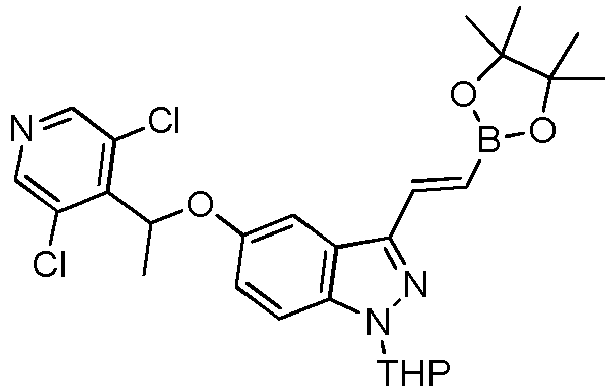
- Vinyl pinacol boronate (890mg, 5.79mmol), Pd(t-Bu3P)2 (130mg, 0.3 mmol) and triethylamine (900mg, 8.9mmol) were added to a solution of 1G (1.5g, 2.89mmol) in toluene (10mL) under nitrogen atmosphere, and the mixture was stirred under microwave conditions at 90°C for 2 hours. The reaction mixture was poured into sodium bicarbonate solution (50mL). The aqueous layer was extracted with ethyl acetate (50mL × 3), the combined organic phase was washed with brine and dried over anhydrous sodium sulfate, filtered, the filtrate was concentrated in vacuo and the residue was purified by column chromatography to give the title compound (1.2g, yield 76%). LCMS (ESI) m/z: 544.1 [M+1]+.
-

- 4-((5-Bromopyridin-2-yl)methyl)morpholine (60mg, 0.23mmol), Pd(dppf)Cl2 (20mg, 0.027mmol) and sodium carbonate (80mg, 0.75mmol) were added to a solution of Example 48A (80mg, 0.15mmol) in tetrahydrofuran (2.5mL) and water (0.5mL) under nitrogen atmosphere, and the mixture was stirred under microwave at 90°C for 1.5 hours. After being cooled to room temperature, the mixture was poured into ice-water (5mL). The aqueous layer was extracted with ethyl acetate (10mL × 3), and the organic layers were combined, washed with brine, dried over anhydrous sodium sulfate, filtered and the filtrate was concentrated in vacuo. The residue was purified by preparative thin layer chromatography to give the title compound (50mg, yield 57%). LCMS (ESI) m/z: 594.1 [M+1]+.
-

- Aqueous hydrochloric acid (0.6mL) was added dropwise to a solution of Example 48B (50mg, 0.08mmol) in methanol (8mL), the mixture was stirred at 28°C for 16 hours. The mixture was basified with saturated sodium bicarbonate solution (15mL). The aqueous layer was extracted with ethyl acetate (20mL × 3), the combined organic phase was washed with brine, dried over anhydrous sodium sulfate, filtered and the filtrate was concentrated in vacuo. The residue was purified by preparative thin layer chromatography (dichloromethane/methanol = 30: 1) to give the title compound (20mg, yield 40%). LCMS (ESI) m/z: 594.1 [M+1]+. 1HNMR (400 MHz, DMSO-d6) ppm 8.94 (s, 1H), 8.60 (s, 2H), 8.27 (dd, J = 8.0 &2.0 Hz, 1H), 7.65-7.69 (m, 2H), 7.49 (d, J = 8.8 Hz, 1H), 7.40 (s, 1H), 7.29 (d, J=17.2Hz, 1H), 7.11 (dd, J=9.2 &2.0 Hz, 1H), 6.18 (q, J=6.8 Hz, 1H), 4.53 (s, 2H), 3.89 (s, 4H), 3.31 (s, 4H), 1.79 (d, J = 7.2 Hz, 3H).
-

-

- Morpholine (1.48g, 0.017mol) and glacial acetic acid (0.2mL) were added to a solution of 2-chloronicotinaldehyde (2g, 0.014mol) in tetrahydrofuran (40mL) and the mixture was stirred at 20°C for 2 hours. The mixture was added with NaBH(OAc)3 (6g, 0.028mol) and stirred for 1 hour, then added with water (40mL) and extracted with ethyl acetate (30mL × 3). The organic layers were combined and washed with saturated brine, dried over sodium sulfate, filtered and the solvent was evaporated off under reduced pressure to give the title compound as a colorless oil (2g, yield 67%). 1H NMR (CHLOROFORM-d, Bruker Avance 400 MHz) ppm 8.30 (d, J=5.0 Hz, 1H), 7.34 (s, 1H), 7.21 (d, J=4.3 Hz, 1H), 3.79 - 3.65 (m, 4H), 3.48 (s, 2H), 2.52 - 2.36 (m, 4H).
-

- This example was prepared by the method as described in Example 48. LCMS (ESI) m/z: 510.0 [M+1]+.
1H NMR (DMSO-d6, Bruker Avance 400 MHz): ppm 8.74 (d, J=4.8 Hz, 1H), 8.62 (s, 2H), 7.90 (d, J=16.6 Hz, 1H), 7.73 (s, 1H), 7.51 (d, J=9.0 Hz, 1H), 7.43 (d, J=4.5 Hz, 1H), 7.37 - 7.27 (m, 2H), 7.12 (dd, J=2.1, 8.9 Hz, 1H), 6.17 (q, J=6.4 Hz, 1H), 4.40 (br. s., 2H), 3.22 (br. s., 8H), 1.79 (d, J=6.5 Hz, 3H). -

-

- Morpholine (1.1g, 0.013mol) and glacial acetic acid (0.2mL) were added to a solution of 5-bromonicotinaldehyde (2g, 0.01mol) in tetrahydrofuran (40mL) and stirred at 20°C for 2 hours. The mixture was added with NaBH(OAc)3 (4.3g, 0.02mol) and stirred for 1 hour, then added with water (40mL) and extracted with ethyl acetate (30mL × 3). The organic layers were combined and washed with saturated brine, dried over sodium sulfate, filtered and evaporated to dryness under reduced pressure to give the title compound (as a colorless oil, 2g, yield 71%).
-

- This example was prepared by the method as described in Example 48. LCMS (ESI) m/z: 510.0 [M+1]+.
1H NMR (DMSO-d6 , Bruker Avance 400 MHz): ppm 8.91 (s, 1H), 8.60 (s, 2H), 8.28 (s, 1H), 7.62 (d, J=16.8 Hz, 1H), 7.49 (d, J=9.0 Hz, 1H), 7.40 (s, 1H), 7.30 (d, J=16.8 Hz, 1H), 7.11 (dd, J=2.1, 9.2 Hz, 1H), 6.22 - 6.13 (m, 1H), 4.44 (br. s., 2H), 4.02 - 3.62 (m, 4H), 3.27 - 3.13 (m, 4H), 1.79 (d, J=6.8 Hz, 3H). -

- This example was prepared by the method as described in Example 48. LCMS (ESI) m/z: 511.1 [M+1]+.
1H NMR (DMSO-d6, BrukerAvance 400MHz) ppm 13.35 (s, 1H), 9.24 (s, 2H), 8.60 (s, 2H), 7.83 (d, J=16.8 Hz, 1H), 7.51-7.46 (m, 2H), 7.29 (d, J=16.8, 1H), 7.11-7.09(m, 1H), 6.20-6.16 (m, 1H), 4.72 (s, 2H), 3.93 (d, J=19.8, 4H), 3.52 (s, 4H), 1.79 (s, 3H). -

-
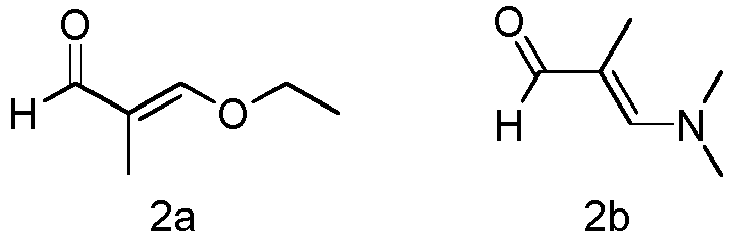
- At 0°C, DMF (62mL) was dropwise added slowly to vigorously stirred phosphorus oxychloride (64mL) below 30°C. After heated to 40°C, the reaction solution was slowly added with 1,1-diethoxypropane (53mL, 307.9mmol) with the temperature kept between 60°C to 70°C, and then the dark brown reaction solution was heated to 70°C and stirred for 2 hours. After cooled to room temperature, the mixture was poured to ice water and kept overnight, then adjusted to pH = 9 with anhydrous potassium carbonate. The aqueous layer was extracted with dichloromethane, the organic layer was dried and concentrated in vacuo to give the title compound as a liquid (15g, crude mixture).
-

- Sodium (12.2g, 530.3mmol) was added to absolute ethanol (200mL) at room temperature and the mixture was stirred until sodium disappeared. Then, a solution of (E)-3-ethoxy-2-methylacrolein and (E)-3-(dimethylamino)-2-methylacrolein (15g, 134mmol) in ethanol (100mL) and urea (9.6g, 159mmol) were added, the mixture was stirred under reflux for 2 days. The reaction solution was adjusted to pH = 9 and continued to reflux overnight, and then concentrated in vacuo. The residue was purified by column chromatography to give the title compound (9g). 1H NMR (400 MHz, DMSO-d6) ppm 7.92-8.14 (m, 2H), 2.52 (s, 3H).
-

- A solution of Example 52B (8.8g, 79.9mmol) in phosphorus oxychloride (50mL) was stirred overnight at 90°C. The reaction solution was poured into ice water, and sodium bicarbonate solution was added, the aqueous layer was extracted with dichloromethane. The organic layer was concentrated to give the title compound (2.8g). 1H NMR (400 MHz, DMSO-d6) ppm 2.27 (s, 3 H) 8.64 (s, 2 H).
-

- NBS (0.28g, 1.56mmol) and AIBN (0.05g, 0.31mmol) were added to a solution of Example 52C (0.2g, 1.56mmol) in carbon tetrachloride (10mL) and the mixture was stirred at 80°C for 12 hours. Water was added and the aqueous layer was extracted with dichloromethane. The organic layer was purified by preparative TLC (ethyl acetate) to give the title compound (40mg), LCMS (ESI) m/z: 206 [M+1]+.
-

- Morpholine (0.25g, 2.9mmol) and potassium carbonate (0.65g, 4.8mmol) were added to a solution of 5-(bromomethyl)-2-chloropyrimidine (0.5g, 2.4mmol) in DMF (5mL), and the mixture was stirred at room temperature for 12 hours. Water was added and the aqueous layer was extracted with dichloromethane. The organic layer was purified by preparative TLC to give the title compound (330mg), LCMS (ESI) m/z: 214 [M+1]+. 1H NMR (400 MHz, DMSO-d6) ppm 2.34 - 2.42 (m, 4 H), 3.50 - 3.54 (m, 2 H), 3.56 (d,J=4.52 Hz, 4 H), 8.71 (s, 2 H).
-

- This example was prepared by the method as described in Example 24K. LCMS (ESI) m/z: 511.1 [M+1]+.
1H NMR (DMSO-d6, Bruker Avance 400MHz) ppm 1.85 (d, J=6.62 Hz, 3 H) 3.46 - 3.56 (m, 1 H) 3.81 (t, J=12.46 Hz, 1 H) 4.10 (d, J=12.13 Hz, 2 H) 4.50 (s, 2 H) 6.20 (d, J=6.62 Hz, 1 H) 7.21 (dd, J=9.04, 1.98 Hz, 1 H) 7.27 (s, 1 H) 7.35 (d, J=16.32 Hz, 1 H) 7.50 (d, J=9.04 Hz, 1 H) 8.28 (d, J=16.32 Hz, 1 H) 8.50 (s, 2 H) 9.00 (s, 2 H). -

- This example was prepared by the method as described in Example 52. LCMS (ESI) m/z: 511.2 [M+1]+.
1H NMR (DMSO-d6, Bruker Avance 400MHz) ppm 1.83 (d, J=6.39 Hz, 3 H) 3.33 - 3.46 (m, 2 H) 3.60 (d, J=9.26 Hz, 2 H) 3.90 (br. s., 2 H) 4.09 (d, J=11.91 Hz, 2 H) 4.65 (br. s., 2 H) 6.17 (d, J=6.39 Hz, 1 H) 7.17 - 7.26 (m, 2 H) 7.36 (d, J=16.10 Hz, 1 H) 7.50 (d, J=9.04 Hz, 1 H) 8.03 (d, J=16.32 Hz, 1 H) 8.52 (br. s., 2 H) 8.75 - 8.87 (m, 2 H). -

- This example was prepared by the method as described in Example 52. LCMS (ESI) m/z: 511.1 [M+1]+.
1H NMR (MeOD-d4, Bruker Avance 400MHz) ppm 8.49 (s, 2H), 8.23 (d, J = 8.4 Hz, 1H), 8.07 (d, J = 16.4 Hz, 1H), 7.92 (d, J = 8.8 Hz, 1H), 7.51 - 7.49 (m, 2H), 7.36 (s, 1H), 7.22 (d, J = 2.0 Hz, 1H), 6.25 - 6.20 (q, 1H), 4.79 (s, 2H), 4.02 (s, 4H), 3.54 (s, 4H), 1.86 (d, J = 6.4 Hz, 3H). -

- This example was prepared by the method as described in Example 51. LCMS (ESI) m/z: 543.1 [M+1]+. 1H NMR (DMSO-d6, Bruker Avance 400MHz) ppm 1.77 (d,J=6.62 Hz, 3 H) 2.33 (d, J=1.76 Hz,4 H) 3.49 (s,2 H) 3.60 (d,J=4.19 Hz,4 H) 5.97 - 6.26 (m,1 H) 6.99 - 7.19 (m,1 H) 7.26 - 7.38 (m,2 H) 7.39 - 7.60 (m,5 H) 7.89 (d,J=7.94 Hz,1 H) 8.57 (s,2 H) 13.21 (s,1 H).
-
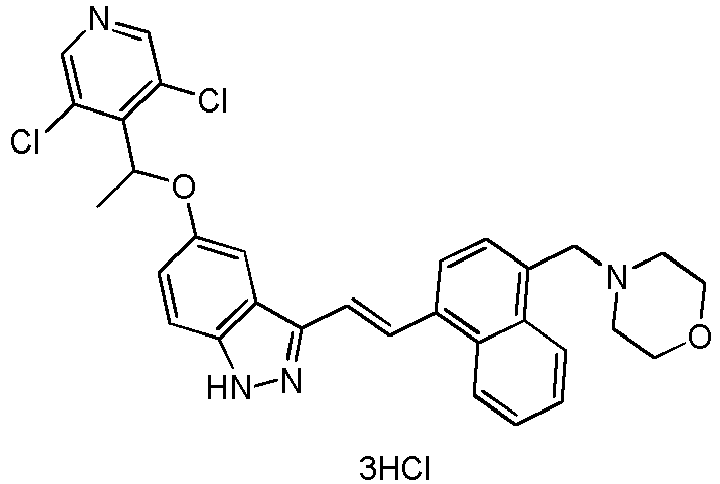
- This example was prepared by the method as described in Example 51. LCMS (ESI) m/z: 559.1 [M+1]+. 1H NMR (400 MHz, METHANOL-d4) ppm 8.45-8.33 (m, 4 H), 7.93 (d, J=9.2 Hz, 1 H), 7.81 (d, J=6.4 Hz, 4 H), 7.54 (d, J=8.8 Hz, 2 H), 7.32-7.28 (m, 2 H), 6.20 (d, J=6 Hz, 1H), 4.96 (s, 2 H) 4.06 (d, J=12.4 Hz 2 H) 3.85-3.80 (m, 2 H) 3.48 (s, 4 H), 1.84 (d, J=6.4 Hz, 3H).
-

- This example was prepared by the method as described in Example 51. LCMS (ESI) m/z: 577.1 [M+1]+. 1H NMR (CD3OD,400MHz): ppm 8.47 (s, 2H), 8.16 (s, 1H), 8.04 (d, J=6.8 Hz, 1H), 7.86 (d, J=8.4 Hz, 1H), 7.58 (d, J=16.8 Hz, 1H), 7.46 (d, J = 9.2 Hz, 1H), 7.30 (d, J=13.6 Hz, 2H), 7.23 (d, J=31.2 Hz, 1H), 6.23-6.18 (m, 1H), 4.62 (s, 2H), 4.08 (br. s., 2H), 3.80 (br. s., 2H), 3.46 (d, J = 41.6 Hz, 4H), 1.84 (d, J = 6.8 Hz, 3H).
-

- This example was prepared by the method as described in Example 51. LCMS (ESI) m/z: 523.2 [M+1]+. 1H NMR (DMSO-d6, Bruker Avance 400MHz) ppm 1.78 (d, J=6.62 Hz, 3 H) 2.43 - 2.46 (m, 3 H) 3.84 - 3.97 (m, 4 H) 4.35 (br. s., 2 H) 6.17 (q, J=6.62 Hz, 1 H) 7.09 (dd, J=8.93, 1.87 Hz, 1 H) 7.18 (d, J=16.76 Hz, 1 H) 7.33 (s, 1 H) 7.44 - 7.53 (m, 2 H) 7.57 (s, 2 H) 7.69 (d, J=8.38 Hz, 1 H) 8.61 (s, 2 H).
-

- This example was prepared by the method as described in Example 51. LCMS (ESI) m/z: 577.1 [M+1]+.
1H NMR (MeOD-d4 , Bruker Avance 400MHz) ppm 8.49 (s, 2H), 7.46 - 7.41 (m, 2H), 7.26 - 7.19 (m, 5H), 6.22 - 6.19 (m, 1H), 4.58 (s, 2H), 3.70 (t, J = 4.4 Hz, 4H), 2.58 (s, 4H), 1.85 (d, J = 6.8 Hz, 3H). -

-

- 2-Bromo-5-methylbenzonitrile (0.5g, 2.53mmol) and NBS (404.58mg, 2.27mmol) were dissolved in tetrachloromethane (20mL) and AIBN (catalytic amount) was added to the above solution. The reaction solution was refluxed for 12 hours at a range of temperature of 60°C to 80°C and the reaction solution was poured into water (20mL). The organic layer was separated, washed with brine, then dried over anhydrous sodium sulfate, and concentrated under pressure to give the title compound (as a colorless liquid, 0.5g, yield 72%).
-

- 2-Bromo-(benzylbromide)benzonitrile was dissolved in methanol (20mL). Morpholine (661.3mg, 7.58mmol) was added dropwise to the above solution and the reaction was stirred at room temperature for 16 hours. The pH of the reaction solution was adjusted to 2.0, the organic phase was washed with water (10mL × 3), and the pH of the organic layer was adjusted to 11. The final organic phase was extracted with dichloromethane (20mL) for three times and the organic phase was concentrated to give the title compound (as a pale yellow oil, 350mg, yield 49.4%). LCMS (ESI) m/z: 281.6 [M+1]+.
-

- This example was prepared by the method as described in Example 51. LCMS (ESI) m/z:534.1 [M+1]+.
1H NMR (MeOD-d4, Bruker Avance 400MHz):ppm.77 (d, J=6.39 Hz, 3 H) 2.39 (br. s., 4 H) 3.60 (br. s., 6 H) 6.15 (d, J=6.62 Hz, 1 H) 7.12 (d, J=8.82 Hz, 1 H) 7.39 - 7.59 (m, 3 H) 7.63 - 7.73 (m, 2 H) 7.77 (s, 1 H) 8.06 (d, J=8.16 Hz, 1 H) 8.57 (s, 2 H) 13.33 (br. s., 1 H). -

-

- 1-Bromo-2-Fluoro-4-methyl-5-nitrobenzene (2.0g, 8.5mmol) and NBS (1.53g, 8.6mmol) were dissolved in CCL4 (15mL) and AIBN (100mg, 0.61mmol) was added to the above solution. The reaction was refluxed for 16 hours. Water (20mL) was added to the solution and the organic layer was separated and washed with brine, dried over anhydrous sodium sulfate and concentrated under reduced pressure to give the title compound (as a brown oil, 2.7g, yield 50%).
-

- Example 61A (2.7g, 4.3mmol) was dissolved in methanol and morpholine (750mg, 8.6mmol) was slowly added dropwise at 0°C. The reaction solution was stirred at 0°C for 4 hours. The reaction solution was diluted with water (50mL) and extracted with dichloromethane (50mL × 2). The organic phase was dried over anhydrous sodium sulfate, filtered and concentrated under reduced pressure to give a residue. The residue was purified by column chromatography (ethyl acetate/petroleum ether = 1/10 to 1/5) to give the title compound (740mg, yield 54%). LCMS (ESI) m/z: 318.7 [M+1]+.
-

- Example 61B (200mg, 0.63mmol) was dissolved in toluene (4mL), and 4,4,5,5-tetramethyl-2-vinyl-1,3,2-boronic acid pinacol ester (200mg, 1.98mmol), Pd(t-Bu3P)2 (48mg, 0.09mmol) and Et3N (200mg, 1.98mmol) were added to the solution under nitrogen atmosphere, and the reaction solution was stirred under microwave conditions at 80°C for 1 hour. The reaction solution was poured into sodium bicarbonate solution (10mL), extracted with ethyl acetate (10mL × 3), washed with brine, dried and concentrated under reduced pressure to obtain a residue which was seperated by column chromatography to give the title compound (195mg, yield 56%). LCMS (ESI) m/z:393 [M+1]+.
-

- Example 61C (150mg, 0.28mmol) was dissolved in a mixture of tetrahydrofuran and water (5/1, 3mL). Then, 1G (170mg, 0.28mmol), Na2CO3 (100mg, 0.84mmol) and Pd(dppf)Cl2 (20mg, 0.027mmol) were added to the above solution under nitrogen atmosphere. The reaction solution was reacted under nitrogen atmosphere at 80°C for 1 hour under microwave conditions, and added with water (5mL). The mixture was extracted with ethyl acetate (10mL × 3), washed with brine, dried and concentrated under reduced pressure. The resulting residue was separated by thin layer chromatography (ethyl acetate/petroleum ether = 1/2) to give the title compound (220mg, yield 96%). LCMS (ESI) m/z:656.0 [M+1]+.
-

- Example 61D (80mg, 0.12mmol) was dissolved in a mixture of ethanol (10mL) and water (5mL). The reduced iron powder (50mg, 0.89mmol), ammonium chloride (50mg, 0.94mmol) were added to the reaction solution, and the reaction solution was refluxed for 6 hours. The reaction was quenched with saturated sodium bicarbonate solution (10mL) and extracted with dichloromethane (10mL × 3). The organic phase was washed with brine, dried over anhydrous sodium sulfate and concentrated under reduced pressure. The residue was separated by thin layer chromatography (methylene chloride/methanol = 20/1) to give the title compound (as a pale yellow liquid, 80mg, yield 73%). LCMS (ESI) m/z: 538.9 [M+1]+.
-

- Example 61E (80mg, 0.09mmol) was dissolved in methanol (2mL) and then concentrated hydrochloric acid (0.1mL) was added dropwise to the solution. The reaction solution was stirred at 30°C for 16 hours. The reaction solution was added with saturated sodium bicarbonate (15mL) and extracted with ethyl acetate (20mL × 3). The organic phase was concentrated under reduced pressure to give a residue. The residue was purified by thin layer chromatography (methylene chloride/methanol = 10/1) to give the title compound (as a pale yellow liquid, 44mg, yield 63%). LCMS (ESI) m/z: 542.0 [M+1]+. 1H NMR (CDCl3, Bruker Avance 400MHz):ppm 8.44 (s, 2H), 7.37 (d, J=8.8 Hz, 1H), 7.34 (s, 2H), 7.25 (d, J = 2.0 Hz, 1H), 7.16 (dd, J1 = 2.0 Hz, J2= 8.8, 1H), 6.91 (d, J=6.4 Hz, 1H), 6.83 (d, J=10.4 Hz, 1H), 6.10 (q, J = 6.4 Hz, 1H), 4.35 (d, J= 4.8 Hz, 2H), 3.75 (s, 3H), 3.56 (s, 1H), 3.48 (s, 6H), 1.82 (d, J= 6.4 Hz, 3H).
-

-

- 2-Bromo-4-fluoro-5-methylbenzonitrile (1g, 4.67mmol) and NBS (838mg, 4.7mmol) were dissolved in carbon tetrachloride (15mL). AIBN (50mg, 0.30mmol) was then added to the solution. The reaction was refluxed for 16 hours. The reaction was quenched in water (20mL), the organic phase was separated and washed with brine (40mL). The organic phase was dried over anhydrous sodium sulphate and evaporated to give the crude title compound (as a brown oil, 1.2g, purity 70%).
-
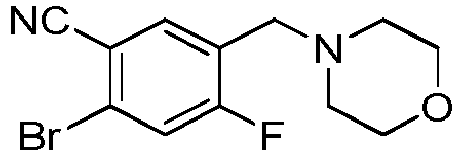
- Morpholine (500mg, 5.8mmol) was added dropwise to a solution of Example 62A (1.2g, 2.9mmol) in methanol (40mL) at 0°C and the mixture was allowed to react for 4 hours. The reaction solution was diluted with water (50mL) and extracted with dichloromethane (50mL×2). The organic phases were collected, dried over anhydrous sodium sulfate and filtered to give a filtrate which was evaporated to dryness under increased pressure. The residue was purified by column chromatography to give the title compound (600mg, yield 69%). LCMS (ESI) m/z: 300.6 [M+1]+.
-

- This example was prepared by the method as described in Example 51. LCMS (ESI) m/z: 551.9 [M+1]+.
1H NMR (MeOD-d4, Bruker Avance 400MHz): ppm 8.47 (s, 2H), 8.14 (d, J=6.8 Hz, 1H), 7.96 (d, J=11.2 Hz, 1H), 7.60-7.8 (m, 2H), 7.50 (d, J = 9.6 Hz, 1H), 7.42 (d, J= 1.6 Hz, 1H), 7.23 (dd, J1=8.8 Hz, J2=2.0 Hz, 1H), 6.24 (q, J = 7.2 Hz, 1H), 4.52 (s, 2H), 4.09 (d, J=12.4 Hz, 2H), 3.83 (t, J=12.4 Hz, 2H), 3.50 (d, J=12Hz, 2H), 3.35 (t, J=12.4 Hz, 2H), 1.84 (d, J = 6.4 Hz, 3H). -

-

- Vinyl pinacol boronate (923mg, 6mmol), Pd(t-Bu3P)2 (56mg, 0.11mmol) and triethylamine (1.1g, 10.9mmol) were added to a solution of 4-bromobenzaldehyde (1g, 5.45mmol) in toluene (10mL), and the mixture was stirred under nitrogen atmosphere at 80°C for 5 hours. The mixture was poured into sodium bicarbonate solution (10mL), the aqueous layer was extracted with ethyl acetate (10mL × 3), and the organic layers were combined and washed with brine, dried over anhydrous sodium sulfate, filtered, the filtrate was concentrated in vacuo and the residue was purified by column chromatography to give the title compound as a yellowish solid (1g, yield 71%). 1HNMR (CHLOROFORM-d, Bruker Avance 400MHz) ppm 10.01 (s, 1H), 7.86 (d, J = 8.3 Hz, 2H), 7.63 (d, J = 8.3 Hz, 2H), 7.43 (d, J = 18.6 Hz, 1H), 6.33 (d, J =18.3 Hz, 1H), 1.33 (s, 12H).
-

- Morpholine (202mg, 2.4mmol), sodium cyanoborohydride (93mg, 1.5mmol) and glacial acetic acid (0.1mL) were added to a solution of Example 63A (300mg, 1.2mmol) in dichloromethane (5mL) and the mixture was stirred for 2 hours at 30°C. Water (5mL) was added, the aqueous layer was extracted with dichloromethane (10mL × 3), the organic layers were combined, washed with brine, dried over anhydrous sodium sulfate, filtered and the filtrate was concentrated in vacuo. The residue was purified by preparative TLC (ethyl acetate/petroleum ether = 1: 10) to give the title compound as a yellowish oil (240mg, yield 63%), LCMS (ESI) m/z: 330.1 [M+1]+.
-

- 63B (96mg, 0.29mmol), Pd(dppf)Cl2 (15mg, 0.02mmol) and sodium carbonate (40mg, 0.38mmol) were added to a solution of 1G (100mg, 0.19mmol) in tetrahydrofuran (5mL) and water (1.0mL) under nitrogen gas atmosphere, and the mixture was stirred at 80°C for 18 hours. After being cooled to room temperature, the mixture was poured into ice-water (5mL). The aqueous layer was extracted with ethyl acetate (10mL × 3), the organic layers were combined and washed with brine, dried over anhydrous sodium sulfate, filtered and the filtrate was concentrated in vacuo. The residue was purified by preparative TLC (ethyl acetate/petroleum ether = 1: 2) to give the title compound as a yellowish oil (50mg, yield 43%). LCMS (ESI) m/z: 593.5 [M+1]+.
-
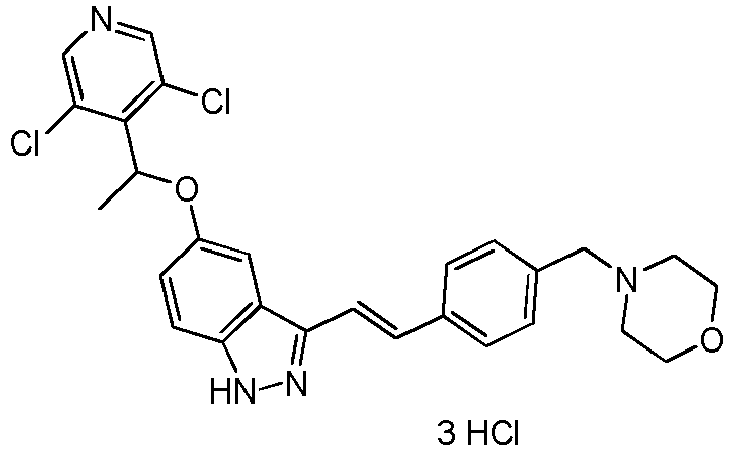
- The aqueous hydrochloric acid (0.1mL) was dropwise added to a solution of Example 63C (50mg, 0.08mmol) in methanol (2mL) and the mixture was stirred at 30°C for 4 hours, and then concentrated in vacuo. The residue was purified by preparative liquid chromatography to give the title compound (15mg, yield 35%), LCMS (ESI) m/z: 501.0 [M+1]+. 1H NMR (DMSO-d6, Bruker Avance 400MHz) ppm 11.35 (br. s., 1H), 8.62 (s, 2H), 7.78 - 7.71 (m, 2H), 7.67 (d, J = 8.3 Hz, 2H), 7.55 - 7. 46 (m, 2H), 7.35 (d, J = 2.0 Hz, 1H), 7.24 (d, J = 16.6 Hz, 1H), 7.14 - 7.08 (m, 1H), 6.18 (q, J = 6.8 Hz, 1H), 4.35 (d, J= 4.8 Hz, 2H), 4.00 - 3.92 (m, 3H), 3.26 (d, J = 12.0 Hz, 2H), 3.11 (d, J = 12.0 Hz, 3H), 1.79 (d, J = 6.5 Hz, 3H).
-

- This example was prepared by the method as described in Example 63. LCMS (ESI) m/z: 577.1 [M+1]+.
1H NMR (CDCl3, Bruker Avance 400MHz): ppm8.46 (s, 2H), 7.84-7.80 (m, 2H), 7.72 (s, 1H), 7.44-7.37 (m, 2H), 7.22-7.16 (m, 3H), 6.12-6.06 (m, 1H), 3.73 (d, J = 28.0 Hz, 6H), 2.53 (s, 4H), 1.85 (d, J= 6.8 Hz, 3H).

-

-

- HCl/MeOH solution (4M, 30mL) was added to 6-oxo-1,6-dihydropyridazine-3-carboxylic acid (3g, 0.02mol) and the mixture was heated to 80°C and stirred for 2 hours. The solvent was evaporated to dryness under reduced pressure to give the title compound (2.8g, yield 85%). 1H NMR (CHLOROFORM-d, Bruker Avance 400 MHz) ppm 11.26 (br. s., 1H), 7.91 (d, J=10.0 Hz, 1H), 7.02 (d, J=10.0 Hz, 1H), 3.99 (s, 3H).
-

- POCl3 (5.60g, 0.036mol) was added to a solution of Example 65A (2.8g, 0.018mol) in toluene at room temperature and the mixture was heated to 120°C and stirred for 2 hours. The solvent was evaporated to dryness, water (20mL) was added and the mixture was extracted with ethyl acetate (15mL × 3). The combined organic layer was washed with brine, dried over sodium sulfate, filtered and the filtrate was evaporated. The residue was purified by column chromatography to give the title compound (1.5g, yield 50%). 1H NMR (CHLOROFORM-d, Bruker Avance 400 MHz) ppm 8.17 (d, J=8.8 Hz, 1H), 7.68 (d, J=8.8 Hz, 1H), 4.09 (s, 3H).
-

- 47A (1g, 1.93mmol), Example 65B (400mg, 2.32mmol), Na2CO3 (307mg, 2.9mmol), a mixed solvent of acetonitrile/water (9mL/3mL) and Pd (PPh3)2Cl2 (135mg, 0.19mmol) were added to the microwave reaction tube at room temperature. Then, the mixture was heated to 130°C and reacted for 30 minutes in the microwave reactor under nitrogen atmosphere. The reaction solution was diluted with water (10mL) and extracted with ethyl acetate (15mL × 3). The combined organic layer was washed with saturated brine, dried over sodium sulfate, filtered and evaporated. The residue was purified by column chromatography to give the title compound (500mg, yield 50%). LCMS (ESI) m/z: 540.0 [M+1]+.
-

- Potassium carbonate (229mg, 1.66mmol) was added to a solution of Example 65C (450mg, 0.83mmol) in DMF at room temperature and methyl iodide (118mg, 0.83mmol) was added dropwise. The mixture was stirred at 20°C for 2 hours, added with water (10mL) and extracted with ethyl acetate (15mL×3). The combined organic layer was washed with brine, dried over sodium sulfate, filtered and the filtrate was evaporated. The residue was purified by column chromatography to give the title compound (160mg, yield 35%). LCMS (ESI) m/z: 554.0 [M+1]+.
-

- LiAlD4 (24mg, 0.58mmol) was added to a solution of Example 65D (160mg, 0.29mmol) in tetrahydrofuran (5mL) at 0°C. The mixture was stirred at 0°C for 2 hours. The reaction was quenched with water (0.1mL), filtered and the filtrate was evaporated to dryness under reduced pressure to give the title compound (158mg, crude). LCMS (ESI) m/z: 528.1[M+1]+.
-

- Methanesulfonyl chloride (38mg, 0.33mmol) was added in batches to a solution of Example 65E (158mg, 0.30mmol) and triethylamine (61mg, 0.60mmol) in dichloromethane (5mL) at 0°C. The reaction solution was stirred at 0°C for 1 hour, and then poured into ice water (10mL). After layering, the organic layer was washed successively with saturated sodium bicarbonate solution (10mL) and brine (20mL), dried over sodium sulfate, filtered and the filtrate was evaporated. The residue was purified by column chromatography to give the title compound (84mg, yield 46%). LCMS (ESI) m/z: 606.0[M+1]+
-

- Morpholine (14.5mg, 0.17mmol) and triethylamine (21mg, 0.029mmol) were added to a solution of Example 65F (84mg, 0.14mmol) in dichloromethane (5mL). The mixture wad stirred for 18 hours at 15°C, added with water (10mL) and extracted with dichloromethane (15mL×3). The combined organic layers were washed with brine, dried over sodium sulfate, filtered and the filtrate was evaporated. The residue was purified by column chromatography to give the title compound (40mg, yield 49%). LCMS (ESI) m/z: 597.1[M+1]+.
-

- Concentrated hydrochloric acid (0.1mL) was added dropwise to a solution of Example 65G (40mg, 0.07mmol) in methanol (2mL). The mixture was heated to 50°C and stirred for 4 hours, filtered and the filtrate was separated by preparative high performance liquid chromatography to give the title compound (26mg, yield 76%). LCMS (ESI) m/z: 513.1[M+1]+. 1H NMR (DMSO-d6, Bruker Avance 400 MHz): ppm 8.60 (s, 2H), 8.21 (d, J=8.8 Hz, 1H), 8.06 (d, J=16.8 Hz, 1H), 7.84 (d, J=8.8 Hz, 1H), 7.55 - 7.44 (m, 2H), 7.38 (s, 1H), 7.14 (dd, J=2.3, 90 Hz, 1H), 6.22 - 6.15 (m, 1H), 3.87 (br. s., 4H), 3.34 (br. s., 4H), 1.79 (d, J=6.5 Hz, 3H).


-
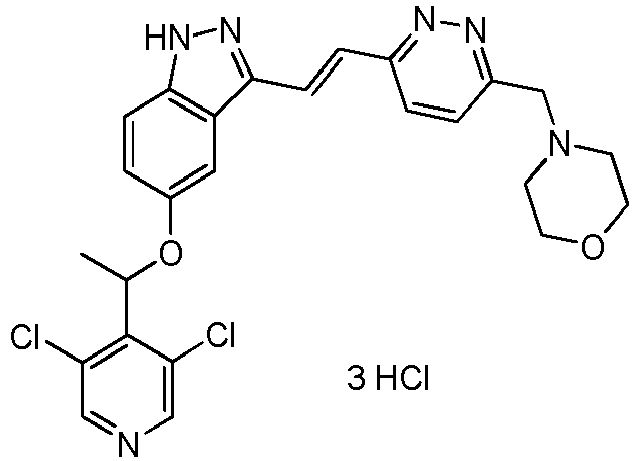
-

- Hydrazine hydrate (6,85g, 136.89mmol) was added to a solution of 2-oxoglutaric acid (20g, 136.89mmol) in ethanol (200mL) and the mixture was stirred at 60°C for 3 hours, then cooled and filtered to give a portion of the title compound (12g, crude) and the filtrate was concentrated to give the yellowish title compound (8g, crude). 1H NMR (400MHz, DMSO-d6) ppm 11.17 (s, 1H), 2.78 - 2.68 (m, 2H), 2.45 - 2.36 (m, 2H).
-

- Liquid bromine (38.23g, 239.25mmol) was slowly added dropwise to a solution of Example 66A (20g, 140.74mmol) in glacial acetic acid (200mL) at 25°C. After the addition, the mixture was heated to 80°C and stirred for 3 hours. When TLC showed that the starting material was consumed completely, the reaction solution was cooled and filtered to give the title compound (20g, crude). 1H NMR (400MHz, DMSO-d6) ppm 13.49 (s, 1H), 7.80 (d, J=9.8 Hz, 1H), 6.92 (d, J=9.8 Hz, 1H).
-

- Concentrated sulfuric acid (19.9g, 202.9mmol) was slowly added dropwise to a solution of Example 66B (20g, 142.76mmol) in methanol (500mL). After the addition, the mixture was heated to 70°C and stirred for 2 hours. Then, the reaction solution was cooled and concentrated in vacuo, added with ice water (300mL) and filtered, the filter cake was washed with water to give the title compound (17g, yield 73.4%). 1H NMR (400MHz, DMSO-d6) ppm 13.62 (s., 1H), 7.83 (d, J=10.0 Hz, 1H), 6.97 (d, J=9.8 Hz, 1H), 3.85 (s, 3H).
-

- A solution of Example 66C (5g, 32.44mmol) in phosphorus oxychloride (60mL) was stirred at 110°C for 3 hours. The solution was cooled and concentrated in vacuo. The residue was slowly added to ice water (20mL). The precipitate was filtered and the filter cake was washed with water to give pale white title compound (1.8g, yield 32.15%). 1H NMR (400MHz, DMSO-d6) ppm 8.27 (d, J=9.0 Hz, 1H), 8.13 (d, J=9.0 Hz, 1H), 3.96 (s, 3H).
-

- A solution of Example 65D (600mg, 3.48mmol), vinyl pinacol borate (803.2mg, 5.22mmol), potassium carbonate (961.07mg, 6.95mmol) and Pd(PPh3)4 (602.66mg, 521.53mmol) in DMF (8mL) was stirred at 100°C for 5 hours under nitrogen atmosphere. The solution was cooled, filtered and concentrated in vacuo. The residue was purified by column chromatography to give the title compound (500mg, yield 84.02%). 1H NMR (400MHz, CHLOROFORM-d) ppm 8.18 (d, J=8.8 Hz, 1H), 7.72 (d, J=8.8 Hz, 1H), 7.16 (dd, J=11.0, 17.8 Hz, 1H), 6.44 (d, J=17.8 Hz, 1H), 5.85 (d, J=10.8 Hz, 1H), 4.10 (s, 3H).
-

- A suspension of Example 66E (200mg, 1.22mmol), 1G (694.43mg, 1.34mmol), POT (37.08mg, 121.83µmol), palladium acetate (27.35mg, 121.83mmol) and triethylamine (369.85mmol, 3.65mmol) in DMF (4mL) was stirred at 110°C for 30 minutes under microwave conditions and nitrogen atmosphere. The suspension was cooled, filtered and the filtrate was concentrated in vacuo. The residue was purified by preparative TLC to give the yellow title compound (345mg, yield 50%), LCMS (ESI) m/z: 554.4 [M+1]+. 1H NMR (400MHz, DMSO-d6) ppm 8.60 (s, 2H), 8.26 (q, J=9.0 Hz, 1H), 8.13 (d, J=16.6 Hz, 1H), 7.74 (d, J=9.0 Hz, 1H), 7.59 (d, J=17.1 Hz, 1H), 7.47 (s, 1H), 7.20 (d, J=9.0 Hz, 1H), 6.23 (dd, J=3.0, 6.5 Hz, 1H), 5.86 (d, J=9.5 Hz, 1H), 4.00 (s, 3H), 3.87 (br. s., 1H), 3.75 (br. s., 1H), 2.68 (br. s., 1H), 2.41 - 2.31 (m, 2H), 2.00 (br. s., 3H), 1.81 (d, J=6.5 Hz, 3H).
-

- Lithium aluminum hydride (10.27mg, 270.55mmol) was slowly added to a solution of Example 66F (100mg, 180.37µmol) in tetrahydrofuran (1mL) at 0°C and then the mixture was stirred at this temperature for 30 minutes. The reaction was quenched with water (0.1mL), aqueous sodium hydroxide (0.1mL, 15%) and water (0.3mL), filtered and the filtrate was concentrated in vacuo. The residue was purified by preparative TLC to give the title compound as a yellow oil (30mg, 30.33 %). LCMS (ESI) m/z :526.4 [M+1]. 1H NMR (400MHz, METHANOL-d4) ppm 8.51 (s, 2H), 8.08 (d, J=8.8 Hz, 1H), 7.93 - 7.86 (m, 2H), 7.65 (d, J=9.0 Hz, 1H), 7.54 (d, J=16.8 Hz, 1H), 7.36 (s, 1H), 7.22 (dd, J=2.1, 9.2 Hz, 1H), 6.24 (q, J=6.7 Hz, 1H), 5.79 (d, J=9.3 Hz, 1H), 4.94 (s, 2H), 3.99 (br. s., 1H), 3.81 (t, J=10.8 Hz, 1H), 3.62 - 3.56 (m, 1H), 2.58 - 2.44 (m, 1H), 2.15 (d, J=13.3 Hz, 1H), 2.05 (br. s., 1H), 1.87 (d, J=6.8 Hz, 3H), 1.76 - 1.62 (m, 3H).
-

- Dess-Martin oxdizer (36.26mg, 85.48mmol) was added to a solution of Example 66G (30mg, 56.99mmol) in dichloromethane (2mL) at 0°C and the suspension was stirred at 25°C for 12 hours, then filtered, the filtrate was concentrated in vacuo and the residue was purified by preparative thin layer chromatography to give the title compound (25mg, yield 81.98%), LCMS (ESI) m/z: 524.4 [M+1]+.
1H NMR (400MHz, CHLOROFORM-d) ppm 10.44 (s, 1H), 8.47 (s, 2H), 8.14 - 8.00 (m, 2H), 7.82 (d, J=8.8 Hz, 1H), 7.70 - 7.51 (m, 2H), 7.35 (s, 1H), 7.19 (dd, J=2.1, 9.2 Hz, 1H), 6.16 (q, J=6.5 Hz, 1H), 5.70 (dd, J=2.9, 8.9 Hz, 1H), 4.04 (br. s., 1H), 3.81 - 3.71 (m, 1H), 2.54 (d, J=9.5 Hz, 1H), 2.24 - 2.02 (m, 2H), 1.87 (d, J=6.5 Hz, 3H), 1.82 - 1.67 (m, 3H). -

- Acetic acid (3.44mg, 57.2µmol) was added dropwise to a mixed solution of Example 66H (30mg, 57.21µmol) and morpholine (15mg, 171.63µmol) in 1,2-dichloroethane (2mL), and the mixture was stirred at 28°C for 2 hours after the addition. Sodium cyanoborohydride (11mg, 171.6mmol) was slowly added and the mixture was stirred for 1 hour at 28°C. The reaction was quenched with water, and the aqueous layer was extracted with dichloromethane (3mL × 3), the combined organic layer was washed with brine and dried over anhydrous sodium sulfate, filtered and the filtrate was concentrated in vacuo. The residue was purified by preparative TLC to give the title compound as a yellow oil (25mg, crude), LCMS (ESI) m/z: 594.2 [M+1]+.
-

- Example 661 (25mg, 42µmol) was dissolved in dry methanol (1mL) and then the solution was added dropwise to acetyl chloride (0.2mL) in dry methanol (0.8mL). The reaction solution was stirred at 40°C for 1 hour, concentrated in vacuo and the residue was purified by preparative liquid chromatography to give the title compound as a yellow oil (8mg, yield 37.26%). LCMS (ESI) m/z: 528.4 [M+1]+. 1H NMR (400MHz, METHANOL-d4) ppm 8.59 (m, 2H), 8.20 (d, J=8.8 Hz, 1H), 8.06 (d, J=16.8 Hz, 1H), 7.88 (d, J=8.5 Hz, 1H), 7.60 - 7.48 (m, 2H), 7.36 (s, 1H), 7.26 - 7.19 (m, 1H), 6.28 - 6.20 (m, 1H), 4.80 (m, 2H), 4.03 (m, 4H), 3.62 - 3.48 (m, 4H), 1.91 - 1.83 (d, 3H).
-

- This example was prepared by the method as described in Example 66. 1H NMR (400MHz, DMSO-d6) ppm 8.59 (s, 2H), 8.21 (d, J=8.8 Hz, 1H), 8.09 - 7.97 (m, 2H), 7.55 - 7.43 (m, 2H), 7.38 (d, J=1.8 Hz, 1H), 7.12 (dd, J=2.3, 9.0 Hz, 1H), 6.17 (q, J=6.5 Hz, 1H), 4.72 (s, 2H), 3.90 (m, 4H), 3.35 (m, 4H), 1.78 (d, J=6.5 Hz, 3H)
-

- This example was prepared by the method as described in Example 66. 1H NMR (400MHz, DMSO-d6) ppm 9.50 (m, 1H), 8.59 (s, 2H), 8.20 (d, J=8.8 Hz, 1H), 8.01 (d, J=16.8 Hz, 1H), 7.84 (d, J=8.8 Hz, 1H), 7.52 (d, J=9.0 Hz, 1H), 7.46 (d, J=16.8 Hz, 1H), 7.36 (s, 1H), 7.15 - 7.10 (m, 1H), 6.17 (d, J=6.8 Hz, 1H), 4.58 (m, 2H), 3.95 (d, J=7.3 Hz, 1H), 2.66 (m, 2H), 2.32 (m, 2H), 2.06 (d, J=11.5 Hz, 2H), 1.78 (d, J=6.5 Hz, 3H), 1.70 (d, J=11.8 Hz, 2H)
-

- This example was prepared by the method as described in Example 66. 1H NMR (400MHz, METHANOL-d4) ppm 8.63 (d, J=9.0 Hz, 1H), 8.51 (s, 2H), 8.30 (d, J=16.6 Hz, 1H), 8.20 (d, J=9.0 Hz, 1H), 7.65 (d, J=16.6 Hz, 1H), 7.55 (d, J=9.0 Hz, 1H), 7.49 (d, J=1.8 Hz, 1H), 7.23 (dd, J=2.0, 9.0 Hz, 1H), 6.27 (q, J=6.8 Hz, 1H), 5.04 - 4.94 (m, 2H), 4.67 (br. s., 1H), 4.09 - 3.72 (m, 3H), 2.33 - 2.11 (m, 2H), 1.88 (d, J=6.5 Hz, 3H).

-

-

- 5-(4,4,5,5-Tetramethyl-1,3,2-diboricacid-2-yl)pyridin-2-amino (205mg, 0.93mmol), Pd(dppf)Cl2 (57mg, 0.078mmol) and sodium carbonate (165mg, 1.56mmol) were added to a mixed solution of Example 1G (400mg, 0.78mmol) in acetonitrile (6mL) and water (2mL). The reaction was heated under microwave to 100°C under nitrogen atmosphere and stirred for 15 minutes. The reaction solution was added with water (10mL) and washed with ethyl acetate (15mL×3) and brine, dried and the filtrate was concentrated to give a residue. The residue was purified by column chromatography to give the title compound (340mg, yield 91%). LCMS (ESI) m/z: 483.9[M+1]+.
-
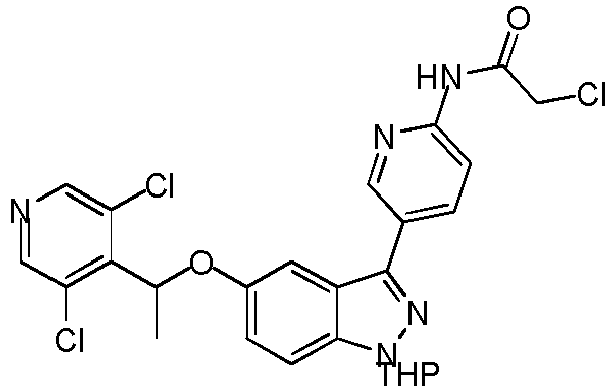
- Dichloroacetyl chloride (35mg, 0.31mmol) and triethylamine (31mg, 0.31mmol) were added to a solution of Example 70A (100mg, 0.21mmol) in dichloromethane (5mL). The reaction solution was stirred at 15°C for 18 hours, added with water (10mL), and then extracted with dichloromethane (15mL × 3), the organic phase was washed with brine, dried and the filtrate was evaporated to give a residue which was purified by column chromatography to give the title compound (as a brown oil, 73mg, yield 63%). LCMS (ESI) m/z: 559.6[M+1] +.
-

- Morpholine (14mg, 0.16mmol) and triethylamine (20mg, 0.20mmol) were added to a solution of Example 70B (73mg, 0.13mmol) in dichloromethane (5mL). The reaction solution was stirred at 15°C for 18 hours, added with water (10mL) and extracted with dichloromethane (15mL × 3), the organic phase was washed with brine, dried and the filtrate was evaporated to give a residue which was separated by thin layer chromatography to give the title compound (as a brown oil, 75 mg, yield 74%). LCMS (ESI) m/z: 611.1 [M+1]+.
-

- Concentrated hydrochloric acid (0.1mL) was added dropwise to a solution of Example 70C (75mg, 0.12mmol) in methanol (2mL). The reaction was stirred at 50°C for 4 hours, filtered and the filtrate was separated by liquid chromatography to give the title compound (23mg, yield 34%). LCMS (ESI) m/z: 510.0[M+1]+. 1H NMR (DMSO-d6, Bruker Avance 400 MHz): ppm 10.18 (s, 1H), 8.76 (s, 1H), 8.58 (s, 2H), 8.27 - 8.18 (m, 2H), 7.51 (d, J=8.8 Hz, 1H), 7.25 (s, 1H), 7.12 (dd, J=2.0, 9.0 Hz, 1H), 6.16 (q, J=6.6 Hz, 1H), 3.73 - 3.60 (m, 4H), 3.25 (s, 2H), 2.57 (br. s., 4H), 1.76 (d, J=6.5 Hz, 3H).

-

-

- N-methylpiperazine (2.8g, 28.4mmol) and potassium carbonate (7.8g, 56.8 mmol) were added to a solution of 5-bromo-2-fluoropyridine (5.0g, 28.4 mmol) in DMF (50mL) at 30°C. The mixture was heated to 80-90°C and stirred for 16 hours, cooled to 33°C, added with water (50mL) and extracted with ethyl acetate (50mL×3). The combined organic layer was washed with water (20mL×3), dried over sodium sulfate, filtered and the filtrate was evaporated. The residue was purified by column chromatography to give the title compound (5.3g, yield 73%). 1H NMR (CDCl3, Bruker Avance 400 MHz): ppm 8.21 (d, J =2.3 Hz, 1H), 7.54 (dd, J = 9.0 Hz, 2.5 Hz, 1H), 6.56 (d, J = 9.0 Hz, 1H), 3.57-3.52 (m, 4H), 2.55-2.50 (m, 4H), 2.36 (s, 3H).
-

- Pd(t-Bu3P)2 (20mg, 0.04mmol) was added to a solution of Example 71A (1.0g, 3.90mmol), 4,4,5,5-tetramethyl-2-vinyl-1,3,2-dioxaborolane (0.66g, 4.30mmol) and triethylamine (0.79g, 7.80mmol) in toluene (10mL) at 30 °C and the mixture was degassed for 10 minutes and then protected with nitrogen. The reaction solution was heated to 80°C, stirred for 16 hours, then cooled to 35°C and evaporated to remove the solvent under reduced pressure. The residue is purified by column chromatography to give the title compound (as a yellow oil, 370mg, crude). LCMS (ESI) m/z: 330.0[M+1]+.
-

- 5-(1-(3,5-Dichloropyridin-4-yl)ethoxy)-3-iodo-1-(tetrahydro-2H-pyran-2-yl)-1H-indazole (79mg, 0.15mmol), potassium carbonate (32mg, 0.30mmol) and Pd(dppf)Cl2 (11mg, 0.015mmol) were added to a mixed solution of Example 71B (50 mg, 0.15mmol) in tetrahydrofuran/water (v/v = 5/1, 5 ml) at 37°C. The mixture was degassed for 10 minutes and then protected with nitrogen. The reaction solution was heated to 75°C, stirred for 16 hours, then cooled to 30°C, added with water (10mL) and extracted with ethyl acetate (20mL). The organic layer was dried over sodium sulfate, filtered and evaporated. The residue was purified by preparative thin layer chromatography to give the title compound (as a yellow oil, 50mg, crude). LCMS (ESI) m/z: 606.2 [M+1]+.
-

- Concentrated hydrochloric acid (0.2mL) was added dropwise to a solution of Example 70C (50mg, 0.08mmol) in methanol (4mL) at 0°C. The mixture was heated to 38°C and stirred for 16 hours. The reaction solution was separated by preparative high performance liquid chromatography and recrystallized from acetonitrile to give the title compound (5.0mg, yield 10%). 1H NMR (DMSO-d 6, Bruker Avance 400 MHz): ppm 8.61 (s, 2H), 8.36 (d, J = 1.8 Hz, 1H), 8.23 (d, J = 8.8 Hz, 1H), 7.47-7.36 (m, 3H), 7.26-7.16 (m, 2H), 7.08 (dd, J1 = 9.0 Hz, J2 = 2.0 Hz, 1H), 6.17 (q, J = 6.6 Hz, 1H), 4.52 (d, J = 13.6 Hz, 2H), 3.45-3.36 (m, 4H), 3.24-2.95 (m, 4H), 2.81 (d, J = 2.5 Hz, 3H), 1.78 (d, J = 6.5 Hz, 3H).

-

- This example was prepared by the method as described in Example 17.
LCMS (ESI) m/z: 523.2[M+1]+.
1H NMR (DMSO-d6, Bruker Avance 400MHz): ppm 10.83 - 10.65 (m, 1H), 8.61 (s, 2H), 7.77 - 7.62 (m, 4H), 7.56 - 7.45 (m, 2H), 7.33 (s, 1H), 7.24 (d, J=16.8 Hz, 1H), 7.15 - 7.07 (m, 1H), 6.22 - 6.11 (m, 1H), 4.28 (dd, J=13.3, 4.5 Hz, 2H), 3.32 (d, J=11.5 Hz, 2H), 3.18 - 3.12 (m, 2H), 2.99 - 2.90 (m, 1H), 2.07 - 1.90 (m, 2H), 1.84 - 1.69 (m, 5H). -

- This example was prepared by the method as described in Example 17.
LCMS (ESI) m/z: 536.3 [M+1]+.
1H NMR (DMSO-d6, Bruker Avance 400MHz): ppm 12.09 - 11.52 (m, 1H), 8.63 - 8.57 (m, 2H), 7.72 (s, 4H), 7.54 - 7.46 (m, 2H), 7.34 (d, J=1.5 Hz, 1H), 7.24 (d, J=16.8 Hz, 1H), 7.10 (dd, J=9.0, 2.0 Hz, 1H), 6.16 (q, J=7.0 Hz, 1H), 4.58 - 4.40 (m, 3H), 3.46 (brs, 4H), 2.81 (brs, 6H), 2.42 - 2.28 (m, 1H), 1.77 (d, J=6.5 Hz, 3H). -

- This example was prepared by the method as described in Example 17.
LCMS (ESI) m/z: 537.2[M+1]+.
1H NMR (DMSO-d6, Bruker Avance 400MHz): ppm 10.48 (brs, 1H), 8.61 (s, 2H), 7.73 (d, J=8.0 Hz, 2H), 7.65 (d, J=8.0 Hz, 2H), 7.54 - 7.46 (m, 2H), 7.34 (d, J=1.8 Hz, 1H), 7.24 (d, J=16.8 Hz, 1H), 7.11 (dd, J=8.9, 1.9 Hz, 1H), 6.17 (q, J=6.5 Hz, 1H), 4.27 (d, J=4.8 Hz, 2H), 3.38 - 3.26 (m, 4H), 2.91 (q, J=10.5 Hz, 2H), 1.87 - 1.77 (m, 5H), 1.69 - 1.44 (m, 3H). -

- This example was prepared by the method as described in Example 17.
LCMS (ESI) m/z: 536.1 [M+1]+.
1H NMR (DMSO-d6, BrukerAvance 400MHz): ppm 10.80 (brs, 1H), 9.74 (brs, 1H), 8.61 (s, 2H), 7.75 - 7.64 (m, 4H), 7.53 - 7.46 (m, 2H), 7.35 (s, 1H), 7.24 (d, J=16.6 Hz, 1H), 7.10 (dd, J=9.0, 2.0 Hz, 1H), 6.18 (q, J=6.5 Hz, 1H), 4.24 - 4.17 (m, 2H), 3.51 (d, J=11.5 Hz, 2H), 3.31 - 3.25 (m, 1H), 3.02 (q, J=11.1 Hz, 2H), 2.71 (d, J=4.3 Hz, 3H), 2.40 - 2.33 (m, 2H), 2.16 - 2.02 (m, 2H), 1.78 (d, J=6.5 Hz, 3H). -

- This example was prepared by the method as described in Example 17.
LCMS (ESI) m/z: 497.1 [M+1]+.
1H NMR (DMSO-d6, Bruker Avance 400MHz): ppm 9.23 (brs, 1H), 9.02 (brs, 1H), 8.61 (s, 2H), 7.74 - 7.69 (m, 2H), 7.67 - 7.61 (m, 2H), 7.53 - 7.46 (m, 2H), 7.34 (s, 1H), 7.23 (d, J=16.8 Hz, 1H), 7.10 (dd, J=8.9, 1.9 Hz, 1H), 6.18 (q, J=6.5 Hz, 1H), 4.21 (t, J=5.3 Hz, 2H), 3.63 - 3.57 (m, 2H), 3.21 - 3.15 (m, 1H), 1.78 (d, J=6.5 Hz, 3H), 1.28 (d, J=6.5 Hz, 3H) -

- This example was prepared by the method as described in Example 17.
LCMS (ESI) m/z: 523.1 [M+1]+.
1H NMR (DMSO-d6, Bruker Avance 400MHz): ppm 9.53 (brs, 2H), 8.61 (s, 2H), 7.75 - 7.70 (m, 2H), 7.68 - 7.64 (m, 2H), 7.53 - 7.46 (m, 2H), 7.34 (d, J=1.5 Hz, 1H), 7.24 (d, J=16.8 Hz, 1H), 7.10 (dd, J=9.0, 2.0 Hz, 1H), 6.18 (q, J=6.5 Hz, 1H), 4.17 (d, J=5.5 Hz, 4H), 3.35 - 3.27 (m, 3H), 2.11 - 2.04 (m, 2H), 1.80 - 1.71 (m, 5H). -

- This example was prepared by the method as described in Example 17.
LCMS (ESI) m/z: 555.1 [M+1]+. -

- This example was prepared by the method as described in Example 17.
LCMS (ESI) m/z: 507.1[M+1]+
1H NMR (400MHz, METHANOL-d4): ppm 8.60-8.47 (m, 2H), 7.83-7.76 (m, 2H), 7.68-7.63 (m, 2H), 7.61-7.55 (m, 1H), 7.52-7.43 (m, 2H), 7.41-7.34 (m, 1H), 7.33-7.30 (m, 1H), 6.29-6.21 (m, 1H), 4.37 (s, 2H), 3.56-3.47 (m, 2H), 3.10-2.98 (m, 2H), 2.04-1.93 (m, 2H), 1.88 (d, m, 6H), 1.63-1.51 (m, 1H). -

- This example was prepared by the method as described in Example 17.
LCMS (ESI) m/z: 583.1 [M+1]+
1H NMR (400MHz, METHANOL-d4) : ppm 8.60 - 8.47 (m, 2H), 7.83 - 7.76 (m, 2H), 7.68 - 7.63 (m, 2H), 7.61 - 7.55 (m, 1H), 7.52 - 7.43 (m, 2H), 7.41 - 7.34 (m, 1H), 7.33 - 7.30 (m, 1H), 6.29 - 6.21 (m, 1H), 4.37 (s, 2H), 3.56 - 3.47 (m, 2H), 3.10 - 2.98 (m, 2H), 2.04 - 1.93 (m, 2H), 1.88 (d, m, 6H), 1.63 - 1.51 (m, 1H). -

- This example was prepared by the method as described in Example 17.
LCMS (ESI) m/z: 584.1 [M+1]+ -

- This example was prepared by the method as described in Example 17.
LCMS (ESI) m/z: 600.2 [M+1]+ -
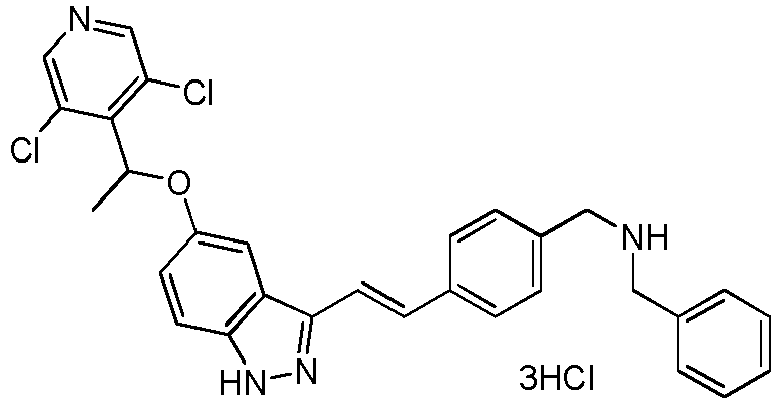
- This example was prepared by the method as described in Example 17.
LCMS (ESI) m/z: 529.1 [M+1]+ -

- This example was prepared by the method as described in Example 17.
LCMS (ESI) m/z: 539.1 [M+1]+
1H NMR (400MHz, DMSO-d6 ) : ppm 11.5 (brs, 1 H), 8.60 (s, 2H), 7.75 - 7.66 (m, 4H), 7.54 - 7.47 (m, 2H), 7.34 (s, 1H), 7.26 - 7.22 (m, 1H), 7.10 (dd, J = 8.0, 1.6 Hz, 1H), 6.20 - 6.15 (m, 1H), 4.37 (brs, 2H), 4.01 - 3.99 (m, 2H), 3.41 - 3.48 (m, 3H), 3.38 - 3.28 (m, 2H), 3.06 - 2.91 (m, 2H), 1.78 (d, J = 6.4 Hz, 3H). -

- This example was prepared by the method as described in Example 17.
LCMS (ESI) m/z: 552.1 [M+1] +
1H NMR (400MHz, DMSO-d6 ) : ppm 11.4 (brs, 1 H), 9.85 (brs, 2H), 8.61 (s, 2H), 7.73 - 7.66 (m, 4H), 7.53 - 7.47 (m, 2H), 7.35 (s, 1H), 7.26 - 7.22 (m, 1H), 7.11 (dd, J = 8.0, 1.6 Hz, 1H), 6.20 - 6.15 (m, 1H), 4.23 (brs, 2H), 4.00 (brs, 2H), 3.56 (brs, 3H), 3.17 (brs, 2H), 1.76 (d, J = 6.4 Hz, 3H). -

- This example was prepared by the method as described in Example 17.
LCMS (ESI) m/z: 597.1 [M+1]+ -

- This example was prepared by the method as described in Example 17.
LCMS (ESI) m/z: 557.1 [M+1]+ -

- This example was prepared by the method as described in Example 17.
LCMS (ESI) m/z: 522.1 [M+1]+ -

- This example was prepared by the method as described in Example 17.
LCMS (ESI) m/z: 543.1 [M+1]+ -
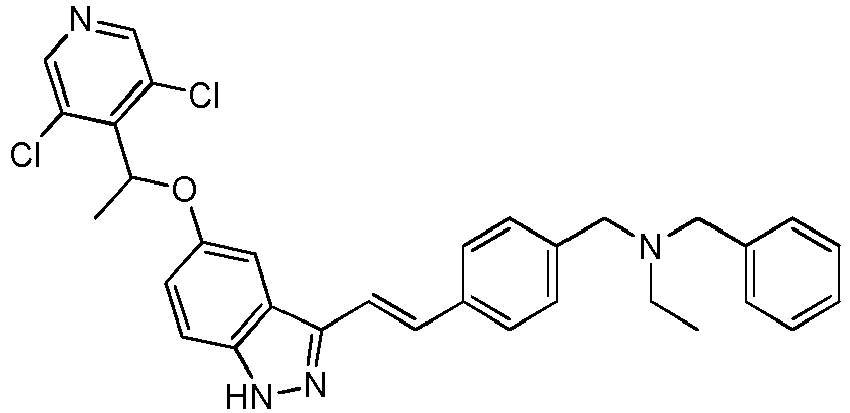
- This example was prepared by the method as described in Example 17.
LCMS (ESI) m/z: 558.1 [M+1]+ -

- This example was prepared by the method as described in Example 17.
LCMS (ESI) m/z: 522.1 [M+1]+
1H NMR (DMSO-d6, Bruker Avance 400MHz): ppm 10.34-10.21 (m, 1H), 10.14 (brs, 1H), 8.65 - 8.59 (m, 2H), 7.77 - 7.69 (m, 4H), 7.55 - 7.46 (m, 2H), 7.35 (d, J=2.0 Hz, 1H), 7.24 (d, J=16.8 Hz, 1H), 7.10 (dd, J=9.0, 2.0 Hz, 1H), 6.18 (q, J=7.0 Hz, 1H), 4.41 (brs, 2H), 3.86 - 3.76 (m, 1H), 3.62 - 3.46 (m, 4H), 3.34 - 3.26 (m, 1H), 3.15 (t, J=12.3 Hz, 1H), 1.78 (d, J=6.5 Hz, 3H), 1.32 (d, J=6.3 Hz, 3H). -

- This example was prepared by the method as described in Example 17.
LCMS (ESI) m/z: 514.9 [M+1]+ -

- This example was prepared by the method as described in Example 17.
LCMS (ESI) m/z: 523.1 [M+1]+ -
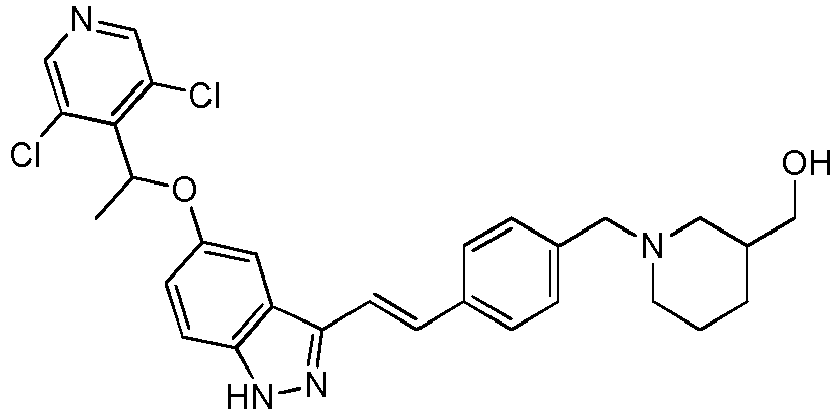
- This example was prepared by the method as described in Example 17.
LCMS (ESI) m/z: 537.1 [M+1] + -

- This example was prepared by the method as described in Example 17.
LCMS (ESI) m/z: 550.1 [M+1]+
1H NMR (DMSO-d6, Bruker Avance 400MHz): ppm 11.64 (br. s., 1H), 8.61 (s, 2H), 7.79 - 7.73 (m, 2H), 7.71 - 7.65 (m, 2H), 7.55 - 7.45 (m, 2H), 7.35 (d, J = 1.5 Hz, 1H), 7.24 (d, J=16.8 Hz, 1H), 7.10 (dd, J=2.0, 9.0 Hz, 1H), 6.18 (q, J=6.5 Hz, 1H), 4.42 (br. s., 2H), 3.69 - 3.45 (m, 9H), 1.78 (d, J=6.5 Hz, 3H), 1.28 (d, J=6.0 Hz, 6H). -

- This example was prepared by the method as described in Example 17.
LCMS (ESI) m/z564.1 [M+1]+ -

- This example was prepared by the method as described in Example 17.
LCMS (ESI) m/z: 549.2 [M+1]+ -

- This example was prepared by the method as described in Example 17.
LCMS (ESI) m/z: 509.0 [M+1]+
1H NMR (DMSO-d6, Bruker Avance 400MHz): ppm 11.56 - 11.41 (m, 0.5H), 11.08 - 10.94 (m, 0.5H), 8.61 (s, 2H), 7.76 - 7.64 (m, 4H), 7.54 - 7.45 (m, 2H), 7.35 (s, 1H), 7.24 (d, J=16.8 Hz, 1H), 7.10 (dd, J=9.0, 1.8 Hz, 1H), 6.18 (q, J=6.4 Hz, 1H), 4.47 - 4.32 (m, 3H), 3.55 - 3.39 (m, 1.5H), 3.32 - 3.12 (m, 2H), 3.01 - 2.96 (m, 0.5H), 2.34 - 2.26 (m, 0.5H), 2.08-1.86 (m, 1.5H), 1.78 (d, J=6.8 Hz, 3H). -

- This example was prepared by the method as described in Example 17.
LCMS (ESI) m/z: 524.9 [M+1]+ -
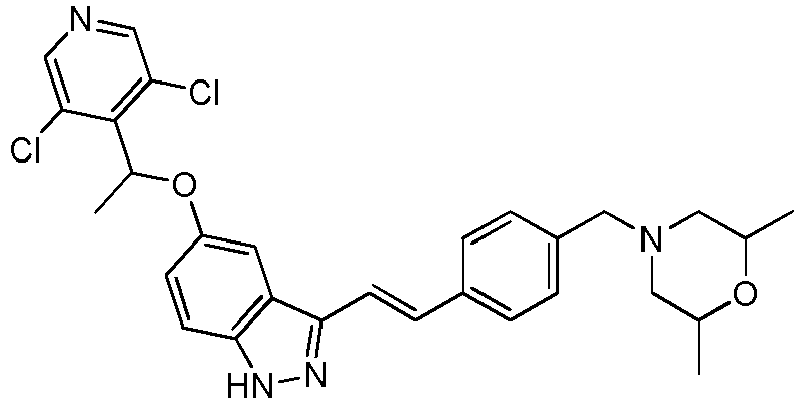
- This example was prepared by the method as described in Example 17.
LCMS (ESI) m/z: 537.1 [M+1]+ -

- This example was prepared by the method as described in Example 17.
LCMS (ESI) m/z: 550.1 [M+1]+

-

-

- 4-Carboxybenzyl boronate (84mg, 0.50mmol), Pd(dppf)Cl2 (29mg, 0.04mmol) and sodium carbonate (83mg, 0.78mmol) were added to a mixed solution of a compound 1G (200mg, 0.39mmol) in tetrahydrofuran (5mL) and water (1mL) at room temperature under nitrogen atmosphere, and the reaction solution was heated to 80°C for 18 hours. The reaction solution was cooled to room temperature, added with water (5mL) and extracted with ethyl acetate (10mL×3). The combined organic phase was washed with brine, dried, filtered and the filtrate was evaporated to dryness. The residue was purified by flash silica gel column chromatography to give the title compound (85mg, yield 43%). LCMS (ESI) m/z: 512.0 [M+1]+1
-

- (R)-1-Aminoisopropanol (7mg, 0.09mmol) was added to a solution of Example 111A (40mg, 0.08mmol), HATU (46mg, 0.12mmol) and triethylamine (24mg, 0.24mml) in DMF (2mL) at room temperature. The reaction solution was stirred at 30°C for 1 hour. The reaction solution was added with water (5mL) and extracted with ethyl acetate (10mL×3). The organic phases were combined and washed with brine and dried. The filtrate was evaporated to dryness to give the title compound (50mg, crude). LCMS (ESI) m/z: 569.1 [M+1]+1
-

- Example 111B (50mg, 0.08mmol) was dissolved in methanol (2mL) and concentrated HCl (0.1mL) was slowly added dropwise. The reaction solution was stirred at room temperature for 4 hours. The reaction solution was concentrated and purified by preparative HPLC to give the target compound (18mg, yield 42%). LCMS (ESI) m/z: 485 [M+1]+1 1H NMR (DMSO-d6, BrukerAvance 400MHz): ppm 8.63 (s, 2H), 8.53 (t, J=5.3 Hz, 1H), 8.01 (d, J=8.3 Hz, 2H), 7.84 (d, J=8.3 Hz, 2H), 7.52 (d, J=9.0 Hz, 1H), 7.20 (d, J=1.8 Hz, 1H), 7.13 (dd, J=2.1, 8.9 Hz, 1H), 6.13 (q, J=6.5 Hz, 1H), 3.84 (td, J=6.2, 12.4 Hz, 2H), 3.32 - 3.18 (m, 2H), 1.77 (d, J=65 Hz, 3H), 1.10 (d, J=6.3 Hz, 3H).
-

- This example was prepared by the method as described in Example 111.
LCMS (ESI) m/z: 510.1 [M+1]+
1H NMR (400 MHz, DMSO-d6) : ppm 9.64 (d, J=10.4 Hz, 1H), 9.16 (s, 2H), 8.63 (d, J=4.4 Hz, 2H), 7.82 (t, J=3.6 Hz, 2H), 7.59 (d, J=7.6 Hz, 2H), 7.52 (d, J=4.4 Hz, 1H), 7.16-7.11 (m, 2H), 6.12-6.07 (m, 1H), 4.51 (m, 1H), 4.06 (m, 1H), 3.21 (m, 3H), 3.05 (m, 2H), 1.76 (d, J=6.8 Hz, 3H), 1.39 (d, J=5.6 Hz, 3H). -

- This example was prepared by the method as described in Example 111.
LCMS (ESI) m/z: 497.0 [M+1]+ -
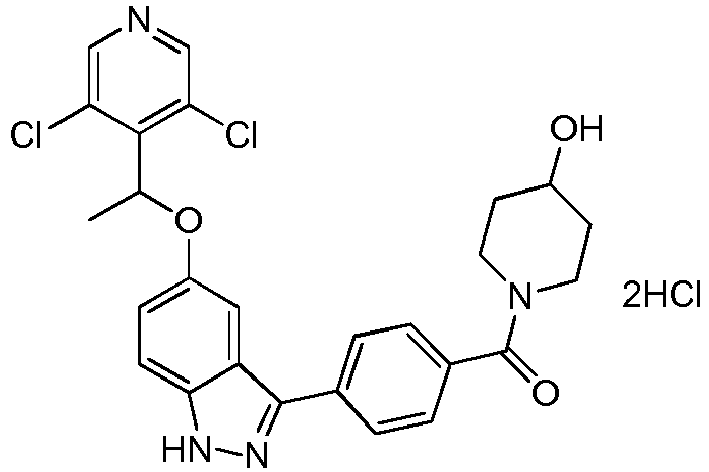
- This example was prepared by the method as described in Example 111.
LCMS (ESI) m/z: 511.1 [M+1]+
1H NMR (DMSO-d6, varian 400MHz): ppm 8.60 (s, 2H), 7.77 (d, J=8.0 Hz, 3H) 7.50 (s, 1H) 7.49 (d, J=8.0Hz, 2H), 7.13 (d, J=2Hz, 2H), 7.11-7.08 (m, 2H), 6.07 (dd, J=6.8Hz, J=13.6Hz, 1H), 4.02 (s, 1H), 3.75 (m, 1H), 3.20(s, 2H), 1.75-1.73 (m, 5H), 1.39 (s, 2H). -

- This example was prepared by the method as described in Example 111.
LCMS (ESI) m/z: 540.2 [M+1]+ -

- This example was prepared by the method as described in Example 111. LCMS (ESI) m/z: 509.9 [M+1] +
-

- This example was prepared by the method as described in Example 111. LCMS (ESI) m/z: 538.3 [M+1]+
-

- This example was prepared by the method as described in Example 111. LCMS (ESI) m/z: 497.3 [M+1]+
1H NMR (400 MHz, DMSO-d6) : ppm 8.63 (d, 2H), 7.80 (d, J = 8, 2H), 7.65 (dd, J= 3.2, J= 7.6, 2H), 7.51 (d, J= 9.2, 1H), 7.16 (s, 1H), 7.13 (d, J = 8.8, 1H), 6.10 (t, J= 2.8,1 H), 4.28 (s, 2H), 3.45-3.66 (m, 3H), 1.98-1.92 (m, 2H), 1.76 (d, J = 6.4, 3H). -

- This example was prepared by the method as described in Example 111. LCMS (ESI) m/z: 552.3 [M+1]+
-

- This example was prepared by the method as described in Example 111. LCMS (ESI) m/z: 524.2 [M+1]+
1H NMR (400 MHz, DMSO-d6): ppm 11.42 (s, 1H), 8.64 (s, 2H), 7.82 (d, J=7.60 Hz, 2H), 7.69 (d, J=6.80 Hz, 2H),7.52 (d, J=9.20 Hz, 1H), 7.13 (t, 2H), 6.07 (d, J=6.40 Hz, 1H), 3.89 (m, 5H), 2.80 (s, 6H), 2.29 (m, 3H), 1.74 (d, J=6.80 Hz, 3H). -

- This example was prepared by the method as described in Example 111.
LCMS (ESI) m/z: 540.2 [M+1]+ -

- This example was prepared by the method as described in Example 111.
LCMS (ESI) m/z: 532.1 [M+23] +
1H NMR (400MHz, DMSO-d6): ppm 13.26 (s, 1H), 8.62 (s, 2H), 8.18 (s, 1H), 7.81 (d, J=8.0 Hz, 2H), 7.56 (d, J=8.0 Hz, 2H), 7.51 (d, J=9.2 Hz,1H), 7.17 (s, 1H), 7.12 (dd, J1=2 Hz, J2=9.2 Hz 1H), 6.12-6.06 (m, 1H), 4.41-4.39 (m, 2H), 3.12-2.85 (m, 5H), 1.76 (d, J=6.4 Hz, 3H), 1.12-1.10 (m, 3H).

-

-

- A suspension of Example 24H (600mg, 1.16mmol), 3-methoxycarbonyl-phenylboronic acid (229.23mg, 1.27mmol), Pd(dppf)Cl2 (84.73mg, 115.79µmol) and potassium phosphate trihydrate (925.10mg, 3.47mmol) and triethylamine (555.53mmol, 5.49mmol) in THF/H2O (4/2 mL) was stirred under nitrogen atmosphere at 100°C for 2 hours. The reaction solution was added with water (50mL) and extracted with ethyl acetate (50mL × 3), dried over anhydrous sodium sulfate and concentrated in vacuo. The residue was purified by column chromatography to give the title compound (600mg, yield 93.35%), LCMS(ESI) m/z: 526.2 [M+1]+. 1H NMR (CHLOROFORM-d, 400 MHz) ppm 8.51 (d, J=1.00 Hz, 1H), 8.40 (d, J=2.51 Hz, 2H), 7.95-8.07 (m, 2H), 7.47-7.58 (m, 2H), 7.24 (d, J=1.51 Hz, 1H), 7.15 (dd, J=2.01, 9.03 Hz, 1H), 6.08 (q, J=6.53 Hz, 1H), 5.69 (ddd, J=3.01, 6.02, 9.03 Hz, 1H), 4.00-4.07 (m, 1H), 3.97 (s, 3H), 3.73 (t, J=10.29 Hz, 1H), 2.59 (dd, J=3.26, 7.78 Hz, 1H), 2.06-2.23 (m, 2H), 1.71-1.84 (m, 5H).
-

- Lithium hydroxide monohydrate (51.34mg, 1.35mmol) was added in one batch to a solution of Example 1A (600mg, 1.14mmol) in methanol/tetrahydrofuran/water (6/6/4 mL) at 30°C, then the mixture was stirred at this temperature for 5 hours. The reaction solution was concentrated in vacuo, added with water (50mL), adjusted to pH = 6 with 2M dilute hydrochloric acid, extracted with ethyl acetate (50mL × 3). The organic phase was dried over anhydrous sodium sulfate and concentrated in vacuo to give the title compound (520mg, yield 85.26%). 1H NMR (CHLOROFORM-d, 400 MHz) ppm 8.44-8.56 (m, 1H), 8.03-8.19 (m, 1H), 7.48-7.62 (m, 1H), 7.12-7.23 (m, 1H), 6.08 (q, J=6.53 Hz, 1H), 5.66-5.75 (m, 1H), 4.03 (d, J=6.53 Hz, 1H), 3.74 (br. s., 1H), 2.53-2.67 (m, 1H), 2.06-2.23 (m, 2H), 1.59-1.86 (m, 6H).
-

- 4-Amino tetrahydropyran hydrochloride (23.63mg, 1.42mmol) was added to a solution of Example 127A (80mg, 156.13mmol), HATU (89.05mg, 234.20mmol) and DIPEA (80.72mg, 624.54mmol) in DMF (5mL) at 30°C and the suspension was stirred at 30°C for 2 hours. The mixture was added with water (50mL) and extracted with ethyl acetate (50mL×3), dried over anhydrous sodium sulfate and concentrated in vacuo. The residue was purified by preparative thin layer chromatography to give the title compound as a yellow oil (90mg, yield 89.05%), LCMS(ESI)m/z: 595.1 [M+1]+.
-
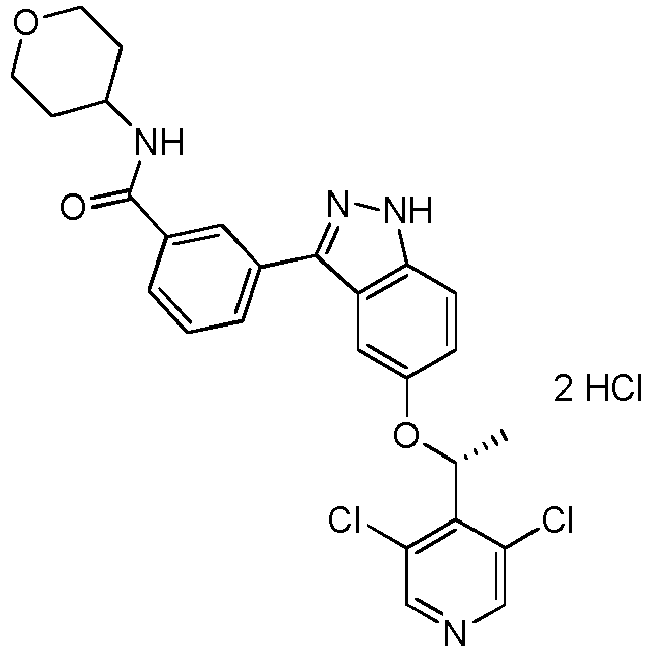
- Acetyl chloride (1mL) was added dropwise to methanol (4 mL) at 0°C, and the mixture was stirred for 15 minutes, then Example 127C (90mg, 151.13µmοl) was added to the solution. After the addition, the mixture was stirred at 40°C for 2 hours, then concentrated in vacuo, and the residue was purified by preparative HPLC (hydrochloric acid system) to give the title compound (20mg, yield 24.16%).
LCMS (ESI) m/z: 511.2 [M+1]+. 1H NMR (METHANOL-d4, 400 MHz) ppm 8.49 (s, 2H), 8.22 (s, 1H), 7.88 (d, J=7.28 Hz, 2H), 7.59-7.67 (m, 1H), 7.54 (d, J=9.29 Hz, 1H), 7.27 (dd, J=2.01, 9.03 Hz, 1H), 7.16 (d, J=1.76 Hz, 1H), 6.15 (q, J=6.78 Hz, 1H), 4.11-4.27 (m, 1H), 4.02 (d, J=9.29 Hz, 2H), 3.56 (t, J=11.67 Hz, 2H), 1.97 (d, J=11.29 Hz, 2H), 1.66-1.84 (m, 5H). -

- This example was prepared by the method as described in Example 127. LCMS (ESI) m/z [M + H]+: 497.1 [M+1]+.
-

- This example was prepared by the method as described in Example 127. LCMS(ESI) m/z [M + H]+: 525.3 [M+1]+.

-

-

- 3-Bromobenzaldehyde (1g, 5.40mmol), pinacolato-4,4,5,5-tetramethyl-2-vinyl-1,3,2-borate (1.2g, 8.10µmol), Pd(OAc)2 (121.24mg, 0.54mmol) and PPh3 (283.27mg, 1.08mmol) and Na2CO3 (1.14mg, 10.80mmol) were dissolved in a mixture of water (3mL) and DMF (9mL), the mixture was reacted at 80°C under nitrogen atmosphere for 12 hours. Thin layer chromatography (petroleum ether: ethyl acetate = 2/1) indicated that the starting material was completely reacted. The reaction mixture was concentrated under reduced pressure and the residue was purified by silica gel column chromatography (petroleum ether/ethyl acetate = 40/1 to 30/1) to give the title compound (as a yellowish oil, 540.00mg, 3.40µmol, yield 63.05%). 1H NMR (400 MHz, METHANOL-d4) 9.99-10.05 (m, 1H), 7.98 (s, 1H), 7.71-7.86 (m, 2H), 7.48-7.60 (m, 1H), 6.78-6.90 (m, 1H), 5.93 (d, J=17.57 Hz, 1H), 5.38 (d, J=11.04 Hz, 1H)
-

- Example 24H (300.00mg, 0.58mmol), 132A (76.52mg, 578.96mmol), Et3N (175.75mg, 1.74mmol) and PPh3 (283.27mg, 1.08mmol), Pd(OAc)2 (13.00mg, 57.90 mmol), tri-o-tolylphosphine (17.62mg, 57.90mmol) were dissolved in DMF (4mL) and the mixture was reacted at 100°C under nitrogen atmosphere for 12 hours. Thin-layer chromatography (petroleum ether: ethyl acetate = 2/1) indicated that the starting material was completely reacted. The reaction mixture was quenched with 5mL ice-water, stirred for 5 minutes and then extracted with ethyl acetate (10mL×3), then layering. The organic phase was washed with brine, dried over anhydrous sodium sulfate, filtered, and the solvent was evaporated. The residue was purified by silica gel column chromatography (petroleum ether/ethyl acetate = 15/1) to give the title compound (220.00mg, 421.12µmol, yield 72.74%). LCMS (ESI) m/z [M + H]+ : 552.1.
-

- Acetic acid (0.80mg, 13.4µmol) was added dropwise to a mixed solution of Example 132B (70mg, 133.99µmol) and tetrahydropyran-4-amino (40.66mg, 401.97µmol) in 1,2-dichloroethane (1mL), and the mixture was stirred at 20°C for 30 minutes after the addition. Sodium cyanoborohydride (25.26mg, 401.98µmol) was slowly added and the mixture was stirred for 2 hours at 20°C. The reaction solution was quenched with water. The aqueous layer was extracted with dichloromethane (10 mL×3), and the organic layers were combined and washed with brine (10mL×2), dried over anhydrous sodium sulfate, filtered and the filtrate was concentrated in vacuo. The residue was purified by thin layer chromatography (petroleum ether/ethyl acetate = 1/1) to give the title compound (as a yellow oily liquid, 30mg, 49.38µmol, yield 36.85%). LCMS (ESI) m/z [M + H]+: 607.4
-

- Example 132C (30.00mg, 49.38µmol) was dissolved in dry methanol (1mL) and then this solution was added dropwise to a solution of acetyl chloride (1mL) in dry methanol (4mL) at 0°C. The reaction solution was warmed to 40°C and stirred for 30 hours. Upon the completion of the reaction, the solvent was spun off to give the title compound (22mg, 42.03µmol, yield 85.11%). LCMS (ESI) m/z [M + H]+: 522.3
-

- This example was prepared by the method as described in Example 132. LCMS (ESI) m/z [M + H]+: 509.1
-

- This example was prepared by the method as described in Example 132. LCMS (ESI) m/z [M + H]+: 537.5


-

-

- A suspension of bis-pinacol boronate (995.45mg, 6.46mmol), 5-bromo-2-(dimethoxymethyl)pyridine (1g, 4.31mmol), Pd(dppf)Cl2 (315.29mg, 0.43mmol) and potassium carbonate (1.79g, 12.93mmol) in dioxane (15mL) was heated at 100°C for 16 hours under nitrogen atmosphere. The suspension was cooled, added with water (10mL), extracted with ethyl acetate (3 × 10mL), washed with brine, dried, filtered and the filtrate was concentrated in vacuo. The residue was purified by column chromatography to give the title compound as a yellow oil (700mg, yield 87%). 1H NMR (400MHz, CHLOROFORM-d) = 8.63 (d, J=1.8 Hz, 1H), 7.80 (dd, J=2.1, 8.2 Hz, 1H), 7.53 (d, J=8.3 Hz, 1H), 6.74 (dd, J=11.0, 17.6 Hz, 1H), 5.86 (d, J=17.8 Hz, 1H), 5.45 - 5.37 (m, 2H), 3.43 (s, 6H)
-

- A suspension of Example 137A (850mg, 4.74mmol), 24H (2.46g, 4.74mmol), POT (144.27mg, 474mmol), palladium acetate (106.42mg, 474mmol) and DIEA(1.84g, 14.2 mmol) in DMF (30mL) was stirred at 100°C for 16 hours under nitrogen atmosphere. The suspension was cooled, filtered and the filtrate was concentrated in vacuo. The residue was purified by preparative column chromatography to give the title compound as a yellow oil (1.4g, yield 52%). LCMS (ESI) m/z [M+H]+: 569.4. 1H NMR (400MHz, CHLOROFORM-d) ppm 8.82 - 8.77 (m, 1H), 8.46 (s, 2H), 8.40 - 8.36 (m, 1H), 7.95 (dd, J=2.0, 8.3 Hz, 1H), 7.60 (d, J=8.0 Hz, 1H), 7.45 (d, J=16.8 Hz, 1H), 7.28 - 7.22 (m, 1H), 7.21 - 7.15 (m, 2H), 6.18 - 6.07 (m, 1H), 5.65 (ddd, J=2.5, 5.8, 9.0 Hz, 1H), 5.47 - 5.43 (m, 1H), 4.05 (t, J=8.9 Hz, 1H), 3.86 - 3.69 (m, 2H), 3.50 - 3.42 (m, 6H), 2.61 - 2.49 (m, 1H), 2.22 - 2.11 (m, 1H), 2.09 - 1.99 (m, 3H), 1.85 (d, J=6.5 Hz, 3H), 1.80 - 1.73 (m, 2H)
-

- A mixed solution of Example 137B (1.4g, 2.46mmol) and p-benzenesulfonic acid monohydrate (234mg, 1.23mmol) in water (5mL) and acetone (15mL) was stirred at 50°C for 3 hours. After cooled, the aqueous layer was extracted with dichloromethane (10mL×3), and the organic layers were combined, washed with brine, dried over anhydrous sodium sulfate, filtered and the filtrate was concentrated in vacuo to give the title compound (1.2g, yield 76%) which was used directly in next step. LCMS (ESI) m/z: 541.4 (M+1).
-

- A mixed solution of Example 137C (100mg, 191µmοl) and morpholine (50mg, 573.15µmol) in 1,2-dichloroethane (2mL) was added with acetic acid (100µL) until pH = 5. After the addition, the mixture was stirred at 29°C for 2 hours. Sodium cyanoborohydride (36mg, 573.15µmol) was slowly added and the mixture was stirred for 3 hours at 29°C. The reaction solution was quenched with water and the aqueous layer was extracted with dichloromethane (5 mL × 3), the organic layers were combined, washed with brine, dried over anhydrous sodium sulfate, filtered and the filtrate was concentrated in vacuo to give the title compound as a dark oil (100mg, crude). LCMS (ESI) m/z: 594.2 [M+1]+.
-

- A mixed solution of methanol (1mL)/acetyl chloride (0.25ml) was added to a solution of Example 137D (100mg, 148µmol) in methanol (1mL), and the mixture was heated to 40°C and stirred for 3 hours, then cooled in vacuo to give the title compound (20.00mg, yield 46%). LCMS (ESI) m/z 510.4 (M+1). 1H NMR (400MHz, METHANOL-d4) ppm 8.95 (d, J=1.8 Hz, 1H), 8.51 (s, 2H), 8.26 (dd, J=2.0, 8.3 Hz, 1H), 7.67 (d, J=8.0 Hz, 1H), 7.60 (d, J=16.8 Hz, 1H), 7.51 (d, J=9.3 Hz, 1H), 7.37 (s, 2H), 7.25 (dd, J=2.1, 9.2 Hz, 1H), 6.24 (q, J=6.7 Hz, 1H), 4.61 (s, 2H), 4.04 - 3.98 (m, 4H), 3.47 (t, J=4.5 Hz, 4H), 1.87 (d, J=6.5 Hz, 3H).
-

- 1H NMR (400MHz, METHANOL-d4) ppm 9.06 (s, 1H), 8.60 - 8.49 (m, 3H), 7.98 (d, J=8.0 Hz, 1H), 7.71 (d, J=16.6 Hz, 1H), 7.57 (d, J=9.0 Hz, 1H), 7.46 (d, J=16.8 Hz, 1H), 7.39 - 7.28 (m, 2H), 6.25 (q, J=6.5 Hz, 1H), 4.84 (s, 2H), 4.66 (br. s., 1H), 3.70 (br. s., 4H), 2.39 (br. s., 1H), 2.18 (br. s., 1H), 1.86 (d, J=6.5 Hz, 3H).
-
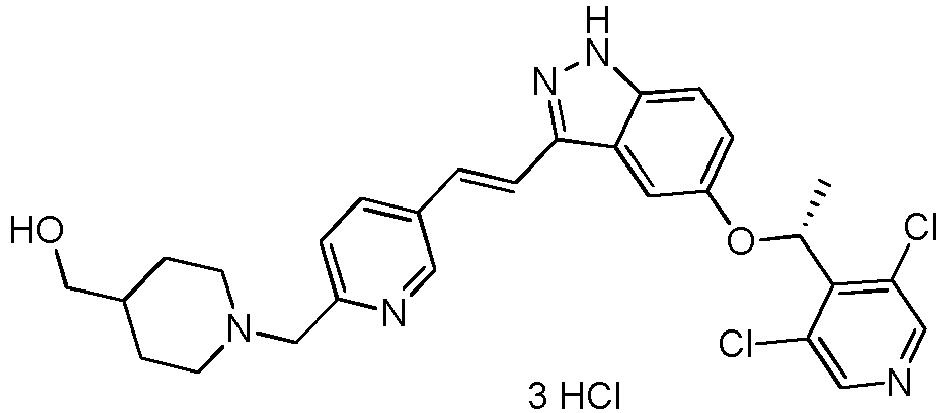
- This example was prepared by the method as described in Example 137. LCMS (ESI) m/z: 538.4 (M+1).
-


-
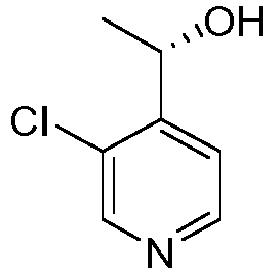
- A solution of 1-(3-chloro-4-pyridine)ethanone (1g, 6.43mmol) in tetrahydrofuran (5mL) was added dropwise to a solution of DIPCl (3.09g, 9.65mmol) in tetrahydrofuran (5mL) at -20°C and the mixture was stirred at this temperature for 1.5 hours, then heated to 0°C and stirred for half an hour. The reaction was quenched with methanol (3mL) and concentrated. The residue was added with water (15mL), extracted with ethyl acetate (3×10mL), washed with brine (10mL), dried, filtered and the filtrate was concentrated in vacuo. The residue was purified by column chromatography to give the title compound as a yellow oil (650mg, yield 61%).
LCMS (ESI) m/z: 158.5 [M+1]+ -

- MsCl (1.42g, 12.37mmol) and triethylamine (1.25g, 12.37mmol) were added to a solution of Example 142A (650mg, 4.12mmol) in dichloromethane (6mL) at 0°C, and the mixture was stirred at this temperature for 1 hour. The mixture was added with water (1mL), basified with aqueous sodium bicarbonate solution to pH = 7-8, then added with water (10mL), and extracted with dichloromethane (2×8mL). The organic phase was washed with brine (5mL), dried, filtered and the filtrate was concentrated in vacuo. The residue was purified by column chromatography to give the title compound as a yellow oil.
LCMS (ESI) m/z: 236.7 [M+1]+ -

- Example 142 was synthesized from Example 3 according to the same method described in Example 24 to give Example 142 (11.00mg, yield 20%).
LCMS (ESI) m/z:508.1 [M+1]+
1H NMR (400 MHz, METHANOL-d4) Shift 9.05-9.18 (m, 1H), 8.78 (d, J=5.52 Hz, 1H), 8.24-8.32 (m, 2H), 7.66 (d, J=8.03 Hz, 1H), 7.57 (d, J=9.54 Hz, 1H), 7.41 (s, 1H), 7.32 (d, J=9.03 Hz, 1H), 7.03-7.18 (m, 1H), 6.05 (q, J=6.02 Hz, 1H), 4.54 (s, 2H), 4.09 (dd, J=4.02, 11.54 Hz, 2H), 3.45-3.65 (m, 3H), 2.16 (d, J=10.54 Hz, 2H), 1.74-1.89 (m, 5H) -


-

- A solution of 2-chloro-4-fluorobenzoic acid (10.00g, 57.29mmol), 1-methoxy-1-methylamine hydrochloride (10.00g, 57.29mmol), 1-hydroxybenzotriazole (11.61g, 85.94mmol), 1-ethyl-(3-dimethylaminopropyl)carbodiimide hydrochloride (16.47g, 85.94mmol), triethylamine (14.49g, 143.23mmol) in DCM (200.00mL) was stirred at 15°C for 3 hours. The solution was added with water (300mL), extracted with DCM (200mL×3) and washed with brine (500 mL×2). The organic phases were combined and dried over anhydrous sodium sulfate, filtered and the filtrate was concentrated in vacuo. The residue was purified by column chromatography to give Example 143A as a colorless oil (12.30g, yield 98.66%).
1H NMR (400 MHz, CHLOROFORM-d) 7.35 (dd, J=6.02, 8.53 Hz, 1H), 7.17 (dd, J=2.51, 8.53 Hz, 1H), 7.04 (dt, J=2.26, 8.28 Hz, 1H), 3.27-3.58 (m, 6H). -

- Methylmagnesium bromide (13.48g, 113.04mmol) was added dropwise to a solution of Example 144A (12.30g, 56.52mmol) in tetrahydrofuran (100.00mL) at - 78°C over 30 minutes, and the mixture was stirred at 0°C for 5 hours. The mixture was added with saturated aqueous ammonium chloride solution (100mL), diluted with water (50mL), extracted with ethyl acetate (200mL×3) and washed with brine (400 mL×2). The organic phases were combined, dried over anhydrous sodium sulfate, filtered, the filtrate was concentrated in vacuo and the residue was purified by column chromatography to give Example 143B as a colorless oil (9.60g, yield 98.42%).
1H NMR (400 MHz, CHLOROFORM-d) 7.64 (dd, J=6.02, 8.53 Hz, 1H), 7.17 (dd, J=2.38, 8.41 Hz, 1H), 7.01-7.07 (m, 1H), 2.61-2.67 (m, 3H). -

- Sodium borohydride (5.26g, 139.08mmol) was added to a solution of Example 144B (9.60g, 55.63mmol) in MeOH (80.00mL) at 0°C, and the mixture was stirred for 3h at 15°C. The mixture was added with water (100mL) at 0°C, extracted with DCM (100mL × 2), and washed with brine (200mL× 3). The organic phases were combined, dried over anhydrous sodium sulfate, filtered and the filtrate was concentrated in vacuo. The residue was purified by column chromatography to give Example 143C as a colorless oil (9.50g, yield 97.81%).
-

- Example 143 was synthesized from Example 4 according to the same method described in Example 24 to give Example 143 (350.00mg, yield 33.84%).
LCMS(ESI) m/z [M + H]+: 525.1 [M+1]+
1H NMR (400 MHz, METHANOL-d4): 9.04 (d, J=1.76 Hz, 1H), 8.23 (dd, J=2.26, 8.28 Hz, 1H), 7.52-7.65 (m, 2H), 7.48 (d, J=9.03 Hz, 1H), 7.16-7.28 (m, 3H), 6.90-7.10 (m, 2H), 5.79 (q, J=6.36 Hz, 1H), 4.52 (s, 2H), 4.08 (dd, J=4.52, 11.80 Hz, 2H), 3.39-3.58 (m, 3H), 2.14 (dd, J=2.38, 12.42 Hz, 2H), 1.79 (dq, J=4.64, 12.26 Hz, 2H), 1.60-1.69 (m, 3H). -

- This example was prepared by the method as described in Example 144. LCMS (ESI) m/z: 509.1 [M+1]+
-

- This example was prepared by the method as described in Example 144. LCMS (ESI) m/z: 525.1 [M+1]+
1H NMR (400 MHz, METHANOL-d4) 9.07 (s, 1H), 8.25 (d, J=8.03 Hz, 1H), 7.63 (d, J=8.28 Hz, 1H), 7.44 (d, J=9.03 Hz, 1H), 7.37 (br. s., 1H), 7.22-7.31 (m, 2H), 7.17 (d, J=9.03 Hz, 1H), 6.90-7.09 (m, 2H), 6.01 (d, J=6.53 Hz, 1H), 4.53 (s, 2H), 4.10 (d, J=8.28 Hz, 2H), 3.43-3.58 (m, 3H), 2.16 (d, J=12.30 Hz, 2H), 1.81 (d, J=6.53 Hz, 5H). -

- This example was prepared by the method as described in Example 144. LCMS (ESI) m/z: 510.4 [M+1]+
1H NMR (400 MHz, METHANOL-d4) 9.09-9.38 (m, 1H), 8.42-8.82 (m, 3H), 7.85-8.06 (m, 1H), 7.55-7.76 (m, 2H), 7.31-7.54 (m, 2H), 5.92-6.30 (m, 1H), 4.65 (br. s., 2H), 4.07 (d, J=7.78 Hz, 2H), 3.41-3.67 (m, 3H), 2.20 (d, J=9.79 Hz, 2H), 1.88 (br. s., 5H) -

- This example was prepared by the method as described in Example 144.
LCMS(ESI)m/z: 509.5 [M+1]+.
1H NMR (400 MHz, METHANOL-d4): 9.09 (d, J=1.25 Hz, 1H), 8.28 (d, J=6.78 Hz, 1H), 7.66 (d, J=8.03 Hz, 1H), 7.43-7.55 (m, 2H), 7.26-7.35 (m, 1H), 7.22 (dd, J=2.01, 9.03 Hz, 1H), 7.00-7.16 (m, 1H), 6.94 (t, J=8.53 Hz, 2H), 5.89 (q, J=6.53 Hz, 1H), 4.54 (s, 2H), 4.08 (dd, J=4.27, 11.54 Hz, 2H), 3.42-3.59 (m, 3H), 2.16 (d, J=11.04 Hz, 2H), 1.67-1.89 (m, 5H). -
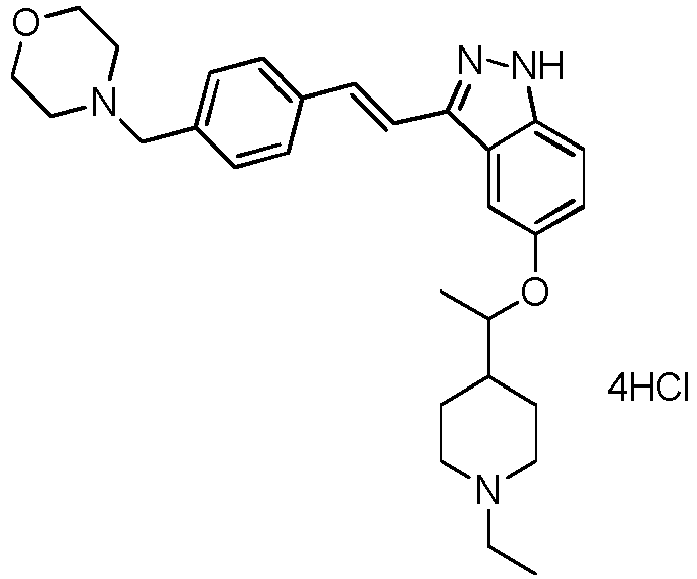
- This example was prepared by the method as described in Example 137. LCMS(ESI)m/z: 475.3 [M+1]+.
1H NMR (400 MHz, METHANOL-d4): 7.79-7.84 (m, 2H), 7.54-7.63 (m, 4H), 7.52 (d, J=7.53 Hz, 2H), 7.40-7.49 (m, 1H), 7.15 (d, J=9.03 Hz, 1H), 4.49 (t, J=5.77 Hz, 1H), 4.41 (s, 2H), 4.03-4.15 (m, 2H), 3.73-3.85 (m, 2H), 3.67 (br. s., 2H), 3.38-3.50 (m, 3H), 3.17-3.27 (m, 5H), 2.93-3.06 (m, 1H), 2.05-2.37 (m, 1H), 1.40 (br. s., 3H), 1.38 (br. s., 3H), 1.35-1.37 (m, 2H) -

- This example was prepared according to the method as described in Example 137. LCMS(ESI)m/z: 461.3 [M+1]+.
1H NMR (400 MHz, METHANOL-d4) □ 7.79-7.84 (m, 2H), 7.56-7.61 (m, 3H), 7.51-7.56 (m, 2H), 7.50 (d, J=9.29 Hz, 1H), 7.13-7.19 (m, 1H), 4.45-4.53 (m, 2H), 4.41 (s, 2H), 4.09 (d, J=13.30 Hz, 2H), 3.78 (t, J=12.80 Hz, 2H), 3.35-3.48 (m, 4H), 3.20-3.30 (m, 4H), 3.07 (t, J=13.05 Hz, 1H), 2.90 (s, 3H), 1.97 (s, 3H), 1.36-1.40 (m, 3H), 1.31 (br. s., 2H) -

- This example was prepared according to the method as described in Example 137.
1H NMR (400MHz, METHANOL-d4) □ = 8.95 (d, J=1.5 Hz, 1H), 8.52 (s, 2H), 8.33 (dd, J=2.0, 8.3 Hz, 1H), 7.72 (d, J=8.3 Hz, 1H), 7.62 (d, J=16.8 Hz, 1H), 7.53 (d, J=9.0 Hz, 1H), 7.38 (d, J=16.8 Hz, 1H), 7.33 (d, J=1.8 Hz, 1H), 7.27 (dd, J=2.0, 9.0 Hz, 1H), 6.25 (q, J=6.5 Hz, 1H), 4.55 (s, 2H), 4.10 (dd, J=4.3, 11.5 Hz, 2H), 3.61 - 3.42 (m, 4H), 2.22 - 2.12 (m, 2H), 1.91 - 1.76 (m, 5H) - To measure enzyme activity by Z'-LYTE™ Detection Kinase Assay, and to evaluate the inhibitory effect of the compounds on FGFR1 using IC50 value of the compounds as an indicator.
-
- FGFR1 (Invitrogen# PV4105)
- Tyr4 (Invitrogen-PR5053U)
- ATP (Sigma-A7699)
- DMSO (Sigma cat # 34869-100ML)
- Reaction Buffer: 50mM Hepes (pH 7.5), 10mM MgCl2, 1mM EGTA, 0.01% Brij-35, 1mM DTT, 2mM MnCl2
- 384 Reaction plate (Corning Costar 3573)
- 384 Compound plate (Greiner # 781280)
-
- Centrifuge (Eppendorf # 5810R)
- Electronic sample pipette (Eppendorf)
- Multidrop Liquid Workstation (Thermo Scientific)
- Bravo Automatic Liquid Workstation (Agilent)
- Envision (Perkin Elmer)
-
- A. Preparing enzyme/substrate mix
0.6nM FGFR1, 2uM Tyr4 peptide and 10uM ATP in reaction buffer (50mM Hepes, pH 7.5, 10mM MgCl2, 0.01% BRIJ-35, 1 mM EGTA, 4 mM MnCl2, 2mM DTT). - B. Compound loading:
- a. Diluting the compounds with DMSO to 10mM, 3-fold dilution, 11 gradients, duplicate wells.
- b. Diluting the compound by 1:25 into middle plate at Bravo Automatic Liquid Station, then transferring 2.5ul to the reaction plate to ensure the final DMSO concentration to be 1%.
- c. Transferring 5ul of enzyme/substrate buffer into each well
- d. Using Multidrop Liquid Workstation to sequentially add ATP solution to each well
- e. Centrifuging at 1000 rpm for 1 minute
- f. Placing the reaction plate in an incubator at 23°C to react for 60min.
- C. Color reaction test
- a. Preparing a 1:128 mixture of Development Regent B and Development Buffer
- b. Adding 5ul to each well and centrifuging at 1000 rpm for 1 minute
- c. Placing the reaction plate in a thermostat (23°C) after centrifuging for 90 minutes, removing and reading on Envision (Perkin Elmer) Plate Reader
- D. Analyzing data: analyzing data using XLFIT (IDBS) and calculating IC50 values for the compounds.
- The experimental results are shown in Table 1:
Table 1. Test results of Z'-LYTE™ Detection for IC50 Sample tested (Title compound) FGFR1 Example 1 A Example 2 A Example 3 A Example 4 A Example 5 A Example 6 A Example 9 AA Example 10 AA Example 11 A Example 12 AA Example 13 A Example 16 AA Example 17 A Example 18 AAA Example 18b AAA Example 21 AAA Example 22 AA Example 23 AAA Example 26 AA Example 27 AAA Example 29 AAA Example 30 AAA Example 31 AAA Example 32 AAA Example 33 AAA Example 34 AAA Example 36 A Example 37 A Example 38 A Example 41 A Example 43 AAA Example 44 AAA Example 45 A Example 47 AAA Example 48 AAA Example 49 N/A Example 50 AAA Example 51 AAA Example 52 A Example 53 AA Example 54 AAA Example 55 A Example 56 A Example 57 A Example 58 A Example 59 A Example 60 A Example 61 A Example 62 A Example 63 AA Example 64 A Example 65 AAA Example 66 AAA Example 67 AAA Example 68 AAA Example 69 AAA Example 70 A Example 71 AA Example 72 AAA Example 73 AAA Example 74 AAA Example 76 AAA Example 78 AAA Example 80 A Example 81 AAA Example 82 A Example 83 A Example 86 A Example 87 A Example 88 AA Example 89 AAA Example 90 A Example 91 A Example 93 AA Example 94 A Example 95 A Example 97 AAA Example 99 A Example 100 AAA Example 101 AAA Example 102 AAA Example 103 AAA Example 104 A Example 106 AAA Example 107 A Example 108 A Example 109 AAA Example 112 A Example 113 A Example 114 A Example 115 AA Example 116 A Example 117 A Example 119 A Example 120 A Example 121 A Example 125 A Example 126 A Example 127 A Example 129 A Example 130 A Example 132 AAA Example 134 AAA Example 135 AAA Example 137 AAA Example 138 AAA Example 140 AA Example 142 AA Example 143 A Example 144 AAA Example 145 A Example 146 AAA Example 147 A Example 148 A Example 149 A - Note: 50nM<A≤1uM, 10nM <AA≤50nM, AAA≤10nM, N/A represents unmeasured.
- Conclusion: The compounds of the present invention have a significant inhibitory effect on FGFR1.
- To detect the change of intracellular ATP by CellTiter-Glo® Luminescent Cell Viability Assay, and to evaluate the inhibitory effect of the compounds on in vitro cell SNU-16 using IC50 value of the compounds as an indicator.
-
- Cell line: SNU-16 cell strain
- SNU-1 cell culture medium: RPMI 1640 (Invitrogen # 22400105), 10% serum (Invitrogen # 10099141), Penicillin-Streptomycin (Invitrogen Gibco # 15140-122)
- Trypsin (Invitrogen, # 25200-072)
- DPBS (Hyclone, # SH30028.01B)
- 384 cell plate (Greiner # 781090)
- 384 Compound Plate (Greiner # 781280)
- CO2 Incubator (Thermo # 371)
- Centrifuge (Eppendorf # 5810R)
- Vi-cell cytometer (Beckman Coulter)
- Bravo Automatic Liquid Workstation (Agilent)
- Envision (Perkin Elmer)
-
- E. Cell Vaccination (SNU-16 cell)
- a. Preheating medium, trypsin, DPBS in 37°C water bath. Aspirating the cell culture media and washing with 10mL DPBS;
- b. Adding the preheated trypsin to the culture flask, rotating the culture flask to evenly cover the culture flask with trypsin, and placing the flask in a 5% CO2 incubator to let it digest for 1-2 minutes at 37°C;
- c. Suspending cells in 10-15mL medium for each T150 cells, centrifuging at 800rpm for 5 minutes, re-suspending cells in 10mL medium, drawing 1mL cell suspension for Vi-cell counting;
- d. Diluting SNU-16 with medium, adding the diluted cells to the 384 plate (Greiner. 781090) (50µL/well, SNU-16 cell 750 cells/well) with multi-channel pipette. Placing the cell plate in a 37°C, 5% CO2 incubator overnight.
- F. Compound loading:
- g. Diluting the compound with DMSO to 10mM, 3-fold dilution, 11 gradients, duplicate wells.
- h. Transferring 2.4ul of the compound to the middle plate added with 47.6ul of cell culture media at Bravo Automatic Liquid Station. Then transferring 5ul to the cell culture plate (55ul) to ensure the final DMSO concentration to be 0.4%.
- i. Placing the cell culture plate in 5% CO2 incubator at 37°C to continue cultivating for 3 days.
- G. CTG experiment:
- d. Balancing Cell Titer Glo Reagent to room temperature
- e. Taking 30ul of Cell Titer Glo Reagent in a 1: 2 ratio into each well and gently mixing for 2 minutes
- f. Placing the cell culture plate in an incubator (23°C) for 10 minutes, taking out and centrifuging at 1000 rpm for 1 minute
- g. Reading on Envision (Perkin Elmer) Plate Reader.
- H. Analyzing data: analyzing the data using XLFIT (IDBS) and calculating IC50 values for the compounds.
- The experimental results are shown in Table 2:
Table 2. Test results of CellTiter-Glo® Detection for IC50 Sample tested (Title compound) SNU-16 Example 1 + Example 16 ++ Example 17 ++ Example 19 + Example 21 ++ Example 29 + Example 32 ++ Example 33 ++ Example 34 ++ Example 38 ++ Example 39 ++ Example 41 ++ Example 42 ++ Example 45 ++ Example 47 ++ Example 53 ++ Example 62 ++ Example 70 ++ Example 76 ++ - Note: 10nM<+≤1uM, ++≤10 nM.
- Conclusion: The compounds of the present invention have a significant inhibitory effect on SNU-16.
- The evolutionary growth potential of tumors was evaluated by the relationship between tumor volume and time. The long axis (L) and short axis (W) of the subcutaneous tumor were measured twice a week by the caliper and the tumor volume (TV) was calculated by the formula ((LxW2)/2). TGI was calculated from the difference between the median tumor volume in the solvent group mice and the median tumor volume in the drug group mice, expressed as a percentage counting for the median tumor volume in the solvent control group, calculated by the following formula:

- The original statistical analysis was done by repeating the analysis of variance, followed by Scheffe psot hoc experimental method for multiple comparisons, with solvent alone (0.5% methylcellulose + 0.2% Tween in water) as negative control.
- The experimental results are shown in Table 3:
FGFR1/2 Highly Expressed Patient-derived Liver Tumor Transplantation Model TGI% (last administration) Example 16 15 mg/kg, BID 84.5 Example 18 5 mg/kg, BID 85 Example 54 10 mg/kg, BID 85.4 Example 63 15 mg/kg, BID 86 - The compound of the invention has excellent in vitro FGFR1 kinase inhibitory activity and SNU-16 cell inhibitory activity and can be used as a small molecule tyrosine kinase inhibitor; and it can inhibit cell proliferation and angiogenesis, having excellent antitumor activity, and having excellent results for the treatment of various mammals (including humans).
- Experimental Procedure: A clear solution of the test compound in 20%DMSO/60%PEG400/20% water at 1mg/ml was injected via the caudal vein into female Balb/c nude mice (fasted overnight, 7-9 weeks of age) with a dose of 1 mg/kg. The test compound suspended in 0.5% Methocel/0.2% Tween 80 at 1mg/ml was administered by intragastric administration to female Balb/c nude mice (fasted overnight, 7-9 weeks of age) with a dose of 10 mg/kg. About 30µL of blood collected from the jugular vein or caudal vein at 0.0833, 0.25, 0.5, 1.0, 2.0, 4.0, 8.0 and 24 h after administration in both groups of animals, were placed in anticoagulation tube with EDTA-K2 and the plasma was centrifuged. Plasma concentrations were determined by LC-MS/MS and related pharmacokinetic parameters were calculated using the non-compartmental model linear logarithmic trapezoidal method using WinNonlin™ Version 6.3 (Pharsight, Mountain View, CA) pharmacokinetic software.
- Experimental data analysis: After a single intravenous injection of 1.0 mg/kg WX_018 to female Balb/c nude mice, the plasma clearance (CL) was 53.0±1.69 mL/min/kg and the steady state apparent volume of distribution (Vdss) was 5.45±0.491 L/kg, the elimination half-life (T1/2) and the area under the plasma concentration curve (AUC0-last) from 0 to the last quantifiable time point were 1.57±0.0286h and 567±19.4 nM•h, respectively.
- After a single intragastric administration of 10 mg/kg WX_018 to female Balb/c nude mice, the bioavailability thereof was 30.1%, AUC0-last was 1649±40.1 nM•h and the peak concentration (Cmax) was 479±62.9 nM, and the peak time appeared 2.00h after administration. After a single intravenous injection of 1.0 mg/kg WX_015 to female Balb/c nude mice, the plasma clearance (CL) was 83.5±18.5 mL/min/kg and the steady state apparent volume of distribution (Vdss) was 5.31±0.268 L/kg, the elimination half-life (T1/2) and the area under the plasma concentration curve (AUC 0-last) from 0 to the last quantifiable time point were 0.971±0.461h and 386±88.3 nM•h, respectively.
- After a single intragastric administration of 10 mg/kg WX_015 to female Balb/c nude mice, the bioavailability thereof was 11.4%, the AUC0-last was 439±202 nM•h and the peak concentration (Cmax) was 134±68.3nM, and the peak time appeared 1.50±0.866h after administration.
- In addition, the introduction of a fluorine on the alkene has many advantages, such as: 1) the structure of fluoroalkene itself is a novel design, synthesis of which requires great skill; 2) it can significantly improve the physical and chemical properties of the compound, improve its solubility on the biofilm, vary the compound's acidity and alkalinity, improve the affinity of the compound and organic tissues, and promote the speed of absorption in the body; 3) at the same time it can increase the stability of the compound, improve the metabolic stability of the compound in vivo and increase exposure quantity, potentially improve in vivo efficacy, and reducing the dose at the same efficacy.
- Experimental Procedure: A clear solution of the test compound in 20%DMSO/60%PEG400/20% water at 0.4mg/ml was administered by intragastric administration to female Balb/c nude mice (fasted overnight, 7-9 weeks of age) with a dose of 2 mg/kg. About 30µL of blood was collected from the jugular vein or caudal vein at 0.25, 0.5, 1.0, 2.0, 4.0, 8.0 and 24 h after administration in both groups of animals, placed in anticoagulation tube with EDTA-K2 and the plasma was centrifuged. Plasma concentrations were determined by LC-MS/MS and related pharmacokinetic parameters were calculated using the non-compartmental model linear logarithmic trapezoidal method using WinNonlin™ Version 6.3 (Pharsight, Mountain View, CA) pharmacokinetic software.
- Experimental data analysis: After a single intragastric administration of 2 mg/kg WX_077 to female Balb/c nude mice, the AUC0-last was 72.1±19.8 nM•h and the peak concentration (Cmax) was 41.7±6.45nM, and the peak time appeared 0.25h after administration.
- After a single intragastric administration of 2 mg/kg WX_063 to female Balb/c nude mice, the AUC0-last was 221±71.3nM•h and the peak concentration (Cmax) was 214±39.7nM, and the peak time appeared 0.25h after administration.
Claims (14)
- A compound represented by formula (I) or formula (II), a pharmaceutically acceptable salt or a tautomer thereof,


 0 to 2 of T11-15 are selected from N and the rest are selected from C(R);0 to 2 of T16-18 are selected from N and the rest are selected from C(R);D11 is selected from the group consisting of -C(R)(R)-, -C(=O)N(R)-, -N(R)-, - C(=NR)-, -S(=O)2N(R)-, -S(=O)N(R)-, -O-, -S-, -C(=O)O-, -C(=O)-, -C(=S)-, -S(=O)-, -S(=O)2- or -N(R)C(=O)N(R)-;T41 is selected from N or C(R);D41 is selected from the group consisting of -C(R)(R)-, -C(=O)N(R)-, -N(R)-, - C(=NR)-, -S(=O)2N(R)-, -S(=O)N(R)-, -O-, -S-, -C(=O)O-, -C(=O)-, -C(=S)-, -S(=O)-, -S(=O)2- or -N(R)C(=O)N(R)-;0 to 2 of D42-45 are each independently selected from the group consisting of a single bond, -[C(R)(R)]1-3-, -C(=O)N(R)-, -N(R)-, -C(=NR)-, -S(=O)2N(R)-, - S(=O)N(R)-, -O-, -S-, -C(=O)O-, -C(=O)-, -C(=S)-, -S(=O)-, -S(=O)2- or - N(R)C(=O)N(R)-, the rest are selected -C(R)(R)-;optionally, any two of D41-45 are connected to the same atom or atom group to form a 3-6 membered ring;L1 and L3 are each independently selected from the group consisting of -(CRR)0-3-, -(CRR)0-3-C(=O)N(R)-(CRR)0-3-, -(CRR)0-3-N(R)-(CRR)0-3-, -(CRR)0-3-C(=NR)-(CRR)0-3-, -(CRR)0-3-S(=O)2N(R)-(CRR)0-3-, -(CRR)0-3-S(=O)N(R)-(CRR)0-3-, - (CRR)0-3-O-(CRR)0-3-, -(CRR)0-3-S-(CRR)0-3-, -(CRR)0-3-C(=O)O-(CRR)0-3-, -(CRR)0-3-C(=O)-(CRR)0-3-, -(CRR)0-3-C(=S)-(CRR)0-3-, -(CRR)0-3-S(=O)-(CRR)0-3-, -(CRR)0-3-S(=O)2-(CRR)0-3- or -(CRR)0-3-N(R)C(=O)N(R)-(CRR)0-3-;B2 is selected from a 5- to 10-membered aryl or heteroaryl which is optionally substituted with R;B4 is selected from a 5- to 6-membered aryl or heteroaryl and a 5- to 6-membered cycloalkyl or heterocycloalkyl, each of which is optionally substituted with R;T31-34 are each independently selected from N or C(R);optionally, any two of T31-34 are connected to the same atom or atom group to form a 3-6 membered ring;n is 0 or 1, and when n is 0, the defined structural unit represents a single bond for linkage;R is selected from the group consisting of H, F, Cl, Br, I, CN, OH, SH, NH2, CHO, COOH, C(=O)NH2, S(=O)NH2, S(=O)2NH2, or selected from a C1-12 alkyl or heteroalkyl, a C3-12 cyclocarbyl or heterocyclocarbyl, and a C1-12 alkyl or heteroalkyl substituted with a C3-12 cyclocarbyl or heterocyclocarbyl; and the C1-12 alkyl or heteroalkyl and the C3-12 cyclocarbyl or heterocyclocarbyl is optionally substituted with R';R' is selected from the group consisting of F, Cl, Br, I, CN, OH, SH, NH2, CHO, COOH, C(=O)NH2, S(=O)NH2, S(=O)2NH2, =NH, =O, =S, or selected from the group optionally substituted with R" consisting of NHC(=O)CH3, a C1-12 alkyl, a C1-12 alkylamino, N,N-di(C1-12 alkyl)amino, a C1-12 alkoxy, a C1-12 alkanoyl, a C1-12 alkoxycarbonyl, a C1-12 alkylsulfonyl, a C1-12 alkylsulfinyl, a 3- to 12-membered cycloalkyl, a 3- to 12-membered cycloalkylamino, a 3- to 12-membered heterocycloalkylamino, a 3- to 12-membered cycloalkyloxy, a 3- to 12-membered cycloalkylcarbonyl, a 3- to 12-membered cycloalkyloxycarbonyl, a 3- to 12-membered cycloalkylsulfonyl, a 3- to 12-cycloalkylsulfinyl, a 5- to 12-membered aryl or heteroaryl, a 5 to 12-membered aralkyl or heteroaralkyl;R" is selected from the group consisting of F, Cl, Br, I, CN, OH, N(CH3)2, NH(CH3), NH2, CHO, COOH, C(=O)NH2, S(=O)NH2, S(=O)2NH2, =NH, =O, =S, trihalomethyl, dihalomethyl, monohalomethyl, aminomethyl, hydroxymethyl, methyl, methoxy, formyl, methoxycarbonyl, methanesulfonyl, methylsulfinyl;"hetero" represents a heteroatom or a heteroatom group selected from the group consisting of -C(=O)N(R)-, -N(R)-, -C(=NR)-, -S(=O)2N(R)-, -S(=O)N(R)-, -O-, -S-, =O, =S, -C(=O)O-, -C(=O)-, -C(=S)-, - S(=O)-, -S(=O)2- and/or -N(R)C(=O)N(R)-;in each of the above cases, the number of R, R', R", heteroatoms or heteroatom groups is independently selected from 0, 1, 2 or 3;and the compound represented by formula (I) does not include
- The compound, the pharmaceutically acceptable salt or the tautomer thereof according to claim 1, wherein R is selected from the group consisting of H, F, Cl, Br, I, OH, NH2, CN, hydroxymethyl, hydroxyethyl, carboxypropyl, carboxymethyl, methoxy, ethoxy, propoxy, methyl, ethyl, propyl, isopropyl, monohalomethyl, dihalomethyl, trihalomethyl, methylamino, dimethylamino,


- The compound, the pharmaceutically acceptable salt or the tautomer thereof according to claim 1 or 2, wherein any two of D41-45 or T31-34 are connected together to the same atom or atom group to form a benzene ring.
- The compound, the pharmaceutically acceptable salt or the tautomer thereof according to claim 3, wherein B1 is selected from the group consisting of


- The compound, the pharmaceutically acceptable salt or the tautomer thereof according to claim 1 or 2, wherein L1 and L3 are each independently selected from the group consisting of a single bond, NH,


- The compound, the pharmaceutically acceptable salt or the tautomer thereof according to claim 1 or 2, wherein B2 is selected from the group consisting of

 wherein, T is selected from N or C(R);D is selected from the group consisting of -C(R)(R)-, -C(=O)N(R)-, -N(R)-, -C(=NR)-, -S(=O)2N(R)-, -S(=O)N(R)-, -O-, -S-, -C(=O)O-, -C(=O) -, -C(=S)-, -S(=O) -, -S(=O)2- or -N(R)C(=O)N(R)-.
 - The compound, the pharmaceutically acceptable salt or the tautomer thereof according to claim 6, wherein B2 is selected from the group consisting of


- The compound, the pharmaceutically acceptable salt or the tautomer thereof according to claim 1 or 2, wherein B4 is selected from the group consisting of phenyl, pyridyl, imidazolyl, furyl, thiazolyl, piperidinyl, piperazinyl or morpholinyl, and each of which is optionally substituted with 1, 2 or 3 R;
optionally, B4 is selected from the group consisting of

- The compound, the pharmaceutically acceptable salt or the tautomer thereof according to claim 1 or 2, wherein the structure unit


- The compound, the pharmaceutically acceptable salt or the tautomer thereof according to claim 1, which is selected from the group consisting of


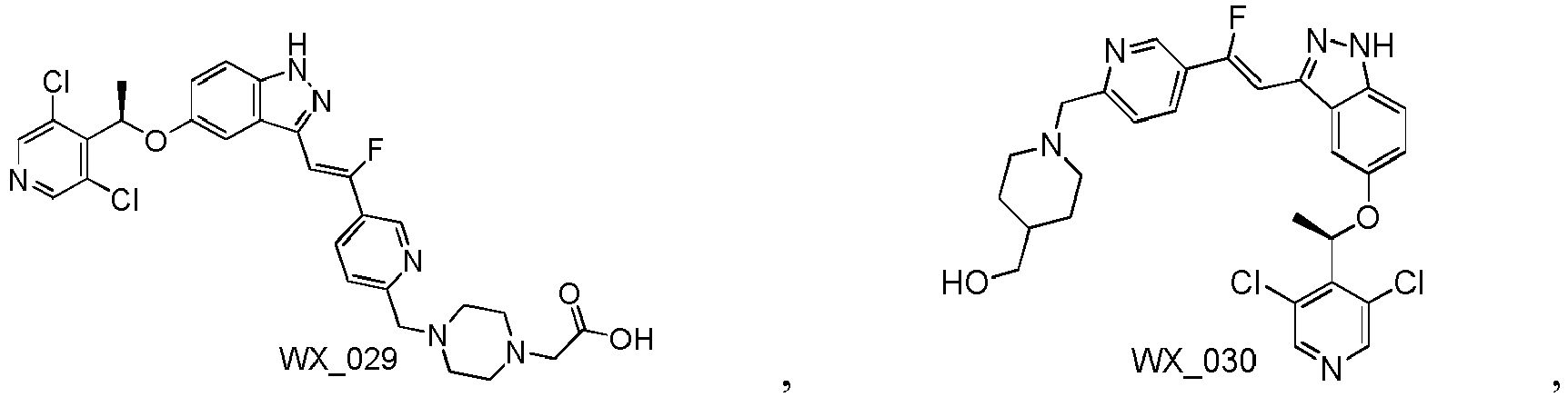


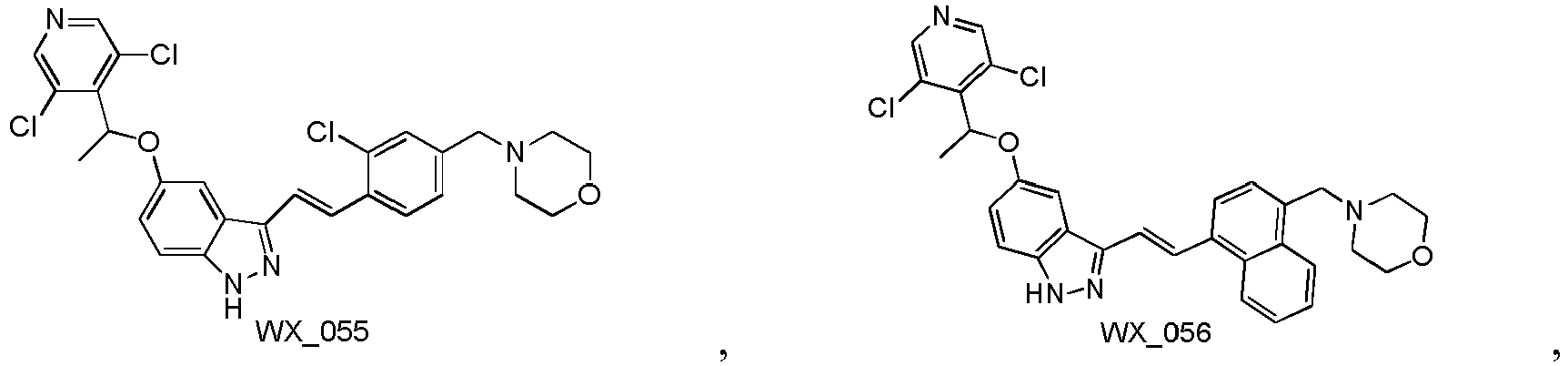
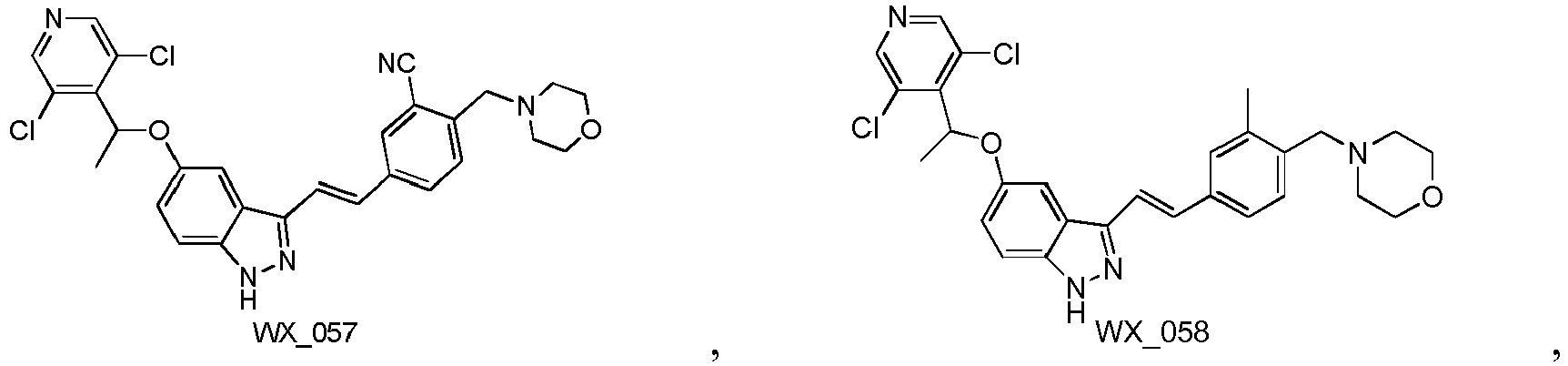


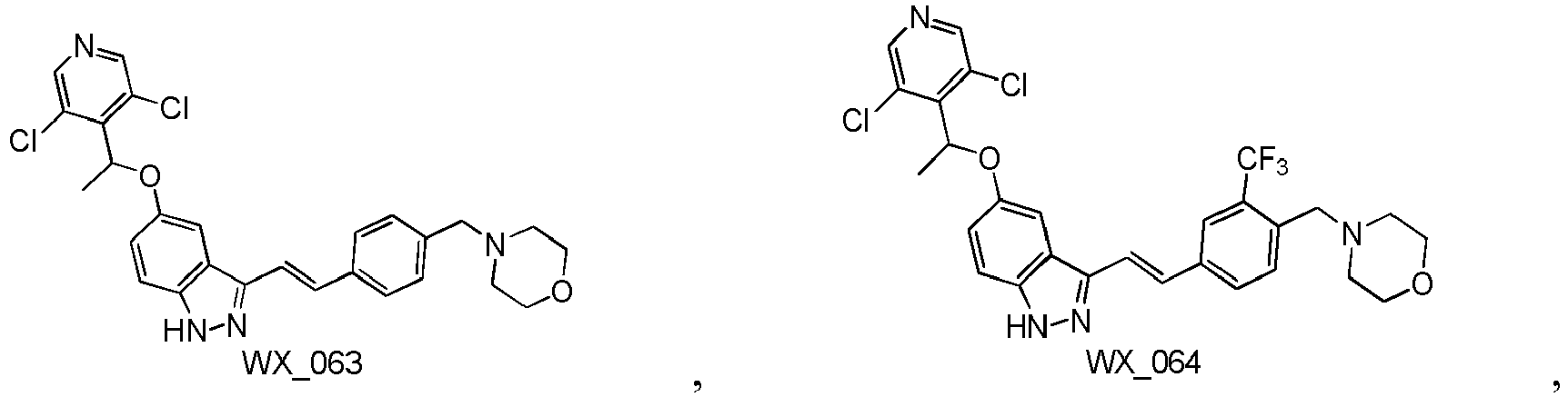


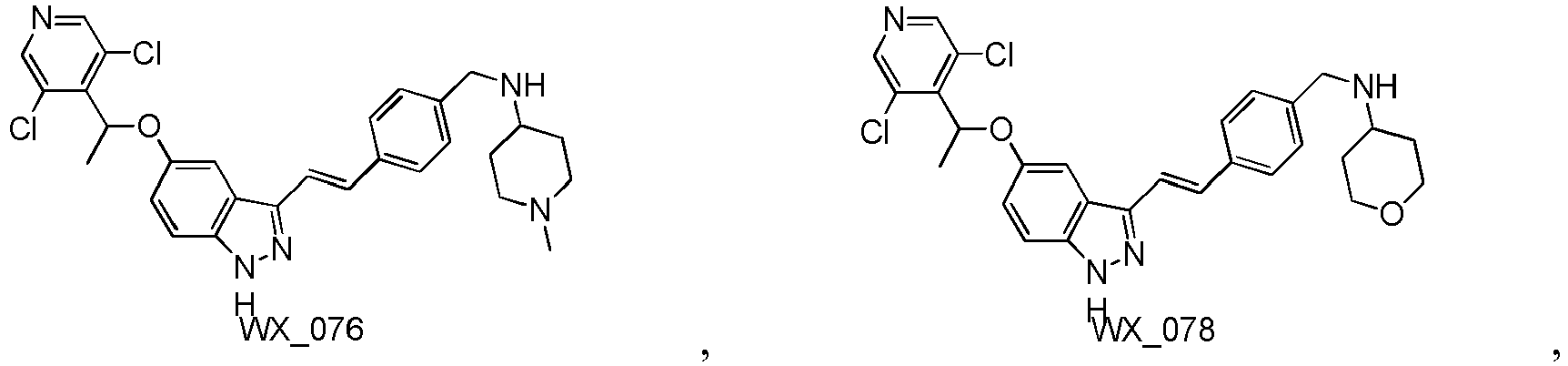


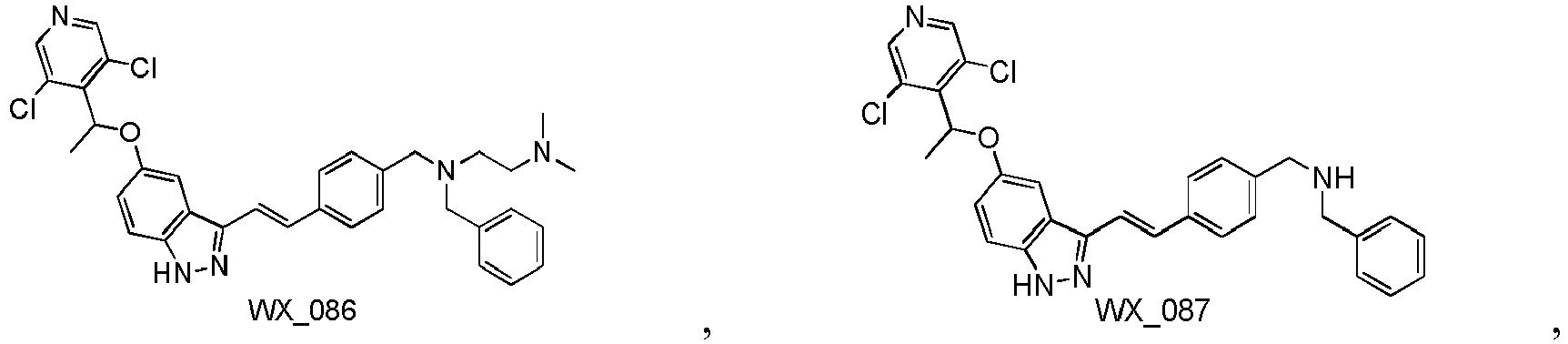


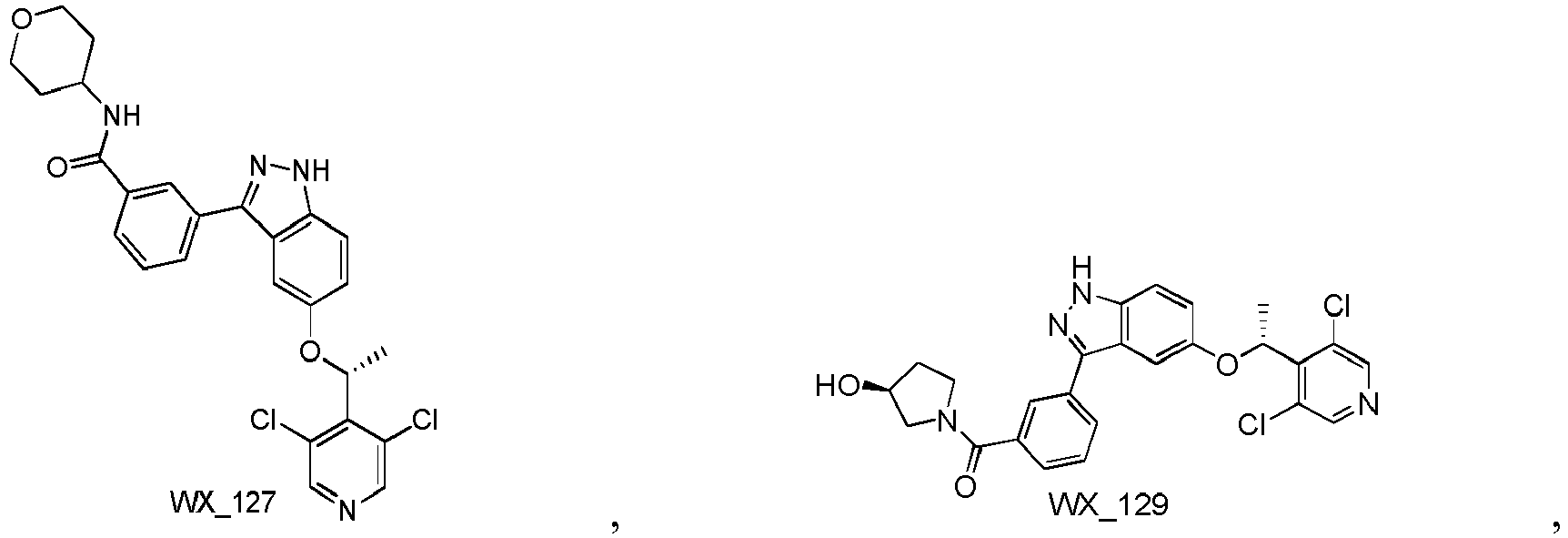


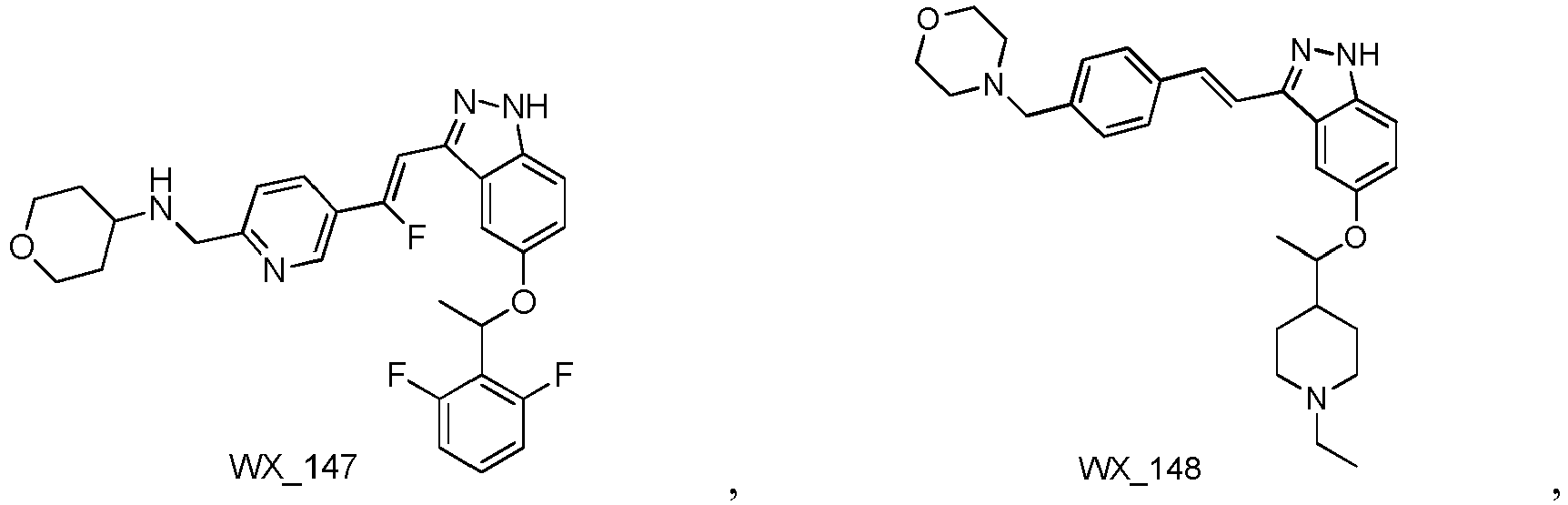

- A process for preparing the compound represented by formula (I) according to claim 1, comprising:

- The process for preparing the compound represented by formula (I) according to claim 11, comprising:

- A pharmaceutical composition comprising a therapeutically effective amount of the compound, the pharmaceutically acceptable salt or the tautomer thereof according to any one of claims 1 to 10, and a pharmaceutically acceptable carrier.
- The compound, the pharmaceutically acceptable salt or the tautomer thereof according to any one of claims 1 to 10, or the pharmaceutical composition according to claim 13 for use in the manufacture of a medicament for the treatment of cancers.
Applications Claiming Priority (3)
| Application Number | Priority Date | Filing Date | Title |
|---|---|---|---|
| CN201510484124 | 2015-08-07 | ||
| CN201510908082 | 2015-12-09 | ||
| PCT/CN2016/092989 WO2017024968A1 (en) | 2015-08-07 | 2016-08-03 | Vinyl compounds as fgfr and vegfr inhibitors |
Publications (3)
| Publication Number | Publication Date |
|---|---|
| EP3333157A1 true EP3333157A1 (en) | 2018-06-13 |
| EP3333157A4 EP3333157A4 (en) | 2018-10-17 |
| EP3333157B1 EP3333157B1 (en) | 2020-12-23 |
Family
ID=57983012
Family Applications (1)
| Application Number | Title | Priority Date | Filing Date |
|---|---|---|---|
| EP16834592.4A Active EP3333157B1 (en) | 2015-08-07 | 2016-08-03 | Vinyl compounds as fgfr and vegfr inhibitors |
Country Status (5)
| Country | Link |
|---|---|
| US (1) | US10519133B2 (en) |
| EP (1) | EP3333157B1 (en) |
| JP (1) | JP6898306B2 (en) |
| CN (1) | CN107922349B (en) |
| WO (1) | WO2017024968A1 (en) |
Cited By (9)
| Publication number | Priority date | Publication date | Assignee | Title |
|---|---|---|---|---|
| EP3584241A4 (en) * | 2017-02-14 | 2019-12-25 | FUJIFILM Corporation | PROCESS FOR PRODUCING INDAZOLE COMPOUND, AND INDAZOLE COMPOUND |
| WO2021138391A1 (en) * | 2019-12-30 | 2021-07-08 | Tyra Biosciences, Inc. | Indazole compounds |
| US11078194B2 (en) | 2017-12-07 | 2021-08-03 | Harbin Zhenbao Pharmaceutical Co., Ltd. | Salt form and crystal form serving as FGFR and VEGFR inhibitor compounds, and preparation method therefor |
| KR20210124329A (en) * | 2019-02-02 | 2021-10-14 | 메드샤인 디스커버리 아이엔씨. | Vinyl pyridine carboxamide compound as a PD-L1 immunomodulator |
| WO2022147246A1 (en) * | 2020-12-30 | 2022-07-07 | Tyra Biosciences, Inc. | Indazole compounds as kinase inhibitors |
| EP3919477A4 (en) * | 2019-02-02 | 2022-12-07 | Shanghai Fosun Pharmaceutical Industrial Development Co., Ltd. | FLUOROVINYLBENZAMIDE COMPOUND USEFUL AS A PD-L1 IMMUNOMODULATOR |
| WO2023279041A1 (en) * | 2021-06-30 | 2023-01-05 | Tyra Biosciences, Inc. | Indazole compounds |
| WO2024006897A1 (en) * | 2022-06-29 | 2024-01-04 | Tyra Biosciences, Inc. | Indazole compounds |
| TWI923663B (en) | 2020-12-30 | 2026-05-01 | 美商泰拉生物科學公司 | Indazole compounds |
Families Citing this family (8)
| Publication number | Priority date | Publication date | Assignee | Title |
|---|---|---|---|---|
| WO2020135878A1 (en) * | 2018-12-29 | 2020-07-02 | 南京明德新药研发有限公司 | Imidazopyridine derivative as fgfr and vegfr dual inhibitor |
| EP3985005A4 (en) * | 2019-06-14 | 2023-07-19 | CGeneTech (Suzhou, China) Co., Ltd. | FUSED CYCLIC COMPOUND AS A DUAL INHIBITOR OF FGFR AND VEGFR |
| EP4056558A4 (en) * | 2019-11-06 | 2023-12-27 | Jinan University | INDAZOLE COMPOUND, PHARMACEUTICAL COMPOSITION THEREOF AND ITS APPLICATIONS |
| JP7511294B2 (en) * | 2020-08-11 | 2024-07-05 | ホーナン メディノ ファーマシューティカル テクノロジー カンパニー リミテッド | FGFR INHIBITOR COMPOUNDS AND USES THEREOF |
| IL303419A (en) * | 2020-12-17 | 2023-08-01 | Blossomhill Therapeutics Inc | Macrocycles and their use |
| CN116761798A (en) * | 2020-12-30 | 2023-09-15 | 泰拉生物科学公司 | Indazoles as kinase inhibitors |
| CN116239623B (en) * | 2022-11-18 | 2025-11-18 | 江西亚太科技发展有限公司 | A method for preparing a borate ester and its application |
| WO2024137742A1 (en) | 2022-12-20 | 2024-06-27 | Blueprint Medicines Corporation | Compounds and compositions as fgfr3 degraders and uses thereof |
Family Cites Families (11)
| Publication number | Priority date | Publication date | Assignee | Title |
|---|---|---|---|---|
| US20020010137A1 (en) * | 1997-09-18 | 2002-01-24 | Genentech, Inc. | Methods and compositions for inhibiting neoplastic cell growth |
| YU54202A (en) * | 2000-01-18 | 2006-01-16 | Agouron Pharmaceuticals Inc. | Indazole compounds,pharmaceutical compositions,and methods for mediating or inhibiting cell proliferation |
| US6897231B2 (en) * | 2000-07-31 | 2005-05-24 | Signal Pharmaceuticals, Inc. | Indazole derivatives as JNK inhibitors and compositions and methods related thereto |
| JP4361727B2 (en) | 2000-09-11 | 2009-11-11 | ノバルティス バクシンズ アンド ダイアグノスティックス,インコーポレーテッド | Quinolinone derivatives as tyrosine kinase inhibitors |
| US7064215B2 (en) * | 2001-07-03 | 2006-06-20 | Chiron Corporation | Indazole benzimidazole compounds |
| KR20050004214A (en) | 2002-05-31 | 2005-01-12 | 에자이 가부시키가이샤 | Pyrazole compound and medicinal composition containing the same |
| EP1582211A1 (en) * | 2002-12-03 | 2005-10-05 | Kyowa Hakko Kogyo Co., Ltd. | Jnk inhibitor |
| JP3814285B2 (en) * | 2002-12-19 | 2006-08-23 | ファイザー・インク | 2- (1H-indazol-6-ylamino) -benzamide compounds as protein kinase inhibitors useful in the treatment of eye diseases |
| WO2007058626A1 (en) * | 2005-11-16 | 2007-05-24 | S*Bio Pte Ltd | Indazole compounds |
| WO2007117465A2 (en) * | 2006-03-31 | 2007-10-18 | Abbott Laboratories | Indazole compounds |
| AR078411A1 (en) * | 2009-05-07 | 2011-11-09 | Lilly Co Eli | IMIDAZOLIL VINYL COMPOUND AND PHARMACEUTICAL COMPOSITION THAT INCLUDES IT |
-
2016
- 2016-08-03 JP JP2018507641A patent/JP6898306B2/en active Active
- 2016-08-03 US US15/750,704 patent/US10519133B2/en active Active
- 2016-08-03 CN CN201680046188.0A patent/CN107922349B/en active Active
- 2016-08-03 EP EP16834592.4A patent/EP3333157B1/en active Active
- 2016-08-03 WO PCT/CN2016/092989 patent/WO2017024968A1/en not_active Ceased
Cited By (18)
| Publication number | Priority date | Publication date | Assignee | Title |
|---|---|---|---|---|
| EP3584241A4 (en) * | 2017-02-14 | 2019-12-25 | FUJIFILM Corporation | PROCESS FOR PRODUCING INDAZOLE COMPOUND, AND INDAZOLE COMPOUND |
| US10689358B2 (en) | 2017-02-14 | 2020-06-23 | Fujifilm Corporation | Method for producing indazole compound, and indazole compound |
| US11078194B2 (en) | 2017-12-07 | 2021-08-03 | Harbin Zhenbao Pharmaceutical Co., Ltd. | Salt form and crystal form serving as FGFR and VEGFR inhibitor compounds, and preparation method therefor |
| KR20210124329A (en) * | 2019-02-02 | 2021-10-14 | 메드샤인 디스커버리 아이엔씨. | Vinyl pyridine carboxamide compound as a PD-L1 immunomodulator |
| US12509440B2 (en) | 2019-02-02 | 2025-12-30 | Novaonco Js Therapeutics Co., Ltd. | Fluorovinylbenzamide compound as PD-L1 immunomodulator |
| EP3919478A4 (en) * | 2019-02-02 | 2022-12-07 | Shanghai Fosun Pharmaceutical Industrial Development Co., Ltd. | Vinylpyridine carboxamide compound as pd-l1 immunomodulator |
| EP3919477A4 (en) * | 2019-02-02 | 2022-12-07 | Shanghai Fosun Pharmaceutical Industrial Development Co., Ltd. | FLUOROVINYLBENZAMIDE COMPOUND USEFUL AS A PD-L1 IMMUNOMODULATOR |
| US12152013B2 (en) | 2019-02-02 | 2024-11-26 | Novaonco Js Therapeutics Co., Ltd. | Vinylpyridine carboxamide compound as PD-L1 immunomodulator |
| WO2021138391A1 (en) * | 2019-12-30 | 2021-07-08 | Tyra Biosciences, Inc. | Indazole compounds |
| US12441707B2 (en) | 2019-12-30 | 2025-10-14 | Tyra Biosciences, Inc. | Indazole compounds |
| AU2021411587B2 (en) * | 2020-12-30 | 2024-10-10 | Tyra Biosciences, Inc. | Indazole compounds as kinase inhibitors |
| US12071428B2 (en) | 2020-12-30 | 2024-08-27 | Tyra Biosciences, Inc. | Indazole compounds as kinase inhibitors |
| US12264149B2 (en) | 2020-12-30 | 2025-04-01 | Tyra Biosciences, Inc. | Indazole compounds as kinase inhibitors |
| WO2022147246A1 (en) * | 2020-12-30 | 2022-07-07 | Tyra Biosciences, Inc. | Indazole compounds as kinase inhibitors |
| TWI923663B (en) | 2020-12-30 | 2026-05-01 | 美商泰拉生物科學公司 | Indazole compounds |
| US20240316022A1 (en) * | 2021-06-30 | 2024-09-26 | Tyra Biosciences, Inc. | Indazole compounds |
| WO2023279041A1 (en) * | 2021-06-30 | 2023-01-05 | Tyra Biosciences, Inc. | Indazole compounds |
| WO2024006897A1 (en) * | 2022-06-29 | 2024-01-04 | Tyra Biosciences, Inc. | Indazole compounds |
Also Published As
| Publication number | Publication date |
|---|---|
| US10519133B2 (en) | 2019-12-31 |
| CN107922349B (en) | 2021-05-07 |
| JP2018531218A (en) | 2018-10-25 |
| US20180222886A1 (en) | 2018-08-09 |
| EP3333157A4 (en) | 2018-10-17 |
| WO2017024968A1 (en) | 2017-02-16 |
| EP3333157B1 (en) | 2020-12-23 |
| JP6898306B2 (en) | 2021-07-07 |
| CN107922349A (en) | 2018-04-17 |
Similar Documents
| Publication | Publication Date | Title |
|---|---|---|
| EP3333157B1 (en) | Vinyl compounds as fgfr and vegfr inhibitors | |
| EP3656769B1 (en) | Aryl-phosphorus-oxygen compound as egfr kinase inhibitor | |
| CN110446712A (en) | As A2A[1,2,4] triazol [1,5-c] pyrimidine derivatives of acceptor inhibitor | |
| JP2018531218A6 (en) | Vinyl compounds that are FGFR and VEGFR inhibitors | |
| KR20190110103A (en) | Pyridine Derivatives as ASK1 Inhibitors and Methods for Use and Preparation thereof | |
| KR102254660B1 (en) | Condensed Ring Derivatives as A2A Receptor Inhibitors | |
| WO2021197467A1 (en) | Multi-target anti-tumor compound, preparation method therefor and use thereof | |
| TWI706950B (en) | Diaza-benzofluoranthene compound | |
| WO2023071998A1 (en) | Novel pyrido or triazine-substituted pyrido heterocyclic compound | |
| EP3473628B1 (en) | Dihydropyrazole azepine compound serving as akt inhibitor | |
| EP3543227B1 (en) | Fgfr4 inhibitor and preparation method and use thereof | |
| WO2024255845A1 (en) | Protein degradation agent, and pharmaceutical composition and use thereof | |
| HK40018495B (en) | Aryl-phosphorus-oxygen compound as egfr kinase inhibitor | |
| HK40018495A (en) | Aryl-phosphorus-oxygen compound as egfr kinase inhibitor | |
| HK40025623A (en) | Fused ring derivative as a2a receptor inhibitor | |
| BR112020001124B1 (en) | The compound or pharmaceutically acceptable salt thereof, pharmaceutical composition, and use of the compound or pharmaceutically acceptable salt thereof. | |
| EA040849B1 (en) | OXYGEN-CONTAINING ARYLPHOSPHORIC COMPOUND AS EGFR KINASE INHIBITOR |
Legal Events
| Date | Code | Title | Description |
|---|---|---|---|
| STAA | Information on the status of an ep patent application or granted ep patent |
Free format text: STATUS: THE INTERNATIONAL PUBLICATION HAS BEEN MADE |
|
| PUAI | Public reference made under article 153(3) epc to a published international application that has entered the european phase |
Free format text: ORIGINAL CODE: 0009012 |
|
| STAA | Information on the status of an ep patent application or granted ep patent |
Free format text: STATUS: REQUEST FOR EXAMINATION WAS MADE |
|
| 17P | Request for examination filed |
Effective date: 20180307 |
|
| AK | Designated contracting states |
Kind code of ref document: A1 Designated state(s): AL AT BE BG CH CY CZ DE DK EE ES FI FR GB GR HR HU IE IS IT LI LT LU LV MC MK MT NL NO PL PT RO RS SE SI SK SM TR |
|
| AX | Request for extension of the european patent |
Extension state: BA ME |
|
| RIC1 | Information provided on ipc code assigned before grant |
Ipc: C07D 401/02 20060101ALI20180618BHEP Ipc: C07D 405/14 20060101ALI20180618BHEP Ipc: C07D 403/02 20060101ALI20180618BHEP Ipc: A61P 35/00 20060101ALI20180618BHEP Ipc: C07D 235/02 20060101AFI20180618BHEP Ipc: A61K 31/395 20060101ALI20180618BHEP Ipc: C07D 401/14 20060101ALI20180618BHEP Ipc: C07D 401/12 20060101ALI20180618BHEP Ipc: C07D 413/14 20060101ALI20180618BHEP Ipc: A61K 31/416 20060101ALI20180618BHEP Ipc: C07D 403/14 20060101ALI20180618BHEP |
|
| A4 | Supplementary search report drawn up and despatched |
Effective date: 20180914 |
|
| RIC1 | Information provided on ipc code assigned before grant |
Ipc: C07D 401/12 20060101ALI20180911BHEP Ipc: C07D 403/02 20060101ALI20180911BHEP Ipc: C07D 235/02 20060101AFI20180911BHEP Ipc: C07D 405/14 20060101ALI20180911BHEP Ipc: C07D 401/02 20060101ALI20180911BHEP Ipc: C07D 413/14 20060101ALI20180911BHEP Ipc: A61K 31/416 20060101ALI20180911BHEP Ipc: A61P 35/00 20060101ALI20180911BHEP Ipc: C07D 403/14 20060101ALI20180911BHEP Ipc: C07D 401/14 20060101ALI20180911BHEP Ipc: A61K 31/395 20060101ALI20180911BHEP |
|
| DAV | Request for validation of the european patent (deleted) | ||
| DAX | Request for extension of the european patent (deleted) | ||
| GRAP | Despatch of communication of intention to grant a patent |
Free format text: ORIGINAL CODE: EPIDOSNIGR1 |
|
| STAA | Information on the status of an ep patent application or granted ep patent |
Free format text: STATUS: GRANT OF PATENT IS INTENDED |
|
| INTG | Intention to grant announced |
Effective date: 20200703 |
|
| RAP1 | Party data changed (applicant data changed or rights of an application transferred) |
Owner name: HARBIN ZHENBAO PHARMACEUTICAL CO., LTD. |
|
| GRAS | Grant fee paid |
Free format text: ORIGINAL CODE: EPIDOSNIGR3 |
|
| GRAA | (expected) grant |
Free format text: ORIGINAL CODE: 0009210 |
|
| STAA | Information on the status of an ep patent application or granted ep patent |
Free format text: STATUS: THE PATENT HAS BEEN GRANTED |
|
| AK | Designated contracting states |
Kind code of ref document: B1 Designated state(s): AL AT BE BG CH CY CZ DE DK EE ES FI FR GB GR HR HU IE IS IT LI LT LU LV MC MK MT NL NO PL PT RO RS SE SI SK SM TR |
|
| REG | Reference to a national code |
Ref country code: GB Ref legal event code: FG4D |
|
| REG | Reference to a national code |
Ref country code: DE Ref legal event code: R096 Ref document number: 602016050351 Country of ref document: DE |
|
| REG | Reference to a national code |
Ref country code: AT Ref legal event code: REF Ref document number: 1347577 Country of ref document: AT Kind code of ref document: T Effective date: 20210115 |
|
| REG | Reference to a national code |
Ref country code: IE Ref legal event code: FG4D |
|
| PG25 | Lapsed in a contracting state [announced via postgrant information from national office to epo] |
Ref country code: FI Free format text: LAPSE BECAUSE OF FAILURE TO SUBMIT A TRANSLATION OF THE DESCRIPTION OR TO PAY THE FEE WITHIN THE PRESCRIBED TIME-LIMIT Effective date: 20201223 Ref country code: GR Free format text: LAPSE BECAUSE OF FAILURE TO SUBMIT A TRANSLATION OF THE DESCRIPTION OR TO PAY THE FEE WITHIN THE PRESCRIBED TIME-LIMIT Effective date: 20210324 Ref country code: NO Free format text: LAPSE BECAUSE OF FAILURE TO SUBMIT A TRANSLATION OF THE DESCRIPTION OR TO PAY THE FEE WITHIN THE PRESCRIBED TIME-LIMIT Effective date: 20210323 Ref country code: RS Free format text: LAPSE BECAUSE OF FAILURE TO SUBMIT A TRANSLATION OF THE DESCRIPTION OR TO PAY THE FEE WITHIN THE PRESCRIBED TIME-LIMIT Effective date: 20201223 |
|
| REG | Reference to a national code |
Ref country code: AT Ref legal event code: MK05 Ref document number: 1347577 Country of ref document: AT Kind code of ref document: T Effective date: 20201223 |
|
| REG | Reference to a national code |
Ref country code: NL Ref legal event code: MP Effective date: 20201223 |
|
| PG25 | Lapsed in a contracting state [announced via postgrant information from national office to epo] |
Ref country code: BG Free format text: LAPSE BECAUSE OF FAILURE TO SUBMIT A TRANSLATION OF THE DESCRIPTION OR TO PAY THE FEE WITHIN THE PRESCRIBED TIME-LIMIT Effective date: 20210323 Ref country code: LV Free format text: LAPSE BECAUSE OF FAILURE TO SUBMIT A TRANSLATION OF THE DESCRIPTION OR TO PAY THE FEE WITHIN THE PRESCRIBED TIME-LIMIT Effective date: 20201223 Ref country code: SE Free format text: LAPSE BECAUSE OF FAILURE TO SUBMIT A TRANSLATION OF THE DESCRIPTION OR TO PAY THE FEE WITHIN THE PRESCRIBED TIME-LIMIT Effective date: 20201223 |
|
| PG25 | Lapsed in a contracting state [announced via postgrant information from national office to epo] |
Ref country code: HR Free format text: LAPSE BECAUSE OF FAILURE TO SUBMIT A TRANSLATION OF THE DESCRIPTION OR TO PAY THE FEE WITHIN THE PRESCRIBED TIME-LIMIT Effective date: 20201223 Ref country code: NL Free format text: LAPSE BECAUSE OF FAILURE TO SUBMIT A TRANSLATION OF THE DESCRIPTION OR TO PAY THE FEE WITHIN THE PRESCRIBED TIME-LIMIT Effective date: 20201223 |
|
| REG | Reference to a national code |
Ref country code: LT Ref legal event code: MG9D |
|
| PG25 | Lapsed in a contracting state [announced via postgrant information from national office to epo] |
Ref country code: LT Free format text: LAPSE BECAUSE OF FAILURE TO SUBMIT A TRANSLATION OF THE DESCRIPTION OR TO PAY THE FEE WITHIN THE PRESCRIBED TIME-LIMIT Effective date: 20201223 Ref country code: SM Free format text: LAPSE BECAUSE OF FAILURE TO SUBMIT A TRANSLATION OF THE DESCRIPTION OR TO PAY THE FEE WITHIN THE PRESCRIBED TIME-LIMIT Effective date: 20201223 Ref country code: EE Free format text: LAPSE BECAUSE OF FAILURE TO SUBMIT A TRANSLATION OF THE DESCRIPTION OR TO PAY THE FEE WITHIN THE PRESCRIBED TIME-LIMIT Effective date: 20201223 Ref country code: CZ Free format text: LAPSE BECAUSE OF FAILURE TO SUBMIT A TRANSLATION OF THE DESCRIPTION OR TO PAY THE FEE WITHIN THE PRESCRIBED TIME-LIMIT Effective date: 20201223 Ref country code: PT Free format text: LAPSE BECAUSE OF FAILURE TO SUBMIT A TRANSLATION OF THE DESCRIPTION OR TO PAY THE FEE WITHIN THE PRESCRIBED TIME-LIMIT Effective date: 20210423 Ref country code: SK Free format text: LAPSE BECAUSE OF FAILURE TO SUBMIT A TRANSLATION OF THE DESCRIPTION OR TO PAY THE FEE WITHIN THE PRESCRIBED TIME-LIMIT Effective date: 20201223 Ref country code: RO Free format text: LAPSE BECAUSE OF FAILURE TO SUBMIT A TRANSLATION OF THE DESCRIPTION OR TO PAY THE FEE WITHIN THE PRESCRIBED TIME-LIMIT Effective date: 20201223 |
|
| PG25 | Lapsed in a contracting state [announced via postgrant information from national office to epo] |
Ref country code: PL Free format text: LAPSE BECAUSE OF FAILURE TO SUBMIT A TRANSLATION OF THE DESCRIPTION OR TO PAY THE FEE WITHIN THE PRESCRIBED TIME-LIMIT Effective date: 20201223 Ref country code: AT Free format text: LAPSE BECAUSE OF FAILURE TO SUBMIT A TRANSLATION OF THE DESCRIPTION OR TO PAY THE FEE WITHIN THE PRESCRIBED TIME-LIMIT Effective date: 20201223 |
|
| REG | Reference to a national code |
Ref country code: DE Ref legal event code: R097 Ref document number: 602016050351 Country of ref document: DE |
|
| PG25 | Lapsed in a contracting state [announced via postgrant information from national office to epo] |
Ref country code: IS Free format text: LAPSE BECAUSE OF FAILURE TO SUBMIT A TRANSLATION OF THE DESCRIPTION OR TO PAY THE FEE WITHIN THE PRESCRIBED TIME-LIMIT Effective date: 20210423 |
|
| PG25 | Lapsed in a contracting state [announced via postgrant information from national office to epo] |
Ref country code: IT Free format text: LAPSE BECAUSE OF FAILURE TO SUBMIT A TRANSLATION OF THE DESCRIPTION OR TO PAY THE FEE WITHIN THE PRESCRIBED TIME-LIMIT Effective date: 20201223 Ref country code: AL Free format text: LAPSE BECAUSE OF FAILURE TO SUBMIT A TRANSLATION OF THE DESCRIPTION OR TO PAY THE FEE WITHIN THE PRESCRIBED TIME-LIMIT Effective date: 20201223 |
|
| PLBE | No opposition filed within time limit |
Free format text: ORIGINAL CODE: 0009261 |
|
| STAA | Information on the status of an ep patent application or granted ep patent |
Free format text: STATUS: NO OPPOSITION FILED WITHIN TIME LIMIT |
|
| PG25 | Lapsed in a contracting state [announced via postgrant information from national office to epo] |
Ref country code: DK Free format text: LAPSE BECAUSE OF FAILURE TO SUBMIT A TRANSLATION OF THE DESCRIPTION OR TO PAY THE FEE WITHIN THE PRESCRIBED TIME-LIMIT Effective date: 20201223 |
|
| 26N | No opposition filed |
Effective date: 20210924 |
|
| PG25 | Lapsed in a contracting state [announced via postgrant information from national office to epo] |
Ref country code: ES Free format text: LAPSE BECAUSE OF FAILURE TO SUBMIT A TRANSLATION OF THE DESCRIPTION OR TO PAY THE FEE WITHIN THE PRESCRIBED TIME-LIMIT Effective date: 20201223 |
|
| PG25 | Lapsed in a contracting state [announced via postgrant information from national office to epo] |
Ref country code: SI Free format text: LAPSE BECAUSE OF FAILURE TO SUBMIT A TRANSLATION OF THE DESCRIPTION OR TO PAY THE FEE WITHIN THE PRESCRIBED TIME-LIMIT Effective date: 20201223 |
|
| PG25 | Lapsed in a contracting state [announced via postgrant information from national office to epo] |
Ref country code: IS Free format text: LAPSE BECAUSE OF FAILURE TO SUBMIT A TRANSLATION OF THE DESCRIPTION OR TO PAY THE FEE WITHIN THE PRESCRIBED TIME-LIMIT Effective date: 20210423 |
|
| PG25 | Lapsed in a contracting state [announced via postgrant information from national office to epo] |
Ref country code: HU Free format text: LAPSE BECAUSE OF FAILURE TO SUBMIT A TRANSLATION OF THE DESCRIPTION OR TO PAY THE FEE WITHIN THE PRESCRIBED TIME-LIMIT; INVALID AB INITIO Effective date: 20160803 |
|
| PG25 | Lapsed in a contracting state [announced via postgrant information from national office to epo] |
Ref country code: CY Free format text: LAPSE BECAUSE OF FAILURE TO SUBMIT A TRANSLATION OF THE DESCRIPTION OR TO PAY THE FEE WITHIN THE PRESCRIBED TIME-LIMIT Effective date: 20201223 |
|
| PG25 | Lapsed in a contracting state [announced via postgrant information from national office to epo] |
Ref country code: MK Free format text: LAPSE BECAUSE OF FAILURE TO SUBMIT A TRANSLATION OF THE DESCRIPTION OR TO PAY THE FEE WITHIN THE PRESCRIBED TIME-LIMIT Effective date: 20201223 |
|
| PG25 | Lapsed in a contracting state [announced via postgrant information from national office to epo] |
Ref country code: TR Free format text: LAPSE BECAUSE OF FAILURE TO SUBMIT A TRANSLATION OF THE DESCRIPTION OR TO PAY THE FEE WITHIN THE PRESCRIBED TIME-LIMIT Effective date: 20201223 |
|
| PG25 | Lapsed in a contracting state [announced via postgrant information from national office to epo] |
Ref country code: MT Free format text: LAPSE BECAUSE OF FAILURE TO SUBMIT A TRANSLATION OF THE DESCRIPTION OR TO PAY THE FEE WITHIN THE PRESCRIBED TIME-LIMIT Effective date: 20201223 |
|
| PGFP | Annual fee paid to national office [announced via postgrant information from national office to epo] |
Ref country code: LU Payment date: 20250822 Year of fee payment: 10 |
|
| PGFP | Annual fee paid to national office [announced via postgrant information from national office to epo] |
Ref country code: DE Payment date: 20250820 Year of fee payment: 10 |
|
| PGFP | Annual fee paid to national office [announced via postgrant information from national office to epo] |
Ref country code: MC Payment date: 20250822 Year of fee payment: 10 |
|
| PGFP | Annual fee paid to national office [announced via postgrant information from national office to epo] |
Ref country code: BE Payment date: 20250820 Year of fee payment: 10 Ref country code: GB Payment date: 20250821 Year of fee payment: 10 |
|
| PGFP | Annual fee paid to national office [announced via postgrant information from national office to epo] |
Ref country code: FR Payment date: 20250828 Year of fee payment: 10 |
|
| PGFP | Annual fee paid to national office [announced via postgrant information from national office to epo] |
Ref country code: CH Payment date: 20250901 Year of fee payment: 10 |
|
| PGFP | Annual fee paid to national office [announced via postgrant information from national office to epo] |
Ref country code: IE Payment date: 20250820 Year of fee payment: 10 |