EP3332749B1 - Shoulder prosthesis comprising a glenohumeral component - Google Patents
Shoulder prosthesis comprising a glenohumeral component Download PDFInfo
- Publication number
- EP3332749B1 EP3332749B1 EP16306625.1A EP16306625A EP3332749B1 EP 3332749 B1 EP3332749 B1 EP 3332749B1 EP 16306625 A EP16306625 A EP 16306625A EP 3332749 B1 EP3332749 B1 EP 3332749B1
- Authority
- EP
- European Patent Office
- Prior art keywords
- component
- glenohumeral
- glenoid
- articular surface
- shoulder prosthesis
- Prior art date
- Legal status (The legal status is an assumption and is not a legal conclusion. Google has not performed a legal analysis and makes no representation as to the accuracy of the status listed.)
- Active
Links
Images
Classifications
-
- A—HUMAN NECESSITIES
- A61—MEDICAL OR VETERINARY SCIENCE; HYGIENE
- A61F—FILTERS IMPLANTABLE INTO BLOOD VESSELS; PROSTHESES; DEVICES PROVIDING PATENCY TO, OR PREVENTING COLLAPSING OF, TUBULAR STRUCTURES OF THE BODY, e.g. STENTS; ORTHOPAEDIC, NURSING OR CONTRACEPTIVE DEVICES; FOMENTATION; TREATMENT OR PROTECTION OF EYES OR EARS; BANDAGES, DRESSINGS OR ABSORBENT PADS; FIRST-AID KITS
- A61F2/00—Filters implantable into blood vessels; Prostheses, i.e. artificial substitutes or replacements for parts of the body; Appliances for connecting them with the body; Devices providing patency to, or preventing collapsing of, tubular structures of the body, e.g. stents
- A61F2/02—Prostheses implantable into the body
- A61F2/30—Joints
- A61F2/40—Joints for shoulders
- A61F2/4014—Humeral heads or necks; Connections of endoprosthetic heads or necks to endoprosthetic humeral shafts
-
- A—HUMAN NECESSITIES
- A61—MEDICAL OR VETERINARY SCIENCE; HYGIENE
- A61F—FILTERS IMPLANTABLE INTO BLOOD VESSELS; PROSTHESES; DEVICES PROVIDING PATENCY TO, OR PREVENTING COLLAPSING OF, TUBULAR STRUCTURES OF THE BODY, e.g. STENTS; ORTHOPAEDIC, NURSING OR CONTRACEPTIVE DEVICES; FOMENTATION; TREATMENT OR PROTECTION OF EYES OR EARS; BANDAGES, DRESSINGS OR ABSORBENT PADS; FIRST-AID KITS
- A61F2/00—Filters implantable into blood vessels; Prostheses, i.e. artificial substitutes or replacements for parts of the body; Appliances for connecting them with the body; Devices providing patency to, or preventing collapsing of, tubular structures of the body, e.g. stents
- A61F2/02—Prostheses implantable into the body
- A61F2/30—Joints
- A61F2/40—Joints for shoulders
- A61F2/4081—Glenoid components, e.g. cups
-
- A—HUMAN NECESSITIES
- A61—MEDICAL OR VETERINARY SCIENCE; HYGIENE
- A61F—FILTERS IMPLANTABLE INTO BLOOD VESSELS; PROSTHESES; DEVICES PROVIDING PATENCY TO, OR PREVENTING COLLAPSING OF, TUBULAR STRUCTURES OF THE BODY, e.g. STENTS; ORTHOPAEDIC, NURSING OR CONTRACEPTIVE DEVICES; FOMENTATION; TREATMENT OR PROTECTION OF EYES OR EARS; BANDAGES, DRESSINGS OR ABSORBENT PADS; FIRST-AID KITS
- A61F2/00—Filters implantable into blood vessels; Prostheses, i.e. artificial substitutes or replacements for parts of the body; Appliances for connecting them with the body; Devices providing patency to, or preventing collapsing of, tubular structures of the body, e.g. stents
- A61F2/02—Prostheses implantable into the body
- A61F2/30—Joints
- A61F2/40—Joints for shoulders
-
- A—HUMAN NECESSITIES
- A61—MEDICAL OR VETERINARY SCIENCE; HYGIENE
- A61F—FILTERS IMPLANTABLE INTO BLOOD VESSELS; PROSTHESES; DEVICES PROVIDING PATENCY TO, OR PREVENTING COLLAPSING OF, TUBULAR STRUCTURES OF THE BODY, e.g. STENTS; ORTHOPAEDIC, NURSING OR CONTRACEPTIVE DEVICES; FOMENTATION; TREATMENT OR PROTECTION OF EYES OR EARS; BANDAGES, DRESSINGS OR ABSORBENT PADS; FIRST-AID KITS
- A61F2/00—Filters implantable into blood vessels; Prostheses, i.e. artificial substitutes or replacements for parts of the body; Appliances for connecting them with the body; Devices providing patency to, or preventing collapsing of, tubular structures of the body, e.g. stents
- A61F2/02—Prostheses implantable into the body
- A61F2/30—Joints
- A61F2002/30001—Additional features of subject-matter classified in A61F2/28, A61F2/30 and subgroups thereof
- A61F2002/30108—Shapes
- A61F2002/30199—Three-dimensional shapes
- A61F2002/30299—Three-dimensional shapes umbrella-shaped or mushroom-shaped
-
- A—HUMAN NECESSITIES
- A61—MEDICAL OR VETERINARY SCIENCE; HYGIENE
- A61F—FILTERS IMPLANTABLE INTO BLOOD VESSELS; PROSTHESES; DEVICES PROVIDING PATENCY TO, OR PREVENTING COLLAPSING OF, TUBULAR STRUCTURES OF THE BODY, e.g. STENTS; ORTHOPAEDIC, NURSING OR CONTRACEPTIVE DEVICES; FOMENTATION; TREATMENT OR PROTECTION OF EYES OR EARS; BANDAGES, DRESSINGS OR ABSORBENT PADS; FIRST-AID KITS
- A61F2/00—Filters implantable into blood vessels; Prostheses, i.e. artificial substitutes or replacements for parts of the body; Appliances for connecting them with the body; Devices providing patency to, or preventing collapsing of, tubular structures of the body, e.g. stents
- A61F2/02—Prostheses implantable into the body
- A61F2/30—Joints
- A61F2002/30001—Additional features of subject-matter classified in A61F2/28, A61F2/30 and subgroups thereof
- A61F2002/30316—The prosthesis having different structural features at different locations within the same prosthesis; Connections between prosthetic parts; Special structural features of bone or joint prostheses not otherwise provided for
- A61F2002/30329—Connections or couplings between prosthetic parts, e.g. between modular parts; Connecting elements
- A61F2002/30518—Connections or couplings between prosthetic parts, e.g. between modular parts; Connecting elements with possibility of relative movement between the prosthetic parts
- A61F2002/30528—Means for limiting said movement
-
- A—HUMAN NECESSITIES
- A61—MEDICAL OR VETERINARY SCIENCE; HYGIENE
- A61F—FILTERS IMPLANTABLE INTO BLOOD VESSELS; PROSTHESES; DEVICES PROVIDING PATENCY TO, OR PREVENTING COLLAPSING OF, TUBULAR STRUCTURES OF THE BODY, e.g. STENTS; ORTHOPAEDIC, NURSING OR CONTRACEPTIVE DEVICES; FOMENTATION; TREATMENT OR PROTECTION OF EYES OR EARS; BANDAGES, DRESSINGS OR ABSORBENT PADS; FIRST-AID KITS
- A61F2/00—Filters implantable into blood vessels; Prostheses, i.e. artificial substitutes or replacements for parts of the body; Appliances for connecting them with the body; Devices providing patency to, or preventing collapsing of, tubular structures of the body, e.g. stents
- A61F2/02—Prostheses implantable into the body
- A61F2/30—Joints
- A61F2002/30001—Additional features of subject-matter classified in A61F2/28, A61F2/30 and subgroups thereof
- A61F2002/30621—Features concerning the anatomical functioning or articulation of the prosthetic joint
- A61F2002/30649—Ball-and-socket joints
- A61F2002/30654—Details of the concave socket
-
- A—HUMAN NECESSITIES
- A61—MEDICAL OR VETERINARY SCIENCE; HYGIENE
- A61F—FILTERS IMPLANTABLE INTO BLOOD VESSELS; PROSTHESES; DEVICES PROVIDING PATENCY TO, OR PREVENTING COLLAPSING OF, TUBULAR STRUCTURES OF THE BODY, e.g. STENTS; ORTHOPAEDIC, NURSING OR CONTRACEPTIVE DEVICES; FOMENTATION; TREATMENT OR PROTECTION OF EYES OR EARS; BANDAGES, DRESSINGS OR ABSORBENT PADS; FIRST-AID KITS
- A61F2/00—Filters implantable into blood vessels; Prostheses, i.e. artificial substitutes or replacements for parts of the body; Appliances for connecting them with the body; Devices providing patency to, or preventing collapsing of, tubular structures of the body, e.g. stents
- A61F2/02—Prostheses implantable into the body
- A61F2/30—Joints
- A61F2002/30001—Additional features of subject-matter classified in A61F2/28, A61F2/30 and subgroups thereof
- A61F2002/30621—Features concerning the anatomical functioning or articulation of the prosthetic joint
- A61F2002/30649—Ball-and-socket joints
- A61F2002/30662—Ball-and-socket joints with rotation-limiting means
-
- A—HUMAN NECESSITIES
- A61—MEDICAL OR VETERINARY SCIENCE; HYGIENE
- A61F—FILTERS IMPLANTABLE INTO BLOOD VESSELS; PROSTHESES; DEVICES PROVIDING PATENCY TO, OR PREVENTING COLLAPSING OF, TUBULAR STRUCTURES OF THE BODY, e.g. STENTS; ORTHOPAEDIC, NURSING OR CONTRACEPTIVE DEVICES; FOMENTATION; TREATMENT OR PROTECTION OF EYES OR EARS; BANDAGES, DRESSINGS OR ABSORBENT PADS; FIRST-AID KITS
- A61F2/00—Filters implantable into blood vessels; Prostheses, i.e. artificial substitutes or replacements for parts of the body; Appliances for connecting them with the body; Devices providing patency to, or preventing collapsing of, tubular structures of the body, e.g. stents
- A61F2/02—Prostheses implantable into the body
- A61F2/30—Joints
- A61F2002/30001—Additional features of subject-matter classified in A61F2/28, A61F2/30 and subgroups thereof
- A61F2002/30621—Features concerning the anatomical functioning or articulation of the prosthetic joint
- A61F2002/30649—Ball-and-socket joints
- A61F2002/30663—Ball-and-socket joints multiaxial, e.g. biaxial; multipolar, e.g. bipolar or having an intermediate shell articulating between the ball and the socket
-
- A—HUMAN NECESSITIES
- A61—MEDICAL OR VETERINARY SCIENCE; HYGIENE
- A61F—FILTERS IMPLANTABLE INTO BLOOD VESSELS; PROSTHESES; DEVICES PROVIDING PATENCY TO, OR PREVENTING COLLAPSING OF, TUBULAR STRUCTURES OF THE BODY, e.g. STENTS; ORTHOPAEDIC, NURSING OR CONTRACEPTIVE DEVICES; FOMENTATION; TREATMENT OR PROTECTION OF EYES OR EARS; BANDAGES, DRESSINGS OR ABSORBENT PADS; FIRST-AID KITS
- A61F2/00—Filters implantable into blood vessels; Prostheses, i.e. artificial substitutes or replacements for parts of the body; Appliances for connecting them with the body; Devices providing patency to, or preventing collapsing of, tubular structures of the body, e.g. stents
- A61F2/02—Prostheses implantable into the body
- A61F2/30—Joints
- A61F2/40—Joints for shoulders
- A61F2/4014—Humeral heads or necks; Connections of endoprosthetic heads or necks to endoprosthetic humeral shafts
- A61F2002/4018—Heads or epiphyseal parts of humerus
- A61F2002/4022—Heads or epiphyseal parts of humerus having a concave shape, e.g. hemispherical cups
-
- A—HUMAN NECESSITIES
- A61—MEDICAL OR VETERINARY SCIENCE; HYGIENE
- A61F—FILTERS IMPLANTABLE INTO BLOOD VESSELS; PROSTHESES; DEVICES PROVIDING PATENCY TO, OR PREVENTING COLLAPSING OF, TUBULAR STRUCTURES OF THE BODY, e.g. STENTS; ORTHOPAEDIC, NURSING OR CONTRACEPTIVE DEVICES; FOMENTATION; TREATMENT OR PROTECTION OF EYES OR EARS; BANDAGES, DRESSINGS OR ABSORBENT PADS; FIRST-AID KITS
- A61F2/00—Filters implantable into blood vessels; Prostheses, i.e. artificial substitutes or replacements for parts of the body; Appliances for connecting them with the body; Devices providing patency to, or preventing collapsing of, tubular structures of the body, e.g. stents
- A61F2/02—Prostheses implantable into the body
- A61F2/30—Joints
- A61F2/40—Joints for shoulders
- A61F2/4014—Humeral heads or necks; Connections of endoprosthetic heads or necks to endoprosthetic humeral shafts
- A61F2002/4051—Connections of heads directly to shafts
-
- A—HUMAN NECESSITIES
- A61—MEDICAL OR VETERINARY SCIENCE; HYGIENE
- A61F—FILTERS IMPLANTABLE INTO BLOOD VESSELS; PROSTHESES; DEVICES PROVIDING PATENCY TO, OR PREVENTING COLLAPSING OF, TUBULAR STRUCTURES OF THE BODY, e.g. STENTS; ORTHOPAEDIC, NURSING OR CONTRACEPTIVE DEVICES; FOMENTATION; TREATMENT OR PROTECTION OF EYES OR EARS; BANDAGES, DRESSINGS OR ABSORBENT PADS; FIRST-AID KITS
- A61F2/00—Filters implantable into blood vessels; Prostheses, i.e. artificial substitutes or replacements for parts of the body; Appliances for connecting them with the body; Devices providing patency to, or preventing collapsing of, tubular structures of the body, e.g. stents
- A61F2/02—Prostheses implantable into the body
- A61F2/30—Joints
- A61F2/40—Joints for shoulders
- A61F2/4081—Glenoid components, e.g. cups
- A61F2002/4085—Glenoid components, e.g. cups having a convex shape, e.g. hemispherical heads
Definitions
- the present invention concerns a shoulder prosthesis comprising a glenohumeral component.
- the head of the humerus which is generally ball-shaped, and the glenoid cavity of the scapula articulate with each other and form a ball-and-socket joint.
- Total shoulder arthroplasty is a common treatment for shoulder pain resulting from arthritis or injury and leads to replace the ball-and-socket joint by a shoulder orthopedic prosthesis.
- Such a shoulder prosthesis generally includes both a glenoid implant to be fixedly implanted at the glenoid of the scapula and a humeral implant to be fixedly implanted at the head of the humerus.
- the glenoid implant and the humeral implant may be designed to articulate directly with each other.
- EP 1 649 836 discloses an insert which is in one piece interposed between a glenoid head, secured to the glenoid, and a humeral cup, secured to the humerus, this insert having both a concave articular surface articulating with a convex articular surface of the glenoid head and a convex articular surface articulating with a concave surface of the humeral cup.
- US 2013/150975 and GB 2 166 654 disclose total shoulder prostheses that are similar to the one proposed in EP 1 649 836 .
- the invention focuses on another type of shoulder prosthesis, in which the humeral implant to be fixedly secured to the humerus is replaced with a free-floating glenohumeral component, as proposed in US 2011/0098822 .
- a free-floating glenohumeral component freely articulates with a concave bone surface that is prepared within an end portion of the humerus
- US 2011/0098822 describes the glenohumeral component as corresponding to an interpositionnal implant which has necessarily a sphere or ball shape so as to freely revolve on itself between the aforesaid concave bone surface and either a concave prosthetic surface of a glenoid component or a concave bone surface of the glenoid.
- EP 2 382 930 discloses a glenohumeral component that is very similar to the one disclosed in US 2011/0098822 .
- One of the goals of the present invention is to propose an improved glenohumeral component that in particular is not limited to a spherical shape.
- one object of the invention is a shoulder prosthesis, as defined in claim 1.
- the shoulder prosthesis is reversed, in the sense that the natural anatomy of the ball-and-socket joint of the shoulder is reversed.
- the articular interface between the glenoid component, which is secured to the glenoid, and the rest of the prosthesis is lateralized and lowered with respect to the scapula, which gives the possibility of increasing the lever arm of the deltoid.
- This reversed prosthesis is therefore particularly indicated when the cuff of the patient is highly damaged, or even torn, partially or completely.
- the aforesaid articular interface has double mobility, in the sense that the glenohumeral component in the invention remains mobile both with respect to the glenoid, that fixedly bears the glenoid component, and with respect to the humerus, that bears no fixed prosthetic component: this double mobility between the glenoid and the humerus provides a greater range of motion between the glenoid and the humerus.
- the shoulder prosthesis of the invention does not include a prosthetic humeral component, there is no need to secure any prosthetic component to the humerus, which avoids loosening of the securement of such a humeral component.
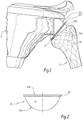
- the figures 1 and 3 show a human shoulder at which a humerus H and a scapula S are associated.
- the figures 1 and 3 also show a shoulder prosthesis 1 which is implanted at the aforesaid shoulder so as to join a glenoid G of the scapula and a proximal humerus PH of the humerus H in an articulated manner.
- the shoulder prosthesis 1 comprises a glenoid component 10 and a glenohumeral component 20 that is shown alone in figure 2 .
- the shoulder prosthesis 1 consists of the glenoid component 10 and the glenohumeral component 20: in other words, the shoulder prosthesis 1 does not include any component other than the glenoid component 10 and the glenohumeral component 20.
- the glenoid component 10 is designed to be secured to the glenoid G.
- the glenoid component 10 is provided with corresponding anchoring arrangements which are located at a side 10A of the glenoid component, which faces the glenoid G when the glenoid component is implanted.
- these anchoring arrangements of the glenoid component 10 which are not detailed in the figures, are known per se. More generally, the embodiments of the anchoring arrangements of the glenoid component 10 are not limitative, provided these anchoring arrangements are operable intraoperatively by a surgeon to fixedly fasten the glenoid component 10 to the glenoid G.
- the glenoid component 10 On a side 10B of the glenoid component 10, which is opposite to the side 10A, the glenoid component 10 has an articular surface 11, which is convex and which is provided to articulate with the glenohumeral component 20 as explained later.
- the convex articular surface 11 is essentially spherical, being centered on an axis Z11, and is defined on a piece of the glenoid component 10, which forms a glenosphere 12.
- the glenosphere 12 or, more generally, the part of the glenoid component 10 on which the articular surface 11 is defined is made of a hard material, typically made of metal, especially surgical metal alloys, or ceramic, especially pyrocarbon. In some other embodiments, the glenosphere 12 or, more generally, the part of the glenoid component on which the articular surface 11 is defined is made of a soft material, typically made of polymeric material.
- the glenohumeral component 20 is not provided to be secured neither to the scapula S, especially the glenoid G thereof, nor to the humerus H, especially the proximal humerus PH thereof: as shown in the figures 1 and 3 , in the implanted state of the shoulder prosthesis 1, the glenohumeral component is free-floating with respect to the scapula S, especially the glenoid thereof, and with respect to the humerus H, especially the proximal humerus PH thereof.
- the glenohumeral component 20 is designed to be interposed in a freely movable manner between the proximal humerus PH and the glenoid component 10 secured to the glenoid G.
- the glenohumeral component 20 has a side 20A, which faces the proximal humerus PH when the shoulder prosthesis 1 is implanted and which is in direct contact with an end portion PH1 of the proximal humerus PH.
- the glenohumeral component 20 has a side 20B, which is opposite to the side 20A and which is in direct contact with the glenoid component 10 when the shoulder prosthesis 1 is implanted.
- the side 20A of the glenohumeral component 20 includes a convex articular surface 21 that is designed to articulate with a complementary concave bone surface PH2 of the end portion PH1 of the proximal humerus PH. If necessary after having partly resected the end portion PH1 of the proximal humerus PH, the bone surface PH2 is prepared within this end portion PH1 before putting in place the glenohumeral component 20 upon implantation of the shoulder prosthesis 1.
- the preparation and the constituent elements of the bone surface PH2 are not limitative, provided the bone surface PH2 is shaped as a recessed socket into the end portion PH1 of the proximal humerus PH and the bone surface PH2 is defined by osseous material, either natural or synthetic. Some embodiments of the bone surface PH2 are given for example in US 2011/0098822 .
- the convex articular surface 21 is essentially spherical and is centered on an axis Z21.
- the convex articular surface 21 and the concave bone surface PH2 are in direct contact so as to freely articulate one with respect to the other, especially somewhat in the manner of a ball joint.
- the convex articular surface 21 and the concave bone surface PH2 freely tilt one with respect to one another both in the cross-sectional plane of figure 3 , as indicated by an arrow T1 on figure 3 , and in all the other geometric planes containing a central geometrical axis of the bone surface PH2.
- the articulation between the glenohumeral component 20 and the proximal humerus H which results from the above-described cooperation between the convex articular surface 21 and the concave bone surface PH2, has a range which may be limited, especially in order to prevent any unwanted disengagement between the articular surface 21 and the bone surface PH2.
- the side 20A of the glenohumeral component 20 is provided with a peripheral flange 22 which is designed to abut against the end portion PH1 of the proximal humerus PH, more precisely to abut against an edge PH3 of this end portion PH1, which borders the concave bone surface PH2.
- this flange 22 mechanically interferes with a lower portion of the edge PH3 so as to limit the range of tilting between the glenohumeral component 20 and the proximal humerus PH in the cross-sectional plane of figure 3 .
- the side 20B of the glenohumeral component 20 includes a concave articular surface 23 that is complementary to the convex articular surface 11 of the glenoid component 10 and that is thus designed to articulate with this articular surface 11 when the shoulder prosthesis 1 is implanted.
- the concave articular surface 23 is essentially spherical and is centered on an axis Z23 which may be coincident with the axis Z21 of the convex articular surface 21.
- the concave articular surface 23 of the glenohumeral component 20 and the convex articular surface 11 of the glenoid component 10 are in direct contact so as to freely articulate one with respect to the other, especially somewhat in the manner of a ball joint.
- the type of articulation between the articular surfaces 11 and 23 is similar or even identical to the type of articulation between the articular surface 21 and the bone surface PH2.
- the articular surface 11 and 23 freely tilt one with respect to the other both in the cross-sectional plane of figure 3 , as indicated by an arrow T2 on figure 3 , and in all the other geometric planes containing a central geometric axis of the articular surface 11, especially the axis Z11.
- a double mobility is operable between the glenoid component 10, that is fixedly fastened to the glenoid G, and the proximal humerus PH: a first mobility is operated by cooperation between the articular surface 21 and the bone surface PH2 and a second mobility is operated by cooperation between the articular surfaces 11 and 23.
- a first mobility is operated by cooperation between the articular surface 21 and the bone surface PH2
- a second mobility is operated by cooperation between the articular surfaces 11 and 23.
- the opposed articular surfaces 21 and 23 of the glenohumeral component 20 have respective curvatures that are opposite, the aforesaid double mobility remains stable in use, with the advantage that the concavity of the articular surface 23 enables to combine the glenohumeral component 20 with a reversed glenoid component as the glenoid component 10, in the sense that unlike a natural glenoid, the glenoid G provided with the glenoid component 10 has a convex shape at the articular surface 11: compared to a natural glenoid, the articulation between the glenoid G, provided with the glenoid component 10, and the glenohumeral component 20 is lateralized and lowered with respect to the scapula S.
- the shoulder prosthesis 1 can be considered as a reversed shoulder prosthesis with all the corresponding functional advantages. That being said, the reversed shoulder prosthesis 1 has, as a specific aspect, no prosthetic humeral component which would be fixedly fastened to the proximal humerus PH, since the glenohumeral component 20 remains free-floating with respect to the proximal humerus P: there is no need to secure any such prosthetic component to the humerus H, which avoids the risk that such a prosthetic component separates from the humerus in an uncontrolled manner as a result of high loads transmitted therethrough to the humerus.
- the glenohumeral component 20 is made in one piece on which both articular surfaces 21 and 23 are defined.
- this one-piece glenohumeral component 20 is preferably made of a hard material, typically made of metal, especially surgical metal alloys, or ceramic, especially pyrocarbon: such a hard material provides a good articular behavior with respect to the osseous material of the bone surface PH2 of the proximal humerus PH.
- the glenosphere 12 or, more generally, the part of the glenoid component 10 on which the articular surface 11 is defined may advantageously be made of a soft material, typically polymeric material. That being said, in some embodiments, both components 20 and 10 may be each made of a hard material, ceramic and ceramic for example.
- the one-piece glenohumeral component 20 is made of a soft material, typically polymeric material; in that case, the glenosphere 12 or, more generally, the part of the glenoid component 10 on which the articular surface 11 is defined is made of a hard material, typically metal, especially surgical metal alloys, or ceramic, especially pyrocarbon.
- a variant of the glenohumeral component 20 is considered, being labelled 20'.
- This glenohumeral component 20' is identical to the glenohumeral component 20 of the figures 1 to 3 , except that the glenohumeral component 20' does not have a flange similar to the flange 22.
- a shoulder prosthesis 101 is considered as an alternative embodiment for the shoulder prosthesis 1 of the figures 1 to 3 .
- the shoulder prosthesis 101 comprises or even consists of both a glenoid component, which is identical to the glenoid component 10 of the shoulder prosthesis 1 and which is therefore labelled 10 for the shoulder prosthesis 101, and a glenohumeral component 120.
- the glenohumeral component 120 is functionally similar to the glenohumeral component 20: thus, two opposed sides 120A and 120B of the glenohumeral component 120 respectively include a convex articular surface 121 for articulating with the bone surface PH2 prepared within the end portion PH1 of the proximal humerus PH and a concave articular surface 123 for articulating with the articular surface 11 of the glenoid component, while having the glenohumeral component 120 that is free-floating with respect to the humerus H and the scapula S.
- the glenohumeral component 120 differs from the glenohumeral component 20 by its constitutive structure, in the sense that unlike being made in one piece, the glenohumeral component 120 comprises two distinct pieces 120.1 and 120.2.
- the piece 120.1 defines the convex articular surface 121 whereas the piece 120.2 defines the concave articular surface 123.
- the two separate pieces 120.1 and 120.2 are fixedly assembled together.
- the means for fixedly assembling the pieces 120.1 and 120.2 are not limitative, any appropriate embodiment, known per se, being possible for these means.
- the two pieces structure of the glenohumeral component 120 may advantageously use to provide two different materials for the pieces 120.1 and 120.2 respectively.
- the piece 120.1 may be made of a hard material, typically made of metal, especially surgical metal alloys, or ceramic, especially pyrocarbon
- the piece 120.2 may be made of a soft material, typically made of polymeric material, being noted that in that case, the glenosphere 12 or, more generally, the part of the glenoid component 10 on which the articular surface 11 is defined is preferably made of a hard material, typically made of metal or ceramic.
- the piece 120.1 may be made of a soft material whereas the piece 120.2 may be made of a hard material.
- the glenohumeral component 120 consists of the two pieces 120.1 and 120.2 and, if appropriate, added elements of the aforesaid means for assembling these two pieces together. That being said, in some other embodiments, the glenohumeral component may include at least one third piece that is distinct from the two pieces 120.1 and 120.2: this third piece is fixedly interposed between the pieces 120.1 and 120.2, which may facilitate the combination of the pieces 120.1 and 120.2 when these latter are difficult to directly assemble together.
- the glenohumeral component 120' is identical to the glenohumeral component 120 of the figures 5 and 6 , except that the glenohumeral component 120' is provided with a peripheral flange 122' which is functionally similar to the flange 22 of the glenohumeral component 20.
- the flange 122' belongs to a piece 120.1' of the glenohumeral component 120', which is similar to the piece 120.1.
- a piece 120.2' of the glenohumeral component 120' which is similar to the piece 120.2, includes the flange 122'.
Landscapes
- Health & Medical Sciences (AREA)
- Orthopedic Medicine & Surgery (AREA)
- Cardiology (AREA)
- Oral & Maxillofacial Surgery (AREA)
- Transplantation (AREA)
- Engineering & Computer Science (AREA)
- Biomedical Technology (AREA)
- Heart & Thoracic Surgery (AREA)
- Vascular Medicine (AREA)
- Life Sciences & Earth Sciences (AREA)
- Animal Behavior & Ethology (AREA)
- General Health & Medical Sciences (AREA)
- Public Health (AREA)
- Veterinary Medicine (AREA)
- Prostheses (AREA)
Description
- The present invention concerns a shoulder prosthesis comprising a glenohumeral component.
- In a healthy human shoulder, the head of the humerus, which is generally ball-shaped, and the glenoid cavity of the scapula articulate with each other and form a ball-and-socket joint. Total shoulder arthroplasty is a common treatment for shoulder pain resulting from arthritis or injury and leads to replace the ball-and-socket joint by a shoulder orthopedic prosthesis.
- Such a shoulder prosthesis generally includes both a glenoid implant to be fixedly implanted at the glenoid of the scapula and a humeral implant to be fixedly implanted at the head of the humerus. The glenoid implant and the humeral implant may be designed to articulate directly with each other. The glenoid implant and the humeral implant may also be designed to articulate through an insert interposed between them: for example,
EP 1 649 836US 2013/150975 andGB 2 166 654 EP 1 649 836 - The invention focuses on another type of shoulder prosthesis, in which the humeral implant to be fixedly secured to the humerus is replaced with a free-floating glenohumeral component, as proposed in
US 2011/0098822 . As this free-floating glenohumeral component freely articulates with a concave bone surface that is prepared within an end portion of the humerus,US 2011/0098822 describes the glenohumeral component as corresponding to an interpositionnal implant which has necessarily a sphere or ball shape so as to freely revolve on itself between the aforesaid concave bone surface and either a concave prosthetic surface of a glenoid component or a concave bone surface of the glenoid.EP 2 382 930 discloses a glenohumeral component that is very similar to the one disclosed inUS 2011/0098822 . - One of the goals of the present invention is to propose an improved glenohumeral component that in particular is not limited to a spherical shape.
- To this end, one object of the invention is a shoulder prosthesis, as defined in
claim 1. - Thanks to the invention, the shoulder prosthesis is reversed, in the sense that the natural anatomy of the ball-and-socket joint of the shoulder is reversed. In that way, the articular interface between the glenoid component, which is secured to the glenoid, and the rest of the prosthesis is lateralized and lowered with respect to the scapula, which gives the possibility of increasing the lever arm of the deltoid. This reversed prosthesis is therefore particularly indicated when the cuff of the patient is highly damaged, or even torn, partially or completely. Moreover, the aforesaid articular interface has double mobility, in the sense that the glenohumeral component in the invention remains mobile both with respect to the glenoid, that fixedly bears the glenoid component, and with respect to the humerus, that bears no fixed prosthetic component: this double mobility between the glenoid and the humerus provides a greater range of motion between the glenoid and the humerus. Besides, as the shoulder prosthesis of the invention does not include a prosthetic humeral component, there is no need to secure any prosthetic component to the humerus, which avoids loosening of the securement of such a humeral component.
- Additional advantageous features of the shoulder prosthesis according to the invention are specified in the other claims.
- Embodiments of the invention will be better understood from reading the description which will follow, which is given solely by way of example and with reference to the drawings in which:
-
figure 1 is an elevational view of a shoulder prosthesis that is implanted at a human shoulder; -
figure 2 is an elevational view of a glenohumeral component of the shoulder prosthesis offigure 1 , this glenohumeral component being shown alone; -
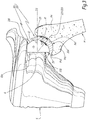
figure 3 corresponds tofigure 1 , in which the glenohumeral component and the humerus of the shoulder are illustrated in cross-section; -
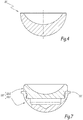
figure 4 is a cross-sectional view of a variant of the glenohumeral component of the shoulder prosthesis offigure 1 ; -
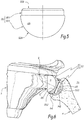
figure 5 is an elevational view of another embodiment of a shoulder prosthesis; -
figure 6 is a view similar tofigure 3 , with the shoulder prosthesis offigure 5 ; and -
figure 7 is a cross-sectional view of a variant of the glenohumeral component of the shoulder prosthesis offigure 5 . - The
figures 1 and3 show a human shoulder at which a humerus H and a scapula S are associated. Thefigures 1 and3 also show ashoulder prosthesis 1 which is implanted at the aforesaid shoulder so as to join a glenoid G of the scapula and a proximal humerus PH of the humerus H in an articulated manner. - The
shoulder prosthesis 1 comprises aglenoid component 10 and aglenohumeral component 20 that is shown alone infigure 2 . - As shown in the figures, the
shoulder prosthesis 1 consists of theglenoid component 10 and the glenohumeral component 20: in other words, theshoulder prosthesis 1 does not include any component other than theglenoid component 10 and theglenohumeral component 20. - The
glenoid component 10 is designed to be secured to the glenoid G. For this purpose, theglenoid component 10 is provided with corresponding anchoring arrangements which are located at aside 10A of the glenoid component, which faces the glenoid G when the glenoid component is implanted. In practice, these anchoring arrangements of theglenoid component 10, which are not detailed in the figures, are known per se. More generally, the embodiments of the anchoring arrangements of theglenoid component 10 are not limitative, provided these anchoring arrangements are operable intraoperatively by a surgeon to fixedly fasten theglenoid component 10 to the glenoid G. - On a
side 10B of theglenoid component 10, which is opposite to theside 10A, theglenoid component 10 has anarticular surface 11, which is convex and which is provided to articulate with theglenohumeral component 20 as explained later. - In some embodiments as the one shown in the figures, the convex
articular surface 11 is essentially spherical, being centered on an axis Z11, and is defined on a piece of theglenoid component 10, which forms aglenosphere 12. - In some embodiments, the
glenosphere 12 or, more generally, the part of theglenoid component 10 on which thearticular surface 11 is defined is made of a hard material, typically made of metal, especially surgical metal alloys, or ceramic, especially pyrocarbon. In some other embodiments, theglenosphere 12 or, more generally, the part of the glenoid component on which thearticular surface 11 is defined is made of a soft material, typically made of polymeric material. - Unlike the
glenoid component 10, theglenohumeral component 20 is not provided to be secured neither to the scapula S, especially the glenoid G thereof, nor to the humerus H, especially the proximal humerus PH thereof: as shown in thefigures 1 and3 , in the implanted state of theshoulder prosthesis 1, the glenohumeral component is free-floating with respect to the scapula S, especially the glenoid thereof, and with respect to the humerus H, especially the proximal humerus PH thereof. For this purpose, theglenohumeral component 20 is designed to be interposed in a freely movable manner between the proximal humerus PH and theglenoid component 10 secured to the glenoid G. - Thus, the
glenohumeral component 20 has aside 20A, which faces the proximal humerus PH when theshoulder prosthesis 1 is implanted and which is in direct contact with an end portion PH1 of the proximal humerus PH. And theglenohumeral component 20 has aside 20B, which is opposite to theside 20A and which is in direct contact with theglenoid component 10 when theshoulder prosthesis 1 is implanted. - As shown by the
figures 2 and3 , theside 20A of theglenohumeral component 20 includes a convexarticular surface 21 that is designed to articulate with a complementary concave bone surface PH2 of the end portion PH1 of the proximal humerus PH. If necessary after having partly resected the end portion PH1 of the proximal humerus PH, the bone surface PH2 is prepared within this end portion PH1 before putting in place theglenohumeral component 20 upon implantation of theshoulder prosthesis 1. The preparation and the constituent elements of the bone surface PH2 are not limitative, provided the bone surface PH2 is shaped as a recessed socket into the end portion PH1 of the proximal humerus PH and the bone surface PH2 is defined by osseous material, either natural or synthetic. Some embodiments of the bone surface PH2 are given for example inUS 2011/0098822 . - In some embodiments as the one shown in the
figures 1 to 3 , the convexarticular surface 21 is essentially spherical and is centered on an axis Z21. - When the
shoulder prosthesis 1 is implanted, the convexarticular surface 21 and the concave bone surface PH2 are in direct contact so as to freely articulate one with respect to the other, especially somewhat in the manner of a ball joint. Thus, the convexarticular surface 21 and the concave bone surface PH2 freely tilt one with respect to one another both in the cross-sectional plane offigure 3 , as indicated by an arrow T1 onfigure 3 , and in all the other geometric planes containing a central geometrical axis of the bone surface PH2. - In some embodiments as the one shown in the
figures 1 to 3 , the articulation between theglenohumeral component 20 and the proximal humerus H, which results from the above-described cooperation between the convexarticular surface 21 and the concave bone surface PH2, has a range which may be limited, especially in order to prevent any unwanted disengagement between thearticular surface 21 and the bone surface PH2. For this purpose, theside 20A of theglenohumeral component 20 is provided with aperipheral flange 22 which is designed to abut against the end portion PH1 of the proximal humerus PH, more precisely to abut against an edge PH3 of this end portion PH1, which borders the concave bone surface PH2. As shown for example for the articulation configuration offigure 3 , thisflange 22 mechanically interferes with a lower portion of the edge PH3 so as to limit the range of tilting between theglenohumeral component 20 and the proximal humerus PH in the cross-sectional plane offigure 3 . - As shown by the
figure 3 , theside 20B of theglenohumeral component 20 includes a concavearticular surface 23 that is complementary to the convexarticular surface 11 of theglenoid component 10 and that is thus designed to articulate with thisarticular surface 11 when theshoulder prosthesis 1 is implanted. - In some embodiments as the one shown in the
figures 1 to 3 , the concavearticular surface 23 is essentially spherical and is centered on an axis Z23 which may be coincident with the axis Z21 of the convexarticular surface 21. - When the
shoulder prosthesis 1 is implanted, the concavearticular surface 23 of theglenohumeral component 20 and the convexarticular surface 11 of theglenoid component 10 are in direct contact so as to freely articulate one with respect to the other, especially somewhat in the manner of a ball joint. In some embodiments as the one shown in thefigures 1 to 3 , the type of articulation between thearticular surfaces articular surface 21 and the bone surface PH2. Thus, thearticular surface figure 3 , as indicated by an arrow T2 onfigure 3 , and in all the other geometric planes containing a central geometric axis of thearticular surface 11, especially the axis Z11. - It will be understood that in use, a double mobility is operable between the
glenoid component 10, that is fixedly fastened to the glenoid G, and the proximal humerus PH: a first mobility is operated by cooperation between thearticular surface 21 and the bone surface PH2 and a second mobility is operated by cooperation between thearticular surfaces shoulder prosthesis 1, one and/or the other of these first and second mobilities are more or less implemented, which provides a greater range of motion between the glenoid G and the proximal humerus PH. Furthermore, thanks to the fact that the opposedarticular surfaces glenohumeral component 20 have respective curvatures that are opposite, the aforesaid double mobility remains stable in use, with the advantage that the concavity of thearticular surface 23 enables to combine theglenohumeral component 20 with a reversed glenoid component as theglenoid component 10, in the sense that unlike a natural glenoid, the glenoid G provided with theglenoid component 10 has a convex shape at the articular surface 11: compared to a natural glenoid, the articulation between the glenoid G, provided with theglenoid component 10, and theglenohumeral component 20 is lateralized and lowered with respect to the scapula S. In this regard, theshoulder prosthesis 1 can be considered as a reversed shoulder prosthesis with all the corresponding functional advantages. That being said, the reversedshoulder prosthesis 1 has, as a specific aspect, no prosthetic humeral component which would be fixedly fastened to the proximal humerus PH, since theglenohumeral component 20 remains free-floating with respect to the proximal humerus P: there is no need to secure any such prosthetic component to the humerus H, which avoids the risk that such a prosthetic component separates from the humerus in an uncontrolled manner as a result of high loads transmitted therethrough to the humerus. - In some embodiments as the one shown in the
figures 1 to 3 , theglenohumeral component 20 is made in one piece on which botharticular surfaces - It follows that this one-piece
glenohumeral component 20 is preferably made of a hard material, typically made of metal, especially surgical metal alloys, or ceramic, especially pyrocarbon: such a hard material provides a good articular behavior with respect to the osseous material of the bone surface PH2 of the proximal humerus PH. In that case, theglenosphere 12 or, more generally, the part of theglenoid component 10 on which thearticular surface 11 is defined may advantageously be made of a soft material, typically polymeric material. That being said, in some embodiments, bothcomponents - Alternatively, the one-piece
glenohumeral component 20 is made of a soft material, typically polymeric material; in that case, theglenosphere 12 or, more generally, the part of theglenoid component 10 on which thearticular surface 11 is defined is made of a hard material, typically metal, especially surgical metal alloys, or ceramic, especially pyrocarbon. - Turning now to the
figure 4 , a variant of theglenohumeral component 20 is considered, being labelled 20'. This glenohumeral component 20' is identical to theglenohumeral component 20 of thefigures 1 to 3 , except that the glenohumeral component 20' does not have a flange similar to theflange 22. - Turning now to the
figures 5 and 6 , ashoulder prosthesis 101 is considered as an alternative embodiment for theshoulder prosthesis 1 of thefigures 1 to 3 . Theshoulder prosthesis 101 comprises or even consists of both a glenoid component, which is identical to theglenoid component 10 of theshoulder prosthesis 1 and which is therefore labelled 10 for theshoulder prosthesis 101, and aglenohumeral component 120. With respect to the proximal humerus PH and theglenoid component 10, theglenohumeral component 120 is functionally similar to the glenohumeral component 20: thus, twoopposed sides glenohumeral component 120 respectively include a convexarticular surface 121 for articulating with the bone surface PH2 prepared within the end portion PH1 of the proximal humerus PH and a concavearticular surface 123 for articulating with thearticular surface 11 of the glenoid component, while having theglenohumeral component 120 that is free-floating with respect to the humerus H and the scapula S. - The
glenohumeral component 120 differs from theglenohumeral component 20 by its constitutive structure, in the sense that unlike being made in one piece, theglenohumeral component 120 comprises two distinct pieces 120.1 and 120.2. The piece 120.1 defines the convexarticular surface 121 whereas the piece 120.2 defines the concavearticular surface 123. In use, the two separate pieces 120.1 and 120.2 are fixedly assembled together. In practice, the means for fixedly assembling the pieces 120.1 and 120.2 are not limitative, any appropriate embodiment, known per se, being possible for these means. - The two pieces structure of the
glenohumeral component 120 may advantageously use to provide two different materials for the pieces 120.1 and 120.2 respectively. Thus, in some embodiments, the piece 120.1 may be made of a hard material, typically made of metal, especially surgical metal alloys, or ceramic, especially pyrocarbon, whereas the piece 120.2 may be made of a soft material, typically made of polymeric material, being noted that in that case, theglenosphere 12 or, more generally, the part of theglenoid component 10 on which thearticular surface 11 is defined is preferably made of a hard material, typically made of metal or ceramic. - Alternatively, the piece 120.1 may be made of a soft material whereas the piece 120.2 may be made of a hard material.
- In some embodiments as the one shown in the
figures 5 and 6 , theglenohumeral component 120 consists of the two pieces 120.1 and 120.2 and, if appropriate, added elements of the aforesaid means for assembling these two pieces together. That being said, in some other embodiments, the glenohumeral component may include at least one third piece that is distinct from the two pieces 120.1 and 120.2: this third piece is fixedly interposed between the pieces 120.1 and 120.2, which may facilitate the combination of the pieces 120.1 and 120.2 when these latter are difficult to directly assemble together. - Turning now to the
figure 7 , a variant for theglenohumeral component 120 is considered, being labelled 120'. The glenohumeral component 120' is identical to theglenohumeral component 120 of thefigures 5 and 6 , except that the glenohumeral component 120' is provided with a peripheral flange 122' which is functionally similar to theflange 22 of theglenohumeral component 20. - In some embodiments, as the one shown in the
figure 7 , the flange 122' belongs to a piece 120.1' of the glenohumeral component 120', which is similar to the piece 120.1. In some other embodiments, a piece 120.2' of the glenohumeral component 120', which is similar to the piece 120.2, includes the flange 122'.
Claims (15)
- Shoulder prosthesis (1; 101), consisting of:- a glenoid component (10), which is designed to be secured to a human glenoid (G), and- a glenohumeral component (20; 20' ; 120; 120'), which comprises a first side (20A; 120A) and a second side (20B; 120B), which are opposite each other and which, in an implanted state in which the glenohumeral component is free-floating with respect to a humerus (H) and a glenoid (G) of a human shoulder, are in contact respectively with an end portion (PH1) of the humerus and with the glenoid component (10) secured to the glenoid,
wherein the first side of the glenohumeral component includes a convex articular surface (21; 121) that is designed to articulate with a concave bone surface (PH2) prepared within the end portion of the humerus,
characterized in that the second side of the glenohumeral component includes a concave articular surface (23; 123) that articulates with a convex articular surface (11) of the glenoid component. - Shoulder prosthesis according to claim 1, wherein the glenoid component (10) comprises a glenosphere (12).
- Shoulder prosthesis according to anyone of the preceding claims, wherein the glenohumeral component (20; 20') is in one piece on which are defined both the convex and concave articular surfaces (21, 23) of the glenohumeral component.
- Shoulder prosthesis according to anyone of the claims 1 to 2, wherein the glenohumeral component (120; 120') comprises a first piece 120.1; 120.1'), on which is defined the convex articular surface (121) of the glenohumeral component, and a second piece (120.2; 120.2'), on which is defined the concave articular surface (123) of the glenohumeral component, the first piece and the second piece being separate and being fixedly assembled together.
- Shoulder prosthesis according to claim 4, wherein the glenohumeral component (120; 120') comprises at least one third piece, that is fixedly interposed between the first and second pieces.
- Shoulder prosthesis according to anyone of the preceding claims, wherein the convex articular surface (21; 121) of the glenohumeral component (20; 20'; 120; 120') is defined on a ceramic part of the glenohumeral component.
- Shoulder prosthesis according to anyone of the claims 1 to 5, wherein the convex articular surface (21; 121) of the glenohumeral component (20; 20'; 120; 120') is defined on a metal part of the glenohumeral component.
- Shoulder prosthesis according to anyone of the preceding claims, wherein the concave articular surface (23; 123) of the glenohumeral component (20; 20'; 120; 120') is defined on a polymeric part of the glenohumeral component, and wherein the convex articular surface (11) of the glenoid component (10) is defined on a ceramic part of the glenoid component.
- Shoulder prosthesis according to anyone of the claims 1 to 7, wherein the concave articular surface (23; 123) of the glenohumeral component (20; 20'; 120; 120') is defined on a polymeric part of the glenohumeral component, and wherein the convex articular surface (11) of the glenoid component (10) is defined on a metal part of the glenoid component.
- Shoulder prosthesis according to anyone of the claims 1 to 7, wherein the concave articular surface (23; 123) of the glenohumeral component (20; 20'; 120; 120') is defined on a ceramic part of the glenohumeral component, and wherein the convex articular surface (11) of the glenoid component (10) is defined on a polymeric part of the glenoid component.
- Shoulder prosthesis according to anyone of the claims 1 to 7, wherein the concave articular surface (23; 123) of the glenohumeral component (20; 20'; 120; 120') is defined on a metal part of the glenohumeral component, and wherein the convex articular surface (11) of the glenoid component (10) is defined on a polymeric part of the glenoid component.
- Shoulder prosthesis according to anyone of the claims 1 to 7, wherein the concave articular surface (23; 123) of the glenohumeral component (20; 20'; 120; 120') is defined on a ceramic part of the glenohumeral component, and wherein the convex articular surface (11) of the glenoid component (10) is defined on a ceramic part of the glenoid component.
- Shoulder prosthesis according to anyone of the claims 6, 10 and 12, wherein the ceramic part of the glenohumeral component (20; 20'; 120; 120') is made of pyrocarbon.
- Shoulder prosthesis according to anyone of the claims 8, 12 and 13, wherein the ceramic part of the glenoid component (10) is made of pyrocarbon.
- Shoulder prosthesis according to anyone of the preceding claims, wherein the glenohumeral component (20; 120') includes a peripheral flange (22; 122') designed to abut against an edge (PH3) of the end portion (PH1) of the humerus (H), the edge bordering the bone surface (PH2), so as to limit range of articulation between the glenohumeral component and the humerus.
Priority Applications (3)
| Application Number | Priority Date | Filing Date | Title |
|---|---|---|---|
| EP16306625.1A EP3332749B1 (en) | 2016-12-06 | 2016-12-06 | Shoulder prosthesis comprising a glenohumeral component |
| US15/828,940 US10695186B2 (en) | 2016-12-06 | 2017-12-01 | Glenohumeral component for a shoulder prosthesis, and shoulder prosthesis comprising such a glenohumeral component |
| US16/885,055 US11439512B2 (en) | 2016-12-06 | 2020-05-27 | Glenohumeral component for a shoulder prosthesis, and shoulder prosthesis comprising such a glenohumeral component |
Applications Claiming Priority (1)
| Application Number | Priority Date | Filing Date | Title |
|---|---|---|---|
| EP16306625.1A EP3332749B1 (en) | 2016-12-06 | 2016-12-06 | Shoulder prosthesis comprising a glenohumeral component |
Publications (2)
| Publication Number | Publication Date |
|---|---|
| EP3332749A1 EP3332749A1 (en) | 2018-06-13 |
| EP3332749B1 true EP3332749B1 (en) | 2020-09-02 |
Family
ID=57570552
Family Applications (1)
| Application Number | Title | Priority Date | Filing Date |
|---|---|---|---|
| EP16306625.1A Active EP3332749B1 (en) | 2016-12-06 | 2016-12-06 | Shoulder prosthesis comprising a glenohumeral component |
Country Status (2)
| Country | Link |
|---|---|
| US (2) | US10695186B2 (en) |
| EP (1) | EP3332749B1 (en) |
Families Citing this family (2)
| Publication number | Priority date | Publication date | Assignee | Title |
|---|---|---|---|---|
| EP3332749B1 (en) | 2016-12-06 | 2020-09-02 | Tornier | Shoulder prosthesis comprising a glenohumeral component |
| WO2021150730A1 (en) * | 2020-01-24 | 2021-07-29 | Zimmer, Inc. | Mobile bearing reversed humeral implant |
Citations (1)
| Publication number | Priority date | Publication date | Assignee | Title |
|---|---|---|---|---|
| WO2017066504A1 (en) * | 2015-10-15 | 2017-04-20 | Britton Orsa | Stemless shoulder implant |
Family Cites Families (21)
| Publication number | Priority date | Publication date | Assignee | Title |
|---|---|---|---|---|
| US3916451A (en) * | 1974-10-25 | 1975-11-04 | Frederick F Buechel | Floating center prosthetic joint |
| GB1544403A (en) * | 1975-01-31 | 1979-04-19 | Nat Res Dev | Endoprosthetic bone joint devices |
| GB2166654A (en) * | 1984-09-22 | 1986-05-14 | Olusola Olumide Akindele Oni | Shoulder joint prosthesis |
| DE3701381C1 (en) | 1987-01-20 | 1988-08-04 | Orthoplant Endoprothetik | Hip socket for a hip joint endoprosthesis |
| US5171285A (en) * | 1992-02-18 | 1992-12-15 | Zimmer, Inc. | Acetabular cup with shiftable elevated rim liner |
| US7799077B2 (en) | 2002-10-07 | 2010-09-21 | Conformis, Inc. | Minimally invasive joint implant with 3-dimensional geometry matching the articular surfaces |
| FR2801193B1 (en) | 1999-11-19 | 2002-02-15 | Proconcept | DOUBLE MOBILITY EXPANDABLE COTYLOIDAL PROSTHESIS |
| WO2003047470A2 (en) | 2001-12-04 | 2003-06-12 | Discure Ltd. | Cushion bearing implants for load bearing applications |
| WO2005016123A2 (en) | 2003-08-11 | 2005-02-24 | Chudik Steven C M D | Devices and methods used for shoulder replacement |
| US7044974B2 (en) | 2003-08-27 | 2006-05-16 | Zimmer Technology, Inc. | Hip prosthesis with a modular acetabular cup assembly |
| ITUD20040195A1 (en) * | 2004-10-20 | 2005-01-20 | Lima Lto Spa | REVERSE PROSTHESIS FOR THE ARTICULATION OF THE SHOULDER |
| WO2007041879A1 (en) * | 2005-10-13 | 2007-04-19 | Plus Orthopedics Ag | Inverse design of endoprosthesis for shoulder joints |
| US20070225822A1 (en) * | 2005-12-09 | 2007-09-27 | Santilli Albert N | Orthopedic Implants Coated with Pyrolytic Carbon |
| US8308811B2 (en) | 2006-04-11 | 2012-11-13 | Zimmer, Inc. | Acetabular cup conversion ring |
| US20090287309A1 (en) | 2007-01-30 | 2009-11-19 | Tornier Sas | Intra-articular joint replacement |
| US20090062923A1 (en) | 2007-09-05 | 2009-03-05 | Swanson Todd V | Method and apparatus for shoulder arthroplasty |
| US9408652B2 (en) * | 2010-04-27 | 2016-08-09 | Tornier Sas | Intra-articular joint replacement and method |
| US20150335441A1 (en) | 2011-08-23 | 2015-11-26 | Linares Medical Devices, Llc | Multi-component shoulder implant assembly with dual articulating surfaces |
| US9414927B2 (en) * | 2011-12-08 | 2016-08-16 | Imds Llc | Shoulder arthroplasty |
| EP2749255A1 (en) | 2012-12-27 | 2014-07-02 | Zimmer GmbH | Shoulder prosthesis and components thereof |
| EP3332749B1 (en) | 2016-12-06 | 2020-09-02 | Tornier | Shoulder prosthesis comprising a glenohumeral component |
-
2016
- 2016-12-06 EP EP16306625.1A patent/EP3332749B1/en active Active
-
2017
- 2017-12-01 US US15/828,940 patent/US10695186B2/en active Active
-
2020
- 2020-05-27 US US16/885,055 patent/US11439512B2/en active Active
Patent Citations (1)
| Publication number | Priority date | Publication date | Assignee | Title |
|---|---|---|---|---|
| WO2017066504A1 (en) * | 2015-10-15 | 2017-04-20 | Britton Orsa | Stemless shoulder implant |
Also Published As
| Publication number | Publication date |
|---|---|
| EP3332749A1 (en) | 2018-06-13 |
| US20200281735A1 (en) | 2020-09-10 |
| US11439512B2 (en) | 2022-09-13 |
| US10695186B2 (en) | 2020-06-30 |
| US20180153701A1 (en) | 2018-06-07 |
Similar Documents
| Publication | Publication Date | Title |
|---|---|---|
| US11076960B2 (en) | Constrained mobile bearing hip assembly and method | |
| EP2566417B1 (en) | Mobile bearing glenoid prosthesis | |
| JP7120928B2 (en) | Elbow joint replacement device | |
| US8845743B2 (en) | Interlocking reverse shoulder prosthesis method | |
| US8142510B2 (en) | Mobile bearing assembly having a non-planar interface | |
| JP5073666B2 (en) | Humeral component of shoulder joint prosthesis | |
| US9925053B2 (en) | Joint implant | |
| US20050049709A1 (en) | Glenoid component of a shoulder prosthesis and complete shoulder prosthesis incorporating such a component | |
| US8679185B2 (en) | Joint prosthesis with positionable head | |
| WO2000018335A1 (en) | Implantable humeral prosthesis having offset head and stem connection | |
| US20230041368A1 (en) | Total wrist prosthesis and related methods | |
| US11439512B2 (en) | Glenohumeral component for a shoulder prosthesis, and shoulder prosthesis comprising such a glenohumeral component | |
| US9265617B2 (en) | Prosthesis for cervical and lumbar spine | |
| US20170202676A1 (en) | Intervertebral disc implant and method for restoring function to a damaged functional spinal unit | |
| JP4349628B2 (en) | Artificial finger joint | |
| CZ27454U1 (en) | Implant for replacement of intervertebral disk | |
| AU2008201470A1 (en) | Mobile bearing assembly having a non-planar interface |
Legal Events
| Date | Code | Title | Description |
|---|---|---|---|
| PUAI | Public reference made under article 153(3) epc to a published international application that has entered the european phase |
Free format text: ORIGINAL CODE: 0009012 |
|
| STAA | Information on the status of an ep patent application or granted ep patent |
Free format text: STATUS: THE APPLICATION HAS BEEN PUBLISHED |
|
| AK | Designated contracting states |
Kind code of ref document: A1 Designated state(s): AL AT BE BG CH CY CZ DE DK EE ES FI FR GB GR HR HU IE IS IT LI LT LU LV MC MK MT NL NO PL PT RO RS SE SI SK SM TR |
|
| AX | Request for extension of the european patent |
Extension state: BA ME |
|
| STAA | Information on the status of an ep patent application or granted ep patent |
Free format text: STATUS: REQUEST FOR EXAMINATION WAS MADE |
|
| 17P | Request for examination filed |
Effective date: 20181120 |
|
| RBV | Designated contracting states (corrected) |
Designated state(s): AL AT BE BG CH CY CZ DE DK EE ES FI FR GB GR HR HU IE IS IT LI LT LU LV MC MK MT NL NO PL PT RO RS SE SI SK SM TR |
|
| STAA | Information on the status of an ep patent application or granted ep patent |
Free format text: STATUS: EXAMINATION IS IN PROGRESS |
|
| 17Q | First examination report despatched |
Effective date: 20190723 |
|
| GRAP | Despatch of communication of intention to grant a patent |
Free format text: ORIGINAL CODE: EPIDOSNIGR1 |
|
| STAA | Information on the status of an ep patent application or granted ep patent |
Free format text: STATUS: GRANT OF PATENT IS INTENDED |
|
| INTG | Intention to grant announced |
Effective date: 20200226 |
|
| GRAJ | Information related to disapproval of communication of intention to grant by the applicant or resumption of examination proceedings by the epo deleted |
Free format text: ORIGINAL CODE: EPIDOSDIGR1 |
|
| STAA | Information on the status of an ep patent application or granted ep patent |
Free format text: STATUS: EXAMINATION IS IN PROGRESS |
|
| GRAR | Information related to intention to grant a patent recorded |
Free format text: ORIGINAL CODE: EPIDOSNIGR71 |
|
| GRAS | Grant fee paid |
Free format text: ORIGINAL CODE: EPIDOSNIGR3 |
|
| STAA | Information on the status of an ep patent application or granted ep patent |
Free format text: STATUS: GRANT OF PATENT IS INTENDED |
|
| INTC | Intention to grant announced (deleted) | ||
| GRAA | (expected) grant |
Free format text: ORIGINAL CODE: 0009210 |
|
| STAA | Information on the status of an ep patent application or granted ep patent |
Free format text: STATUS: THE PATENT HAS BEEN GRANTED |
|
| INTG | Intention to grant announced |
Effective date: 20200723 |
|
| AK | Designated contracting states |
Kind code of ref document: B1 Designated state(s): AL AT BE BG CH CY CZ DE DK EE ES FI FR GB GR HR HU IE IS IT LI LT LU LV MC MK MT NL NO PL PT RO RS SE SI SK SM TR |
|
| REG | Reference to a national code |
Ref country code: GB Ref legal event code: FG4D |
|
| REG | Reference to a national code |
Ref country code: AT Ref legal event code: REF Ref document number: 1307928 Country of ref document: AT Kind code of ref document: T Effective date: 20200915 Ref country code: CH Ref legal event code: EP |
|
| REG | Reference to a national code |
Ref country code: DE Ref legal event code: R096 Ref document number: 602016043121 Country of ref document: DE |
|
| REG | Reference to a national code |
Ref country code: IE Ref legal event code: FG4D |
|
| REG | Reference to a national code |
Ref country code: LT Ref legal event code: MG4D |
|
| PG25 | Lapsed in a contracting state [announced via postgrant information from national office to epo] |
Ref country code: GR Free format text: LAPSE BECAUSE OF FAILURE TO SUBMIT A TRANSLATION OF THE DESCRIPTION OR TO PAY THE FEE WITHIN THE PRESCRIBED TIME-LIMIT Effective date: 20201203 Ref country code: BG Free format text: LAPSE BECAUSE OF FAILURE TO SUBMIT A TRANSLATION OF THE DESCRIPTION OR TO PAY THE FEE WITHIN THE PRESCRIBED TIME-LIMIT Effective date: 20201202 Ref country code: NO Free format text: LAPSE BECAUSE OF FAILURE TO SUBMIT A TRANSLATION OF THE DESCRIPTION OR TO PAY THE FEE WITHIN THE PRESCRIBED TIME-LIMIT Effective date: 20201202 Ref country code: SE Free format text: LAPSE BECAUSE OF FAILURE TO SUBMIT A TRANSLATION OF THE DESCRIPTION OR TO PAY THE FEE WITHIN THE PRESCRIBED TIME-LIMIT Effective date: 20200902 Ref country code: HR Free format text: LAPSE BECAUSE OF FAILURE TO SUBMIT A TRANSLATION OF THE DESCRIPTION OR TO PAY THE FEE WITHIN THE PRESCRIBED TIME-LIMIT Effective date: 20200902 Ref country code: LT Free format text: LAPSE BECAUSE OF FAILURE TO SUBMIT A TRANSLATION OF THE DESCRIPTION OR TO PAY THE FEE WITHIN THE PRESCRIBED TIME-LIMIT Effective date: 20200902 Ref country code: FI Free format text: LAPSE BECAUSE OF FAILURE TO SUBMIT A TRANSLATION OF THE DESCRIPTION OR TO PAY THE FEE WITHIN THE PRESCRIBED TIME-LIMIT Effective date: 20200902 |
|
| REG | Reference to a national code |
Ref country code: NL Ref legal event code: MP Effective date: 20200902 |
|
| REG | Reference to a national code |
Ref country code: AT Ref legal event code: MK05 Ref document number: 1307928 Country of ref document: AT Kind code of ref document: T Effective date: 20200902 |
|
| PG25 | Lapsed in a contracting state [announced via postgrant information from national office to epo] |
Ref country code: LV Free format text: LAPSE BECAUSE OF FAILURE TO SUBMIT A TRANSLATION OF THE DESCRIPTION OR TO PAY THE FEE WITHIN THE PRESCRIBED TIME-LIMIT Effective date: 20200902 Ref country code: RS Free format text: LAPSE BECAUSE OF FAILURE TO SUBMIT A TRANSLATION OF THE DESCRIPTION OR TO PAY THE FEE WITHIN THE PRESCRIBED TIME-LIMIT Effective date: 20200902 Ref country code: PL Free format text: LAPSE BECAUSE OF FAILURE TO SUBMIT A TRANSLATION OF THE DESCRIPTION OR TO PAY THE FEE WITHIN THE PRESCRIBED TIME-LIMIT Effective date: 20200902 |
|
| PG25 | Lapsed in a contracting state [announced via postgrant information from national office to epo] |
Ref country code: CZ Free format text: LAPSE BECAUSE OF FAILURE TO SUBMIT A TRANSLATION OF THE DESCRIPTION OR TO PAY THE FEE WITHIN THE PRESCRIBED TIME-LIMIT Effective date: 20200902 Ref country code: SM Free format text: LAPSE BECAUSE OF FAILURE TO SUBMIT A TRANSLATION OF THE DESCRIPTION OR TO PAY THE FEE WITHIN THE PRESCRIBED TIME-LIMIT Effective date: 20200902 Ref country code: PT Free format text: LAPSE BECAUSE OF FAILURE TO SUBMIT A TRANSLATION OF THE DESCRIPTION OR TO PAY THE FEE WITHIN THE PRESCRIBED TIME-LIMIT Effective date: 20210104 Ref country code: RO Free format text: LAPSE BECAUSE OF FAILURE TO SUBMIT A TRANSLATION OF THE DESCRIPTION OR TO PAY THE FEE WITHIN THE PRESCRIBED TIME-LIMIT Effective date: 20200902 Ref country code: EE Free format text: LAPSE BECAUSE OF FAILURE TO SUBMIT A TRANSLATION OF THE DESCRIPTION OR TO PAY THE FEE WITHIN THE PRESCRIBED TIME-LIMIT Effective date: 20200902 |
|
| PG25 | Lapsed in a contracting state [announced via postgrant information from national office to epo] |
Ref country code: AT Free format text: LAPSE BECAUSE OF FAILURE TO SUBMIT A TRANSLATION OF THE DESCRIPTION OR TO PAY THE FEE WITHIN THE PRESCRIBED TIME-LIMIT Effective date: 20200902 Ref country code: AL Free format text: LAPSE BECAUSE OF FAILURE TO SUBMIT A TRANSLATION OF THE DESCRIPTION OR TO PAY THE FEE WITHIN THE PRESCRIBED TIME-LIMIT Effective date: 20200902 Ref country code: ES Free format text: LAPSE BECAUSE OF FAILURE TO SUBMIT A TRANSLATION OF THE DESCRIPTION OR TO PAY THE FEE WITHIN THE PRESCRIBED TIME-LIMIT Effective date: 20200902 Ref country code: IS Free format text: LAPSE BECAUSE OF FAILURE TO SUBMIT A TRANSLATION OF THE DESCRIPTION OR TO PAY THE FEE WITHIN THE PRESCRIBED TIME-LIMIT Effective date: 20210102 |
|
| REG | Reference to a national code |
Ref country code: DE Ref legal event code: R097 Ref document number: 602016043121 Country of ref document: DE |
|
| PG25 | Lapsed in a contracting state [announced via postgrant information from national office to epo] |
Ref country code: SK Free format text: LAPSE BECAUSE OF FAILURE TO SUBMIT A TRANSLATION OF THE DESCRIPTION OR TO PAY THE FEE WITHIN THE PRESCRIBED TIME-LIMIT Effective date: 20200902 |
|
| PLBE | No opposition filed within time limit |
Free format text: ORIGINAL CODE: 0009261 |
|
| STAA | Information on the status of an ep patent application or granted ep patent |
Free format text: STATUS: NO OPPOSITION FILED WITHIN TIME LIMIT |
|
| REG | Reference to a national code |
Ref country code: CH Ref legal event code: PL |
|
| 26N | No opposition filed |
Effective date: 20210603 |
|
| PG25 | Lapsed in a contracting state [announced via postgrant information from national office to epo] |
Ref country code: SI Free format text: LAPSE BECAUSE OF FAILURE TO SUBMIT A TRANSLATION OF THE DESCRIPTION OR TO PAY THE FEE WITHIN THE PRESCRIBED TIME-LIMIT Effective date: 20200902 Ref country code: MC Free format text: LAPSE BECAUSE OF FAILURE TO SUBMIT A TRANSLATION OF THE DESCRIPTION OR TO PAY THE FEE WITHIN THE PRESCRIBED TIME-LIMIT Effective date: 20200902 Ref country code: DK Free format text: LAPSE BECAUSE OF FAILURE TO SUBMIT A TRANSLATION OF THE DESCRIPTION OR TO PAY THE FEE WITHIN THE PRESCRIBED TIME-LIMIT Effective date: 20200902 |
|
| REG | Reference to a national code |
Ref country code: BE Ref legal event code: MM Effective date: 20201231 |
|
| PG25 | Lapsed in a contracting state [announced via postgrant information from national office to epo] |
Ref country code: LU Free format text: LAPSE BECAUSE OF NON-PAYMENT OF DUE FEES Effective date: 20201206 |
|
| PG25 | Lapsed in a contracting state [announced via postgrant information from national office to epo] |
Ref country code: LI Free format text: LAPSE BECAUSE OF NON-PAYMENT OF DUE FEES Effective date: 20201231 Ref country code: CH Free format text: LAPSE BECAUSE OF NON-PAYMENT OF DUE FEES Effective date: 20201231 |
|
| PG25 | Lapsed in a contracting state [announced via postgrant information from national office to epo] |
Ref country code: TR Free format text: LAPSE BECAUSE OF FAILURE TO SUBMIT A TRANSLATION OF THE DESCRIPTION OR TO PAY THE FEE WITHIN THE PRESCRIBED TIME-LIMIT Effective date: 20200902 Ref country code: MT Free format text: LAPSE BECAUSE OF FAILURE TO SUBMIT A TRANSLATION OF THE DESCRIPTION OR TO PAY THE FEE WITHIN THE PRESCRIBED TIME-LIMIT Effective date: 20200902 Ref country code: CY Free format text: LAPSE BECAUSE OF FAILURE TO SUBMIT A TRANSLATION OF THE DESCRIPTION OR TO PAY THE FEE WITHIN THE PRESCRIBED TIME-LIMIT Effective date: 20200902 |
|
| PG25 | Lapsed in a contracting state [announced via postgrant information from national office to epo] |
Ref country code: MK Free format text: LAPSE BECAUSE OF FAILURE TO SUBMIT A TRANSLATION OF THE DESCRIPTION OR TO PAY THE FEE WITHIN THE PRESCRIBED TIME-LIMIT Effective date: 20200902 |
|
| PG25 | Lapsed in a contracting state [announced via postgrant information from national office to epo] |
Ref country code: BE Free format text: LAPSE BECAUSE OF NON-PAYMENT OF DUE FEES Effective date: 20201231 |
|
| P01 | Opt-out of the competence of the unified patent court (upc) registered |
Effective date: 20230515 |
|
| PG25 | Lapsed in a contracting state [announced via postgrant information from national office to epo] |
Ref country code: NL Free format text: LAPSE BECAUSE OF NON-PAYMENT OF DUE FEES Effective date: 20200923 |
|
| PGFP | Annual fee paid to national office [announced via postgrant information from national office to epo] |
Ref country code: FR Payment date: 20250930 Year of fee payment: 10 |
|
| PGFP | Annual fee paid to national office [announced via postgrant information from national office to epo] |
Ref country code: DE Payment date: 20250930 Year of fee payment: 10 |
|
| PGFP | Annual fee paid to national office [announced via postgrant information from national office to epo] |
Ref country code: GB Payment date: 20251001 Year of fee payment: 10 |
|
| PGFP | Annual fee paid to national office [announced via postgrant information from national office to epo] |
Ref country code: IT Payment date: 20251121 Year of fee payment: 10 |
|
| PGFP | Annual fee paid to national office [announced via postgrant information from national office to epo] |
Ref country code: IE Payment date: 20251001 Year of fee payment: 10 |