EP3331579B1 - Procede de greffage de polymeres bioactifs sur des materiaux metalliques - Google Patents
Procede de greffage de polymeres bioactifs sur des materiaux metalliques Download PDFInfo
- Publication number
- EP3331579B1 EP3331579B1 EP16750805.0A EP16750805A EP3331579B1 EP 3331579 B1 EP3331579 B1 EP 3331579B1 EP 16750805 A EP16750805 A EP 16750805A EP 3331579 B1 EP3331579 B1 EP 3331579B1
- Authority
- EP
- European Patent Office
- Prior art keywords
- metallic material
- process according
- irradiation
- carried out
- oxidation
- Prior art date
- Legal status (The legal status is an assumption and is not a legal conclusion. Google has not performed a legal analysis and makes no representation as to the accuracy of the status listed.)
- Active
Links
- 239000007769 metal material Substances 0.000 title claims description 141
- 238000000034 method Methods 0.000 title claims description 106
- 230000008569 process Effects 0.000 title claims description 76
- 229920000642 polymer Polymers 0.000 title claims description 59
- 230000000975 bioactive effect Effects 0.000 title claims description 17
- 239000000463 material Substances 0.000 claims description 87
- 238000007254 oxidation reaction Methods 0.000 claims description 83
- 230000003647 oxidation Effects 0.000 claims description 79
- 239000000178 monomer Substances 0.000 claims description 73
- RTAQQCXQSZGOHL-UHFFFAOYSA-N Titanium Chemical compound [Ti] RTAQQCXQSZGOHL-UHFFFAOYSA-N 0.000 claims description 65
- 239000000243 solution Substances 0.000 claims description 55
- 229910052719 titanium Inorganic materials 0.000 claims description 55
- 239000010936 titanium Substances 0.000 claims description 55
- 238000009281 ultraviolet germicidal irradiation Methods 0.000 claims description 42
- 150000001336 alkenes Chemical group 0.000 claims description 35
- 238000010526 radical polymerization reaction Methods 0.000 claims description 32
- 239000000203 mixture Substances 0.000 claims description 30
- 239000000956 alloy Substances 0.000 claims description 27
- 239000002253 acid Substances 0.000 claims description 26
- 229910001069 Ti alloy Inorganic materials 0.000 claims description 23
- 239000007864 aqueous solution Substances 0.000 claims description 22
- 229910045601 alloy Inorganic materials 0.000 claims description 20
- MNCGMVDMOKPCSQ-UHFFFAOYSA-M sodium;2-phenylethenesulfonate Chemical group [Na+].[O-]S(=O)(=O)C=CC1=CC=CC=C1 MNCGMVDMOKPCSQ-UHFFFAOYSA-M 0.000 claims description 18
- JRZJOMJEPLMPRA-UHFFFAOYSA-N olefin Natural products CCCCCCCC=C JRZJOMJEPLMPRA-UHFFFAOYSA-N 0.000 claims description 13
- 230000001590 oxidative effect Effects 0.000 claims description 13
- 230000000977 initiatory effect Effects 0.000 claims description 12
- NIXOWILDQLNWCW-UHFFFAOYSA-N 2-Propenoic acid Natural products OC(=O)C=C NIXOWILDQLNWCW-UHFFFAOYSA-N 0.000 claims description 9
- QAOWNCQODCNURD-UHFFFAOYSA-N Sulfuric acid Chemical compound OS(O)(=O)=O QAOWNCQODCNURD-UHFFFAOYSA-N 0.000 claims description 9
- SMZOUWXMTYCWNB-UHFFFAOYSA-N 2-(2-methoxy-5-methylphenyl)ethanamine Chemical compound COC1=CC=C(C)C=C1CCN SMZOUWXMTYCWNB-UHFFFAOYSA-N 0.000 claims description 8
- MHAJPDPJQMAIIY-UHFFFAOYSA-N Hydrogen peroxide Chemical compound OO MHAJPDPJQMAIIY-UHFFFAOYSA-N 0.000 claims description 8
- QVGXLLKOCUKJST-UHFFFAOYSA-N atomic oxygen Chemical compound [O] QVGXLLKOCUKJST-UHFFFAOYSA-N 0.000 claims description 8
- 239000001301 oxygen Substances 0.000 claims description 8
- 229910052760 oxygen Inorganic materials 0.000 claims description 8
- VVQNEPGJFQJSBK-UHFFFAOYSA-N Methyl methacrylate Chemical compound COC(=O)C(C)=C VVQNEPGJFQJSBK-UHFFFAOYSA-N 0.000 claims description 7
- 229910052782 aluminium Inorganic materials 0.000 claims description 7
- XAGFODPZIPBFFR-UHFFFAOYSA-N aluminium Chemical compound [Al] XAGFODPZIPBFFR-UHFFFAOYSA-N 0.000 claims description 7
- 229910052720 vanadium Inorganic materials 0.000 claims description 7
- CERQOIWHTDAKMF-UHFFFAOYSA-N Methacrylic acid Chemical compound CC(=C)C(O)=O CERQOIWHTDAKMF-UHFFFAOYSA-N 0.000 claims description 6
- ABLZXFCXXLZCGV-UHFFFAOYSA-N Phosphorous acid Chemical class OP(O)=O ABLZXFCXXLZCGV-UHFFFAOYSA-N 0.000 claims description 6
- 150000007942 carboxylates Chemical class 0.000 claims description 6
- 125000001273 sulfonato group Chemical group [O-]S(*)(=O)=O 0.000 claims description 5
- PXHVJJICTQNCMI-UHFFFAOYSA-N Nickel Chemical compound [Ni] PXHVJJICTQNCMI-UHFFFAOYSA-N 0.000 claims description 4
- 229910052758 niobium Inorganic materials 0.000 claims description 4
- 239000010955 niobium Substances 0.000 claims description 4
- GUCVJGMIXFAOAE-UHFFFAOYSA-N niobium atom Chemical compound [Nb] GUCVJGMIXFAOAE-UHFFFAOYSA-N 0.000 claims description 4
- 239000007800 oxidant agent Substances 0.000 claims description 3
- VALXVSHDOMUUIC-UHFFFAOYSA-N 2-methylprop-2-enoic acid;phosphoric acid Chemical compound OP(O)(O)=O.CC(=C)C(O)=O VALXVSHDOMUUIC-UHFFFAOYSA-N 0.000 claims description 2
- HRPVXLWXLXDGHG-UHFFFAOYSA-N Acrylamide Chemical compound NC(=O)C=C HRPVXLWXLXDGHG-UHFFFAOYSA-N 0.000 claims description 2
- WOBHKFSMXKNTIM-UHFFFAOYSA-N Hydroxyethyl methacrylate Chemical compound CC(=C)C(=O)OCCO WOBHKFSMXKNTIM-UHFFFAOYSA-N 0.000 claims description 2
- ZOKXTWBITQBERF-UHFFFAOYSA-N Molybdenum Chemical compound [Mo] ZOKXTWBITQBERF-UHFFFAOYSA-N 0.000 claims description 2
- XNRKCFNFLPMQGV-UHFFFAOYSA-N [3-[5,6-di(propan-2-ylidene)cyclohexa-1,3-dien-1-yl]-5-methyl-4-oxohexa-1,5-dien-3-yl]phosphonic acid Chemical compound CC(=C1C=CC=C(C1=C(C)C)C(C=C)(C(=O)C(=C)C)P(=O)(O)O)C XNRKCFNFLPMQGV-UHFFFAOYSA-N 0.000 claims description 2
- 238000010438 heat treatment Methods 0.000 claims description 2
- FQPSGWSUVKBHSU-UHFFFAOYSA-N methacrylamide Chemical compound CC(=C)C(N)=O FQPSGWSUVKBHSU-UHFFFAOYSA-N 0.000 claims description 2
- 229910052750 molybdenum Inorganic materials 0.000 claims description 2
- 239000011733 molybdenum Substances 0.000 claims description 2
- 229910052759 nickel Inorganic materials 0.000 claims description 2
- 239000004411 aluminium Substances 0.000 claims 2
- 238000004140 cleaning Methods 0.000 claims 2
- LEONUFNNVUYDNQ-UHFFFAOYSA-N vanadium atom Chemical compound [V] LEONUFNNVUYDNQ-UHFFFAOYSA-N 0.000 claims 2
- XNRWLWYNGROTLU-UHFFFAOYSA-N 2-(2-ethoxycarbonylprop-2-enoxy)ethylphosphonic acid Chemical compound CCOC(=O)C(=C)COCCP(O)(O)=O XNRWLWYNGROTLU-UHFFFAOYSA-N 0.000 claims 1
- 229910000838 Al alloy Inorganic materials 0.000 claims 1
- 229910000756 V alloy Inorganic materials 0.000 claims 1
- 229920000578 graft copolymer Polymers 0.000 description 27
- 238000005554 pickling Methods 0.000 description 24
- 239000011734 sodium Substances 0.000 description 19
- XLYOFNOQVPJJNP-UHFFFAOYSA-N water Substances O XLYOFNOQVPJJNP-UHFFFAOYSA-N 0.000 description 19
- 239000000126 substance Substances 0.000 description 17
- 229910052751 metal Inorganic materials 0.000 description 16
- 238000005498 polishing Methods 0.000 description 15
- 230000037452 priming Effects 0.000 description 15
- 150000001768 cations Chemical class 0.000 description 14
- 230000006870 function Effects 0.000 description 13
- 239000002184 metal Substances 0.000 description 13
- 239000007943 implant Substances 0.000 description 12
- 150000001875 compounds Chemical class 0.000 description 11
- BDHFUVZGWQCTTF-UHFFFAOYSA-M sulfonate Chemical compound [O-]S(=O)=O BDHFUVZGWQCTTF-UHFFFAOYSA-M 0.000 description 11
- 229910052784 alkaline earth metal Inorganic materials 0.000 description 10
- 125000003178 carboxy group Chemical group [H]OC(*)=O 0.000 description 10
- CSCPPACGZOOCGX-UHFFFAOYSA-N Acetone Chemical compound CC(C)=O CSCPPACGZOOCGX-UHFFFAOYSA-N 0.000 description 9
- DGAQECJNVWCQMB-PUAWFVPOSA-M Ilexoside XXIX Chemical compound C[C@@H]1CC[C@@]2(CC[C@@]3(C(=CC[C@H]4[C@]3(CC[C@@H]5[C@@]4(CC[C@@H](C5(C)C)OS(=O)(=O)[O-])C)C)[C@@H]2[C@]1(C)O)C)C(=O)O[C@H]6[C@@H]([C@H]([C@@H]([C@H](O6)CO)O)O)O.[Na+] DGAQECJNVWCQMB-PUAWFVPOSA-M 0.000 description 8
- 229920001577 copolymer Polymers 0.000 description 8
- 229910052708 sodium Inorganic materials 0.000 description 8
- 125000000217 alkyl group Chemical group 0.000 description 7
- 238000006243 chemical reaction Methods 0.000 description 7
- 125000001495 ethyl group Chemical group [H]C([H])([H])C([H])([H])* 0.000 description 7
- 125000004435 hydrogen atom Chemical class [H]* 0.000 description 7
- 238000002513 implantation Methods 0.000 description 7
- 125000001997 phenyl group Chemical group [H]C1=C([H])C([H])=C(*)C([H])=C1[H] 0.000 description 7
- MZSDGDXXBZSFTG-UHFFFAOYSA-M sodium;benzenesulfonate Chemical compound [Na+].[O-]S(=O)(=O)C1=CC=CC=C1 MZSDGDXXBZSFTG-UHFFFAOYSA-M 0.000 description 7
- 238000001228 spectrum Methods 0.000 description 7
- QTBSBXVTEAMEQO-UHFFFAOYSA-N Acetic acid Chemical compound CC(O)=O QTBSBXVTEAMEQO-UHFFFAOYSA-N 0.000 description 6
- JLVVSXFLKOJNIY-UHFFFAOYSA-N Magnesium ion Chemical compound [Mg+2] JLVVSXFLKOJNIY-UHFFFAOYSA-N 0.000 description 6
- NBIIXXVUZAFLBC-UHFFFAOYSA-N Phosphoric acid Chemical compound OP(O)(O)=O NBIIXXVUZAFLBC-UHFFFAOYSA-N 0.000 description 6
- HEMHJVSKTPXQMS-UHFFFAOYSA-M Sodium hydroxide Chemical compound [OH-].[Na+] HEMHJVSKTPXQMS-UHFFFAOYSA-M 0.000 description 6
- PPBRXRYQALVLMV-UHFFFAOYSA-N Styrene Chemical compound C=CC1=CC=CC=C1 PPBRXRYQALVLMV-UHFFFAOYSA-N 0.000 description 6
- 230000002378 acidificating effect Effects 0.000 description 6
- WLUDLTZTFZNOFB-UHFFFAOYSA-N benzyl(ethenoxy)phosphinic acid Chemical compound C=COP(=O)(O)CC1=CC=CC=C1 WLUDLTZTFZNOFB-UHFFFAOYSA-N 0.000 description 6
- 230000015572 biosynthetic process Effects 0.000 description 6
- 229910001425 magnesium ion Inorganic materials 0.000 description 6
- 238000006116 polymerization reaction Methods 0.000 description 6
- 150000003254 radicals Chemical class 0.000 description 6
- HNONEKILPDHFOL-UHFFFAOYSA-M tolonium chloride Chemical compound [Cl-].C1=C(C)C(N)=CC2=[S+]C3=CC(N(C)C)=CC=C3N=C21 HNONEKILPDHFOL-UHFFFAOYSA-M 0.000 description 6
- GPPXJZIENCGNKB-UHFFFAOYSA-N vanadium Chemical compound [V]#[V] GPPXJZIENCGNKB-UHFFFAOYSA-N 0.000 description 6
- 229910018830 PO3H Inorganic materials 0.000 description 5
- 239000003513 alkali Substances 0.000 description 5
- 150000001342 alkaline earth metals Chemical class 0.000 description 5
- 229910052786 argon Inorganic materials 0.000 description 5
- 210000000988 bone and bone Anatomy 0.000 description 5
- 125000001072 heteroaryl group Chemical group 0.000 description 5
- 229910052739 hydrogen Inorganic materials 0.000 description 5
- 239000011777 magnesium Substances 0.000 description 5
- 229950003937 tolonium Drugs 0.000 description 5
- XKRFYHLGVUSROY-UHFFFAOYSA-N Argon Chemical compound [Ar] XKRFYHLGVUSROY-UHFFFAOYSA-N 0.000 description 4
- IJGRMHOSHXDMSA-UHFFFAOYSA-N Atomic nitrogen Chemical compound N#N IJGRMHOSHXDMSA-UHFFFAOYSA-N 0.000 description 4
- VEXZGXHMUGYJMC-UHFFFAOYSA-N Hydrochloric acid Chemical compound Cl VEXZGXHMUGYJMC-UHFFFAOYSA-N 0.000 description 4
- FAPWRFPIFSIZLT-UHFFFAOYSA-M Sodium chloride Chemical compound [Na+].[Cl-] FAPWRFPIFSIZLT-UHFFFAOYSA-M 0.000 description 4
- 238000002048 anodisation reaction Methods 0.000 description 4
- 229910052799 carbon Inorganic materials 0.000 description 4
- 229940082150 encore Drugs 0.000 description 4
- 229920001519 homopolymer Polymers 0.000 description 4
- 239000001257 hydrogen Substances 0.000 description 4
- 208000015181 infectious disease Diseases 0.000 description 4
- 238000005259 measurement Methods 0.000 description 4
- 238000010883 osseointegration Methods 0.000 description 4
- 239000002245 particle Substances 0.000 description 4
- 210000001519 tissue Anatomy 0.000 description 4
- WROUWQQRXUBECT-UHFFFAOYSA-N 2-ethylacrylic acid Chemical compound CCC(=C)C(O)=O WROUWQQRXUBECT-UHFFFAOYSA-N 0.000 description 3
- 238000004483 ATR-FTIR spectroscopy Methods 0.000 description 3
- OKKJLVBELUTLKV-UHFFFAOYSA-N Methanol Chemical compound OC OKKJLVBELUTLKV-UHFFFAOYSA-N 0.000 description 3
- GRYLNZFGIOXLOG-UHFFFAOYSA-N Nitric acid Chemical compound O[N+]([O-])=O GRYLNZFGIOXLOG-UHFFFAOYSA-N 0.000 description 3
- 229910010038 TiAl Inorganic materials 0.000 description 3
- 125000004429 atom Chemical group 0.000 description 3
- 229910052729 chemical element Inorganic materials 0.000 description 3
- 230000000536 complexating effect Effects 0.000 description 3
- 230000003247 decreasing effect Effects 0.000 description 3
- 238000007598 dipping method Methods 0.000 description 3
- 239000012153 distilled water Substances 0.000 description 3
- 238000009826 distribution Methods 0.000 description 3
- 239000008151 electrolyte solution Substances 0.000 description 3
- 238000005530 etching Methods 0.000 description 3
- 238000002474 experimental method Methods 0.000 description 3
- MHAJPDPJQMAIIY-UHFFFAOYSA-M hydroperoxide group Chemical group [O-]O MHAJPDPJQMAIIY-UHFFFAOYSA-M 0.000 description 3
- 238000006385 ozonation reaction Methods 0.000 description 3
- 239000002953 phosphate buffered saline Substances 0.000 description 3
- 235000011007 phosphoric acid Nutrition 0.000 description 3
- 229920003229 poly(methyl methacrylate) Polymers 0.000 description 3
- 239000004926 polymethyl methacrylate Substances 0.000 description 3
- 238000005215 recombination Methods 0.000 description 3
- 230000006798 recombination Effects 0.000 description 3
- 238000002791 soaking Methods 0.000 description 3
- 239000011780 sodium chloride Substances 0.000 description 3
- 241000894007 species Species 0.000 description 3
- 235000001892 vitamin D2 Nutrition 0.000 description 3
- 238000005406 washing Methods 0.000 description 3
- SEILKFZTLVMHRR-UHFFFAOYSA-N 2-phosphonooxyethyl 2-methylprop-2-enoate Chemical compound CC(=C)C(=O)OCCOP(O)(O)=O SEILKFZTLVMHRR-UHFFFAOYSA-N 0.000 description 2
- OKTJSMMVPCPJKN-UHFFFAOYSA-N Carbon Chemical compound [C] OKTJSMMVPCPJKN-UHFFFAOYSA-N 0.000 description 2
- AVVWPBAENSWJCB-IVMDWMLBSA-N D-glucofuranose Chemical compound OC[C@@H](O)[C@H]1OC(O)[C@H](O)[C@H]1O AVVWPBAENSWJCB-IVMDWMLBSA-N 0.000 description 2
- WQZGKKKJIJFFOK-QTVWNMPRSA-N D-mannopyranose Chemical compound OC[C@H]1OC(O)[C@@H](O)[C@@H](O)[C@@H]1O WQZGKKKJIJFFOK-QTVWNMPRSA-N 0.000 description 2
- KRHYYFGTRYWZRS-UHFFFAOYSA-N Fluorane Chemical compound F KRHYYFGTRYWZRS-UHFFFAOYSA-N 0.000 description 2
- 239000005715 Fructose Substances 0.000 description 2
- 229930091371 Fructose Natural products 0.000 description 2
- RFSUNEUAIZKAJO-ARQDHWQXSA-N Fructose Chemical compound OC[C@H]1O[C@](O)(CO)[C@@H](O)[C@@H]1O RFSUNEUAIZKAJO-ARQDHWQXSA-N 0.000 description 2
- WQZGKKKJIJFFOK-GASJEMHNSA-N Glucose Natural products OC[C@H]1OC(O)[C@H](O)[C@@H](O)[C@@H]1O WQZGKKKJIJFFOK-GASJEMHNSA-N 0.000 description 2
- UFHFLCQGNIYNRP-UHFFFAOYSA-N Hydrogen Chemical compound [H][H] UFHFLCQGNIYNRP-UHFFFAOYSA-N 0.000 description 2
- XEEYBQQBJWHFJM-UHFFFAOYSA-N Iron Chemical compound [Fe] XEEYBQQBJWHFJM-UHFFFAOYSA-N 0.000 description 2
- CZMRCDWAGMRECN-UGDNZRGBSA-N Sucrose Chemical compound O[C@H]1[C@H](O)[C@@H](CO)O[C@@]1(CO)O[C@@H]1[C@H](O)[C@@H](O)[C@H](O)[C@@H](CO)O1 CZMRCDWAGMRECN-UGDNZRGBSA-N 0.000 description 2
- 229930006000 Sucrose Natural products 0.000 description 2
- QCWXUUIWCKQGHC-UHFFFAOYSA-N Zirconium Chemical compound [Zr] QCWXUUIWCKQGHC-UHFFFAOYSA-N 0.000 description 2
- 230000009471 action Effects 0.000 description 2
- 238000007792 addition Methods 0.000 description 2
- -1 aluminum ions Chemical class 0.000 description 2
- 238000004873 anchoring Methods 0.000 description 2
- 125000003118 aryl group Chemical group 0.000 description 2
- 238000005102 attenuated total reflection Methods 0.000 description 2
- 230000001580 bacterial effect Effects 0.000 description 2
- RWCCWEUUXYIKHB-UHFFFAOYSA-N benzophenone Chemical compound C=1C=CC=CC=1C(=O)C1=CC=CC=C1 RWCCWEUUXYIKHB-UHFFFAOYSA-N 0.000 description 2
- WQZGKKKJIJFFOK-VFUOTHLCSA-N beta-D-glucose Chemical compound OC[C@H]1O[C@@H](O)[C@H](O)[C@@H](O)[C@@H]1O WQZGKKKJIJFFOK-VFUOTHLCSA-N 0.000 description 2
- 125000004432 carbon atom Chemical group C* 0.000 description 2
- 239000011203 carbon fibre reinforced carbon Substances 0.000 description 2
- 210000004027 cell Anatomy 0.000 description 2
- 239000004053 dental implant Substances 0.000 description 2
- LOKCTEFSRHRXRJ-UHFFFAOYSA-I dipotassium trisodium dihydrogen phosphate hydrogen phosphate dichloride Chemical compound P(=O)(O)(O)[O-].[K+].P(=O)(O)([O-])[O-].[Na+].[Na+].[Cl-].[K+].[Cl-].[Na+] LOKCTEFSRHRXRJ-UHFFFAOYSA-I 0.000 description 2
- 238000007323 disproportionation reaction Methods 0.000 description 2
- 150000002148 esters Chemical class 0.000 description 2
- GNBHRKFJIUUOQI-UHFFFAOYSA-N fluorescein Chemical compound O1C(=O)C2=CC=CC=C2C21C1=CC=C(O)C=C1OC1=CC(O)=CC=C21 GNBHRKFJIUUOQI-UHFFFAOYSA-N 0.000 description 2
- 125000000524 functional group Chemical group 0.000 description 2
- 239000008103 glucose Substances 0.000 description 2
- 230000002209 hydrophobic effect Effects 0.000 description 2
- 239000012535 impurity Substances 0.000 description 2
- 238000011065 in-situ storage Methods 0.000 description 2
- 230000028709 inflammatory response Effects 0.000 description 2
- 238000002329 infrared spectrum Methods 0.000 description 2
- 239000003999 initiator Substances 0.000 description 2
- 230000010354 integration Effects 0.000 description 2
- 229910021645 metal ion Inorganic materials 0.000 description 2
- 150000002739 metals Chemical class 0.000 description 2
- 125000002496 methyl group Chemical group [H]C([H])([H])* 0.000 description 2
- 238000012986 modification Methods 0.000 description 2
- 230000004048 modification Effects 0.000 description 2
- 230000007935 neutral effect Effects 0.000 description 2
- 229910017604 nitric acid Inorganic materials 0.000 description 2
- 229910052757 nitrogen Inorganic materials 0.000 description 2
- 238000002360 preparation method Methods 0.000 description 2
- 150000003839 salts Chemical class 0.000 description 2
- 238000003756 stirring Methods 0.000 description 2
- 239000005720 sucrose Substances 0.000 description 2
- 238000001356 surgical procedure Methods 0.000 description 2
- OGIDPMRJRNCKJF-UHFFFAOYSA-N titanium oxide Inorganic materials [Ti]=O OGIDPMRJRNCKJF-UHFFFAOYSA-N 0.000 description 2
- 231100000331 toxic Toxicity 0.000 description 2
- 230000002588 toxic effect Effects 0.000 description 2
- 229910052726 zirconium Inorganic materials 0.000 description 2
- 125000000008 (C1-C10) alkyl group Chemical group 0.000 description 1
- 238000006677 Appel reaction Methods 0.000 description 1
- 241000894006 Bacteria Species 0.000 description 1
- VYZAMTAEIAYCRO-UHFFFAOYSA-N Chromium Chemical compound [Cr] VYZAMTAEIAYCRO-UHFFFAOYSA-N 0.000 description 1
- LFQSCWFLJHTTHZ-UHFFFAOYSA-N Ethanol Chemical compound CCO LFQSCWFLJHTTHZ-UHFFFAOYSA-N 0.000 description 1
- 238000005033 Fourier transform infrared spectroscopy Methods 0.000 description 1
- CERQOIWHTDAKMF-UHFFFAOYSA-M Methacrylate Chemical compound CC(=C)C([O-])=O CERQOIWHTDAKMF-UHFFFAOYSA-M 0.000 description 1
- 206010031252 Osteomyelitis Diseases 0.000 description 1
- CBENFWSGALASAD-UHFFFAOYSA-N Ozone Chemical compound [O-][O+]=O CBENFWSGALASAD-UHFFFAOYSA-N 0.000 description 1
- 206010040047 Sepsis Diseases 0.000 description 1
- 206010041925 Staphylococcal infections Diseases 0.000 description 1
- 241000191967 Staphylococcus aureus Species 0.000 description 1
- 241000191963 Staphylococcus epidermidis Species 0.000 description 1
- 229910000831 Steel Inorganic materials 0.000 description 1
- GWEVSGVZZGPLCZ-UHFFFAOYSA-N Titan oxide Chemical compound O=[Ti]=O GWEVSGVZZGPLCZ-UHFFFAOYSA-N 0.000 description 1
- 229910003089 Ti–OH Inorganic materials 0.000 description 1
- 238000005299 abrasion Methods 0.000 description 1
- 150000007513 acids Chemical class 0.000 description 1
- 239000012190 activator Substances 0.000 description 1
- 229910052783 alkali metal Inorganic materials 0.000 description 1
- QNTVPKHKFIYODU-UHFFFAOYSA-N aluminum niobium Chemical compound [Al].[Nb] QNTVPKHKFIYODU-UHFFFAOYSA-N 0.000 description 1
- 239000003242 anti bacterial agent Substances 0.000 description 1
- 230000000844 anti-bacterial effect Effects 0.000 description 1
- 229940088710 antibiotic agent Drugs 0.000 description 1
- 239000003125 aqueous solvent Substances 0.000 description 1
- 239000012300 argon atmosphere Substances 0.000 description 1
- 239000012298 atmosphere Substances 0.000 description 1
- 238000004630 atomic force microscopy Methods 0.000 description 1
- 244000052616 bacterial pathogen Species 0.000 description 1
- 230000008901 benefit Effects 0.000 description 1
- 239000012965 benzophenone Substances 0.000 description 1
- 230000001588 bifunctional effect Effects 0.000 description 1
- 230000004071 biological effect Effects 0.000 description 1
- 239000012620 biological material Substances 0.000 description 1
- CREMABGTGYGIQB-UHFFFAOYSA-N carbon carbon Chemical compound C.C CREMABGTGYGIQB-UHFFFAOYSA-N 0.000 description 1
- 230000036755 cellular response Effects 0.000 description 1
- 238000012512 characterization method Methods 0.000 description 1
- PBAYDYUZOSNJGU-UHFFFAOYSA-N chelidonic acid Natural products OC(=O)C1=CC(=O)C=C(C(O)=O)O1 PBAYDYUZOSNJGU-UHFFFAOYSA-N 0.000 description 1
- KRVSOGSZCMJSLX-UHFFFAOYSA-L chromic acid Substances O[Cr](O)(=O)=O KRVSOGSZCMJSLX-UHFFFAOYSA-L 0.000 description 1
- 229910052804 chromium Inorganic materials 0.000 description 1
- 239000011651 chromium Substances 0.000 description 1
- 238000000576 coating method Methods 0.000 description 1
- 229910017052 cobalt Inorganic materials 0.000 description 1
- 239000010941 cobalt Substances 0.000 description 1
- GUTLYIVDDKVIGB-UHFFFAOYSA-N cobalt atom Chemical compound [Co] GUTLYIVDDKVIGB-UHFFFAOYSA-N 0.000 description 1
- 238000007398 colorimetric assay Methods 0.000 description 1
- 238000010668 complexation reaction Methods 0.000 description 1
- 230000003750 conditioning effect Effects 0.000 description 1
- 239000000470 constituent Substances 0.000 description 1
- 230000001419 dependent effect Effects 0.000 description 1
- 238000011161 development Methods 0.000 description 1
- 230000004069 differentiation Effects 0.000 description 1
- 230000000694 effects Effects 0.000 description 1
- 239000003792 electrolyte Substances 0.000 description 1
- 238000005538 encapsulation Methods 0.000 description 1
- 206010014665 endocarditis Diseases 0.000 description 1
- 238000000605 extraction Methods 0.000 description 1
- AWJWCTOOIBYHON-UHFFFAOYSA-N furo[3,4-b]pyrazine-5,7-dione Chemical compound C1=CN=C2C(=O)OC(=O)C2=N1 AWJWCTOOIBYHON-UHFFFAOYSA-N 0.000 description 1
- 125000002541 furyl group Chemical group 0.000 description 1
- 239000007789 gas Substances 0.000 description 1
- PCHJSUWPFVWCPO-UHFFFAOYSA-N gold Chemical compound [Au] PCHJSUWPFVWCPO-UHFFFAOYSA-N 0.000 description 1
- 229910052737 gold Inorganic materials 0.000 description 1
- 239000010931 gold Substances 0.000 description 1
- 229910052734 helium Inorganic materials 0.000 description 1
- 239000001307 helium Substances 0.000 description 1
- SWQJXJOGLNCZEY-UHFFFAOYSA-N helium atom Chemical compound [He] SWQJXJOGLNCZEY-UHFFFAOYSA-N 0.000 description 1
- 125000005842 heteroatom Chemical group 0.000 description 1
- 125000001183 hydrocarbyl group Chemical group 0.000 description 1
- 230000007062 hydrolysis Effects 0.000 description 1
- 238000006460 hydrolysis reaction Methods 0.000 description 1
- 150000002432 hydroperoxides Chemical class 0.000 description 1
- 230000005660 hydrophilic surface Effects 0.000 description 1
- 125000002887 hydroxy group Chemical group [H]O* 0.000 description 1
- 229910052588 hydroxylapatite Inorganic materials 0.000 description 1
- 125000002883 imidazolyl group Chemical group 0.000 description 1
- 229910052500 inorganic mineral Inorganic materials 0.000 description 1
- 125000003010 ionic group Chemical group 0.000 description 1
- 229910052741 iridium Inorganic materials 0.000 description 1
- GKOZUEZYRPOHIO-UHFFFAOYSA-N iridium atom Chemical compound [Ir] GKOZUEZYRPOHIO-UHFFFAOYSA-N 0.000 description 1
- 229910052742 iron Inorganic materials 0.000 description 1
- 125000001972 isopentyl group Chemical group [H]C([H])([H])C([H])(C([H])([H])[H])C([H])([H])C([H])([H])* 0.000 description 1
- 238000004519 manufacturing process Methods 0.000 description 1
- 230000007246 mechanism Effects 0.000 description 1
- 230000005012 migration Effects 0.000 description 1
- 238000013508 migration Methods 0.000 description 1
- 239000011707 mineral Substances 0.000 description 1
- 238000002156 mixing Methods 0.000 description 1
- 125000004108 n-butyl group Chemical group [H]C([H])([H])C([H])([H])C([H])([H])C([H])([H])* 0.000 description 1
- 125000001280 n-hexyl group Chemical group C(CCCCC)* 0.000 description 1
- 239000003960 organic solvent Substances 0.000 description 1
- 210000000963 osteoblast Anatomy 0.000 description 1
- 125000004430 oxygen atom Chemical group O* 0.000 description 1
- XYJRXVWERLGGKC-UHFFFAOYSA-D pentacalcium;hydroxide;triphosphate Chemical compound [OH-].[Ca+2].[Ca+2].[Ca+2].[Ca+2].[Ca+2].[O-]P([O-])([O-])=O.[O-]P([O-])([O-])=O.[O-]P([O-])([O-])=O XYJRXVWERLGGKC-UHFFFAOYSA-D 0.000 description 1
- 125000001147 pentyl group Chemical group C(CCCC)* 0.000 description 1
- UEZVMMHDMIWARA-UHFFFAOYSA-M phosphonate Chemical compound [O-]P(=O)=O UEZVMMHDMIWARA-UHFFFAOYSA-M 0.000 description 1
- 238000007745 plasma electrolytic oxidation reaction Methods 0.000 description 1
- 125000001436 propyl group Chemical group [H]C([*])([H])C([H])([H])C([H])([H])[H] 0.000 description 1
- 125000003226 pyrazolyl group Chemical group 0.000 description 1
- 125000004076 pyridyl group Chemical group 0.000 description 1
- 125000000714 pyrimidinyl group Chemical group 0.000 description 1
- 125000000168 pyrrolyl group Chemical group 0.000 description 1
- 238000007348 radical reaction Methods 0.000 description 1
- 230000009467 reduction Effects 0.000 description 1
- 230000004044 response Effects 0.000 description 1
- 229930195734 saturated hydrocarbon Natural products 0.000 description 1
- 125000002914 sec-butyl group Chemical group [H]C([H])([H])C([H])([H])C([H])(*)C([H])([H])[H] 0.000 description 1
- 238000000926 separation method Methods 0.000 description 1
- KSMWLICLECSXMI-UHFFFAOYSA-N sodium;benzene Chemical compound [Na+].C1=CC=[C-]C=C1 KSMWLICLECSXMI-UHFFFAOYSA-N 0.000 description 1
- 239000002904 solvent Substances 0.000 description 1
- 238000001179 sorption measurement Methods 0.000 description 1
- 239000010959 steel Substances 0.000 description 1
- 150000003871 sulfonates Chemical class 0.000 description 1
- 125000004434 sulfur atom Chemical group 0.000 description 1
- 238000011477 surgical intervention Methods 0.000 description 1
- 238000003786 synthesis reaction Methods 0.000 description 1
- 229910052715 tantalum Inorganic materials 0.000 description 1
- GUVRBAGPIYLISA-UHFFFAOYSA-N tantalum atom Chemical compound [Ta] GUVRBAGPIYLISA-UHFFFAOYSA-N 0.000 description 1
- 125000000999 tert-butyl group Chemical group [H]C([H])([H])C(*)(C([H])([H])[H])C([H])([H])[H] 0.000 description 1
- 125000003831 tetrazolyl group Chemical group 0.000 description 1
- 125000001544 thienyl group Chemical group 0.000 description 1
- 238000012876 topography Methods 0.000 description 1
- 238000012546 transfer Methods 0.000 description 1
- 238000006276 transfer reaction Methods 0.000 description 1
- 238000002834 transmittance Methods 0.000 description 1
- 125000001425 triazolyl group Chemical group 0.000 description 1
- 229910052721 tungsten Inorganic materials 0.000 description 1
- 238000010200 validation analysis Methods 0.000 description 1
Images



Classifications
-
- C—CHEMISTRY; METALLURGY
- C08—ORGANIC MACROMOLECULAR COMPOUNDS; THEIR PREPARATION OR CHEMICAL WORKING-UP; COMPOSITIONS BASED THEREON
- C08J—WORKING-UP; GENERAL PROCESSES OF COMPOUNDING; AFTER-TREATMENT NOT COVERED BY SUBCLASSES C08B, C08C, C08F, C08G or C08H
- C08J7/00—Chemical treatment or coating of shaped articles made of macromolecular substances
- C08J7/04—Coating
- C08J7/043—Improving the adhesiveness of the coatings per se, e.g. forming primers
-
- A—HUMAN NECESSITIES
- A61—MEDICAL OR VETERINARY SCIENCE; HYGIENE
- A61L—METHODS OR APPARATUS FOR STERILISING MATERIALS OR OBJECTS IN GENERAL; DISINFECTION, STERILISATION OR DEODORISATION OF AIR; CHEMICAL ASPECTS OF BANDAGES, DRESSINGS, ABSORBENT PADS OR SURGICAL ARTICLES; MATERIALS FOR BANDAGES, DRESSINGS, ABSORBENT PADS OR SURGICAL ARTICLES
- A61L27/00—Materials for grafts or prostheses or for coating grafts or prostheses
- A61L27/02—Inorganic materials
- A61L27/04—Metals or alloys
-
- A—HUMAN NECESSITIES
- A61—MEDICAL OR VETERINARY SCIENCE; HYGIENE
- A61L—METHODS OR APPARATUS FOR STERILISING MATERIALS OR OBJECTS IN GENERAL; DISINFECTION, STERILISATION OR DEODORISATION OF AIR; CHEMICAL ASPECTS OF BANDAGES, DRESSINGS, ABSORBENT PADS OR SURGICAL ARTICLES; MATERIALS FOR BANDAGES, DRESSINGS, ABSORBENT PADS OR SURGICAL ARTICLES
- A61L27/00—Materials for grafts or prostheses or for coating grafts or prostheses
- A61L27/28—Materials for coating prostheses
- A61L27/34—Macromolecular materials
-
- B—PERFORMING OPERATIONS; TRANSPORTING
- B32—LAYERED PRODUCTS
- B32B—LAYERED PRODUCTS, i.e. PRODUCTS BUILT-UP OF STRATA OF FLAT OR NON-FLAT, e.g. CELLULAR OR HONEYCOMB, FORM
- B32B15/00—Layered products comprising a layer of metal
- B32B15/04—Layered products comprising a layer of metal comprising metal as the main or only constituent of a layer, which is next to another layer of the same or of a different material
- B32B15/08—Layered products comprising a layer of metal comprising metal as the main or only constituent of a layer, which is next to another layer of the same or of a different material of synthetic resin
- B32B15/082—Layered products comprising a layer of metal comprising metal as the main or only constituent of a layer, which is next to another layer of the same or of a different material of synthetic resin comprising vinyl resins; comprising acrylic resins
-
- B—PERFORMING OPERATIONS; TRANSPORTING
- B32—LAYERED PRODUCTS
- B32B—LAYERED PRODUCTS, i.e. PRODUCTS BUILT-UP OF STRATA OF FLAT OR NON-FLAT, e.g. CELLULAR OR HONEYCOMB, FORM
- B32B27/00—Layered products comprising a layer of synthetic resin
- B32B27/30—Layered products comprising a layer of synthetic resin comprising vinyl (co)polymers; comprising acrylic (co)polymers
- B32B27/302—Layered products comprising a layer of synthetic resin comprising vinyl (co)polymers; comprising acrylic (co)polymers comprising aromatic vinyl (co)polymers, e.g. styrenic (co)polymers
-
- C—CHEMISTRY; METALLURGY
- C08—ORGANIC MACROMOLECULAR COMPOUNDS; THEIR PREPARATION OR CHEMICAL WORKING-UP; COMPOSITIONS BASED THEREON
- C08F—MACROMOLECULAR COMPOUNDS OBTAINED BY REACTIONS ONLY INVOLVING CARBON-TO-CARBON UNSATURATED BONDS
- C08F12/00—Homopolymers and copolymers of compounds having one or more unsaturated aliphatic radicals, each having only one carbon-to-carbon double bond, and at least one being terminated by an aromatic carbocyclic ring
- C08F12/02—Monomers containing only one unsaturated aliphatic radical
- C08F12/04—Monomers containing only one unsaturated aliphatic radical containing one ring
- C08F12/14—Monomers containing only one unsaturated aliphatic radical containing one ring substituted by hetero atoms or groups containing heteroatoms
- C08F12/30—Sulfur
-
- C—CHEMISTRY; METALLURGY
- C08—ORGANIC MACROMOLECULAR COMPOUNDS; THEIR PREPARATION OR CHEMICAL WORKING-UP; COMPOSITIONS BASED THEREON
- C08F—MACROMOLECULAR COMPOUNDS OBTAINED BY REACTIONS ONLY INVOLVING CARBON-TO-CARBON UNSATURATED BONDS
- C08F2/00—Processes of polymerisation
- C08F2/46—Polymerisation initiated by wave energy or particle radiation
- C08F2/48—Polymerisation initiated by wave energy or particle radiation by ultraviolet or visible light
-
- C—CHEMISTRY; METALLURGY
- C08—ORGANIC MACROMOLECULAR COMPOUNDS; THEIR PREPARATION OR CHEMICAL WORKING-UP; COMPOSITIONS BASED THEREON
- C08J—WORKING-UP; GENERAL PROCESSES OF COMPOUNDING; AFTER-TREATMENT NOT COVERED BY SUBCLASSES C08B, C08C, C08F, C08G or C08H
- C08J7/00—Chemical treatment or coating of shaped articles made of macromolecular substances
- C08J7/12—Chemical modification
- C08J7/123—Treatment by wave energy or particle radiation
-
- C—CHEMISTRY; METALLURGY
- C23—COATING METALLIC MATERIAL; COATING MATERIAL WITH METALLIC MATERIAL; CHEMICAL SURFACE TREATMENT; DIFFUSION TREATMENT OF METALLIC MATERIAL; COATING BY VACUUM EVAPORATION, BY SPUTTERING, BY ION IMPLANTATION OR BY CHEMICAL VAPOUR DEPOSITION, IN GENERAL; INHIBITING CORROSION OF METALLIC MATERIAL OR INCRUSTATION IN GENERAL
- C23C—COATING METALLIC MATERIAL; COATING MATERIAL WITH METALLIC MATERIAL; SURFACE TREATMENT OF METALLIC MATERIAL BY DIFFUSION INTO THE SURFACE, BY CHEMICAL CONVERSION OR SUBSTITUTION; COATING BY VACUUM EVAPORATION, BY SPUTTERING, BY ION IMPLANTATION OR BY CHEMICAL VAPOUR DEPOSITION, IN GENERAL
- C23C18/00—Chemical coating by decomposition of either liquid compounds or solutions of the coating forming compounds, without leaving reaction products of surface material in the coating; Contact plating
- C23C18/16—Chemical coating by decomposition of either liquid compounds or solutions of the coating forming compounds, without leaving reaction products of surface material in the coating; Contact plating by reduction or substitution, e.g. electroless plating
- C23C18/18—Pretreatment of the material to be coated
- C23C18/1851—Pretreatment of the material to be coated of surfaces of non-metallic or semiconducting in organic material
- C23C18/1872—Pretreatment of the material to be coated of surfaces of non-metallic or semiconducting in organic material by chemical pretreatment
- C23C18/1886—Multistep pretreatment
- C23C18/1889—Multistep pretreatment with use of metal first
-
- A—HUMAN NECESSITIES
- A61—MEDICAL OR VETERINARY SCIENCE; HYGIENE
- A61L—METHODS OR APPARATUS FOR STERILISING MATERIALS OR OBJECTS IN GENERAL; DISINFECTION, STERILISATION OR DEODORISATION OF AIR; CHEMICAL ASPECTS OF BANDAGES, DRESSINGS, ABSORBENT PADS OR SURGICAL ARTICLES; MATERIALS FOR BANDAGES, DRESSINGS, ABSORBENT PADS OR SURGICAL ARTICLES
- A61L2420/00—Materials or methods for coatings medical devices
- A61L2420/02—Methods for coating medical devices
-
- C—CHEMISTRY; METALLURGY
- C08—ORGANIC MACROMOLECULAR COMPOUNDS; THEIR PREPARATION OR CHEMICAL WORKING-UP; COMPOSITIONS BASED THEREON
- C08J—WORKING-UP; GENERAL PROCESSES OF COMPOUNDING; AFTER-TREATMENT NOT COVERED BY SUBCLASSES C08B, C08C, C08F, C08G or C08H
- C08J2325/00—Characterised by the use of homopolymers or copolymers of compounds having one or more unsaturated aliphatic radicals, each having only one carbon-to-carbon double bond, and at least one being terminated by an aromatic carbocyclic ring; Derivatives of such polymers
- C08J2325/18—Homopolymers or copolymers of aromatic monomers containing elements other than carbon and hydrogen
-
- C—CHEMISTRY; METALLURGY
- C08—ORGANIC MACROMOLECULAR COMPOUNDS; THEIR PREPARATION OR CHEMICAL WORKING-UP; COMPOSITIONS BASED THEREON
- C08J—WORKING-UP; GENERAL PROCESSES OF COMPOUNDING; AFTER-TREATMENT NOT COVERED BY SUBCLASSES C08B, C08C, C08F, C08G or C08H
- C08J2333/00—Characterised by the use of homopolymers or copolymers of compounds having one or more unsaturated aliphatic radicals, each having only one carbon-to-carbon double bond, and only one being terminated by only one carboxyl radical, or of salts, anhydrides, esters, amides, imides, or nitriles thereof; Derivatives of such polymers
- C08J2333/24—Homopolymers or copolymers of amides or imides
- C08J2333/26—Homopolymers or copolymers of acrylamide or methacrylamide
-
- C—CHEMISTRY; METALLURGY
- C22—METALLURGY; FERROUS OR NON-FERROUS ALLOYS; TREATMENT OF ALLOYS OR NON-FERROUS METALS
- C22C—ALLOYS
- C22C14/00—Alloys based on titanium
Definitions
- the present invention relates to a process for grafting polymers onto a metallic material, the grafted metallic materials capable of being obtained by this process and to applications of the latter. More specifically, the invention relates to a process for the direct grafting of polymers onto the surface of metallic materials.
- the inventors have thus developed a process for grafting polymers onto a metallic material leading to high grafting rates, while dramatically reducing (factor greater than 10) the overall duration of implementation of the process according to WO 2007/141460 . More particularly, the inventors have reduced the time necessary to carry out the radical polymerization step by using a priming step by UV irradiation, in particular with a specific irradiation power range.
- the invention relates to a grafting method as described in the claims.
- the indices m, n, p, q, are whole numbers.
- metallic material is meant in the sense of the present invention a material essentially consisting of metal or a material whose surface consists essentially of metal. When the material is not essentially made of metal, the thickness of the surface essentially made up of metal is preferably greater than 1 ⁇ m, more preferably greater than 10 ⁇ m.
- alloy is meant within the meaning of the present invention a material consisting of a combination of a metallic element with one or more other chemical elements. Preferably all the chemical elements constituting the alloy are metals.
- the titanium alloy according to the invention can be a combination of titanium with vanadium and aluminum (eg TA6V4AI comprising 6% Vanadium and 4% aluminum).
- An alloy can comprise a metal in combination with a chemical element representing up to 45% by mass of the alloy.
- a Ti-25Nb-3Fe alloy includes up to 25% Niobium and 3% Iron and a Ti-24.8Nb-40.7Zr alloy includes up to 24.8% Niobium and 40.7% Zirconium .
- An alloy can be the combination of numerous metallic elements such as for example Ti-10,1Ta-1,7Nb-1,6Zr which is a combination of 4 different elements.
- material essentially consisting of X is meant within the meaning of the present invention a material comprising only X, X which may be a metallic element or an alloy, and possibly traces of other constituents.
- a material essentially consisting of X comprises at least 95% by weight, preferably at least 97% by weight of X, optionally in combination with oxygen, relative to the total weight of the material.
- a metallic material can comprise a native oxidation layer on the surface.
- a metallic material essentially consisting of X comprises at most 5%, preferably at most 3%, by weight of an element different from oxygen and X, relative to the total weight of the material.
- prosthetic material is meant within the meaning of the present invention a material which can be used in the manufacture of a medical implant such as a prosthesis, in particular a hip prosthesis or a dental implant.
- a medical implant such as a prosthesis, in particular a hip prosthesis or a dental implant.
- the prosthetic material according to the invention consists essentially of metal.
- pure compound in the sense of the present invention that the compound has a purity of 100%.
- essentially pure compound is meant within the meaning of the present invention that the compound is used as it is, without being mixed with another compound, and in particular it is not dissolved.
- An "essentially pure” compound may nevertheless contain up to 5% by weight (preferably less than 3%) of impurities relative to the total weight of the compound.
- a monomer such as commercial technical grade acrylic acid is an essentially pure compound.
- bioactive polymer in the sense of the present invention a polymer making it possible to improve the osseointegration of the metallic material, preferably prosthetic, on which it is grafted.
- a bioactive polymer is in particular capable of orienting the eukaryotic and / or prokaryotic cellular responses to the site of integration of the prosthetic implant made from a metallic material capable of being obtained according to the process of the present invention, and to prevent the development of an infection.
- a polymer preferably comprises ionic groups. More preferably, the bioactive polymer comprises phosphonate, carboxylate and / or sulfonate groups. The contact angle of a material is measured according to methods well known to those skilled in the art.
- UV ultraviolet
- radical polymerization is meant a chain polymerization involving radicals as active species. It includes a priming, propagation, termination, and possibly chain transfer step.
- Said priming step can advantageously be carried out without additional thermal heating to UV irradiation.
- Propagation is the main step in free radical polymerization. It is during this stage that the polymer chain is formed from the metal surface by successive additions of monomer units on the growing chain.
- Termination can result from the addition to the growing chain of an initiator molecule, of solvent, of an impurity present in the medium, etc. Other termination reactions, recombination and disproportionation, put in play two growing channels.
- the term "acid” means an organic or mineral acid whose pKa in water is less than 3.
- C 1 -C 10 alkyl is understood within the meaning of the present invention a saturated hydrocarbon chain of 1 to 10 carbon atoms, linear or branched.
- C 1 -C 10 alkyl By way of example of C 1 -C 10 alkyl, mention may in particular be made of methyl, ethyl, propyl, n-butyl, s-butyl, tert-butyl, pentyl, isopentyl , n-hexyl. Of preferably, C 1 -C 10 alkyl is C 1 -C 4 alkyl. Methyl and ethyl are particularly preferred.
- heteroaryl is meant, within the meaning of the present invention, an aromatic group comprising 5 to 10 cyclic atoms including one or more heteroatoms, advantageously 1 to 4 and even more advantageously 1 or 2, such as for example sulfur atoms , nitrogen or oxygen, the other cyclic atoms being carbon atoms.
- heteroaryl groups are the furyl, thienyl, pyrrolyl, pyridinyl, pyrimidinyl, pyrazolyl, imidazolyl, triazolyl, tetrazolyl or even indyl groups.
- controlled oxidation is understood to mean an oxidation step making it possible to specifically generate hydroperoxide - OOH functions at the surface of the metallic material.
- the controlled oxidation according to the invention makes it possible to obtain a result different from the uncontrolled oxidation that the metallic material could undergo, leading to a natural oxidation layer, which essentially consists of OH functions, the distribution and the density are not homogeneous on the surface of the metallic material.
- absence of O 2 means an O 2 level of less than 1% by volume, preferably less than 0.5% by volume relative to the total volume of the gas considered.
- the term "surface power” means the power of UV irradiation at the surface of the metallic material. It is notably dependent on the power of the lamp used and on the distance between the lamp and the sample. It can be easily measured by a person skilled in the art, for example using a microprocessor radiometer (eg VLX-3W, VILBER LOURMAT). For the purposes of the measurement, the stabilized power is considered, for example when the lamp has been on for 1 hour or more.
- the metallic material according to the invention is preferably a prosthetic material made of titanium or of a titanium alloy.
- metallic materials preferably prosthetic, materials based on titanium, aluminum, steel, chromium, cobalt, niobium, tantalum, vanadium, iridium, zirconium, gold and their alloys.
- Metallic materials generally comprise on the surface a native oxidation layer which forms spontaneously in the presence of air, comprising or essentially consisting of M-OH groups whose density and distribution is random, M representing an atom of one of the metals of the alloy, in particular an atom of a metal cited among the lists above.
- the metallic material (preferably prosthetic) is made of titanium or a titanium alloy. Indeed, titanium is known for its biocompatibility properties.
- a titanium material consists essentially of titanium, and / or titanium oxide.
- the titanium material comprises on the surface a native oxidation layer which forms spontaneously in the presence of air, comprising Ti-OH groups whose density and distribution is random.
- the titanium alloy is based on nickel, vanadium, aluminum niobium and / or molybdenum, preferably it is an alloy of titanium, aluminum and vanadium, most preferably it s is TiAl 6 V 4 .
- the method according to the invention can comprise a preliminary polishing step. This step is preferably carried out prior to the pickling step which is described below.
- the metallic material can be polished by abrasion to limit the roughness of the surface of the material.
- the metallic materials are polished with abrasive paper and preferably with different abrasive papers of decreasing particle size.
- the mechanical polishing of metallic materials can be carried out using an automatic arm mounted on a rotary polisher, with abrasive paper of decreasing particle sizes.
- the metallic material is also washed, preferably successively with polishing, in particular by soaking in an acetone solution then with water, then is preferably dried.
- the method according to the invention is devoid of any polishing step.
- the metallic material used has a roughness greater than 0.2 ⁇ m, preferably greater than 1 ⁇ m, and more preferably greater than 3 ⁇ m. Typically the roughness is less than 20 ⁇ m. The roughness is preferably measured by atomic force microscopy. If the starting metallic material has too high a roughness, then the method comprises a polishing step as described above to obtain a suitable roughness, in particular between 0.2 ⁇ m and 20 ⁇ m, preferably between 3 ⁇ m and 10 ⁇ m .
- the method according to the invention comprises a pickling step, carried out prior to the oxidation step, in order to improve its efficiency.
- the pickling step is then carried out between the polishing step and the oxidation step a).
- the pickling is advantageously a chemical pickling.
- a chemical pickling typically involves contacting the metallic material in an acidic aqueous solution.
- the metallic material is soaked for a period t decap in an acidic aqueous solution.
- the acid preferably has a pKa of between -2 and 3.
- the duration t decap is between 0.5 and 10 minutes, more preferably between 0.5 and 2 minutes.
- the acidic aqueous solution used for the pickling step is preferably an aqueous solution of nitric acid (HNO 3 ) or an aqueous solution comprising a mixture of hydrofluoric and nitric acids (mixture HF / HNO 3 ), preferably in HF / HNO 3 volume proportions between 1:20 and 20: 1.
- the pH of the acidic aqueous solution is between -1 and 3, more preferably between -1 and 1.
- the chemical pickling comprises the dipping of the metallic material in an acidic aqueous solution of pH between -1 and 1 for a decap period between 0.5 and 1 minute, the acidic aqueous solution preferably being an aqueous solution comprising the HF / HNO 3 mixture. Examples of implementation of this pickling step for titanium or titanium alloy materials are described in particular by Liu et al (Materials Science and Engineering. R47 (2004) 49-121 ) and Takeuchi et al (Biomaterials 24 (2003) 1821-1827 ).
- the oxidation step is preferably carried out quickly after the pickling.
- the time between the end of the pickling step and the start of the oxidation step is advantageously less than 16 hours, preferably less than 12 hours, more preferably less than 6 hours, even more preferred less than 3 hours.
- the pickling step also comprises the washing (or rinsing) of the pickled material, in particular with water, in particular distilled water.
- the oxidation can be carried out by any means for oxidizing metallic materials well known to those skilled in the art such as oxidation by treatment with a solution of hydrogen peroxide, or by means of a high temperature, or with a combination of the two techniques (Takemoto et al., 2004), the anodic oxidation of titanium in an acetic acid solution or in a mixture of electrolytes containing magnesium ions (Sul et al., 2005), and micro-arc oxidation on titanium prostheses (Li et al., 2004).
- the oxidation step a) advantageously makes it possible to provide an oxidized layer comprising hydroperoxide groups -OOH, in a controlled manner, on the surface of the metallic material.
- metallic materials in particular made of titanium or of a titanium alloy, have a native oxidation layer, the content of M-OH function of which is not controlled (M representing a metallic atom).
- M representing a metallic atom
- the oxidation step notably makes it possible to form metal hydroperoxides (M-OOH) on the surface, the density of which can be controlled.
- the oxidation stage a) has a direct influence on the degree of grafting of the polymer, which is very high, typically between 1.5 and 10 ⁇ g.cm -2 .
- step a) of the process according to the invention is omitted, the grafting rate is greatly reduced, in particular in the case of metallic materials, such as materials, preferably prosthetic, made of titanium, aluminum or made of alloys.
- the oxidation layer makes it possible to avoid the migration of toxic metal ions, in particular when the process is carried out with a titanium alloy of TiAl 6 V 4 type (in this particular case the metal ions toxic are vanadium and aluminum ions).
- step a) of oxidation is carried out by chemical treatment: this embodiment will hereinafter be called "chemical oxidation".
- Oxidation by chemical means is in particular an oxidation by bringing the metallic material into contact with an oxidizing solution, in particular H 2 O 2 , or an oxidation by ozonation.
- the oxidation by chemical route is in particular carried out by treatment of the material with an aqueous solution comprising an oxidant and an acid, preferably a mixture of H 2 SO 4 and H 2 O 2 .
- the contacting of the metallic material with the oxidizing solution (in particular a solution comprising H 2 O 2 ) can be carried out for example, by pouring the oxidizing solution into a container containing the metallic material, or the metallic material can be immersed in a container. containing the oxidizing solution.
- said oxidizing solution is in particular an acid / oxidizing mixture, in particular H 2 SO 4 / H 2 O 2 .
- the acid is preferably an acid of pKa (in water) less than 3, more preferably of pKa (in water) less than 2.
- the acid is in aqueous solution and chosen from acid hydrofluoric (HF), hydrochloric acid (HCI), sulfuric acid (H 2 SO 4 ) and their mixtures, more preferably it is H 2 SO 4 .
- the oxidant is preferably H 2 O 2 . However, it can be replaced by ozone in the case of ozonation.
- the oxidation step a) is carried out with an aqueous mixture H 2 SO 4 / H 2 O 2 .
- the proportion of acid relative to H 2 O 2 can vary to a large extent and a person skilled in the art is able to define the most effective ratio to achieve a desired grafting rate.
- an H 2 SO 4 / H 2 O 2 50/50 (v / v) solution is used to oxidize the metallic material.
- the temperature used is generally room temperature (20-30 ° C), or even a lower temperature (for example, between 0 and 20 ° C), the oxidation reaction can be exothermic.
- acid / H 2 O 2 mixture means the simultaneous or sequential mixing of the acid solution and the H 2 O 2 solution .
- the two solutions are brought into contact simultaneously with the metallic material to be oxidized, or the metallic material is first brought into contact with the acid solution, then the H 2 O 2 solution is brought into contact in a second time with the metallic material.
- a person skilled in the art can adapt the contact time of the metallic material with the oxidizing solution according to its nature (pure titanium or in the form of an alloy, etc.), the chemical oxidation mode used. work and the desired final grafting rate.
- the oxidation time is preferably from 1 to 10 minutes, more preferably from 3 to 6 minutes and most preferably the oxidation time is of 4 minutes.
- this oxidation time applies to the oxidation of titanium or one of its alloys with an H 2 SO 4 / H 2 O 2 solution .
- the metallic material can be, for example, immersed in the acid solution for at least 10 seconds, preferably for at least 20 seconds, preferably for at least 30 seconds , more preferably for more than 50 seconds, preferably for more than 1 minute, preferably for more than 2 minutes, preferably for more than 3 minutes, preferably for more than 4 minutes.
- This contact time of titanium, or one of its alloys, with H 2 SO 4 can be much greater and can, for example, reach 30 minutes or more.
- the time for bringing the metallic material with the acid solution is less than 5 minutes, time beyond which a decrease in the grafting rate is observed.
- This procedure is in particular applied in the case of the oxidation of titanium or one of its alloys, advantageously placed in the presence of a solution of H 2 SO 4 .
- the time for bringing the metallic material into contact with the H 2 O 2 solution can vary.
- the metallic material preferably titanium or one of its alloys
- the metallic material is placed in the presence of H 2 O 2 for at least 10 seconds, preferably at least 20 seconds, preferably at least 30 seconds, preferably at least 40 seconds, preferably at least 50 seconds, preferably at least 1 minute, preferably at least 2 minutes, preferably for 2 to 3 minutes, and most preferably for two minutes after adding the H 2 O solution 2 .
- an action of H 2 SO 4 on titanium, or one of its alloys is preferred for 1 minute, followed by an action of H 2 O 2 on titanium for 3 minutes.
- step a) of oxidation is carried out by chemical treatment with a mixture of H 2 SO 4 and H 2 O 2 , typically in 50/50 (v / v) proportions.
- the oxidation step a) is carried out by anodic treatment (or anodization) or by ozonation.
- the metallic material is brought into contact with an acid electrolytic solution contained in an electrochemical cell comprising an electrode, then undergoes an electrochemical energizing step, the metallic material playing the role of l anode in the electrochemical cell.
- anode metallic material
- a proton oxidation reaction takes place according to the following equation: 2e - + 2H + ⁇ H 2 .
- the potential applied to the anode is between 10 and 250 V vs normal hydrogen electrode (NHE), preferably between 20 and 200 V vs NHE.
- the intensity applied to the anode is between 0.1 and 50 mA / cm 2 , preferably between 1 and 50 mA / cm 2 .
- the electrolytic solution comprises an acid having at least one pKa of less than 2.5, for example an acid having at least one pKa of between - 10 and 2.5.
- the acids can also be used in mixture with an alcohol such as the methanol / NaNO 3 mixture.
- the electrolytic solution comprises sulfuric acid (sulfuric anodization) or orthophosphoric acid, preferably orthophosphoric acid.
- sulfuric acid sulfuric anodization
- orthophosphoric acid preferably orthophosphoric acid.
- olefins of formula (II) are particularly preferred olefins for which R ′ represents a group Ar, Ar-O-, or Ar-C (O) NH-, more preferably Ar, Ar representing a phenyl group or heteroaryl, preferably a phenyl group.
- the monomer in particular the olefin, is chosen from sulfonates, phosphonates and / or carboxylates, preferably chosen from acrylic acid, methacrylate acid, methyl methacrylate (MMA), l N- acrylate (sodium phenyl sulfonate) (NaAS), N- methacrylamide (sodium phenyl sulfonate) (NaMS), sodium styrene sulfonate (NaSS), ethylene glycol methacrylate, methacrylate phosphate, methacryloyl-di-isopropylidene, vinylbenzylphosphonate (VBP), ethyl 2- [4- (dihydroxyphosphoryl) -2-oxa-butyl] acrylate (MA154), or mixtures thereof.
- MMA methyl methacrylate
- NaAS sodium phenyl sulfonate
- NaMS N- methacrylamide
- NaSS sodium
- the priming step by UV irradiation makes it possible to generate —O ⁇ radicals.
- the priming step by UV irradiation consists of a homolytic rupture of the OO bond of the hydroperoxide group (generated by step a) of oxidation) or of the OH bond of the hydroxide group (resulting from oxidation native to the material) found on the surface of the oxidized metallic material: -OOH ⁇ -O ⁇ or - OH ⁇ -O ⁇ .
- the mechanism of this priming step by UV irradiation can be represented as follows: TiO-OH ⁇ TiO ⁇ .
- the priming step can be carried out before or concomitantly with the propagation step.
- the monomer (s) can (be) used (s) either in solution, or pure (s) (or essentially pure (s)).
- the monomer (s) is (are) used (s) in solution, it (s) are (are) in an organic or aqueous solvent.
- it is an aqueous solution.
- the concentration of monomer (s) in the solution is between 0.2 and 1 mol.L -1 , preferably between 0.3 and 1 mol.L -1 , for example 0.7 mol.L -1 .
- the monomer (s) is (are) used in aqueous solution, at a concentration of between 0.2 and 1 mol.L -1 , preferably between 0.3 and 1 mol.L -1 , for example 0.7 mol.L -1 .
- said radical polymerization is carried out in the absence of oxygen.
- step b) is carried out in the absence of oxygen, under an inert atmosphere, in particular under argon, helium or nitrogen, advantageously under an argon atmosphere.
- the duration of UV t UV irradiation is less than 120 minutes.
- the duration of UV t UV irradiation is for example between more than 15 minutes and 120 minutes, more preferably between 30 minutes and 60 minutes, for example 60 minutes.
- the duration of UV t UV irradiation is advantageously between more than 15 minutes and 120 minutes for a surface power greater than 72 mW.cm -2 preferably .
- the duration of UV t UV irradiation is advantageously between more than 15 minutes and 120 minutes, with a surface power greater than 72 mW.cm - Preferably 2 .
- the grafting rate of the oxidized metallic material during step b) is a function both of the UV irradiation power received by the oxidized metallic material, and the surface energy received by said material.
- the surface power due to the UV irradiation received by the oxidized metallic material is between 72 and 226 mW / cm -2 , more preferably between 91 and 162 mW / cm -2 , and the surface energy total received from UV irradiation by the metallic, preferably prosthetic, oxidized material is between 194.4 and 1749.6 J.cm -2 , more preferably between 220 and 450 J.cm -2 .
- the grafting step b) thus leads to a grafted metallic material.
- the grafted metallic material undergoes various rinses and washes in aqueous and / or aqueous saline solutions at ambient temperature or at 37 ° C. or at 60 ° C.
- the aqueous or aqueous saline solutions are distilled water, aqueous NaCl solutions of different concentrations and / or a phosphate buffered saline solution (PBS or "phosphate-buffered saline").
- PBS phosphate buffered saline solution
- the process according to the invention can be represented schematically by the figure 1 .
- the figure 1 illustrates the fact that the process according to the invention is a “direct” grafting: no intermediate molecule is grafted to the surface of the metallic material to act as a “coupler” between the surface of the material and the polymer.
- the polymer is bonded to the surface of the metallic material by a simple oxygen atom.
- the grafted metallic materials comprise polymers, preferably bioactive, grafted on their surface.
- the grafted metallic materials obtained by the process of the invention advantageously have a contact angle with a drop of water of less than 50 °, preferably less than 45 °, more preferably less than 30 ° and possibly advantageously less than 20 °.
- the grafted metallic materials obtained by the process of the invention generally have a contact angle with a drop of water greater than 5 °.
- the inventors have notably discovered that the use of UV irradiation according to the invention makes it possible to obtain a significant reduction in the contact angle with respect to the ungrafted metallic materials. This discovery makes it possible to envisage metallic materials grafted with polymers having low contact angles and therefore good biocompatibility.
- the method according to the invention leads to a grafted metallic material having a grafting rate of said polymer (preferably bioactive) greater than 1.5 ⁇ g / cm -2 , preferably greater than 3 ⁇ g / cm -2 .
- the method according to the invention leads to a grafted metallic material having a grafting rate of said polymer (preferably bioactive) preferably between 1.5 and 10 ⁇ g.cm -2 , preferably between 3 and 8 ⁇ g.cm - 2 .
- the degree of grafting of the polymer is largely a function of the time of exposure to UV irradiation. It can also depend on the nature and amount of the monomer used.
- the polymers grafted on the surface of the metallic materials obtained according to the process of the invention result from the radical polymerization of the monomers described above, used in step b).
- the molecular weight of the polymers grafted according to the process of the present invention can vary to a large extent and is chosen or controlled by a person skilled in the art depending on their application or subsequent use.
- the weight average molecular weight of the grafted polymers can vary from 200 to 100,000 daltons.
- the polymers grafted on the surface of the metallic materials obtained according to the process of the invention result from the radical polymerization of at least one monomer chosen from: acrylic acid, methacrylic acid, methyl methacrylate ( MMA), N- acrylamide (sodium phenyl sulfonate) (NaAS), N- methacrylamide (sodium phenyl sulfonate) (NaMS), sodium styrene sulfonate (NaSS), ethylene glycol methacrylate phosphate, vinylbenzylphosphonate (VBP) and ethyl 2- [4- (dihydroxyphosphoryl) -2-oxa-butyl] acrylate (MA154), and mixtures thereof.
- monomer chosen from: acrylic acid, methacrylic acid, methyl methacrylate ( MMA), N- acrylamide (sodium phenyl sulfonate) (NaAS), N- methacrylamide (sodium phenyl
- the grafted polymers can be homopolymers or copolymers.
- the grafted polymers are homopolymers.
- a single monomer is used in step b) of radical polymerization, said monomer is then preferably an olefin of formula (I), (II) or (III), preferably chosen from styrene sulfonate sodium (the grafted polymer is then polyNaSS) or methyl methacrylate (the grafted polymer is then poly (methyl methacrylate), or PMMA), 2- [4- (dihydroxyphosphoryl) -2-oxa-butyl] acrylate ethyl (MA154) or vinylbenzylphosphonate (VBP).
- the grafted polymers are copolymers.
- the graft copolymers are obtained by radical polymerization of at least two monomers chosen from olefins of formula (I), (II) and (III) as defined above. More preferably, the graft copolymers are obtained by radical polymerization of at least two monomers chosen from olefins of formula (I), (V) and (III) as defined above.
- the amounts of olefins of formulas (I), (II) and / or (III) can vary to a large extent and are adapted as a function in particular of the properties desired for the copolymers.
- the graft copolymers according to the process of the present invention can be obtained by radical polymerization of monomers comprising, in addition to the monomers of formulas (I), (II) and (III), other monomers of olefin type.
- the additional olefins can be of any kind, advantageously olefins giving a water-soluble character or not to the grafted polymers.
- the additional monomers are water-soluble in nature, such as olefins comprising a sugar type group, in particular olefins comprising a dare group such as glucose, glucofuranose, sucrose, fructose, mannose.
- the amount of the monomers of formula (I), (II) and (III) is advantageously greater than or equal to 25%, preferably greater than or equal to 50%, in moles relative to the total number moles of the monomer units present in the polymers.
- the graft copolymers are obtained by radical polymerization of two or three monomers chosen from olefins of formula (I), (II) and (III) as defined above.
- the grafted polymer is PolyNaSS. The material is preferably thoroughly washed and sterilized prior to implantation.
- the present invention also relates to metallic materials capable of being obtained by the process according to the invention.
- the metallic materials capable of being obtained by the process according to the invention are therefore grafted on the surface by polymers, preferably bioactive.
- the grafted metallic materials capable of being obtained by the process of the invention advantageously have a contact angle of less than 50 °, preferably less than 45 °, more preferably less than 40 °, even more advantageously less than 30 ° may even be less than 20 °
- the grafted metallic materials obtained by the process of the invention generally have a contact angle with a drop of water greater than 5 °.
- the grafted metallic materials capable of being obtained by the process according to the invention have a grafting rate greater than 1.5 ⁇ g / cm -2 , preferably greater than 3 ⁇ g / cm -2 , preferably between 1.5 and10 ⁇ g.cm -2 , more preferably between 3 and 10 ⁇ g.cm -2 .
- the polymers grafted on the surface of metallic materials capable of being obtained according to the process of the invention result from the radical polymerization of the monomers described above.
- the molecular weight of the grafted polymers can vary to a large extent and is chosen or controlled by a person skilled in the art depending on their application or subsequent use.
- the weight average molecular weight of the grafted polymers can vary from 200 to 100,000 daltons.
- the polymers grafted on the surface of the metallic materials capable of being obtained according to the process of the invention result from the radical polymerization of at least one monomer chosen from: acrylic acid, methacrylic acid, methyl methacrylate (MMA), N- acrylamide (sodium phenyl sulfonate) (NaAS), N- methacrylamide (phenyl sodium sulfonate) (NaMS), sodium styrene sulfonate (NaSS), ethylene glycol methacrylate phosphate, vinylbenzylphosphonate (VBP) and ethyl 2- [4- (dihydroxyphosphoryl) -2-oxa-butyl] acrylate (MA154).
- monomer chosen from: acrylic acid, methacrylic acid, methyl methacrylate (MMA), N- acrylamide (sodium phenyl sulfonate) (NaAS), N- methacrylamide (phenyl sodium sulfonate) (NaMS
- the grafted polymers can be homopolymers or copolymers.
- the grafted polymers are homopolymers.
- a single monomer is used in the radical polymerization, said monomer is then preferably an olefin of formula (I), (II), (III) or (IV) as defined above, preferably chosen from sodium styrene sulfonate (the grafted polymer is then polyNaSS) or methyl methacrylate (the polymer grafted is then poly (methyl methacrylate, or PMMA), vinylbenzylphosphonate (VBP) or 2- [4- (dihydroxyphosphoryl) -2-oxa-butyl] acrylate (MA154).
- the grafted polymers are copolymers.
- the graft copolymers are obtained by radical polymerization of at least two monomers chosen from olefins of formula (I), (II), (III) and (IV) as defined above. More preferably, the graft copolymers are obtained by radical polymerization of at least two monomers chosen from olefins of formula (I), (II) and (III) as defined above.
- the amounts of olefins of formulas (I), (II), (III) and / or (IV) can vary to a large extent and are adapted as a function in particular of the properties desired for the copolymers.
- the graft copolymers according to the process of the present invention can be obtained by radical polymerization of monomers comprising, in addition to the monomers of formulas (I), (II), (III) and (IV), other monomers of olefin type.
- the additional olefins can be of any kind, advantageously olefins giving a water-soluble character to the grafted polymers.
- the additional monomers are water-soluble in nature, such as olefins comprising a sugar type group, in particular olefins comprising a dare group such as glucose, glucofuranose, sucrose, fructose, mannose.
- the amount of the monomers of formula (I), (II), (III) and (IV) is advantageously greater than or equal to 25%, preferably greater than or equal to 50%, in moles per relative to the total number of moles of the monomer units present in the polymers.
- the graft copolymers are obtained by radical polymerization of two or three monomers chosen from olefins of formula (I), (II), (III) and (IV) as defined above.
- the grafted polymers are PolyNaSS, vinylbenzylphosphonate (VBP) and ethyl 2- [4- (dihydroxyphosphoryl) -2-oxa-butyl] acrylate (MA154).
- VBP vinylbenzylphosphonate
- MA154 ethyl 2- [4- (dihydroxyphosphoryl) -2-oxa-butyl] acrylate
- a prosthetic implant made from metallic materials capable of being obtained by the process of the invention are advantageously joint implants, in particular useful as a hip prosthesis, or dental implants.
- the present application also discloses implants for their use in replacing a joint or a tooth, in particular by surgery.
- the metallic material is a material made of titanium or of a titanium alloy.
- the surfaces of the titanium metal material can be polished first.
- the mechanical polishing of the titanium discs is carried out using an automatic arm, mounted on a rotary polisher, with abrasive paper of decreasing particle size (Struers).
- a first polishing with grade 500 paper (hereinafter P500) removes approximately 1/10 th of a millimeter in thickness.
- P1200 The polishing is then refined by the use of a paper with a smaller particle size, 1200 (hereinafter P1200).
- the protocol used is as follows: the discs are polished 1 to 2 minutes with P500 paper with a rotation of 200 revolutions / minute (rpm) then 1 to 2 minutes with P1200.
- the samples are washed by soaking in an acetone solution (1 night) then 2 ⁇ 15 min in acetone in an ultrasonic bath, and finally 3 ⁇ 15 min in an ultrasonic bath in distilled water. They are then dried at 60 ° C and used immediately or stored under argon.
- the polished metallic material then undergoes an etching step in an H 2 O / HF / HNO 3 mixture (88/2/10).
- the solution used for this washing is a mixture of water, a 24 M aqueous hydrofluoric acid solution and a 10 M aqueous nitric acid solution of respective proportions (88/2/10) (v / v / v), stirred for 1 minute.
- the samples are then dried in an oven at 60 ° C.
- the pickled metallic material is then subjected to an oxidation step by chemical treatment.
- the metallic material is thus immersed in a mixture of concentrated sulfuric acid H 2 SO 4 and hydrogen peroxide H 2 O 2 .
- the samples are immersed in a volume v of concentrated sulfuric acid solution H 2 SO 4 (diluted to 50% with water for the alloy) with stirring for 1 minute.
- An equivalent volume v of hydrogen peroxide H 2 O 2 (30% by volume of water) is added and the samples are left in this mixture with stirring for 3 minutes.
- the oxidized surfaces are then rinsed in 3 water baths for 3 minutes.
- the pickled metallic material can be subjected to an oxidation step by anodic treatment.
- the oxidized metallic material is then immersed in a degassed aqueous solution of sodium styrene sulfonate monomer (NaSS) at 0.7 mol / L or 0.32 mol / L.
- NaSS sodium styrene sulfonate monomer
- the solution in which the oxidized material is immersed is then exposed for a time varying between 15 min and 240 min depending on the samples to UV irradiations coming from a UV source of wavelength 365 nm and 200 W of power.
- the surface power varies between 72 mW.cm -2 and 226 mW.cm -2 .
- the presence of polymers grafted on the surface was measured by different methods.
- the grafted metal samples are brought into contact with a solution of BT at 5.10 -4 M (adjusted to pH 10 using sodium hydroxide) at a temperature of 30 ° C for 6 hours. This step corresponds to the complexation of the BT to the monomer units of the grafted polymer.
- the samples are then rinsed thoroughly with a 1.10 -3 M sodium hydroxide solution to remove the uncomplexed BT. The rinses are stopped when the solution is colorless.
- the complexed BT is then decomplexed using a 50% acetic acid solution which is left in contact with the titanium samples for 24 hours.
- the solution obtained is assayed spectrophotometrically using a Perkin Elmer Lambda 25 spectrophotometer ( Biomacromolecules 2006, 7, 755-760 ).
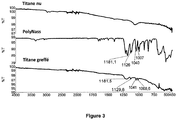
- the samples are directly analyzed (without preparation) by ATR-FTIR on a Perkin Elmer, spectrum Two device.
- the contact angle measurements are made from a drop of water deposited on the surface of the samples, oxidized or grafted via the KRUSS: DSA100 device, which makes it possible to know the modifications of the hydrophilic or hydrophobic character of the surface.
- the quantity of polyNaSS polymers grafted on the titanium surface was measured by complexing the sulfonate groups of the polymers with toluidine blue, both on samples having undergone the process described in point 1.1 (eg polishing, pickling, oxidation), but also on samples of metallic material which has not undergone an oxidation step (eg only polishing and pickling).
- the oxidation step is essential for obtaining a metallic material grafted according to the invention. It increases the grafting rate by a factor of 25 (7.7 vs 0.3 ⁇ g / cm) compared to grafting on a metal surface with natural oxidation.
- the contact angle is 59 ⁇ 5 °.
- the samples of grafted material obtained according to the process described in point 1.1. have a contact angle value equal to 15 ⁇ 2 °, i.e. a decrease in the contact angle of 44 ° between the untreated surface and the grafted surface.
- the grafted metallic materials obtained according to the process of the invention have a much more hydrophilic surface than the ungrafted metallic materials and this is made possible in particular by the prior oxidation step.
- the metallic material in this example is a titanium material. 15 samples of said metallic material are used.
- the surfaces of the 15 samples of metallic titanium material are first polished and then undergo an etching step in an H 2 O / HF / HNO 3 mixture (88/2/10).
- the 15 pickled samples are then subjected to an oxidation step.
- the oxidized samples are then subjected to the grafting step in an aqueous solution of sodium styrene sulfonate monomer (NaSS).
- NaSS sodium styrene sulfonate monomer
- the figure 4 shows that the time between the end of pickling and the start of oxidation has an importance on the grafting rate according to the method of the invention. If 16 hours or more separates the end of the pickling stage from the beginning of the oxidation stage then the grafting rate is not optimal (eg 1.09 ⁇ g / cm -2 ). Thus it is preferable to carry out the oxidation step fairly quickly after the pickling step.
- the metallic material in this example is a titanium material. 15 samples of said metallic material are used. The surfaces of the titanium metal material samples are first polished. The 15 samples are then subjected to an etching step in an H 2 O / HF / HNO 3 mixture (88/2/10). The 15 pickled samples are then subjected to an oxidation step by chemical treatment. The oxidized samples are then subjected to the grafting step in an aqueous solution of sodium styrene sulfonate monomer (NaSS). The other conditions used are identical to those described in Example 1.
- NaSS sodium styrene sulfonate monomer
- the grafting rate of polyNaSS on the surface of the titanium samples was studied by complexing the sulfonate groups of the polymers with toluidine blue.
- the metallic material is a material made of titanium or of a titanium alloy. 15 samples of said metallic material are used. The surfaces of the samples of metallic material made of titanium or of titanium alloy undergo a pickling step. The 15 pickled samples are then subjected to an oxidation step. The oxidized samples are then immersed in an aqueous solution of sodium styrene sulfonate monomer (NaSS).
- NaSS sodium styrene sulfonate monomer
- the solution in which the oxidized material is immersed is then exposed for 45 min to distances varying between 5 cm and 30 cm from UV irradiation coming from a UV source of 200W with a wavelength of 365 nm, with a surface power thus varying between 72 mW.cm -2 and 226 mW.cm -2 .
- the other conditions used are identical to those described in Example 1.
- the figure 6 shows that a surface power greater than 72 mW.cm -2 is necessary to induce a satisfactory grafting on the metallic material.
Landscapes
- Chemical & Material Sciences (AREA)
- Health & Medical Sciences (AREA)
- Medicinal Chemistry (AREA)
- Organic Chemistry (AREA)
- Chemical Kinetics & Catalysis (AREA)
- Polymers & Plastics (AREA)
- Epidemiology (AREA)
- Veterinary Medicine (AREA)
- Oral & Maxillofacial Surgery (AREA)
- Transplantation (AREA)
- Dermatology (AREA)
- Life Sciences & Earth Sciences (AREA)
- Animal Behavior & Ethology (AREA)
- General Health & Medical Sciences (AREA)
- Public Health (AREA)
- General Chemical & Material Sciences (AREA)
- Inorganic Chemistry (AREA)
- Engineering & Computer Science (AREA)
- Materials Engineering (AREA)
- Mechanical Engineering (AREA)
- Metallurgy (AREA)
- Materials For Medical Uses (AREA)
- Prostheses (AREA)
Description
- La présente invention concerne un procédé de greffage de polymères sur un matériau métallique, les matériaux métalliques greffés susceptibles d'être obtenus par ce procédé et des applications de ces derniers. Plus spécifiquement, l'invention concerne un procédé de greffage direct de polymères à la surface de matériaux métalliques.
- L'implantation d'une prothèse articulaire ou dentaire dans un site osseux engendre une cascade de réactions tissus/implants intitulée « réponse de l'hôte » qui, si elle est contrôlée, permet d'aboutir in fine à « l'ostéointégration de l'implant », processus menant notamment à l'intégration de la prothèse dans le tissu osseux grâce à un contact intime tissu osseux/prothèse et à une minimisation de l'épaisseur du tissus fibreux à l'interface. Dans le cas contraire, ces réactions peuvent conduire à une nouvelle intervention chirurgicale, voire au retrait de la prothèse.
En effet, le matériau implanté est considéré comme un « corps étranger » par le système vivant, ce qui déclenche une réponse inflammatoire, pouvant conduire à une encapsulation fibreuse, et ainsi, au rejet de l'implant. De plus, lorsqu'un tissu « fibro-inflammatoire » est produit autour de l'implant (tissu qui n'a ni les activités biologiques, ni les caractéristiques mécaniques du tissu osseux), la probabilité d'un descellement aseptique (désolidarisation de l'implant) ou d'une infection du site de l'implantation s'en trouve accrue.
Le matériau prothétique apparaît en effet comme un support privilégié pour l'adhésion et la colonisation par des bactéries (éventuellement par la formation d'un « biofilm » bactérien résistant notamment aux antibiotiques), étape initiatrice d'une infection pouvant conduire à une septicémie, une endocardite ou une ostéomyélite, notamment dans le cas d'infections aux staphylocoques.
Le processus d'ostéointégration peut ainsi être affecté par la technique chirurgicale et la présence de germes lors de l'implantation, mais aussi pour une grande partie par les propriétés physicochimiques du matériau, telles que la topographie de surface, sa rugosité, ou sa composition chimique.
Pour améliorer l'ostéointégration des implants, notamment métalliques, les revêtements « hydroxyapatite » sont encore aujourd'hui utilisés, car ils permettent un bon ancrage osseux tout en offrant de bonnes performances mécaniques dans un temps relativement court.
Par ailleurs, des matériaux prothétiques prometteurs, métalliques ou polymériques, dont la surface est modifiée par greffage de « polymères bioactifs », destinés à améliorer la biointégration (notamment par diminution de la réponse inflammatoire), ont été développés.
Plusieurs procédés ont été décrits pour la préparation de ces matériaux, procédés que l'on peut classer en deux catégories : les procédés par greffage « indirect » du polymère bioactif, et les procédés par greffage « direct ».
Au sens de la présente invention, un « procédé de greffage indirect » inclut une première étape de fonctionnalisation de la surface du matériau métallique à l'aide d'une molécule de faible poids moléculaire, qui sert de point d'ancrage pour greffer le polymère bioactif, le polymère étant soit préformé, soit formé in situ par polymérisation dans une étape subséquente. A titre d'exemple de greffage indirect, on peut citer notamment le procédé décrit dans l'article de Li et al. (Langmuir 2011, 27(8), 4848-4856). Le procédé divulgué dans ce document fait intervenir une première étape de greffage par réaction radicalaire d'un composé oléfinique (de préférence le TMG-C10) avec une initiation par irradiation UV d'une durée supérieure à 2h30. Toutefois, ces composés ne subissent pas de réaction de polymérisation. Ils sont bifonctionnels, et leur second groupe fonctionnel sert de point d'ancrage pour greffer le polymère à proprement parler. Ainsi, le composé oléfinique (ou coupleur), une fois greffé, sert de point d'ancrage dans un procédé de greffage « indirect », où le polymère en tant que tel est introduit par la suite via le second groupe fonctionnel.
Par opposition, un « procédé de greffage direct » s'entend, au sens de la présente invention, d'un procédé dans lequel le polymère est greffé directement à la surface du matériau métallique, sans molécule intermédiaire servant de point d'ancrage pour se lier au polymère. En d'autres termes, dans un matériau obtenu par un procédé de greffage direct, il n'existe aucune molécule intermédiaire entre la surface du matériau et le polymère bioactif greffé. Un tel procédé est notamment plus économique, plus rapide et plus efficace qu'un procédé de greffage indirect. A titre d'exemple, on peut citer le procédé décrit dansWO 2007/141460 . Celui-ci comprend les étapes suivantes : - des espèces actives donneurs de radicaux libres sont générées à la surface du matériau prothétique ; et
- le matériau prothétique sur lequel des espèces actives ont été générées est mis en présence d'au moins un monomère porteur d'une fonction permettant une polymérisation radicalaire, sa polymérisation radicalaire permettant, en l'absence d'oxygène, la formation d'un polymère bioactif.
- Les Inventeurs ont ainsi mis au point un procédé de greffage de polymères sur un matériau métallique conduisant à des taux de greffage élevés, tout en diminuant de manière spectaculaire (facteur supérieur à 10) la durée globale de mise en oeuvre du procédé selon
WO 2007/141460 .
Plus particulièrement, les inventeurs ont réduit la durée nécessaire pour effectuer l'étape de polymérisation radicalaire en ayant recours à une étape d'amorçage par irradiation UV, notamment avec une gamme de puissance d'irradiation spécifique. L'invention concerne un procédé de greffage comme décrit dans les revendications. - Sauf indication contraire, dans la présente description, les indices m, n, p, q, sont des nombres entiers.
Par « matériau métallique », on entend au sens de la présente invention un matériau essentiellement constitué de métal ou un matériau dont la surface est essentiellement constituée de métal. Lorsque le matériau n'est pas essentiellement constitué de métal, l'épaisseur de la surface essentiellement constituée de métal est de préférence supérieure à 1 µm, de façon plus préférée supérieur à 10µm.
Par « alliage », on entend au sens de la présente invention un matériau constitué d'une combinaison d'un élément métallique avec un ou plusieurs autres éléments chimiques. De préférence tous les éléments chimiques constituants l'alliage sont des métaux. Par exemple, l'alliage de titane selon l'invention peut être une combinaison de titane avec du vanadium et de l'aluminium (e.g. TA6V4AI comprenant 6% de Vanadium et 4 % d'aluminium). Un alliage peut comprendre un métal en combinaison avec élément chimique représentant jusqu'à 45 % en masse de l'alliage. Par exemple, un alliage Ti-25Nb-3Fe comprend jusqu'à 25 % de Niobium et 3 % de Fer et un alliage Ti-24.8Nb-40.7Zr comprend jusqu'à 24,8 % de Niobium et 40,7 % de Zirconium. Un alliage peut être la combinaison de nombreux éléments métalliques comme par exemple le Ti-10,1Ta-1,7Nb-1,6Zr qui est une combinaison de 4 éléments différents. - Par « matériau essentiellement constitué de X », on entend au sens de la présente invention un matériau comprenant uniquement X, X pouvant être un élément métallique ou un alliage, et éventuellement des traces d'autres constituants. Ainsi, un matériau essentiellement constitué de X comprend au moins 95% en poids, de préférence au moins 97% en poids de X, éventuellement en combinaison avec l'oxygène, par rapport au poids total du matériau. En effet, il est entendu qu'un matériau métallique peut comprendre une couche d'oxydation native en surface. Ainsi, un matériau métallique essentiellement constitué de X comprend au plus 5%, de préférence au plus 3%, en poids d'un élément différent de l'oxygène et de X, par rapport au poids total du matériau.
- Par « matériau prothétique », on entend au sens de la présente invention un matériau utilisable dans la fabrication d'un implant médical tel qu'une prothèse, en particulier une prothèse de hanche ou un implant dentaire. De préférence, le matériau prothétique selon l'invention est essentiellement constitué de métal.
- Par « composé pur », on entend au sens de la présente invention que le composé présente une pureté de 100%. Par « composé essentiellement pur » on entend au sens de la présente invention que le composé est utilisé tel quel, sans être mélangé à un autre composé, et en particulier il n'est pas mis en solution. Un composé « essentiellement pur » peut néanmoins contenir jusqu'à 5% en poids (de préférence moins de 3%) d'impuretés par rapport au poids total du composé. Ainsi, un monomère tel que l'acide acrylique de grade technique commercial est un composé essentiellement pur.
- Par « polymère bioactif », on entend au sens de la présente invention un polymère permettant d'améliorer l'ostéointégration du matériau métallique, de préférence prothétique, sur lequel il est greffé. De préférence, un polymère bioactif est en particulier capable d'orienter les réponses cellulaires eucaryotes et/ou procaryotes au site d'intégration de l'implant prothétique fabriqué à partir d'un matériau métallique susceptible d'être obtenu selon le procédé de la présente invention, et de prévenir le développement d'une infection. Un tel polymère comporte de préférence des groupements ioniques. De façon plus préférée, le polymère bioactif comprend des groupements phosphonates, carboxylates et/ou sulfonates.
L'angle de contact d'un matériau se mesure selon des méthodes bien connues de l'homme du métier. Par exemple, on peut utiliser une méthode de mesure de l'angle de contact à partir d'une goutte d'eau déposée à la surface du matériau (matériau métallique oxydé ou matériau métallique greffé) via l'appareil KRUSS : DSA100 qui permet de connaître les modifications du caractère hydrophile ou hydrophobe de la surface.
Au sens de la présente invention, une oléfine est un monomère comprenant au moins une insaturation carbone - carbone (double liaison carbone-carbone C=C ou triple liaison C≡C) non aromatique, de préférence une double liaison. Par monomères présentant au moins une insaturation carbone - carbone non aromatique, on entend selon l'invention des monomères présentant une ou deux, de préférence une, double ou triple liaison, avantageusement une double liaison, et plus particulièrement le motif CH2=CH-.
Dans la présente description, l'acronyme « UV » est synonyme d'ultraviolet. Ainsi, lorsque l'on parle d'« irradiation UV », on entend « irradiation aux rayons ultraviolets ». Par « polymérisation radicalaire », on entend une polymérisation en chaîne faisant intervenir comme espèce active des radicaux. Elle comprend une étape d'amorçage, de propagation, de terminaison, et éventuellement de transfert de chaîne.
L'étape d'amorçage consiste en la formation d'un radical issu de l'amorceur sur la première unité monomère (dans cet exemple, un monomère oléfinique) :
X˙ + CH2=CHR → X-CH2-HC˙R.
- Ladite étape d'amorçage peut être effectuée avantageusement sans chauffage thermique additionnel à l'irradiation UV.
La propagation est la principale étape de la polymérisation radicalaire. C'est au cours de cette étape que la chaîne polymérique se forme à partir de la surface métallique par additions successives d'unités monomères sur la chaine en croissance. - Le nombre d'occurrences de la réaction de propagation gouverne le degré de polymérisation en nombre de la chaîne formée et donc la masse molaire du polymère formé.
X-(CH2-CHR)n-CH2-HC*R + CH2=CHR → X-(CH2 -CHR) n+1-CH2 -HC*R.
Les réactions de terminaison sont de plusieurs types. La terminaison peut résulter de l'addition sur la chaine en croissance d'une molécule d'amorceur, de solvant, d'une impureté présente dans le milieu etc... D'autres réactions de terminaison, la recombinaison et la dismutation, mettent en jeu deux chaines en croissance. Dans une réaction de recombinaison, deux chaines reforment une liaison covalente :
X-(CH2-CHR) n -CH2-HC*R + R*CH-CH2-(CHR-CH2) m -X → X-(CH2-CHR) n -CH2-HRC-CHR-CH2-(CHR-CH2) m -X
Dans une réaction de dismutation, deux chaines donnent lieu à une réaction de transfert d'hydrogène, suivie d'une recombinaison. Le résultat global peut s'écrire :
X-(CH2-CHR) n -CH2-HC*R + R*CH-CH2-(CHR-CH2) m -X → X-(CH2-CHR) n -CH2-CH2R + CRH=CH-(CHR-CH2) m -X.
La proportion relative de ces modes de terminaison dépend essentiellement du type de monomère employé, de l'accessibilité des sites radicalaires c'est-à-dire de l'encombrement stérique des sites actifs.
Le taux de greffage du polymère (de préférence bioactif) du matériau métallique greffé est exprimé en µg.cm-2. Il est mesuré par exemple à l'aide d'un dosage colorimétrique au bleu de toluidine, lorsque le polymère comprend des groupes sulfonates, carboxylates ou phosphonates.
Au sens de la présente invention, on entend par « acide » un acide organique ou minéral dont le pKa dans l'eau est inférieur à 3.
Par « alkyle en C1-C10» on entend au sens de la présente invention une chaîne hydrocarbonée saturée de 1 à 10 atomes de carbone, linéaire ou ramifiée. A titre d'exemple d'alkyle en C1-C10, on peut citer notamment le méthyle, l'éthyle, le propyle, le n-butyle, le s-butyle, le tert-butyle, le pentyle, l'isopentyle, le n-hexyle. De préférence, l'alkyle en C1-C10 est un alkyle en C1-C4. Le méthyle et l'éthyle sont particulièrement préférés.
Par « hétéroaryle », on entend, au sens de la présente invention, un groupe aromatique comprenant 5 à 10 atomes cycliques dont un ou plusieurs hétéroatomes, avantageusement 1 à 4 et encore plus avantageusement 1 ou 2, tels que par exemple des atomes de soufre, azote ou oxygène, les autres atomes cycliques étant des atomes de carbone. Des exemples de groupes hétéroaryle sont les groupes furyle, thiényle, pyrrolyle, pyridinyle, pyrimidinyle, pyrazolyle, imidazolyle, triazolyle, tétrazolyle ou encore indyle.
Au sens de la présente invention, on entend par « oxydation contrôlée », une étape d'oxydation permettant de générer spécifiquement des fonctions hydroperoxydes - OOH à la surface du matériau métallique. Ainsi, l'oxydation contrôlée selon l'invention permet d'obtenir un résultat différent de l'oxydation non contrôlée que pourrait subir le matériau métallique conduisant à une couche d'oxydation naturelle, qui est essentiellement constituée de fonctions OH dont la répartition et la densité ne sont pas homogènes sur la surface du matériau métallique.
Au sens de la présente invention, on entend par « absence d'O2 », un taux de O2 inférieur à 1 % en volume, de façon préférée inférieur à 0,5% en volume par rapport au volume total du gaz considéré.
Au sens de la présente invention, on entend par « puissance surfacique », la puissance de l'irradiation UV à la surface du matériau métallique. Elle est notamment dépendante de la puissance de la lampe utilisée et de la distance entre la lampe et l'échantillon. Elle peut être aisément mesurée par l'homme du métier, par exemple à l'aide d'un radiomètre à microprocesseur (e.g. VLX-3W, VILBER LOURMAT). Aux fins de la mesure, on considère la puissance stabilisée, par exemple lorsque la lampe est allumée depuis 1 heure ou plus. - Ainsi, l'invention a pour objet un procédé de greffage de polymères sur un matériau métallique, comprenant les étapes suivantes :
- a) l'oxydation de la surface du matériau métallique, conduisant à un matériau métallique oxydé, et
- b) le greffage d'un polymère à la surface dudit matériau métallique oxydé par polymérisation radicalaire d'un monomère, ladite polymérisation radicalaire comprenant une étape d'amorçage et une étape de propagation,
- Le matériau métallique selon l'invention est de préférence un matériau prothétique en titane ou en alliage de titane.
On peut citer comme exemple de matériaux métalliques, de préférence prothétiques, les matériaux à base de titane, d'aluminium, d'acier, de chrome, de cobalt, de niobium, de tantale, de vanadium, d'iridium, de zirconium, d'or et leurs alliages.
Les matériaux métalliques comprennent généralement en surface une couche d'oxydation native qui se forme spontanément en présence d'air, comprenant ou essentiellement constituée de groupes M-OH dont la densité et la répartition est aléatoire, M représentant un atome d'un des métaux de l'alliage, notamment un atome d'un métal cité parmi les listes ci-dessus.
Le matériau métallique (de préférence prothétique) est en titane ou en alliage de titane. En effet, le titane est connu pour ses propriétés de biocompatibilité. Typiquement, un matériau en titane est essentiellement constitué de titane, et/ou d'oxyde de titane. Dans tous les cas, le matériau en titane comprend en surface une couche d'oxydation native qui se forme spontanément en présence d'air, comprenant des groupes Ti-OH dont la densité et la répartition est aléatoire.
Avantageusement, l'alliage de titane est à base de nickel, de vanadium, d'aluminium niobium et/ou de molybdène, de préférence c'est un alliage de titane, d'aluminium et de vanadium, de manière préférée entre toutes il s'agit du TiAl6V4. - Le procédé selon l'invention peut comprendre une étape préalable de polissage.
Cette étape est effectuée de préférence préalablement à l'étape de décapage qui est décrite ci-après.
Ainsi, le matériau métallique peut être poli par abrasion pour limiter la rugosité de la surface du matériau.
Dans un mode particulier de réalisation de l'invention, les matériaux métalliques sont polis avec du papier abrasif et de préférence avec différents papiers abrasifs de granulométries décroissantes. Plus spécifiquement, le polissage mécanique des matériaux métalliques peut être réalisé à l'aide d'un bras automatique monté sur une polisseuse rotative, avec du papier abrasif de granulométries décroissantes. Ainsi, on peut successivement utiliser des papiers abrasifs de grades 500 puis 1200.
Avantageusement, le matériau métallique est également lavé, de préférence successivement au polissage, notamment par trempage dans une solution d'acétone puis avec de l'eau, puis est de préférence séché.
De préférence toutefois, le procédé selon l'invention est dépourvu de toute étape de polissage. - Avantageusement, le matériau métallique utilisé présente une rugosité supérieure à 0,2 µm, de préférence supérieure à 1 µm, et façon plus préférée supérieure à 3 µm. Typiquement la rugosité est inférieure à 20 µm.
La rugosité est de préférence mesurée par microscopie à force atomique.
Si le matériau métallique de départ présente une rugosité trop élevée, alors le procédé comprend une étape de polissage telle que décrite ci-dessus pour obtenir une rugosité adaptée, notamment comprise entre 0.2 µm et 20 µm, de préférence comprise entre 3 µm et 10 µm. - Avantageusement, le procédé selon l'invention comprend une étape de décapage, réalisée préalablement à l'étape d'oxydation, afin d'en améliorer l'efficacité. Lorsque le procédé selon l'invention comprend également une étape de polissage, l'étape de décapage est alors conduite entre l'étape de polissage et l'étape a) d'oxydation.
Le décapage est avantageusement un décapage chimique. - Un décapage chimique comprend typiquement une mise en contact du matériau métallique dans une solution aqueuse acide. Par exemple, le matériau métallique est trempé pendant une durée tdecap dans une solution aqueuse acide.
L'acide présente de préférence un pKa compris entre -2 et 3.
De préférence, la durée tdecap est comprise entre 0,5 et 10 minutes, de manière encore préférée entre 0,5 et 2 minutes.
La solution aqueuse acide utilisée pour l'étape de décapage est de préférence une solution aqueuse d'acide nitrique (HNO3) ou une solution aqueuse comprenant un mélange d'acides fluorhydrique et nitrique (mélange HF/HNO3), de préférence en des proportions volumiques HF/HNO3 comprises entre 1:20 et 20:1.
Avantageusement, le pH de la solution aqueuse acide est compris entre -1 et 3, de manière encore préférée entre -1 et 1.
Ainsi, avantageusement, le décapage chimique comprend le trempage du matériau métallique dans une solution aqueuse acide de pH compris entre -1 et 1 pendant une durée tdecap comprise entre 0,5 et 1 minute, la solution aqueuse acide étant de préférence une solution aqueuse comprenant le mélange HF/HNO3.
Des exemples de mise en oeuvre de cette étape de décapage pour des matériaux en titane ou alliage de titane sont notamment décrits par Liu et al (Materials Science and Engineering. R47 (2004) 49-121) et Takeuchi et al (Biomaterials 24 (2003) 1821-1827). Lorsque le procédé selon l'invention comprend également une étape de décapage préalablement à l'étape d'oxydation, l'étape d'oxydation est réalisée de préférence rapidement après le décapage. Ainsi, le temps entre la fin de l'étape de décapage et le début de l'étape d'oxydation est avantageusement inférieur à 16 heures, de préférence inférieur à 12 heures, de manière encore préférée inférieur à 6 heures, de façon encore plus préférée inférieur à 3 heures.
Avantageusement, l'étape de décapage comprend également le lavage (ou rinçage) du matériau décapé notamment avec de l'eau, en particulier de l'eau distillée. - De manière générale, l'oxydation peut être réalisée par tous les moyens d'oxydation de matériaux métalliques bien connus de l'homme du métier tels que l'oxydation par traitement avec une solution de peroxyde d'hydrogène, ou au moyen d'une forte température, ou avec une combinaison des deux techniques (Takemoto et al., 2004), l'oxydation anodique du titane dans une solution d'acide acétique ou dans un mélange d'électrolytes contenant des ions magnésium (Sul et al., 2005), et l'oxydation micro-arc sur des prothèses de titane (Li et al., 2004).
L'étape a) d'oxydation permet avantageusement de fournir une couche oxydée comprenant des groupes hydroperoxydes -OOH, de manière contrôlée, à la surface du matériau métallique.
En effet, les matériaux métalliques, notamment en titane ou en alliage de titane, présentent une couche d'oxydation native, dont la teneur en fonction M-OH n'est pas contrôlée (M représentant un atome métallique). Pour ces matériaux métalliques, l'étape d'oxydation permet notamment de former en surface des hydroperoxydes de métal (M-OOH) dont la densité peut être contrôlée.
Il en résulte que l'étape a) d'oxydation a une influence directe sur le taux de greffage du polymère, qui est très élevé, typiquement compris entre 1,5 et 10 µg.cm-2. Ainsi, si l'étape a) du procédé selon l'invention est omise, le taux de greffage s'en trouve fortement diminué, notamment dans le cas des matériaux métalliques, tels que les matériaux, de préférence prothétiques, en titane, aluminium ou en alliages.
En outre, il semble que la couche d'oxydation permet d'éviter la migration d'ions métalliques toxiques, notamment lorsque le procédé est mis en oeuvre avec un alliage de titane de type TiAl6V4 (dans ce cas particulier les ions métalliques toxiques sont les ions vanadium et aluminium).
Dans un premier mode de réalisation, l'étape a) d'oxydation est réalisée par traitement chimique : ce mode de réalisation sera dans la suite appelé « oxydation par voie chimique ». L'oxydation par voie chimique est notamment une oxydation par mise en contact du matériau métallique avec une solution oxydante, notamment H2O2, ou une oxydation par ozonation. L'oxydation par voie chimique est en particulier réalisée par traitement du matériau avec une solution aqueuse comprenant un oxydant et un acide, de préférence un mélange H2SO4 et H2O2.
La mise en contact du matériau métallique avec la solution oxydante (notamment une solution comprenant H2O2) peut être réalisée par exemple, en versant la solution oxydante dans un récipient contenant le matériau métallique, ou le matériau métallique peut être plongé dans un récipient contenant la solution oxydante.
Dans le cas d'une oxydation par voie chimique par mise en contact du matériau métallique avec une solution oxydante, ladite solution oxydante est notamment un mélange acide /oxydant, en particulier H2SO4/H2O2. L'acide est de préférence un acide de pKa (dans l'eau) inférieur à 3, de manière encore préférée de pKa (dans l'eau) inférieur à 2. Avantageusement, l'acide est en solution aqueuse et choisi parmi l'acide fluorhydrique (HF), l'acide chlorhydrique (HCI), l'acide sulfurique (H2SO4) et leurs mélanges, de manière encore préférée il s'agit de H2SO4.
L'oxydant est de préférence H2O2. Néanmoins il peut être remplacé par l'ozone dans le cas d'une ozonation.
Ainsi, de préférence, dans ce mode de réalisation par traitement chimique, l'étape a) d'oxydation est réalisée avec un mélange aqueux H2SO4/H2O2.
La proportion d'acide par rapport à H2O2 peut varier dans une large mesure et l'homme du métier est à même de définir le rapport le plus efficace pour aboutir à un taux de greffage souhaité. De préférence, une solution H2SO4/H2O2 50/50 (v/v) est utilisée pour oxyder le matériau métallique. La température utilisée est généralement la température ambiante (20-30°C), voire une température plus faible (par exemple, entre 0 et 20°C), la réaction d'oxydation pouvant être exothermique.
Par « mélange acide/H2O2 » on entend le mélange simultané ou séquentiel de la solution d'acide et de la solution de H2O2. Ainsi, soit les deux solutions sont mises en contact simultanément avec le matériau métallique à oxyder, soit le matériau métallique est d'abord mis en contact avec la solution d'acide, puis la solution de H2O2 est mise en contact dans un deuxième temps avec le matériau métallique.
Dans tous les cas, l'homme du métier pourra adapter le temps de contact du matériau métallique avec la solution oxydante en fonction de sa nature (titane pur ou sous forme d'alliage...), du mode d'oxydation chimique mis en oeuvre et du taux de greffage final souhaité.
Dans le cas d'un mélange acide/H2O2 simultané, le temps d'oxydation est de préférence de 1 à 10 minutes, de manière plus préférée de 3 à 6 minutes et de manière la plus préférée le temps d'oxydation est de 4 minutes. De préférence, ce temps d'oxydation s'applique à l'oxydation du titane ou d'un de ses alliages avec une solution H2SO4/H2O2.
Dans le cas de l'utilisation d'un mélange séquentiel, le matériau métallique peut être, par exemple, plongé dans la solution d'acide pendant au moins 10 secondes, de préférence pendant au moins 20 secondes, de préférence pendant au moins 30 secondes, de manière plus préférée pendant plus de 50 secondes, de manière préférée pendant plus de 1 minute, de manière préférée pendant plus de 2 minutes, de manière préférée pendant plus de 3 minutes, de manière préférée pendant plus de 4 minutes. Ce temps de mise en présence du titane, ou d'un de ses alliages, avec H2SO4 peut être largement supérieur et peut, par exemple, atteindre 30 minutes ou plus. Cependant, dans un mode préféré de réalisation, le temps de mise en présence du matériau métallique avec la solution d'acide est inférieur à 5 minutes, temps au-delà duquel une diminution du taux de greffage est observée. Cette procédure est en particulier appliquée dans le cas de l'oxydation du titane ou d'un de ses alliages, avantageusement mis en présence d'une solution de H2SO4.
De la même manière, le temps de mise en présence du matériau métallique avec la solution de H2O2 peut varier. De préférence, le matériau métallique, de préférence le titane ou un de ses alliages, est mis en présence de H2O2 pendant au moins 10 secondes, de préférence au moins 20 secondes, de préférence au moins 30 secondes, de préférence au moins 40 secondes, de préférence au moins 50 secondes, de préférence au moins 1 minute, de préférence au moins 2 minutes, de préférence pendant 2 à 3 minutes, et de manière la plus préférée pendant deux minutes après ajout de la solution de H2O2. Dans un mode préféré de réalisation, on préfère une action de H2SO4 sur le titane, ou un de ses alliages, pendant 1 minute puis une action de H2O2 sur le titane pendant 3 minutes.
L'oxydation chimique par trempage du matériau métallique dans une solution oxydante, notamment un mélange acide/H2O2 et de préférence un mélange H2SO4/H2O2, typiquement en des proportions 50/50 (v/v), est particulièrement préférée. Dans un mode de réalisation préféré, l'étape a) d'oxydation est réalisée par traitement chimique avec un mélange H2SO4 et H2O2, typiquement en des proportions 50/50 (v/v). Dans un autre mode de réalisation, l'étape a) d'oxydation est réalisée par traitement anodique (ou anodisation) ou par ozonation.
Typiquement, lors d'une oxydation par traitement anodique, le matériau métallique est mis en contact avec une solution électrolytique acide contenue dans une cuve électrochimique comprenant une électrode, puis subit une étape de mise sous tension électrochimique, le matériau métallique jouant le rôle de l'anode dans la cuve électrochimique. A l'anode (matériau métallique), se produit une réaction d'oxydation des protons selon l'équation suivante : 2e- + 2H+ → H2.
Avantageusement, le potentiel appliqué à l'anode est compris entre 10 et 250 V vs électrode normale à l'hydrogène (NHE), de préférence entre 20 et 200 V vs NHE.
En outre, avantageusement, l'intensité appliquée à l'anode est comprise entre 0.1 et 50 mA/cm2, de préférence entre 1 et 50 mA/cm2.
De préférence, la solution électrolytique comprend un acide possédant au moins un pKa inférieur à 2.5, par exemple un acide possédant au moins un pKa compris entre - 10 et 2.5. Par exemple, on peut utiliser de l'acide chromique (anodisation chromique), de l'acide sulfurique (anodisation sulfurique), de l'acide orthophosphorique, de l'acide oxalique ou un mélange de ceux-ci. Les acides peuvent également être utilisés en mélange avec un alcool tel que le mélange méthanol / NaNO3. De préférence toutefois, la solution électrolytique comprend de l'acide sulfurique (anodisation sulfurique) ou de l'acide orthophosphorique, de manière préférée de l'acide orthophosphorique.
Dans le cas des matériaux métalliques, à l'échelle du laboratoire, on préférera mettre en oeuvre l'étape a) d'oxydation par traitement chimique, tandis qu'à l'échelle industrielle, on préférera mettre en oeuvre l'étape a) d'oxydation par traitement anodique. - Le monomère utilisé dans l'étape b), impliqué dans la polymérisation radicalaire, est porteur d'une fonction permettant une polymérisation radicalaire. De préférence, ledit monomère est une oléfine.
La structure des monomères utilisés dans la présente invention permet la formation d'un polymère, de préférence bioactif, à la surface d'un matériau métallique. En particulier, afin d'améliorer les propriétés d'ostéointégration et anti-bactériennes des matériaux cités ci-dessus, les monomères utilisés dans le cadre du présent procédé comprennent avantageusement un groupement sulfonate et/ou carboxylate et/ou phosphonate. En effet, les polymères porteurs de groupements ioniques sulfonates et/ou carboxylates et/ou phosphonates favorisent l'adhérence, la colonisation et la différenciation des ostéoblastes. De plus, les polymères porteurs de groupe sulfonates et/ou phosphonates permettent d'inhiber l'adhérence de souches bactériennes, notamment de Staphylococcus aureus et de Staphylococcus epidermidis, souches très majoritairement impliquées dans les infections sur matériels prothétiques métalliques.
Ainsi, avantageusement, l'oléfine est choisie parmi les oléfines de formule (I), (II) ou (III):
CH2=CR1-(CH2)n-R'-C(O)OR (I),
CH2=CR1-(CH2)m-R'-S(O)2OX (II),
CH2=CR1-(CH2)p-R'-P(O)O2Y (III),
dans lesquelles, - R1 représente un atome d'hydrogène ou un alkyle en C1-C10, de préférence un atome d'hydrogène,
- n est compris entre 0 et 6, de préférence entre 0 et 1,
- R représente un atome d'hydrogène, un alkyle en C1-C10 optionnellement substitué par un groupe OH, COOH ou PO3H, un groupe Ar optionnellement substitué par un groupe OH, COOH ou PO3H, Ar représentant un groupe phényle ou hétéroaryle, de préférence un groupe phényle, ou R représente un atome d'hydrogène, ou un cation choisi parmi les alcalins ou les alcalinoterreux, par exemple parmi Na+, Ca2+, Zn2+ ou Mg2+, de préférence Na+ ou Ca2+, de préférence R représente un atome d'hydrogène, ou un cation choisi parmi les alcalins ou les alcalinoterreux, par exemple parmi Na+, Ca2+, Zn2+ ou Mg2+, de préférence Na+ou Ca2+,
- m est compris entre 0 et 6, de préférence entre 0 et 1,
- R' représente une liaison, un alkyle en C1-C10 optionnellement substitué par un groupe OH, COOH ou PO3H, ou R' représente un groupe -C(O)-CR2-OCR3, Ar', Ar'-O-, ou Ar'-C(O)NH-, Ar' représentant un groupe phényle ou hétéroaryle optionnellement substitué par un groupe OH, COOH ou PO3H, de préférence un groupe phényle optionnellement substitué par un groupe OH, COOH ou PO3H, et
- R2 et R3 représentent indépendamment des groupes alkyle en C1-C10,
- X représente un hydrogène ou un ou plusieurs cations choisis de manière à obtenir une espèce électriquement neutre, notamment un cation choisi parmi les alcalins ou les alcalinoterreux, par exemple parmi 2 Na+, Ca2+, Zn2+ ou Mg2+, de préférence 2 Na+ou Ca2+,
- p est compris entre 0 et 6, de préférence entre 0 et 1,
- Y représente un hydrogène ou un ou plusieurs cations choisis de manière à obtenir une espèce électriquement neutre, un cation choisi parmi les alcalins ou les alcalinoterreux, par exemple parmi Na+, Ca2+, Zn2+ ou Mg2+, de préférence Na+ou Ca2+. Parmi les oléfines de formule (I), on peut notamment citer l'acide acrylique (AA), l'acide méthacrylique (MA), l'acide éthacrylique (EA), les sels correspondants (en particulier sels de métal alcalin, de préférence de sodium) et leurs mélanges.
- Parmi les oléfines de formule (II), sont particulièrement préférées les oléfines pour lesquelles R' représente un groupe Ar, Ar-O-, ou Ar-C(O)NH-, de manière encore préférée Ar , Ar représentant un groupe phényle ou hétéroaryle, de préférence un groupe phényle.
Ainsi, dans un mode de réalisation particulier, les oléfines de formule (II) sont choisies parmi les oléfines de formule (V) et (VI):
CH2=CR1-Ph-S(O)2OX (V),
CH2=CR1-Ph-CO-NH-S(O)2OX (VI),
dans lesquelles X et R1 sont tels que définis ci-dessus, et Ph représente un noyau phényle, de préférence substitué en positions 1 et 4. Parmi les monomères de formule (II), (V) ou (VI), on peut notamment citer l'acrylamide de N- (sulfonate de sodium phényl) (NaAS), le méthacrylamide de N-(sulfonate de sodium phényl) (NaMS), le styrène sulfonate de sodium (NaSS) et leurs mélanges. On préfère le styrène sulfonate de sodium.
Parmi les monomères de formule (III) on peut notamment citer le vinylbenzylphosphonate (VBP) et le 2-[4-(dihydroxyphosphoryl)-2-oxa-butyl]acrylate d'éthyle (MA154).
Ainsi, avantageusement, le monomère, en particulier l'oléfine, est choisi parmi les sulfonates, les phosphonates et/ou les carboxylates, de préférence choisi parmi l'acide acrylique, l'acide méthacrylate, le méthacrylate de méthyle (MMA), l'acrylamide de N-(sulfonate de sodium phényl) (NaAS), le méthacrylamide de N-(sulfonate de sodium phényl) (NaMS), le styrène sulfonate de sodium (NaSS), l'ethylène glycol methacrylate, le méthacrylate phosphate, le methacryloyl-di-isopropylidene, le vinylbenzylphosphonate (VBP), 2-[4-(dihydroxyphosphoryl)-2-oxa-butyl]acrylate d'éthyle (MA154), ou leurs mélanges. - Dans la présente invention, l'étape d'amorçage par irradiation UV permet de générer des radicaux -O·. Ainsi, l'étape d'amorçage par irradiation UV consiste en une rupture homolytique de la liaison O-O du groupe hydroperoxyde (généré grâce à l'étape a) d'oxydation) ou de la liaison O-H du groupe hydroxyde (résultant de l'oxydation native du matériau) se trouvant à la surface du matériau métallique oxydé : -OOH → -O· ou - OH → -O·.
En particulier, dans le cas d'un matériau métallique en titane, le mécanisme de cette étape d'amorçage par irradiation UV peut être représenté comme suit :
TiO-OH → TiO·.
L'étape d'amorçage peut être effectuée préalablement ou de manière concomitante à l'étape de propagation.
Dans l'étape b), le (ou les) monomère(s) peut(vent) être utilisé(s) soit en solution, soit pur(s) (ou essentiellement pur(s)). Lorsque le (ou les) monomère(s) est (sont) utilisé(s) en solution, il(s) l'est (le sont) dans un solvant organique ou aqueux. De préférence, il s'agit d'une solution aqueuse.
Avantageusement la concentration de monomère(s) dans la solution est comprise entre 0.2 et 1 mol.L-1, de préférence entre 0.3 et 1 mol.L-1, par exemple 0.7 mol.L-1. De préférence, le (ou les) monomère(s) est (sont) utilisé(s) en solution aqueuse, à une concentration comprise entre 0.2 et 1 mol.L-1, de préférence entre 0.3 et 1 mol.L-1, par exemple 0.7 mol.L-1.
Avantageusement, ladite polymérisation radicalaire est réalisée en l'absence d'oxygène. En effet, la présence d'oxygène tend à inhiber la polymérisation radicalaire. Ainsi, de préférence, l'étape b) est réalisée en l'absence d'oxygène, sous atmosphère inerte, en particulier sous argon, hélium ou azote, avantageusement sous atmosphère d'argon. - Dans un mode de réalisation particulier, l'étape b) de greffage comprend les sous-étapes suivantes :
- b1) mise en contact du matériau métallique oxydé avec ledit monomère en solution aqueuse ;
- b2) irradiation UV de la solution comprenant ledit monomère et ledit matériau métallique oxydé avec une source UV diffusant une puissance à la surface du matériau supérieure à 72 mW.cm-2, de préférence comprise entre 72 mW.cm-2 et 20 W.cm-2, de préférence entre 72 mW.cm-2 et 226 mW.cm-2, de préférence entre 91 mW.cm-2 et 226 mW.cm-2, de manière préférée entre toutes égale à environ 162 mW.cm-2.
- b1') trempage du matériau métallique oxydé dans le monomère, ledit monomère étant essentiellement pur, conduisant à un matériau métallique oxydé imprégné de monomère ;
- b2') irradiation UV du matériau métallique oxydé enrobé de monomère avec une source UV diffusant une puissance à la surface du matériau supérieure à 72 mW.cm-2, , de préférence comprise entre 72 mW.cm-2 et 20 W.cm-2 de préférence entre 72 mW.cm-2 et 226mW.cm-2, de préférence entre 91 mW.cm-2 et 226 mW.cm-2, de manière préférée entre toutes égale à environ 162 mW.cm-2.
- Avantageusement, la durée d'irradiation UV tUV est inférieure à 120 minutes. La durée d'irradiation UV tUV est par exemple comprise entre plus de 15 minutes et 120 minutes, de manière encore préférée entre 30 minutes et 60 minutes, par exemple 60 minutes.
- Dans un mode de réalisation particulier dans lequel le matériau métallique est un matériau en titane, la durée d'irradiation UV tUV est avantageusement comprise entre plus de 15 minutes et 120 minutes pour une puissance surfacique supérieure à 72 mW.cm-2 de préférence.
Dans un mode de réalisation particulier dans lequel le matériau métallique est un matériau en alliage de titane, la durée d'irradiation UV tUV est avantageusement comprise entre plus de 15 minutes et 120 minutes, avec une puissance surfacique supérieure à 72 mW.cm-2 de préférence.
Avantageusement, il semble donc que le taux de greffage du matériau métallique oxydé lors de l'étape b) est fonction à la fois de la puissance d'irradiation UV reçue par le matériau métallique oxydé, et l'énergie surfacique reçue par ledit matériau.
Ainsi, avantageusement, la puissance surfacique due à l'irradiation UV reçue par le matériau métallique oxydé est comprise entre 72 et 226 mW/cm-2, de manière encore préférée entre 91 et 162 mW/cm-2, et l'énergie surfacique totale reçue de l'irradiation UV par le matériau métallique, de préférence prothétique, oxydé est comprise entre 194,4et 1749,6 J.cm-2, de manière encore préférée entre 220 et 450 J.cm-2. - L'étape b) de greffage conduit ainsi à un matériau métallique greffé.
- Le matériau métallique greffé subit différents rinçages et lavages dans des solutions aqueuses et/ou salines aqueuses à température ambiante ou à 37°C ou à 60°C. Les solutions aqueuses ou salines aqueuses sont l'eau distillée, des solutions aqueuses de NaCl de différentes concentrations et/ou une solution tampon phosphate salin (PBS ou « Phosphate-buffered saline »).
Une telle étape permet avantageusement de débarrasser le matériau métallique greffé de toute chaîne polymérique non greffée située en surface dudit matériau. Le matériau métallique greffé et rincé ainsi obtenu, une fois implanté, offre une meilleure sécurité pour le patient puisqu'elle empêche le relargage « in situ » de produits d'extraction issus de la synthèse. - Le procédé selon l'invention peut être représenté schématiquement par la
figure 1 .
Lafigure 1 illustre bien le fait que le procédé selon l'invention est un greffage « direct » : aucune molécule intermédiaire n'est greffée à la surface du matériau métallique pour jouer le rôle de « coupleur » entre la surface du matériau et le polymère. Dans le procédé selon l'invention, le polymère est lié à la surface du matériau métallique par un simple atome d'oxygène.
Ainsi, les matériaux métalliques greffés comprennent des polymères, de préférence bioactifs, greffés à leur surface.
Les matériaux métalliques greffés obtenus par le procédé de l'invention présentent avantageusement un angle de contact avec une goutte d'eau inférieur à 50°, de préférence inférieur 45°, de façon plus préférée inférieur à 30° et pouvant être avantageusement inférieur à 20°.
Les matériaux métalliques greffés obtenus par le procédé de l'invention présentent généralement un angle de contact avec une goutte d'eau supérieur à 5°. - Les inventeurs ont notamment découvert que l'utilisation d'une irradiation UV selon l'invention permet d'obtenir une réduction importante de l'angle de contact par rapport aux matériaux métalliques non greffés. Cette découverte permet d'envisager des matériaux métalliques greffés avec des polymères présentant des angles de contact faibles et donc une bonne biocompatibilité.
- Avantageusement, le procédé selon l'invention conduit à un matériau métallique greffé possédant un taux de greffage dudit polymère (de préférence bioactif) supérieur à 1,5 µg/cm-2, de préférence supérieur à 3 µg/cm-2.
Ainsi le procédé selon l'invention conduit à un matériau métallique greffé possédant un taux de greffage dudit polymère (de préférence bioactif) de préférence compris entre 1,5 et 10 µg.cm-2 , de préférence entre 3 et 8 µg.cm-2.
Le taux de greffage du polymère est dans une large mesure fonction du temps d'exposition à l'irradiation UV. Il peut dépendre également de la nature et de la quantité du monomère utilisé.
Les polymères greffés à la surface des matériaux métalliques obtenus selon le procédé de l'invention sont issus de la polymérisation radicalaire des monomères décrits plus haut, utilisés dans l'étape b). - Le poids moléculaire des polymères greffés selon le procédé de la présente l'invention peut varier dans une large mesure et est choisi ou contrôlé par l'homme du métier en fonction de leur application ou usage ultérieur. Avantageusement, le poids moléculaire moyen en poids des polymères greffés peut varier de 200 à 100 000 daltons.
De préférence, les polymères greffés à la surface des matériaux métalliques obtenus selon le procédé de l'invention sont issus de la polymérisation radicalaire d'au moins un monomère choisi parmi : l'acide acrylique, l'acide méthacrylique, le méthacrylate de méthyle (MMA), l'acrylamide de N-(sulfonate de sodium phényl) (NaAS), le méthacrylamide de N-(sulfonate de sodium phényl) (NaMS), le styrène sulfonate de sodium (NaSS), l'éthylène glycol méthacrylate phosphate, le vinylbenzylphosphonate (VBP) et le 2-[4-(dihydroxyphosphoryl)-2-oxa-butyl]acrylate d'éthyle (MA154), et leurs mélanges.
En fonction des monomères utilisés, les polymères greffés peuvent être des homopolymères ou des copolymères.
Dans un premier mode de réalisation particulier de l'invention, les polymères greffés sont des homopolymères. Dans ce mode de réalisation, un seul monomère est utilisé dans l'étape b) de polymérisation radicalaire, ledit monomère est alors de préférence une oléfine de formule (I), (II) ou (III), de préférence choisie parmi le styrène sulfonate de sodium (le polymère greffé est alors le polyNaSS) ou le méthacrylate de méthyle (le polymère greffé est alors poly (méthacrylate de méthyle), ou PMMA), le 2-[4-(dihydroxyphosphoryl)-2-oxa-butyl]acrylate d'éthyle (MA154) ou le vinylbenzylphosphonate (VBP).
Dans un autre mode de réalisation particulier de l'invention, les polymères greffés sont des copolymères. De préférence, les copolymères greffés sont obtenus par polymérisation radicalaire d'au moins deux monomères choisis parmi les oléfines de formule (I), (II) et (III) telles que définies ci-dessus. De manière encore préférée, les copolymères greffés sont obtenus par polymérisation radicalaire d'au moins deux monomères choisis parmi les oléfines de formule (I), (V) et (III) telles que définies ci-dessus.
Les quantités des oléfines de formules (I), (II) et/ou (III) peuvent varier dans une large mesure et sont adaptées en fonction notamment des propriétés désirées pour les copolymères.
Les copolymères greffés selon le procédé de la présente invention peuvent être obtenus par polymérisation radicalaire de monomères comprenant, en plus des monomères de formules (I), (II) et (III), d'autres monomères de type oléfine. Les oléfines additionnelles peuvent être de toute nature, avantageusement des oléfines donnant un caractère hydrosoluble ou non aux polymères greffés. De préférence, les monomères additionnels sont de nature hydrosoluble, tels que les oléfines comprenant un groupe de type sucre, notamment des oléfines comprenant un groupe ose tel que le glucose, le glucofuranose, le saccharose, le fructose, le mannose.
Dans les copolymères comprenant un monomère additionnel, la quantité des monomères de formule (I), (II) et (III) est avantageusement supérieure ou égale à 25 %, de préférence supérieure ou égale à 50%, en moles par rapport au nombre total de moles des unités monomères présentes dans les polymères.
Selon un aspect préféré de l'invention, les copolymères greffés sont obtenus par polymérisation radicalaire de deux ou trois monomères choisis parmi les oléfines de formule (I), (II) et (III) telles que définies ci-dessus.
De manière préférée, le polymère greffé est le PolyNaSS.
Le matériau est de préférence abondamment lavé et stérilisé préalablement à l'implantation. - Dans un mode de réalisation préféré, le procédé selon l'invention est un procédé de greffage de polymères PolyNaSS sur un matériau métallique en titane ou alliage de titane (l'alliage étant avantageusement le TiAl6V4), comprenant les étapes suivantes :
- a) oxydation de la surface du matériau en titane ou en alliage de titane, conduisant à un matériau oxydé, et
- b) greffage d'un polymère PolyNaSS à la surface dudit matériau oxydé par polymérisation radicalaire du monomère styrène sulfonate de sodium (NaSS), ladite polymérisation radicalaire comprenant une étape d'amorçage, une étape de propagation,
- Dans ce mode de réalisation particulier, l'étape b) de greffage peut comprendre les sous-étapes suivantes :
- b1) mise en contact du matériau en titane ou en alliage de titane oxydé avec le styrène sulfonate de sodium (NaSS) en solution aqueuse ;
- b2) irradiation UV de la solution comprenant le styrène sulfonate de sodium (NaSS) et ledit matériau en titane ou en alliage de titane oxydé avec une source UV diffusant une puissance à la surface du matériau comprise entre 72 mW.cm-2 et 20 W.cm-2, de préférence entre 72 mW.cm-2 et 226 mW.cm-2, de préférence entre 91 mW.cm-2 et 226 mW.cm-2, de manière préférée entre toutes égale à environ 162 mW.cm-2.
- b1') trempage du matériau en titane ou en alliage de titane oxydé dans le styrène sulfonate de sodium (NaSS), ledit styrène sulfonate de sodium (NaSS) étant essentiellement pur, conduisant à un matériau métallique oxydé enrobé de styrène sulfonate de sodium (NaSS) ;
- b2') irradiation UV du matériau métallique oxydé de en solution aqueuse avec une source UV diffusant une puissance à la surface du matériau supérieur à 72 mW.cm-2, de préférence comprise entre 72mW.cm-2 et 226 mW.cm-2, de préférence entre 91 mW.cm-2 et 226 mW.cm-2, de manière préférée entre toutes égale à environ 162 mW.cm-2.
- La présente invention concerne également les matériaux métalliques susceptibles d'être obtenus par le procédé selon l'invention.
Les matériaux métalliques susceptibles d'être obtenus par le procédé selon l'invention sont donc greffés en surface par des polymères, de préférence bioactifs.
Les matériaux métalliques greffés susceptibles d'être obtenus par le procédé de l'invention présentent avantageusement un angle de contact inférieur à 50°, de préférence inférieur à 45°, de façon plus préférée inférieur à 40°, encore plus avantageusement inférieur à 30° pouvant même être inférieur à 20° Les matériaux métalliques greffés obtenus par le procédé de l'invention présentent généralement un angle de contact avec une goutte d'eau supérieur à 5°. - Les matériaux métalliques greffés susceptibles d'être obtenus par le procédé selon l'invention possèdent un taux de greffage supérieur à 1,5 µg/cm-2, de préférence supérieur à 3 µg/cm-2, de préférence compris entre 1,5 et10 µg.cm-2 , de façon plus préférée entre 3 et 10 µg.cm-2.
Les polymères greffés à la surface des matériaux métalliques susceptibles d'être obtenus selon le procédé de l'invention sont issus de la polymérisation radicalaire des monomères décrits plus haut.
Le poids moléculaire des polymères greffés peut varier dans une large mesure et est choisi ou contrôlé par l'homme du métier en fonction de leur application ou usage ultérieur. Avantageusement, le poids moléculaire moyen en poids des polymères greffés peut varier de 200 à 100 000 daltons.
De préférence, les polymères greffés à la surface des matériaux métalliques susceptibles d'être obtenus selon le procédé de l'invention sont issus de la polymérisation radicalaire d'au moins un monomère choisi parmi : l'acide acrylique, l'acide méthacrylique, le méthacrylate de méthyle (MMA), l'acrylamide de N-(sulfonate de sodium phényl) (NaAS), le méthacrylamide de N-(sulfonate de sodium phényl) (NaMS), le styrène sulfonate de sodium (NaSS), l'éthylène glycol méthacrylate phosphate, le vinylbenzylphosphonate (VBP) et le 2-[4-(dihydroxyphosphoryl)-2-oxa-butyl]acrylate d'éthyle (MA154).
En fonction des monomères utilisés, les polymères greffés peuvent être des homopolymères ou des copolymères.
Dans un premier mode de réalisation particulier de l'invention, les polymères greffés sont des homopolymères. Dans ce mode de réalisation, un seul monomère est utilisé dans la polymérisation radicalaire, ledit monomère est alors de préférence une oléfine de formule (I), (II), (III) ou (IV) telle que définie ci-dessus, de préférence choisie parmi le styrène sulfonate de sodium (le polymère greffé est alors le polyNaSS) ou le méthacrylate de méthyle (le polymère greffé est alors poly (méthacrylate de méthyle), ou PMMA), le Vinylbenzylphosphonate (VBP) ou le 2-[4-(dihydroxyphosphoryl)-2-oxa-butyl]acrylate d'éthyle (MA154).
Dans un autre mode de réalisation particulier de l'invention, les polymères greffés sont des copolymères. De préférence, les copolymères greffés sont obtenus par polymérisation radicalaire d'au moins deux monomères choisis parmi les oléfines de formule (I), (II), (III) et (IV) telles que définies ci-dessus. De manière encore préférée, les copolymères greffés sont obtenus par polymérisation radicalaire d'au moins deux monomères choisis parmi les oléfines de formule (I), (II) et (III) telles que définies ci-dessus.
Les quantités des oléfines de formules (I), (II), (III) et/ou (IV) peuvent varier dans une large mesure et sont adaptées en fonction notamment des propriétés désirées pour les copolymères.
Les copolymères greffés selon le procédé de la présente invention peuvent être obtenus par polymérisation radicalaire de monomères comprenant, en plus des monomères de formules (I), (II), (III) et (IV), d'autres monomères de type oléfine. Les oléfines additionnelles peuvent être de toute nature, avantageusement des oléfines donnant un caractère hydrosoluble aux polymères greffés. De préférence, les monomères additionnels sont de nature hydrosoluble, tels que les oléfines comprenant un groupe de type sucre, notamment des oléfines comprenant un groupe ose tel que le glucose, le glucofuranose, le saccharose, le fructose, le mannose.
Dans les copolymères comprenant un monomère additionnel, la quantité des monomères de formule (I), (II), (III) et (IV) est avantageusement supérieure ou égale à 25 %, de préférence supérieure ou égale à 50%, en moles par rapport au nombre total de moles des unités monomères présentes dans les polymères.
Selon un aspect préféré de l'invention, les copolymères greffés sont obtenus par polymérisation radicalaire de deux ou trois monomères choisis parmi les oléfines de formule (I), (II), (III) et (IV) telles que définies ci-dessus.
De manière préférée, les polymères greffés sont le PolyNaSS, le vinylbenzylphosphonate (VBP) et le 2-[4-(dihydroxyphosphoryl)-2-oxa-butyl]acrylate d'éthyle (MA154).
Le matériau est de préférence lavé et stérilisé préalablement à l'implantation. - Un implant prothétique fabriqué à partir des matériaux métalliques susceptibles d'être obtenus par le procédé de l'invention.
Les implants prothétiques sont avantageusement des implants articulaires, en particulier utiles en tant que prothèse de hanche, ou des implants dentaires
La présente demande divulgue également des implants pour leur utilisation dans le remplacement d'une articulation ou d'une dent, notamment par chirurgie. -
- La
figure 1 représente schématiquement un mode de réalisation du procédé selon l'invention, faisant intervenir les différentes espèces intermédiaires mises en jeu à chaque étape du procédé. Le matériau (1) correspond au matériau métallique prothétique non traité avec une couche d'oxydation en surface à l'état natif. Le matériau (2) a subi l'étape a) d'oxydation, et présente en surface des fonctions hydroperoxydes, avec une densité équivalente ou plus importante que les fonctions OH du matériau à l'état natif. Le matériau (3) a subi une étape d'amorçage par irradiation UV : une rupture homolytique de la liaison O-O ou OH a eu lieu, donnant naissance à des radicaux O en surface. Ce matériau amorcé (3) est ensuite mis en présence d'une oléfine de formule CH2=CR1A (dans laquelle par exemple R1 représente H, et A représente Ph-SO3Na), qui subit l'étape de polymérisation, pour conduire au matériau greffé (4). - La
figure 2 est un diagramme à barres démontrant l'effet de l'étape a) d'oxydation sur le taux de greffage d'un matériau prothétique en titane (exemple 3). L'axe des ordonnées représente le taux de greffage en µg.cm-2. La barre de gauche (A) représente le taux de greffage moyen obtenu pour 6 échantillons de matériau en titane ayant subi les étapes a) et b) du procédé selon l'invention, et la barre de droite (B) représente le taux de greffage moyen obtenu pour 2 échantillons de matériau en titane ayant subi uniquement l'étape b) du procédé selon l'invention (pas d'oxydation contrôlée, seulement l'oxydation naturelle). - La
figure 3 représente trois spectres infrarouges : spectre du du titane brut (matériau prothétique non traité i.e. à l'état natif, spectre du haut), spectre du du polyNaSS non greffé (spectre du milieu), et spectre du d'un matériau en titane greffé avec du polyNaSS selon le procédé de l'exemple 1 (spectre du bas). L'axe des ordonnées représente la transmittance (en %). L'axe des abscisses représente le nombre d'onde (en cm-1). - La
figure 4 est un diagramme à barres démontrant l'impact du temps d'attente entre l'étape de décapage et l'étape d'oxydation. L'axe des ordonnées représente le taux de greffage en µg.cm-2. La barre de gauche (A) représente le taux de greffage moyen obtenu pour un matériau en titane ayant subi l'étape d'oxydation 16 heures après l'étape de décapage, et la barre de droite (B) représente le taux de greffage moyen obtenu pour un matériau en titane ayant subi l'étape d'oxydation 2 heures après l'étape de décapage. - La
figure 5 représente le taux de greffage d'un matériau métallique en titane de l'exemple 4 en fonction du temps d'irradiation UV du matériau oxydé dans une solution à 0.32 M en monomère. L'axe des ordonnées représente le taux de greffage en µg.cm-2, et l'axe des abscisses représente le temps d'irradiation UV en minutes. Les valeurs représentées sont des moyennes sur trois expériences. - La
figure 6 représente le taux de greffage d'un matériau métallique en titane en fonction de la puissance surfacique de l'irradiation UV, pour un temps d'exposition de 45min sur un matériau en alliage de titane (Figure 6A ) et sur un matériau en titane (figure 6B ), dans une solution à 0.7 M en monomère. Les valeurs représentées sont des moyennes sur trois expériences. - Les avantages de la présente invention apparaîtront à la lumière des exemples suivants, qui concernent des modes de réalisation particuliers de l'invention, mais ne sauraient être considérés comme limitatifs.
- Le matériau métallique est dans cet exemple un matériau en titane ou en alliage de titane.
- Les surfaces du matériau métallique en titane peuvent être tout d'abord polies.
Le polissage mécanique des disques de titane est réalisé à l'aide d'un bras automatique, monté sur une polisseuse rotative, avec du papier abrasif de granulométries décroissantes (Struers). Un premier polissage avec un papier de grade 500 (ci-après P500) enlève environ 1/10ème de millimètres d'épaisseur. Le polissage est ensuite affiné par l'utilisation d'un papier de granulométrie plus faible, 1200 (ci-après P1200).
Le protocole utilisé est le suivant : les disques sont polis 1 à 2 minutes avec du papier P500 avec une rotation de 200 tours/minute (t/min) puis 1 à 2 minutes avec P1200.
Après le polissage, les échantillons sont lavés par trempage dans une solution d'acétone (1 nuit) puis 2x15min dans l'acétone au bain à ultrasons, et enfin 3x15min au bain à ultrasons dans l'eau distillée. Ils sont ensuite séchés à 60°C et utilisés immédiatement ou conservés sous argon. - Le matériau métallique poli subit ensuite une étape de décapage dans un mélange H2O/HF/HNO3 (88/2/10). La solution utilisée pour ce lavage est un mélange d'eau, d'une solution aqueuse d'acide fluorhydrique à 24 M et d'une solution aqueuse d'acide nitrique à 10 M de proportions respectives (88/2/10) (v/v/v), agité pendant 1 minute. Les échantillons sont ensuite séchés à l'étuve à 60°C.
- Le matériau métallique décapé est ensuite soumis à une étape d'oxydation par traitement chimique. Le matériau métallique est ainsi immergé dans un mélange d'acide sulfurique concentré H2SO4 et de peroxyde d'hydrogène H2O2.
Les échantillons sont immergés dans un volume v de solution d'acide sulfurique concentré H2SO4 (dilué à 50% avec de l'eau pour l'alliage) sous agitation pendant 1 minute. Un volume équivalent v de peroxyde d'hydrogène H2O2 (30% en volume d'eau) est additionné et les échantillons sont laissés dans ce mélange sous agitation pendant 3 minutes. Les surfaces oxydées sont ensuite rincées dans 3 bains d'eau pendant 3 minutes.
Alternativement, le matériau métallique décapé peut être soumis à une étape d'oxydation par traitement anodique. - Le matériau métallique oxydé est ensuite immergé dans une solution aqueuse dégazée de monomère styrène sulfonate de sodium (NaSS) à 0.7 mol/L ou 0,32 mol/L. La solution dans laquelle est immergée le matériau oxydé est ensuite exposée pendant un temps variant entre 15 min et 240 min en fonction des échantillons à des irradiations UV provenant d'une source UV de longueur d'onde 365 nm et de 200 W de puissance. En fonction de la distance entre la lampe et le matériau métallique (de 5 cm à 30 cm), la puissance surfacique varie entre 72 mW.cm-2 et 226 mW.cm-2.
- La présence des polymères greffés à la surface a été mesurée par différentes méthodes.
- Les échantillons métalliques greffés sont mis au contact d'une solution de BT à 5.10-4 M (ajustée à pH 10 grâce à de la soude) à la température de 30°C pendant 6heures. Cette étape correspond à la complexation du BT aux unités monomères du polymère greffé. Les échantillons sont ensuite rincés abondamment avec une solution d'hydroxyde de sodium 1.10-3M pour éliminer le BT non complexé. On arrête les rinçages lorsque la solution est incolore. Le BT complexé est ensuite décomplexé au moyen d'une solution d'acide acétique 50% qui est laissée au contact des échantillons de titane pendant 24 heures. La solution obtenue est dosée par spectrophotométrie à l'aide d'un spectrophotomètre Perkin Elmer Lambda 25 (Biomacromolecules 2006, 7, 755-760).
- Les échantillons sont directement analysés (sans préparation) par ATR-FTIR sur un appareil Perkin Elmer, spectrum Two.
- Les mesures des angles de contact se font à partir d'une goutte d'eau déposée à la surface des échantillons oxydé ou greffé via l'appareil KRUSS : DSA100 qui permet de connaître les modifications du caractère hydrophile ou hydrophobe de la surface.
- Pour les échantillons obtenus par mise en oeuvre du procédé décrit au point 1.1., les bandes caractéristiques du groupement sulfonate à 1180 cm-1 et 1128 cm-1, ainsi que le doublet de vibrations à 1010 1040 cm-1, la vibration symétrique à 1040 cm-1 sont observés dans le spectre infrarouge en réflexion totale atténuée (ATR-FTIR, voir
figure 3 ). - La mesure de la quantité de polymères polyNaSS greffés à la surface du titane a été réalisée en complexant les groupements sulfonate des polymères avec du bleu de toluidine, à la fois sur des échantillons ayant subi le procédé décrit au point 1.1 (e.g. polissage, décapage, oxydation), mais également sur des échantillons de matériau métallique n'ayant pas subi une étape d'oxydation (e.g. seulement polissage et décapage).
- Ainsi, pour les échantillons ayant subi la totalité du procédé décrit au point 1.1., un taux de greffage de l'ordre de 8 µg/cm2 est observé (voir la
figure 2 ) alors que les échantillons n'ayant pas subit l'étape d'oxydation contrôlée présente un taux de greffage de 0,62 µg/cm-2.
L'oxydation du matériau métallique par oxydation chimique aussi bien que l'oxydation anodique donnent des résultats satisfaisants.
Il est à noter qu'un échantillon de matériau en titane oxydé immergé dans une solution de polyNaSS (e.g. Acros, Mn= 70000g/mol, n°lot : A012503701, CAS : 24704-18-1) à une concentration de 0.7 mol/L puis abondamment lavé par rinçage à l'eau, mais non soumis à une étape de greffage proprement dite, donne des valeurs de 0,3 µg/cm2 par mesure par complexation au bleu de toluidine. Cette expérience permet d'écarter l'hypothèse d'une simple adsorption du polymère à la surface du matériau métallique (e.g. en titane) oxydé.
En conclusion, l'étape d'oxydation est essentielle à l'obtention d'un matériau métallique greffé selon l'invention. Elle permet d'augmenter d'un facteur 25 (7,7 vs 0,3 µg/cm) le taux de greffage par rapport à un greffage sur une surface métallique présentant une oxydation naturelle. - Sur un matériau en titane « pur » (i.e. titane de départ non greffé, i.e. n'ayant pas subi le procédé de l'invention), l'angle de contact est de 59 ±5°.
Les échantillons de matériau greffé obtenus selon le procédé décrit au point 1.1. présentent une valeur d'angle de contact égale à 15 ± 2°, soit une baisse de l'angle de contact de 44° entre la surface non traitée et la surface greffée.
En conclusion, les matériaux métalliques greffés obtenus selon le procédé de l'invention possèdent une surface beaucoup plus hydrophile que les matériaux métalliques non greffés et cela est rendu possible notamment par l'étape préalable d'oxydation. - Le matériau métallique est dans cet exemple un matériau en titane. 15 échantillons dudit matériau métallique sont utilisés.
- Les surfaces des 15 échantillons de matériau métallique en titane sont tout d'abord polies puis subissent ensuite une étape de décapage dans un mélange H2O/HF/HNO3 (88/2/10).
Les 15 échantillons décapés sont ensuite soumis à une étape d'oxydation.
Après une période d'attente variant de 2 heures à 16 heures, les 15 échantillons oxydés sont ensuite soumis à l'étape de greffage dans une solution aqueuse de monomère styrène sulfonate de sodium (NaSS).
Les autres conditions utilisées sont identiques à celles décrites dans l'exemple 1. - La
figure 4 montre que le temps entre la fin du décapage et le début de l'oxydation à une importance sur le taux de greffage selon la méthode de l'invention.
Si 16 heures ou plus sépare la fin de l'étape de décapage du début de l'étape d'oxydation alors le taux de greffage n'est pas optimal (e.g. 1,09 µg/cm-2).
Ainsi il est préférable réaliser l'étape d'oxydation assez rapidement après l'étape de décapage. - Le matériau métallique est dans cet exemple un matériau en titane.
15 échantillons dudit matériau métallique sont utilisés.
Les surfaces des 15 échantillons de matériau métallique en titane sont tout d'abord polies.
Les 15 échantillons subissent ensuite une étape de décapage dans un mélange H2O/HF/HNO3 (88/2/10).
Les 15 échantillons décapés sont ensuite soumis à une étape d'oxydation par traitement chimique.
Les 15 échantillons oxydés sont ensuite soumis à l'étape de greffage dans une solution aqueuse de monomère styrène sulfonate de sodium (NaSS).
Les autres conditions utilisées sont identiques à celles décrites dans l'exemple 1. - Le taux de greffage du polyNaSS à la surface des 15 échantillons de titane a été étudié en complexant les groupements sulfonate des polymères avec du bleu de toluidine.
- Les résultats présentés dans le tableau 1 et la
figure 5 montrent que les résultats optimaux, i.e. un taux de greffage supérieur à 1.5 µg/cm-2, sont obtenus dans ce cas pour une irradiation UV comprise entre 30 et 120 minutes.Tableau 1 Temps (min) Moy (µg.cm-2) 15 0,43 30 2,91 45 4,19 60 6,79 90 3,15 120 2,18 180 1,15 240 1,09 - Le matériau métallique est dans cet exemple un matériau en titane ou en alliage de titane.
15 échantillons dudit matériau métallique sont utilisés.
Les surfaces des 15 échantillons de matériau métallique en titane ou en alliage de titane subissent une étape de décapage.
Les 15 échantillons décapés sont ensuite soumis à une étape d'oxydation.
Les 15 échantillons oxydés sont ensuite immergés dans une solution aqueuse de monomère styrène sulfonate de sodium (NaSS).
La solution dans laquelle est immergée le matériau oxydé est ensuite exposée pendant 45min à des distances variant entre 5 centimètres et 30 centimètres des irradiations UV provenant d'une source UV de 200W de longueur d'onde 365 nm, de puissance surfacique variant ainsi entre 72 mW.cm-2 et 226 mW.cm-2.
Les autres conditions utilisées sont identiques à celles décrites dans l'exemple 1. - La
figure 6 montre qu'une puissance surfacique supérieure à 72 mW.cm-2 est nécessaire pour induire un greffage satisfaisant sur le matériau métallique.
Il existe donc un besoin pour un procédé permettant d'obtenir des matériaux métalliques avec un taux de greffage de polymères élevé (notamment supérieur à 1,5 µg.cm-2) en un temps raisonnable, par exemple inférieur à 2h30.
ladite irradiation UV étant réalisée pendant une durée supérieure à 30 minutes et inférieure à 180 minutes, de préférence inférieure ou égale à 120 minutes, de manière encore préférée inférieure ou égale à 90 minutes,
ledit procédé conduisant à un matériau métallique greffé.
Le procédé selon l'invention est un procédé de greffage direct. Ainsi, le procédé de greffage de la présente invention est exempt de toute étape de greffage d'une molécule intermédiaire ou coupleur entre le matériau métallique et le polymère greffé.
CH2=CR1-(CH2)q-P(O)O2Y (IV)
dans laquelle R1 et Y sont tels que définis ci-dessus, et q est compris entre 0 et 6, de préférence entre 1 et 5, par exemple égal à 2.
Dans les modes de réalisation où une oléfine de formule (I) avec un groupe R représentant un alkyle en C1-C10 optionnellement substitué par un groupe OH, l'étape b) de polymérisation est de préférence suivie d'une étape d'hydrolyse de la fonction ester pour libérer l'acide correspondant, soit sous forme d'acide soit sous forme de sel, de préférence avec un cation choisi parmi les alcalins ou les alcalinoterreux, par exemple parmi Na+, Ca2+, Zn2+ ou Mg2+, de préférence Na+ ou Ca2+.
La solution aqueuse de l'étape b1) contenant ledit monomère, comprend en outre avantageusement un activateur UV de préférence choisi parmi la fluoresceine et la benzophénone.
Dans un autre mode de réalisation, l'étape b) de greffage comprend les sous-étapes suivantes :
L'étape b) comprend une irradiation UV du matériau métallique oxydé avec une source UV de longueur d'onde avantageusement comprise entre 10 nm et 380 nm, de préférence entre 200 nm et 380 nm. Par exemple, la source UV possède une longueur d'onde de 365 nm ou de 254 nm, de préférence 365 nm.
Un paramètre important de l'irradiation est sa puissance surfacique sur la surface du matériau métallique oxydé, qui est elle-même fonction de la puissance de la source UV, et de la distance dS-Mox entre la source UV et le matériau métallique oxydé.
De préférence, la puissance de la source UV est comprise entre 50 et 400 W, de manière encore préférée entre 150 et 200 W.
Par exemple, lorsque la puissance de la source UV est de 200 W, la distance dS-Mox peut être comprise entre 5 et 30 cm, de préférence entre 5 et 20 cm.
Dans un mode de réalisation particulier, la distance dS-Mox est de 10 cm et la puissance surfacique de la source UV à 200 W est de 162 mW/cm-2.
Ainsi, l'irradiation UV est de préférence effectuée avec une source UV diffusant une puissance surfacique sur la surface du matériau métallique oxydé supérieure à 72 mW.cm-2, de préférence comprise entre 72 mW.cm-2 et 20 W.cm-2, de préférence entre 72 mW.cm-2 et 226 mW.cm-2, de préférence entre 91 mW.cm-2 et 226mW.cm-2, de manière préférée entre toutes égale à environ 162 mW.cm-2.
Un autre paramètre important à prendre en considération est la durée d'irradiation UV tUV. L'homme du métier choisira le temps nécessaire à l'irradiation du matériau métallique en fonction de la nature de ce dernier, du polymère à greffer et de la densité de greffage souhaitée. De préférence, la durée d'irradiation est inférieure à 180 minutes.
de préférence, ladite irradiation UV étant réalisée pendant une durée supérieure à 15 minutes et inférieure à 180 minutes, de préférence inférieure ou égale à 120 minutes, de manière plus préférée inférieure ou égale à 90 minutes,
ledit procédé conduisant à un matériau greffé.
Il est entendu que l'homme du métier pourra combiner tous les modes de réalisation particuliers et préférés des étapes a) et b), avec le procédé de ce mode de réalisation particulier.
Ainsi, le matériau greffé obtenu par le procédé selon l'invention est de préférence un matériau (de préférence prothétique) en titane ou alliage de titane à la surface duquel sont greffés directement des polymères, du polyNaSS de préférence, avantageusement avec un taux de greffage supérieur à 1,5 µg.cm-2 , de préférence compris entre 1,5 et 10 µg.cm-2 , de manière encore préférée avec un taux de greffage compris entre 3 et 8 µg.cm-2.
Le matériau est de préférence lavé et stérilisé préalablement à l'implantation.
Claims (16)
- Procédé de greffage direct de polymères bioactifs sur un matériau métallique prothétique en titane ou en alliage de titane, comprenant les étapes suivantes :a) l'oxydation de la surface du matériau métallique, conduisant à une surface oxydée de matériau métallique ;b) le greffage d'un polymère à partir de la surface oxydée dudit matériau métallique, par polymérisation radicalaire d'un monomère mis en présence de la surface oxydée du matériau métallique, ladite polymérisation radicalaire comprenant une étape d'amorçage et une étape de propagation,ladite étape d'amorçage étant effectuée par irradiation UV avec une source UV diffusant une puissance à la surface du matériau supérieure à 72 mW.cm-2,
ladite irradiation UV étant réalisée pendant une durée supérieure à 30 minutes et inférieure à 180 minutes,
ledit procédé conduisant à un matériau métallique prothétique en titane ou en alliage de titane greffé de polymères bioactifs. - Procédé selon la revendication 1, caractérisé en ce que ladite étape d'amorçage est effectuée par irradiation UV avec une source UV diffusant une puissance comprise entre 72 mW.cm-2 et 20 W.cm-2.
- Procédé selon la revendication 1 ou 2, caractérisé en ce que ladite étape d'amorçage est effectuée par irradiation UV avec une source UV pendant une durée inférieure ou égale à 90 minutes.
- Procédé selon l'une des revendications 2 à 3, caractérisé en ce que ladite étape d'amorçage est effectuée par irradiation UV avec une source UV diffusant une puissance comprise entre 72 mW.cm-2 et 226 mW.cm-2.
- Procédé selon l'une des revendications 1 à 4, caractérisé en ce que ladite étape d'amorçage est effectuée sans chauffage additionnel à l'irradiation UV.
- Procédé selon l'une des revendications 1 à 5, caractérisé en ce que la concentration de monomère(s) dans la solution est comprise entre 0.2 et 1 mol.L-1.
- Procédé selon l'une des revendications 1 à 6, caractérisé en ce que le matériau métallique est un alliage de titane à base de nickel, vanadium, aluminium, niobium, et/ou molybdène, notamment un alliage de titane, d'aluminium et de vanadium, typiquement l'alliage Ti Al6V4.
- Procédé selon l'une des revendications 1 à 7, caractérisé en ce que ledit monomère est une oléfine.
- Procédé selon l'une quelconque des revendications 1 à 8, caractérisé en ce que le monomère est le styrène sulfonate de sodium (NaSS).
- Procédé selon l'une quelconque des revendications 1 à 8, caractérisé en ce que le monomère est choisi parmi les sulfonates, les phosphonates et/ou les carboxylates, de préférence choisi parmi l'acide acrylique, l'acide méthacrylate, le méthacrylate de méthyle (MMA), l'acrylamide de N-(sulfonate de sodium phényl) (NaAS), le méthacrylamide de N-(sulfonate de sodium phényl) (NaMS), l'ethylène glycol methacrylate, le méthacrylate phosphate, le methacryloyl-di-isopropylidene, le vinylbenzylphosphonate (VBP), 2-[4-(dihydroxyphosphoryl)-2-oxa-butyl]acrylate d'éthyle (MA154), ou leurs mélanges.
- Procédé selon l'une quelconque des revendications 1 à 10, caractérisé en ce que ladite polymérisation radicalaire est réalisée en l'absence d'oxygène.
- Procédé selon l'une quelconque des revendications 1 à 11, caractérisé en ce que l'étape d'amorçage est effectuée préalablement ou de manière concomitante à l'étape de propagation.
- Procédé selon l'une quelconque des revendications 1 à 12, caractérisé en ce qu'il comprend une étape de décapage réalisée préalablement à l'étape d'oxydation, le temps entre la fin de l'étape de décapage et le début de l'étape d'oxydation étant inférieur à 16 heures, de préférence inférieur à 12 heures.
- Procédé selon l'une quelconque des revendications 1 à 13, caractérisé en ce que l'étape a) d'oxydation est réalisée par traitement du matériau avec une solution aqueuse comprenant un oxydant et un acide, de préférence un mélange H2SO4 et H2O2.
- Procédé selon l'une quelconque des revendications 1 à 14, caractérisé en ce que l'étape a) d'oxydation est réalisée par traitement anodique.
- Procédé selon l'une quelconque des revendications 1 à 15, caractérisé en ce que le matériau métallique greffé possède un taux de greffage dudit polymère supérieur à 1,5 µg.cm-2, de préférence supérieur à 3 µg.cm-2.
Applications Claiming Priority (2)
| Application Number | Priority Date | Filing Date | Title |
|---|---|---|---|
| FR1557621A FR3039772B1 (fr) | 2015-08-07 | 2015-08-07 | Procede de greffage de polymeres bioactifs sur des materiaux metalliques |
| PCT/EP2016/068909 WO2017025519A1 (fr) | 2015-08-07 | 2016-08-08 | Procede de greffage de polymeres bioactifs sur des materiaux metalliques |
Publications (2)
| Publication Number | Publication Date |
|---|---|
| EP3331579A1 EP3331579A1 (fr) | 2018-06-13 |
| EP3331579B1 true EP3331579B1 (fr) | 2020-03-11 |
Family
ID=54478807
Family Applications (1)
| Application Number | Title | Priority Date | Filing Date |
|---|---|---|---|
| EP16750805.0A Active EP3331579B1 (fr) | 2015-08-07 | 2016-08-08 | Procede de greffage de polymeres bioactifs sur des materiaux metalliques |
Country Status (5)
| Country | Link |
|---|---|
| US (1) | US20190016093A1 (fr) |
| EP (1) | EP3331579B1 (fr) |
| ES (1) | ES2789355T3 (fr) |
| FR (1) | FR3039772B1 (fr) |
| WO (1) | WO2017025519A1 (fr) |
Families Citing this family (1)
| Publication number | Priority date | Publication date | Assignee | Title |
|---|---|---|---|---|
| JP7518378B2 (ja) | 2020-10-07 | 2024-07-18 | 日本製鉄株式会社 | チタン材およびその製造方法 |
Family Cites Families (3)
| Publication number | Priority date | Publication date | Assignee | Title |
|---|---|---|---|---|
| US5804263A (en) * | 1990-10-24 | 1998-09-08 | University Of Florida Research Foundation, Inc. | Combined plasma and gamma radiation polymerization method for modifying surfaces |
| FR2902102B1 (fr) * | 2006-06-07 | 2011-11-18 | Univ Paris 13 | Procede de greffage de polymeres bioactifs sur des materiaux prothetiques |
| FR2944982B1 (fr) * | 2009-04-30 | 2011-10-14 | Commissariat Energie Atomique | Procede de preparation d'un substrat metallise,ledit substrat et ses utilisations |
-
2015
- 2015-08-07 FR FR1557621A patent/FR3039772B1/fr not_active Expired - Fee Related
-
2016
- 2016-08-08 EP EP16750805.0A patent/EP3331579B1/fr active Active
- 2016-08-08 WO PCT/EP2016/068909 patent/WO2017025519A1/fr not_active Ceased
- 2016-08-08 US US15/750,608 patent/US20190016093A1/en not_active Abandoned
- 2016-08-08 ES ES16750805T patent/ES2789355T3/es active Active
Non-Patent Citations (1)
| Title |
|---|
| None * |
Also Published As
| Publication number | Publication date |
|---|---|
| EP3331579A1 (fr) | 2018-06-13 |
| FR3039772A1 (fr) | 2017-02-10 |
| FR3039772B1 (fr) | 2017-09-08 |
| US20190016093A1 (en) | 2019-01-17 |
| ES2789355T3 (es) | 2020-10-26 |
| WO2017025519A1 (fr) | 2017-02-16 |
Similar Documents
| Publication | Publication Date | Title |
|---|---|---|
| EP2032663B1 (fr) | Procédé de greffage de polymères bioactifs sur des matériaux prothétiques | |
| EP1778770B1 (fr) | Matériau de surface modifiée, son procédé de préparation et ses utilisations | |
| EP1131113B1 (fr) | Protheses bioactives en materiau conducteur revetu d'un polymere et d'une substance a proprietes immunosuppressives, antistenose et antithrombose | |
| KR101986089B1 (ko) | 표면에 칼슘을 포함한 임플란트와, 이 표면에 칼슘을 형성하기 위한 임플란트 표면 개질 방법 | |
| EP2780049B1 (fr) | Procède de traitement de surface des implants osseux en titane utilisant successivement un bain d'hydroxyde de sodium et une anodisation | |
| CN110665772B (zh) | 一种可降解镁合金表面包含金属有机框架mof和聚己内酯pcl复合涂层的制备方法 | |
| Rangel et al. | Nanostructured titanium alloy surfaces for enhanced osteoblast response: A combination of morphology and chemistry | |
| WO2013068591A1 (fr) | Matériaux métalliques présentant une couche superficielle de phosphate de calcium, et procédés pour le préparer | |
| CA3019885C (fr) | Procede de traitement de surface d'un materiau metallique biocompatible et implant traite par ledit procede | |
| Pereira et al. | Biological properties of direct grafting by ultraviolet irradiation of vinyl benzyl phosphonic acid onto titanium surfaces | |
| EP1474182A1 (fr) | Composition pour la reparation cutanee comprenant un hydrogel de chitosane | |
| EP3331579A1 (fr) | Procede de greffage de polymeres bioactifs sur des materiaux metalliques | |
| RU2448741C1 (ru) | Способ формирования наноструктурированного биосовместимого покрытия на имплантатах | |
| Pereira et al. | Ultraviolet irradiation modification of poly (methyl methacrylate) titanium grafted surface for biological purpose | |
| KR101654457B1 (ko) | 고분자 나노층을 포함하는 생체재료 및 이의 제조방법 | |
| EP4453071A1 (fr) | Substrat revetu d'un polymere obtenu par greffage d'une solution aqueuse de greffage | |
| Lin et al. | Magnesium-enhanced porcine particles using hydrothermal technique improve the osteogenic differentiation of cells | |
| CN117045872B (zh) | 一种抗腐蚀复合涂层、包含其的镁基支架及其制备方法 | |
| Winiecki et al. | Titanium-peroxy and peroxide complex functionalities on Ti-6Al-4V alloy effected by modification with active radicals | |
| FR2942408A1 (fr) | Hydrogel heterogene hybride et son utilisation therapeutique | |
| EP4637673A1 (fr) | Biomatériau pour une utilisation dans le domaine dentaire | |
| CN117661063A (zh) | 一种无铅压电纳米涂层改性钛合金支架及其制备方法 | |
| EP0641197A1 (fr) | Compositions sous forme de film pour le traitement des parodontolyses et procede de fabrication |
Legal Events
| Date | Code | Title | Description |
|---|---|---|---|
| STAA | Information on the status of an ep patent application or granted ep patent |
Free format text: STATUS: THE INTERNATIONAL PUBLICATION HAS BEEN MADE |
|
| PUAI | Public reference made under article 153(3) epc to a published international application that has entered the european phase |
Free format text: ORIGINAL CODE: 0009012 |
|
| STAA | Information on the status of an ep patent application or granted ep patent |
Free format text: STATUS: REQUEST FOR EXAMINATION WAS MADE |
|
| 17P | Request for examination filed |
Effective date: 20180305 |
|
| AK | Designated contracting states |
Kind code of ref document: A1 Designated state(s): AL AT BE BG CH CY CZ DE DK EE ES FI FR GB GR HR HU IE IS IT LI LT LU LV MC MK MT NL NO PL PT RO RS SE SI SK SM TR |
|
| AX | Request for extension of the european patent |
Extension state: BA ME |
|
| RIN1 | Information on inventor provided before grant (corrected) |
Inventor name: CHOUIRFA, HAMZA Inventor name: MIGONNEY, VERONIQUE Inventor name: FALENTIN-DAUDRE, CELINE Inventor name: BAUMANN, JEAN-SEBASTIEN |
|
| DAV | Request for validation of the european patent (deleted) | ||
| DAX | Request for extension of the european patent (deleted) | ||
| REG | Reference to a national code |
Ref country code: DE Ref legal event code: R079 Ref document number: 602016031557 Country of ref document: DE Free format text: PREVIOUS MAIN CLASS: A61L0027040000 Ipc: C23C0018180000 |
|
| RIC1 | Information provided on ipc code assigned before grant |
Ipc: C23C 18/18 20060101AFI20190820BHEP Ipc: B32B 27/30 20060101ALI20190820BHEP Ipc: A61L 27/34 20060101ALI20190820BHEP Ipc: A61L 27/04 20060101ALI20190820BHEP Ipc: C08J 7/04 20060101ALI20190820BHEP Ipc: C08F 12/30 20060101ALI20190820BHEP Ipc: B32B 15/082 20060101ALI20190820BHEP Ipc: C08F 2/48 20060101ALI20190820BHEP Ipc: C08J 7/12 20060101ALI20190820BHEP Ipc: C22C 14/00 20060101ALI20190820BHEP |
|
| GRAP | Despatch of communication of intention to grant a patent |
Free format text: ORIGINAL CODE: EPIDOSNIGR1 |
|
| STAA | Information on the status of an ep patent application or granted ep patent |
Free format text: STATUS: GRANT OF PATENT IS INTENDED |
|
| INTG | Intention to grant announced |
Effective date: 20191002 |
|
| RAP1 | Party data changed (applicant data changed or rights of an application transferred) |
Owner name: UNIV PARIS XIII PARIS-NORD VILLETANEUSE Owner name: CENTRE NATIONAL DE LA RECHERCHE SCIENTIFIQUE (CNRS |
|
| RIN1 | Information on inventor provided before grant (corrected) |
Inventor name: CHOUIRFA, HAMZA Inventor name: MIGONNEY, VERONIQUE Inventor name: FALENTIN-DAUDRE, CELINE Inventor name: BAUMANN, JEAN-SEBASTIEN |
|
| GRAS | Grant fee paid |
Free format text: ORIGINAL CODE: EPIDOSNIGR3 |
|
| GRAA | (expected) grant |
Free format text: ORIGINAL CODE: 0009210 |
|
| STAA | Information on the status of an ep patent application or granted ep patent |
Free format text: STATUS: THE PATENT HAS BEEN GRANTED |
|
| AK | Designated contracting states |
Kind code of ref document: B1 Designated state(s): AL AT BE BG CH CY CZ DE DK EE ES FI FR GB GR HR HU IE IS IT LI LT LU LV MC MK MT NL NO PL PT RO RS SE SI SK SM TR |
|
| REG | Reference to a national code |
Ref country code: GB Ref legal event code: FG4D Free format text: NOT ENGLISH |
|
| REG | Reference to a national code |
Ref country code: CH Ref legal event code: EP |
|
| REG | Reference to a national code |
Ref country code: AT Ref legal event code: REF Ref document number: 1243235 Country of ref document: AT Kind code of ref document: T Effective date: 20200315 |
|
| REG | Reference to a national code |
Ref country code: IE Ref legal event code: FG4D Free format text: LANGUAGE OF EP DOCUMENT: FRENCH |
|
| REG | Reference to a national code |
Ref country code: DE Ref legal event code: R096 Ref document number: 602016031557 Country of ref document: DE |
|
| REG | Reference to a national code |
Ref country code: CH Ref legal event code: NV Representative=s name: MICHELI AND CIE SA, CH |
|
| PG25 | Lapsed in a contracting state [announced via postgrant information from national office to epo] |
Ref country code: FI Free format text: LAPSE BECAUSE OF FAILURE TO SUBMIT A TRANSLATION OF THE DESCRIPTION OR TO PAY THE FEE WITHIN THE PRESCRIBED TIME-LIMIT Effective date: 20200311 Ref country code: NO Free format text: LAPSE BECAUSE OF FAILURE TO SUBMIT A TRANSLATION OF THE DESCRIPTION OR TO PAY THE FEE WITHIN THE PRESCRIBED TIME-LIMIT Effective date: 20200611 Ref country code: RS Free format text: LAPSE BECAUSE OF FAILURE TO SUBMIT A TRANSLATION OF THE DESCRIPTION OR TO PAY THE FEE WITHIN THE PRESCRIBED TIME-LIMIT Effective date: 20200311 |
|
| REG | Reference to a national code |
Ref country code: NL Ref legal event code: MP Effective date: 20200311 |
|
| PG25 | Lapsed in a contracting state [announced via postgrant information from national office to epo] |
Ref country code: GR Free format text: LAPSE BECAUSE OF FAILURE TO SUBMIT A TRANSLATION OF THE DESCRIPTION OR TO PAY THE FEE WITHIN THE PRESCRIBED TIME-LIMIT Effective date: 20200612 Ref country code: BG Free format text: LAPSE BECAUSE OF FAILURE TO SUBMIT A TRANSLATION OF THE DESCRIPTION OR TO PAY THE FEE WITHIN THE PRESCRIBED TIME-LIMIT Effective date: 20200611 Ref country code: HR Free format text: LAPSE BECAUSE OF FAILURE TO SUBMIT A TRANSLATION OF THE DESCRIPTION OR TO PAY THE FEE WITHIN THE PRESCRIBED TIME-LIMIT Effective date: 20200311 Ref country code: SE Free format text: LAPSE BECAUSE OF FAILURE TO SUBMIT A TRANSLATION OF THE DESCRIPTION OR TO PAY THE FEE WITHIN THE PRESCRIBED TIME-LIMIT Effective date: 20200311 Ref country code: LV Free format text: LAPSE BECAUSE OF FAILURE TO SUBMIT A TRANSLATION OF THE DESCRIPTION OR TO PAY THE FEE WITHIN THE PRESCRIBED TIME-LIMIT Effective date: 20200311 |
|
| REG | Reference to a national code |
Ref country code: LT Ref legal event code: MG4D |
|
| PG25 | Lapsed in a contracting state [announced via postgrant information from national office to epo] |
Ref country code: NL Free format text: LAPSE BECAUSE OF FAILURE TO SUBMIT A TRANSLATION OF THE DESCRIPTION OR TO PAY THE FEE WITHIN THE PRESCRIBED TIME-LIMIT Effective date: 20200311 |
|
| REG | Reference to a national code |
Ref country code: ES Ref legal event code: FG2A Ref document number: 2789355 Country of ref document: ES Kind code of ref document: T3 Effective date: 20201026 |
|
| PG25 | Lapsed in a contracting state [announced via postgrant information from national office to epo] |
Ref country code: PT Free format text: LAPSE BECAUSE OF FAILURE TO SUBMIT A TRANSLATION OF THE DESCRIPTION OR TO PAY THE FEE WITHIN THE PRESCRIBED TIME-LIMIT Effective date: 20200805 Ref country code: CZ Free format text: LAPSE BECAUSE OF FAILURE TO SUBMIT A TRANSLATION OF THE DESCRIPTION OR TO PAY THE FEE WITHIN THE PRESCRIBED TIME-LIMIT Effective date: 20200311 Ref country code: RO Free format text: LAPSE BECAUSE OF FAILURE TO SUBMIT A TRANSLATION OF THE DESCRIPTION OR TO PAY THE FEE WITHIN THE PRESCRIBED TIME-LIMIT Effective date: 20200311 Ref country code: EE Free format text: LAPSE BECAUSE OF FAILURE TO SUBMIT A TRANSLATION OF THE DESCRIPTION OR TO PAY THE FEE WITHIN THE PRESCRIBED TIME-LIMIT Effective date: 20200311 Ref country code: SM Free format text: LAPSE BECAUSE OF FAILURE TO SUBMIT A TRANSLATION OF THE DESCRIPTION OR TO PAY THE FEE WITHIN THE PRESCRIBED TIME-LIMIT Effective date: 20200311 Ref country code: LT Free format text: LAPSE BECAUSE OF FAILURE TO SUBMIT A TRANSLATION OF THE DESCRIPTION OR TO PAY THE FEE WITHIN THE PRESCRIBED TIME-LIMIT Effective date: 20200311 Ref country code: SK Free format text: LAPSE BECAUSE OF FAILURE TO SUBMIT A TRANSLATION OF THE DESCRIPTION OR TO PAY THE FEE WITHIN THE PRESCRIBED TIME-LIMIT Effective date: 20200311 Ref country code: IS Free format text: LAPSE BECAUSE OF FAILURE TO SUBMIT A TRANSLATION OF THE DESCRIPTION OR TO PAY THE FEE WITHIN THE PRESCRIBED TIME-LIMIT Effective date: 20200711 |
|
| REG | Reference to a national code |
Ref country code: AT Ref legal event code: MK05 Ref document number: 1243235 Country of ref document: AT Kind code of ref document: T Effective date: 20200311 |
|
| REG | Reference to a national code |
Ref country code: DE Ref legal event code: R097 Ref document number: 602016031557 Country of ref document: DE |
|
| PLBE | No opposition filed within time limit |
Free format text: ORIGINAL CODE: 0009261 |
|
| STAA | Information on the status of an ep patent application or granted ep patent |
Free format text: STATUS: NO OPPOSITION FILED WITHIN TIME LIMIT |
|
| PG25 | Lapsed in a contracting state [announced via postgrant information from national office to epo] |
Ref country code: DK Free format text: LAPSE BECAUSE OF FAILURE TO SUBMIT A TRANSLATION OF THE DESCRIPTION OR TO PAY THE FEE WITHIN THE PRESCRIBED TIME-LIMIT Effective date: 20200311 Ref country code: AT Free format text: LAPSE BECAUSE OF FAILURE TO SUBMIT A TRANSLATION OF THE DESCRIPTION OR TO PAY THE FEE WITHIN THE PRESCRIBED TIME-LIMIT Effective date: 20200311 |
|
| 26N | No opposition filed |
Effective date: 20201214 |
|
| PG25 | Lapsed in a contracting state [announced via postgrant information from national office to epo] |
Ref country code: PL Free format text: LAPSE BECAUSE OF FAILURE TO SUBMIT A TRANSLATION OF THE DESCRIPTION OR TO PAY THE FEE WITHIN THE PRESCRIBED TIME-LIMIT Effective date: 20200311 Ref country code: SI Free format text: LAPSE BECAUSE OF FAILURE TO SUBMIT A TRANSLATION OF THE DESCRIPTION OR TO PAY THE FEE WITHIN THE PRESCRIBED TIME-LIMIT Effective date: 20200311 |
|
| PG25 | Lapsed in a contracting state [announced via postgrant information from national office to epo] |
Ref country code: MC Free format text: LAPSE BECAUSE OF FAILURE TO SUBMIT A TRANSLATION OF THE DESCRIPTION OR TO PAY THE FEE WITHIN THE PRESCRIBED TIME-LIMIT Effective date: 20200311 |
|
| PG25 | Lapsed in a contracting state [announced via postgrant information from national office to epo] |
Ref country code: LU Free format text: LAPSE BECAUSE OF NON-PAYMENT OF DUE FEES Effective date: 20200808 |
|
| REG | Reference to a national code |
Ref country code: BE Ref legal event code: MM Effective date: 20200831 |
|
| PG25 | Lapsed in a contracting state [announced via postgrant information from national office to epo] |
Ref country code: IE Free format text: LAPSE BECAUSE OF NON-PAYMENT OF DUE FEES Effective date: 20200808 Ref country code: BE Free format text: LAPSE BECAUSE OF NON-PAYMENT OF DUE FEES Effective date: 20200831 |
|
| PG25 | Lapsed in a contracting state [announced via postgrant information from national office to epo] |
Ref country code: TR Free format text: LAPSE BECAUSE OF FAILURE TO SUBMIT A TRANSLATION OF THE DESCRIPTION OR TO PAY THE FEE WITHIN THE PRESCRIBED TIME-LIMIT Effective date: 20200311 Ref country code: MT Free format text: LAPSE BECAUSE OF FAILURE TO SUBMIT A TRANSLATION OF THE DESCRIPTION OR TO PAY THE FEE WITHIN THE PRESCRIBED TIME-LIMIT Effective date: 20200311 Ref country code: CY Free format text: LAPSE BECAUSE OF FAILURE TO SUBMIT A TRANSLATION OF THE DESCRIPTION OR TO PAY THE FEE WITHIN THE PRESCRIBED TIME-LIMIT Effective date: 20200311 |
|
| PG25 | Lapsed in a contracting state [announced via postgrant information from national office to epo] |
Ref country code: MK Free format text: LAPSE BECAUSE OF FAILURE TO SUBMIT A TRANSLATION OF THE DESCRIPTION OR TO PAY THE FEE WITHIN THE PRESCRIBED TIME-LIMIT Effective date: 20200311 Ref country code: AL Free format text: LAPSE BECAUSE OF FAILURE TO SUBMIT A TRANSLATION OF THE DESCRIPTION OR TO PAY THE FEE WITHIN THE PRESCRIBED TIME-LIMIT Effective date: 20200311 |
|
| PGFP | Annual fee paid to national office [announced via postgrant information from national office to epo] |
Ref country code: FR Payment date: 20220609 Year of fee payment: 7 |
|
| PGFP | Annual fee paid to national office [announced via postgrant information from national office to epo] |
Ref country code: IT Payment date: 20220712 Year of fee payment: 7 Ref country code: GB Payment date: 20220706 Year of fee payment: 7 Ref country code: ES Payment date: 20220902 Year of fee payment: 7 Ref country code: DE Payment date: 20220608 Year of fee payment: 7 |
|
| PGFP | Annual fee paid to national office [announced via postgrant information from national office to epo] |
Ref country code: CH Payment date: 20220901 Year of fee payment: 7 |
|
| REG | Reference to a national code |
Ref country code: DE Ref legal event code: R119 Ref document number: 602016031557 Country of ref document: DE |
|
| REG | Reference to a national code |
Ref country code: CH Ref legal event code: PL |
|
| GBPC | Gb: european patent ceased through non-payment of renewal fee |
Effective date: 20230808 |
|
| PG25 | Lapsed in a contracting state [announced via postgrant information from national office to epo] |
Ref country code: CH Free format text: LAPSE BECAUSE OF NON-PAYMENT OF DUE FEES Effective date: 20230831 |
|
| PG25 | Lapsed in a contracting state [announced via postgrant information from national office to epo] |
Ref country code: GB Free format text: LAPSE BECAUSE OF NON-PAYMENT OF DUE FEES Effective date: 20230808 |
|
| PG25 | Lapsed in a contracting state [announced via postgrant information from national office to epo] |
Ref country code: IT Free format text: LAPSE BECAUSE OF NON-PAYMENT OF DUE FEES Effective date: 20230808 Ref country code: GB Free format text: LAPSE BECAUSE OF NON-PAYMENT OF DUE FEES Effective date: 20230808 Ref country code: FR Free format text: LAPSE BECAUSE OF NON-PAYMENT OF DUE FEES Effective date: 20230831 Ref country code: DE Free format text: LAPSE BECAUSE OF NON-PAYMENT OF DUE FEES Effective date: 20240301 |
|
| REG | Reference to a national code |
Ref country code: ES Ref legal event code: FD2A Effective date: 20240927 |
|
| PG25 | Lapsed in a contracting state [announced via postgrant information from national office to epo] |
Ref country code: ES Free format text: LAPSE BECAUSE OF NON-PAYMENT OF DUE FEES Effective date: 20230809 |
|
| PG25 | Lapsed in a contracting state [announced via postgrant information from national office to epo] |
Ref country code: ES Free format text: LAPSE BECAUSE OF NON-PAYMENT OF DUE FEES Effective date: 20230809 |