EP3330876A1 - Server and control program - Google Patents
Server and control program Download PDFInfo
- Publication number
- EP3330876A1 EP3330876A1 EP17200416.0A EP17200416A EP3330876A1 EP 3330876 A1 EP3330876 A1 EP 3330876A1 EP 17200416 A EP17200416 A EP 17200416A EP 3330876 A1 EP3330876 A1 EP 3330876A1
- Authority
- EP
- European Patent Office
- Prior art keywords
- server
- user
- service
- registering
- receiving
- Prior art date
- Legal status (The legal status is an assumption and is not a legal conclusion. Google has not performed a legal analysis and makes no representation as to the accuracy of the status listed.)
- Granted
Links
Images



Classifications
-
- G—PHYSICS
- G06—COMPUTING OR CALCULATING; COUNTING
- G06Q—INFORMATION AND COMMUNICATION TECHNOLOGY [ICT] SPECIALLY ADAPTED FOR ADMINISTRATIVE, COMMERCIAL, FINANCIAL, MANAGERIAL OR SUPERVISORY PURPOSES; SYSTEMS OR METHODS SPECIALLY ADAPTED FOR ADMINISTRATIVE, COMMERCIAL, FINANCIAL, MANAGERIAL OR SUPERVISORY PURPOSES, NOT OTHERWISE PROVIDED FOR
- G06Q30/00—Commerce
- G06Q30/06—Buying, selling or leasing transactions
- G06Q30/0601—Electronic shopping [e-shopping]
- G06Q30/0633—Managing shopping lists, e.g. compiling or processing purchase lists
- G06Q30/0635—Managing shopping lists, e.g. compiling or processing purchase lists replenishment orders; recurring orders
-
- H—ELECTRICITY
- H04—ELECTRIC COMMUNICATION TECHNIQUE
- H04L—TRANSMISSION OF DIGITAL INFORMATION, e.g. TELEGRAPHIC COMMUNICATION
- H04L67/00—Network arrangements or protocols for supporting network services or applications
- H04L67/50—Network services
- H04L67/56—Provisioning of proxy services
-
- G—PHYSICS
- G06—COMPUTING OR CALCULATING; COUNTING
- G06K—GRAPHICAL DATA READING; PRESENTATION OF DATA; RECORD CARRIERS; HANDLING RECORD CARRIERS
- G06K15/00—Arrangements for producing a permanent visual presentation of the output data, e.g. computer output printers
- G06K15/40—Details not directly involved in printing, e.g. machine management, management of the arrangement as a whole or of its constitutive parts
- G06K15/4005—Sharing resources or data with other data processing systems; Preparing such data
- G06K15/402—Sharing data concerning the arrangement's configuration or current state
-
- B—PERFORMING OPERATIONS; TRANSPORTING
- B41—PRINTING; LINING MACHINES; TYPEWRITERS; STAMPS
- B41J—TYPEWRITERS; SELECTIVE PRINTING MECHANISMS, i.e. MECHANISMS PRINTING OTHERWISE THAN FROM A FORME; CORRECTION OF TYPOGRAPHICAL ERRORS
- B41J2/00—Typewriters or selective printing mechanisms characterised by the printing or marking process for which they are designed
- B41J2/005—Typewriters or selective printing mechanisms characterised by the printing or marking process for which they are designed characterised by bringing liquid or particles selectively into contact with a printing material
- B41J2/01—Ink jet
- B41J2/17—Ink jet characterised by ink handling
- B41J2/175—Ink supply systems ; Circuit parts therefor
- B41J2/17503—Ink cartridges
- B41J2/17543—Cartridge presence detection or type identification
- B41J2/17546—Cartridge presence detection or type identification electronically
-
- G—PHYSICS
- G03—PHOTOGRAPHY; CINEMATOGRAPHY; ANALOGOUS TECHNIQUES USING WAVES OTHER THAN OPTICAL WAVES; ELECTROGRAPHY; HOLOGRAPHY
- G03G—ELECTROGRAPHY; ELECTROPHOTOGRAPHY; MAGNETOGRAPHY
- G03G15/00—Apparatus for electrographic processes using a charge pattern
- G03G15/55—Self-diagnostics; Malfunction or lifetime display
- G03G15/553—Monitoring or warning means for exhaustion or lifetime end of consumables, e.g. indication of insufficient copy sheet quantity for a job
-
- G—PHYSICS
- G06—COMPUTING OR CALCULATING; COUNTING
- G06F—ELECTRIC DIGITAL DATA PROCESSING
- G06F21/00—Security arrangements for protecting computers, components thereof, programs or data against unauthorised activity
-
- G—PHYSICS
- G06—COMPUTING OR CALCULATING; COUNTING
- G06F—ELECTRIC DIGITAL DATA PROCESSING
- G06F21/00—Security arrangements for protecting computers, components thereof, programs or data against unauthorised activity
- G06F21/30—Authentication, i.e. establishing the identity or authorisation of security principals
- G06F21/31—User authentication
-
- G—PHYSICS
- G03—PHOTOGRAPHY; CINEMATOGRAPHY; ANALOGOUS TECHNIQUES USING WAVES OTHER THAN OPTICAL WAVES; ELECTROGRAPHY; HOLOGRAPHY
- G03G—ELECTROGRAPHY; ELECTROPHOTOGRAPHY; MAGNETOGRAPHY
- G03G15/00—Apparatus for electrographic processes using a charge pattern
- G03G15/06—Apparatus for electrographic processes using a charge pattern for developing
- G03G15/08—Apparatus for electrographic processes using a charge pattern for developing using a solid developer, e.g. powder developer
- G03G15/0822—Arrangements for preparing, mixing, supplying or dispensing developer
- G03G15/0863—Arrangements for preparing, mixing, supplying or dispensing developer provided with identifying means or means for storing process- or use parameters, e.g. an electronic memory
-
- G—PHYSICS
- G06—COMPUTING OR CALCULATING; COUNTING
- G06K—GRAPHICAL DATA READING; PRESENTATION OF DATA; RECORD CARRIERS; HANDLING RECORD CARRIERS
- G06K15/00—Arrangements for producing a permanent visual presentation of the output data, e.g. computer output printers
- G06K15/02—Arrangements for producing a permanent visual presentation of the output data, e.g. computer output printers using printers
- G06K15/10—Arrangements for producing a permanent visual presentation of the output data, e.g. computer output printers using printers by matrix printers
- G06K15/102—Arrangements for producing a permanent visual presentation of the output data, e.g. computer output printers using printers by matrix printers using ink jet print heads
Definitions
- the present invention relates to a server that is communicable to a device via the Internet.
- a service for a device offered using a specific server e.g., an electric commerce (“EC") server.
- Such service may include a consumable components automatic ordering service for the device.
- a user applies for and concludes a service contract using a terminal, e.g., a general-purpose personal computer (“PC"), through communication between the terminal and the specific server via the Internet.
- a terminal e.g., a general-purpose personal computer (“PC”)
- the user communicates with the specific server using the terminal, e.g., the PC, via the Internet to complete user registration, device registration for registering a device to be targeted for service, and conclusion of a service contract, in this order.
- the terminal e.g., the PC
- Patent Document 1 Japanese Laid-Open Patent Application No. 2016-193592
- the device to be registered and a predetermined server communicate with each other via the Internet. Therefore, when the device registration is performed, a situation in which the device to be registered is capable of communicating with the predetermined server via the Internet may need to be created.
- the service contract is concluded after the device registration is completed. Therefore, if a situation in which the device is not capable of communicating with the predetermined server via the Internet has occurred after the device registration is completed, the service contract cannot be concluded, which may cause troublesome situation.
- the present invention was made in light of the foregoing circumstances.
- the present invention provides for a technique that may enable registration for service although a target device is not capable of performing communication via the Internet.
- a server system comprising: a first registering unit for, in response to receiving, from a terminal, a registration request for registering a user of a device in a condition which a communication between the server system and the device via the Internet is not capable of being executed, registering a user ID for identifying the user; a second registering unit for, in response to receiving information related to registration of a service from the terminal in the condition which the communication between the server system and the device via the Internet is not capable of being executed, registering service information used when the service is used, the service being provided from a specific server and being used at the device; a third registering unit for, in response to receiving a device ID for identifying the device from the device after registering the user ID and the service information and after the condition in which the communication between the server system and the device via the Internet is not capable of being executed to a condition in which the communication between the server system and the device via the Internet is capable of being executed, registering the device ID in association with the user ID; a first registering unit for, in response to
- the user ID and the service information may be registered under a situation in which the device is not capable of performing communication via the Internet. If the registration of the user ID and the service information is completed, the registration for service may be allowed to be performed. Therefore, under the situation in which the device is not capable of performing communication via the Internet, the service contract may be concluded. After the device becomes capable of performing communication via the Internet subsequent to completion of the registration for service, the device registration may be performed. In response to completion of the device registration, a user is allowed to obtain the service.
- control methods and computer programs for implementing functions of devices or the above-described methods may be implemented by various approaches, for example, control methods and computer programs for implementing functions of devices or the above-described methods, or computer-readable storage media storing the computer programs.
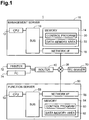
- Fig. 1 is a block diagram of a communication system 1 according to an embodiment of the present application.
- the communication system 1 includes a management server (as an example of each of a management server and a server of the present invention) 10, a function server (as an example of each of a function server and the server of the present invention) 50, an electric commerce (“EC") server (as an example of a specific server of the present invention) 70, a printer (as an example of a device of the present invention) 72, and a general-purpose personal computer (“PC”) (as an example of a terminal) 74.
- the function server 50 is a separate server from the management server 10.
- the management server 10 primarily includes a central processing unit (“CPU”) (as an example of a computer of the present invention) 12, a memory 14, a network interface (“I/F”) 16, which are communicable to each other via a bus 18.
- CPU central processing unit
- I/F network interface
- the CPU 112 executes various processing in accordance with a control program (as an example of a control program of the present invention) 30 stored in the memory 14.
- the control program 30 is provided for managing a consumable components delivery service.
- the memory 14 may include one or a combination of, for example, a random access memory (“RAM”), a read-only memory (“ROM”), a flash memory, a hard disk drive (“HDD”), and a buffer of the CPU 12.
- the memory 14 includes a data memory area 32.
- the data memory area 32 is configured to store data necessary for execution of the control program 30.
- the network I/F 16 is connected to the Internet 38 and enables the management server 10 to communicate with an external device.
- the Internet 38 is connected to the function server 50, the EC server 70, and a router 40.
- the router 40 is further connected to the printer 72 and the PC 74.
- the management server 10 is enabled to perform data communication with the function server 50, the EC server 70, the printer 72, and the PC 74 via the network I/F 16.
- the function server 50 primarily includes a CPU (as another example of the computer of the present invention) 52, a memory 54, a network I/F 56, which are communicable to each other via a bus 58.
- the CPU 52 executes various processing in accordance with a control program (as another example of the control program of the present invention) 60 stored in the memory 54.
- the control program 60 is provided for implementing communication involved in the consumable components delivery service.
- the memory 54 may include one or a combination of, for example, a RAM, a ROM, a flash memory, a HDD, and an a buffer of the CPU 52.
- the memory 54 includes a data memory area 62.
- the data memory area 62 is configured to store data necessary for execution of the control program 60.
- the network I/F 56 is connected to the Internet 38 and enables the function server 50 to communicate with an external device.
- the Internet 38 is connected to the management server 10, the EC server 70, and the router 40.
- the router 40 is further connected to the printer 72 and the PC 74.
- the function server 50 is enabled to perform data communication with the management server 10, the EC server 70, the printer 72, and the PC 74 via the network I/F 56.
- the printer 72 may be an inkjet printer or a laser printer that is an image forming apparatus that may print an image onto a sheet.
- the PC 74 is a general-purpose calculating device that may be operated by a user.
- the router 40 is a relay device that relays communication between one or more client devices that are present on a local network and one or more servers that are present on the Internet 38.
- the EC server 70 is configured to accept an order for a device, e.g., the printer 72, and/or an order for one or more consumable components to be used in the device.
- This configuration may enable the user to order or purchase the printer 72 on the EC server 70 using the PC 74. While the user proceeds the procedure of purchasing the printer 72 on the EC server 70, the user may apply for and conclude a contract for an ordering service for consumable components (e.g., one or more ink cartridges for the printer 72).
- an ordering service for example, when a consumable component used in the printer 72 is near the end of its life, an order for the consumable component is automatically placed and the ordered consumable component is delivered to the user from a company that manages the EC server 70.
- the printer 72 ordered on the EC server 70 has not been delivered to the user yet. Therefore, the user is not enabled to register the printer 72 for the ordering service when concluding the contract for the ordering service.
- the printer 72 ordered on the EC server 70 is registered for the ordering service after the printer 72 is delivered to the user.
- the ordering service for consumable components starts.
- the ordering service for consumable components for the printer 72 will be described in detail. While the consumable components that can be offered in the ordering service for the printer 72 include, for example, toner cartridges of respective colors and drums for laser printers, ink cartridges of respective colors for inkjet printers, and driving force transmission belts used in a mechanism that conveys a printing sheet in a printer, hereinafter, an explanation will be made on an ordering service for ink cartridges of the printer 72.
- Each processing executed in the management server 10 in the following sequence is executed by the CPU 12 that operates in accordance with the control program 40
- each processing executed in the function server 50 in the following sequence is executed by the CPU 52 that operates in accordance with the control program 60.
- the user accesses the EC server 70 using the PC 74.
- a user account for the user (hereinafter, referred to as the "EC server account") is already registered in the EC server 70. Therefore, the user accesses the EC server 70 using the EC server account already registered in the EC server 70.
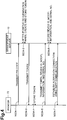
- the user proceeds a procedure of ordering (e.g., purchasing) the printer 72 and a procedure of applying for a contract for an ordering service for one or more ink cartridges to be used in the printer 72, on the EC server 70 (e.g., M100) (refer to Fig. 2 ).
- the user enters user information, which may include, for example, a user name, an email address to be used by the user, a delivery address for ink cartridges, and information on payment for the service.
- the EC server 70 stores model information indicating a model number of the ordered printer 72 and the entered user information in association with the EC server account used when the user accessed the EC server 70 (e.g., M102).
- the EC server 70 transmits an account creation request to the management server 10 (e.g., M104).
- the user name and email address included in the user information are also transmitted to the management server 10 together with the account creation request.
- the EC server 70 transmits the account creation request. Therefore, transmitting the order for the printer 72 and the request for applying the contract of the ordering service for ink cartridges of the printer 72 also refers to transmitting a user registration request by the PC 74.
- the management server 10 In response to receipt of the account creation request, the management server 10 creates an account to be used in the management server 10 (hereinafter, referred to as the "management server account") and a user ID (as an example of a user ID of the present invention) and stores the management server account and the user ID in the data memory area 32 in association with each other (e.g., M106).
- the management server account may be created based on the user name and email address transmitted together with the account creation request.
- the user ID identifies the user who ordered the printer 72. In this example, the user who ordered the printer 72 is the same as the user of the PC 74. Therefore, the user ID also identifies the user of the PC 74.
- the management server 10 transmits the created user ID to the EC server 70 (e.g., M108).
- the EC server 70 In response to receipt of the user ID, the EC server 70 stores the user ID in association with the EC server account as well as the model information stored in M102 (e.g., M110). Subsequently, the EC server 70 transmits a JavaScript® (JavaScript® is a registered trademark owned by Oracle Corporation of Redwood Shores, California) request to the function server 50 (e.g., M112). The model information is also transmitted to the function server 50 together with the JavaScript® request. The function server 50 extracts JavaScript® appropriate for the received model information and transmits the extracted JavaScript® to the EC server 70 (e.g., M114).
- JavaScript® is a registered trademark owned by Oracle Corporation of Redwood Shores, California
- the JavaScript® transmitted in M114 enables, for example, the PC 74, to display, on its display, a screen for selecting one or more consumable components to be targeted for the ordering service.
- Consumable components to be targeted for the ordering service may differ depending on the device models, and therefore, different JavaScript® is required for different device model. Therefore, the function server 50 extracts the JavaScript® appropriate for the received model information and transmits the appropriate JavaScript® to the EC server 70.
- the EC server 70 further transmits the JavaScript® to the PC 74 (e.g., M116).
- the PC 74 displays a product selection screen on the display of the PC 74 (e.g., M118).
- the product selection screen enables the user to select one or more consumable components appropriate for the ordered printer 72, as targets for the ordering service. Then, the user selects and enters one or more consumable components to be targeted for the ordering service, e.g., ink cartridges of respective colors, into the PC 74.
- information on the selected consumable component hereinafter, referred to as the "selected product information" is transmitted to the EC server 70 from the PC 74 (e.g., M120).
- the selected product information includes, for example, a model number of the selected consumable component.
- the selected product information may also be referred to as information on registration for the consumable component ordering service.
- the EC server 70 transmits the received selected product information and the user ID stored in M110, to the function server 50 (e.g., M122).
- the function server 50 In response to receipt of the selected product information and the user ID, the function server 50 generates an order ID (as an example of a registration ID of the present invention) and associates the selected product information, server information, and the order ID with each other.
- the server information identifies the EC server 70 that has transmitted the selected product information.
- the selected product information is received on an individual color basis.
- the function server 50 stores the order ID and the received user ID in the data memory area 62 in association with each other (e.g., M124).
- the function server 50 transmits the order ID to the EC server 70 (e.g., M126).
- the EC server 70 stores the received order ID in association with the EC server account.
- the EC server 70 also associates the already-stored model information and user information with the EC server account (e.g., M128).
- the EC server 70 transmits, to the PC 74, a completion screen representing that the contract for the ordering service has been concluded (e.g., M130).
- the PC 74 displays the completion screen on the display of the PC 74 (e.g., M132).
- the EC server 70 transmits an email for device registration to the email address included in the user information.
- the PC 74 receives the email for device registration (e.g., M134).
- the email for device registration includes a link for accessing a predetermined website on the EC server.
- the registration of the printer 72 is performed using the link included in the email.
- the printer 72 While the processing of each of M100 to M134 is executed, the printer 72 is not being connected to the router 40 because the printer 72 ordered on the EC server 70 has not been delivered to the user yet. Thus, the printer 72 is not capable of communicating with the management server 10 via the Internet 38.
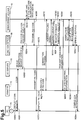
- the printer 72 After the printer 72 is delivered to the user, the user connects the printer 72 to the router 40 (e.g., M200) (refer to Fig. 3 ).
- the printer 72 becomes enabled to communicate with an external device connected to the local network, e.g., a wireless local area network ("LAN") or wired LAN, i.e., the external device connected to the PC 74 and the Internet 38. That is, the printer 72 becomes capable of communicating with the management server 10.
- the status of the printer 72 changes from an uncommunicable status in which the printer 72 is not capable of communicating with the management server 10 via the Internet 38 to a communicable status in which the printer 72 is capable of communicating with the management server 10 via the Internet 38.
- the user accesses the predetermined website on the EC server 70 using the PC 74 through the link included in the email for device registration received in M134 (e.g., M202).
- M134 e.g., M202
- the PC 74 In response to access to the predetermined website on the EC server 70 using the link included in the email for device registration, the PC 74 displays a registration screen for registering a predetermined device for the ordering service (corresponding to a setting selection screen of Fig. 3 ) on the display of the PC 74 (e.g., M204).
- the registration screen includes a "setting through application” button and a "setting through website” button.
- the "setting through application” button may be selected for registering a device through an application.
- the "setting through website” button may be selected for registering a device through a website of the EC server 70.
- the PC 74 In response to input of an operation for selecting the "setting through application” button (e.g., M206: SETTING THROUGH APPLICATION) on the registration screen, the PC 74 is allowed to access the predetermined website. In response to this, the PC 74 displays a screen for enabling the PC 74 to download a predetermined application on the display of the PC 74. Then, the PC 74 downloads the predetermined application through the screen (e.g., M208) and launches the downloaded application (e.g., M210).
- the predetermined application e.g., M208
- the application attempts to log in to the EC server 70 using the EC server account (e.g., M212).
- the EC server 70 extracts the user ID and the order ID both stored in association with the EC server account used for login, and transmits the extracted user ID and order ID to the PC 74 (e.g., M214).
- the application of the PC 74 searches one or more devices connected to the local network (e.g., M216).
- the printer 72 is thus found by the application of the PC 74.
- the printer 72 transmits a response to the PC 74 (e.g., M218). Therefore, the PC 74 recognizes that the printer 72 is being connected to the local network.
- the PC 74 transmits a device registration request to the function server 50 (e.g., M220).
- the order ID received in M214 is also transmitted together with the device registration request.
- the function server 50 extracts the user ID stored in association with the received order ID, and transmits a PIN code (as an example of a PIN code of the present invention) creation request to the management server 10 together with the user ID (e.g., M222).
- the management server 10 creates a PIN code and stores the PIN code in the data memory area 32 in association with the user ID received in M222 (e.g., M224).
- the management server 10 transmits the PIN code to the function server 50 (e.g., M226), and the function server 50 further transmits the received PIN code to the PC 74 (e.g., M228).
- the application of the PC 74 transmits a PIN code registration request to the printer 72 (e.g., M230).
- the printer 72 registers the received PIN code (e.g., M232).
- a connection process is performed between the printer 72 in which the PIN code has been registered and the management server 10.
- the printer 72 transmits the PIN code, which has been registered in the printer 72, to the management server 10 (e.g., M234-1) (refer to Fig. 4 ).
- the management server 10 determines whether the received PIN code matches with the PIN code stored in M224.
- the management server 10 creates a token.
- the management server 10 extracts the user ID stored in association with the PIN code, and stores the created token in the data memory area 32 in association with the extracted user ID (e.g., M234-2).
- the management server 10 transmits the token to the printer 72 (e.g., M234-3), and the printer 72 stores the received token (e.g., M234-4).
- the printer 72 transmits a device ID (as an example of a device ID of the present invention) identifying the printer 72, the model information, and a serial No. to the management server 10 (e.g., M234-5).
- the management server 10 extracts the user ID associated to the received token and stores the received device ID, the model information, and the serial No. in the data memory area 32 in association with the extracted user ID (e.g., M234-6).
- XMPP extensible messaging and presence protocol
- the printer 72 transmits, to the PC 74, a completion notification that the connection process has been completed (e.g., M236) (refer to Fig. 3 ).
- the completion notification includes the device ID of the printer 72.
- the PC 74 then transmits a completion notification including the device ID of the printer 72 to the function server 50 (e.g., M238).
- the function server 50 registers the device ID included in the completion notification in association with the user ID, the selected product information, and the server information, and transmits a subscribe request to the management server 10 (e.g., M240).
- the management server 10 transmits subscribe information to the printer 72 (e.g., M242).
- the subscribe information includes an instruction for executing predetermined processing periodically. More specifically, for example, the subscribe information may include an instruction for causing the printer 72 to detect a remaining life of a target, e.g., every 12 hours, and transmit remaining life information indicating the detected remaining life of the target to the management server 10.
- the remaining information may indicate, for example, an amount of ink remaining in an ink cartridge.
- the printer 72 In response to receipt of the subscribe information, the printer 72 stores the subscribe information (e.g., M244). Subsequently, the printer 72 transmits, to the management server 10, a completion notification that storing of the subscribe information has been completed (e.g., M246), and the management server 10 further transmits the completion notification to the function server 50 (e.g., M248).
- the function server 50 enables the ordering service for the printer 72 (e.g., M250).
- the function server 50 monitors whether the ordering service starts. In response to enabling the ordering service, the ordering service starts. In response to enabling the ordering service in the function server 50, the function server 50 transmits a completion notification to the PC 74 (e.g., M252).
- the user recognizes that the registration of the printer 72 for the ordering service has been completed and the ordering service for the printer 72 has started.
- the PC 74 In response to input of an operation for selecting the "setting through website” button on the registration screen in M206 (e.g., M206: SETTING THROUGH WEBSITE) (refer to Fig. 3 ), the PC 74 displays a login screen on the display of the PC 74 (e.g., M260) (refer to Fig. 5 ). In response to this, the user attempts to log in to the EC server 70 by entering the EC server account on the login screen (e.g., M261). In response to success in the login, the EC server 70 extracts the order ID stored in association with the EC server account used for login, and transmits the order ID to the function server 50 together with a device registration request (e.g., M262).
- a device registration request e.g., M262
- the function server 50 extracts the user ID stored in association with the received order ID, and transmits a PIN code creation request to the management server 10 together with the user ID (e.g., M264).
- the management server 10 creates a PIN code and stores the PIN code in the data memory area 32 in association with the user ID received in M264 (e.g., M266).
- the management server 10 transmits the PIN code to the function server 50 (e.g., M268), and the function server 50 further transmits the received PIN code to the PC 74 (e.g., M270).
- the PC 74 In response to receipt of the PIN code, the PC 74 displays the PIN code on the display (e.g., M272). In response to this, the user confirms the PIN code and enters the PIN code into the printer 72 by operating an operation panel of the printer 72. Thus, the PIN code is registered in the printer 72 (e.g., M274). In response to this, a connection process is executed between the printer 72 and the management server 10 (e.g., M276). The connection process executed in M276 is the same or similar to the connection process executed in M234, and therefore, the detailed description of the connection process executed in M276 is omitted.
- the function server 50 After transmitting the PIN code to the PC 74, the function server 50 periodically transmits, to the management server 10, the user ID and a polling signal for obtaining a device list associated with the user ID (e.g., M278), and receives a device list from the management server 10 periodically in reply to the transmission of each polling signal (e.g., M280).
- the device list includes the device ID associated with the user ID.
- the function server 50 determines that the received device list includes a new printer (e.g., the printer 72) and thus registers the new device ID in association with the user ID, the selected product information, and the server information (e.g., M281). Thereafter, processing of each of M282 to M294 is executed. Processing executed in each of M282 to M294 is the same or similar to the processing executed in each of M240 to M252, respectively, and therefore, the detailed description of the common steps is omitted. Upon completion of the processing of M294, the registration of the printer 72 for the ordering service is completed and the ordering service for the printer 72 starts.
- a new device ID e.g., the device ID of the printer 72
- the printer 72 Upon start of the ordering service for the printer 72, the printer 72 detects a remaining amount of each ink cartridge periodically (as an example of related information of the present invention) as remaining life information of each ink cartridge.
- a plurality of ink cartridges of respective colors are installed in the printer 72 so as to be detachably attachable, and the printer 72 includes detection sensors for the respective ink cartridges.
- Each of the detection sensors is configured to detect whether a remaining amount of ink in a corresponding ink cartridge is lower than or equal to a first threshold and lower than or equal to a second threshold, which is smaller than the first threshold.
- the ink remaining amount of the ink cartridge is determined as "Near Empty".
- the ink remaining amount of the ink cartridge is determined as "Empty”.
- the ink remaining amount of the ink cartridge is determined as "Full”.
- the status of the determined ink remaining amount (hereinafter, referred to as "ink remaining amount status") is determined as one of "Near Empty", “Empty”, and "Full".
- an amount of used ink is estimated based on the number of sheets that have been printed and an ink remaining amount is further estimated based on the estimated amount of used ink (hereinafter, referred to as the “estimated ink remaining amount”). Therefore, the printer 72 periodically detects the ink remaining amount status and the estimated ink remaining amount, as remaining life information (e.g., M300). Then, the printer 72 transmits the remaining life information to the management server 10 (e.g., M302). Both of the ink remaining amount status and the estimated ink remaining amount are detected on an ink cartridge basis. Therefore, the remaining life information of each ink cartridge is transmitted in association with respective color information.
- the management server 10 In response to receipt of each pieces of remaining life information together with the device ID, the management server 10 further transmits each pieces of remaining life information together with the device ID to the function server 50 (e.g., M304). In response to receipt of each pieces of remaining life information together with the device ID, the function server 50 determines for each color whether selected product information is associated to the received device ID. When the function server 50 determines that selected product information is associated to the received device ID for any color, the function server 50 further determines, based on the corresponding received remaining life information, whether the ink cartridge indicated by the selected product information needs to be replaced with a new one (e.g., M306).
- a new one e.g., M306
- the function server 50 determines that the ink cartridge needs to be replaced with a new one, the function server 50 transmits the serial number of the ink cartridge indicated by the selected product information used in the determination in M306, to the EC server 70 identified by the server information, as ordered product information (e.g., M308). Thus, an order for the ink cartridge with a relatively low ink is placed automatically. In a case where two or more ink cartridges need to be replaced with respective new ones, an order for the two or more ink cartridges is automatically placed.
- the function server 50 transmits the user ID to the EC server 70 together with the ordered product information. In response to receipt of the ordered product information and the user ID, the EC server 70 extracts the user information associated to the received user ID.
- the company that manages the EC server dispatches the ink cartridge with the model number based on the received ordered product information (e.g., M310). Therefore, the user may receive a new ink cartridge assigned with the model number that the user selected when applying for the service, without concern for the remaining life of the ink cartridge nor without ordering the ink cartridge by him/herself.
- the received ordered product information e.g., M310
- the contract for the ordering service is applied and concluded when a device, e.g., the printer 72, is ordered or purchased.
- the device is registered for the ordering service.
- the user is enabled to access the website for registering the device using the link included in the email transmitted from the EC server 70, and register the device by entering necessary information in accordance with instructions provided through the website.
- the device registration needs to be completed when a contract for such an ordering service is applied and concluded. Therefore, some users who may be unfamiliar to operation of terminals, e.g., PCs, may give up applying for and concluding a contract for the service.
- the user may be enabled to apply for and conclude the contract for the service without the ordered device on user site. In other words, the user may be enabled to conclude the contract for the service without registering the ordered device.
- the description has been made on the case where the user orders or purchases a device on the EC server 70. Nevertheless, in other embodiments, for example, the user may purchase a device at a mortar and brick store.
- the user may be enabled to apply for and conclude the contract for ordering service when purchasing the device at the store.
- a staff member of the store may apply for and conclude the contract for ordering service at the store.
- the user may apply for and conclude the contract for ordering service at the store with an assistance of the staff member of the store.
- the CPU 12 of the management server 10 that executes the processing of M106 is an example of a first registering unit.
- the CPU 52 of the function server 50 that executes the processing of M124 is an example of a second registering unit.
- the CPU 12 of the management server 10 that executes the processing of M234-6 is an example of a third registering unit.
- the CPU 52 of the function server 50 that executes the processing of M304 is an example of a first receiving unit.
- the CPU 52 of the function server 50 that executes the processing of M308 is an example of a communicating unit.
- the CPU 12 of the management server 10 that executes the processing of M222 is an example of a second receiving unit.
- the CPU 52 of the function server 50 that executes the processing of M222 is an example of a third transmitting unit.
- the CPU 12 of the management server 10 that executes the processing of M226 is an example of a first transmitting unit and an example of a fourth transmitting unit.
- the CPU 12 of the management server 10 that executes the processing of M264 is an example of a third receiving unit.
- the CPU 12 of the management server 10 that executes the processing of M268 is an example of a second transmitting unit.
- the management server 10 and the function server 50 are independent web servers, respectively. Nevertheless, in other embodiments, for example, the management server 10 and the function server 50 may consist of a single web server.
- the selected product information is registered subsequent to registration of the user ID. Nevertheless, in other embodiments, for example, the selected product information may be registered prior to registration of the user ID.
- the contract for the ordering service is concluded at the time of ordering or purchasing a device (i.e., prior to the user receiving the ordered device). Nevertheless, in other embodiments, for example, the contract for the ordering service may be concluded after the user received the ordered device but before the user connects the device to the Internet
- the target components for the ordering service are replaceable components for printers.
- the target components for the ordering service may be consumable components for other devices, e.g., facsimile machines, sewing machines, or label printers. That is, the target components for the ordering service may include, for example, ink ribbons, threads, and tape cartridges.
- another service for example, service for executing special image processing relating to scanning or printing on a specific server may be provided.
- the function server 50 confirms the completion of the registration of the printer 72 by signal transmission and reception between the management server 10 and the function server 50 through M248 to M281. Nevertheless, in other embodiments, for example, the function server 50 may confirm the completion of the registration of the printer 72 by a notification provided by the PC 74. More specifically, for example, the screen showing a PIN code may include a "complete" button, and a message that prompts the user to select or operate the "complete” button after completing entry of the PIN code into the printer 72. The message is added to the "complete” button. Therefore, after the user completed the entry of the PIN code into the printer 72, the user may select or operate the "complete” button. In response to this, the PC 74 may transmit a completion notification to the function server 50. Thus, the function server 50 may confirm the completion of the registration of the printer 72.
- the processing in all steps illustrated in Figs. 2 to 6 is implemented by the CPU 12 or the CPU 52. Nevertheless, in other embodiments, for example, the processing in at least one of the steps illustrated in Figs. 2 to 6 may be implemented by hardware, for example, one or more special application specific integrated circuits ("ASICs") or one or more other logical circuits, or a combination of one or more CPUs, one or more ASICs, and one or more other logical circuits.
- ASICs application specific integrated circuits
Landscapes
- Engineering & Computer Science (AREA)
- Theoretical Computer Science (AREA)
- Physics & Mathematics (AREA)
- General Physics & Mathematics (AREA)
- General Engineering & Computer Science (AREA)
- Computer Security & Cryptography (AREA)
- Computer Hardware Design (AREA)
- Software Systems (AREA)
- Business, Economics & Management (AREA)
- Accounting & Taxation (AREA)
- Finance (AREA)
- Signal Processing (AREA)
- Computer Networks & Wireless Communication (AREA)
- Development Economics (AREA)
- General Business, Economics & Management (AREA)
- Economics (AREA)
- Strategic Management (AREA)
- Marketing (AREA)
- Accessory Devices And Overall Control Thereof (AREA)
- Information Transfer Between Computers (AREA)
- Computer And Data Communications (AREA)
Abstract
Description
- The present invention relates to a server that is communicable to a device via the Internet.
- Recently, there has been provided some service for a device offered using a specific server, e.g., an electric commerce ("EC") server. Such service may include a consumable components automatic ordering service for the device. To obtain such service, a user applies for and concludes a service contract using a terminal, e.g., a general-purpose personal computer ("PC"), through communication between the terminal and the specific server via the Internet. More specifically, for example, as disclosed in the following Patent Document, to obtain such service, the user communicates with the specific server using the terminal, e.g., the PC, via the Internet to complete user registration, device registration for registering a device to be targeted for service, and conclusion of a service contract, in this order.
- [Patent Document 1] Japanese Laid-Open Patent Application No.
2016-193592 - For registering a device for concluding the service contract, the device to be registered and a predetermined server communicate with each other via the Internet. Therefore, when the device registration is performed, a situation in which the device to be registered is capable of communicating with the predetermined server via the Internet may need to be created. In the technique disclosed in the Patent Document, the service contract is concluded after the device registration is completed. Therefore, if a situation in which the device is not capable of communicating with the predetermined server via the Internet has occurred after the device registration is completed, the service contract cannot be concluded, which may cause troublesome situation. The present invention was made in light of the foregoing circumstances. The present invention provides for a technique that may enable registration for service although a target device is not capable of performing communication via the Internet.
- In the present specification, the disclosure provides for a server system comprising: a first registering unit for, in response to receiving, from a terminal, a registration request for registering a user of a device in a condition which a communication between the server system and the device via the Internet is not capable of being executed, registering a user ID for identifying the user; a second registering unit for, in response to receiving information related to registration of a service from the terminal in the condition which the communication between the server system and the device via the Internet is not capable of being executed, registering service information used when the service is used, the service being provided from a specific server and being used at the device; a third registering unit for, in response to receiving a device ID for identifying the device from the device after registering the user ID and the service information and after the condition in which the communication between the server system and the device via the Internet is not capable of being executed to a condition in which the communication between the server system and the device via the Internet is capable of being executed, registering the device ID in association with the user ID; a first receiving unit for receiving the device ID and related information related to the service from the device after registering the device ID; a communicating unit for, in response to receiving the related information, communicating with the specific server using the user ID and the service information for using the service.
- According to the above-described configuration, the user ID and the service information may be registered under a situation in which the device is not capable of performing communication via the Internet. If the registration of the user ID and the service information is completed, the registration for service may be allowed to be performed. Therefore, under the situation in which the device is not capable of performing communication via the Internet, the service contract may be concluded. After the device becomes capable of performing communication via the Internet subsequent to completion of the registration for service, the device registration may be performed. In response to completion of the device registration, a user is allowed to obtain the service.
- The technique disclosed in the specification may be implemented by various approaches, for example, control methods and computer programs for implementing functions of devices or the above-described methods, or computer-readable storage media storing the computer programs.
-
-
Fig. 1 is a block diagram of acommunication system 1. -
Fig 2 is an operation sequence diagram for thecommunication system 1. -
Fig 3 is an operation sequence diagram for thecommunication system 1. -
Fig 4 is an operation sequence diagram for thecommunication system 1. -
Fig 5 is an operation sequence diagram for thecommunication system 1. -
Fig 6 is an operation sequence diagram for thecommunication system 1. -
Fig. 1 is a block diagram of acommunication system 1 according to an embodiment of the present application. Thecommunication system 1 includes a management server (as an example of each of a management server and a server of the present invention) 10, a function server (as an example of each of a function server and the server of the present invention) 50, an electric commerce ("EC") server (as an example of a specific server of the present invention) 70, a printer (as an example of a device of the present invention) 72, and a general-purpose personal computer ("PC") (as an example of a terminal) 74. Thefunction server 50 is a separate server from themanagement server 10. - The
management server 10 primarily includes a central processing unit ("CPU") (as an example of a computer of the present invention) 12, amemory 14, a network interface ("I/F") 16, which are communicable to each other via abus 18. - The CPU 112 executes various processing in accordance with a control program (as an example of a control program of the present invention) 30 stored in the
memory 14. Thecontrol program 30 is provided for managing a consumable components delivery service. Thememory 14 may include one or a combination of, for example, a random access memory ("RAM"), a read-only memory ("ROM"), a flash memory, a hard disk drive ("HDD"), and a buffer of theCPU 12. Thememory 14 includes adata memory area 32. Thedata memory area 32 is configured to store data necessary for execution of thecontrol program 30. - The network I/F 16 is connected to the Internet 38 and enables the
management server 10 to communicate with an external device. The Internet 38 is connected to thefunction server 50, the ECserver 70, and arouter 40. Therouter 40 is further connected to theprinter 72 and the PC 74. Thus, themanagement server 10 is enabled to perform data communication with thefunction server 50, theEC server 70, theprinter 72, and the PC 74 via the network I/F 16. - The
function server 50 primarily includes a CPU (as another example of the computer of the present invention) 52, amemory 54, a network I/F 56, which are communicable to each other via abus 58. - The
CPU 52 executes various processing in accordance with a control program (as another example of the control program of the present invention) 60 stored in thememory 54. Thecontrol program 60 is provided for implementing communication involved in the consumable components delivery service. Thememory 54 may include one or a combination of, for example, a RAM, a ROM, a flash memory, a HDD, and an a buffer of theCPU 52. Thememory 54 includes adata memory area 62. Thedata memory area 62 is configured to store data necessary for execution of thecontrol program 60. - The network I/F 56 is connected to the Internet 38 and enables the
function server 50 to communicate with an external device. The Internet 38 is connected to themanagement server 10, the ECserver 70, and therouter 40. Therouter 40 is further connected to theprinter 72 and the PC 74. Thus, thefunction server 50 is enabled to perform data communication with themanagement server 10, theEC server 70, theprinter 72, and the PC 74 via the network I/F 56. - The
printer 72 may be an inkjet printer or a laser printer that is an image forming apparatus that may print an image onto a sheet. The PC 74 is a general-purpose calculating device that may be operated by a user. Therouter 40 is a relay device that relays communication between one or more client devices that are present on a local network and one or more servers that are present on the Internet 38. - The
EC server 70 is configured to accept an order for a device, e.g., theprinter 72, and/or an order for one or more consumable components to be used in the device. This configuration may enable the user to order or purchase theprinter 72 on theEC server 70 using the PC 74. While the user proceeds the procedure of purchasing theprinter 72 on theEC server 70, the user may apply for and conclude a contract for an ordering service for consumable components (e.g., one or more ink cartridges for the printer 72). In the ordering service, for example, when a consumable component used in theprinter 72 is near the end of its life, an order for the consumable component is automatically placed and the ordered consumable component is delivered to the user from a company that manages theEC server 70. Nevertheless, at the time of concluding the contract for the ordering service, theprinter 72 ordered on theEC server 70 has not been delivered to the user yet. Therefore, the user is not enabled to register theprinter 72 for the ordering service when concluding the contract for the ordering service. Thus, theprinter 72 ordered on theEC server 70 is registered for the ordering service after theprinter 72 is delivered to the user. In response to completion of the registration of theprinter 72, the ordering service for consumable components starts. - Referring to sequence diagrams of
Figs. 2 to 6 , the ordering service for consumable components for theprinter 72 will be described in detail. While the consumable components that can be offered in the ordering service for theprinter 72 include, for example, toner cartridges of respective colors and drums for laser printers, ink cartridges of respective colors for inkjet printers, and driving force transmission belts used in a mechanism that conveys a printing sheet in a printer, hereinafter, an explanation will be made on an ordering service for ink cartridges of theprinter 72. Each processing executed in themanagement server 10 in the following sequence is executed by theCPU 12 that operates in accordance with thecontrol program 40, and each processing executed in thefunction server 50 in the following sequence is executed by theCPU 52 that operates in accordance with thecontrol program 60. - More specifically, for example, the user accesses the
EC server 70 using thePC 74. A user account for the user (hereinafter, referred to as the "EC server account") is already registered in theEC server 70. Therefore, the user accesses theEC server 70 using the EC server account already registered in theEC server 70. Then, the user proceeds a procedure of ordering (e.g., purchasing) theprinter 72 and a procedure of applying for a contract for an ordering service for one or more ink cartridges to be used in theprinter 72, on the EC server 70 (e.g., M100) (refer toFig. 2 ). In the procedure of applying for the contract for the ordering service, the user enters user information, which may include, for example, a user name, an email address to be used by the user, a delivery address for ink cartridges, and information on payment for the service. - Subsequently, the
EC server 70 stores model information indicating a model number of the orderedprinter 72 and the entered user information in association with the EC server account used when the user accessed the EC server 70 (e.g., M102). TheEC server 70 then transmits an account creation request to the management server 10 (e.g., M104). The user name and email address included in the user information are also transmitted to themanagement server 10 together with the account creation request. In response to receipt of the order for theprinter 72 and the request for applying the contract of the ordering service for ink cartridges of theprinter 72, theEC server 70 transmits the account creation request. Therefore, transmitting the order for theprinter 72 and the request for applying the contract of the ordering service for ink cartridges of theprinter 72 also refers to transmitting a user registration request by thePC 74. - In response to receipt of the account creation request, the
management server 10 creates an account to be used in the management server 10 (hereinafter, referred to as the "management server account") and a user ID (as an example of a user ID of the present invention) and stores the management server account and the user ID in thedata memory area 32 in association with each other (e.g., M106). The management server account may be created based on the user name and email address transmitted together with the account creation request. The user ID identifies the user who ordered theprinter 72. In this example, the user who ordered theprinter 72 is the same as the user of thePC 74. Therefore, the user ID also identifies the user of thePC 74. Subsequently, themanagement server 10 transmits the created user ID to the EC server 70 (e.g., M108). - In response to receipt of the user ID, the
EC server 70 stores the user ID in association with the EC server account as well as the model information stored in M102 (e.g., M110). Subsequently, theEC server 70 transmits a JavaScript® (JavaScript® is a registered trademark owned by Oracle Corporation of Redwood Shores, California) request to the function server 50 (e.g., M112). The model information is also transmitted to thefunction server 50 together with the JavaScript® request. Thefunction server 50 extracts JavaScript® appropriate for the received model information and transmits the extracted JavaScript® to the EC server 70 (e.g., M114). - The JavaScript® transmitted in M114 enables, for example, the
PC 74, to display, on its display, a screen for selecting one or more consumable components to be targeted for the ordering service. Consumable components to be targeted for the ordering service may differ depending on the device models, and therefore, different JavaScript® is required for different device model. Therefore, thefunction server 50 extracts the JavaScript® appropriate for the received model information and transmits the appropriate JavaScript® to theEC server 70. - In response to receipt of the JavaScript®, the
EC server 70 further transmits the JavaScript® to the PC 74 (e.g., M116). In response to this, thePC 74 displays a product selection screen on the display of the PC 74 (e.g., M118). The product selection screen enables the user to select one or more consumable components appropriate for the orderedprinter 72, as targets for the ordering service. Then, the user selects and enters one or more consumable components to be targeted for the ordering service, e.g., ink cartridges of respective colors, into thePC 74. In response to this, information on the selected consumable component (hereinafter, referred to as the "selected product information") is transmitted to theEC server 70 from the PC 74 (e.g., M120). The selected product information includes, for example, a model number of the selected consumable component. The selected product information may also be referred to as information on registration for the consumable component ordering service. - In response to receipt of the selected product information, the
EC server 70 transmits the received selected product information and the user ID stored in M110, to the function server 50 (e.g., M122). In response to receipt of the selected product information and the user ID, thefunction server 50 generates an order ID (as an example of a registration ID of the present invention) and associates the selected product information, server information, and the order ID with each other. The server information identifies theEC server 70 that has transmitted the selected product information. In the embodiment, the selected product information is received on an individual color basis. Subsequently, thefunction server 50 stores the order ID and the received user ID in thedata memory area 62 in association with each other (e.g., M124). - Subsequently, the
function server 50 transmits the order ID to the EC server 70 (e.g., M126). In response to receipt of the order ID, theEC server 70 stores the received order ID in association with the EC server account. At that time, theEC server 70 also associates the already-stored model information and user information with the EC server account (e.g., M128). Then, theEC server 70 transmits, to thePC 74, a completion screen representing that the contract for the ordering service has been concluded (e.g., M130). In response to receipt of the completion screen, thePC 74 displays the completion screen on the display of the PC 74 (e.g., M132). Further, theEC server 70 transmits an email for device registration to the email address included in the user information. In this example, thePC 74 receives the email for device registration (e.g., M134). The email for device registration includes a link for accessing a predetermined website on the EC server. The registration of theprinter 72 is performed using the link included in the email. - While the processing of each of M100 to M134 is executed, the
printer 72 is not being connected to therouter 40 because theprinter 72 ordered on theEC server 70 has not been delivered to the user yet. Thus, theprinter 72 is not capable of communicating with themanagement server 10 via theInternet 38. - After the
printer 72 is delivered to the user, the user connects theprinter 72 to the router 40 (e.g., M200) (refer toFig. 3 ). Thus, theprinter 72 becomes enabled to communicate with an external device connected to the local network, e.g., a wireless local area network ("LAN") or wired LAN, i.e., the external device connected to thePC 74 and theInternet 38. That is, theprinter 72 becomes capable of communicating with themanagement server 10. In other words, the status of theprinter 72 changes from an uncommunicable status in which theprinter 72 is not capable of communicating with themanagement server 10 via theInternet 38 to a communicable status in which theprinter 72 is capable of communicating with themanagement server 10 via theInternet 38. Subsequently, the user accesses the predetermined website on theEC server 70 using thePC 74 through the link included in the email for device registration received in M134 (e.g., M202). - In response to access to the predetermined website on the
EC server 70 using the link included in the email for device registration, thePC 74 displays a registration screen for registering a predetermined device for the ordering service (corresponding to a setting selection screen ofFig. 3 ) on the display of the PC 74 (e.g., M204). The registration screen includes a "setting through application" button and a "setting through website" button. The "setting through application" button may be selected for registering a device through an application. The "setting through website" button may be selected for registering a device through a website of theEC server 70. In response to input of an operation for selecting the "setting through application" button (e.g., M206: SETTING THROUGH APPLICATION) on the registration screen, thePC 74 is allowed to access the predetermined website. In response to this, thePC 74 displays a screen for enabling thePC 74 to download a predetermined application on the display of thePC 74. Then, thePC 74 downloads the predetermined application through the screen (e.g., M208) and launches the downloaded application (e.g., M210). - In response to launching of the application, the application attempts to log in to the
EC server 70 using the EC server account (e.g., M212). In response to success in the login, theEC server 70 extracts the user ID and the order ID both stored in association with the EC server account used for login, and transmits the extracted user ID and order ID to the PC 74 (e.g., M214). Subsequently, the application of thePC 74 searches one or more devices connected to the local network (e.g., M216). Theprinter 72 is thus found by the application of thePC 74. In reply to the device search executed by the application of thePC 74, theprinter 72 transmits a response to the PC 74 (e.g., M218). Therefore, thePC 74 recognizes that theprinter 72 is being connected to the local network. - Subsequently, the
PC 74 transmits a device registration request to the function server 50 (e.g., M220). At that time, the order ID received in M214 is also transmitted together with the device registration request. Thefunction server 50 extracts the user ID stored in association with the received order ID, and transmits a PIN code (as an example of a PIN code of the present invention) creation request to themanagement server 10 together with the user ID (e.g., M222). In response to receipt of the PIN code creation request, themanagement server 10 creates a PIN code and stores the PIN code in thedata memory area 32 in association with the user ID received in M222 (e.g., M224). - Subsequently, the
management server 10 transmits the PIN code to the function server 50 (e.g., M226), and thefunction server 50 further transmits the received PIN code to the PC 74 (e.g., M228). In response to receipt of the PIN code, the application of thePC 74 transmits a PIN code registration request to the printer 72 (e.g., M230). Thus, theprinter 72 registers the received PIN code (e.g., M232). Then, a connection process is performed between theprinter 72 in which the PIN code has been registered and themanagement server 10. - In the connection process performed between the
printer 72 and themanagement server 10, theprinter 72 transmits the PIN code, which has been registered in theprinter 72, to the management server 10 (e.g., M234-1) (refer toFig. 4 ). In response to receipt of the PIN code, themanagement server 10 determines whether the received PIN code matches with the PIN code stored in M224. When the received PIN code matches with the PIN code stored in M224, themanagement server 10 creates a token. Themanagement server 10 then extracts the user ID stored in association with the PIN code, and stores the created token in thedata memory area 32 in association with the extracted user ID (e.g., M234-2). - Subsequently, the
management server 10 transmits the token to the printer 72 (e.g., M234-3), and theprinter 72 stores the received token (e.g., M234-4). Theprinter 72 then transmits a device ID (as an example of a device ID of the present invention) identifying theprinter 72, the model information, and a serial No. to the management server 10 (e.g., M234-5). In response to receipt of the token, the device ID, the model information, and the serial No., themanagement server 10 extracts the user ID associated to the received token and stores the received device ID, the model information, and the serial No. in thedata memory area 32 in association with the extracted user ID (e.g., M234-6). Then, an always-on connection using extensible messaging and presence protocol ("XMPP") communication is established between theprinter 72 and the management server 10 (e.g., M234-7). Thus, the connection process (e.g., M234) between theprinter 72 and themanagement server 10 is completed. - In response to completion of the connection process between the
printer 72 and themanagement server 10, theprinter 72 transmits, to thePC 74, a completion notification that the connection process has been completed (e.g., M236) (refer toFig. 3 ). The completion notification includes the device ID of theprinter 72. ThePC 74 then transmits a completion notification including the device ID of theprinter 72 to the function server 50 (e.g., M238). In response to receipt of the completion notification, thefunction server 50 registers the device ID included in the completion notification in association with the user ID, the selected product information, and the server information, and transmits a subscribe request to the management server 10 (e.g., M240). In response to this, themanagement server 10 transmits subscribe information to the printer 72 (e.g., M242). The subscribe information includes an instruction for executing predetermined processing periodically. More specifically, for example, the subscribe information may include an instruction for causing theprinter 72 to detect a remaining life of a target, e.g., every 12 hours, and transmit remaining life information indicating the detected remaining life of the target to themanagement server 10. The remaining information may indicate, for example, an amount of ink remaining in an ink cartridge. - In response to receipt of the subscribe information, the
printer 72 stores the subscribe information (e.g., M244). Subsequently, theprinter 72 transmits, to themanagement server 10, a completion notification that storing of the subscribe information has been completed (e.g., M246), and themanagement server 10 further transmits the completion notification to the function server 50 (e.g., M248). In response to receipt of the completion notification, thefunction server 50 enables the ordering service for the printer 72 (e.g., M250). Thefunction server 50 monitors whether the ordering service starts. In response to enabling the ordering service, the ordering service starts. In response to enabling the ordering service in thefunction server 50, thefunction server 50 transmits a completion notification to the PC 74 (e.g., M252). In response to receipt of the completion notification from thefunction server 50, the user recognizes that the registration of theprinter 72 for the ordering service has been completed and the ordering service for theprinter 72 has started. - In response to input of an operation for selecting the "setting through website" button on the registration screen in M206 (e.g., M206: SETTING THROUGH WEBSITE) (refer to
Fig. 3 ), thePC 74 displays a login screen on the display of the PC 74 (e.g., M260) (refer toFig. 5 ). In response to this, the user attempts to log in to theEC server 70 by entering the EC server account on the login screen (e.g., M261). In response to success in the login, theEC server 70 extracts the order ID stored in association with the EC server account used for login, and transmits the order ID to thefunction server 50 together with a device registration request (e.g., M262). - The
function server 50 extracts the user ID stored in association with the received order ID, and transmits a PIN code creation request to themanagement server 10 together with the user ID (e.g., M264). In response to receipt of the PIN code creation request, themanagement server 10 creates a PIN code and stores the PIN code in thedata memory area 32 in association with the user ID received in M264 (e.g., M266). Subsequently, themanagement server 10 transmits the PIN code to the function server 50 (e.g., M268), and thefunction server 50 further transmits the received PIN code to the PC 74 (e.g., M270). - In response to receipt of the PIN code, the
PC 74 displays the PIN code on the display (e.g., M272). In response to this, the user confirms the PIN code and enters the PIN code into theprinter 72 by operating an operation panel of theprinter 72. Thus, the PIN code is registered in the printer 72 (e.g., M274). In response to this, a connection process is executed between theprinter 72 and the management server 10 (e.g., M276). The connection process executed in M276 is the same or similar to the connection process executed in M234, and therefore, the detailed description of the connection process executed in M276 is omitted. - After transmitting the PIN code to the
PC 74, thefunction server 50 periodically transmits, to themanagement server 10, the user ID and a polling signal for obtaining a device list associated with the user ID (e.g., M278), and receives a device list from themanagement server 10 periodically in reply to the transmission of each polling signal (e.g., M280). The device list includes the device ID associated with the user ID. In a case where a new device ID (e.g., the device ID of the printer 72) has been registered in association with the user ID in themanagement server 10 as a result of the processing of M276, thefunction server 50 determines that the received device list includes a new printer (e.g., the printer 72) and thus registers the new device ID in association with the user ID, the selected product information, and the server information (e.g., M281). Thereafter, processing of each of M282 to M294 is executed. Processing executed in each of M282 to M294 is the same or similar to the processing executed in each of M240 to M252, respectively, and therefore, the detailed description of the common steps is omitted. Upon completion of the processing of M294, the registration of theprinter 72 for the ordering service is completed and the ordering service for theprinter 72 starts. - Upon start of the ordering service for the
printer 72, theprinter 72 detects a remaining amount of each ink cartridge periodically (as an example of related information of the present invention) as remaining life information of each ink cartridge. A plurality of ink cartridges of respective colors are installed in theprinter 72 so as to be detachably attachable, and theprinter 72 includes detection sensors for the respective ink cartridges. Each of the detection sensors is configured to detect whether a remaining amount of ink in a corresponding ink cartridge is lower than or equal to a first threshold and lower than or equal to a second threshold, which is smaller than the first threshold. When the detection sensor detects that the remaining amount of ink in the corresponding ink cartridge is lower than or equal to the first threshold but greater than the second threshold, the ink remaining amount of the ink cartridge is determined as "Near Empty". When the detection sensor detects that the remaining amount of ink in the corresponding ink cartridge is lower than or equal to the second threshold, the ink remaining amount of the ink cartridge is determined as "Empty". When the detection sensor detects that the remaining amount of ink in the corresponding ink cartridge is greater than the first threshold, the ink remaining amount of the ink cartridge is determined as "Full". Thus, the status of the determined ink remaining amount (hereinafter, referred to as "ink remaining amount status") is determined as one of "Near Empty", "Empty", and "Full". In theprinter 72, an amount of used ink is estimated based on the number of sheets that have been printed and an ink remaining amount is further estimated based on the estimated amount of used ink (hereinafter, referred to as the "estimated ink remaining amount"). Therefore, theprinter 72 periodically detects the ink remaining amount status and the estimated ink remaining amount, as remaining life information (e.g., M300). Then, theprinter 72 transmits the remaining life information to the management server 10 (e.g., M302). Both of the ink remaining amount status and the estimated ink remaining amount are detected on an ink cartridge basis. Therefore, the remaining life information of each ink cartridge is transmitted in association with respective color information. - In response to receipt of each pieces of remaining life information together with the device ID, the
management server 10 further transmits each pieces of remaining life information together with the device ID to the function server 50 (e.g., M304). In response to receipt of each pieces of remaining life information together with the device ID, thefunction server 50 determines for each color whether selected product information is associated to the received device ID. When thefunction server 50 determines that selected product information is associated to the received device ID for any color, thefunction server 50 further determines, based on the corresponding received remaining life information, whether the ink cartridge indicated by the selected product information needs to be replaced with a new one (e.g., M306). - When the
function server 50 determines that the ink cartridge needs to be replaced with a new one, thefunction server 50 transmits the serial number of the ink cartridge indicated by the selected product information used in the determination in M306, to theEC server 70 identified by the server information, as ordered product information (e.g., M308). Thus, an order for the ink cartridge with a relatively low ink is placed automatically. In a case where two or more ink cartridges need to be replaced with respective new ones, an order for the two or more ink cartridges is automatically placed. Thefunction server 50 transmits the user ID to theEC server 70 together with the ordered product information. In response to receipt of the ordered product information and the user ID, theEC server 70 extracts the user information associated to the received user ID. Then, for example, the company that manages the EC server dispatches the ink cartridge with the model number based on the received ordered product information (e.g., M310). Therefore, the user may receive a new ink cartridge assigned with the model number that the user selected when applying for the service, without concern for the remaining life of the ink cartridge nor without ordering the ink cartridge by him/herself. - As described above, in the
communication system 1, the contract for the ordering service is applied and concluded when a device, e.g., theprinter 72, is ordered or purchased. After the ordered device is delivered to the user, the device is registered for the ordering service. For registering the device for the ordering service, the user is enabled to access the website for registering the device using the link included in the email transmitted from theEC server 70, and register the device by entering necessary information in accordance with instructions provided through the website. - In some known system, the device registration needs to be completed when a contract for such an ordering service is applied and concluded. Therefore, some users who may be unfamiliar to operation of terminals, e.g., PCs, may give up applying for and concluding a contract for the service. On the other hand, in the
communication system 1, the user may be enabled to apply for and conclude the contract for the service without the ordered device on user site. In other words, the user may be enabled to conclude the contract for the service without registering the ordered device. In the embodiment, the description has been made on the case where the user orders or purchases a device on theEC server 70. Nevertheless, in other embodiments, for example, the user may purchase a device at a mortar and brick store. In this case, the user may be enabled to apply for and conclude the contract for ordering service when purchasing the device at the store. In this case, in one example, on behalf of the user, a staff member of the store may apply for and conclude the contract for ordering service at the store. In another example, the user may apply for and conclude the contract for ordering service at the store with an assistance of the staff member of the store. By doing so, users who may be unfamiliar to operation of terminals, e.g., PCs, may be enabled to conclude the contract for ordering service with less stress. - The
CPU 12 of themanagement server 10 that executes the processing of M106 is an example of a first registering unit. TheCPU 52 of thefunction server 50 that executes the processing of M124 is an example of a second registering unit. TheCPU 12 of themanagement server 10 that executes the processing of M234-6 is an example of a third registering unit. TheCPU 52 of thefunction server 50 that executes the processing of M304 is an example of a first receiving unit. TheCPU 52 of thefunction server 50 that executes the processing of M308 is an example of a communicating unit. TheCPU 12 of themanagement server 10 that executes the processing of M222 is an example of a second receiving unit. TheCPU 52 of thefunction server 50 that executes the processing of M222 is an example of a third transmitting unit. TheCPU 12 of themanagement server 10 that executes the processing of M226 is an example of a first transmitting unit and an example of a fourth transmitting unit. TheCPU 12 of themanagement server 10 that executes the processing of M264 is an example of a third receiving unit. TheCPU 12 of themanagement server 10 that executes the processing of M268 is an example of a second transmitting unit. - The present invention is not limited to the embodiment described above, and various changes, arrangements and modifications may be applied therein. In the above-described embodiment, the
management server 10 and thefunction server 50 are independent web servers, respectively. Nevertheless, in other embodiments, for example, themanagement server 10 and thefunction server 50 may consist of a single web server. - In the above-described embodiment, the selected product information is registered subsequent to registration of the user ID. Nevertheless, in other embodiments, for example, the selected product information may be registered prior to registration of the user ID.
- In the above-described embodiment, the contract for the ordering service is concluded at the time of ordering or purchasing a device (i.e., prior to the user receiving the ordered device). Nevertheless, in other embodiments, for example, the contract for the ordering service may be concluded after the user received the ordered device but before the user connects the device to the Internet
- In the above-described embodiment, the target components for the ordering service are replaceable components for printers. Nevertheless, in other embodiments, for example, the target components for the ordering service may be consumable components for other devices, e.g., facsimile machines, sewing machines, or label printers. That is, the target components for the ordering service may include, for example, ink ribbons, threads, and tape cartridges. In other embodiments, for example, another service, for example, service for executing special image processing relating to scanning or printing on a specific server may be provided.
- In the above-described embodiment, the
function server 50 confirms the completion of the registration of theprinter 72 by signal transmission and reception between themanagement server 10 and thefunction server 50 through M248 to M281. Nevertheless, in other embodiments, for example, thefunction server 50 may confirm the completion of the registration of theprinter 72 by a notification provided by thePC 74. More specifically, for example, the screen showing a PIN code may include a "complete" button, and a message that prompts the user to select or operate the "complete" button after completing entry of the PIN code into theprinter 72. The message is added to the "complete" button. Therefore, after the user completed the entry of the PIN code into theprinter 72, the user may select or operate the "complete" button. In response to this, thePC 74 may transmit a completion notification to thefunction server 50. Thus, thefunction server 50 may confirm the completion of the registration of theprinter 72. - In the above-described embodiments, the processing in all steps illustrated in
Figs. 2 to 6 is implemented by theCPU 12 or theCPU 52. Nevertheless, in other embodiments, for example, the processing in at least one of the steps illustrated inFigs. 2 to 6 may be implemented by hardware, for example, one or more special application specific integrated circuits ("ASICs") or one or more other logical circuits, or a combination of one or more CPUs, one or more ASICs, and one or more other logical circuits.
Claims (9)
- A server system (10, 50) comprising:a first registering unit for, in response to receiving, from a terminal (74), a registration request for registering a user of a device (72) in a condition which a communication between the server system (10, 50) and the device (72) via the Internet is not capable of being executed, registering a user ID for identifying the user;a second registering unit for, in response to receiving information related to registration of a service from the terminal (74) in the condition which the communication between the server system (10, 50) and the device (72) via the Internet is not capable of being executed, registering service information used when the service is used, the service being provided from a specific server (70) and being used at the device (72);a third registering unit for, in response to receiving a device ID for identifying the device (72) from the device (72) after registering the user ID and the service information and after the condition in which the communication between the server system (10, 50) and the device (72) via the Internet is not capable of being executed to a condition in which the communication between the server system (10, 50) and the device (72) via the Internet is capable of being executed, registering the device ID in association with the user ID;a first receiving unit for receiving the device ID and related information related to the service from the device (72) after registering the device ID;a communicating unit for, in response to receiving the related information, communicating with the specific server (70) using the user ID and the service information for using the service.
- The server system (10, 50) according to claim 1, wherein
the server system (10, 50) further comprises:a second receiving unit for receiving a transmission request for requesting a PIN code from the terminal (74) after (1) the user ID and the service information are registered, (2) a mail including a link for accessing a specific website is transmitted from the specific server (70), (3) the specific website is accessed using the link at the terminal (74), (4) an application program is received at the terminal (74) and (5) the received application program is executed at the terminal (74); anda first transmitting unit for, in response to receiving the transmission request of the PIN code, transmitting the PIN code to the terminal (74),in response to receiving the PIN code from the device (72) after transmitting the PIN code, the third registering unit registers the device ID in association with the user ID. - The server system (10, 50) according to claim 1, wherein
the server system (10, 50) further comprises:a third receiving unit for receiving a transmission request for requesting a PIN code from the specific server (70) after (1) the user ID and the service information are registered, (2) a mail including a link for accessing the specific server (70) is transmitted from the specific server (70) and (3) the specific server (70) is accessed using the link at the terminal (74); anda second transmitting unit for, in response to receiving the transmission request for requesting the PIN code, transmitting the PIN code to the terminal (74),in response to receiving the PIN code from the device (72) after transmitting the PIN code, the third registering unit registers the device ID in association with the user ID. - The server system (10, 50) according to claim 1, wherein
the server system (10, 50) includes a management server (10) and a function server (50) being different from the management server (10),
the management server (10) comprises:the first registering unit;the third registering unit; andthe first receiving unit,the function server (50) comprises:the second registering unit; andthe communicating unit,the first registering unit receives, via the specific server (70), the registration request from the terminal (74),
the first registering unit registers the user ID by creating the user ID,
the second registering unit receives, via the specific server (70), the information related to registration of the service. - The server system (10, 50) according to claim 4, wherein
the second registering unit registers the service information after the first registering unit registers the user ID. - The server system (10, 50) according to claim 4, wherein
the function server (50) further comprises:a third transmitting unit for, in response to receiving a registration ID used when the device (72) is registered for using the service after (1) the user ID and the registration ID are registered in association with each other and (2) the condition in which the communication between the server system (10, 50) and the device (72) via the Internet is not capable of being executed is changed to the condition in which the communication between the server system (10, 50) and the device (72) via the Internet is capable of being executed, transmitting the user ID being in association with the received registration ID to the management server (10),the management server (10) further comprises:a fourth transmitting unit for, after registering the user ID and a PIN code in association with each other in response to receiving the user ID from the function server (50), transmitting a PIN code to the function server (50),the third registering unit registers the device ID in association with the user ID after the PIN code is sent, the user ID being associated with the PIN code. - The server system (10, 50) according to claim 1, wherein
in response to receiving a registration request of user of the terminal (74) from the terminal (74) when an instruction for purchase a device (72) is executed to the specific server (70) at the terminal (74), the first registering unit registers the user ID,
in response to receiving the information related to the registration of the service from the terminal (74) when the instruction for purchase is executed to the specific server (70) at the terminal (74), the second registering unit registers the service information. - The server system (10, 50) according to claim 1, wherein
the service includes delivering service for delivering a consumable component used at the device (72),
the related information includes information representing a remaining life of the consumable component,
the communicating unit transmits a delivering request, to the specific server (70), for requesting to deliver the consumable component. - A computer program for a server system (10, 50), the computer program causing the processor of the server system (10, 50) to perform:a first registering unit for, in response to receiving, from a terminal (74), a registration request for registering a user of a device (72) in a condition which a communication between the server system (10, 50) and the device (72) via the Internet is not capable of being executed, registering a user ID for identifying the user;a second registering unit for, in response to receiving information related to registration of a service from the terminal (74) in the condition which the communication between the server system (10, 50) and the device (72) via the Internet is not capable of being executed, registering service information used when the service is used, the service being provided from a specific server (70) and being used at the device (72);a third registering unit for, in response to receiving a device ID for identifying the device (72) from the device (72) after registering the user ID and the service information and after the condition in which the communication between the server system (10, 50) and the device (72) via the Internet is not capable of being executed to a condition in which the communication between the server system (10, 50) and the device (72) via the Internet is capable of being executed, registering the device ID in association with the user ID;a first receiving unit for receiving the device ID and related information related to the service from the device (72) after registering the device ID;a communicating unit for, in response to receiving the related information, communicating with the specific server (70) using the user ID and the service information for using the service.
Applications Claiming Priority (2)
| Application Number | Priority Date | Filing Date | Title |
|---|---|---|---|
| JP2016233804 | 2016-12-01 | ||
| JP2016247822A JP6809205B2 (en) | 2016-12-01 | 2016-12-21 | Server and control program |
Publications (2)
| Publication Number | Publication Date |
|---|---|
| EP3330876A1 true EP3330876A1 (en) | 2018-06-06 |
| EP3330876B1 EP3330876B1 (en) | 2020-02-26 |
Family
ID=60301791
Family Applications (1)
| Application Number | Title | Priority Date | Filing Date |
|---|---|---|---|
| EP17200416.0A Active EP3330876B1 (en) | 2016-12-01 | 2017-11-07 | Server and control program |
Country Status (3)
| Country | Link |
|---|---|
| US (1) | US11379701B2 (en) |
| EP (1) | EP3330876B1 (en) |
| CN (1) | CN108198014B (en) |
Families Citing this family (5)
| Publication number | Priority date | Publication date | Assignee | Title |
|---|---|---|---|---|
| JP7286274B2 (en) * | 2018-06-29 | 2023-06-05 | キヤノン株式会社 | System, management server system, and control method |
| JP7448887B2 (en) * | 2020-09-30 | 2024-03-13 | ブラザー工業株式会社 | Printing devices, printing systems, and methods of controlling printing devices |
| JP7634165B2 (en) * | 2021-03-30 | 2025-02-21 | ブラザー工業株式会社 | METHOD AND INFORMATION PROCESSING APPARATUS |
| JP2024073847A (en) * | 2022-11-18 | 2024-05-30 | ブラザー工業株式会社 | COMPUTER PROGRAM FOR TERMINAL DEVICE, TERMINAL DEVICE, AND CONTROL METHOD FOR TERMINAL DEVICE |
| JP2024074536A (en) * | 2022-11-21 | 2024-05-31 | キヤノン株式会社 | Monitoring device, control method and program thereof |
Citations (3)
| Publication number | Priority date | Publication date | Assignee | Title |
|---|---|---|---|---|
| US20140227976A1 (en) * | 2013-02-08 | 2014-08-14 | Microsoft Corporation | Pervasive service providing device-specific updates |
| US20150040187A1 (en) * | 2013-07-31 | 2015-02-05 | Ricoh Company, Limited | Service provision system, service provision method, and computer program product |
| JP2016193592A (en) | 2015-03-31 | 2016-11-17 | ブラザー工業株式会社 | Image recording apparatus, server apparatus, and communication system |
Family Cites Families (17)
| Publication number | Priority date | Publication date | Assignee | Title |
|---|---|---|---|---|
| JP4596384B2 (en) * | 2002-03-22 | 2010-12-08 | ブラザー工業株式会社 | Client server system, server, server embedded device and program |
| US7191237B2 (en) * | 2002-10-15 | 2007-03-13 | Hewlett-Packard Development Company, L.P. | Automatic registration of receiving device on a remote printing application |
| JP2005280067A (en) | 2004-03-29 | 2005-10-13 | Canon Inc | Ink replenishment method and replenishment ink amount output method |
| US20070233834A1 (en) * | 2006-03-31 | 2007-10-04 | Tomoki Hattori | Printer driver with print search function |
| US20080071626A1 (en) * | 2006-09-20 | 2008-03-20 | Hill Evan M | Systems and methods for event-based automated consumable reordering |
| JP4858271B2 (en) * | 2007-03-30 | 2012-01-18 | ブラザー工業株式会社 | Network systems and network devices |
| US8875259B2 (en) * | 2007-11-15 | 2014-10-28 | Salesforce.Com, Inc. | On-demand service security system and method for managing a risk of access as a condition of permitting access to the on-demand service |
| JP5454275B2 (en) | 2010-03-24 | 2014-03-26 | セイコーエプソン株式会社 | Management system, electronic device, and method |
| US8911056B2 (en) | 2010-03-24 | 2014-12-16 | Seiko Epson Corporation | Electronic instrument and management method |
| JP5218860B2 (en) | 2010-04-02 | 2013-06-26 | アイシン・エィ・ダブリュ株式会社 | Control device |
| US8355987B2 (en) * | 2010-05-06 | 2013-01-15 | Boku, Inc. | Systems and methods to manage information |
| US8570568B2 (en) | 2010-10-15 | 2013-10-29 | Xerox Corporation | Web/cloud hosted publish and subscribe service |
| JP5843586B2 (en) | 2011-12-01 | 2016-01-13 | キヤノン株式会社 | Management system, image forming apparatus, and method thereof |
| CN103412730B (en) | 2013-05-22 | 2016-12-28 | 成都国腾实业集团有限公司 | Intelligent terminal's print system based on cloud computing technology |
| JP6098396B2 (en) | 2013-06-28 | 2017-03-22 | ブラザー工業株式会社 | Terminal device and printer |
| WO2015119614A1 (en) * | 2014-02-06 | 2015-08-13 | Hewlett-Packard Development Company, L.P. | Registering a user with a subscription service using a network-enabled printer |
| EP3091398B1 (en) | 2015-03-31 | 2026-04-22 | Brother Kogyo Kabushiki Kaisha | Image recording apparatus, server, and communication system |
-
2017
- 2017-10-31 US US15/798,636 patent/US11379701B2/en active Active
- 2017-11-07 EP EP17200416.0A patent/EP3330876B1/en active Active
- 2017-11-30 CN CN201711236750.9A patent/CN108198014B/en active Active
Patent Citations (3)
| Publication number | Priority date | Publication date | Assignee | Title |
|---|---|---|---|---|
| US20140227976A1 (en) * | 2013-02-08 | 2014-08-14 | Microsoft Corporation | Pervasive service providing device-specific updates |
| US20150040187A1 (en) * | 2013-07-31 | 2015-02-05 | Ricoh Company, Limited | Service provision system, service provision method, and computer program product |
| JP2016193592A (en) | 2015-03-31 | 2016-11-17 | ブラザー工業株式会社 | Image recording apparatus, server apparatus, and communication system |
Also Published As
| Publication number | Publication date |
|---|---|
| EP3330876B1 (en) | 2020-02-26 |
| CN108198014A (en) | 2018-06-22 |
| CN108198014B (en) | 2022-05-31 |
| US11379701B2 (en) | 2022-07-05 |
| US20180157942A1 (en) | 2018-06-07 |
Similar Documents
| Publication | Publication Date | Title |
|---|---|---|
| EP3330876B1 (en) | Server and control program | |
| JP6809205B2 (en) | Server and control program | |
| AU2011227464B2 (en) | Cloud-based print service | |
| US20100208298A1 (en) | Image forming apparatus | |
| US11947847B2 (en) | Application for acquiring and displaying processing status of print data | |
| JP2016194771A (en) | Server device and control program | |
| US10803417B2 (en) | Intermediary device, system, and method for delivery of replacement components of a device | |
| US8085422B2 (en) | Printing system, printing apparatus, and printing method | |
| US11995366B2 (en) | Server performs a registration operation for a plurality of printers using printer identification information, receives correspondence key information from a terminal device and non-transitory computer-readable storage medium | |
| US12481714B2 (en) | Information processing apparatus that displays a screen including a code image to allow an external apparatus to read the code image and execute a web application, information processing method and storage medium | |
| JP7272054B2 (en) | server and computer program for server | |
| US12056405B2 (en) | Information processing apparatus having cloud printing capability, control method of information processing apparatus, storage medium, and cloud printing system | |
| JP2023088696A (en) | Information processing device, method and program | |
| JP2003216393A (en) | Electric appliance managing method, network server and electric appliance | |
| US11893289B1 (en) | Printer, non-transitory computer-readable storage medium storing computer-readable instructions for printer, and method implementable by printer | |
| JP7286274B2 (en) | System, management server system, and control method | |
| US20240377996A1 (en) | Information processing system, information processing method, and non-transitory computer readable medium | |
| JP7494571B2 (en) | Information processing system, program, and information processing method | |
| JP2023097676A (en) | controller and computer program | |
| JP2024131428A (en) | SERVER DEVICE, SERVER DEVICE CONTROL METHOD, AND PRINT CONTROL SYSTEM | |
| JP2024121729A (en) | Systems, devices and methods | |
| EP3438834A1 (en) | Server, information processing system, client terminal | |
| JP2018200576A (en) | Management server |
Legal Events
| Date | Code | Title | Description |
|---|---|---|---|
| PUAI | Public reference made under article 153(3) epc to a published international application that has entered the european phase |
Free format text: ORIGINAL CODE: 0009012 |
|
| STAA | Information on the status of an ep patent application or granted ep patent |
Free format text: STATUS: THE APPLICATION HAS BEEN PUBLISHED |
|
| AK | Designated contracting states |
Kind code of ref document: A1 Designated state(s): AL AT BE BG CH CY CZ DE DK EE ES FI FR GB GR HR HU IE IS IT LI LT LU LV MC MK MT NL NO PL PT RO RS SE SI SK SM TR |
|
| AX | Request for extension of the european patent |
Extension state: BA ME |
|
| STAA | Information on the status of an ep patent application or granted ep patent |
Free format text: STATUS: REQUEST FOR EXAMINATION WAS MADE |
|
| 17P | Request for examination filed |
Effective date: 20181122 |
|
| RBV | Designated contracting states (corrected) |
Designated state(s): AL AT BE BG CH CY CZ DE DK EE ES FI FR GB GR HR HU IE IS IT LI LT LU LV MC MK MT NL NO PL PT RO RS SE SI SK SM TR |
|
| RIC1 | Information provided on ipc code assigned before grant |
Ipc: G06F 21/31 20130101ALI20191015BHEP Ipc: G06F 21/00 20130101AFI20191015BHEP Ipc: H04L 29/08 20060101ALI20191015BHEP |
|
| GRAP | Despatch of communication of intention to grant a patent |
Free format text: ORIGINAL CODE: EPIDOSNIGR1 |
|
| STAA | Information on the status of an ep patent application or granted ep patent |
Free format text: STATUS: GRANT OF PATENT IS INTENDED |
|
| INTG | Intention to grant announced |
Effective date: 20191127 |
|
| GRAS | Grant fee paid |
Free format text: ORIGINAL CODE: EPIDOSNIGR3 |
|
| GRAA | (expected) grant |
Free format text: ORIGINAL CODE: 0009210 |
|
| STAA | Information on the status of an ep patent application or granted ep patent |
Free format text: STATUS: THE PATENT HAS BEEN GRANTED |
|
| AK | Designated contracting states |
Kind code of ref document: B1 Designated state(s): AL AT BE BG CH CY CZ DE DK EE ES FI FR GB GR HR HU IE IS IT LI LT LU LV MC MK MT NL NO PL PT RO RS SE SI SK SM TR |
|
| REG | Reference to a national code |
Ref country code: GB Ref legal event code: FG4D |
|
| REG | Reference to a national code |
Ref country code: CH Ref legal event code: EP |
|
| REG | Reference to a national code |
Ref country code: AT Ref legal event code: REF Ref document number: 1238496 Country of ref document: AT Kind code of ref document: T Effective date: 20200315 |
|
| REG | Reference to a national code |
Ref country code: IE Ref legal event code: FG4D |
|
| REG | Reference to a national code |
Ref country code: DE Ref legal event code: R096 Ref document number: 602017012211 Country of ref document: DE |
|
| PG25 | Lapsed in a contracting state [announced via postgrant information from national office to epo] |
Ref country code: FI Free format text: LAPSE BECAUSE OF FAILURE TO SUBMIT A TRANSLATION OF THE DESCRIPTION OR TO PAY THE FEE WITHIN THE PRESCRIBED TIME-LIMIT Effective date: 20200226 Ref country code: NO Free format text: LAPSE BECAUSE OF FAILURE TO SUBMIT A TRANSLATION OF THE DESCRIPTION OR TO PAY THE FEE WITHIN THE PRESCRIBED TIME-LIMIT Effective date: 20200526 Ref country code: RS Free format text: LAPSE BECAUSE OF FAILURE TO SUBMIT A TRANSLATION OF THE DESCRIPTION OR TO PAY THE FEE WITHIN THE PRESCRIBED TIME-LIMIT Effective date: 20200226 |
|
| REG | Reference to a national code |
Ref country code: NL Ref legal event code: MP Effective date: 20200226 |
|
| REG | Reference to a national code |
Ref country code: LT Ref legal event code: MG4D |
|
| PG25 | Lapsed in a contracting state [announced via postgrant information from national office to epo] |
Ref country code: BG Free format text: LAPSE BECAUSE OF FAILURE TO SUBMIT A TRANSLATION OF THE DESCRIPTION OR TO PAY THE FEE WITHIN THE PRESCRIBED TIME-LIMIT Effective date: 20200526 Ref country code: GR Free format text: LAPSE BECAUSE OF FAILURE TO SUBMIT A TRANSLATION OF THE DESCRIPTION OR TO PAY THE FEE WITHIN THE PRESCRIBED TIME-LIMIT Effective date: 20200527 Ref country code: HR Free format text: LAPSE BECAUSE OF FAILURE TO SUBMIT A TRANSLATION OF THE DESCRIPTION OR TO PAY THE FEE WITHIN THE PRESCRIBED TIME-LIMIT Effective date: 20200226 Ref country code: SE Free format text: LAPSE BECAUSE OF FAILURE TO SUBMIT A TRANSLATION OF THE DESCRIPTION OR TO PAY THE FEE WITHIN THE PRESCRIBED TIME-LIMIT Effective date: 20200226 Ref country code: LV Free format text: LAPSE BECAUSE OF FAILURE TO SUBMIT A TRANSLATION OF THE DESCRIPTION OR TO PAY THE FEE WITHIN THE PRESCRIBED TIME-LIMIT Effective date: 20200226 Ref country code: IS Free format text: LAPSE BECAUSE OF FAILURE TO SUBMIT A TRANSLATION OF THE DESCRIPTION OR TO PAY THE FEE WITHIN THE PRESCRIBED TIME-LIMIT Effective date: 20200626 |
|
| PG25 | Lapsed in a contracting state [announced via postgrant information from national office to epo] |
Ref country code: NL Free format text: LAPSE BECAUSE OF FAILURE TO SUBMIT A TRANSLATION OF THE DESCRIPTION OR TO PAY THE FEE WITHIN THE PRESCRIBED TIME-LIMIT Effective date: 20200226 |
|
| PG25 | Lapsed in a contracting state [announced via postgrant information from national office to epo] |
Ref country code: ES Free format text: LAPSE BECAUSE OF FAILURE TO SUBMIT A TRANSLATION OF THE DESCRIPTION OR TO PAY THE FEE WITHIN THE PRESCRIBED TIME-LIMIT Effective date: 20200226 Ref country code: CZ Free format text: LAPSE BECAUSE OF FAILURE TO SUBMIT A TRANSLATION OF THE DESCRIPTION OR TO PAY THE FEE WITHIN THE PRESCRIBED TIME-LIMIT Effective date: 20200226 Ref country code: PT Free format text: LAPSE BECAUSE OF FAILURE TO SUBMIT A TRANSLATION OF THE DESCRIPTION OR TO PAY THE FEE WITHIN THE PRESCRIBED TIME-LIMIT Effective date: 20200719 Ref country code: SK Free format text: LAPSE BECAUSE OF FAILURE TO SUBMIT A TRANSLATION OF THE DESCRIPTION OR TO PAY THE FEE WITHIN THE PRESCRIBED TIME-LIMIT Effective date: 20200226 Ref country code: LT Free format text: LAPSE BECAUSE OF FAILURE TO SUBMIT A TRANSLATION OF THE DESCRIPTION OR TO PAY THE FEE WITHIN THE PRESCRIBED TIME-LIMIT Effective date: 20200226 Ref country code: RO Free format text: LAPSE BECAUSE OF FAILURE TO SUBMIT A TRANSLATION OF THE DESCRIPTION OR TO PAY THE FEE WITHIN THE PRESCRIBED TIME-LIMIT Effective date: 20200226 Ref country code: DK Free format text: LAPSE BECAUSE OF FAILURE TO SUBMIT A TRANSLATION OF THE DESCRIPTION OR TO PAY THE FEE WITHIN THE PRESCRIBED TIME-LIMIT Effective date: 20200226 Ref country code: EE Free format text: LAPSE BECAUSE OF FAILURE TO SUBMIT A TRANSLATION OF THE DESCRIPTION OR TO PAY THE FEE WITHIN THE PRESCRIBED TIME-LIMIT Effective date: 20200226 Ref country code: SM Free format text: LAPSE BECAUSE OF FAILURE TO SUBMIT A TRANSLATION OF THE DESCRIPTION OR TO PAY THE FEE WITHIN THE PRESCRIBED TIME-LIMIT Effective date: 20200226 |
|
| REG | Reference to a national code |
Ref country code: AT Ref legal event code: MK05 Ref document number: 1238496 Country of ref document: AT Kind code of ref document: T Effective date: 20200226 |
|
| REG | Reference to a national code |
Ref country code: DE Ref legal event code: R097 Ref document number: 602017012211 Country of ref document: DE |
|
| PLBE | No opposition filed within time limit |
Free format text: ORIGINAL CODE: 0009261 |
|
| STAA | Information on the status of an ep patent application or granted ep patent |
Free format text: STATUS: NO OPPOSITION FILED WITHIN TIME LIMIT |
|
| PG25 | Lapsed in a contracting state [announced via postgrant information from national office to epo] |
Ref country code: AT Free format text: LAPSE BECAUSE OF FAILURE TO SUBMIT A TRANSLATION OF THE DESCRIPTION OR TO PAY THE FEE WITHIN THE PRESCRIBED TIME-LIMIT Effective date: 20200226 Ref country code: IT Free format text: LAPSE BECAUSE OF FAILURE TO SUBMIT A TRANSLATION OF THE DESCRIPTION OR TO PAY THE FEE WITHIN THE PRESCRIBED TIME-LIMIT Effective date: 20200226 |
|
| 26N | No opposition filed |
Effective date: 20201127 |
|
| PG25 | Lapsed in a contracting state [announced via postgrant information from national office to epo] |
Ref country code: PL Free format text: LAPSE BECAUSE OF FAILURE TO SUBMIT A TRANSLATION OF THE DESCRIPTION OR TO PAY THE FEE WITHIN THE PRESCRIBED TIME-LIMIT Effective date: 20200226 Ref country code: SI Free format text: LAPSE BECAUSE OF FAILURE TO SUBMIT A TRANSLATION OF THE DESCRIPTION OR TO PAY THE FEE WITHIN THE PRESCRIBED TIME-LIMIT Effective date: 20200226 |
|
| PG25 | Lapsed in a contracting state [announced via postgrant information from national office to epo] |
Ref country code: MC Free format text: LAPSE BECAUSE OF FAILURE TO SUBMIT A TRANSLATION OF THE DESCRIPTION OR TO PAY THE FEE WITHIN THE PRESCRIBED TIME-LIMIT Effective date: 20200226 |
|
| REG | Reference to a national code |
Ref country code: CH Ref legal event code: PL |
|
| PG25 | Lapsed in a contracting state [announced via postgrant information from national office to epo] |
Ref country code: LU Free format text: LAPSE BECAUSE OF NON-PAYMENT OF DUE FEES Effective date: 20201107 |
|
| REG | Reference to a national code |
Ref country code: BE Ref legal event code: MM Effective date: 20201130 |
|
| PG25 | Lapsed in a contracting state [announced via postgrant information from national office to epo] |
Ref country code: LI Free format text: LAPSE BECAUSE OF NON-PAYMENT OF DUE FEES Effective date: 20201130 Ref country code: CH Free format text: LAPSE BECAUSE OF NON-PAYMENT OF DUE FEES Effective date: 20201130 |
|
| PG25 | Lapsed in a contracting state [announced via postgrant information from national office to epo] |
Ref country code: IE Free format text: LAPSE BECAUSE OF NON-PAYMENT OF DUE FEES Effective date: 20201107 |
|
| PG25 | Lapsed in a contracting state [announced via postgrant information from national office to epo] |
Ref country code: TR Free format text: LAPSE BECAUSE OF FAILURE TO SUBMIT A TRANSLATION OF THE DESCRIPTION OR TO PAY THE FEE WITHIN THE PRESCRIBED TIME-LIMIT Effective date: 20200226 Ref country code: MT Free format text: LAPSE BECAUSE OF FAILURE TO SUBMIT A TRANSLATION OF THE DESCRIPTION OR TO PAY THE FEE WITHIN THE PRESCRIBED TIME-LIMIT Effective date: 20200226 Ref country code: CY Free format text: LAPSE BECAUSE OF FAILURE TO SUBMIT A TRANSLATION OF THE DESCRIPTION OR TO PAY THE FEE WITHIN THE PRESCRIBED TIME-LIMIT Effective date: 20200226 |
|
| PG25 | Lapsed in a contracting state [announced via postgrant information from national office to epo] |
Ref country code: MK Free format text: LAPSE BECAUSE OF FAILURE TO SUBMIT A TRANSLATION OF THE DESCRIPTION OR TO PAY THE FEE WITHIN THE PRESCRIBED TIME-LIMIT Effective date: 20200226 Ref country code: AL Free format text: LAPSE BECAUSE OF FAILURE TO SUBMIT A TRANSLATION OF THE DESCRIPTION OR TO PAY THE FEE WITHIN THE PRESCRIBED TIME-LIMIT Effective date: 20200226 |
|
| PG25 | Lapsed in a contracting state [announced via postgrant information from national office to epo] |
Ref country code: BE Free format text: LAPSE BECAUSE OF NON-PAYMENT OF DUE FEES Effective date: 20201130 |
|
| P01 | Opt-out of the competence of the unified patent court (upc) registered |
Effective date: 20230529 |
|
| PGFP | Annual fee paid to national office [announced via postgrant information from national office to epo] |
Ref country code: DE Payment date: 20251013 Year of fee payment: 9 |
|
| PGFP | Annual fee paid to national office [announced via postgrant information from national office to epo] |
Ref country code: GB Payment date: 20251009 Year of fee payment: 9 |
|
| PGFP | Annual fee paid to national office [announced via postgrant information from national office to epo] |
Ref country code: FR Payment date: 20251013 Year of fee payment: 9 |