EP3329688B1 - Auf mobilvorrichtung basierender steuerungsvorrichtungslokalisator - Google Patents
Auf mobilvorrichtung basierender steuerungsvorrichtungslokalisator Download PDFInfo
- Publication number
- EP3329688B1 EP3329688B1 EP16831242.9A EP16831242A EP3329688B1 EP 3329688 B1 EP3329688 B1 EP 3329688B1 EP 16831242 A EP16831242 A EP 16831242A EP 3329688 B1 EP3329688 B1 EP 3329688B1
- Authority
- EP
- European Patent Office
- Prior art keywords
- information
- control device
- acoustic
- mobile device
- component
- Prior art date
- Legal status (The legal status is an assumption and is not a legal conclusion. Google has not performed a legal analysis and makes no representation as to the accuracy of the status listed.)
- Active
Links
Images


Classifications
-
- G—PHYSICS
- G01—MEASURING; TESTING
- G01S—RADIO DIRECTION-FINDING; RADIO NAVIGATION; DETERMINING DISTANCE OR VELOCITY BY USE OF RADIO WAVES; LOCATING OR PRESENCE-DETECTING BY USE OF THE REFLECTION OR RERADIATION OF RADIO WAVES; ANALOGOUS ARRANGEMENTS USING OTHER WAVES
- G01S5/00—Position-fixing by co-ordinating two or more direction or position line determinations; Position-fixing by co-ordinating two or more distance determinations
- G01S5/18—Position-fixing by co-ordinating two or more direction or position line determinations; Position-fixing by co-ordinating two or more distance determinations using ultrasonic, sonic or infrasonic waves
-
- G—PHYSICS
- G01—MEASURING; TESTING
- G01S—RADIO DIRECTION-FINDING; RADIO NAVIGATION; DETERMINING DISTANCE OR VELOCITY BY USE OF RADIO WAVES; LOCATING OR PRESENCE-DETECTING BY USE OF THE REFLECTION OR RERADIATION OF RADIO WAVES; ANALOGOUS ARRANGEMENTS USING OTHER WAVES
- G01S3/00—Direction-finders for determining the direction from which infrasonic, sonic, ultrasonic or electromagnetic waves, or particle emission, not having a directional significance, are being received
- G01S3/80—Direction-finders for determining the direction from which infrasonic, sonic, ultrasonic or electromagnetic waves, or particle emission, not having a directional significance, are being received using ultrasonic, sonic or infrasonic waves
-
- G—PHYSICS
- G01—MEASURING; TESTING
- G01S—RADIO DIRECTION-FINDING; RADIO NAVIGATION; DETERMINING DISTANCE OR VELOCITY BY USE OF RADIO WAVES; LOCATING OR PRESENCE-DETECTING BY USE OF THE REFLECTION OR RERADIATION OF RADIO WAVES; ANALOGOUS ARRANGEMENTS USING OTHER WAVES
- G01S3/00—Direction-finders for determining the direction from which infrasonic, sonic, ultrasonic or electromagnetic waves, or particle emission, not having a directional significance, are being received
- G01S3/80—Direction-finders for determining the direction from which infrasonic, sonic, ultrasonic or electromagnetic waves, or particle emission, not having a directional significance, are being received using ultrasonic, sonic or infrasonic waves
- G01S3/801—Details
-
- G—PHYSICS
- G01—MEASURING; TESTING
- G01S—RADIO DIRECTION-FINDING; RADIO NAVIGATION; DETERMINING DISTANCE OR VELOCITY BY USE OF RADIO WAVES; LOCATING OR PRESENCE-DETECTING BY USE OF THE REFLECTION OR RERADIATION OF RADIO WAVES; ANALOGOUS ARRANGEMENTS USING OTHER WAVES
- G01S3/00—Direction-finders for determining the direction from which infrasonic, sonic, ultrasonic or electromagnetic waves, or particle emission, not having a directional significance, are being received
- G01S3/80—Direction-finders for determining the direction from which infrasonic, sonic, ultrasonic or electromagnetic waves, or particle emission, not having a directional significance, are being received using ultrasonic, sonic or infrasonic waves
- G01S3/802—Systems for determining direction or deviation from predetermined direction
-
- G—PHYSICS
- G01—MEASURING; TESTING
- G01S—RADIO DIRECTION-FINDING; RADIO NAVIGATION; DETERMINING DISTANCE OR VELOCITY BY USE OF RADIO WAVES; LOCATING OR PRESENCE-DETECTING BY USE OF THE REFLECTION OR RERADIATION OF RADIO WAVES; ANALOGOUS ARRANGEMENTS USING OTHER WAVES
- G01S3/00—Direction-finders for determining the direction from which infrasonic, sonic, ultrasonic or electromagnetic waves, or particle emission, not having a directional significance, are being received
- G01S3/80—Direction-finders for determining the direction from which infrasonic, sonic, ultrasonic or electromagnetic waves, or particle emission, not having a directional significance, are being received using ultrasonic, sonic or infrasonic waves
- G01S3/802—Systems for determining direction or deviation from predetermined direction
- G01S3/808—Systems for determining direction or deviation from predetermined direction using transducers spaced apart and measuring phase or time difference between signals therefrom, i.e. path-difference systems
- G01S3/8083—Systems for determining direction or deviation from predetermined direction using transducers spaced apart and measuring phase or time difference between signals therefrom, i.e. path-difference systems determining direction of source
-
- G—PHYSICS
- G01—MEASURING; TESTING
- G01S—RADIO DIRECTION-FINDING; RADIO NAVIGATION; DETERMINING DISTANCE OR VELOCITY BY USE OF RADIO WAVES; LOCATING OR PRESENCE-DETECTING BY USE OF THE REFLECTION OR RERADIATION OF RADIO WAVES; ANALOGOUS ARRANGEMENTS USING OTHER WAVES
- G01S5/00—Position-fixing by co-ordinating two or more direction or position line determinations; Position-fixing by co-ordinating two or more distance determinations
- G01S5/18—Position-fixing by co-ordinating two or more direction or position line determinations; Position-fixing by co-ordinating two or more distance determinations using ultrasonic, sonic or infrasonic waves
- G01S5/28—Position-fixing by co-ordinating two or more direction or position line determinations; Position-fixing by co-ordinating two or more distance determinations using ultrasonic, sonic or infrasonic waves by co-ordinating position lines of different shape, e.g. hyperbolic, circular, elliptical or radial
-
- H—ELECTRICITY
- H04—ELECTRIC COMMUNICATION TECHNIQUE
- H04W—WIRELESS COMMUNICATION NETWORKS
- H04W4/00—Services specially adapted for wireless communication networks; Facilities therefor
- H04W4/02—Services making use of location information
-
- H—ELECTRICITY
- H04—ELECTRIC COMMUNICATION TECHNIQUE
- H04W—WIRELESS COMMUNICATION NETWORKS
- H04W64/00—Locating users or terminals or network equipment for network management purposes, e.g. mobility management
Definitions
- This disclosure is generally directed to locating a control device using a mobile device. More particularly, this disclosure relates to mobile device based control device locators.
- Consumer electronics such as, for example, high definition audio and/or video play back devices, typically provide a remote control to enable a user to operate, select, and/or playback available audio and/or video content on a display connected to the high definition audio and/or video playback device.
- a remote control to enable a user to operate, select, and/or playback available audio and/or video content on a display connected to the high definition audio and/or video playback device.
- consumers or users of a high definition audio and/or video play back device will often not remember or misplace where they may have physically placed the remote control after several hours of non-use. This problem may be further exacerbated when several users share the use of the high definition audio and/or video play back device and each user may not physically place the remote control in a prominent location for each other to use. Consequently, it may be difficult for the consumers or users to locate the remote control. Accordingly, it would be desirable to provide improved techniques for providing a mobile device based control device locator.
- US 2009/221298 A1 describes wireless communication terminals that display the direction and distance between them so that users can, for example, travel away from each other and then later find one another.
- the terminals are configured to track their movement using acceleration data.
- Some of the terminals may operate as slave terminals in which they transmit their movement data to a master terminal which determines therefrom the relative direction and distance between the terminals.
- the master terminal may then transmit the relative direction and distance data to the slave terminals where it can be displayed to their users.
- US 2007/109914 A1 describes a building environment, in which a distance associated with a building automation device is determined as a function of an inserted time delay between a wireless transmission of a signal and wireless reception of another signal.
- a two-way communication may be provided with a time delay inserted before responding to a received transmission. It is described that, by using two-way transmissions, the building automation devices may be free of clock synchronization. Acoustic signals may be used in a building environment to determine a distance.
- the building automation device may also use radio frequency information for communicating with other devices. It is described that communication between devices allows a controller to coordinate the determination of distances associated with different devices within a network, such as through transmission of a test signal and assigning distance measurement operations to devices that receive the test signal with sufficient strength or other characteristics.
- the present invention provides a device according to claim 1 and a corresponding method according to claim 9.
- Provided herein are system, apparatus, article of manufacture, method and/or computer program product embodiments, and/or combinations and sub-combinations thereof, for providing a mobile device based control device locator.
- An embodiment includes a computer implemented method for a mobile device based control device locator.
- the method may operate by receiving a request to locate a control device; transmitting acoustic token transmission information to the control device to activate an electroacoustic transducer on the control device; receiving an acoustic signal including an acoustic token signal from the control device via a plurality of acoustic sensors operatively coupled to the at least one processor; and determining distance information of the control device based on the received acoustic token signal generated by the electroacoustic transducer of the control device.
- the system may include at least one processor and a memory coupled to the at least one processor and configured to receive a request input to locate a control device, transmit acoustic token transmission information to the control device to activate an electroacoustic transducer on the control device, receive an acoustic signal including an acoustic token signal from the control device via a plurality of acoustic sensors, and determine distance information of the control device based on the received acoustic token signal generated by the electroacoustic transducer of the control device.
- a further embodiment includes a tangible computer-readable device having instructions stored thereon that, when executed by at least one computing device, causes the at least one computing device to perform operations.
- the operations may include receiving a request to determine distance information and direction information; transmitting acoustic token transmission information to a mobile device to activate an electroacoustic transducer on the control device; receiving an acoustic signal including an acoustic token signal from the mobile device via a plurality of acoustic sensors; and determining the distance information of the mobile device based on the received acoustic token signal generated by the electroacoustic transducer of the mobile device.
- a reference number identifies the drawing in which the reference number first appears.
- designators to the right of a reference number such as, for example, " a " and “ b “ and “ c " and other similar designators are intended to be variables representing any positive integer.
- a complete set of elements 104- a may include elements 114-1, 114-2, 114-3, and 114-4.
- FIG. 1 illustrates a block diagram according to an embodiment of a control device location system 100.
- the control device location system 100 may include one or more interface systems 110- a , a platform server device 120, and one or more content source systems 130- b .
- the interface systems 110- a may include, without limitation, a display devices 112- a (e.g. a monitor, television, a projector, etc.), a media devices 114- a (e.g. streaming devices, multimedia devices, audio/video playback devices, etc.), control devices 116- a , and/or mobile devices 118- a .
- the media devices 114- a may be integrated with, operatively coupled to, and/or connected to their respective display devices 112- a , control device 116- a , and/or network 150.
- the media devices 150 may be configured to communicate with their respective display devices 112- a and network 150.
- the network 150 may include, without limitation, a computer and/or telecommunications network which may enable coupled and/or interconnected systems and/or devices to communicate information between and among each other.
- the network 150 may include, without limitation, intranet, extranet, Internet, and/or any other local, regional, global telecommunications network.
- the platform server device 120 may include, without limitation, a platform datastore 122 and a platform application 124.
- the platform datastore 122 may be configured to store platform information which may include, without limitation, network locations and content descriptions of content source systems 130- b , hardware/software capabilities of different firmware versions and specifications of the media devices 114- a , customer information associated with each media devices 114- a , and user interface (UI) information associated with the media devices 114- a .
- the stored customer information may include, without limitation, demographic information, geographic information, internet service provider (ISP) identification information, financial information, and/or any other information that may be associated with customers or users of the media devices 114- a ,.
- platform server device 120 may enable access to the content stored in the one or more content source systems 130- b .
- the platform server device 120 may generate customized UI information for one or more of the media devices 114- a .
- the generated customized UI information may include content such as, for example, audio, visual, and/or gaming content for selection by the consumers or users of the one or more media devices 114- a utilizing, for example, respective control devices 116-a and/or mobile devices 118- a .
- the platform server device 120 may be further configured to provide the generated UI information to respective media devices 114- a for graphical and/or aural presentation via the respective display devices 114- a and/or mobile devices 118- a , which may enable a consumers or users to select and/or access content from the content source systems 130- b .
- the platform server device 120 may be configured to receive command information from media devices 114- a and may process the command information through the platform server application 124.
- the command information received from the media devices 114- a may include, without limitation, navigation commands and/or selection commands which may represent selection of content, search for content, and/or an ongoing interaction with an application executing on the platform server device 120.
- the media devices 114- a may be configured to acoustically, graphically, and/or visually present user interfaces and/or content on respective display devices 112- a .
- the media device 114-1 may be configured to acoustically, graphically, and/or visually present content on the display device 112-1 sourced from media device 114-1, the platform server device 120, the one or more content source systems 130- b , or any combination thereof.
- the media device 114-1 may be configured to provide the one or more user interface (UI) views and/or UI elements and associated acoustic information to display device 112-1 for acoustical, graphical, and/or visual presentation, where the UI views, UI elements, and/or associated acoustic information may be generated by the platform server device 120, the one or more content source systems 130- b , or the media device 114-1.
- UI user interface
- control devices 116- a may be configured to communicate user input information with the respective media devices 114- a and may optionally include a touch screen display (not shown), audio input and/or output circuitry.
- the control device 116-1 may be configured to utilize one or more wireless communication protocols and/or standards, which may include, without limitation, infrared (IR) protocols and/or standards, radio frequency (RF) protocols and/or standards, and/or Bluetooth protocol and/or standard to communicate with the media device 114-1 and/or mobile device 118-1.
- the control device 116-1 may be further configured to enable a consumer or user of media device 114- a to navigate and/or make user selections from the UI views presented on the display device 112-1.
- control device 116-1 itself may be configured to present at least a portion of the UI views on a touch screen display (not shown) connected and/or integrated with the control device 116-1 to enable a consumer or user of media device 114-1 to navigate, select, or otherwise interact with various content as previously discussed.
- control devices 116- a may include, without limitation, remote controls.
- the mobile devices 118- a may also be configured to communicate user input information with respective media devices 114- a .
- the mobile device 118-1 may be configured to utilize the one or more wireless communication protocols and/or standards and include a touch screen display as discussed with respect to control devices 116- a to enable the consumer or user of the media device 114-1 to navigate and/or make user selections from the UI views presented on the display device 112-1 and/or the touch screen display integrated with and/or connected to the mobile device 118-1.
- Examples of mobile devices 118- a may include, without limitation, mobile phones, smart phones, tablets, and/or mobile computers.
- the content source systems 130- b may include content server devices 132- b and associated content datastore 134- b .
- the network address and/or path of particular content stored within the content datastores 134- b may be maintained within the platform server device 120.
- the network location of the content source systems 130- b is maintained and stored within the platform server device 120 while the specific locations of corresponding content are managed locally by the content source systems 130- b .
- the network location and/or path of the content source systems 130 is embedded within the UI elements representative of selectable and/or viewable content displayed via the media devices 114- a and/or display devices 112- a , such that interaction with the UI elements through the media devices 114- a allows the selectable and/or viewable content located within the content source systems 130- b to be accessible to the media devices 114- a .
- the content stored within the content datastores 134- b may include music, video, multimedia, still pictures, text, graphics, gaming applications, and the like.
- the particular content which is stored within the content datastores 134- b may be requested and provided to the media devices 114- a through the network 150.
- the media device 114-1 may communicate with platform server device 120 to request specific content for acoustic, graphic, and/or visual presentation on display device 112-1. If the requested content is audio/video content, the platform server device 120 may request the specific content from the one or more respective content source systems 130- b (e.g., content source system 130-1, etc.) via network 150, receive at least a portion of the specific content, and transmit or stream the at least a portion of the specific content to the media device 114-1 via network 150.
- the platform server device 120 may request the specific content from the one or more respective content source systems 130- b (e.g., content source system 130-1, etc.) via network 150, receive at least a portion of the specific content, and transmit or stream the at least a portion of the specific content to the media device 114-1 via network 150.
- the platform server device 120 may provide one or more network addresses and/or paths of the respective content source systems 130- b (e.g., content source system 130-1, etc.) to the media device 114-1, and the media device 114-1 may subsequently directly request the specific content from the one or more respective content source systems 130- b (e.g., content source system 130-1, etc.), and receive at least a portion of the specific content transmitted or streamed by the one or more respective content source systems 130- b to the media device 114-1 via network 150 for acoustic, graphic, and/or visual presentation on display device 112-1.
- the respective content source systems 130- b e.g., content source system 130-1, etc.
- the media device 114-1 may subsequently directly request the specific content from the one or more respective content source systems 130- b (e.g., content source system 130-1, etc.), and receive at least a portion of the specific content transmitted or streamed by the one or more respective content source systems 130- b to the media device
- FIG. 2 illustrates a block diagram of an embodiment of the mobile device 118-1 and the control device 116-1 communicatively coupled to each other via respective communication component 258 and communication component 210.
- the mobile device 118-1 may be generally arranged to provide mobile computing and/or mobile communications and may include, but is not limited to, memory 252, processor component 254, communications component 258, acoustic input/output component 262, touch sensitive display component 282, haptic component 272, location component 276, motion component 280, and orientation component 264, where each of the components and memory 252 may be operatively connected via interconnect 256.
- the processor component 254 may be generally arranged to execute instruction information including one or more instructions.
- the processor component 254 may be a mobile processor component or system-on-chip (SoC) processor component which may comprise, among other elements, processor circuit, which may include, but is not limited to, at least one set of electronic circuits arranged to execute one or more instructions.
- SoC system-on-chip
- Examples of processor components 254 may include, but is not limited to, Qualcomm® Snapdragon®, Nvidia® Tegra®, Intel® Atom®, Samsung® Exynos, Apple® A7®, Apple® A8®, or any other type of mobile processor(s) arranged to execute the instruction information including the one or more instructions stored in memory 252.
- the memory 252 may be generally arranged to store information in volatile and/or nonvolatile memory, which may include, but is not limited to, read-only memory (ROM), random-access memory (RAM), dynamic RAM (DRAM), Double-Data-Rate DRAM (DDRAM), synchronous DRAM (SDRAM), static RAM (SRAM), programmable ROM (PROM), erasable programmable ROM (EPROM), electrically erasable programmable ROM (EEPROM) flash memory, polymer memory such as ferroelectric polymer memory, ovonic memory, phase change or ferroelectric memory, silicon-oxide-nitride-oxide-silicon (SONOS) memory, solid state memory devices (e.g., USB memory, solid state drives SSD, etc.), and/or any other type of storage media configured for storing information.
- ROM read-only memory
- RAM random-access memory
- DRAM dynamic RAM
- DDRAM Double-Data-Rate DRAM
- SDRAM synchronous DRAM
- SRAM static RAM
- PROM
- the communications component 258 may be generally arranged to enable the mobile device 118-1 to communicate, directly and/or indirectly, with control device 116-1, media device 114-1, platform server device 120, and/or content source systems 130- b .
- the communications component 258 may include, among other elements, a radio frequency circuit 160 configured for encoding and/or decoding information and receiving and/or transmitting the encoded information as radio signals in frequencies consistent with the one or more wireless communications standards (e.g., Wireless IEEE 802.11, WiMAX IEEE 802.16, Global Systems for Mobile Communications (GSM), Enhanced Data Rates for GSM Evolution (EDGE), Long Term Evolution (LTE), Bluetooth standards, Near Field Communications (NFC) standards, etc.).
- GSM Global Systems for Mobile Communications
- EDGE Enhanced Data Rates for GSM Evolution
- LTE Long Term Evolution
- Bluetooth Near Field Communications
- the acoustic input/output (I/O) component 262 may be generally arranged for converting sound, vibrations, or any other mechanical waves received by the mobile device 118-1 into digital or electronic signals representative of acoustic input information utilizing one or more acoustic sensors 262-1- c (e.g., microphones, etc.), which may be located or positioned on or within the housing, case, or enclosure of the mobile device 118-1 to form an microphone array.
- the acoustic input/output (I/O) component 262 may be configured to provide acoustic input information for each of the one or more acoustic sensors 262-1- c .
- the acoustic I/O component 262 may be further arranged to receive acoustic output information and convert the received acoustic output information into electronic signals to output sound, vibrations, or any other mechanical waves utilizing the one or more electroacoustic transducers 262-2- c (e.g., speakers, etc.).
- the touch sensitive display component 282 may be generally arranged to receive and present visual display information, and provide touch input information based on detected touch based or contact based input.
- the touch sensitive display component 282 may include, among other elements, display device (e.g., liquid-crystal display, light-emitting diode display, organic light-emitting diode display, etc.) for presenting the visual display information and touch sensor(s) (e.g., resistive touch sensor, capacitive touch sensor, etc.) associated with the display device 268 to detect and/or receive touch or contact based input information via associated with the display device 268.
- touch sensor(s) may be integrated with the surface of the display device, so that a user's touch or contact input may substantially correspond to the presented visual display information on the display device.
- the haptic component 272 may be generally arranged to provide tactile feedback with varying strength and/or frequency with respect to time through the housing, case, or enclosure of the mobile device 118-1.
- the haptic component 272 may include, among other elements, a vibration circuit (e.g., an oscillating motor, vibrating motor, etc.) arranged to receive haptic output information and convert the received haptic output information to mechanical vibrations representative of tactile feedback.
- a vibration circuit e.g., an oscillating motor, vibrating motor, etc.
- the location component 276 may be generally arranged to receive positioning signals representative of positioning information and provide location information (e.g., approximate physical location of the current mobile device 118-1) determined based at least partially on the received positioning information. Moreover, the location component 276 may include, among other elements, positioning circuit (e.g., a global positioning system (GPS) receiver, etc.) arranged to determine the physical location of the mobile device 118-1. In some embodiments, the location component 276 may be further arranged to communicate and/or interface with the communications component 258 in order to provide greater accuracy and/or faster determination of the location information.
- positioning circuit e.g., a global positioning system (GPS) receiver, etc.
- the location component 276 may be further arranged to communicate and/or interface with the communications component 258 in order to provide greater accuracy and/or faster determination of the location information.
- the motion component 280 may be generally arranged to detect motion of the mobile device 118-1 in one or more axes.
- the motion component 280 may include, among other elements, motion sensor (e.g., accelerometer, etc.) to convert physical motions applied to or exerted on the mobile device 118-1 into motion information.
- motion sensor e.g., accelerometer, etc.
- the orientation component 264 may be generally arranged to detect magnetic fields for measuring the strength of magnetic fields surrounding the mobile device 118-1.
- the orientation component 264 may include, among other elements, magnetic sensor (e.g., magnetometer, magnetoresistive permalloy sensor, etc.) to convert magnetic field applied to or exerted on the mobile device 118-1 into orientation information.
- magnetic sensor e.g., magnetometer, magnetoresistive permalloy sensor, etc.
- the memory may include instruction information arranged for execution by the processor component 254.
- the instruction information may be representative of at least one operating system 288, one or more applications, which may include, but is not limited to, remote application 290.
- the operating system 288 may include, without limitation, mobile operating systems (e.g., Apple®, iOS®, Google® Android®, HP® WebOS®, Microsoft® Windows Phone®, Microsoft® Windows®, etc.) general arranged to manage hardware resources (e.g., one or more components of the mobile device 118-1) and/or software resources (e.g., one or more applications of the mobile device 118-1).
- mobile operating systems e.g., Apple®, iOS®, Google® Android®, HP® WebOS®, Microsoft® Windows Phone®, Microsoft® Windows®, etc.
- hardware resources e.g., one or more components of the mobile device 118-1
- software resources e.g., one or more applications of the mobile device 118-1).
- the remote application 290 may be generally arranged to provide user input information to the media device 114-1 based on received touch input information and assisting a user of the control device 116-1 in determining the approximate physical location of the control device 116-1.
- the remote application 290 may include, without limitation, an acoustic information component 290-1, a distance component 290-2, a direction component 290-3, a visual component 290-4, a feedback component 290-5, and/or an acoustic token component 290-6.
- the remote application 290 may be configured to request to establish a direct connection 202 with the control device 116-1, in response to receiving touch input information from the touch sensitive display component 282 indicating a request by the user to initiate the location of the control device 116-1.
- the remote application 290 may be configured to request to establish a direct wireless connection utilizing one or more Bluetooth standards, Wi-Fi standards (e.g., Wi-Fi Direct, Wi-Fi Peer-to Peer (P2P), etc.), and/or NFC standards, where no intermediary devices (e.g., media device 114-1, platform server device 120, network devices (access points, routers, etc.), network 150, etc.) are present in the connection between the mobile device 118-1 and the control device 116-1.
- Wi-Fi standards e.g., Wi-Fi Direct, Wi-Fi Peer-to Peer (P2P), etc.
- NFC NFC standards
- the remote application 290 may also be configured to request to establish an indirect connection 204 with the control device 116-1, in response to receiving touch input information to initiate the location of the control device 116-1.
- the remote application 290 may be configured to establish an indirect wireless connection utilizing one or more wireless communication standards (e.g., cellular standards, Wi-Fi standards, etc.), where at least one intermediary device (e.g., media device 114-1, platform server device 120, network devices (access points, routers, etc.), network 150, etc.) is present in the connection between mobile device 118-1 and control device 116-1.
- wireless communication standards e.g., cellular standards, Wi-Fi standards, etc.
- intermediary device e.g., media device 114-1, platform server device 120, network devices (access points, routers, etc.), network 150, etc.
- the remote application 290 may be configured to operate in at least a first mode and/or a second mode.
- the remote application 290 may be configured to request the acoustic information component 290-1, distance component 290-2, and/or the direction component 290-3 to begin determining network and computation delay information, acoustic delay information, distance information, and/or control device direction information, in response to receiving touch input information to initiate the location of the control device 116-1.
- the acoustic token component 290-6 may be configured to generate and/or provide acoustic token transmission information in response to a request for acoustic token transmission information.
- the acoustic token transmission information may include, without limitation, waveform information (e.g., square wave, sinusoidal wave, saw tooth wave, etc.), frequency information (e.g., 10 kHz, 15 kHz, etc.), phase shift information (e.g., 0 degrees, 45 degrees, 90 degrees, etc.), power information (e.g., 500 mW, 1 W, 5 W, 10 W, etc.), duration information (e.g., 250ms, 500 ms, 1 second, etc.), or any combination thereof.
- waveform information e.g., square wave, sinusoidal wave, saw tooth wave, etc.
- frequency information e.g., 10 kHz, 15 kHz, etc.
- phase shift information e.g., 0 degrees, 45 degrees, 90 degrees, etc.
- power information
- the acoustic information component 290-1 may be configured to determine various approximate delays between the control device 116-1 and the mobile device 118-1, in response to a request from the remote application 290 to determine network and computation delay information and acoustic delay information. To determine the various approximate delays between the mobile device 118-1 and the control device 116-1, in an embodiment, the acoustic information component 290-1 may be configured to determine network and computation delay information and acoustic delay information for at least one acoustic sensor of the acoustic I/O component 262.
- the acoustic information component 290-1 may be configured to request an acoustic token component 290-6 to generate acoustic token transmission information.
- the acoustic information component 290-1 may be further configured to transmit the generated acoustic token transmission information to the control device 116-1 via the established indirect or direct wireless connection, receive acknowledgement information from the control device 116-1 via the established indirect or direct wireless connection.
- the acoustic token component 290-6 may generate and/or provide acoustic token transmission information to the acoustic information component 290-1, which may include, without limitation, waveform information (e.g., sinusoidal wave), frequency information (e.g., 10 kHz), phase shift information (e.g., 0 degrees), power information (e.g., 2 W), and/or duration information (e.g., 1 second).
- waveform information e.g., sinusoidal wave
- frequency information e.g., 10 kHz
- phase shift information e.g., 0 degrees
- power information e.g., 2 W
- duration information e.g., 1 second
- the acoustic information component 290-1 may then transmit, via the established direct or indirect network connection, the generated acoustic token transmission information to the acoustic information component 240-1 of the control device 116-1 in order for the control device 116-1 to generate, for example, a 10 kHz sinusoidal acoustic tone with 0 degree phase, at 2 watts for 1 second.
- the acoustic information component 290-1 may receive control device acknowledgement information from the control device 116-1 via the same established direct or indirect network connection.
- the acoustic information component 290-1 may also be configured to reset and initiate a high resolution timer (e.g., within 1 microsecond resolution, 100 nanoseconds resolution, etc.).
- the acoustic information component 290-1 may store a value of the high resolution timer in memory 252.
- the stored value may be the round trip network and computation delay, where half of the stored value may be an estimate of one way network and computation delay and may be represented as the network and computation delay information. It may be appreciated that the network and computation delay information may be indicative of the aggregate time required for the control device 116-1 to: (1) receive the acoustic token transmission information, (2) process the acoustic token transmission information, (3) generate an acoustic token signal based on the acoustic token transmission information, and (4) start or begin the emission of the acoustic token signal by the control device 116-1 via the acoustic I/O component 216.
- the acoustic information component 290-1 may also be configured to continuously receive acoustic signals from the environment as acoustic input information for one or more acoustic sensors 262-1- c of the acoustic I/O component 262, where the acoustic signals may include, among other acoustic signals, the acoustic token signal generated and emitted by the control device 116-1.
- the acoustic information component 290-1 may buffer or store at least a portion of the acoustic signal (e.g., 250 milliseconds, 500 milliseconds, etc.) and corresponding values of the high resolution timer as acoustic sensor information in memory 252 for one or more acoustic sensors 262-1- c utilizing the acoustic I/O component 262.
- the acoustic information component 290-1 may detect and determine the time of when the acoustic token signal was first received by, for example, correlating and comparing the acoustic sensor information with the generated acoustic token transmission information, and determining the time based on the corresponding values of the high resolution timer.
- a value associated with the high resolution timer may be stored based on the detection and determination of the time of when the acoustic token signal was first received by the mobile device 118-1. It may be appreciated that due to physical arrangement of one or more acoustic sensors 262-1- c in the mobile device 118-1 and the actual location of the control device 116-1 emitting the acoustic token signal, some of the acoustic sensors of the one or more acoustic sensors 262-1- c may receive the acoustic token signal at a different time than others acoustic sensors. Thus, each value may be indicative of the time when the acoustic token signal was first received by a particular acoustic sensor of one or more acoustic sensors 262-1- c , which may be represented as aggregate acoustic delay information.
- the acoustic information component 290-1 may be further configured to determine the acoustic delay information for each of the one or more acoustic sensors 262-1- c , based on the difference between the aggregate acoustic delay information for each of the one or more acoustic sensors 262-1- c and the network and computation delay information.
- the acoustic information component 290-1 may be configured to determine sound speed information representative of the speed of sound based on one or more environmental factors.
- the one or more environmental factors may include a temperature, a pressure (e.g., altitude, etc.), humidity, or any combination thereof near the proximity of the mobile device 118-1. It may be appreciated the environmental factors may be determined by the mobile device 118-1 by interfacing with readily available online weather datastores based on location information provided by the location component 276 of the mobile device 118-1.
- the distance component 290-2 may be configured to calculate an approximate distance between the mobile device 118-1 and the control device 116-1, which may be represented by distance information. Additionally or alternatively, based on an average of the acoustic delay information for a plurality of acoustic sensors 262-1- c , and the sound speed information, the distance component 290-2 may be configured to calculate an approximate distance between the mobile device 118-1 and the control device 116-1, which may also be represented by the distance information.
- the direction component 290-3 may be configured to determine direction information by comparing acoustic delay information between at least two acoustic sensors 262-1- c to determine paired acoustic delay information. Additionally or alternatively, the direction component 290-3 may be configured to utilize time delay estimation techniques to determine paired acoustic delay information.
- the direction component 290-3 may be configured to compare the stored acoustic signal information for pairs of acoustic sensors 262-1- c to determine paired acoustic delay information utilizing one or more time delay estimation algorithms, which may include, without limitation, cross correlation algorithm, generalized cross correlation algorithm (GCC), phase transform algorithm (PHAT), and the like. It may be appreciated that the one or more time delay estimation algorithms may be further configured to determine paired acoustic delay information utilizing substantially the acoustic token signal for acoustic signal information of each acoustic sensor.
- time delay estimation algorithms may include, without limitation, cross correlation algorithm, generalized cross correlation algorithm (GCC), phase transform algorithm (PHAT), and the like.
- the one or more time delay estimation algorithms may be further configured to determine paired acoustic delay information utilizing substantially the acoustic token signal for acoustic signal information of each acoustic sensor.
- the direction component 290-3 may be further configured with acoustic sensor arrangement information representative of one or more algorithms for determining control device direction information and physical distances and angles between the acoustic sensors 262-1- c .
- the direction component 290-3 may be configured to determine the control device direction information based on the acoustic sensor arrangement information, the sound speed information, and one or more paired time delay information.
- At least one technical advantage that may be realized in using a specific acoustic token signal generated in accordance with acoustic token transmission information is that the determination of distance information and control device direction information is possible even in noisy environments. Additionally, by having the control device 116-1 emit a distinct acoustic token signal, a user may also easily identify and locate the control device 116-1 based on hearing in conjunction with the information displayed in the control device location UI view 450 on a mobile device 118-1.
- the remote application 290 may also operate in the second mode, which may be in addition to or alternative to the first mode.
- the remote application 290 may be configured to request the control device 116-1 to determine network and computation delay information, acoustic delay information, distance information, and/or mobile device direction information, in response to receiving touch input information to initiate the location of the control device 116-1.
- the acoustic token component 290-6 may be configured to receive acoustic token transmission information from the control device 116-1. In response to receiving acoustic token transmission information from the control device 116-1, the acoustic token component 290-6 may provide acoustic output information to the acoustic I/O component 262 in order to generate an acoustic token signal in accordance with the received acoustic token transmission information. Thus, the acoustic output information may be generated by the acoustic token component 290-6 based on the received acoustic token transmission information.
- the acoustic token component 290-6 may also be configured to provide mobile device acknowledgement information via the established direct and/or indirect wireless connection to the control device 116-1.
- the remote application 290 may be configured to receive the network and computation delay information, acoustic delay information, distance information, and/or control device direction information from the control device 116-1, which may be subsequently utilized by the visual component 290-4 for visual presentation and/or feedback component 290-5 for providing haptic and/or auditory feedback. Additionally or alternatively, the remote application 290 may also be configured to translate the received mobile device direction information, generated from the perspective of the control device 116-1 to control device direction information by, for example, shifting the received mobile device direction information by 180 degrees.
- the visual component 290-4 may be configured to visually present one or more UI views including one or more UI elements to enable a user to initiate in the determination of the physical location of a lost control device 116-1.
- the visual component 290-4 may be configured to visually present control device location initiation UI view 400 of FIG. 4A on the display device of the touch sensitive display component 282 and receive touch input information from the touch sensitive display component 282 to initiate the location of the control device 116-1.
- the visual component 290-4 may also be configured to visually present and update, in substantially real-time control device location UI view 450.
- the visual component 290-4 may be configured to visually present, in substantially real-time, one or more UI elements of the control device location UI view 450 based on location information received from location component 276, the motion information received from acceleration component 280, orientation information from the orientation component 264, distance information generated by the distance component 290-2 or distance component 240-2, and/or control device direction information generated by the direction component 290-3 or translated from mobile device direction information generated by direction component 240-3.
- the feedback component 290-5 may be configured to provide auditory and/or haptic feedback to the user.
- the feedback component 290-5 may be configured to generate feedback information based on the distance information and/or direction information.
- the feedback information may include, without limitation, pulse waveform information (e.g., square wave, sinusoidal wave, saw tooth wave, etc.), pulse frequency information (e.g., 5 kHz, 10 kHz, 15 kHz for each pulse, etc.), pulse power information (e.g., 500 mW, 1 W, 5 W, 10 W, etc.), pulse duration information (e.g., 250 ms, 500 ms, 1 second duration for each pulse etc.), and/or pulse gap information (e.g., 500ms, 1 second, 2 seconds gap between each pulse, etc.).
- pulse waveform information e.g., square wave, sinusoidal wave, saw tooth wave, etc.
- pulse frequency information e.g., 5 kHz, 10 kHz, 15 kHz for each pulse, etc
- the feedback component 290-5 may generate pulse frequency information of the feedback information as a function of control device direction information, where the generated pulse frequency information may be higher (e.g., 8 kHz), when the direction information indicates that the approximate location of the acoustic token signal and accordingly the control device 116-1 may be directly in front of the mobile device 118-1. Similarly, the frequency may be lower (e.g., 2 kHz), when the control device direction information indicates that the approximate location of the acoustic token signal and accordingly the control device 116-1 may be directly behind of the mobile device 118-1.
- the generated pulse frequency information may be higher (e.g., 8 kHz)
- the frequency may be lower (e.g., 2 kHz)
- the feedback component 290-5 may generate the pulse gap information and/or the pulse duration information as a function of distance information, where the generated pulse gap information may be longer (e.g., every 2 second) and pulse duration information may be shorter (e.g., 500 ms), when the distance information indicates that the approximate location of the acoustic token signal and accordingly the control device 116-1 is further away from the mobile device 118-1.
- the pulse gap information may be shorter (e.g., every 250 ms) and pulse duration information may be longer (e.g., 1 second), when the distance information indicates that the location of the acoustic token signal and accordingly the control device 116-1 may be very close to the mobile device 118-1.
- the feedback component 290-5 may be configured to convert the generated feedback information to acoustic output information and/or haptic output information, and provide the acoustic output information and/or the haptic output information to the acoustic I/O component 262 and/or haptic component 272, respectively, in order to emit sound and/or mechanical vibrations in accordance with the generated feedback information.
- the mobile device 118-1 may emit sound with a sinusoidal wave having a frequency of the 8 kHz for duration of 1 second, and repeating after 250 ms have elapsed. Additionally or alternatively, mobile device 118-1 may also emit mechanical vibrations with a sinusoidal wave having a frequency of the 8 kHz for duration of 1 second, and repeating after 250 ms have elapsed.
- the mobile device 118-1 may emit sound with a sinusoidal wave having a frequency of the 2 kHz for duration of 500 ms, and repeating after 2 seconds have elapsed. Additionally or alternatively, mobile device 118-1 may also emit mechanical vibrations with a sinusoidal wave having a frequency of 2 kHz for duration of 500 ms, and repeating after 2 seconds have elapsed.
- control device 116-1 may be generally arranged to communicate user input information to, for example, the media device 114-1 and may include, but is not limited to, memory 212, processor component 214, communications component 210, acoustic input/output component 216, input component 218, where each of the components and memory 212 may be operatively connected via interconnect 230.
- the processor component 214 may be generally arranged to execute instruction information including one or more instructions.
- the processor component 214 may be an embedded processor component or system-on-chip (SoC) processor component which may comprise, among other elements, processor circuit, which may include, but is not limited to, at least one set of electronic circuits arranged to execute one or more instructions.
- SoC system-on-chip
- Examples of processor components 214 may include, but is not limited to, Qualcomm® Snapdragon®, Texas Instruments® OMAP®, or any other type of embedded processor(s) and/or mobile processor(s) arranged to execute the instruction information including the one or more instructions stored in memory 212.
- the memory 212 may be generally arranged to store information in volatile and/or nonvolatile memory, which may include, but is not limited to, one or more example memories discussed above with respect to memory 252 of mobile device 118-1.
- the communications component 210 may be generally arranged to enable the control device 116-1 to communicate, directly and/or indirectly, with media device 114-1, mobile device 118-1, platform server device 120, and/or content source systems 130- b .
- the communications component 210 may include, among other elements, radio frequency circuit(s) configured for encoding and/or decoding information and receiving and/or transmitting the encoded information as radio signals in frequencies consistent with the one or more wireless communications standards (e.g., Wireless IEEE 802.11, Bluetooth standards, Near Field Communications (NFC) standards, etc.). Additionally, the communications component 210 may further include, among other elements, infrared emitter circuit(s) to communicate directly and/or indirectly with previously discussed devices and systems.
- wireless communications standards e.g., Wireless IEEE 802.11, Bluetooth standards, Near Field Communications (NFC) standards, etc.
- the acoustic I/O component 216 may be generally arranged for converting sound, vibrations, or any other mechanical waves received into digital or electronic signals representative of acoustic input information utilizing one or more acoustic sensors 216-1- e (e.g., microphones, etc.), which may be located or positioned on or within the housing, case, or enclosure of the control device 116-1 to form an microphone array.
- the I/O component 216 may be configured to provide acoustic input information for each of the one or more acoustic sensors 216-1- e .
- the acoustic I/O component 216 may be further arranged to receive acoustic output information and convert the received acoustic output information into electronic signals to output sound, vibrations, or any other mechanical waves utilizing the one or more electroacoustic transducers 216-2- f (e.g., speakers, etc.).
- the input component 218 may be generally arranged to receive user input(s) via a keypad (not shown) and provide the user input information representative of user inputs to the media device 114-1.
- the input component 218 may receive user input(s) such as key presses on the keypad, generate user input information based on the key presses, and transmit user input information to the media device 114-1 via communications component 210.
- the memory 212 may include instruction information arranged for execution by the processor component 214.
- the instruction information may optionally include, among other instruction information, an embedded operating system 242, and one or more applications, which may include, but is not limited to, control application 240.
- the optional embedded operating system 242 may include operating systems general arranged to manage hardware resources (e.g., one or more components of the control device 116-1) and/or software resources (e.g., one or more applications of the control device 116-1).
- control application 240 may be generally arranged to provide input information to the media device 114-1 based on received user input information.
- the control application 240 may include, without limitation, acoustic information component 240-1, distance component 240-2, direction component 240-2, and/or acoustic token component 240-3.
- the control application 240 may be configured to establish a direct or indirect connection with the mobile device 118-1, the control application 240 may be configured to receive a request from the mobile device 118-1 to establish a direct or indirect connection as previously discussed with respect to the mobile device 118-1.
- control application 240 may be configured to operate in at least a first mode corresponding to the first mode of the remote application 290 and/or a second mode corresponding to the second mode of the remote application 290.
- the control application 240 and in particular, the acoustic token component 240-4 may be configured to receive acoustic token transmission information from the mobile device 118-1.
- the acoustic token component 240-3 may provide acoustic output information to the acoustic I/O component 216 in order to generate an acoustic signal in accordance with the received acoustic token transmission information, where the acoustic output information may be generated by the acoustic token component 240-4 based on the received acoustic token transmission information.
- the acoustic token component 240-4 may also be configured to provide control device acknowledgement information via the established direct and/or indirect wireless connection to the mobile device 118-1.
- control application 240 may be configured to receive a request from the mobile device 118-1 to begin the determination of network and computation delay information, acoustic delay information, distance information, and/or mobile device direction information. In an embodiment and during the second mode, the control application 240 may request the acoustic information component 240-1 to determine network and computation delay information and acoustic delay information.
- the acoustic information component 240-1 may be configured to determine various approximate delays between the control device 116-1 and the mobile device 118-1, in response to a request from the control application 240 to determine network and computation delay information and acoustic delay information.
- the acoustic information component 290-1 may be configured to determine network and computation delay information and acoustic delay information for at least one acoustic sensor of the acoustic input/output (I/O) component 216.
- the acoustic information component 240-1 may be configured to request an acoustic token component 240-4 to generate acoustic token transmission information.
- the acoustic information component 240-1 may be further configured to transmit the generated acoustic token transmission information to the mobile device 118-1 via the established indirect or direct wireless connection, receive mobile device acknowledgement information from the mobile device 118-1 via the established indirect or direct wireless connection.
- the acoustic token component 240-4 may be configured to generate and/or provide acoustic token transmission information in response to a request for acoustic token transmission information.
- the acoustic token transmission information may contain information similar to those previously discussed with respect to mobile device 118-1.
- the acoustic information component 240-1 may also be configured to reset and initiate a high resolution timer (e.g., within 1 microsecond resolution, 100 nanoseconds resolution, etc.).
- the acoustic information component 240-1 may store a value of the high resolution timer in memory 252.
- the stored value may be representative of the round trip network and computation delay, where half of the stored value may be an estimate of one way network and computation delay and may be represented as the network and computation delay information. It may be appreciated that the network and computation delay information may be indicative of the aggregate time required for the mobile device 118-1 to: (1) receive the acoustic token transmission information, (2) process the acoustic token transmission information, (3) generate an acoustic token signal based on the acoustic token transmission information, and (4) start the transmission of the acoustic token signal by the mobile device 118-1 via the acoustic I/O component 262.
- the acoustic information component 240-1 may also be configured to continuously receive and store acoustic signals from the environment as acoustic input information for one or more acoustic sensors 216-1- e of the acoustic I/O component 216, where the acoustic signals may include, among other acoustic signals, the acoustic token signal generated and emitted by mobile device 118-1.
- the acoustic information component 240-1 may receive and buffer or store at least a portion of the acoustic signals (e.g., 250 milliseconds, 500 milliseconds, etc.) and corresponding values of the high resolution timer as acoustic sensor information in memory 212 for one or more acoustic sensors 216-1- e utilizing the acoustic I/O component 216.
- the acoustic signals e.g., 250 milliseconds, 500 milliseconds, etc.
- the acoustic information component 290-1 may detect and determine the time of when the acoustic token signal was first received by, for example, correlating and comparing the acoustic sensor information with the generated acoustic token transmission information, and determining the time based on the corresponding values of the high resolution timer.
- a value associated with the high resolution timer may be stored based on the detection and determination of the time of when the acoustic token signal was first received by the control device 116-1. It may be appreciated that due to physical arrangement of one or more acoustic sensors 216-1- e in the control device 116-1 and the actual location of the mobile device 118-1 emitting the acoustic token signal, some of the acoustic sensors of the one or more acoustic sensors 216-1- e may receive the acoustic token signal at a different time than others acoustic sensors.
- each value may be indicative of the time when the acoustic token signal was first received by a particular acoustic sensor of one or more acoustic sensors 216-1- e , which may be represented as aggregate acoustic delay information.
- the acoustic information component 240-1 may be further configured to determine the acoustic delay information for each of the one or more acoustic sensors 216-1- e , based on the difference between the aggregate acoustic delay information for each of the one or more acoustic sensors 216-1- e and the network and computation delay information.
- the acoustic information component 240-1 may be configured to determine sound speed information representative of the speed of sound based on one or more environmental factors.
- the one or more environmental factors may include a temperature, a pressure (e.g., altitude, etc.), humidity or any combination thereof near the proximity of the control device 116-1.
- the environmental factors may be determined by the control device 116-1 by interfacing with readily available online weather datastores based on geographic information previously discussed for the user of the media device 114-1. Additionally or alternatively, the one or more environmental factors may also be preprogrammed.
- the distance component 240-2 may be configured to calculate an approximate distance between the mobile device 118-1 and the control device 116-1, which may be represented as distance information. Additionally or alternatively, the distance component 240-2 may be configured to calculate an approximate distance between the mobile device 118-1 and the control device 116-1 based on an average of the acoustic delay information for a plurality of acoustic sensors 216-1- e and the sound speed information.
- the direction component 240-3 may be configured to determine direction information by comparing acoustic delay information between at least two acoustic sensors 216-1- e to determine paired acoustic delay information. Additionally or alternatively, the direction component 240-3 may be configured to utilize time delay estimation techniques for determining paired acoustic delay information as previously discussed with respect to direction component 290-3.
- the direction component 240-3 may be further configured with acoustic sensor arrangement information representative of one or more algorithms for determining direction information and physical distances and angles between the acoustic sensors 216-1- e , and determine the mobile device direction information based on the acoustic sensor arrangement information, the sound speed information, and one or more paired acoustic delay information.
- control application 240 may be configured to transmit acoustic delay information, distance information, and/or mobile device direction information to the mobile device 118-1 for further processing, visual presentation, and/or acoustic and/or haptic feedback.
- FIG. 3A illustrates an embodiment of mobile device 118-1 and control device 116-1 operating in the first mode.
- the mobile device 118-1 may include at least two acoustic sensors 262-1-1 and 262-1-2 physically arranged in the top portion of the mobile device 118-1 and bottom portion of the mobile device 118-1, respectively.
- the mobile device 118-1 may transmit acoustic token transmission information to the control device 116-1 via the established indirect or direct wireless connection as illustrated by element 312.
- the control device 116-1 may emit acoustic token signal, which may be received by the mobile device 118-1 as illustrated by element 314.
- the control device 116-1 may also transmit control device acknowledgement information via the established indirect or direct wireless connection, which may be received by the mobile device 118-1 as illustrated by element 316.
- FIG. 3B illustrates an embodiment of mobile device 118-1 and control device 116-1 operating in the second mode.
- the control device 116-1 may include at least two acoustic sensors 216-1-1 and 216-1-2 physically arranged in the top portion of the control device 116-1 and bottom portion of the control device 116-1, respectively.
- the mobile device 118-1 may transmit a request to the control device 116-1 to determine network and computation delay information, mobile device delay information, distance information, and/or mobile device direction information, via the established indirect or direct wireless connection, which may be received by the control device 116-1 as illustrated by element 352.
- control device 116-1 may transmit acoustic token transmission information to the mobile device 116-1 via the established indirect or direct wireless connection, which may be received by the mobile device 118-1 as illustrated by element 354.
- the mobile device 118-1 may emit acoustic token signal, which may be received by the control device 116-1 as illustrated by element 356.
- the mobile device 118-1 may also transmit mobile device acknowledgement information via the established indirect or direct wireless connection, which may be received by the control device 116-1 as illustrated by element 358.
- the control device 116-1 may then transmit network and computation delay information, acoustic delay information, distance information, and/or mobile device direction information to the mobile device 118-1, which may be received by the mobile device 118-1 as illustrated by element 360.
- FIG. 4A illustrates a control device location initiation UI view 400 for visual presentation on a mobile device 118-1.
- the control device location initiation UI view 400 may include a locate control device UI element 412 and a back UI element 414.
- a user may select the control device UI element 412, for example, by touching the portion defined by the control device UI element 412 on the display device of the touch sensitive display component 282. This in turn may provide touch input information to the remote application 290 and initiate the process to establish a direct or indirect connection with control device 116-1 and determining network and computation delay information, acoustic delay information, distance information, and/or control device direction information utilizing the first mode and/or second mode.
- the user may select the back UI element 414, to return to using the remote control functions of the remote application 290.
- FIG. 4B illustrates a control device location UI view 450, which may be visually presented on the mobile device 118-1 after user selects the locate control device UI element 412.
- the control device location UI view 450 may include a text based distance UI element 462, a text based direction UI element 464, a graphical distance and direction UI element 474, a mobile device direction UI element 468, a path UI element 472, a approximate location UI element 466, and a back UI element 470.
- the user may select the back UI element 470, to return to the control device location initiation UI view 400.
- the text based distance UI element 462 may be visually presented and continuously updated in substantially real-time to indicate the current distance between the mobile device 118-1 and control device 116-1 based on the determined distance information. It may be appreciated that the visually presented distance information may vary by font, size, color, units and/or the like.
- the text based direction UI element 464 may be visually presented and continuously updated in substantially real-time to indicate the current approximate direction with respect to the orientation of the mobile device 118-1, based on the determined control device direction information. It may be appreciated that the visually presented distance information may vary by font, size, color, and may visually present the general direction such as North (N), South (S), East (E), West (W), or combinations thereof, of the control device 116-1 with respect to the mobile device 118-1. In an embodiment, the mobile device direction UI element 468 may be visually presented and continuously updated in substantially real-time to indicate the current heading of the mobile device 118-1.
- the visually presented current heading which may be an arrow pointing to the current heading of the mobile device 118-1, may vary by size, color, shape, and/or the like.
- This heading may be synchronized or locked to the orientation of the mobile device 118-1.
- the heading may be determined based on orientation information received from the orientation component 264.
- the graphical distance and direction UI element 474 may be visually presented and continuously updated in substantially real-time to indicate the current distance and direction of the control device 116-1 with respect to the current heading of the mobile device 118-1 based on the control device direction information, distance information, and/or orientation information. It may be appreciated that the visually presented current distance and direction of the control device 116-1, which may be an arrow pointing to an approximate location of the control device 116-1, may vary by size, color, shape, and/or the like.
- the length of the arrow of the distance and direction UI element 474 may be a function of the distance information, so that the farther the control device 116-1 is from the mobile device 118-1, the longer the arrow up to a maximum length. Similarly, the closer the control device 116-1 is from the mobile device 118-1, the shorter the arrow up to a minimum length.
- the arrow of the graphical distance and direction UI element 474 may be visually presented and continuously updated in substantially real-time to pivot with respect to the mobile device direction UI element 468 based on the control device direction information and/or orientation information.
- the path UI element 472 may be visually presented and continuously updated in substantially real-time to indicate the path of travel of the mobile device 118-1 based on the motion information received from motion component 280 and location information received from location component 276. It may be appreciated that the visually presented path may assist users in tracking the location of the control device 116-1 in relation to the approximate physical location(s) or paths the user has already taken to find the control device 116-1 with the mobile device 118-1.
- the approximate location UI element 466 may be visually presented and continuously updated in substantially real-time to indicate the approximate location of the control device 116-1 based on the distance information, control device direction information and orientation information. It may be appreciated that the visually presented approximate location of the control device 116-1, which may be a circle, may vary by size, color, and/or the like.
- processing operations may be performed by one or more example embodiments. Although some of the processing operations may appear to be performed sequentially, it may be appreciated that the processing operations may not be limited to the order as illustrated and/or described. Additionally, some of the processing operations may even occur substantially simultaneously or contemporaneously with respect to other processing operations.
- FIG. 5A illustrates processing operations that may be performed by the processor component 254 of a mobile device and processor component 214 of a control device with respect to the first mode.
- mobile device may receive request to locate control device.
- mobile device 118-1 may receive request from user to locate control device 116-1.
- mobile device may establish connection with control device 512.
- mobile device 118-1 may request to establish a direct or indirect wireless connection with the control device 116-1.
- the mobile device may generate acoustic token transmission information.
- mobile device 118-1 may generate acoustic token transmission information, which may include, without limitation, waveform information, frequency information, phase shift information, power information, and/or duration information.
- mobile device may transmit acoustic token information and initiate timer.
- mobile device 118-1 may transmit acoustic token information to the control device 116-1 and substantially contemporaneous or simultaneous to the transmission, the mobile device 118-1 may also initialize or reset a high resolution timer.
- the mobile device may store acoustic sensor information.
- mobile device 118-1 may store or buffer at least a portion of acoustic input information received from control device 116-1 via acoustic I/O component 262 and associated values of the high resolution timer as acoustic sensor information for each of the one or more acoustic sensors 262-1- c .
- the mobile device may determine aggregate acoustic delay information.
- mobile device 118-1 may determine the aggregate acoustic delay information by correlating and comparing the acoustic sensor information with the generated acoustic token transmission information.
- the mobile device may receive control device acknowledgement information and store timer.
- the mobile device 118-1 may receive control device acknowledgement information transmitted from control device 116-1 and substantially contemporaneous or simultaneous to the receipt, the mobile device 118-1 may store the value of the high resolution timer.
- mobile device may determine acoustic delay information. For example, the mobile device 118-1 may determine acoustic delay information for each of the one or more acoustic sensors 262-1- c based on the stored value of the high resolution timer and aggregate acoustic delay information for each of the one or more acoustic sensors 262-1- c .
- mobile device may determine distance information. For example, the mobile device 118-1 may determine distance information based at least partially on acoustic delay information for at least one acoustic sensor of the one or more acoustic sensors 262-1- c and/or sound speed information.
- mobile device may determine direction information. For example, the mobile device 118-1 may determine control device direction information based at least partially on the acoustic sensor arrangement information, the sound speed information, and/or one or more paired time delay information.
- mobile device may update views. For example, mobile device 118-1 may update, in substantially real-time, the control device location UI view 450 and one or more UI elements in the control device location UI view 450.
- mobile device may provide feedback. For example, mobile device 118-1 may provide haptic feedback based at least partially on the distance information and/or direction information.
- the control device may establish connection with mobile device.
- the control device 116-1 may establish a direct or indirect connection with mobile device 118-1, in response to the request to establish a direct or indirect wireless connection by the mobile device 118-1 at step 512.
- the control device may receive acoustic token transmission information.
- control device 116-1 may receive acoustic token transmission information transmitted by mobile device 118-1 at step 516.
- the control device may generate acoustic token signal.
- control device 116-1 may generate and emit acoustic token signal based on the acoustic token transmission information.
- control device may transmit control device acknowledgment information.
- control device 116-1 may transmit control device acknowledgment information to the mobile device 118-1 substantially contemporaneous or simultaneous to the generation and emission of the acoustic token signal.
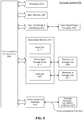
- FIG. 5B illustrates processing operations that may be performed by the processor component 254 of a mobile device and processor component 214 of a control device with respect to the second mode.
- mobile device may receive request to locate control device.
- mobile device 118-1 may receive request from a user to locate control device 116-1.
- mobile device may establish connection with control device 512.
- mobile device 118-1 may request to establish a direct or indirect wireless connection with the control device 116-1.
- the mobile device may transmit request to determine information.
- the mobile device 118-1 may transmit request to control device 116-1 to request the control device 116-1 to determine network and computation delay information, acoustic delay information, distance information, and/or mobile device direction information.
- the mobile device may receive acoustic token transmission information.
- mobile device 118-1 may receive acoustic token transmission information transmitted by control device 116-1 at step 562.
- the mobile device may generate and emit acoustic token signal.
- mobile device 118-1 may generate and emit acoustic token signal based on the acoustic token transmission information.
- the mobile device may transmit mobile device acknowledgement information.
- the mobile device 118-1 may transmit the mobile device acknowledgment information to the control device 116-1.
- the mobile device may receive distance and/or direction information.
- the mobile device 118-1 may receive distance information and/or mobile device direction information from the control device 116-1 transmitted at step 578 and translate the mobile device direction information to control device direction information.
- mobile device may update views.
- mobile device 118-1 may update in substantially real-time the control device location UI view 450 and one or more UI elements in the control device location UI view 450.
- mobile device may provide feedback.
- mobile device 118-1 may provide haptic feedback based at least partially on the distance information and/or direction information.
- control device may establish connection with mobile device.
- control device 116-1 may establish a direct or indirect wireless connection with the mobile device 118-1, in response to the request to establish a direct or indirect wireless connection by the mobile device 118-1 at step 512.
- the control device may receive request to determine information.
- control device 116-1 may receive request from mobile device 118-1 to determine network and computation delay information, acoustic delay information, distance information, and/or mobile device direction information.
- the control device may generate acoustic token transmission information.
- control device 116-1 may generate acoustic token transmission information, which may include, without limitation, waveform information, frequency information, phase shift information, power information, and/or duration information.
- control device may transmit acoustic token information and initiate timer.
- control device 116-1 may transmit acoustic token information to the mobile device 118-1 and substantially contemporaneous or simultaneous to the transmission, the control device 116-1 may also initialize or reset a high resolution timer.
- control device may store acoustic sensor information.
- control device 116-1 may store or buffer at least a portion of acoustic input information received from mobile device 118-1 via acoustic I/O component 216 and associated values of the high resolution timer as acoustic sensor information for each of the one or more acoustic sensors 216-1- e .
- the control device may determine aggregate acoustic delay information.
- control device 116-1 may determine the aggregate acoustic delay information by correlating and comparing the acoustic sensor information with the generated acoustic token transmission information.
- the control device may receive mobile device acknowledgement information and store timer.
- the control device 116-1 may receive mobile device acknowledgement information from mobile device 118-1 and substantially contemporaneous or simultaneous to the receipt, the control device 116-1 may store the value of the high resolution timer.
- control device may determine acoustic delay information. For example, the control device 116-1 may determine acoustic delay information for each of the one or more acoustic sensors 216-1- e based on the stored value of the high resolution timer and aggregate acoustic delay information for each of the one or more acoustic sensors 216-1- e .
- control device may determine distance information. For example, the control device 116-1 may determine distance information based at least partially on acoustic delay information for at least one acoustic sensor of the one or more acoustic sensors 216-1- e and/or sound speed information.
- control device may determine direction information. For example, the control device 116-1 may determine direction information based at least partially on acoustic sensor arrangement information, the sound speed information, and/or one or more paired time delay information.
- control device may transmit distance and/or direction information. For example, control device 116-1 may transmit distance information and mobile device direction information to the mobile device 118-1.
- a user of the control device location system 100 may quickly and easily locate the control device 116-1 with the assistance of at least the mobile device and/or control device of the control device location system 100.
- FIGS. 1 , 2 , 3A-B , 4A-B , and/or 5A-B may have been described in substantial detail with respect to mobile device 118-1 and control device 116-1, the example embodiments are not limited to those contexts and/or devices. As such, the example embodiments may similarly implemented in some or all mobile devices 118- a and/or control devices 116- a .
- Computer system 600 can be any well-known computer capable of performing the functions described herein. Computer system 600 may also be internal or external to a display device (e.g., display device 112-1, 112-2, etc.).
- Computer system 600 includes one or more processors (also called central processing units, or CPUs), such as a processor 604.
- processors also called central processing units, or CPUs
- Processor 604 is connected to a communication infrastructure or bus 606.
- One or more processors 604 may each be a graphics processing unit (GPU).
- a GPU is a processor that is a specialized electronic circuit designed to process mathematically intensive applications.
- the GPU may have a parallel structure that is efficient for parallel processing of large blocks of data, such as mathematically intensive data common to computer graphics applications, images, videos, etc.
- Computer system 600 also includes user input/output device(s) 603, such as monitors, keyboards, pointing devices, etc., that communicate with communication infrastructure 606 through user input/output interface(s) 602.
- user input/output device(s) 603 such as monitors, keyboards, pointing devices, etc.
- Computer system 600 also includes a main or primary memory 608, such as random access memory (RAM).
- Main memory 608 may include one or more levels of cache.
- Main memory 608 has stored therein control logic (i.e., computer software) and/or data.
- Computer system 600 may also include one or more secondary storage devices or memory 610.
- Secondary memory 610 may include, for example, a hard disk drive 612 and/or a removable storage device or drive 614.
- Removable storage drive 614 may be a floppy disk drive, a magnetic tape drive, a compact disk drive, an optical storage device, tape backup device, and/or any other storage device/drive.
- Removable storage drive 614 may interact with a removable storage unit 618.
- Removable storage unit 618 includes a computer usable or readable storage device having stored thereon computer software (control logic) and/or data.
- Removable storage unit 618 may be a floppy disk, magnetic tape, compact disk, DVD, optical storage disk, and/ any other computer data storage device.
- Removable storage drive 614 reads from and/or writes to removable storage unit 618 in a well-known manner.
- secondary memory 610 may include other means, instrumentalities or other approaches for allowing computer programs and/or other instructions and/or data to be accessed by computer system 600.
- Such means, instrumentalities or other approaches may include, for example, a removable storage unit 622 and an interface 620.
- the removable storage unit 622 and the interface 620 may include a program cartridge and cartridge interface (such as that found in video game devices), a removable memory chip (such as an EPROM or PROM) and associated socket, a memory stick and USB port, a memory card and associated memory card slot, and/or any other removable storage unit and associated interface.
- Computer system 600 may further include a communication or network interface 624.
- Communication interface 624 enables computer system 600 to communicate and interact with any combination of remote devices, remote networks, remote entities, etc. (individually and collectively referenced by reference number 628).
- communication interface 624 may allow computer system 600 to communicate with remote devices 628 over communications path 626, which may be wired and/or wireless, and which may include any combination of LANs, WANs, the Internet, etc. Control logic and/or data may be transmitted to and from computer system 600 via communication path 626.
- a tangible apparatus or article of manufacture comprising a tangible computer useable or readable medium having control logic (software) stored thereon is also referred to herein as a computer program product or program storage device.
- control logic software stored thereon
- control logic when executed by one or more data processing devices (such as computer system 600), causes such data processing devices to operate as described herein.
- references herein to "one embodiment,” “an embodiment,” “an example embodiment,” or similar phrases, indicate that the embodiment described may include a particular feature, structure, or characteristic, but every embodiment may not necessarily include the particular feature, structure, or characteristic. Moreover, such phrases are not necessarily referring to the same embodiment. Further, when a particular feature, structure, or characteristic is described in connection with an embodiment, it would be within the knowledge of persons skilled in the relevant art(s) to incorporate such feature, structure, or characteristic into other embodiments whether or not explicitly mentioned or described herein. Additionally, some embodiments may be described using the expression “coupled” and “connected” along with their derivatives. These terms are not necessarily intended as synonyms for each other.
- Coupled may also mean that two or more elements are not in direct contact with each other, but yet still co-operate or interact with each other.
Landscapes
- Engineering & Computer Science (AREA)
- Physics & Mathematics (AREA)
- General Physics & Mathematics (AREA)
- Radar, Positioning & Navigation (AREA)
- Remote Sensing (AREA)
- Computer Networks & Wireless Communication (AREA)
- Signal Processing (AREA)
- Telephone Function (AREA)
Claims (15)
- Vorrichtung (118-a), umfassend:zumindest einen Prozessor (254); undeinen Speicher (252), der mit dem zumindest einen Prozessor (254) wirkgekoppelt ist, wobei der zumindest eine Prozessor (254) für Folgendes konfiguriert ist:Empfangen einer Anfrage zum Lokalisieren einer Steuervorrichtung (116-a),Senden akustischer Token-Sendeinformationen an die Steuervorrichtung (116-a), um einen elektroakustischen Wandler (216-2-1) auf der Steuervorrichtung (116-a) zu aktivieren,Empfangen eines akustischen Signals, einschließlich eines akustischen Token-Signals, von der Steuervorrichtung (116-a) über eine Vielzahl von Akustiksensoren (262-1-1, 262-1-2), die mit dem zumindest einen Prozessor (254) wirkgekoppelt sind, undBestimmen von Abstandsinformationen der Steuervorrichtung (116-a) auf Basis zumindest des empfangenen akustischen Token-Signals, das vom elektroakustischen Wandler (216-2-1) der Steuervorrichtung (116-a) erzeugt wird.
- Vorrichtung (118-a) nach Anspruch 1, wobei der zumindest eine Prozessor (254) ferner für Folgendes konfiguriert ist:
visuelles Darstellen von Abstandsinformationen der Steuervorrichtung (116-a) auf einer Anzeige (112-a), die mit dem zumindest einen Prozessor (254) wirkgekoppelt ist, wobei die visuell dargestellten Abstandsinformationen ein erstes grafisches UI(Benutzerschnittstelle)-Element umfassen, das einen Abstand der Steuervorrichtung (116-a) angibt. - Vorrichtung (118-a) nach Anspruch 1, wobei der zumindest eine Prozessor (254) ferner für Folgendes konfiguriert ist:
Bestimmen von Richtungsinformationen der Steuervorrichtung (116-a) auf Basis des empfangenen akustischen Token-Signals, das vom elektroakustischen Wandler (216-2-1) der Steuervorrichtung (116-a) erzeugt wird. - Vorrichtung (118-a) nach Anspruch 1, wobei der zumindest eine Prozessor (254) ferner für Folgendes konfiguriert ist:
visuelles Darstellen von Richtungsinformationen auf einer Anzeige (112-a), die mit dem zumindest einen Prozessor (254) wirkgekoppelt ist, wobei die visuell dargestellten Richtungsinformationen ein zweites grafisches UI-Element umfassen, das eine Richtung der Steuervorrichtung (116-a) angibt. - Vorrichtung (118-a) nach Anspruch 1, ferner umfassend:
eine haptische Komponente (272), die mit dem zumindest einen Prozessor (254) wirkgekoppelt ist, wobei der zumindest eine Prozessor (254) ferner konfiguriert ist, auf Basis der Abstandsinformationen über die haptische Komponente (272) haptisches Feedback bereitzustellen. - Vorrichtung (118-a) nach Anspruch 1, wobei das akustische Token-Signal auf Basis der akustischen Token-Sendeinformationen erzeugt wird und die akustischen Token-Sendeinformationen zumindest eines aus den folgenden umfassen:Wellenforminformationen, Frequenzinformationen, Phaseninformationen,Leistungsinformationen oder eine beliebige Kombination davon.
- Vorrichtung (118-a) nach Anspruch 1, wobei der zumindest eine Prozessor (254) ferner für Folgendes konfiguriert ist:
Empfangen einer Benutzereingabe zum Aufbauen einer direkten Drahtlosverbindung mit der Steuervorrichtung (116-a), wobei die akustischen Token-Sendeinformationen über die direkte Drahtlosverbindung an die Steuervorrichtung (116-a) gesendet werden. - Vorrichtung (118-a) nach Anspruch 1, wobei der zumindest eine Prozessor (254) ferner für Folgendes konfiguriert ist:Bestimmen von Netzwerk- und Berechnungsverzögerungsinformationen auf Basis von Bestätigungsinformationen der Steuervorrichtung (116-a), die über eine direkte oder indirekte Drahtlosverbindung mit der Steuervorrichtung (116-a) empfangen werden, wobeidas akustische Token-Signal auf Basis der akustischen Token-Sendeinformationen von der Steuervorrichtung (116-a) erzeugt wird unddie Abstandsinformationen auf Basis zumindest des empfangenen akustischen Token-Signals und der Netzwerk- und Berechnungsverzögerungsinformationen bestimmt werden.
- Computerimplementiertes Verfahren, umfassend:Empfangen einer Anfrage zum Lokalisieren einer Steuervorrichtung (116-a),Senden akustischer Token-Sendeinformationen an die Steuervorrichtung (116-a), um einen elektroakustischen Wandler (216-2-1) auf der Steuervorrichtung (116-a) zu aktivieren,Empfangen eines akustischen Signals, einschließlich eines akustischen Token-Signals, von der Steuervorrichtung (116-a) über eine Vielzahl von Akustiksensoren (262-1-1, 262-1-2); undBestimmen von Abstandsinformationen der Steuervorrichtung (116-a) auf Basis zumindest des empfangenen akustischen Token-Signals, das vom elektroakustischen Wandler (216-2-1) der Steuervorrichtung (116-a) erzeugt wird.
- Computerimplementiertes Verfahren nach Anspruch 9, ferner umfassend:
visuelles Darstellen von Abstandsinformationen der Steuervorrichtung (116-a) auf einer Anzeige (112-a), wobei die visuell dargestellten Abstandsinformationen ein erstes grafisches UI-Element umfassen, das einen Abstand der Steuervorrichtung (116-a) angibt. - Computerimplementiertes Verfahren nach Anspruch 9, ferner umfassend:Bestimmen von Richtungsinformationen der Steuervorrichtung (116-a) auf Basis des empfangenen akustischen Token-Signals, das vom elektroakustischen Wandler (216-2-1) der Steuervorrichtung (116-a) erzeugt wird; undvisuelles Darstellen von Richtungsinformationen der Steuervorrichtung (116-a) auf einer Anzeige (112-a), wobei die visuell dargestellten Richtungsinformationen ein zweites grafisches UI-Element umfassen, das eine Richtung der Steuervorrichtung (116-a) angibt.
- Computerimplementiertes Verfahren nach Anspruch 9, ferner umfassend:
Bereitstellen von haptischem Feedback über eine haptische Komponente (272) auf Basis der Abstandsinformationen der Steuervorrichtung (116-a). - Computerimplementiertes Verfahren nach Anspruch 9, wobei das akustische Token-Signal auf Basis der akustischen Token-Sendeinformationen erzeugt wird und die akustischen Token-Sendeinformationen zumindest eines aus den folgenden umfassen:Wellenforminformationen, Frequenzinformationen, Phaseninformationen,Leistungsinformationen oder eine beliebige Kombination davon.
- Computerimplementiertes Verfahren nach Anspruch 9, ferner umfassend:
Empfangen einer Benutzereingabe zum Aufbauen einer indirekten Drahtlosverbindung mit der Steuervorrichtung (116-a), wobei die akustischen Token-Sendeinformationen über die indirekte Drahtlosverbindung an die Steuervorrichtung (116-a) gesendet werden. - Computerimplementiertes Verfahren nach Anspruch 9, ferner umfassend:Bestimmen von Netzwerk- und Berechnungsverzögerungsinformationen auf Basis von Bestätigungsinformationen der Steuervorrichtung (116-a), die über eine direkte oder indirekte Drahtlosverbindung mit der Steuervorrichtung (116-a) empfangen werden, wobeidas akustische Token-Signal auf Basis zumindest der akustischen Token-Sendeinformationen von der Steuervorrichtung (116-a) erzeugt wird unddie Abstandsinformationen auf Basis zumindest des empfangenen akustischen Token-Signals und der Netzwerk- und Berechnungsverzögerungsinformationen bestimmt werden.
Applications Claiming Priority (2)
| Application Number | Priority Date | Filing Date | Title |
|---|---|---|---|
| US14/813,766 US10401473B2 (en) | 2015-07-30 | 2015-07-30 | Mobile device based control device locator |
| PCT/US2016/044054 WO2017019691A1 (en) | 2015-07-30 | 2016-07-26 | Mobile device based control device locator |
Publications (3)
| Publication Number | Publication Date |
|---|---|
| EP3329688A1 EP3329688A1 (de) | 2018-06-06 |
| EP3329688A4 EP3329688A4 (de) | 2018-12-19 |
| EP3329688B1 true EP3329688B1 (de) | 2020-12-30 |
Family
ID=57885302
Family Applications (1)
| Application Number | Title | Priority Date | Filing Date |
|---|---|---|---|
| EP16831242.9A Active EP3329688B1 (de) | 2015-07-30 | 2016-07-26 | Auf mobilvorrichtung basierender steuerungsvorrichtungslokalisator |
Country Status (3)
| Country | Link |
|---|---|
| US (5) | US10401473B2 (de) |
| EP (1) | EP3329688B1 (de) |
| WO (1) | WO2017019691A1 (de) |
Cited By (1)
| Publication number | Priority date | Publication date | Assignee | Title |
|---|---|---|---|---|
| US11327150B2 (en) * | 2015-07-30 | 2022-05-10 | Roku, Inc. | Mobile device based control device locator |
Families Citing this family (10)
| Publication number | Priority date | Publication date | Assignee | Title |
|---|---|---|---|---|
| US9619036B2 (en) * | 2012-05-11 | 2017-04-11 | Comcast Cable Communications, Llc | System and methods for controlling a user experience |
| US10623796B2 (en) | 2015-07-30 | 2020-04-14 | Roku, Inc. | Detection of smartphone to enable content |
| EP3430824B1 (de) * | 2016-04-25 | 2021-02-24 | Samsung Electronics Co., Ltd. | Verfahren und systeme zur verwaltung der konnektivität zwischen vorrichtungen |
| WO2018190927A1 (en) | 2017-04-10 | 2018-10-18 | Google Llc | Symmetric discovery over audio |
| CN112154345B (zh) * | 2018-03-02 | 2024-08-16 | 所尼托技术股份公司 | 声学定位发射器和接收器系统及方法 |
| KR102607787B1 (ko) * | 2018-11-30 | 2023-11-30 | 삼성전자주식회사 | 전자 장치 및 전자 장치의 제어 방법 |
| US12119884B2 (en) * | 2018-12-14 | 2024-10-15 | Google Llc | Audio receiver device calibration for audio communications between a broadcaster device and a receiver device |
| DE102020206804A1 (de) * | 2020-05-29 | 2021-12-02 | Fraunhofer-Gesellschaft zur Förderung der angewandten Forschung eingetragener Verein | Verfahren zur akustischen Entfernungsmessung zwischen zwei mobilen Endgeräten |
| US12124757B2 (en) * | 2022-07-26 | 2024-10-22 | Lenovo (Singapore) Pte. Ltd. | Movement of cursor between displays based on motion vectors |
| US20240210519A1 (en) * | 2022-12-23 | 2024-06-27 | Apple Inc. | Sound-based location detection for electronic devices |
Family Cites Families (41)
| Publication number | Priority date | Publication date | Assignee | Title |
|---|---|---|---|---|
| US20030073432A1 (en) | 2001-10-16 | 2003-04-17 | Meade, William K. | Mobile computing device with method and system for interrupting content performance among appliances |
| JP4013614B2 (ja) | 2002-03-29 | 2007-11-28 | ブラザー工業株式会社 | 通信圏内誘導方法及び無線通信機器 |
| US7408839B2 (en) | 2004-09-09 | 2008-08-05 | Siemens Building Technologies, Inc. | Distance measurement for wireless building automation devices |
| US7720463B2 (en) | 2005-09-02 | 2010-05-18 | Tekelec | Methods, systems, and computer program products for providing third party control of access to media content available via broadcast and multicast service (BCMCS) |
| US20100153885A1 (en) | 2005-12-29 | 2010-06-17 | Rovi Technologies Corporation | Systems and methods for interacting with advanced displays provided by an interactive media guidance application |
| US20070209009A1 (en) | 2006-03-02 | 2007-09-06 | Inventec Corporation | Display with settings changed according to user's ID and method thereof |
| US7941131B2 (en) | 2006-08-29 | 2011-05-10 | At&T Intellectual Property I, Lp | Exchange of media by device discovery |
| US7890972B2 (en) | 2006-09-06 | 2011-02-15 | Canon Kabushiki Kaisha | Apparatus for generating electronic program guides and control method therefor |
| US7729204B2 (en) | 2007-06-08 | 2010-06-01 | Microsoft Corporation | Acoustic ranging |
| US8041333B2 (en) | 2007-06-14 | 2011-10-18 | Broadcom Corporation | Method and system for 60 GHz antenna adaptation and user coordination based on base station beacons |
| US8611962B2 (en) | 2007-06-29 | 2013-12-17 | Microsoft Corporation | Activity illumination |
| CN101925916B (zh) | 2007-11-21 | 2013-06-19 | 高通股份有限公司 | 基于媒体偏好控制电子设备的方法和系统 |
| JP5280044B2 (ja) | 2007-12-12 | 2013-09-04 | 任天堂株式会社 | 表示システム |
| US8000721B2 (en) | 2008-02-29 | 2011-08-16 | Sony Ericsson Mobile Communications Ab | Wireless communication terminals and methods that display relative direction and distance therebetween responsive to acceleration data |
| US9078043B2 (en) | 2008-08-01 | 2015-07-07 | Verizon Patent And Licensing Inc. | Media source monitoring and parental awards |
| US9131191B2 (en) | 2008-09-18 | 2015-09-08 | VIZIO Inc. | Synchronizing operational states of closed captioning and audio mute |
| US7966641B2 (en) | 2008-10-23 | 2011-06-21 | Sony Corporation | User identification using Bluetooth and audio ranging |
| WO2010135367A1 (en) | 2009-05-18 | 2010-11-25 | Alarm.Com Incorporated | Moving asset location tracking |
| US8350694B1 (en) | 2009-05-18 | 2013-01-08 | Alarm.Com Incorporated | Monitoring system to monitor a property with a mobile device with a monitoring application |
| WO2010136913A1 (en) | 2009-05-28 | 2010-12-02 | Koninklijke Philips Electronics, N.V. | Apparatus and methods for arranging media items in a physical space based on personal profiles |
| US20110016492A1 (en) | 2009-07-16 | 2011-01-20 | Gemstar Development Corporation | Systems and methods for forwarding media asset events |
| WO2011034474A1 (en) | 2009-09-17 | 2011-03-24 | Telefonaktiebolaget Lm Ericsson (Publ) | Method and arrangement for sharing media content |
| US9014546B2 (en) | 2009-09-23 | 2015-04-21 | Rovi Guides, Inc. | Systems and methods for automatically detecting users within detection regions of media devices |
| US20110164175A1 (en) | 2010-01-05 | 2011-07-07 | Rovi Technologies Corporation | Systems and methods for providing subtitles on a wireless communications device |
| US8174934B2 (en) | 2010-07-28 | 2012-05-08 | Empire Technology Development Llc | Sound direction detection |
| US8949871B2 (en) | 2010-09-08 | 2015-02-03 | Opentv, Inc. | Smart media selection based on viewer user presence |
| US9456025B2 (en) | 2010-09-17 | 2016-09-27 | Thomson Licensing | Method and system for determining identity/presence of a mobile device user for control and interaction in content distribution |
| US20130027613A1 (en) | 2011-05-03 | 2013-01-31 | Lg Electronics Inc. | Image display apparatus, portable terminal, and methods for operating the same |
| US9854318B2 (en) | 2011-06-06 | 2017-12-26 | Rovi Guides, Inc. | Systems and methods for sharing interactive media guidance information |
| US9317571B2 (en) | 2011-08-26 | 2016-04-19 | Google Inc. | Third party content provider integrations |
| WO2013109793A1 (en) | 2012-01-18 | 2013-07-25 | Kinectus LLC | Systems and methods for establishing communications between mobile device users |
| KR20150036008A (ko) | 2012-07-06 | 2015-04-07 | 니다 테크 스웨덴 에이비 | 장치의 측위를 위한 방법, 노드 및 컴퓨터 프로그램 |
| US20140075575A1 (en) | 2012-09-07 | 2014-03-13 | Samsung Electronics Co., Ltd. | Content delivery system with an identification mechanism and method of operation thereof |
| US10250837B2 (en) | 2012-12-05 | 2019-04-02 | DISH Technologies L.L.C. | User proximity recognition and hands-free control |
| US20140249927A1 (en) | 2013-03-04 | 2014-09-04 | Michael De Angelo | System and method for cyclic recognition-primed notifications and responsive situational awareness in an advertising display network |
| US9392414B2 (en) | 2013-12-31 | 2016-07-12 | Yahoo! Inc. | Low key point of interest notification |
| US10820051B2 (en) | 2014-10-21 | 2020-10-27 | At&T Mobility Ii Llc | Inhibiting display of advertisements with age-inappropriate content |
| US9439045B2 (en) | 2014-10-29 | 2016-09-06 | At&T Intellectual Property I, L.P. | Methods, systems, and products for location determination |
| US10401473B2 (en) * | 2015-07-30 | 2019-09-03 | Roku, Inc. | Mobile device based control device locator |
| US10623796B2 (en) | 2015-07-30 | 2020-04-14 | Roku, Inc. | Detection of smartphone to enable content |
| US10091581B2 (en) * | 2015-07-30 | 2018-10-02 | Roku, Inc. | Audio preferences for media content players |
-
2015
- 2015-07-30 US US14/813,766 patent/US10401473B2/en active Active
-
2016
- 2016-07-26 WO PCT/US2016/044054 patent/WO2017019691A1/en not_active Ceased
- 2016-07-26 EP EP16831242.9A patent/EP3329688B1/de active Active
-
2019
- 2019-08-20 US US16/545,426 patent/US11327150B2/en active Active
-
2022
- 2022-05-04 US US17/736,614 patent/US11808875B2/en active Active
-
2023
- 2023-09-25 US US18/474,099 patent/US12153155B2/en active Active
-
2024
- 2024-10-07 US US18/908,172 patent/US20250028018A1/en active Pending
Non-Patent Citations (1)
| Title |
|---|
| None * |
Cited By (4)
| Publication number | Priority date | Publication date | Assignee | Title |
|---|---|---|---|---|
| US11327150B2 (en) * | 2015-07-30 | 2022-05-10 | Roku, Inc. | Mobile device based control device locator |
| US11808875B2 (en) | 2015-07-30 | 2023-11-07 | Roku, Inc. | Mobile device based control device locator |
| US12153155B2 (en) * | 2015-07-30 | 2024-11-26 | Roku, Inc. | Mobile device based control device locator |
| US20250028018A1 (en) * | 2015-07-30 | 2025-01-23 | Roku, Inc. | Mobile device based control device locator |
Also Published As
| Publication number | Publication date |
|---|---|
| EP3329688A4 (de) | 2018-12-19 |
| US12153155B2 (en) | 2024-11-26 |
| US20170030999A1 (en) | 2017-02-02 |
| US11327150B2 (en) | 2022-05-10 |
| US20220260669A1 (en) | 2022-08-18 |
| US10401473B2 (en) | 2019-09-03 |
| WO2017019691A1 (en) | 2017-02-02 |
| US20250028018A1 (en) | 2025-01-23 |
| US20240168125A1 (en) | 2024-05-23 |
| US20190369206A1 (en) | 2019-12-05 |
| EP3329688A1 (de) | 2018-06-06 |
| US11808875B2 (en) | 2023-11-07 |
Similar Documents
| Publication | Publication Date | Title |
|---|---|---|
| US12153155B2 (en) | Mobile device based control device locator | |
| US11703320B2 (en) | Determining relative positions of user devices | |
| CN107667542B (zh) | 使用伙伴设备的位置确定 | |
| KR101931607B1 (ko) | 클라우드 서버를 통한 디바이스 페어링 | |
| CN110198484B (zh) | 消息推送方法、装置及设备 | |
| CN110677700A (zh) | 校准媒体回放信道用于同步呈现 | |
| EP4191585B1 (de) | Systeme und verfahren zur erzeugung einer gereinigten version von umgebungston | |
| US10574728B2 (en) | User pairing method and apparatus, and data exchange method, apparatus, and system | |
| CN103596017B (zh) | 一种视频下载方法及系统 | |
| WO2017201935A1 (zh) | 视频播放方法及装置 | |
| JP6371485B2 (ja) | エアマウスリモコンの最適化方法、装置、端末機器、プログラム、及び記録媒体 | |
| CN106911956B (zh) | 一种音频数据播放方法、装置及移动终端 | |
| US20130290495A1 (en) | Method of setting optimal ping interval and electronic device therefor | |
| WO2017016043A1 (zh) | 基于指示方向的指令传输方法及装置、智能设备、存储介质 | |
| WO2018129838A1 (zh) | 一种定位方法、终端及服务器 | |
| CN111245854B (zh) | 一种媒体传输方法、媒体控制方法及装置 | |
| WO2022179080A1 (zh) | 定位方法、装置、电子设备、存储介质、程序及产品 | |
| KR20170076294A (ko) | 무선 통신 시스템에서 사운드 신호를 기반으로 데이터를 송신 및 수신하는 장치 및 방법 | |
| WO2016095641A1 (zh) | 数据交互方法及系统、移动终端 | |
| CN105099884A (zh) | 即时通讯消息的呈现方法及装置 | |
| KR20190026432A (ko) | 슬레이브 디바이스와 데이터 통신을 수행하는 디바이스 및 방법 | |
| CN112954659A (zh) | 蓝牙设备间的连接方法、装置、电子设备和存储介质 | |
| CN109547830B (zh) | 一种用于多个虚拟现实设备的同步播放的方法与装置 | |
| WO2018076927A1 (zh) | 一种适用于空间系统的操作方法及装置、存储介质 | |
| CN113778230A (zh) | 信息交互方法、装置、设备及存储介质 |
Legal Events
| Date | Code | Title | Description |
|---|---|---|---|
| STAA | Information on the status of an ep patent application or granted ep patent |
Free format text: STATUS: THE INTERNATIONAL PUBLICATION HAS BEEN MADE |
|
| PUAI | Public reference made under article 153(3) epc to a published international application that has entered the european phase |
Free format text: ORIGINAL CODE: 0009012 |
|
| STAA | Information on the status of an ep patent application or granted ep patent |
Free format text: STATUS: REQUEST FOR EXAMINATION WAS MADE |
|
| 17P | Request for examination filed |
Effective date: 20180214 |
|
| AK | Designated contracting states |
Kind code of ref document: A1 Designated state(s): AL AT BE BG CH CY CZ DE DK EE ES FI FR GB GR HR HU IE IS IT LI LT LU LV MC MK MT NL NO PL PT RO RS SE SI SK SM TR |
|
| AX | Request for extension of the european patent |
Extension state: BA ME |
|
| DAV | Request for validation of the european patent (deleted) | ||
| DAX | Request for extension of the european patent (deleted) | ||
| A4 | Supplementary search report drawn up and despatched |
Effective date: 20181115 |
|
| RIC1 | Information provided on ipc code assigned before grant |
Ipc: H04Q 9/00 20060101AFI20181109BHEP Ipc: G01S 3/80 20060101ALI20181109BHEP Ipc: H04M 1/725 20060101ALI20181109BHEP Ipc: G01S 3/808 20060101ALI20181109BHEP |
|
| RAP1 | Party data changed (applicant data changed or rights of an application transferred) |
Owner name: ROKU, INC. |
|
| GRAP | Despatch of communication of intention to grant a patent |
Free format text: ORIGINAL CODE: EPIDOSNIGR1 |
|
| STAA | Information on the status of an ep patent application or granted ep patent |
Free format text: STATUS: GRANT OF PATENT IS INTENDED |
|
| RIC1 | Information provided on ipc code assigned before grant |
Ipc: G01S 3/80 20060101ALI20200629BHEP Ipc: G01S 3/808 20060101ALI20200629BHEP Ipc: H04M 1/725 20060101ALI20200629BHEP Ipc: H04Q 9/00 20060101AFI20200629BHEP |
|
| INTG | Intention to grant announced |
Effective date: 20200722 |
|
| GRAS | Grant fee paid |
Free format text: ORIGINAL CODE: EPIDOSNIGR3 |
|
| GRAA | (expected) grant |
Free format text: ORIGINAL CODE: 0009210 |
|
| STAA | Information on the status of an ep patent application or granted ep patent |
Free format text: STATUS: THE PATENT HAS BEEN GRANTED |
|
| AK | Designated contracting states |
Kind code of ref document: B1 Designated state(s): AL AT BE BG CH CY CZ DE DK EE ES FI FR GB GR HR HU IE IS IT LI LT LU LV MC MK MT NL NO PL PT RO RS SE SI SK SM TR |
|
| REG | Reference to a national code |
Ref country code: GB Ref legal event code: FG4D |
|
| REG | Reference to a national code |
Ref country code: DE Ref legal event code: R096 Ref document number: 602016050732 Country of ref document: DE |
|
| REG | Reference to a national code |
Ref country code: AT Ref legal event code: REF Ref document number: 1351146 Country of ref document: AT Kind code of ref document: T Effective date: 20210115 |
|
| REG | Reference to a national code |
Ref country code: IE Ref legal event code: FG4D |
|
| REG | Reference to a national code |
Ref country code: NL Ref legal event code: FP |
|
| PG25 | Lapsed in a contracting state [announced via postgrant information from national office to epo] |
Ref country code: RS Free format text: LAPSE BECAUSE OF FAILURE TO SUBMIT A TRANSLATION OF THE DESCRIPTION OR TO PAY THE FEE WITHIN THE PRESCRIBED TIME-LIMIT Effective date: 20201230 Ref country code: NO Free format text: LAPSE BECAUSE OF FAILURE TO SUBMIT A TRANSLATION OF THE DESCRIPTION OR TO PAY THE FEE WITHIN THE PRESCRIBED TIME-LIMIT Effective date: 20210330 Ref country code: FI Free format text: LAPSE BECAUSE OF FAILURE TO SUBMIT A TRANSLATION OF THE DESCRIPTION OR TO PAY THE FEE WITHIN THE PRESCRIBED TIME-LIMIT Effective date: 20201230 Ref country code: GR Free format text: LAPSE BECAUSE OF FAILURE TO SUBMIT A TRANSLATION OF THE DESCRIPTION OR TO PAY THE FEE WITHIN THE PRESCRIBED TIME-LIMIT Effective date: 20210331 |
|
| REG | Reference to a national code |
Ref country code: AT Ref legal event code: MK05 Ref document number: 1351146 Country of ref document: AT Kind code of ref document: T Effective date: 20201230 |
|
| PG25 | Lapsed in a contracting state [announced via postgrant information from national office to epo] |
Ref country code: SE Free format text: LAPSE BECAUSE OF FAILURE TO SUBMIT A TRANSLATION OF THE DESCRIPTION OR TO PAY THE FEE WITHIN THE PRESCRIBED TIME-LIMIT Effective date: 20201230 Ref country code: BG Free format text: LAPSE BECAUSE OF FAILURE TO SUBMIT A TRANSLATION OF THE DESCRIPTION OR TO PAY THE FEE WITHIN THE PRESCRIBED TIME-LIMIT Effective date: 20210330 Ref country code: LV Free format text: LAPSE BECAUSE OF FAILURE TO SUBMIT A TRANSLATION OF THE DESCRIPTION OR TO PAY THE FEE WITHIN THE PRESCRIBED TIME-LIMIT Effective date: 20201230 |
|
| PG25 | Lapsed in a contracting state [announced via postgrant information from national office to epo] |
Ref country code: HR Free format text: LAPSE BECAUSE OF FAILURE TO SUBMIT A TRANSLATION OF THE DESCRIPTION OR TO PAY THE FEE WITHIN THE PRESCRIBED TIME-LIMIT Effective date: 20201230 |
|
| REG | Reference to a national code |
Ref country code: LT Ref legal event code: MG9D |
|
| PG25 | Lapsed in a contracting state [announced via postgrant information from national office to epo] |
Ref country code: RO Free format text: LAPSE BECAUSE OF FAILURE TO SUBMIT A TRANSLATION OF THE DESCRIPTION OR TO PAY THE FEE WITHIN THE PRESCRIBED TIME-LIMIT Effective date: 20201230 Ref country code: SK Free format text: LAPSE BECAUSE OF FAILURE TO SUBMIT A TRANSLATION OF THE DESCRIPTION OR TO PAY THE FEE WITHIN THE PRESCRIBED TIME-LIMIT Effective date: 20201230 Ref country code: PT Free format text: LAPSE BECAUSE OF FAILURE TO SUBMIT A TRANSLATION OF THE DESCRIPTION OR TO PAY THE FEE WITHIN THE PRESCRIBED TIME-LIMIT Effective date: 20210430 Ref country code: LT Free format text: LAPSE BECAUSE OF FAILURE TO SUBMIT A TRANSLATION OF THE DESCRIPTION OR TO PAY THE FEE WITHIN THE PRESCRIBED TIME-LIMIT Effective date: 20201230 Ref country code: CZ Free format text: LAPSE BECAUSE OF FAILURE TO SUBMIT A TRANSLATION OF THE DESCRIPTION OR TO PAY THE FEE WITHIN THE PRESCRIBED TIME-LIMIT Effective date: 20201230 Ref country code: EE Free format text: LAPSE BECAUSE OF FAILURE TO SUBMIT A TRANSLATION OF THE DESCRIPTION OR TO PAY THE FEE WITHIN THE PRESCRIBED TIME-LIMIT Effective date: 20201230 |
|
| PG25 | Lapsed in a contracting state [announced via postgrant information from national office to epo] |
Ref country code: AT Free format text: LAPSE BECAUSE OF FAILURE TO SUBMIT A TRANSLATION OF THE DESCRIPTION OR TO PAY THE FEE WITHIN THE PRESCRIBED TIME-LIMIT Effective date: 20201230 Ref country code: PL Free format text: LAPSE BECAUSE OF FAILURE TO SUBMIT A TRANSLATION OF THE DESCRIPTION OR TO PAY THE FEE WITHIN THE PRESCRIBED TIME-LIMIT Effective date: 20201230 |
|
| PG25 | Lapsed in a contracting state [announced via postgrant information from national office to epo] |
Ref country code: IS Free format text: LAPSE BECAUSE OF FAILURE TO SUBMIT A TRANSLATION OF THE DESCRIPTION OR TO PAY THE FEE WITHIN THE PRESCRIBED TIME-LIMIT Effective date: 20210430 |
|
| REG | Reference to a national code |
Ref country code: DE Ref legal event code: R097 Ref document number: 602016050732 Country of ref document: DE |
|
| PG25 | Lapsed in a contracting state [announced via postgrant information from national office to epo] |
Ref country code: IT Free format text: LAPSE BECAUSE OF FAILURE TO SUBMIT A TRANSLATION OF THE DESCRIPTION OR TO PAY THE FEE WITHIN THE PRESCRIBED TIME-LIMIT Effective date: 20201230 Ref country code: AL Free format text: LAPSE BECAUSE OF FAILURE TO SUBMIT A TRANSLATION OF THE DESCRIPTION OR TO PAY THE FEE WITHIN THE PRESCRIBED TIME-LIMIT Effective date: 20201230 |
|
| PLBE | No opposition filed within time limit |
Free format text: ORIGINAL CODE: 0009261 |
|
| STAA | Information on the status of an ep patent application or granted ep patent |
Free format text: STATUS: NO OPPOSITION FILED WITHIN TIME LIMIT |
|
| PG25 | Lapsed in a contracting state [announced via postgrant information from national office to epo] |
Ref country code: DK Free format text: LAPSE BECAUSE OF FAILURE TO SUBMIT A TRANSLATION OF THE DESCRIPTION OR TO PAY THE FEE WITHIN THE PRESCRIBED TIME-LIMIT Effective date: 20201230 |
|
| 26N | No opposition filed |
Effective date: 20211001 |
|
| PG25 | Lapsed in a contracting state [announced via postgrant information from national office to epo] |
Ref country code: ES Free format text: LAPSE BECAUSE OF FAILURE TO SUBMIT A TRANSLATION OF THE DESCRIPTION OR TO PAY THE FEE WITHIN THE PRESCRIBED TIME-LIMIT Effective date: 20201230 |
|
| PG25 | Lapsed in a contracting state [announced via postgrant information from national office to epo] |
Ref country code: SI Free format text: LAPSE BECAUSE OF FAILURE TO SUBMIT A TRANSLATION OF THE DESCRIPTION OR TO PAY THE FEE WITHIN THE PRESCRIBED TIME-LIMIT Effective date: 20201230 |
|
| REG | Reference to a national code |
Ref country code: CH Ref legal event code: PL |
|
| PG25 | Lapsed in a contracting state [announced via postgrant information from national office to epo] |
Ref country code: MC Free format text: LAPSE BECAUSE OF FAILURE TO SUBMIT A TRANSLATION OF THE DESCRIPTION OR TO PAY THE FEE WITHIN THE PRESCRIBED TIME-LIMIT Effective date: 20201230 |
|
| REG | Reference to a national code |
Ref country code: BE Ref legal event code: MM Effective date: 20210731 |
|
| PG25 | Lapsed in a contracting state [announced via postgrant information from national office to epo] |
Ref country code: LI Free format text: LAPSE BECAUSE OF NON-PAYMENT OF DUE FEES Effective date: 20210731 Ref country code: CH Free format text: LAPSE BECAUSE OF NON-PAYMENT OF DUE FEES Effective date: 20210731 |
|
| PG25 | Lapsed in a contracting state [announced via postgrant information from national office to epo] |
Ref country code: IS Free format text: LAPSE BECAUSE OF FAILURE TO SUBMIT A TRANSLATION OF THE DESCRIPTION OR TO PAY THE FEE WITHIN THE PRESCRIBED TIME-LIMIT Effective date: 20210430 Ref country code: LU Free format text: LAPSE BECAUSE OF NON-PAYMENT OF DUE FEES Effective date: 20210726 |
|
| PG25 | Lapsed in a contracting state [announced via postgrant information from national office to epo] |
Ref country code: IE Free format text: LAPSE BECAUSE OF NON-PAYMENT OF DUE FEES Effective date: 20210726 Ref country code: BE Free format text: LAPSE BECAUSE OF NON-PAYMENT OF DUE FEES Effective date: 20210731 |
|
| PG25 | Lapsed in a contracting state [announced via postgrant information from national office to epo] |
Ref country code: HU Free format text: LAPSE BECAUSE OF FAILURE TO SUBMIT A TRANSLATION OF THE DESCRIPTION OR TO PAY THE FEE WITHIN THE PRESCRIBED TIME-LIMIT; INVALID AB INITIO Effective date: 20160726 |
|
| PG25 | Lapsed in a contracting state [announced via postgrant information from national office to epo] |
Ref country code: CY Free format text: LAPSE BECAUSE OF FAILURE TO SUBMIT A TRANSLATION OF THE DESCRIPTION OR TO PAY THE FEE WITHIN THE PRESCRIBED TIME-LIMIT Effective date: 20201230 |
|
| P01 | Opt-out of the competence of the unified patent court (upc) registered |
Effective date: 20230527 |
|
| PG25 | Lapsed in a contracting state [announced via postgrant information from national office to epo] |
Ref country code: SM Free format text: LAPSE BECAUSE OF FAILURE TO SUBMIT A TRANSLATION OF THE DESCRIPTION OR TO PAY THE FEE WITHIN THE PRESCRIBED TIME-LIMIT Effective date: 20201230 |
|
| PG25 | Lapsed in a contracting state [announced via postgrant information from national office to epo] |
Ref country code: MK Free format text: LAPSE BECAUSE OF FAILURE TO SUBMIT A TRANSLATION OF THE DESCRIPTION OR TO PAY THE FEE WITHIN THE PRESCRIBED TIME-LIMIT Effective date: 20201230 |
|
| PG25 | Lapsed in a contracting state [announced via postgrant information from national office to epo] |
Ref country code: TR Free format text: LAPSE BECAUSE OF FAILURE TO SUBMIT A TRANSLATION OF THE DESCRIPTION OR TO PAY THE FEE WITHIN THE PRESCRIBED TIME-LIMIT Effective date: 20201230 |
|
| PG25 | Lapsed in a contracting state [announced via postgrant information from national office to epo] |
Ref country code: MT Free format text: LAPSE BECAUSE OF FAILURE TO SUBMIT A TRANSLATION OF THE DESCRIPTION OR TO PAY THE FEE WITHIN THE PRESCRIBED TIME-LIMIT Effective date: 20201230 |
|
| PGFP | Annual fee paid to national office [announced via postgrant information from national office to epo] |
Ref country code: NL Payment date: 20250617 Year of fee payment: 10 |
|
| PGFP | Annual fee paid to national office [announced via postgrant information from national office to epo] |
Ref country code: DE Payment date: 20250618 Year of fee payment: 10 |
|
| PGFP | Annual fee paid to national office [announced via postgrant information from national office to epo] |
Ref country code: GB Payment date: 20250721 Year of fee payment: 10 |
|
| PGFP | Annual fee paid to national office [announced via postgrant information from national office to epo] |
Ref country code: FR Payment date: 20250722 Year of fee payment: 10 |