EP3327628B1 - Verfahren und vorrichtung zur erkennung eines objekts - Google Patents
Verfahren und vorrichtung zur erkennung eines objekts Download PDFInfo
- Publication number
- EP3327628B1 EP3327628B1 EP17177468.0A EP17177468A EP3327628B1 EP 3327628 B1 EP3327628 B1 EP 3327628B1 EP 17177468 A EP17177468 A EP 17177468A EP 3327628 B1 EP3327628 B1 EP 3327628B1
- Authority
- EP
- European Patent Office
- Prior art keywords
- vector
- vectors
- feature
- layer
- feature vectors
- Prior art date
- Legal status (The legal status is an assumption and is not a legal conclusion. Google has not performed a legal analysis and makes no representation as to the accuracy of the status listed.)
- Active
Links
Images




Classifications
-
- G—PHYSICS
- G06—COMPUTING OR CALCULATING; COUNTING
- G06F—ELECTRIC DIGITAL DATA PROCESSING
- G06F18/00—Pattern recognition
- G06F18/20—Analysing
- G06F18/22—Matching criteria, e.g. proximity measures
-
- G—PHYSICS
- G06—COMPUTING OR CALCULATING; COUNTING
- G06V—IMAGE OR VIDEO RECOGNITION OR UNDERSTANDING
- G06V10/00—Arrangements for image or video recognition or understanding
- G06V10/20—Image preprocessing
- G06V10/25—Determination of region of interest [ROI] or a volume of interest [VOI]
-
- G—PHYSICS
- G06—COMPUTING OR CALCULATING; COUNTING
- G06F—ELECTRIC DIGITAL DATA PROCESSING
- G06F18/00—Pattern recognition
- G06F18/20—Analysing
- G06F18/21—Design or setup of recognition systems or techniques; Extraction of features in feature space; Blind source separation
- G06F18/213—Feature extraction, e.g. by transforming the feature space; Summarisation; Mappings, e.g. subspace methods
- G06F18/2135—Feature extraction, e.g. by transforming the feature space; Summarisation; Mappings, e.g. subspace methods based on approximation criteria, e.g. principal component analysis
- G06F18/21355—Feature extraction, e.g. by transforming the feature space; Summarisation; Mappings, e.g. subspace methods based on approximation criteria, e.g. principal component analysis nonlinear criteria, e.g. embedding a manifold in a Euclidean space
-
- G—PHYSICS
- G06—COMPUTING OR CALCULATING; COUNTING
- G06F—ELECTRIC DIGITAL DATA PROCESSING
- G06F18/00—Pattern recognition
- G06F18/20—Analysing
- G06F18/24—Classification techniques
-
- G—PHYSICS
- G06—COMPUTING OR CALCULATING; COUNTING
- G06N—COMPUTING ARRANGEMENTS BASED ON SPECIFIC COMPUTATIONAL MODELS
- G06N3/00—Computing arrangements based on biological models
- G06N3/02—Neural networks
- G06N3/04—Architecture, e.g. interconnection topology
- G06N3/0464—Convolutional networks [CNN, ConvNet]
-
- G—PHYSICS
- G06—COMPUTING OR CALCULATING; COUNTING
- G06N—COMPUTING ARRANGEMENTS BASED ON SPECIFIC COMPUTATIONAL MODELS
- G06N3/00—Computing arrangements based on biological models
- G06N3/02—Neural networks
- G06N3/08—Learning methods
- G06N3/09—Supervised learning
-
- G—PHYSICS
- G06—COMPUTING OR CALCULATING; COUNTING
- G06V—IMAGE OR VIDEO RECOGNITION OR UNDERSTANDING
- G06V10/00—Arrangements for image or video recognition or understanding
- G06V10/40—Extraction of image or video features
-
- G—PHYSICS
- G06—COMPUTING OR CALCULATING; COUNTING
- G06V—IMAGE OR VIDEO RECOGNITION OR UNDERSTANDING
- G06V10/00—Arrangements for image or video recognition or understanding
- G06V10/40—Extraction of image or video features
- G06V10/44—Local feature extraction by analysis of parts of the pattern, e.g. by detecting edges, contours, loops, corners, strokes or intersections; Connectivity analysis, e.g. of connected components
- G06V10/443—Local feature extraction by analysis of parts of the pattern, e.g. by detecting edges, contours, loops, corners, strokes or intersections; Connectivity analysis, e.g. of connected components by matching or filtering
- G06V10/449—Biologically inspired filters, e.g. difference of Gaussians [DoG] or Gabor filters
- G06V10/451—Biologically inspired filters, e.g. difference of Gaussians [DoG] or Gabor filters with interaction between the filter responses, e.g. cortical complex cells
- G06V10/454—Integrating the filters into a hierarchical structure, e.g. convolutional neural networks [CNN]
-
- G—PHYSICS
- G06—COMPUTING OR CALCULATING; COUNTING
- G06V—IMAGE OR VIDEO RECOGNITION OR UNDERSTANDING
- G06V10/00—Arrangements for image or video recognition or understanding
- G06V10/70—Arrangements for image or video recognition or understanding using pattern recognition or machine learning
- G06V10/74—Image or video pattern matching; Proximity measures in feature spaces
- G06V10/75—Organisation of the matching processes, e.g. simultaneous or sequential comparisons of image or video features; Coarse-fine approaches, e.g. multi-scale approaches; using context analysis; Selection of dictionaries
- G06V10/758—Involving statistics of pixels or of feature values, e.g. histogram matching
-
- G—PHYSICS
- G06—COMPUTING OR CALCULATING; COUNTING
- G06V—IMAGE OR VIDEO RECOGNITION OR UNDERSTANDING
- G06V10/00—Arrangements for image or video recognition or understanding
- G06V10/70—Arrangements for image or video recognition or understanding using pattern recognition or machine learning
- G06V10/764—Arrangements for image or video recognition or understanding using pattern recognition or machine learning using classification, e.g. of video objects
-
- G—PHYSICS
- G06—COMPUTING OR CALCULATING; COUNTING
- G06V—IMAGE OR VIDEO RECOGNITION OR UNDERSTANDING
- G06V10/00—Arrangements for image or video recognition or understanding
- G06V10/70—Arrangements for image or video recognition or understanding using pattern recognition or machine learning
- G06V10/82—Arrangements for image or video recognition or understanding using pattern recognition or machine learning using neural networks
-
- G—PHYSICS
- G06—COMPUTING OR CALCULATING; COUNTING
- G06N—COMPUTING ARRANGEMENTS BASED ON SPECIFIC COMPUTATIONAL MODELS
- G06N3/00—Computing arrangements based on biological models
- G06N3/02—Neural networks
- G06N3/04—Architecture, e.g. interconnection topology
- G06N3/045—Combinations of networks
-
- G—PHYSICS
- G06—COMPUTING OR CALCULATING; COUNTING
- G06N—COMPUTING ARRANGEMENTS BASED ON SPECIFIC COMPUTATIONAL MODELS
- G06N3/00—Computing arrangements based on biological models
- G06N3/02—Neural networks
- G06N3/08—Learning methods
- G06N3/084—Backpropagation, e.g. using gradient descent
Definitions
- the following description relates to a method and apparatus for recognizing an object.
- the neural network may use a selection of algorithms which may have emergent behavior appearing similar to a human learning ability.
- the neural network performs mapping between an input pattern and each of output patterns through learning.
- the neural network may have a generalization ability to generate a relatively correct, or good enough approximation output based on an input pattern not used for learning, based on a result of previous learning.
- first or second are used to explain various components, the components are not limited to the terms. These terms should be used only to distinguish one component from another component.
- a “first” component may be referred to as a “second” component, or similarly, and the “second” component may be referred to as the “first” component within the scope of the right according to the concept of the present disclosure.
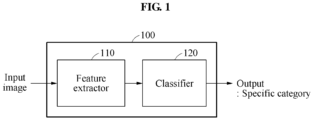
- FIG. 1 illustrates an example of an object recognizing apparatus.
- an object recognizing apparatus 100 includes a feature extractor 110 and a classifier 120.
- the object recognizing apparatus 100 applies an input image to the feature extractor 110 and recognizes a specific category of an object in the input image based on an output of the classifier 120.
- the object recognizing apparatus 100 is according to different embodiments provided in a hardware model, a firmware model, a software module, or a combination thereof.
- the feature extractor 110 and the classifier 120 includes at least one neural network.
- the neural network may be used for deep learning.
- the deep learning is a machine learning scheme for solving a problem of image recognition or voice recognition from a big data set.
- the neural network includes a multi layer neural network including a plurality of layers.
- the multi layer neural network includes, a fully connected neural network, a convolutional neural network, and a recurrent neural network. Feature layers are extracted from the multi layer neural network based supervised learning or unsupervised learning of deep learning.
- the feature extractor 110 includes a plurality of layers.
- the layers output feature vectors from the input image.
- the feature extractor 110 includes a convolutional neural network.
- each of the layers of the feature extractor 110 output feature vectors corresponding to a number of kernels using the kernels.
- a layer of the feature extractor 110 performs a convolutional operation by scanning the input image using a kernel and outputs a feature vector corresponding to a result of the convolutional operation.
- a feature of each of the kernels and a number of the kernels may be different for each layer of the feature extractor 110.
- a size of the feature vector may be determined based on a size of the input image, a size of the kernel, and a scan method.
- the scan method includes a stride.
- the feature vector may be represented by a feature map.
- Feature vectors output by a layer may be represented in a form of a three-dimensional (3D) block in which feature maps overlap. For example, in response to a horizontal length of a feature map being represented by x, a vertical length of the feature map being represented by y, and a number of kernels being represented by z, the 3D block may be represented in an x-y-z space.
- the object recognizing apparatus 100 performs a predetermined pooling operation with respect to each of the feature vectors output by the layers of the feature extractor 110.
- the predetermined pooling operation is, according to one or more embodiments, an operation differentiated from a pooling operation, for example, max pooling, used in the convolutional network.
- the feature vectors generated by performing the predetermined pooling operation include information for classifying the specific category.
- the object recognizing apparatus 100 transfers the feature vectors generated based on the predetermined pooling operation to the classifier 120.
- the predetermined pooling operation is performed, according to one or more embodiments, in a manner corresponding to the layers included in the feature extractor 110 and the feature vectors obtained based on a result of the predetermined pooling operation are applied to the classifier 120. For example, a first layer included in the feature extractor 110 outputs first feature vectors and a second layer included in the feature extractor 110 outputs second feature vectors.
- the object recognizing apparatus 100 determines a third feature vector based on the predetermined pooling operation with respect to the first feature vectors and the predetermined pooling operation with respect to the second feature vectors, and applies the third feature vector to the classifier 120.
- a classifier determines a type of an object in an input image. For example, the classifier determines whether an object in an input image is a dog or a cat. In this case, the classifier has a limited capacity to determine breed of dog.
- the classifier 120 determines a specific category corresponding to the object in the input image among specific categories included in a predetermined category based on a feature vector. For example, the predetermined category indicates a higher (or more abstract, general, e.g. a genus) type corresponding to the object in the input image and the specific category indicates a lower (more specific - e.g. a species) type corresponding to the object in the input image.
- the specific category in response to the predetermined category being "bird”, the specific category may include a specific breed of bird, for example, “sooty albatross”, “black footed albatross”, and “rhinoceros auklet”.
- the specific category in response to the predetermined category being "flower”, the specific category may include a specific type of flower, for example, “rose”, “tulip”, and “sunflower”.
- the specific category in response to the predetermined category being "bag”, the specific category may include a model of bag or a type of bag, for example, “back pack”, "tote bag” and "cross bag”.
- the classifier 120 is, according to one or more embodiments, trained in advance to determine the specific category corresponding to the object in the input image.
- the classifier 120 is trained based on training data associated with the predetermined category. For example, the classifier 120 is trained to classify the specific breed of a bird based on training data associated with various breeds of birds.
- a nonlinear relationship is established between a feature vector to be input to the classifier 120 and an output vector of the classifier 120 indicating the specific category.
- the classifier 120 includes a nonlinear classifier including a plurality of layers in order to obtain a solution of the nonlinear relationship.
- the classifier 120 includes a fully connected neural network including a plurality of layers.
- the classifier 120 determines the specific category corresponding to the object in the input image by performing nonlinear classification on the feature vector input to the classifier 120. For example, the classifier 120 outputs a vector indicating an output node corresponding to the specific category corresponding to the object in the input image among a predetermined number of output nodes corresponding to a predetermined number of specific categories.
- the nonlinear classification of the classifier 120 involves a complex operation depending on a number of input nodes, a number of layers, and a number of output nodes.
- the number of layers in deep learning is beneficial in some embodiments for obtaining a solution to a nonlinear problem.
- the object recognizing apparatus 100 lightens by intelligently selecting, paring, or trimming the output vector generated based on the predetermined pooling operation after performing the predetermined pooling operation on the feature vector output by the feature extractor 110. For example, the object recognizing apparatus 100 lightens the output vector generated based on the predetermined pooling operation based on a principal component analysis (PCA). In response to the output vector generated based on the predetermined pooling operation being lightened, the number of the input nodes of the classifier 120 decreases such that the classifier may secure an appropriate depth for nonlinearly classifying the specific category.
- PCA principal component analysis
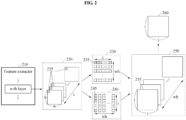
- FIG. 2 illustrates an example of a predetermined pooling operation.
- a feature extractor 210 includes a plurality of layers. A method of processing feature vectors output by an n-th layer among a plurality of layers included in the feature extractor 210 is explained below, but the explanation below is also applicable to other layers of the feature extractor 210.
- the n-th layer outputs feature vectors 220.
- FIG. 2 illustrates that each of the feature vectors 220 is represented in a form of a two-dimensional (2D) map, the feature vectors 220 may be also represented in a one-dimensional vector.
- a number i of the feature vectors 220 corresponds to a number of kernels used for the n-th layer.
- a length w and a length h indicate a size of each of the illustrated 2D feature vectors 220.
- the size of each of the feature vectors 220 is determined based on a size of an image input to the n-th layer, a size of a kernel, and a scan method.
- the size of the image input to the n-th layer may indicate a size of a feature vector output by an n-1-th layer.
- An object recognizing apparatus determines column vectors 230 and row vectors 240 based on corresponding points having a substantially identical offset in the first feature vectors 220.
- the object recognizing apparatus determines a first column vector 235 and a first row vector 245 based on corresponding points 225 having an offset of (0, 0) in the feature vectors 220.
- a size n of each of the column vectors 230 and the row vectors 240 may correspond to a number i of the kernels used for the n-th layer.
- a number of the column vectors 230 and a number of the row vectors 240 are determined based on a size of a feature vector.
- the number of the column vectors 230 and the number of the row vectors 240 are determined based on a product wh of the length w in an x-axial direction of the feature vector and the length h in a y-axial direction of the feature vector.
- the object recognizing apparatus obtains vectors 250 based on a product of the row vectors 240 and the column vectors 230. For example, the object recognizing apparatus obtains a vector 255 based on a product of the first row vector 245 and the first column vector 235. A size of each of the vectors 250 may be determined to be i ⁇ i corresponding to the number i of the kernels used for the n-th layer. A number of the vectors 250 is determined to be wh based on the size of each of the feature vectors 220. The object recognizing apparatus determines a feature vector 260 associated with the n-th layer based on a sum of vectors.
- the above-described predetermined pooling operation indicates an operation for determining the feature vector 260 based on the feature vectors 220 output corresponding to the kernels of the n-th layer.
- Equation 1 f1 denotes a vector determined based on the predetermined pooling operation, ⁇ denotes a column vector for the predetermined pooling operation, and ⁇ denotes a row vector for the predetermined pooling operation.
- FIG. 2 illustrates an example in which the feature vectors 220 of a single set output by the feature extractor 210 are used for the predetermined pooling operation.
- the column vector ⁇ and the row vector ⁇ are identical.
- feature vectors of a plurality of sets output by a plurality of feature extractors are used for the predetermined pooling operation. For example, first feature vectors output by an n-th layer of a first feature extractor and second feature vectors output by an n-th layer of a second feature extractor are used for the predetermined pooling operation.
- the row vectors 240 are determined based on the first feature vectors and the column vectors 230 are determined based on the second feature vectors.
- Equation 1 a denotes an index of a kernel used for the n-th layer of the first feature extractor, and b denotes an index of a kernel used for the n-th layer of the second feature extractor.
- a is (1 ⁇ a ⁇ i) and b is (1 ⁇ a ⁇ i).
- i denotes a number of kernels used for the n-th layer of the first feature extractor and j denotes a number of kernels used for the n-th layer of the second feature extractor.
- the number i and the number j may be identical.
- each of x and y may correspond to coordinates of elements in an individual feature vector represented in a 2D map, and a combination of x and y may indicate an offset of the row vector and the column vector.
- FIG. 3 illustrates an example of a process of recognizing an object.
- an object recognizing apparatus applies an input image to a feature extractor 310.
- the feature extractor 310 includes a plurality of layers. Each of the layers of the feature extractor 310, according to one or more embodiments, output feature vectors.
- the feature vectors output by a single layer of the feature extractor 310 may be transferred to a next layer.
- max pooling is performed with respect to the feature vectors output by the single layer of the feature extractor 310 and then the feature vectors are transferred to the next layer.
- the object recognizing apparatus obtains vectors 330 by performing a predetermined pooling operation based on the feature vectors output by the feature extractor 310. For example, the object recognizing apparatus generates a vector 331 associated with a first layer 311 by performing the predetermined pooling operation based on feature vectors 321 output by the first layer 311.
- the predetermined pooling operation is illustrated as being performed in block 320. Feature vectors represented in a two-dimensional (2D) map are represented in an overlapping form in the block 320.
- the predetermined pooling operation may be performed based on a left block and a right block based on a sign ⁇ .
- the feature extractor 310 includes two neural networks.
- the predetermined pooling operation is performed based on feature vectors output by the first neural network and feature vectors output by the second neural network.
- the predetermined pooling operation is performed based on feature vectors 322 output by a fifth layer 312 of the first neural network and feature vectors 323 output by a fifth layer 313 of the second neural network.
- a vector 335 is, according to one or more embodiments, generated based on the predetermined pooling operation performed based on the feature vectors 322 and the feature vectors 323.
- a length i of the feature vectors 322 corresponds to a number of kernels used for the fifth layer 312
- a length j of the feature vectors 323 corresponds to a number of kernels used for the fifth layer 313.
- a size of each of the kernels used for the fifth layer 312 and a size of each of the kernels used for the fifth layer 313 may be identical.
- the object recognizing apparatus generates a feature vector 340 by lightening the vectors 330.
- the object recognizing apparatus minimizes a loss of information included in each of the vectors 330 and lightens the vectors 330.
- the object recognizing apparatus lightens the vectors 330 based on a principal component analysis (PCA).
- PCA principal component analysis
- a size or a dimension of the lightened vectors is beneficially reduced compared to a size or a dimension of the vectors 330.
- Lightening may be performed in a dimension reduction & whitening (DR&W) block.
- DR&W dimension reduction & whitening
- the object recognizing apparatus determines the feature vector 340 used as an input of a classifier 350 based on the lightened vectors.
- the object recognizing apparatus generates the feature vector 340 by performing concatenation on the lightened vectors.
- a size L2 of the feature vector 340 is, generally, smaller than a total size L1 of the vectors 330.
- the object recognizing apparatus applies the feature vector 340 to the classifier 350.
- the classifier 350 performs nonlinear classification based on the feature vector 340. For example, a result of classification of the classifier 350 indicates a specific category of a bird included in the input image.
- FIG. 4 illustrates an example of a process of recognizing an object using a mask vector.
- an object recognizing apparatus applies an input image to a feature extractor 410 and an object separator 460.
- the object recognizing apparatus obtains vectors 430 by performing a predetermined pooling operation based on mask vectors 425 and feature vectors output by the feature extractor 410. For example, the object recognizing apparatus obtains a vector 431 associated with a first layer by performing the predetermined pooling operation based on feature vectors 421 output by the first layer and a mask vector 426.
- a mask vector passes an object corresponding to a target category corresponding to a classifier 450 among objects included in the input image. For example, in response to the classifier 450 classifying a specific type of a cat included in the input image, the object recognizing apparatus generates a mask vector for passing (or excluding) an object corresponding to the cat in the input image. In response to the classifier 450 classifying a specific type of a dog included in the input image, the object recognizing apparatus generates a mask vector for passing an object corresponding to the dog in the input image.
- the object separator 460 outputs a mask image indicating a category of at least one object included in the input image.
- the input image includes a dog, a cat and a sofa.
- the object separator 460 analyzes objects included in the input image and outputs a mask image that separates the dog, the cat, and the sofa based on a result of analysis.
- the mask image includes an area 471 corresponding to the dog in the input image, an area 472 corresponding to the sofa in the input image, and an area 473 corresponding to the cat in the input image.
- the object separator 460 includes a multi layer neural network or may be trained in advance to separate the objects included in the input image.
- the object recognizing apparatus selects the area corresponding to the target category of the classifier 450 from the mask image. For example, in response to the classifier 450 classifying a specific type of the cat included in the image, the object recognizing apparatus selects the area 473 corresponding to the cat.
- the object recognizing apparatus may, for example, generate the mask vector by filling a selected area with "1" and filling remaining areas with "0" or vice versa.
- the object recognizing apparatus adjusts a size of the mask vector based on a size of each of feature vectors of a block 420. For example, the object recognizing apparatus generates the mask vector 426 corresponding to the size of each of the feature vectors 421.
- FIG. 5 illustrates an example of a process of generating a mask vector.
- the object recognizing apparatus selects at least one area from a mask image 510 based on a target category classified by the classifier 450. For example, the object recognizing apparatus selects at least one area from an area 511 corresponding to the dog, an area 512 corresponding to the sofa, and an area 513 corresponding to the cat from the mask image 510.
- the object recognizing apparatus selects the area 511 corresponding to the dog and generates a mask vector 520.
- an area 521 for example, is filled with "1” and an area 522 may be filled with "0".
- the object recognizing apparatus may adjust a size of the mask vector 520 corresponding to a size of each of feature vectors output by a feature extractor.
- the object recognizing apparatus selects the area 513 corresponding to the cat and generates a mask vector 530.
- an area 531 may be filled with "1” and an area 532 may be filled with "0".
- the object recognizing apparatus adjusts a size of the mask vector 530 corresponding to the size of each of the feature vectors output by the feature extractor.
- the object recognizing apparatus determines the vectors 430 by performing the predetermined pooling operation based on the feature vectors output by the feature extractor 410 and the mask vectors 425.
- the predetermined pooling operation is performed, for example, in the block 420 based on Equation 2.
- f2 denotes a vector determined based on the predetermined pooling operation
- ⁇ denotes a column vector for the predetermined pooling operation
- ⁇ denotes a row vector for the predetermined pooling operation
- ⁇ denotes a mask vector.
- each of a and b denotes an index of a kernel
- each of x and y denotes coordinates of elements in an individual feature vector represented in a two-dimensional (2D) map.
- a is (1 ⁇ a ⁇ i) and b is (1 ⁇ b ⁇ j).
- the feature extractor 410 includes a first feature extractor and a second feature extractor.
- i denotes a number of kernels used for an n-th layer of the first feature extractor and j denotes a number of kernels used for an n-th layer of the second feature extractor.
- the object recognizing apparatus generates a feature vector 440 by lightening the vectors 430. Lightening is performed, according to an embodiment, in a dimension reduction & whitening (DR&W) block.
- the object recognizing apparatus applies the feature vector 440 to the classifier 450.
- the classifier 450 performs nonlinear classification based on the feature vector 440. For example, in response to a target category of the classifier 450 corresponding to "cat" and the area 473 being selected from the mask image, a result of classification of the classifier 450 indicates a specific category of the cat. Because only information on the target category of the classifier 450 remains in the feature vectors output by the feature extractor 410 based on the mask vectors 425, an accuracy in recognizing a specific category is beneficially enhanced.
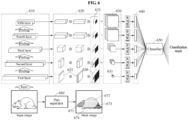
- FIG. 6 illustrates another example of a process of recognizing an object using a mask vector.
- an object recognizing apparatus applies an input image to a feature extractor 610 and a part separator 660.
- the object recognizing apparatus obtains vectors 630 by performing a predetermined pooling operation based on mask vectors 625 and feature vectors output by the feature extractor 610. For example, the object recognizing apparatus obtains vectors 631 associated with a first layer by performing the predetermined pooling operation based on feature vectors 621 output by the first layer and mask vectors 626.
- the part separator 660 outputs a mask image indicating at least one part of an object included in the input image.
- the input image includes a mouse.
- the part separator 660 analyzes the object included in the input image and outputs the mask image based on a result of analysis.
- the mask image in this example, includes an area 671 corresponding to a head of the mouse, an area 672 corresponding to a torso of the mouse, an area 673 corresponding to a tail of the mouse, and an area 674 corresponding to a leg of the mouse.
- the part separator 660 in one or more embodiments, includes a multi layer neural network and may be trained in advance to separate parts of the object included in the input image.
- At least one part indicated by the mask image may be determined in advance for each category. For example, in response to a target category of a classifier 650 being "mouse”, parts indicated by the mask image include the head, torso, tail, and leg. In another example, in response to the target category of the classifier 650 being "bird”, parts indicated by a mask image include a head, beak, torso, and wing. In response to the target category of the classifier 650 being "bag”, parts indicated by a mask image include a main body and strap.
- the mask vector may pass target parts of the object allocated to the mask vector.
- the mask vectors 626 include a mask vector for passing the head of the mouse, a mask vector for passing the torso of the mouse, a mask vector for passing the tail of the mouse, and a mask vector for passing the leg of the mouse while excluding other portions.
- the object recognizing apparatus generates a mask vector by filling an area corresponding to a target part with "1" and filling remaining areas with "0".
- the object recognizing apparatus determines a size of the mask vector based on a size of each of feature vectors 620. For example, the object recognizing apparatus generates the mask vectors 626 corresponding to the size of each of the feature vectors 621.
- FIG. 7 illustrates another example of a process of generating a mask vector.
- the object recognizing apparatus generates mask vectors 720 through 750 based on a mask image 710.
- the mask vector 720 may pass the head of the mouse
- the mask vector 730 may pass the tail of the mouse
- the mask vector 740 may pass the torso of the mouse
- the mask vector 750 may pass the leg of the mouse.
- a target area may be filled with "1" and remaining areas with "0".
- the object recognizing apparatus may adjust a size of the mask vector 720 corresponding to a size of each of feature vectors output by a feature extractor.
- Other suitable measures for passing the mask vector according to certain parts will be apparent to one of skill in the art after gaining a thorough understanding of the detailed description and FIGS.
- the object recognizing apparatus determines the vectors 630 by performing the predetermined pooling operation based on the mask vectors 625 and the feature vectors output by the feature extractor 610.
- a number of vectors may correspond to a number of mask vectors.
- a number of the vectors 631 corresponds to a number of the mask vectors 626.
- Equation 3 f3 denotes a vector determined based on the predetermined pooling operation, ⁇ denotes a column vector for the predetermined pooling operation, ⁇ denotes a row vector for the predetermined pooling operation, and ⁇ denotes a mask vector. Also, in Equation 3, each of a and b denotes an index of a kernel, c denotes an index of a mask vector, and each of x and y denotes coordinates of elements in an individual feature vector represented in a two-dimensional (2D) map.
- a is (1 ⁇ a ⁇ i)
- b is (1 ⁇ b ⁇ j)
- c is (1 ⁇ c ⁇ k).
- the feature extractor 610 includes a first feature extractor and a second feature extractor.
- i denotes a number of kernels used for an n-th layer of the first feature extractor
- j denotes a number of kernels used for an n-th layer of the second feature extractor.
- k denotes a number of mask vectors. Because a size of a mask vector is adjusted corresponding to a size of each of the feature vectors, offsets of a column vector, a row vector, and the mask vector may be calculated based on coordinates.
- the object recognizing apparatus generates a feature vector 640 by lightening the vectors 630. Lightening may be performed in a dimension reduction & whitening (DR&W) block.
- the object recognizing apparatus applies the feature vector 640 to the classifier 650.
- the classifier 650 performs nonlinear classification based on the feature vector 640. For example, a result of classification of the classifier 650 indicates a specific category of the mouse included in the input image.
- the classifier 650 may be trained in advance to classify the specific category of the input image based on a feature vector including information that is classified for each target part. Because the feature vectors output by the feature extractor 610 based on the mask vectors 625 include information classified for each target part and the feature vectors are transferred to the classifier 650, an accuracy in recognizing the specific category is significantly enhanced.
- FIG. 8 is a block diagram illustrating an example of a training apparatus.
- a training apparatus 800 includes a processor 810 operably coupled to a memory 820 such as by a system bus.
- the processor 810 trains a recognizer 821, an object separator 823, and a part separator 825 based on training data - while the recognizer 821, object separator 823, and part separator 825 are shown as being contained within memory in this embodiment, in other embodiments, they are composed of other functional hardware and firmware components.
- the recognizer 821 in one or more embodiments, includes the feature extractor 110 and/or the classifier 120 of FIG. 1 .
- the training data includes a training input and a training output. The training output is mapped to the training input. For example, the training output indicates a label to be output from the training input.
- the processor 810 trains the recognizer 821, the object separator 823, and the part separator 825 such that the training output is calculated based on the training input. For example, the processor trains the recognizer 821 to determine a specific category corresponding to an object in the training input.
- the training input may include an image in which objects included in a target category are represented.
- the recognizer 821, the object separator 823, and the part separator 825 includes at least one neural network.
- the processor 810 learns a connection weight between layers of the neural network through error back propagation learning.
- the processor 810 trains the neural network through supervised learning.
- the supervised learning is a method of updating the connection weight such that the training input and the training output corresponding to the training input are input to the neural network and the training output corresponding to the training input is output.
- the processor 810 updates a connection weight between neurons through a delta rule or error back propagation learning.
- the error back propagation learning is a method of adjusting the connection weight by estimating an error based on forward computation with respect to the provided training data, propagating the estimated error in a reverse direction starting from an output layer to a hidden layer and an input layer, and thereby reducing the error.
- the neural network may be recognized in an order of the input layer, the hidden layer, and the output layer, but the connection weight may be updated in an order of the output layer, the hidden layer, and the input layer when the error back propagation learning is used.
- the memory 820 includes the recognizer 821, the object separator 823, and the part separator 825.
- the memory 820 stores the neural network that is sequentially updated during a training process. Also, the memory 820 stores the training data.
- FIG. 9 is a block diagram illustrating an example of an object recognizing apparatus.
- an object recognizing apparatus 900 includes a processor 910 which is operably coupled to a memory 920 which may include local memory such as ram or nonvolatile storage and/or remotely accessible memory such as cloud storage or network attached storage (NAS).
- a processor 910 which is operably coupled to a memory 920 which may include local memory such as ram or nonvolatile storage and/or remotely accessible memory such as cloud storage or network attached storage (NAS).
- a memory 920 which may include local memory such as ram or nonvolatile storage and/or remotely accessible memory such as cloud storage or network attached storage (NAS).
- NAS network attached storage
- the processor 910 may include at least one of above-described recognizer 821, object separator 823, and part separator 825, and/or perform at least one of above-described methods. For example, the processor 910 processes the above-described operation associated with object recognition. In more detail, the processor 910 applies an input image to a feature extractor including a plurality of layers, determines a third feature vector based on first feature vectors of the input image output by a first layer included in the feature extractor and second feature vectors of the input image output by a second layer included in the feature extractor, and recognizes an object in the input image based on the third feature vector.
- the memory 920 stores instructions readable by a computer. In response to the instructions stored in the memory 920 being executed, the processor 910 performs an operation associated with object recognition. In addition, the memory 920 stores at least one of the above-described recognizer 821, object separator 823, and part separator 825 and pieces of data associated with object recognition. For example, the memory 920 stores equations for a predetermined pooling operation, a recognizer, an object separator, a part separator, a feature vector, and a mask vector.
- the processor 910 executes instructions, scripts, and/or programs.
- the processor 910 controls the object recognizing apparatus 900.
- the object recognizing apparatus 900 is connected to an external device, for example, a personal computer (PC) or a network, via an input/output device (not shown), to exchange data with the external device.
- the object recognizing apparatus 900 receives an input image through a camera.
- the object recognizing apparatus 900 may be implemented in at least a portion of, for example, a mobile device, for example, a mobile telephone, a smartphone, a personal digital assistant (PDA), a tablet computer or a laptop computer, a computing device, for example, a PC, a tablet computer or a netbook computer, an electronic product, for example, a television (TV), a smart TV, a smart-car, a robot, scientific instruments, a microwave, refrigerator, oven, or other kitchen appliance, or a security device for gate control.
- a mobile device for example, a mobile telephone, a smartphone, a personal digital assistant (PDA), a tablet computer or a laptop computer, a computing device, for example, a PC, a tablet computer or a netbook computer, an electronic product, for example, a television (TV), a smart TV, a smart-car, a robot, scientific instruments, a microwave, refrigerator, oven, or other kitchen appliance, or a security device for gate control.
- TV television
- smart TV
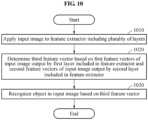
- FIG. 10 is a flowchart illustrating an example of a method of recognizing an object.
- an object recognizing apparatus applies an input image to a feature extractor including a plurality of layers.
- the object recognizing apparatus determines a third feature vector based on first feature vectors of the input image output by a first layer included in the feature extractor and second feature vectors of the input image output by a second layer included in the feature extractor.
- the object recognizing apparatus recognizes an object in the input image based on the third feature vector. Repeated descriptions will be omitted for increased clarity and conciseness because descriptions provided with reference to FIGS. 1 through 9 are also applicable to each of operations of FIG. 10 .
- the recognizer 821, object separator 823, part separator 825, classifier 120, feature extractor 110, DR&W units in FIGS. 1 , 3-6 , 8, and 9 , that perform the operations described in this application are implemented by hardware components configured to perform the operations described in this application.
- Examples of hardware components include controllers, sensors, generators, drivers, and any other electronic components known to one of ordinary skill in the art.
- the hardware components are implemented by one or more processors or computers.
- a processor or computer is implemented by one or more processing elements, such as an array of logic gates, a controller and an arithmetic logic unit, a digital signal processor, a microcomputer, a programmable logic controller, a field-programmable gate array, a programmable logic array, a microprocessor, or any other device or combination of devices known to one of ordinary skill in the art that is capable of responding to and executing instructions in a defined manner to achieve a desired result.
- a processor or computer includes, or is connected to, one or more memories storing instructions or software that are executed by the processor or computer.
- Hardware components implemented by a processor or computer execute instructions or software, such as an operating system (OS) and one or more software applications that run on the OS, to perform the operations described herein.
- the hardware components also access, manipulate, process, create, and store data in response to execution of the instructions or software.
- OS operating system
- processors or computers may be used in the description of the examples described herein, but in other examples multiple processors or computers are used, or a processor or computer includes multiple processing elements, or multiple types of processing elements, or both.
- a hardware component includes multiple processors, and in another example, a hardware component includes a processor and a controller.
- a hardware component has any one or more of different processing configurations, examples of which include a single processor, independent processors, parallel processors, single-instruction single-data (SISD) multiprocessing, single-instruction multiple-data (SIMD) multiprocessing, multiple-instruction single-data (MISD) multiprocessing, and multiple-instruction multiple-data (MIMD) multiprocessing.
- SISD single-instruction single-data
- SIMD single-instruction multiple-data
- MIMD multiple-instruction multiple-data
- FIGS. 1-7 and 10 that perform the operations described in this application are performed by computing hardware, for example, by one or more processors or computers, implemented as described above executing instructions, firmware, or software to perform the operations described in this application that are performed by the methods.
- a single operation or two or more operations may be performed by a single processor, or two or more processors, or a processor and a controller.
- One or more operations may be performed by one or more processors, or a processor and a controller, and one or more other operations may be performed by one or more other processors, or another processor and another controller.
- One or more processors, or a processor and a controller may perform a single operation, or two or more operations.
- Instructions or software to control a processor or computer to implement the hardware components and perform the methods as described above are written as computer programs, code segments, instructions or any combination thereof, for individually or collectively instructing or configuring the processor or computer to operate as a machine or special-purpose computer to perform the operations performed by the hardware components and the methods as described above.
- the instructions or software include machine code that is directly executed by the processor or computer, such as machine code produced by a compiler.
- the instructions or software include higher-level code that is executed by the processor or computer using an interpreter.
- the instructions or software to control a processor or computer to implement the hardware components and perform the methods as described above, and any associated data, data files, and data structures, are recorded, stored, or fixed in or on one or more non-transitory computer-readable storage media.
- Examples of a non-transitory computer-readable storage medium include read-only memory (ROM), random-access memory (RAM), flash memory, CD-ROMs, CD-Rs, CD+Rs, CD-RWs, CD+RWs, DVD-ROMs, DVD-Rs, DVD+Rs, DVD-RWs, DVD+RWs, DVD-RAMs, BD-ROMs, BD-Rs, BD-R LTHs, BD-REs, magnetic tapes, floppy disks, magneto-optical data storage devices, optical data storage devices, hard disks, solid-state disks, and any device known to one of ordinary skill in the art that is capable of storing the instructions or software and any associated data, data files, and data structures in a non-transitory
- the instructions or software and any associated data, data files, and data structures are distributed over network-coupled computer systems so that the instructions and software and any associated data, data files, and data structures are stored, accessed, and executed in a distributed fashion by the processor or computer.
Landscapes
- Engineering & Computer Science (AREA)
- Theoretical Computer Science (AREA)
- Physics & Mathematics (AREA)
- General Physics & Mathematics (AREA)
- Evolutionary Computation (AREA)
- Computer Vision & Pattern Recognition (AREA)
- Artificial Intelligence (AREA)
- Multimedia (AREA)
- Data Mining & Analysis (AREA)
- General Health & Medical Sciences (AREA)
- Health & Medical Sciences (AREA)
- Life Sciences & Earth Sciences (AREA)
- Software Systems (AREA)
- Computing Systems (AREA)
- General Engineering & Computer Science (AREA)
- Databases & Information Systems (AREA)
- Medical Informatics (AREA)
- Bioinformatics & Cheminformatics (AREA)
- Bioinformatics & Computational Biology (AREA)
- Evolutionary Biology (AREA)
- Biomedical Technology (AREA)
- Molecular Biology (AREA)
- Biodiversity & Conservation Biology (AREA)
- Biophysics (AREA)
- Computational Linguistics (AREA)
- Mathematical Physics (AREA)
- Image Analysis (AREA)
Claims (7)
- Prozessorimplementiertes Verfahren zur Erkennung eines Objekts unter Verwendung einer neuronalen Netzwerkstruktur, umfassend:Anlegen (1010) eines Eingangsbildes an einen Merkmalsextraktor, wobei der Merkmalsextraktor ein erstes mehrschichtiges neuronales Netzwerk mit einer ersten Schicht und einer zweiten Schicht sowie ein zweites mehrschichtiges neuronales Netzwerk mit einer anderen ersten Schicht, die der ersten Schicht entspricht, und einer anderen zweiten Schicht, die der zweiten Schicht entspricht, enthält;Ausgeben von ersten Merkmalsvektoren des Eingangsbildes durch die erste Schicht;Ausgeben von anderen ersten Merkmalsvektoren des Eingangsbildes durch die andere erste Schicht;Übermitteln der ersten Merkmalsvektoren an die zweite Schicht und Übermitteln der anderen ersten Merkmalsvektoren an die andere zweite Schicht;Ausgeben von zweiten Merkmalsvektoren des Eingangsbildes durch die zweite Schicht;Ausgeben von anderen zweiten Merkmalsvektoren des Eingangsbildes durch die andere zweite Schicht;Erhalten eines ersten gepoolten Vektors durch Durchführen einer Pooling-Operation in Bezug auf jeden der ersten Merkmalsvektoren, die den Ergebnissen einer auf Kernen der ersten Schicht basierenden Faltungsoperation entsprechen, und jeden der anderen ersten Merkmalsvektoren, die den Ergebnissen einer auf Kernen der anderen ersten Schicht basierenden Faltungsoperation entsprechen;Erhalten eines zweiten gepoolten Vektors durch Durchführen der Pooling-Operation in Bezug auf jeden der zweiten Merkmalsvektoren, die den Ergebnissen der auf Kernen der zweiten Schicht basierenden Faltungsoperation entsprechen, und jeden der anderen zweiten Merkmalsvektoren, die den Ergebnissen einer auf Kernen der anderen zweiten Schicht basierenden Faltungsoperation entsprechen;Bestimmen (1020) eines dritten Merkmalsvektors basierend auf dem ersten gepoolten Vektor und dem zweiten gepoolten Vektor; undIdentifizieren (1030) des Objekts in dem Eingangsbild basierend auf dem dritten Merkmalsvektor durch einen nichtlinearen Klassifikator,wobei das Erhalten des ersten gepoolten Vektors Folgendes umfasst:Bestimmen von ersten Spaltenvektoren basierend auf entsprechenden Punkten, die einen im Wesentlichen identischen Versatz in den ersten Merkmalsvektoren aufweisen;Bestimmen von ersten Zeilenvektoren basierend auf entsprechenden Punkten, die einen im Wesentlichen identischen Versatz in den anderen ersten Merkmalsvektoren aufweisen;Erhalten einer Vielzahl von ersten Vektoren, die jeweils auf einem Produkt aus einem der ersten Spaltenvektoren und einem der ersten Zeilenvektoren basieren; undBestimmen des ersten gepoolten Vektors basierend auf einer Summe der Vielzahl von ersten Vektoren,wobei das Erhalten des zweiten gepoolten Vektors Folgendes umfasst:Bestimmen von zweiten Spaltenvektoren basierend auf entsprechenden Punkten, die einen im Wesentlichen identischen Versatz in den zweiten Merkmalsvektoren aufweisen;Bestimmen von zweiten Zeilenvektoren basierend auf entsprechenden Punkten, die einen im Wesentlichen identischen Versatz in den anderen zweiten Merkmalsvektoren aufweisen;Erhalten einer Vielzahl von zweiten Vektoren, die jeweils auf einem Produkt aus einem der zweiten Spaltenvektoren und einem der zweiten Zeilenvektoren basieren; undBestimmen des zweiten gepoolten Vektors basierend auf einer Summe der Vielzahl von zweiten Vektoren,wobei das Bestimmen des dritten Merkmalsvektors Folgendes umfasst:Erleichtern des ersten gepoolten Vektors und des zweiten gepoolten Vektors, wodurch eine Größe oder Abmessung des ersten gepoolten Vektors und des zweiten gepoolten Vektors verringert wird; undVerketten des erleichterten ersten gepoolten Vektors und des erleichterten zweiten gepoolten Vektors, um den dritten Merkmalsvektor zu bestimmen.
- Verfahren nach Anspruch 1, wobei der erste gepoolte Vektor und der zweite gepoolte Vektor basierend auf einer Hauptkomponentenanalyse (PCA, Principal Component Analysis) erleichtert werden.
- Verfahren nach Anspruch 1 oder 2, wobei das Erhalten des ersten gepoolten Vektors das Erhalten des ersten gepoolten Vektors durch Durchführen der Pooling-Operation basierend auf den ersten Merkmalsvektoren und einem Maskenvektor zum Ausschluss eines Objekts, das einer Zielkategorie entspricht, umfasst, vorzugsweise umfassend:Anlegen des Eingangsbildes an einen Objektseparator;Erhalten eines Maskenbildes, das eine Kategorie von zumindest einem in dem Eingangsbild enthaltenen Objekt angibt; undErhalten des Maskenvektors basierend auf dem Maskenbild und einer Größe von jedem der ersten gepoolten Merkmalsvektoren.
- Verfahren nach Anspruch 1, 2 oder 3, wobei das Erhalten des ersten gepoolten Vektors das Erhalten des ersten gepoolten Vektors durch Durchführen der Pooling-Operation basierend auf den ersten Merkmalsvektoren und Maskenvektoren zum Ausschluss jedes Zielteils des Objekts umfasst.
- Verfahren nach einem der vorhergehenden Ansprüche, wobei das Erkennen des Objekts Folgendes umfasst:Anlegen des dritten Merkmalsvektors an den nichtlinearen Klassifikator, der eine Vielzahl von Schichten enthält; undErkennen des Objekts in dem Eingangsbild basierend auf einer Ausgabe des nichtlinearen Klassifizierers, wobei die Ausgabe des nichtlinearen Klassifizierers vorzugsweise eine dem Objekt in dem Eingangsbild entsprechende spezifische Kategorie unter spezifischen Kategorien, die in einer vorbestimmten Kategorie enthalten sind, angibt.
- Übergangsloses computerlesbares Speichermedium, auf dem Anweisungen gespeichert sind, die, wenn sie von einem Prozessor ausgeführt werden, bewirken, dass der Prozessor das Verfahren nach einem der vorhergehenden Ansprüche durchführt.
- Vorrichtung zur Erkennung eines Objekts, die Folgendes umfasst:einen Prozessor (810), undeinen Speicher (820), der betriebsmäßig mit dem Prozessor gekoppelt ist und eine von dem Prozessor ausführbare Anweisung umfasst,wobei der Prozessor als Reaktion auf die Ausführung der Anweisung durch den Prozessor konfiguriert ist, um das Verfahren nach einem der Ansprüche 1 bis 5 durchzuführen.
Applications Claiming Priority (1)
| Application Number | Priority Date | Filing Date | Title |
|---|---|---|---|
| KR1020160159536A KR102785792B1 (ko) | 2016-11-28 | 2016-11-28 | 객체 인식 방법 및 장치 |
Publications (2)
| Publication Number | Publication Date |
|---|---|
| EP3327628A1 EP3327628A1 (de) | 2018-05-30 |
| EP3327628B1 true EP3327628B1 (de) | 2025-02-12 |
Family
ID=59215567
Family Applications (1)
| Application Number | Title | Priority Date | Filing Date |
|---|---|---|---|
| EP17177468.0A Active EP3327628B1 (de) | 2016-11-28 | 2017-06-22 | Verfahren und vorrichtung zur erkennung eines objekts |
Country Status (4)
| Country | Link |
|---|---|
| US (1) | US10691971B2 (de) |
| EP (1) | EP3327628B1 (de) |
| KR (1) | KR102785792B1 (de) |
| CN (1) | CN108121995B (de) |
Families Citing this family (21)
| Publication number | Priority date | Publication date | Assignee | Title |
|---|---|---|---|---|
| US9980100B1 (en) | 2017-08-31 | 2018-05-22 | Snap Inc. | Device location based on machine learning classifications |
| JP6969254B2 (ja) * | 2017-09-22 | 2021-11-24 | 株式会社アイシン | 画像処理装置及びプログラム |
| US10453220B1 (en) * | 2017-12-29 | 2019-10-22 | Perceive Corporation | Machine-trained network for misalignment-insensitive depth perception |
| WO2019148019A1 (en) | 2018-01-25 | 2019-08-01 | Kraft Foods Group Brands Llc | Method and system for improving food-related personalization |
| US10720235B2 (en) | 2018-01-25 | 2020-07-21 | Kraft Foods Group Brands Llc | Method and system for preference-driven food personalization |
| US10628705B2 (en) * | 2018-03-29 | 2020-04-21 | Qualcomm Incorporated | Combining convolution and deconvolution for object detection |
| US11403529B2 (en) * | 2018-04-05 | 2022-08-02 | Western Digital Technologies, Inc. | Noise injection training for memory-based learning |
| JP7075013B2 (ja) * | 2018-09-05 | 2022-05-25 | 日本電信電話株式会社 | 符号量推定装置、符号量推定方法及び符号量推定プログラム |
| KR102092475B1 (ko) * | 2018-10-16 | 2020-03-23 | 고려대학교 산학협력단 | 동물 종 식별 방법 및 장치 |
| EP3928247A1 (de) * | 2019-02-22 | 2021-12-29 | Google LLC | Speichergeführte videoobjekterkennung |
| US12002245B2 (en) | 2019-10-25 | 2024-06-04 | Mashgin Inc. | Method and system for item identification |
| US11036964B2 (en) | 2019-10-25 | 2021-06-15 | Mashgin Inc. | Method and system for item identification |
| US11275972B2 (en) * | 2019-11-08 | 2022-03-15 | International Business Machines Corporation | Image classification masking |
| US11030763B1 (en) | 2019-12-06 | 2021-06-08 | Mashgin Inc. | System and method for identifying items |
| WO2021230680A1 (en) * | 2020-05-13 | 2021-11-18 | Pireco Co,. Ltd. | Method and device for detecting object in image |
| KR102243466B1 (ko) * | 2020-05-13 | 2021-04-22 | 주식회사 파이리코 | 이미지 내 동물의 눈 영역을 검출하는 방법 및 장치 |
| US11844458B2 (en) | 2020-10-13 | 2023-12-19 | June Life, Llc | Method and system for automatic cook program determination |
| KR20220098502A (ko) * | 2021-01-04 | 2022-07-12 | 오드컨셉 주식회사 | 마스크를 기반으로 하는 다중 레이블 분류 방법 및 장치 |
| WO2022211925A1 (en) * | 2021-04-01 | 2022-10-06 | University Of South Florida | Systems and methods for classifying mosquito larvae based on extracted masks of anatomical components from images |
| US12469316B1 (en) * | 2023-02-08 | 2025-11-11 | Veracity Protocol Inc. | Authentication and identification of physical objects using microstructural features |
| US12450750B2 (en) * | 2023-06-29 | 2025-10-21 | Adobe Inc. | Modifying digital images via adaptive rendering order of image objects |
Family Cites Families (23)
| Publication number | Priority date | Publication date | Assignee | Title |
|---|---|---|---|---|
| KR100903816B1 (ko) | 2007-12-21 | 2009-06-24 | 한국건설기술연구원 | 정지영상에서의 얼굴추출시스템과 그 방법 |
| US8224021B2 (en) * | 2008-03-14 | 2012-07-17 | Millivision Technologies, Inc. | Method and system for automatic detection of a class of objects |
| US9031294B2 (en) * | 2010-07-23 | 2015-05-12 | National Institute Of Advanced Industrial Science And Technology | Region segmented image data creating system and feature extracting system for histopathological images |
| KR101254177B1 (ko) | 2011-10-07 | 2013-04-19 | 위아코퍼레이션 주식회사 | 방사형 기저 함수 신경회로망 알고리즘을 이용한 실시간 얼굴 인식 시스템 |
| US9275300B2 (en) * | 2012-02-24 | 2016-03-01 | Canon Kabushiki Kaisha | Method and apparatus for generating image description vector, image detection method and apparatus |
| US9053551B2 (en) * | 2012-05-23 | 2015-06-09 | International Business Machines Corporation | Vessel identification using shape and motion mapping for coronary angiogram sequences |
| US8879855B2 (en) * | 2012-08-17 | 2014-11-04 | Nec Laboratories America, Inc. | Image segmentation for large-scale fine-grained recognition |
| US10127636B2 (en) * | 2013-09-27 | 2018-11-13 | Kofax, Inc. | Content-based detection and three dimensional geometric reconstruction of objects in image and video data |
| US9190053B2 (en) * | 2013-03-25 | 2015-11-17 | The Governing Council Of The Univeristy Of Toronto | System and method for applying a convolutional neural network to speech recognition |
| CN105849747B (zh) * | 2013-11-30 | 2018-08-17 | 北京市商汤科技开发有限公司 | 用于人脸图像识别的方法和系统 |
| KR101844932B1 (ko) | 2014-09-16 | 2018-04-03 | 한국전자통신연구원 | 신호처리 알고리즘이 통합된 심층 신경망 기반의 음성인식 장치 및 이의 학습방법 |
| KR20160061856A (ko) | 2014-11-24 | 2016-06-01 | 삼성전자주식회사 | 객체 인식 방법 및 장치, 및 인식기 학습 방법 및 장치 |
| KR102276339B1 (ko) * | 2014-12-09 | 2021-07-12 | 삼성전자주식회사 | Cnn의 근사화를 위한 학습 장치 및 방법 |
| US10346726B2 (en) * | 2014-12-15 | 2019-07-09 | Samsung Electronics Co., Ltd. | Image recognition method and apparatus, image verification method and apparatus, learning method and apparatus to recognize image, and learning method and apparatus to verify image |
| KR101624926B1 (ko) | 2014-12-17 | 2016-05-27 | 서울대학교산학협력단 | 딥 뉴럴 네트워크 기반 특징 보상 기법을 이용한 음성 인식 방법 |
| US9721190B2 (en) * | 2014-12-19 | 2017-08-01 | Google Inc. | Large-scale classification in neural networks using hashing |
| CN105844128B (zh) | 2015-01-15 | 2021-03-02 | 北京三星通信技术研究有限公司 | 身份识别方法和装置 |
| KR101591626B1 (ko) | 2015-02-04 | 2016-02-04 | 한양대학교 산학협력단 | 딥신경망에 기초한 패킷 손실 은닉 방법 및 장치 |
| US10002313B2 (en) * | 2015-12-15 | 2018-06-19 | Sighthound, Inc. | Deeply learned convolutional neural networks (CNNS) for object localization and classification |
| GB2545661A (en) * | 2015-12-21 | 2017-06-28 | Nokia Technologies Oy | A method for analysing media content |
| KR101644998B1 (ko) | 2015-12-22 | 2016-08-02 | 엑스브레인 주식회사 | Convolutional Neural Network를 이용하여 비정상 입력 데이터를 검출하는 방법 및 장치 |
| US20180039853A1 (en) * | 2016-08-02 | 2018-02-08 | Mitsubishi Electric Research Laboratories, Inc. | Object Detection System and Object Detection Method |
| KR101914208B1 (ko) * | 2017-09-08 | 2018-11-02 | 한국과학기술연구원 | 피라미드 구조 기반 기계 학습을 이용한 객체 인식 장치 및 방법 |
-
2016
- 2016-11-28 KR KR1020160159536A patent/KR102785792B1/ko active Active
-
2017
- 2017-04-20 US US15/492,772 patent/US10691971B2/en active Active
- 2017-06-22 EP EP17177468.0A patent/EP3327628B1/de active Active
- 2017-07-06 CN CN201710544947.2A patent/CN108121995B/zh active Active
Also Published As
| Publication number | Publication date |
|---|---|
| KR102785792B1 (ko) | 2025-03-26 |
| KR20180060257A (ko) | 2018-06-07 |
| CN108121995B (zh) | 2023-12-08 |
| US20180150715A1 (en) | 2018-05-31 |
| US10691971B2 (en) | 2020-06-23 |
| CN108121995A (zh) | 2018-06-05 |
| EP3327628A1 (de) | 2018-05-30 |
Similar Documents
| Publication | Publication Date | Title |
|---|---|---|
| EP3327628B1 (de) | Verfahren und vorrichtung zur erkennung eines objekts | |
| US11715011B2 (en) | Neural network based recognition apparatus and method of training neural network | |
| US10755162B2 (en) | Method and apparatus to reduce neural network | |
| You et al. | Incremental learning meets transfer learning: Application to multi-site prostate mri segmentation | |
| CN105913121B (zh) | 神经网络训练方法和设备以及识别方法和设备 | |
| US20180144185A1 (en) | Method and apparatus to perform facial expression recognition and training | |
| JP6596164B2 (ja) | 単一ビューオブジェクト再構成のためのファイングレインデータセットにおける教師なしマッチング | |
| Gupta et al. | Dilated convolutions for modeling long-distance genomic dependencies | |
| Ugolotti et al. | Particle swarm optimization and differential evolution for model-based object detection | |
| US11514692B2 (en) | Method and apparatus for building image model | |
| KR102011788B1 (ko) | 계층적 시각 특징을 이용한 시각 질의 응답 장치 및 방법 | |
| EP3929822A1 (de) | Neuromorphe vorrichtung und verfahren mit neuronalem netzwerk | |
| WO2022125181A1 (en) | Recurrent neural network architectures based on synaptic connectivity graphs | |
| US11562204B2 (en) | Method and apparatus for performing recognition using recurrent model and training recurrent model | |
| WO2024187142A9 (en) | Data representation with cross-modality knowledge sharing | |
| Tlaisun et al. | Efficient deep learning approach for modern skin cancer detection | |
| Anand et al. | IMNMAGN: integrative multimodal approach for enhanced detection of neurodegenerative diseases using fusion of multidomain analysis with graph networks | |
| CN119053991A (zh) | 利用点网格卷积对图形结构化数据进行建模 | |
| Yao et al. | Modified osprey algorithm for optimizing capsule neural network in leukemia image recognition | |
| WO2025102256A1 (en) | Training neural network with contrastive knowledge distillation | |
| Murli et al. | eSNN for Spatio-temporal fMRI brain pattern recognition with a graphical object recognition case study | |
| Kirtay et al. | Multimodal sensory representation for object classification via neocortically-inspired algorithm | |
| Rorato | Segmentazione accurata di filopodi delle cellule | |
| Ribeiro | Porting of Vision and Image Recognition Applications to TIDL Environments | |
| Khan et al. | Predictive Coding Explains Asymmetric Connectivity in the Brain: A Neural Network Study |
Legal Events
| Date | Code | Title | Description |
|---|---|---|---|
| PUAI | Public reference made under article 153(3) epc to a published international application that has entered the european phase |
Free format text: ORIGINAL CODE: 0009012 |
|
| STAA | Information on the status of an ep patent application or granted ep patent |
Free format text: STATUS: THE APPLICATION HAS BEEN PUBLISHED |
|
| AK | Designated contracting states |
Kind code of ref document: A1 Designated state(s): AL AT BE BG CH CY CZ DE DK EE ES FI FR GB GR HR HU IE IS IT LI LT LU LV MC MK MT NL NO PL PT RO RS SE SI SK SM TR |
|
| AX | Request for extension of the european patent |
Extension state: BA ME |
|
| STAA | Information on the status of an ep patent application or granted ep patent |
Free format text: STATUS: REQUEST FOR EXAMINATION WAS MADE |
|
| 17P | Request for examination filed |
Effective date: 20181106 |
|
| RBV | Designated contracting states (corrected) |
Designated state(s): AL AT BE BG CH CY CZ DE DK EE ES FI FR GB GR HR HU IE IS IT LI LT LU LV MC MK MT NL NO PL PT RO RS SE SI SK SM TR |
|
| STAA | Information on the status of an ep patent application or granted ep patent |
Free format text: STATUS: EXAMINATION IS IN PROGRESS |
|
| 17Q | First examination report despatched |
Effective date: 20210317 |
|
| P01 | Opt-out of the competence of the unified patent court (upc) registered |
Effective date: 20230519 |
|
| REG | Reference to a national code |
Ref country code: DE Ref legal event code: R079 Free format text: PREVIOUS MAIN CLASS: G06K0009460000 Ipc: G06V0010250000 Ref country code: DE Ref legal event code: R079 Ref document number: 602017087668 Country of ref document: DE Free format text: PREVIOUS MAIN CLASS: G06K0009460000 Ipc: G06V0010250000 |
|
| GRAP | Despatch of communication of intention to grant a patent |
Free format text: ORIGINAL CODE: EPIDOSNIGR1 |
|
| STAA | Information on the status of an ep patent application or granted ep patent |
Free format text: STATUS: GRANT OF PATENT IS INTENDED |
|
| RIC1 | Information provided on ipc code assigned before grant |
Ipc: G06V 10/82 20220101ALI20241115BHEP Ipc: G06V 10/764 20220101ALI20241115BHEP Ipc: G06V 10/44 20220101ALI20241115BHEP Ipc: G06V 10/25 20220101AFI20241115BHEP |
|
| INTG | Intention to grant announced |
Effective date: 20241129 |
|
| GRAS | Grant fee paid |
Free format text: ORIGINAL CODE: EPIDOSNIGR3 |
|
| GRAA | (expected) grant |
Free format text: ORIGINAL CODE: 0009210 |
|
| STAA | Information on the status of an ep patent application or granted ep patent |
Free format text: STATUS: THE PATENT HAS BEEN GRANTED |
|
| AK | Designated contracting states |
Kind code of ref document: B1 Designated state(s): AL AT BE BG CH CY CZ DE DK EE ES FI FR GB GR HR HU IE IS IT LI LT LU LV MC MK MT NL NO PL PT RO RS SE SI SK SM TR |
|
| REG | Reference to a national code |
Ref country code: GB Ref legal event code: FG4D |
|
| REG | Reference to a national code |
Ref country code: CH Ref legal event code: EP |
|
| REG | Reference to a national code |
Ref country code: DE Ref legal event code: R096 Ref document number: 602017087668 Country of ref document: DE |
|
| REG | Reference to a national code |
Ref country code: IE Ref legal event code: FG4D |
|
| REG | Reference to a national code |
Ref country code: NL Ref legal event code: MP Effective date: 20250212 |
|
| PG25 | Lapsed in a contracting state [announced via postgrant information from national office to epo] |
Ref country code: RS Free format text: LAPSE BECAUSE OF FAILURE TO SUBMIT A TRANSLATION OF THE DESCRIPTION OR TO PAY THE FEE WITHIN THE PRESCRIBED TIME-LIMIT Effective date: 20250512 |
|
| PG25 | Lapsed in a contracting state [announced via postgrant information from national office to epo] |
Ref country code: FI Free format text: LAPSE BECAUSE OF FAILURE TO SUBMIT A TRANSLATION OF THE DESCRIPTION OR TO PAY THE FEE WITHIN THE PRESCRIBED TIME-LIMIT Effective date: 20250212 |
|
| PG25 | Lapsed in a contracting state [announced via postgrant information from national office to epo] |
Ref country code: PL Free format text: LAPSE BECAUSE OF FAILURE TO SUBMIT A TRANSLATION OF THE DESCRIPTION OR TO PAY THE FEE WITHIN THE PRESCRIBED TIME-LIMIT Effective date: 20250212 |
|
| PGFP | Annual fee paid to national office [announced via postgrant information from national office to epo] |
Ref country code: DE Payment date: 20250507 Year of fee payment: 9 |
|
| PG25 | Lapsed in a contracting state [announced via postgrant information from national office to epo] |
Ref country code: ES Free format text: LAPSE BECAUSE OF FAILURE TO SUBMIT A TRANSLATION OF THE DESCRIPTION OR TO PAY THE FEE WITHIN THE PRESCRIBED TIME-LIMIT Effective date: 20250212 |
|
| PGFP | Annual fee paid to national office [announced via postgrant information from national office to epo] |
Ref country code: GB Payment date: 20250508 Year of fee payment: 9 |
|
| REG | Reference to a national code |
Ref country code: LT Ref legal event code: MG9D |
|
| PG25 | Lapsed in a contracting state [announced via postgrant information from national office to epo] |
Ref country code: IS Free format text: LAPSE BECAUSE OF FAILURE TO SUBMIT A TRANSLATION OF THE DESCRIPTION OR TO PAY THE FEE WITHIN THE PRESCRIBED TIME-LIMIT Effective date: 20250612 Ref country code: NO Free format text: LAPSE BECAUSE OF FAILURE TO SUBMIT A TRANSLATION OF THE DESCRIPTION OR TO PAY THE FEE WITHIN THE PRESCRIBED TIME-LIMIT Effective date: 20250512 |
|
| PG25 | Lapsed in a contracting state [announced via postgrant information from national office to epo] |
Ref country code: NL Free format text: LAPSE BECAUSE OF FAILURE TO SUBMIT A TRANSLATION OF THE DESCRIPTION OR TO PAY THE FEE WITHIN THE PRESCRIBED TIME-LIMIT Effective date: 20250212 |
|
| PG25 | Lapsed in a contracting state [announced via postgrant information from national office to epo] |
Ref country code: HR Free format text: LAPSE BECAUSE OF FAILURE TO SUBMIT A TRANSLATION OF THE DESCRIPTION OR TO PAY THE FEE WITHIN THE PRESCRIBED TIME-LIMIT Effective date: 20250212 |
|
| PG25 | Lapsed in a contracting state [announced via postgrant information from national office to epo] |
Ref country code: PT Free format text: LAPSE BECAUSE OF FAILURE TO SUBMIT A TRANSLATION OF THE DESCRIPTION OR TO PAY THE FEE WITHIN THE PRESCRIBED TIME-LIMIT Effective date: 20250612 Ref country code: LV Free format text: LAPSE BECAUSE OF FAILURE TO SUBMIT A TRANSLATION OF THE DESCRIPTION OR TO PAY THE FEE WITHIN THE PRESCRIBED TIME-LIMIT Effective date: 20250212 |
|
| PGFP | Annual fee paid to national office [announced via postgrant information from national office to epo] |
Ref country code: FR Payment date: 20250508 Year of fee payment: 9 |
|
| PG25 | Lapsed in a contracting state [announced via postgrant information from national office to epo] |
Ref country code: BG Free format text: LAPSE BECAUSE OF FAILURE TO SUBMIT A TRANSLATION OF THE DESCRIPTION OR TO PAY THE FEE WITHIN THE PRESCRIBED TIME-LIMIT Effective date: 20250212 Ref country code: GR Free format text: LAPSE BECAUSE OF FAILURE TO SUBMIT A TRANSLATION OF THE DESCRIPTION OR TO PAY THE FEE WITHIN THE PRESCRIBED TIME-LIMIT Effective date: 20250513 |
|
| REG | Reference to a national code |
Ref country code: AT Ref legal event code: MK05 Ref document number: 1766828 Country of ref document: AT Kind code of ref document: T Effective date: 20250212 |
|
| PG25 | Lapsed in a contracting state [announced via postgrant information from national office to epo] |
Ref country code: SE Free format text: LAPSE BECAUSE OF FAILURE TO SUBMIT A TRANSLATION OF THE DESCRIPTION OR TO PAY THE FEE WITHIN THE PRESCRIBED TIME-LIMIT Effective date: 20250212 |
|
| PG25 | Lapsed in a contracting state [announced via postgrant information from national office to epo] |
Ref country code: SM Free format text: LAPSE BECAUSE OF FAILURE TO SUBMIT A TRANSLATION OF THE DESCRIPTION OR TO PAY THE FEE WITHIN THE PRESCRIBED TIME-LIMIT Effective date: 20250212 |
|
| PG25 | Lapsed in a contracting state [announced via postgrant information from national office to epo] |
Ref country code: DK Free format text: LAPSE BECAUSE OF FAILURE TO SUBMIT A TRANSLATION OF THE DESCRIPTION OR TO PAY THE FEE WITHIN THE PRESCRIBED TIME-LIMIT Effective date: 20250212 |
|
| PG25 | Lapsed in a contracting state [announced via postgrant information from national office to epo] |
Ref country code: IT Free format text: LAPSE BECAUSE OF FAILURE TO SUBMIT A TRANSLATION OF THE DESCRIPTION OR TO PAY THE FEE WITHIN THE PRESCRIBED TIME-LIMIT Effective date: 20250212 |
|
| PG25 | Lapsed in a contracting state [announced via postgrant information from national office to epo] |
Ref country code: AT Free format text: LAPSE BECAUSE OF FAILURE TO SUBMIT A TRANSLATION OF THE DESCRIPTION OR TO PAY THE FEE WITHIN THE PRESCRIBED TIME-LIMIT Effective date: 20250212 |
|
| PG25 | Lapsed in a contracting state [announced via postgrant information from national office to epo] |
Ref country code: EE Free format text: LAPSE BECAUSE OF FAILURE TO SUBMIT A TRANSLATION OF THE DESCRIPTION OR TO PAY THE FEE WITHIN THE PRESCRIBED TIME-LIMIT Effective date: 20250212 Ref country code: CZ Free format text: LAPSE BECAUSE OF FAILURE TO SUBMIT A TRANSLATION OF THE DESCRIPTION OR TO PAY THE FEE WITHIN THE PRESCRIBED TIME-LIMIT Effective date: 20250212 |
|
| PG25 | Lapsed in a contracting state [announced via postgrant information from national office to epo] |
Ref country code: RO Free format text: LAPSE BECAUSE OF FAILURE TO SUBMIT A TRANSLATION OF THE DESCRIPTION OR TO PAY THE FEE WITHIN THE PRESCRIBED TIME-LIMIT Effective date: 20250212 |
|
| PG25 | Lapsed in a contracting state [announced via postgrant information from national office to epo] |
Ref country code: SK Free format text: LAPSE BECAUSE OF FAILURE TO SUBMIT A TRANSLATION OF THE DESCRIPTION OR TO PAY THE FEE WITHIN THE PRESCRIBED TIME-LIMIT Effective date: 20250212 |
|
| REG | Reference to a national code |
Ref country code: DE Ref legal event code: R097 Ref document number: 602017087668 Country of ref document: DE |
|
| PLBE | No opposition filed within time limit |
Free format text: ORIGINAL CODE: 0009261 |
|
| STAA | Information on the status of an ep patent application or granted ep patent |
Free format text: STATUS: NO OPPOSITION FILED WITHIN TIME LIMIT |
|
| REG | Reference to a national code |
Ref country code: CH Ref legal event code: L10 Free format text: ST27 STATUS EVENT CODE: U-0-0-L10-L00 (AS PROVIDED BY THE NATIONAL OFFICE) Effective date: 20251224 |
|
| 26N | No opposition filed |
Effective date: 20251113 |
|
| REG | Reference to a national code |
Ref country code: CH Ref legal event code: H13 Free format text: ST27 STATUS EVENT CODE: U-0-0-H10-H13 (AS PROVIDED BY THE NATIONAL OFFICE) Effective date: 20260127 |
|
| PG25 | Lapsed in a contracting state [announced via postgrant information from national office to epo] |
Ref country code: MC Free format text: LAPSE BECAUSE OF FAILURE TO SUBMIT A TRANSLATION OF THE DESCRIPTION OR TO PAY THE FEE WITHIN THE PRESCRIBED TIME-LIMIT Effective date: 20250212 |
|
| PG25 | Lapsed in a contracting state [announced via postgrant information from national office to epo] |
Ref country code: LU Free format text: LAPSE BECAUSE OF NON-PAYMENT OF DUE FEES Effective date: 20250622 |
|
| REG | Reference to a national code |
Ref country code: BE Ref legal event code: MM Effective date: 20250630 |