EP3326478A1 - A safety helmet, a heat reflective accessory and a method of retrofitting a safety helmet - Google Patents
A safety helmet, a heat reflective accessory and a method of retrofitting a safety helmet Download PDFInfo
- Publication number
- EP3326478A1 EP3326478A1 EP16201052.4A EP16201052A EP3326478A1 EP 3326478 A1 EP3326478 A1 EP 3326478A1 EP 16201052 A EP16201052 A EP 16201052A EP 3326478 A1 EP3326478 A1 EP 3326478A1
- Authority
- EP
- European Patent Office
- Prior art keywords
- reflective layer
- safety helmet
- heat reflective
- heat
- protective shell
- Prior art date
- Legal status (The legal status is an assumption and is not a legal conclusion. Google has not performed a legal analysis and makes no representation as to the accuracy of the status listed.)
- Withdrawn
Links
- 238000000034 method Methods 0.000 title claims description 10
- 238000009420 retrofitting Methods 0.000 title claims description 8
- 230000001681 protective effect Effects 0.000 claims abstract description 56
- 239000000725 suspension Substances 0.000 claims description 29
- 229910052751 metal Inorganic materials 0.000 claims description 11
- 239000002184 metal Substances 0.000 claims description 11
- 239000000463 material Substances 0.000 claims description 9
- 239000012782 phase change material Substances 0.000 claims description 7
- 239000000049 pigment Substances 0.000 claims description 4
- 239000000758 substrate Substances 0.000 description 7
- 229910052782 aluminium Inorganic materials 0.000 description 4
- XAGFODPZIPBFFR-UHFFFAOYSA-N aluminium Chemical compound [Al] XAGFODPZIPBFFR-UHFFFAOYSA-N 0.000 description 4
- 230000005855 radiation Effects 0.000 description 4
- 230000000717 retained effect Effects 0.000 description 4
- -1 salt hydrates Chemical class 0.000 description 4
- 239000004743 Polypropylene Substances 0.000 description 3
- 239000011324 bead Substances 0.000 description 3
- 238000005452 bending Methods 0.000 description 3
- 239000011248 coating agent Substances 0.000 description 3
- 238000000576 coating method Methods 0.000 description 3
- 238000010586 diagram Methods 0.000 description 3
- 239000011521 glass Substances 0.000 description 3
- 238000002329 infrared spectrum Methods 0.000 description 3
- 229920001155 polypropylene Polymers 0.000 description 3
- 238000009423 ventilation Methods 0.000 description 3
- 239000004698 Polyethylene Substances 0.000 description 2
- 239000004676 acrylonitrile butadiene styrene Substances 0.000 description 2
- 238000009529 body temperature measurement Methods 0.000 description 2
- 230000000052 comparative effect Effects 0.000 description 2
- 239000000835 fiber Substances 0.000 description 2
- 229920000728 polyester Polymers 0.000 description 2
- 229920000573 polyethylene Polymers 0.000 description 2
- 238000010521 absorption reaction Methods 0.000 description 1
- 239000000853 adhesive Substances 0.000 description 1
- 230000001070 adhesive effect Effects 0.000 description 1
- 230000005540 biological transmission Effects 0.000 description 1
- 238000010276 construction Methods 0.000 description 1
- 238000009713 electroplating Methods 0.000 description 1
- 239000004744 fabric Substances 0.000 description 1
- 239000011888 foil Substances 0.000 description 1
- 239000003365 glass fiber Substances 0.000 description 1
- PCHJSUWPFVWCPO-UHFFFAOYSA-N gold Chemical compound [Au] PCHJSUWPFVWCPO-UHFFFAOYSA-N 0.000 description 1
- 229910052737 gold Inorganic materials 0.000 description 1
- 239000010931 gold Substances 0.000 description 1
- 238000001465 metallisation Methods 0.000 description 1
- 239000004745 nonwoven fabric Substances 0.000 description 1
- 230000000149 penetrating effect Effects 0.000 description 1
- 230000035515 penetration Effects 0.000 description 1
- 239000004033 plastic Substances 0.000 description 1
- 229920003023 plastic Polymers 0.000 description 1
- 239000004417 polycarbonate Substances 0.000 description 1
- 229920000515 polycarbonate Polymers 0.000 description 1
- 229920000642 polymer Polymers 0.000 description 1
- 229910052709 silver Inorganic materials 0.000 description 1
- 239000004332 silver Substances 0.000 description 1
- 238000004544 sputter deposition Methods 0.000 description 1
- 230000037072 sun protection Effects 0.000 description 1
- 238000013022 venting Methods 0.000 description 1
- 230000002747 voluntary effect Effects 0.000 description 1
- 239000002759 woven fabric Substances 0.000 description 1
- 230000037303 wrinkles Effects 0.000 description 1
Images


Classifications
-
- A—HUMAN NECESSITIES
- A42—HEADWEAR
- A42B—HATS; HEAD COVERINGS
- A42B3/00—Helmets; Helmet covers ; Other protective head coverings
- A42B3/04—Parts, details or accessories of helmets
- A42B3/10—Linings
-
- A—HUMAN NECESSITIES
- A42—HEADWEAR
- A42B—HATS; HEAD COVERINGS
- A42B3/00—Helmets; Helmet covers ; Other protective head coverings
- A42B3/04—Parts, details or accessories of helmets
- A42B3/28—Ventilating arrangements
- A42B3/285—Ventilating arrangements with additional heating or cooling means
Definitions
- the invention relates to a safety helmet that has a heat reflective layer, a heat reflective accessory having the heat reflective layer and a method of retrofitting a safety helmet with a heat reflective layer.
- Safety helmets are typically used as head protection in different areas, like for example in constructions work zones.
- Various government agencies and industry organizations define certain requirements and standards for protective gear, including helmets and respirators.
- NIOSH National Institute of Occupational Safety and Health
- ANSI American National Standards Institute
- European Standards related to safety helmets like for example EN 397.
- Other agencies and organizations around the world also establish safety standards for helmets and respirators.
- some of these standards relate to impact energy attenuation, penetration resistance, force transmission, stiffness, flammability, and head coverage.
- safety helmets usually comprise a rigid outer protective shell of plastic and a head suspension system inside the shell.
- the suspension system serves many purposes, including providing a proper fit of the helmet to the wearer's head, holding the inner part of the helmet away from the wearer's head, distributing the weight of the helmet over a larger area of the wearer's head, and attenuating the force transferred to the wearer's head upon impact of an object with the outer helmet shell.
- Suspension systems often comprise a headband attached to a crown support assembly which includes crisscrossing crown straps and a crown pad. In some applications, however, additional protection may be desired.
- safety helmets can provide sun protection when worn under sunny weather conditions it is desirable to minimize heat building up inside the helmet.
- safety helmets having a passive ventilation provided by openings in the protective shell.
- CN 203608892 U discloses a heat-preventing safety helmet for reducing sunshine temperature.
- the safety helmet comprises a safety helmet body and a heat-insulating device, wherein the heat-insulating device comprises a light-reflecting coating.
- the light-reflecting coating is uniformly coated on the outer surface of the safety helmet body or is arranged on a cover fabric on the outer surface of the safety helmet body.
- the invention relates in one aspect to a safety helmet.
- the safety helmet has a generally dome-shaped protective shell for protecting a wearer's head.
- the protective shell forms a head-facing inner side and an outer side.
- the safety helmet comprises a heat reflective layer that has a heat reflective side.
- the heat reflective layer is arranged with the heat reflective side facing the inner side of the protective shell.
- the invention is advantageous in that it helps minimizing heat building up in the helmet when the helmet is exposed to heat or light radiation, for example to sunlight.
- the invention enables such heat minimization without altering the outer appearance, for example the color or shape of the outer side of the protection shell of the safety helmet.
- the properties of the protection shell are not affected by providing the safety helmet with the heat reflective layer according to the invention.
- no electrically conductive layer or surface is created on the outer side of the protection shell.
- the invention is further advantageous in that it enables the retrofitting of an existing safety helmet by the heat reflective layer.
- the invention allows to selectively change the configuration of the safety helmet according as desired by the user. For example the same helmet can be worn with or without the heat reflective layer by a simple changeover.
- the heat reflective layer may further form part of an exchangeable and disposable accessory.
- the heat reflective layer comprises a metal layer.
- a metal layer is preferably made of aluminum, but may further be made of other material like silver or gold.
- the metal layer may be provided in the form of a metallization on a substrate, for example may be provided as a coating, by sputter deposition or by electroplating. Alternatively, the metal layer may be provided in the form of a film or foil.
- the heat reflective layer may further comprise retroreflective elements, for example a layer of glass beads or a layer of cube corners. The glass beads, or a layer beneath the glass beads, may be metallized, for example with aluminum. Further, the cube corners may be metallized.
- the heat reflective layer may further comprise reflective pigments.
- the heat reflective layer is reflective at least within the infrared spectrum, preferably in a predominant range of the infrared spectrum, most preferably over the whole range of the infrared spectrum.
- the heat reflective layer may be reflective for infrared light within the range of a wavelength of 780 nm to 50 ⁇ m. Further, the heat reflective layer may in addition be reflective for visible light within the range of 380 nm to 750 nm.
- the infrared reflectance is preferably within the range of about 50% to about 100 %, more preferably within the range of about 85 % to about 100 %.
- the safety helmet comprises a carrier layer that carries the reflective layer.
- the carrier and the reflective layer may form a laminate in which the carrier and the reflective layer are bonded to each other.
- the carrier and the substrate may form a laminate in which the metal layer and the substrate are bonded to each other by an adhesive.
- the carrier layer has thermally insulating properties.
- the carrier may comprise voids or air cells which provide the carrier with the thermally insulating properties.
- the carrier may comprise a woven or non-woven fabric or a foamed material.
- the carrier has a specific weight of 500 grams per square meters at a thickness of 5 mm.
- the carrier may further have a thickness of between about 3 mm and about 30 mm, preferably between 3 mm and about 10 mm.
- the carrier comprises a phase change material (PCM).
- Phase Change Materials typically can store and release energy by absorbing or releasing heat.
- the Phase Change Material used with the present invention may be an inorganic Phase Change Materials, for example based on salt hydrates.
- the safety helmet comprises a head suspension for retaining the safety helmet of a wearer's head.
- the head suspension typically has at least one headband and a plurality of head straps for supporting the head suspension on a wearer's head.
- the heat reflective layer is preferably arranged between the head suspension and the protective shell.
- the heat reflective layer is movably arranged between the head suspension and the inner side of the protective shell.
- the heat reflective layer lies on the head suspension and/or the wearer's head and is spaced from the protective shell. Therefore, the heat reflective layer is hindered in being heated up by the protective shell by thermal conduction. This minimizes the risk that the heat reflective layer itself heats up and radiates heat toward the wearer's head.
- the heat reflective layer may at some areas touch the protective shell the predominant area of the heat reflective layer is spaced from the protective shell, when the safety helmet is worn by a wearer.
- the heat reflective layer is entrapped or retained between the protective shell and the head suspension.
- the head suspension and the protective shell are attached to each other and through the attachment of the head suspension and the protective shell the heat reflective layer is entrapped. Consequently the heat reflective layer may not be attached to one the protective shell or the headband but may only be retained between. This facilitates retrofitting a safety helmet with the heat reflective layer.
- the head suspension is removably attached to the protective shell.
- the heat reflective layer is thus also removably retained between the protective shell and the head suspension. This facilitates an exchange of the heat reflective layer, if desired.
- the protective shell is made of a polymeric material.
- the polymeric material may be one (or a combination of) polyethylene (PE), polypropylene (PP), polycarbonate (PC), acrylonitrile butadiene styrene (ABS).
- the polymeric material may be fiber reinforced, for example glass-fiber reinforced. Other polymeric materials are possible.
- the heat reflective layer is provided as a heat reflection accessory.
- the heat reflective layer may itself form the heat reflection accessory or the heat reflective layer together with further layers may form the heat reflection accessory.
- the invention relates to the heat reflection accessory for a safety helmet.
- the heat reflection accessory comprises a heat reflective layer and is configured for forming a dome-shape.
- the configuration for forming the dome-shape may comprise the presence of a plurality of cutaways that enable bending the heat reflective layer toward a dome-shape.
- the heat reflection accessory further comprises a carrier.
- the carrier may carry the reflective layer. This means that the carrier and the reflective layer may form a laminate as described herein.
- the heat reflective layer comprises at least one of a metal layer, retroreflective elements and reflective pigments. Further embodiments of the heat reflective layer as described herein are possible.
- the heat reflection accessory forms a flat sheeting that has a center portion from which straps extend radially outwardly in a palmate-shaped or fan-shaped configuration.
- the straps are preferably separated by recesses or the cutaways.
- the heat reflective layer may correspond to (or essentially correspond to) in shape to a flat projection of a dome-shape. Such a flat projection of a dome shape can be bent to a dome shape without portions of the heat reflective layer overlapping or forming wrinkles.
- the heat reflection accessory has an indicator which indicates an orientation at which the reflective layer is to be arranged at the safety helmet.
- the indicator may be formed by the shape of the heat reflective layer, for example by an arrow-shape structure extending from or cut into the heat reflective layer.
- the heat reflection accessory may further comprise a printed indicator for indicating orientation at which the reflective layer is to be arranged at the safety helmet.
- the indicator may indicate a rear-front direction of the heat reflective layer relative to the safety helmet and/or an inside-outside direction of the heat reflective layer relative to the safety helmet.
- the rear-front direction refers to a direction parallel to the back to the face of a wearer's head.
- the inside-outside direction refers to a direction of the heat reflective layer with its heat reflective side facing the inner side of the protection shell or facing away from the inner side of the protection shell.
- the heat reflection accessory comprises printed information.
- the printed information may comprise a brand name, a designation, and/or one or more type of safety helmets for which the heat reflection accessory may be used.
- the printed information may further comprise instructions for retrofitting a safety helmet.
- the invention relates to a method of retrofitting a safety helmet with a heat reflective layer and/or a heat reflection accessory as described herein.
- the method comprises the steps of:
- the method may further comprise the step of orienting the heat reflecting accessory relative to the helmet. Further method may comprise the steps of bending or folding the heat reflecting accessory toward a dome shape and placing the heat reflecting accessory in the protective shell.
- Fig. 1 shows an exploded view of a safety helmet 1 according to the invention.
- the safety helmet 1 has a protective shell 2.
- the protective shell 2 is generally dome-shaped and has a head-facing inner side 3 and an outer side 4.
- the protective shell 2 in the example has a plurality of venting holes 5.
- the protective shell is made of a polymer, in the example a high density polypropylene (HD-PE) or acrylonitrile butadiene styrene (ABS).
- HD-PE high density polypropylene
- ABS acrylonitrile butadiene styrene
- the safety helmet 1 further comprises a heat reflective layer 6.
- the heat reflective layer 6 in the example is formed by a metal layer, in particular by an aluminum layer.
- the reflective layer forms a heat reflective side 7.
- the heat reflective side 7 is an exposed outer side of the heat reflective layer.
- the heat reflective layer 6 is arranged with the heat reflective side facing the inner side 3 of the protective shell 2.
- the heat reflective layer 6 has a palmate-shaped or fan-shaped structure.
- the heat reflective layer 6 forms a plurality of straps 9 which extend radially outwardly and a plurality of recesses 8 between the straps 9.
- the recesses 8 make the heat reflective layer 6 air permeable.
- ventilation through the heat reflective layer 6 is enabled.
- the safety helmet 1 further comprises a head suspension 10.
- the head suspension 10 allows a wearer to wear the safety helmet 1 and to retain the safety helmet 1 on the wearer's head. Further, the head suspension 10 provides for distributing any forces that may act upon the safety helmet 1.
- the reflective layer 6 is arranged between the head suspension 10 and the protective shell 2. In particular, the heat reflective layer 6 is retained between the head suspension 10 and the protective shell 2. In the example, the heat reflective layer 6 is locked-in in a space between the head suspension 10 and the protective shell 2. The heat reflective layer 6 is prevented from falling out by fasteners which fix the head suspension 10 and the protective shell.
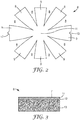
- Fig. 2 shows the heat reflective layer 6 in more detail.
- the heat reflective layer 6 has a general star-shape.
- the heat reflective layer 6 comprises a plurality of straps 9 which extend radially outwardly from a common center portion 11.
- the heat reflective layer 6 has a plurality of V-shaped recesses which separate the straps 9 from each other. This configuration allows for bending the heat reflective layer 6 into a dome-shape. Accordingly, the heat reflective layer 6 can be easily fitted into the dome-shape of different types of safety helmets.
- the balance between the size of the recesses 8 and the size of the straps 9 can be selected in accordance to the requirements resulting from a use of the safety helmet at a particular location and/or for a particular application. For example, for some applications a maximized infrared protection may be desired while ventilation may be of subordinate relevance, or vice versa.
- the heat reflective layer comprises a first indicator 12 and a second indicator 13, that indicate an orientation at which the reflective layer is to be mounted at the safety helmet.
- the first and second indicator 12, 13 have the shape of an arrow. Therefor a wearer can derive that the heat reflective layer 6 is to be oriented with the first indicator 12 toward the front of the safety helmet. (The front of the safety helmet is typically the side of the helmet at the wearer's face.)
- Fig. 3 shows a cross-section of a portion of the heat reflective layer 6.
- the heat reflective layer 6 has a metal layer 11, a substrate 12 and a carrier 13.
- the substrate 12 in the example is made of a polyester that is metallized (for example coated or sputtered) with an aluminum layer.
- the carrier 13 in the example is made of a non-woven material, in particular by a non-woven material made of polyester fibers.
- the carrier 13 in this example has a basis weight of a 500 grams per square meters and a thickness of 5 mm.
- the substrate 12 and the carrier 13 are laminated onto each other, with the heat reflective side 7 being arranged opposite of the carrier 13.
- Figures 4 illustrates a diagram of temperature measurements over time in an Example 1 and a Comparative Example as described in the following.
- the vertical axis of the diagram represents the temperatures in degrees Celsius and the horizontal axis represents the time in seconds.
- a safety helmet of the type 3MTM G3000 of white color was arranged on a dummy head.
- a first temperature sensor was arranged outside the protective shell of the safety helmet at a distance of about 10 mm above helmet shell and a second temperature sensor was arranged on the dummy head (within the protective shell of the safety helmet).
- An infrared lamp available under the designation Infralogic Walkermeister having a nominal power of 1000 W was arranged at a distance of about 400 mm from the outside of the protective shell.
- the infrared lamp was oriented to provide radiation on a center area of the protective shell and in a vertical direction (with respect to Fig. 1 from the top toward the bottom).
- the infrared lamp was adjusted in power so that the temperature sensed (in degrees Celsius) over time by the first temperature sensor stabilizes at about 37 °C.
- the temperature measured by the first temperature sensor is represented by the curve T1.
- the temperature measured over time by the second temperature sensor is represented by the curve T2. As shown the temperature measured by the second temperature sensor has reached about 44 °C after ap proximately 60 minutes.
- Example 1 was repeated with the same safety helmet as used in the Example 1, but with a heat reflective layer arranged between the inner side of the protective shell and the head of the dummy.
- the temperatures sensed over time by the first temperature sensor are represented by the curve T1*, whereas the temperatures sensed (in degrees Celsius) over time by the second temperature sensor are represented by the curve T2*.
- the temperature in the protective shell reached about 41 °C (instead of 44 °C) although the temperature on the outside of the protective shell (measured by the first temperature sensor) was essentially the same.
- the temperature on the dummy head after 60 minutes is 3 °C lower than with the safety helmet h aving no heat reflective layer.
Landscapes
- Helmets And Other Head Coverings (AREA)
Abstract
A safety helmet (1) having a generally dome-shaped protective shell (2) for protecting a wearer's head. The safety helmet comprises a heat reflective layer (6) that has a heat reflective side, (7), wherein the heat reflective layer is arranged with the heat reflective side facing an inner side (3) of the protective shell.
Description
- The invention relates to a safety helmet that has a heat reflective layer, a heat reflective accessory having the heat reflective layer and a method of retrofitting a safety helmet with a heat reflective layer.
- Safety helmets are typically used as head protection in different areas, like for example in constructions work zones. Various government agencies and industry organizations define certain requirements and standards for protective gear, including helmets and respirators. In the United States, for example, the National Institute of Occupational Safety and Health (NIOSH) certifies certain safety equipment for the workplace and the American National Standards Institute (ANSI) recommends voluntary consensus industry standards. There are further European Standards related to safety helmets, like for example EN 397. Other agencies and organizations around the world also establish safety standards for helmets and respirators. For safety helmets, some of these standards relate to impact energy attenuation, penetration resistance, force transmission, stiffness, flammability, and head coverage.
- To meet these safety requirements and standards, safety helmets usually comprise a rigid outer protective shell of plastic and a head suspension system inside the shell. The suspension system serves many purposes, including providing a proper fit of the helmet to the wearer's head, holding the inner part of the helmet away from the wearer's head, distributing the weight of the helmet over a larger area of the wearer's head, and attenuating the force transferred to the wearer's head upon impact of an object with the outer helmet shell. Suspension systems often comprise a headband attached to a crown support assembly which includes crisscrossing crown straps and a crown pad. In some applications, however, additional protection may be desired.
- While safety helmets can provide sun protection when worn under sunny weather conditions it is desirable to minimize heat building up inside the helmet. For minimizing heat inside the helmet there are for example safety helmets having a passive ventilation provided by openings in the protective shell.
- Further, for example
CN 203608892 U discloses a heat-preventing safety helmet for reducing sunshine temperature. The safety helmet comprises a safety helmet body and a heat-insulating device, wherein the heat-insulating device comprises a light-reflecting coating. The light-reflecting coating is uniformly coated on the outer surface of the safety helmet body or is arranged on a cover fabric on the outer surface of the safety helmet body. - Although existing safety helmets provide advantages with respect to heat minimizing there is still a desire for a relatively inexpensive solution which further fulfills the applicable safety standards.
- The invention relates in one aspect to a safety helmet. The safety helmet has a generally dome-shaped protective shell for protecting a wearer's head. The protective shell forms a head-facing inner side and an outer side. Further, the safety helmet comprises a heat reflective layer that has a heat reflective side. The heat reflective layer is arranged with the heat reflective side facing the inner side of the protective shell.
- The invention is advantageous in that it helps minimizing heat building up in the helmet when the helmet is exposed to heat or light radiation, for example to sunlight. The invention enables such heat minimization without altering the outer appearance, for example the color or shape of the outer side of the protection shell of the safety helmet. Further, the properties of the protection shell are not affected by providing the safety helmet with the heat reflective layer according to the invention. In particular, no electrically conductive layer or surface is created on the outer side of the protection shell. The invention is further advantageous in that it enables the retrofitting of an existing safety helmet by the heat reflective layer. Further, the invention allows to selectively change the configuration of the safety helmet according as desired by the user. For example the same helmet can be worn with or without the heat reflective layer by a simple changeover. The heat reflective layer may further form part of an exchangeable and disposable accessory.
- In one embodiment the heat reflective layer comprises a metal layer. Such a metal layer is preferably made of aluminum, but may further be made of other material like silver or gold. The metal layer may be provided in the form of a metallization on a substrate, for example may be provided as a coating, by sputter deposition or by electroplating. Alternatively, the metal layer may be provided in the form of a film or foil. The heat reflective layer may further comprise retroreflective elements, for example a layer of glass beads or a layer of cube corners. The glass beads, or a layer beneath the glass beads, may be metallized, for example with aluminum. Further, the cube corners may be metallized. The heat reflective layer may further comprise reflective pigments.
- In one embodiment the heat reflective layer is reflective at least within the infrared spectrum, preferably in a predominant range of the infrared spectrum, most preferably over the whole range of the infrared spectrum. The heat reflective layer may be reflective for infrared light within the range of a wavelength of 780 nm to 50 µm. Further, the heat reflective layer may in addition be reflective for visible light within the range of 380 nm to 750 nm. The infrared reflectance is preferably within the range of about 50% to about 100 %, more preferably within the range of about 85 % to about 100 %.
- In one embodiment the safety helmet comprises a carrier layer that carries the reflective layer. For example, the carrier and the reflective layer may form a laminate in which the carrier and the reflective layer are bonded to each other. In case a metal layer provided on a substrate is used the carrier and the substrate may form a laminate in which the metal layer and the substrate are bonded to each other by an adhesive.
- In one embodiment the carrier layer has thermally insulating properties. The carrier may comprise voids or air cells which provide the carrier with the thermally insulating properties. For example, the carrier may comprise a woven or non-woven fabric or a foamed material. Preferably the carrier has a specific weight of 500 grams per square meters at a thickness of 5 mm. The carrier may further have a thickness of between about 3 mm and about 30 mm, preferably between 3 mm and about 10 mm.
- In one embodiment the carrier comprises a phase change material (PCM). Phase Change Materials typically can store and release energy by absorbing or releasing heat. The Phase Change Material used with the present invention may be an inorganic Phase Change Materials, for example based on salt hydrates.
- In a preferred embodiment the safety helmet comprises a head suspension for retaining the safety helmet of a wearer's head. The head suspension typically has at least one headband and a plurality of head straps for supporting the head suspension on a wearer's head. The heat reflective layer is preferably arranged between the head suspension and the protective shell.
- In one embodiment the heat reflective layer is movably arranged between the head suspension and the inner side of the protective shell. Thus, when the safety helmet is worn, the heat reflective layer lies on the head suspension and/or the wearer's head and is spaced from the protective shell. Therefore, the heat reflective layer is hindered in being heated up by the protective shell by thermal conduction. This minimizes the risk that the heat reflective layer itself heats up and radiates heat toward the wearer's head. Although the heat reflective layer may at some areas touch the protective shell the predominant area of the heat reflective layer is spaced from the protective shell, when the safety helmet is worn by a wearer.
- In a further embodiment the heat reflective layer is entrapped or retained between the protective shell and the head suspension. This means that preferably the head suspension and the protective shell are attached to each other and through the attachment of the head suspension and the protective shell the heat reflective layer is entrapped. Consequently the heat reflective layer may not be attached to one the protective shell or the headband but may only be retained between. This facilitates retrofitting a safety helmet with the heat reflective layer. Typically the head suspension is removably attached to the protective shell. The heat reflective layer is thus also removably retained between the protective shell and the head suspension. This facilitates an exchange of the heat reflective layer, if desired.
- In one embodiment the protective shell is made of a polymeric material. In particular the polymeric material may be one (or a combination of) polyethylene (PE), polypropylene (PP), polycarbonate (PC), acrylonitrile butadiene styrene (ABS). The polymeric material may be fiber reinforced, for example glass-fiber reinforced. Other polymeric materials are possible.
- Preferably the heat reflective layer is provided as a heat reflection accessory. This means that the heat reflective layer may itself form the heat reflection accessory or the heat reflective layer together with further layers may form the heat reflection accessory.
- In one aspect the invention relates to the heat reflection accessory for a safety helmet. The heat reflection accessory comprises a heat reflective layer and is configured for forming a dome-shape. The configuration for forming the dome-shape may comprise the presence of a plurality of cutaways that enable bending the heat reflective layer toward a dome-shape. In a further embodiment the heat reflection accessory further comprises a carrier. The carrier may carry the reflective layer. This means that the carrier and the reflective layer may form a laminate as described herein.
- In a further embodiment the heat reflective layer comprises at least one of a metal layer, retroreflective elements and reflective pigments. Further embodiments of the heat reflective layer as described herein are possible.
- In one embodiment the heat reflection accessory forms a flat sheeting that has a center portion from which straps extend radially outwardly in a palmate-shaped or fan-shaped configuration. The straps are preferably separated by recesses or the cutaways. In particular, the heat reflective layer may correspond to (or essentially correspond to) in shape to a flat projection of a dome-shape. Such a flat projection of a dome shape can be bent to a dome shape without portions of the heat reflective layer overlapping or forming wrinkles.
- In one embodiment the heat reflection accessory has an indicator which indicates an orientation at which the reflective layer is to be arranged at the safety helmet. Thus, retrofitting of an existing helmet with the heat reflection accessory is enabled. The indicator may be formed by the shape of the heat reflective layer, for example by an arrow-shape structure extending from or cut into the heat reflective layer. The heat reflection accessory may further comprise a printed indicator for indicating orientation at which the reflective layer is to be arranged at the safety helmet. The indicator may indicate a rear-front direction of the heat reflective layer relative to the safety helmet and/or an inside-outside direction of the heat reflective layer relative to the safety helmet. The rear-front direction refers to a direction parallel to the back to the face of a wearer's head. And the inside-outside direction refers to a direction of the heat reflective layer with its heat reflective side facing the inner side of the protection shell or facing away from the inner side of the protection shell.
- In one embodiment the heat reflection accessory comprises printed information. The printed information may comprise a brand name, a designation, and/or one or more type of safety helmets for which the heat reflection accessory may be used. The printed information may further comprise instructions for retrofitting a safety helmet.
- In a further aspect the invention relates to a method of retrofitting a safety helmet with a heat reflective layer and/or a heat reflection accessory as described herein. The method comprises the steps of:
- providing a safety helmet having a generally dome-shaped protective shell for protecting a wearer's head, the protective shell forming a head-facing inner side and an outer side;
- providing a heat reflective layer that has a heat reflective side; and
- arranging the heat reflective layer with the heat reflective side facing the inner side of the protective shell.
- In one embodiment the method further comprises the steps of:
- providing a head suspension for retaining the safety helmet of a wearer's head; and
- attaching the head suspension in front of the inner side of the protective shell and thereby retaining the heat reflective layer between the protective shell and the head suspension.
- The method may further comprise the step of orienting the heat reflecting accessory relative to the helmet. Further method may comprise the steps of bending or folding the heat reflecting accessory toward a dome shape and placing the heat reflecting accessory in the protective shell.
-
- Fig. 1
- is an exploded view of a safety helmet according to an embodiment of the invention;
- Fig. 2
- is a top view of a heat reflective layer in the form of a heat reflective accessory according to an embodiment of the invention;
- Fig. 3
- is a cross-sectional view of a portion of a heat reflective layer in the form of a heat reflective accessory according to an embodiment of the invention; and
- Fig. 4
- is a diagram illustrating temperature measurements in a safety helmet with and without a heat reflective layer according to an embodiment of the invention.
-
Fig. 1 shows an exploded view of asafety helmet 1 according to the invention. Thesafety helmet 1 has aprotective shell 2. Theprotective shell 2 is generally dome-shaped and has a head-facinginner side 3 and anouter side 4. Theprotective shell 2 in the example has a plurality of venting holes 5. The protective shell is made of a polymer, in the example a high density polypropylene (HD-PE) or acrylonitrile butadiene styrene (ABS). - The
safety helmet 1 further comprises a heatreflective layer 6. The heatreflective layer 6 in the example is formed by a metal layer, in particular by an aluminum layer. - The reflective layer forms a heat
reflective side 7. The heatreflective side 7 is an exposed outer side of the heat reflective layer. Further, the heatreflective layer 6 is arranged with the heat reflective side facing theinner side 3 of theprotective shell 2. Thus, infrared radiation penetrating through theprotective shell 2 or generated through absorption of radiation by theprotective shell 2 is reflected back toward theprotective shell 2. The heatreflective layer 6 has a palmate-shaped or fan-shaped structure. In the example the heatreflective layer 6 forms a plurality ofstraps 9 which extend radially outwardly and a plurality ofrecesses 8 between thestraps 9. Therecesses 8 make the heatreflective layer 6 air permeable. Thus, ventilation through the heatreflective layer 6 is enabled. - The
safety helmet 1 further comprises ahead suspension 10. Thehead suspension 10 allows a wearer to wear thesafety helmet 1 and to retain thesafety helmet 1 on the wearer's head. Further, thehead suspension 10 provides for distributing any forces that may act upon thesafety helmet 1. Thereflective layer 6 is arranged between thehead suspension 10 and theprotective shell 2. In particular, the heatreflective layer 6 is retained between thehead suspension 10 and theprotective shell 2. In the example, the heatreflective layer 6 is locked-in in a space between thehead suspension 10 and theprotective shell 2. The heatreflective layer 6 is prevented from falling out by fasteners which fix thehead suspension 10 and the protective shell. -
Fig. 2 shows the heatreflective layer 6 in more detail. The heatreflective layer 6 has a general star-shape. In particular, the heatreflective layer 6 comprises a plurality ofstraps 9 which extend radially outwardly from acommon center portion 11. Further, the heatreflective layer 6 has a plurality of V-shaped recesses which separate thestraps 9 from each other. This configuration allows for bending the heatreflective layer 6 into a dome-shape. Accordingly, the heatreflective layer 6 can be easily fitted into the dome-shape of different types of safety helmets. - The balance between the size of the
recesses 8 and the size of thestraps 9 can be selected in accordance to the requirements resulting from a use of the safety helmet at a particular location and/or for a particular application. For example, for some applications a maximized infrared protection may be desired while ventilation may be of subordinate relevance, or vice versa. - In the example the heat reflective layer comprises a
first indicator 12 and asecond indicator 13, that indicate an orientation at which the reflective layer is to be mounted at the safety helmet. The first andsecond indicator reflective layer 6 is to be oriented with thefirst indicator 12 toward the front of the safety helmet. (The front of the safety helmet is typically the side of the helmet at the wearer's face.) -
Fig. 3 shows a cross-section of a portion of the heatreflective layer 6. The heatreflective layer 6 has ametal layer 11, asubstrate 12 and acarrier 13. Thesubstrate 12 in the example is made of a polyester that is metallized (for example coated or sputtered) with an aluminum layer. Thecarrier 13 in the example is made of a non-woven material, in particular by a non-woven material made of polyester fibers. Thecarrier 13 in this example has a basis weight of a 500 grams per square meters and a thickness of 5 mm. Thesubstrate 12 and thecarrier 13 are laminated onto each other, with the heatreflective side 7 being arranged opposite of thecarrier 13. -
Figures 4 illustrates a diagram of temperature measurements over time in an Example 1 and a Comparative Example as described in the following. The vertical axis of the diagram represents the temperatures in degrees Celsius and the horizontal axis represents the time in seconds. - A safety helmet of the type 3M™ G3000 of white color was arranged on a dummy head. A first temperature sensor was arranged outside the protective shell of the safety helmet at a distance of about 10 mm above helmet shell and a second temperature sensor was arranged on the dummy head (within the protective shell of the safety helmet).
- An infrared lamp available under the designation Infralogic Heizmeister having a nominal power of 1000 W was arranged at a distance of about 400 mm from the outside of the protective shell. The infrared lamp was oriented to provide radiation on a center area of the protective shell and in a vertical direction (with respect to
Fig. 1 from the top toward the bottom). The infrared lamp was adjusted in power so that the temperature sensed (in degrees Celsius) over time by the first temperature sensor stabilizes at about 37 °C. The temperature measured by the first temperature sensor is represented by the curve T1. - Further, the temperature measured over time by the second temperature sensor is represented by the curve T2. As shown the temperature measured by the second temperature sensor has reached about 44 °C after ap proximately 60 minutes.
- The Example 1 was repeated with the same safety helmet as used in the Example 1, but with a heat reflective layer arranged between the inner side of the protective shell and the head of the dummy.
- The temperatures sensed over time by the first temperature sensor are represented by the curve T1*, whereas the temperatures sensed (in degrees Celsius) over time by the second temperature sensor are represented by the curve T2*.
- After approximately 60 minutes the temperature in the protective shell reached about 41 °C (instead of 44 °C) although the temperature on the outside of the protective shell (measured by the first temperature sensor) was essentially the same.
- Accordingly, with the helmet of the invention the temperature on the dummy head after 60 minutes is 3 °C lower than with the safety helmet h aving no heat reflective layer.
Claims (15)
- A safety helmet having a generally dome-shaped protective shell for protecting a wearer's head, the protective shell forming a head-facing inner side and an outer side, wherein the safety helmet comprises a heat reflective layer that has a heat reflective side, wherein the heat reflective layer is arranged with the heat reflective side facing the inner side of the protective shell.
- The safety helmet of claim 1, wherein the heat reflective layer comprises at least one of a metal layer, retroreflective elements and reflective pigments.
- The safety helmet of claim 2, wherein the heat reflective layer is infrared reflective with the infrared reflectance being within the range of about 50% to about 100%.
- The safety helmet of any of the preceding claims, comprising a carrier layer that carries the reflective layer.
- The safety helmet of claim 4, wherein the carrier layer has thermally insulating properties.
- The safety helmet of claim 4 or 5, wherein the carrier comprises a phase change material (PCM).
- The safety helmet of any of the preceding claims, comprising a head suspension for retaining the safety helmet of a wearer's head, wherein the heat reflective layer is arranged between the head suspension and the protective shell.
- The safety helmet of claim 1, wherein the protective shell is made of a polymeric material.
- A heat reflection accessory for a safety helmet, comprising an heat reflective layer and being configured for forming a dome-shape.
- The heat reflection accessory of claim 9, further comprising a carrier which carries the reflective layer.
- The heat reflection accessory of claim 9 or 10, wherein the heat reflective layer comprises at least one of a metal layer, retroreflective elements and reflective pigments.
- The heat reflection accessory, forming a flat sheeting that has a center portion from which straps extend radially outwardly in a palmate-shaped or fan-shaped configuration.
- The heat reflection accessory of claim 12, having an indicator which indicates an orientation at which the reflective layer is to be arranged at the safety helmet.
- A method of retrofitting a safety helmet with an heat reflective layer, the method comprising the steps of:- providing a safety helmet having a generally dome-shaped protective shell for protecting a wearer's head, the protective shell forming a head-facing inner side and an outer side;- providing a heat reflective layer that has a heat reflective side; and- arranging the heat reflective layer with the heat reflective side facing the inner side of the protective shell.
- The method of claim 14, further comprising the steps of:- providing a head suspension for retaining the safety helmet of a wearer's head; and- attaching the head suspension in front of the inner side of the protective shell and thereby retaining the heat reflective layer between the protective shell and the head suspension.
Priority Applications (1)
| Application Number | Priority Date | Filing Date | Title |
|---|---|---|---|
| EP16201052.4A EP3326478A1 (en) | 2016-11-29 | 2016-11-29 | A safety helmet, a heat reflective accessory and a method of retrofitting a safety helmet |
Applications Claiming Priority (1)
| Application Number | Priority Date | Filing Date | Title |
|---|---|---|---|
| EP16201052.4A EP3326478A1 (en) | 2016-11-29 | 2016-11-29 | A safety helmet, a heat reflective accessory and a method of retrofitting a safety helmet |
Publications (1)
| Publication Number | Publication Date |
|---|---|
| EP3326478A1 true EP3326478A1 (en) | 2018-05-30 |
Family
ID=57442499
Family Applications (1)
| Application Number | Title | Priority Date | Filing Date |
|---|---|---|---|
| EP16201052.4A Withdrawn EP3326478A1 (en) | 2016-11-29 | 2016-11-29 | A safety helmet, a heat reflective accessory and a method of retrofitting a safety helmet |
Country Status (1)
| Country | Link |
|---|---|
| EP (1) | EP3326478A1 (en) |
Cited By (4)
| Publication number | Priority date | Publication date | Assignee | Title |
|---|---|---|---|---|
| WO2020134401A1 (en) * | 2018-12-25 | 2020-07-02 | 深圳光启高端装备技术研发有限公司 | Temperature-reducing foam liner |
| US20210212406A1 (en) * | 2020-01-13 | 2021-07-15 | Msa Technology, Llc | Safety helmet |
| IT202200010574A1 (en) * | 2022-05-23 | 2023-11-23 | Thi Total Healthcare Innovation S R L | SURGICAL HELMET INCLUDING A COOLING PADDING |
| DE102024116496A1 (en) * | 2024-06-12 | 2025-12-18 | Technische Universität Chemnitz, Körperschaft des öffentlichen Rechts | Device for reducing thermal stress and regulating the microclimate in a protective helmet and protective helmet equipped with the device |
Citations (6)
| Publication number | Priority date | Publication date | Assignee | Title |
|---|---|---|---|---|
| US4619003A (en) * | 1985-11-25 | 1986-10-28 | Bell Helmets Inc. | Insulated helmet |
| US4912778A (en) * | 1989-04-07 | 1990-04-03 | Darleen Daniels | Heat reflective skull cap shield for use in hard hats |
| JP2007119949A (en) * | 2005-10-28 | 2007-05-17 | Yukitomo Kurita | Multilayered heat-shielding sheet and helmet equipped with the same |
| JP2011256505A (en) * | 2010-06-11 | 2011-12-22 | Shinsei:Kk | Helmet device |
| CN203608892U (en) | 2013-12-23 | 2014-05-28 | 曹玮 | Heat-preventing safety helmet for reducing sunshine temperature |
| WO2016135529A1 (en) * | 2015-02-24 | 2016-09-01 | Aspire Zone Foundation | Protective headgear comprising temperature control apparatus |
-
2016
- 2016-11-29 EP EP16201052.4A patent/EP3326478A1/en not_active Withdrawn
Patent Citations (6)
| Publication number | Priority date | Publication date | Assignee | Title |
|---|---|---|---|---|
| US4619003A (en) * | 1985-11-25 | 1986-10-28 | Bell Helmets Inc. | Insulated helmet |
| US4912778A (en) * | 1989-04-07 | 1990-04-03 | Darleen Daniels | Heat reflective skull cap shield for use in hard hats |
| JP2007119949A (en) * | 2005-10-28 | 2007-05-17 | Yukitomo Kurita | Multilayered heat-shielding sheet and helmet equipped with the same |
| JP2011256505A (en) * | 2010-06-11 | 2011-12-22 | Shinsei:Kk | Helmet device |
| CN203608892U (en) | 2013-12-23 | 2014-05-28 | 曹玮 | Heat-preventing safety helmet for reducing sunshine temperature |
| WO2016135529A1 (en) * | 2015-02-24 | 2016-09-01 | Aspire Zone Foundation | Protective headgear comprising temperature control apparatus |
Cited By (10)
| Publication number | Priority date | Publication date | Assignee | Title |
|---|---|---|---|---|
| WO2020134401A1 (en) * | 2018-12-25 | 2020-07-02 | 深圳光启高端装备技术研发有限公司 | Temperature-reducing foam liner |
| US20210212406A1 (en) * | 2020-01-13 | 2021-07-15 | Msa Technology, Llc | Safety helmet |
| WO2021146253A1 (en) | 2020-01-13 | 2021-07-22 | Msa Technology, Llc | Safety helmet |
| CN115135192A (en) * | 2020-01-13 | 2022-09-30 | Msa技术有限公司 | Safety helmet |
| EP4090192A4 (en) * | 2020-01-13 | 2024-01-31 | MSA Technology, LLC | Safety helmet |
| US12011057B2 (en) | 2020-01-13 | 2024-06-18 | Msa Technology, Llc | Safety helmet |
| US12514323B2 (en) | 2020-01-13 | 2026-01-06 | Msa Technology, Llc | Safety helmet |
| CN115135192B (en) * | 2020-01-13 | 2026-03-24 | Msa技术有限公司 | Safety helmet |
| IT202200010574A1 (en) * | 2022-05-23 | 2023-11-23 | Thi Total Healthcare Innovation S R L | SURGICAL HELMET INCLUDING A COOLING PADDING |
| DE102024116496A1 (en) * | 2024-06-12 | 2025-12-18 | Technische Universität Chemnitz, Körperschaft des öffentlichen Rechts | Device for reducing thermal stress and regulating the microclimate in a protective helmet and protective helmet equipped with the device |
Similar Documents
| Publication | Publication Date | Title |
|---|---|---|
| EP3326478A1 (en) | A safety helmet, a heat reflective accessory and a method of retrofitting a safety helmet | |
| US9215904B2 (en) | Helmet having magnetically coupled cheek pads | |
| EP3261473B1 (en) | Protective headgear comprising temperature control apparatus | |
| EP1906779B1 (en) | Protective padding systems | |
| US6070271A (en) | Protective helmet | |
| AU716661B2 (en) | Flexible helmet | |
| US20110239346A1 (en) | Microclimate System for Protective Body Armor | |
| EP3080648B1 (en) | Retroreflective article | |
| CA2926979C (en) | Protective helmet | |
| JP2019523855A (en) | Bulletproof protective layer for helmet pad system | |
| US20160278467A1 (en) | Safety Helmet | |
| US20210378344A1 (en) | Protective equipment | |
| CA2639691A1 (en) | Helmet mounted eye protectors with deployable eye shields | |
| KR20170037191A (en) | Heat insulation sheet | |
| GB2342278A (en) | Protective Garment | |
| JP3222405U (en) | Heat shield structure of helmet | |
| CN210611140U (en) | High-temperature-resistant fire-fighting helmet | |
| KR101640433B1 (en) | A Heat insulation clothes | |
| JP3235505U (en) | A cover member and a cap body having a cover member | |
| US20110016612A1 (en) | No sweat | |
| JP3237909U (en) | Heat shield | |
| JP2010095828A (en) | Shock-absorbing liner and helmet with the same | |
| WO2024081236A1 (en) | Protective helmet | |
| CN219920399U (en) | Fireproof safety helmet | |
| JP3240258U (en) | Clothing |
Legal Events
| Date | Code | Title | Description |
|---|---|---|---|
| PUAI | Public reference made under article 153(3) epc to a published international application that has entered the european phase |
Free format text: ORIGINAL CODE: 0009012 |
|
| AK | Designated contracting states |
Kind code of ref document: A1 Designated state(s): AL AT BE BG CH CY CZ DE DK EE ES FI FR GB GR HR HU IE IS IT LI LT LU LV MC MK MT NL NO PL PT RO RS SE SI SK SM TR |
|
| AX | Request for extension of the european patent |
Extension state: BA ME |
|
| STAA | Information on the status of an ep patent application or granted ep patent |
Free format text: STATUS: THE APPLICATION IS DEEMED TO BE WITHDRAWN |
|
| 18D | Application deemed to be withdrawn |
Effective date: 20181201 |