EP3323900A1 - Aluminum alloy brazing sheet - Google Patents
Aluminum alloy brazing sheet Download PDFInfo
- Publication number
- EP3323900A1 EP3323900A1 EP16824267.5A EP16824267A EP3323900A1 EP 3323900 A1 EP3323900 A1 EP 3323900A1 EP 16824267 A EP16824267 A EP 16824267A EP 3323900 A1 EP3323900 A1 EP 3323900A1
- Authority
- EP
- European Patent Office
- Prior art keywords
- brazing
- core
- intermediate material
- core material
- aluminum alloy
- Prior art date
- Legal status (The legal status is an assumption and is not a legal conclusion. Google has not performed a legal analysis and makes no representation as to the accuracy of the status listed.)
- Granted
Links
Images
Classifications
-
- B—PERFORMING OPERATIONS; TRANSPORTING
- B23—MACHINE TOOLS; METAL-WORKING NOT OTHERWISE PROVIDED FOR
- B23K—SOLDERING OR UNSOLDERING; WELDING; CLADDING OR PLATING BY SOLDERING OR WELDING; CUTTING BY APPLYING HEAT LOCALLY, e.g. FLAME CUTTING; WORKING BY LASER BEAM
- B23K35/00—Rods, electrodes, materials, or media, for use in soldering, welding, or cutting
- B23K35/22—Rods, electrodes, materials, or media, for use in soldering, welding, or cutting characterised by the composition or nature of the material
- B23K35/24—Selection of soldering or welding materials proper
- B23K35/28—Selection of soldering or welding materials proper with the principal constituent melting at less than 950°C
- B23K35/286—Al as the principal constituent
- B23K35/288—Al as the principal constituent with Sn or Zn
-
- B—PERFORMING OPERATIONS; TRANSPORTING
- B23—MACHINE TOOLS; METAL-WORKING NOT OTHERWISE PROVIDED FOR
- B23K—SOLDERING OR UNSOLDERING; WELDING; CLADDING OR PLATING BY SOLDERING OR WELDING; CUTTING BY APPLYING HEAT LOCALLY, e.g. FLAME CUTTING; WORKING BY LASER BEAM
- B23K35/00—Rods, electrodes, materials, or media, for use in soldering, welding, or cutting
- B23K35/02—Rods, electrodes, materials, or media, for use in soldering, welding, or cutting characterised by mechanical features, e.g. shape
- B23K35/0222—Rods, electrodes, materials, or media, for use in soldering, welding, or cutting characterised by mechanical features, e.g. shape for use in soldering or brazing
- B23K35/0233—Sheets or foils
- B23K35/0238—Sheets or foils layered
-
- B—PERFORMING OPERATIONS; TRANSPORTING
- B23—MACHINE TOOLS; METAL-WORKING NOT OTHERWISE PROVIDED FOR
- B23K—SOLDERING OR UNSOLDERING; WELDING; CLADDING OR PLATING BY SOLDERING OR WELDING; CUTTING BY APPLYING HEAT LOCALLY, e.g. FLAME CUTTING; WORKING BY LASER BEAM
- B23K35/00—Rods, electrodes, materials, or media, for use in soldering, welding, or cutting
- B23K35/22—Rods, electrodes, materials, or media, for use in soldering, welding, or cutting characterised by the composition or nature of the material
-
- B—PERFORMING OPERATIONS; TRANSPORTING
- B23—MACHINE TOOLS; METAL-WORKING NOT OTHERWISE PROVIDED FOR
- B23K—SOLDERING OR UNSOLDERING; WELDING; CLADDING OR PLATING BY SOLDERING OR WELDING; CUTTING BY APPLYING HEAT LOCALLY, e.g. FLAME CUTTING; WORKING BY LASER BEAM
- B23K35/00—Rods, electrodes, materials, or media, for use in soldering, welding, or cutting
- B23K35/22—Rods, electrodes, materials, or media, for use in soldering, welding, or cutting characterised by the composition or nature of the material
- B23K35/24—Selection of soldering or welding materials proper
- B23K35/28—Selection of soldering or welding materials proper with the principal constituent melting at less than 950°C
-
- B—PERFORMING OPERATIONS; TRANSPORTING
- B32—LAYERED PRODUCTS
- B32B—LAYERED PRODUCTS, i.e. PRODUCTS BUILT-UP OF STRATA OF FLAT OR NON-FLAT, e.g. CELLULAR OR HONEYCOMB, FORM
- B32B15/00—Layered products comprising a layer of metal
- B32B15/01—Layered products comprising a layer of metal all layers being exclusively metallic
- B32B15/016—Layered products comprising a layer of metal all layers being exclusively metallic all layers being formed of aluminium or aluminium alloys
-
- C—CHEMISTRY; METALLURGY
- C22—METALLURGY; FERROUS OR NON-FERROUS ALLOYS; TREATMENT OF ALLOYS OR NON-FERROUS METALS
- C22C—ALLOYS
- C22C21/00—Alloys based on aluminium
-
- C—CHEMISTRY; METALLURGY
- C22—METALLURGY; FERROUS OR NON-FERROUS ALLOYS; TREATMENT OF ALLOYS OR NON-FERROUS METALS
- C22C—ALLOYS
- C22C21/00—Alloys based on aluminium
- C22C21/02—Alloys based on aluminium with silicon as the next major constituent
-
- F—MECHANICAL ENGINEERING; LIGHTING; HEATING; WEAPONS; BLASTING
- F28—HEAT EXCHANGE IN GENERAL
- F28F—DETAILS OF HEAT-EXCHANGE AND HEAT-TRANSFER APPARATUS, OF GENERAL APPLICATION
- F28F21/00—Constructions of heat-exchange apparatus characterised by the selection of particular materials
- F28F21/08—Constructions of heat-exchange apparatus characterised by the selection of particular materials of metal
- F28F21/089—Coatings, claddings or bonding layers made from metals or metal alloys
-
- B—PERFORMING OPERATIONS; TRANSPORTING
- B23—MACHINE TOOLS; METAL-WORKING NOT OTHERWISE PROVIDED FOR
- B23K—SOLDERING OR UNSOLDERING; WELDING; CLADDING OR PLATING BY SOLDERING OR WELDING; CUTTING BY APPLYING HEAT LOCALLY, e.g. FLAME CUTTING; WORKING BY LASER BEAM
- B23K2101/00—Articles made by soldering, welding or cutting
- B23K2101/04—Tubular or hollow articles
- B23K2101/14—Heat exchangers
-
- F—MECHANICAL ENGINEERING; LIGHTING; HEATING; WEAPONS; BLASTING
- F28—HEAT EXCHANGE IN GENERAL
- F28F—DETAILS OF HEAT-EXCHANGE AND HEAT-TRANSFER APPARATUS, OF GENERAL APPLICATION
- F28F1/00—Tubular elements; Assemblies of tubular elements
- F28F1/02—Tubular elements of cross-section which is non-circular
-
- F—MECHANICAL ENGINEERING; LIGHTING; HEATING; WEAPONS; BLASTING
- F28—HEAT EXCHANGE IN GENERAL
- F28F—DETAILS OF HEAT-EXCHANGE AND HEAT-TRANSFER APPARATUS, OF GENERAL APPLICATION
- F28F21/00—Constructions of heat-exchange apparatus characterised by the selection of particular materials
- F28F21/08—Constructions of heat-exchange apparatus characterised by the selection of particular materials of metal
- F28F21/081—Heat exchange elements made from metals or metal alloys
- F28F21/084—Heat exchange elements made from metals or metal alloys from aluminium or aluminium alloys
-
- F—MECHANICAL ENGINEERING; LIGHTING; HEATING; WEAPONS; BLASTING
- F28—HEAT EXCHANGE IN GENERAL
- F28F—DETAILS OF HEAT-EXCHANGE AND HEAT-TRANSFER APPARATUS, OF GENERAL APPLICATION
- F28F3/00—Plate-like or laminated elements; Assemblies of plate-like or laminated elements
- F28F3/02—Elements or assemblies thereof with means for increasing heat-transfer area, e.g. with fins, with recesses, with corrugations
- F28F3/025—Elements or assemblies thereof with means for increasing heat-transfer area, e.g. with fins, with recesses, with corrugations the means being corrugated, plate-like elements
-
- Y—GENERAL TAGGING OF NEW TECHNOLOGICAL DEVELOPMENTS; GENERAL TAGGING OF CROSS-SECTIONAL TECHNOLOGIES SPANNING OVER SEVERAL SECTIONS OF THE IPC; TECHNICAL SUBJECTS COVERED BY FORMER USPC CROSS-REFERENCE ART COLLECTIONS [XRACs] AND DIGESTS
- Y10—TECHNICAL SUBJECTS COVERED BY FORMER USPC
- Y10T—TECHNICAL SUBJECTS COVERED BY FORMER US CLASSIFICATION
- Y10T428/00—Stock material or miscellaneous articles
- Y10T428/12—All metal or with adjacent metals
- Y10T428/12493—Composite; i.e., plural, adjacent, spatially distinct metal components [e.g., layers, joint, etc.]
- Y10T428/12736—Al-base component
- Y10T428/12764—Next to Al-base component
Definitions
- the present invention relates to an aluminum alloy brazing sheet used for brazing aluminum, without using a flux, in an inert gas atmosphere or a vacuum.
- Brazing is widely used as a method for jointing aluminum products including a number of fine jointing portions, such as aluminum heat exchangers and mechanical components. Brazing aluminum requires breaking an oxide film covering the surface, and bring the molten brazing material into contact with base metal or brazing material molten in the same manner. Methods for breaking an oxide film are broadly classified into a method of using a flux and a method of heating the oxide film in vacuum, and both of them are put to practical use.
- brazing An application range of brazing is wide, and the most typical example is a heat exchanger for vehicles. Most of heat exchangers for vehicles, such as radiators, heaters, condensers, and evaporators, are made of aluminum, and most of them are manufactured by brazing. Among brazing methods, a method of applying a noncorrosive flux and heating it in a nitrogen gas atmosphere occupies the majority part of the methods at present.
- various methods have been presented as a method of enabling brazing, without using a flux, in an inert gas atmosphere, by diffusing Mg into a brazing material during brazing heating.
- the methods include a method of diffusing Mg added to the core material into the brazing material, and a method of diffusing Mg added to the sacrificial anode material disposed between the core material and the brazing material into the brazing material. These methods prevent formation of an oxide film on the surface of the brazing material in manufacturing of a clad material or during brazing heating, and Mg effectively acts on destruction of the oxide film on the surface of the brazing film.
- Bi has a low melting point (approximately 270°C) and is hardly dissolved in aluminum.
- Bi scattered in a state of a substantially pure substance is molten, to adsorb oxygen and form a thick Bi-based oxide film, and deteriorates the brazing properties. Reducing the Bi quantity in the brazing material can be one way to suppress it, but causes failure in full achievement of the effect of Bi.
- the present invention has been made to solve the above problem in the case of brazing aluminum without using a flux in an inert gas atmosphere, such as a nitrogen gas atmosphere, or in vacuum.
- An object of the present invention is to provide an aluminum alloy brazing sheet enabling excellent brazing properties by promptly supplying Bi and Mg into the brazing material during brazing heating, causing these elements to be eluted in the molten brazing material after start of melting the brazing material, and effectively embrittling the oxide film on the surface of the brazing material.
- An aluminum alloy brazing sheet is a brazing sheet used for brazing aluminum, without using a flux, in an inert gas atmosphere or vacuum, and formed by arranging a brazing material on one side or both sides of a core material made of pure aluminum or aluminum alloy, the brazing material including 6% to 13% of Si and the balance being Al and inevitable impurities, and performing cladding with an intermediate material interposed between the core material and the brazing material, the intermediate material including 0.01% to 1.5% of Bi, 1.5% to 13% of Si, and the balance being Al and inevitable impurities, the intermediate material having a thickness of 2% to 35% of a thickness of the brazing material, wherein one or both of the intermediate material and the core material includes 0.4% to 6% of Mg.
- all the alloy components are expressed with % by mass.
- An aluminum alloy brazing sheet is a brazing sheet used for brazing aluminum, without using a flux, in an inert gas atmosphere or vacuum, and formed by arranging a brazing material on one side or both sides of a core material made of pure aluminum or aluminum alloy, the brazing material including 6% to 13% of Si and the balance being Al and inevitable impurities, and performing cladding with an intermediate material and a sacrificial anode material interposed between the core material and the brazing material such that the materials are arranged in an order of the core material, the sacrificial anode material, the intermediate material, and the brazing material, the intermediate material including 0.01% to 1.5% of Bi, 1.5% to 13% of Si, and the balance being Al and inevitable impurities, the sacrificial anode material including 0.9% to 6% of Zn and the balance being Al and inevitable impurities, the intermediate material having a thickness of 2% to 35% of a thickness of the brazing material, wherein at least one of the intermediate material, the
- An aluminum alloy brazing sheet is a brazing sheet used for brazing aluminum, without using a flux, in an inert gas atmosphere or vacuum, and formed by arranging a brazing material on one side of a core material made of pure aluminum or aluminum alloy, the brazing material including 6% to 13% of Si and the balance being Al and inevitable impurities, arranging a sacrificial anode material on the other side of the core material, the sacrificial anode material including 0.9% to 6% of Zn and the balance being Al and inevitable impurities, and performing cladding with an intermediate material interposed between the core material and the brazing material, the intermediate material including 0.01% to 1.5% of Bi, 1.5% to 13% of Si, and the balance being Al and inevitable impurities, the intermediate material having a thickness of 2% to 35% of a thickness of the brazing material, wherein one or both of the intermediate material and the core material includes 0.4% to 6% of Mg.
- An aluminum alloy brazing sheet according to claim 4 is the brazing sheet according to any one of claims 1 to 3, wherein the core material of the aluminum alloy includes at least one of 1.8% or less of Mn, 1.2% or less of Si, 1.0% or less of Fe, 1.5% or less of Cu, 0.8% or less of Zn, 0.2% or less of Ti, and 0.5% or less of Zr, and the balance being Al and inevitable impurities.
- An aluminum alloy brazing sheet according to claim 5 is the brazing sheet according to any one of claims 1 to 4, wherein the intermediate material further includes at least one of 6% or less of Cu and 6% or less of Zn.
- the present invention provides an aluminum alloy brazing sheet enabling excellent brazing properties by promptly supplying Bi and Mg into the brazing material during brazing heating, causing these elements to be eluted in the molten brazing material after start of melting the brazing material, and effectively embrittling the oxide film on the surface of the brazing material.
- a first embodiment of an aluminum alloy brazing sheet according to the present invention is a brazing sheet used for brazing aluminum, without using a flux, in an inert gas atmosphere or vacuum, and formed by arranging a brazing material on one side or both sides of a core material made of pure aluminum or aluminum alloy, the brazing material including 6% to 13% of Si and the balance being Al and inevitable impurities, and performing cladding with an intermediate material interposed between the core material and the brazing material, the intermediate material including 0.01% to 1.5% of Bi, 1.5% to 13% of Si, and the balance being Al and inevitable impurities, the intermediate material having a thickness of 2% to 35% of a thickness of the brazing material, wherein one or both of the intermediate material and the core material includes 0.4% to 6% of Mg.
- a second embodiment is a brazing sheet used for brazing aluminum, without using a flux, in an inert gas atmosphere or vacuum, and formed by arranging a brazing material on one side or both sides of a core material made of pure aluminum or aluminum alloy, the brazing material including 6% to 13% of Si and the balance being Al and inevitable impurities, and performing cladding with an intermediate material and a sacrificial anode material interposed between the core material and the brazing material such that the materials are arranged in an order of the core material, the sacrificial anode material, the intermediate material, and the brazing material, the intermediate material including 0.01% to 1.5% of Bi, 1.5% to 13% of Si, and the balance being Al and inevitable impurities, the sacrificial anode material including 0.9% to 6% of Zn and the balance being Al and inevitable impurities, the intermediate material having a thickness of 2% to 35% of a thickness of the brazing material, wherein at least one of the intermediate material, the sacrificial ano
- a third embodiment is a brazing sheet used for brazing aluminum, without using a flux, in an inert gas atmosphere or vacuum, and formed by arranging a brazing material on one side of a core material made of pure aluminum or aluminum alloy, the brazing material including 6% to 13% of Si and the balance being Al and inevitable impurities, arranging a sacrificial anode material on the other side of the core material, the sacrificial anode material including 0.9% to 6% of Zn and the balance being Al and inevitable impurities, and performing cladding with an intermediate material interposed between the core material and the brazing material, the intermediate material including 0.01% to 1.5% of Bi, 1.5% to 13% of Si, and the balance being Al and inevitable impurities, the intermediate material having a thickness of 2% to 35% of a thickness of the brazing material, wherein one or both of the intermediate material and the core material includes 0.4% to 6% of Mg.
- the core material is preferably pure aluminum, or aluminum alloy including at least one of 1.8% or less of Mn, 1.2% or less of Si, 1.0% or less of Fe, 1.5% or less of Cu, 0.8% or less of Zn, 0.2% or less of Ti, and 0.5% or less of Zr, and the balance being Al and inevitable impurities.
- the core material preferably includes 0.4% to 6% of Mg.
- Mn effectively functions to improve the strength and regulate the potential.
- a preferable content of Mn is 1.8% or less, and a content exceeding 1.8% causes easy occurrence of crack in rolling of the material.
- a more preferable content range is 0.3% to 1.8%.
- a content less than 0.3% has difficulty in obtaining a sufficient effect of improving the strength.
- Si effectively functions to improve the strength.
- a preferable content of Si is 1.2% or less.
- a content exceeding 1.2% decreases the melting point, causes local melting in brazing, and may cause deformation of the core material to decrease the corrosion resistance.
- a more preferable lower limit value of the Si content to enhance the strength is 0.3%.
- a preferable content of Fe is 1.0% or less.
- a content exceeding 1.0% decreases the corrosion resistance, and causes easy occurrence of huge deposits.
- a more preferable lower limit value of the Fe content to enhance the strength is 0.2%.
- a preferable content of Cu is 1.5% or less. A content exceeding 1.5% is not preferable, because it causes easy occurrence of intergranular corrosion, and decreases the melting point. A more preferable lower limit value of the Cu content to enhance the strength is 0.2%.
- Zn effectively functions to regulate the potential.
- a preferable content of Zn is 0.8% or less.
- a content exceeding 0.8% decreases the natural electrode potential, and shortens through-life due to corrosion.
- a more preferable lower limit value of the Zn content to regulate the potential is 0.1%.
- Ti effectively functions to advance corrosion in a layered manner.
- a preferable content of Ti is 0.2% or less.
- a content exceeding 0.2% causes easy occurrence of huge deposits, and impedes rolling properties and corrosion resistance.
- a more preferable lower limit value of the Ti content to advance layered corrosion is 0.06%.
- Zr effectively functions to increase the crystal grain size.
- a preferable content of Zr is 0.5% or less.
- a content of Zr exceeding 0.5% causes easy occurrence of crack in manufacturing of the material.
- a more preferable lower limit value of the Zr content to increase the crystal grain size is 0.2%.
- the brazing material is an ordinary Al-Si brazing material, and the Si quantity thereof is set to 6% to 13%.
- a Si content less than 6% fails to achieve sufficient jointing properties.
- a Si content exceeding 13% causes easy occurrence of crack in manufacturing of the material, and causes difficulty in manufacturing of the brazing sheet.
- Bi included in the intermediate material interposed between the core material and the brazing material promotes destruction of an oxide film with Mg supplied from the intermediate material and/or the core material to the brazing material in brazing heating, to improve the brazing properties.
- the intermediate material functions to supply these elements to the brazing material.
- a preferable content of Bi included in the intermediate material is 0.01% to 1.5%.
- a Bi content less than 0.01% causes deficiency of Bi eluted to the brazing material, and causes difficulty in achieving the function to break an oxide film on the surface of the brazing material.
- a Bi content exceeding 1.5% causes easy occurrence of crack in rolling of the material, and causes difficulty in manufacturing of the brazing sheet.
- a more preferable content of Bi is 0.1% to 1.5%.
- Bi included in the intermediate material promotes the function to break the oxide film, with Mg supplied from the intermediate material and/or the core material to the brazing material in brazing heating, to effectively improve the brazing properties.
- Bi exceeding 0.05% is directly added to the brazing material, a thick Bi-based oxide is formed at the stage of manufacturing the material and/or during brazing heating.
- the thick Bi-based oxide is accompanied by discoloration, and markedly deteriorates brazing properties. For this reason, addition of Bi requires pretreatment before brazing, and a low-oxygen atmosphere.
- Bi is hardly solid-diffused in aluminum.
- Bi is not supplied into the brazing material and no Bi-based oxide is formed.
- Bi can be supplied with a quantity that is not effective when it is directly added to the brazing material, and effectively promotes the function of destroying an oxide film with Mg in the surface of the brazing material. Accordingly, excellent brazing properties can be achieved, without pretreatment before brazing or low-oxygen concentration atmosphere.
- Bi of 0.05% or less may be added to the brazing material, as well as addition of Bi to the intermediate material.
- Si included in the intermediate material promotes dissolution of the intermediate material with the molten brazing material during brazing heating, and causes the intermediate material itself to be molten, to cause active and efficient supply of Mg and Bi to the molten brazing material.
- the intermediate material itself can also function as brazing material.
- a preferable Si content in the intermediate material is 1.5% to 13%. If the Si content is less than 1.5%, the effect of promoting dissolution of the intermediate material cannot be expected with the molten brazing material at the brazing temperature, and the intermediate material is hardly melted. For this reason, Bi and Mg existing on the surface of the intermediate material facing the core material remain even after brazing heating, and supply of Mg and Bi becomes inefficient. A Si content exceeding 13% causes easy occurrence of crack in rolling of the material, and causes difficulty in manufacturing of the brazing sheet.
- the thickness of the intermediate material is 2% to 35% of a thickness of the brazing material adjacent to the intermediate material.
- a thickness less than 2% requires increase in the Bi concentration and the Mg concentration in the intermediate material, and causes difficulty in manufacturing of the material.
- a thickness exceeding 35% decreases the thickness of the brazing material, and Mg included in the intermediate material reaches the surface before the brazing material is molten during brazing heating, and makes the film on the surface firm.
- Reduction in the Mg concentration in the intermediate material suppresses arrival of the Mg at the surface, but causes deficiency in the absolute quantity of Mg, and insufficiency of the function to break the oxide film.
- the thickness of the brazing material is reduced. For this reason, Bi in the intermediate material reaches the surface of the brazing material earlier than Mg, to form a Bi-based oxide and deteriorate the brazing properties.
- Mg included in the intermediate material or the core material has low oxide formation free energy, they are diffused into the brazing material in brazing heating, to form a unique oxide in the aluminum oxide film covering the surface of the brazing material, and induce destruction of the aluminum oxide film by formation of the unique oxide.
- Mg is directly added to the brazing material, because formation of a unique oxide proceeds also at the stage of manufacturing the brazing sheet, not only the added Mg is consumed wastefully, but also the surface oxide film becomes firmer. In this case, performing etching before brazing becomes necessary to peel off the oxide film.
- a preferable Mg content is 0.4% to 6.0%.
- a Mg content less than 0.4% causes deficiency of the Mg quantity diffused and eluted into the brazing material, and causes difficulty in achieving the function to break the oxide film on the surface of the brazing material.
- a Mg content exceeding 6.0% causes easy occurrence of crack in manufacturing of the material, and difficulty in manufacturing of the brazing sheet.
- a more preferable upper limit value is 1.3%.
- a Mg content exceeding 1.3% decreases the melting point of the core material, and causes local melting in the core material in brazing heating. This may cause deformation of the core material, and occurrence of erosion to the core material with the molten brazing material, and deteriorate the brazing properties and corrosion resistance.
- the intermediate material It is effective to further add Cu and Zn to the intermediate material, to reduce the solidus temperature of the intermediate material.
- the intermediate material can be partly or wholly molten before the brazing material is molten.
- Bi and Mg can be immediately supplied into the brazing material when the brazing material starts melting, and early destruction of the oxide film and ultra-high speed heating can be employed.
- the Cu content is 6% or less and the Zn content is 6% or less.
- a content of each of them exceeding the upper limit causes easy occurrence of crack in rolling of the material, and causes difficulty in manufacturing of the brazing sheet.
- the Cu content is 1.0% and the Zn content is 1.0%.
- the sacrificial anode material used in the second embodiment and the third embodiment provides an anti-corrosion effect to the sacrificial anode material side.
- a preferable content of Zn in the sacrificial anode material is 0.9% to 6%.
- a Zn content less than 0.9% fails to achieve a sufficient anti-corrosion effect.
- a Zn content exceeding 6% promotes corrosion, and deteriorates the corrosion-through-life.
- the sacrificial anode material may include Mg, to break the oxide film and improve the brazing properties.
- a preferable Mg content is 0.4% to 6%.
- a Mg content less than 0.4% causes deficiency of the Mg quantity diffused and eluted into the brazing material, and causes difficulty in achievement of a function to break the oxide film on the surface of the brazing material.
- a Mg content exceeding 6.0% causes easy occurrence of crack in manufacturing of the material, and difficulty in manufacturing of the brazing sheet.
- a more preferable upper limit value of the Mg content is 1.3%.
- a Mg content exceeding 1.3% reduces the melting point of the sacrificial anode material, and causes local melting in the sacrificial anode material in brazing heating and deformation of the sacrificial anode material. This causes erosion with the molten brazing material to the sacrificial anode material, and may deteriorate the brazing properties and the corrosion resistance.
- the brazing sheet according to the present invention is manufactured by preparing ingots of the core material, the brazing material, the intermediate material, and the sacrificial anode material with the compositions described above, rolling some of them to a predetermined thickness, and performing clad rolling using them by a conventional method.
- the intermediate material may be an ingot cut in a plate shape, or a rolled sheet (hot rolled sheet, cool rolled sheet) obtained by rolling the ingot.
- the present invention also has the following advantage. Specifically, because an ordinary material that can be produced regardless of the location (material that can be produced or supplied in various places in the world) can be applied as the brazing material and the core material of the brazing sheet of the present invention, the brazing sheet of the present invention can be produced in any place in the world, regardless of the location, as long as the factory is capable of manufacturing an ordinary aluminum clad material.
- the intermediate material being a special material may be acquired by obtaining a plain coil rolled within or outside the country or an ingot slab, and using a cut material thereof.
- the intermediate material occupying the brazing sheet is low, that is, substantially 5% or less, the intermediate material has small influence on the cost caused by transport costs and customs duties, even when a plain coil and/or an ingot slab thereof is imported to be used.
- the degree of freedom of the site is effectively exhibited also in the site for producing the products, such as heat exchangers, as well as production of the material.
- the products such as heat exchangers
- acid and/or alkaline are used for etching before brazing, but much load is required for the solution management and waste liquid treatment. For this reason, many processing manufacturers for heat exchangers and the like often avoid execution of etching, and etching in abroad processing manufacturers is difficult.
- the present invention can also solve such a problem.
- the brazing material, the core material, the intermediate material, and the sacrificial anode material having the compositions listed in Table 1 were individually casted into ingots by continuous casting.
- the obtained ingot was machined to a size of 163 mm in length, 163 mm in width, and 27 mm in thickness.
- the obtained ingot was subjected to hot rolling to a thickness of 2.23 mm to 2.93 mm, and cut to a size of 163 mm in length and 163 mm in width.
- the obtained ingot was subjected to hot rolling to a thickness of 3mm, thereafter subjected to cold rolling to a thickness of 0.07 mm to 0.77 mm, and cut to a size of 163 mm in length and 163 mm in width.
- a cut product of the ingot was prepared.
- the obtained ingot was subjected to hot rolling to a thickness of 3mm, thereafter subjected to cold rolling to a thickness of 1.5 mm, and cut to a size of 163 mm in length and 163 mm in width.
- the brazing material, the core material, the intermediate material, and the sacrificial anode material prepared were subjected to clad rolling by a conventional method, to obtain an annealed clad sheet material with a thickness of 0.4 mm.
- the sheet material was used as a test material.
- test material After the test material was pressed in a cup shape, two test materials are prepared. One material was prepared by subjecting the material to only degreasing (without etching) with acetone, and the other material was prepared by subjecting the material to degreasing with acetone and thereafter to etching with weak acid (with etching). Each of the test materials was incorporated into a cup test piece illustrated in Fig. 1 . A fin obtained by molding and degreasing a 3003 alloy sheet material with a thickness of 0.1 mm was disposed inside the cup test piece, and brazed without a flux.
- the brazing was performed in a nitrogen gas furnace, or in a vacuum furnace.
- the nitrogen gas furnace was a two-chambered experimental furnace, and the oxygen concentration thereof in brazing was 15 ppm to 20 ppm.
- the vacuum furnace was a batch-type one-chambered experimental furnace, and the in-furnace pressure thereof in brazing was 5 ⁇ 10 -3 Pa to 8 ⁇ 10 -3 Pa.
- the temperature which each of the test pieces reached was set to 600°C.
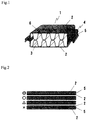
- Fig. 1 denotes a cup test piece
- 2 denotes a test material
- 3 denotes a fin
- 4 denotes a flare groove joint
- 5 denotes a fillet formed outside the flare groove joint.
- the following evaluation was performed on a fillet 5 (expressed as "outside” in the cup brazing test in Table 1) formed on the outside of the flare groove joint
- a fillet 6 (expressed as "inside” in the cup brazing test in Table 1) formed in a joint portion between the test piece and the fin. Table 1 lists the evaluation results.
- the fillet 5 formed on the outside of the flare groove joint 4 was evaluated by observation with four levels.
- the four levels are: “ ⁇ : a continuous fillet is formed with a uniform size", “ ⁇ : a state in which 50% or more of the fillet has a uniform size although the fillet size fluctuates, or a state in which the fillet is small although the fillet has a uniform shape", “ ⁇ : a state in which the fillet is partly disconnected and discontinuous, or a state in which 50% or more of the fillet has a non-uniform size", and " ⁇ : fillet is hardly formed or the material is not brazed”.
- ⁇ and ⁇ were determined as passing levels.
- each of the cup test pieces obtained by incorporating the test materials 1 to 17 according to the present invention proved to be capable of producing an excellent brazed state of a passing level, without etching.
- a cut ingot material (163 mm in length, 163 mm in width, and 3 mm in thickness) was applied as the intermediate material to the test material 15, the cup test piece obtained by incorporating the test material 15 also produced an excellent brazed state in the same manner.
- the brazing material, the core material, the intermediate material, and the sacrificial anode material having the compositions listed in Table 2 were casted into ingots by continuous casting, to manufacture an annealed clad sheet materials with a thickness of 0.4 mm in the same manner as Example 1.
- Cup test pieces were prepared with the sheet materials serving as the test materials, and subjected to brazing heating in a nitrogen gas furnace under the same conditions as those of Example 1, to evaluate the brazed states of the cup test pieces in the same manner as Example 1.
- Table 2 lists the evaluation results.
- the underlined values are values that fail to satisfy the conditions of the present invention.
- a clad material in which no intermediate material is interposed was prepared in the same manner. [Table 2] No.
- test materials 18, 19, and 20 include no intermediate material interposed.
- the cup test pieces including the test materials 18 to 20 had inferior brazing properties for the outside without etching.
- test material 21 includes a brazing material with a low Si content
- the test material 21 incurred deficiency in a quantity of the molten brazing material, and had inferior brazing properties for both the inside and the outside.
- the test material 22 includes a brazing material with a high Si content, crack occurred in rolling of the material.
- the test material 23 includes an intermediate material with a low Bi content, and incurred poor function to promote destruction of the oxide film on the surface of the brazing material, and had inferior brazing properties. Because the test material 24 includes an intermediate material with a high Bi content, crack occurred in rolling of the material.
- test material 25 includes a low Si content in the intermediate material, Mg and Bi remained in the intermediate material. This structure caused deficiency in supply of Mg and Bi to the brazing material, caused poor function to promote destruction of the oxide film on the surface of the brazing material, and had inferior brazing properties. Because the test material 26 includes a brazing material with a high Si content, crack occurred in rolling of the material.
- test material 27 includes an intermediate material with a low clad rate
- the test material 27 incurred deficiency in supply of Mg and Bi to the brazing material even when Mg and Bi of the upper limit concentrations were added, incurred poor function to promote destruction of the oxide film on the surface of the brazing material, and had inferior brazing properties.
- the test material 28 includes an intermediate material with a high clad rate
- Mg included in the intermediate material reached the surface of the brazing material during brazing heating, to make the oxide film firm, and had inferior brazing properties.
- the test material 29 includes an intermediate material with a high clad rate
- Bi included in the intermediate material reached the surface of the brazing material earlier than Mg during brazing heating, to form a Bi-based oxide, and impeded the brazing properties.
- test material 30 includes an intermediate material with a low Mg content, the test material 30 had poor function to break the oxide film on the surface of the brazing material, and had inferior brazing properties. Because the test material 31 includes an intermediate material with a high Mg content, crack occurred in rolling of the material.
- the test material 32 includes a core material with a low Mg content, and incurred poor function to promote destruction of the oxide film on the surface of the brazing material, and had inferior brazing properties. Because the test material 33 includes a core material with a high Mg content, erosion of the molten brazing material progresses due to a decrease in the melting point of the core material, and the test material after brazing was deformed.
- test material 34 includes a core material with a low Mg content, crack occurred in rolling of the material.
- test material 35 includes a sacrificial anode material with a low Mg content, the test material 35 incurred a poor function to promote destruction of the oxide film on the surface of the brazing material, and had inferior brazing properties.
- test material 36 includes a sacrificial anode material with a high Mg content, crack occurred in rolling of the material.
- test material 37 includes an intermediate material with a high Cu content and the test material 38 includes an intermediate material with a high Zn content, crack occurred in rolling of the material.
Landscapes
- Engineering & Computer Science (AREA)
- Mechanical Engineering (AREA)
- Chemical & Material Sciences (AREA)
- Materials Engineering (AREA)
- Metallurgy (AREA)
- Organic Chemistry (AREA)
- Physics & Mathematics (AREA)
- Thermal Sciences (AREA)
- General Engineering & Computer Science (AREA)
- Laminated Bodies (AREA)
- Pressure Welding/Diffusion-Bonding (AREA)
Abstract
Description
- The present invention relates to an aluminum alloy brazing sheet used for brazing aluminum, without using a flux, in an inert gas atmosphere or a vacuum.
- Brazing is widely used as a method for jointing aluminum products including a number of fine jointing portions, such as aluminum heat exchangers and mechanical components. Brazing aluminum requires breaking an oxide film covering the surface, and bring the molten brazing material into contact with base metal or brazing material molten in the same manner. Methods for breaking an oxide film are broadly classified into a method of using a flux and a method of heating the oxide film in vacuum, and both of them are put to practical use.
- An application range of brazing is wide, and the most typical example is a heat exchanger for vehicles. Most of heat exchangers for vehicles, such as radiators, heaters, condensers, and evaporators, are made of aluminum, and most of them are manufactured by brazing. Among brazing methods, a method of applying a noncorrosive flux and heating it in a nitrogen gas atmosphere occupies the majority part of the methods at present.
- In recent years, due to change in the driving system in electric cars and hybrid cars, heat exchangers equipped with electronic components, such as an inverter cooler, appear, and residue of a flux is regarded as problem in increasing cases. For this reason, some of inverter coolers are manufactured by vacuum brazing in which no flux is used. However, vacuum brazing requires high equipment cost and high maintenance cost for the heating furnace, and has problem in productivity and brazing stability. Such a situation increases needs for jointing without using a flux in a nitrogen gas furnace.
- To respond to the needs, various methods have been presented as a method of enabling brazing, without using a flux, in an inert gas atmosphere, by diffusing Mg into a brazing material during brazing heating. Examples of the methods include a method of diffusing Mg added to the core material into the brazing material, and a method of diffusing Mg added to the sacrificial anode material disposed between the core material and the brazing material into the brazing material. These methods prevent formation of an oxide film on the surface of the brazing material in manufacturing of a clad material or during brazing heating, and Mg effectively acts on destruction of the oxide film on the surface of the brazing film.
- However, destruction of the oxide film on the surface of the brazing material is not sufficiently performed, by merely diffusing Mg into the brazing material. Without application of a flux, sufficient fillet formation ability cannot be exhibited in a practical joint having a clearance. By contrast, another method has been presented. In the method, Bi is added to the brazing material, to promote the action of Mg of breaking the oxide film, and greatly improve the brazing properly without applying a flux. However, when Bi exceeding 0.05% is added to the brazing material, a Bi-based oxide is generated on the surface of the brazing material at the stage of manufacturing of the material. Brazing the material with the Bi-based oxide without any treatment causes discoloration, and the problem of marked deterioration in brazing properties.
- The mechanism of generation of a Bi-based oxide can be explained from the fact that Bi has a low melting point (approximately 270°C) and is hardly dissolved in aluminum. Specifically, in hot rolling and/or annealing, Bi scattered in a state of a substantially pure substance is molten, to adsorb oxygen and form a thick Bi-based oxide film, and deteriorates the brazing properties. Reducing the Bi quantity in the brazing material can be one way to suppress it, but causes failure in full achievement of the effect of Bi. Although a certain effect is obtained by performing pretreatment before brazing to remove the Bi-based oxide, reoxidation occurs during preheating for brazing in an inert gas atmosphere with oxygen concentration of 20 ppm or higher, and the effect of the pretreatment is lost. By contrast, excellent brazing properties are exhibited in a low-oxygen atmosphere. However, achieving a low-oxygen atmosphere requires much cost, and is not practical.
-
- [Patent Literature 1] Japanese Patent Publication
2004-358519-A - [Patent Literature 2] Japanese Patent Publication
2013-001941-A - [Patent Literature 3] Japanese Patent Publication
2014-050861-A - The present invention has been made to solve the above problem in the case of brazing aluminum without using a flux in an inert gas atmosphere, such as a nitrogen gas atmosphere, or in vacuum. An object of the present invention is to provide an aluminum alloy brazing sheet enabling excellent brazing properties by promptly supplying Bi and Mg into the brazing material during brazing heating, causing these elements to be eluted in the molten brazing material after start of melting the brazing material, and effectively embrittling the oxide film on the surface of the brazing material.
- An aluminum alloy brazing sheet according to claim 1 to achieve the object described above is a brazing sheet used for brazing aluminum, without using a flux, in an inert gas atmosphere or vacuum, and formed by arranging a brazing material on one side or both sides of a core material made of pure aluminum or aluminum alloy, the brazing material including 6% to 13% of Si and the balance being Al and inevitable impurities, and performing cladding with an intermediate material interposed between the core material and the brazing material, the intermediate material including 0.01% to 1.5% of Bi, 1.5% to 13% of Si, and the balance being Al and inevitable impurities, the intermediate material having a thickness of 2% to 35% of a thickness of the brazing material, wherein one or both of the intermediate material and the core material includes 0.4% to 6% of Mg. In the following explanation, all the alloy components are expressed with % by mass.
- An aluminum alloy brazing sheet according to
claim 2 is a brazing sheet used for brazing aluminum, without using a flux, in an inert gas atmosphere or vacuum, and formed by arranging a brazing material on one side or both sides of a core material made of pure aluminum or aluminum alloy, the brazing material including 6% to 13% of Si and the balance being Al and inevitable impurities, and performing cladding with an intermediate material and a sacrificial anode material interposed between the core material and the brazing material such that the materials are arranged in an order of the core material, the sacrificial anode material, the intermediate material, and the brazing material, the intermediate material including 0.01% to 1.5% of Bi, 1.5% to 13% of Si, and the balance being Al and inevitable impurities, the sacrificial anode material including 0.9% to 6% of Zn and the balance being Al and inevitable impurities, the intermediate material having a thickness of 2% to 35% of a thickness of the brazing material, wherein at least one of the intermediate material, the sacrificial anode material, and the core material includes 0.4% to 6% of Mg. - An aluminum alloy brazing sheet according to
claim 3 is a brazing sheet used for brazing aluminum, without using a flux, in an inert gas atmosphere or vacuum, and formed by arranging a brazing material on one side of a core material made of pure aluminum or aluminum alloy, the brazing material including 6% to 13% of Si and the balance being Al and inevitable impurities, arranging a sacrificial anode material on the other side of the core material, the sacrificial anode material including 0.9% to 6% of Zn and the balance being Al and inevitable impurities, and performing cladding with an intermediate material interposed between the core material and the brazing material, the intermediate material including 0.01% to 1.5% of Bi, 1.5% to 13% of Si, and the balance being Al and inevitable impurities, the intermediate material having a thickness of 2% to 35% of a thickness of the brazing material, wherein one or both of the intermediate material and the core material includes 0.4% to 6% of Mg. - An aluminum alloy brazing sheet according to claim 4 is the brazing sheet according to any one of claims 1 to 3, wherein the core material of the aluminum alloy includes at least one of 1.8% or less of Mn, 1.2% or less of Si, 1.0% or less of Fe, 1.5% or less of Cu, 0.8% or less of Zn, 0.2% or less of Ti, and 0.5% or less of Zr, and the balance being Al and inevitable impurities.
- An aluminum alloy brazing sheet according to
claim 5 is the brazing sheet according to any one of claims 1 to 4, wherein the intermediate material further includes at least one of 6% or less of Cu and 6% or less of Zn. - The present invention provides an aluminum alloy brazing sheet enabling excellent brazing properties by promptly supplying Bi and Mg into the brazing material during brazing heating, causing these elements to be eluted in the molten brazing material after start of melting the brazing material, and effectively embrittling the oxide film on the surface of the brazing material.
-
-
Fig. 1 is an outside drawing of a cup test piece to evaluate a fillet formation state in an example of the present invention; and -
Fig. 2 is a diagram illustrating fillet formation states with evaluation of ⊚ to × for a fillet formed on the external side of a flare groove joint of the cup test piece. - A first embodiment of an aluminum alloy brazing sheet according to the present invention is a brazing sheet used for brazing aluminum, without using a flux, in an inert gas atmosphere or vacuum, and formed by arranging a brazing material on one side or both sides of a core material made of pure aluminum or aluminum alloy, the brazing material including 6% to 13% of Si and the balance being Al and inevitable impurities, and performing cladding with an intermediate material interposed between the core material and the brazing material, the intermediate material including 0.01% to 1.5% of Bi, 1.5% to 13% of Si, and the balance being Al and inevitable impurities, the intermediate material having a thickness of 2% to 35% of a thickness of the brazing material, wherein one or both of the intermediate material and the core material includes 0.4% to 6% of Mg.
- A second embodiment is a brazing sheet used for brazing aluminum, without using a flux, in an inert gas atmosphere or vacuum, and formed by arranging a brazing material on one side or both sides of a core material made of pure aluminum or aluminum alloy, the brazing material including 6% to 13% of Si and the balance being Al and inevitable impurities, and performing cladding with an intermediate material and a sacrificial anode material interposed between the core material and the brazing material such that the materials are arranged in an order of the core material, the sacrificial anode material, the intermediate material, and the brazing material, the intermediate material including 0.01% to 1.5% of Bi, 1.5% to 13% of Si, and the balance being Al and inevitable impurities, the sacrificial anode material including 0.9% to 6% of Zn and the balance being Al and inevitable impurities, the intermediate material having a thickness of 2% to 35% of a thickness of the brazing material, wherein at least one of the intermediate material, the sacrificial anode material, and the core material includes 0.4% to 6% of Mg.
- A third embodiment is a brazing sheet used for brazing aluminum, without using a flux, in an inert gas atmosphere or vacuum, and formed by arranging a brazing material on one side of a core material made of pure aluminum or aluminum alloy, the brazing material including 6% to 13% of Si and the balance being Al and inevitable impurities, arranging a sacrificial anode material on the other side of the core material, the sacrificial anode material including 0.9% to 6% of Zn and the balance being Al and inevitable impurities, and performing cladding with an intermediate material interposed between the core material and the brazing material, the intermediate material including 0.01% to 1.5% of Bi, 1.5% to 13% of Si, and the balance being Al and inevitable impurities, the intermediate material having a thickness of 2% to 35% of a thickness of the brazing material, wherein one or both of the intermediate material and the core material includes 0.4% to 6% of Mg.
- The core material is preferably pure aluminum, or aluminum alloy including at least one of 1.8% or less of Mn, 1.2% or less of Si, 1.0% or less of Fe, 1.5% or less of Cu, 0.8% or less of Zn, 0.2% or less of Ti, and 0.5% or less of Zr, and the balance being Al and inevitable impurities. The core material preferably includes 0.4% to 6% of Mg.
- In the core material of aluminum alloy, Mn effectively functions to improve the strength and regulate the potential. A preferable content of Mn is 1.8% or less, and a content exceeding 1.8% causes easy occurrence of crack in rolling of the material. A more preferable content range is 0.3% to 1.8%. A content less than 0.3% has difficulty in obtaining a sufficient effect of improving the strength.
- Si effectively functions to improve the strength. A preferable content of Si is 1.2% or less. A content exceeding 1.2% decreases the melting point, causes local melting in brazing, and may cause deformation of the core material to decrease the corrosion resistance. A more preferable lower limit value of the Si content to enhance the strength is 0.3%.
- Fe effectively functions to improve the strength. A preferable content of Fe is 1.0% or less. A content exceeding 1.0% decreases the corrosion resistance, and causes easy occurrence of huge deposits. A more preferable lower limit value of the Fe content to enhance the strength is 0.2%.
- Cu effectively functions to enhance the strength and regulate the potential. A preferable content of Cu is 1.5% or less. A content exceeding 1.5% is not preferable, because it causes easy occurrence of intergranular corrosion, and decreases the melting point. A more preferable lower limit value of the Cu content to enhance the strength is 0.2%.
- Zn effectively functions to regulate the potential. A preferable content of Zn is 0.8% or less. A content exceeding 0.8% decreases the natural electrode potential, and shortens through-life due to corrosion. A more preferable lower limit value of the Zn content to regulate the potential is 0.1%.
- Ti effectively functions to advance corrosion in a layered manner. A preferable content of Ti is 0.2% or less. A content exceeding 0.2% causes easy occurrence of huge deposits, and impedes rolling properties and corrosion resistance. A more preferable lower limit value of the Ti content to advance layered corrosion is 0.06%. Zr effectively functions to increase the crystal grain size. A preferable content of Zr is 0.5% or less. A content of Zr exceeding 0.5% causes easy occurrence of crack in manufacturing of the material. A more preferable lower limit value of the Zr content to increase the crystal grain size is 0.2%.
- The brazing material is an ordinary Al-Si brazing material, and the Si quantity thereof is set to 6% to 13%. A Si content less than 6% fails to achieve sufficient jointing properties. A Si content exceeding 13% causes easy occurrence of crack in manufacturing of the material, and causes difficulty in manufacturing of the brazing sheet.
- In the first to the third embodiments, Bi included in the intermediate material interposed between the core material and the brazing material promotes destruction of an oxide film with Mg supplied from the intermediate material and/or the core material to the brazing material in brazing heating, to improve the brazing properties. The intermediate material functions to supply these elements to the brazing material. A preferable content of Bi included in the intermediate material is 0.01% to 1.5%. A Bi content less than 0.01% causes deficiency of Bi eluted to the brazing material, and causes difficulty in achieving the function to break an oxide film on the surface of the brazing material. A Bi content exceeding 1.5% causes easy occurrence of crack in rolling of the material, and causes difficulty in manufacturing of the brazing sheet. A more preferable content of Bi is 0.1% to 1.5%.
- As described above, Bi included in the intermediate material promotes the function to break the oxide film, with Mg supplied from the intermediate material and/or the core material to the brazing material in brazing heating, to effectively improve the brazing properties. When Bi exceeding 0.05% is directly added to the brazing material, a thick Bi-based oxide is formed at the stage of manufacturing the material and/or during brazing heating. The thick Bi-based oxide is accompanied by discoloration, and markedly deteriorates brazing properties. For this reason, addition of Bi requires pretreatment before brazing, and a low-oxygen atmosphere. By contrast, according to the present invention with a structure of supplying Bi to the brazing material through the intermediate material, Bi is hardly solid-diffused in aluminum. For this reason, until the intermediate material is dissolved with the molten brazing material or the intermediate material itself is molten, Bi is not supplied into the brazing material and no Bi-based oxide is formed. In this way, Bi can be supplied with a quantity that is not effective when it is directly added to the brazing material, and effectively promotes the function of destroying an oxide film with Mg in the surface of the brazing material. Accordingly, excellent brazing properties can be achieved, without pretreatment before brazing or low-oxygen concentration atmosphere. Bi of 0.05% or less may be added to the brazing material, as well as addition of Bi to the intermediate material.
- Si included in the intermediate material promotes dissolution of the intermediate material with the molten brazing material during brazing heating, and causes the intermediate material itself to be molten, to cause active and efficient supply of Mg and Bi to the molten brazing material. The intermediate material itself can also function as brazing material.
- A preferable Si content in the intermediate material is 1.5% to 13%. If the Si content is less than 1.5%, the effect of promoting dissolution of the intermediate material cannot be expected with the molten brazing material at the brazing temperature, and the intermediate material is hardly melted. For this reason, Bi and Mg existing on the surface of the intermediate material facing the core material remain even after brazing heating, and supply of Mg and Bi becomes inefficient. A Si content exceeding 13% causes easy occurrence of crack in rolling of the material, and causes difficulty in manufacturing of the brazing sheet.
- The thickness of the intermediate material is 2% to 35% of a thickness of the brazing material adjacent to the intermediate material. A thickness less than 2% requires increase in the Bi concentration and the Mg concentration in the intermediate material, and causes difficulty in manufacturing of the material. A thickness exceeding 35% decreases the thickness of the brazing material, and Mg included in the intermediate material reaches the surface before the brazing material is molten during brazing heating, and makes the film on the surface firm. Reduction in the Mg concentration in the intermediate material suppresses arrival of the Mg at the surface, but causes deficiency in the absolute quantity of Mg, and insufficiency of the function to break the oxide film. When no Mg is added to the intermediate material but Mg of the core material is used, the thickness of the brazing material is reduced. For this reason, Bi in the intermediate material reaches the surface of the brazing material earlier than Mg, to form a Bi-based oxide and deteriorate the brazing properties.
- Because Mg included in the intermediate material or the core material has low oxide formation free energy, they are diffused into the brazing material in brazing heating, to form a unique oxide in the aluminum oxide film covering the surface of the brazing material, and induce destruction of the aluminum oxide film by formation of the unique oxide. When Mg is directly added to the brazing material, because formation of a unique oxide proceeds also at the stage of manufacturing the brazing sheet, not only the added Mg is consumed wastefully, but also the surface oxide film becomes firmer. In this case, performing etching before brazing becomes necessary to peel off the oxide film.
- By contrast, in the case of supplying Mg to the brazing material through the intermediate material or the core material, formation of a unique oxide does not progress at the stage of manufacturing the brazing sheet, but the substances are diffused into the brazing material from the intermediate material or the core material at the stage of brazing heating. For this reason, a uniquely formed oxide serves as a starting point to divide the oxide film after melting of the brazing material, and the oxide film is embrittled. In addition, with start of melting of the brazing material, because dissolution of the intermediate material into the molten brazing material also progresses, Mg is eluted into the molten brazing material promptly. Because diffusion of elements in the molten brazing material progresses very quickly in comparison with diffusion in a solid, formation of a unique oxide rapidly progresses in the surface of the brazing material, and destruction of the oxide film is promoted.
- In particular, in the method of supplying Mg to the brazing material through the intermediate material, diffusion of the elements into the brazing material progresses with higher concentration than that in a method of simply adding Mg to the core material and the sacrificial anode material directly under the brazing material and diffusing the elements into the brazing material. In addition, because dissolution of the intermediate material into the molten brazing material accompanying with start of melting of the brazing material is more than dissolution of the core material and the sacrificial anode material into the molten brazing material, and the supply quantity of Mg to the brazing material becomes larger, and formation of the unique oxide is intensively performed. With intensive progress of formation of the unique oxide immediately before brazing, destruction of the aluminum oxide film is induced efficiently and strongly. In this case, the brazing properties are improved, and stable brazing properties can be achieved without performing etching before brazing.
- Mg included in the intermediate material or the core material, or both of them, breaks the oxide film and improves the brazing properties, as described above. A preferable Mg content is 0.4% to 6.0%. A Mg content less than 0.4% causes deficiency of the Mg quantity diffused and eluted into the brazing material, and causes difficulty in achieving the function to break the oxide film on the surface of the brazing material. A Mg content exceeding 6.0% causes easy occurrence of crack in manufacturing of the material, and difficulty in manufacturing of the brazing sheet. When Mg is included in the core material, a more preferable upper limit value is 1.3%. A Mg content exceeding 1.3% decreases the melting point of the core material, and causes local melting in the core material in brazing heating. This may cause deformation of the core material, and occurrence of erosion to the core material with the molten brazing material, and deteriorate the brazing properties and corrosion resistance.
- It is effective to further add Cu and Zn to the intermediate material, to reduce the solidus temperature of the intermediate material. In the case where the solidus temperature of the intermediate material is higher than the solidus temperature of the brazing material, at the point when the brazing material starts melting, the intermediate material has not yet been molten or has just started melting, and supply of Mg and Bi included in the intermediate material to the brazing material is late. However, in the case where Cu and Zn are added to the intermediate material to reduce the solidus temperature of the intermediate material, the intermediate material can be partly or wholly molten before the brazing material is molten. In this case, Bi and Mg can be immediately supplied into the brazing material when the brazing material starts melting, and early destruction of the oxide film and ultra-high speed heating can be employed.
- As preferable contents of Cu and Zn functioning effectively to decrease the solidus temperature of the intermediate material, the Cu content is 6% or less and the Zn content is 6% or less. A content of each of them exceeding the upper limit causes easy occurrence of crack in rolling of the material, and causes difficulty in manufacturing of the brazing sheet. As more preferable lower limit values of the Cu content and the Zn content to decrease the melting point, the Cu content is 1.0% and the Zn content is 1.0%.
- The sacrificial anode material used in the second embodiment and the third embodiment provides an anti-corrosion effect to the sacrificial anode material side. A preferable content of Zn in the sacrificial anode material is 0.9% to 6%. A Zn content less than 0.9% fails to achieve a sufficient anti-corrosion effect. A Zn content exceeding 6% promotes corrosion, and deteriorates the corrosion-through-life.
- In the second embodiment, the sacrificial anode material may include Mg, to break the oxide film and improve the brazing properties. A preferable Mg content is 0.4% to 6%. A Mg content less than 0.4% causes deficiency of the Mg quantity diffused and eluted into the brazing material, and causes difficulty in achievement of a function to break the oxide film on the surface of the brazing material. A Mg content exceeding 6.0% causes easy occurrence of crack in manufacturing of the material, and difficulty in manufacturing of the brazing sheet. A more preferable upper limit value of the Mg content is 1.3%. A Mg content exceeding 1.3% reduces the melting point of the sacrificial anode material, and causes local melting in the sacrificial anode material in brazing heating and deformation of the sacrificial anode material. This causes erosion with the molten brazing material to the sacrificial anode material, and may deteriorate the brazing properties and the corrosion resistance.
- The brazing sheet according to the present invention is manufactured by preparing ingots of the core material, the brazing material, the intermediate material, and the sacrificial anode material with the compositions described above, rolling some of them to a predetermined thickness, and performing clad rolling using them by a conventional method. The intermediate material may be an ingot cut in a plate shape, or a rolled sheet (hot rolled sheet, cool rolled sheet) obtained by rolling the ingot.
- The present invention also has the following advantage. Specifically, because an ordinary material that can be produced regardless of the location (material that can be produced or supplied in various places in the world) can be applied as the brazing material and the core material of the brazing sheet of the present invention, the brazing sheet of the present invention can be produced in any place in the world, regardless of the location, as long as the factory is capable of manufacturing an ordinary aluminum clad material. The intermediate material being a special material may be acquired by obtaining a plain coil rolled within or outside the country or an ingot slab, and using a cut material thereof. Because the rate of the intermediate material occupying the brazing sheet is low, that is, substantially 5% or less, the intermediate material has small influence on the cost caused by transport costs and customs duties, even when a plain coil and/or an ingot slab thereof is imported to be used.
- The degree of freedom of the site is effectively exhibited also in the site for producing the products, such as heat exchangers, as well as production of the material. Specifically, in production of heat exchangers, acid and/or alkaline are used for etching before brazing, but much load is required for the solution management and waste liquid treatment. For this reason, many processing manufacturers for heat exchangers and the like often avoid execution of etching, and etching in abroad processing manufacturers is difficult. The present invention can also solve such a problem.
- The following is explanation of examples of the present invention in comparison with a comparative example, to prove the effects of the present invention. These examples illustrate an embodiment of the present invention, and the present invention is not limited thereto.
- The brazing material, the core material, the intermediate material, and the sacrificial anode material having the compositions listed in Table 1 were individually casted into ingots by continuous casting. For the core material, the obtained ingot was machined to a size of 163 mm in length, 163 mm in width, and 27 mm in thickness. For the brazing material, the obtained ingot was subjected to hot rolling to a thickness of 2.23 mm to 2.93 mm, and cut to a size of 163 mm in length and 163 mm in width.
- For the intermediate material, the obtained ingot was subjected to hot rolling to a thickness of 3mm, thereafter subjected to cold rolling to a thickness of 0.07 mm to 0.77 mm, and cut to a size of 163 mm in length and 163 mm in width. For some of the intermediate material, a cut product of the ingot was prepared. For the sacrificial anode material, the obtained ingot was subjected to hot rolling to a thickness of 3mm, thereafter subjected to cold rolling to a thickness of 1.5 mm, and cut to a size of 163 mm in length and 163 mm in width.
- The brazing material, the core material, the intermediate material, and the sacrificial anode material prepared were subjected to clad rolling by a conventional method, to obtain an annealed clad sheet material with a thickness of 0.4 mm. The sheet material was used as a test material.
- After the test material was pressed in a cup shape, two test materials are prepared. One material was prepared by subjecting the material to only degreasing (without etching) with acetone, and the other material was prepared by subjecting the material to degreasing with acetone and thereafter to etching with weak acid (with etching). Each of the test materials was incorporated into a cup test piece illustrated in
Fig. 1 . A fin obtained by molding and degreasing a 3003 alloy sheet material with a thickness of 0.1 mm was disposed inside the cup test piece, and brazed without a flux. - The brazing was performed in a nitrogen gas furnace, or in a vacuum furnace. The nitrogen gas furnace was a two-chambered experimental furnace, and the oxygen concentration thereof in brazing was 15 ppm to 20 ppm. The vacuum furnace was a batch-type one-chambered experimental furnace, and the in-furnace pressure thereof in brazing was 5×10⁻³ Pa to 8×10⁻³ Pa. The temperature which each of the test pieces reached was set to 600°C.
- In
Fig. 1, 1 denotes a cup test piece, 2 denotes a test material, 3 denotes a fin, 4 denotes a flare groove joint, and 5 denotes a fillet formed outside the flare groove joint. The following evaluation was performed on a fillet 5 (expressed as "outside" in the cup brazing test in Table 1) formed on the outside of the flare groove joint, and a fillet 6 (expressed as "inside" in the cup brazing test in Table 1) formed in a joint portion between the test piece and the fin. Table 1 lists the evaluation results. - As illustrated in
Fig. 2 , for the "outside", thefillet 5 formed on the outside of the flare groove joint 4 was evaluated by observation with four levels. The four levels are: "⊚: a continuous fillet is formed with a uniform size", "○: a state in which 50% or more of the fillet has a uniform size although the fillet size fluctuates, or a state in which the fillet is small although the fillet has a uniform shape", "Δ: a state in which the fillet is partly disconnected and discontinuous, or a state in which 50% or more of the fillet has a non-uniform size", and "×: fillet is hardly formed or the material is not brazed". Among the levels, ⊚ and ○ were determined as passing levels. For the "inside", the brazed test piece was divided into two, and the fillet formation state was evaluated by observation with four levels in the same manner as above, for the inside of the flare groove joint and the jointing portion of the fin.[Table 1] No. Region Chemical Composition (mass %) Thickness (mm) Clad Ratio (%) Intermediate Material /brazing Material (%) Atmosphere Cup Brazing Test Si Fe Cu Mn Mg Cr Zn Ti Zr Bi Not Etched Etched 1 Brazing Material 6 - - - - - - - - - 0.4 9.1 10 Nitrogen Outside:○ Outside:○ Intermediate Material 6 - - - 5 - - - - 1 0.9 Core Material - - - - - - - - - - - Inside:○ Inside:○ 2 Brazing Material 13 - - - - - - - - - 0.4 8.7 15 Nitrogen Outside:○ Outside:○ Intermediate Material 1.5 - - - 3 - - - - 0.8 1.3 Core Material - - - 1.2 - - - - - - - Inside: ○ Inside:⊚ 3 Brazing Material 10 - - - - - - - - - 0.4 7.7 30 Nitrogen Outside:○ Outside:○ Intermediate Material 10 - - - 3 - - - - 0.01 2.3 Core Material - - - 1.2 - - - - - - - Inside:○ Inside:○ 4 Brazing Material 10 - - - - - - - - - 0.4 9.5 5 Nitrogen Outside:○ Outside:⊚ Intermediate Material 10 - - - 5 - - - - 1.5 0.5 Core Material - - - 1.2 - - - - - - - Inside: ○ Inside:⊚ 5 Brazing Material 10 - - - - - - - - - 0.4 8.7 15 Nitrogen Outside:○ Outside:⊚ Intermediate Material 13 - - - 3 - - - - 0.8 1.3 Core Material - - - 1.2 - - - - - - - Inside: ○ Inside:⊚ 6 Brazing Material 10 - - - - - - - - - 0.4 9.8 2 Nitrogen Outside:○ Outside:○ Intermediate Material 10 - - - 5 - - - - 0.8 0.2 Inside:○ Inside:○ Core Material - - - 1.2 0.6 - - - - - - - 7 Brazing Material 10 - - - - - - - - - 0.4 7.4 35 Nitrogen Outside:○ Outside:⊚ Intermediate Material 7.5 - - - 3 - - - - 0.1 2.6 Core Material - - - 1.2 0.6 - - - - - - Inside:○ Inside:⊚ 8 Brazing Material 10 - - - - - - - - - - 0.4 8.0 25 Nitrogen Outside:○ Outside:○ Intermediate Material 13 - - - 0.4 - - - - 0.4 2.0 Core Material - - - 1.2 0.6 - - - - - - Inside:○ Inside:⊚ 9 Brazing Material 10 - - - - - - - - - 0.4 8.7 15 Nitrogen Outside:○ Outside:⊚ Intermediate Material 10 - - - 6 - - - - 0.8 1.3 Core Material - - - 1.2 - - - - - - - Inside:⊚ Inside:⊚ 10 Brazing Material 10 - - - - - - - - - 0.4 9.1 10 Nitrogen Outside:○ Outside:○ Intermediate Material 6 - - - - - - - - 0.8 0.9 Core Material - - - 1.2 0.4 - - - - - - Inside:○ Inside: ○ 11 Brazing Material 10 - - - - - - - - - 0.4 8.0 25 Nitrogen Outside:○ Outside:○ Intermediate Material 10 - - - - - - - - 0.8 2.0 Core Material - - - 1.2 1.3 - - - - - - Inside:○ Inside:⊚ 12 Brazing Material 10 - - - - - - - - - 0.4 8.0 25 Vacuum Outside:○ Outside:⊚ Intermediate Material 10 - - - 6 - - - - 0.4 2.0 Core Material - - - 1.2 - - - - - - - Inside:⊚ Inside:⊚ 13 Brazing Material 12 - - - - - - - - - 0.4 7.6 25 Nitrogen Outside:○ Outside:⊚ Intermediate Material 10 - - - 3 - - - - 0.8 1.9 Core Material - - - 1.2 - - - - - - - Inside:⊚ Inside:⊚ Sacrificial anode material - - - - - - 2.5 - - - 4.8 14 Brazing Material 12 - - - - - - - - - 0.4 7.6 25 Nitrogen Outside: ○ Outside:⊚ Intermediate Material 10 - - - - - - - - 0.8 1.9 Sacrificial material - - - - 0.4 - 2.5 - - - - 4.8 Inside:⊚ Inside:⊚ Core Material - - - 1.2 - - - - - - - 15 Brazing Material 12 - - - - - - - - - 0.4 7.6 25 Nitrogen Outside:○ Outside:⊚ Intermediate Material 10 - - - - - - - - 0.8 1.9 Sacrificial anode material - - - - 1.3 - 2.5 - - - 4.8 Inside:⊚ Inside:⊚ Core Material - - - 1.2 - - - - - - - 16 Brazing Material 10 - - - - - - - - - 0.4 8.7 15 Nitrogen Outside:○ Outside:⊚ IntermediateMaterial 3 - 5 - 3 - 5 - - 0.4 1.3 Core Material - - - 1.2 0.6 - - - - - - Inside:⊚ Inside:⊚ 17 Brazing Material 12 - - - - - - - - - 0.4 8.0 25 Nitrogen Outside:⊚ Outside:⊚ Intermediate Material 7 - 4 - 0.4 - 4 - - 0.2 2.0 Core Material - - - 1.2 0.6 - - - - - - Inside:⊚ Inside:⊚ - As listed in Table 1, each of the cup test pieces obtained by incorporating the test materials 1 to 17 according to the present invention proved to be capable of producing an excellent brazed state of a passing level, without etching. Although a cut ingot material (163 mm in length, 163 mm in width, and 3 mm in thickness) was applied as the intermediate material to the test material 15, the cup test piece obtained by incorporating the test material 15 also produced an excellent brazed state in the same manner.
- The brazing material, the core material, the intermediate material, and the sacrificial anode material having the compositions listed in Table 2 were casted into ingots by continuous casting, to manufacture an annealed clad sheet materials with a thickness of 0.4 mm in the same manner as Example 1. Cup test pieces were prepared with the sheet materials serving as the test materials, and subjected to brazing heating in a nitrogen gas furnace under the same conditions as those of Example 1, to evaluate the brazed states of the cup test pieces in the same manner as Example 1. Table 2 lists the evaluation results. In Table 2, the underlined values are values that fail to satisfy the conditions of the present invention. As a test material for comparison, a clad material in which no intermediate material is interposed was prepared in the same manner.
[Table 2] No. Region Chemical Composition (mass %) Thickness (mm) Clad Ratio (%) Intermediate Material /brazing Material (%) Atmosphere Cup Brazing Test Si Fe Cu Mn Mg Cr Zn Ti Zr Bi Not Etched Cup Brazing Etched 18 Brazing Material 10 - - - 0.5 - - - - 0.0 3 0.4 10 - Nitrogen Outside:Δ Outside:Δ Core Material - - - 1.2 - - - - - - - Inside:Δ Inside:○ 19 Brazing Material 10 - - - - - - - - 0.0 3 0.4 10 - Nitrogen Outside:Δ Outsider:Δ Core Material - - - 1.2 0.6 - - - - - - Inside:Δ Inside:⊚ 20 Brazing Material 10 - - - - - - - - 0.0 3 0.4 9.5 - Nitrogen Sacrificial Anode Material - - - - 0.6 - 2.5 - - - 4.8 Outside: Δ Inside: Δ Outside: Δ Inside:⊚ Core Material - - - 1.2 - - - - - - - 21 Brazing Material 4 - - - - - - - - - 0.4 8.7 15 Nitrogen Intermediate Material 10 - - - 3 - - - - 0.8 1.3 Outside:× Outside:Δ Core Material - - - 1.2 - - - - - - - Inside:Δ ΔInside:Δ 22 Brazing Material 16 - - - - - - - - - - - - - - - Intermediate Material 10 - - - 3 - - - - 0.8 - Core Material - - - 1.2 - - - - - - - 23 Brazing 10 - - - - - - - - - 0.4 7.4 35 Nitrogen Oulside:Δ Oulside:Δ Material Inside:Δ Inside:○ Intermediate Material 10 - - - 3 - - - - 0.0 05 2.6 Core Material - - - 1.2 - - - - - - - - 24 Brazing Material 10 - - - - - - - - - - - - - - - Intermediate Material 10 - - - 3 - - - - 1.8 - Core Material - - - 1.2 - - - - - - - 25 Brazing Material 10 - - - - - - - - - 0.4 8.7 15 Nitrogen Intermediate Material 1 - - - 3 - - - - 0.8 1.3 Outside: ×
Inside:ΔOutside:Δ
Inside:ΔCore Material - - - 1.2 - - - - - - - 26 Brazing Material 10 - - - - - - - - - - - - - - - Intermediate Material 15 - - - 3 - - - - 0.8 - Core Material - - - 1.2 - - - - - - - - 27 Brazing Material 10 - - - - - - - - - 0.4 9.9 1 Nitrogen Intermediate 10 - - - 6 - - - - 1.5 0.1 Oulside:Δ Outside: Δ Core Material - - - 1.2 0.6 - - - - - - Inside:Δ Inside:○ 28 Brazing Material 10 - - - - - - - - - 0.4 7.3 37 Nitrogen Intermediate Material 7.5 - - - 3 - - - - 0.4 2.7 Outside:× Outside:Δ Core Material - - - 1.2 - - - - - - - Inside:× Inside:Δ 29 Brazing Material 10 - - - - - - - - - 0.4 7.3 37 Nitrogen Intermediate Material 7.5 - - - - - - - - 0.4 2.7 Outside:× Oulside:Δ Core Material - - - 1.2 0.6 - - - - - - Inside:× Inside:Δ 30 Brazing Material 10 - - - - - - - - 0.4 7.4 35 Nitrogen Outside:× Outside:Δ Intermediate 10 - - - 0.2 - - - - 0.4 2.6 Inside:Δ Inside:Δ Material Core Material - - - 1.2 0.6 - - - - - - 31 Brazing Material 10 - - - - - - - - - - - - - - - Intermediate Material 10 - - - 8 - - - - 0.8 - Core Material - - - 1.2 0.6 - - - - - - 32 Brazing Material 10 - - - - - - - - - 0.4 9.5 5 Nitrogen Intermediate Material 10 - - - - - - - - 0.8 0.5 Outside:× Outside:Δ Core Material - - - 1.2 0.2 - - - - - - - Inside:Δ Inside:Δ 33 Brazing Material 10 - - - - - - - - - 0.4 8 25 Nitrogen Intermediate Material 10 - - - - - - - - 0.8 2 Outside:Δ Outside:Δ Core Material - - - 1.2 1.6 - - - - - - Inside:○ Inside:○ 34 Brazing Material 12 - - - - - - - - - 0.4 - - - - - Intermediate Material 10 - - - 3 - - - - 0.8 - Core Material - - - 1.2 - - - - - - - Sacrificial anode material - - - - - - 8 - - - - 35 Brazing Material 12 - - - - - - - - - 0.4 7.6 25 Nitrogen Intermediate Material 10 - - - - - - - - 0.8 1.9 Outside:× Outside:Δ Sacrificial anode material - - - - 0.3 - 2.5 - - - 4.8 Inside:Δ Inside:○ Core Material - - - 1.2 - - - - - - - 36 Brazing Material 12 - - - - - - - - - 0.4 - - - - - Intermediate Material 10 - - - - - - - - 0.8 - Sacrificial anode material - - - - 6.3 - 2.5 - - - - Core Material - - - 1.2 - - - - - - - 37 Brazing Material 10 - - - - - - - - - 0.4 - - - - - Intermediate Material 10 - 7 - 3 - - - - 0.4 - Core Material - - - 1.2 - - - - - - - 38 Brazing Material 10 - - - - - - - - - 0.4 - - - - - - Intermediate Material 10 - - - 3 - 7 - - 0.4 - Core Material - - - 1.2 - - - - - - - - As listed in Table 2, the test materials 18, 19, and 20 include no intermediate material interposed. The cup test pieces including the test materials 18 to 20 had inferior brazing properties for the outside without etching.
- Because the test material 21 includes a brazing material with a low Si content, the test material 21 incurred deficiency in a quantity of the molten brazing material, and had inferior brazing properties for both the inside and the outside. Because the
test material 22 includes a brazing material with a high Si content, crack occurred in rolling of the material. - The test material 23 includes an intermediate material with a low Bi content, and incurred poor function to promote destruction of the oxide film on the surface of the brazing material, and had inferior brazing properties. Because the test material 24 includes an intermediate material with a high Bi content, crack occurred in rolling of the material.
- Because the test material 25 includes a low Si content in the intermediate material, Mg and Bi remained in the intermediate material. This structure caused deficiency in supply of Mg and Bi to the brazing material, caused poor function to promote destruction of the oxide film on the surface of the brazing material, and had inferior brazing properties. Because the test material 26 includes a brazing material with a high Si content, crack occurred in rolling of the material.
- Because the test material 27 includes an intermediate material with a low clad rate, the test material 27 incurred deficiency in supply of Mg and Bi to the brazing material even when Mg and Bi of the upper limit concentrations were added, incurred poor function to promote destruction of the oxide film on the surface of the brazing material, and had inferior brazing properties. Because the test material 28 includes an intermediate material with a high clad rate, Mg included in the intermediate material reached the surface of the brazing material during brazing heating, to make the oxide film firm, and had inferior brazing properties. Because the test material 29 includes an intermediate material with a high clad rate, Bi included in the intermediate material reached the surface of the brazing material earlier than Mg during brazing heating, to form a Bi-based oxide, and impeded the brazing properties.
- Because the test material 30 includes an intermediate material with a low Mg content, the test material 30 had poor function to break the oxide film on the surface of the brazing material, and had inferior brazing properties. Because the test material 31 includes an intermediate material with a high Mg content, crack occurred in rolling of the material.
- The test material 32 includes a core material with a low Mg content, and incurred poor function to promote destruction of the oxide film on the surface of the brazing material, and had inferior brazing properties. Because the test material 33 includes a core material with a high Mg content, erosion of the molten brazing material progresses due to a decrease in the melting point of the core material, and the test material after brazing was deformed.
- Because the test material 34 includes a core material with a low Mg content, crack occurred in rolling of the material. Because the test material 35 includes a sacrificial anode material with a low Mg content, the test material 35 incurred a poor function to promote destruction of the oxide film on the surface of the brazing material, and had inferior brazing properties. Because the test material 36 includes a sacrificial anode material with a high Mg content, crack occurred in rolling of the material.
- Because the test material 37 includes an intermediate material with a high Cu content and the test material 38 includes an intermediate material with a high Zn content, crack occurred in rolling of the material.
-
- 1 CUP TEST PIECE
- 2 TEST MATERIAL
- 3 FIN
- 4 FLARE GROOVE JOINT
- 5 FILLET FORMED ON OUTSIDE OF FLARE GROOVE JOINT (expressed as "outside" in cup brazing test listed in Table 1)
- 6 FILLET FORMED IN JOINT PORTION BETWEEN TEST MATERIAL AND FIN (expressed as "inside" in cup brazing test listed in Table 1)
Claims (5)
- An aluminum alloy brazing sheet used for brazing aluminum (including aluminum alloy, the same is applicable through the claims), without using a flux, in an inert gas atmosphere or vacuum, the brazing sheet being formed by arranging a brazing material on one side or both sides of a core material made of pure aluminum or aluminum alloy, the brazing material including 6% to 13% (% by mass, the same is applicable through the claims) of Si and the balance being Al and inevitable impurities, and performing cladding with an intermediate material interposed between the core material and the brazing material, the intermediate material including 0.01% to 1.5% of Bi, 1.5% to 13% of Si, and the balance being Al and inevitable impurities, the intermediate material having a thickness of 2% to 35% of a thickness of the brazing material, wherein
one or both of the intermediate material and the core material includes 0.4% to 6% of Mg. - An aluminum alloy brazing sheet used for brazing aluminum, without using a flux, in an inert gas atmosphere or vacuum, the brazing sheet being formed by arranging a brazing material on one side or both sides of a core material made of pure aluminum or aluminum alloy, the brazing material including 6% to 13% of Si and the balance being Al and inevitable impurities, and performing cladding with an intermediate material and a sacrificial anode material interposed between the core material and the brazing material such that the materials are arranged in an order of the core material, the sacrificial anode material, the intermediate material, and the brazing material, the intermediate material including 0.01% to 1.5% of Bi, 1.5% to 13% of Si, and the balance being Al and inevitable impurities, the sacrificial anode material including 0.9% to 6% of Zn and the balance being Al and inevitable impurities, the intermediate material having a thickness of 2% to 35% of a thickness of the brazing material, wherein
at least one of the intermediate material, the sacrificial anode material, and the core material includes 0.4% to 6% of Mg. - An aluminum alloy brazing sheet used for brazing aluminum, without using a flux, in an inert gas atmosphere or vacuum, the brazing sheet being formed by arranging a brazing material on one side of a core material made of pure aluminum or aluminum alloy, the brazing material including 6% to 13% of Si and the balance being Al and inevitable impurities, arranging a sacrificial anode material on the other side of the core material, the sacrificial anode material including 0.9% to 6% of Zn and the balance being Al and inevitable impurities, and performing cladding with an intermediate material interposed between the core material and the brazing material, the intermediate material including 0.01% to 1.5% of Bi, 1.5% to 13% of Si, and the balance being Al and inevitable impurities, the intermediate material having a thickness of 2% to 35% of a thickness of the brazing material, wherein
one or both of the intermediate material and the core material includes 0.4% to 6% of Mg. - The aluminum alloy brazing sheet according to any one of claims 1 to 3, wherein the core material made of aluminum alloy includes at least one of 1.8% or less of Mn, 1.2% or less of Si, 1.0% or less of Fe, 1.5% or less of Cu, 0.8% or less of Zn, 0.2% or less of Ti, and 0.5% or less of Zr, and the balance being Al and inevitable impurities.
- The aluminum alloy brazing sheet according to any one of claims 1 to 4, wherein the intermediate material further includes one or two of 6% or less of Cu and 6% or less of Zn.
Applications Claiming Priority (2)
| Application Number | Priority Date | Filing Date | Title |
|---|---|---|---|
| JP2015139748A JP6648999B2 (en) | 2015-07-13 | 2015-07-13 | Aluminum alloy brazing sheet |
| PCT/JP2016/069255 WO2017010287A1 (en) | 2015-07-13 | 2016-06-29 | Aluminum alloy brazing sheet |
Publications (3)
| Publication Number | Publication Date |
|---|---|
| EP3323900A1 true EP3323900A1 (en) | 2018-05-23 |
| EP3323900A4 EP3323900A4 (en) | 2019-02-27 |
| EP3323900B1 EP3323900B1 (en) | 2020-02-12 |
Family
ID=57757208
Family Applications (1)
| Application Number | Title | Priority Date | Filing Date |
|---|---|---|---|
| EP16824267.5A Active EP3323900B1 (en) | 2015-07-13 | 2016-06-29 | Aluminum alloy brazing sheet |
Country Status (5)
| Country | Link |
|---|---|
| US (1) | US10682730B2 (en) |
| EP (1) | EP3323900B1 (en) |
| JP (1) | JP6648999B2 (en) |
| CN (1) | CN107849647A (en) |
| WO (1) | WO2017010287A1 (en) |
Families Citing this family (10)
| Publication number | Priority date | Publication date | Assignee | Title |
|---|---|---|---|---|
| JP6263574B2 (en) * | 2016-05-30 | 2018-01-17 | 株式会社Uacj | Brazing sheet, method for producing the same and method for brazing aluminum structure |
| EP3573781B1 (en) | 2017-01-30 | 2021-07-21 | Arconic Technologies LLC | Aluminum material for fluxfree cab brazing |
| JP6819393B2 (en) * | 2017-03-23 | 2021-01-27 | 株式会社デンソー | How to make a heat exchanger |
| JP7165553B2 (en) | 2018-10-01 | 2022-11-04 | 株式会社Uacj | Brazing sheet and its manufacturing method |
| WO2020129267A1 (en) | 2019-01-23 | 2020-06-25 | 三菱アルミニウム株式会社 | Aluminum brazing sheet for flux-free brazing |
| CN115151352B (en) | 2020-03-30 | 2025-04-18 | 株式会社Uacj | Aluminum alloy brazing plate and method for manufacturing the same |
| EP3925728A1 (en) * | 2020-06-16 | 2021-12-22 | Aleris Rolled Products Germany GmbH | Aluminium alloy multi-layered brazing sheet material for flux-free brazing |
| CN117545584A (en) * | 2021-05-21 | 2024-02-09 | 奥科宁克技术有限责任公司 | Brazing sheet, article formed from the brazing sheet, and method of forming the article |
| JP2023141036A (en) * | 2022-03-23 | 2023-10-05 | 株式会社Uacj | aluminum alloy brazing sheet |
| JP2023141035A (en) * | 2022-03-23 | 2023-10-05 | 株式会社Uacj | aluminum alloy brazing sheet |
Family Cites Families (15)
| Publication number | Priority date | Publication date | Assignee | Title |
|---|---|---|---|---|
| JPS6041696B2 (en) * | 1979-02-01 | 1985-09-18 | 株式会社神戸製鋼所 | Aluminum alloy composite material for brazing |
| DE60125777T3 (en) | 2001-10-26 | 2012-01-26 | Furukawa-Sky Aluminum Corp. | Flux-free method for brazing under inert gas |
| JP4537019B2 (en) | 2003-06-04 | 2010-09-01 | 古河スカイ株式会社 | Brazing method of aluminum material |
| JP4825507B2 (en) * | 2005-12-08 | 2011-11-30 | 古河スカイ株式会社 | Aluminum alloy brazing sheet |
| JP5497978B2 (en) * | 2006-11-28 | 2014-05-21 | 積水化学工業株式会社 | Thermally expandable microcapsules and foamed molded articles |
| JP4111456B1 (en) | 2006-12-27 | 2008-07-02 | 株式会社神戸製鋼所 | Aluminum alloy brazing sheet for heat exchanger |
| CN102644009B (en) * | 2008-02-12 | 2015-04-01 | 株式会社神户制钢所 | Aluminum-alloy multi-layered sheet |
| JP5695490B2 (en) * | 2011-05-10 | 2015-04-08 | 株式会社Uacj | Aluminum alloy brazing sheet |
| JP5944626B2 (en) * | 2011-06-15 | 2016-07-05 | 株式会社デンソー | Manufacturing method of heat exchanger |
| JP2012148344A (en) * | 2012-03-12 | 2012-08-09 | Kobe Steel Ltd | Aluminum alloy composite material and heat exchanger |
| JP2014050861A (en) | 2012-09-07 | 2014-03-20 | Uacj Corp | Aluminum-alloy-made brazing sheet |
| JP5456920B1 (en) * | 2013-02-18 | 2014-04-02 | 株式会社Uacj | Brazing sheet for flux-free brazing |
| JP6132347B2 (en) * | 2013-07-31 | 2017-05-24 | 株式会社Uacj | Aluminum alloy brazing sheet and method for producing the same |
| JP6281203B2 (en) * | 2013-08-01 | 2018-02-21 | いすゞ自動車株式会社 | Cross member |
| JP6236253B2 (en) * | 2013-08-09 | 2017-11-22 | 株式会社Uacj | Method for producing aluminum alloy brazing sheet and aluminum alloy brazing sheet obtained by the production method |
-
2015
- 2015-07-13 JP JP2015139748A patent/JP6648999B2/en active Active
-
2016
- 2016-06-29 EP EP16824267.5A patent/EP3323900B1/en active Active
- 2016-06-29 CN CN201680040774.4A patent/CN107849647A/en active Pending
- 2016-06-29 US US15/744,205 patent/US10682730B2/en active Active
- 2016-06-29 WO PCT/JP2016/069255 patent/WO2017010287A1/en not_active Ceased
Also Published As
| Publication number | Publication date |
|---|---|
| JP6648999B2 (en) | 2020-02-19 |
| EP3323900B1 (en) | 2020-02-12 |
| JP2017018995A (en) | 2017-01-26 |
| US20180200842A1 (en) | 2018-07-19 |
| WO2017010287A1 (en) | 2017-01-19 |
| EP3323900A4 (en) | 2019-02-27 |
| US10682730B2 (en) | 2020-06-16 |
| CN107849647A (en) | 2018-03-27 |
Similar Documents
| Publication | Publication Date | Title |
|---|---|---|
| EP3323900B1 (en) | Aluminum alloy brazing sheet | |
| US20180200841A1 (en) | Aluminum alloy brazing sheet | |
| EP3508595B2 (en) | Aluminum alloy brazing sheet | |
| EP1484425B1 (en) | Method for producing aluminum alloy composite material for heat exchanger | |
| US10300563B2 (en) | Aluminum alloy brazing sheet and brazing method | |
| EP2803438A1 (en) | Method for brazing aluminum material and brazed structure | |
| EP2732898A1 (en) | Aluminum-alloy brazing sheet and method of manufacturing same | |
| CN108431260A (en) | The manufacturing method of aluminum alloy brazing sheet and aluminum alloy heat exchanger | |
| JP6236253B2 (en) | Method for producing aluminum alloy brazing sheet and aluminum alloy brazing sheet obtained by the production method | |
| JP6570325B2 (en) | Aluminum alloy clad material and brazing method | |
| CN118147555A (en) | A high-strength magnesium alloy and processing method thereof | |
| JP2012024827A (en) | Fluxless brazing method of aluminum material and aluminum alloy brazing sheet for fluxless brazing | |
| JP2012050992A (en) | Fluxless brazing method of aluminum material, aluminum brazing sheet for fluxless brazing, and aluminum alloy brazing material for fluxless brazing | |
| CN114173984A (en) | Aluminum alloy brazing sheet and method for producing same | |
| JP5451217B2 (en) | Manufacturing method of internally grooved tube | |
| CN115151352B (en) | Aluminum alloy brazing plate and method for manufacturing the same | |
| JP2005125364A (en) | Brazing sheet manufacturing method | |
| JPH05247577A (en) | Aluminum alloy excellent in formability and its production |
Legal Events
| Date | Code | Title | Description |
|---|---|---|---|
| STAA | Information on the status of an ep patent application or granted ep patent |
Free format text: STATUS: THE INTERNATIONAL PUBLICATION HAS BEEN MADE |
|
| PUAI | Public reference made under article 153(3) epc to a published international application that has entered the european phase |
Free format text: ORIGINAL CODE: 0009012 |
|
| STAA | Information on the status of an ep patent application or granted ep patent |
Free format text: STATUS: REQUEST FOR EXAMINATION WAS MADE |
|
| 17P | Request for examination filed |
Effective date: 20180118 |
|
| AK | Designated contracting states |
Kind code of ref document: A1 Designated state(s): AL AT BE BG CH CY CZ DE DK EE ES FI FR GB GR HR HU IE IS IT LI LT LU LV MC MK MT NL NO PL PT RO RS SE SI SK SM TR |
|
| AX | Request for extension of the european patent |
Extension state: BA ME |
|
| DAV | Request for validation of the european patent (deleted) | ||
| DAX | Request for extension of the european patent (deleted) | ||
| A4 | Supplementary search report drawn up and despatched |
Effective date: 20190125 |
|
| RIC1 | Information provided on ipc code assigned before grant |
Ipc: F28F 21/08 20060101ALI20190121BHEP Ipc: B23K 35/22 20060101ALI20190121BHEP Ipc: B23K 35/02 20060101ALI20190121BHEP Ipc: B32B 15/01 20060101ALI20190121BHEP Ipc: B23K 35/28 20060101ALI20190121BHEP Ipc: C22C 21/02 20060101ALI20190121BHEP Ipc: B23K 101/14 20060101ALI20190121BHEP Ipc: C22C 21/00 20060101AFI20190121BHEP |
|
| REG | Reference to a national code |
Ref country code: DE Ref legal event code: R079 Ref document number: 602016029764 Country of ref document: DE Free format text: PREVIOUS MAIN CLASS: C22C0021000000 Ipc: F28F0001020000 |
|
| GRAP | Despatch of communication of intention to grant a patent |
Free format text: ORIGINAL CODE: EPIDOSNIGR1 |
|
| STAA | Information on the status of an ep patent application or granted ep patent |
Free format text: STATUS: GRANT OF PATENT IS INTENDED |
|
| RIC1 | Information provided on ipc code assigned before grant |
Ipc: B23K 35/22 20060101ALI20190905BHEP Ipc: F28F 21/08 20060101ALI20190905BHEP Ipc: F28F 1/02 20060101AFI20190905BHEP Ipc: C22C 21/02 20060101ALI20190905BHEP Ipc: F28F 3/02 20060101ALI20190905BHEP Ipc: B23K 35/02 20060101ALI20190905BHEP Ipc: B23K 35/28 20060101ALI20190905BHEP Ipc: C22C 21/00 20060101ALI20190905BHEP Ipc: B23K 101/14 20060101ALI20190905BHEP Ipc: B32B 15/01 20060101ALI20190905BHEP |
|
| INTG | Intention to grant announced |
Effective date: 20190920 |
|
| GRAS | Grant fee paid |
Free format text: ORIGINAL CODE: EPIDOSNIGR3 |
|
| GRAA | (expected) grant |
Free format text: ORIGINAL CODE: 0009210 |
|
| STAA | Information on the status of an ep patent application or granted ep patent |
Free format text: STATUS: THE PATENT HAS BEEN GRANTED |
|
| AK | Designated contracting states |
Kind code of ref document: B1 Designated state(s): AL AT BE BG CH CY CZ DE DK EE ES FI FR GB GR HR HU IE IS IT LI LT LU LV MC MK MT NL NO PL PT RO RS SE SI SK SM TR |
|
| REG | Reference to a national code |
Ref country code: GB Ref legal event code: FG4D |
|
| REG | Reference to a national code |
Ref country code: CH Ref legal event code: EP |
|
| REG | Reference to a national code |
Ref country code: AT Ref legal event code: REF Ref document number: 1232685 Country of ref document: AT Kind code of ref document: T Effective date: 20200215 |
|
| REG | Reference to a national code |
Ref country code: IE Ref legal event code: FG4D |
|
| REG | Reference to a national code |
Ref country code: DE Ref legal event code: R096 Ref document number: 602016029764 Country of ref document: DE |
|
| PG25 | Lapsed in a contracting state [announced via postgrant information from national office to epo] |
Ref country code: RS Free format text: LAPSE BECAUSE OF FAILURE TO SUBMIT A TRANSLATION OF THE DESCRIPTION OR TO PAY THE FEE WITHIN THE PRESCRIBED TIME-LIMIT Effective date: 20200212 Ref country code: FI Free format text: LAPSE BECAUSE OF FAILURE TO SUBMIT A TRANSLATION OF THE DESCRIPTION OR TO PAY THE FEE WITHIN THE PRESCRIBED TIME-LIMIT Effective date: 20200212 Ref country code: NO Free format text: LAPSE BECAUSE OF FAILURE TO SUBMIT A TRANSLATION OF THE DESCRIPTION OR TO PAY THE FEE WITHIN THE PRESCRIBED TIME-LIMIT Effective date: 20200512 |
|
| REG | Reference to a national code |
Ref country code: LT Ref legal event code: MG4D |
|
| REG | Reference to a national code |
Ref country code: NL Ref legal event code: MP Effective date: 20200212 |
|
| PG25 | Lapsed in a contracting state [announced via postgrant information from national office to epo] |
Ref country code: IS Free format text: LAPSE BECAUSE OF FAILURE TO SUBMIT A TRANSLATION OF THE DESCRIPTION OR TO PAY THE FEE WITHIN THE PRESCRIBED TIME-LIMIT Effective date: 20200612 Ref country code: BG Free format text: LAPSE BECAUSE OF FAILURE TO SUBMIT A TRANSLATION OF THE DESCRIPTION OR TO PAY THE FEE WITHIN THE PRESCRIBED TIME-LIMIT Effective date: 20200512 Ref country code: LV Free format text: LAPSE BECAUSE OF FAILURE TO SUBMIT A TRANSLATION OF THE DESCRIPTION OR TO PAY THE FEE WITHIN THE PRESCRIBED TIME-LIMIT Effective date: 20200212 Ref country code: SE Free format text: LAPSE BECAUSE OF FAILURE TO SUBMIT A TRANSLATION OF THE DESCRIPTION OR TO PAY THE FEE WITHIN THE PRESCRIBED TIME-LIMIT Effective date: 20200212 Ref country code: HR Free format text: LAPSE BECAUSE OF FAILURE TO SUBMIT A TRANSLATION OF THE DESCRIPTION OR TO PAY THE FEE WITHIN THE PRESCRIBED TIME-LIMIT Effective date: 20200212 Ref country code: GR Free format text: LAPSE BECAUSE OF FAILURE TO SUBMIT A TRANSLATION OF THE DESCRIPTION OR TO PAY THE FEE WITHIN THE PRESCRIBED TIME-LIMIT Effective date: 20200513 |
|
| PG25 | Lapsed in a contracting state [announced via postgrant information from national office to epo] |
Ref country code: NL Free format text: LAPSE BECAUSE OF FAILURE TO SUBMIT A TRANSLATION OF THE DESCRIPTION OR TO PAY THE FEE WITHIN THE PRESCRIBED TIME-LIMIT Effective date: 20200212 |
|
| PG25 | Lapsed in a contracting state [announced via postgrant information from national office to epo] |
Ref country code: PT Free format text: LAPSE BECAUSE OF FAILURE TO SUBMIT A TRANSLATION OF THE DESCRIPTION OR TO PAY THE FEE WITHIN THE PRESCRIBED TIME-LIMIT Effective date: 20200705 Ref country code: SM Free format text: LAPSE BECAUSE OF FAILURE TO SUBMIT A TRANSLATION OF THE DESCRIPTION OR TO PAY THE FEE WITHIN THE PRESCRIBED TIME-LIMIT Effective date: 20200212 Ref country code: EE Free format text: LAPSE BECAUSE OF FAILURE TO SUBMIT A TRANSLATION OF THE DESCRIPTION OR TO PAY THE FEE WITHIN THE PRESCRIBED TIME-LIMIT Effective date: 20200212 Ref country code: DK Free format text: LAPSE BECAUSE OF FAILURE TO SUBMIT A TRANSLATION OF THE DESCRIPTION OR TO PAY THE FEE WITHIN THE PRESCRIBED TIME-LIMIT Effective date: 20200212 Ref country code: RO Free format text: LAPSE BECAUSE OF FAILURE TO SUBMIT A TRANSLATION OF THE DESCRIPTION OR TO PAY THE FEE WITHIN THE PRESCRIBED TIME-LIMIT Effective date: 20200212 Ref country code: SK Free format text: LAPSE BECAUSE OF FAILURE TO SUBMIT A TRANSLATION OF THE DESCRIPTION OR TO PAY THE FEE WITHIN THE PRESCRIBED TIME-LIMIT Effective date: 20200212 Ref country code: ES Free format text: LAPSE BECAUSE OF FAILURE TO SUBMIT A TRANSLATION OF THE DESCRIPTION OR TO PAY THE FEE WITHIN THE PRESCRIBED TIME-LIMIT Effective date: 20200212 Ref country code: CZ Free format text: LAPSE BECAUSE OF FAILURE TO SUBMIT A TRANSLATION OF THE DESCRIPTION OR TO PAY THE FEE WITHIN THE PRESCRIBED TIME-LIMIT Effective date: 20200212 Ref country code: LT Free format text: LAPSE BECAUSE OF FAILURE TO SUBMIT A TRANSLATION OF THE DESCRIPTION OR TO PAY THE FEE WITHIN THE PRESCRIBED TIME-LIMIT Effective date: 20200212 |
|
| REG | Reference to a national code |
Ref country code: DE Ref legal event code: R097 Ref document number: 602016029764 Country of ref document: DE |
|
| REG | Reference to a national code |
Ref country code: AT Ref legal event code: MK05 Ref document number: 1232685 Country of ref document: AT Kind code of ref document: T Effective date: 20200212 |
|
| PLBE | No opposition filed within time limit |
Free format text: ORIGINAL CODE: 0009261 |
|
| STAA | Information on the status of an ep patent application or granted ep patent |
Free format text: STATUS: NO OPPOSITION FILED WITHIN TIME LIMIT |
|
| 26N | No opposition filed |
Effective date: 20201113 |
|
| PG25 | Lapsed in a contracting state [announced via postgrant information from national office to epo] |
Ref country code: IT Free format text: LAPSE BECAUSE OF FAILURE TO SUBMIT A TRANSLATION OF THE DESCRIPTION OR TO PAY THE FEE WITHIN THE PRESCRIBED TIME-LIMIT Effective date: 20200212 Ref country code: AT Free format text: LAPSE BECAUSE OF FAILURE TO SUBMIT A TRANSLATION OF THE DESCRIPTION OR TO PAY THE FEE WITHIN THE PRESCRIBED TIME-LIMIT Effective date: 20200212 Ref country code: MC Free format text: LAPSE BECAUSE OF FAILURE TO SUBMIT A TRANSLATION OF THE DESCRIPTION OR TO PAY THE FEE WITHIN THE PRESCRIBED TIME-LIMIT Effective date: 20200212 |
|
| REG | Reference to a national code |
Ref country code: CH Ref legal event code: PL |
|
| PG25 | Lapsed in a contracting state [announced via postgrant information from national office to epo] |
Ref country code: PL Free format text: LAPSE BECAUSE OF FAILURE TO SUBMIT A TRANSLATION OF THE DESCRIPTION OR TO PAY THE FEE WITHIN THE PRESCRIBED TIME-LIMIT Effective date: 20200212 Ref country code: SI Free format text: LAPSE BECAUSE OF FAILURE TO SUBMIT A TRANSLATION OF THE DESCRIPTION OR TO PAY THE FEE WITHIN THE PRESCRIBED TIME-LIMIT Effective date: 20200212 |
|
| GBPC | Gb: european patent ceased through non-payment of renewal fee |
Effective date: 20200629 |
|
| PG25 | Lapsed in a contracting state [announced via postgrant information from national office to epo] |
Ref country code: LU Free format text: LAPSE BECAUSE OF NON-PAYMENT OF DUE FEES Effective date: 20200629 |
|
| REG | Reference to a national code |
Ref country code: BE Ref legal event code: MM Effective date: 20200630 |
|
| PG25 | Lapsed in a contracting state [announced via postgrant information from national office to epo] |
Ref country code: FR Free format text: LAPSE BECAUSE OF NON-PAYMENT OF DUE FEES Effective date: 20200630 Ref country code: IE Free format text: LAPSE BECAUSE OF NON-PAYMENT OF DUE FEES Effective date: 20200629 Ref country code: GB Free format text: LAPSE BECAUSE OF NON-PAYMENT OF DUE FEES Effective date: 20200629 Ref country code: CH Free format text: LAPSE BECAUSE OF NON-PAYMENT OF DUE FEES Effective date: 20200630 Ref country code: LI Free format text: LAPSE BECAUSE OF NON-PAYMENT OF DUE FEES Effective date: 20200630 |
|
| PG25 | Lapsed in a contracting state [announced via postgrant information from national office to epo] |
Ref country code: BE Free format text: LAPSE BECAUSE OF NON-PAYMENT OF DUE FEES Effective date: 20200630 |
|
| PG25 | Lapsed in a contracting state [announced via postgrant information from national office to epo] |
Ref country code: TR Free format text: LAPSE BECAUSE OF FAILURE TO SUBMIT A TRANSLATION OF THE DESCRIPTION OR TO PAY THE FEE WITHIN THE PRESCRIBED TIME-LIMIT Effective date: 20200212 Ref country code: MT Free format text: LAPSE BECAUSE OF FAILURE TO SUBMIT A TRANSLATION OF THE DESCRIPTION OR TO PAY THE FEE WITHIN THE PRESCRIBED TIME-LIMIT Effective date: 20200212 Ref country code: CY Free format text: LAPSE BECAUSE OF FAILURE TO SUBMIT A TRANSLATION OF THE DESCRIPTION OR TO PAY THE FEE WITHIN THE PRESCRIBED TIME-LIMIT Effective date: 20200212 |
|
| PG25 | Lapsed in a contracting state [announced via postgrant information from national office to epo] |
Ref country code: MK Free format text: LAPSE BECAUSE OF FAILURE TO SUBMIT A TRANSLATION OF THE DESCRIPTION OR TO PAY THE FEE WITHIN THE PRESCRIBED TIME-LIMIT Effective date: 20200212 Ref country code: AL Free format text: LAPSE BECAUSE OF FAILURE TO SUBMIT A TRANSLATION OF THE DESCRIPTION OR TO PAY THE FEE WITHIN THE PRESCRIBED TIME-LIMIT Effective date: 20200212 |
|
| P01 | Opt-out of the competence of the unified patent court (upc) registered |
Effective date: 20230816 |
|
| PGFP | Annual fee paid to national office [announced via postgrant information from national office to epo] |
Ref country code: DE Payment date: 20250507 Year of fee payment: 10 |