EP3322104A1 - Verfahren, system und vorrichtung zur kompensation von doppler- beeinträchtigungen in ofdm-drahtloskommunikationsnetzwerken - Google Patents
Verfahren, system und vorrichtung zur kompensation von doppler- beeinträchtigungen in ofdm-drahtloskommunikationsnetzwerken Download PDFInfo
- Publication number
- EP3322104A1 EP3322104A1 EP16382529.2A EP16382529A EP3322104A1 EP 3322104 A1 EP3322104 A1 EP 3322104A1 EP 16382529 A EP16382529 A EP 16382529A EP 3322104 A1 EP3322104 A1 EP 3322104A1
- Authority
- EP
- European Patent Office
- Prior art keywords
- beams
- doppler
- user equipments
- received
- signals
- Prior art date
- Legal status (The legal status is an assumption and is not a legal conclusion. Google has not performed a legal analysis and makes no representation as to the accuracy of the status listed.)
- Withdrawn
Links
- 238000000034 method Methods 0.000 title claims abstract description 57
- 230000006735 deficit Effects 0.000 title claims abstract description 43
- 238000004891 communication Methods 0.000 title description 15
- 230000014509 gene expression Effects 0.000 claims description 14
- 230000005540 biological transmission Effects 0.000 claims description 10
- 238000012545 processing Methods 0.000 claims description 9
- 238000002372 labelling Methods 0.000 claims description 3
- 230000009466 transformation Effects 0.000 claims 1
- 230000001413 cellular effect Effects 0.000 abstract description 19
- 230000000694 effects Effects 0.000 abstract description 9
- 239000000470 constituent Substances 0.000 abstract description 3
- 238000001228 spectrum Methods 0.000 description 8
- 230000008901 benefit Effects 0.000 description 5
- 239000013598 vector Substances 0.000 description 5
- 230000008569 process Effects 0.000 description 4
- 238000010420 art technique Methods 0.000 description 3
- 238000004590 computer program Methods 0.000 description 3
- 238000010586 diagram Methods 0.000 description 3
- 230000003595 spectral effect Effects 0.000 description 3
- 238000013459 approach Methods 0.000 description 2
- 230000005284 excitation Effects 0.000 description 2
- 230000007774 longterm Effects 0.000 description 2
- 238000010295 mobile communication Methods 0.000 description 2
- 238000000926 separation method Methods 0.000 description 2
- 230000003044 adaptive effect Effects 0.000 description 1
- 239000000969 carrier Substances 0.000 description 1
- 230000010267 cellular communication Effects 0.000 description 1
- 238000012512 characterization method Methods 0.000 description 1
- 230000000295 complement effect Effects 0.000 description 1
- 230000010485 coping Effects 0.000 description 1
- 238000012937 correction Methods 0.000 description 1
- 125000004122 cyclic group Chemical group 0.000 description 1
- 238000013500 data storage Methods 0.000 description 1
- 230000001419 dependent effect Effects 0.000 description 1
- 238000009795 derivation Methods 0.000 description 1
- 238000001514 detection method Methods 0.000 description 1
- 230000001747 exhibiting effect Effects 0.000 description 1
- 230000002349 favourable effect Effects 0.000 description 1
- 230000002452 interceptive effect Effects 0.000 description 1
- 238000012986 modification Methods 0.000 description 1
- 230000004048 modification Effects 0.000 description 1
- 238000005070 sampling Methods 0.000 description 1
- 238000012549 training Methods 0.000 description 1
Images


Classifications
-
- H—ELECTRICITY
- H04—ELECTRIC COMMUNICATION TECHNIQUE
- H04B—TRANSMISSION
- H04B7/00—Radio transmission systems, i.e. using radiation field
- H04B7/02—Diversity systems; Multi-antenna system, i.e. transmission or reception using multiple antennas
- H04B7/04—Diversity systems; Multi-antenna system, i.e. transmission or reception using multiple antennas using two or more spaced independent antennas
- H04B7/08—Diversity systems; Multi-antenna system, i.e. transmission or reception using multiple antennas using two or more spaced independent antennas at the receiving station
- H04B7/0837—Diversity systems; Multi-antenna system, i.e. transmission or reception using multiple antennas using two or more spaced independent antennas at the receiving station using pre-detection combining
- H04B7/0842—Weighted combining
- H04B7/086—Weighted combining using weights depending on external parameters, e.g. direction of arrival [DOA], predetermined weights or beamforming
-
- H—ELECTRICITY
- H04—ELECTRIC COMMUNICATION TECHNIQUE
- H04L—TRANSMISSION OF DIGITAL INFORMATION, e.g. TELEGRAPHIC COMMUNICATION
- H04L27/00—Modulated-carrier systems
- H04L27/26—Systems using multi-frequency codes
- H04L27/2601—Multicarrier modulation systems
- H04L27/2647—Arrangements specific to the receiver only
- H04L27/2655—Synchronisation arrangements
- H04L27/2657—Carrier synchronisation
-
- H—ELECTRICITY
- H04—ELECTRIC COMMUNICATION TECHNIQUE
- H04B—TRANSMISSION
- H04B7/00—Radio transmission systems, i.e. using radiation field
- H04B7/02—Diversity systems; Multi-antenna system, i.e. transmission or reception using multiple antennas
- H04B7/04—Diversity systems; Multi-antenna system, i.e. transmission or reception using multiple antennas using two or more spaced independent antennas
- H04B7/0408—Diversity systems; Multi-antenna system, i.e. transmission or reception using multiple antennas using two or more spaced independent antennas using two or more beams, i.e. beam diversity
-
- H—ELECTRICITY
- H04—ELECTRIC COMMUNICATION TECHNIQUE
- H04B—TRANSMISSION
- H04B7/00—Radio transmission systems, i.e. using radiation field
- H04B7/02—Diversity systems; Multi-antenna system, i.e. transmission or reception using multiple antennas
- H04B7/04—Diversity systems; Multi-antenna system, i.e. transmission or reception using multiple antennas using two or more spaced independent antennas
- H04B7/0413—MIMO systems
-
- H—ELECTRICITY
- H04—ELECTRIC COMMUNICATION TECHNIQUE
- H04B—TRANSMISSION
- H04B7/00—Radio transmission systems, i.e. using radiation field
- H04B7/02—Diversity systems; Multi-antenna system, i.e. transmission or reception using multiple antennas
- H04B7/04—Diversity systems; Multi-antenna system, i.e. transmission or reception using multiple antennas using two or more spaced independent antennas
- H04B7/0413—MIMO systems
- H04B7/0452—Multi-user MIMO systems
-
- H—ELECTRICITY
- H04—ELECTRIC COMMUNICATION TECHNIQUE
- H04B—TRANSMISSION
- H04B7/00—Radio transmission systems, i.e. using radiation field
- H04B7/02—Diversity systems; Multi-antenna system, i.e. transmission or reception using multiple antennas
- H04B7/04—Diversity systems; Multi-antenna system, i.e. transmission or reception using multiple antennas using two or more spaced independent antennas
- H04B7/08—Diversity systems; Multi-antenna system, i.e. transmission or reception using multiple antennas using two or more spaced independent antennas at the receiving station
-
- H—ELECTRICITY
- H04—ELECTRIC COMMUNICATION TECHNIQUE
- H04L—TRANSMISSION OF DIGITAL INFORMATION, e.g. TELEGRAPHIC COMMUNICATION
- H04L27/00—Modulated-carrier systems
- H04L27/26—Systems using multi-frequency codes
- H04L27/2601—Multicarrier modulation systems
- H04L27/2647—Arrangements specific to the receiver only
- H04L27/2655—Synchronisation arrangements
- H04L27/2668—Details of algorithms
- H04L27/2681—Details of algorithms characterised by constraints
- H04L27/2684—Complexity
-
- H—ELECTRICITY
- H04—ELECTRIC COMMUNICATION TECHNIQUE
- H04L—TRANSMISSION OF DIGITAL INFORMATION, e.g. TELEGRAPHIC COMMUNICATION
- H04L5/00—Arrangements affording multiple use of the transmission path
- H04L5/0001—Arrangements for dividing the transmission path
- H04L5/0003—Two-dimensional division
- H04L5/0005—Time-frequency
- H04L5/0007—Time-frequency the frequencies being orthogonal, e.g. OFDM(A) or DMT
- H04L5/001—Time-frequency the frequencies being orthogonal, e.g. OFDM(A) or DMT the frequencies being arranged in component carriers
Definitions
- the present invention has its application within the telecommunication sector, especially, deals with the Doppler impairments caused by user mobility in Orthogonal Frequency-Division Multiplexing (OFDM) wireless communication systems. More specifically, the present invention proposes a method, a system and a device to compensate (at the base station side) the Doppler impairments introduced by user mobility in OFDM wireless cellular networks.
- OFDM Orthogonal Frequency-Division Multiplexing
- LTE Long Term Evolution
- 3G Third-Generation
- UMTS Universal Mobile Telecommunication System
- GSM Global System for Mobile Communications
- 3GPP Third Generation Partnership Project
- LTE is also expected to improve spectral efficiency in networks, allowing carriers to provide more data and voice services over a given bandwidth.
- LTE uses Orthogonal Frequency-Division Multiple Access (OFDMA) which is a proven access technique, based on Orthogonal Frequency-Division Multiplexing (OFDM).
- OFDM Orthogonal Frequency-Division Multiplexing
- Other wireless standards like WiFi (IEEE 802.11) or WiMAX (IEEE 802.16) also employ OFDM techniques.
- OFDM orthogonal frequency division multiplexing
- OFDM orthogonal frequency division multiplexing
- Compensation of impairments caused by user speed is of increased importance in wireless cellular systems, particularly in systems employing high carrier frequencies for which Doppler impairments can be very significant.
- the impact of mobility of the user and/or the environment linearly increases with the carrier frequency.
- mobile devices are usually equipped with omni-directional antennas (or present very limited beamforming capabilities), and chances are high that signals are received over a relatively wide angular region. This fact, together with the existence of multipath, transforms Doppler shifts into Doppler spreads which are much more difficult to compensate at the receive side.
- Massive MIMO also known as Large-Scale Antenna Systems, Very Large MIMO, Hyper MIMO, Full-Dimension MIMO
- Massive MIMO tries to spatially multiplex several users in the same time-frequency resources, thanks to the extra degrees of freedom provided by the high number of antennas at the base station, by employing linear precoding techniques.
- Extra antennas help by focusing energy into ever-smaller regions of space to bring huge improvements in throughput and radiated energy efficiency.
- Other benefits of massive MIMO include the extensive use of inexpensive low-power components, reduced latency, simplification of the media access control (MAC) layer, and robustness to intentional jamming.
- MAC media access control
- the subcarrier width can be increased when trying to cope with systems with large Doppler impairments, but this leads to shorter OFDM symbol durations. This is typically interesting when the system bandwidth is large (e.g. as foreseen in millimetre-wave bands, with up to several GHz potentially available for cellular use). If this is not the case, increasing the subcarrier width is not a valid option.
- the present invention solves the aforementioned problems and overcomes previously explained state-of-the-art limitations by proposing a new method to compensate the effects of Doppler impairments in wireless Orthogonal Frequency-Division Multiplexing (OFDM) networks and more specifically in OFDM cellular networks.
- OFDM Orthogonal Frequency-Division Multiplexing
- M moving cellular users (or more specifically M user equipments, also called user stations) are wirelessly connected (communicated) to a base station, comprising a rectangular array of N 1 x N 2 transmission/reception antennas (where N 1 and N 2 are the number of antennas in the horizontal and vertical direction, respectively) in a MIMO (multiple input-multiple output) system, preferably a massive MIMO system.
- a MIMO multiple input-multiple output
- Doppler impairments caused by user speeds are compensated in both uplink (UL) and downlink (DL) directions.
- the base station continuously senses the channel in uplink direction and preferably performs a technique to spatially separate the received beams corresponding to the different users according to their angles of arrival.
- Any known technique can be used to spatially separate the received beams according to their angles of arrival, for example the techniques proposed in patent applications EP-A1-2806576 and EP-A1-3038270 .
- said at least one base station will have a sufficiently high number of antennas so as to be able to spatially resolve the individual constituent beams of the received signals according to their angles of arrival.
- the base station may perform the following steps:
- the proposed method can be applied even when the base station has no previous information on the channel characteristics between it and some or all of the M user equipments.
- the frequency components S R [ k , l , f ] at the spatial beam in the ( k , l ) direction can be obtained by means of the following expression (this can be obtained, for example, from known training or pilot signals transmitted by each one of the users):
- the base station can estimate the Doppler shifts corresponding to the remaining spatial beams (this estimation is more accurate if the number of antennas is sufficiently high so that the resulting beam widths are very small).
- Said intentional Doppler shifts can be introduced in order to compensate Doppler impairments in uplink by applying the following expression:
- S R k l t S R , Dopp k l t exp ⁇ j 2 ⁇ f d , shift k l ⁇ f t ,
- S R,Dopp [ k,l,t ] denotes the Doppler-affected discrete-time samples of the received OFDM symbol at the base station
- S R [ k,l,t ] are the corresponding samples of the received OFDM symbol at the base station after introducing said intentional Doppler shift (ideally without Doppler impairments)
- ⁇ f is the subcarrier width
- f d,shift [ k , l ] is the estimated Doppler shift of the beam (uplink beam) characterized by coordinates (k, l ) in the (u, v) grid.
- the M user equipments are characterized by elevation and azimuth angles ( ⁇ , ⁇ ) in a spherical coordinate system discretized through a grid spacing ⁇ u , ⁇ v in an ( u, v ) domain
- the signals to be transmitted in downlink direction may be decomposed into a set of individual beams in the frequency domain by means of the following expression:
- a T [ n , m , f ] are the frequency-domain OFDM transmit signals corresponding to each antenna element (n, m) ;
- P T [ k , l ] are the individual transmit powers assigned to beams (k, / ) ;
- S T [ k , l , f ] are the frequency-domain normalized (unit power) complex baseband signals to be sent to user equipment i over the spatial beams ( k , l) .
- a T [ n , m , t ] are the time-domain OFDM transmit signals corresponding to antenna element (n, m) which compensate Doppler impairments in downlink
- ⁇ f is the subcarrier width
- S T [ k , l , t ] is the time-domain OFDM transmission signal corresponding to spatial beam with coordinates (k, l) in the (u, v) grid
- f d,shifi [ k,l ] is the Doppler shift of
- Each of the signal beams is in general affected by Doppler in a seemingly unpredictable way.
- the spatial beams are characterized by narrow beam widths according to the large number of base station antennas, Doppler effects are much more easily overcome by individually compensating the Doppler shifts associated to each of the beams.
- the present invention can be applied in either Time Division Duplex (TDD) or Frequency Division Duplex (FDD) because, contrary to other massive MIMO techniques, the spatial multiplexing of beams (for example, as proposed in patent applications EP-A1-2806576 or EP-A1-3038270 ) does not require full channel knowledge at the base station side.
- TDD Time Division Duplex
- FDD Frequency Division Duplex
- the present invention proposes a system and a base station with means for performing the steps of the method previously disclosed.
- a computer program comprising computer program code means adapted to perform the steps of the described method, when said program is run on proccesing means of a network entity of an OFDM network, said proccesing means being for example a computer, a digital signal processor, a field-programmable gate array (FPGA), an application-specific integrated circuit (ASIC), a micro-processor, a micro-controller, or any other form of programmable hardware.
- proccesing means being for example a computer, a digital signal processor, a field-programmable gate array (FPGA), an application-specific integrated circuit (ASIC), a micro-processor, a micro-controller, or any other form of programmable hardware.
- a non-transitory digital data storage medium is also provided for storing a computer program comprising instructions, causing a computer executing the program to perform all steps of the disclosed methods when the program is run on a computer.
- the present invention proposes a method, system and device to compensate the effects of Doppler impairments in wireless OFDM communications systems.
- Figure 1 summarizes the basics of the proposed invention.
- a number M of moving cellular user equipments (moving at velocities v 1 ...v M ) are wirelessly connected to a base station, comprising a rectangular array of N 1 x N 2 transmision/reception antennas in a massive MIMO system (with multipath wireless channels), where N 1 and N 2 are the amount of antennas in the horizontal and vertical direction, respectively.
- User mobility leads to the appearance of a certain Doppler power spectrum at the receive side, whose impact depends on the magnitude of the user's velocity and its relative orientation with respect to the angles of departure or arrival, impairing reception in both uplink and downlink directions.
- the present invention compensates said Doppler impairments by estimating Doppler shifts for each of the spatial beams in uplink and compensating said estimated Doppler shifts in uplink and downlink.
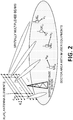
- Figure 2 illustrates the basic scenario and network deployment where the proposed method would apply, comprising a MIMO base station (BS), preferably a so-called massive MIMO base station, with a rectangular antenna array of N 1 x N 2 antenna elements, with inter-antenna spacing given by d X , d y in the horizontal and vertical dimensions, respectively.
- M cellular user equipments are simultaneously connected to the base station and their mobility is described by the velocity vectors v1 ??v M , which create Doppler impairments in both uplink (UL) and downlink (DL).
- the aim of this invention is to compensate Doppler effects at the BS side so that performance is optimized, while keeping baseband processing at the device side as simple as possible.
- Massive MIMO systems are characterized by having at least one order of magnitude higher number of antennas at the BS compared to traditional MIMO systems (see for example, T. L. Marzetta, "Noncooperative Cellular Wireless with Unlimited Numbers of Base Station Antennas", IEEE Transactions on Wireless Communications, vol. 9 no. 11, November 2010 or L. Lu, G. Y. Li, A. L. Swindlehurst, A. Ashikhmin and R. Zhang, “An Overview of Massive MIMO: Benefits and Challenges," in IEEE Journal of Selected Topics in Signal Processing, vol. 8, no. 5, pp. 742-758, Oct. 2014 ).
- the additional degrees of freedom brought by the excess antennas can be exploited in two ways:
- UL signals from users are assumed to be periodically received by the BS, for carrying either UL data or UL control pilots.
- Such UL signals contain enough information on the angles of arrival that can be re-used for the downlink. Reciprocity is observed between the angles of arrival and departure even if different frequencies are involved, apart from a usually small correction factor applied to the antenna excitations that accounts for the differences in UL and DL carrier frequencies.
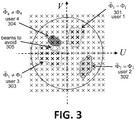
- the angular profile ⁇ i of each user equipment characterizes said user equipment uplink communications as it represents the set of angular directions (corresponding to the received multipaths) in which significant signal energy (or at least non-zero signal energy) is detected at the BS.
- the angular directions defined by the (u, v) grid can be regarded as a set of orthogonal beams.
- the angular profile (the set of beams from which the power received from each user equipment is significant or at least is not zero) can be determined.
- M' denotes the number of different resulting clusters (equal to the number of resolvable user equipments not suffering complete inter-user interference).
- the described spatial multiplexing technique allows convenient separation of the users in the spatial domain.
- Signals received in the uplink direction can be examined in the spatial domain by obtaining the time/frequency components of the beams in the spatial directions ( k , l) , which characterize the users (the user equipments) according to their "modified" angular profiles ⁇ i (avoiding inter-user experience).
- Each of the beams represents a well-defined direction in space, with a certain beam width that can be obtained by taking derivatives thus yielding the following expressions: ⁇ ⁇ ⁇ u ⁇ u + v ⁇ v u 2 + v 2 1 ⁇ u 2 ⁇ v 2 , ⁇ ⁇ ⁇ u ⁇ v ⁇ v ⁇ u u 2 + v 2
- the beam widths are inversely proportional to the numbers of antennas N 1 , N 2 .
- Very small beam widths can be assumed if sufficiently large numbers of antennas are considered in both dimensions.
- the Doppler power spectrum of a signal contained in a given beam does not follow the classical "U-shaped" Jakes spectrum, but resembles instead a pure Doppler shift.
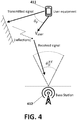
- a user equipment (411) moves at a relative velocity ( v user ) with respect to the direction of departure of a given ray, which after reflection, diffraction and scattering is finally captured by the base station (412).
- ⁇ H RX The angle between the velocity vector and the direction of departure of the ray is ⁇ v , and the receive beam width is ⁇ H RX .
- ⁇ H RX will be equal to ⁇ , ⁇ or something in between depending on the plane formed by the received signal and the beam's rotational axis.
- the Doppler shift f d,shift and Doppler spread ⁇ f d values can be well approximated by the following expressions (as stated for example in the document " On the Impact of Beamforming in the Doppler Spectrum of Millimeter Wave Communications", submitted to IEEE Communications Letters, July 2016 by J. Lorca, M. Hunukumbure, and Y. Wang ):
- the resulting Doppler spread values are therefore proportional to the receive beam width ⁇ H RX .
- ⁇ H RX the Doppler spectrum resembles a Doppler shift with a magnitude that depends on the magnitude of the velocity vector and its relative orientation with respect to the angle of departure.
- the fine Doppler shift can be obtained by means of known techniques (for example, the techniques explained in Schmidl and D. Cox, "Robust frequency and timing synchronization for OFDM", IEEE Transactions on Consumer Electronics, vol. 43, no. 3, pp. 776-783, August 1997 or in Van de Beek, M. Sandell, and P. O.
- a T [ n , m , t ] (the time domain OFDM transmission signals corresponding to antenna (n, m) ) in order to ideally compensate Doppler:
- S T [ k , l , t ] is the time-domain OFDM transmit signal corresponding to the spatial beam with coordinates (k,l) in the (u,v) grid (the spatial beams for downlink and uplink may be considered to be the same, as they correspond to physical directions in space and the grid definition depends on the wavelength
- the Doppler spectrum of the whole received signal (comprising the superposition of multiple components) is not compensated.
- individual beams characterizing the users (the user equipments) are isolated by exploiting the spatial multiplexing capabilities of massive MIMO and the properties of the Doppler spectrum in presence of beamforming.
- the constituent beams can reach the users in DL with ideally no Doppler impairments.
- the signals corresponding to the different spatial beams are detected and their Doppler impairments compensated.
- Figure 5 illustrates an exemplary embodiment for application of the proposed invention.
- a MIMO base station (51) (preferably a massive MIMO base station) comprises a rectangular array of N 1 x N 2 transmit/receive antennas (56), and M user equipments (57) are wirelessly connected exhibiting user velocities v 1 , v 2 ,..., v M respectively.
- the user equipments (UE) may be mobile phones, smartphones, laptops, tablets...and generally speaking any electronic device which can be wirelessly connected to the base station, allowing the user to communicate through the telecommunications network to which the base station belongs.
- the massive MIMO base station is capable of spatially multiplexing up to N 1 x N 2 orthogonal beams aimed at the M user equipments.
- steps (52, 53) may be done using the techniques proposed in patent applications EP-A1-2806576 or EP-A1-3038270 , but other known techniques are not precluded.
- the individual Doppler shifts corresponding to the spatial beams contained in ⁇ i ⁇ are estimated in the uplink (54), following the process previously explained.
- Doppler shifts in UL are compensated (55), and DL signals are generated by ideally compensating the estimated Doppler shifts (following the process previously explained).
- the beams (58) aimed towards each of the user equipments 1... M (57) will exhibit no Doppler impairments at the device side (user equipment side).
- the present invention proposes a novel technique to overcome the effects of mobility in OFDM wireless cellular networks.
- the spatial multiplexing capabilities of massive MIMO are exploited in order to decompose the signals received from, and transmitted to, a set of users into orthogonal spatial beams, in such a way that beams corresponding to each user are detected and inter-user interference is ideally avoided.
- the impact of Doppler within each spatial beam can be well approximated by a simple Doppler shift whenever the beam widths of the spatial beams are sufficiently small. Individual Doppler shifts can then be estimated in UL, and further compensated in UL and DL so that the combined signals do not suffer from any Doppler impairment.
- the proposed invention can have great relevance in wireless cellular communications where Doppler effects are strong, either because user speeds are significant or because the carrier frequency is high (e.g. in millimeter-wave communications). Doppler effects in OFDM can limit performance to the point that no communication is possible beyond a given user speed. Moreover, Doppler exhibits a Doppler spread whenever the received signals are uniformly distributed in azimuth, hence being much more difficult to compensate at the receiver side.
- the proposed invention transforms Doppler spread into the superposition of multiple Doppler shifts at each of the spatial beams, which can be effectively compensated at the BS side.
- the proposed invention is applicable in both FDD and TDD as no detailed channel knowledge is required at the base station side.
- user or cellular user are employed to refer to the concept of user equipment (also called user station or user device), that is the electronic device wirelessly connected to a base station in a wireless OFDM communications system which is employed by a user to communicate through the wireless OFDM communications system.
- user equipment also called user station or user device
- the present invention can be used in any type of OFDM communication system, especially in OFDM communication systems such as mobile (cellular) telecommunication networks, Long-Term Evolution (LTE) wireless cellular system, an IEEE 802.11, WiFi system, an IEEE 802.16, WiMAX (Wireless Microwave Access) system or any other type of OFDM communications system.
- OFDM communication systems such as mobile (cellular) telecommunication networks, Long-Term Evolution (LTE) wireless cellular system, an IEEE 802.11, WiFi system, an IEEE 802.16, WiMAX (Wireless Microwave Access) system or any other type of OFDM communications system.
- LTE Long-Term Evolution
- WiFi Wireless Fidelity
- WiMAX Wireless Microwave Access
- the proposed embodiments can be implemented by means of software elements, hardware elements, firmware elements, or any suitable combination of them.
Landscapes
- Engineering & Computer Science (AREA)
- Signal Processing (AREA)
- Computer Networks & Wireless Communication (AREA)
- Mobile Radio Communication Systems (AREA)
- Radio Transmission System (AREA)
Priority Applications (2)
| Application Number | Priority Date | Filing Date | Title |
|---|---|---|---|
| EP16382529.2A EP3322104A1 (de) | 2016-11-14 | 2016-11-14 | Verfahren, system und vorrichtung zur kompensation von doppler- beeinträchtigungen in ofdm-drahtloskommunikationsnetzwerken |
| US15/810,588 US10284280B2 (en) | 2016-11-14 | 2017-11-13 | Method, system and device for compensation of Doppler impairments in OFDM wireless communication networks |
Applications Claiming Priority (1)
| Application Number | Priority Date | Filing Date | Title |
|---|---|---|---|
| EP16382529.2A EP3322104A1 (de) | 2016-11-14 | 2016-11-14 | Verfahren, system und vorrichtung zur kompensation von doppler- beeinträchtigungen in ofdm-drahtloskommunikationsnetzwerken |
Publications (1)
| Publication Number | Publication Date |
|---|---|
| EP3322104A1 true EP3322104A1 (de) | 2018-05-16 |
Family
ID=57391927
Family Applications (1)
| Application Number | Title | Priority Date | Filing Date |
|---|---|---|---|
| EP16382529.2A Withdrawn EP3322104A1 (de) | 2016-11-14 | 2016-11-14 | Verfahren, system und vorrichtung zur kompensation von doppler- beeinträchtigungen in ofdm-drahtloskommunikationsnetzwerken |
Country Status (2)
| Country | Link |
|---|---|
| US (1) | US10284280B2 (de) |
| EP (1) | EP3322104A1 (de) |
Families Citing this family (7)
| Publication number | Priority date | Publication date | Assignee | Title |
|---|---|---|---|---|
| CN108347272B (zh) * | 2017-01-25 | 2020-12-15 | 华为技术有限公司 | 一种基于波束组进行通信的方法及设备 |
| US12021661B2 (en) | 2019-02-12 | 2024-06-25 | Samsung Electronics Co., Ltd. | Methods for frequency offset tracking in NR mmwave for efficient beam management |
| JP7265926B2 (ja) * | 2019-04-26 | 2023-04-27 | 株式会社Nttドコモ | 通信制御装置および通信制御方法 |
| CN111624402B (zh) * | 2020-05-31 | 2022-09-02 | 西南电子技术研究所(中国电子科技集团公司第十研究所) | 微弱pm信号载波频率精确估计方法 |
| US11438033B2 (en) | 2020-11-16 | 2022-09-06 | Ultralogic 6G, Llc | Location-based power for high reliability and low latency in 5G/6G |
| CN119171941B (zh) * | 2024-09-10 | 2025-04-25 | 南京邮电大学 | 针对大规模mimo系统的二维正交图分多址通信方法 |
| CN119484223B (zh) * | 2024-11-07 | 2025-09-16 | 同济大学 | 一种感知辅助的基于irs和ofdm的高精度信道参数估计和目标定位方法 |
Citations (3)
| Publication number | Priority date | Publication date | Assignee | Title |
|---|---|---|---|---|
| EP2806576A1 (de) | 2013-05-21 | 2014-11-26 | Telefonica S.A. | Verfahren und System für mehrfachen Zugriff auf drahtlose zellulare OFDM-Systeme unter Berücksichtigung von Raum und Frequenzbereichen |
| EP3038270A1 (de) | 2014-12-23 | 2016-06-29 | Telefonica S.A. | Verfahren zur Durchführung von Mehrfachzugang bei drahtlosen zellularen OFDM-Systemen über drahtlose Mehrwegkanäle, die Raum und Frequenzbereiche berücksichtigen, Basisstation und Computerprogramme dafür |
| WO2016153265A1 (ko) * | 2015-03-26 | 2016-09-29 | 엘지전자 주식회사 | 무선 통신 시스템에서 빔 스캐닝 절차를 이용하여 도플러 주파수를 추정하는 방법 및 장치 |
-
2016
- 2016-11-14 EP EP16382529.2A patent/EP3322104A1/de not_active Withdrawn
-
2017
- 2017-11-13 US US15/810,588 patent/US10284280B2/en active Active
Patent Citations (3)
| Publication number | Priority date | Publication date | Assignee | Title |
|---|---|---|---|---|
| EP2806576A1 (de) | 2013-05-21 | 2014-11-26 | Telefonica S.A. | Verfahren und System für mehrfachen Zugriff auf drahtlose zellulare OFDM-Systeme unter Berücksichtigung von Raum und Frequenzbereichen |
| EP3038270A1 (de) | 2014-12-23 | 2016-06-29 | Telefonica S.A. | Verfahren zur Durchführung von Mehrfachzugang bei drahtlosen zellularen OFDM-Systemen über drahtlose Mehrwegkanäle, die Raum und Frequenzbereiche berücksichtigen, Basisstation und Computerprogramme dafür |
| WO2016153265A1 (ko) * | 2015-03-26 | 2016-09-29 | 엘지전자 주식회사 | 무선 통신 시스템에서 빔 스캐닝 절차를 이용하여 도플러 주파수를 추정하는 방법 및 장치 |
Non-Patent Citations (6)
| Title |
|---|
| DIAN FAN ET AL: "Doppler shift estimation for high-speed railway wireless communication systems with large-scale linear antennas", 2015 INTERNATIONAL WORKSHOP ON HIGH MOBILITY WIRELESS COMMUNICATIONS (HMWC), IEEE, 21 October 2015 (2015-10-21), pages 96 - 100, XP032828695, DOI: 10.1109/HMWC.2015.7354343 * |
| J. LORCA; M. HUNUKUMBURE; Y. WANG: "On the Impact of Beamforming in the Doppler Spectrum of Millimeter Wave Communications", IEEE COMMUNICATIONS LETTERS, July 2016 (2016-07-01) |
| L. LU; G. Y. LI; A. L. SWINDLEHURST; A. ASHIKHMIN; R. ZHANG: "An Overview of Massive MIMO: Benefits and Challenges", IEEE JOURNAL OF SELECTED TOPICS IN SIGNAL PROCESSING, vol. 8, no. 5, October 2014 (2014-10-01), pages 742 - 758 |
| SCHMIDL; D. COX: "Robust frequency and timing synchronization for OFDM", IEEE TRANSACTIONS ON CONSUMER ELECTRONICS, vol. 43, no. 3, August 1997 (1997-08-01), pages 776 - 783 |
| T. L. MARZETTA: "Noncooperative Cellular Wireless with Unlimited Numbers of Base Station Antennas", IEEE TRANSACTIONS ON WIRELESS COMMUNICATIONS, vol. 9, no. 11, November 2010 (2010-11-01) |
| VAN DE BEEK; M. SANDELL; P. O. BORJENSON: "ML Estimation of Timing and Frequency Offset in OFDM Systems", IEEE TRANSACTIONS ON CONSUMER ELECTRONICS, vol. 42, no. 10, October 1994 (1994-10-01), pages 2908 - 2914 |
Also Published As
| Publication number | Publication date |
|---|---|
| US10284280B2 (en) | 2019-05-07 |
| US20180138963A1 (en) | 2018-05-17 |
Similar Documents
| Publication | Publication Date | Title |
|---|---|---|
| US10284280B2 (en) | Method, system and device for compensation of Doppler impairments in OFDM wireless communication networks | |
| US20230412442A1 (en) | Method, apparatus, and medium for modulation of waveform in fractional domain for integrated sensing and communication | |
| EP3949151B1 (de) | Veerfahren für erhöhte gerätekommunikation | |
| EP3902192B1 (de) | System und verfahren für ofdma-tonzuweisung in wifi-netzwerken der nächsten generation | |
| US9712217B2 (en) | Parallel channel training in multi-user multiple-input and multiple-output system | |
| US9450723B2 (en) | Channel estimation for data transmission parameter determination in systems employing an array-of-subarrays transceiver architecture | |
| US10230436B2 (en) | Methods for channel information acquisition, signal detection and transmission in multi-user wireless communication systems | |
| CN106233684B (zh) | 无线通信网络节点中的信道估计 | |
| US20220345336A1 (en) | Reference signal channel estimation | |
| US7499504B2 (en) | Method for determining multiple-input multiple-output (MIMO) channel coefficient using polarity-inverted training signals in an orthogonal frequency division multiplexed (OFDM) multicarrier system | |
| US20190086505A1 (en) | Methods for estimating angle of arrival or angle of departure | |
| US10644904B2 (en) | System and method for channel estimation | |
| US12349092B2 (en) | Method and apparatus for signal processing in a wireless communication system | |
| EP4387179A1 (de) | Verfahren und vorrichtung zur datenübertragungsverarbeitung, kommunikationsvorrichtung und speichermedium | |
| CA2945375C (en) | Sparse ordered iterative group multi-antenna channel estimation | |
| CN109391403A (zh) | 用于无线信号的发送和接收的方法和装置 | |
| US11632272B1 (en) | Multiplexing demodulation reference signal and data in orthogonal time frequency space waveform | |
| US20240048309A1 (en) | Method and apparatus for round-trip carrier-phase operation | |
| Cassiau et al. | Time and frequency synchronization for CoMP with FBMC | |
| Fan et al. | Power allocation for cell-free massive MIMO ISAC systems with OTFS signal | |
| US20250088330A1 (en) | Resource grouping information indication for time-domain channel reporting and resource selection | |
| WO2022199664A1 (zh) | 信息发送方法和设备 | |
| CN106105121B (zh) | 用于在大规模mimo系统中获取下行数据的方法与设备 | |
| US10103905B2 (en) | Method for transmitting channel information and wireless communication system using the same | |
| Ying et al. | Uplink-aided downlink channel estimation for a high-mobility massive MIMO-OTFS system |
Legal Events
| Date | Code | Title | Description |
|---|---|---|---|
| PUAI | Public reference made under article 153(3) epc to a published international application that has entered the european phase |
Free format text: ORIGINAL CODE: 0009012 |
|
| STAA | Information on the status of an ep patent application or granted ep patent |
Free format text: STATUS: THE APPLICATION HAS BEEN PUBLISHED |
|
| AK | Designated contracting states |
Kind code of ref document: A1 Designated state(s): AL AT BE BG CH CY CZ DE DK EE ES FI FR GB GR HR HU IE IS IT LI LT LU LV MC MK MT NL NO PL PT RO RS SE SI SK SM TR |
|
| AX | Request for extension of the european patent |
Extension state: BA ME |
|
| STAA | Information on the status of an ep patent application or granted ep patent |
Free format text: STATUS: THE APPLICATION IS DEEMED TO BE WITHDRAWN |
|
| 18D | Application deemed to be withdrawn |
Effective date: 20181117 |