EP3322018A1 - Polymer electrolyte membrane production method, polymer electrolyte membrane produced using same, membrane electrode assembly comprising said polymer electrolyte membrane, and fuel cell comprising said membrane electrode assembly - Google Patents
Polymer electrolyte membrane production method, polymer electrolyte membrane produced using same, membrane electrode assembly comprising said polymer electrolyte membrane, and fuel cell comprising said membrane electrode assembly Download PDFInfo
- Publication number
- EP3322018A1 EP3322018A1 EP17792852.0A EP17792852A EP3322018A1 EP 3322018 A1 EP3322018 A1 EP 3322018A1 EP 17792852 A EP17792852 A EP 17792852A EP 3322018 A1 EP3322018 A1 EP 3322018A1
- Authority
- EP
- European Patent Office
- Prior art keywords
- electrolyte membrane
- chemical formula
- polymer
- polymer electrolyte
- group
- Prior art date
- Legal status (The legal status is an assumption and is not a legal conclusion. Google has not performed a legal analysis and makes no representation as to the accuracy of the status listed.)
- Granted
Links
Images


Classifications
-
- H—ELECTRICITY
- H01—ELECTRIC ELEMENTS
- H01M—PROCESSES OR MEANS, e.g. BATTERIES, FOR THE DIRECT CONVERSION OF CHEMICAL ENERGY INTO ELECTRICAL ENERGY
- H01M8/00—Fuel cells; Manufacture thereof
- H01M8/10—Fuel cells with solid electrolytes
- H01M8/1016—Fuel cells with solid electrolytes characterised by the electrolyte material
- H01M8/1018—Polymeric electrolyte materials
- H01M8/1069—Polymeric electrolyte materials characterised by the manufacturing processes
-
- H—ELECTRICITY
- H01—ELECTRIC ELEMENTS
- H01M—PROCESSES OR MEANS, e.g. BATTERIES, FOR THE DIRECT CONVERSION OF CHEMICAL ENERGY INTO ELECTRICAL ENERGY
- H01M8/00—Fuel cells; Manufacture thereof
- H01M8/10—Fuel cells with solid electrolytes
- H01M8/1016—Fuel cells with solid electrolytes characterised by the electrolyte material
- H01M8/1018—Polymeric electrolyte materials
- H01M8/1069—Polymeric electrolyte materials characterised by the manufacturing processes
- H01M8/1086—After-treatment of the membrane other than by polymerisation
- H01M8/1088—Chemical modification, e.g. sulfonation
-
- C—CHEMISTRY; METALLURGY
- C08—ORGANIC MACROMOLECULAR COMPOUNDS; THEIR PREPARATION OR CHEMICAL WORKING-UP; COMPOSITIONS BASED THEREON
- C08G—MACROMOLECULAR COMPOUNDS OBTAINED OTHERWISE THAN BY REACTIONS ONLY INVOLVING UNSATURATED CARBON-TO-CARBON BONDS
- C08G65/00—Macromolecular compounds obtained by reactions forming an ether link in the main chain of the macromolecule
-
- C—CHEMISTRY; METALLURGY
- C08—ORGANIC MACROMOLECULAR COMPOUNDS; THEIR PREPARATION OR CHEMICAL WORKING-UP; COMPOSITIONS BASED THEREON
- C08J—WORKING-UP; GENERAL PROCESSES OF COMPOUNDING; AFTER-TREATMENT NOT COVERED BY SUBCLASSES C08B, C08C, C08F, C08G or C08H
- C08J3/00—Processes of treating or compounding macromolecular substances
- C08J3/24—Crosslinking, e.g. vulcanising, of macromolecules
-
- C—CHEMISTRY; METALLURGY
- C08—ORGANIC MACROMOLECULAR COMPOUNDS; THEIR PREPARATION OR CHEMICAL WORKING-UP; COMPOSITIONS BASED THEREON
- C08J—WORKING-UP; GENERAL PROCESSES OF COMPOUNDING; AFTER-TREATMENT NOT COVERED BY SUBCLASSES C08B, C08C, C08F, C08G or C08H
- C08J5/00—Manufacture of articles or shaped materials containing macromolecular substances
- C08J5/20—Manufacture of shaped structures of ion-exchange resins
- C08J5/22—Films, membranes or diaphragms
- C08J5/2206—Films, membranes or diaphragms based on organic and/or inorganic macromolecular compounds
- C08J5/2218—Synthetic macromolecular compounds
- C08J5/2256—Synthetic macromolecular compounds based on macromolecular compounds obtained by reactions other than those involving carbon-to-carbon bonds, e.g. obtained by polycondensation
-
- H—ELECTRICITY
- H01—ELECTRIC ELEMENTS
- H01M—PROCESSES OR MEANS, e.g. BATTERIES, FOR THE DIRECT CONVERSION OF CHEMICAL ENERGY INTO ELECTRICAL ENERGY
- H01M8/00—Fuel cells; Manufacture thereof
- H01M8/10—Fuel cells with solid electrolytes
- H01M8/1004—Fuel cells with solid electrolytes characterised by membrane-electrode assemblies [MEA]
-
- H—ELECTRICITY
- H01—ELECTRIC ELEMENTS
- H01M—PROCESSES OR MEANS, e.g. BATTERIES, FOR THE DIRECT CONVERSION OF CHEMICAL ENERGY INTO ELECTRICAL ENERGY
- H01M8/00—Fuel cells; Manufacture thereof
- H01M8/10—Fuel cells with solid electrolytes
- H01M8/1016—Fuel cells with solid electrolytes characterised by the electrolyte material
- H01M8/1018—Polymeric electrolyte materials
- H01M8/102—Polymeric electrolyte materials characterised by the chemical structure of the main chain of the ion-conducting polymer
- H01M8/1025—Polymeric electrolyte materials characterised by the chemical structure of the main chain of the ion-conducting polymer having only carbon and oxygen, e.g. polyethers, sulfonated polyetheretherketones [S-PEEK], sulfonated polysaccharides, sulfonated celluloses or sulfonated polyesters
-
- H—ELECTRICITY
- H01—ELECTRIC ELEMENTS
- H01M—PROCESSES OR MEANS, e.g. BATTERIES, FOR THE DIRECT CONVERSION OF CHEMICAL ENERGY INTO ELECTRICAL ENERGY
- H01M8/00—Fuel cells; Manufacture thereof
- H01M8/10—Fuel cells with solid electrolytes
- H01M8/1016—Fuel cells with solid electrolytes characterised by the electrolyte material
- H01M8/1018—Polymeric electrolyte materials
- H01M8/1041—Polymer electrolyte composites, mixtures or blends
- H01M8/1046—Mixtures of at least one polymer and at least one additive
-
- H—ELECTRICITY
- H01—ELECTRIC ELEMENTS
- H01M—PROCESSES OR MEANS, e.g. BATTERIES, FOR THE DIRECT CONVERSION OF CHEMICAL ENERGY INTO ELECTRICAL ENERGY
- H01M8/00—Fuel cells; Manufacture thereof
- H01M8/10—Fuel cells with solid electrolytes
- H01M8/1016—Fuel cells with solid electrolytes characterised by the electrolyte material
- H01M8/1018—Polymeric electrolyte materials
- H01M8/1069—Polymeric electrolyte materials characterised by the manufacturing processes
- H01M8/1072—Polymeric electrolyte materials characterised by the manufacturing processes by chemical reactions, e.g. in situ polymerisation or in situ crosslinking
-
- C—CHEMISTRY; METALLURGY
- C08—ORGANIC MACROMOLECULAR COMPOUNDS; THEIR PREPARATION OR CHEMICAL WORKING-UP; COMPOSITIONS BASED THEREON
- C08J—WORKING-UP; GENERAL PROCESSES OF COMPOUNDING; AFTER-TREATMENT NOT COVERED BY SUBCLASSES C08B, C08C, C08F, C08G or C08H
- C08J2371/00—Characterised by the use of polyethers obtained by reactions forming an ether link in the main chain; Derivatives of such polymers
-
- H—ELECTRICITY
- H01—ELECTRIC ELEMENTS
- H01M—PROCESSES OR MEANS, e.g. BATTERIES, FOR THE DIRECT CONVERSION OF CHEMICAL ENERGY INTO ELECTRICAL ENERGY
- H01M8/00—Fuel cells; Manufacture thereof
- H01M8/10—Fuel cells with solid electrolytes
- H01M2008/1095—Fuel cells with polymeric electrolytes
-
- H—ELECTRICITY
- H01—ELECTRIC ELEMENTS
- H01M—PROCESSES OR MEANS, e.g. BATTERIES, FOR THE DIRECT CONVERSION OF CHEMICAL ENERGY INTO ELECTRICAL ENERGY
- H01M2300/00—Electrolytes
- H01M2300/0017—Non-aqueous electrolytes
- H01M2300/0065—Solid electrolytes
- H01M2300/0082—Organic polymers
-
- Y—GENERAL TAGGING OF NEW TECHNOLOGICAL DEVELOPMENTS; GENERAL TAGGING OF CROSS-SECTIONAL TECHNOLOGIES SPANNING OVER SEVERAL SECTIONS OF THE IPC; TECHNICAL SUBJECTS COVERED BY FORMER USPC CROSS-REFERENCE ART COLLECTIONS [XRACs] AND DIGESTS
- Y02—TECHNOLOGIES OR APPLICATIONS FOR MITIGATION OR ADAPTATION AGAINST CLIMATE CHANGE
- Y02E—REDUCTION OF GREENHOUSE GAS [GHG] EMISSIONS, RELATED TO ENERGY GENERATION, TRANSMISSION OR DISTRIBUTION
- Y02E60/00—Enabling technologies; Technologies with a potential or indirect contribution to GHG emissions mitigation
- Y02E60/30—Hydrogen technology
- Y02E60/50—Fuel cells
-
- Y—GENERAL TAGGING OF NEW TECHNOLOGICAL DEVELOPMENTS; GENERAL TAGGING OF CROSS-SECTIONAL TECHNOLOGIES SPANNING OVER SEVERAL SECTIONS OF THE IPC; TECHNICAL SUBJECTS COVERED BY FORMER USPC CROSS-REFERENCE ART COLLECTIONS [XRACs] AND DIGESTS
- Y02—TECHNOLOGIES OR APPLICATIONS FOR MITIGATION OR ADAPTATION AGAINST CLIMATE CHANGE
- Y02P—CLIMATE CHANGE MITIGATION TECHNOLOGIES IN THE PRODUCTION OR PROCESSING OF GOODS
- Y02P70/00—Climate change mitigation technologies in the production process for final industrial or consumer products
- Y02P70/50—Manufacturing or production processes characterised by the final manufactured product
Definitions
- the present specification relates to a method for preparing a polymer electrolyte membrane, a polymer electrolyte membrane prepared using the same, a membrane electrode assembly including the polymer electrolyte membrane and a fuel cell including the membrane electrode assembly.
- the present specification is directed to providing a method for preparing a polymer electrolyte membrane, a polymer electrolyte membrane prepared using the same, a membrane electrode assembly including the polymer electrolyte membrane and a fuel cell including the membrane electrode assembly.
- One embodiment of the present specification provides a method for preparing a polymer electrolyte membrane including preparing an electrolyte membrane including a polyarylene ether ketone polymer including a unit of the following Chemical Formula 1 and having a sulfonate group and inorganic nanoparticles including a hydroxyl group on a surface; reducing a ketone group of the polyarylene ether ketone polymer; and crosslinking the reduced polyarylene ether ketone polymer and the inorganic nanoparticles by treating the electrolyte membrane with sulfuric acid.
- R1 to R3 are the same as or different from each other, and each independently hydrogen, an alkyl group or an aryl group, a is an integer of 0 to 8 and b and c are each an integer of 0 to 4, and when a to c are 2 or greater, substituents in the parentheses are the same as or different from each other.
- Another embodiment of the present specification provides a method for preparing a polymer electrolyte membrane including reducing a ketone group of a polyarylene ether ketone polymer including the unit of Chemical Formula 1 and having a sulfonate group; preparing an electrolyte membrane including the reduced polyarylene ether ketone polymer and inorganic nanoparticles including a hydroxyl group on a surface; and crosslinking the reduced polyarylene ether ketone polymer and the inorganic nanoparticles by treating the electrolyte membrane with sulfuric acid.
- Still another embodiment of the present specification provides a polymer electrolyte membrane including a structure in which a polymer including the unit of Chemical Formula 1 and having a sulfonate group is crosslinked with inorganic nanoparticles through a structure of the following Chemical Formula 6.
- Yet another embodiment of the present specification provides a membrane electrode assembly including the electrolyte membrane described above.
- Still yet another embodiment of the present specification provides a fuel cell including the membrane electrode assembly described above.
- a polymer electrolyte membrane according to one embodiment of the present specification has excellent durability and mechanical strength.
- substitution means a hydrogen atom bonding to a carbon atom of a compound is changed to another substituent, and the position of substitution is not limited as long as it is a position at which the hydrogen atom is substituted, that is, a position at which a substituent can substitute, and when two or more substituents substitute, the two or more substituents may be the same as or different from each other.
- substituted or unsubstituted in the present specification means being substituted with one, two or more substituents selected from the group consisting of deuterium; a sulfonate group; a halogen group; a nitrile group; a substituted or unsubstituted alkyl group; and a substituted or unsubstituted aryl group, or having no substituents.
- substituents selected from the group consisting of deuterium; a sulfonate group; a halogen group; a nitrile group; a substituted or unsubstituted alkyl group; and a substituted or unsubstituted aryl group, or having no substituents.
- the sulfonate group may be represented by groups such as -SO 3 Q, and Q may be hydrogen or a group 1 element such as hydrogen (H), potassium (K) or sodium (Na). Accordingly, examples of the sulfonate group include - SO 3 H, -SO 3 Na, or -SO 3 K.
- the halogen group may be fluorine, chlorine, bromine or iodine.
- the alkyl group may be linear or branched, and although not particularly limited thereto, the number of carbon atoms is preferably from 1 to 30. Specific examples thereof may include methyl, ethyl, propyl, n-propyl, isopropyl, butyl, n-butyl, isobutyl, tert-butyl, sec-butyl, 1-methyl-butyl, 1-ethyl-butyl, pentyl, n-pentyl, isopentyl, neopentyl, tert-pentyl, hexyl, n-hexyl, 1-methylpentyl, 2-methylpentyl, 4-methyl-2-pentyl, 3,3-dimethylbutyl, 2-ethylbutyl, heptyl, n-heptyl, 1-methylhexyl, cyclopentylmethyl, cyclohexylmethyl, octy
- the aryl group may be monocyclic or multicyclic, and when the aryl group is a monocyclic aryl group, the number of carbon atoms is not particularly limited, but is preferably from 6 to 30.
- Specific examples of the monocyclic aryl group may include a phenyl group, a biphenyl group, a terphenyl group and the like, but are not limited thereto.
- the number of carbon atoms is not particularly limited, but is preferably from 10 to 30.
- Specific examples of the multicyclic aryl group may include a naphthyl group, an anthracenyl group, a phenanthryl group, a pyrenyl group, a perylenyl group, a chrysenyl group, a fluorenyl group or the like, but are not limited thereto.
- the fluorenyl group may be substituted, and adjacent substituents may bond to each other to form a ring.
- the alkylene group means an alkyl group having two bonding sites, that is, a divalent group. Descriptions on the alkyl group provided above may be applied thereto except for each being a divalent group.
- the arylene group means an aryl group having two bonding sites, that is, a divalent group. Descriptions on the aryl group provided above may be applied thereto except for each being a divalent group.
- One embodiment of the present specification provides a method for preparing a polymer electrolyte membrane including preparing an electrolyte membrane including a polyarylene ether ketone polymer including a unit of the following Chemical Formula 1 and having a sulfonate group and inorganic nanoparticles including a hydroxyl group on a surface; reducing a ketone group of the polyarylene ether ketone polymer; and crosslinking the reduced polyarylene ether ketone polymer and the inorganic nanoparticles by treating the electrolyte membrane with sulfuric acid.
- R1 to R3 are the same as or different from each other and each independently hydrogen, an alkyl group or an aryl group, a is an integer of 0 to 8 and b and c are each an integer of 0 to 4, and when a to c are 2 or greater, substituents in the parentheses are the same as or different from each other.
- Another embodiment of the present specification provides a method for preparing a polymer electrolyte membrane including reducing a ketone group of a polyarylene ether ketone polymer including the unit of Chemical Formula 1 and having a sulfonate group; preparing an electrolyte membrane including the reduced polyarylene ether ketone polymer and inorganic nanoparticles including a hydroxyl group on a surface; and crosslinking the reduced polyarylene ether ketone polymer and the inorganic nanoparticles by treating the electrolyte membrane with sulfuric acid.
- the term "inorganic nanoparticles” means a nano-scaled particle-type inorganic material. Typical diameters of the inorganic nanoparticles are from 5 nm to 70 nm and preferably from 5 nm to 20 nm. Sizes of the inorganic nanoparticles may be properly controlled by changing a hydrolysis condition, a heating treatment condition and the like in the polymer electrolyte membrane preparation process.
- the inorganic nanoparticles in the present disclosure are not particularly limited as long as they include a hydroxyl group on the surface, and are capable of being stably present inside a crosslinked structure of the polymer electrolyte membrane (that is, a crosslinked structure with a main chain of the polymer membrane) prepared according to the present disclosure.
- Examples of the preferred inorganic nanoparticles in the present disclosure may include Al 2 O 3 , Y 2 O 3 , SiO 2 , TiO 2 , ZrO 2 , WO 3 , NiO and the like.
- the more preferred inorganic nanoparticles are SiO 2 .
- the inorganic nanoparticles include the hydroxyl group on the surface, chemical crosslinking is formed with a hydroxyl group of the reduced polyarylene ether ketone polymer, and a polymer electrolyte membrane having high durability may be formed.
- the reducing of a ketone group of the polyarylene ether ketone polymer may be carried out using NaBH 4 or LiAlH 4 , and NaBH 4 that is advantageous in terms of experimental stability may be preferably used.
- the reduction may be carried out by immersing the electrolyte membrane in an aqueous NaBH 4 or LiAlH 4 solution for 24 hours.
- the reduction may be carried out by reacting the polyarylene ether ketone polymer with NaBH 4 or LiAlH 4 for 12 hours.
- a content of the inorganic nanoparticles may be from 1% by weight to 10% by weight, preferably from 3% by weight to 7% by weight and more preferably from 4% by weight to 6% by weight with respect to 100% by weight of the polyarylene ether ketone polymer.
- a content of the inorganic nanoparticles may be from 1% by weight to 10% by weight, preferably from 3% by weight to 7% by weight and more preferably from 4% by weight to 6% by weight with respect to 100% by weight of the reduced polyarylene ether ketone polymer.
- the content of the inorganic nanoparticles When the content of the inorganic nanoparticles is included in the above-mentioned range, a hydrophilic effect, an ion conductivity enhancing effect obtained by crosslinking with the polymer and a durability enhancing effect of the inorganic nanoparticles may be maximized. Meanwhile, when the content of the inorganic nanoparticles is less than 1% by weight, the effects described above may not be obtained sufficiently, and the content being greater than 10% by weight causes a problem in the inorganic nanoparticle dispersion and membrane uniformity and ion conductivity may become worse.
- the polyarylene ether ketone polymer including the unit of Chemical Formula 1 and having a sulfonate group includes a unit of the following Chemical Formula 2 and a unit of the following Chemical Formula 3.
- R1 to R3 and a to c have the same definitions as in Chemical Formula 1, Ar1 to Ar5 are the same as or different from each other and each independently a substituted or unsubstituted arylene group, and Q is hydrogen (H), potassium (K) or sodium (Na).
- the polymer crosslinked with the inorganic nanoparticles through crosslinking the reduced polyarylene ether ketone polymer and the inorganic nanoparticles by treating the electrolyte membrane with sulfuric acid includes a unit of the following Chemical Formula 4 and a unit of the following Chemical Formula 5.
- X in Chemical Formulae 4 and 5 is -C(-OH)H- or Chemical Formula 6.
- the polymer crosslinked with the inorganic nanoparticles includes a unit of the following Chemical Formula 7.
- R1 to R3 and a to c have the same definitions as in Chemical Formula 1, Ar1 to Ar5 are the same as or different from each other and each independently a substituted or unsubstituted arylene group, Q is hydrogen(H), potassium (K) or sodium (Na), and is a site bonding to the inorganic nanoparticles.
- One embodiment of the present specification provides a polymer electrolyte membrane prepared using the preparation method described above.
- One embodiment of the present specification provides a polymer electrolyte membrane including a structure in which a polymer including the unit of Chemical Formula 1 and having a sulfonate group is crosslinked with inorganic nanoparticles through a structure of the following Chemical Formula 6.
- R1 to R3 are the same as or different from each other and each independently hydrogen, an alkyl group or an aryl group, a is an integer of 0 to 8, b and c are each an integer of 0 to 4, and when a to c are 2 or greater, substituents in the parentheses are the same as or different from each other, and in Chemical Formula 6, * is a site linking to a main chain of the polymer forming the polymer electrolyte membrane, and is a site bonding to the inorganic nanoparticles.
- the polymer electrolyte membrane includes the unit of Chemical Formula 4 and the unit of the following Chemical Formula 5 described above.
- the polymer electrolyte membrane includes a unit of the following Chemical Formula 7.
- R1 to R3 and a to c have the same definitions as in Chemical Formula 1, Ar1 to Ar5 are the same as or different from each other and each independently a substituted or unsubstituted arylene group, Q is hydrogen(H), potassium (K) or sodium (Na), and is a site bonding to the inorganic nanoparticles.
- One embodiment of the present specification provides a membrane electrode assembly including the electrolyte membrane described above.
- One embodiment of the present specification provides a fuel cell including the membrane electrode assembly.
- the fuel cell of the present specification includes fuel cells generally known in the art.
- the fuel cell may include a stack including the membrane electrode assembly and a separator provided between the membrane electrode assemblies; a fuel supply unit supplying fuel to the stack; and an oxidizer supply unit supplying an oxidizer to the stack.
- the stack includes one, two or more of the membrane electrode assemblies, and when including two or more membrane electrode assemblies, a separator provided therebetween is included.
- the separator performs a role of preventing the membrane electrode assemblies from being electrically connected to each other, and transferring fuel and oxidizer supplied from the outside to the membrane electrode assemblies.
- the oxidizer supply unit performs a role of supplying an oxidizer to the stack.
- Oxygen is typically used as the oxidizer, and oxygen or air may be injected using a pump when used.
- the fuel supply unit performs a role of supplying fuel to the stack, and may be formed with a fuel tank storing fuel and a pump supplying the fuel stored in the fuel tank to the stack.
- a fuel tank storing fuel
- a pump supplying the fuel stored in the fuel tank to the stack.
- the fuel hydrogen or hydrocarbon fuel in a gas or liquid state may be used.
- the hydrocarbon fuel may include methanol, ethanol, propanol, butanol or natural gas.
- Hydroquinonesulfonic acid potassium salt (0.9 eq.), 4,4'-difluorobenzophenone (0.97 eq.) and 3,5-bis(4-fluorobenzoyl) phenyl (4-fluorophenyl)methanone (0.02 eq.) were introduced to a 1 L round bottom flask equipped with a Dean-Stark trap and a condenser, and prepared under nitrogen atmosphere using potassium carbonate (K 2 CO 3 ) as a catalyst in a dimethyl sulfoxide (DMSO) and benzene solvent.
- K 2 CO 3 potassium carbonate
- reaction mixture was stirred for 4 hours in an oil bath at a temperature of 140°C, and after removing an azeotropic mixture by adsorbing the azeotropic mixture to molecular sieves of the Dean-Stark trap while benzene flowed backward, the reaction temperature was raised to 180°C, and the result was condensation polymerization reacted for 20 hours.
- reaction mixture was stirred again for 4 hours in an oil bath at a temperature of 140°C, and after removing an azeotropic mixture by adsorbing the azeotropic mixture to molecular sieves of the Dean-Stark trap while benzene flowed backward, the reaction temperature was raised to 180°C, and the result was condensation polymerization reacted for 20 hours. Then the temperature of the reactant was lowered to room temperature, and dimethyl sulfoxide (DMSO) was further added to dilute a product, and the diluted product was poured into excess ethanol to separate a copolymer from the solvent.
- DMSO dimethyl sulfoxide
- Fumed silica was prepared by a high temperature gas phase reaction hydrolyzing chlorosilane in flames of 1000°C or higher formed with oxygen and hydrogen. Basic particles made in the flames were linked to each other through collision to form secondary particles while still being dissolved on the surface, and as a result, aggregates and agglomerates linked in a three-dimensional branched form were produced. After the reaction, hydrogen chloride gas remaining in the silica was removed under a high temperature air condition. Density of the fumed silica was very low immediately after preparation, and therefore, the density was raised to 50 g/L or greater using a method of deflation using a pressure reducing device.
- silica particles were surface treated with a hydroxyl group (-OH) to prepare hydrophilic silica particles.
- hydrocarbon-based polymer synthesized in 1) and the silica particles prepared in 2) in a ratio of 5% by weight with respect to 100% by weight of the hydrocarbon-based polymer were added to a dimethyl sulfoxide (DMSO) solvent, and then the result was filtered to prepare a silica polymer composition.
- DMSO dimethyl sulfoxide
- the prepared silica polymer composition was dried for 24 hours in an oven at 80°C to prepare a silica-added hydrocarbon-based composite membrane.
- the prepared composite membrane was acid treated for 24 hours at 80°C using 10 wt% sulfuric acid, washed 4 times or more with distilled water, and then dried at 80°C to prepare a polymer electrolyte membrane.
- Crosslinking was progressed by immersing the polymer electrolyte membrane including silica nanoparticles prepared according to Steps 1) to 3) of the preparation example in an aqueous 5 wt% sodium borohydride (NaBH 4 ) solution for 24 hours at room temperature, then washing with ion-removed distilled water, and then placing in a 1 M sulfuric acid (H 2 SO 4 ) solution.
- NaBH 4 sodium borohydride
- a polymer electrolyte membrane was prepared by adding sodium borohydride (NaBH 4 ) to an electrolyte polymer solution including the polymer prepared according to Step 1) of the preparation example and the silica nanoparticles prepared according to Step 2) of the preparation example in a ratio of 1% by weight with respect to 100% by weight of the polymer in a dimethyl sulfoxide (DMSO) solvent, and reacting the result for 12 hours at 120°C.
- Crosslinking was progressed by drying the prepared polymer electrolyte membrane, washing with ion-removed distilled water, and then placing in a 1 M sulfuric acid (H 2 SO 4 ) solution.
- a polymer electrolyte membrane was prepared by adding the polymer without including silica particles prepared according to Step 1) of the preparation example to a dimethyl sulfoxide (DMSO) solvent, and drying for 24 hours in an oven at 80°C.
- DMSO dimethyl sulfoxide
- a polymer electrolyte membrane was prepared by adding Nafion 211 that does not include a ketone group as in the following chemical formula to a dimethyl sulfoxide (DMSO) solvent without adding silica nanoparticles, and then drying for 24 hours in an oven at 80°C.
- DMSO dimethyl sulfoxide
- Example 1 For Example 1, Example 2, Comparative Example 1 and Comparative Example 3, volumetric expansion of the electrolyte membranes were each measured in a dry state and a humid state. Specifically, the electrolyte membrane was cut to a 5 cm ⁇ 5 cm size, and a width and a thickness depending on each condition were measured.
- Example 1 As shown in FIG. 4 , it was identified that volumetric expansion decreased in Example 1, Example 2 and Comparative Example 3 due to silica containment. Among these, it was identified that Examples 1 and 2 having a crosslinked structure exhibited lowest volumetric expansion compared to Comparative Examples 1 and 3. Accordingly, it was seen that the electrolyte membrane according to the present disclosure had excellent humid condition-dependent mechanical stability.
- Example 1 ion conductivity of Example 1 under a low humid condition was significantly high compared to Comparative Example 1, and enhancement in the membrane performance was identified. This is considered as an effect of the silica included in the electrolyte membrane, and a similar result was also obtained in Comparative Example 3.
Landscapes
- Chemical & Material Sciences (AREA)
- Engineering & Computer Science (AREA)
- Manufacturing & Machinery (AREA)
- Chemical Kinetics & Catalysis (AREA)
- General Chemical & Material Sciences (AREA)
- Life Sciences & Earth Sciences (AREA)
- Electrochemistry (AREA)
- Sustainable Energy (AREA)
- Sustainable Development (AREA)
- Organic Chemistry (AREA)
- Health & Medical Sciences (AREA)
- Polymers & Plastics (AREA)
- Medicinal Chemistry (AREA)
- Crystallography & Structural Chemistry (AREA)
- Inorganic Chemistry (AREA)
- Materials Engineering (AREA)
- Composite Materials (AREA)
- Fuel Cell (AREA)
- Conductive Materials (AREA)
- Compositions Of Macromolecular Compounds (AREA)
- Manufacture Of Macromolecular Shaped Articles (AREA)
Abstract
Description
- This application claims priority to and the benefits of Korean Patent Application No.
10-2016-0055740 10-2017-0054523 - The present specification relates to a method for preparing a polymer electrolyte membrane, a polymer electrolyte membrane prepared using the same, a membrane electrode assembly including the polymer electrolyte membrane and a fuel cell including the membrane electrode assembly.
- In a fuel cell including a polymer electrolyte membrane, superiority of a fluorine-based polymer electrolyte membrane is widely known for its high performance and durability. Particularly, in a fluorine-based polymer electrolyte membrane, it is identified that durability is stably exhibited in a mechanical property evaluation through a relative humidity cycle test (RH cycle test). However, studies on a hydrocarbon-based polymer electrolyte membrane have been much progressed with higher price competitiveness of a hydrocarbon-based polymer electrolyte membrane compared to a fluorine-based polymer electrolyte membrane. In order to increase ion conductivity of a hydrocarbon-based polymer electrolyte membrane to a fluorine-based polymer electrolyte membrane level, polymers having a low equivalent weight value are mainly synthesized, however, mechanical durability tends to further decrease in a hydrocarbon-based polymer having a low equivalent weight value. Accordingly, studies for enhancing mechanical durability shown in a relative humidity cycle test (RH cycle test) through blending have been mainly progressed.
- The present specification is directed to providing a method for preparing a polymer electrolyte membrane, a polymer electrolyte membrane prepared using the same, a membrane electrode assembly including the polymer electrolyte membrane and a fuel cell including the membrane electrode assembly.
- One embodiment of the present specification provides a method for preparing a polymer electrolyte membrane including preparing an electrolyte membrane including a polyarylene ether ketone polymer including a unit of the following Chemical Formula 1 and having a sulfonate group and inorganic nanoparticles including a hydroxyl group on a surface; reducing a ketone group of the polyarylene ether ketone polymer; and crosslinking the reduced polyarylene ether ketone polymer and the inorganic nanoparticles by treating the electrolyte membrane with sulfuric acid.

- In
Chemical Formula 1, R1 to R3 are the same as or different from each other, and each independently hydrogen, an alkyl group or an aryl group, a is an integer of 0 to 8 and b and c are each an integer of 0 to 4, and when a to c are 2 or greater, substituents in the parentheses are the same as or different from each other. - Another embodiment of the present specification provides a method for preparing a polymer electrolyte membrane including reducing a ketone group of a polyarylene ether ketone polymer including the unit of Chemical Formula 1 and having a sulfonate group; preparing an electrolyte membrane including the reduced polyarylene ether ketone polymer and inorganic nanoparticles including a hydroxyl group on a surface; and crosslinking the reduced polyarylene ether ketone polymer and the inorganic nanoparticles by treating the electrolyte membrane with sulfuric acid.
- Still another embodiment of the present specification provides a polymer electrolyte membrane including a structure in which a polymer including the unit of Chemical Formula 1 and having a sulfonate group is crosslinked with inorganic nanoparticles through a structure of the following Chemical Formula 6.
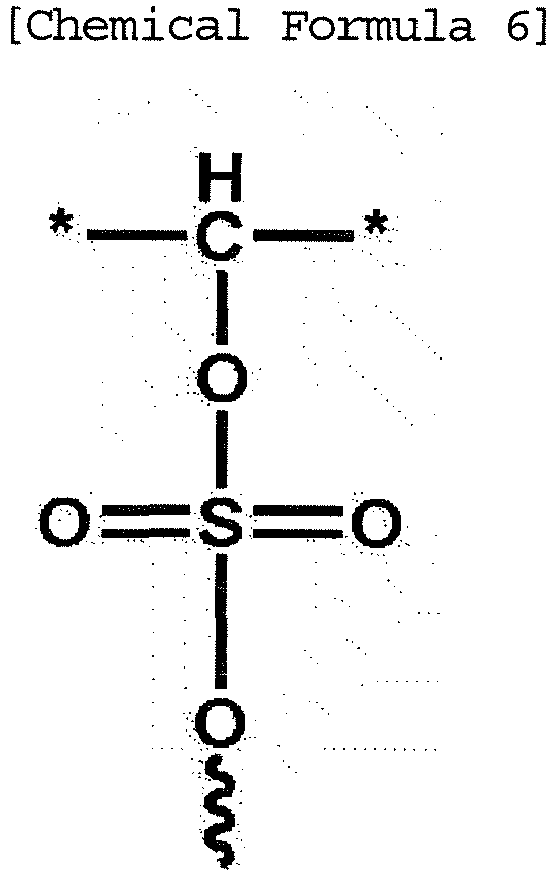
- In Chemical Formula 6, * is a site linking to a main chain of the polymer forming the polymer electrolyte membrane, andis a site bonding to the inorganic nanoparticles.

- Yet another embodiment of the present specification provides a membrane electrode assembly including the electrolyte membrane described above.
- Still yet another embodiment of the present specification provides a fuel cell including the membrane electrode assembly described above.
- A polymer electrolyte membrane according to one embodiment of the present specification has excellent durability and mechanical strength.
-
-
FIG. 1 illustrates bonding structures of polymer electrolyte membranes of Example 1 and Comparative Example 1 according to one embodiment of the present specification. -
FIG. 2 is a graph comparing stress of electrolyte membranes of Example 1, Example 2 and Comparative Example 1 to Comparative Example 3 according to one embodiment of the present specification. -
FIG. 3 is a graph comparing stress of electrolyte membranes of Comparative Example 4 and Comparative Example 5 according to one embodiment of the present specification. -
FIG. 4 is a graph comparing humidity-dependent volumetric expansion of electrolyte membranes of Example 1, Example 2, Comparative Example 1 and Comparative Example 3 according to one embodiment of the present specification. -
FIG. 5 is a graph comparing ion conductivity of electrolyte membranes of Example 1 and Comparative Example 1 to Comparative Example 3 according to one embodiment of the present specification. -
FIG. 6 shows photographed SEM images of Example 1 and Comparative Example 3 according to one embodiment of the present specification. - Hereinafter, the present specification will be described in more detail.
- In the present specification, a certain part "including" certain constituents means capable of further including other constituents, and does not exclude other constituents unless particularly stated on the contrary.
- Examples of the substituents in the present specification are described below, however, the substituents are not limited thereto.
- The term "substitution" means a hydrogen atom bonding to a carbon atom of a compound is changed to another substituent, and the position of substitution is not limited as long as it is a position at which the hydrogen atom is substituted, that is, a position at which a substituent can substitute, and when two or more substituents substitute, the two or more substituents may be the same as or different from each other.
- The term "substituted or unsubstituted" in the present specification means being substituted with one, two or more substituents selected from the group consisting of deuterium; a sulfonate group; a halogen group; a nitrile group; a substituted or unsubstituted alkyl group; and a substituted or unsubstituted aryl group, or having no substituents. In the present specification,is a site bonding to other substituents or bonding sites.
- In the present specification, the sulfonate group may be represented by groups such as -SO3Q, and Q may be hydrogen or a
group 1 element such as hydrogen (H), potassium (K) or sodium (Na). Accordingly, examples of the sulfonate group include - SO3H, -SO3Na, or -SO3K. - In the present specification, the halogen group may be fluorine, chlorine, bromine or iodine.
- In the present specification, the alkyl group may be linear or branched, and although not particularly limited thereto, the number of carbon atoms is preferably from 1 to 30. Specific examples thereof may include methyl, ethyl, propyl, n-propyl, isopropyl, butyl, n-butyl, isobutyl, tert-butyl, sec-butyl, 1-methyl-butyl, 1-ethyl-butyl, pentyl, n-pentyl, isopentyl, neopentyl, tert-pentyl, hexyl, n-hexyl, 1-methylpentyl, 2-methylpentyl, 4-methyl-2-pentyl, 3,3-dimethylbutyl, 2-ethylbutyl, heptyl, n-heptyl, 1-methylhexyl, cyclopentylmethyl, cyclohexylmethyl, octyl, n-octyl, tert-octyl, 1-methylheptyl, 2-ethylhexyl, 2-propylpentyl, n-nonyl, 2,2-dimethylheptyl, 1-ethyl-propyl, 1,1-dimethyl-propyl, isohexyl, 2-methylpentyl, 4-methylhexyl, 5-methylhexyl and the like, but are not limited thereto.
- In the present specification, the aryl group may be monocyclic or multicyclic, and when the aryl group is a monocyclic aryl group, the number of carbon atoms is not particularly limited, but is preferably from 6 to 30. Specific examples of the monocyclic aryl group may include a phenyl group, a biphenyl group, a terphenyl group and the like, but are not limited thereto.
- When the aryl group is a multicyclic aryl group, the number of carbon atoms is not particularly limited, but is preferably from 10 to 30. Specific examples of the multicyclic aryl group may include a naphthyl group, an anthracenyl group, a phenanthryl group, a pyrenyl group, a perylenyl group, a chrysenyl group, a fluorenyl group or the like, but are not limited thereto.
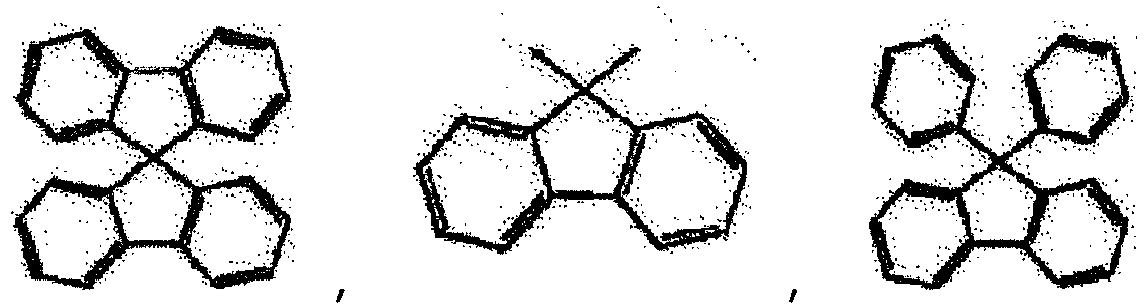
- In the present specification, the fluorenyl group may be substituted, and adjacent substituents may bond to each other to form a ring.
- When the fluorenyl group is substituted,

- In the present specification, the alkylene group means an alkyl group having two bonding sites, that is, a divalent group. Descriptions on the alkyl group provided above may be applied thereto except for each being a divalent group.
- In the present specification, the arylene group means an aryl group having two bonding sites, that is, a divalent group. Descriptions on the aryl group provided above may be applied thereto except for each being a divalent group.
- One embodiment of the present specification provides a method for preparing a polymer electrolyte membrane including preparing an electrolyte membrane including a polyarylene ether ketone polymer including a unit of the following Chemical Formula 1 and having a sulfonate group and inorganic nanoparticles including a hydroxyl group on a surface; reducing a ketone group of the polyarylene ether ketone polymer; and crosslinking the reduced polyarylene ether ketone polymer and the inorganic nanoparticles by treating the electrolyte membrane with sulfuric acid.

- In
Chemical Formula 1, R1 to R3 are the same as or different from each other and each independently hydrogen, an alkyl group or an aryl group, a is an integer of 0 to 8 and b and c are each an integer of 0 to 4, and when a to c are 2 or greater, substituents in the parentheses are the same as or different from each other. - Another embodiment of the present specification provides a method for preparing a polymer electrolyte membrane including reducing a ketone group of a polyarylene ether ketone polymer including the unit of Chemical Formula 1 and having a sulfonate group; preparing an electrolyte membrane including the reduced polyarylene ether ketone polymer and inorganic nanoparticles including a hydroxyl group on a surface; and crosslinking the reduced polyarylene ether ketone polymer and the inorganic nanoparticles by treating the electrolyte membrane with sulfuric acid.
- In the present specification, the term "inorganic nanoparticles" means a nano-scaled particle-type inorganic material. Typical diameters of the inorganic nanoparticles are from 5 nm to 70 nm and preferably from 5 nm to 20 nm. Sizes of the inorganic nanoparticles may be properly controlled by changing a hydrolysis condition, a heating treatment condition and the like in the polymer electrolyte membrane preparation process. The inorganic nanoparticles in the present disclosure are not particularly limited as long as they include a hydroxyl group on the surface, and are capable of being stably present inside a crosslinked structure of the polymer electrolyte membrane (that is, a crosslinked structure with a main chain of the polymer membrane) prepared according to the present disclosure. Examples of the preferred inorganic nanoparticles in the present disclosure may include Al2O3, Y2O3, SiO2, TiO2, ZrO2, WO3, NiO and the like. In the present disclosure, the more preferred inorganic nanoparticles are SiO2.
- When the inorganic nanoparticles include the hydroxyl group on the surface, chemical crosslinking is formed with a hydroxyl group of the reduced polyarylene ether ketone polymer, and a polymer electrolyte membrane having high durability may be formed.
- According to one embodiment of the present specification, the reducing of a ketone group of the polyarylene ether ketone polymer may be carried out using NaBH4 or LiAlH4, and NaBH4 that is advantageous in terms of experimental stability may be preferably used.
- Specifically, when the reducing of a ketone group of the polyarylene ether ketone polymer is carried out after preparing an electrolyte membrane including a polyarylene ether ketone polymer and inorganic nanoparticles, the reduction may be carried out by immersing the electrolyte membrane in an aqueous NaBH4 or LiAlH4 solution for 24 hours.
- When reducing of a ketone group of the polyarylene ether ketone polymer is carried out before preparing an electrolyte membrane including a polyarylene ether ketone polymer and inorganic nanoparticles, the reduction may be carried out by reacting the polyarylene ether ketone polymer with NaBH4 or LiAlH4 for 12 hours.
- According to one embodiment of the present specification, in the preparing of an electrolyte membrane including a polyarylene ether ketone polymer and inorganic nanoparticles including a hydroxyl group on a surface, a content of the inorganic nanoparticles may be from 1% by weight to 10% by weight, preferably from 3% by weight to 7% by weight and more preferably from 4% by weight to 6% by weight with respect to 100% by weight of the polyarylene ether ketone polymer.
- According to another embodiment of the present specification, in the preparing of an electrolyte membrane including the reduced polyarylene ether ketone polymer and inorganic nanoparticles including a hydroxyl group on a surface, a content of the inorganic nanoparticles may be from 1% by weight to 10% by weight, preferably from 3% by weight to 7% by weight and more preferably from 4% by weight to 6% by weight with respect to 100% by weight of the reduced polyarylene ether ketone polymer.
- When the content of the inorganic nanoparticles is included in the above-mentioned range, a hydrophilic effect, an ion conductivity enhancing effect obtained by crosslinking with the polymer and a durability enhancing effect of the inorganic nanoparticles may be maximized. Meanwhile, when the content of the inorganic nanoparticles is less than 1% by weight, the effects described above may not be obtained sufficiently, and the content being greater than 10% by weight causes a problem in the inorganic nanoparticle dispersion and membrane uniformity and ion conductivity may become worse.
- According to one embodiment of the present specification, the polyarylene ether ketone polymer including the unit of
Chemical Formula 1 and having a sulfonate group includes a unit of the followingChemical Formula 2 and a unit of the followingChemical Formula 3.

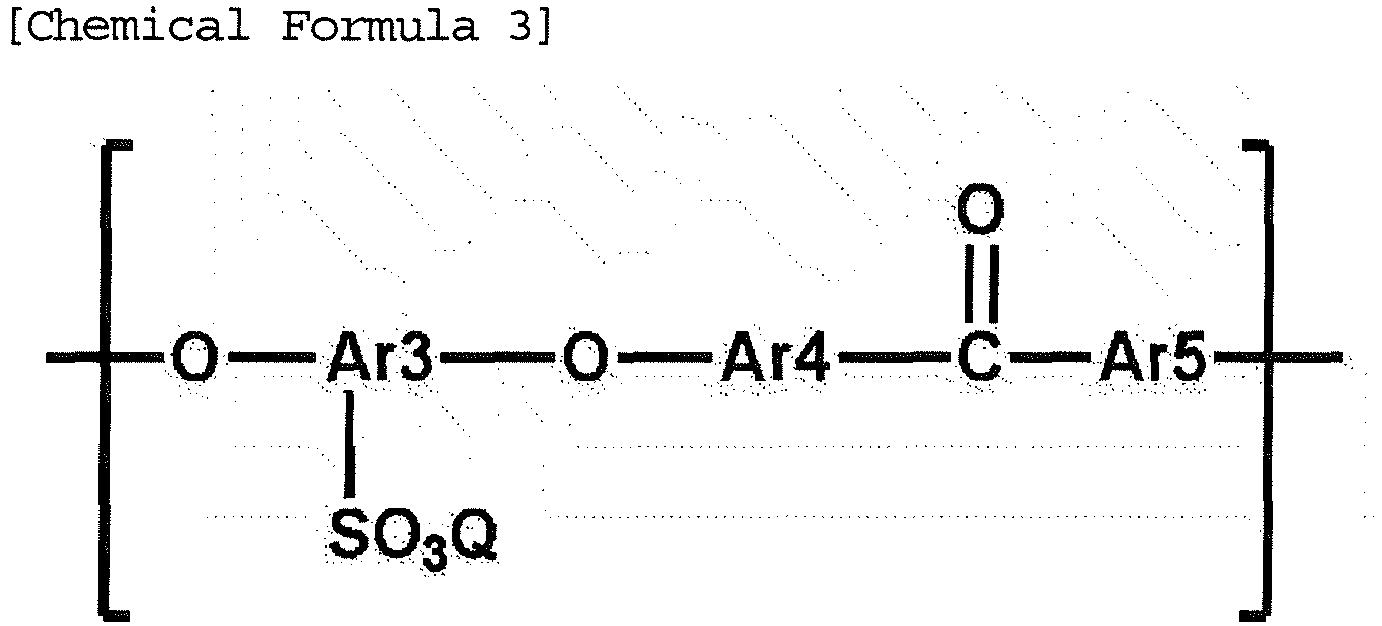
- According to one embodiment of the present specification, in
Chemical Formulae Chemical Formula 1, Ar1 to Ar5 are the same as or different from each other and each independently a substituted or unsubstituted arylene group, and Q is hydrogen (H), potassium (K) or sodium (Na). - According to one embodiment of the present specification, the polymer crosslinked with the inorganic nanoparticles through crosslinking the reduced polyarylene ether ketone polymer and the inorganic nanoparticles by treating the electrolyte membrane with sulfuric acid includes a unit of the following
Chemical Formula 4 and a unit of the followingChemical Formula 5.

- In
Chemical Formulae Chemical Formula 1, Ar1 to Ar5 are the same as or different from each other and each independently a substituted or unsubstituted arylene group, Q is hydrogen(H), potassium (K) or sodium (Na), and X is -C(=O)-, -C(-OH)H- or the following Chemical Formula 6,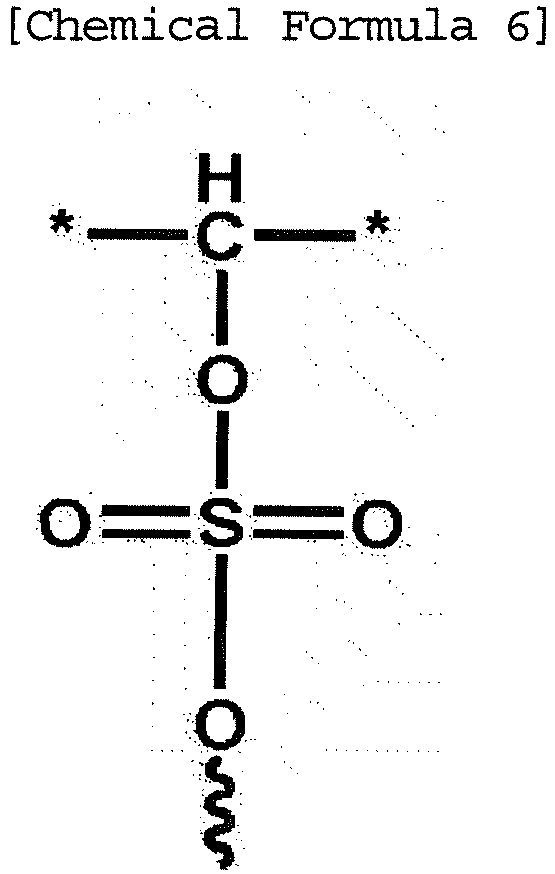 is a site bonding to the inorganic nanoparticles.
 - According to one embodiment of the present specification, when all ketone groups of the polyarylene ether ketone polymer are reduced, X in
Chemical Formulae - According to one embodiment of the present specification, the polymer crosslinked with the inorganic nanoparticles includes a unit of the following Chemical Formula 7.


- In Chemical Formula 7, R1 to R3 and a to c have the same definitions as in
Chemical Formula 1, Ar1 to Ar5 are the same as or different from each other and each independently a substituted or unsubstituted arylene group, Q is hydrogen(H), potassium (K) or sodium (Na), andis a site bonding to the inorganic nanoparticles. - One embodiment of the present specification provides a polymer electrolyte membrane prepared using the preparation method described above.
- One embodiment of the present specification provides a polymer electrolyte membrane including a structure in which a polymer including the unit of
Chemical Formula 1 and having a sulfonate group is crosslinked with inorganic nanoparticles through a structure of the following Chemical Formula 6.


- In
Chemical Formula 1, R1 to R3 are the same as or different from each other and each independently hydrogen, an alkyl group or an aryl group, a is an integer of 0 to 8, b and c are each an integer of 0 to 4, and when a to c are 2 or greater, substituents in the parentheses are the same as or different from each other, and in Chemical Formula 6, * is a site linking to a main chain of the polymer forming the polymer electrolyte membrane, andis a site bonding to the inorganic nanoparticles. - According to one embodiment of the present specification, the polymer electrolyte membrane includes the unit of
Chemical Formula 4 and the unit of the followingChemical Formula 5 described above. - According to one embodiment of the present specification, the polymer electrolyte membrane includes a unit of the following Chemical Formula 7.
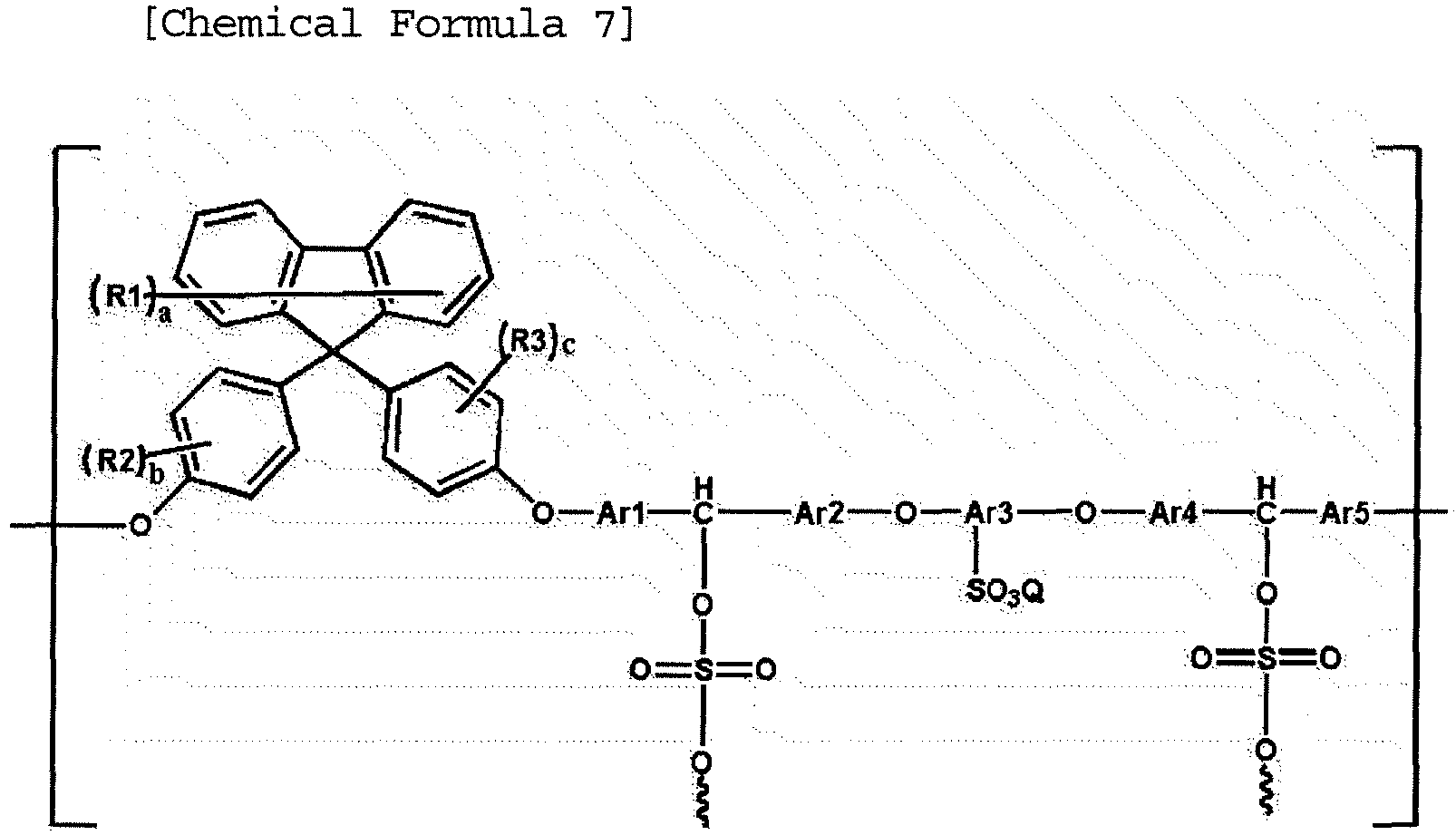
- In Chemical Formula 7, R1 to R3 and a to c have the same definitions as in
Chemical Formula 1, Ar1 to Ar5 are the same as or different from each other and each independently a substituted or unsubstituted arylene group, Q is hydrogen(H), potassium (K) or sodium (Na), andis a site bonding to the inorganic nanoparticles. - One embodiment of the present specification provides a membrane electrode assembly including the electrolyte membrane described above.
- One embodiment of the present specification provides a fuel cell including the membrane electrode assembly.
- The fuel cell of the present specification includes fuel cells generally known in the art. Specifically, the fuel cell may include a stack including the membrane electrode assembly and a separator provided between the membrane electrode assemblies; a fuel supply unit supplying fuel to the stack; and an oxidizer supply unit supplying an oxidizer to the stack.
- The stack includes one, two or more of the membrane electrode assemblies, and when including two or more membrane electrode assemblies, a separator provided therebetween is included.
- The separator performs a role of preventing the membrane electrode assemblies from being electrically connected to each other, and transferring fuel and oxidizer supplied from the outside to the membrane electrode assemblies.
- The oxidizer supply unit performs a role of supplying an oxidizer to the stack. Oxygen is typically used as the oxidizer, and oxygen or air may be injected using a pump when used.
- The fuel supply unit performs a role of supplying fuel to the stack, and may be formed with a fuel tank storing fuel and a pump supplying the fuel stored in the fuel tank to the stack. As the fuel, hydrogen or hydrocarbon fuel in a gas or liquid state may be used. Examples of the hydrocarbon fuel may include methanol, ethanol, propanol, butanol or natural gas.
- Hereinafter, the present specification will be described in detail with reference to examples. However, examples according to the present specification may be modified to various different forms, and the scope of the present specification is not to be construed as being limited to the examples described below. Examples of the present specification are provided in order to more fully describe the present specification to those having average knowledge in the art.
- Hydroquinonesulfonic acid potassium salt (0.9 eq.), 4,4'-difluorobenzophenone (0.97 eq.) and 3,5-bis(4-fluorobenzoyl) phenyl (4-fluorophenyl)methanone (0.02 eq.) were introduced to a 1 L round bottom flask equipped with a Dean-Stark trap and a condenser, and prepared under nitrogen atmosphere using potassium carbonate (K2CO3) as a catalyst in a dimethyl sulfoxide (DMSO) and benzene solvent. Next, the reaction mixture was stirred for 4 hours in an oil bath at a temperature of 140°C, and after removing an azeotropic mixture by adsorbing the azeotropic mixture to molecular sieves of the Dean-Stark trap while benzene flowed backward, the reaction temperature was raised to 180°C, and the result was condensation polymerization reacted for 20 hours. After the reaction was terminated, the temperature of the reactant was lowered to 60°C, 4,4'-difluorobenzophenone (0.2275 eq.), 9,9-bis (hydroxyphenyl) fluorine (0.335 eq.) and 3,5-bis(4-fluorobenzoyl)phenyl(4-fluorophenyl)-methanone (0.005 eq.) were introduced to the same flask, and the reaction was started again using K2CO3 as a catalyst using dimethyl sulfoxide (DMSO) and benzene under nitrogen atmosphere.
- Next, the reaction mixture was stirred again for 4 hours in an oil bath at a temperature of 140°C, and after removing an azeotropic mixture by adsorbing the azeotropic mixture to molecular sieves of the Dean-Stark trap while benzene flowed backward, the reaction temperature was raised to 180°C, and the result was condensation polymerization reacted for 20 hours. Then the temperature of the reactant was lowered to room temperature, and dimethyl sulfoxide (DMSO) was further added to dilute a product, and the diluted product was poured into excess ethanol to separate a copolymer from the solvent. After that, excess potassium carbonate was removed using water, and then the copolymer obtained from filtration was dried for 12 hours or longer in a vacuum oven at 80°C to prepare a branched sulfonated multi-block copolymer of the following chemical formula in which hydrophobic blocks and hydrophilic blocks are alternatively linked through chemical bonds.

- Fumed silica was prepared by a high temperature gas phase reaction hydrolyzing chlorosilane in flames of 1000°C or higher formed with oxygen and hydrogen. Basic particles made in the flames were linked to each other through collision to form secondary particles while still being dissolved on the surface, and as a result, aggregates and agglomerates linked in a three-dimensional branched form were produced. After the reaction, hydrogen chloride gas remaining in the silica was removed under a high temperature air condition. Density of the fumed silica was very low immediately after preparation, and therefore, the density was raised to 50 g/L or greater using a method of deflation using a pressure reducing device.
- After that, the silica particles were surface treated with a hydroxyl group (-OH) to prepare hydrophilic silica particles.
- The hydrocarbon-based polymer synthesized in 1) and the silica particles prepared in 2) in a ratio of 5% by weight with respect to 100% by weight of the hydrocarbon-based polymer were added to a dimethyl sulfoxide (DMSO) solvent, and then the result was filtered to prepare a silica polymer composition.
- The prepared silica polymer composition was dried for 24 hours in an oven at 80°C to prepare a silica-added hydrocarbon-based composite membrane. The prepared composite membrane was acid treated for 24 hours at 80°C using 10 wt% sulfuric acid, washed 4 times or more with distilled water, and then dried at 80°C to prepare a polymer electrolyte membrane.
- Crosslinking was progressed by immersing the polymer electrolyte membrane including silica nanoparticles prepared according to Steps 1) to 3) of the preparation example in an aqueous 5 wt% sodium borohydride (NaBH4) solution for 24 hours at room temperature, then washing with ion-removed distilled water, and then placing in a 1 M sulfuric acid (H2SO4) solution.
- A polymer electrolyte membrane was prepared by adding sodium borohydride (NaBH4) to an electrolyte polymer solution including the polymer prepared according to Step 1) of the preparation example and the silica nanoparticles prepared according to Step 2) of the preparation example in a ratio of 1% by weight with respect to 100% by weight of the polymer in a dimethyl sulfoxide (DMSO) solvent, and reacting the result for 12 hours at 120°C. Crosslinking was progressed by drying the prepared polymer electrolyte membrane, washing with ion-removed distilled water, and then placing in a 1 M sulfuric acid (H2SO4) solution.
- A polymer electrolyte membrane was prepared by adding the polymer without including silica particles prepared according to Step 1) of the preparation example to a dimethyl sulfoxide (DMSO) solvent, and drying for 24 hours in an oven at 80°C.
- For the polymer electrolyte membrane prepared in Comparative Example 1, crosslinking was progressed in the same manner as in Example 1.
- For the polymer electrolyte membrane including silica nanoparticles prepared according to Steps 1) to 3) of the preparation example, crosslinking was not progressed.
- A polymer electrolyte membrane was prepared by adding Nafion 211 that does not include a ketone group as in the following chemical formula to a dimethyl sulfoxide (DMSO) solvent without adding silica nanoparticles, and then drying for 24 hours in an oven at 80°C.

- For the polymer electrolyte membrane prepared in Comparative Example 4, crosslinking was progressed in the same manner as in Example 1.
- Mechanical strength of the electrolyte membranes prepared in Example 1 and Comparative Examples 1 to 5 was measured, and the results are as shown in
FIG. 2 andFIG. 3 . Mechanical strength was measured using a method of applying stress to each of the polymer films and measuring strain caused therefrom using a Universal Test Machine (UTM). - When examining
FIG. 2 , it was seen that, for the polymer electrolyte membrane including silica particles, Examples 1 and 2 that went through the crosslinking process had significantly enhanced stress compared to Comparative Example 3 that did not go through the crosslinking process. In addition, through the comparison between Comparative Example 1 and Comparative Example 2, it was seen that, for the polymer electrolyte membrane that did not include silica particles, high stress was exhibited as well when going through the crosslinking process. - When examining
FIG. 3 , it was identified that, when using a polymer that does not include a ketone group, an effect of enhancing stress was not obtained even when the crosslinking process was applied as in Comparative Example 5 compared to Comparative Example 4 that did not go through the crosslinking process. - For Example 1, Example 2, Comparative Example 1 and Comparative Example 3, volumetric expansion of the electrolyte membranes were each measured in a dry state and a humid state. Specifically, the electrolyte membrane was cut to a 5 cm×5 cm size, and a width and a thickness depending on each condition were measured.
- As shown in
FIG. 4 , it was identified that volumetric expansion decreased in Example 1, Example 2 and Comparative Example 3 due to silica containment. Among these, it was identified that Examples 1 and 2 having a crosslinked structure exhibited lowest volumetric expansion compared to Comparative Examples 1 and 3. Accordingly, it was seen that the electrolyte membrane according to the present disclosure had excellent humid condition-dependent mechanical stability. - In order to measure performance of the electrolyte membranes prepared in Example 1 and Comparative Examples 1 to 3, ion conductivity of the electrolyte membranes was evaluated, and the results are shown in
FIG. 5 . - In
FIG. 5 , ion conductivity of Example 1 under a low humid condition was significantly high compared to Comparative Example 1, and enhancement in the membrane performance was identified. This is considered as an effect of the silica included in the electrolyte membrane, and a similar result was also obtained in Comparative Example 3. - However, unlike Comparative Example 3, binding of the polymer and the silica interface was enhanced through crosslinking and a stable electrolyte membrane was formed in Example 1, and therefore, enhanced ion conductivity was identified in the whole humid region, and the effect of crosslinking was also seen through enhanced ion conductivity in Comparative Example 2 that did not include silica.
Claims (14)
- A method for preparing a polymer electrolyte membrane comprising:preparing an electrolyte membrane including a polyarylene ether ketone polymer including a unit of the following Chemical Formula 1 and having a sulfonate group and inorganic nanoparticles including a hydroxyl group on a surface;reducing a ketone group of the polyarylene ether ketone polymer; andcrosslinking the reduced polyarylene ether ketone polymer and the inorganic nanoparticles by treating the electrolyte membrane with sulfuric acid:
 wherein, in Chemical Formula 1, R1 to R3 are the same as or different from each other and each independently hydrogen, an alkyl group or an aryl group;a is an integer of 0 to 8 and b and c are each an integer of 0 to 4; andwhen a to c are 2 or greater, substituents in the parentheses are the same as or different from each other.
 - A method for preparing a polymer electrolyte membrane comprising:reducing a ketone group of a polyarylene ether ketone polymer including a unit of the following Chemical Formula 1 and having a sulfonate group;preparing an electrolyte membrane including the reduced polyarylene ether ketone polymer and inorganic nanoparticles including a hydroxyl group on a surface; andcrosslinking the reduced polyarylene ether ketone polymer and the inorganic nanoparticles by treating the electrolyte membrane with sulfuric acid:

 wherein, in Chemical Formula 1, R1 to R3 are the same as or different from each other and each independently hydrogen, an alkyl group or an aryl group;a is an integer of 0 to 8 and b and c are each an integer of 0 to 4; andwhen a to c are 2 or greater, substituents in the parentheses are the same as or different from each other.
 - The method for preparing a polymer electrolyte membrane of Claim 1, wherein, in the preparing of an electrolyte membrane including a polyarylene ether ketone polymer and inorganic nanoparticles including a hydroxyl group on a surface, a content of the inorganic nanoparticles is from 1% by weight to 10% by weight with respect to 100% by weight of the polyarylene ether ketone polymer.
- The method for preparing a polymer electrolyte membrane of Claim 2, wherein, in the preparing of an electrolyte membrane including the reduced polyarylene ether ketone polymer and inorganic nanoparticles including a hydroxyl group on a surface, a content of the inorganic nanoparticles is from 1% by weight to 10% by weight with respect to 100% by weight of the reduced polyarylene ether ketone polymer.
- The method for preparing a polymer electrolyte membrane of Claim 1 or 2, wherein the reducing of a ketone group of the polyarylene ether ketone polymer is carried out using NaBH4 or LiAlH4 .
- The method for preparing a polymer electrolyte membrane of Claim 1 or 2, wherein the polyarylene ether ketone polymer including the unit of Chemical Formula 1 and having a sulfonate group includes a unit of the following Chemical Formula 2 and a unit of the following Chemical Formula 3:


Ar1 to Ar5 are the same as or different from each other and each independently a substituted or unsubstituted arylene group; and
Q is hydrogen (H), potassium (K) or sodium (Na). - The method for preparing a polymer electrolyte membrane of Claim 1 or 2, wherein the polymer crosslinked with the inorganic nanoparticles includes a unit of the following Chemical Formula 4 and a unit of the following Chemical Formula 5:


Ar1 to Ar5 are the same as or different from each other and each independently a substituted or unsubstituted arylene group;
Q is hydrogen (H), potassium (K) or sodium (Na) ; and
X is -C(=O)-, -C(-OH)H- or the following Chemical Formula 6; is a site bonding to the inorganic nanoparticles.
- The method for preparing a polymer electrolyte membrane of Claim 1 or 2, wherein the polymer crosslinked with the inorganic nanoparticles includes a unit of the following Chemical Formula 7:


Ar1 to Ar5 are the same as or different from each other and each independently a substituted or unsubstituted arylene group;
Q is hydrogen (H), potassium (K) or sodium (Na); and
is a site bonding to the inorganic nanoparticles. - A polymer electrolyte membrane prepared by any one of Claims 1 to 4.
- A polymer electrolyte membrane comprising a structure in which a polymer including a unit of the following Chemical Formula 1 and having a sulfonate group is crosslinked with inorganic nanoparticles through a structure of the following Chemical Formula 6:


a is an integer of 0 to 8 and b and c are each an integer of 0 to 4; and
when a to c are 2 or greater, substituents in the parentheses are the same as or different from each other, and
in Chemical Formula 6, * is a site linking to a main chain of the polymer forming the polymer electrolyte membrane; andis a site bonding to the inorganic nanoparticles. - The polymer electrolyte membrane of Claim 10 comprising a unit of the following Chemical Formula 4 and a unit of the following Chemical Formula 5:


Ar1 to Ar5 are the same as or different from each other and each independently a substituted or unsubstituted arylene group;
Q is hydrogen (H), potassium (K) or sodium (Na); and
X is -C(=O)-, -C(-OH)H- or Chemical Formula 6. - The polymer electrolyte membrane of Claim 10 comprising a unit of the following Chemical Formula 7:


Ar1 to Ar5 are the same as or different from each other and each independently a substituted or unsubstituted arylene group;
Q is hydrogen (H), potassium (K) or sodium (Na); and
is a site bonding to the inorganic nanoparticles. - A membrane electrode assembly comprising the polymer electrolyte membrane of any one of Claims 10 to 12.
- A fuel cell comprising the membrane electrode assembly of Claim 13.
Applications Claiming Priority (3)
| Application Number | Priority Date | Filing Date | Title |
|---|---|---|---|
| KR20160055740 | 2016-05-04 | ||
| KR1020170054523A KR102011418B1 (en) | 2016-05-04 | 2017-04-27 | Method for manufacturing polymer electrolyte membrane, polymer electrolyte membrane manufactured by thereof, membrane electrode assembly comprising the polymer electrolyte membrane and fuel cell comprising the membrane electrode assembly |
| PCT/KR2017/004566 WO2017191950A1 (en) | 2016-05-04 | 2017-04-28 | Polymer electrolyte membrane production method, polymer electrolyte membrane produced using same, membrane electrode assembly comprising said polymer electrolyte membrane, and fuel cell comprising said membrane electrode assembly |
Publications (3)
| Publication Number | Publication Date |
|---|---|
| EP3322018A1 true EP3322018A1 (en) | 2018-05-16 |
| EP3322018A4 EP3322018A4 (en) | 2018-07-18 |
| EP3322018B1 EP3322018B1 (en) | 2021-01-20 |
Family
ID=60387406
Family Applications (1)
| Application Number | Title | Priority Date | Filing Date |
|---|---|---|---|
| EP17792852.0A Active EP3322018B1 (en) | 2016-05-04 | 2017-04-28 | Polymer electrolyte membrane production method, polymer electrolyte membrane produced using same, membrane electrode assembly comprising said polymer electrolyte membrane, and fuel cell comprising said membrane electrode assembly |
Country Status (4)
| Country | Link |
|---|---|
| US (1) | US10790528B2 (en) |
| EP (1) | EP3322018B1 (en) |
| KR (1) | KR102011418B1 (en) |
| CN (1) | CN107925109B (en) |
Families Citing this family (1)
| Publication number | Priority date | Publication date | Assignee | Title |
|---|---|---|---|---|
| KR102553737B1 (en) * | 2021-09-09 | 2023-07-12 | 한국생산기술연구원 | Composition for transferring used in preparation of transparent electrode |
Family Cites Families (13)
| Publication number | Priority date | Publication date | Assignee | Title |
|---|---|---|---|---|
| US6962959B2 (en) | 2003-08-28 | 2005-11-08 | Hoku Scientific, Inc. | Composite electrolyte with crosslinking agents |
| KR100726891B1 (en) | 2005-07-27 | 2007-06-14 | 한국과학기술원 | Organic-inorganic hybrid nanoparticles and nanocomposite polymer electrolyte for lithium polymer secondary batteries comprising same |
| KR101022557B1 (en) | 2007-10-11 | 2011-03-16 | 광주과학기술원 | Organic-inorganic composite membranes and preparation method thereof |
| KR101178644B1 (en) | 2007-10-17 | 2012-08-30 | 주식회사 엘지화학 | Ion conductive hybrid membrane, membrane-electrode assembly and fuel cell |
| KR20100009823A (en) * | 2008-07-21 | 2010-01-29 | 삼성전자주식회사 | The method and apparatus for controlling lcd backlight |
| KR101070015B1 (en) * | 2009-02-27 | 2011-10-04 | 고려대학교 산학협력단 | Method for fabricating polymer electrolyte composite membrane and polymer electrolyte fuel cell including polymer electrolyte composite membrane fabricated using the same |
| KR101550595B1 (en) | 2009-04-10 | 2015-09-07 | 주식회사 동진쎄미켐 | - Polysufone based polymer polymer electrolyte membrane comprising polymer membranes-electrode assembly comprising membrane and fuel cell comprising membrane method for preparing polymer |
| KR101382126B1 (en) | 2011-02-09 | 2014-04-07 | (주)엘켐텍 | A proton exchange membrane for an electrochemical cell |
| KR101826539B1 (en) | 2011-05-30 | 2018-02-07 | 현대자동차 주식회사 | Polyarylene-based polymer, preparation method for the same, and polymer electrolyte membrane for fuel cell using the polymer |
| US8420767B2 (en) | 2011-05-30 | 2013-04-16 | Hyundai Motor Company | Polyarlene-based polymer, preparation method for the same, and polymer electrolyte membrane for fuel cell using the polymer |
| JPWO2014157389A1 (en) * | 2013-03-28 | 2017-02-16 | Jsr株式会社 | Composition for electrolyte membrane, solid polymer electrolyte membrane, method for producing the electrolyte membrane, membrane-electrode assembly, polymer electrolyte fuel cell, water electrolysis cell, and water electrolysis apparatus |
| KR101672095B1 (en) * | 2013-10-18 | 2016-11-02 | 주식회사 엘지화학 | Seperator and litium-sulfur battery comprising the same |
| CN103811776B (en) * | 2013-12-23 | 2016-06-29 | 天津大学 | A kind of modified sulfonated polyarylether ketone ion exchange membrane and preparation method thereof |
-
2017
- 2017-04-27 KR KR1020170054523A patent/KR102011418B1/en active Active
- 2017-04-28 US US15/754,235 patent/US10790528B2/en active Active
- 2017-04-28 EP EP17792852.0A patent/EP3322018B1/en active Active
- 2017-04-28 CN CN201780002883.1A patent/CN107925109B/en active Active
Also Published As
| Publication number | Publication date |
|---|---|
| KR20170125721A (en) | 2017-11-15 |
| EP3322018A4 (en) | 2018-07-18 |
| KR102011418B1 (en) | 2019-08-16 |
| US20180248213A1 (en) | 2018-08-30 |
| EP3322018B1 (en) | 2021-01-20 |
| US10790528B2 (en) | 2020-09-29 |
| CN107925109B (en) | 2021-03-19 |
| CN107925109A (en) | 2018-04-17 |
Similar Documents
| Publication | Publication Date | Title |
|---|---|---|
| JP5472267B2 (en) | Nitrogen-containing aromatic compound, method for producing the same, polymer, and proton conducting membrane | |
| ITMI20001843A1 (en) | SULPHONIC FLUORINATED IONOMERS | |
| CN114560997B (en) | Low-swelling ordered branched polyarenearene piperidine alkaline membrane for fuel cell and preparation method thereof | |
| KR101798499B1 (en) | Branched sulfonated polyphenylene polymer and polymer electrolyte membrane for fuel cell comprising the same | |
| US20130164653A1 (en) | Use of a functionalized mineral filler for chemically stabilizing a polymer, membrane thus stabilized, process for preparing same and uses thereof | |
| WO2010021348A1 (en) | Polymer, polymer electrolyte and use of same | |
| TWI304821B (en) | Block copolymer and use thereof | |
| CN105968364B (en) | Imidazoles salt form poly ion liquid cross linking membrane based on Click reactions and its preparation, application | |
| CN101693770B (en) | Preparation method of composite sulfonated membrane with IPN structure | |
| KR20180026972A (en) | Polymer separator comprising inorganic particles | |
| EP3322018B1 (en) | Polymer electrolyte membrane production method, polymer electrolyte membrane produced using same, membrane electrode assembly comprising said polymer electrolyte membrane, and fuel cell comprising said membrane electrode assembly | |
| CN102482401B (en) | Biphenyltetrasulfonic acid compound, method for producing same, polymer and polymer electrolyte | |
| CN108530631A (en) | A kind of branched combed polyether sulphone, preparation method and application | |
| CN101343360B (en) | A kind of low swelling sulfonated polyimide proton exchange membrane and preparation method thereof | |
| JP7541682B2 (en) | Electrolyte membrane containing polyfluorene-based ionomer and method for producing same | |
| JP2016044242A (en) | Proton conductive material, electrolyte membrane and solid polymer fuel cell | |
| JP2013203919A (en) | Polymer electrolyte and method for producing the same | |
| CN101643548B (en) | Preparation method of direct cross-linked proton exchange membrane | |
| Yoon et al. | Synthesis of Sulfonation Poly (N-propylsulfonicacid isatin biphenylene) for Polymer Electrolyte Membrane Fuel Cell Containing SiO2 Nanocomposite Membrane | |
| KR20150142885A (en) | Sulfonated polyphenylene polymer containing n-methylisatin | |
| Chanthad et al. | Proton‐conductive polymer nanocomposite membranes prepared from telechelic fluorinated polymers containing perfluorosulfonic acid side chains | |
| JP5103753B2 (en) | Composition containing oxocarbonic acid and / or derivative thereof and use thereof | |
| KR20190061959A (en) | Alternating copolymer and preparation method thereof | |
| WO2012167877A1 (en) | Novel block copolymers comprising sulfonated poly(sulfones) with high ion-exchange capacity, high ion-conductivity and high stability | |
| CN116253912A (en) | Aromatic polymer proton exchange membrane and preparation method and application thereof |
Legal Events
| Date | Code | Title | Description |
|---|---|---|---|
| STAA | Information on the status of an ep patent application or granted ep patent |
Free format text: STATUS: THE INTERNATIONAL PUBLICATION HAS BEEN MADE |
|
| PUAI | Public reference made under article 153(3) epc to a published international application that has entered the european phase |
Free format text: ORIGINAL CODE: 0009012 |
|
| STAA | Information on the status of an ep patent application or granted ep patent |
Free format text: STATUS: REQUEST FOR EXAMINATION WAS MADE |
|
| 17P | Request for examination filed |
Effective date: 20180206 |
|
| AK | Designated contracting states |
Kind code of ref document: A1 Designated state(s): AL AT BE BG CH CY CZ DE DK EE ES FI FR GB GR HR HU IE IS IT LI LT LU LV MC MK MT NL NO PL PT RO RS SE SI SK SM TR |
|
| AX | Request for extension of the european patent |
Extension state: BA ME |
|
| A4 | Supplementary search report drawn up and despatched |
Effective date: 20180620 |
|
| RIC1 | Information provided on ipc code assigned before grant |
Ipc: H01M 8/1004 20160101ALI20180614BHEP Ipc: H01M 8/1088 20160101ALI20180614BHEP Ipc: H01M 8/1018 20160101ALI20180614BHEP Ipc: C08J 5/22 20060101ALI20180614BHEP Ipc: H01M 8/1025 20160101ALI20180614BHEP Ipc: H01M 8/1069 20160101AFI20180614BHEP |
|
| DAV | Request for validation of the european patent (deleted) | ||
| DAX | Request for extension of the european patent (deleted) | ||
| GRAP | Despatch of communication of intention to grant a patent |
Free format text: ORIGINAL CODE: EPIDOSNIGR1 |
|
| STAA | Information on the status of an ep patent application or granted ep patent |
Free format text: STATUS: GRANT OF PATENT IS INTENDED |
|
| INTG | Intention to grant announced |
Effective date: 20201023 |
|
| GRAS | Grant fee paid |
Free format text: ORIGINAL CODE: EPIDOSNIGR3 |
|
| GRAA | (expected) grant |
Free format text: ORIGINAL CODE: 0009210 |
|
| STAA | Information on the status of an ep patent application or granted ep patent |
Free format text: STATUS: THE PATENT HAS BEEN GRANTED |
|
| AK | Designated contracting states |
Kind code of ref document: B1 Designated state(s): AL AT BE BG CH CY CZ DE DK EE ES FI FR GB GR HR HU IE IS IT LI LT LU LV MC MK MT NL NO PL PT RO RS SE SI SK SM TR |
|
| REG | Reference to a national code |
Ref country code: GB Ref legal event code: FG4D |
|
| REG | Reference to a national code |
Ref country code: CH Ref legal event code: EP |
|
| REG | Reference to a national code |
Ref country code: DE Ref legal event code: R096 Ref document number: 602017031744 Country of ref document: DE |
|
| REG | Reference to a national code |
Ref country code: AT Ref legal event code: REF Ref document number: 1357152 Country of ref document: AT Kind code of ref document: T Effective date: 20210215 |
|
| REG | Reference to a national code |
Ref country code: IE Ref legal event code: FG4D |
|
| REG | Reference to a national code |
Ref country code: NL Ref legal event code: MP Effective date: 20210120 |
|
| REG | Reference to a national code |
Ref country code: LT Ref legal event code: MG9D |
|
| REG | Reference to a national code |
Ref country code: AT Ref legal event code: MK05 Ref document number: 1357152 Country of ref document: AT Kind code of ref document: T Effective date: 20210120 |
|
| PG25 | Lapsed in a contracting state [announced via postgrant information from national office to epo] |
Ref country code: PT Free format text: LAPSE BECAUSE OF FAILURE TO SUBMIT A TRANSLATION OF THE DESCRIPTION OR TO PAY THE FEE WITHIN THE PRESCRIBED TIME-LIMIT Effective date: 20210520 Ref country code: NO Free format text: LAPSE BECAUSE OF FAILURE TO SUBMIT A TRANSLATION OF THE DESCRIPTION OR TO PAY THE FEE WITHIN THE PRESCRIBED TIME-LIMIT Effective date: 20210420 Ref country code: GR Free format text: LAPSE BECAUSE OF FAILURE TO SUBMIT A TRANSLATION OF THE DESCRIPTION OR TO PAY THE FEE WITHIN THE PRESCRIBED TIME-LIMIT Effective date: 20210421 Ref country code: FI Free format text: LAPSE BECAUSE OF FAILURE TO SUBMIT A TRANSLATION OF THE DESCRIPTION OR TO PAY THE FEE WITHIN THE PRESCRIBED TIME-LIMIT Effective date: 20210120 Ref country code: HR Free format text: LAPSE BECAUSE OF FAILURE TO SUBMIT A TRANSLATION OF THE DESCRIPTION OR TO PAY THE FEE WITHIN THE PRESCRIBED TIME-LIMIT Effective date: 20210120 Ref country code: LT Free format text: LAPSE BECAUSE OF FAILURE TO SUBMIT A TRANSLATION OF THE DESCRIPTION OR TO PAY THE FEE WITHIN THE PRESCRIBED TIME-LIMIT Effective date: 20210120 Ref country code: BG Free format text: LAPSE BECAUSE OF FAILURE TO SUBMIT A TRANSLATION OF THE DESCRIPTION OR TO PAY THE FEE WITHIN THE PRESCRIBED TIME-LIMIT Effective date: 20210420 |
|
| PG25 | Lapsed in a contracting state [announced via postgrant information from national office to epo] |
Ref country code: SE Free format text: LAPSE BECAUSE OF FAILURE TO SUBMIT A TRANSLATION OF THE DESCRIPTION OR TO PAY THE FEE WITHIN THE PRESCRIBED TIME-LIMIT Effective date: 20210120 Ref country code: AT Free format text: LAPSE BECAUSE OF FAILURE TO SUBMIT A TRANSLATION OF THE DESCRIPTION OR TO PAY THE FEE WITHIN THE PRESCRIBED TIME-LIMIT Effective date: 20210120 Ref country code: PL Free format text: LAPSE BECAUSE OF FAILURE TO SUBMIT A TRANSLATION OF THE DESCRIPTION OR TO PAY THE FEE WITHIN THE PRESCRIBED TIME-LIMIT Effective date: 20210120 Ref country code: RS Free format text: LAPSE BECAUSE OF FAILURE TO SUBMIT A TRANSLATION OF THE DESCRIPTION OR TO PAY THE FEE WITHIN THE PRESCRIBED TIME-LIMIT Effective date: 20210120 Ref country code: LV Free format text: LAPSE BECAUSE OF FAILURE TO SUBMIT A TRANSLATION OF THE DESCRIPTION OR TO PAY THE FEE WITHIN THE PRESCRIBED TIME-LIMIT Effective date: 20210120 |
|
| PG25 | Lapsed in a contracting state [announced via postgrant information from national office to epo] |
Ref country code: IS Free format text: LAPSE BECAUSE OF FAILURE TO SUBMIT A TRANSLATION OF THE DESCRIPTION OR TO PAY THE FEE WITHIN THE PRESCRIBED TIME-LIMIT Effective date: 20210520 |
|
| REG | Reference to a national code |
Ref country code: DE Ref legal event code: R097 Ref document number: 602017031744 Country of ref document: DE |
|
| PG25 | Lapsed in a contracting state [announced via postgrant information from national office to epo] |
Ref country code: SM Free format text: LAPSE BECAUSE OF FAILURE TO SUBMIT A TRANSLATION OF THE DESCRIPTION OR TO PAY THE FEE WITHIN THE PRESCRIBED TIME-LIMIT Effective date: 20210120 Ref country code: EE Free format text: LAPSE BECAUSE OF FAILURE TO SUBMIT A TRANSLATION OF THE DESCRIPTION OR TO PAY THE FEE WITHIN THE PRESCRIBED TIME-LIMIT Effective date: 20210120 Ref country code: CZ Free format text: LAPSE BECAUSE OF FAILURE TO SUBMIT A TRANSLATION OF THE DESCRIPTION OR TO PAY THE FEE WITHIN THE PRESCRIBED TIME-LIMIT Effective date: 20210120 |
|
| PLBE | No opposition filed within time limit |
Free format text: ORIGINAL CODE: 0009261 |
|
| STAA | Information on the status of an ep patent application or granted ep patent |
Free format text: STATUS: NO OPPOSITION FILED WITHIN TIME LIMIT |
|
| PG25 | Lapsed in a contracting state [announced via postgrant information from national office to epo] |
Ref country code: MC Free format text: LAPSE BECAUSE OF FAILURE TO SUBMIT A TRANSLATION OF THE DESCRIPTION OR TO PAY THE FEE WITHIN THE PRESCRIBED TIME-LIMIT Effective date: 20210120 Ref country code: DK Free format text: LAPSE BECAUSE OF FAILURE TO SUBMIT A TRANSLATION OF THE DESCRIPTION OR TO PAY THE FEE WITHIN THE PRESCRIBED TIME-LIMIT Effective date: 20210120 Ref country code: SK Free format text: LAPSE BECAUSE OF FAILURE TO SUBMIT A TRANSLATION OF THE DESCRIPTION OR TO PAY THE FEE WITHIN THE PRESCRIBED TIME-LIMIT Effective date: 20210120 Ref country code: RO Free format text: LAPSE BECAUSE OF FAILURE TO SUBMIT A TRANSLATION OF THE DESCRIPTION OR TO PAY THE FEE WITHIN THE PRESCRIBED TIME-LIMIT Effective date: 20210120 |
|
| 26N | No opposition filed |
Effective date: 20211021 |
|
| PG25 | Lapsed in a contracting state [announced via postgrant information from national office to epo] |
Ref country code: LU Free format text: LAPSE BECAUSE OF NON-PAYMENT OF DUE FEES Effective date: 20210428 |
|
| REG | Reference to a national code |
Ref country code: BE Ref legal event code: MM Effective date: 20210430 |
|
| PG25 | Lapsed in a contracting state [announced via postgrant information from national office to epo] |
Ref country code: LI Free format text: LAPSE BECAUSE OF NON-PAYMENT OF DUE FEES Effective date: 20210430 Ref country code: CH Free format text: LAPSE BECAUSE OF NON-PAYMENT OF DUE FEES Effective date: 20210430 Ref country code: AL Free format text: LAPSE BECAUSE OF FAILURE TO SUBMIT A TRANSLATION OF THE DESCRIPTION OR TO PAY THE FEE WITHIN THE PRESCRIBED TIME-LIMIT Effective date: 20210120 Ref country code: ES Free format text: LAPSE BECAUSE OF FAILURE TO SUBMIT A TRANSLATION OF THE DESCRIPTION OR TO PAY THE FEE WITHIN THE PRESCRIBED TIME-LIMIT Effective date: 20210120 |
|
| PG25 | Lapsed in a contracting state [announced via postgrant information from national office to epo] |
Ref country code: SI Free format text: LAPSE BECAUSE OF FAILURE TO SUBMIT A TRANSLATION OF THE DESCRIPTION OR TO PAY THE FEE WITHIN THE PRESCRIBED TIME-LIMIT Effective date: 20210120 |
|
| PG25 | Lapsed in a contracting state [announced via postgrant information from national office to epo] |
Ref country code: IT Free format text: LAPSE BECAUSE OF FAILURE TO SUBMIT A TRANSLATION OF THE DESCRIPTION OR TO PAY THE FEE WITHIN THE PRESCRIBED TIME-LIMIT Effective date: 20210120 Ref country code: IE Free format text: LAPSE BECAUSE OF NON-PAYMENT OF DUE FEES Effective date: 20210428 |
|
| PG25 | Lapsed in a contracting state [announced via postgrant information from national office to epo] |
Ref country code: IS Free format text: LAPSE BECAUSE OF FAILURE TO SUBMIT A TRANSLATION OF THE DESCRIPTION OR TO PAY THE FEE WITHIN THE PRESCRIBED TIME-LIMIT Effective date: 20210520 |
|
| PG25 | Lapsed in a contracting state [announced via postgrant information from national office to epo] |
Ref country code: BE Free format text: LAPSE BECAUSE OF NON-PAYMENT OF DUE FEES Effective date: 20210430 |
|
| PG25 | Lapsed in a contracting state [announced via postgrant information from national office to epo] |
Ref country code: NL Free format text: LAPSE BECAUSE OF NON-PAYMENT OF DUE FEES Effective date: 20210120 Ref country code: CY Free format text: LAPSE BECAUSE OF FAILURE TO SUBMIT A TRANSLATION OF THE DESCRIPTION OR TO PAY THE FEE WITHIN THE PRESCRIBED TIME-LIMIT Effective date: 20210120 |
|
| PG25 | Lapsed in a contracting state [announced via postgrant information from national office to epo] |
Ref country code: HU Free format text: LAPSE BECAUSE OF FAILURE TO SUBMIT A TRANSLATION OF THE DESCRIPTION OR TO PAY THE FEE WITHIN THE PRESCRIBED TIME-LIMIT; INVALID AB INITIO Effective date: 20170428 |
|
| PG25 | Lapsed in a contracting state [announced via postgrant information from national office to epo] |
Ref country code: MK Free format text: LAPSE BECAUSE OF FAILURE TO SUBMIT A TRANSLATION OF THE DESCRIPTION OR TO PAY THE FEE WITHIN THE PRESCRIBED TIME-LIMIT Effective date: 20210120 |
|
| PG25 | Lapsed in a contracting state [announced via postgrant information from national office to epo] |
Ref country code: MT Free format text: LAPSE BECAUSE OF FAILURE TO SUBMIT A TRANSLATION OF THE DESCRIPTION OR TO PAY THE FEE WITHIN THE PRESCRIBED TIME-LIMIT Effective date: 20210120 |
|
| PGFP | Annual fee paid to national office [announced via postgrant information from national office to epo] |
Ref country code: DE Payment date: 20250320 Year of fee payment: 9 |
|
| PG25 | Lapsed in a contracting state [announced via postgrant information from national office to epo] |
Ref country code: TR Free format text: LAPSE BECAUSE OF FAILURE TO SUBMIT A TRANSLATION OF THE DESCRIPTION OR TO PAY THE FEE WITHIN THE PRESCRIBED TIME-LIMIT Effective date: 20210120 |
|
| PGFP | Annual fee paid to national office [announced via postgrant information from national office to epo] |
Ref country code: GB Payment date: 20260324 Year of fee payment: 10 |
|
| PGFP | Annual fee paid to national office [announced via postgrant information from national office to epo] |
Ref country code: FR Payment date: 20260323 Year of fee payment: 10 |