EP3321341A1 - Organic electronic element using compound for organic electronic element, and electronic device thereof - Google Patents
Organic electronic element using compound for organic electronic element, and electronic device thereof Download PDFInfo
- Publication number
- EP3321341A1 EP3321341A1 EP16824643.7A EP16824643A EP3321341A1 EP 3321341 A1 EP3321341 A1 EP 3321341A1 EP 16824643 A EP16824643 A EP 16824643A EP 3321341 A1 EP3321341 A1 EP 3321341A1
- Authority
- EP
- European Patent Office
- Prior art keywords
- group
- sub
- mmol
- synthesis example
- ring
- Prior art date
- Legal status (The legal status is an assumption and is not a legal conclusion. Google has not performed a legal analysis and makes no representation as to the accuracy of the status listed.)
- Granted
Links
- 0 CC1(C)c(ccc(*)c2)c2-c2c1cccc2 Chemical compound CC1(C)c(ccc(*)c2)c2-c2c1cccc2 0.000 description 30
- NNWNNFSMEBAKIT-UHFFFAOYSA-N C(C1c2c(cccc3)c3c3[s]c(cccc4)c4c3c22)=CC=CC1N2c(nc1-c2cc(-c3ccccc3)ccc2)cc2c1[s]c1c2cccc1 Chemical compound C(C1c2c(cccc3)c3c3[s]c(cccc4)c4c3c22)=CC=CC1N2c(nc1-c2cc(-c3ccccc3)ccc2)cc2c1[s]c1c2cccc1 NNWNNFSMEBAKIT-UHFFFAOYSA-N 0.000 description 1
- JRAMUQGCAPPUNM-ZOHSFXIOSA-N C/C=C(\C=C/C=C)/c(c(-c(cc1)ccc1-c1cc(C=CCC2)c2cc1)nc(Nc1c(-c2ccccc2)c(cccc2)c2c(S2)c1C/C=C\CCC2=C)n1)c1S Chemical compound C/C=C(\C=C/C=C)/c(c(-c(cc1)ccc1-c1cc(C=CCC2)c2cc1)nc(Nc1c(-c2ccccc2)c(cccc2)c2c(S2)c1C/C=C\CCC2=C)n1)c1S JRAMUQGCAPPUNM-ZOHSFXIOSA-N 0.000 description 1
- CSUAWPQVYIPMNW-YWKQJQNLSA-N C=CCCC1=CSC(/C=C\C=C\C(\c2cc(C=CCCC3)c3[s]2)=N\[C@@H]2NC2Cl)=CS1 Chemical compound C=CCCC1=CSC(/C=C\C=C\C(\c2cc(C=CCCC3)c3[s]2)=N\[C@@H]2NC2Cl)=CS1 CSUAWPQVYIPMNW-YWKQJQNLSA-N 0.000 description 1
- QWRMCFCHCLHTQZ-UHFFFAOYSA-N CC(C)(C(C)(C)S)OBB1OC(C)(C)C(C)(C)O1 Chemical compound CC(C)(C(C)(C)S)OBB1OC(C)(C)C(C)(C)O1 QWRMCFCHCLHTQZ-UHFFFAOYSA-N 0.000 description 1
- UTQQRLULXFOSGG-UHFFFAOYSA-N CC1(C)OB(C2(C)C=CC3N(C(C)=O)C4=CCCC=C4C3C=C2)OC1(C)C Chemical compound CC1(C)OB(C2(C)C=CC3N(C(C)=O)C4=CCCC=C4C3C=C2)OC1(C)C UTQQRLULXFOSGG-UHFFFAOYSA-N 0.000 description 1
- OPFILOLCFWFBNT-UHFFFAOYSA-N Cc1c2-c3ccccc3Cc2ccc1 Chemical compound Cc1c2-c3ccccc3Cc2ccc1 OPFILOLCFWFBNT-UHFFFAOYSA-N 0.000 description 1
- FZXCKOOHEAMJNV-UHFFFAOYSA-N ClC([N-][NH+](CCC=C=Cc1ccccc1)C12)=NC1Sc1c2cccc1 Chemical compound ClC([N-][NH+](CCC=C=Cc1ccccc1)C12)=NC1Sc1c2cccc1 FZXCKOOHEAMJNV-UHFFFAOYSA-N 0.000 description 1
- FPXRXTFMSXVSGY-UHFFFAOYSA-N [Tc]C1C2c(c(-c(cc3)ccc3C3=CCC(C=CC=C4)C4=C3)ncn3)c3SC2C=CC1 Chemical compound [Tc]C1C2c(c(-c(cc3)ccc3C3=CCC(C=CC=C4)C4=C3)ncn3)c3SC2C=CC1 FPXRXTFMSXVSGY-UHFFFAOYSA-N 0.000 description 1
Images

Classifications
-
- C—CHEMISTRY; METALLURGY
- C09—DYES; PAINTS; POLISHES; NATURAL RESINS; ADHESIVES; COMPOSITIONS NOT OTHERWISE PROVIDED FOR; APPLICATIONS OF MATERIALS NOT OTHERWISE PROVIDED FOR
- C09K—MATERIALS FOR MISCELLANEOUS APPLICATIONS, NOT PROVIDED FOR ELSEWHERE
- C09K11/00—Luminescent materials, e.g. electroluminescent or chemiluminescent
- C09K11/06—Luminescent materials, e.g. electroluminescent or chemiluminescent containing organic luminescent materials
-
- C—CHEMISTRY; METALLURGY
- C07—ORGANIC CHEMISTRY
- C07D—HETEROCYCLIC COMPOUNDS
- C07D209/00—Heterocyclic compounds containing five-membered rings, condensed with other rings, with one nitrogen atom as the only ring hetero atom
- C07D209/56—Ring systems containing three or more rings
- C07D209/80—[b, c]- or [b, d]-condensed
- C07D209/82—Carbazoles; Hydrogenated carbazoles
- C07D209/86—Carbazoles; Hydrogenated carbazoles with only hydrogen atoms, hydrocarbon or substituted hydrocarbon radicals, directly attached to carbon atoms of the ring system
-
- C—CHEMISTRY; METALLURGY
- C07—ORGANIC CHEMISTRY
- C07D—HETEROCYCLIC COMPOUNDS
- C07D401/00—Heterocyclic compounds containing two or more hetero rings, having nitrogen atoms as the only ring hetero atoms, at least one ring being a six-membered ring with only one nitrogen atom
- C07D401/02—Heterocyclic compounds containing two or more hetero rings, having nitrogen atoms as the only ring hetero atoms, at least one ring being a six-membered ring with only one nitrogen atom containing two hetero rings
- C07D401/04—Heterocyclic compounds containing two or more hetero rings, having nitrogen atoms as the only ring hetero atoms, at least one ring being a six-membered ring with only one nitrogen atom containing two hetero rings directly linked by a ring-member-to-ring-member bond
-
- C—CHEMISTRY; METALLURGY
- C07—ORGANIC CHEMISTRY
- C07D—HETEROCYCLIC COMPOUNDS
- C07D401/00—Heterocyclic compounds containing two or more hetero rings, having nitrogen atoms as the only ring hetero atoms, at least one ring being a six-membered ring with only one nitrogen atom
- C07D401/02—Heterocyclic compounds containing two or more hetero rings, having nitrogen atoms as the only ring hetero atoms, at least one ring being a six-membered ring with only one nitrogen atom containing two hetero rings
- C07D401/12—Heterocyclic compounds containing two or more hetero rings, having nitrogen atoms as the only ring hetero atoms, at least one ring being a six-membered ring with only one nitrogen atom containing two hetero rings linked by a chain containing hetero atoms as chain links
-
- C—CHEMISTRY; METALLURGY
- C07—ORGANIC CHEMISTRY
- C07D—HETEROCYCLIC COMPOUNDS
- C07D405/00—Heterocyclic compounds containing both one or more hetero rings having oxygen atoms as the only ring hetero atoms, and one or more rings having nitrogen as the only ring hetero atom
- C07D405/02—Heterocyclic compounds containing both one or more hetero rings having oxygen atoms as the only ring hetero atoms, and one or more rings having nitrogen as the only ring hetero atom containing two hetero rings
- C07D405/04—Heterocyclic compounds containing both one or more hetero rings having oxygen atoms as the only ring hetero atoms, and one or more rings having nitrogen as the only ring hetero atom containing two hetero rings directly linked by a ring-member-to-ring-member bond
-
- C—CHEMISTRY; METALLURGY
- C07—ORGANIC CHEMISTRY
- C07D—HETEROCYCLIC COMPOUNDS
- C07D405/00—Heterocyclic compounds containing both one or more hetero rings having oxygen atoms as the only ring hetero atoms, and one or more rings having nitrogen as the only ring hetero atom
- C07D405/02—Heterocyclic compounds containing both one or more hetero rings having oxygen atoms as the only ring hetero atoms, and one or more rings having nitrogen as the only ring hetero atom containing two hetero rings
- C07D405/12—Heterocyclic compounds containing both one or more hetero rings having oxygen atoms as the only ring hetero atoms, and one or more rings having nitrogen as the only ring hetero atom containing two hetero rings linked by a chain containing hetero atoms as chain links
-
- C—CHEMISTRY; METALLURGY
- C07—ORGANIC CHEMISTRY
- C07D—HETEROCYCLIC COMPOUNDS
- C07D405/00—Heterocyclic compounds containing both one or more hetero rings having oxygen atoms as the only ring hetero atoms, and one or more rings having nitrogen as the only ring hetero atom
- C07D405/14—Heterocyclic compounds containing both one or more hetero rings having oxygen atoms as the only ring hetero atoms, and one or more rings having nitrogen as the only ring hetero atom containing three or more hetero rings
-
- C—CHEMISTRY; METALLURGY
- C07—ORGANIC CHEMISTRY
- C07D—HETEROCYCLIC COMPOUNDS
- C07D409/00—Heterocyclic compounds containing two or more hetero rings, at least one ring having sulfur atoms as the only ring hetero atoms
- C07D409/02—Heterocyclic compounds containing two or more hetero rings, at least one ring having sulfur atoms as the only ring hetero atoms containing two hetero rings
- C07D409/04—Heterocyclic compounds containing two or more hetero rings, at least one ring having sulfur atoms as the only ring hetero atoms containing two hetero rings directly linked by a ring-member-to-ring-member bond
-
- C—CHEMISTRY; METALLURGY
- C07—ORGANIC CHEMISTRY
- C07D—HETEROCYCLIC COMPOUNDS
- C07D409/00—Heterocyclic compounds containing two or more hetero rings, at least one ring having sulfur atoms as the only ring hetero atoms
- C07D409/02—Heterocyclic compounds containing two or more hetero rings, at least one ring having sulfur atoms as the only ring hetero atoms containing two hetero rings
- C07D409/12—Heterocyclic compounds containing two or more hetero rings, at least one ring having sulfur atoms as the only ring hetero atoms containing two hetero rings linked by a chain containing hetero atoms as chain links
-
- C—CHEMISTRY; METALLURGY
- C07—ORGANIC CHEMISTRY
- C07D—HETEROCYCLIC COMPOUNDS
- C07D409/00—Heterocyclic compounds containing two or more hetero rings, at least one ring having sulfur atoms as the only ring hetero atoms
- C07D409/14—Heterocyclic compounds containing two or more hetero rings, at least one ring having sulfur atoms as the only ring hetero atoms containing three or more hetero rings
-
- C—CHEMISTRY; METALLURGY
- C07—ORGANIC CHEMISTRY
- C07D—HETEROCYCLIC COMPOUNDS
- C07D491/00—Heterocyclic compounds containing in the condensed ring system both one or more rings having oxygen atoms as the only ring hetero atoms and one or more rings having nitrogen atoms as the only ring hetero atoms, not provided for by groups C07D451/00 - C07D459/00, C07D463/00, C07D477/00 or C07D489/00
- C07D491/02—Heterocyclic compounds containing in the condensed ring system both one or more rings having oxygen atoms as the only ring hetero atoms and one or more rings having nitrogen atoms as the only ring hetero atoms, not provided for by groups C07D451/00 - C07D459/00, C07D463/00, C07D477/00 or C07D489/00 in which the condensed system contains two hetero rings
- C07D491/04—Ortho-condensed systems
- C07D491/044—Ortho-condensed systems with only one oxygen atom as ring hetero atom in the oxygen-containing ring
- C07D491/048—Ortho-condensed systems with only one oxygen atom as ring hetero atom in the oxygen-containing ring the oxygen-containing ring being five-membered
-
- C—CHEMISTRY; METALLURGY
- C07—ORGANIC CHEMISTRY
- C07D—HETEROCYCLIC COMPOUNDS
- C07D519/00—Heterocyclic compounds containing more than one system of two or more relevant hetero rings condensed among themselves or condensed with a common carbocyclic ring system not provided for in groups C07D453/00 or C07D455/00
-
- H—ELECTRICITY
- H10—SEMICONDUCTOR DEVICES; ELECTRIC SOLID-STATE DEVICES NOT OTHERWISE PROVIDED FOR
- H10K—ORGANIC ELECTRIC SOLID-STATE DEVICES
- H10K50/00—Organic light-emitting devices
-
- H—ELECTRICITY
- H10—SEMICONDUCTOR DEVICES; ELECTRIC SOLID-STATE DEVICES NOT OTHERWISE PROVIDED FOR
- H10K—ORGANIC ELECTRIC SOLID-STATE DEVICES
- H10K50/00—Organic light-emitting devices
- H10K50/10—OLEDs or polymer light-emitting diodes [PLED]
- H10K50/11—OLEDs or polymer light-emitting diodes [PLED] characterised by the electroluminescent [EL] layers
- H10K50/12—OLEDs or polymer light-emitting diodes [PLED] characterised by the electroluminescent [EL] layers comprising dopants
-
- H—ELECTRICITY
- H10—SEMICONDUCTOR DEVICES; ELECTRIC SOLID-STATE DEVICES NOT OTHERWISE PROVIDED FOR
- H10K—ORGANIC ELECTRIC SOLID-STATE DEVICES
- H10K50/00—Organic light-emitting devices
- H10K50/10—OLEDs or polymer light-emitting diodes [PLED]
- H10K50/14—Carrier transporting layers
- H10K50/15—Hole transporting layers
-
- H—ELECTRICITY
- H10—SEMICONDUCTOR DEVICES; ELECTRIC SOLID-STATE DEVICES NOT OTHERWISE PROVIDED FOR
- H10K—ORGANIC ELECTRIC SOLID-STATE DEVICES
- H10K50/00—Organic light-emitting devices
- H10K50/10—OLEDs or polymer light-emitting diodes [PLED]
- H10K50/14—Carrier transporting layers
- H10K50/16—Electron transporting layers
-
- H—ELECTRICITY
- H10—SEMICONDUCTOR DEVICES; ELECTRIC SOLID-STATE DEVICES NOT OTHERWISE PROVIDED FOR
- H10K—ORGANIC ELECTRIC SOLID-STATE DEVICES
- H10K50/00—Organic light-emitting devices
- H10K50/10—OLEDs or polymer light-emitting diodes [PLED]
- H10K50/17—Carrier injection layers
- H10K50/171—Electron injection layers
-
- H—ELECTRICITY
- H10—SEMICONDUCTOR DEVICES; ELECTRIC SOLID-STATE DEVICES NOT OTHERWISE PROVIDED FOR
- H10K—ORGANIC ELECTRIC SOLID-STATE DEVICES
- H10K50/00—Organic light-emitting devices
- H10K50/10—OLEDs or polymer light-emitting diodes [PLED]
- H10K50/18—Carrier blocking layers
-
- H—ELECTRICITY
- H10—SEMICONDUCTOR DEVICES; ELECTRIC SOLID-STATE DEVICES NOT OTHERWISE PROVIDED FOR
- H10K—ORGANIC ELECTRIC SOLID-STATE DEVICES
- H10K50/00—Organic light-emitting devices
- H10K50/80—Constructional details
-
- H—ELECTRICITY
- H10—SEMICONDUCTOR DEVICES; ELECTRIC SOLID-STATE DEVICES NOT OTHERWISE PROVIDED FOR
- H10K—ORGANIC ELECTRIC SOLID-STATE DEVICES
- H10K50/00—Organic light-emitting devices
- H10K50/80—Constructional details
- H10K50/805—Electrodes
- H10K50/81—Anodes
- H10K50/814—Anodes combined with auxiliary electrodes, e.g. ITO layer combined with metal lines
-
- H—ELECTRICITY
- H10—SEMICONDUCTOR DEVICES; ELECTRIC SOLID-STATE DEVICES NOT OTHERWISE PROVIDED FOR
- H10K—ORGANIC ELECTRIC SOLID-STATE DEVICES
- H10K50/00—Organic light-emitting devices
- H10K50/80—Constructional details
- H10K50/805—Electrodes
- H10K50/82—Cathodes
-
- H—ELECTRICITY
- H10—SEMICONDUCTOR DEVICES; ELECTRIC SOLID-STATE DEVICES NOT OTHERWISE PROVIDED FOR
- H10K—ORGANIC ELECTRIC SOLID-STATE DEVICES
- H10K71/00—Manufacture or treatment specially adapted for the organic devices covered by this subclass
- H10K71/10—Deposition of organic active material
- H10K71/12—Deposition of organic active material using liquid deposition, e.g. spin coating
- H10K71/13—Deposition of organic active material using liquid deposition, e.g. spin coating using printing techniques, e.g. ink-jet printing or screen printing
- H10K71/135—Deposition of organic active material using liquid deposition, e.g. spin coating using printing techniques, e.g. ink-jet printing or screen printing using ink-jet printing
-
- H—ELECTRICITY
- H10—SEMICONDUCTOR DEVICES; ELECTRIC SOLID-STATE DEVICES NOT OTHERWISE PROVIDED FOR
- H10K—ORGANIC ELECTRIC SOLID-STATE DEVICES
- H10K85/00—Organic materials used in the body or electrodes of devices covered by this subclass
- H10K85/60—Organic compounds having low molecular weight
- H10K85/631—Amine compounds having at least two aryl rest on at least one amine-nitrogen atom, e.g. triphenylamine
- H10K85/636—Amine compounds having at least two aryl rest on at least one amine-nitrogen atom, e.g. triphenylamine comprising heteroaromatic hydrocarbons as substituents on the nitrogen atom
-
- H—ELECTRICITY
- H10—SEMICONDUCTOR DEVICES; ELECTRIC SOLID-STATE DEVICES NOT OTHERWISE PROVIDED FOR
- H10K—ORGANIC ELECTRIC SOLID-STATE DEVICES
- H10K85/00—Organic materials used in the body or electrodes of devices covered by this subclass
- H10K85/60—Organic compounds having low molecular weight
- H10K85/649—Aromatic compounds comprising a hetero atom
- H10K85/657—Polycyclic condensed heteroaromatic hydrocarbons
- H10K85/6572—Polycyclic condensed heteroaromatic hydrocarbons comprising only nitrogen in the heteroaromatic polycondensed ring system, e.g. phenanthroline or carbazole
-
- H—ELECTRICITY
- H10—SEMICONDUCTOR DEVICES; ELECTRIC SOLID-STATE DEVICES NOT OTHERWISE PROVIDED FOR
- H10K—ORGANIC ELECTRIC SOLID-STATE DEVICES
- H10K85/00—Organic materials used in the body or electrodes of devices covered by this subclass
- H10K85/60—Organic compounds having low molecular weight
- H10K85/649—Aromatic compounds comprising a hetero atom
- H10K85/657—Polycyclic condensed heteroaromatic hydrocarbons
- H10K85/6574—Polycyclic condensed heteroaromatic hydrocarbons comprising only oxygen in the heteroaromatic polycondensed ring system, e.g. cumarine dyes
-
- H—ELECTRICITY
- H10—SEMICONDUCTOR DEVICES; ELECTRIC SOLID-STATE DEVICES NOT OTHERWISE PROVIDED FOR
- H10K—ORGANIC ELECTRIC SOLID-STATE DEVICES
- H10K85/00—Organic materials used in the body or electrodes of devices covered by this subclass
- H10K85/60—Organic compounds having low molecular weight
- H10K85/649—Aromatic compounds comprising a hetero atom
- H10K85/657—Polycyclic condensed heteroaromatic hydrocarbons
- H10K85/6576—Polycyclic condensed heteroaromatic hydrocarbons comprising only sulfur in the heteroaromatic polycondensed ring system, e.g. benzothiophene
-
- H—ELECTRICITY
- H10—SEMICONDUCTOR DEVICES; ELECTRIC SOLID-STATE DEVICES NOT OTHERWISE PROVIDED FOR
- H10K—ORGANIC ELECTRIC SOLID-STATE DEVICES
- H10K99/00—Subject matter not provided for in other groups of this subclass
-
- C—CHEMISTRY; METALLURGY
- C09—DYES; PAINTS; POLISHES; NATURAL RESINS; ADHESIVES; COMPOSITIONS NOT OTHERWISE PROVIDED FOR; APPLICATIONS OF MATERIALS NOT OTHERWISE PROVIDED FOR
- C09K—MATERIALS FOR MISCELLANEOUS APPLICATIONS, NOT PROVIDED FOR ELSEWHERE
- C09K2211/00—Chemical nature of organic luminescent or tenebrescent compounds
- C09K2211/10—Non-macromolecular compounds
- C09K2211/1018—Heterocyclic compounds
- C09K2211/1025—Heterocyclic compounds characterised by ligands
- C09K2211/1029—Heterocyclic compounds characterised by ligands containing one nitrogen atom as the heteroatom
-
- C—CHEMISTRY; METALLURGY
- C09—DYES; PAINTS; POLISHES; NATURAL RESINS; ADHESIVES; COMPOSITIONS NOT OTHERWISE PROVIDED FOR; APPLICATIONS OF MATERIALS NOT OTHERWISE PROVIDED FOR
- C09K—MATERIALS FOR MISCELLANEOUS APPLICATIONS, NOT PROVIDED FOR ELSEWHERE
- C09K2211/00—Chemical nature of organic luminescent or tenebrescent compounds
- C09K2211/10—Non-macromolecular compounds
- C09K2211/1018—Heterocyclic compounds
- C09K2211/1025—Heterocyclic compounds characterised by ligands
- C09K2211/1044—Heterocyclic compounds characterised by ligands containing two nitrogen atoms as heteroatoms
- C09K2211/1048—Heterocyclic compounds characterised by ligands containing two nitrogen atoms as heteroatoms with oxygen
-
- C—CHEMISTRY; METALLURGY
- C09—DYES; PAINTS; POLISHES; NATURAL RESINS; ADHESIVES; COMPOSITIONS NOT OTHERWISE PROVIDED FOR; APPLICATIONS OF MATERIALS NOT OTHERWISE PROVIDED FOR
- C09K—MATERIALS FOR MISCELLANEOUS APPLICATIONS, NOT PROVIDED FOR ELSEWHERE
- C09K2211/00—Chemical nature of organic luminescent or tenebrescent compounds
- C09K2211/10—Non-macromolecular compounds
- C09K2211/1018—Heterocyclic compounds
- C09K2211/1025—Heterocyclic compounds characterised by ligands
- C09K2211/1044—Heterocyclic compounds characterised by ligands containing two nitrogen atoms as heteroatoms
- C09K2211/1051—Heterocyclic compounds characterised by ligands containing two nitrogen atoms as heteroatoms with sulfur
-
- H—ELECTRICITY
- H10—SEMICONDUCTOR DEVICES; ELECTRIC SOLID-STATE DEVICES NOT OTHERWISE PROVIDED FOR
- H10K—ORGANIC ELECTRIC SOLID-STATE DEVICES
- H10K2101/00—Properties of the organic materials covered by group H10K85/00
- H10K2101/10—Triplet emission
-
- H—ELECTRICITY
- H10—SEMICONDUCTOR DEVICES; ELECTRIC SOLID-STATE DEVICES NOT OTHERWISE PROVIDED FOR
- H10K—ORGANIC ELECTRIC SOLID-STATE DEVICES
- H10K50/00—Organic light-emitting devices
- H10K50/10—OLEDs or polymer light-emitting diodes [PLED]
- H10K50/11—OLEDs or polymer light-emitting diodes [PLED] characterised by the electroluminescent [EL] layers
-
- Y—GENERAL TAGGING OF NEW TECHNOLOGICAL DEVELOPMENTS; GENERAL TAGGING OF CROSS-SECTIONAL TECHNOLOGIES SPANNING OVER SEVERAL SECTIONS OF THE IPC; TECHNICAL SUBJECTS COVERED BY FORMER USPC CROSS-REFERENCE ART COLLECTIONS [XRACs] AND DIGESTS
- Y02—TECHNOLOGIES OR APPLICATIONS FOR MITIGATION OR ADAPTATION AGAINST CLIMATE CHANGE
- Y02E—REDUCTION OF GREENHOUSE GAS [GHG] EMISSIONS, RELATED TO ENERGY GENERATION, TRANSMISSION OR DISTRIBUTION
- Y02E10/00—Energy generation through renewable energy sources
- Y02E10/50—Photovoltaic [PV] energy
- Y02E10/549—Organic PV cells
Definitions
- energy levels and T 1 values between organic material layers, inherent material properties (mobility, interfacial properties, etc.), and the like can be optimized by forming a hole transport layer and/or an emission-auxiliary layer which comprise the compound represented by the Formula 1, and thus it is possible to simultaneously improve the life span and efficiency of the organic electronic element.
- Ar 6 is any one of the following 8-1, 8-2 and 8-3.
- any adjacent groups of R 8 to R 10 may be each independently linked together to form at least one ring, and the remaining groups not forming the ring are the same as defined above.
- h and i are each an integer of 2
- neighboring R 8 s can be linked to each other to form a ring
- R 9 s may be each independently an aryl group or a heterocyclic ring.
- the compound represented by Formula 8 may be any one of the following compounds.
- Sub 4-2-O-(14) (12.74g, 80%) was obtained by reacting 2,4-Dichlorobenzofuro[2,3- d ]pyrimidine (10g, 0.04mol), phenanthren-2-ylboronic acid (9.28g, 0.04mol), K 2 CO 3 (17.34g, 0.12mol), Pd(PPh 3 ) 4 (1.93g, 4mol%), anhydrous THF and water by the same method as in synthesis example of Sub 4-1-O-(1).
- Compound 1-1-1-S-(10) (8.88g, 81%) was obtained by reacting 3-1 Core (5g, 15.46mmol), Sub 4-1-S-(10) (7.84g, 18.55mmol), Pd 2 (dba) 3 (0.56g, 4mol%), t -Bu 3 P (0.25g, 8mol%), KO t Bu (5.2g, 46.38mmol) and toluene by the same method as in synthesis example of the compound 1-1-1-O-(1).
- Compound 1-3-1-O-(13) (7.53g, 73%) was obtained by reacting 3-2 Core (5g, 15.46mmol), Sub 4-1-O-(13) (7.06g, 18.55mmol), Pd 2 (dba) 3 (0.56g, 4mol%), t -Bu 3 P (0.25g, 8mol%), KO t Bu (5.2g, 46.38mmol) and toluene by the same method as in synthesis example of the compound 1-1-1-O-(1).
- the compound of the present invention represented by Formula 1 When the compound of the present invention represented by Formula 1 is used alone as material of an emission-auxiliary layer, it has a high T1 energy level and a deep HOMO energy level. As a result, the holes and electrons form a charge balance and light emission occurs inside the light emitting layer rather than at the interface of the hole transport layer, thereby maximizing efficiency.
Landscapes
- Chemical & Material Sciences (AREA)
- Organic Chemistry (AREA)
- Physics & Mathematics (AREA)
- Optics & Photonics (AREA)
- Engineering & Computer Science (AREA)
- Materials Engineering (AREA)
- Spectroscopy & Molecular Physics (AREA)
- Manufacturing & Machinery (AREA)
- Electroluminescent Light Sources (AREA)
- Photovoltaic Devices (AREA)
- Plural Heterocyclic Compounds (AREA)
- Nitrogen And Oxygen Or Sulfur-Condensed Heterocyclic Ring Systems (AREA)
- Indole Compounds (AREA)
- Devices For Indicating Variable Information By Combining Individual Elements (AREA)
Description
- The present invention relates to organic electric element using compound for organic electric element and electronic device thereof.
- In general, an organic light emitting phenomenon refers to a phenomenon in which electric energy is converted into light energy of an organic material. An organic electric element utilizing the organic light emitting phenomenon usually has a structure including an anode, a cathode, and an organic material layer interposed therebetween. In many cases, the organic material layer has a multi-layered structure having respectively different materials in order to improve efficiency and stability of an organic electric element, and for example, may include a hole injection layer, a hole transport layer, a light emitting layer, an electron transport layer, an electron injection layer, or the like.
- Materials used as an organic material layer in an organic electric element may be classified into a light emitting material and a charge transport material, for example, a hole injection material, a hole transport material, an electron transport material, an electron injection material, and the like according to its function.
- Currently, the power consumption is required more and more as size of display becomes larger and larger in the portable display market. Therefore, the power consumption is a very important factor in the portable display with a limited power source of the battery, and the situation is such that efficiency and life span issue also must be solved.
- Efficiency, life span, driving voltage, and the like are correlated with each other. For example, if efficiency is increased, then driving voltage is relatively lowered, and the crystallization of an organic material due to Joule heating generated during operation is reduced as driving voltage is lowered, as a result of which life span shows a tendency to increase. However, efficiency cannot be maximized only by simply improving the organic material layer. This is because long life span and high efficiency can be simultaneously achieved when an optimal combination of energy levels and T1 values, inherent material properties (mobility, interfacial properties, etc.), and the like among the respective layers included in the organic material layer is given.
- In order to solve the problem of luminescence in the hole transport layer in recent organic electroluminescent devices, an emission-auxiliary layer must be present between the hole transport layer and the light emitting layer, and it is time to develop different emission-auxiliary layers according to respective light emitting layers(R, G, B).
- In general, electrons transfer from an electron transport layer to a light emitting layer and holes transfer from a hole transport layer to the light emitting layer. As a result, excitons are generated by recombination of electrons and holes in the light emitting layer. However, material of a hole transporting layer has mainly a low T1 value since it should have a low HOMO value. Due to this, excitons generated from a light emitting layer are transported to the hole transporting layer, resulting in a charge unbalance in the light emitting layer. Thus, light emission occurs in the hole transporting layer or at an interface of the hole transporting layer so that the organic electroluminescent device is reduced in color purity, efficiency, and lifespan.
- In addition, when a material having a rapid hole mobility is used to lower driving voltage, the efficiency tends to decrease. This is because, in a general organic electroluminescent device, hole mobility is faster than electron mobility, which leads to charge unbalance in the light emitting layer, resulting in reduction in efficiency and lifetime.
- Therefore, the emission-auxiliary layer should be formed of a material having hole mobility, high electron block (T), and wide band gap so as to have a proper driving voltage capable of solving the problems of the hole transport layer. These requirements are not met by the structural properties of the core of the emission-auxiliary layer material alone, but are achieved when the properties of the material, such as core and sub-substituent, are all properly combined. Therefore, in order to improve the efficiency and lifetime of an organic electric device, it is strongly required to develop materials of the emission-auxiliary layer having a high T1 value and a wide band gap.
- That is, in order to allow an organic electric element to fully exhibit the excellent features, it should be preceded that the materials consisting an organic material layer of the element, for example, a hole injection material, a hole transport material, a light emitting material, an electron transport material, an electron injection material, an emission-auxiliary layer material or the like, are supported by a stable and efficient material. However, such a stable and efficient material of organic material layer for an organic electric element has not yet been fully developed. Accordingly, there is a continuous need to develop new materials for an organic material layer, particularly, it is strongly required to develop materials of the emission-auxiliary layer and/or materials of the hole transport layer and the light emitting layer.
- In order to solve one or more of the above-mentioned problems in prior art, an aspect of the present invention is to provide a compound having high luminous efficiency, low driving voltage, and high heat-resistance, improving color purity and lifetime of the element, an organic electric element comprising the same, and an electronic device thereof.
- In accordance with an aspect of the present invention, the present invention provides an organic electric element comprising a first electrode, a second electrode, and an organic material layer formed between the first electrode and the second electrode comprising at least one of a hole transport layer, an emission-auxiliary layer, and a light emitting layer, wherein the hole transport layer or the emission-auxiliary layer comprises the compound represented by the following formula 1 and the light emitting layer comprises the compound represented by the following formula 2.

- In another aspect of the present invention, the present invention provides an electronic device comprising the compounds represented by the above formulas.
- By using the compound according to embodiments of the present invention, high luminous efficiency, low driving voltage and high heat-resistance of the element can be achieved, and color purity and life span of the element can be improved.
- The FIGURE illustrates an example of an organic light emitting diode according to an embodiment of the present invention: 100 is organic electric element, 110 is substrate, 120 is first electrode, 130 is hole injection layer, 140 is hole transport layer, 141 is buffer layer, 150 is light emitting layer, 151 is emission-auxiliary layer, 160 is electron transport layer, 170 is electron injection layer, and 180 is second electrode.
- Hereinafter, some embodiments of the present invention will be described in detail with reference to the accompanying illustrative drawings.
- In designation of reference numerals to components in respective drawings, it should be noted that the same elements will be designated by the same reference numerals although they are shown in different drawings. Further, in the following description of the present invention, a detailed description of known functions and configurations incorporated herein will be omitted when it may make the subject matter of the present invention rather unclear.
- In addition, terms, such as first, second, A, B, (a), (b) or the like may be used herein when describing components of the present invention. Each of these terminologies is not used for defining an essence, order or sequence of a corresponding component but used merely to distinguish the corresponding component from other component(s). It should be noted that if it is described in the specification that one component is "connected," "coupled" or "joined" to another component, a third component may be "connected," "coupled," and "joined" between the first and second components, although the first component may be directly connected, coupled or joined to the second component.
- In addition, it will be understood that when an element such as a layer, film, region or substrate is referred to as being "on" or "over" another element, it can be directly on the other element or intervening elements may also be present. In contrast, when an element is referred to as being "directly on" another element, there are no intervening elements present.
- As used in the specification and the accompanying claims, unless otherwise stated, the following is the meaning of the term as follows.
- Unless otherwise stated, the term "halo" or "halogen" as used herein includes fluorine(F), chlorine(Cl), bromine(Br), or iodine(I).
- Unless otherwise stated, the term "alkyl" or "alkyl group" as used herein has a single bond of 1 to 60 carbon atoms, and means aliphatic functional radicals including a linear alkyl group, a branched chain alkyl group, a cycloalkyl group (alicyclic), or an alkyl group substituted with a cycloalkyl.
- Unless otherwise stated, the term "halo alkyl" or "halogen alkyl" as used herein includes an alkyl group substituted with a halogen.
- Unless otherwise stated, the term "alkenyl" or "alkynyl" as used herein has, but not limited to, double or triple bonds of 2 to 60 carbon atoms, and includes a linear alkyl group, or a branched chain alkyl group.
- Unless otherwise stated, the term "cycloalkyl" as used herein means, but not limited to, alkyl forming a ring having 3 to 60 carbon atoms.
- The term "alkoxyl group", "alkoxy group" or "alkyloxy group" as used herein means an oxygen radical attached to an alkyl group, but not limited to, and has 1 to 60 carbon atoms.
- The term "aryloxyl group" or "aryloxy group" as used herein means an oxygen radical attached to an aryl group, but not limited to, and has 6 to 60 carbon atoms.
- Unless otherwise stated, the term "fluorenyl group" or "fluorenylene group" as used herein means, univalent or bivalent functional group which R, R' and R" are all hydrogen in the structural formula below, "substituted fluorenyl group" or "substituted fluorenylene group" means, functional group which at least any one of R, R' and R" is a functional group other than hydrogen, and fluorenyl group" or "fluorenylene group" comprises spiro compound which is formed by linking R and R' together with the carbon bonded to them.

- Unless otherwise stated, the term "aryl group" or "arylene group" as used herein has, but not limited to, 6 to 60 carbon atoms. The aryl group or arylene group include a monocyclic rings, ring assemblies, fused polycyclic system or spiro compounds.
- Unless otherwise stated, the term "heterocyclic group" as used herein means, but not limited to, a non-aromatic ring as well as an aromatic ring like "heteroaryl group" or "heteroarylene group". The heterocyclic group as used herein means, but not limited to, a ring containing one or more heteroatoms, and having 2 to 60 carbon atoms. Unless otherwise stated, the term "heteroatom" as used herein represents N, O, S, P or Si. The heterocyclic group means a monocyclic, ring assemblies, fused polycyclic system or spiro compound containing one or more heteroatoms.
- Also, the term "heterocyclic group" may include SO2 instead of carbon consisting of cycle. For example, "heterocyclic group" includes the following compound.

- Unless otherwise stated, the term "ring" as used herein means, a monocyclic and polycyclic, an aliphatic ring and heterocyclic group containing at least one heteroatom, and an aromatic ring and a non-aromatic ring.
- Unless otherwise stated, the term "polycyclic" as used herein means, ring assemblies like biphenyl and terphenyl, fused polycyclic system and spiro compound, an aromatic ring and a non-aromatic ring, and an aliphatic ring and heterocyclic group containing at least one heteroatom.
- Unless otherwise stated, the term "ring assemblies" as used herein means, two or more cyclic systems (single rings or fused systems) which are directly joined to each other by double or single bonds are named ring assemblies when the number of such direct ring junctions is one less than the number of cyclic systems involved. The ring assemblies also mean, same or different ring systems are directly joined to each other by double or single bonds.
- Unless otherwise stated, the term "fused polycyclic system" as used herein means, fused ring type which has at least two atoms as the common members, fused two or more aliphatic ring systems and a fused hetero ring system containing at least one heteroatom. Fused polycyclic system is an aromatic ring, a hetero aromatic ring, an aliphatic ring, or the combination of these.
- Unless otherwise stated, the term "spiro compound" as used herein has, a spiro union which means union having one atom as the only common member of two rings. The common atom is designated as 'spiro atom'. The compounds are defined as 'monospiro-', 'dispiro-' or 'trispiro-' depending on the number of spiro atoms in one compound.
- Also, when prefixes are named subsequently, it means that substituents are listed in the order described first. For example, an arylalkoxy means an alkoxy substituted with an aryl, an alkoxylcarbonyl means a carbonyl substituted with an alkoxyl, and an arylcarbonylalkenyl also means an alkenyl substitutes with an arylcarbonyl, wherein the arylcarbonyl may be a carbonyl substituted with an aryl.
- Unless otherwise stated, the term "substituted or unsubstituted" as used herein means that substitution is carried out by at least one substituent selected from the group consisting of, but not limited to, deuterium, halogen, an amino group, a nitrile group, a nitro group, a C1-C20 alkyl group, a C1-C20 alkoxy group, a C1-C20 alkylamine group, a C1-C20 alkylthio group, a C6-C20 arylthio group, a C2-C20 alkenyl group, a C2-C20 alkynyl group, a C3-C20 cycloalkyl group, a C6-C60 aryl group, a C6-C20 aryl group substituted by deuterium, a C8-C20 arylalkenyl group, a silane group, a boron group, a germanium group, and a C2-C20 heterocyclic group containing at least one heteroatom selected from the group consisting of O, N, S, Si, and P.
- In the present description, a 'group name' corresponding to an aryl group, an arylene group, a heterocyclic group, and the like exemplified for each symbol and its substituent may be written in the name of functional group reflecting the valence, and may also be described under the name of a parent compound. For example, in the case of phenanthrene which is a kind of aryl group, it may be described by distinguishing valence such as 'phenanthryl (group)' when it is 'monovalent group', and as 'phenanthrylene (group)' when it is 'divalent group', and it may also be described as a parent compound name, 'phenanthrene', regardless of its valence. Similarly, in the case of pyrimidine, it may be described as 'pyrimidine' regardless of its valence, and it may also be described as the name of corresponding functional group such as pyrimidinyl (group) when it is 'monovalent group', and as 'pyrimidylene (group)' when it is 'divalent group'.
- Otherwise specified, the formulas used in the present invention are as defined in the index definition of the substituent of the following formula:

- Here, it means that the substituent R1 is not present when a is an integer of 0. That is, it means that only hydrogens are bonded to all the carbons forming the benzene ring when a is 0, and chemical formulas or compounds can be represented by omitting the indication of hydrogen bonded to the carbon. In addition, when a is an integer of 1, the sole R1 is bonded to any one of the carbon atoms constituting the benzene ring, when a is an integer of 2 or 3, for example, the substituent R1s may be bonded as follows, when a is an integer from 4 to 6, the substituent R1s may be bonded to the carbon of the benzene ring in a similar manner, and the substituents R1s may be the same and different when a is an integer of 2 or more.

-
Fig. 1 illustrates an organic electric element according to an embodiment of the present invention. - Referring to
Fig. 1 , an organicelectric element 100 according to an embodiment of the present invention includes afirst electrode 120 formed on asubstrate 110, asecond electrode 180, and an organic material layer between thefirst electrode 110 and thesecond electrode 180, which contains the inventive compound. Here, thefirst electrode 120 may be an anode (positive electrode), and thesecond electrode 180 may be a cathode (negative electrode). In the case of an inverted organic electric element, the first electrode may be a cathode, and the second electrode may be an anode. - The organic material layer may include a
hole injection layer 130, ahole transport layer 140, alight emitting layer 150, anelectron transport layer 160, and anelectron injection layer 170 formed in sequence on thefirst electrode 120. Here, at least one layer of the organic material layer may be omitted, or the organic material layer may further include a hole blocking layer, an electron blocking layer, an emission-auxiliary layer 151, an electron transport auxiliary layer, abuffer layer 141, etc., theelectron transport layer 160 or the like may serve as the hole blocking layer, and ahole transport layer 140 and anelectron transport layer 160 may be formed of at least one or more layers. - Although not shown, the organic electric element according to an embodiment of the present invention may further include at least one protective layer or one capping layer formed on at least one of the sides the first and second electrodes, which is a side opposite to the organic material layer.
- The inventive compound employed in the organic material layer may be used as a material of a
hole injection layer 130, ahole transport layer 140, an emission-auxiliary layer 151, an electron transport auxiliary layer, anelectron transport layer 160, or anelectron injection layer 170, as a host or a dopant material of alight emitting layer 150, or as a material of a capping layer. For example, the inventive compound may be used as material of thelight emitting layer 150, thehole transport layer 140, and/or the emission-auxiliary layer 151. - On the other hand, even if the core is the same core, the band gap, the electrical characteristics, the interface characteristics, and the like may be different depending on which substituent is bonded at which position. Therefore, it is necessary to study the selection of the core and the combination of the sub-substituent. Specially, long life span and high efficiency can be simultaneously achieved when the optimal combination of energy levels and T1 values, inherent material properties (mobility, interfacial properties, etc.), and the like among the respective layers of an organic material layer is achieved.
- As already described above, generally, in order to solve the emission problem in a hole transport layer of an organic electroluminescent element, it is preferable that an emission-auxiliary layer is formed between the hole transport layer and a light emitting layer, and it is necessary to develop different material of an emission-auxiliary layers according to respective light emitting layers (R, G, B). On the other hand, in the case of an emission-auxiliary layer, it is necessary to grasp the correlation between a hole transport layer and a light emitting layer (host). Therefore, if an organic material layer is different, it is very difficult to infer the characteristics even if the core of an emission-auxiliary layer is similar.
- According to the present invention, energy levels and T1 values between organic material layers, inherent material properties (mobility, interfacial properties, etc.), and the like can be optimized by forming a hole transport layer and/or an emission-auxiliary layer which comprise the compound represented by the Formula 1, and thus it is possible to simultaneously improve the life span and efficiency of the organic electronic element.
- The organic electric element according to an embodiment of the present invention may be manufactured using various deposition methods. The organic electric element according to an embodiment of the present invention may be manufactured using a PVD (physical vapor deposition) method or CVD (chemical vapor deposition) method. For example, the organic electric element may be manufactured by depositing a metal, a conductive metal oxide, or a mixture thereof on the substrate to form the
anode 120, forming the organic material layer including thehole injection layer 130, thehole transport layer 140, thelight emitting layer 150, theelectron transport layer 160, and theelectron injection layer 170 thereon, and then depositing a material, which can be used as thecathode 180, thereon. Also, an emittingauxiliary layer 151 may be formed between ahole transport layer 140 and alight emitting layer 150, and an electron transport auxiliary layer may be formed between a light emittinglayer 150 and anelectron transport layer 160. - Also, the organic material layer may be manufactured in such a manner that a smaller number of layers are formed using various polymer materials by a soluble process or solvent process, for example, spin coating, nozzle printing, inkjet printing, slot coating, dip coating, roll-to-roll, doctor blading, screen printing, or thermal transfer, instead of deposition. Since the organic material layer according to the present invention may be formed in various ways, the scope of protection of the present invention is not limited by a method of forming the organic material layer.
- The organic electric element according to an embodiment of the present invention may be of a top emission type, a bottom emission type, or a dual emission type depending on the material used.
- WOLED (White Organic Light Emitting Device) has advantages of high resolution realization, an excellent processability, and being produced by using conventional color filter technologies for LCDs. Various structures for WOLED which mainly used as back light units have been suggested and patented. WOLED may employ various arrangement methods, representatively, a parallel side-by-side arrangement method of R(Red), G(Green), B(Blue) light-emitting units, a vertical stack arrangement method of RGB light-emitting units, and a CCM (color conversion material) method in which electroluminescence from a blue (B) organic light emitting layer, and the present invention may be applied to such WOLED.
- Also, the organic electric element according to an embodiment of the present invention may be any one of an organic light emitting diode, an organic solar cell, an organic photo conductor, an organic transistor, and an element for monochromatic or white illumination.
- Another embodiment of the present invention provides an electronic device including a display device which includes the above described organic electric element, and a control unit for controlling the display device. Here, the electronic device may be a wired/wireless communication terminal which is currently used or will be used in the future, and covers all kinds of electronic devices including a mobile communication terminal such as a cellular phone, a personal digital assistant (PDA), an electronic dictionary, a point-to-multipoint (PMP), a remote controller, a navigation unit, a game player, various kinds of TVs, and various kinds of computers.
- Hereinafter, an organic electric element according to an aspect of the present invention will be described.
- An embodiment of the present invention provides an organic electric element in which a first electrode, an organic material layer and a second electrode are stacked in sequence, wherein the organic material layer comprises a hole transport layer, an emission-auxiliary layer, and a light emitting layer, at least one of the hole transport layer and the emission-auxiliary layer comprises the compound represented by the following formula 1, and the light emitting layer comprises the compound represented by the following formula 2.


- In formulas 1 and 2 above, each of symbols may be defined as follows.
- Ar1 to Ar3 may be each independently selected from the group consisting of a C6-C60 aryl group, a fluorenyl group, a C2-C60 heterocyclic group containing at least one heteroatom selected from the group consisting of O, N, S, Si, and P, a fused ring group of a C3-C60 aliphatic ring and a C6-C60 aromatic ring, a C1-C50 alkyl group, a C2-C20 alkenyl group, a C2-C20 alkynyl group, a C1-C30 alkoxyl group, a C6-C30 aryloxyl group and -L'-N(Ra)(Rb).
- Ar2 and Ar3 may be optionally linked to each other to form a ring. Here, the formed ring may be a monocyclic or polycyclic alicyclic or aliphatic ring, specifically, may be selected from the group consisting of a C6-C60 aryl group, a fluorenyl group, a C2-C60 heterocyclic group containing at least one heteroatom selected from the group consisting of O, N, S, Si, and P, a fused ring group of a C3-C60 aliphatic ring and a C6-C60 aromatic ring.
- When Ar1 is an aryl group, Ar1 may be preferably a C6-C30 aryl group, more preferably, a C6-C18 aryl group, for example, phenyl, biphenyl, terphenyl, naphthyl, etc.; when Ar1 is a heterocyclic group, Ar1 may be preferably a C2-C30 heterocyclic group, more preferably a C2-C12 heterocyclic group, for example, pyridyl, isoquinoline, dibenzothiophene, dibenzofurane, etc.; when Ar1 is a fluorenyl group, for example, Ar1 may be 9,9-dimethyl-9H-fluorenyl group, 9,9-diphenyl-9H-fluorenyl group, 9,9-spiro-bifluorenyl group, etc.; when Ar1 is an alkyl group, Ar1 may be preferably a C1-C20 alkyl group, more preferably a C1-C10 alkyl group, for example, an ethyl group; and when Ar1 is an alkenyl group, Ar1 may be preferably a C2-C20 alkenyl group, more preferably a C1-C10 alkenyl group, for example, a prophenyl group.
- When Ar2 and Ar3 are an aryl group, Ar2 and Ar1 may be preferably a C6-C30 aryl group, more preferably a C6-C18 aryl group, for example, phenyl, naphthyl, biphenyl, terphenyl, phenanthryl, etc.; when Ar2 and Ar3 are a heterocyclic group, Ar2 and Ar3 may be preferably a C2-C30 heterocyclic group, more preferably a C2-C12 heterocyclic group, for example, thiophene, benzothiophene, dibenzothiophene, dibenzofurane, indole, pyridine, quinoline, isoquinoline, benzoquinoline, etc.; and when Ar2 and Ar3 are a fluorenyl group, Ar2 and Ar3 may be, for example, 9,9-dimethyl-9H-fluorene, 9,9-diphenyl-9H-fluorenyl, 9,9'-spirobifluorene, 7,7-diphenyl-7H-benzofluorene and the like.
- L1 may be selected from the group consisting of a C6-C60 arylene group, a fluorenylene group, a divalent C2-C60 heterocyclic group containing at least one heteroatom selected from the group consisting of O, N, S, Si, and P, a divalent fused ring of a C3-C60 aliphatic ring and a C6-C60 aromatic ring, and a divalent C2-C60 aliphatic hydrocarbon group.
- When L1 is an arylene group, L1 may be preferably a C6-C30 arylene group, more preferably a C6-C12 arylene group, for example, phenylene, biphenyl, naphthalene, etc.; when L1 is a heterocyclic group, L1 may be preferably a C2-C30 heterocyclic group, more preferably a C2-C12 heterocyclic group, for example, dibenzothiophene, dibenzofurane and the like; and when L1 is a fluorenyl group, L1 may be, for example, 9,9-dimethyl-9H-fluorene, 9,9-diphenyl-9H-fluorenyl and the like.
- R1 and R2 may be each independently selected from the group consisting of deuterium, halogen, a C6-C60 aryl group, a fluorenyl group, a C2-C60 heterocyclic group containing at least one heteroatom selected from the group consisting of O, N, S, Si, and P, a fused ring group of a C3-C60 aliphatic ring and a C6-C60 aromatic ring, a C1-C50 alkyl group, a C2-C20 alkenyl group, a C2-C20 alkynyl group, a C1-C30 alkoxyl group, a C6-C30 aryloxyl group, and -L'-N(Ra)(Rb).
- When R1 and R2 are an aryl group, R1 and R2 may be preferably a C6-C30 aryl group, more preferably a C6-C12 aryl group, for example, phenyl, naphthyl, etc..
- In addition, any adjacent groups of R1s or/and R2s may be each independently linked together to form at least one ring, and the remaining groups not forming the ring are the same as defined above.
- For example, when m and n are each an integer of 2, neighboring R1s can be linked to each other to form a ring, and even though there are neighboring R2s, R2s may be each independently an aryl group or a heterocyclic ring. When neighboring R1s, and/or R2s are linked to each other to form a ring, the ring may be selected from the group consisting of a C6-C60 aryl group, a fluorenyl group, a C2-C60 heterocyclic group containing at least one heteroatom selected from the group consisting of O, N, S, Si, and P, and a fused ring group of a C3-C60 aliphatic ring and a C6-C60 aromatic ring.
- m is an integer of 0 to 4, n is an integer of 0 to 3, and a plurality of R1s, R2s and a plurality of R3s may be each the same or different from each other when m, n are each an integer of 2 or more.
- R3 to R5, and R7 may be each independently selected from the group consisting of deuterium, halogen, a C6-C60 aryl group, a fluorenyl group, a C2-C60 heterocyclic group containing at least one heteroatom selected from the group consisting of O, N, S, Si, and P, a fused ring group of a C3-C60 aliphatic ring and a C6-C60 aromatic ring, a C1-C50 alkyl group, a C2-C20 alkenyl group, a C2-C20 alkynyl group, a C1-C30 alkoxyl group, a C6-C30 aryloxyl group, and -L'-N(Ra)(Rb).
- When R3 to R5, and R7 are an aryl group, R3 to R5, and R7 may be preferably a C6-C30 aryl group, more preferably a C6-C18 aryl group, for example, phenyl; and when R3 to R5, and R7 are a heterocyclic group, R3 to R5, and R7 may be preferably a C2-C30 heterocyclic group, more preferably a C2-C12 heterocyclic group, for example, pyridine.
- In addition, any adjacent groups of R3s to R5s, and R7s may be each indendently linked together to form at least one ring, and the remaining groups not forming the ring are the same as defined above. For example, when a and b are each an integer of 2, neighboring R3s can be linked to each other to form a ring, and even though there are neighboring R4s, R4s may be each independently an aryl group or a heterocyclic ring. When neighboring R3s, R4s, R5s, and/or R7s are linked to each other to form a ring, the ring may be selected from the group consisting of a C6-C60 aryl group, a fluorenyl group, a C2-C60 heterocyclic group containing at least one heteroatom selected from the group consisting of O, N, S, Si, and P, and a fused ring group of a C3-C60 aliphatic ring and a C6-C60 aromatic ring. For example, the ring may be benzene and thus naphthalene or phenanthrene can be formed together with the benzene ring to which they are bonded.
- a to c, and h are each independently an integer of 0 to 4, when a to c, and h are each an integer of 2 or more, a plurality of R3s to R5s, and R7s may be each the same or different from each other.
- R6 may be selected from the group consisting of hydrogen, a C6-C60 aryl group, a fluorenyl group, and a C2-C60 heterocyclic group containing at least one heteroatom selected from the group consisting of O, N, S, Si, and P. When R6 is an aryl group, R6 may be preferably a C6-C30 aryl group, more preferably a C6-C18 aryl group, for example, phenyl, naphthyl, biphenyl, terphenyl, phenanthryl, etc.; when R6 is a heterocyclic group, R6 may be preferably a C2-C30 heterocyclic group, more preferably a C2-C16 heterocyclic group, for example, pyridine, carbazole, dibenzothiophene, dibenzofuran, thianthrene, etc.; and when R6 is a fluorenyl group, for example, R6 may be 9,9-dimethyl-9H-fluorenyl and the like.
- X and Y may be each independently selected from the group consisting of a single bond, S, O, N(R') and C(R')(R"). Here, R' and R" may be each independently selected from the group consisting of hydrogen, a C6-C60 aryl group, a fluorenyl group, a C2-C60 heterocyclic group containing at least one heteroatom selected from the group consisting of O, N, S, Si, and P, and a C1-C50 alkyl group. d and e are each independently an integer of 0 or 1, and it is preferable that d+e is an integer of 1 or 2.
- In addition, R' and R" can be optionally linked to each other to form a ring, and thus spiro compound can be formed. Here, the formed ring may be a monocyclic or polycyclic alicyclic or aliphatic ring, specifically, the ring may be selected from the group consisting of a C6-C60 aryl group, a fluorenyl group, a C2-C60 heterocyclic group containing at least one heteroatom selected from the group consisting of O, N, S, Si, and P, and a fused ring group of a C3-C60 aliphatic ring and a C6-C60 aromatic ring.
- Z1 and Z2 may be each independently a single bond, O or S. f and g are each independently an integer of 0 or 1, and it is preferable that f+g is an integer of 1 or 2.
- In -L'-N(Ra)(Rb) of Ar1 to Ar3, R1 to R5, and R7, L' may be selected from the group consisting of a single bond, a C6-C60 arylene group, a fluorenylene group, a fused ring of a C3-C60 aliphatic ring and a C6-C60 aromatic ring, and a C2-C60 heterocyclic group containing at least one heteroatom selected from the group consisting of O, N, S, Si, and P, and Ra and Rb may be each independently selected from the group consisting of a C6-C60 aryl group, a fluorenyl group, a fused ring of a C3-C60 aliphatic ring and a C6-C60 aromatic ring, and a C2-C60 heterocyclic group containing at least one heteroatom selected from the group consisting of O, N, S, Si, and P.
- When Ar1-Ar3, R1-R7, R', R", L1, L', Ra and Rb are each the aryl group, heterocyclic group, fluorenyl group, alkyl group, alkenyl group, fused ring group, alkoxyl group, aryloxly group, arylene group, fluorenylene group, or aliphatic hydrocarbon group, they may be each optionally further substituted with one or more substituents selected from the group consisting of deuterium, halogen, a silane group, a siloxane group, a boron group, a germanium group, a cyano group, a nitro group, a C1-C20 alkylthio group, a C1-C20 alkoxyl group, a C1-C20 alkyl group, a C2-C20 alkenyl group, a C2-C20 alkynyl group, a C6-C20 aryl group, a C6-C20 aryl group substituted with deuterium, a fluorenyl group, a C2-C20 heterocyclic group containing at least one heteroatom selected from the group consisting of O, N, S, Si, and P, a C3-C20 cycloalkyl group, a C7-C20 arylalkyl group, and a C8-C20 arylalkenyl group.
- Illustratively, Formula 1 above can be represented by any one of the following Formulas 3-1 to 3-3.

- In Formulas 3-1 to 3-3, the symbols of Ar1 to Ar3, R1, R2, m, n and the like are the same as defined in Formuala 1.
- Specifically, the compound represented by Formula 1 may be any one of the following compounds.

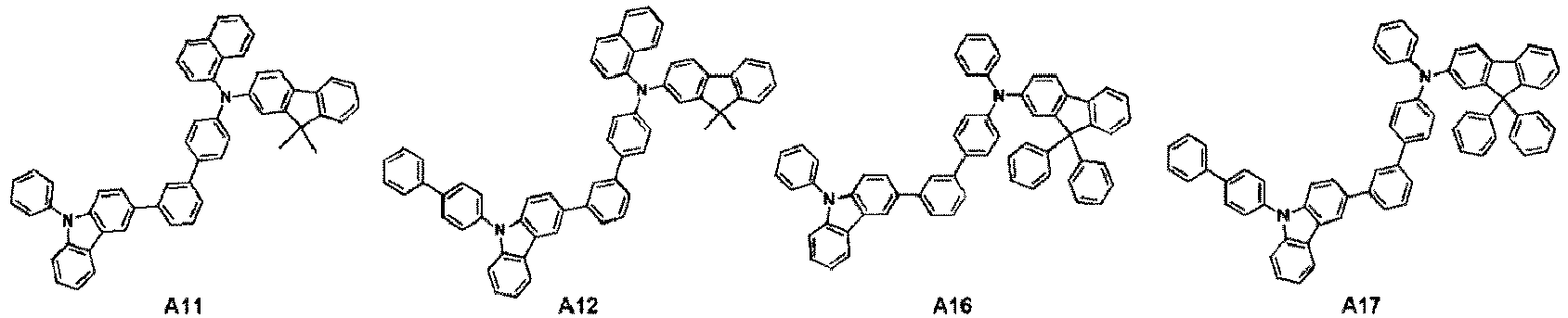


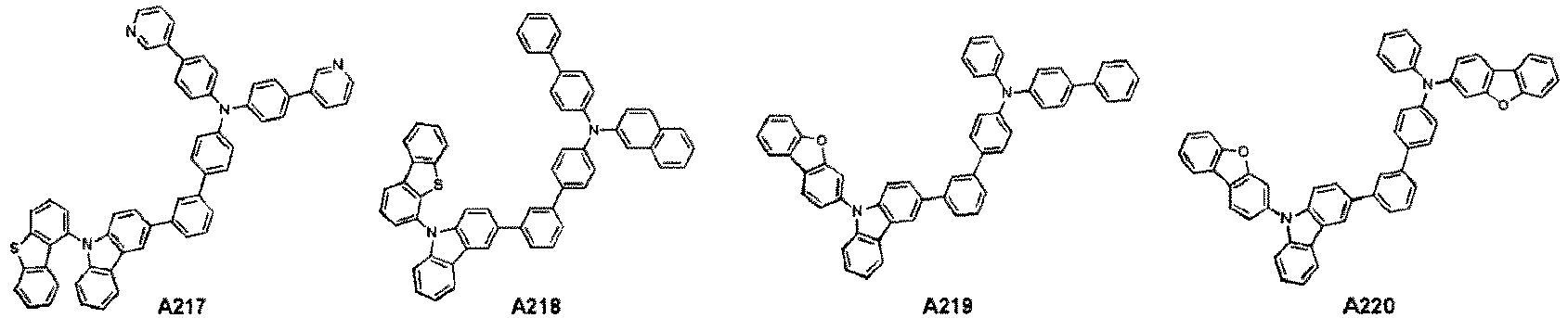


- In addition, illustratively, the compound represented by Formula 2 may be the compound represented by any one of the following formulas 4 to 7.



- In Formulas 4 to 7, the symbols of R3 to R7, X, Y, Z1, Z2, a, b, c and h and the like are the same as defined in Formula 2 above.
- Specifically, the compound represented by Formula 2 may be any one of the following compounds.
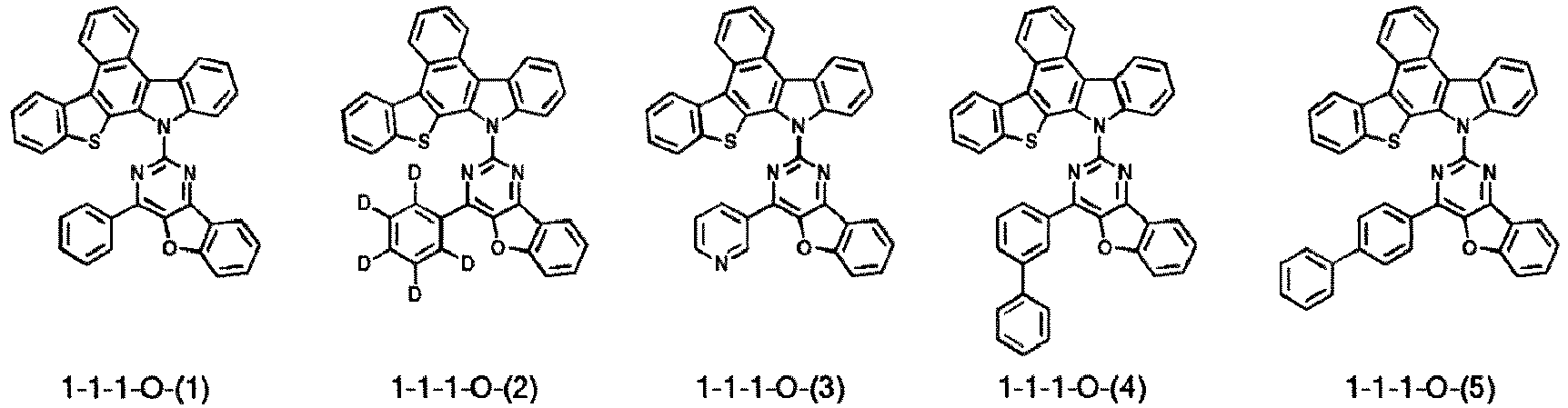


- In another aspect of the present invention, the present invention provides an organic electric element, wherein an emission-auxiliary layer of an organic material layer comprises the compound represented by formula 1 above, a hole transport layer of the organic material layer comprises the compound represented by the following formula 8, and a light emitting layer of the organic material layer comprises the compound represented by formula 2 above.

- In formula 8 above, each of symbols may be defined as follows.
- Ar4 and Ar5 may be each independently selected from the group consisting of a C6-C60 aryl group, a fluorenyl group, a C2-C60 heterocyclic group containing at least one heteroatom selected from the group consisting of O, N, S, Si, and P, a fused ring group of a C3-C60 aliphatic ring and a C6-C60 aromatic ring, a C1-C50 alkyl group, a C2-C20 alkenyl group, a C2-C20 alkynyl group, a C1-C30 alkoxyl group, a C6-C30 aryloxyl group and -L'-N(Ra)(Rb).
- When Ar4 and Ar5 are an aryl group, Ar4 and Ar5 may be preferably a C6-C30 aryl group, more preferably a C6-C12 aryl group, for example, phenyl, naphthyl, biphenyl, etc.; when Ar4 and Ar5 are a heterocyclic group, Ar4 and Ar5 may be preferably a C2-C30 heterocyclic group, more preferably a C2-C12 heterocyclic group, for example, dibenzothiophene, dibenzofuran, etc.; when Ar4 and Ar5 are a fluorenyl group, for example, Ar4 and Ar5 may be 9,9-dimethyl-9H-fluorene, 9,9-diphenyl-9H-fluorenyl, 9,9'-spirobifluorene and the like, and when Ar1 and Ar5 are each -L'-N(Ra)(Rb), Ar4 and Ar5 may be, for example, a diphenylamine group.
- Ar6 is any one of the following 8-1, 8-2 and 8-3.


- In formulas 8-1, 8-2 and 8-3 above, each of symbols may be defined as follows.
- Ar7, Ar8 and Ar9 are each independently selected from the group consisting of a C6-C60 aryl group, a fluorenyl group, a C2-C60 heterocyclic group containing at least one heteroatom selected from the group consisting of O, N, S, Si, and P, a fused ring group of a C3-C60 aliphatic ring and a C6-C60 aromatic ring, a C1-C50 alkyl group, a C2-C20 alkenyl group, a C2-C20 alkynyl group, a C1-C30 alkoxyl group, a C6-C30 aryloxyl group and -L'-N(Ra)(Rb).
- When Ar7, Ar8 and Ar9 are an aryl group, Ar7, Ar8 and Ar9 may be preferably a C6-C30 aryl group, more preferably a C6-C12 aryl group, for example, phenyl, naphthyl, biphenyl, etc.; when Ar7, Ar8 and Ar9 are a heterocyclic group, Ar7, Ar8 and Ar9 may be preferably a C2-C30 heterocyclic group, more preferably a C2-C12 heterocyclic group, for example, dibenzothiophene, dibenzofuran, etc.; and when Ar7, Ar8 and Ar9 are a fluorenyl group, for example, Ar7, Ar8 and Ar9 may be 9,9-dimethyl-9H-fluorene, 9,9-diphenyl-9H-fluorenyl, 9,9'-spirobifluorene and the like.
- R8 to R10 are each independently selected from the group consisting of deuterium, halogen, a C6-C60 aryl group, a fluorenyl group, a C2-C60 heterocyclic group containing at least one heteroatom selected from the group consisting of O, N, S, Si, and P, a fused ring group of a C3-C60 aliphatic ring and a C6-C60 aromatic ring, a C1-C50 alkyl group, a C2-C20 alkenyl group, a C2-C20 alkynyl group, a C1-C30 alkoxyl group, a C6-C30 aryloxyl group, and -L'-N(Ra)(Rb).
- In addition, any adjacent groups of R8 to R10 may be each independently linked together to form at least one ring, and the remaining groups not forming the ring are the same as defined above. For example, when h and i are each an integer of 2, neighboring R8s can be linked to each other to form a ring, and even though there are neighboring R9s, R9s may be each independently an aryl group or a heterocyclic ring. When neighboring R8s, R9s, and/or R10s are linked to each other to form a ring, the ring may be selected from the group consisting of a C6-C60 aryl group, a fluorenyl group, a C2-C60 heterocyclic group containing at least one heteroatom selected from the group consisting of O, N, S, Si, and P, and a fused ring group of a C3-C60 aliphatic ring and a C6-C60 aromatic ring, for example, the ring may be a benzene and thus naphthalene or phenanthrene can be formed together with the benzene ring to which they are bonded.
- When R8 to R10 are an aryl group, R8 to R10 may be preferably a C6-C30 aryl group, more preferably a C6-C12 aryl group, for example, phenyl, etc.; when R8 to R10 are a heterocyclic group, R8 to R10 may be preferably a C2-C30 heterocyclic group, more preferably a C2-C12 heterocyclic group, for example, carbazole and the like.
- h, i and j are each independently an integer of 0 to 4, when h, i and j are each an integer of 2 or more, a plurality of R8s to R10s may be each the same or different from each other,
- L2 may be each independently selected from the group consisting of a single bond, a C6-C60 arylene group, a fluorenylene group, a fused ring formed by a C3-C60 aliphatic ring and a C6-C60 aromatic ring, and a C2-C60 heterocyclic group containing at least one heteroatom selected from the group consisting of O, N, S, Si, and P. When L2 is an arylene group, L2 may be preferably a C6-C30 arylene group, more preferably a C6-C12 arylene group, for example, phenyl, biphenyl and the like.
- L3 and L4 may be each independently selected from the group consisting of a C6-C60 arylene group, a fluorenylene group, a fused ring of a C3-C60 aliphatic ring and a C6-C60 aromatic ring, and a C2-C60 heterocyclic group containing at least one heteroatom selected from the group consisting of O, N, S, Si, and P,
- When L3 and L4 are an arylene group, L3 and L4 may be preferably a C6-C30 arylene group, more preferably a C6-C12 arylene group, for example, biphenyl and the like, when L3 and L4 are a fluorenyl group, L3 and L4 may be, for example, 9,9-dimethyl-9H-fluorene, 9,9-diphenyl-9H-fluorenyl and the like.
- In -L'-N(Ra)(Rb) of Ar4, Ar5, Ar7 to Ar9, R8 to R10, L' is selected from the group consisting of a single bond, a C6-C60 arylene group, a fluorenylene group, a fused ring formed by a C3-C60 aliphatic ring and a C6-C60 aromatic ring, and a C2-C60 heterocyclic group containing at least one heteroatom selected from the group consisting of O, N, S, Si, and P, and Ra and Rb are each independently selected from the group consisting of a C6-C60 aryl group, a fluorenyl group, a fused ring formed by a C3-C60 aliphatic ring and a C6-C60 aromatic ring, and a C2-C60 heterocyclic group containing at least one heteroatom selected from the group consisting of O, N, S, Si, and P, and
the aryl group, heterocyclic group, fluorenyl group, alkyl group, alkenyl group, fused ring group, alkoxyl group, aryloxly group, arylene group, fluorenylene group, aliphatic hydrocarbon group of Ar4-Ar5, Ar7-Ar9, R8-R10, R', R", L2, L3, L', Ra and Rb may be each optionally further substituted with one or more substituents selected from the group consisting of deuterium, halogen, a silane group, a siloxane group, a boron group, a germanium group, a cyano group, a nitro group, a C1-C20 alkylthio group, a C1-C20 alkoxyl group, a C1-C20 alkyl group, a C2-C20 alkenyl group, a C2-C20 alkynyl group, a C6-C20 aryl group, a C6-C20 aryl group substituted with deuterium, a fluorenyl group, a C2-C20 heterocyclic group containing at least one heteroatom selected from the group consisting of O, N, S, Si, and P, a C3-C20 cycloalkyl group, a C7-C20 arylalkyl group, and a C8-C20 arylalkenyl group. - Specifically, the compound represented by Formula 8 may be any one of the following compounds.


- In another aspect of the present invention, the compound comprised in the hole transport layer, the emission-auxiliary layer and/or a light emitting layer may be a single compound or a mixture of two or more kinds represented by Formulas above. That is, the hole transport layer may comprise a single compound or a mixture of two or more kinds represented by Formula 1 or 8, the emission-auxiliary layer may comprise a single compound or a mixture of two or more kinds represented by Formula 1, and a light emitting layer may comprise a single compound or a mixture of two or more kinds represented by Formula 2.
- In another aspect of the present invention, the present invention provides an organic electric element further including at least a layer to improve luminous efficiency which is formed on at least one of the sides the first and second electrodes, wherein the side is opposite to the organic material layer.
- Hereinafter, Synthesis example of the compound according to one embodiment of the present invention and preparation example of an organic electric element will be described in detail by way of examples. However, the present invention is not limited to the following examples.
- Final products represented by Formula 1 according to the present invention are synthesized by reacting Sub 1 and Sub 2 as shown in Reaction Scheme 1, but are not limited thereto.

- Sub 1 of the Reaction Scheme 1 can be synthesized according to, but not limited to, the reaction route of the following Reaction Scheme 2.

- Synthesis Examples of compounds comprised in Sub 1 are as follows.
-


- The starting material phenylboronic acid (412.96 g, 3386.9 mmol) was dissolved in THF in a round bottom flask, and then 4-bromo-2-iodo-1-nitrobenzene (1665.83 g, 5080.3 mmol), Pd(PPh3)4 (195.69 g, 169.3 mmol), K2CO3 (1404.29 g, 10160.6 mmol) and water were added and followed by stirring the mixture at 80°C. When the reaction was completed, the reaction product was extracted with CH2Cl2 and water, and then, the organic layer was dried with MgSO4 and concentrated. Then, the concentrate was applied to silica gel column and recrystallized to obtain 659.32 g (yield: 70%) of the product.
- Sub 1-I-A1 (659.32 g, 2370.8 mmol) obtained in the above synthesis was dissolved in o-dichlorobenzene in a round bottom flask, and then, triphenylphosphine (1554.59 g, 5927 mmol) was added and followed by stirring the mixture at 200°C. When the reaction was completed, o-dichlorobenzene was removed and then the residue was extracted with CH2Cl2 and water. Then, the organic layer was dried with MgSO4 and concentrated, and the concentrate was applied to silica gel column and recrystallized to obtain 431.76 g (yield: 74%) of the product.
- Sub 1-II-A1 (50.69 g, 206 mmol) obtained in the above synthesis was dissolved in nitrobenzene in a round bottom flask, and then, iodobenzene (63.03 g, 309 mmol), Na2SO4 (29.26 g, 206 mmol), K2CO3 (28.47 g, 206 mmol) and Cu (3.93 g, 61.8 mmol) were added and followed by stirring the mixture at 200°C. When the reaction was completed, nitrobenzene was removed and then the residue was extracted with CH2Cl2 and water. Then, the organic layer was dried with MgSO4 and concentrated, and the concentrate was applied to silica gel column and recrystallized to obtain 48.45 g (yield 73%) of the product.
- Sub 1-III-A1 (48.45 g, 150.4 mmol) obtained in the above synthesis was dissolved in DMF in a round bottom flask, and then, Bis(pinacolato)diboron (42 g, 165.4 mmol), Pd(dppf)Cl2(3.68 g, 4.5 mmol) and KOAc(44.27 g, 451.1 mmol) were added and followed by stirring the mixture at 90°C. When the reaction was completed, DMF was removed and then the residue was extracted with CH2Cl2 and water. Then, the organic layer was dried with MgSO4 and concentrated, and the concentrate was applied to silica gel column and recrystallized to obtain 46.64 g (yield: 84%) of the product.
- Sub I-IV-A1 (46.64 g, 126.3 mmol) obtained in the above synthesis was dissolved in THF in a round bottom flask, and then, 1,3-dibromobenzene (44.69 g, 189.5 mmol), Pd(PPh3)4(7.3 g, 6.3 mmol), K2CO3 (52.37 g, 378.9 mmol) and water were added and followed by stirring the mixture at 80°C. When the reaction was completed, the reaction product was extracted with CH2Cl2 and water, and then, the organic layer was dried with MgSO4 and concentrated. Then, the concentrate was applied to silica gel column and recrystallized to obtain 36.22 g (yield: 72%) of the product.
- Sub 1-V-A1 (36.22 g, 90.9 mmol) obtained in the above synthesis was dissolved in DMF in a round bottom flask, and then, Bis(pinacolato)diboron (25.4 g, 100 mmol), Pd(dppf)Cl2(2.23 g, 2.7 mmol) and KOAc(26.77 g, 272.8 mmol) were added and followed by stirring the mixture at 90°C. When the reaction was completed, DMF was removed and then the residue was extracted with CH2Cl2 and water. Then, the organic layer was dried with MgSO4 and concentrated, and the concentrate was applied to silica gel column and recrystallized to obtain 33.21 g (yield: 82%) of the product.
- Sub I-VI-AL (10.52 g, 23.6 mmol) obtained in the above synthesis was dissolved in THF in a round bottom flask, and then, 1-bromo-4-iodobenzene (10.02 g, 35.4 mmol), Pd(PPh3)4(1.36 g, 1.2 mmol), K2CO3 (9.79 g, 70.9 mmol) and water were added and followed by stirring the mixture at 80°C. When the reaction was completed, the reaction product was extracted with CH2Cl2 and water, and then, the organic layer was dried with MgSO4 and concentrated. Then, the concentrate was applied to silica gel column and recrystallized to obtain 9.08 g (yield: 81%) of the product.
-

- 4-iodo-1,1'-biphenyl (40.87 g, 145.9 mmol), Na2SO4(13.82 g, 97.3 mmol), K2CO3(13.44 g, 97.3 mmol), Cu (1.85 g, 29.2 mmol) and nitrobenzene were added to Sub 1-II-A1 (23.94 g, 97.3 mmol) obtained in the above synthesis, and then 27.51 g (yield: 71%) of the product was obtained by the same method as in synthesis example of Sub 1-III-A1.
- Bis(pinacolato)diboron (19.29 g, 76 mmol), Pd(dppf)Cl2(1.69 g, 2.1 mmol), KOAc(20.34 g, 207.2 mmol) and DMF were added to Sub 1-III-A2 (27.51 g, 69.1 mmol) obtained in the above synthesis, and then 26.76 g (yield: 87%) of the product was obtained by the same method as in synthesis example of Sub 1-IV-A1.
- 1,3-dibromobenzene (21.26 g, 90.1 mmol), Pd(PPh3)4 (3.47 g, 3 mmol), K2CO3 (24.91 g, 180.3 mmol), THF and water were added to Sub 1-IV-A2 (26.76 g, 60.1 mmol) obtained in the above synthesis, and then 22.23 g (yield: 78%) of the product was obtained by the same method as in synthesis example of Sub 1-V-A1.
- Bis(pinacolato)diboron (13.09 g, 51.5 mmol), Pd(dppf)Cl2(1.15 g, 1.4 mmol), KOAc(13.8 g, 140.6 mmol) and DMF were added to Sub 1-V-A2 (22.23 g, 46.9 mmol) obtained in the above synthesis, and then 20.53 g (yield: 84%) of the product was obtained by the same method as in synthesis example of Sub 1-VI-A1.
- 1-bromo-4-iodobenzene (7.07 g, 25 mmol), Pd(PPh3)4(0.96 g, 0.8 mmol), K2CO3 (6.91 g, 50 mmol), THF and water were added to Sub 1-VI-A2 (8.69 g, 16.7 mmol) obtained in the above synthesis, and then 7.61 g (yield: 83%) of the product was obtained by the same method as in synthesis example of Sub 1-A1.
-
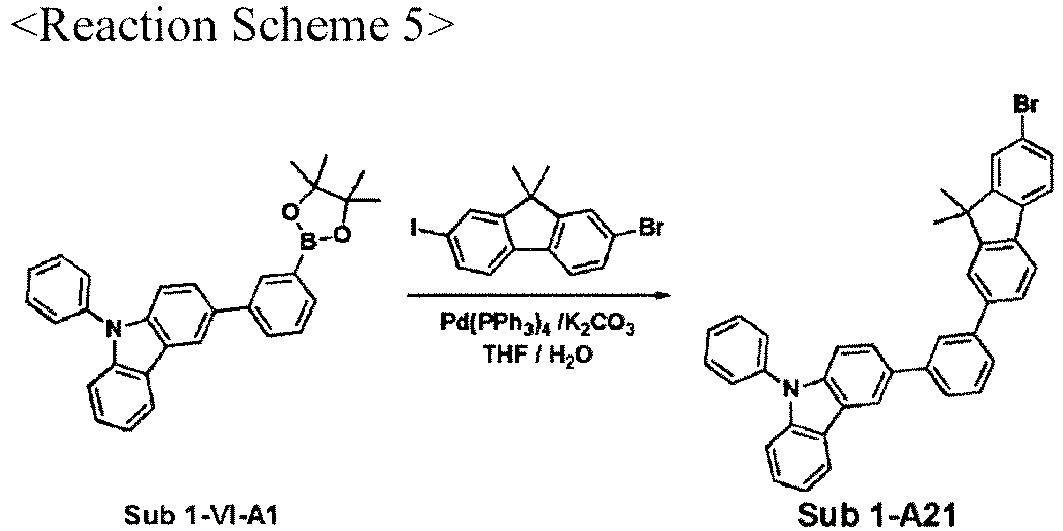
- 2-bromo-7-iodo-9,9-dimethyl-9H-fluorene (16.61 g, 41.6 mmol), Pd(PPh3)4 (1.6 g, 1.4 mmol), K2CO3 (11.51 g, 83.3 mmol), THF and water were added to Sub 1-VI-A1 (12.36 g, 27.8 mmol) obtained in the above synthesis, and then 12.95 g (yield: 79%) of the product was obtained by the same method as in synthesis example of Sub 1-A1.
-

- 5'-bromo-1,1':3',1"-terphenyl (90.54 g, 292.8 mmol), Na2SO4(27.73 g, 195.2 mmol), K2CO3 (26.98 g, 195.2 mmol), Cu (3.72 g, 58.6 mmol) and nitrobenzene were added to Sub 1-II-A1 (48.04 g, 195.2 mmol) obtained in the above synthesis, and then 62.97 g (yield: 68%) of the product was obtained by the same method as in synthesis example of Sub 1-III-A1.
- Bis(pinacolato)diboron (37.08 g, 146 mmol), Pd(dppf)Cl2 (3.25 g, 4 mmol), KOAc (39.08 g, 398.2 mmol) and DMF were added to Sub 1-III-A26 (62.97 g, 132.7 mmol) obtained in the above synthesis, and then 56.07 g (yield: 81%) of the product was obtained by the same method as in synthesis example of Sub 1-IV-A1.
- 1,3-dibromobenzene (38.05 g, 161.3 mmol), Pd(PPh3)4(6.21 g, 5.4 mmol), K2CO3 (44.58 g, 322.6 mmol), THF and water were added to Sub 1-IV-A26 (56.07 g, 107.5 mmol) obtained in the above synthesis, and then 41.43 g (yield: 70%) of the product was obtained by the same method as in synthesis example of Sub 1-V-A1.
- Bis(pinacolato)diboron (21.02 g, 82.8 mmol), Pd(dppf)Cl2(1.84 g, 2.3 mmol), KOAc(22.16 g, 225.8 mmol) and DMF were added to Sub 1-V-A26 (41.43 g, 75.3 mmol) obtained in the above synthesis, and then 35.08 g (yield: 78%) of the product was obtained by the same method as in synthesis example of Sub 1-VI-A1.
- 1-bromo-4-iodobenzene (7.59 g, 26.8 mmol), Pd(PPh3)4(1.03 g, 0.9 mmol), K2CO3 (7.42 g, 53.7 mmol), THF and water were added to Sub 1-VI-A26 (10.69 g, 17.9 mmol) obtained in the above synthesis, and then 8.52 g (yield: 76%) of the product was obtained by the same method as in synthesis example of Sub 1-A1.
-

- 3-bromo-9,9-dimethyl-9H-fluorene (68.41 g, 250.4 mmol), Na2SO4 (23.72 g, 167 mmol), K2CO3(23.08 g, 167 mmol), Cu (3.18 g, 50.1 mmol) and nitrobenzene were added to Sub 1-II-A1 (41.09 g, 167 mmol) obtained in the above synthesis, and then 51.23 g (yield: 70%) of the product was obtained by the same method as in synthesis example of Sub 1-III-A1.
- Bis(pinacolato)diboron (32.65 g, 128.6 mmol), Pd(dppf)Cl2 (2.86 g, 3.5 mmol), KOAc (34.41 g, 350.6 mmol) and DMF were added to Sub 1-III-A29 (51.23 g, 116.9 mmol) obtained in the above synthesis, and then 48.22 g (yield: 85%) of the product was obtained by the same method as in synthesis example of Sub 1-IV-A1.
- 1,3-dibromobenzene (35.15 g, 149 mmol), Pd(PPh3)4(5.74 g, 5 mmol), K2CO3 (41.19 g, 298 mmol), THF and water were added to Sub 1-IV-A29 (48.22 g, 99.3 mmol) obtained in the above synthesis, and then 38.84 g (yield: 76%) of the product was obtained by the same method as in synthesis example of Sub 1-V-A1.
- Bis(pinacolato)diboron (21.09 g, 83 mmol), Pd(dppf)Cl2(1.85 g, 2.3 mmol), KOAc(22.23 g, 226.5 mmol) and DMF were added to Sub 1-V-A29 (38.84 g, 75.5 mmol) obtained in the above synthesis, and then 33.91 g (yield: 80%) of the product was obtained by the same method as in synthesis example of Sub 1-VI-A1.
- 1-bromo-4-iodobenzene (7.26 g, 25.7 mmol), Pd(PPh3)4(0.99 g, 0.9 mmol), K2CO3 (7.1 g, 51.3 mmol), THF and water were added to Sub 1-VI-A29 (9.61 g, 17.1 mmol) obtained in the above synthesis, and then 8.09 g (yield: 80%) of the product was obtained by the same method as in synthesis example of Sub 1-A1.
-


- 2-bromo-9,9-diplvenyl-9H-fluorene (154.31 g, 388.4 mmol), Na2SO4 (36.78 g, 258.9 mmol), K2CO3 (35.79 g, 258.9 mmol), Cu (4.94 g, 77.7 mmol) and nitrobenzene were added to Sub 1-II-A1 (63.72 g, 258.9 mmol) obtained in the above synthesis, and then 88.84 g (yield: 61%) of the product was obtained by the same method as in synthesis example of Sub 1-III-A1.
- Bis(pinacolato)diboron (44.12 g, 173.7 mmol), Pd(dppf)Cl2(3.87 g, 4.7 mmol), KOAc(46.5 g, 473.8 mmol) and DMF were added to Sub 1-III-A35 (88.84 g, 157.9 mmol) obtained in the above synthesis, and then 74.13 g (yield: 77%) of the product was obtained by the same method as in synthesis example of Sub 1-IV-A1.
- 1,3-dibromobenzene (43.03 g, 182.4 mmol), Pd(PPh3)4(7.03 g, 6.1 mmol), K2CO3 (50.42 g, 364.8 mmol), THF and water were added to Sub 1-IV-A35 (74.13 g, 121.6 mmol) obtained in the above synthesis, and then 54.36 g (yield: 70%) of the product was obtained by the same method as in synthesis example of Sub 1-V-A1.
- Bis(pinacolato)diboron (23.78 g, 93.6 mmol), Pd(dppf)Cl2(2.09 g, 2.6 mmol), KOAc(25.06 g, 255.4 mmol) and DMF were added to Sub 1-V-A35 (54.36 g, 85.1 mmol) obtained in the above synthesis, and then 43.19 g (yield: 74%) of the product was obtained by the same method as in synthesis example of Sub 1-VI-A1.
- 1-bromo-4-iodobenzene (7.61 g, 26.9 mmol), Pd(PPh3)4(1.04 g, 0.9 mmol), K2CO3 (7.43 g, 53.8 mmol), THF and water were added to Sub 1-VI-A35 (12.29 g, 17.9 mmol) obtained in the above synthesis, and then 9.61 g (yield: 75%) of the product was obtained by the same method as in synthesis example of Sub 1-A1.
-

- 3-bromo-9,9-diphenyl-9H-fluorene (143.48 g, 361.1 mmol), Na2SO4(34.2 g, 240.8 mmol), K2CO3 (33.27 g, 240.8 mmol), Cu (4.59 g, 72.2 mmol) and nitrobenzene were added to Sub 1-II-A1 (59.25 g, 240.8 mmol) obtained in the above synthesis, and then 85.32 g (yield: 63%) of the product was obtained by the same method as in synthesis example of Sub 1-III-A1.
- Bis(pinacolato)diboron (42.37 g, 166.8 mmol), Pd(dppf)Cl2 (3.72 g, 4.6 mmol), KOAc (44.66 g, 455 mmol) and DMF were added to Sub 1-III-A36 (85.32 g, 151.7 mmol) obtained in the above synthesis, and then 73.04 g (yield: 79%) of the product was obtained by the same method as in synthesis example of Sub 1-IV-A1.
- 1,3-dibromobenzene (42.4 g, 179.7 mmol), Pd(PPh3)4(6.92 g, 6 mmol), K2CO3 (49.68 g, 359.5 mmol), THF and water were added to Sub 1-IV-A36 (73.04 g, 119.8 mmol) obtained in the above synthesis, and then 55.86 g (yield: 73%) of the product was obtained by the same method as in synthesis example of Sub 1-V-A1.
- Bis(pinacolato)diboron (24.43 g, 96.2 mmol), Pd(dppf)Cl2(2.14 g, 2.6 mmol), KOAc (25.75 g, 262.4 mmol) and DMF were added to Sub 1-V-A36 (55.86 g, 87.5 mmol) obtained in the above synthesis, and then 42.58 g (yield: 71%) of the product was obtained by the same method as in synthesis example of Sub I-VI-A1.
- 1-bromo-4-iodobenzene (7.33 g, 25.9 mmol), Pd(PPh3)4(1 g, 0.9 mmol), K2CO3 (7.17 g, 51.8 mmol), THF and water were added to Sub 1-VI-A36 (11.85 g, 17.3 mmol) obtained in the above synthesis, and then 9.39 g (yield: 76%) of the product was obtained by the same method as in synthesis example of Sub 1-A1.
-

- 2-bromodibenzo[b,d]thiophene (83.61 g, 317.7 mmol), Na2SO4 (30.09 g, 211.8 mmol), K2CO3(29.28 g, 211.8 mmol), Cu (4.04 g, 63.5 mmol) and nitrobenzene were added to Sub 1-II-A1 (52.13 g, 211.8 mmol) obtained in the above synthesis, and then 62.61 g (yield: 69%) of the product was obtained by the same method as in synthesis example of Sub 1-III-A1.
- Bis(pinacolato)diboron (40.83 g, 160.8 mmol), Pd(dppf)Cl2 (3.58 g, 4.4 mmol), KOAc (43.04 g, 438.5 mmol) and DMF were added to Sub 1-III-A43 (62.61 g, 146.2 mmol) obtained in the above synthesis, and then 58.37 g (yield: 84%) of the product was obtained by the same method as in synthesis example of Sub 1-IV-A1.
- 1,3-dibromobenzene (43.45 g, 184.2 mmol), Pd(PPh3)4(7.09 g, 6.1 mmol), K2CO3 (50.91 g, 368.3 mmol), THF and water were added to Sub 1-IV-A43 (58.37 g, 122.8 mmol) obtained in the above synthesis, and then 46.45 g (yield: 75%) of the product was obtained by the same method as in synthesis example of Sub 1-V-A1.
- Bis(pinacolato)diboron (25.72 g, 101.3 mmol), Pd(dppf)Cl2 (2.26 g, 2.8 mmol), KOAc (27.11 g, 276.2 mmol) and DMF were added to Sub 1-V-A43 (46.45 g, 92.1 mmol) obtained in the above synthesis, and then 40.63 g (yield: 80%) of the product was obtained by the same method as in synthesis example of Sub 1-VI-A1.
- 1-bromo-4-iodobenzene (7.53 g, 26.6 mmol), Pd(PPh3)4 (1.02 g, 0.9 mmol), K2CO3 (7.35 g, 53.2 mmol), THF and water were added to Sub 1-VI-A43 (9.78 g, 17.7 mmol) obtained in the above synthesis, and then 8.13 g (yield: 79%) of the product was obtained by the same method as in synthesis example of Sub 1-A1.
-

- 3-bromodibenzo[b,d]furan (87.23 g, 353 mmol), Na2SO4 (33.43 g, 235.4 mmol), K2CO3 (32.53 g, 235.4 mmol), Cu (4.49 g, 70.6 mmol) and nitrobenzene were added to Sub 1-II-A1 (57.92 g, 235.4 mmol) obtained in the above synthesis, and then 63.07 g (yield: 65%) of the product was obtained by the same method as in synthesis example of Sub 1-III-A1.
- Bis(pinacolato)diboron (42.73 g, 168.3 mmol), Pd(dppf)Cl2 (3.75 g, 4.6 mmol), KOAc (45.04 g, 458.9 mmol) and DMF were added to Sub 1-III-A46 (63.07 g, 153 mmol) obtained in the above synthesis, and then 55.51 g (yield: 79%) of the product was obtained by the same method as in synthesis example of Sub 1-IV-A1.
- 1,3-dibromobenzene (42.76 g, 181.3 mmol), Pd(PPh3)4(6.98 g, 6 mmol), K2CO3 (50.11 g, 362.5 mmol), THF and water were added to Sub 1-IV-A46 (55.51 g, 120.8 mmol) obtained in the above synthesis, and then 44.26 g (yield: 75%) of the product was obtained by the same method as in synthesis example of Sub 1-V-A1.
- Bis(pinacolato)diboron (25.32 g, 99.7 mmol), Pd(dppf)Cl2 (2.22 g, 2.7 mmol), KOAc(26.68 g, 271.9 mmol) and DMF were added to Sub 1-V-A46 (44.26 g, 90.6 mmol) obtained in the above synthesis, and then 37.36 g (yield: 77%) of the product was obtained by the same method as in synthesis example of Sub 1-VI-A1.
- 1-bromo-4-iodobenzene (8.44 g, 29.8 mmol), Pd(PPh3)4(1.15 g, 1 mmol), K2CO3 (8.25 g, 59.7 mmol), THF and water were added to Sub 1-VI-A46 (10.65 g, 19.9 mmol) obtained in the above synthesis, and then 8.98 g (yield: 80%) of the product was obtained by the same method as in synthesis example of Sub 1-A1.
-

- 1-bromo-3-iodobenzene (8.27 g, 29.2 mmol), Pd(PPh3)4(1.13 g, 1 mmol), K2CO3 (8.08 g, 58.5 mmol), THF and water were added to Sub 1-VI-A2 (10.16 g, 19.5 mmol) obtained in the above synthesis, and then 7.94 g (yield: 74%) of the product was obtained by the same method as in synthesis example of Sub 1-A1.
-

- 1-bromo-3-iodobenzene (7.68 g, 27.1 mmol), Pd(PPh3)4(1.05 g, 0.9 mmol), K2CO3 (7.5 g, 54.3 mmol), THF and water were added to Sub 1-VI-A26 (10.81 g, 18.1 mmol) obtained in the above synthesis, and then 8.05 g (yield: 71 %) of the product was obtained by the same method as in synthesis example of Sub 1-A1.
-

- 1-bromo-3-iodobenzene (7.78 g, 27.5 mmol), Pd(PPh3)4 (1.06 g, 0.9 mmol), K2CO3 (7.6 g, 55 mmol), THF and water were added to Sub 1-VI-A29 (10.29 g, 18.3 mmol) obtained in the above synthesis, and then 8.33 g (yield: 77%) of the product was obtained by the same method as in synthesis example of Sub 1-A1.
-

- 1-bromo-3-iodobenzene (8.43 g, 29.8 mmol), Pd(PPh3)4 (1.15 g, 1 mmol), K2CO3 (8.24 g, 59.6 mmol), THF and water were added to Sub 1-VI-A35 (13.62 g, 19.9 mmol) obtained in the above synthesis, and then 9.94 g (yield: 70%) of the product was obtained by the same method as in synthesis example of Sub 1-A1.
-

- 1-bromo-3-iodobenzene (7.97 g, 28.2 mmol), Pd(PPh3)4 (1.08 g, 0.9 mmol), K2CO3 (7.78 g, 56.3 mmol), THF and water were added to Sub 1-VI-A36 (12.87 g, 18.8 mmol) obtained in the above synthesis, and then 9.66 g (yield: 72%) of the product was obtained by the same method as in synthesis example of Sub 1-A1.
-

- 1-bromo-3-iodobenzene (9.46 g, 33.4 mmol), Pd(PPh3)4 (1.29 g, 1.1 mmol), K2CO3 (9.24 g, 66.9 mmol), THF and water were added to Sub 1-VI-A43 (12.29 g, 22.3 mmol) obtained in the above synthesis, and then 10.09 g (yield: 78%) of the product was obtained by the same method as in synthesis example of Sub 1-A1.
-

- 1-bromo-3-iodobenzene (9.45 g, 33.4 mmol), Pd(PPh3)4(1.29 g, 1.1 mmol), K2CO3 (9.24 g, 66.8 mmol), THF and water were added to Sub 1-VI-A46 (11.93 g, 22.3 mmol) obtained in the above synthesis, and then 9.43 g (yield: 75%) of the product was obtained by the same method as in synthesis example of Sub 1-A1.
-

- 1-bromo-2-iodobenzene (8.94 g, 31.6 mmol), Pd(PPh3)4 (1.22 g, 1.1 mmol), K2CO3 (8.73 g, 63.2 mmol), THF and water were added to Sub 1-VI-A1 (9.38 g, 21.1 mmol) obtained in the above synthesis, and then 6.99 g (yield: 70%) of the product was obtained by the same method as in synthesis example of Sub 1-A1.
-


- 1-bromo-2-iodobenzene (8.22 g, 29 mmol), Pd(PPh3)4 (1.12 g, 1 mmol), K2CO3 (8.03 g, 58.1 mmol), THF and water were added to Sub 1-VI-A26 (11.57 g, 19.4 mmol) obtained in the above synthesis, and then 7.76 g (yield: 64%) of the product was obtained by the same method as in synthesis example of Sub 1-A1.
-

- 1-bromo-2-iodobenzene (9.13 g, 32.3 mmol), Pd(PPh3)4 (1.24 g, 1.1 mmol), K2CO3 (8.92 g, 64.5 mmol), THF and water were added to Sub 1-VI-A29 (12.08 g, 21.5 mmol) obtained in the above synthesis, and then 8.64 g (yield: 68%) of the product was obtained by the same method as in synthesis example of Sub 1-A1.
-

- 1-bromo-2-iodobenzene (10.25 g, 36.2 mmol), Pd(PPh3)4 (1.4 g, 1.2 mmol), K2CO3 (10.01 g, 72.5 mmol), THF and water were added to Sub 1-VI-A35 (16.56 g, 24.2 mmol) obtained in the above synthesis, and then 10.18 g (yield: 59%) of the product was obtained by the same method as in synthesis example of Sub 1-A1.
-


- 1-bromo-2-iodobenzene (9.71 g, 34.3 mmol), Pd(PPh3)4 (1.32 g, 1.1 mmol), K2CO3 (9.49 g, 68.6 mmol), THF and water were added to Sub 1-VI-A36 (15.69 g, 22.9 mmol) obtained in the above synthesis, and then 9.81 g (yield: 60%) of the product was obtained by the same method as in synthesis example of Sub 1-A1.
-

- 2-bromo-9,9'-spirobi[fluorene] (79.53 g, 201.2 mmol), Na2SO4 (19.05 g, 134.1 mmol), K2CO3 (18.54 g, 134.1 mmol), Cu (2.56 g, 40.2 mmol) and nitrobenzene were added to Sub 1-II-A1 (33.01 g, 134.1 mmol) obtained in the above synthesis, and then 39.84 g (yield: 53%) of the product was obtained by the same method as in synthesis example of Sub 1-III-A1.
- Bis(pinacolato)diboron (19.86 g, 78.2 mmol), Pd(dppf)Cl2 (1.74 g, 2.1 mmol), KOAc (20.93 g, 213.2 mmol) and DMF were added to Sub 1-III-A101 (39.84 g, 71.1 mmol) obtained in the above synthesis, and then 32.82 g (yield: 76%) of the product was obtained by the same method as in synthesis example of Sub 1-IV-A1.
- 1,3-dibromobenzene (19.12 g, 81 mmol), Pd(PPh3)4 (3.12 g, 2.7 mmol), K2CO3 (22.4 g, 162.1 mmol), THF and water were added to Sub 1-IV-A101 (32.82 g, 54 mmol) obtained in the above synthesis, and then 24.42 g (yield: 71%) of the product was obtained by the same method as in synthesis example of Sub 1-V-A1.
- Bis(pinacolato)diboron (10.72 g, 42.2 mmol), Pd(dppf)Cl2 (0.94 g, 1.2 mmol), KOAc(11.29 g, 115.1 mmol) and DMF were added to Sub 1-V-A101 (24.42 g, 38.4 mmol) obtained in the above synthesis, and then 18.88 g (yield: 72%) of the product was obtained by the same method as in synthesis example of Sub 1-VI-A1.
- 1-bromo-2-iodobenzene (11.01 g, 38.9 mmol), Pd(PPh3)4 (1.5 g, 1.3 mmol), K2CO3 (10.76 g, 77.8 mmol), THF and water were added to Sub 1-VI-A101 (17.74 g, 25.9 mmol) obtained in the above synthesis, and then 10.36 g (yield: 56%) of the product was obtained by the same method as in synthesis example of Sub 1-A1.
-

- 1-bromo-2-iodobenzene (12.41 g, 43.9 mmol), Pd(PPh3)4 (1.69 g, 1.5 mmol), K2CO3 (12.13 g, 87.7 mmol), THF and water were added to Sub 1-VI-A43 (16.13 g, 29.2 mmol) obtained in the above synthesis, and then 10.7 g (yield: 63%) of the product was obtained by the same method as in synthesis example of Sub 1-A1.
-

- 1-bromo-2-iodobenzene (10.26 g, 36.3 mmol), Pd(PPh3)4 (1.4 g, 1.2 mmol), K2CO3 (10.02 g, 72.5 mmol), THF and water were added to Sub 1-VI-A46 (12.94 g, 24.2 mmol) obtained in the above synthesis, and then 8.87 g (yield: 65%) of the product was obtained by the same method as in synthesis example of Sub 1-A1.
- The compound belonging to Sub 1 may be, but not limited to, the following compounds, and Table 1 shows FD-MS (Field Desorption-Mass Spectrometry) values of compounds belonging to Sub 1.


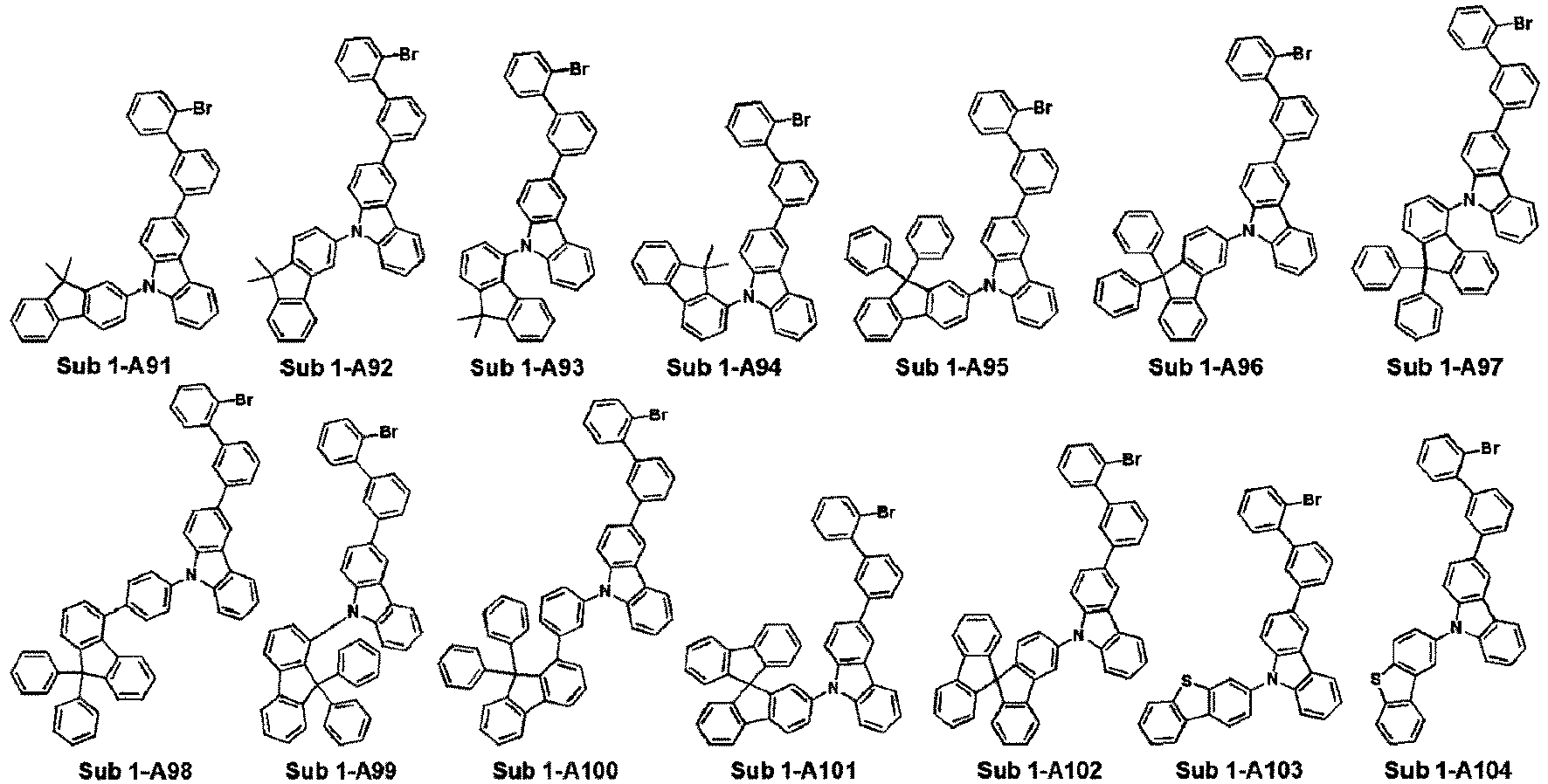

[Table 1] compound FD-MS compound FD-MS Sub1-A1 m/z=473.08(C30H20BrN=474.39) Sub1-A2 m/z=549.11(C36H24BrN=550.49) Sub1-A3 m/z=523.09(C34H22BrN=524.45) Sub1-A4 m/z=523.09(C34H22BrN=524.45) Sub1-A5 m/z=425.08(C26H20BrN=426.35) Sub1-A6 m/z=474.07(C29H19BrN2=475.38) Sub1-A7 m/z=5549.11(C36H24BrN=550.49) Sub1-A8 m/z=549.11(C36H24BrN=550.49) Sub1-A9 m/z==487.09(C31H11BrN=488.42) Sub1-A10 m/z=625.14(C42H28BrN=626.58) Sub1-A11 m/z=599.12(C40H26BrN=600.55) Sub1-A12 m/z=487.09(C31H22BrN=488.42) Sub1-A13 m/z=513.11(C33H24BrN=514.45) Sub1-A14 m/z=523.09(C34H22BrN=524.45) Sub1-A15 m/z=475.09(C30H22BrN=476.41) Sub1-A16 m/z=599.12(C40H26BrN=600.55) Sub1-A17 m/z=523.09(C34H22BrN=524.45) Sub1-A18 m/z=599.12(C40H26BrN=600.55) Sub1-A19 m/z=599.12(C40H26BrN=600.55) Sub1-A20 m/z=599.12(C40H26BrN=600.55) Sub1-A21 m/z=589.14(C39H28BrN=590.55) Sub1-A22 m/z=713.17(C49H32BrN=714.69) Sub1-A23 m/z=579.07(C36H22BrNS=580.54) Sub1-A24 m/z=563.09(C36H22BrNO=564.47) Sub1-A25 m/z=549.11(C36H24BrN=550.49) Sub1-A26 m/z=625.14(C42H28BrN=(626.58) Sub1-A27 m/z=625.14(C42H28RBrN=626.58) Sub1-A28 m/z=589.14(C39H28BrN=590.55) Sub1-A29 m/z=589.14(C39H28BrN=590.55) Sub1-A30 m/z=665.17(C45H32BrN=666.65) Sub1-A31 m/z=589.14(C39H28BrN=590.55) Sub1-A32 m/z=665.17(C45H32BrN=666.65) Sub1-A33 m/z=589.14(C39H28BrN=590.55) Sub1-A34 m/z=665.17(C45H32BrN=666.65) Sub1-A35 m/z=713.17(C49H32BrN=714.69) Sub1-A36 m/z=713.17(C49H32BrN=714.69) Sub1-A37 m/z=713.17(C49H32BrN=714.69) Sub1-A38 m/z=713.17(C49H32BrN=714.69) Sub1-A39 m/z=789.20(C55H36BrN=790.79) Sub1-A40 m/z=711.16(C49H30BrN=712.67) Sub1-A41 m/z=711.16(C49H30BrN=712.67) Sub1-A42 m/z=579.07(C36H22BrNS=580.54) Sub1-A43 m/z=579.07(C36H22BrNS=580.54) Sub1-A44 m/z=579.07(C36H22BrNS=580.54) Sub1-A45 m/z=579.07(C36H22BrNS=580.54) Sub1-A46 m/z=563.09(C36H22BrNO=564.47) Sub1-A47 m/z=563.09(C36H22BrNO=564.47) Sub1-A48 m/z=563.09(C36H22BrNO=564.47) Sub1-A49 m/z=563.09(C36H22BrNO=564.47) Sub1-A50 m/z=473.08(C30H20BrN=474.39) Sub1-A51 m/z=549.11(C36H24BrN=550.49) Sub1-A52 m/z=523.09(C34H22BrN=524.45) Sub1-A53 m/z=523.09(C34H22BrN=524.45) Sub1-A54 m/z=425.08(C26H20BrN=426.35) Sub1-A55 m/z=549.11(C36H24BrN=550.49) Sub1-A56 m/z=625.14(C42H28BrN=626.58) Sub1-A57 m/z=549.11(C36H24BrN=550.49) Sub1-A58 m/z=549.11(C36H24BrN=550.49) Sub1-A59 m/z=625.14(C42H28BrN=626.58) Sub1-A60 m/z=625.14(C42H28BrN=626.58) Sub1-A61 m/z=549.11(C36H24BrN=550.49) Sub1-A62 m/z=589.14(C39H28BrN=590.55) Sub1-A63 m/z=665.17(C45H32BrN=666.65) Sub1-A64 m/z=589.14(C39H28BrN=590.55) Sub1-A65 m/z=589.14(C39H28BrN=590.55) Sub1-A66 m/z=589.14(C39H28BrN=590.55) Sub1-A67 m/z=713.17(C49H32BrN=714.69) Sub1-A68 m/z=713.17(C49H32BrN=714.69) Sub1-A69 m/z=713.17(C49H32BrN=714.69) Sub1-A70 m/z=789.20(C55H36BrN=790.79) Sub1-A71 m/z=713.17(C49H32BrN=714.69) Sub1-A72 m/z=711.16(C49H30BrN=712.67) Sub1-A73 m/z=711.16(C49H30BrN=712.67) Sub1-A74 m/z=579.07(C36H22BrNS=580.54) Sub1-A75 m/z=579.07(C36H22BrNS=580.54) Sub1-A76 m/z=656.09(C41H25BrN2S=657.62) Sub1-A77 m/z=579.07(C36H22BrNS=580.54) Sub1-A78 m/z=579.07(C36H22BrNS=580.54) Sub1-A79 m/z=563.09(C36H22BrNO=564.47) Sub1-A80 m/z=563.09(C36H22BrNO=564.47) Sub1-A81 m/z=563.09(C36H22BrNO=564.47) Sub1-A82 m/z=563.09(C36H22BrNO=564.47) Sub1-A83 m/z=473.08(C30H20BrN=474.39) Sub1-A84 m/z=549.11(C36H24BrN=550.49) Sub1-A85 m/z=523.09(C34H22BrN=524.45) Sub1-A86 m/z=524.09(C33H21BrN2=525.44) Sub1-A87 m/z=549.11(C36H24BrN=550.49) Sub1-A88 m/z=549.11(C36H24BrN=550.49) Sub1-A89 m/z=625.14(C42H28BrN=626.58) Sub1-A90 m/z=625.14(C42H28BrN=626.58) Sub1-A91 m/z=589.14(C39H28BrN=590.55) Sub1-A92 m/z=589.14(C39H28BrN=590.55) Sub1-A93 m/z=589.14(C39H28BrN=590.55) Sub1-A94 m/z=589.14(C39H28BrN=590.55) Sub1-A95 m/z=713.17(C49H32BrN=714.69) Sub1-A96 m/z=713.17(C49H32BrN=714.69) Sub1-A97 m/z=713.17(C49H32BrN=714.69) Sub1-A98 m/z=789.20(C55H36BrN=790.79) Sub1-A99 m/z=713.17(C49H32BrN=714.69) Sub1-A100 m/z=789.20(C55H36BrN=790.79) Sub1-A101 m/z=711.16(C49H30BrN=712.67) Sub1-A102 m/z=711.16(C49H30BrN=712.67) Sub1-A103 m/z=579.07(C36H22BrNS=580.54) Sub1-A104 m/z=579.07(C36H22BrNS=580.54) Sub1-A105 m/z=579.07(C36H22BrNS=580.54) Sub1-A106 m/z=579.07(C36H22BrNS=580.54) Sub1-A107 m/z=563.09(C36H22BrNO=564.47) Sub1-A108 m/z=563.09(C36H22BrNO=564.47) Sub1-A109 m/z=563.09(C36H22BrNO=564.47) Sub1-A110 m/z=563.09(C36H22BrNO=564.47) - Sub 2 of the Reaction Scheme 1 can be synthesized according to, but not limited to, the reaction route of the following Reaction Scheme 27.

- Synthesis Examples of compounds comprised in Sub 2 are as follows.
-

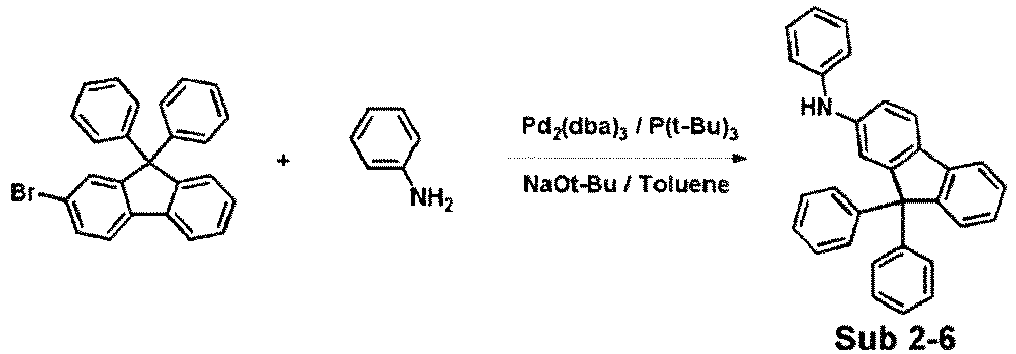
- The starting material 2-bromo-9,9-diphenyl-9H-fluorene (41.72 g, 105 mmol) was dissolved in toluene in a round bottom flask, and then aniline (19.56 g, 210 mmol), Pd2(dba)3 (2.88 g, 3.2 mmol), 50% P(t-Bu)3 (4.1ml, 8.4 mmol) and NaOt-Bu (30.28 g, 315 mmol) were added and followed by stirring the mixture at 40°C. When the reaction was completed, the reaction product was extracted with CH2Cl2 and water, and then, the organic layer was dried with MgSO4 and concentrated. Then, the concentrate was applied to silica gel column and recrystallized to obtain 32.25 g (yield: 75%) of the product.
-

- [1,1'-biphenyl]-4-amine (13.31 g, 78.7 mmol), Pd2(dba)3 (1.08 g, 1.2 mmol), 50% P(t-Bu)3 (1.5ml, 3.1 mmol), NaOt-Bu (11.34 g, 118 mmol) and toluene were added to the starting material 2-bromo-9,9-diphenyl-9H-fluorene (15.63 g, 39.3 mmol), and then 14.52 g (yield: 76%) of the product was obtained by the same method as in synthesis example of Sub 2-6.
-

- Aniline (14.02 g, 150.6 mmol), Pd2(dba)3 (2.07 g, 2.3 mmol), 50% P(t-Bu)3 (2.9ml, 6 mmol), NaOt-Bu (21.71 g, 225.8 mmol) and toluene were added to the starting material bromobenzene (11.82 g, 75.3 mmol), and then 10.19 g (yield: 80%) of the product was obtained by the same method as in synthesis example of Sub 2-6.
-

- [1,1'-biphenyl]-4-amine (32.18 g, 190.2 mmol), Pd2(dba)3 (2.61 g, 2.9 mmol), 50% P(t-Bu)3 (3.7ml, 7.6 mmol), NaOt-Bu (27.42 g, 285.3 mmol) and toluene were added to the starting material bromobenzene (14.93 g, 95.1 mmol), and then 19.36 g (yield: 83%) of the product was obtained by the same method as in synthesis example of Sub 2-6.
-

- [1,1'-biphenyl]-4-amine (37.15 g, 219.6 mmol), Pd2(dba)3 (3.02 g, 3.3 mmol), 50% P(t-Bu)3 (4.3ml, 8.8 mmol), NaOt-Bu (31.65 g, 329.3 mmol) and toluene were added to the starting material 4-bromo-1,1'-biphenyl (25.59 g, 109.8 mmol), and then 27.87 g (yield: 79%) of the product was obtained by the same method as in synthesis example of Sub 2-6.
-

- Aniline (11.56 g, 124.1 mmol), Pd2(dba)3 (1.7 g, 1.9 mmol), 50% P(t-Bu)3 (2.4ml, 5 mmol), NaOt-Bu (17.89 g, 186.2 mmol) and toluene were added to the starting material 1-bromonaphthalene (12.85 g, 62.1 mmol), and then 10.07 g (yield: 74%) of the product was obtained by the same method as in synthesis example of Sub 2-6.
-

- Aniline (11.43 g, 122.7 mmol), Pd2(dba)3 (1.69 g, 1.8 mmol), 50% P(t-Bu)3 (2.4ml, 4.9 mmol), NaOt-Bu (17.69 g, 184 mmol) and toluene were added to the starting material 2-bromo-5-phenylthiophene (14.67 g, 61.3 mmol), and then 14.52 g (yield: 76%) of the product was obtained by the same method as in synthesis example of Sub 2-6.
-
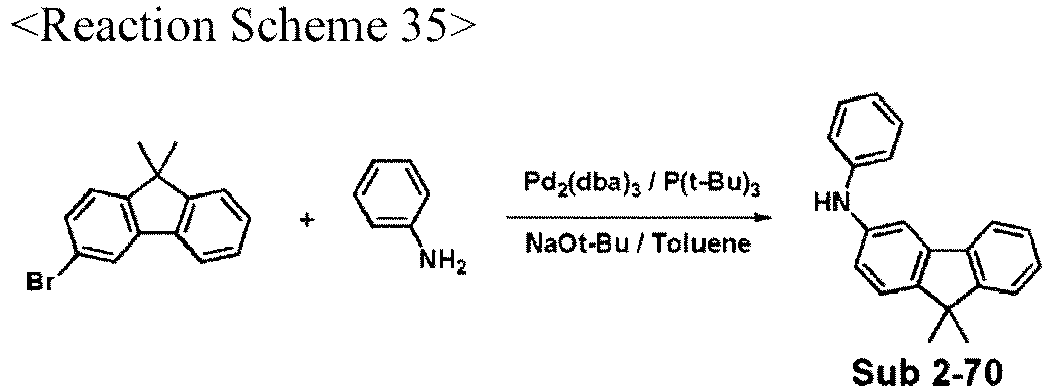
- Aniline (10.73 g, 115.2 mmol), Pd2(dba)3 (1.58 g, 1.7 mmol), 50% P(t-Bu)3 (2.2ml, 4.6 mmol), NaOt-Bu (16.61 g, 172.9 mmol) and toluene were added to the starting material 3-bromo-9,9-dimethyl-9H-fluorene (15.74 g, 57.6 mmol), and then 13.81 g (yield: 84%) of the product was obtained by the same method as in synthesis example of Sub 2-6.
-

- [1,1'-biphenyl]-4-amine (11.73 g, 69.3 mmol), Pd2(dba)3 (0.95 g, 1 mmol), 50% P(t-Bu)3 (1.4ml, 2.8 mmol), NaOt-Bu (10 g, 104 mmol) and toluene were added to the starting material 3-bromo-9,9-dimethyl-9H-fluorene (9.47 g, 34.7 mmol), and then 10.28 g (yield: 82%) of the product was obtained by the same method as in synthesis example of Sub 2-6.
-

- Naphthalen-2-amine (12.24 g, 85.5 mmol), Pd2(dba)3 (1.17 g, 1.3 mmol), 50% P(t-Bu)3 (1.7ml, 3.4 mmol), NaOt-Bu (12.33 g, 128.3 mmol) and toluene were added to the starting material 3-bromo-9,9-dimethyl-9H-fluorene (11.68 g, 42.8 mmol), and then 11.04 g (yield: 77%) of the product was obtained by the same method as in synthesis example of Sub 2-6.
-

- Aniline (6.86 g, 73.2 mmol), Pd2(dba)3 (1.01 g, 1.1 mmol), 50% P(t-Bu)3 (1.4ml, 2.9 mmol), NaOt-Bu (10.55 g, 109.8 mmol) and toluene were added to the starting material 3-bromo-9,9-diphenyl-9H-fluorene (14.54 g, 36.6 mmol), and then 11.24 g (yield: 75%) of the product was obtained by the same method as in synthesis example of Sub 2-6.
-

- Aniline (16.28 g, 174.8 mmol), Pd2(dba)3 (2.4 g, 2.6 mmol), 50% P(t-Bu)3 (3.4ml, 7 mmol), NaOt-Bu (25.2 g, 262.2 mmol) and toluene were added to the starting material 3-bromopyridine (13.81 g, 87.4 mmol), and then 9.97 g (yield: 67%) of the product was obtained by the same method as in synthesis example of Sub 2-6.
-

- Aniline (18.02 g, 193.5 mmol), Pd2(dba)3 (2.66 g, 2.9 mmol), 50% P(t-Bu)3 (3.8ml, 7.7 mmol), NaOt-Bu (27.9 g, 290.3 mmol) and toluene were added to the starting material 3-(4-bromophenyl)pyridine (22.65 g, 96.8 mmol), and then 16.44 g (yield: 69%) of the product was obtained by the same method as in synthesis example of Sub 2-6.
- The compound belonging to Sub 2 may be, but not limited to, the following compounds, and Table 1 shows FD-MS (Field Desorption-Mass Spectrometry) values of the following compounds.


[Table 2] compound FD-MS compound FD-MS Sub 2-1 m/z=285.15(C21H19N=285.38) Sub 2-2 m/z=299.17(C22H21N=299.41) Sub 2-3 m/z=361.18(C27H23N=361.48) Sub 2-4 m/z=335.17(C25H21N=335.44) Sub 2-5 m/z=335.17(C25H21N=335.44) Sub 2-6 m/z=409.18(C31H23N=409.52) Sub 2-7 m/z=485.21(C37H27N=485.62) Sub 2-8 m/z=535.23(C41H29N=535.68) Sub 2-9 m/z=459.20(C35H25N=459.58) Sub 2-10 m/z=407.17(C31H21N=407.51) Sub 2-11 m/z=483.20(C37HN=483.60) Sub 2-12 m/z=457.18(C35H23N=457.56) Sub 2-13 m/z=169.09(C12H11N=169.22) Sub 2-14 m/z=187.08(C12H10FN=187.21) Sub 2-15 m/z=209.12(C15H15N=209.29) Sub 2-16 m/z=245.12(C18H15N=245.32) Sub 2-17 m/z=321.15(C24H19N=321.41) Sub 2-18 m/z=295.14(C22H17N=295.38) Sub 2-19 m/z=295.14(C22H17N=295.38) Sub 2-20 m/z=219.10(C16H13N=219.28) Sub 2-21 m/z=219.10(C16H13N=219.28) Sub 2-22 m/z=269.12(C20H15N=269.34) Sub 2-23 m/z=219.12(C20H15N=269.34) Sub 2-24 m/z=269.12(C20H15N=269.34) Sub 2-25 m/z=275.08(C18H13NS=275.37) Sub 2-26 m/z=275.08(C18H13NS=275.37) Sub 2-27 m/z=259.10(C18H13NO=259.30) Sub 2-28 m/z=351.11(C24H17NS=351.46) Sub 2-30 m/z=325.09(C22H15NS=325.43) Sub 2-31 m/z=309.12(C22H15NO=309.36) Sub 2-32 m/z=351.11(C24H17NS=351.46) Sub 2-33 m/z=-427.18(C30H25NSi=427.61) Sub 2-34 m/z=412.19(C30H24N2=412.52) Sub 2-35 m/z=366.21(C27H18D5N=366.51) Sub 2-37 m/z=410.18(C30H22N2=410.51) Sub 2-38 m/z=360.16(C26H20N2=360.45) Sub 2-39 m/z=225.06(C14H11NS=225.31) Sub 2-40 m/z=251.08(C16H13NS=251.35) Sub 2-41 m/z=259.10(C18H13NO=259.30) Sub 2-42 m/z=335.13(C24H17NO=335.40) Sub 2-43 m/z=259.10(C18H3NO=259.30) Sub 2-44 m/z=309.12(C22H15NO=309.36) Sub 2-45 m/z=235.10(C16H13NO=235.28) Sub 2-46 m/z=269.12(C20H15N=269.34) Sub 2-47 m/z=269.12(C20H15N=269.34) Sub 2-48 m/z=345.15(C26H19N=345.44) Sub 2-49 m/z=321.15(C24H19N=321.41) Sub 2-50 m/z=321.15(C24H19N=321.41) Sub 2-51 m/z=321.15(C24H19N=321.41) Sub 2-52 m/z=321.15(C24H19N=321.41) Sub 2-53 m/z=321.15(C24H19N=321.41) Sub 2-54 m/z=321.15(C24H19N=321.41) Sub 2-55 m/z=321.15(C24H19N=321.41) Sub 2-56 m/z=361.18(C27H23N=361.48) Sub 2-57 m/z=437.21(C33H27N=437.57) Sub 2-58 m/z=411.20(C31H25N=411.54) Sub 2-59 m/z=485.21(C37H27N=485.62) Sub 2-60 m/z=459.20(C35H25N=459.58) Sub 2-61 m/z=535.23(C41H29N=535.68) Sub 2-62 m/z=561.25(C43H31N=561.71) Sub 2-63 m/z=535.23(C41H29N=535.68) Sub 2-64 m/z=535.23(C41H29N=535.68) Sub 2-65 m/z=437.21(C33H27N=437.57) Sub 2-66 m/z=423.20(C32H25N=423.55) Sub 2-67 m/z=437.21(C33H27N=437.57) Sub 2-68 m/z=445.16(C31H21F2N=445.50) Sub 2-69 m/z=414.21(C31H18D5N=414.55) Sub 2-70 m/z=285.15(C21H19N=285.38) Sub 2-71 m/z=361.18(C27H23N=361.48) Sub 2-72 m/z=361.18(C27H23N=361.48) Sub 2-73 m/z=335.17(C25H21N=335.44) Sub 2-74 m/z=335.17(C25H21N=335.44) Sub 2-75 m/z=437.21(C33H27N=437.57) Sub 2-76 m/z=409.18(C31H23N=409.52) Sub 2-77 m/z=485.21(C37H27N=485.62) Sub 2-78 m/z=335.17(C25H21N=335.44) Sub 2-79 m/z=286.15(C20H18N2=286.37) Sub 2-80 m/z=336.16(C24H20N2=336.43) Sub 2-81 m/z=170.08(C11H10N2=170.21) Sub 2-82 m/z=246.12(C17H14N2=246.31) Sub 2-83 m/z=296.13(C21H16N2=296.37) Sub 2-84 m/z=323.14(C22H17N3=323.39) Sub 2-85 m/z=322.15(C23H18N2=322.40) Sub 2-86 m/z=220.10(C15H12N2=220.27) Sub 2-87 m/z=220.10(C15H12N2=220.27) Sub 2-88 m/z=220.10(C15H12N2=220.27) Sub 2-89 m/z=220.10(C15H12N2=220.27) Sub 2-90 m/z=346.15(C25H18N2=346.42) Sub 2-91 m/z=296.13(C21H16N2=296.37) Sub 2-92 m/z=270.12(C19H14N2=270.33) - Sub 2 (1 eq.) was dissolved in toluene in a round bottom flask, and Sub 1 (1.2 eq.), Pd2(dba)3 (0.03 eq.), P(t-Bu)3 (0.08 eq.) and NaOt-Bu (3 eq.) were added, and followed by stirring the mixture at 100°C. When the reaction was completed, the reaction product was extracted with CH2Cl2 and water, and then the organic layer was dried with MgSO4 and concentrated. Then, the concentrate was applied to silica gel column and recrystallized to obtain final product.
-

- Sub 2-6 (4.46 g, 10.9 mmol) obtained in the above synthesis was dissolved in toluene in a round bottom flask, and Sub 1-A2 (7.19 g, 13.1 mmol), Pd2(dba)3 (0.3 g, 0.3 mmol), 50% P(t-Bu)3 (0.4ml, 0.9 mmol) and NaOt-Bu (3.14 g, 32.7 mmol) were added, and followed by stirring the mixture at 100°C. When the reaction was completed, the reaction product was extracted with CH2Cl2 and water, and then the organic layer was dried with MgSO4 and concentrated. Then, the concentrate was applied to silica gel column and recrystallized to obtain 6.8 g (yield: 71%) of product.
-


- Sub 1-A1 (8.89 g, 18.7 mmol), Pd2(dba)3 (0.43 g, 0.5 mmol), 50% P(t-Bu)3 (0.6ml, 1.2 mmol), NaOt-Bu (4.5 g, 46.8 mmol) and toluene were added to Sub 2-7 (7.58 g, 15.6 mmol) obtained in the above synthesis, and then 10.02 g (yield: 73%) of the product was obtained by the same method as in synthesis example of Product A17.
-

- Sub 1-A21 (12.52 g, 21.2mmol), Pd2(dba)3 (0.49 g, 0.5 mmol), 50% P(t-Bu)3 (0.7ml, 1.4 mmol), NaOt-Bu (5.1g, 53 mmol) and toluene were added to Sub 2-17 (5.68 g, 17.7 mmol) obtained in the above synthesis, and then 10.28 g (yield: 70%) of the product was obtained by the same method as in synthesis example of Product A 17.
-

- Sub 1-A26 (8.09 g, 12.9 mmol), Pd2(dba)3 (0.3 g, 0.3 mmol), 50% P(t-Bu)3 (0.4ml, 0.9 mmol), NaOt-Bu (3.1 g, 32.3 mmol) and toluene were added to Sub 2-71 (3.89 g, 10.8 mmol) obtained in the above synthesis, and then 7.13 g (yield: 73%)) of the product was obtained by the same method as in synthesis example of Product A 17.
-

- Sub 1-A29 (7.89 g, 13.4 mmol), Pd2(dba)3 (0.31 g, 0.3 mmol), 50% P(t-Bu)3 (0.4ml, 0.9 mmol), NaOt-Bu (3.21 g, 33.4 mmol) and toluene were added to Sub 2-17 (3.58 g, 11.1 mmol) obtained in the above synthesis, and then 7.04 g (yield: 76%) of the product was obtained by the same method as in synthesis example of Product A17.
-

- Sub 1-A35 (9.33 g, 13.1 mmol), Pd2(dba)3 (0.3 g, 0.3 mmol), 50% P(t-Bu)3 (0.4ml, 0.9 mmol), NaOt-Bu (3.14 g, 32.7 mmol) and toluene were added to Sub 2-16 (2.67 g, 10.9 mmol) obtained in the above synthesis, and then 6.79 g (yield: 71 %) of the product was obtained by the same method as in synthesis example of Product A17.
-

- Sub 1-A36 (9.14 g, 12.8 mmol), Pd2(dba)3 (0.29 g, 0.3 mmol), 50% P(t-Bu)3 (0.4ml, 0.9 mmol), NaOt-Bu (3.07 g, 32 mmol) and toluene were added to Sub 2-70 (3.04 g, 10.7 mmol) obtained in the above synthesis, and then 7.25 g (yield: 74%) of the product was obtained by the same method as in synthesis example of Product A17.
-

- Sub 1-A43 (7.57 g, 13 mmol), Pd2(dba)3 (0.3 g, 0.3 mmol), 50% P(t-Bu)3 (0.4ml, 0.9 mmol), NaOt-Bu (3.13 g, 32.6 mmol) and toluene were added to Sub 2-6 (4.45 g, 10.9 mmol) obtained in the above synthesis, and then 6.82 g (yield: 69%) of the product was obtained by the same method as in synthesis example of Product A 17.
-

- Sub 1-A46 (8.75 g, 15.5 mmol), Pd2(dba)3 (0.35 g, 0.4 mmol), 50% P(t-Bu)3 (0.5ml, 1 mmol), NaOt-Bu (3.73 g, 38.8 mmol) and toluene were added to Sub 2-16 (3.17 g, 12.9 mmol) obtained in the above synthesis, and then 6.97 g (yield: 74%) of the product was obtained by the same method as in synthesis example of Product A17.
-

- Sub 1-A51 (7.47 g, 13.6 mmol), Pd2(dba)3 (0.31 g, 0.3 mmol), 50% P(t-Bu)3 (0.4ml, 0.9 mmol), NaOt-Bu (3.26 g, 33.9 mmol) and toluene were added to Sub 2-6 (4.63 g, 11.3 mmol) obtained in the above synthesis, and then 7.16 g (yield: 72%) of the product was obtained by the same method as in synthesis example of Product A17.
-

- Sub 1-A59 (7.84 g, 12.5 mmol), Pd2(dba)3 (0.29 g, 0.3 mmol), 50% P(t-Bu)3 (0.4ml, 0.8 mmol), NaOt-Bu (3.01 g, 31.3 mmol) and toluene were added to Sub 2-76 (4.27 g, 10.4 mmol) obtained in the above synthesis, and then 6.47 g (yield: 65%) of the product was obtained by the same method as in synthesis example of Product A17.
-

- Sub 1-A64 (8.18 g, 13.9 mmol), Pd2(dba)3 (0.32 g, 0.3 mmol), 50% P(t-Bu)3 (0.5ml, 0.9 mmol), NaOt-Bu (3.33 g, 34.6 mmol) and toluene were added to Sub 2-17 (3.71 g, 11.5 mmol) obtained in the above synthesis, and then 7.39 g (yield: 77%) of the product was obtained by the same method as in synthesis example of Product A 17.
-

- Sub 1-A67 (9.62 g, 13.5 mmol), Pd2(dba)3 (0.31 g, 0.3 mmol), 50% P(t-Bu)3 (0.4ml, 0.9 mmol), NaOt-Bu (3.23 g, 33.7 mmol) and toluene were added to Sub 2-20 (2.46 g, 11.2 mmol) obtained in the above synthesis, and then 6.99 g (yield: 73%) of the product was obtained by the same method as in synthesis example of Product A17.
-

- Sub 1-A68 (9.28 g, 13 mmol), Pd2(dba)3 (0.3 g, 0.3 mmol), 50% P(t-Bu)3 (0.4ml, 0.9 mmol), NaOt-Bu (3.12 g, 32.5 mmol) and toluene were added to Sub 2-40 (2.72 g, 10.8 mmol) obtained in the above synthesis, and then 6.42 g (yield: 67%) of the product was obtained by the same method as in synthesis example of Product A 17.
-

- Sub 1-A75 (9.84 g, 16.9 mmol), Pd2(dba)3 (0.39 g, 0.4 mmol), 50% P(t-Bu)3 (0.6ml, 1.1 mmol), NaOt-Bu (4.07 g, 42.4 mmol) and toluene were added to Sub 2-13 (2.39 g, 14.1 mmol) obtained in the above synthesis, and then 6.61 g (yield: 70%) of the product was obtained by the same method as in synthesis example of Product A17.
-

- Sub 1-A79 (9.24 g, 16.4 mmol), Pd2(dba)3 (0.37 g, 0.4 mmol), 50% P(t-Bu)3 (0.5ml, 1.1 mmol), NaOt-Bu (3.93 g, 40.9 mmol) and toluene were added to Sub 2-82 (3.36 g, 13.6 mmol) obtained in the above synthesis, and then 6.07 g (yield: 61%) of the product was obtained by the same method as in synthesis example of Product A 17.
-


- Sub 1-A83 (6.8 g, 14.3 mmol), Pd2(dba)3 (0.33 g, 0.4 mmol), 50% P(t-Bu)3 (0.5ml, 1 mmol), NaOt-Bu (3.44 g, 35.8 mmol) and toluene were added to Sub 2-6 (4.89 g, 11.9 mmol) obtained in the above synthesis, and then 6.42 g (yield: 67%) of the product was obtained by the same method as in synthesis example of Product A 17.
-

- Sub 1-A89 (7.56 g, 12.1 mmol), Pd2(dba)3 (0.28 g, 0.3 mmol), 50% P(t-Bu)3 (0.4ml, 0.8 mmol), NaOt-Bu (2.9 g, 30.2 mmol) and toluene were added to Sub 2-6 (4.12 g, 10.1 mmol) obtained in the above synthesis, and then 6.15 g (yield: 64%) of the product was obtained by the same method as in synthesis example of Product A17.
-

- Sub 1-A92 (8.49 g, 14.4 mmol), Pd2(dba)3 (0.33 g, 0.4 mmol), 50% P(t-Bu)3 (0.5ml, 1 mmol), NaOt-Bu (3.46 g, 36 mmol) and toluene were added to Sub 2-70 (3.42 g, 12 mmol) obtained in the above synthesis, and then 6.57 g (yield: 69%) of the product was obtained by the same method as in synthesis example of Product A 17.
-

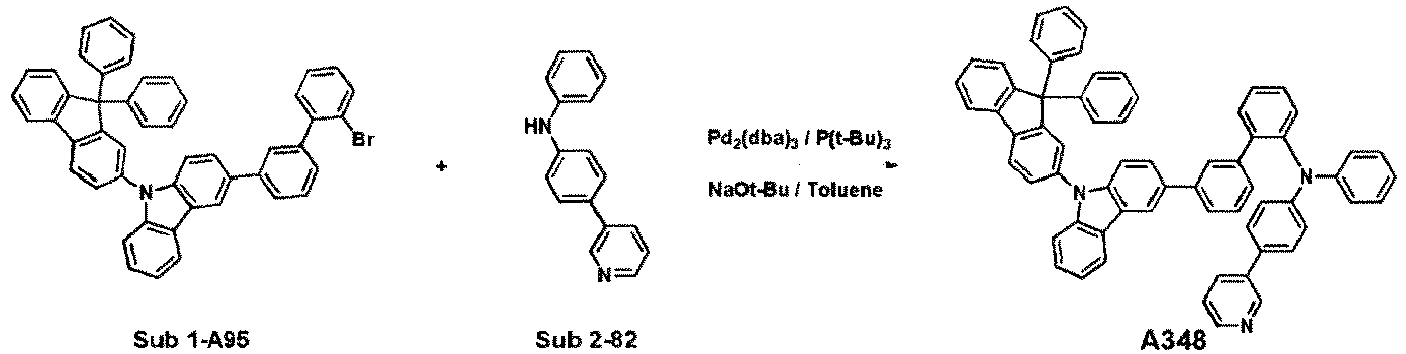
- Sub 1-A95 (9.85 g, 13.8 mmol), Pd2(dba)3 (0.32 g, 0.3 mmol), 50% P(t-Bu)3 (0.4ml, 0.9 mmol), NaOt-Bu (3.31 g, 34.5 mmol) and toluene were added to Sub 2-82 (2.83 g, 11.5 mmol) obtained in the above synthesis, and then 5.76 g (yield: 57%) of the product was obtained by the same method as in synthesis example of Product A 17.
-
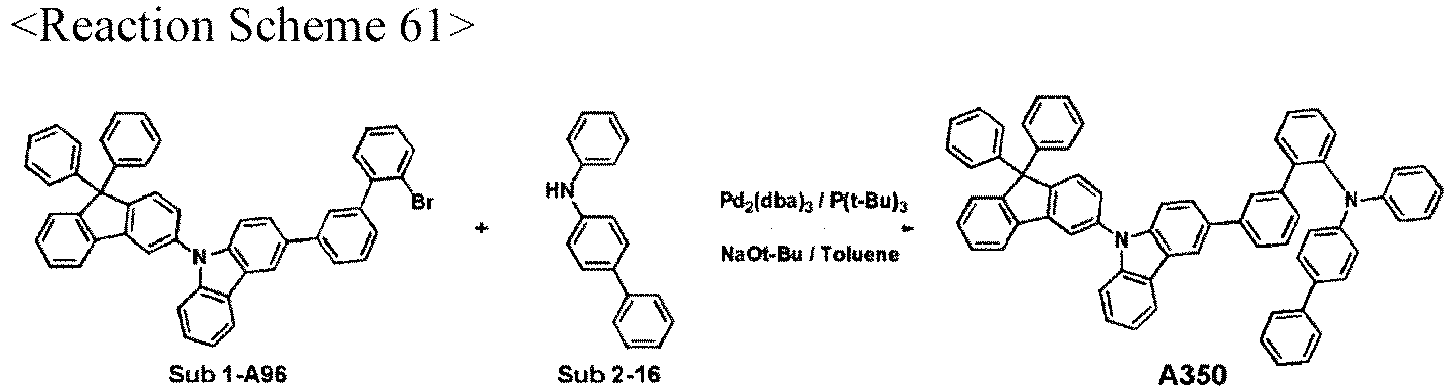
- Sub 1-A96 (9.58 g, 13.4 mmol), Pd2(dba)3 (0.31 g, 0.3 mmol), 50% P(t-Bu)3 (0.4ml, 0.9 mmol), NaOt-Bu (3.22 g, 33.5 mmol) and toluene were added to Sub 2-16 (2.74 g, 11.2 mmol) obtained in the above synthesis, and then 6.38 g (yield: 65%) of the product was obtained by the same method as in synthesis example of Product A17.
-

- Sub 1-A101 (9.85 g, 13.8 mmol), Pd2(dba)3 (0.32 g, 0.3 mmol), 50% P(t-Bu)3 (0.4ml, 0.9 mmol), NaOt-Bu (3.32 g, 34.6 mmol) and toluene were added to Sub 2-13 (1.95 g, 11.5 mmol) obtained in the above synthesis, and then 6.37 g (yield: 69%) of the product was obtained by the same method as in synthesis example of Product A17.
-


- Sub 1-A104 (10.19 g, 17.6 mmol), Pd2(dba)3 (0.4 g, 0.4 mmol), 50% P(t-Bu)3 (0.6ml, 1.2 mmol), NaOt-Bu (4.22 g, 43.9 mmol) and toluene were added to Sub 2-81 (2.49 g, 14.6 mmol) obtained in the above synthesis, and then 6.17 g (yield: 63%) of the product was obtained by the same method as in synthesis example of Product A17.
-

- Sub 1-A107 (8.44 g, 15 mmol), Pd2(dba)3 (0.34 g, 0.4 mmol), 50% P(t-Bu)3 (0.5ml, 1 mmol), NaOt-Bu (3.59 g, 37.4 mmol) and toluene were added to Sub 2-74 (4.18 g, 12.5 mmol) obtained in the above synthesis, and then 6.74 g (yield: 66%) of the product was obtained by the same method as in synthesis example of Product A17.
- On the other hand, the FD-MS values of compounds A1∼A392 of the present invention prepared according to the above synthesis examples are shown in Table 3 below.
[Table 3] compound FD-MS compound FD-MS A1 m/z=678.30(C51H38N2=678.86) A2 m/z=754.33(C57H42N2=754.96) A6 m/z=759.37(C57H37D5N2=759.99) A7 m/z=830.37(C63H46N2=831.05) All m/z=728.32(C55H40N2=728.92) A12 m/z=804.35(C61H44N2=805.02) A16 m/z=802.33(C61H42N2=803.00) A17 m/z=878.37(C67H46N2=879.10) A19 m/z=852.35(C65H44N2=853.06) A21 m/z=878.37(C67H46N2=879.10) A22 m/z=954.40(C73H50N2=955.19) A23 m/z=928.38(C71H48N2=929.15) A24 m/z=928.38(C71H48N2=929.15) A25 m/z=830.37(C63H46N2=831.05) A26 m/z=852.35(C65H44N2=853.06) A27 m/z=928.38(C71H48N2=929.15) A31 m/z=800.32(C61H40N2=800.98) A36 m/z=850.33(C65H42N2=851.04) A47 m/z=714.30(C54H38N2=714.89) A51 m/z=714.30(C54H38N2=714.89) A56 m/z=688.29(C52H36N2=688.86) A62 m/z=764.32(C58H40N2=764.95) A66 m/z=612.26(C46N32N2=612.76) A72 m/z=688.29(C52H36N2=688.86) A87 m/z=738.30(C56H38N2=738.91) A97 m/z=728.28(C54H36N2O=728.88) A101 m/z=744.26(C54H36N2S=744.94) A121 m/z=668.23(C48H32N2S=668.85) A123 m/z=638.27(C48H34N2=638.80) A124 m/z=714.30(C54H38N2=714.89) A125 m/z=738.30(C56H38N2=738.91) A127 m/z=729.31(C54H39)N3=729.91) A128 m/z=928.38(C71H48N2=929.15) A129 m/z=790.33(C60H42N2=790.99) A130 m/z=879.36(C66H45N3=880.08) A131 m/z=896.36(C66H48N2Si=897.19) A134 m/z=602.27(C45H34N2=602.76) A135 m/z=656.26(C48H33FN2=656.79) A142 m/z=612.26(C46H32N2=612.76) A146 m/z=804.35(C61H44N2=805.02) A161 m/z=802.33(C61H42N2=803.00) A162 m/z=830.37(C63H46N2=831.05) A165 m/z=820.29(C60H40N2S=821.04) A168 m/z=778.30(C58H38N2O=778.94) A169 m/z=928.38(C71H48N2=929.15) A170 m/z=954.40(C73H50N2=955.19) A171 m/z=878.37(C67H46N2=879.10) A172 m/z=954.0(C73H50N2=955.19) A173 m/z=852.35(C65H44N2=853.06) A174 m/z=878.37(C67H46N2=879.10) A175 m/z=928.38(C71H48N2=929.15) A176 m/z=928.38(C71H48N2=929.15) A177 m/z=754.33(C57H42N2=754.96) A178 m/z=802.33(C61H42N2=803.00) A179 m/z=878.37(C67H46N2=879.10) A180 m/z=878.37(C67H46N2=879.10) A181 m/z=714.30(C54H38N2=714.89) A182 m/z=1004.41(C77H52N2=1005.25) A183 m/z=906.40(C69H50N2=907.15) A184 m/z=954.40(C73H50N2=955.19) A185 m/z=820.29(C60H40N2S=821.04) A186 m/z=831.36(C62H45N3=832.04) A187 m/z=830.37(C63H46N2=831.05) A188 m/z=854.37(C65H46N2=855.07) A189 m/z=994.43(C76H54N2=995.26) A190 m/z=744.31(C55H40N2O=744.92) A191 m/z=830.37(C63H46N2=831.05) A192 m/z=830.37(C63H46N2=831.05) A193 m/z=794.37(C60H46N2=795.02) A194 m/z=906.40(C69H50N2=907.15) A195 m/z=830.37(C63H46N2=831.05) A196 m/z=906.40(C69H50N2=907.15) A197 m/z=755.33(C56H41N3=755.94) A198 m/z=906.40(C69H50N2=907.15) A199 m/z=802.33(C61H42N2=803.00) A200 m/z=852.35(C65H44N2=853.06) A201 m/z=902.37(C69H46N2=903.12) A202 m/z=902.37(C69H46N2=903.12) A203 m/z=878.37(C67H46N2=879.10) A204 m/z=954.40(C73H50N2=955.19) A205 m/z=918.40(C70H50N2=919.16) A206 m/z=853.35(C64H43N3=854.05) A207 m/z=802.33(C61H42N2=803.00) A208 m/z=852.35(C65H44N2=853.06) A209 m/z=878.37(C67H46N2=879.10) A210 m/z=918.40(C70H50N2=919.16) A211 m/z=877.35(C66H43N3=878.07) A212 m/z=800.32(C61H40N2=800.98) A213 m/z=768.26(C56H36N2S=768.96) A214 m/z=936.35(C69H48N2S=937.20) A215 m/z=820.29(C60H40N2S=821.04) A216 m/z=908.32(C67H44N2S=909.14) A217 m/z=822.28(CH38N4S=823.01) A218 m/z=794.28(C58H38N2S=795.00) A219 m/z=728.28(C54H36N2O=728.88) A220 m/z=742.26(C54H34N2O2=742.86) A221 m/z=829.31(C61H39N3O=829.98) A222 m/z=782.33(C58H42N2O=782.97) A223 m/z=652.25(C48H32N2O=652.78) A224 m/z=942.36(C71H46N2O=943.14) A225 m/z=678.30(C51H38N2=678.86) A226 m/z=754.33(C57H42N2=754.96) A227 m/z=754.33(C57H42N2=754.96) A228 m/z=830.37(C63H46N2=831.05) A229 m/z=802.33(C61H42N2=803.00) A230 m/z=878.37(C67H46N2=879.10) A231 m/z=878.37(C67H46N2=879.10) A232 m/z=954.40(C73H50N2=955.19) A233 m/z=928.38(C71H48N2=929.15) A234 m/z=928.38(C71H48N2=929.15) A235 m/z=852.35(C65H44N2=853.06) A236 m/z=928.38(C71H48=929.15) A237 m/z=562.24(C42H30N2=562.70) A238 m/z=638.27(C48H34N2=638.80) A239 m/z=638.27(C48H34N2=638.80) A240 m/z=714.30(C54H38N2=714.89) A241 m/z=714.30(C54H38N2=714.89) A242 m/z=790.33(C60H42N2=790.99) A243 m/z=878.37(C67H46N2=879.10) A244 m/z=954.40(C73H50N2=955.19) A245 m/z=830.37(C63H46N2=831.05) A246 m/z=892.38(C68H48N2=893.12) A247 m/z=830.37(C63H46N2=831.05) A248 m/z=838.32(C61H40F2N2=838.98) A249 m/z=928.38(C71H48N2=929.15) A250 m/z=1030.43(C79H54N2=1031.29) A251 m/z=878.37(C67H46N2=879.10) A252 m/z=883.40(C67H41D5N2=884.13) A253 m/z=878.37(C67H46N2=879.10) A254 m/z=878.37(C67H46N2=879.10) A255 m/z=954.40(C73H50N2=955.19) A256 m/z=928.38(C71H48N2=929.15) A257 m/z=802.33(C61H42N2=803.00) A258 m/z=878.37(C67H46N2=879.10) A259 m/z=878.37(C67H46N2=879.10) A260 m/z=878.37(C67H46N2=879.10) A261 m/z=614.27(C46H34N2=614.78) A262 m/z=744.26(C54H36N2S=744.94) A263 m/z=765.31(C57H39N3=765.94) A264 m/z=881.38(C66H47N3=882.10) A265 m/z=814.33(C62H42N2=815.01) A266 m/z=906.40(C69H50N2=907.15) A267 m/z=954.40(C73H50N2=955.19) A268 m/z=1028.41(C79H52N2=1029.27) A269 m/z=881.38(C66H47N3=882.10) A270 m/z=954.40(C73H50N2=955.19) A271 m/z=854.33(C64H42N2O=855.03) A272 m/z=754.33(C57H42N2=754.96) A273 m/z=830.37(C63H46N2=831.05) A274 m/z=830.37(C63H46N2=831.05) A275 m/z=918.40(C70H50N2=919.16) A276 m/z=805.35(C60H3N3=806.00) A277 m/z=830.37(C63H46N2=831.05) A278 m/z=830.37(C63H46N2=831.05) A279 m/z=844.38(C64H48N2=845.08) A280 m/z=834.31(C61H42N2S=835.06) A281 m/z=778.33(C59H42N2=778.98) A282 m/z=946.43(C72H54N2=947.21) A283 m/z=869.38(C65H47N3=870.09) A284 m/z=870.40(C66H50N2=871.12) A285 m/z=852.35(C65H44N2=853.06) A286 m/z=878.37(C67H46N2=879.10) A287 m/z=994.43(C76H54N2=995.26) A288 m/z=903.36(C68H45N3=904.10) A289 m/z=802.33(C61H42N2=803.00) A290 m/z=878.37(C67H46N2=879.10) A291 m/z=918.40(C70H50N2=919.16) A292 m/z=884.32(C65H44N2S=885.12) A293 m/z=916.38(C70H48N2=917.14) A294 m/z=850.33(C65H42N2=851.04) A295 m/z=7744.26(C54H36N2S=744.94) A296 m/z=908.32(C67H44N2S=909.14) A297 m/z=668.23(C48H32N2S=668.85) A298 m/z=898.31(C64H42N4S=899-11) A299 m/z=774.22(C54H34N2S2=774.99) A300 m/z=820.29(C60H40N2S=821.04) A301 m/z=908.32(C67H44N2S=909.14) A302 m/z=804.31(C60H40N2O=804.97) A303 m/z=729.28(C53H35N3O=729.86) A304 m/z=768.31(C57H40N2O=768.94) A305 m/z=752.28(C56H36N2O=752.90) A306 m/z=892.35(C67H44N2O=893.08) A307 m/z=818.33(C61H42N2O=819.00) A308 m/z=804.31(C60H40N2O=804.97) A309 m/z=754.33(C57H42N2=754.96) A310 m/z=754.33(C57H42N2=754.96) A311 m/z=802.33(C61H42N2=803.00) A312 m/z=878.37(C67H46N2=879.10) A313 m/z=954.40(C73H50N2=955.19) A314 m/z=928.38(C71H48N2=929.15) A315 m/z=852.35(C65H44N2=853.06) A316 m/z=878.37(C67H46N2=879.10) A317 m/z=562.24(C42H30N2=562.70) A318 m/z=638.27(C48H34N2=638.80) A319 m/z=638.27(C48H34N2=638.80) A320 m/z=714.30(C54H38N2=714.89) A321 m/z=878.37(C67H46N2=879.10) A322 m/z=878.37(C67H46N2=879.10) A323 m/z=800.32(C61H40N2=800.98) A324 m/z=779.29(C57H37N3O=779.92) A325 m/z=802.33(C61H42N2=803.00) A326 m/z=878.37(C67H46N2=879.10) A327 m/z=878.37(C67H46N2=879.10) A328 m/z=878.37(C67H46N2=879.10) A329 m/z=866.37(C66H46N2=867.08) A330 mlz=954.40(C73H50N2=955.19) A331 m/z=880.38(C67H48N2=881.11) A332 m/z=954.40(C73H50N2=955.19) A333 m/z=820.29(C60H40N2S=821.04) A334 m/z=896.32(C66H44N2S=897.13) A335 m/z=754.33(C57H42N2=754.96) A336 m/z=794.37(C60H46N2=795.02) A337 m/z=679.30(C50H37N3=679.85) A338 m/z=830.37(C63H46N2=831.05) A339 m/z=794.37(C60H46N2=795.02) A340 m/z=818.33(C61H42N2O=819.00) A341 m/z=728.32(C55H40N2=728.92) A342 m/z=920.41(C70H52N2=921.18) A343 m/z=729.31(C54H39N3=729.91) A344 m/z=870.40(C66H50N2=871.12) A345 m/z=802.33(C61H42N2=803.00) A346 m/z=878.37(C67H46N2=879.10) A347 m/z=918.40(C70H50N2=919.16) A348 m/z=879.36(C66H45N3=880.08) A349 m/z=802.33(C61H42N2=803.00) A350 m/z=878.37(C67H46N2=879.10) A351 m/z=918.40(C70H50N2=919.16) A352 m/z=858.31(C63H42N2S=859.09) A353 m/z=800.32(C61H40N2=800.98) A354 m/z=916.38(C70H48N2=917.14) A355 m/z=744.26(C54H36N2S=744.94) A356 m/z=908.32(C67H44N2S=909.14) A357 m/z=668.23(C48H32N2S=668.85) A358 m/z=784.29(C57H40N2S=785.01) A359 m/z=669.22(C47H31N3S=669.83) A360 m/z=719.24(C51H33N3S=719.89) A361 m/z=768.26(C56H36N2S=768.96) A362 m/z=702.27(C52H34N2O=702.84) A363 m/z=818.33(C61H42N2O=819.00) A364 m/z=729.28(C53H35N3O=729.86) A365 m/z=652.25(C48H32N2O=652.78) A366 m/z=892.35(C67H44N2O=893.08) A367 m/z=702.27(C52H34N2O=702.84) A368 m/z=792.28(C58H36N2O2=792.92) A369 m/z=804.31(C60H40N2O=804.97) A370 m/z=806.30(C58H38N4O=806.95) A371 m/z=802.33(C61H42N2=803.00) A372 m/z=918.40(C70H50N2=919.16) A373 m/z=908.32(C67H44N2S=909.14) A374 m/z=852.35(C65H44N2=853.06) A375 m/z=918.40(C70H50N2=919.16) A376 m/z=803.33(C60H41N3=803.99) A377 m/z=878.37(C67H46N2=879.10) A378 m/z=954.40(C73H50N2=955.19) A379 m/z=968.41(C74H52N2=969.22) A380 m/z=853.35(C64H43N3=854.05) A381 m/z=994.43(C76H54N2=995.26) A382 m/z=902.37(C69H46N2=903.12) A383 m/z=918.40(C70H50N2=919.16) A384 m/z=892.35(C67H44N2O=893.08) A385 m/z=802.33(C61H42N2=803.00) A386 m/z=1042.43(C80H54N2=1043.30) A387 m/z=853.35(C64H43N3=854.05) A388 m/z=994.43(C76H54N2=995.26) A389 m/z=878.37(C67H46N2=879.10) A390 m/z=994.43(C76H54N2=995.26) A391 m/z=884.32(C65H44N2S=885.12) A392 m/z=994.43(C76H54N2=995.26) - The compound(final products) represented by Formula 2 according to the present invention are synthesized by reacting Sub 3 and Sub 4 as shown in Reaction Scheme 65, but are not limited thereto.


-

- 5-bromobenzo[b]naphtha[1,2-d]thiophene (50 g, 0.16 mol), bis(pinacolato)diboron (48.65 g, 0.19 mol), KOAc (47 g, 0.48 mol), and PdCl2(dppf) (5.21 g, 4 mol%) were dissolved in DMF solvent in a round bottom flask, and then followed by refluxing the mixture at 120°C for 12 hours. When the reaction was completed, the reaction product is cooled to a room temperature, was extracted with CH2Cl2 and was washed with water. Then, the organic layer was dried with MgSO4 and concentrated. Then, recrystallization of the concentrate was carried out by using solvent of CH2Cl2 and a methanol to obtain the desired 3-1-C1 (46 g, 80%).
- 3-1-C1 (40 g, 0.11 mol), bromo-2-nitrobenzene (26.91 g, 0.13 mol), K2CO3 (46.03 g, 0.33 mol) and Pd(PPh3)4 (5.13 g, 4 mol%) were dissolved in anhydrous THF and a small amount of water, and then followed by refluxing the mixture at 80°C for 12 hours. When the reaction was completed, the reaction product is cooled to a room temperature, was extracted with CH2Cl2 and was washed with water. Then, the organic layer was dried with MgSO4 and concentrated. Then, recrystallization of the concentrate was carried out by using solvent of CH2Cl2 and a methanol solvent to obtain the desired 3-1-C2 (27.62 g, 70%).
- 3-1-C2 (20 g, 0.05 mol) and triphenylphosphine (44.28 g, 0.17 mol) were dissolved in o-dichlorobenzene, and then followed by refluxing the mixture for 24 hours. When the reaction was completed, the solvent was removed by vacuum distillation, and the residue was applied to silica gel column and recrystallized to obtain 3-1 Core (13.65 g, 75%) of the product.
-

- 5-bromobenzo[b]naphtha[2,1-d]thiophene (50 g, 0.16 mol), bis(pinacolato)diboron (48.65 g, 0.19 mol), KOAc (47 g, 0.48 mol) and PdCl2(dppf) (5.21 g, 4 mol%) were dissolved in DMF solvent in a round bottom flask, and then followed by refluxing the mixture at 120°C for 12 hours. When the reaction was completed, the reaction product is cooled to a room temperature, was extracted with CH2Cl2 and was washed with water. Then, the organic layer was dried with MgSO4 and concentrated. Then, recrystallization of the concentrate was carried out by using solvent of CH2Cl2 and methanol to obtain the desired -2-C1 (49.5 g, 86%).
- 3-2-C1 (40 g, 0.11 mol), bromo-2-nitrobenzene (26.91 g, 0.13 mol), K2CO3 (46.03 g, 0.33 mol), Pd(PPh3)4 (5.13 g, 4 mol%) were dissolved in anhydrous THF and a small amount of water, and then, and then followed by refluxing the mixture at 80°C for 12 hours. When the reaction was completed, the reaction product is cooled to a room temperature, was extracted with CH2Cl2 and was washed with water. Then, the organic layer was dried with MgSO4 and concentrated, and the concentrate was separated by silica gel column to obtain the desired 3-2-C2 (30 g, 76%).
- 3-1-C2 (20 g, 0.05 mol) and triphenylphosphine (44.28 g, 0.17 mol) were dissolved in o-dichlorobenzene, and then followed by refluxing the mixture 24 hours. When the reaction was completed, the solvent was removed by vacuum distillation, and the residue was applied to silica gel column and recrystallized to obtain 3-2 Core (12.43 g, 68%) of the product.
-

- 2,4-Dichlorobenzofuro[3,2-d]pyrimidine (10g, 0.04mol), phenylboronic acid (5.1g, 0.04mol), K2CO3 (17.34g, 0.12mol) and Pd(PPh3)4 (1.93g, 4mol%) were dissolved in anhydrous THF and a small amount of water, and then followed by refluxing the mixture at 80°C for 12 hours. When the reaction was completed, the reaction product is cooled to a room temperature, was extracted with CH2Cl2 and was washed with water. Then, the organic layer was dried with MgSO4 and concentrated, and the concentrate was applied to silica gel column and recrystallized to obtain Sub 4-1-O-(1) (9.39g, 80%) of the product.
-

- Sub 4-1-O-(2) (9.80g, 82%) was obtained by reacting 2,4-Dichlorobenzofuro[3,2-]pyrimidine (10g, 0.04mol), phenylboronic acid-d5 (5.31g, 0.04mol), K2CO3 (17.34g, 0.12mol), Pd(PPh3)4 (1.93g, 4mol%), anhydrous THF and water by the same method as in synthesis example of Sub 4-1-O-(1).
-

- Sub 4-1-O-(3) (11.78g, 73%) was obtained by reacting 2,4-Dichlorobenzofuro[3,2-d]pyrimidine (10g, 0.04mol), pyridine-3-ylboronic acid (5.14g, 0.04mol), K2CO3 (17.34g, 0.12mol), Pd(PPh3)4 (1.93g, 4mol%), anhydrous THF and water by the same method as in synthesis example of Sub 4-1-O-(1).
-

- Sub 4-1-O-(4) (11.19g, 75%) was obtained by reacting 2,4-Dichlorobenzofuro[3,2-d]pyrimidine (10g, 0.04mol), (1,1'-biphenyl)-3-ylboronic acid (8.28g, 0.04mol), K2CO3 (17.34g, 0.12mol), Pd(PPh3)4 (1.93g, 4mol%), anhydrous THF and water by the same method as in synthesis example of Sub 4-1-O-(1).
-
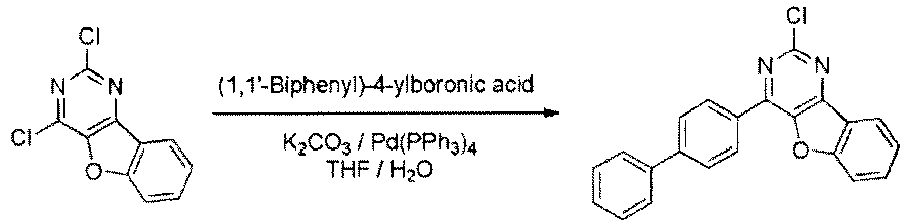
- Sub 4-1-O-(5) (11.93g, 80%) was obtained by reacting 2,4-Dichlorobenzofuro[3,2-d]pyrimidine (10g, 0.04mol), (1,1'-biphenyl)-4-ylboronic acid (8.28g, 0.04mol), K2CO3 (17.34g, 0.12mol), Pd(PPh3)4 (1.93g, 4mol%), anhydrous THF and water by the same method as in synthesis example of Sub 4-1-O-(1).
-

- Sub 4-1-S-(6) (11.55g, 85%) was obtained by reacting 2,4-Dichlorobenzo[4,5]thieno[3,2-d]pyrimidine (10g, 0.04mol), naphthalene-1-ylboronic acid (6.74g, 0.04mol), K2CO3 (16.25g, 0.12mol), Pd(PPh3)4 (1.81g, 4mol%), anhydrous THF and water by the same method as in synthesis example of Sub 4-1-O-(1).
-

- Sub 4-1-S-(7) (11.23g, 83%) was obtained by reacting 2,4-Dichlorobenzo[4,5]thieno[3,2-d]pyrimidine (10g, 0.04mol), naphthalene-2-ylboronic acid (6.74g, 0.04mol), K2CO3 (16.25g, 0.12mol), Pd(PPh3)4 (1.81g, 4mol%), anhydrous THF and water by the same method as in synthesis example of Sub 4-1-O-(1).
-

- Sub 4-1-S-(8) (12.14g, 69%) was obtained by reacting 2,4-Dichlorobenzo[4,5]thieno[3,2-d]pyrimidine (10g, 0.04mol), terphenyl-5-ylboronic acid (10.74g, 0.04mol), K2CO3 (16.25g, 0.12mol), Pd(PPh3)4 (1.81g, 4mol%), anhydrous THF and water by the same method as in synthesis example of Sub 4-1-O-(1).
-
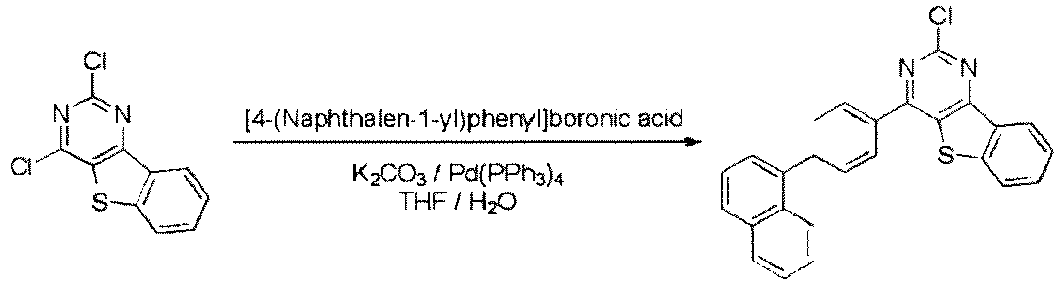
- Sub 4-1-S-(9) (12.76g, 77%) was obtained by reacting 2,4-Dichlorobenzo[4,5]thieno[3,2-d]pyrimidine (10g, 0.04mol), [4-(naphthalene-1-yl)phenyl]-boronic acid (9.72g, 0.04mol), K2CO3 (16.25g, 0.12mol), Pd(PPh3)4 (1.81g, 4mol%), anhydrous THF and water by the same method as in synthesis example of Sub 4-1-O-(1).
-

- Sub 4-1-S-(10) (12.93g, 78%) was obtained by reacting 2,4-Dichlorobenzo[4,5]thieno[3,2-d]pyrimidine (10g, 0.04mol), [4-(naphthalene-2-yl)phenyl]-boronic acid (9.72g, 0.04mol), K2CO3 (16.25g, 0.12mol), Pd(PPh3)4 (1.81g, 4mol%), anhydrous THF and water by the same method as in synthesis example of Sub 4-1-O-(1).
-

- Sub 4-2-O-(11) (10.89g, 64%) was obtained by reacting 2,4-Dichlorobenzofuro[2,3-d]pyrimidine (10g, 0.04mol), (4-phenylnaphthalen-1-yl)boronic acid (10.37g, 0.04mol), K2CO3 (17.34g, 0.12mol), Pd(PPh3)4 (1.93g, 4mol%), anhydrous THF and water by the same method as in synthesis example of Sub 4-1-O-(1).
-

- Sub 4-2-0-(12) (11.23g, 66%) was obtained by reacting 2,4-Dichlorobenzofuro[2,3-d]pyrimidine (10g, 0.04mol), (6-phenylnaphthalen-2-yl)boronic acid (10.37g, 0.04mol), K2CO3 (17.34g, 0.12mol), Pd(PPh3)4 (1.93g, 4mol%), anhydrous THF and water by the same method as in synthesis example of Sub 4-1-O-(1).
-

- Sub 4-2-O-(13) (12.9g, 81%) was obtained by reacting 2,4-Dichlorobenzofuro[2,3-d]pyrimidine (10g, 0.04mol), phenanthren-9-ylboronic acid (9.28g, 0.04mol), K2CO3 (17.34g, 0.12mol), Pd(PPh3)4 (1.93g, 4mol%), anhydrous THF and water by the same method as in synthesis example of Sub 4-1-O-(1).
-

- Sub 4-2-O-(14) (12.74g, 80%) was obtained by reacting 2,4-Dichlorobenzofuro[2,3-d]pyrimidine (10g, 0.04mol), phenanthren-2-ylboronic acid (9.28g, 0.04mol), K2CO3 (17.34g, 0.12mol), Pd(PPh3)4 (1.93g, 4mol%), anhydrous THF and water by the same method as in synthesis example of Sub 4-1-O-(1).
-

- Sub 4-2-O-(15) (11.56g, 62%) was obtained by reacting 2,4-Dichlorobenzofuro[2,3-d]pyrimidine (10g, 0.04mol), (9-phenyl-9H-carbazol-3-yl)boronic acid (12.01g, 0.04mol), K2CO3 (17.34g, 0.12mol), Pd(PPh3)4 (1.93g, 4mol%), anhydrous THF and water by the same method as in synthesis example of Sub 4-1-O-(1).
-

- Sub 4-2-S-(16) (8.79g, 58%) was obtained by reacting 2,4-Dichlorobenzo[4,5]thieno[2,3-d]pyrimidine (10g, 0.04mol), dibenzo[b,d]furan-4-ylboronic acid (8.31g, 0.04mol), K2CO3 (16.25g, 0.12mol), Pd(PPh3)4 (1.81g, 4mol%), anhydrous THF and water by the same method as in synthesis example of Sub 4-1-O-(1).
-

- Sub 4-2-S-(17) (9.09g, 60%) was obtained by reacting 2,4-Dichlorobenzo[4,5]thieno[2,3-d]pyrimidine (10g, 0.04mol), dibenzo[b,d]furan-2-ylboronic acid (8.31g, 0.04mol), K2CO3 (16.25g, 0.12mol), Pd(PPh3)4 (1.81g, 4mol%), anhydrous THF and water by the same method as in synthesis example of Sub 4-1-O-(1).
-

- Sub 4-2-S-(18) (10.73g, 68%) was obtained by reacting 2,4-Dichlorobenzo[4,5]thieno[2,3-d]pyrimidine (10g, 0.04mol), dibenzo[b,d]thiophen-4-ylboronic acid (8.93g, 0.04mol), K2CO3 (16.25g, 0.12mol), Pd(PPh3)4 (1.81g, 4mol%), anhydrous THF and water by the same method as in synthesis example of Sub 4-1-O-(1).
-

- Sub 4-2-S-(19) (11.21 g, 71%) was obtained by reacting 2,4-Dichlorobenzo[4,5]thieno[2,3-d]pyrimidine (10g, 0.04mol), dibenzo[b,d]thiophen-2-ylboronic acid (8.93g, 0.04mol), K2CO3 (16.25g, 0.12mol), Pd(PPh3)4 (1.81g, 4mol%), anhydrous THF and water by the same method as in synthesis example of Sub 4-1-O-(1).
-

- Sub 4-2-S-(20) (13.98g, 82%) was obtained by reacting 2,4-Dichlorobenzo[4,5]thieno[2,3-d]pyrimidine (10g, 0.04mol), thianthren-1-ylboronic acid (10.19g, 0.04mol), K2CO3 (16.25g, 0.12mol), Pd(PPh3)4 (1.81g, 4mol%), anhydrous THF and water by the same method as in synthesis example of Sub 4-1-O-(1).
- The compound belonging to Sub 4 may be, but not limited to, the following compounds, and Table 4 shows FD-MS (Field Desorption-Mass Spectrometry) values of the following compounds.


[Table 4] compound FD-MS compound FD-MS Sub 4-1-O-(1) m/z=280.04(C16H9ClN2O=280.71) Sub 4-1-O-(2) m/z=285.07(C16H4D5ClN2O=285.74) Sub 4-1-O-(3) m/z=281.04(C15H8ClN3O=281.70) Sub 4-1-O-(4) m/z=356.07(C22H13ClN2O=356.80) Sub 4-1-O-(5) m/z=356.07(C22H13ClN2O=356.80) Sub 4-1-O-(6) m/z=330.06(C20H11ClN2O=330.77) Sub 4-1-O-(7) m/z=330.06(C20H11ClN2O=330.77) Sub 4-1-O-(8) m/z=432.10(C28H17ClN2O=432.90) Sub 4-1-O-(9) m/z=406.09(C26H15ClN2O=406.86) Sub 4-1-O-(10) m/z=406.09(C26H15ClN2O=406.86) Sub 4-1-O-(11) m/z=406.09(C26H15ClN2O=406.86) Sub 4-1-O-(12) m/z=406.09(C26H15ClN2O=406.86) Sub 4-1-O-(13) m/z=380.07(C24H13ClN2O=380.83) Sub 4-1-O-(14) m/z=380.07(C24H13ClN2O=380.83) Sub 4-1-O-(15) m/z=445.10(C28H16ClN3O=445.90) Sub 4-1-O-(16) m/z=370.05(C22H11ClN2O2=370.79) Sub 4-1-O-(17) m/z=370.05(C22H11ClN2O=370.79) Sub 4-1-O-(18) m/z=386.03(C22H11ClN2OS=386.85) Sub 4-1-O-(19) m/z=386.03(C22H11ClN2O=386.85) Sub 4-1-O-(20) m/z=418.00(C22H11ClN2OS2=418.92) Sub 4-1-O-(21) m/z=330.06(C20H11ClN2O=330.77) Sub 4-1-O-(22) m/z=406.09(C26H15ClN2O=406.86) Sub 4-1-S-(1) m/z=296.02(C16H9ClN2S=296.77) Sub 4-1-S-(2) m/z=301.05(C16H4D5ClN2S=301.80) Sub 4-1-S-(3) m/z=297.01(C15H8ClN3S=297.76) Sub 4-1-S-(4) m/z=372.05(C22H13ClN2S=372.87) Sub 4-1-S-(5) m/z=372.05(C22H13ClN2S=372.87) Sub 4-1-S-(6) m/z=346.03(C20H11ClN2S=346.83) Sub 4-1-S-(7) m/z=346.03(C20H11ClN2S=346.83) Sub 4-1-S-(8) m/z=448.08(C28H17ClN2S=448.97) Sub 4-1-S-(9) m/z=422.06(C26H15ClN2S=422.93) Sub 4-1-S-(10) m/z=422.06(C26H15ClN2S=422.93) Sub 4-1-S-(11) m/z=340.03(C20H11ClN2S=346.83) Sub 4-1-S-(12) m/z=346.03(C20H11ClN2S=346.83) Sub 4-1-S-(13) m/z=396.05(C24H13ClN2S=396.89) Sub 4-1-S-(14) m/z=396.05(C24H13ClN2S=396.89) Sub 4-1-S-(15) m/z=461.08(C28H16ClN3S=461.96) Sub 4-1-S-(16) m/z=386.03(C22H11ClN2OS=386.85) Sub 4-1-S-(17) m/z=386.03(C22H11ClN2OS=385.85) Sub 4-1-S-(18) mm/z=402.01(C22H11ClN2S2=402.92) Sub 4-1-S-(19) m/z=402.01(C22H11ClN2S2=402.92) Sub 4-1-S-(20) m/z=433.98(C22H11ClN2S3=434.98) Sub 4-1-S-(21) m/z=396.05(C24H13ClN2S=396.89) Sub4 4-1-S-(22) m/z=346.03(C20H11ClN2S=346.83) Sub 4-1-S-(23) m/z=452.02(C26H13ClN2S2=452.98) Sub 4-1-S-(24) m/z=346.03(C20H11ClN2S=346.83) Sub 4-1-S-(25) m/z=452.02(C26H11ClN2S2=452.98) Sub 4-2-O-(1) m/z=280.04(C16H9ClN2O=280.71) Sub 4-2-O-(2) m/z=285.07(C16H4D5ClN2O=285.74) Sub 4-2-O-(3) m/z=281.04(C15H8ClN2O=281.70) Sub 4-2-O-(4) m/z=356.07(C22H13ClN2O=356.80) Sub 4-2-O-(5) m/z=356.07(C22H13ClN2O=356.80) Sub 4-2-O-(6) m/z=330.06(C20H11ClN2O=330.77) Sub 4-2-O-(7) m/z=330.06(C20H11ClN2O=330.77) Sub 4-2-O-(8) m/z=432.10(C28H17ClN2O=432.90) Sub 4-2-O-(9) m/z=406.09(C26H15ClN2O=406.86) Sub 4-2-O-(10) m/z=406.09(C26H15ClN2O=406.86) Sub 4-2-O-(11) m/z=406.09(C26H15ClN2O=406.86) Sub 4-2-O-(12) m/z=406.09(C26H15ClN2O=406.86) Sub 4-2-O-(13) m/z=380.07(C24H13ClN2O=380.83) Sub 4-2-O-(14) m/z=380.07(C24H13ClN2O=380.83) Sub 4-2-O-(15) m/z=445.10(C28H16ClN2O=445.90) Sub 4-2-O-(16) m/z=370.05(C22H11ClN2O2=370.79) Sub 4-2-O-(17) m/z=370.05(C22H11ClN2O=370.79) Sub 4-2-O-(18) m/z=386.03(C22H11ClN2OS=386.85) Sub 4-2-O-(19) m/z=386.03(C22H11ClN2OS=386.85) Sub 4-2-O-(20) m/z=418.00(C22H11ClN2OS2=418.92) Sub 4-2-O-(21) m/z=380.07(C24H13ClN2O=380.83) Sub 4-2-O-(22) m/z=380.07(C24H13ClN2O=380.83) Sub 4-2-O-(23) m/z=380.07(C24H13ClN2O=380.83) Sub 4-2-S-(1) m/z=296.02(C16H9ClN2S=296.77) Sub 4-2-S-(2) m/z=301.05(C16H4D5ClN2S=301.80) Sub 4-2-S-(3) m/z=297.01(C15H8ClN3S=297.76) Sub 4-2-S-(4) m/z=372.05(C22H13ClN2S=372.87) Sub 4-2-S-(5) m/z=372.05(C22H13ClN2S=372.87) Sub 4-2-S-(6) m/z=346.03(C20H11ClN2S=346.83) Sub 4-2-S-(7) m/z=346.03(C20H11ClN2S=346.83) Sub 4-2-S-(8) m/z=448.08(C28H17ClN2S=448.97) Sub 4-2-S-(9) m/z=422.06(C26H15ClN2S=422.93) Sub 4-2-S-(10) m/z=422.06(C26H15ClN2S=422.93) Sub 4-2-S-(11) m/z=346.03(C20H11ClN2S=346.83) Sub 4-2-S-(12) m/z=346.03(C20H11ClN2S=346.83) Sub 4-2-S-(13) m/z=396.05(C24H13ClN2S=396.89) Sub 4-2-S-(14) m/z=396.05(C24H13ClN2S=396.89) Sub 4-2-S-(15) m/z=461.08(C28H16ClN35S=461.96) Sub 4-2-S-(16) m/z=386.03(C22H11ClN2OS=386.85) Sub 4-2-S-(17) m/z=386.03(C22H11ClN2OS=386.85) Sub 4-2-S-(18) m/z=402.01(C22H11ClN2S2=402.92) Sub 4-2-S-(19) m/z=402.01(C22H11ClN2S2=402.92) Sub 4-2-S-(20) m/z=433.98(C22H11ClN2S3=434.98) Sub 4-2-S-(21) m/z=396.05(C24H13ClN2S=396.89) Sub 4-2-S-(22) m/z=422.06(C26H15ClN2S=422.93) Sub 4-2-S-(23) m/z=462.10(C29H19ClN2S=462.99) Sub 4-2-S-(24) m/z=422.06(C26H15ClN2S=422.93) Sub 4-2-S-(25) m/z=462.10(C29H19ClN2S=462.99) -

- 3-1 Core (5 g, 15.46 mmol), Sub 4-1-O-(1) (5.2 g, 18.55 mmol), Pd2(dba)3 (0.56 g, 4 mol%), t-Bu3P (0.25 g, 8 mol%) and KOtBu (5.2 g, 46.38 mmol) were dissolved in toluene solvent, and then followed by refluxing the mixture at 100°C for 12 hours. When the reaction was completed, the reaction product is cooled to a room temperature, was extracted with CH2Cl2 and was washed with water. Then, the organic layer was dried with MgSO4 and concentrated, and the concentrate was applied to silica gel column and recrystallized to obtain the desired compound 1-1-1-O-(1) (7.28 g, 83%).
-

- Compound 1-1-1-O-(2) (7.52g, 85%) was obtained by reacting 3-1 Core (5g, 15.46mmol), Sub 4-1-O-(2) (5.3g, 18.55mmol), Pd2(dba)3 (0.56g, 4mol%), t-Bu3P (0.25g, 8mol%), KOtBu (5.2g, 46.38mmol) and toluene by the same method as in synthesis example of the compound 1-1-1-O-(1).
-

- Compound 1-1-1-O-(3) (7.12g, 81%) was obtained by reacting 3-1 Core (5g, 15.46mmol), Sub 4-1-O-(3) (4.35g, 18.55mmol), Pd2(dba)3 (0.56g, 4mol%), t-Bu3P (0.25g, 8mol%), KOtBu (5.2g, 46.38mmol) and toluene by the same method as in synthesis example of the compound 1-1-1-O-(1).
-

- Compound 1-1-1-O-(4) (7.96g, 80%) was obtained by reacting 3-1 Core (5g, 15.46mmol), Sub 4-1-O-(4) (6.61g, 18.55mmol), Pd2(dba)3 (0.56g, 4mol%), t-Bu3P (0.25g, 8mol%), KOtBu (5.2g, 46.38mmol) and toluene by the same method as in synthesis example of the compound 1-1-1-O-(1).
-

- Compound 1-1-1-O-(5) (8.26g, 83%) was obtained by reacting 3-1 Core (5g, 15.46mmol), Sub 4-1-O-(5) (6.61g, 18.55mmol), Pd2(dba)3 (0.56g, 4mol%), t-Bu3P (0.25g, 8mol%), KOtBu (5.2g, 46.38mmol) and toluene by the same method as in synthesis example of the compound 1-1-1-O-(1).
-

- Compound 1-1-1-S-(6) (7.34g, 75% was obtained by reacting 3-1 Core (5g, 15.46mmol), Sub 4-1-S-(6) (6.43g, 18.55mmol), Pd2(dba)3 (0.56g, 4mol%), t-Bu3P (0.25g, 8mol%), KOtBu (5.2g, 46.38mmol) and toluene by the same method as in synthesis example of the compound 1-1-1-O-(1).
-

- Compound 1-1-1-S-(7) (7.05g, 72%) was obtained by reacting 3-1 Core (5g, 15.46mmol), Sub 4-1-S-(7) (6.43g, 18.55mmol), Pd2(dba)3 (0.56g, 4mol%), t-Bu3P (0.25g, 8mol%), KOtBu (5.2g, 46.38mmol) and toluene by the same method as in synthesis example of the compound 1-1-1-O-(1).
-

- Compound 1-1-1-S-(8) (9.1g, 80%) was obtained by reacting 3-1 Core (5g, 15.46mmol), Sub 4-1-S-(8) (8.32g, 18.55mmol), Pd2(dba)3 (0.56g, 4mol%), t-Bu3P (0.25g, 8mol%), KOtBu (5.2g, 46.38mmol) and toluene by the same method as in synthesis example of the compound 1-1-1-O-(1).
-

- Compound 1-1-1-S-(9) (8.45g, 77%) was obtained by reacting 3-1 Core (5g, 15.46mmol), Sub 4-1-S-(9) (7.84g, 18.55mmol), Pd2(dba)3 (0.56g, 4mo1%), t-Bu3P (0.25g, 8mol%), KOtBu (5.2g, 46.38mmol) and toluene by the same method as in synthesis example of the compound 1-1-1-O-(1).
-

- Compound 1-1-1-S-(10) (8.88g, 81%) was obtained by reacting 3-1 Core (5g, 15.46mmol), Sub 4-1-S-(10) (7.84g, 18.55mmol), Pd2(dba)3 (0.56g, 4mol%), t-Bu3P (0.25g, 8mol%), KOtBu (5.2g, 46.38mmol) and toluene by the same method as in synthesis example of the compound 1-1-1-O-(1).
-

- Compound 1-1-2-O-(11) (8.58g, 80%) was obtained by reacting 3-1 Core (5g, 15.46mmol), Sub 4-2-O-(11) (7.54g, 18.55mmol), Pd2(dba)3(0.56g, 4mol%), t-Bu3P (0.25g, 8mol%), KOtBu (5.2g, 46.38mmol) and toluene by the same method as in synthesis example of the compound 1-1-1-O-(1).
-

- Compound 1-1-2-O-(12) (7.83g, 73%) was obtained by reacting 3-1 Core (5g, 15.46mmol), Sub 4-2-O-(12) (7.54g, 18.55mmol), Pd2(dba)3(0.56g, 4mol%), t-Bu3P (0.25g, 8mol%), KOtBu (5.2g, 46.38mmol) and toluene by the same method as in synthesis example of the compound 1-1-1-O-(1).
-

- Compound 1-1-2-O-(13) (7.74g, 75%) was obtained by reacting 3-1 Core (5g, 15.46mmol), Sub 4-2-O-(13) (7.06g, 18.55mmol), Pd2(dba)3(0.56g, 4mol%), t-Bu3P (0.25g, 8mol%), KOtBu (5.2g, 46.38mmol) and toluene by the same method as in synthesis example of the compound 1-1-1-O-(1).
-

- Compound 1-1-2-O-(14) (8.36g, 81%) was obtained by reacting 3-1 Core (5g, 15.46mmol), Sub 4-2-O-(14) (7.06g, 18.55mmol), Pd2(dba)3(0.56g, 4mol%), t-Bu3P (0.25g, 8mol%), KOtBu (5.2g, 46.38mmol) and toluene by the same method as in synthesis example of the compound 1-1-1-O-(1).
-

- Compound 1-1-2-O-(15) (7.93g, 70%) was obtained by reacting 3-1 Core (5g, 15.46mmol), Sub 4-2-O-(15) (8.27g, 18.55mmol), Pd2(dba)3(0.56g, 4mol%), t-Bu3P (0.25g, 8mol%), KOtBu (5.2g, 46.38mmol) and toluene by the same method as in synthesis example of the compound 1-1-1-O-(1).
-

- Compound 1-1-2-S-(16) (7.5g, 72%) was obtained by reacting 3-1 Core (5g, 15.46mmol), Sub 4-2-S-(16) (7.17g, 18.55mmol), Pd2(dba)3 (0.56g, 4mol%), t-Bu3P (0.25g, 8mol%), KOtBu (5.2g, 46.38mmol) and toluene by the same method as in synthesis example of the compound 1-1-1-O-(1).
-

- Compound 1-1-2-S-(17) (7.7g, 74%) was obtained by reacting 3-1 Core (5g, 15.46mmol), Sub 4-2-S-(17) (7.17g, 18.55mmol), Pd2(dba)3 (0.56g, 4mol%), t-Bu3P (0.25g, 8mol%), KOtBu (5.2g, 46.38mmol) and toluene by the same method as in synthesis example of the compound 1-1-1-O-(1).
-
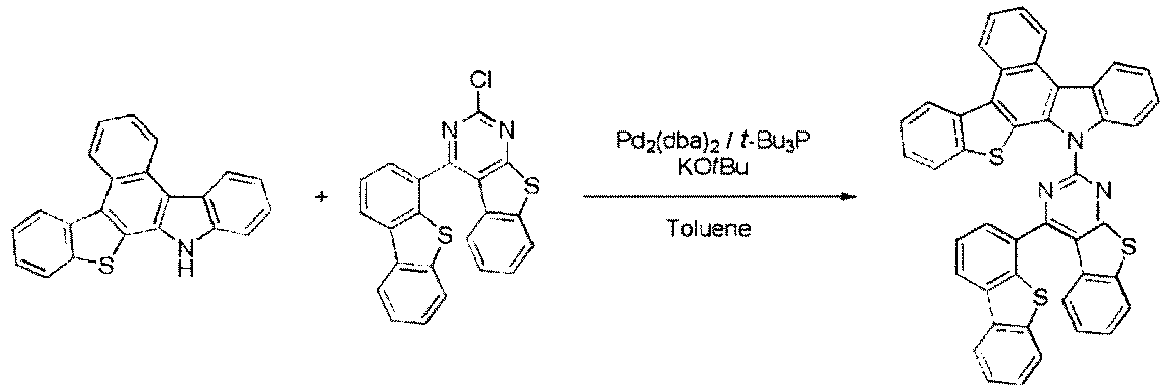
- Compound 1-1-2-S-(18) (8.42g, 79%) was obtained by reacting 3-1 Core (5g, 15.46mmol), Sub 4-2-S-(18) (7.47g, 18.55mmol), Pd2(dba)3 (0.56g, 4mol%), t-Bu3P (0.25g, 8mol%), KOtBu (5.2g, 46.38mmol) and toluene by the same method as in synthesis example of the compound 1-1-1-O-(1).
-

- Compound 1-1-2-S-(19) (8.1g, 76%) was obtained by reacting 3-1 Core (5g, 15.46mmol), Sub 4-2-S-(19) (7.47g, 18.55mmol), Pd2(dba)3 (0.56g, 4mol%), t-Bu3P (0.25g, 8mol%), KOtBu (5.2g, 46.38mmol) and toluene by the same method as in synthesis example of the compound 1-1-1-O-(1).
-

- Compound 1-1-2-S-(20) (8.92g, 80%) was obtained by reacting 3-1 Core (5g, 15.46mmol), Sub 4-2-S-(20) (8.06g, 18.55mmol), Pd2(dba)3 (0.56g, 4mol%), t-Bu3P (0.25g, 8mol%), KOtBu (5.2g, 46.38mmol) and toluene by the same method as in synthesis example of the compound 1-1-1-O-(1).
-

- Compound 1-3-1-O-(11) (8.04g, 75%) was obtained by reacting 3-2 Core (5g, 15.46mmol), Sub 4-1-O-(11) (7.54g, 18.55mmol), Pd2(dba)3 (0.56g, 4mol%), t-Bu3P (0.25g, 8mol%), KOtBu (5.2g, 46.38mmol) and toluene by the same method as in synthesis example of the compound 1-1-1-O-(1).
-

- Compound 1-3-1-O-(12) (8.25g, 77%) was obtained by reacting 3-2 Core (5g, 15.46mmol), Sub 4-1-O-(12) (7.54g, 18.55mmol), Pd2(dba)3 (0.56g, 4mol%), t-Bu3P (0.25g, 8mol%), KOtBu (5.2g, 46.38mmol) and toluene by the same method as in synthesis example of the compound 1-1-1-O-(1).
-

- Compound 1-3-1-O-(13) (7.53g, 73%) was obtained by reacting 3-2 Core (5g, 15.46mmol), Sub 4-1-O-(13) (7.06g, 18.55mmol), Pd2(dba)3 (0.56g, 4mol%), t-Bu3P (0.25g, 8mol%), KOtBu (5.2g, 46.38mmol) and toluene by the same method as in synthesis example of the compound 1-1-1-O-(1).
-

- Compound 1-3-1-O-(14) (8.46g, 82%) was obtained by reacting 3-2 Core (5g, 15.46mmol), Sub 4-1-O-(14) (7.06g, 18.55mmol), Pd2(dba)3 (0.56g, 4mol%), t-Bu3P (0.25g, 8mol%), KOtBu (5.2g, 46.38mmol) and toluene by the same method as in synthesis example of the compound 1-1-1-O-(1).
-

- Compound 1-3-1-O-(15) (8.95g, 79%) was obtained by reacting 3-2 Core (5g, 15.46mmol), Sub 4-1-O-(15) (8.27g, 18.55mmol), Pd2(dba)3 (0.56g, 4mol%), t-Bu3P (0.25g, 8mol%), KOtBu (5.2g, 46.38mmol) and toluene by the same method as in synthesis example of the compound 1-1-1-O-(1).
-
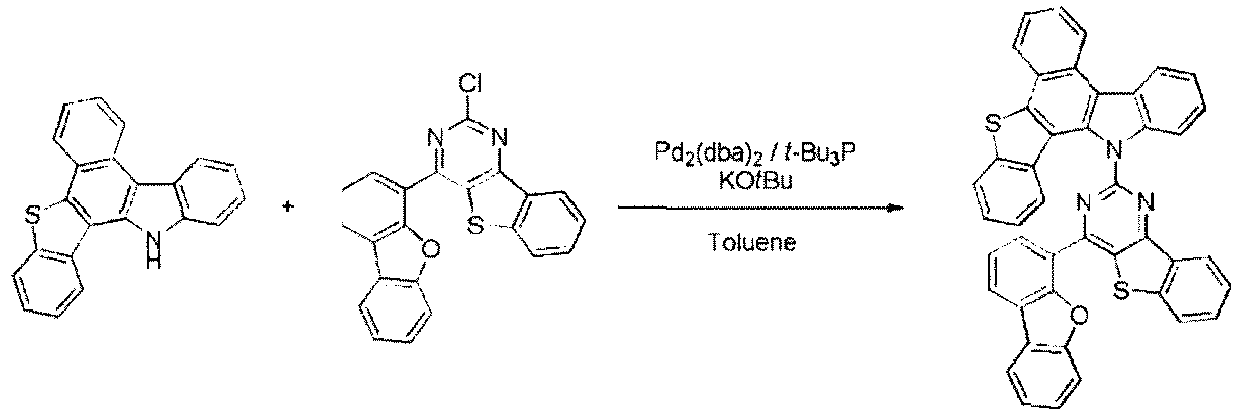
- Compound 1-3-1-S-(16) (7.91g, 76%) was obtained by reacting 3-2 Core (5g, 15.46mmol), Sub 4-1-S-(16) (7.17g, 18.55mmol), Pd2(dba)3 (0.56g, 4mol%), t-Bu3P (0.25g, 8mol%), KOtBu (5.2g, 46.38mmol) and toluene by the same method as in synthesis example of the compound 1-1-1-O-(1).
-

- Compound 1-3-1-S-(17) (7.39g, 71%) was obtained by reacting 3-2 Core (5g, 15.46mmol), Sub 4-1-S-(17) (7.17g, 18.55mmol)), Pd2(dba)3 (0.56g, 4mol%), t-Bu3P (0.25g, 8mol%), KOtBu (5.2g, 46.38mmol) and toluene by the same method as in synthesis example of the compound 1-1-1-O-(1).
-

- Compound 1-3-1-S-(18) (7.89g, 74%) was obtained by reacting 3-2 Core (5g, 15.46mmol), Sub 4-1-S-(18) (7.47g, 18.55mmol), Pd2(dba)3 (0.56g, 4mol%), t-Bu3P (0.25g, 8mol%), KOtBu (5.2g, 46.38mmol) and toluene by the same method as in synthesis example of the compound 1-1-1-O-(1).
-

- Compound 1-3-1-S-(19) (8.21g, 77%) was obtained by reacting 3-2 Core (5g, 15.46mmol), Sub 4-1-S-(19) (7.47g, 18.55mmol), Pd2(dba)3 (0.56g, 4mol%), t-Bu3P (0.25g, 8mol%), KOtBu (5.2g, 46.38mmol) and toluene by the same method as in synthesis example of the compound 1-1-1-O-(1).
-

- Compound 1-3-1-S-(20) (8.59g, 77%) was obtained by reacting 3-2 Core (5g, 15.46mmol), Sub 4-1-S-(20) (8.06g, 18.55mmol), Pd2(dba)3 (0.56g, 4mol%), t-Bu3P (0.25g, 8mol%), KOtBu (5.2g, 46.38mmol) and toluene by the same method as in synthesis example of the compound 1-1-1-O-(1).
-
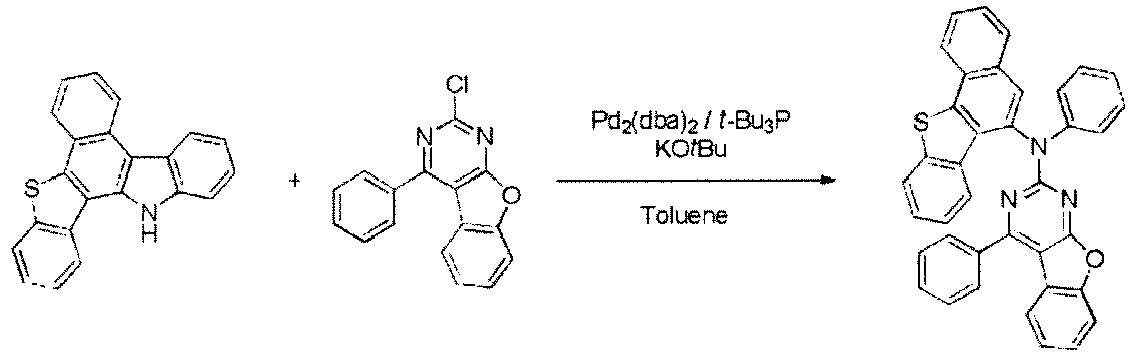
- Compound 1-3-2-O-(1) (6.49g, 74%) was obtained by reacting 3-2 Core (5g, 15.46mmol), Sub 4-2-O-(1) (5.20, 18.55mmol), Pd2(dba)3 (0.56g, 4mol%), t-Bu3P (0.25g, 8mol%), KOtBu (5.2g, 46.38mmol) and toluene by the same method as in synthesis example of the compound 1-1-1-O-(1).
-

- Compound 1-3-2-O-(2) (7.08g, 80%) was obtained by reacting 3-2 Core (5g, 15.46mmol), Sub 4-2-O-(2) (5.30, 18.55mmol), Pd2(dba)3 (0.56g, 4mol%), t-Bu3P (0.25g, 8mol%), KOtBu (5.2g, 46.38mmol) and toluene by the same method as in synthesis example of the compound 1-1-1-O-(1).
-
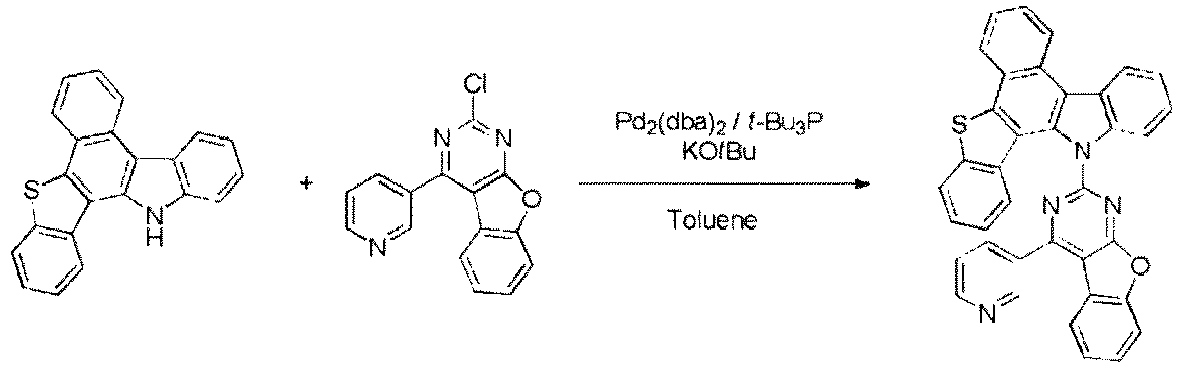
- Compound 1-3-2-O-(3) (7.03g, 80%) was obtained by reacting 3-2 Core (5g, 15.46mmol), Sub 4-2-O-(3) (5.22, 18.55mmol), Pd2(dba)3 (0.56g, 4mol%), t-Bu3P (0.25g, 8mol%), KOtBu (5.2g, 46.38mmol) and toluene by the same method as in synthesis example of the compound 1-1-1-O-(1).
-

- Compound 1-3-2-O-(4) (7.86g, 79%) was obtained by reacting 3-2 Core (5g, 15.46mmol), Sub 4-2-O-(4) (6.61, 18.55mmol), Pd2(dba)3 (0.56g, 4mol%), t-Bu3P (0.25g, 8mol%), KOtBu (5.2g, 46.38mmol) and toluene by the same method as in synthesis example of the compound 1-1-1-O-(1).
-

- Compound 1-3-2-O-(5) (7.66g, 77%) was obtained by reacting 3-2 Core (5g, 15.46mmol), Sub 4-2-O-(5) (6.61, 18.55mmol), Pd2(dba)3 (0.56g, 4mol%), t-Bu3P (0.25g, 8mol%), KOtBu (5.2g, 46.38mmol) and toluene by the same method as in synthesis example of the compound 1-1-1-O-(1).
-

- Compound 1-3-2-S-(6) (7.34g, 75%) was obtained by reacting 3-2 Core (5g, 15.46mmol), Sub 4-2-S-(6) (6.43g, 18.55mmol), Pd2(dba)3 (0.56g, 4mol%), t-Bu3P (0.25g, 8mol%), KOtBu (5.2g, 46.38mmol) and toluene by the same method as in synthesis example of the compound 1-1-1-O-(1).
-
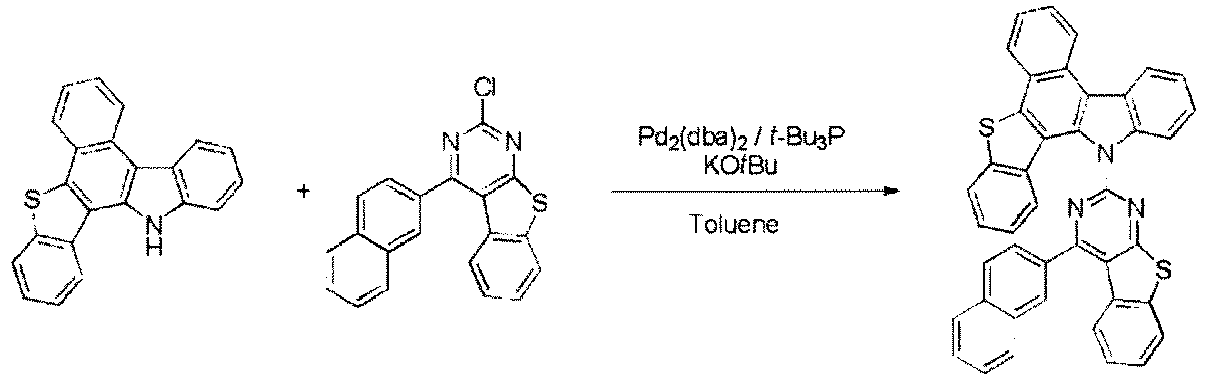
- Compound 1-3-2-S-(7) (6.85g, 70%) was obtained by reacting 3-2 Core (5g, 15.46mmol), Sub 4-2-S-(7) (6.43g, 18.55mmol), Pd2(dba)3 (0.56g, 4mol%), t-Bu3P (0.25g, 8mol%), KOtBu (5.2g, 46.38mmol) and toluene by the same method as in synthesis example of the compound 1-1-1-O-(1).
-

- Compound 1-3-2-S-(8) (8.64g, 76%) was obtained by reacting 3-2 Core (5g, 15.46mmol), Sub 4-2-S-(8) (8.32g, 18.55mmol), Pd2(dba)3 (0.56g, 4mol%), t-Bu3P (0.25g, 8mol%), KOtBu (5.2g, 46.38mmol) and toluene by the same method as in synthesis example of the compound 1-1-1-O-(1).
-

- Compound 1-3-2-S-(9) (8.34g, 76%) was obtained by reacting 3-2 Core (5g, 15.46mmol), Sub 4-2-S-(9) (7.84g, 18.55mmol), Pd2(dba)3 (0.56g, 4mol%), t-Bu3P (0.25g, 8mol%), KOtBu (5.2g, 46.38mmol) and toluene e by the same method as in synthesis example of the compound 1-1-1-O-(1).
-

- Compound 1-3-2-S-(10) (8.77g, 80%) was obtained by reacting 3-2 Core (5g, 15.46mmol), Sub 4-2-S-(10) (7.84g, 18.55mmol), Pd2(dba)3 (0.56g, 4mol%), t-Bu3P (0.25g, 8mol%), KOtBu (5.2g, 46.38mmol) and toluene by the same method as in synthesis example of the compound 1-1-1-O-(1).
- On the other hand, the FD-MS values of compounds 1-1-1-O-(1) to 1-3-2-(23) synthesized according to the above synthesis examples are shown in Table 5 below.
[Table 5] compound compound 1-1-1-O-(1) m/z=567.14 (C38H21N3OS=567.66) 1-1-1-O-(2) m/z=572.17 (C38H16D5N3OS=572.69) 1-1-1-O-(3) m/z=568.14 (C37H20N3OS=568.65) 1-1-1-O-(4) m/z=643.17 (C44H23N3OS=643.75) 1-1-1-O-(5) m/z=643.17 (C44H25N3OS=643.75) 1-1-1-O-(6) m/z=617.16 (C42H23N3OS=617.72) 1-1-1-O-(7) m/z=617.16 (C42H23N3OS=617.72) 1-1-1-O-(8) m/z=719.20 (C50H29N3OS=719.85) 1-1-1-O-(9) m/z=693.19 (C48H27N3OS=693.81) 1-1-1-O-(10) m/z=693.19 (C48H27N3OS=693.81) 1-1-1-O-(11) m/z=693.19 (C48H27N3OS=693.81) 1-1-1-O-(12) m/z=693.19 (C48H27N3OS=693.81) 1-1-1-O-(13) m/z=667.17 (C46H25N3OS=667.78) 1-1-1-O-(14) m/z=667.17 (C46H25N3OS=667.78) 1-1-1-O-(15) m/z=732.20 (C50H28N4OS=732.85) 1-1-1-O-(16) m/z=657.15 (C44H23N3O2S=657.74) 1-1-1-O-(17) m/z=657.15 (C44H23N3O2S=657.74) 1-1-1-O-(18) m/z=673.13 (C44H23N3OS2=673.80) 1-1-1-O-(19) m/z=673.13 (C44H23N3OS2=673.80) 1-1-1-O-(20) m/z=705.10 (C44H23N3OS3=705.87) 1-1-1-O-(21) m/z=617.16 (C42H23N3OS=617.72) 1-1-1-O-(22) m/z=693.19 (C48H27N3OS=693.81) 1-1-1-S-(1) m/z=583.12 (C38H21N3S2=583.72) 1-1-1-S-(2) m/z=588.15 (C38H16D5N3S2=588.75) 1-1-1-S-(3) m/z=584.11 (C37H20N4S2=584.71) 1-1-1-S-(4) m/z=659.15 (C44H25N3S2=659.82) 1-1-1-S-(5) m/z=659.15 (C44H25N3S2=659.82) 1-11-S-(6) m/z=633.13 (C42H23N3S2=633.78) 1-1-1-S-(7) m/z=633.13 (C42H23N3S2=633.78) 1-1-1-5-(8) m/z=735.18 (C50H29N3S2=735.92) 1-1-1-S-(9) m/z=709.16 (C48H27N3S2=709.88) 1-1-1-S-(10) m/z=709.16 (C48H27N3S2=709.88) 1-1-1-S-(11) m/z=709.16 (C48H27N3S2=709.88) 1-1-1-S-(12) m/z=709.16 (C48H27N3S2=709.88) 1-1-1-S-(13) m/z=683.15 (C46H25N3S2=683.84) 1-1-1-S-(14) m/z=683.15 (C46H25N3S2=683.84) 1-1-1-S-(15) m/z=748.18 (C50H28N4S2=748.91) 1-1-1-S-(16) m/z=673.13 (C44H23N3OS2=673.80) 1-1-1-S-(17) m/z=673.13 (C44H23N3OS2=673.80) 1-1-1-S-(18) m/z=689.11 (C44H23N3S3=689.87) 1-1-1-S-(19) m/z=689.11 (C44H23N3S3=689.87) 1-1-1-S-(20) m/z=721.08 (C44H23N3S4=721.93) 1-1-1-S-(21) m/z=683.15 (C64H25N3S2=683.84) 1-1-1-S-(22) m/z=785.20 (C54H31N3S2=785.97) 1-1-1-S-(23) m/z=739.12 (C48H25N3S2=739.93) 1-1-2-O-(1) m/z=567.14 (C38H21N3OS=567.66) 1-1-2-O-(2) m/z=572.17 (C38H16N3OS2=572.69) 1-1-2-O-(3) m/z=568.14 (C37H20N4OS=568.65) 1-1-2-O-(4) m/z=643.17 (C44H25N3OS=643.75) 1-1-2-O-(5) m/z=643.17 (C44H25N3OS2=643.75) 1-1-2-O-(6) m/z=617.16 (C42H23N5OS=617.72) 1-1-2-O-(7) m/z=617.15 (C42H23N3OS2=617.72) 1-1-2-O-(8) m/z=719.20 (C50H29N3OS=719.85) 1-1-2-O-(9) m/z=693.19 (C48H27N3OS=693.81) 1-1-2-O-(10) m/z=693.19 (C48H27N3OS=693.81) 1-1-2-O-(11) m/z=693.19 (C48H27N3OS=693.81) 1-1-2-O-(12) m/z=693.19 (C48H27N3OS=693.81) 1-1-2-O-(13) m/z=667.17 (C46H25N3OS=667.78) 1-1-2-O-(14) m/z=667.17 (C46H25N3OS=667.78) 1-1-2-O-(15) m/z=732.20 (C50H28N4OS=732.85) 1-1-2-O-(16) m/z=657.15 (C44H23N3O2S=657.74) 1-1-2-O-(17) m/z=657.15 (C44H23N3O2S=657.74) 1-1-2-O-(18) m/z=673.13 (C44H23N3OS2=673.80) 1-1-2-O-(19) m/z=673.13 (C44H23N3OS2=673.80) 1-1-2-O-(20) m/z=705.10 (C44H23N3OS3=705.87 1-1-2-O-(21) m/z=667.17 (C45H25N3OS=667.78) 1-1-2-O-(22) m/z=667.17 (C46H25N3OS=667.78) 1-1-2-S-(1) m/z=583.12 (C38H23N3S2=583.72) 1-1-2-S-(2) m/z=588.15 (C38H16D5N3S2=588.75) 1-1-2-S-(3) m/z=584.11 (C37H20N4S2=584.71) 1-1-2-S-(4) m/z=659.15 (C44H25N3S2=659.82) 1-1-2-S-(5) m/z=659.15 (C44H25N3S2=659.82) 1-1-2-S-(6) m/z=633.13 (C42H23N3S2=633.78) 1-1-2-S-(7) m/z=633.13 (C42H23N3S2=633.78) 1-1-2-S-(8) m/z=735.18 (C50H29N3S2=735.92) 1-1-2-S-(9) m/z=709.16 (C48H27N3S2=709.88) 1-1-2-S-(10) m/z=709.16 (C48H27N3S2=709.88) 1-1-2-S-(11) m/z=709.16(C48H27N3S2=709.88) 1-2-2-S-(12) m/z=709.16 (C48H27N3S2=709.88) 1-1-2-S-(13) m/z=683.15 (C46H25N3S2=683.84) 1-1-2-S-(14) m/z=683.15 (C46H25N3S2=683.84) 1-1-2-S-(15) m/z=748.18 (C50H28N4S2=748.91) 1-1-2-S-(16) m/z=673.13 (C44H23N3OS2=673.80) 1-1-2-S-(17) m/z=673.13 (C44H23N3OS2=673.80) 1-1-2-S-(18) m/z=689.11 (C44H22N3S3=689.87) 1-1-2-S-(19) m/z=689.11 (C44H23N3S3=689.87) 1-1-2-S-(20) m/z=721.08 (C44H23N3S4=721.93) 1-1-2-S-(21) m/z=683.15 (C46H2N3S2=683.84) 1-1-2-S-(22) m/z=709.16 (C48H27N3S2=709.88) 1-1-2-S-(23) m/z=826.22 (C56H34N4S2=827.03) 1-3-1-O-(1) m/z=567.14 (C38H21N3OS=567.66) 1-3-1-O-(2) m/z=572.17 (C38H16D5N3OS=572.69) 1-3-1-O-(3) m/z=568.14 (C37H20N4OS=568.65) 1-3-1-O-(4) m/z=643.17 (C44H25N3OS=643.75 1-3-1-O-(5) m/z=643.17 (C44H25N3OS=643.75) 1-3-1-O-(6) m/z=617.16 (C42H23N3OS=617.72) 1-3-1-O-(7) m/z=617.16 (C42H23N3OS=617.72) 1-3-1-O-(8) m/z=719.20 (C50H29N3OS=719.85) 1-3-1-O-(9) m/z=693.19 (C48H27N3OS=693.81) 1-3-1-O-(10) m/z=693.19 (C48H27N3OS=693.81) 1-3-1-O-(11) m/z=693.19 (C48H27N3OS=693.81) 1-3-1-O-(12) m/z=693.19 (C48H27N3OS=693.81) 1-3-1-O-(13) m/z=667.17 (C46H25N3OS=667.78) 1-3-1-O-(14) m/z=667.17 (C46H25N3OS=667.78) 1-3-1-O-(15) m/z=732.20 (C50H28N4OS=732.85) 1-3-1-O-(16) m/z=657.15 (C44H23N3O2S=657.74) 1-3-1-O-(17) m/z=657.15 (C44H23N3O2S=657.74) 1-3-1-O-(18) m/z=673.13 (C44H23N3OS2=673.80) 1-3-1-O-(19) m/z=673.13 (C44H23N3OS2=673.80) 1-3-1-O-(20) m/z=705.10 (C44H23N3OS3=705.87) 1-3-2-O-(21) m/z=617.16 (C42H23N3OS=617.72) 1-3-1-O-(22) m/z=693.19 (C48H27N3OS=693.81) 1-3-1-S-(1) m/z=583.12 (C38H21N3S2=583.72) 1-3-1-S-(2) m/z=588.15 (C38H16D5N3S2=588.75) 1-3-1-S-(3) m/z=584.11 (C37H20N4S2=584.71) 1-3-1-S-(4) m/z=659.15 (C44H25N3S2=659.82) 1-3-1-S-(5) m/z=659.15 (C44H25N3S2=659.82) 1-3-1-S-(6) m/z=633.13 (C42H23N3S2=633.78) 1-3-1-S-(7) m/z=633.13 (C42H23N3S2=633.78) 1-3-1-S-(8) m/z=735.18 (C50H29N3S2=735.92) 1-3-1-S-(9) m/z=709.16 (C48H27N3S2=709.88) 1-3-1-S-(10) m/z=709.16 (C48H27N3S2=709.88) 1-3-1-S-(11) m/z=709.16 (C48H27N3S2=709.88) 1-3-1-S-(12) m/z=709.16 (C48H27N3S2=709.88) 1-3-1-S-(13) m/z=683.15 (C46H25N3S2=683.84) 1-3-1-S-(14) m/z=683.15 (C46H25N3S2=683.84) 1-3-1-S-(15) m/z=78.18 (C50H28N4S2=748.91) 1-3-1-S-(16) m/z=673.13 (C44H23N3OS2=673.80) 1-3-1-S-(17) m/z=673.13 (C44H23N3OS2=673.80) 1-3-1-S-(18) m/z=689.11 (C44H23N3S3=689.87) 1-3-1-S-(19) m/z=689.11 (C44H23N3S3=689.87) 1-3-1-S-(20) m/z=721.08 (C44H23N3S4=721.93) 1-3-1-S-(21) m/z=683.15 (C46H25N3S2=683.84) 1-3-1-S-(22) m/z=709.16 (C48H27N3S2=709.88) 1-3-1-S-(23) m/z=739.12 (C48H25N3S3=739.93) 1-3-2-O-(1) m/z=567.14 (C38H21N3OS=567.66) 1-3-2-O-(2) m/z=572.17 (C38H16D5N3OS=572.69) 1-3-2-O-(3) m/z=568.14 (C37H20N4OS=568.65) 1-3-2-O-(4) m/z=643.17 (C44H25N3OS=643.75) 1-3-2-O-(5) m/z=643.17 (C44H25N3OS=643.75) 1-3-2-O-(6) m/z=617.16 (C42H23OS=617.72) 1-3-2-O-(7) m/z=617.16 (C42H23N3OS=617.72) 1-3-2-O-(8) m/z=719.20 (C50H29N3OS=719.85) 1-3-2-O-(9) m/z=693.19 (C48H27N3OS=693.81) 1-3-2-O-(10) m/z=693.19 (C48H27N3OS=693.81) 1-3-2-O-(11) m/z=693.19 (C48H27N3OS=693.81) 1-3-2-O-(12) m/z=693.19 (C48H27N3OS=693.81) 1-3-2-O-(13) m/z=667.17 (C46H25N3OS=667.78) 1-3-2-O-(14) m/z=667.17 (C46H25N3OS=667.78) 1-3-2-O-(15) m/z=732.20 (C50H28N4OS=732.85) 1-3-2-O-(16) m/z=657.15 (C44H23N3O2S=657.74) 1-3-2-O-(17) m/z=657.15 (C44H23N3O2S=657.74) 1-3-2-O-(18) m/z=673.13 (C44H23N3OS2=673.80) 1-3-2-O-(19) m/z=673.13 (C44H23N3OS2=673.80) 1-3-2-O-(20) m/z=705.10 (C44H23N3OS3=705.87) 1-3-2-O-(21) m/z=667.17 (C46H25N3OS=667.78) 11-3-2-O-(2) m/z=572.17 (C38H16D5N3OS=572.69) 1-3-2-S-(1) m/z=583.12 (C38N21N3S2=583.72) 1-3-2-S-(2) m/z=588.15 (C38H16D5N3S2=588.75) 1-3-2-S-(3) m/z=584.11 (C37H20N4S2=584.71) 1-3-2-S-(4) m/z=659.15 (C44H25N3S2=659.82) 1-3-2-S-(5) m/z=659.15 (C44H25N3S2=659.82) 1-3-2-S-(6) m/z=633.13 (C42H23N3S2=633.78) 1-3-2-S-(7) m/z=633.13 (C42H23N3S2=633.78) 1-3-2-S-(8) m/z=735.18 (C50H29N3S2=735.92) 1-3-2-S-(9) m/z=709.16 (C48N27N3S2=709.88) 1-3-2-S-(10) m/z=709.16 (C48H27N3S2=709.88) 1-3-2-S-(11) m/z=709.16 (C48H27N3S2=709.88) 1-3-2-S-(12) m/z=709.16 (C48H27N3S2=709.88) 1-3-2-S-(13) m/z=683.15 (C46H25N3S2=683.84) 1-3-2-S-(14) m/z=683.15 (C46H25N3S2=683.84) 1-3-2-S-(15) m/z=748.18 (C50H28N4S2=748.91) 1-3-2-S-(16) m/z=673.13 (C44H23N3OS2=673.80) 1-3-2-S-(17) m/z=673.13 (C44H23N3OS2=673.80) 1-3-2-S-(18) m/z=689.11 (C44H23N3S3=689.87) 1-3-2-S-(19) m/z=689.11 (C44H23N3S3=689.87) 1-3-2-S-(20) m/z=721.08 (C44N23N3S4=721.93) 1-3-2-S-(21) m/z=683.15 (C46H25N3S2=683.84) 1-3-2-S-(22) m/z=709.16 (C48H27N3S2=709.88) 1-3-2-S-(23) m/z=826.22 (C56H34N4S2=827.03) - Final products represented by Formula 8 according to the present invention are synthesized by reacting Sub 5 or Sub 6 and Sub 2 as shown in Reaction Scheme 2, but are not limited thereto.

-

- Here, S1 to S7 are as follows.

-

- The starting material 9H-carbazole (50.16 g, 300 mmol) was dissolved in nitrobenzene (600 ml), and then, 4-bromo-4'-iodo-1,1'-biphenyl (129.2 g, 360 mmol), Na2SO4(42.6 g, 300 mmol), K2CO3 (41.4 g, 300 mmol) and Cu (5.72 g, 90 mmol) were added and followed by stirred the mixture at 200°C. When the reaction was completed, nitrobenzene was removed by distillation, and then the residue was extracted with CH2Cl2 and water. Then, the organic layer was dried with MgSO4 and concentrated, and the concentrate was applied to silica gel column and recrystallized to obtain 80.05 g (yield: 67%) of the product.
-

- 2-bromo-7-iodo-9,9-dimethyl-9H-fluorene (143.7 g, 360 mmol), Na2SO4(42.6 g, 300 mmol), K2CO3 (41.4 g, 300 mmol), Cu (5.72 g, 90 mmol), nitrobenzene were added to the starting material 9H-carbazole (50.16 g, 300 mmol), and then 88.11 g (yield: 67%) of the product was obtained by the same method as in synthesis of Sub 5-1-1.
-

- 4-bromo-4'-iodo-1,1'-biphenyl (129.2 g, 360 mmol), Na2SO4 (42.6 g, 300 mmol), K2CO3 (41.4 g, 300 mmol), Cu (5.72 g, 90 mmol) and nitrobenzene were added to the starting material 7H-benzo[c]carbazole (65.18 g, 300 mmol), and then 92.8 g (yield: 69%) of the product was obtained by the same method as in synthesis of Sub 5-1-1.
-

- 2-bromo-7-iodo-9,9-dimethyl-9H-fluorene (143.7 g, 360 mmol), Na2SO4 (42.6 g, 300 mmol), K2CO3 (41.4 g, 300 mmol), Cu (5.72 g, 90 mmol) and nitrobenzene were added to the starting material 7H-benzo[c]carbazole (65.18 g, 300 mmol), and then 95.24 g (yield: 65%) of the product was obtained by the same method as in synthesis of Sub 5-1-1.
-

- 4-bromo-4'-iodo-1,1'-biphenyl (129.2 g, 360 mmol), Na2SO4 (42.6 g, 300 mmol), K2CO3 (41.4 g, 300 mmol), Cu (5.72 g, 90 mmol) and nitrobenzene were added to the starting material 11H-benzo[a]carbazole (65.18 g, 300 mmol), and then 80.05 g (yield: 62%) of the product was obtained by the same method as in synthesis of Sub 5-1-1.
-

- 2-bromo-7-iodo-9,9-dimethyl-9H-fluorene (143.7 g, 360 mmol), Na2SO4 (42.6 g, 300 mmol), K2CO3 (41.4 g, 300 mmol), Cu (5.72 g, 90 mmol) and nitrobenzene were added to the starting material 5H-benzo[b]carbazole (65.18 g, 300 mmol), and then 93.78 g (yield: 64%) of the product was obtained by the same method as in synthesis of Sub 5-1-1.
-

- 4-bromo-4'-iodo-1,1'-biphenyl (129.2 g, 360 mmol), Na2SO4 (42.6 g, 300 mmol), K2CO3 (41.4 g, 300 mmol), Cu (5.72 g, 90 mmol) and nitrobenzene were added to the starting material 9H-dibenzo[a,c]carbazole (80.2 g, 300 mmol), and then 98.7 g (yield: 66%) of the product was obtained by the same method as in synthesis of Sub 5-1-1.
-
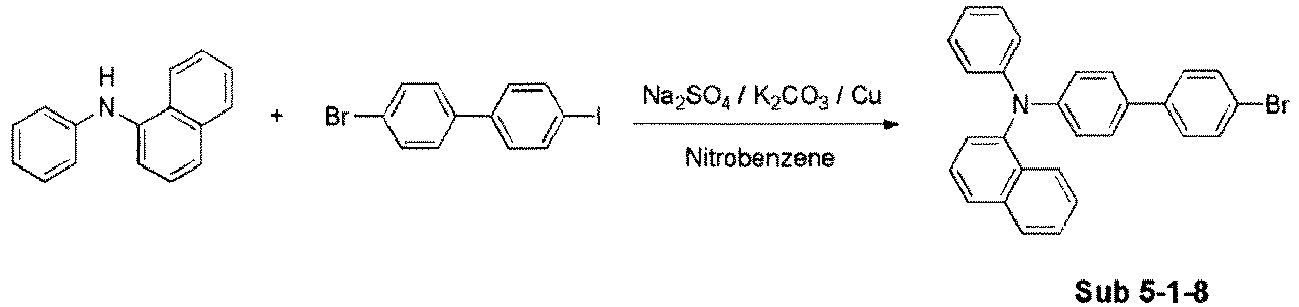
- 4-bromo-4'-iodo-1,1'-biphenyl (129.2 g, 360 mmol), Na2SO4 (42.6 g, 300 mmol), K2CO3 (41.4 g, 300 mmol), Cu (5.72 g, 90 mmol) and nitrobenzene were added to the starting material N-phenylnaphthalen-1-amine (65.8 g, 300 mmol), and then 89.2 g (yield: 66%) of the product was obtained by the same method as in synthesis of Sub 5-1-1.
-

- 2-bromo-7-iodo-9,9-dimethyl-9H-fluorene (143.7 g, 360 mmol), Na2SO4(42.6 g, 300 mmol), K2CO3(41.4 g, 300 mmol), Cu (5.72 g, 90 mmol) and nitrobenzene were added to the starting material 7H-dibenzo[c,g]carbazole (80.2 g, 300 mmol), and then 98.5g (yield: 61%) of the product was obtained by the same method as in synthesis of Sub 5-1-1.
-

-

- 3-bromo-9-phenyl-9H-carbazole (45.1 g, 140 mmol) was dissolved in DMF 980mL, and Bispinacolborate (39.1 g, 154 mmol), PdCl2(dppf) catalyst (3.43 g, 4.2 mmol) and KOAc (41.3 g, 420 mmol) were added in order, then, borate compound was synthesized after stirring for 24 hours. Then, the obtained compound was separated by silica gel column and recrystallization to obtain 35.2 g (68 %) of borate compound.
-

- 40 g (64%) of the product was obtained by the same experimental procedure as M2-2-1.
-

- M2-2-1 (29.5 g, 80 mmol) was dissolved in THF 360 mL, and 4-bromo-4'-iodo-1,1'-biphenyl (30.16 g, 84 mmol), Pd(PPh3)4 (2.8 g, 2.4mmol), NaOH (9.6 g, 240mmol) and
water 180 mL were added, and then followed by refluxing and stirring the mixture. When the reaction was completed, the reaction product was extracted with ether and water, and then, the organic layer was dried with MgSO4 and concentrated. Then, the concentrate was applied to silica gel column and recrystallized to obtain 26.56 g (70 %) of the product. -

- M2-2-1 (29.5 g, 80 mmol) was dissolved in THF 360 mL, and 1-bromo-4-iodobenzene (23.8 g, 84 mmol), Pd(PPh3)4 (2.8 g, 2.4mmol), NaOH (9.6 g, 240mmol) and
water 180 mL were added, and then followed by refluxing and stirring the mixture. When the reaction was completed, the reaction product was extracted with ether and water, and then, the organic layer was dried with MgSO4 and concentrated. Then, the concentrate was applied to silica gel column and recrystallized to obtain 22.9 g (72 %) of the product. -

- M2-2-1 (29.5 g, 80 mmol) was dissolved in THF 360 mL, and 4'-bromo-3-iodo-1,1,-biphenyl (30.16 g, 84 mmol), Pd(PPh3)4 (2.8 g, 2.4mmol), NaOH (9.6 g, 240mmol) and
water 180 mL were added, and then followed by refluxing and stirring the mixture. When the reaction was completed, the reaction product was extracted with ether and water, and then, the organic layer was dried with MgSO4 and concentrated. Then, the concentrate was applied to silica gel column and recrystallized to obtain 24.7 g (65 %) of the product. -

- M2-2-2 (35.63 g, 80 mmol) obtained in the above synthesis was dissolved in THF 360 mL, and 4-bromo-4'-iodo-1,1'-biphenyl (30.16 g, 84 mmol), Pd(PPh3)4 (2.8 g, 2.4mmol), NaOH (9.6 g, 240mmol) and
water 180 mL were added, and then followed by refluxing and stirring the mixture. When the reaction was completed, the reaction product was extracted with ether and water, and then, the organic layer was dried with MgSO4 and concentrated. Then, the concentrate was applied to silica gel column and recrystallized to obtain 29.51 g (67 %) of the product. -

- 9-(4'-bromo-[1,1'-biphenyl]-4-yl)-9H-carbazole(9.6g, 24mmol) was dissolved in toluene, and di([1,1'-biphenyl]-4-yl)amine(6.4g, 20mmol), Pd2(dba)3(0.05 eq.), PPh3 (0.1 eq.) and NaOt-Bu (3 eq.) were added, and then followed by refluxing and stirring the mixture at 100°C for 24 hours. When the reaction was completed, the reaction product was extracted with ether and water, and then, the organic layer was dried with MgSO4 and concentrated. Then, the concentrate was applied to silica gel column and recrystallized to obtain 12.9g (yield: 84%) of the product.
-

- 3-(4-bromophenyl)-9-phenyl-9H-carbazole (9.6g, 24mmol) was dissolved in toluene, and N-([1,1'-biphenyl]-4-yl)-9,9-dimethyl-9H-fluoren-2-amine (7.2g, 20mmol), Pd2(dba)3 (0.05 eq.), PPh3 (0.1 eq.) and NaOt-Bu (3 eq.) were added, and then followed by refluxing and stirring the mixture at 100°C for 24 hours. When the reaction was completed, the reaction product was extracted with ether and water, and then, the organic layer was dried with MgSO4 and concentrated. Then, the concentrate was applied to silica gel column and recrystallized to obtain 13.8g (yield: 85%) of the product.
-

- N-(4'-bromo-[1,1'-biphenyl]-4-yl)-N-phenylnaphthalen-1-amine (10.8g, 24mmol) was dissolved in toluene, and N-phenylnaphthalen-1-amine (4.4g, 20mmol), Pd2(dba)3 (0.05 eq.), PPh3 (0.1 eq.) and NaOt-Bu (3 eq.) were added, and then followed by refluxing and stirring the mixture at 100°C for 24 hours. When the reaction was completed, the reaction product was extracted with ether and water, and then, the organic layer was dried with MgSO4 and concentrated. Then, the concentrate was applied to silica gel column and recrystallized to obtain 11.4g (yield: 81%) of the product.
- On the other hand, the FD-MS values of compounds represented by formula 8 according to the above synthesis examples are shown in Table 6 below.
[Table 6] compound FD-MS compound FD-MS 8-17 m/z=638.27 (C48H34N2=638.80) 8-20 m/z=678.30 (C51H38N2=678.86) 8-21 m/z=802.33 (C61H42N2=803.00) 8-22 m/z=800.32 (C61H40N2=800.98) 8-32 m/z=678.30 (C51H38N2=678.86) 8-33 m/z=802.33 (C61H42N2=803.00) 8-34 m/z=800.32 (C61H40N2=800.98) 8-43 m/z=714.30 (C54H38N2=714.89) 8-44 m/z=754.33 (C57H42N2=754.96) 8-45 m/z=878.37 (C67H46N2=879.10) 8-46 m/z=876.35 (C67H44N2=877.08) 8-47 m/z=744.26 (C54H36N2S=744.94) 8-52 m/z=826.33 (C63H42N2=827.02) 8-53 m/z=824.32 (C63H40N2=825.01) 8-54 m/z=688.29 (C52H36N2=688.86) 8-55 m/z=728.32 (C55H40N2=728.92) 8-57 m/z=778.33 (C59H42N2=778.98) 8-58 m/z=902.37 (C69H46N2=903.12) 8-59 m/z=900.35 (C69H44N2=901.10) 8-60 m/z=538.24 (C40H30N2=538.68) 8-61 m/z=588.26 (C44H32N2=588.74) 8-62 m/z=588.26 (C44H32N2=588.74) 8-63 m/z=614.27 (C46H34N2=614.78) - First, an ITO layer (anode) was formed on a glass substrate, and then N'-(naphthalen-2-yl)-N4,N4-bis(4-(naphthalen-2-yl(phenyl)amino)phenyl)-N1-phenylbenzene-1,4-diamine (hereinafter, "2-TNATA") was vacuum-deposited on the ITO layer to form a hole injection layer with a thickness of 60nm. Subsequently, compound A1 of the present invention was vacuum-deposited with a thickness of 60nm on the hole injection layer to form a hole transport layer. Then, a light emitting layer with a thickness of 30nm was formed on the hole transport layer by using compound 1-1-1-S-(1) of the present invention as a host material and bis-(1-phenylisoquinolyl)iridium(III)acetylacetonate (hereinafter, "(piq)2Ir(acac)") as a dopant material in a weight ratio of 95:5.
- Subsequently, (1,1'-bisphenyl-4-olato)bis(2-methyl-8-quinolinolato)aluminum (hereinafter, "BAlq") was vacuum-deposited with a thickness of 10nm on the light emitting layer to form a hole blocking layer, and tris(8-quinolinolato)aluminum (hereinafter, "Alq3") was formed with a thickness of 40nm to form an electron transport layer. Next, halogenated alkali metal LiF was deposited with a thickness of 0.2nm on the electron transport layer to form an electron injection layer, and then A1 was deposited with a thickness of 150nm on the electron injection layer to form a cathode. In this way, the OLED was completed.
- The OLEDs were fabricated in the same manner as described in Example 1 except that the compounds represented by formula 1 described in Table 7, instead of the compound A1 of the present invention, were used as hole transporting material and the compounds represented by formula 2 described in Table 7, instead of the compound 1-1-1-S-(1) of the present invention, were used as host material of a light emitting layer.
- The OLEDs were fabricated in the same manner as described in Example 1 except that the Comparative compound A instead of the compound A1 of the present invention was used as hole transporting material and the Comparative compound C instead of the compound 1-1-1-S-(1) of the present invention, was used as host material of a light emitting layer.
- The OLED were fabricated in the same manner as described in Example 1 except that the Comparative compound B instead of the compound A1 of the present invention was used as hole transporting material and the Comparative compound C instead of the compound I-I-I-S-(1) of the present invention, was used as host material of a light emitting layer.
- The OLED were fabricated in the same manner as described in Example 1 except that the Comparative compound A instead of the compound A1 of the present invention was used as hole transporting material.
- The OLED were fabricated in the same manner as described in Example 1 except that the Comparative compound B instead of the compound A1 of the present invention was used as hole transporting material.
- The OLED were fabricated in the same manner as described in Example 1 except that the Comparative compound C instead of the compound 1-1-1-S-(1) of the present invention was used as host material of a light emitting layer.

- Electroluminescence (EL) characteristics were measured with a PR-650(Photoresearch) by applying a forward bias DC voltage to the OLEDs prepared in Examples 1 to 36 of the present invention and Comparative Examples 1 to 5. And, the T95 life time was measured using a life time measuring apparatus manufactured by Macscience Inc. at reference brightness of 2500cd/m2. The measurement results are shown in Tables 7 below.
[Table 7] HTL com. Phosphorescent host com. Voltage (V) Current Density (mA/cm2) Brightness (cd/m2) Efficiency (cd/A) Lifetime T(95) comp.Ex(1) comp.Com A comp.Com C 6.8 32.9 2500.0 7.6 79.7 comp.Ex(2) comp.Com B comp.Com C 6.6 31.6 2500.0 7.9 83.7 comp.Ex(3) comp.Com A Com.1-1-1-S-(1) 6.6 30.1 2500.0 8.3 87.1 comp.Ex(4) comp.Com B Com.1-1-1-S-(1) 6.4 28.1 2500.0 8.9 97.9 comp.Ex(5) Com.(A258) comp.Com C 6.5 29.4 2500.0 8.5 86.5 Ex.(1) Com.(A1) Com.1-1-1-S-(1) 5.7 18.2 2500.0 13.7 113.6 Ex.(2) Com.(A1) Com.1-1-1-S-(7) 5.8 19.0 2500.0 13.2 118.7 Ex.(3) Com.(A1) Com.1-1-2-O-(5) 5.7 18.9 2500.0 13.2 119.3 Ex.(4) Com.(A1) Com.1-1-2-S-(17) 5.8 18.0 2500.0 13.9 112.4 Ex.(5) Com.(A1) Com.1-1-3-O-(6) 5.7 19.0 2500.0 13.2 105.8 Ex.(6) Com.(A1) Com.1-1-3-S-(1) 5.7 18.3 2500.0 13.6 107.8 Ex.(7) Com.(A5) Com.1-1-1-S-(1) 5.7 17.9 2500.0 14.0 111.3 Ex.(8) Com.(A5) Com.1-1-1-S-(7) 5.8 18.2 2500.0 13.8 108.2 Ex.(9) Com.(A5) Com.1-1-2-O-(5) 5.7 19.1 2500.0 13.1 118.4 Ex.(10) Com.(A5) Com.1-1-2-S-(17) 5.8 18.5 2500.0 13.5 116.1 Ex.(11) Com.(A5) Com.1-1-3-O-(6) 5.7 17.9 2500.0 14.0 113.1 Ex.(12) Com.(A5) Com.1-1-3-S-(1) 5.7 18.6 2500.0 13.5 112.9 Ex.(13) Com.(A258) Com.1-1-1-S-(1) 5.5 16.3 2500.0 15.4 115.3 Ex.(14) Com.(A258) Com.1-1-1-S-(7) 5.5 15.6 2500.0 16.0 105.4 Ex.(15) Com.(A258) Com.1-1-2-O-(5) 5.6 16.2 2500.0 15.4 117.6 Ex.(16) Com.(A258) Com.1-1-2-S-(17) 5.5 15.7 2500.0 15.9 108.2 Ex.(17) Com.(A258) Com.1-1-3-O-(6) 5.5 16.3 2500.0 15.4 116.0 Ex.(18) Com.(A258) Com.1-1-3-S-(1) 5.5 15.9 2500.0 15.7 118.9 Ex.(19) Com.(A296) Com.1-1-1-S-(1) 5.5 16.6 2500.0 15.0 117.6 Ex.(20) Com.(A296) Com.1-1-1-S-(7) 5.5 15.7 2500.0 15.9 117.6 Ex.(21) Com.(A296) Com.1-1-2-O-(5) 5.5 16.2 2500.0 15.4 113.0 Ex.(22) Com.(A296) Com.1-1-2-S-(17) 5.5 15.8 2500.0 15.9 105.9 Ex.(23) Com.(A296) Com.1-1-3-O-(6) 5.6 15.9 2500.0 15.7 105.8 Ex.(24) Com.(A296) Com.1-1-3-S-(1) 5.6 16.0 2500.0 15.6 108.7 Ex.(25) Com.(A321) Com.1-1-1-S-(1) 5.8 22.5 2500.0 11.1 112.4 Ex.(26) Com.(A321) Com.1-1-1-S-(7) 5.8 23.6 2500.0 10.6 112.3 Ex.(27) Com.(A321) Com.1-1-2-O-(5) 5.9 23.5 2500.0 10.6 112.2 Ex.(28) Com.(A321) Com.1-1-2-S-(17) 5.9 21.8 2500.0 11.5 108.4 Ex.(29) Com.(A321) Com.1-1-3-O-(6) 5.9 24.4 2500.0 10.3 114.7 Ex.(30) Com.(A321) Com.1-1-3-S-(1) 5.9 23.2 2500.0 10.8 107.6 Ex.(31) Com.(A389) Com.1-1-1-S-(1) 5.8 22.7 2500.0 11.0 109.6 Ex.(32) Com.(A389) Com.1-1-1-S-(7) 6.0 22.6 2500.0 11.0 107.2 Ex.(33) Com.(A389) Com.1-1-2-O-(5) 5.8 23.7 2500.0 10.5 107.2 Ex.(34) Com.(A389) Com.1-1-2-S-(17) 5.9 22.8 2500.0 10.9 108.3 Ex.(35) Com.(A389) Com.1-1-3-O-(6) 5.9 21.0 2500.0 11.9 106.4 Ex.(36) Com.(A389) Com.1-1-3-S-(1) 5.9 23.3 2500.0 10.7 106.5 - From the results of the above table, it is found that luminous efficiency and lifetime of OLED are remarkably improved when the compound of the present invention represented by Formula 1 is used as material of a hole transport layer and the compound of the present invention represented by Formula 2 is used as phosphorescent host material of a light emitting layer.
- That is, the organic electroluminescent element of the present invention according to Examples 1 to 36 showed remarkably excellent results in terms of driving voltage, the efficiency and the lifetime, comparing to Comparative Examples 1 and 2, Comparative Examples 3 and 4, and Comparative Example 5. Here, the compound of the present invention represented by Formula 1 is used as material of a hole transport layer and the compound of the present invention represented by Formula 2 is used as phosphorescent host material in Example 1 to 36, any one of Comparative compounds A and B is used as material of a hole transport layer and Comparative compound C is used as phosphorescent host material in Comparative Examples 1 and 2, any one of Comparative compounds A and B is used as material of a hole transport layer and the compound represented by Formula 1 is used as phosphorescent host material in Comparative Examples 3 and 4, and the compound of the present invention represented by Formula 1 is used as material of a hole transport layer and Comparative compound C is used as phosphorescent host material in Comparative Example 5.
- This is because the compound of the present invention represented by the formula 1 has a faster mobility and a broad band gap as compared with the Comparative compounds A and B, and the compound of the present invention represented by the formula 2 has high stability and T1 values for holes as well as electrons as compared with the Comparative compounds C. Therefore, thanks to the combination of the two, more holes can be quickly and easily transferred to the light emitting layer, and thus the charge balance in the light emitting layer of holes and electrons is increased, so that light emission is performed well inside the light emitting layer rather than at the interface of the hole transporting layer. As a result, the deterioration of the ITO and HTL interfaces is also reduced, and it is considered that the driving voltage, efficiency and lifetime of the entire element are maximized. That is, it is believed that the combination of the compound of the present invention represented by the formula 1 and the compound of the present invention represented by the formula 2 is electrochemically synergistic to improve the performance of the element as a whole.
- First, an ITO layer (anode) was formed on a glass substrate, and a film of 2-TNATA was vacuum-deposited on the ITO layer to form a hole injection layer with a thickness of 60nm. Subsequently, the compound 8-17 of the present invention was vacuum-deposited with a thickness of 60nm on the hole injection layer to form a hole transport layer.
- Subsequently, a film of the compound A1 of the present invention was vacuum-deposited on the hole transport layer to form an emission-auxiliary layer with a thickness of 60nm. A light emitting layer with a thickness of 30nm was deposited on the emission-auxiliary layer by using the compound 1-1-1-S-(1) of the present invention as a host material and (piq)2Ir(acac) as a dopant material in a weight ratio of 95:5.
- Next, ((1,1'-bisphenyl)-4-olato)bis(2-methyl-8-quinolinolato)aluminum (hereinafter, "BAlq") was vacuum-deposited with a thickness of 10nm on the light emitting layer to form a hole blocking layer, and tris(8-quinolinolato)aluminum (hereinafter, "Alq3") was formed with a thickness of 40mn to form an electron transport layer.
- Next, halogenated alkali metal LiF was deposited with a thickness of 0.2nm on the electron transport layer to form an electron injection layer, and then A1 was deposited with a thickness of 150nm on the electron injection layer to form a cathode. In this way, the OLED was completed.
- The OLEDs were fabricated in the same manner as described in Example 37 except that the compounds represented by formula 8 described in Table 8, instead of the compound 8-17 of the present invention, were used as hole transporting material, the compounds represented by formula 1 described in Table 8, instead of the compound A1 of the present invention, were used as material of an emission-auxiliary layer, and the compounds represented by formula 2 described in Table 8, instead of the compound 1-1-1-S-(1) of the present invention, were used as host material of a light emitting layer.
- The OLEDs were fabricated in the same manner as described in Example 37, 43, 49 except that the same material as hole transporting material, instead of the compound A1 of the present invention, were used as an emission-auxiliary layer material.
- The OLEDs were fabricated in the same manner as described in Example 37, 43, 49 except that Comparative compounds A, instead of the compound A1 of the present invention, was used as an emission-auxiliary layer material.
- The OLEDs were fabricated in the same manner as described in Example 37, 43, 49 except that Comparative compounds B, instead of the compound A1 of the present invention, was used as an emission-auxiliary layer material.
- The OLEDs were fabricated in the same manner as described in Example 39, 45, 51 except that Comparative compounds C, instead of the compound 1-1-1-S-(1) of the present invention, was used as phosphorescent host material of a light emitting layer.
- Electroluminescence (EL) characteristics were measured with a PR-650(Photoresearch) by applying a forward bias DC voltage to the OLEDs prepared in Examples 37 to 54 of the present invention and Comparative Examples 6 to 17. And, the T95 life time was measured using a life time measuring apparatus manufactured by Macscience Inc. at reference brightness of 2500cd/m2. The measurement results are shown in Tables 8 below.
[Table 8] HTL com. EAL com. phosphorescent host com. Voltage (V) Current Density (mA/cm2) Brightness (cd/m2) Efficiency (cd/A) Lifetime T(95) comp.Ex(6) Com.(8-17) Com.(8-17) Com.1-1-1-S-(1) 6.9 22.1 2500.0 11.3 87.7 comp.Ex(7) Com.(8-32) Com.(8-32) Com.1-1-1-S-(1) 6.8 19.2 2500.0 13.0 84.1 comp.Ex(8) Com.(8-61) Com.(8-61) Com.1-1-1-S-(1) 6.9 20.0 2500.0 12.5 80.3 comp.Ex(9) Com.(8-17) comp.Com A Com.1-1-1-S-(1) 7.1 13.6 2500.0 18.4 114.5 comp.Ex(10) Com.(8-32) comp.Com A Com.1-1-1-S-(1) 6.9 12.8 2500.0 19.6 118.5 comp.Ex(11) Com.(8-61) comp.Com A Com.1-1-1-S-(1) 7.0 13.1 2500.0 19.1 112.2 comp.Ex(12) Com.(8-17) comp.Com B Com.1-1-1-S-(1) 7.0 14.3 2500.0 17.5 118.0 comp.Ex(13) Com.(8-32) comp.Com B Com.1-1-1-S-(1) 7.0 13.5 2500.0 18.5 117.1 comp.Ex(14) Com.(8-61) comp.Com B Com.1-1-1-S-(1) 7.2 13.7 2500.0 18.3 105.2 comp.Ex(15) Com.(8-17) Com. (A258) comp.Com C 7.2 13.0 2500.0 19.2 119.5 comp.Ex(16) Com.(8-32) Com. (A258) comp.Com C 7.0 11.5 2500.0 21.8 116.8 comp.Ex(17) Com.(8-61) Com. (A258) comp.Com C 7.2 12.5 2500.0 20.0 110.4 Ex.(37) Com.(8-17) Com. (A1) Com.1-1-1-S-(1) 6.6 8.6 2500.0 29.0 127.9 Ex.(38) Com.(8-17) Com. (A1) Com.1-1-1-S-(7) 6.6 8.5 2500.0 29.4 123.9 Ex.(39) Com.(8-17) Com. (A258) Com.1-1-1-S-(1) 6.5 8.4 2500.0 29.8 129.4 Ex.(40) Com.(8-17) Com. (A258) Com.1-1-1-S-(7) 6.5 8.3 2500.0 30.1 129.8 Ex.(41) Com.(8-17) Com. (A321) Com.1-1-1-S-(1) 6.6 8.8 2500.0 28.3 128.7 Ex.(42) Com.(8-17) Com. (A321) Com.1-1-1-S-(7) 6.6 8.5 2500.0 29.3 124.2 Ex.(43) Com.(8-32) Com. (A1) Com.1-1-1-S-(1) 6.3 8.2 2500.0 30.5 129.0 Ex.(44) Com.(8-32) Com. (A1) Com.1-1-1-S-(7) 6.3 7.6 2500.0 33.1 125.9 Ex.(45) Com.(8-32) Com. (A258) Com.1-1-1-S-(1) 6.2 7.0 2500.0 35.6 132.8 Ex.(46) Com.(8-32) Com. (A258) Com.1-1-1-S-(7) 6.2 7.1 2500.0 35.2 131.5 Ex.(47) Com.(8-32) Com. (A321) Com.1-1-1-S-(1) 6.3 7.4 2500.0 33.8 125.9 Ex.(48) Com.(8-32) Com. (A321) Com.1-1-1-S-(7) 6.4 7.5 2500.0 33.3 123.9 Ex.(49) Com.(8-61) Com. (A1) Com.1-1-1-S-(1) 6.6 8.9 2500.0 28.2 128.8 Ex.(50) Com.(8-61) Com. (A1) Com.1-1-1-S-(7) 6.6 8.4 2500.0 29.7 129.2 Ex.(51) Com.(8-61) Com. (A258) Com.1-1-1-S-(1) 6.4 8.3 2500.0 30.1 130.0 Ex.(52) Com.(8-61) Com. (A258) Com.1-1-1-S-(7) 6.5 8.0 2500.0 31.1 129.7 Ex.(53) Com.(8-61) Com. (A321) Com.1-1-1-S-(1) 6.7 8.9 2500.0 28.1 126.5 Ex.(54) Com.(8-61) Com. (A321) Com.1-1-1-S-(7) 6.6 8.8 2500.0 28.4 127.9 - From the results of the above table, it is found that the driving voltage is lowered and luminous efficiency and lifetime are improved according to Example of the present invention, compared with Comparative Examples 6 to 8 not forming an emission-auxiliary layer and Comparative Examples 9 to 14 in which Comparative compounds A and B are used as material of an emission-auxiliary layer, and Comparative Examples 15 to 17 Comparative compounds C is used as phosphorescent host material. Here, the compound of the present invention represented by Formula 8 is used as material of a hole transport layer, the compound of the present invention represented by Formula 2 is used as material of an emission-auxiliary layer, and the compound of the present invention represented by Formula 2 is used as phosphorescent host material in Example of the present invention. Further, an emission-auxiliary layer is not formed in Comparative Examples 6 to 8 of Table 8 in which the materials of an emission-auxiliary layer and the hole transport layer are indicated as being the same, but this is for comparison with element of the same thickness, .actually, an emission-auxiliary layer was not formed, and the hole transport layer material is further stacked by the thickness of an emission-auxiliary layer.
- When the compound of the present invention represented by Formula 1 is used alone as material of an emission-auxiliary layer, it has a high T1 energy level and a deep HOMO energy level. As a result, the holes and electrons form a charge balance and light emission occurs inside the light emitting layer rather than at the interface of the hole transport layer, thereby maximizing efficiency.
- In addition, by using the compound of the present invention represented by the general formula 2 as a phosphorescent host, it is considered that the combination of these elements is electrochemically synergistic to improve the performance of the element as a whole. This can be easily seen by comparing Comparative Examples 13 to 15 in which the compound of the present invention represented by the formula 1 is used as material of an emission-auxiliary layer and Comparative compound C is used as the phosphorescent host.
- Although exemplary embodiments of the present invention have been described for illustrative purposes, those skilled in the art will appreciate that various modifications, additions and substitutions are possible, without departing from the scope and spirit of the invention as disclosed in the accompanying claims. Therefore, the embodiment disclosed in the present invention is intended to illustrate the scope of the technical idea of the present invention, and the scope of the present invention is not limited by the embodiment. The scope of the present invention shall be construed on the basis of the accompanying claims, and it shall be construed that all of the technical ideas included within the scope equivalent to the claims belong to the present invention.
- This patent application claims priority from and the benefit under 35 U.S.C. 119(a) of Korean Patent Application No.
10-2015-0098090, filed on July 10, 2015
Claims (14)
- An organic electric element comprising a first electrode, a second electrode, and an organic material layer stacked in sequence, wherein the organic material layer comprises a hole transport layer, an emission-auxiliary layer and a light emitting layer, at least one of the hole transport layer and the emission-auxiliary layer comprises a compound represented by Formula 1 below, and the light emitting layer comprises a compound represented by Formula 2 below:
 Ar1 to Ar3 are each independently selected from the group consisting of a C6-C60 aryl group, a fluorenyl group, a C2-C60 heterocyclic group containing at least one heteroatom selected from the group consisting of O, N, S, Si, and P, a fused ring group of a C3-C60 aliphatic ring and a C6-C60 aromatic ring, a C1-C50 alkyl group, a C2-C20 alkenyl group, a C2-C20 alkynyl group, a C1-C30 alkoxyl group, a C6-C30 aryloxyl group, and -L'-N(Ra)(Rb), and Ar2 and Ar3 are optionally linked to each other to form a ring,L1 is selected from the group consisting of a C6-C60 arylene group, a fluorenylene group, a divalent C2-C60 heterocyclic group containing at least one heteroatom selected from the group consisting of O, N, S, Si, and P, a divalent fused ring of a C3-C60 aliphatic ring and a C6-C60 aromatic ring, and a divalent C2-C60 aliphatic hydrocarbon group,R1, R2, R3 to R5, and R7 i) are each independently selected from the group consisting of deuterium, halogen, a C6-C60 aryl group, a fluorenyl group, a C2-C60 heterocyclic group containing at least one heteroatom selected from the group consisting of O, N, S, Si, and P, a fused ring group of a C3-C60 aliphatic ring and a C6-C60 aromatic ring, a C1-C50 alkyl group, a C2-C20 alkenyl group, a C2-C20 alkynyl group, a C1-C30 alkoxyl group, a C6-C30 aryloxyl group, and -L'-N(Ra)(Rb), or ii) any adjacent groups of R1, R2, R3 to R5, and R7 may be optionally linked together to form at least one ring, and the remaining groups not forming the ring are defined as same as in i),m is an integer of 0 to 4, n is an integer of 0 to 3, a to c and h are each independently an integer of 0 to 4, wherein when m, n, a to c and h are each an integer of 2 or more, a plurality of R1s, R2s, R3s to R5s, and R7s may be the same or different from each other,R6 is selected from the group consisting of hydrogen, a C6-C60 aryl group, a fluorenyl group, and a C2-C60 heterocyclic group containing at least one heteroatom selected from the group consisting of O, N, S, Si, and P,X and Y are each independently selected from the group consisting of a single bond, S, O, N(R') and C(R')(R"), wherein R' and R" are each independently selected from the group consisting of hydrogen, a C6-C60 aryl group, a fluorenyl group, a C2-C60 heterocyclic group containing at least one heteroatom selected from the group consisting of O, N, S, Si, and P, and a C1-C50 alkyl group, and R' and R" may be optionally linked to each other to form a ring, d and e are each independently an integer of 0 or 1, and d+e is an integer of 1 or 2,Z1 and Z2 are each independently a single bond, O or S, f and g are each independently an integer of 0 or 1, and f+g is an integer of 1 or 2,in -L'-N(Ra)(Rb) of Ar1 to Ar3, R1 to R5, and R7, L' is selected from the group consisting of a single bond, a C6-C60 arylene group, a fluorenylene group, a fused ring of a C3-C60 aliphatic ring and a C6-C60 aromatic ring, and a C2-C60 heterocyclic group containing at least one heteroatom selected from the group consisting of O, N, S, Si, and P, and Ra and Rb are each independently selected from the group consisting of a C6-C60 aryl group, a fluorenyl group, a fused ring of a C3-C60 aliphatic ring and a C6-C60 aromatic ring, and a C2-C60 heterocyclic group containing at least one heteroatom selected from the group consisting of O, N, S, Si, and P, andthe aryl group, heterocyclic group, fluorenyl group, alkyl group, alkenyl group, fused ring group, alkoxyl group, aryloxly group, arylene group, fluorenylene group, aliphatic hydrocarbon group of Ar1-Ar3, R1-R7, R', R", L1, L', Ra and Rb may be each optionally further substituted with one or more substituents selected from the group consisting of deuterium, halogen, a silane group, a siloxane group, a boron group, a germanium group, a cyano group, a nitro group, a C1-C20 alkylthio group, a C1-C20 alkoxyl group, a C1-C20 alkyl group, a C2-C20 alkenyl group, a C2-C20 alkynyl group, a C6-C20 aryl group, a C6-C20 aryl group substituted with deuterium, a fluorenyl group, a C2-C20 heterocyclic group containing at least one heteroatom selected from the group consisting of O, N, S, Si, and P, a C3-C20 cycloalkyl group, a C7-C20 arylalkyl group, and a C8-C20 arylalkenyl group.
 - The organic electric element of claim 1, wherein Formula 1 is represented by one of the following Formulas 3-1 to 3-3:

- The organic electric element of claim 1, wherein Formula 2 is represented by one of the following Formulas 4 to 7:


- The organic electric element of claim 1, wherein Formula 1 is one of the following compounds:


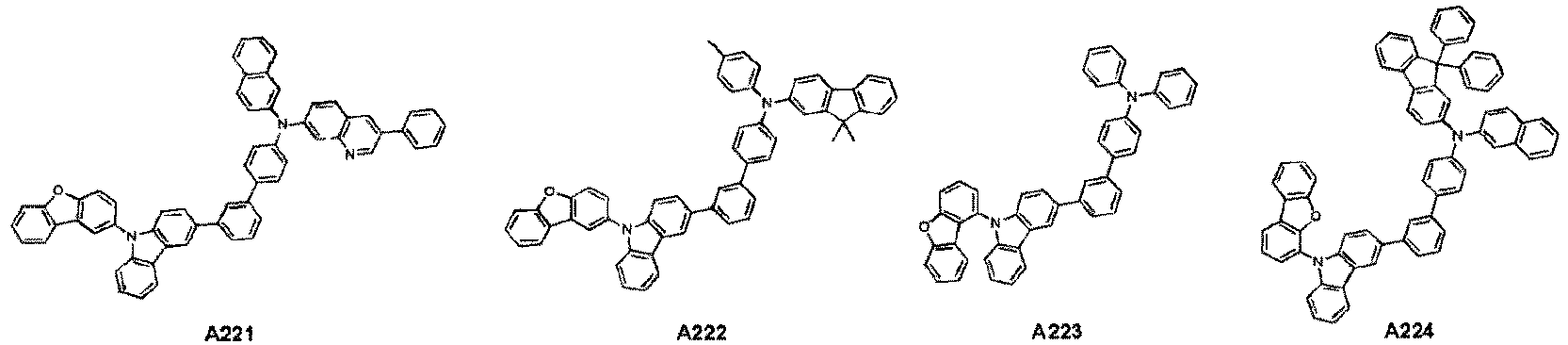












- The organic electric element of claim 1, wherein Formula 2 is any one of the following compounds:


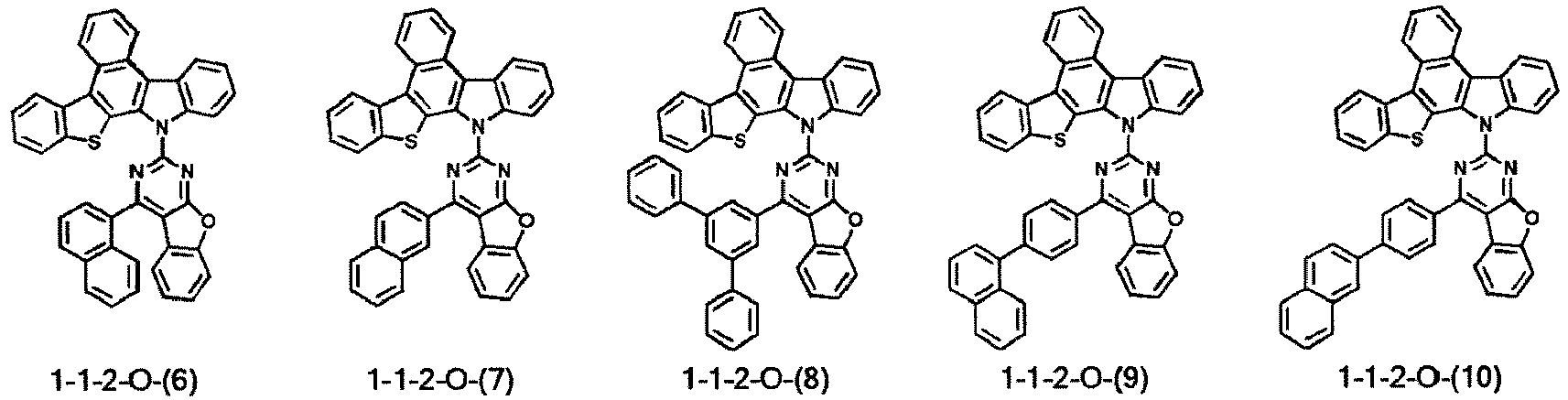


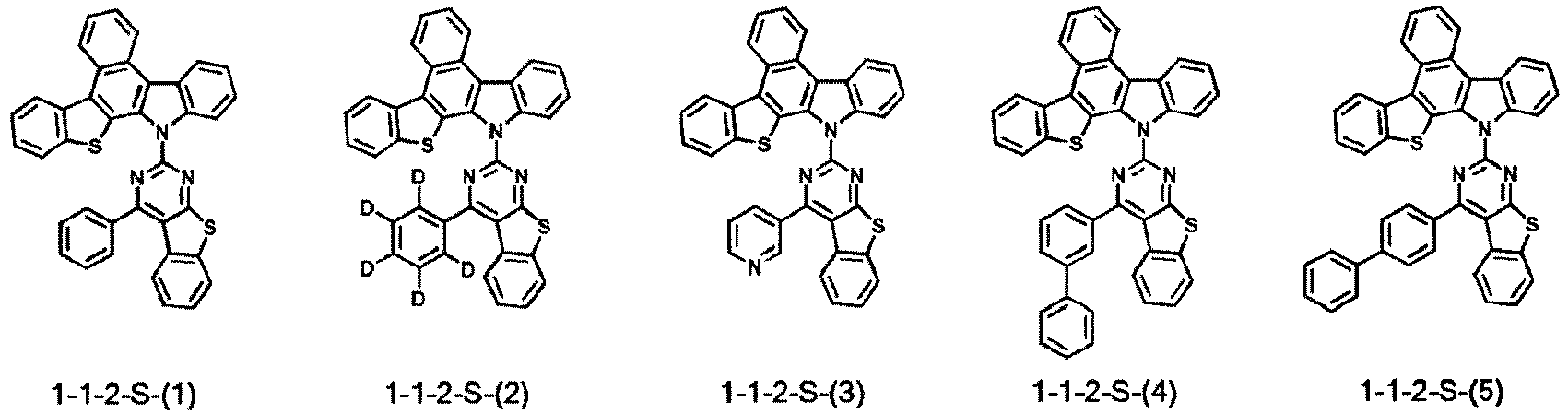


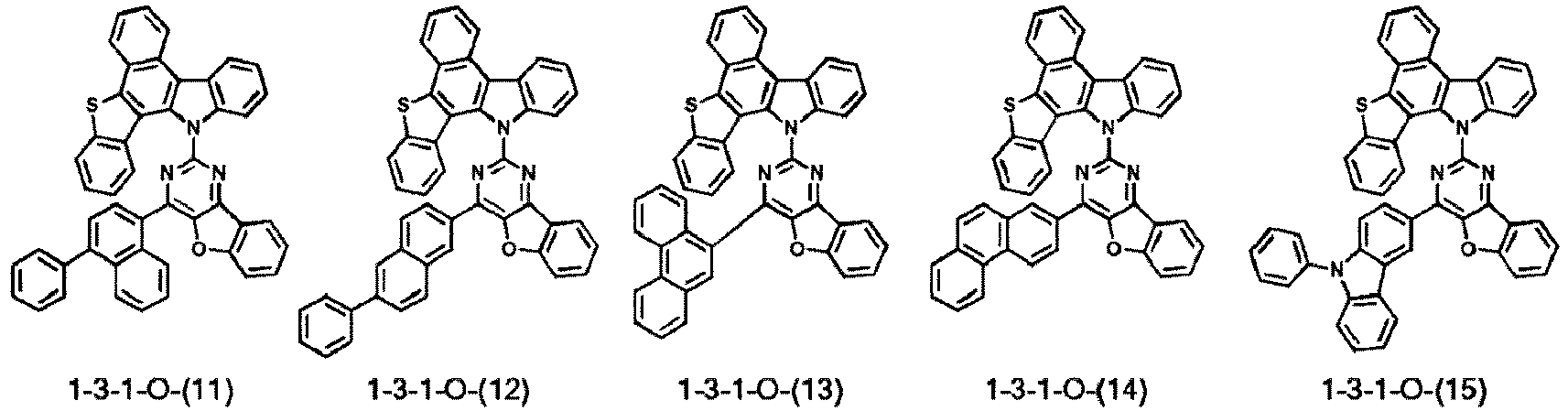
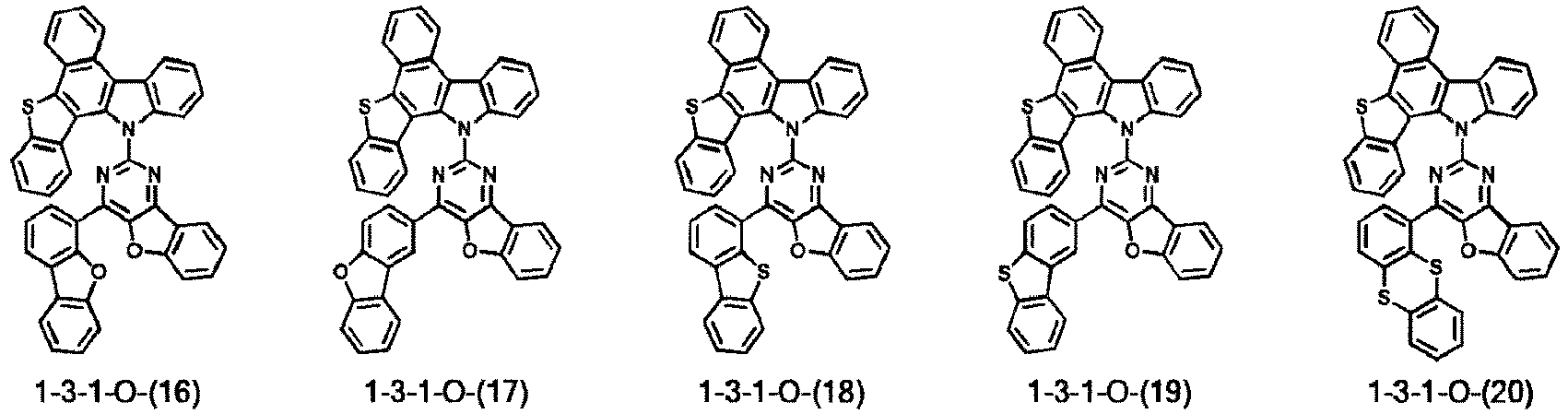


- The organic electric element of claim 1, wherein the emission-auxiliary layer comprises a compound of Formula 1, the hole transport layer comprises a compound of the following Formula 8:
 Ar4 and Ar5 are each independently selected from the group consisting of a C6-C60 aryl group, a fluorenyl group, a C2-C60 heterocyclic group containing at least one heteroatom selected from the group consisting of O, N, S, Si, and P, a fused ring group of a C3-C60 aliphatic ring and a C6-C60 aromatic ring, a C1-C50 alkyl group, a C2-C20 alkenyl group, a C2-C20 alkynyl group, a C1-C30 alkoxyl group, a C6-C30 aryloxyl group and -L'-N(Ra)(Rb),Ar6 is one of the following 8-1, 8-2 and 8-3:
 Ar7, Ar8 and Ar9 are each independently selected from the group consisting of a C6-C60 aryl group, a fluorenyl group, a C2-C60 heterocyclic group containing at least one heteroatom selected from the group consisting of O, N, S, Si, and P, a fused ring group of a C3-C60 aliphatic ring and a C6-C60 aromatic ring, a C1-C50 alkyl group, a C2-C20 alkenyl group, a C2-C20 alkynyl group, a C1-C30 alkoxyl group, a C6-C30 aryloxyl group and -L'-N(Ra)(Rb),R8 to R10 i) are each independently selected from the group consisting of deuterium, halogen, a C6-C60 aryl group, a fluorenyl group, a C2-C60 heterocyclic group containing at least one heteroatom selected from the group consisting of O, N, S, Si, and P, a fused ring group of a C3-C60 aliphatic ring and a C6-C60 aromatic ring, a C1-C50 alkyl group, a C2-C20 alkenyl group, a C2-C20 alkynyl group, a C1-C30 alkoxyl group, a C6-C30 aryloxyl group, and -L'-N(Ra)(Rb), or ii) any adjacent groups of R8 to R10 may be optionally linked together to form at least one ring, and the remaining groups not forming the ring are the same as defined in i),h, i and j are each independently an integer of 0 to 4, wherein when h, i and j are each an integer of 2 or more, a plurality of R8s to R10s may be each the same or different from each other,L2 to L4 are each independently selected from the group consisting of a single bond, a C6-C60 arylene group, a fluorenylene group, a fused ring of a C3-C60 aliphatic ring and a C6-C60 aromatic ring, and a C2-C60 heterocyclic group containing at least one heteroatom selected from the group consisting of O, N, S, Si, and P, with the proviso that a single bond is excluded from L3 and L4,in -L'-N(Ra)(Rb) of Ar4, Ar5, Ar7 to Ar9, R8 to R10, L' is selected from the group consisting of a single bond, a C6-C60 arylene group, a fluorenylene group, a fused ring of a C3-C60 aliphatic ring and a C6-C60 aromatic ring, and a C2-C60 heterocyclic group containing at least one heteroatom selected from the group consisting of O, N, S, Si, and P, and Ra and Rb are each independently selected from the group consisting of a C6-C60 aryl group, a fluorenyl group, a fused ring of a C3-C60 aliphatic ring and a C6-C60 aromatic ring, and a C2-C60 heterocyclic group containing at least one heteroatom selected from the group consisting of O, N, S, Si, and P, andthe aryl group, heterocyclic group, fluorenyl group, alkyl group, alkenyl group, fused ring group, alkoxyl group, aryloxly group, arylene group, fluorenylene group, aliphatic hydrocarbon group of Ar4-Ar5, Ar7-Ar9, R8-R10, R', R", L2, L3, L', Ra and Rb may be each optionally further substituted with one or more substituents selected from the group consisting of deuterium, halogen, a silane group, a siloxane group, a boron group, a germanium group, a cyano group, a nitro group, a C1-C20 alkylthio group, a C1-C20 alkoxyl group, a C1-C20 alkyl group, a C2-C20 alkenyl group, a C2-C20 alkynyl group, a C6-C20 aryl group, a C6-C20 aryl group substituted with deuterium, a fluorenyl group, a C2-C20 heterocyclic group containing at least one heteroatom selected from the group consisting of O, N, S, Si, and P, a C3-C20 cycloalkyl group, a C7-C20 arylalkyl group, and a C8-C20 arylalkenyl group.
 - The organic electric element of claim 6, wherein Formula 8 is one of the following compounds:


- The organic electric element of claim 1, wherein the compound represented by Formula 1 is comprised in the hole transport layer or the emission-auxiliary layer in the form of a single compound or a mixture of two or more compounds.
- The organic electric element of claim 1, wherein the compound represented by Formula 2 is comprised in the light emitting layer in the form of a single compound or a mixture of two or more compounds.
- The organic electric element of claim 6, wherein the compound represented by Formula 1 is comprised in the emission-auxiliary layer in the form of a single compound or a mixture of two or more compounds, and the compound represented by Formula 3 is comprised in the hole transport layer in the form of a single compound or a mixture of two or more compounds.
- The organic electric element of claim 1, further comprising a layer for improving luminous efficiency formed on one side of the first electrode and/or one side of the second electrode, the side not facing the organic material layer.
- The organic electric element of claim 1, wherein the organic material layer is formed by the processes of spin coating, nozzle printing, inkjet printing, slot coating, dip coating or roll-to-roll.
- An electronic device comprising a display device and a control unit for driving the display device, wherein the display device comprises the organic electric element of claim 1.
- The electronic device of claim 13, wherein the organic electric element is at least one of an organic light emitting diode, an organic solar cell, an organic photo conductor, an organic transistor, and an element for monochromatic or white illumination.
Applications Claiming Priority (2)
| Application Number | Priority Date | Filing Date | Title |
|---|---|---|---|
| KR1020150098090A KR102319873B1 (en) | 2015-07-10 | 2015-07-10 | Organic electric element comprising compound for organic electric element and electronic device thereof |
| PCT/KR2016/007269 WO2017010726A1 (en) | 2015-07-10 | 2016-07-05 | Organic electronic element using compound for organic electronic element, and electronic device thereof |
Publications (3)
| Publication Number | Publication Date |
|---|---|
| EP3321341A1 true EP3321341A1 (en) | 2018-05-16 |
| EP3321341A4 EP3321341A4 (en) | 2019-04-10 |
| EP3321341B1 EP3321341B1 (en) | 2020-04-29 |
Family
ID=57757958
Family Applications (1)
| Application Number | Title | Priority Date | Filing Date |
|---|---|---|---|
| EP16824643.7A Active EP3321341B1 (en) | 2015-07-10 | 2016-07-05 | Organic electronic element using compound for organic electronic element, and electronic device thereof |
Country Status (6)
| Country | Link |
|---|---|
| US (1) | US10573838B2 (en) |
| EP (1) | EP3321341B1 (en) |
| JP (1) | JP6691598B2 (en) |
| KR (1) | KR102319873B1 (en) |
| CN (1) | CN107849442B (en) |
| WO (1) | WO2017010726A1 (en) |
Cited By (2)
| Publication number | Priority date | Publication date | Assignee | Title |
|---|---|---|---|---|
| EP3502107B1 (en) * | 2017-12-20 | 2022-01-26 | Samsung Display Co., Ltd. | 1-aminodibenzofuran-based compound and organic light-emitting device including the same |
| US11917899B2 (en) | 2020-03-05 | 2024-02-27 | Samsung Electronics Co., Ltd. | Arylamine-fluorene alternating copolymer, electroluminescence device material, and electroluminescence device using the polymer |
Families Citing this family (21)
| Publication number | Priority date | Publication date | Assignee | Title |
|---|---|---|---|---|
| US11127905B2 (en) | 2015-07-29 | 2021-09-21 | Universal Display Corporation | Organic electroluminescent materials and devices |
| KR102659162B1 (en) * | 2016-02-11 | 2024-04-22 | 삼성전자주식회사 | Condensed cyclic compound and organic light emitting device including the same |
| KR102644500B1 (en) * | 2017-02-24 | 2024-03-07 | 덕산네오룩스 주식회사 | Compound for organic electronic element, organic electronic element comprising the same, and electronic device thereof |
| CN110325524A (en) * | 2017-03-02 | 2019-10-11 | 默克专利有限公司 | Material for organic electronic device |
| KR102364045B1 (en) * | 2017-05-19 | 2022-02-18 | 주식회사 동진쎄미켐 | Compound for forming capping layer and organic electroluminescent divice including the same |
| KR101856586B1 (en) * | 2017-06-13 | 2018-05-10 | (주)위즈켐 | Preparation method of 13-Bromo-10H-phenanthro[9,10-b]carbazole |
| JP6849248B2 (en) | 2017-07-20 | 2021-03-24 | エルジー・ケム・リミテッド | Compounds and organic light emitting devices containing them |
| KR102667927B1 (en) * | 2017-07-26 | 2024-05-23 | 듀폰스페셜티머터리얼스코리아 유한회사 | A plurality of host materials and organic electroluminescent device comprising the same |
| KR102583853B1 (en) * | 2017-09-27 | 2023-10-06 | 주식회사 동진쎄미켐 | Novel compound and organic electroluminescent divice including the same |
| WO2020032428A1 (en) * | 2018-08-09 | 2020-02-13 | 덕산네오룩스 주식회사 | Organic electric element comprising compound for organic electric element and electronic device using same |
| US12325713B2 (en) | 2019-01-04 | 2025-06-10 | Lg Chem, Ltd. | Compound and organic light emitting device comprising the same |
| KR102642133B1 (en) * | 2019-06-17 | 2024-03-04 | 덕산네오룩스 주식회사 | Compound for organic electric element and organic electric device comprising the same |
| KR102642129B1 (en) * | 2019-06-21 | 2024-03-05 | 덕산네오룩스 주식회사 | Compound for organic electric element and organic electric device comprising the same |
| KR102642127B1 (en) * | 2019-06-21 | 2024-03-04 | 덕산네오룩스 주식회사 | Compound for organic electric element and organic electric device comprising the same |
| KR102673123B1 (en) * | 2019-06-27 | 2024-06-07 | 솔루스첨단소재 주식회사 | Organic electroluminescent device |
| CN114641870B (en) * | 2019-11-01 | 2025-07-18 | 德山新勒克斯有限公司 | Organic electronic element comprising a plurality of light-emitting auxiliary layers and electronic device comprising same |
| KR102720072B1 (en) * | 2019-11-05 | 2024-10-23 | 삼성디스플레이 주식회사 | Organic light emitting device and method for manufacturing the same |
| KR102843711B1 (en) * | 2020-04-23 | 2025-08-08 | 덕산네오룩스 주식회사 | Compound for organic electronic element, organic electronic element using the same, and an electronic device thereof |
| WO2023013615A1 (en) * | 2021-08-02 | 2023-02-09 | 東ソー株式会社 | Amine compound, hole injection layer and organic electroluminescent element |
| CN116041334B (en) * | 2023-03-29 | 2023-07-28 | 吉林奥来德光电材料股份有限公司 | Blue light luminescent auxiliary material, preparation method thereof and organic electroluminescent device |
| KR20250167414A (en) * | 2024-05-22 | 2025-12-01 | 덕산네오룩스 주식회사 | An organic electronic element and an electronic device thereof |
Family Cites Families (10)
| Publication number | Priority date | Publication date | Assignee | Title |
|---|---|---|---|---|
| JP6174030B2 (en) * | 2011-09-21 | 2017-08-02 | メルク パテント ゲーエムベーハー | Carbazole derivatives for organic electroluminescent devices |
| KR101948145B1 (en) * | 2011-11-07 | 2019-02-15 | 덕산네오룩스 주식회사 | Compound for organic electronic element, organic electronic element using the same, and a electronic device thereof |
| WO2013069939A1 (en) * | 2011-11-07 | 2013-05-16 | 덕산하이메탈(주) | Compound for organic electronic element, organic electronic element including the same, electronic device thereof |
| JP2015534724A (en) * | 2012-09-11 | 2015-12-03 | ローム・アンド・ハース・エレクトロニック・マテリアルズ・コリア・リミテッド | Novel combination of host compound and dopant compound and organic electroluminescent device comprising the same |
| WO2014092362A1 (en) * | 2012-12-11 | 2014-06-19 | 덕산하이메탈(주) | Compound for organic electronic element, organic electronic element using same, and electronic device thereof |
| KR101900287B1 (en) * | 2012-12-11 | 2018-09-19 | 덕산네오룩스 주식회사 | Compound for organic electronic element, organic electronic element using the same, and a electronic device thereof |
| KR102052076B1 (en) * | 2013-06-14 | 2019-12-05 | 삼성디스플레이 주식회사 | Organic light-emitting diode |
| KR102090714B1 (en) * | 2013-08-23 | 2020-03-19 | 삼성디스플레이 주식회사 | Organic light-emitting device |
| KR101561566B1 (en) | 2014-05-28 | 2015-10-27 | 덕산네오룩스 주식회사 | Compound for organic electronic element, organic electronic element using the same, and an electronic device thereof |
| KR101493482B1 (en) * | 2014-08-29 | 2015-02-16 | 덕산네오룩스 주식회사 | Organic electronic element using a compound for organic electronic element, and an electronic device thereo |
-
2015
- 2015-07-10 KR KR1020150098090A patent/KR102319873B1/en active Active
-
2016
- 2016-07-05 CN CN201680040887.4A patent/CN107849442B/en active Active
- 2016-07-05 WO PCT/KR2016/007269 patent/WO2017010726A1/en not_active Ceased
- 2016-07-05 JP JP2018501983A patent/JP6691598B2/en active Active
- 2016-07-05 EP EP16824643.7A patent/EP3321341B1/en active Active
- 2016-07-05 US US15/743,535 patent/US10573838B2/en active Active
Cited By (2)
| Publication number | Priority date | Publication date | Assignee | Title |
|---|---|---|---|---|
| EP3502107B1 (en) * | 2017-12-20 | 2022-01-26 | Samsung Display Co., Ltd. | 1-aminodibenzofuran-based compound and organic light-emitting device including the same |
| US11917899B2 (en) | 2020-03-05 | 2024-02-27 | Samsung Electronics Co., Ltd. | Arylamine-fluorene alternating copolymer, electroluminescence device material, and electroluminescence device using the polymer |
Also Published As
| Publication number | Publication date |
|---|---|
| US10573838B2 (en) | 2020-02-25 |
| CN107849442A (en) | 2018-03-27 |
| US20180205032A1 (en) | 2018-07-19 |
| EP3321341B1 (en) | 2020-04-29 |
| JP2018532253A (en) | 2018-11-01 |
| WO2017010726A1 (en) | 2017-01-19 |
| KR102319873B1 (en) | 2021-11-02 |
| CN107849442B (en) | 2020-05-19 |
| JP6691598B2 (en) | 2020-04-28 |
| KR20170007626A (en) | 2017-01-19 |
| EP3321341A4 (en) | 2019-04-10 |
Similar Documents
| Publication | Publication Date | Title |
|---|---|---|
| EP3321341B1 (en) | Organic electronic element using compound for organic electronic element, and electronic device thereof | |
| TWI847435B (en) | Organic electroluminescent materials and devices | |
| US11889747B2 (en) | Organic electroluminescent materials and devices | |
| US11342516B2 (en) | Organic electroluminescent materials and devices | |
| US10033002B2 (en) | Organic electroluminescent materials and devices | |
| TWI895043B (en) | Organic electroluminescent materials and devices | |
| EP3689890B1 (en) | Organic electroluminescent materials and devices | |
| US12598905B2 (en) | Organic electroluminescent materials and devices | |
| US20220384741A1 (en) | Organic electroluminescent material and device thereof | |
| US10276809B2 (en) | Organic electroluminescent materials and devices | |
| US10270046B2 (en) | Organic electroluminescent materials and devices | |
| EP4328285A1 (en) | Organic electroluminescent material and device thereof | |
| US12550603B2 (en) | Organic electroluminescent materials and devices | |
| US20250089550A1 (en) | Organic electroluminescent material and device | |
| TW202506961A (en) | Organic compound of formula (i) for use in organic electronic devices, a composition comprising a compound of formula (iv) and at least one compound of formula (iva) to (ivd), an organic semiconductor layer comprising the compound or composition, an organic electronic device comprising the organic semiconductor layer, and a display device comprising the organic electronic device |
Legal Events
| Date | Code | Title | Description |
|---|---|---|---|
| STAA | Information on the status of an ep patent application or granted ep patent |
Free format text: STATUS: THE INTERNATIONAL PUBLICATION HAS BEEN MADE |
|
| PUAI | Public reference made under article 153(3) epc to a published international application that has entered the european phase |
Free format text: ORIGINAL CODE: 0009012 |
|
| STAA | Information on the status of an ep patent application or granted ep patent |
Free format text: STATUS: REQUEST FOR EXAMINATION WAS MADE |
|
| 17P | Request for examination filed |
Effective date: 20180209 |
|
| AK | Designated contracting states |
Kind code of ref document: A1 Designated state(s): AL AT BE BG CH CY CZ DE DK EE ES FI FR GB GR HR HU IE IS IT LI LT LU LV MC MK MT NL NO PL PT RO RS SE SI SK SM TR |
|
| AX | Request for extension of the european patent |
Extension state: BA ME |
|
| DAV | Request for validation of the european patent (deleted) | ||
| DAX | Request for extension of the european patent (deleted) | ||
| A4 | Supplementary search report drawn up and despatched |
Effective date: 20190307 |
|
| RIC1 | Information provided on ipc code assigned before grant |
Ipc: H01L 51/00 20060101ALI20190301BHEP Ipc: H01L 51/52 20060101ALI20190301BHEP Ipc: C09K 11/06 20060101AFI20190301BHEP Ipc: H01L 51/50 20060101ALI20190301BHEP |
|
| RAP1 | Party data changed (applicant data changed or rights of an application transferred) |
Owner name: DUK SAN NEOLUX CO., LTD. Owner name: SAMSUNG DISPLAY CO., LTD. |
|
| GRAP | Despatch of communication of intention to grant a patent |
Free format text: ORIGINAL CODE: EPIDOSNIGR1 |
|
| STAA | Information on the status of an ep patent application or granted ep patent |
Free format text: STATUS: GRANT OF PATENT IS INTENDED |
|
| RIC1 | Information provided on ipc code assigned before grant |
Ipc: C09K 11/06 20060101AFI20191030BHEP Ipc: H01L 51/54 20060101ALI20191030BHEP |
|
| INTG | Intention to grant announced |
Effective date: 20191125 |
|
| GRAS | Grant fee paid |
Free format text: ORIGINAL CODE: EPIDOSNIGR3 |
|
| GRAA | (expected) grant |
Free format text: ORIGINAL CODE: 0009210 |
|
| STAA | Information on the status of an ep patent application or granted ep patent |
Free format text: STATUS: THE PATENT HAS BEEN GRANTED |
|
| AK | Designated contracting states |
Kind code of ref document: B1 Designated state(s): AL AT BE BG CH CY CZ DE DK EE ES FI FR GB GR HR HU IE IS IT LI LT LU LV MC MK MT NL NO PL PT RO RS SE SI SK SM TR |
|
| REG | Reference to a national code |
Ref country code: GB Ref legal event code: FG4D |
|
| REG | Reference to a national code |
Ref country code: CH Ref legal event code: EP |
|
| REG | Reference to a national code |
Ref country code: AT Ref legal event code: REF Ref document number: 1263269 Country of ref document: AT Kind code of ref document: T Effective date: 20200515 |
|
| REG | Reference to a national code |
Ref country code: DE Ref legal event code: R096 Ref document number: 602016035309 Country of ref document: DE |
|
| REG | Reference to a national code |
Ref country code: IE Ref legal event code: FG4D |
|
| REG | Reference to a national code |
Ref country code: NL Ref legal event code: MP Effective date: 20200429 |
|
| REG | Reference to a national code |
Ref country code: LT Ref legal event code: MG4D |
|
| PG25 | Lapsed in a contracting state [announced via postgrant information from national office to epo] |
Ref country code: NO Free format text: LAPSE BECAUSE OF FAILURE TO SUBMIT A TRANSLATION OF THE DESCRIPTION OR TO PAY THE FEE WITHIN THE PRESCRIBED TIME-LIMIT Effective date: 20200729 Ref country code: FI Free format text: LAPSE BECAUSE OF FAILURE TO SUBMIT A TRANSLATION OF THE DESCRIPTION OR TO PAY THE FEE WITHIN THE PRESCRIBED TIME-LIMIT Effective date: 20200429 Ref country code: LT Free format text: LAPSE BECAUSE OF FAILURE TO SUBMIT A TRANSLATION OF THE DESCRIPTION OR TO PAY THE FEE WITHIN THE PRESCRIBED TIME-LIMIT Effective date: 20200429 Ref country code: GR Free format text: LAPSE BECAUSE OF FAILURE TO SUBMIT A TRANSLATION OF THE DESCRIPTION OR TO PAY THE FEE WITHIN THE PRESCRIBED TIME-LIMIT Effective date: 20200730 Ref country code: IS Free format text: LAPSE BECAUSE OF FAILURE TO SUBMIT A TRANSLATION OF THE DESCRIPTION OR TO PAY THE FEE WITHIN THE PRESCRIBED TIME-LIMIT Effective date: 20200829 Ref country code: SE Free format text: LAPSE BECAUSE OF FAILURE TO SUBMIT A TRANSLATION OF THE DESCRIPTION OR TO PAY THE FEE WITHIN THE PRESCRIBED TIME-LIMIT Effective date: 20200429 Ref country code: PT Free format text: LAPSE BECAUSE OF FAILURE TO SUBMIT A TRANSLATION OF THE DESCRIPTION OR TO PAY THE FEE WITHIN THE PRESCRIBED TIME-LIMIT Effective date: 20200831 |
|
| REG | Reference to a national code |
Ref country code: AT Ref legal event code: MK05 Ref document number: 1263269 Country of ref document: AT Kind code of ref document: T Effective date: 20200429 |
|
| PG25 | Lapsed in a contracting state [announced via postgrant information from national office to epo] |
Ref country code: BG Free format text: LAPSE BECAUSE OF FAILURE TO SUBMIT A TRANSLATION OF THE DESCRIPTION OR TO PAY THE FEE WITHIN THE PRESCRIBED TIME-LIMIT Effective date: 20200729 Ref country code: RS Free format text: LAPSE BECAUSE OF FAILURE TO SUBMIT A TRANSLATION OF THE DESCRIPTION OR TO PAY THE FEE WITHIN THE PRESCRIBED TIME-LIMIT Effective date: 20200429 Ref country code: LV Free format text: LAPSE BECAUSE OF FAILURE TO SUBMIT A TRANSLATION OF THE DESCRIPTION OR TO PAY THE FEE WITHIN THE PRESCRIBED TIME-LIMIT Effective date: 20200429 Ref country code: HR Free format text: LAPSE BECAUSE OF FAILURE TO SUBMIT A TRANSLATION OF THE DESCRIPTION OR TO PAY THE FEE WITHIN THE PRESCRIBED TIME-LIMIT Effective date: 20200429 |
|
| PG25 | Lapsed in a contracting state [announced via postgrant information from national office to epo] |
Ref country code: AL Free format text: LAPSE BECAUSE OF FAILURE TO SUBMIT A TRANSLATION OF THE DESCRIPTION OR TO PAY THE FEE WITHIN THE PRESCRIBED TIME-LIMIT Effective date: 20200429 Ref country code: NL Free format text: LAPSE BECAUSE OF FAILURE TO SUBMIT A TRANSLATION OF THE DESCRIPTION OR TO PAY THE FEE WITHIN THE PRESCRIBED TIME-LIMIT Effective date: 20200429 |
|
| PG25 | Lapsed in a contracting state [announced via postgrant information from national office to epo] |
Ref country code: ES Free format text: LAPSE BECAUSE OF FAILURE TO SUBMIT A TRANSLATION OF THE DESCRIPTION OR TO PAY THE FEE WITHIN THE PRESCRIBED TIME-LIMIT Effective date: 20200429 Ref country code: DK Free format text: LAPSE BECAUSE OF FAILURE TO SUBMIT A TRANSLATION OF THE DESCRIPTION OR TO PAY THE FEE WITHIN THE PRESCRIBED TIME-LIMIT Effective date: 20200429 Ref country code: CZ Free format text: LAPSE BECAUSE OF FAILURE TO SUBMIT A TRANSLATION OF THE DESCRIPTION OR TO PAY THE FEE WITHIN THE PRESCRIBED TIME-LIMIT Effective date: 20200429 Ref country code: EE Free format text: LAPSE BECAUSE OF FAILURE TO SUBMIT A TRANSLATION OF THE DESCRIPTION OR TO PAY THE FEE WITHIN THE PRESCRIBED TIME-LIMIT Effective date: 20200429 Ref country code: AT Free format text: LAPSE BECAUSE OF FAILURE TO SUBMIT A TRANSLATION OF THE DESCRIPTION OR TO PAY THE FEE WITHIN THE PRESCRIBED TIME-LIMIT Effective date: 20200429 Ref country code: RO Free format text: LAPSE BECAUSE OF FAILURE TO SUBMIT A TRANSLATION OF THE DESCRIPTION OR TO PAY THE FEE WITHIN THE PRESCRIBED TIME-LIMIT Effective date: 20200429 Ref country code: IT Free format text: LAPSE BECAUSE OF FAILURE TO SUBMIT A TRANSLATION OF THE DESCRIPTION OR TO PAY THE FEE WITHIN THE PRESCRIBED TIME-LIMIT Effective date: 20200429 Ref country code: SM Free format text: LAPSE BECAUSE OF FAILURE TO SUBMIT A TRANSLATION OF THE DESCRIPTION OR TO PAY THE FEE WITHIN THE PRESCRIBED TIME-LIMIT Effective date: 20200429 |
|
| REG | Reference to a national code |
Ref country code: DE Ref legal event code: R097 Ref document number: 602016035309 Country of ref document: DE |
|
| PG25 | Lapsed in a contracting state [announced via postgrant information from national office to epo] |
Ref country code: MC Free format text: LAPSE BECAUSE OF FAILURE TO SUBMIT A TRANSLATION OF THE DESCRIPTION OR TO PAY THE FEE WITHIN THE PRESCRIBED TIME-LIMIT Effective date: 20200429 Ref country code: SK Free format text: LAPSE BECAUSE OF FAILURE TO SUBMIT A TRANSLATION OF THE DESCRIPTION OR TO PAY THE FEE WITHIN THE PRESCRIBED TIME-LIMIT Effective date: 20200429 Ref country code: PL Free format text: LAPSE BECAUSE OF FAILURE TO SUBMIT A TRANSLATION OF THE DESCRIPTION OR TO PAY THE FEE WITHIN THE PRESCRIBED TIME-LIMIT Effective date: 20200429 |
|
| REG | Reference to a national code |
Ref country code: CH Ref legal event code: PL |
|
| PLBE | No opposition filed within time limit |
Free format text: ORIGINAL CODE: 0009261 |
|
| STAA | Information on the status of an ep patent application or granted ep patent |
Free format text: STATUS: NO OPPOSITION FILED WITHIN TIME LIMIT |
|
| GBPC | Gb: european patent ceased through non-payment of renewal fee |
Effective date: 20200729 |
|
| 26N | No opposition filed |
Effective date: 20210201 |
|
| REG | Reference to a national code |
Ref country code: BE Ref legal event code: MM Effective date: 20200731 |
|
| PG25 | Lapsed in a contracting state [announced via postgrant information from national office to epo] |
Ref country code: GB Free format text: LAPSE BECAUSE OF NON-PAYMENT OF DUE FEES Effective date: 20200729 Ref country code: IE Free format text: LAPSE BECAUSE OF NON-PAYMENT OF DUE FEES Effective date: 20200705 Ref country code: FR Free format text: LAPSE BECAUSE OF NON-PAYMENT OF DUE FEES Effective date: 20200731 Ref country code: LI Free format text: LAPSE BECAUSE OF NON-PAYMENT OF DUE FEES Effective date: 20200731 Ref country code: LU Free format text: LAPSE BECAUSE OF NON-PAYMENT OF DUE FEES Effective date: 20200705 Ref country code: CH Free format text: LAPSE BECAUSE OF NON-PAYMENT OF DUE FEES Effective date: 20200731 |
|
| PG25 | Lapsed in a contracting state [announced via postgrant information from national office to epo] |
Ref country code: BE Free format text: LAPSE BECAUSE OF NON-PAYMENT OF DUE FEES Effective date: 20200731 Ref country code: SI Free format text: LAPSE BECAUSE OF FAILURE TO SUBMIT A TRANSLATION OF THE DESCRIPTION OR TO PAY THE FEE WITHIN THE PRESCRIBED TIME-LIMIT Effective date: 20200429 |
|
| PG25 | Lapsed in a contracting state [announced via postgrant information from national office to epo] |
Ref country code: TR Free format text: LAPSE BECAUSE OF FAILURE TO SUBMIT A TRANSLATION OF THE DESCRIPTION OR TO PAY THE FEE WITHIN THE PRESCRIBED TIME-LIMIT Effective date: 20200429 Ref country code: MT Free format text: LAPSE BECAUSE OF FAILURE TO SUBMIT A TRANSLATION OF THE DESCRIPTION OR TO PAY THE FEE WITHIN THE PRESCRIBED TIME-LIMIT Effective date: 20200429 Ref country code: CY Free format text: LAPSE BECAUSE OF FAILURE TO SUBMIT A TRANSLATION OF THE DESCRIPTION OR TO PAY THE FEE WITHIN THE PRESCRIBED TIME-LIMIT Effective date: 20200429 |
|
| PG25 | Lapsed in a contracting state [announced via postgrant information from national office to epo] |
Ref country code: MK Free format text: LAPSE BECAUSE OF FAILURE TO SUBMIT A TRANSLATION OF THE DESCRIPTION OR TO PAY THE FEE WITHIN THE PRESCRIBED TIME-LIMIT Effective date: 20200429 |
|
| P01 | Opt-out of the competence of the unified patent court (upc) registered |
Effective date: 20230530 |
|
| REG | Reference to a national code |
Ref country code: DE Ref legal event code: R082 Ref document number: 602016035309 Country of ref document: DE Representative=s name: PRUEFER & PARTNER MBB PATENTANWAELTE RECHTSANW, DE |
|
| PGFP | Annual fee paid to national office [announced via postgrant information from national office to epo] |
Ref country code: DE Payment date: 20250729 Year of fee payment: 10 |