EP3321318A1 - Thermoplastic resin composition, inner liner and pneumatic tire - Google Patents
Thermoplastic resin composition, inner liner and pneumatic tire Download PDFInfo
- Publication number
- EP3321318A1 EP3321318A1 EP16821296.7A EP16821296A EP3321318A1 EP 3321318 A1 EP3321318 A1 EP 3321318A1 EP 16821296 A EP16821296 A EP 16821296A EP 3321318 A1 EP3321318 A1 EP 3321318A1
- Authority
- EP
- European Patent Office
- Prior art keywords
- resin composition
- thermoplastic resin
- ethylene
- copolymer
- vinyl alcohol
- Prior art date
- Legal status (The legal status is an assumption and is not a legal conclusion. Google has not performed a legal analysis and makes no representation as to the accuracy of the status listed.)
- Granted
Links
- 239000011342 resin composition Substances 0.000 title claims abstract description 51
- 229920005992 thermoplastic resin Polymers 0.000 title claims abstract description 51
- 229920001577 copolymer Polymers 0.000 claims abstract description 58
- PEDCQBHIVMGVHV-UHFFFAOYSA-N Glycerol Natural products OCC(O)CO PEDCQBHIVMGVHV-UHFFFAOYSA-N 0.000 claims abstract description 39
- 239000004952 Polyamide Substances 0.000 claims abstract description 28
- 229920002647 polyamide Polymers 0.000 claims abstract description 28
- 235000014113 dietary fatty acids Nutrition 0.000 claims abstract description 11
- 229930195729 fatty acid Natural products 0.000 claims abstract description 11
- 239000000194 fatty acid Substances 0.000 claims abstract description 11
- 150000004665 fatty acids Chemical class 0.000 claims abstract description 11
- 125000004432 carbon atom Chemical group C* 0.000 claims abstract description 10
- 229920000219 Ethylene vinyl alcohol Polymers 0.000 claims description 42
- 229920001971 elastomer Polymers 0.000 claims description 42
- 239000000806 elastomer Substances 0.000 claims description 33
- 239000003431 cross linking reagent Substances 0.000 claims description 16
- 239000000203 mixture Substances 0.000 claims description 11
- 125000004018 acid anhydride group Chemical group 0.000 claims description 6
- DCXXMTOCNZCJGO-UHFFFAOYSA-N tristearoylglycerol Chemical compound CCCCCCCCCCCCCCCCCC(=O)OCC(OC(=O)CCCCCCCCCCCCCCCCC)COC(=O)CCCCCCCCCCCCCCCCC DCXXMTOCNZCJGO-UHFFFAOYSA-N 0.000 claims description 4
- VGGSQFUCUMXWEO-UHFFFAOYSA-N Ethene Chemical compound C=C VGGSQFUCUMXWEO-UHFFFAOYSA-N 0.000 abstract description 14
- 239000005977 Ethylene Substances 0.000 abstract description 14
- 230000002265 prevention Effects 0.000 abstract description 11
- 230000006866 deterioration Effects 0.000 abstract description 5
- -1 acyl glycerol Chemical compound 0.000 abstract description 4
- 238000004519 manufacturing process Methods 0.000 abstract description 4
- PPBRXRYQALVLMV-UHFFFAOYSA-N Styrene Natural products C=CC1=CC=CC=C1 PPBRXRYQALVLMV-UHFFFAOYSA-N 0.000 abstract 1
- 239000000126 substance Substances 0.000 description 15
- XLOMVQKBTHCTTD-UHFFFAOYSA-N Zinc monoxide Chemical compound [Zn]=O XLOMVQKBTHCTTD-UHFFFAOYSA-N 0.000 description 13
- 238000004898 kneading Methods 0.000 description 12
- 238000002156 mixing Methods 0.000 description 11
- 238000004132 cross linking Methods 0.000 description 8
- 230000035699 permeability Effects 0.000 description 8
- 238000007127 saponification reaction Methods 0.000 description 8
- 150000008065 acid anhydrides Chemical class 0.000 description 6
- 230000000052 comparative effect Effects 0.000 description 6
- 150000002148 esters Chemical class 0.000 description 6
- QIQXTHQIDYTFRH-UHFFFAOYSA-N octadecanoic acid Chemical compound CCCCCCCCCCCCCCCCCC(O)=O QIQXTHQIDYTFRH-UHFFFAOYSA-N 0.000 description 6
- URAYPUMNDPQOKB-UHFFFAOYSA-N triacetin Chemical compound CC(=O)OCC(OC(C)=O)COC(C)=O URAYPUMNDPQOKB-UHFFFAOYSA-N 0.000 description 6
- 239000011787 zinc oxide Substances 0.000 description 6
- 235000021355 Stearic acid Nutrition 0.000 description 5
- 230000000694 effects Effects 0.000 description 5
- 238000002844 melting Methods 0.000 description 5
- 230000008018 melting Effects 0.000 description 5
- OQCDKBAXFALNLD-UHFFFAOYSA-N octadecanoic acid Natural products CCCCCCCC(C)CCCCCCCCC(O)=O OQCDKBAXFALNLD-UHFFFAOYSA-N 0.000 description 5
- 239000008117 stearic acid Substances 0.000 description 5
- ZZMVLMVFYMGSMY-UHFFFAOYSA-N 4-n-(4-methylpentan-2-yl)-1-n-phenylbenzene-1,4-diamine Chemical compound C1=CC(NC(C)CC(C)C)=CC=C1NC1=CC=CC=C1 ZZMVLMVFYMGSMY-UHFFFAOYSA-N 0.000 description 4
- 229920000577 Nylon 6/66 Polymers 0.000 description 4
- 239000000654 additive Substances 0.000 description 4
- TZYHIGCKINZLPD-UHFFFAOYSA-N azepan-2-one;hexane-1,6-diamine;hexanedioic acid Chemical compound NCCCCCCN.O=C1CCCCCN1.OC(=O)CCCCC(O)=O TZYHIGCKINZLPD-UHFFFAOYSA-N 0.000 description 4
- 238000001125 extrusion Methods 0.000 description 4
- 239000004014 plasticizer Substances 0.000 description 4
- 229920005989 resin Polymers 0.000 description 4
- 239000011347 resin Substances 0.000 description 4
- QTBSBXVTEAMEQO-UHFFFAOYSA-N Acetic acid Chemical compound CC(O)=O QTBSBXVTEAMEQO-UHFFFAOYSA-N 0.000 description 3
- WWZKQHOCKIZLMA-UHFFFAOYSA-N Caprylic acid Natural products CCCCCCCC(O)=O WWZKQHOCKIZLMA-UHFFFAOYSA-N 0.000 description 3
- 239000004677 Nylon Substances 0.000 description 3
- 229920002292 Nylon 6 Polymers 0.000 description 3
- VYPSYNLAJGMNEJ-UHFFFAOYSA-N Silicium dioxide Chemical compound O=[Si]=O VYPSYNLAJGMNEJ-UHFFFAOYSA-N 0.000 description 3
- NINIDFKCEFEMDL-UHFFFAOYSA-N Sulfur Chemical compound [S] NINIDFKCEFEMDL-UHFFFAOYSA-N 0.000 description 3
- 235000013773 glyceryl triacetate Nutrition 0.000 description 3
- 230000002209 hydrophobic effect Effects 0.000 description 3
- 229920001778 nylon Polymers 0.000 description 3
- 239000002994 raw material Substances 0.000 description 3
- 229960002622 triacetin Drugs 0.000 description 3
- VBICKXHEKHSIBG-UHFFFAOYSA-N 1-monostearoylglycerol Chemical compound CCCCCCCCCCCCCCCCCC(=O)OCC(O)CO VBICKXHEKHSIBG-UHFFFAOYSA-N 0.000 description 2
- ZNRLMGFXSPUZNR-UHFFFAOYSA-N 2,2,4-trimethyl-1h-quinoline Chemical compound C1=CC=C2C(C)=CC(C)(C)NC2=C1 ZNRLMGFXSPUZNR-UHFFFAOYSA-N 0.000 description 2
- JLBJTVDPSNHSKJ-UHFFFAOYSA-N 4-Methylstyrene Chemical compound CC1=CC=C(C=C)C=C1 JLBJTVDPSNHSKJ-UHFFFAOYSA-N 0.000 description 2
- WKBOTKDWSSQWDR-UHFFFAOYSA-N Bromine atom Chemical compound [Br] WKBOTKDWSSQWDR-UHFFFAOYSA-N 0.000 description 2
- FERIUCNNQQJTOY-UHFFFAOYSA-N Butyric acid Chemical compound CCCC(O)=O FERIUCNNQQJTOY-UHFFFAOYSA-N 0.000 description 2
- 229920000089 Cyclic olefin copolymer Polymers 0.000 description 2
- IMROMDMJAWUWLK-UHFFFAOYSA-N Ethenol Chemical group OC=C IMROMDMJAWUWLK-UHFFFAOYSA-N 0.000 description 2
- VQTUBCCKSQIDNK-UHFFFAOYSA-N Isobutene Chemical group CC(C)=C VQTUBCCKSQIDNK-UHFFFAOYSA-N 0.000 description 2
- JHWNWJKBPDFINM-UHFFFAOYSA-N Laurolactam Chemical compound O=C1CCCCCCCCCCCN1 JHWNWJKBPDFINM-UHFFFAOYSA-N 0.000 description 2
- 229920000299 Nylon 12 Polymers 0.000 description 2
- 229920000572 Nylon 6/12 Polymers 0.000 description 2
- 239000003963 antioxidant agent Substances 0.000 description 2
- 230000003078 antioxidant effect Effects 0.000 description 2
- GDTBXPJZTBHREO-UHFFFAOYSA-N bromine Substances BrBr GDTBXPJZTBHREO-UHFFFAOYSA-N 0.000 description 2
- 229910052794 bromium Inorganic materials 0.000 description 2
- 239000000460 chlorine Substances 0.000 description 2
- 150000001875 compounds Chemical class 0.000 description 2
- 238000007796 conventional method Methods 0.000 description 2
- 238000001816 cooling Methods 0.000 description 2
- 230000007423 decrease Effects 0.000 description 2
- XBDQKXXYIPTUBI-UHFFFAOYSA-N dimethylselenoniopropionate Natural products CCC(O)=O XBDQKXXYIPTUBI-UHFFFAOYSA-N 0.000 description 2
- POULHZVOKOAJMA-UHFFFAOYSA-N dodecanoic acid Chemical compound CCCCCCCCCCCC(O)=O POULHZVOKOAJMA-UHFFFAOYSA-N 0.000 description 2
- UFRKOOWSQGXVKV-UHFFFAOYSA-N ethene;ethenol Chemical compound C=C.OC=C UFRKOOWSQGXVKV-UHFFFAOYSA-N 0.000 description 2
- 239000004715 ethylene vinyl alcohol Substances 0.000 description 2
- 238000009472 formulation Methods 0.000 description 2
- KQNPFQTWMSNSAP-UHFFFAOYSA-N isobutyric acid Chemical compound CC(C)C(O)=O KQNPFQTWMSNSAP-UHFFFAOYSA-N 0.000 description 2
- 239000011159 matrix material Substances 0.000 description 2
- BDAGIHXWWSANSR-UHFFFAOYSA-N methanoic acid Natural products OC=O BDAGIHXWWSANSR-UHFFFAOYSA-N 0.000 description 2
- 238000000465 moulding Methods 0.000 description 2
- 150000003335 secondary amines Chemical class 0.000 description 2
- MAYCICSNZYXLHB-UHFFFAOYSA-N tricaproin Chemical compound CCCCCC(=O)OCC(OC(=O)CCCCC)COC(=O)CCCCC MAYCICSNZYXLHB-UHFFFAOYSA-N 0.000 description 2
- PJHKBYALYHRYSK-UHFFFAOYSA-N triheptanoin Chemical compound CCCCCCC(=O)OCC(OC(=O)CCCCCC)COC(=O)CCCCCC PJHKBYALYHRYSK-UHFFFAOYSA-N 0.000 description 2
- VLPFTAMPNXLGLX-UHFFFAOYSA-N trioctanoin Chemical compound CCCCCCCC(=O)OCC(OC(=O)CCCCCCC)COC(=O)CCCCCCC VLPFTAMPNXLGLX-UHFFFAOYSA-N 0.000 description 2
- NQPDZGIKBAWPEJ-UHFFFAOYSA-N valeric acid Chemical compound CCCCC(O)=O NQPDZGIKBAWPEJ-UHFFFAOYSA-N 0.000 description 2
- XOOUIPVCVHRTMJ-UHFFFAOYSA-L zinc stearate Chemical compound [Zn+2].CCCCCCCCCCCCCCCCCC([O-])=O.CCCCCCCCCCCCCCCCCC([O-])=O XOOUIPVCVHRTMJ-UHFFFAOYSA-L 0.000 description 2
- 239000004711 α-olefin Substances 0.000 description 2
- IPJGAEWUPXWFPL-UHFFFAOYSA-N 1-[3-(2,5-dioxopyrrol-1-yl)phenyl]pyrrole-2,5-dione Chemical compound O=C1C=CC(=O)N1C1=CC=CC(N2C(C=CC2=O)=O)=C1 IPJGAEWUPXWFPL-UHFFFAOYSA-N 0.000 description 1
- JBAUPCNQUQGXJT-UHFFFAOYSA-N 1-ethenyl-4-methylbenzene;2-methylprop-1-ene Chemical class CC(C)=C.CC1=CC=C(C=C)C=C1 JBAUPCNQUQGXJT-UHFFFAOYSA-N 0.000 description 1
- XYHKNCXZYYTLRG-UHFFFAOYSA-N 1h-imidazole-2-carbaldehyde Chemical compound O=CC1=NC=CN1 XYHKNCXZYYTLRG-UHFFFAOYSA-N 0.000 description 1
- OVSKIKFHRZPJSS-UHFFFAOYSA-N 2,4-D Chemical compound OC(=O)COC1=CC=C(Cl)C=C1Cl OVSKIKFHRZPJSS-UHFFFAOYSA-N 0.000 description 1
- QLZJUIZVJLSNDD-UHFFFAOYSA-N 2-(2-methylidenebutanoyloxy)ethyl 2-methylidenebutanoate Chemical class CCC(=C)C(=O)OCCOC(=O)C(=C)CC QLZJUIZVJLSNDD-UHFFFAOYSA-N 0.000 description 1
- KUDUQBURMYMBIJ-UHFFFAOYSA-N 2-prop-2-enoyloxyethyl prop-2-enoate Chemical class C=CC(=O)OCCOC(=O)C=C KUDUQBURMYMBIJ-UHFFFAOYSA-N 0.000 description 1
- GWYFCOCPABKNJV-UHFFFAOYSA-M 3-Methylbutanoic acid Natural products CC(C)CC([O-])=O GWYFCOCPABKNJV-UHFFFAOYSA-M 0.000 description 1
- YHQXBTXEYZIYOV-UHFFFAOYSA-N 3-methylbut-1-ene Chemical compound CC(C)C=C YHQXBTXEYZIYOV-UHFFFAOYSA-N 0.000 description 1
- OSWFIVFLDKOXQC-UHFFFAOYSA-N 4-(3-methoxyphenyl)aniline Chemical compound COC1=CC=CC(C=2C=CC(N)=CC=2)=C1 OSWFIVFLDKOXQC-UHFFFAOYSA-N 0.000 description 1
- WSSSPWUEQFSQQG-UHFFFAOYSA-N 4-methyl-1-pentene Chemical compound CC(C)CC=C WSSSPWUEQFSQQG-UHFFFAOYSA-N 0.000 description 1
- AWQSAIIDOMEEOD-UHFFFAOYSA-N 5,5-Dimethyl-4-(3-oxobutyl)dihydro-2(3H)-furanone Chemical compound CC(=O)CCC1CC(=O)OC1(C)C AWQSAIIDOMEEOD-UHFFFAOYSA-N 0.000 description 1
- ZCYVEMRRCGMTRW-UHFFFAOYSA-N 7553-56-2 Chemical compound [I] ZCYVEMRRCGMTRW-UHFFFAOYSA-N 0.000 description 1
- RZVAJINKPMORJF-UHFFFAOYSA-N Acetaminophen Chemical compound CC(=O)NC1=CC=C(O)C=C1 RZVAJINKPMORJF-UHFFFAOYSA-N 0.000 description 1
- ZAMOUSCENKQFHK-UHFFFAOYSA-N Chlorine atom Chemical compound [Cl] ZAMOUSCENKQFHK-UHFFFAOYSA-N 0.000 description 1
- PXGOKWXKJXAPGV-UHFFFAOYSA-N Fluorine Chemical compound FF PXGOKWXKJXAPGV-UHFFFAOYSA-N 0.000 description 1
- 239000005639 Lauric acid Substances 0.000 description 1
- 239000006057 Non-nutritive feed additive Substances 0.000 description 1
- 229920000571 Nylon 11 Polymers 0.000 description 1
- 229920003189 Nylon 4,6 Polymers 0.000 description 1
- 229920000305 Nylon 6,10 Polymers 0.000 description 1
- 229920002302 Nylon 6,6 Polymers 0.000 description 1
- 229920000007 Nylon MXD6 Polymers 0.000 description 1
- 229910000831 Steel Inorganic materials 0.000 description 1
- 235000011054 acetic acid Nutrition 0.000 description 1
- 230000000996 additive effect Effects 0.000 description 1
- OBETXYAYXDNJHR-UHFFFAOYSA-N alpha-ethylcaproic acid Natural products CCCCC(CC)C(O)=O OBETXYAYXDNJHR-UHFFFAOYSA-N 0.000 description 1
- 239000010692 aromatic oil Substances 0.000 description 1
- 239000011324 bead Substances 0.000 description 1
- GONOPSZTUGRENK-UHFFFAOYSA-N benzyl(trichloro)silane Chemical compound Cl[Si](Cl)(Cl)CC1=CC=CC=C1 GONOPSZTUGRENK-UHFFFAOYSA-N 0.000 description 1
- GWYFCOCPABKNJV-UHFFFAOYSA-N beta-methyl-butyric acid Natural products CC(C)CC(O)=O GWYFCOCPABKNJV-UHFFFAOYSA-N 0.000 description 1
- 229920001400 block copolymer Polymers 0.000 description 1
- 229920005557 bromobutyl Polymers 0.000 description 1
- 229910052799 carbon Inorganic materials 0.000 description 1
- 239000006229 carbon black Substances 0.000 description 1
- 239000003795 chemical substances by application Substances 0.000 description 1
- 229910052801 chlorine Inorganic materials 0.000 description 1
- 239000000470 constituent Substances 0.000 description 1
- 150000001982 diacylglycerols Chemical class 0.000 description 1
- 239000006185 dispersion Substances 0.000 description 1
- 229920006228 ethylene acrylate copolymer Polymers 0.000 description 1
- 239000005038 ethylene vinyl acetate Substances 0.000 description 1
- 229920006244 ethylene-ethyl acrylate Polymers 0.000 description 1
- 229920006225 ethylene-methyl acrylate Polymers 0.000 description 1
- 229920005680 ethylene-methyl methacrylate copolymer Polymers 0.000 description 1
- 238000011156 evaluation Methods 0.000 description 1
- 239000000945 filler Substances 0.000 description 1
- 229910052731 fluorine Inorganic materials 0.000 description 1
- 239000011737 fluorine Substances 0.000 description 1
- 235000019253 formic acid Nutrition 0.000 description 1
- YQEMORVAKMFKLG-UHFFFAOYSA-N glycerine monostearate Natural products CCCCCCCCCCCCCCCCCC(=O)OC(CO)CO YQEMORVAKMFKLG-UHFFFAOYSA-N 0.000 description 1
- SVUQHVRAGMNPLW-UHFFFAOYSA-N glycerol monostearate Natural products CCCCCCCCCCCCCCCCC(=O)OCC(O)CO SVUQHVRAGMNPLW-UHFFFAOYSA-N 0.000 description 1
- 150000004820 halides Chemical class 0.000 description 1
- 229920005555 halobutyl Polymers 0.000 description 1
- 229910052736 halogen Inorganic materials 0.000 description 1
- 125000005843 halogen group Chemical group 0.000 description 1
- 230000002140 halogenating effect Effects 0.000 description 1
- 150000002367 halogens Chemical class 0.000 description 1
- 238000010438 heat treatment Methods 0.000 description 1
- 238000012001 immunoprecipitation mass spectrometry Methods 0.000 description 1
- 239000003112 inhibitor Substances 0.000 description 1
- 239000011630 iodine Substances 0.000 description 1
- 229910052740 iodine Inorganic materials 0.000 description 1
- 239000000395 magnesium oxide Substances 0.000 description 1
- CPLXHLVBOLITMK-UHFFFAOYSA-N magnesium oxide Inorganic materials [Mg]=O CPLXHLVBOLITMK-UHFFFAOYSA-N 0.000 description 1
- AXZKOIWUVFPNLO-UHFFFAOYSA-N magnesium;oxygen(2-) Chemical compound [O-2].[Mg+2] AXZKOIWUVFPNLO-UHFFFAOYSA-N 0.000 description 1
- 238000010077 mastication Methods 0.000 description 1
- 230000018984 mastication Effects 0.000 description 1
- 239000000463 material Substances 0.000 description 1
- 229910052751 metal Inorganic materials 0.000 description 1
- 239000002184 metal Substances 0.000 description 1
- 239000003607 modifier Substances 0.000 description 1
- 150000002759 monoacylglycerols Chemical class 0.000 description 1
- FUZZWVXGSFPDMH-UHFFFAOYSA-N n-hexanoic acid Natural products CCCCCC(O)=O FUZZWVXGSFPDMH-UHFFFAOYSA-N 0.000 description 1
- 230000000704 physical effect Effects 0.000 description 1
- IUGYQRQAERSCNH-UHFFFAOYSA-N pivalic acid Chemical compound CC(C)(C)C(O)=O IUGYQRQAERSCNH-UHFFFAOYSA-N 0.000 description 1
- 229920001200 poly(ethylene-vinyl acetate) Polymers 0.000 description 1
- 229920006111 poly(hexamethylene terephthalamide) Polymers 0.000 description 1
- 238000006116 polymerization reaction Methods 0.000 description 1
- 238000002360 preparation method Methods 0.000 description 1
- 235000019260 propionic acid Nutrition 0.000 description 1
- IUVKMZGDUIUOCP-BTNSXGMBSA-N quinbolone Chemical compound O([C@H]1CC[C@H]2[C@H]3[C@@H]([C@]4(C=CC(=O)C=C4CC3)C)CC[C@@]21C)C1=CCCC1 IUVKMZGDUIUOCP-BTNSXGMBSA-N 0.000 description 1
- 229920005604 random copolymer Polymers 0.000 description 1
- 239000000377 silicon dioxide Substances 0.000 description 1
- 239000000344 soap Substances 0.000 description 1
- 239000010959 steel Substances 0.000 description 1
- 238000005728 strengthening Methods 0.000 description 1
- 150000005846 sugar alcohols Polymers 0.000 description 1
- 229910052717 sulfur Inorganic materials 0.000 description 1
- 239000011593 sulfur Substances 0.000 description 1
- 229920002725 thermoplastic elastomer Polymers 0.000 description 1
- 229940005605 valeric acid Drugs 0.000 description 1
- 238000004073 vulcanization Methods 0.000 description 1
Classifications
-
- C—CHEMISTRY; METALLURGY
- C08—ORGANIC MACROMOLECULAR COMPOUNDS; THEIR PREPARATION OR CHEMICAL WORKING-UP; COMPOSITIONS BASED THEREON
- C08L—COMPOSITIONS OF MACROMOLECULAR COMPOUNDS
- C08L29/00—Compositions of homopolymers or copolymers of compounds having one or more unsaturated aliphatic radicals, each having only one carbon-to-carbon double bond, and at least one being terminated by an alcohol, ether, aldehydo, ketonic, acetal or ketal radical; Compositions of hydrolysed polymers of esters of unsaturated alcohols with saturated carboxylic acids; Compositions of derivatives of such polymers
- C08L29/02—Homopolymers or copolymers of unsaturated alcohols
- C08L29/04—Polyvinyl alcohol; Partially hydrolysed homopolymers or copolymers of esters of unsaturated alcohols with saturated carboxylic acids
-
- C—CHEMISTRY; METALLURGY
- C08—ORGANIC MACROMOLECULAR COMPOUNDS; THEIR PREPARATION OR CHEMICAL WORKING-UP; COMPOSITIONS BASED THEREON
- C08K—Use of inorganic or non-macromolecular organic substances as compounding ingredients
- C08K5/00—Use of organic ingredients
- C08K5/0008—Organic ingredients according to more than one of the "one dot" groups of C08K5/01 - C08K5/59
- C08K5/0025—Crosslinking or vulcanising agents; including accelerators
-
- C—CHEMISTRY; METALLURGY
- C08—ORGANIC MACROMOLECULAR COMPOUNDS; THEIR PREPARATION OR CHEMICAL WORKING-UP; COMPOSITIONS BASED THEREON
- C08K—Use of inorganic or non-macromolecular organic substances as compounding ingredients
- C08K5/00—Use of organic ingredients
- C08K5/04—Oxygen-containing compounds
- C08K5/10—Esters; Ether-esters
- C08K5/101—Esters; Ether-esters of monocarboxylic acids
- C08K5/103—Esters; Ether-esters of monocarboxylic acids with polyalcohols
-
- C—CHEMISTRY; METALLURGY
- C08—ORGANIC MACROMOLECULAR COMPOUNDS; THEIR PREPARATION OR CHEMICAL WORKING-UP; COMPOSITIONS BASED THEREON
- C08K—Use of inorganic or non-macromolecular organic substances as compounding ingredients
- C08K5/00—Use of organic ingredients
- C08K5/04—Oxygen-containing compounds
- C08K5/10—Esters; Ether-esters
- C08K5/11—Esters; Ether-esters of acyclic polycarboxylic acids
-
- C—CHEMISTRY; METALLURGY
- C08—ORGANIC MACROMOLECULAR COMPOUNDS; THEIR PREPARATION OR CHEMICAL WORKING-UP; COMPOSITIONS BASED THEREON
- C08L—COMPOSITIONS OF MACROMOLECULAR COMPOUNDS
- C08L25/00—Compositions of, homopolymers or copolymers of compounds having one or more unsaturated aliphatic radicals, each having only one carbon-to-carbon double bond, and at least one being terminated by an aromatic carbocyclic ring; Compositions of derivatives of such polymers
- C08L25/02—Homopolymers or copolymers of hydrocarbons
- C08L25/16—Homopolymers or copolymers of alkyl-substituted styrenes
-
- C—CHEMISTRY; METALLURGY
- C08—ORGANIC MACROMOLECULAR COMPOUNDS; THEIR PREPARATION OR CHEMICAL WORKING-UP; COMPOSITIONS BASED THEREON
- C08L—COMPOSITIONS OF MACROMOLECULAR COMPOUNDS
- C08L25/00—Compositions of, homopolymers or copolymers of compounds having one or more unsaturated aliphatic radicals, each having only one carbon-to-carbon double bond, and at least one being terminated by an aromatic carbocyclic ring; Compositions of derivatives of such polymers
- C08L25/18—Homopolymers or copolymers of aromatic monomers containing elements other than carbon and hydrogen
-
- C—CHEMISTRY; METALLURGY
- C08—ORGANIC MACROMOLECULAR COMPOUNDS; THEIR PREPARATION OR CHEMICAL WORKING-UP; COMPOSITIONS BASED THEREON
- C08L—COMPOSITIONS OF MACROMOLECULAR COMPOUNDS
- C08L77/00—Compositions of polyamides obtained by reactions forming a carboxylic amide link in the main chain; Compositions of derivatives of such polymers
-
- B—PERFORMING OPERATIONS; TRANSPORTING
- B60—VEHICLES IN GENERAL
- B60C—VEHICLE TYRES; TYRE INFLATION; TYRE CHANGING; CONNECTING VALVES TO INFLATABLE ELASTIC BODIES IN GENERAL; DEVICES OR ARRANGEMENTS RELATED TO TYRES
- B60C5/00—Inflatable pneumatic tyres or inner tubes
- B60C5/12—Inflatable pneumatic tyres or inner tubes without separate inflatable inserts, e.g. tubeless tyres with transverse section open to the rim
- B60C5/14—Inflatable pneumatic tyres or inner tubes without separate inflatable inserts, e.g. tubeless tyres with transverse section open to the rim with impervious liner or coating on the inner wall of the tyre
Definitions
- the present invention relates to a thermoplastic resin composition, an inner liner for a pneumatic tire comprising the thermoplastic resin composition, and a pneumatic tire including the inner liner. More specifically, the present invention relates to a thermoplastic resin composition comprising a continuous phase comprising an ethylene-vinyl alcohol copolymer and a polyamide and a dispersed phase comprising a halogenated isomonoolefin- para -alkylstyrene copolymer, an inner liner for a pneumatic tire comprising the thermoplastic resin composition, and a pneumatic tire including the inner liner.
- An inner liner for a tire inner surface comprising a resin composition containing an ethylene-vinyl alcohol copolymer and a hydrophobic plasticizer is known (Japanese Unexamined Patent Publication No. 2002-52904 ). According to Japanese Unexamined Patent Publication No. 2002-52904 , flexibility and durability of the inner liner are improved by blending a hydrophobic plasticizer.
- Japanese Unexamined Patent Publication No. 2002-52904 describes an ester of glycerol as an example of a hydrophobic plasticizer, and esters of glycerol which are mentioned as specific examples are esters of stearic acid and glycerol and esters of lauric acid and glycerol.
- thermoplastic resin composition comprising a continuous phase comprising an ethylene-vinyl alcohol copolymer and a polyamide and a dispersed phase comprising a halogenated isomonoolefin- para -alkylstyrene copolymer is blended with an ester of a polyhydric alcohol and a higher fatty acid having 12 or more carbon atoms, durability may not be improved when the thermoplastic resin is formed as an inner liner.
- An object of the present invention is to provide a thermoplastic resin composition which can produce an inner liner excellent in durability and less deterioration in air permeation prevention due to repeated deformation when a thermoplastic resin composition comprising a continuous phase comprising an ethylene-vinyl alcohol copolymer and a polyamide and a dispersed phase comprising a halogenated isomonoolefin- para -alkylstyrene copolymer is used as a material of an inner liner for a tire.
- the present inventor has found that it is possible to improve the durability of an inner liner produced from the thermoplastic resin composition and to suppress deterioration of air permeation prevention due to repeated deformation by blending acylglycerol derived from fatty acid having not more than 8 carbon atoms and glycerol to a thermoplastic resin composition comprising a continuous phase comprising an ethylene-vinyl alcohol copolymer and a polyamide and a dispersed phase comprising a halogenated isomonoolefin- para -alkylstyrene copolymer, thereby completing the present invention.
- the present invention is a thermoplastic resin composition
- a thermoplastic resin composition comprising a continuous phase comprising an ethylene-vinyl alcohol copolymer and a polyamide and a dispersed phase comprising a halogenated isomonoolefin- para -alkylstyrene copolymer, wherein the composition comprises from 0.5 to 20 parts by weight of acylglycerol derived from a fatty acid having not more than 8 carbon atoms and glycerol based on 100 parts by weight of an ethylene-vinyl alcohol copolymer.
- the present invention includes the following aspects.
- thermoplastic resin composition according to the present invention an inner liner excellent in durability and less deterioration in air permeation prevention due to repeated deformation can be produced.
- the present invention is a thermoplastic resin composition
- a thermoplastic resin composition comprising a continuous phase comprising an ethylene-vinyl alcohol copolymer and a polyamide and a dispersed phase comprising a halogenated isomonoolefin- para -alkylstyrene copolymer, wherein the composition comprises from 0.5 to 20 parts by weight of acylglycerol derived from a fatty acid having not more than 8 carbon atoms and glycerol based on 100 parts by weight of an ethylene-vinyl alcohol copolymer.
- the acylglycerol used in the present invention is an ester of a fatty acid having 8 or less carbon atoms and glycerol.
- fatty acid having not more than 8 carbon atoms examples include formic acid, acetic acid, propionic acid, butyric acid, isobutyric acid, valeric acid, isovaleric acid, pivalic acid, hexanoic acid, heptanoic acid, and octanoic acid, and preferable fatty acids are fatty acids having 2 to 7 carbon atoms.
- acylglycerol There are three types of acylglycerol, i.e., monoacylglycerol, diacylglycerol, and triacylglycerol. Among these, triacylglycerol is preferable.
- acylglycerols include glycerol triacetate, glycerol trihexanoate, glycerol triheptanoate, and glycerol trioctanoate.
- the most preferable acyl glycerol is glycerol triacetate.
- the blending amount of the acylglycerol is from 0.5 to 20 parts by weight, preferably from 0.8 to 15 parts by weight, and more preferably from 1.0 to 12 parts by weight, based on 100 parts by weight of ethylene-vinyl alcohol copolymer.
- the blending amount of acylglycerol is too small, the effect of suppressing deterioration of air permeation prevention due to repeated deformation is poor.
- the blending amount of acylglycerol is too large, the air permeation prevention before repeated deformation is deteriorated.
- the thermoplastic resin composition of the present invention comprises a continuous phase and a dispersed phase.
- the thermoplastic resin composition of the present invention has a so-called sea-island structure.
- the continuous phase (also referred to as "matrix phase”) comprises an ethylene-vinyl alcohol copolymer and a polyamide.
- the disperse phase comprises a halogenated isomonoolefin- para -alkylstyrene copolymer.
- the dispersed phase preferably further comprises an elastomer having an acid anhydride group.
- An ethylene-vinyl alcohol copolymer (hereinafter, also referred to as "EVOH") used in the present invention is a copolymer composed of an ethylene unit (-CH 2 CH 2 -) and a vinyl alcohol unit (-CH 2 -CH(OH)-), and may contain another constituent unit in addition to the ethylene unit and the vinyl alcohol unit within a range not impairing an effect of the present invention.
- the ethylene-vinyl alcohol copolymer used in the present invention is preferably an ethylene-vinyl alcohol copolymer having an ethylene unit content (i.e., an ethylene compositional ratio) of from 32 to 48% by mole, and more preferably from 38 to 48% by mole.
- the ethylene-vinyl alcohol copolymer is a saponified product of an ethylene-vinyl acetate copolymer, and the saponification degree thereof is preferably 90% or more, and more preferably 98% or more.
- the degree of saponification of the ethylene-vinyl alcohol copolymer is too small, the air permeation prevention is deteriorated and the thermal stability is deteriorated.
- Ethylene-vinyl alcohol copolymers are commercially available, for example, under the trade name of EVAL® from KURARAY CO., LTD., or under the trade name of SOANOL® from The Nippon Synthetic Chemical Industry Co., Ltd.
- Examples of the ethylene-vinyl alcohol copolymer having an ethylene compositional ratio of from 32% by mole to 48% by mole and a saponification degree of 90% or more include EVAL® H171B (ethylene compositional ratio of 38% by mole, saponification degree of 99% or more) and E171B (ethylene composition ratio of 44% by mole, saponification degree of 99% or more) manufactured by KURARAY CO., LTD., and Soarnol® H4815B (ethylene compositional ratio of 48% by mole, saponification degree of 99% or more), A4412B (ethylene compositional ratio of 42% by mole, saponification degree of 99% or more), and DC3212B (ethylene compositional ratio of 32% by mole, saponification degree of 99% or more) manufactured by Nippon Synthetic Chemical Industry Co., Ltd.
- the polyamide used in the present invention includes, but is not limited to, nylon 6, nylon 11, nylon 12, nylon 46, nylon 66, nylon 610, nylon 612, nylon 6/66, nylon 6/66/12, nylon MXD6, nylon 6T, and nylon 9T.
- nylon 6, nylon 6/66, and nylon 612 are preferable in view of compatibility between durability and air permeation prevention.
- the weight ratio of the ethylene-vinyl alcohol copolymer and the polyamide is preferably from 95 : 5 to 40 : 60, more preferably from 90 : 10 to 45 : 55%, and still more preferably from 85 : 15 to 50 : 50.
- the proportion of the ethylene-vinyl alcohol copolymer is too low, the air permeation prevention before repeated deformation is not sufficient, and when the proportion of the ethylene-vinyl alcohol copolymer is too high, the low temperature durability is deteriorated.
- the halogenated isomonoolefin- para -alkylstyrene copolymer used in the present invention can be produced by halogenating a copolymer of isomonoolefin and para- alkylstyrene.
- the mixing ratio, polymerization rate, average molecular weight, polymerized form (block copolymer, random copolymer etc.), viscosity, halogen atom, and the like of halogenated isomonoolefin and para- alkylstyrene are not particularly limited, and can be arbitrarily selected according to physical properties or the like preferable for a thermoplastic elastomer composition.
- Examples of isomonoolefins constituting the halogenated isomonoolefin- para -alkylstyrene copolymer include isobutylene, isopentene, and isohexene, and isobutylene is preferable.
- Examples of the para- alkylstyrene constituting the halogenated isomonoolefin- para -alkylstyrene copolymer include para -methylstyrene, para -ethylstyrene, para -propylstyrene, and para- butylstyrene. Para -methylstyrene is preferable.
- halogen constituting the halogenated isomonoolefin- para -alkylstyrene copolymer examples include fluorine, chlorine, bromine and iodine. Bromine is preferable.
- a particularly preferable halogenated isoolefin- para -alkylstyrene copolymer is a brominated isobutylene- para -methylstyrene copolymer.
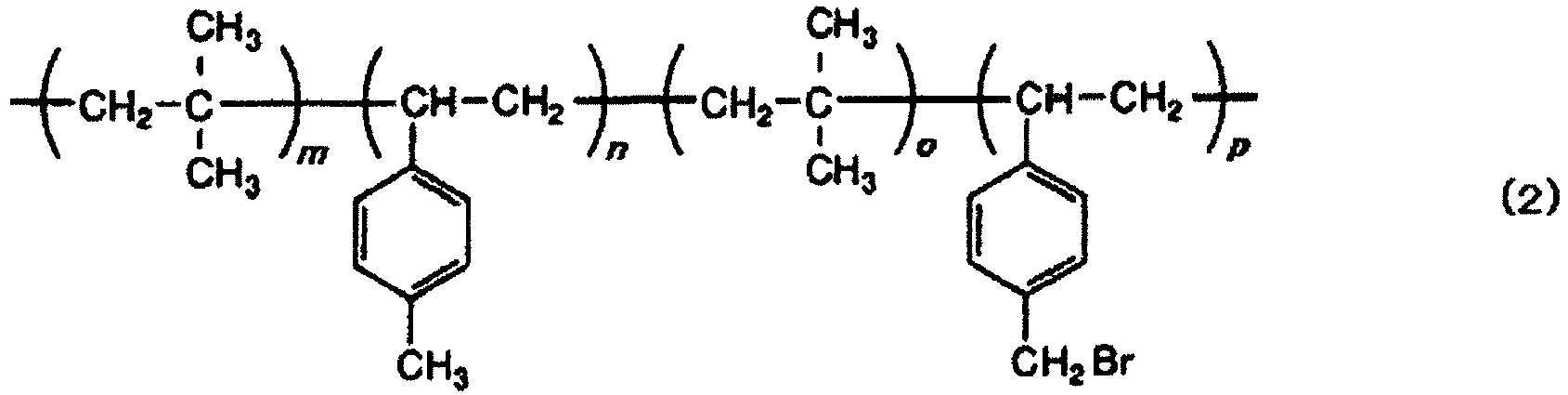
- a brominated isobutylene- para -methylstyrene copolymer is a brominated isobutylene- para -methylstyrene copolymer having a repeating unit represented by formula (1) : and is typically one having a repeating unit represented by formula (2).
- the brominated isobutylene- para -methylstyrene copolymer can be obtained from Exxon Mobil Chemical Company under the product name EXXPRO®.
- the blending amount of the halogenated isomonoolefin- para -alkylstyrene copolymer is preferably from 10 to 150 parts by weight, more preferably from 20 to 140 parts by weight, and still more preferably from 30 to 130 parts by weight based on 100 parts by weight of the total amount of the ethylene-vinyl alcohol copolymer and the polyamide.
- the amount of the halogenated isomonoolefin- para -alkylstyrene copolymer is too small, the low temperature durability is inferior.
- the amount is too large, the fluidity at the time of melting is lowered and the film formability is deteriorated.
- the halogenated isomonoolefin- para -alkylstyrene copolymer is preferably dynamically crosslinked with a crosslinking agent.
- dynamic crosslinking it is possible to fix the continuous phase and the dispersed phase of the thermoplastic resin composition.
- Dynamic crosslinking can be carried out by melt-kneading a halogenated isomonoolefin- para -alkylstyrene copolymer with a crosslinking agent.
- crosslinking agents used for dynamic crosslinking include zinc oxide, stearic acid, zinc stearate, magnesium oxide, m -phenylene bismaleimide, alkylphenol resins and their halides, and secondary amines.
- secondary amine used as a crosslinking agent include N -(1,3-dimethylbutyl)- N '-phenyl- p -phenylenediamine and polymerized 2,2,4-trimethyl-1,2-dihydroquinoline.
- zinc oxide, stearic acid, zinc stearate, N -(1,3-dimethylbutyl)- N '-phenyl- p -phenylenediamine can be preferably used as a crosslinking agent for dynamic crosslinking.
- the amount of the crosslinking agent is preferably from 4 to 12 parts by weight, more preferably from 6 to 9 parts by weight, based on 100 parts by weight of the halogenated isomonoolefin- para -alkylstyrene copolymer.
- the amount of the crosslinking agent is too small, the dynamic crosslinking becomes insufficient and the fine dispersion of the halogenated isomonoolefin- para- alkylstyrene copolymer may not be maintained, whereby the durability deteriorates.
- too large an amount of the crosslinking agent causes scorching during kneading and processing, and generation of a foreign matter in a film.
- the dispersed phase preferably further comprises an elastomer having an acid anhydride group.
- an elastomer having an acid anhydride group By blending an elastomer having an acid anhydride group, low temperature durability and flexibility can be improved.
- Examples of the acid anhydride-containing elastomer used in the present invention include maleic anhydride-modified ethylene- ⁇ -olefin copolymer elastomer, maleic anhydride-modified ethylene-(meth)acrylate copolymer elastomer, and maleic anhydride-modified ethylene-(meth)acrylate copolymer elastomer.
- maleic anhydride-modified ethylene- ⁇ -olefin copolymer elastomer examples include maleic anhydride-modified ethylene-propylene copolymer elastomer, maleic anhydride-modified ethylene-butene copolymer elastomer, maleic anhydride-modified ethylene-hexene copolymer elastomer, and maleic anhydride-modified ethylene-octene copolymer elastomer.
- maleic anhydride-modified ethylene-(meth)acrylate copolymer elastomer examples include maleic anhydride-modified ethylene-acrylate copolymer elastomer and maleic anhydride-modified ethylene-methacrylate copolymer elastomer.
- maleic anhydride-modified ethylene-(meth)acrylate copolymer elastomer examples include maleic anhydride-modified ethylene-methyl acrylate copolymer elastomer, maleic anhydride-modified ethylene-ethyl acrylate copolymer elastomer, maleic anhydride-modified ethylene-methyl methacrylate copolymer elastomer, and maleic anhydride-modified ethylene-ethyl methacrylate copolymer elastomer.
- preferable elastomers having an acid anhydride are maleic anhydride-modified ethylene-butene copolymer, maleic anhydride-modified ethylene-propylene copolymer, and maleic anhydride-modified ethylene-octene copolymer.
- Maleic anhydride-modified ethylene-butene copolymers are commercially available, and can be obtained, for example, from Mitsui Chemicals, Inc., under the product names of TAFMER® MH7010 and MH7020, and maleic anhydride-modified ethylene-propylene copolymers can be obtained, for example, from Mitsui Chemicals, Inc. under the product names of TAFMER® MP0610 and MP0620.
- the blending amount of the acid anhydride-containing elastomer is preferably from 10 to 150 parts by weight based on 100 parts by weight of the total amount of the ethylene-vinyl alcohol copolymer and the polyamide, more preferably from 20 to 140 parts by weight, and still more preferably from 30 to 130 parts by weight.
- the blending amount of the elastomer is too small, an effect of improving low temperature durability and flexibility may not be sufficiently obtained.
- the blending amount of the elastomer is too large, the fluidity at the time of melting is lowered, and the film formability is deteriorated.
- the thermoplastic resin composition of the present invention may contain a resin other than ethylene-vinyl alcohol copolymer and polyamide, an elastomer other than halogenated isomonoolefin-para-alkylstyrene copolymer and elastomer having acid anhydride, and various additives within a range not impairing an effect of the present invention.
- the additive include a crosslinking agent, an antioxidant, a plasticizer, a processing aid (such as metal soap), a crosslinking accelerating aid, a crosslinking accelerator, a strengthening agent (filler), a scorch inhibitor, a mastication accelerator, an organic modifier, a softener, and a tackifier.
- thermoplastic resin composition of the present invention is not limited, and may be produced by melt-kneading ethylene-vinyl alcohol copolymer, polyamide, halogenated isomonoolefin- para -alkylstyrene copolymer, acylglycerol, and as needed, an elastomer having an acid anhydride, and other components at a temperature not lower than the melting point of the polyamide.
- a crosslinking agent may be mixed with a halogenated isomonoolefin- para -alkylstyrene copolymer in advance, added before melt-kneading, or added during melt-kneading.
- the melt-kneading temperature is a temperature equal to or higher than the melting point of a polyamide, and is preferably a temperature 20°C higher than the melting point of the polyamide, for example 180 to 300°C.
- the melt-kneading time is usually from 1 to 10 minutes, and preferably from 1 to 5 minutes.
- thermoplastic resin composition of the present invention can be produced preferably by continuously kneading an ethylene-vinyl alcohol copolymer, a polyamide, and a halogenated isomonoolefin- para- alkylstyrene copolymer with a twin-screw kneader and dispersing the halogenated isomonoolefin- para- alkylstyrene copolymer in a continuous phase (matrix phase) composed of the ethylene-vinyl alcohol copolymer and the polyamide by the kneading and dynamic crosslinking.
- a halogenated isomonoolefin- para -alkylstyrene copolymer, a crosslinking agent, and, as needed, other additives are mixed at from 60 to 150°C to prepare a rubber compound, and the rubber compound and a polyamide and an ethylene-vinyl alcohol copolymer, and, as needed, other resins or additives are charged into a biaxial kneading machine with set temperature of from 220 to 250°C, and the halogenated isomonoolefin- para -alkylstyrene copolymer is dispersed and dynamically crosslinked to obtain a thermoplastic resin composition of the present invention.
- the present invention is also an inner liner for a pneumatic tire comprising the thermoplastic resin composition.
- thermoplastic resin composition of the present invention can be made into a film with an extruder equipped with a T-die, an inflation molding machine, or the like. Since a film made of the thermoplastic resin composition of the present invention is excellent in air permeation prevention and durability, the film can be suitably used as an inner liner of a pneumatic tire.
- the present invention is also a pneumatic tire including the inner liner.
- the pneumatic tire of the present invention is a pneumatic tire including a film of the thermoplastic resin composition as an inner liner.
- a conventional method can be used.
- the thermoplastic resin composition of the present invention is extruded into a film having a predetermined width and thickness, and the film is attached in a cylindrical shape on a tire molding drum as an inner liner.
- Members used for manufacturing ordinary tires such as a carcass layer made of unvulcanized rubber, a belt layer, a tread layer, and the like are sequentially stuck thereon, and the members are pulled out from the drum to form a green tire.
- a carcass layer made of unvulcanized rubber, a belt layer, a tread layer, and the like
- EVOH ethylene-vinyl alcohol copolymer
- polyamide As the polyamide, the following two types were used.
- Acid-modified elastomer maleic anhydride-modified ethylene-butene copolymer TAFMER® MH7010 manufactured by Mitsui Chemicals, Inc.
- Zinc oxide zinc oxide No. 3 manufactured by SEIDO CHEMICAL INDUSTRY CO., LTD.
- the film was cut into a predetermined size and laminated with a sheet of the rubber composition listed on Table 2 and vulcanized and bonded at 180°C for 10 minutes to obtain a laminate of a thermoplastic resin composition and a rubber composition.
- the laminate was cut into a width of 5 cm and subjected to repeated deformation of 1 million times using a constant strain tester (Ueshima Seisakusho Co., Ltd.).
- the air permeability coefficient of the laminate was measured at a temperature of 23°C and a humidity of 0% RH before and after applying repeated deformation, and the rate of change in air permeability coefficient was calculated by the following equation.
- rate of change of air permeability coefficient air permeability coefficient after deformation / air permeability coefficient before deformation ⁇ 100 %
- a change rate of the air permeability coefficient of less than 200% was determined to be acceptable.
- the dumbbell was set in a constant strain tester (Ueshima Seisakusho Co., Ltd.), repeatedly subjected to 40% constant strain in an atmosphere of -40°C, and the number of breaks was measured.
- thermoplastic resin composition of the present invention can be suitably used for producing an inner liner for a pneumatic tire.
Landscapes
- Chemical & Material Sciences (AREA)
- Health & Medical Sciences (AREA)
- Chemical Kinetics & Catalysis (AREA)
- Medicinal Chemistry (AREA)
- Polymers & Plastics (AREA)
- Organic Chemistry (AREA)
- Engineering & Computer Science (AREA)
- Mechanical Engineering (AREA)
- Compositions Of Macromolecular Compounds (AREA)
- Tires In General (AREA)
Abstract
Description
- The present invention relates to a thermoplastic resin composition, an inner liner for a pneumatic tire comprising the thermoplastic resin composition, and a pneumatic tire including the inner liner. More specifically, the present invention relates to a thermoplastic resin composition comprising a continuous phase comprising an ethylene-vinyl alcohol copolymer and a polyamide and a dispersed phase comprising a halogenated isomonoolefin-para-alkylstyrene copolymer, an inner liner for a pneumatic tire comprising the thermoplastic resin composition, and a pneumatic tire including the inner liner.
- An inner liner for a tire inner surface comprising a resin composition containing an ethylene-vinyl alcohol copolymer and a hydrophobic plasticizer is known (Japanese Unexamined Patent Publication No.
2002-52904 2002-52904 2002-52904 - PTL 1: Japanese Unexamined Patent Publication No.
2002-52904 - However, even when a thermoplastic resin composition comprising a continuous phase comprising an ethylene-vinyl alcohol copolymer and a polyamide and a dispersed phase comprising a halogenated isomonoolefin-para-alkylstyrene copolymer is blended with an ester of a polyhydric alcohol and a higher fatty acid having 12 or more carbon atoms, durability may not be improved when the thermoplastic resin is formed as an inner liner.
- An object of the present invention is to provide a thermoplastic resin composition which can produce an inner liner excellent in durability and less deterioration in air permeation prevention due to repeated deformation when a thermoplastic resin composition comprising a continuous phase comprising an ethylene-vinyl alcohol copolymer and a polyamide and a dispersed phase comprising a halogenated isomonoolefin-para-alkylstyrene copolymer is used as a material of an inner liner for a tire.
- The present inventor has found that it is possible to improve the durability of an inner liner produced from the thermoplastic resin composition and to suppress deterioration of air permeation prevention due to repeated deformation by blending acylglycerol derived from fatty acid having not more than 8 carbon atoms and glycerol to a thermoplastic resin composition comprising a continuous phase comprising an ethylene-vinyl alcohol copolymer and a polyamide and a dispersed phase comprising a halogenated isomonoolefin-para-alkylstyrene copolymer, thereby completing the present invention.
- The present invention is a thermoplastic resin composition comprising a continuous phase comprising an ethylene-vinyl alcohol copolymer and a polyamide and a dispersed phase comprising a halogenated isomonoolefin-para-alkylstyrene copolymer, wherein the composition comprises from 0.5 to 20 parts by weight of acylglycerol derived from a fatty acid having not more than 8 carbon atoms and glycerol based on 100 parts by weight of an ethylene-vinyl alcohol copolymer.
- The present invention includes the following aspects.
- [1] A thermoplastic resin composition comprising a continuous phase comprising an ethylene-vinyl alcohol copolymer and a polyamide and a dispersed phase comprising a halogenated isomonoolefin-para-alkylstyrene copolymer, wherein the composition comprises from 0.5 to 20 parts by weight of acylglycerol derived from a fatty acid having not more than 8 carbon atoms and glycerol based on 100 parts by weight of an ethylene-vinyl alcohol copolymer.
- [2] The thermoplastic resin composition according to [1], wherein the acylglycerol is triacylglycerol.
- [3] The thermoplastic resin composition according to [1] or [2], wherein the weight ratio of the ethylene-vinyl alcohol copolymer to the polyamide is from 95 : 5 to 40 : 60.
- [4] The thermoplastic resin composition according to any one of [1] to [3], wherein the halogenated isomonoolefin-para-alkylstyrene copolymer is from 10 to 150 parts by weight based on 100 parts by weight of the total amount of the ethylene-vinyl alcohol copolymer and the polyamide.
- [5] The thermoplastic resin composition according to any one of [1] to [4], wherein the dispersed phase further comprises an elastomer having an acid anhydride group.
- [6] The thermoplastic resin composition according to any one of [1] to [5], wherein the halogenated isomonoolefin-para-alkylstyrene copolymer is dynamically crosslinked with a crosslinking agent.
- [7] An inner liner for a pneumatic tire comprising the thermoplastic resin composition according to any one of [1] to [6].
- [8] A pneumatic tire comprising the inner liner according to [7].
- Using the thermoplastic resin composition according to the present invention, an inner liner excellent in durability and less deterioration in air permeation prevention due to repeated deformation can be produced.
- The present invention is a thermoplastic resin composition comprising a continuous phase comprising an ethylene-vinyl alcohol copolymer and a polyamide and a dispersed phase comprising a halogenated isomonoolefin-para-alkylstyrene copolymer, wherein the composition comprises from 0.5 to 20 parts by weight of acylglycerol derived from a fatty acid having not more than 8 carbon atoms and glycerol based on 100 parts by weight of an ethylene-vinyl alcohol copolymer.
- The acylglycerol used in the present invention is an ester of a fatty acid having 8 or less carbon atoms and glycerol.
- Examples of the fatty acid having not more than 8 carbon atoms include formic acid, acetic acid, propionic acid, butyric acid, isobutyric acid, valeric acid, isovaleric acid, pivalic acid, hexanoic acid, heptanoic acid, and octanoic acid, and preferable fatty acids are fatty acids having 2 to 7 carbon atoms.
- There are three types of acylglycerol, i.e., monoacylglycerol, diacylglycerol, and triacylglycerol. Among these, triacylglycerol is preferable.
- Preferable acylglycerols include glycerol triacetate, glycerol trihexanoate, glycerol triheptanoate, and glycerol trioctanoate. The most preferable acyl glycerol is glycerol triacetate.
- The blending amount of the acylglycerol is from 0.5 to 20 parts by weight, preferably from 0.8 to 15 parts by weight, and more preferably from 1.0 to 12 parts by weight, based on 100 parts by weight of ethylene-vinyl alcohol copolymer. When the blending amount of acylglycerol is too small, the effect of suppressing deterioration of air permeation prevention due to repeated deformation is poor. When the blending amount of acylglycerol is too large, the air permeation prevention before repeated deformation is deteriorated.
- The thermoplastic resin composition of the present invention comprises a continuous phase and a dispersed phase. In other words, the thermoplastic resin composition of the present invention has a so-called sea-island structure. The continuous phase (also referred to as "matrix phase") comprises an ethylene-vinyl alcohol copolymer and a polyamide. The disperse phase comprises a halogenated isomonoolefin-para-alkylstyrene copolymer. The dispersed phase preferably further comprises an elastomer having an acid anhydride group.
- An ethylene-vinyl alcohol copolymer (hereinafter, also referred to as "EVOH") used in the present invention is a copolymer composed of an ethylene unit (-CH2CH2-) and a vinyl alcohol unit (-CH2-CH(OH)-), and may contain another constituent unit in addition to the ethylene unit and the vinyl alcohol unit within a range not impairing an effect of the present invention. The ethylene-vinyl alcohol copolymer used in the present invention is preferably an ethylene-vinyl alcohol copolymer having an ethylene unit content (i.e., an ethylene compositional ratio) of from 32 to 48% by mole, and more preferably from 38 to 48% by mole. When the ethylene compositional ratio of the ethylene-vinyl alcohol copolymer is too small, the flexibility of the ethylene-vinyl alcohol copolymer decreases and the durability decreases. On the contrary, when the ethylene compositional ratio is too large, the air permeation prevention deteriorates. The ethylene-vinyl alcohol copolymer is a saponified product of an ethylene-vinyl acetate copolymer, and the saponification degree thereof is preferably 90% or more, and more preferably 98% or more. When the degree of saponification of the ethylene-vinyl alcohol copolymer is too small, the air permeation prevention is deteriorated and the thermal stability is deteriorated. Ethylene-vinyl alcohol copolymers are commercially available, for example, under the trade name of EVAL® from KURARAY CO., LTD., or under the trade name of SOANOL® from The Nippon Synthetic Chemical Industry Co., Ltd. Examples of the ethylene-vinyl alcohol copolymer having an ethylene compositional ratio of from 32% by mole to 48% by mole and a saponification degree of 90% or more include EVAL® H171B (ethylene compositional ratio of 38% by mole, saponification degree of 99% or more) and E171B (ethylene composition ratio of 44% by mole, saponification degree of 99% or more) manufactured by KURARAY CO., LTD., and Soarnol® H4815B (ethylene compositional ratio of 48% by mole, saponification degree of 99% or more), A4412B (ethylene compositional ratio of 42% by mole, saponification degree of 99% or more), and DC3212B (ethylene compositional ratio of 32% by mole, saponification degree of 99% or more) manufactured by Nippon Synthetic Chemical Industry Co., Ltd.
- The polyamide used in the present invention includes, but is not limited to, nylon 6, nylon 11, nylon 12, nylon 46, nylon 66, nylon 610, nylon 612, nylon 6/66, nylon 6/66/12, nylon MXD6, nylon 6T, and nylon 9T. Among these, nylon 6, nylon 6/66, and nylon 612 are preferable in view of compatibility between durability and air permeation prevention.
- The weight ratio of the ethylene-vinyl alcohol copolymer and the polyamide is preferably from 95 : 5 to 40 : 60, more preferably from 90 : 10 to 45 : 55%, and still more preferably from 85 : 15 to 50 : 50. When the proportion of the ethylene-vinyl alcohol copolymer is too low, the air permeation prevention before repeated deformation is not sufficient, and when the proportion of the ethylene-vinyl alcohol copolymer is too high, the low temperature durability is deteriorated.
- The halogenated isomonoolefin-para-alkylstyrene copolymer used in the present invention can be produced by halogenating a copolymer of isomonoolefin and para-alkylstyrene. The mixing ratio, polymerization rate, average molecular weight, polymerized form (block copolymer, random copolymer etc.), viscosity, halogen atom, and the like of halogenated isomonoolefin and para-alkylstyrene are not particularly limited, and can be arbitrarily selected according to physical properties or the like preferable for a thermoplastic elastomer composition. Examples of isomonoolefins constituting the halogenated isomonoolefin-para-alkylstyrene copolymer include isobutylene, isopentene, and isohexene, and isobutylene is preferable. Examples of the para-alkylstyrene constituting the halogenated isomonoolefin-para-alkylstyrene copolymer include para-methylstyrene, para-ethylstyrene, para-propylstyrene, and para-butylstyrene. Para-methylstyrene is preferable. Examples of the halogen constituting the halogenated isomonoolefin-para-alkylstyrene copolymer include fluorine, chlorine, bromine and iodine. Bromine is preferable. A particularly preferable halogenated isoolefin-para-alkylstyrene copolymer is a brominated isobutylene-para-methylstyrene copolymer.
- A brominated isobutylene-para-methylstyrene copolymer is a brominated isobutylene-para-methylstyrene copolymer having a repeating unit represented by formula (1) :

- The blending amount of the halogenated isomonoolefin-para-alkylstyrene copolymer is preferably from 10 to 150 parts by weight, more preferably from 20 to 140 parts by weight, and still more preferably from 30 to 130 parts by weight based on 100 parts by weight of the total amount of the ethylene-vinyl alcohol copolymer and the polyamide. When the amount of the halogenated isomonoolefin-para-alkylstyrene copolymer is too small, the low temperature durability is inferior. When the amount is too large, the fluidity at the time of melting is lowered and the film formability is deteriorated.
- The halogenated isomonoolefin-para-alkylstyrene copolymer is preferably dynamically crosslinked with a crosslinking agent. By dynamic crosslinking, it is possible to fix the continuous phase and the dispersed phase of the thermoplastic resin composition. Dynamic crosslinking can be carried out by melt-kneading a halogenated isomonoolefin-para-alkylstyrene copolymer with a crosslinking agent.
- Examples of crosslinking agents used for dynamic crosslinking include zinc oxide, stearic acid, zinc stearate, magnesium oxide, m-phenylene bismaleimide, alkylphenol resins and their halides, and secondary amines. Examples of the secondary amine used as a crosslinking agent include N-(1,3-dimethylbutyl)-N'-phenyl-p-phenylenediamine and polymerized 2,2,4-trimethyl-1,2-dihydroquinoline. Among them, zinc oxide, stearic acid, zinc stearate, N-(1,3-dimethylbutyl)-N'-phenyl-p-phenylenediamine can be preferably used as a crosslinking agent for dynamic crosslinking.
- The amount of the crosslinking agent is preferably from 4 to 12 parts by weight, more preferably from 6 to 9 parts by weight, based on 100 parts by weight of the halogenated isomonoolefin-para-alkylstyrene copolymer. When the amount of the crosslinking agent is too small, the dynamic crosslinking becomes insufficient and the fine dispersion of the halogenated isomonoolefin-para-alkylstyrene copolymer may not be maintained, whereby the durability deteriorates. On the contrary, too large an amount of the crosslinking agent causes scorching during kneading and processing, and generation of a foreign matter in a film.
- The dispersed phase preferably further comprises an elastomer having an acid anhydride group. By blending an elastomer having an acid anhydride group, low temperature durability and flexibility can be improved.
- Examples of the acid anhydride-containing elastomer used in the present invention include maleic anhydride-modified ethylene-α-olefin copolymer elastomer, maleic anhydride-modified ethylene-(meth)acrylate copolymer elastomer, and maleic anhydride-modified ethylene-(meth)acrylate copolymer elastomer.
- Examples of the maleic anhydride-modified ethylene-α-olefin copolymer elastomer include maleic anhydride-modified ethylene-propylene copolymer elastomer, maleic anhydride-modified ethylene-butene copolymer elastomer, maleic anhydride-modified ethylene-hexene copolymer elastomer, and maleic anhydride-modified ethylene-octene copolymer elastomer.
- Examples of the maleic anhydride-modified ethylene-(meth)acrylate copolymer elastomer include maleic anhydride-modified ethylene-acrylate copolymer elastomer and maleic anhydride-modified ethylene-methacrylate copolymer elastomer.
- Examples of the maleic anhydride-modified ethylene-(meth)acrylate copolymer elastomer include maleic anhydride-modified ethylene-methyl acrylate copolymer elastomer, maleic anhydride-modified ethylene-ethyl acrylate copolymer elastomer, maleic anhydride-modified ethylene-methyl methacrylate copolymer elastomer, and maleic anhydride-modified ethylene-ethyl methacrylate copolymer elastomer.
- Among them, preferable elastomers having an acid anhydride are maleic anhydride-modified ethylene-butene copolymer, maleic anhydride-modified ethylene-propylene copolymer, and maleic anhydride-modified ethylene-octene copolymer. Maleic anhydride-modified ethylene-butene copolymers are commercially available, and can be obtained, for example, from Mitsui Chemicals, Inc., under the product names of TAFMER® MH7010 and MH7020, and maleic anhydride-modified ethylene-propylene copolymers can be obtained, for example, from Mitsui Chemicals, Inc. under the product names of TAFMER® MP0610 and MP0620.
- When the thermoplastic resin composition comprises an elastomer having an acid anhydride, the blending amount of the acid anhydride-containing elastomer is preferably from 10 to 150 parts by weight based on 100 parts by weight of the total amount of the ethylene-vinyl alcohol copolymer and the polyamide, more preferably from 20 to 140 parts by weight, and still more preferably from 30 to 130 parts by weight. When the blending amount of the elastomer is too small, an effect of improving low temperature durability and flexibility may not be sufficiently obtained. When the blending amount of the elastomer is too large, the fluidity at the time of melting is lowered, and the film formability is deteriorated.
- The thermoplastic resin composition of the present invention may contain a resin other than ethylene-vinyl alcohol copolymer and polyamide, an elastomer other than halogenated isomonoolefin-para-alkylstyrene copolymer and elastomer having acid anhydride, and various additives within a range not impairing an effect of the present invention. Examples of the additive include a crosslinking agent, an antioxidant, a plasticizer, a processing aid (such as metal soap), a crosslinking accelerating aid, a crosslinking accelerator, a strengthening agent (filler), a scorch inhibitor, a mastication accelerator, an organic modifier, a softener, and a tackifier.
- The thermoplastic resin composition of the present invention is not limited, and may be produced by melt-kneading ethylene-vinyl alcohol copolymer, polyamide, halogenated isomonoolefin-para-alkylstyrene copolymer, acylglycerol, and as needed, an elastomer having an acid anhydride, and other components at a temperature not lower than the melting point of the polyamide. When a crosslinking agent is added, the crosslinking agent may be mixed with a halogenated isomonoolefin-para-alkylstyrene copolymer in advance, added before melt-kneading, or added during melt-kneading.
- The melt-kneading temperature is a temperature equal to or higher than the melting point of a polyamide, and is preferably a temperature 20°C higher than the melting point of the polyamide, for example 180 to 300°C. The melt-kneading time is usually from 1 to 10 minutes, and preferably from 1 to 5 minutes.
- The thermoplastic resin composition of the present invention can be produced preferably by continuously kneading an ethylene-vinyl alcohol copolymer, a polyamide, and a halogenated isomonoolefin-para-alkylstyrene copolymer with a twin-screw kneader and dispersing the halogenated isomonoolefin-para-alkylstyrene copolymer in a continuous phase (matrix phase) composed of the ethylene-vinyl alcohol copolymer and the polyamide by the kneading and dynamic crosslinking.
- More specifically, for example, a halogenated isomonoolefin-para-alkylstyrene copolymer, a crosslinking agent, and, as needed, other additives are mixed at from 60 to 150°C to prepare a rubber compound, and the rubber compound and a polyamide and an ethylene-vinyl alcohol copolymer, and, as needed, other resins or additives are charged into a biaxial kneading machine with set temperature of from 220 to 250°C, and the halogenated isomonoolefin-para-alkylstyrene copolymer is dispersed and dynamically crosslinked to obtain a thermoplastic resin composition of the present invention.
- The present invention is also an inner liner for a pneumatic tire comprising the thermoplastic resin composition.
- The thermoplastic resin composition of the present invention can be made into a film with an extruder equipped with a T-die, an inflation molding machine, or the like. Since a film made of the thermoplastic resin composition of the present invention is excellent in air permeation prevention and durability, the film can be suitably used as an inner liner of a pneumatic tire.
- The present invention is also a pneumatic tire including the inner liner.
- More specifically, the pneumatic tire of the present invention is a pneumatic tire including a film of the thermoplastic resin composition as an inner liner. As a method of manufacturing the pneumatic tire, a conventional method can be used. For example, the thermoplastic resin composition of the present invention is extruded into a film having a predetermined width and thickness, and the film is attached in a cylindrical shape on a tire molding drum as an inner liner. Members used for manufacturing ordinary tires such as a carcass layer made of unvulcanized rubber, a belt layer, a tread layer, and the like are sequentially stuck thereon, and the members are pulled out from the drum to form a green tire. Next, by heating and vulcanizing this green tire according to a conventional method, it is possible to manufacture a desired pneumatic tire.
- Hereinafter, the present invention will be described in more detail based on Examples, but is not limited to the following Examples.
- Raw materials used in the following Examples and Comparative Examples are as follows.
- As the ethylene-vinyl alcohol copolymer (hereinafter, also referred to as "EVOH"), the following three types were used.
- SOANOL® D2908 manufactured by Nippon Synthetic Chemical Industry Co., Ltd.
- SOANOL® E3808 manufactured by Nippon Synthetic Chemical Industry Co., Ltd.
- SOANOL® H4815B manufactured by Nippon Synthetic Chemical Industry Co., Ltd.
- As the polyamide, the following two types were used.
- Nylon 6: "UBE Nylon" 1013B manufactured by Ube Industries, Ltd.
- Nylon 6/66: "UBE Nylon" 5023B manufactured by Ube Industries, Ltd.
- The following halogenated isomonoolefin-para-alkylstyrene copolymer was used.
Brominated isobutylene-para-methyl styrene copolymerize rubber: EXXPRO® MDX89-4 manufactured by Exxon Mobil Chemical Company - The following elastomer having an acid anhydride group was used.
Acid-modified elastomer: maleic anhydride-modified ethylene-butene copolymer TAFMER® MH7010 manufactured by Mitsui Chemicals, Inc. - The following 5 types were used as acyl glycerol.
- Glycerol triacetate: manufactured by DAIHACHI CHEMICAL INDUSTRY CO., LTD.
- Glycerol trioctanoate: PANACETE® 800 manufactured by NOF CORPORATION
- Glycerol monostearate: "MONOGLY MD" manufactured by NOF CORPORATION
- Glycerol trihexanoate manufactured by Energy Chemical Co., Ltd.
- Glycerol triheptanoate manufactured by Energy Chemical Co., Ltd.
- The following crosslinking agent was used.
Zinc oxide: zinc oxide No. 3 manufactured by SEIDO CHEMICAL INDUSTRY CO., LTD. - The following antioxidant was used.
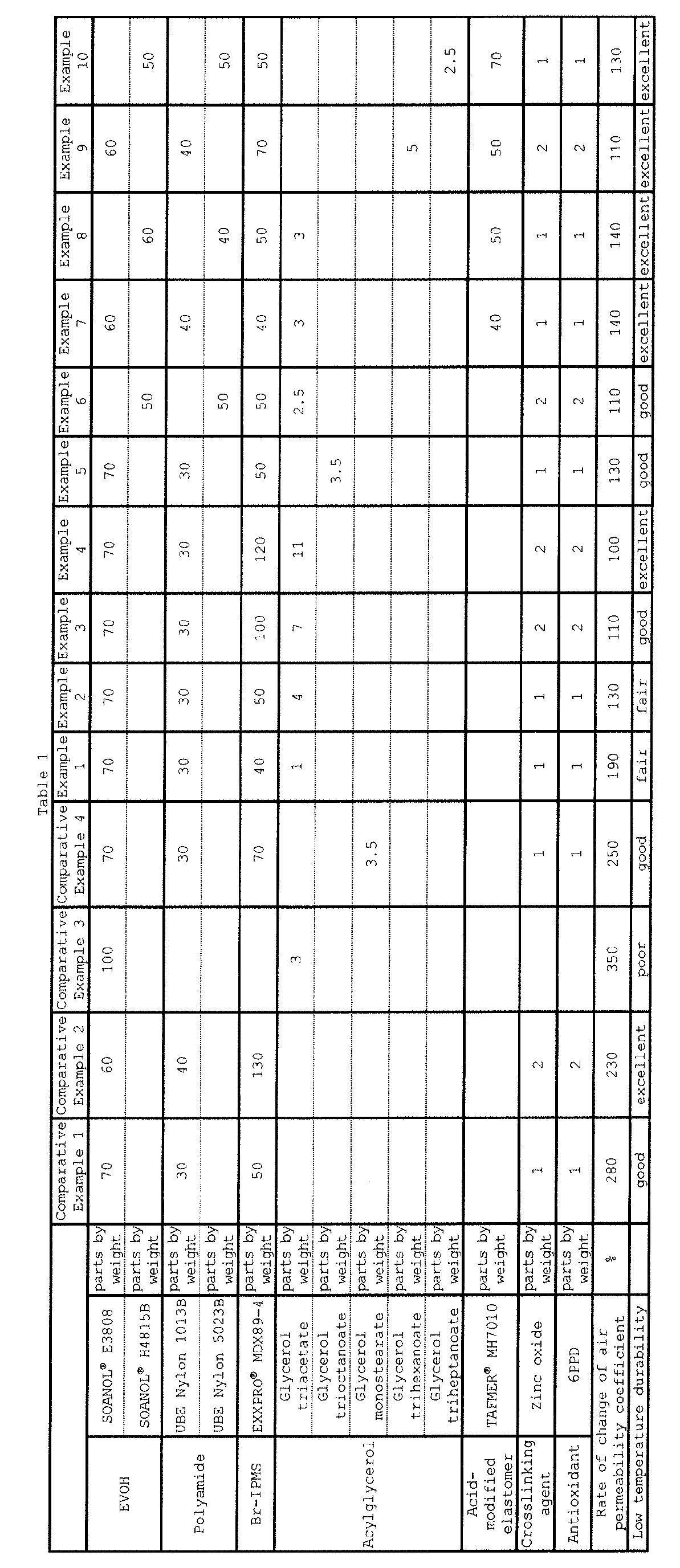
6PPD: Santoflex 13 (N-(1,3-dimethylbutyl)-N'-phenyl-1,4-phenylenediamine) manufactured by Flexsys Company - An ethylene-vinyl alcohol copolymer, a polyamide, a brominated isobutylene-paramethylstyrene copolymer rubber (hereinafter, referred to as "Br-IPMS"), an acylglycerol, an acid-modified elastomer, and a crosslinking agent were charged into a cylinder of a twin-screw kneading extruder (manufactured by THE JAPAN STEEL WORKS, LTD.) in the formulation shown in Table 1, conveyed to a kneading zone set at a temperature of 230°C and a residence time of about from 3 to 8 minutes, melt-kneaded, and the melt-kneaded product was extruded in a strand shape from a die attached to the discharge port. The obtained strand-shaped extrudate was pelletized with a resin pelletizer to obtain a pellet-like thermoplastic resin composition. For the obtained thermoplastic resin composition, the rate of change of air permeability coefficient and low temperature durability were evaluated. The evaluation results are listed on Table 1.
- The prepared pellet-shaped thermoplastic resin composition was molded into a film having an average thickness of 0.1 mm under extrusion conditions of extrusion temperatures of C1/C2/C3/C4/die = 220/225/230/235/235°C, a cooling roll temperature of 50°C, and a take-up speed of 4 m/min using a 550 mm width T-die equipped 40 mmφ single screw extruder (manufactured by Pla Giken Co., Ltd.). The film was cut into a predetermined size and laminated with a sheet of the rubber composition listed on Table 2 and vulcanized and bonded at 180°C for 10 minutes to obtain a laminate of a thermoplastic resin composition and a rubber composition. The laminate was cut into a width of 5 cm and subjected to repeated deformation of 1 million times using a constant strain tester (Ueshima Seisakusho Co., Ltd.). The air permeability coefficient of the laminate was measured at a temperature of 23°C and a humidity of 0% RH before and after applying repeated deformation, and the rate of change in air permeability coefficient was calculated by the following equation.

- A change rate of the air permeability coefficient of less than 200% was determined to be acceptable.
- The prepared pellet-shaped thermoplastic resin composition was molded into a sheet having an average thickness of 1.0 mm under extrusion conditions of extrusion temperatures of Cl/C2/C3/C4/die = 220/225/230/235/235°C, a cooling roll temperature of 50°C, and a take-up speed of 1.0 m/min using a 200 mm width T-die equipped 40 mmφ single screw extruder (Pla Giken Co., Ltd.), and a dumbbell (JIS No. 3) was punched out from the sheet. The dumbbell was set in a constant strain tester (Ueshima Seisakusho Co., Ltd.), repeatedly subjected to 40% constant strain in an atmosphere of -40°C, and the number of breaks was measured. Based on the number of breaks of Comparative Example 1, the number of breaks of not less than 0.5 times and less than 3.0 times the number of breaks of Comparative Example 1 was judged as "good", the number of breaks of not less than 0.2 times and less than 0.5 times the number of breaks of Comparative Example 1 was judged as "fair", the number of breaks less than 0.2 times the number of breaks of Comparative Example 1 was judged as "poor", and the number of breaks of not less than 3.0 times the number of breaks of Comparative Example 1 was judged as "excellent". When the judgment is "fair", "good", or "excellent", a tire to which a film made of the thermoplastic resin composition is applied can be run with no problem in durability.
-
-
Table 2 Formulation of Unvulcanized Rubber Composition Raw Materials Amount (parts by weight) Halogenated butyl rubber (1) 100 GPF carbon black (2) 30 Wet silica (3) 20 Aromatic oil (4) 7.5 Zinc oxide (5) 3 Stearic acid (6) 1 Sulfur (7) 1 Vulcanization accelerator (8) 1.5 Total 164 Footnote:
(1) BROMOBUTYL X2 manufactured by LANXESS Rubber Corporation
(2) HTC#G manufactured by NSCC Carbon Co., Ltd.
(3) Zeosil® 165GR manufactured by Rhodia Corporation
(4) Extract 4S manufactured by SHOWA SHELL SEKIYU K.K.
(5) Zinc oxide No. 3 manufactured by SEIDO CHEMICAL INDUSTRY CO., LTD.
(6) Beads Stearic Acid YR manufactured by NOF CORPORATION
(7) "GOLDEN FLOWER" SULFUR POWDER 150 mesh manufactured by Tsurumi Chemical Industry Co., ltd.
(8) NOCCELER DM manufactured by OUCHI SHINKO CHEMICAL INDUSTRIAL CO., LTD. - The thermoplastic resin composition of the present invention can be suitably used for producing an inner liner for a pneumatic tire.
Claims (8)
- A thermoplastic resin composition comprising a continuous phase comprising an ethylene-vinyl alcohol copolymer and a polyamide and a dispersed phase comprising a halogenated isomonoolefin-para-alkylstyrene copolymer, wherein the composition comprises from 0.5 to 20 parts by weight of acylglycerol derived from a fatty acid having not more than 8 carbon atoms and glycerol based on 100 parts by weight of the ethylene-vinyl alcohol copolymer.
- The thermoplastic resin composition according to claim 1, wherein the acylglycerol is triacylglycerol.
- The thermoplastic resin composition according to claim 1 or 2, wherein the weight ratio of the ethylene-vinyl alcohol copolymer to the polyamide is from 95 : 5 to 40 : 60.
- The thermoplastic resin composition according to any one of claims 1 to 3, wherein the halogenated isomonoolefin-para-alkylstyrene copolymer is from 10 to 150 parts by weight based on 100 parts by weight of the total amount of the ethylene-vinyl alcohol copolymer and the polyamide.
- The thermoplastic resin composition according to any one of claims 1 to 4, wherein the dispersed phase further comprises an elastomer having an acid anhydride group.
- The thermoplastic resin composition according to any one of claims 1 to 5, wherein the halogenated isomonoolefin-para-alkylstyrene copolymer is dynamically crosslinked with a crosslinking agent.
- An inner liner for a pneumatic tire comprising the thermoplastic resin composition according to any one of claims 1 to 6.
- A pneumatic tire comprising the inner liner according to claim 7.
Applications Claiming Priority (2)
| Application Number | Priority Date | Filing Date | Title |
|---|---|---|---|
| JP2015136242A JP6565398B2 (en) | 2015-07-07 | 2015-07-07 | Thermoplastic resin composition, inner liner and pneumatic tire |
| PCT/JP2016/069312 WO2017006827A1 (en) | 2015-07-07 | 2016-06-29 | Thermoplastic resin composition, inner liner and pneumatic tire |
Publications (3)
| Publication Number | Publication Date |
|---|---|
| EP3321318A1 true EP3321318A1 (en) | 2018-05-16 |
| EP3321318A4 EP3321318A4 (en) | 2019-02-20 |
| EP3321318B1 EP3321318B1 (en) | 2020-03-18 |
Family
ID=57685644
Family Applications (1)
| Application Number | Title | Priority Date | Filing Date |
|---|---|---|---|
| EP16821296.7A Active EP3321318B1 (en) | 2015-07-07 | 2016-06-29 | Thermoplastic resin composition, inner liner and pneumatic tire |
Country Status (5)
| Country | Link |
|---|---|
| US (1) | US10889709B2 (en) |
| EP (1) | EP3321318B1 (en) |
| JP (1) | JP6565398B2 (en) |
| CN (1) | CN107735449B (en) |
| WO (1) | WO2017006827A1 (en) |
Cited By (1)
| Publication number | Priority date | Publication date | Assignee | Title |
|---|---|---|---|---|
| EP3725843A4 (en) * | 2017-12-12 | 2021-11-17 | The Yokohama Rubber Co., Ltd. | THERMOPLASTIC ELASTOMER COMPOSITION FOR TIRES AND TIRES |
Families Citing this family (4)
| Publication number | Priority date | Publication date | Assignee | Title |
|---|---|---|---|---|
| WO2018123192A1 (en) * | 2016-12-28 | 2018-07-05 | 横浜ゴム株式会社 | Thermoplastic resin composition, inner liner, and pneumatic tire |
| JP6926495B2 (en) * | 2017-02-01 | 2021-08-25 | 横浜ゴム株式会社 | Thermoplastic composition, inner liner and pneumatic tire |
| JP7082898B2 (en) * | 2018-04-06 | 2022-06-09 | 横浜ゴム株式会社 | A method for manufacturing a thermoplastic resin composition for a tire inner liner, a tire inner liner, a pneumatic tire, a tire inner liner, and a method for manufacturing a pneumatic tire. |
| EP3854844A4 (en) * | 2018-09-19 | 2022-06-08 | Bridgestone Corporation | RUBBER AND TIRE COMPOSITION |
Family Cites Families (14)
| Publication number | Priority date | Publication date | Assignee | Title |
|---|---|---|---|---|
| JPS6339935A (en) * | 1986-08-04 | 1988-02-20 | Riken Vitamin Co Ltd | Rubber compound composition |
| US6359071B1 (en) | 1998-01-13 | 2002-03-19 | The Yokohama Rubber Co., Ltd. | Thermoplastic elastomer composition, process for producing the same, and pneumatic tire and hose made with the same |
| JP2002052904A (en) * | 2000-08-11 | 2002-02-19 | Kuraray Co Ltd | Inner liner for tire inner surface |
| CA2627170C (en) | 2005-10-27 | 2012-02-21 | Exxonmobil Chemical Patents Inc. | Low permeability thermoplastic elastomer composition |
| RU2395544C2 (en) * | 2005-10-27 | 2010-07-27 | Эксонмобил Кемикал Пэйтентс, Инк. | Low-permeability thermoplastic elastomer composition |
| JP2007161822A (en) * | 2005-12-12 | 2007-06-28 | Yokohama Rubber Co Ltd:The | Rubber composition for tire |
| JP5754092B2 (en) | 2010-07-15 | 2015-07-22 | 横浜ゴム株式会社 | Laminated body and pneumatic tire using the same |
| JP5720145B2 (en) * | 2010-08-26 | 2015-05-20 | 横浜ゴム株式会社 | Thermoplastic elastomer composition and pneumatic tire using the same |
| JP5909846B2 (en) * | 2010-08-26 | 2016-04-27 | 横浜ゴム株式会社 | Thermoplastic resin composition and tire using the same |
| JP4862954B1 (en) | 2010-09-13 | 2012-01-25 | 横浜ゴム株式会社 | Method for producing thermoplastic resin composition |
| JP5644332B2 (en) | 2010-09-29 | 2014-12-24 | 横浜ゴム株式会社 | Method for producing thermoplastic elastomer composition |
| WO2014030541A1 (en) | 2012-08-21 | 2014-02-27 | 横浜ゴム株式会社 | Method for producing thermoplastic elastomer composition |
| CN104937023B (en) * | 2012-12-19 | 2017-08-15 | 株式会社普利司通 | Rubber composition and the tire produced using the rubber composition |
| JP6234449B2 (en) | 2013-05-17 | 2017-11-22 | 株式会社ブリヂストン | Rubber composition and tire using the same |
-
2015
- 2015-07-07 JP JP2015136242A patent/JP6565398B2/en not_active Expired - Fee Related
-
2016
- 2016-06-29 WO PCT/JP2016/069312 patent/WO2017006827A1/en not_active Ceased
- 2016-06-29 US US15/741,654 patent/US10889709B2/en not_active Expired - Fee Related
- 2016-06-29 CN CN201680037886.4A patent/CN107735449B/en not_active Expired - Fee Related
- 2016-06-29 EP EP16821296.7A patent/EP3321318B1/en active Active
Cited By (2)
| Publication number | Priority date | Publication date | Assignee | Title |
|---|---|---|---|---|
| EP3725843A4 (en) * | 2017-12-12 | 2021-11-17 | The Yokohama Rubber Co., Ltd. | THERMOPLASTIC ELASTOMER COMPOSITION FOR TIRES AND TIRES |
| US11566125B2 (en) | 2017-12-12 | 2023-01-31 | The Yokohama Rubber Co., Ltd. | Thermoplastic elastomer composition for tires, and tire |
Also Published As
| Publication number | Publication date |
|---|---|
| EP3321318A4 (en) | 2019-02-20 |
| JP6565398B2 (en) | 2019-08-28 |
| CN107735449B (en) | 2020-03-20 |
| CN107735449A (en) | 2018-02-23 |
| JP2017019891A (en) | 2017-01-26 |
| WO2017006827A1 (en) | 2017-01-12 |
| US10889709B2 (en) | 2021-01-12 |
| US20200087502A1 (en) | 2020-03-19 |
| EP3321318B1 (en) | 2020-03-18 |
Similar Documents
| Publication | Publication Date | Title |
|---|---|---|
| EP0857761B1 (en) | Process for making a pneumatic tire having an almost impermeable thermoplastic elastomer composition in gas-barrier layer | |
| EP2474570B1 (en) | Manufacturing method for thermoplastic resin composition | |
| JP5644332B2 (en) | Method for producing thermoplastic elastomer composition | |
| CN105764685B (en) | Laminate of film and rubber composition, and tire comprising same | |
| CN102482471B (en) | Thermoplastic elsatomer composition, and pneumatic tire using same | |
| KR101600087B1 (en) | Thermoplastic elastomer composition and pneumatic tire using the same | |
| CN102066480B (en) | Elastomer composition and pneumatic tire using the same | |
| EP3321318B1 (en) | Thermoplastic resin composition, inner liner and pneumatic tire | |
| EP2607406B1 (en) | Method for producing thermoplastic resin compositions | |
| EP3578605B1 (en) | Thermoplastic resin composition, inner liner, and pneumatic tire | |
| JPH10114840A (en) | Low-gas-permeability thermoplastic elastomer composition and its production | |
| WO2013136596A1 (en) | Thermoplastic elastomer composition | |
| JP7053242B2 (en) | Thermoplastic resin composition for pneumatic tire inner liner | |
| US8933172B2 (en) | Thermoplastic elastomer composition and manufacturing method therefor | |
| JP5774202B2 (en) | Thermoplastic elastomer composition | |
| JP2019019183A (en) | Thermoplastic resin composition for tire inner liner | |
| WO2018123192A1 (en) | Thermoplastic resin composition, inner liner, and pneumatic tire | |
| JP2006176575A (en) | Thermoplastic elastomer composition containing modified butyl rubber |
Legal Events
| Date | Code | Title | Description |
|---|---|---|---|
| STAA | Information on the status of an ep patent application or granted ep patent |
Free format text: STATUS: THE INTERNATIONAL PUBLICATION HAS BEEN MADE |
|
| PUAI | Public reference made under article 153(3) epc to a published international application that has entered the european phase |
Free format text: ORIGINAL CODE: 0009012 |
|
| STAA | Information on the status of an ep patent application or granted ep patent |
Free format text: STATUS: REQUEST FOR EXAMINATION WAS MADE |
|
| 17P | Request for examination filed |
Effective date: 20180104 |
|
| AK | Designated contracting states |
Kind code of ref document: A1 Designated state(s): AL AT BE BG CH CY CZ DE DK EE ES FI FR GB GR HR HU IE IS IT LI LT LU LV MC MK MT NL NO PL PT RO RS SE SI SK SM TR |
|
| AX | Request for extension of the european patent |
Extension state: BA ME |
|
| DAV | Request for validation of the european patent (deleted) | ||
| DAX | Request for extension of the european patent (deleted) | ||
| A4 | Supplementary search report drawn up and despatched |
Effective date: 20190123 |
|
| RIC1 | Information provided on ipc code assigned before grant |
Ipc: C08K 5/103 20060101ALI20190117BHEP Ipc: C08L 25/18 20060101ALI20190117BHEP Ipc: C08L 29/04 20060101AFI20190117BHEP Ipc: C08L 77/00 20060101ALI20190117BHEP Ipc: B60C 5/14 20060101ALI20190117BHEP |
|
| GRAP | Despatch of communication of intention to grant a patent |
Free format text: ORIGINAL CODE: EPIDOSNIGR1 |
|
| STAA | Information on the status of an ep patent application or granted ep patent |
Free format text: STATUS: GRANT OF PATENT IS INTENDED |
|
| INTG | Intention to grant announced |
Effective date: 20191021 |
|
| GRAS | Grant fee paid |
Free format text: ORIGINAL CODE: EPIDOSNIGR3 |
|
| GRAA | (expected) grant |
Free format text: ORIGINAL CODE: 0009210 |
|
| STAA | Information on the status of an ep patent application or granted ep patent |
Free format text: STATUS: THE PATENT HAS BEEN GRANTED |
|
| AK | Designated contracting states |
Kind code of ref document: B1 Designated state(s): AL AT BE BG CH CY CZ DE DK EE ES FI FR GB GR HR HU IE IS IT LI LT LU LV MC MK MT NL NO PL PT RO RS SE SI SK SM TR |
|
| REG | Reference to a national code |
Ref country code: GB Ref legal event code: FG4D |
|
| REG | Reference to a national code |
Ref country code: DE Ref legal event code: R096 Ref document number: 602016032215 Country of ref document: DE |
|
| REG | Reference to a national code |
Ref country code: AT Ref legal event code: REF Ref document number: 1245873 Country of ref document: AT Kind code of ref document: T Effective date: 20200415 Ref country code: IE Ref legal event code: FG4D |
|
| PG25 | Lapsed in a contracting state [announced via postgrant information from national office to epo] |
Ref country code: RS Free format text: LAPSE BECAUSE OF FAILURE TO SUBMIT A TRANSLATION OF THE DESCRIPTION OR TO PAY THE FEE WITHIN THE PRESCRIBED TIME-LIMIT Effective date: 20200318 Ref country code: FI Free format text: LAPSE BECAUSE OF FAILURE TO SUBMIT A TRANSLATION OF THE DESCRIPTION OR TO PAY THE FEE WITHIN THE PRESCRIBED TIME-LIMIT Effective date: 20200318 Ref country code: NO Free format text: LAPSE BECAUSE OF FAILURE TO SUBMIT A TRANSLATION OF THE DESCRIPTION OR TO PAY THE FEE WITHIN THE PRESCRIBED TIME-LIMIT Effective date: 20200618 |
|
| REG | Reference to a national code |
Ref country code: NL Ref legal event code: MP Effective date: 20200318 |
|
| PG25 | Lapsed in a contracting state [announced via postgrant information from national office to epo] |
Ref country code: SE Free format text: LAPSE BECAUSE OF FAILURE TO SUBMIT A TRANSLATION OF THE DESCRIPTION OR TO PAY THE FEE WITHIN THE PRESCRIBED TIME-LIMIT Effective date: 20200318 Ref country code: LV Free format text: LAPSE BECAUSE OF FAILURE TO SUBMIT A TRANSLATION OF THE DESCRIPTION OR TO PAY THE FEE WITHIN THE PRESCRIBED TIME-LIMIT Effective date: 20200318 Ref country code: HR Free format text: LAPSE BECAUSE OF FAILURE TO SUBMIT A TRANSLATION OF THE DESCRIPTION OR TO PAY THE FEE WITHIN THE PRESCRIBED TIME-LIMIT Effective date: 20200318 Ref country code: BG Free format text: LAPSE BECAUSE OF FAILURE TO SUBMIT A TRANSLATION OF THE DESCRIPTION OR TO PAY THE FEE WITHIN THE PRESCRIBED TIME-LIMIT Effective date: 20200618 Ref country code: GR Free format text: LAPSE BECAUSE OF FAILURE TO SUBMIT A TRANSLATION OF THE DESCRIPTION OR TO PAY THE FEE WITHIN THE PRESCRIBED TIME-LIMIT Effective date: 20200619 |
|
| REG | Reference to a national code |
Ref country code: LT Ref legal event code: MG4D |
|
| PG25 | Lapsed in a contracting state [announced via postgrant information from national office to epo] |
Ref country code: NL Free format text: LAPSE BECAUSE OF FAILURE TO SUBMIT A TRANSLATION OF THE DESCRIPTION OR TO PAY THE FEE WITHIN THE PRESCRIBED TIME-LIMIT Effective date: 20200318 |
|
| PG25 | Lapsed in a contracting state [announced via postgrant information from national office to epo] |
Ref country code: RO Free format text: LAPSE BECAUSE OF FAILURE TO SUBMIT A TRANSLATION OF THE DESCRIPTION OR TO PAY THE FEE WITHIN THE PRESCRIBED TIME-LIMIT Effective date: 20200318 Ref country code: IS Free format text: LAPSE BECAUSE OF FAILURE TO SUBMIT A TRANSLATION OF THE DESCRIPTION OR TO PAY THE FEE WITHIN THE PRESCRIBED TIME-LIMIT Effective date: 20200718 Ref country code: SK Free format text: LAPSE BECAUSE OF FAILURE TO SUBMIT A TRANSLATION OF THE DESCRIPTION OR TO PAY THE FEE WITHIN THE PRESCRIBED TIME-LIMIT Effective date: 20200318 Ref country code: CZ Free format text: LAPSE BECAUSE OF FAILURE TO SUBMIT A TRANSLATION OF THE DESCRIPTION OR TO PAY THE FEE WITHIN THE PRESCRIBED TIME-LIMIT Effective date: 20200318 Ref country code: LT Free format text: LAPSE BECAUSE OF FAILURE TO SUBMIT A TRANSLATION OF THE DESCRIPTION OR TO PAY THE FEE WITHIN THE PRESCRIBED TIME-LIMIT Effective date: 20200318 Ref country code: SM Free format text: LAPSE BECAUSE OF FAILURE TO SUBMIT A TRANSLATION OF THE DESCRIPTION OR TO PAY THE FEE WITHIN THE PRESCRIBED TIME-LIMIT Effective date: 20200318 Ref country code: EE Free format text: LAPSE BECAUSE OF FAILURE TO SUBMIT A TRANSLATION OF THE DESCRIPTION OR TO PAY THE FEE WITHIN THE PRESCRIBED TIME-LIMIT Effective date: 20200318 Ref country code: PT Free format text: LAPSE BECAUSE OF FAILURE TO SUBMIT A TRANSLATION OF THE DESCRIPTION OR TO PAY THE FEE WITHIN THE PRESCRIBED TIME-LIMIT Effective date: 20200812 |
|
| REG | Reference to a national code |
Ref country code: AT Ref legal event code: MK05 Ref document number: 1245873 Country of ref document: AT Kind code of ref document: T Effective date: 20200318 |
|
| REG | Reference to a national code |
Ref country code: DE Ref legal event code: R097 Ref document number: 602016032215 Country of ref document: DE |
|
| PLBE | No opposition filed within time limit |
Free format text: ORIGINAL CODE: 0009261 |
|
| STAA | Information on the status of an ep patent application or granted ep patent |
Free format text: STATUS: NO OPPOSITION FILED WITHIN TIME LIMIT |
|
| PG25 | Lapsed in a contracting state [announced via postgrant information from national office to epo] |
Ref country code: AT Free format text: LAPSE BECAUSE OF FAILURE TO SUBMIT A TRANSLATION OF THE DESCRIPTION OR TO PAY THE FEE WITHIN THE PRESCRIBED TIME-LIMIT Effective date: 20200318 Ref country code: ES Free format text: LAPSE BECAUSE OF FAILURE TO SUBMIT A TRANSLATION OF THE DESCRIPTION OR TO PAY THE FEE WITHIN THE PRESCRIBED TIME-LIMIT Effective date: 20200318 Ref country code: DK Free format text: LAPSE BECAUSE OF FAILURE TO SUBMIT A TRANSLATION OF THE DESCRIPTION OR TO PAY THE FEE WITHIN THE PRESCRIBED TIME-LIMIT Effective date: 20200318 Ref country code: MC Free format text: LAPSE BECAUSE OF FAILURE TO SUBMIT A TRANSLATION OF THE DESCRIPTION OR TO PAY THE FEE WITHIN THE PRESCRIBED TIME-LIMIT Effective date: 20200318 |
|
| REG | Reference to a national code |
Ref country code: CH Ref legal event code: PL |
|
| 26N | No opposition filed |
Effective date: 20201221 |
|
| PG25 | Lapsed in a contracting state [announced via postgrant information from national office to epo] |
Ref country code: PL Free format text: LAPSE BECAUSE OF FAILURE TO SUBMIT A TRANSLATION OF THE DESCRIPTION OR TO PAY THE FEE WITHIN THE PRESCRIBED TIME-LIMIT Effective date: 20200318 |
|
| GBPC | Gb: european patent ceased through non-payment of renewal fee |
Effective date: 20200629 |
|
| PG25 | Lapsed in a contracting state [announced via postgrant information from national office to epo] |
Ref country code: LU Free format text: LAPSE BECAUSE OF NON-PAYMENT OF DUE FEES Effective date: 20200629 |
|
| REG | Reference to a national code |
Ref country code: BE Ref legal event code: MM Effective date: 20200630 |
|
| PG25 | Lapsed in a contracting state [announced via postgrant information from national office to epo] |
Ref country code: CH Free format text: LAPSE BECAUSE OF NON-PAYMENT OF DUE FEES Effective date: 20200630 Ref country code: LI Free format text: LAPSE BECAUSE OF NON-PAYMENT OF DUE FEES Effective date: 20200630 Ref country code: GB Free format text: LAPSE BECAUSE OF NON-PAYMENT OF DUE FEES Effective date: 20200629 Ref country code: IE Free format text: LAPSE BECAUSE OF NON-PAYMENT OF DUE FEES Effective date: 20200629 |
|
| PG25 | Lapsed in a contracting state [announced via postgrant information from national office to epo] |
Ref country code: BE Free format text: LAPSE BECAUSE OF NON-PAYMENT OF DUE FEES Effective date: 20200630 Ref country code: SI Free format text: LAPSE BECAUSE OF FAILURE TO SUBMIT A TRANSLATION OF THE DESCRIPTION OR TO PAY THE FEE WITHIN THE PRESCRIBED TIME-LIMIT Effective date: 20200318 |
|
| PGFP | Annual fee paid to national office [announced via postgrant information from national office to epo] |
Ref country code: FR Payment date: 20210513 Year of fee payment: 6 Ref country code: DE Payment date: 20210602 Year of fee payment: 6 Ref country code: IT Payment date: 20210511 Year of fee payment: 6 |
|
| PG25 | Lapsed in a contracting state [announced via postgrant information from national office to epo] |
Ref country code: TR Free format text: LAPSE BECAUSE OF FAILURE TO SUBMIT A TRANSLATION OF THE DESCRIPTION OR TO PAY THE FEE WITHIN THE PRESCRIBED TIME-LIMIT Effective date: 20200318 Ref country code: MT Free format text: LAPSE BECAUSE OF FAILURE TO SUBMIT A TRANSLATION OF THE DESCRIPTION OR TO PAY THE FEE WITHIN THE PRESCRIBED TIME-LIMIT Effective date: 20200318 Ref country code: CY Free format text: LAPSE BECAUSE OF FAILURE TO SUBMIT A TRANSLATION OF THE DESCRIPTION OR TO PAY THE FEE WITHIN THE PRESCRIBED TIME-LIMIT Effective date: 20200318 |
|
| PG25 | Lapsed in a contracting state [announced via postgrant information from national office to epo] |
Ref country code: MK Free format text: LAPSE BECAUSE OF FAILURE TO SUBMIT A TRANSLATION OF THE DESCRIPTION OR TO PAY THE FEE WITHIN THE PRESCRIBED TIME-LIMIT Effective date: 20200318 Ref country code: AL Free format text: LAPSE BECAUSE OF FAILURE TO SUBMIT A TRANSLATION OF THE DESCRIPTION OR TO PAY THE FEE WITHIN THE PRESCRIBED TIME-LIMIT Effective date: 20200318 |
|
| REG | Reference to a national code |
Ref country code: DE Ref legal event code: R119 Ref document number: 602016032215 Country of ref document: DE |
|
| PG25 | Lapsed in a contracting state [announced via postgrant information from national office to epo] |
Ref country code: FR Free format text: LAPSE BECAUSE OF NON-PAYMENT OF DUE FEES Effective date: 20220630 |
|
| PG25 | Lapsed in a contracting state [announced via postgrant information from national office to epo] |
Ref country code: DE Free format text: LAPSE BECAUSE OF NON-PAYMENT OF DUE FEES Effective date: 20230103 |
|
| PG25 | Lapsed in a contracting state [announced via postgrant information from national office to epo] |
Ref country code: IT Free format text: LAPSE BECAUSE OF NON-PAYMENT OF DUE FEES Effective date: 20220629 |