EP3319977B1 - Peptidreinigung mittels mischphasen-festphasenextraktionsmaterial - Google Patents
Peptidreinigung mittels mischphasen-festphasenextraktionsmaterial Download PDFInfo
- Publication number
- EP3319977B1 EP3319977B1 EP16738402.3A EP16738402A EP3319977B1 EP 3319977 B1 EP3319977 B1 EP 3319977B1 EP 16738402 A EP16738402 A EP 16738402A EP 3319977 B1 EP3319977 B1 EP 3319977B1
- Authority
- EP
- European Patent Office
- Prior art keywords
- peptides
- acidic
- polypeptides
- cyclic
- organic solvent
- Prior art date
- Legal status (The legal status is an assumption and is not a legal conclusion. Google has not performed a legal analysis and makes no representation as to the accuracy of the status listed.)
- Active
Links
Images
Classifications
-
- C—CHEMISTRY; METALLURGY
- C07—ORGANIC CHEMISTRY
- C07K—PEPTIDES
- C07K1/00—General methods for the preparation of peptides, i.e. processes for the organic chemical preparation of peptides or proteins of any length
- C07K1/14—Extraction; Separation; Purification
- C07K1/16—Extraction; Separation; Purification by chromatography
- C07K1/165—Extraction; Separation; Purification by chromatography mixed-mode chromatography
-
- G—PHYSICS
- G01—MEASURING; TESTING
- G01N—INVESTIGATING OR ANALYSING MATERIALS BY DETERMINING THEIR CHEMICAL OR PHYSICAL PROPERTIES
- G01N33/00—Investigating or analysing materials by specific methods not covered by groups G01N1/00 - G01N31/00
- G01N33/48—Biological material, e.g. blood, urine; Haemocytometers
- G01N33/50—Chemical analysis of biological material, e.g. blood, urine; Testing involving biospecific ligand binding methods; Immunological testing
- G01N33/5002—Partitioning blood components
Definitions
- the present invention relates to a method of purifying peptides and/or polypeptides, said peptides and/or polypeptides being the result of a tryptic digest of a sample of biological origin, said method comprising or consisting of: (a) loading a sample comprising peptides and/or polypeptides under acidic or neutral aqueous conditions on mixed-phase solid phase extraction (SPE) material, wherein said material consists of or comprises reversed phase/ion exchange material; (b) washing said mixed-phase SPE material with (ba) an acidic or neutral composition comprising at least 50% (v/v) ethanol, 2-propanol or butanol and (bb) an acidic or neutral aqueous solution; and (c) eluting said peptides and/or polypeptides from said mixed-phase SPE material with an alkaline composition comprising at least 50% (v/v) organic solvent.
- SPE mixed-phase solid phase extraction
- Nano-flow high-pressure liquid-chromatography systems
- ESI electrospray ionization
- MS mass-spectrometer
- Contaminating compounds can originate from the sample itself or the materials used for sample preparation. Especially clinically relevant tissues and bodily fluids contain undesirable substances such as high contents of salts, fats, lipids, and sugars which harm chromatography and electrospray quality. Furthermore, plastics and chemical components which are used during sample handling may introduce interfering ions which influence LC-MS measurements. Especially LC-MS incompatible detergents can be very destructive by either damaging chromatography media or flooding the instrument and covering peptide ions during measurements.
- Interfering ions are commonly observed in mass spectrometry and often referred to as background ions. These ions are often present in laboratory air but the most abundant and chromatographically resolved contaminating ions are typically present in the sample which is analyzed. As noted above, these originate from chemicals or plastics employed during sample handling ( Keller, B.O., et al., Interferences and contaminants encountered in modern mass spectromentry, Anal Chim Acta, 2008. 627(1): p. 71-81 ; McDonald, G.R., et al., Bioactive contaminants leach from disposable laboratory plasticware, Science, 2008. 322(5903): p.
- Interfering ions can flood the mass spectrometer and thereby cover the analytes of interest. Such contaminants are mostly reduced using specialized plastic ware, chemicals of outstanding purity, or are reduced by time consuming protein precipitation steps. Precipitation at peptide level is not advisable, though, because small polypeptides tend not to precipitate and therefore precipitation would lead to severe sample loss.
- the publication WO2014/200346 discloses protein purification from a tryptic digest by mixed mode solid-phase extraction; methanol is used in this protocol as a wash step.
- the present invention provides a method of purifying peptides and/or polypeptides, said peptides and/or polypeptides being the result of a tryptic digest of a sample of biological origin, said method comprising or consisting of: (a) loading a sample comprising peptides and/or polypeptides under acidic or neutral aqueous conditions on mixed-phase solid phase extraction (SPE) material, wherein said material consists of or comprises reversed phase/ion exchange material; (b) washing said mixed-phase SPE material with (ba) an acidic or neutral composition comprising at least 50% (v/v) ethanol, 2-propanol or butanol and (bb) an acidic or neutral aqueous solution; and (c) eluting said peptides and/or polypeptides from said mixed-phase SPE material with an alkaline composition comprising at least 50% (v/v) organic solvent.
- SPE mixed-phase solid phase extraction
- purifying as used herein has its art-established meaning. It refers to the preparation of an analyte, in this case a peptide or polypeptide, in pure or substantially pure form. Purifying is the removal of contaminants. Contaminants may be of biological or chemical origin. Generally, a biological contaminant is a contaminant which originates from the sample. A chemical contaminant generally is a contaminant which is introduced during sample handling.
- the present invention provides for the removal of both biological and chemical contaminants. In terms of physicochemical properties, the present invention provides for the removal of both hydrophobic, hydrophilic and amphipathic contaminants. Typically or preferred contaminants to be removed are further detailed below.
- the pure form of the analyte may be solid or liquid, liquids including solutions of the analytes. It goes without saying that removal of solvent, water or of buffered aqueous solution is not a requirement for purity. In fact, it is well-known in the art that peptide and polypeptide solutions should generally be buffered. Preferred buffer substances in that respect include, but are not limited to acetic acid, formic acid, trifluoroacetic acid, ammonium acetate, and ammonium formate.
- a preparation of peptides or polypeptides is considered pure or essentially pure if non-peptide and non-polypeptide compounds have (essentially) been removed.
- the methods of the present invention do not aim at separating peptides or polypeptides from each other. Typical contaminants which the present methods are capable of removing from a sample are described in the background section herein above and are the subject of a preferred embodiment disclosed further below.
- the methods of the present invention provide purified peptides and polypeptides at a level of at least 60%, at least 70%, more preferably at least 80%, at least 90%, at least 91%, at least 92%, at least 93%, at least 94%, at least 95%, at least 96%, at least 97%, at least 98%, or at least 99% purity.
- Preferred is also that peptides or polypeptides are the only analytes above the detection level.
- Preferred means of detection are mass spectrometry and UV/vis spectroscopy.
- the above disclosed percentage values are weight/weight percentages (% (w/w)).
- the above disclosed percentage values refer to weight/weight percentages of lyophilisates obtainable from said liquid compositions.
- a peptide or a polypeptide molecule Owing to the presence of one or more charges or potentially charged groups such as N-terminus, C-terminus and side chains, it is generally required for a peptide or a polypeptide molecule to be electrostatically neutral that one or more cations and/or one or more anions are associated with said peptide or polypeptide.
- Such cations and anions are not viewed as contaminants in accordance with the present invention.
- Preferred cations in that respect are alkaline metal ions, alkaline earth metal ions and ammonium.
- Preferred anions include halogenides, sulfate, phosphates and acetate.
- peptide and “polypeptide”, respectively, have their art-established meaning. Either one is a polycondensate of amino acids, wherein peptides consist of up to and including 30 amino acids, and polypeptides of more than 30 amino acids. In typical applications of the methods of the present invention, said peptides or polypeptides are the result of a tryptic digest of a sample of biological origin and comprising proteins and polypeptides.
- a preferred length range for the peptides and polypeptides is from 4 to 50 amino acids. To the extent longer polypeptides are to be purified, the preferred upper length limit is about 500 amino acids.
- the monomeric building blocks of peptides and polypeptides are preferably the 20 standard ⁇ -amino acids. Having said that, other naturally occurring or non-naturally occurring amino acids are deliberately envisaged as building blocks. Examples thereof are selenomethonine, pyrrolysine and hydroyproline. Ornitine and canavanine are further atypical amino acids.
- ⁇ -amino acids as monomer building blocks of peptides and polypeptides in accordance with the present invention. This, however, does not exclude other positions for the amino group such as in ⁇ -amino acids or ⁇ -amino acids.
- Peptides and polypeptides may contain post-translational modifications such as phosphorylation, glycation, glycosylation and methylation. These and other post-translational modifications are well-known in the art as are the typical attachment sites in peptides, polypeptides and proteins.
- peptide bond preference is given to the peptide bond.
- isopeptide bonds or reverse peptide bonds preference is given to the peptide bond.
- the backbone may be yet further modified such as it is conventionally done in peptidomimetics.
- esters, ethers or alkyl moieties may be present.
- PNAs peptide nucleic acids
- loading in connection with the methods of the present invention refers to bringing into contact under conditions that allow binding, more specifically binding of peptides or polypeptides to the SPE material recited above. In typical applications, this is done by pouring a liquid sample onto said material. Peptides and polypeptides bind to said SPE material, interactions typically including hydrophobic and ionic interactions.
- sample in accordance with the present invention is not particularly limited. Samples may be bodily fluids, supernatants of cell cultures, homogenized tissue or broken up cells. Prior to said loading, any of these samples may be subjected to a pre-purifying procedure such as filtration and/or centrifugation.
- Preferred bodily fluids in accordance with the present invention are blood, serum, plasma, urine and saliva.
- solid phase extraction material has its art-established meaning. It designates a solid composition of matter which absorbs analytes, typically analytes to be purified. The process of purification, especially when performed in columns, is also known as chromatography. In many instances, the term “matrix” is used with a meaning equivalent to that of "material”.
- the solid phase extraction material to be used for the methods disclosed herein is mixed-phase solid phase extraction material.
- the term “mixed-phase” designates material which exhibits two distinct physicochemical properties. Such physicochemical properties are relevant for the absorption of analytes.
- mixed-phase designates the concomitant presence of reversed phase material and ion exchange material. By choosing appropriate functional groups, a single material may implement both purification capabilities. Preferred mixed-phase SPE material is disclosed further below.
- aqueous conditions in conjunction with the loading step refers to the sample comprising peptides and/or polypeptides being an aqueous composition.
- aqueous conditions extends to said SPE material, or, in the corresponding preferred embodiment, the column comprising said SPE material, being equilibrated or preconditioned with an aqueous composition.
- Aqueous conditions do not imply a requirement for an organic solvent.
- organic solvent may be present, wherein preferred organic solvents are disclosed herein below.
- the percentage of organic solvent is below 50% (v/v), below 40% (vlv), below 30% (v/v), below 20% (v/v), below 10% (v/v), below 5% (v/v), below 2% (v/v), below 1% (v/v), or below 0.1% (v/v).
- Loading under acidic conditions is preferred over loading under neutral conditions.
- Washing in accordance with step (b) of the first aspect of the present invention serves to remove contaminants, while the analytes of interest, namely peptides and polypeptides, remain bound to the SPE material.
- two wash steps designated (ba) and (bb) herein above are provided. According to the invention, both washing steps, namely in accordance with (ba) and (bb), are performed.
- the washing solution in accordance with (ba) is an acidic or neutral composition comprising at least 50% (vlv) organic solvent, preferred organic solvents being defined further below. Also higher contents of organic solvent such as at least 60% (v/v), at least 70% (v/v), at least 80% (v/v), at least 90% (v/v), at least 95% (v/v), at least 97% (v/v), at least 98% (v/v), at least 99% (v/v) or 100% (v/v) are deliberately envisaged. At least 90% (v/v) is a particularly preferred value. In principle, there is no upper limit, 100% (v/v) being also especially preferred, even though, in practical terms a minimal water contents of about 0.1% (v/v) may be present.
- eluting in accordance with step (c) also makes use of a composition comprising organic solvent
- the organic solvent used for washing may also be designated “first organic solvent”
- the organic solvent to be used for eluting may also be designated “second organic solvent”.
- acidic compositions or solutions are preferred over the neutral counterparts for the purpose of washing.
- the washing solution in accordance with (ba) may consist of said organic solvent, water, and, to the extent it is acidic, means for acidifying, and optionally a salt. 100% (v/v) alcohol, preferred alcohols being disclosed below, is especially preferred.
- the washing solution in accordance with (bb) may consist of water and, to the extent the solution is acidic, means for acidifying, and optionally a salt.
- a 0.2% (v/v) trifluoroacetic acid solution is preferred.
- washing may be performed in columns or in batch format. This applies independently to both steps (ba) and (bb).
- organic solvent refers to an organic compound which is liquid at room temperature.
- An organic solvent in accordance with the invention preferably has a dielectric constant at 20°C which is below 50, preferably below 25. Exemplary and preferred organic solvents are disclosed further below.
- Eluting in accordance with the methods of the present invention involves a change in conditions such that said peptides and polypeptides which have bound to the SPE material during loading and remained bound during washing are removed from said material.
- the eluent to be used is an alkaline composition comprising at least 50% (v/v) organic solvent. Also higher contents of organic solvent such as at least 60% (v/v), at least 70% (v/v), at least 80% (v/v), at least 90% (v/v), at least 95% (v/v), at least 97% (v/v), at least 98% (v/v), at least 99% (v/v) or 100% (v/v) are deliberately envisaged.
- alkaline refers to a pH greater than 7. Preferred alkaline pH ranges as well as preferred means of rendering alkaline are disclosed further below.
- organic solvent comprised in the eluent may also be designated “second organic solvent”.
- a preferred eluent according to (c) is 80% (v/v) ACN and 5% (v/v) ammonia in water.
- Wash step (ba) solubilizes and removes from the SPE material hydrophobic and weakly cationic compounds. These compounds include, for example, lipids and plasticizers as well as oligomeric or polymeric material from the walls of vessels used for sample handling. Peptides and polypeptides remain bound owing to their strong interactions with the ion exchange component in said mixed phase SPE material. Washing in accordance with step (bb) leads to the solubilization of salts and substances without or a low degree of hydrophobic surfaces. Peptides and polypeptides remain bound also under conditions in accordance with step (bb) owing to their hydrophobic interaction with mixed phase SPE material. As such, hydrophilic contaminants are removed in step (bb). Elution of peptides occurs only in step (c) which involves a combination of the use of organic solvents with alkaline conditions.
- washing steps can be made. In case the nature of the contaminants is unknown, use of both washing steps (ba) and (bb) is recommended.
- the methods of the present invention provide for an excellent removal of contaminants, which contaminants may vary greatly in terms of physicochemical properties.
- Use of the method of purifying in accordance with the present invention provides for improved performance and lower risk of failure in all downstream processes.
- Preferred downstream processes include analysis by means of mass spectrometry or UV/vis spectroscopy.
- Liquid chromatography combined with mass spectrometry (LC-MS) is a particular preferred embodiment of the conceivable downstream processing steps. Both liquid chromatography as well as analysis in the mass spectrometer are significantly improved owing to the higher degree of purity of the compositions comprising peptides and/or polypeptides as obtained by the methods of the present invention when compared to established procedures.
- the present invention provides a method of purifying peptides and/or polypeptides bound to mixed-phase SPE material, said peptides and/or polypeptides being the result of a tryptic digest of a sample of biological origin, said method comprising or consisting of: (a) washing said mixed-phase SPE material with (aa) an acidic or neutral composition comprising at least 50% (v/v) ethanol, 2-propanol or butanol and (ab) an acidic or neutral aqueous solution; and (b) eluting the peptides and/or polypeptides from said mixed-phase SPE material with an alkaline composition comprising at least 50% (vlv) organic solvent.
- said mixed-phase SPE material is sulfonated poly-divinyl benzene (DVB) or sulfonated poly-styrene divinyl benzene (SDB).
- DVD sulfonated poly-divinyl benzene
- SDB sulfonated poly-styrene divinyl benzene
- Manufacturers and their commercially available products include Generik BCX of Sepax Technologies (Newark, Delaware, US) and SDB-RPS of 3M (e.g. 3M Germany, Neuss). A further manufacturer is Dr. Maisch (Germany).
- Sulfonation introduces functional groups which renders the otherwise hydrophobic material capable of performing as an ion exchange material in addition to its capabilities as reversed phase material.
- the loading conditions have a pH greater or equal 1 and less than 7, preferably a pH between 3 and 4.
- said acidic organic solvent has a pH greater or equal 1 and less than 7, preferably a pH between 3 and 4.
- said acidic aqueous solution has a pH greater or equal 1 and less than 7, preferably a pH between 3 and 4.
- preferred acids to be used for acidifying are acids compatible with a downstream use of the purified peptides and polypeptides in mass spectrometry.
- suitable acids are formic acid (FA), acetic acid and trifluoroacetic acid (TFA).
- said alkaline organic solvent has a pH greater than 7 and less or equal 14, preferably a pH between 8 and 10.
- bases which are compatible with downstream analysis of the purified peptides and polypeptides in a mass spectrometer. Also, preference is given to volatile bases. Examples meeting either requirement are ammonia, triethylammonia (TEA), ammonium formate (AF), and ammonium acetate.
- the organic solvent for eluting is chosen from (a) alcohols, preferably primary or secondary unbranched, branched or cyclic C 1 to C 6 alkanoles such as methanol, ethanol, 2-propanol or butanol; (b) alkanes, preferably unbranched, branched or cyclic C 5 to C 10 alkanes such as hexane, cyclohexane, pentane or isopentane; (c) halogenated hydrocarbons, preferably chlorinated hydrocarbons such as chlorinated unsubstituted or substituted C 1 to C 6 unbranched, branched or cyclic alkanes, including chloroform and dichloromethane, or fluorinated hydrocarbons such as fluorinated unsubstituted or substituted C 1 to C 6 unbranched, branched or cyclic alkanes
- Dielectric constants of specific solvents according to the invention are given in Table 2 below.
- Table 2 Dielectric constants at room temperature of specific solvents.
- Solvent Dielectric constant Methanol 33 Ethanol 24.55 2-propanol 18 Butanol 18 Hexane 1.88 Cyclohexane 2.02 Pentane 1.84 Isopentane 1.8 Chloroform 4.81 Dichloromethane 9.1
- said first organic solvent and said second organic solvent may be the same. Preference, though, is given to said first and said second organic solvent being different.
- said washing with an acidic or neutral composition comprising at least 50% (v/v) organic solvent is washing with an acidic or neutral composition comprising at least 50% (v/v) ethanol, 2-propanol or butanol.
- an acidic or neutral composition comprising at least 50% (v/v) ethanol, 2-propanol or butanol.
- Preferred is 99% (v/v), 99.9% (v/v) or (100% (v/v)) alcohol.
- eluting is with an alkaline composition comprising at least 50% (v/v) acetonitrile.
- an acidic composition comprising said alcohol
- the term "acidic” preferably referring to a pH between 3 and 4.
- the alkaline conditions for eluting are preferably characterized by pH between 8 and 10. Both washing steps (ba) and (bb) are performed. Preferably, all steps (loading, washing and eluting) are performed in column format.
- said purifying comprises or consists of the reduction of the amount or the removal of one or more of the following: salts; detergents; lipids; saccharides, especially mono- and disaccharides; polymeric or oligomeric wall material of vessels used for sample handling; and plasticizers.
- one, more or all steps of loading, washing and eluting are effected in columns. Pre-packed columns are available from the above mentioned manufacturers.
- the present disclosure also relates to the use of an organic solvent as defined herein above, preferably an alcohol, for washing mixed-phase SPE material under acidic or neutral conditions, said material consisting of or comprising reversed phase/ion exchange material and having peptides bound, and/or of an organic solvent as defined herein above, preferably acetonitrile, for eluting peptides from said mixed-phase SPE material under alkaline conditions.
- an organic solvent as defined herein above preferably an alcohol
- the use may be the use of a single composition, namely either a composition for washing or a composition for eluting, or it may be a combined use of two compositions, one for washing and one for eluting.
- any implementations of said use as disclosed above may be combined with the use of an acidic or neutral aqueous solution for washing mixed phase SPE material, said material being as defined above.
- the present disclosure also relates to a kit comprising or consisting of (a) mixed-phase SPE material; and (b) one, more or all of (ba) an alcohol; (bb) acetonitrile; and (bc) an acidic or neutral aqueous solution.
- a kit may comprise or consist of mixed phase SPE material and an alcohol.
- a further kit may comprise or consist of mixed phase SPE material and acetonitrile.
- a preferred kit comprise or consist of mixed phase SPE material, an alcohol and acetonitrile.
- said acidic or neutral aqueous solution to the extent it is comprised in the kit, is acidic, more preferably it has pH value between 3 and 4.
- Preferred alcohols are disclosed herein above. Preferred are alcohols with a dielectric constant below 25 at room temperature.
- said mixed-phase SPE material is sulfonated poly-divinyl benzene (DVB) or sulfonated poly-styrene divinyl benzene (SDB).
- Said kit may further comprise (a) means for acidifying said solvent; (b) means for rendering said solvent alkaline; and/or (c) a manual containing instructions for performing the method of the first and the second aspect of the present invention.
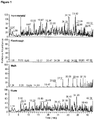
- Figure 1 HeLa peptides were spiked with PEG polymers. Washing with 100% alcohol removes polymer contaminants from the sample and thereby improves sample quality and purity.
- 160 patient serum samples could be prepared and analyzed without any interruption or decrease in performance.
- the patient materials were 20 samples of hyperlipidemia, known for their very high lipid content. These samples are typically even harder to handle and cause severe interference in immune-assays.
- serum samples were collected and diluted 1:10 with double-distilled water.
- the samples were the digested using the 'iST'-sample preparation method ( Kulak, N.A., et al., Minimal, encapsulated proteomic-sample processing applied to copy-number estimation in eukaryotic cells, Nat Methods, 2014 Mar. 11(3) p. 319-24 ).
- Peptides were loaded onto a sulfonated styrene-divinylbenzene matrix and washed with 100% alcohol.
- the matrix was then washed also with a 0.2% (v/v) TFA solution end eluted with 80% (v/v) ACN, 5% (v/v) ammonia.
- the peptides were measured by nanoLC-MS/MS and analyzed using the MaxQuant environment.
- the disclosed methods were applied to urine samples which have generally a very high content of salts and metabolites.
- Second-morning urine was collected from apparently healthy donors and centrifuged to remove cell debris.
- the supernatants were concentrated and digested using the 'iST'-sample preparation method (Kulak et al; loc. cit.).
- Peptides were loaded onto a sulfonated styrene-divinylbenzene matrix and washed with 100% alcohol. The matrix was then washed also with a 0.2% (v/v) TFA solution end eluted with 80% (v/v) ACN, 5% (v/v) ammonia.
- the peptides were measured by nanoLC-MS/MS and analyzed using the MaxQuant environment.
- Vesicles were enriched using a glucose gradient system. Each glucose fraction was then digested using the 'iST'-sample preparation method (Kulak et al; loc. cit.). Peptides were loaded onto a sulfonated styrene-divinylbenzene matrix and washed with 100% alcohol. The matrix was then washed also with a 0.2% (v/v) TFA solution end eluted with 80% (v/v) ACN, 5% (v/v) ammonia. The peptides were measured by nanoLC-MS/MS and analyzed using the MaxQuant environment.
- the methods of the present invention allowed the measurement of 160 membrane enrichments on a single nano-flow column as compared to three injections which is what normally is feasible without the methods of the invention.
- the disclosed clean-up therefore permits to significantly increase the number of injections.
- the disclosed invention relates to the removal of polymers from complex peptide mixtures.
- the data displayed in Figure 1 provide evidence that washing in accordance with the invention specifically removes polymers.
Landscapes
- Chemical & Material Sciences (AREA)
- Organic Chemistry (AREA)
- General Health & Medical Sciences (AREA)
- Life Sciences & Earth Sciences (AREA)
- Biochemistry (AREA)
- Biophysics (AREA)
- Health & Medical Sciences (AREA)
- Genetics & Genomics (AREA)
- Medicinal Chemistry (AREA)
- Molecular Biology (AREA)
- Proteomics, Peptides & Aminoacids (AREA)
- Analytical Chemistry (AREA)
- Peptides Or Proteins (AREA)
- Other Investigation Or Analysis Of Materials By Electrical Means (AREA)
- Extraction Or Liquid Replacement (AREA)
Claims (10)
- Verfahren zum Reinigen von Peptiden und/oder Polypeptiden, wobei die Peptide und/oder Polypeptide das Ergebnis eines tryptischen Verdaus einer Probe biologischen Ursprungs sind, wobei das Verfahren Folgendes umfasst oder aus Folgendem besteht:(a) Laden einer Probe, die Peptide und/oder Polypeptide umfasst, unter sauren oder neutralen wässrigen Bedingungen auf Mischphasen-Festphasenextraktions(solid phase extraction ― SPE)-Material, wobei das Material aus Umkehrphasen-/Ionenaustauschmaterial besteht oder dieses umfasst;(b) Waschen des Mischphasen-SPE-Materials mit(ba) einer sauren oder neutralen Zusammensetzung, die wenigstens 50 Vol.-% Ethanol, 2-Propanol oder Butanol umfasst; und(bb) einer sauren oder neutralen wässrigen Lösung; und(c) Eluieren der Peptide und/oder Polypeptide aus dem Mischphasen-SPE-Material mit einer alkalischen Zusammensetzung, die wenigstens 50 Vol.-% eines organischen Lösungsmittels umfasst.
- Verfahren zum Reinigen von Peptiden und/oder Polypeptiden, die an das Mischphasen-SPE-Material gebunden sind, wobei die Peptide und/oder Polypeptide das Ergebnis eines tryptischen Verdaus einer Probe biologischen Ursprungs sind, wobei das Verfahren Folgendes umfasst oder aus Folgendem besteht:(a) Waschen mit(aa) einer sauren oder neutralen Zusammensetzung, die wenigstens 50 Vol.-% Ethanol, 2-Propanol oder Butanol umfasst; und(ab) einer sauren oder neutralen wässrigen Lösung; und(b) Eluieren der Peptide und/oder Polypeptide aus dem Mischphasen-SPE-Material mit einer alkalischen Zusammensetzung, die wenigstens 50 Vol.-% eines organischen Lösungsmittels umfasst.
- Verfahren nach Anspruch 1, wobei die Ladebedingungen einen pH-Wert größer als oder gleich 1 und kleiner als 7, vorzugsweise einen pH-Wert zwischen 3 und 4, aufweisen.
- Verfahren nach einem der Ansprüche 1 bis 3, wobei das saure organische Lösungsmittel einen pH-Wert größer als oder gleich 1 und kleiner als 7, vorzugsweise einen pH-Wert zwischen 3 und 4, aufweist.
- Verfahren nach einem der Ansprüche 1 bis 4, wobei die saure wässrige Lösung einen pH-Wert größer als oder gleich 1 und kleiner als 7, vorzugsweise einen pH-Wert zwischen 3 und 4, aufweist.
- Verfahren nach einem der vorhergehenden Ansprüche, wobei das alkalische organische Lösungsmittel einen pH-Wert größer als 7 und kleiner als oder gleich 14, vorzugsweise einen pH-Wert zwischen 8 und 10, aufweist.
- Verfahren nach einem der vorhergehenden Ansprüche, wobei das organische Lösungsmittel zum Eluieren aus Folgenden ausgewählt ist:(a) Alkoholen, vorzugsweise primären oder sekundären unverzweigten, verzweigten oder cyclischen C1- bis C6-Alkanolen, wie etwa Methanol, Ethanol, 2-Propanol oder Butanol;(b) Alkanen, vorzugsweise unverzweigten, verzweigten oder cyclischen C5- bis C10-Alkanen, wie etwa Hexan, Cyclohexan, Pentan oder Isopentan;(c) halogenierten Kohlenwasserstoffen, vorzugsweise chlorierten Kohlenwasserstoffen, wie etwa chlorierten unsubstituierten oder substituierten, unverzweigten, verzweigten oder cyclischen C1- bis C6-Alkanen, einschließlich Chloroform und Dichlormethan, oder fluorierten Kohlenwasserstoffen, wie etwa fluorierten unsubstituierten oder substituierten, unverzweigten, verzweigten oder cyclischen C1- bis C6-Alkanen, einschließlich Trifluorethanol, wobei es sich bei den Substituenten vorzugsweise um eine oder zwei Hydroxygruppen handelt;(d) Ethern, vorzugsweise linearen oder cyclischen Ethern mit 3 bis 10 Kohlenstoffatomen und 1 bis 3 Ether-Sauerstoffatomen, wie etwa Diethylether, Tetrahydrofuran, Ethylmethylether oder 1,4-Dioxan;(e) Ketonen, vorzugsweise linearen oder cyclischen Ketone mit 2 bis 10 Kohlenstoffatomen, wie etwa Aceton;(f) Nitrilen, vorzugsweise primären oder sekundären unverzweigten, verzweigten oder cyclischen C1- bis C6-Nitrilen, wie etwa Acetonitril;(g) Sulfoxiden, vorzugsweise Dialkylsulfoxiden, wobei Alkyl ein unverzweigtes, verzweigtes oder cyclisches C1- bis C6-Alkyl ist, wie etwa DMSO; und(h) Estern, vorzugsweise Estern von unverzweigten, verzweigten oder cyclischen C1-C6-Alkansäuren mit unverzweigten, verzweigten oder cyclischen C1-C6-Alkanolen; wie etwa Ethylacetat.
- Verfahren nach einem der vorhergehenden Ansprüche, wobei das Waschen mit einer sauren oder neutralen Zusammensetzung, die wenigstens 50 Vol.-% eines organischen Lösungsmittels umfasst, das Waschen mit einer sauren oder neutralen Zusammensetzung ist, die wenigstens 50 Vol.-% Ethanol, 2-Propanol oder Butanol umfasst; und/oder das Eluieren mit einer alkalischen Zusammensetzung erfolgt, die wenigstens 50 Vol.-% Acetonitril umfasst.
- Verfahren nach einem der vorhergehenden Ansprüche, wobei das Reinigen die Verringerung der Menge oder die Entfernung von Folgendem umfasst oder daraus besteht: Salzen; Detergentien; Lipiden; Sacchariden, insbesondere Mono- und Disacchariden; polymeres oder oligomeres Wandmaterial von Gefäßen, die zur Probenhandhabung verwendet werden; und/oder Weichmacher.
- Verfahren nach einem der vorhergehenden Ansprüche, wobei einer, mehrere oder alle Schritte des Ladens, Waschens und Eluierens in Säulen bewirkt werden.
Priority Applications (1)
| Application Number | Priority Date | Filing Date | Title |
|---|---|---|---|
| EP21151333.8A EP3828195A1 (de) | 2015-07-09 | 2016-07-08 | Peptidreinigung mittels gemischtphasigem festphasigem extraktionsmaterial |
Applications Claiming Priority (2)
| Application Number | Priority Date | Filing Date | Title |
|---|---|---|---|
| EP15176142.6A EP3115369A1 (de) | 2015-07-09 | 2015-07-09 | Peptidreinigung mittels mischphasen-festphasenextraktionsmaterial |
| PCT/EP2016/066263 WO2017005898A1 (en) | 2015-07-09 | 2016-07-08 | Peptide purification using mixed-phase solid phase extraction material |
Related Child Applications (2)
| Application Number | Title | Priority Date | Filing Date |
|---|---|---|---|
| EP21151333.8A Division-Into EP3828195A1 (de) | 2015-07-09 | 2016-07-08 | Peptidreinigung mittels gemischtphasigem festphasigem extraktionsmaterial |
| EP21151333.8A Division EP3828195A1 (de) | 2015-07-09 | 2016-07-08 | Peptidreinigung mittels gemischtphasigem festphasigem extraktionsmaterial |
Publications (2)
| Publication Number | Publication Date |
|---|---|
| EP3319977A1 EP3319977A1 (de) | 2018-05-16 |
| EP3319977B1 true EP3319977B1 (de) | 2021-12-01 |
Family
ID=53525145
Family Applications (3)
| Application Number | Title | Priority Date | Filing Date |
|---|---|---|---|
| EP15176142.6A Ceased EP3115369A1 (de) | 2015-07-09 | 2015-07-09 | Peptidreinigung mittels mischphasen-festphasenextraktionsmaterial |
| EP21151333.8A Pending EP3828195A1 (de) | 2015-07-09 | 2016-07-08 | Peptidreinigung mittels gemischtphasigem festphasigem extraktionsmaterial |
| EP16738402.3A Active EP3319977B1 (de) | 2015-07-09 | 2016-07-08 | Peptidreinigung mittels mischphasen-festphasenextraktionsmaterial |
Family Applications Before (2)
| Application Number | Title | Priority Date | Filing Date |
|---|---|---|---|
| EP15176142.6A Ceased EP3115369A1 (de) | 2015-07-09 | 2015-07-09 | Peptidreinigung mittels mischphasen-festphasenextraktionsmaterial |
| EP21151333.8A Pending EP3828195A1 (de) | 2015-07-09 | 2016-07-08 | Peptidreinigung mittels gemischtphasigem festphasigem extraktionsmaterial |
Country Status (8)
| Country | Link |
|---|---|
| US (2) | US11753437B2 (de) |
| EP (3) | EP3115369A1 (de) |
| CN (1) | CN107849085A (de) |
| AU (3) | AU2016290650B2 (de) |
| CA (1) | CA2989261C (de) |
| DK (1) | DK3319977T3 (de) |
| ES (1) | ES2907591T3 (de) |
| WO (1) | WO2017005898A1 (de) |
Families Citing this family (10)
| Publication number | Priority date | Publication date | Assignee | Title |
|---|---|---|---|---|
| CA3008641A1 (en) | 2015-12-16 | 2017-06-22 | Gritstone Oncology, Inc. | Neoantigen identification, manufacture, and use |
| WO2019075112A1 (en) | 2017-10-10 | 2019-04-18 | Gritstone Oncology, Inc. | IDENTIFICATION OF NEO-ANTIGENS USING HOT POINTS |
| KR102905054B1 (ko) | 2017-11-22 | 2025-12-29 | 시애틀 프로젝트 코포레이션 | 신생항원에 대한 접합 에피토프 제시 감소 |
| WO2021076489A1 (en) * | 2019-10-14 | 2021-04-22 | Pierce Biotechnology, Inc. | Peptide purification formulations and methods |
| EP3892994A1 (de) * | 2020-04-08 | 2021-10-13 | PreOmics GmbH | Vorfraktionierung für massenspektrometrische analyse |
| US11773715B2 (en) | 2020-09-03 | 2023-10-03 | Saudi Arabian Oil Company | Injecting multiple tracer tag fluids into a wellbore |
| KR20240017932A (ko) | 2021-06-10 | 2024-02-08 | 다우 글로벌 테크놀로지스 엘엘씨 | 개질된 활성을 갖는 촉매 조성물 및 이들의 제조 공정 |
| US12253467B2 (en) | 2021-12-13 | 2025-03-18 | Saudi Arabian Oil Company | Determining partition coefficients of tracer analytes |
| US12000278B2 (en) | 2021-12-16 | 2024-06-04 | Saudi Arabian Oil Company | Determining oil and water production rates in multiple production zones from a single production well |
| CN119492829B (zh) * | 2024-11-25 | 2025-08-19 | 舟山市食品药品检验检测研究院 | 一种生物多肽检测方法 |
Family Cites Families (3)
| Publication number | Priority date | Publication date | Assignee | Title |
|---|---|---|---|---|
| US20050258097A1 (en) * | 2004-01-08 | 2005-11-24 | Gjerde Douglas T | Method and device for extracting an analyte |
| US8123949B2 (en) * | 2005-01-20 | 2012-02-28 | Waters Technologies Corporation | Methods for separating compounds |
| WO2014200346A1 (en) * | 2013-06-14 | 2014-12-18 | Delta Crystallon B.V. | Quantification of alpha b-crystallin |
-
2015
- 2015-07-09 EP EP15176142.6A patent/EP3115369A1/de not_active Ceased
-
2016
- 2016-07-08 CN CN201680040589.5A patent/CN107849085A/zh active Pending
- 2016-07-08 EP EP21151333.8A patent/EP3828195A1/de active Pending
- 2016-07-08 DK DK16738402.3T patent/DK3319977T3/da active
- 2016-07-08 CA CA2989261A patent/CA2989261C/en active Active
- 2016-07-08 AU AU2016290650A patent/AU2016290650B2/en active Active
- 2016-07-08 EP EP16738402.3A patent/EP3319977B1/de active Active
- 2016-07-08 ES ES16738402T patent/ES2907591T3/es active Active
- 2016-07-08 US US15/741,804 patent/US11753437B2/en active Active
- 2016-07-08 WO PCT/EP2016/066263 patent/WO2017005898A1/en not_active Ceased
-
2022
- 2022-02-03 AU AU2022200704A patent/AU2022200704A1/en not_active Abandoned
-
2023
- 2023-07-28 US US18/361,539 patent/US20240092826A1/en active Pending
-
2025
- 2025-02-21 AU AU2025201281A patent/AU2025201281A1/en active Pending
Non-Patent Citations (3)
| Title |
|---|
| ANONYMOUS: "Empore High Performance Extraction Disk Cartridges", 1 October 1998 (1998-10-01), pages 1 - 10, XP055642151, Retrieved from the Internet <URL:https://www.sopachem.com/analytical/wp-content/uploads/2014/07/Instruction-for-Use-3M-Empore-Cartridges.pdf> [retrieved on 20191113] * |
| GEORG H.H. BORNER ET AL: "Using In-Solution Digestion, Peptide Fractionation, and a Q Exactive Mass Spectrometer to Analyze the Proteome of Clathrin-Coated Vesicles", COLD SPRING HARBOR PROTOCOL, vol. 2014, no. 11, 3 November 2014 (2014-11-03), United States, pages pdb.prot084137, XP055642658, ISSN: 1940-3402, DOI: 10.1101/pdb.prot084137 * |
| JURI RAPPSILBER ET AL: "Protocol for micro-purification, enrichment, pre-fractionation and storage of peptides for proteomics using StageTips", NATURE PROTOCOLS, vol. 2, no. 8, 1 August 2007 (2007-08-01), GB, pages 1896 - 1906, XP055642417, ISSN: 1754-2189, DOI: 10.1038/nprot.2007.261 * |
Also Published As
| Publication number | Publication date |
|---|---|
| EP3115369A1 (de) | 2017-01-11 |
| AU2025201281A1 (en) | 2025-03-13 |
| AU2016290650A1 (en) | 2018-02-01 |
| HK1248728A1 (zh) | 2018-10-19 |
| DK3319977T3 (da) | 2022-03-07 |
| WO2017005898A1 (en) | 2017-01-12 |
| CA2989261A1 (en) | 2017-01-12 |
| AU2016290650B2 (en) | 2022-08-18 |
| CA2989261C (en) | 2023-10-03 |
| AU2022200704A1 (en) | 2022-02-24 |
| EP3319977A1 (de) | 2018-05-16 |
| US20180201644A1 (en) | 2018-07-19 |
| CN107849085A (zh) | 2018-03-27 |
| ES2907591T3 (es) | 2022-04-25 |
| US11753437B2 (en) | 2023-09-12 |
| US20240092826A1 (en) | 2024-03-21 |
| EP3828195A1 (de) | 2021-06-02 |
Similar Documents
| Publication | Publication Date | Title |
|---|---|---|
| US20240092826A1 (en) | Peptide purification using mixed-phase solid phase extraction material | |
| JP7716450B2 (ja) | 標識化グリコシルアミンの迅速調製およびそれを生成するグリコシル化生体分子の分析方法 | |
| CA3000178C (en) | Amyloid beta detection by mass spectrometry | |
| Trontelj | Quantification of glucuronide metabolites in biological matrices by LC-MS/MS | |
| WO2015051343A1 (en) | High throughput mass spectrometric analysis of proteome samples | |
| HK1248728B (en) | Peptide purification using mixed-phase solid phase extraction material | |
| Fountain et al. | Simultaneous analysis of morphine‐related compounds in plasma using mixed‐mode solid phase extraction and UltraPerformance liquid chromatography–mass spectrometry | |
| JP7805290B2 (ja) | ペプチド精製配合物および方法 | |
| US8507291B1 (en) | Detergent removal from protein samples prior to mass spectrometry analysis | |
| JP7576708B2 (ja) | 糖鎖の分析方法 | |
| CN110849998B (zh) | 一种分离表断马钱子苷半缩醛内酯和断马钱子苷半缩醛内酯的液相色谱方法 | |
| CN110849999B (zh) | 一种分离8-表马钱子苷和马钱子苷的液相色谱方法 | |
| Aurand | LC-MS ionization effect from solid phase extraction extractables | |
| CN114441697A (zh) | 一种高效清除液相色谱中多肽残留的方法及应用 | |
| Mohottalage et al. | Assessment of Suitability of Magnetic Beads for Purification of Rat Plasma in Proteomic Analyses by Matrix-Assisted Laser Desorption IonizationTime-of-Flight MS | |
| Pereira et al. | Porous Graphitic Carbon for the LC/MS Analysis of Hydrophilic Biomolecules | |
| WO2005078451A1 (en) | Method for peptide analysis |
Legal Events
| Date | Code | Title | Description |
|---|---|---|---|
| STAA | Information on the status of an ep patent application or granted ep patent |
Free format text: STATUS: THE INTERNATIONAL PUBLICATION HAS BEEN MADE |
|
| PUAI | Public reference made under article 153(3) epc to a published international application that has entered the european phase |
Free format text: ORIGINAL CODE: 0009012 |
|
| STAA | Information on the status of an ep patent application or granted ep patent |
Free format text: STATUS: REQUEST FOR EXAMINATION WAS MADE |
|
| 17P | Request for examination filed |
Effective date: 20180209 |
|
| AK | Designated contracting states |
Kind code of ref document: A1 Designated state(s): AL AT BE BG CH CY CZ DE DK EE ES FI FR GB GR HR HU IE IS IT LI LT LU LV MC MK MT NL NO PL PT RO RS SE SI SK SM TR |
|
| AX | Request for extension of the european patent |
Extension state: BA ME |
|
| RIN1 | Information on inventor provided before grant (corrected) |
Inventor name: MANN, MATTHIAS Inventor name: KULAK, NILS A. Inventor name: PICHLER, GARWIN |
|
| DAV | Request for validation of the european patent (deleted) | ||
| DAX | Request for extension of the european patent (deleted) | ||
| REG | Reference to a national code |
Ref country code: HK Ref legal event code: DE Ref document number: 1248728 Country of ref document: HK |
|
| STAA | Information on the status of an ep patent application or granted ep patent |
Free format text: STATUS: EXAMINATION IS IN PROGRESS |
|
| 17Q | First examination report despatched |
Effective date: 20190515 |
|
| GRAP | Despatch of communication of intention to grant a patent |
Free format text: ORIGINAL CODE: EPIDOSNIGR1 |
|
| STAA | Information on the status of an ep patent application or granted ep patent |
Free format text: STATUS: GRANT OF PATENT IS INTENDED |
|
| INTG | Intention to grant announced |
Effective date: 20210709 |
|
| GRAS | Grant fee paid |
Free format text: ORIGINAL CODE: EPIDOSNIGR3 |
|
| GRAA | (expected) grant |
Free format text: ORIGINAL CODE: 0009210 |
|
| STAA | Information on the status of an ep patent application or granted ep patent |
Free format text: STATUS: THE PATENT HAS BEEN GRANTED |
|
| AK | Designated contracting states |
Kind code of ref document: B1 Designated state(s): AL AT BE BG CH CY CZ DE DK EE ES FI FR GB GR HR HU IE IS IT LI LT LU LV MC MK MT NL NO PL PT RO RS SE SI SK SM TR |
|
| REG | Reference to a national code |
Ref country code: GB Ref legal event code: FG4D |
|
| REG | Reference to a national code |
Ref country code: AT Ref legal event code: REF Ref document number: 1451688 Country of ref document: AT Kind code of ref document: T Effective date: 20211215 Ref country code: CH Ref legal event code: EP |
|
| REG | Reference to a national code |
Ref country code: IE Ref legal event code: FG4D |
|
| REG | Reference to a national code |
Ref country code: DE Ref legal event code: R096 Ref document number: 602016066807 Country of ref document: DE |
|
| REG | Reference to a national code |
Ref country code: FI Ref legal event code: FGE |
|
| REG | Reference to a national code |
Ref country code: DK Ref legal event code: T3 Effective date: 20220304 |
|
| REG | Reference to a national code |
Ref country code: NL Ref legal event code: FP |
|
| REG | Reference to a national code |
Ref country code: SE Ref legal event code: TRGR |
|
| REG | Reference to a national code |
Ref country code: LT Ref legal event code: MG9D |
|
| REG | Reference to a national code |
Ref country code: ES Ref legal event code: FG2A Ref document number: 2907591 Country of ref document: ES Kind code of ref document: T3 Effective date: 20220425 |
|
| PG25 | Lapsed in a contracting state [announced via postgrant information from national office to epo] |
Ref country code: RS Free format text: LAPSE BECAUSE OF FAILURE TO SUBMIT A TRANSLATION OF THE DESCRIPTION OR TO PAY THE FEE WITHIN THE PRESCRIBED TIME-LIMIT Effective date: 20211201 Ref country code: LT Free format text: LAPSE BECAUSE OF FAILURE TO SUBMIT A TRANSLATION OF THE DESCRIPTION OR TO PAY THE FEE WITHIN THE PRESCRIBED TIME-LIMIT Effective date: 20211201 Ref country code: BG Free format text: LAPSE BECAUSE OF FAILURE TO SUBMIT A TRANSLATION OF THE DESCRIPTION OR TO PAY THE FEE WITHIN THE PRESCRIBED TIME-LIMIT Effective date: 20220301 |
|
| REG | Reference to a national code |
Ref country code: NO Ref legal event code: T2 Effective date: 20211201 |
|
| PG25 | Lapsed in a contracting state [announced via postgrant information from national office to epo] |
Ref country code: PL Free format text: LAPSE BECAUSE OF FAILURE TO SUBMIT A TRANSLATION OF THE DESCRIPTION OR TO PAY THE FEE WITHIN THE PRESCRIBED TIME-LIMIT Effective date: 20211201 Ref country code: LV Free format text: LAPSE BECAUSE OF FAILURE TO SUBMIT A TRANSLATION OF THE DESCRIPTION OR TO PAY THE FEE WITHIN THE PRESCRIBED TIME-LIMIT Effective date: 20211201 Ref country code: HR Free format text: LAPSE BECAUSE OF FAILURE TO SUBMIT A TRANSLATION OF THE DESCRIPTION OR TO PAY THE FEE WITHIN THE PRESCRIBED TIME-LIMIT Effective date: 20211201 Ref country code: GR Free format text: LAPSE BECAUSE OF FAILURE TO SUBMIT A TRANSLATION OF THE DESCRIPTION OR TO PAY THE FEE WITHIN THE PRESCRIBED TIME-LIMIT Effective date: 20220302 |
|
| PG25 | Lapsed in a contracting state [announced via postgrant information from national office to epo] |
Ref country code: SM Free format text: LAPSE BECAUSE OF FAILURE TO SUBMIT A TRANSLATION OF THE DESCRIPTION OR TO PAY THE FEE WITHIN THE PRESCRIBED TIME-LIMIT Effective date: 20211201 Ref country code: SK Free format text: LAPSE BECAUSE OF FAILURE TO SUBMIT A TRANSLATION OF THE DESCRIPTION OR TO PAY THE FEE WITHIN THE PRESCRIBED TIME-LIMIT Effective date: 20211201 Ref country code: RO Free format text: LAPSE BECAUSE OF FAILURE TO SUBMIT A TRANSLATION OF THE DESCRIPTION OR TO PAY THE FEE WITHIN THE PRESCRIBED TIME-LIMIT Effective date: 20211201 Ref country code: PT Free format text: LAPSE BECAUSE OF FAILURE TO SUBMIT A TRANSLATION OF THE DESCRIPTION OR TO PAY THE FEE WITHIN THE PRESCRIBED TIME-LIMIT Effective date: 20220401 Ref country code: EE Free format text: LAPSE BECAUSE OF FAILURE TO SUBMIT A TRANSLATION OF THE DESCRIPTION OR TO PAY THE FEE WITHIN THE PRESCRIBED TIME-LIMIT Effective date: 20211201 Ref country code: CZ Free format text: LAPSE BECAUSE OF FAILURE TO SUBMIT A TRANSLATION OF THE DESCRIPTION OR TO PAY THE FEE WITHIN THE PRESCRIBED TIME-LIMIT Effective date: 20211201 |
|
| REG | Reference to a national code |
Ref country code: DE Ref legal event code: R097 Ref document number: 602016066807 Country of ref document: DE |
|
| PG25 | Lapsed in a contracting state [announced via postgrant information from national office to epo] |
Ref country code: IS Free format text: LAPSE BECAUSE OF FAILURE TO SUBMIT A TRANSLATION OF THE DESCRIPTION OR TO PAY THE FEE WITHIN THE PRESCRIBED TIME-LIMIT Effective date: 20220401 |
|
| PLBE | No opposition filed within time limit |
Free format text: ORIGINAL CODE: 0009261 |
|
| STAA | Information on the status of an ep patent application or granted ep patent |
Free format text: STATUS: NO OPPOSITION FILED WITHIN TIME LIMIT |
|
| PG25 | Lapsed in a contracting state [announced via postgrant information from national office to epo] |
Ref country code: AL Free format text: LAPSE BECAUSE OF FAILURE TO SUBMIT A TRANSLATION OF THE DESCRIPTION OR TO PAY THE FEE WITHIN THE PRESCRIBED TIME-LIMIT Effective date: 20211201 |
|
| 26N | No opposition filed |
Effective date: 20220902 |
|
| PG25 | Lapsed in a contracting state [announced via postgrant information from national office to epo] |
Ref country code: SI Free format text: LAPSE BECAUSE OF FAILURE TO SUBMIT A TRANSLATION OF THE DESCRIPTION OR TO PAY THE FEE WITHIN THE PRESCRIBED TIME-LIMIT Effective date: 20211201 |
|
| PG25 | Lapsed in a contracting state [announced via postgrant information from national office to epo] |
Ref country code: MC Free format text: LAPSE BECAUSE OF FAILURE TO SUBMIT A TRANSLATION OF THE DESCRIPTION OR TO PAY THE FEE WITHIN THE PRESCRIBED TIME-LIMIT Effective date: 20211201 |
|
| PG25 | Lapsed in a contracting state [announced via postgrant information from national office to epo] |
Ref country code: LU Free format text: LAPSE BECAUSE OF NON-PAYMENT OF DUE FEES Effective date: 20220708 |
|
| PG25 | Lapsed in a contracting state [announced via postgrant information from national office to epo] |
Ref country code: IE Free format text: LAPSE BECAUSE OF NON-PAYMENT OF DUE FEES Effective date: 20220708 |
|
| P01 | Opt-out of the competence of the unified patent court (upc) registered |
Effective date: 20230624 |
|
| PG25 | Lapsed in a contracting state [announced via postgrant information from national office to epo] |
Ref country code: HU Free format text: LAPSE BECAUSE OF FAILURE TO SUBMIT A TRANSLATION OF THE DESCRIPTION OR TO PAY THE FEE WITHIN THE PRESCRIBED TIME-LIMIT; INVALID AB INITIO Effective date: 20160708 |
|
| PG25 | Lapsed in a contracting state [announced via postgrant information from national office to epo] |
Ref country code: MK Free format text: LAPSE BECAUSE OF FAILURE TO SUBMIT A TRANSLATION OF THE DESCRIPTION OR TO PAY THE FEE WITHIN THE PRESCRIBED TIME-LIMIT Effective date: 20211201 Ref country code: CY Free format text: LAPSE BECAUSE OF FAILURE TO SUBMIT A TRANSLATION OF THE DESCRIPTION OR TO PAY THE FEE WITHIN THE PRESCRIBED TIME-LIMIT Effective date: 20211201 |
|
| PG25 | Lapsed in a contracting state [announced via postgrant information from national office to epo] |
Ref country code: TR Free format text: LAPSE BECAUSE OF FAILURE TO SUBMIT A TRANSLATION OF THE DESCRIPTION OR TO PAY THE FEE WITHIN THE PRESCRIBED TIME-LIMIT Effective date: 20211201 |
|
| PG25 | Lapsed in a contracting state [announced via postgrant information from national office to epo] |
Ref country code: MT Free format text: LAPSE BECAUSE OF FAILURE TO SUBMIT A TRANSLATION OF THE DESCRIPTION OR TO PAY THE FEE WITHIN THE PRESCRIBED TIME-LIMIT Effective date: 20211201 |
|
| PGFP | Annual fee paid to national office [announced via postgrant information from national office to epo] |
Ref country code: NL Payment date: 20250723 Year of fee payment: 10 |
|
| PGFP | Annual fee paid to national office [announced via postgrant information from national office to epo] |
Ref country code: FI Payment date: 20250722 Year of fee payment: 10 Ref country code: ES Payment date: 20250819 Year of fee payment: 10 |
|
| PGFP | Annual fee paid to national office [announced via postgrant information from national office to epo] |
Ref country code: DK Payment date: 20250723 Year of fee payment: 10 Ref country code: DE Payment date: 20250722 Year of fee payment: 10 |
|
| PGFP | Annual fee paid to national office [announced via postgrant information from national office to epo] |
Ref country code: NO Payment date: 20250722 Year of fee payment: 10 |
|
| PGFP | Annual fee paid to national office [announced via postgrant information from national office to epo] |
Ref country code: IT Payment date: 20250731 Year of fee payment: 10 |
|
| REG | Reference to a national code |
Ref country code: AT Ref legal event code: UEP Ref document number: 1451688 Country of ref document: AT Kind code of ref document: T Effective date: 20211201 |
|
| PGFP | Annual fee paid to national office [announced via postgrant information from national office to epo] |
Ref country code: BE Payment date: 20250722 Year of fee payment: 10 Ref country code: GB Payment date: 20250724 Year of fee payment: 10 |
|
| PGFP | Annual fee paid to national office [announced via postgrant information from national office to epo] |
Ref country code: FR Payment date: 20250723 Year of fee payment: 10 Ref country code: AT Payment date: 20250721 Year of fee payment: 10 |
|
| PGFP | Annual fee paid to national office [announced via postgrant information from national office to epo] |
Ref country code: CH Payment date: 20250724 Year of fee payment: 10 Ref country code: SE Payment date: 20250723 Year of fee payment: 10 |