EP3318287A1 - Implantable medical device preform, implantable medical device and preparation method thereof - Google Patents
Implantable medical device preform, implantable medical device and preparation method thereof Download PDFInfo
- Publication number
- EP3318287A1 EP3318287A1 EP16817076.9A EP16817076A EP3318287A1 EP 3318287 A1 EP3318287 A1 EP 3318287A1 EP 16817076 A EP16817076 A EP 16817076A EP 3318287 A1 EP3318287 A1 EP 3318287A1
- Authority
- EP
- European Patent Office
- Prior art keywords
- solution
- basal body
- ions
- medical device
- implantable medical
- Prior art date
- Legal status (The legal status is an assumption and is not a legal conclusion. Google has not performed a legal analysis and makes no representation as to the accuracy of the status listed.)
- Granted
Links
Images

Classifications
-
- A—HUMAN NECESSITIES
- A61—MEDICAL OR VETERINARY SCIENCE; HYGIENE
- A61F—FILTERS IMPLANTABLE INTO BLOOD VESSELS; PROSTHESES; DEVICES PROVIDING PATENCY TO, OR PREVENTING COLLAPSING OF, TUBULAR STRUCTURES OF THE BODY, e.g. STENTS; ORTHOPAEDIC, NURSING OR CONTRACEPTIVE DEVICES; FOMENTATION; TREATMENT OR PROTECTION OF EYES OR EARS; BANDAGES, DRESSINGS OR ABSORBENT PADS; FIRST-AID KITS
- A61F2/00—Filters implantable into blood vessels; Prostheses, i.e. artificial substitutes or replacements for parts of the body; Appliances for connecting them with the body; Devices providing patency to, or preventing collapsing of, tubular structures of the body, e.g. stents
- A61F2/01—Filters implantable into blood vessels
- A61F2/0108—Both ends closed, i.e. legs gathered at both ends
-
- A—HUMAN NECESSITIES
- A61—MEDICAL OR VETERINARY SCIENCE; HYGIENE
- A61L—METHODS OR APPARATUS FOR STERILISING MATERIALS OR OBJECTS IN GENERAL; DISINFECTION, STERILISATION OR DEODORISATION OF AIR; CHEMICAL ASPECTS OF BANDAGES, DRESSINGS, ABSORBENT PADS OR SURGICAL ARTICLES; MATERIALS FOR BANDAGES, DRESSINGS, ABSORBENT PADS OR SURGICAL ARTICLES
- A61L27/00—Materials for grafts or prostheses or for coating grafts or prostheses
- A61L27/28—Materials for coating prostheses
- A61L27/34—Macromolecular materials
-
- A—HUMAN NECESSITIES
- A61—MEDICAL OR VETERINARY SCIENCE; HYGIENE
- A61L—METHODS OR APPARATUS FOR STERILISING MATERIALS OR OBJECTS IN GENERAL; DISINFECTION, STERILISATION OR DEODORISATION OF AIR; CHEMICAL ASPECTS OF BANDAGES, DRESSINGS, ABSORBENT PADS OR SURGICAL ARTICLES; MATERIALS FOR BANDAGES, DRESSINGS, ABSORBENT PADS OR SURGICAL ARTICLES
- A61L27/00—Materials for grafts or prostheses or for coating grafts or prostheses
- A61L27/02—Inorganic materials
- A61L27/04—Metals or alloys
-
- A—HUMAN NECESSITIES
- A61—MEDICAL OR VETERINARY SCIENCE; HYGIENE
- A61L—METHODS OR APPARATUS FOR STERILISING MATERIALS OR OBJECTS IN GENERAL; DISINFECTION, STERILISATION OR DEODORISATION OF AIR; CHEMICAL ASPECTS OF BANDAGES, DRESSINGS, ABSORBENT PADS OR SURGICAL ARTICLES; MATERIALS FOR BANDAGES, DRESSINGS, ABSORBENT PADS OR SURGICAL ARTICLES
- A61L27/00—Materials for grafts or prostheses or for coating grafts or prostheses
- A61L27/40—Composite materials, i.e. containing one material dispersed in a matrix of the same or different material
- A61L27/42—Composite materials, i.e. containing one material dispersed in a matrix of the same or different material having an inorganic matrix
-
- A—HUMAN NECESSITIES
- A61—MEDICAL OR VETERINARY SCIENCE; HYGIENE
- A61L—METHODS OR APPARATUS FOR STERILISING MATERIALS OR OBJECTS IN GENERAL; DISINFECTION, STERILISATION OR DEODORISATION OF AIR; CHEMICAL ASPECTS OF BANDAGES, DRESSINGS, ABSORBENT PADS OR SURGICAL ARTICLES; MATERIALS FOR BANDAGES, DRESSINGS, ABSORBENT PADS OR SURGICAL ARTICLES
- A61L27/00—Materials for grafts or prostheses or for coating grafts or prostheses
- A61L27/50—Materials characterised by their function or physical properties, e.g. injectable or lubricating compositions, shape-memory materials, surface modified materials
-
- A—HUMAN NECESSITIES
- A61—MEDICAL OR VETERINARY SCIENCE; HYGIENE
- A61F—FILTERS IMPLANTABLE INTO BLOOD VESSELS; PROSTHESES; DEVICES PROVIDING PATENCY TO, OR PREVENTING COLLAPSING OF, TUBULAR STRUCTURES OF THE BODY, e.g. STENTS; ORTHOPAEDIC, NURSING OR CONTRACEPTIVE DEVICES; FOMENTATION; TREATMENT OR PROTECTION OF EYES OR EARS; BANDAGES, DRESSINGS OR ABSORBENT PADS; FIRST-AID KITS
- A61F2/00—Filters implantable into blood vessels; Prostheses, i.e. artificial substitutes or replacements for parts of the body; Appliances for connecting them with the body; Devices providing patency to, or preventing collapsing of, tubular structures of the body, e.g. stents
- A61F2/01—Filters implantable into blood vessels
- A61F2002/018—Filters implantable into blood vessels made from tubes or sheets of material, e.g. by etching or laser-cutting
-
- A—HUMAN NECESSITIES
- A61—MEDICAL OR VETERINARY SCIENCE; HYGIENE
- A61F—FILTERS IMPLANTABLE INTO BLOOD VESSELS; PROSTHESES; DEVICES PROVIDING PATENCY TO, OR PREVENTING COLLAPSING OF, TUBULAR STRUCTURES OF THE BODY, e.g. STENTS; ORTHOPAEDIC, NURSING OR CONTRACEPTIVE DEVICES; FOMENTATION; TREATMENT OR PROTECTION OF EYES OR EARS; BANDAGES, DRESSINGS OR ABSORBENT PADS; FIRST-AID KITS
- A61F2210/00—Particular material properties of prostheses classified in groups A61F2/00 - A61F2/26 or A61F2/82 or A61F9/00 or A61F11/00 or subgroups thereof
- A61F2210/0014—Particular material properties of prostheses classified in groups A61F2/00 - A61F2/26 or A61F2/82 or A61F9/00 or A61F11/00 or subgroups thereof using shape memory or superelastic materials, e.g. nitinol
-
- A—HUMAN NECESSITIES
- A61—MEDICAL OR VETERINARY SCIENCE; HYGIENE
- A61F—FILTERS IMPLANTABLE INTO BLOOD VESSELS; PROSTHESES; DEVICES PROVIDING PATENCY TO, OR PREVENTING COLLAPSING OF, TUBULAR STRUCTURES OF THE BODY, e.g. STENTS; ORTHOPAEDIC, NURSING OR CONTRACEPTIVE DEVICES; FOMENTATION; TREATMENT OR PROTECTION OF EYES OR EARS; BANDAGES, DRESSINGS OR ABSORBENT PADS; FIRST-AID KITS
- A61F2230/00—Geometry of prostheses classified in groups A61F2/00 - A61F2/26 or A61F2/82 or A61F9/00 or A61F11/00 or subgroups thereof
- A61F2230/0002—Two-dimensional shapes, e.g. cross-sections
- A61F2230/0028—Shapes in the form of latin or greek characters
- A61F2230/006—Y-shaped
-
- A—HUMAN NECESSITIES
- A61—MEDICAL OR VETERINARY SCIENCE; HYGIENE
- A61F—FILTERS IMPLANTABLE INTO BLOOD VESSELS; PROSTHESES; DEVICES PROVIDING PATENCY TO, OR PREVENTING COLLAPSING OF, TUBULAR STRUCTURES OF THE BODY, e.g. STENTS; ORTHOPAEDIC, NURSING OR CONTRACEPTIVE DEVICES; FOMENTATION; TREATMENT OR PROTECTION OF EYES OR EARS; BANDAGES, DRESSINGS OR ABSORBENT PADS; FIRST-AID KITS
- A61F2240/00—Manufacturing or designing of prostheses classified in groups A61F2/00 - A61F2/26 or A61F2/82 or A61F9/00 or A61F11/00 or subgroups thereof
- A61F2240/001—Designing or manufacturing processes
-
- A—HUMAN NECESSITIES
- A61—MEDICAL OR VETERINARY SCIENCE; HYGIENE
- A61L—METHODS OR APPARATUS FOR STERILISING MATERIALS OR OBJECTS IN GENERAL; DISINFECTION, STERILISATION OR DEODORISATION OF AIR; CHEMICAL ASPECTS OF BANDAGES, DRESSINGS, ABSORBENT PADS OR SURGICAL ARTICLES; MATERIALS FOR BANDAGES, DRESSINGS, ABSORBENT PADS OR SURGICAL ARTICLES
- A61L2400/00—Materials characterised by their function or physical properties
- A61L2400/18—Modification of implant surfaces in order to improve biocompatibility, cell growth, fixation of biomolecules, e.g. plasma treatment
-
- A—HUMAN NECESSITIES
- A61—MEDICAL OR VETERINARY SCIENCE; HYGIENE
- A61L—METHODS OR APPARATUS FOR STERILISING MATERIALS OR OBJECTS IN GENERAL; DISINFECTION, STERILISATION OR DEODORISATION OF AIR; CHEMICAL ASPECTS OF BANDAGES, DRESSINGS, ABSORBENT PADS OR SURGICAL ARTICLES; MATERIALS FOR BANDAGES, DRESSINGS, ABSORBENT PADS OR SURGICAL ARTICLES
- A61L2430/00—Materials or treatment for tissue regeneration
- A61L2430/36—Materials or treatment for tissue regeneration for embolization or occlusion, e.g. vaso-occlusive compositions or devices
-
- A—HUMAN NECESSITIES
- A61—MEDICAL OR VETERINARY SCIENCE; HYGIENE
- A61M—DEVICES FOR INTRODUCING MEDIA INTO, OR ONTO, THE BODY; DEVICES FOR TRANSDUCING BODY MEDIA OR FOR TAKING MEDIA FROM THE BODY; DEVICES FOR PRODUCING OR ENDING SLEEP OR STUPOR
- A61M31/00—Devices for introducing or retaining media, e.g. remedies, in cavities of the body
Definitions
- the present invention relates to the field of medical devices, and more particularly to an implantable medical device preform, an implantable medical device, and preparation method thereof.
- Pulmonary embolism is a common disease with high mortality, statistics show that untreated pulmonary embolism mortality rate is 20%-30%; the new cases per year account for about 0.2% of the total population, and there are about 2.7 million new patients each year calculated with 1.35 billion population in China as a whole.
- a vena cava filter (hereinafter referred to as the filter) was clinically proven to reduce the incidence of pulmonary embolism.
- the filters usually made of metal are divided into permanently implantable filters and temporary filters.
- a polymer film layer preventing endothelium growth and covering is applied on the surface of the metal basal body of the filter, such as a polyethylene glycol-like (PEG-like) film, which is typically less than 3 microns thick and can improve the bioadhesion resistance of the surface of the filter, an interaction of the surface of the filter with the inner wall of the blood vessel and the blood is inhibited to reduce the growth and encapsulation of the vascular endothelial cells on the surface of the filter, and possible coagulation for forming thrombosis, thereby enabling the filter to remain fully open and further achieve good recovery performance of the filter.
- PEG-like polyethylene glycol-like
- the polymer film layer (hereinafter may simply be referred to as a film) and the metal basal body of the filter (hereinafter simply referred to as a basal body) are generally connected by small-acting force such as mechanical bonding and van der Waals forces.
- small-acting force such as mechanical bonding and van der Waals forces.
- the filter is implantable, it is required to be loaded into a delivery sheath, and the filter is implantable into the body through the delivery sheath.
- various parts of the filter will suffer from strong extrusion and friction, and the filter will inevitably be in friction with the inner wall of the delivery sheath when it is delivered in a delivery sheath having a length of about 550 mm; if a binding force between the film and the basal body is insufficient, the film will easily fall off, and may even be separated from the basal body in large pieces after that series of extrusion and friction.
- the surface of the metal basal body after the separation of the film will be in direct contact with the inner wall of the blood vessel, and the endothelial cells tend to creep and encapsulate the metal surface, which is not conducive to recovery; and the fallen films may go into the lungs with the blood flow to obstruct the lung capillaries, or for the patients with heart defects, the films will possibly go into the brain through atrial septal defects to obstruct the brain blood vessels, thus is life-threatening.
- the implantable medical device including polymer film layers and the metal basal body, it is significant to improve the adhesion between the film and the surface of the metal basal body to prevent the film from falling off in delivery and after implantation.
- the technical problem to be solved by the present invention is to provide an implantable medical device and preparation method thereof, and an implantable medical device preform for preparing the implantable medical device, in regard to the defect that the polymer film layer preventing endothelium growth and covering on the surface of the implantable medical device of the prior art cannot be firmly connected with the metal basal body.
- an implantable medical device comprising a metal basal body and a polymer film layer covering the surface of the metal basal body and preventing endothelium growth and covering, at least a part of the surface of the metal basal body is provided with a surface-modified layer which contains doped ions, and the metal basal body is connected to the polymer film layer by the doped ions.
- the doped ions include at least one of oxygen ions, hydroxide ions, carbon ions, nitrogen ions and carbon-nitrogen ions.
- a thickness of the surface-modified layer is less than 4 ⁇ m.
- a thickness of the surface-modified layer is 2 nm-1 ⁇ m.
- the doped ions are chemically bonded to carbon atoms in the polymer film layer.
- the doped ions are chemically bonded to metal elements in the metal basal body; or the doped ions are located in a lattice spacing of the metal basal body.
- the polymer film layer comprises at least one of a polyethylene glycol-like polymer, a polyoxyethylene-like polymer, a polyethylene glycol-like derivative, and a polyoxyethylene-like derivative.
- the metal basal body comprises at least one of cobalt, chromium, iron, nickel, molybdenum, titanium, platinum and tantalum.
- the present invention also provides a method of preparing an implantable medical device, comprising modification to at least a part of a surface of a metal basal body to form a surface-modified layer which contains doped ions, and the metal basal body is connected to the polymer film layer by the doped ions.
- the doped ions comprise at least one of oxygen ions, hydroxide ions, carbon ions, nitrogen ions and carbon nitrogen ions.
- the modification to at least a part of a surface of a metal basal body to form a surface-modified layer comprises soaking the metal basal body in a soaking solution for soaking reaction to form a surface-modified layer.
- the doped ions comprise at least one of oxygen ions and hydroxide ions.
- the soaking solution comprises a hydrogen peroxide solution, a mixed solution of a hydrogen peroxide solution and an alkaline solution, a mixed solution of a hydrogen peroxide solution and an acidic solution, and an alkaline solution.
- the metal basal body is placed in the different soaking solutions for at least two soaking reactions to form the surface-modified layer.
- the soaking solution comprises a hydrogen peroxide solution, a mixed solution of a hydrogen peroxide solution and an alkaline solution, a mixed solution of a hydrogen peroxide solution and an acidic solution, an acidic solution, and an alkaline solution.
- the acidic solution comprises at least one of an HF solution, an HCl solution, an H 2 SO 4 solution, an HNO 3 solution, an H 3 PO 4 solution, an HClO 4 solution, an HBr solution, an HI solution, an HCN solution, an H 2 SO 3 solution, an HNO 2 solution, a CH 3 COOH solution, and an H 2 SeO 4 solution;
- the alkaline solution includes at least one of an NaOH solution, an NaHCO 3 solution, a KOH solution, a Ca(OH) 2 solution, an Na 2 CO 3 solution, an NH 3 .H 2 O solution, an NH 4 HCO 3 solution and a K 2 CO 3 solution.
- the modification to at least a part of a surface of a metal basal body to form a surface-modified layer comprises injecting the doped ions into the surface of the metal basal body to form the surface-modified layer by a plasma injection method.
- the doped ions comprise at least one of an oxygen ion and a nitrogen ion.
- the modification to at least a part of a surface of a metal basal body to form a surface-modified layer comprises injecting the doped ions into the surface of the metal basal body to form the surface-modified layer by an ion injection method.
- the doped ions comprise at least one of carbon ions, nitrogen ions and carbon-nitrogen ions.
- the present invention also provides an implantable medical device preform, comprising a metal basal body, at least a part of which is provided thereon with a surface-modified layer containing doped ions.
- the doped ions are bonded to carbon atoms in the polymer.
- the doped ions comprise at least one of oxygen ions, hydroxide ions, carbon ions, nitrogen ions and carbon-nitrogen ions.
- a thickness of the surface-modified layer is less than 4 ⁇ m.
- a thickness of the surface-modified layer is 2 nm-1 ⁇ m.
- the metal basal body comprises at least one of cobalt, chromium, iron, nickel, molybdenum, titanium, platinum and tantalum.
- the metal basal body may be connected to the polymer film layer by the doped ions, so that the polymer film layer will not easily fall off in delivery, so as to effectively play a role of preventing endothelium growth and covering in vivo.
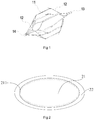
- the filter 1 in Fig. 1 includes a plurality of support rods 11 and a plurality of connecting rods 12 provided on both sides of the support rods 11, each supporting rod 11 is uniformly and circumferentially distributed, one end of the plurality of connecting rods 12 is connected to the supporting rod 11 and the other ends are converged to form a Y-shaped structure and finally form a proximal end 13 or a distal end 14.
- the above supporting rods 11 are in direct contact with the blood vessel wall, and stably places the filter 1 in the blood vessel through the radial support force to avoid displacement.
- the support rod 11 is also provided thereon with an anchor to penetrate into the blood vessel wall for locating the filter.
- the filter may be of other structures.
- a connecting rod may be provided only on one side of the supporting rod, one end of each connecting rod is connected to the supporting rod, the other ends are converged to form a distal end, and the other side of the supporting rod is an open structure.
- At least a portion in contact with the blood vessel wall comprises a metal basal body 21 and a polymer film layer 22 covering the metal basal body 21 and preventing endothelium growth and covering; wherein the portion of the metal basal body 21 has a surface-modified layer 211 containing doped ions, and the metal basal body 21 is connected to the polymer film layer 22 by the doped ions.
- the portion of the implantable medical device that is not in contact with the blood vessel wall, for example, the connecting rod 12 in Fig. 1 may be the same structure as the support rod 11 or may be a metal base 21 having no surface-modified layer, or may be a polymer film layer 22 directly covered on the metal basal body 21 having no surface-modified layer.
- the implantable medical device includes an implantable medical device preform and a polymer film layer covering the preform;
- the preform comprises a metal basal body, at least a part of the metal basal body has a surface-modified layer containing doped ions, and the doped ions in the metal basal body may be bonded to the carbon atoms in the polymer.
- the metal basal body (hereinafter simply referred to as “basal body”) may be prepared from one of 316L stainless steel, nickel titanium alloy, metal titanium, Phynox alloy (cobalt, chromium, iron, nickel, molybdenum alloy), tantalum alloy having better biocompatibility; the basal body may be prepared by designing the structure of the basal body or using a memory alloy material (e.g., nickel-titanium alloy), so that the basal body has a radially compressed state and a radially expanded state.
- a memory alloy material e.g., nickel-titanium alloy
- the basal body may be compressed radially and pushed into the sheath, and then delivered to the predetermined location, such as in a vascular lumen through the sheath; the basal body is released from the sheath of the delivery system and may be restored to a radially expanded state, appressed to the inner wall of the lumen to be fixed within the lumen.
- the metal basal body can block and retain thrombosis after being implantable into the lumen, in order to filter the thrombosis.
- the surface-modified layer is the outermost surface of the metal basal body and has a thickness of less than 4 ⁇ m, usually 2 nm-1 ⁇ m.
- the doped ions in the surface-modified layer include at least one of oxygen ions, hydroxide ions, carbon ions, nitrogen ions and carbonitanium ions, which may be directly bonded with metal element Me (Me includes but is not limited to metal elements such as cobalt, chromium, iron, nickel, molybdenum, titanium, platinum and tantalum, which may include one or more metal elements) in the metal basal body, for example, forming one or more Me-O bonds, Me-OH bonds, Me-C bonds, Me- N bonds, and Me-CN bonds; or may be located in the lattice spacing of the metal basal body to form a interstitial.
- Me includes but is not limited to metal elements such as cobalt, chromium, iron, nickel, molybdenum, titanium, platinum and tantalum, which may include one or
- the concentration of the doped ions is gradually reduced from the surface of the metal basal body to the inside of the metal basal body, and the concentration is the highest at the outermost surface of the metal basal body.
- the doped ions at the outer surface of the surface-modified layer have no proximal atoms on the outward side of the surface, so that the doped ions at the surface have a part of the chemical bonds extending into the space to form dangling bonds.
- the metal basal body is covered with a polymer film layer, the dangling bonds will readily be chemically bonded to the ions/atoms in the polymer film layer.
- the thickness of the polymer film layer is typically less than 3 microns
- the polymer film layer may be at least one of a polyethylene glycol-like polymer, a polyoxyethylene-like polymer, a polyethylene glycol-like derivative, and a polyoxyethylene-like derivative.
- the polymer film layer may be at least one of polyethylene glycol (PEG), polyethylene glycol-like (PEG-like), polyethylene diether, crown ether (e.g., 12-crown ether-4), polyethylene diether-like, polyvinyl alcohol, polyvinyl ether, polyoxyethylene (PEO), polyoxyethylene glycol, polyoxyethylene ether, polyoxyethylene glycol-like, and polyoxyethylene ether-like.
- the polymer film layer covered on the outermost surface of the medical device can significantly improve the hydrophilicity of the surface of the device, reduce roughness, and can greatly reduce adsorption of bacteria and protein on the surface of the material, and prevent the endothelium growth and covering, and increase anticoagulation of the material.
- the polymer film layer is rich in carbon atoms.
- the doped ions such as oxygen ions, hydroxide ions, carbon ions, nitrogen ions, carbon and nitrogen ions
- the bonding energy of the chemical bonds is 0.5-10 eV, which is far greater than that of 0.1-0.5 eV between the van der Waals. Therefore, it is difficult to separate the metal basal body from the polymer film layer under the same external force, the metal basal body may be firmly bonded to the polymer film layer so that the polymer film layer is firmly and effectively attached to the metal basal body.
- the polymer film layer may be firmly and effectively connected to the metal basal body by the doped ions, the polymer film layer will hardly fall off when the filter enters and exits the sheath and after the filter is implantable into the lumen, and the polymer film layer can function effectively to improve the performance of preventing endothelium growth and covering of the filter.
- Fig. 3 shows a flow chart of a preparation method 100 of an implantable medical device (taking a filter as an example) according to an embodiment of the present invention.
- step 101 modification to at least a part of a surface of a metal basal body to form a surface-modified layer, thus forming an implantable medical device preform.
- the surface-modified layer has a thickness of less than 4 ⁇ m, usually 2 nm-1 ⁇ m, and contains doped ions including at least one of oxygen ions, hydroxide ions, carbon ions, nitrogen ions and carbon-nitrogen ions.
- Concentration of the doped ions is gradually reduced from the surface of the metal basal body to the inside of the metal basal body, and is the highest at the outer surface.
- the doped ions at the surface have a part of the chemical bonds extend into space to form dangling bonds which are easily bonded to other ions/atoms to form new chemical bonds, so that the metal basal body may be connected to the polymer film layer by doped ions.
- the metal basal body may be subjected to surface modification by chemical surface treatment to form a surface-modified layer.
- the metal basal body may be placed in a soaking solution, and forms a surface-modified layer on the surface through chemical reaction with the soaking solution.
- Surface modification may be performed by soaking reaction once in only one soaking solution, and the optional soaking solutions include a hydrogen peroxide solution, a mixed solution of a hydrogen peroxide solution and an alkaline solution, a mixed solution of a hydrogen peroxide solution and an acidic solution, and an alkaline solution; when in reaction, temperature of the soaking solution may be room temperature, or the soaking solution can also be heated at high temperature or even to boiling temperature.
- Surface modification may be performed by soaking reaction for many times in numerous soaking solutions, and the soaking solutions used at present include a hydrogen peroxide solution, a mixed solution of a hydrogen peroxide solution and an alkaline solution, a mixed solution of a hydrogen peroxide solution and an acidic solution, and an acidic solution or an alkaline solution; when in reaction, temperature of the soaking solution may be room temperature, or the soaking solution can also be heated at high temperature or even to boiling temperature.
- the acidic solution includes at least one of an HF solution, an HCl solution, an H 2 SO 4 solution, an HNO 3 solution, an H 3 PO 4 solution, an HClO 4 solution, an HBr solution, an HI solution, an HCN solution, an H 2 SO 3 solution, an HNO 2 solution, a CH 3 COOH solution, and an H 2 SeO 4 solution; a same alkaline solution may be used in the above two reaction processes, which includes at least one of an NaOH solution, an NaHCO 3 solution, a KOH solution, a Ca(OH) 2 solution, an Na 2 CO 3 solution, an NH 3 .H 2 O solution, an NH 4 HCO 3 solution and a K 2 CO 3 solution.
- a same alkaline solution may be used in the above two reaction processes, which includes at least one of an NaOH solution, an NaHCO 3 solution, a KOH solution, a Ca(OH) 2 solution, an Na 2 CO 3 solution, an NH 3 .H 2 O solution, an NH 4 H
- the original metal basal body may be subjected to soaking reaction in an H 2 O 2 solution or a boiling solution containing hydrogen peroxide to form a surface-modified layer containing Me-O and Me-OH bonds on the surface of the metal or alloy.
- the soaking solution may also be a mixed solution of hydrogen peroxide and an alkaline solution, and a surface-modified layer containing Me-O and Me-OH bonds is formed on the surface of the metal basal body after the soaking reaction.
- the original metal basal body may be subjected in a hydrogen peroxide solution first to form a surface-modified layer containing Me-O and Me-OH bonds; and then in an alkaline solution for a secondary soaking reaction, and further forming Me-O and Me-OH bonds in the surface-modified layer.
- the original metal basal body may be placed in an acidic solution first for soaking reaction to activate the surface of the metal basal body; and then in a boiling alkaline solution for a secondary soaking reaction, and further forming Me-O and Me-OH bonds in the surface-modified layer.
- the surface-modified layer may be formed by injecting the doped ions into the surface of the metal basal body by a plasma injection method.
- the original metal basal body is placed in a vacuum apparatus at a preset degree of vacuum and under an oxygen or nitrogen atmosphere, and the glow discharge power source is turned on to produce an oxygen plasma or nitrogen plasma, a highly reactive oxygen plasma or a nitrogen plasma reacts with the metal to form an Me-O or Me-N bond on the surface of the metal basal body, thus forming a surface-modified layer containing Me-O or Me-N bonds.
- the surface-modified layer may be formed by injecting the doped ions into the surface of the metal basal body by an ion injection method.
- the original metal basal body may be placed in a high-energy ion injection apparatus for injection of the doped ions, specifically, at a preset degree of vacuum, the electrons generated by a hot filament (commonly used tungsten filament) source is used for bombarding the gas molecules or atoms, or solid targets to be injected, and the bombarded particles (gas molecules or atoms, or solid targets) are ionized to form ions; charged ions in the magnetic field have movement trajectory deflected by Lorentz force to sort out required ions; the ions are accelerated to obtain required energy with a strong electric field of the accelerator; finally, ions are injected into the surface of the metal basal body by focusing lenses and beam scanning devices.
- a hot filament commonly used tungsten filament
- At least one of a carbon ion, a nitrogen ion and a carbon-nitrogen ion may be injected into the surface of the metal basal body to form a surface-modified layer.
- nitrogen may be used as a bombarded gas to inject N-elements into the surface of the metal basal body to form Me-N bonds
- C ions may be produced with methane, acetylene and other hydrocarbon gases being used as a carbon source, and C elements are injected into the surface of the metal basal body to form Me-C bonds
- a mixed gas of a nitrogen gas, a methane, an acetylene and other hydrocarbon gases may be used simultaneously to inject C and N elements into the surface of the metal basal body to form Me-CN bonds
- graphite may be used as a carbon source to inject C elements into the surface of the metal basal body, make the graphite into a target, and C ion beams are formed after electron bombardment, then the C ion beams are injected
- At least one of carbon ions, nitrogen ions and carbon-nitrogen ions located at the outer surface of the surface-modified layer may be chemically bonded to the carbon atoms in the polymer directly to form at least one of C-N, C-C and C-CN bonds, thereby firmly connecting the metal basal body with the polymer film layer, so that the polymer film layer is unlikely to fall off from the metal basal body.
- the doped ions cannot only be directly bonded with the metal elements in the metal basal body, but also in the lattice spacing of the metal basal body to form interstitials.
- the C ions in the surface-modified layer can form Me-C bonds with the metal elements or are in the lattice spacing of the metal basal body.
- step 102 the surface of the metal basal body having the surface-modified layer in step 101 is coated with the polymer film layer so as to connect the metal basal body and the polymer film layer by the doped ions contained in the surface-modified layer.
- a polymer film layer may be covered on the surface of the transition body and the surface of the metal basal body by chemical vapor deposition method (e.g., radio frequency plasma enhanced chemical vapor deposition RF-PECVD and microwave electron cyclotron resonance plasma chemical vapor deposition ECR-CVD).
- chemical vapor deposition method e.g., radio frequency plasma enhanced chemical vapor deposition RF-PECVD and microwave electron cyclotron resonance plasma chemical vapor deposition ECR-CVD.
- the prepared polymer film layer may be at least one of a polyethylene glycol-like polymer, a polyoxyethylene-like polymer, a polyethylene glycol-like derivative, and a polyoxyethylene-like derivative; specifically, it may be at least one of polyethylene glycol, polyethylene glycol-like, polyethylene diether, crown ether, polyethylene diether-like, polyvinyl alcohol, polyvinyl ether, polyoxyethylene, polyoxyethylene glycol, polyoxyethylene ether, polyoxyethylene glycol-like, and polyoxyethylene ether-like.
- the monomer molecules may be ionized and reacted to form a polymer film layercoated metal basal body.
- the monomer molecule comprises at least one of ethylene glycol, diethylene glycol, ethylene glycol dimethyl ether, diethylene glycol dimethyl ether, triethylene glycol dimethyl ether, and tetraethylene glycol dimethyl ether.
- the metal basal body may also be cleaned prior to step 101, for example, the metal basal body may be placed in the same apparatus as in step 102, and the metal basal body is subjected to plasma cleaning under vacuum conditions. In addition, the metal basal body may be first subjected to ultrasonic cleaning.
- the original metal basal body was first subjected to plasma cleaning, the original metal basal body was placed on a sample rack in a vacuum chamber which was vacuumized below 10 Pa, and an argon having a flow rate of 20-200 sccm was passed to keep the pressure of the vacuum chamber below 10 Pa, the surface of the original metal basal body was subjected to plasma cleaning for 5 to 60 min under the condition of RF plasma power was 50-1000 W and bias voltage was 10-800 V, then the radio-frequency power supply was turned off and the original metal basal body was removed.
- the original metal basal body may be subjected to ultrasonic cleaning, the original metal basal body was placed into a container with ethanol, acetone or other cleaning agents, and then the container was placed in an ultrasonic cleaning tank for ultrasonic cleaning for 5 to 30 min, the original metal basal body was removed and was blow dried using compressed air or hot air;
- step 101 the cleaned original metal basal body was subjected to a soaking reaction using a hydrogen peroxide solution as a soaking solution.
- Concentration of H 2 O 2 in the solution was 10-35.wt%, the time for soaking reaction was 1-180 min, the original metal basal body was removed after the soaking reaction, subjected to ultrasonic cleaning with distilled water for 5-30 min, and blow dried with hot air or purified compressed air to obtain a metal basal body having a surface-modified layer containing Me-O and Me-OH bonds.
- a polymer film layer (a PEG-like film layer) was coated on the outermost layer of the surface of the metal basal body, and a radio frequency plasma enhanced chemical vapor deposition (RF-PECVD) method was used in the present embodiment. Specifically, argon was introduced at a flow rate of 10-100 sccm to control the atmospheric pressure in the reaction chamber to be 2-7 Pa, which was 1-2 Pa lower than the pressure set in the reaction deposition.
- RF-PECVD radio frequency plasma enhanced chemical vapor deposition
- Example 1 The difference from Example 1 is as follows: in step 101 of the example, a mixed solution of an H 2 O 2 solution and an NaOH solution was used as a soaking solution in which the weight concentration of H 2 O 2 was 10-35% and the weight concentration of the alkaline substance was 5-35%, and the time for the soaking reaction is 1-180 min. After the soaking reaction, the metal basal body was removed, ultrasonic cleaned with distilled water for 5 to 30 min, and finally was dried at room temperature to obtain a metal basal body having a surface-modified layer containing Me-O and Me-OH bonds.
- Example 1 The difference from Example 1 is as follows: the original metal basal body was subjected to two soaking reactions using two different soaking solutions in step 101 of the example.
- An H 2 O 2 solution having a weight concentration of 10-35% was used as a soaking solution for the first soaking reaction, and the time for the soaking reaction was 1-60 min;
- a mixed solution of an NaOH solution and a KOH solution having a weight concentration of 5-35% of the alkaline substance was used for the second soaking reaction, and the reaction soaking time was 1-180 min.
- the metal basal body was removed after the soaking reaction, washed and dried to obtain a metal basal body having a surface-modified layer containing Me-O bonds and Me-OH bonds.
- Example 1 The difference from Example 1 is as follows: the original metal basal body was subjected to two soaking reactions using two different soaking solutions in step 101 of the example.
- a mixed solution of HF acid having a weight concentration of 1-50% and a nitric acid having a molar concentration of 0.1-8 mol/L was used as a soaking solution for the first soaking reaction for 0.5-10 min; an NaOH strong base solution having a weight concentration of 5-35% was used as a soaking solution for the second soaking reaction for 1-180 min.
- the metal basal body was removed after the soaking reaction, washed and blow dried with hot air or purified compressed air to obtain a metal basal body having a surface-modified layer containing Me-O bonds and Me-OH bonds.
- Example 1 The difference from Example 1 is as follows: a mixed solution of an H 2 SO 4 solution having a molar concentration of 0.1-5 mol/L and an H 2 O 2 solution having a molar concentration of 0.1-9 mol/L was used as a soaking solution in step 101 of the example, and the time for the soaking reaction was 0.5-20 min. The metal basal body was removed after the soaking reaction, washed and dried to obtain a metal basal body having a surface-modified layer containing Me-O bonds and Me-OH bonds.
- a plasma injection method was used to inject the doped ions into the original metal basal body to form a surface-modified layer on the surface of the metal basal body.
- the original metal basal body was placed on a sample rack in a vacuum chamber which was vacuumized below 10.0 Pa; a mixed gas of argon and oxygen was introduced, with the flow rate of argon being 10-100 sccm, the flow rate of the oxygen being 20-200 sccm, and the oxygen with a flow rate of 20-200 sccm can also be used alone, such that the pressure of the vacuum chamber may be kept below 20.0 Pa, the radio frequency plasma power supply was turned on, the surface of the original metal basal body was subjected to oxygen plasma injection for 5-60 min under the conditions that the power was 10-1000 W, and the bias voltage was 10-800 V.
- Example 6 The difference from Example 6 is as follows: a surface-modified layer was formed on the surface of the metal basal body by nitrogen plasma injection in 101 step of the embodiment. Specifically, the original metal basal body was placed on a sample rack in a vacuum chamber which was vacuumized below 10.0 Pa, a mixed gas of argon and nitrogen was introduced, with the flow rate of argon being 10-100 sccm, the flow rate of the nitrogen being 20-200 sccm, and the nitrogen with a flow rate of 20-200 sccm can also be used alone, such that the pressure of the vacuum chamber may be kept below 20.0 Pa; the radio frequency plasma power supply was turned on, the basal body of the original metal basal body was subjected to nitrogen plasma injection for 5-60 min under the conditions that the power was 10-1000 W, and the bias voltage was 10-800 V.
- a metal basal body having a surface-modified layer containing Me-N bonds was obtained.
- the nitrogen ions in the surface-modified layer may be easily bonded to the carbon atoms in the polymer film layer to form C-N chemical bonds through which the metal basal body could be firmly connected with the polymer film layer and would not easily fall off.
- a plasma injection method was used to inject the doped ions into the original metal basal body to form a surface-modified layer on the surface of the metal basal body.
- the original metal basal body was placed on a sample rack in a vacuum chamber of the ion injection apparatus, and the vacuum chamber was vacuumized below 1 ⁇ 10 -4 Pa; and nitrogen gas of 5-50 sccm was introduced to keep the vacuum below 1 ⁇ 10 -3 Pa; the ion injection power supply was turned on, ion injection energy was set to 10-500 keV, and the injection time was 3-60 min. Therefore, a metal basal body having a surface-modified layer containing Me-N bonds was obtained.
- the nitrogen ions in the surface-modified layer may be easily bonded to the carbon atoms in the polymer film layer to form C-N chemical bonds through which the metal basal body could be firmly connected with the polymer film layer and would not easily fall off.
- Example 8 The difference from Example 8 is as follows: the original metal basal body was placed on a sample rack in a vacuum chamber of the ion injection apparatus, and the vacuum chamber was vacuumized below 1 ⁇ 10 -4 Pa; and methane gas of 5-50 sccm was introduced to keep the vacuum below 1 ⁇ 10 -3 Pa; the ion injection power supply was turned on, ion injection energy was set to 10-500 keV, and the injection time was 3-60 min. Therefore, a metal basal body having a surface-modified layer containing Me-C bonds was obtained. The nitrogen ions in the surface-modified layer may be easily bonded to the carbon atoms in the polymer film layer to form C-C chemical bonds through which the metal basal body could be firmly connected with the polymer film layer and would not easily fall off.
- Example 8 The difference from Example 8 is as follows: the original metal basal body was placed on a sample rack in a vacuum chamber of the ion injection apparatus, and the vacuum chamber was vacuumized below 1 ⁇ 10 -4 Pa, and a high purity graphite target was used as a carbon source; the ion injection power supply was turned on, ion injection energy was set to 10-500 keV, and the injection time was 3-60 min. Therefore, a metal basal body having a surface-modified layer was obtained, a part of the injected carbon elements of the surface-modified layer forms Me-C bonds with the metal elements Me, and a part of the injected carbon elements was used as an interstitial in the lattice spacing of the metal basal body.
- Example 8 The difference from Example 8 is as follows: the original metal basal body was placed on a sample rack in a vacuum chamber of the ion injection apparatus, and the vacuum chamber was vacuumized below 1 ⁇ 10 -4 Pa, and a nitrogen gas of 2-30 sccm and a methane gas of 4-60 sccm were introduced, the vacuum chamber was kept below 1 ⁇ 10 -3 Pa; the injection power supply was turned on, the ion injection energy was set to 10-500 keV, and the injection time was 3-60 min. Therefore, a metal basal body having a surface-modified layer was obtained.
- the carbon ions and nitrogen ions in the surface-modified layer may be easily bonded to the carbon atoms in the polymer film layer to form at least one of C-C and C-N chemical bonds through which the metal basal body could be firmly connected with the polymer film layer and would not easily fall off.
- the metal basal body was first subjected to surface modification to form a surface-modified layer, and the metal basal body was coated with a polymer film layer which preventing endothelium growth and covering; in the implantable device prepared as above, the doped ions in the surface-modified layer may be bonded to the carbon atoms in the polymer film layer to form at least one of C-C bonds, C-O bonds, C-OH bonds, C-N bonds, C-CN, etc. Bonding energy of the chemical bonds could be far greater than the bonding energy and mechanical binding energy between the molecules, so that the polymer film layer may be firmly bonded to the metal basal body.
- the polymer film layer may be firmly connected to the metal basal body with the doped ions as a medium, so that the polymer film layer on the surface of the resulting filter would not easily fall off when the resulting filter went into and out of the sheath and was implantable.
Landscapes
- Health & Medical Sciences (AREA)
- Chemical & Material Sciences (AREA)
- Public Health (AREA)
- Veterinary Medicine (AREA)
- Oral & Maxillofacial Surgery (AREA)
- Transplantation (AREA)
- General Health & Medical Sciences (AREA)
- Life Sciences & Earth Sciences (AREA)
- Animal Behavior & Ethology (AREA)
- Epidemiology (AREA)
- Dermatology (AREA)
- Medicinal Chemistry (AREA)
- Inorganic Chemistry (AREA)
- Engineering & Computer Science (AREA)
- Heart & Thoracic Surgery (AREA)
- Cardiology (AREA)
- Biomedical Technology (AREA)
- Vascular Medicine (AREA)
- Materials Engineering (AREA)
- Composite Materials (AREA)
- Prostheses (AREA)
- Materials For Medical Uses (AREA)
Abstract
Description
- The present invention relates to the field of medical devices, and more particularly to an implantable medical device preform, an implantable medical device, and preparation method thereof.
- Pulmonary embolism (PE) is a common disease with high mortality, statistics show that untreated pulmonary embolism mortality rate is 20%-30%; the new cases per year account for about 0.2% of the total population, and there are about 2.7 million new patients each year calculated with 1.35 billion population in China as a whole. A vena cava filter (hereinafter referred to as the filter) was clinically proven to reduce the incidence of pulmonary embolism. The filters usually made of metal are divided into permanently implantable filters and temporary filters. No matter what kind of filter it is, after it is implantable into the vena cava for a period of time, due to the fact that it contacts the blood vessel endothelium, endothelium growth and covering such as protein adsorption and platelet adhesion may be caused, and thrombosis will eventually be formed, leading to venous vessel blockage or recurrence of pulmonary embolism. Especially for the temporary filters, the above-mentioned endothelium growth and covering may also injure the endangium while increasing the difficulty of removal.
- A polymer film layer preventing endothelium growth and covering is applied on the surface of the metal basal body of the filter, such as a polyethylene glycol-like (PEG-like) film, which is typically less than 3 microns thick and can improve the bioadhesion resistance of the surface of the filter, an interaction of the surface of the filter with the inner wall of the blood vessel and the blood is inhibited to reduce the growth and encapsulation of the vascular endothelial cells on the surface of the filter, and possible coagulation for forming thrombosis, thereby enabling the filter to remain fully open and further achieve good recovery performance of the filter.
- However, the polymer film layer (hereinafter may simply be referred to as a film) and the metal basal body of the filter (hereinafter simply referred to as a basal body) are generally connected by small-acting force such as mechanical bonding and van der Waals forces. When the film directly covers the surface of the filter, the film cannot be firmly and effectively attached to the metal surface, and will easily fall off from the metal surface. This is especially important for filters. Unlike other implantable medical devices, such as occluders or stents, when the filter is ready for delivery, it is connected to the delivery steel cable and is preloaded within a guide sheath, usually a smaller 6F guide sheath. During surgery, before the filter is implantable, it is required to be loaded into a delivery sheath, and the filter is implantable into the body through the delivery sheath. In a process of retracting the filter into the delivery sheath, with the filter being compressed by forces, various parts of the filter will suffer from strong extrusion and friction, and the filter will inevitably be in friction with the inner wall of the delivery sheath when it is delivered in a delivery sheath having a length of about 550 mm; if a binding force between the film and the basal body is insufficient, the film will easily fall off, and may even be separated from the basal body in large pieces after that series of extrusion and friction.
- The surface of the metal basal body after the separation of the film will be in direct contact with the inner wall of the blood vessel, and the endothelial cells tend to creep and encapsulate the metal surface, which is not conducive to recovery; and the fallen films may go into the lungs with the blood flow to obstruct the lung capillaries, or for the patients with heart defects, the films will possibly go into the brain through atrial septal defects to obstruct the brain blood vessels, thus is life-threatening. Thus, as for the implantable medical device including polymer film layers and the metal basal body, it is significant to improve the adhesion between the film and the surface of the metal basal body to prevent the film from falling off in delivery and after implantation.
- The technical problem to be solved by the present invention is to provide an implantable medical device and preparation method thereof, and an implantable medical device preform for preparing the implantable medical device, in regard to the defect that the polymer film layer preventing endothelium growth and covering on the surface of the implantable medical device of the prior art cannot be firmly connected with the metal basal body.
- The technical solution of the present invention to solve the technical problem is that an implantable medical device is provided, comprising a metal basal body and a polymer film layer covering the surface of the metal basal body and preventing endothelium growth and covering, at least a part of the surface of the metal basal body is provided with a surface-modified layer which contains doped ions, and the metal basal body is connected to the polymer film layer by the doped ions.
- According to an implantable medical device of an embodiment of the present invention, the doped ions include at least one of oxygen ions, hydroxide ions, carbon ions, nitrogen ions and carbon-nitrogen ions.
- According to an implantable medical device of an embodiment of the present invention, a thickness of the surface-modified layer is less than 4 µm.
- According to an implantable medical device of an embodiment of the present invention, a thickness of the surface-modified layer is 2 nm-1 µm.
- According to an implantable medical device of an embodiment of the present invention, the doped ions are chemically bonded to carbon atoms in the polymer film layer.
- According to an implantable medical device of an embodiment of the present invention, the doped ions are chemically bonded to metal elements in the metal basal body; or the doped ions are located in a lattice spacing of the metal basal body.
- According to an implantable medical device of an embodiment of the present invention, the polymer film layer comprises at least one of a polyethylene glycol-like polymer, a polyoxyethylene-like polymer, a polyethylene glycol-like derivative, and a polyoxyethylene-like derivative.
- According to an implantable medical device of an embodiment of the present invention, the metal basal body comprises at least one of cobalt, chromium, iron, nickel, molybdenum, titanium, platinum and tantalum.
- The present invention also provides a method of preparing an implantable medical device, comprising modification to at least a part of a surface of a metal basal body to form a surface-modified layer which contains doped ions, and the metal basal body is connected to the polymer film layer by the doped ions.
- In a method of preparing the implantable medical device according to an embodiment of the present invention, the doped ions comprise at least one of oxygen ions, hydroxide ions, carbon ions, nitrogen ions and carbon nitrogen ions.
- In a method of preparing the implantable medical device according to an embodiment of the present invention, the modification to at least a part of a surface of a metal basal body to form a surface-modified layer comprises soaking the metal basal body in a soaking solution for soaking reaction to form a surface-modified layer.
- In a method of preparing the implantable medical device according to an embodiment of the present invention, the doped ions comprise at least one of oxygen ions and hydroxide ions.
- In a method of preparing the implantable medical device according to an embodiment of the present invention, the soaking solution comprises a hydrogen peroxide solution, a mixed solution of a hydrogen peroxide solution and an alkaline solution, a mixed solution of a hydrogen peroxide solution and an acidic solution, and an alkaline solution.
- In a method of preparing the implantable medical device according to an embodiment of the present invention, the metal basal body is placed in the different soaking solutions for at least two soaking reactions to form the surface-modified layer.
- In a method of preparing the implantable medical device according to an embodiment of the present invention, the soaking solution comprises a hydrogen peroxide solution, a mixed solution of a hydrogen peroxide solution and an alkaline solution, a mixed solution of a hydrogen peroxide solution and an acidic solution, an acidic solution, and an alkaline solution.
- In a method of preparing the implantable medical device according to an embodiment of the present invention, when the soaking solution comprises the acidic solution, the acidic solution comprises at least one of an HF solution, an HCl solution, an H2SO4 solution, an HNO3 solution, an H3PO4 solution, an HClO4 solution, an HBr solution, an HI solution, an HCN solution, an H2SO3 solution, an HNO2 solution, a CH3COOH solution, and an H2SeO4 solution; the alkaline solution includes at least one of an NaOH solution, an NaHCO3 solution, a KOH solution, a Ca(OH)2 solution, an Na2CO3 solution, an NH3.H2O solution, an NH4HCO3 solution and a K2CO3 solution.
- In a method of preparing the implantable medical device according to an embodiment of the present invention, the modification to at least a part of a surface of a metal basal body to form a surface-modified layer comprises injecting the doped ions into the surface of the metal basal body to form the surface-modified layer by a plasma injection method.
- In a method of preparing the implantable medical device according to an embodiment of the present invention, the doped ions comprise at least one of an oxygen ion and a nitrogen ion. In a method of preparing the implantable medical device according to an embodiment of the present invention, the modification to at least a part of a surface of a metal basal body to form a surface-modified layer comprises injecting the doped ions into the surface of the metal basal body to form the surface-modified layer by an ion injection method.
- In a method of preparing the implantable medical device according to an embodiment of the present invention, the doped ions comprise at least one of carbon ions, nitrogen ions and carbon-nitrogen ions.
- The present invention also provides an implantable medical device preform, comprising a metal basal body, at least a part of which is provided thereon with a surface-modified layer containing doped ions.
- According to an implantable medical device preform of an embodiment of the present invention, the doped ions are bonded to carbon atoms in the polymer.
- According to an implantable medical device preform of an embodiment of the present invention, the doped ions comprise at least one of oxygen ions, hydroxide ions, carbon ions, nitrogen ions and carbon-nitrogen ions.
- According to an implantable medical device preform of an embodiment of the present invention, a thickness of the surface-modified layer is less than 4 µm.
- According to an implantable medical device preform of an embodiment of the present invention, a thickness of the surface-modified layer is 2 nm-1 µm.
- According to an implantable medical device preform of an embodiment of the present invention, the metal basal body comprises at least one of cobalt, chromium, iron, nickel, molybdenum, titanium, platinum and tantalum.
- In an implantable medical device and preparation method thereof according to an embodiment of the present invention, and an implantable medical device preform for preparing the above implantable medical device, at least a part of the metal basal body has a surface-modified layer containing the doped ions, the metal basal body may be connected to the polymer film layer by the doped ions, so that the polymer film layer will not easily fall off in delivery, so as to effectively play a role of preventing endothelium growth and covering in vivo.
- The present invention will be further described in detail in combination with accompanying drawings and specific embodiments. In the drawings:
-
Fig. 1 is a structural schematic diagram of an implantable medical device according to an embodiment of the present invention; -
Fig. 2 is a schematic cross-sectional view of the portion in contact with the blood vessel wall ofFig. 1 ; -
Fig. 3 shows a flow chart of a method of preparing an implantable medical device according to an embodiment of the present invention. - In order to provide a clearer understanding of the technical features, objects and effects of the present invention, the embodiments of the present invention will now be described in detail with reference to the drawings. It will be understood by those skilled in the art that taking the filter as an example is not construed as limiting the present invention, and any other implantable medical devices (e.g., lumen stents and occluders) will fall within the scope of protection of the present invention as long as they are based on the teachings of the present invention.
- As shown in
Fig. 1 , at least a part of the implantable medical device 1 (for example, a filter) according to an embodiment of the present invention is required to be in direct contact with the blood vessel wall after the device is implantable into the body. For example, the filter 1 inFig. 1 includes a plurality ofsupport rods 11 and a plurality of connectingrods 12 provided on both sides of thesupport rods 11, each supportingrod 11 is uniformly and circumferentially distributed, one end of the plurality of connectingrods 12 is connected to the supportingrod 11 and the other ends are converged to form a Y-shaped structure and finally form aproximal end 13 or adistal end 14. After radial deployment, the above supportingrods 11 are in direct contact with the blood vessel wall, and stably places the filter 1 in the blood vessel through the radial support force to avoid displacement. Thesupport rod 11 is also provided thereon with an anchor to penetrate into the blood vessel wall for locating the filter. Of course, the structure as shown in the figures are for illustrative purposes only and are not construed to be limiting the present invention. The filter may be of other structures. For example, a connecting rod may be provided only on one side of the supporting rod, one end of each connecting rod is connected to the supporting rod, the other ends are converged to form a distal end, and the other side of the supporting rod is an open structure. - With reference to
Fig. 2 , in an implantable medical device, at least a portion in contact with the blood vessel wall (e.g., thesupport rod 11 inFig. 1 ) comprises a metalbasal body 21 and apolymer film layer 22 covering the metalbasal body 21 and preventing endothelium growth and covering; wherein the portion of the metalbasal body 21 has a surface-modifiedlayer 211 containing doped ions, and the metalbasal body 21 is connected to thepolymer film layer 22 by the doped ions. The portion of the implantable medical device that is not in contact with the blood vessel wall, for example, the connectingrod 12 inFig. 1 may be the same structure as thesupport rod 11 or may be ametal base 21 having no surface-modified layer, or may be apolymer film layer 22 directly covered on the metalbasal body 21 having no surface-modified layer. - With the structure unchanged, the implantable medical device may also be described as follows: the implantable medical device includes an implantable medical device preform and a polymer film layer covering the preform; the preform comprises a metal basal body, at least a part of the metal basal body has a surface-modified layer containing doped ions, and the doped ions in the metal basal body may be bonded to the carbon atoms in the polymer.
- The metal basal body (hereinafter simply referred to as "basal body") may be prepared from one of 316L stainless steel, nickel titanium alloy, metal titanium, Phynox alloy (cobalt, chromium, iron, nickel, molybdenum alloy), tantalum alloy having better biocompatibility; the basal body may be prepared by designing the structure of the basal body or using a memory alloy material (e.g., nickel-titanium alloy), so that the basal body has a radially compressed state and a radially expanded state. The basal body may be compressed radially and pushed into the sheath, and then delivered to the predetermined location, such as in a vascular lumen through the sheath; the basal body is released from the sheath of the delivery system and may be restored to a radially expanded state, appressed to the inner wall of the lumen to be fixed within the lumen. The metal basal body can block and retain thrombosis after being implantable into the lumen, in order to filter the thrombosis.
- The surface-modified layer is the outermost surface of the metal basal body and has a thickness of less than 4 µm, usually 2 nm-1 µm. The doped ions in the surface-modified layer include at least one of oxygen ions, hydroxide ions, carbon ions, nitrogen ions and carbonitanium ions, which may be directly bonded with metal element Me (Me includes but is not limited to metal elements such as cobalt, chromium, iron, nickel, molybdenum, titanium, platinum and tantalum, which may include one or more metal elements) in the metal basal body, for example, forming one or more Me-O bonds, Me-OH bonds, Me-C bonds, Me- N bonds, and Me-CN bonds; or may be located in the lattice spacing of the metal basal body to form a interstitial.
- The concentration of the doped ions is gradually reduced from the surface of the metal basal body to the inside of the metal basal body, and the concentration is the highest at the outermost surface of the metal basal body. The doped ions at the outer surface of the surface-modified layer have no proximal atoms on the outward side of the surface, so that the doped ions at the surface have a part of the chemical bonds extending into the space to form dangling bonds. When the metal basal body is covered with a polymer film layer, the dangling bonds will readily be chemically bonded to the ions/atoms in the polymer film layer. In particular, the thickness of the polymer film layer is typically less than 3 microns, and the polymer film layer may be at least one of a polyethylene glycol-like polymer, a polyoxyethylene-like polymer, a polyethylene glycol-like derivative, and a polyoxyethylene-like derivative. Specifically, may be at least one of polyethylene glycol (PEG), polyethylene glycol-like (PEG-like), polyethylene diether, crown ether (e.g., 12-crown ether-4), polyethylene diether-like, polyvinyl alcohol, polyvinyl ether, polyoxyethylene (PEO), polyoxyethylene glycol, polyoxyethylene ether, polyoxyethylene glycol-like, and polyoxyethylene ether-like. The polymer film layer covered on the outermost surface of the medical device can significantly improve the hydrophilicity of the surface of the device, reduce roughness, and can greatly reduce adsorption of bacteria and protein on the surface of the material, and prevent the endothelium growth and covering, and increase anticoagulation of the material.
- The polymer film layer is rich in carbon atoms. When the polymer film layer covers the metal basal body and is in direct contact with the metal basal body, it is easy for the doped ions (such as oxygen ions, hydroxide ions, carbon ions, nitrogen ions, carbon and nitrogen ions) to be chemically bonded to the carbon atoms in the polymer film layer directly. The dangling bonds of the doped ions at the outer surface of the metal basal body are bonded to the carbon atoms in the polymer film layer to form at least one of C-C bonds, C-O bonds, C=O bonds, C-OH bonds, C-N bonds, C-CN bonds and other chemical bonds, such that the polymer film layer is connected to the metal basal body through the chemical bonds (e.g., covalent bonds). The bonding energy of the chemical bonds is 0.5-10 eV, which is far greater than that of 0.1-0.5 eV between the van der Waals. Therefore, it is difficult to separate the metal basal body from the polymer film layer under the same external force, the metal basal body may be firmly bonded to the polymer film layer so that the polymer film layer is firmly and effectively attached to the metal basal body.
- After the filter according to the present invention is implantable into the lumen, due to the fact that the polymer film layer may be firmly and effectively connected to the metal basal body by the doped ions, the polymer film layer will hardly fall off when the filter enters and exits the sheath and after the filter is implantable into the lumen, and the polymer film layer can function effectively to improve the performance of preventing endothelium growth and covering of the filter.
-
Fig. 3 shows a flow chart of apreparation method 100 of an implantable medical device (taking a filter as an example) according to an embodiment of the present invention. As shown inFig. 3 , instep 101, modification to at least a part of a surface of a metal basal body to form a surface-modified layer, thus forming an implantable medical device preform. The surface-modified layer has a thickness of less than 4 µm, usually 2 nm-1 µm, and contains doped ions including at least one of oxygen ions, hydroxide ions, carbon ions, nitrogen ions and carbon-nitrogen ions. Concentration of the doped ions is gradually reduced from the surface of the metal basal body to the inside of the metal basal body, and is the highest at the outer surface. The doped ions at the surface have a part of the chemical bonds extend into space to form dangling bonds which are easily bonded to other ions/atoms to form new chemical bonds, so that the metal basal body may be connected to the polymer film layer by doped ions. - The metal basal body may be subjected to surface modification by chemical surface treatment to form a surface-modified layer. Specifically, the metal basal body may be placed in a soaking solution, and forms a surface-modified layer on the surface through chemical reaction with the soaking solution. Surface modification may be performed by soaking reaction once in only one soaking solution, and the optional soaking solutions include a hydrogen peroxide solution, a mixed solution of a hydrogen peroxide solution and an alkaline solution, a mixed solution of a hydrogen peroxide solution and an acidic solution, and an alkaline solution; when in reaction, temperature of the soaking solution may be room temperature, or the soaking solution can also be heated at high temperature or even to boiling temperature. Surface modification may be performed by soaking reaction for many times in numerous soaking solutions, and the soaking solutions used at present include a hydrogen peroxide solution, a mixed solution of a hydrogen peroxide solution and an alkaline solution, a mixed solution of a hydrogen peroxide solution and an acidic solution, and an acidic solution or an alkaline solution; when in reaction, temperature of the soaking solution may be room temperature, or the soaking solution can also be heated at high temperature or even to boiling temperature. Wherein the acidic solution includes at least one of an HF solution, an HCl solution, an H2SO4 solution, an HNO3 solution, an H3PO4 solution, an HClO4 solution, an HBr solution, an HI solution, an HCN solution, an H2SO3 solution, an HNO2 solution, a CH3COOH solution, and an H2SeO4 solution; a same alkaline solution may be used in the above two reaction processes, which includes at least one of an NaOH solution, an NaHCO3 solution, a KOH solution, a Ca(OH)2 solution, an Na2CO3 solution, an NH3.H2O solution, an NH4HCO3 solution and a K2CO3 solution.
- For example, the original metal basal body may be subjected to soaking reaction in an H2O2 solution or a boiling solution containing hydrogen peroxide to form a surface-modified layer containing Me-O and Me-OH bonds on the surface of the metal or alloy. The soaking solution may also be a mixed solution of hydrogen peroxide and an alkaline solution, and a surface-modified layer containing Me-O and Me-OH bonds is formed on the surface of the metal basal body after the soaking reaction. It is also possible to subject the original metal basal body in a hydrogen peroxide solution first to form a surface-modified layer containing Me-O and Me-OH bonds; and then in an alkaline solution for a secondary soaking reaction, and further forming Me-O and Me-OH bonds in the surface-modified layer. Similarly, the original metal basal body may be placed in an acidic solution first for soaking reaction to activate the surface of the metal basal body; and then in a boiling alkaline solution for a secondary soaking reaction, and further forming Me-O and Me-OH bonds in the surface-modified layer. The surface-modified layer comprising Me-O and/or Me-OH bonds may be formed on the surface of the metal basal body by the soaking reaction as above, and the oxygen ions and the hydroxide ions located at the outer surface of the surface-modified layer may be chemically bonded to the carbon atoms in the polymer directly to form at least one of C-O, C-OH and C=O bonds, thereby firmly connecting the metal basal body to the polymer film layer so that the polymer film layer is unlikely to fall off from the metal basal body.
- The surface-modified layer may be formed by injecting the doped ions into the surface of the metal basal body by a plasma injection method. For example, the original metal basal body is placed in a vacuum apparatus at a preset degree of vacuum and under an oxygen or nitrogen atmosphere, and the glow discharge power source is turned on to produce an oxygen plasma or nitrogen plasma, a highly reactive oxygen plasma or a nitrogen plasma reacts with the metal to form an Me-O or Me-N bond on the surface of the metal basal body, thus forming a surface-modified layer containing Me-O or Me-N bonds. The oxygen ions and nitrogen ions located at the outer surface of the surface-modified layer may be chemically bonded to the carbon atoms in the polymer directly to form at least one of C-O, C=O and C-N bonds, thereby firmly connecting the metal basal body to the polymer film layer, so that the polymer film layer cannot easily fall off from the metal basal body.
- The surface-modified layer may be formed by injecting the doped ions into the surface of the metal basal body by an ion injection method. For example, the original metal basal body may be placed in a high-energy ion injection apparatus for injection of the doped ions, specifically, at a preset degree of vacuum, the electrons generated by a hot filament (commonly used tungsten filament) source is used for bombarding the gas molecules or atoms, or solid targets to be injected, and the bombarded particles (gas molecules or atoms, or solid targets) are ionized to form ions; charged ions in the magnetic field have movement trajectory deflected by Lorentz force to sort out required ions; the ions are accelerated to obtain required energy with a strong electric field of the accelerator; finally, ions are injected into the surface of the metal basal body by focusing lenses and beam scanning devices.
- With this method, at least one of a carbon ion, a nitrogen ion and a carbon-nitrogen ion may be injected into the surface of the metal basal body to form a surface-modified layer. For example, nitrogen may be used as a bombarded gas to inject N-elements into the surface of the metal basal body to form Me-N bonds; C ions may be produced with methane, acetylene and other hydrocarbon gases being used as a carbon source, and C elements are injected into the surface of the metal basal body to form Me-C bonds; a mixed gas of a nitrogen gas, a methane, an acetylene and other hydrocarbon gases may be used simultaneously to inject C and N elements into the surface of the metal basal body to form Me-CN bonds; graphite may be used as a carbon source to inject C elements into the surface of the metal basal body, make the graphite into a target, and C ion beams are formed after electron bombardment, then the C ion beams are injected into the surface of the metal basal body to form Me-C bonds.
- At least one of carbon ions, nitrogen ions and carbon-nitrogen ions located at the outer surface of the surface-modified layer may be chemically bonded to the carbon atoms in the polymer directly to form at least one of C-N, C-C and C-CN bonds, thereby firmly connecting the metal basal body with the polymer film layer, so that the polymer film layer is unlikely to fall off from the metal basal body.
- Of course, the doped ions cannot only be directly bonded with the metal elements in the metal basal body, but also in the lattice spacing of the metal basal body to form interstitials. Taking C doped ions as an example, the C ions in the surface-modified layer can form Me-C bonds with the metal elements or are in the lattice spacing of the metal basal body.
- In
step 102, the surface of the metal basal body having the surface-modified layer instep 101 is coated with the polymer film layer so as to connect the metal basal body and the polymer film layer by the doped ions contained in the surface-modified layer. - A polymer film layer may be covered on the surface of the transition body and the surface of the metal basal body by chemical vapor deposition method (e.g., radio frequency plasma enhanced chemical vapor deposition RF-PECVD and microwave electron cyclotron resonance plasma chemical vapor deposition ECR-CVD). The prepared polymer film layer may be at least one of a polyethylene glycol-like polymer, a polyoxyethylene-like polymer, a polyethylene glycol-like derivative, and a polyoxyethylene-like derivative; specifically, it may be at least one of polyethylene glycol, polyethylene glycol-like, polyethylene diether, crown ether, polyethylene diether-like, polyvinyl alcohol, polyvinyl ether, polyoxyethylene, polyoxyethylene glycol, polyoxyethylene ether, polyoxyethylene glycol-like, and polyoxyethylene ether-like.
- For example, in the process of preparing a polymer film layer by chemical vapor deposition, the monomer molecules may be ionized and reacted to form a polymer film layercoated metal basal body. Wherein, the monomer molecule comprises at least one of ethylene glycol, diethylene glycol, ethylene glycol dimethyl ether, diethylene glycol dimethyl ether, triethylene glycol dimethyl ether, and tetraethylene glycol dimethyl ether.
- In order to further improve the performance of the filter, the metal basal body may also be cleaned prior to step 101, for example, the metal basal body may be placed in the same apparatus as in
step 102, and the metal basal body is subjected to plasma cleaning under vacuum conditions. In addition, the metal basal body may be first subjected to ultrasonic cleaning. - Prior to step 101, the original metal basal body was first subjected to plasma cleaning, the original metal basal body was placed on a sample rack in a vacuum chamber which was vacuumized below 10 Pa, and an argon having a flow rate of 20-200 sccm was passed to keep the pressure of the vacuum chamber below 10 Pa, the surface of the original metal basal body was subjected to plasma cleaning for 5 to 60 min under the condition of RF plasma power was 50-1000 W and bias voltage was 10-800 V, then the radio-frequency power supply was turned off and the original metal basal body was removed. Or the original metal basal body may be subjected to ultrasonic cleaning, the original metal basal body was placed into a container with ethanol, acetone or other cleaning agents, and then the container was placed in an ultrasonic cleaning tank for ultrasonic cleaning for 5 to 30 min, the original metal basal body was removed and was blow dried using compressed air or hot air;
- In
step 101, the cleaned original metal basal body was subjected to a soaking reaction using a hydrogen peroxide solution as a soaking solution. Concentration of H2O2 in the solution was 10-35.wt%, the time for soaking reaction was 1-180 min, the original metal basal body was removed after the soaking reaction, subjected to ultrasonic cleaning with distilled water for 5-30 min, and blow dried with hot air or purified compressed air to obtain a metal basal body having a surface-modified layer containing Me-O and Me-OH bonds. - In
step 102, a polymer film layer (a PEG-like film layer) was coated on the outermost layer of the surface of the metal basal body, and a radio frequency plasma enhanced chemical vapor deposition (RF-PECVD) method was used in the present embodiment. Specifically, argon was introduced at a flow rate of 10-100 sccm to control the atmospheric pressure in the reaction chamber to be 2-7 Pa, which was 1-2 Pa lower than the pressure set in the reaction deposition. A needle valve of a heated (heating temperature was set to 80-150 °C) triethylene glycol dimethyl ether reaction cylinder was opened to adjust the pressure of the vacuum chamber to the deposition set pressure, and the reaction deposition pressure was set to 3-9 Pa; the radio frequency power supply was adjusted to 20-200 W, bias voltage of 10-200 V, and the deposition time under the above conditions was 10-60 min. After that, all the reaction gases, RF power supplies and bias voltages were cut off, the vacuum pump was closed, and the finished filter product was removed. - The schematic cross-section of the filter prepared in Example 1 is similar to that of
Fig. 2 , and the surface of the metalbasal body 21 of the filter was coated with a PEG-like film layer 22 to prevent endothelium growth and covering; the surface-modifiedlayer 211 of the metalbasal body 21 was in direct contact with the PEG-like film layer 22, oxygen ions and hydroxide ions with dangling bonds were contained in the thickness of the atomic layers of the outermost layer of the surface-modifiedlayer 211, the oxygen ions and hydroxide ions were easily bonded to the carbon atoms in the PEG-like film layer 22 to form at least one of C-O, C=O and C-OH chemical bonds through which the metalbasal body 21 may be connected to the PEG-like film layer 22 firmly and would not easily fall off. - The difference from Example 1 is as follows: in
step 101 of the example, a mixed solution of an H2O2 solution and an NaOH solution was used as a soaking solution in which the weight concentration of H2O2 was 10-35% and the weight concentration of the alkaline substance was 5-35%, and the time for the soaking reaction is 1-180 min. After the soaking reaction, the metal basal body was removed, ultrasonic cleaned with distilled water for 5 to 30 min, and finally was dried at room temperature to obtain a metal basal body having a surface-modified layer containing Me-O and Me-OH bonds. The oxygen ions and the hydroxide ions in the surface-modified layer were bonded to the carbon atoms in the polymer film layer to form at least one of C-O, C=O and C-OH chemical bonds through which the metal basal body could be firmly connected with the polymer film layer and would not easily fall off. - The difference from Example 1 is as follows: the original metal basal body was subjected to two soaking reactions using two different soaking solutions in
step 101 of the example. An H2O2 solution having a weight concentration of 10-35% was used as a soaking solution for the first soaking reaction, and the time for the soaking reaction was 1-60 min; A mixed solution of an NaOH solution and a KOH solution having a weight concentration of 5-35% of the alkaline substance was used for the second soaking reaction, and the reaction soaking time was 1-180 min. The metal basal body was removed after the soaking reaction, washed and dried to obtain a metal basal body having a surface-modified layer containing Me-O bonds and Me-OH bonds. The oxygen ions and the hydroxide ions in the surface-modified layer were bonded to the carbon atoms in the polymer film layer to form at least one of C-O, C=O and C-OH chemical bonds through which the metal basal body could be firmly connected with the polymer film layer and would not easily fall off. - The difference from Example 1 is as follows: the original metal basal body was subjected to two soaking reactions using two different soaking solutions in
step 101 of the example. A mixed solution of HF acid having a weight concentration of 1-50% and a nitric acid having a molar concentration of 0.1-8 mol/L was used as a soaking solution for the first soaking reaction for 0.5-10 min; an NaOH strong base solution having a weight concentration of 5-35% was used as a soaking solution for the second soaking reaction for 1-180 min. The metal basal body was removed after the soaking reaction, washed and blow dried with hot air or purified compressed air to obtain a metal basal body having a surface-modified layer containing Me-O bonds and Me-OH bonds. The oxygen ions and the hydroxide ions in the surface-modified layer were bonded to the carbon atoms in the polymer film layer to form at least one of C-O, C=O and C-OH chemical bonds through which the metal basal body could be firmly connected with the polymer film layer and would not easily fall off. - The difference from Example 1 is as follows: a mixed solution of an H2SO4 solution having a molar concentration of 0.1-5 mol/L and an H2O2 solution having a molar concentration of 0.1-9 mol/L was used as a soaking solution in
step 101 of the example, and the time for the soaking reaction was 0.5-20 min. The metal basal body was removed after the soaking reaction, washed and dried to obtain a metal basal body having a surface-modified layer containing Me-O bonds and Me-OH bonds. The oxygen ions and the hydroxide ions in the surface-modified layer were bonded to the carbon atoms in the polymer film layer to form at least one of C-O, C=O and C-OH chemical bonds through which the metal basal body could be firmly connected with the polymer film layer and would not easily fall off. - The difference from Example 1 is as follows: in
step 101 of the example, a plasma injection method was used to inject the doped ions into the original metal basal body to form a surface-modified layer on the surface of the metal basal body. In implementation, the original metal basal body was placed on a sample rack in a vacuum chamber which was vacuumized below 10.0 Pa; a mixed gas of argon and oxygen was introduced, with the flow rate of argon being 10-100 sccm, the flow rate of the oxygen being 20-200 sccm, and the oxygen with a flow rate of 20-200 sccm can also be used alone, such that the pressure of the vacuum chamber may be kept below 20.0 Pa, the radio frequency plasma power supply was turned on, the surface of the original metal basal body was subjected to oxygen plasma injection for 5-60 min under the conditions that the power was 10-1000 W, and the bias voltage was 10-800 V. Thereby a metal basal body having a surface-modified layer containing Me-O bonds is obtained. The oxygen ions in the surface-modified layer were easily bonded to the carbon atoms in the polymer film layer to form at least one of C-O, C=O through which the metal basal body could be firmly connected with the polymer film layer and would not easily fall off. - The difference from Example 6 is as follows: a surface-modified layer was formed on the surface of the metal basal body by nitrogen plasma injection in 101 step of the embodiment. Specifically, the original metal basal body was placed on a sample rack in a vacuum chamber which was vacuumized below 10.0 Pa, a mixed gas of argon and nitrogen was introduced, with the flow rate of argon being 10-100 sccm, the flow rate of the nitrogen being 20-200 sccm, and the nitrogen with a flow rate of 20-200 sccm can also be used alone, such that the pressure of the vacuum chamber may be kept below 20.0 Pa; the radio frequency plasma power supply was turned on, the basal body of the original metal basal body was subjected to nitrogen plasma injection for 5-60 min under the conditions that the power was 10-1000 W, and the bias voltage was 10-800 V. Therefore, a metal basal body having a surface-modified layer containing Me-N bonds was obtained. The nitrogen ions in the surface-modified layer may be easily bonded to the carbon atoms in the polymer film layer to form C-N chemical bonds through which the metal basal body could be firmly connected with the polymer film layer and would not easily fall off.
- The difference from Example 1 is as follows: in
step 101 of the example, a plasma injection method was used to inject the doped ions into the original metal basal body to form a surface-modified layer on the surface of the metal basal body. In implementation, the original metal basal body was placed on a sample rack in a vacuum chamber of the ion injection apparatus, and the vacuum chamber was vacuumized below 1×10⁻⁴ Pa; and nitrogen gas of 5-50 sccm was introduced to keep the vacuum below 1×10⁻³ Pa; the ion injection power supply was turned on, ion injection energy was set to 10-500 keV, and the injection time was 3-60 min. Therefore, a metal basal body having a surface-modified layer containing Me-N bonds was obtained. The nitrogen ions in the surface-modified layer may be easily bonded to the carbon atoms in the polymer film layer to form C-N chemical bonds through which the metal basal body could be firmly connected with the polymer film layer and would not easily fall off. - The difference from Example 8 is as follows: the original metal basal body was placed on a sample rack in a vacuum chamber of the ion injection apparatus, and the vacuum chamber was vacuumized below 1×10⁻⁴ Pa; and methane gas of 5-50 sccm was introduced to keep the vacuum below 1×10⁻³ Pa; the ion injection power supply was turned on, ion injection energy was set to 10-500 keV, and the injection time was 3-60 min. Therefore, a metal basal body having a surface-modified layer containing Me-C bonds was obtained. The nitrogen ions in the surface-modified layer may be easily bonded to the carbon atoms in the polymer film layer to form C-C chemical bonds through which the metal basal body could be firmly connected with the polymer film layer and would not easily fall off.
- The difference from Example 8 is as follows: the original metal basal body was placed on a sample rack in a vacuum chamber of the ion injection apparatus, and the vacuum chamber was vacuumized below 1×10⁻⁴ Pa, and a high purity graphite target was used as a carbon source; the ion injection power supply was turned on, ion injection energy was set to 10-500 keV, and the injection time was 3-60 min. Therefore, a metal basal body having a surface-modified layer was obtained, a part of the injected carbon elements of the surface-modified layer forms Me-C bonds with the metal elements Me, and a part of the injected carbon elements was used as an interstitial in the lattice spacing of the metal basal body. Therefore, a metal basal body having a surface-modified layer was obtained, the carbon ions in the surface-modified layer was easily bonded to the carbon atoms in the polymer film layer to form C-C chemical bonds through which the metal basal body may be connected to the polymer film layer firmly, and would not easily fall off.
- The difference from Example 8 is as follows: the original metal basal body was placed on a sample rack in a vacuum chamber of the ion injection apparatus, and the vacuum chamber was vacuumized below 1×10⁻⁴ Pa, and a nitrogen gas of 2-30 sccm and a methane gas of 4-60 sccm were introduced, the vacuum chamber was kept below 1×10⁻³Pa; the injection power supply was turned on, the ion injection energy was set to 10-500 keV, and the injection time was 3-60 min. Therefore, a metal basal body having a surface-modified layer was obtained. The carbon ions and nitrogen ions in the surface-modified layer may be easily bonded to the carbon atoms in the polymer film layer to form at least one of C-C and C-N chemical bonds through which the metal basal body could be firmly connected with the polymer film layer and would not easily fall off.
- As can be seen from the above, in the preparation method of the implantable device of the present invention, the metal basal body was first subjected to surface modification to form a surface-modified layer, and the metal basal body was coated with a polymer film layer which preventing endothelium growth and covering; in the implantable device prepared as above, the doped ions in the surface-modified layer may be bonded to the carbon atoms in the polymer film layer to form at least one of C-C bonds, C-O bonds, C-OH bonds, C-N bonds, C-CN, etc. Bonding energy of the chemical bonds could be far greater than the bonding energy and mechanical binding energy between the molecules, so that the polymer film layer may be firmly bonded to the metal basal body. Thus, the polymer film layer may be firmly connected to the metal basal body with the doped ions as a medium, so that the polymer film layer on the surface of the resulting filter would not easily fall off when the resulting filter went into and out of the sheath and was implantable.
- The above specific embodiments are only used for illustrative purposes and not intended to limit the present invention. Those skilled in the art will be able to prepare a filter in any suitable manner based on the teachings of the present invention, and the prepared filter has characteristics such as the polymer film would not easily fall off, the performance of preventing endothelium growth and covering was good, and the time window for safe removal of the filter is long.
Claims (26)
- An implantable medical device, comprising a metal basal body and a polymer film layer covering a surface of the metal basal body and preventing endothelium growth and covering, characterized in that at least a part of the surface of the metal basal body is provided with a surface-modified layer which contains doped ions, and the metal basal body is connected to the polymer film layer by the doped ions.
- The implantable medical device according to claim 1, characterized in that the doped ions comprise at least one of oxygen ions, hydroxide ions, carbon ions, nitrogen ions and carbon-nitrogen ions.
- The implantable medical device according to claim 1, characterized in that a thickness of the surface-modified layer is less than 4 µm.
- The implantable medical device according to claim 1, characterized in that a thickness of the surface-modified layer is 2 nm-1 µm.
- The implantable medical device according to claim 1, characterized in that the doped ions are chemically bonded to carbon atoms in the polymer film layer.
- The implantable medical device according to claim 1, characterized in that the doped ions are chemically bonded to metal elements in the metal basal body; or the doped ions are located in a lattice spacing of the metal basal body.
- The implantable medical device according to claim 1, characterized in that the polymer film layer comprises at least one of a polyethylene glycol-like polymer, a polyoxyethylene-like polymer, a polyethylene glycol-like derivative, and a polyoxyethylene-like derivative.
- The implantable medical device according to claim 1, characterized in that the metal basal body comprises at least one of cobalt, chromium, iron, nickel, molybdenum, titanium, platinum and tantalum.
- A method of preparing an implantable medical device, characterized by comprising modification to at least a part of a surface of a metal basal body to form a surface-modified layer which contains doped ions, and the metal basal body is connected to the polymer film layer by the doped ions.
- The method of preparing an implantable medical device according to claim 9, characterized in that the doped ions comprise at least one of oxygen ions, hydroxide ions, carbon ions, nitrogen ions and carbon-nitrogen ions.
- The method of preparing an implantable medical device according to claim 9, characterized in that the modification to at least a part of a surface of a metal basal body to form a surface-modified layer comprises soaking the metal basal body in a soaking solution to form the surface-modified layer.
- The method of preparing an implantable medical device according to claim 11, characterized in that the doped ions comprise at least one of oxygen ions and hydroxide ions.
- The method of preparing an implantable medical device according to claim 11, characterized in that the soaking solution comprises a hydrogen peroxide solution, a mixed solution of a hydrogen peroxide solution and an alkaline solution, a mixed solution of a hydrogen peroxide solution and an acidic solution, and an alkaline solution.
- The method of preparing an implantable medical device according to claim 11, characterized in that the metal basal body is placed in the different soaking solutions for at least two soaking reactions to form the surface-modified layer.
- The method of preparing an implantable medical device according to claim 14, characterized in that the soaking solution comprises a hydrogen peroxide solution, a mixed solution of a hydrogen peroxide solution and an alkaline solution, a mixed solution of a hydrogen peroxide solution and an acidic solution, an acidic solution, and an alkaline solution.
- The method of preparing an implantable medical device according to claim 13 or 15, characterized in that when the soaking solution comprises the acidic solution, the acidic solution comprises at least one of an HF solution, an HCl solution, an H2SO4 solution, an HNO3 solution, an H3PO4 solution, an HClO4 solution, an HBr solution, an HI solution, an HCN solution, an H2SO3 solution, an HNO2 solution, a CH3COOH solution, and an H2SeO4 solution; the alkaline solution comprises at least one of an NaOH solution, an NaHCO3 solution, a KOH solution, a Ca(OH)2 solution, an Na2CO3 solution, an NH3.H2O solution, an NH4HCO3 solution and a K2CO3 solution.
- The method of preparing an implantable medical device according to claim 9, characterized in that the modification to at least a part of a surface of a metal basal body to form a surface-modified layer comprises injecting the doped ions into the surface of the metal basal body to form the surface-modified layer by a plasma injection method.
- The method of preparing an implantable medical device according to claim 17, characterized in that the doped ions comprise at least one of oxygen ions and nitrogen ions.
- The method of preparing an implantable medical device according to claim 9, characterized in that the modification to at least a part of a surface of a metal basal body to form a surface-modified layer comprises injecting the doped ions into the surface of the metal basal body to form the surface-modified layer by an ion injection method.
- The method of preparing an implantable medical device according to claim 19, characterized in that the doped ions comprise at least one of carbon ions, nitrogen ions and carbon-nitrogen ions.
- An implantable medical device preform comprising a metal basal body, characterized in that at least a part of the metal basal body is provided thereon with a surface-modified layer which contains doped ions.
- The implantable medical device preform according to claim 21, characterized in that the doped ions are bonded to carbon atoms in a polymer.
- The implantable medical device preform according to claim 21, characterized in that the doped ions comprise at least one of oxygen ions, hydroxide ions, carbon ions, nitrogen ions and carbon-nitrogen ions.
- The implantable medical device preform according to claim 21, characterized in that a thickness of the surface-modified layer is less than 4 µm.
- The implantable medical device preform according to claim 21, characterized in that a thickness of the surface-modified layer is 2 nm-1 µm.
- The implantable medical device preform according to claim 21, characterized in that the metal basal body comprises at least one of cobalt, chromium, iron, nickel, molybdenum, titanium, platinum and tantalum.
Applications Claiming Priority (2)
| Application Number | Priority Date | Filing Date | Title |
|---|---|---|---|
| CN201510375689.0A CN106310376B (en) | 2015-06-30 | 2015-06-30 | Implanted medical device prefabricated part, implanted medical device and preparation method thereof |
| PCT/CN2016/083420 WO2017000712A1 (en) | 2015-06-30 | 2016-05-26 | Implantable medical device preform, implantable medical device and preparation method thereof |
Publications (3)
| Publication Number | Publication Date |
|---|---|
| EP3318287A1 true EP3318287A1 (en) | 2018-05-09 |
| EP3318287A4 EP3318287A4 (en) | 2019-03-06 |
| EP3318287B1 EP3318287B1 (en) | 2021-10-06 |
Family
ID=57607803
Family Applications (1)
| Application Number | Title | Priority Date | Filing Date |
|---|---|---|---|
| EP16817076.9A Active EP3318287B1 (en) | 2015-06-30 | 2016-05-26 | Implantable medical device preform, implantable medical device and preparation method thereof |
Country Status (4)
| Country | Link |
|---|---|
| US (1) | US10786599B2 (en) |
| EP (1) | EP3318287B1 (en) |
| CN (1) | CN106310376B (en) |
| WO (1) | WO2017000712A1 (en) |
Cited By (1)
| Publication number | Priority date | Publication date | Assignee | Title |
|---|---|---|---|---|
| EP3299039A4 (en) * | 2015-05-22 | 2019-01-23 | Lifetech Scientific (Shenzhen) Co., Ltd. | IMPLANTABLE MEDICAL INSTRUMENT PREFORM, IMPLANTABLE MEDICAL INSTRUMENT, AND PREPARATION METHOD THEREOF |
Families Citing this family (3)
| Publication number | Priority date | Publication date | Assignee | Title |
|---|---|---|---|---|
| CN109626319B (en) * | 2019-01-11 | 2024-10-18 | 清华大学 | Implantable device and packaging method thereof |
| CN111760073B (en) * | 2020-05-18 | 2021-12-31 | 武汉杨森生物技术有限公司 | Tectorial membrane implantation medical instrument and preparation method thereof |
| CN117467929B (en) * | 2023-12-28 | 2024-03-26 | 核工业西南物理研究院 | A kind of surface metallization treatment method of polymer materials |
Family Cites Families (11)
| Publication number | Priority date | Publication date | Assignee | Title |
|---|---|---|---|---|
| JP4465051B2 (en) | 1998-05-01 | 2010-05-19 | テルモ株式会社 | Indwelling stent |
| CN1569270B (en) | 2004-04-29 | 2011-06-29 | 上海瑞邦生物材料有限公司 | Method for preparing cardiovascular drug eluting stent |
| CN1628863A (en) * | 2004-10-14 | 2005-06-22 | 大连理工大学 | A kind of preparation method of cardiovascular stent polymer drug-loaded coating |
| EP2032091A2 (en) * | 2006-06-29 | 2009-03-11 | Boston Scientific Limited | Medical devices with selective coating |
| EP2197537A1 (en) * | 2007-10-15 | 2010-06-23 | Cardiac Pacemakers, Inc. | Conductive composite electrode material |
| US20090118813A1 (en) * | 2007-11-02 | 2009-05-07 | Torsten Scheuermann | Nano-patterned implant surfaces |
| CN101347634B (en) * | 2008-09-10 | 2012-10-03 | 西北有色金属研究院 | Method for processing surface functionalization and modification of biological medical titanium alloy |
| CN101623218A (en) * | 2009-07-03 | 2010-01-13 | 先健科技(深圳)有限公司 | Blood vessel covered stent and manufacturing method thereof |
| TWI425961B (en) * | 2009-12-29 | 2014-02-11 | Metal Ind Res & Dev Ct | Medical equipment and its surface treatment method |
| RO127024B1 (en) * | 2010-01-14 | 2017-11-29 | Institutul Naţional De Cercetare-Dezvoltare Pentru Optoelectronică - Inoe 2000 | Carbonitride thin layer materials for biomedical applications |
| US20130046375A1 (en) * | 2011-08-17 | 2013-02-21 | Meng Chen | Plasma modified medical devices and methods |
-
2015
- 2015-06-30 CN CN201510375689.0A patent/CN106310376B/en active Active
-
2016
- 2016-05-26 WO PCT/CN2016/083420 patent/WO2017000712A1/en not_active Ceased
- 2016-05-26 EP EP16817076.9A patent/EP3318287B1/en active Active
- 2016-05-26 US US15/579,336 patent/US10786599B2/en active Active
Cited By (1)
| Publication number | Priority date | Publication date | Assignee | Title |
|---|---|---|---|---|
| EP3299039A4 (en) * | 2015-05-22 | 2019-01-23 | Lifetech Scientific (Shenzhen) Co., Ltd. | IMPLANTABLE MEDICAL INSTRUMENT PREFORM, IMPLANTABLE MEDICAL INSTRUMENT, AND PREPARATION METHOD THEREOF |
Also Published As
| Publication number | Publication date |
|---|---|
| CN106310376A (en) | 2017-01-11 |
| EP3318287B1 (en) | 2021-10-06 |
| WO2017000712A1 (en) | 2017-01-05 |
| CN106310376B (en) | 2020-06-12 |
| EP3318287A4 (en) | 2019-03-06 |
| US10786599B2 (en) | 2020-09-29 |
| US20180185545A1 (en) | 2018-07-05 |
Similar Documents
| Publication | Publication Date | Title |
|---|---|---|
| US10786599B2 (en) | Implantable medical instrument preform, implantable medical device and preparation method thereof | |
| CA2558131C (en) | Medical devices including metallic films and methods for making same | |
| US8591568B2 (en) | Medical devices including metallic films and methods for making same | |
| US8236046B2 (en) | Bioerodible endoprosthesis | |
| CA2729883C (en) | Metal stent for treating lesions in blood vessels, comprising a packaging | |
| JP2007526099A5 (en) | ||
| JP2017136381A (en) | Drug delivery system and manufacturing method thereof | |
| DE102008042603A1 (en) | Implant and method for producing a demodulation-inhibiting layer on a body surface of an implant | |
| Kurzina et al. | New materials based on polylactide modified with silver and carbon ions | |
| CN103483610B (en) | Preparation method of blood-compatible medical high polymer material | |
| CN107440764A (en) | A kind of conveying device of intravascular distal protector | |
| CN106267356B (en) | Implanted medical device prefabricated part, implanted medical device and preparation method thereof | |
| US20030187496A1 (en) | Intravascular stent with expandable coating | |
| JP2014198247A (en) | Drug delivery system and manufacturing method thereof | |
| US20080281410A1 (en) | Method for Production of a Coated Endovascular Device | |
| EP3496776A1 (en) | Method for coating a medical device, especially a vascular stent | |
| EP3636294B1 (en) | Method for treatment medical devices made from nickel - titanium (niti) alloys | |
| EP4129351A1 (en) | Method for production of nanostructured surfaces on stents for improved biocompatibility | |
| CN1736345A (en) | Bioceramic stopper and preparation method thereof | |
| JPWO2011118401A1 (en) | Method for manufacturing medical device and medical device | |
| EP2548587B1 (en) | Coated implant and method for its production | |
| RO135805A2 (en) | Ferromagnetic shape-memory biomaterials coated with biocompatible polymers | |
| KR20230029007A (en) | Method of manufacturing hydrophobic stent using electron beam pulse and hydrophobic stent manufactured by the method | |
| WO2020219894A1 (en) | Implantable device coated by a self-assembled monolayer and therapeutic agent | |
| CN120771355A (en) | Vascular stent and preparation method thereof |
Legal Events
| Date | Code | Title | Description |
|---|---|---|---|
| STAA | Information on the status of an ep patent application or granted ep patent |
Free format text: STATUS: THE INTERNATIONAL PUBLICATION HAS BEEN MADE |
|
| PUAI | Public reference made under article 153(3) epc to a published international application that has entered the european phase |
Free format text: ORIGINAL CODE: 0009012 |
|
| STAA | Information on the status of an ep patent application or granted ep patent |
Free format text: STATUS: REQUEST FOR EXAMINATION WAS MADE |
|
| 17P | Request for examination filed |
Effective date: 20180130 |
|
| AK | Designated contracting states |
Kind code of ref document: A1 Designated state(s): AL AT BE BG CH CY CZ DE DK EE ES FI FR GB GR HR HU IE IS IT LI LT LU LV MC MK MT NL NO PL PT RO RS SE SI SK SM TR |
|
| AX | Request for extension of the european patent |
Extension state: BA ME |
|
| DAV | Request for validation of the european patent (deleted) | ||
| DAX | Request for extension of the european patent (deleted) | ||
| A4 | Supplementary search report drawn up and despatched |
Effective date: 20190205 |
|
| RIC1 | Information provided on ipc code assigned before grant |
Ipc: A61L 27/34 20060101ALI20190130BHEP Ipc: A61L 27/04 20060101AFI20190130BHEP Ipc: A61L 27/42 20060101ALI20190130BHEP Ipc: A61M 31/00 20060101ALI20190130BHEP |
|
| STAA | Information on the status of an ep patent application or granted ep patent |
Free format text: STATUS: EXAMINATION IS IN PROGRESS |
|
| 17Q | First examination report despatched |
Effective date: 20200527 |
|
| GRAP | Despatch of communication of intention to grant a patent |
Free format text: ORIGINAL CODE: EPIDOSNIGR1 |
|
| STAA | Information on the status of an ep patent application or granted ep patent |
Free format text: STATUS: GRANT OF PATENT IS INTENDED |
|
| INTG | Intention to grant announced |
Effective date: 20210510 |
|
| GRAS | Grant fee paid |
Free format text: ORIGINAL CODE: EPIDOSNIGR3 |
|
| GRAA | (expected) grant |
Free format text: ORIGINAL CODE: 0009210 |
|
| STAA | Information on the status of an ep patent application or granted ep patent |
Free format text: STATUS: THE PATENT HAS BEEN GRANTED |
|
| AK | Designated contracting states |
Kind code of ref document: B1 Designated state(s): AL AT BE BG CH CY CZ DE DK EE ES FI FR GB GR HR HU IE IS IT LI LT LU LV MC MK MT NL NO PL PT RO RS SE SI SK SM TR |
|
| REG | Reference to a national code |
Ref country code: GB Ref legal event code: FG4D |
|
| REG | Reference to a national code |
Ref country code: CH Ref legal event code: EP Ref country code: AT Ref legal event code: REF Ref document number: 1435673 Country of ref document: AT Kind code of ref document: T Effective date: 20211015 |
|
| REG | Reference to a national code |
Ref country code: IE Ref legal event code: FG4D |
|
| REG | Reference to a national code |
Ref country code: DE Ref legal event code: R096 Ref document number: 602016064692 Country of ref document: DE |
|
| REG | Reference to a national code |
Ref country code: LT Ref legal event code: MG9D |
|
| REG | Reference to a national code |
Ref country code: NL Ref legal event code: MP Effective date: 20211006 |
|
| REG | Reference to a national code |
Ref country code: AT Ref legal event code: MK05 Ref document number: 1435673 Country of ref document: AT Kind code of ref document: T Effective date: 20211006 |
|
| PG25 | Lapsed in a contracting state [announced via postgrant information from national office to epo] |
Ref country code: RS Free format text: LAPSE BECAUSE OF FAILURE TO SUBMIT A TRANSLATION OF THE DESCRIPTION OR TO PAY THE FEE WITHIN THE PRESCRIBED TIME-LIMIT Effective date: 20211006 Ref country code: LT Free format text: LAPSE BECAUSE OF FAILURE TO SUBMIT A TRANSLATION OF THE DESCRIPTION OR TO PAY THE FEE WITHIN THE PRESCRIBED TIME-LIMIT Effective date: 20211006 Ref country code: FI Free format text: LAPSE BECAUSE OF FAILURE TO SUBMIT A TRANSLATION OF THE DESCRIPTION OR TO PAY THE FEE WITHIN THE PRESCRIBED TIME-LIMIT Effective date: 20211006 Ref country code: BG Free format text: LAPSE BECAUSE OF FAILURE TO SUBMIT A TRANSLATION OF THE DESCRIPTION OR TO PAY THE FEE WITHIN THE PRESCRIBED TIME-LIMIT Effective date: 20220106 Ref country code: AT Free format text: LAPSE BECAUSE OF FAILURE TO SUBMIT A TRANSLATION OF THE DESCRIPTION OR TO PAY THE FEE WITHIN THE PRESCRIBED TIME-LIMIT Effective date: 20211006 |
|
| PG25 | Lapsed in a contracting state [announced via postgrant information from national office to epo] |
Ref country code: IS Free format text: LAPSE BECAUSE OF FAILURE TO SUBMIT A TRANSLATION OF THE DESCRIPTION OR TO PAY THE FEE WITHIN THE PRESCRIBED TIME-LIMIT Effective date: 20220206 Ref country code: SE Free format text: LAPSE BECAUSE OF FAILURE TO SUBMIT A TRANSLATION OF THE DESCRIPTION OR TO PAY THE FEE WITHIN THE PRESCRIBED TIME-LIMIT Effective date: 20211006 Ref country code: PT Free format text: LAPSE BECAUSE OF FAILURE TO SUBMIT A TRANSLATION OF THE DESCRIPTION OR TO PAY THE FEE WITHIN THE PRESCRIBED TIME-LIMIT Effective date: 20220207 Ref country code: PL Free format text: LAPSE BECAUSE OF FAILURE TO SUBMIT A TRANSLATION OF THE DESCRIPTION OR TO PAY THE FEE WITHIN THE PRESCRIBED TIME-LIMIT Effective date: 20211006 Ref country code: NO Free format text: LAPSE BECAUSE OF FAILURE TO SUBMIT A TRANSLATION OF THE DESCRIPTION OR TO PAY THE FEE WITHIN THE PRESCRIBED TIME-LIMIT Effective date: 20220106 Ref country code: NL Free format text: LAPSE BECAUSE OF FAILURE TO SUBMIT A TRANSLATION OF THE DESCRIPTION OR TO PAY THE FEE WITHIN THE PRESCRIBED TIME-LIMIT Effective date: 20211006 Ref country code: LV Free format text: LAPSE BECAUSE OF FAILURE TO SUBMIT A TRANSLATION OF THE DESCRIPTION OR TO PAY THE FEE WITHIN THE PRESCRIBED TIME-LIMIT Effective date: 20211006 Ref country code: HR Free format text: LAPSE BECAUSE OF FAILURE TO SUBMIT A TRANSLATION OF THE DESCRIPTION OR TO PAY THE FEE WITHIN THE PRESCRIBED TIME-LIMIT Effective date: 20211006 Ref country code: GR Free format text: LAPSE BECAUSE OF FAILURE TO SUBMIT A TRANSLATION OF THE DESCRIPTION OR TO PAY THE FEE WITHIN THE PRESCRIBED TIME-LIMIT Effective date: 20220107 Ref country code: ES Free format text: LAPSE BECAUSE OF FAILURE TO SUBMIT A TRANSLATION OF THE DESCRIPTION OR TO PAY THE FEE WITHIN THE PRESCRIBED TIME-LIMIT Effective date: 20211006 |
|
| REG | Reference to a national code |
Ref country code: DE Ref legal event code: R097 Ref document number: 602016064692 Country of ref document: DE |
|
| PG25 | Lapsed in a contracting state [announced via postgrant information from national office to epo] |
Ref country code: SM Free format text: LAPSE BECAUSE OF FAILURE TO SUBMIT A TRANSLATION OF THE DESCRIPTION OR TO PAY THE FEE WITHIN THE PRESCRIBED TIME-LIMIT Effective date: 20211006 Ref country code: SK Free format text: LAPSE BECAUSE OF FAILURE TO SUBMIT A TRANSLATION OF THE DESCRIPTION OR TO PAY THE FEE WITHIN THE PRESCRIBED TIME-LIMIT Effective date: 20211006 Ref country code: RO Free format text: LAPSE BECAUSE OF FAILURE TO SUBMIT A TRANSLATION OF THE DESCRIPTION OR TO PAY THE FEE WITHIN THE PRESCRIBED TIME-LIMIT Effective date: 20211006 Ref country code: EE Free format text: LAPSE BECAUSE OF FAILURE TO SUBMIT A TRANSLATION OF THE DESCRIPTION OR TO PAY THE FEE WITHIN THE PRESCRIBED TIME-LIMIT Effective date: 20211006 Ref country code: DK Free format text: LAPSE BECAUSE OF FAILURE TO SUBMIT A TRANSLATION OF THE DESCRIPTION OR TO PAY THE FEE WITHIN THE PRESCRIBED TIME-LIMIT Effective date: 20211006 Ref country code: CZ Free format text: LAPSE BECAUSE OF FAILURE TO SUBMIT A TRANSLATION OF THE DESCRIPTION OR TO PAY THE FEE WITHIN THE PRESCRIBED TIME-LIMIT Effective date: 20211006 |
|
| PLBE | No opposition filed within time limit |
Free format text: ORIGINAL CODE: 0009261 |
|
| STAA | Information on the status of an ep patent application or granted ep patent |
Free format text: STATUS: NO OPPOSITION FILED WITHIN TIME LIMIT |
|
| 26N | No opposition filed |
Effective date: 20220707 |
|
| PG25 | Lapsed in a contracting state [announced via postgrant information from national office to epo] |
Ref country code: AL Free format text: LAPSE BECAUSE OF FAILURE TO SUBMIT A TRANSLATION OF THE DESCRIPTION OR TO PAY THE FEE WITHIN THE PRESCRIBED TIME-LIMIT Effective date: 20211006 |
|
| PG25 | Lapsed in a contracting state [announced via postgrant information from national office to epo] |
Ref country code: SI Free format text: LAPSE BECAUSE OF FAILURE TO SUBMIT A TRANSLATION OF THE DESCRIPTION OR TO PAY THE FEE WITHIN THE PRESCRIBED TIME-LIMIT Effective date: 20211006 |
|
| REG | Reference to a national code |
Ref country code: CH Ref legal event code: PL |
|
| REG | Reference to a national code |
Ref country code: BE Ref legal event code: MM Effective date: 20220531 |
|
| GBPC | Gb: european patent ceased through non-payment of renewal fee |
Effective date: 20220526 |
|
| PG25 | Lapsed in a contracting state [announced via postgrant information from national office to epo] |
Ref country code: MC Free format text: LAPSE BECAUSE OF FAILURE TO SUBMIT A TRANSLATION OF THE DESCRIPTION OR TO PAY THE FEE WITHIN THE PRESCRIBED TIME-LIMIT Effective date: 20211006 Ref country code: LU Free format text: LAPSE BECAUSE OF NON-PAYMENT OF DUE FEES Effective date: 20220526 Ref country code: LI Free format text: LAPSE BECAUSE OF NON-PAYMENT OF DUE FEES Effective date: 20220531 Ref country code: CH Free format text: LAPSE BECAUSE OF NON-PAYMENT OF DUE FEES Effective date: 20220531 |
|
| PG25 | Lapsed in a contracting state [announced via postgrant information from national office to epo] |
Ref country code: IE Free format text: LAPSE BECAUSE OF NON-PAYMENT OF DUE FEES Effective date: 20220526 Ref country code: FR Free format text: LAPSE BECAUSE OF NON-PAYMENT OF DUE FEES Effective date: 20220531 |
|
| PG25 | Lapsed in a contracting state [announced via postgrant information from national office to epo] |
Ref country code: IT Free format text: LAPSE BECAUSE OF FAILURE TO SUBMIT A TRANSLATION OF THE DESCRIPTION OR TO PAY THE FEE WITHIN THE PRESCRIBED TIME-LIMIT Effective date: 20211006 Ref country code: GB Free format text: LAPSE BECAUSE OF NON-PAYMENT OF DUE FEES Effective date: 20220526 Ref country code: BE Free format text: LAPSE BECAUSE OF NON-PAYMENT OF DUE FEES Effective date: 20220531 |
|
| P01 | Opt-out of the competence of the unified patent court (upc) registered |
Effective date: 20230515 |
|
| PG25 | Lapsed in a contracting state [announced via postgrant information from national office to epo] |
Ref country code: HU Free format text: LAPSE BECAUSE OF FAILURE TO SUBMIT A TRANSLATION OF THE DESCRIPTION OR TO PAY THE FEE WITHIN THE PRESCRIBED TIME-LIMIT; INVALID AB INITIO Effective date: 20160526 |
|
| PG25 | Lapsed in a contracting state [announced via postgrant information from national office to epo] |
Ref country code: MK Free format text: LAPSE BECAUSE OF FAILURE TO SUBMIT A TRANSLATION OF THE DESCRIPTION OR TO PAY THE FEE WITHIN THE PRESCRIBED TIME-LIMIT Effective date: 20211006 Ref country code: CY Free format text: LAPSE BECAUSE OF FAILURE TO SUBMIT A TRANSLATION OF THE DESCRIPTION OR TO PAY THE FEE WITHIN THE PRESCRIBED TIME-LIMIT Effective date: 20211006 |
|
| PG25 | Lapsed in a contracting state [announced via postgrant information from national office to epo] |
Ref country code: TR Free format text: LAPSE BECAUSE OF FAILURE TO SUBMIT A TRANSLATION OF THE DESCRIPTION OR TO PAY THE FEE WITHIN THE PRESCRIBED TIME-LIMIT Effective date: 20211006 |
|
| PG25 | Lapsed in a contracting state [announced via postgrant information from national office to epo] |
Ref country code: MT Free format text: LAPSE BECAUSE OF FAILURE TO SUBMIT A TRANSLATION OF THE DESCRIPTION OR TO PAY THE FEE WITHIN THE PRESCRIBED TIME-LIMIT Effective date: 20211006 |
|
| PGFP | Annual fee paid to national office [announced via postgrant information from national office to epo] |
Ref country code: DE Payment date: 20250513 Year of fee payment: 10 |