EP3316247A1 - Information processing device, information processing method, and program - Google Patents
Information processing device, information processing method, and program Download PDFInfo
- Publication number
- EP3316247A1 EP3316247A1 EP16832642.9A EP16832642A EP3316247A1 EP 3316247 A1 EP3316247 A1 EP 3316247A1 EP 16832642 A EP16832642 A EP 16832642A EP 3316247 A1 EP3316247 A1 EP 3316247A1
- Authority
- EP
- European Patent Office
- Prior art keywords
- video
- video display
- display
- scheme
- information
- Prior art date
- Legal status (The legal status is an assumption and is not a legal conclusion. Google has not performed a legal analysis and makes no representation as to the accuracy of the status listed.)
- Granted
Links
Images








Classifications
-
- G—PHYSICS
- G06—COMPUTING OR CALCULATING; COUNTING
- G06F—ELECTRIC DIGITAL DATA PROCESSING
- G06F3/00—Input arrangements for transferring data to be processed into a form capable of being handled by the computer; Output arrangements for transferring data from processing unit to output unit, e.g. interface arrangements
- G06F3/14—Digital output to display device ; Cooperation and interconnection of the display device with other functional units
- G06F3/147—Digital output to display device ; Cooperation and interconnection of the display device with other functional units using display panels
-
- G—PHYSICS
- G09—EDUCATION; CRYPTOGRAPHY; DISPLAY; ADVERTISING; SEALS
- G09G—ARRANGEMENTS OR CIRCUITS FOR CONTROL OF INDICATING DEVICES USING STATIC MEANS TO PRESENT VARIABLE INFORMATION
- G09G3/00—Control arrangements or circuits, of interest only in connection with visual indicators other than cathode-ray tubes
- G09G3/001—Control arrangements or circuits, of interest only in connection with visual indicators other than cathode-ray tubes using specific devices not provided for in groups G09G3/02 - G09G3/36, e.g. using an intermediate record carrier such as a film slide; Projection systems; Display of non-alphanumerical information, solely or in combination with alphanumerical information, e.g. digital display on projected diapositive as background
- G09G3/002—Control arrangements or circuits, of interest only in connection with visual indicators other than cathode-ray tubes using specific devices not provided for in groups G09G3/02 - G09G3/36, e.g. using an intermediate record carrier such as a film slide; Projection systems; Display of non-alphanumerical information, solely or in combination with alphanumerical information, e.g. digital display on projected diapositive as background to project the image of a two-dimensional display, such as an array of light emitting or modulating elements or a CRT
-
- G—PHYSICS
- G09—EDUCATION; CRYPTOGRAPHY; DISPLAY; ADVERTISING; SEALS
- G09G—ARRANGEMENTS OR CIRCUITS FOR CONTROL OF INDICATING DEVICES USING STATIC MEANS TO PRESENT VARIABLE INFORMATION
- G09G5/00—Control arrangements or circuits for visual indicators common to cathode-ray tube indicators and other visual indicators
-
- G—PHYSICS
- G09—EDUCATION; CRYPTOGRAPHY; DISPLAY; ADVERTISING; SEALS
- G09G—ARRANGEMENTS OR CIRCUITS FOR CONTROL OF INDICATING DEVICES USING STATIC MEANS TO PRESENT VARIABLE INFORMATION
- G09G5/00—Control arrangements or circuits for visual indicators common to cathode-ray tube indicators and other visual indicators
- G09G5/003—Details of a display terminal, the details relating to the control arrangement of the display terminal and to the interfaces thereto
-
- G—PHYSICS
- G09—EDUCATION; CRYPTOGRAPHY; DISPLAY; ADVERTISING; SEALS
- G09G—ARRANGEMENTS OR CIRCUITS FOR CONTROL OF INDICATING DEVICES USING STATIC MEANS TO PRESENT VARIABLE INFORMATION
- G09G5/00—Control arrangements or circuits for visual indicators common to cathode-ray tube indicators and other visual indicators
- G09G5/003—Details of a display terminal, the details relating to the control arrangement of the display terminal and to the interfaces thereto
- G09G5/005—Adapting incoming signals to the display format of the display terminal
-
- H—ELECTRICITY
- H04—ELECTRIC COMMUNICATION TECHNIQUE
- H04N—PICTORIAL COMMUNICATION, e.g. TELEVISION
- H04N21/00—Selective content distribution, e.g. interactive television or video on demand [VOD]
- H04N21/20—Servers specifically adapted for the distribution of content, e.g. VOD servers; Operations thereof
- H04N21/21—Server components or server architectures
- H04N21/218—Source of audio or video content, e.g. local disk arrays
- H04N21/21805—Source of audio or video content, e.g. local disk arrays enabling multiple viewpoints, e.g. using a plurality of cameras
-
- H—ELECTRICITY
- H04—ELECTRIC COMMUNICATION TECHNIQUE
- H04N—PICTORIAL COMMUNICATION, e.g. TELEVISION
- H04N21/00—Selective content distribution, e.g. interactive television or video on demand [VOD]
- H04N21/40—Client devices specifically adapted for the reception of or interaction with content, e.g. set-top-box [STB]; Operations thereof
- H04N21/45—Management operations performed by the client for facilitating the reception of or the interaction with the content or administrating data related to the end-user or to the client device itself, e.g. learning user preferences for recommending movies, resolving scheduling conflicts
- H04N21/4508—Management of client data or end-user data
- H04N21/4516—Management of client data or end-user data involving client characteristics, e.g. Set-Top-Box type, software version or amount of memory available
-
- H—ELECTRICITY
- H04—ELECTRIC COMMUNICATION TECHNIQUE
- H04N—PICTORIAL COMMUNICATION, e.g. TELEVISION
- H04N21/00—Selective content distribution, e.g. interactive television or video on demand [VOD]
- H04N21/40—Client devices specifically adapted for the reception of or interaction with content, e.g. set-top-box [STB]; Operations thereof
- H04N21/47—End-user applications
- H04N21/482—End-user interface for programme selection
- H04N21/4825—End-user interface for programme selection using a list of items to be played back in a given order, e.g. playlists
-
- H—ELECTRICITY
- H04—ELECTRIC COMMUNICATION TECHNIQUE
- H04N—PICTORIAL COMMUNICATION, e.g. TELEVISION
- H04N21/00—Selective content distribution, e.g. interactive television or video on demand [VOD]
- H04N21/80—Generation or processing of content or additional data by content creator independently of the distribution process; Content per se
- H04N21/81—Monomedia components thereof
- H04N21/816—Monomedia components thereof involving special video data, e.g 3D video
-
- H—ELECTRICITY
- H04—ELECTRIC COMMUNICATION TECHNIQUE
- H04N—PICTORIAL COMMUNICATION, e.g. TELEVISION
- H04N21/00—Selective content distribution, e.g. interactive television or video on demand [VOD]
- H04N21/80—Generation or processing of content or additional data by content creator independently of the distribution process; Content per se
- H04N21/85—Assembly of content; Generation of multimedia applications
- H04N21/854—Content authoring
- H04N21/85406—Content authoring involving a specific file format, e.g. MP4 format
-
- H—ELECTRICITY
- H04—ELECTRIC COMMUNICATION TECHNIQUE
- H04N—PICTORIAL COMMUNICATION, e.g. TELEVISION
- H04N23/00—Cameras or camera modules comprising electronic image sensors; Control thereof
- H04N23/60—Control of cameras or camera modules
- H04N23/698—Control of cameras or camera modules for achieving an enlarged field of view, e.g. panoramic image capture
-
- G—PHYSICS
- G09—EDUCATION; CRYPTOGRAPHY; DISPLAY; ADVERTISING; SEALS
- G09G—ARRANGEMENTS OR CIRCUITS FOR CONTROL OF INDICATING DEVICES USING STATIC MEANS TO PRESENT VARIABLE INFORMATION
- G09G2320/00—Control of display operating conditions
- G09G2320/06—Adjustment of display parameters
- G09G2320/0613—The adjustment depending on the type of the information to be displayed
-
- G—PHYSICS
- G09—EDUCATION; CRYPTOGRAPHY; DISPLAY; ADVERTISING; SEALS
- G09G—ARRANGEMENTS OR CIRCUITS FOR CONTROL OF INDICATING DEVICES USING STATIC MEANS TO PRESENT VARIABLE INFORMATION
- G09G2320/00—Control of display operating conditions
- G09G2320/06—Adjustment of display parameters
- G09G2320/068—Adjustment of display parameters for control of viewing angle adjustment
-
- G—PHYSICS
- G09—EDUCATION; CRYPTOGRAPHY; DISPLAY; ADVERTISING; SEALS
- G09G—ARRANGEMENTS OR CIRCUITS FOR CONTROL OF INDICATING DEVICES USING STATIC MEANS TO PRESENT VARIABLE INFORMATION
- G09G2340/00—Aspects of display data processing
- G09G2340/14—Solving problems related to the presentation of information to be displayed
-
- G—PHYSICS
- G09—EDUCATION; CRYPTOGRAPHY; DISPLAY; ADVERTISING; SEALS
- G09G—ARRANGEMENTS OR CIRCUITS FOR CONTROL OF INDICATING DEVICES USING STATIC MEANS TO PRESENT VARIABLE INFORMATION
- G09G2360/00—Aspects of the architecture of display systems
- G09G2360/02—Graphics controller able to handle multiple formats, e.g. input or output formats
-
- G—PHYSICS
- G09—EDUCATION; CRYPTOGRAPHY; DISPLAY; ADVERTISING; SEALS
- G09G—ARRANGEMENTS OR CIRCUITS FOR CONTROL OF INDICATING DEVICES USING STATIC MEANS TO PRESENT VARIABLE INFORMATION
- G09G2370/00—Aspects of data communication
- G09G2370/20—Details of the management of multiple sources of image data
Definitions
- the present disclosure relates to an information processing device, an information processing method, and a program, and more particularly, to an information processing device, an information processing method, and a program capable of displaying a display scheme of a video to be displayed on a display unit in accordance with an optimum scheme, for example, a display scheme recommended by a content maker, in a video display configuration in which a multi-directional video such as a celestial video, an omnidirectional video, or a panorama video can be observed.
- an optimum scheme for example, a display scheme recommended by a content maker
- imaging devices capable of shooting multi-directional videos such as celestial videos, omnidirectional videos, or panorama videos have been developed.
- HMDs head-mounted displays
- picture (moving video) data of peripheral 360° omnidirectional videos can be acquired from external servers or can be read from recording media to be displayed on display devices. Users can select videos of any direction and display the videos on display devices, can change viewpoints freely, and can observe videos such as moving videos, still images, or the like.
- Videos displayed on display units of PCs, tablet terminals, or portable terminals can be displayed by moving observation directions by mouse manipulations or sliding processes, flicking processes, or the like on touch panels by users so that the users can easily enjoy multi-directional videos.
- videos in accordance with directions of the heads of users can be displayed in accordance with information of sensors which are mounted on the HMDs and detect motions or directions of the heads.
- the users can experience a sensation as if the users were in the videos displayed on display units of the HMDs.
- the celestial videos, the omnidirectional videos, or the panorama videos are subjected to a process of cutting only partial videos from the shot multi-directional videos and displaying the partial videos on display units of display devices.
- Patent Literature 1 JP 2014-127001A .
- applications programs
- display devices for example, display devices of PCs, portable terminals, HMDs, or the like
- display processes are executed in accordance with display schemes selected in accordance with the applications (apps).
- the display scheme selected by each of the apps does not necessarily match an intention of a content maker, that is, a display scheme realizing a video that appears as the content maker intended.
- Patent Literature 1 JP 2014-127001A
- the present disclosure was finalized in view of, for example, the foregoing problem and provides an information processing device, an information processing method, and a program capable of selecting and executing an optimum display scheme, for example, a display scheme of displaying a video that appears as a content maker intended, in a video display device that outputs a multi-directional video such as an omnidirectional video in response to a manipulation or an operation by a user.
- an optimum display scheme for example, a display scheme of displaying a video that appears as a content maker intended, in a video display device that outputs a multi-directional video such as an omnidirectional video in response to a manipulation or an operation by a user.
- a first aspect of the present disclosure is an information processing device including: a display unit configured to be able to selectively display a multi-directional video; and a data processing unit configured to execute video display control on a video to be output to the display unit.
- the data processing unit acquires video display control information regarding output video data, applies a video display scheme recorded in the video display control information, and executes a video display process.
- a second aspect of the present disclosure is a data delivery server including: a data processing unit configured to generate a file that stores video data configured so that a multi-directional video is selectably displayable and video display control information which is video display control information regarding the video data and defines a video display scheme in accordance with a device type that executes video display; and a communication unit configured to transmit the file generated by the data processing unit.
- a third aspect of the present disclosure is an information recording medium storing video data configured so that a multi-directional video is selectably displayable, and video display control information which is video display control information regarding the video data and defines a video display scheme in accordance with a device type that executes video display.
- the information recording medium is configured to be able to cause a reproduction device that reproduces data read from the information recording medium to apply the video display scheme corresponding to the device type matching the type of the own device recorded in the video display control information and execute the video display.
- a fourth aspect of the present disclosure is an information processing method of executing video display control in an information processing device.
- the information processing device includes a display unit configured to be able to selectively display a multi-directional video, and a data processing unit configured to execute the video display control on a video to be output to the display unit, and the data processing unit acquires video display control information regarding output video data, applies a video display scheme recorded in the video display control information, and executes a video display process.
- a fifth aspect of the present disclosure is a program causing an information processing device to execute video display control.
- the information processing device includes a display unit configured to be able to selectively display a multi-directional video, and a data processing unit configured to execute the video display control on a video to be output to the display unit, and the program causes the data processing unit to acquire video display control information regarding output video data, apply a video display scheme recorded in the video display control information, and execute a video display process.
- a program according to the present disclosure is, for example, a program provided in computer-readable format to an information processing device or a computer system capable of executing various program code, the program being providable by a storage medium or communication medium.
- processing corresponding to the program is realized on the information processing device or the computer system.
- system refers to a logical aggregate configuration of multiple devices, and the respective devices of the configuration are not limited to being inside the same housing.
- the data processing unit applies a device-correspondent video display scheme recorded in video display control information and executes the video display process.
- the video display control information defines a type-based display scheme optimum for each type of information processing device executing a video display process.
- the data processing unit applies the display scheme associated with a type matching the type of the own device and executes the video display process.
- imaging devices capable of shooting multi-directional videos such as celestial videos, omnidirectional videos, or panorama videos have been developed.
- HMDs head-mounted displays
- picture (moving video) data of peripheral 360° omnidirectional videos can be acquired from an external server or can be read from recording media to be displayed on display devices of PCs or the like of users.
- the users can select videos of any direction from the video data acquired from the servers or the recording media, display the videos on the display devices, and observe pictures (moving videos) or still images while freely changing viewpoints.
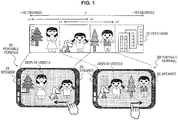
- FIG. 1 is an explanatory diagram illustrating an example in which multi-directional videos are selected and displayed on a display unit of a portable terminal.
- Video data 10 illustrated in FIG. 1 is a panorama video.
- a video of 360° in horizontal directions is set as one piece of video data.
- the left and right ends of the video data 10 are the videos at the same position.
- the configuration according to the present disclosure can also be applied in a case in which a celestial video or an omnidirectional video is used.
- the configuration of the present disclosure can be applied to a device in which multi-directional videos can be selectively displayed.
- a panorama video in the following description is assumed to include a 360° panorama video in the horizontal directions, a 360° panorama video such as a celestial video or an omnidirectional video, and all the videos in which multi-directional videos can be displayed by video movement.
- a portable terminal 20 which is an example of an information processing device of a user is illustrated.
- a video in a region of a part of the video data 10, for example, a video in any region selected by the user, can be displayed on a display unit of the portable terminal 20.
- a display video A on the portable terminal 20 on the left side is a region video of a partial section of a video section a1 to a2 of a partial region in the video data 10.
- a display video B on the portable terminal 20 on the right side is a region video of a partial section of a video section b1 to b2 of a partial region in the video data 10.
- the user can display a video of any region by moving the display video through a sliding process or the like with his or her finger on the display unit configured as a touch panel.
- the portable terminal 20 includes a speaker 25 so that audio data recorded together in the display video can be output.
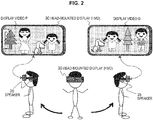
- FIG. 2 illustrates an example in which a panorama video is displayed using a head-mounted display (HMD) 30.
- HMD head-mounted display
- a video in accordance with a direction of the head of a user is displayed in accordance with information of a sensor which is mounted on the HMD and detects a motion or a direction of the head.
- the user can experience a sensation as if the user were in the video displayed on the display unit of the HMD.
- a video when the user wearing the HMD 30 faces left is a display video P.
- a video when the user wearing the HMD 30 faces right is a display video Q.
- the user wearing the HMD 30 can observe a peripheral 360° video by changing the direction of his or her body (head).
- the head-mounted display (HMD) 30 also includes a speaker 35 so that audio data recorded together in the display video can be output.
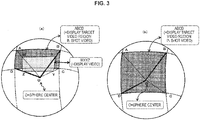
- the perspective scheme is a scheme of converting a shot video ABCD to be projected into a display video XYZW using a certain central point O as a reference point.
- the fish eye (wide angle) display scheme is a video projection conversion scheme to which a fish eye lens is applied.
- the fish eye display scheme is a scheme of projecting a video to a virtual spherical surface using a central point O of the virtual spherical surface as a reference point and converting the projected video into a display planar video.
- the projection conversion scheme to which a fish eye lens is applied there are various schemes such as stereographic projection, equidistance projection, equisolid angle projection, and orthographic projection.
- applications programs
- display devices for example, display devices of PCs, portable terminals, HMDs, or the like
- display processes are executed in accordance with display schemes selected in accordance with the applications (apps).
- the display scheme selected by each of the apps does not necessarily match an intention of a content maker, that is, a display scheme realizing a video that appears as the content maker intended.
- An information processing device is capable of selecting and executing an optimum display scheme, for example, a display scheme of displaying a video that appears as a content maker intended, at the time of a video display process of outputting a multi-directional video such as an omnidirectional video in response to a manipulation or an operation by a user.
- the information processing device that displays the panorama video described with reference to FIGS. 1 and 2 , the celestial video, the omnidirectional video, or the like on a display unit
- information processing devices devices that display the panorama video described with reference to FIGS. 1 and 2 , the celestial video, the omnidirectional video, or the like on a display unit
- devices types for example:
- a data processing unit of the information processing device reads metadata set to correspond to a video, applies a display scheme designated in the metadata, and executes the display process.
- one piece of designation information of (1) to (8) is recorded as metadata corresponding to a video and is supplied to the information processing device along with the video.
- the information processing device executes the display process in accordance with the designation scheme recorded in the metadata with reference to the metadata associated with a display video at the time of video display.
- the metadata is recorded in, for example, one of the following files:
- FIG. 4 is a diagram illustrating an information processing device 70 executing video display control according to the present disclosure in accordance with the first embodiment, and a server 50 and a medium 60 supplying content including video and audio data to the information processing device 70.
- the video data and the audio data of a celestial video, an omnidirectional video, a panorama video, or the like are supplied, for example, from the server 50 illustrated in FIG. 4 to the information processing device 70.
- the video data and the audio data are supplied from the medium 60 illustrated in FIG. 4 to the information processing device 70.
- the server 50 includes, for example, a broadcast server 51 of a broadcast station or the like and another data delivery server 52.
- Content is transmitted to the information processing device 70 via a network such as the Internet or broadcast waves.
- the information processing device 70 receives the content transmitted from the server 50 via the network such as the Internet or the broadcast waves and reproduces the content.
- the medium 60 includes various media such as a disc, a flash memory, and hard disk mounted on the information processing device.
- the information processing device 70 reads content recorded on the medium and reproduces the content.
- the information processing device reproducing the content is, for example, a TV 71, a PC 72, a portable terminal 73, a head-mounted display (HMD) 74, or the like and is a device that includes a video display unit and an audio output unit (speaker).
- a TV 71 for example, a TV 71, a PC 72, a portable terminal 73, a head-mounted display (HMD) 74, or the like and is a device that includes a video display unit and an audio output unit (speaker).
- HMD head-mounted display
- the content supplied from the server 50 or the medium 60 to the information processing device 70 is content that includes video data and audio data configured so that a multi-directional video such as a celestial video, an omnidirectional video, or a panorama video can be selectively displayed.
- the content is stored in, for example, an MP4 file 81 to be supplied.
- the MP4 file 81 is a file in which data is recorded in accordance with an ISO base media file format.
- the ISO base media file format is a data format that is defined in conformity with ISO/IEC 14496-12 and is, for example, a data format suitable for recording data on a flash memory or the like or storage data of a transmission data file via a network or broadcast waves.
- the ISO base media file format is used, for example, when encoded data which is content configuration data such as a video, audio, and subtitles or metadata (attribute information) related to the data is recorded on a recording medium. Further, the ISO base media file format is also used as a data storage format of data transmitted via a network or broadcast waves.
- FIG. 5 illustrates an example of the ISO base media file format defined in conformity with ISO/IEC14496-12.
- the MP4 file illustrated in FIG. 5 is a file that is set as one processing unit in a process of recording or reproducing data in accordance with the ISO base media file format.
- region setting in units of boxes is executed and data defined in units of boxes is stored in each box.
- Each box has regions of a box size (box-size), a box type (box-type), and box data (box-data).
- a data length (byte size) of the box is recorded in the box size (box-size).
- a type of data stored in the box is recorded in the box type (box-type).
- Actual data which is reproduction target data such as a video, audio, and subtitles is stored in the mdat box.
- the metadata such as attribute information or reproduction control information regarding data stored in the mdat box is stored in the trak box in the moov box.
- the moov box is a box set as a storage region of the metadata (the reproduction control information or the attribute information) of the data stored in the mdat box of the MP4 file.
- the trak box can be set, for example, by the types of data such as a video, audio, and subtitles and stores the metadata of each piece of data.
- the following data is stored:
- Storage data of the mdat box which is a data portion with the ISO base media file format is divided into samples serving as basic data units.
- a collection of the same kind of data samples such as a collection of only video samples, a collection of only audio samples, or a collection of only subtitle samples is stored.
- the moov box is a storage region of the metadata (the reproduction control information or the attribute information) of the data stored in the mdat box of the MP4 file.
- the trak box can be set, for example, by the types of data such as a video, audio, and subtitles and stores the metadata of each piece of data.
- the trak (video) box illustrated in FIG. 6 is a video-correspondent metadata storage box that stores attribute information or control information regarding video data.
- the trak (audio) box is a video-correspondent metadata storage box that stores attribute information or control information regarding audio data.
- the trak (subtitle) box is a video-correspondent metadata storage box that stores attribute information or control information regarding subtitle data.
- reproduction data stored in the MP4 file includes a plurality of different pieces of video data, for example, a 2K video and a 4K video
- control information in units of the types of videos can be recorded in the trak (video) box.
- the audio data stored in the MP4 file includes a plurality of different pieces of audio data, for example, Japanese audio and English audio
- individual control information in units of audio channels in accordance with the types of audio can be recorded in the trak (audio) box.
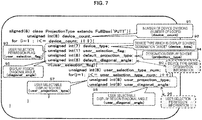
- the video display control information illustrated in FIG. 7 is video display control information which is supplied to the information processing device 70 that displays video data configured so that a multi-directional video such as a panorama video can be selectively displayed, on the display unit.
- the video display control information is control information used to decide a display scheme which is executed among the following display schemes at the time of video display of video data (a panorama video, a celestial video, an omnidirectional video, or the like) stored in the MP4 file:
- the video display control information is control information used to decide one of the schemes (1) to (8) in accordance with which to execute video display.
- the control information recorded in the trak (video) box is recorded as data illustrated in FIG. 7 .
- control information is recorded as the following data.
- the control information for designating the video display scheme described in FIG. 7 and the above includes:
- the pieces of information (a) and (b) are included.
- the device-type-based designation information 90 is a region in which designation information of a display scheme in accordance with a type of device such as a PC or a head-mounted display (HMD) is recorded.
- a type of device such as a PC or a head-mounted display (HMD)
- the device-type-based designation information 90 is a loop region in which a display scheme in units of one or more types of devices is repeatedly recorded.
- the designation information of the display scheme in accordance with each device type is recorded by, for example, recording a designation display scheme for a PC and a tablet terminal in a first loop and recording a designation display scheme for an HMD as a second loop.
- a device corresponding to a device type identifier recorded in a "device type (device_type) 92 which is a display scheme designation target" in the device-type-based designation information 90 is requested to apply a display scheme designated in a recording region of the device-type-based designation information 90 and execute video display.
- User selection permission information 96 is a region which is used in a case in which setting of a "user selection permission flag 93 (user_selection_flag)" in the device-type-based designation information 90 is a setting value for permitting user selection and in which the display schemes which can be freely selected by a user is recorded.
- the user can freely decide a display scheme among choices recorded in the user selection permission information 96.
- Data “device_count” in control data illustrated in FIG. 7 is “number of device divisions (the number of loops) 91,” as illustrated in FIG. 7 . That is, the data “device_count” is the “number of device divisions (the number of loops) 91" recorded in the device-type-based designation information 90.
- the device type is a type of information processing device that executes video display and is equivalent to a kind of PC, HMD, or the like.
- the device-type-based designation information 90 is assumed to include the following two loops:
- the "number of device divisions (the number of loops) (device_count) 91" is 2.
- data "device_type" in the control data illustrated in FIG. 7 is a “device type 92 which is a display scheme designation target,” as illustrated in FIG. 7 .
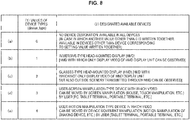
- the device type setting value 1 or 2 is set for the "device type (device_type) 92 which is a display scheme designation target" of the first loop.
- the setting of the correspondence relation illustrated in FIG. 8 is an example. Setting different from the correspondence relation illustrated in FIG. 8 is also possible and a configuration in which setting values are set for devices other than the device types illustrated in FIG. 8 may also be realized.
- Data "user_selection_flag" in the control data illustrated in FIG. 7 is a "user selection permission flag 93," as illustrated in FIG. 7 .
- Data "projection_type" in the control data illustrated in FIG. 7 is a "designation display scheme 94," as illustrated in FIG. 7 .
- the correspondence relation between the setting value of the designation display scheme (projection_type) and the display scheme are as follows:
- the setting illustrated in FIG. 9 is an example. Setting different from the setting illustrated in FIG. 9 is also possible. In addition, a configuration in which setting values are set for display schemes other than the display schemes illustrated in FIG. 9 may be realized.
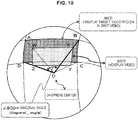
- Data “diagonal_angle” in the control data illustrated in FIG. 7 is a "display region diagonal angle 95," as illustrated in FIG. 7 .
- the display region diagonal angle is a region in which display region diagonal angles to be defined are defined in the display scheme (c) 2: the perspective scheme to (h) 7: the fish eye (wide angle) display scheme illustrated in FIG. 8 .
- FIG. 10 An example of a diagonal angle (an angle BOD) in the perspective scheme is illustrated in FIG. 10 and an example of a diagonal angle (an angle BOD) in the fish eye (wide angle) scheme is illustrated in FIG. 11 .
- Data "user_projection_type" in the control data illustrated in FIG. 7 is a “user selectable display scheme 97,” as illustrated in FIG. 7 .
- data "user_diagonal_angle" in the control data illustrated in FIG. 7 is a “user selectable display region diagonal angle 98,” as illustrated in FIG. 7 .
- the user selection permission information 96 is the region which is used in a case in which setting of the "user selection permission flag 93 (user_selection_flag)" in the device-type-based designation information 90 is a setting value for permitting user selection and in which the display schemes which can be freely selected by a user is recorded.
- setting of the "user selection permission flag 93 (user_selection_flag)" is a setting value in which user selection is permitted
- the user can freely decide the display scheme among display scheme choices recorded in the "user selectable display scheme 97" of the user selection permission information 96.
- the user can freely decide a display region diagonal angle among display region diagonal angle choices recorded in the "user selectable display region diagonal angle 98.”
- the video display control information illustrated in FIG. 7 is recorded in the trak box which is a control information (metadata) recording region corresponding to a video of the MP4 file described above with reference to FIGS. 5 and 6 .
- trak box which is the video display control information recording region
- various kinds of control information can be recorded.
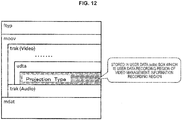
- FIG. 12 One example of a recording position set in the trak box in which the video display control information illustrated in FIG. 7 is recorded will be described with reference to FIG. 12 .
- a first control information storage example illustrated in FIG. 12 will be described.
- FIG. 12 is an example in which a video display control information (projection type) recording box is set as a subordinate box in a user data (udta) box that stores user data in the trak box which is a video display control information storage box of the MP4 file.
- a video display control information (projection type) recording box is set as a subordinate box in a user data (udta) box that stores user data in the trak box which is a video display control information storage box of the MP4 file.
- the control information illustrated in FIG. 7 is recorded on the video display control information (projection type) recording box illustrated in FIG. 12 .
- the video display control information can be recorded in the metadata recording region described with reference to FIG. 12 .
- setting of recording data of the MP4 file is executed as follows:
- one loop is set in the recording region of "the device-type-based designation information 90" in the recording data of the video display control information illustrated in FIG. 7 , and one common recording scheme is recorded in all the devices.
- One of the setting values illustrated in FIG. 9 is recorded in the "designation display scheme (projection_type) 94" in the control data illustrated in FIG. 7 .
- designated display region diagonal angle data is recorded in the "display region diagonal angle (diagonal_angle) 95" in the control data illustrated in FIG. 7 , as necessary.
- a display device such as a PC or an HMD executing video display interprets the video display control information, executes a designated display scheme, and executes a video display process.
- One of the setting values illustrated in FIG. 9 is recorded in the "designation display scheme (projection_type) 94" in the control data illustrated in FIG. 7 .
- designated display region diagonal angle data is recorded in the "display region diagonal angle (diagonal_angle) 95" in the control data illustrated in FIG. 7 , as necessary.
- recording scheme designation information corresponding to the device type (device_type) 0 (no designation) is recorded.
- One of the setting values illustrated in FIG. 9 is recorded in the "designation display scheme (projection_type) 94" in the control data illustrated in FIG. 7 .
- designated display region diagonal angle data is recorded in the "display region diagonal angle (diagonal angle) 95" in the control data illustrated in FIG. 7 , as necessary.
- the display device executes the video display process in accordance with the designation scheme recorded in the first loop of the device type-based designation information, that is, the following designation data:
- the display device executes the video display process in accordance with the designation scheme recorded in the second loop of the device type-based designation information, that is, the following designation data:
- setting of recording data of the MP4 file is executed as follows, for example.
- the schemes or the like which can be selected by the user are recorded in the user selection permission information 96.
- the display schemes, the display region diagonal angles, and the like to be permitted are recorded in the following data recording regions:
- the display device (information processing device) executing the video display applies a scheme and an angle selected by the user from the schemes and angles recorded in the following regions and executes the video display process:
- FIGS. 13 and 14 are explanatory flowcharts illustrating the video display control process sequence executed in the information processing device 70 which is a user device.
- the information processing device 70 includes a display unit (display) and an audio output unit (speaker).
- the information processing device 70 is, for example, a TV, a PC, a portable terminal, a head-mounted display (HMD), or the like.
- the information processing device 70 acquires the MP4 file from, for example, the server 50 or the medium 60 illustrated in FIG. 4 and reproduces content recorded in the MP4 file.
- the reproduced content is content that includes a video in which a multi-directional video such as a celestial video, an omnidirectional video, or a panorama video can be observed and includes audio information which is reproduced along with the video.
- a multi-directional video such as a celestial video, an omnidirectional video, or a panorama video can be observed and includes audio information which is reproduced along with the video.
- Video data and audio data are stored in the MP4 file and control information corresponding to the video data and the audio data are also further stored in the MP4 file.
- the video display control information includes the control information described above with reference to FIG. 7 .
- the information processing device 70 includes a data processing unit including a CPU that has a program execution function and each process is executed under the control of the data processing unit. Also, a hardware configuration example of the information processing device 70 will be described later.
- step S101 the data processing unit of the information processing device acquires an MP4 file.
- step S102 the data processing unit of the information processing device acquires video display control information from the acquired MP4 file.
- the video display control information is the video display control information described with reference to FIG. 7 .
- step S103 the data processing unit of the information processing device acquires device-type-based designation information from the video display control information acquired in step S102.
- the device-type-based designation information is the device-type-based designation information 90 described with reference to FIG. 7 .
- the device-type-based designation information 90 is a region in which designation information of a display scheme in accordance with a type of device such as a PC or a head-mounted display (HMD) is recorded.
- a type of device such as a PC or a head-mounted display (HMD)
- the device-type-based designation information 90 is a loop region in which a display scheme in units of one or more types of devices is repeatedly recorded.
- the designation information of the display scheme in accordance with each device type is recorded by, for example, recording a designation display scheme for a PC and a tablet terminal in a first loop and recording a designation display scheme for an HMD as a second loop.
- step S104 the data processing unit of the information processing device selects a data recording region (loop) in which the setting value of the device type (device_type) recorded in the device-type-based designation information matches the device type of the own device.
- step S105 the data processing unit of the information processing device determines whether the setting value of the user selection permission flag (user_selection_flag) recorded in the loop in the device-type-based designation information selected in step S104 indicates user selectable setting.
- user_selection_flag user selection permission flag
- step S201 In the case of the user selectable setting, the process proceeds to step S201.
- step S106 In the case of user unselectable setting, the process proceeds to step S106.
- step S106 In a case in which the setting value of the user selection permission flag (user_selection_flag) recorded in the loop in the device-type-based designation information selected in step S104 is the user unselectable setting, the process of step S106 is executed.
- the data processing unit of the information processing device executes, in step S106, the video display process according to designation of the following (a) and (b) recorded in the selection loop in the device-type-based designation information:
- step S201 is executed.
- the data processing unit of the information processing device acquires, in step S201, the following data recorded in the user selection permission information region and displays the permission scheme and the permission angle information on the display unit:
- a UI for selecting a desired scheme and angle is presented to the user.
- the data processing unit of the information processing device inputs input information of the user, that is, the display scheme and the display region angle information desired by the user.
- the data processing unit of the information processing device applies the input information of the user, that is, the scheme and the angle selected in accordance with the display scheme and the display region angle information desired by the user and executes the video display process.
- FIG. 15 is a diagram illustrating an information processing device 70 executing video display control according to the present disclosure in accordance with the second embodiment, and a server 50 and a medium 60 supplying content including video and audio data to the information processing device 70.
- the video data and the audio data of a celestial video, an omnidirectional video, a panorama video, or the like is transmitted from the server 50 illustrated in FIG. 4 or is read from the medium 60 to be supplied to the information processing device 70.
- the server 50 includes, for example, the broadcast server 51 of a broadcast station or the like and the other data delivery server 52 and transmits various kinds of data to the information processing device 70 via a network such as the Internet or broadcast waves.
- the information processing device 70 receives the data transmitted from the server 50 via the network such as the Internet or the broadcast waves and reproduces the data.
- the medium 60 is any of various media such as a disc, a flash memory, and a hard disk mounted on the information processing device.
- the information processing device 70 reads data recorded on the medium and reproduces the data.
- the information processing device reproducing the content is, for example, a TV 71, a PC 72, a portable terminal 73, a head-mounted display (HMD) 74, or the like and is a device that includes a video display unit and an audio output unit (speaker).
- a TV 71 for example, a TV 71, a PC 72, a portable terminal 73, a head-mounted display (HMD) 74, or the like and is a device that includes a video display unit and an audio output unit (speaker).
- HMD head-mounted display
- the content supplied from the server 50 or the medium 60 to the information processing device 70 is content that includes video data and audio data configured so that a multi-directional video such as a celestial video, an omnidirectional video, or a panorama video can be selectively displayed.
- the content is stored in, for example, an MP4 file 81 to be supplied, as in the first embodiment described above.
- the video display control information described with reference to FIG. 7 has been recorded in the trak box which is the storage region of the metadata of the MP4 file.
- the video display control information regarding the video data stored in the MP4 file 81 illustrated in FIG. 15 is stored in an MPD file 82 different from the MP4 file 81 to be supplied to the information processing device 70.
- the media presentation description [MPD] file 82 is one manifest file that constitutes signaling data (metadata) defined in the MPEG-DASH standard which is a standard related to streaming delivery content.
- the MPD file 82 is a manifest file for describing metadata which is management information of a moving image or audio file.
- the second embodiment is an embodiment in which the video display control information regarding the video data stored in the MP4 file 81 is recorded in the MPD file 82.
- control data can be recorded, for example, in units of periods which are time sections formed by segmenting a reproduction time of certain content.
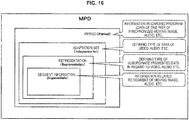
- FIG. 16 is a diagram illustrating an example of an MPD format.
- MPD can describe information such as an attribute or control information in the following various definition range units for each stream of a video or audio:
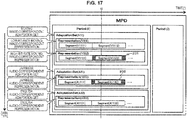
- FIG. 17 is a diagram illustrating chronological development of information (control information, management information, attribute information, or the like) corresponding to an AV segment recorded in the MPD.
- Time is assumed to elapse from the left to the right.
- the time axis corresponds to a reproduction time of AV content in, for example, the information processing device.
- the MPD file 82 is supplied from the server 50 to the information processing device 70, the MPD is transmitted as signaling data earlier than the MP4 file 81 that stores the AV segment which is reproduction target actual data.
- the information processing device 70 can analyze the MPD and acquire access information or codec information of the MP4 file 81 storing the AV segment which is reproduction target actual data and can make reproduction preparation of the AV segment stored in the MP4 file 81.
- the MPD is configured to record the metadata (signaling data) such as attribute information or control information regarding the AV segment under the following hierarchical setting:
- FIG. 17 is a diagram illustrating development of the metadata recording regions by a time axis and a type of data.
- Period 1 Period 1
- Period 2 Period 2
- AdaptationSet three adaptation sets
- an adaptation set A11 (AdaptatiobSet (A11) which is a Japanese audio-correspondent information recording region includes the following representation:
- an adaptation set A12 (AdaptatiobSet (A12) which is an English audio-correspondent information recording region includes the following representation:
- each representation is configured such that information can be recorded in units of segments.
- the information processing device (client) that selects and reproduces a high-bit-rate video and Japanese audio at time t1 selects and acquires information regarding the high-bit-rate video and the Japanese audio which are reproduction targets from the MPD.
- the recording information of the MPD which is the selection target is information of segment regions 201 and 202 illustrated in the drawing.
- a reception device selects only information corresponding to data (segment), which is a reproduction target of the own device from the MPD transmitted as signaling data from a transmission device, to refer to the information.
- the second embodiment to be described below is an embodiment in which video or audio data (AV segment) which is reproduction target data is stored in the MP4 file 81 illustrated in FIG. 15 and control information regarding the video or audio data (AV segment) stored in the MP4 file 81 is stored in the MPD file 82.
- a new descriptor is prepared in a role element which is a constituent element of the MPD.
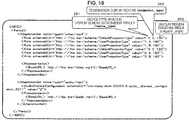
- An URI corresponding to the video control information is assumed to be, for example, "http://foo.bar/scheme/DefaultProjectionType" and "http://foo.bar/scheme/UserProjectionType.”
- angle information such as 180 or 120 is recorded.
- FIG. 18 An example of XML data in a case in which the video display control information is recorded in the MPD is illustrated in FIG. 18 and is described below.
- elements which are a plurality of recording elements are recorded in the MPD.
- Each element is an element in which, for example, the display scheme and the display region angle information designated in regard to a specific device type are recorded.
- This element records the following designation information.
- HMD head-mounted display
- the HMD applies the perspective scheme, and sets the display region diagonal angle to 180 degrees and executes the display process, in accordance with the element recording information.
- a device type setting value 1: an immersive-type head-mounted display (HMD) [an HMD with which only a display video of an HMD display unit can be observed]:
- the three setting values are recorded.
- a case in which the plurality of setting values for the same device type are recorded means that one setting can be freely selected and applied from the settings.
- HMD head-mounted display
- HMD head-mounted display
- FIGS. 19 and 20 are explanatory flowcharts illustrating the video display control process sequence executed in the information processing device 70 which is a user device.
- the information processing device 70 includes a display unit (display) and an audio output unit (speaker).
- the information processing device 70 is, for example, a TV, a PC, a portable terminal, a head-mounted display (HMD), or the like.
- the information processing device 70 acquires the MPD file from, for example, the server 50 or the medium 60 illustrated in FIG. 4 and reproduces content recorded in the MPD file.
- the reproduced content is content that includes a video in which a multi-directional video such as a celestial video, an omnidirectional video, or a panorama video can be observed and includes audio information which is reproduced along with the video.
- a multi-directional video such as a celestial video, an omnidirectional video, or a panorama video can be observed and includes audio information which is reproduced along with the video.
- Video data and audio data are stored in the MP4 file and control information corresponding to the video data and the audio data are further stored in the MPD file.
- the information processing device 70 includes a data processing unit including a CPU that has a program execution function and each process is executed under the control of the data processing unit. Also, a hardware configuration example of the information processing device 70 will be described later.
- step S301 the data processing unit of the information processing device acquires an MPD file.
- step S302 the data processing unit of the information processing device acquires video display control information from the acquired MPD file.
- the video display control information is the video display control information described with reference to FIG. 18 .
- step S303 the data processing unit of the information processing device acquires a video display control information recording element (role element) from the video display control information acquired in step S302.
- the video display control information recording element is the role element described with reference to FIG. 18 .
- the plurality of role elements are each recorded in the MPD and are, for example, the elements in which a display scheme and display region angle information designated in a specific device type are recorded.
- a device type setting value 0: no device designation: available in all devices (in a case in which another value other than 0 is written together, available in devices other than a device corresponding to the setting value written together);
- a device type setting value 1: an immersive-type head-mounted display (HMD) [an HMD with which only a display video of an HMD display unit can be observed];
- a device type setting value 2: a glasses-type head-mounted display (HMD) [an HMD with which not only a display video of an HMD display unit but also an outside scenery transmitted through the HMD can be observed];
- step S303 the element in which the setting value (x, y, z) is recorded is read.
- step S304 the data processing unit of the information processing device selects the element in which the device type identifier (x) in the setting value (x, y, z) recorded in each element matches the device type of the own device.
- step S305 the data processing unit of the information processing device determines whether there is designation of the user display scheme (UserProjectionType) for permitting user selection in regard to the element matching the device type of the own device selected in step S304.
- UserProjectionType the user display scheme
- step S306 In a case of the designation of only the default display scheme (DefaultProjectionType) of the default setting in regard to the element selected in step S304 and matching the device type of the own device, the process of step S306 is executed.
- step S401 is executed.
- a UI for selecting a desired scheme and angle is presented to the user.
- both the default display scheme (DefaultProjectionType) and the user display scheme (UserProjectionType) are set to be displayed so that the user can select either scheme.
- the data processing unit of the information processing device inputs input information of the user, that is, the display scheme and the display region angle information desired by the user.
- the data processing unit of the information processing device applies the input information of the user, that is, the scheme and the angle selected in accordance with the display scheme and the display region angle information desired by the user and executes the video display process.
- Hardware illustrated in FIG. 21 is an example of a hardware configuration of the information processing device (user device) 70 illustrated in FIGS. 4 and 15 , that is, the information processing device (user device) 70 executing video reproduction and audio output.
- the hardware illustrated in FIG. 21 is also an example of a hardware configuration of the server 50 illustrated in FIGS. 4 and 15 , that is, the server 50 executing a process of generating a file storing video data, audio data, and the above-described video display control information and transmitting the file to the information processing device (user device) 70.
- a central processing unit (CPU) 301 functions as a data processing unit that executes various processes in accordance with programs stored in a read-only memory (ROM) 302 or a storage unit 308.
- the CPU 301 executes the processes in accordance with the sequences described in the above-described embodiments.
- a random access memory (RAM) 303 stores data or a program executed by the CPU 301.
- the CPU 301, the ROM 302, and the RAM 303 are connected to each other by a bus 304.
- the CPU 301 is connected to an input and output interface 305 via the bus 304.
- An input unit 306 including any of various switches, a keyboard, a mouse, a microphone, or the like, a display unit 307 including a display, a speaker, or the like, and an audio output unit 321 are connected to the input and output interface 305.
- the CPU 301 executes various processes in response to instructions input from the input unit 306 and outputs processing results to, for example, the display unit 307 and the audio output unit 321.
- the storage unit 308 connected to the input and output interface 305 includes, for example, a hard disk and stores various kinds of data or programs executed by the CPU 301.
- the communication unit 309 functions as a transceiver unit for data communication via a network such as the Internet or a local area network and further functions as a transceiver unit for broadcast waves to communicate with an external device.
- a drive 310 connected to the input and output interface 305 drives a removable medium 311 such as a magnetic disk, an optical disc, a magneto-optical disc, or a semiconductor memory such as a memory card to execute data recording or reading.
- a removable medium 311 such as a magnetic disk, an optical disc, a magneto-optical disc, or a semiconductor memory such as a memory card to execute data recording or reading.
- data encoding or decoding can be executed as a process of the CPU 301 serving as the data processing unit, but a codec serving as dedicated hardware for executing an encoding process or a decoding process may be included.
- present technology may also be configured as below.
- a program that records a process sequence can be installed in a memory of a computer embedded in dedicated hardware to be executed or a program can be installed in a general-purpose computer capable of executing various processes to be executed.
- the program can be recorded in advance on a recording medium.
- the program can also be received via a network such as a Local Area Network (LAN) or the Internet and can be installed on a recording medium such as a built-in hard disk.
- LAN Local Area Network
- the Internet can be installed on a recording medium such as a built-in hard disk.
- system refers to a logical aggregate configuration of multiple devices, and the respective devices of the configuration are not limited to being inside the same housing.
- the data processing unit applies a device-correspondent video display scheme recorded in video display control information and executes the video display process.
- the video display control information defines a type-based display scheme optimum for each type of information processing device executing a video display process.
- the data processing unit applies the display scheme associated with a type matching the type of the own device and executes the video display process.
Landscapes
- Engineering & Computer Science (AREA)
- Multimedia (AREA)
- Signal Processing (AREA)
- Theoretical Computer Science (AREA)
- Physics & Mathematics (AREA)
- General Physics & Mathematics (AREA)
- Computer Hardware Design (AREA)
- Databases & Information Systems (AREA)
- Human Computer Interaction (AREA)
- General Engineering & Computer Science (AREA)
- Computer Security & Cryptography (AREA)
- Controls And Circuits For Display Device (AREA)
- Image Processing (AREA)
- Studio Devices (AREA)
Abstract
Description
- The present disclosure relates to an information processing device, an information processing method, and a program, and more particularly, to an information processing device, an information processing method, and a program capable of displaying a display scheme of a video to be displayed on a display unit in accordance with an optimum scheme, for example, a display scheme recommended by a content maker, in a video display configuration in which a multi-directional video such as a celestial video, an omnidirectional video, or a panorama video can be observed.
- In recent years, imaging devices capable of shooting multi-directional videos such as celestial videos, omnidirectional videos, or panorama videos have been developed. Systems in which videos shot using such imaging devices are displayed on display units of PCs, tablet terminals, portable terminals, head-mounted displays (HMDs), or the like and videos selected by users or videos automatically selected in accordance with directions of users can be observed have been widely used.
- For example, in PCs or the like, picture (moving video) data of peripheral 360° omnidirectional videos can be acquired from external servers or can be read from recording media to be displayed on display devices. Users can select videos of any direction and display the videos on display devices, can change viewpoints freely, and can observe videos such as moving videos, still images, or the like.
- Videos displayed on display units of PCs, tablet terminals, or portable terminals can be displayed by moving observation directions by mouse manipulations or sliding processes, flicking processes, or the like on touch panels by users so that the users can easily enjoy multi-directional videos.
- In a case in which videos are displayed on head-mounted displays (HMDs), videos in accordance with directions of the heads of users can be displayed in accordance with information of sensors which are mounted on the HMDs and detect motions or directions of the heads. Thus, the users can experience a sensation as if the users were in the videos displayed on display units of the HMDs.
- The celestial videos, the omnidirectional videos, or the panorama videos are subjected to a process of cutting only partial videos from the shot multi-directional videos and displaying the partial videos on display units of display devices.
- There are a plurality of different schemes of a display process involving the video cutting.
- For example, there are a perspective scheme, a fish eye (wide angle) display scheme, and the like.
- Also, as a technology of the related art in which a process of changing a display range through video processing is disclosed, there is Patent Literature 1 (
JP 2014-127001A - In general, applications (programs) executing predetermined display schemes are stored in display devices, for example, display devices of PCs, portable terminals, HMDs, or the like, and display processes are executed in accordance with display schemes selected in accordance with the applications (apps).
- However, the display scheme selected by each of the apps does not necessarily match an intention of a content maker, that is, a display scheme realizing a video that appears as the content maker intended.
- When video display is executed using a display scheme different from a display scheme assumed by the content maker, a problem that a user (observer) cannot view a "video that appears as intended" by the content maker occurs.
- Patent Literature 1:
JP 2014-127001A - The present disclosure was finalized in view of, for example, the foregoing problem and provides an information processing device, an information processing method, and a program capable of selecting and executing an optimum display scheme, for example, a display scheme of displaying a video that appears as a content maker intended, in a video display device that outputs a multi-directional video such as an omnidirectional video in response to a manipulation or an operation by a user.
- A first aspect of the present disclosure is an information processing device including: a display unit configured to be able to selectively display a multi-directional video; and a data processing unit configured to execute video display control on a video to be output to the display unit. The data processing unit acquires video display control information regarding output video data, applies a video display scheme recorded in the video display control information, and executes a video display process.
- Further, a second aspect of the present disclosure is a data delivery server including: a data processing unit configured to generate a file that stores video data configured so that a multi-directional video is selectably displayable and video display control information which is video display control information regarding the video data and defines a video display scheme in accordance with a device type that executes video display; and a communication unit configured to transmit the file generated by the data processing unit.
- Further, a third aspect of the present disclosure is an information recording medium storing video data configured so that a multi-directional video is selectably displayable, and video display control information which is video display control information regarding the video data and defines a video display scheme in accordance with a device type that executes video display. The information recording medium is configured to be able to cause a reproduction device that reproduces data read from the information recording medium to apply the video display scheme corresponding to the device type matching the type of the own device recorded in the video display control information and execute the video display.
- Further, a fourth aspect of the present disclosure is an information processing method of executing video display control in an information processing device. The information processing device includes a display unit configured to be able to selectively display a multi-directional video, and a data processing unit configured to execute the video display control on a video to be output to the display unit, and the data processing unit acquires video display control information regarding output video data, applies a video display scheme recorded in the video display control information, and executes a video display process.
- Further, a fifth aspect of the present disclosure is a program causing an information processing device to execute video display control. The information processing device includes a display unit configured to be able to selectively display a multi-directional video, and a data processing unit configured to execute the video display control on a video to be output to the display unit, and the program causes the data processing unit to acquire video display control information regarding output video data, apply a video display scheme recorded in the video display control information, and execute a video display process.
- Note that a program according to the present disclosure is, for example, a program provided in computer-readable format to an information processing device or a computer system capable of executing various program code, the program being providable by a storage medium or communication medium. By providing such a program in a computer-readable format, processing corresponding to the program is realized on the information processing device or the computer system.
- Further objectives, features, and advantages of the present disclosure will be clarified by a more detailed description based on the embodiments of the present disclosure described hereinafter and the attached drawings. Note that in this specification, the term "system" refers to a logical aggregate configuration of multiple devices, and the respective devices of the configuration are not limited to being inside the same housing.
- In a configuration according to an embodiment of the present disclosure, it is possible to realize a device and a method capable of applying an optimum display scheme corresponding to a display device and executing a display process at the time of a panorama video display process.
- Specifically, in an information processing device including a display unit that is able to selectively display a multi-directional video and a data processing unit that executes video display control, the data processing unit applies a device-correspondent video display scheme recorded in video display control information and executes the video display process. The video display control information defines a type-based display scheme optimum for each type of information processing device executing a video display process. The data processing unit applies the display scheme associated with a type matching the type of the own device and executes the video display process.
- With this configuration, it is possible to realize a device and a method capable of applying an optimum display scheme corresponding to a display device and executing a display process at the time of a panorama video display process.
- Note that the advantageous effects described in this specification are merely for the sake of example and non-limiting, and there may be additional advantageous effects.
-
- [
FIG. 1] FIG. 1 is an explanatory diagram illustrating examples of a video display process and an audio output process in an information processing device. - [
FIG. 2] FIG. 2 is an explanatory diagram illustrating examples of a video display process and an audio output process in an information processing device. - [
FIG. 3] FIG. 3 is an explanatory diagram illustrating a perspective scheme and a fish eye (wide angle) display scheme. - [
FIG. 4] FIG. 4 is an explanatory diagram illustrating a configuration of a data supply process for an information processing device. - [
FIG. 5] FIG. 5 is an explanatory diagram illustrating an ISO base media file format. - [
FIG. 6] FIG. 6 is an explanatory diagram illustrating an ISO base media file format. - [
FIG. 7] FIG. 7 is an explanatory diagram illustrating a recording example of video display control information in an MP4 file. - [
FIG. 8] FIG. 8 is an explanatory diagram illustrating a device type setting example. - [
FIG. 9] FIG. 9 is an explanatory diagram illustrating a display scheme setting example. - [
FIG. 10] FIG. 10 is an explanatory diagram illustrating an example of a display region diagonal angle. - [
FIG. 11] FIG. 11 is an explanatory diagram illustrating an example of a display region diagonal angle. - [
FIG. 12] FIG. 12 is an explanatory diagram illustrating an example of a recording region of video display control information in an MP4 file. - [
FIG. 13] FIG. 13 is a diagram illustrating an explanatory flowchart of an execution sequence of reading of video display control information from an MP4 file and a video display control process. - [
FIG. 14] FIG. 14 is a diagram illustrating an explanatory flowchart of an execution sequence of reading of video display control information from an MP4 file and a video display control process. - [
FIG. 15] FIG. 15 is an explanatory diagram illustrating a configuration of a data supply process for an information processing device. - [
FIG. 16] FIG. 16 is an explanatory diagram illustrating an MPD file. - [
FIG. 17] FIG. 17 is an explanatory diagram illustrating an MPD file. - [
FIG. 18] FIG. 18 is an explanatory diagram illustrating video display control information recorded in an MPD file. - [
FIG. 19] FIG. 19 is a diagram illustrating an explanatory flowchart of an execution sequence of reading of video display control information from an MPD file and a video display control process. - [
FIG. 20] FIG. 20 is a diagram illustrating an explanatory flowchart of an execution sequence of reading of video display control information from an MPD file and a video display control process. - [
FIG. 21] FIG. 21 is an explanatory diagram illustrating a hardware configuration example of an information processing device. - Hereinafter, the details of an information processing device, an information processing method, and a program of the present disclosure will be described with reference to the drawings. Note that the following items will be described.
- 1. Overview of video display process
- 2. Overview of configuration in which designated video display scheme is selected and video display process is executed
- 3. (First embodiment) Embodiment in which video display scheme to be used in device is defined in MP4 file
- 3-1. (First video display control information recording example) Recording example in which display scheme designation information is recorded in units of content in MP4 file
- 3-2. (Second video display control information recording example) Recording example in which display scheme designation information is recorded in units of display devices in MP4 file
- 3-3. (Third video display control information recording example) Recording example in which display scheme designation information for restricting scheme which can be selected by user is recorded in MP4 file
- 4. Video display control process sequence in which video display control information recorded in MP4 file is used
- 5. (Second embodiment) Embodiment in which video display control information is recorded in MPD
- 6. Video display control process sequence in which video display control information recorded in MPD file is used
- 7. Hardware configuration example of information processing device
- 8. Summary of configuration of present disclosure
- First, an overview of a video display process in a device capable of displaying a multi-directional video such as a celestial video, an omnidirectional video, or a panorama video on a display unit will be described with reference to
FIG. 1 and the subsequent drawings. - As described above, in recent years, imaging devices capable of shooting multi-directional videos such as celestial videos, omnidirectional videos, or panorama videos have been developed. Systems in which videos shot using such imaging devices are displayed on display units of PCs, tablet terminals, portable terminals, head-mounted displays (HMDs), or the like and videos of any direction selected by users can be observed have widely been used.
- For example, picture (moving video) data of peripheral 360° omnidirectional videos can be acquired from an external server or can be read from recording media to be displayed on display devices of PCs or the like of users. The users can select videos of any direction from the video data acquired from the servers or the recording media, display the videos on the display devices, and observe pictures (moving videos) or still images while freely changing viewpoints.
-
FIG. 1 is an explanatory diagram illustrating an example in which multi-directional videos are selected and displayed on a display unit of a portable terminal. -
Video data 10 illustrated inFIG. 1 is a panorama video. A video of 360° in horizontal directions is set as one piece of video data. - When a middle portion of the video data is assumed to be a video in the front direction (for example, 0 degrees = north) of a user (an observer), a left end of the
video data 10 is a video in the rear direction (-180 degrees = south) of the user (the observer) and a right end of thevideo data 10 is also a video in the rear direction (+180 degrees = south) of the user (the observer). - The left and right ends of the
video data 10 are the videos at the same position. - Also, in a case of a celestial video or an omnidirectional video, that is, a 360° panorama video, 180° videos are shot in regard to the vertical direction and videos in all the vertical and horizontal directions are included.
- In the following embodiments, an example in which a 360° panorama video in the horizontal directions is used will be described. However, the configuration according to the present disclosure can also be applied in a case in which a celestial video or an omnidirectional video is used. The configuration of the present disclosure can be applied to a device in which multi-directional videos can be selectively displayed.
- A panorama video in the following description is assumed to include a 360° panorama video in the horizontal directions, a 360° panorama video such as a celestial video or an omnidirectional video, and all the videos in which multi-directional videos can be displayed by video movement.
- In the lower part of
FIG. 1 , aportable terminal 20 which is an example of an information processing device of a user is illustrated. - A video in a region of a part of the
video data 10, for example, a video in any region selected by the user, can be displayed on a display unit of theportable terminal 20. - A display video A on the
portable terminal 20 on the left side is a region video of a partial section of a video section a1 to a2 of a partial region in thevideo data 10. - A display video B on the
portable terminal 20 on the right side is a region video of a partial section of a video section b1 to b2 of a partial region in thevideo data 10. - The user can display a video of any region by moving the display video through a sliding process or the like with his or her finger on the display unit configured as a touch panel.
- Also, the
portable terminal 20 includes aspeaker 25 so that audio data recorded together in the display video can be output. -
FIG. 2 illustrates an example in which a panorama video is displayed using a head-mounted display (HMD) 30. - In a case in which a video is displayed on the head-mounted display (HMD) 30, a video in accordance with a direction of the head of a user is displayed in accordance with information of a sensor which is mounted on the HMD and detects a motion or a direction of the head. Through the video display control, the user can experience a sensation as if the user were in the video displayed on the display unit of the HMD.
- A video when the user wearing the
HMD 30 faces left is a display video P. - A video when the user wearing the
HMD 30 faces right is a display video Q. - The user wearing the
HMD 30 can observe a peripheral 360° video by changing the direction of his or her body (head). - Also, the head-mounted display (HMD) 30 also includes a
speaker 35 so that audio data recorded together in the display video can be output. - When the panorama video described with reference to
FIGS. 1 and2 , the celestial video, the omnidirectional video, or the like is displayed on the display unit, a process of cutting a partial video from a multi-directional shot video and displaying the partial video is executed. - There are a plurality of different schemes of a display process involving the video cutting.
- For example, the schemes are broadly classified into the following schemes:
- a perspective scheme; and
- a fish eye (wide angle) display scheme.
- As illustrated in
FIG. 3(a) , the perspective scheme is a scheme of converting a shot video ABCD to be projected into a display video XYZW using a certain central point O as a reference point. The fish eye (wide angle) display scheme is a video projection conversion scheme to which a fish eye lens is applied. As illustrated inFIG. 3(b) , the fish eye display scheme is a scheme of projecting a video to a virtual spherical surface using a central point O of the virtual spherical surface as a reference point and converting the projected video into a display planar video. - Also, as the projection conversion scheme to which a fish eye lens is applied, there are various schemes such as stereographic projection, equidistance projection, equisolid angle projection, and orthographic projection.
- In general, applications (programs) executing predetermined display schemes are stored in display devices, for example, display devices of PCs, portable terminals, HMDs, or the like, and display processes are executed in accordance with display schemes selected in accordance with the applications (apps).
- However, the display scheme selected by each of the apps does not necessarily match an intention of a content maker, that is, a display scheme realizing a video that appears as the content maker intended.
- When video display is executed using a display scheme different from a display scheme assumed by the content maker, a problem that a user (observer) cannot view a "video that appears as intended" by the content maker occurs.
- A configuration according to the present disclosure for resolving this problem will be described below.
- An information processing device according to the present disclosure to be described below is capable of selecting and executing an optimum display scheme, for example, a display scheme of displaying a video that appears as a content maker intended, at the time of a video display process of outputting a multi-directional video such as an omnidirectional video in response to a manipulation or an operation by a user.
- First, an overview of a process executed by the information processing device according to the present disclosure will be described.
- As the information processing device that displays the panorama video described with reference to
FIGS. 1 and2 , the celestial video, the omnidirectional video, or the like on a display unit, there are the following types of information processing devices (device types), for example: - (a) a device that moves and changes a display video by a user manipulation (a mouse, a touch panel manipulation, swiping, or remote control);
- (a1) a PC;
- (a2) a tablet terminal;
- (s3) a portable terminal; and
- (a4) a TV.
- (b) a device that moves and changes a display video in accordance with detection information such as a motion or a direction of a user (an observer) or a device (a display device) from a detection sensor;
- (b1) an immersive-type head-mounted display (HMD) in which the outside is not visible;
- (b2) a glasses-type head-mounted display (HMD) in which the outside is also visible therethrough; and
- (b3) a portable terminal such as a mobile device (a device in which a screen can be moved with a motion sensor).
- When a panorama video, a celestial video, an omnidirectional video, or the like is displayed on a display unit of any of the various information processing devices, a data processing unit of the information processing device reads metadata set to correspond to a video, applies a display scheme designated in the metadata, and executes the display process.
- As designation schemes recorded in metadata, there are the following schemes, for example:
- (1) a non-conversion whole display scheme of displaying the whole without conversion;
- (2) a perspective scheme;
- (3) a scheme of displaying the whole of 360° using two fish eyes;
- (4) a fish eye (wide angle) display (stereographic) scheme;
- (5) a fish eye (wide angle) display (equidistant) scheme;
- (6) a fish eye (wide angle) display (wquisolid angle) scheme;
- (7) a fish eye (wide angle) display (orthographic) scheme; and
- (8) a setting for allowing an information processing device or user designation without limiting the display scheme.
- For example, one piece of designation information of (1) to (8) is recorded as metadata corresponding to a video and is supplied to the information processing device along with the video.
- The information processing device executes the display process in accordance with the designation scheme recorded in the metadata with reference to the metadata associated with a display video at the time of video display.
- Also, the metadata is recorded in, for example, one of the following files:
- (1) an MP4 file defined as a storage file of AV content; and
- (2) a media presentation description (MPD) file which is one manifest file constituting signaling data (metadata) defined in the MPEG-DASH standard.
- Two embodiments will be described in sequence below.
- (First embodiment) Embodiment in which video display scheme to be used in device is defined in MP4 file
- (Second embodiment) Embodiment in which video display scheme to be used in device is defined in MPD file
- First, an embodiment in which a video display scheme to be used in a device is defined in an MP4 file will be described as a first embodiment.
-
FIG. 4 is a diagram illustrating aninformation processing device 70 executing video display control according to the present disclosure in accordance with the first embodiment, and aserver 50 and a medium 60 supplying content including video and audio data to theinformation processing device 70. - The video data and the audio data of a celestial video, an omnidirectional video, a panorama video, or the like are supplied, for example, from the
server 50 illustrated inFIG. 4 to theinformation processing device 70. Alternatively, the video data and the audio data are supplied from the medium 60 illustrated inFIG. 4 to theinformation processing device 70. - The
server 50 includes, for example, abroadcast server 51 of a broadcast station or the like and anotherdata delivery server 52. - Content is transmitted to the
information processing device 70 via a network such as the Internet or broadcast waves. - The
information processing device 70 receives the content transmitted from theserver 50 via the network such as the Internet or the broadcast waves and reproduces the content. - In addition, the medium 60 includes various media such as a disc, a flash memory, and hard disk mounted on the information processing device.
- The
information processing device 70 reads content recorded on the medium and reproduces the content. - The information processing device reproducing the content is, for example, a
TV 71, aPC 72, aportable terminal 73, a head-mounted display (HMD) 74, or the like and is a device that includes a video display unit and an audio output unit (speaker). - The content supplied from the
server 50 or the medium 60 to theinformation processing device 70 is content that includes video data and audio data configured so that a multi-directional video such as a celestial video, an omnidirectional video, or a panorama video can be selectively displayed. - The content is stored in, for example, an
MP4 file 81 to be supplied. - The
MP4 file 81 is a file in which data is recorded in accordance with an ISO base media file format. - The ISO base media file format is a data format that is defined in conformity with ISO/IEC 14496-12 and is, for example, a data format suitable for recording data on a flash memory or the like or storage data of a transmission data file via a network or broadcast waves.
- The ISO base media file format is used, for example, when encoded data which is content configuration data such as a video, audio, and subtitles or metadata (attribute information) related to the data is recorded on a recording medium. Further, the ISO base media file format is also used as a data storage format of data transmitted via a network or broadcast waves.
- In recent years, many portable terminals have reproduction applications capable of reproducing MP4 data recorded in accordance with the ISO base media file format. In a case in which content is recorded on a medium of a portable terminal, there are requests for recording with an MP4 format in many cases.
- An overview of the ISO base media file format will be described with reference to
FIGS. 5 and6 . -
FIG. 5 illustrates an example of the ISO base media file format defined in conformity with ISO/IEC14496-12. - The MP4 file illustrated in
FIG. 5 is a file that is set as one processing unit in a process of recording or reproducing data in accordance with the ISO base media file format. - In the MP4 file, region setting in units of boxes is executed and data defined in units of boxes is stored in each box.
- Each box has regions of a box size (box-size), a box type (box-type), and box data (box-data).
- A data length (byte size) of the box is recorded in the box size (box-size).
- A type of data stored in the box is recorded in the box type (box-type).
- Data of the type indicated by the box type is recorded in the box data (box-data).
- In the MP4 file illustrated in
FIG. 5 , the following types of boxes are set: - a moov box;
- a trak box; and
- an mdat box.
- The above boxes are set.
- Actual data which is reproduction target data such as a video, audio, and subtitles is stored in the mdat box.
- In addition, the metadata such as attribute information or reproduction control information regarding data stored in the mdat box is stored in the trak box in the moov box.
- The moov box is a box set as a storage region of the metadata (the reproduction control information or the attribute information) of the data stored in the mdat box of the MP4 file.
- In the moov box, one or more trak boxes are set. The trak box can be set, for example, by the types of data such as a video, audio, and subtitles and stores the metadata of each piece of data.
- An example of a data storage configuration in the MP4 file will be described with reference to
FIG. 6 . In the MP4 file, as described above, the following boxes are set: - a moov box;
- a trak box; and
- an mdat box.
- The above boxes are set.
- In the mdat box, for example, the following data is stored:
- (a) a video;
- (b) audio; and
- (c) subtitles.
- Storage data of the mdat box which is a data portion with the ISO base media file format is divided into samples serving as basic data units.
- In one mdat box, a collection of the same kind of data samples such as a collection of only video samples, a collection of only audio samples, or a collection of only subtitle samples is stored.
- The moov box is a storage region of the metadata (the reproduction control information or the attribute information) of the data stored in the mdat box of the MP4 file.
- In the moov box, one or more trak boxes are set. The trak box can be set, for example, by the types of data such as a video, audio, and subtitles and stores the metadata of each piece of data.
- The trak (video) box illustrated in
FIG. 6 is a video-correspondent metadata storage box that stores attribute information or control information regarding video data. - The trak (audio) box is a video-correspondent metadata storage box that stores attribute information or control information regarding audio data.
- The trak (subtitle) box is a video-correspondent metadata storage box that stores attribute information or control information regarding subtitle data.
- Also, in a case in which reproduction data stored in the MP4 file includes a plurality of different pieces of video data, for example, a 2K video and a 4K video, control information in units of the types of videos can be recorded in the trak (video) box.
- In addition, in a case in which the audio data stored in the MP4 file includes a plurality of different pieces of audio data, for example, Japanese audio and English audio, individual control information in units of audio channels in accordance with the types of audio can be recorded in the trak (audio) box.
- In addition, also for BGM, narration, subject (object) audio, and the like, individual control information in units of audio channels (also including audio output objects) can be recorded in the trak (audio) box.
- Next, a specific control information recording example corresponding to a video recorded in the trak (video) box will be described with reference to
FIG. 7 . - The video display control information illustrated in
FIG. 7 is video display control information which is supplied to theinformation processing device 70 that displays video data configured so that a multi-directional video such as a panorama video can be selectively displayed, on the display unit. - Specifically, the video display control information is control information used to decide a display scheme which is executed among the following display schemes at the time of video display of video data (a panorama video, a celestial video, an omnidirectional video, or the like) stored in the MP4 file:
- (1) a non-conversion whole display scheme of displaying the whole without conversion;
- (2) a perspective scheme;
- (3) a scheme of displaying the whole of 360° using two fish eyes;
- (4) a fish eye (wide angle) display (stereographic) scheme;
- (5) a fish eye (wide angle) display (equidistant) scheme;
- (6) a fish eye (wide angle) display (wquisolid angle) scheme;
- (7) a fish eye (wide angle) display (orthographic) scheme; and
- (8) a setting for allowing an information processing device or user designation without limiting the display scheme.
- For example, the video display control information is control information used to decide one of the schemes (1) to (8) in accordance with which to execute video display.
- The control information recorded in the trak (video) box is recorded as data illustrated in
FIG. 7 . - That is, for example, the control information is recorded as the following data.
-
         aligned(8) class ProjectionType extends
         FullBox('PJTT'){
           unsigned int(8) device_count;
           for (i=1; i<=device_count; i++){
              unsigned int(7) device_type;
              unsigned int(1) user_selection_flag;
              unsigned int(8) default_projection_type;
              unsigned int(8) default_diagonal_angle;
              if(user_selection_flag) {
                unsigned int(8) user_selection_type_num;
                for (j=1;j<=user_selection_type_num;j++) {
                   unsigned int(8) user_projection_type;
                   unsigned int(8) user_diagonal_angle;
         }
      }
    }
  }
- (a) device-type-based
designation information 90; and - (b) user
selection permission information 96.
- (first loop) a designation display scheme for a PC and a tablet terminal; and
- (second loop) a designation display scheme for an HMD.
- a device type setting value = 0: no device designation: available in all devices (in a case in which another value other than 0 is written together, available in devices other than a device corresponding to the setting value written together);
- a device type setting value = 1: an immersive-type head-mounted display (HMD) [an HMD with which only a display video of an HMD display unit can be observed];
- a device type setting value = 2: a glasses-type head-mounted display (HMD) [an HMD with which not only a display video of an HMD display unit but also an outside scenery transmitted through the HMD can be observed];
- a device type setting value = 3: a user-screen-manipulation-type device with which a video can be moved by a screen manipulation (a mouse or touch manipulation or the like) by a user [a PC, a tablet terminal, a portable terminal, or the like]; and
- a device type setting value = 4: a user-motion-manipulation-type device in which a video can be moved by a device movement manipulation (a motion manipulation of shaking a device or the like) by a user [a tablet terminal, a portable terminal, or the like].
- a user selection permission flag = 1; and
- a user selection permission flag = 0.
- a "user selectable display scheme (user_projection_type) 96"; and
- a "user selectable display region diagonal angle (user_diagonal_angle) 97."
- a designation display scheme setting value = 0: no designation [a display scheme decided in an information processing device (display device) side can be used];
- a designation display scheme setting value = 1: a video is displayed without change (no video conversion is executed);
- a designation display scheme setting value = 2: a perspective scheme;
- a designation display scheme setting value = 3: a 360° video whole display scheme using two fish eyes;
- a designation display scheme setting value = 4: a fish eye (wide angle) display scheme [= a stereographic display scheme];
- a designation display scheme setting value = 5: a fish eye (wide angle) display scheme [= an equidistant display scheme];
- a designation display scheme setting value = 6: a fish eye (wide angle) display scheme [= an equisolid angle display scheme]; and
- a designation display scheme setting value = 7: a fish eye (wide angle) display scheme [= an orthographic display scheme].
- (first video display control information recording example) display scheme designation information in units of content is recorded in the MP4 file;
- (second video display control information recording example) display scheme designation information in units of display devices is recorded in the MP4 file; and
- (third video display control information recording example) display scheme designation information for restricting schemes which can be selected by the user is recorded in the MP4 file.
- the number of device divisions (the number of loops) (device_count) = 1; and
- the device type (device_type) = 0 (no designation).
a designation display scheme setting value = 0: no designation [a display scheme decided in an information processing device (display device) side can be used];
a designation display scheme setting value = 1: a video is displayed without change (no video conversion is executed);
a designation display scheme setting value = 2: a perspective scheme;
a designation display scheme setting value = 3: a 360° video whole display scheme using two fish eyes;
a designation display scheme setting value = 4: a fish eye (wide angle) display scheme [= a stereographic display scheme];
a designation display scheme setting value = 5: a fish eye (wide angle) display scheme [= an equidistant display scheme];
a designation display scheme setting value = 6: a fish eye (wide angle) display scheme [= an equisolid angle display scheme]; and
a designation display scheme setting value = 7: a fish eye (wide angle) display scheme [= an orthographic display scheme].
the number of device divisions (the number of loops) (device_count) = 2.
- the device type (device_type) = 1 (HMD); and
- the device type (device_type) = 0 (no designation).
- the "designation display scheme (projection_type) 94"; and
- the "display region diagonal angle (diagonal_angle) 95."
- the "designation display scheme (projection type) 94"; and
- the "display region diagonal angle (diagonal_angle) 95."
the user selection permission flag = 1.
- the "user selectable display scheme (user_projection_type) 97"; and
- the "user selectable display region diagonal angle (user_diagonal_angle) 98."
- the "user selectable display scheme (user_projection_type) 97"; and
- the "user selectable display region diagonal angle (user_diagonal_angle) 98."
- (a) the designation display scheme (projection_type); and
- (b) the display region diagonal angle (diagonal_angle).
- (a) the "user selectable display scheme (user_projection_type)"; and
- (b) the "user selectable display region diagonal angle (user_diagonal_angle)."
- (1) a period (Period) defining a section on the time axis;
- (2) an adaptation set (AdaptatiobSet) defining a type of data of a video, audio, or the like;
- (3) a representation (Representation) defining a type of subordinate segmented data of a video, audio, or the like; and
- (4) segment information (SegmentInfo) serving as an information recording region in units of segments (AV segments) of a video or audio.
- (1) a period (Period);
- (2) an adaptation set (AdaptatiobSet);
- (3) a representation (Representation); and
- (4) segment information (SegmentInfo).
- (V11) an adaptation set V11 (AdaptatiobSet (V11)) which is a video-correspondent information recording region;
- (A11) an adaptation set A11 (AdaptatiobSet (A11)) which is a Japanese audio-correspondent information recording region; and
- (A12) an adaptation set A12 (AdaptatiobSet (A12)) which is an English audio-correspondent information recording region.
- (V11) An adaptation set V11 (AdaptatiobSet (V11)) which is a video-correspondent information recording region includes the following two representations (Representation) as information recording regions in units of streams with different attributes.
- (V111) a representation (V111) (Representation (V111)) which is a low-bit-rate video-correspondent information recording region.
- (V112) a representation (V112) (Representation (V112)) which is a high-bit-rate video-correspondent information recording region.
- (A111) a representation A(111) (Representation (A111)) which is a Japanese audio-correspondent information recording region.
- (A121) a representation (A121) (Representation (A121)) which is an English audio-correspondent information recording region.
- (a) a display format which is automatically selected as a default display scheme (DefaultProjectionType) at the time of reproduction of a video is recorded; and
- (b) a display format which can be selected as the user display scheme (UserProjectionType) by the user is recorded.
- a setting value (value) = (x, y, z),
- x= device type (device_type);
- y = designation display scheme (projection_type); and
- z = display region diagonal angle (diagonal_angle) are set.
The value described above with reference to
a device type setting value = 0: no device designation: available in all devices (in a case in which another value other than 0 is written together, available in devices other than a device corresponding to the setting value written together);
a device type setting value = 1: an immersive-type head-mounted display (HMD) [an HMD with which only a display video of an HMD display unit can be observed];
a device type setting value = 2: a glasses-type head-mounted display (HMD) [an HMD with which not only a display video of an HMD display unit but also an outside scenery transmitted through the HMD can be observed];
a device type setting value = 3: a user-screen-manipulation-type device with which a video can be moved by a screen manipulation (a mouse or touch manipulation or the like) by a user [a PC, a tablet terminal, a portable terminal, or the like]; and
a device type setting value = 4: a user-motion-manipulation-type device in which a video can be moved by a device movement manipulation (a motion manipulation of shaking a device or the like) by a user [a tablet terminal, a portable terminal, or the like].
a designation display scheme setting value = 0: no designation [a display scheme decided in an information processing device (display device) side can be used];
a designation display scheme setting value = 1: a video is displayed without change (no video conversion is executed);
a designation display scheme setting value = 2: a perspective scheme;
a designation display scheme setting value = 3: a 360° video whole display scheme using two fish eyes;
a designation display scheme setting value = 4: a fish eye (wide angle) display scheme [= a stereographic display scheme];
a designation display scheme setting value = 5: a fish eye (wide angle) display scheme [= an equidistant display scheme];
a designation display scheme setting value = 6: a fish eye (wide angle) display scheme [= an equisolid angle display scheme]; and
a designation display scheme setting value = 7: a fish eye (wide angle) display scheme [= an orthographic display scheme].
 <MPD>
  <Period>
     <AdaptationSet mime-type="video/mp4">
       <Role schemeIdUri="http://foo.bar/scheme/DefaultProjectionType"
       value="1,2,120">
       <Role schemeIdUri="http://foo.bar/scheme/UserProjectionType"
       value="1,4,180">
       <Role schemeIdUri="http://foo.bar/scheme/UserProjectionType"
       value="1,5,180">
       <Role schemeIdUri="http://foo.bar/scheme/DefaultProjectionType"
       value="3,2,120">
       <Role schemeIdUri="http://foo.bar/scheme/UserProjectionType"
       value="3,4,180">
       <Role schemeIdUri="http://foo.bar/scheme/DefaultProjectionType"
       value="3,5,180">
       <Representation>
           <BaseURL> http://foo.bar/ideo.mp4</BaseURL>
       </Representation>
     </AdaptationSet>
     <AdaptationSet mine-type="audio/mp4">
       <AudioChannelConfiguration schemeUri="urn: mpeg: dash: 23003: 3:
       audio_channel_configuration: 2011" value="2">
       <Representation>
          <BaseURL> http://foo.bar/audio.mp4</BaseURL>
       </Representation>
     </AdaptationSet>
  </Period>
  </MPD>
- a setting value (value) = (x, y, z),
- x= device type (device_type) 251;
- y = designation display scheme (projection_type) 252; and
- z = display region diagonal angle (diagonal_angle) 253 are set.
a setting value (value) = (x, y, z) = (1, 2, 120).
as understood from the table illustrated in
a device type setting value = 1: an immersive-type head-mounted display (HMD) [an HMD with which only a display video of an HMD display unit can be observed].
as understood from the table illustrated in
a designation display scheme setting value = 2: a perspective scheme.
this is designation information of the display region diagonal angle applied to the perspective scheme and is designation information in which the display region diagonal angle is set to 120 degrees.
a device type setting value = 1: an immersive-type head-mounted display (HMD) [an HMD with which only a display video of an HMD display unit can be observed]:
- a setting value (value) = (x, y, z) = (1, 2, 120);
- a setting value (value) = (x, y, z) = (1, 4, 180); and
- a setting value (value) = (x, y, z) = (1, 5, 180).
the setting value (value) = (x, y, z) = (1, 2, 120).
- the setting value (value) = (x, y, z) = (1, 4, 180); and
- the setting value (value) = (x, y, z) = (1, 5, 180).
- y = designation display scheme (projection_type) = 2: perspective scheme; and
- z = display region diagonal angle (diagonal_angle) = 120.
- y = designation display scheme (projection_type) = 4: the fish eye (wide angle) display scheme [= the stereographic display scheme]; and
- z = display region diagonal angle (diagonal_angle) = 180.
- y = designation display scheme (projection_type) = 5: the fish eye (wide angle) display scheme [= the equidistant display scheme]; and
- z = display region diagonal angle (diagonal_angle) = 180.
- x= device type (device_type) 251;
- y = designation display scheme (projection_type) 252; and
- z = display region diagonal angle (diagonal_angle) 253.
a device type setting value = 0: no device designation: available in all devices (in a case in which another value other than 0 is written together, available in devices other than a device corresponding to the setting value written together);
a device type setting value = 1: an immersive-type head-mounted display (HMD) [an HMD with which only a display video of an HMD display unit can be observed];
a device type setting value = 2: a glasses-type head-mounted display (HMD) [an HMD with which not only a display video of an HMD display unit but also an outside scenery transmitted through the HMD can be observed];
a device type setting value = 3: a user-screen-manipulation-type device with which a video can be moved by a screen manipulation (a mouse or touch manipulation or the like) by a user [a PC, a tablet terminal, a portable terminal, or the like]; and
a device type setting value = 4: a user-motion-manipulation-type device in which a video can be moved by a device movement manipulation (a motion manipulation of shaking a device or the like) by a user [a tablet terminal, a portable terminal, or the like].
a designation display scheme setting value = 0: no designation [a display scheme decided in an information processing device (display device) side can be used];
a designation display scheme setting value = 1: a video is displayed without change (no video conversion is executed);
a designation display scheme setting value = 2: a perspective scheme;
a designation display scheme setting value = 3: a 360° video whole display scheme using two fish eyes;
a designation display scheme setting value = 4: a fish eye (wide angle) display scheme [= a stereographic display scheme];
a designation display scheme setting value = 5: a fish eye (wide angle) display scheme [= an equidistant display scheme];
a designation display scheme setting value = 6: a fish eye (wide angle) display scheme [= an equisolid angle display scheme]; and
a designation display scheme setting value = 7: a fish eye (wide angle) display scheme [= an orthographic display scheme].
- (y) = designation display scheme (projection_type); and
- (z) = display region diagonal angle (diagonal_angle).
- (y) the "user selectable display scheme (user_projection_type)"; and
- (z) the "user selectable display region diagonal angle (user_diagonal_angle)."
- (1) An information processing device including:
a display unit configured to be able to selectively display a multi-directional video; and
a data processing unit configured to execute video display control on a video to be output to the display unit,
in which the data processing unit acquires video display control information regarding output video data, applies a video display scheme recorded in the video display control information, and executes a video display process. - (2) The information processing device according to (1),
in which the video display control information is information defining a type-based display scheme corresponding to each type of information processing device that executes the video display process, and
the data processing unit applies the type-based display scheme of a type matching the type of the own device and executes the video display process. - (3) The information processing device according to (1) or (2),
in which the video display control information includes at least designation information of one of a perspective scheme and a fish eye (wide angle) display scheme as a video display scheme, and
the data processing unit applies a display scheme in accordance with the designation information and executes the video display process. - (4) The information processing device according to any one of (1) to (3),
in which the video display control information includes designation information of one of the following display schemes as a video display scheme:
a fish eye (wide angle) display scheme of a stereographic scheme;
a fish eye (wide angle) display scheme of an equidistant scheme;
a fish eye (wide angle) display scheme of an equisolid scheme; and
a fish eye (wide angle) display scheme of an orthographic scheme, and
the data processing unit applies the display scheme in accordance with the designation information and executes the video display process. - (5) The information processing device according to any one of (1) to (4),
in which the video display control information includes video display region diagonal angle information, and
the data processing unit decides a display region diagonal angle in accordance with the video display region diagonal angle information recorded in the video display control information and executes the video display process. - (6) The information processing device according to any one of (1) to (5),
in which the video display control information includes recording information regarding a user-selectable video display scheme, and
the data processing unit
displays the user-selectable video display scheme on the display unit, and
applies a selected display scheme in accordance with an input of user selection information and executes the video display process. - (7) The information processing device according to any one of (1) to (6),
in which the video display control information includes recording information regarding user-selectable video display region diagonal angle information, and
the data processing unit
displays the user-selectable video display region diagonal angle information on the display unit, and
applies a selected video display region diagonal angle in accordance with an input of user selection information and executes the video display process. - (8) The information processing device according to any one of (1) to (7),
in which the video display control information is stored in an MP4 file, and
the data processing unit acquires the video display control information regarding the output video data from the MP4 file and executes the video display process in accordance with the video display control information acquired from the MP4 file. - (9) The information processing device according to (8),
in which the video display control information is stored in a trak box of the MP4 file, and
the data processing unit acquires the video display control information regarding the output video data from the trak box of the MP4 file. - (10) The information processing device according to any one of (1) to (7),
in which the video display control information is stored in a media presentation description (MPD) file, and
the data processing unit acquires the video display control information regarding the output video data from the MPD file and executes the video display process in accordance with the video display control information acquired from the MPD file. - (11) The information processing device according to (10),
in which the video display control information is recorded as device-type-based information in video display control information recording elements set in the media representation description (MPD) file, and
the data processing unit selects an element in which device type information matching a device type of the own device is recorded from the video display control information recording elements of the MPD file, and applies a video display scheme recorded in the selected element and executes the video display process. - (12) A data delivery server including:
a data processing unit configured to generate a file that stores video data configured so that a multi-directional video is selectably displayable and video display control information which is video display control information regarding the video data and defines a video display scheme in accordance with a device type that executes video display; and
a communication unit configured to transmit the file generated by the data processing unit. - (13) An information recording medium storing
video data configured so that a multi-directional video is selectably displayable, and
video display control information which is video display control information regarding the video data and defines a video display scheme in accordance with a device type that executes video display,
in which the information recording medium is configured to be able to cause a reproduction device that reproduces data read from the information recording medium to apply the video display scheme corresponding to the device type matching the type of the own device recorded in the video display control information and execute the video display. - (14) An information processing method of executing video display control in an information processing device,
in which the information processing device includes
a display unit configured to be able to selectively display a multi-directional video, and
a data processing unit configured to execute the video display control on a video to be output to the display unit, and
the data processing unit acquires video display control information regarding output video data, applies a video display scheme recorded in the video display control information, and executes a video display process. - (15) A program causing an information processing device to execute video display control,
in which the information processing device includes
a display unit configured to be able to selectively display a multi-directional video, and
a data processing unit configured to execute the video display control on a video to be output to the display unit, and
the program causes the data processing unit to acquire video display control information regarding output video data, apply a video display scheme recorded in the video display control information, and execute a video display process.
- 10
- video data
- 20
- portable terminal
- 25
- speaker
- 30
- head-mounted display (HMD)
- 35
- speaker
- 50
- server
- 51
- broadcast server
- 52
- data delivery server
- 60
- medium
- 70
- information processing device
- 71
- TV
- 72
- PC
- 73
- portable terminal
- 74
- head-mounted display (HMD)
- 81
- MP4 file
- 82
- MPD file
- 301
- CPU
- 302
- ROM
- 303
- RAM
- 304
- bus
- 305
- input and output interface
- 306
- input unit
- 307
- display unit
- 308
- storage unit
- 309
- communication unit
- 310
- drive
- 311
- removable medium
- 321
- audio output unit
Claims (15)
- An information processing device comprising:a display unit configured to be able to selectively display a multi-directional video; anda data processing unit configured to execute video display control on a video to be output to the display unit,wherein the data processing unit acquires video display control information regarding output video data, applies a video display scheme recorded in the video display control information, and executes a video display process.
- The information processing device according to claim 1,
wherein the video display control information is information defining a type-based display scheme corresponding to each type of information processing device that executes the video display process, and
the data processing unit applies the type-based display scheme of a type matching the type of the own device and executes the video display process. - The information processing device according to claim 1,
wherein the video display control information includes at least designation information of one of a perspective scheme and a fish eye (wide angle) display scheme as a video display scheme, and
the data processing unit applies a display scheme in accordance with the designation information and executes the video display process. - The information processing device according to claim 1,
wherein the video display control information includes designation information of one of the following display schemes as a video display scheme:a fish eye (wide angle) display scheme of a stereographic scheme;a fish eye (wide angle) display scheme of an equidistant scheme;a fish eye (wide angle) display scheme of an equisolid scheme; anda fish eye (wide angle) display scheme of an orthographic scheme, andthe data processing unit applies the display scheme in accordance with the designation information and executes the video display process. - The information processing device according to claim 1,
wherein the video display control information includes video display region diagonal angle information, and
the data processing unit decides a display region diagonal angle in accordance with the video display region diagonal angle information recorded in the video display control information and executes the video display process. - The information processing device according to claim 1,
wherein the video display control information includes recording information regarding a user-selectable video display scheme, and
the data processing unit
displays the user-selectable video display scheme on the display unit, and applies a selected display scheme in accordance with an input of user selection information and executes the video display process. - The information processing device according to claim 1,
wherein the video display control information includes recording information regarding user-selectable video display region diagonal angle information, and
the data processing unit
displays the user-selectable video display region diagonal angle information on the display unit, and
applies a selected video display region diagonal angle in accordance with an input of user selection information and executes the video display process. - The information processing device according to claim 1,
wherein the video display control information is stored in an MP4 file, and
the data processing unit acquires the video display control information regarding the output video data from the MP4 file and executes the video display process in accordance with the video display control information acquired from the MP4 file. - The information processing device according to claim 8,
wherein the video display control information is stored in a trak box of the MP4 file, and
the data processing unit acquires the video display control information regarding the output video data from the trak box of the MP4 file. - The information processing device according to claim 1,
wherein the video display control information is stored in a media presentation description (MPD) file, and
the data processing unit acquires the video display control information regarding the output video data from the MPD file and executes the video display process in accordance with the video display control information acquired from the MPD file. - The information processing device according to claim 10,
wherein the video display control information is recorded as device-type-based information in video display control information recording elements set in the media representation description (MPD) file, and
the data processing unit selects an element in which device type information matching a device type of the own device is recorded from the video display control information recording elements of the MPD file, and applies a video display scheme recorded in the selected element and executes the video display process. - A data delivery server comprising:a data processing unit configured to generate a file that stores video data configured so that a multi-directional video is selectably displayable and video display control information which is video display control information regarding the video data and defines a video display scheme in accordance with a device type that executes video display; anda communication unit configured to transmit the file generated by the data processing unit.
- An information recording medium storing:video data configured so that a multi-directional video is selectably displayable; andvideo display control information which is video display control information regarding the video data and defines a video display scheme in accordance with a device type that executes video display,wherein the information recording medium is configured to be able to cause a reproduction device that reproduces data read from the information recording medium to apply the video display scheme corresponding to the device type matching the type of the own device recorded in the video display control information and execute the video display.
- An information processing method of executing video display control in an information processing device,
wherein the information processing device includes
a display unit configured to be able to selectively display a multi-directional video, and
a data processing unit configured to execute the video display control on a video to be output to the display unit, and
the data processing unit acquires video display control information regarding output video data, applies a video display scheme recorded in the video display control information, and executes a video display process. - A program causing an information processing device to execute video display control,
wherein the information processing device includes
a display unit configured to be able to selectively display a multi-directional video, and
a data processing unit configured to execute the video display control on a video to be output to the display unit, and
the program causes the data processing unit to acquire video display control information regarding output video data, apply a video display scheme recorded in the video display control information, and execute a video display process.
Applications Claiming Priority (2)
| Application Number | Priority Date | Filing Date | Title |
|---|---|---|---|
| JP2015155239 | 2015-08-05 | ||
| PCT/JP2016/069008 WO2017022363A1 (en) | 2015-08-05 | 2016-06-27 | Information processing device, information processing method, and program |
Publications (3)
| Publication Number | Publication Date |
|---|---|
| EP3316247A1 true EP3316247A1 (en) | 2018-05-02 |
| EP3316247A4 EP3316247A4 (en) | 2018-12-26 |
| EP3316247B1 EP3316247B1 (en) | 2022-03-30 |
Family
ID=57942861
Family Applications (1)
| Application Number | Title | Priority Date | Filing Date |
|---|---|---|---|
| EP16832642.9A Active EP3316247B1 (en) | 2015-08-05 | 2016-06-27 | Information processing device, information processing method, and program |
Country Status (6)
| Country | Link |
|---|---|
| US (1) | US10511767B2 (en) |
| EP (1) | EP3316247B1 (en) |
| JP (1) | JP6860485B2 (en) |
| CN (1) | CN107851425B (en) |
| TW (1) | TWI716418B (en) |
| WO (1) | WO2017022363A1 (en) |
Families Citing this family (9)
| Publication number | Priority date | Publication date | Assignee | Title |
|---|---|---|---|---|
| CN108574881B (en) * | 2017-03-07 | 2020-08-25 | 华为技术有限公司 | Projection type recommendation method, server and client |
| JP2020516132A (en) * | 2017-03-26 | 2020-05-28 | シャープ株式会社 | System and method for signaling information for virtual reality applications |
| KR102330164B1 (en) * | 2017-06-08 | 2021-11-24 | 엘지전자 주식회사 | Digital signage and operating method thereof |
| US10567734B2 (en) * | 2017-08-29 | 2020-02-18 | Qualcomm Incorporated | Processing omnidirectional media with dynamic region-wise packing |
| CN108965859B (en) * | 2018-07-09 | 2020-05-22 | 歌尔科技有限公司 | Projection mode identification method, video playing method and device and electronic equipment |
| JP7415936B2 (en) * | 2018-10-02 | 2024-01-17 | ソニーグループ株式会社 | Information processing device and information processing method |
| CN115552904A (en) * | 2020-05-15 | 2022-12-30 | Oppo广东移动通信有限公司 | Information processing method, encoder, decoder, storage medium device |
| JP7844168B2 (en) * | 2022-01-13 | 2026-04-13 | キヤノン株式会社 | Information processing device, its control method, and program |
| GB2634066A (en) * | 2023-09-28 | 2025-04-02 | Sony Interactive Entertainment Europe Ltd | Systems and methods for customising a content stream |
Family Cites Families (22)
| Publication number | Priority date | Publication date | Assignee | Title |
|---|---|---|---|---|
| WO2002097584A2 (en) * | 2001-05-31 | 2002-12-05 | Hyperspace Communications, Inc. | Adaptive video server |
| KR20050000956A (en) * | 2003-06-25 | 2005-01-06 | 엘지전자 주식회사 | Apparatus for converting video format |
| JP4756876B2 (en) * | 2004-06-09 | 2011-08-24 | キヤノン株式会社 | Image display control device, image display control method, program, and storage medium |
| JP2006180022A (en) | 2004-12-21 | 2006-07-06 | Konica Minolta Holdings Inc | Image processing system |
| JP3968665B2 (en) * | 2005-03-22 | 2007-08-29 | ソニー株式会社 | Imaging apparatus, information processing apparatus, information processing method, program, and program recording medium |
| CN101021669A (en) * | 2006-02-13 | 2007-08-22 | 耿忠 | Whole-view field imaging and displaying method and system |
| CN101136022A (en) * | 2006-09-01 | 2008-03-05 | 李筑 | Panorama manufacturing and displaying system of resource information |
| JP2010062695A (en) * | 2008-09-02 | 2010-03-18 | Sony Corp | Image processing apparatus, image processing method, and program |
| JP5245963B2 (en) * | 2009-03-19 | 2013-07-24 | 大日本印刷株式会社 | Image converter |
| JP5299214B2 (en) * | 2009-10-20 | 2013-09-25 | ソニー株式会社 | Image processing apparatus, image processing method, and program |
| JP2011142586A (en) * | 2010-01-08 | 2011-07-21 | Sony Corp | Image processing device, information recording medium, image processing method, and program |
| US8667164B2 (en) * | 2010-04-26 | 2014-03-04 | Samsung Electronics Co., Ltd. | Method and apparatus for playing live content |
| JP2011254239A (en) * | 2010-06-01 | 2011-12-15 | Sony Corp | Recording device, reproducing device, record reproducing system, recording medium, and program |
| US10192517B2 (en) * | 2011-07-12 | 2019-01-29 | Dolby Laboratories Licensing Corporation | Method of adapting a source image content to a target display |
| JP5966341B2 (en) * | 2011-12-19 | 2016-08-10 | 大日本印刷株式会社 | Image processing apparatus, image processing method, program for image processing apparatus, and image display apparatus |
| CN102724386A (en) * | 2012-05-18 | 2012-10-10 | 浙江捷尚视觉科技有限公司 | Real-time video intelligent system and processing method thereof |
| JP2015156523A (en) * | 2012-06-06 | 2015-08-27 | ソニー株式会社 | Image processing device, image processing method, and program |
| TWI530179B (en) * | 2012-07-09 | 2016-04-11 | Yi-Xian Dai | The method and apparatus for controlling the lens signal by means of a handheld device |
| BR112015010280B1 (en) * | 2012-11-13 | 2022-06-21 | Sony Corporation | Image display system and method |
| JP6044328B2 (en) | 2012-12-26 | 2016-12-14 | 株式会社リコー | Image processing system, image processing method, and program |
| CN104125478A (en) * | 2013-04-28 | 2014-10-29 | 腾讯科技(深圳)有限公司 | Cross-platform video playing method, device and system |
| TWI514320B (en) * | 2013-09-11 | 2015-12-21 | Univ Nat Yunlin Sci & Tech | Panoramic image splicing method based on variable seam line |
-
2016
- 2016-06-27 US US15/742,137 patent/US10511767B2/en active Active
- 2016-06-27 JP JP2017532426A patent/JP6860485B2/en active Active
- 2016-06-27 WO PCT/JP2016/069008 patent/WO2017022363A1/en not_active Ceased
- 2016-06-27 CN CN201680044107.3A patent/CN107851425B/en active Active
- 2016-06-27 EP EP16832642.9A patent/EP3316247B1/en active Active
- 2016-07-07 TW TW105121563A patent/TWI716418B/en active
Also Published As
| Publication number | Publication date |
|---|---|
| US10511767B2 (en) | 2019-12-17 |
| CN107851425A (en) | 2018-03-27 |
| EP3316247B1 (en) | 2022-03-30 |
| TWI716418B (en) | 2021-01-21 |
| JPWO2017022363A1 (en) | 2018-06-07 |
| WO2017022363A1 (en) | 2017-02-09 |
| EP3316247A4 (en) | 2018-12-26 |
| TW201714163A (en) | 2017-04-16 |
| CN107851425B (en) | 2022-01-18 |
| US20180198979A1 (en) | 2018-07-12 |
| JP6860485B2 (en) | 2021-04-14 |
Similar Documents
| Publication | Publication Date | Title |
|---|---|---|
| EP3316247B1 (en) | Information processing device, information processing method, and program | |
| US12002223B2 (en) | Digital representation of multi-sensor data stream | |
| US11651752B2 (en) | Method and apparatus for signaling user interactions on overlay and grouping overlays to background for omnidirectional content | |
| US11356648B2 (en) | Information processing apparatus, information providing apparatus, control method, and storage medium in which virtual viewpoint video is generated based on background and object data | |
| US20160198140A1 (en) | System and method for preemptive and adaptive 360 degree immersive video streaming | |
| US10931930B2 (en) | Methods and apparatus for immersive media content overlays | |
| KR20190008901A (en) | Method, device, and computer program product for improving streaming of virtual reality media content | |
| CN109416931A (en) | Device and method for eye tracking | |
| US10656900B2 (en) | Information processing device, information processing method, and program | |
| US8497858B2 (en) | Graphic image processing method and apparatus | |
| EP3982638A1 (en) | Information processing device, information processing method, reproduction processing device, and reproduction processing method | |
| EP4016994A1 (en) | Information processing device and information processing method | |
| WO2019072861A1 (en) | Selection of animated viewing angle in an immersive virtual environment | |
| JP6934052B2 (en) | Display control device, display control method and program | |
| WO2019068310A1 (en) | Method and apparatus for improved encoding of immersive video | |
| KR20190007804A (en) | Method and apparatus for delivering data in network system | |
| US20230043591A1 (en) | Information processing apparatus and method | |
| Gudumasu et al. | A sub-picture-based omnidirectional video live streaming platform |
Legal Events
| Date | Code | Title | Description |
|---|---|---|---|
| STAA | Information on the status of an ep patent application or granted ep patent |
Free format text: STATUS: THE INTERNATIONAL PUBLICATION HAS BEEN MADE |
|
| PUAI | Public reference made under article 153(3) epc to a published international application that has entered the european phase |
Free format text: ORIGINAL CODE: 0009012 |
|
| STAA | Information on the status of an ep patent application or granted ep patent |
Free format text: STATUS: REQUEST FOR EXAMINATION WAS MADE |
|
| 17P | Request for examination filed |
Effective date: 20180125 |
|
| AK | Designated contracting states |
Kind code of ref document: A1 Designated state(s): AL AT BE BG CH CY CZ DE DK EE ES FI FR GB GR HR HU IE IS IT LI LT LU LV MC MK MT NL NO PL PT RO RS SE SI SK SM TR |
|
| AX | Request for extension of the european patent |
Extension state: BA ME |
|
| DAV | Request for validation of the european patent (deleted) | ||
| DAX | Request for extension of the european patent (deleted) | ||
| A4 | Supplementary search report drawn up and despatched |
Effective date: 20181123 |
|
| RIC1 | Information provided on ipc code assigned before grant |
Ipc: H04N 5/232 20060101ALI20181119BHEP Ipc: H04N 21/218 20110101ALI20181119BHEP Ipc: H04N 21/81 20110101ALI20181119BHEP Ipc: G06T 5/00 20060101ALI20181119BHEP Ipc: G09G 5/00 20060101AFI20181119BHEP Ipc: H04N 5/225 20060101ALI20181119BHEP |
|
| STAA | Information on the status of an ep patent application or granted ep patent |
Free format text: STATUS: EXAMINATION IS IN PROGRESS |
|
| 17Q | First examination report despatched |
Effective date: 20190828 |
|
| RAP3 | Party data changed (applicant data changed or rights of an application transferred) |
Owner name: SONY GROUP CORPORATION Owner name: SONY INTERACTIVE ENTERTAINMENT INC. |
|
| REG | Reference to a national code |
Ref country code: DE Ref legal event code: R079 Ref document number: 602016070586 Country of ref document: DE Free format text: PREVIOUS MAIN CLASS: G09G0005000000 Ipc: H04N0005232000 |
|
| GRAP | Despatch of communication of intention to grant a patent |
Free format text: ORIGINAL CODE: EPIDOSNIGR1 |
|
| STAA | Information on the status of an ep patent application or granted ep patent |
Free format text: STATUS: GRANT OF PATENT IS INTENDED |
|
| RIC1 | Information provided on ipc code assigned before grant |
Ipc: H04N 21/218 20110101ALI20211001BHEP Ipc: H04N 21/81 20110101ALI20211001BHEP Ipc: H04N 5/225 20060101ALI20211001BHEP Ipc: G06T 5/00 20060101ALI20211001BHEP Ipc: G09G 5/00 20060101ALI20211001BHEP Ipc: H04N 5/232 20060101AFI20211001BHEP |
|
| INTG | Intention to grant announced |
Effective date: 20211027 |
|
| GRAS | Grant fee paid |
Free format text: ORIGINAL CODE: EPIDOSNIGR3 |
|
| GRAA | (expected) grant |
Free format text: ORIGINAL CODE: 0009210 |
|
| STAA | Information on the status of an ep patent application or granted ep patent |
Free format text: STATUS: THE PATENT HAS BEEN GRANTED |
|
| AK | Designated contracting states |
Kind code of ref document: B1 Designated state(s): AL AT BE BG CH CY CZ DE DK EE ES FI FR GB GR HR HU IE IS IT LI LT LU LV MC MK MT NL NO PL PT RO RS SE SI SK SM TR |
|
| REG | Reference to a national code |
Ref country code: GB Ref legal event code: FG4D |
|
| REG | Reference to a national code |
Ref country code: CH Ref legal event code: EP |
|
| REG | Reference to a national code |
Ref country code: AT Ref legal event code: REF Ref document number: 1480254 Country of ref document: AT Kind code of ref document: T Effective date: 20220415 |
|
| REG | Reference to a national code |
Ref country code: DE Ref legal event code: R096 Ref document number: 602016070586 Country of ref document: DE |
|
| REG | Reference to a national code |
Ref country code: IE Ref legal event code: FG4D |
|
| REG | Reference to a national code |
Ref country code: LT Ref legal event code: MG9D |
|
| PG25 | Lapsed in a contracting state [announced via postgrant information from national office to epo] |
Ref country code: SE Free format text: LAPSE BECAUSE OF FAILURE TO SUBMIT A TRANSLATION OF THE DESCRIPTION OR TO PAY THE FEE WITHIN THE PRESCRIBED TIME-LIMIT Effective date: 20220330 Ref country code: RS Free format text: LAPSE BECAUSE OF FAILURE TO SUBMIT A TRANSLATION OF THE DESCRIPTION OR TO PAY THE FEE WITHIN THE PRESCRIBED TIME-LIMIT Effective date: 20220330 Ref country code: NO Free format text: LAPSE BECAUSE OF FAILURE TO SUBMIT A TRANSLATION OF THE DESCRIPTION OR TO PAY THE FEE WITHIN THE PRESCRIBED TIME-LIMIT Effective date: 20220630 Ref country code: LT Free format text: LAPSE BECAUSE OF FAILURE TO SUBMIT A TRANSLATION OF THE DESCRIPTION OR TO PAY THE FEE WITHIN THE PRESCRIBED TIME-LIMIT Effective date: 20220330 Ref country code: HR Free format text: LAPSE BECAUSE OF FAILURE TO SUBMIT A TRANSLATION OF THE DESCRIPTION OR TO PAY THE FEE WITHIN THE PRESCRIBED TIME-LIMIT Effective date: 20220330 Ref country code: BG Free format text: LAPSE BECAUSE OF FAILURE TO SUBMIT A TRANSLATION OF THE DESCRIPTION OR TO PAY THE FEE WITHIN THE PRESCRIBED TIME-LIMIT Effective date: 20220630 |
|
| REG | Reference to a national code |
Ref country code: NL Ref legal event code: MP Effective date: 20220330 |
|
| REG | Reference to a national code |
Ref country code: AT Ref legal event code: MK05 Ref document number: 1480254 Country of ref document: AT Kind code of ref document: T Effective date: 20220330 |
|
| PG25 | Lapsed in a contracting state [announced via postgrant information from national office to epo] |
Ref country code: LV Free format text: LAPSE BECAUSE OF FAILURE TO SUBMIT A TRANSLATION OF THE DESCRIPTION OR TO PAY THE FEE WITHIN THE PRESCRIBED TIME-LIMIT Effective date: 20220330 Ref country code: GR Free format text: LAPSE BECAUSE OF FAILURE TO SUBMIT A TRANSLATION OF THE DESCRIPTION OR TO PAY THE FEE WITHIN THE PRESCRIBED TIME-LIMIT Effective date: 20220701 Ref country code: FI Free format text: LAPSE BECAUSE OF FAILURE TO SUBMIT A TRANSLATION OF THE DESCRIPTION OR TO PAY THE FEE WITHIN THE PRESCRIBED TIME-LIMIT Effective date: 20220330 |
|
| PG25 | Lapsed in a contracting state [announced via postgrant information from national office to epo] |
Ref country code: NL Free format text: LAPSE BECAUSE OF FAILURE TO SUBMIT A TRANSLATION OF THE DESCRIPTION OR TO PAY THE FEE WITHIN THE PRESCRIBED TIME-LIMIT Effective date: 20220330 |
|
| PG25 | Lapsed in a contracting state [announced via postgrant information from national office to epo] |
Ref country code: SM Free format text: LAPSE BECAUSE OF FAILURE TO SUBMIT A TRANSLATION OF THE DESCRIPTION OR TO PAY THE FEE WITHIN THE PRESCRIBED TIME-LIMIT Effective date: 20220330 Ref country code: SK Free format text: LAPSE BECAUSE OF FAILURE TO SUBMIT A TRANSLATION OF THE DESCRIPTION OR TO PAY THE FEE WITHIN THE PRESCRIBED TIME-LIMIT Effective date: 20220330 Ref country code: RO Free format text: LAPSE BECAUSE OF FAILURE TO SUBMIT A TRANSLATION OF THE DESCRIPTION OR TO PAY THE FEE WITHIN THE PRESCRIBED TIME-LIMIT Effective date: 20220330 Ref country code: PT Free format text: LAPSE BECAUSE OF FAILURE TO SUBMIT A TRANSLATION OF THE DESCRIPTION OR TO PAY THE FEE WITHIN THE PRESCRIBED TIME-LIMIT Effective date: 20220801 Ref country code: ES Free format text: LAPSE BECAUSE OF FAILURE TO SUBMIT A TRANSLATION OF THE DESCRIPTION OR TO PAY THE FEE WITHIN THE PRESCRIBED TIME-LIMIT Effective date: 20220330 Ref country code: EE Free format text: LAPSE BECAUSE OF FAILURE TO SUBMIT A TRANSLATION OF THE DESCRIPTION OR TO PAY THE FEE WITHIN THE PRESCRIBED TIME-LIMIT Effective date: 20220330 Ref country code: CZ Free format text: LAPSE BECAUSE OF FAILURE TO SUBMIT A TRANSLATION OF THE DESCRIPTION OR TO PAY THE FEE WITHIN THE PRESCRIBED TIME-LIMIT Effective date: 20220330 Ref country code: AT Free format text: LAPSE BECAUSE OF FAILURE TO SUBMIT A TRANSLATION OF THE DESCRIPTION OR TO PAY THE FEE WITHIN THE PRESCRIBED TIME-LIMIT Effective date: 20220330 |
|
| REG | Reference to a national code |
Ref country code: DE Ref legal event code: R079 Ref document number: 602016070586 Country of ref document: DE Free format text: PREVIOUS MAIN CLASS: H04N0005232000 Ipc: H04N0023600000 |
|
| PG25 | Lapsed in a contracting state [announced via postgrant information from national office to epo] |
Ref country code: PL Free format text: LAPSE BECAUSE OF FAILURE TO SUBMIT A TRANSLATION OF THE DESCRIPTION OR TO PAY THE FEE WITHIN THE PRESCRIBED TIME-LIMIT Effective date: 20220330 Ref country code: IS Free format text: LAPSE BECAUSE OF FAILURE TO SUBMIT A TRANSLATION OF THE DESCRIPTION OR TO PAY THE FEE WITHIN THE PRESCRIBED TIME-LIMIT Effective date: 20220730 Ref country code: AL Free format text: LAPSE BECAUSE OF FAILURE TO SUBMIT A TRANSLATION OF THE DESCRIPTION OR TO PAY THE FEE WITHIN THE PRESCRIBED TIME-LIMIT Effective date: 20220330 |
|
| REG | Reference to a national code |
Ref country code: DE Ref legal event code: R097 Ref document number: 602016070586 Country of ref document: DE |
|
| PG25 | Lapsed in a contracting state [announced via postgrant information from national office to epo] |
Ref country code: MC Free format text: LAPSE BECAUSE OF FAILURE TO SUBMIT A TRANSLATION OF THE DESCRIPTION OR TO PAY THE FEE WITHIN THE PRESCRIBED TIME-LIMIT Effective date: 20220330 Ref country code: DK Free format text: LAPSE BECAUSE OF FAILURE TO SUBMIT A TRANSLATION OF THE DESCRIPTION OR TO PAY THE FEE WITHIN THE PRESCRIBED TIME-LIMIT Effective date: 20220330 |
|
| REG | Reference to a national code |
Ref country code: CH Ref legal event code: PL |
|
| PLBE | No opposition filed within time limit |
Free format text: ORIGINAL CODE: 0009261 |
|
| STAA | Information on the status of an ep patent application or granted ep patent |
Free format text: STATUS: NO OPPOSITION FILED WITHIN TIME LIMIT |
|
| REG | Reference to a national code |
Ref country code: BE Ref legal event code: MM Effective date: 20220630 |
|
| GBPC | Gb: european patent ceased through non-payment of renewal fee |
Effective date: 20220630 |
|
| 26N | No opposition filed |
Effective date: 20230103 |
|
| PG25 | Lapsed in a contracting state [announced via postgrant information from national office to epo] |
Ref country code: LU Free format text: LAPSE BECAUSE OF NON-PAYMENT OF DUE FEES Effective date: 20220627 Ref country code: LI Free format text: LAPSE BECAUSE OF NON-PAYMENT OF DUE FEES Effective date: 20220630 Ref country code: IE Free format text: LAPSE BECAUSE OF NON-PAYMENT OF DUE FEES Effective date: 20220627 Ref country code: FR Free format text: LAPSE BECAUSE OF NON-PAYMENT OF DUE FEES Effective date: 20220630 Ref country code: CH Free format text: LAPSE BECAUSE OF NON-PAYMENT OF DUE FEES Effective date: 20220630 |
|
| PG25 | Lapsed in a contracting state [announced via postgrant information from national office to epo] |
Ref country code: SI Free format text: LAPSE BECAUSE OF FAILURE TO SUBMIT A TRANSLATION OF THE DESCRIPTION OR TO PAY THE FEE WITHIN THE PRESCRIBED TIME-LIMIT Effective date: 20220330 Ref country code: GB Free format text: LAPSE BECAUSE OF NON-PAYMENT OF DUE FEES Effective date: 20220630 Ref country code: BE Free format text: LAPSE BECAUSE OF NON-PAYMENT OF DUE FEES Effective date: 20220630 |
|
| P01 | Opt-out of the competence of the unified patent court (upc) registered |
Effective date: 20230530 |
|
| PG25 | Lapsed in a contracting state [announced via postgrant information from national office to epo] |
Ref country code: IT Free format text: LAPSE BECAUSE OF FAILURE TO SUBMIT A TRANSLATION OF THE DESCRIPTION OR TO PAY THE FEE WITHIN THE PRESCRIBED TIME-LIMIT Effective date: 20220330 |
|
| PG25 | Lapsed in a contracting state [announced via postgrant information from national office to epo] |
Ref country code: HU Free format text: LAPSE BECAUSE OF FAILURE TO SUBMIT A TRANSLATION OF THE DESCRIPTION OR TO PAY THE FEE WITHIN THE PRESCRIBED TIME-LIMIT; INVALID AB INITIO Effective date: 20160627 |
|
| PG25 | Lapsed in a contracting state [announced via postgrant information from national office to epo] |
Ref country code: MK Free format text: LAPSE BECAUSE OF FAILURE TO SUBMIT A TRANSLATION OF THE DESCRIPTION OR TO PAY THE FEE WITHIN THE PRESCRIBED TIME-LIMIT Effective date: 20220330 Ref country code: CY Free format text: LAPSE BECAUSE OF FAILURE TO SUBMIT A TRANSLATION OF THE DESCRIPTION OR TO PAY THE FEE WITHIN THE PRESCRIBED TIME-LIMIT Effective date: 20220330 |
|
| PG25 | Lapsed in a contracting state [announced via postgrant information from national office to epo] |
Ref country code: TR Free format text: LAPSE BECAUSE OF FAILURE TO SUBMIT A TRANSLATION OF THE DESCRIPTION OR TO PAY THE FEE WITHIN THE PRESCRIBED TIME-LIMIT Effective date: 20220330 |
|
| PG25 | Lapsed in a contracting state [announced via postgrant information from national office to epo] |
Ref country code: MT Free format text: LAPSE BECAUSE OF FAILURE TO SUBMIT A TRANSLATION OF THE DESCRIPTION OR TO PAY THE FEE WITHIN THE PRESCRIBED TIME-LIMIT Effective date: 20220330 |
|
| PGFP | Annual fee paid to national office [announced via postgrant information from national office to epo] |
Ref country code: DE Payment date: 20250530 Year of fee payment: 10 |