EP3315499A1 - CRYSTAL OF (6S,9aS)-N-BENZYL-6-[(4-HYDROXYPHENYL)METHYL]- 4,7-DIOXO-8-({6-[3-(PIPERAZIN-1-YL)AZETIDIN-1-YL]PYRIDIN- 2-YL}METHYL)-2-(PROP-2-EN-1-YL)-OCTAHYDRO-1H-PYRAZINO[2,1-c][1,2,4]TRIAZINE-1-CARBOXAMIDE COMPOUND - Google Patents
CRYSTAL OF (6S,9aS)-N-BENZYL-6-[(4-HYDROXYPHENYL)METHYL]- 4,7-DIOXO-8-({6-[3-(PIPERAZIN-1-YL)AZETIDIN-1-YL]PYRIDIN- 2-YL}METHYL)-2-(PROP-2-EN-1-YL)-OCTAHYDRO-1H-PYRAZINO[2,1-c][1,2,4]TRIAZINE-1-CARBOXAMIDE COMPOUND Download PDFInfo
- Publication number
- EP3315499A1 EP3315499A1 EP16814346.9A EP16814346A EP3315499A1 EP 3315499 A1 EP3315499 A1 EP 3315499A1 EP 16814346 A EP16814346 A EP 16814346A EP 3315499 A1 EP3315499 A1 EP 3315499A1
- Authority
- EP
- European Patent Office
- Prior art keywords
- crystal
- ppm
- methyl
- compound
- diffraction
- Prior art date
- Legal status (The legal status is an assumption and is not a legal conclusion. Google has not performed a legal analysis and makes no representation as to the accuracy of the status listed.)
- Granted
Links
- 0 CCN(CC1)CCN1C(C1)CN1c1cccc(CN(CC(N2[C@]3Cc(ccc(O)c4)c4F)N(*=CNCc4ccccc4)N(CC=C)CC2=O)C3=O)n1 Chemical compound CCN(CC1)CCN1C(C1)CN1c1cccc(CN(CC(N2[C@]3Cc(ccc(O)c4)c4F)N(*=CNCc4ccccc4)N(CC=C)CC2=O)C3=O)n1 0.000 description 2
- XWCCTMBMQUCLSI-UHFFFAOYSA-N CCCN(CC)CCC Chemical compound CCCN(CC)CCC XWCCTMBMQUCLSI-UHFFFAOYSA-N 0.000 description 1
Images



Classifications
-
- C—CHEMISTRY; METALLURGY
- C07—ORGANIC CHEMISTRY
- C07D—HETEROCYCLIC COMPOUNDS
- C07D487/00—Heterocyclic compounds containing nitrogen atoms as the only ring hetero atoms in the condensed system, not provided for by groups C07D451/00 - C07D477/00
- C07D487/02—Heterocyclic compounds containing nitrogen atoms as the only ring hetero atoms in the condensed system, not provided for by groups C07D451/00 - C07D477/00 in which the condensed system contains two hetero rings
- C07D487/04—Ortho-condensed systems
-
- A—HUMAN NECESSITIES
- A61—MEDICAL OR VETERINARY SCIENCE; HYGIENE
- A61K—PREPARATIONS FOR MEDICAL, DENTAL OR TOILETRY PURPOSES
- A61K31/00—Medicinal preparations containing organic active ingredients
- A61K31/33—Heterocyclic compounds
- A61K31/395—Heterocyclic compounds having nitrogen as a ring hetero atom, e.g. guanethidine or rifamycins
- A61K31/53—Heterocyclic compounds having nitrogen as a ring hetero atom, e.g. guanethidine or rifamycins having six-membered rings with three nitrogens as the only ring hetero atoms, e.g. chlorazanil, melamine
-
- A—HUMAN NECESSITIES
- A61—MEDICAL OR VETERINARY SCIENCE; HYGIENE
- A61P—SPECIFIC THERAPEUTIC ACTIVITY OF CHEMICAL COMPOUNDS OR MEDICINAL PREPARATIONS
- A61P35/00—Antineoplastic agents
-
- C—CHEMISTRY; METALLURGY
- C07—ORGANIC CHEMISTRY
- C07B—GENERAL METHODS OF ORGANIC CHEMISTRY; APPARATUS THEREFOR
- C07B2200/00—Indexing scheme relating to specific properties of organic compounds
- C07B2200/13—Crystalline forms, e.g. polymorphs
-
- Y—GENERAL TAGGING OF NEW TECHNOLOGICAL DEVELOPMENTS; GENERAL TAGGING OF CROSS-SECTIONAL TECHNOLOGIES SPANNING OVER SEVERAL SECTIONS OF THE IPC; TECHNICAL SUBJECTS COVERED BY FORMER USPC CROSS-REFERENCE ART COLLECTIONS [XRACs] AND DIGESTS
- Y02—TECHNOLOGIES OR APPLICATIONS FOR MITIGATION OR ADAPTATION AGAINST CLIMATE CHANGE
- Y02A—TECHNOLOGIES FOR ADAPTATION TO CLIMATE CHANGE
- Y02A50/00—TECHNOLOGIES FOR ADAPTATION TO CLIMATE CHANGE in human health protection, e.g. against extreme weather
- Y02A50/30—Against vector-borne diseases, e.g. mosquito-borne, fly-borne, tick-borne or waterborne diseases whose impact is exacerbated by climate change
Definitions
- the present invention relates to a crystal of (6S,9aS)-N-benzyl-6-[(4-hydroxyphenyl)methyl]-4,7-dioxo-8-( ⁇ 6-[3-(piperazi n-1-yl)azetidin-1-yl]pyridin-2-yl ⁇ methyl)-2-(prop-2-en-1-yl)-octahydro-1H-p yrazino[2,1-c][1,2,4]triazine-1-carboxamide compound
- a Wnt signaling pathway is conserved regardless of the difference in the species of organisms, and is known as an important pathway involved in the development, differentiation and maintenance of living organisms. In recent years, however, it is reported that the constitutive activation of the pathway is involved in the development of malignant transformation of fibrosis and cancer. It is known that, particularly in colorectal cancer, melanoma, endometrial cancer, liver cancer and prostate cancer, the Wnt signaling pathway can be activated constitutively by the suppressible mutation of adenomatous polyposis coli (APC) or activating mutation of ⁇ -catenin or the like. It is also known that, in pancreatic cancer, hematological cancer, liver cancer and the like, the Wnt signaling pathway can be activated after the treatment with a known anti-tumor agent
- Non Patent Literatures 1 and 2 it is described that an excellent anti-tumor activity can be achieved by inhibiting the Wnt signaling pathway.
- Non Patent Literatures 12, 13 and 14 it is described that an excellent effect on fibrosis can be achieved by inhibiting the Wnt signaling pathway.
- the Wnt signaling pathway has attracted attention as a novel target for the treatment of tumors or the treatment of fibrosis.
- Non Patent Literatures 3 4, 5, 6, 7, 8, 9, 10 and 11, compounds or antibodies capable of inhibiting the Wnt signaling pathways are disclosed, and it is reported that the compounds or the antibodies can act on Tankyrase, Traf2- and Nck-interacting kinase (TNIK), Porcupine, Frizzled Receptor and the like.
- TKIK Traf2- and Nck-interacting kinase
- Compound 1 (6S,9aS)-N-benzyl-8-( ⁇ 6-[3-(4-ethylpiperazin-1-yl)azetidin-1-yl]pyri din-2-yl ⁇ methyl)-6-(2-fluoro-4-hydroxybenzyl)-4,7-dioxo-2-(prop-2-en-1-yl) hexahydro-2H-pyrazino[2,1-c][1,2,4]triazine-1(6H)-carboxamide (hereinafter referred to as "Compound 1”), which is a compound represented by the following formula, has a Wnt Pathway modulating activity.
- the problem to be solved by the present invention is to provide a crystal of Compound 1 having a potential use as a drug substance for pharmaceutical products.
- the present inventors have completed the present invention as a result of diligent efforts.
- the present invention provides the following [1] to [12]:
- the crystal of Compound 1 according to the present invention has such properties as illustrated in Examples, and has a potential use as a drug substance for pharmaceutical products.
- examples of preferred crystals include:
- the diffraction angle (2 ⁇ ) in powder X-ray diffraction may have an error within ⁇ 0.2°
- the above-mentioned values of diffraction angles also include values within about ⁇ 0.2°. Therefore, not only crystals having completely consistent diffraction angles of peaks in powder X-ray diffraction, but also crystals having diffraction angles of peaks consistent within an error of about ⁇ 0.2° are included in the present invention.
- the peak intensity or half-width at the diffraction angle (2 ⁇ ) in powder X-ray diffraction varies from one measurement to another, due to the difference in the measurement conditions and the variation in the size or shape of particles of powder crystals used as measurement samples, and constant peak intensities or half-widths are not necessarily shown.
- the difference does not mean that the crystal forms of the measured crystals are different from each other.
- the crystal of the compound showing a powder X-ray diffraction pattern having such a difference with respect to the diffraction peak characteristic of the specific crystal of the present invention has the same crystal form as the crystal of the compound of the present invention.
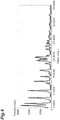
- “have substantially the same powder X-ray diffraction pattern as the powder X-ray diffraction pattern shown in FIG. 4” means that the powder X-ray diffraction pattern having a characteristic diffraction peak is the same as the powder X-ray diffraction pattern shown in FIG. 4 , not only when it is completely consistent with the powder X-ray diffraction pattern shown in FIG.
- examples of preferred crystals include:
- the crystal is a crystal having the same solid state 13 C NMR spectrum as shown in FIG. 6 . Therefore, it is meant that all crystals having such a solid state 13 C NMR spectrum are the same crystals as the crystal of the present invention.
- Compound 1 can be produced by the process described in Examples and Production Examples as mentioned below.
- the crystal of Compound 1 can be produced by the above-mentioned process for producing Compound 1, or can be produced by heating and dissolving Compound 1 in a solvent and cooling it under stirring to crystallize it.
- Compound 1 used for crystallization may be in any form, may be a solvate or hydrate or anhydrate thereof may be amorphous or crystalline (including those composed of a plurality of polymorphs), and may be any mixture thereof, but is preferably an anhydrate thereof.
- Examples of the solvent for crystallization include, for example, alcohol-based solvents such as methanol, ethanol, 1-propanol and 2-propanol; acetonitrile; amide-based solvents such as N,N-dimethylformamide; ester-based solvents such as ethyl acetate and isopropyl acetate; saturated hydrocarbon-based solvents such as hexane and heptane; ketone-based solvents such as acetone and 2-butanone; ether-based solvents such as t-butyl methyl ether; or water. These solvents may be used alone or in a mixture of two or more thereof. When carrying out crystallization in a mixture of two or more solvents, it is preferable to use, for example, a combination of heptane and 1-propanol.
- the amount of the solvent to be used can be appropriately selected with the lower limit being the amount at or above which Compound 1 is dissolved by heating or the amount at or above which the suspension thereof can be stirred and with the upper limit being the amount at or below which the yield of crystal is not significantly decreased
- the crystal obtained by the above process has a single crystalline form.
- This crystal form is stable, does not readily transit to other crystalline forms or amorphous form, has good physical properties, and is also suitable for the formulation.
- a seed crystal (such as the desired crystal of Compound 1) may or may not be added.
- the temperature at which seed crystals are added is not particularly limited, but is preferably 0 to 100°C.
- the temperature at which Compound 1 is heated to be dissolved may be appropriately selected depending on the solvent, but is preferably in the range of from 50°C to the temperature at which a recrystallization solvent begins to reflux, and more preferably 60 to 100°C.
- cooling at the time of crystallization is desirably carried out by appropriately adjusting the cooling rate in consideration of the influence on the quality and grain size of the crystal, and is preferably for example, at a cooling rate of 5 to 40°C/hour. It is more preferably at a cooling rate of 5 to 25°C/hour.
- the final crystallization temperature can be appropriately selected depending on the yield and quality of the crystal and the like and is preferably from -25 to 30°C.
- the crystallized crystal is separated by a usual filtration operation, and the crystal separated by filtration can be washed with a solvent as appropriate and further dried to obtain the desired crystal.
- a solvent used for washing the crystal
- the same solvent as the crystallization solvent can be used.
- examples of such a solvent preferably include, for example, ethanol, acetone, 2-butanone, ethyl acetate, diethyl ether, t-butyl methyl ether, hexane and heptane. These solvents may be used alone or in a mixture of two or more thereof.
- the crystal separated by the filtration operation can be dried by leaving it in the atmosphere or under a nitrogen gas as appropriate, or by heating.
- the time by which the residual solvent falls below a predetermined amount may be appropriately selected depending on the production amount, the drying apparatus, the drying temperature and the like. Drying can be carried out under forced-air condition or under reduced pressure. The degree of reduced pressure may be appropriately selected depending on the production amount, the drying apparatus, the drying temperature and the like. After drying, the obtained crystal can also be left in the atmosphere as appropriate.
- compositions can be prepared by adding pharmaceutically acceptable additives to the crystal of Compound 1, as appropriate.
- dosage form of the pharmaceutical composition include oral preparations (tablets, granules, powders, capsules, syrups, etc.), injectable preparations (for intravenous administration, for intramuscular administration, for subcutaneous administration, for intraperitoneal administration, etc.), and preparations for external applications (transdermal absorption preparations (ointments, patches, etc.), eye drops, nose drops, suppositories, etc.).
- These solid preparations such as tablets, capsules, granules and powders can contain the crystal of Compound 1 usually in an amount of 0.001 to 99.5% by mass, preferably 0.001 to 90% by mass.
- an excipient, a binder, a disintegrator, a lubricant, a colorant and the like are added to the crystal of Compound 1, as appropriate to prepare tablets, granules, powders or capsules by a conventional method. Tablets, granules, powders, capsules and the like may also be coated as appropriate.
- the dose of the medicine according to the present invention is generally varied depending on the bodily conditions, ages, sexes, body weights and the like, and may be an enough amount to develop a desired effect
- about 0.1 to 5000 mg (preferably 0.5 to 1000 mg) per day is administered one time daily or every several days or in 2 to 6 divided doses daily.
- the crystal of Compound 1 according to the present invention can be produced by the methods described in Production Examples and Examples as mentioned below. However, these examples are only for illustrative purposes and the crystal of the compound according to the present invention is not limited to the specific examples mentioned below in any way.
- the silica gel for purification by using silica gel column chromatography was YMC GEL SILICA (YMC Co., Ltd, catalog code: SL06I52W)
- the silica gel for purification by using NH silica gel column chromatography was NH silica gel (Fuji Silysia Chemical LTD., catalog code: DM2035)
- the silica gel for purification by using ODS silica gel column chromatography was YAMAZEN GEL ODS-SM (YAMAZEN Corporation, catalog codes: W113, W116, etc.)
- the TLC plate for purification by using silica gel thin-layer chromatography was TLC Silica gel 60F 254 (Merck KGaA, catalog code: 1.05715.0001)
- the TLC plate for purification by using NH silica gel thin-layer chromatography was NH SILICA GEL TLC plate (Fuji Silysia Chemical LTD., catalog code: T05
- the resultant mixture was irradiated with a microwave at 140°C for 12 hours.
- the reaction mixture was cooled to room temperature, water was then added thereto, then the resultant solution was extracted with ethyl acetate, and an organic layer was washed with saturated brine. The organic layer was dried over anhydrous magnesium sulfate and then filtrated.
- the reaction mixture was cooled to room temperature, then water and ethyl acetate were added to the reaction mixture, the resultant mixture was filtrated using Celite, and a filtrate was partitioned between aqueous layer and organic layer.
- the aqueous layer was extracted with ethyl acetate.
- the combined organic layers were filtrated using a glass filter having silica gel laid thereon.
- the silica gel was washed with ethyl acetate, organic layers obtained were combined, and the solvent was evaporated under a reduced pressure.
- a zinc powder (51.6 g, 789 mmol) was added to 1 N hydrochloric acid (100 mL), the resultant mixture was sonicated and then allowed to stand, and then a supernatant was removed therefrom. This procedure was repeated two times. Water (300 mL) was added to the resultant zinc residue, the resultant solution was stirred and then allowed to stand, and then a supernatant was removed therefrom. This procedure was repeated three times.
- pcDNA3.1(+) (invitrogen) was cleaved with restriction enzymes BglII and NotI, and an adapter BEHKS having a sequence shown below (containing restriction enzyme sites BglII, EcoRI, HindIII, KpnI, SacI and NotI) was inserted thereinto, thereby producing a plasmid pNeo-HKS.
- BEHKS-F 5'-gatctgaattcaagcttctcgagggtacctctagagagctcgc-3' (SEQ ID NO:1)
- BEHKS-R 5'-ggccgcgagctctctagaggtaccctcgagaagcttgaattca-3' (SEQ ID NO: 2)
- a fragment having a length of about 2700 bp (containing a Wnt-responsive sequence and a luciferase gene), which was prepared by cleaving from a TOPglow plasmid contained in a TOPglow/FOPglow TCF Reporter Kit (upstate Catalog#17-366) with restriction enzymes HindIII and KpnI, was inserted between HindIII and KpnI in pNeo-HKS, thereby producing a plasmid pNeo-TOP.
- the plasmid pNeo-TOP was introduced into human fetus-derived renal cell strain HEK293, then a compound was selected using G418, and then a cell clone strain was established by a limiting dilution method. The cell clone strain was subjected to a Wnt signal detection test.
- the cell clone strain was subcultured in a D-MEM glucose-rich culture medium (Wako Pure Chemical Industries, Ltd.) containing 10% FBS, and cells in a growth phase were used in the test. Cells were collected using trypsin-EDTA, the number of the cells was counted, and then the cells were suspended in a D-MEM glucose-rich culture medium containing 10% FBS so that the number of cells became 2 ⁇ 10 5 cells/mL. The cell suspension was added to a 96-well cell culture plate (Greiner Bio-One Co., Ltd., product number: 655083) in an amount of 0.1 mL/well and then cultured overnight in a 5% CO 2 incubator (37°C).
- a substance to be tested which was dissolved in DMSO, was diluted with a D-MEM glucose-rich culture medium containing 10% of FBS and 80 mM of LiCl to produce a sample solution.
- the sample solution (0.1 mL) was added to each well and then cultured in a 5% CO 2 incubator (37°C) overnight.
- a supernatant was removed from each well, and then 50 ⁇ L of Bright-GloTM Luciferase substrate (Promega, product number: E2620) was added thereto.
- the plate was put on a plate mixer for several seconds, and then the emission of light from each well was measured using a EnVisionTM Multilabel plate reader (PerkinElmer Co., Ltd.).
- the Wnt signal activation rate (%) of each well was determined, and a concentration (IC 50 ) which is required for inhibiting the Wnt signal activity of a substance of interest by 50% was calculated, wherein the luminosity of a well to which a sample solution was not added and LiCl was added was defined as a 100% Wnt signal activity and the luminosity of a well to which either of a sample solution or LiCl was not added was defined as a 0% Wnt signal activity.
- IC 50 of the compound of Example 1 was 0.06 ⁇ M.
- An APC gene (an adenomatous polyposis coli gene), a Wnt signal degradation regulation factor, is called "colorectal cancer suppressor gene" and is a causal gene of familial adenomatous polyposis. If a mutation occurs in the APC gene, a colorectal mucosal cell begins to proliferate disorderly to form colorectal polyps that can be called a precancerous lesion. Thus, it is known that the gene has an important role in the initial stage of a process of onset of colorectal cancer.
- the mouse In a mouse in which the APC gene is mutated (a APC Min/+ mouse), many polyps are developed in the intestinal tract like a familial adenomatous polyposis patient. Therefore, the mouse is useful for the clarification of the mechanism of the onset or invasion of cancer based on a WNT signal, and is a standard model that has been used for the studies on the prevention, diagnosis and treatment of colorectal cancer.
- mice C57BL/6J-APC ⁇ Min>/J Hetero, female, Sunplanet Co., Ltd.
- An analyte was prepared by being dissolved a test substance (Example compound) in 0.1 N HCl so that the concentration became a desired administration concentration, and then stored in a refrigerator at 4°C.
- a control (vehicle) group an administration solvent was administered orally under the same conditions as a test material.
- the analyte was continuously administered through an oral route at dosages of 50 mg/kg and 75 mg/kg two times daily for 4 days, and the following three days were provided as drug holidays. This procedure was defined as one cycle, and the administration was performed for 16 days in total (i.e., 4 days ⁇ 4 cycles). The experiment was carried out on 6 to 7 mice per group. With respect to each of the control group and the test substance-administered group, the value of the body weight on the final day to the body weight on the first day (i.e., a relative body weight: RBW) was calculated.
- RBW relative body weight
- test substance-administered group of which the (RBW of the test substance-administered group)/(RBW of the control group) was 0.8 or more was determined as a group that could be administered safely.
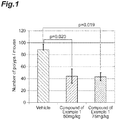
- the test substance-administered group the actual number of polyps after the administration of the test substance and the standard error of the actual number compared with the number of polyps in the control on the final day (i.e., the 25th day counted from the first day of the administration) are shown in Figure 1 .
- polyps formed in the small intestine and the colon were counted.
- a statistical analysis (Dunnett's test) of the test substance-administered group relative to the control group was carried out, and a P value was reported.
- a preparation of a human chronic myologenous leukemia cell strain K562 (which had been cultured in a RPMI-1640 liquid culture medium supplemented with 10% FBS and penicillin/streptomycin) which was so prepared with PBS (Wako Pure Chemical Industries, Ltd.; Cat# 045-29795) that the density became 2 ⁇ 10 8 cells/mL was mixed with MATRIGEL (BD Biosicence, Cat#: 354234) at a mixing ratio of 1 : 1, thereby preparing a cell suspension having a density of 1 ⁇ 10 8 cells/mL.
- the resulting cell suspension was transplanted subcutaneously into the right flank of each of six-week-old nude mice (CAnN.Cg-Foxn1nu/CrlCrlj, female, Charles River Laboratories Japan) at a dose of 100 ⁇ L. Seven days after the transplantation, the shorter diameter and the longer diameter of a tumor were measured using an electronic digital caliper (Digimatic TM Caliper, Mitutoyo Corporation) to calculate the tumor volume in accordance with the following equation.
- Tumor volume mm 3 longer diameter mm ⁇ shorter diameter mm ⁇ shorter diameter mm / 2
- mice were grouped in such a manner that the average value of the tumor volumes in mice in a group, which were determined on the basis of the tumor volume on the first day of the administration.
- An analyte was prepared by being dissolved a compound of Example 1 in 0.1 N HCl so that the dose amount became 10 mL/kg.
- a Dasatinib administration solution was prepared by dissolving Dasatinib, Free Base (LC Laboratories, Cat No: D-3307) in a 1 : 1 solution of Otsuka distilled water (Otsuka Pharmaceutical Co., Ltd., Cat#: 1324) and PROPYLENE GLYCOL (Wako Pure Chemical Industries, Ltd., Cat#: 164-04996) so that the dosage amount became 10 mL/kg.
- An analyte was administered orally continuously for 5 days starting from the first day of the administration in two divided doses daily (bid).
- a Dasatinib administration solution was administered orally once daily (qd) for 5 days continuously, and the following two-day drug holidays was set.
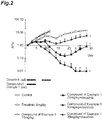
- a control group was a group to which any example compound was not administered. In the experiment, one group includes 9 to 10 mice. With respect to the control group, a group to which only an Example compound was administered, a group to which only Dasatinib was administered, and an a group to which both an Example compound and Dasatinib were administered (hereinafter referred as 'combined administered group'), the tumor volumes and body weights were measured over time for a period from the first day to the 28th day. With respect to the control group and the group to which only the Example compound was administered, the measurement was carried out for a period from the first day to the 11th day.
- a tumor volume (a relative tumor volume: RTV) and a body weight (a relative body weight: RBW) were calculated relative to the values for the first day, and graphs determined for a period from the first day of the administration to the 28th day are shown in Figs. 2 and 3 . Further, a statistic analysis (Dunnett's test) was carried out on the group to which both the Example compound and Dasatinib were administered compared with the group to which only Dasatinib was administered using a RTV value on day 28, and a group of which the P value was 0.05 or less was marked with an asterisk (*).
- RTV relative tumor volume
- RBW body weight
- the number of individuals in which a tumor was not observed by visual judgment and was impalpable (i.e., having a non-palpable tumor) on day 28 are also shown in Table 6.
- a statistic analysis was carried out on the group to which both the Example compound and Dasatinib were administered compared with the group to which only Dasatinib was administered, and a group of which P value was 0.05 or less was marked with an asterisk (*) and a group in which P value is 0.01 or less was marked with asterisks (***).
- Example 2 The crystal of Compound 1 obtained in Example 2 was placed on the sample stage of a powder X-ray diffraction apparatus and analyzed under the following conditions. The results are shown in Figure 4 .
- Example 2 The crystal obtained in Example 2 was accurately weighed into an aluminum sample pan and subjected to thermogravimetry (TG) and differential thermal analysis (DTA) under the following conditions. The results are shown in Figure 5 .
- TG thermogravimetry
- DTA differential thermal analysis
- the solid state 13 C NMR spectrum was obtained by CPTOSS method (a method for eliminating spinning side bands) with carbon nucleus (resonance frequency 100.6 MHz) using an NMR instrument, BRUKER Avance 400MHz equipped with a 7 mm CPMAS probe (manufactured by BRUKER).
- the sample tube enclosing approximately 300 mg of a solid sample was rotated at 5 kHz and measured using contact time of 1 millisecond, pulse delay time of 4 second and number of scans of 8000 at room temperature (22°C). Chemical shifts were corrected by an external reference method with carbonyl carbon of glycine being 176.03 ppm.
Landscapes
- Chemical & Material Sciences (AREA)
- Health & Medical Sciences (AREA)
- Organic Chemistry (AREA)
- General Health & Medical Sciences (AREA)
- Veterinary Medicine (AREA)
- Pharmacology & Pharmacy (AREA)
- Life Sciences & Earth Sciences (AREA)
- Animal Behavior & Ethology (AREA)
- Medicinal Chemistry (AREA)
- Public Health (AREA)
- Epidemiology (AREA)
- Chemical Kinetics & Catalysis (AREA)
- General Chemical & Material Sciences (AREA)
- Nuclear Medicine, Radiotherapy & Molecular Imaging (AREA)
- Pharmaceuticals Containing Other Organic And Inorganic Compounds (AREA)
- Plural Heterocyclic Compounds (AREA)
- Peptides Or Proteins (AREA)
- Nitrogen Condensed Heterocyclic Rings (AREA)
Abstract
Description
- The present invention relates to a crystal of (6S,9aS)-N-benzyl-6-[(4-hydroxyphenyl)methyl]-4,7-dioxo-8-({6-[3-(piperazi n-1-yl)azetidin-1-yl]pyridin-2-yl}methyl)-2-(prop-2-en-1-yl)-octahydro-1H-p yrazino[2,1-c][1,2,4]triazine-1-carboxamide compound
- A Wnt signaling pathway is conserved regardless of the difference in the species of organisms, and is known as an important pathway involved in the development, differentiation and maintenance of living organisms. In recent years, however, it is reported that the constitutive activation of the pathway is involved in the development of malignant transformation of fibrosis and cancer. It is known that, particularly in colorectal cancer, melanoma, endometrial cancer, liver cancer and prostate cancer, the Wnt signaling pathway can be activated constitutively by the suppressible mutation of adenomatous polyposis coli (APC) or activating mutation of β-catenin or the like. It is also known that, in pancreatic cancer, hematological cancer, liver cancer and the like, the Wnt signaling pathway can be activated after the treatment with a known anti-tumor agent
- In
Non Patent Literatures 1 and 2, it is described that an excellent anti-tumor activity can be achieved by inhibiting the Wnt signaling pathway. In Non Patent Literatures 12, 13 and 14, it is described that an excellent effect on fibrosis can be achieved by inhibiting the Wnt signaling pathway. Thus, the Wnt signaling pathway has attracted attention as a novel target for the treatment of tumors or the treatment of fibrosis. - In
Non Patent Literatures - Furthermore, compounds each having an octahydro-1H-pyrazino[2,1-c][1,2,4]triazine backbone are known as modulator of the Wnt signaling pathway, and the relationship between the compounds and diseases such as cancer and fibrosis is pointed out (
Patent Literatures 1 to 3). -
- [Patent Literature 1]
WO 2009/051397 A - [Patent Literature 2]
US 2010/0286094 A - [Patent Literature 3]
WO 2009/148192 A -
- [Non Patent Literature 1] Nick Barker et al., "Mining the Wnt pathway for cancer therapeutics", Nature reviews Drug discovery 2006 Dec; 5(12):997-1014.
- [Non Patent Literature 2] Katayoon H. Emami et al., "A small molecule inhibitor of beta-catenin/CREB-binding protein transcription", Proc. Natl. Acad. Sci. USA., 2004, 101(34), p.12682-12687.
- [Non Patent Literature 3] Baozhi Chen et al., "Small molecule-mediated disruption of Wnt-dependent signaling in tissue regeneration and cancer", Nat ChemBiol., 2009, 5(2), p.100-107.
- [Non Patent Literature 4] Shih-Min A. Huang et al., "Tankyrase inhibition stabilizes axin and antagonizes Wnt signalling", Nature, 2009, 461, p.614-620.
- [Non Patent Literature 5] Lari Lehtio et al., "Tankyrases as drug targets", The FEBS Journal, 2013, 280, 3576-3593.
- [Non Patent Literature 6] Miki Shitashige et al., "Traf2- and Nck-Interacting Kinase Is Essential for Wnt Signaling and Colorectal Cancer Growth", Cancer Res., 2010, 70(12), 5024-5033.
- [Non Patent Literature 7] Austin Gurney et al., "Wnt pathway inhibition via the targeting of Frizzled receptors results in decreased growth and tumorigenicity of human tumors", Proc. Natl. Acad. Sci. USA., 2012, 109(29), 11717-11722.
- [Non Patent Literature 8] Xiaomo Jiang et al., "Inactivating mutations of RNF43 confer Wnt dependency in pancreatic ductal adenocarcinoma", Proc. Natl. Acad. Sci. USA., 2013, 110(31), 12649-12654.
- [Non Patent Literature 9] Jo Waaler et al., "Novel Synthetic Antagonists of Canonical Wnt Signaling Inhibit Colorectal Cancer Cell Growth", Cancer Res, 2011, 71(1), 197-205.
- [Non Patent Literature 10] H Yao et al., "AV-65, a novel Wnt/β-catenin signal inhibitor, successfully suppresses progression of multiple myeloma in a mouse model", Blood Cancer Journal, 2011, 1, e43.
- [Non Patent Literature 11] De Robertis A et al., "Identification and characterization of a small-molecule inhibitor of Wnt signaling in glioblastoma cells", Mol Cancer Ther., 2013,12(7), 1180-1189.
- [Non Patent Literature 12] Anna P. Lam et al., "β-catenin signaling: a novel mediator of fibrosis and potential therapeutic target", Curr Opin Rheumatol. 2011 November; 23(6): 562-567.
- [Non Patent Literature 13] Sha Hao et al., "Targeted Inhibition of β-Catenin/CBP Signaling Ameliorates Renal Interstitial Fibrosis", J. Am. Soc. Nephrol. 22: 1642-1653, 2011.
- [Non Patent Literature 14] William R. Henderson, Jr. et al., "Inhibition of Wnt/β-catenin/CREB binding protein(CBP) signaling reverses pulmonary fibrosis", Proc. Natl. Acad. Sci. USA., 2010,107(32),14309-14314.
- (6S,9aS)-N-benzyl-8-({6-[3-(4-ethylpiperazin-1-yl)azetidin-1-yl]pyri din-2-yl}methyl)-6-(2-fluoro-4-hydroxybenzyl)-4,7-dioxo-2-(prop-2-en-1-yl) hexahydro-2H-pyrazino[2,1-c][1,2,4]triazine-1(6H)-carboxamide (hereinafter referred to as "
Compound 1"), which is a compound represented by the following formula, has a Wnt Pathway modulating activity.
- Generally, the physical properties of compounds and salts thereof and crystals thereof used as pharmaceutical products have a large effect on the bioavailability of drugs, the purity of drug substances, the pharmaceutical formulation, and the like. Therefore, the problem to be solved by the present invention is to provide a crystal of Compound 1 having a potential use as a drug substance for pharmaceutical products.
- The present inventors have completed the present invention as a result of diligent efforts.
- That is, the present invention provides the following [1] to [12]:
- [1] A crystal of (6S,9aS)-N-benzyl-8-({6-[3-(4-ethylpiperazin-1-yl)azetidin-1-yl]pyridin-2-yl} methyl)-6-(2-fluoro-4-hydroxybenzyl)-4,7-dioxo-2-(prop-2-en-1-yl)hexahydr o-2H-pyrazino[2,1-c][1,2,4]triazine-1(6H)-carboxamide.

- [2] The crystal according to [1], wherein the crystal has a diffraction peak at the diffraction angle (2θ ± 0.2°) of 5.8° in powder X-ray diffraction.
- [3] The crystal according to [1], wherein the crystal has diffraction peaks at the diffraction angles (2θ ± 0.2°) of 5.8°, 6.4° and 10.1° in powder X-ray diffraction.
- [4] The crystal according to [3], wherein the crystal further has diffraction peaks at the diffraction angles (2θ ± 0.2°) of 8.0° and 12.8° in powder X-ray diffraction.
- [5] The crystal according to [4], wherein the crystal further has diffraction peaks at the diffraction angles (2θ ± 0.2°) of 14.2°, 16.0°, 18.9°, 19.7° and 23.1° in powder X-ray diffraction.
- [6] A crystal of (6S,9aS)-N-benzyl-8-({6-[3-(4-ethylpiperazin-1-yl)azetidin-1-yllpyridin-2-yl}methyl)-6-(2-fluoro-4-hy droxybenzyl)-4,7-dioxo-2-(prop-2-en-1-yl)hexahydro-2H-pyrazino[2,1-c][1,2, 4]triazine-1(6H)-carboxamide, wherein the crystal has a peak at the chemical shift (δ±0.5 ppm) of 154.7 ppm in solid state 13C NMR spectrum.
- [7] The crystal according to [6], wherein the crystal further has peaks at the chemical shifts (δ ± 0.5 ppm) of 141.1 ppm and 158.1 ppm in solid state 13C NMR spectrum.
- [8] The crystal according to [7], wherein the crystal further has peaks at the chemical shifts (δ ± 0.5 ppm) of 134.0 ppm and 165.1 ppm in solid state 13C NMR spectrum.
- [9] The crystal according to [8], wherein the crystal further has peaks at the chemical shifts (δ ± 0.5 ppm) of 12.6 ppm, 55.5 ppm and 118.5 ppm in solid state 13C NMR spectrum.
- [10] A crystal of (6S,9aS)N-benzyl-8-({6-[3-(4-ethylpiperazin-1-yl)azetidin-1-yl]pyridin-2-yl} methyl)-6-(2-fluoro-4-hydroxybenzyl)-4,7-dioxo-2-(prop-2-en-1-yl)hexahydr o-2H-pyrazino[2,1-c][1,2,4]triazine-1(6H)-carboxamide, wherein the crystal has substantially the same powder X-ray diffraction pattern as the powder X-ray diffraction pattern shown in
FIG 4 . - [11] A crystal of (6S,9aS)-N-benzyl-8-({6-[3-(4-ethylpiperazin-1-yl)azetidin-1-yl]pyridin-2-yl} methyl)-6-(2-fluoro-4-hydroxybenzyl)-4,7-dioxo-2-(prop-2-en-1-yl)hexahydr o-2H-pyrazino[2,1-c][1,2,4]triazine-1(6H)-carboxamide, wherein the crystal has substantially the same 13C solid state NMR spectrum as solid state 13C NMR spectrum shown in
FIG 6 . - [12] A pharmaceutical composition comprising the crystal according to any one of [1] to [11].
- The crystal of
Compound 1 according to the present invention has such properties as illustrated in Examples, and has a potential use as a drug substance for pharmaceutical products. -
-
FIG. 1 shows the results of Test Example 2. The ordinate indicates the number of polyps per mouse. -
FIG. 2 shows the results of Test Example 3. The abscissa indicates the number of days elapsed, and the ordinate indicates the relative tumor volume (RTV) with respect to the tumor volume onday 0. -
FIG. 3 shows the results of Test Example 3. The abscissa indicates the number of days elapsed, and the ordinate indicates the relative body weight (RBW) with respect to the body weight onday 0. -
FIG. 4 is a powder X-ray diffraction pattern of the crystal ofCompound 1 in Test Example 4. The abscissa indicates the diffraction angle (2θ), and the ordinate indicates the peak intensity. -
FIG. 5 shows the results of Test Example 5. The abscissa indicates the temperature, the left ordinate indicates the weight change in thermogravimetry (TG), and the right ordinate indicates the heat flow in differential thermal analysis (DTA). -
FIG. 6 is the solid state 13C NMR spectrum of the crystal ofCompound 1 in Test Example 6. The abscissa indicates the chemical shift (δ), and the ordinate indicates the peak intensity. - In the present specification, examples of preferred crystals include:
- the crystal of
Compound 1 having a diffraction peak at the diffraction angle (2θ ± 0.2°) of 5.8° in powder X-ray diffraction; - the crystal of
Compound 1 having diffraction peaks at the diffraction angles (2θ ± 0.2°) of 5.8°, 6.4° and 10.1° in powder X-ray diffraction; - the crystal of
Compound 1 having diffraction peaks at the diffraction angles (2θ ± 0.2°) of 5.8°, 6.4°, 8.0°, 10.1° and 12.8° in powder X-ray diffraction; and - the crystal of
Compound 1 having diffraction peaks at the diffraction angles (2θ ± 0.2°) of 5.8°, 6.4°, 8.0°, 10.1°, 12.8°, 14.2°, 16.0°, 18.9°, 19.7° and 23.1° in powder X-ray diffraction. - Each of the above-mentioned diffraction peaks in the powder X-ray diffraction is specific to and characteristic of the crystals of
Compound 1. - Generally, as the diffraction angle (2θ) in powder X-ray diffraction may have an error within ± 0.2°, it should be understood that the above-mentioned values of diffraction angles also include values within about ± 0.2°. Therefore, not only crystals having completely consistent diffraction angles of peaks in powder X-ray diffraction, but also crystals having diffraction angles of peaks consistent within an error of about ± 0.2° are included in the present invention.
- In the present specification, for example, "have a diffraction peak at the diffraction angle (2θ ± 0.2°) of 5.8°" means "have a diffraction peak at the diffraction angle (2θ) of 5.6° to 6.0°" and the same applies to other diffraction angles.
- Generally, even if the crystal forms are identical to each other, the peak intensity or half-width at the diffraction angle (2θ) in powder X-ray diffraction varies from one measurement to another, due to the difference in the measurement conditions and the variation in the size or shape of particles of powder crystals used as measurement samples, and constant peak intensities or half-widths are not necessarily shown. For this reason, in comparison of powder X-ray diffraction patterns, if the diffraction angles (2θ) are identical to each other but the peak intensities or half-widths thereof are different, the difference does not mean that the crystal forms of the measured crystals are different from each other. Therefore, it is meant that the crystal of the compound showing a powder X-ray diffraction pattern having such a difference with respect to the diffraction peak characteristic of the specific crystal of the present invention has the same crystal form as the crystal of the compound of the present invention. In the present specification, "have substantially the same powder X-ray diffraction pattern as the powder X-ray diffraction pattern shown in
FIG. 4 " means that the powder X-ray diffraction pattern having a characteristic diffraction peak is the same as the powder X-ray diffraction pattern shown inFIG. 4 , not only when it is completely consistent with the powder X-ray diffraction pattern shown inFIG. 4 , but also when its peak intensity or half-width is different or it is consistent within an error range of about ± 0.2° with the powder X-ray diffraction pattern shown inFIG.4 . Therefore, it is meant that all crystals having such powder X-ray diffraction patterns are the same crystals as the crystal of the present invention. - In the present specification, examples of preferred crystals include:
- the crystal of
Compound 1 having a peak at the chemical shift (δ ± 0.5 ppm) of 154.7 ppm in solid state 13C NMR spectrum; - the crystal of
Compound 1 having peaks at the chemical shifts (δ ± 0.5 ppm) of 141.1 ppm, 154.7 ppm and 158.1 ppm in solid state 13C NMR spectrum; - the crystal of
Compound 1 having peaks at the chemical shifts (δ ± 0.5 ppm) of 134.0 ppm, 141.1 ppm, 154.7 ppm, 158.1 ppm and 165.1 ppm in solid state 13C NMR spectrum; and - the crystal of
Compound 1 having peaks at the chemical shifts (δ ± 0.5 ppm) of 12.6 ppm, 55.5 ppm, 118.5 ppm, 134.0 ppm, 141.1 ppm, 154.7 ppm, 158.1 ppm and 165.1 ppm in solid state 13C NMR spectrum. - Each of the above-mentioned peaks in the solid state 13C NMR spectrum is specific to and characteristic of the crystal of
Compound 1. - In the present specification, "have the peaks at the chemical shifts (δ ± 0.5 ppm) of 12.6 ppm, 55.5 ppm, 118.5 ppm, 134.0 ppm, 141.1 ppm, 154.7 ppm, 158.1 ppm and 165.1 ppm" means "have the substantially equivalent peaks to the peaks at the chemical shifts (δ ± 0.5 ppm) of 12.6 ppm, 55.5 ppm, 118.5 ppm, 134.0 ppm, 141.1 ppm, 154.7 ppm, 158.1 ppm and 165.1 ppm, respectively, when solid state 13C NMR spectroscopy is carried out under normal conditions or under substantially the same conditions as those described in the present specification":
- In determining whether or not to "have the substantially equivalent peaks", generally, as the chemical shift (δ) in solid state 13C NMR spectrum may have an error within ± 0.5 ppm, it should be understood that the above-mentioned values of chemical shifts also include values within about ± 0.5 ppm. Therefore, not only crystals having the completely consistent chemical shifts in 13C solid state NMR spectrum, but also crystals having the chemical shifts consistent within an error of about ± 0.5 ppm are included in the present invention. For this reason, in the present specification, for example, "have a peak at the chemical shift (δ ± 0.5 ppm) of 12.6 ppm" means "have a peak at the chemical shift (δ) of 12.1 ppm to 13.1 ppm", and the same applies to other chemical shifts in solid state 13C NMR spectrum. Furthermore, "crystal having substantially the same solid state 13C NMR spectrum as shown in
FIG. 6 " means that, not only when the solid state 13C NMR spectrum having a peak at a certain chemical shift is completely consistent with the solid state 13C NMR spectrum shown inFIG. 6 , but also when its peak intensity is different or its characteristic peak is consistent within an error range of about ± 0.5 ppm, the crystal is a crystal having the same solid state 13C NMR spectrum as shown inFIG. 6 . Therefore, it is meant that all crystals having such a solid state 13C NMR spectrum are the same crystals as the crystal of the present invention. - Hereinafter, a process for producing the crystal of
Compound 1 and the like which is an embodiment of the present invention will be described. -
Compound 1 can be produced by the process described in Examples and Production Examples as mentioned below. - The crystal of
Compound 1 can be produced by the above-mentioned process for producingCompound 1, or can be produced by heating anddissolving Compound 1 in a solvent and cooling it under stirring to crystallize it. -
Compound 1 used for crystallization may be in any form, may be a solvate or hydrate or anhydrate thereof may be amorphous or crystalline (including those composed of a plurality of polymorphs), and may be any mixture thereof, but is preferably an anhydrate thereof. - Examples of the solvent for crystallization include, for example, alcohol-based solvents such as methanol, ethanol, 1-propanol and 2-propanol; acetonitrile; amide-based solvents such as N,N-dimethylformamide; ester-based solvents such as ethyl acetate and isopropyl acetate; saturated hydrocarbon-based solvents such as hexane and heptane; ketone-based solvents such as acetone and 2-butanone; ether-based solvents such as t-butyl methyl ether; or water. These solvents may be used alone or in a mixture of two or more thereof. When carrying out crystallization in a mixture of two or more solvents, it is preferable to use, for example, a combination of heptane and 1-propanol.
- The amount of the solvent to be used can be appropriately selected with the lower limit being the amount at or above which
Compound 1 is dissolved by heating or the amount at or above which the suspension thereof can be stirred and with the upper limit being the amount at or below which the yield of crystal is not significantly decreased - The crystal obtained by the above process has a single crystalline form. This crystal form is stable, does not readily transit to other crystalline forms or amorphous form, has good physical properties, and is also suitable for the formulation.
- In the crystallization, a seed crystal (such as the desired crystal of Compound 1) may or may not be added. The temperature at which seed crystals are added is not particularly limited, but is preferably 0 to 100°C.
- For the temperature at which
Compound 1 is heated to be dissolved, the temperature at whichCompound 1 is dissolved may be appropriately selected depending on the solvent, but is preferably in the range of from 50°C to the temperature at which a recrystallization solvent begins to reflux, and more preferably 60 to 100°C. - As crystals containing different aspects of crystals (polymorphs) are given when quenched, cooling at the time of crystallization is desirably carried out by appropriately adjusting the cooling rate in consideration of the influence on the quality and grain size of the crystal, and is preferably for example, at a cooling rate of 5 to 40°C/hour. It is more preferably at a cooling rate of 5 to 25°C/hour.
- The final crystallization temperature can be appropriately selected depending on the yield and quality of the crystal and the like and is preferably from -25 to 30°C.
- The crystallized crystal is separated by a usual filtration operation, and the crystal separated by filtration can be washed with a solvent as appropriate and further dried to obtain the desired crystal. As the solvent used for washing the crystal, the same solvent as the crystallization solvent can be used. Examples of such a solvent preferably include, for example, ethanol, acetone, 2-butanone, ethyl acetate, diethyl ether, t-butyl methyl ether, hexane and heptane. These solvents may be used alone or in a mixture of two or more thereof.
- The crystal separated by the filtration operation can be dried by leaving it in the atmosphere or under a nitrogen gas as appropriate, or by heating.
- For the time of drying, the time by which the residual solvent falls below a predetermined amount may be appropriately selected depending on the production amount, the drying apparatus, the drying temperature and the like. Drying can be carried out under forced-air condition or under reduced pressure. The degree of reduced pressure may be appropriately selected depending on the production amount, the drying apparatus, the drying temperature and the like. After drying, the obtained crystal can also be left in the atmosphere as appropriate.
- Pharmaceutical compositions can be prepared by adding pharmaceutically acceptable additives to the crystal of
Compound 1, as appropriate. Examples of the dosage form of the pharmaceutical composition include oral preparations (tablets, granules, powders, capsules, syrups, etc.), injectable preparations (for intravenous administration, for intramuscular administration, for subcutaneous administration, for intraperitoneal administration, etc.), and preparations for external applications (transdermal absorption preparations (ointments, patches, etc.), eye drops, nose drops, suppositories, etc.). - These solid preparations such as tablets, capsules, granules and powders can contain the crystal of
Compound 1 usually in an amount of 0.001 to 99.5% by mass, preferably 0.001 to 90% by mass. - In the case of preparing an oral solid preparation, an excipient, a binder, a disintegrator, a lubricant, a colorant and the like are added to the crystal of
Compound 1, as appropriate to prepare tablets, granules, powders or capsules by a conventional method. Tablets, granules, powders, capsules and the like may also be coated as appropriate. - The dose of the medicine according to the present invention is generally varied depending on the bodily conditions, ages, sexes, body weights and the like, and may be an enough amount to develop a desired effect For example, in the case of a human adult, about 0.1 to 5000 mg (preferably 0.5 to 1000 mg) per day is administered one time daily or every several days or in 2 to 6 divided doses daily.
- The crystal of
Compound 1 according to the present invention can be produced by the methods described in Production Examples and Examples as mentioned below. However, these examples are only for illustrative purposes and the crystal of the compound according to the present invention is not limited to the specific examples mentioned below in any way. - In Production Examples and Examples, unless specifically mentioned otherwise, the silica gel for purification by using silica gel column chromatography was YMC GEL SILICA (YMC Co., Ltd, catalog code: SL06I52W), the silica gel for purification by using NH silica gel column chromatography was NH silica gel (Fuji Silysia Chemical LTD., catalog code: DM2035), the silica gel for purification by using ODS silica gel column chromatography was YAMAZEN GEL ODS-SM (YAMAZEN Corporation, catalog codes: W113, W116, etc.), the TLC plate for purification by using silica gel thin-layer chromatography was TLC Silica gel 60F254 (Merck KGaA, catalog code: 1.05715.0001), and the TLC plate for purification by using NH silica gel thin-layer chromatography was NH SILICA GEL TLC plate (Fuji Silysia Chemical LTD., catalog code: T050908).
- The abbreviations used herein are as follows:
- NMP: N-methylpyrrolidinone
- THF: tetrahydrofuran
- HATU: O-(7-azabenzotriazol-1-yl)-N,N,N',N'-tetramethyluronium hexafluorophosphate
- HBTU: O-(benzotriazol-1-yl)-N,N,N',N'-tetramethyluronium hexafluorophosphate
- TFA: trifluoroacetic acid
- DMF: N,N-dimethylformamide
- DMSO: dimethylsolfoxide
- Chemical shifts of 1H-NMR (proton nuclear magnetic resonance) spectra are recorded in δ units (ppm) relative to tetramethylsilane and coupling constants are recorded in hertz (Hz). The abbreviations of the splitting pattern are as follows: s: singlet; d: doublet; t: triplet; q: quartet; m: multiplet; and br: broad.
-

- To a mixed solution of (6S,9aS)-N-benzyl-6-((2-fluoro-4-hydroxyphenyl)methyl)-8-((6-fluoropyridin -2-yl)methyl)-4,7-dioxo-2-(prop-2-en-1-yl)-octahydro-1H-pyrazino[2,1-c][1,2 ,4]triazine-1-carboxamide (397 mg, 0.689 mmol) described in Production Example 1-1-6 and NMP (10 mL) was added a mixture (1.16 g) of 1-(azetidin-3-yl)-4-ethylpiperazine and benzylbenzene described in Production Example 1-3-2 at room temperature. The resultant mixture was irradiated with a microwave at 140°C for 12 hours. The reaction mixture was cooled to room temperature, water was then added thereto, then the resultant solution was extracted with ethyl acetate, and an organic layer was washed with saturated brine. The organic layer was dried over anhydrous magnesium sulfate and then filtrated. The solvent was evaporated under a reduced pressure, and the resultant residue was purified by silica gel column chromatography (methanol) and then further purified by NH silica gel column chromatography (ethyl acetate : methanol = 20 : 1) to give the title compound (402 mg, yield: 80%).
1H-NMR Spectrum (400 MHz, CDCl3) δ(ppm): 1.00(3H, t, J = 6.8 Hz), 2.10-2.65(10H, m), 3.10-3.21(2H, m), 3.41-3.74(8H, m), 3.84-3.89(1H, m), 3.95-4.05(2H, m), 4.17-4.23(2H, m), 4.51(1H, dd, J = 6.8 Hz, 15.6 Hz), 4.95(1H, d, J = 13.6 Hz), 5.20-5.30(3H, m), 5.50-5.60(1H, m), 5.70-5.80(1H, m), 5.82-5.87(1H, m), 6.24(1H, d, J = 8.0 Hz), 6.41(1H, dd, J = 2.0 Hz, 11.2 Hz), 6.47(1H, dd, J = 8.8 Hz, 8.8 Hz), 6.69(1H, d, J = 7.2 Hz), 6.80-6.86(1H, m), 7.20-7.31(3H, m), 7.35-7.46(3H, m).
ESI-MS (m/z): 726.57 [M+H]+. -

- To a mixed solution of a commercially available product of 2,2-diethoxyethan-1-amine (926 µL, 6.39 mmol), THF (10.0 mL) and acetic acid (1.00 mL) was added a commercially available product of 6-fluoropyridine-2-carbaldehyde (800 mg, 6.39 mmol) at room temperature. The resultant mixture was stirred at room temperature for 25 minutes. Subsequently, sodium triacetoxyborohydride (2.71 g, 12.8 mmol) was added to the reaction mixture at room temperature and then stirred for 1 hour and 10 minutes. To the reaction mixture was added sodium hydrogen carbonate and water to terminate the reaction. The resultant solution was extracted with ethyl acetate. An organic layer was dried over anhydrous magnesium sulfate and then filtrated. The solvent was evaporated under a reduced pressure, and the resultant residue was purified by NH silica gel column chromatography (heptane : ethyl acetate = 1 : 1), and was then further purified by silica gel column chromatography (ethyl acetate : methanol = 20 : 1) to give the title compound (1.14 g, yield: 74%).
1H-NMR Spectrum (400 MHz, CDCl3) δ(ppm): 1.22(6H, t, J = 7.2 Hz), 2.76(2H, d, J = 5.5 Hz), 3.50-3.61(2H, m), 3.65-3.76(2H, m), 3.89(2H, s), 4.64(1H, t, J = 5.5 Hz), 6.80(1H, dd, J = 2.8 Hz, 8.2 Hz), 7.22(1H, dd, J = 2.4 Hz, 7.3 Hz), 7.74(1H, q, J = 7.9 Hz). -

- To a mixed solution of (2,2-diethoxyethyl)((6-fluoropyridin-2-yl)methyl)amine (3.50 g, 14.4 mmol) described in Production Example 1-1-1 and dichloromethane (25 mL) were added (2S)-3-(4-(benzyloxy)-2-fluorophenyl)-24(((9H-fluoren-9-ylmethoxy)carbonyl )amino)propanoic acid (7.76 g, 15.1 mmol) described in Production Example 1-2-7, N-methylmorpholine (2.06 mL, 18.7 mmol) and HATU (6.04 g, 15.8 mmol) at room temperature. The resultant mixture was stirred at room temperature for 13 hours. Sodium hydrogen carbonate and water were added to the reaction mixture, and the resultant solution was extracted with dichloromethane. An organic layer was dried over anhydrous magnesium sulfate and then filtrated. The solvent was evaporated under a reduced pressure to give a crude product (14.4 g) of the title compound. The product was used in the subsequent reaction without further purification.
ESI-MS (m/z): 758.50 [M+Na]+. -

- To a mixed solution of 9H-fluoren-9-ylmethyl N-((1S)-2-(4-(benzyloxy)-2-fluorophenyl)-1-((2,2-diethoxyethyl)((6-fluoropyr idin-2-yl)methyl)carbamoyl)ethyl)carbamate described in Production Example 1-1-2 (14.4 g) and THF (30 mL) was added diethylamine (5.27 mL, 50.4 mmol) at room temperature. The resultant mixture was stirred at room temperature for 2 hours. The reaction mixture was concentrated under a reduced pressure, methanol, water and heptane were added to the residue, and the resultant mixture was partitioned. An aqueous layer was washed with heptane, and was then concentrated under a reduced pressure. Water was added to the residue, and the resultant solution was extracted with ethyl acetate. An organic layer was dried over anhydrous magnesium sulfate and then filtrated. The solvent was evaporated under a reduced pressure, and the resultant residue was purified by NH silica gel column chromatography (heptane : ethyl acetate = 1 : 1, and then ethyl acetate) to give the title compound (6.87 g, yield: 93%).
ESI-MS (m/z): 514.32 [M+H]+. -

- To a mixed solution of (2S)-2-amino-3-(4-(benzyloxy)-2-fluorophenyl)-N-(2,2-diethoxyethyl)-N-((6-fluoropyridin-2-yl)methyl)propanamide (4.87 g, 9.48 mmol) described in Production Example 1-1-3 and dichloromethane (100 mL) were added a known substance (
WO2009/148192 ) 2-(((benzylcarbamoyl)amino)(prop-2-en-1-yl)amino)acetic acid (2.62 g, 9.95 mmol), triethylamine (2.64 mL, 19.0 mmol) and HBTU(3.96 g, 10.4 mmol) at room temperature. The resultant mixture was stirred at room temperature for 1 hour. The reaction mixture was concentrated under a reduced pressure, and the resultant residue was purified by NH silica gel column chromatography (ethyl acetate and then ethyl acetate : methanol = 30 : 1) to give the title compound (7.28 g, yield: quantitative).
ESI-MS (m/z): 759.43 [M+H]+. -

- A mixed solution of (2S)-2-(2-(((benzylcarbamoyl)amino)prop-2-en-1-yl)amino)acetamido)-3-(4-(benzyloxy)-2-fluorophenyl)-N-(2,2-diethoxyethyl)-N-((6-fluoropyridin-2-yl) methyl)propanamide (7.28 g, 9.48 mmol) described in Production Example 1-1-4 and formic acid (50 mL) was stirred at room temperature for 15 hours and 15 minutes. The reaction mixture was concentrated under a reduced pressure, an aqueous ammonia solution was added to the residue, and the resultant solution was extracted with ethyl acetate. An organic layer was dried over anhydrous magnesium sulfate and then filtrated. The solvent was evaporated under a reduced pressure, and the resultant residue was purified by NH silica gel column chromatography (heptane : ethyl acetate = 1 : 1) to give the title compound (5.04 g, yield: 80%).
ESI-MS (m/z): 667.39 [M+H]+. -

- To a mixed solution of (6S,9aS)-N-benzyl-6-((4-(benzyloxy)-2-fluorophenyl)methyl)-8-((6-fluoropyr idin-2-yl)methyl)-4,7-dioxo-2-(prop-2-en-1-yl)-octahydro-1H-pyrazino[2,1-c] [1,2,4]triazine-1-carboxamide (5.04 g, 7.56 mmol) described in Production Example 1-1-5 and TFA (20 mL) was added thioanisole (3.55 mL, 30.2 mmol) at room temperature. The resultant mixture was stirred at room temperature for 13 hours and 50 minutes. The reaction mixture was concentrated under a reduced pressure, sodium hydrogen carbonate and water were added to the residue, and the resultant solution was extracted with ethyl acetate. An organic layer was dried over anhydrous magnesium sulfate and then filtrated. The solvent was evaporated under a reduced pressure, and the resultant residue was purified by NH silica gel column chromatography (ethyl acetate : methanol = 20 : 1) to give the title compound (4.34 g, yield: quantitative).
ESI-MS (m/z): 577.31 [M+H]+. -

- To a mixed solution of a commercially available product of L-serine methyl ester hydrochloride (10.0 g, 64.3 mmol), 1,4-dioxane (15 mL) and water (90 mL) was added sodium hydrogen carbonate (10.8 g, 129 mmol) at room temperature. The resultant mixture was stirred at room temperature for 15 minutes. Subsequently, a solution of 2,5-dioxopyrrolidin-1-yl 9H-fluoren-9-ylmethylcarbonate (21.7 g, 64.3 mmol) in 1,4-dioxane (60 mL) was added to the resultant solution at room temperature, and the resultant mixture was stirred at room temperature for 14 hours. Water was added to the reaction mixture, the resultant solution was extracted with ethyl acetate three times, and a combined organic layer was washed with water and saturated brine. An organic layer was dried over anhydrous magnesium sulfate and then filtrated. The solvent was evaporated under a reduced pressure, diethyl ether and heptane were added to the resultant residue, and a precipitate was collected by filtration to give the title compound (22.3 g, yield: quantitative).
1H-NMR Spectrum (400 MHz, CDCl3) δ(ppm): 2.00-2.15(1H, m), 3.81(3H, s), 3.89-4.07(2H, m), 4.20-4.28(1H, m), 4.39-4.53(3H, m), 5.63-5.74(1H, m), 7.29-7.37(2H, m), 7.38-7.46(2H, m), 7.55-7.65(2H, m), 7.74-7.82(2H, m). -

- To a mixed solution of methyl (2S)-2-(((9H-fluoren-9-ylmethoxy)carbonyl)amino)- 3-hydroxypropanoate (5.00 g, 14.6 mmol) described in Production Example 1-2-1 and pyridine (25 mL) were added 4-dimethylaminopyridine (18.0 mg, 0.146 mmol) and p-toluenesulfonyl chloride (5.58 g, 29.3 mmol) at 0°C, and the resultant mixture was stirred at 0°C for 7 hours. Water was added to the reaction mixture, and the resultant solution was extracted with ethyl acetate two times. A combined organic layer was washed with 1N hydrochloric acid three times, then with a saturated aqueous sodium hydrogen carbonate solution, and then with saturated brine. An organic layer was dried over anhydrous magnesium sulfate and then filtrated. The solvent was evaporated under a reduced pressure, then ethyl acetate, diethyl ether and heptane were added to the resultant residue, and then a precipitate was collected by filtration to give the title compound (6.20 g, yield: 85%).
1H-NMR Spectrum (400 MHz, CDCl3) δ(ppm): 2.37(3H, s), 3.74(3H, s), 4.16-4.23(1H, m), 4.23-4.31(1H, m), 4.32-4.40(2H, m), 4.41-4.48(1H, m), 4.54-4.62(1H, m), 5.63-5.66(1H, m), 7.26-7.37(4H, m), 7.38-7.45(2H, m), 7.56-7.64(2H, m), 7.72-7.81(4H, m). -

- To a mixed solution of methyl (2S)-2-(((9H-fluoren-9-ylmethoxy)carbonyl)amino)-3-(((4-methylbenzene)sul fonyl)oxy)propanoate (6.20 g, 12.5 mmol) described in Production Example 1-2-2 and acetone (50 mL) was added sodium iodide (9.38 g, 62.6 mmol) at room temperature. The resultant mixture was stirred at room temperature for 90 hours and 50 minutes. The reaction mixture was filtrated, and a filtrate was concentrated under a reduced pressure. Water was added to the residue, and the resultant solution was extracted with ethyl acetate. An organic layer was washed with water, then with a saturated aqueous sodium thiosulfate solution, and then saturated brine. An organic layer was dried over anhydrous magnesium sulfate and then filtrated. The solvent was evaporated under a reduced pressure, then diethyl ether and heptane were added to the resultant residue, and a precipitate was collected by filtration to give the title compound (3.82 g, yield: 68%).
1H-NMR Spectrum (400 MHz, CDCl3) δ(ppm): 3.55-3.66(2H, m), 3.84(3H, s), 4.20-4.30(1H, m), 4.354.48(2H, m), 4.56-4.62(1H, m), 5.63-5.72(1H, m), 7.30-7.37(2H, m), 7.38-7.45(2H, m), 7.62(2H, d, J = 7.2 Hz), 7.78(2H, d, J = 7.5 Hz). -

- To a mixed solution of a commercially available product of 4-bromo-3-fluorophenol (15.0 g, 78.5 mmol) and DMF (30 mL) were added potassium carbonate (21.7 g, 157 mmol) and benzyl bromide (10.2 mL, 86.4 mmol) at room temperature, and the resultant mixture was stirred at room temperature for 20 minutes and then at 70°C for 40 minutes. The reaction mixture was cooled to room temperature, then water was added to the reaction mixture, and the resultant solution was extracted with ethyl acetate. An organic layer was washed with water and then with saturated brine. An organic layer was dried over anhydrous magnesium sulfate and then filtrated. The solvent was evaporated under a reduced pressure, and the resultant residue was purified by silica gel column chromatography (heptane : ethyl acetate = 5 : 1) to give the title compound (22.7 g, yield: quantitative).
1H-NMR Spectrum (400 MHz, CDCl3) δ(ppm): 5.04(2H, s), 6.65-6.72(1H, m), 6.75-6.80(1H, m), 7.30-7.45(6H, m). -

- To a mixed solution of 4-(benzyloxy)-1-bromo-2-fluorobenzene (187 g, 665 mmol) described in Production Example 1-2-4 and 1,4-dioxane (300 mL) were added copper iodide (I) (12.6 g, 66.1 mmol), sodium iodide (200 g, 1.33mol) and N,N-dimethylethylenediamine (14.0 mL, 132 mmol) at room temperature, and the resultant mixture was stirred under a nitrogen atmosphere at 110 to 115°C for 19 hours. The reaction mixture was cooled to room temperature, then water and ethyl acetate were added to the reaction mixture, the resultant mixture was filtrated using Celite, and a filtrate was partitioned between aqueous layer and organic layer. The aqueous layer was extracted with ethyl acetate. The combined organic layers were filtrated using a glass filter having silica gel laid thereon. The silica gel was washed with ethyl acetate, organic layers obtained were combined, and the solvent was evaporated under a reduced pressure. The resultant residue was purified by silica gel column chromatography (heptane : ethyl acetate = 7 : 1 and then 4 : 1) to give the title compound (195 g, yield: 89%).
1H-NMR Spectrum (400 MHz, CDCl3) δ(ppm): 5.04(2H, s), 6.57-6.62(1H, m), 6.73(1H, dd, J = 2.8 Hz, 10.0 Hz), 7.31-7.43(5H, m), 7.55-7.60(1H, m). -

- A zinc powder (51.6 g, 789 mmol) was added to 1 N hydrochloric acid (100 mL), the resultant mixture was sonicated and then allowed to stand, and then a supernatant was removed therefrom. This procedure was repeated two times. Water (300 mL) was added to the resultant zinc residue, the resultant solution was stirred and then allowed to stand, and then a supernatant was removed therefrom. This procedure was repeated three times. Acetone (300 mL) was added to the resultant product, the mixture was stirred and then allowed to stand, a supernatant was removed therefrom, then diethyl ether (300 mL) was added to the solution, the resultant solution was stirred and then allowed to stand, a supernatant was removed therefrom, and a residue was then dried under reduced pressure to give activated zinc. To the activated zinc were added DMF (120 mL) and iodine (3.36 g, 13.2 mmol) under a nitrogen atmosphere at room temperature. The resultant mixture was stirred at room temperature for 45 minutes. To the reaction mixture was added a solution of methyl (2R)-2-(((9H-fluoren-9-ylmethoxy)carbonyl)amino)-3-iodopropanoate (120 g, 266 mmol) described in Production Example 1-2-3 in DMF (500 mL) over 30 minutes under a nitrogen atmosphere at room temperature. The resultant mixture was stirred at room temperature for 40 minutes. To the reaction mixture were added 4-(benzyloxy)-2-fluoro-1-iodobenzene (104 g, 318 mmol) described in Production Example 1-2-5, tris(dibenzylideneacetone)palladium (0) (6.00 g, 6.55 mmol) and 2-dicyclohexylphosphino-2',6'-dimethoxybiphenyl (5.40 g, 13.2 mmol) under a nitrogen atmosphere at room temperature. The resultant mixture was stirred at room temperature for 20 hours and 40 minutes. Water and ethyl acetate were added to the reaction mixture, and the resultant solution was filtrated using Celite. A filtrate was partitioned, and an aqueous layer was further extracted with ethyl acetate three times. A combined organic layer was washed with water and saturated brine. An organic layer was dried over anhydrous magnesium sulfate and then filtrated. The solvent was evaporated under a reduced pressure, then diethyl ether (1.00 L) and heptane (1.00 L) were added to the resultant residue, and then a precipitate was collected by filtration. Diethyl ether (500 mL) and heptane (500 mL) were added to the filtrated solid, and a precipitate was collected by filtration to give the title compound (107 g, yield: 77%).
1H-NMR Spectrum (400 MHz, CDCl3) δ(ppm): 3.03-3.20(2H, m), 3.75(3H, s), 4.20(1H, t, J = 6.6 Hz), 425-4.38(1H, m), 4.43(1H, dd, J = 7.1 Hz, 10.4 Hz), 4.58-4.70(1H, m), 4.99(2H, s), 5.33(1H, d, J = 8.4 Hz), 6.63-6.72(2H, m), 6.94-7.03(1H, m), 7.26-7.48(9H, m), 7.52-7.62(2H, m), 7.77(2H, d, J = 7.7 Hz). -

- To a mixed solution of methyl (2S)-3-(4-(benzyloxy)-2-fluorophenyl)-2-(((9H-fluoren-9-ylmethoxy)carbonyl )amino)propanoate (60.0 g, 114 mmol) described in Production Example 1-2-6 and ethyl acetate (1331 mL) was added lithium iodide (92.0 g, 685 mmol) at room temperature. The resultant mixture was stirred under reflux for 23 hours and 45 minutes. The reaction mixture was cooled to 0°C, and a precipitate was collected by filtration. To the resultant solid was added 1 N hydrochloric acid (228 mL). The resultant solution was extracted with ethyl acetate. An organic layer was dried over anhydrous magnesium sulfate and then filtrated. The solvent was evaporated under a reduced pressure to give the title compound (42.2 g, yield: 72%).
1H-NMR Spectrum (400 MHz, CDCl3) δ(ppm): 3.05-3.15(1H, m), 3.18-3.30(1H, m), 4.15-4.23(1H, m), 4.25-4.50(2H, m), 4.60-4.70(1H, m), 4.99(2H, m), 5.29(1H, d, J = 7.6 Hz), 6.64-6.73(2H, m), 7.06(1H, dd, J = 8.0 Hz, 9.6 Hz), 7.24-7.44(9H, m), 7.55(2H, dd, J = 6.4 Hz, 6.4 Hz), 7.76(2H, d, J = 7.6 Hz).
ESI-MS (m/z): 512.30 [M+H]+. -

- To a mixed solution of a commercially available product of 1-(diphenylmethyl)azetidin-3-one (10.1 g, 42.6 mmol), THF (100 mL) and acetic acid (5.00 mL) was added ethylpiperazine (6.48 mL, 51.1 mmol) at room temperature. The resultant mixture was stirred at room temperature for 45 minutes. Sodium triacetoxyborohydride (18.1 g, 85.1 mmol) was added to the reaction mixture at room temperature and then stirred at room temperature for 15 hours. Sodium hydrogen carbonate and water were added to the reaction mixture, and the resultant solution was then extracted with ethyl acetate. An organic layer was washed with saturated brine, then dried over anhydrous magnesium sulfate, and then filtrated The solvent was evaporated under a reduced pressure, and the resultant residue was purified by silica gel column chromatography (ethyl acetate-methanol) and was then further purified by NH silica gel column chromatography (heptane : ethyl acetate = 2 : 1 and the 1 : 1) to give the title compound (12.7 g, yield: 89%).
1H-NMR Spectrum (400 MHz, CDCl3) δ(ppm): 1.07(3H, t, J = 7.6 Hz), 2.20-2.65(10H, m), 2.85-2.93(2H, m), 2.95-3.05(1H, m), 3.35-3.45(2H, m), 4.41(1H, s), 7.15-7.20(2H, m), 7.23-7.29(4H, m), 7.37-7.42(4H, m). -

- To a mixed solution of 1-(1-(diphenylmethyl)azetidin-3-yl)-4-ethylpiperazine (12.7 g, 37.9 mmol) described in Production Example 1-3-1 and methanol (50 mL) was added palladium hydroxide-carbon (5.00 g) at room temperature. The resultant mixture was stirred under a hydrogen atmosphere at room temperature and at 0.35 MPa to 0.40 MPa for 10 hours. The reaction mixture was purged with a nitrogen atmosphere and was then filtrated using Celite. A filtrate was concentrated under a reduced pressure to give the title compound in the form of a mixture (12.4 g) with benzylbenzene. The product was used in the subsequent reaction without further purification.
1H-NMR Spectrum (400 MHz, CDCl3) δ(ppm): 1.09(3H, t, J = 7.2 Hz), 2.10-2.80(10H, m), 3.20-3.30(1H, m), 3.53-3.60(2H, m), 3.60-3.70(2H, m). - A crystal of (6S,9aS)-N-benzyl-8-({6-[3-(4-ethylpiperazin-1-yl)azetidin-1-yl]pyridin-2-yl} methyl)-6-(2-fluoro-4-hydroxybenzyl)-4,7-dioxo-2-(prop-2-en-1-yl)hexahydr o-2H-pyrazino[2,1-c][1,2,4]triazine-1(6H)-carboxamide.
- Isopropyl acetate (1.5 mL) was added to (6S,9aS)-N-benzyl-8-({6-[3-(4-ethylpiperazin-1-yl)azetidin-1-yl]pyridin-2-yl} methyl)-6-(2-fluoro4-hydroxybenzyl)4,7-dioxo-2-(prop-2-en-1-yl)hexahydr o-2H-pyrazino[2,1-c][1,2,4]triazine-1(6H)-carboxamide (150 mg) described in Example 1, and stirred at 85°C for one hour and further overnight at room temperature. The resulting suspension was collected by filtration, washed with isopropyl acetate cooled to 4°C, and then dried under reduced pressure at 45°C to obtain 141.2 mg of a white solid. 1-Propanol (0.4 mL) was added to 100 mg of the obtained solid, and the mixture was heated and dissolved at 95°C. 1-Propanol (0.1 mL) was added, and the mixture was stirred at room temperature. Heptane (1.5 mL) was added to the resulting suspension at room temperature. The suspension was collected by filtration, washed with heptane cooled to 4°C, and then dried under reduced pressure at 45°C to obtain 92.1 mg of the title compound.
1H-NMR (600 MHz, CD3OD) δ (ppm): 1.15 (t, J=7 Hz, 3 H), 2.0-3.1 (br, 8 H), 3.13 (dd, J=14, 7 Hz, 1 H), 3.32 (m, 1 H), 3.33 (m, 1 H), 3.44 (dd, J=14, 5 Hz, 1 H), 3.46 (d, J=17 Hz, 1 H), 3.54 (dd, J=12, 4 Hz, 1 H), 3.62 (dd, J=13, 6 Hz, 1 H), 3.69 (dd, J=13, 7 Hz, 1 H), 3.79 (dd, J=8, 5 Hz, 1 H), 3.86 (dd, J=8, 6 Hz, 1 H), 3.89 (t, J=11 Hz, 1 H), 4.03 (t, J=8 Hz, 1 H), 4.06 (t, J=8 Hz, 1 H), 4.25 (d, J=15 Hz, 1 H), 4.33 (d, J=16 Hz, 1 H), 4.41 (d, J=16 Hz, 1 H), 4.77 (d, J=16Hz, 1 H), 5.12 - 5.18 (m, 2H), 5.27 (dd, J=7, 5 Hz, 1 H), 5.84 (m, 2 H), 6.30 (d, J=8 Hz, 1 H), 6.38 (m, 1 H), 6.40 (m,1 H), 6.51 (d, J=8 Hz, 1 H), 6.88 (dd, J=9, 8 Hz, 1 H), 7.25 (dd, J=8, 7 Hz, 1 H), 7.28 (d, J=8 Hz, 2 H), 7.34 (dd, J=8, 7 Hz, 2 H), 7.47 (dd, J=8, 8 Hz, 1 H) - pcDNA3.1(+) (invitrogen) was cleaved with restriction enzymes BglII and NotI, and an adapter BEHKS having a sequence shown below (containing restriction enzyme sites BglII, EcoRI, HindIII, KpnI, SacI and NotI) was inserted thereinto, thereby producing a plasmid pNeo-HKS. BEHKS-F 5'-gatctgaattcaagcttctcgagggtacctctagagagctcgc-3' (SEQ ID NO:1) BEHKS-R 5'-ggccgcgagctctctagaggtaccctcgagaagcttgaattca-3' (SEQ ID NO: 2)
- Subsequently, a fragment having a length of about 2700 bp (containing a Wnt-responsive sequence and a luciferase gene), which was prepared by cleaving from a TOPglow plasmid contained in a TOPglow/FOPglow TCF Reporter Kit (upstate Catalog#17-366) with restriction enzymes HindIII and KpnI, was inserted between HindIII and KpnI in pNeo-HKS, thereby producing a plasmid pNeo-TOP. The plasmid pNeo-TOP was introduced into human fetus-derived renal cell strain HEK293, then a compound was selected using G418, and then a cell clone strain was established by a limiting dilution method. The cell clone strain was subjected to a Wnt signal detection test.
- The cell clone strain was subcultured in a D-MEM glucose-rich culture medium (Wako Pure Chemical Industries, Ltd.) containing 10% FBS, and cells in a growth phase were used in the test. Cells were collected using trypsin-EDTA, the number of the cells was counted, and then the cells were suspended in a D-MEM glucose-rich culture medium containing 10% FBS so that the number of cells became 2 × 10⁵ cells/mL. The cell suspension was added to a 96-well cell culture plate (Greiner Bio-One Co., Ltd., product number: 655083) in an amount of 0.1 mL/well and then cultured overnight in a 5% CO2 incubator (37°C). After the culturing, a substance to be tested, which was dissolved in DMSO, was diluted with a D-MEM glucose-rich culture medium containing 10% of FBS and 80 mM of LiCl to produce a sample solution. The sample solution (0.1 mL) was added to each well and then cultured in a 5% CO2 incubator (37°C) overnight. Six hours after the addition of the sample solution, a supernatant was removed from each well, and then 50 µL of Bright-Glo™ Luciferase substrate (Promega, product number: E2620) was added thereto. The plate was put on a plate mixer for several seconds, and then the emission of light from each well was measured using a EnVision™ Multilabel plate reader (PerkinElmer Co., Ltd.). The Wnt signal activation rate (%) of each well was determined, and a concentration (IC50) which is required for inhibiting the Wnt signal activity of a substance of interest by 50% was calculated, wherein the luminosity of a well to which a sample solution was not added and LiCl was added was defined as a 100% Wnt signal activity and the luminosity of a well to which either of a sample solution or LiCl was not added was defined as a 0% Wnt signal activity. IC50 of the compound of Example 1 was 0.06 µM.
- An APC gene (an adenomatous polyposis coli gene), a Wnt signal degradation regulation factor, is called "colorectal cancer suppressor gene" and is a causal gene of familial adenomatous polyposis. If a mutation occurs in the APC gene, a colorectal mucosal cell begins to proliferate disorderly to form colorectal polyps that can be called a precancerous lesion. Thus, it is known that the gene has an important role in the initial stage of a process of onset of colorectal cancer.
- In a mouse in which the APC gene is mutated (a APCMin/+ mouse), many polyps are developed in the intestinal tract like a familial adenomatous polyposis patient. Therefore, the mouse is useful for the clarification of the mechanism of the onset or invasion of cancer based on a WNT signal, and is a standard model that has been used for the studies on the prevention, diagnosis and treatment of colorectal cancer.
- APCMin/+ mice (C57BL/6J-APC<Min>/J Hetero, female, Sunplanet Co., Ltd.) were grouped so that the average of the body weights of mice in a group became almost the same as one another at the first day of the administration. An analyte was prepared by being dissolved a test substance (Example compound) in 0.1 N HCl so that the concentration became a desired administration concentration, and then stored in a refrigerator at 4°C. To a control (vehicle) group, an administration solvent was administered orally under the same conditions as a test material. The analyte was continuously administered through an oral route at dosages of 50 mg/kg and 75 mg/kg two times daily for 4 days, and the following three days were provided as drug holidays. This procedure was defined as one cycle, and the administration was performed for 16 days in total (i.e., 4 days × 4 cycles). The experiment was carried out on 6 to 7 mice per group. With respect to each of the control group and the test substance-administered group, the value of the body weight on the final day to the body weight on the first day (i.e., a relative body weight: RBW) was calculated. A test substance-administered group of which the (RBW of the test substance-administered group)/(RBW of the control group) was 0.8 or more was determined as a group that could be administered safely. With respect to the test substance-administered group, the actual number of polyps after the administration of the test substance and the standard error of the actual number compared with the number of polyps in the control on the final day (i.e., the 25th day counted from the first day of the administration) are shown in
Figure 1 . In this test, polyps formed in the small intestine and the colon were counted. A statistical analysis (Dunnett's test) of the test substance-administered group relative to the control group was carried out, and a P value was reported. - A preparation of a human chronic myologenous leukemia cell strain K562 (which had been cultured in a RPMI-1640 liquid culture medium supplemented with 10% FBS and penicillin/streptomycin) which was so prepared with PBS (Wako Pure Chemical Industries, Ltd.; Cat# 045-29795) that the density became 2 × 10⁸ cells/mL was mixed with MATRIGEL (BD Biosicence, Cat#: 354234) at a mixing ratio of 1 : 1, thereby preparing a cell suspension having a density of 1 × 10⁸ cells/mL. The resulting cell suspension was transplanted subcutaneously into the right flank of each of six-week-old nude mice (CAnN.Cg-Foxn1nu/CrlCrlj, female, Charles River Laboratories Japan) at a dose of 100 µL. Seven days after the transplantation, the shorter diameter and the longer diameter of a tumor were measured using an electronic digital caliper (Digimatic TM Caliper, Mitutoyo Corporation) to calculate the tumor volume in accordance with the following equation.

- The mice were grouped in such a manner that the average value of the tumor volumes in mice in a group, which were determined on the basis of the tumor volume on the first day of the administration. An analyte was prepared by being dissolved a compound of Example 1 in 0.1 N HCl so that the dose amount became 10 mL/kg. A Dasatinib administration solution was prepared by dissolving Dasatinib, Free Base (LC Laboratories, Cat No: D-3307) in a 1 : 1 solution of Otsuka distilled water (Otsuka Pharmaceutical Co., Ltd., Cat#: 1324) and PROPYLENE GLYCOL (Wako Pure Chemical Industries, Ltd., Cat#: 164-04996) so that the dosage amount became 10 mL/kg. An analyte was administered orally continuously for 5 days starting from the first day of the administration in two divided doses daily (bid). A Dasatinib administration solution was administered orally once daily (qd) for 5 days continuously, and the following two-day drug holidays was set. This procedure was defined as one cycle, and the administration was performed in two cycles in total. A control group was a group to which any example compound was not administered. In the experiment, one group includes 9 to 10 mice. With respect to the control group, a group to which only an Example compound was administered, a group to which only Dasatinib was administered, and an a group to which both an Example compound and Dasatinib were administered (hereinafter referred as 'combined administered group'), the tumor volumes and body weights were measured over time for a period from the first day to the 28th day. With respect to the control group and the group to which only the Example compound was administered, the measurement was carried out for a period from the first day to the 11th day. In every measurement, a tumor volume (a relative tumor volume: RTV) and a body weight (a relative body weight: RBW) were calculated relative to the values for the first day, and graphs determined for a period from the first day of the administration to the 28th day are shown in
Figs. 2 and3 . Further, a statistic analysis (Dunnett's test) was carried out on the group to which both the Example compound and Dasatinib were administered compared with the group to which only Dasatinib was administered using a RTV value on day 28, and a group of which the P value was 0.05 or less was marked with an asterisk (*). Further, the number of individuals in which a tumor was not observed by visual judgment and was impalpable (i.e., having a non-palpable tumor) on day 28 are also shown in Table 6. At this time, a statistic analysis (Fisher's test) was carried out on the group to which both the Example compound and Dasatinib were administered compared with the group to which only Dasatinib was administered, and a group of which P value was 0.05 or less was marked with an asterisk (*) and a group in which P value is 0.01 or less was marked with asterisks (***).[Table 1] Administered compound the number of individuals in which a tumor was not observed by visual judgment / total number of administered individuals Vehicle 0/10 Dasatinib 5mg/ kg 0/9 Dasatinib 5mg/kg + Compound of Example 1 35mg/kg 6/10* Dasatinib 5mg/kg + Compound of Example 1 50mg/kg 9/10*** Dasatinib 5mg/kg + Compound of Example 1 75mg/ kg 10/10*** - The crystal of
Compound 1 obtained in Example 2 was placed on the sample stage of a powder X-ray diffraction apparatus and analyzed under the following conditions. The results are shown inFigure 4 . -
- Target: copper
- Detector: scintillation counter
- Tube voltage: 50 kV
- Tube current: 300 mA
- Slit: divergent slit: 0.5 mm; scattering slit: open; light-receiving slit: open
- Scan rate: 5°/minute
- Sampling interval: 0.02°
- Scan range: 5° to 35°
- Sample holder: aluminum holder
- The crystal obtained in Example 2 was accurately weighed into an aluminum sample pan and subjected to thermogravimetry (TG) and differential thermal analysis (DTA) under the following conditions.
The results are shown inFigure 5 . -
- Atmosphere: under 40 mL/minute of nitrogen gas flow
- Reference: empty aluminum sample pan
- Heating rate: 10°C/minute
- Sampling interval: 1 second
- Measurement temperature range: 40 to 300°C
- The solid state 13C NMR spectrum was measured under the following conditions. The results are shown in
Figure 6 . -
- Used apparatus: Avance400MHz (manufactured by BRUKER) 7 mm-CPMAS probe (manufactured by BRUKER)
- Measured nucleus: 13C (resonant frequency 100.6248425 MHz)
- Measurement temperature: room temperature (22°C)
- Pulse mode: CPTOSS measurement
- Rotation number: 5,000 Hz
- Pulse repetition time: 4 second
- Contact time: 1 millisecond
- Number of scans: 8,000
- Reference material: glycine (external reference: 176.03 ppm)
- The solid state 13C NMR spectrum was obtained by CPTOSS method (a method for eliminating spinning side bands) with carbon nucleus (resonance frequency 100.6 MHz) using an NMR instrument, BRUKER Avance 400MHz equipped with a 7 mm CPMAS probe (manufactured by BRUKER). The sample tube enclosing approximately 300 mg of a solid sample was rotated at 5 kHz and measured using contact time of 1 millisecond, pulse delay time of 4 second and number of scans of 8000 at room temperature (22°C). Chemical shifts were corrected by an external reference method with carbonyl carbon of glycine being 176.03 ppm.


Claims (12)
- A crystal of (6S,9aS)-N-benzyl-8-({6-[3-(4-ethylpiperazin-1-yl)azetidin-1-yl]pyridin-2-yl} methyl)-6-(2-fluoro-4-hydroxybenzyl)-4,7-dioxo-2-(prop-2-en-1-yl)hexahydr o-2H-pyrazino[2,1-c][1,2,4]triazine-1(6H)-carboxamide.

- The crystal according to claim 1, wherein the crystal has a diffraction peak at the diffraction angle (2θ ± 0.2°) of 5.8° in powder X-ray diffraction.
- The crystal according to claim 1, wherein the crystal has diffraction peaks at the diffraction angles (2θ ± 0.2°) of 5.8°, 6.4° and 10.1° in powder X-ray diffraction.
- The crystal according to claim 3, wherein the crystal further has diffraction peaks at the diffraction angles (2θ ± 0.2°) of 8.0° and 12.8° in powder X-ray diffraction.
- The crystal according to claim 4, wherein the crystal further has diffraction peaks at the diffraction angles (2θ ± 0.2°) of 14.2°, 16.0°, 18.9°, 19.7° and 23.1° in powder X-ray diffraction.
- A crystal of (6S,9aS)-N-benzyl-8-({6-[3-(4-ethylpiperazin-1-yl)azetidin-1-yl]pyridin-2-yl}methyl)-6-(2-fluoro-4-hy droxybenzyl)-4,7-dioxo-2-(prop-2-en-1-yl)hexahydro-2H-pyrazino[2,1-c][1,2, 4]triazine-1(6H)-carboxamide, wherein the crystal has a peak at the chemical shift (δ ± 0.5 ppm) of 154.7 ppm in solid state 13C NMR spectrum.
- The crystal according to claim 6, wherein the crystal further has peaks at the chemical shifts (δ ± 0.5 ppm) of 141.1 ppm and 158.1 ppm in solid state 13C NMR spectrum.
- The crystal according to claim 7, wherein the crystal further has peaks at the chemical shifts (δ ± 0.5 ppm) of 134.0 ppm and 165.1 ppm in solid state 13C NMR spectrum.
- The crystal according to claim 8, wherein the crystal further has peaks at the chemical shifts (δ ± 0.5 ppm) of 12.6 ppm, 55.5 ppm and 118.5 ppm in solid state 13C NMR spectrum.
- A crystal of (6S,9aS)-N-benzyl-8-({6-[3-(4-ethylpiperazin-1-yl)azetidin-1-yl]pyridin-2-yl} methyl)-6-(2-fluoro-4-hydroxybenzyl)-4,7-dioxo-2-(prop-2-en-1-yl)hexahydr o-2H-pyrazino[2,1-c][1,2,4]triazine-1(6H)-carboxamide, wherein the crystal has substantially the same powder X-ray diffraction pattern as shown in FIG 4.
- A crystal of (6S,9aS)-N-benzyl-8-({6-[3-(4-ethylpiperazin-1-yl)azetidin-1-yl]pyridin-2-yl} methyl)-6-(2-fluoro-4-hydroxybenzyl)-4,7-dioxo-2-(prop-2-en-1-yl)hexahydr o-2H-pyrazino[2,1-c][1,2,4]triazine-1(6H)-carboxamide, wherein the crystal has substantially the same solid state 13C NMR spectrum as shown in FIG 6.
- A pharmaceutical composition comprising a crystal according to any one of claims 1 to 11.
Applications Claiming Priority (2)
| Application Number | Priority Date | Filing Date | Title |
|---|---|---|---|
| US201562183577P | 2015-06-23 | 2015-06-23 | |
| PCT/JP2016/068381 WO2016208576A1 (en) | 2015-06-23 | 2016-06-21 | CRYSTAL OF (6S,9aS)-N-BENZYL-6-[(4-HYDROXYPHENYL)METHYL]- 4,7-DIOXO-8-({6-[3-(PIPERAZIN-1-YL)AZETIDIN-1-YL]PYRIDIN- 2-YL}METHYL)-2-(PROP-2-EN-1-YL)-OCTAHYDRO-1H-PYRAZINO[2,1-c][1,2,4]TRIAZINE-1-CARBOXAMIDE COMPOUND |
Publications (3)
| Publication Number | Publication Date |
|---|---|
| EP3315499A1 true EP3315499A1 (en) | 2018-05-02 |
| EP3315499A4 EP3315499A4 (en) | 2018-12-19 |
| EP3315499B1 EP3315499B1 (en) | 2021-04-07 |
Family
ID=57586245
Family Applications (1)
| Application Number | Title | Priority Date | Filing Date |
|---|---|---|---|
| EP16814346.9A Active EP3315499B1 (en) | 2015-06-23 | 2016-06-21 | Crystal of (6S,9aS)-N-benzyl-8-({6-[3-(4-ethylpiperazin-1-yl)azetidin-1-yl]pyridin-2-yl}methyl)-6-(2-fluoro-4-hydroxybenzyl)-4,7-dioxo-2-(prop-2-en-1-yl)hexahydro-2H-pyrazino[2,1-c][1,2,4]triazine-1(6H)-carboxamide |
Country Status (13)
| Country | Link |
|---|---|
| US (1) | US10259817B2 (en) |
| EP (1) | EP3315499B1 (en) |
| JP (1) | JP6126319B1 (en) |
| KR (1) | KR102559211B1 (en) |
| CN (1) | CN107614504B (en) |
| AU (1) | AU2016284383B2 (en) |
| CA (1) | CA2986999C (en) |
| ES (1) | ES2870013T3 (en) |
| IL (1) | IL255901B (en) |
| MX (1) | MX2017015257A (en) |
| RU (1) | RU2723551C2 (en) |
| SG (1) | SG11201709593VA (en) |
| WO (1) | WO2016208576A1 (en) |
Families Citing this family (15)
| Publication number | Priority date | Publication date | Assignee | Title |
|---|---|---|---|---|
| BR112012003592B8 (en) | 2009-08-19 | 2021-05-25 | Eisai R&D Man Co Ltd | pharmaceutical composition containing quinoline derivative |
| WO2012166899A2 (en) | 2011-06-03 | 2012-12-06 | Eisai R&D Management Co., Ltd. | Biomarkers for predicting and assessing responsiveness of thyroid and kidney cancer subjects to lenvatinib compounds |
| CA2957005C (en) | 2014-08-28 | 2021-10-12 | Eisai R&D Management Co., Ltd. | High-purity quinoline derivative and method for manufacturing same |
| SG11201706630UA (en) | 2015-02-25 | 2017-09-28 | Eisai R&D Man Co Ltd | Method for suppressing bitterness of quinoline derivative |
| WO2016140717A1 (en) | 2015-03-04 | 2016-09-09 | Merck Sharp & Dohme Corp. | Combination of a pd-1 antagonist and a vegfr/fgfr/ret tyrosine kinase inhibitor for treating cancer |
| BR112017027227B1 (en) * | 2015-06-16 | 2023-12-12 | Eisai R&D Management Co., Ltd | ANTI-CANCER AGENT |
| JP6553726B2 (en) | 2015-08-20 | 2019-07-31 | エーザイ・アール・アンド・ディー・マネジメント株式会社 | Tumor therapeutic agent |
| US12303505B2 (en) | 2017-02-08 | 2025-05-20 | Eisai R&D Management Co., Ltd. | Tumor-treating pharmaceutical composition |
| BR112019023064A2 (en) | 2017-05-16 | 2020-06-09 | Eisai R&D Man Co Ltd | treatment of hepatocellular carcinoma |
| US20220409724A1 (en) | 2019-10-29 | 2022-12-29 | Eisai R&D Management Co., Ltd. | Combination of a pd-1 antagonist, a vegfr/fgfr/ret tyrosine kinase inhibitor and a cbp/beta-catenin inhibitor for treating cancer |
| KR20220151178A (en) | 2020-03-12 | 2022-11-14 | 3+2 파마, 엘엘씨 | CBP/catenin signaling pathway inhibitors and uses thereof |
| CA3227813A1 (en) | 2021-09-08 | 2023-03-16 | Eisai R&D Management Co., Ltd. | Pharmaceutical composition for treating solid tumors |
| WO2023190748A1 (en) | 2022-03-31 | 2023-10-05 | エーザイ・アール・アンド・ディー・マネジメント株式会社 | Pharmaceutical composition for treating tumors |
| CN115784934A (en) * | 2022-11-22 | 2023-03-14 | 上海吉奉生物科技有限公司 | Synthetic method of tyrosine derivative |
| CN120813358A (en) * | 2023-04-06 | 2025-10-17 | 卫材R&D管理有限公司 | Pharmaceutical composition for treating tumors |
Family Cites Families (15)
| Publication number | Priority date | Publication date | Assignee | Title |
|---|---|---|---|---|
| GB9714129D0 (en) | 1997-07-04 | 1997-09-10 | Pfizer Ltd | Azetidines |
| CA2395520A1 (en) | 1999-12-21 | 2001-06-28 | Sugen, Inc. | 4-substituted 7-aza-indolin-2-ones and their use as protein kinase inhibitors |
| US7671054B1 (en) * | 2001-10-12 | 2010-03-02 | Choongwae Pharma Corporation | Reverse-turn mimetics and method relating thereto |
| US8080657B2 (en) | 2001-10-12 | 2011-12-20 | Choongwae Pharma Corporation | Compounds of reverse turn mimetics and the use thereof |
| ES2310215T3 (en) | 2001-10-12 | 2009-01-01 | Choongwae Pharma Corporation | MIMETIC STRUCTURES OF REVERSE TURN AND RELATED METHOD. |
| EP1878719A4 (en) * | 2005-04-26 | 2010-10-06 | Kissei Pharmaceutical | Crystal polymorph of hydroxynorephedrin derivative hydrochloride |
| BRPI0911383B1 (en) | 2008-06-06 | 2021-08-31 | Prism Biolab Corporation | COMPOUND, PHARMACEUTICAL COMPOSITION, USE OF SUCH COMPOUND, AGENTS TO TREAT OR PREVENT CANCER, FIBROSIS, RESTENISIS ASSOCIATED WITH ANGIOPLASTY, POLYCYSTIC KIDNEY DISEASE, ABERRANT ANGIOGENESIS DISEASE, KILLA, SHETROSIS, PERSECULAR COMPLEX, SCLEROSIS, PERSECUROSIS, PERSECULAR COMPLEX ALZHEIMER'S DISEASE, AND PROCESS TO PREPARE SUCH COMPOUND |
| UA103918C2 (en) | 2009-03-02 | 2013-12-10 | Айерем Элелси | N-(hetero)aryl, 2-(hetero)aryl-substituted acetamides for use as wnt signaling modulators |
| CA2758904C (en) | 2009-04-15 | 2017-04-04 | Jw Pharmaceutical Corporation | Novel compounds of reverse-turn mimetics, method for manufacturing the same and use thereof |
| ES2552462T3 (en) | 2010-10-14 | 2015-11-30 | Jw Pharmaceutical Corporation | New compound of a mimetic of reverse rotation and a procedure of production and use of the same |
| WO2012115286A1 (en) | 2011-02-25 | 2012-08-30 | Prism Biolab Corporation | Alpha helix mimetics and methods relating thereto |
| PH12017500997A1 (en) | 2012-04-04 | 2018-02-19 | Samumed Llc | Indazole inhibitors of the wnt signal pathway and therapeutic uses thereof |
| PL2968249T3 (en) | 2013-02-22 | 2019-06-28 | Samumed, Llc | Gamma-diketones as wnt/beta -catenin signaling pathway activators |
| CA2935002A1 (en) * | 2013-12-25 | 2015-07-02 | Prism Pharma Co., Ltd. | Crystals (2) of pyrazino[2,1-c][1,2,4]triazine compound |
| US9174998B2 (en) * | 2013-12-25 | 2015-11-03 | Eisai R&D Management Co., Ltd. | (6S,9aS)-N-benzyl-6-[(4-hydroxyphenyl)methyl]-4,7-dioxo-8-({6-[3-(piperazin-1-yl)azetidin-1-yl]pyridin-2-yl}methyl)-2-(prop-2-en-1-yl)-octahydro-1H-pyrazino[2,1-c][1,2,4]triazine-1-carboxamide compound |
-
2016
- 2016-06-21 MX MX2017015257A patent/MX2017015257A/en unknown
- 2016-06-21 RU RU2017141763A patent/RU2723551C2/en active
- 2016-06-21 SG SG11201709593VA patent/SG11201709593VA/en unknown
- 2016-06-21 CA CA2986999A patent/CA2986999C/en active Active
- 2016-06-21 US US15/577,858 patent/US10259817B2/en active Active
- 2016-06-21 KR KR1020177033876A patent/KR102559211B1/en active Active
- 2016-06-21 AU AU2016284383A patent/AU2016284383B2/en active Active
- 2016-06-21 WO PCT/JP2016/068381 patent/WO2016208576A1/en not_active Ceased
- 2016-06-21 EP EP16814346.9A patent/EP3315499B1/en active Active
- 2016-06-21 ES ES16814346T patent/ES2870013T3/en active Active
- 2016-06-21 CN CN201680030060.5A patent/CN107614504B/en active Active
- 2016-06-21 JP JP2016572771A patent/JP6126319B1/en active Active
-
2017
- 2017-11-26 IL IL255901A patent/IL255901B/en active IP Right Grant
Also Published As
| Publication number | Publication date |
|---|---|
| RU2723551C2 (en) | 2020-06-16 |
| SG11201709593VA (en) | 2017-12-28 |
| ES2870013T3 (en) | 2021-10-26 |
| WO2016208576A1 (en) | 2016-12-29 |
| EP3315499B1 (en) | 2021-04-07 |
| KR102559211B1 (en) | 2023-07-25 |
| JPWO2016208576A1 (en) | 2017-06-29 |
| US10259817B2 (en) | 2019-04-16 |
| CA2986999A1 (en) | 2016-12-29 |
| CN107614504B (en) | 2019-12-24 |
| AU2016284383A1 (en) | 2017-12-14 |
| JP6126319B1 (en) | 2017-05-10 |
| CA2986999C (en) | 2023-08-08 |
| RU2017141763A3 (en) | 2019-08-23 |
| KR20180019083A (en) | 2018-02-23 |
| US20180141950A1 (en) | 2018-05-24 |
| CN107614504A (en) | 2018-01-19 |
| AU2016284383B2 (en) | 2020-08-20 |
| IL255901B (en) | 2020-07-30 |
| BR112017025519A2 (en) | 2018-08-07 |
| EP3315499A4 (en) | 2018-12-19 |
| RU2017141763A (en) | 2019-07-23 |
| MX2017015257A (en) | 2018-02-19 |
| IL255901A (en) | 2018-01-31 |
Similar Documents
| Publication | Publication Date | Title |
|---|---|---|
| EP3315499B1 (en) | Crystal of (6S,9aS)-N-benzyl-8-({6-[3-(4-ethylpiperazin-1-yl)azetidin-1-yl]pyridin-2-yl}methyl)-6-(2-fluoro-4-hydroxybenzyl)-4,7-dioxo-2-(prop-2-en-1-yl)hexahydro-2H-pyrazino[2,1-c][1,2,4]triazine-1(6H)-carboxamide | |
| RU2669805C2 (en) | (6s,9as)-n-benzyl-6-[(4-hydroxyphenyl)methyl]-4,7-dioxo-8-({6-[3-(piperazin-1-yl)azethydin-1-yl]pyridine-2-yl}methyl)-2-(prop-2-en-1-yl)-octahydro-1h-pyrasino[2,1-c][1,2,4]triazine-1-carboxamide compound | |
| KR20200096261A (en) | Sulfonamide compounds and uses thereof | |
| CN112300153B (en) | Heterocyclic compound, pharmaceutical composition and application | |
| EP3882248A1 (en) | Dimethoxybenzene compound analogs, methods for analyzing said compounds and standard products of said compounds | |
| CN109641909A (en) | The mechanism target and its treatment use of rapamycin signal pathway inhibitor | |
| US20240391896A1 (en) | Small molecule compound targeting bcl9/beta-catenin interaction | |
| BR112017025519B1 (en) | CRYSTAL OF THE COMPOUND (6S,9AS)-N-BENZYL-6-[(4-HYDROXYPHENYL)METHYL]-4,7-DIOXO-8-({6-[3-(PIPERAZINE-1-YL) AZETIDIN-1- IL]PYRIDIN-2-IL}METHYL)-2-(PROP-2-EN-1-IL)-OCTAHYDRO-1HPYRAZINE[2,1-C] [1,2,4]TRIAZINE-1-CARBOXAMIDE | |
| EP4071154B1 (en) | Crystal form as inhibitor of acc1 and acc2, and preparation method therefor and use thereof | |
| RU2826000C1 (en) | Proposed 3,4-dihydro-2,7-naphthyridine-1,6(2h,7h)-diones as mek inhibitors | |
| EP4071153B1 (en) | Crystal form of thieno[2,3-c]pyridazine-4(1h)-one compound, preparation method therefor and use thereof | |
| EP4644374A1 (en) | Naphthylamide compound, and preparation method therefor and use thereof | |
| KR20260059572A (en) | Salt and solid forms of compounds regulating IKZF2 | |
| JP2025521070A (en) | Substituted pyridazine-3-carboxamide compounds that function as TYK2 inhibitors | |
| BR112023019849B1 (en) | 3,4-DIHYDRO-2,7-NAPHTHYRIDINE-1,6(2H,7H)-DIONES, COMPOSITIONS COMPRISING THEM, USES THEREOF, AND KITS | |
| HK1222656B (en) | (6s,9as)-n-benzyl-6-[(4-hydroxyphenyl)methyl]-4,7-dioxo-8-({6-[3-(piperazine-1-yl)azetidine-1-yl]pyridine-2-yl}methyl)-2-(prop-2-en-1-yl)-octahydro-1h-pyrazino[2,1-c][1,2,4]triazine-1-carboxamide compound | |
| NZ720718B2 (en) | (6S,9aS)-N-BENZYL-6-[(4-HYDROXYPHENYL)METHYL]-4,7-DIOXO-8-({6-[3-(PIPERAZINE-1-YL)AZETIDINE-1-YL]PYRIDINE-2-YL}METHYL)-2-(PROP-2-EN-1-YL)-OCTAHYDRO-1H-PYRAZINO[2,1-c][1,2,4]TRIAZINE-1-CARBOXAMIDE COMPOUND |
Legal Events
| Date | Code | Title | Description |
|---|---|---|---|
| STAA | Information on the status of an ep patent application or granted ep patent |
Free format text: STATUS: THE INTERNATIONAL PUBLICATION HAS BEEN MADE |
|
| PUAI | Public reference made under article 153(3) epc to a published international application that has entered the european phase |
Free format text: ORIGINAL CODE: 0009012 |
|
| STAA | Information on the status of an ep patent application or granted ep patent |
Free format text: STATUS: REQUEST FOR EXAMINATION WAS MADE |
|
| 17P | Request for examination filed |
Effective date: 20171127 |
|
| AK | Designated contracting states |
Kind code of ref document: A1 Designated state(s): AL AT BE BG CH CY CZ DE DK EE ES FI FR GB GR HR HU IE IS IT LI LT LU LV MC MK MT NL NO PL PT RO RS SE SI SK SM TR |
|
| AX | Request for extension of the european patent |
Extension state: BA ME |
|
| DAV | Request for validation of the european patent (deleted) | ||
| DAX | Request for extension of the european patent (deleted) | ||
| A4 | Supplementary search report drawn up and despatched |
Effective date: 20181115 |
|
| RIC1 | Information provided on ipc code assigned before grant |
Ipc: A61K 31/53 20060101ALI20181109BHEP Ipc: A61P 35/00 20060101ALI20181109BHEP Ipc: C07D 487/04 20060101AFI20181109BHEP |
|
| STAA | Information on the status of an ep patent application or granted ep patent |
Free format text: STATUS: EXAMINATION IS IN PROGRESS |
|
| 17Q | First examination report despatched |
Effective date: 20190626 |
|
| GRAP | Despatch of communication of intention to grant a patent |
Free format text: ORIGINAL CODE: EPIDOSNIGR1 |
|
| STAA | Information on the status of an ep patent application or granted ep patent |
Free format text: STATUS: GRANT OF PATENT IS INTENDED |
|
| INTG | Intention to grant announced |
Effective date: 20201125 |
|
| GRAS | Grant fee paid |
Free format text: ORIGINAL CODE: EPIDOSNIGR3 |
|
| GRAA | (expected) grant |
Free format text: ORIGINAL CODE: 0009210 |
|
| STAA | Information on the status of an ep patent application or granted ep patent |
Free format text: STATUS: THE PATENT HAS BEEN GRANTED |
|
| AK | Designated contracting states |
Kind code of ref document: B1 Designated state(s): AL AT BE BG CH CY CZ DE DK EE ES FI FR GB GR HR HU IE IS IT LI LT LU LV MC MK MT NL NO PL PT RO RS SE SI SK SM TR |
|
| REG | Reference to a national code |
Ref country code: GB Ref legal event code: FG4D |
|
| REG | Reference to a national code |
Ref country code: CH Ref legal event code: EP Ref country code: AT Ref legal event code: REF Ref document number: 1379561 Country of ref document: AT Kind code of ref document: T Effective date: 20210415 |
|
| REG | Reference to a national code |
Ref country code: DE Ref legal event code: R096 Ref document number: 602016055754 Country of ref document: DE |
|
| REG | Reference to a national code |
Ref country code: IE Ref legal event code: FG4D |
|
| REG | Reference to a national code |
Ref country code: NL Ref legal event code: FP |
|
| REG | Reference to a national code |
Ref country code: SE Ref legal event code: TRGR |
|
| REG | Reference to a national code |
Ref country code: LT Ref legal event code: MG9D |
|
| REG | Reference to a national code |
Ref country code: AT Ref legal event code: MK05 Ref document number: 1379561 Country of ref document: AT Kind code of ref document: T Effective date: 20210407 |
|
| REG | Reference to a national code |
Ref country code: ES Ref legal event code: FG2A Ref document number: 2870013 Country of ref document: ES Kind code of ref document: T3 Effective date: 20211026 |
|
| PG25 | Lapsed in a contracting state [announced via postgrant information from national office to epo] |
Ref country code: HR Free format text: LAPSE BECAUSE OF FAILURE TO SUBMIT A TRANSLATION OF THE DESCRIPTION OR TO PAY THE FEE WITHIN THE PRESCRIBED TIME-LIMIT Effective date: 20210407 Ref country code: AT Free format text: LAPSE BECAUSE OF FAILURE TO SUBMIT A TRANSLATION OF THE DESCRIPTION OR TO PAY THE FEE WITHIN THE PRESCRIBED TIME-LIMIT Effective date: 20210407 Ref country code: BG Free format text: LAPSE BECAUSE OF FAILURE TO SUBMIT A TRANSLATION OF THE DESCRIPTION OR TO PAY THE FEE WITHIN THE PRESCRIBED TIME-LIMIT Effective date: 20210707 Ref country code: LT Free format text: LAPSE BECAUSE OF FAILURE TO SUBMIT A TRANSLATION OF THE DESCRIPTION OR TO PAY THE FEE WITHIN THE PRESCRIBED TIME-LIMIT Effective date: 20210407 Ref country code: FI Free format text: LAPSE BECAUSE OF FAILURE TO SUBMIT A TRANSLATION OF THE DESCRIPTION OR TO PAY THE FEE WITHIN THE PRESCRIBED TIME-LIMIT Effective date: 20210407 |
|
| PG25 | Lapsed in a contracting state [announced via postgrant information from national office to epo] |
Ref country code: NO Free format text: LAPSE BECAUSE OF FAILURE TO SUBMIT A TRANSLATION OF THE DESCRIPTION OR TO PAY THE FEE WITHIN THE PRESCRIBED TIME-LIMIT Effective date: 20210707 Ref country code: PT Free format text: LAPSE BECAUSE OF FAILURE TO SUBMIT A TRANSLATION OF THE DESCRIPTION OR TO PAY THE FEE WITHIN THE PRESCRIBED TIME-LIMIT Effective date: 20210809 Ref country code: PL Free format text: LAPSE BECAUSE OF FAILURE TO SUBMIT A TRANSLATION OF THE DESCRIPTION OR TO PAY THE FEE WITHIN THE PRESCRIBED TIME-LIMIT Effective date: 20210407 Ref country code: RS Free format text: LAPSE BECAUSE OF FAILURE TO SUBMIT A TRANSLATION OF THE DESCRIPTION OR TO PAY THE FEE WITHIN THE PRESCRIBED TIME-LIMIT Effective date: 20210407 Ref country code: GR Free format text: LAPSE BECAUSE OF FAILURE TO SUBMIT A TRANSLATION OF THE DESCRIPTION OR TO PAY THE FEE WITHIN THE PRESCRIBED TIME-LIMIT Effective date: 20210708 Ref country code: LV Free format text: LAPSE BECAUSE OF FAILURE TO SUBMIT A TRANSLATION OF THE DESCRIPTION OR TO PAY THE FEE WITHIN THE PRESCRIBED TIME-LIMIT Effective date: 20210407 Ref country code: IS Free format text: LAPSE BECAUSE OF FAILURE TO SUBMIT A TRANSLATION OF THE DESCRIPTION OR TO PAY THE FEE WITHIN THE PRESCRIBED TIME-LIMIT Effective date: 20210807 |
|
| REG | Reference to a national code |
Ref country code: DE Ref legal event code: R097 Ref document number: 602016055754 Country of ref document: DE |
|
| PG25 | Lapsed in a contracting state [announced via postgrant information from national office to epo] |
Ref country code: SK Free format text: LAPSE BECAUSE OF FAILURE TO SUBMIT A TRANSLATION OF THE DESCRIPTION OR TO PAY THE FEE WITHIN THE PRESCRIBED TIME-LIMIT Effective date: 20210407 Ref country code: SM Free format text: LAPSE BECAUSE OF FAILURE TO SUBMIT A TRANSLATION OF THE DESCRIPTION OR TO PAY THE FEE WITHIN THE PRESCRIBED TIME-LIMIT Effective date: 20210407 Ref country code: RO Free format text: LAPSE BECAUSE OF FAILURE TO SUBMIT A TRANSLATION OF THE DESCRIPTION OR TO PAY THE FEE WITHIN THE PRESCRIBED TIME-LIMIT Effective date: 20210407 Ref country code: CZ Free format text: LAPSE BECAUSE OF FAILURE TO SUBMIT A TRANSLATION OF THE DESCRIPTION OR TO PAY THE FEE WITHIN THE PRESCRIBED TIME-LIMIT Effective date: 20210407 Ref country code: DK Free format text: LAPSE BECAUSE OF FAILURE TO SUBMIT A TRANSLATION OF THE DESCRIPTION OR TO PAY THE FEE WITHIN THE PRESCRIBED TIME-LIMIT Effective date: 20210407 Ref country code: EE Free format text: LAPSE BECAUSE OF FAILURE TO SUBMIT A TRANSLATION OF THE DESCRIPTION OR TO PAY THE FEE WITHIN THE PRESCRIBED TIME-LIMIT Effective date: 20210407 Ref country code: MC Free format text: LAPSE BECAUSE OF FAILURE TO SUBMIT A TRANSLATION OF THE DESCRIPTION OR TO PAY THE FEE WITHIN THE PRESCRIBED TIME-LIMIT Effective date: 20210407 |
|
| PLBE | No opposition filed within time limit |
Free format text: ORIGINAL CODE: 0009261 |
|
| STAA | Information on the status of an ep patent application or granted ep patent |
Free format text: STATUS: NO OPPOSITION FILED WITHIN TIME LIMIT |
|
| REG | Reference to a national code |
Ref country code: BE Ref legal event code: MM Effective date: 20210630 |
|
| 26N | No opposition filed |
Effective date: 20220110 |
|
| PG25 | Lapsed in a contracting state [announced via postgrant information from national office to epo] |
Ref country code: LU Free format text: LAPSE BECAUSE OF NON-PAYMENT OF DUE FEES Effective date: 20210621 |
|
| PG25 | Lapsed in a contracting state [announced via postgrant information from national office to epo] |
Ref country code: IE Free format text: LAPSE BECAUSE OF NON-PAYMENT OF DUE FEES Effective date: 20210621 |
|
| PG25 | Lapsed in a contracting state [announced via postgrant information from national office to epo] |
Ref country code: IS Free format text: LAPSE BECAUSE OF FAILURE TO SUBMIT A TRANSLATION OF THE DESCRIPTION OR TO PAY THE FEE WITHIN THE PRESCRIBED TIME-LIMIT Effective date: 20210807 Ref country code: AL Free format text: LAPSE BECAUSE OF FAILURE TO SUBMIT A TRANSLATION OF THE DESCRIPTION OR TO PAY THE FEE WITHIN THE PRESCRIBED TIME-LIMIT Effective date: 20210407 |
|
| PG25 | Lapsed in a contracting state [announced via postgrant information from national office to epo] |
Ref country code: BE Free format text: LAPSE BECAUSE OF NON-PAYMENT OF DUE FEES Effective date: 20210630 |
|
| P01 | Opt-out of the competence of the unified patent court (upc) registered |
Effective date: 20230510 |
|
| PG25 | Lapsed in a contracting state [announced via postgrant information from national office to epo] |
Ref country code: CY Free format text: LAPSE BECAUSE OF FAILURE TO SUBMIT A TRANSLATION OF THE DESCRIPTION OR TO PAY THE FEE WITHIN THE PRESCRIBED TIME-LIMIT Effective date: 20210407 |
|
| PG25 | Lapsed in a contracting state [announced via postgrant information from national office to epo] |
Ref country code: HU Free format text: LAPSE BECAUSE OF FAILURE TO SUBMIT A TRANSLATION OF THE DESCRIPTION OR TO PAY THE FEE WITHIN THE PRESCRIBED TIME-LIMIT; INVALID AB INITIO Effective date: 20160621 |
|
| PG25 | Lapsed in a contracting state [announced via postgrant information from national office to epo] |
Ref country code: MK Free format text: LAPSE BECAUSE OF FAILURE TO SUBMIT A TRANSLATION OF THE DESCRIPTION OR TO PAY THE FEE WITHIN THE PRESCRIBED TIME-LIMIT Effective date: 20210407 |
|
| PG25 | Lapsed in a contracting state [announced via postgrant information from national office to epo] |
Ref country code: TR Free format text: LAPSE BECAUSE OF FAILURE TO SUBMIT A TRANSLATION OF THE DESCRIPTION OR TO PAY THE FEE WITHIN THE PRESCRIBED TIME-LIMIT Effective date: 20210407 |
|
| PG25 | Lapsed in a contracting state [announced via postgrant information from national office to epo] |
Ref country code: MT Free format text: LAPSE BECAUSE OF FAILURE TO SUBMIT A TRANSLATION OF THE DESCRIPTION OR TO PAY THE FEE WITHIN THE PRESCRIBED TIME-LIMIT Effective date: 20210407 |
|
| PGFP | Annual fee paid to national office [announced via postgrant information from national office to epo] |
Ref country code: DE Payment date: 20250618 Year of fee payment: 10 |
|
| PGFP | Annual fee paid to national office [announced via postgrant information from national office to epo] |
Ref country code: GB Payment date: 20250618 Year of fee payment: 10 |
|
| PGFP | Annual fee paid to national office [announced via postgrant information from national office to epo] |
Ref country code: NL Payment date: 20250618 Year of fee payment: 10 |
|
| PGFP | Annual fee paid to national office [announced via postgrant information from national office to epo] |
Ref country code: FR Payment date: 20250625 Year of fee payment: 10 |
|
| PGFP | Annual fee paid to national office [announced via postgrant information from national office to epo] |
Ref country code: SE Payment date: 20250618 Year of fee payment: 10 |
|
| PGFP | Annual fee paid to national office [announced via postgrant information from national office to epo] |
Ref country code: ES Payment date: 20250728 Year of fee payment: 10 |
|
| PGFP | Annual fee paid to national office [announced via postgrant information from national office to epo] |
Ref country code: IT Payment date: 20250624 Year of fee payment: 10 |
|
| PGFP | Annual fee paid to national office [announced via postgrant information from national office to epo] |
Ref country code: CH Payment date: 20250701 Year of fee payment: 10 |