EP3309268B1 - Hartmetall und schneidwerkzeug - Google Patents
Hartmetall und schneidwerkzeug Download PDFInfo
- Publication number
- EP3309268B1 EP3309268B1 EP15895692.0A EP15895692A EP3309268B1 EP 3309268 B1 EP3309268 B1 EP 3309268B1 EP 15895692 A EP15895692 A EP 15895692A EP 3309268 B1 EP3309268 B1 EP 3309268B1
- Authority
- EP
- European Patent Office
- Prior art keywords
- particles
- cemented carbide
- phase
- tungsten carbide
- composite compound
- Prior art date
- Legal status (The legal status is an assumption and is not a legal conclusion. Google has not performed a legal analysis and makes no representation as to the accuracy of the status listed.)
- Active
Links
Images


Classifications
-
- C—CHEMISTRY; METALLURGY
- C22—METALLURGY; FERROUS OR NON-FERROUS ALLOYS; TREATMENT OF ALLOYS OR NON-FERROUS METALS
- C22C—ALLOYS
- C22C29/00—Alloys based on carbides, oxides, nitrides, borides, or silicides, e.g. cermets, or other metal compounds, e.g. oxynitrides, sulfides
- C22C29/02—Alloys based on carbides, oxides, nitrides, borides, or silicides, e.g. cermets, or other metal compounds, e.g. oxynitrides, sulfides based on carbides or carbonitrides
- C22C29/06—Alloys based on carbides, oxides, nitrides, borides, or silicides, e.g. cermets, or other metal compounds, e.g. oxynitrides, sulfides based on carbides or carbonitrides based on carbides, but not containing other metal compounds
- C22C29/08—Alloys based on carbides, oxides, nitrides, borides, or silicides, e.g. cermets, or other metal compounds, e.g. oxynitrides, sulfides based on carbides or carbonitrides based on carbides, but not containing other metal compounds based on tungsten carbide
-
- C—CHEMISTRY; METALLURGY
- C22—METALLURGY; FERROUS OR NON-FERROUS ALLOYS; TREATMENT OF ALLOYS OR NON-FERROUS METALS
- C22C—ALLOYS
- C22C29/00—Alloys based on carbides, oxides, nitrides, borides, or silicides, e.g. cermets, or other metal compounds, e.g. oxynitrides, sulfides
- C22C29/02—Alloys based on carbides, oxides, nitrides, borides, or silicides, e.g. cermets, or other metal compounds, e.g. oxynitrides, sulfides based on carbides or carbonitrides
- C22C29/06—Alloys based on carbides, oxides, nitrides, borides, or silicides, e.g. cermets, or other metal compounds, e.g. oxynitrides, sulfides based on carbides or carbonitrides based on carbides, but not containing other metal compounds
- C22C29/067—Alloys based on carbides, oxides, nitrides, borides, or silicides, e.g. cermets, or other metal compounds, e.g. oxynitrides, sulfides based on carbides or carbonitrides based on carbides, but not containing other metal compounds comprising a particular metallic binder
-
- B—PERFORMING OPERATIONS; TRANSPORTING
- B22—CASTING; POWDER METALLURGY
- B22F—WORKING METALLIC POWDER; MANUFACTURE OF ARTICLES FROM METALLIC POWDER; MAKING METALLIC POWDER; APPARATUS OR DEVICES SPECIALLY ADAPTED FOR METALLIC POWDER
- B22F2998/00—Supplementary information concerning processes or compositions relating to powder metallurgy
- B22F2998/10—Processes characterised by the sequence of their steps
-
- B—PERFORMING OPERATIONS; TRANSPORTING
- B22—CASTING; POWDER METALLURGY
- B22F—WORKING METALLIC POWDER; MANUFACTURE OF ARTICLES FROM METALLIC POWDER; MAKING METALLIC POWDER; APPARATUS OR DEVICES SPECIALLY ADAPTED FOR METALLIC POWDER
- B22F2999/00—Aspects linked to processes or compositions used in powder metallurgy
-
- C—CHEMISTRY; METALLURGY
- C22—METALLURGY; FERROUS OR NON-FERROUS ALLOYS; TREATMENT OF ALLOYS OR NON-FERROUS METALS
- C22C—ALLOYS
- C22C29/00—Alloys based on carbides, oxides, nitrides, borides, or silicides, e.g. cermets, or other metal compounds, e.g. oxynitrides, sulfides
- C22C29/02—Alloys based on carbides, oxides, nitrides, borides, or silicides, e.g. cermets, or other metal compounds, e.g. oxynitrides, sulfides based on carbides or carbonitrides
-
- C—CHEMISTRY; METALLURGY
- C22—METALLURGY; FERROUS OR NON-FERROUS ALLOYS; TREATMENT OF ALLOYS OR NON-FERROUS METALS
- C22C—ALLOYS
- C22C29/00—Alloys based on carbides, oxides, nitrides, borides, or silicides, e.g. cermets, or other metal compounds, e.g. oxynitrides, sulfides
- C22C29/16—Alloys based on carbides, oxides, nitrides, borides, or silicides, e.g. cermets, or other metal compounds, e.g. oxynitrides, sulfides based on nitrides
Definitions
- the present invention relates to a cemented carbide which can be used as a material for cutting tools, dies, and the like, and a cutting tool. More particularly, the invention relates to a cemented carbide having excellent plastic deformation resistance, and a cutting tool in which the cemented carbide is used.
- Cemented carbides are used, for example, as a material for cutting tools and dies.
- a cemented carbide typically includes a hard phase containing, as a main component, tungsten carbide (WC) and a binder phase containing, as a main component, cobalt (Co).
- WC tungsten carbide
- Co cobalt
- Patent Literature 1 discloses a cemented carbide having excellent plastic deformation resistance in which the composition is adjusted and the oxygen content, porosity, and hardness are set in predetermined ranges.
- JP 2015-101746 A discloses a method for preparing a cemented carbide.
- the method includes the steps of mixing WC carbide powder, other material and solvent; forming with the mixed powder into a predetermined shape; and firing the formed body at the temperature within the range of 1350°C to 1450°C.
- WO 2011/021554 A1 discloses a method for preparing a cemented carbide which includes drying, molding, and sintering steps. The sintering is performed by retaining the molded body in a vacuum atmosphere at 1320°C -1500°C for 1 to 2 hours.
- JP 2004-256861 A discloses a method for preparing a cemented carbide.
- the method includes: mixing and crashing WC powder and other material powder; pressing and forming the mixed powder into a predetermined form; firing the formed body at the temperature of 1400°C -1450°C for 1 to 2 hours; and sintering the fired body at the temperature which is lower than the firing the temperature by 20°C -50°C for 0.5-1 hour.
- JP 3014307B discloses a method for preparing a cemented carbide.
- the cemented carbide is prepared by firing WC powder, using Co as a binder metal.
- the present invention has been made under these circumstances, and it is an object of the invention to provide a cemented carbide having excellent plastic deformation resistance.
- a cemented carbide according to the present invention comprises of 80% by mass or more a hard phase, wherein the hard phase contains tungsten carbide particles at a ratio of 50 % by mass or more and a binder phase at a ratio of 4 % by mass or more, the binder phase containing, as a main component, an iron-group element, characterized in that the formula B/A ⁇ 0.05 is satisfied, where A represents the number of the tungsten carbide particles in an observation plane, and B represents the number of tungsten carbide particles in the observation plane whose number of contact points with other tungsten carbide particles is 1 or less, the observation plane being within a surface or a cross section of the cemented carbide; wherein a contact point refers to a portion where tungsten carbide particles are in contact with each other without the binder phase therebetween in a planar structure of the cemented carbide; as long as a tungsten carbide particle is continuously in contact with an adjacent tungsten carbide particle, the number of contact points is considered to be one
- the cemented carbide according to the invention has excellent plastic deformation resistance.
- the hard coating is formed by a chemical vapor deposition (CVD) method or physical vapor deposition (PVD) method, which is a gas phase method, it is possible to produce a hard coating having excellent adhesion to substrate.
- CVD chemical vapor deposition
- PVD physical vapor deposition
- the present inventors have focused on sufficient binding of WC particles of the hard phase to each other, instead of adjustment of the composition or the like, and have conducted various studies. As a result, the following findings have been made, and the present invention has been achieved.
- a cemented carbide according to an embodiment of the present invention includes a hard phase containing, as a main component, WC and a binder phase containing, as a main component, an iron-group element.
- One of the characteristics of the cemented carbide is that the ratio B/A satisfies the formula B/A ⁇ 0.05, where A represents the number of WC particles, and B represents the number of WC particles whose number of contact points with other WC particles is 1 or less.
- the limitation of the ratio B/A realizes a cemented carbide having a small proportion of WC particles whose number of contact points with other WC particles is low. Description will be made below on the structure and production method of the cemented carbide according to the embodiment of the present invention.
- the ratio B/A within the specified range described above indicates that there are a low number of WC particles whose circumference is entirely surrounded with the binder phase (whose number of contact points is zero) or WC particles which are in contact with another WC particle at one point only, and that there are a high number of contact points between adjacent WC particles.
- the contact points as will be described later, it is considered that there are many portions where WC particles are rigidly bound together compared with existing cemented carbides. Accordingly, it is assumed that such a contact state between WC particles can improve plastic deformation resistance.
- FIG. 1 shows a photograph of a cemented carbide according to an embodiment in which the hard phase is composed of WC and the binder phase is composed of Co
- Fig. 2 shows a photograph of a cemented carbide according to a comparative example.
- a grey particle represents a WC particle
- a black region seen among the particles represents Co
- a WC particle surrounded with a white broken line represents a WC particle whose number of contact points with other WC particles is 1 or less.
- WC particles there are a low number of WC particles whose number of contact points with other WC particles is 1 or less, and most of the WC particles have 2 or more contact points with other WC particles.
- the term "contact point" refers to a portion where WC particles are in contact with each other without the binder phase therebetween in a planar structure of the cemented carbide.
- the contact point includes a portion where WC particles are merely in contact with each other and a portion where WC particles are bound together.
- the WC particles are preferably bound together in such a binding state that the liquid phase generated during sintering of the cemented carbide can be prevented from penetrating between WC particles. More specifically, diffusion of the constituent elements of individual particles may proceed at the interfaces between WC particles to form so-called necking.
- it is considered that a highest possible number of WC particles in the binding state contributes to improving plastic deformation resistance. The technique for obtaining such a rigid binding state will be described In detail later in the section "method of producing cemented carbide".
- the number of contact points (hereinafter, may be referred to as the "contact point number" in some cases), as long as a WC particle is continuously in contact with an adjacent WC particle, the number of contact points is considered to be one regardless of the size thereof, and the contact point number is measured for each WC particle.
- the cemented carbide according to the embodiment can contain, in addition to WC, hard phase particles other than WC. In such a case, WC particles can be in contact with hard phase particles other than WC. This contact is not between WC particles and, therefore, is not included in the contact point number.
- the contact point number is measured, for example, as described below. Any surface or any cross section of the cemented carbide is subjected to mirror finishing to obtain an observation plane, and by observing the observation plane with a microscope, an observation image is obtained. By image analysis or the like using the observation image and a composition distribution image obtained by analysis (EDS surface analysis) with energy dispersive X-ray spectroscopy (EDS), hard phase particles are classified into WC particles and hard phase particles other than WC. After the classification, the contact point number of each WC particle is visually counted, and thus the contact point number can be measured. Examples of the type of microscope include a metallographic microscope and a scanning electron microscope (SEM).
- SEM scanning electron microscope
- the portion to be used as the observation plane include a portion particularly required to have excellent plastic deformation resistance when the cemented carbide according to the embodiment is formed into a tool, such as an edge.
- the number of particles (A) of WC particles per field of view of the observation image is set to 450 to 550.
- the specific observation magnification to set the number of particles (A) in the range described above, which depends on the average particle diameter of WC particles or the like, may be 80 to 10,000 times in the case of an SEM and 750 to 1,500 times in the case of a metallographic microscope.
- the ratio B/A is determined by measuring ratios B/A of a plurality of fields of view and using the average value of the measured ratios B/A of the fields of view. More specifically, the number of fields of view is preferably set to be 5 or more. The reason for this is that the number of particles (A) and the number of particles (B) of WC particles, and thus the ratio B/A can be more accurately measured.
- the ratio B/A is determined as the average value of a plurality of fields of view
- the plurality of fields of view may be set in one observation plane, or the plurality of fields of view may be set in a plurality of observation planes.
- the ratio B/A is 0.05 or less, and is preferably 0.03 or less, or 0.01 or less.
- Examples of the mirror finishing method include a method of polishing with diamond paste, a method using a focused ion beam (FIB) system, a method using a cross section polisher (CP) device, and a combination of these methods.
- FIB focused ion beam
- CP cross section polisher
- the proportion of the hard phase in the cemented carbide is 80% by mass or more, or may be 90% by mass or more relative to the entire cemented carbide. On the other hand, the proportion of the hard phase in the cemented carbide may be 96% by mass or less, or 95% by mass or less relative to the entire cemented carbide.
- the hard phase contains WC as a main component, which means that WC is contained at a ratio of 50% by mass or more in the hard phase.
- the proportion of WC may be, for example, 70% by mass or more, 75% by mass or more, 80% by mass or more, or 85% by mass of the hard phase. In the case where the hard phase contains other components described below, the proportion of WC may be 98% by mass or less, or 95% by mass or less.
- the hard phase can contain components other than WC.
- the proportion of other components in the hard phase may be 2% by mass or more, 5% by mass or more, or 8% by mass or more in the hard phase.
- the proportion of other components in the hard phase is 50% by mass or less, or may be 30% by mass or less in the hard phase. The reason for this is that the proportion of WC relatively decreases and the ratio B/A can be suppressed from exceeding 0.05.
- Examples of the components other than WC include carbides (excluding WC), nitrides, and carbonitrides of at least one element selected from the group consisting of Group 4, 5, and 6 elements of the periodic table and silicon (Si).
- Examples of the Group 4, 5, and 6 elements of the periodic table include titanium (Ti), V (vanadium), Cr (chromium), zirconium (Zr), niobium (Nb), tantalum (Ta), tungsten (W), and the like.
- the other components include niobium carbide (NbC), tantalum carbide (TaC), titanium carbide (TiC), vanadium carbide (VC), trichromium dicarbide (Cr 3 C 2 ), titanium nitride (TiN), titanium carbonitride (TiCN), zirconium carbonitride (ZrCN), and the like.
- NbC niobium carbide
- TaC tantalum carbide
- TiC titanium carbide
- VC vanadium carbide
- Cr 3 C 2 trichromium dicarbide
- TiN titanium nitride
- TiCN titanium carbonitride
- ZrCN zirconium carbonitride
- the cemented carbide preferably includes, as the hard phase, a composite compound phase composed of at least one composite compound selected from carbides, nitrides, and carbonitrides containing W and one or more elements selected from Group 4, 5, and 6 elements of the periodic table, excluding W, and Si.
- the Group 4, 5, and 6 elements include Ti, V, Cr, Zr, Nb, Ta, and the like.
- the composite compound include (W, Ti)C, (W, Ti)N, (W, Ti)(C, N), (W, Ti, Mo)C, (W, Ti, Mo)N, (W, Ti, Mo)(C, N), (W, Ti, Nb)C, (W, Ti, Nb)N, (W, Ti, Mo, Nb)(C, N), (W, Ti, Mo, Nb, Zr)(C, N), (W, Cr)C, (W, Cr)N, (W, Cr)(C, N), (W, Ti, Ta)C, (W, Ti, Ta)N, (W, Ti, Ta)(C, N), (W, Nb, Ta)C, (W, Nb, Ta)N, (W, Nb, Ta)(C, N), (W, Zr)C, (W, Zr)N, (W, Zr)(C, N), and the like.
- the W-containing composite compound phase When the W-containing composite compound phase is present in the cemented carbide, strength can be improved at the interfaces between W-containing composite compound particles and WC particles, and the strength of the cemented carbide can be improved.
- the reason for this is that the bonding strength between W-containing composite compound particles and WC particles is higher than the bonding strength between WC particles.
- the constituent elements of the individual powders are dissolved in the binder phase and combined together during sintering, and are precipitated as a composite compound phase by subsequent cooling.
- Control of the composite compound phase by precipitation can be performed, for example, by controlling the types, combinations, and contents of the constituent elements of the individual powders and by controlling the cooling rate after sintering.
- WC and TiC may be dissolved and combined together during sintering to be precipitated as (W, Ti)C.
- the (W, Ti)C is a composite compound.
- the starting material powder are present while maintaining its form after sintering.
- the (W, Ti)C powder, and a Co powder are used as starting material powders, when the (W, Ti)C powder content is particularly excessive, the (W, Ti)C powder may be present while maintaining its form after sintering.
- the (W, Ti)C is a composite compound.
- the average particle diameter of all the particles constituting the hard phase is preferably 1.5 ⁇ m or more, or 3 ⁇ m or more. The reason for this is that the toughness of the cemented carbide can be enhanced.
- the average particle diameter of all the particles constituting the hard phase is preferably 9 ⁇ m or less, or 6 ⁇ m or less. The reason for this is that the hardness of the cemented carbide can be enhanced.
- the average particle diameter refers to the Feret's diameter.
- the average particle diameter of all the particles constituting the hard phase and the average particle diameter of the WC particles can be measured by image analysis or the like using an observation image obtained by observing an observation plane with a microscope and EDS surface analysis, as in the method of measuring contacts points and the number thereof described above.
- Each of the average particle diameters is preferably an average value of the values obtained in a plurality of fields of view, in particular, 5 or more fields of view.
- the area fraction of the composite compound phase relative to any surface or cross section of the cemented carbide may be 1% to 10%.
- the area fraction of the composite compound phase is 1% or more, binding between W-containing composite compound particles and WC particles can be secured to a certain extent, and the strength of the cemented carbide can be improved.
- the area fraction of the composite compound phase is 10% or less, WC particles can be sufficiently secured, and it is possible to achieve both an improvement in plastic deformation resistance due to binding between WC particles and an improvement in strength due to binding between W-containing composite compound particles and WC particles.
- the area fraction of the composite compound phase is more preferably 3% to 8%, in particular, 4% to 7.5%.
- each composite compound phase portion may be 1 ⁇ m 2 or more and less than 10 ⁇ m 2 .
- the composite compound phase portion present in any surface or any cross section of the cemented carbide when the area thereof is 1 ⁇ m 2 or more, binding to WC particles is likely to occur, and strength is likely to be improved.
- the area of the composite compound phase portion is large, the composite compound phase portion is likely to act as a starting point for breakage, which can cause a decrease in fracture resistance. Therefore, when the area of the composite compound phase portion is less than 10 ⁇ m 2 , it is possible to decrease the starting point for breakage.
- the size of the composite compound phase portion is more preferably 2 to 9 ⁇ m 2 , in particular, 3 to 8 ⁇ m 2 .
- the existence ratio of the composite compound phase portion with an area of 10 ⁇ m 2 or more is preferably less than 3%, or less than 2%. In particular, preferably, the composite compound phase portion with an area of 10 ⁇ m 2 or more does not substantially exist.
- the area, area fraction, and existence ratio of the composite compound phase portion can be measured by image analysis or the like using an observation image obtained by observing an observation plane with a microscope and EDS surface analysis, as in the method of measuring the contact point number between WC particles described above.
- One field of view of the observation image is preferably set such that the total of the number of WC particles and the number of W-containing composite compound particles is 450 to 550.
- Each of the area fraction and the existence ratio is preferably an average value of the values obtained in a plurality of fields of view, in particular, 5 or more fields of view.
- the binder phase contains, as a main component, an iron-group element, which means that the iron-group element is contained at a ratio of 50% by mass or more relative to the entire binder phase.
- iron-group element typically include Co, nickel (Ni), iron (Fe), and the like. These may be used alone or in combination of two or more.
- the binder phase may contain W and carbon (C) which are components of the hard phase, the other components described above, and other unavoidable components.
- the binder phase may contain at least one of Cr and V. These elements originate from a grain growth inhibitor and the like which are optionally used during production of the cemented carbide and can be contained in the binder phase. When these elements are present in the binder phase, it is considered that they exist in the form of being dissolved in the binder phase.
- the content of the binder phase in the cemented carbide is 4% by mass or more, or preferably 6% by mass or more.
- the reason for this is that the deterioration of sinterability during production is prevented, the hard phase is rigidly bound by the binder phase and, therefore, a cemented carbide which has high strength and in which fracture is unlikely to occur can be produced.
- the content of the binder phase is 4% by mass or more, the toughness of the cemented carbide is improved.
- the Co content in the cemented carbide is preferably 6% by mass or more, or 8% by mass or more. The reason for this is that a cemented carbide in which fracture is unlikely to occur can be easily obtained.
- the cemented carbide As the content of the binder phase increases, plastic deformation resistance tends to decrease.
- the ratio B/A satisfies the formula described above, in the case where the content of Co mainly constituting the binder phase is high to a certain extent, for example, for example, even in the case where the cemented carbide contains 8% by mass or more of Co, excellent plastic deformation resistance is exhibited. Accordingly, even when the content of Co is increased to a certain extent in order to improve fracture resistance, it is possible to produce a cemented carbide having certain plastic deformation resistance.
- the content of the binder phase is preferably 20% by mass or less, or 10% by mass or less. The reason for this is that decreases in hardness and plastic deformation resistance due to a relative decrease of the hard phase can be suppressed.
- the cemented carbide according to the embodiment described above has excellent plastic deformation resistance because the ratio B/A satisfies the formula B/A ⁇ 0.05.
- the life of the cutting tool can be increased 2 or more times, or 4 or more times that of a cutting tool in which the formula B/A ⁇ 0.05 is not satisfied.
- the cemented carbide according to the embodiment can be suitably used in the application, in particular, requiring plastic deformation resistance, such as a material for dies.
- the cemented carbide according to the embodiment of the present invention in which the ratio B/A satisfies the formula B/A ⁇ 0.05 can be produced, for example, by a method of producing a cemented carbide including a preparation step, a mixing step, a forming step, a calcination step, and a sintering step.
- a feature of the production method is to perform a calcination step.
- all starting material powders for the materials constituting a cemented carbide are prepared.
- the powders to be prepared include a WC powder and a binder phase powder as essential powders, and include, according to need, a hard phase powder other than WC, a grain growth inhibitor, and the like. Commercially available powders can be used for these starting material powders.
- the average particle diameter of the individual starting material powders is not particularly limited, and may be set, for example, in the range of 0.5 to 10 ⁇ m.
- the average particle diameter of the individual starting material powders refers to the average particle diameter (FSSS diameter) determined by the Fisher sub-sieve sizer (FSSS) method.
- FSSS diameter average particle diameter determined by the Fisher sub-sieve sizer
- the average particle diameter of the WC powder may be, for example, 1.5 to 6.0 ⁇ m, or 2.0 to 5.0 ⁇ m.
- the average particle diameter of the binder phase powder may be 0.5 to 3.0 ⁇ m, or 0.8 to 1.6 ⁇ m.
- the individual starting material powders prepared in the preparation step are mixed.
- a mixed powder in which the individual starting material powders are mix is produced.
- a known apparatus can be used in the mixing step, and for example, an attritor, rolling ball mill, bead mill, or the like may be used.
- the mixing conditions may be known conditions, and either wet mixing or dry mixing may be performed. In one example, in the case where an attritor is used, the mixing conditions are as follows: number of revolutions: 30 to 500 rpm, and mixing time: 30 to 900 minutes. Mixing with the attritor may be performed by using ball-like media made of a cemented carbide or without using media.
- the mixed powder may be granulated.
- the reason for this is that by granulating the mixed powder, the mixed powder is easily charged into a die, metal mold or the like in the forming step describe below.
- a known granulating method can be used, and for example, a commercially available granulator, such as a spray dryer, may be used.
- the mixed powder is formed into a predetermined shape.
- a formed body formed from the mixed powder is obtained by the forming step.
- a commonly used method and conditions may be employed. Examples of the forming method include a dry pressing method, a cold isostatic pressing method, an injection molding method, an extrusion method, and the like.
- the load is set to be 50 to 200 MPa.
- the predetermined shape may be, for example, a cutting tool shape. In this case, in order to obtain a final product shape, as necessary, appropriate machining may be performed after the calcination step or after the sintering step.
- the formed body obtained by the forming step is heat-treated under conditions in which a liquid phase of the binder phase is not generated, and as many as possible WC particles can be more rigidly bound together.
- a preliminarily fired body in which the number of contact points at which the individual WC particles are in contact with other WC particles is high, is obtained by the calcination step.
- the calcination step can be performed with a known apparatus, such as a commercially available sintering furnace.
- the condition for the calcination step hereinafter, referred to as the "heat treatment conditions", such as the holding temperature for the heat treatment and the holding time in which the formed body is held, will be described below.
- the predetermined temperature in the calcination step is equal to or higher than the temperature at which as many as possible WC particles can be rigidly bound together. It is considered that, by holding the formed body at this temperature or higher, sufficient binding between WC particles is promoted, and the number of contact points at which the individual WC particles are in contact with other WC particles increases. Thereby, it is possible to prevent the liquid phase generated in the sintering step, which will be described later, from penetrating between WC particles. On the other hand, the predetermined temperature is lower than the liquidus temperature of the binder phase.
- the temperature may be, for example, 1,100°C to 1,200°C, or 1,150°C to 1,200°C.
- the holding time in which the formed body is held at the predetermined temperature should be a sufficient time for binding the individual WC particles together such that it is possible to prevent the liquid phase generated in the sintering step, which will be described later, from penetrating between WC particles, and the holding time, together with the predetermined temperature, may be appropriately adjusted.
- the holding time may be 300 minutes or more, or 500 minutes or more.
- the upper limit of the holding time is not particularly set, but by setting the upper limit to be 1,100 minutes or less, or 900 minutes or less, in particular, 600 minutes or less, excellent productivity can be achieved.
- the atmosphere in which the calcination step is performed is not particularly limited, and the calcination step can be performed in an atmosphere of air, nitrogen, inert gas, reducing gas, or the like, or in vacuum (about 0.1 to 0.5 Pa).
- the calcination step is performed in a non-oxidizing atmosphere, oxidation of WC and the like can be prevented, which is preferable.
- the same also applies to the sintering step described below.
- the preliminarily fired body obtained in the calcination step is held, for a predetermined time, in a temperature range in which a liquid phase of the binder phase is generated to produce a sintered cemented carbide.
- a cemented carbide according to the embodiment in which the formula B/A ⁇ 0.05 is satisfied can be obtained.
- the sintering step can be performed by using a commonly used apparatus, such as a sintering furnace.
- known conditions for the sintering step known conditions can be applied.
- the temperature range in which a liquid phase is generated may be, for example, 1,300°C to 1,600°C, or 1,350°C to 1,500°C.
- the predetermined time may be, for example, 0.5 to 2.0 hours, or 1.0 to 1.5 hours.
- the constituent elements of the individual powders are dissolved in the binder phase and combined together to be precipitated by subsequent cooling.
- cooling may be performed to 1,200°C at a cooling rate of 10°C/min or less.
- the cooling rate may be set to be 8°C/min or less.
- cooling may be performed to 1,300°C to 1,150°C at a rate of 5°C/min or less, or to 1,250°C to 1,200°C at a rate of 3°C/min or less.
- a cutting tool according to an embodiment of the present invention is a cutting tool in which the cemented carbide in which the formula B/A ⁇ 0.05 is satisfied is used as a substrate. Accordingly, the cutting tool according to the embodiment of the present invention has excellent plastic deformation resistance.
- the cutting tool is not particularly limited.
- Examples of the cutting tool include bits, ball mills, end mills, drills, reamers, and the like.
- an indexable insert may be mentioned as an example.
- the cutting tool according to the embodiment may be provided with a hard coating on the substrate.
- a hard coating By forming the hard coating on the substrate, wear resistance and the like can be improved. Furthermore, from the viewpoint of improvement in wear resistance due to the hard coating and excellent plastic deformation resistance of the substrate, it is expected that, in particular, flank face wear can be easily suppressed. Furthermore, since the hard coating is formed on the substrate, chipping is unlikely to occur on an edge of the substrate and therefore, it is expected that the state of a machined surface of a workpiece can be improved. In particular, since the cemented carbide having excellent plastic deformation resistance according to the embodiment is used as a substrate in the cutting tool according to the embodiment, the hard coating is unlikely to be separated from the substrate. Accordingly, it is possible to produce a cutting tool for more highly efficient machining and provided with a longer life.
- the hard coating preferably covers a portion serving as an edge and its vicinity in the substrate, and may cover the entire surface of the substrate.
- constituent materials for the hard coating include carbides, nitrides, oxides, and borides of one or more elements selected from Group 4, 5, and 6 metals of the periodic table, aluminum (Al), and Si, and solid solutions thereof.
- Ti(C, N), Al 2 O 3 , (Ti, Al)N, TiN, TiC, (Al, Cr)N, and the like may be used.
- cubic boron nitride (cBN), diamond-like carbon, and the like are also suitable as the composition of the hard coating.
- Such a hard coating can be formed by a known gas phase method, such as a chemical vapor deposition (CVD) method or physical vapor deposition (PVD) method.
- CVD chemical vapor deposition
- PVD physical vapor deposition
- the hard coating formed by the gas phase method has excellent adhesion with the substrate and therefore, can meet the demand for highly efficient machining and prolonged life.
- the CVD method include a plasma CVD method, a thermal CVD method, and the like.
- the PVD method include a cathode arc ion plating method, a sputtering method, and the like.
- the hard coating may be formed of a single layer or multiple layers.
- the total thickness of the hard coating is preferably 1 to 20 ⁇ m, and more preferably 1.5 to 15 ⁇ m.
- an indexable insert is shown in Fig. 3 .
- An indexable insert 1 is a piece having a substantially rhombic shape, and as shown in Fig. 4 , includes a substrate 10 made of a cemented carbide, and a hard coating 20 covering a surface of the substrate 10.
- the substrate 10 is the cemented carbide according to the embodiment described above.
- the indexable insert 1 has a rake face 2, a flank face 3, a cutting edge (edge) 4, and a mounting hole 5.
- such an indexable insert 1 is used while being fixed on an appropriate shank.
- Test Example 1 cutting tools were fabricated in which produced cemented carbides were used as substrates, and evaluations thereof were carried out.
- a WC powder (average particle diameter: 3.8 ⁇ m), a Co powder (average particle diameter: 1.0 ⁇ m), and a TaC powder (average particle diameter: 1.5 ⁇ m) were prepared (preparation step).
- the average particle diameters written with the starting material powders are average particle diameters determined by the FSSS method. The same also applies to Test Example 2 which will be described later.
- the WC powder, the Co powder, and the TaC powder were mixed at a mass ratio of 88:9:3 by using a commercially available attritor to obtain a mixed powder (mixing step).
- the mixing conditions were as follows: 200 rpm and 6 hours (360 minutes).
- the mixed powder was formed by pressing into a CNMG120408N-GU shape, and a plurality of formed bodies were obtained (forming step). Some of the formed bodies were subjected to a calcination step under various conditions shown in Table 1 to thereby obtain preliminarily fired bodies. The preliminarily fired bodies and the formed bodies which were not subjected to the calcination step were each sintered under the conditions of a temperature of 1,380°C and a time of one hour to thereby obtain cemented carbides (sintering step). These cemented carbides were used as samples. For each sample, a plurality of cemented carbides were produced for the purpose of observation of the structure, measurement of the Young's modulus, and a cutting test.
- any cross section or surface was subjected to mirror finishing, and then, the machined layer of the cross section or surface was removed by argon (Ar) ion beam processing.
- the cross section or the surface was used as an observation plane.
- the observation plane of each sample was photographed with a SEM to obtain a backscattered electron image as an observation image.
- the number of particles per field of view was set to be about 500.
- the elements which were expected to emerge from the mixture composition were selected as analysis targets, and EDS surface analysis was performed in the same fields of view as those of the backscattered electron images. Thereby, composition distribution images were obtained.
- W, Ta, and Co were selected as elements to be analyzed from the compositions of the starting material powders used for each sample.
- starting material powders contain TiC and Cr 3 C 2
- Ti and Cr may be added to the analysis target.
- light elements such as C and nitrogen (N) may be included in the analysis target, it is difficult to identify light elements with the energy resolution of EDS in many cases, and the light elements were not selected in this test example.
- the number of particles (A) and the number of particles (B) in each of the fields of view of each sample were visually measured, and the ratio B/A was obtained.
- the average B/A value was calculated for each sample. In all the fields of view, the number of particles (A) per field of view was 450 to 550.
- the average B/A value in each sample is shown in Table 1.
- the average particle diameter (Feret's diameter) of WC particles in each of the fields of view in each sample was determined by an image analysis software (manufactured by Mountech Co., Ltd.; Mac-View). Then, the average value of the average particle diameters in each sample was calculated. As a result, in all the samples, the average value of the average particle diameters of WC particles was 3.3 ⁇ m.
- Characteristics of each of the samples were evaluated. Specifically, the Young's modulus and life as a cutting tool of each of the samples were evaluated.
- the Young's modulus of each of the samples were obtained by measuring, with a commercially available high-temperature dynamic elastic modulus measuring apparatus (probe: 5 MHz), the sound velocity of the longitudinal wave and the sound velocity of the transverse wave by the ultrasonic pulse technique.
- the sample with a higher Young's modulus has higher rigidity and is less likely to plastically deform.
- the measurement results are shown in Table 1.
- the Young's modulus is 565 GPs or more, in particular, 570 GPa or more, which indicates high plastic deformation resistance. Furthermore, it is clear that Samples 1-1 to 1-4 have a longer life as a cutting tool than Samples 1-11 to 1-14 in which the ratio B/A exceeds 0.05. As is evident from the above, the plastic deformation resistance of a cemented carbide affects the life when formed into a cutting tool. The reason for this will be described with reference to Fig. 4 which shows part of a longitudinal cross section of a ridgeline portion of a cutting edge.
- cemented carbide having excellent plastic deformation resistance can be produced by setting the heat treatment conditions in the calcination step as follows: temperature: 1,100°C to 1,200°C, and time: 300 to 600 minutes.
- Test Example 2 the influences of the average particle diameter of WC particles in the produced cemented carbide and the Co content in the cemented carbide on plastic deformation resistance were evaluated.
- a hard coating was formed by a known CVD method on each of the samples.
- the composition and thickness of the hard coating were TiN: 0.2 ⁇ m, MT-TiCN: 5.0 ⁇ m, TiBN: 0.4 ⁇ m, ⁇ -Al 2 O 3 : 5.2 ⁇ m, and TiN: 0.2 ⁇ m in this order from the substrate side.
- the above-described "MT" indicates that the coating was formed by a CVD method at a lower temperature than that for other hard coatings.
- the average value of the B/A ratios in five fields of view in each sample was obtained as in Test Example 1.
- the average particle diameter of WC particles in each of the fields of view in each sample was also obtained as in Test Example 1, and the average value of average particle diameters of WC particles in each sample was obtained.
- the ratio B/A was 0.05 or less.
- the average value of average particle diameters of WC particles after sintering in each sample is shown in Table 3.
- the average particle diameter refers to the Feret's diameter.
- the Young's modulus is 580 GPa or more, which indicates high plastic deformation resistance.
- Sample 2-1 has a higher Young's modulus than Sample 2-3, and (2) Sample 2-1 has a larger average particle diameter of WC particles (3 ⁇ m or more) than Sample 2-3 and therefore, the size of contact points is large. Consequently, excellent toughness, in particular, fracture resistance is exhibited. It is clear that Sample 2-1, in which the Co content is 8% by mass or more in the cemented carbide, and the average particle diameter of WC particles is 3 ⁇ m or more, has the longest life as the cutting tool.
- cemented carbides were produced by the same production method as that of Text Example 1, the cemented carbides further including, as the hard phase, a composite compound phase composed of a composite compound containing W. Cutting tools in which the cemented carbides were used as a substrate were produced and evaluated.
- powders having the compositions shown in Table 5 were prepared (preparation step).
- the average particle diameters of the prepared powders are as follows: WC powder: 3.8 ⁇ m, Co powder: 1.0 ⁇ m, TiC powder: 3 ⁇ m, TaC powder: 1.5 ⁇ m, and TiN powder: 2 ⁇ m.
- the average particle diameters were determined by the FSSS method.
- a mixing step, a forming step, a calcination step (heat treatment conditions shown in Table 5), and a sintering step were performed in this order to obtain cemented carbides (Sample Nos. 3-1 to 3-4, 3-11 to 3-13). [Table 5] Sample No.
- Composition mixing ratio (mass%) Heat treatment conditions in calcination step Cooling conditions in sintering step WC Co TiC TaC TiN Holding temperature (°C) Holding time (min) Temperature control range (°C) Cooling rate (°C/min) 3-1 86.5 10 1 2.5 - 1180 400 1250 ⁇ 1200 2.5 3-2 86.5 10 1 2.5 - 1180 600 1300 ⁇ 1200 4.0 3-3 86.5 10 - 2.5 1 1180 400 1250 ⁇ 1180 3.5 3-4 88.5 9.5 1.5 0.5 - 1180 330 1280 ⁇ 1170 4.0 3-11 83.5 10.5 4 2 - 1180 550 1250 ⁇ 1200 100.0 3-12 86.5 10.5 0.5 2.5 - 1180 550 1300 ⁇ 1100 30.0 3-13 86.5 9 2 2.5 - 1180 700 1250 ⁇ 1200 25.0
- a cross section was photographed with an SEM, and a backscattered electron image was obtained as an observation image.
- Five fields of view were photographed for each sample.
- the number of particles per field of view was set such that the total of the number of WC particles and the number of W-containing composite compound particles was about 500.
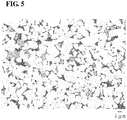
- a photograph (magnification 5,000 times) of a cross section of Sample No. 3-1 is shown in Fig. 5 .
- light grey represent WC particles
- dark grey represents a composite compound phase composed of a W-containing composite compound
- the black region therebetween represents a binder phase.
- a composite compound phase was present between WC particles.
- the composite compound phase was identified as a composite compound of (W, Ti, Ta)(C, N).
- the contact state between WC particles was measured as in Test Example 1.
- the average B/A value of each sample is shown in Table 7.
- the average particle diameter of WC particles in each sample was determined as in Test Example 1. As a result, in all the samples, the average particle diameter of WC particles was 2.4 ⁇ m.
- the area of each composite compound phase portion was measured by an image measurement software Mac-View. Then, the ratio of the total area of the composite compound phase portions to the observation image (area fraction) was calculated. The area fraction was calculated in accordance with the formula (total area of composite compound phase portions/area of observed field of view) ⁇ 100. The results thereof (the average value of values of the fields of view in each sample) are shown in Table 7. Furthermore, the existence ratio of a composite compound phase portion with an area of 10 ⁇ m 2 or more in the entire composite compound phase present in the observation image was calculated.
- a hard coating was formed on each of the samples as in Test Example 2.
- the composition of the hard coating was set to be TiN (0.2 ⁇ m), MT-TiCN (5.0 ⁇ m), TiBN (0.4 ⁇ m), ⁇ -Al 2 O 3 (5.2 ⁇ m), and TiN (0.2 ⁇ m) in this order from the substrate (sample) side.
- the numerical value in parentheses shows the thickness of each coating.
- Each of the samples provided with the hard coating was subjected to a cutting test under the cutting conditions shown in Table 6. The time until fracture of the substrate was measured as a life. The results there of are also shown in Table 7.
- Sample Nos. 3-1 to 3-4 in which the composite compound phase satisfies the conditions: (1) an area fraction of 1% to 10% and (2) an existence ratio of less than 5%, have a longer life as the cutting tool than Sample Nos. 3-11 to 3-13, in which at least one of (1) and (2) is not satisfied.
- the reason for this is considered to be that, in Sample Nos. 3-1 to 3-4, since the area fraction satisfies (1) above, the composite compound phase is moderately bound to WC particles, and since the existence ratio satisfies (2) above, the amount of the composite compound phase portion that can be a starting point for breakage is small.
- the total content of the hard phase powders other than WC (TiC powder, TaC powder, and TiN powder) as starting material powders is suitably set, and after sintering, cooling is performed at a cooling rate of 10°C/min or less. Therefore, it is considered that the composite compound phase satisfying both (1) and (2) above is generated by precipitation.
- Sample No. 3-1 in which the area fraction is 5.5% the life is longer.
- the reason for this is considered to be that because of the existence of the composite compound phase, strength can be improved, and since a sufficient amount of WC particles is present, and adjacent WC particles are sufficiently bound together, the plastic deformation resistance can be improved.
- the cooling rate after sintering is low at 2.5°C/min, precipitation is promoted, and composite compound phase portions with a proper size are precipitated between WC particles.
- the cemented carbide of the present invention has excellent plastic deformation resistance and therefore, can be suitably used as a material for cutting tools, dies, and the like. Furthermore, in the cutting tool of the present invention, by using the cemented carbide of the present invention having excellent plastic deformation resistance as a substrate, it is possible to realize highly efficient machining which meets the stricter cutting conditions and a long life.
Landscapes
- Chemical & Material Sciences (AREA)
- Engineering & Computer Science (AREA)
- Materials Engineering (AREA)
- Mechanical Engineering (AREA)
- Metallurgy (AREA)
- Organic Chemistry (AREA)
- Powder Metallurgy (AREA)
- Cutting Tools, Boring Holders, And Turrets (AREA)
Claims (6)
- Hartmetall, das 80 Masse-% oder mehr einer harten Phase aufweist, wobei die harte Phase Wolframkarbidteilchen in einem Verhältnis von 50 Masse-% oder mehr und eine Bindemittelphase in einem Verhältnis von 4 Masse-% oder mehr enthält, die Bindemittelphase als eine Hauptkomponente eine Eisengruppenelement enthält, dadurch gekennzeichnet, dass die Formel B/A ≤ 0,05 erfüllt wird, wobei A die Anzahl der Wolframkarbidteilchen in einer Beobachtungsebene repräsentiert und B die Anzahl der Wolframkarbidteilchen in einer Beobachtungsebene repräsentiert, deren Anzahl von Kontaktpunkten mit anderen Wolframkarbidteilchen 1 oder weniger ist, wobei sich die Beobachtungsebene innerhalb einer Oberfläche oder eines Querschnitts des Hartmetalls befindet; wobei
sich ein Kontaktpunkt auf einen Abschnitt bezieht, wo Wolframkarbidteilchen ohne die Bindemittelphase dazwischen in einer ebenen Struktur des Hartmetalls miteinander in Kontakt stehen;
solange ein Wolframkarbidteilchen durchgehend mit einem benachbarten Wolframkarbidteilchen in Kontakt steht, die Anzahl der Kontaktpunkte unabhängig von deren Größe als eins betrachtet wird, und die Kontaktpunktanzahl für jede Wolframkarbidteilchen gemessen wird;
die Kontaktpunktanzahl gemessen wird, durch:Hochglanzpolieren irgendeiner Oberfläche oder irgendeines Querschnitts des Hartmetalls, um die Beobachtungsebene zu erhalten, und Beobachten der Beobachtungsebene mit einem Mikroskop, um ein Beobachtungsbild zu erhalten, Bildanalyse unter Verwendung des Beobachtungsbilds und eines Zusammensetzungsverteilungsbilds, das durch Analyse mit energiedispersiver Röntgenspektroskopie erhalten wird, Klassifizieren der Teilchen der harten Phase in Wolframkarbidteilchen und andere Teilchen der harten Phase als Wolframkarbidteilchen, undnach dem Klassifizieren visuelles Zählen der Kontaktpunktanzahl von jedem Wolframkarbidteilchen;die Anzahl der Teilchen der Wolframkarbidteilchen pro Gesichtsfeld des Beobachtungsbilds 450 bis 550 beträgt; unddas Verhältnis B/A durch Messen von Verhältnissen B/A von mehreren Gesichtsfeldern und Verwenden des Durchschnittswerts der gemessenen Verhältnisse B/A der Gesichtsfelder bestimmt wird. - Hartmetall nach Anspruch 1, wobei das Hartmetall als die harte Phase eine zusammengesetzte Verbindungsphase aufweist, die aus mindestens einer zusammengesetzten Verbindung besteht, die aus Karbiden, Nitriden und Karbonitriden ausgewählt ist, die W und ein oder mehrere Elemente enthalten, die aus Elementen der Gruppe 4, 5 und 6 des Periodensystems mit der Ausnahme von W und Si ausgewählt sind;
der Flächenanteil der zusammengesetzten Verbindungsphase relativ zu irgendeiner Oberfläche oder irgendeines Querschnitts des Hartmetalls 1% bis 10% beträgt; und der Anteil eines zusammengesetzten Verbindungsphasenanteils, der eine Fläche von 10 µm2 oder mehr aufweist, kleiner als 5% in der gesamten zusammengesetzten Verbindungsphase ist, die in der Oberfläche oder dem Querschnitt vorhanden ist. - Hartmetall nach einem der Ansprüche 1 bis 2, wobei das Eisengruppenelement Kobalt aufweist und der Kobaltgehalt im Hartmetall 8 Masse-% oder mehr beträgt.
- Hartmetall nach einem der Ansprüche 1 bis 3, wobei die Wolframkarbidteilchen einen durchschnittlichen Teilchendurchmesser von 3 µm oder mehr aufweisen, der durchschnittliche Teilchendurchmesser der Wolframkarbidteilchen durch eine Bildanalyse unter Verwendung eines Beobachtungsbilds gemessen wird, das durch Beobachten einer Beobachtungsebene mit einem Mikroskop und einer EDS-Oberflächenanalyse erhalten wird.
- Schneidwerkzeug, wobei das Hartmetall nach einem der Ansprüche 1 bis 4 als ein Substrat verwendet wird.
- Schneidwerkzeug nach Anspruch 5, wobei das Schneidwerkzeug mit einer harten Beschichtung versehen ist, die mindestens einen Teil einer Oberfläche des Substrats bedeckt.
Applications Claiming Priority (2)
| Application Number | Priority Date | Filing Date | Title |
|---|---|---|---|
| JP2015119999A JP6256415B2 (ja) | 2014-06-19 | 2015-06-15 | 超硬合金、および切削工具 |
| PCT/JP2015/085097 WO2016203674A1 (ja) | 2014-06-19 | 2015-12-15 | 超硬合金、および切削工具 |
Publications (3)
| Publication Number | Publication Date |
|---|---|
| EP3309268A1 EP3309268A1 (de) | 2018-04-18 |
| EP3309268A4 EP3309268A4 (de) | 2018-07-04 |
| EP3309268B1 true EP3309268B1 (de) | 2020-07-29 |
Family
ID=61598410
Family Applications (1)
| Application Number | Title | Priority Date | Filing Date |
|---|---|---|---|
| EP15895692.0A Active EP3309268B1 (de) | 2015-06-15 | 2015-12-15 | Hartmetall und schneidwerkzeug |
Country Status (1)
| Country | Link |
|---|---|
| EP (1) | EP3309268B1 (de) |
Cited By (1)
| Publication number | Priority date | Publication date | Assignee | Title |
|---|---|---|---|---|
| EP4471167A4 (de) * | 2023-02-07 | 2025-04-23 | Sumitomo Electric Industries, Ltd. | Superharte legierung und schneidwerkzeug damit |
Families Citing this family (1)
| Publication number | Priority date | Publication date | Assignee | Title |
|---|---|---|---|---|
| WO2021199260A1 (ja) * | 2020-03-31 | 2021-10-07 | 住友電工ハードメタル株式会社 | 超硬合金及びそれを備える切削工具 |
Family Cites Families (6)
| Publication number | Priority date | Publication date | Assignee | Title |
|---|---|---|---|---|
| AU2754067A (en) * | 1967-09-21 | 1969-03-27 | Hughes Tool Company | Process of making bulk cemented tungsten carbide with rounded chunky granules and product thereof |
| JP3014307B2 (ja) * | 1995-10-16 | 2000-02-28 | 株式会社栗本鐵工所 | 内張りライナー |
| JP4336120B2 (ja) * | 2003-02-25 | 2009-09-30 | 京セラ株式会社 | 切削工具およびその製造方法 |
| CN101397614B (zh) * | 2008-11-04 | 2010-12-15 | 四川大学 | 一种Ni粘结WC基硬质合金的制备方法 |
| JP5462549B2 (ja) * | 2009-08-20 | 2014-04-02 | 住友電気工業株式会社 | 超硬合金 |
| JP5835306B2 (ja) * | 2013-11-22 | 2015-12-24 | 住友電気工業株式会社 | 超硬合金およびこれを用いた表面被覆切削工具 |
-
2015
- 2015-12-15 EP EP15895692.0A patent/EP3309268B1/de active Active
Non-Patent Citations (1)
| Title |
|---|
| None * |
Cited By (2)
| Publication number | Priority date | Publication date | Assignee | Title |
|---|---|---|---|---|
| EP4471167A4 (de) * | 2023-02-07 | 2025-04-23 | Sumitomo Electric Industries, Ltd. | Superharte legierung und schneidwerkzeug damit |
| US12409499B2 (en) | 2023-02-07 | 2025-09-09 | Sumitomo Electric Industries, Ltd. | Cemented carbide and cutting tool using the same |
Also Published As
| Publication number | Publication date |
|---|---|
| EP3309268A1 (de) | 2018-04-18 |
| EP3309268A4 (de) | 2018-07-04 |
Similar Documents
| Publication | Publication Date | Title |
|---|---|---|
| US10987739B2 (en) | Cemented carbide and cutting tool | |
| EP3739074B1 (de) | Hartmetall | |
| EP3453776B1 (de) | Hartmetall und schneidwerkzeug | |
| EP3521468A1 (de) | Hartmetall und schneidwerkzeug | |
| EP3613864B1 (de) | Hartmetall und verfahren zur herstellung von hartmetall | |
| EP3587609B1 (de) | Hartmetall und verfahren zur herstellung von hartmetall | |
| EP3130686B1 (de) | Cermet und schneidewerkzeug | |
| EP3130685B1 (de) | Cermet, verfahren zur herstellung des cermets und schneidwerkzeug | |
| EP3795706B1 (de) | Cermet, schneidwerkzeug damit und verfahren zur herstellung von cermet | |
| EP2450136A1 (de) | Cermet und beschichtetes cermet | |
| EP4170053B1 (de) | Hartmetall und schneidwerkzeug, das dieses als substrat enthält | |
| EP3878992A1 (de) | Hartmetall und dieses als basismaterial enthaltendes schneidwerkzeug | |
| EP3871809A1 (de) | Hartmetall und dieses als basismaterial enthaltendes schneidwerkzeug | |
| EP2826578B1 (de) | Schneidewerkzeug | |
| EP2407263B1 (de) | Cermet und beschichtetes cermet | |
| EP3502290A1 (de) | Hartes material und schneidewerkzeug | |
| EP1087026B1 (de) | Cermet auf TiCN basis | |
| EP3309268A1 (de) | Hartmetall und schneidwerkzeug | |
| JP7587205B2 (ja) | 切削工具 |
Legal Events
| Date | Code | Title | Description |
|---|---|---|---|
| STAA | Information on the status of an ep patent application or granted ep patent |
Free format text: STATUS: THE INTERNATIONAL PUBLICATION HAS BEEN MADE |
|
| PUAI | Public reference made under article 153(3) epc to a published international application that has entered the european phase |
Free format text: ORIGINAL CODE: 0009012 |
|
| STAA | Information on the status of an ep patent application or granted ep patent |
Free format text: STATUS: REQUEST FOR EXAMINATION WAS MADE |
|
| 17P | Request for examination filed |
Effective date: 20171208 |
|
| AK | Designated contracting states |
Kind code of ref document: A1 Designated state(s): AL AT BE BG CH CY CZ DE DK EE ES FI FR GB GR HR HU IE IS IT LI LT LU LV MC MK MT NL NO PL PT RO RS SE SI SK SM TR |
|
| AX | Request for extension of the european patent |
Extension state: BA ME |
|
| A4 | Supplementary search report drawn up and despatched |
Effective date: 20180601 |
|
| RIC1 | Information provided on ipc code assigned before grant |
Ipc: B23C 5/16 20060101ALI20180525BHEP Ipc: C22C 29/06 20060101ALI20180525BHEP Ipc: B23B 27/14 20060101ALI20180525BHEP Ipc: B23B 51/00 20060101ALI20180525BHEP Ipc: C22C 29/16 20060101ALN20180525BHEP Ipc: C22C 1/05 20060101ALI20180525BHEP Ipc: C22C 29/08 20060101AFI20180525BHEP Ipc: C22C 29/02 20060101ALN20180525BHEP |
|
| DAV | Request for validation of the european patent (deleted) | ||
| DAX | Request for extension of the european patent (deleted) | ||
| STAA | Information on the status of an ep patent application or granted ep patent |
Free format text: STATUS: EXAMINATION IS IN PROGRESS |
|
| 17Q | First examination report despatched |
Effective date: 20191203 |
|
| REG | Reference to a national code |
Ref country code: DE Ref legal event code: R079 Ref document number: 602015056726 Country of ref document: DE Free format text: PREVIOUS MAIN CLASS: C22C0029080000 Ipc: C22C0029020000 |
|
| GRAP | Despatch of communication of intention to grant a patent |
Free format text: ORIGINAL CODE: EPIDOSNIGR1 |
|
| STAA | Information on the status of an ep patent application or granted ep patent |
Free format text: STATUS: GRANT OF PATENT IS INTENDED |
|
| RIC1 | Information provided on ipc code assigned before grant |
Ipc: C22C 29/08 20060101ALI20200302BHEP Ipc: C22C 29/02 20060101AFI20200302BHEP Ipc: C22C 29/06 20060101ALI20200302BHEP Ipc: C22C 29/16 20060101ALI20200302BHEP Ipc: C22C 1/05 20060101ALI20200302BHEP |
|
| INTG | Intention to grant announced |
Effective date: 20200324 |
|
| GRAS | Grant fee paid |
Free format text: ORIGINAL CODE: EPIDOSNIGR3 |
|
| GRAA | (expected) grant |
Free format text: ORIGINAL CODE: 0009210 |
|
| STAA | Information on the status of an ep patent application or granted ep patent |
Free format text: STATUS: THE PATENT HAS BEEN GRANTED |
|
| AK | Designated contracting states |
Kind code of ref document: B1 Designated state(s): AL AT BE BG CH CY CZ DE DK EE ES FI FR GB GR HR HU IE IS IT LI LT LU LV MC MK MT NL NO PL PT RO RS SE SI SK SM TR |
|
| REG | Reference to a national code |
Ref country code: CH Ref legal event code: EP |
|
| REG | Reference to a national code |
Ref country code: AT Ref legal event code: REF Ref document number: 1295863 Country of ref document: AT Kind code of ref document: T Effective date: 20200815 |
|
| REG | Reference to a national code |
Ref country code: IE Ref legal event code: FG4D |
|
| REG | Reference to a national code |
Ref country code: DE Ref legal event code: R096 Ref document number: 602015056726 Country of ref document: DE |
|
| REG | Reference to a national code |
Ref country code: SE Ref legal event code: TRGR |
|
| REG | Reference to a national code |
Ref country code: LT Ref legal event code: MG4D |
|
| REG | Reference to a national code |
Ref country code: NL Ref legal event code: MP Effective date: 20200729 |
|
| REG | Reference to a national code |
Ref country code: AT Ref legal event code: MK05 Ref document number: 1295863 Country of ref document: AT Kind code of ref document: T Effective date: 20200729 |
|
| PG25 | Lapsed in a contracting state [announced via postgrant information from national office to epo] |
Ref country code: BG Free format text: LAPSE BECAUSE OF FAILURE TO SUBMIT A TRANSLATION OF THE DESCRIPTION OR TO PAY THE FEE WITHIN THE PRESCRIBED TIME-LIMIT Effective date: 20201029 Ref country code: LT Free format text: LAPSE BECAUSE OF FAILURE TO SUBMIT A TRANSLATION OF THE DESCRIPTION OR TO PAY THE FEE WITHIN THE PRESCRIBED TIME-LIMIT Effective date: 20200729 Ref country code: NO Free format text: LAPSE BECAUSE OF FAILURE TO SUBMIT A TRANSLATION OF THE DESCRIPTION OR TO PAY THE FEE WITHIN THE PRESCRIBED TIME-LIMIT Effective date: 20201029 Ref country code: ES Free format text: LAPSE BECAUSE OF FAILURE TO SUBMIT A TRANSLATION OF THE DESCRIPTION OR TO PAY THE FEE WITHIN THE PRESCRIBED TIME-LIMIT Effective date: 20200729 Ref country code: AT Free format text: LAPSE BECAUSE OF FAILURE TO SUBMIT A TRANSLATION OF THE DESCRIPTION OR TO PAY THE FEE WITHIN THE PRESCRIBED TIME-LIMIT Effective date: 20200729 Ref country code: PT Free format text: LAPSE BECAUSE OF FAILURE TO SUBMIT A TRANSLATION OF THE DESCRIPTION OR TO PAY THE FEE WITHIN THE PRESCRIBED TIME-LIMIT Effective date: 20201130 Ref country code: HR Free format text: LAPSE BECAUSE OF FAILURE TO SUBMIT A TRANSLATION OF THE DESCRIPTION OR TO PAY THE FEE WITHIN THE PRESCRIBED TIME-LIMIT Effective date: 20200729 Ref country code: GR Free format text: LAPSE BECAUSE OF FAILURE TO SUBMIT A TRANSLATION OF THE DESCRIPTION OR TO PAY THE FEE WITHIN THE PRESCRIBED TIME-LIMIT Effective date: 20201030 Ref country code: FI Free format text: LAPSE BECAUSE OF FAILURE TO SUBMIT A TRANSLATION OF THE DESCRIPTION OR TO PAY THE FEE WITHIN THE PRESCRIBED TIME-LIMIT Effective date: 20200729 |
|
| PG25 | Lapsed in a contracting state [announced via postgrant information from national office to epo] |
Ref country code: IS Free format text: LAPSE BECAUSE OF FAILURE TO SUBMIT A TRANSLATION OF THE DESCRIPTION OR TO PAY THE FEE WITHIN THE PRESCRIBED TIME-LIMIT Effective date: 20201129 Ref country code: RS Free format text: LAPSE BECAUSE OF FAILURE TO SUBMIT A TRANSLATION OF THE DESCRIPTION OR TO PAY THE FEE WITHIN THE PRESCRIBED TIME-LIMIT Effective date: 20200729 Ref country code: LV Free format text: LAPSE BECAUSE OF FAILURE TO SUBMIT A TRANSLATION OF THE DESCRIPTION OR TO PAY THE FEE WITHIN THE PRESCRIBED TIME-LIMIT Effective date: 20200729 Ref country code: PL Free format text: LAPSE BECAUSE OF FAILURE TO SUBMIT A TRANSLATION OF THE DESCRIPTION OR TO PAY THE FEE WITHIN THE PRESCRIBED TIME-LIMIT Effective date: 20200729 |
|
| PG25 | Lapsed in a contracting state [announced via postgrant information from national office to epo] |
Ref country code: NL Free format text: LAPSE BECAUSE OF FAILURE TO SUBMIT A TRANSLATION OF THE DESCRIPTION OR TO PAY THE FEE WITHIN THE PRESCRIBED TIME-LIMIT Effective date: 20200729 |
|
| PG25 | Lapsed in a contracting state [announced via postgrant information from national office to epo] |
Ref country code: IT Free format text: LAPSE BECAUSE OF FAILURE TO SUBMIT A TRANSLATION OF THE DESCRIPTION OR TO PAY THE FEE WITHIN THE PRESCRIBED TIME-LIMIT Effective date: 20200729 Ref country code: DK Free format text: LAPSE BECAUSE OF FAILURE TO SUBMIT A TRANSLATION OF THE DESCRIPTION OR TO PAY THE FEE WITHIN THE PRESCRIBED TIME-LIMIT Effective date: 20200729 Ref country code: CZ Free format text: LAPSE BECAUSE OF FAILURE TO SUBMIT A TRANSLATION OF THE DESCRIPTION OR TO PAY THE FEE WITHIN THE PRESCRIBED TIME-LIMIT Effective date: 20200729 Ref country code: EE Free format text: LAPSE BECAUSE OF FAILURE TO SUBMIT A TRANSLATION OF THE DESCRIPTION OR TO PAY THE FEE WITHIN THE PRESCRIBED TIME-LIMIT Effective date: 20200729 Ref country code: SM Free format text: LAPSE BECAUSE OF FAILURE TO SUBMIT A TRANSLATION OF THE DESCRIPTION OR TO PAY THE FEE WITHIN THE PRESCRIBED TIME-LIMIT Effective date: 20200729 Ref country code: RO Free format text: LAPSE BECAUSE OF FAILURE TO SUBMIT A TRANSLATION OF THE DESCRIPTION OR TO PAY THE FEE WITHIN THE PRESCRIBED TIME-LIMIT Effective date: 20200729 |
|
| REG | Reference to a national code |
Ref country code: DE Ref legal event code: R097 Ref document number: 602015056726 Country of ref document: DE |
|
| PG25 | Lapsed in a contracting state [announced via postgrant information from national office to epo] |
Ref country code: AL Free format text: LAPSE BECAUSE OF FAILURE TO SUBMIT A TRANSLATION OF THE DESCRIPTION OR TO PAY THE FEE WITHIN THE PRESCRIBED TIME-LIMIT Effective date: 20200729 |
|
| PLBE | No opposition filed within time limit |
Free format text: ORIGINAL CODE: 0009261 |
|
| STAA | Information on the status of an ep patent application or granted ep patent |
Free format text: STATUS: NO OPPOSITION FILED WITHIN TIME LIMIT |
|
| PG25 | Lapsed in a contracting state [announced via postgrant information from national office to epo] |
Ref country code: SK Free format text: LAPSE BECAUSE OF FAILURE TO SUBMIT A TRANSLATION OF THE DESCRIPTION OR TO PAY THE FEE WITHIN THE PRESCRIBED TIME-LIMIT Effective date: 20200729 |
|
| 26N | No opposition filed |
Effective date: 20210430 |
|
| REG | Reference to a national code |
Ref country code: CH Ref legal event code: PL |
|
| GBPC | Gb: european patent ceased through non-payment of renewal fee |
Effective date: 20201215 |
|
| PG25 | Lapsed in a contracting state [announced via postgrant information from national office to epo] |
Ref country code: MC Free format text: LAPSE BECAUSE OF FAILURE TO SUBMIT A TRANSLATION OF THE DESCRIPTION OR TO PAY THE FEE WITHIN THE PRESCRIBED TIME-LIMIT Effective date: 20200729 Ref country code: SI Free format text: LAPSE BECAUSE OF FAILURE TO SUBMIT A TRANSLATION OF THE DESCRIPTION OR TO PAY THE FEE WITHIN THE PRESCRIBED TIME-LIMIT Effective date: 20200729 |
|
| REG | Reference to a national code |
Ref country code: BE Ref legal event code: MM Effective date: 20201231 |
|
| PG25 | Lapsed in a contracting state [announced via postgrant information from national office to epo] |
Ref country code: IE Free format text: LAPSE BECAUSE OF NON-PAYMENT OF DUE FEES Effective date: 20201215 Ref country code: LU Free format text: LAPSE BECAUSE OF NON-PAYMENT OF DUE FEES Effective date: 20201215 Ref country code: FR Free format text: LAPSE BECAUSE OF NON-PAYMENT OF DUE FEES Effective date: 20201231 |
|
| PG25 | Lapsed in a contracting state [announced via postgrant information from national office to epo] |
Ref country code: CH Free format text: LAPSE BECAUSE OF NON-PAYMENT OF DUE FEES Effective date: 20201231 Ref country code: GB Free format text: LAPSE BECAUSE OF NON-PAYMENT OF DUE FEES Effective date: 20201215 Ref country code: LI Free format text: LAPSE BECAUSE OF NON-PAYMENT OF DUE FEES Effective date: 20201231 |
|
| PG25 | Lapsed in a contracting state [announced via postgrant information from national office to epo] |
Ref country code: IS Free format text: LAPSE BECAUSE OF FAILURE TO SUBMIT A TRANSLATION OF THE DESCRIPTION OR TO PAY THE FEE WITHIN THE PRESCRIBED TIME-LIMIT Effective date: 20201129 Ref country code: TR Free format text: LAPSE BECAUSE OF FAILURE TO SUBMIT A TRANSLATION OF THE DESCRIPTION OR TO PAY THE FEE WITHIN THE PRESCRIBED TIME-LIMIT Effective date: 20200729 Ref country code: MT Free format text: LAPSE BECAUSE OF FAILURE TO SUBMIT A TRANSLATION OF THE DESCRIPTION OR TO PAY THE FEE WITHIN THE PRESCRIBED TIME-LIMIT Effective date: 20200729 Ref country code: CY Free format text: LAPSE BECAUSE OF FAILURE TO SUBMIT A TRANSLATION OF THE DESCRIPTION OR TO PAY THE FEE WITHIN THE PRESCRIBED TIME-LIMIT Effective date: 20200729 |
|
| PG25 | Lapsed in a contracting state [announced via postgrant information from national office to epo] |
Ref country code: MK Free format text: LAPSE BECAUSE OF FAILURE TO SUBMIT A TRANSLATION OF THE DESCRIPTION OR TO PAY THE FEE WITHIN THE PRESCRIBED TIME-LIMIT Effective date: 20200729 |
|
| PG25 | Lapsed in a contracting state [announced via postgrant information from national office to epo] |
Ref country code: BE Free format text: LAPSE BECAUSE OF NON-PAYMENT OF DUE FEES Effective date: 20201231 |
|
| P01 | Opt-out of the competence of the unified patent court (upc) registered |
Effective date: 20230515 |
|
| PGFP | Annual fee paid to national office [announced via postgrant information from national office to epo] |
Ref country code: SE Payment date: 20231110 Year of fee payment: 9 Ref country code: DE Payment date: 20231031 Year of fee payment: 9 |
|
| REG | Reference to a national code |
Ref country code: DE Ref legal event code: R119 Ref document number: 602015056726 Country of ref document: DE |
|
| REG | Reference to a national code |
Ref country code: SE Ref legal event code: EUG |
|
| PG25 | Lapsed in a contracting state [announced via postgrant information from national office to epo] |
Ref country code: DE Free format text: LAPSE BECAUSE OF NON-PAYMENT OF DUE FEES Effective date: 20250701 |