EP3307806B1 - Method for poly(phenylene ether) manufacture and associated poly(phenylene ether) - Google Patents
Method for poly(phenylene ether) manufacture and associated poly(phenylene ether) Download PDFInfo
- Publication number
- EP3307806B1 EP3307806B1 EP16731436.8A EP16731436A EP3307806B1 EP 3307806 B1 EP3307806 B1 EP 3307806B1 EP 16731436 A EP16731436 A EP 16731436A EP 3307806 B1 EP3307806 B1 EP 3307806B1
- Authority
- EP
- European Patent Office
- Prior art keywords
- poly
- phenylene ether
- monohydric phenol
- dimethyl
- oxygen
- Prior art date
- Legal status (The legal status is an assumption and is not a legal conclusion. Google has not performed a legal analysis and makes no representation as to the accuracy of the status listed.)
- Active
Links
- 0 C*c(cc(*)cc1C)c1OC Chemical compound C*c(cc(*)cc1C)c1OC 0.000 description 5
Images


Classifications
-
- C—CHEMISTRY; METALLURGY
- C08—ORGANIC MACROMOLECULAR COMPOUNDS; THEIR PREPARATION OR CHEMICAL WORKING-UP; COMPOSITIONS BASED THEREON
- C08G—MACROMOLECULAR COMPOUNDS OBTAINED OTHERWISE THAN BY REACTIONS ONLY INVOLVING UNSATURATED CARBON-TO-CARBON BONDS
- C08G65/00—Macromolecular compounds obtained by reactions forming an ether link in the main chain of the macromolecule
- C08G65/34—Macromolecular compounds obtained by reactions forming an ether link in the main chain of the macromolecule from hydroxy compounds or their metallic derivatives
- C08G65/38—Macromolecular compounds obtained by reactions forming an ether link in the main chain of the macromolecule from hydroxy compounds or their metallic derivatives derived from phenols
- C08G65/44—Macromolecular compounds obtained by reactions forming an ether link in the main chain of the macromolecule from hydroxy compounds or their metallic derivatives derived from phenols by oxidation of phenols
-
- C—CHEMISTRY; METALLURGY
- C08—ORGANIC MACROMOLECULAR COMPOUNDS; THEIR PREPARATION OR CHEMICAL WORKING-UP; COMPOSITIONS BASED THEREON
- C08G—MACROMOLECULAR COMPOUNDS OBTAINED OTHERWISE THAN BY REACTIONS ONLY INVOLVING UNSATURATED CARBON-TO-CARBON BONDS
- C08G2650/00—Macromolecular compounds obtained by reactions forming an ether link in the main chain of the macromolecule
- C08G2650/28—Macromolecular compounds obtained by reactions forming an ether link in the main chain of the macromolecule characterised by the polymer type
- C08G2650/50—Macromolecular compounds obtained by reactions forming an ether link in the main chain of the macromolecule characterised by the polymer type containing nitrogen, e.g. polyetheramines or Jeffamines(r)
-
- C—CHEMISTRY; METALLURGY
- C08—ORGANIC MACROMOLECULAR COMPOUNDS; THEIR PREPARATION OR CHEMICAL WORKING-UP; COMPOSITIONS BASED THEREON
- C08G—MACROMOLECULAR COMPOUNDS OBTAINED OTHERWISE THAN BY REACTIONS ONLY INVOLVING UNSATURATED CARBON-TO-CARBON BONDS
- C08G2650/00—Macromolecular compounds obtained by reactions forming an ether link in the main chain of the macromolecule
- C08G2650/62—Macromolecular compounds obtained by reactions forming an ether link in the main chain of the macromolecule characterised by the nature of monomer used
- C08G2650/64—Monomer containing functional groups not involved in polymerisation
Definitions
- Poly(phenylene ether)s are a class of plastics known for excellent water resistance, dimensional stability, and inherent flame retardancy, as well as high oxygen permeability, and oxygen/nitrogen selectivity. Properties such as strength, stiffness, chemical resistance, and heat resistance can be tailored by blending poly(phenylene ether)s with various other plastics in order to meet the requirements of a wide variety of consumer products, for example, plumbing fixtures, electrical boxes, automotive parts, insulation for wire and cable, and hollow fiber membranes. Improved properties useful for certain applications can be obtained with poly(phenylene ether) copolymers.
- poly(phenylene ether) is poly(2,6-dimethyl-1,4-phenylene ether), which is prepared on a large scale by the oxidative polymerization of 2,6-dimethylphenol (also known as 2,6-xylenol).
- 2,6-dimethylphenol also known as 2,6-xylenol
- high molecular weight poly(2,6-dimethyl-1,4-phenylene ether) is desirable.
- high molecular weight poly(2,6-dimethyl-4-phenylene ether) can have a bimodal molecular weight distribution, as indicated in the GPC trace of Fig. 1 .
- the low molecular weight fraction is believed to be caused by polymer chain scission during equilibration of poly(2,6-dimethyl-1,4-phenylene ether) with 2,2',6,6'-diphenoquinone.
- the presence of a low molecular weight fraction results in a high polydispersity and can adversely affect the physical properties and oxidative resistance of poly(phenylene ether).
- the low molecular weight fraction has a proportionally higher amount of phenolic terminal groups, which are prone to oxidation. Therefore it is desirable to develop an improved method for producing high molecular weight poly(phenylene ether) having a unimodal molecular weight distribution and low polydispersity.
- the method should be commercially-scalable, economical, and environmentally acceptable.
- WO-A-2009/104107 discloses a process for making high molecular weight poly(2,6-dimethyl-1,4-phenylene ether).
- a method of making a poly(phenylene ether) comprises: in an exotherm period, continuous addition of oxygen and a monohydric phenol of the structure: wherein each occurrence of Z 1 is independently halogen, unsubstituted or substituted C 1 -C 12 hydrocarbyl provided that the hydrocarbyl group is not tertiary hydrocarbyl, C 1 -C 12 hydrocarbylthio, C 1 -C 12 hydrocarbyloxy, or C 2 -C 12 halohydrocarbyloxy, wherein two to twelve carbon atoms separate the halogen and oxygen atoms; and each occurrence of Z 2 is independently hydrogen, halogen, unsubstituted or substituted C 1 -C 12 hydrocarbyl provided that the hydrocarbyl group is not tertiary hydrocarbyl, C 1 -C 12 hydrocarbylthio, C 1 -C 12 hydrocarbyloxy, or C 2 -C 12 halohydrocarbyloxy, wherein two to
- a poly(phenylene ether) having an intrinsic viscosity of 0.5 to 2.0 deciliters per gram, measured in chloroform using an Ubbelohde capillary glass viscometer at 25 °C, a polydispersity of 1 to 10, and a unimodal molecular weight distribution, is made by the method.
- a method of making a poly(phenylene ether) having an intrinsic viscosity of 0.5 to 2.0 deciliters per gram, measured in chloroform using an Ubbelohde capillary glass viscometer at 25 °C, a polydispersity of 1 to 10, and a unimodal molecular weight distribution comprises: in an exotherm period, continuous addition of oxygen and a monohydric phenol of the structure: wherein each occurrence of Z 1 is independently halogen, unsubstituted or substituted C 1 -C 12 hydrocarbyl provided that the hydrocarbyl group is not tertiary hydrocarbyl, C 1 -C 12 hydrocarbylthio, C 1 -C 12 hydrocarbyloxy, or C 2 -C 12 halohydrocarbyloxy, wherein two to twelve carbon atoms separate the halogen and oxygen atoms; and each occurrence of Z 2 is independently hydrogen, halogen, unsubstituted or substituted C 1 -C 12 hydrocarby
- the poly(phenylene ether) has an intrinsic viscosity of 0.5 to 2.0 deciliters per gram, measured in chloroform using an Ubbelohde capillary glass viscometer at 25 °C; a polydispersity of 1 to 10, and a unimodal molecular weight distribution
- the mole ratio of oxygen to monohydric phenol is referred to herein as the "O/monomer mole ratio" for brevity.
- the inventors have determined that intrinsic viscosity is optimized (maximized) at an O/monomer mole ratio of 0.95:1 to 1.2:1, specifically 1.0:1 to 1.2:1, more specifically 1.0:1 to 1.15:1, and still more specifically 1.0:1 to 1.1:1.
- C-C coupling which results in undesired oxidative dimerization of the monohydric phenol to form a diphenoquinone, can be increased relative to C-O coupling, which results in the desired oxidative polymerization.
- TMDQ 2,2',6,6'-diphenoquinone
- the monohydric phenol is 2,6-dimethylphenol and the poly(phenylene ether) made by the method is poly(2,6-dimethyl-4-phenylene ether).
- the method is also suitable for copolymerization and copolymers.
- the monohydric phenol comprises a first monohydric phenol that is 2,6-dimethylphenol and a second monohydric phenol that is 2-methyl-6-phenylphenol or 2,6-diphenylphenol; and the poly(phenylene ether) made by the method is poly(2-methyl-6-phenyl-1,4-phenylene-co-2,6-dimethyl-1,4-phenylene ether) or poly(2,6-diphenyl-1,4-phenylene-co-2,6-dimethyl-1,4-phenylene ether).
- the poly(phenylene ether) can be a copolymer derived from 1 to 50 mole percent of the second monohydric phenol and 50 to 99 mole percent of the first monohydric phenol.
- the poly(phenylene ether) made by the method has an intrinsic viscosity of 0.5 to 2.0 deciliters per gram, measured in chloroform using an Ubbelohde capillary glass viscometer at 25 °C. Within this range, the intrinsic viscosity can be greater than or equal to 0.8, 0.9, 1.0, 1.2, or 1.3 deciliters per gram, and less than or equal to 1.8, 1.7, 1.6, or 1.5 deciliters per gram. In some embodiments, the intrinsic viscosity is 0.8 to 1.7 deciliters per gram, specifically 1.3 to 1.5 deciliters per gram, and more specifically 1.35 to 1.45 deciliters per gram.
- the weight-average molecular weight of the poly(phenylene ether) made by the method is 60,000 to 500,000 daltons, as measured by gel permeation chromatography. Within this range, the weight-average molecular weight can be greater than or equal to 100,000 or 200,000 daltons, and less than or equal to 400,000 or 300,000 daltons.
- the poly(phenylene ether) made by the method has a polydispersity of 1 to 10. Within this range, the polydispersity can be greater than or equal to 2 or 3, and less than or equal to 8, 7, or 6. Advantageously, the polydispersity can be less than that obtained by other methods, and less than observed in commercial high molecular weight poly(2,6-dimethyl-1,4-phenylene ether), for example PPOTM 6130. Thus in some embodiments, the polydispersity is 2 to 7, specifically 2 to 6, and more specifically 3 to 6.
- the poly(phenylene ether) made by the method has a unimodal molecular weight distribution.
- High molecular weight poly(2,6-dimethyl-4-phenylene ether) can have a bimodal molecular weight distribution, as indicated in the GPC trace of Fig. 1 .
- the low molecular weight fraction is believed to be caused by polymer chain scission during equilibration of poly(2,6-dimethyl-1,4-phenylene ether) with 2,2',6,6'-diphenoquinone.
- the presence of a low molecular weight fraction results in high polydispersity and can adversely affect the physical properties and oxidative resistance of poly(phenylene ether). Therefore the absence of a low molecular weight fraction results in a low polydispersity and a unimodal molecular weight distribution which provides improved physical properties and oxidative resistance.
- the method further comprises, after completion of the exotherm period and build period, an equilibration step comprising: cessation of oxygen addition; flushing oxygen from a gaseous head space above the polymerization mixture; addition of a aqueous chelating agent to the polymerization mixture; and in an equilibration period, holding the polymerization mixture for 0.1 to 24 hours at 30 to 80 °C.
- the equilibration period can be greater than or equal to 1, 2, or 3 hours, and less than or equal to 12, 6, or 5 hours; and the equilibration temperature can be greater than 40, 50, or 60 °C and less than 70 °C.
- a poly(phenylene ether) is made by the method, wherein the method further comprises, after completion of the exotherm period and build period, an equilibration step comprising: cessation of oxygen addition; flushing oxygen from a gaseous head space above the polymerization mixture; addition of a aqueous chelating agent to the polymerization mixture; and in an equilibration period, holding the polymerization mixture for 0.1 to 24 hours at 30 to 80 °C.
- Fig. 2 illustrates some of the chemical reactions associated with equilibration when the monohydric phenol is 2,6-dimethylphenol.
- 2,6-Dimethylphenol is oxidatively polymerized to poly(2,6-dimethyl-1,4-phenylene ether); and in a side reaction, oxidatively dimerized to 2,2',6,6'-diphenoquinone (TMDQ).
- TMDQ is incorporated into the poly(2,6-dimethyl-4-phenylene ether) backbone to form internal or terminal TMDQ.
- the TMDQ serves as both oxidant and reactant in these reactions.
- the monohydric phenol is 2,6-dimethylphenol
- the poly(phenylene ether) is poly(2,6-dimethyl-4-phenylene ether)
- the poly(2,6-dimethyl-4-phenylene ether) has, based on the total weight of the poly(2,6-dimethyl-4-phenylene ether), 0.01 to 2.0 weight percent of biphenyl units: derived from 2,2',6,6'-diphenoquinone, as determined by 1 H-NMR spectroscopy.
- the poly(2,6-dimethyl-4-phenylene ether) has greater than or equal to 0.05, 0.10, or 0.15 weight percent, and less than or equal to 1.5, 1.0, 0.9, 0.8, 0.7, 0.6, 0.5, or 0.4 weight percent, of biphenyl units.
- the poly(2,6-dimethyl-4-phenylene ether) has 0.1 to 1.0 weight percent of biphenyl units.
- the poly(phenylene ether) made by the method comprises minor amounts of covalently bound monoamine groups which are derived from an amine used in the method by reaction with the methyl group.
- the covalently bound monoamine groups are present as aminomethyl groups ortho to the ether oxygen atoms in internal units and as aminomethyl groups ortho to the phenol oxygen in terminal units.
- the internal units can have the structure: and the terminal units can have the structure:
- the amounts of covalently bound monoamine groups can be determined by 1 H-NMR spectroscopy.
- Fig. 5 is a plot of terminal dibutylamine content in weight percent as a function of equilibration time at O/monomer mole ratios of 0.72, 1.0, and 1.31 (at 20 and 25 °C)
- Fig. 6 is a plot of internal dibutylamine content in weight percent as a function of equilibration time at O/monomer mole ratios of 0.72, 1.0, and 1.31 (at 20 and 25 °C).
- intrinsic viscosity is optimized at an O/monomer mole ratio of 0.95:1 to 1.20:1.
- amine incorporation can be increased.
- terminal and internal dibutylamine contents are highest at an O/monomer mole ratio of 1.31:1.
- the high dibutylamine incorporation at high O/monomer mole ratios can interfere with polymerization, molecular weight build, and the intrinsic viscosity obtained.
- dibutylamine content is low and intrinsic viscosity is highest at an O/monomer mole ratio of 1.0:1, which is within the range of 0.95 to 1.20:1.
- the monohydric phenol is 2,6-dimethylphenol
- the amine comprises dibutylamine
- the poly(phenylene ether) is poly(2,6-dimethyl-4-phenylene ether); and after the equilibration period, the poly(2,6-dimethyl-4-phenylene ether) has, based on the total weight of the poly(2,6-dimethyl-4-phenylene ether), 0.1 to 2.0 weight percent combined of internal dibutylamino units and terminal dibutylamino units derived from dibutylamine, as determined by 1 H-NMR spectroscopy.
- the amount of internal dibutylamino units and terminal dibutylamino units derived from dibutylamine can be greater than or equal to 0.1, 0.2, 0.3 or 0.4 weight percent, and less than or equal to 2.0, 1.5, 1.4, 1.3, 1.2, or 1.1 weight percent.
- the amount of internal dibutylamino units and terminal dibutylamino units derived from dibutylamine can be, for example, 0.2 to 1.5 weight percent, specifically 0.4 to 1.4 weight percent.
- the amount of diphenoquinone formation and biphenyl incorporation can depend upon the amount of a first portion of the monohydric phenol added prior to continuous addition of the second portion.
- a second portion of the monohydric phenol is continuously added to a first portion of the monohydric phenol, the non-polar solvent and polymerization catalyst; wherein the first portion comprises 1 to 20 weight percent of the monohydric phenol and the second portion comprises 80 to 99 weight percent, of the monohydric phenol.
- the first portion can comprise greater than or equal to 1, 2, 3, 4, or 5 weight percent and less than or equal to 20, 15, 12, 10, or 7 weight percent of the monohydric phenol; and the second portion can comprise greater than or equal to 80, 85, 88, 90, or 93 weight percent and less than or equal to 99, 98, 97, 96, or 95 weight percent of the monohydric phenol.
- the first portion can comprise 3 to 12 weight percent of the monohydric phenol and the second portion can comprise 88 to 97 weight percent of the monohydric phenol; or the first portion can comprise 3 to 7 weight percent of the monohydric phenol and the second portion can comprise 93 to 97 weight percent of the monohydric phenol.
- the amount of diphenoquinone formation and biphenyl incorporation can also depend on the rate of continuous addition of the second portion of the monohydric phenol.
- the second portion of monohydric phenol is added over a period of 10 to 120 minutes.
- the second portion of the monohydric phenol can be added over a period of greater than or equal to 10, 20, or 30 minutes and less than or equal to 90, 60, 50, or 40 minutes.
- the second portion of the monohydric phenol can be added in 30 to 60 minutes.
- the second portion of monohydric phenol is added over a period of 30 to 36 minutes.
- the monohydric phenol is 2,6-dimethylphenol
- the poly(phenylene ether) is poly(2,6-dimethyl-4-phenylene ether) having an intrinsic viscosity of 0.8 to 1.7 deciliters per gram, measured in chloroform using an Ubbelohde capillary glass viscometer at 25 °C, and a polydispersity of 3 to 6
- the mole ratio is 0.8:1 to 1.2:1
- oxidative polymerization comprises continuous addition of a second portion of the monohydric phenol and oxygen to a first portion of the monohydric phenol, the non-polar solvent, and polymerization catalyst
- the first portion comprises 3 to 12 weight percent of the monohydric phenol and the second portion comprises 88 to 97 weight percent of the monohydric phenol
- the second portion of the monohydric phenol is added over a period of 20 to 60 minutes.
- the invention includes at least the following embodiments.
- Intrinsic viscosity (Ubbelohde, IV) was measured in chloroform using an Ubbelohde capillary glass viscometer at 25 °C in a thermostatted water bath.
- M n Number average molecular weight
- M w weight average molecular weight
- D polydispersity
- the detection wavelength for the polystyrene standard was 254 nm and that of poly(2,6-dimethyl-4-phenylene ether) was 280 nm.
- Intrinsic viscosity was calculated using the Agilent GPC data.
- a third order polynomial fit was generated using polystyrene standards obtained from Agilent.
- the molecular weight range of the standard varied between 575 to 990,500 daltons (Da).
- the Mark-Houwink coefficients, 'k' and 'a' used in the quantification were 0.0483 and 0.64, respectively.
- the Malvern GPC method was similar to the Agilent method, with the following differences. Approximately 60 mg of PPE was dissolved in 20 mL of chloroform (3 mg/mL) by shaking for 1 hr. The GPC was equipped with two Viscotek TM6000M General Mixed Columns. The flow rate was 1 mL/min. A dn/dc value of 0.163 was used to estimate the intrinsic viscosity of the polymeric resin.
- biphenyl content is the weight percent of 3,3',5,5'-tetramethyl-4,4'-biphenol units, i.e. units having structure: and was determined by integrating the protons labeled "d” and the protons labeled "a” in internal DMP unit:
- Terminal DBA refers to dibutylamino groups covalently bonded to terminal 2,6-dimethylphenol repeat units as follows: and was determined by integrating the peak for the methylene protons labeled "g".
- Cyclic DBA refers to dibutylamino groups that form a 6-membered ring with terminal 2,6-dimethylphenol units as follows: and was determined by integrating the peak for the methylene protons labeled "h".
- Term . DBA wt . % V U + V + W + X + Y + Z ⁇ 100
- W Peak " H f " Integral @ 3.62 ppm ⁇ MW Cyclic DBA 2
- MW (Cyclic DBA)" is the molecular weight of a dibutylamino diradical, or 127.23 Da.
- MBA monobutylamino groups covalently bonded to terminal 2,6-dimethylphenol units as follows: and was determined by integrating the peak for the methylene protons labeled "i".
- Total DBA in Tables 2-6 refers to the combined weight percent of internal and terminal DBA units, as the amounts of cyclic DBA and MBA are generally relatively small.
- Poly(2,6-dimethyl-4-phenylene ether) was prepared in a 1-gallon RC1TM reaction calorimeter as follows, with stirring throughout the procedure. An approximately 50 wt.% solution of 0.16 lb. monomer (2,6-dimethylphenol, DMP) in toluene was prepared. (The total amount of toluene added to the calorimeter provided a total monomer concentration of 7 wt.%). A catalyst solution was prepared from 0.3795 g Cu 2 O dissolved in 4.81 g 48 wt.% aqueous HBr.
- the remaining 90% of the monomer solution was dosed into the calorimeter at a rate of 2.88 grams per minute, and molecular oxygen (O 2 ) was simultaneously sparged through a dip tube at 0.377, 0.288, or 0.210 standard cubic feet per hour (SCFH) at 25 °C to initiate oxidative polymerization.
- O 2 molecular oxygen
- SCFH standard cubic feet per hour
- the O/monomer mole ratio was 0.72:1, 1.0:1, or 1.31:1.
- the initial phase of the polymerization was exothermic, and cooling was used to maintain a temperature of 25 °C, unless indicated otherwise.
- TMDQ is a byproduct of the oxidative polymerization of 2,6-dimethylphenol, and it has been reported that TMDQ yield increases with increasing O/monomer mole ratio.
- the ratio was varied between 0.72 to 1.31. While an effort was made to maintain a constant O/monomer mole ratio, the operator reduced the O 2 flow rate whenever an excursion in O 2 concentration in the reactor head space was detected which suggested O 2 breakthrough. This manual change in the O 2 flow rate by the operator was not reproducible (i.e. every operator responded differently to the excursion in O 2 flow rate and does not respond the same way every time). This introduced batch variability, in particular variation in TMDQ yield and total amine incorporated to the polymer. However, general trends can be seen from the data plotted in Fig. 3-9 .
- the poly(2,6-dimethyl-4-phenylene ether) present is equilibrated with the TMDQ, which generally results in a decrease in intrinsic viscosity and molecular weight.
- the effects of O/monomer mole ratio on intrinsic viscosity, M n , M w , D, and weight percents of biphenyl, terminal DBA, and internal DBA were measured as a function of equilibration time, and the results are summarized in Fig. 3-9 .
- the highest IV is obtained with an O/monomer mole ratio of 1.0.
- Fig. 3 the highest IV is obtained with an O/monomer mole ratio of 1.0.
- Example 2 the general procedure above was followed, with an O/monomer mole ratio of 1.0:1 and an O 2 flow of 0.288 SCFH.
- the DBA amounts were 2, 4, and 6 wt.% based on total monomer (-0.003 lb, -0.007 lb., and -0.010 lb.) respectively.
- Table 2 As can be seen from Table 2, there was no difference in dibutylamine incorporation at the three DBA amounts at an O/monomer mole ratio of 1.0:1.
- Example 2 the general procedure above was followed with an O/monomer mole ratio of 1.0:1 and an O 2 flow of 0.288 SCFH.
- the DMBA amounts were 0.8, 1.0, and 1.2 wt.% based on total toluene (-0.017 lb, -0.021 lb., and -0.025 lb. respectively).
- Table 3 Extent of DBA Incorporation as a Function of DMBA Amount and Equil. Time Ex.
- DBA (wt.%) Total DBA (wt.%) 157 0.101 0.45 0.547 0.074 0.37 0.444 0.090 0.411 0.501 230 0.111 0.42 0.529 0.082 0.37 0.452 0.104 0.424 0.528 290 0.131 0.38 0.512 0.099 0.37 0.469 0.124 0.389 0.514 350 0.156 0.36 0.513 0.131 0.37 0.501 0.144 0.371 0.515 Day 2 0.190 0.32 0.512 0.18 0.37 0.550 0.168 0.328 0.496 a) Amount based on total toluene.
- DBA (wt.%) Total DBA (wt.%) 1 1.16 1.31 47,294 203,850 4.31 0.23 0.21 0.78 0.99 9 1.61 1 82,200 324,500 3.95 0.08 0.09 0.48 0.57 10 1.40 1 - - - 0.06 0.1 0.44 0.54 11 1.61 1 59,700 306,000 5.13 0.09 0.08 0.43 0.52 12 1.41 1 50,282 237,330 4.72 0.09 0.08 0.5 0.58 13 1.58 1 37,323 333,620 8.94 0.13 0.11 0.45 0.56 14 0.954 1.31 43,700 159,000 3.64 0.13 0.19 0.94 1.13 15 0.910 1.31 36,754 142,050 3.86 0.23 0.26 1.11 1.37 16 1.100 1.31 45,813 195,870 4.28 0.16 0.3 0.83 1.13 17 1.040 1 43,355 193,930 4.47 0.22 0.19 0.73 0.92 18 0.816 1.31 34,904 125,850 3.61 0.35 0.
- EXAMPLE 21 PREPARATION OF POLY(2-METHYL-6-PHENYL-1,4-PHENYLENE- co -2,6-DIMETHYL-1,4-PHENYLENE ETHER) (14:86 MOLE RATIO)
- the copolymer was prepared in a 500-mL stirred glass vessel. A 7 wt.% solution of the monomers (14.22 mole percent 2-methyl-6-phenylphenol and 85.78 mole percent 2,6-dimethylphenol) in toluene was prepared. Approximately 10 wt.% of the toluene solution was charged to the vessel up front and the remainder dosed in over 45 minutes. The catalyst solution (Cu 2 O in 48 wt.% aq.
- HBr HBr amount was 7.05 wt.% based on total monomer (TM, 0.005 lb.), DBA amount was 4.05% based on TM ( ⁇ 0.003 1b.), DMBA amount was 1% based on total toluene ( ⁇ 0.009 lb.), and DBEDA amount was 0.006 lb.
- Oxygen was sparged through the dip tube at 0.112 SCFH (O/monomer mole ratio was 1.0). The vessel was blanketed with nitrogen (0.33 SCFH) throughout the polymerization. The polymerization was maintained at 25 °C during the exotherm and build periods (total of 75 min.). The catalyst was chelated with NTA at the end of the build period, and the polymerization mixture was transferred to a jacketed glass vessel and allowed to equilibrate at 62 °C for 285 min.
- EXAMPLE 22 PREPARATION OF POLY(2,6-DIPHENYL-1,4-PHENYLENE- co -2,6-DIMETHYL-1,4-PHENYLENE ETHER) (11:89 MOLE RATIO)
- the copolymer was prepared in a 500-mL stirred glass vessel. A 7 wt.% solution of the monomers (11.03 mole percent 2,6-diphenylphenol and 88.97 mole percent 2,6-dimethylphenol) in toluene was prepared. Approximately 10 wt.% of the toluene solution was charged to the vessel up front and the remainder dosed in over 45 minutes. The catalyst (Cu 2 O in 48 wt.% aq.
- HBr HBr amount was 7.05 wt.% based on TM (0.005 lb.), DBA amount was 4.05% based on TM ( ⁇ 0.003 lb.), DMBA amount was 1% based on total toluene ( ⁇ 0.009 lb.), and DBEDA amount was 0.006 lb.
- Oxygen was sparged through the dip tube at 0.112 SCFH (O/monomer mole ratio was 1.0). The vessel was blanketed with nitrogen (0.33 SCFH) throughout the polymerization. The polymerization was maintained at 25 °C during the exotherm and build periods (total of 75 min.). The catalyst was chelated with NTA at the end of the build period, and the polymerization mixture was transferred to a jacketed glass vessel and allowed to equilibrate at 62 °C for 285 min.
- oxygen refers to molecular oxygen (O 2 ), unless indicated otherwise.
- the mole ratio of oxygen atoms to monohydric phenol is referred to herein as the "O/monomer mole ratio", i.e. the O/monomer ratio is twice the molecular oxygen (O 2 )/monomer ratio.
- Nirogen refers to molecular nitrogen (N 2 );
- monomer refers to monohydric phenol;
- TM refers to "total monomer", which can be, for example, 2,6-dimethylphenol, 2-methyl-6-phenylphenol, 2,6-diphenylphenol, or combinations thereof.
- the terms “a” and “an” do not denote a limitation of quantity, but rather the presence of at least one of the referenced items. An asterisk in a chemical structure indicates an open valence.
Landscapes
- Chemical & Material Sciences (AREA)
- Health & Medical Sciences (AREA)
- Chemical Kinetics & Catalysis (AREA)
- Medicinal Chemistry (AREA)
- Polymers & Plastics (AREA)
- Organic Chemistry (AREA)
- Polyethers (AREA)
- Polyesters Or Polycarbonates (AREA)
Description
- Poly(phenylene ether)s are a class of plastics known for excellent water resistance, dimensional stability, and inherent flame retardancy, as well as high oxygen permeability, and oxygen/nitrogen selectivity. Properties such as strength, stiffness, chemical resistance, and heat resistance can be tailored by blending poly(phenylene ether)s with various other plastics in order to meet the requirements of a wide variety of consumer products, for example, plumbing fixtures, electrical boxes, automotive parts, insulation for wire and cable, and hollow fiber membranes. Improved properties useful for certain applications can be obtained with poly(phenylene ether) copolymers.
- An example of a commercial poly(phenylene ether) is poly(2,6-dimethyl-1,4-phenylene ether), which is prepared on a large scale by the oxidative polymerization of 2,6-dimethylphenol (also known as 2,6-xylenol). For certain product applications, for example hollow fiber membranes, high molecular weight poly(2,6-dimethyl-1,4-phenylene ether) is desirable. However, high molecular weight poly(2,6-dimethyl-4-phenylene ether) can have a bimodal molecular weight distribution, as indicated in the GPC trace of
Fig. 1 . - Without being bound by theory, the low molecular weight fraction is believed to be caused by polymer chain scission during equilibration of poly(2,6-dimethyl-1,4-phenylene ether) with 2,2',6,6'-diphenoquinone. The presence of a low molecular weight fraction results in a high polydispersity and can adversely affect the physical properties and oxidative resistance of poly(phenylene ether). For example, the low molecular weight fraction has a proportionally higher amount of phenolic terminal groups, which are prone to oxidation. Therefore it is desirable to develop an improved method for producing high molecular weight poly(phenylene ether) having a unimodal molecular weight distribution and low polydispersity. The method should be commercially-scalable, economical, and environmentally acceptable.
WO-A-2009/104107 discloses a process for making high molecular weight poly(2,6-dimethyl-1,4-phenylene ether). - A method of making a poly(phenylene ether) comprises: in an exotherm period, continuous addition of oxygen and a monohydric phenol of the structure:

- Referring now to the drawings,
-
Fig. 1 depicts the gel permeation chromatography trace for a commercial sample of high molecular weight poly(2,6-dimethyl-1,4-phenylene ether). -
Fig. 2 is a reaction scheme for oxidative polymerization of 2,6-dimethylphenol forming poly(2,6-dimethyl-4-phenylene ether), oxidative dimerization of 2,6-dimethylphenol forming 2,2',6,6'-diphenoquinone; and equilibration of 2,2',6,6'-diphenoquinone with poly(2,6-dimethyl-4-phenylene ether) forming internal and terminal biphenyl units derived from the 2,2',6,6'-diphenoquinone. -
Fig. 3 is a plot of Ubbelohde intrinsic viscosity in dL/g as a function of equilibration time at O/monomer mole ratios of 0.72, 1.0, and 1.31 (at 20 and 25 °C). -
Fig. 4 is a plot of biphenyl content (internal and terminal biphenyl content combined) in weight percent as a function of equilibration time at O/monomer mole ratios of 0.72, 1.0, and 1.31 (at 20 and 25 °C). -
Fig. 5 is a plot of terminal dibutylamine content in weight percent as a function of equilibration time at O/monomer mole ratios of 0.72, 1.0, and 1.31 (at 20 and 25 °C). -
Fig. 6 is a plot of internal dibutylamine content in weight percent as a function of equilibration time at O/monomer mole ratios of 0.72, 1.0, and 1.31 (at 20 and 25 °C). -
Fig. 7 is a plot of number-average molecular weight in daltons as a function of equilibration time at O/monomer mole ratios of 0.72, 1.0, and 1.31 (at 20 and 25 °C). -
Fig. 8 is a plot of weight-average molecular weight in daltons as a function of equilibration time at O/monomer mole ratios of 0.72, 1.0, and 1.31 (at 20 and 25 °C). -
Fig. 9 is a plot of polydispersity (D) as a function of equilibration time at O/monomer mole ratios of 0.72, 1.0, and 1.31 (at 20 and 25 °C). - The presence of a low molecular weight fraction in high molecular weight poly(2,6-dimethyl-4-phenylene ether) results in a high polydispersity and can adversely affect the physical properties and oxidative resistance of poly(phenylene ether). An improved method for producing high molecular weight poly(phenylene ether) having a unimodal molecular weight distribution and low polydispersity has been developed. The method is commercially-scalable, economical, and environmentally acceptable. Thus a method of making a poly(phenylene ether) having an intrinsic viscosity of 0.5 to 2.0 deciliters per gram, measured in chloroform using an Ubbelohde capillary glass viscometer at 25 °C, a polydispersity of 1 to 10, and a unimodal molecular weight distribution comprises: in an exotherm period, continuous addition of oxygen and a monohydric phenol of the structure:

- A poly(phenylene ether) having repeat units of the structure:

- The mole ratio of oxygen to monohydric phenol is referred to herein as the "O/monomer mole ratio" for brevity. The inventors have determined that intrinsic viscosity is optimized (maximized) at an O/monomer mole ratio of 0.95:1 to 1.2:1, specifically 1.0:1 to 1.2:1, more specifically 1.0:1 to 1.15:1, and still more specifically 1.0:1 to 1.1:1. Without being bound by theory, below these ratios, C-C coupling, which results in undesired oxidative dimerization of the monohydric phenol to form a diphenoquinone, can be increased relative to C-O coupling, which results in the desired oxidative polymerization. When the monohydric phenol is 2,6-dimethylphenol, the yield of 2,2',6,6'-diphenoquinone (TMDQ) is increased, which in turn results in an intrinsic viscosity drop during equilibration. Above these ratios, incorporation of amine, for example dibutylamine, into the polymer chain increases, which interferes with polymerization. An O/monomer mole ratio of greater than or equal to 1.3:1 is also undesirable because it can result in an explosion hazard in the vessel headspace.
- In some embodiments of the method and the poly(phenylene ether) made by the method, the monohydric phenol is 2,6-dimethylphenol and the poly(phenylene ether) made by the method is poly(2,6-dimethyl-4-phenylene ether). The method is also suitable for copolymerization and copolymers. Thus in some embodiments of the method and the poly(phenylene ether) made by the method, the monohydric phenol comprises a first monohydric phenol that is 2,6-dimethylphenol and a second monohydric phenol that is 2-methyl-6-phenylphenol or 2,6-diphenylphenol; and the poly(phenylene ether) made by the method is poly(2-methyl-6-phenyl-1,4-phenylene-co-2,6-dimethyl-1,4-phenylene ether) or poly(2,6-diphenyl-1,4-phenylene-co-2,6-dimethyl-1,4-phenylene ether). The poly(phenylene ether) can be a copolymer derived from 1 to 50 mole percent of the second monohydric phenol and 50 to 99 mole percent of the first monohydric phenol.
- The poly(phenylene ether) made by the method has an intrinsic viscosity of 0.5 to 2.0 deciliters per gram, measured in chloroform using an Ubbelohde capillary glass viscometer at 25 °C. Within this range, the intrinsic viscosity can be greater than or equal to 0.8, 0.9, 1.0, 1.2, or 1.3 deciliters per gram, and less than or equal to 1.8, 1.7, 1.6, or 1.5 deciliters per gram. In some embodiments, the intrinsic viscosity is 0.8 to 1.7 deciliters per gram, specifically 1.3 to 1.5 deciliters per gram, and more specifically 1.35 to 1.45 deciliters per gram.
- In some embodiments of the method and the poly(phenylene ether) made by the method, the weight-average molecular weight of the poly(phenylene ether) made by the method is 60,000 to 500,000 daltons, as measured by gel permeation chromatography. Within this range, the weight-average molecular weight can be greater than or equal to 100,000 or 200,000 daltons, and less than or equal to 400,000 or 300,000 daltons.
- The poly(phenylene ether) made by the method has a polydispersity of 1 to 10. Within this range, the polydispersity can be greater than or equal to 2 or 3, and less than or equal to 8, 7, or 6. Advantageously, the polydispersity can be less than that obtained by other methods, and less than observed in commercial high molecular weight poly(2,6-dimethyl-1,4-phenylene ether), for example PPO™ 6130. Thus in some embodiments, the polydispersity is 2 to 7, specifically 2 to 6, and more specifically 3 to 6.
- Advantageously, the poly(phenylene ether) made by the method has a unimodal molecular weight distribution. High molecular weight poly(2,6-dimethyl-4-phenylene ether) can have a bimodal molecular weight distribution, as indicated in the GPC trace of
Fig. 1 . - Without being bound by theory, the low molecular weight fraction is believed to be caused by polymer chain scission during equilibration of poly(2,6-dimethyl-1,4-phenylene ether) with 2,2',6,6'-diphenoquinone. The presence of a low molecular weight fraction results in high polydispersity and can adversely affect the physical properties and oxidative resistance of poly(phenylene ether). Therefore the absence of a low molecular weight fraction results in a low polydispersity and a unimodal molecular weight distribution which provides improved physical properties and oxidative resistance.
- In some embodiments, the method further comprises, after completion of the exotherm period and build period, an equilibration step comprising: cessation of oxygen addition; flushing oxygen from a gaseous head space above the polymerization mixture; addition of a aqueous chelating agent to the polymerization mixture; and in an equilibration period, holding the polymerization mixture for 0.1 to 24 hours at 30 to 80 °C. Within these ranges, the equilibration period can be greater than or equal to 1, 2, or 3 hours, and less than or equal to 12, 6, or 5 hours; and the equilibration temperature can be greater than 40, 50, or 60 °C and less than 70 °C. In some embodiments, a poly(phenylene ether) is made by the method, wherein the method further comprises, after completion of the exotherm period and build period, an equilibration step comprising: cessation of oxygen addition; flushing oxygen from a gaseous head space above the polymerization mixture; addition of a aqueous chelating agent to the polymerization mixture; and in an equilibration period, holding the polymerization mixture for 0.1 to 24 hours at 30 to 80 °C.
-
Fig. 2 illustrates some of the chemical reactions associated with equilibration when the monohydric phenol is 2,6-dimethylphenol. 2,6-Dimethylphenol is oxidatively polymerized to poly(2,6-dimethyl-1,4-phenylene ether); and in a side reaction, oxidatively dimerized to 2,2',6,6'-diphenoquinone (TMDQ). In the absence of oxygen during the equilibration period, TMDQ is incorporated into the poly(2,6-dimethyl-4-phenylene ether) backbone to form internal or terminal TMDQ. The TMDQ serves as both oxidant and reactant in these reactions. Equilibration also results in poly(2,6-dimethyl-4-phenylene ether) chain scission. As can be seen from Examples 1-4, intrinsic viscosity (Fig. 3 ), number-average molecular weight (Fig. 7 ), and weight-average molecular weight (Fig. 8 ) decrease during the equilibration period, and biphenyl content (Fig. 4 ) and polydispersity (Fig. 9 ) increases during the equilibration period, relative to the poly(2,6-dimethyl-4-phenylene ether) present at the end of the build period. - In some embodiments of the method and poly(phenylene ether) made by the method, the monohydric phenol is 2,6-dimethylphenol; the poly(phenylene ether) is poly(2,6-dimethyl-4-phenylene ether); and after the equilibration period, the poly(2,6-dimethyl-4-phenylene ether) has, based on the total weight of the poly(2,6-dimethyl-4-phenylene ether), 0.01 to 2.0 weight percent of biphenyl units:

Fig. 4 ), this is offset by the reduced intrinsic viscosity obtained at this O/monomer mole ratio (1.31:1 inFig. 3 ). - When at least one of substituents Z1 in the monohydric phenol is a methyl group, the poly(phenylene ether) made by the method comprises minor amounts of covalently bound monoamine groups which are derived from an amine used in the method by reaction with the methyl group. The covalently bound monoamine groups are present as aminomethyl groups ortho to the ether oxygen atoms in internal units and as aminomethyl groups ortho to the phenol oxygen in terminal units. For example, when the amine is dibutylamine, the internal units can have the structure:


- The effects of O/monomer mole ratios and equilibration time on internal and terminal dibutylamine content was studied in Examples 1-4.
Fig. 5 is a plot of terminal dibutylamine content in weight percent as a function of equilibration time at O/monomer mole ratios of 0.72, 1.0, and 1.31 (at 20 and 25 °C), andFig. 6 is a plot of internal dibutylamine content in weight percent as a function of equilibration time at O/monomer mole ratios of 0.72, 1.0, and 1.31 (at 20 and 25 °C). As mentioned above, intrinsic viscosity is optimized at an O/monomer mole ratio of 0.95:1 to 1.20:1. Above this range, amine incorporation can be increased. As can be seen fromFig.s 5 and6 , terminal and internal dibutylamine contents are highest at an O/monomer mole ratio of 1.31:1. The high dibutylamine incorporation at high O/monomer mole ratios can interfere with polymerization, molecular weight build, and the intrinsic viscosity obtained. Advantageously, dibutylamine content is low and intrinsic viscosity is highest at an O/monomer mole ratio of 1.0:1, which is within the range of 0.95 to 1.20:1. - Thus, in some embodiments of the method and poly(phenylene ether) made by the method, the monohydric phenol is 2,6-dimethylphenol; the amine comprises dibutylamine; the poly(phenylene ether) is poly(2,6-dimethyl-4-phenylene ether); and after the equilibration period, the poly(2,6-dimethyl-4-phenylene ether) has, based on the total weight of the poly(2,6-dimethyl-4-phenylene ether), 0.1 to 2.0 weight percent combined of internal dibutylamino units and terminal dibutylamino units derived from dibutylamine, as determined by 1H-NMR spectroscopy. Within this range, the amount of internal dibutylamino units and terminal dibutylamino units derived from dibutylamine can be greater than or equal to 0.1, 0.2, 0.3 or 0.4 weight percent, and less than or equal to 2.0, 1.5, 1.4, 1.3, 1.2, or 1.1 weight percent. The amount of internal dibutylamino units and terminal dibutylamino units derived from dibutylamine can be, for example, 0.2 to 1.5 weight percent, specifically 0.4 to 1.4 weight percent.
- The amount of diphenoquinone formation and biphenyl incorporation can depend upon the amount of a first portion of the monohydric phenol added prior to continuous addition of the second portion. Thus, in some embodiments of the method and the poly(phenylene ether) made by the method, a second portion of the monohydric phenol is continuously added to a first portion of the monohydric phenol, the non-polar solvent and polymerization catalyst; wherein the first portion comprises 1 to 20 weight percent of the monohydric phenol and the second portion comprises 80 to 99 weight percent, of the monohydric phenol. Within these ranges, the first portion can comprise greater than or equal to 1, 2, 3, 4, or 5 weight percent and less than or equal to 20, 15, 12, 10, or 7 weight percent of the monohydric phenol; and the second portion can comprise greater than or equal to 80, 85, 88, 90, or 93 weight percent and less than or equal to 99, 98, 97, 96, or 95 weight percent of the monohydric phenol. For example, the first portion can comprise 3 to 12 weight percent of the monohydric phenol and the second portion can comprise 88 to 97 weight percent of the monohydric phenol; or the first portion can comprise 3 to 7 weight percent of the monohydric phenol and the second portion can comprise 93 to 97 weight percent of the monohydric phenol.
- The amount of diphenoquinone formation and biphenyl incorporation can also depend on the rate of continuous addition of the second portion of the monohydric phenol. In some embodiments of the method and the poly(phenylene ether) made by the method, the second portion of monohydric phenol is added over a period of 10 to 120 minutes. Within this range, the second portion of the monohydric phenol can be added over a period of greater than or equal to 10, 20, or 30 minutes and less than or equal to 90, 60, 50, or 40 minutes. For example, the second portion of the monohydric phenol can be added in 30 to 60 minutes. In some embodiments, the second portion of monohydric phenol is added over a period of 30 to 36 minutes.
- In some embodiments of the method and the poly(phenylene ether) made by the method, the monohydric phenol is 2,6-dimethylphenol; the poly(phenylene ether) is poly(2,6-dimethyl-4-phenylene ether) having an intrinsic viscosity of 0.8 to 1.7 deciliters per gram, measured in chloroform using an Ubbelohde capillary glass viscometer at 25 °C, and a polydispersity of 3 to 6; the mole ratio is 0.8:1 to 1.2:1; oxidative polymerization comprises continuous addition of a second portion of the monohydric phenol and oxygen to a first portion of the monohydric phenol, the non-polar solvent, and polymerization catalyst; the first portion comprises 3 to 12 weight percent of the monohydric phenol and the second portion comprises 88 to 97 weight percent of the monohydric phenol; and the second portion of the monohydric phenol is added over a period of 20 to 60 minutes.
- The invention includes at least the following embodiments.
-
Embodiment 1. A method of making a poly(phenylene ether) having an intrinsic viscosity of 0.5 to 2.0 deciliters per gram, measured in chloroform using an Ubbelohde capillary glass viscometer at 25 °C, a polydispersity of 1 to 10, and a unimodal molecular weight distribution comprising: in an exotherm period, continuous addition of oxygen and a monohydric phenol of the structure:
-
Embodiment 2. The method ofembodiment 1, wherein the monohydric phenol is 2,6-dimethylphenol and the poly(phenylene ether) is poly(2,6-dimethyl-4-phenylene ether). - Embodiment 3. The method of
embodiment 1, wherein the monohydric phenol comprises a first monohydric phenol that is 2,6-dimethylphenol and a second monohydric phenol that is 2-methyl-6-phenylphenol or 2,6-diphenylphenol. - Embodiment 4. The method of any of embodiments 1-3, wherein the weight-average molecular weight of the poly(phenylene ether) is 60,000 to 500,000 daltons, as measured by gel permeation chromatography.
- Embodiment 5. The method of any of embodiments 1-4, further comprising, after completion of the exotherm period and build period: cessation of oxygen addition; flushing oxygen from a gaseous head space above the polymerization mixture; addition of a aqueous chelating agent to the polymerization mixture; and in an equilibration period, holding the polymerization mixture for 0.1 to 24 hours at 30 to 80 °C.
- Embodiment 6. The method of embodiment 5, wherein the monohydric phenol is 2,6-dimethylphenol; the poly(phenylene ether) is poly(2,6-dimethyl-4-phenylene ether); and after the equilibration period, the poly(2,6-dimethyl-4-phenylene ether) has, based on the total weight of the poly(2,6-dimethyl-4-phenylene ether), 0.01 to 2 weight percent of biphenyl units:

- Embodiment 7. The method of embodiment 5 or 6, wherein: the monohydric phenol is 2,6-dimethylphenol; the amine comprises dibutylamine; the poly(phenylene ether) is poly(2,6-dimethyl-4-phenylene ether); and after the equilibration period, the poly(2,6-dimethyl-4-phenylene ether) has, based on the total weight of the poly(2,6-dimethyl-4-phenylene ether), 0.5 to 2.0 weight percent combined of dibutylamino groups covalently bound to internal 2,6-dimethylphenol repeat units as follows:

terminal 2,6-dimethylphenol units as follows: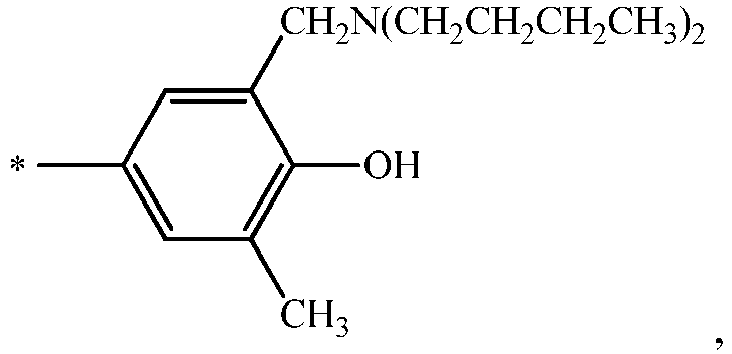
- Embodiment 8. The method of any of embodiments 1-7, wherein a second portion of the monohydric phenol is continuously added to a first portion of the monohydric phenol, the non-polar solvent and polymerization catalyst; wherein the first portion comprises 1 to 20 weight percent of the monohydric phenol and the second portion comprises 80 to 99 weight percent of the monohydric phenol.
- Embodiment 9. The method of embodiment 8, wherein the second portion of monohydric phenol is added over a period of 10 to 120 minutes.
- Embodiment 10. The method of
embodiment 1, wherein: the monohydric phenol is 2,6-dimethylphenol; the poly(phenylene ether) is poly(2,6-dimethyl-4-phenylene ether) having an intrinsic viscosity of 0.8 to 1.7 deciliters per gram, measured in chloroform using an Ubbelohde capillary glass viscometer at 25 °C, and a polydispersity of 3 to 6; the mole ratio is 1.0:1 to 1.2:1; oxidative polymerization comprises continuous addition of a second portion of the monohydric phenol and oxygen to a first portion of the monohydric phenol, the non-polar solvent, and polymerization catalyst; the first portion comprises 3 to 12 weight percent of the monohydric phenol and the second portion comprises 88 to 97 weight percent of the monohydric phenol, and the second portion of the monohydric phenol is added over a period of 20 to 60 minutes. - Embodiment 11. A poly(phenylene ether) having an intrinsic viscosity of 0.5 to 2.0 deciliters per gram, measured in chloroform using an Ubbelohde capillary glass viscometer at 25 °C, a polydispersity of 1 to 10, and a unimodal molecular weight distribution, made by a method comprising: in an exotherm period, continuous addition of oxygen and a monohydric phenol of the structure:

- Embodiment 12. The poly(phenylene ether) of embodiment 11, wherein the monohydric phenol is 2,6-dimethylphenol, and the poly(phenylene ether) is poly(2,6-dimethyl-4-phenylene ether).
- Embodiment 13. The poly(phenylene ether) of embodiment 11, wherein the monohydric phenol comprises a first monohydric phenol that is 2,6-dimethylphenol and a second monohydric phenol that is 2-methyl-6-phenylphenol or 2,6-diphenylphenol; and the poly(phenylene ether) is poly(2,6-dimethyl-1,4-phenylene ether-co-2-methyl-6-phenyl-1,4-phenylene ether) or poly(2,6-dimethyl-1,4-phenylene ether-co-2,6-diphenyl-1,4-phenylene ether).
- Embodiment 14. The poly(phenylene ether) of any of embodiments 11-13, wherein the weight-average molecular weight of the poly(phenylene ether) is 60,000 to 500,000 daltons, as measured by gel permeation chromatography.
- Embodiment 15. The poly(phenylene ether) of any of embodiments 11-14, wherein the method further comprises, after completion of the exotherm period and build period: cessation of oxygen addition; flushing oxygen from a gaseous head space above the polymerization mixture; addition of a aqueous chelating agent to the polymerization mixture; and in an equilibration period, holding the polymerization mixture for 0.1 to 24 hours at 30 to 80 °C.
- Embodiment 16. The poly(phenylene ether) of embodiment 15, wherein the monohydric phenol is 2,6-dimethylphenol; the poly(phenylene ether) is poly(2,6-dimethyl-4-phenylene ether); and after the equilibration period, the poly(phenylene ether) has, based on the total weight of the poly(phenylene ether), 0.01 to 0.08 weight percent of biphenyl units:

- Embodiment 17. The poly(phenylene ether) of embodiment 15 or 16, wherein: the monohydric phenol is 2,6-dimethylphenol; the amine comprises dibutylamine; the poly(phenylene ether) comprises poly(2,6-dimethyl-4-phenylene ether); and after the equilibration period, the poly(2,6-dimethyl-4-phenylene ether) has, based on the total weight of the poly(2,6-dimethyl-4-phenylene ether), 0.1 to 1.2 weight percent combined of dibutylamino groups covalently bound to internal 2,6-dimethylphenol repeat units as follows:

terminal 2,6-dimethylphenol units as follows:
- Embodiment 18. The poly(phenylene ether) of any of embodiments 11-17, wherein a second portion of the monohydric phenol is continuously added to a first portion of the monohydric phenol, the non-polar solvent, and polymerization catalyst; wherein the first portion comprises 1 to 20 weight percent of the monohydric phenol and the second portion comprises 80 to 99 weight percent of the monohydric phenol.
- Embodiment 19. The poly(phenylene ether) of embodiment 18, wherein the second portion of monohydric phenol is added over a period of 10 to 120 minutes.
- Embodiment 20. The poly(phenylene ether) of embodiment 11, wherein: the monohydric phenol is 2,6-dimethylphenol; the poly(phenylene ether) comprises poly(2,6-dimethyl-4-phenylene ether) having an intrinsic viscosity of 0.8 to 1.7 deciliters per gram, measured in chloroform using an Ubbelohde capillary glass viscometer at 25 °C and a polydispersity of 3 to 6; the oxygen and monohydric phenol are added in a mole ratio of 1.0:1 to 1.2:1; oxidative polymerization comprises continuous addition of a second portion of the monohydric phenol and oxygen to a first portion of the monohydric phenol, the non-polar solvent, and polymerization catalyst; the first portion comprises 3 to 12 weight percent of the monohydric phenol and the second portion comprises 88 to 97 weight percent of the monohydric phenol; and the second portion of the monohydric phenol is added over a period of 30 to 60 minutes.
- The materials utilized in the examples are identified below in Table 1.
Table 1. Material Description DMP 2,6-Dimethylphenol (2,6-xylenol); C.A.S. Reg. No. 576,26-1. Cu2O Cuprous oxide; C.A.S. Reg. No. 1317-39-1. HBr Hydrobromic acid; C.A.S. Reg. No. DBEDA Di-tert-butylethylenediamine; C.A.S. Reg. No. 10035-10-6. DBA Di-n-butylamine; C.A.S. Reg. No. 111-92-2. DMBA N,N-Dimethylbutylamine; C.A.S. Reg. No. 927-62-8. QUAT N,N,N',N'-Didecyldimethyl ammonium chloride; C.A.S. Reg. No. 7173-51-5, available as MAQUAT™ from Mason Chemical Company. NTA Nitrilotriacetic acid trisodium salt; C.A.S. Reg. No. 5064-31-3. MEK Methyl ethyl ketone; C.A.S. Reg. No. 78-93-3. TMDQ 2,2',6,6'-diphenoquinone; C.A.S. Reg. No. 68424-85-1 - Intrinsic viscosity (Ubbelohde, IV) was measured in chloroform using an Ubbelohde capillary glass viscometer at 25 °C in a thermostatted water bath.
- Number average molecular weight (Mn), weight average molecular weight (Mw) and polydispersity (D) were measured by gel permeation chromatography (GPC) using an Agilent or Malvern GPC. Samples were dissolved in chloroform at 1 mg/mL, and sample injection volume was 20 µL. Measurements were made soon after preparation of the sample solutions due to instability of the poly(2,6-dimethyl-4-phenylene ether) in chloroform. The mobile phase was chloroform containing 200 µL of DBA per 4 L. A Phenomenex PHENOGEL™ 5 µm Linear/Mixed, 50 x 7.8 mm guard column with 5-µm particles in combination with a Phenomenex PHENOLGEL™ 5 µM Linear (2), 300 × 7.8 mm column with 5-µm particles was used. The detection wavelength for the polystyrene standard was 254 nm and that of poly(2,6-dimethyl-4-phenylene ether) was 280 nm.
- Intrinsic viscosity (Agilent) was calculated using the Agilent GPC data. A third order polynomial fit was generated using polystyrene standards obtained from Agilent. The molecular weight range of the standard varied between 575 to 990,500 daltons (Da). For poly(2,6-dimethyl-4-phenylene ether), the Mark-Houwink coefficients, 'k' and 'a' used in the quantification were 0.0483 and 0.64, respectively. The equation used to convert the molecular weight to IV is given below:

- The Malvern GPC method was similar to the Agilent method, with the following differences. Approximately 60 mg of PPE was dissolved in 20 mL of chloroform (3 mg/mL) by shaking for 1 hr. The GPC was equipped with two Viscotek TM6000M General Mixed Columns. The flow rate was 1 mL/min. A dn/dc value of 0.163 was used to estimate the intrinsic viscosity of the polymeric resin.
- Proton Nuclear Magnetic Resonance (1H-NMR) spectroscopy was utilized for measuring the weight percent of biphenyl units derived from 3,3',5,5'-tetramethyl-4,4'-biphenol, and terminal, internal, and cyclic aminomethyl groups derived from dibutylamine (DBA) in solid samples. Samples were prepared by dissolving 0.06 g of poly(2,6-dimethyl-4-phenylene ether) in deuterated chloroform (CDCl3).
- The "biphenyl" content is the weight percent of 3,3',5,5'-tetramethyl-4,4'-biphenol units, i.e. units having structure:



- "Internal DBA" ("Int. DBA") refers to dibutylamino groups covalently bound to internal 2,6-dimethylphenol repeat units as follows:


- "Terminal DBA" ("Term. DBA") refers to dibutylamino groups covalently bonded to
terminal 2,6-dimethylphenol repeat units as follows:


- "Cyclic DBA" refers to dibutylamino groups that form a 6-membered ring with
terminal 2,6-dimethylphenol units as follows:


- "MBA" refers to monobutylamino groups covalently bonded to
terminal 2,6-dimethylphenol units as follows:


- Poly(2,6-dimethyl-4-phenylene ether) was prepared in a 1-gallon RC1™ reaction calorimeter as follows, with stirring throughout the procedure. An approximately 50 wt.% solution of 0.16 lb. monomer (2,6-dimethylphenol, DMP) in toluene was prepared. (The total amount of toluene added to the calorimeter provided a total monomer concentration of 7 wt.%). A catalyst solution was prepared from 0.3795 g Cu2O dissolved in 4.81 g 48 wt.% aqueous HBr. 10 wt.% of the monomer solution, catalyst solution (7.05 wt.% based on total monomer, or 0.011 lb., unless indicated otherwise), DMBA (1 wt.% based on total toluene, or 0.021 lb. unless indicated otherwise), and 0.013 lb. of a diamine mixture of 30:16:54 parts by weight DBEDA, 50% aqueous QUAT, and toluene, were added to the calorimeter.
- The remaining 90% of the monomer solution was dosed into the calorimeter at a rate of 2.88 grams per minute, and molecular oxygen (O2) was simultaneously sparged through a dip tube at 0.377, 0.288, or 0.210 standard cubic feet per hour (SCFH) at 25 °C to initiate oxidative polymerization. The O/monomer mole ratio was 0.72:1, 1.0:1, or 1.31:1. The initial phase of the polymerization was exothermic, and cooling was used to maintain a temperature of 25 °C, unless indicated otherwise.
- When the exotherm period was completed (70 minutes), the "build" period of the polymerization began, and external heating was required to maintain a polymerization temperature of 25 °C, unless indicated otherwise. O2 sparging was continued at the same rate as in the exotherm period to continue the oxidative polymerization. However, when a large increase in O2 headspace occurred, the addition rate was adjusted to maintain a headspace O2 concentration of no greater than about 20 volume percent. A flow of nitrogen (0.864 SCFH unless indicated otherwise) into the head space of the calorimeter was maintained throughout the exotherm and build periods.
- When the build period was complete (57 minutes), the O2 flow was stopped, which terminated oxidative polymerization, O2 in the headspace was flushed out with N2, an aqueous solution of NTA) was added, and the temperature of the resulting mixture was adjusted to 62 °C for equilibration intervals specified in
Fig. 3-9 . - For isolation of the poly(2,6-dimethyl-4-phenylene ether), water was added, the resulting mixture was stirred for a time sufficient to extract the copper catalyst into the aqueous phase, and the toluene phase was separated from the aqueous phase by liquid-liquid centrifugation. The toluene phase was combined with methanol (antisolvent) to precipitate the poly(2,6-dimethyl-4-phenylene ether) as a powder. The powder was isolated by filtration, reslurried and isolated twice by solid-liquid centrifugation, and dried.
- TMDQ is a byproduct of the oxidative polymerization of 2,6-dimethylphenol, and it has been reported that TMDQ yield increases with increasing O/monomer mole ratio. In order to study the effect of the O/monomer mole ratio on TMDQ yield, the ratio was varied between 0.72 to 1.31. While an effort was made to maintain a constant O/monomer mole ratio, the operator reduced the O2 flow rate whenever an excursion in O2 concentration in the reactor head space was detected which suggested O2 breakthrough. This manual change in the O2 flow rate by the operator was not reproducible (i.e. every operator responded differently to the excursion in O2 flow rate and does not respond the same way every time). This introduced batch variability, in particular variation in TMDQ yield and total amine incorporated to the polymer. However, general trends can be seen from the data plotted in
Fig. 3-9 . - In each example, the general procedure above was followed. The O2 flows were adjusted to 0.377, 0.288, 0.210, and 0.377 SCFH in Examples 1-4, respectively, to achieve the corresponding O/monomer mole ratios of 1.31:1, 1.0:1, 0.72:1, and 1.31:1, respectively. The N2 flow was reduced to 0.63 SCFH for Example 3. The exotherm period and build period temperatures were 25 °C for Examples 1-3 and 20 °C for Example 4.
- During the equilibration period, when the catalyst is quenched with NTA, and the O2 flow is stopped, the poly(2,6-dimethyl-4-phenylene ether) present is equilibrated with the TMDQ, which generally results in a decrease in intrinsic viscosity and molecular weight. The effects of O/monomer mole ratio on intrinsic viscosity, Mn, Mw, D, and weight percents of biphenyl, terminal DBA, and internal DBA were measured as a function of equilibration time, and the results are summarized in
Fig. 3-9 . As can be seen fromFig. 3 , the highest IV is obtained with an O/monomer mole ratio of 1.0. As can be seen fromFig. 4 , the formation of TMDQ, as evidenced by biphenyl content, increases as the O/monomer mole ratio is decreased. Without being bound by theory, the low IV (Fig. 3 ) and high biphenyl content (Fig. 4 ) obtained at an O/monomer mole ratio of 1.31 suggests the amount of 2,6-dimethylphenoxy radicals is increased at this ratio, which results in increased dimerization to form TMDQ and decreased chain propagation to form poly(2,6-dimethyl-4-phenylene ether). - In Examples 2, 5 and 6, the general procedure above was followed, with an O/monomer mole ratio of 1.0:1 and an O2 flow of 0.288 SCFH. In Examples 5, 2, and 6, the DBA amounts were 2, 4, and 6 wt.% based on total monomer (-0.003 lb, -0.007 lb., and -0.010 lb.) respectively. The results are summarized in Table 2. As can be seen from Table 2, there was no difference in dibutylamine incorporation at the three DBA amounts at an O/monomer mole ratio of 1.0:1. (The highest dibutylamine incorporation was obtained at O/monomer mole ratio of 1.31:1.)
Table 2: Extent of DBA Incorporation as a Function of DBA Amount and Equilibration Time Ex. 5 2 6 DBAa 2wt.% 4 wt.% 6 wt.% Time (min) Term. DBA (wt.%) Int. DBA (wt.%) Total DBA (wt.%) Term. DBA (wt.%) Int. DBA (wt.%) Total DBA (wt.%) Term. DBA (wt.%) Int. DBA (wt.%) Total DBA (wt.%) 157 0.085 0.415 0.499 0.074 0.370 0.444 0.089 0.402 0.491 230 0.090 0.401 0.491 0.082 0.370 0.452 0.109 0.438 0.546 290 0.114 0.344 0.458 0.099 0.370 0.469 0.120 0.399 0.519 350 0.146 0.342 0.488 0.131 0.370 0.501 0.149 0.391 0.540 Day 20.160 0.278 0.438 0.180 0.370 0.550 - - - a) Amount Based on Total Monomer - In Examples 2, 7, and 8, the general procedure above was followed with an O/monomer mole ratio of 1.0:1 and an O2 flow of 0.288 SCFH. In Examples 7, 2, and 8, the DMBA amounts were 0.8, 1.0, and 1.2 wt.% based on total toluene (-0.017 lb, -0.021 lb., and -0.025 lb. respectively). The results are summarized in Table 3. As can be seen from Table 3, there was no difference in dibutylamine incorporation at the three DMBA amounts at an O/monomer mole ratio of 1.0:1.
Table 3: Extent of DBA Incorporation as a Function of DMBA Amount and Equil. Time Ex. 7 2 8 DMBAa 0.8 wt. % 1 wt.% 1.2 wt.% Equil. Time (min) Term. DBA (wt.%) Int. DBA (wt.%) Total DBA (wt.%) Term. DBA (wt.%) Int. DBA (wt.%) Total DBA (wt.%) Term. DBA (wt.%) Int. DBA (wt.%) Total DBA (wt.%) 157 0.101 0.45 0.547 0.074 0.37 0.444 0.090 0.411 0.501 230 0.111 0.42 0.529 0.082 0.37 0.452 0.104 0.424 0.528 290 0.131 0.38 0.512 0.099 0.37 0.469 0.124 0.389 0.514 350 0.156 0.36 0.513 0.131 0.37 0.501 0.144 0.371 0.515 Day 20.190 0.32 0.512 0.18 0.37 0.550 0.168 0.328 0.496 a) Amount based on total toluene. - The general procedure above was followed, and the O/monomer mole ratio was 1.0 or 1.31. The results are also summarized in (Examples 1,14,15,16,18 and 20 are not inventive)
Table 4. GPC - Agilent Method 1H-NMR Ex. IVa (dL/g) O/Mon. Mole Ratio Mn (Da) Mw (Da) D Biphenyl (wt.%) Term. DBA (wt.%) Int. DBA (wt.%) Total DBA (wt.%) 1 1.16 1.31 47,294 203,850 4.31 0.23 0.21 0.78 0.99 9 1.61 1 82,200 324,500 3.95 0.08 0.09 0.48 0.57 10 1.40 1 - - - 0.06 0.1 0.44 0.54 11 1.61 1 59,700 306,000 5.13 0.09 0.08 0.43 0.52 12 1.41 1 50,282 237,330 4.72 0.09 0.08 0.5 0.58 13 1.58 1 37,323 333,620 8.94 0.13 0.11 0.45 0.56 14 0.954 1.31 43,700 159,000 3.64 0.13 0.19 0.94 1.13 15 0.910 1.31 36,754 142,050 3.86 0.23 0.26 1.11 1.37 16 1.100 1.31 45,813 195,870 4.28 0.16 0.3 0.83 1.13 17 1.040 1 43,355 193,930 4.47 0.22 0.19 0.73 0.92 18 0.816 1.31 34,904 125,850 3.61 0.35 0.31 0.93 1.24 19 - 1.31 40,600 146,200 3.60 0.18 0.21 1.01 1.22 20 0.894 0.31 43,300 128,900 2.98 0.08 0.18 1.03 1.21 a) Ubbelohde method. - The copolymer was prepared in a 500-mL stirred glass vessel. A 7 wt.% solution of the monomers (14.22 mole percent 2-methyl-6-phenylphenol and 85.78
mole percent 2,6-dimethylphenol) in toluene was prepared. Approximately 10 wt.% of the toluene solution was charged to the vessel up front and the remainder dosed in over 45 minutes. The catalyst solution (Cu2O in 48 wt.% aq. HBr) amount was 7.05 wt.% based on total monomer (TM, 0.005 lb.), DBA amount was 4.05% based on TM (∼0.003 1b.), DMBA amount was 1% based on total toluene (∼0.009 lb.), and DBEDA amount was 0.006 lb. Oxygen was sparged through the dip tube at 0.112 SCFH (O/monomer mole ratio was 1.0). The vessel was blanketed with nitrogen (0.33 SCFH) throughout the polymerization. The polymerization was maintained at 25 °C during the exotherm and build periods (total of 75 min.). The catalyst was chelated with NTA at the end of the build period, and the polymerization mixture was transferred to a jacketed glass vessel and allowed to equilibrate at 62 °C for 285 min. - For isolation of the copolymer, water was added to the polymerization mixture, the resulting mixture was stirred for a time sufficient to extract the copper catalyst into the aqueous phase, and the toluene phase was separated from the aqueous phase by liquid-liquid centrifugation. The toluene phase was combined with methanol (antisolvent) to precipitate the poly(2-methyl-6-phenyl-1,4-phenylene-co-2,6-dimethyl-1,4-phenylene ether) as a powder. The powder was isolated by filtration, reslurried, isolated twice by solid-liquid centrifugation, and dried. Analytical results are summarized in Table 5.
Table 5. Equil. Time (min.) IVa (dL/g) GPC -Agilent method 1H-NMR Mw (Da) Mn (Da) D External DBA (wt.%) Internal DBA (wt.%) Total DBA (wt.%) 60 0.86 142,930 50,881 2.81 0.032 0.206 0.238 70 0.85 143,860 47,634 3.02 0.024 0.174 0.198 185 0.84 141,510 38,001 3.72 0.027 0.173 0.200 a) Ubbelohde - The copolymer was prepared in a 500-mL stirred glass vessel. A 7 wt.% solution of the monomers (11.03
mole percent 2,6-diphenylphenol and 88.97mole percent 2,6-dimethylphenol) in toluene was prepared. Approximately 10 wt.% of the toluene solution was charged to the vessel up front and the remainder dosed in over 45 minutes. The catalyst (Cu2O in 48 wt.% aq. HBr) amount was 7.05 wt.% based on TM (0.005 lb.), DBA amount was 4.05% based on TM (∼0.003 lb.), DMBA amount was 1% based on total toluene (∼0.009 lb.), and DBEDA amount was 0.006 lb. Oxygen was sparged through the dip tube at 0.112 SCFH (O/monomer mole ratio was 1.0). The vessel was blanketed with nitrogen (0.33 SCFH) throughout the polymerization. The polymerization was maintained at 25 °C during the exotherm and build periods (total of 75 min.). The catalyst was chelated with NTA at the end of the build period, and the polymerization mixture was transferred to a jacketed glass vessel and allowed to equilibrate at 62 °C for 285 min. - For isolation of the copolymer, water was added to the polymerization mixture, the resulting mixture was stirred for a time sufficient to extract the copper catalyst into the aqueous phase, and the toluene phase was separated from the aqueous phase by liquid-liquid centrifugation. The toluene phase was combined with methanol (antisolvent) to precipitate the poly(2,6-diphenyl-1,4-phenylene-co-2,6-dimethyl-1,4-phenylene ether) as a powder. The powder was isolated by filtration, reslurried and isolated twice by solid-liquid centrifugation, and dried. Analytical results are summarized in Table 6.
Table 6. Equil. Time (min.) IVa (dL/g) GPC - Malvern method 1H-NMR Mw (Da) Mn (Da) D External DBA (wt.%) Internal DBA (wt.%) Total DBA (wt.%) 60 1.13 188,351 90,131 2.09 0.074 0.373 0.447 70 1.13 198,527 85,894 2.31 0.068 0.367 0.435 185 1.07 180,635 71,682 2.52 0.080 0.367 0.447 a) Ubbelohde method. - As used herein, "oxygen" refers to molecular oxygen (O2), unless indicated otherwise. The mole ratio of oxygen atoms to monohydric phenol is referred to herein as the "O/monomer mole ratio", i.e. the O/monomer ratio is twice the molecular oxygen (O2)/monomer ratio. "Nitrogen" refers to molecular nitrogen (N2); "monomer" refers to monohydric phenol; "TM" refers to "total monomer", which can be, for example, 2,6-dimethylphenol, 2-methyl-6-phenylphenol, 2,6-diphenylphenol, or combinations thereof. The terms "a" and "an" do not denote a limitation of quantity, but rather the presence of at least one of the referenced items. An asterisk in a chemical structure indicates an open valence.
- Recitation of ranges of values are merely intended to serve as a shorthand method of referring individually to each separate value falling within the range, unless otherwise indicated herein, and each separate value is incorporated into this specification as if it were individually recited. Thus each range disclosed herein constitutes a disclosure of any sub-range falling within the disclosed range. Disclosure of a narrower range or more specific group in addition to a broader range or larger group is not a disclaimer of the broader range or larger group. All ranges disclosed herein are inclusive of the endpoints, and the endpoints are independently combinable with each other.
Claims (15)
- A method of making a poly(phenylene ether) having an intrinsic viscosity of 0.5 to 2.0 deciliters per gram, measured in chloroform using an Ubbelohde capillary glass viscometer at 25 °C, a polydispersity of 1 to 10, and a unimodal molecular weight distribution as measured by GPC comprising:in an exotherm period, continuous addition of oxygen and a monohydric phenol of the structure:
 cessation of the continuous addition of the monohydric phenol; andin a build period, continuation of oxygen addition until there is no further increase in viscosity of the polymerization mixture.
 - The method of claim 1, wherein the monohydric phenol is 2,6-dimethylphenol and the poly(phenylene ether) is poly(2,6-dimethyl-1,4-phenylene ether); or the monohydric phenol comprises a first monohydric phenol that is 2,6-dimethylphenol and a second monohydric phenol that is 2-methyl-6-phenylphenol or 2,6-diphenylphenol; and the poly(phenylene ether) is poly(2,6-dimethyl-1,4-phenylene ether-co-2-methyl-6-phenyl-1,4-phenylene ether) or poly(2,6-dimethyl-1,4-phenylene ether-co-2,6-diphenyl-1,4-phenylene ether).
- The method of claim 1 or 2, further comprising, after completion of the exotherm period and build period:cessation of oxygen addition;flushing oxygen from a gaseous head space above the polymerization mixture;addition of a aqueous chelating agent to the polymerization mixture; andin an equilibration period, holding the polymerization mixture for 0.1 to 24 hours at 30 to 80 °C.
- The method of claim 3, wherein the monohydric phenol is 2,6-dimethylphenol; the poly(phenylene ether) is poly(2,6-dimethyl-1,4-phenylene ether); and after the equilibration period, the poly(2,6-dimethyl-1,4-phenylene ether) has, based on the total weight of the poly(2,6-dimethyl-4-phenylene ether), 0.01 to 2 weight percent of biphenyl units:

- The method of claim 3 or 4, wherein:the monohydric phenol is 2,6-dimethylphenol;the amine comprises dibutylamine;the poly(phenylene ether) is poly(2,6-dimethyl-1,4-phenylene ether); andafter the equilibration period, the poly(2,6-dimethyl-1,4-phenylene ether) has, based on the total weight of the poly(2,6-dimethyl-1,4-phenylene ether), 0.5 to 2.0 weight percent combined of dibutylamino groups covalently bound to internal 2,6-dimethylphenol repeat units as follows:


- The method of any of claims 1-5, wherein a second portion of the monohydric phenol is continuously added to a first portion of the monohydric phenol, the non-polar solvent and polymerization catalyst; wherein the first portion comprises 1 to 20 weight percent of the monohydric phenol and the second portion comprises 80 to 99 weight percent of the monohydric phenol
- The method of claim 1, wherein:the monohydric phenol is 2,6-dimethylphenol;the poly(phenylene ether) is poly(2,6-dimethyl-1,4-phenylene ether) having an intrinsic viscosity of 0.8 to 1.7 deciliters per gram, measured in chloroform using an Ubbelohde capillary glass viscometer at 25 °C, and a polydispersity of 3 to 6;the mole ratio is 1.0:1 to 1.2:1;oxidative polymerization comprises continuous addition of a second portion of the monohydric phenol and oxygen to a first portion of the monohydric phenol, the non-polar solvent, and polymerization catalyst;the first portion comprises 3 to 12 weight percent of the monohydric phenol and the second portion comprises 88 to 97 weight percent of the monohydric phenol, andthe second portion of the monohydric phenol is added over a period of 20 to 60 minutes.
- A poly(phenylene ether) having an intrinsic viscosity of 0.5 to 2.0 deciliters per gram, measured in chloroform using an Ubbelohde capillary glass viscometer at 25 °C, a polydispersity of 1 to 10, and a unimodal molecular weight distribution, as measured by GPC made by a method comprising:in an exotherm period, continuous addition of oxygen and a monohydric phenol of the structure:
 cessation of the continuous addition of the monohydric phenol; andin a build period, continuation of oxygen addition until there is no further increase in viscosity of the polymerization mixture.
 - The poly(phenylene ether) of claim 8, wherein the monohydric phenol is 2,6-dimethylphenol, and the poly(phenylene ether) is poly(2,6-dimethy-1-4-phenylene ether).
- The poly(phenylene ether) of claim 8, wherein the monohydric phenol comprises a first monohydric phenol that is 2,6-dimethylphenol and a second monohydric phenol that is 2-methyl-6-phenylphenol or 2,6-diphenylphenol; and the poly(phenylene ether) is poly(2,6-dimethyl-1,4-phenylene ether-co-2-methyl-6-phenyl-1,4-phenylene ether) or poly(2,6-dimethyl-1,4-phenylene ether-co-2,6-diphenyl-1,4-phenylene ether).
- The poly(phenylene ether) of any of claims 8-10, wherein the method further comprises, after completion of the exotherm period and build period:cessation of oxygen addition;flushing oxygen from a gaseous head space above the polymerization mixture;addition of a aqueous chelating agent to the polymerization mixture; andin an equilibration period, holding the polymerization mixture for 0.1 to 24 hours at 30 to 80 °C.
- The poly(phenylene ether) of claim 11, wherein the monohydric phenol is 2,6-dimethylphenol; the poly(phenylene ether) is poly(2,6-dimethyl-1,4-phenylene ether); and after the equilibration period, the poly(phenylene ether) has, based on the total weight of the poly(phenylene ether), 0.01 to 0.08 weight percent of biphenyl units:

- The poly(phenylene ether) of claim 11 or 12, wherein:the monohydric phenol is 2,6-dimethylphenol;the amine comprises dibutylamine;the poly(phenylene ether) comprises poly(2,6-dimethyl-1,4-phenylene ether); andafter the equilibration period, the poly(2,6-dimethyl-4-phenylene ether) has, based on the total weight of the poly(2,6-dimethyl-1,4-phenylene ether), 0.1 to 1.2 weight percent combined of dibutylamino groups covalently bound to internal 2,6-dimethylphenol repeat units as follows:

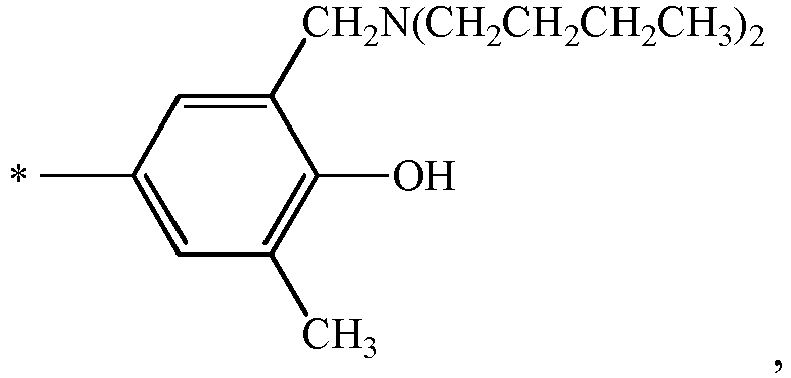
- The poly(phenylene ether) of any of claims 8-13, wherein a second portion of the monohydric phenol is continuously added to a first portion of the monohydric phenol, the non-polar solvent, and polymerization catalyst; wherein the first portion comprises 1 to 20 weight percent of the monohydric phenol and the second portion comprises 80 to 99 weight percent of the monohydric phenol.
- The poly(phenylene ether) of claim 8, wherein:the monohydric phenol is 2,6-dimethylphenol;the poly(phenylene ether) comprises poly(2,6-dimethyl-4-phenylene ether) having an intrinsic viscosity of 0.8 to 1.7 deciliters per gram, measured in chloroform using an Ubbelohde capillary glass viscometer at 25 °C and a polydispersity of 3 to 6;the oxygen and monohydric phenol are added in a mole ratio of 1.0:1 to 1.2:1;oxidative polymerization comprises continuous addition of a second portion of the monohydric phenol and oxygen to a first portion of the monohydric phenol, the non-polar solvent, and polymerization catalyst;the first portion comprises 3 to 12 weight percent of the monohydric phenol and the second portion comprises 88 to 97 weight percent of the monohydric phenol; andthe second portion of the monohydric phenol is added over a period of 30 to 60 minutes.
Applications Claiming Priority (2)
| Application Number | Priority Date | Filing Date | Title |
|---|---|---|---|
| US201562172868P | 2015-06-09 | 2015-06-09 | |
| PCT/US2016/036187 WO2016200791A1 (en) | 2015-06-09 | 2016-06-07 | Method for poly(phenylene ether) manufacture and associated poly(phenylene ether) |
Publications (2)
| Publication Number | Publication Date |
|---|---|
| EP3307806A1 EP3307806A1 (en) | 2018-04-18 |
| EP3307806B1 true EP3307806B1 (en) | 2019-11-27 |
Family
ID=56178474
Family Applications (1)
| Application Number | Title | Priority Date | Filing Date |
|---|---|---|---|
| EP16731436.8A Active EP3307806B1 (en) | 2015-06-09 | 2016-06-07 | Method for poly(phenylene ether) manufacture and associated poly(phenylene ether) |
Country Status (4)
| Country | Link |
|---|---|
| US (1) | US11041046B2 (en) |
| EP (1) | EP3307806B1 (en) |
| CN (1) | CN107849239B (en) |
| WO (1) | WO2016200791A1 (en) |
Families Citing this family (10)
| Publication number | Priority date | Publication date | Assignee | Title |
|---|---|---|---|---|
| KR20160147989A (en) | 2014-05-01 | 2016-12-23 | 사빅 글로벌 테크놀러지스 비.브이. | Porous asymmetric polyphenylene ether membranes and associated separation modules and methods |
| CN106255709A (en) | 2014-05-01 | 2016-12-21 | 沙特基础工业全球技术有限公司 | Amphiphilic block copolymer, a combination thereof thing, film and separation assembly and preparation method thereof |
| KR20170002516A (en) | 2014-05-01 | 2017-01-06 | 사빅 글로벌 테크놀러지스 비.브이. | Skinned asymmetric polyphenylene ether co-polymer membrane gas separation unit and preparation method thereof |
| US10207230B2 (en) | 2014-05-01 | 2019-02-19 | Sabic Global Technologies B.V. | Composite membrane with support comprising poly(phenylene ether) and amphilphilic polymer; method of making; and separation module thereof |
| US10421046B2 (en) | 2015-05-01 | 2019-09-24 | Sabic Global Technologies B.V. | Method for making porous asymmetric membranes and associated membranes and separation modules |
| US10307717B2 (en) * | 2016-03-29 | 2019-06-04 | Sabic Global Technologies B.V. | Porous membranes and associated separation modules and methods |
| EP3640279B1 (en) * | 2018-10-16 | 2021-02-17 | SHPP Global Technologies B.V. | High molecular weight poly(phenylene ether) and process for the preparation thereof |
| WO2020079544A1 (en) | 2018-10-18 | 2020-04-23 | Sabic Global Technologies B.V. | Method of preparing a poly(phenylene ether), poly(phenylene ether) made thereby, and article comprising the poly(phenylene ether) |
| US11472920B2 (en) * | 2019-01-22 | 2022-10-18 | Shpp Global Technologies B.V. | Method for preparing a poly(phenylene ether) and poly(phenylene ether) prepared thereby |
| CN119875110B (en) * | 2023-10-23 | 2026-02-03 | 旭化成株式会社 | Polyphenylene ether, polyphenylene ether solution, resin film, prepreg, and metal-clad laminate |
Citations (1)
| Publication number | Priority date | Publication date | Assignee | Title |
|---|---|---|---|---|
| WO2009104107A1 (en) * | 2008-02-21 | 2009-08-27 | Sabic Innovative Plastics Ip B.V. | High molecular weight poly(2,6-dimethyl-1,4-phenylene ether) and process therefor |
Family Cites Families (9)
| Publication number | Priority date | Publication date | Assignee | Title |
|---|---|---|---|---|
| DE3578428D1 (en) * | 1984-11-17 | 1990-08-02 | Basf Ag | METHOD AND DEVICE FOR PRODUCING POLYPHENYLENE ETHERS. |
| US6323300B1 (en) | 1996-11-25 | 2001-11-27 | Asahi Kasei Kogyo Kabushiki Kaisha | Aromatic copolymer and composition containing the same |
| US5880221A (en) | 1997-02-14 | 1999-03-09 | General Electric Company | Redistribution of polyphenylene ethers and polyphenylene ethers with novel structure |
| JP4059466B2 (en) | 2000-06-19 | 2008-03-12 | 三菱瓦斯化学株式会社 | Process for producing polyphenylene ether |
| US6472499B1 (en) | 2000-08-04 | 2002-10-29 | General Electric Company | Preparation of high intrinsic viscosity poly(arylene ether) resins |
| JP4007828B2 (en) | 2002-03-08 | 2007-11-14 | 旭化成ケミカルズ株式会社 | Method for producing low molecular weight polyphenylene ether |
| JP2007217657A (en) | 2006-01-23 | 2007-08-30 | Toyo Ink Mfg Co Ltd | Curable resin composition and method for producing the same |
| US8178610B2 (en) | 2008-06-10 | 2012-05-15 | Sabic Innovative Plastics Ip B.V. | Polyamide/poly(arylene ether) composition, method, and article |
| US8669332B2 (en) | 2011-06-27 | 2014-03-11 | Sabic Innovative Plastics Ip B.V. | Poly(arylene ether)-polysiloxane composition and method |
-
2016
- 2016-06-07 CN CN201680042727.3A patent/CN107849239B/en active Active
- 2016-06-07 EP EP16731436.8A patent/EP3307806B1/en active Active
- 2016-06-07 WO PCT/US2016/036187 patent/WO2016200791A1/en not_active Ceased
- 2016-06-07 US US15/578,116 patent/US11041046B2/en active Active
Patent Citations (1)
| Publication number | Priority date | Publication date | Assignee | Title |
|---|---|---|---|---|
| WO2009104107A1 (en) * | 2008-02-21 | 2009-08-27 | Sabic Innovative Plastics Ip B.V. | High molecular weight poly(2,6-dimethyl-1,4-phenylene ether) and process therefor |
Also Published As
| Publication number | Publication date |
|---|---|
| WO2016200791A1 (en) | 2016-12-15 |
| CN107849239B (en) | 2019-03-08 |
| EP3307806A1 (en) | 2018-04-18 |
| US20180079863A1 (en) | 2018-03-22 |
| CN107849239A (en) | 2018-03-27 |
| US11041046B2 (en) | 2021-06-22 |
Similar Documents
| Publication | Publication Date | Title |
|---|---|---|
| US11041046B2 (en) | Method for poly(phenylene ether) manufacture and associated poly(phenylene ether) | |
| EP2252646B1 (en) | High molecular weight poly(2,6-dimethyl-1,4-phenylene ether) and process therefor | |
| CA1073594A (en) | Polyphenylene ether and process for preparing the same | |
| JPH01304121A (en) | Method for capping polyphenylene ether | |
| CN104254558B (en) | Poly(phenylene ether) copolymer and method of making | |
| EP3686234B1 (en) | Method for preparing a poly(phenylene ether) and poly(phenylene ether) prepared thereby | |
| EP3390490B1 (en) | Method of forming high molecular weight poly(phenylene ether), poly(phenylene ether) formed thereby, and fiber and article comprising the poly(phenylene ether) | |
| US20080085989A1 (en) | Poly(arylene ether) copolymer | |
| EP3640279B1 (en) | High molecular weight poly(phenylene ether) and process for the preparation thereof | |
| Lee et al. | Synthesis, structures and thermal properties of new class epoxide-terminated telechelic poly (2, 6-dimethyl-1, 4-phenylene oxide) s | |
| EP3647339A1 (en) | Method of making a poly(phenylene ether) and poly(phenylene ether) prepared thereby | |
| US12024589B2 (en) | Method of preparing a poly (phenylene ether), poly(phenylene ether) made thereby, and article comprising the poly(phenylene ether) | |
| CN117186386A (en) | A kind of polyphenylene ether and its manufacturing method |
Legal Events
| Date | Code | Title | Description |
|---|---|---|---|
| STAA | Information on the status of an ep patent application or granted ep patent |
Free format text: STATUS: THE INTERNATIONAL PUBLICATION HAS BEEN MADE |
|
| PUAI | Public reference made under article 153(3) epc to a published international application that has entered the european phase |
Free format text: ORIGINAL CODE: 0009012 |
|
| STAA | Information on the status of an ep patent application or granted ep patent |
Free format text: STATUS: REQUEST FOR EXAMINATION WAS MADE |
|
| 17P | Request for examination filed |
Effective date: 20180102 |
|
| AK | Designated contracting states |
Kind code of ref document: A1 Designated state(s): AL AT BE BG CH CY CZ DE DK EE ES FI FR GB GR HR HU IE IS IT LI LT LU LV MC MK MT NL NO PL PT RO RS SE SI SK SM TR |
|
| AX | Request for extension of the european patent |
Extension state: BA ME |
|
| RAP3 | Party data changed (applicant data changed or rights of an application transferred) |
Owner name: SABIC GLOBAL TECHNOLOGIES B.V. |
|
| DAV | Request for validation of the european patent (deleted) | ||
| DAX | Request for extension of the european patent (deleted) | ||
| STAA | Information on the status of an ep patent application or granted ep patent |
Free format text: STATUS: EXAMINATION IS IN PROGRESS |
|
| 17Q | First examination report despatched |
Effective date: 20180921 |
|
| GRAP | Despatch of communication of intention to grant a patent |
Free format text: ORIGINAL CODE: EPIDOSNIGR1 |
|
| STAA | Information on the status of an ep patent application or granted ep patent |
Free format text: STATUS: GRANT OF PATENT IS INTENDED |
|
| INTG | Intention to grant announced |
Effective date: 20190612 |
|
| GRAS | Grant fee paid |
Free format text: ORIGINAL CODE: EPIDOSNIGR3 |
|
| GRAA | (expected) grant |
Free format text: ORIGINAL CODE: 0009210 |
|
| STAA | Information on the status of an ep patent application or granted ep patent |
Free format text: STATUS: THE PATENT HAS BEEN GRANTED |
|
| AK | Designated contracting states |
Kind code of ref document: B1 Designated state(s): AL AT BE BG CH CY CZ DE DK EE ES FI FR GB GR HR HU IE IS IT LI LT LU LV MC MK MT NL NO PL PT RO RS SE SI SK SM TR |
|
| REG | Reference to a national code |
Ref country code: GB Ref legal event code: FG4D |
|
| REG | Reference to a national code |
Ref country code: CH Ref legal event code: EP |
|
| REG | Reference to a national code |
Ref country code: AT Ref legal event code: REF Ref document number: 1206617 Country of ref document: AT Kind code of ref document: T Effective date: 20191215 |
|
| REG | Reference to a national code |
Ref country code: DE Ref legal event code: R096 Ref document number: 602016025079 Country of ref document: DE |
|
| REG | Reference to a national code |
Ref country code: IE Ref legal event code: FG4D |
|
| REG | Reference to a national code |
Ref country code: NL Ref legal event code: MP Effective date: 20191127 |
|
| REG | Reference to a national code |
Ref country code: LT Ref legal event code: MG4D |
|
| PG25 | Lapsed in a contracting state [announced via postgrant information from national office to epo] |
Ref country code: LV Free format text: LAPSE BECAUSE OF FAILURE TO SUBMIT A TRANSLATION OF THE DESCRIPTION OR TO PAY THE FEE WITHIN THE PRESCRIBED TIME-LIMIT Effective date: 20191127 Ref country code: NO Free format text: LAPSE BECAUSE OF FAILURE TO SUBMIT A TRANSLATION OF THE DESCRIPTION OR TO PAY THE FEE WITHIN THE PRESCRIBED TIME-LIMIT Effective date: 20200227 Ref country code: BG Free format text: LAPSE BECAUSE OF FAILURE TO SUBMIT A TRANSLATION OF THE DESCRIPTION OR TO PAY THE FEE WITHIN THE PRESCRIBED TIME-LIMIT Effective date: 20200227 Ref country code: SE Free format text: LAPSE BECAUSE OF FAILURE TO SUBMIT A TRANSLATION OF THE DESCRIPTION OR TO PAY THE FEE WITHIN THE PRESCRIBED TIME-LIMIT Effective date: 20191127 Ref country code: FI Free format text: LAPSE BECAUSE OF FAILURE TO SUBMIT A TRANSLATION OF THE DESCRIPTION OR TO PAY THE FEE WITHIN THE PRESCRIBED TIME-LIMIT Effective date: 20191127 Ref country code: GR Free format text: LAPSE BECAUSE OF FAILURE TO SUBMIT A TRANSLATION OF THE DESCRIPTION OR TO PAY THE FEE WITHIN THE PRESCRIBED TIME-LIMIT Effective date: 20200228 Ref country code: LT Free format text: LAPSE BECAUSE OF FAILURE TO SUBMIT A TRANSLATION OF THE DESCRIPTION OR TO PAY THE FEE WITHIN THE PRESCRIBED TIME-LIMIT Effective date: 20191127 Ref country code: NL Free format text: LAPSE BECAUSE OF FAILURE TO SUBMIT A TRANSLATION OF THE DESCRIPTION OR TO PAY THE FEE WITHIN THE PRESCRIBED TIME-LIMIT Effective date: 20191127 |
|
| PG25 | Lapsed in a contracting state [announced via postgrant information from national office to epo] |
Ref country code: RS Free format text: LAPSE BECAUSE OF FAILURE TO SUBMIT A TRANSLATION OF THE DESCRIPTION OR TO PAY THE FEE WITHIN THE PRESCRIBED TIME-LIMIT Effective date: 20191127 Ref country code: HR Free format text: LAPSE BECAUSE OF FAILURE TO SUBMIT A TRANSLATION OF THE DESCRIPTION OR TO PAY THE FEE WITHIN THE PRESCRIBED TIME-LIMIT Effective date: 20191127 Ref country code: IS Free format text: LAPSE BECAUSE OF FAILURE TO SUBMIT A TRANSLATION OF THE DESCRIPTION OR TO PAY THE FEE WITHIN THE PRESCRIBED TIME-LIMIT Effective date: 20200327 |
|
| PG25 | Lapsed in a contracting state [announced via postgrant information from national office to epo] |
Ref country code: AL Free format text: LAPSE BECAUSE OF FAILURE TO SUBMIT A TRANSLATION OF THE DESCRIPTION OR TO PAY THE FEE WITHIN THE PRESCRIBED TIME-LIMIT Effective date: 20191127 |
|
| PG25 | Lapsed in a contracting state [announced via postgrant information from national office to epo] |
Ref country code: CZ Free format text: LAPSE BECAUSE OF FAILURE TO SUBMIT A TRANSLATION OF THE DESCRIPTION OR TO PAY THE FEE WITHIN THE PRESCRIBED TIME-LIMIT Effective date: 20191127 Ref country code: RO Free format text: LAPSE BECAUSE OF FAILURE TO SUBMIT A TRANSLATION OF THE DESCRIPTION OR TO PAY THE FEE WITHIN THE PRESCRIBED TIME-LIMIT Effective date: 20191127 Ref country code: PT Free format text: LAPSE BECAUSE OF FAILURE TO SUBMIT A TRANSLATION OF THE DESCRIPTION OR TO PAY THE FEE WITHIN THE PRESCRIBED TIME-LIMIT Effective date: 20200419 Ref country code: EE Free format text: LAPSE BECAUSE OF FAILURE TO SUBMIT A TRANSLATION OF THE DESCRIPTION OR TO PAY THE FEE WITHIN THE PRESCRIBED TIME-LIMIT Effective date: 20191127 Ref country code: DK Free format text: LAPSE BECAUSE OF FAILURE TO SUBMIT A TRANSLATION OF THE DESCRIPTION OR TO PAY THE FEE WITHIN THE PRESCRIBED TIME-LIMIT Effective date: 20191127 Ref country code: ES Free format text: LAPSE BECAUSE OF FAILURE TO SUBMIT A TRANSLATION OF THE DESCRIPTION OR TO PAY THE FEE WITHIN THE PRESCRIBED TIME-LIMIT Effective date: 20191127 |
|
| REG | Reference to a national code |
Ref country code: DE Ref legal event code: R097 Ref document number: 602016025079 Country of ref document: DE |
|
| PG25 | Lapsed in a contracting state [announced via postgrant information from national office to epo] |
Ref country code: SK Free format text: LAPSE BECAUSE OF FAILURE TO SUBMIT A TRANSLATION OF THE DESCRIPTION OR TO PAY THE FEE WITHIN THE PRESCRIBED TIME-LIMIT Effective date: 20191127 Ref country code: SM Free format text: LAPSE BECAUSE OF FAILURE TO SUBMIT A TRANSLATION OF THE DESCRIPTION OR TO PAY THE FEE WITHIN THE PRESCRIBED TIME-LIMIT Effective date: 20191127 |
|
| REG | Reference to a national code |
Ref country code: AT Ref legal event code: MK05 Ref document number: 1206617 Country of ref document: AT Kind code of ref document: T Effective date: 20191127 |
|
| PLBE | No opposition filed within time limit |
Free format text: ORIGINAL CODE: 0009261 |
|
| STAA | Information on the status of an ep patent application or granted ep patent |
Free format text: STATUS: NO OPPOSITION FILED WITHIN TIME LIMIT |
|
| 26N | No opposition filed |
Effective date: 20200828 |
|
| PG25 | Lapsed in a contracting state [announced via postgrant information from national office to epo] |
Ref country code: AT Free format text: LAPSE BECAUSE OF FAILURE TO SUBMIT A TRANSLATION OF THE DESCRIPTION OR TO PAY THE FEE WITHIN THE PRESCRIBED TIME-LIMIT Effective date: 20191127 Ref country code: PL Free format text: LAPSE BECAUSE OF FAILURE TO SUBMIT A TRANSLATION OF THE DESCRIPTION OR TO PAY THE FEE WITHIN THE PRESCRIBED TIME-LIMIT Effective date: 20191127 Ref country code: SI Free format text: LAPSE BECAUSE OF FAILURE TO SUBMIT A TRANSLATION OF THE DESCRIPTION OR TO PAY THE FEE WITHIN THE PRESCRIBED TIME-LIMIT Effective date: 20191127 |
|
| PG25 | Lapsed in a contracting state [announced via postgrant information from national office to epo] |
Ref country code: IT Free format text: LAPSE BECAUSE OF FAILURE TO SUBMIT A TRANSLATION OF THE DESCRIPTION OR TO PAY THE FEE WITHIN THE PRESCRIBED TIME-LIMIT Effective date: 20191127 Ref country code: MC Free format text: LAPSE BECAUSE OF FAILURE TO SUBMIT A TRANSLATION OF THE DESCRIPTION OR TO PAY THE FEE WITHIN THE PRESCRIBED TIME-LIMIT Effective date: 20191127 |
|
| REG | Reference to a national code |
Ref country code: CH Ref legal event code: PL |
|
| GBPC | Gb: european patent ceased through non-payment of renewal fee |
Effective date: 20200607 |
|
| PG25 | Lapsed in a contracting state [announced via postgrant information from national office to epo] |
Ref country code: LU Free format text: LAPSE BECAUSE OF NON-PAYMENT OF DUE FEES Effective date: 20200607 |
|
| REG | Reference to a national code |
Ref country code: BE Ref legal event code: MM Effective date: 20200630 |
|
| PG25 | Lapsed in a contracting state [announced via postgrant information from national office to epo] |
Ref country code: GB Free format text: LAPSE BECAUSE OF NON-PAYMENT OF DUE FEES Effective date: 20200607 Ref country code: IE Free format text: LAPSE BECAUSE OF NON-PAYMENT OF DUE FEES Effective date: 20200607 Ref country code: LI Free format text: LAPSE BECAUSE OF NON-PAYMENT OF DUE FEES Effective date: 20200630 Ref country code: CH Free format text: LAPSE BECAUSE OF NON-PAYMENT OF DUE FEES Effective date: 20200630 |
|
| REG | Reference to a national code |
Ref country code: DE Ref legal event code: R081 Ref document number: 602016025079 Country of ref document: DE Owner name: SHPP GLOBAL TECHNOLOGIES B.V., NL Free format text: FORMER OWNER: SABIC GLOBAL TECHNOLOGIES B.V., BERGEN OP ZOOM, NL |
|
| PG25 | Lapsed in a contracting state [announced via postgrant information from national office to epo] |
Ref country code: BE Free format text: LAPSE BECAUSE OF NON-PAYMENT OF DUE FEES Effective date: 20200630 |
|
| PG25 | Lapsed in a contracting state [announced via postgrant information from national office to epo] |
Ref country code: TR Free format text: LAPSE BECAUSE OF FAILURE TO SUBMIT A TRANSLATION OF THE DESCRIPTION OR TO PAY THE FEE WITHIN THE PRESCRIBED TIME-LIMIT Effective date: 20191127 Ref country code: MT Free format text: LAPSE BECAUSE OF FAILURE TO SUBMIT A TRANSLATION OF THE DESCRIPTION OR TO PAY THE FEE WITHIN THE PRESCRIBED TIME-LIMIT Effective date: 20191127 Ref country code: CY Free format text: LAPSE BECAUSE OF FAILURE TO SUBMIT A TRANSLATION OF THE DESCRIPTION OR TO PAY THE FEE WITHIN THE PRESCRIBED TIME-LIMIT Effective date: 20191127 |
|
| PG25 | Lapsed in a contracting state [announced via postgrant information from national office to epo] |
Ref country code: MK Free format text: LAPSE BECAUSE OF FAILURE TO SUBMIT A TRANSLATION OF THE DESCRIPTION OR TO PAY THE FEE WITHIN THE PRESCRIBED TIME-LIMIT Effective date: 20191127 |
|
| P01 | Opt-out of the competence of the unified patent court (upc) registered |
Effective date: 20230530 |
|
| PGFP | Annual fee paid to national office [announced via postgrant information from national office to epo] |
Ref country code: DE Payment date: 20260629 Year of fee payment: 11 |
|
| PGFP | Annual fee paid to national office [announced via postgrant information from national office to epo] |
Ref country code: FR Payment date: 20260625 Year of fee payment: 11 |