EP3306707A1 - Separation membrane capable of selective ion migration, and secondary battery comprising same - Google Patents
Separation membrane capable of selective ion migration, and secondary battery comprising same Download PDFInfo
- Publication number
- EP3306707A1 EP3306707A1 EP16803618.4A EP16803618A EP3306707A1 EP 3306707 A1 EP3306707 A1 EP 3306707A1 EP 16803618 A EP16803618 A EP 16803618A EP 3306707 A1 EP3306707 A1 EP 3306707A1
- Authority
- EP
- European Patent Office
- Prior art keywords
- ion migration
- separator
- inhibition layer
- migration inhibition
- porous ion
- Prior art date
- Legal status (The legal status is an assumption and is not a legal conclusion. Google has not performed a legal analysis and makes no representation as to the accuracy of the status listed.)
- Withdrawn
Links
Images

Classifications
-
- H—ELECTRICITY
- H01—ELECTRIC ELEMENTS
- H01M—PROCESSES OR MEANS, e.g. BATTERIES, FOR THE DIRECT CONVERSION OF CHEMICAL ENERGY INTO ELECTRICAL ENERGY
- H01M10/00—Secondary cells; Manufacture thereof
- H01M10/02—Details
-
- H—ELECTRICITY
- H01—ELECTRIC ELEMENTS
- H01M—PROCESSES OR MEANS, e.g. BATTERIES, FOR THE DIRECT CONVERSION OF CHEMICAL ENERGY INTO ELECTRICAL ENERGY
- H01M10/00—Secondary cells; Manufacture thereof
- H01M10/05—Accumulators with non-aqueous electrolyte
-
- H—ELECTRICITY
- H01—ELECTRIC ELEMENTS
- H01M—PROCESSES OR MEANS, e.g. BATTERIES, FOR THE DIRECT CONVERSION OF CHEMICAL ENERGY INTO ELECTRICAL ENERGY
- H01M10/00—Secondary cells; Manufacture thereof
- H01M10/24—Alkaline accumulators
-
- H—ELECTRICITY
- H01—ELECTRIC ELEMENTS
- H01M—PROCESSES OR MEANS, e.g. BATTERIES, FOR THE DIRECT CONVERSION OF CHEMICAL ENERGY INTO ELECTRICAL ENERGY
- H01M12/00—Hybrid cells; Manufacture thereof
- H01M12/04—Hybrid cells; Manufacture thereof composed of a half-cell of the fuel-cell type and of a half-cell of the primary-cell type
- H01M12/06—Hybrid cells; Manufacture thereof composed of a half-cell of the fuel-cell type and of a half-cell of the primary-cell type with one metallic and one gaseous electrode
-
- H—ELECTRICITY
- H01—ELECTRIC ELEMENTS
- H01M—PROCESSES OR MEANS, e.g. BATTERIES, FOR THE DIRECT CONVERSION OF CHEMICAL ENERGY INTO ELECTRICAL ENERGY
- H01M12/00—Hybrid cells; Manufacture thereof
- H01M12/08—Hybrid cells; Manufacture thereof composed of a half-cell of a fuel-cell type and a half-cell of the secondary-cell type
-
- H—ELECTRICITY
- H01—ELECTRIC ELEMENTS
- H01M—PROCESSES OR MEANS, e.g. BATTERIES, FOR THE DIRECT CONVERSION OF CHEMICAL ENERGY INTO ELECTRICAL ENERGY
- H01M50/00—Constructional details or processes of manufacture of the non-active parts of electrochemical cells other than fuel cells, e.g. hybrid cells
- H01M50/40—Separators; Membranes; Diaphragms; Spacing elements inside cells
- H01M50/403—Manufacturing processes of separators, membranes or diaphragms
-
- H—ELECTRICITY
- H01—ELECTRIC ELEMENTS
- H01M—PROCESSES OR MEANS, e.g. BATTERIES, FOR THE DIRECT CONVERSION OF CHEMICAL ENERGY INTO ELECTRICAL ENERGY
- H01M50/00—Constructional details or processes of manufacture of the non-active parts of electrochemical cells other than fuel cells, e.g. hybrid cells
- H01M50/40—Separators; Membranes; Diaphragms; Spacing elements inside cells
- H01M50/409—Separators, membranes or diaphragms characterised by the material
- H01M50/411—Organic material
- H01M50/414—Synthetic resins, e.g. thermoplastics or thermosetting resins
-
- H—ELECTRICITY
- H01—ELECTRIC ELEMENTS
- H01M—PROCESSES OR MEANS, e.g. BATTERIES, FOR THE DIRECT CONVERSION OF CHEMICAL ENERGY INTO ELECTRICAL ENERGY
- H01M50/00—Constructional details or processes of manufacture of the non-active parts of electrochemical cells other than fuel cells, e.g. hybrid cells
- H01M50/40—Separators; Membranes; Diaphragms; Spacing elements inside cells
- H01M50/409—Separators, membranes or diaphragms characterised by the material
- H01M50/446—Composite material consisting of a mixture of organic and inorganic materials
-
- H—ELECTRICITY
- H01—ELECTRIC ELEMENTS
- H01M—PROCESSES OR MEANS, e.g. BATTERIES, FOR THE DIRECT CONVERSION OF CHEMICAL ENERGY INTO ELECTRICAL ENERGY
- H01M50/00—Constructional details or processes of manufacture of the non-active parts of electrochemical cells other than fuel cells, e.g. hybrid cells
- H01M50/40—Separators; Membranes; Diaphragms; Spacing elements inside cells
- H01M50/409—Separators, membranes or diaphragms characterised by the material
- H01M50/449—Separators, membranes or diaphragms characterised by the material having a layered structure
- H01M50/451—Separators, membranes or diaphragms characterised by the material having a layered structure comprising layers of only organic material and layers containing inorganic material
-
- H—ELECTRICITY
- H01—ELECTRIC ELEMENTS
- H01M—PROCESSES OR MEANS, e.g. BATTERIES, FOR THE DIRECT CONVERSION OF CHEMICAL ENERGY INTO ELECTRICAL ENERGY
- H01M50/00—Constructional details or processes of manufacture of the non-active parts of electrochemical cells other than fuel cells, e.g. hybrid cells
- H01M50/40—Separators; Membranes; Diaphragms; Spacing elements inside cells
- H01M50/463—Separators, membranes or diaphragms characterised by their shape
-
- Y—GENERAL TAGGING OF NEW TECHNOLOGICAL DEVELOPMENTS; GENERAL TAGGING OF CROSS-SECTIONAL TECHNOLOGIES SPANNING OVER SEVERAL SECTIONS OF THE IPC; TECHNICAL SUBJECTS COVERED BY FORMER USPC CROSS-REFERENCE ART COLLECTIONS [XRACs] AND DIGESTS
- Y02—TECHNOLOGIES OR APPLICATIONS FOR MITIGATION OR ADAPTATION AGAINST CLIMATE CHANGE
- Y02E—REDUCTION OF GREENHOUSE GAS [GHG] EMISSIONS, RELATED TO ENERGY GENERATION, TRANSMISSION OR DISTRIBUTION
- Y02E60/00—Enabling technologies; Technologies with a potential or indirect contribution to GHG emissions mitigation
- Y02E60/10—Energy storage using batteries
-
- Y—GENERAL TAGGING OF NEW TECHNOLOGICAL DEVELOPMENTS; GENERAL TAGGING OF CROSS-SECTIONAL TECHNOLOGIES SPANNING OVER SEVERAL SECTIONS OF THE IPC; TECHNICAL SUBJECTS COVERED BY FORMER USPC CROSS-REFERENCE ART COLLECTIONS [XRACs] AND DIGESTS
- Y02—TECHNOLOGIES OR APPLICATIONS FOR MITIGATION OR ADAPTATION AGAINST CLIMATE CHANGE
- Y02P—CLIMATE CHANGE MITIGATION TECHNOLOGIES IN THE PRODUCTION OR PROCESSING OF GOODS
- Y02P70/00—Climate change mitigation technologies in the production process for final industrial or consumer products
- Y02P70/50—Manufacturing or production processes characterised by the final manufactured product
Definitions
- the present invention relates to a separator capable of selective ion migration and a secondary battery including the same, and more specifically, to a separator capable of selective ion migration in which each of a plurality of pores of a porous ion migration inhibition layer is formed so as to have a size smaller than the size of an electromigration-promoting ion contained in an electrolyte, and thus the electromigration-promoting ion is prevented from passing through the porous ion migration inhibition layer, and a secondary battery including the same.
- a battery is assembled by a negative electrode, a positive electrode, and a separator interposed therebetween.
- the separator positioned between the two electrodes of the battery is a subsidiary material which prevents the negative electrode and the positive electrode from being in direct contact with each other to prevent an internal short-circuit, and plays an important role not only as an ion passage in the battery but also in improving the safety of the battery.
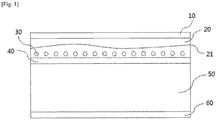
- FIG. 1 is a view showing a general structure of a zinc-air battery.
- the zinc-air battery includes a positive electrode, a separator 40, an electrolyte 50 and a negative electrode.
- the positive electrode includes a carbon layer 20, a positive electrode current collector 30 in a metal mesh form formed in the interior of the carbon layer 20, and a Teflon layer 10 formed on the upper part of the carbon layer 20.
- the separator 40 is disposed at the lower part of the carbon layer 20, and a negative electrode current collector 60 of the negative electrode is formed apart from the separator 40 at a predetermined distance.
- the electrolyte 50 is formed as a slurry in which zinc (Zn), potassium hydroxide (KOH) and water (H 2 O) are mixed, and accommodated between the separator 40 and the negative electrode current collector 60.
- the electrolyte 50 passes through the separator 40 capable of selective ion migration and impregnates a part of the carbon layer 20 to form a gas-liquid interface 21.
- the zinc-air battery formed as above operates by the migration of electrons generated when zinc contained in the electrolyte 50 reacts with oxygen in the air and is changed into zinc oxide.
- the electrolyte 50 impregnates a part of the carbon layer 20 through a plurality of pores of the separator 40, and potassium hydroxide contained in the electrolyte 50 reacts with oxygen in the air and is precipitated. As a result, the carbon layer 20 is destroyed and the performance of the zinc-air battery is deteriorated.
- the present invention is designed to solve the aforementioned problems, and it is an object of the present invention to provide a separator capable of selective ion migration in which each of a plurality of pores of a porous ion migration inhibition layer is formed so as to have a size smaller than the size of an electromigration-promoting ion contained in an electrolyte, and thus the electromigration-promoting ion is prevented from passing through the porous ion migration inhibition layer, and a secondary battery including the same.
- a separator capable of selective ion migration, including: a support formed in a grid; and a porous ion migration inhibition layer with which the grid of the support is coated and which has a plurality of pores formed therein, where each of the plurality of pores of the porous ion migration inhibition layer is formed so as to have a size smaller than the size of an electromigration-promoting ion contained in an electrolyte, and thus the electromigration-promoting ion is prevented from passing through the porous ion migration inhibition layer.
- the support may be formed of polyvinyl alcohol (PVA), and the porous ion migration inhibition layer is formed of polyvinyl acetate (PVAc).
- PVA polyvinyl alcohol
- PVAc polyvinyl acetate
- the porous ion migration inhibition layer may be formed by an electrospinning process of electrically charging polyvinyl acetate (PVAc) and spinning the polyvinyl acetate (PVAc) onto the support.
- PVAc polyvinyl acetate
- porous ion migration inhibition layer may be formed by substituting polyvinyl acetate (PVAc) with at least one alkali metal or alkaline earth metal.
- PVAc polyvinyl acetate
- a secondary battery including: a positive electrode; a negative electrode; a separator interposed between the positive electrode and the negative electrode; and an electrolyte for partially impregnating the negative electrode, the separator and the positive electrode, where the separator is formed of a porous material having a plurality of pores formed therein, and each of the plurality of pores of the porous ion migration inhibition layer is formed so as to have a size smaller than the size of an electromigration-promoting ion contained in an electrolyte, and thus the electromigration-promoting ion is prevented from passing through the porous ion migration inhibition layer and migrating to the positive electrode side.
- the present invention has the following effects.
- the performance of a zinc-air battery can be prevented from being degraded in a manner whereby a plurality of pores in the porous ion migration inhibition layer of the separator are formed so as to have a size smaller than the size of potassium ions contained in an electrolyte, thereby preventing the potassium ions from migrating to a carbon layer to fundamentally prevent potassium hydroxide from being precipitated, whereby the carbon layer is destroyed.
- a zinc-air battery can be used as a secondary battery in a manner whereby potassium is prevented from migrating to the carbon layer, thereby preventing potassium hydroxide from being precipitated even when oxygen is moved to a positive electrode side during charging of the zinc-air battery.
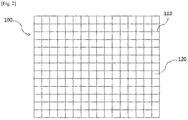
- a separator 100 capable of selective ion migration according to the present invention includes a support 110 formed in a grid, and a porous ion migration inhibition layer 120 with which the grid of the support is coated and which has a plurality of pores formed therein.
- the support 110 is a sheet formed in a grid prepared by curing polyvinyl alcohol (PVA).
- PVA polyvinyl alcohol
- Polyvinyl alcohol (PVA) is a polymer compound and a colorless powder obtained by hydrolyzing polyvinyl acetate, and has a property of not being wetted with water when cured.
- the support 110 is formed of polyvinyl alcohol (PVA), but is not limited thereto, and may be formed of any material which does not become wet with water.
- PVA polyvinyl alcohol
- the porous ion migration inhibition layer 120 is formed by electrically charging polyvinyl acetate (PVAc) and spinning the polyvinyl acetate (PVAc) onto the grid of the support 110. That is, the porous ion migration inhibition layer 120 is formed by an electrospinning process.
- PVAc polyvinyl acetate
- PVAc polyvinyl acetate
- a plurality of pores are formed in the porous ion migration inhibition layer 120, and the size of the pores is formed to be smaller than the size of potassium ions. Accordingly, it is not possible for the potassium ions to migrate to the carbon layer, thereby preventing potassium hydroxide from being precipitated.
- porous ion migration inhibition layer 120 may be formed by substituting polyvinyl acetate (PVAc) with at least one alkali metal or alkaline earth metal.
- PVAc polyvinyl acetate
- the secondary battery according to the present invention includes a positive electrode, a separator 100, an electrolyte 50 and a negative electrode.
- the positive electrode includes a carbon layer 20, a positive electrode current collector 30 in a metal mesh form formed in the interior of the carbon layer 20, and a Teflon layer 10 formed on the upper part of the carbon layer 20.
- the separator 100 capable of selective ion migration is disposed at the lower part of the carbon layer 20, and a negative electrode current collector 60 of the negative electrode is formed a predetermined distance apart from the separator 100 capable of selective ion migration.
- the electrolyte 50 is formed as a slurry in which zinc (Zn), potassium hydroxide (KOH) and water (H 2 O) are mixed, and accommodated between the separator 100 and the negative electrode current collector 60.
- the electrolyte 50 passes through the separator 100 capable of selective ion migration and impregnates a part of the carbon layer 20 to form a gas-liquid interface 21.
- potassium ions are prevented from migrating to the carbon layer 20 by the porous ion migration inhibition layer 120 of the separator 100 capable of selective ion migration to fundamentally prevent potassium hydroxide from being precipitated, thereby preventing the performance of the secondary battery from being degraded.
- a zinc-air battery can be used as a secondary battery in a manner whereby potassium is prevented from migrating to the carbon layer, thereby preventing potassium hydroxide from being precipitated even when oxygen is moved to a positive electrode side during charging of the zinc-air battery.
- the separator 100 capable of selective ion migration of the present invention is applied to an alkaline battery, it is possible to prevent potassium ions from migrating to a positive electrode side of the alkaline battery to prevent potassium hydroxide from being precipitated even when oxygen migrates to the positive electrode side during charging, thereby achieving an excellent effect that the alkaline primary battery can be used as a secondary battery.
Landscapes
- Chemical & Material Sciences (AREA)
- Chemical Kinetics & Catalysis (AREA)
- Electrochemistry (AREA)
- General Chemical & Material Sciences (AREA)
- Engineering & Computer Science (AREA)
- Manufacturing & Machinery (AREA)
- Inorganic Chemistry (AREA)
- Composite Materials (AREA)
- Materials Engineering (AREA)
- Hybrid Cells (AREA)
- Cell Separators (AREA)
- Secondary Cells (AREA)
Abstract
Description
- The present invention relates to a separator capable of selective ion migration and a secondary battery including the same, and more specifically, to a separator capable of selective ion migration in which each of a plurality of pores of a porous ion migration inhibition layer is formed so as to have a size smaller than the size of an electromigration-promoting ion contained in an electrolyte, and thus the electromigration-promoting ion is prevented from passing through the porous ion migration inhibition layer, and a secondary battery including the same.
- Generally, a battery is assembled by a negative electrode, a positive electrode, and a separator interposed therebetween. Here, the separator positioned between the two electrodes of the battery is a subsidiary material which prevents the negative electrode and the positive electrode from being in direct contact with each other to prevent an internal short-circuit, and plays an important role not only as an ion passage in the battery but also in improving the safety of the battery.
-
FIG. 1 is a view showing a general structure of a zinc-air battery. - The zinc-air battery includes a positive electrode, a
separator 40, anelectrolyte 50 and a negative electrode. - First, the positive electrode includes a
carbon layer 20, a positive electrodecurrent collector 30 in a metal mesh form formed in the interior of thecarbon layer 20, and a Teflonlayer 10 formed on the upper part of thecarbon layer 20. - Further, the
separator 40 is disposed at the lower part of thecarbon layer 20, and a negative electrodecurrent collector 60 of the negative electrode is formed apart from theseparator 40 at a predetermined distance. - The
electrolyte 50 is formed as a slurry in which zinc (Zn), potassium hydroxide (KOH) and water (H2O) are mixed, and accommodated between theseparator 40 and the negative electrodecurrent collector 60. Here, theelectrolyte 50 passes through theseparator 40 capable of selective ion migration and impregnates a part of thecarbon layer 20 to form a gas-liquid interface 21. - The zinc-air battery formed as above operates by the migration of electrons generated when zinc contained in the
electrolyte 50 reacts with oxygen in the air and is changed into zinc oxide. - In the conventional zinc-air battery as described above, the
electrolyte 50 impregnates a part of thecarbon layer 20 through a plurality of pores of theseparator 40, and potassium hydroxide contained in theelectrolyte 50 reacts with oxygen in the air and is precipitated. As a result, thecarbon layer 20 is destroyed and the performance of the zinc-air battery is deteriorated. - Further, when the zinc-air battery is charged, oxygen migrates to the positive electrode side, and the oxygen migrated to the positive electrode side reacts with potassium hydroxide such that potassium hydroxide is precipitated, and thus it is difficult to use the zinc-air battery as a secondary battery.
- The present invention is designed to solve the aforementioned problems, and it is an object of the present invention to provide a separator capable of selective ion migration in which each of a plurality of pores of a porous ion migration inhibition layer is formed so as to have a size smaller than the size of an electromigration-promoting ion contained in an electrolyte, and thus the electromigration-promoting ion is prevented from passing through the porous ion migration inhibition layer, and a secondary battery including the same.
- According to an aspect of the present invention, there is provided a separator capable of selective ion migration, including: a support formed in a grid; and a porous ion migration inhibition layer with which the grid of the support is coated and which has a plurality of pores formed therein, where each of the plurality of pores of the porous ion migration inhibition layer is formed so as to have a size smaller than the size of an electromigration-promoting ion contained in an electrolyte, and thus the electromigration-promoting ion is prevented from passing through the porous ion migration inhibition layer.
- Here, the support may be formed of polyvinyl alcohol (PVA), and the porous ion migration inhibition layer is formed of polyvinyl acetate (PVAc).
- The porous ion migration inhibition layer may be formed by an electrospinning process of electrically charging polyvinyl acetate (PVAc) and spinning the polyvinyl acetate (PVAc) onto the support.
- Further, the porous ion migration inhibition layer may be formed by substituting polyvinyl acetate (PVAc) with at least one alkali metal or alkaline earth metal.
- Further, according to another aspect of the present invention, there is provided a secondary battery, including: a positive electrode; a negative electrode; a separator interposed between the positive electrode and the negative electrode; and an electrolyte for partially impregnating the negative electrode, the separator and the positive electrode, where the separator is formed of a porous material having a plurality of pores formed therein, and each of the plurality of pores of the porous ion migration inhibition layer is formed so as to have a size smaller than the size of an electromigration-promoting ion contained in an electrolyte, and thus the electromigration-promoting ion is prevented from passing through the porous ion migration inhibition layer and migrating to the positive electrode side.
- Accordingly, the present invention has the following effects.
- First, the performance of a zinc-air battery can be prevented from being degraded in a manner whereby a plurality of pores in the porous ion migration inhibition layer of the separator are formed so as to have a size smaller than the size of potassium ions contained in an electrolyte, thereby preventing the potassium ions from migrating to a carbon layer to fundamentally prevent potassium hydroxide from being precipitated, whereby the carbon layer is destroyed.
- Second, a zinc-air battery can be used as a secondary battery in a manner whereby potassium is prevented from migrating to the carbon layer, thereby preventing potassium hydroxide from being precipitated even when oxygen is moved to a positive electrode side during charging of the zinc-air battery.
- Third, when the present invention is applied to a separator of an alkaline battery, it is possible to prevent potassium hydroxide from being precipitated during charging, thereby achieving an effect that an alkaline primary battery can be used as a secondary battery.
-
-
FIG. 1 is a view showing a general structure of a zinc-air battery. -
FIG. 2 is a view showing a separator capable of selective ion migration according to the present invention. -
FIG. 3 is a view showing a structure of a secondary battery including the separator capable of selective ion migration according to the present invention. - Terms or words used in this specification and claims should not be restrictively interpreted as ordinary meanings or dictionary-based meanings, but should be interpreted as meanings and concepts conforming to the technical ideas of the present invention on the basis of the principle that an inventor can properly define the concept of a term to describe and explain his or her invention in the best way.
- Accordingly, embodiments and structures illustrated herein are suggested only by way of example but do not represent all technical concepts of the present invention. Therefore, it will be understood that various equivalents and modifications may exist which can replace the embodiments described at the time of the application. Moreover, detailed descriptions related to well-known functions or configurations will be omitted in order to not unnecessarily obscure the subject matter of the present invention.
- Hereinafter, a separator capable of selective ion migration and a secondary battery including the separator according to an exemplary embodiment of the present invention will be described with reference to accompanying drawings
- As shown in
FIG. 2 , aseparator 100 capable of selective ion migration according to the present invention includes asupport 110 formed in a grid, and a porous ionmigration inhibition layer 120 with which the grid of the support is coated and which has a plurality of pores formed therein. - First, the
support 110 is a sheet formed in a grid prepared by curing polyvinyl alcohol (PVA). Polyvinyl alcohol (PVA) is a polymer compound and a colorless powder obtained by hydrolyzing polyvinyl acetate, and has a property of not being wetted with water when cured. - In the present embodiment, the
support 110 is formed of polyvinyl alcohol (PVA), but is not limited thereto, and may be formed of any material which does not become wet with water. - Further, the porous ion
migration inhibition layer 120 is formed by electrically charging polyvinyl acetate (PVAc) and spinning the polyvinyl acetate (PVAc) onto the grid of thesupport 110. That is, the porous ionmigration inhibition layer 120 is formed by an electrospinning process. When the porous ionmigration inhibition layer 120 is formed by spinning polyvinyl acetate (PVAc) onto thesupport 110 through the electrospinning process as described above, a plurality of pores are formed in the porous ionmigration inhibition layer 120, and the size of the pores is formed to be smaller than the size of potassium ions. Accordingly, it is not possible for the potassium ions to migrate to the carbon layer, thereby preventing potassium hydroxide from being precipitated. - Further, the porous ion
migration inhibition layer 120 may be formed by substituting polyvinyl acetate (PVAc) with at least one alkali metal or alkaline earth metal. - When hydrogen of a methyl group of radicals connected to the backbone of polyvinyl acetate (PVAc) is substituted with at least one alkali metal or alkaline earth metal, potassium ions are prevented from passing through the porous ion
migration inhibition layer 120 in terms of the chemical structure. In this case, the same effect as the effect of forming polyvinyl acetate (PVAc) by the electrospinning process can also be achieved. - Hereinafter, a secondary battery according to the present invention will be described with reference to
FIG. 3 . - The secondary battery according to the present invention includes a positive electrode, a
separator 100, anelectrolyte 50 and a negative electrode. - First, the positive electrode includes a
carbon layer 20, a positive electrodecurrent collector 30 in a metal mesh form formed in the interior of thecarbon layer 20, and a Teflonlayer 10 formed on the upper part of thecarbon layer 20. - Further, the
separator 100 capable of selective ion migration is disposed at the lower part of thecarbon layer 20, and a negative electrodecurrent collector 60 of the negative electrode is formed a predetermined distance apart from theseparator 100 capable of selective ion migration. - The
electrolyte 50 is formed as a slurry in which zinc (Zn), potassium hydroxide (KOH) and water (H2O) are mixed, and accommodated between theseparator 100 and the negative electrodecurrent collector 60. Here, theelectrolyte 50 passes through theseparator 100 capable of selective ion migration and impregnates a part of thecarbon layer 20 to form a gas-liquid interface 21. - In the secondary battery according to the present invention, potassium ions are prevented from migrating to the
carbon layer 20 by the porous ionmigration inhibition layer 120 of theseparator 100 capable of selective ion migration to fundamentally prevent potassium hydroxide from being precipitated, thereby preventing the performance of the secondary battery from being degraded. - Further, a zinc-air battery can be used as a secondary battery in a manner whereby potassium is prevented from migrating to the carbon layer, thereby preventing potassium hydroxide from being precipitated even when oxygen is moved to a positive electrode side during charging of the zinc-air battery.
- Further, when the
separator 100 capable of selective ion migration of the present invention is applied to an alkaline battery, it is possible to prevent potassium ions from migrating to a positive electrode side of the alkaline battery to prevent potassium hydroxide from being precipitated even when oxygen migrates to the positive electrode side during charging, thereby achieving an excellent effect that the alkaline primary battery can be used as a secondary battery. - Heretofore, the exemplary embodiment with respect to the separator capable of selective ion migration and the secondary battery including the separator according to the present invention has been described as an example.
- The above-described embodiments are illustrative and non-limiting in all respects, so it is to be understood that the scope of the present invention will be defined by the appended claims rather than the foregoing description and the exemplary embodiments described therein. All changes and modifications made within the spirit and scope of the claims of the invention, as well as equivalents thereof, are to be regarded as being included within the scope of the present invention.
Claims (5)
- A separator capable of selective ion migration, comprising:a support formed in a grid; anda porous ion migration inhibition layer with which the grid of the support is coated and which has a plurality of pores formed therein,wherein each of the plurality of pores of the porous ion migration inhibition layer is formed so as to have a size smaller than the size of an electromigration-promoting ion contained in an electrolyte, and thus the electromigration-promoting ion is prevented from passing through the porous ion migration inhibition layer.
- The separator according to claim 1, wherein the support is formed of polyvinyl alcohol (PVA), and the porous ion migration inhibition layer is formed of polyvinyl acetate (PVAc).
- The separator according to claim 2, wherein the porous ion migration inhibition layer is formed by an electrospinning process of electrically charging polyvinyl acetate (PVAc) and spinning the polyvinyl acetate (PVAc) onto the support.
- The separator according to claim 2, wherein the porous ion migration inhibition layer is formed by substituting polyvinyl acetate (PVAc) with at least one alkali metal or alkaline earth metal.
- A secondary battery, comprising:a positive electrode;a negative electrode;a separator interposed between the positive electrode and the negative electrode; andan electrolyte for partially impregnating the negative electrode, the separator and the positive electrode,wherein the separator is formed of a porous material having a plurality of pores formed therein, and each of the plurality of pores of the porous ion migration inhibition layer is formed so as to have a size smaller than the size of an electromigration-promoting ion contained in an electrolyte, and thus the electromigration-promoting ion does not pass through the porous ion migration inhibition layer such that the electromigration-promoting ion is prevented from migrating to the positive electrode side.
Applications Claiming Priority (2)
| Application Number | Priority Date | Filing Date | Title |
|---|---|---|---|
| KR1020150076060A KR102246849B1 (en) | 2015-05-29 | 2015-05-29 | Separator having selective moving function of ion and secondary battery including the same |
| PCT/KR2016/004814 WO2016195263A1 (en) | 2015-05-29 | 2016-05-09 | Separation membrane capable of selective ion migration, and secondary battery comprising same |
Publications (2)
| Publication Number | Publication Date |
|---|---|
| EP3306707A1 true EP3306707A1 (en) | 2018-04-11 |
| EP3306707A4 EP3306707A4 (en) | 2019-02-06 |
Family
ID=57440617
Family Applications (1)
| Application Number | Title | Priority Date | Filing Date |
|---|---|---|---|
| EP16803618.4A Withdrawn EP3306707A4 (en) | 2015-05-29 | 2016-05-09 | SEPARATING MEMBRANE FOR SELECTIVE ION MIGRATION, AND SECONDARY CELL COMPRISING SAME |
Country Status (6)
| Country | Link |
|---|---|
| US (1) | US10461295B2 (en) |
| EP (1) | EP3306707A4 (en) |
| JP (1) | JP6643361B2 (en) |
| KR (1) | KR102246849B1 (en) |
| CN (1) | CN107667444A (en) |
| WO (1) | WO2016195263A1 (en) |
Cited By (1)
| Publication number | Priority date | Publication date | Assignee | Title |
|---|---|---|---|---|
| CN108598627A (en) * | 2018-05-16 | 2018-09-28 | 东北大学秦皇岛分校 | A kind of high power capacity potassium-aeration cell |
Families Citing this family (1)
| Publication number | Priority date | Publication date | Assignee | Title |
|---|---|---|---|---|
| WO2019046575A1 (en) * | 2017-08-31 | 2019-03-07 | Research Foundation Of The City University Of New York | Ion selective membrane for selective ion penetration in alkaline batteries |
Family Cites Families (25)
| Publication number | Priority date | Publication date | Assignee | Title |
|---|---|---|---|---|
| US4965147A (en) | 1988-07-25 | 1990-10-23 | Societe Anonyme Dite: Cipel | Separator for an electrochemical cell of the metal-air type and having an alkaline electrolyte |
| JP3279091B2 (en) | 1993-10-07 | 2002-04-30 | 松下電器産業株式会社 | Organic electrolyte lithium secondary battery and method for producing separator thereof |
| WO2000059052A2 (en) * | 1999-03-29 | 2000-10-05 | The Gillette Company | Alkaline cell separator |
| IL155790A0 (en) * | 2000-11-09 | 2003-12-23 | Foc Frankenburg Oil Company Es | A supercapacitor and a method of manufacturing such a supercapacitor |
| KR20080044738A (en) * | 2006-11-16 | 2008-05-21 | 한국전자통신연구원 | Hermetic film primary battery comprising an aqueous electrolyte composition and an electrolyte layer obtained therefrom |
| KR100868290B1 (en) | 2007-05-04 | 2008-11-12 | 한국과학기술연구원 | A negative electrode for a secondary battery having a negative electrode active material having a nanofiber network structure, a secondary battery using the same, and a method of manufacturing a negative electrode active material for a secondary battery |
| US20110117413A1 (en) * | 2009-11-19 | 2011-05-19 | Yichun Wang | Alkaline Battery Separators with Ion-Trapping Molecules |
| CN102315463A (en) * | 2011-08-05 | 2012-01-11 | 上海交通大学 | Preparation method for flexible inorganic/organic composite proton exchange membrane |
| JP5848545B2 (en) | 2011-08-08 | 2016-01-27 | 三星エスディアイ株式会社Samsung SDI Co.,Ltd. | Secondary battery separator layer and secondary battery |
| CN102496485B (en) | 2011-12-06 | 2013-07-17 | 浙江理工大学 | Method for improving firmness of combination of dye-sensitized cell nanometer fibrous membrane and conductive glass |
| EP2814104B1 (en) * | 2012-02-06 | 2018-09-26 | NGK Insulators, Ltd. | Zinc secondary cell |
| JP2013222088A (en) | 2012-04-17 | 2013-10-28 | Seiko Epson Corp | Base material for electrophoretic display device and manufacturing method for the same, and electrophoretic display device and manufacturing method for the same |
| JP2013222090A (en) * | 2012-04-17 | 2013-10-28 | Seiko Epson Corp | Base material for electrophoretic display device and manufacturing method for the same, and electrophoretic display device and manufacturing method for the same |
| US9853270B2 (en) * | 2012-04-18 | 2017-12-26 | King Abdullah University Of Science And Technology | Nanostructured metal organic material electrode separators and methods therefor |
| US20150314245A1 (en) | 2012-12-11 | 2015-11-05 | Toyobo Co., Ltd. | Composite separation membrane |
| JPWO2014091856A1 (en) | 2012-12-12 | 2017-01-05 | 日本電気株式会社 | Separator, electrode element, power storage device, and method for manufacturing the separator |
| WO2014099649A1 (en) * | 2012-12-19 | 2014-06-26 | Lockheed Martin Corporation | Perforated graphene deionization or desalination |
| US8974946B2 (en) * | 2013-03-15 | 2015-03-10 | Gm Global Technology Operations | Coating for separator or cathode of lithium—sulfur or silicon—sulfur battery |
| CN104143614B (en) * | 2013-05-09 | 2017-02-08 | 中国科学院大连化学物理研究所 | Lithium sulfur battery |
| US9601805B2 (en) * | 2013-07-22 | 2017-03-21 | Nanotek Instruments, Inc. | Process for producing non-flammable quasi-solid electrolyte and electrolyte-separator for lithium battery applications |
| KR101523322B1 (en) | 2013-08-09 | 2015-05-27 | 충남대학교산학협력단 | Lithium-ion battery separator and method for preparing the same |
| GB2517228B (en) * | 2013-08-15 | 2016-03-02 | Oxis Energy Ltd | Laminate cell |
| US9373829B2 (en) * | 2013-10-11 | 2016-06-21 | GM Global Technology Operations LLC | Porous interlayer for a lithium-sulfur battery |
| KR101715811B1 (en) * | 2013-11-12 | 2017-03-13 | 주식회사 아모그린텍 | Ion exchange membrane |
| CN103779527B (en) * | 2014-01-29 | 2016-06-29 | 中国科学院宁波材料技术与工程研究所 | A kind of barrier film and preparation method thereof |
-
2015
- 2015-05-29 KR KR1020150076060A patent/KR102246849B1/en not_active Expired - Fee Related
-
2016
- 2016-05-09 CN CN201680031208.7A patent/CN107667444A/en active Pending
- 2016-05-09 JP JP2017559550A patent/JP6643361B2/en not_active Expired - Fee Related
- 2016-05-09 US US15/573,553 patent/US10461295B2/en active Active
- 2016-05-09 WO PCT/KR2016/004814 patent/WO2016195263A1/en not_active Ceased
- 2016-05-09 EP EP16803618.4A patent/EP3306707A4/en not_active Withdrawn
Cited By (1)
| Publication number | Priority date | Publication date | Assignee | Title |
|---|---|---|---|---|
| CN108598627A (en) * | 2018-05-16 | 2018-09-28 | 东北大学秦皇岛分校 | A kind of high power capacity potassium-aeration cell |
Also Published As
| Publication number | Publication date |
|---|---|
| KR102246849B1 (en) | 2021-04-30 |
| JP6643361B2 (en) | 2020-02-12 |
| EP3306707A4 (en) | 2019-02-06 |
| WO2016195263A1 (en) | 2016-12-08 |
| JP2018519622A (en) | 2018-07-19 |
| US10461295B2 (en) | 2019-10-29 |
| KR20160140013A (en) | 2016-12-07 |
| CN107667444A (en) | 2018-02-06 |
| US20180151861A1 (en) | 2018-05-31 |
Similar Documents
| Publication | Publication Date | Title |
|---|---|---|
| CN104662705B (en) | Alkali-chalcogenide batteries with low self-discharge, high cycle life and performance | |
| JP5361712B2 (en) | New silver positive electrode for alkaline storage batteries | |
| MY198089A (en) | Negative electrode for non-aqueous electrolyte secondary battery | |
| MY196037A (en) | Positive Electrode for Non-Aqueous Electrolyte Secondary Battery | |
| JP2015191879A (en) | Winding type secondary battery | |
| KR20130005732A (en) | Li-air hybrid battery and method for manufacturing the same | |
| CN104718642B (en) | Separator for electrochemical element and manufacturing method thereof | |
| US10461295B2 (en) | Separator capable of selective ion migration, and secondary battery comprising same | |
| KR101262666B1 (en) | Separator For Lithium-Air Secondary Battery and Lithium-Air Secondary Battery Having The Separator | |
| CN110226260B (en) | metal air battery | |
| US20180047967A1 (en) | Metal-air battery | |
| KR102884642B1 (en) | Lithium ion secondary battery | |
| JP6074394B2 (en) | Aqueous lithium-positive electrode for air secondary battery | |
| US20170338536A1 (en) | Metal-air battery | |
| KR102845721B1 (en) | Lithium ion secondary battery and manufacturing method of the same | |
| KR20160024685A (en) | Lithium secondary battery having side bead | |
| KR101646357B1 (en) | The positive electrode of lithium-air batteries | |
| KR101731282B1 (en) | Active Material for Lead-acid battery | |
| KR101793907B1 (en) | Air-Zinc secondary battery | |
| JP5395974B1 (en) | Electrode for electrochemical device, electrochemical device, and method for producing electrode for electrochemical device | |
| KR20220119305A (en) | Porous frame-based solid electrolyte membrane and its manufacturing method and all-solid-state battery including the same | |
| CN108604720B (en) | Air zinc secondary battery | |
| KR101198029B1 (en) | Zinc-air cell | |
| KR102329471B1 (en) | Membrane for electrically rechargeable zinc-air battery and electrically rechargeable zinc-air battery using the same | |
| JP2015076315A (en) | Method of manufacturing solid state battery |
Legal Events
| Date | Code | Title | Description |
|---|---|---|---|
| STAA | Information on the status of an ep patent application or granted ep patent |
Free format text: STATUS: THE INTERNATIONAL PUBLICATION HAS BEEN MADE |
|
| PUAI | Public reference made under article 153(3) epc to a published international application that has entered the european phase |
Free format text: ORIGINAL CODE: 0009012 |
|
| STAA | Information on the status of an ep patent application or granted ep patent |
Free format text: STATUS: REQUEST FOR EXAMINATION WAS MADE |
|
| 17P | Request for examination filed |
Effective date: 20171129 |
|
| AK | Designated contracting states |
Kind code of ref document: A1 Designated state(s): AL AT BE BG CH CY CZ DE DK EE ES FI FR GB GR HR HU IE IS IT LI LT LU LV MC MK MT NL NO PL PT RO RS SE SI SK SM TR |
|
| AX | Request for extension of the european patent |
Extension state: BA ME |
|
| DAV | Request for validation of the european patent (deleted) | ||
| DAX | Request for extension of the european patent (deleted) | ||
| A4 | Supplementary search report drawn up and despatched |
Effective date: 20190109 |
|
| RIC1 | Information provided on ipc code assigned before grant |
Ipc: H01M 12/06 20060101ALI20190103BHEP Ipc: H01M 10/05 20100101ALI20190103BHEP Ipc: H01M 10/02 20060101ALI20190103BHEP Ipc: H01M 2/14 20060101ALI20190103BHEP Ipc: H01M 10/24 20060101ALI20190103BHEP Ipc: H01M 2/16 20060101AFI20190103BHEP |
|
| STAA | Information on the status of an ep patent application or granted ep patent |
Free format text: STATUS: EXAMINATION IS IN PROGRESS |
|
| 17Q | First examination report despatched |
Effective date: 20200907 |
|
| STAA | Information on the status of an ep patent application or granted ep patent |
Free format text: STATUS: THE APPLICATION IS DEEMED TO BE WITHDRAWN |
|
| 18D | Application deemed to be withdrawn |
Effective date: 20231201 |