EP3305787B1 - Xanthine derivative - Google Patents
Xanthine derivative Download PDFInfo
- Publication number
- EP3305787B1 EP3305787B1 EP16802482.6A EP16802482A EP3305787B1 EP 3305787 B1 EP3305787 B1 EP 3305787B1 EP 16802482 A EP16802482 A EP 16802482A EP 3305787 B1 EP3305787 B1 EP 3305787B1
- Authority
- EP
- European Patent Office
- Prior art keywords
- acid
- methyl
- xanthine
- solvates
- pharmaceutically acceptable
- Prior art date
- Legal status (The legal status is an assumption and is not a legal conclusion. Google has not performed a legal analysis and makes no representation as to the accuracy of the status listed.)
- Not-in-force
Links
- GROWBOBLPMJLKC-OAHLLOKOSA-N CC#CC[n]1c(N(CCC2)C[C@@H]2N)nc(N(C)C(N2Cc(nccc3)c3C(OC)=O)=O)c1C2=O Chemical compound CC#CC[n]1c(N(CCC2)C[C@@H]2N)nc(N(C)C(N2Cc(nccc3)c3C(OC)=O)=O)c1C2=O GROWBOBLPMJLKC-OAHLLOKOSA-N 0.000 description 3
- 0 CC#CC[n]1c(N(CCC2)C[C@]2N)nc(N(C)C(N2C*)=O)c1C2=O Chemical compound CC#CC[n]1c(N(CCC2)C[C@]2N)nc(N(C)C(N2C*)=O)c1C2=O 0.000 description 2
- WJUSRPMGKJHANU-UHFFFAOYSA-N CC#CC[n]1c(Br)nc(N(C)C(N2Cc3nccnc3C#N)=O)c1C2=O Chemical compound CC#CC[n]1c(Br)nc(N(C)C(N2Cc3nccnc3C#N)=O)c1C2=O WJUSRPMGKJHANU-UHFFFAOYSA-N 0.000 description 1
- YNDVTDKMXMMQIW-CQSZACIVSA-N CC#CC[n]1c(N(CCC2)C[C@@H]2N)nc(N(C)C(N2Cc3nccnc3C#N)=O)c1C2=O Chemical compound CC#CC[n]1c(N(CCC2)C[C@@H]2N)nc(N(C)C(N2Cc3nccnc3C#N)=O)c1C2=O YNDVTDKMXMMQIW-CQSZACIVSA-N 0.000 description 1
- RELQGEQVPMYGLA-GOSISDBHSA-N CC(C)(C)OC(N[C@H](CCC1)CN1c1nc(N(C)C(N(Cc(nccc2)c2C(OC)=O)C2=O)=O)c2[n]1CC#CC)=O Chemical compound CC(C)(C)OC(N[C@H](CCC1)CN1c1nc(N(C)C(N(Cc(nccc2)c2C(OC)=O)C2=O)=O)c2[n]1CC#CC)=O RELQGEQVPMYGLA-GOSISDBHSA-N 0.000 description 1
- LTXREWYXXSTFRX-QGZVFWFLSA-N Cc1nc(CN(C(c([n]2CC#CC)c(N3C)nc2N(CCC2)C[C@@H]2N)=O)C3=O)nc2ccccc12 Chemical compound Cc1nc(CN(C(c([n]2CC#CC)c(N3C)nc2N(CCC2)C[C@@H]2N)=O)C3=O)nc2ccccc12 LTXREWYXXSTFRX-QGZVFWFLSA-N 0.000 description 1
- PMLQFBHDBBSNSR-UHFFFAOYSA-N N#Cc1c(CBr)nccn1 Chemical compound N#Cc1c(CBr)nccn1 PMLQFBHDBBSNSR-UHFFFAOYSA-N 0.000 description 1
Images


Classifications
-
- A—HUMAN NECESSITIES
- A61—MEDICAL OR VETERINARY SCIENCE; HYGIENE
- A61K—PREPARATIONS FOR MEDICAL, DENTAL OR TOILETRY PURPOSES
- A61K31/00—Medicinal preparations containing organic active ingredients
- A61K31/33—Heterocyclic compounds
- A61K31/395—Heterocyclic compounds having nitrogen as a ring hetero atom, e.g. guanethidine or rifamycins
- A61K31/495—Heterocyclic compounds having nitrogen as a ring hetero atom, e.g. guanethidine or rifamycins having six-membered rings with two or more nitrogen atoms as the only ring heteroatoms, e.g. piperazine or tetrazines
- A61K31/505—Pyrimidines; Hydrogenated pyrimidines, e.g. trimethoprim
- A61K31/519—Pyrimidines; Hydrogenated pyrimidines, e.g. trimethoprim ortho- or peri-condensed with heterocyclic rings
- A61K31/52—Purines, e.g. adenine
- A61K31/522—Purines, e.g. adenine having oxo groups directly attached to the heterocyclic ring, e.g. hypoxanthine, guanine, acyclovir
-
- A—HUMAN NECESSITIES
- A61—MEDICAL OR VETERINARY SCIENCE; HYGIENE
- A61P—SPECIFIC THERAPEUTIC ACTIVITY OF CHEMICAL COMPOUNDS OR MEDICINAL PREPARATIONS
- A61P3/00—Drugs for disorders of the metabolism
- A61P3/08—Drugs for disorders of the metabolism for glucose homeostasis
- A61P3/10—Drugs for disorders of the metabolism for glucose homeostasis for hyperglycaemia, e.g. antidiabetics
-
- C—CHEMISTRY; METALLURGY
- C07—ORGANIC CHEMISTRY
- C07D—HETEROCYCLIC COMPOUNDS
- C07D473/00—Heterocyclic compounds containing purine ring systems
- C07D473/02—Heterocyclic compounds containing purine ring systems with oxygen, sulphur, or nitrogen atoms directly attached in positions 2 and 6
- C07D473/04—Heterocyclic compounds containing purine ring systems with oxygen, sulphur, or nitrogen atoms directly attached in positions 2 and 6 two oxygen atoms
-
- C—CHEMISTRY; METALLURGY
- C07—ORGANIC CHEMISTRY
- C07D—HETEROCYCLIC COMPOUNDS
- C07D473/00—Heterocyclic compounds containing purine ring systems
- C07D473/02—Heterocyclic compounds containing purine ring systems with oxygen, sulphur, or nitrogen atoms directly attached in positions 2 and 6
- C07D473/04—Heterocyclic compounds containing purine ring systems with oxygen, sulphur, or nitrogen atoms directly attached in positions 2 and 6 two oxygen atoms
- C07D473/06—Heterocyclic compounds containing purine ring systems with oxygen, sulphur, or nitrogen atoms directly attached in positions 2 and 6 two oxygen atoms with radicals containing only hydrogen and carbon atoms, attached in position 1 or 3
Definitions
- the present invention belongs to the field of pharmaceutical chemistry, and particularly relates to a xanthine derivative and a preparation method thereof and a use of such compound as a dipeptidyl peptidase IV (DPP-IV) inhibitor.
- DPP-IV dipeptidyl peptidase IV
- Diabetes is a polyetiological metabolic disease, characterized by chronic hyperglycemia accompanied with disorder of glucose, fat and protein metabolism caused by insulin secretion and/or effect defects. Diabetes is also a very old disease. It is caused by relative or absolute lack of insulin in the human body, which leads to rise of the concentration of glucose in the blood and this further leads to excretion of a large volume of glucose from urine accompanied with symptoms such as polydipsia, polyuria, polyphagia, emaciation, dizziness, debilitation, etc.
- diabetes treatment exercise therapy and diet therapy are two essential types of therapeutic methods for diabetes.
- insulin or oral hypoglycemic drugs can be used. But because there are many side effects in these hypoglycemic drugs, it is particularly important to develop a new and low-side effect drug that can effectively treat diabetes.
- DPP-IV is a serine protease; it can split N-terminal dipeptidase in a peptide chain containing a proline residue at the secondary end; although the physiological effect of DPP-IV to mammals has not been fully confirmed, it plays a very important role in the process of neural enzyme metabolism, T-cell activation, cancer cells metastasizing in endothelium and HIV virus entering lymphoid cells ( WO98/19998 ).
- DPP-IV can inhibit the secretion of Glucagon-Like Peptide (GLP)-1 and split His-Ala dipeptide at N-terminal in (GLP)-1 so that it is degraded from active form (GLP)-1 ( Endocrinology, 1999, 140:5356-5363 ). Under physiological conditions, the half-life period of the intact (GLP)-1 is short in circulating blood, and DPP-IV inhibitor can completely protect the endogenous and exogenous (GLP)-1 from inactivating by DPP-IV, which greatly improves the physiological activity of (GLP)-1 (from 5 to 10 times). Because (GLP)-1 is an important stimulator for secretion of pancreatic insulin and can directly affect the distribution of glucose, DPP-IV inhibitor has very good effects for the treatment of non-insulin-dependent diabetes patients ( US6110949 ).
- DPP-IV inhibitors include sitagliptin, vildagliptin, saxagliptin, alogliptin and linagliptin and so on. Wherein linagliptin has less liver and kidney function damage.
- the structural formula of linagliptin is as follows:
- the present invention carries out structural modification to it based on linagliptin so as to obtain a compound with more safety, higher activity and better bioavailability.
- the present invention provides a kind of compounds with the activity of inhibiting DPP-IV and can be used for medicine for the treatment or mitigation of DPP-IV related diseases.
- Linagliptin is the drug with highest activity and least toxicity to liver and kidney in DPP-IV inhibitors on the market; compounds obtained by the method of the present invention have similar activity with linagliptin, especially the activity of compound I-3 which is better than linagliptin, can better treat DPP-IV related diseases (such as diabetes, hyperglycemia, obesity or insulin resistance) in the future.
- DPP-IV related diseases such as diabetes, hyperglycemia, obesity or insulin resistance
- the present invention provides a xanthine derivative as shown in formula I and solvate thereof, or their pharmaceutically acceptable salts, wherein,
- R 2 is selected from hydrogen or fluorine atom.
- the xanthine derivative is or a xanthine derivative as shown in formula 1-1 or formula 1-3 wherein the xanthine derivatives and solvates thereof or their pharmaceutically acceptable salts in the present invention, wherein the pharmaceutically acceptable salts are salts formed by xanthine derivatives or their solvates with the acids selected from the following: hydrochloric acid, p-toluene sulfonic acid, tartaric acid, maleic acid, lactic acid, methanesulfonic acid, sulfuric acid, phosphoric acid, citric acid, acetic acid or trifluoroacetic acid.
- the acids are p-toluene sulfonic acid, hydrochloric acid, tartaric acid or trifluoroacetic acid.
- the present invention also provides a pharmaceutical composition containing xanthine derivatives and solvates thereof, or their pharmaceutically acceptable salts.
- Xanthine derivatives and solvates thereof of the present invention, or their pharmaceutically acceptable salts can be used as the main active ingredients of the pharmaceutical composition, the weight of which accounts for 0.1-99.9% of the pharmaceutical composition.
- compositions of the present invention can be made into any pharmaceutically acceptable dosage forms when made into pharmaceutical preparations, and these dosage forms are selected from tablets, sugar coated tablets, film coated tablets, enteric coated tablets, capsules, hard capsules, soft capsules, oral liquid, oral agents, granules, suspensions, solutions, injections, suppositories, ointments, emplastrums, creams, sprays and patches.
- oral preparations, and optimal preferably tablets and capsules.
- compositions of the present invention also contain pharmaceutically acceptable carriers.
- the pharmaceutical preparation can be prepared by using conventional techniques in galenical pharmacy, for instance, mixing the xanthine derivatives and solvates thereof of the present invention, or their pharmaceutically acceptable salts with pharmaceutically acceptable carriers.
- the pharmaceutically acceptable carriers include, but not limited to: mannitol, sorbitol, sorbic acid or sylvite, sodium metabisulfite, sodium bisulfite, sodium thiosulfate, cysteine hydrochloride, mercaptoacetic acid, methionine, vitamin A, vitamin C, vitamin E, vitamin D, azone, disodium EDTA, calcium disodium EDTA, the carbonate, acetate, phosphate of monovalence alkali metal or aqueous solution thereof, hydrochloric acid, acetic acid, sulfuric acid, phosphoric acid, amino acid, sodium chloride, potassium chloride, sodium lactate, xylitol, maltose, glucose, fructose, dextran, glycine, star
- the xanthine derivatives and solvates thereof of the present invention or their pharmaceutically acceptable salts, used as the active ingredients of the pharmaceutical composition, when made into preparations, individual unit dosage form can contain 0.1-1000 mg pharmaceutical active substances of the present invention, and the balanced is pharmaceutically acceptable carrier.
- Pharmaceutically acceptable carriers can be 0.1-99.9% of total weight of the preparations by weight.
- the usage and dosage of the pharmaceutical compositions of the present invention are determined according to patients' conditions while being used.
- the present invention also includes the xanthine derivatives and solvates thereof or their pharmaceutically acceptable saltsfor use in treating diseases related to dipeptidyl peptidase IV.
- the diseases related to dipeptidyl peptidase IV include, but are limited to type II diabetes, impaired glucose tolerance, hyperglycemia, obesity or insulin resistance, etc.
- One tablet core contains hydroxypropyl TSL-0319 5 mg 15 mg methylcellulose calcium magneseum 90 mg 1.5 mg phosphate stearate corn starch 35 mg polyvinyl pyrrolidone 10 mg Total amount 166.5 mg
- the tablet core made by such way is coated with a film substantially made of hydroxypropyl methylcellulose. Film coating finished at last is polished with beeswax.
- the weight of coated tablets is 175 mg.
- the obtained pharmaceutical composition is enclosed into ordinary gelatine capsules to obtain 1000 capsules.
- Capsules containing 5 mg of compound TSL-0319 were obtained according to this method.
- DPP-IV could hydrolyze Gly-Pro-Aminoluciferin at room temperature to generate Aminoluciferin, which could produce "glow type” luminescent signals in a luciferase reaction system provided by a DPPIV-Glo (TM) protease test kit, and the strength of the luminescent signals was in direct proportion to the enzyme activity of DPP-IV.
- TM DPPIV-Glo
- compound I-3 of the present invention has better activity than linagliptin, and other compounds I-1, I-2 and I-4 have similar activity to ligulitine.
- the compound TSL-0319 of the present invention only shows inhibition effect to DPP4, and shows no inhibition effect to DPP8 and DPP9. Simultaneously the selectivity of compound TSL-0319 was significantly superior to the selectivity of the marketed products of the same kind.
- Experimental drugs compound I-3 (referred to as TSL-0319 for short) and linagliptin 2.
- Experimental method normal mice, obese mice and diabetic mice were used for studying glucose tolerance tests Experimental process of OGTT(Oral Glucose Tolerance Test): fasting for 6 hours before the test begins, 60 min after drug administration, glucose was administrated by gavage (drug concentration 0.6 mg/ml, administration volume 5 ml/kg) (2 g/kg glucose was administrated to diabetic mice; 2 g/kg glucose was administrated to obese mice; and 5 g/kg glucose was administrated to normal mice), blood glucose values at 0 min, 15 min, 30 min, 45 min, 60 min and 120 min are respectively determined after glucose administration, 3.
- Experimental results :
- Test method testing the effect of the compounds on hERG sodium current in stable CHO cell lines transfected hERG sodium channels by manual patch clamp method, and then calculating IC 50 value of the compounds to hERG.
- hERG human Ether-a-go-go Related Gene
- IKr inhibition was the most important mechanism leading to QT interval prolongation by drugs.
- hERG could be inhibited by compounds of diversified structures, due to its specific molecular structure.
- testing effects of compounds on hERG potassium channel was a critical step in pre-clinical evaluation of cardiac safety of compounds, and was indispensable material for new drugs registration required by FDA.
- TSL-0319 was safe in hERG toxicity, and was significantly better than linagliptin.
- Test method human liver microsomes were used to carry out inhibition activity test of the compounds to CYP enzyme.
- TSL-0319 to five metabolizing enzymes CYP1A2, CYP2C9, CYP2C19, CYP2D6 and CYP3A4 were all greater than 50 ⁇ M, therefore, the use of TSL-0319 would not affect the metabolism of other drugs, and it could be used by being combined with other drugs.
- CD-1 mice were used to do pharmacokinetics experiments of TSL-0319, its T 1/2 was greatly different from disclosed data of linagliptin while being compared, due to the setting of blood taking points and LLOQ, but the bioavailability of 60.5% was much higher than that of linagliptin under the same condition(CD-1 mice were used to do pharmacokinetics experiments of linagliptin, 5mg/kg, oral administration, and the bioavailability was 18.4%).
- the structures of the compounds I-1 and I-4 in the present invention were similar to that of I-3, therefore compounds I-1 and I-4 all had the same pharmacodynamic effects with compound I-3.
Landscapes
- Health & Medical Sciences (AREA)
- Chemical & Material Sciences (AREA)
- Organic Chemistry (AREA)
- Diabetes (AREA)
- Life Sciences & Earth Sciences (AREA)
- Animal Behavior & Ethology (AREA)
- General Health & Medical Sciences (AREA)
- Public Health (AREA)
- Veterinary Medicine (AREA)
- Pharmacology & Pharmacy (AREA)
- Medicinal Chemistry (AREA)
- Epidemiology (AREA)
- Endocrinology (AREA)
- Emergency Medicine (AREA)
- Engineering & Computer Science (AREA)
- Bioinformatics & Cheminformatics (AREA)
- Hematology (AREA)
- Obesity (AREA)
- Chemical Kinetics & Catalysis (AREA)
- General Chemical & Material Sciences (AREA)
- Nuclear Medicine, Radiotherapy & Molecular Imaging (AREA)
- Pharmaceuticals Containing Other Organic And Inorganic Compounds (AREA)
Description
- The present invention belongs to the field of pharmaceutical chemistry, and particularly relates to a xanthine derivative and a preparation method thereof and a use of such compound as a dipeptidyl peptidase IV (DPP-IV) inhibitor.
- Diabetes is a polyetiological metabolic disease, characterized by chronic hyperglycemia accompanied with disorder of glucose, fat and protein metabolism caused by insulin secretion and/or effect defects. Diabetes is also a very old disease. It is caused by relative or absolute lack of insulin in the human body, which leads to rise of the concentration of glucose in the blood and this further leads to excretion of a large volume of glucose from urine accompanied with symptoms such as polydipsia, polyuria, polyphagia, emaciation, dizziness, debilitation, etc.
- In diabetes treatment, exercise therapy and diet therapy are two essential types of therapeutic methods for diabetes. When these two therapeutic methods are not sufficient to control the disease, insulin or oral hypoglycemic drugs can be used. But because there are many side effects in these hypoglycemic drugs, it is particularly important to develop a new and low-side effect drug that can effectively treat diabetes. DPP-IV is a serine protease; it can split N-terminal dipeptidase in a peptide chain containing a proline residue at the secondary end; although the physiological effect of DPP-IV to mammals has not been fully confirmed, it plays a very important role in the process of neural enzyme metabolism, T-cell activation, cancer cells metastasizing in endothelium and HIV virus entering lymphoid cells (
WO98/19998 - Studies have shown that DPP-IV can inhibit the secretion of Glucagon-Like Peptide (GLP)-1 and split His-Ala dipeptide at N-terminal in (GLP)-1 so that it is degraded from active form (GLP)-1 (Endocrinology, 1999, 140:5356-5363). Under physiological conditions, the half-life period of the intact (GLP)-1 is short in circulating blood, and DPP-IV inhibitor can completely protect the endogenous and exogenous (GLP)-1 from inactivating by DPP-IV, which greatly improves the physiological activity of (GLP)-1 (from 5 to 10 times). Because (GLP)-1 is an important stimulator for secretion of pancreatic insulin and can directly affect the distribution of glucose, DPP-IV inhibitor has very good effects for the treatment of non-insulin-dependent diabetes patients (
US6110949 ). - Currently marketed DPP-IV inhibitors include sitagliptin, vildagliptin, saxagliptin, alogliptin and linagliptin and so on. Wherein linagliptin has less liver and kidney function damage. The structural formula of linagliptin is as follows:

- According to the report sent by linagliptin to FDA, it was disclosed that bioavailability of linagliptin in mouse and human body was not high (CD-1 mouse, 5 mg/kg, F = 18.4%; man, 5 mg/subject, F = 30%). Therefore, providing a compound to replace linagliptin is a problem to be solved urgently.
- In order to solve the above-mentioned problem, the present invention carries out structural modification to it based on linagliptin so as to obtain a compound with more safety, higher activity and better bioavailability.
- The present invention provides a kind of compounds with the activity of inhibiting DPP-IV and can be used for medicine for the treatment or mitigation of DPP-IV related diseases.
- Linagliptin is the drug with highest activity and least toxicity to liver and kidney in DPP-IV inhibitors on the market; compounds obtained by the method of the present invention have similar activity with linagliptin, especially the activity of compound I-3 which is better than linagliptin, can better treat DPP-IV related diseases (such as diabetes, hyperglycemia, obesity or insulin resistance) in the future.
- Specifically, the present invention provides a xanthine derivative as shown in formula I and solvate thereof, or their pharmaceutically acceptable salts,

- R is selected from:

- R1 is methoxycarbonyl;
- R2 is selected from hydrogen and halogen atoms, a linear or branched C1-6 alkyl group which is substituted or unsubstituted by 1 to 5 halogen atoms, a linear or branched C1-6 alkoxy group which is substituted or unsubstituted by 1 to 5 halogen atoms;
- X and Y are each independently selected from C or N; and
- n is 0, 1, 2, 3 or 4.
- Preferably,
- R2 is selected from hydrogen, fluorine atom, chlorine atom, bromine atom, methyl, ethyl, isopropyl, methoxy, ethoxy, trifluoromethyl and trifluoromethoxy and
- n is 0, 1 or 2.
- Preferably,
- R2 is selected from hydrogen, chlorine atom, fluorine atom, methyl and
- methoxy.
- More preferably,
R2 is selected from hydrogen or fluorine atom. - Most preferably,
the xanthine derivative is


- The present invention also provides a pharmaceutical composition containing xanthine derivatives and solvates thereof, or their pharmaceutically acceptable salts.
- Xanthine derivatives and solvates thereof of the present invention, or their pharmaceutically acceptable salts can be used as the main active ingredients of the pharmaceutical composition, the weight of which accounts for 0.1-99.9% of the pharmaceutical composition.
- Pharmaceutical compositions of the present invention, preferably in unit dosage forms of pharmaceutical preparation, can be made into any pharmaceutically acceptable dosage forms when made into pharmaceutical preparations, and these dosage forms are selected from tablets, sugar coated tablets, film coated tablets, enteric coated tablets, capsules, hard capsules, soft capsules, oral liquid, oral agents, granules, suspensions, solutions, injections, suppositories, ointments, emplastrums, creams, sprays and patches. Preferably oral preparations, and optimal preferably tablets and capsules.
- Further, the pharmaceutical compositions of the present invention also contain pharmaceutically acceptable carriers.
- The pharmaceutical preparation can be prepared by using conventional techniques in galenical pharmacy, for instance, mixing the xanthine derivatives and solvates thereof of the present invention, or their pharmaceutically acceptable salts with pharmaceutically acceptable carriers. The pharmaceutically acceptable carriers include, but not limited to: mannitol, sorbitol, sorbic acid or sylvite, sodium metabisulfite, sodium bisulfite, sodium thiosulfate, cysteine hydrochloride, mercaptoacetic acid, methionine, vitamin A, vitamin C, vitamin E, vitamin D, azone, disodium EDTA, calcium disodium EDTA, the carbonate, acetate, phosphate of monovalence alkali metal or aqueous solution thereof, hydrochloric acid, acetic acid, sulfuric acid, phosphoric acid, amino acid, sodium chloride, potassium chloride, sodium lactate, xylitol, maltose, glucose, fructose, dextran, glycine, starch, sucrose, lactose, mannitol, silicon derivative, cellulose and derivate thereof, alginate, gelatin, polyvinyl pyrrolidone, glycerine, propylene glycol, ethanol, Tween 60-80, Span-80, beeswax, lanolin, liquid paraffin, cetyl alcohol, gallic acid esters, agar, triethanolamine, basic amino acid, urea, allantoin, calcium carbonate, calcium bicarbonate, surfactant, polyethylene glycol, cyclodextrin, beta-cyclodextrin, phospholipid material, kaolin, talc, calcium stearate, magnesium stearate, etc.
- The xanthine derivatives and solvates thereof of the present invention or their pharmaceutically acceptable salts, used as the active ingredients of the pharmaceutical composition, when made into preparations, individual unit dosage form can contain 0.1-1000 mg pharmaceutical active substances of the present invention, and the balanced is pharmaceutically acceptable carrier. Pharmaceutically acceptable carriers can be 0.1-99.9% of total weight of the preparations by weight.
- The usage and dosage of the pharmaceutical compositions of the present invention are determined according to patients' conditions while being used.
- The present invention also includes the xanthine derivatives and solvates thereof or their pharmaceutically acceptable saltsfor use in treating diseases related to dipeptidyl peptidase IV.
- The diseases related to dipeptidyl peptidase IV include, but are limited to type II diabetes, impaired glucose tolerance, hyperglycemia, obesity or insulin resistance, etc.
-
-
Figure 1 is glucose tolerance experimental results of normal mice -
Figure 2 is glucose tolerance experimental results of normal mice -
Figure 3 is glucose tolerance experimental results of obese mice -
Figure 4 is glucose tolerance experimental results of obese mice -
Figure 5 is glucose tolerance experimental results of diabetic mice -
Figure 6 is glucose tolerance experimental results of diabetic mice - The preparation of 1-[(6-fluoro-benzonitrile-2-yl)methyl]-3-methyl-7-(2-butyne-1-yl)-8-[(R)-3-amino-piperidine-1-yl ]-xanthine

-

- At room temperature, suspending 8-bromo-3-methylxanthine (2.5 g, 10.2 mmol) in 15mL N, N-dimethylformamide (abbreviated to DMF), adding diisopropylethylamine (1.326 g, 10.2 mmol) and 1-bromo-2-butyne (1.357 g, 10.2 mmol) dropwise, and stirring at room temperature for 12 hours after the dripping was finished. After the reaction was completed, pouring the reaction liquid into ice water and stirring to precipitate solid, filtrating by air pump, vacuum drying to obtain 2.57 g yellowish solid, with a yield of 85%. ES-API(m/z):[M+H]+297.0, 299.0.
- 1-[(6-fluoro-benzonitrile-2-yl)methyl]-3-methyl-7-(2-butyne-1-yl)-8-bromoxanthine

- Adding 3-methyl-7-(2-butyne-1-yl)-8-bromoxanthine (2.9 g, 9.8 mmol), potassium carbonate (2.2 g, 16 mmol) and 2-bromomethyl-6-fluorobenzonitrile (2.3 g, 10.7 mmol) into a 100mL round-bottom flask, adding 25mL of N,N-dimethylformamides, heating to 80°C and stirring for 5 hours; after the reaction was completed, pouring the reaction liquid into ice water to precipitate solid, filtrating by air pump, washing solid with water and drying to obtain 3.5 g yellowish solid, with a yield of 84%. ES-API(m/z):[M+H]+ 430.0.
- 1-[(6-fluoro-benzonitrile-2-yl)methyl]-3-methyl-7-(2-butyne-1-yl)-8-[(R)-3-t-butyloxycarbonyla mino-piperidine-1-yl]-xanthine

- Adding 1-[(6-fluoro-benzonitrile-2-yl)methyl]-3-methyl-7-(2-butyne-1-yl)-8-bromoxanthine (3.5 g, 7.4 mmol), potassium carbonate (1.9 g, 14 mmol) and 3-(R)-t-butyloxycarbonyl-aminopiperidine (1.6 g, 8 mmol) into a 50ml round-bottom flask, adding 25 mL of N,N-dimethylformamides, heating to 80°C and stirring for 5 hours; after the reaction was completed, cooling to room temperature, pouring the reaction liquid into ice water to precipitate solid, filtrating by air pump and vacuum drying to obtain 2.9 g yellowish solid, with a yield of 72%. ES-API(m/z):[M+H]+ 550.3.
- 1-[(6-fluoro-benzonitrile-2-yl)methyl]-3-methyl-7-(2-butyne-1-yl)-8-[(R)-3-amino-piperidine-1-yl ]-xanthine

- Dissolving the compound 1-[(6-fluoro-benzonitrile-2-yl)methyl]-3-methyl-7-(2-butyne-1-yl)-8-[(R)-3-t-butyloxycarbonyla mino-piperidine-1-yl]-xanthine (0.4 g, 0.7 mmol) in dichrolomethane (8 ml), dropping trifluoroacetic acid (2 ml) in at room temperature to react for 1 hour at room temperature. After adding dichloromethane (10 ml) to dilute the reaction solution, washing with a potassium carbonate aqueous solution of
pH 10, extracting with dichloromethane, drying organic phase with anhydrous magnesium sulfate, filtering and concentrating. Separating and purifying the residue with thin layer chromatography (methylene chloride : methanol=20:1) to obtain compound - 1-[(6-fluoro-benzonitrile-2-yl)methyl]-3-methyl-7-(2-butyne-1-yl)-8-[(R)-3-amino-piperidine-1-yl ]-xanthine (0.25 g, yellowish solid), with a yield of 77%. ES-API(m/z):[M+H]+450.2. 1H NMR (400 MHz, DMSO) δ 7.68 (m, 1H), 7.42 (m, 1H), 7.13 (m, 1H), 5.20 (s, 2H), 4.90 (s, 2H), 3.63 (m, 2H), 3.38 (s, 3H), 3.00 (m, 1H), 2.90 - 2.71 (m, 2H), 1.92 - 1.72 (m, 5H), 1.62 (m, 1H), 1.34 - 1.25 (m, 1H).
- The preparation of 1-[(4,5-difluoro-benzonitrile-2-yl)methyl]-3-methyl-7-(2-butyne-1-yl)-8-[(R)-3-amino-piperidine-1-yl]-xanthine
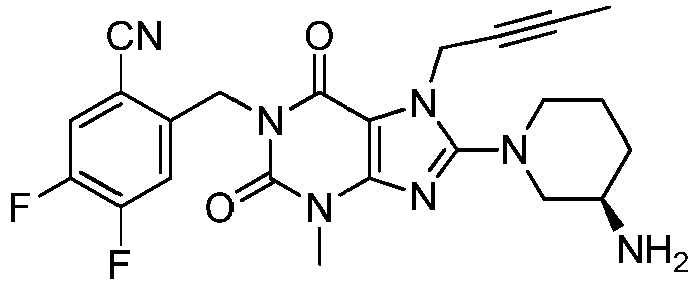
- The preparation of 1-[(4,5-difluoro-benzonitrile-2-yl)methyl]-3-methyl-7-(2-butyne-1-yl)-8-bromoxanthine

- Adding 3-methyl-7-(2-butyne-1-yl)-8-bromoxanthine (2.3 g, 7.9 mmol), potassium carbonate (1.7 g, 12.6 mmol) and 2-bromomethyl-4,5-difluorobenzonitrile (2.0 g, 8.7 mmol) into a 100mL round-bottom flask, adding 25 mL of N,N-dimethylformamides in, heating to 80°C and stirring for 5 hours; after the reaction was completed, pouring the reaction liquid into ice water to precipitate solid, filtrating by air pump, washing solid with water, drying to obtain 3.0 g of yellowish solid, with a yield of 86%. ES-API(m/z):[M+H]+ 448.0.
-

- Adding 1-[(4,5-difluoro-benzonitrile-2-yl)methyl]-3-methyl-7-(2-butyne-1-yl)-8-bromoxanthine (2.3 g, 5.1 mmol), potassium carbonate (1.4 g, 10.4 mmol) and 3-(R)-t-butyloxycarbonyl-aminopiperidine (1.1 g, 5.5 mmol) into a 50ml round-bottom flask, adding 25 mL of N,N-dimethylformamides in, heating to 80°C and stirring for 5 hours; after the reaction was completed, cooling to room temperature, pouring the reaction liquid into ice water to precipitate solid, filtrating by air pump and vacuum drying to obtain 2.2 g of yellowish solid, with a yield of 76%. ES-API(m/z):[M+H]+ 568.2.
-

- Dissolving the compound 1-[(4,5-difluoro-benzonitrile-2-yl)methyl]-3-methyl-7-(2-butyne-1-yl)-8-[(R)-3-t-butyloxycarbon ylamino-piperidine-1-yl]-xanthine (0.4 g, 0.7 mmol) in dichrolomethane (8 ml), dropping trifluoroacetic acid (2 ml) in at room temperature to react for 1 hour at room temperature. After adding dichloromethane (10ml) to dilute the reaction solution, washing with potassium carbonate aqueous solution with pH of 10, extracting with dichloromethane, drying with organic phase with anhydrous magnesium sulfate, filtering and concentrating. Separating and purifying residue thin layer chromatography (methylene chloride: methanol=20:1) to obtain compound
- 1-[(4 ,5-difluoro-benzonitrile-2-yl)methyl]-3-methyl-7-(2-butyne-1-yl)-8-[(R)-3-amino-piperidine-1-yl]-xanthine (0.26 g, yellow solid),with a yield of 79%. ES-API(m/z):[M+H]+468.2.
- 1H NMR (400 MHz, DMSO) δ 8.18 (m, 1H), 7.42 (m, 1H), 5.16 (s, 2H), 4.89 (s, 2H), 3.62 (m, 2H), 3.38 (s, 3H), 2.99 (m, 1H), 2.90-2.73 (m, 2H), 1.93 - 1.71 (m, 5H), 1.70 - 1.53 (m, 1H), 1.35 - 1.24 (m, 1H).
- The preparation of 1-[(3-cyano-pyrazine-2-yl)methyl]-3-methyl-7-(2-butyne-1-yl)-8-[(R)-3-amino-piperidine-1-yl]-x anthine

-

- Adding 3-methyl-7-(2-butyne-1-yl)-8-bromoxanthine (0.71 g, 2.4 mmol), potassium carbonate (0.53 g, 3.8 mmol) and 2-bromomethyl-3-cyano-pyrazine (0.52 g, 2.6 mmol) into a 50ml round-bottom flask, adding 5 mL of N,N-dimethylformamides in, heating to 80°C and stirring for 5 hours; after the reaction was completed, pouring the reaction liquid into ice water to precipitate solid, filtrating by air pump, washing solid with water and dry to obtain 0.88 g of yellowish solid, with a yield of 89%. ES-API(m/z):[M+H]+ 414.0.
-

- Adding 1-[(3-cyano-pyrazine-2-yl)methyl]-3-methyl-7-(2-butyne-1-yl)-8-bromoxanthine (0.23 g, 0.78 mmol), potassium carbonate (0.22 g, 1.6 mmol) and 3-(R)-t-butyloxycarbonyl-aminopiperidine (0.17 g, 0.85 mmol) into a 10ml round-bottom flask, adding 5 mL of N,N-dimethylformamides in, heated to 80°C and stirred for 5 hours; after the reaction was completed, it was cooled to room temperature, the reaction liquid was poured into ice water to precipitate solid, and suction filtration and vacuum drying were carried out to obtain 0.35 g yellowish solid, with the yield of 85%. ES-API(m/z):[M+H]+ 534.3.
-

- Dissolving the compound 1-[(3-cyano-pyrazine-2-yl)methyl]-3-methyl-7-(2-butyne-1-yl)-8-[(R)-3-t-butyloxycarbonylamin o-piperidine-1-yl]-xanthine (0.31 g, 0.6 mmol) in dichrolomethane (8 ml), dropping trifluoroacetic acid (2 ml) in at room temperature to react for 1 hour at room temperature. After adding dichloromethane (10 ml) to dilute the reaction solution, washing with potassium carbonate aqueous solution with pH of 10, extracting with dichloromethane, drying organic phase with anhydrous magnesium sulfate, filtering and concentrating. Separating and purifying residue with thin layer chromatography (methylene chloride:methanol=20:1) to obtain compound
- 1-[(3-cyano-pyrazine-2-yl)methyl]-3-methyl-7-(2-butyne-1-yl)-8-[(R)-3-amino-piperidine-1-yl]-x anthine (0.19 g, yellow solid), with a yield of 74%. ES-API(m/z):[M+H]+434.2.
- 1H NMR (400 MHz, DMSO) δ 8.84 (m, 1H), 8.75 (m, 1H), 5.38 (s, 2H), 4.89 (s, 2H), 3.71 - 3.53 (m, 2H), 3.37 (s, 3H), 3.07 - 2.97 (m, 1H), 2.90 (m, 1H), 2.81 (m, 1H), 1.93 - 1.73 (m, 5H), 1.70 - 1.56 (m, 1H), 1.32 - 1.22 (m, 1H).
- 1-[(3-methoxycarbonyl-pyridine-2-yl)methyl]-3-methyl-7-(2-butyne-1-yl)-8-[(R)-3-aminopiperidine-1-yl]-xanthine

-

- Adding 3-methyl-7-(2-butyne-1-yl)-8-bromoxanthine (2.0 g, 6.7 mmol), potassium carbonate (1.5 g, 12.6 mmol) and 2-bromomethyl-3-methoxycarbonyl-pyridine (1.7 g, 7.4 mmol) into a 100ml round-bottom flask, adding 20 mL of N,N-dimethylformamides in, heating to 80°C and stirring for 5 hours; after the reaction was completed, pouring the reaction liquid into ice water to precipitate solid, filtrating by air pump, washing solid with water and drying to obtain 2.5 g of yellowish solid, with a yield of 83%. ES-API(m/z):[M+H]+ 446.0.
-

- Adding [(3-methoxycarbonyl-pyridine-2-yl)methyl]-3-methyl-7-(2-butyne-1-yl)-8-bromoxanthine (1.2 g, 2.7 mmol), potassium carbonate (0.74 g, 5.4 mmol) and 3-(R)-t-butyloxycarbonyl-aminopiperidine (0.61 g, 3.1 mmol) into a 50 ml round-bottom flask, adding 10 mL of N,N-dimethylformamides in, heating to 80°C and stirring for 5 hours; after the reaction was completed, cooling to room temperature, pouring the reaction liquid into ice water to precipitate solid, filtrating by air pump and vacuum drying to obtain 1.2 g of yellowish solid, with a yield of 80%. ES-API(m/z):[M+H]+ 566.3.
-

- 1H NMR (400 MHz, DMSO) δ 8.59 (m, 1H), 8.30 (m, 1H), 7.44 (m, 1H), 5.48 (s, 2H), 4.89 (s, 2H), 3.94 (s, 3H), 3.61 (m, 2H), 3.38 (s, 3H), 3.00 (m, 2H), 2.87 - 2.77 (m, 1H), 1.94 - 1.72 (m, 5H), 1.71 - 1.57 (m, 1H), 1.36 - 1.25 (m, 1H).
- One tablet core contains
hydroxypropyl TSL-0319 5 mg 15 mg methylcellulose calcium magneseum 90 mg 1.5 mg phosphate stearate corn starch 35 mg polyvinyl pyrrolidone 10 mg Total amount 166.5 mg - Mixing the compound TSL-0319 with calcium phosphate, corn starch, polyvinyl pyrrolidone, hydroxypropyl methylcellulose and half of the specified amount of magnesium stearate. Making a tablet with 13 mm in diameter, then making the tablet rub through a sieve mesh with a size of 1.5 mm with an appropriate machine and be mixed with the rest of magnesium stearate. Compressing the granules in the tableting machine to form tablets in desired shape.
- Core weight: 166.5 mg, plunger chip: 9 mm, convex type
- The tablet core made by such way is coated with a film substantially made of hydroxypropyl methylcellulose. Film coating finished at last is polished with beeswax.
- The weight of coated tablets is 175 mg.
-
Compound 5 g TSL-0319 Starch 400 g Microcrystalline 200 g cellulose - According to the conventional method, after being evenly mixed, the obtained pharmaceutical composition is enclosed into ordinary gelatine capsules to obtain 1000 capsules. Capsules containing 5 mg of compound TSL-0319 were obtained according to this method.
- DPP-IV could hydrolyze Gly-Pro-Aminoluciferin at room temperature to generate Aminoluciferin, which could produce "glow type" luminescent signals in a luciferase reaction system provided by a DPPIV-Glo (TM) protease test kit, and the strength of the luminescent signals was in direct proportion to the enzyme activity of DPP-IV.
- 1. Experimental purposes:
to evaluate the inhibition effects of compounds I-1~I-4 by observing their activity inhibition to DPP-IV enzyme. - 2. Experimental materials:
- 2.1 humanized recombinant DPP-IV: SIGMA product, article number D3446-10UG.
- 2.2 DPPIV-Glo(TM) protease detection kit: Promega product, article number G8351.
- 2.3 Trizma base: Sigma product, article number T6066-1 KG: prepared into 10 mM Tris-HCl, pH 8.0.
- 2.4 384 OptiPlate: PerkinElmer product, article number 6007299.
- 2.5 Liquid treatment instrument: Bravo (Agilent company); Echo (Labcyte company).
- 2.6 Detection instrument: Envision (PerkinElmer company).
- 3. Experimental methods:
- 3.1 Diluting tested samples in a gradient dilution to ten concentrations by DMSO with Bravo, and then transferring 250 nl of samples to 384 OptiPlate with Echo.
- 3.2 Diluting dipeptidyl peptidase IV (Sigma) to 0.2 ng/ml solution with 10 mM Tris-HCl (pH 8.0), adding the samples to be detected in, per well 25 µl. Meanwhile, a blank control (including substrate but no enzyme and samples) and positive control (including substrate and enzyme but no samples) were also set up.
- 3.3 Adding 25 µl of DPPIV-Glo™ Reagent (prepared according to instructions in DPPIV-Glo(TM) protease detection kit, containing 20 µM DPP-IV substrate Gly-Pro-Aminofluorescein and luciferase reaction system) into each well.
- 3.4 Reacting at room temperature for 60 min, determining the luminescence intensity by Envision.
- 3.5 Calculating the enzyme activity of DPP-IV according to the luminescence intensity, enzyme activity=(sample luminescence intensity values - blank control luminescence intensity values/(positive control luminescence intensity values-blank control luminescence intensity values)× 100.
- 3.6 Calculating IC50 of the samples according to the enzyme activity using GraphPad Prism5.0 software.
-
Table 1 IC50 values of compounds I-1~I-4 and linagliptin Compound code Compound structure IC50 (nM) I-1 
0.24 I-2 (Reference) 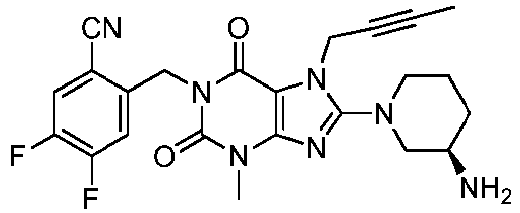
2.1 I-3 
0.08 I-4 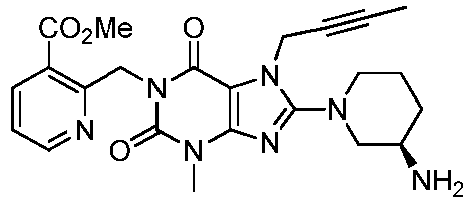
4.8 Positive control Linagliptin 0.21 - According to the above results, compound I-3 of the present invention has better activity than linagliptin, and other compounds I-1, I-2 and I-4 have similar activity to ligulitine.
-
- 1. Experimental purposes:
to observe the enzyme activity inhibition effect of the compound I-3 (hereinafter referred to as TSL-0319 for short) of the present invention on dipeptidyl peptidase, and compare with selectivity of marketed drugs of the same kind. - 2. Experimental materials:
2.1 humanized recombinant DPP-IV, DPP8 and DPP9 enzymes, other experimental materials were the same as those in experiment example (I). - 3. Experimental methods: being the same as the experiment example (I)
- 4. Experimental results
- According to the above results, the compound TSL-0319 of the present invention only shows inhibition effect to DPP4, and shows no inhibition effect to DPP8 and DPP9. Simultaneously the selectivity of compound TSL-0319 was significantly superior to the selectivity of the marketed products of the same kind.
-
1. Experimental drugs: compound I-3 (referred to as TSL-0319 for short) and linagliptin
2. Experimental method: normal mice, obese mice and diabetic mice were used for studying glucose tolerance tests
Experimental process of OGTT(Oral Glucose Tolerance Test): fasting for 6 hours before the test begins, 60 min after drug administration, glucose was administrated by gavage (drug concentration 0.6 mg/ml,administration volume 5 ml/kg) (2 g/kg glucose was administrated to diabetic mice; 2 g/kg glucose was administrated to obese mice; and 5 g/kg glucose was administrated to normal mice), blood glucose values at 0 min, 15 min, 30 min, 45 min, 60 min and 120 min are respectively determined after glucose administration,
3. Experimental results: - The glucose tolerance test of normal mice was shown in table 3,
figures 1-2 , compound I-3 of the present invention (called TSL-0319 for short) has good hypoglycemic effect, especially better than that of linagliptin. - The glucose tolerance test of obese mice was shown in table 4,
figures 3-4 , compound I-3 of the present invention (called TSL-0319 for short) had good hypoglycemic effect, especially better than that of linagliptin. - The glucose tolerance test of obese mice was shown in table 5,
figures 5-6 , compound I-3 of the present invention (called TSL-0319 for short) had good hypoglycemic effect, especially better than that of linagliptin. - 1. Test method: testing the effect of the compounds on hERG sodium current in stable CHO cell lines transfected hERG sodium channels by manual patch clamp method, and then calculating IC50 value of the compounds to hERG.
- Conventional Patch-Clamp was a technology that has been disclosed, was the most important technical means for studying ion channels and was universally recognized as the "gold standard" for ion channel researches and was the most accurate method for measuring ion channel. It was applicable to study the action mechanism of the effect of compound and the ion channel, and also could be used for toxicity evaluation and structure optimization of candidate drugs in the process of new drugs.
- In cardiomyocytes, human Ether-a-go-go Related Gene (hERG) coded potassium channel mediates a delayed rectification potassium current (IKr), IKr inhibition was the most important mechanism leading to QT interval prolongation by drugs. hERG could be inhibited by compounds of diversified structures, due to its specific molecular structure. Currently, testing effects of compounds on hERG potassium channel was a critical step in pre-clinical evaluation of cardiac safety of compounds, and was indispensable material for new drugs registration required by FDA.
- The effects of compounds on hERG could be tested and relevant IC50 could be determined by conventional patch-clamp, using CHO cell lines that had been stably transfected hERG potassium channel.
- 2. Experimental results: IC50 of TSL-0319 to hERG was 79.80 µM in the hERG experiments. (IC50 of linagliptin to hERG was not reported, it was only mentioned that the inhibition rate to hERG was 3% under 1 µM concentration; and the inhibition rate of TSL-0319 to hERG was 0% under 1 µM concentration.)
- Calculated according to requirement of 20 times more than Cmax, when the dosage of TSL-0319 is 5 mg/kg, Cmax in mice was 200-500 nM, IC50 to hERG should be more than 20 µM, therefore, TSL-0319 was safe in hERG toxicity, and was significantly better than linagliptin.
- 1. Test method: human liver microsomes were used to carry out inhibition activity test of the compounds to CYP enzyme.
- With the system for incubating human liver microsomes in vitro, the content variation of phenacetin, diclofenac, S-mephenytoin, dextromethorphan and midazolam, which were substrates of human liver microsomes CYP1A2, CYP2C9, CYP2C19, CYP2D6, CYP3A4, were measured simultaneously by cocktail probe drug method (which is a disclosed technology), the effects of TSL-0319 under different concentrations on activity of human liver microsomes CYP1A2, CYP2C9, CYP2C19, CYP2D6, CYP3A4 subtypes are evaluated and relavant IC50 was measured.
- 2.Experimental results:
Table 6 inhibition rates of different concentrations of TSL-0319 to CYP enzyme TSL-0319 concentration µM 0 0.0 5 0.1 5 0.5 1.5 5 15 50 Inhibition rate (%) to CYP1A2 0 0 0 2.2 4.2 6.6 20. 8 41. 8 Inhibition rate (%) to CYP2C9 0 0 0 3.2 5.7 10. 5 12. 1 13. 9 Inhibition rate (%) to CYP2C19 0 0 3.3 8.2 14 2.9 Inhibition rate (%) to CYP2D6 0 0 0 0 0 0 3 14. 6 Inhibition rate (%) to CYP3A4 0 0 0 4 4.4 8.7 17. 9 44. 6 -
1. Dosage regimen:
Six healthy CD-1 mice of 7-10 weeks old were randomly separated into two groups. 2 mg/kg and 5 mg/kg TSL-0319 were administrated respectively by intravenous injection and by gavage ( 2 mg/ml for intravenous injection, made into transparent solution with solution of DMSO/PEG400/H2O=20/60/20; 5 mg/ml for gavage; made into transparent solution with solution of PEG400/Tween80/H2O=40/10/50); fasting for 12 hours but free drinking before administration; blood was taken from the great saphenous vein or submaxillary veins by time points (time points for taking blood of intravenous injection: 0h, 0.0833h, 0.250h, 0.500h, 1.00h, 2.00h, 4.00h, 8.00h, 12.00h and 24.00h; time points for taking blood of gavage: 0h, 0.250h, 0.500h, 1.00h, 2.00h, 4.00h, 8.00h, 12.00h and 24.00h)before and after administration, lower limit of quantitation, LLOQ was set at 3ng/ml.
2. Experimental results: see table 7Table 7 pharmacokinetics experimental data of TSL-0319 Time points for taking blood of intravenous injection (h) Plasma drug concentration (ng/ml) Time points for taking blood of gavage (h) Plasma drug concentration (ng/ml) 0.00833 759±133 0.250 529±93.4 0.250 48.0±27.9 0.500 344±32.7 0.500 123±30.2 1.00 161±21.2 1.00 183±19.1 2.00 47.5±13.6 2.00 211±83.0 4.00 11.9±2.24 4.00 145±40.9 8.00 BQL 8.00 8.03±3.71 12.00 BQL 12.00 BQL 24.00 BQL 24.00 BQL Average pharmacokinetics parameters of intravenous injection Average pharmacokinetics parameters of gavage T1/2(h) 1.09±0.623 Cmax(ng/ml) 223±68.1 Vdss(L/kg) 3.41±0. 745 Tmax(h) 1.33±0.577 CL(ml/min/kg) 59.1±5.63 T1/2(h) 1.37±0.317 AUC0-last(ng.h/ml) 555±54.7 AUC0-last(ng.h/ml) 844±181 AUC0-inf(ng.h/ml) 567±56.1 AUC0-inf(ng.h/ml) 858±185 MRT0-last(h) 0.836±0.0919 MRT0-last(h) 2.87±0.0589 MRT0-inf(h) 0.953±0.123 MRT0-inf(h) 3.00±0.111 Bioavailability(%) 60.5
3. Conclusions:
CD-1 mice were used to do pharmacokinetics experiments of TSL-0319, its T1/2 was greatly different from disclosed data of linagliptin while being compared, due to the setting of blood taking points and LLOQ, but the bioavailability of 60.5% was much higher than that of linagliptin under the same condition(CD-1 mice were used to do pharmacokinetics experiments of linagliptin, 5mg/kg, oral administration, and the bioavailability was 18.4%). The structures of the compounds I-1 and I-4 in the present invention were similar to that of I-3, therefore compounds I-1 and I-4 all had the same pharmacodynamic effects with compound I-3.
| Compoun d | DPP4 IC50(nM) | DPP8 IC50(nM) | DPP9 IC50(nM) |
| TSL-0319 | 0.08 | >100000 Selectivity> 125000 0 | >100000 Selectivity> 125000 0 |
| Linagliptin | 0.21 | 40000 Selectivity> 190000 | 11000 Selectivity>50000 |
| Sitagliptin | 17 | Selectivity>2600 | Selectivity>5550 |
| Saxaglipti n | 26 | Selectivity>390 | Selectivity>77 |
| Vildagliptin | 2.3 | Selectivity>270 | Selectivity>32 |
| Groups | Blood glucose concentrations (mmol/L) | ||||||
| 0 min | 15 min | 30 min | 45 min | 60 min | 120 min | AUC0-120 min | |
| Blank | 10.4 | 20.8 | 16.4 | 15.7 | 13.8 | 8.5 | 1646 |
| Linagliptin compared with Blank | 8.64* | 14.7*** | 10.5*** | 9.5*** | 10.14*** | 7.72 | 1198*** |
| P<0.05 | P<0.00 1 | P<0.00 1 | P<0.001 | P<0.00 1 | P>0.0 5 | P<0.001 | |
| TSL-0319 compared with Blank | 8.88* | 14.6*** | 11.0*** | 9.23*** | 9.82*** | 7.58 | 1185*** |
| P<0.05 | P<0.00 1 | P<0.00 1 | P<0.001 | P<0.00 1 | P>0.0 5 | P<0.001 | |
| *: P < 0.05 vs blank group; **: P < 0.01 vs blank group; ***: P < 0.001 vs blank group |
| Groups | Blood glucose concentrations(mmol/L) | ||||||
| 0 min | 15 min | 30 min | 45 min | 60 min | 120 min | AUC0-120 min | |
| Model | 14.14 | 36.33 | 28.35 | 25.03 | 22.33 | 16.15 | 2773 |
| Linagliptin compared with Model | 10.95 | 31.73 | 27.98 | 20.50 | 16.00* | 11.50 | 2230 |
| P>0.05 | P>0.05 | P>0.05 | P>0.05 | P<0.05 | P>0.05 | P>0.05 | |
| TSL-0319 compared with Model | 10.90 | 32.88 | 25.93 | 17.03** | 13.88** | 9.53* | 2025* |
| P>0.05 | P>0.05 | P>0.05 | P<0.01 | P<0.01 | P<0.05 | P<0.05 | |
| *: P < 0.05 vs model group; **:P < 0.01 vs model group |
| Groups | Blood glucose concentrations(mmol/L) | ||||||
| 0 min | 15 min | 30 min | 45 min | 60 min | 120 min | AUC0-120 min | |
| Model: | 17.03 | 36.68 | 29.85 | 27.00 | 24.80 | 16.50 | 2956 |
| Linagliptin | 12.09 | 29.98* | 20.15*** | 16.60*** | 15.83** | 10.05* | 1987** |
| compared with Model | P>0.05 | P<0.05 | P<0.00 1 | P<0.00 1 | P<0.01 | P<0.05 | P<0.01 |
| TSL-0319 compared with Model | 11.84 | 32.23 | 22.80* | 15.70*** | 13.80** | 8.75** | 1930** |
| P>0.05 | P>0.05 | P<0.05 | P<0.00 1 | P<0.00 1 | P<0.01 | P<0.01 | |
| *: P < 0.05 vs model group; **:P < 0.01 vs model group; ***:P < 0.001 vs model group |
4. Conclusions:
In the glucose metabolism tests in vivo, normal mice, obese mice and diabetic mice are used for study, the compound I-3 of the present invention(called TSL-0319 for short) has hypoglycemic effects on the three kinds of mice and hypoglycemic effects are better than that of the linagliptin.
Claims (10)
- A xanthine derivative as shown in formula I and solvates thereof or their pharmaceutically acceptable salts,
 R is selected from:
 R1 is methoxycarbonyl;R2 is selected from hydrogen, halogen atoms, a linear or branched chain C1-6 alkyl group which is substituted or unsubstituted by 1 to 5 halogen atoms, a linear or branched C1-6 alkoxy which is substituted or unsubstituted by 1 to 5 halogen atoms;X and Y are each independently selected from C or N; andn is 0, 1, 2, 3 or 4.
 - The xanthine derivatives according to claim 1, wherein R2 is selected from hydrogen, halogen atoms, methyl, ethyl, isopropyl, methoxy, ethoxy, trifluoromethyl and trifluoromethoxy; and n is 0, 1 or 2.
- The xanthine derivatives according to claim 2, wherein R2 is selected from hydrogen, chlorine atom, fluorine atom, bromine atom, methyl and methoxy.
- The xanthine derivatives according to claim 3, wherein R2 is selected from hydrogen or fluorine atom.
- The xanthine derivative according to claim 1, wherein the xanthine derivative is:

- A xanthine derivative as shown in formula I-1 or formula 1-3 and solvates thereof or their pharmaceutically acceptable salts and solvates thereof:


- The xanthine derivatives according to any one of claims 1 to 6, wherein the pharmaceutically acceptable salts are salts formed by xanthine derivatives or their solvates with acids selected from the following: hydrochloric acid, p-toluene sulfonic acid, tartaric acid, maleic acid, lactic acid, methanesulfonic acid, sulfuric acid, phosphoric acid, citric acid, acetic acid or trifluoroacetic acid.
- A pharmaceutical composition containing the xanthine derivatives and solvates thereof or their pharmaceutically acceptable salts of any one of claims 1 to 6 as active ingredients, wherein the active ingredients account for 0.1-99.9% of the total weight of the pharmaceutical composition.
- Xanthine derivatives and solvates thereof or their pharmaceutically acceptable salts of any one of claims 1 to 6 for use as a medicament.
- Xanthine derivatives and solvates thereof or their pharmaceutically acceptable salts of any one of claims 1 to 6 for use in treating type II diabetes, hyperglycemia, obesity, insulin resistance or impaired glucose tolerance.
Applications Claiming Priority (2)
| Application Number | Priority Date | Filing Date | Title |
|---|---|---|---|
| CN201510290336 | 2015-05-29 | ||
| PCT/CN2016/083406 WO2016192559A1 (en) | 2015-05-29 | 2016-05-26 | Xanthine derivative |
Publications (3)
| Publication Number | Publication Date |
|---|---|
| EP3305787A1 EP3305787A1 (en) | 2018-04-11 |
| EP3305787A4 EP3305787A4 (en) | 2018-11-21 |
| EP3305787B1 true EP3305787B1 (en) | 2022-02-16 |
Family
ID=57440191
Family Applications (1)
| Application Number | Title | Priority Date | Filing Date |
|---|---|---|---|
| EP16802482.6A Not-in-force EP3305787B1 (en) | 2015-05-29 | 2016-05-26 | Xanthine derivative |
Country Status (14)
| Country | Link |
|---|---|
| US (1) | US10358449B2 (en) |
| EP (1) | EP3305787B1 (en) |
| JP (1) | JP6742345B2 (en) |
| KR (1) | KR20180011270A (en) |
| CN (2) | CN106188058B (en) |
| AU (1) | AU2016270100B2 (en) |
| CA (1) | CA2987697A1 (en) |
| ES (1) | ES2908658T3 (en) |
| IL (1) | IL255829B (en) |
| MY (1) | MY186396A (en) |
| RU (1) | RU2709348C2 (en) |
| SG (1) | SG11201709782SA (en) |
| TW (1) | TWI682931B (en) |
| WO (1) | WO2016192559A1 (en) |
Families Citing this family (2)
| Publication number | Priority date | Publication date | Assignee | Title |
|---|---|---|---|---|
| CN105983016B (en) | 2015-03-23 | 2023-08-11 | 天士力医药集团股份有限公司 | A drug combination containing silibinin |
| JP2024504328A (en) * | 2021-01-21 | 2024-01-31 | ザ スクリプス リサーチ インスティテュート | Small molecule regulators of alveolar type 2 cell proliferation for the treatment of lung diseases |
Family Cites Families (14)
| Publication number | Priority date | Publication date | Assignee | Title |
|---|---|---|---|---|
| TW492957B (en) | 1996-11-07 | 2002-07-01 | Novartis Ag | N-substituted 2-cyanopyrrolidnes |
| US6110949A (en) | 1999-06-24 | 2000-08-29 | Novartis Ag | N-(substituted glycyl)-4-cyanothiazolidines, pharmaceutical compositions containing them and their use in inhibiting dipeptidyl peptidase-IV |
| DE60323823D1 (en) * | 2002-01-11 | 2008-11-13 | Novo Nordisk As | METHOD AND COMPOSITION FOR THE TREATMENT OF DIABETES, HYPERTENSION, CHRONIC HEART FAILURE AND LIQUID RETENTION CONDITIONS |
| US7482337B2 (en) * | 2002-11-08 | 2009-01-27 | Boehringer Ingelheim Pharma Gmbh & Co. Kg | Xanthine derivatives, the preparation thereof and their use as pharmaceutical compositions |
| DE102004008112A1 (en) * | 2004-02-18 | 2005-09-01 | Boehringer Ingelheim Pharma Gmbh & Co. Kg | New 8-aminopiperidinyl-xanthine derivatives, useful for treating e.g. diabetes, arthritis and osteoporosis, are inhibitors of dipeptidylpeptidase-IV |
| US7501426B2 (en) * | 2004-02-18 | 2009-03-10 | Boehringer Ingelheim International Gmbh | 8-[3-amino-piperidin-1-yl]-xanthines, their preparation and their use as pharmaceutical compositions |
| AU2005219508B2 (en) * | 2004-02-18 | 2012-02-16 | Boehringer Ingelheim International Gmbh | 8-[3-amino-piperidin-1-yl]-xanthine, the production thereof and the use in the form of a DPP inhibitor |
| DE102004054054A1 (en) * | 2004-11-05 | 2006-05-11 | Boehringer Ingelheim Pharma Gmbh & Co. Kg | Process for preparing chiral 8- (3-amino-piperidin-1-yl) -xanthines |
| DE102005035891A1 (en) * | 2005-07-30 | 2007-02-08 | Boehringer Ingelheim Pharma Gmbh & Co. Kg | 8- (3-amino-piperidin-1-yl) -xanthines, their preparation and their use as pharmaceuticals |
| PE20100156A1 (en) * | 2008-06-03 | 2010-02-23 | Boehringer Ingelheim Int | NAFLD TREATMENT |
| UY32030A (en) * | 2008-08-06 | 2010-03-26 | Boehringer Ingelheim Int | "TREATMENT FOR DIABETES IN INAPPROPRIATE PATIENTS FOR THERAPY WITH METFORMIN" |
| KR101657960B1 (en) * | 2008-08-15 | 2016-09-20 | 베링거 인겔하임 인터내셔날 게엠베하 | Purin derivatives for use in the treatment of FAB-related diseases |
| UY32177A (en) * | 2008-10-16 | 2010-05-31 | Boehringer Ingelheim Int | TREATMENT OF DIABETES IN PATIENTS WITH INSUFFICIENT GLUCEMIC CONTROL TO WEIGHT THERAPY WITH DRUG, ORAL OR NOT, ANTIDIABÉTICO |
| CN103172633B (en) * | 2011-12-22 | 2016-08-03 | 成都地奥制药集团有限公司 | A kind of compound and its production and use |
-
2016
- 2016-05-25 CN CN201610356576.0A patent/CN106188058B/en active Active
- 2016-05-25 TW TW105116298A patent/TWI682931B/en not_active IP Right Cessation
- 2016-05-26 JP JP2017561869A patent/JP6742345B2/en not_active Expired - Fee Related
- 2016-05-26 KR KR1020177037626A patent/KR20180011270A/en not_active Ceased
- 2016-05-26 ES ES16802482T patent/ES2908658T3/en active Active
- 2016-05-26 US US15/577,946 patent/US10358449B2/en active Active
- 2016-05-26 WO PCT/CN2016/083406 patent/WO2016192559A1/en not_active Ceased
- 2016-05-26 AU AU2016270100A patent/AU2016270100B2/en not_active Ceased
- 2016-05-26 CN CN201680031442.XA patent/CN107709324B/en active Active
- 2016-05-26 CA CA2987697A patent/CA2987697A1/en active Pending
- 2016-05-26 MY MYPI2017704554A patent/MY186396A/en unknown
- 2016-05-26 EP EP16802482.6A patent/EP3305787B1/en not_active Not-in-force
- 2016-05-26 RU RU2017145919A patent/RU2709348C2/en active
- 2016-05-26 SG SG11201709782SA patent/SG11201709782SA/en unknown
-
2017
- 2017-11-21 IL IL255829A patent/IL255829B/en active IP Right Grant
Also Published As
| Publication number | Publication date |
|---|---|
| JP6742345B2 (en) | 2020-08-19 |
| SG11201709782SA (en) | 2017-12-28 |
| MY186396A (en) | 2021-07-22 |
| EP3305787A4 (en) | 2018-11-21 |
| CN106188058A (en) | 2016-12-07 |
| RU2709348C2 (en) | 2019-12-18 |
| RU2017145919A3 (en) | 2019-08-09 |
| TWI682931B (en) | 2020-01-21 |
| CA2987697A1 (en) | 2016-12-08 |
| EP3305787A1 (en) | 2018-04-11 |
| JP2018520120A (en) | 2018-07-26 |
| TW201643166A (en) | 2016-12-16 |
| IL255829B (en) | 2021-02-28 |
| WO2016192559A1 (en) | 2016-12-08 |
| HK1245796A1 (en) | 2018-08-31 |
| RU2017145919A (en) | 2019-07-02 |
| US10358449B2 (en) | 2019-07-23 |
| CN106188058B (en) | 2020-11-06 |
| KR20180011270A (en) | 2018-01-31 |
| ES2908658T3 (en) | 2022-05-03 |
| AU2016270100A1 (en) | 2017-12-14 |
| CN107709324B (en) | 2021-06-08 |
| CN107709324A (en) | 2018-02-16 |
| US20180162860A1 (en) | 2018-06-14 |
| IL255829A (en) | 2018-01-31 |
| AU2016270100B2 (en) | 2020-02-13 |
Similar Documents
| Publication | Publication Date | Title |
|---|---|---|
| EP3104706B1 (en) | Compositions and methods using the same for treatment of neurodegenerative and mitochondrial disease | |
| EP2070926A1 (en) | 13,13a-DIHYDROBERBERINE DERIVATIVES, THEIR PHARMACEUTICAL COMPOSITION AND USE | |
| EP2786998B1 (en) | Thienyl [3, 2-d]pyrimidin-4-one compounds, preparation method, pharmaceutical compositions and use thereof | |
| US20240091210A1 (en) | Use of 5-[[4-[2-[5-acetylpyridin-2-yl]ethoxy]benzyl]-1,3-thiazolidine-2,4-dione and its salts | |
| EP3214079B1 (en) | Six-membered ring benzo derivatives as dpp-4 inhibitor and use thereof | |
| US10155775B2 (en) | Substituted amino six-membered saturated heteroalicycles as long-acting DPP-IV inhibitors | |
| US20230364094A1 (en) | Deuterated ruc-4 | |
| AU2018290225A1 (en) | Compositions and methods using the same for treatment of neurodegenerative and mitochondrial disease | |
| US20130345243A1 (en) | 1h-pyrollo[3,2-d]pyrimidinedione derivatives | |
| US10358449B2 (en) | Xanthine derivative | |
| EP2436684A1 (en) | Salts of methyl (r)-7-[3-amino-4-(2,4,5-trifluoro-phenyl)-butyryl]-3-trifluoromethyl-5,6,7,8-tetrahydro-imidazo[1,5-a]pyrazine-1-carboxylate | |
| HK1245796B (en) | Xanthine derivative | |
| EP2992883B1 (en) | Pharmaceutical use of hexahydro-dibenzo[a,g]quinolizine compounds | |
| CN115087643B (en) | Condensed and heterocyclic compounds and their preparation methods and medicinal uses | |
| CN113234013B (en) | A compound for inhibiting collagen synthesis and deposition and its application | |
| CN120271673A (en) | Compound, pharmaceutical composition containing same and application of compound | |
| CN120271664A (en) | Compound, pharmaceutical composition containing same and application of compound | |
| CN112826821A (en) | Application of allopurinol derivative in preparation of medicine for preventing and/or treating diabetes | |
| CN113493471A (en) | Heteroaromatic kinase inhibitors |
Legal Events
| Date | Code | Title | Description |
|---|---|---|---|
| STAA | Information on the status of an ep patent application or granted ep patent |
Free format text: STATUS: THE INTERNATIONAL PUBLICATION HAS BEEN MADE |
|
| PUAI | Public reference made under article 153(3) epc to a published international application that has entered the european phase |
Free format text: ORIGINAL CODE: 0009012 |
|
| STAA | Information on the status of an ep patent application or granted ep patent |
Free format text: STATUS: REQUEST FOR EXAMINATION WAS MADE |
|
| 17P | Request for examination filed |
Effective date: 20171220 |
|
| AK | Designated contracting states |
Kind code of ref document: A1 Designated state(s): AL AT BE BG CH CY CZ DE DK EE ES FI FR GB GR HR HU IE IS IT LI LT LU LV MC MK MT NL NO PL PT RO RS SE SI SK SM TR |
|
| AX | Request for extension of the european patent |
Extension state: BA ME |
|
| REG | Reference to a national code |
Ref country code: HK Ref legal event code: DE Ref document number: 1245796 Country of ref document: HK |
|
| DAV | Request for validation of the european patent (deleted) | ||
| DAX | Request for extension of the european patent (deleted) | ||
| RIC1 | Information provided on ipc code assigned before grant |
Ipc: C07D 473/06 20060101AFI20181010BHEP Ipc: A61K 31/522 20060101ALI20181010BHEP Ipc: A61P 3/10 20060101ALI20181010BHEP |
|
| A4 | Supplementary search report drawn up and despatched |
Effective date: 20181022 |
|
| GRAP | Despatch of communication of intention to grant a patent |
Free format text: ORIGINAL CODE: EPIDOSNIGR1 |
|
| STAA | Information on the status of an ep patent application or granted ep patent |
Free format text: STATUS: GRANT OF PATENT IS INTENDED |
|
| INTG | Intention to grant announced |
Effective date: 20210930 |
|
| GRAS | Grant fee paid |
Free format text: ORIGINAL CODE: EPIDOSNIGR3 |
|
| GRAA | (expected) grant |
Free format text: ORIGINAL CODE: 0009210 |
|
| STAA | Information on the status of an ep patent application or granted ep patent |
Free format text: STATUS: THE PATENT HAS BEEN GRANTED |
|
| AK | Designated contracting states |
Kind code of ref document: B1 Designated state(s): AL AT BE BG CH CY CZ DE DK EE ES FI FR GB GR HR HU IE IS IT LI LT LU LV MC MK MT NL NO PL PT RO RS SE SI SK SM TR |
|
| REG | Reference to a national code |
Ref country code: GB Ref legal event code: FG4D |
|
| REG | Reference to a national code |
Ref country code: CH Ref legal event code: EP |
|
| REG | Reference to a national code |
Ref country code: DE Ref legal event code: R096 Ref document number: 602016069177 Country of ref document: DE |
|
| REG | Reference to a national code |
Ref country code: AT Ref legal event code: REF Ref document number: 1468814 Country of ref document: AT Kind code of ref document: T Effective date: 20220315 |
|
| REG | Reference to a national code |
Ref country code: IE Ref legal event code: FG4D |
|
| REG | Reference to a national code |
Ref country code: NL Ref legal event code: FP |
|
| REG | Reference to a national code |
Ref country code: ES Ref legal event code: FG2A Ref document number: 2908658 Country of ref document: ES Kind code of ref document: T3 Effective date: 20220503 |
|
| REG | Reference to a national code |
Ref country code: LT Ref legal event code: MG9D |
|
| PGFP | Annual fee paid to national office [announced via postgrant information from national office to epo] |
Ref country code: NL Payment date: 20220518 Year of fee payment: 7 |
|
| REG | Reference to a national code |
Ref country code: AT Ref legal event code: MK05 Ref document number: 1468814 Country of ref document: AT Kind code of ref document: T Effective date: 20220216 |
|
| PG25 | Lapsed in a contracting state [announced via postgrant information from national office to epo] |
Ref country code: SE Free format text: LAPSE BECAUSE OF FAILURE TO SUBMIT A TRANSLATION OF THE DESCRIPTION OR TO PAY THE FEE WITHIN THE PRESCRIBED TIME-LIMIT Effective date: 20220216 Ref country code: RS Free format text: LAPSE BECAUSE OF FAILURE TO SUBMIT A TRANSLATION OF THE DESCRIPTION OR TO PAY THE FEE WITHIN THE PRESCRIBED TIME-LIMIT Effective date: 20220216 Ref country code: PT Free format text: LAPSE BECAUSE OF FAILURE TO SUBMIT A TRANSLATION OF THE DESCRIPTION OR TO PAY THE FEE WITHIN THE PRESCRIBED TIME-LIMIT Effective date: 20220616 Ref country code: NO Free format text: LAPSE BECAUSE OF FAILURE TO SUBMIT A TRANSLATION OF THE DESCRIPTION OR TO PAY THE FEE WITHIN THE PRESCRIBED TIME-LIMIT Effective date: 20220516 Ref country code: LT Free format text: LAPSE BECAUSE OF FAILURE TO SUBMIT A TRANSLATION OF THE DESCRIPTION OR TO PAY THE FEE WITHIN THE PRESCRIBED TIME-LIMIT Effective date: 20220216 Ref country code: HR Free format text: LAPSE BECAUSE OF FAILURE TO SUBMIT A TRANSLATION OF THE DESCRIPTION OR TO PAY THE FEE WITHIN THE PRESCRIBED TIME-LIMIT Effective date: 20220216 Ref country code: BG Free format text: LAPSE BECAUSE OF FAILURE TO SUBMIT A TRANSLATION OF THE DESCRIPTION OR TO PAY THE FEE WITHIN THE PRESCRIBED TIME-LIMIT Effective date: 20220516 |
|
| PGFP | Annual fee paid to national office [announced via postgrant information from national office to epo] |
Ref country code: IT Payment date: 20220531 Year of fee payment: 7 Ref country code: GB Payment date: 20220523 Year of fee payment: 7 Ref country code: FR Payment date: 20220523 Year of fee payment: 7 Ref country code: ES Payment date: 20220617 Year of fee payment: 7 Ref country code: DE Payment date: 20220523 Year of fee payment: 7 |
|
| PG25 | Lapsed in a contracting state [announced via postgrant information from national office to epo] |
Ref country code: PL Free format text: LAPSE BECAUSE OF FAILURE TO SUBMIT A TRANSLATION OF THE DESCRIPTION OR TO PAY THE FEE WITHIN THE PRESCRIBED TIME-LIMIT Effective date: 20220216 Ref country code: LV Free format text: LAPSE BECAUSE OF FAILURE TO SUBMIT A TRANSLATION OF THE DESCRIPTION OR TO PAY THE FEE WITHIN THE PRESCRIBED TIME-LIMIT Effective date: 20220216 Ref country code: GR Free format text: LAPSE BECAUSE OF FAILURE TO SUBMIT A TRANSLATION OF THE DESCRIPTION OR TO PAY THE FEE WITHIN THE PRESCRIBED TIME-LIMIT Effective date: 20220517 Ref country code: FI Free format text: LAPSE BECAUSE OF FAILURE TO SUBMIT A TRANSLATION OF THE DESCRIPTION OR TO PAY THE FEE WITHIN THE PRESCRIBED TIME-LIMIT Effective date: 20220216 Ref country code: AT Free format text: LAPSE BECAUSE OF FAILURE TO SUBMIT A TRANSLATION OF THE DESCRIPTION OR TO PAY THE FEE WITHIN THE PRESCRIBED TIME-LIMIT Effective date: 20220216 |
|
| PG25 | Lapsed in a contracting state [announced via postgrant information from national office to epo] |
Ref country code: IS Free format text: LAPSE BECAUSE OF FAILURE TO SUBMIT A TRANSLATION OF THE DESCRIPTION OR TO PAY THE FEE WITHIN THE PRESCRIBED TIME-LIMIT Effective date: 20220617 |
|
| PG25 | Lapsed in a contracting state [announced via postgrant information from national office to epo] |
Ref country code: SM Free format text: LAPSE BECAUSE OF FAILURE TO SUBMIT A TRANSLATION OF THE DESCRIPTION OR TO PAY THE FEE WITHIN THE PRESCRIBED TIME-LIMIT Effective date: 20220216 Ref country code: SK Free format text: LAPSE BECAUSE OF FAILURE TO SUBMIT A TRANSLATION OF THE DESCRIPTION OR TO PAY THE FEE WITHIN THE PRESCRIBED TIME-LIMIT Effective date: 20220216 Ref country code: RO Free format text: LAPSE BECAUSE OF FAILURE TO SUBMIT A TRANSLATION OF THE DESCRIPTION OR TO PAY THE FEE WITHIN THE PRESCRIBED TIME-LIMIT Effective date: 20220216 Ref country code: EE Free format text: LAPSE BECAUSE OF FAILURE TO SUBMIT A TRANSLATION OF THE DESCRIPTION OR TO PAY THE FEE WITHIN THE PRESCRIBED TIME-LIMIT Effective date: 20220216 Ref country code: DK Free format text: LAPSE BECAUSE OF FAILURE TO SUBMIT A TRANSLATION OF THE DESCRIPTION OR TO PAY THE FEE WITHIN THE PRESCRIBED TIME-LIMIT Effective date: 20220216 Ref country code: CZ Free format text: LAPSE BECAUSE OF FAILURE TO SUBMIT A TRANSLATION OF THE DESCRIPTION OR TO PAY THE FEE WITHIN THE PRESCRIBED TIME-LIMIT Effective date: 20220216 |
|
| REG | Reference to a national code |
Ref country code: DE Ref legal event code: R097 Ref document number: 602016069177 Country of ref document: DE |
|
| PG25 | Lapsed in a contracting state [announced via postgrant information from national office to epo] |
Ref country code: AL Free format text: LAPSE BECAUSE OF FAILURE TO SUBMIT A TRANSLATION OF THE DESCRIPTION OR TO PAY THE FEE WITHIN THE PRESCRIBED TIME-LIMIT Effective date: 20220216 |
|
| PLBE | No opposition filed within time limit |
Free format text: ORIGINAL CODE: 0009261 |
|
| STAA | Information on the status of an ep patent application or granted ep patent |
Free format text: STATUS: NO OPPOSITION FILED WITHIN TIME LIMIT |
|
| REG | Reference to a national code |
Ref country code: CH Ref legal event code: PL |
|
| REG | Reference to a national code |
Ref country code: BE Ref legal event code: MM Effective date: 20220531 |
|
| 26N | No opposition filed |
Effective date: 20221117 |
|
| PG25 | Lapsed in a contracting state [announced via postgrant information from national office to epo] |
Ref country code: MC Free format text: LAPSE BECAUSE OF FAILURE TO SUBMIT A TRANSLATION OF THE DESCRIPTION OR TO PAY THE FEE WITHIN THE PRESCRIBED TIME-LIMIT Effective date: 20220216 Ref country code: LU Free format text: LAPSE BECAUSE OF NON-PAYMENT OF DUE FEES Effective date: 20220526 Ref country code: LI Free format text: LAPSE BECAUSE OF NON-PAYMENT OF DUE FEES Effective date: 20220531 Ref country code: CH Free format text: LAPSE BECAUSE OF NON-PAYMENT OF DUE FEES Effective date: 20220531 |
|
| PG25 | Lapsed in a contracting state [announced via postgrant information from national office to epo] |
Ref country code: SI Free format text: LAPSE BECAUSE OF FAILURE TO SUBMIT A TRANSLATION OF THE DESCRIPTION OR TO PAY THE FEE WITHIN THE PRESCRIBED TIME-LIMIT Effective date: 20220216 |
|
| PG25 | Lapsed in a contracting state [announced via postgrant information from national office to epo] |
Ref country code: IE Free format text: LAPSE BECAUSE OF NON-PAYMENT OF DUE FEES Effective date: 20220526 |
|
| PG25 | Lapsed in a contracting state [announced via postgrant information from national office to epo] |
Ref country code: BE Free format text: LAPSE BECAUSE OF NON-PAYMENT OF DUE FEES Effective date: 20220531 |
|
| REG | Reference to a national code |
Ref country code: DE Ref legal event code: R119 Ref document number: 602016069177 Country of ref document: DE |
|
| REG | Reference to a national code |
Ref country code: NL Ref legal event code: MM Effective date: 20230601 |
|
| GBPC | Gb: european patent ceased through non-payment of renewal fee |
Effective date: 20230526 |
|
| PG25 | Lapsed in a contracting state [announced via postgrant information from national office to epo] |
Ref country code: NL Free format text: LAPSE BECAUSE OF NON-PAYMENT OF DUE FEES Effective date: 20230601 |
|
| PG25 | Lapsed in a contracting state [announced via postgrant information from national office to epo] |
Ref country code: HU Free format text: LAPSE BECAUSE OF FAILURE TO SUBMIT A TRANSLATION OF THE DESCRIPTION OR TO PAY THE FEE WITHIN THE PRESCRIBED TIME-LIMIT; INVALID AB INITIO Effective date: 20160526 |
|
| PG25 | Lapsed in a contracting state [announced via postgrant information from national office to epo] |
Ref country code: MK Free format text: LAPSE BECAUSE OF FAILURE TO SUBMIT A TRANSLATION OF THE DESCRIPTION OR TO PAY THE FEE WITHIN THE PRESCRIBED TIME-LIMIT Effective date: 20220216 Ref country code: IT Free format text: LAPSE BECAUSE OF NON-PAYMENT OF DUE FEES Effective date: 20230526 Ref country code: DE Free format text: LAPSE BECAUSE OF NON-PAYMENT OF DUE FEES Effective date: 20231201 Ref country code: CY Free format text: LAPSE BECAUSE OF FAILURE TO SUBMIT A TRANSLATION OF THE DESCRIPTION OR TO PAY THE FEE WITHIN THE PRESCRIBED TIME-LIMIT Effective date: 20220216 Ref country code: GB Free format text: LAPSE BECAUSE OF NON-PAYMENT OF DUE FEES Effective date: 20230526 |
|
| PG25 | Lapsed in a contracting state [announced via postgrant information from national office to epo] |
Ref country code: FR Free format text: LAPSE BECAUSE OF NON-PAYMENT OF DUE FEES Effective date: 20230531 |
|
| REG | Reference to a national code |
Ref country code: ES Ref legal event code: FD2A Effective date: 20240704 |
|
| PG25 | Lapsed in a contracting state [announced via postgrant information from national office to epo] |
Ref country code: ES Free format text: LAPSE BECAUSE OF NON-PAYMENT OF DUE FEES Effective date: 20230527 |
|
| PG25 | Lapsed in a contracting state [announced via postgrant information from national office to epo] |
Ref country code: ES Free format text: LAPSE BECAUSE OF NON-PAYMENT OF DUE FEES Effective date: 20230527 |
|
| PG25 | Lapsed in a contracting state [announced via postgrant information from national office to epo] |
Ref country code: MT Free format text: LAPSE BECAUSE OF FAILURE TO SUBMIT A TRANSLATION OF THE DESCRIPTION OR TO PAY THE FEE WITHIN THE PRESCRIBED TIME-LIMIT Effective date: 20220216 |
|
| PG25 | Lapsed in a contracting state [announced via postgrant information from national office to epo] |
Ref country code: TR Free format text: LAPSE BECAUSE OF FAILURE TO SUBMIT A TRANSLATION OF THE DESCRIPTION OR TO PAY THE FEE WITHIN THE PRESCRIBED TIME-LIMIT Effective date: 20220216 |