EP3305115B1 - Schutzbekleidung und verfahren zur herstellung davon - Google Patents
Schutzbekleidung und verfahren zur herstellung davon Download PDFInfo
- Publication number
- EP3305115B1 EP3305115B1 EP17194924.1A EP17194924A EP3305115B1 EP 3305115 B1 EP3305115 B1 EP 3305115B1 EP 17194924 A EP17194924 A EP 17194924A EP 3305115 B1 EP3305115 B1 EP 3305115B1
- Authority
- EP
- European Patent Office
- Prior art keywords
- layer
- protective apparel
- foam
- article
- cavity
- Prior art date
- Legal status (The legal status is an assumption and is not a legal conclusion. Google has not performed a legal analysis and makes no representation as to the accuracy of the status listed.)
- Not-in-force
Links
- 230000001681 protective effect Effects 0.000 title claims description 91
- 238000000034 method Methods 0.000 title claims description 25
- 239000006260 foam Substances 0.000 claims description 90
- 239000000463 material Substances 0.000 claims description 56
- 239000004433 Thermoplastic polyurethane Substances 0.000 claims description 18
- 229920002803 thermoplastic polyurethane Polymers 0.000 claims description 18
- 238000007373 indentation Methods 0.000 claims description 16
- 238000004519 manufacturing process Methods 0.000 claims description 15
- 238000003825 pressing Methods 0.000 claims description 13
- 238000007666 vacuum forming Methods 0.000 claims description 13
- 239000008258 liquid foam Substances 0.000 claims description 12
- 230000001012 protector Effects 0.000 claims description 9
- 239000013518 molded foam Substances 0.000 claims description 6
- 229920002725 thermoplastic elastomer Polymers 0.000 claims description 6
- 229920001971 elastomer Polymers 0.000 claims description 3
- 239000000806 elastomer Substances 0.000 claims description 2
- 239000004744 fabric Substances 0.000 claims description 2
- 229920001296 polysiloxane Polymers 0.000 claims description 2
- 239000010410 layer Substances 0.000 description 112
- 239000004753 textile Substances 0.000 description 16
- 210000000038 chest Anatomy 0.000 description 15
- 239000002131 composite material Substances 0.000 description 6
- 210000000707 wrist Anatomy 0.000 description 5
- 210000000245 forearm Anatomy 0.000 description 4
- 239000012815 thermoplastic material Substances 0.000 description 4
- 210000000988 bone and bone Anatomy 0.000 description 3
- -1 polyethylene Polymers 0.000 description 3
- 229920001169 thermoplastic Polymers 0.000 description 3
- 239000004416 thermosoftening plastic Substances 0.000 description 3
- 230000006978 adaptation Effects 0.000 description 2
- 230000006870 function Effects 0.000 description 2
- 210000003127 knee Anatomy 0.000 description 2
- 210000000236 metacarpal bone Anatomy 0.000 description 2
- 238000012986 modification Methods 0.000 description 2
- 230000004048 modification Effects 0.000 description 2
- 229920003023 plastic Polymers 0.000 description 2
- 239000004033 plastic Substances 0.000 description 2
- 210000001562 sternum Anatomy 0.000 description 2
- 229920000079 Memory foam Polymers 0.000 description 1
- 239000004698 Polyethylene Substances 0.000 description 1
- 229920005830 Polyurethane Foam Polymers 0.000 description 1
- 210000001015 abdomen Anatomy 0.000 description 1
- 230000000712 assembly Effects 0.000 description 1
- 238000000429 assembly Methods 0.000 description 1
- 230000037147 athletic performance Effects 0.000 description 1
- 230000009286 beneficial effect Effects 0.000 description 1
- 239000013013 elastic material Substances 0.000 description 1
- 239000013536 elastomeric material Substances 0.000 description 1
- 210000002310 elbow joint Anatomy 0.000 description 1
- 210000003811 finger Anatomy 0.000 description 1
- 239000000499 gel Substances 0.000 description 1
- 210000004247 hand Anatomy 0.000 description 1
- 210000002758 humerus Anatomy 0.000 description 1
- 210000002414 leg Anatomy 0.000 description 1
- 239000008210 memory foam Substances 0.000 description 1
- 239000002184 metal Substances 0.000 description 1
- 230000035699 permeability Effects 0.000 description 1
- 229920000728 polyester Polymers 0.000 description 1
- 229920000573 polyethylene Polymers 0.000 description 1
- 229920006327 polystyrene foam Polymers 0.000 description 1
- 239000011496 polyurethane foam Substances 0.000 description 1
- 230000001737 promoting effect Effects 0.000 description 1
- 239000012779 reinforcing material Substances 0.000 description 1
- 238000007493 shaping process Methods 0.000 description 1
- 210000002832 shoulder Anatomy 0.000 description 1
- 229920002379 silicone rubber Polymers 0.000 description 1
- 239000004945 silicone rubber Substances 0.000 description 1
- 239000002356 single layer Substances 0.000 description 1
- 238000000859 sublimation Methods 0.000 description 1
- 230000008022 sublimation Effects 0.000 description 1
- 238000009966 trimming Methods 0.000 description 1
- 210000000623 ulna Anatomy 0.000 description 1
- 210000000689 upper leg Anatomy 0.000 description 1
- 125000000391 vinyl group Chemical group [H]C([*])=C([H])[H] 0.000 description 1
- 229920002554 vinyl polymer Polymers 0.000 description 1
Images












Classifications
-
- A—HUMAN NECESSITIES
- A41—WEARING APPAREL
- A41D—OUTERWEAR; PROTECTIVE GARMENTS; ACCESSORIES
- A41D13/00—Professional, industrial or sporting protective garments, e.g. surgeons' gowns or garments protecting against blows or punches
- A41D13/05—Professional, industrial or sporting protective garments, e.g. surgeons' gowns or garments protecting against blows or punches protecting only a particular body part
- A41D13/0512—Neck or shoulders area
-
- A—HUMAN NECESSITIES
- A63—SPORTS; GAMES; AMUSEMENTS
- A63B—APPARATUS FOR PHYSICAL TRAINING, GYMNASTICS, SWIMMING, CLIMBING, OR FENCING; BALL GAMES; TRAINING EQUIPMENT
- A63B71/00—Games or sports accessories not covered in groups A63B1/00 - A63B69/00
- A63B71/08—Body-protectors for players or sportsmen, i.e. body-protecting accessories affording protection of body parts against blows or collisions
- A63B71/12—Body-protectors for players or sportsmen, i.e. body-protecting accessories affording protection of body parts against blows or collisions for the body or the legs, e.g. for the shoulders
- A63B71/1225—Body-protectors for players or sportsmen, i.e. body-protecting accessories affording protection of body parts against blows or collisions for the body or the legs, e.g. for the shoulders for the legs, e.g. thighs, knees, ankles, feet
-
- A—HUMAN NECESSITIES
- A63—SPORTS; GAMES; AMUSEMENTS
- A63B—APPARATUS FOR PHYSICAL TRAINING, GYMNASTICS, SWIMMING, CLIMBING, OR FENCING; BALL GAMES; TRAINING EQUIPMENT
- A63B71/00—Games or sports accessories not covered in groups A63B1/00 - A63B69/00
- A63B71/08—Body-protectors for players or sportsmen, i.e. body-protecting accessories affording protection of body parts against blows or collisions
-
- A—HUMAN NECESSITIES
- A41—WEARING APPAREL
- A41D—OUTERWEAR; PROTECTIVE GARMENTS; ACCESSORIES
- A41D13/00—Professional, industrial or sporting protective garments, e.g. surgeons' gowns or garments protecting against blows or punches
- A41D13/05—Professional, industrial or sporting protective garments, e.g. surgeons' gowns or garments protecting against blows or punches protecting only a particular body part
- A41D13/0518—Chest
-
- A—HUMAN NECESSITIES
- A41—WEARING APPAREL
- A41D—OUTERWEAR; PROTECTIVE GARMENTS; ACCESSORIES
- A41D13/00—Professional, industrial or sporting protective garments, e.g. surgeons' gowns or garments protecting against blows or punches
- A41D13/05—Professional, industrial or sporting protective garments, e.g. surgeons' gowns or garments protecting against blows or punches protecting only a particular body part
- A41D13/08—Arm or hand
-
- A—HUMAN NECESSITIES
- A41—WEARING APPAREL
- A41D—OUTERWEAR; PROTECTIVE GARMENTS; ACCESSORIES
- A41D19/00—Gloves
- A41D19/0006—Gloves made of several layers of material
-
- A—HUMAN NECESSITIES
- A41—WEARING APPAREL
- A41D—OUTERWEAR; PROTECTIVE GARMENTS; ACCESSORIES
- A41D19/00—Gloves
- A41D19/0044—Cuff portions
- A41D19/0048—Cuff portions with cuff securing features
-
- A—HUMAN NECESSITIES
- A41—WEARING APPAREL
- A41D—OUTERWEAR; PROTECTIVE GARMENTS; ACCESSORIES
- A41D19/00—Gloves
- A41D19/015—Protective gloves
- A41D19/01523—Protective gloves absorbing shocks or vibrations
-
- A—HUMAN NECESSITIES
- A41—WEARING APPAREL
- A41D—OUTERWEAR; PROTECTIVE GARMENTS; ACCESSORIES
- A41D27/00—Details of garments or of their making
- A41D27/08—Trimmings; Ornaments
-
- A—HUMAN NECESSITIES
- A63—SPORTS; GAMES; AMUSEMENTS
- A63B—APPARATUS FOR PHYSICAL TRAINING, GYMNASTICS, SWIMMING, CLIMBING, OR FENCING; BALL GAMES; TRAINING EQUIPMENT
- A63B71/00—Games or sports accessories not covered in groups A63B1/00 - A63B69/00
- A63B71/08—Body-protectors for players or sportsmen, i.e. body-protecting accessories affording protection of body parts against blows or collisions
- A63B71/10—Body-protectors for players or sportsmen, i.e. body-protecting accessories affording protection of body parts against blows or collisions for the head
-
- A—HUMAN NECESSITIES
- A63—SPORTS; GAMES; AMUSEMENTS
- A63B—APPARATUS FOR PHYSICAL TRAINING, GYMNASTICS, SWIMMING, CLIMBING, OR FENCING; BALL GAMES; TRAINING EQUIPMENT
- A63B71/00—Games or sports accessories not covered in groups A63B1/00 - A63B69/00
- A63B71/08—Body-protectors for players or sportsmen, i.e. body-protecting accessories affording protection of body parts against blows or collisions
- A63B71/12—Body-protectors for players or sportsmen, i.e. body-protecting accessories affording protection of body parts against blows or collisions for the body or the legs, e.g. for the shoulders
-
- A—HUMAN NECESSITIES
- A63—SPORTS; GAMES; AMUSEMENTS
- A63B—APPARATUS FOR PHYSICAL TRAINING, GYMNASTICS, SWIMMING, CLIMBING, OR FENCING; BALL GAMES; TRAINING EQUIPMENT
- A63B71/00—Games or sports accessories not covered in groups A63B1/00 - A63B69/00
- A63B71/08—Body-protectors for players or sportsmen, i.e. body-protecting accessories affording protection of body parts against blows or collisions
- A63B71/14—Body-protectors for players or sportsmen, i.e. body-protecting accessories affording protection of body parts against blows or collisions for the hands, e.g. baseball, boxing or golfing gloves
- A63B71/141—Body-protectors for players or sportsmen, i.e. body-protecting accessories affording protection of body parts against blows or collisions for the hands, e.g. baseball, boxing or golfing gloves in the form of gloves
- A63B71/143—Baseball or hockey gloves
-
- A—HUMAN NECESSITIES
- A63—SPORTS; GAMES; AMUSEMENTS
- A63B—APPARATUS FOR PHYSICAL TRAINING, GYMNASTICS, SWIMMING, CLIMBING, OR FENCING; BALL GAMES; TRAINING EQUIPMENT
- A63B71/00—Games or sports accessories not covered in groups A63B1/00 - A63B69/00
- A63B71/08—Body-protectors for players or sportsmen, i.e. body-protecting accessories affording protection of body parts against blows or collisions
- A63B71/14—Body-protectors for players or sportsmen, i.e. body-protecting accessories affording protection of body parts against blows or collisions for the hands, e.g. baseball, boxing or golfing gloves
- A63B71/141—Body-protectors for players or sportsmen, i.e. body-protecting accessories affording protection of body parts against blows or collisions for the hands, e.g. baseball, boxing or golfing gloves in the form of gloves
- A63B71/145—Boxing gloves
-
- A—HUMAN NECESSITIES
- A63—SPORTS; GAMES; AMUSEMENTS
- A63B—APPARATUS FOR PHYSICAL TRAINING, GYMNASTICS, SWIMMING, CLIMBING, OR FENCING; BALL GAMES; TRAINING EQUIPMENT
- A63B71/00—Games or sports accessories not covered in groups A63B1/00 - A63B69/00
- A63B71/08—Body-protectors for players or sportsmen, i.e. body-protecting accessories affording protection of body parts against blows or collisions
- A63B71/14—Body-protectors for players or sportsmen, i.e. body-protecting accessories affording protection of body parts against blows or collisions for the hands, e.g. baseball, boxing or golfing gloves
- A63B71/141—Body-protectors for players or sportsmen, i.e. body-protecting accessories affording protection of body parts against blows or collisions for the hands, e.g. baseball, boxing or golfing gloves in the form of gloves
- A63B71/148—Gloves for bowling and other ball games
-
- B—PERFORMING OPERATIONS; TRANSPORTING
- B29—WORKING OF PLASTICS; WORKING OF SUBSTANCES IN A PLASTIC STATE IN GENERAL
- B29C—SHAPING OR JOINING OF PLASTICS; SHAPING OF MATERIAL IN A PLASTIC STATE, NOT OTHERWISE PROVIDED FOR; AFTER-TREATMENT OF THE SHAPED PRODUCTS, e.g. REPAIRING
- B29C44/00—Shaping by internal pressure generated in the material, e.g. swelling or foaming ; Producing porous or cellular expanded plastics articles
- B29C44/02—Shaping by internal pressure generated in the material, e.g. swelling or foaming ; Producing porous or cellular expanded plastics articles for articles of definite length, i.e. discrete articles
-
- B—PERFORMING OPERATIONS; TRANSPORTING
- B29—WORKING OF PLASTICS; WORKING OF SUBSTANCES IN A PLASTIC STATE IN GENERAL
- B29C—SHAPING OR JOINING OF PLASTICS; SHAPING OF MATERIAL IN A PLASTIC STATE, NOT OTHERWISE PROVIDED FOR; AFTER-TREATMENT OF THE SHAPED PRODUCTS, e.g. REPAIRING
- B29C51/00—Shaping by thermoforming, i.e. shaping sheets or sheet like preforms after heating, e.g. shaping sheets in matched moulds or by deep-drawing; Apparatus therefor
- B29C51/10—Forming by pressure difference, e.g. vacuum
-
- B—PERFORMING OPERATIONS; TRANSPORTING
- B29—WORKING OF PLASTICS; WORKING OF SUBSTANCES IN A PLASTIC STATE IN GENERAL
- B29D—PRODUCING PARTICULAR ARTICLES FROM PLASTICS OR FROM SUBSTANCES IN A PLASTIC STATE
- B29D99/00—Subject matter not provided for in other groups of this subclass
- B29D99/0064—Producing wearing apparel
-
- A—HUMAN NECESSITIES
- A63—SPORTS; GAMES; AMUSEMENTS
- A63B—APPARATUS FOR PHYSICAL TRAINING, GYMNASTICS, SWIMMING, CLIMBING, OR FENCING; BALL GAMES; TRAINING EQUIPMENT
- A63B71/00—Games or sports accessories not covered in groups A63B1/00 - A63B69/00
- A63B71/08—Body-protectors for players or sportsmen, i.e. body-protecting accessories affording protection of body parts against blows or collisions
- A63B71/12—Body-protectors for players or sportsmen, i.e. body-protecting accessories affording protection of body parts against blows or collisions for the body or the legs, e.g. for the shoulders
- A63B71/1225—Body-protectors for players or sportsmen, i.e. body-protecting accessories affording protection of body parts against blows or collisions for the body or the legs, e.g. for the shoulders for the legs, e.g. thighs, knees, ankles, feet
- A63B2071/1233—Body-protectors for players or sportsmen, i.e. body-protecting accessories affording protection of body parts against blows or collisions for the body or the legs, e.g. for the shoulders for the legs, e.g. thighs, knees, ankles, feet for the hip
-
- A—HUMAN NECESSITIES
- A63—SPORTS; GAMES; AMUSEMENTS
- A63B—APPARATUS FOR PHYSICAL TRAINING, GYMNASTICS, SWIMMING, CLIMBING, OR FENCING; BALL GAMES; TRAINING EQUIPMENT
- A63B71/00—Games or sports accessories not covered in groups A63B1/00 - A63B69/00
- A63B71/08—Body-protectors for players or sportsmen, i.e. body-protecting accessories affording protection of body parts against blows or collisions
- A63B71/12—Body-protectors for players or sportsmen, i.e. body-protecting accessories affording protection of body parts against blows or collisions for the body or the legs, e.g. for the shoulders
- A63B71/1225—Body-protectors for players or sportsmen, i.e. body-protecting accessories affording protection of body parts against blows or collisions for the body or the legs, e.g. for the shoulders for the legs, e.g. thighs, knees, ankles, feet
- A63B2071/1241—Body-protectors for players or sportsmen, i.e. body-protecting accessories affording protection of body parts against blows or collisions for the body or the legs, e.g. for the shoulders for the legs, e.g. thighs, knees, ankles, feet for the thigh
-
- A—HUMAN NECESSITIES
- A63—SPORTS; GAMES; AMUSEMENTS
- A63B—APPARATUS FOR PHYSICAL TRAINING, GYMNASTICS, SWIMMING, CLIMBING, OR FENCING; BALL GAMES; TRAINING EQUIPMENT
- A63B71/00—Games or sports accessories not covered in groups A63B1/00 - A63B69/00
- A63B71/08—Body-protectors for players or sportsmen, i.e. body-protecting accessories affording protection of body parts against blows or collisions
- A63B71/12—Body-protectors for players or sportsmen, i.e. body-protecting accessories affording protection of body parts against blows or collisions for the body or the legs, e.g. for the shoulders
- A63B71/1225—Body-protectors for players or sportsmen, i.e. body-protecting accessories affording protection of body parts against blows or collisions for the body or the legs, e.g. for the shoulders for the legs, e.g. thighs, knees, ankles, feet
- A63B2071/125—Body-protectors for players or sportsmen, i.e. body-protecting accessories affording protection of body parts against blows or collisions for the body or the legs, e.g. for the shoulders for the legs, e.g. thighs, knees, ankles, feet for the knee
-
- A—HUMAN NECESSITIES
- A63—SPORTS; GAMES; AMUSEMENTS
- A63B—APPARATUS FOR PHYSICAL TRAINING, GYMNASTICS, SWIMMING, CLIMBING, OR FENCING; BALL GAMES; TRAINING EQUIPMENT
- A63B71/00—Games or sports accessories not covered in groups A63B1/00 - A63B69/00
- A63B71/08—Body-protectors for players or sportsmen, i.e. body-protecting accessories affording protection of body parts against blows or collisions
- A63B71/12—Body-protectors for players or sportsmen, i.e. body-protecting accessories affording protection of body parts against blows or collisions for the body or the legs, e.g. for the shoulders
- A63B71/1225—Body-protectors for players or sportsmen, i.e. body-protecting accessories affording protection of body parts against blows or collisions for the body or the legs, e.g. for the shoulders for the legs, e.g. thighs, knees, ankles, feet
- A63B2071/1258—Body-protectors for players or sportsmen, i.e. body-protecting accessories affording protection of body parts against blows or collisions for the body or the legs, e.g. for the shoulders for the legs, e.g. thighs, knees, ankles, feet for the shin, e.g. shin guards
-
- B—PERFORMING OPERATIONS; TRANSPORTING
- B29—WORKING OF PLASTICS; WORKING OF SUBSTANCES IN A PLASTIC STATE IN GENERAL
- B29K—INDEXING SCHEME ASSOCIATED WITH SUBCLASSES B29B, B29C OR B29D, RELATING TO MOULDING MATERIALS OR TO MATERIALS FOR MOULDS, REINFORCEMENTS, FILLERS OR PREFORMED PARTS, e.g. INSERTS
- B29K2021/00—Use of unspecified rubbers as moulding material
- B29K2021/003—Thermoplastic elastomers
-
- B—PERFORMING OPERATIONS; TRANSPORTING
- B29—WORKING OF PLASTICS; WORKING OF SUBSTANCES IN A PLASTIC STATE IN GENERAL
- B29K—INDEXING SCHEME ASSOCIATED WITH SUBCLASSES B29B, B29C OR B29D, RELATING TO MOULDING MATERIALS OR TO MATERIALS FOR MOULDS, REINFORCEMENTS, FILLERS OR PREFORMED PARTS, e.g. INSERTS
- B29K2083/00—Use of polymers having silicon, with or without sulfur, nitrogen, oxygen, or carbon only, in the main chain, as moulding material
-
- B—PERFORMING OPERATIONS; TRANSPORTING
- B29—WORKING OF PLASTICS; WORKING OF SUBSTANCES IN A PLASTIC STATE IN GENERAL
- B29K—INDEXING SCHEME ASSOCIATED WITH SUBCLASSES B29B, B29C OR B29D, RELATING TO MOULDING MATERIALS OR TO MATERIALS FOR MOULDS, REINFORCEMENTS, FILLERS OR PREFORMED PARTS, e.g. INSERTS
- B29K2105/00—Condition, form or state of moulded material or of the material to be shaped
- B29K2105/04—Condition, form or state of moulded material or of the material to be shaped cellular or porous
-
- B—PERFORMING OPERATIONS; TRANSPORTING
- B29—WORKING OF PLASTICS; WORKING OF SUBSTANCES IN A PLASTIC STATE IN GENERAL
- B29L—INDEXING SCHEME ASSOCIATED WITH SUBCLASS B29C, RELATING TO PARTICULAR ARTICLES
- B29L2031/00—Other particular articles
- B29L2031/48—Wearing apparel
Definitions
- the present disclosure relates to protective apparel and equipment and methods of manufacturing protective apparel and equipment.
- the present disclosure relates to embodiments of wearable padding and gloves for lacrosse, hockey, baseball, etc. and methods of manufacturing such equipment.
- Protective apparel is important equipment for athletes to wear in sports, in particular, contact sports such as lacrosse and hockey. Early protective apparel provided protection for athletes, but was often burdensome and bulky for optimal athletic performance. More streamlined protective apparel has been created to reduce the bulky nature of earlier models, however, some updated apparel does not provide adequate protection. A next generation design for protective padding is needed to provide adequate protection to athletes, but also be less cumbersome and more mobile. Furthermore, it is beneficial to design protective apparel with more protection in some regions than others. Therefore, protective apparel is needed that provides adequate protection in key regions, while maintaining mobility and flexibility for the player so as not to limit performance.
- Document US 2015/020 252 1 A1 relates to a protective glove having a unitary dorsal panel formed from an inner scrim material and a plurality of protective elements molded directly to an exterior surface of the inner scrim.
- the plurality of protective elements are formed in an array of discrete islands each separated by zero-elevation interstitial spaces.
- the unitary dorsal panel is sewn or otherwise attached circumferentially to the palmer sections of the glove. This array provides increased protection to the user's fingers, hands, wrists, and lower forearms while maintaining flexibility and tactile feel on both palmar and dorsal sides of the glove, increasing flexibility where needed without compromising protection.
- an article of protective apparel can include a first outer shell having a vacuum-formed first material.
- the first outer shell can include a first cavity, a second cavity, and a channel disposed between the first cavity and the second cavity.
- the protective apparel can include a first padding piece disposed in the first cavity, a second padding piece disposed in the second cavity, and a first inner layer attached to the first outer shell.
- the first padding piece and the second padding piece can be disposed between the first outer shell and the first inner layer.
- the first material can include a thermoplastic elastomer.
- the first material can include thermoplastic polyurethane.
- the first material can include a fabric.
- the first and/or second padding piece can include die-cut foam. In some embodiments, the first and/or second padding piece can include molded foam. In some embodiments, the first and/or second padding piece can include hardened liquid foam.
- the protective apparel can be a glove.
- the glove can include a palmar portion, a dorsal portion, and a cuff portion.
- the dorsal portion can include the first outer shell, the first padding piece, the second padding piece, and the first inner layer.
- the cuff portion can be coupled to the dorsal portion.
- the cuff portion can include a second outer shell having a vacuum-formed second material.
- the first material and the second material can be the same.
- the second outer shell can have a third cavity, a third padding piece disposed in the third cavity, and a second inner layer attached to the second outer shell.
- the third padding piece can be disposed between the second outer shell and the second inner layer.
- a strap can be configured to secure the cuff portion about a wearer's arm.
- the protective apparel can be an elbow pad, shoulder pads, or a chest protector.
- an article of protective apparel can include a padded portion having an outer layer, an inner layer, and a padding piece disposed between the outer layer and the inner layer in a cavity of the outer layer.
- the padded portion can be formed by vacuum-forming the outer layer on a mold, disposing the padding piece in the cavity of the outer layer, and attaching the inner layer to the outer layer.
- the outer layer can include a thermoplastic elastomer.
- the padding piece can include die-cut foam.
- a method of making an article of protective apparel can include disposing a first layer on a vacuum mold having a pattern with a plurality of indentations, vacuum-forming the first layer such that the first layer includes a plurality of cavities corresponding to the indentations of the vacuum mold, disposing foam in the cavities of the first layer, and attaching a second layer to the first layer.
- disposing foam in the cavities can include disposing die-cut foam pieces in the cavities.
- disposing foam in the cavities can include injecting liquid foam in the cavities.
- the method can include fabricating a sublimated graphic on an outer surface of the first layer.
- the method can include disposing a sheet over the first layer prior to vacuum-forming the first layer.
- the sheet can include silicone or an elastomer.
- Protective apparel, padding, equipment (e.g., sports equipment), etc., referred to herein generally as “protective apparel,” can be made according to any of the methods describes herein.
- a person skilled in the relevant art(s) will understand how to apply the disclosed methods to make the particular protective apparel described herein, as well as other types of protective apparel. Therefore, an embodiment disclosed as being manufactured according to a particular method is not limited to being manufactured by that method and can be made according to any of the methods described herein.
- some embodiments of the manufacturing methods may include each of the steps described herein, while others may not include each step.
- the disclosed methods can be implemented to make protective apparel or portion of protective apparel, for example, sporting equipment including, but not limited to, gloves (e.g., lacrosse gloves, hockey gloves, soccer goalkeeper gloves, football gloves, baseball and softball batting gloves, weightlifting gloves, boxing gloves, tactical law enforcement gloves, or work gloves), elbow pads, arm pads, knee pads, shin pads (e.g., soccer or hockey shin guards), leg pads (e.g., hockey goalie pads) shoulder pads, chest protectors, rib pads, thigh pads, hip pads, and protective headgear.
- Other types of protective or padded equipment for example, gym mats, wall padding, etc. can also be made according to the methods described herein.
- protective apparel can be made with intricately formed padding pieces with an outer layer or shell of material over the padding pieces.
- a thermoplastic, a thermoplastic elastomer, thermoplastic polyurethane (TPU), textile, multi-layered sheet containing both a textile and a thermoplastic material, or composite material can form the outer shell.
- the padding pieces can be foam, for example, but not limited to polyurethane foam, polyethylene foam, polystyrene foam, EVA foam, vinyl foam, dilatant material, polyester foam, memory foam, gels, or foam composites.
- Padding pieces can be layered with other padding pieces or reinforcing materials, such as plastic or rubber materials, to create assemblies containing varying levels of durometer and protection.
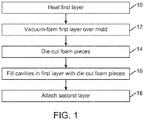
- FIG. 1 illustrates a method of manufacturing protective apparel, according to an embodiment.
- a first layer of the protective apparel can be heated.
- the first layer can be vacuum-formed over a mold. In some embodiments the first layer may not be heated before being vacuum-formed over the mold. In some embodiments, the first layer can itself have multiple layers.
- foam pieces can be die-cut. For example, foam pieces can be die-cut from a sheet of foam. In some embodiments, foam can be molded into a particular shape and the molded foam can be used instead of, or in addition to, die-cut foam.
- cavities or indentations created by vacuum-forming the first layer over the mold can act as receptacles and be filled or partially filled with die-cut foam pieces.
- a second layer can be attached to the first layer to enclose the die-cut foam pieces between the first and second layers.
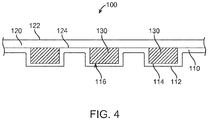
- FIG. 4 illustrates a cross-sectional view of protective apparel 100, according to an embodiment.
- Protective apparel 100 can be manufactured according to the method described, for example, with respect to FIG. 1 .
- protective apparel 100 can include outer layer 110 having an exterior surface 112 and interior surface 114. By vacuum forming outer layer 110, one or more cavities 116 can be formed in outer layer 110.
- the outer layer 110 can be a first material, for example, but not limited to a thermoplastic, a thermoplastic elastomer, thermoplastic polyurethane (TPU), textile, multi-layered sheet containing both a textile and a thermoplastic material, or composite material can form the outer shell.
- TPU thermoplastic polyurethane
- padding for example, foam pieces 130 can be disposed in the cavities 116.
- pieces of die-cut foam pieces 130 can be disposed within the cavities 116 in outer layer 110.
- the foam pieces 130 can be die-cut with a stencil-like tool that allows for intricate patterns of the foam pieces 130 in the protective apparel 100, as shown, for example, in FIGS. 7 , 8 , 10 , 17 , 19 , and 21 .
- foam can be molded into a particular shape and the molded foam can be used instead of, or in addition to, die-cut foam.
- the foam pieces 130 can be inserted while the vacuum is still on.
- the foam pieces 130 can be die-cut using a template that corresponds to cavities 116 of the outer layer 110 of the protective apparel 100.
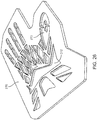
- FIG. 26 illustrates a foam sheet 270 with holes 272 where the intricately shaped pieces of foam have been cut out and removed to be disposed within the cavities 116 of the outer layer 110.
- the foam pieces 130 can be arranged in the outer layer 110 with the outer layer 110 acting as an "ice tray" and the foam pieces as the ice cubes, for example, as shown in the glove template 260 in FIG. 27 .
- the foam pieces 130 can correspond in size, shape, and depth to the cavities 116.
- a volume of foam pieces 130 can be approximately 10% larger than cavities 116, so that the foam pieces 130 can be pressed into the cavities 116 such that the foam pieces 130 deform for a tight fit.
- FIG. 27 illustrates foam pieces 230A having a first density and foam pieces 230B having a second density.
- protective apparel 100 can include inner layer 120 having a first surface 122 and a second surface 124.
- inner layer 120 can be disposed over outer layer 110 and foam pieces 130 to encapsulate the foam pieces 130 between outer layer 110 and inner layer 120 of the protective apparel 100.
- Inner layer 120 can be any suitable material, for example, TPU or a textile.
- inner layer 120 can be hot-melted to the backside of the outer layer 110 and foam pieces 130 while still on the vacuum mold.
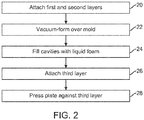
- FIG. 2 illustrates a method of manufacturing protective apparel, according to an embodiment.
- a first layer and a second layer can be attached. This is represented, for example, by outer layer 110 in FIG. 4 .
- a textile and TPU film can be attached to form outer layer 110.
- the textile and TPU can be hot-pressed together to bond the first and second layer together.
- the hot-press can occur at 200 to 400 degrees Fahrenheit for 10 to 30 seconds.
- the hot-press can occur at 250 to 350 degrees Fahrenheit.
- the hot-press can occur at about 300 degrees Fahrenheit.
- the hot-press can occur for 15 to 25 seconds.
- the hot-press can occur for about 18 seconds.
- only one of the TPU film and textile forms outer layer 110.
- the first and second layers can be vacuum-formed over a mold, shaping outer layer 110.
- a textile side can contact the mold.
- a TPU side can contact the mold.
- the vacuum-formed outer layer 110 can form an "ice tray," for example, as described above with respect to FIG. 1 and shown, for example, in FIG. 23 .
- the pattern 702 of the mold 700 in FIG. 23 which can be configured for any of the types of protective apparel described herein, can include ridges and cavities that form the "ice tray.”
- cavities in the molded outer layer can be filled with liquid foam, for example, as shown in FIG. 24 .
- the TPU side of the outer layer 110, 610 receives the foam.
- liquid foam can be poured into the cavities of the molded "ice tray.”
- liquid foam can be injected into the cavities of the molded "ice tray.”
- the liquid foam can be poured or injected into the mold while the vacuum is still on.
- excess liquid foam can be cleaned off before it hardens, for example, with a squeegee.
- Different types of foam or foam of different densities can be poured or injected into the cavities. As described above, this can provide additional protection in certain areas, while allowing for increased flexibility in other areas.
- a third layer is attached to the first and second layers to encapsulate the foam between the composite first and second layers and the third layer.
- a plate is pressed against the third layer, as described below with respect to FIG. 25 , for example.
- the plate includes one or more indentations and/or protrusions.
- the inner layer 620 of the protective apparel 600 thus includes one or more protrusions 622.
- the inner layer 620 is the body-touching side of the protective apparel 600, and so the protrusions 622 promote and improve air flow, keeping the athlete cooler.
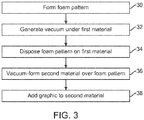
- FIG. 3 illustrates a method of manufacturing protective apparel, according to an embodiment.
- a foam pattern can be formed.
- FIG. 6 illustrates a foam tray 134, according to an embodiment.
- foam tray 134 can have a plurality of cells 136 which can protrude from the surface of foam tray 134.
- Cells 136 can be various shapes and sizes, for example, but not limited to, squares, rectangles, triangles, circles, ovals, etc.
- foam tray 134 can include one or more channels or grooves 138 in the surface of foam tray 134.
- foam tray 134 can resemble an upside-down ice cube tray.
- foam tray 134 can include a plurality of rows and columns of cells 136.
- a vacuum can be generated under a first material.
- the foam pattern can be disposed on the first material.
- a second material e.g., TPU or a textile
- one or more graphic can be created on the second material.
- a graphic can be sublimated on the second material, before or after vacuum-forming the second material.
- Other embodiments can include graphics (e.g., sublimated graphics) as well.
- FIG. 5 illustrates a cross-sectional view of protective apparel 100, according to an embodiment.
- protective apparel 100 as shown in FIG. 5 can be manufactured, for example, using the method described with respect to FIG. 3 .
- foam 130 e.g., foam tray 134 shown in FIG. 6
- foam 130 can be disposed on inner layer 120, for example, on second surface 124 of inner layer 120.
- foam 130 can have one or more protrusions 132.
- interior surface 114 of outer layer 110 can be disposed on foam 130.
- outer layer 110 can have a graphic sublimated onto the exterior surface 112 of outer layer 110, before or after outer layer 110 is formed over foam 130.
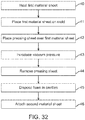
- FIG. 32 illustrates a method of manufacturing protective apparel, according to an embodiment.
- FIG. 33 illustrates a cross-sectional view of a protective apparel layer on a mold, according to an embodiment, which can undergo the method described with respect to FIG. 32 .
- a first material sheet 760 can be disposed on a mold 700, for example, a vacuum mold.
- mold 700 can have one or more indentations 712. Upon vacuum-forming, the indentations 712 create the corresponding cavities described herein. The raised portions between the indentations 712 create the channels or grooves described herein, which can also be described as ridges, depending which side of the formed material is being viewed.
- a pressing sheet 762 can be disposed over first material sheet 760.
- Protective apparel can be manufactured by vacuum-forming first material sheet 760 and pressing sheet 762 on mold 700, for example, as described below.
- a first material sheet can be heated.
- the first material sheet can include a thermoplastic material.
- the material sheet can be composed of multiple layers of varying materials, including, but not limited to, a thermoplastic, a thermoplastic elastomer, thermoplastic polyurethane (TPU), textile, both a textile and a thermoplastic material, composite material, or any combination thereof.
- the first material sheet can be placed on a mold.
- the first material sheet can be placed on a vacuum mold.
- a pressing sheet can be disposed over the first material sheet.
- the pressing sheet can have low air permeability to promote suction between the vacuum mold, the pressing sheet, and the first material sheet disposed between the mold and pressing sheet.
- the pressing sheet can be silicone rubber or an elastomeric material. Other materials can also be used for the pressing sheet.
- vacuum pressure can be introduced. This can cause the pressing sheet to press the heated first material sheet against the mold, which can permanently form the first material sheet according to the mold design. That is, the first material sheet can be drawn into the indentations on the mold such that the first material sheet has indentations or cavities. In some embodiments, the vacuum pressure can then be turned off. At Step 44, the pressing sheet can be removed from the first material sheet, for example, by peeling the pressing sheet away from the first material sheet.
- foam can be disposed in the cavities formed in the first material sheet.
- foam can be disposed in the cavities formed in the first material sheet.
- die-cut foam, molded foam, and/or liquid foam can be disposed in the cavities, as described herein.
- a second material sheet can be attached to the first material sheet, encapsulating the foam between the first and second material sheets.
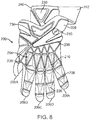
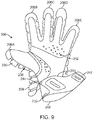
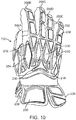
- FIGS. 7-13 illustrate glove 200, according to embodiments.
- Glove 200 and portions of glove 200 can be manufactured using any of the methods described herein.
- glove 200 can include a palmar portion 202 as shown, for example, in FIGS. 9 , 11 , and 13 .
- Glove 200 can include dorsal portion 204 as shown, for example, in FIGS. 7 , 8 , 10 , and 12 .
- glove 200 can include fingers 206A-E.
- glove 200 can include wrist portion 208.
- outer layer 210 can encapsulate a plurality of pads 230, which can provide protection to the wearer's hand.
- glove 200 can include a plurality of grooves 238 in between the pads 230.
- the pads 230 of dorsal portion 204 can be any size, shape, thickness, or configuration.
- pads 230 can grooves 238 can be disposed at discrete anatomical locations to provide protection to the wearer's hand, while also allowing mobility of the hand.
- a groove 238 can extend lengthwise along one or more fingers 206A-E.
- a plurality of pads 230 can be disposed on either side of groove 238 along finger 206A-E. In some embodiments, for example, as shown in FIGS.
- grooves 238 can be located approximately at each joint of the finger 206A-E, with pads 230 being disposed between each groove 238 at locations corresponding generally to the phalanges bones of the wearer's fingers.
- pads 230 disposed generally over the wearer's metacarpal bones are larger than the pads 230 disposed generally over the wearer's phalanges bones.
- pads 230 disposed generally over the wearer's metacarpal bones are smaller than the pads 230 disposed generally over the wearer's phalanges bones.
- one or more graphic or indicia 250 can be located on dorsal portion 204 of glove 200.
- glove 200 can include cuff 240.
- cuff 240 can include one or more pad 230, which can be included in cuff 240 by any of the methods of manufacturing protective apparel described herein.
- cuff 240 can include strap 242. Strap 242 can be used to adjust the size and fit of cuff 240 about the user's wrist or forearm.
- strap 242 can include part of a hook and loop fastener to fasten strap 242 to cuff 240 about the user's wrist or forearm.
- Cuff 240 can also be configured for use with other types of protective apparel, for example, but not limited to arm pads, knee pads, and shin pads.
- glove 200 can include a rear edge 203 of palmar portion 202.
- glove 200 can include a rear edge 205 of dorsal portion 204.
- cuff 240 can be attached to palmar portion 202 and/or dorsal portion 204 of glove 200.
- a front edge 244 of cuff 240 can be attached to rear edge 203 and/or rear edge 205 of palmar portion 202 and dorsal portion 204, respectively.
- cuff 240 can be stitched along seam 246 to the rear edges 203, 205 of palmar and dorsal portions 202, 204, respectively.
- cuff 240 can be attached entirely around a circumference of front edge 244.
- cuff 240 can be ripped off or cut out by the wearer, if desired.
- wrist portion 208 can include a plurality of sections.
- adjacent sections can be coupled to one another, for example, by a band 209.
- band 209 can be an elastic material.
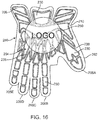
- FIGS. 14-16 illustrate glove templates 260, according to embodiments.
- Glove templates 260 can be used to form dorsal portion 204 of glove 200.
- Glove template 260 can be manufactured according to any of the methods described herein. In some embodiments, upon forming glove template 260, it can be cut along edge 262 to remove excess material from the manufacturing process.
- FIG. 14 illustrates an embodiment in which glove template 260 becomes the outer layer 210 of the dorsal portion 204 of glove 200.
- FIG. 15 shows the inner layer 220, according to an embodiment.
- FIG. 16 illustrates a glove template 260 after trimming along edge 262 to remove excess material.
- FIG. 16 also illustrates the addition of a graphic or indicia 250. For example, graphic 250 can be added to outer layer 210 of glove template 260 by sublimation.
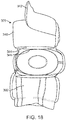
- FIGS. 17 and 18 illustrate an elbow pad 300, according to an embodiment.
- elbow pad 300 can include sleeve 302 which can be disposed about the wearer's arm to hold elbow pad 300 in place.
- sleeve 302 can be an elastic textile.
- elbow pad 300 can include one or more padded portions 304A, 304B, and 304C with pads 330 of various shapes and sizes.
- padded portions 304A and 304C can have one or more triangular pads 330 and padded portion 304B can have one or more quadrilateral pads 330.
- the padded portions 304A-C can be made according to any of the methods described herein.
- Padded portions 304A-C can be separate pieces coupled together, or a single integral piece.
- padded portions 304A-C can include outer layer 310, which can encapsulate one or more pads 330.
- elbow pad 300 can include channels or grooves 338 between the pads 330.
- outer layer 310 of one or more padded portions 304A-C can include one or more graphic or indicia 350, for example, a sublimated graphic.
- padded portions 304A, 304B, and 304C can be disposed over the wearer's upper arm (e.g., triceps and humerus), elbow joint, and forearm (e.g., radius and ulna), respectively.
- elbow pad 300 can include cuff 340, which can be similar to the cuff described with respect to glove 200 in FIGS. 7-9 , 12 , and 13 , for example.
- cuff 340 can include strap 342 to adjust cuff 340 about the wearer's arm.
- cuff 340 can include front edge 344, which can be attached to the rear side of a padded portion 304 of elbow pad 300, for example, along seam 346.
- FIG. 19 illustrates chest protector 400, according to an embodiment.
- Chest protector 400 can be made according to any of the methods described herein.
- chest protector 400 can include outer layer 410, which can include one or more pads 430.
- chest protector 400 can include one or more channels or grooves 438 between pads 430.
- pads 430 can be disposed to protect certain anatomical locations of the wearer. For example, one or more pads 430 can be disposed such that they cover the wearer's shoulders, chest, abdomen, and/or ribs. In some embodiments, a majority of pads 430 can be a quadrilateral shape. In some embodiments, a pentagonal pad can be disposed generally over the wearer's sternum.
- chest protector 400 can include one or more graphic or indicia 450 on outer layer 410, for example, a sublimated graphic.
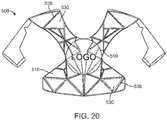
- FIG. 20 illustrates shoulder pads 500, according to an embodiment.
- Shoulder pads 500 can be made according to any of the methods described herein.
- shoulder pads 500 can include outer layer 510 which can cover one or more pads 530.
- shoulder pads 500 can include one or more channels or grooves 538 between pads 530.
- pads 530 can be disposed to protect certain anatomical locations of the wearer. For example, one or more pads 530 can be disposed such that they cover the wearer's shoulders, chest, and/or ribs. In some embodiments, a majority of pads 530 can be generally triangular in shape, for example, a triangle with rounded corners.
- an elongate pad can be disposed generally over the wearer's sternum, extending from a neck portion to a bottom portion of shoulder pads 500, as shown, for example, in FIG. 21 .
- shoulder pads 530 can include one or more graphic or indicia 550 on outer layer 510, for example, a sublimated graphic.
- FIGS. 21 and 22 illustrate a front and rear view, respectively, of protective apparel 600, according to an embodiment.
- protective apparel 600 can have an outer layer 610 covering one or more pads 630 disposed between the outer layer 610 and an inner layer 620.
- protective apparel 600 can include one or more channels or grooves 638 between pads 630.
- protective apparel 600 can include graphics or indicia on outer layer 610 (not shown), for example, a sublimated graphic.
- protective apparel 600 can be manufactured by vacuum-forming outer layer 610 on a mold 700 having a pattern 702, as shown, for example, in FIG. 23 .
- outer layer 610 can be TPU, a textile, or a composite of TPU bonded to a textile.
- One or more cavities 616 can be formed in outer layer 610 because of the pattern 702 of mold 700.
- the size, shape, indentations, and ridges of pattern 702 can be configured for particular types of protective apparel, for example, any of the embodiments of protective apparel disclosed herein.
- foam 630 can be disposed in cavities 616.
- Foam 630 can be die-cut foam pieces placed into the cavities 616, molded foam, and/or liquid foam that is poured or injected into cavities 616.
- inner layer 620 can be disposed onto the foam 630 and outer layer 610 to enclose the foam 630 between inner layer 620 and outer layer 610 of the protective apparel 600.
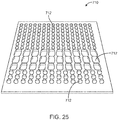
- inner layer 620 of protective apparel 600 includes one or more protrusions 622. These protrusions can be formed, for example, by pressing a plate 710 against the inner layer 620, as described, for example, with respect to Step 28 in FIG. 2 .
- Protrusions 622 can have any size, shape, or configuration.
- protrusions 622 can have a circular outline or a round-cornered rectangular outline.
- protrusions 622 can be disposed in rows and/or columns.
- the protrusions 622 correspond to the indentations 712 in plate 710, as shown, for example, in FIG. 25 .
- the foam can expand into the indentations 712 of the plate 710 pressed against inner layer 620, thereby creating the protrusions 622 of inner layer 620.
- These protrusions 622 can reduce surface contact with the body the wearer, promoting and improving air flow, keeping the athlete cooler.
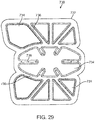
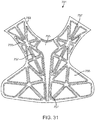
- FIGS. 28-31 illustrate embodiments of molds 720, 730, 750, and 751 for vacuum-forming protective apparel.
- the molds can be made from any suitable material, for example, metal or plastic. When a layer of material is disposed on top of the mold and the vacuum is turned on, the material can be drawn into the holes to form an "ice cube tray" as discussed above.
- the molds can have patterns shaped for a particular type of protective apparel, with holes and walls positioned so that foam can be disposed into the cutout areas once the first layer is vacuum-formed on the mold.
- the holes and walls making up the patterns can have many other configurations in addition to the embodiments shown in FIGS. 28-31 .
- FIG. 28 illustrates an embodiment of a glove mold 720, with a pattern 722 generally in the shape of a hand.
- Glove mold 720 includes a plurality of holes 724 and a plurality of walls 726 disposed between the holes 724.
- Other configurations of the holes 724 and walls 726 of pattern 722 for glove mold 720 are contemplated.
- the holes 724 for example, can have other shapes, sizes, and locations. This can provide a different look, feel, and protection scheme to the glove once the foam is disposed into the molded shell and enclosed between another layer of material.
- FIG. 29 illustrates an example of an elbow pad mold 730.
- the pattern 732 of elbow pad mold 730 includes a plurality of holes 734 and a plurality of walls 736 disposed between the holes 734.
- Other configurations of the holes 734 and walls 736 of pattern 732 for elbow pad mold 730 are contemplated.
- the holes 734 for example, can have other shapes, sizes, and locations. This can provide a different look, feel, and protection scheme to the elbow pad once the foam is disposed into the molded shell and enclosed between another layer of material.
- FIG. 30 illustrates an example of chest mold 750 for shoulder pads.
- the pattern 752 of chest mold 750 includes a plurality of holes 754 and a plurality of walls 756 disposed between the holes 754.
- Other configurations of the holes 754 and walls 756 of pattern 752 for chest mold 750 are contemplated.
- the holes 754, for example, can have other shapes, sizes, and locations. This can provide a different look, feel, and protection scheme to the chest portion of the shoulder pads once the foam is disposed into the molded shell and enclosed between another layer of material.
- FIG. 31 illustrates an example of back mold 751 for shoulder pads.
- the pattern 753 of back mold 751 includes a plurality of holes 755 and a plurality of walls 757 disposed between the holes 755.
- Other configurations of the holes 755 and walls 757 of pattern 753 for back mold 751 are contemplated.
- the holes 755, for example, can have other shapes, sizes, and locations. This can provide a different look, feel, and protection scheme to the back portion of the shoulder pads once the foam is disposed into the molded shell and enclosed between another layer of material.
Landscapes
- Health & Medical Sciences (AREA)
- General Health & Medical Sciences (AREA)
- Physical Education & Sports Medicine (AREA)
- Engineering & Computer Science (AREA)
- Textile Engineering (AREA)
- Mechanical Engineering (AREA)
- Otolaryngology (AREA)
- Heart & Thoracic Surgery (AREA)
- Professional, Industrial, Or Sporting Protective Garments (AREA)
- Gloves (AREA)
Claims (15)
- Ein Schutzkleidungsstück (100, 200, 600), umfassend:
einen gepolsterten Abschnitt mit einer Außenschicht (110, 210, 610), einer Innenschicht (120, 220, 620) und einem Polsterstück (130, 230, 630), das zwischen der Außenschicht und der Innenschicht in einem Hohlraum der Außenschicht angeordnet ist, wobei der gepolsterte Abschnitt gebildet ist durch:Vakuumformen der Außenschicht auf einer Form;Anordnen des Polsterstücks im Hohlraum der Außenschicht; undAnbringen der Innenschicht an der Außenschicht, dadurch gekennzeichnet, dass die Innenschicht die körperberührende Seite der Schutzkleidung ist und eine oder mehrere Erhebungen aufweist. - Schutzkleidungsstück nach Anspruch 1, wobei:die Außenschicht des gepolsterten Abschnitts eine erste Außenhülle umfasst, die ein erstes vakuumgeformtes Material umfasst, das umfasst:einen ersten Hohlraum,einen zweiten Hohlraum, undeinen Kanal, der zwischen dem ersten Hohlraum und dem zweiten Hohlraum angeordnet ist; wobei das Polsterstück umfasst:ein erstes Polsterstück, das in dem ersten Hohlraum angeordnet ist, undein zweites Polsterstück, das in dem zweiten Hohlraum angeordnet ist; undwobei die innere Schicht eine erste innere Schicht umfasst, die an der ersten Außenhülle befestigt ist.
- Schutzkleidungsstück nach Anspruch 1 oder 2, wobei das erste Material ein thermoplastisches Elastomer und / oder ein thermoplastisches Polyurethan und / oder ein Gewebe umfasst.
- Schutzkleidungsstück nach einem der vorstehenden Ansprüche, wobei das erste Polsterstück gestanzten Schaumstoff und / oder gehärteten Flüssigschaum umfasst.
- Schutzkleidungsstück nach einem der vorstehenden Ansprüche, wobei das zweite Polsterstück Formschaum umfasst.
- Schutzkleidungsstück nach einem der vorstehenden Ansprüche 1 - 5, wobei das Schutzkleidungsstück ein Handschuh ist, der umfasst:eine palmaren Abschnitt;einen dorsalen Abschnitt; undeinen Manschettenabschnitt.
- Schutzkleidungsstück nach Anspruch 6, wobei der dorsale Abschnitt die erste Außenschale, das erste Polsterstück, das zweite Polsterstück und die erste Innenschicht umfasst.
- Schutzkleidungsstück nach Anspruch 6 oder 7, wobei der Manschettenabschnitt mit dem dorsalen Abschnitt gekoppelt ist, wobei der Manschettenabschnitt umfasst:eine zweite Außenhülle, die ein vakuumgeformtes zweites Material umfasst, wobei die zweite Außenhülle einen dritten Hohlraum aufweist;ein drittes Polsterstück, das in dem dritten Hohlraum angeordnet ist;eine zweite innere Schicht, die an der zweiten Außenhülle befestigt ist, wobei das dritte Polsterstück zwischen der zweiten Außenhülle und der zweiten inneren Schicht angeordnet ist; undeinen Riemen, der konfiguriert ist, um den Manschettenabschnitt um den Arm eines Trägers zu sichern.
- Schutzkleidungsstück nach Anspruch 8, wobei das erste Material und das zweite Material gleich sind.
- Schutzkleidungsstück nach einem der Ansprüche 1 - 5, wobei die Schutzkleidung ein Ellbogenpolster, Schulterpolster oder ein Brustschutz ist.
- Verfahren zur Herstellung eines Schutzkleidungsstücks, umfassend:Anordnen (20) einer ersten Schicht auf einer Vakuumform, wobei die Vakuumform ein Muster mit einer Vielzahl von Vertiefungen aufweist;Vakuumformen (22) der ersten Schicht, so dass die erste Schicht eine Vielzahl von Hohlräumen beinhaltet, die den Vertiefungen der Vakuumform entsprechen;Einbringen von Schaum in die Hohlräume der ersten Schicht;Anbringen (26) einer zweiten Schicht an der ersten Schicht; gekennzeichnet durch:
Pressen (28) einer Platte gegen die zweite Schicht, wobei die Platte eine oder mehrere Vertiefungen und / oder Erhebungen aufweist. - Verfahren nach Anspruch 11, wobei Einbringen von Schaum in den Hohlräumen Einbringen von gestanzten Schaumstoffstücken in den Hohlräumen umfasst.
- Verfahren nach Anspruch 11 oder 12, wobei Einbringen von Schaum in den Hohlräumen Einspritzen von flüssigem Schaum in die Hohlräume umfasst.
- Verfahren nach einem der Ansprüche 11 - 13, ferner umfassend: Herstellen einer sublimierten Grafik auf einer Außenfläche der ersten Schicht.
- Verfahren nach einem der Ansprüche 11 - 14, ferner umfassend: Anordnen einer Folie über der ersten Schicht vor dem Vakuumformen der ersten Schicht, wobei die Folie Silikon oder ein Elastomer umfasst.
Applications Claiming Priority (1)
| Application Number | Priority Date | Filing Date | Title |
|---|---|---|---|
| US15/288,845 US20180099206A1 (en) | 2016-10-07 | 2016-10-07 | Protective Apparel and Methods of Making the Same |
Publications (2)
| Publication Number | Publication Date |
|---|---|
| EP3305115A1 EP3305115A1 (de) | 2018-04-11 |
| EP3305115B1 true EP3305115B1 (de) | 2019-06-26 |
Family
ID=60021982
Family Applications (1)
| Application Number | Title | Priority Date | Filing Date |
|---|---|---|---|
| EP17194924.1A Not-in-force EP3305115B1 (de) | 2016-10-07 | 2017-10-05 | Schutzbekleidung und verfahren zur herstellung davon |
Country Status (4)
| Country | Link |
|---|---|
| US (1) | US20180099206A1 (de) |
| EP (1) | EP3305115B1 (de) |
| JP (1) | JP2018066101A (de) |
| CN (1) | CN107913510A (de) |
Families Citing this family (12)
| Publication number | Priority date | Publication date | Assignee | Title |
|---|---|---|---|---|
| US20170238625A1 (en) * | 2016-02-19 | 2017-08-24 | Thunder Strength L.L.C. | Article of weightlifting equipment with torso pad |
| US12490784B2 (en) | 2018-04-16 | 2025-12-09 | Easton Diamond Sports, Llc | Catcher's chest protector with grip elements for improved ball control |
| CN109337029B (zh) * | 2018-09-11 | 2021-12-14 | 东莞市雄林新材料科技股份有限公司 | 一种高耐磨tpu/硅胶复合材料及其制备方法 |
| US11304471B2 (en) | 2018-10-12 | 2022-04-19 | Carbon, Inc. | Moisture controlling lattice liners for helmets and other wearable articles |
| US10966472B2 (en) * | 2018-12-28 | 2021-04-06 | Easton Diamond Sports, Llc | Chest protectors for reducing risk of commotio cordis |
| US12403383B2 (en) * | 2021-09-13 | 2025-09-02 | Pulse Sports, LLC | Boxing glove with shock-absorbing lattice |
| USD1136373S1 (en) * | 2023-02-23 | 2026-07-21 | Ampac Enterprises Inc. | Chest protector |
| USD1137888S1 (en) * | 2023-02-23 | 2026-07-28 | Ampac Enterprises Inc. | Chest protector |
| USD1136374S1 (en) * | 2023-02-23 | 2026-07-21 | Ampac Enterprises Inc. | Chest protector |
| US12521620B2 (en) * | 2024-06-13 | 2026-01-13 | Christopher Vandamia | Football player's hand-covering |
| USD1130617S1 (en) | 2024-07-17 | 2026-06-16 | 5.11, Inc. | Weight training plate |
| US20260021337A1 (en) * | 2024-07-17 | 2026-01-22 | 5.11, Inc. | Plate for weight training |
Family Cites Families (11)
| Publication number | Priority date | Publication date | Assignee | Title |
|---|---|---|---|---|
| JPS514294A (ja) * | 1974-06-17 | 1976-01-14 | Nippon Paint Co Ltd | Jurihorumuarudehidoganryonosukunai aminojushino seizoho |
| CN2121978U (zh) * | 1992-05-29 | 1992-11-18 | 联兴运动器材胶份有限公司 | 护胫、踝套护垫 |
| CN2306810Y (zh) * | 1997-06-17 | 1999-02-10 | 联兴运动器材股份有限公司 | 组合式防撞装置 |
| US6591456B2 (en) * | 2001-07-09 | 2003-07-15 | Bic Corporation | Cushioning device |
| US7100216B2 (en) * | 2003-10-15 | 2006-09-05 | Impact Innovative Products, Llc | Garment with energy dissipating conformable padding |
| JP2005248376A (ja) * | 2004-03-04 | 2005-09-15 | Unity:Kk | 刺繍の製造方法 |
| CA2571229C (en) * | 2004-06-19 | 2012-11-27 | Bruce Mccormick | An insulating liner for an article of clothing |
| MX391328B (es) * | 2010-08-11 | 2025-03-21 | G Form Llc | Cojines de amortiguacion flexibles, articulos que incorporan dichos cojines y metodos de fabricacion y uso |
| US8950015B2 (en) * | 2010-12-22 | 2015-02-10 | Nike, Inc. | Glove with laminated padding regions |
| DE102011100642B4 (de) * | 2011-05-05 | 2012-11-15 | Vaco Technology Ag | Polsterlagenanordnung für ein Körperschutzpolster und Verfahren zu deren Herstellung |
| US10201744B2 (en) * | 2014-01-22 | 2019-02-12 | Anthony Abdelmalek | Stitchless dorsal padding for protective sports gloves and other protective gear |
-
2016
- 2016-10-07 US US15/288,845 patent/US20180099206A1/en not_active Abandoned
-
2017
- 2017-09-19 JP JP2017178580A patent/JP2018066101A/ja active Pending
- 2017-09-30 CN CN201710917268.5A patent/CN107913510A/zh active Pending
- 2017-10-05 EP EP17194924.1A patent/EP3305115B1/de not_active Not-in-force
Non-Patent Citations (1)
| Title |
|---|
| None * |
Also Published As
| Publication number | Publication date |
|---|---|
| CN107913510A (zh) | 2018-04-17 |
| EP3305115A1 (de) | 2018-04-11 |
| JP2018066101A (ja) | 2018-04-26 |
| US20180099206A1 (en) | 2018-04-12 |
Similar Documents
| Publication | Publication Date | Title |
|---|---|---|
| EP3305115A1 (de) | Schutzbekleidung und verfahren zur herstellung davon | |
| US10376006B2 (en) | Pad and fabric arrangement and method of making the same | |
| US20190381386A1 (en) | Stitchless dorsal padding for protective sports gloves and other protective gear | |
| US12274930B2 (en) | Stitchless dorsal padding for protective sports gloves and other protective gear | |
| AU651292B2 (en) | Body protective device | |
| US8060949B2 (en) | Protective sports glove | |
| US8950015B2 (en) | Glove with laminated padding regions | |
| US3446880A (en) | Method of manufacturing a protective athletic pad | |
| US9539780B2 (en) | Bicycle glove with direct-molded padding | |
| EA028487B1 (ru) | Амортизирующий щиток | |
| US20160082342A1 (en) | Protective sports glove | |
| US9884240B2 (en) | Three dimensional knee and elbow pads | |
| US20230285837A1 (en) | Athletic gear with a printed cover | |
| EP2289359B1 (de) | Fussballhandschuh | |
| US20250000186A1 (en) | Pads with three dimensional image element | |
| US11076647B2 (en) | Pads with three dimensional image element | |
| GB2246282A (en) | Improvements in protective clothing | |
| US20250288890A1 (en) | Customization for sports protective pads and uniform ornamentation | |
| EP0993254B1 (de) | Verfahren zur herstellung von anzügen aus leder oder gewebe, jacke oder hose mitschutzelementen und so hergestelltes bekleidingsartikel | |
| US20260115577A1 (en) | Protective sports glove | |
| US20160174641A1 (en) | Protective wear for reducing trauma to the human body | |
| CN119546374A (zh) | 具有分层分段的护垫的防护性运动装备 |
Legal Events
| Date | Code | Title | Description |
|---|---|---|---|
| PUAI | Public reference made under article 153(3) epc to a published international application that has entered the european phase |
Free format text: ORIGINAL CODE: 0009012 |
|
| STAA | Information on the status of an ep patent application or granted ep patent |
Free format text: STATUS: REQUEST FOR EXAMINATION WAS MADE |
|
| 17P | Request for examination filed |
Effective date: 20171005 |
|
| AK | Designated contracting states |
Kind code of ref document: A1 Designated state(s): AL AT BE BG CH CY CZ DE DK EE ES FI FR GB GR HR HU IE IS IT LI LT LU LV MC MK MT NL NO PL PT RO RS SE SI SK SM TR |
|
| AX | Request for extension of the european patent |
Extension state: BA ME |
|
| GRAP | Despatch of communication of intention to grant a patent |
Free format text: ORIGINAL CODE: EPIDOSNIGR1 |
|
| STAA | Information on the status of an ep patent application or granted ep patent |
Free format text: STATUS: GRANT OF PATENT IS INTENDED |
|
| INTG | Intention to grant announced |
Effective date: 20190104 |
|
| GRAS | Grant fee paid |
Free format text: ORIGINAL CODE: EPIDOSNIGR3 |
|
| GRAA | (expected) grant |
Free format text: ORIGINAL CODE: 0009210 |
|
| STAA | Information on the status of an ep patent application or granted ep patent |
Free format text: STATUS: THE PATENT HAS BEEN GRANTED |
|
| AK | Designated contracting states |
Kind code of ref document: B1 Designated state(s): AL AT BE BG CH CY CZ DE DK EE ES FI FR GB GR HR HU IE IS IT LI LT LU LV MC MK MT NL NO PL PT RO RS SE SI SK SM TR |
|
| REG | Reference to a national code |
Ref country code: GB Ref legal event code: FG4D |
|
| REG | Reference to a national code |
Ref country code: CH Ref legal event code: EP |
|
| REG | Reference to a national code |
Ref country code: DE Ref legal event code: R096 Ref document number: 602017004825 Country of ref document: DE |
|
| REG | Reference to a national code |
Ref country code: AT Ref legal event code: REF Ref document number: 1147270 Country of ref document: AT Kind code of ref document: T Effective date: 20190715 |
|
| REG | Reference to a national code |
Ref country code: IE Ref legal event code: FG4D |
|
| REG | Reference to a national code |
Ref country code: NL Ref legal event code: MP Effective date: 20190626 |
|
| PG25 | Lapsed in a contracting state [announced via postgrant information from national office to epo] |
Ref country code: HR Free format text: LAPSE BECAUSE OF FAILURE TO SUBMIT A TRANSLATION OF THE DESCRIPTION OR TO PAY THE FEE WITHIN THE PRESCRIBED TIME-LIMIT Effective date: 20190626 Ref country code: LT Free format text: LAPSE BECAUSE OF FAILURE TO SUBMIT A TRANSLATION OF THE DESCRIPTION OR TO PAY THE FEE WITHIN THE PRESCRIBED TIME-LIMIT Effective date: 20190626 Ref country code: AL Free format text: LAPSE BECAUSE OF FAILURE TO SUBMIT A TRANSLATION OF THE DESCRIPTION OR TO PAY THE FEE WITHIN THE PRESCRIBED TIME-LIMIT Effective date: 20190626 Ref country code: FI Free format text: LAPSE BECAUSE OF FAILURE TO SUBMIT A TRANSLATION OF THE DESCRIPTION OR TO PAY THE FEE WITHIN THE PRESCRIBED TIME-LIMIT Effective date: 20190626 Ref country code: SE Free format text: LAPSE BECAUSE OF FAILURE TO SUBMIT A TRANSLATION OF THE DESCRIPTION OR TO PAY THE FEE WITHIN THE PRESCRIBED TIME-LIMIT Effective date: 20190626 Ref country code: NO Free format text: LAPSE BECAUSE OF FAILURE TO SUBMIT A TRANSLATION OF THE DESCRIPTION OR TO PAY THE FEE WITHIN THE PRESCRIBED TIME-LIMIT Effective date: 20190926 |
|
| REG | Reference to a national code |
Ref country code: LT Ref legal event code: MG4D |
|
| PG25 | Lapsed in a contracting state [announced via postgrant information from national office to epo] |
Ref country code: LV Free format text: LAPSE BECAUSE OF FAILURE TO SUBMIT A TRANSLATION OF THE DESCRIPTION OR TO PAY THE FEE WITHIN THE PRESCRIBED TIME-LIMIT Effective date: 20190626 Ref country code: GR Free format text: LAPSE BECAUSE OF FAILURE TO SUBMIT A TRANSLATION OF THE DESCRIPTION OR TO PAY THE FEE WITHIN THE PRESCRIBED TIME-LIMIT Effective date: 20190927 Ref country code: RS Free format text: LAPSE BECAUSE OF FAILURE TO SUBMIT A TRANSLATION OF THE DESCRIPTION OR TO PAY THE FEE WITHIN THE PRESCRIBED TIME-LIMIT Effective date: 20190626 Ref country code: BG Free format text: LAPSE BECAUSE OF FAILURE TO SUBMIT A TRANSLATION OF THE DESCRIPTION OR TO PAY THE FEE WITHIN THE PRESCRIBED TIME-LIMIT Effective date: 20190926 |
|
| REG | Reference to a national code |
Ref country code: AT Ref legal event code: MK05 Ref document number: 1147270 Country of ref document: AT Kind code of ref document: T Effective date: 20190626 |
|
| PG25 | Lapsed in a contracting state [announced via postgrant information from national office to epo] |
Ref country code: CZ Free format text: LAPSE BECAUSE OF FAILURE TO SUBMIT A TRANSLATION OF THE DESCRIPTION OR TO PAY THE FEE WITHIN THE PRESCRIBED TIME-LIMIT Effective date: 20190626 Ref country code: PT Free format text: LAPSE BECAUSE OF FAILURE TO SUBMIT A TRANSLATION OF THE DESCRIPTION OR TO PAY THE FEE WITHIN THE PRESCRIBED TIME-LIMIT Effective date: 20191028 Ref country code: RO Free format text: LAPSE BECAUSE OF FAILURE TO SUBMIT A TRANSLATION OF THE DESCRIPTION OR TO PAY THE FEE WITHIN THE PRESCRIBED TIME-LIMIT Effective date: 20190626 Ref country code: EE Free format text: LAPSE BECAUSE OF FAILURE TO SUBMIT A TRANSLATION OF THE DESCRIPTION OR TO PAY THE FEE WITHIN THE PRESCRIBED TIME-LIMIT Effective date: 20190626 Ref country code: NL Free format text: LAPSE BECAUSE OF FAILURE TO SUBMIT A TRANSLATION OF THE DESCRIPTION OR TO PAY THE FEE WITHIN THE PRESCRIBED TIME-LIMIT Effective date: 20190626 Ref country code: AT Free format text: LAPSE BECAUSE OF FAILURE TO SUBMIT A TRANSLATION OF THE DESCRIPTION OR TO PAY THE FEE WITHIN THE PRESCRIBED TIME-LIMIT Effective date: 20190626 Ref country code: SK Free format text: LAPSE BECAUSE OF FAILURE TO SUBMIT A TRANSLATION OF THE DESCRIPTION OR TO PAY THE FEE WITHIN THE PRESCRIBED TIME-LIMIT Effective date: 20190626 |
|
| PG25 | Lapsed in a contracting state [announced via postgrant information from national office to epo] |
Ref country code: IT Free format text: LAPSE BECAUSE OF FAILURE TO SUBMIT A TRANSLATION OF THE DESCRIPTION OR TO PAY THE FEE WITHIN THE PRESCRIBED TIME-LIMIT Effective date: 20190626 Ref country code: ES Free format text: LAPSE BECAUSE OF FAILURE TO SUBMIT A TRANSLATION OF THE DESCRIPTION OR TO PAY THE FEE WITHIN THE PRESCRIBED TIME-LIMIT Effective date: 20190626 Ref country code: IS Free format text: LAPSE BECAUSE OF FAILURE TO SUBMIT A TRANSLATION OF THE DESCRIPTION OR TO PAY THE FEE WITHIN THE PRESCRIBED TIME-LIMIT Effective date: 20191026 Ref country code: SM Free format text: LAPSE BECAUSE OF FAILURE TO SUBMIT A TRANSLATION OF THE DESCRIPTION OR TO PAY THE FEE WITHIN THE PRESCRIBED TIME-LIMIT Effective date: 20190626 |
|
| PG25 | Lapsed in a contracting state [announced via postgrant information from national office to epo] |
Ref country code: TR Free format text: LAPSE BECAUSE OF FAILURE TO SUBMIT A TRANSLATION OF THE DESCRIPTION OR TO PAY THE FEE WITHIN THE PRESCRIBED TIME-LIMIT Effective date: 20190626 |
|
| PG25 | Lapsed in a contracting state [announced via postgrant information from national office to epo] |
Ref country code: DK Free format text: LAPSE BECAUSE OF FAILURE TO SUBMIT A TRANSLATION OF THE DESCRIPTION OR TO PAY THE FEE WITHIN THE PRESCRIBED TIME-LIMIT Effective date: 20190626 Ref country code: PL Free format text: LAPSE BECAUSE OF FAILURE TO SUBMIT A TRANSLATION OF THE DESCRIPTION OR TO PAY THE FEE WITHIN THE PRESCRIBED TIME-LIMIT Effective date: 20190626 |
|
| PG25 | Lapsed in a contracting state [announced via postgrant information from national office to epo] |
Ref country code: MC Free format text: LAPSE BECAUSE OF FAILURE TO SUBMIT A TRANSLATION OF THE DESCRIPTION OR TO PAY THE FEE WITHIN THE PRESCRIBED TIME-LIMIT Effective date: 20190626 Ref country code: IS Free format text: LAPSE BECAUSE OF FAILURE TO SUBMIT A TRANSLATION OF THE DESCRIPTION OR TO PAY THE FEE WITHIN THE PRESCRIBED TIME-LIMIT Effective date: 20200320 |
|
| REG | Reference to a national code |
Ref country code: DE Ref legal event code: R097 Ref document number: 602017004825 Country of ref document: DE |
|
| PLBE | No opposition filed within time limit |
Free format text: ORIGINAL CODE: 0009261 |
|
| STAA | Information on the status of an ep patent application or granted ep patent |
Free format text: STATUS: NO OPPOSITION FILED WITHIN TIME LIMIT |
|
| PG2D | Information on lapse in contracting state deleted |
Ref country code: IS |
|
| PG25 | Lapsed in a contracting state [announced via postgrant information from national office to epo] |
Ref country code: LU Free format text: LAPSE BECAUSE OF NON-PAYMENT OF DUE FEES Effective date: 20191005 |
|
| 26N | No opposition filed |
Effective date: 20200603 |
|
| REG | Reference to a national code |
Ref country code: BE Ref legal event code: MM Effective date: 20191031 |
|
| PG25 | Lapsed in a contracting state [announced via postgrant information from national office to epo] |
Ref country code: BE Free format text: LAPSE BECAUSE OF NON-PAYMENT OF DUE FEES Effective date: 20191031 Ref country code: SI Free format text: LAPSE BECAUSE OF FAILURE TO SUBMIT A TRANSLATION OF THE DESCRIPTION OR TO PAY THE FEE WITHIN THE PRESCRIBED TIME-LIMIT Effective date: 20190626 |
|
| PG25 | Lapsed in a contracting state [announced via postgrant information from national office to epo] |
Ref country code: IE Free format text: LAPSE BECAUSE OF NON-PAYMENT OF DUE FEES Effective date: 20191005 |
|
| PG25 | Lapsed in a contracting state [announced via postgrant information from national office to epo] |
Ref country code: CY Free format text: LAPSE BECAUSE OF FAILURE TO SUBMIT A TRANSLATION OF THE DESCRIPTION OR TO PAY THE FEE WITHIN THE PRESCRIBED TIME-LIMIT Effective date: 20190626 |
|
| REG | Reference to a national code |
Ref country code: CH Ref legal event code: PL |
|
| PG25 | Lapsed in a contracting state [announced via postgrant information from national office to epo] |
Ref country code: LI Free format text: LAPSE BECAUSE OF FAILURE TO SUBMIT A TRANSLATION OF THE DESCRIPTION OR TO PAY THE FEE WITHIN THE PRESCRIBED TIME-LIMIT Effective date: 20201031 Ref country code: CH Free format text: LAPSE BECAUSE OF FAILURE TO SUBMIT A TRANSLATION OF THE DESCRIPTION OR TO PAY THE FEE WITHIN THE PRESCRIBED TIME-LIMIT Effective date: 20201031 |
|
| PG25 | Lapsed in a contracting state [announced via postgrant information from national office to epo] |
Ref country code: HU Free format text: LAPSE BECAUSE OF FAILURE TO SUBMIT A TRANSLATION OF THE DESCRIPTION OR TO PAY THE FEE WITHIN THE PRESCRIBED TIME-LIMIT; INVALID AB INITIO Effective date: 20171005 Ref country code: MT Free format text: LAPSE BECAUSE OF FAILURE TO SUBMIT A TRANSLATION OF THE DESCRIPTION OR TO PAY THE FEE WITHIN THE PRESCRIBED TIME-LIMIT Effective date: 20190626 |
|
| PG25 | Lapsed in a contracting state [announced via postgrant information from national office to epo] |
Ref country code: MK Free format text: LAPSE BECAUSE OF FAILURE TO SUBMIT A TRANSLATION OF THE DESCRIPTION OR TO PAY THE FEE WITHIN THE PRESCRIBED TIME-LIMIT Effective date: 20190626 |
|
| PGFP | Annual fee paid to national office [announced via postgrant information from national office to epo] |
Ref country code: GB Payment date: 20220922 Year of fee payment: 6 |
|
| PGFP | Annual fee paid to national office [announced via postgrant information from national office to epo] |
Ref country code: FR Payment date: 20220922 Year of fee payment: 6 |
|
| PGFP | Annual fee paid to national office [announced via postgrant information from national office to epo] |
Ref country code: DE Payment date: 20220920 Year of fee payment: 6 |
|
| REG | Reference to a national code |
Ref country code: DE Ref legal event code: R119 Ref document number: 602017004825 Country of ref document: DE |
|
| GBPC | Gb: european patent ceased through non-payment of renewal fee |
Effective date: 20231005 |
|
| PG25 | Lapsed in a contracting state [announced via postgrant information from national office to epo] |
Ref country code: GB Free format text: LAPSE BECAUSE OF NON-PAYMENT OF DUE FEES Effective date: 20231005 |
|
| PG25 | Lapsed in a contracting state [announced via postgrant information from national office to epo] |
Ref country code: GB Free format text: LAPSE BECAUSE OF NON-PAYMENT OF DUE FEES Effective date: 20231005 Ref country code: FR Free format text: LAPSE BECAUSE OF NON-PAYMENT OF DUE FEES Effective date: 20231031 Ref country code: DE Free format text: LAPSE BECAUSE OF NON-PAYMENT OF DUE FEES Effective date: 20240501 |