EP3304674B1 - System und verfahren zur wechselstromverteilung für ein flugzeug - Google Patents
System und verfahren zur wechselstromverteilung für ein flugzeug Download PDFInfo
- Publication number
- EP3304674B1 EP3304674B1 EP16724795.6A EP16724795A EP3304674B1 EP 3304674 B1 EP3304674 B1 EP 3304674B1 EP 16724795 A EP16724795 A EP 16724795A EP 3304674 B1 EP3304674 B1 EP 3304674B1
- Authority
- EP
- European Patent Office
- Prior art keywords
- bus
- dedicated
- aircraft
- converter
- inverter
- Prior art date
- Legal status (The legal status is an assumption and is not a legal conclusion. Google has not performed a legal analysis and makes no representation as to the accuracy of the status listed.)
- Active
Links
Images

Classifications
-
- H—ELECTRICITY
- H02—GENERATION; CONVERSION OR DISTRIBUTION OF ELECTRIC POWER
- H02J—ELECTRIC POWER NETWORKS; CIRCUIT ARRANGEMENTS OR SYSTEMS FOR SUPPLYING OR DISTRIBUTING ELECTRIC POWER; SYSTEMS FOR STORING ELECTRIC ENERGY
- H02J1/00—Circuit arrangements for DC mains or DC distribution networks
- H02J1/10—Parallel operation of DC sources
-
- B—PERFORMING OPERATIONS; TRANSPORTING
- B64—AIRCRAFT; AVIATION; COSMONAUTICS
- B64D—EQUIPMENT FOR FITTING IN OR TO AIRCRAFT; FLIGHT SUITS; PARACHUTES; ARRANGEMENT OR MOUNTING OF POWER PLANTS OR PROPULSION TRANSMISSIONS IN AIRCRAFT
- B64D47/00—Equipment not otherwise provided for
-
- H—ELECTRICITY
- H02—GENERATION; CONVERSION OR DISTRIBUTION OF ELECTRIC POWER
- H02J—ELECTRIC POWER NETWORKS; CIRCUIT ARRANGEMENTS OR SYSTEMS FOR SUPPLYING OR DISTRIBUTING ELECTRIC POWER; SYSTEMS FOR STORING ELECTRIC ENERGY
- H02J3/00—Circuit arrangements for AC mains or AC distribution networks
-
- H—ELECTRICITY
- H02—GENERATION; CONVERSION OR DISTRIBUTION OF ELECTRIC POWER
- H02J—ELECTRIC POWER NETWORKS; CIRCUIT ARRANGEMENTS OR SYSTEMS FOR SUPPLYING OR DISTRIBUTING ELECTRIC POWER; SYSTEMS FOR STORING ELECTRIC ENERGY
- H02J3/00—Circuit arrangements for AC mains or AC distribution networks
- H02J3/38—Arrangements for feeding a single network from two or more generators or sources in parallel; Arrangements for feeding already energised networks from additional generators or sources in parallel
-
- H—ELECTRICITY
- H02—GENERATION; CONVERSION OR DISTRIBUTION OF ELECTRIC POWER
- H02J—ELECTRIC POWER NETWORKS; CIRCUIT ARRANGEMENTS OR SYSTEMS FOR SUPPLYING OR DISTRIBUTING ELECTRIC POWER; SYSTEMS FOR STORING ELECTRIC ENERGY
- H02J4/00—Circuit arrangements for mains or distribution networks not specified as AC or DC; Circuit arrangements for mains or distribution networks combining AC and DC sections or sub-networks
-
- H—ELECTRICITY
- H02—GENERATION; CONVERSION OR DISTRIBUTION OF ELECTRIC POWER
- H02M—APPARATUS FOR CONVERSION BETWEEN AC AND AC, BETWEEN AC AND DC, OR BETWEEN DC AND DC, AND FOR USE WITH MAINS OR SIMILAR POWER SUPPLY SYSTEMS; CONVERSION OF DC OR AC INPUT POWER INTO SURGE OUTPUT POWER; CONTROL OR REGULATION THEREOF
- H02M7/00—Conversion of AC power input into DC power output; Conversion of DC power input into AC power output
- H02M7/02—Conversion of AC power input into DC power output without possibility of reversal
-
- H—ELECTRICITY
- H02—GENERATION; CONVERSION OR DISTRIBUTION OF ELECTRIC POWER
- H02J—ELECTRIC POWER NETWORKS; CIRCUIT ARRANGEMENTS OR SYSTEMS FOR SUPPLYING OR DISTRIBUTING ELECTRIC POWER; SYSTEMS FOR STORING ELECTRIC ENERGY
- H02J13/00—Circuit arrangements for providing remote monitoring or remote control of equipment in a power distribution network
- H02J13/13—Circuit arrangements for providing remote monitoring or remote control of equipment in a power distribution network characterised by the transmission of data to equipment in the power network
- H02J13/1321—Circuit arrangements for providing remote monitoring or remote control of equipment in a power distribution network characterised by the transmission of data to equipment in the power network using a wired telecommunication network or a data transmission bus
Definitions
- This disclosure relates generally to power systems, and more particularly to aircraft DC power distribution systems and methods.
- Efficiency for an electrical system, can refer not only to minimizing losses in individual system components, but can also entail minimizing the amount of hardware in the system as well as optimizing the manner in which power is generated, converted and distributed by that electrical system. This is especially true for aircraft which needs to rely on a limited number of power generating sources and distribution components it can reasonably carry on board for providing electrical power.
- Generators on aircraft may be driven with various prime movers, such as turbine engines.
- a prime mover may drive a generator only as an ancillary function.
- a typical primary function for a prime mover, such as a turbine engine, may be to provide propulsion thrust for the aircraft.
- the prime mover In the context of its primary function, the prime mover may operate at varying rotational speeds. Therefore, a generator coupled to a shaft of such a variable-speed prime mover may rotate at varying speeds. Additionally, a generator load may become large enough to negatively affect engine thrust output. Because of recent increases in electrical power demand of aircraft, a single generator driven by a single prime mover may not be capable of producing all of the electrical power for an aircraft. Consequently, an aircraft may be provided with multiple generators, each driven by different prime movers.
- Certain aircraft operating conditions may arise in which a particular generator may be subjected to a particularly high load demand during a time when its associated prime mover may be performing its primary function (e.g. producing thrust) at a relatively low speed.
- a particular generator may be subjected to a particularly high load demand during a time when its associated prime mover may be performing its primary function (e.g. producing thrust) at a relatively low speed.
- it may be necessary to increase the speed of the prime mover, even though such an increase in speed may not otherwise be required for the primary function of the prime mover.
- Excessive fuel may be consumed if and when a prime mover is operated at a speed greater than required for its primary role.
- Certain design efforts have been directed to this issue. For example multiple generators may be driven on different shafts of a turbine machine.
- the turbine machine may have a low-pressure turbine output shaft and a high-pressure turbine output shaft.
- a separate generator may be driven by each of the shafts. Electrical outputs of the generators may be shared and controlled so that electrical loads may be allocated to either the low-pressure turbine or the high-pressure turbine as a function of turbine operating speed. This allocation may facilitate more efficient operation of the turbine machine.
- US 2015/123463 A1 discloses an electrical power system for an aircraft having electrical loads and at least one jet engine with a high pressure spool and a low pressure spool, the electrical power system includes a first electrical machine (generator) driven by a first pressure spool and outputting a first voltage, a second electrical machine (generator) driven by a second pressure spool and outputting a second voltage, and an electrical distribution bus receiving the first and second voltages and supplying the voltages to the loads.
- a first electrical machine generator
- a second electrical machine driven by a second pressure spool and outputting a second voltage
- an electrical distribution bus receiving the first and second voltages and supplying the voltages to the loads.
- US 4 403 292 A discloses a control for an electrical generating and distribution system comprising serial data links between a bus power control unit and each of generator control units, which provide for communication of input and control information and enable comparison of redundant circuit information enhancing reliability of the system operation.
- an aircraft power system comprises a plurality of generators that generate respective AC voltage signals in response to mechanical energy generated by one or more aircraft turbines, a plurality of AC/DC converters that each receive a respective AC output signal from a respective generator and generate a respective DC voltage, and a plurality of dedicated DC buses, wherein each dedicated DC bus is associated with a respective generator and a respective AC/DC converter to receive a respective DC voltage.
- Each dedicated bus provides power to one or more associated dedicated bus loads.
- a synchronization bus is selectively coupleable to each dedicated DC bus by respective synchronization bus line switches to allow for bus sharing between a first set of dedicated DC buses of the plurality of dedicated DC buses and bus isolation of a second set of selected dedicated DC buses of the plurality of dedicated DC buses.
- an aircraft power system comprising a first generator that generates a first AC voltage signal from a high pressure spool, a second generator that generates a second AC voltage signal from a low pressure spool, a first AC/ DC converter that converts the first AC voltage signal to a first DC voltage, and a second AC/ DC converter that converts the second AC voltage signal to a second DC voltage signal.
- the aircraft power system further comprises a first dedicated DC bus that receives the first DC voltage and provides the first DC voltage to one or more first dedicated bus loads, a second dedicated DC bus that receives the second DC voltage and provides the second DC voltage to one or more second dedicated bus loads, and a synchronization bus selectively coupleable to the first dedicated bus by a first bus line switch and the second dedicated bus by a second bus line switch to allow for selective bus sharing between the first and second dedicated buses, wherein there are not any bus loads that are directly coupled to the synchronization bus.
- a bus controller controls the selective closing and opening of the synchronization bus line switches.
- a method for distributing DC power in an aircraft includes generating a plurality of DC voltages from a plurality of independent sources driven by one or more turbines of the aircraft, providing each of the plurality of DC voltages to respective dedicated DC buses, and setting a plurality of switches that selectively couples a first set of dedicated DC buses to a synchronization bus to allow for bus sharing between the first set of dedicated DC buses and bus isolation of a second set of dedicated DC buses.
- Direct current (DC) power distribution systems and methods are provided for aircraft that leverage multiple power generating sources driven by multiple engine spools and can employ aircraft-level advanced control algorithms governing aircraft-quality advanced components.
- the electrical power distribution systems and methods can take advantage of low-pressure spool horsepower extraction since, for a given specific fuel consumption, it is more efficient than extracting horsepower from the high-pressure spool of the engine.
- the electrical power distribution techniques combine and dynamically control DC power sharing from each generator in an intelligent manner based on different states of the aircraft and the turbines driving the generators through selectively coupling and decoupling of DC power from dedicated busses to and from a separate synchnronization bus.
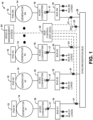
- FIG. 1 illustrates an example of an N-channel direct current (DC) power distribution system (PDS) 10 for sharing power requirements of different types of aircraft electrical system loads.
- the N-channel DC power distribution system includes a plurality of variable frequency generators 14, labeled, #1 through #N, coupled to respective engine driven gearbox pads 12, labeled, #1 through #N, where N is an integer greater than one.
- the gearbox pad 12 can be mounted on a high pressure spool, a low pressure spool or on an auxiliary power unit (APU) of the aircraft.
- An aircraft can include a high pressure spool and a low pressure spool for each engine turbine (e.g., left and right) of the aircraft, and an APU that is driven by a turbine at the tail of the aircraft.
- An AC/DC converter 16 also labeled #1 through #N, converts alternating current (AC) voltage from the generator to DC voltage to be provided to a dedicated bus 18, labeled Bus #1 through Bus #N, for each respective generator via a bus line contactor (BLC) switch 17 disposed between the output of the AC/DC converter 16 and its respective dedicated DC bus 18.
- the BLC switch 17 can be closed during normal operation and opened as a result of a fault.
- Each DC dedicated bus 18 drives one or more dedicated loads (Bus #1 to Bus #N loads) of the aircraft.
- Each of the DC dedicated buses 18 are coupled to a DC synchronization bus 20 via respective synchronization bus line (SBL) switches 21, also referred to as bus tie-breaker (BTB) switches, to allow for selective coupling and decoupling of dedicated buses 18 to the synchronization bus 20, thus allowing for DC power sharing of selected dedicated buses 18 and DC power isolation for other dedicated buses 18.
- SBL synchronization bus line
- BTB bus tie-breaker
- the system 10 includes a bus control unit (BCU) 22 that controls the opening and closing of the SBL switches 21, and the selective coupling and decoupling of SBL switches 21 to the synchronization bus 20, and thus allowing for power sharing among selected dedicated buses 18 and power isolation amongst other dedicated buses 18.
- the BCU 22 is coupled to an aircraft vehicle management system (VMS) 24, which controls the aircraft and its electrical system.
- VMS aircraft vehicle management system
- the BCU 22 and VMS 24 can communicate with another to provide load sharing commands, fault information and commands and a variety of other information useful for communicating between the two units.
- the BCU 22 can rely on discrete logic-based decisions on generator and bus arrangements, as it performs fault detection, isolation and power distribution in addition to information provided to the BCU 22 by the VMS 24 on the aircrafts operating parameters.
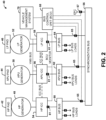
- FIG. 2 illustrates a 3-channel DC PDS 40 for sharing power requirements of different types of aircraft electrical systems (electrical loads).
- the 3-channel DC PDS 40 comprises three DC power channels that are arranged in parallel with respect to one another.
- a first DC power channel comprises a high pressure (HP) generator 48 configured to generate HP alternating current (AC) power and is coupled to a HP Pad 42 (e.g., a gearbox).
- HP Pad 42 is configured to convert mechanical energy (ME) generated by a HP spool of an aircraft engine to electrical energy from which the HP generator 48 utilizes to generate HP-AC power.
- HP high pressure
- ME mechanical energy
- the HP generator 48 is further coupled to an HP-inverter-Converter-Controller (ICC) 54 that is configured to convert the HP-AC power to HP-DC power, and supply the HP-DC power to a dedicated HP Bus 60 for distribution to HP-DC electrical bus loads.
- the 3-channel PDS further comprises a second DC power channel that includes a low pressure (LP) generator 52 coupled to an LP Pad 46 (similar in function as the HP Pad 42), and is configured to supply LP-AC power to an LP-ICC 58, which is configured to convert the LP-AC power to LP-DC power and supply the LP-DC power to a dedicated LP Bus 64 for distribution to the LP-DC electrical bus loads.
- LP low pressure
- the 3-channel PDS 40 further comprises a third DC power channel that includes an auxiliary generator (e.g., an auxiliary power unit (APU)) coupled to APU Pad 44 (similar in function as HP Pad 42 and LP Pad 46), and is configured to supply APU-AC power to an APU-ICC 56, which is configured to convert the APU-AC power to APU-DC power and supply the APU-DC power to dedicated APU Bus 62 for distribution to APU electrical bus loads.
- HP Bus 60, APU Bus 62, and LP Bus 64, respectively, of each DC power channel of the 3-channel PDS are coupled to a respective SBL switches 65 that allows coupling and decoupling between respective dedicated HP Bus 60, APU Bus 62, and LP Bus 64 with a synchronization bus 66.
- the synchronization bus 66 is coupled to an external power contactor (EPC) 67, which enables power to be provided to on board aircraft systems. However, no aircraft loads are connected directly to the synchronization bus 66.
- EPC external power contactor
- Each ICC 54, 56 and 58 has a bus line contactor (BLC) switch 61 at which its input is the point of regulation (POR) for the generating system and to which its output is connected a respective dedicated DC bus.
- BLC bus line contactor
- the 3-channel PDS further comprises a BCU 68 housing executable instructions that control each DC power channel of the 3-channel PDS 40 in cooperation with a VMS 70 in an intelligent manner based on changes (variations) in aircraft operating parameters (e.g., changes in fuel quantity, engine performance, altitude, airspeed, etc). For example, during normal flight operations (e.g., when the aircraft operating parameters are non-varying), the BCU 68 in cooperation with the VMS 70 can maintain each SBL switch 65 of each DC power channel in an open condition. Since each SBL 65 of each DC power channel is open, each DC power channel satisfies the power requirements of the electrical loads that are coupled at their respective dedicated bus.
- aircraft operating parameters e.g., changes in fuel quantity, engine performance, altitude, airspeed, etc.
- the BCU 68 in cooperation with the VMS 70 can be configured to control the HP-ICC 54, the LP-ICC 58, the APU-ICC 56, and each SBL 65 (e.g., by changing the SBL to a closed condition), as illustrated in FIG. 2 with dashed lines, so that power requirements of electrical loads that are coupled to each bus is dynamically shared (distributed) amongst one or more of the HP, APU and LP generators 48, 50 and 52, respectively.
- Dynamically sharing the power requirements of the electrical loads coupled to a respective DC power channel with other DC power channels reduces an amount of horsepower required to be extracted by a respective generator (e.g., HP generator) to satisfy the power requirements of the electrical loads.
- the systems and methods can operate multiple 270Vdc generating systems in parallel with one another in a robust and stable manner. This can be achieved through the use of both voltage and current feedback loops to continuously update the voltage regulation at the respective POR of each generating system such that no single generating system overrides another. Voltage regulation of each generating system operating in parallel is such that as a combined system, it can conform to Mil-Std-704F power quality utilizing a delta-voltage between generating systems of less than 5.0Vdc.
- the three channels can be operated stand-alone as three separate generators feeding regulated 270Vdc power to their respective dedicated buses.
- any two, or all, of the SBLs are closed thereby forcing two or more of the DC generating systems in parallel with one another.
- the generating systems therefore now share the aircraft loads that are connected to the individual dedicated buses through the closed SBLs 65 via the synchronization Bus 66.
- the amount of the total aircraft electrical load that each generating system is set to supply can be set by a ratio asserted by the VMS 70.
- This ratio can be determined through contemplating numerous aircraft operating parameters and can be continuously updated while any two or more channels are operating in parallel in effort to maximize overall aircraft operating efficiency and performance.
- Example aircraft operating parameters may include generator maximum power output ratings, total aircraft electrical load, air speed, altitude, fuel quantity, engine performance and thermal management system performance.
- continuously adjusting the sharing ratio allows for the dynamic shifting of horsepower extraction between HP and LP spools of the same, or a separate, engine as well as an APU, as aircraft and engine performance conditions dictate.
- More immediate local control of the system in terms of its configuration through the open and closure of the SBLs and EPC, is accomplished by the BCU as it contemplates discrete inputs from the ICCs and the aircraft. Examples of BCU inputs are ICC over-current, ICC stop-parallel, ICC fault, SBL status, bus over-current and external power monitoring. Through discrete logic, the BCU can rapidly reconfigure the PDS as faults occur and clear within the system.
- the BCU can rely on discrete logic-based decisions on generator and bus arrangement, or grid configuration, as it performs fault detection, isolation and coordination. Should a source go off-line, or should a fault occur in the distribution system, the BCU, with discrete inputs from the aircraft and the ICCs, commands the SBLs open or closed within 5.0ms of the event. In the event of a bus over-current, the BCU logic will operate faster, opening the SBLs isolating the fault, than that of the ICC protective functions as to prevent that downstream fault from taking viable sources off-line. In conventional stand alone mode, should a source trip off, the BCU will close SBLs allowing the remaining sources to parallel and share the load that had been supplied by the now-off-line generator.
- a load share command can be issued by the VMS to provide a share ratio command to the generating systems to govern the amount of power each is supplying to the total load demanded by the vehicle.
- this command is expressed in a percentage similar to 20%: 35%: 45%, HP: LP: APU.
- the percentage of the aircraft total load that any one generator can supply based on a number of VMS-determined aircraft operating parameters including generator maximum power output ratings, total aircraft electrical load, air speed, altitude, fuel quantity, engine performance and thermal management system performance.
- the ICC 2 can have a set of default load share ratios programmed into the ICCs such that as the BCU informs the ICCs of the requirement to reconfigure the system, the ICCs can immediately revert to a given set of ratios.
- these default ratios are set based on each generating systems' maximum continuous output ratings, for example, 13%: 43.5%: 43.5%.
- advanced energy storage is provided. It can be employed in both high voltage battery (270V nominal) and low voltage battery (28V nominal) applications, each contributing to the overall efficiency of the electrical system and the aircraft.
- the 270V battery is floated on the 270Vdc bus allowing it to immediately fill-in when large on-load transients are applied to the bus as well as absorb energy when large off-load transients or regenerative energy events occur in the system. This allows the generating system to not be over-sized to handle these excursions as well as mitigates horsepower extraction transients on the engine and the engine gearbox.
- the 28V batteries can be employed in a similar floating fashion, but are physically distributed throughout the aircraft in effort to both minimize voltage drop to the flight-critical loads as well as allow for better response in transient suppression.
- Distribution of electrical power in the systems and methods can be performed by both conventional electro-mechanical switch devices and by solid-sate switch devices.
- the BLC switches and the SBL switches can be electro-mechanical switches, while the individual load switches can be solid-state devices.
- the solid-state devices provide faster switch times than conventional contactors and are programmed with trip curves and inrush limiting curves such that both normal and abnormal operation of the various aircraft loads can be managed in a timely manner.
- Fault detection and isolation begins with solid-state load switches and is coordinated with the BCU and ICC protective functions such that a fault with a load is managed accordingly.
- Integrating high-power batteries into an electrical system brings with it the need to safely connect and disconnect to and from a bus. If a fault occurs when a battery is sourcing a bus, or when a battery is applied to an already-faulted bus, a method of interrupting that fault current is required in effort to preserve the hardware.
- the systems and methods can employ an advanced contactor that is designed to make and break battery-sourced fault currents in excess of 8,000 amps.
- Carbon nano-tube cables have been identified as showing up to approximately 40% in cable weight savings, especially when used in shielding of twisted-pair communication lines.
- carbon nano-tube signal cables have an improved cable and harness flexibility, improved bend radii and improved thermal performance.
- FIG. 3 An example methodology will be better appreciated with reference to FIG. 3 . While, for purposes of simplicity of explanation, the methodology of FIG. 3 is shown and described as executing serially, it is to be understood and appreciated that the present invention is not limited by the illustrated order, as some actions could in other examples occur in different orders and/or concurrently from that shown and described herein.
- FIG. 3 illustrates a flow diagram of a method for distributing DC power in an aircraft employing a synchronization bus selectively coupleable to dedicated DC buses by respective synchronization bus line switches.
- the methodology begins at 100 where a plurality of AC voltages are generated from a plurality of sources.
- the plurality of sources could be generators associated with one or more HP and/or LP spools driven by one or more engine turbines. Additionally, the plurality of sources could be an APU driven by an engine turbine at a tail of the aircraft.
- the methodology then proceeds to 120, where the plurality of AC voltages are converted to a plurality of DC voltages, for example, by a plurality of AC/ DC converters.
- each DC voltage is provided to a respective dedicated DC bus that is coupled to respective dedicated bus loads.
- the methodology then advances to 140.
- one or more operating parameters are measured associated with the PDS of the aircraft and/or the operation of the aircraft.
- the methodology then proceeds to 150.
Landscapes
- Engineering & Computer Science (AREA)
- Power Engineering (AREA)
- Aviation & Aerospace Engineering (AREA)
- Supply And Distribution Of Alternating Current (AREA)
Claims (14)
- Ein Flugzeug-Energieverteilungssystem (10), das Folgendes umfasst:eine Vielzahl von Generatoren (14), die als Reaktion auf mechanische Energie, die von einer oder mehreren Flugzeugturbinen eines Flugzeugs erzeugt wird, entsprechende Wechselspannungssignale erzeugen;eine Vielzahl von Wechselrichter-Wandler-Steuerungen (54, 56, 58), wobei jeder der Vielzahl von Wechselrichter-Wandler-Steuerungen (54, 56, 58) einen AC/DC-Wandler (16) enthält, der ein jeweiliges AC-Ausgangssignal von einem jeweiligen Generator (14) empfängt und eine jeweilige DC-Spannung erzeugt, um eine gegebene Leistungsmenge bereitzustellen;eine Vielzahl von dedizierten Gleichstrombussen (18), wobei jeder dedizierte Gleichstrombus (18) mit einem entsprechenden Generator (14) und einem entsprechenden AC/DC-Wandler (16) verbunden ist und eine entsprechende Gleichspannung empfängt, wobei jeder dedizierte Bus die gegebene Leistungsmenge an eine oder mehrere zugehörige dedizierte Buslasten liefert;einen Synchronisationsbus (20), der selektiv mit jedem dedizierten Gleichstrombus (18) durch entsprechende Synchronisationsbus-Leitungsschalter (21) koppelbar ist, um eine gemeinsame Nutzung des Busses zwischen einem ersten Satz dedizierter Gleichstrombusse der Vielzahl dedizierter Gleichstrombusse zu ermöglichen und einen zweiten Satz ausgewählter dedizierter Gleichstrombusse der Vielzahl dedizierter Gleichstrombusse von einem Bus zu isolieren;eine Steuerung (22), die das selektive Schließen und Öffnen der jeweiligen Synchronisationsbusleitungsschalter (21) steuert und die gegebene Leistungsmenge steuert, die der jeweilige AC/DC-Wandler (16) bereitstellt, wenn sich der jeweilige Synchronisationsbusleitungsschalter (21) entweder in einem geschlossenen Zustand oder in einem offenen Zustand befindet, und zwar auf der Grundlage eines Wertes, der auf der Basis von Flugzeugbetriebsparametern des Flugzeugs bestimmt wird; unddadurch gekennzeichnet, dass das Flugzeugenergiesystem (10) ferner ein Fahrzeugmanagementsystem (24) umfasst, um einen Lastverteilungsbefehl an die mehreren Wechselrichter-Wandler-Steuerungen (54, 56, 58) auszugeben, der einen Prozentsatz der Leistung regelt, die von jedem der mehreren Wechselrichter-Wandler-Steuerungen (54, 56, 58) geliefert wird,wobei Lastverteilungs-Standardverhältnisse in jede der mehreren Wechselrichter-Wandler-Steuerungen (54, 56, 58) auf der Grundlage maximaler Dauerausgangsleistungen jedes Erzeugungssystems programmiert sind, das einen der mehreren Generatoren (14), eine der mehreren Wechselrichter-Wandler-Steuerungen (54, 56, 58) und eine der mehreren dedizierten Gleichstrombusse (18) umfasst, undwobei das Fahrzeugmanagementsystem (24) einen Befehl ausgibt, um die mehreren Wechselrichter-Wandler-Steuerungen (54, 56, 58) auf die Standard-Lastverteilungsverhältnisse zurückzusetzen, um das Stromverteilungssystem (10) des Flugzeugs neu zu konfigurieren.
- Das System (10) nach Anspruch 1, das ferner eine Bus-Steuerung umfasst, der das selektive Schließen und Öffnen der Synchronisations-Busleitungsschalter steuert, wobei die Bus-Steuerung kommunikativ mit dem Fahrzeugmanagementsystem des Flugzeugs gekoppelt ist, um Befehle, den Wert und/oder gemeinsame Statusinformationen über den Zustand des Energieverteilungssystems (10) und/oder des Flugzeugs zu empfangen.
- Das System (10) nach Anspruch 2, wobei die Bus-Steuerung bei der Bestimmung des Zustands der Synchronisations-Busleitungsschalter eine diskrete Eingangsrückmeldung von dem Energieverteilungssystem erhält.
- Das System (10) nach Anspruch 1, wobei mindestens einer der Generatoren mit einer Hochdruckspule des Flugzeugs verbunden ist und mindestens einer der Generatoren mit einer Niederdruckspule des Flugzeugs verbunden ist.
- Das System (10) nach Anspruch 1, wobei jede der mehreren Wechselrichter-Wandler-Steuerungen (54, 56, 58) einen Busleitungs-Schützschalter enthält, der den jeweiligen Wechselrichter-Gleichrichter von seinem jeweiligen dedizierten Bus koppelt und entkoppelt.
- Das System (10) nach Anspruch 1, wobei die mehreren Generatoren einen ersten Generator, der mit einer ersten Hochdruckspule verbunden ist, die mit einem ersten Triebwerk des Flugzeugs gekoppelt ist, und einen zweiten Generator, der mit einer ersten Niederdruckspule verbunden ist, die mit dem ersten Triebwerk des Flugzeugs gekoppelt ist, und einen dritten Generator, der mit einer zweiten Hochdruckspule verbunden ist, die mit einem zweiten Triebwerk des Flugzeugs gekoppelt ist, und einen vierten Generator, der mit einer zweiten Niederdruckspule verbunden ist, die mit dem zweiten Triebwerk des Flugzeugs gekoppelt ist, umfassen.
- Ein Flugzeug-Energieverteilungssystem (10) nach Anspruch 1, wobei die Mehrzahl der Generatoren umfasst:einen ersten Generator, der ein erstes Wechselspannungssignal von einer Hochdruckspule erzeugt;einen zweiten Generator, der ein zweites Wechselspannungssignal von einer Niederdruckspule erzeugt,die Mehrzahl von Wechselrichter-Wandler-Steuerungen (54, 56, 58) umfasst:eine ersten Wechselrichter-Wandler-Steuerung (54), der das erste Wechselspannungssignal in eine erste Gleichspannung umwandelt, um eine entsprechende Leistungsmenge bereitzustellen; undeine zweite Wechselrichter-Wandler-Steuerung (56), der das zweite Wechselspannungssignal in ein zweites Gleichspannungssignal umwandelt, um eine entsprechende Leistungsmenge bereitzustellen,die Mehrzahl der dedizierten DC-Busse umfassteinen ersten dedizierten Gleichstrombus, der die erste Gleichspannung empfängt und die erste Gleichspannung an eine oder mehrere erste dedizierte Buslasten liefert; undeinen zweiten dedizierten Gleichstrombus, der die zweite Gleichspannung empfängt und die zweite Gleichspannung an eine oder mehrere zweite dedizierte Buslasten liefert,wobei der Synchronisationsbus durch einen ersten Busleitungsschalter selektiv mit dem ersten dedizierten Gleichstrombus und durch einen zweiten Busleitungsschalter mit dem zweiten dedizierten Gleichstrombus koppelbar ist, um eine selektive Busteilung zwischen dem ersten und dem zweiten dedizierten Gleichstrombus zu ermöglichen, wobei es keine Buslasten gibt, die direkt mit dem Synchronisationsbus gekoppelt sind,die Steuerung, die das selektive Schließen und Öffnen der Synchronisationsbusleitungsschalter steuert und die jeweilige Leistungsmenge steuert, die jeder der ersten und zweiten AC/DC-Wandler bereitstellt, wenn sich die jeweiligen Synchronisationsbusleitungsschalter entweder in einem geschlossenen Zustand oder in einem offenen Zustand befinden, und zwar auf der Grundlage eines Wertes, der auf der Basis von Flugzeugbetriebsparametern eines Flugzeugs bestimmt wird; unddas Fahrzeugmanagementsystem zur Ausgabe eines Lastverteilungsbefehls an den ersten und den zweiten AC/DC-Wandler, der einen Prozentsatz der von jedem der ersten und zweiten AC/DC-Wandler gelieferten Leistung festlegtwobei das Fahrzeugmanagementsystem einen Befehl ausgibt, um die erste Wechselrichter-Wandler-Steuerung (54) und die zweite Wechselrichter-Wandler-Steuerung (56) auf Standard-Lastverteilungsverhältnisse zurückzusetzen, um das Stromverteilungssystem des Flugzeugs neu zu konfigurieren.
- Das System (10) nach Anspruch 7, wobei der Controller kommunikativ mit einem Fahrzeugmanagementsystem des Flugzeugs gekoppelt ist, um Befehle, den Wert und/oder Statusinformationen über den Zustand des Energieverteilungssystems und/oder des Flugzeugs zu empfangen.
- Das System (10) nach Anspruch 7, das ferner umfasst:einen dritten Generator, der ein drittes Wechselspannungssignal von einem Hilfsaggregat erzeugt;ein drittes Wechselrichter-Wandler-Steuergerät (58) mit einem dritten Wechselrichter-Gleichrichter, der das dritte Wechselspannungssignal in eine dritte Gleichspannung umwandelt;einen dritten dedizierten Gleichstrombus, der die dritte Gleichspannung empfängt und die dritte Gleichspannung an eine oder mehrere dritte dedizierte Buslasten liefert, wobei der Synchronisationsbus durch einen dritten Busleitungsschalter selektiv mit dem dritten dedizierten Gleichstrombus koppelbar ist, um eine selektive Busteilung und Bustrennung zwischen dem ersten, zweiten und dritten dedizierten Gleichstrombus über die Bussteuerung zu ermöglichen.
- Das System (10) nach Anspruch 8, wobei die erste Wechselrichter-Wandler-Steuerung (54) und die zweite Wechselrichter-Wandler-Steuerung (56) mit der Bus-Steuereinheit kommunizieren, um Statusinformationen des Energieverteilungssystems (10) auszutauschen, und wobei die erste Wechselrichter-Wandler-Steuerung (54) und die zweite Wechselrichter-Wandler-Steuerung (56) einen Busleitungs-Schützschalter enthalten, der den jeweiligen Wechselstrom-Gleichstrom-Wandler von seinem jeweiligen dedizierten Gleichstrombus koppelt und entkoppelt.
- Das System (10) nach Anspruch 7, das ferner umfasst:einen dritten Generator, der ein drittes Wechselspannungssignal von einer zweiten Hochdruckspule erzeugt;einen vierten Generator, der ein viertes Wechselspannungssignal von einer zweiten Niederdruckspule erzeugt;eine dritte Wechselrichter-Wandler-Steuerung (58) mit einem dritten Wechselrichter-Gleichrichter, der das dritte Wechselspannungssignal in eine dritte Gleichspannung umwandelt;eine vierten Wechselrichter-Wandler-Steuerung, die einen vierten AC/DC-Wandler umfasst, der das vierte Wechselspannungssignal in ein viertes Gleichspannungssignal umwandelt;einen dritten dedizierten Gleichstrombus, der die dritte Gleichspannung empfängt und die dritte Gleichspannung an eine oder mehrere dritte dedizierte Buslasten liefert;einen vierten dedizierten Gleichstrombus, der die vierte Gleichspannung empfängt und die vierte Gleichspannung an eine oder mehrere vierte dedizierte Buslasten liefert, wobei der Synchronisationsbus selektiv mit dem dritten dedizierten Bus durch einen dritten Busleitungsschalter und dem vierten dedizierten Bus durch einen vierten Busleitungsschalter koppelbar ist, um eine selektive Busteilung zwischen dem ersten, zweiten, dritten und vierten dedizierten Bus zu ermöglichen.
- Ein Verfahren zur Verteilung von Gleichstrom in einem Flugzeug, wobei das Verfahren umfasst;Erzeugen einer Vielzahl von Gleichspannungen mit einer gegebenen Leistungsmenge aus einer Vielzahl unabhängiger Quellen, die von einer oder mehreren Turbinen des Flugzeugs angetrieben werden, mit einer Vielzahl von Wechselrichter-Wandler-Steuerungen, wobei jede der Vielzahl von Wechselrichter-Wandler-Steuerungen einen mit dem Flugzeug verbundenen AC/DC-Wandler umfasst;Bereitstellung jeder der mehreren Gleichspannungen für entsprechende dedizierte Gleichstrombusse;Einstellen einer Vielzahl von Schaltern, die selektiv einen ersten Satz dedizierter Gleichstrombusse mit einem Synchronisationsbus koppelt, um eine gemeinsame Nutzung des Busses durch den ersten Satz dedizierter Gleichstrombusse zu ermöglichen und einen zweiten Satz dedizierter Busse zu isolieren;Einstellen der gegebenen Leistungsmenge, die eine jeweilige unabhängige Quelle bereitstellt, wenn sich ein jeweiliger Schalter entweder in einem geschlossenen oder in einem offenen Zustand befindet, auf der Grundlage eines Wertes, der auf der Basis von Flugzeugbetriebsparametern des Flugzeugs bestimmt wird; undAusgeben eines Lastverteilungsbefehls an die mehreren Wechselrichter-Wandler-Steuerungen (54, 56, 58), der einen Prozentsatz der von jedem der mehreren AC/DC-Wandler gelieferten Leistung bestimmt; undAusgabe eines Befehls durch ein Fahrzeugverwaltungssystem, um mehrere Wechselrichter-Wandler-Steuerungen (54, 56, 58) auf Lastverteilungs-Standardverhältnisse zurückzusetzen, um das Flugzeug-Energieverteilungssystem (10) neu zu konfigurieren,wobei die Lastverteilungs-Standardverhältnisse in jede der mehreren Wechselrichter-Wandler-Steuerungen (54, 56, 58) auf der Grundlage maximaler Dauerausgangsleistungen jedes Erzeugungssystems programmiert sind, das einen der mehreren Generatoren (14), eine der mehreren Wechselrichter-Wandler-Steuerungen (54, 56, 58) und eine der mehreren dedizierten Gleichstrombusse (18) umfasst.
- Das Verfahren nach Anspruch 12, das ferner das Überwachen eines oder mehrerer Parameter des Flugzeugs und das dynamische Einstellen der mehreren Schalter auf der Grundlage von Änderungen des überwachten einen oder der mehreren Parameter umfasst.
- Das Verfahren nach Anspruch 12, wobei die unabhängigen Quellen eine oder mehrere Hochdruckspulen, eine oder mehrere Niederdruckspulen und eine Hilfsenergieeinheit umfassen.
Applications Claiming Priority (2)
| Application Number | Priority Date | Filing Date | Title |
|---|---|---|---|
| US14/729,925 US10090676B2 (en) | 2015-06-03 | 2015-06-03 | Aircraft DC power distribution systems and methods |
| PCT/US2016/031748 WO2016195936A1 (en) | 2015-06-03 | 2016-05-11 | Aircraft dc power distribution systems and methods |
Publications (2)
| Publication Number | Publication Date |
|---|---|
| EP3304674A1 EP3304674A1 (de) | 2018-04-11 |
| EP3304674B1 true EP3304674B1 (de) | 2024-12-18 |
Family
ID=56072442
Family Applications (1)
| Application Number | Title | Priority Date | Filing Date |
|---|---|---|---|
| EP16724795.6A Active EP3304674B1 (de) | 2015-06-03 | 2016-05-11 | System und verfahren zur wechselstromverteilung für ein flugzeug |
Country Status (3)
| Country | Link |
|---|---|
| US (1) | US10090676B2 (de) |
| EP (1) | EP3304674B1 (de) |
| WO (1) | WO2016195936A1 (de) |
Families Citing this family (50)
| Publication number | Priority date | Publication date | Assignee | Title |
|---|---|---|---|---|
| EP3332467A1 (de) * | 2015-08-07 | 2018-06-13 | GE Energy Products France SNC | Hilfssystem zur speicherung und bereitstellung von elektrischer energie für mehrere verwendungen in einer stromerzeugungsanlage |
| US10654578B2 (en) | 2016-11-02 | 2020-05-19 | Rolls-Royce North American Technologies, Inc. | Combined AC and DC turboelectric distributed propulsion system |
| US10934935B2 (en) * | 2017-01-30 | 2021-03-02 | Ge Aviation Systems Llc | Engine core assistance |
| GB2559956B (en) * | 2017-02-15 | 2020-09-16 | Ge Aviat Systems Ltd | Power distribution node for a power architecture |
| US11970062B2 (en) * | 2017-04-05 | 2024-04-30 | Ge Aviation Systems Llc | Systems and methods of power allocation for hybrid electric architecture |
| CA3005542A1 (en) | 2017-05-23 | 2018-11-23 | Pratt & Whitney Canada Corp. | Engine assembly with a dedicated voltage bus |
| FR3068532A1 (fr) * | 2017-06-29 | 2019-01-04 | Zodiac Aero Electric | Boitier de distribution d'energie electrique pour reseau de bord d'un aeronef et systeme d'alimentation electrique correspondant |
| US10640225B2 (en) * | 2017-07-10 | 2020-05-05 | Rolls-Royce North American Technologies, Inc. | Selectively regulating current in distributed propulsion systems |
| US10644630B2 (en) | 2017-11-28 | 2020-05-05 | General Electric Company | Turbomachine with an electric machine assembly and method for operation |
| CN108288853B (zh) * | 2018-04-04 | 2024-05-28 | 中国商用飞机有限责任公司北京民用飞机技术研究中心 | 飞机直流供电系统及供电方法 |
| CN108964149A (zh) * | 2018-07-26 | 2018-12-07 | 国网辽宁省电力有限公司经济技术研究院 | 考虑故障情况的交直流柔性互联配电网协调控制方法 |
| FR3085667B1 (fr) | 2018-09-12 | 2020-11-20 | Safran | Ensemble propulsif hybride serie pour aeronef |
| US11027719B2 (en) * | 2018-12-03 | 2021-06-08 | General Electric Company | Distributed power generation for a vehicle system |
| FR3093870B1 (fr) * | 2019-03-15 | 2021-04-02 | Safran Electrical & Power | Système de commande d’un réseau électrique d’avion |
| US10868483B1 (en) * | 2019-06-03 | 2020-12-15 | Hamilton Sundstrand Corporation | DC generator system |
| US11549464B2 (en) * | 2019-07-25 | 2023-01-10 | Raytheon Technologies Corporation | Hybrid gas turbine engine starting control |
| US11428171B2 (en) | 2019-12-06 | 2022-08-30 | General Electric Company | Electric machine assistance for multi-spool turbomachine operation and control |
| US11005465B1 (en) * | 2020-01-13 | 2021-05-11 | Hamilton Sunstrand Corporation | Zero-cross circuit with low phase delay |
| US11325714B2 (en) | 2020-07-09 | 2022-05-10 | General Electric Company | Electric power system for a vehicle |
| CN112436503B (zh) * | 2020-12-01 | 2022-12-13 | 陕西航空电气有限责任公司 | 一种飞机高压直流供电系统中的高压直流汇流条功率控制方法 |
| GB2604366B (en) * | 2021-03-03 | 2023-10-25 | Rolls Royce Plc | Electrical power systems |
| US12571360B2 (en) | 2021-04-14 | 2026-03-10 | General Electric Deutschland Holding Gmbh | Three-stream gas turbine engine with embedded electric machine |
| US11845388B2 (en) | 2021-05-20 | 2023-12-19 | General Electric Company | AC electrical power system for a vehicle |
| US11677234B2 (en) | 2021-08-20 | 2023-06-13 | Hamilton Sundstrand Corporation | Power input source detection in aircraft LRU |
| US11492918B1 (en) | 2021-09-03 | 2022-11-08 | General Electric Company | Gas turbine engine with third stream |
| US11750114B2 (en) | 2021-10-22 | 2023-09-05 | General Electric Company | Reduction of common mode emission of an electrical power converter |
| US11834995B2 (en) | 2022-03-29 | 2023-12-05 | General Electric Company | Air-to-air heat exchanger potential in gas turbine engines |
| US12071896B2 (en) | 2022-03-29 | 2024-08-27 | General Electric Company | Air-to-air heat exchanger potential in gas turbine engines |
| US12065989B2 (en) | 2022-04-11 | 2024-08-20 | General Electric Company | Gas turbine engine with third stream |
| US11834954B2 (en) | 2022-04-11 | 2023-12-05 | General Electric Company | Gas turbine engine with third stream |
| US11834992B2 (en) | 2022-04-27 | 2023-12-05 | General Electric Company | Heat exchanger capacity for one or more heat exchangers associated with an accessory gearbox of a turbofan engine |
| US12366204B2 (en) | 2022-04-27 | 2025-07-22 | General Electric Company | Heat exchanger capacity for one or more heat exchangers associated with a power gearbox of a turbofan engine |
| US11680530B1 (en) | 2022-04-27 | 2023-06-20 | General Electric Company | Heat exchanger capacity for one or more heat exchangers associated with a power gearbox of a turbofan engine |
| US12060829B2 (en) | 2022-04-27 | 2024-08-13 | General Electric Company | Heat exchanger capacity for one or more heat exchangers associated with an accessory gearbox of a turbofan engine |
| US12560132B2 (en) | 2022-08-02 | 2026-02-24 | General Electric Company | Gas turbine engine with third stream |
| US12410763B2 (en) | 2022-08-02 | 2025-09-09 | General Electric Company | Gas turbine engine with third stream |
| US12577926B2 (en) | 2022-08-02 | 2026-03-17 | General Electric Company | Gas turbine engine |
| US12571358B2 (en) | 2022-08-02 | 2026-03-10 | General Electric Company | Gas turbine engine with third stream |
| US12577925B2 (en) | 2022-08-02 | 2026-03-17 | General Electric Company | Gas turbine engine with third stream |
| US12565866B2 (en) | 2022-08-02 | 2026-03-03 | General Electric Company | Gas turbine engine with third stream |
| US12516647B2 (en) | 2022-08-02 | 2026-01-06 | General Electric Company | Gas turbine engine with third stream |
| US12031504B2 (en) | 2022-08-02 | 2024-07-09 | General Electric Company | Gas turbine engine with third stream |
| US12486817B2 (en) | 2022-08-02 | 2025-12-02 | General Electric Company | Gas turbine engine with third stream |
| US12421917B2 (en) | 2022-08-02 | 2025-09-23 | General Electric Company | Gas turbine engine with third stream |
| US12480449B2 (en) | 2022-08-22 | 2025-11-25 | General Electric Company | Propulsion system including an electric machine for starting a gas turbine engine |
| FR3141680B1 (fr) * | 2022-11-08 | 2024-10-25 | Safran | Système de génération électrique pour un aéronef et procédé associé |
| FR3141678B1 (fr) * | 2022-11-08 | 2024-10-25 | Safran | Système de génération électrique pour un aéronef et procédé associé |
| FR3145657B1 (fr) * | 2023-02-06 | 2025-02-07 | Safran Electrical & Power | Système de distribution électrique pour aéronef et procédé associé |
| FR3145656A1 (fr) * | 2023-02-07 | 2024-08-09 | Safran Electrical & Power | Procédé de surveillance et de protection d’un système d’hybridation électrique contre le risque de feu |
| US20250316998A1 (en) * | 2024-04-09 | 2025-10-09 | Lockheed Martin Corporation | Electric aircraft with power generation and distribution system |
Citations (3)
| Publication number | Priority date | Publication date | Assignee | Title |
|---|---|---|---|---|
| US4403292A (en) * | 1979-05-30 | 1983-09-06 | Sundstrand Corporation | Control for an electrical generating and distribution system, and method of operation |
| US20090224599A1 (en) * | 2008-03-06 | 2009-09-10 | Edwin Yue | Paralleled hvdc bus electrical power system architecture |
| US20150123463A1 (en) * | 2013-11-06 | 2015-05-07 | Ge Aviation Systems Limited | Electrical power system for an aircraft |
Family Cites Families (27)
| Publication number | Priority date | Publication date | Assignee | Title |
|---|---|---|---|---|
| US7210653B2 (en) | 2002-10-22 | 2007-05-01 | The Boeing Company | Electric-based secondary power system architectures for aircraft |
| US6931856B2 (en) | 2003-09-12 | 2005-08-23 | Mes International, Inc. | Multi-spool turbogenerator system and control method |
| US7116003B2 (en) | 2004-07-14 | 2006-10-03 | Hamilton Sundstrand Corporation | Aircraft starter/generator electrical system with mixed power architecture |
| US7439634B2 (en) | 2004-08-24 | 2008-10-21 | Honeywell International Inc. | Electrical starting, generation, conversion and distribution system architecture for a more electric vehicle |
| US7400065B2 (en) | 2004-08-24 | 2008-07-15 | Honeywell International Inc. | Electrical power distribution system and method with active load control |
| US7285871B2 (en) | 2004-08-25 | 2007-10-23 | Honeywell International, Inc. | Engine power extraction control system |
| US7492057B2 (en) * | 2004-11-10 | 2009-02-17 | Baldwin Mark H | High reliability DC power distribution system |
| FR2882200B1 (fr) | 2005-02-17 | 2015-05-01 | Hispano Suiza Sa | Alimentation electrique d'equipements d'un moteur d'avion a turbine a gaz |
| FR2900636B1 (fr) | 2006-05-05 | 2009-03-06 | Hispano Suiza Sa | Circuit d'alimentation en energie electrique pour des equipements electriques d'un moteur d'aeronef ou de son environnement |
| FR2907762B1 (fr) | 2006-10-27 | 2009-12-18 | Airbus France | Systeme de generation, conversion, distribution et demarrage electrique a bord d'un aeronef |
| US7805204B2 (en) | 2007-03-21 | 2010-09-28 | Honeywell International Inc. | Integrated electrical power distribution system using common building blocks |
| US7468561B2 (en) | 2007-03-27 | 2008-12-23 | General Electric Company | Integrated electrical power extraction for aircraft engines |
| WO2008130968A1 (en) * | 2007-04-19 | 2008-10-30 | Glacier Bay, Inc. | Power generation system for marine vessel |
| US7876542B2 (en) | 2007-08-16 | 2011-01-25 | Hamilton Sundstrand Corporation | Generator for gas turbine engine having DC bus fault short circuit control using a battery |
| US7952221B2 (en) * | 2007-11-14 | 2011-05-31 | Honeywell International Inc. | Enhanced DC electric main engine start system |
| US8148848B2 (en) | 2008-01-24 | 2012-04-03 | Honeywell International, Inc. | Solid state power controller (SSPC) used as bus tie breaker in electrical power distribution systems |
| DE102008043626A1 (de) | 2008-11-10 | 2010-05-20 | Airbus Deutschland Gmbh | Leistungsverteilungs-Vorrichtung zum Verteilen von Leistung und Verfahren zum Verteilen von Leistung |
| DE102010003632B4 (de) | 2009-04-06 | 2012-09-13 | Airbus Operations Gmbh | Vorrichtung und Verfahren zum Wandeln bereitgestellter elektrischer Leistung in mechanische Leistung zum Starten zumindest eines Triebwerkes |
| GB0912340D0 (en) | 2009-07-16 | 2009-08-26 | Rolls Royce Plc | Aircraft power management system |
| US8330291B2 (en) | 2009-10-02 | 2012-12-11 | General Electric Company | Power generation apparatus |
| US8344544B2 (en) | 2010-05-19 | 2013-01-01 | Hamilton Sundstrand Corporation | Bus-tie SSPCS for DC power distribution system |
| US8738268B2 (en) * | 2011-03-10 | 2014-05-27 | The Boeing Company | Vehicle electrical power management and distribution |
| US20130062885A1 (en) | 2011-09-08 | 2013-03-14 | General Electric Company | Method and apparatus for extracting electrical power from a gas turbine engine |
| GB2495917B (en) | 2011-10-24 | 2014-10-22 | Ge Aviat Systems Ltd | Multiple source electrical power distribution in aircraft |
| EP2973918B1 (de) * | 2013-03-13 | 2022-04-20 | Aspin Kemp & Associates Holding Corp. | Schalterdesign für energiesystemelastizität |
| US9676351B2 (en) * | 2013-10-11 | 2017-06-13 | The Boeing Company | Modular equipment center solid state primary power switching network |
| US9939194B2 (en) * | 2014-10-21 | 2018-04-10 | Kellogg Brown & Root Llc | Isolated power networks within an all-electric LNG plant and methods for operating same |
-
2015
- 2015-06-03 US US14/729,925 patent/US10090676B2/en active Active
-
2016
- 2016-05-11 EP EP16724795.6A patent/EP3304674B1/de active Active
- 2016-05-11 WO PCT/US2016/031748 patent/WO2016195936A1/en not_active Ceased
Patent Citations (3)
| Publication number | Priority date | Publication date | Assignee | Title |
|---|---|---|---|---|
| US4403292A (en) * | 1979-05-30 | 1983-09-06 | Sundstrand Corporation | Control for an electrical generating and distribution system, and method of operation |
| US20090224599A1 (en) * | 2008-03-06 | 2009-09-10 | Edwin Yue | Paralleled hvdc bus electrical power system architecture |
| US20150123463A1 (en) * | 2013-11-06 | 2015-05-07 | Ge Aviation Systems Limited | Electrical power system for an aircraft |
Also Published As
| Publication number | Publication date |
|---|---|
| US20160359324A1 (en) | 2016-12-08 |
| WO2016195936A1 (en) | 2016-12-08 |
| EP3304674A1 (de) | 2018-04-11 |
| US10090676B2 (en) | 2018-10-02 |
Similar Documents
| Publication | Publication Date | Title |
|---|---|---|
| EP3304674B1 (de) | System und verfahren zur wechselstromverteilung für ein flugzeug | |
| US11078850B2 (en) | Method for allocating power in an electrical power system architecture | |
| CN103415975B (zh) | 交通工具电力管理和分配 | |
| US7936086B2 (en) | Paralleled HVDC bus electrical power system architecture | |
| US11495982B2 (en) | System and method for allocating propulsion load power drawn from high-energy and high-power batteries | |
| US10014707B2 (en) | Method for managing the electric power network of an aircraft | |
| US8975784B2 (en) | Method for managing an electrical network | |
| US8829707B2 (en) | Methods for aircraft emergency power management | |
| CN102210094B (zh) | 用于配电的配电设备和用于配电的方法 | |
| US10053030B2 (en) | Electrical system for an aircraft | |
| WO2016101130A1 (en) | Method and controller for coordinating control of wind farm during disconnection to utility grid | |
| RU2463212C1 (ru) | Комплекс из приводов и системы электропитания от сети | |
| CN112228221B (zh) | 一种冲压涡轮驱动的辅助发电系统及使用方法 | |
| WO2015132186A1 (en) | Power system for a floating vessel | |
| JP2016506234A (ja) | 航空機に電力を供給する方法およびシステム | |
| US10822116B2 (en) | Power distribution network | |
| Hegner et al. | Integrated fight through power | |
| US12280881B2 (en) | Aircraft propulsion utilizing a safety critical energy management system | |
| Todd et al. | Effects of electrical power off-take on finite inertia mechanical systems | |
| GB2635384A (en) | Apparatus | |
| Thalin | The Electric Aircraft | |
| Cuomo et al. | Smart Electric Power Management Onboard Future Aircraft |
Legal Events
| Date | Code | Title | Description |
|---|---|---|---|
| STAA | Information on the status of an ep patent application or granted ep patent |
Free format text: STATUS: THE INTERNATIONAL PUBLICATION HAS BEEN MADE |
|
| PUAI | Public reference made under article 153(3) epc to a published international application that has entered the european phase |
Free format text: ORIGINAL CODE: 0009012 |
|
| STAA | Information on the status of an ep patent application or granted ep patent |
Free format text: STATUS: REQUEST FOR EXAMINATION WAS MADE |
|
| 17P | Request for examination filed |
Effective date: 20171127 |
|
| AK | Designated contracting states |
Kind code of ref document: A1 Designated state(s): AL AT BE BG CH CY CZ DE DK EE ES FI FR GB GR HR HU IE IS IT LI LT LU LV MC MK MT NL NO PL PT RO RS SE SI SK SM TR |
|
| AX | Request for extension of the european patent |
Extension state: BA ME |
|
| DAV | Request for validation of the european patent (deleted) | ||
| DAX | Request for extension of the european patent (deleted) | ||
| STAA | Information on the status of an ep patent application or granted ep patent |
Free format text: STATUS: EXAMINATION IS IN PROGRESS |
|
| 17Q | First examination report despatched |
Effective date: 20191114 |
|
| P01 | Opt-out of the competence of the unified patent court (upc) registered |
Effective date: 20230607 |
|
| GRAP | Despatch of communication of intention to grant a patent |
Free format text: ORIGINAL CODE: EPIDOSNIGR1 |
|
| STAA | Information on the status of an ep patent application or granted ep patent |
Free format text: STATUS: GRANT OF PATENT IS INTENDED |
|
| GRAS | Grant fee paid |
Free format text: ORIGINAL CODE: EPIDOSNIGR3 |
|
| INTG | Intention to grant announced |
Effective date: 20241011 |
|
| GRAA | (expected) grant |
Free format text: ORIGINAL CODE: 0009210 |
|
| STAA | Information on the status of an ep patent application or granted ep patent |
Free format text: STATUS: THE PATENT HAS BEEN GRANTED |
|
| AK | Designated contracting states |
Kind code of ref document: B1 Designated state(s): AL AT BE BG CH CY CZ DE DK EE ES FI FR GB GR HR HU IE IS IT LI LT LU LV MC MK MT NL NO PL PT RO RS SE SI SK SM TR |
|
| REG | Reference to a national code |
Ref country code: GB Ref legal event code: FG4D |
|
| REG | Reference to a national code |
Ref country code: CH Ref legal event code: EP |
|
| REG | Reference to a national code |
Ref country code: DE Ref legal event code: R096 Ref document number: 602016090655 Country of ref document: DE |
|
| REG | Reference to a national code |
Ref country code: IE Ref legal event code: FG4D |
|
| REG | Reference to a national code |
Ref country code: LT Ref legal event code: MG9D |
|
| PG25 | Lapsed in a contracting state [announced via postgrant information from national office to epo] |
Ref country code: HR Free format text: LAPSE BECAUSE OF FAILURE TO SUBMIT A TRANSLATION OF THE DESCRIPTION OR TO PAY THE FEE WITHIN THE PRESCRIBED TIME-LIMIT Effective date: 20241218 |
|
| PG25 | Lapsed in a contracting state [announced via postgrant information from national office to epo] |
Ref country code: FI Free format text: LAPSE BECAUSE OF FAILURE TO SUBMIT A TRANSLATION OF THE DESCRIPTION OR TO PAY THE FEE WITHIN THE PRESCRIBED TIME-LIMIT Effective date: 20241218 |
|
| PG25 | Lapsed in a contracting state [announced via postgrant information from national office to epo] |
Ref country code: BG Free format text: LAPSE BECAUSE OF FAILURE TO SUBMIT A TRANSLATION OF THE DESCRIPTION OR TO PAY THE FEE WITHIN THE PRESCRIBED TIME-LIMIT Effective date: 20241218 |
|
| PG25 | Lapsed in a contracting state [announced via postgrant information from national office to epo] |
Ref country code: NO Free format text: LAPSE BECAUSE OF FAILURE TO SUBMIT A TRANSLATION OF THE DESCRIPTION OR TO PAY THE FEE WITHIN THE PRESCRIBED TIME-LIMIT Effective date: 20250318 |
|
| REG | Reference to a national code |
Ref country code: NL Ref legal event code: MP Effective date: 20241218 |
|
| PG25 | Lapsed in a contracting state [announced via postgrant information from national office to epo] |
Ref country code: LV Free format text: LAPSE BECAUSE OF FAILURE TO SUBMIT A TRANSLATION OF THE DESCRIPTION OR TO PAY THE FEE WITHIN THE PRESCRIBED TIME-LIMIT Effective date: 20241218 Ref country code: GR Free format text: LAPSE BECAUSE OF FAILURE TO SUBMIT A TRANSLATION OF THE DESCRIPTION OR TO PAY THE FEE WITHIN THE PRESCRIBED TIME-LIMIT Effective date: 20250319 |
|
| PG25 | Lapsed in a contracting state [announced via postgrant information from national office to epo] |
Ref country code: RS Free format text: LAPSE BECAUSE OF FAILURE TO SUBMIT A TRANSLATION OF THE DESCRIPTION OR TO PAY THE FEE WITHIN THE PRESCRIBED TIME-LIMIT Effective date: 20250318 |
|
| PG25 | Lapsed in a contracting state [announced via postgrant information from national office to epo] |
Ref country code: NL Free format text: LAPSE BECAUSE OF FAILURE TO SUBMIT A TRANSLATION OF THE DESCRIPTION OR TO PAY THE FEE WITHIN THE PRESCRIBED TIME-LIMIT Effective date: 20241218 |
|
| REG | Reference to a national code |
Ref country code: AT Ref legal event code: MK05 Ref document number: 1753034 Country of ref document: AT Kind code of ref document: T Effective date: 20241218 |
|
| PG25 | Lapsed in a contracting state [announced via postgrant information from national office to epo] |
Ref country code: SM Free format text: LAPSE BECAUSE OF FAILURE TO SUBMIT A TRANSLATION OF THE DESCRIPTION OR TO PAY THE FEE WITHIN THE PRESCRIBED TIME-LIMIT Effective date: 20241218 |
|
| PG25 | Lapsed in a contracting state [announced via postgrant information from national office to epo] |
Ref country code: PL Free format text: LAPSE BECAUSE OF FAILURE TO SUBMIT A TRANSLATION OF THE DESCRIPTION OR TO PAY THE FEE WITHIN THE PRESCRIBED TIME-LIMIT Effective date: 20241218 |
|
| PG25 | Lapsed in a contracting state [announced via postgrant information from national office to epo] |
Ref country code: ES Free format text: LAPSE BECAUSE OF FAILURE TO SUBMIT A TRANSLATION OF THE DESCRIPTION OR TO PAY THE FEE WITHIN THE PRESCRIBED TIME-LIMIT Effective date: 20241218 |
|
| PGFP | Annual fee paid to national office [announced via postgrant information from national office to epo] |
Ref country code: GB Payment date: 20250527 Year of fee payment: 10 |
|
| PG25 | Lapsed in a contracting state [announced via postgrant information from national office to epo] |
Ref country code: IS Free format text: LAPSE BECAUSE OF FAILURE TO SUBMIT A TRANSLATION OF THE DESCRIPTION OR TO PAY THE FEE WITHIN THE PRESCRIBED TIME-LIMIT Effective date: 20250418 |
|
| PG25 | Lapsed in a contracting state [announced via postgrant information from national office to epo] |
Ref country code: PT Free format text: LAPSE BECAUSE OF FAILURE TO SUBMIT A TRANSLATION OF THE DESCRIPTION OR TO PAY THE FEE WITHIN THE PRESCRIBED TIME-LIMIT Effective date: 20250421 |
|
| PG25 | Lapsed in a contracting state [announced via postgrant information from national office to epo] |
Ref country code: EE Free format text: LAPSE BECAUSE OF FAILURE TO SUBMIT A TRANSLATION OF THE DESCRIPTION OR TO PAY THE FEE WITHIN THE PRESCRIBED TIME-LIMIT Effective date: 20241218 |
|
| PGFP | Annual fee paid to national office [announced via postgrant information from national office to epo] |
Ref country code: FR Payment date: 20250528 Year of fee payment: 10 |
|
| PG25 | Lapsed in a contracting state [announced via postgrant information from national office to epo] |
Ref country code: RO Free format text: LAPSE BECAUSE OF FAILURE TO SUBMIT A TRANSLATION OF THE DESCRIPTION OR TO PAY THE FEE WITHIN THE PRESCRIBED TIME-LIMIT Effective date: 20241218 Ref country code: AT Free format text: LAPSE BECAUSE OF FAILURE TO SUBMIT A TRANSLATION OF THE DESCRIPTION OR TO PAY THE FEE WITHIN THE PRESCRIBED TIME-LIMIT Effective date: 20241218 |
|
| PG25 | Lapsed in a contracting state [announced via postgrant information from national office to epo] |
Ref country code: SK Free format text: LAPSE BECAUSE OF FAILURE TO SUBMIT A TRANSLATION OF THE DESCRIPTION OR TO PAY THE FEE WITHIN THE PRESCRIBED TIME-LIMIT Effective date: 20241218 |
|
| PG25 | Lapsed in a contracting state [announced via postgrant information from national office to epo] |
Ref country code: CZ Free format text: LAPSE BECAUSE OF FAILURE TO SUBMIT A TRANSLATION OF THE DESCRIPTION OR TO PAY THE FEE WITHIN THE PRESCRIBED TIME-LIMIT Effective date: 20241218 |
|
| PG25 | Lapsed in a contracting state [announced via postgrant information from national office to epo] |
Ref country code: IT Free format text: LAPSE BECAUSE OF FAILURE TO SUBMIT A TRANSLATION OF THE DESCRIPTION OR TO PAY THE FEE WITHIN THE PRESCRIBED TIME-LIMIT Effective date: 20241218 |
|
| PG25 | Lapsed in a contracting state [announced via postgrant information from national office to epo] |
Ref country code: SE Free format text: LAPSE BECAUSE OF FAILURE TO SUBMIT A TRANSLATION OF THE DESCRIPTION OR TO PAY THE FEE WITHIN THE PRESCRIBED TIME-LIMIT Effective date: 20241218 |
|
| REG | Reference to a national code |
Ref country code: DE Ref legal event code: R097 Ref document number: 602016090655 Country of ref document: DE |
|
| PG25 | Lapsed in a contracting state [announced via postgrant information from national office to epo] |
Ref country code: DK Free format text: LAPSE BECAUSE OF FAILURE TO SUBMIT A TRANSLATION OF THE DESCRIPTION OR TO PAY THE FEE WITHIN THE PRESCRIBED TIME-LIMIT Effective date: 20241218 |
|
| PLBE | No opposition filed within time limit |
Free format text: ORIGINAL CODE: 0009261 |
|
| STAA | Information on the status of an ep patent application or granted ep patent |
Free format text: STATUS: NO OPPOSITION FILED WITHIN TIME LIMIT |
|
| REG | Reference to a national code |
Ref country code: CH Ref legal event code: L10 Free format text: ST27 STATUS EVENT CODE: U-0-0-L10-L00 (AS PROVIDED BY THE NATIONAL OFFICE) Effective date: 20251029 |
|
| 26N | No opposition filed |
Effective date: 20250919 |
|
| REG | Reference to a national code |
Ref country code: DE Ref legal event code: R119 Ref document number: 602016090655 Country of ref document: DE |
|
| REG | Reference to a national code |
Ref country code: CH Ref legal event code: H13 Free format text: ST27 STATUS EVENT CODE: U-0-0-H10-H13 (AS PROVIDED BY THE NATIONAL OFFICE) Effective date: 20251223 |
|
| PG25 | Lapsed in a contracting state [announced via postgrant information from national office to epo] |
Ref country code: LU Free format text: LAPSE BECAUSE OF NON-PAYMENT OF DUE FEES Effective date: 20250511 |
|
| PG25 | Lapsed in a contracting state [announced via postgrant information from national office to epo] |
Ref country code: CH Free format text: LAPSE BECAUSE OF NON-PAYMENT OF DUE FEES Effective date: 20250531 |
|
| REG | Reference to a national code |
Ref country code: BE Ref legal event code: MM Effective date: 20250531 |
|
| PG25 | Lapsed in a contracting state [announced via postgrant information from national office to epo] |
Ref country code: MC Free format text: LAPSE BECAUSE OF FAILURE TO SUBMIT A TRANSLATION OF THE DESCRIPTION OR TO PAY THE FEE WITHIN THE PRESCRIBED TIME-LIMIT Effective date: 20241218 |