EP3304385B1 - Entdeckung einer populationsstruktur aus mustern von identity-by-descent - Google Patents
Entdeckung einer populationsstruktur aus mustern von identity-by-descent Download PDFInfo
- Publication number
- EP3304385B1 EP3304385B1 EP16802662.3A EP16802662A EP3304385B1 EP 3304385 B1 EP3304385 B1 EP 3304385B1 EP 16802662 A EP16802662 A EP 16802662A EP 3304385 B1 EP3304385 B1 EP 3304385B1
- Authority
- EP
- European Patent Office
- Prior art keywords
- ibd
- individuals
- community
- individual
- computer
- Prior art date
- Legal status (The legal status is an assumption and is not a legal conclusion. Google has not performed a legal analysis and makes no representation as to the accuracy of the status listed.)
- Active
Links
Images



Classifications
-
- G—PHYSICS
- G16—INFORMATION AND COMMUNICATION TECHNOLOGY [ICT] SPECIALLY ADAPTED FOR SPECIFIC APPLICATION FIELDS
- G16B—BIOINFORMATICS, i.e. INFORMATION AND COMMUNICATION TECHNOLOGY [ICT] SPECIALLY ADAPTED FOR GENETIC OR PROTEIN-RELATED DATA PROCESSING IN COMPUTATIONAL MOLECULAR BIOLOGY
- G16B10/00—ICT specially adapted for evolutionary bioinformatics, e.g. phylogenetic tree construction or analysis
-
- C—CHEMISTRY; METALLURGY
- C12—BIOCHEMISTRY; BEER; SPIRITS; WINE; VINEGAR; MICROBIOLOGY; ENZYMOLOGY; MUTATION OR GENETIC ENGINEERING
- C12Q—MEASURING OR TESTING PROCESSES INVOLVING ENZYMES, NUCLEIC ACIDS OR MICROORGANISMS; COMPOSITIONS OR TEST PAPERS THEREFOR; PROCESSES OF PREPARING SUCH COMPOSITIONS; CONDITION-RESPONSIVE CONTROL IN MICROBIOLOGICAL OR ENZYMOLOGICAL PROCESSES
- C12Q1/00—Measuring or testing processes involving enzymes, nucleic acids or microorganisms; Compositions therefor; Processes of preparing such compositions
- C12Q1/68—Measuring or testing processes involving enzymes, nucleic acids or microorganisms; Compositions therefor; Processes of preparing such compositions involving nucleic acids
- C12Q1/6876—Nucleic acid products used in the analysis of nucleic acids, e.g. primers or probes
- C12Q1/6888—Nucleic acid products used in the analysis of nucleic acids, e.g. primers or probes for detection or identification of organisms
-
- G—PHYSICS
- G06—COMPUTING OR CALCULATING; COUNTING
- G06N—COMPUTING ARRANGEMENTS BASED ON SPECIFIC COMPUTATIONAL MODELS
- G06N20/00—Machine learning
-
- G—PHYSICS
- G16—INFORMATION AND COMMUNICATION TECHNOLOGY [ICT] SPECIALLY ADAPTED FOR SPECIFIC APPLICATION FIELDS
- G16B—BIOINFORMATICS, i.e. INFORMATION AND COMMUNICATION TECHNOLOGY [ICT] SPECIALLY ADAPTED FOR GENETIC OR PROTEIN-RELATED DATA PROCESSING IN COMPUTATIONAL MOLECULAR BIOLOGY
- G16B20/00—ICT specially adapted for functional genomics or proteomics, e.g. genotype-phenotype associations
-
- G—PHYSICS
- G16—INFORMATION AND COMMUNICATION TECHNOLOGY [ICT] SPECIALLY ADAPTED FOR SPECIFIC APPLICATION FIELDS
- G16B—BIOINFORMATICS, i.e. INFORMATION AND COMMUNICATION TECHNOLOGY [ICT] SPECIALLY ADAPTED FOR GENETIC OR PROTEIN-RELATED DATA PROCESSING IN COMPUTATIONAL MOLECULAR BIOLOGY
- G16B20/00—ICT specially adapted for functional genomics or proteomics, e.g. genotype-phenotype associations
- G16B20/20—Allele or variant detection, e.g. single nucleotide polymorphism [SNP] detection
-
- G—PHYSICS
- G16—INFORMATION AND COMMUNICATION TECHNOLOGY [ICT] SPECIALLY ADAPTED FOR SPECIFIC APPLICATION FIELDS
- G16B—BIOINFORMATICS, i.e. INFORMATION AND COMMUNICATION TECHNOLOGY [ICT] SPECIALLY ADAPTED FOR GENETIC OR PROTEIN-RELATED DATA PROCESSING IN COMPUTATIONAL MOLECULAR BIOLOGY
- G16B20/00—ICT specially adapted for functional genomics or proteomics, e.g. genotype-phenotype associations
- G16B20/40—Population genetics; Linkage disequilibrium
-
- G—PHYSICS
- G16—INFORMATION AND COMMUNICATION TECHNOLOGY [ICT] SPECIALLY ADAPTED FOR SPECIFIC APPLICATION FIELDS
- G16B—BIOINFORMATICS, i.e. INFORMATION AND COMMUNICATION TECHNOLOGY [ICT] SPECIALLY ADAPTED FOR GENETIC OR PROTEIN-RELATED DATA PROCESSING IN COMPUTATIONAL MOLECULAR BIOLOGY
- G16B30/00—ICT specially adapted for sequence analysis involving nucleotides or amino acids
-
- G—PHYSICS
- G16—INFORMATION AND COMMUNICATION TECHNOLOGY [ICT] SPECIALLY ADAPTED FOR SPECIFIC APPLICATION FIELDS
- G16B—BIOINFORMATICS, i.e. INFORMATION AND COMMUNICATION TECHNOLOGY [ICT] SPECIALLY ADAPTED FOR GENETIC OR PROTEIN-RELATED DATA PROCESSING IN COMPUTATIONAL MOLECULAR BIOLOGY
- G16B35/00—ICT specially adapted for in silico combinatorial libraries of nucleic acids, proteins or peptides
-
- G—PHYSICS
- G16—INFORMATION AND COMMUNICATION TECHNOLOGY [ICT] SPECIALLY ADAPTED FOR SPECIFIC APPLICATION FIELDS
- G16B—BIOINFORMATICS, i.e. INFORMATION AND COMMUNICATION TECHNOLOGY [ICT] SPECIALLY ADAPTED FOR GENETIC OR PROTEIN-RELATED DATA PROCESSING IN COMPUTATIONAL MOLECULAR BIOLOGY
- G16B40/00—ICT specially adapted for biostatistics; ICT specially adapted for bioinformatics-related machine learning or data mining, e.g. knowledge discovery or pattern finding
-
- G—PHYSICS
- G16—INFORMATION AND COMMUNICATION TECHNOLOGY [ICT] SPECIALLY ADAPTED FOR SPECIFIC APPLICATION FIELDS
- G16B—BIOINFORMATICS, i.e. INFORMATION AND COMMUNICATION TECHNOLOGY [ICT] SPECIALLY ADAPTED FOR GENETIC OR PROTEIN-RELATED DATA PROCESSING IN COMPUTATIONAL MOLECULAR BIOLOGY
- G16B40/00—ICT specially adapted for biostatistics; ICT specially adapted for bioinformatics-related machine learning or data mining, e.g. knowledge discovery or pattern finding
- G16B40/20—Supervised data analysis
-
- G—PHYSICS
- G16—INFORMATION AND COMMUNICATION TECHNOLOGY [ICT] SPECIALLY ADAPTED FOR SPECIFIC APPLICATION FIELDS
- G16C—COMPUTATIONAL CHEMISTRY; CHEMOINFORMATICS; COMPUTATIONAL MATERIALS SCIENCE
- G16C20/00—Chemoinformatics, i.e. ICT specially adapted for the handling of physicochemical or structural data of chemical particles, elements, compounds or mixtures
- G16C20/60—In silico combinatorial chemistry
-
- G—PHYSICS
- G06—COMPUTING OR CALCULATING; COUNTING
- G06N—COMPUTING ARRANGEMENTS BASED ON SPECIFIC COMPUTATIONAL MODELS
- G06N5/00—Computing arrangements using knowledge-based models
- G06N5/01—Dynamic search techniques; Heuristics; Dynamic trees; Branch-and-bound
-
- Y—GENERAL TAGGING OF NEW TECHNOLOGICAL DEVELOPMENTS; GENERAL TAGGING OF CROSS-SECTIONAL TECHNOLOGIES SPANNING OVER SEVERAL SECTIONS OF THE IPC; TECHNICAL SUBJECTS COVERED BY FORMER USPC CROSS-REFERENCE ART COLLECTIONS [XRACs] AND DIGESTS
- Y02—TECHNOLOGIES OR APPLICATIONS FOR MITIGATION OR ADAPTATION AGAINST CLIMATE CHANGE
- Y02A—TECHNOLOGIES FOR ADAPTATION TO CLIMATE CHANGE
- Y02A90/00—Technologies having an indirect contribution to adaptation to climate change
- Y02A90/10—Information and communication technologies [ICT] supporting adaptation to climate change, e.g. for weather forecasting or climate simulation
Definitions
- the disclosed embodiments relate to discovering historical populations from the pattern of genetic relationships between people.
- Y. QIAN ET AL "Efficient clustering of identity-by-descent between multiple individuals",BIOINFORMATICS., vol. 30, no. 7, 1 April 2014 (2014-04-01), pages 915-922 discloses a clustering method, efficient multiple-IBD, which uses pairwise IBD segments to infer multiple-haplotype IBD clusters. It expands clusters from seed haplotypes by adding qualified neighbors and extends clusters across sliding windows in the genome.
- IBD identity-by-descent
- IBD identity-by-descent
- the techniques disclosed herein may additionally be used for predicting assignments of individuals to populations based on obtained genetic information.
- additional data is used to annotate the inferred populations, and characterize them with respect to known worldwide population structure and historical events.
- a process for determining IBD segments includes analyzing phased genetic data obtained from DNA samples of individuals. Phased genetic data from pairs of individuals in a sample are analyzed to estimate shared IBD chromosomal segments. The extent of IBD sharing between every pair can be mapped to an affinity metric.
- IBD network In which nodes in the network represent individuals, and weighted edges in the network represent the IBD-based affinity between individuals.
- Application of a network clustering algorithm allows for the identification of structure from the pattern of IBD.
- Each cluster within an IBD network may define a group of people that share common ancestral origins or a common history.
- identified clusters are annotated with historical data based on information available about the individuals in each cluster.
- annotations include, for example, genealogical data (e.g., surnames and birth locations of ancestors in pedigrees), estimates of ethnic background based on the DNA sample, and information obtained from user surveys.
- the IBD network may be used to construct data sets, referred to as reference panels, which can be used to train models. These models can in turn be used to generate a prediction regarding which clusters are relevant to a hypothetical user, such as a new user, based on a sample of their DNA.
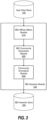
- FIG. 1 is a block diagram of an overview of a computing system for estimating IBD from genotype data, using IBD to generate an IBD network and train a model based on the IBD network, according to one embodiment.
- Depicted in Fig. 1 are an individual 101 (i.e. a human or other organism), a deoxyribonucleic acid (DNA) extraction service 102, and a computing system 100.
- individual 101 i.e. a human or other organism
- DNA deoxyribonucleic acid
- Individuals 101 provide DNA samples for analysis of their genetic data.
- an individual uses a sample collection kit to provide a DNA sample, e.g., saliva, from which genetic data can be reliably extracted according to conventional DNA processing techniques.
- DNA extraction service 102 receives the sample and estimates genotypes from the genetic data, for example by extracting the DNA from the sample and identifying genotype values of single nucleotide polymorphisms (SNPs) present within the DNA. The result in this example is a diploid genotype for each SNP.
- Computing system 100 receives the genetic data from DNA extraction service 102 and stores the genetic data in a DNA sample store 140 containing DNA diploid genotypes.
- the genetic data stored in the DNA sample store 140 may be associated with a user in the user data store 145 via one or more pointers.
- the computing system 100 processes the DNA to identify shared IBD between pairs of individuals, and uses that information to identify clusters in a sample of individuals.
- a cluster includes individuals in a sample that exhibit a higher density of IBD connections between each other relative to other individuals in the sample.
- the clusters can be annotated with information about phenotypes characteristic of individuals within the group, and used to develop models that allow assignment of, often new, individuals to those clusters.
- the computing system 100 comprises computer program instructions that can be logically structured to generate within the processor/s and storage media of the computing system an input data processing module 110, an IBD estimation module 115, an IBD network module 120, a model training module 125, a community (cluster) prediction module 135, a DNA sample store 140, a user data store 145, a model store 150, an IBD network store 155, and a panel store 160.
- the computer system 100 may comprise more or fewer modules, and the logical structure may be differently organized.
- the data stores may be represented in different ways in different embodiments, such as comma-separated text files, or as databases such as relational databases (SQL) or non-relational databases (NoSQL).
- the computing system 100 comprises an input data processing module 110, and an IBD estimation module 115. These modules are described in relation with FIG. 2 which is a flow diagram for the operation of the computer system 100 for estimating and storing estimated IBD in accordance with an embodiment.
- FIG. 2 is a flow diagram for the operation of the computer system for receiving, processing and storing genetic, genealogical and survey input data.
- FIG. 2 depicts an input data processing module 110, an IBD estimation module 115, a DNA sample store 140, and a user data store 145.
- the input data processing module 110 is responsible for receiving, storing and processing data received from an individual 101 via the DNA extraction service 102.
- the input data processing module 110 comprises a DNA collection module 210, a genealogical collection module 220, a survey data collection module 230, genotype identification module 240, genotype phasing module 250, and ethnicity estimation module 260.
- the DNA collection module 210 is responsible for receiving sample data from external sources (e.g., extraction service 102), processing and storing the samples in the DNA sample store 140.
- external sources e.g., extraction service 102
- a new user to the system 100 who is submitting their DNA among other data will activate a new account, often through graphical user interface (GUI) provided through a mobile software application or a web-based interface.
- GUI graphical user interface
- the system 100 receives one or more types of basic personal information about the individual such as age, date of birth, geographical location of birth (e.g., city, state, county, country, hospital, etc.), complete name including first, last middle names as well as any suffixes, and gender.
- This received user information is stored in the user data store 145, in association with the corresponding DNA samples stored in the DNA sample store 140.
- the data stored in the DNA sample store 140 may store one or more received samples DNA linked to a user as a ⁇ key, value> pair associated with the individual 101.
- the ⁇ key, value> pair is ⁇ sampleID, "GA TC TC AA">.
- the data stored in the DNA sample store 140 may be identified by one or more keys used to index one or more values associated with an individual 101.
- keys are a userID and sampleID, or alternatively another ⁇ key, value> pair is ⁇ userID, sampleID>.
- the DNA sample store 140 stores a pointer to a location associated with the user data store 145 associated with the individual 101. The user data store 145 will be further described below.
- the genealogical collection module 220 both receives and processes data provided by an individual for storage in the user data store 145 in association with their accounts.
- the genealogical collection module 220 specifically is configured to receive detailed information about an individual's family history. In some instances, family history can take the form of a pedigree of that individual (e.g., the recorded relationships in a family).
- family history can take the form of a pedigree of that individual (e.g., the recorded relationships in a family).
- the genealogical collection module 220 may be configured to provide an interactive GUI that asks the individual questions or provides a menu of options, and receives user input that can be processed to obtain the genealogical data.
- genealogical data examples include, but are not limited to, names (first, last, middle, suffixes), birth locations (e.g., county, city, state, country, hospital, global map coordinates), date of birth, date of death, marriage information, family relations (manually provided rather than genetically identified), etc.
- OCR optical character recognition
- the pedigree information associated with a user comprises one or more specified nodes.
- Each specified node in the pedigree represents either the individual themselves or an ancestor of individual 101 corresponding to a stored DNA sample. Therefore, the nodes represent pedigree members that are either the individual themselves, or individuals that could have passed down generic material to the associated individual 101.
- the pedigree information provided by individuals may or may not be perfectly accurate.
- the genealogical collection module 220 is responsible for filtering the received pedigree data based on one or more quality criteria in an effort to discard lower quality genealogical data. For example, the genealogical collection module 220 may filter the received pedigree data by excluding all pedigree nodes associated with a stored DNA sample that do not satisfy all of the following criteria: (1) recorded death date for a the linked pedigree node corresponds to official records (when available), (2) the gender is the same as the gender provided by the individual; and (3) the birth date is within 3 years of the birth date provided by the individual.
- DNA samples that do not satisfy these criteria are still included in the subsequent analysis but either the associated pedigree data are not used, or the individual is prompted via GUI to resolve any discrepancies identified by module 220.
- all received genealogical data marked as "private" are excluded from the any subsequent analysis to ensure that privacy requirements are met.
- the survey data collection module 230 both receives and processes data provided by an individual for storage in the user data store 145 in association with their user accounts.
- the survey data collection module 230 is configured to receive information provided by individual in response to survey questions that ask about phenotypes that fall outside of those collected by the genealogical collection module 220.
- Examples of survey questions include questions about an individual's phenotype, such as physical traits (e.g., height, hair, skin pigmentation, freckling, bitter taste, earlobe type, iris patterns, male pattern baldness, hair curl), wellness phenotypes (e.g., lactose tolerance, caffeine consumption, malaria resistance, norovirus resistance, muscle performance, alcohol flush), and personal preferences (e.g., likes and dislikes).
- physical traits e.g., height, hair, skin pigmentation, freckling, bitter taste, earlobe type, iris patterns, male pattern baldness, hair curl
- wellness phenotypes e.g., lactose tolerance, caffeine consumption, malaria resistance, norovirus resistance, muscle performance, alcohol flush
- personal preferences e.g., likes and dislikes.
- the genotype identification module 240 accesses the collected DNA data from the DNA collection module 210 or the sample store 140 and identifies autosomal SNPs so that the individual's diploid genotype on autosomal chromosomes can be computationally phased. For example, for one individual 633,299 autosomal SNPs may be identified to estimate genotype phase.
- the genotype identification module 240 provides the identified SNPs to the genotype phasing module 250 which phases the individual's diploid genotype based on the set of identified SNPs.
- the genotype phasing module 250 is further described below.
- the genotype phasing module 250 generates a pair of estimated haplotypes for each diploid genotype.
- the estimated haplotypes are then stored in the user data store 145 in association with the user, and may also be stored in association with or verified against the genotypes of the individual's parents, who may also have their own separate accounts in the computing system 100.
- the phasing module 250 stores phased genotypes in the user data store 145.
- the ethnicity estimation module 260 is responsible for estimating the global ancestral origins ("ethnicity") from an individual's SNP genotypes. In the genetics literature, this is often described as using genetic polymorphism data to estimate the proportion of the genome that is attributed to two or more defined ancestral populations.
- the ethnicity estimation module 260 accesses as input the diploid genotype of an individual from the genotype identification module 240 or the DNA sample store 140. Information may also be accessed that includes reference data that provide population-specific statistics to assist in the computation of the ethnicity estimates. Specifically, the reference data may include reference features such as population-specific SNP allele frequencies for one or more defined ancestral populations.
- the ethnicity estimate module 260 compares the individual's diploid genotype against the reference features to estimate the degree of overlap between the two sets. In one embodiment, if there is a threshold amount of overlap between a section of one of the chromosomes of the individual and that of one of the reference features, the individual may be labeled with the ethnicity associated with the at least partially overlapping reference feature. The labeling may also occur if a sufficient number of reference features are partially overlapping, or based on the extent of overlap.
- the ethnicity estimate output of the ethnicity estimation module 260 algorithm takes the form of a vector of estimated ethnicity proportions of length K, where K is the number of ancestral populations under consideration.
- each vector entry is a number greater than or equal to 0, and all the entries of the vector sum to 1.
- K 3 ancestral populations corresponding to African, European and Native American
- the ethnicity estimation module 260 stores the estimated ethnicities in the user data store 145 in association with a particular user.
- the ethnicity estimation module 260 estimates ethnicity using the techniques further described in U.S. Patent Application No. 14/020,577 filed on September 6, 2013 . In other embodiments, the ethnicity estimation module 260 estimates ethnicity using any one of a number of techniques, such as the STRUCTURE or ADMIXTURE algorithms. In one embodiment, the ethnicity estimation module 260 uses haplotype data to improve the accuracy of ethnicity estimate which is further described in U.S. Patent Application No. 62/191,968 filed on July 13, 2015 .
- the IBD estimation module 115 is responsible for identifying IBD segments (also referred to as IBD estimates) from phased genotype data (haplotypes) between pairs of individuals stored in the user data store 145.
- IBD segments are chromosome segments identified in a pair of individuals that are putatively inherited from a recent common ancestor.
- individuals who are closely related share a relatively large number of IBD segments, and the IBD segments tend to have greater length (individually or in aggregate across one or more chromosomes), while individuals who are more distantly related share relatively few IBD segments, and these segments tend to be shorter (individually or in aggregate across one or more chromosomes).
- close family members often share upwards of 71 cM of IBD (e.g., third cousins), more distantly related individuals may share less than 12 cM of IBD.
- the IBD estimation algorithm used by the IBD estimation module 115 to estimate (or infer) IBD segments between two individuals is as described in U.S. Patent Application No. 14/029,765, filed on September 17, 2013 .
- Another further processing step may be performed on these inferred IBD segments by applying the technique described in PCT Patent Application No. PCT/US2015/055579, filed on October 14, 2015 .
- the identified IBD segments are stored in the user data store 145 in association with the user.
- the IBD estimation module 115 is configured to estimate IBD segments between large numbers of individuals stored in the user data store 145. That is, between each individual and many other individuals in the user data store 145. These IBD estimates are used in aggregate to build IBD networks as described in Section III below. The exact extent to which IBD calculations are performed (i.e., between every pair of users vs. between only a subset of pairs of users) depends on the implementation. In one embodiment, IBD estimates between any given pair of users may only be calculated if some prior information is known (e.g., genealogical, genetic) that links them, or if an initial pre-calculation suggests there will be at least a threshold amount of IBD sharing between the pair. The selective calculation of IBD estimates described above may help reduce processing time required to identify IBD segments.
- the computing system has been optimized to efficiently handle large amounts of IBD data. Said another way, IBD is estimated across a large number of individuals based on their DNA.
- the IBD estimation module 115 (and computing system 100 generally) distributes IBD computations over a Hadoop computing cluster, internal to or external from computing system 100, and stores the phased genotypes used in the IBD computations in a database so that IBD estimates for new accounts/individuals can be quickly compared to previously processed individuals.
- FIG. 3 is a flow diagram for constructing an IBD network, inferring clusters in the network, and annotating the IBD network clusters, in accordance with an embodiment. These techniques are carried out by the IBD network module in conjunction with the user data store 145 and the IBD network store 155. In one embodiment, to accomplish these tasks the IBD network module 120 itself comprises an IBD affinity metric module 310, an IBD community generation module 320, and a community annotation module 330.
- the IBD affinity metric module 310 accesses estimated IBD segments from the user data store 145 in order to generate an IBD network (also referred to as an IBD graph).
- an IBD network also referred to as an IBD graph.
- cluster and community are used interchangeably. That is, both the terms cluster and community refer to a subset of nodes in a determined IBD network.
- the set of clusters in the IBD Network are identified by selecting clusters that maximize the modularity objective defined with respect to the IBD network. Clusters identified from a network in this way are often referred to as "communities" in the network analysis literature; for instance, see M. E. J. Newman, Nature Physics, 2012 (doi:10.1038/nphys2162 ).
- modularity-maximizing algorithms may be employed to identify clusters in one or more embodiments
- the term "community” is not used in the strict technical sense of a modularity-maximizing clustering, but is instead used more generally to refer to clusters identified in a network by taking any one of several existing network clustering approaches developed in the network analysis or machine learning areas.
- the IBD network includes a number of nodes with one or more weighted edges connecting some of the nodes to each other.
- Each node corresponds to one of the individuals from the user data store 145.
- Each edge between one node and another node has a weight, a numerical value, based on the IBD estimate between the two nodes, as generated by IBD estimation module 115.
- the IBD affinity metric module 310 defines a mapping (also called an "affinity measure") from the total length of the shared IBD segments between two individuals (e.g., i and j ) to the weight of the edge linking nodes i and j in the network.
- the affinity measure is a real number between 0 and 1. For example, if the total length of the shared IBD segment between nodes i and j is greater than 65 cM (e.g., third cousins), then the edge linking nodes i and j receives a value of 0.97 or greater. Alternatively, if the total length of the shared IBD segment is 4-10 cM or less (e.g., distantly related or distant cousins), the edge may receive a weight of 0.
- the mapping function between IBD estimates and edge weights may be any continuous or discontinuous function with the function domain defined by the set of possible total IBD length estimates.
- the IBD affinity metric module 310 maps the total IBD segment lengths to edge weights by: (1) choosing a target range of generations; (2) empirically assessing, using a reasonably realistic simulation, the distribution of total IBD lengths among pairs of individuals that share common ancestors within that range of generations; and (3) defining the affinity metric so that high weights are placed on total IBD lengths arising from familial relationships sharing common ancestors corresponding to the chosen range of generations.
- CDF Beta cumulative density function
- the IBD community generation module 320 partitions the IBD network generated by the IBD affinity metric module 310 into two or more communities.
- Various algorithms may be used to cluster the IBD network. Examples are algorithms that have been developed in statistical physics and machine learning to identify "strongly connected" subsets of a network, in which the density of edges within each subset is much higher than expected. Described, below, is just one method by which clusters may be identified in an IBD network. Examples of alternative network clustering algorithms include spectral graph clustering methods. In various embodiments, communities may be detected using other clustering algorithms such as Locally Linear Embedding or Normalized Cuts.
- the IBD community generation module 320 identifies the communities through recursive application of the multi-level Louvain method, which is a modularity-optimization-based community detection algorithm (also called "community detection").
- communities may be identified via recursive application of a community detection algorithm other than the Louvain method.
- the IBD community generation module 320 identifies a high-modularity partition of the network by recursively applying the Louvain method to IBD network S comprising nodes N connected to each other via edges M each having a weight.
- k is the community index
- S k is the set of edges among all nodes assigned to community k
- a ij is the weight of edge ( i, j )
- d i is the "degree " of node i, defined to be the sum of all edge weights for edges connecting node i
- m is the sum of all "degrees”.
- the computation time associated with community detection grows linearly with the number of edges, M (i.e., O(M)).
- the Louvain algorithm heuristically maximizes the modularity Q associated with a network S .
- the community detection algorithm divides network S comprising N nodes into C communities.
- the partitioning of the network into communities using the Louvain method described above is denoted ( A 1 , A 2 , A 3 , ..., A C ).
- communities ( A 1 , A 2 , A 3 ,..., A C ) are labeled as a "valid” if they each comprise a given threshold number of nodes t .
- a community A i with less than the threshold number of nodes is not considered a valid community (i.e., an "invalid" community) and is, thus, omitted from subsequent steps of the community detection analysis and model training (its constituent nodes are left to stand alone without being labeled as a community).
- the threshold number of nodes t is 1,000. However, in other embodiments the threshold number is any integer number of nodes greater than 0.
- the set of communities labeled as valid are denoted by ( A' 1 , A' 2 , A' 3 , ..., A' c ) , where C' is less than or equal to C .
- This threshold cutoff for performing the community detection algorithm again within a community helps ensure that any detected communities will contain a large enough number of nodes to be interpreted as a group of historical or geographic significance. If a community has below the threshold number of nodes t , there is a sufficiently high likelihood that any identified subcommunities that could be generated through another application of the community identification algorithm would potentially over-fit/over-analyze the data and suggest a subpopulation that does not have an analog that experts in the field would recognize.
- the threshold number of nodes may be anywhere between 1000 and 10,000, depending upon the exact implementation of the system.
- the IBD community generation module 320 applies the community detection algorithm (e.g., Louvain method) again on each IBD sub-network defined by the nodes in community A i ' to identify sub-communities within each community A i '.
- the community detection algorithm e.g., Louvain method
- communities at level 3 may be delineated by module 320 by once again generating a subgraph g i for each level 2 community B i and applying the Louvain method to each subgraph g i
- the procedure delineated through the example pseudocode above results in a hierarchy of communities by recursively fragmenting or subdividing groups of connected nodes.
- the algorithm illustrated by the pseudocode above automatically stops subdividing further when the size of the subnetwork defined by a community contains fewer than 1,000 nodes.
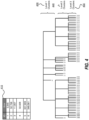
- FIG. 4 is an illustration of an example result of running a hierarchical clustering algorithm on an IBD network, in accordance with an embodiment.
- Example IBD network 410 has six level-1 communities and an illustrated number of nodes in each level 1 community. Further illustrated is how the hierarchical clustering algorithm can be applied to subdivide five out of the six level 1 communities 430 into twenty level 2 communities 440, and further subdivide these into fifty level 3 communities 450, however in practice the exact community structure may vary.
- the community annotation module 330 is responsible for annotating a community A i with information drawn from the individuals that make up each community, such as ethnicity estimates, surnames, birth locations of the individuals or their ancestors, and responses to survey questions. The following paragraphs explain ways in which the community annotation module 330 compiles these annotations into distinguishing features that may be used to suggest a demographic or geographic interpretation of each community.
- the ethnicity-based annotations can be used to estimate which ancestral populations are over-represented or under-represented by the individuals from the set of nodes comprising a given community.
- communities with highly over-represented ancestral populations can be related to known human population structure when the interpretation of the ancestral populations is known in advance. For example, in one embodiment, communities corresponding to recent US immigrant groups such as Finnish, Jewish and Irish can be identified from the ethnicity-based annotations because some of the ancestral populations in the ethnicity estimation are defined for Finnish, Jewish and Irish.
- the ethnicity-based annotations are summarized into a convenient form by compiling, for each ancestral population, the distribution of estimated ethnicity proportions among all individuals assigned to the community, and comparing against the distribution of estimated ethnicity proportions among individuals that are not assigned to the community.
- an ethnicity-based summary for a community may be determined based on the ethnicity estimates only for network nodes associated with individuals having birth dates within a specified range of years in order to better summarize the ethnic diversity of individuals from certain generations.
- Another type of annotation provided by the community annotation module 330 comprises birth locations of ancestors associated with individuals assigned to a community, which can provide useful geographic clues relating a community to historical populations. To do this, the community annotation module compiles statistics from the ancestral birth location data specific to each community.
- the community annotation module 330 may summarize the birth location data so that it may be visualized in a graphical map format. This is accomplished, for example, by converting each birth location, within a specified range of generations, to the nearest coordinate on a two-dimensional (2-D) grid, with grid points every 0.5 degrees of latitude and longitude. Then the location of each grid point plotted on the map is the mean latitude and longitude over all the annotations assigned to that grid point.
- 2-D two-dimensional
- the community annotation module 330 computes, for each grid point in the 2D grid, an odds ratio (OR).
- OR is defined as the odds that a given grid point of the 2-D grid is associated with a community member over the odds that the same grid point is associated with a user who is not a member of the community.
- the community annotation module 330 uses this OR measure to generate a graph (or plot) that visually depicts grid points in which the largest odds ratios are indicated visually by labels or distinguishable colors, for example.
- the highlighted graphical map locations correspond to geographic locations that are disproportionately represented in a given community. For example, the birth locations of ancestors 0-5 generations ago associated with the Utah cluster are more highly concentrated in Utah, and this is reflected in this visual summary by map locations with particularly high odds ratios.
- the community annotation 330 may then use the labels associated with specific geographic locations in the plot as an input to determine which of those geographic location labels are annotated and stored in association with the community in one of the data stores.
- the graphical maps and plots described above are useful because in various implementations they may be presented to a user via a GUI. However, actual generation of the graphical maps and plots is not strictly necessary in order to determine the geographic locations to annotate to a given community. The description above may be accomplished entirely through nongraphical means, that is by grouping data by geographical location, computing odds ratios based on the groups, and performing statistical analysis on the result to determine the labels.
- the community annotation module 330 may use surname annotations to generate additional historical or geographic clues about a community. To summarize surnames for a given community, the community annotation module 330 collects all surnames of recent ancestors (e.g., born after 1900 A.D.) associated with individuals who are assigned to the community. To highlight surnames that are more likely to be characteristic of the community, and therefore more likely to yield informative clues about the historical or demographic significance of the community, for each identified surname, in one embodiment, the community annotation module 330 quantifies the statistical evidence (e.g., p -value) that a given surname is over-represented in a given community compared against the background surname distribution over all individuals included in the generated IBD network.
- the statistical evidence e.g., p -value
- the community annotation module 330 ranks the surnames according to the statistical evidence (e.g., smallest p -values), and selects the 10 most highly ranked surnames as surnames that are characteristic to the given community. For example, the most highly ranked surnames from the surname annotations associated with individuals assigned to an Irish community include "McCarthy”, “Sullivan”, “Murphy”, “O'Brien”, and “O'Connor”.
- the community annotation module 330 may similarly annotate a given community using other items of data associated with the individuals assigned to that community as collected by either the genealogical collection module 220 or the survey data collection module 230, such as marriage data and responses to survey questions.
- the community annotation module 330 performs annotation on many if not all communities in the IBD network. If the communities are arranged in a hierarchy (e.g., through recursive application of the Louvain method), then this may include communities at any level of the clustering hierarchy (level 1, level 2, level 3, etc.). The resulting summary for each community compiled from the annotations are stored in the IBD network store 155.
- FIG. 5 is a flow diagram for generating a model to assign individuals to communities, in accordance with an embodiment.
- the model training module 125 accesses communities (e.g., generated as described in Section III) from the IBD network store 155 and uses the communities to build a model that can be later used to predict which community, or communities, an individual belongs to based on their DNA sample. This process is applied to all communities identified in the IBD network, after removing communities that do not satisfy additional criteria for being "valid". In cases where the communities can be viewed as a hierarchy, in which each level of the hierarchy subdivides the communities from the previous level, this process can applied to all communities at all, or selected, levels of the hierarchy.
- communities e.g., generated as described in Section III
- the model training module 125 generates 510, for each community stored in the IBD network store 155, a reference panel 510, refines 520 the generated reference panel, generates one or more candidate features 530 that may be useful for predicting whether a given user is or is not a member of a given community based on the refined reference panels, and trains 540 a community classification model using the selected features and the refined reference panels.
- this is described as a multi-way classification problem, in which each user may be classified into zero, one or more communities. Since each community assignment can be considered as a separate classification problem, a "model" refers to the classification of a single community, and is trained separately from other models.
- the training process results in a collection of models that are configured to predict whether or not a given individual belongs to each community.
- the community prediction module 130 can use the model to predict which, if any, communities, a new user 101 is a member of based on the new user's genetic sample.
- the system 100 can use these community predictions to provide a report detailing the individual's predicted community membership without needing to re-build the IBD network or re-train the model.
- the model training module 125 receives from the IBD network store 155 a set of communities (or, equivalently, clusters) previously identified in an IBD network and generates a reference panel 510 for each community. To generate 510 the reference panels, the model training module 125 may simply identify all of the individuals in a community. Alternatively, module 125 may generate the reference panel based on some subset thereof. For example, a generated reference panel 510 comprises a subset of individuals selected uniformly at random from the set of individuals (network nodes) assigned to a given community. In one embodiment, a generated reference panel 510 may be limited to those individuals in a community by their birth locations, or the birth locations of their ancestors or descendants. As another example, a generated reference panel may include individuals from a community who also have West African ancestry based on their ethnicity estimates. The generated reference panels are stored in the panel store 160 in association with a particular community as stored in the IBD network store 155.
- the model training module 125 refines 520 the generated 510 reference panels in an effort to remove individuals who are less representative of the community.
- the IBD community generation module 320 is used to run a community detection algorithm (e.g., Louvain method) on a random subgraph consisting of randomly selected set of individuals (i.e., nodes) and the IBD connections between these individuals (i.e., the weighted edges of the network).
- the model training module 125 repeats the process described above a number of times (e.g., 20 times) separately on each random subgraph.
- the subgraphs must be large enough that each individual in the full IBD network is included multiple times in the subgraphs.
- the number of times individual i is assigned to the same community provides a way of ranking the "stability" of the clustering for individual i.
- the concept of "same community" is not completely well-defined because application of the clustering algorithm to random subgraphs can produce different numbers of communities, but for simplicity the model training module 125 can consider the subset of communities that have some threshold degree of overlap in terms of the proportion of individuals assigned. In cases where a hierarchical clustering approach is implemented, this stability analysis is restricted to communities at the same level of the hierarchy. In an embodiment, individuals with a stability ranking greater than a certain threshold number (e.g., 10) are excluded from the reference panel R i .
- a certain threshold number e.g. 10
- the model training module 125 uses the refined reference panels to select features that will be subsequently used to train the models introduced above.
- the set of candidate features included in the selection step are all defined as counts of the number of connections between a given individual and all individuals included in a reference panel, restricted to connections within a given edge weight interval or, equivalently, within a given range of estimated total IBD shared.
- each feature thus represents some "degree of connectedness" between an individual and a set of individuals included a given reference panel.
- the total set of candidate features includes a feature for each edge weight interval and for each reference panel. For example, supposing that the edge weights are subdivided into 6 intervals, and 300 reference panels have been generated, then a total of 1,800 candidate features are included in the feature selection step.
- additional candidate features may be defined based on ethnicity estimates generated for an individual by the ethnicity estimate module 260.
- the training module 540 first selects, for each community, candidate features that are estimated to be most predictive of the assignment of an individual to a community.
- the model training module 125 runs a feature selection algorithm to estimate the prediction ability of each feature, where the prediction ability is represented as a numerical value, often normalized within the range of 0 to 1.
- algorithms that may be used to implement the feature selection include, but are not limited to, sparse penalized regression (e.g., Lasso), a forward/stepwise regression method, recursive feature elimination, and regularized trees.
- the input data to the feature selection algorithm are the computed values of the candidate features for all individuals in all reference panels, and an additional binary ("0" or "1") training label for each individual indicating whether or not it has been assigned to the given community.
- An individual in a reference panel belonging to the given community is assigned a label of "1”
- an individual in a reference panel that does not belong to the same community is assigned a label of "0”.
- the input data are the computed feature values and labels for a set of individuals drawn randomly from the reference panels.
- the computed feature values are counts calculated by accessing the IBD data in the user data store 145.
- the model training module 125 selects the most predictive features (i.e., those estimated to have the highest prediction ability), and removes the remaining features from consideration/use in the model (in some embodiments, this is accomplished simply by setting their corresponding weight or regression coefficient in the model to 0).
- the number of selected features will vary by implementation, and may vary for each model.
- the model training module 125 uses the selected features to train 540 the model for that community. Specifically, the model training module 125 uses the set of candidate features selected for that community to train a corresponding model using a supervised machine learning technique. Once training is completed, and the model is saved in the model store 150, the model is able to generate, for a single individual, a score, likelihood or probability for predicting assignment of that individual to the community. In one embodiment, the model outputs a probability (a real number between 0 and 1), in which a number close to 1 indicates that the individual is classified to the community with high confidence, and a number close to 0 indicates with high confidence that the individual is not a member of the community.
- a probability a real number between 0 and 1
- the input data to the model training algorithm is the same or similar to the input data provided to the feature selection algorithm above.
- Individuals that are a part of the community associated with the model being trained are assigned training labels of "1," indicating that they should be classified into the community.
- Individuals that are part of any other community are assigned training labels of "0,” indicating that they should not be classified into the community.
- individuals are drawn from reference panels at random to construct the training set provided as input to the model training algorithm and for use in training the model, however in other embodiments the input data may be differently selected.
- the values for the features used in the training are again the values for those input data individuals.
- any one of a number of supervised learning techniques may be used to train the models. Examples include, but are not limited to, random forests and other ensemble learning techniques, support vector machines (SVM) and logistic regression.
- SVM support vector machines
- the training process involves determining the numerical values of model parameters so that the model best "fits" the training data. Therefore, the trained model is specified by the fitted values of the model parameters. For example, if a random forests approach is used, the model parameters will consist of the features and splitting criteria that define each decision tree in the random forest model.
- the community identification module 125 stores the models, including the fitted model parameters, in model store 150.
- the community prediction module 130 uses each trained model to compute, for a given individual, a score, likelihood or probability for assignment of that individual to the community (referred to as classifying the individual or user).
- the model may be used classify an existing individual, for example someone present in one of the reference panels, or a new user who has submitted their DNA sample for inclusion in the system 100.
- the user to be classified has their DNA processed by various parts of the system 100.
- the user to be classified has their data processed using the genotype identification module 240 and the genotype phasing module 250.
- the ethnicity estimate module 260 may generate an ethnicity estimate for the user.
- the community prediction module 130 then, in conjunction with the IBD estimation module 115, generates IBD estimates between the user and all individuals included in the reference panels stored in the panel store 160. Alternatively, only a subset of those IBD estimates may be generated based on which features and/or individuals are included in the data sets used to train the models. This can reduce processing costs in generating community classification predictions, as it may not be necessary to know all IBD estimates when the models only make use of some fraction of them.
- the community prediction module 130 compiles the IBD estimates (and, in some instances, the ethnicity estimates) into feature vectors according to the features selected for each of the models. Each model will receive a different feature vector depending on which features were selected and used to train that particular model. Thus, the estimated IBD that is relevant to the community classification will be different for each model (and hence, for each community).
- the community prediction module 130 then computes a score, probability or likelihood for each model.
- an individual is classified as belonging a given community if the probability computed by the trained model exceeds a threshold numerical value.
- the threshold for classifying individuals to communities may be the same or different for each model.
- the output of the community prediction module includes both the classification and score/probability/likelihood for each community.
- an individual may be predicted to be a member of zero, one, or more communities.
- the output of the community prediction module may be reported to a user via a generated document or a GUI.
- Data reported in the document or GUI may also draw on annotations associated with the community, as well as historical or geographic interpretations drawing from summaries of the annotations associated with the community. This may include geographical features or regions distinguishing the community, and other historical, social or economic features characteristic of the community that may or may not be informed by the annotations.
- the community assignment module 135 may additionally produce reports that summarize IBD connections and other genetic estimates relevant to each community; for example, an estimate of the number of 2nd cousins that are classified as belonging to the same community as the user.
- Computing system 100 is implemented using one or more computers having one or more processors executing application code to perform the steps described herein, and data may be stored on any conventional non-transitory storage medium and, where appropriate, include a conventional database server implementation.
- any conventional non-transitory storage medium and, where appropriate, include a conventional database server implementation.
- various components of a computer system for example, processors, memory, input devices, network devices and the like are not shown in Fig. 1 .
- a distributed computing architecture is used to implement the described features.
- One example of such a distributed computing platform is the Apache Hadoop project available from the Apache Software Foundation.
Landscapes
- Life Sciences & Earth Sciences (AREA)
- Engineering & Computer Science (AREA)
- Health & Medical Sciences (AREA)
- Physics & Mathematics (AREA)
- Chemical & Material Sciences (AREA)
- Bioinformatics & Cheminformatics (AREA)
- Medical Informatics (AREA)
- General Health & Medical Sciences (AREA)
- Theoretical Computer Science (AREA)
- Biophysics (AREA)
- Biotechnology (AREA)
- Bioinformatics & Computational Biology (AREA)
- Analytical Chemistry (AREA)
- Proteomics, Peptides & Aminoacids (AREA)
- Evolutionary Biology (AREA)
- Spectroscopy & Molecular Physics (AREA)
- Genetics & Genomics (AREA)
- Molecular Biology (AREA)
- Organic Chemistry (AREA)
- Data Mining & Analysis (AREA)
- Software Systems (AREA)
- Zoology (AREA)
- Wood Science & Technology (AREA)
- Artificial Intelligence (AREA)
- Evolutionary Computation (AREA)
- Physiology (AREA)
- Computer Vision & Pattern Recognition (AREA)
- Biochemistry (AREA)
- General Engineering & Computer Science (AREA)
- Databases & Information Systems (AREA)
- Epidemiology (AREA)
- Public Health (AREA)
- Bioethics (AREA)
- Immunology (AREA)
- Microbiology (AREA)
- Computing Systems (AREA)
- Animal Behavior & Ethology (AREA)
- Ecology (AREA)
- Medicinal Chemistry (AREA)
- Library & Information Science (AREA)
Claims (15)
- Computerimplementiertes Verfahren zum genetischen Klassifizieren von Individuen, wobei das Verfahren umfasst:Zugreifen auf einen phasierten Genotyp eines Individuums;Erzeugen einer Mehrzahl von IBD-Segmenten zwischen dem Individuum und jedem einer Anzahl von Referenzpanel-Individuen durch Analysieren des phasierten Genotyps des Individuums und phasierter Genotypen von jedem der Anzahl von Referenzpanel-Individuen, wobei die Referenzpanel-Individuen Mitglieder eines einer Mehrzahl von Referenzpanels sind, die jeweils einem einer Mehrzahl von unterschiedlichen Clustern eines Identität-durch-Abstammung (IBD)-Netzwerks zugehörig sind;
wobei jedes Cluster eine Mehrzahl von Knoten umfasst, wobei die Knoten Individuen und ihre zugehörigen phasierten Genotypen darstellen, wobei die Knoten über Kanten mit Gewichten basierend auf IBD-Segmenten zwischen den zugehörigen phasierten Genotypen verbunden sind, wobei die Knoten in Clustern basierend auf den Kantengewichten gruppiert sind;Eingeben der IBD-Segmente in einen Satz von Modellen, um einen Wert zum Klassifizieren des Individuums in eines oder mehrere der Cluster zu erzeugen, wobei jedes Modell einem der Cluster entspricht und das Modell unter Verwendung eines Satzes von Merkmalen trainiert wird, die aus den IBD-Segmenten definiert sind, die mit Individuen in den Referenzpanels geteilt werden;Senden eines Berichts, der die Cluster zusammenfasst, bei denen der Wert des Individuums einen Schwellenwert überschreitet. - Computerimplementiertes Verfahren nach Anspruch 1, wobei ein IBD-Segment einer Gesamtmenge von einem oder mehreren Chromosomen entspricht, das von einem Vorfahren geerbt wird, das dem gegebenen Individuum und einem der Individuen in einem der Referenzpanels gemeinsam ist.
- Computerimplementiertes Verfahren nach Anspruch 1, wobei die Merkmale eine Mehrzahl von Merkmalen umfassen, die als die Anzahl von Verbindungen zwischen dem Individuum und Individuen in einem der Referenzpanels innerhalb bestimmter Bereiche von Gesamtmengen von geschätzten IBD definiert sind.
- Computerimplementiertes Verfahren nach Anspruch 3, wobei die Merkmale separate Merkmale für jeden der bestimmten Bereiche für jedes der unterschiedlichen Referenzpanels umfassen.
- Computerimplementiertes Verfahren nach Anspruch 1, ferner umfassend:
Erzeugen des IBD-Netzwerks durch:Erzeugen einer Mehrzahl von IBD-Segmenten, wobei jedes IBD-Segment zwischen jeweils einem Paar von Individuen in einem der Referenzpanels liegt;Abbilden der IBD-Segmente in Kantengewichte:Anwenden eines Netzwerk-Clusteralgorithmus auf das durch diese Kantengewichte definierte Netzwerk, um zwei oder mehr Cluster zu identifizieren; undKlassifizieren der Individuen zu jedem Cluster basierend auf den IBD-Segmenten. - Computerimplementiertes Verfahren nach Anspruch 5, wobei das Abbilden der IBD-Segmente in Kantengewichte ferner umfasst:Auswählen einer Zielspanne von Generationen;Simulieren der Verteilung von geschätzter IBD, die Beziehungen entspricht, bei denen die gemeinsamen Vorfahren in den Zielbereich von Generationen fallen; undDefinieren des Abbildens, um IBD-Segmente stärker zu gewichten, die Paaren von Individuen mit gemeinsamen Vorfahren zugehörig sind, die in den Zielbereich von Generationen fallen.
- Computerimplementiertes Verfahren nach Anspruch 5, wobei der Netzwerk-Clustering-Algorithmus als rekursive Anwendung eines modularitätsmaximierenden Gemeinschaftserfassungsverfahrens implementiert ist.
- Computerimplementiertes Verfahren nach Anspruch 5, ferner umfassend:
Verfeinern der Referenzpanels für jedes einer Mehrzahl der Individuen im Referenzpanel durch:mehrmaliges Anwenden des Netzwerk-Clustering-Algorithmus;Messen einer Stabilitätseinstufung des Individuums durch Zählen der Häufigkeit, mit der das Individuum einem gleichen Cluster zugeordnet wird; undBeibehalten des Individuums im Referenzpanel, wenn die Stabilitätseinstufung größer ist als ein Schwellenwert für die Stabilitätseinstufung. - Computerimplementiertes Verfahren nach Anspruch 1, ferner umfassend:
Zugreifen auf eine Abstammungsinformation bezüglich der Individuen des Referenzpanels, wobei die Abstammungsinformation eine Information über Vorfahren der Individuen des Referenzpanels bestimmt. - Computerimplementiertes Verfahren nach Anspruch 1, ferner umfassend:Versehen der Cluster mit mindestens einem von einer Kennzeichnung für den anzestralen Geburtsort und einer Kennzeichnung für Nachnamen basierend auf einer Abstammungsinformation der Individuen des Referenzpanels, die jedem Cluster zugehörig sind; undwobei ein Senden des Berichts ferner eine Zusammenfassung basierend auf mindestens einem von der Kennzeichnung für den Geburtsort und der Kennzeichnung für Nachnamen für die Cluster umfasst, wenn der Wert des Individuums den Schwellenwert überschreitet.
- Computerimplementiertes Verfahren nach Anspruch 9, ferner umfassend:
wobei das Zugreifen auf die Abstammungsinformation bezüglich einem der Individuen des Referenzpanels umfasst:Empfangen der Abstammungsinformation, wobei die Abstammungsinformation mindestens eines aus der Gruppe umfasst, bestehend aus:einem Namen eines Vorfahren des Individuums des Referenzpanels,einem Geschlecht des Vorfahren,einem Geburtsort des Vorfahren,einem Geburtsdatum des Vorfahren,einem Sterbedatum des Vorfahren, undeinem Nachnamen des Vorfahren,Filtern der Abstammungsinformation basierend auf einem oder mehreren Kriterien, wobei die Kriterien mindestens eines aus der Gruppe umfassen, bestehend aus:einem aufgezeichneten Geburtsdatum des Vorfahreneinem aufgezeichneten Sterbedatum des Vorfahren, undeinem aufgezeichneten Geschlecht des Vorfahren. - Computerimplementiertes Verfahren nach Anspruch 1, ferner umfassend:Erzeugen von Ethnizitätsschätzungen für die Individuen des Referenzpanels;Versehen der Cluster mit Ethnizitätskennzeichnungen basierend auf den Ethnizitätsschätzungen, die dem jedem Cluster zugehörigen Referenzpanel zugehörig sind; undwobei das Senden des Berichts ferner ein Senden einer Zusammenfassung basierend auf den Ethnizitätskennzeichnungen für die Cluster umfasst, wenn der Wert des Individuums den Schwellenwert überschreitet.
- Computerprogramm, das Befehle umfasst, die, wenn das Programm von einem Computer ausgeführt wird, den Computer veranlassen, ein Verfahren nach einem der vorhergehenden Ansprüche auszuführen.
- Computerlesbares Medium, auf dem ein Computerprogramm nach Anspruch 13 gespeichert ist.
- System, das zur Durchführung eines Verfahrens nach einem der Ansprüche 1 bis 12 ausgestaltet ist.
Applications Claiming Priority (2)
| Application Number | Priority Date | Filing Date | Title |
|---|---|---|---|
| US201562168808P | 2015-05-30 | 2015-05-30 | |
| PCT/IB2016/053166 WO2016193891A1 (en) | 2015-05-30 | 2016-05-28 | Discovering population structure from patterns of identity-by-descent |
Publications (4)
| Publication Number | Publication Date |
|---|---|
| EP3304385A1 EP3304385A1 (de) | 2018-04-11 |
| EP3304385A4 EP3304385A4 (de) | 2018-12-12 |
| EP3304385B1 true EP3304385B1 (de) | 2024-08-14 |
| EP3304385C0 EP3304385C0 (de) | 2024-08-14 |
Family
ID=57398757
Family Applications (1)
| Application Number | Title | Priority Date | Filing Date |
|---|---|---|---|
| EP16802662.3A Active EP3304385B1 (de) | 2015-05-30 | 2016-05-28 | Entdeckung einer populationsstruktur aus mustern von identity-by-descent |
Country Status (7)
| Country | Link |
|---|---|
| US (4) | US10223498B2 (de) |
| EP (1) | EP3304385B1 (de) |
| AU (1) | AU2016272732B2 (de) |
| CA (1) | CA2987015A1 (de) |
| MX (1) | MX2017015224A (de) |
| NZ (1) | NZ737553A (de) |
| WO (1) | WO2016193891A1 (de) |
Families Citing this family (40)
| Publication number | Priority date | Publication date | Assignee | Title |
|---|---|---|---|---|
| US9336177B2 (en) | 2007-10-15 | 2016-05-10 | 23Andme, Inc. | Genome sharing |
| WO2009051766A1 (en) | 2007-10-15 | 2009-04-23 | 23Andme, Inc. | Family inheritance |
| EP2370929A4 (de) | 2008-12-31 | 2016-11-23 | 23Andme Inc | Suche nach verwandten in einer datenbank |
| US8990250B1 (en) | 2011-10-11 | 2015-03-24 | 23Andme, Inc. | Cohort selection with privacy protection |
| US10437858B2 (en) | 2011-11-23 | 2019-10-08 | 23Andme, Inc. | Database and data processing system for use with a network-based personal genetics services platform |
| US10025877B2 (en) | 2012-06-06 | 2018-07-17 | 23Andme, Inc. | Determining family connections of individuals in a database |
| US9977708B1 (en) | 2012-11-08 | 2018-05-22 | 23Andme, Inc. | Error correction in ancestry classification |
| US9213947B1 (en) | 2012-11-08 | 2015-12-15 | 23Andme, Inc. | Scalable pipeline for local ancestry inference |
| EP3304385B1 (de) * | 2015-05-30 | 2024-08-14 | Ancestry.com DNA, LLC | Entdeckung einer populationsstruktur aus mustern von identity-by-descent |
| EP3323067B1 (de) * | 2015-07-13 | 2022-07-06 | Ancestry.com DNA, LLC | System zur lokalen bestimmung der genetischen ethnizität |
| CN106682848A (zh) * | 2017-01-18 | 2017-05-17 | 浙江工业大学 | 一种面向多配送点的配送仓库选址方法及装置 |
| US10622095B2 (en) * | 2017-07-21 | 2020-04-14 | Helix OpCo, LLC | Genomic services platform supporting multiple application providers |
| WO2019193551A1 (en) * | 2018-04-05 | 2019-10-10 | Ancestry.Com Dna, Llc | Community assignments in identity by descent networks and genetic variant origination |
| US11211149B2 (en) | 2018-06-19 | 2021-12-28 | Ancestry.Com Dna, Llc | Filtering genetic networks to discover populations of interest |
| WO2020035821A1 (en) | 2018-08-17 | 2020-02-20 | Ancestry.Com Dna, Llc | Prediction of phenotypes using recommender systems |
| NZ774718A (en) | 2018-09-11 | 2021-04-30 | Global ancestry determination system | |
| AU2019357270A1 (en) | 2018-10-12 | 2021-06-03 | Ancestry.Com Dna, Llc | Enrichment of traits and association with population demography |
| US10896742B2 (en) | 2018-10-31 | 2021-01-19 | Ancestry.Com Dna, Llc | Estimation of phenotypes using DNA, pedigree, and historical data |
| MX2021010260A (es) | 2019-02-27 | 2021-09-21 | Ancestry Com Dna Llc | Interfaz grafica de usuario que muestra el parentesco basado en el adn compartido. |
| US20210020266A1 (en) * | 2019-07-19 | 2021-01-21 | 23Andme, Inc. | Phase-aware determination of identity-by-descent dna segments |
| US12050629B1 (en) | 2019-08-02 | 2024-07-30 | Ancestry.Com Dna, Llc | Determining data inheritance of data segments |
| EP4029020A4 (de) | 2019-09-13 | 2023-09-20 | 23Andme, Inc. | Verfahren und systeme zur bestimmung und darstellung von stammbäumen |
| EP4078397A1 (de) | 2019-12-20 | 2022-10-26 | Ancestry.com DNA, LLC | Verknüpfung einzelner datensätze mit einer datenbank |
| MX2022008847A (es) | 2020-01-17 | 2022-08-10 | Ancestry Com Dna Llc | Inferencia de ascendencia basada en red neuronal convolucional. |
| US11481939B2 (en) * | 2020-01-23 | 2022-10-25 | Virtualitics, Inc. | Systems and methods for 3D data visualization and network extraction |
| WO2021211840A1 (en) * | 2020-04-15 | 2021-10-21 | Chan Zuckerberg Biohub, Inc. | Local-ancestry inference with machine learning model |
| US11817176B2 (en) | 2020-08-13 | 2023-11-14 | 23Andme, Inc. | Ancestry composition determination |
| CN111932386B (zh) * | 2020-09-09 | 2021-01-15 | 腾讯科技(深圳)有限公司 | 用户账号确定方法及装置、信息推送方法及装置、电子设备 |
| EP4200858A4 (de) | 2020-10-09 | 2024-08-28 | 23Andme, Inc. | Formatierung und speicherung genetischer marker |
| US12217393B2 (en) * | 2020-11-20 | 2025-02-04 | Ancestry.Com Dna, Llc | Photo composites |
| AU2022276402B2 (en) | 2021-05-20 | 2025-06-26 | Ancestry.Com Operations Inc. | Domain knowledge guided selection of nodes for addition to data trees |
| WO2023281450A1 (en) | 2021-07-09 | 2023-01-12 | Ancestry.Com Operations Inc. | Handwriting recognition pipelines for genealogical records |
| US20250032199A1 (en) | 2022-02-10 | 2025-01-30 | Digital Surgery Systems, Inc. | Microphone directionality control based on surgeon's command |
| US12248451B2 (en) | 2022-03-15 | 2025-03-11 | Ancestry.Com Operations Inc. | Machine-learning based automated document integration into genealogical trees |
| AU2023254037A1 (en) | 2022-04-13 | 2024-11-21 | Ancestry.Com Dna, Llc | Accelerated hidden markov models for genotype analysis |
| US12332902B2 (en) | 2022-04-20 | 2025-06-17 | Ancestry.Com Dna, Llc | Filtering individual datasets in a database |
| US20240120028A1 (en) * | 2022-10-05 | 2024-04-11 | 23Andme, Inc. | Learning Architecture and Pipelines for Granular Determination of Genetic Ancestry |
| US12332974B2 (en) | 2023-06-29 | 2025-06-17 | Ancestry.Com Dna, Llc | Determination of data-source influence on data manifestations |
| WO2025049155A1 (en) | 2023-08-25 | 2025-03-06 | Ancestry.Com Dna, Llc | Determining data inheritance of genomic data segments |
| US20260017284A1 (en) | 2024-07-09 | 2026-01-15 | Ancestry.Com Dna, Llc | Determining labels of inheritance datasets using simulated data instances |
Family Cites Families (15)
| Publication number | Priority date | Publication date | Assignee | Title |
|---|---|---|---|---|
| US20030113727A1 (en) | 2000-12-06 | 2003-06-19 | Girn Kanwaljit Singh | Family history based genetic screening method and apparatus |
| US7957907B2 (en) * | 2001-03-30 | 2011-06-07 | Sorenson Molecular Genealogy Foundation | Method for molecular genealogical research |
| US20020143578A1 (en) | 2001-04-02 | 2002-10-03 | Cole Louis Scott | Interactives system and method for recording and assessing a person's inherited risk for a range of diseases |
| US8285486B2 (en) | 2006-01-18 | 2012-10-09 | Dna Tribes Llc | Methods of determining relative genetic likelihoods of an individual matching a population |
| WO2008042232A2 (en) | 2006-10-02 | 2008-04-10 | Sorenson Molecular Genealogy Foundation | Method and system for displaying genetic and genealogical data |
| US8510057B1 (en) | 2007-10-15 | 2013-08-13 | 23Andme, Inc. | Summarizing an aggregate contribution to a characteristic for an individual |
| US9928338B2 (en) | 2011-06-01 | 2018-03-27 | The Board Of Trustees Of The Leland Stanford Junior University | Method and system for phasing individual genomes in the context of clinical interpretation |
| WO2013009969A2 (en) * | 2011-07-12 | 2013-01-17 | Carnegie Mellon University | Visual representations of structured association mappings |
| US8745085B2 (en) * | 2011-08-17 | 2014-06-03 | The Regents Of The University Of Michigan | System for explanation-based auditing of medical records data |
| US10025877B2 (en) | 2012-06-06 | 2018-07-17 | 23Andme, Inc. | Determining family connections of individuals in a database |
| US20140108527A1 (en) * | 2012-10-17 | 2014-04-17 | Fabric Media, Inc. | Social genetics network for providing personal and business services |
| US9977708B1 (en) | 2012-11-08 | 2018-05-22 | 23Andme, Inc. | Error correction in ancestry classification |
| US9213947B1 (en) | 2012-11-08 | 2015-12-15 | 23Andme, Inc. | Scalable pipeline for local ancestry inference |
| CA2906180C (en) | 2013-03-15 | 2020-05-05 | Ancestry.Com Dna, Llc | Family networks |
| EP3304385B1 (de) * | 2015-05-30 | 2024-08-14 | Ancestry.com DNA, LLC | Entdeckung einer populationsstruktur aus mustern von identity-by-descent |
-
2016
- 2016-05-28 EP EP16802662.3A patent/EP3304385B1/de active Active
- 2016-05-28 CA CA2987015A patent/CA2987015A1/en active Pending
- 2016-05-28 AU AU2016272732A patent/AU2016272732B2/en active Active
- 2016-05-28 US US15/168,011 patent/US10223498B2/en active Active
- 2016-05-28 NZ NZ73755316A patent/NZ737553A/xx unknown
- 2016-05-28 WO PCT/IB2016/053166 patent/WO2016193891A1/en not_active Ceased
- 2016-05-28 MX MX2017015224A patent/MX2017015224A/es unknown
-
2017
- 2017-03-14 US US15/458,549 patent/US9940433B2/en active Active
-
2019
- 2019-01-16 US US16/249,803 patent/US11538551B2/en active Active
-
2022
- 2022-12-01 US US18/072,716 patent/US20230102326A1/en not_active Abandoned
Also Published As
| Publication number | Publication date |
|---|---|
| US20160350479A1 (en) | 2016-12-01 |
| US20230102326A1 (en) | 2023-03-30 |
| US9940433B2 (en) | 2018-04-10 |
| US20170242957A1 (en) | 2017-08-24 |
| EP3304385A1 (de) | 2018-04-11 |
| US20190147973A1 (en) | 2019-05-16 |
| EP3304385C0 (de) | 2024-08-14 |
| AU2016272732A1 (en) | 2017-12-07 |
| CA2987015A1 (en) | 2016-12-08 |
| EP3304385A4 (de) | 2018-12-12 |
| US11538551B2 (en) | 2022-12-27 |
| AU2016272732B2 (en) | 2021-02-25 |
| US10223498B2 (en) | 2019-03-05 |
| NZ737553A (de) | 2017-11-24 |
| WO2016193891A1 (en) | 2016-12-08 |
| MX2017015224A (es) | 2018-02-19 |
Similar Documents
| Publication | Publication Date | Title |
|---|---|---|
| US20230102326A1 (en) | Discovering population structure from patterns of identity-by-descent | |
| US11232854B2 (en) | Characterizing heterogeneity with fine-scale population structure | |
| US11211149B2 (en) | Filtering genetic networks to discover populations of interest | |
| US10896742B2 (en) | Estimation of phenotypes using DNA, pedigree, and historical data | |
| KR20220069943A (ko) | 단일 세포 rna-seq 데이터 처리 | |
| US20240274229A1 (en) | Community Assignments in Identity by Descent Networks and Genetic Variant Origination | |
| WO2021124298A1 (en) | Linking individual datasets to a database | |
| Diaz-Papkovich et al. | Topological stratification of continuous genetic variation in large biobanks | |
| US20230342364A1 (en) | Filtering individual datasets in a database | |
| Kuchta et al. | Population structure and species delimitation in the Wehrle’s salamander complex | |
| Botta | A walk into random forests: adaptation and application to Genome-Wide Association Studies | |
| US20260017284A1 (en) | Determining labels of inheritance datasets using simulated data instances | |
| CN119741966B (zh) | 一种约束多组学的甲基化cpg位点筛选方法、设备及程序产品 | |
| CN121191741A (zh) | 风险预测方法、装置、计算机设备及存储介质 | |
| Diaz-Papkovich | The Entangled Biobank: On the Topology of High-Dimensional Human Genetic Data | |
| Faisal | Retrieval of Gene Expression Measurements with Probabilistic Models. | |
| Xu | Bagging E-Bayes for Estimated Breeding Value Prediction | |
| Sharma | Data mining using clustering algorithms in bioinformatics |
Legal Events
| Date | Code | Title | Description |
|---|---|---|---|
| STAA | Information on the status of an ep patent application or granted ep patent |
Free format text: STATUS: THE INTERNATIONAL PUBLICATION HAS BEEN MADE |
|
| PUAI | Public reference made under article 153(3) epc to a published international application that has entered the european phase |
Free format text: ORIGINAL CODE: 0009012 |
|
| STAA | Information on the status of an ep patent application or granted ep patent |
Free format text: STATUS: REQUEST FOR EXAMINATION WAS MADE |
|
| 17P | Request for examination filed |
Effective date: 20171117 |
|
| AK | Designated contracting states |
Kind code of ref document: A1 Designated state(s): AL AT BE BG CH CY CZ DE DK EE ES FI FR GB GR HR HU IE IS IT LI LT LU LV MC MK MT NL NO PL PT RO RS SE SI SK SM TR |
|
| AX | Request for extension of the european patent |
Extension state: BA ME |
|
| DAV | Request for validation of the european patent (deleted) | ||
| DAX | Request for extension of the european patent (deleted) | ||
| A4 | Supplementary search report drawn up and despatched |
Effective date: 20181114 |
|
| RIC1 | Information provided on ipc code assigned before grant |
Ipc: G06F 19/24 20110101ALI20181108BHEP Ipc: G06F 19/18 20110101ALI20181108BHEP Ipc: G06F 19/14 20110101AFI20181108BHEP Ipc: G06F 19/22 20110101ALI20181108BHEP Ipc: G06F 19/28 20110101ALI20181108BHEP |
|
| STAA | Information on the status of an ep patent application or granted ep patent |
Free format text: STATUS: EXAMINATION IS IN PROGRESS |
|
| 17Q | First examination report despatched |
Effective date: 20220207 |
|
| REG | Reference to a national code |
Ref country code: DE Ref legal event code: R079 Free format text: PREVIOUS MAIN CLASS: G06F0019240000 Ipc: G16B0010000000 Ref document number: 602016088910 Country of ref document: DE |
|
| GRAP | Despatch of communication of intention to grant a patent |
Free format text: ORIGINAL CODE: EPIDOSNIGR1 |
|
| STAA | Information on the status of an ep patent application or granted ep patent |
Free format text: STATUS: GRANT OF PATENT IS INTENDED |
|
| RIC1 | Information provided on ipc code assigned before grant |
Ipc: G06N 5/01 20230101ALN20240315BHEP Ipc: G06N 20/00 20190101ALI20240315BHEP Ipc: C12Q 1/6888 20180101ALI20240315BHEP Ipc: G16B 40/20 20190101ALI20240315BHEP Ipc: G16B 30/00 20190101ALI20240315BHEP Ipc: G16B 20/40 20190101ALI20240315BHEP Ipc: G16B 20/20 20190101ALI20240315BHEP Ipc: G16B 10/00 20190101AFI20240315BHEP |
|
| INTG | Intention to grant announced |
Effective date: 20240423 |
|
| GRAS | Grant fee paid |
Free format text: ORIGINAL CODE: EPIDOSNIGR3 |
|
| GRAA | (expected) grant |
Free format text: ORIGINAL CODE: 0009210 |
|
| STAA | Information on the status of an ep patent application or granted ep patent |
Free format text: STATUS: THE PATENT HAS BEEN GRANTED |
|
| AK | Designated contracting states |
Kind code of ref document: B1 Designated state(s): AL AT BE BG CH CY CZ DE DK EE ES FI FR GB GR HR HU IE IS IT LI LT LU LV MC MK MT NL NO PL PT RO RS SE SI SK SM TR |
|
| REG | Reference to a national code |
Ref country code: GB Ref legal event code: FG4D |
|
| REG | Reference to a national code |
Ref country code: CH Ref legal event code: EP |
|
| REG | Reference to a national code |
Ref country code: DE Ref legal event code: R096 Ref document number: 602016088910 Country of ref document: DE |
|
| REG | Reference to a national code |
Ref country code: IE Ref legal event code: FG4D |
|
| U01 | Request for unitary effect filed |
Effective date: 20240830 |
|
| U07 | Unitary effect registered |
Designated state(s): AT BE BG DE DK EE FI FR IT LT LU LV MT NL PT RO SE SI Effective date: 20240911 |
|
| PG25 | Lapsed in a contracting state [announced via postgrant information from national office to epo] |
Ref country code: NO Free format text: LAPSE BECAUSE OF FAILURE TO SUBMIT A TRANSLATION OF THE DESCRIPTION OR TO PAY THE FEE WITHIN THE PRESCRIBED TIME-LIMIT Effective date: 20241114 |
|
| PG25 | Lapsed in a contracting state [announced via postgrant information from national office to epo] |
Ref country code: GR Free format text: LAPSE BECAUSE OF FAILURE TO SUBMIT A TRANSLATION OF THE DESCRIPTION OR TO PAY THE FEE WITHIN THE PRESCRIBED TIME-LIMIT Effective date: 20241115 Ref country code: PL Free format text: LAPSE BECAUSE OF FAILURE TO SUBMIT A TRANSLATION OF THE DESCRIPTION OR TO PAY THE FEE WITHIN THE PRESCRIBED TIME-LIMIT Effective date: 20240814 |
|
| PG25 | Lapsed in a contracting state [announced via postgrant information from national office to epo] |
Ref country code: IS Free format text: LAPSE BECAUSE OF FAILURE TO SUBMIT A TRANSLATION OF THE DESCRIPTION OR TO PAY THE FEE WITHIN THE PRESCRIBED TIME-LIMIT Effective date: 20241214 |
|
| PG25 | Lapsed in a contracting state [announced via postgrant information from national office to epo] |
Ref country code: HR Free format text: LAPSE BECAUSE OF FAILURE TO SUBMIT A TRANSLATION OF THE DESCRIPTION OR TO PAY THE FEE WITHIN THE PRESCRIBED TIME-LIMIT Effective date: 20240814 |
|
| PG25 | Lapsed in a contracting state [announced via postgrant information from national office to epo] |
Ref country code: RS Free format text: LAPSE BECAUSE OF FAILURE TO SUBMIT A TRANSLATION OF THE DESCRIPTION OR TO PAY THE FEE WITHIN THE PRESCRIBED TIME-LIMIT Effective date: 20241114 Ref country code: ES Free format text: LAPSE BECAUSE OF FAILURE TO SUBMIT A TRANSLATION OF THE DESCRIPTION OR TO PAY THE FEE WITHIN THE PRESCRIBED TIME-LIMIT Effective date: 20240814 |
|
| PG25 | Lapsed in a contracting state [announced via postgrant information from national office to epo] |
Ref country code: RS Free format text: LAPSE BECAUSE OF FAILURE TO SUBMIT A TRANSLATION OF THE DESCRIPTION OR TO PAY THE FEE WITHIN THE PRESCRIBED TIME-LIMIT Effective date: 20241114 Ref country code: PL Free format text: LAPSE BECAUSE OF FAILURE TO SUBMIT A TRANSLATION OF THE DESCRIPTION OR TO PAY THE FEE WITHIN THE PRESCRIBED TIME-LIMIT Effective date: 20240814 Ref country code: NO Free format text: LAPSE BECAUSE OF FAILURE TO SUBMIT A TRANSLATION OF THE DESCRIPTION OR TO PAY THE FEE WITHIN THE PRESCRIBED TIME-LIMIT Effective date: 20241114 Ref country code: IS Free format text: LAPSE BECAUSE OF FAILURE TO SUBMIT A TRANSLATION OF THE DESCRIPTION OR TO PAY THE FEE WITHIN THE PRESCRIBED TIME-LIMIT Effective date: 20241214 Ref country code: HR Free format text: LAPSE BECAUSE OF FAILURE TO SUBMIT A TRANSLATION OF THE DESCRIPTION OR TO PAY THE FEE WITHIN THE PRESCRIBED TIME-LIMIT Effective date: 20240814 Ref country code: GR Free format text: LAPSE BECAUSE OF FAILURE TO SUBMIT A TRANSLATION OF THE DESCRIPTION OR TO PAY THE FEE WITHIN THE PRESCRIBED TIME-LIMIT Effective date: 20241115 Ref country code: ES Free format text: LAPSE BECAUSE OF FAILURE TO SUBMIT A TRANSLATION OF THE DESCRIPTION OR TO PAY THE FEE WITHIN THE PRESCRIBED TIME-LIMIT Effective date: 20240814 |
|
| PG25 | Lapsed in a contracting state [announced via postgrant information from national office to epo] |
Ref country code: SM Free format text: LAPSE BECAUSE OF FAILURE TO SUBMIT A TRANSLATION OF THE DESCRIPTION OR TO PAY THE FEE WITHIN THE PRESCRIBED TIME-LIMIT Effective date: 20240814 |
|
| PG25 | Lapsed in a contracting state [announced via postgrant information from national office to epo] |
Ref country code: CZ Free format text: LAPSE BECAUSE OF FAILURE TO SUBMIT A TRANSLATION OF THE DESCRIPTION OR TO PAY THE FEE WITHIN THE PRESCRIBED TIME-LIMIT Effective date: 20240814 |
|
| PG25 | Lapsed in a contracting state [announced via postgrant information from national office to epo] |
Ref country code: SK Free format text: LAPSE BECAUSE OF FAILURE TO SUBMIT A TRANSLATION OF THE DESCRIPTION OR TO PAY THE FEE WITHIN THE PRESCRIBED TIME-LIMIT Effective date: 20240814 |
|
| PLBE | No opposition filed within time limit |
Free format text: ORIGINAL CODE: 0009261 |
|
| STAA | Information on the status of an ep patent application or granted ep patent |
Free format text: STATUS: NO OPPOSITION FILED WITHIN TIME LIMIT |
|
| U20 | Renewal fee for the european patent with unitary effect paid |
Year of fee payment: 10 Effective date: 20250526 |
|
| PGFP | Annual fee paid to national office [announced via postgrant information from national office to epo] |
Ref country code: GB Payment date: 20250520 Year of fee payment: 10 |
|
| 26N | No opposition filed |
Effective date: 20250515 |
|
| REG | Reference to a national code |
Ref country code: CH Ref legal event code: H13 Free format text: ST27 STATUS EVENT CODE: U-0-0-H10-H13 (AS PROVIDED BY THE NATIONAL OFFICE) Effective date: 20251223 |
|
| PG25 | Lapsed in a contracting state [announced via postgrant information from national office to epo] |
Ref country code: CH Free format text: LAPSE BECAUSE OF NON-PAYMENT OF DUE FEES Effective date: 20250531 |
|
| PG25 | Lapsed in a contracting state [announced via postgrant information from national office to epo] |
Ref country code: MC Free format text: LAPSE BECAUSE OF FAILURE TO SUBMIT A TRANSLATION OF THE DESCRIPTION OR TO PAY THE FEE WITHIN THE PRESCRIBED TIME-LIMIT Effective date: 20240814 |