EP3301601A1 - Integrität von codeentschlüsselung auf anfrage - Google Patents
Integrität von codeentschlüsselung auf anfrage Download PDFInfo
- Publication number
- EP3301601A1 EP3301601A1 EP16191975.8A EP16191975A EP3301601A1 EP 3301601 A1 EP3301601 A1 EP 3301601A1 EP 16191975 A EP16191975 A EP 16191975A EP 3301601 A1 EP3301601 A1 EP 3301601A1
- Authority
- EP
- European Patent Office
- Prior art keywords
- code
- area
- result
- demand
- decryption
- Prior art date
- Legal status (The legal status is an assumption and is not a legal conclusion. Google has not performed a legal analysis and makes no representation as to the accuracy of the status listed.)
- Granted
Links
Images






Classifications
-
- G—PHYSICS
- G06—COMPUTING OR CALCULATING; COUNTING
- G06F—ELECTRIC DIGITAL DATA PROCESSING
- G06F21/00—Security arrangements for protecting computers, components thereof, programs or data against unauthorised activity
- G06F21/50—Monitoring users, programs or devices to maintain the integrity of platforms, e.g. of processors, firmware or operating systems
- G06F21/52—Monitoring users, programs or devices to maintain the integrity of platforms, e.g. of processors, firmware or operating systems during program execution, e.g. stack integrity ; Preventing unwanted data erasure; Buffer overflow
- G06F21/54—Monitoring users, programs or devices to maintain the integrity of platforms, e.g. of processors, firmware or operating systems during program execution, e.g. stack integrity ; Preventing unwanted data erasure; Buffer overflow by adding security routines or objects to programs
-
- G—PHYSICS
- G06—COMPUTING OR CALCULATING; COUNTING
- G06F—ELECTRIC DIGITAL DATA PROCESSING
- G06F21/00—Security arrangements for protecting computers, components thereof, programs or data against unauthorised activity
- G06F21/10—Protecting distributed programs or content, e.g. vending or licensing of copyrighted material ; Digital rights management [DRM]
- G06F21/12—Protecting executable software
- G06F21/14—Protecting executable software against software analysis or reverse engineering, e.g. by obfuscation
-
- G—PHYSICS
- G06—COMPUTING OR CALCULATING; COUNTING
- G06F—ELECTRIC DIGITAL DATA PROCESSING
- G06F21/00—Security arrangements for protecting computers, components thereof, programs or data against unauthorised activity
- G06F21/50—Monitoring users, programs or devices to maintain the integrity of platforms, e.g. of processors, firmware or operating systems
- G06F21/51—Monitoring users, programs or devices to maintain the integrity of platforms, e.g. of processors, firmware or operating systems at application loading time, e.g. accepting, rejecting, starting or inhibiting executable software based on integrity or source reliability
-
- G—PHYSICS
- G06—COMPUTING OR CALCULATING; COUNTING
- G06F—ELECTRIC DIGITAL DATA PROCESSING
- G06F21/00—Security arrangements for protecting computers, components thereof, programs or data against unauthorised activity
- G06F21/60—Protecting data
- G06F21/602—Providing cryptographic facilities or services
-
- G—PHYSICS
- G06—COMPUTING OR CALCULATING; COUNTING
- G06F—ELECTRIC DIGITAL DATA PROCESSING
- G06F21/00—Security arrangements for protecting computers, components thereof, programs or data against unauthorised activity
- G06F21/60—Protecting data
- G06F21/64—Protecting data integrity, e.g. using checksums, certificates or signatures
-
- G—PHYSICS
- G06—COMPUTING OR CALCULATING; COUNTING
- G06F—ELECTRIC DIGITAL DATA PROCESSING
- G06F2221/00—Indexing scheme relating to security arrangements for protecting computers, components thereof, programs or data against unauthorised activity
- G06F2221/21—Indexing scheme relating to G06F21/00 and subgroups addressing additional information or applications relating to security arrangements for protecting computers, components thereof, programs or data against unauthorised activity
- G06F2221/2123—Dummy operation
Definitions
- the present disclosure relates to a system and method for monitoring the integrity of code, for example within an on demand code decryption process.
- on-demand code decryption An example of such a technique is known as "on-demand code decryption”. According to this technique, some elements, or “chunks”, of the code are delivered in an encrypted form. These are decrypted just prior to execution and then purged afterwards. This can in particular mitigate static analysis techniques which examine the code without executing it. Static analysis techniques include multiple variations and typically involve disassembling machine code.
- checksums which can also be referred to as "fingerprints”.
- a checksum/fingerprint can be carried out for a piece of code and if this does not match an expected value then potential tampering can be inferred.
- the code in a particular area is modified during execution, which can imply a variation in the checksum in the absence of any tampering.
- a system and a method for monitoring the integrity of code are provided.
- Dummy code is provided in an on demand decryption area of an object file while runtime code is provided elsewhere (and may be in the same object file or another object file).
- a compensation area is also provided which is initially blank.
- checksums can be calculated based on the result of an exclusive or (XOR) operation between contents of the on demand code decryption area and a compensation area such as a compensation area.
- the compensation area is populated with the result of an XOR operation between the dummy code and the runtime code.
- a method for example a method for monitoring the integrity of code.
- the method comprises receiving one or more files in which dummy code occupies an on demand code decryption area and runtime code is provided elsewhere.
- the method further comprises initialising a compensation area to take an initial value.
- a first checksum result is calculated that depends on contents of the on demand code decryption area and contents of the compensation area.
- the compensation area is populated with the result of an operation carried out in dependence on the dummy code and the runtime code and the on demand code decryption area is populated with at least part of the runtime code.
- a second checksum result is then calculated that depends on contents of on demand code decryption area and contents of the compensation area.
- the first and second checksum results are utilised to infer the integrity of one or both of the real code and the dummy code.
- the method for monitoring may act to verify the integrity of code when the checksum results are as expected.
- checksum results By calculating checksum results using a compensation area in this way, tampering with the code may be identified while at the same time enabling a process where runtime code may be substituted into an on demand code decryption area in place of dummy code.
- the checksum results depend not just on this but on the compensation area, the contents of which are also modified to compensate for the change in the on demand encryption area. Accordingly, if the comparison of checksum results shows a change then this will imply a loss of integrity in one or both of the dummy code or runtime code.
- the dummy code may be fake code. It may be code that simulates or resembles real code. Alternatively, the dummy code may be random or otherwise. The dummy code may not be intended for execution, or may be executable.
- the compensation area may be a duplication table.
- the compensation area is initially blank (i.e. has an initial value of zero).
- the first checksum result may be calculated on the result of an exclusive or operation between the on demand code decryption area and the compensation area.
- the compensation area may be populated with the result of an exclusive or operation between the on demand code decryption area and the runtime code.
- the on demand code decryption area may be populated with the result of an exclusive or operation between the dummy code and compensation area.
- the second checksum result may be calculated on the result of an exclusive or operation between the on demand code decryption area and the compensation area.
- the approach also enables elements of the dummy code to be retained in the on demand decryption area by setting corresponding positions in the runtime code to take a predefined value (which may be zero - i.e. the corresponding positions may be blank).
- relocation directions are provided at defined locations in the dummy code and corresponding locations in the runtime code are set to the predefined value. This can enable relocation instructions within the object files to be handled by a linker without knowledge of the runtime code.
- the method further comprises, prior to calculating the second checksum result, executing the runtime code.
- the runtime code that has been transferred to the on demand code decryption area can be executed and furthermore the second checksum will reflect any tampering that may take place during execution.
- the runtime code is encrypted within the one or more files. This encryption may include calculating the result of an exclusive or operation between the runtime code and the dummy code.
- the one or more files are object files.
- the method may further comprise, after calculating the second checksum result, populating the on demand decryption area with the result of an exclusive or operation between the on demand decryption area and the compensation area.
- the compensation area may further be set to be blank. In this manner, the contents of the on demand decryption area may be returned to its original state.
- a computer program product comprising computer executable instructions for carrying out the method described above.
- a system is provided for carrying out the method described above.
- Figure 1 illustrates a block diagram of one implementation of a computing device 100 within which a set of instructions, for causing the computing device to perform any one or more of the methodologies discussed herein, may be executed.
- the computing device may be connected (e.g., networked) to other machines in a Local Area Network (LAN), an intranet, an extranet, or the Internet.
- the computing device may operate in the capacity of a server or a client machine in a client-server network environment, or as a peer machine in a peer-to-peer (or distributed) network environment.
- the computing device may be a personal computer (PC), a tablet computer, a set-top box (STB), a Personal Digital Assistant (PDA), a cellular telephone, a web appliance, a server, a network router, switch or bridge, or any machine capable of executing a set of instructions (sequential or otherwise) that specify actions to be taken by that machine.
- PC personal computer
- PDA Personal Digital Assistant
- STB set-top box
- web appliance a web appliance
- server a server
- network router network router, switch or bridge
- any machine capable of executing a set of instructions (sequential or otherwise) that specify actions to be taken by that machine.
- the term "computing device” shall also be taken to include any collection of machines (e.g., computers) that individually or jointly execute a set (or multiple sets) of instructions to perform any one or more of the methodologies discussed herein.
- the example computing device 100 includes a processing device 102, a main memory 104 (e.g., read-only memory (ROM), flash memory, dynamic random access memory (DRAM) such as synchronous DRAM (SDRAM) or Rambus DRAM (RDRAM), etc.), a static memory 106 (e.g., flash memory, static random access memory (SRAM), etc.), and a secondary memory (e.g., a data storage device 118), which communicate with each other via a bus 130.
- main memory 104 e.g., read-only memory (ROM), flash memory, dynamic random access memory (DRAM) such as synchronous DRAM (SDRAM) or Rambus DRAM (RDRAM), etc.
- DRAM dynamic random access memory
- SDRAM synchronous DRAM
- RDRAM Rambus DRAM
- static memory 106 e.g., flash memory, static random access memory (SRAM), etc.
- SRAM static random access memory
- secondary memory e.g., a data storage device 118
- Processing device 102 represents one or more general-purpose processors such as a microprocessor, central processing unit, or the like. More particularly, the processing device 102 may be a complex instruction set computing (CISC) microprocessor, reduced instruction set computing (RISC) microprocessor, very long instruction word (VLIW) microprocessor, processor implementing other instruction sets, or processors implementing a combination of instruction sets. Processing device 102 may also be one or more special-purpose processing devices such as an application specific integrated circuit (ASIC), a field programmable gate array (FPGA), a digital signal processor (DSP), network processor, or the like. Processing device 102 is configured to execute the processing logic (instructions 122) for performing the operations and steps discussed herein.
- ASIC application specific integrated circuit
- FPGA field programmable gate array
- DSP digital signal processor
- the computing device 100 may further include a network interface device 108.
- the computing device 100 also may include a video display unit 110 (e.g., a liquid crystal display (LCD) or a cathode ray tube (CRT)), an alphanumeric input device 112 (e.g., a keyboard or touchscreen), a cursor control device 114 (e.g., a mouse or touchscreen), and an audio device 116 (e.g., a speaker).
- a video display unit 110 e.g., a liquid crystal display (LCD) or a cathode ray tube (CRT)
- an alphanumeric input device 112 e.g., a keyboard or touchscreen
- a cursor control device 114 e.g., a mouse or touchscreen
- an audio device 116 e.g., a speaker
- the data storage device 118 may include one or more machine-readable storage media (or more specifically one or more non-transitory computer-readable storage media) 128 on which is stored one or more sets of instructions 122 embodying any one or more of the methodologies or functions described herein.
- the instructions 122 may also reside, completely or at least partially, within the main memory 104 and/or within the processing device 102 during execution thereof by the computer system 100, the main memory 104 and the processing device 102 also constituting computer-readable storage media.
- Figure 2A illustrates the general steps of a known software build process.
- source files ".c” are compiled by a compiler to create object files ".o”.
- the object files are then archived by an archiver to form libraries “.lib” which are in turn linked by a linker (sometimes referred to as an integrator) to form a final binary file ".bin”.
- Each of the complier, archiver and integrator may be implemented on a computing device 100 such as that described in Figure 1 .
- the archiver, compiler and integrator may each be implemented on an independent computing device 100, or any combination of the archiver, compiler and integrator may share a computing device upon which they are implemented.
- the compiler and archiver may be integrated on a first computing device 100 and the integrator may be implemented on a second computing device 100. Where multiple computing devices 100 are provided, these may communicate over any appropriate communications network.
- the compiler and archiver may be under control of a first entity, while a second entity may aggregate libraries from multiple sources through implementation of a linker/integrator.
- Box 210 in Figure 2A illustrates the entities under control of the first entity. Accordingly, when the binary .bin file is produced, multiple entities have had access to the code, increasing potential security risks as well as stability risks where coordination between entities is imperfect.
- the present disclosure provides a build process which mitigates such risks. In particular, this build process enables on-demand code decryption. Such a build process is illustrated in Figure 2B .
- Figure 2B illustrates two additional build steps. Firstly, an "s2s" source-to-source transformation transforms an input source file .c into an output source file .c. This is then compiled by a compiler to form an object file in line with the process of Figure 2A . This object file is then an input object file for an object-to-object transformation labelled as "patch" in Figure 2B , which generates one or more output object files.
- the source-to-source transformation can be understood with reference to Figure 3 , which illustrates an example of such a process.
- the source-to-source transformation isolates and marks the code to be protected with markers.
- the operation "fibWrapped" identifies this code.
- additional code is incorporated to assist in handling the decryption operation.
- an alternative process to encryption may be used to obscure the code to be protected, in which case the decryption operation will be replaced by a suitable alternative.
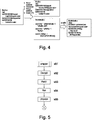
- Figure 4 illustrates an example of the object-to-object transformation.
- input object file fib.s2s.o contains markers "fibWrapped” and "fibWrappedEnd” allowing the object-to-object transformation to identify the code to be protected.
- This code is extracted and replaced with dummy code (e.g fake code) within the object file fib.s2s.o.
- the dummy code can be selected to resemble real code, and may be, for example, junk code, real code or seemingly meaningful code. In other examples, the dummy code code may be random code.
- the modified object file fib.s2s.o may be considered a first output object file.
- the object-to-object transformation may generate an intermediate source file fib.shellcode.c.
- This intermediate source file is used to encrypt the code to be protected using an encryption operation matching the decryption operation injected during the source-to-source transformation and a give secret key.
- the secret key may be predefined or may be defined such that it can be derived during the object-to-object transformation or at another time.
- the encryption operation may be replaced with an alternative form of obfuscation, which may be weaker, in order to minimize overheads and potential performance penalties.
- the intermediate source file is compiled during the object-to-object transformation to generate a second output object file, referred to as "fib.shellcode.o" in Figure 4 .
- the second object file carries the encrypted or otherwise obscured code to be protected in a data section.
- the first and second object files may subsequently be consolidated to form a single, consolidated output object file, although this is not required in all embodiments.
- a one-to-one relationship may be achieved between object files used as an input to the object-to-object transformation and those that are output from this process.
- the approach to object file consolidation will vary in dependence on the toolchain.
- a COFF-format parser may be developed and the process may involve reading both object files, consolidating them according to the Microsoft COFF specification and writing the consolidated file back to disk.
- the object file(s) generated by the process of Figures 2B, 3 and 4 can then be passed to an integrator/linker for linking.
- the integrator does not need to take further steps to ensure that on-demand decryption is possible and does not need to carry out any post-link process.
- the code delivered to the integrator is already encrypted, static analysis of the library at this stage is inhibited, increasing the security of the code.
- Figure 5 illustrates a process of on-demand decryption subsequently carried out when the software is run.
- ultimate .bin binary wrapper is obtained at step s51 and the relevant function code (i.e. the code that has been protected) can be retrieved.
- This is decrypted at step s52 and then patched at step s53 into its source location, replacing the fake code that had been located there.
- the program may then be run, at step s54.
- the function code is unpatched at step s55, once again obscuring this code from static analysis.
- certain areas may be preserved, particularly areas modified by the linker after encryption was completed.
- An example process will be described in more detail below with reference to Figures 6 to 8 .
- the linker modifies the code, updating offsets in CALL instructions to the relevant target functions. As this cannot be pre-computed in the encrypted code, in this approach described below with reference to Figure 6 to 8 , these are anticipated, such areas are identified prior to encryption, and then preserved so that the result after patching is a proper, correct code.
- relocation processes may require unaltered code. Such relocation processes can occur during the linking process and when the program is loaded. In order to avoid interference with this process, during the object-to-object transformation areas which are used for relocation directions can be excluded from replacement by the fake code. In particular, the areas used for relocation directions may be areas targeted by relocation commands. As a result, the fake code finally provided will include relocation directions that are unaltered from the original code.
- Figure 6 illustrates an example.
- the original, "plain" code in the input object file includes two highlighted regions which are the target of relocation operations.
- the fake code is modified so that these regions are not replaced and values remain constant in these regions.
- a mask may then be generated to ensure any data provided to the regions during relocation is not overwritten during the on-demand decryption process at run-time.
- the mask may be generated by comparison of the (decrypted) code to be protected and the equivalent area within the output object file. This is illustrated in Figure 7 ; an XOR operation identifies where the two sets of code are identical, thus indicating where no substitution has been made.
- Relocations occur during linking and loading processes, as illustrated in Figure 8 .
- the mask is then utilized to ensure that during the on-demand decryption process these relocations remain effective by inhibiting the patching of the code that has been protected into the regions reserved for such relocations.
- the decryption process of in some embodiments can be further understood with respect to Figures 9 to 11 .
- integrity of the data is monitored through the calculation of checksums. Since the dummy code within an on demand decryption area is modified during processing (as fake code is replaced by real code) a particular approach is required to ensure checksum values are constant in normal operation.
- the approach taken uses a "duplication table".
- the duplication table is a data area which can be modified during the process and thus acts as compensation area.
- the runtime code (“Code A”) is maintained in an encrypted area 10.
- the runtime code is stored as the result of an XOR operation between the runtime code and the fake code (“Garbage Code A”) maintained in the on demand code decryption area 12.
- "Holes” 14 are provided in the runtime code corresponding to the mask described in Figures 6 to 8 .
- the fake code in the on demand code decryption area 12 is provided with relocation directions 16 at locations corresponding to the holes.
- the duplication table 18 is also illustrated in Figure 10
- Figure 9 shows a flow table for the process.
- object files are received at step s91.
- These object files include the encrypted area 10 and the on demand code decryption area 12.
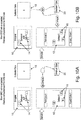
- Checksums can be calculated for parts of the object file not protected by on demand code decryption as illustrated in Figure 10A .
- a duplication table is generated at step s92.
- the duplication table 18 is blank (i.e. set at 0).
- the ODCD area 12 is initialized with a fake code but with correct relocation directions as mentioned above.
- a checksum may then be calculated at step s93. This will generate a first checksum result which may be stored in a checksum table 20.
- the duplication table is populated with the result of the operation runtime code XOR fake code.
- the runtime code includes "holes" of value 0 corresponding to the positions of relocation directions in the fake code.
- this process of populating the duplication table 18 may comprise decrypting the information stored in the encryption area 10 using a decryption key.
- Figure 10C also helps to illustrate step s95, at which the runtime code (with the exception of the holes) replaces the fake code within the on demand decryption area 12.
- XOR fake code Real runtime code with expected relocations added (in place of the "holes").
- the real runtime code with relocations added may be executed. This step can occur earlier or later in the process and may not occur at all.
- a second checksum result is calculated.
- the checksum is based on the result of an XOR operation between the code within the ODCD area 12 and the duplication table 18.
- first and second checksums are both calculated on the fake code and provide the same value.
- the first and second checksum results may then be used to step s98 to assess integrity of the fake code and/or real code. For example, since both results should be identical, a comparison of the two results which shows a change would imply a loss of integrity.
- the checksum results may be compared with an expected value, or may be used in a process having operation dependent upon the checksum results. That is to say, the alteration of a checksum result from its expected value may be inferred from the result of a further process.
- the ODCD area 12 is returned to its original state and the duplication table is re-initialized to zero.
- the duplication table is re-initialized to zero.
- contents of ODCD area 12 XOR contents of duplication table 18 fake code.
- the initial state of the duplication table 18 is blank (or set to zero).
- Alternative embodiments may adopt an alternative initial value.
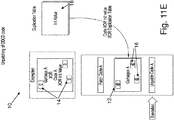
- Figures 11A to 11E (which correspond to the equivalent steps to the process described with reference to Figures 10A to 10E ) illustrate one such scenario.
- the duplication table 18 takes an initial value labelled "init value". This initial value is included in XOR operations when populating the ODCD area 12 or the duplication table 18 and thus persists in such a way as to ensure consistency of the checksum values.
- the holes provided in the real time code take the value zero, but in alternative embodiments different predefined values may be adopted.
- the predefined value for the holes is
- the various methods described above may be implemented by a computer program.
- the computer program may include computer code arranged to instruct a computer to perform the functions of one or more of the various methods described above.
- the computer program and/or the code for performing such methods may be provided to an apparatus, such as a computer, on one or more computer readable media or, more generally, a computer program product.
- the computer readable media may be transitory or non-transitory.
- the one or more computer readable media could be, for example, an electronic, magnetic, optical, electromagnetic, infrared, or semiconductor system, or a propagation medium for data transmission, for example for downloading the code over the Internet.
- the one or more computer readable media could take the form of one or more physical computer readable media such as semiconductor or solid state memory, magnetic tape, a removable computer diskette, a random access memory (RAM), a read-only memory (ROM), a rigid magnetic disc, and an optical disk, such as a CD-ROM, CD-R/W or DVD.
- physical computer readable media such as semiconductor or solid state memory, magnetic tape, a removable computer diskette, a random access memory (RAM), a read-only memory (ROM), a rigid magnetic disc, and an optical disk, such as a CD-ROM, CD-R/W or DVD.
- modules, components and other features described herein can be implemented as discrete components or integrated in the functionality of hardware components such as ASICS, FPGAs, DSPs or similar devices as part of an individualization server.
- a “hardware component” is a tangible (e.g., non-transitory) physical component (e.g., a set of one or more processors) capable of performing certain operations and may be configured or arranged in a certain physical manner.
- a hardware component may include dedicated circuitry or logic that is permanently configured to perform certain operations.
- a hardware component may be or include a special-purpose processor, such as a field programmable gate array (FPGA) or an ASIC.
- FPGA field programmable gate array
- a hardware component may also include programmable logic or circuitry that is temporarily configured by software to perform certain operations.
- the phrase "hardware component” should be understood to encompass a tangible entity that may be physically constructed, permanently configured (e.g., hardwired), or temporarily configured (e.g., programmed) to operate in a certain manner or to perform certain operations described herein.
- modules and components can be implemented as firmware or functional circuitry within hardware devices. Further, the modules and components can be implemented in any combination of hardware devices and software components, or only in software (e.g., code stored or otherwise embodied in a machine-readable medium or in a transmission medium).
Landscapes
- Engineering & Computer Science (AREA)
- Computer Security & Cryptography (AREA)
- Theoretical Computer Science (AREA)
- Software Systems (AREA)
- Physics & Mathematics (AREA)
- Computer Hardware Design (AREA)
- General Engineering & Computer Science (AREA)
- General Physics & Mathematics (AREA)
- Health & Medical Sciences (AREA)
- Bioethics (AREA)
- General Health & Medical Sciences (AREA)
- Technology Law (AREA)
- Multimedia (AREA)
- Detection And Correction Of Errors (AREA)
- Storage Device Security (AREA)
Priority Applications (4)
| Application Number | Priority Date | Filing Date | Title |
|---|---|---|---|
| EP16191975.8A EP3301601B1 (de) | 2016-09-30 | 2016-09-30 | Integrität von codeentschlüsselung auf anfrage |
| ES16191975T ES2746127T3 (es) | 2016-09-30 | 2016-09-30 | Integridad de descifrado de código bajo demanda |
| PCT/EP2017/074842 WO2018060459A1 (en) | 2016-09-30 | 2017-09-29 | Integrity of on demand code decryption |
| US16/336,120 US11244075B2 (en) | 2016-09-30 | 2017-09-29 | Integrity of on demand code decryption |
Applications Claiming Priority (1)
| Application Number | Priority Date | Filing Date | Title |
|---|---|---|---|
| EP16191975.8A EP3301601B1 (de) | 2016-09-30 | 2016-09-30 | Integrität von codeentschlüsselung auf anfrage |
Publications (2)
| Publication Number | Publication Date |
|---|---|
| EP3301601A1 true EP3301601A1 (de) | 2018-04-04 |
| EP3301601B1 EP3301601B1 (de) | 2019-07-03 |
Family
ID=57178220
Family Applications (1)
| Application Number | Title | Priority Date | Filing Date |
|---|---|---|---|
| EP16191975.8A Active EP3301601B1 (de) | 2016-09-30 | 2016-09-30 | Integrität von codeentschlüsselung auf anfrage |
Country Status (4)
| Country | Link |
|---|---|
| US (1) | US11244075B2 (de) |
| EP (1) | EP3301601B1 (de) |
| ES (1) | ES2746127T3 (de) |
| WO (1) | WO2018060459A1 (de) |
Families Citing this family (8)
| Publication number | Priority date | Publication date | Assignee | Title |
|---|---|---|---|---|
| US11416628B2 (en) | 2019-09-27 | 2022-08-16 | Amazon Technologies, Inc. | User-specific data manipulation system for object storage service based on user-submitted code |
| US11550944B2 (en) | 2019-09-27 | 2023-01-10 | Amazon Technologies, Inc. | Code execution environment customization system for object storage service |
| US11656892B1 (en) | 2019-09-27 | 2023-05-23 | Amazon Technologies, Inc. | Sequential execution of user-submitted code and native functions |
| US11394761B1 (en) | 2019-09-27 | 2022-07-19 | Amazon Technologies, Inc. | Execution of user-submitted code on a stream of data |
| US11263220B2 (en) | 2019-09-27 | 2022-03-01 | Amazon Technologies, Inc. | On-demand execution of object transformation code in output path of object storage service |
| US11360948B2 (en) | 2019-09-27 | 2022-06-14 | Amazon Technologies, Inc. | Inserting owner-specified data processing pipelines into input/output path of object storage service |
| US11250007B1 (en) | 2019-09-27 | 2022-02-15 | Amazon Technologies, Inc. | On-demand execution of object combination code in output path of object storage service |
| US20230195860A1 (en) * | 2021-12-20 | 2023-06-22 | International Business Machines Corporation | Selective on-demand execution encryption |
Citations (3)
| Publication number | Priority date | Publication date | Assignee | Title |
|---|---|---|---|---|
| US20110202996A1 (en) * | 2010-02-18 | 2011-08-18 | Thomson Licensing | Method and apparatus for verifying the integrity of software code during execution and apparatus for generating such software code |
| EP2378452A1 (de) * | 2010-04-16 | 2011-10-19 | Thomson Licensing | Verfahren, Vorrichtung und Computerprogrammprodukt zur Verifizierung von Prüfsummen für selbstmodifizierten Computercode |
| US20120260102A1 (en) * | 2011-04-08 | 2012-10-11 | Apple Inc. | System and method for executing an encrypted binary from a memory pool |
Family Cites Families (1)
| Publication number | Priority date | Publication date | Assignee | Title |
|---|---|---|---|---|
| US6880149B2 (en) * | 2002-04-01 | 2005-04-12 | Pace Anti-Piracy | Method for runtime code integrity validation using code block checksums |
-
2016
- 2016-09-30 ES ES16191975T patent/ES2746127T3/es active Active
- 2016-09-30 EP EP16191975.8A patent/EP3301601B1/de active Active
-
2017
- 2017-09-29 WO PCT/EP2017/074842 patent/WO2018060459A1/en not_active Ceased
- 2017-09-29 US US16/336,120 patent/US11244075B2/en active Active
Patent Citations (3)
| Publication number | Priority date | Publication date | Assignee | Title |
|---|---|---|---|---|
| US20110202996A1 (en) * | 2010-02-18 | 2011-08-18 | Thomson Licensing | Method and apparatus for verifying the integrity of software code during execution and apparatus for generating such software code |
| EP2378452A1 (de) * | 2010-04-16 | 2011-10-19 | Thomson Licensing | Verfahren, Vorrichtung und Computerprogrammprodukt zur Verifizierung von Prüfsummen für selbstmodifizierten Computercode |
| US20120260102A1 (en) * | 2011-04-08 | 2012-10-11 | Apple Inc. | System and method for executing an encrypted binary from a memory pool |
Also Published As
| Publication number | Publication date |
|---|---|
| US11244075B2 (en) | 2022-02-08 |
| US20200019730A1 (en) | 2020-01-16 |
| EP3301601B1 (de) | 2019-07-03 |
| WO2018060459A1 (en) | 2018-04-05 |
| ES2746127T3 (es) | 2020-03-04 |
Similar Documents
| Publication | Publication Date | Title |
|---|---|---|
| US11244075B2 (en) | Integrity of on demand code decryption | |
| US12113899B2 (en) | On demand code decryption | |
| US20170372068A1 (en) | Method to identify known compilers functions, libraries and objects inside files and data items containing an executable code | |
| Almeida et al. | Formal verification of side-channel countermeasures using self-composition | |
| EP3126973A1 (de) | Verfahren, vorrichtung und computerlesbares medium zur verschleierung der ausführung einer anwendung auf einer virtuellen maschine | |
| US7739516B2 (en) | Import address table verification | |
| EP3528149B1 (de) | Verfahren und vorrichtung zur verhinderung der neupaketierung von software | |
| JP7154365B2 (ja) | ソフトウェアコードをセキュアにするための方法 | |
| US20160203087A1 (en) | Method for providing security for common intermediate language-based program | |
| US20150095653A1 (en) | Method and apparatus of creating application package, method and apparatus of executing application package, and recording medium storing application package | |
| CN104866739A (zh) | 安卓系统中应用程序加密方法及系统 | |
| CN107077562A (zh) | 用于动态控制代码执行的计算机实现的方法和系统 | |
| CN112231702A (zh) | 应用保护方法、装置、设备及介质 | |
| CN105701368B (zh) | 一种混淆软件代码的方法 | |
| CN106416119B (zh) | 保护软件项目 | |
| CN113221077B (zh) | 基于spring容器的class文件加密方法及设备 | |
| CN106922191B (zh) | 生成和执行受保护的软件项目 | |
| CN102855439A (zh) | 一种执行文件自校验方法及装置 | |
| US20190102573A1 (en) | Theater ears android app sensitive data management | |
| Ebert et al. | Generative Artificial Intelligence for Automotive Cybersecurity | |
| CN114969765B (zh) | 一种物联网设备无感安全漏洞修复方法、装置及设备 | |
| Lee et al. | Identifying code tampering using a bytecode comparison analysis tool | |
| US20260141055A1 (en) | System and Method for Granular Application Signatures | |
| CN118673474A (zh) | 一种防止动态链接库劫持的链接方法、设备及介质 | |
| Verma | Multimedia Attacks on Android devices using StageFright exploit |
Legal Events
| Date | Code | Title | Description |
|---|---|---|---|
| PUAI | Public reference made under article 153(3) epc to a published international application that has entered the european phase |
Free format text: ORIGINAL CODE: 0009012 |
|
| STAA | Information on the status of an ep patent application or granted ep patent |
Free format text: STATUS: THE APPLICATION HAS BEEN PUBLISHED |
|
| AK | Designated contracting states |
Kind code of ref document: A1 Designated state(s): AL AT BE BG CH CY CZ DE DK EE ES FI FR GB GR HR HU IE IS IT LI LT LU LV MC MK MT NL NO PL PT RO RS SE SI SK SM TR |
|
| AX | Request for extension of the european patent |
Extension state: BA ME |
|
| STAA | Information on the status of an ep patent application or granted ep patent |
Free format text: STATUS: REQUEST FOR EXAMINATION WAS MADE |
|
| 17P | Request for examination filed |
Effective date: 20180907 |
|
| RBV | Designated contracting states (corrected) |
Designated state(s): AL AT BE BG CH CY CZ DE DK EE ES FI FR GB GR HR HU IE IS IT LI LT LU LV MC MK MT NL NO PL PT RO RS SE SI SK SM TR |
|
| GRAP | Despatch of communication of intention to grant a patent |
Free format text: ORIGINAL CODE: EPIDOSNIGR1 |
|
| STAA | Information on the status of an ep patent application or granted ep patent |
Free format text: STATUS: GRANT OF PATENT IS INTENDED |
|
| INTG | Intention to grant announced |
Effective date: 20190124 |
|
| GRAS | Grant fee paid |
Free format text: ORIGINAL CODE: EPIDOSNIGR3 |
|
| GRAA | (expected) grant |
Free format text: ORIGINAL CODE: 0009210 |
|
| STAA | Information on the status of an ep patent application or granted ep patent |
Free format text: STATUS: THE PATENT HAS BEEN GRANTED |
|
| AK | Designated contracting states |
Kind code of ref document: B1 Designated state(s): AL AT BE BG CH CY CZ DE DK EE ES FI FR GB GR HR HU IE IS IT LI LT LU LV MC MK MT NL NO PL PT RO RS SE SI SK SM TR |
|
| REG | Reference to a national code |
Ref country code: GB Ref legal event code: FG4D |
|
| REG | Reference to a national code |
Ref country code: AT Ref legal event code: REF Ref document number: 1151860 Country of ref document: AT Kind code of ref document: T Effective date: 20190715 Ref country code: CH Ref legal event code: EP |
|
| REG | Reference to a national code |
Ref country code: DE Ref legal event code: R096 Ref document number: 602016016200 Country of ref document: DE |
|
| REG | Reference to a national code |
Ref country code: IE Ref legal event code: FG4D |
|
| REG | Reference to a national code |
Ref country code: NL Ref legal event code: FP |
|
| REG | Reference to a national code |
Ref country code: LT Ref legal event code: MG4D |
|
| REG | Reference to a national code |
Ref country code: AT Ref legal event code: MK05 Ref document number: 1151860 Country of ref document: AT Kind code of ref document: T Effective date: 20190703 |
|
| PG25 | Lapsed in a contracting state [announced via postgrant information from national office to epo] |
Ref country code: CZ Free format text: LAPSE BECAUSE OF FAILURE TO SUBMIT A TRANSLATION OF THE DESCRIPTION OR TO PAY THE FEE WITHIN THE PRESCRIBED TIME-LIMIT Effective date: 20190703 Ref country code: BG Free format text: LAPSE BECAUSE OF FAILURE TO SUBMIT A TRANSLATION OF THE DESCRIPTION OR TO PAY THE FEE WITHIN THE PRESCRIBED TIME-LIMIT Effective date: 20191003 Ref country code: PT Free format text: LAPSE BECAUSE OF FAILURE TO SUBMIT A TRANSLATION OF THE DESCRIPTION OR TO PAY THE FEE WITHIN THE PRESCRIBED TIME-LIMIT Effective date: 20191104 Ref country code: HR Free format text: LAPSE BECAUSE OF FAILURE TO SUBMIT A TRANSLATION OF THE DESCRIPTION OR TO PAY THE FEE WITHIN THE PRESCRIBED TIME-LIMIT Effective date: 20190703 Ref country code: LT Free format text: LAPSE BECAUSE OF FAILURE TO SUBMIT A TRANSLATION OF THE DESCRIPTION OR TO PAY THE FEE WITHIN THE PRESCRIBED TIME-LIMIT Effective date: 20190703 Ref country code: FI Free format text: LAPSE BECAUSE OF FAILURE TO SUBMIT A TRANSLATION OF THE DESCRIPTION OR TO PAY THE FEE WITHIN THE PRESCRIBED TIME-LIMIT Effective date: 20190703 Ref country code: AT Free format text: LAPSE BECAUSE OF FAILURE TO SUBMIT A TRANSLATION OF THE DESCRIPTION OR TO PAY THE FEE WITHIN THE PRESCRIBED TIME-LIMIT Effective date: 20190703 Ref country code: NO Free format text: LAPSE BECAUSE OF FAILURE TO SUBMIT A TRANSLATION OF THE DESCRIPTION OR TO PAY THE FEE WITHIN THE PRESCRIBED TIME-LIMIT Effective date: 20191003 Ref country code: SE Free format text: LAPSE BECAUSE OF FAILURE TO SUBMIT A TRANSLATION OF THE DESCRIPTION OR TO PAY THE FEE WITHIN THE PRESCRIBED TIME-LIMIT Effective date: 20190703 |
|
| PG25 | Lapsed in a contracting state [announced via postgrant information from national office to epo] |
Ref country code: IS Free format text: LAPSE BECAUSE OF FAILURE TO SUBMIT A TRANSLATION OF THE DESCRIPTION OR TO PAY THE FEE WITHIN THE PRESCRIBED TIME-LIMIT Effective date: 20191103 Ref country code: RS Free format text: LAPSE BECAUSE OF FAILURE TO SUBMIT A TRANSLATION OF THE DESCRIPTION OR TO PAY THE FEE WITHIN THE PRESCRIBED TIME-LIMIT Effective date: 20190703 Ref country code: AL Free format text: LAPSE BECAUSE OF FAILURE TO SUBMIT A TRANSLATION OF THE DESCRIPTION OR TO PAY THE FEE WITHIN THE PRESCRIBED TIME-LIMIT Effective date: 20190703 Ref country code: LV Free format text: LAPSE BECAUSE OF FAILURE TO SUBMIT A TRANSLATION OF THE DESCRIPTION OR TO PAY THE FEE WITHIN THE PRESCRIBED TIME-LIMIT Effective date: 20190703 Ref country code: GR Free format text: LAPSE BECAUSE OF FAILURE TO SUBMIT A TRANSLATION OF THE DESCRIPTION OR TO PAY THE FEE WITHIN THE PRESCRIBED TIME-LIMIT Effective date: 20191004 |
|
| REG | Reference to a national code |
Ref country code: ES Ref legal event code: FG2A Ref document number: 2746127 Country of ref document: ES Kind code of ref document: T3 Effective date: 20200304 |
|
| PG25 | Lapsed in a contracting state [announced via postgrant information from national office to epo] |
Ref country code: TR Free format text: LAPSE BECAUSE OF FAILURE TO SUBMIT A TRANSLATION OF THE DESCRIPTION OR TO PAY THE FEE WITHIN THE PRESCRIBED TIME-LIMIT Effective date: 20190703 |
|
| PG25 | Lapsed in a contracting state [announced via postgrant information from national office to epo] |
Ref country code: EE Free format text: LAPSE BECAUSE OF FAILURE TO SUBMIT A TRANSLATION OF THE DESCRIPTION OR TO PAY THE FEE WITHIN THE PRESCRIBED TIME-LIMIT Effective date: 20190703 Ref country code: PL Free format text: LAPSE BECAUSE OF FAILURE TO SUBMIT A TRANSLATION OF THE DESCRIPTION OR TO PAY THE FEE WITHIN THE PRESCRIBED TIME-LIMIT Effective date: 20190703 Ref country code: DK Free format text: LAPSE BECAUSE OF FAILURE TO SUBMIT A TRANSLATION OF THE DESCRIPTION OR TO PAY THE FEE WITHIN THE PRESCRIBED TIME-LIMIT Effective date: 20190703 Ref country code: RO Free format text: LAPSE BECAUSE OF FAILURE TO SUBMIT A TRANSLATION OF THE DESCRIPTION OR TO PAY THE FEE WITHIN THE PRESCRIBED TIME-LIMIT Effective date: 20190703 |
|
| PG25 | Lapsed in a contracting state [announced via postgrant information from national office to epo] |
Ref country code: SK Free format text: LAPSE BECAUSE OF FAILURE TO SUBMIT A TRANSLATION OF THE DESCRIPTION OR TO PAY THE FEE WITHIN THE PRESCRIBED TIME-LIMIT Effective date: 20190703 Ref country code: MC Free format text: LAPSE BECAUSE OF FAILURE TO SUBMIT A TRANSLATION OF THE DESCRIPTION OR TO PAY THE FEE WITHIN THE PRESCRIBED TIME-LIMIT Effective date: 20190703 Ref country code: SM Free format text: LAPSE BECAUSE OF FAILURE TO SUBMIT A TRANSLATION OF THE DESCRIPTION OR TO PAY THE FEE WITHIN THE PRESCRIBED TIME-LIMIT Effective date: 20190703 Ref country code: IS Free format text: LAPSE BECAUSE OF FAILURE TO SUBMIT A TRANSLATION OF THE DESCRIPTION OR TO PAY THE FEE WITHIN THE PRESCRIBED TIME-LIMIT Effective date: 20200224 |
|
| REG | Reference to a national code |
Ref country code: CH Ref legal event code: PL |
|
| REG | Reference to a national code |
Ref country code: DE Ref legal event code: R097 Ref document number: 602016016200 Country of ref document: DE |
|
| PLBE | No opposition filed within time limit |
Free format text: ORIGINAL CODE: 0009261 |
|
| STAA | Information on the status of an ep patent application or granted ep patent |
Free format text: STATUS: NO OPPOSITION FILED WITHIN TIME LIMIT |
|
| PG2D | Information on lapse in contracting state deleted |
Ref country code: IS |
|
| PG25 | Lapsed in a contracting state [announced via postgrant information from national office to epo] |
Ref country code: CH Free format text: LAPSE BECAUSE OF NON-PAYMENT OF DUE FEES Effective date: 20190930 Ref country code: LI Free format text: LAPSE BECAUSE OF NON-PAYMENT OF DUE FEES Effective date: 20190930 Ref country code: LU Free format text: LAPSE BECAUSE OF NON-PAYMENT OF DUE FEES Effective date: 20190930 Ref country code: IE Free format text: LAPSE BECAUSE OF NON-PAYMENT OF DUE FEES Effective date: 20190930 |
|
| REG | Reference to a national code |
Ref country code: BE Ref legal event code: MM Effective date: 20190930 |
|
| 26N | No opposition filed |
Effective date: 20200603 |
|
| PG25 | Lapsed in a contracting state [announced via postgrant information from national office to epo] |
Ref country code: BE Free format text: LAPSE BECAUSE OF NON-PAYMENT OF DUE FEES Effective date: 20190930 Ref country code: SI Free format text: LAPSE BECAUSE OF FAILURE TO SUBMIT A TRANSLATION OF THE DESCRIPTION OR TO PAY THE FEE WITHIN THE PRESCRIBED TIME-LIMIT Effective date: 20190703 |
|
| PG25 | Lapsed in a contracting state [announced via postgrant information from national office to epo] |
Ref country code: CY Free format text: LAPSE BECAUSE OF FAILURE TO SUBMIT A TRANSLATION OF THE DESCRIPTION OR TO PAY THE FEE WITHIN THE PRESCRIBED TIME-LIMIT Effective date: 20190703 |
|
| PG25 | Lapsed in a contracting state [announced via postgrant information from national office to epo] |
Ref country code: MT Free format text: LAPSE BECAUSE OF FAILURE TO SUBMIT A TRANSLATION OF THE DESCRIPTION OR TO PAY THE FEE WITHIN THE PRESCRIBED TIME-LIMIT Effective date: 20190703 Ref country code: HU Free format text: LAPSE BECAUSE OF FAILURE TO SUBMIT A TRANSLATION OF THE DESCRIPTION OR TO PAY THE FEE WITHIN THE PRESCRIBED TIME-LIMIT; INVALID AB INITIO Effective date: 20160930 |
|
| PG25 | Lapsed in a contracting state [announced via postgrant information from national office to epo] |
Ref country code: MK Free format text: LAPSE BECAUSE OF FAILURE TO SUBMIT A TRANSLATION OF THE DESCRIPTION OR TO PAY THE FEE WITHIN THE PRESCRIBED TIME-LIMIT Effective date: 20190703 |
|
| PGFP | Annual fee paid to national office [announced via postgrant information from national office to epo] |
Ref country code: NL Payment date: 20250820 Year of fee payment: 10 |
|
| PGFP | Annual fee paid to national office [announced via postgrant information from national office to epo] |
Ref country code: DE Payment date: 20250820 Year of fee payment: 10 |
|
| PGFP | Annual fee paid to national office [announced via postgrant information from national office to epo] |
Ref country code: IT Payment date: 20250820 Year of fee payment: 10 |
|
| PGFP | Annual fee paid to national office [announced via postgrant information from national office to epo] |
Ref country code: GB Payment date: 20250820 Year of fee payment: 10 |
|
| PGFP | Annual fee paid to national office [announced via postgrant information from national office to epo] |
Ref country code: FR Payment date: 20250821 Year of fee payment: 10 |
|
| PGFP | Annual fee paid to national office [announced via postgrant information from national office to epo] |
Ref country code: ES Payment date: 20251001 Year of fee payment: 10 |