EP3301482A1 - Batch processing for gnss signal processing in a user satellite - Google Patents
Batch processing for gnss signal processing in a user satellite Download PDFInfo
- Publication number
- EP3301482A1 EP3301482A1 EP17189587.3A EP17189587A EP3301482A1 EP 3301482 A1 EP3301482 A1 EP 3301482A1 EP 17189587 A EP17189587 A EP 17189587A EP 3301482 A1 EP3301482 A1 EP 3301482A1
- Authority
- EP
- European Patent Office
- Prior art keywords
- measurements
- processing unit
- receiver
- pvt
- time period
- Prior art date
- Legal status (The legal status is an assumption and is not a legal conclusion. Google has not performed a legal analysis and makes no representation as to the accuracy of the status listed.)
- Granted
Links
Images



Classifications
-
- G—PHYSICS
- G01—MEASURING; TESTING
- G01S—RADIO DIRECTION-FINDING; RADIO NAVIGATION; DETERMINING DISTANCE OR VELOCITY BY USE OF RADIO WAVES; LOCATING OR PRESENCE-DETECTING BY USE OF THE REFLECTION OR RERADIATION OF RADIO WAVES; ANALOGOUS ARRANGEMENTS USING OTHER WAVES
- G01S19/00—Satellite radio beacon positioning systems; Determining position, velocity or attitude using signals transmitted by such systems
- G01S19/01—Satellite radio beacon positioning systems transmitting time-stamped messages, e.g. GPS [Global Positioning System], GLONASS [Global Orbiting Navigation Satellite System] or GALILEO
- G01S19/13—Receivers
- G01S19/14—Receivers specially adapted for specific applications
-
- B—PERFORMING OPERATIONS; TRANSPORTING
- B64—AIRCRAFT; AVIATION; COSMONAUTICS
- B64G—COSMONAUTICS; VEHICLES OR EQUIPMENT THEREFOR
- B64G3/00—Observing or tracking cosmonautic vehicles
-
- G—PHYSICS
- G01—MEASURING; TESTING
- G01S—RADIO DIRECTION-FINDING; RADIO NAVIGATION; DETERMINING DISTANCE OR VELOCITY BY USE OF RADIO WAVES; LOCATING OR PRESENCE-DETECTING BY USE OF THE REFLECTION OR RERADIATION OF RADIO WAVES; ANALOGOUS ARRANGEMENTS USING OTHER WAVES
- G01S19/00—Satellite radio beacon positioning systems; Determining position, velocity or attitude using signals transmitted by such systems
- G01S19/01—Satellite radio beacon positioning systems transmitting time-stamped messages, e.g. GPS [Global Positioning System], GLONASS [Global Orbiting Navigation Satellite System] or GALILEO
- G01S19/13—Receivers
- G01S19/35—Constructional details or hardware or software details of the signal processing chain
- G01S19/37—Hardware or software details of the signal processing chain
-
- G—PHYSICS
- G01—MEASURING; TESTING
- G01S—RADIO DIRECTION-FINDING; RADIO NAVIGATION; DETERMINING DISTANCE OR VELOCITY BY USE OF RADIO WAVES; LOCATING OR PRESENCE-DETECTING BY USE OF THE REFLECTION OR RERADIATION OF RADIO WAVES; ANALOGOUS ARRANGEMENTS USING OTHER WAVES
- G01S19/00—Satellite radio beacon positioning systems; Determining position, velocity or attitude using signals transmitted by such systems
- G01S19/38—Determining a navigation solution using signals transmitted by a satellite radio beacon positioning system
- G01S19/39—Determining a navigation solution using signals transmitted by a satellite radio beacon positioning system the satellite radio beacon positioning system transmitting time-stamped messages, e.g. GPS [Global Positioning System], GLONASS [Global Orbiting Navigation Satellite System] or GALILEO
- G01S19/42—Determining position
-
- G—PHYSICS
- G01—MEASURING; TESTING
- G01S—RADIO DIRECTION-FINDING; RADIO NAVIGATION; DETERMINING DISTANCE OR VELOCITY BY USE OF RADIO WAVES; LOCATING OR PRESENCE-DETECTING BY USE OF THE REFLECTION OR RERADIATION OF RADIO WAVES; ANALOGOUS ARRANGEMENTS USING OTHER WAVES
- G01S19/00—Satellite radio beacon positioning systems; Determining position, velocity or attitude using signals transmitted by such systems
- G01S19/38—Determining a navigation solution using signals transmitted by a satellite radio beacon positioning system
- G01S19/39—Determining a navigation solution using signals transmitted by a satellite radio beacon positioning system the satellite radio beacon positioning system transmitting time-stamped messages, e.g. GPS [Global Positioning System], GLONASS [Global Orbiting Navigation Satellite System] or GALILEO
- G01S19/52—Determining velocity
-
- H—ELECTRICITY
- H04—ELECTRIC COMMUNICATION TECHNIQUE
- H04W—WIRELESS COMMUNICATION NETWORKS
- H04W4/00—Services specially adapted for wireless communication networks; Facilities therefor
- H04W4/02—Services making use of location information
- H04W4/023—Services making use of location information using mutual or relative location information between multiple location based services [LBS] targets or of distance thresholds
-
- H—ELECTRICITY
- H04—ELECTRIC COMMUNICATION TECHNIQUE
- H04W—WIRELESS COMMUNICATION NETWORKS
- H04W4/00—Services specially adapted for wireless communication networks; Facilities therefor
- H04W4/02—Services making use of location information
- H04W4/025—Services making use of location information using location based information parameters
- H04W4/027—Services making use of location information using location based information parameters using movement velocity, acceleration information
Definitions
- the invention relates to a receiver for use in a user satellite, a method and a user satellite.
- a cold start requires a calculation of an initial position, velocity and time, PVT, from a Kalman filter of the receiver.
- This initial PVT can be uploaded from a ground station, if contact exists between the ground station and the receiver.
- the PVT can be calculated in the receiver by a kinematic point solution, which necessitates a simultaneous availability of measurements of at least four navigation satellites.
- a low Earth orbit which is located between 200 km and 2000 km, the alternative solution can be a problem. This is the case in particular if the user satellite associated with the receiver is located/moving on ascent routes to its target position or on elliptical orbits.
- the invention is consequently based on the problem of carrying out an autonomous initialisation in the event of sparse measurements.
- a receiver for use in a user satellite, among other things located, for example, partly or wholly on paths remote from the Earth.
- the receiver comprises a receiving unit and a processing unit.
- the receiving unit is configured to receive signals transmitted by navigation satellites of one or more, for example interoperable, global navigation satellite systems.
- the processing unit is configured to determine measurements based on the data contained in the signals received.
- the processing unit is configured further to carry out a calculation of position, velocity and time, PVT, based on batch processing of the measurements.
- the expression "for use in a user satellite” can also be understood in such a way that the receiver itself or parts of the receiver can be located or arranged and mounted on the user satellite, in the user satellite and/or on/at the user satellite.
- the expression "batch processing" is a literal translation from the English.
- the processing unit can be configured in the form of an on-board computer or as part of an ASIC.
- the predetermined time period can be determined by an availability of at least four measurements.
- the predetermined time period can further be defined by a maximum time.
- the predetermined time period can be defined by a maximum buffer time.
- the predetermined time period can further be defined by a threshold value on memory in the processing unit and/or in a memory unit.
- the predetermined time period can further be determined by a minimum requirement for measurements needed, which are required to calculate the PVT with a required accuracy.
- the receiver can further include a memory unit.
- the memory unit can be configured to store the data contained in the signals received or the measurements based on the data in batches during the predetermined time period and/or with a predefined time buffer.
- the processing unit can further be provided and/or configured to access or retrieve the measurements and/or data stored in batches after the predetermined time period or after the predefined time buffer.
- the processing unit can further be configured to process the data and/or measurements stored in batches.
- the processing can include the calculation of the PVT.
- the processing unit can further be provided to carry out the calculation of the PVT after and/or on completion of the predetermined time period. That can also comprise a combination of calculation during the predetermined time period and calculation after the predetermined time period.
- the receiving unit can further be configured to receive the signals transmitted by the navigation satellites sequentially and/or simultaneously.
- the processing unit can further be configured to determine the measurements from the data contained in the signals received sequentially and/or simultaneously.
- the processing unit can further be configured to carry out an initial and/or continuous calculation of the PVT based on batch processing of the measurements.
- the receiving unit can further be configured to receive the signals transmitted by the navigation satellites over a predetermined time period.
- the processing unit can further be configured to batch the measurements over the predetermined time period and carry out the calculation of the PVT, for example including the initial PVT, based on batch processing of the batched measurements.
- the processing unit can further be connected to the receiving unit.
- the processing unit can further be configured to batch the measurements so as to carry out the calculation of the PVT after the predetermined time period.
- After the predetermined time period can be understood here as “upon completion of the predetermined time period”, but also as “time after the predetermined time period”, so that a buffer time can be present between stored/buffered batch and the calculation of the PVT.
- the receiving unit and/or the processing unit can also be provided to store the signals transmitted by the navigation satellites or the data and/or the measurements based on the data for the predetermined time period.
- the processing unit can be configured to process the signals transmitted by the navigation satellites into the corresponding measurements and/or data and/or the appropriate data format.
- the processing unit can further be configured to store the measurements and/or data in batches in order to process them after the predetermined time period.
- the signals transmitted by the navigation satellites can be understood here also as navigation signals, which comprise typical encrypted or unencrypted GNSS navigation messages. These GNSS navigation messages can be contained in the measurements and/or data which are contained in the received signals.
- the receiving unit can further be configured to receive signals transmitted by the navigation satellites above a low Earth orbit.
- the low Earth orbit can lie between 200 and 2000 km.
- the navigation satellites can be available (only) to some extent during the predetermined time period or cannot be available to some extent during the predetermined time period.
- the PVT calculated from the batch processing can be used for verification in comparison with a standard calculation for the PVT from a Kalman filter. This thus represents a redundant solution.
- a condition for an adequate measurement or measuring accuracy can be a minimum duration for the predetermined time period.
- the signals transmitted by the navigation satellites can be present over the complete predetermined time period or can also be present only to some extent over the predetermined time period.
- Be present can be understood here as a signal that can be received from the respective navigation satellite with data contained therein for the PVT calculation determined from the data.
- the batch processing can comprise a batching or collection of the measurements.
- the measurements can contain at least four pseudorange measurements and at least four range rate measurements. Furthermore, the measurements can contain carrier phase measurements.
- the processing unit can further be configured to determine the at least four pseudorange measurements at least at two different times.
- the processing unit can further be configured to determine the at least four range rate measurements at least at two different times.
- the processing unit can further be configured to determine the at least four pseudorange measurements at the same times as the at least four range rate measurements.
- the processing unit can be configured to batch a portion of the measurements, for example two pseudorange measurements and two range rate measurements, at a first time and to batch a remaining portion of the measurements, for example two pseudorange measurements and two range rate measurements, at least at one further time.
- the first time and the at least one further time can be located in the predetermined time period.
- the first time and the at least one further time can determine the start and the end of the time period.
- the portion of the measurements can be associated with one navigation satellite and/or different navigation satellites.
- the measurements can contain the portion and the remaining portion of the measurements, or correspond to the portion and the remaining portion of the measurements.
- the portion of the measurements (at the first time) can comprise two pseudorange measurements, wherein the remaining portion of the measurements can comprise, on the one hand, two pseudorange measurements and two range rate measurements (at a second time), and on the other hand two range rate measurements (at a third time).
- the first and third time can determine the start and the end of the predetermined time period. Fewer or more than three times are conceivable, wherein the first and last time can lie within the predetermined time period or can determine this.
- the processing unit can further be configured to use a Kalman filter to calculate a PVT.
- the PVT calculated with the aid of the Kalman filter can differ from the PVT calculated with the aid of batch processing.
- the results of the calculated PVT can be compared with results of the PVT calculated via the Kalman filter to verify the correctness of the results of the PVT calculated with the Kalman filter.
- the predetermined time period can be a function of an availability of the navigation satellites.
- the predetermined time period can also be a function of a set of the batched or collected measurements.
- a user satellite with a receiver according to the first aspect comprises an electric and/or chemical drive.
- the time for an ascent into the geostationary orbit can increase from a few days (for chemical propulsion units) to several months. This can make autonomous position determination economical instead of the use of ground stations.
- the proposed autonomous initialisation and PVT determination are a substantial element to this end.
- a method for use in a user satellite, among other things located partly or wholly on orbits remote from Earth, for example.
- the method comprises receiving, by a receiving unit, of signals transmitted by navigation satellites of one or more, for example interoperable, global navigation satellite systems, GNSS.
- the method further comprises determination, by a processing unit, of measurements based on data contained in the signals received.
- the method further comprises carrying out, by a processing unit, of a calculation of position, velocity and time, PVT, based on batch processing of the measurements.
- a computer program for executing the method according to the fourth aspect is provided.
- a computer program product includes a machine-readable program carrier, on which a computer program according to the fifth aspect is stored in the form of electronically and/or optically readable control signals.
- the declarations stated herein can be/become implemented using hardware circuits, software means or a combination of these.
- the software means can be connected to programmed microprocessors or a general computer, an ASIC (Application Specific integrated Circuit) and/or DSPs (Digital Signal Processors).
- the receiving unit, memory unit and the processing unit can be realised partly as a computer or a processor (for example a microprocessor, microcontroller or DSP).
- FIG. 1 shows an exemplary embodiment of a receiver 101 schematically and in a simplified manner.
- the receiver 101 is provided for use in a user satellite.
- the receiver 101 comprises a receiving unit 110 and a processing unit 130.
- the receiver can further comprise a memory unit 120.
- the receiving unit 110 is configured to receive signals transmitted by navigation satellites of one or more, for example interoperable, global navigation satellite systems.
- the processing unit 130 is configured to determine measurements based on the data contained in the signals received.
- the processing unit 130 is further configured to carry out a calculation of position, velocity and time, PVT, based on batch processing of the measurements.
- the calculation of the PVT can represent an initial and/or a continuous calculation, i.e. permanent calculation, of the PVT.
- the memory unit 120 can be configured to store the measurements and/or data in batches during the predetermined time period and/or with a predefined time buffer.
- the processing unit 130 can further be provided and/or formed to access the measurements and/or data stored in batches and to retrieve these following the predetermined time period or following the predefined time buffer.
- the processing unit can further be configured to process the measurements and/or data stored in batches.
- the processing can include the calculation of the PVT.
- the processing unit 130 can also be formed in the form of an on-board computer.
- the predetermined time period can be defined by an availability of at least four measurements.
- the predetermined time period can further be defined by a maximum time.
- the predetermined time period can further be defined by a maximum buffer time.
- the predetermined time period can further be defined by a threshold value on memory space in the processing unit 130 and/or in the memory unit 120.
- the predetermined time period can further be determined by a minimal requirement of required measurements that are necessary for calculating the PVT.
- the processing unit 130 can further be provided to carry out the calculation of the PVT following and/or on completion of the predetermined time period. This can also comprise a combination of calculation during the predetermined time period and calculation after the predetermined time period.
- the receiving unit 110 can also be formed to receive the signals transmitted by the navigation satellites over a predetermined time period.
- the processing unit 130 can also be configured to batch the measurements over the predetermined time period and carry out the calculation based on batch processing of the batched measurements.
- the processing unit 130 can further be connected to the receiving unit 110 and the memory unit 120.
- the processing unit 130 can further be configured to batch the measurements, in order to carry out the calculation of the PVT with a required accuracy after the predetermined time period.
- the processing unit 130 can further be configured to use a Kalman filter to calculate a PVT.
- the PVT calculated with the aid of the Kalman filter may differ from the PVT calculated with the aid of the batch processing.
- the results of the calculated PVT can be compared with results of the PVT calculated by the Kalman filter, in order to verify the correctness of the results of the PVT calculated with the Kalman filter.
- the predetermined time period can be a function of an availability of the navigation satellites.
- the predetermined time period can also be a function of a set of the batched or collected measurements and/or data.
- FIG 2 shows schematically and in a simplified manner an exemplary embodiment of a user satellite 204 with a receiver 201.
- the user satellite 204 is provided with a receiver according to figure 1 .
- the receiver 201 can be arranged partly outside the user satellite. This means that parts of the receiver 201, such as the processing unit 230 and the memory unit 220, for example, can be arranged in the user satellite, while the receiving unit 210 can be arranged outside or partly outside and partly inside.
- the receiving unit 210 can also be configured to receive the signals transmitted by the navigation satellites.
- the receiving unit 210 and/or the processing unit 230 can also be provided to store the signals transmitted by the navigation satellites or the measurements and/or data for the predetermined time period.
- the processing unit 230 can be configured to process the signals transmitted by the navigation satellites into the corresponding measurements and/or data and/or the appropriate data format (also file format). It is conceivable here that the receiving unit has demodulation and decoding units, for example, to have decoded signals present in the baseband, which it can then convert by a suitable processor in connection with a storable medium (can be contained in the processing unit 230) into the data suitable for the calculation of the PVT and store this.
- the processing unit 230 can further be configured to store the measurements and/or data in batches, in order to process them after the predetermined time period.
- the signals transmitted by the navigation satellites can be understood here also as navigation signals, which comprise typical encrypted or unencrypted GNSS navigation messages. These GNSS navigation messages can be contained in the measurements and/or data contained in the signals received.
- the receiving unit 210 can further be configured to receive signals transmitted by the navigation satellites above a low Earth orbit.
- the low Earth orbit can lie between 200 and 2000 km. The receiving can take place above the low Earth orbit on the ascent of the satellite 204.
- the satellite 204 further comprises an electric and/or chemical drive.
- the satellite 204 can further be an applications satellite, which can be used, for example, as a communications satellite in geostationary orbit.
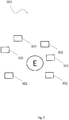
- Figure 3 shows schematically and in a simplified manner a global satellite navigation system GNSS, 303 with navigation satellites 302 and a user satellite 304 comprising a receiver corresponding to figures 1 and 2 , wherein the navigation satellites 302 and the user satellite 304 orbit an Earth E shown in a schematic and simplified manner.
- the GNSS 303 comprises several navigation satellites 302. It is conceivable that the measurements from the navigation satellites 302 of the GNSS 303 can only be available to some extent during the predetermined time period. The calculation of the PVT for the user satellite can be carried out as long as at least four measurements are available sequentially in the measuring period. However, the navigation satellites 302 do not have to be available over the entire predetermined time period.
- the calculated PVT from the batch processing can be used for verification in comparison with a standard calculation for the PVT from a Kalman filter and is thus a redundant solution. It is also conceivable that the navigation satellites 302 of the GNSS 303 cannot be available to some extent during the predetermined time period. The calculation of the PVT can be carried out even with a sparse presence of measurements of the navigation satellites 302. The at least four collected/batched measurements can be present in the signals transmitted by the navigation satellites 302 of the GNSS 303. The calculation of the PVT can be carried out based on these measurements. A condition for an adequate measurement or measuring accuracy can be a minimum duration for the predetermined time period.
- the signals transmitted by the navigation satellites 302 of the GNSS 303 can be present over the complete predetermined time period or can also only be available to some extent over the predetermined time period.
- the time period can be understood in such a way that it specifies the time or the time interval in which the receiving unit of the receiver is at least partly capable of receiving at least four measuring signals from navigation satellites 302, meaning that a connection can be set up between them at least during a partial amount of the time period.
- Figure 4 shows an exemplary embodiment of a method schematically and in a simplified manner.
- the method according to figure 4 is provided for use in a user satellite.
- the method comprises receiving S410 by a receiving unit according to figures 2 and 3 , of signals transmitted by navigation satellites of one or more, for example interoperable, global navigation satellite systems, GNSS.
- the method further comprises the determination S420, by a processing unit, of measurements based on data contained in the signals received.
- the method further comprises the carrying out S430, by the processing unit according to figures 2 and 3 , of a calculation of position, velocity and time, PVT, based on batch processing of the measurements.
- the method can further comprise intermediate storage S440, by a memory unit according to figure 1 , of the signals transmitted by navigation satellites.
- the processing unit can further be configured to retrieve (indicated as a dashed line) the measurements and/or data from the memory unit if a predetermined time period, in which the receiving unit has received the signals of the navigation satellites, was exceeded. Following retrieval, the processing unit can carry out the calculation of the PVT S430.
Landscapes
- Engineering & Computer Science (AREA)
- Remote Sensing (AREA)
- Radar, Positioning & Navigation (AREA)
- Computer Networks & Wireless Communication (AREA)
- Physics & Mathematics (AREA)
- General Physics & Mathematics (AREA)
- Signal Processing (AREA)
- Astronomy & Astrophysics (AREA)
- Aviation & Aerospace Engineering (AREA)
- Position Fixing By Use Of Radio Waves (AREA)
- Navigation (AREA)
Abstract
Description
- The invention relates to a receiver for use in a user satellite, a method and a user satellite.
- In a receiver for receiving signals of one or more global navigation satellite systems, GNSS, on a user satellite, a cold start requires a calculation of an initial position, velocity and time, PVT, from a Kalman filter of the receiver. This initial PVT can be uploaded from a ground station, if contact exists between the ground station and the receiver. Alternatively the PVT can be calculated in the receiver by a kinematic point solution, which necessitates a simultaneous availability of measurements of at least four navigation satellites. Above a low Earth orbit, which is located between 200 km and 2000 km, the alternative solution can be a problem. This is the case in particular if the user satellite associated with the receiver is located/moving on ascent routes to its target position or on elliptical orbits. In this case too short a reception timewise sometimes exists between the receiver and the navigation satellites. Furthermore, too great a pause (too great a time interval) exists between successive connections. In addition, the aforementioned Kalman filter is generally sensitive to a sparse availability of measurements.
- The invention is consequently based on the problem of carrying out an autonomous initialisation in the event of sparse measurements.
- According to a first aspect, a receiver is provided for use in a user satellite, among other things located, for example, partly or wholly on paths remote from the Earth. The receiver comprises a receiving unit and a processing unit. The receiving unit is configured to receive signals transmitted by navigation satellites of one or more, for example interoperable, global navigation satellite systems. The processing unit is configured to determine measurements based on the data contained in the signals received. The processing unit is configured further to carry out a calculation of position, velocity and time, PVT, based on batch processing of the measurements.
- This has the advantage that the simultaneous availability of measurements of at least four navigation satellites is no longer required.
- The expression "for use in a user satellite" can also be understood in such a way that the receiver itself or parts of the receiver can be located or arranged and mounted on the user satellite, in the user satellite and/or on/at the user satellite. The expression "batch processing" is a literal translation from the English.
- The processing unit can be configured in the form of an on-board computer or as part of an ASIC. The predetermined time period can be determined by an availability of at least four measurements. The predetermined time period can further be defined by a maximum time. Furthermore, the predetermined time period can be defined by a maximum buffer time. The predetermined time period can further be defined by a threshold value on memory in the processing unit and/or in a memory unit. The predetermined time period can further be determined by a minimum requirement for measurements needed, which are required to calculate the PVT with a required accuracy.
- The receiver can further include a memory unit. The memory unit can be configured to store the data contained in the signals received or the measurements based on the data in batches during the predetermined time period and/or with a predefined time buffer. The processing unit can further be provided and/or configured to access or retrieve the measurements and/or data stored in batches after the predetermined time period or after the predefined time buffer. The processing unit can further be configured to process the data and/or measurements stored in batches. The processing can include the calculation of the PVT.
- The processing unit can further be provided to carry out the calculation of the PVT after and/or on completion of the predetermined time period. That can also comprise a combination of calculation during the predetermined time period and calculation after the predetermined time period.
- This has the advantage of shortening the time up to the availability of the PVT.
- The receiving unit can further be configured to receive the signals transmitted by the navigation satellites sequentially and/or simultaneously. The processing unit can further be configured to determine the measurements from the data contained in the signals received sequentially and/or simultaneously. The processing unit can further be configured to carry out an initial and/or continuous calculation of the PVT based on batch processing of the measurements.
- The receiving unit can further be configured to receive the signals transmitted by the navigation satellites over a predetermined time period. The processing unit can further be configured to batch the measurements over the predetermined time period and carry out the calculation of the PVT, for example including the initial PVT, based on batch processing of the batched measurements.
- "Batching" or "batched" can be understood here as "collection" or "collected".
- The processing unit can further be connected to the receiving unit. The processing unit can further be configured to batch the measurements so as to carry out the calculation of the PVT after the predetermined time period.
- "After the predetermined time period" can be understood here as "upon completion of the predetermined time period", but also as "time after the predetermined time period", so that a buffer time can be present between stored/buffered batch and the calculation of the PVT.
- The receiving unit and/or the processing unit can also be provided to store the signals transmitted by the navigation satellites or the data and/or the measurements based on the data for the predetermined time period. For the storage of the measurements and/or data, the processing unit can be configured to process the signals transmitted by the navigation satellites into the corresponding measurements and/or data and/or the appropriate data format.
- The processing unit can further be configured to store the measurements and/or data in batches in order to process them after the predetermined time period.
- The signals transmitted by the navigation satellites can be understood here also as navigation signals, which comprise typical encrypted or unencrypted GNSS navigation messages. These GNSS navigation messages can be contained in the measurements and/or data which are contained in the received signals.
- The receiving unit can further be configured to receive signals transmitted by the navigation satellites above a low Earth orbit. The low Earth orbit can lie between 200 and 2000 km.
- This has the advantage of shortening the time up to availability of the PVT above the low Earth orbit.
- The navigation satellites can be available (only) to some extent during the predetermined time period or cannot be available to some extent during the predetermined time period.
- The PVT calculated from the batch processing can be used for verification in comparison with a standard calculation for the PVT from a Kalman filter. This thus represents a redundant solution.
- A condition for an adequate measurement or measuring accuracy can be a minimum duration for the predetermined time period. The signals transmitted by the navigation satellites can be present over the complete predetermined time period or can also be present only to some extent over the predetermined time period.
- "Be present" can be understood here as a signal that can be received from the respective navigation satellite with data contained therein for the PVT calculation determined from the data.
- The batch processing can comprise a batching or collection of the measurements. The measurements can contain at least four pseudorange measurements and at least four range rate measurements. Furthermore, the measurements can contain carrier phase measurements. The processing unit can further be configured to determine the at least four pseudorange measurements at least at two different times. The processing unit can further be configured to determine the at least four range rate measurements at least at two different times. The processing unit can further be configured to determine the at least four pseudorange measurements at the same times as the at least four range rate measurements.
- The processing unit can be configured to batch a portion of the measurements, for example two pseudorange measurements and two range rate measurements, at a first time and to batch a remaining portion of the measurements, for example two pseudorange measurements and two range rate measurements, at least at one further time. The first time and the at least one further time can be located in the predetermined time period. The first time and the at least one further time can determine the start and the end of the time period. The portion of the measurements can be associated with one navigation satellite and/or different navigation satellites. The measurements can contain the portion and the remaining portion of the measurements, or correspond to the portion and the remaining portion of the measurements.
- For example, the portion of the measurements (at the first time) can comprise two pseudorange measurements, wherein the remaining portion of the measurements can comprise, on the one hand, two pseudorange measurements and two range rate measurements (at a second time), and on the other hand two range rate measurements (at a third time). In this case the first and third time can determine the start and the end of the predetermined time period. Fewer or more than three times are conceivable, wherein the first and last time can lie within the predetermined time period or can determine this.
- The processing unit can further be configured to use a Kalman filter to calculate a PVT. In this case, the PVT calculated with the aid of the Kalman filter can differ from the PVT calculated with the aid of batch processing. The results of the calculated PVT can be compared with results of the PVT calculated via the Kalman filter to verify the correctness of the results of the PVT calculated with the Kalman filter.
- Furthermore, the predetermined time period can be a function of an availability of the navigation satellites. The predetermined time period can also be a function of a set of the batched or collected measurements.
- The previous paragraphs and the features described in the claims also have the advantage of increasing the accuracy of a position determination. This can in turn result in fuel being able to be conserved in the user satellite, collisions being able to be avoided, for example in the so-called GEO Belt crossing. GEO boxes can also be reduced in size and the co-positioning in a GEO box can also be extended to even more user satellites, permitting an increase in the density of geostationary user satellites.
- According to a second aspect, a user satellite with a receiver according to the first aspect is provided. The user satellite comprises an electric and/or chemical drive.
- When using electric propulsion units, the time for an ascent into the geostationary orbit (GEO) can increase from a few days (for chemical propulsion units) to several months. This can make autonomous position determination economical instead of the use of ground stations. The proposed autonomous initialisation and PVT determination are a substantial element to this end.
- Furthermore, a redundant availability of another independent position determination can facilitate long-term autonomy of 15-20 years.
- According to a third aspect, a method is provided for use in a user satellite, among other things located partly or wholly on orbits remote from Earth, for example. The method comprises receiving, by a receiving unit, of signals transmitted by navigation satellites of one or more, for example interoperable, global navigation satellite systems, GNSS. The method further comprises determination, by a processing unit, of measurements based on data contained in the signals received. The method further comprises carrying out, by a processing unit, of a calculation of position, velocity and time, PVT, based on batch processing of the measurements.
- According to a fourth aspect, a computer program for executing the method according to the fourth aspect is provided.
- According to a fifth aspect, a computer program product is provided. The computer program product includes a machine-readable program carrier, on which a computer program according to the fifth aspect is stored in the form of electronically and/or optically readable control signals.
- It is clear to a person skilled in the art that the declarations stated herein can be/become implemented using hardware circuits, software means or a combination of these. The software means can be connected to programmed microprocessors or a general computer, an ASIC (Application Specific integrated Circuit) and/or DSPs (Digital Signal Processors). For example, the receiving unit, memory unit and the processing unit can be realised partly as a computer or a processor (for example a microprocessor, microcontroller or DSP). It is also clear to a person skilled in the art that even if the details described herein are described in relation to a method, these details can also be realised in a suitable device unit, a computer processor or a memory connected to a processor, wherein the memory is provided with one or more programs that implement the method when they are executed by the processor.
- Even if some of the aspects described above were described in relation to the receiver, these aspects can also apply to the method. In precisely the same way, the aspects described above in relation to the method can apply correspondingly to the receiver.
- Further aims, features, advantages and application possibilities result from the following description of exemplary embodiments, which are to be understood as not restrictive, with reference to the associated drawings. Here all features described and/or illustrated show by themselves or in any combination the object disclosed here, even independently of their grouping in the claims or their back-references. The dimensions and proportions of the components shown in the figures are not necessarily to scale in this case; they can deviate from what is shown here in the case of embodiments to be implemented.
- Figure 1
- shows schematically and in a simplified manner an exemplary embodiment of a receiver;
- Figure 2
- shows schematically and in a simplified manner an exemplary embodiment of a user satellite with a receiver;
- Figure 3
- shows schematically and in a simplified manner an exemplary embodiment of a global satellite navigation system with navigation satellites comprising a receiver; and
- Figure 4
- shows schematically and in a simplified manner an exemplary embodiment of a method for use in a user satellite.
- The method variants described here and their functional and operational aspects serve purely for a better understanding of their structure, mode of operation and properties; they do not restrict the disclosure to the exemplary embodiments, for instance. The figures are partially schematic, wherein substantial properties and effects are shown significantly enlarged to some extent to clarify the functions, active principles, technical configurations and features. Every mode of functioning, every principle, every technical configuration and every feature which is/are disclosed in the figures or in the text can be combined freely and in any way with all claims, every feature in the text and in the other figures, other modes of functioning, principles, technical configurations and features that are contained in or result from this disclosure so that all conceivable combinations are to be associated with the devices described. Combinations between all individual implementations in the text, meaning in each section of the description, in the claims and also combinations between different variants in the text, in the claims and in the figures are also comprised here and can be made the subject of further claims. Even the claims do not limit the disclosure and thus the combination options of all features demonstrated with one another. All disclosed features are explicitly also disclosed here individually and in combination with all other features.
- The receiver, the method and the satellite are described below with reference to exemplary embodiments.
- Specific details are presented below, without being restricted to these, to give a complete understanding of the present disclosure. However, it is clear to a person skilled in the art that the present disclosure can be used in other exemplary embodiments, which may deviate from the details set out below.
-
Figure 1 shows an exemplary embodiment of areceiver 101 schematically and in a simplified manner. Thereceiver 101 is provided for use in a user satellite. Thereceiver 101 comprises a receivingunit 110 and aprocessing unit 130. The receiver can further comprise amemory unit 120. The receivingunit 110 is configured to receive signals transmitted by navigation satellites of one or more, for example interoperable, global navigation satellite systems. Theprocessing unit 130 is configured to determine measurements based on the data contained in the signals received. Theprocessing unit 130 is further configured to carry out a calculation of position, velocity and time, PVT, based on batch processing of the measurements. The calculation of the PVT can represent an initial and/or a continuous calculation, i.e. permanent calculation, of the PVT. Thememory unit 120 can be configured to store the measurements and/or data in batches during the predetermined time period and/or with a predefined time buffer. Theprocessing unit 130 can further be provided and/or formed to access the measurements and/or data stored in batches and to retrieve these following the predetermined time period or following the predefined time buffer. The processing unit can further be configured to process the measurements and/or data stored in batches. The processing can include the calculation of the PVT. Theprocessing unit 130 can also be formed in the form of an on-board computer. The predetermined time period can be defined by an availability of at least four measurements. The predetermined time period can further be defined by a maximum time. The predetermined time period can further be defined by a maximum buffer time. The predetermined time period can further be defined by a threshold value on memory space in theprocessing unit 130 and/or in thememory unit 120. The predetermined time period can further be determined by a minimal requirement of required measurements that are necessary for calculating the PVT. Theprocessing unit 130 can further be provided to carry out the calculation of the PVT following and/or on completion of the predetermined time period. This can also comprise a combination of calculation during the predetermined time period and calculation after the predetermined time period. The receivingunit 110 can also be formed to receive the signals transmitted by the navigation satellites over a predetermined time period. Theprocessing unit 130 can also be configured to batch the measurements over the predetermined time period and carry out the calculation based on batch processing of the batched measurements. Theprocessing unit 130 can further be connected to the receivingunit 110 and thememory unit 120. Theprocessing unit 130 can further be configured to batch the measurements, in order to carry out the calculation of the PVT with a required accuracy after the predetermined time period. Theprocessing unit 130 can further be configured to use a Kalman filter to calculate a PVT. In this case, the PVT calculated with the aid of the Kalman filter may differ from the PVT calculated with the aid of the batch processing. The results of the calculated PVT can be compared with results of the PVT calculated by the Kalman filter, in order to verify the correctness of the results of the PVT calculated with the Kalman filter. - Furthermore, the predetermined time period can be a function of an availability of the navigation satellites. The predetermined time period can also be a function of a set of the batched or collected measurements and/or data.
-
Figure 2 shows schematically and in a simplified manner an exemplary embodiment of auser satellite 204 with areceiver 201. Theuser satellite 204 is provided with a receiver according tofigure 1 . Thereceiver 201 can be arranged partly outside the user satellite. This means that parts of thereceiver 201, such as theprocessing unit 230 and thememory unit 220, for example, can be arranged in the user satellite, while the receivingunit 210 can be arranged outside or partly outside and partly inside. The receivingunit 210 can also be configured to receive the signals transmitted by the navigation satellites. The receivingunit 210 and/or theprocessing unit 230 can also be provided to store the signals transmitted by the navigation satellites or the measurements and/or data for the predetermined time period. For storage of the measurements and/or data contained, theprocessing unit 230 can be configured to process the signals transmitted by the navigation satellites into the corresponding measurements and/or data and/or the appropriate data format (also file format). It is conceivable here that the receiving unit has demodulation and decoding units, for example, to have decoded signals present in the baseband, which it can then convert by a suitable processor in connection with a storable medium (can be contained in the processing unit 230) into the data suitable for the calculation of the PVT and store this. - The
processing unit 230 can further be configured to store the measurements and/or data in batches, in order to process them after the predetermined time period. The signals transmitted by the navigation satellites can be understood here also as navigation signals, which comprise typical encrypted or unencrypted GNSS navigation messages. These GNSS navigation messages can be contained in the measurements and/or data contained in the signals received. The receivingunit 210 can further be configured to receive signals transmitted by the navigation satellites above a low Earth orbit. The low Earth orbit can lie between 200 and 2000 km. The receiving can take place above the low Earth orbit on the ascent of thesatellite 204. - The
satellite 204 further comprises an electric and/or chemical drive. Thesatellite 204 can further be an applications satellite, which can be used, for example, as a communications satellite in geostationary orbit. -
Figure 3 shows schematically and in a simplified manner a global satellite navigation system GNSS, 303 withnavigation satellites 302 and auser satellite 304 comprising a receiver corresponding tofigures 1 and2 , wherein thenavigation satellites 302 and theuser satellite 304 orbit an Earth E shown in a schematic and simplified manner. TheGNSS 303 comprisesseveral navigation satellites 302. It is conceivable that the measurements from thenavigation satellites 302 of theGNSS 303 can only be available to some extent during the predetermined time period. The calculation of the PVT for the user satellite can be carried out as long as at least four measurements are available sequentially in the measuring period. However, thenavigation satellites 302 do not have to be available over the entire predetermined time period. The calculated PVT from the batch processing can be used for verification in comparison with a standard calculation for the PVT from a Kalman filter and is thus a redundant solution. It is also conceivable that thenavigation satellites 302 of theGNSS 303 cannot be available to some extent during the predetermined time period. The calculation of the PVT can be carried out even with a sparse presence of measurements of thenavigation satellites 302. The at least four collected/batched measurements can be present in the signals transmitted by thenavigation satellites 302 of theGNSS 303. The calculation of the PVT can be carried out based on these measurements. A condition for an adequate measurement or measuring accuracy can be a minimum duration for the predetermined time period. The signals transmitted by thenavigation satellites 302 of theGNSS 303 can be present over the complete predetermined time period or can also only be available to some extent over the predetermined time period. The time period can be understood in such a way that it specifies the time or the time interval in which the receiving unit of the receiver is at least partly capable of receiving at least four measuring signals fromnavigation satellites 302, meaning that a connection can be set up between them at least during a partial amount of the time period. -
Figure 4 shows an exemplary embodiment of a method schematically and in a simplified manner. The method according tofigure 4 is provided for use in a user satellite. The method comprises receiving S410 by a receiving unit according tofigures 2 and3 , of signals transmitted by navigation satellites of one or more, for example interoperable, global navigation satellite systems, GNSS. The method further comprises the determination S420, by a processing unit, of measurements based on data contained in the signals received. The method further comprises the carrying out S430, by the processing unit according tofigures 2 and3 , of a calculation of position, velocity and time, PVT, based on batch processing of the measurements. The method can further comprise intermediate storage S440, by a memory unit according tofigure 1 , of the signals transmitted by navigation satellites. The processing unit can further be configured to retrieve (indicated as a dashed line) the measurements and/or data from the memory unit if a predetermined time period, in which the receiving unit has received the signals of the navigation satellites, was exceeded. Following retrieval, the processing unit can carry out the calculation of the PVT S430. - The invention is naturally not restricted in any way to the embodiments described previously. On the contrary, many options for modifications to this will be evident to an average expert without departing from the basic idea of the invention as defined in the enclosed claims.
Claims (14)
- Receiver (101) for use in a user satellite, the receiver (101) comprising:a receiving unit (110), which is configured to receive signals transmitted by navigation satellites of one or more global navigation satellite systems, GNSS; anda processing unit (130), which is configured to determine measurements based on data contained in the signals received and to carry out a calculation of position, velocity and time, PVT, based on batch processing of the measurements.
- Receiver (101) according to claim 1,
wherein the receiving unit (110) is further configured to receive the signals transmitted by the navigation satellites sequentially and/or simultaneously; and
wherein the processing unit (130) is further configured to determine the measurements from the data contained in the signals received sequentially and/or simultaneously, and to carry out an initial and/or continuous calculation of the PVT based on batch processing of the measurements. - Receiver (101) according to claim 1 or 2,
wherein the receiving unit (110) is further configured to receive the signals transmitted by the navigation satellites over a predetermined time period; and/or
wherein the processing unit (130) is further configured to batch the measurements over the predetermined time period and to carry out the calculation of the PVT based on batch processing of the batched measurements. - Receiver (101) according to one of the preceding claims, wherein the processing unit (130) is further connected to the receiving unit and is formed to batch the measurements, in order to carry out the calculation of the PVT after the predetermined time period.
- Receiver (101) according to one of the preceding claims, wherein the processing unit (130) is further configured to store the measurements in batches, in order to process them after the predetermined time period.
- Receiver (101) according to one of the preceding claims, wherein the receiving unit (110) is further configured to receive the signals transmitted by the navigation satellites above a low Earth orbit, wherein the low Earth orbit lies between 200 and 2000 km.
- Receiver (101) according to one of the preceding claims, wherein the navigation satellites are available only to some extent during the predetermined time period or are unavailable to some extent during the predetermined time period.
- Receiver (101) according to one of the preceding claims, wherein the batch processing comprises batching of the measurements, and wherein the measurements contain at least four pseudorange measurements and at least four range rate measurements, and/or
wherein the processing unit (130) is further configured to determine the at least four pseudorange measurements at least at two different times, and/or
wherein the processing unit (130) is further configured to determine the at least four range rate measurements at least at two different times, and/or
wherein the processing unit (130) is further configured to determine the at least four pseudorange measurements and the at least four range rate measurements at the same times. - Receiver (101) according to one of the preceding claims,
wherein the processing unit (130) is configured further to use a Kalman filter for calculating a PVT; and
wherein results of the calculated PVT are compared with results of the PVT calculated via the Kalman filter to verify the correctness of the results of the PVT calculated with the Kalman filter. - Receiver (101) according to one of the preceding claims, wherein the predetermined time period is a function of an availability of the navigation satellites and/or the predetermined time period is a function of a set of the batched measurements.
- User satellite (204) with a receiver (201) according to one of the preceding claims, further comprising an electric and/or chemical drive.
- Method for use in a user satellite, the method comprising:receiving (S410), by a receiving unit, signals transmitted by navigation satellites of one or more global navigation satellite systems, GNSS; anddetermining (S420), by the processing unit, of measurements based on data contained in the signals received, and carrying out (S430), by a processing unit, of a calculation of position, velocity and time, PVT, based on batch processing of the measurements.
- Computer program for executing a method according to claim 12.
- Computer program product containing a machine-readable program carrier, on which a computer program according to claim 13 is stored in the form of electronically and/or optically readable control signals.
Applications Claiming Priority (1)
| Application Number | Priority Date | Filing Date | Title |
|---|---|---|---|
| DE102016218655.8A DE102016218655A1 (en) | 2016-09-28 | 2016-09-28 | Batch processing for GNSS signal processing in a user satellite |
Publications (2)
| Publication Number | Publication Date |
|---|---|
| EP3301482A1 true EP3301482A1 (en) | 2018-04-04 |
| EP3301482B1 EP3301482B1 (en) | 2023-11-08 |
Family
ID=59799306
Family Applications (1)
| Application Number | Title | Priority Date | Filing Date |
|---|---|---|---|
| EP17189587.3A Active EP3301482B1 (en) | 2016-09-28 | 2017-09-06 | Batch processing for gnss signal processing in a user satellite |
Country Status (5)
| Country | Link |
|---|---|
| US (1) | US11029410B2 (en) |
| EP (1) | EP3301482B1 (en) |
| JP (1) | JP2018059914A (en) |
| CA (1) | CA2978609A1 (en) |
| DE (1) | DE102016218655A1 (en) |
Families Citing this family (2)
| Publication number | Priority date | Publication date | Assignee | Title |
|---|---|---|---|---|
| CN108594278B (en) * | 2018-05-23 | 2020-03-10 | 中国电子科技集团公司第五十四研究所 | Non-cooperative navigation satellite identification method based on related signal characteristics |
| CN116636288A (en) * | 2023-03-27 | 2023-08-22 | 北京小米移动软件有限公司 | Measuring method and device, communication device and storage medium |
Citations (3)
| Publication number | Priority date | Publication date | Assignee | Title |
|---|---|---|---|---|
| US6424913B1 (en) * | 1999-02-19 | 2002-07-23 | Astrium Gmbh | GPS navigational system and associated process for space applications |
| US7050002B1 (en) * | 2005-05-27 | 2006-05-23 | Analytical Graphics, Inc. | GPS carrier phase measurement representation and method of use |
| US20100073223A1 (en) * | 2006-07-31 | 2010-03-25 | Nicolas Wilhelm | Space navigation receiver operating with the assistance of navigation information |
Family Cites Families (12)
| Publication number | Priority date | Publication date | Assignee | Title |
|---|---|---|---|---|
| US5452211A (en) * | 1992-08-10 | 1995-09-19 | Caterpillar Inc. | Method and system for determining vehicle position |
| US5935196A (en) * | 1997-06-11 | 1999-08-10 | Itt Manufacturing Enterprises | Technique for the use of GPS for high orbiting satellites |
| US5969670A (en) * | 1998-01-22 | 1999-10-19 | Trimble Navigation Limited | Inexpensive monitoring technique for achieving high level integrity monitoring for differential GPS |
| US6608589B1 (en) * | 1999-04-21 | 2003-08-19 | The Johns Hopkins University | Autonomous satellite navigation system |
| FR2814232B1 (en) * | 2000-09-15 | 2002-11-29 | Centre Nat Etd Spatiales | PROCESS FOR CALCULATING INSTANTANEOUS CHARACTERISTICS IN ORBIT EQUIPPED WITH A GNSS RECEIVER |
| DE10062951B4 (en) * | 2000-12-16 | 2006-11-16 | Eads Astrium Gmbh | Method for determining the position of geostationary satellites by transit time measurements of satellite navigation signals |
| US6975266B2 (en) * | 2003-06-17 | 2005-12-13 | Global Locate, Inc. | Method and apparatus for locating position of a satellite signal receiver |
| KR101216551B1 (en) * | 2006-03-06 | 2012-12-31 | 콸콤 인코포레이티드 | Method for position determination with measurement stitching |
| KR100809425B1 (en) * | 2006-09-29 | 2008-03-05 | 한국전자통신연구원 | Precise orbital determination system and method using GPS and Galileo data |
| US8259012B2 (en) * | 2010-04-14 | 2012-09-04 | The Boeing Company | Software GNSS receiver for high-altitude spacecraft applications |
| US10126429B2 (en) * | 2013-03-15 | 2018-11-13 | etherwhere Corporation | Method and apparatus for determining device location |
| US9453903B2 (en) * | 2013-05-29 | 2016-09-27 | Raytheon Company | Satellite orbital determination (OD) using Doppler and Kepler orbital elements |
-
2016
- 2016-09-28 DE DE102016218655.8A patent/DE102016218655A1/en active Pending
-
2017
- 2017-09-06 EP EP17189587.3A patent/EP3301482B1/en active Active
- 2017-09-06 CA CA2978609A patent/CA2978609A1/en active Pending
- 2017-09-14 JP JP2017176554A patent/JP2018059914A/en active Pending
- 2017-09-27 US US15/716,948 patent/US11029410B2/en not_active Expired - Fee Related
Patent Citations (3)
| Publication number | Priority date | Publication date | Assignee | Title |
|---|---|---|---|---|
| US6424913B1 (en) * | 1999-02-19 | 2002-07-23 | Astrium Gmbh | GPS navigational system and associated process for space applications |
| US7050002B1 (en) * | 2005-05-27 | 2006-05-23 | Analytical Graphics, Inc. | GPS carrier phase measurement representation and method of use |
| US20100073223A1 (en) * | 2006-07-31 | 2010-03-25 | Nicolas Wilhelm | Space navigation receiver operating with the assistance of navigation information |
Non-Patent Citations (2)
| Title |
|---|
| HECHENBLAIKNER G ET AL: "GNSS-based Precise Orbit Determination for a Highly Eccentric Orbit in the STE-QUEST Mission", GNSS 2013 - PROCEEDINGS OF THE 26TH INTERNATIONAL TECHNICAL MEETING OF THE SATELLITE DIVISION OF THE INSTITUTE OF NAVIGATION (ION GNSS+ 2013), THE INSTITUTE OF NAVIGATION, 8551 RIXLEW LANE SUITE 360 MANASSAS, VA 20109, USA, 20 September 2013 (2013-09-20), pages 3347 - 3356, XP056007413 * |
| MONTENBRUCK O ET AL: "Reduced dynamic orbit determination using GPS code and carrier measurements", AEROSPACE SCIENCE AND TECHNOLOGY, ELSEVIER MASSON, FR, vol. 9, no. 3, 1 April 2005 (2005-04-01), pages 261 - 271, XP027845779, ISSN: 1270-9638, [retrieved on 20050401] * |
Also Published As
| Publication number | Publication date |
|---|---|
| US11029410B2 (en) | 2021-06-08 |
| JP2018059914A (en) | 2018-04-12 |
| CA2978609A1 (en) | 2018-03-28 |
| EP3301482B1 (en) | 2023-11-08 |
| DE102016218655A1 (en) | 2018-03-29 |
| US20180088244A1 (en) | 2018-03-29 |
Similar Documents
| Publication | Publication Date | Title |
|---|---|---|
| US6317688B1 (en) | Method and apparatus for achieving sole means navigation from global navigation satelite systems | |
| KR101247808B1 (en) | Determining position without use of broadcast ephemeris information | |
| US7839324B2 (en) | Efficient ephemeris coding | |
| KR102290732B1 (en) | Cloud-offloaded global satellite positioning | |
| US8259011B2 (en) | Long term compact satellite models | |
| US10578746B2 (en) | Conversion device and computer readable medium | |
| CN102844678B (en) | Software global navigation satellite systems receiver for high-altitude spacecraft applications | |
| US20080270026A1 (en) | Method and apparatus in positioning without broadcast ephemeris | |
| EP2426510B1 (en) | Satellite navigation receivers with self-provided future ephemeris and clock predictions | |
| KR20100068919A (en) | Global positioning system receiver and locating method therof | |
| US20110273329A1 (en) | Method and Apparatus for Fast TTFF | |
| EP2280292B1 (en) | Method and apparatus for using GPS satellite state computations in glonass measurement processing | |
| US20230127310A1 (en) | Method and apparatus for detecting multipath signals from a navigation satellite | |
| KR101605357B1 (en) | Method for measuring position and positioning apparatus therefor | |
| US11029410B2 (en) | Batch processing for GNSS signal processing in a user satellite | |
| US20130135144A1 (en) | Synchronized measurement sampling in a navigation device | |
| EP3559701B1 (en) | Supporting an extension of a validity period of parameter values defining an orbit | |
| KR101976751B1 (en) | GNSS radio signal with an improved navigation message | |
| US10502835B2 (en) | Methods and systems for inherent fast time to first position fix (TTFF) and high sensitivity | |
| EP2881758A1 (en) | Position calculation method and position calculator | |
| US20150070213A1 (en) | Location determination in multi-system gnns environment using conversion of data into a unified format | |
| JP2006220512A (en) | Cycle slip detection device and cycle slip detection method | |
| EP2541276B1 (en) | Long term compact satellite models | |
| WO2008148785A1 (en) | Satellite radiolocalization receiver | |
| Povalyaev | GLONASS navigation message format for flexible row structure |
Legal Events
| Date | Code | Title | Description |
|---|---|---|---|
| PUAI | Public reference made under article 153(3) epc to a published international application that has entered the european phase |
Free format text: ORIGINAL CODE: 0009012 |
|
| STAA | Information on the status of an ep patent application or granted ep patent |
Free format text: STATUS: THE APPLICATION HAS BEEN PUBLISHED |
|
| AK | Designated contracting states |
Kind code of ref document: A1 Designated state(s): AL AT BE BG CH CY CZ DE DK EE ES FI FR GB GR HR HU IE IS IT LI LT LU LV MC MK MT NL NO PL PT RO RS SE SI SK SM TR |
|
| AX | Request for extension of the european patent |
Extension state: BA ME |
|
| STAA | Information on the status of an ep patent application or granted ep patent |
Free format text: STATUS: REQUEST FOR EXAMINATION WAS MADE |
|
| 17P | Request for examination filed |
Effective date: 20180523 |
|
| RBV | Designated contracting states (corrected) |
Designated state(s): AL AT BE BG CH CY CZ DE DK EE ES FI FR GB GR HR HU IE IS IT LI LT LU LV MC MK MT NL NO PL PT RO RS SE SI SK SM TR |
|
| STAA | Information on the status of an ep patent application or granted ep patent |
Free format text: STATUS: EXAMINATION IS IN PROGRESS |
|
| 17Q | First examination report despatched |
Effective date: 20200316 |
|
| GRAP | Despatch of communication of intention to grant a patent |
Free format text: ORIGINAL CODE: EPIDOSNIGR1 |
|
| STAA | Information on the status of an ep patent application or granted ep patent |
Free format text: STATUS: GRANT OF PATENT IS INTENDED |
|
| RIC1 | Information provided on ipc code assigned before grant |
Ipc: H04W 4/02 20180101ALI20230505BHEP Ipc: G01S 19/14 20100101AFI20230505BHEP |
|
| INTG | Intention to grant announced |
Effective date: 20230531 |
|
| GRAS | Grant fee paid |
Free format text: ORIGINAL CODE: EPIDOSNIGR3 |
|
| GRAA | (expected) grant |
Free format text: ORIGINAL CODE: 0009210 |
|
| STAA | Information on the status of an ep patent application or granted ep patent |
Free format text: STATUS: THE PATENT HAS BEEN GRANTED |
|
| AK | Designated contracting states |
Kind code of ref document: B1 Designated state(s): AL AT BE BG CH CY CZ DE DK EE ES FI FR GB GR HR HU IE IS IT LI LT LU LV MC MK MT NL NO PL PT RO RS SE SI SK SM TR |
|
| REG | Reference to a national code |
Ref country code: GB Ref legal event code: FG4D |
|
| REG | Reference to a national code |
Ref country code: CH Ref legal event code: EP |
|
| REG | Reference to a national code |
Ref country code: DE Ref legal event code: R096 Ref document number: 602017076236 Country of ref document: DE |
|
| REG | Reference to a national code |
Ref country code: IE Ref legal event code: FG4D |
|
| REG | Reference to a national code |
Ref country code: LT Ref legal event code: MG9D |
|
| REG | Reference to a national code |
Ref country code: NL Ref legal event code: MP Effective date: 20231108 |
|
| PG25 | Lapsed in a contracting state [announced via postgrant information from national office to epo] |
Ref country code: GR Free format text: LAPSE BECAUSE OF FAILURE TO SUBMIT A TRANSLATION OF THE DESCRIPTION OR TO PAY THE FEE WITHIN THE PRESCRIBED TIME-LIMIT Effective date: 20240209 |
|
| PG25 | Lapsed in a contracting state [announced via postgrant information from national office to epo] |
Ref country code: IS Free format text: LAPSE BECAUSE OF FAILURE TO SUBMIT A TRANSLATION OF THE DESCRIPTION OR TO PAY THE FEE WITHIN THE PRESCRIBED TIME-LIMIT Effective date: 20240308 |
|
| PG25 | Lapsed in a contracting state [announced via postgrant information from national office to epo] |
Ref country code: LT Free format text: LAPSE BECAUSE OF FAILURE TO SUBMIT A TRANSLATION OF THE DESCRIPTION OR TO PAY THE FEE WITHIN THE PRESCRIBED TIME-LIMIT Effective date: 20231108 |
|
| REG | Reference to a national code |
Ref country code: AT Ref legal event code: MK05 Ref document number: 1630089 Country of ref document: AT Kind code of ref document: T Effective date: 20231108 |
|
| PG25 | Lapsed in a contracting state [announced via postgrant information from national office to epo] |
Ref country code: NL Free format text: LAPSE BECAUSE OF FAILURE TO SUBMIT A TRANSLATION OF THE DESCRIPTION OR TO PAY THE FEE WITHIN THE PRESCRIBED TIME-LIMIT Effective date: 20231108 |
|
| PG25 | Lapsed in a contracting state [announced via postgrant information from national office to epo] |
Ref country code: AT Free format text: LAPSE BECAUSE OF FAILURE TO SUBMIT A TRANSLATION OF THE DESCRIPTION OR TO PAY THE FEE WITHIN THE PRESCRIBED TIME-LIMIT Effective date: 20231108 |
|
| PG25 | Lapsed in a contracting state [announced via postgrant information from national office to epo] |
Ref country code: ES Free format text: LAPSE BECAUSE OF FAILURE TO SUBMIT A TRANSLATION OF THE DESCRIPTION OR TO PAY THE FEE WITHIN THE PRESCRIBED TIME-LIMIT Effective date: 20231108 |
|
| PG25 | Lapsed in a contracting state [announced via postgrant information from national office to epo] |
Ref country code: NL Free format text: LAPSE BECAUSE OF FAILURE TO SUBMIT A TRANSLATION OF THE DESCRIPTION OR TO PAY THE FEE WITHIN THE PRESCRIBED TIME-LIMIT Effective date: 20231108 Ref country code: LT Free format text: LAPSE BECAUSE OF FAILURE TO SUBMIT A TRANSLATION OF THE DESCRIPTION OR TO PAY THE FEE WITHIN THE PRESCRIBED TIME-LIMIT Effective date: 20231108 Ref country code: IS Free format text: LAPSE BECAUSE OF FAILURE TO SUBMIT A TRANSLATION OF THE DESCRIPTION OR TO PAY THE FEE WITHIN THE PRESCRIBED TIME-LIMIT Effective date: 20240308 Ref country code: GR Free format text: LAPSE BECAUSE OF FAILURE TO SUBMIT A TRANSLATION OF THE DESCRIPTION OR TO PAY THE FEE WITHIN THE PRESCRIBED TIME-LIMIT Effective date: 20240209 Ref country code: ES Free format text: LAPSE BECAUSE OF FAILURE TO SUBMIT A TRANSLATION OF THE DESCRIPTION OR TO PAY THE FEE WITHIN THE PRESCRIBED TIME-LIMIT Effective date: 20231108 Ref country code: BG Free format text: LAPSE BECAUSE OF FAILURE TO SUBMIT A TRANSLATION OF THE DESCRIPTION OR TO PAY THE FEE WITHIN THE PRESCRIBED TIME-LIMIT Effective date: 20240208 Ref country code: AT Free format text: LAPSE BECAUSE OF FAILURE TO SUBMIT A TRANSLATION OF THE DESCRIPTION OR TO PAY THE FEE WITHIN THE PRESCRIBED TIME-LIMIT Effective date: 20231108 Ref country code: PT Free format text: LAPSE BECAUSE OF FAILURE TO SUBMIT A TRANSLATION OF THE DESCRIPTION OR TO PAY THE FEE WITHIN THE PRESCRIBED TIME-LIMIT Effective date: 20240308 |
|
| PG25 | Lapsed in a contracting state [announced via postgrant information from national office to epo] |
Ref country code: SE Free format text: LAPSE BECAUSE OF FAILURE TO SUBMIT A TRANSLATION OF THE DESCRIPTION OR TO PAY THE FEE WITHIN THE PRESCRIBED TIME-LIMIT Effective date: 20231108 Ref country code: RS Free format text: LAPSE BECAUSE OF FAILURE TO SUBMIT A TRANSLATION OF THE DESCRIPTION OR TO PAY THE FEE WITHIN THE PRESCRIBED TIME-LIMIT Effective date: 20231108 Ref country code: PL Free format text: LAPSE BECAUSE OF FAILURE TO SUBMIT A TRANSLATION OF THE DESCRIPTION OR TO PAY THE FEE WITHIN THE PRESCRIBED TIME-LIMIT Effective date: 20231108 Ref country code: NO Free format text: LAPSE BECAUSE OF FAILURE TO SUBMIT A TRANSLATION OF THE DESCRIPTION OR TO PAY THE FEE WITHIN THE PRESCRIBED TIME-LIMIT Effective date: 20240208 Ref country code: LV Free format text: LAPSE BECAUSE OF FAILURE TO SUBMIT A TRANSLATION OF THE DESCRIPTION OR TO PAY THE FEE WITHIN THE PRESCRIBED TIME-LIMIT Effective date: 20231108 Ref country code: HR Free format text: LAPSE BECAUSE OF FAILURE TO SUBMIT A TRANSLATION OF THE DESCRIPTION OR TO PAY THE FEE WITHIN THE PRESCRIBED TIME-LIMIT Effective date: 20231108 |
|
| PG25 | Lapsed in a contracting state [announced via postgrant information from national office to epo] |
Ref country code: DK Free format text: LAPSE BECAUSE OF FAILURE TO SUBMIT A TRANSLATION OF THE DESCRIPTION OR TO PAY THE FEE WITHIN THE PRESCRIBED TIME-LIMIT Effective date: 20231108 |
|
| PG25 | Lapsed in a contracting state [announced via postgrant information from national office to epo] |
Ref country code: CZ Free format text: LAPSE BECAUSE OF FAILURE TO SUBMIT A TRANSLATION OF THE DESCRIPTION OR TO PAY THE FEE WITHIN THE PRESCRIBED TIME-LIMIT Effective date: 20231108 |
|
| PG25 | Lapsed in a contracting state [announced via postgrant information from national office to epo] |
Ref country code: SK Free format text: LAPSE BECAUSE OF FAILURE TO SUBMIT A TRANSLATION OF THE DESCRIPTION OR TO PAY THE FEE WITHIN THE PRESCRIBED TIME-LIMIT Effective date: 20231108 |
|
| PG25 | Lapsed in a contracting state [announced via postgrant information from national office to epo] |
Ref country code: SM Free format text: LAPSE BECAUSE OF FAILURE TO SUBMIT A TRANSLATION OF THE DESCRIPTION OR TO PAY THE FEE WITHIN THE PRESCRIBED TIME-LIMIT Effective date: 20231108 Ref country code: SK Free format text: LAPSE BECAUSE OF FAILURE TO SUBMIT A TRANSLATION OF THE DESCRIPTION OR TO PAY THE FEE WITHIN THE PRESCRIBED TIME-LIMIT Effective date: 20231108 Ref country code: RO Free format text: LAPSE BECAUSE OF FAILURE TO SUBMIT A TRANSLATION OF THE DESCRIPTION OR TO PAY THE FEE WITHIN THE PRESCRIBED TIME-LIMIT Effective date: 20231108 Ref country code: IT Free format text: LAPSE BECAUSE OF FAILURE TO SUBMIT A TRANSLATION OF THE DESCRIPTION OR TO PAY THE FEE WITHIN THE PRESCRIBED TIME-LIMIT Effective date: 20231108 Ref country code: EE Free format text: LAPSE BECAUSE OF FAILURE TO SUBMIT A TRANSLATION OF THE DESCRIPTION OR TO PAY THE FEE WITHIN THE PRESCRIBED TIME-LIMIT Effective date: 20231108 Ref country code: DK Free format text: LAPSE BECAUSE OF FAILURE TO SUBMIT A TRANSLATION OF THE DESCRIPTION OR TO PAY THE FEE WITHIN THE PRESCRIBED TIME-LIMIT Effective date: 20231108 Ref country code: CZ Free format text: LAPSE BECAUSE OF FAILURE TO SUBMIT A TRANSLATION OF THE DESCRIPTION OR TO PAY THE FEE WITHIN THE PRESCRIBED TIME-LIMIT Effective date: 20231108 |
|
| REG | Reference to a national code |
Ref country code: DE Ref legal event code: R097 Ref document number: 602017076236 Country of ref document: DE |
|
| PLBE | No opposition filed within time limit |
Free format text: ORIGINAL CODE: 0009261 |
|
| STAA | Information on the status of an ep patent application or granted ep patent |
Free format text: STATUS: NO OPPOSITION FILED WITHIN TIME LIMIT |
|
| 26N | No opposition filed |
Effective date: 20240809 |
|
| PG25 | Lapsed in a contracting state [announced via postgrant information from national office to epo] |
Ref country code: SI Free format text: LAPSE BECAUSE OF FAILURE TO SUBMIT A TRANSLATION OF THE DESCRIPTION OR TO PAY THE FEE WITHIN THE PRESCRIBED TIME-LIMIT Effective date: 20231108 |
|
| PG25 | Lapsed in a contracting state [announced via postgrant information from national office to epo] |
Ref country code: SI Free format text: LAPSE BECAUSE OF FAILURE TO SUBMIT A TRANSLATION OF THE DESCRIPTION OR TO PAY THE FEE WITHIN THE PRESCRIBED TIME-LIMIT Effective date: 20231108 |
|
| PG25 | Lapsed in a contracting state [announced via postgrant information from national office to epo] |
Ref country code: MC Free format text: LAPSE BECAUSE OF FAILURE TO SUBMIT A TRANSLATION OF THE DESCRIPTION OR TO PAY THE FEE WITHIN THE PRESCRIBED TIME-LIMIT Effective date: 20231108 |
|
| REG | Reference to a national code |
Ref country code: CH Ref legal event code: PL |
|
| PG25 | Lapsed in a contracting state [announced via postgrant information from national office to epo] |
Ref country code: LU Free format text: LAPSE BECAUSE OF NON-PAYMENT OF DUE FEES Effective date: 20240906 |
|
| REG | Reference to a national code |
Ref country code: BE Ref legal event code: MM Effective date: 20240930 |
|
| PG25 | Lapsed in a contracting state [announced via postgrant information from national office to epo] |
Ref country code: BE Free format text: LAPSE BECAUSE OF NON-PAYMENT OF DUE FEES Effective date: 20240930 |
|
| PG25 | Lapsed in a contracting state [announced via postgrant information from national office to epo] |
Ref country code: CH Free format text: LAPSE BECAUSE OF NON-PAYMENT OF DUE FEES Effective date: 20240930 |
|
| PG25 | Lapsed in a contracting state [announced via postgrant information from national office to epo] |
Ref country code: IE Free format text: LAPSE BECAUSE OF NON-PAYMENT OF DUE FEES Effective date: 20240906 |
|
| PG25 | Lapsed in a contracting state [announced via postgrant information from national office to epo] |
Ref country code: FI Free format text: LAPSE BECAUSE OF FAILURE TO SUBMIT A TRANSLATION OF THE DESCRIPTION OR TO PAY THE FEE WITHIN THE PRESCRIBED TIME-LIMIT Effective date: 20231108 |
|
| PGFP | Annual fee paid to national office [announced via postgrant information from national office to epo] |
Ref country code: DE Payment date: 20250919 Year of fee payment: 9 |
|
| PGFP | Annual fee paid to national office [announced via postgrant information from national office to epo] |
Ref country code: GB Payment date: 20250919 Year of fee payment: 9 |
|
| PGFP | Annual fee paid to national office [announced via postgrant information from national office to epo] |
Ref country code: FR Payment date: 20250922 Year of fee payment: 9 |
|
| PG25 | Lapsed in a contracting state [announced via postgrant information from national office to epo] |
Ref country code: CY Free format text: LAPSE BECAUSE OF FAILURE TO SUBMIT A TRANSLATION OF THE DESCRIPTION OR TO PAY THE FEE WITHIN THE PRESCRIBED TIME-LIMIT; INVALID AB INITIO Effective date: 20170906 |
|
| PG25 | Lapsed in a contracting state [announced via postgrant information from national office to epo] |
Ref country code: HU Free format text: LAPSE BECAUSE OF FAILURE TO SUBMIT A TRANSLATION OF THE DESCRIPTION OR TO PAY THE FEE WITHIN THE PRESCRIBED TIME-LIMIT; INVALID AB INITIO Effective date: 20170906 |